

Submitted:
18 September 2024
Posted:
19 September 2024
You are already at the latest version
Abstract
Students' ability to exhibit positive behavior towards their environment plays a major role in building a sustainable world in the future. It is important to offer students, who are the subjects of the digital age, a more interactive and customized technology-focused learning experience. This study aims to reveal how environmental education supported by digital games affects middle school students' knowledge, environmentally responsible behaviors, and levels of digital literacy for a sustainable life. The participants of the research consist of 54 students studying at the 5th grade level of secondary school. The research was conducted with a pretest-posttest control group quasi-experimental design, which is one of the quantitative research methods. In the research, environmental education based on digital games created with web 2.0 tools was carried out. Study data; It was obtained through environmental knowledge test, environmentally responsible citizen behavior scale, and digital literacy scale. Study data were analyzed with appropriate statistical analysis using a statistical program. The research results revealed that environmental education supported by digital games is effective. It was determined that students' knowledge level, environmental behavior and digital literacy scores increased. Based on the research results, it is recommended that digital games be used to achieve more qualified learning.
Keywords:
environment
; environmental teaching
; sustainability
; digital education
; web 2.0 applications
; digital game
1. Introduction
The necessity of digital environments and their integration to our lives has gained importance day by day as a result of advancing technology. Accelerating the digitalization process, especially increasing the interaction with the education and training world, will undoubtedly be valuable. It is emphasised that it is an absolute necessity to equip the environment or process of learning and teaching atmosphere with modern technologies (Ristanto et al.,2022) strategical initiatives are also supported in this regard (Schmidt & Tang, 2020). In order to move education and training processes to a qualified point, some steps should be taken to digitalize instructional designs, taking into account the needs of the digital generation. Instructional plans and materials should be created in line with the developments (Mete & Batıbay, 2019). The loss of sufficiency of traditional methods and techniques in teaching the digital generation (Savaş et al.,2022) accelerates the innovations that can be made in the teaching process. Therefore, the success of educators in taking actions that reflect this situation in their curricula stands out (Karakuş & Er, 2021).
Digital games aim to assist the learning process as a result of the technologies expected to be brought to the instructional environments. Digital games play an important role to be an instructional approach used by the educators (Byun & Joung, 2018) since they have a significant potential after developing rapidly thanks to the modern technology (Zou et al.,2021). They are located in an important position because it provides students with the opportunity to discover their skills and knowledge levels (Kaimara et al., 2021). The value of digital games is revealed since the opportunities it provides, purposes it serves, and potentials it has in the classroom environment are not fully comprehended (Coleman & Money, 2020). Their catalyst role in facilitating and activating learning may make digital games a common approach used in the learning process (Chen et al.,2020).
At this point, the necessity of developing teaching materials produced with digital games, Web 2.0 tools, and artificial intelligence for a sustainable life cycle must be emphasized. The 21st century is a period of significant change in terms of both environmental issues and digital transformation in education. Sustainability is of critical importance for the future of humanity. Artificial intelligence is a tool that has the potential to revolutionize the field of education Peters, 2020). This article will examine how digital games contribute to sustainability goals in education. Sustainability refers to the understanding of protecting natural resources and leaving a healthy environment for future generations. Education plays a critical role in enabling individuals to make conscious and responsible decisions for a sustainable world. For these goals to be supported, it is necessary for educational systems to update their curricula and adopt new teaching methods (Luckin et al., 2016; UNESCO 2020).
Researchers focus on the research about digital game-based learning and reveal the potentials of digital games in the learning process (Behnamnia et al., 2020). They have been considered as an interesting and motivating form of teaching in the students’ learning processes (Hussein et al., 2019). Digital games are the applications which help students to improve their learning experiences (Wang et al., 2022), are engrossing and entertaining (Papastergiou, 2009), increase attitude and motivation (Sabırlı, 2018), improve creativity (Aksoy & Küçük Demir, 2019), support retention and enable active learning (Yang, 2012). They are effective on students’ strategic thinking, fast and accurate decision-making and problem-solving skills (Turan Güntepe & Dönmez Usta, 2017; Hazar et al.,2017). Chen et al.(2020) emphasise that digital games can be adapted to individual class levels and different age groups since they are learning tools that make learning process more interesting and effective. Similarly, Clark et al. (2016) state that games can fulfil the task of providing students with desired goals and increase effectiveness of the learning environment. Along with that, they are considered strong tools to teach scientific concepts to students (Lamb et al., 2018). They can create a strong impact in teaching since they increase individual performances supporting cognitive skills (Ronimus et al., 2019). Supporting all of these positive impacts in their synthesis study, Arslan and Coştu (2022) reveal the positive impacts of digital games on success, concept teaching, problem solving, creativity, critical thinking, and motivation. Teacher opinions, which are evaluated in the same way, point to the positive effects of digital games in education. Reflections of digital games stand out since they make education entertaining, facilitate learning process, support retention, and increase active participation (Akgül & Kılıç, 2020). There are many studies that support environmental education through digital games. Another important aspect of these studies is their direct connection to a sustainable life cycle. This is because cultivating conscious generations that are aware of the importance of protecting their environment and preserving nature and biological life starts from here. While digital games ensure the permanence of learning, they will also facilitate the acquisition of environmental awareness and its continuity.
The obstacles that could be created by digital games, which are shown as a smart pedagogical approach and provide numerous contributions to both students and educators in the education and training process, should not be overlooked. The following are amongst the top potential disadvantages of digital games: teachers with are lack of adequate educational qualifications, lack of infrastructure, and limited technological equipment (Kaimara et al., 2021). On the other hand, one may face some negative situations such as worry about failing, loss of motivation, failure in teamwork since digital games are considered as competitive environments by some of the students (Bigdeli & Kaufman, 2017). In crowded classroom environments, implementation difficulties and classroom management problems may occur (Deng et al., 2020). It is important to create contents appealing to and suitable for the development levels of students, to take precautions that may threaten their safety, and to design effective games (Talan & Kalınkara, 2020). In this way, teachers can prevent potential game addictions that may occur as a result of excessive and uncontrolled gaming behaviours.
As the subject of world life, human beings have been in constant interaction with the environmental system for centuries (Yanarateş & Yılmaz, 2020). Seeing the environment as an infinite resource, they have used the resources unconsciously, destroyed the ecological balance, created environmental problems, and started to threaten the life of other living things. Environmental problems and pollution have reached very serious level (Efe, 2015; Gülersoy et al., 2002; Kıvrak & Uyanık, 2020). The environmental problems of the 21st century appear as a reflection of the negative impact of humans on the nature (Aznar-Díaz et al., 2019). The negative suppression of resources in the Earth system as a result of human activities has signaled many signs of degradation (Barnosky & Hadly, 2016). Many symptoms are listed such as damage to ozone layer, global warming, water, air, and soil pollution (Boca & Saraçlı, 2019). Preventing the deterioration in the world balance can only be achieved through the people who are the source of the problem. Environmental problems can be solved by improving the behaviours and attitudes of the people, who are pointed to as the main reason of environmental problems, towards the nature. At this point, the importance of environmental education for a sustainable life that can be designed to increase environmental awareness in individuals and give them responsibility for protecting the environment emerges.
Especially rising generation takes on the responsibility to protect environment and leave a clean living area for the future. An education system that covers the objectives of shaping people’s actions and behaviours towards the environment positively, raising them as responsible citizens, giving them information about it, encouraging them to acquire environmental awareness, leading them to behaviours such as environmental protection, and ensuring them to take required precautions is considered quite important (Boca & Saraçlı, 2019; Çelik & Doğru, 2019; Çubukçu et al., 2018; Hoffmann & Muttarak, 2020; Liobikienė & Poškus, 2019; Shutaleva et al., 2020). Ajaps and Forh Mbah (2022) have been pointed out the need of concentrating on developing an effective education that will equip individuals with content about protecting their environment. Environmental education is a protection strategy and consists of various scales focusing on people’s environmental attitudes and behaviours, social and ecosystem levels (Ardoin et al., 2020). Similarly, Clark et al. (2020) states that environmental education links human and environmental experiences, equips individuals with required skills, and enables them to interpret complex situations. To sum up, it is necessary to take a step to plan an environmental education that advocates our understanding of the environment and how to position ourselves in it (Bonnett, 2021), concentrates on positive behaviours, opens new doors to environmental improvements, and provides a safer living space.
When the literature is reviewed, there are national and international studies that use digital-based games for environmental education and teaching (Arbex et al., 2012; Chin & Wahid, 2020; Fjællingsdal & Klöckner, 2019; Hobbs et al., 2018; Hsiao et al., 2014; Janakiraman et al., 2021; Karasaç, 2019; Kaya, 2022; Kırmızıyüz, Ercan & Bilgin, 2021; Koutromanos et al.,2018; Lee & Kim, 2016; Morganti et al., 2017; Rahmayanti et al., 2020; Su, 2018; Wang et al., 2023). The active role of teachers and students in the teaching process can be achieved by being in contact with digital technologies. In this regard, individuals are expected to develop an understanding to use digital materials and ensure their sustainability. In this context, individuals need to be provided with an understanding of how to use digital materials and also sustainability for them. Therefore, it may be important to make the use of digital games effective in moving education to a more qualified level.This study is a guide for educators who wish to benefit from digital games since it highlights their use. Creating a pedagogical framework for the individuals who aim to improve the process of teaching with digital games is one of the study objectives. It will be able to guide individuals to create fundamental understanding and shape the process of teaching. On the other hand, it is also clear that it will make important contributions to the literature in terms of performing an effective environmental teaching. As a matter of fact, this study, which aims to raise environmental awareness at the secondary school level, may stand out. It will be valuable to perform environmental education of utmost importance effectively and meaningfully. It is an answer to the questions about how and with what methods environmental teaching can be performed in secondary school level. It will also enable the individuals considered away from the natural environment to get closer to the environmental contexts through digital games. However, when the outcomes of the teaching are evaluated; students may be faced with the possibility of activating their environmental actions, gaining environmental protection behaviors, and changing their knowledge levels. They can also create the opportunity to bring students together with digital materials. Potential recommendations under the study will be able to guide researchers and educators. Thus, this study aimed to reveal the impact of environmental education supported by digital games on secondary school students’ knowledge, environmentally responsible behaviours, digital literacy levels, and determine their opinions about them.
Based on the purpose of the study, the research questions to be answered are listed respectively:
- Is there a statistically significant difference between the environmental knowledge test scores of the experimental and control group students before and after the application?
- Is there a statistically significant difference between the environmentally responsible citizen behavior scores of the experimental and control group students before and after the application?
- Is there a statistically significant difference between the digital literacy scores of the experimental and control group students before and after the application?
2. Research Methodology
2.1. Research Design
This study was conducted with a quasi-experimental design with a pretest-posttest control group, based on quantitative research methods. In the research aiming to determine the effect of digital games, a quasi-experimental design with a pre-test and post-test control group was used. Studies based on the relevant design are frequently used in the field of education, allowing researchers to compare measurements after application and test their effects on different independent variables (Büyüköztürk et al., 2016; Fraenkel et al., 2012). Experimental procedure was carried out with the students selected as experimental group in the study, and they were provided with environmental education supported by digital games. Routine instruction was provided to the students designated as the control group, in accordance with the existing curriculum. The current curriculum includes teaching that is carried out by following textbooks and where technology-supported web 2.0 applications are not preferred. In this regard, the students were made to do the activities in the book, the subject was explained directly via slides, and questions and answers were used. Before and after the procedure, a knowledge test, environmentally friendly citizen behavior scale, and digital literacy scale were applied to both groups.
2.2. Working Group
Study group of the research consists of secondary school students who were studying in a public school located in Istanbul during the 2023-2024 academic year. Study was carried out with a total of 54 students who were studying in the 5th grade. Study group was created with convenience sampling, which is one of the purposeful sampling methods. The purpose of this sampling type is to give researchers acceleration and practice (Baltacı, 2018; Creswell, 2012; Yıldırım & Şimşek, 2018). Therefore, this study aims to reach the study group easily and collect the data healthily. Involved in the study, 54 students were divided into experimental group (n = 27) and control group (n = 27). It was planned to perform the education supported by digital games with the experimental group and based on traditional methods with the control group.
2.3. Instruments
Depending on the study purpose, environmental knowledge test, environmentally responsible citizen behaviours scale, and digital literacy scale were used as the quantitative data collection tools; as qualitative data collection tools, interviews regarding the environment and the implementation process were used.
2.4. Environmental Knowledge Test
Human and environmental knowledge test developed by Ekinci (2019) was used in the study. The test consists of 25 multiple choice questions. The highest score students can get from the knowledge test is 26 and the lowest score is 0. Difficulty levels of the items in the achievement test range between 0.33 and 0.73. The average discrimination difficulty in the test range between 0.31 and 0.76, and overall test discrimination is high. The KR-20 reliability coefficient of the academic achievement test is 0.83. Therefore, it is possible to say that the achievement test is quite reliable, has medium difficulty, and consists of very good and good questions. The required permissions to use the achievement test in the study were obtained from the researcher via email.
2.5. Digital Literacy Scale
Digital literacy scale developed by Pala & Başıbüyük (2020) was used in the study. The scale was developed for the secondary school age group. It is in the type of 5-point Likert scale and consists of 21 items. It was graded as always, often, sometimes, rarely, and never from 1 to 5. It consists of four sub-dimensions as data processing, communication, security, and problem solving. It has a Cronbach’s alpha reliability coefficient of 0.877. In this respect, it is possible to say that digital literacy scale is valid and reliable to be used in the study. The required permissions to use the scale in the study were obtained from the researcher via email.
2.6. Environmentally Responsible Citizen Behaviour Scale
Environmentally responsible citizen behaviour scale developed by Özden (2011) was used in the study. The scale was developed for the students in secondary school. It was graded from 1 to 5 expressing never, rarely, sometimes, often and always. Consisting of a total of 27 items, the scale comprises four sub-factors as environmental development, waste recycling, environmental activism and resource conservation. The Cronbach alpha coefficient of the scale is 0.92. Therefore, it is possible to say that scale’s validity and reliability are sufficient. The required permissions to use the scale in the study were obtained from the researcher via email.
2.7. Procedures
Application process in the experimental group, with which the education was performed using digital games, covers 18 lesson hours in each step. Application process and duration were shaped based on the curriculum. The study was carried out under the theme of “Doğa ve Evren (Nature and Universe),” which is a theme related tothe environment within the scope of Turkish lesson curriculum. Considering the main ideas of the reading texts in the textbooks, education was shaped and performed. Environmental education was carried out face-to-face with the students in the classroom environment. 6 different digital game activities were created by the programme used in the study. The steps for the application process followed with the students in the experimental group are given on Table 1.
In Table 1, the steps for the application process carried out with the students in the experimental group can be seen. Experimental group students were provided with an education through “Learning Apps” programme with interactive elements, which is one of the web 2.0 based digital game applications. In the first step, trial application was performed on a sample model and the programme was introduced to the students. Prior to the application, pre-test measurement was performed with the knowledge test, environmentally responsible citizen behaviours and digital literacy scale. In the next step, students’ prior knowledge about environment was revealed, and a brief lesson was performed in this process. Prepared for the theme of environment with Learning Apps, 6 different interactive digital game activities were applied on the students with sub-topics based on puzzle, competition, and matching. Prior to the activities, a video was played on the application. Activities were prepared based on the sub-topics of introduction of the concepts of environment, relation between human and environment, fundamental environmental problems, environmental protection, environmentally friendly behaviours, and biodiversity. Each digital game activity was applied in turn. The activities were focused on students, and in the first stage, students were included in the process carried out by the teacher. During the course of application, teacher tried to create an atmosphere of discussion asking questions to the students and involve them in the process. In the last step, scales were applied again to reveal the post-test measurements of the tests whose pre-test measurements had been already performed. Of the18-hour application process, 4 hours were devoted to the application of the tests and 11 hours to the application of the activities. In addition, reading texts related to the theme were read and interpreted within 3 lesson hours. Interviews were performed with the students in the experimental group. The photographs of the digital game activities and application process are given in Figure 1.
2.8. Data Analysis
Data that were obtained from the students using qualitative and quantitative data collection tools were analysed. Knowledge test, environmentally responsible citizen behaviour and digital literacy scale were transferred to the SPSS statistics programme and analysed. In the knowledge test, true answers were coded as 1 while wrong answers and unanswered questions were coded as 0. Answers given to the environmentally responsible citizen behaviour and digital literacy scales were coded from 1 to 5. Each of the data transferred to the programme was controlled and normal distribution of the data was examined prior to the analytic procedure. Parametric tests were used during the analytic process. Values were calculated for the mean score and standard deviation of the experimental and control groups. Unpaired t-test was used to compare the pre-test and post-test achievement scores of the experimental and control groups.
2.9. Ethical Process of Research
Ethical principles were complied with without any intervention by the researcher during the initiation and completion of the research process. Participants participating in the research were informed that the data obtained from the research would be used only for scientific purposes and that their confidentiality would be protected. Necessary permissions for each measurement tool used in the study were obtained from the researchers. Additionally, ethical permission was obtained from Yıldız Technical University Ethics Committee (Date: 2023, Subject: Ethics Committee Decision 2023/..).
3. Research Results
Table 2 demonstrates the analytic unpaired t-test results of the students’ pre-test scores.
In Table 2, one can see the mean value of the experimental group students’ pre-measurement scores in the knowledge test is 12.40 and the value of standard deviation is 2.253 while the mean value of the control group students’ pre-measurement scores in the knowledge test is 11.18 and the value of standard deviation is 2.590. In the values of pre-test scores for the knowledge test, one can also see that there is not a significant difference (t=1.849; p>.05) between the values of the groups’ scores.
Table 3 demonstrates the analytic unpaired t-test results of the students’ post-test scores.
In Table 3, it can be seen that the mean value of the experimental group students’ post-measurement scores in the knowledge test is 15.81 and the value of standard deviation is 3.658 while the mean value of the control group students’ post-measurement scores in the knowledge test is 12.40 and the value of standard deviation is 2.706. In the values of post-test scores for the knowledge test, one can also see that there is a significant difference (t=3.890; p<.05) between the values of the groups’ scores.
Table 4 demonstrates the analytic unpaired t-test analytic of the students’ pre-test scores.
In Table 4, it can be seen that the mean value of the experimental group students’ post-measurement scores in the environmentally responsible citizen behaviour scale is 3.01 and the value of standard deviation is .6690 while the mean value of the control group students’ post-measurement scores in the environmentally responsible citizen behaviour scale is 2.89 and the value of standard deviation is .6723. In the values of pre-test scores for the environmentally responsible citizen behaviour scale, one can also see that there is not a significant difference (t=.631; p>.05) between the values of the groups’ scores.
Table 5 demonstrates the analytic unpaired t-test results of the students’ post-test scores.
In Table 5, one can see the mean value of the experimental group students’ post-measurement scores in the environmentally responsible citizen behaviour scale is 4.00 and the value of standard deviation is .9102 while the mean value of the control group students’ post-measurement scores in the environmentally responsible citizen behaviour scale is 3.04 and the value of standard deviation is .7643. In the values of post-test scores for the environmentally responsible citizen behaviour scale, one can also see that there is a significant difference (t=4.198; p<.05) between the values of the groups’ scores.
Table 6 demonstrates the analytic unpaired t-test results of the students’ pre-test scores.
In Table 6, one can see the mean value of the experimental group students’ pre-measurement scores in the digital literacy scale is 3.61 and the value of standard deviation is .4751 while the mean value of the control group students’ pre-measurement scores in the digital literacy scale is 3.52 and the value of standard deviation is .4194. In the values of pre-test scores for the digital literacy scale, one can also see that there is a significant difference (t=4.198; p<.05) between the values of the groups’ scores.
Table 7 demonstrates the analytic unpaired t-test results of the students’ post-test scores.
In Table 7, one can see the mean value of the experimental group students’ post-measurement scores in the digital literacy scale is 4.20 and the value of standard deviation is .6190 while the mean value of the control group students’ post-measurement scores in the digital literacy scale is 3.63 and the value of standard deviation is .7214. In the values of post-test scores for the digital literacy scale, one can also see that there is a significant difference (t=3.133; p<.05) between the values of the groups’ scores.
4. Discussion
This research aims to reveal the impact of environmental teaching supported by digital games on secondary school students’ knowledge, environmentally responsible behaviours, and digital literacy levels, and determine their opinions about it.
Considering the students’ pre-test scores in the knowledge test, it is understood that the knowledge levels of the groups that will receive environmental education are equal (p>.05). In this regard, a desired result is obtained in terms of clearly demonstrating the effect of the teaching, since the groups have a close level of environmental knowledge. One can see a statistically significant difference (p<.05) in favour of the experimental group even though there was an increase in both of the groups’ knowledge levels receiving environmental education with traditional methods and digital games. In this respect, one can understand that digital games prevail in providing individuals with environmental knowledge compared to traditional teaching. Thus, one can deduce that teaching based on digital games can be used since it provides individuals with effective results in their achievement levels. Similarly, literature studies reveal the positive impact of the digital games on students’ knowledge levels and meaningful learnings when used in the instructional processes performed for different purposes and designed with different applications (Blumberg et al., 2019; Chandra & Kepirianto, 2021; Chang et al., 2018; Chu & Hung, 2015; Deng et al., 2020; Doğan & Koç, 2017; Hung et al., 2014; Kabak & Korucu, 2021; Khan et al., 2017; Yang & Chang, 2013). Along with that, meta-analysis studies provide evidence to the study results since they reflect positive impact of digital-based learning on student achievement (Briffa et al., 2020; Byun & Joung, 2018; Lamb et al., 2018; Riopel et al., 2019; Tokac et al., 2019; Tsai & Tsai, 2020; Wang et al., 2022). On the other hand, there are other studies in which Learning Apps was used to develop digital games and its positive impacts were detected during the instructional processes (Çıldır, 2021; Fidan Tarhan, 2019; Karadağ & Garip, 2021; Karamete &Yaşar, 2018; Şahin, 2022; Türk, 2022; Yerzhanova & Maketova, 2018). Therefore, one can understand that it is effective for students to reach the targeted achievement level when Learning-Up application with which digital game activities have been designed is added to the instructional process by the educators.
The research tests the effectiveness of environmental education supported by digital games on environmentally responsible behavior. There was not a significant difference (p>.05) in the students’ pre-measurement scores of environmentally responsible citizen behaviour scale. However, there was a significant difference (p<.05) in the experimental group students even though there was an increase in the values of all the individuals’ post-measurement scores in the environmentally responsible behaviour scale. In this regard, it is obvious that digital-based teaching is more effective on the students’ environmental behaviours than traditional teaching. It is possible to reveal the positive impact of digitisation onpeople’s awareness of environmental responsibility. Gülersoy et al. (2020) state that one should use the materials prioritising technology based on entertaining and interesting printed and visual media to create environmental awareness and provide individuals with permanent behaviour change. On the other hand, it is noteworthy that there are studies that applications based on different digital technologies can be a sign for the reflections of environmental education (Bahar & Erten, 2021; Fernández et al.,2019; Kamarainen et al.,2013; Matsekoleng et al., 2023; Safitri et al., 2021).
The research focuses on the effect of environmental education supported by digital games on students’ digital literacy skills. There is no significant difference (p>.05) in the individuals’ digital literacy scale pre-test scores. However, after the teaching process, there was a significant difference (p <.05) in favor of the experimental group in the final measurements of the classes receiving environmental education based on digital games. From this perspective, it has been seen that digital-based teaching is more effective than traditional teaching in bringing digital literacy skills to a qualified level. Literature studies reveal that web 2.0 technologies and digital games based on them positively affect digital literacy skills (Baki, 2022; Ekemen, 2022; Eroğlu, 2020; Gürleroğlu, 2019; Kasap, 2022; Korkut et al., 2021; Nerse)., 2021). Similarly, Tammaro et al. (2019) emphasize that new teaching and learning theories need to be reviewed and implemented to improve students’ digital literacy levels.
5. Conclusions and Implications
Research findings show that digital game-based teaching has a positive effect on students’ knowledge, digital literacy and environmental behavior levels. For this reason, integrating the Learning-Up application, which is used in creating digital game activities, into the teaching process is important in terms of increasing students’ success levels, developing digital literacy skills and creating environmental awareness. Different digital materials should be used to carry environmental education to a more qualified level so that future generations can live in a healthy environment and resource sustainability can be achieved. It is important to make digital games more accessible materials in order to distract students from boring teaching processes and create an interesting and fun environment. On the other hand, it is possible to underline that digital game activities can be created and different applications that can strengthen the game design process should be used. In the design of digital game materials, attention should be paid to the student’s readiness and student differences. It is recommended to provide controls to eliminate difficulties that may be encountered during the use of digital materials and to eliminate connection problems that may occur.
The findings reveal that students in the experimental group who participated in activities alongside digital games learned more easily, quickly, and enjoyably. This aspect aligns with similar studies. In the digital age of the 21st century, where everything is consumed rapidly, it is essential to utilize the very digital tools and artificial intelligence that contribute most to consumption to ensure the natural continuation of the life cycle and promote environmental awareness. Instead of using digital content and games that support consumption, we should enrich and develop our educational approach by integrating digital games and content that support production and sustainability.
References
- Aksoy, N. C., & Küçük Demir, B. (2019). Matematik öğretiminde dijital oyun tasarlamanın öğretmen adaylarının yaratıcılıklarına etkisi. Gazi Üniversitesi Gazi Eğitim Fakültesi Dergisi, 39 (1), 147-169. [CrossRef]
- Arbex, D. F., Jappur, R., Selig, P., &Varvakis, G. (2012). Ergonomic aspects simulation digital online: an educational game proposal to promote environmental education. Work, 41(Supplement 1), 6011-6015.
- Ardoin, N. M., Bowers, A. W., & Gaillard, E. (2020). Environmental education outcomes for conservation: A systematic review. Biological Conservation, 241, 108224. [CrossRef]
- Arslan, K. & Coştu, F. (2022). Eğitimin vazgeçilmez parçası dijital oyunlar: lisansüstü tezlere ait bir sentez çalışması. Dokuz Eylül Üniversitesi Buca Eğitim Fakültesi Dergisi, (54), 1329-135. [CrossRef]
- Atabek-Yiğit, E., Balkan-Kıyıcı, F.,& Yavuz-Topaloğlu, M. (2019). İlkokul öğrencilerinin çevre sorunları ile ilgili kavramlara yönelik algılarının belirlenmesi. Abant İzzet Baysal Üniversitesi Eğitim Fakültesi Dergisi, 19(3), 732-744. [CrossRef]
- Aznar-Díaz, I., Hinojo-Lucena, F. J., Cáceres-Reche, M. P., Trujillo-Torres, J. M., & Romero-Rodríguez, J. M. (2019). Environmental attitudes in trainee teachers in primary education. The future of biodiversity preservation and environmental pollution. International journal of environmental research and public health, 16(3), 362. [CrossRef]
- Bahar, S., & Erten, S. (2021). 5. sınıf öğrencilerinin ağ araştırması (webquest) yöntemine göre çevre bilinci düzeylerinin incelenmesi. Eskişehir Osmangazi Üniversitesi Türk Dünyası Uygulama ve Araştırma Merkezi Eğitim Dergisi, 6(2), 104-127. https://dergipark.org.tr/en/pub/estudamegitim/issue/65623/891670.
- Baki, Y. (2022). Web 2.0 araçlarının dijital okuryazarlık becerilerinin ve web pedagojik içerik bilgisinin gelişimine etkisi. Ana Dili EğitimiDergisi, 10 (3), 671-695. [CrossRef]
- Behnamnia, N., Kamsin, A., Ismail, M. A. B., & Hayati, A. (2020). The effective components of creativity in digital game-based learning among young children: A case study. Children and Youth Services Review, 116, 105227. [CrossRef]
- Bigdeli, S., & Kaufman, D. (2017). Digital games in health professions education: Advantages, disadvantages, and game engagement factors. Medical Journal of the Islamic Republic of Iran, 31, 117.
- Blumberg, F. C., Deater-Deckard, K., Calvert, S. L., Flynn, R. M., Green, C. S., Arnold, D., & Brooks, P. J. (2019). Digital games as a context for children’s cognitive development: Research recommendations and policy considerations. Social Policy Report, 32(1), 1-33. [CrossRef]
- Boca, G. D., & Saraçlı, S. (2019). Environmental education and student’s perception, for sustainability. Sustainability, 11(6), 1553. [CrossRef]
- Bonnett, M. (2021). Environmental consciousness, nature, and the philosophy of education: some key themes. Environmental Education Research, 1-11. [CrossRef]
- Briffa, M., Jaftha, N., Loreto, G., Pinto, F. C. M., Chircop, T., & Hill, C. (2020). Improved students’ performance within gamified learning environment: A meta-analysis study. International Journal of Education and Research, 8(1), 223-244.
- Byun, J., & Joung, E. (2018). Digital game-based learning for K–12 mathematics education: A meta-analysis. School Science and Mathematics, 118(3-4), 113-126. [CrossRef]
- Cai, Z., Mao, P., Wang, D., He, J., Chen, X., & Fan, X. (2022). Effects of scaffolding in digital game-based learning on student’s achievement: A three-level meta-analysis. Educational Psychology Review, 34(2), 537-574. [CrossRef]
- Çelik, M.,& Doğru, M. (2019). Fen Bilimleri Öğretmen Adaylarının Çevre Sorunlarına Yönelik Davranışlarının İncelenmesi. Van Yüzüncü Yıl Üniversitesi Eğitim Fakültesi Dergisi, 16 (1), 1791-1813. [CrossRef]
- Chandra, C., & Kepirianto, C. (2021). Digital-game-based language learning for children: a study in vocabulary. Culturalistics: Journal of Cultural, Literary, and Linguistic Studies, 5(2), 29-33. [CrossRef]
- Chang, C. C., Warden, C. A., Liang, C., & Lin, G. Y. (2018). Effects of digital game-based learning on achievement, flow and overall cognitive load. Australasian Journal of Educational Technology, 34(4). [CrossRef]
- Chen, C. H., Shih, C. C., & Law, V. (2020). The effects of competition in digital game-based learning (DGBL): a meta-analysis. Educational Technology Research and Development, 68, 1855-1873. [CrossRef]
- Cheng, Y. M., Lou, S. J., Kuo, S. H., & Shih, R. C. (2013). Investigating elementary school students’ technology acceptance by applying digital game-based learning to environmental education. Australasian Journal of Educational Technology, 29(1), 96-110. [CrossRef]
- Chin, L. S., & Wahid, R. (2020). Digital Game-based Learning in Enhancing Recycling Awareness. International Journal of Academic Research in Progressive Education and Development, 9(2), 269–275. [CrossRef]
- Chu, H. C., & Hung, C. M. (2015). Effects of the digital game-development approach on elementary school Students’ learning motivation, problem solving, and learning achievement. International Journal of Distance Education Technologies (IJDET), 13(1), 87-102. [CrossRef]
- Çıldır, M. (2022). Web 2.0 araçlarının ikinci yabancı dil almanca dersinde kullanılmasına yönelik öğrenci görüşleri. Yayımlanmamış Yüksek Lisans Tezi, Gazi Üniversitesi, Eğitim Bilimleri Enstitüsü, Ankara.
- Clark, C. R., Heimlich, J. E., Ardoin, N. M., &Braus, J. (2020). Using a Delphi study to clarify the landscape and core outcomes in environmental education. Environmental Education Research, 26(3), 381-399. [CrossRef]
- Clark, D. B., Tanner-Smith, E. E., & Killingsworth, S. S. (2016). Digital games, design, and learning: A systematic review and meta-analysis. Review of Educational Research, 86(1), 79–122. [CrossRef]
- Coleman, T. E., & Money, A. G. (2020). Student-centred digital game–based learning: a conceptual framework and survey of the state of the art. Higher Education, 79, 415-457. [CrossRef]
- Cornillie, F., Clarebout, G., & Desmet, P. (2012). Between learning and playing? Exploring learners’ perceptions of corrective feedback in an immersive game for English pragmatics. ReCALL, 24(3), 257–278.
- Çubukçu, E., Kahraman, D. E., & Yavaşal, Ö. F. (2018). Comparing the lifestyles and environmental perceptions of rural and urban children: a case study in Turkey. Journal of Housing and the Built Environment, 33, 861-875. [CrossRef]
- Deng, L., Wu, S., Chen, Y., & Peng, Z. (2020). Digital game-based learning in a Shanghai primary-school mathematics class: A case study. Journal of Computer Assisted Learning, 36(5),709-717. [CrossRef]
- Doğan, E., & Koç, H. (2017). Sosyal bilgiler dersinde deprem konusunun dijital oyunla öğretiminin akademik başarıya etkisi. Uluslararası Türk Eğitim Bilimleri Derigisi, 5(8), 90-100. https://dergipark.org.tr/en/pub/goputeb/issue/34591/38201.
- Dönel Akgül, G.,& Kılıç, M. (2020). Fen bilgisi öğretmen adaylarının eğitsel dijital oyunlar ve kodu uygulamasına yönelik görüşleri. Fen Bilimleri Öğretimi Dergisi, 8(2), 101-120. https://dergipark.org.tr/en/pub/fbod/issue/71992/1158003.
- Dönmez Usta, N. & Turan Güntepe, E. (2019). Dijital oyun tasarlamanın öğrenmeye etkisi. Bingöl Üniversitesi Sosyal Bilimler Enstitüsü Dergisi, 9(18), 1213-1232. [CrossRef]
- Efe, H. A. (2015). Animasyon destekli çevre eğitiminin akademik başarıya, akılda kalıcılığa ve çevreye yönelik tutuma etkisi. Journal of Computer and Education Research, 3(5), 130-143. [CrossRef]
- Ekemen, M. (2022). Web 2.0 araçlarıilezenginleştirilmişsosyalmedyadestekli fen öğretiminin6. Sınıf öğrencilerinin sosyal medya kullanım durumlarına, dijital okuryazarlık düzeylerine ve eleştirel düşünme becerilerine etkisinin incelenmesi. Yayımlanmamış Yüksek Lisans Tezi, Marmara Üniversitesi Eğitim Bilimleri Enstitüsü, İstanbul.
- Erduran Avcı, D., Demirekin, M., Hare, O., Özlü, S., & Özkan, İ. (2013). 8. Sınıf Öğrencilerinin Çevre Sorunları Algısının Farklı Tekniklerle İncelenmesi. Fen Eğitimi ve Araştırmaları Derneği Fen Bilimleri Öğretimi Dergisi, 1(2), 50-66. https://dergipark.org.tr/en/pub/fbod/issue/71979/1157953.
- Eroğlu, A. (2020). Ortaokul 7. Sınıf Türkçe dersinde dijital hikâye anlatımının kullanılması. Yayımlanmamış Yüksek Doktora Tezi, Sakarya Üniversitesi Eğitim Bilimleri Enstitüsü, Sakarya.
- Fernández, A. H., Camargo, C. D. B., & Nascimento, M. S. L. D. (2019). Technologies and environmental education: a beneficial relationship. Research in Social Sciences and Technology, 4(2), 13-30. [CrossRef]
- Fidan Tarhan, G. (2019). Beşinci sınıf bilişim teknolojileri ve yazılım dersi etik ve güvenlik ünitesinin ters-yüz öğrenme ve oyunlaştırma yaklaşımları ile öğretimi. Yayımlanmamış Yüksek Lisans Tezi, Balıkesir Üniversitesi Fen Bilimleri Enstitüsü, Balıkesir.
- Fjællingsdal, K. S., & Klöckner, C. A. (2019). Gaming green: the educational potential of eco–a digital simulated ecosystem. Frontiers in psychology, 10, 2846. [CrossRef]
- Fraenkel, J. R., Wallen, N. E. & Hyun, H. H. (2012). How to design and evaluate research in education. New York: McGraw Hill.
- Genc, M., Genc, T., Ergenc, M., & Erkuz, N. (2016). Environmental Problem Perception of 6th Grade Students. Online Submission, 6(1), 14-24.
- Gülersoy, A. E., Dülger, İ., Dursun, E., Ay, D.,& Duyal, D. (2020). Nasıl bir çevre eğitimi? Çağdaş yaklaşımlar çerçevesinde bazı öneriler. Turkish Studies, 15(5), 2357-2398. [CrossRef]
- Gürleroğlu, L. (2019). 5E modelineuygun web 2.0 uygulamaları ile gerçekleştirilen fen bilimleri öğretiminin öğrenci başarısına motivasyonuna tutumuna ve dijital okuryazarlığına etkisinin incelenmesi. Yayımlanmamış Yüksek Lisans Tezi, Marmara Üniversitesi Eğitim Bilimleri Enstitüsü, İstanbul.
- Hazar, Z., Demir, T. G., &Dalkıran, H. (2017). Ortaokul öğrencilerinin geleneksel oyun ve dijital oyun algılarının incelenmesi: karşılaştırmalımetaforçalışması. Spormetre Beden Eğitimi ve Spor Bilimleri Dergisi, 15(4), 179-190. [CrossRef]
- Hobbs, L. K., Stevens, C. J., & Hartley, J. (2018). Environmental education and engagement using a construction play computer game. Roots Education Review, 15(1), 20-23. https://eprints.lancs.ac.uk/id/eprint/125864.
- Hoffmann, R., &Muttarak, R. (2020). Greening through schooling: understanding the link between education and pro-environmental behavior in the Philippines. Environmental Research Letters, 15(1), 014009. [CrossRef]
- Hsiao, H. S., Chang, C. S., Lin, C. Y., & Hu, P. M. (2014). Development of children’s creativity and manual skills within digital game-based learning environment. Journal of Computer Assisted Learning, 30(4), 377-395. [CrossRef]
- Hung, C. M., Huang, I., & Hwang, G. J. (2014). Effects of digital game-based learning on students’ self-efficacy, motivation, anxiety, and achievements in learning mathematics. Journal of Computers in Education, 1(2–3), 151–166. [CrossRef]
- Hussein, M. H., Ow, S. H., Cheong, L. S., Thong, M. K., & Ebrahim, N. A. (2019). Effects of digital game-based learning on elementary science learning: A systematic review. IEEE Access, 7, 62465-62478. [CrossRef]
- İşçi, T.,& Yeşiltaş, E. (2020). Dijital oyun geliştirme yazılımlarının sosyal bilgiler öğretiminde kullanımı ve sosyal bilgiler öğretmen adaylarının buna ilişkin görüşleri. Türkiye Bilimsel Araştırmalar Dergisi, 5(2), 260-284. https://dergipark.org.tr/en/pub/tubad/issue/59101/.
- Janakiraman, S., Watson, S. L., Watson, W. R., & Newby, T. (2021). Effectiveness of digital games in producing environmentally friendly attitudes and behaviors: A mixed methods study. Computers & Education, 160, 104043. [CrossRef]
- Kabak, K., & Korucu, A. T. (2021). The effect of students’ developing their own digital games on their academic achievement and attitudes towards for English lessons. Participatory Educational Research, 8(2), 74-93. [CrossRef]
- Kaimara, P., Fokides, E., Oikonomou, A., &Deliyannis, I. (2021). Potential barriers to the implementation of digital game-based learning in the classroom: Pre-service teachers’ views. Technology, Knowledge and Learning, 26(4), 825-844. [CrossRef]
- Kamarainen, A. M., Metcalf, S., Grotzer, T., Browne, A., Mazzuca, D., Tutwiler, M. S., & Dede, C. (2013). EcoMOBILE: Integrating augmented reality and probeware with environmental education field trips. Computers & Education, 68, 545-556. [CrossRef]
- Karadağ, B. F., & Garip, S. (2021). Türkçe öğretiminde Web 2.0 uygulaması olarak Learningapps’ ın kullanımı. Çocuk Edebiyat ve Dil Eğitimi Dergisi, 4(1), 21-40. [CrossRef]
- Karakuş, N., & Er, Z. (2021). Türkçe öğretmeni adaylarının WEB 2.0 araçlarının kullanımıyla ilgili görüşleri. IBAD Sosyal Bilimler Dergisi, (9), 177-197. [CrossRef]
- Karamete, A. & Yaşar, Ç. (2018). Bilgisayar donanım birimleri ünitesinin öğretimi için materyal tasarımı. International Journal of Computers in Education (IJCE), 1(1), 1-13. https://dergipark.org.tr/en/pub/ijce/issue/38078/428660.
- Karasaç, E. (2019). Mobil uygulama destekli çevre eğitiminin beşinci sınıf öğrencilerinin akademik başarılarına, teknolojiye ve çevreye karşı tutumlarına etkisinin incelenmesi. Yayımlanmamış Doktora Tezi, Marmara Üniversitesi Eğitim Bilimleri Enstitüsü, İstanbul.
- Kasap, B. (2022). Fen öğretiminde dijital öykü kullanımının öğrencilerin fen dersine yönelik tutumlarına, dijital okuryazarlık seviyelerine ve eleştirel düşünme becerilerine etkisi. YayımlanmamışYüksek LisansTezi, Mersin Üniversitesi Eğitim Bilimleri Enstitüsü, Mersin.
- Kaya, O. (2022). 5. Sınıf biyoçeşitlilik konusunun öğretimine dijital oyunun ve geleneksel oyunun etkisinini ncelenmesi. Yayımlanmamış Yüksek Lisans Tezi, Erzincan Binali Yıldırım Üniversitesi Fen Bilimleri Enstitüsü, Erzincan.
- Khan, A., Ahmad, F., & Malik, M. M. (2017). Use of digital game based learning and gamification in secondary school science: The effect on student engagement, learning and gender difference. Education & Information Technologies, 22(6), 2767–2804. [CrossRef]
- Kırmızıyüz, E., Ercan, D., & Bilgin, Ç. U. (2021). Elektrik enerjisinin dönüşümü ve geri dönüşüm konusunda eğitsel mobil oyun tasarlanması, geliştirilmesi ve uygulanması. Yıldız Journal of Educational Research, 6(1), 48–60. [CrossRef]
- Kıvrak, A. H., & Uyanık, G. (2020). İlkokul dördüncü sınıf öğrencilerinin çevre kirliliğine yönelik zihinsel modellerinin belirlenmesi. Eğitim ve Teknoloji, 2(1), 1-15. https://dergipark.org.tr/en/pub/egitek/issue/54642/682200.
- Korkut, H. M., Mantaş, H. C. Ö., & Yıldırım, M. (2021). Analysis of the effect of use of web 2.0 tools in online science courses on students achievements and digital literacy. Journal of Science and Mathematics Education in Southeast Asia, 44, 148-168.
- Koutromanos, G., Tzortzoglou, F., & Sofos, A. (2018). Evaluation of an augmented reality game for environmental education: “Save Elli, Save the Environment”. Research on e-Learning and ICT in Education: Technological, Pedagogical and Instructional Perspectives, 231-241. [CrossRef]
- Lamb, R. L., Annetta, L., Firestone, J., & Etopio, E. (2018). A meta-analysis with examination of moderators of student cognition, affect, and learning outcomes while using serious educational games, serious games, and simulations. Computers in Human Behavior, 80, 158–167. [CrossRef]
- Lee, Y. S., & Kim, S. N. (2016). Design of “TRASH TREASURE”, a characters-based serious game for environmental education. In Games and Learning Alliance: 4th International Conference, GALA 2015, Rome, Italy, December 9-11, 2015, Revised Selected Papers 4 (pp. 471-479). Springer International Publishing.
- Liobikienė, G., &Poškus, M. S. (2019). The importance of environmental knowledge for private and public sphere pro-environmental behavior: modifying the value-belief-norm theory. Sustainability, 11(12), 3324. [CrossRef]
- Luckin, R., et al. (2016). Intelligence Unleashed: An Argument for AI in Education.
- Matsekoleng, T. K., Mapotse, T. A., & Gumbo, M. T. (2023). The role of indigenous games in education: a technology and environmental education perspective. Diaspora, Indigenous, and Minority Education, 1-15. [CrossRef]
- Mete, F. ve Batıbay, E., F. (2019). Web 2.0 uygulamalarının Türkçe eğitiminde motivasyona etkisi: Kahoot örneği. Ana Dili Eğitimi Dergisi, 7(4), 1029-1047.
- Morganti, L., Pallavicini, F., Cadel, E., Candelieri, A., Archetti, F., &Mantovani, F. (2017). Gaming for Earth: Serious games and gamification to engage consumers in pro-environmental behaviours for energy efficiency. Energy Research & Social Science, 29, 95-102. [CrossRef]
- Nerse, B. N. (2021). Online eğitimsürecinde web 2.0 araçlarıyla zenginleştirilmiş problem dayalı öğrenme yaklaşımının öğrencilerin akademik başarılarına, üstbilişsel farkındalıklarına, teknolojiyle kendi kendine öğrenmelerine ve dijital okuryazarlıklarına etkisinin incelenmesi. Yayımlanmamış Yüksek Lisans Tezi, Kocaeli Üniversitesi Fen Bilimleri Enstitüsü, Kocaeli.
- Papastergiou, M. (2009). Digital game-based learning in high school computer science education: Impact on educational effectiveness and student motivation. Computers & Education, 52(1), 1–12. [CrossRef]
- Peters, M. A., & Besley, T. (2020). Educating for Sustainability: The Role of Artificial Intelligence in Achieving Sustainable Development Goals.
- Pınar, E., & Yakışan, M. (2017). İlkokul Öğrencilerinin Çevre Kavramları İle İlgili Çizimlerinin Analizi. Trakya Üniversitesi Eğitim Fakültesi Dergisi, 8(1), 97-113. [CrossRef]
- Pruneau, D., Freiman, V., Barbier, P. Y., & Langis, J. (2009). Helping young students to better pose an environmental problem. Applied Environmental Education and Communication, 8(2), 105-113. [CrossRef]
- Rahmayanti, H., Oktaviani, V., & Syani, Y. (2020). Development of sorting waste game android based for early childhood in environmental education. In Journal of Physics: Conference Series (Vol. 1434, No. 1, p. 012029). IOP Publishing. [CrossRef]
- Recepoglu, S. (2021). Examination of Secondary School Students’ Views on Environmental Issues. International Online Journal of Education and Teaching, 8(4), 2701-2719.
- Riopel, M., Nenciovici, L., Potvin, P., Chastenay, P., Patrick, C., Sarrasin, J. B., & Masson, S. (2019). Impact of serious games on science learning achievement compared with more conventional instruction: An overview and a meta-analysis. Studies in Science Education, 55(2), 169–214. [CrossRef]
- Ristanto, R. H., Kristiani, E., & Lisanti, E. (2022). Flipped classroom–digital game based learning (FC-DGBL): Enhancing genetics conceptual understanding of students in bilingual programme. Journal of Turkish Science Education, 19(1),332-352. [CrossRef]
- Ronimus, M., Eklund, K., Pesu, L., & Lyytinen, H. (2019). Supporting struggling readers with digital game-based learning. Educational Technology Research and Development, 67, 639-663. [CrossRef]
- Sabırlı, Z.E. (2018). Dijital eğitsel oyunların eğitimde kullanımının farklı değişkenler açısından incelenmesi. Yüksek Lisans Tezi, Selçuk Üniversitesi Eğitim Bilimleri Enstitüsü, Konya.
- Safitri, D., Lestari, I., Maksum, A., Ibrahim, N., Marini, A., Zahari, M., & Iskandar, R. (2021). Web- based animation video for student environmental education at elementary schools. International Journal of Interactive Mobile Technologies, 15(11). [CrossRef]
- Sağsöz, G.,& Doğanay, G. (2019). İlkokul öğrencilerinin çevre ve çevre sorunlarına ilişkin görüşlerinin incelenmesi (Giresun ili örneği). Anadolu Üniversitesi Eğitim Fakültesi Dergisi (AUJEF), 3(1), 1-20.https://dergipark.org.tr/en/pub/aujef/issue/44113/478033.
- Şahin, F. (2022). 7. sınıf fen bilimleri dersi hücre ve bölünmeler ünitesinde Learning Apps uygulaması kullanımının öğrencilerin başarı ve derse yönelik tutumlarına etkisi. Yayımlanmamış Yüksek Lisans Tezi, Ordu Üniversitesi Fen BilimleriEnstitüsü, Ordu.
- Savaş, S.,Güler, O., Kaya, K.,Çoban, G., & Güzel, M. S. (2022). Eğitimde dijital oyunlar ve oyun ile öğrenme. International Journal of Active Learning, 6(2), 117-140 . [CrossRef]
- Savchenko, I., & Martyushev, N. (2020). Environmental education for sustainable development in Russia. Sustainability, 12(18), 7742. [CrossRef]
- Schmidt, J. T., & Tang, M. (2020). Digitalization in education: challenges, trends and transformative potential. In Führen und Managen in der Digitalen Transformation, 287-312.
- Su, C. H. (2018). Exploring sustainability environment educational design and learning effect evaluation through migration theory: An example of environment educational serious games. Sustainability, 10(10), 3363. [CrossRef]
- Talan, T., & Kalinkara, Y. (2020). Ortaokul öğrencilerinin dijital oyun oynama eğilimlerinin ve bilgisayar oyun bağımlılık düzeylerinin incelenmesi: Malatya ili örneği. Journal of Instructional Technologies and Teacher Education, 9(1), 1-13. https://dergipark.org.tr/en/pub/jitte/issue/55183/714996.
- Tammaro, R., Iannotta, I. S., &Ferrantino, C. (2019). Improving Digital Literacy In Primary Education. In EDULEARN19 Proceedings (pp. 9922-9927). IATED. [CrossRef]
- Tapilouw, M. C., Firman, H., Redjeki, S., & Chandra, D. T. (2017). Junior high school students’ perception about simple environmental problem as an impact of problem based learning. In Journal of Physics: Conference Series (Vol.895,No. 1, p. 012130). IOP Publishing. [CrossRef]
- Tokac, U., Novak, E., & Thompson, C. G. (2019). Effects of game-based learning on students’ mathematics achievement: A meta-analysis. Journal of Computer Assisted Learning, 35(3), 407–420. [CrossRef]
- Tsai, Y. L., & Tsai, C. C. (2020). A meta-analysis of research on digital game-based science learning. Journal of Computer Assisted Learning, 36(3), 280–294. [CrossRef]
- Türk, E. (2022). Mobil teknoloji destekli işlevsel dil bilgisi uygulamalarının akademik başarı ile okuduğunu anlama becerilerine etkisi ve sürece yönelik öğrenci görüşleri. YayımlanmamışDoktoraTezi, İnönüÜniversitesiEğitimBilimleriEnstitüsü, Malatya.
- UNESCO. (2020). Education for Sustainable Development Goals: Learning Objectives.
- Uyanık, G. (2017). İlkokul öğrencilerinin çevre kirliliğine ilişkin görüşleri. Yüzüncü Yıl Üniversitesi Eğitim Fakültesi Dergisi, 14 (1), 1574-1600. https://dergipark.org.tr/en/pub/yyuefd/issue/28496/360641.
- Uyar, S. & Karakuş, U. (2022). Ortaokul öğrencilerinin çevre algısının belirlenmesinde afiş kullanımı.Uluslararası Sosyal Bilgilerde Yeni Yaklaşımlar Dergisi, 6(2), 282-309. [CrossRef]
- Wang, L. H., Chen, B., Hwang, G. J., Guan, J. Q., & Wang, Y. Q. (2022). Effects of digital game-based STEM education on students’ learning achievement: a meta-analysis. International Journal of STEM Education, 9(1), 1-13. [CrossRef]
- Wang, X. M., Wang, S. M., Wang, J. N., Hwang, G. J., & Xu, S. (2023). Effects of a two-tier test strategy on students’ digital game-based learning performances and flow experience in environmental education. Journal of Educational Computing Research, 60(8), 1942-1968. [CrossRef]
- Yalçınkaya, E. (2013). İlköğretim 8. Sınıf Öğrencilerine Göre Çevre Sorunları: Nitel Bir Çalışma. Marmara Coğrafya Dergisi, (27), 416-439. Https://Dergipark.Org.Tr/En/Pub/Marucog/İssue/474/3909.
- Yanarateş, E., &Yılmaz, A. (2020). Öğretmen Adaylarının “Çevre Duyarlılığı” Kavramına Yönelik Metaforik Algıları. Gazi Üniversitesi Gazi Eğitim Fakültesi Dergisi, 40(3), 1019-1050 . [CrossRef]
- Yang, Y. C. (2012). Building virtual cities, inspiring intelligent citizens: Digital games for developing students’ problem solving and learning motivation. Computers & Education, 59(2), 365–377. [CrossRef]
- Yang, Y. T. C., & Chang, C. H. (2013). Empowering students through digital game authorship: Enhancing concentration, critical thinking, and academic achievement. Computers & Education, 68, 334-344. [CrossRef]
- Yardımcı, E., & Bağcı-Kılıç, G. (2010). Çocukların gözünden çevre ve çevre sorunları. İlköğretim Online, 9 (3), 1122-1136. http://ilkogretim-online.org.
- Yerzhanova, G., & Maketova, M. (2018). Efficient ways of using information and communication technology service learningapps.org at geography lessons. Қарағанды Университетінің Хабаршысы, 1(89), 82-88. http://rep.ksu.kz/handle/data/2844.
- Zou, D., Huang, Y., & Xie, H. (2021). Digital game-based vocabulary learning: where are we and where are we going?. Computer Assisted Language Learning, 34(5-6), 751-777. [CrossRef]
Figure 1.
Photographs of the Digital Game Activities and Application Process.
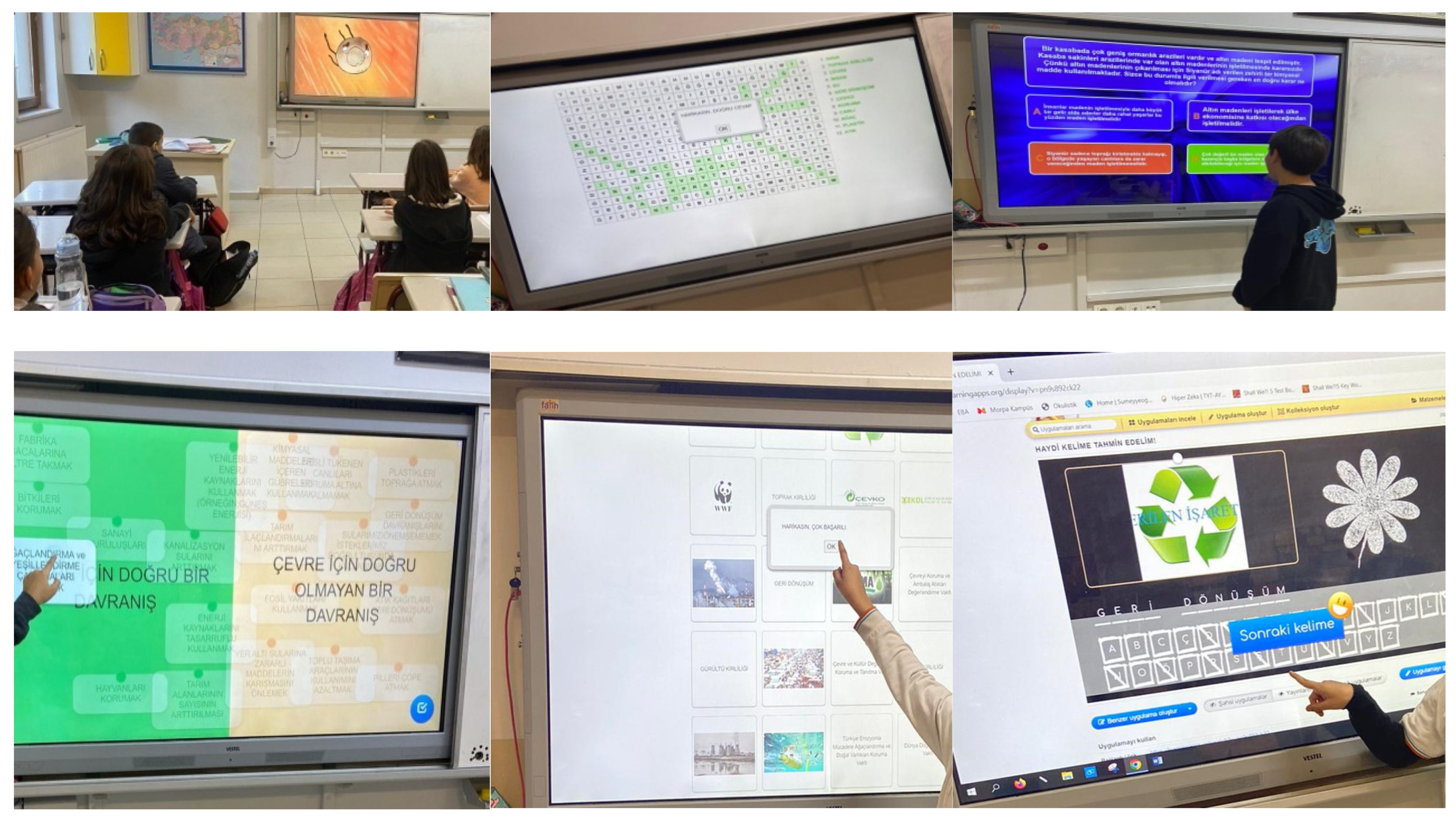

Table 1.
Implementation Process Steps Followed by Experimental Group Students.
| Lesson Hours | Application Process |
|---|---|
| 2 1 |
Pre-Test Measurements of the Knowledge Test and Scales Introduction and Trial of the Learning Apps |
| 1 | Evaluation of the Students’ Prior Knowledge |
| 1 | Watching the Video and Interpreting it through Discussion |
| 1 | Game Activity Introducing the Concepts Related to the Environment |
| 1 | Game Activity Explaining the Relation between Human and Environment |
| 2 | Game Activity for the Fundamental Environmental Problems |
| 2 | Game Activity for the Environmental Protection |
| 1 | Game Activity for the People’s Environmentally Friendly Behaviours |
| 1 | Game Activity for the Conservation of Biodiversity. |
| 3 | Interpreting the Reading Texts Selected for the Theme |
| 2 | Post-Test Measurements of the Knowledge Test and Scales |
| Total | 18 Lesson Hours |
Table 2.
Results of the Pre-Test Scores for the Knowledge Test.
| Groups | N | x̄ | Sd | df | t | ρ |
| Experimental | 27 | 12.40 | 2.253 |
52 |
1.849 |
.070 |
| Control | 27 | 11.18 | 2.590 |
Table 3.
Results of the Post-Test Scores for the Knowledge Test.
| Groups | N | x̄ | Sd | df | t | ρ |
| Experimental | 27 | 15.81 | 3.658 |
52 |
3.890 |
.000 |
| Control | 27 | 12.40 | 2.706 |
Table 4.
Scale Results of the Pre-Test Scores for the Environmentally Responsible Citizen Behaviour Scale.
Table 4.
Scale Results of the Pre-Test Scores for the Environmentally Responsible Citizen Behaviour Scale.
| Groups | N | x̄ | Sd | df | t | ρ |
| Experimental | 27 | 3.01 | .6690 |
52 |
.631 |
.531 |
| Control | 27 | 2.89 | .6723 |
Table 5.
Results of the Post-Test Scores for the Environmentally Responsible Citizen Behaviour Scale.
Table 5.
Results of the Post-Test Scores for the Environmentally Responsible Citizen Behaviour Scale.
| Groups | N | x̄ | Sd | df | t | ρ |
| Experimental | 27 | 4.00 | .9102 |
52 |
4.198 |
.000 |
| Control | 27 | 3.04 | .7643 |
Table 6.
Results of the Pre-Test Scores for the Digital Literacy Scale.
| Groups | N | x̄ | Sd | df | t | ρ |
| Experimental | 27 | 3.61 | .4751 | 52 | .723 | .473 |
| Control | 27 | 3.52 | .4194 |
Table 7.
Results of the Post-Test Scores for the Digital Literacy Scale.
| Groups | N | x̄ | Sd | df | t | ρ |
| Experimental | 27 | 4.20 | .6190 |
52 |
3.133 |
.003 |
| Control | 27 | 3.63 | .7214 |
Disclaimer/Publisher’s Note: The statements, opinions and data contained in all publications are solely those of the individual author(s) and contributor(s) and not of MDPI and/or the editor(s). MDPI and/or the editor(s) disclaim responsibility for any injury to people or property resulting from any ideas, methods, instructions or products referred to in the content. |
© 2024 by the authors. Licensee MDPI, Basel, Switzerland. This article is an open access article distributed under the terms and conditions of the Creative Commons Attribution (CC BY) license (http://creativecommons.org/licenses/by/4.0/).
Copyright: This open access article is published under a Creative Commons CC BY 4.0 license, which permit the free download, distribution, and reuse, provided that the author and preprint are cited in any reuse.


