
Submitted:
16 September 2024
Posted:
16 September 2024
You are already at the latest version
Abstract
For predicting the current status about the quality of drinking water in the Sindh province about 140 research articles in which drinking water had been analysed, were systematically reviewed. The literature disclosed that the drinking water particularly groundwater in Sindh province is not suitable for drinking purposes in more than 70-80% of the area. It was also revealed that the major contaminants that are found excessively high in the drinking water of Sindh province are EC, Cl, Mg, Ca, TDS, As, F, Zn, TH, Ni, and other heavy metals. Overall, in Sindh province the concentration of water quality parameters such as Cl, EC, TDS, TH, SO4, NO2, NO3, Mg, Ca, Zn, Pb, F, and Fe, are beyond permissible limit. pH is found within allowable limits in Sindh province and As is found beyond allowable limits in regions located nearer to river and coastal side of Arabian sea such as Badin, Thatta, and Karachi.Total and fecal coliform had also been reported in the groundwater of Sindh province and that’s why waterborne diseases are common in Sindh province. The major reason behind the degrading quality of drinking water in Sindh province is the mixing of sewage and seawater with groundwater and surface water. Therefore, it has been recommended that proper monitoring of seawater and sewage should be ensured so that safe water should be supplied to the consumer in Sindh province.
Keywords:
groundwater quality
; Sindh province
; WQI
; physicochemical parameter
1. Introduction
Water is an important source of survival for human beings. Water may be either groundwater or surface water; it is drinkable in both cases. Water is an element that greatly impacts the well-being of people as well as has a great effect on the economy of the country. Therefore, proper management of the quantity of water and maintenance of the quality of water specifically for drinking purposes is one of the challenges of the modern world. The quality of water was not as deteriorated as today in past decades. However, modern inventions, technologies, and industries have contributed to the contamination of drinking water. Moreover, anthropogenic activities such as over-extraction of groundwater, excessive cutting of trees, burgeoning population, urbanization, and improper disposal of sewage and solid waste materials are also responsible for the degeneration of the quality of water (Jamali et al. 2020).
Although the degeneration of the quality of drinking water is a global calamity, Pakistan is also one of the victims of bad-quality of drinking water (Jamali et al. 2023). Previous research has spelled out that waterborne diseases have caused the loss of precious lives in great numbers. World Health Organization also claims that 80-85% of diseases in the world are caused by low-standard drinking water. It is reported that about 40-50% of infectious diseases in Pakistan are due to bad quality of drinking water (Daud et al. 2017). Additionally, in the most recent research, it is investigated that around 2000 children have lost their lives because of consuming unsuitable drinking water (Nabi et al. 2019). According to Ilyas et al. 2019, only 20% population in Pakistan has access to fit drinking water while others bank on extremely contaminated or moderately contaminated water. This percentage further depends on the location of the province. It is estimated that about 41-45% of population in the urban areas have the facilities for safe drinking water, while in rural areas the value is limited to 7-8% only.
Most of the population in this province of Pakistan depends on groundwater resources for drinking purposes. Although groundwater is the most used drinking water resource in the Sindh province of Pakistan, this water is no longer portable for the population of Sindh province. This source of water is degraded due to anthropogenic activities and improper treatment of wastewater. It is investigated that around 80% of groundwater in Sindh is saline (Steenbergen et al. 2015).
Due to the variety of these pollutants variety of diseases are found in Sindh province of Pakistan. According to reports in 2018 the Director General of Health in Hyderabad received a report about the cases of severe stomach diseases broke due to the consumption of highly contaminated drinking water in the village of Mir Khan Otho, Nawabshah, Sindh province ( Khaskheli et al. 2018). Moreover, an increase in cholera cases due to bad quality of drinking water was also reported in 2022. It was reported that from January 2022 to May 2022 about 234 cholera cases were confirmed from reputable laboratories (Zeb et al. 2023). Moreover, Kumar et al. 2016 revealed that diseases such as gastro, diarrhea, typhoid, hepatitis, etc. have become common due to the degenerated quality of groundwater.
Therefore, this paper is intended to provide a detailed review of previous research done on the groundwater quality of the Sindh province of Pakistan in the last two decades. Groundwater is the focused of the review because about 60% population of Sindh province of Pakistan has been relying on the groundwater for drinking purposes. Although, in urban parts of Sindh water supply schemes are introduced and that are the sole source of water for consumption even in these parts of Sindh the whole population does not have access to safe water and water through water supply schemes. Therefore, people either unfit surface water or extremely contaminated groundwater. Thus, this study will provide details about the overall status of drinking water in the Sindh province of Pakistan.
2. Description of Sindh Province of Pakistan
The Sindh province shown in Figure 1 is the second most populated province of Pakistan. Sindh province is located between earth coordinates 26°21′N 68°51′E/26.350°N 68.850°E/26.350; 68.850. According Gallup Pakistan Analysis of Census 2023 total population of Sindh province was reported as 55.7 million people. The major source of drinking water in Sindh is groundwater.
Sindh province is divided into six divisions and thirty districts. Divisions of Sindh are named Hyderabad Division; Karachi Division; Larkana Division; Mirpur Khas Division; Shaheed Benazirabad Division; and Sukkur Division, and each division has more than three districts as shown in Figure 2.
3. Review Methods
In this study to predict the overall current status of drinking water quality in Sindh province of Pakistan, a rigorous review process of previous research carried out on the drinking water quality of all divisions and districts of Sindh province, was done as shown in Figure 3. This article explores the data on the drinking water quality of Sindh province including every source of water particularly groundwater. For this purpose, about 140 research articles that included almost all divisions and districts of Sindh province as shown in Table.1 were reviewed. For performing the literature search popular scientific literature databases such as Google Scholar, Scopus, Web of Science, Researchgate, and Science Direct websites were used. Keywords for the literature search were used such as groundwater sindh. It should also be noted that groundwater quality was also a keyword because it is the major source of drinking water in Sindh province. Articles written in the domestic language or published in national newspapers were taken into account. Research work was first searched based on the divisions and districts then it was compiled and categorized based on divisions and date of publication.
4. Discussions
A review of previous research work was done based on the divisions and districts. Therefore, data from each division along with their district and with a few subdivisions was tabulated and the method of water quality assessment, water quality parameters, and results were analyzed separately for each division of Sindh province. The results and data based on the each division are discussed one by one as following.
4.1. Hyderabad Division
Hyderabad division of Sindh province is found south-western part of Sindh and is divided into nine districts i.e Badin, Dadu Hyderabad, Jamshoro, Matiari, Sujawal, Thatta, Tando Allahyar, and Tando Muhammad Khan. So, the previous studies on the drinking water quality of these districts were focused and a literature search was carried out. Literature work was analysed systematically as shown in Table 1.
Ahmed et al. 2013 in their study on the drinking water quality of district Badin of Sindh province found that water quality parameters such as pH, EC (µS/cm), and TDS in the drinking water of Badin were within the range recommended values of the WHO. However, water was found to have contamination caused by fecal waste.
Mahessar et al. 2015, while studying the quality of drinking water in the coastal line of Badin district, it was disclosed that drinking was not suitable in most villages. It was concluded that in almost 77% of water, Turbidity was in the higher concentration; almost 49% of water depicted excessive concentration of TDS; in 46% of water samples higher values of chloride were detected; and in 20% and 54% of samples depicted higher values of SO4 and TH. Overall, water was found unsuitable based on the various physic-chemical water quality parameters. This was also confirmed by the study of Baloch et al. 2019, in which it was confirmed that almost 100% of water in Badin was contaminated with the excessive concentration of TDS, Ca, EC, Hardness, and other chemical parameters. Other parameters such as fluoride have also been reported beyond the permissible limits of the WHO in the district Badin of Hyderabad division (Talpur et al 2020).
Ali et al. 2008 revealed in their research that 50 % of the water they collected from the Dadu district exhibited a concentration of various physic-chemical parameters excessively higher than the recommended values of the WHO. The study also showed that the Arsenic (As) was also detected in more than 77% of samples, and water in taste was also saline. Baig et al. 2016 reported similar results and confirmed the presence of a higher quantity of Arsenic in the groundwater of the Dadu district of the Hyderabad division of Sindh province. It has been noted that not the whole groundwater in Dadu district is unfit for drinking but As the most dangerous contaminant is found in the groundwater of district Dadu. However, it is also essential to note that a limited number of studies have been carried out on the groundwater of Dadu district and no application of GIS, WQI, etc. have been employed yet.
Rahman et al. 2017 found that the EC, TDS, and Alkalinity in the drinking water of Hyderabad district were higher than the WHO values. It was further evaluated by Khokhar et al. 2023 in their research on the drinking water of district Hyderabad and found that drinking water of district Hyderabad is dangerous to consume due to higher concentrations of EC, TDS, TH, and Cl. It was concluded that about 65%, 83%, 62%, 77%, and 60% of water in district Hyderabad is contaminated by the higher quantity of EC, TDS, Alkalinity, TH, and Cl. Additionally, the contaminated index (Cd) indicated that about 75% of water in the Hyderabad district showed risks for human health and WQI confirmed that about 45% of samples fell in the poor to very poor water category. Khokhar et al. 2023, in another study, revealed that 94% of groundwater in district Hyderabad depicts higher values of TDS and Ca. Ni was found to exceed the WHO limit in 63% of the groundwater of district Hyderabad. Therefore, the water of district Hyderabad has been declared unsuitable for drinking purposes.
Baig et al. 2009 revealed that the values of As in the groundwater of Jamshoro were excessively higher than the prescribed values of the WHO. Memon et al. 2016 also assessed Arsenic availability in the groundwater of district Jamshoro and revealed that As was found higher than the allowable limit. In addition, in another study on Jamshoro, Memon et al. 2017 confirmed that As was excessively higher in the groundwater of Jamshoro, and water was also found polluted by heavy metals such as Co, Fe, Zn, lead, etc. Overall, studies have found that the groundwater of district Jamshoro is not safe to be consumed by human beings.
Dars et al. 2023 have revealed that in Matiari, the groundwater of district Matiari was salty to extremely salty water. In addition, Rind et al. 2024 revealed that in Matiari nearly 65% of water is polluted by excessive concentration of EC; 27% of water exhibited exceeding values of TDS; COD in 16% of samples were beyond the WHO values; and other parameters such as sodium, potassium, and fluoride, were also beyond the WHO limit. However, a limited number of studies have been done on the groundwater of district Matiari without the application of modern tools.
Memon et al. 2011 that all water-supplying bodies such as dug wells, water supply schemes, shallow pumps, and other sources depicted higher concentrations of various physic-chemical parameters such as turbidity, EC, TDS, Sodium, pH, Copper, zn, and other water quality parameters. Moreover, Solangi et al. 2019 revealed that based on the application of the WQI model it was found that about 55.32%, 22.34%, and 13.83% of water samples represented poor groundwater, very poor groundwater, and unsuitable groundwater for drinking purposes. Also, the SPI model depicted that 20.12%, 18.1%, and 15.95% of water samples represented moderately polluted groundwater, highly polluted groundwater, and unsuitable groundwater for drinking. Solangi et al. 2019 also disclosed that in the Thatta and Sujawal districts of the Hyderabad division of Sindh province, based on the (WQI), it had been detected that about 27.8%, 42.8%, and 26.6% of the water samples were poor, very poor, and unsuitable for human consumption, respectively. However, another model such as the synthetic pollution index (SPI), categorized groundwater of Thatta and Sujawal as 23.9%, 41.7%, and 29.4% as moderately polluted, highly polluted, and unsuitable water, respectively. It was also concluded that nearly 62% of the groundwater exhibited salty and bitter taste; Arsenic was also detected in 18% of samples; and about 89%, 67%, and 56% of the samples represented higher values of EC, Ca, and Mg in groundwater. Shar et al. 2020 also revealed that TDS, TH, and EC, were higher than the allowable limit in Sujawal, and As was also detected in samples.
Alamgir et al. 2016 that biological and physicochemical impurities have made the groundwater of Taluka Thatta not suitable for drinking purposes. Moreover, various studies have detected an increase in pollution groundwater year by year. For instance, Solangi et al. 2019 have found that almost all water quality parameters in the groundwater of district Thatta exceeded the WHO guidelines. The application of the WQI on the groundwater of district thatta divulged that 57%, 20%, and 15% of the samples collected from the groundwater of Thatta exhibited poor, very poor, and unsuitable drinking water respectively. Similarly, the SPI model detected that 55%, 19%, and 16% of groundwater in Thatta was moderately polluted, highly polluted, and unsuitable for drinking. Solang et al. 2019 in another study found that nearly 85%, 52%, 85%, 60%, and 20% of the water groundwater samples gathered from district Thatat depicted higher concentrations of TDS, Ca, Mg, TH and As respectively; and about 90% of water samples exhibited higher values of Cl as well. Majidano et al. 2011 revealed that about 94% of groundwater in Tando Allahyar depicted exceeding values of almost all physic-chemical parameters including EC, pH, TDS, Zn, Mn, Fe, etc. Mumtaz et al. 2017 during their study on Tandojam of Tando Muhammad Khan revealed that the quality of groundwater was worst in Muzaffrabad colony, Jam Ghar and Mir colony, which were located at the center of Tando Jam and was contaminated with higher TDS and had a salty taste. It was concluded that the TDS, EC, Ca, Mg, TH, Na, Cl, etc, Overall, groundwater in almost all districts of Hyderabad division is contaminated. The groundwater in districts such as Hyderabad, Jamshoro, Matiari, Tando Muhammad Khan, Tando Allahyar, and Dadu, is polluted by the mixing of sewage. While, the reason behind the pollution of groundwater in the coastal districts of Hyderabad division such as Badin, Thatta, and Sujawal, is the mixing of Seawater with groundwater.
4.2. Karachi Division
Karachi is the most populated division of the Sindh province of Pakistan with 20.3 million people according to census 2023. Karachi is also one of the metropolitan cities of Pakistan. It remained the capital of Pakistan after independence from 1947 to 1967. Although, most of the parts of Karachi rely on the water supply for drinking purposes, which has never been sufficient for meeting the demand of consumers; groundwater is also used in a few parts of Karachi. However, people face risks in consuming groundwater as well as surface water. Previous research work done on the driking water quality of Karachi division is shown Table.2.
Hasnie et al. 2004 during their study on the drinking water in the coastal village of Karachi found that 71% of the water was contaminated and was posing a threat to human health. Nadim et al. 2014, also revealed that in the few water supply schemes, water exhibited excessive concentration of the water quality parameters. Samo et al. 2017 also found that both surface water and groundwater in Karachi depicted the concentration of TDS and EC beyond the WHO limit. It was also found by Khan et al. 2018 that the groundwater of Gulistan-e-Johar in Karachi was not fit for human consumption and groundwater posed a dangerous threat to human health. The WQI value of groundwater was found to be 183 further endorsing that groundwater in Gulistan-e-Johar of Karai was unfit for drinking purposes.
Additionally, Samo et al. 2019 in their study on the drinking water in Malir Karachi found that around 70-80% of groundwater in Karachi was contaminated by the intrusion of sewage into groundwater, and E-Coli was found in higher concentration. Khan et al. 2020 also revealed that drinking water in the aquifers of Gulshan-e-Iqbal Karachi is completely contaminated. All samples gathered from Gulshan-e-Iqbal Karachi represented values of Ca, Mg, TDFS, TH, EC, and other heavy metals exceeding the WHO-recommended values. Moreover, Naqvi et al. 2020 concluded in their study that specifically thickly populated areas of Karachi were using extremely contaminated water, and excessive concentration of fluoride in those areas had been causing dental diseases for a long time. Razaq et al. 2020 also confirmed that around 60% of the water in South Karachi; 62% of the water in West Karachi; 46% of groundwater in east Karachi; 48% of the water in Malir; and 55% of the water in Central Karachi and Korangi; was extremely contaminated by microbiological impurities to be drunk. Arsenic in Karachi was also found beyond permissible value. In addition, Khan et al. 2023 also disclosed in their study that in Korangi the chemical impurities and biological impurities are found excessively high in drinking water.
Overall, groundwater in Karachi is not suitable for drinking purposes due to chemical and biological impurities. The reason behind contaminated water in Karachi is the mixing of sewage and Seawater with groundwater. However, not all the supply schemes are safe too. Therefore, proper monitoring of water supply schemes is also needed in every part of Karachi.
4.3. Larkana Division
Larkana division is located in the North-western part of Sindh province of Pakistan as shown in Figure 2 and has a border with the Indus River. Larkana is divided into four districts Jacobabad, Kambar Shahdad Kot, Kashmore, Shikarpur, and Larkana.
District Larkana is the largest district of the Larkana division. Groundwater quality of district Larkana is deteriorating day by day. Larkana is a division of Sindh province where only groundwater is the source of water supply, but this source is not pure anymore. A number of dangerous chemicals have been found in the groundwater of the Larkana division. Asghar et al. 2006 conducted research on the ten villages in Larkana for Arsenic concentration. The study disclosed that for about one in ten groundwater samples the concentration of As exceeded the value recommended by the WHO i.e. 10 parts per billion. Moreover, Jamali et al. 2020 in their lab analysis study on the groundwater of Taluka Larkana found that only pH was within the allowable limits and the remaining parameters studied such as Ca, Mg, TH, TDS, EC, and others were beyond permissible values. Overall, EC, TDS, and TH exceeded in about 84%, 85%, and 22% of the area respectively. Jamali et al. 2022 while conducting a detailed study on the groundwater of Taluka Larkana of district Larkana while making use of GIS and water quality models such as WQI, SPI, and PIG, concluded that groundwater in Larkana is not fit for drinking purposes. Studies revealed that in most parts of Taluka Larkana water is extremely salty and EC, Ca, TDS, Mg, and Cl exceeded in about 84%, 31%, 84%, 37%, and 21% of groundwater collected from Taluka Larkana. It was concluded based on the use of WQI, SPI, and PIG that 47%, 51%, and 50% of groundwater in Taluka Larkana ranged from very poor to unsuitable water respectively. Jamali et al. 2022 in another study on Larkana particularly on the groundwater of rural areas also revealed that in the western part of Larkana taluka the taste of 68% of samples collected from 17 villages was highly bitter and unfit for drinking. Overall, the results of the analysis summarized that about 100%, 88%, 72%, 68%, 60%, and 52% of the samples possessed concentrations of EC, TDS, Mg, Cl, Ca, TH, and SO4 higher than the allowable limits fixed by the WHO. Assessment of groundwater samples based on the SPI disclosed that 40%, 48%, 8%, and 4% of samples were highly contaminated, slightly contaminated, and moderately contaminated, respectively. The WQI value described that 12%, 36%, 40%, and 12% of the groundwater samples were found unfit for drinking, very poor for consumption, poor water, and good for health, respectively.
Moreover, Lanjwani et al. 2021 in a study on the groundwater of Taluka Dokri of district Larkana found that the groundwater in Taluka Dokri was fit for drinking purposes. The higher contamination was only found in the groundwater nearer to the Moen Jo Daro site. The groundwater nearer to the Moen Jo Daro site was found contaminated by excessive concentrations of TDS, Cl, and EC. It was confirmed by the use of the WQI that about 65% of groundwater in Taluka Dokri is safe to be drunk. However, Ahmed et al. 2022 revealed that in Dokri about 2.56% of the samples possessed color and odor beyond permissible limits, and about 23% of samples were unsuitable for drinking purposes due to the salinity of groundwater samples. Overall, 30.77%, 38.46%, 30.77%, 41%, 100%, and 38.46% of samples were unfit for human consumption based on the high concentration of Ca, Mg, TH, TDS, EC, and Cl respectively. Additionally, results of the analysis of groundwater samples-based SPI approach concluded that around 10.3% of samples were slightly polluted, 66.67% of samples were moderately polluted, and 23% of samples were highly polluted. Overall, the result showed that groundwater in UC Tatri, Baghi Bindi, and Wakro was slightly polluted; groundwater, in UC New Badah, old Badah, and Dokri was extremely polluted; and groundwater in remaining all union councils was moderately polluted, and in these UCs, water needed proper treatment before it is consumed by living beings. In another study Lanjwani et al. 2022 while conducting an analysis of groundwater of another taluka of district Larkana named Ratodero found that about 72% of groundwater in Ratodero was very poor and unfit for drinking purposes. The EC, TDS, Cl, and F were the contaminants that exceeded their allowable values of the WHO. Ahmed et al. 2022 carried out another study on the groundwater of Taluka Dokri in which they made use of the SPI model for an overall assessment of groundwater quality.
Kamber Shahdad Kot is another district of the Larkana division located on the west side of Larkana district. Pathan et al. 2018 have revealed that in the groundwater of district Kamber Shahdad Kot, the concentration of pH is within the recommended range. However, the concentration of Cl, EC, TDS, TH, and alkalinity is not within the safe limits as per the recommendations of the WHO. Further, Lanjwani et al. 2020 revealed that for groundwater of Kamber Shahdad Kot TDS exceeded the allowable limit of 1000 mg/l. It was further disclosed that the concentration of Cr, Pb, Ni, and fluoride exceeded in more than 50% of groundwater collected from district kamber Shahdad Kot. It was also confirmed by Lanjwani et al. 2022 in another study that in more than 80% of the groundwater of district Kamber Shahdad Kot the concentration of fluoride exceeded the allowable level of concentration and that was declared the main reason behind the diseases in the district kamber shahdad Kot of larkana division.
Sarfraz et al. 2018 has found that in districts Kashmore and Jacobabd drinking water was contaminated by the higher level of microbial contamination. It was found that nearly 70% of drinking water sites in districts Kashmore and Jacobabd have been contaminated by fecal and total coliform waste. Water quality parameters such as TH, Ca, Mg, Na, F, K, Zn, As, SO4, Cl, and TDS were also exceeding in more than 50% of the groundwater of district Kashmore and Jacobabd. Furthermore, Shahab et al. 2018 revealed that in Jacobabd where a water supply scheme is used for drinking water, the concentration of water quality characteristics such as EC, TH, and TDS, exceeded allowable levels of the WHO. In another study, Shar et al. 2021 revealed that in Garhi Khairo and Kahsmore, the concentration of As was found to exceed more than 70% of groundwater.
Groundwater quality of the Shikarpur district has been evaluated by Shahab et al. 2019 while conducting studies on the eighteen districts including Shikarpur and it was revealed that in Shikarpur, TDS, EC, and TH concentrations were found beyond permissible limits.
It has been found that groundwater in district Larkana is extremely contaminated, particularly in Taluka Larkana, and groundwater in other Talukas such as Ratodero and Dokri is also declining. Drinking water quality in district Kamber Shahdad Kot of Larkana division is also not safe for human health. Further, the drinking water quality of Jacobabad, Kahsmore, and Shikarpur has been reported unfit for drinking by a limited number of scholars. Therefore, an extensive study on the drinking water quality of these districts particularly for Shikarpur is required.
4.4. Mirpur Khas Division
The groundwater of the Mirpurkhas district of the division of Mirpurkhas of Sindh province of Pakistan has also been reported contaminated by various factors. Asghar et al. 2006 did a comprehensive lab analysis of groundwater samples collected from seven villages in Mirpur Khas and ten villages in Larkana district. The study found that in all the study areas of Mirpurkhas, arsenic concentration was found below the maximum permissible limit as recommended by the World Health Organization (WHO). However, Memon et al. 2016 in their study on the groundwater of Taluka Drighri of Mirpur Khas district, found that the groundwater of Taluka Drighrii was unfit for drinking due to lack of safe disposal of sewage and solid waste, and due to prolonged solid disposal sites. It was found that in Taluka Drighri of Mirpur Khas district, 53% of water was saline because the concentration of water quality parameters such as EC, TDS, and CL was exceeding the allowable limit of the WHO The level of arsenic was also found to be excessively higher than the WHO suggested values. Khan et al. 2018 reported similar results in their study and concluded that EC and TDS exceeded the WHO limit in the district Mirpur Khas of MirpurKhas division of Sindh province of Pakistan
It has been noted that many diseases in Tharparkar are associated with the bad quality of drinking water. It has been found by Memon et al. 2011 in their study on the Thatta, Badin, and Tharparkar that all water quality parameters such as TDS, EC, Hardness, and even fecal coliform in drinking water Tharparkar exceeded allowable limits. Rashid et al. 2012 also divulged that more than 75% of drinking water in Tharparkar had higher concentrations of EC, As, TDS, TH, and other heavy metals. The presence of As in the drinking water of Tharparkar was also indicated by Barhman et al. 2016 in their analysis. Bhatti et al. 2018 carried out an analysis of drinking water in the Nagarparkar part of Tharparkar and concluded based on the use of WQI that 20% of water was very poor water quality and 30% of the water in Nagarparkar was unsuitable for drinking purposes. The contaminants that exceeded the allowable limits of the WHO included 83% of water that had EC and TDS above 400 µS/cm and 1000 mg/l respectively. Moreover, Khuhawar et al. 2019 investigated about 2193 dug wells in the Tharparkar for drinking purposes and revealed that about 71% of dug wells exhibited a concentration of TDS beyond 1000 mg/l allowable limit fixed by the WHO; and chloride, sulfate, Arsenic (As), and fluoride was also beyond allowable limits. Jakhrani et al. 2019 also confirmed that in the drinking water of the Tharparkar district of MirpurKhas division, the EC and TDS were excessively beyond the WHO allowable values.
Additionally, when Bhatti et al. 2020 checked the impact of the dam site on the groundwater quality of the Tharparkar district of the MirpurKhas division; it was found that the concentration of pH, SO4, Fe, CU, Mn, Zn, As, and fluoride exceeded allowable limit in about 60% of groundwater. Further, the use of the WQI concluded that 40% of groundwater became very poor to unsuitable for drinking due to the dam site. Kumar et al. 2020 also found that almost 100% of water-dug wells in the Tharparkar district of the MirpurKhas division are contaminated with excessive concentrations of TDS, EC, pH, As, and other metals. The application of the WQI also indicated that the drinking water in Tharparkar is in the range between very poor to unsuitable water. Similar results were also reported by Meghwar et al. 2021.
Overall, the literature review reveals that drinking water in the Tharparkar district of MirpurKhas division is unsuitable for drinking due to exceeding presence of TH, TDS, EC, As, Cl, Ca, Mg, fecal coliform, and other impurities. Although a little research work has been done on the quality of drinking water of districts MirpurKhas and Umerkot, water in these districts has also been reported as not suitable for drinking.
4.5. Shaheed Benazirabad Division
The Shaheed Benazirabad division is divided into three major districts Shaheed Benazirabad district, Sanghar, and Naushahro Feroze district. Literature regarding the drinking water quality of each district is listed is analysed based on these research works.
Literature reveals that a very limited study on the groundwater of Naushahro Feroz has been done. However, these studies such as Akram et al. 2020 have revealed that in Naushahro Feroz various water quality parameters such as pH, Cl, EC, TDS, DO, and COD are within allowable limits. On the contrary, Shahb et al. 2019 have revealed that, although TH, pH, and Cl Naushahro Feroz were within the allowable limit of the WHO, EC and TDS exceeded the WHO limits. However, in none of these any numerical model such as WQI or SPI used, so, the accurate depiction of groundwater quality in district Naushahro Feroz has not been achieved yet.
According to Erum et al. 2017 only sodium and potassium in the drinking water of Sanghar exceeded the allowable limit of the WHO. However, Ullah et al. 2021 revealed in another study in which the Entropy Water Quality Index (EWQI) was also employed that 28% of groundwater in Sanghar represented poor water, and 18% represented unfit drinking water. Arsenic was also found to exceed the WHO limit. Mahara et al. 2022 in their broad detailed study of all Talukas of district Sanghar found that in three Talukas of district Sanghar Arsenic had been found; Taluka Jam Nawaz Ali depicted about 71% of water having TDS beyond the WHO limits.
Analysis of drinking water in the district of Shaheed Benazir Abad has also been conducted by various scholars. Majidano et al. 2008 during their study on the drinking water of district Shaheed Benazir Abad it was disclosed that around 80% of water in the Shaheed Benazir Abad was found highly polluted due to the higher values of TDS, Cl, DO, NO2, NO3, Ca, and Mg. Majidano et al. 2010 also evinced that in the Daur part of Shaheed Benazir Abad, about 73% of groundwater depicted higher concentrations of water quality parameters such as pH, EC, TDS, TH, Mg, Ca, Cl, SO4, Zn, Pb, Overall, about 74% of drinking water in Daur part of Shaheed Benazir Abad was unsuitable for drinking purposes. In another research study, Kandhro et al. 2015 evinced that 70% of water in Shaheed Benazir Abad was unsuitable for human consumption because the majority of sites had been excessively contaminated by toxic metals. It was found that even out of 60 water supply schemes only 4 represented good quality water and in the remaining 56 water supply schemes water quality parameters were beyond the WHO limits. Kandhro et al. 2019 also confirmed that about 60% of groundwater in Shaheed Benazir Abad is extremely unsuitable for drinking. Further, Shah et al. 2019 in another research work while analyzing drinking water quality in nineteen districts of Sindh province including Nawabshah/Shaheed Benazir Abad concluded that water in Shaheed Benazir Abad was unfit for drinking due to the exceeding concentration of TDS, Cl, EC, and NO2, NO3, Ca, and Mg hardness. DO, NO, NO3, Ca, and Mg. Akhtar et al. 2021 also found that TDS, TH, Ca, and EC in the water of Shaheed Benazir Abad exceeded allowable limits.
Overall, it was revealed that in Shaheed Benazir Abad division, the drinking water of district Shaheed Benazir Abad is polluted by TDS, EC, TH, Ca, Mg, and other water quality parameters. Arsenic had also been found in the Sanghar district of division Shaheed Benazir Abad. Very limited work has been conducted on the drinking water of Naushahro Feroz, therefore, a detailed study based on the GIS, WQI, or SPI is needed to be conducted on the drinking water quality of Naushahro Feroz and other parts of Shaheed Benazir Abad division.
4.6. Sukkur Division
Sukkur division is one of the largest divisions of Sindh province and is divided in district Sukkur, Khairpur Mir’s and Ghotki and Khairpur. Baig et al. 2011 revealed that in Thari Mirwah part of Khairpur Mir's water was contaminated by Arsenic, which is the most dangerous pollutant causing cancer in human beings.
Further Shar et al. 2014 revealed that in the Thari Mirwah part of Kkhairpur Mir, about 60-70% of drinking water is unfit for drinking due to the value of EC, TDS, TH, Cl, and other heavy metals being beyond permissible limits of the WHO. Ali et al. 2015 found that in the Ranipur part of Khairpur Mirs, about 50% of water exhibited a concentration of EC above the allowable limit fixed by the WHO. It was also further confirmed by Majidano et al. 2017 that in the groundwater of Khairpur Mir’s the EC was found to exceed the 400 µS/cm recommended values of the WHO. It was found that in the Thari Mirwah and Kotdiji areas of Khairpur Mir’s the values of EC exceeded 3480 µS/cm and TDS was also found excessively high in these areas. Furthermore, Khan et al. 2018 while analyzing the drinking water quality of thirteen different districts of the Sindh province of Pakistan including Ghotki and Khairpur Mir’s districts of Sukkur division that the groundwater in these districts is excessively contaminated by the higher values of Cl, TH, EC, and TDS. Qasim et al. 2018 during their study on the evaluation of the presence of Arsenic in the groundwater of Khairpur Mir’s revealed that arsenic was excessively available in groundwater and it was about thirteen times higher than the level fixed by the WHO. Additionally, Ansari et al. 2021 while conducting a study on the drinking water quality of district Sukkur using the WQI model found that about 46% of groundwater ranged from very poor to unsuitable water. Groundwater in Sukkur was found contaminated by the higher concentration of EC, TDS, TH, Cl, Ca, Mg, and SO4 was found in Sukkur.
Overall, in Sindh province the concentration of water quality parameters such as Cl, EC, TDS, TH, SO4, NO2, NO3, Mg, Ca, Zn, Pb, F, and Fe, are beyond permissible limit. pH is found within allowable limits in Sindh province and As is found beyond allowable limits in regions located nearer to river and coastal side of Arabian sea such as Badin, Thatta, etc. Major contaminants and causes of contaminants are shown in Table.1

Table 1.
Major Contaminants and causes of contaminations.
| Rank | Major Contaminant beyond allowable limits | Major Cause |
|---|---|---|
| 1 | As (Arsenic) | Seawater intrusion |
| 2 | TH (Total Hardness) | Flood and sewage water mixing |
| 3 | TDS (Total dissolved Solids) | Sewage mixing; leachates; Fertilizers |
| 4 | Cl (Chloride) | Sewage mixing; leachates; Fertilizers |
| 5 | EC (Electrical Conductivity) | Sewage mixing; leachateste; Fertilizers |
| 6 | Ca (Calcium) | Degradation of rocks |
| 7 | Mg (Magnesium) | Degradation of rocks |
| 8 | E-Coli | Fecal waste; Sewage mixing |
5. Conclusions
Water is the life for human beings and other living organisms. However, water is also responsible for the most dangerous diseases among human beings. When water flows on the surface it comes in contact with a variety of minerals that get dissolved into water, but, not all dissolved in water are good for human health. Dangerous chemicals such as Arsenic (As) if available in water, they make water extremely polluted and are responsible for chronic diseases such as Cancer. Moreover, other hazardous chemicals such as fecal waste, SO4, Total Hardness (TH), Total Dissolved Solids (TDS), Calcium (Ca), Chloride (Cl), electrical conductivity (EC), and all such heavy metals are responsible for degrading the quality of drinking water throughout the world. The drinking water in the Sindh province of Pakistan is also affected by the excessive presence of such dangerous chemicals. Overall, from the systematic review of literature it has been found thatin more than 60-70% of the area in Sindh province does not have excellent quality of drinking water. The major contaminants that are found excessively high in the groundwater of Sindh province are EC, Cl, Mg, Ca, TDS, As, F, Zn, TH, Ni, and other heavy metals. Total and fecal coliform have also been found in the groundwater of Sindh province. The major reason behind the degrading quality of drinking water in Sindh province is the mixing of sewage and seawater with groundwater. Therefore, it has been recommended that proper monitoring of seawater and sewage should be carried out.
References
- Ahmed, J.; Wong, L.P.; Chua, Y.P.; Channa, N. Drinking Water Quality Mapping Using Water Quality Index and Geospatial Analysis in Primary Schools of Pakistan. Water 2020, 12, 3382. [CrossRef]
- Ahmed, S., Jamali, M. Z., Khoso, S., Azeem, F., & Ansari, A. A. (2022). ASSESSMENT OF GROUNDWATER QUALITY IN RURAL AREAS OF TALUKA DOKRI, SINDH, PAKISTAN, THROUGH PHYSICOCHEMICAL PARAMETERS. International Journal of Energy, Environment and Economics, 30(3), 211-226.
- Akram, P., Solangi, G. S., Shehzad, F. R., & Ahmed, A. (2020). Groundwater Quality Assessment using a Water Quality Index (WQI) in Nine Major Cities of Sindh, Pakistan. International Journal of Research in Environmental Science (IJRES), 6(3), 18-26.
- Alamgir, A.; Khan, M.A.; Schilling, J.; Shaukat, S.S.; Shahab, S. Assessment of groundwater quality in the coastal area of Sindh province, Pakistan. Environ. Monit. Assess. 2016, 188, 1–13. [CrossRef]
- Ali, Z. M., Bhatti, Z. A., Mukwana, K. C., & Tunio, M. M. (2015). GROUND WATER QUALITY OF KHAIRPUR MIR’S SINDH: A CASE STUDY. ENGINEERING, SCIENCE & TECHNOLOGY, 69.
- Ali, I., Ahmed, S., Khoso, S., Sohu, S., & Naqash, M. T. (2022). Environmental Impact Assessment on Shear Strength Characteristics of Soil. International Journal of Energy, Environment and Economics, 30(1), 109-122.
- Ansari, M.H.; Solangi, G.S.; Bhatti, N.B.; Akram, P.; Panhwar, S.U.D.; Shah, F.A.; Ansari, S. An Integrated Indexical Assessment of Groundwater Quality of Sukkur City, Pakistan. Int. J. Econ. Energy Environ. 2021, 6, 91. [CrossRef]
- Arain, G.M.; Sattar, N.; Khatoon, S.; Mustaquim, J. Assessment of Groundwater Quality of Taluka Bulri Shah Karim, District Tando Muhammad Khan, Sindh, Pakistan. Int. J. Econ. Environ. Geol. 2024, 14, 9–19. [CrossRef]
- Asghar, U., Perveen, F., Alvi, S. K., Khan, F. A., Siddqui, I., & Usmani, T. H. (2006). Contamination of arsenic in public water supply schemes of Larkana and Mirpurkhas Districts of Sind. JOURNAL-CHEMICAL SOCIETY OF PAKISTAN, 28(2), 130.
- Baig, J.A.; Kazi, T.G.; Mustafa, M.A.; Solangi, I.B.; Mughal, M.J.; Afridi, H.I. Arsenic Exposure in Children through Drinking Water in Different Districts of Sindh, Pakistan. Biol. Trace Element Res. 2016, 173, 35–46. [CrossRef]
- Baig, J.A.; Kazi, T.G.; Shah, A.Q.; Afridi, H.I.; Khan, S.; Kolachi, N.F.; Kandhro, G.A.; Wadhwa, S.K.; Shah, F. Evaluation of Toxic Risk Assessment of Arsenic in Male Subjects Through Drinking Water in Southern Sindh Pakistan. Biol. Trace Element Res. 2010, 143, 772–786. [CrossRef]
- Bhatti, N.B.; Siyal, A.A.; Qureshi, A.L.; Solangi, G.S.; Memon, N.A.; Bhatti, I.A. Impact of small dam’s construction on groundwater quality and level using water quality index (WQI) and GIS: Nagarparkar area of Sindh, Pakistan. Hum. Ecol. Risk Assessment: Int. J. 2019, 26, 2586–2607. [CrossRef]
- Baloch, S., Chang, F. K., Hafeez-ur-Rehman Mangio, M. S., & Ismail, M. (2019). Deterioration of Ground Water Quality through Seawater Intrusion in Coastal Area of District Badin Sindh Pakistan. International Journal of Environmental Sciences & Natural Resources, 20(5), 148-157.
- Brahman, K.D.; Kazi, T.G.; Afridi, H.I.; Arain, S.S.; Kazi, A.G.; Talpur, F.N.; Baig, J.A.; Panhwar, A.H.; Arain, M.S.; Ali, J.; et al. Toxic Risk Assessment of Arsenic in Males Through Drinking Water in Tharparkar Region of Sindh, Pakistan. Biol. Trace Element Res. 2015, 172, 61–71. [CrossRef]
- Dars, R.; Qureshi, A.L.; Jamali, M.A.; Memon, H.A.S.; Kori, S.M.; Oad, S. Subsurface groundwater aquifer mapping and quality characterization in Matiari district, Sindh, Pakistan. Environ. Monit. Assess. 2022, 195, 1–17. [CrossRef]
- Daud, M.K.; Nafees, M.; Ali, S.; Rizwan, M.; Bajwa, R.A.; Shakoor, M.B.; Arshad, M.U.; Chatha, S.A.S.; Deeba, F.; Murad, W.; et al. Drinking Water Quality Status and Contamination in Pakistan. BioMed Res. Int. 2017, 2017, 1–18. [CrossRef]
- Bashir, E.; Huda, S.N.-U.; Naseem, S.; Hamza, S.; Kaleem, M. Geochemistry and quality parameters of dug and tube well water of Khipro, District Sanghar, Sindh, Pakistan. Appl. Water Sci. 2015, 7, 1645–1655. [CrossRef]
- Hasnie, F. R., & Qureshi, N. A. (2004). Assessment of drinking water quality of a coastal village of Karachi. Biological Sciences-PJSIR, 47(5), 370-375.
- Ilyas, M.; Ahmad, W.; Khan, H.; Yousaf, S.; Yasir, M.; Khan, A. Environmental and health impacts of industrial wastewater effluents in Pakistan: a review. Rev. Environ. Heal. 2019, 34, 171–186. [CrossRef]
- Imad, H.U.; Sanjrani, R.A.; Hassan, S.; Solangi, S.; Sanjrani, G.S. Assessment of water quality parameters due to longitudinal salinity inundation at Indus Delta: a case study of Kharo Chan, District Sujawal. Discov. Water 2024, 4, 1–11. [CrossRef]
- Jakhrani, S. H., Soni, H. L., & Shar, N. Z. (2019). Analysis of Total Dissolved Solids and Electrical Conductivity in Different Water Supply Schemes of Taluka Chachro, District Tharparkar. Quaid-E-Awam University Research Journal of Engineering, Science & Technology, Nawabshah., 17(01), 1-5.
- Jamali, M. Z., et al. "Assessing and mapping the groundwater quality of Taluka Larkana, Sindh, Pakistan, using water quality indices and geospatial tools." International Journal of Environmental Science and Technology 20.8 (2023): 8849-8862.
- Jamali, M. Z., Solangi, G. S., & Keerio, M. A. (2020). Assessment of Groundwater Quality of Taluka Larkana, Sindh, Pakistan. International Journal of Scientific & Engineering Research, 11(5), 795-797.
- Jamali, M. Z., Khoso, S., Soomro, Z., Sohu, S., & Abro, A. F. (2022). EVALUATING THE SUITABILITY OF GROUNDWATER IN PAKISTAN: AN ANALYSIS OF WATER QUALITY USING SYNTHETIC POLLUTION INDEX (SPI) AND WATER QUALITY INDEX (WQI). International Journal of Energy, Environment and Economics, 30(3), 311-328.
- Jamali, M.A.; Markhand, A.H.; Kumar, D.; Arain, A.Y.W.; Mahar, M.H. The investigation of heavy metal concentration through GIS-based approach from groundwater of Umerkot city, Sindh, Pakistan. Arab. J. Geosci. 2023, 16, 1–15. [CrossRef]
- Kandhro, A. J., Rind, A. M., Mastoi, A. A., Almani, K. F., Meghwar, S., Laghari, M. A., & Rajpout, M. S. (2015). Physico-chemical assessment of surface and ground water for drinking purpose in Nawabshah city, Sindh, Pakistan. Am J Environ Prot, 4(1), 62-69.
- Kandhro, A. J., Soomro, A. M., Khaskheli, M. S., Qureshi, M. A., Yousfani, N. A., Samoon, N. A., & Chandio, A. M. (2019). A Base Line Survey on the Status of Quality of Drinking Water Resources and Its Contaminants of theDistrict Shaheed Benazirabad, Sindh, Pakistan. Journal of Peoples University of Medical & Health Sciences Nawabshah.(JPUMHS), 9(1), 15-25.
- Khan, M.; Chaudhry, M.N. Role of and challenges to environmental impact assessment proponents in Pakistan. Environ. Impact Assess. Rev. 2021, 90, 106606. [CrossRef]
- Khan, A., Husain, V., & Bakhtiari, A. E. (2017). Groundwater arsenic contamination in shallow alluvial aquifers of Bhulri Shah Karim taluka, Tando Muhammad Khan district, Sindh, Pakistan. International Journal of Ground Sediment & Water, 5, 217-244.
- Khan, A.; Khan, M.A. Groundwater Quality Assessment for Drinking Purpose in Gulistan-e-Johar Town, Karachi, Pakistan. J. Geosci. Eng. Environ. Technol. 2018, 3, 200–207. [CrossRef]
- Khan, A. F., Abbasi, H. N., Nasir, M. I., & Ahmad, W. (2023). Study on Chemical Investigations of Drinking Water Eminence of Diverse Textile Industries in Korangi Industrial Area Karachi, Sindh, Pakistan. Pakistan Journal of Scientific & Industrial Research Series A: Physical Sciences, 66(3), 244-248.
- Khan, O.S.; Sohu, S.; Jamali, M.Z.; Ahmed, S.; Nagapan, S. Improving mechanical properties of concrete by using fibrous materials. Eng. Solid Mech. 2024, 12, 437–446. [CrossRef]
- Khaskheli, A.; Masood, N. Outbreak Investigation on Acute Watery Diarrhea in Village Mir Khan Otho, District Shaheed Benazirabad, Sindh Pakistan, 2017. Iproceedings 2018, 4, e10581. [CrossRef]
- Khokhar, L.A.K.; Khuhawar, M.Y.; Khuhawar, T.M.J.; Lanjwani, M.F.; Arain, G.M.; Khokhar, F.M.; Khaskheli, M.I. Spatial variability and hydrochemical quality of groundwater of Hyderabad Rural, Sindh, Pakistan. Sustain. Water Resour. Manag. 2023, 9, 1–18. [CrossRef]
- Khuhawar, M. Y., H. Ursani, T. M. J. Khuahwar, M. F. Lanjwani, and A. A. Mahessar. "Assessment of water quality of groundwater of Thar Desert, Sindh." Pakistan. J Hydrogeol Hydrol Eng 7 2 (2019): 2.
- Kumar, L.; Kumari, R.; Kumar, A.; Tunio, I.A.; Sassanelli, C. Water Quality Assessment and Monitoring in Pakistan: A Comprehensive Review. Sustainability 2023, 15, 6246. [CrossRef]
- Kumar P, Kumar M, Ramanathan AL, Tsujimura M (2010) Tracing the factors responsible for arsenic enrichment in groundwater of the middle Gangetic Plain, India: a source identifcation perspective. Environ Geochem Health 32:129–146.
- Kumar, N.; Mahessar, A.A.; Memon, S.A.; Ansari, K.; Qureshi, A.L. Impact Assessment of Groundwater Quality using WQI and Geospatial tools: A Case Study of Islamkot, Tharparkar, Pakistan. Eng. Technol. Appl. Sci. Res. 2020, 10, 5288–5294. [CrossRef]
- Lanjwani, M.F.; Khuhawar, M.Y.; Khuhawar, T.M.J. Assessment of groundwater quality for drinking and irrigation uses in taluka Ratodero, district Larkana, Sindh, Pakistan. Int. J. Environ. Anal. Chem. 2020, 102, 4134–4157. [CrossRef]
- Lanjwani, M. F., Khuhawar, M. Y., Jahangir Khuhawar, T. M., Lanjwani, A. H., & Soomro, W. A. (2023). Evaluation of hydrochemistry of the Dokri groundwater, including historical site Mohenjo-Daro, Sindh, Pakistan. International Journal of Environmental Analytical Chemistry, 103(8), 1892-1916.
- Lanjwani, M.F.; Khuhawar, M.Y.; Khuhawar, T.M.J.; Lanjwani, A.H.; Jagirani, M.S.; Kori, A.H.; Rind, I.K.; Khuhawar, A.H.; Dodo, J.M. Risk assessment of heavy metals and salts for human and irrigation consumption of groundwater in Qambar city: a case study. Geol. Ecol. Landscapes 2019, 4, 23–39. [CrossRef]
- Lanjwani, M.F.; Khuhawar, M.Y.; Lanjwani, A.H.; Khuahwar, T.M.J.; Samtio, M.S.; Rind, I.K.; Soomro, W.A.; Khokhar, L.A.; Channa, F.A. Spatial variability and risk assessment of metals in groundwater of district Kamber-Shahdadkot, Sindh, Pakistan. Groundw. Sustain. Dev. 2022, 18. [CrossRef]
- Lanjwani, M.F.; Khuhawar, M.Y.; Khuhawar, T.M.J. Groundwater quality assessment of Shahdadkot, Qubo Saeed Khan and Sijawal Junejo Talukas of District Qambar Shahdadkot, Sindh. Appl. Water Sci. 2019, 10, 26. [CrossRef]
- Lashari, B., McKay, J. M., & Villholth, K. (2007). Institutional and legal groundwater management framework: Lessons learnt from South Australia for Pakistan. Lashari, Bakhshal, McKay, Jennifer, Villholth, Karen (2007)'Institutional and legal groundwater management framework: lessons learnt from South Australia for Pakistan', International journal of environment and development, 4(1), 45-59.
- Mahara, G. N., Koraib, M. S., Unarc, I. N., & Channad, N. (2022). Identification and mapping of ground water contamination site of district Sanghar.
- Mahessar, A. A., Memon, N. A., Leghari, M. E. H., Qureshi, A. L., & Arain, G. M. (2015). Assessment of source and quality of drinking water in coastal area of Badin, Sindh, Pakistan. IOSR Journal of Environmental Science, Toxicology and Food Technology, 9(1), 9-15.
- Majidano, S. A., Arain, G. M., Bajaj, D. R., Iqbal, P., & Khuhawar, M. Y. (2010). Assessment of groundwater quality with focus on arsenic contents and consequences. Case study of Tando Allahyar District in Sindh Province. Intl J Chem & Environ Eng, 1(2).
- Majidano, S. A., Khuhawar, M. Y., & Channar, A. H. (2010). Quality assessment of surface and groundwater of Taluka Daur, district Nawabshah, Sindh, Pakistan. Journal of the Chemical Society of Pakistan, 32(6), 745.
- Majidano, S. A., Majidano, A. S. G. H. A. R. A. L. I., & Khuhawar, M. Y. (2008). Physico-chemical study of surface and ground water of Taluka Nawabshah, District Nawabshah, Sindh, Pakistan. Journal of the Chemical Society of Pakistan, 30(6), 951.
- Majidano, A.A.; Khan, S.; Sodhokhoso, N.A.; Memon, S.; Qurshi, S. Physicochemical study of drinking water of talukaMirwah and KotDiji from District Khairpur Mir’s. SINDH Univ. Res. J. -SCIENCE Ser. 2017, 49, 499–504. [CrossRef]
- Meghwar, P.; Shaikh, S.A.; Hussain, B.; Saleem, N.; Shar, P.A.; Depar, A.A. Assessment of quality parameters of underground drinking water from Diplo Area of Sindh. Sci. Inq. Rev. 2021, 5. [CrossRef]
- Meghwar, P.; Shaikh, S.A.; Hussain, B.; Saleem, N.; Shar, P.A.; Depar, A.A. Assessment of Groundwater Quality: A Sample Study of Selective Drinking Water Sources in Diplo Area of Sindh. Sci. Inq. Rev. 2021, 5, 27–40. [CrossRef]
- Memon, A. H., Ghanghro, A. B., Jahangir, T. M., Lund, G. M., Sahito, K., Abro, H. A., & Arain, S. R. (2016). Physicochemical Properties and Health Impacts of Flood and Post Flood on Drinking Water of Indus River System of Jamshoro, Sindh. Sci Lett, 4(3), 193.
- Memon, A. H., Ghanghro, A. B., Jahangir, T. M., & Lund, G. M. (2016). Arsenic contamination in drinking water of district Jamshoro, Sindh, Pakistan. Biomed Lett, 2(1), 31-37.
- Memon, Amjad Hussain, Gul Muneer Lund, Naseem Aslam Channa, Muhammad Younis, Sajjad Ali, and Fahim Buriro Shah. "Analytical Study of Drinking Water Quality Sources of Dighri Sub-division of Sindh, Pakistan." (2016).
- Memona, A. H., Ghanghrob, A. B., Jahangirc, T. M., Khandd, A. A., & Muneer, G. (2017). Health risk assessment of trace metals during pre-and post-monsoon seasons in drinking water of Jamshoro, Sindh.
- Memon, M.; Soomro, M.S.; Akhtar, M.S.; Memon, K.S. Drinking water quality assessment in Southern Sindh (Pakistan). Environ. Monit. Assess. 2010, 177, 39–50. [CrossRef]
- Mosley, L.M. Drought impacts on the water quality of freshwater systems; review and integration. Earth-Science Rev. 2015, 140, 203–214. [CrossRef]
- Nabi, G.; Ali, M.; Khan, S.; Kumar, S. The crisis of water shortage and pollution in Pakistan: risk to public health, biodiversity, and ecosystem. Environ. Sci. Pollut. Res. 2019, 26, 10443–10445. [CrossRef]
- Nadeem, S. M. S., & Saeed, R. E. H. A. N. A. (2014). Determination of water quality parameters of water supply in different areas of Karachi city. European Academic Research, 1(12), 6030-6050.
- Naqvi, S.T.S.; Memon, A.H.; Zafar, M.U.; Hussain, M.T.; Jaffery, I. Physico-Chemical Assessment of Drinking Water Available to the Inhabitants of Low Income and Thickly Populated Areas of Karachi City. 2020, 11, 1-10. [CrossRef]
- Panhwar, A., Kandhro, A., Jalbani, N., Faryal, K., Mirjat, M. S., Jhatial, G. H., & Qaiser, S. (2019). Assessment of groundwater quality affected by open dumping site in Hyderabad, Pakistan. International Journal of Environmental Chemistry, 5(1), 49-59.
- Pathan, M. A., Lashari, R. A., & Maira, M. (2018). Physical and chemical contamination studies of drinking water in the vicinity of Jamshoro area (Jetharo Village) Sindh, Pakistan. International Journal of Engineering Science, 17985.
- Pathan, A.M.; Mastoi, G.M.; Qureshi, M.A.; Pirzada, A.M.; Brohi, K.M.; Khurshid, O.; Almani, K.F.; Siddique, S. Physico-chemical studies of groundwater quality in Shahdadkot City and its suitability for drinking purpose: A case study for clean water security. SINDH Univ. Res. J. -SCIENCE Ser. 2018, 50, 491–494. [CrossRef]
- Qasim, M., & Ali Jakhrani, M. (2018). Physicochemical and elemental contamination assessment in groundwater samples of Khairpur Mir's, Pakistan. Human and Ecological Risk Assessment: An International Journal, 24(4), 870-885.
- Rashid, U., Alvi, S. K., Perveen, F., Khan, F. A., Bhutto, S., Siddiqui, I., ... & Usmani, T. H. (2012). Metal contents in the ground waters of Tharparkar district, Sindh, Pakistan, with special focus on arsenic. Pakistan Journal of Scientific & Industrial Research Series A: Physical Sciences, 55(1), 49-56.
- Razali, A.; Ismail, S.N.S.; Awang, S.; Praveena, S.M.; Abidin, E.Z. Land use change in highland area and its impact on river water quality: a review of case studies in Malaysia. Ecol. Process. 2018, 7, 19. [CrossRef]
- RAHMAN, A. A. U., SIDDIQUI, M. I., GHANGHRO, I. H., & CHANNA, M. J. OCCURRENCE OF MICROBIAL AND CHEMICAL CAUSATIVE AGENTS IN DRINKING WATER SOURCES OF DISTRICT HYDERABAD, SINDH PAKISTAN.
- RAHMAN, A. A. U., SIDDIQUI, M. I., & HUSSAIN, I. (2017). PREVALENCE OF ARSENIC AND MICROBIAL CONTAMINATION IN DRINKING WATER-SILENT THREAT TO PUBLIC HEALTH OF TANDO ALLAHYAAR.
- Razzaq, S. S., Zubair, A., Naz, S. A., Yasmeen, K., Shafique, M., Jabeen, N., & Magsi, A. (2020). Detection of Hazardous Contaminants in Ground Water Resources: An Alarming Situation for Public Health in Karachi, Pakistan. Pakistan Journal of Analytical & Environmental Chemistry, 21(2), 322-331.
- Rind, I.K.; Khuhawar, M.Y.; Jahangir, T.M.; Memon, N.; Lanjwani, M.F.; Soomro, W.A. Water quality index and geographic information system to assess the groundwater quality of taluka Matiari, Sindh, Pakistan. Arab. J. Geosci. 2023, 17, 1–21. [CrossRef]
- Samo, S. R., Khan, A., Channa, R. S. A., Mukwana, K. C., & Hakro, A. A. (2019). Physicochemical and Biological assessment of drinking water quality and its impact on coastal community health of Goth Ibrahim Hyderi, Karachi, Pakistan. International Journal of Economic and Environmental Geology, 45-50.
- Samo, S. R., Channa, R. S. A., & Mukwana, K. C. (2017). Assessment of drinking water quality and its health impact on local community in coastal belt Karachi. Adv. Environ. Res, 6(3), 203-216.
- Sarfraz, M.; Sultana, N.; Tariq, M.I. Assessment of Groundwater Quality and Associated Health Risks in Rural Areas of Sindh (Pakistan). Stud. Univ. Babes-Bolyai Chem. 2018, 63, 125–136. [CrossRef]
- Shahab, A., Qi, S., Zaheer, M., Rashid, A., Talib, M. A., & Ashraf, U. (2018). Hydrochemical characteristic and water quality assessment for drinking and agricultural purposes in District Jacobabad, Lower Indus Plain, Pakistan. International Journal of Agricultural and Biological Engineering, 11(2), 115-121.
- Shahab, A.; Qi, S.; Zaheer, M. Arsenic contamination, subsequent water toxicity, and associated public health risks in the lower Indus plain, Sindh province, Pakistan. Environ. Sci. Pollut. Res. 2018, 26, 30642–30662. [CrossRef]
- Shahbaz, M.S.; Bhatti, N.U.K.; Soomroe, Z.; Zafarullah, M. The Impact of Supply Chain Capabilities on Logistic Efficiency for the Construction Projects. Civ. Eng. J. 2019, 5, 1249–1256. [CrossRef]
- Shar, A., Shar, G. Q., Jakhrani, M. A., Jakhrani, S. A., Zaman, N., Shar, N. U. H., ... & Bhutto, K. A. (2020). Quality characteristics and risk assessment of arsenic in drinking water of different Villages of District Sujawal, Sindh, Pakistan. International Journal of Biosciences (IJB), 17(3), 287-294.
- Shar, G. Q., Shar, A. R., Jatoi, W. B., Shar, L. A., & Ghouri, W. M. (2014). Assessment of the quality of drinking water of Thari Mirwah Town and surrounding villages, District Khairpur, Sindh, Pakistan. Pakistan Journal of Analytical & Environmental Chemistry, 15(2), 21.
- Shar, N.U.H.; Shar, G.Q.; Shar, A.R.; Wassan, S.M.; Bhatti, Z.Q.; Ali, A. Health Risk Assessment of Arsenic in the Drinking Water of Upper Sindh, Pakistan. Eng. Technol. Appl. Sci. Res. 2021, 11, 7558–7563. [CrossRef]
- Soomro, N. A. (2019). RESEARCH ARTICLE INKING WATER QUALITY DISTRICT JAMSHORO SINDH PA CASE STUDY.
- Mumtaz, A.; Mirjat, M.S.; Mangio, H.U.R.; Soomro, A. Assessment of Drinking Water Quality Status and its Impact on Health in Tandojam City. J. Basic Appl. Sci. 2017, 13, 363–369. [CrossRef]
- Solangi, G.S.; Siyal, A.A.; Babar, M.M.; Siyal, P. Groundwater quality evaluation using the water quality index (WQI), the synthetic pollution index (SPI), and geospatial tools: a case study of Sujawal district, Pakistan. Hum. Ecol. Risk Assessment: Int. J. 2019, 26, 1529–1549. [CrossRef]
- Solangi, G.S.; Siyal, A.A.; Babar, M.M.; Siyal, P. Application of water quality index, synthetic pollution index, and geospatial tools for the assessment of drinking water quality in the Indus Delta, Pakistan. Environ. Monit. Assess. 2019, 191, 731. [CrossRef]
- Solangi, G.S.; Siyal, A.A.; Babar, M.M.; Siyal, P. Evaluation of drinking water quality using the water quality index (WQI), the synthetic pollution index (SPI) and geospatial tools in Thatta district, Pakistan. Desalination Water Treat. 2019, 160, 202–213. [CrossRef]
- Talpur, S.A.; Noonari, T.M.; Rashid, A.; Ahmed, A.; Baloch, M.Y.J.; Talpur, H.A.; Soomro, M.H. Hydrogeochemical signatures and suitability assessment of groundwater with elevated fluoride in unconfined aquifers Badin district, Sindh, Pakistan. SN Appl. Sci. 2020, 2, 1–15. [CrossRef]
- Ullah, Z.; Talib, M.A.; Rashid, A.; Ghani, J.; Shahab, A.; Irfan, M.; Rauf, A.; Bawazeer, S.; Almarhoon, Z.M.; Mabkhot, Y.N. Hydrogeochemical Investigation of Elevated Arsenic Based on Entropy Modeling, in the Aquifers of District Sanghar, Sindh, Pakistan. Water 2021, 13, 3477. [CrossRef]
- Van Steenbergen, F.; Basharat, M.; Lashari, B.K. Key Challenges and Opportunities for Conjunctive Management of Surface and Groundwater in Mega-Irrigation Systems: Lower Indus, Pakistan. Resources 2015, 4, 831–856. [CrossRef]
- Waseem, A.; Arshad, J.; Iqbal, F.; Sajjad, A.; Mehmood, Z.; Murtaza, G. Pollution Status of Pakistan: A Retrospective Review on Heavy Metal Contamination of Water, Soil, and Vegetables. BioMed Res. Int. 2014, 2014, 1–29. [CrossRef]
- Zeb, H.; Yaqub, A.; Ajab, H.; Zeb, I.; Khan, I. Effect of Climate Change and Human Activities on Surface and Ground Water Quality in Major Cities of Pakistan. Water 2023, 15, 2693. [CrossRef]
Figure 2.
Map of Sindh province showing all districts.
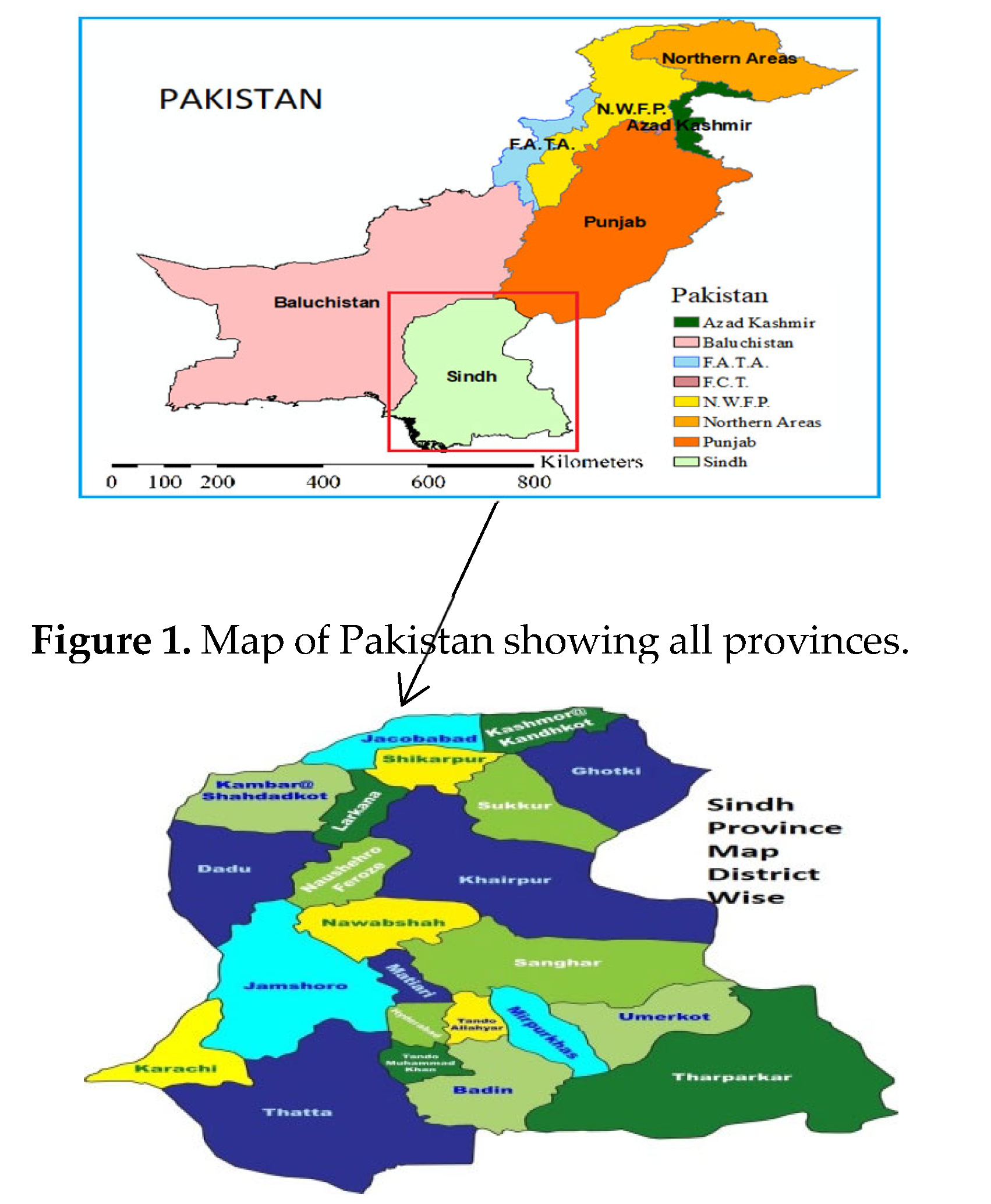
Figure 3.
Review process of previous research articles.
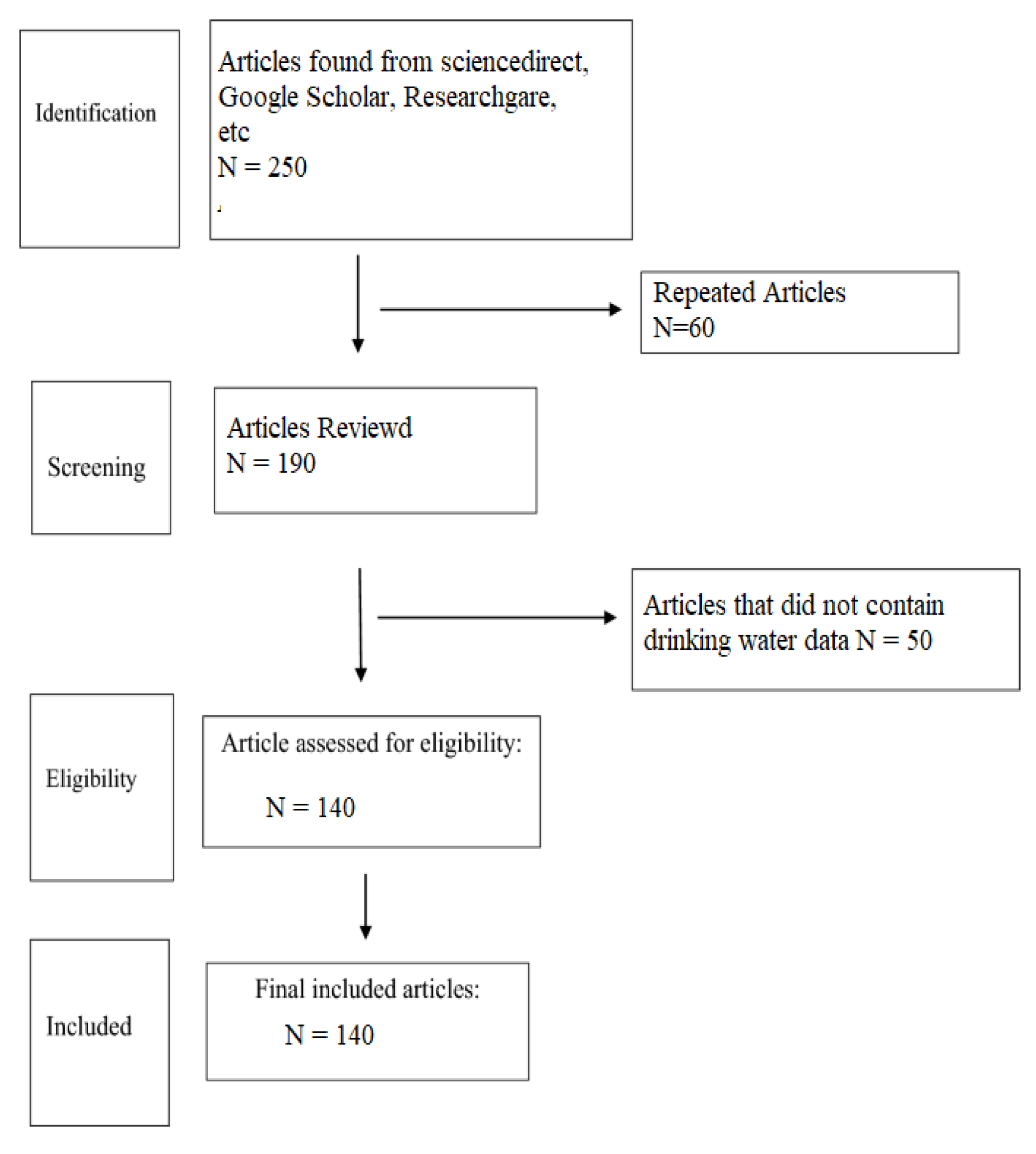
Table 1.
Water quality analysis in districts of Hyderabad division.
| S.# | Source | No of samples | Pollution causes | Major Pollutants Found | Methodology |
|---|---|---|---|---|---|
| 1 | Ali et al. 2008 | 30 | Anthropogenic activities | TDS, As, Fe, pH | Lab Analysis |
| 2 | Baig et al. 2009 | 117 | Water Logging from river | As | Lab analysis |
| 3 | Majidano et al. 2011 | 175 | geochemical | pH, TDS, EC, As, Fe, Mg, Mn, Ni, Pb, and Zn | Lab Analysis |
| 4 | Uqaili et al. 2012 | 85 | Agricultural Products | As | Lab Analysis |
| 5 | Ahmed et al. 2013 | 18 | Faecal coliform bacteria | EC,T DS, pH, Total and Faecal Coliforms, Residual Chlorine | Lab analysis |
| 6 | Mahessar et al. 2015 | 170 | Anthropogenic activities | Cl, TDS, Na, Mg, SO4, hardness, etc | Lab analysis, GIS |
| 7 | Baig et al. 2016 | 50 | Arsenic | Arsenic | Lab Analysis |
| 8 | Memon et al. 2016 | 40 | Flood | Co, Cd, Cr, As, Cu, Mn, Ni, Zn, Pb, and Fe, As, | Lab Analysis |
| 9 | Memon et al. 2016 | 67 | Seepage from river | As | Lab Analysis |
| 10 | Alamgir et al. 2016 | 56 | Seawater | Cl. pH, Hardness, TDS, EC, Ca, As, Cr, Cu, Fe, Mg, Mn, Ni, Pb, and Zn) | Lab Analysis & GIS |
| 11 | Rahman et al. 2017 | 26 | Anthropogenic activities | Cl. pH, Hardness, TDS, EC, Turbidity, Total Coliform, etc | Lab Analysis |
| 12 | Memon et al. 2017 | 68 | Anthropogenic activities | Co, Cd, Cr, As, Cu, Mn, Ni, Zn, Pb, and Fe, As | Lab Analysis |
| 13 | Rahman et al. 2017 | 16 | Anthropogenic | EC, TDS, Tur, pH | Lab Analysis |
| 14 | Khan et al. 2017 | 66 | Flood & Sewage | As, Tur, pH, TDS, EC, Mg, Ca, Fe, F, etc | Lab Analysis |
| 15 | Mumtaz et al. 2017 | 7 | Flood & Sewage | pH, TDS, Ca, Mg, TH, EC | Lab Analysis |
| 16 | Pathan et al. 2018 | Not Specified | Anthropogenic activities | Cl. pH, Hardness, TDS, EC, Color, taste, Ca, SO4 | Lab Analysis |
| 17 | Solangi et al. 2019 | 94 | Climate Change | Cl. pH, Hardness, TDS, EC, Color, taste, Ca, Mg | Lab Analysis. SPI, & WQI |
| 18 | Baloch et al. 2019 | 12 | Seawater intrusion | Cl, TDS, Na, Mg, Ca SO4, NO3, hardness, HCO3, etc | Lab analysis |
| 19 | Solangi et al. 2019 | 180 | Seawater intrusion | Cl. pH, Hardness, TDS, EC, Color, taste, Ca, Mg | Lab Analysis, WQI SPI, & GIS |
| 20 | Solangi et al. 2019 | 100 | Seawater and excessive abstraction | Cl. pH, Hardness, TDS, EC, Color, taste, Ca, Mg | Lab Analysis, WQI SPI, & GIS |
| 21 | Talpur et al. 2020 | 57 | Flouride | Flouride | Lab analysis |
| 22 | Shar et al. 2020 | 35 | Anthropogenic Activities | TDS, EC, As, TH, pH, etc | Lab Analysis |
| 23 | Arain et al. 2022 | 53 | Anthropogenic | Cl. pH, Hardness, TDS, EC, Ca, As, Cr, Cu, Fe, Mg, Mn, Ni, Pb, and Zn, SO4 | Lab Analysis |
| 24 | Khokhar et al. 2023 | 96 | Anthropogenic activities | Co, Cd, Cr, As, Cu, Mn, Ni, Zn, Pb, and Fe, pH, TDS | Lab Analysis, CDI, HQ |
| 25 | Khokhar et al. 2023 | 80 | Anthropogenic activities, Geological reason | Cl. pH, Hardness, TDS, EC, heavy metals, health risk, etc | WQI, GIS, CDI, HQI Lab Analysis |
| 26 | Imdad et al. 2023 | 10 | Seawater intrusion | Cl. pH, Hardness, TDS, EC, Color, taste, Ca, Mg | Lab Analysis |
| 27 | Dars et al. 2023 | 52 | Sewage | Salinity of Aquifers | Lab Analysis |
| 28 | Rind et al. 2024 | 37 | Leachate, Soluble salts | Cl. pH, Hardness, TDS, EC, Color, taste, Ca, SO4 | Lab Analysis and WQI |
Disclaimer/Publisher’s Note: The statements, opinions and data contained in all publications are solely those of the individual author(s) and contributor(s) and not of MDPI and/or the editor(s). MDPI and/or the editor(s) disclaim responsibility for any injury to people or property resulting from any ideas, methods, instructions or products referred to in the content. |
© 2024 by the authors. Licensee MDPI, Basel, Switzerland. This article is an open access article distributed under the terms and conditions of the Creative Commons Attribution (CC BY) license (http://creativecommons.org/licenses/by/4.0/).
Copyright: This open access article is published under a Creative Commons CC BY 4.0 license, which permit the free download, distribution, and reuse, provided that the author and preprint are cited in any reuse.


