

Submitted:
15 September 2024
Posted:
17 September 2024
You are already at the latest version
Abstract
This research explores how regional socioeconomic variables affect the perception of social trust and support networks (PYCC) in Italian regions, and examines the implications for public policy designed to strengthen social cohesion. This study examines the variable "People You Can Count On" (PYCC) from the ISTAT-BES dataset, focusing on its distribution across Italian regions between 2013 and 2022. Using clustering through a k-Means algorithm optimized with the Silhouette coefficient and the Elbow method, three distinct clusters of regions emerged, highlighting significant differences in social support networks. An econometric model was employed to estimate the PYCC variable, factoring in socioeconomic indicators such as employment rates, income inequality, and social participation. The results indicate a complex interplay between socioeconomic conditions and social trust, with regions in the South and Islands showing increased community support, while many Northern regions experienced declines. The study suggests that areas with lower economic conditions often foster stronger social networks, driven by necessity. These findings underline the importance of targeted public policies aimed at fostering social cohesion, particularly in regions facing economic challenges. Policy implications include enhancing education, supporting small enterprises, and promoting social housing and welfare initiatives. Strengthening community participation and volunteering are also highlighted as critical strategies to build resilient support networks. Overall, the research provides valuable insights into the regional disparities of social trust and the role of socioeconomic factors in shaping community support across Italy.
Keywords:
Altruism
; Social Trust
; k-Means
; Machine-Learning
; Silhouette Coefficient
; Elbow Method
; Panel Data
; Regional Disparities
1. Introduction
Social support networks play a pivotal role in shaping individual well-being and societal cohesion. They are the intricate webs of relationships that provide emotional, informational, and practical assistance, acting as buffers against life's adversities. In contemporary societies, where rapid economic, social, and technological changes are commonplace, understanding the dynamics of these support networks becomes increasingly crucial. They not only influence personal outcomes such as health and happiness but also impact broader societal constructs like community resilience and social capital. Italy presents a unique context for examining social support networks due to its rich cultural heritage, regional diversity, and historical emphasis on family and community ties. The country is characterized by pronounced regional disparities in economic development, social structures, and cultural norms. From the industrialized and affluent North to the traditionally agrarian and less developed South, these differences manifest in various socio-economic indicators. Such regional heterogeneity provides a fertile ground for investigating how social support networks vary across different contexts within the same national framework. The variable "People You Can Count On" (PYCC), as identified in the ISTAT-BES (Italian National Institute of Statistics - Equitable and Sustainable Well-being) dataset, serves as a proxy for measuring the perceived availability of social support. PYCC reflects the percentage of individuals aged 14 and over who have non-cohabiting relatives, friends, or neighbors on whom they can rely (Amati et al., 2015; Stansfeld and Khatib, 2011; Furfaro et al., 2020; Di Nicola, 2015).
The variable is the embodiment of social trust and cohesion, reflecting interpretations of individual perceptions about their social surroundings and determining the strength of support networks. Much of the literature on support networks has identified such networks as being crucial for stimulated mental health, begetting economic opportunities, and increasing satisfaction with life. While several such studies have been carried out on Italian regions, none have done so with datasets as rich as the ISTAT-BES. Moreover, though a number of studies have focused on the economic dimensions influencing cohesion, no study has integrated a wide set of socio-economic variables in order to capture their combined effects on the perceptions of social support (Porreca et al., 2019; Fazio et al., 2018; D'Urso et al., 2020).
The relevance of this research is manifold. The first is that it responds to a very important knowledge gap that concerns the role of regional socio-economic conditions on social support networks in Italy. Again, focusing their attention on PYCC, the research offers a much finer insight into the level of social cohesion, beyond traditional economic indicators. The second is that the time frame-2013 to 2022-encompasses critical events: the consequences of globalization on economic stability, the migrant crisis, and the COVID-19 pandemic. These events have wide ramifications for social structures and trust, making it a necessity that the impact on social support networks is always scrutinized. The main purpose of this research effort is to examine the regional differences that exist in one revived confidence index-dubbed PYCC across Italian regions and further identify the socio-economic drivers of these perceptions. The article attempts to unpack the cyclic interaction among economic conditions, employment patterns, income inequality, and social participation shaping social support networks using clustering techniques, and econometric modelling. Application of the k-Means clustering algorithm, optimized by the Silhouette coefficient, allows them to identify distinct regional groupings based on the PYCC values that give more profound insights into regional similarities and differences. More methodologically, it exploits the richness of data provided by the ISTAT-BES dataset (Leogrande et al., 2023; Laureti et al., 2022).
Clustering allows classifying the regions into groups that possess similar characteristics of PYCC, which might be very pivotal for targeted policy interventions. The econometric model includes such variables as low-paid employment, satisfaction with work, risk of poverty, social participation, generalized trust, employment rates, income inequality, and non-regular employment. This comprehensive model allows both positive and negative associations between these variables and PYCC to be modelled. This study has implications for policymakers, sociologists, economists, and community leaders as well. Understanding what factors enhance or erode social support networks will have important implications on the development of policies that promote social cohesion. Policies, for example, might improve working conditions and encourage community support that recognizes mutual difficulties if low-paid employment is positively related to PYCC due to increased solidarity among workers. Conversely, redistributive policies could be particularly effective in promoting better social cohesion where there is a negative effect on PYCC from income inequality (Cappiello et al., 2020; D’Angelo and Lilla, 2011).
The findings of this research also have far-reaching implications. For instance, the COVID-19 pandemic has shaken even strong social support networks. An analysis of PYCC in that period helps understand how crises shake social cohesion and what type of actions can be undertaken to reduce negative impacts. Understanding this may secondly lay light on the North-South gap in Italy, a pressing historical issue with economic, social, and political consequences. The contribution of this study will be toward developing such a regional divide in social support perceptions, with possible strategies to bridge the gap. Lastly, this research is timely and relevant to the current socio-economic scenario. By dis-aggregating the determinants of social support networks across Italian regions, it does identify the mechanisms of social cohesion. The widespread socio-economic variables that are integrated into this analysis provide a broad perspective that can be used as a foundation for effective policy formulation. As societies navigate the challenges of economic disparity, social fragmentation, and global crises, studies like this play an instrumental role in the building of resilient and cohesive communities (Palmentieri, 2023; Gatto et al., 2020; Milani, 2020).
Significance of the Study. The research undertakes a comprehensive approach to the analysis of social support networks from a regional perspective. Setting its focus on Italy, a country with marked regional disparities and a rich tapestry of social and cultural dynamics, it offers insights that are nationally specific yet at the same time globally relevant. The methodologies used provide a robust analysis that could be followed easily to apply or adapt in other contexts and enhances the usefulness of the study beyond Italian borders. Secondly, the findings have practical ramifications. Policymakers can use findings to input interventions to enhance social support networks, particularly when they are weakening. For example, improving opportunities for social participation or addressing income inequality may positively affect the positive variations in PYCC. Understanding the complex relationships between socioeconomic variables and perceptions of social support allows for the elaboration of targeted strategies that have a heightened possibility of success owing to its empiric basis (Gonzalez et al., 2020; Canale et al., 2017; Ippolito and Cicatiello, 2019).
Relevance in Contemporary Society. Issues with social cohesion and support are increasingly rising to the forefront in today's society. While digital communication has opened people up to global interactions, it sometimes serves to weaken the ties between those in the same community. Added to that, economic pressure, migration, and political polarization strain the social fabric. Understanding how people perceive their ability to rely on others is crucial within this context. Apart from these, mental health outcomes, crime rates, economic productivity, and general wellbeing in society are influenced. Considering the period this research focuses on 2013 to 2022, this would ideally fit the time scale to observe the impact of major socio-economic phenomena-for example, the outcomes of the 2008 financial crisis, the migration crisis that began in 2015 in Europe, and the COVID-19 pandemic have given shape to social dynamics. It is through an analysis of data from such events that the research provides timely insights into how such external shocks bear upon the structures of support. The PYCC across Italian regions serves as neither a theoretical nor an academic affair but rather a necessitated inquiry into the very foundation of social cohesion itself. Bringing to light how socio-economic aspects shape the perceptions of support, the study advances an understanding of societal resilience. Such insight is of major importance during periods of uncertainty and change in helping to build stronger, more connected communities that will be better prepared to face whatever challenges the future may bring (Cerami et al., 2020; Sanfelici, 2021; Blasetti and Garzonio, 2022; Corvo and De Caro, 2020).
The article continues as follows: in the second section the analysis of the literature is presented, in the third session the variables of the model and the methodology used in the article are presented, in the fourth section the trends of the phenomenon at regional and macro-regional level are indicated, the fifth section shows the clustering with k-Means algorithm optimized with the Silhouette coefficient and the Elbow Method, the sixth section presents the econometric model, the seventh section presents the political implications, the eight section concludes.
2. Literature Review
Altruism, the act of selflessly benefiting others, has long challenged the foundational principles of traditional economics, which prioritize rational self-interest as the core of human decision-making. Behavioral economics, however, presents a broader framework to examine human motivations, making room for the complexity of altruistic behavior. In the following section various recent articles are analyzed to introduce the topic in the context of the contemporary scientific and epistemological debate regarding the role of altruism on a socio-economic perspective.
Behavioral Economics and Altruism. The concept of altruism has long been a subject of academic inquiry, especially when considered in relation to economics. The idea of individuals engaging in selfless acts for the welfare of others contradicts traditional economic theories based on rational self-interest. Several scholars have contributed to this debate, exploring the intersections between altruism, economic behavior, and societal factors like culture, identity, religion, and morality. In reviewing the six articles mentioned, it becomes clear that altruism is influenced by a variety of factors, ranging from economic crises to cultural traditions and personal beliefs. Akhtar (2023) delves into the challenge that altruism poses for behavioral economics, specifically from the perspective of Austrian economics. The Austrian school, which emphasizes the role of individual choice and market dynamics, struggles to incorporate altruism within its framework of rational behavior. Akhtar’s review argues that altruism, by definition, operates outside of self-interested rationality. Austrian economics tends to focus on subjective value and the importance of personal benefit in decision-making. However, the existence of altruistic behavior, where individuals act for the benefit of others without direct personal gain, questions the completeness of this framework. Akhtar ultimately suggests that behavioral economics needs to expand its understanding of human motivation to fully incorporate altruistic actions, acknowledging the role of emotions, social norms, and ethical considerations. The study by Aksoy et al. (2021) examines how shared experiences, especially disasters or calamities, can foster altruism and reciprocity among people. The authors explore how collective suffering can promote a sense of shared identity and common interest, which in turn increases altruistic behavior. The research suggests that during times of crises, individuals become more likely to help others, even at personal cost, because they perceive themselves as part of a larger group with shared goals and destinies. The paper highlights how the emergence of altruism is closely tied to external events that reshape social bonds, making people more inclined toward cooperation and mutual aid. This study adds an important dimension to the understanding of altruism, suggesting that it can be situationally induced and heavily influenced by the social environment. Eriawaty et al. (2022) explore how local wisdom and traditional values shape altruistic behavior among Nyatu Sap artisans in Indonesia. The authors argue that for these artisans, altruism is intertwined with morality, lifestyle, and economic rationality. In their local culture, economic activities are not purely driven by profit but are deeply embedded in moral and communal values. This study demonstrates that altruism can be a guiding force in economic behavior when cultural practices emphasize communal welfare over individual success. The artisans prioritize mutual aid, shared resources, and collective well-being, even if it means sacrificing potential economic gains. This research contributes to the understanding of how altruism is culturally mediated and how it can manifest in specific economic practices that differ from Western, profit-driven models. Konarik and Melecky (2022) focus on the influence of religiosity on altruistic behavior, specifically in the context of economic preferences. Their research finds that individuals who are more religious tend to exhibit stronger altruistic tendencies in their economic decisions. This connection between religiosity and altruism is explained by the moral teachings of many religions, which often promote values such as charity, compassion, and selflessness. The authors argue that religious individuals may incorporate these values into their economic decision-making, even when it contradicts the logic of personal gain. This study highlights how personal beliefs and religious convictions can drive altruistic behavior, making it a critical factor in understanding the broader economic choices people make. Mangone (2020) challenges the traditional dichotomy between altruism and egoism, proposing a more integrated understanding of human behavior. Mangone argues that altruism and egoism are not mutually exclusive but can coexist within complex social relationships. People may act altruistically not only out of selflessness but also because it strengthens social bonds, ensures reciprocity, or aligns with a broader sense of responsibility toward others. Mangone’s work shifts the focus from individual motivations to relational dynamics, suggesting that altruistic actions are part of a larger social framework that includes both self-interest and a desire for collective welfare. This perspective broadens the discussion on altruism by emphasizing the role of societal structures and interpersonal relationships in shaping economic and social behavior. In his 2022 work, Mangone builds on his earlier arguments by advocating for a society based on solidarity and altruistic relationships. He suggests that true social cohesion can only be achieved when individuals prioritize the well-being of others and form relationships based on mutual care and support. Mangone calls for a rethinking of societal values, moving away from competitive individualism toward a more cooperative and altruistic model of sociality. This work offers a utopian vision of a society where altruism is the norm rather than the exception, and where social structures are designed to encourage and reward selfless behavior. Mangone’s vision extends the discussion of altruism beyond individual actions to include systemic changes in how society operates. Altruism is a multifaceted concept shaped by various factors, including behavioral economics, shared identity during crises, cultural practices, religiosity, and societal relationships. While traditional economic models struggle to account for altruism, these studies suggest that selflessness is influenced by moral, cultural, and situational factors that transcend individual rationality. Altruism, therefore, is not an anomaly in economic behavior but a reflection of the complex motivations that drive human action, often shaped by external events, personal beliefs, and societal norms.
Solidarity Economics and Social Movements. The collection of works provided explores the evolving landscape of the solidarity economy, emphasizing its critical role in fostering mutuality, social movements, and sustainable alternatives to capitalism. Together, these authors offer a comprehensive view of how solidarity economics and associated frameworks can reshape society by prioritizing community well-being, social justice, and sustainability over the profit-maximizing logics of traditional capitalism. Benner and Pastor (2021) argue for a transformative economic system based on solidarity rather than individualism and competition. They highlight how solidarity economics creates more equitable social structures by centering economic systems around cooperation, mutuality, and social movements. The authors assert that the growing inequalities in capitalist societies call for the adoption of an economic framework that places community and collective responsibility at its core. They make the case that economic solidarity is necessary not only for addressing immediate social issues, such as wealth inequality, but also for creating long-term, sustainable movements that protect the rights of the most marginalized. Benner and Pastor (2021) suggest that solidarity economics is not merely an academic theory but a lived practice reflected in grassroots movements that are already shaping a fairer society. Similarly, Matthaei (2020) provides a historical perspective on how the solidarity economy has developed as a response to the systemic failures of capitalism. Matthaei (2020) links the growth of solidarity economies to broader social movements that challenge the existing order, including feminist, anti-racist, and environmental movements. She argues that solidarity economies inherently promote inclusivity, democratization, and sustainability, which are not achievable under capitalist systems. According to Matthaei (2020), a key feature of the solidarity economy is its ability to empower individuals and communities by creating alternative structures where resources are shared and power is redistributed. She contends that the solidarity economy is not just an economic model but also a revolutionary force capable of transforming society. By connecting solidarity economics to social movements, Matthaei (2020) underscores the potential for systemic change through collective action. Kawano (2020) builds on the foundational principles of solidarity economics by focusing on how this model can address environmental challenges. Kawano (2020) stresses the importance of transitioning from a profit-driven economy to one that is rooted in ecological sustainability and community well-being. She critiques capitalism for its exploitation of both people and the planet, arguing that a solidarity economy offers a viable alternative that respects ecological limits and fosters environmental stewardship. Kawano (2020) emphasizes that the solidarity economy is a holistic approach, integrating social, economic, and environmental concerns into a unified framework. She advocates for local, community-based economic initiatives that prioritize people over profit and align with the principles of ecological justice. This work is especially relevant in the context of the growing climate crisis, as it presents solidarity economics as a practical solution to the ecological destruction caused by capitalist systems. Salustri (2021) shifts the focus toward the ethical dimensions of the solidarity economy. He explores how social and solidarity economy practices can help rediscover and reintegrate the notion of the common good into modern society. According to Salustri (2021), the social and solidarity economy challenges the individualistic ethos of capitalism by fostering a collective sense of responsibility and mutual care. This ethical dimension is crucial, as it promotes an economy based on shared values rather than on the pursuit of individual gain. Salustri (2021) draws connections between solidarity economics and the concept of "commons," arguing that both are grounded in the idea that resources should be managed and distributed for the benefit of all, rather than for private enrichment. He suggests that the solidarity economy has the potential to revive an ethic of communal well-being and shared prosperity, which is increasingly absent in capitalist societies. Pearlman (2023) the author delves into the tension between mutual aid and more institutionalized forms of charity, such as effective altruism. Pearlman (2023) critiques effective altruism for reinforcing hierarchical relationships between donors and recipients, often perpetuating a sense of dependency rather than empowerment. In contrast, mutual aid, as a cornerstone of the solidarity economy, is framed as a more ethical and sustainable approach to addressing social problems. Mutual aid operates on principles of solidarity and reciprocity, where communities work together to meet each other's needs without the power imbalances inherent in traditional charitable models. Pearlman (2023) argues that mutual aid fosters stronger communities by building relationships based on trust and shared responsibility, rather than on the transactional nature of charity. This approach aligns with the broader goals of the solidarity economy, which seeks to create systems of support that are grounded in mutual care and collective empowerment. Ventura (2023) discusses the rise of hybrid organizational models that combine elements of traditional business structures with social and environmental goals. These hybrid organizations, often referred to as social enterprises, are seen as a response to the growing public demand for firms to engage in altruistic activities. Ventura (2023) connects this movement to the broader principles of the solidarity economy, as both emphasize the need for businesses to prioritize social and environmental responsibility over profit maximization. The author highlights how social enterprises blur the lines between for-profit and non-profit sectors, offering a new way for businesses to engage with social issues while remaining financially viable. Ventura (2023) suggests that the social enterprise movement represents a significant shift in how businesses operate, as it challenges the traditional separation between economic and social objectives. This trend, he argues, is a reflection of the growing influence of solidarity economics on business practices and policy-making. In conclusion, these works collectively underscore the transformative potential of the solidarity economy as an alternative to capitalist systems. By emphasizing mutuality, collective action, and sustainability, the solidarity economy offers a pathway toward a more equitable and just society. Each author contributes unique perspectives on how solidarity economics can address pressing social, economic, and environmental challenges, ultimately demonstrating that a more ethical and sustainable economy is not only possible but already taking shape through grassroots movements and innovative organizational models.
Diversity, Reciprocity, and Prosocial Behavior. The following articles explore various dimensions of prosocial behavior, altruism, and solidarity in different contexts, particularly in response to crises such as the COVID-19 pandemic and systemic challenges like inequality and social exclusion. Each study contributes to a deeper understanding of how individuals, communities, and institutions engage in prosocial and altruistic behavior, how these behaviors change during times of crisis, and the implications for broader social structures. Baldassarri and Abascal (2020), examine how prosocial behaviors emerge in diverse societies. They argue that in multi-ethnic settings, social cohesion relies not only on solidarity within groups but also on the ability to extend prosocial behavior beyond one's own group. Their research shows that economic interdependence and social differentiation can encourage prosocial interactions between different groups, especially when institutional frameworks promote inclusivity. Their findings highlight that ethnic diversity does not inherently weaken trust, but the roles minorities occupy within the social structure are critical for fostering constructive prosocial behaviour. Cimagalli (2020) revisits the role of altruism in sociology. He notes that Auguste Comte introduced the concept, but its use in sociological discussions has declined over time due to its value-laden nature, which complicates its scientific treatment. However, Cimagalli (2020) argues that altruism remains significant for understanding social phenomena, particularly through the lens of theorists like Pitirim Sorokin, who regarded altruism as central to societal well-being. Altruism, he suggests, can still offer valuable insights into how societies maintain cohesion and empathy, especially when facing modern social challenges. Cappelen et al. (2021) explore how crises, such as the COVID-19 pandemic, influence public perceptions of fairness and solidarity. Their large-scale survey experiment reveals that individuals, when reminded of the pandemic, are more willing to prioritize collective societal issues over personal concerns. However, they also become more tolerant of inequalities resulting from luck. This dual response suggests that crises can lead people to re-evaluate their moral perspectives, particularly concerning redistribution policies. The findings imply that while crises can increase solidarity, they may also lead to greater acceptance of some forms of inequality, which could shape long-term policy debates around welfare and redistribution. Choquette-Levy et al. (2024) investigates how prosocial preferences enhance climate risk management in vulnerable farming communities. Their study shows that farmers who prioritize the collective good over individual profit tend to adopt more sustainable and effective strategies for managing climate risks. This is particularly vital in subsistence communities, where resources are limited, and cooperative action can lead to more resilient outcomes in the face of environmental uncertainties. The findings emphasize the role of prosocial preferences in fostering environmental sustainability and community resilience, offering insights into how such values can be nurtured to address global challenges like climate change. Matos de Oliveira (2022) discusses the idea of Homo Colaboratus, providing a new perspective on collaborative behavior in complex consumer societies. Matos de Oliveira (2022) explores how digital technology-driven models of collaborative consumption are transforming traditional economic relationships, pushing them toward more collective and cooperative forms. This shift emphasizes mutual aid and shared responsibility as consumers increasingly engage in prosocial behaviors that go beyond individualistic consumption patterns. The article envisions a future economy where collaboration and cooperation are central to market interactions, promoting both sustainability and social cohesion. In summary, these works collectively highlight the importance of prosocial behavior, altruism, and solidarity in addressing both immediate crises and long-term social challenges. Whether responding to diversity, economic inequality, environmental risks, or global health crises, prosocial and altruistic behaviors emerge as essential mechanisms for maintaining social cohesion and fostering equitable, sustainable solutions. These studies underscore that prosociality benefits not only individual well-being but is also crucial for the functioning of societies, particularly during times of crisis. By fostering a culture of collaboration, inclusivity, and mutual aid, societies can better navigate the challenges posed by global crises and build more resilient, just communities.
Socioeconomic Position and Solidarity in Times of Crisis. The following articles offer a broad perspective on how socio-economic conditions, organizational structures, and ideological frameworks shape solidarity during times of crisis. Below is a discussion of each article with a focus on how they contribute to the understanding of solidarity and care economies in different socio-political contexts. Bertogg and Koos (2021) examine how socio-economic status (SES) influences informal helping arrangements in Germany during the COVID-19 pandemic. The authors investigate the types of help provided and to whom, showing that solidarity during crises emerges differently across SES groups. Notably, those with higher SES, embedded in formal networks, were more likely to extend help to unknown recipients, revealing that existing social inequalities shape how and to whom aid is given. The study highlights how crises can spark new local solidarity efforts, especially among individuals not typically involved in pre-crisis helping behaviors. This underscores the need to consider the role of social networks in fostering solidarity across different socio-economic groups. Bertogg and Koos (2021) research provides a micro-level view of how individual socio-economic positions influence solidarity efforts, showing that higher-income individuals tend to help unknown recipients more, thanks to their embeddedness in formal networks. This challenges the notion that solidarity is uniformly distributed across a population in times of crisis. Fernández et al., 2021 explore how different organizational forms and sectors in Europe approach solidarity during crises, focusing on various NGOs, community-based groups, and institutional bodies. It argues that the effectiveness of solidarity efforts is shaped by the organizational structures and the sectors in which these organizations operate. The article suggests that solidarity is not a monolithic response but varies significantly depending on the internal dynamics of the organizations involved. This contributes to an understanding of how solidarity is operationalized across Europe and highlights the importance of both formal and informal structures in crisis response efforts. Fernández et al. (2021) demonstrate that the type of organization and sector play crucial roles in shaping how solidarity is structured. Their work suggests that solidarity is not an abstract ideal but is mediated by the internal workings of organizations. Travlou and Bernát (2022) focus on Greece and Hungary between 2015 and 2020. Travlou and Bernát (2022) delve into how care economies emerged in response to multiple crises, including economic instability and the refugee crisis. The authors explore the rise of grassroots solidarity networks, particularly in Greece, where economic hardship led to the development of informal care structures that bridged gaps left by the state. In contrast, Hungary's response was more politically charged, with a stronger emphasis on state-controlled solidarity measures. The paper emphasizes the importance of care as an economic and social force in times of crisis and how informal economies often become lifelines for marginalized populations. Salem (2020) critically examines the economic policies of Tunisia's Ennahda party, which espouses a form of neoliberalism that, according to the author, claims to foster social solidarity while primarily serving the interests of the wealthy. Salem (2020) critiques this dual approach, where economic liberalism is promoted under the guise of religiously inspired solidarity. This reveals the contradictions in how political ideologies can co-opt the language of solidarity to justify policies that, in practice, deepen socio-economic inequalities. Salem (2020) highlights the complex interplay between economic policies and notions of solidarity, questioning the extent to which neoliberal reforms can genuinely support social solidarity. Across these articles, the concept of solidarity is treated as both a social and economic phenomenon that is deeply influenced by structural conditions, from socio-economic status to organizational form and political ideology. Each study underscores a different dimension of how solidarity functions in times of crisis, offering insights into the multiple forms it can take. These articles collectively demonstrate that solidarity is a complex phenomenon shaped by socio-economic, organizational, and ideological factors. While solidarity can emerge as a powerful force in times of crisis, these studies show that it is neither uniform nor universally accessible. Whether mediated by socio-economic status, organizational structures, or political ideologies, solidarity efforts are often unevenly distributed and can sometimes reinforce existing inequalities rather than alleviating them. This makes it essential to critically examine who benefits from solidarity efforts and under what conditions.
Economic Philosophy and Homo Economicus. Albanese (2021) reflects on the epistemological underpinnings of Homo Economicus, emphasizing the limitations of neoclassical economics in accounting for altruism, happiness, and solidarity. According to Albanese (2021), these traits are sidelined in economic theory because they do not fit within the narrow rational-choice framework of Homo Economicus, which focuses on utility maximization and efficiency. This exclusion presents significant challenges, such as explaining why increased wealth does not necessarily lead to greater well-being. Albanese (2021) highlights emerging research that challenges the Homo Economicus model by arguing that social interactions and identities play a crucial role in economic decision-making. For instance, individuals may make choices that prioritize social cohesion and community well-being over personal material gain, a dimension often overlooked by classical and neoclassical economists. Johnson (2020) takes a sociological approach, examining how the Homo Economicus model is socially constructed and internalized through modern capitalist structures. He argues that the emphasis on self-interest and competition in economic theory is not an innate human characteristic but a socialized behavior shaped by the institutions and values of capitalist societies. Johnson (2020) introduces the notion that human behavior is not purely driven by greed or need but can also be motivated by solidarity and collective well-being. His work suggests that fostering different social norms, such as those that prioritize cooperation and collective welfare, could cultivate a different economic agent—one less focused on individual gain and more on mutual benefit. Silvestri and Kesting (2021) extend this critique by exploring the concept of gift-giving as an alternative to the transactional logic of Homo Economicus. They propose an “institutional economics of gift” to highlight how economic exchanges can be based on reciprocity, trust, and social ties rather than mere self-interest. In this framework, the gift economy serves as a counterpoint to market-based economies, emphasizing relationships over transactions. The authors argue that understanding economic behavior through the lens of gift-giving can provide insights into how institutional structures shape human interaction and value systems, particularly in contexts where social and economic activities are intertwined. This shift from a market-centered to a relationship-centered view of economics challenges the narrow focus of Homo Economicus and opens up possibilities for more inclusive and socially embedded economic models. In conclusion, these articles collectively argue that Homo Economicus, while useful in specific contexts, fails to capture the full complexity of human behavior. By incorporating social, ethical, and institutional dimensions, these scholars offer richer and more nuanced perspectives on economic agents, moving beyond the simplistic model of rational self-interest. These insights challenge traditional economic theory and open up pathways for developing economic systems that are more attuned to human needs and social relationships.
Morality and Economics. The following articles explore different dimensions of justice, citizenship, and the ethical frameworks surrounding economic, organizational, and social behaviors. Together, they highlight the intersection of ethics, merit, and social responsibility, challenging conventional views of justice and economic behavior in modern society. Van Geest (2021) argues for the indispensability of theology in enriching economic concepts. Theology, according to Van Geest (2021), provides a moral foundation that challenges the purely material and utilitarian approaches typically found in modern economic theories. He asserts that economics has been impoverished by its disregard for spiritual and ethical dimensions, particularly in areas like altruism, solidarity, and justice. The article suggests that by incorporating theological principles, particularly those that prioritize human well-being and social justice, economic theories can be more holistic and aligned with human dignity and ethical values. This approach contrasts with the mainstream economic model that often prioritizes profit maximization and individual self-interest at the expense of communal welfare. Van Geest (2021) serves as a reminder of the importance of integrating ethical and theological considerations into economic discourse to foster a more just and compassionate society. Volosevici and Grigorescu (2021) examine the relationship between individual behavior, employers, and organizational citizenship behavior (OCB). OCB refers to discretionary behaviors by employees that go beyond their formal job requirements and contribute positively to the organization. The authors emphasize the importance of social and psychological factors in promoting OCB, noting that individuals who feel valued and supported by their employers are more likely to engage in these positive behaviors. The study underscores the role of organizational culture and leadership in fostering an environment where OCB thrives. Volosevici and Grigorescu (2021) also discuss the reciprocal nature of OCB, where employees who engage in such behaviors often experience personal and professional benefits, including greater job satisfaction and improved performance evaluations. This research highlights the broader social contract between employers and employees, suggesting that fostering a supportive and inclusive workplace can lead to greater organizational success. Siemoneit (2023) addresses the complex interplay between merit, need, and equality in his analysis of justice. He argues that in most societies, merit is often prioritized over need and equality, creating hierarchies of justice that reflect underlying societal values. Siemoneit (2023) suggests that while merit-based systems can promote efficiency and reward hard work, they can also perpetuate inequality by overlooking structural disadvantages and the inherent differences in opportunities available to individuals. Siemoneit (2023) challenges the meritocratic ideal, pointing out that in practice, merit-based systems often fail to deliver true justice because they do not account for the unequal distribution of resources and opportunities. The author advocates for a more balanced approach to justice that incorporates both merit and need, ensuring that those who are disadvantaged are not left behind in the pursuit of fairness. Gualda (2022) explores the concepts of altruism, solidarity, and responsibility from a sociological perspective. Gualda (2022) emphasizes the role of sociology in promoting social justice and responsibility, arguing that individuals and societies have a moral obligation to act in ways that promote the common good. He stresses the importance of solidarity in addressing social inequalities, particularly in a globalized world where the impacts of economic and social policies are felt across borders. Gualda (2022) work highlights the need for a more committed sociology that goes beyond academic analysis to actively engage in the promotion of social justice. By fostering a sense of responsibility and collective action, he argues, sociology can contribute to the creation of more equitable and just societies. In conclusion, these four articles provide valuable insights into the ethical and moral foundations of economic, organizational, and social behavior. They collectively challenge the narrow focus on self-interest and profit maximization that dominates much of modern economic and organizational theory, advocating instead for a more holistic and ethically grounded approach to justice, responsibility, and citizenship.
In conclusion, the exploration of altruism within behavioral economics highlights the intricate balance between self-interest and selflessness in economic decision-making. The reviewed articles collectively argue that altruism is not an anomaly but a critical factor that shapes economic and social behavior, challenging traditional economic models like Homo Economicus. Akhtar (2023) suggests that behavioral economics must broaden its scope to account for altruism, acknowledging the limitations of rational self-interest frameworks. Similarly, Aksoy et al. (2021) show how crises can foster altruism through shared experiences, emphasizing the role of external events in shaping social bonds and cooperative behavior. Cultural influences also play a significant role in altruistic actions. Eriawaty et al. (2022) explore how traditional values among Indonesian artisans intertwine altruism with economic behavior, demonstrating that economic rationality is not always driven by profit but by communal welfare and shared resources. The study by Konarik and Melecky (2022) further expands on the influence of personal beliefs, particularly religiosity, in driving altruistic economic decisions, showing how moral teachings can override the pursuit of personal gain. Mangone (2020) challenges the dichotomy between altruism and egoism, arguing that both can coexist within social relationships. His research emphasizes that altruistic actions often serve to strengthen social bonds and align with broader responsibilities toward others. This perspective highlights the relational dynamics of altruism, offering a more nuanced understanding of how self-interest and selflessness interact in shaping human behavior. Overall, these articles present a multifaceted view of altruism, influenced by social, cultural, and ethical factors. They collectively argue that altruism should not be seen as contrary to economic logic but rather as an integral part of human behavior, shaped by a complex interplay of motivations, beliefs, and external conditions. This expanded understanding of altruism has significant implications for economic theory, suggesting the need for models that account for the full range of human motivations beyond self-interest.
A synthesis of the literature review is presented in the following Table 1.
3. Data, Variables and Methodology
In the following section, we analyze the variables and methodology that were used to capture the essential elements of PYCC in the Italian regions. The variables are listed in the following Table 2.
The research of social phenomena is often complex due to the nature of human behavior, social structures, and the contextual factors that shape them. Of these variables, one on which a significant amount of interest has rested is People You Can Count On-PYCC, a measure of the extent to which people have in their lives reliable social networks. Indeed, being able to rely on others, especially in periods of personal need, is a precondition for individual well-being and social cohesion. In order to see how the availability of supportive social networks varies both in space and over time, appropriate methodological tools have to be collated. This paper describes the methodological choices made for the study of the distribution of PYCC in Italy through the database ISTAT BES (Benessere Equo e Sostenibile, Fair and Sustainable Well-being). In fact, such a choice has been indispensable to the creation of our dataset, in the choice of the variables, and in the application of the analytical methods necessary to highlight the subtlety of this social phenomenon and, at the same time, to produce insights that would have been meaningful. Our first methodological decision was the selection of the ISTAT BES database. The database provides a comprehensive set of indicators aimed at measuring the well-being of individuals across 12 macro-categories, ranging from health and education to economic stability and social relationships. PYCC is one of the key indicators within the "Social relations" category, and it reflects the strength of interpersonal networks. For the purposes of this study, we selected three macro-categories—“Work-life balance,” “Politics and institutions,” and “Social relations”—to examine how social support varies in relation to employment conditions, institutional trust, and the quality of relationships (Cugnata et al., 2021; Monte and Schoier, 2020).
The choice of these macro-categories was motivated by theoretical and empirical considerations. Labor market participation is often linked to social support because employment provides opportunities for social interaction, fosters relationships, and offers access to social capital. Similarly, trust in political and institutional systems can influence the formation and maintenance of social networks. Finally, the quality of interpersonal relationships directly affects the degree to which individuals can count on others. By selecting these three categories, we aimed to explore the interplay between social and institutional factors in determining PYCC. In order to account for the geographical heterogeneity of social support systems in Italy, we conducted our analysis at the regional level. Italy is known for significant socio-economic disparities between its Northern, Central, and Southern regions, which extend beyond income inequality to include variations in social capital, institutional trust, and social cohesion. The decision to include all 20 Italian regions in the analysis allowed us to capture this territorial diversity. This regional focus was crucial for understanding how the availability of social networks differs not only across macro-regions but also within smaller territorial units, providing a more granular view of PYCC distribution. After constructing the dataset, our next step was to explore the temporal and spatial dimensions of PYCC. To achieve this, we analyzed the most recent data available and the historical series, tracing the distribution of PYCC over time. This longitudinal approach provided insights into how social support has evolved, allowing us to identify trends and patterns across different regions. The time-series analysis revealed that the availability of reliable social networks is not static; rather, it fluctuates in response to broader socio-economic changes, such as economic downturns, migration, and shifts in labor market conditions. However, these regional and temporal variations in PYCC necessitated a more sophisticated method of analysis. Recognizing that there might be latent clusters within the data—regions that share similar characteristics in terms of social support—we applied the k-Means clustering algorithm. This machine learning technique allowed us to segment the data into distinct clusters based on similarities in PYCC values. The clustering approach proved useful for identifying regions that exhibited comparable levels of social support, which in turn facilitated a more detailed examination of the underlying factors driving these similarities. For instance, clusters of regions in Northern Italy might share a stronger labor market, which supports the formation of more robust social networks, while regions in the South might cluster together due to weaker institutional trust and higher levels of economic instability, which undermine social support systems (Biggeri et al., 2021; Giambona et al., 2021).
Following the clustering analysis, we applied an econometric model, specifically a panel data approach, to estimate the influence of socio-economic and relational variables on PYCC. Panel data models are particularly well-suited for this type of analysis because they allow us to account for both time and individual-specific effects. By using this approach, we were able to capture not only the variation in PYCC across regions but also how changes in variables like employment rates, political engagement, and social capital affect the availability of social support over time. This methodological choice was instrumental in ensuring that our analysis captured the dynamic nature of social relationships and their connection to broader socio-economic factors. The results of our analysis have significant socio-political and economic implications. Although PYCC is often seen as a private or interpersonal matter, our findings suggest that it is closely tied to institutional factors. Regions with stronger labor markets and higher levels of institutional trust tend to exhibit greater availability of social support. This indicates that policies aimed at improving employment opportunities and fostering trust in political institutions could also enhance social cohesion. Furthermore, while PYCC may seem less politically relevant at first glance, our study shows that social support is an important determinant of generalized trust, a crucial asset for both public and private economies. By strengthening social networks, policymakers can potentially increase trust in institutions and markets, contributing to overall societal well-being (Bartscher et al., 2020; Stanzani, 2020; Gianmoena & Ríos, 2023).
The following figure represents through a workflow the various steps that were followed in the application of the proposed investigation methodology (See Figure 1).
In conclusion, our study highlights the critical role of methodological choices in investigating complex social phenomena such as PYCC. By selecting appropriate datasets, variables, and analytical techniques, we were able to provide a comprehensive examination of the factors that influence social support networks in Italy. Our findings underscore the importance of understanding social relationships not only as personal or family matters but also as outcomes shaped by broader socio-economic and political contexts.
4. Rankings of Regions and Macro-Regions in the Sense of PYCC
There is a certain geographical variability in the level of PYCC. This could suggest differences in social structure, cultural values, or community support systems across the regions. The Valle d'Aosta (86.3%), Sardinia (84.7%), and the Marche (84.9%) stand out as the regions with the highest percentages. These data could indicate a strong social support network or a high sense of community in these regions. Puglia (77.8%) and Basilicata (77%) show the lowest percentages. This could reflect greater challenges in social cohesion or the presence of support networks in these regions. There does not appear to be a clear North-South pattern in the percentages of "People to Rely On," with regions from both the North and the South present at the extremes of the distribution. This suggests that social cohesion and community support are not necessarily related to geography. Large metropolitan areas such as Lombardy and Lazio (which include Milan and Rome, respectively) do not have the highest percentages, which might suggest that in large cities, it is more difficult to build close social support networks, compared to smaller regions or those with a strong cultural and community identity. These data offer a point of reflection on how various socio-cultural, economic, and geographical factors can influence social support networks and the individual perception of available support within communities (D’Adamo and Gastaldi, 2023; Albanese, 2020). It is important to note that these numbers represent only one aspect of social well-being and that interpreting the data may require a deeper and contextualized analysis (see Figure 2).
The analysis of data on PYCC across Italian regions between 2013 and 2022 reveals significant trends in the perception of social cohesion and community support. The percentage and absolute variations in these values offer insights into how social dynamics have evolved over the decade in question. Some regions have shown an improvement in community sentiment and social support. Specifically, Valle d'Aosta, Liguria, Friuli-Venezia Giulia, Umbria, Marche, Abruzzo, Calabria, Sicily, and notably, Campania, all registered an increase in the percentages of people to rely on. Campania, with a 9.2% increase in percentage variation and a 12.5 point increase in absolute variation, stands out, suggesting a significant strengthening of social cohesion. On the other hand, other regions have witnessed a decrease in these values, which could indicate a perceived reduction in social support and community cohesion. Piedmont, Lombardy, Trentino-Alto Adige, Veneto, Tuscany, Lazio, Puglia, and most markedly, Basilicata, have all experienced a decline. Basilicata recorded the most significant decrease, with a -7.1% percentage variation and -8.44 points in absolute variation, suggesting growing challenges in building or maintaining social support networks. Some regions have shown minimal changes, like Emilia-Romagna and Puglia, suggesting a relative stability in the perception of available support networks. Regions that had relatively low values in 2013, such as Molise and Campania, have seen the most significant increases. This could reflect effective interventions or significant cultural shifts that have strengthened the social fabric. Some regions that started from a position of strength in 2013, like Trentino-Alto Adige and Basilicata, have seen the most significant declines. These data could suggest that maintaining high levels of social cohesion over time is a complex challenge. The evolution of the perception of social support in Italian regions between 2013 and 2022 shows a wide variety of regional dynamics. While some areas have strengthened their community support networks, others have faced increasing challenges
(Kaiser et al., 2022; Sabbatucci et al., 2022). These trends offer valuable insights into how various factors, including economic, cultural, and political ones, can influence social cohesion. It is essential that such insights guide public policies and community initiatives to promote social resilience and collective well-being across the diverse Italian regional realities (See Figure 3).
Analysing the provided data about PYCC across Italian macro-regions from 2013 to 2022, we observe changes in both absolute and percentage terms. North experienced a slight decrease in the percentage of people one can count on, moving from 82.9% in 2013 to 81.3% in 2022, marking an absolute decrease of 1.6 percentage points and a -1.930% change. This indicates a small reduction in social trust or availability of support networks in the North. North-West saw a more pronounced decrease, from 82.9% to 81%, resulting in a -1.9 percentage points change and a -2.292% variation. This is the largest percentage decrease among all regions, suggesting a significant decline in support networks. North-East and Center both also experienced decreases in the percentages of people one can count on, with North-East seeing a smaller decrease of 1 percentage point (-1.208%) and Center a decrease of 1.4 percentage points (-1.701%). These changes indicate a general trend of declining social support or trust across these regions. Mezzogiorno, South, and Islands, on the other hand, showed improvements. Notably, South had a 4.1 percentage point increase, the largest absolute increase, translating to a 5.339% rise. Mezzogiorno's PYCC improved by 3.1 percentage points (4.000%), and Islands saw a modest increase of 1.2 percentage points (1.523%). These improvements suggest an increasing availability of support networks or growing social trust in the southern parts of Italy and the islands. At a national level, there was a marginal increase of 0.1 percentage points, representing a 0.124% rise (Matricano, 2022; Milano and Cannataro, 2020). This indicates that while some regions experienced declines in social support, the increases in others were enough to slightly uplift the national average. The data reflects a regional divergence in social trust and support networks within Italy over the considered period. The northern and central parts of Italy experienced decreases, while the southern regions and islands saw increases. The overall stability at the national level masks significant regional disparities, suggesting targeted policies or social initiatives might be necessary to address these differences. The improvement in the South and islands could be attributed to various factors, including possibly increased community engagement or effectiveness of social policies aimed at bolstering social cohesion and support (See Figure 4).
- A summary of the trend of the PYCC variable at regional level is shown in Figure 5.
5. Clusterization with k-Means Algorithm
In the following part we present the clustering with k-Means algorithm to evaluate the presence of aggregations and differences in the Italian regions for the value of the PYCC variable. The clustering is necessary due to the characteristic fragmentation of the Italian regions, characterized by significant divergence in socio-economic and institutional terms. In particular, the clustering is aimed at highlighting the presence of a phenomenon of opposition between the regions of the South and the regions of Central-Northern Italy in terms of PYCC. Since k-Means is an unsupervised machine learning algorithm then we chose to use two different methods for its optimization: Silhouette coefficient and Elbow method (Et-Taleby et al., 2020; Pedersen, et al., 2023; Leogrande et al., 2023). In the following figure we represent the optimal levels of clusters identified through the two different methodologies (see Figure 6).
Silhouette Coefficient. The optimal number of clusters for the data concerning trustworthiness and social reliability across Italian regions, as determined by the Silhouette Coefficient, is two. A Silhouette Score measures how well samples are clustered, balancing between tight cohesion within clusters and clear separation from other clusters. The score for this analysis indicates that the dataset can be meaningfully grouped into two clusters, revealing two distinct patterns or groupings across the regions. This clustering reflects differences in social, economic, or cultural factors that influence how people perceive their ability to count on others in their respective communities. To understand why two clusters emerged as optimal, it is important to delve into the role of the Silhouette Coefficient in clustering. The Silhouette Score quantifies the compactness of points within a cluster relative to their separation from other clusters. A higher score, approaching 1, suggests that points are tightly grouped with others in the same cluster while being far from those in different clusters. Conversely, a score close to -1 implies that points may be misclassified. In this analysis, the Silhouette Coefficient provided clear evidence that two clusters offered the best balance between cohesion and separation, meaning the regions grouped together share substantial commonalities, while those in different clusters diverge meaningfully (Leogrande et al., 2023; Shahapure and Nicholas, 2020). The composition of the two clusters is shown below:
- Cluster 1 includes: Piemonte, Valle d'Aosta, Liguria, Lombardia, Trentino-Alto Adige, Veneto, Friuli-Venezia Giulia, Emilia-Romagna, Toscana, Umbria, Marche, Lazio, Abruzzo, Molise, Basilicata, Calabria, and Sardegna. These regions are characterized by relatively higher levels of economic development, more robust welfare systems, and stronger social safety nets compared to other parts of Italy. Over the years, these factors have likely contributed to a more consistent sense of social trust and reliability. People in these regions may feel more confident that they can rely on others in their community, whether through formal institutions or informal social networks. From 2013 to 2022, this trend of higher trustworthiness persisted, likely underpinned by steady employment rates, lower levels of poverty, and better access to public services, which all strengthen social cohesion (D’Adamo and Gastaldi, 2023; Algieri and Álvarez, 2023; Cattivelli, 2021).
- Cluster 2 includes: Campania, Puglia, and Sicilia. These regions have historically faced higher levels of unemployment, greater income inequality, and more fragile social structures, which may contribute to a weaker sense of trust among individuals. The differences in economic and social conditions across Italy's regions are significant, particularly between the more prosperous north and the less developed south. Southern Italy has long grappled with economic challenges, including a weaker labor market, lower levels of investment in public services, and higher rates of poverty. These structural issues likely erode the social bonds that foster trust and reliability within communities, as people may feel less supported by both formal institutions and informal social networks (Gentile et al., 2022; Petraglia and Scalera, 2021; Drago, 2021).
What is particularly interesting about these two clusters is how they reflect broader socio-economic divides within Italy, often referred to as the "North-South divide." The northern and central regions (Cluster 1) are economically stronger, with a long tradition of industrialization, higher standards of living, and more robust institutions. As a result, people in these areas are more likely to feel they can count on others, whether through state-sponsored welfare programs, community organizations, or personal relationships. In contrast, the southern regions (Cluster 2) have struggled with economic stagnation, weaker institutions, and higher rates of emigration, which could weaken social ties and make individuals feel less able to rely on their fellow citizens. The clustering of the regions also aligns with historical, cultural, and even political differences. For example, northern and central Italy has long been more integrated into European economic and political structures, enjoying greater benefits from EU funding and investment. Southern Italy, by contrast, has often been less integrated into these broader structures, facing challenges that range from organized crime to political corruption, which can further undermine social trust. In this context, it makes sense that people in northern and central regions might feel a stronger sense of social support, while those in the south might be more skeptical about their ability to rely on others. The visualization of the data, using the first two years as features, provides a clear picture of how these clusters form. The regions in Cluster 1 are tightly grouped, showing that the social trust levels in these areas have remained relatively stable and similar over time. In contrast, the regions in Cluster 2 are more dispersed, indicating greater variability in social trust, possibly reflecting the economic and social instability that characterizes southern Italy. This visual representation underscores the role that economic and social factors play in shaping people's perceptions of trust and reliability within their communities (Deleidi et al., 2021; Zambon et al., 2020; Di Martino et al., 2020).
In conclusion, the optimal clustering of Italian regions into two groups, based on the data concerning people you can count on from 2013 to 2022, highlights the socio-economic and cultural divides within the country. The northern and central regions, which form Cluster 1, demonstrate higher levels of social trust, likely due to stronger economies and more robust institutions. The southern regions, in Cluster 2, face more significant challenges, which may contribute to weaker social cohesion and lower levels of trust. These findings emphasize the importance of understanding the socio-economic factors that shape people's perceptions of social support, particularly in regions with starkly different historical and economic contexts. Results are showed in the Figure 7.
However, the clustering with the Silhouette coefficient appears insufficient since 85% of the regions analyzed, i.e. 17 over 20, are included in cluster 1. This results in an evident imbalance in the clustering and the inability to delve into the diversities characterizing the Italian regions in the sense of PYCC. To overcome this inconvenience, we present below the clustering with the k-Means algorithm optimized with the Elbow method.
Elbow method. The application of the k-Means algorithm to analyze the level of people you can count on across Italian regions provides valuable insights into the social dynamics of the country. Using the Elbow method, which is a widely accepted technique to determine the optimal number of clusters, the analysis reveals that three distinct clusters (C1, C2, and C3) best describe the data. This approach is particularly useful for capturing regional variations in trust and social support, two critical elements of social cohesion. Understanding these clusters and their composition can shed light on the socio-economic, cultural, and historical factors that influence how people perceive their ability to count on others within different regions of Italy (Cui, 2020; Rocha et al., 2021). The composition of the clusters is given below:
- C1: Piedmont, Liguria, Lombardy, Veneto, Friuli-Venezia Giulia, Emilia-Romagna, Tuscany, Umbria, Marche, Lazio, Abruzzo, Molise, Basilicata, Calabria, Sardinia. Cluster 1 (C1), comprising regions such as Piedmont, Liguria, Lombardy, Veneto, and Emilia-Romagna, reflects a group of regions predominantly located in northern and central Italy. These regions are often associated with higher levels of economic development, stronger welfare systems, and more robust social safety nets. This could explain why the median value for trust and social support in C1 is relatively high, at 81.3. While not the highest of the three clusters, this score suggests that people in these regions generally feel they can rely on others, which could be due to the presence of well-functioning public institutions, higher levels of employment, and a strong tradition of community engagement. These regions also benefit from a long history of industrialization and integration into European markets, which may contribute to a stable social environment that fosters trust (Maugeri et al., 2021; Bocci et al., 2021).
- C2: Aosta Valley, Trentino-Alto Adige. In contrast, Cluster 2 (C2) stands out for its composition and particularly high median value of 84.7. This cluster includes only two regions: Aosta Valley and Trentino-Alto Adige. Both regions are unique within Italy for their geographic isolation and special autonomous status. Their high scores in social trust could be attributed to several factors, including their relatively small populations, which may foster tighter-knit communities where individuals are more likely to rely on each other. Additionally, these regions benefit from higher levels of local governance and economic stability, thanks in part to their autonomy. Trentino-Alto Adige, in particular, has a strong tradition of local government and economic prosperity, which likely plays a role in the high level of social trust. The relative wealth and strong public services in these regions, including education and healthcare, also contribute to a sense of reliability and support among residents (Fazari and Musolino, 2023; Baroncelli, 2022, Rosini, 2022).
- C3: Campania, Apulia, Sicily. Cluster 3 (C3), which includes Campania, Apulia, and Sicily, represents the southernmost regions of Italy, and it has the lowest median value of 78.5. The social and economic challenges faced by southern Italy are well-documented, and these factors likely contribute to the lower levels of trust and perceived social support in C3. High levels of unemployment, lower educational attainment, and weaker public institutions all undermine social cohesion in these regions. In addition, the historical prevalence of organized crime and corruption in some parts of southern Italy may further erode trust in both formal institutions and informal social networks. Residents of these regions may feel that they cannot rely on either their fellow citizens or the government, leading to a lower sense of social trust. These issues are compounded by the fact that the southern regions have experienced high rates of emigration, particularly among young people, which can weaken community ties and further reduce the sense of social support (Savona et al., 2020; Falcone et al., 2020).
The hierarchy of the clusters—C2 > C1 > C3—reveals a clear socio-economic gradient in terms of social trust and reliability. The fact that Cluster 2, composed of Aosta Valley and Trentino-Alto Adige, ranks the highest is not surprising given these regions’ unique governance structures, economic prosperity, and cultural cohesiveness. Their smaller populations and relative isolation may also contribute to higher levels of social trust, as individuals in smaller communities often feel a greater sense of connection and mutual responsibility. The fact that Cluster 1, which includes some of Italy’s most economically advanced regions, comes next in the hierarchy also makes sense. While these regions enjoy strong economies and public services, their larger populations and more complex social dynamics may result in slightly lower levels of trust compared to the more cohesive communities of Cluster 2. The lower score of Cluster 3 highlights the ongoing challenges faced by southern Italy. These regions suffer from persistent economic difficulties, weaker institutions, and social instability, all of which erode the sense of trust and social cohesion. The disparity between Cluster 3 and the other clusters underscores the continuing divide between northern and southern Italy, a divide that has deep roots in the country’s history and remains a significant challenge to national unity and development (See Figure 8)
In conclusion, the clustering of Italian regions based on the level of people you can count on reveals important patterns in social trust and cohesion. The Elbow method's identification of three clusters—C1, C2, and C3—provides a useful framework for understanding regional differences in social reliability. The high levels of trust in Cluster 2 (Aosta Valley and Trentino-Alto Adige) reflect the benefits of autonomy, economic stability, and cohesive communities, while the intermediate trust levels in Cluster 1 highlight the role of economic development and robust public services in fostering social cohesion. Conversely, the lower trust levels in Cluster 3 point to the deep-seated social and economic challenges facing southern Italy, which continue to undermine social support and trust. These findings highlight the importance of addressing regional disparities in Italy, not only for economic development but also for strengthening social cohesion and trust across the country.
6. Econometric Model
In the following analysis, we have taken into consideration the people you can count on in the Italian regions. Specifically we estimated the following econometric equation through the use of Panel Data with Random Effects, Panel Data with Fixed Effects, Pooled Ordinary Least Squares-OLS and Weighted Least Squares-WLS, i.e.:
where i=20 and t=[2004;2020]. The results are synthetized in the Table 3.
- There is a positive relationship between PYCC and the following variables namely:
- LPE: the positive relationship between PYCC and LPE can be explored through the lens of social support networks and solidarity that often form in work contexts characterized by less favourable economic conditions. This positive link suggests that, despite economic challenges, there are positive social and relational dynamics emerging in work environments with a prevalence of low wages. In work contexts where employees face similar economic conditions, often characterized by low wages, a strong sense of solidarity can develop. Sharing common challenges can foster a supportive environment, where workers tend to help each other both professionally and personally. People working under conditions of low pay may be more inclined to build social support networks at the workplace and beyond. These networks can provide practical assistance, such as sharing caregiving responsibilities or support in financial emergencies, as well as offering emotional support. Working in low-wage contexts can also lead to shared values and a sense of belonging. This collective identity can strengthen interpersonal relationships and promote a culture of mutual support. People experiencing similar economic conditions tend to have higher levels of empathy and mutual understanding. This can translate into closer and more meaningful relationships, where there is a greater inclination to offer and receive support. In low-wage contexts, support can extend beyond the workplace, involving families and local communities. Communities may organize shared resources or mutual aid initiatives to help those facing economic difficulties. Despite economic challenges, LPE can benefit from robust and meaningful social support networks, highlighting how shared difficulties can act as a catalyst for forming strong interpersonal bonds and support networks. This demonstrates the importance of social and relational dimensions in mitigating the negative impacts of economic hardships and in promoting individual and collective well-being (Shook et al., 2020; Benassi and Vlandas, 2022, Sobering, 2021).
- SWWD: the positive relationship between PYCC and SWWD highlights how having a supportive network at work can significantly enhance an individual's satisfaction with their job. This connection suggests that when employees feel supported by their colleagues and superiors, they are more likely to experience higher levels of job satisfaction. The presence of supportive colleagues and managers can provide a buffer against workplace stress and challenges. Emotional support from co-workers can foster a sense of belonging and well-being, contributing to overall job satisfaction. A work environment where employees can rely on each other encourages collaboration and effective teamwork. When people feel they are part of a cohesive team, working towards common goals, their engagement and satisfaction with their job increase. Having mentors and supportive peers can facilitate opportunities for learning and professional growth. Employees who feel supported in their career development are more likely to be satisfied with their job, as they see a path for progression and improvement. A supportive network contributes to a positive work culture, where individuals feel valued and recognized. This positive environment can significantly boost job satisfaction, as employees feel their contributions are appreciated and that they are an integral part of the organization. When employees have a reliable support system at work, they are less likely to consider leaving their job. High job satisfaction, fostered by supportive relationships, contributes to higher retention rates within organizations. Support from co-workers and supervisors can enhance job performance. Employees who feel supported are more motivated and engaged, leading to better outcomes and further increasing job satisfaction. In essence, the positive correlation between having PYYC and experiencing SWWD underscores the importance of fostering supportive relationships in the workplace. Organizations that prioritize building a collaborative and supportive culture can enhance employee satisfaction, which in turn can lead to improved performance, reduced turnover, and a more positive work environment (Cardiff et al., 2020; Sabet et al. 2021; Jiang et al. 2020).
- RP: a positive relationship between PYYC and RP might seem counterintuitive at first glance, as it suggests that having a supportive network is associated with a higher risk of poverty. However, this interpretation might need clarification or a different perspective to fully understand the underlying dynamics. Typically, one would expect that having a strong network of support would decrease the risk of poverty by providing individuals with resources, emotional support, and opportunities that could help them avoid or escape poor economic conditions. In communities or groups where the risk of poverty is high, strong social support networks might develop as a necessary means of survival and mutual aid. In these contexts, the presence of PYYC is crucial and more prevalent because of the shared challenges. Therefore, the positive relationship does not imply that support networks cause poverty but rather that in environments where poverty risk is high, supportive networks are essential and become more visible or necessary. Individuals facing economic hardships often rely on extended family, friends, and community networks for support. This could include financial assistance, sharing of resources, or providing care services for each other. The strong presence of these support networks among those at risk of poverty highlights how essential they are for mitigating the immediate impacts of economic challenges. In areas with high poverty risks, the development of social capital—reflected in networks of mutual support and solidarity—can be particularly strong. People in these communities may often rely on one another to navigate economic difficulties, leading to a positive correlation between having people to rely on and experiencing a higher risk of poverty. It is important to clarify that the positive relationship here does not suggest that supportive networks increase the risk of poverty; rather, it reflects the importance and prevalence of support networks within communities where the risk of poverty is already high. These networks play a critical role in providing emotional, financial, and practical support, helping individuals and families cope with economic challenges and potentially aiding in poverty alleviation efforts (Lubbers et al., 2020; Gonzalez et al., 2020; Hill et al., 2021).
- SP: A positive relationship between PYCC and SP indicates that individuals who have a strong support network are more likely to be involved in social activities and community engagement. This correlation highlights the significant role that interpersonal relationships and social support play in encouraging active participation in social, cultural, and community events. Having supportive people in one's life can boost confidence and motivation to engage in social activities. Knowing that they have others to rely on for encouragement or companionship can make individuals more inclined to participate in social events and community activities. Social networks often serve as a valuable source of information about social activities, volunteer opportunities, and community events. People embedded in a network of supportive relationships are more likely to be informed about and encouraged to take part in these activities. Supportive networks frequently consist of individuals with shared interests and values. This common ground can foster group participation in social and community activities, leading to higher levels of social participation among the network's members. For some, participating in social activities can be challenging due to logistical, financial, or emotional barriers. Having people to rely on can provide the necessary support to overcome these obstacles, whether it is through sharing transportation, helping with costs, or offering emotional encouragement. Participation in community and social activities often leads to the strengthening of community ties and the building of new supportive relationships. This, in turn, creates a positive feedback loop where increased social participation enhances community cohesion, which further supports individual engagement. Engaging in social participation contributes to personal resilience and well-being, aspects that are supported and reinforced by having a reliable social network. The sense of belonging and purpose gained through active participation can improve mental health and overall life satisfaction. In summary, the positive correlation between having PYCC and SP underscores the importance of social support networks in fostering an active, engaged lifestyle. Supportive relationships not only encourage individuals to partake in social and community activities but also enhance the collective vibrancy and cohesiveness of communities as a whole (Singh and Moody, 2022; Zhao et al., 2022; Hu et al., 2022).
- There is a negative relationship between PYCC and the following variables namely:
- GT: A negative relationship between PYCC and GT suggests that in environments where individuals have strong, reliable support networks, there might be a lower level of trust towards society. When people have close-knit support networks, they may develop strong in-group bonds that inadvertently lead to reduced trust outside of their immediate circle. This "us vs. them" mentality strengthens ties within the group but can erode generalized trust in broader society. Individuals who rely heavily on a tight support network might feel less need to trust or engage with those outside their immediate circle. This self-sufficiency can reduce the perceived necessity to build trust with others in the wider community, leading to lower levels of generalized trust. In some cultures or communities, the emphasis on strong familial or community ties may come with an inherent wariness of external entities or individuals. This cultural norm can foster deep trust within specific groups while simultaneously lowering trust in broader society. Support networks often function as protective entities. When such networks are strong, individuals within them may become more risk-averse, viewing external interactions as unnecessary or potentially threatening, thereby reducing their level of generalized trust. In situations where individuals have experienced betrayal or exploitation by those outside their immediate support network, there may be a tendency to retreat into more trusted inner circles. Such experiences can significantly diminish one's propensity to trust people in general. Strong reliance on personal networks might be more pronounced in communities facing economic or social challenges, where trust in institutions and societal structures is low. In these contexts, the reliance on PYCC becomes a necessity rather than a choice, reflecting broader issues of systemic distrust. To address this negative relationship and promote generalized trust, interventions might focus on building bridges between different social groups, fostering inclusivity, and encouraging positive interactions across community divides. Efforts to strengthen social cohesion and trust in institutions, alongside promoting the benefits of diverse and open social networks, could also help counteract the tendency towards insularity and enhance generalized trust within the broader society (Igarashi and Hirashima, 2021; Growiec et al., 2022; Alecu, 2021).
- ER: a negative relationship between PYCC and the ER might initially seem counterintuitive, as strong social networks are often thought to contribute positively to job opportunities through connections and information sharing. However, this correlation could highlight underlying social and economic dynamics that merit closer examination. In communities with robust support systems, individuals might rely more on their network for financial and material support, possibly reducing the immediate necessity or urgency to seek employment. This could be particularly true in cultures or contexts where family or community support is expected and normalized over individual economic independence. Individuals with strong support networks might be more inclined to withdraw from the job market, especially after prolonged periods of unsuccessful job searching. The emotional and sometimes financial support they receive can afford them the luxury of not participating in the labour force, inadvertently affecting the employment rate. In some cases, strong support networks facilitate engagement in informal or non-traditional employment sectors not captured by standard employment statistics. For instance, individuals might participate in family businesses, informal caregiving, or community-based work, which may not be reflected in the official employment rate for ages 20-64. The relationship could also reflect regional economic conditions where strong community bonds are essential for survival due to a lack of formal employment opportunities. In such areas, the employment rate might be lower, not because social networks directly discourage work, but because the economy offers fewer formal job opportunities, and people rely more on each other for support. Areas with lower employment rates might see a higher out-migration of individuals seeking work elsewhere, leaving behind a population with stronger ties to the local community. These individuals may have a greater reliance on their social networks due to reduced economic opportunities in their locality. In societies with generous social welfare systems, individuals might not feel as compelled to find employment due to the availability of social support. This could lead to a situation where strong social networks exist alongside a lower employment rate, as the pressure to seek employment is mitigated by the welfare support. Addressing this negative relationship requires a multifaceted approach, focusing on enhancing economic opportunities, providing targeted employment services, and encouraging the positive aspects of social networks in facilitating job search and employment. Policies aimed at economic development, education, and training programs, as well as incentives for entrepreneurship, could help transform the potential of social networks into a driving force for increasing employment rates among the 20-64 age group (Zarova and Dubravskaya, 2020; Galbis et al., 2020).
- NII: a negative relationship between PYCC and NII suggests that in communities or societies where individuals have strong support networks, there tends to be lower income inequality. In societies with strong support networks, there is often a culture of sharing resources and providing mutual aid. This can help mitigate financial disparities by ensuring that those who are less well off receive support from their community, thereby reducing the gap between the highest and lowest earners. Strong social networks foster social cohesion, which can lead to more collective action aimed at addressing issues of inequality. Communities that are tightly knit are more likely to advocate for policies and practices that benefit the broader society, including welfare programs, progressive taxation, and other redistributive measures. Individuals with reliable support networks have better resilience in the face of economic downturns. The ability to rely on others for temporary financial assistance, job leads, or even entrepreneurial opportunities can prevent people from falling into poverty, which, on a larger scale, can contribute to reducing overall income inequality. Social networks increase an individual's social capital, providing access to information, resources, and opportunities that can lead to better employment and income prospects. When widespread across a society, this can lead to a more equitable distribution of economic resources, as more people can improve their socioeconomic status. Support networks often play a crucial role in educational achievement and occupational success by providing mentorship, advice, and connections. This support can level the playing field, especially for individuals from less privileged backgrounds, contributing to reduced income inequality. Societies with strong social bonds may also show higher levels of engagement in political and policy-making processes. This engagement can lead to the support and implementation of policies that aim to reduce income inequality, as there is a collective understanding of the importance of supporting every member of the community. In summary, the negative relationship between PYCC and NII highlights the role of social support networks in fostering economic equity. By sharing resources, advocating for fair policies, and providing individual support, these networks can help reduce the disparities in income distribution, contributing to a more balanced and cohesive society (Jackson, 2021; Ortiz and Bellotti, 2021).
- NRE: A negative relationship between PYCC and NRE suggests that in contexts where individuals have strong and reliable support networks, there tends to be a lower presence of irregular employment. Having a solid network can facilitate access to more stable and regular job opportunities through recommendations and information sharing. People with extensive social supports might be better positioned to find jobs with long-term contracts or full-time positions thanks to the shared information and opportunities within their networks. Support networks provide not just practical assistance in job searching but also emotional support throughout the process. This can reduce the level of stress associated with job precarity and increase individual resilience, making people less inclined to accept irregular jobs out of desperation or immediate necessity. Individuals supported by a robust network of contacts might have greater opportunities to access educational and training resources that enhance their employability in more stable and higher-quality jobs. Family or community support can facilitate investment in education and ongoing training, key elements for accessing more stable job opportunities. People with strong support networks might have a lower tolerance for precarious and irregular working conditions, feeling more secure in rejecting unsatisfactory job offers. The economic and emotional security provided by their social support could allow them to actively seek jobs that offer greater stability and satisfaction. In some cultures or social contexts, there is a strong expectation towards job stability as a social norm and a sign of success. Support networks in these contexts can, therefore, encourage and facilitate the pursuit of regular employment as the desirable path. However, it is important to note that this relationship can vary significantly depending on the socio-economic context, local labour market dynamics, and prevailing social policies. Interventions aimed at strengthening social support networks, along with inclusive labour policies that promote regular and quality employment, can help mitigate the negative effects of irregular employment on social cohesion and individual well-being (Belvis et al., 2022; Galanis et al., 2022; Yuan et al., 2022).
7. Policy Implications
Implementing targeted economic and social policies to increase the number of "people to rely on" in Italian regions is not just beneficial but essential for fostering resilient, cohesive communities. The foundation of such policies rests on the premise that social cohesion and economic development are deeply intertwined, with each reinforcing the other. Firstly, education and lifelong learning initiatives play a pivotal role in building social capital. By embedding citizenship education into curricula, societies can nurture generations that are empathetic, socially aware, and equipped with the skills to contribute positively to their communities. Lifelong learning opportunities, especially those focusing on soft skills and community leadership, enable adults to adapt to changing social and economic landscapes, ensuring that individuals of all ages can contribute to and benefit from a supportive community network. Supporting SMEs and encouraging social entrepreneurship directly link economic prosperity with social well-being. SMEs often provide the backbone of local economies, offering employment and fostering a sense of community identity. Social enterprises go a step further by addressing social challenges through innovative business models, creating jobs while solving critical community issues. Such economic policies not only stimulate local economies but also build stronger, more interconnected communities where individuals can rely on one another. Moreover, the emphasis on welfare policies, including strengthening social services and promoting social housing, ensures that all members of society have access to the support they need. This is particularly important in reducing inequalities and ensuring that everyone, regardless of their socioeconomic status, has someone to rely on. Accessible mental health services and community activities further enhance this support network, promoting well-being and a sense of belonging among community members. Community participation and volunteering are crucial for fostering a culture of mutual support and solidarity. Policies that facilitate these activities can transform societal norms, making it more commonplace for individuals to reach out and support one another. Such an environment not only benefits those in immediate need but also strengthens the social fabric, making communities more resilient to future challenges. However, the success of these policies hinges on their implementation being a collaborative, participatory process that involves local communities in their design and execution. This ensures that the policies are well-suited to meet the specific needs of each community, thereby maximizing their effectiveness and sustainability. In conclusion, through a comprehensive approach that combines education, economic support, welfare policies, and the promotion of community participation, it's possible to significantly increase the number of "people to rely on" across Italian regions. Such policies not only address immediate social and economic challenges but also lay the groundwork for more supportive, cohesive communities in the long term.
8. Conclusions
The article provides a comprehensive examination of social trust and cohesion across Italy, focusing specifically on the concept of "People You Can Count On" (PYCC) as a measure of social reliability. This study seeks to identify the underlying socio-economic and political factors influencing PYCC in various Italian regions, revealing significant regional disparities that reflect broader economic, cultural, and historical divisions, particularly between the North and the South. The research highlights that regions in Northern and Central Italy, characterized by stronger economic development, robust public institutions, and a more established welfare infrastructure, generally display higher levels of social trust and reliability. In contrast, regions in Southern Italy, which have historically faced persistent economic challenges, institutional weaknesses, and higher levels of social instability, exhibit lower levels of social cohesion and trust. The persistence of this North-South divide underscores the complexity of socio-economic disparities within Italy and the enduring challenges these pose to national unity and equitable development.
Through the application of advanced clustering techniques, notably the k-Means algorithm optimized using the Elbow method, the study effectively segments Italian regions into distinct clusters based on their levels of social trust and cohesion. The findings indicate that Northern and Central regions, grouped in Cluster 1, exhibit relatively stable and higher levels of social trust compared to the more variable and weaker levels observed in Southern regions, classified in Cluster 3. Notably, regions such as Aosta Valley and Trentino-Alto Adige stand out as outliers in Cluster 2, displaying the highest levels of social cohesion and trust, likely due to their distinct socio-economic and institutional characteristics, including geographic isolation and greater local autonomy. The econometric analysis further elucidates the critical role of institutional trust, labor market conditions, and social participation in fostering robust social networks. Regions that exhibit stronger labor markets and higher levels of institutional trust were found to have higher PYCC values, suggesting that socio-economic stability and institutional effectiveness are key determinants of social cohesion. This finding carries significant policy implications, as it suggests that efforts to strengthen employment opportunities and enhance trust in political and institutional frameworks could contribute to bolstering social cohesion across Italy. Furthermore, the study reveals that regions with weaker economic conditions, particularly in the South, have experienced slight improvements in PYCC over time, with notable progress observed in Campania. However, this positive trend is tempered by the decline in social trust observed in several Northern and Central regions, highlighting a concerning erosion of social cohesion in traditionally more prosperous areas.
This research has important socio-political implications, particularly for policymakers and regional leaders. It underscores the necessity of targeted, region-specific policies that address the unique socio-economic and institutional challenges facing different parts of Italy. In Southern regions, where economic stagnation and social fragmentation are more pronounced, interventions aimed at improving employment opportunities, enhancing institutional trust, and fostering community engagement could significantly strengthen social cohesion. Conversely, the declining levels of social trust in Northern and Central regions signal the need for renewed attention to the factors contributing to this erosion, including potential strains on public services and social infrastructure due to economic and demographic shifts.
In conclusion, the study's exploration of social trust through the PYCC framework provides critical insights into the state of social cohesion across Italian regions. The significant regional disparities revealed by the analysis emphasize the importance of regionally tailored socio-economic policies designed to foster trust and solidarity, particularly in regions facing economic challenges. The findings also suggest avenues for future research, particularly in examining the long-term impacts of socio-economic interventions on social cohesion and investigating the role of external shocks, such as the COVID-19 pandemic, in shaping the dynamics of social support networks. This research contributes to a deeper understanding of social trust and cohesion, offering valuable insights not only for the Italian context but also for other countries grappling with regional disparities in social capital. By highlighting the crucial role of social networks in fostering both economic and social resilience, the study underscores the broader implications of social cohesion for political stability, economic development, and societal well-being.
References
- Akhtar, S. (2023). Behavioral economics and the problem of altruism: The review of Austrian economics. The Review of Austrian Economics, 1-20. [CrossRef]
- Aksoy, C. G., Cabrales, A., Dolls, M., Durante, R., & Windsteiger, L. (2021). Calamities, Common Interests, Shared Identity: What Shapes Altruism and Reciprocity? (No. tax-mpg-rps-2021-07). Max Planck Institute for Tax Law and Public Finance.
- Albanese, V. (2020). Il sentimento della crisi: un’analisi spaziale tra la Puglia e l’Emilia-Romagna. Semestrale di studi e ricerche di Geografia, 32(2), 23-37. [CrossRef]
- Alecu, A. I. (2021). Exploring the role of network diversity and resources in relationship to generalized trust in Norway. Social Networks, 66, 91-99. [CrossRef]
- Algieri, B., & Álvarez, A. (2023). Assessing the ability of regions to attract foreign tourists: The case of Italy. Tourism Economics, 29(3), 788-811. [CrossRef]
- Amati, V., Rivellini, G., & Zaccarin, S. (2015). Potential and effective support networks of young Italian adults. Social Indicators Research, 122, 807-831. [CrossRef]
- Anwar, S., Supriyanto, S., Budiarto, W., & Hargono, R. (2020). Relationship between Social Capital and Mental Health among the Older Adults in Aceh, Indonesia. Indian Journal of Forensic Medicine & Toxicology, 14(3). [CrossRef]
- Baldassarri, D., & Abascal, M. (2020). Diversity and prosocial behavior. Science, 369(6508), 1183-1187. [CrossRef]
- Baroncelli, S. (2022). How Fluid is the Special Statute of Autonomy of Trentino Alto Adige/South Tyrol? The influence of the Court of Justice of the EU, the Council of Europe and the Italian Constitutional Court on the Process of Implementation. europa ethnica-Zeitschrift für Minderheitenfragen, 79(1+ 2), 69-80. [CrossRef]
- Bartoll, X., & Ramos, R. (2020). Worked hours, job satisfaction and self-perceived health. Journal of Economic Studies, 48(1), 223-241. [CrossRef]
- Bartscher, A. K., Seitz, S., Siegloch, S., Slotwinski, M., & Wehrhöfer, N. (2021). Social capital and the spread of Covid-19: Insights from European countries. Journal of health economics, 80, 102531. [CrossRef]
- Bayer, Y. A. M. (2022). Age and Social Trust: Evidence from the United States. Available at SSRN 3596456.
- Beckmannshagen, M., & Schröder, C. (2022). Earnings inequality and working hours mismatch. Labour Economics, 76, 102184. [CrossRef]
- Belvis, F., Bolíbar, M., Benach, J., & Julià, M. (2022). Precarious employment and chronic stress: do social support networks matter?. International Journal of Environmental Research and Public Health, 19(3), 1909. [CrossRef]
- Benassi, C., & Vlandas, T. (2022). Trade unions, bargaining coverage and low pay: a multilevel test of institutional effects on low-pay risk in Germany. Work, Employment and Society, 36(6), 1018-1037. [CrossRef]
- Benner, C., & Pastor, M. (2021). Solidarity economics: Why mutuality and movements matter. John Wiley & Sons.
- Bertogg, A., & Koos, S. (2021). Socio-economic position and local solidarity in times of crisis. The COVID-19 pandemic and the emergence of informal helping arrangements in Germany. Research in Social Stratification and Mobility, 74, 100612. [CrossRef]
- Biggeri, M., Braito, L., Caloffi, A., & Zhou, H. (2022). Chinese entrepreneurs and workers at the crossroad: the role of social networks in ethnic industrial clusters in Italy. International Journal of Manpower, 43(9), 1-18. [CrossRef]
- Blasetti, E., & Garzonio, E. (2022). La representación social de los migrantes durante la pandemia de covid-19. Un estudio de caso italiano sobre narrativas hostiles y comunicación política visual. Perspectivas de la comunicación, 15(2), 139-185. [CrossRef]
- Bocci, L., D’Urso, P., & Vitale, V. (2021). Clustering of the Italian Regions Based on Their Equitable and Sustainable Well-Being Indicators: A Three-Way Approach. Social Indicators Research, 155(3), 995-1043. [CrossRef]
- Borraccino, A., Lazzeri, G., Kakaa, O., Bad’Ura, P., Bottigliengo, D., Dalmasso, P., & Lemma, P. (2020). The contribution of organised leisure-time activities in shaping positive community health practices among 13-and 15-year-old adolescents: results from the health behaviours in school-aged children study in italy. International journal of environmental research and public health, 17(18), 6637. [CrossRef]
- Börsch-Supan, A., Hunkler, C., & Weiss, M. (2021). Big data at work: Age and labor productivity in the service sector. The Journal of the Economics of Ageing, 19, 100319. [CrossRef]
- Bosch, M., González, S., & Silva Porto, M. T. (2021). Chasing Informality: Evidence from Increasing Enforcement in Large Firms in Peru (No. 11114). Inter-American Development Bank. [CrossRef]
- Canale, N., Vieno, A., Lenzi, M., Griffiths, M. D., Borraccino, A., Lazzeri, G., ... & Santinello, M. (2017). Income inequality and adolescent gambling severity: Findings from a large-scale Italian representative survey. Frontiers in Psychology, 8, 1318. [CrossRef]
- Cappelen, A. W., Falch, R., Sørensen, E. Ø., & Tungodden, B. (2021). Solidarity and fairness in times of crisis. Journal of Economic Behavior & Organization, 186, 1-11. [CrossRef]
- Cappiello, G., Giordani, F., & Visentin, M. (2020). Social capital and its effect on networked firm innovation and competitiveness. Industrial Marketing Management, 89, 422-430. [CrossRef]
- Cardiff, S., Sanders, K., Webster, J., & Manley, K. (2020). Guiding lights for effective workplace cultures that are also good places to work. International Practice Development Journal, 10(2). [CrossRef]
- Cattivelli, V. (2021). Planning peri-urban areas at regional level: The experience of Lombardy and Emilia-Romagna (Italy). Land use policy, 103, 105282. [CrossRef]
- Cerami, C., Santi, G. C., Galandra, C., Dodich, A., Cappa, S. F., Vecchi, T., & Crespi, C. (2020). Covid-19 outbreak in Italy: are we ready for the psychosocial and the economic crisis? Baseline findings from the PsyCovid study. Frontiers in psychiatry, 11, 556. [CrossRef]
- Chongyu, L. (2021). The influence of work salary and working hours on employee job satisfaction. In E3S Web of Conferences (Vol. 253, p. 02078). EDP Sciences. [CrossRef]
- Choquette-Levy, N., Wildemeersch, M., Santos, F. P., Levin, S. A., Oppenheimer, M., & Weber, E. U. (2024). Prosocial preferences improve climate risk management in subsistence farming communities. Nature Sustainability, 7(3), 282-293. [CrossRef]
- Cimagalli, F. (2020). Is there a place for altruism in sociological thought?. Human Arenas, 3(1), 52-66. [CrossRef]
- Corvo, E., & De Caro, W. (2020). COVID-19 and spontaneous singing to decrease loneliness, improve cohesion, and mental well-being: An Italian experience. Psychological Trauma: Theory, Research, Practice, and Policy, 12(S1), S247.
- Cugnata, F., Salini, S., & Siletti, E. (2021). Deepening well-being evaluation with different data sources: a Bayesian networks approach. International Journal of Environmental Research and Public Health, 18(15), 8110. [CrossRef]
- Cui, M. (2020). Introduction to the k-means clustering algorithm based on the elbow method. Accounting, Auditing and Finance, 1(1), 5-8.
- D’Adamo, I., & Gastaldi, M. (2023). Monitoring the performance of Sustainable Development Goals in the Italian regions. Sustainability, 15(19), 14094. [CrossRef]
- D’Urso, P., Alaimo, L. S., De Giovanni, L., & Massari, R. (2020). Well-being in the Italian regions over time. Social Indicators Research, 1-29. [CrossRef]
- D'Angelo, E., & Lilla, M. (2011). Social networking and inequality: the role of clustered networks. cambridge Journal of regions, economy and Society, 4(1), 63-77. [CrossRef]
- Deleidi, M., Paternesi Meloni, W., Salvati, L., & Tosi, F. (2021). Output, investment and productivity: the Italian North–South regional divide from a Kaldor–Verdoorn approach. Regional Studies, 55(8), 1376-1387. [CrossRef]
- Di Martino, P., Felice, E., & Vasta, M. (2020). A tale of two Italies:‘access-orders’ and the Italian regional divide. Scandinavian Economic History Review, 68(1), 1-22. [CrossRef]
- Di Nicola, P. (2011). Family, Personal Networks and Social Capital. Italian Sociological Review, 1(2), 11-11. [CrossRef]
- Drago, C. (2021). The analysis and the measurement of poverty: An interval-based composite indicator approach. Economies, 9(4), 145. [CrossRef]
- Dudziński, M., & Kaleta, J. (2021). An application of the interval estimation for the At-Risk-of-Poverty Rate assessment. Metody Ilościowe w Badaniach Ekonomicznych, 22(1), 14-28. [CrossRef]
- Erauskin, I. (2020). The labor share and income inequality: Some empirical evidence for the period 1990-2015. Applied Economic Analysis, 28(84), 173-195. [CrossRef]
- Eriawaty, E. T. D., Widjaja, S. U. M., & Wahyono, H. (2022). Rationality, Morality, Lifestyle And Altruism In Local Wisdom Economic Activities Of Nyatu Sap Artisans. Journal of Positive School Psychology, 5781-5797.
- Espi-Sanchis, G., Leibbrandt, M., & Ranchhod, V. (2022). Age, employment and labour force participation outcomes in COVID-era South Africa. Development Southern Africa, 39(5), 664-688. [CrossRef]
- Et-Taleby, A., Boussetta, M., & Benslimane, M. (2020). Faults Detection for Photovoltaic Field Based on K-Means, Elbow, and Average Silhouette Techniques through the Segmentation of a Thermal Image. International Journal of Photoenergy, 2020(1), 6617597. [CrossRef]
- Falcone, P. M., D'Alisa, G., Germani, A. R., & Morone, P. (2020). When all seemed lost. A social network analysis of the waste-related environmental movement in Campania, Italy. Political Geography, 77, 102114. [CrossRef]
- Fazari, E., & Musolino, D. (2023). Social farming in high mountain regions: The case of the Aosta Valley in Italy. Economia agro-alimentare, (2022/3). [CrossRef]
- Fazio, G., Giambona, F., Vassallo, E., & Vassiliadis, E. (2018). A measure of trust: The Italian regional divide in a latent class approach. Social Indicators Research, 140, 209-242. [CrossRef]
- Fernández GG, E., Lahusen, C., & Kousis, M. (2021). Does organisation matter? Solidarity approaches among organisations and sectors in Europe. Sociological Research Online, 26(3), 649-671. [CrossRef]
- Furfaro, E., Rivellini, G., & Terzera, L. (2020). Social support networks for childcare among foreign women in Italy. Social Indicators Research, 151, 181-204. [CrossRef]
- Galanis, P., Katsiroumpa, A., Vraka, I., Siskou, O., Konstantakopoulou, O., Katsoulas, T., & Kaitelidou, D. (2022). Relationship between social support and resilience among nurses: A systematic review. medRxiv, 2022-09. [CrossRef]
- Galbis, E. M., Wolff, F. C., & Herault, A. (2020). How helpful are social networks in finding a job along the economic cycle? Evidence from immigrants in France. Economic Modelling, 91, 12-32. [CrossRef]
- Gatto, M., Bertuzzo, E., Mari, L., Miccoli, S., Carraro, L., Casagrandi, R., & Rinaldo, A. (2020). Spread and dynamics of the COVID-19 epidemic in Italy: Effects of emergency containment measures. Proceedings of the National Academy of Sciences, 117(19), 10484-10491. [CrossRef]
- Gentile, I., Iorio, M., Zappulo, E., Scotto, R., Maraolo, A. E., Buonomo, A. R., ... & Federico II COVID-Team. (2022). COVID-19 Post-Exposure Evaluation (COPE) study: assessing the role of socio-economic factors in household SARS-CoV-2 transmission within Campania Region (Southern Italy). International Journal of Environmental Research and Public Health, 19(16), 10262. [CrossRef]
- Giambona, F., Khalawi, A., Buzzigoli, L., Grassini, L., & Martelli, C. (2021). Big data analysis and labour market: an analysis of Italian online job vacancies data. ASA 2021, 105. [CrossRef]
- Gianmoena, L., & Rios, V. (2024). The diffusion of COVID-19 across Italian provinces: a spatial dynamic panel data approach with common factors. Regional Studies, 58(2), 285-305. [CrossRef]
- Gonzalez De La Rocha, M. (2020). Of morals and markets: Social exchange and poverty in contemporary urban Mexico. The ANNALS of the American Academy of Political and Social Science, 689(1), 26-45. [CrossRef]
- Gonzalez, R., Fuentes, A., & Muñoz, E. (2020). On social capital and health: the moderating role of income inequality in comparative perspective. International Journal of Sociology, 50(1), 68-85. [CrossRef]
- Growiec, K., Growiec, J., & Kamiński, B. (2022). it matterS whom you Know: mapping the linKS between Social capital, truSt and willingneSS to cooperate. Studia Socjologiczne, (2), 59-83. [CrossRef]
- Gualda, E. (2022). Altruism, solidarity and responsibility from a committed sociology: contributions to society. The American Sociologist, 53(1), 29-43. [CrossRef]
- Hill, K., Hirsch, D., & Davis, A. (2021). The role of social support networks in helping low income families through uncertain times. Social Policy and Society, 20(1), 17-32. [CrossRef]
- Hu, G., Wang, J., Laila, U., Fahad, S., & Li, J. (2022). Evaluating households’ community participation: Does community trust play any role in sustainable development?. Frontiers in Environmental Science, 10, 951262. [CrossRef]
- Igarashi, T., & Hirashima, T. (2021). Generalized trust and social selection process. Frontiers in Communication, 6, 667082. [CrossRef]
- Ilmakunnas, I. (2022). The magnitude and direction of changes in age-specific at-risk-of-poverty rates: an analysis of patterns of poverty trends in Europe in the mid-2010s. Journal of International and Comparative Social Policy, 38(1), 71-91. [CrossRef]
- Ippolito, M., & Cicatiello, L. (2019). Political instability, economic inequality and social conflict: The case in Italy. Panoeconomicus, 66(3), 365-383. [CrossRef]
- Islam, S., & Safavi, M. (2020). Wage inequality, firm size and Gender: The case of Canadá. Archive of Business research, 8(2), 27-37. [CrossRef]
- Jackson, M. O. (2021). Inequality's economic and social roots: the role of social networks and homophily. Available at SSRN 3795626.
- Janietz, C., Bol, T., & Lancee, B. (2023). Temporary employment and wage inequality over the life course. European Sociological Review. [CrossRef]
- Jiang, Z., Di Milia, L., Jiang, Y., & Jiang, X. (2020). Thriving at work: A mentoring-moderated process linking task identity and autonomy to job satisfaction. Journal of Vocational Behavior, 118, 103373. [CrossRef]
- Kaiser, S., Oliveira, M., Vassillo, C., Orlandini, G., & Zucaro, A. (2022). Social and Environmental Assessment of a Solidarity Oriented Energy Community: A Case-Study in San Giovanni a Teduccio, Napoli (IT). Energies, 15(4), 1557. [CrossRef]
- Kalland, M., Salo, S., Vincze, L., Lipsanen, J., Raittila, S., Sourander, J., Salvén-Bodin, M., & Pajulo, M. (2022). Married and cohabiting Finnish first-time parents: Differences in wellbeing, social support and infant health. Social Sciences. [CrossRef]
- Kawano, E. (2020). Solidarity economy: Building an economy for people and planet. In The new systems reader (pp. 285-302). Routledge.
- Kebe, M., Kpanzou, T. A., Manou-Abi, S. M., & Sisawo, E. (2023). Kernel estimation of the Quintile Share Ratio index of inequality for heavy-tailed income distributions. European Journal of Pure and Applied Mathematics, 16(4), 2509-2543. [CrossRef]
- Khatskevich, A., & Alexandrov, P. (2021). Comparative analysis of the cultural preferences of Orthodox and student (secular) youth. Nauka. me, (4), 42-48. [CrossRef]
- Konarik, V., & Melecky, A. (2022). Religiosity as a Driving Force of Altruistic Economic Preferences. International Journal of Business and Applied Social Science, 10-29. [CrossRef]
- Laureti, L., Costantiello, A., & Leogrande, A. (2022). Satisfaction with the Environmental Condition in the Italian Regions between 2004 and 2020. Available at SSRN 4061708. [CrossRef]
- Leogrande, A., Costantiello, A., & Leogrande, D. (2023). The Socio-Economic Determinants of the Number of Physicians in Italian Regions. Available at SSRN 4560149.
- Leogrande, A., Costantiello, A., Leogrande, D., & Anobile, F. (2023). Beds in Health Facilities in the Italian Regions: A Socio-Economic Approach. Available at SSRN 4577029.
- Li, X., Tian, L., & Xu, J. (2020). Missing social security contributions: the role of contribution rate and corporate income tax rate. International Tax and Public Finance, 27(6), 1453-1484. [CrossRef]
- Lubbers, M. J., García, H. V., Castaño, P. E., Molina, J. L., Casellas, A., & Rebollo, J. G. (2020). Relationships stretched thin: Social support mobilization in poverty. The Annals of the American Academy of Political and Social Science, 689(1), 65-88. [CrossRef]
- Lum, T. Y. (2022). Social capital and geriatric depression in the Asian context. International Psychogeriatrics, 34(8), 671-673. [CrossRef]
- Mangone, E. (2020). Beyond the dichotomy between altruism and egoism: Society, relationship, and responsibility. IAP.
- Mangone, E. (2022). A new sociality for a solidarity-based society: the altruistic relationships. Derecho y Realidad, 20(40), 15-32. [CrossRef]
- Marinescu, I., Qiu, Y., & Sojourner, A. (2021). Wage inequality and labor rights violations (No. w28475). National Bureau of Economic Research.
- Matricano, D. (2022). Economic and social development generated by innovative startups: Does heterogeneity persist across Italian macro-regions?. Economics of Innovation and New Technology, 31(6), 467-484. [CrossRef]
- Matthaei, J. (2020). Thinking beyond capitalism: social movements, revolution, and the solidarity economy. In A Research Agenda for Critical Political Economy (pp. 209-224). Edward Elgar Publishing. [CrossRef]
- Maugeri, A., Barchitta, M., Basile, G., & Agodi, A. (2021). Applying a hierarchical clustering on principal components approach to identify different patterns of the SARS-CoV-2 epidemic across Italian regions. Scientific reports, 11(1), 7082. [CrossRef]
- Milani, F. (2021). COVID-19 outbreak, social response, and early economic effects: a global VAR analysis of cross-country interdependencies. Journal of population economics, 34(1), 223-252. [CrossRef]
- Milano, M., & Cannataro, M. (2020). Statistical and network-based analysis of Italian COVID-19 data: communities detection and temporal evolution. International journal of environmental research and public health, 17(12), 4182. [CrossRef]
- Monte, A., & Schoier, G. (2022). A multivariate statistical analysis of equitable and sustainable well-being over time. Social Indicators Research, 161(2), 735-750. [CrossRef]
- Nwaubani, J. C., Ohia, A. N., Peace, O., Adaugo, U. C., Ezeji, U. M., & Ezechukwu, C. U. (2020). Evaluation of Total Employment Rate Aged 15-64 in EU15. European Journal of Business and Management Research, 5(5). [CrossRef]
- Ødegård, G., & Fladmoe, A. (2020). Are immigrant youth involved in voluntary organizations more likely than their non-immigrant peers to be engaged in politics? Survey evidence from Norway. Acta sociologica, 63(3), 267-283. [CrossRef]
- Ortiz, F., & Bellotti, E. (2021). The impact of life trajectories on retirement: socioeconomic differences in social support networks. Social Inclusion, 9(4), 327-338. [CrossRef]
- Palmentieri, S. (2023). Post-pandemic scenarios. The role of the Italian National Recovery and Resilience Plan (NRRP) in reducing the gap between the Italian Central-Northern regions and southern ones. AIMS Geosciences, 9(3), 555-577. [CrossRef]
- Pearlman, S. (2023). Solidarity Over Charity: Mutual Aid as a Moral Alternative to Effective Altruism. Kennedy Institute of Ethics Journal, 33(2), 167-199. [CrossRef]
- Pedersen, K., Jensen, R. R., Hall, L. K., Cutler, M. C., Transtrum, M. K., Gee, K. L., & Lympany, S. V. (2023). K-means clustering of 51 geospatial layers identified for use in continental-scale modeling of outdoor acoustic environments. Applied Sciences, 13(14), 8123. [CrossRef]
- Petraglia, C., & Scalera, D. (2021). Economy and industry in Campania: which policy for lasting growth?. Rivista internazionale di scienze sociali: 2, 2021, 221-251. [CrossRef]
- Porreca, A., Cruz Rambaud, S., Scozzari, F., & Di Nicola, M. (2019). A fuzzy approach for analysing equitable and sustainable well-being in Italian regions. International Journal of Public Health, 64, 935-942. [CrossRef]
- Power, S. (2020). Civil Society through the lifecourse. In Civil Society through the Lifecourse (pp. 203-214). Bristol University Press. [CrossRef]
- Preetz, R. (2022). Dissolution of non-cohabiting relationships and changes in life satisfaction and mental health. Frontiers in Psychology, 13. [CrossRef]
- Rapp, I., & Stauder, J. (2020). Mental and physical health in couple relationships: Is it better to live together? European Sociological Review. [CrossRef]
- Rocha, J. L. M., Zela, M. A. C., Torres, N. I. V., & Medina, G. S. (2021). Analogy of the application of clustering and K-means techniques for the approximation of values of human development indicators. International Journal of Advanced Computer Science and Applications, 12(9). [CrossRef]
- Rosini, M. (2022). Statute of Trentino-Alto Adige/Südtirol and "major favour clause": More or less autonomy? An evaluation 20 years after the reform of Title V of the Constitution. Europa Ethnica.
- Sabbatucci, M., Odone, A., Signorelli, C., Siddu, A., Silenzi, A., Maraglino, F. P., & Rezza, G. (2022). Childhood immunisation coverage during the COVID-19 epidemic in Italy. Vaccines, 10(1), 120. [CrossRef]
- Sabet, S., Goodarzvand Chegini, M., Rezaei Klidbari, H., & Rezaei Dizgah, M. (2021). Designing a Model of Human Resource Mentoring System Based on a Mixed Approach, With the Aim of Increasing Productivity. Journal of System Management, 7(2), 205-229. [CrossRef]
- Salem, M. B. (2020). “God loves the rich.” The economic policy of Ennahda: liberalism in the service of social solidarity. Politics and Religion, 13(4), 695-718. [CrossRef]
- Salustri, A. (2021). Social and solidarity economy and social and solidarity commons: Towards the (re) discovery of an ethic of the common good?. Annals of Public and Cooperative Economics, 92(1), 13-32. [CrossRef]
- Sánchez-Sánchez, N., & Fernández Puente, A. C. (2021). Public versus private job satisfaction. Is there a trade-off between wages and stability?. Public Organization Review, 21(1), 47-67. [CrossRef]
- Sanfelici, M. (2021). The impact of the COVID-19 crisis on marginal migrant populations in Italy. American Behavioral Scientist, 65(10), 1323-1341. [CrossRef]
- Savona, E. U., Calderoni, F., Campedelli, G. M., Comunale, T., Ferrarini, M., & Meneghini, C. (2020). The criminal careers of Italian mafia members. Understanding recruitment to organized crime and terrorism, 241-267. [CrossRef]
- Shahapure, K. R., & Nicholas, C. (2020, October). Cluster quality analysis using silhouette score. In 2020 IEEE 7th international conference on data science and advanced analytics (DSAA) (pp. 747-748). IEEE. [CrossRef]
- Shook, J., Goodkind, S., Engel, R. J., Wexler, S., & Ballentine, K. L. (2020). Moving beyond poverty: Effects of low-wage work on individual, social, and family well-being. Families in Society, 101(3), 249-259. [CrossRef]
- Siemoneit, A. (2023). Merit first, need and equality second: hierarchies of justice. International Review of Economics, 70(4), 537-567. [CrossRef]
- Singh, M. K., & Moody, J. (2022). Do social capital and networks facilitate community participation?. International Journal of Sociology and Social Policy, 42(5/6), 385-398. [CrossRef]
- Slobodenyuk, E. D., & Mareeva, S. V. (2020). Relative poverty in Russia: Evidence from different thresholds. Social Indicators Research, 151(1), 135-153. [CrossRef]
- Sobering, K. (2021). Survival finance and the politics of equal pay. The British Journal of Sociology, 72(3), 742-756. [CrossRef]
- Spaulonci Chiachia Matos de Oliveira, B. C. (2022). Homo Colaboratus Birth Within Complex Consumption. In The Palgrave Handbook of Global Social Problems (pp. 1-10). Cham: Springer International Publishing. [CrossRef]
- Stansfeld, S., & Khatib, Y. (2011). Social Support and Social Networks. In International Encyclopedia of the Social & Behavioral Sciences (pp. 119-123).
- Stanzani, S. (2020). Trust and civic engagement in the Italian COVID-19 Lockdown. Italian Sociological Review, 10(3S), 917-935.
- Surinov, A., & Luppov, A. (2020). Income inequality in Russia. Measurement based on equivalent income. HSE Economic Journal, 24(4), 539-571. [CrossRef]
- Travlou, P., & Bernát, A. (2022). Solidarity and care economy in times of ‘crisis’: A view from Greece and Hungary between 2015 and 2020. In The Sharing Economy in Europe: Developments, Practices, and Contradictions (pp. 207-237). Cham: Springer International Publishing. [CrossRef]
- Tuominen, M., & Haanpää, L. (2022). Young people’s well-being and the association with social capital, ie Social Networks, Trust and Reciprocity. Social indicators research, 159(2), 617-645. [CrossRef]
- van Geest, P. (2021). The Indispensability of Theology for Enriching Economic Concepts. In Morality in the Marketplace (pp. 68-88). Brill. [CrossRef]
- Ventura, L. (2023). The social enterprise movement and the birth of hybrid organisational forms as policy response to the growing demand for firm altruism. The international handbook of Social Enterprise Law. Cham: Springer, 9-26. [CrossRef]
- Volosevici, D., & Grigorescu, D. (2021). Individual, employers and organizational citizenship behaviour. A Journal of Social and Legal, 43, 50. [CrossRef]
- Yuan, C. T., Lai, A. Y., Benishek, L. E., Marsteller, J. A., Mahabare, D., Kharrazi, H., & Dy, S. M. (2022). A double-edged sword: The effects of social network ties on job satisfaction in primary care organizations. Health care management review, 47(3), 180-187. [CrossRef]
- Yucel, D., & Latshaw, B. A. (2022). Mental health across the life course for men and women in married, cohabiting, and living apart together relationships. Journal of Family Issues. [CrossRef]
- Zambon, I., Rontos, K., Reynaud, C., & Salvati, L. (2020). Toward an unwanted dividend? Fertility decline and the North–South divide in Italy, 1952–2018. Quality & Quantity, 54, 169-187. [CrossRef]
- Zarova, E. V., & Dubravskaya, E. I. (2020). The Random Forest Method in Research of Impact of Macroeconomic Indicators of Regional Development on Informal Employment Rate. ÂÎÏÐÎÑÛ ÑÒÀÒÈÑÒÈÊÈ, 27(6), 38. [CrossRef]
- Zhao: D., Li, G., Zhou, M., Wang, Q., Gao, Y., Zhao, X., ... & Li, P. (2022). Differences according to sex in the relationship between social participation and well-being: a network analysis. International Journal of Environmental Research and Public Health, 19(20), 13135. [CrossRef]
Figure 1.
Workflow model capable of summarizing the methodology followed in conducting the analysis.
Figure 1.
Workflow model capable of summarizing the methodology followed in conducting the analysis.
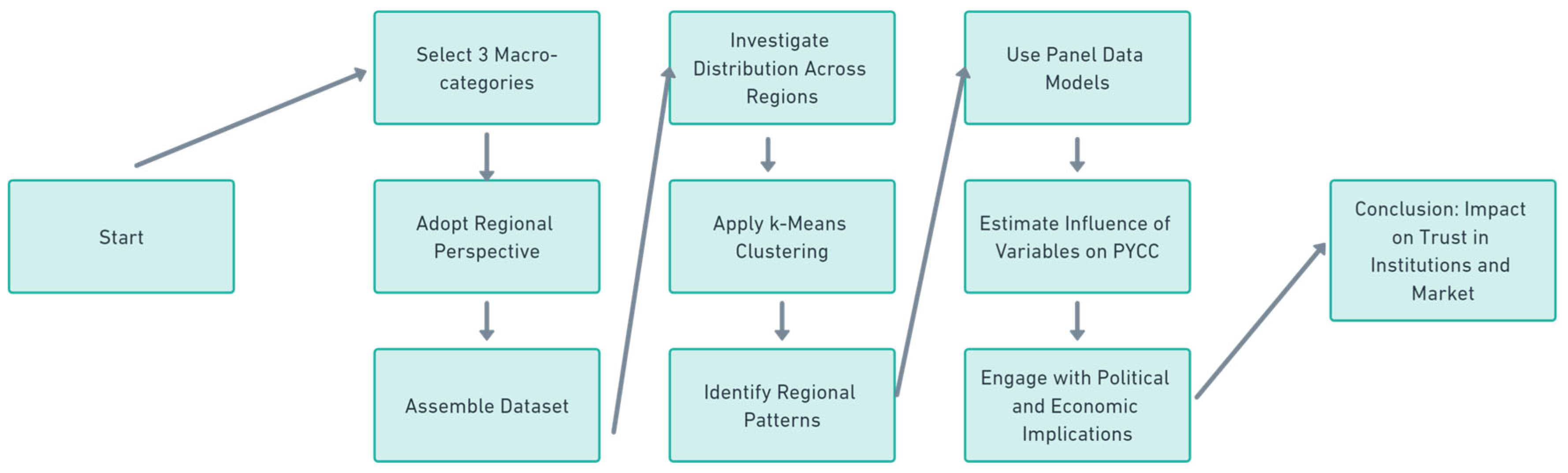
Figure 2.
People you can count on across Italian regions in 2022. Source: Istat-Bes. Elaboration by the authors.
Figure 2.
People you can count on across Italian regions in 2022. Source: Istat-Bes. Elaboration by the authors.
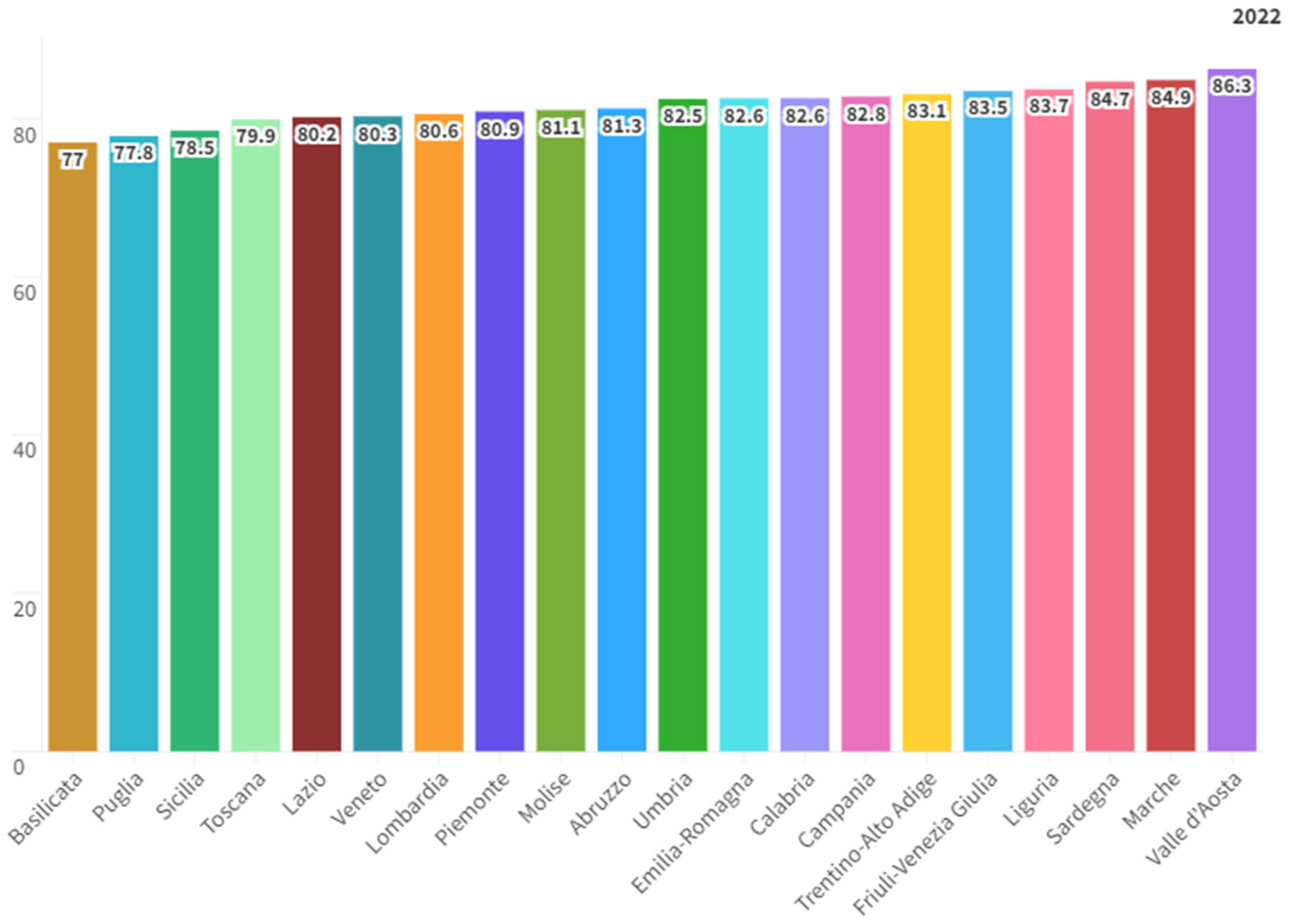
Figure 3.
Change in the level of people you can count on in the Italian regions between 2013 and 2022. Source: Istat-Bes. Elaboration by the authors.
Figure 3.
Change in the level of people you can count on in the Italian regions between 2013 and 2022. Source: Istat-Bes. Elaboration by the authors.
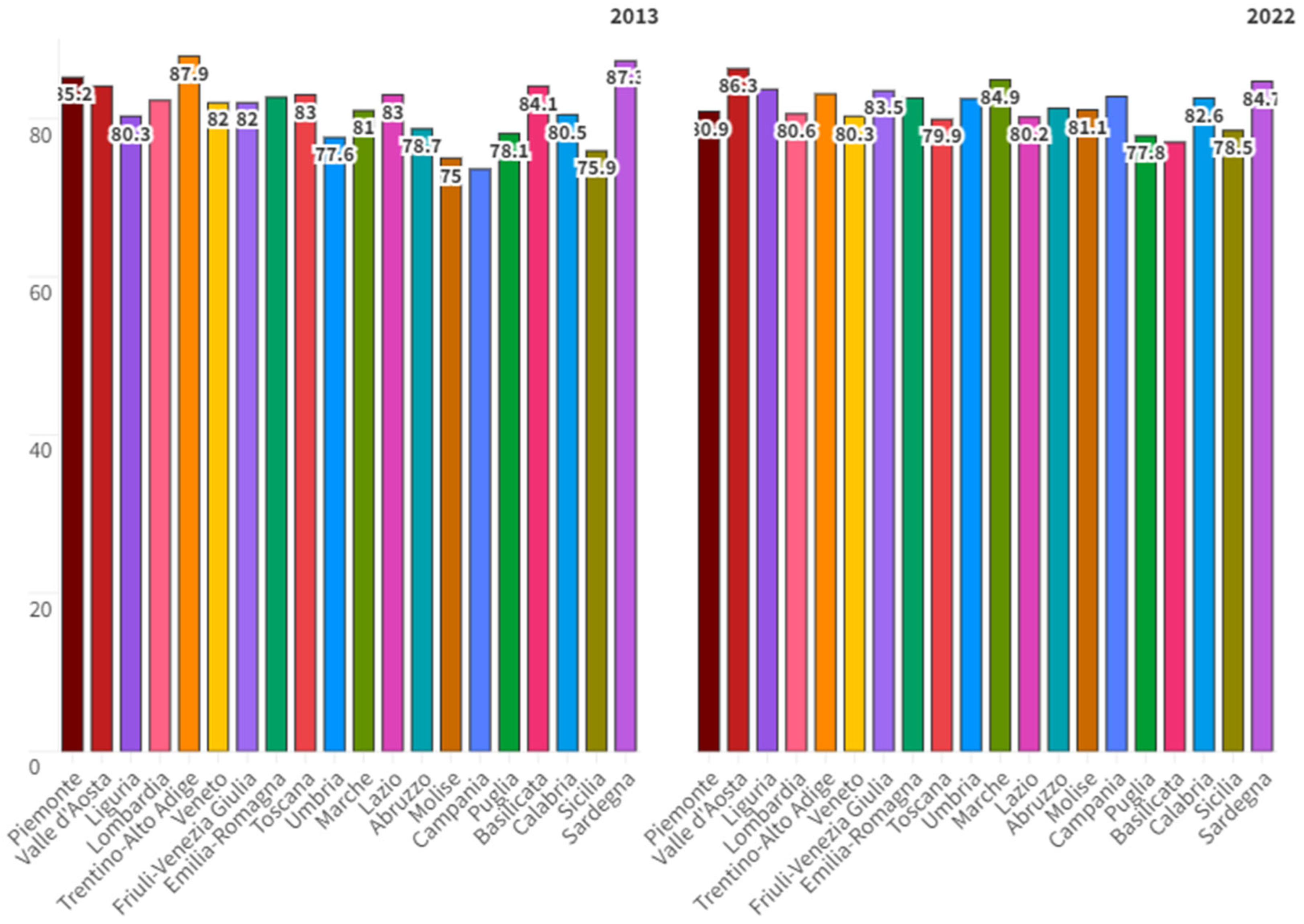
Figure 4.
PYCC across Italian macro-regions during the period 2013-2022. Source: Istat-Bes. Elaboration by the authors.
Figure 4.
PYCC across Italian macro-regions during the period 2013-2022. Source: Istat-Bes. Elaboration by the authors.
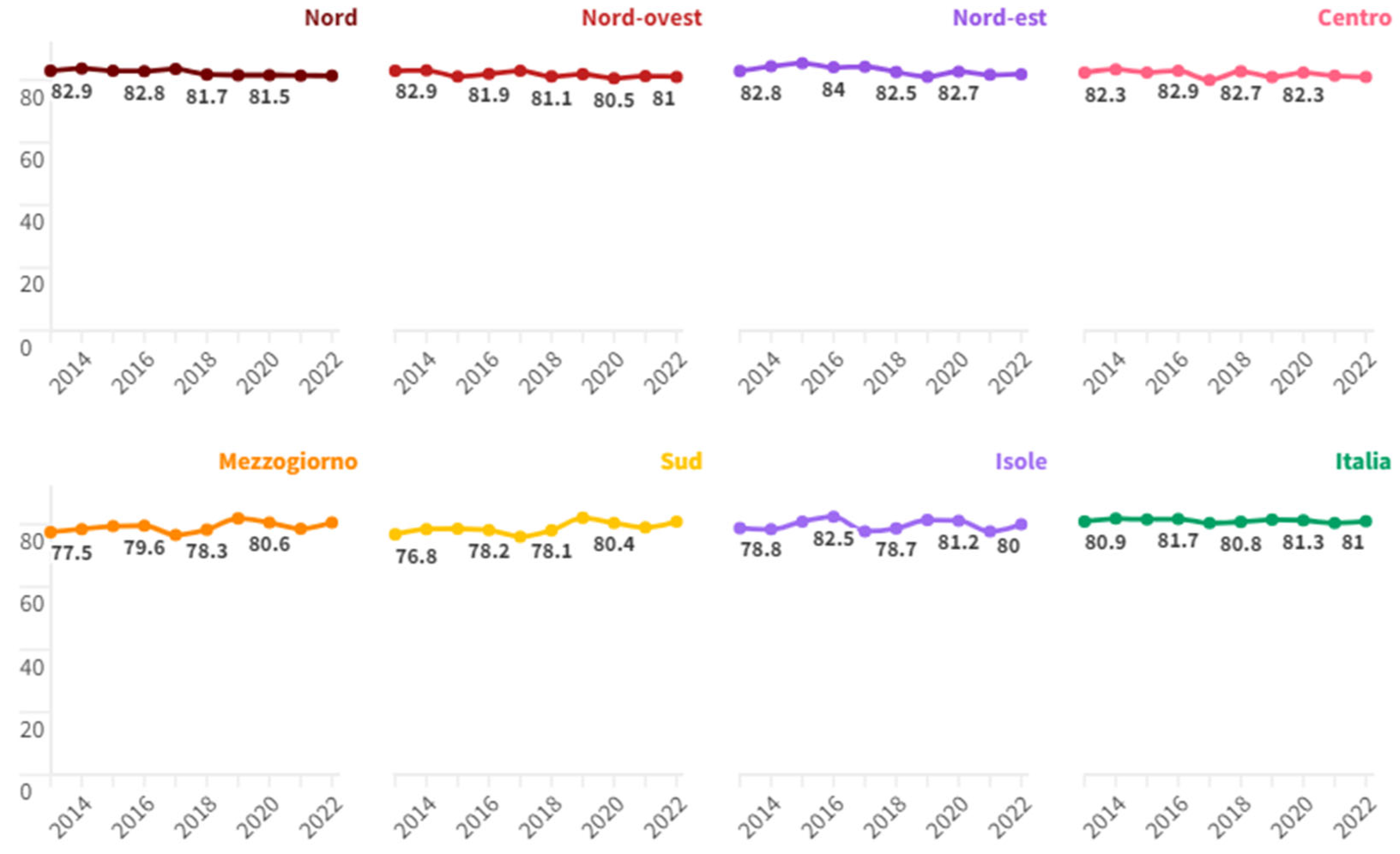
Figure 5.
PYCC across Italian regions the period 2013-2022. Source: Istat-Bes. Elaboration by the authors.
Figure 5.
PYCC across Italian regions the period 2013-2022. Source: Istat-Bes. Elaboration by the authors.
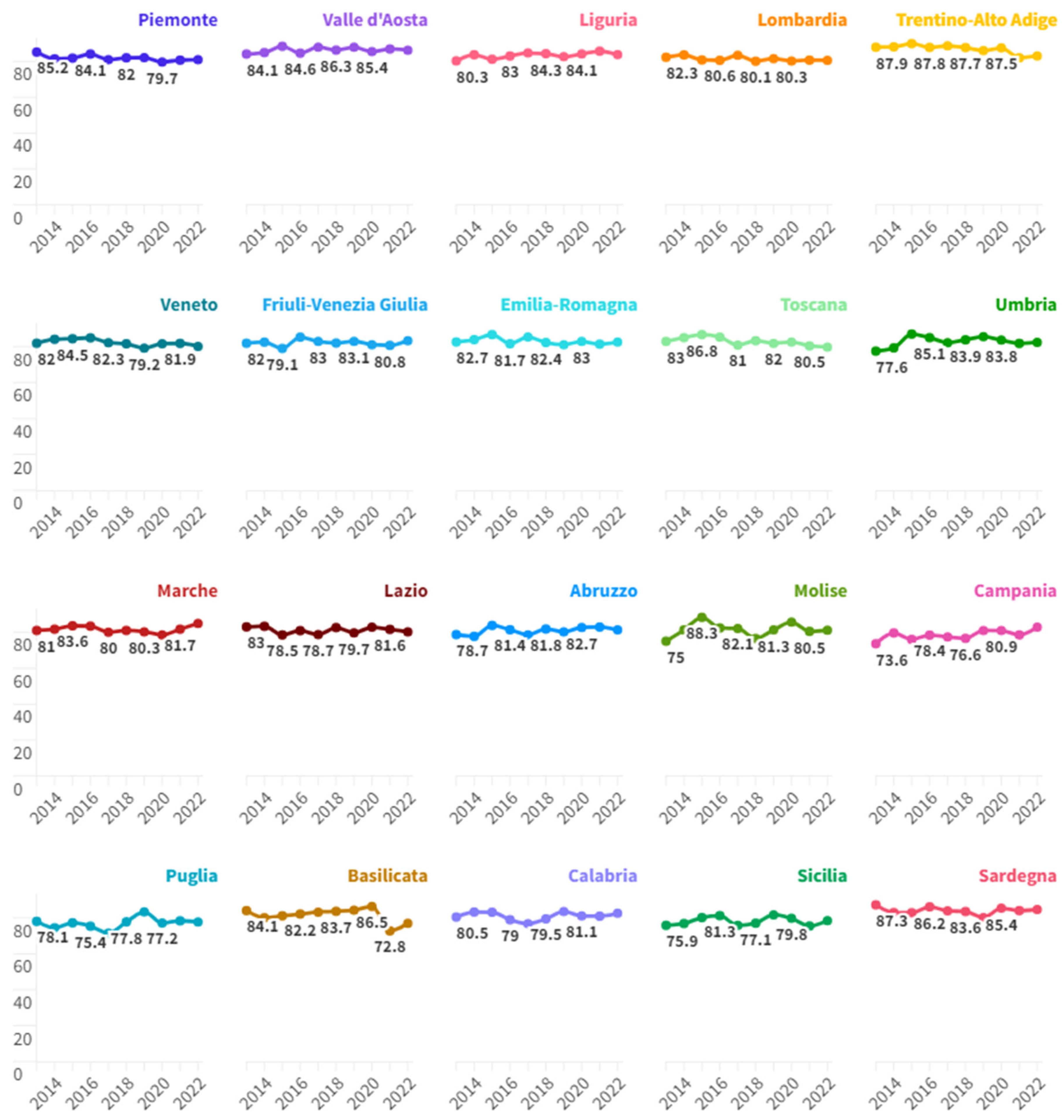
Figure 6.
The optimal number of clusters according to Silhouette Coefficient and Elbow Method in the optimization of the non-supervised machine-learning algorithm k-Means.
Figure 6.
The optimal number of clusters according to Silhouette Coefficient and Elbow Method in the optimization of the non-supervised machine-learning algorithm k-Means.
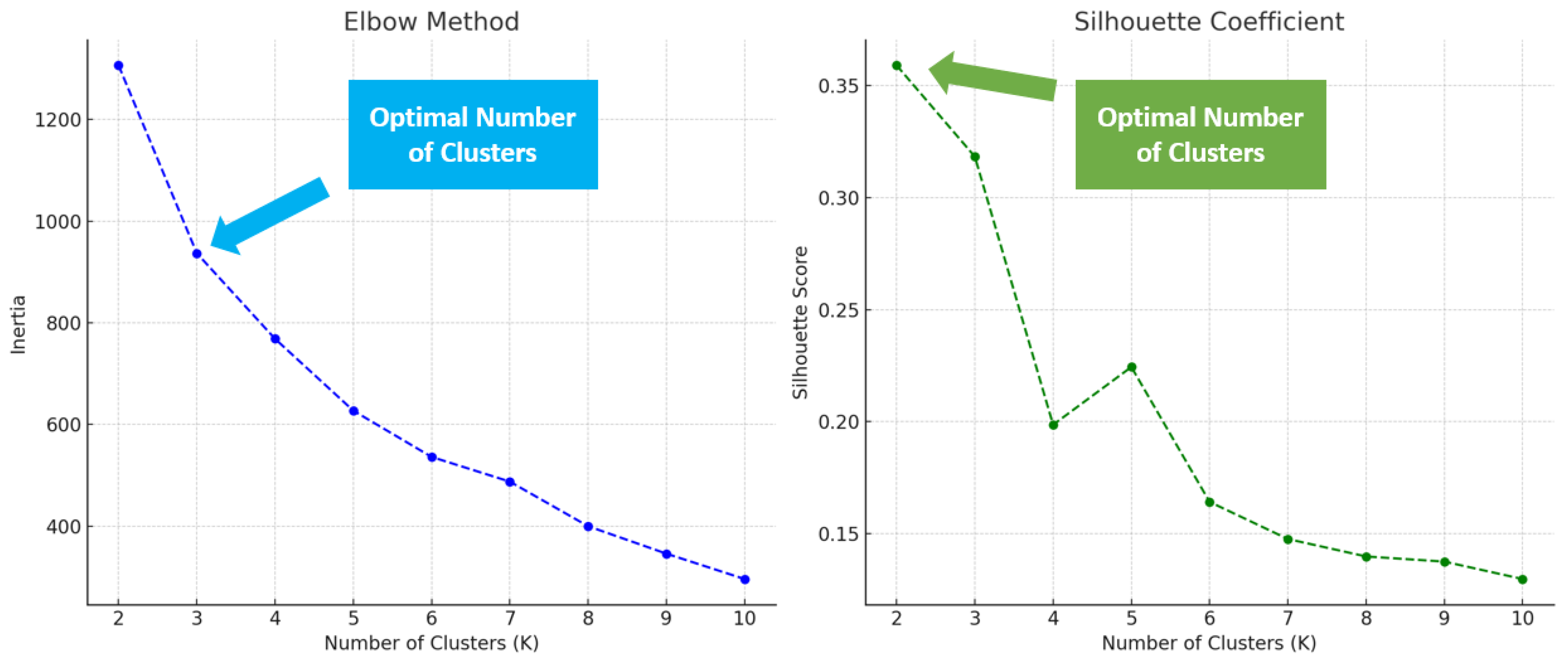
Figure 7.
Representation of the regions belonging to cluster 1 and 2 with indications of the network structure. Optimization with Silhouette coefficient.
Figure 7.
Representation of the regions belonging to cluster 1 and 2 with indications of the network structure. Optimization with Silhouette coefficient.
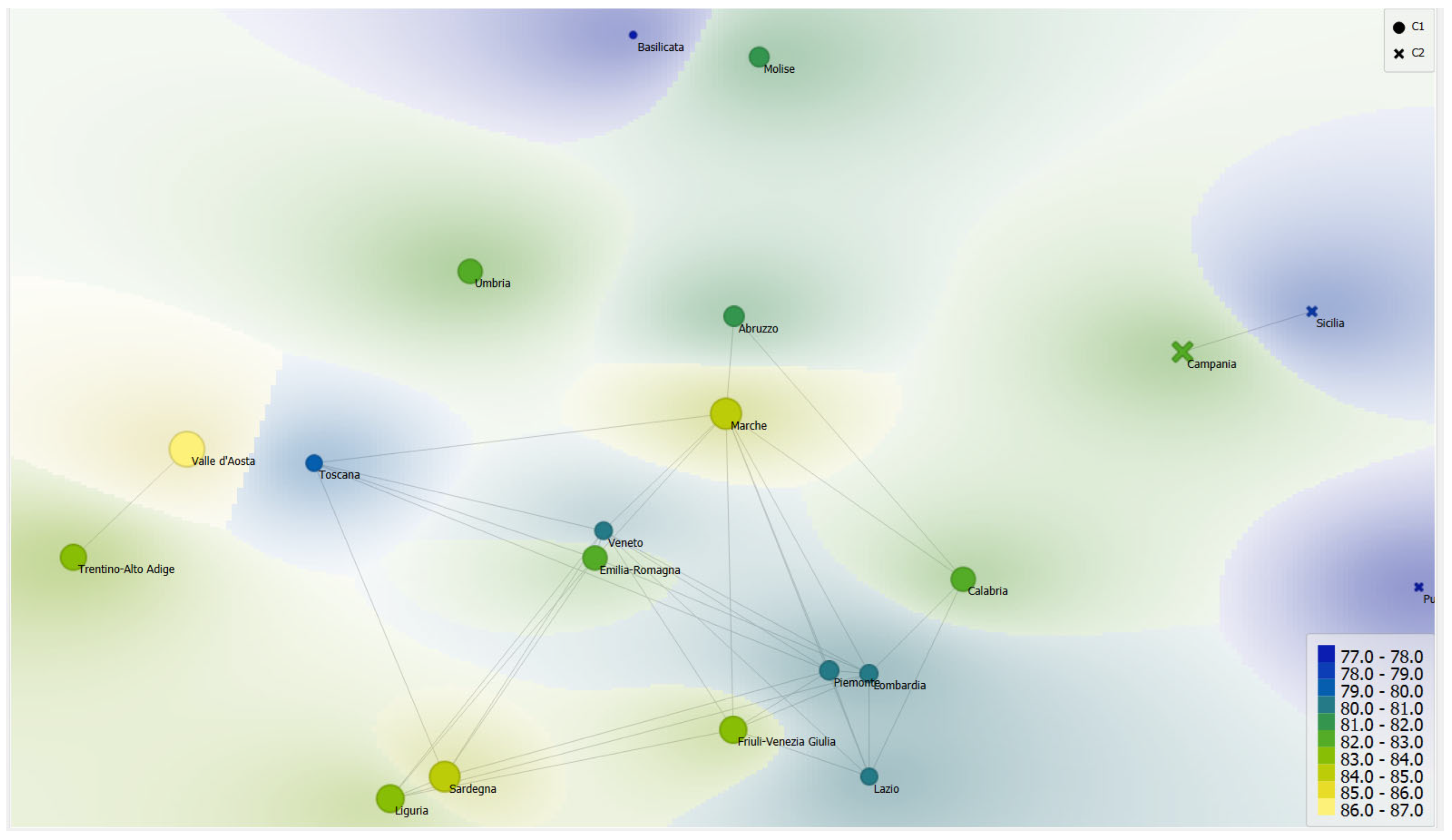
Figure 8.
Composition of clusters based on Elbow optimization.
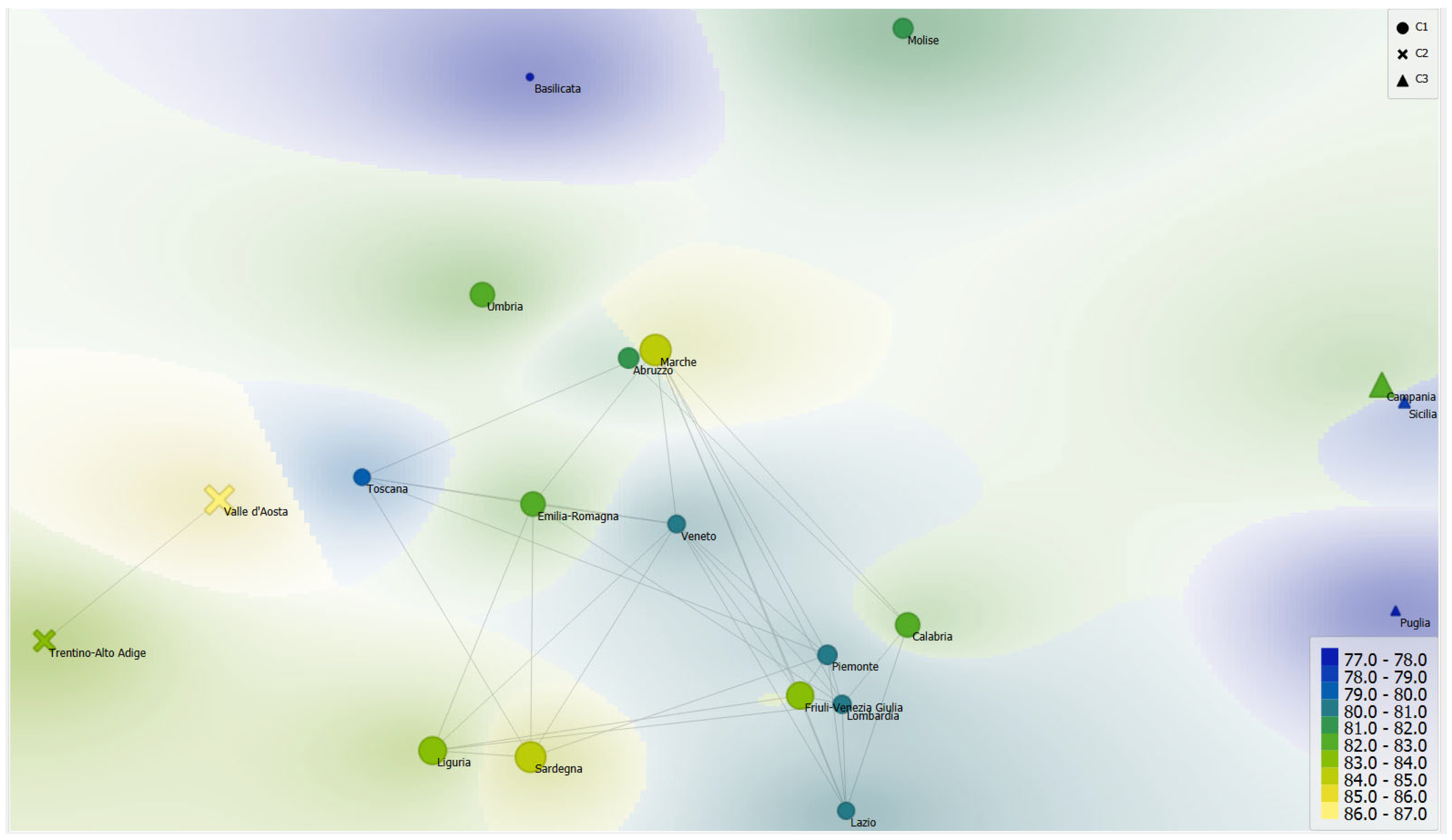

Table 1.
Synthesis of the literature review by macro-themes.
| Macro-themes | References |
|---|---|
| Behavioral Economics and Altruism | Akhtar (2023); Aksoy et al. (2021); Eriawaty et al. (2022); Konarik and Melecky (2022); Mangone (2020); Mangone (2022) |
| Solidarity Economics and Social Movements | Benner and Pastor (2021); Matthaei (2020); Kawano (2020); Salustri (2021); Pearlman (2023); Ventura (2023) |
| Diversity, Reciprocity, and Prosocial Behavior | Baldassarri and Abascal (2020); Cimagalli (2020); Cappelen et al. (2021); Choquette-Levy et al. (2024); Spaulonci Chiachia Matos de Oliveira (2022) |
| Socioeconomic Position and Solidarity in Times of Crisis | Bertogg and Koos (2021); Fernández et al. (2021); Travlou and Bernát (2022); Salem (2020) |
| Economic Philosophy and Homo Economicus | Albanese (2021); Johnson (2020); Silvestri and Kesting (2021) |
| Morality and Economics | van Geest (2021); Volosevici and Grigorescu (2021); Siemoneit (2023); Gualda (2022) |
Table 2.
Variables, Acronym, Definitions and Source.
| Variables | Acronym | Definition | Source |
|---|---|---|---|
| People you can count on | PYCC | Percentage of people aged 14 and over who have non-cohabiting relatives (in addition to parents, children, brothers, sisters, grandparents, grandchildren), friends or neighbors they can count on out of all people aged 14 and over. In contemporary society, non-cohabiting relationships serve an equally vital function in providing emotional, social, and practical support. The statistic on the percentage of people aged 14 and over who have non-cohabiting relatives, friends, or neighbors they can rely on reflects the broader network of interpersonal connections that extend beyond immediate family members, such as parents, children, or siblings. These relationships often contribute significantly to individuals’ mental well-being and promote greater community cohesion. A higher percentage of individuals with such connections could be interpreted as indicative of stronger community bonds and increased social capital, both of which are essential for fostering a sense of belonging and collective security. Those with access to non-cohabiting relatives or friends are likely to demonstrate greater resilience when facing personal challenges or crises, as they can draw upon a more extensive range of resources for support. Conversely, a lower percentage may signal rising social isolation, a condition associated with negative health outcomes, including depression and anxiety. Furthermore, as family structures evolve and urbanization progresses, friendships and neighborhood ties become increasingly critical sources of support. Nevertheless, this statistic does not fully capture the quality or depth of these relationships, which can vary considerably. Simply knowing someone who can be relied upon does not necessarily guarantee active, reciprocal support. Despite these limitations, the statistic remains a valuable indicator of social well-being, underscoring the importance of fostering wider community connections in a time of shifting familial dynamics (Kalland et al., 2022; Preetz, 2022; Yucel and Latshaw, 2022; Rapp and Stauder, 2020). | ISTAT-BES |
| Low paid employees | LPE | Percentage of employees with an hourly wage lower than 2/3 of the median hourly wage out of all employees. This measure is essential for evaluating wage inequality and understanding the degree to which certain segments of workers face economic vulnerability. A high percentage of employees earning less than two-thirds of the median wage signals significant income disparity, potentially reflecting systemic issues in wage distribution. From an economic standpoint, a higher proportion of low-wage workers often correlates with diminished employee bargaining power, which may stem from labor market deregulation, limited union representation, or an increase in precarious employment arrangements. Such workers are more likely to experience financial instability, with restricted access to essential services such as healthcare, housing, and education. This dynamic can perpetuate cycles of poverty and exacerbate social inequality. Moreover, the prevalence of low-wage employment has broader implications for overall economic productivity. Employees earning lower wages may suffer from reduced job satisfaction and motivation, potentially leading to higher turnover rates and lower organizational efficiency. Employers, in turn, may face difficulties in retaining skilled workers, thereby hindering long-term business growth and competitiveness. Conversely, a lower percentage of employees earning below this threshold suggests a more equitable wage distribution, with a larger portion of workers receiving compensation that reflects fair market value. This statistic thus serves as a critical indicator for policymakers and economists, emphasizing the need for interventions to address wage disparities and foster more inclusive economic growth (Islam and Safavi, 2020; Marinescu and Sojourner, 2021; Janietz et al., 2023; Beckmannshagen and Schröder, 2022). | ISTAT-BES |
| Satisfaction with the work done | SWWD | Percentage of employed people who expressed an average satisfaction score between 8 and 10 for the following aspects of their work: earnings, career opportunities, number of hours worked, job stability, distance from home to work, interest in work. The aspects evaluated—earnings, career opportunities, working hours, job stability, commute, and interest in work—are fundamental elements that shape the quality of an individual's work experience and, by extension, their broader life satisfaction. A high percentage of workers expressing satisfaction in these areas suggests that the labor market is effectively addressing employees' needs and expectations. Satisfaction with earnings and career opportunities, for instance, reflects not only financial security but also the potential for upward mobility and professional development, both of which are critical to sustaining motivation and retaining talent over the long term. Similarly, high satisfaction with working hours and job stability points to a healthy work-life balance and a sense of economic security, factors closely linked to improved mental and emotional well-being.ΦMoreover, satisfaction with the commute, particularly the distance from home to work, is a key determinant of job satisfaction. Shorter or more manageable commutes are associated with reduced stress levels and greater overall job contentment. Additionally, high levels of interest in one's work indicate that employees find their roles meaningful and engaging, which can foster increased productivity and a stronger sense of purpose within the organization. Conversely, a lower percentage of satisfaction across these dimensions may indicate underlying structural deficiencies in the workplace, such as inadequate compensation, limited career advancement opportunities, or poor work-life balance. Addressing these issues is crucial for improving workforce morale and enhancing organizational performance. Consequently, this statistic offers valuable insights for both employers and policymakers, guiding efforts to create more supportive and fulfilling work environments (Chongyu, 2021; Bartoll and Ramos, 2020; Sánchez-Sánchez and Fernández Puente, 2021). | ISTAT-BES |
| Risk of poverty | RP | Percentage of people who live in families with an equivalent net incomeΦlower than a risk-of-poverty threshold, set at 60% of the median of the individual distribution of equivalent net income. The income reference year is the calendar year preceding the survey year. This threshold measures the proportion of people at risk of poverty relative to the median income, offering a nuanced understanding of relative deprivation within a society. A high percentage of individuals falling below this threshold points to significant income disparities and socioeconomic stratification. Families with incomes below this level frequently face challenges in meeting essential needs such as housing, healthcare, and education, restricting their access to resources that facilitate social mobility. The use of "equivalent net income," which adjusts for household size and composition, allows for a more precise reflection of financial well-being compared to the median income standard. Living below this threshold often entrenches families in cycles of poverty, as limited financial resources hinder investments in critical areas like education and health, thereby reducing future earnings potential. Prolonged exposure to these conditions can result in negative long-term outcomes, including poorer health, lower educational attainment, and diminished overall life quality. Addressing the high proportion of individuals living in poverty requires targeted social policies aimed at wealth redistribution and the provision of comprehensive social safety nets. This statistic provides essential insights for policymakers, highlighting the need for interventions that promote a more equitable distribution of income and reduce the risk of poverty within the population (Ilmakunnas, 2022; Dudziński and Kaleta, 2021; Slobodenyuk and Mareeva, 2020; Surinov and Luppov, 2020). | ISTAT-BES |
| Social participation | SP | People aged 14 and over who in the last 12 months have carried out at least one social participation activity out of the total number of people aged 14 and over. The activities considered are: participating in meetings or initiatives (cultural, sports, recreational, spiritual) organized or promoted by parishes, congregations or religious or spiritual groups; participating in meetings of cultural, recreational or other associations; participating in meetings of environmental, civil rights, peace associations; participating in meetings of trade union organizations; participating in meetings of professional or trade associations; participating in meetings of political parties; carrying out free activities for a party; paying a monthly or periodic fee for a sports club. Social participation, encompassing activities such as involvement in cultural, recreational, spiritual, political, and trade organizations, plays a pivotal role in promoting social cohesion, enhancing civic responsibility, and fostering individual well-being. Participation in such activities reflects the degree to which individuals engage in collective actions that contribute to the formation and maintenance of social capital. A high percentage of individuals involved in these activities suggests a robust civil society characterized by active civic engagement and the presence of strong social networks. Participation in organized events, such as religious gatherings, trade union meetings, or political party activities, allows individuals to forge social connections, share collective values, and collaborate in pursuit of common objectives. This fosters a sense of belonging, strengthens communal bonds, and contributes to the overall stability of the social and political environment. Conversely, a low level of social participation may indicate social disengagement, which can erode social capital and diminish individuals' sense of belonging and collective efficacy. Barriers such as economic inequality, time constraints, or geographic inaccessibility may inhibit participation, further contributing to social isolation. This statistic provides critical insights for policymakers and social organizations, highlighting the importance of fostering inclusive opportunities for civic engagement. Developing policies and initiatives that promote broader social participation is crucial for cultivating a more cohesive, engaged, and resilient society (Power, 2020; Ødegård and Fladmoe, 2020; Borraccino et al., 2020; Khatskevich and Alexandrov, 2021). | ISTAT-BES |
| Generalized trust | GT | Percentage of people aged 14 and over who believe, that most people are trustworthy out of the total number of people aged 14 and over. Trust in others underpins the development of strong interpersonal relationships, community cohesion, and the accumulation of social capital. A high percentage of individuals expressing trust in others suggests the presence of robust social bonds, enhanced cooperation, and a lower likelihood of social fragmentation. Social trust is a fundamental element in the effective functioning of democratic institutions and economic systems. In societies where trust is prevalent, there tends to be greater cooperation in collective efforts, smoother economic transactions, and increased civic participation. This high level of trust reduces the need for costly oversight and enforcement mechanisms, thereby promoting efficiency and mutual respect within both public and private sectors. Additionally, social trust is positively correlated with mental health and well-being, as individuals in high-trust environments often feel more secure and supported by their communities. In contrast, a low percentage of individuals perceiving others as trustworthy may indicate rising social fragmentation, individualism, or growing skepticism towards institutions. This lack of trust can result in heightened social tensions, reduced community engagement, and an increased reliance on regulatory mechanisms to maintain social order. Moreover, diminished trust can undermine civic and political participation, weakening democratic institutions over time (Tuominen and Haanpää, 2022; Bayer, 2022; Lum, 2022; Anwar et al, 2020). | ISTAT-BES |
| Employment rate (20-64 years) | ER | Percentage of employed people aged 20-64 on the population aged 20-64. This indicator provides an understanding of the proportion of the working-age population actively engaged in employment, thereby offering valuable insights into both employment levels and overall economic productivity. A high percentage reflects a robust labor market with significant employment opportunities, suggesting favorable economic conditions. Conversely, a low percentage may point to labor market challenges, such as high unemployment rates, underemployment, or structural barriers that inhibit individuals from securing stable employment. The 20-64 age group represents the prime working years, making their employment rate essential for economic performance and growth. Employment within this demographic is not only a driver of economic output but also supports the sustainability of social security systems, as employed individuals contribute to pensions, healthcare, and other public services. High employment rates within this age group are especially critical in aging societies, where a smaller working population must support a growing number of retirees. Moreover, employment within this age group is strongly associated with social inclusion and individual well-being. Stable employment contributes to financial security, access to healthcare, and a sense of purpose and societal contribution. A decline in employment rates among this demographic can increase dependency ratios, placing pressure on public resources and social welfare systems, as fewer workers support a larger non-working population (Börsch-Supan, et al. 2021; Nwaubani et al., 2020; Espi-Sanchis et al., 2022). | ISTAT-BES |
| Net income inequality (s80/s20) | NII | Ratio between the total equivalent income received by the 20% of the population with the highest income and that received by the 20% of the population with the lowest income. This ratio, often referred to as the income quintile share ratio, provides insight into the distribution of wealth and the degree of economic disparity between the wealthiest and the poorest segments of the population. A higher ratio indicates greater inequality, where the top 20% of earners capture a disproportionately large share of the total income relative to the bottom 20%. This form of economic imbalance can have profound implications for social cohesion, political stability, and long-term economic growth. Income inequality, as reflected in this ratio, often results from a combination of structural factors, including disparities in education, access to employment, capital accumulation, and the concentration of wealth. High inequality can lead to reduced social mobility, where individuals in lower-income brackets face significant barriers to improving their economic status. It may also exacerbate social divisions, fostering distrust and resentment, which can destabilize political institutions and erode democratic processes. Furthermore, extreme income inequality has been shown to negatively impact economic performance. Concentrated wealth limits overall consumer demand, as lower-income households spend a larger share of their income on consumption. This disparity can hinder economic growth, as wealthier individuals tend to save or invest, reducing immediate economic activity. Thus, this ratio serves as a vital tool for policymakers to assess the need for redistributive policies, such as progressive taxation or social welfare programs, to mitigate inequality and promote more inclusive economic development (Kebe et al., 2023; Erauskin, 2020). | ISTAT-BES |
| Non-regularly employed | NRE | Percentage of employed people who do not comply with the current legislation on labor, tax and social security contributions on the total employed people. This non-compliance has significant economic, social, and legal implications. A high percentage of non-compliance suggests widespread informal employment, where workers and employers evade labor laws, tax obligations, and social security contributions. This phenomenon undermines the formal economy by depriving governments of essential tax revenues and social security contributions, which are vital for funding public services and welfare programs. From a social perspective, non-compliance affects both workers and the broader population. Workers who operate outside formal regulations often lack access to critical protections such as health benefits, pension schemes, and unemployment insurance. This lack of coverage increases their vulnerability to economic shocks and long-term poverty, especially in cases of illness, unemployment, or old age. In addition, non-compliant employment exacerbates income inequality, as informal workers typically earn lower wages and have less job security than their counterparts in the formal sector. Furthermore, widespread non-compliance creates unfair competition in the labor market, where businesses that adhere to legal standards face disadvantages compared to those that avoid taxes and regulations. This can lead to a "race to the bottom," where businesses are incentivized to cut costs through non-compliance rather than improving productivity or working conditions (Li et al., 2020; Bosch et al., 2021). | ISTAT-BES |
Table 3.
Estimation of the Value of PYCC with Panel Data with Fixed Effects, Panel Data with Random Effects, Pooled OLS and WLS.
Table 3.
Estimation of the Value of PYCC with Panel Data with Fixed Effects, Panel Data with Random Effects, Pooled OLS and WLS.
| Estimation of the Value of PYCC | ||||||||||
|---|---|---|---|---|---|---|---|---|---|---|
| Variable | const | ER | LPE | SWWD | NII | RP | NRE | SP | GT | |
| Pooled OLS | Coefficient | 30.482 | −0.523337 | 1.85435 | 0.941618 | −3.29518 | 0.284913 | −1.29779 | 2.29992 | −0.859506 |
| Std. Error | 3.30334 | 0.238503 | 0.207111 | 0.321446 | 1.01386 | 0.129974 | 0.412513 | 0.076236 | 0.119062 | |
| p-value | <0.0001 | 0.0288 | <0.0001 | 0.0036 | 0.0013 | 0.029 | 0.0018 | <0.0001 | <0.0001 | |
| *** | ** | *** | *** | *** | ** | *** | *** | *** | ||
| Fixed Effects | Coefficient | 34.2525 | −0.650720 | 2.21164 | 1.08443 | −4.09917 | 0.485842 | −1.70579 | 2.37634 | −1.03985 |
| Std. Error | 4.00646 | 0.260433 | 0.217229 | 0.353539 | 1.30129 | 0.199375 | 0.539081 | 0.075975 | 0.124273 | |
| p-value | <0.0001 | 0.0129 | <0.0001 | 0.0023 | 0.0018 | 0.0153 | 0.0017 | <0.0001 | <0.0001 | |
| *** | ** | *** | *** | *** | ** | *** | *** | *** | ||
| Random Effects | Coefficient | 33.7664 | −0.595876 | 2.08993 | 1.01667 | −3.72735 | 0.37483 | −1.60997 | 2.35364 | −0.976760 |
| Std. Error | 3.78998 | 0.245898 | 0.20925 | 0.332295 | 1.14466 | 0.157082 | 0.477984 | 0.074682 | 0.119853 | |
| p-value | <0.0001 | 0.0154 | <0.0001 | 0.0022 | 0.0011 | 0.017 | 0.0008 | <0.0001 | <0.0001 | |
| *** | ** | *** | *** | *** | ** | *** | *** | *** | ||
| WLS | Coefficient | 31.0799 | −0.516237 | 1.86797 | 0.920011 | −3.40669 | 0.313577 | −1.33956 | 2.33801 | −0.902347 |
| Std. Error | 3.1949 | 0.237616 | 0.199949 | 0.321138 | 0.958205 | 0.122202 | 0.385256 | 0.07431 | 0.118442 | |
| p-value | <0.0001 | 0.0304 | <0.0001 | 0.0044 | 0.0004 | 0.0107 | 0.0006 | <0.0001 | <0.0001 | |
| *** | ** | *** | *** | *** | ** | *** | *** | *** | ||
Disclaimer/Publisher’s Note: The statements, opinions and data contained in all publications are solely those of the individual author(s) and contributor(s) and not of MDPI and/or the editor(s). MDPI and/or the editor(s) disclaim responsibility for any injury to people or property resulting from any ideas, methods, instructions or products referred to in the content. |
© 2024 by the authors. Licensee MDPI, Basel, Switzerland. This article is an open access article distributed under the terms and conditions of the Creative Commons Attribution (CC BY) license (https://creativecommons.org/licenses/by/4.0/).
Copyright: This open access article is published under a Creative Commons CC BY 4.0 license, which permit the free download, distribution, and reuse, provided that the author and preprint are cited in any reuse.


