

Submitted:
12 September 2024
Posted:
13 September 2024
You are already at the latest version
Abstract
In recent years, consensus algorithms have gained significant importance in the context of blockchain networks. These algorithms play a crucial role in allowing network participants to reach agreements on the state of the Blockchain without needing a central authority. The present study focuses on carrying out a systematic mapping of these consensus algorithms to explore in detail their use, benefits, and challenges in the context of blockchain networks. Understanding consensus algorithms is essential to appreciating how blockchain networks achieve the reliability and integrity of their distributed ledgers. These algorithms allow network nodes to reach agreement on the validity of transactions and the creation of new blocks on the Blockchain. In this sense, consensus algorithms are the engine that drives trust in these decentralized networks. Numerous authors have contributed to the development and understanding of consensus algorithms in the context of blockchain networks. For example, Satoshi Nakamoto's (2008) original paper on Bitcoin introduced proof-of-work (PoW) as a method of achieving consensus on the network. This revolutionary concept paved the way for numerous cryptocurrencies and blockchain systems. Despite advances in this field, significant challenges remain: centralization, fair token distribution, scalability, and sustainability. The energy consumption of blockchain networks, particularly those using algorithms such as Proof of Work, Proof of Stake, Delegated Proof of Stake, Proof of Authority, and hybrid algorithms (Proof of Work/Proof of Stake), has raised concerns about their environmental impact, motivating the scientific and technological community to investigate more sustainable alternatives that promise to reduce energy consumption and contribute to climate change mitigation. Furthermore, interoperability between different blockchains and security in specific environments, such as IoT, are areas that still require significant research attention. This systematic mapping not only seeks to shed light on the current state of consensus algorithms in blockchain, but also their impact on sustainability, identifying those algorithms that, in addition to guaranteeing integrity and security, minimize the environmental footprint, promoting a more efficient use of energy resources, being a relevant approach in a context in which the adoption of sustainable technologies has become a global priority. Understanding and improving these algorithms are critical to unlocking the full potential of blockchain technology in a variety of applications and industry sectors.
Keywords:
Blockchain
; consensus algorithms
; sustainability
; environmental footprint
; systematic mapping
1. Introduction
Blockchain technology, a revolutionary milestone in the world of computing, first emerged in 2009 as a concept that challenged established conventions. It is a data structure that has transformed the way digital transactions are managed, creating a decentralized and distributed environment that allows the execution of transactions in a peer-to-peer (P2P) network without the need for intermediaries. The name "blockchain" comes from its most distinctive feature: the record of digital transactions, a chain of continuously connected blocks. In this ecosystem, the main actors are the nodes the participants of the blockchain network. Each of these nodes maintains a copy of all transactions that have taken place on the network, ensuring complete transparency and reliability. The validation of any transaction on this network requires the consensus of the nodes, which implies that the user community must accept all parties involved in the transaction.
Consensus algorithms are essential in this scenario. They are self-contained, self-executing codes that act every time a transaction is made. These algorithms are responsible for guaranteeing the harmony and integrity of the blockchain network. Although various platforms are available for creating consensus algorithms, Ethereum stands out as one of the most used and recognized in this area. Consensus algorithms are crucial in various applications and sectors, allowing network users to coordinate their actions and reach agreements without a central authority. This systematic mapping, however, will focus specifically on its application in the context of blockchain networks.
The architecture of a blockchain is a complex network of interconnected components: transactions, blocks, mining, and consensus. In addition, users (those who make transactions), miners (responsible for validating and grouping these transactions into blocks), and cryptocurrencies (the units of value that users and miners obtain) are the three main actors in this exciting ecosystem.
Blockchain technology has opened up a vast horizon of possibilities in the digital world, and understanding it is essential to harness its full potential in a wide range of applications. However, it has raised concerns about the environmental impact due to its exponential growth due to the high energy consumption associated with some consensus algorithms such as PoW, which requires a large amount of computational power and electrical energy to solve complex cryptographic problems, which has contributed significantly to the carbon footprint of the blockchain ecosystem. In this context, sustainability has become a key criterion for evaluating consensus algorithms, leading researchers and developers to look for more efficient alternatives with a lower environmental impact. A consensus algorithm is an agreement that must be reached to maintain the harmony of the network see [1][2].
In recent years, we have witnessed a rapid increase in the adoption of systems based on blockchain technology. In this scenario, consensus algorithms have emerged as crucial elements in the governance of decentralized applications, playing a fundamental role in ensuring that none of the parties involved can breach or make unauthorized changes to the transactions recorded on the Blockchain.
Blockchain technology, in itself, has revolutionized the way we think about and manage information and transactions. It offers the ability to create a single, consensual, distributed record of any event or transaction across multiple nodes in a network, all without relying on a centralized database. This feature has driven its adoption across a wide variety of industries as it brings several significant benefits, such as transparency, immutability, and security. One of the fundamental pillars of Blockchain is the ability to add new blocks to the chain securely and reliably. This is achieved through a mechanism that ensures that all network participants agree on the decisions made. At the heart of this process is an essential component: the consensus algorithm. These algorithms are executed by nodes known as miners, which are machines specialized in solving highly complex mathematical problems, ensuring the integrity and reliability of the network [3][4].
The interaction between consensus algorithms and blockchain networks is presented as an extremely promising field for both researchers and professionals from various disciplines. However, despite this appeal, there needs to be more systematic literature reviews dedicated to identifying the opportunities and potential problems related to these specific topics. Although the academic literature has devoted considerable efforts to literature reviews on blockchain or consensus algorithms separately, the intersection of consensus algorithms in the context of blockchain networks has yet to be comprehensively addressed. This paper aims to close this research gap.
The main objective of this systematic mapping is to explore and analyze in depth the use and application of consensus algorithms in blockchain networks, examining the potential problems and opportunities they face. As new blockchain platforms and applications are developed, algorithms that demonstrate a lower environmental footprint are more likely to be implemented in industries where ecological responsibility is crucial. This trend underscores the importance of continuing to research and develop consensus algorithms that not only prioritize security and efficiency, but are also compatible with global goals of reducing environmental impact.
2. Investigation Methodology
The research method selected to carry out this study is systematic mapping, a recognized and widely used methodology in academic research. Following the proposal of Petersen and others, as described in their work [5], this approach provides us with the structure and rigor necessary to exhaustively explore the relevant studies, papers, and articles that will allow us to address the research questions in a systematic and precise. Systematic mapping is presented as a powerful tool that not only allows us to identify and understand the crucial research topics related to consensus algorithms applied in blockchain networks but also helps to chart a clear path toward the identification of the gaps in the existing literature, which opens the door to future research and advances in this exciting field.
This systematic mapping process is divided into five essential stages, each contributing significantly to the understanding and analyzing the relevant literature. First, defining the research questions allows establishing a clear and specific framework for the investigation. This ensures that efforts are focused on the most relevant topics and that conclusions are directly related to the study objectives. The second stage, conducting the search, involves identifying and compiling various academic sources and relevant literature. This ensures that the review is as complete and representative as possible. The third stage involves searching for relevant articles. In this phase, the identified sources are critically evaluated to determine which are relevant to the research questions and which are not, allowing attention to be focused on the most valuable and significant resources. In the fourth stage, relevant articles are classified according to specific keywords and categories. This helps organize and structure information coherently, making it easier to identify patterns and trends in the literature. Finally, in the fifth stage, data extraction must be carried out, where detailed and relevant information is collected from the selected articles, which provides a solid basis for the analysis and synthesis of the literature, allowing, in turn, to answer the questions. research questions in an informed and accurate manner. This systematic mapping not only approves in-depth exploration in the field of consensus algorithms in blockchain networks but also establishes a solid methodological framework for research. With this approach, researchers will be in a unique position to identify existing advances, emerging trends, and areas of research that require further attention. This study will significantly advance knowledge in this field and provide a solid foundation for future research and development in blockchain networks and consensus algorithms.
- A.
- Define research questions
The first fundamental step in a systematic review is defining the research questions guiding the entire process and whose answers will be sought after the study. In this case, four questions have been formulated that will serve as the beacon that will illuminate the way in the search and analysis of the relevant literature. These research questions are the core around which the framework will be built:
RQ-1: What are the existing research areas related to consensus algorithms applied to Blockchain?
This question allows us to identify and understand the thematic areas on which researchers have focused their efforts. The different facets of this technology and its applications will be explored, from security to scalability and from cryptocurrencies to enterprise applications.
RQ-2: How has research on consensus algorithms applied to Blockchain evolved year after year regarding the number and type of publications?
This second question encourages a trip through time to analyze how research in this field has evolved. It is expected to observe how interest in consensus algorithms has grown over time, identifying emerging trends and patterns. Diversification in publication types can also be explored, from academic articles to technical reports and open-source projects.
RQ-3: Which consensus algorithms are more sustainable in terms of carbon and environmental footprint?
The third question seeks to identify which algorithms generate fewer greenhouse gas emissions and have a lower environmental impact overall; based on the answers, it could be determined which algorithms are more viable for adoption in blockchain networks from an ecological perspective, helping to promote the use of more sustainable technologies.
RQ-4: Are there consensus algorithms that efficiently balance security, scalability, and sustainability in blockchain networks?
The fourth and final question aims to evaluate which consensus algorithms, without sacrificing performance and security, minimize environmental impact.
These four research questions are intertwined to provide a complete and holistic view of research in sustainable consensus algorithms applied to blockchain, addressing challenges such as energy consumption, carbon footprint, and the need to balance security, scalability, and sustainability. By answering these questions, this study will not only contribute to the advancement of knowledge in this ever-evolving field, but will also provide valuable information for researchers, practitioners and those interested in better understanding the environmental impact and possibilities of this technology.
- B.
- Search
In this second phase of the systematic review process, research papers related to consensus algorithms are searched and compiled based on a specific search term. After performing some exploratory searches and trying different combinations of keywords, a final string has been defined that will be used when searching for articles in several relevant databases. This search string is made up of the following keywords: ("consensus algorithms") ("blockchain") AND (“sustainable”).
To carry out this exhaustive literature search, various renowned databases in the field of computer science have been used. These databases were selected due to their relevance and accessibility through institutional accounts. Databases used include:
- ACM Digital Library (http://dl.acm.org)
- IEEE Explore (https://explore.ieee.com)
- SpringerLink (https://link.springer.com)
- ScienceDirect (https://www.sciencedirect.com/)
- Scopus (https://www.scopus.com)
This set of sources has been chosen because they are among the most relevant sources of articles within the field of computer science and are accessible through the institutional account. The search began in August 2022 in these databases, and Mendeley was used as a reference management tool to avoid duplication of results. In the compilation process, only research articles that have been peer-reviewed and published in journals, conferences, symposia, workshops, and books have been considered. This guarantees that the selected literature meets the quality and relevance standards required to answer the research questions posed. To further refine the selection of literature, inclusion and exclusion criteria have been established. The inclusion criteria have been defined to cover those articles that are relevant and contribute to answering the research questions. On the other hand, exclusion criteria have been implemented to discard articles that do not fit the scope of the study.
Table 1 provides a detailed description of the inclusion and exclusion criteria applied:
This rigorous literature search and selection process ensures that the resources collected are relevant and appropriate to address the previously defined research questions effectively. With this solid foundation of academic literature, the study is poised to move towards a complete and exhaustive analysis of consensus algorithms applied in the context of blockchain technology. This meticulous and selective approach to literature collection supports the quality and relevance of the data that will be used to address the research objectives and ultimately contribute to knowledge in this ever-evolving field.
- C.
- Selection of relevant articles
The third step in the systematic review process involves the exclusion of all research articles that are irrelevant to the research questions posed. To carry out this task, the approach proposed by J. Yli-Huumo and others has been followed, as described in their work [6]. Initially, research papers are eliminated based on the review of their titles and abstracts. In this process, those articles that do not fit the scope of the previously defined research questions are discarded. In addition to this initial exclusion, the exclusion criteria detailed in Table 1 are considered.
This approach to article selection ensures that only those directly relevant to the research questions are included, contributing to the quality and accuracy of the systematic mapping study. Among the exclusion criteria applied, the elimination of articles that are not written in English or Spanish, as well as those that lack access to the full text, is considered. Articles that do not contribute critically to the research, such as popular articles, newsletters, or gray literature, are also excluded. Duplicate articles are also removed to avoid redundancy in the review.
Furthermore, articles that are not directly related to technology are excluded since the focus of the study is on consensus algorithms applied to Blockchain, a relevant technological topic. This exclusion allows us to maintain coherence with the research objectives. This exclusion process is essential to ensure that only those articles that are genuinely relevant and that contribute significantly to answering the research questions posed are included in the review. In this way, the quality and relevance of the literature are ensured and will be subjected to further analysis in the later stages of the study.
- D.
- Classification of articles according to keywords
The fourth step in this systematic review process involves classifying all relevant research articles into different categories based on a keyword approach proposed by J. Yli-Huumo et al. [6]. At this stage, a thorough review of the article abstracts is carried out to associate keywords and critical contributions to each article, allowing them to be categorized appropriately. This keyword approach is essential for organizing and structuring the literature coherently, making it easier to identify emerging patterns and trends in the research. The abstracts provide an overview of the main contributions of each article, allowing researchers to determine which category it best fits.
In some cases, when the classification based on the abstract is ambiguous or insufficient, a more detailed review of the articles in question is carried out. This additional review may involve scanning critical sections of the article or further analyzing its content to make an accurate decision about its categorization. Classifying by keywords promotes coherence and uniformity in research and academic communication since, by assigning them, the search and comparison between various related works is facilitated.
Classifying articles according to specific categories is a crucial step to identify and organize research areas related to sustainable consensus algorithms applied to blockchain. This will allow for a more structured and meaningful analysis in the later stages of the study, which will contribute to effectively answering the research questions posed. Furthermore, this classification will facilitate the identification of key research topics and approaches in the field.
- E.
- Data extraction
In this stage, data extraction is carried out to collect all the relevant information necessary to answer the previously formulated research questions. This data extraction process involves collecting critical data and essential elements from the articles selected for review. The information extracted includes specific details about the consensus algorithms analyzed in each article, as well as their application in the context of Blockchain. In addition, data related to the research areas addressed in each study is collected, which will allow us to identify the most recurrent approaches and themes in the reviewed literature. Data extraction is carried out systematically and rigorously, following predefined criteria to ensure consistency in information collection. This stage is essential to gather the necessary data for subsequent analysis, allowing for a deeper understanding of the trends, patterns, and results in sustainable consensus algorithms in the context of Blockchain. The data extraction process is carried out carefully and thoroughly, ensuring that accurate and relevant data is collected for the study. The information obtained will be essential to answer the research questions posed and provide a solid basis for the analysis and synthesis of the reviewed literature.
3. Results
- A.
- Search and selection
In the initial search and selection phase, two essential steps were carried out: search and filtering. During this phase, an exhaustive search of all available scientific articles in various scientific databases was performed using the specific search ("consensus algorithms") ("blockchain") AND (“sustainable”).
The result of this search yielded a total of 3,352 articles collected in the period from January 1, 2020 to August 1, 2024. These articles constitute the initial literature set that will be subjected to a review and selection process in the later stages of the systematic review. This set of articles represents a significant sample of the research carried out in the field of consensus algorithms applied to Blockchain in the specified time. The next stage of the process will involve a more detailed examination of these articles to determine which ones meet the previously defined inclusion and exclusion criteria. This will allow us to refine the selection further and ensure that only the most relevant resources for the study are included.

Table 2.
Initial search results. Own elaboration.
| Library | Initial |
|---|---|
| IEEE Explore | 780 |
| ScienceDirect | 503 |
| ACM Digital Library | 520 |
| SpringerLink | 912 |
| Scopus | 637 |
During the selection phase, a purification process was carried out on the collected articles, with the help of a reference manager, to eliminate duplicates, which resulted in a set of 2,724 unique articles. Subsequently, 984 articles that were considered irrelevant to the research objectives were excluded, which reduced the set to 1,740 articles. This exclusion was based on three fundamental reasons: the irrelevance of some articles with respect to the research questions posed, the lack of significant contribution to the research, and the inclusion in the so-called "gray literature" related to sustainable consensus algorithms in Blockchain. Consequently, at the end of the selection phase, a total of 1,006 articles were included in this systematic mapping study. These articles represent a careful and exhaustive selection of relevant literature in the field of sustainable consensus algorithms applied to Blockchain. This selection ensures that the focus of the study is aligned with the posed research questions and the objectives of the systematic mapping, allowing for more precise and meaningful analysis to be carried out in the later stages of the study.
Table 3 presents some of the sources selected for the research development that allows us to answer the proposed questions of the review, being of more significant impact and relevance for the current research. In this phase, selecting appropriate sources is essential, as it will ensure the quality, credibility, and relevance of the information collected, thus providing a basis for building solid arguments and accurate conclusions, supporting the academic integrity of previous contributions in the field and strengthening the validity and reliability of the research. In addition to the above, the correct choice of sources will guarantee obtaining a balanced and diverse perspective on the topic, enriching the level of research and avoiding biases or limited points of view.
It is worth noting that the research studies carried out since 2020 and relevant to the present systematic review of the literature have been increasing, as can be seen in Figure 1. It should be noted that the 2024 review only references the first semester.
The annual scientific production of the research topic is shown in Figure 2; publications corresponding to the years between 2020 and the first half of 2024.
From the previous graph, it is concluded that the number of articles has increased over the years. However, throughout this period of time in 2020, production decreased, and one of the possible factors that influenced this was the health emergency (COVID-19). For the rest of the years, scientific production has been constantly increasing.
Likewise, discrimination of authors by country is carried out to know the relevance of consensus algorithms applied to blockchain technology worldwide since their geolocation could indicate the adoption and interest of this topic in different regions of the world, and in this way, be able to determine if the research will have a global scope or if it could be more focused on some geographic regions, serving as an analysis tool for the evaluation of regional and cultural trends in the research.
For the above, a sample of authors is chosen, consulting by number of citations and who have in their relevant writings at least one of the following keywords: Blockchain, consensus algorithms, proof of work, proof of stake, blockchain architecture, Delegated proof of stake, Smart Contracts, Fork, Security, Tokenomics, and Cryptography, resulting in Table 4.
To have a better perspective of academic research interest by country, it was decided to make a graph, looking as follows: Germany, Saudi Arabia, Bangladesh, India, Iraq, Norway, United Kingdom, and Singapore with 2.4%, Korea from the South with 4.3%, Australia, Canada, and Russia with 7.3%, the United States with 24% and China being the country where the highest percentage of academic research interest is found in the field of applied consensus algorithms to Blockchain technology with 30%. See Figure 3.
- B.
- Classification
The articles are classified into six categories: Privacy, Performance, Frameworks, Security, Data Transmission, and other topics related to consensus algorithms in Blockchains. Privacy includes issues related to the disclosure of information of blockchain network participants. Performance is related to the problem of energy consumption. The Frameworks refer to consensus algorithm frameworks for blockchain networks focused on different environments. Security refers to the emergence of intelligent environments where devices can connect independently (without human intervention) to some network. Data transmission focuses on the speed of information delivery between system actors and other topics, focusing on the type of Blockchain where they are executed, cloud computing, execution environments, and application sectors, among others.
Figure 4 analyses the percentage of scientific articles in each category defined in this study. It is evident that the majority of the papers focus on the topic of security, which represents a significant 41% of all articles reviewed. This high concentration of security research reflects the critical importance of this aspect in the context of consensus algorithms applied to blockchain technology. The second most common category is privacy, covering 38% of the articles reviewed. Concern for privacy and confidentiality in transactions and data management in Blockchain is a relevant topic and of continued research interest. The performance category occupies significant space, accounting for 15% of the articles. This focus on performance is essential, as scalability and efficiency are crucial factors in successfully implementing Blockchain in various applications. It is observed that 2% of the documents are related to Frameworks, which demonstrates the interest in developing frameworks and tools to facilitate the implementation of consensus algorithms in Blockchain. Finally, 3% of the documents refer to data transmission, which suggests that the efficient transfer and management of data in a blockchain network is also a relevant topic.
It is worth noting that there is a small percentage of articles (1%) that do not fit into any of the mentioned categories, which indicates the presence of other topics related to consensus algorithms applied in blockchain technology that deserves attention. Taken together, this category distribution reflects the diversity and breadth of research in the field of blockchain consensus algorithms and highlights key areas of focus in current academic literature.
The keywords that involve the most relevant articles that were classified for this review are referenced in Table 5. For relevance weighting, those that unquestionably have directly to do with the sustainable consensus algorithm applied to them are estimated as "High" blockchain technology, "Medium" relevance refers to those that, depending on the scope or adaptation of the approach given by their author, can take on a particular relevance to the topic, and "Low" relevance is all those that do not fit the previous characteristics.
Based on the relevance of the keywords in the previous table, a graph is made to know which have been the most relevant topics by year, resulting in Figure 5.
From this graph, it can be inferred that by 2022 – 2023, Proof of Work and Proof of Stake were relevant topics, which over time decreased in importance due to their high energy cost and the creation of new algorithms which made up for some of the flaws that these seed algorithms presented. By 2020, there was a general decrease in research and presentation of scientific articles on the chosen base topic due to the health emergency experienced worldwide; however, the most relevant topics of the moment were Blockchain and Proof of Stake; the first was relevant due to the creation of new consensus algorithms that could be applied through blockchain technology in different scenarios, Proof of Stake, being an improvement of Proof of Work, is named during this period of time, from which new conditions are applied for its execution.
Later in the years 2021-2022, the most mentioned keywords in the different investigations were Consensus Algorithm and Blockchain; the first continues to revolve around the creation of new consensus algorithms and the second comes with the creation of blockchain business architectures. By carrying out a more detailed analysis of the different consensus algorithms applied to blockchain in terms of sustainability, based on the consulted literature, a comparative analysis of the most common algorithms is presented: Proof of Work, Proof of Stake, Delegated Proof of Stake, Proof of Authority and the hybrid algorithms that are the combination between Proof of Work and Proof of Stake.
The evaluation criteria of each of the mentioned algorithms were defined in order to compare the sustainability of the algorithm in terms of carbon footprint and environmental footprint based on metrics used in the evaluation of the environmental impact of technologies. Energy consumption measures the amount of energy used by an algorithm to execute it, energy efficiency assesses how energy is used in relation to the work performed, carbon footprint measures the environmental impact in terms of CO2 or greenhouse gas emissions, and resource usage assesses the amount of specialized hardware needed to operate the algorithm.
From Table 6, it’s understood that Proof of Work (PoW) is the algorithm with the highest environmental impact, presenting energy consumption and carbon footprint between very high and high, and low energy efficiency, in addition to requiring intensive use of specialized hardware. Meanwhile, Proof of Stake (PoS) and its variants (DPoS and PoA) are much more sustainable, presenting low and very low energy consumption, high energy efficiency and a considerably lower carbon footprint, requiring fewer resources in terms of hardware, making them more environmentally friendly.
Hybrid algorithms (PoW/PoS) present an intermediate compromise with energy consumption and carbon footprint, being moderate. Although they are not as efficient as PoS, they significantly improve in sustainability compared to PoW. Below is a comparative table that evaluates the five algorithms chosen above according to three key criteria: Security, Scalability and Sustainability, in order to determine whether there are algorithms that balance these three aspects.
From Table 7, it is possible to determine that PoW offers the highest security, due to its resistance to attacks such as 51%, since it requires an immense amount of computational resources to compromise the network. However, this robustness depends on a very high energy consumption, therefore it is the worst evaluated in sustainability; in addition, it has scalability problems due to its design, limiting the number of transactions per second. PoS offers good security, but its robustness depends on the number of tokens held by the validator nodes; however, this algorithm improves in terms of scalability by allowing more transactions per block, and by not directly depending on the hardware, it significantly reduces energy consumption, making it more sustainable.
DPoS and PoA have lower security levels since they depend on a reduced number of validators, which increases the risk of centralization and internal attacks, they offer better scalability and are part of the most sustainable algorithms.
Hybrid algorithms (PoW/PoS) seek to balance security by using PoW for initial validation and PoS for final confirmation, providing a high level of security, although somewhat lower than PoW, achieving an intermediate compromise, improving scalability over PoW, but without reaching the level of DPoS or PoA and offering a balance between security and sustainability, consuming less energy than PoW, but more than PoS.
4. Discussion
In this section, the study's results are analyzed, and the research questions defined in Section II are answered.
RQ-1: What are the existing research areas of consensus algorithms applied to Blockchain?
Analysis of the results reveals that research on consensus algorithms applied to Blockchain is divided into several main categories. The majority of studies focus on the area of security, which represents 41% of all articles reviewed. This indicates the excellent concern for guaranteeing the integrity and reliability of transactions in blockchain environments. The second most common category is privacy, with 38% of the articles. This shows that protecting privacy and confidentiality in blockchain operations is also a relevant topic of research interest.
Performance occupies a significant space, accounting for 15% of the articles. This suggests that optimizing speed and efficiency in blockchain networks remains a crucial area of research. In addition, other categories have been identified, such as Frameworks, Data Transmission, and other related topics. These categories represent more specialized areas of research that address specific aspects of consensus algorithms in Blockchain.
RQ2. How does research on consensus algorithms applied to Blockchain evolve year after year regarding the number and type of publications?
The temporal analysis indicates that interest in research related to consensus algorithms in the context of Blockchain has experienced a significant increase since 2021. This increase in the number of publications suggests that consensus algorithms applied in blockchain networks are acquiring increasing relevance and attention in both the academic community and industry. This increase in academic production and research in the field of consensus algorithms reflects a continued and evolving interest in the improvement and development of consensus technologies that are secure, efficient, scalable and sustainable. This trend demonstrates the importance and need to address challenges related to the implementation and optimization of consensus algorithms in the context of blockchain networks, contributing to the growth and evolution of this disruptive technology.
RQ-3: Which consensus algorithms are more sustainable in terms of carbon and environmental footprint?
Analysis of the different consensus algorithms reveals that those such as Proof of Stake (PoS), Delegated Proof of Stake (DPoS) and Proof of Authority (PoA) are significantly more sustainable in terms of environmental impact. These algorithms consume much less energy compared to Proof of Work (PoW) as they do not rely on an intensive mining process to validate transactions, which not only reduces their carbon footprint but also decreases the need for specialized hardware, making them more efficient and environmentally friendly. PoW remains the standard security consensus algorithm in many blockchain networks, its high environmental cost makes it a less viable long-term option in a world looking to reduce the carbon footprint. In contrast, algorithms such as PoS, DPoS and PoA not only offer acceptable performance in security and scalability, but are much more sustainable alternatives for building ecologically responsible blockchain networks.
RQ-4: Are there consensus algorithms that efficiently balance security, scalability, and sustainability in blockchain networks?
In the comparison made between the most relevant consensus algorithms for blockchain networks, there is no algorithm that achieves a perfect balance between security, scalability, and sustainability. Some, such as Proof of Stake (PoS) and Delegated Proof of Stake (DPoS), come close to an ideal balance, providing good security by relying on the participation of validators instead of intensive mining, which considerably reduces the risk of attacks and keeps the network protected. In addition, they offer much greater scalability than Proof of Work (PoW), allowing more transactions to be processed without compromising performance. In terms of sustainability, both PoS and DPoS stand out for their low energy consumption, since they do not require the excessive computational power that PoW demands. This makes them much more environmentally efficient options, reducing both the carbon footprint and the use of specialized hardware. In this way, they achieve a reasonable balance that combines security, efficiency and lower environmental impact, making them attractive for blockchain networks that seek to be more sustainable.
Taken together, the results of this systematic mapping study offer a comprehensive view of research on consensus algorithms applied to Blockchain, their temporal evolution, and areas of application. These findings provide valuable information for researchers, practitioners, and all those interested in understanding the current state and trends in this constantly evolving field.
5. Emerging trends
Today, the academic community and industry continue to explore and refine consensus algorithms to address the changing challenges and emerging opportunities in the field of blockchain technology. According to Smith et al. (2021), consensus algorithms in Blockchain are crucial to ensure the security, integrity, and efficiency of transactions in a decentralized network. Furthermore, sustainability and energy efficiency have become increasingly pressing concerns, leading to the search for greener consensus algorithms (Jiang et al., 2022). In parallel, privacy and interoperability between blockchain chains have become key challenges that require innovative solutions (Bhargav-Spantzel et al., 2022).
The emerging trends of consensus algorithms are constantly evolving due to the rapid development of blockchain technology. Some of the trends that could be quickly observed, supported by current research, include:
- (1)
- Green Consensus Algorithms: With a growing focus on sustainability, greener and more efficient consensus algorithms are expected to continue to be an important trend (Jiang et al., 2022).
- (2)
- Advanced Proof-of-Stake (PoS): Implementation of enhanced PoS, such as reputation-based PoS or liquid staking PoS, could gain traction to address security and scalability challenges (Xu et al., 2021).
- (3)
- Multi-Blockchain Interoperability: An increase in efforts to achieve greater interoperability between different blockchains is expected, which could lead to consensus algorithms that facilitate this communication (Bhargav-Spantzel et al., 2022).
- (4)
- Hybrid and Multichain Consensus: Combining multiple consensus algorithms in hybrid or multichain systems could gain popularity to address specific performance and security challenges (Conti et al., 2020).
- (5)
- Privacy and Secure Sandboxes: A greater emphasis is expected on consensus algorithms that improve transaction privacy, such as secure sandboxes and coin mixing techniques (Chaum, 1988; Ben-Sasson et al., 2018).
- (6)
- Consensus Algorithms for IoT and Vehicular Networks: As blockchain adoption expands in the Internet of Things (IoT) and vehicular networks, specific consensus algorithms can be developed for these applications (Tian et al., 2021).
- (7)
- Optimization of Communication Networks: Additional research into consensus algorithms that optimize the efficiency of communication between nodes that can be crucial for scalability (Sun et al., 2022).
- (8)
- Quantum Fault Tolerance: As quantum computing advances, consensus algorithms resistant to quantum attacks can be explored (Khan et al., 2021).
These emerging trends reflect the ever-changing challenges and opportunities in the field of consensus algorithms applied to Blockchain. As blockchain technology continues to mature and diversify, we will likely see more significant innovation in these algorithms to address the specific needs of various applications and scenarios.
6. Current Challenges
The current challenges of consensus algorithms applied to blockchain technology are fundamental to understanding the constantly evolving landscape of this research area. Some of the most prominent challenges supported by this research are highlighted below:
- (1)
- Efficiency and Scalability: One of the most pressing challenges is to improve the efficiency and scalability of consensus algorithms. As blockchain networks grow in size and transaction volume, it is critical to design algorithms that can handle increasingly larger workloads (Gencer et al., 2018).
- (2)
- Sustainability and Energy Consumption: The sustainability and high energy consumption of some consensus algorithms, such as Proof of Work (PoW), are significant concerns. Greener and more energy-efficient solutions are being sought (Jiang et al., 2022).
- (3)
- Privacy and Security: Privacy and security of blockchain transactions remain key challenges. Advances in anonymity techniques and the implementation of privacy solutions are growing areas of research (Ben-Sasson et al., 2018).
- (4)
- Interoperability: The need for interoperability between different blockchain chains is an obstacle to widespread adoption. Researchers are working on protocols and standards that allow seamless communication between different blockchains (Bhargav-Spantzel et al., 2022).
- (5)
- Quantum Consensus: With the advent of quantum computing, there is a threat that current consensus algorithms may be vulnerable. Algorithms resistant to quantum attacks are investigated (Khan et al., 2021).
- (6)
- Governance and Decision-Making: The governance of blockchain networks and decision-making on protocol changes are areas of constant debate. More decentralized and efficient governance mechanisms are sought (Gupta et al., 2019).
- (7)
- Practical Implementation: Effective implementation of consensus algorithms in real-world environments remains challenging. Solutions are needed that are practical and can be adapted to various applications (Conti et al., 2020).
- (8)
- Attacks and Cyber Security: Attacks and vulnerabilities in consensus algorithms can compromise the security of a blockchain network. Defense strategies and early detection of threats are investigated (Kumar et al., 2020).
- (9)
- Performance in Mobile and Low-Power Networks: The application of Blockchain in mobile devices and low-power networks presents specific performance challenges that require tailored solutions (Tian et al., 2021).
These current challenges reflect the complexity and diversity of aspects surrounding consensus algorithms in Blockchain. Research and innovation in these areas are essential to overcome these challenges and enable widespread adoption of Blockchain across various applications and sectors.
7. Recommendations for future research
Recommendations for future research are essential to guide the development and continuous improvement of this area, presenting itself as a field in constant evolution and adaptation as blockchain technology continues to mature and expand to various applications and sectors. These proposals are based on current trends and challenges in the field of blockchain technology; consensus algorithms could:
- Have green and energy-efficient approaches.
- Resist quantum attacks to protect the security of blockchain networks.
- Incorporate advanced anonymity and privacy preservation techniques.
- Combine multiple custom consensus algorithms tailored to specific applications and needs.
- Propose new decentralized and efficient decision-making mechanisms.
8. Conclusions
- (1)
- An exhaustive systematic mapping study has been carried out to identify and classify peer-reviewed research papers related to consensus algorithms applied in blockchain networks. The main objective of this study is to understand the current research areas in this field and, from this understanding, identify possible research gaps that can serve as a basis for future work.
- (2)
- The analysis was carried out on a set of 912 articles obtained from five renowned scientific databases. These articles have been classified into six different categories: Privacy, Performance, Frameworks, Security, Data Transmission, and other topics related to consensus algorithms applied in blockchain networks. One of the key findings is that the number of articles related to these topics has seen a notable increase since 2021.
- (3)
- This increase in interest and research in the field of consensus algorithms applied to blockchain networks reflects the growing importance of this technology in the academic community and industry. Furthermore, it demonstrates the need to address significant challenges in areas such as security, privacy, and performance, as well as the continuous evolution of Frameworks and applications related to data transmission on Blockchain.
- (4)
- The evaluation of consensus algorithms reveals that energy consumption is one of the most critical factors when measuring their environmental impact. Algorithms such as Proof of Work are energy intensive, resulting in low energy efficiency and a high carbon footprint. On the other hand, options such as Proof of Stake and Delegated Proof of Stake are much more efficient, as they consume significantly less energy and therefore generate a much smaller carbon footprint. In addition, these algorithms require less resource usage in terms of hardware, making them more sustainable alternatives for the future of blockchain networks.
- (5)
- Finding a consensus algorithm that efficiently balances security, scalability, and sustainability in blockchain networks is a challenge, as each algorithm tends to prioritize one of these aspects over the others.
- (6)
- On the other hand, the geographical location of the authors of the different articles allows us to sense that the research topic is essential to the academic community since it shows authors from different parts of the world. The geographical diversity in these authors indicates the breadth and global applicability of the consensus algorithms applied to blockchain technology
Author Contributions
Conceptualization, Magda Pineda; Data curation, Magda Pineda; Formal analysis, Magda Pineda, Daladier Jabba, Wilson Nieto-Bernal and Alfredo Pérez; Funding acquisition, Magda Pineda, Daladier Jabba, Wilson Nieto-Bernal and Alfredo Pérez; Investigation, Magda Pineda, Daladier Jabba, Wilson Nieto-Bernal and Alfredo Pérez; Methodology, Magda Pineda; Project administration, Magda Pineda, Daladier Jabba, Wilson Nieto-Bernal and Alfredo Pérez; Resources, Magda Pineda; Supervision, Magda Pineda, Daladier Jabba, Wilson Nieto-Bernal and Alfredo Pérez; Writing – original draft, Magda Pineda; Writing – review & editing, Daladier Jabba, Wilson Nieto-Bernal and Alfredo Pérez.
Funding
This research received no external funding.
Institutional Review Board Statement
Not applicable
Informed Consent Statement
Not applicable.
Data Availability Statement
Not applicable.
Acknowledgments
We thank all the participants involved in the project for their contribution to our research. At the same time, we thank the editors and reviewers for their valuable comments.
Conflicts of Interest
The authors declare no conflict of interest.
References
- Reyna, A., Martín, C., Chen, J., Soler, E., & Díaz, M. (2018). On blockchain and its integration with IoT. Challenges and opportunities. Future Generation Computer Systems, 88, 173-190. [CrossRef]
- Viriyasitavat, W. y Hoonsopon, D. (2018). Blockchain characteristics and consensus in modern business processes. Journal of Industrial Information Integration, 13, 32-39. [CrossRef]
- Antonopoulos, A. M. (2017). Mastering Bitcoin: Programming the open blockchain. " O'Reilly Media, Inc.".
- Nespral, D., & Hergueta, R.F. (2021). Blockchain: el modelo descentralizado hacia la economía digital. Ra-Ma.
- K. Petersen, R. Feldt, S. Mujtaba, and M. Mattsson, “Systematic mapping studies in software engineering.,” in EASE, vol. 8, pp. 68–77, 2008.
- Yli-Huumo, D. Ko, S. Choi, S. Park, and K. Smolander, “Where is current research on blockchain technology?a systematic review,” PloS one, vol. 11, no. 10, p. e0163477, 2016. [CrossRef]
- Ferdous, M. S., Chowdhury, M. J. M., & Hoque, M. A. (2021). A survey of consensus algorithms in public blockchain systems for crypto-currencies. Journal of Network and Computer Applications, 103035. [CrossRef]
- Mohamed, A. A., & Ibrahim, A. O. (2020). Blockchain Consensuses Algorithms Based on Proof of Work: A Comparative Analysis. International Journal of Computing and Communication Networks, 2(1), 12-20.
- Zheng, Z., Xie, S., Dai, H. N., Chen, X., & Wang, H. (2018). Blockchain challenges and opportunities: A survey. International Journal of Web and Grid Services, 14(4), 352-375.
- Debus, J. (2017). Consensus methods in blockchain systems. Frankfurt School of Finance & Management, Blockchain Center, Tech. Rep.
- Salimitari, M., Chatterjee, M., & Fallah, Y. P. (2020). A survey on consensus methods in blockchain for resource-constrained IoT networks. Internet of Things, 11, 100212. [CrossRef]
- Bou Abdo, J., El Sibai, R., & Demerjian, J. (2021). Permissionless proof-of-reputation-X: A hybrid reputation-based consensus algorithm for permissionless blockchains. Transactions on Emerging Telecommunications Technologies, 32(1), e4148.
- Wang, D., Jin, C., Li, H., & Perkowski, M. (2020, September). Proof of Activity Consensus Algorithm Based on Credit Reward Mechanism. In International Conference on Web Information Systems and Applications (pp. 618-628). Springer, Cham.
- Lindell, Y., Lysyanskaya, A., & Rabin, T. (2006). On the composition of authenticated byzantine agreement. Journal of the ACM (JACM), 53(6), 881-917. [CrossRef]
- Li, Y., Qiao, L., & Lv, Z. (2021). An optimized byzantine fault tolerance algorithm for consortium blockchain. Peer-to-Peer Networking and Applications, 1-14. [CrossRef]
- Mazieres, D. (2015). The stellar consensus protocol: A federated model for internet-level consensus. Stellar Development Foundation, 32.
- Schwartz, D., Youngs, N., & Britto, A. (2014). The ripple protocol consensus algorithm. Ripple Labs Inc White Paper, 5(8), 151.
- Dinh, T. T. A., Liu, R., Zhang, M., Chen, G., Ooi, B. C., & Wang, J. (2018). Untangling blockchain: A data processing view of blockchain systems. IEEE transactions on knowledge and data engineering, 30(7), 1366-1385. [CrossRef]
- Xie, J., Yu, F. R., Huang, T., Xie, R., Liu, J., & Liu, Y. (2019). A survey on the scalability of blockchain systems. IEEE Network, 33(5), 166-173. [CrossRef]
- Gilad, Y., Hemo, R., Micali, S., Vlachos, G., & Zeldovich, N. (2017, October). Algorand: Scaling byzantine agreements for cryptocurrencies. In Proceedings of the 26th symposium on operating systems principles (pp. 51-68).
- Zhou, Q., Huang, H., Zheng, Z., & Bian, J. (2020). Solutions to scalability of blockchain: A survey. IEEE Access, 8, 16440-16455. [CrossRef]
- Danezis, G., & Meiklejohn, S. (2015). Centrally banked cryptocurrencies. arXiv preprint arXiv:1505.06895.
- Halgamuge, M. N., Hettikankanamge, S. C., & Mohammad, A. (2020, December). Trust model to minimize the influence of malicious attacks in sharding based blockchain networks. In 2020 IEEE Third International Conference on Artificial Intelligence and Knowledge Engineering (AIKE) (pp. 162-167). IEEE.
- Kokoris-Kogias, E., Jovanovic, P., Gasser, L., Gailly, N., Syta, E., & Ford, B. (2018, May). Omniledger: A secure, scale-out, decentralized ledger via sharding. In 2018 IEEE Symposium on Security and Privacy (SP) (pp. 583-598). IEEE.
- Zamani, M., Movahedi, M., & Raykova, M. (2018, October). Rapidchain: Scaling blockchain via full sharding. In Proceedings of the 2018 ACM SIGSAC Conference on Computer and Communications Security (pp. 931-948).
- Li, C., Zhang, J., Yang, X., & Youlong, L. (2021). Lightweight blockchain consensus mechanism and storage optimization for resource-constrained IoT devices. Information Processing & Management, 58(4), 102602. [CrossRef]
- Song, H., Zhu, N., Xue, R., He, J., Zhang, K., & Wang, J. (2021). Proof-of-Contribution consensus mechanism for blockchain and its application in intellectual property protection. Information Processing & Management, 58(3), 102507. [CrossRef]
- Kim, D. H., Ullah, R., & Kim, B. S. (2019, September). RSP Consensus Algorithm for Blockchain. In 2019 20th Asia-Pacific Network Operations and Management Symposium (APNOMS) (pp. 1-4). IEEE.
- D. Wood, “Ethereum: A secure decentralised generalised transaction ledger,” 2014.
- T. L. Foundation, “Hyperledger,” cited July 09. [Online]. Available: https://www.hyperledger.org/.
- V. Buterin, “A next generation smart contract & decentralized application platform,” 2015.
- Xu, X., Weber, I., & Staples, M. (2019). Architecture for blockchain applications. Springer.
- D. Meshkov, A. Chepurnoy, and M. Jansen, “Revisiting difficulty control for blockchain systems,” IACR Cryptology ePrint Archive, vol. 2017, p. 731, 2017.
- S. Nakamoto, “Bitcoin: A peer-to-peer electronic cash system, Available: http://bitcoin.org/bitcoin.pdf.
- L. Guillaume, J. van de Sype, L. Schumacher, G. Di Stasi, and R. Canonico, “Adding reputation extensions to aodv-uu,” in 2010 17th IEEE SCVT2010, Nov 2010, pp. 1–6.
- X. Li, P. Jiang, T. Chen, X. Luo, and Q. Wen, “A survey on the security of blockchain systems,” Future Generation Computer Systems, 2017. [CrossRef]
- Q. Xing, B. Wang, and X. Wang, “Bgpcoin: Blockchain-based internet number resource authority and bgp security solution,” Symmetry, vol. 10, no. 9, 2018. [CrossRef]
- Saghiri, A. M. (2020). Blockchain architecture. In Advanced applications of blockchain technology (pp. 161-176). Springer, Singapore.
- Xu, X., Pautasso, C., Zhu, L., Lu, Q., & Weber, I. (2018, July). A pattern collection for blockchain-based applications. In Proceedings of the 23rd European Conference on Pattern Languages of Programs (pp. 1-20).
- Indhuja, E., & Venkatesulu, M. (2021). A Survey of Blockchain Technology Applications and Consensus Algorithm. In Sustainable Communication Networks and Application (pp. 173-187). Springer, Singapore.
- Harish, V., & Sridevi, R. (2020). A Brief Survey on Blockchain Technology. ICCII 2018, 249.
- Patidar, K., & Jain, S. (2021). Implementation of Blockchain Based Distributed Architecture for Enhancing Security and Privacy in Peer-To-Peer Networks. In Advanced Computing: 10th International Conference, IACC 2020, Panaji, Goa, India, December 5–6, 2020, Revised Selected Papers, Part II 10 (pp. 94-105). Springer Singapore.
- Bandara, E., Liang, X., Foytik, P., Shetty, S., Ranasinghe, N., & De Zoysa, K. (2021). Rahasak—Scalable blockchain architecture for enterprise applications. Journal of Systems Architecture, 116, 102061. [CrossRef]
- McConaghy, T., Marques, R., Müller, A., De Jonghe, D., McConaghy, T., McMullen, G., ... & Granzotto, A. (2016). Bigchaindb: a scalable blockchain database. white paper, BigChainDB.
- Sahoo, M. S., & Baruah, P. K. (2018, March). Hbasechaindb–a scalable blockchain framework on hadoop ecosystem. In Asian Conference on Supercomputing Frontiers (pp. 18-29). Springer, Cham.
- Jie, S. O. N. G., ZHANG, P., ALKUBATI, M., Yubin, B. A. O., & Ge, Y. U. (2021). Research advances on blockchain-as-a-service: architectures, applications and challenges. Digital Communications and Networks.
- Zheng, W., Zheng, Z., Chen, X., Dai, K., Li, P., & Chen, R. (2019). Nutbaas: A blockchain-as-a-service platform. Ieee Access, 7, 134422-134433. [CrossRef]
- Ammi, M., Alarabi, S., & Benkhelifa, E. (2021). Customized blockchain-based architecture for secure smart home for lightweight IoT. Information Processing & Management, 58(3), 102482. [CrossRef]
- Cha, J., Singh, S. K., Kim, T. W., & Park, J. H. (2021). Blockchain-empowered cloud architecture based on secret sharing for smart city. Journal of Information Security and Applications, 57, 102686. [CrossRef]
- Zhang, Q., Han, Y. Y., Su, Z. B., Fang, J. L., Liu, Z. Q., & Wang, K. Y. (2020). A storage architecture for high-throughput crop breeding data based on improved blockchain technology. Computers and Electronics in Agriculture, 173, 105395. [CrossRef]
- T. Xue, Y. Yuan, Z. Ahmed, K. Moniz, G. Cao and C. Wang, "Proof of Contribution: A Modification of Proof of Work to Increase Mining Efficiency," 2018 IEEE 42nd Annual Computer Software and Applications Conference (COMPSAC), 2018, pp. 636-644. [CrossRef]
- Mingxiao, D., Xiaofeng, M., Zhe, Z., Xiangwei, W., & Qijun, C. (2017, October). A review on consensus algorithm of blockchain. In 2017 IEEE international conference on systems, man, and cybernetics (SMC) (pp. 2567-2572). IEEE.
- Jiang, S., Ding, X., Zhang, W., Li, L., & Yang, D. (2022). Sustainable Consensus Mechanisms for Blockchain: A Comprehensive Survey. IEEE Transactions on Industrial Informatics.
- Li, D., Han, D., Weng, T. H., Zheng, Z., Li, H., Liu, H., ... & Li, K. C. (2022). Blockchain for federated learning toward secure distributed machine learning systems: a systemic survey. Soft Computing, 26(9), 4423-4440. [CrossRef]
- Xu, Z., Zhang, X., & Li, L. (2021). Enhanced Proof of Stake (ePoS) Blockchain Consensus Mechanism: Design and Performance Analysis. IEEE Access, 9, 36536-36545.
- Yang, F., Zhou, W., Wu, Q., Long, R., Xiong, N. N., & Zhou, M. (2019). Delegated proof of stake with downgrade: A secure and efficient blockchain consensus algorithm with downgrade mechanism. IEEE Access, 7, 118541-118555.
- Ge, L., Wang, J., & Zhang, G. (2022). Survey of consensus algorithms for proof of stake in blockchain. Security and Communication Networks, 2022, 1-13. [CrossRef]
- Tkachuk, R. V., Ilie, D., Tutschku, K., & Robert, R. (2021). A survey on blockchain-based telecommunication services marketplaces. IEEE Transactions on Network and Service Management, 19(1), 228-255. [CrossRef]
- Lin, I. C., & Liao, T. C. (2017). A survey of blockchain security issues and challenges. Int. J. Netw. Secur., 19(5), 653-659.
- Dorri, A., Kanhere, S. S., Jurdak, R., & Gauravaram, P. (2017, March). Blockchain for IoT security and privacy: The case study of a smart home. In 2017 IEEE international conference on pervasive computing and communications workshops (PerCom workshops) (pp. 618-623). IEEE.
- Xu, X., Sun, G., & Yu, H. (2021, November). An efficient blockchain pbft consensus protocol in energy constrained iot applications. In 2021 International Conference on UK-China Emerging Technologies (UCET) (pp. 152-157). IEEE.
- Li, C., Zhang, J., Yang, X., & Youlong, L. (2021). Lightweight blockchain consensus mechanism and storage optimization for resource-constrained IoT devices. Information Processing & Management, 58(4), 102602. [CrossRef]
- Mollah, M. B., Zhao, J., Niyato, D., Lam, K. Y., Zhang, X., Ghias, A. M., ... & Yang, L. (2020). Blockchain for future smart grid: A comprehensive survey. IEEE Internet of Things Journal, 8(1), 18-43. [CrossRef]
- Belchior, R., Vasconcelos, A., Guerreiro, S., & Correia, M. (2021). A survey on blockchain interoperability: Past, present, and future trends. ACM Computing Surveys (CSUR), 54(8), 1-41. [CrossRef]
- Bao, J., He, D., Luo, M., & Choo, K. K. R. (2020). A survey of blockchain applications in the energy sector. IEEE Systems Journal, 15(3), 3370-3381. [CrossRef]
- Liu, Y., Lu, Q., Zhu, L., Paik, H. Y., & Staples, M. (2023). A systematic literature review on blockchain governance. Journal of Systems and Software, 197, 111576. [CrossRef]
- Gao, W., Hatcher, W. G., & Yu, W. (2018, July). A survey of blockchain: Techniques, applications, and challenges. In 2018 27th international conference on computer communication and networks (ICCCN) (pp. 1-11). IEEE.
- Monrat, A. A., Schelén, O., & Andersson, K. (2019). A survey of blockchain from the perspectives of applications, challenges, and opportunities. IEEE Access, 7, 117134-117151. [CrossRef]
- Lin, I. C., & Liao, T. C. (2017). A survey of blockchain security issues and challenges. Int. J. Netw. Secur., 19(5), 653-659.
- De La Rosa, J. L., Torres-Padrosa, V., El-Fakdi, A., Gibovic, D., Hornyák, O., Maicher, L., & Miralles, F. (2017, December). A survey of blockchain technologies for open innovation. In Proceedings of the 4th Annual World Open Innovation Conference (pp. 14-15).
- Chaudhry, N., & Yousaf, M. M. (2018, December). Consensus algorithms in blockchain: Comparative analysis, challenges and opportunities. In 2018 12th International Conference on Open Source Systems and Technologies (ICOSST) (pp. 54-63). IEEE.
- Xiong, H., Chen, M., Wu, C., Zhao, Y., & Yi, W. (2022). Research on progress of blockchain consensus algorithm: A review on recent progress of blockchain consensus algorithms. Future Internet, 14(2), 47. [CrossRef]
- Bach, L. M., Mihaljevic, B., & Zagar, M. (2018, May). Comparative analysis of blockchain consensus algorithms. In 2018 41st international convention on information and communication technology, electronics and microelectronics (MIPRO) (pp. 1545-1550). Ieee.
- Alsunaidi, S. J., & Alhaidari, F. A. (2019, April). A survey of consensus algorithms for blockchain technology. In 2019 International Conference on Computer and Information Sciences (ICCIS) (pp. 1-6). IEEE.
- Ferdous, M. S., Chowdhury, M. J. M., Hoque, M. A., & Colman, A. (2020). Blockchain consensus algorithms: A survey. arXiv preprint arXiv:2001.07091.
- Sharma, K., & Jain, D. (2019, July). Consensus algorithms in blockchain technology: A survey. In 2019 10th International Conference on Computing, Communication and Networking Technologies (ICCCNT) (pp. 1-7). IEEE.
- Pahlajani, S., Kshirsagar, A., & Pachghare, V. (2019, April). Survey on private blockchain consensus algorithms. In 2019 1st International Conference on Innovations in Information and Communication Technology (ICIICT) (pp. 1-6). IEEE.
- Bamakan, S. M. H., Motavali, A., & Bondarti, A. B. (2020). A survey of blockchain consensus algorithms performance evaluation criteria. Expert Systems with Applications, 154, 113385. [CrossRef]
- Fu, X., Wang, H., & Shi, P. (2021). A survey of Blockchain consensus algorithms: mechanism, design and applications. Science China Information Sciences, 64, 1-15. [CrossRef]
- Yim, J. C., Yoo, H. K., Kwak, J. Y., & Kim, S. M. (2018). Blockchain and consensus algorithm. Electronics and telecommunications trends, 33(1), 45-56.
- Frikha, T., Chaabane, F., Aouinti, N., Cheikhrouhou, O., Ben Amor, N., & Kerrouche, A. (2021). Implementation of blockchain consensus algorithm on embedded architecture. Security and Communication Networks, 2021, 1-11. [CrossRef]
- Uddin, M., Muzammal, M., Hameed, M. K., Javed, I. T., Alamri, B., & Crespi, N. (2021). CBCIoT: a consensus algorithm for blockchain-based IoT applications. Applied Sciences, 11(22), 11011. [CrossRef]
- Panda, S. S., Mohanta, B. K., Satapathy, U., Jena, D., Gountia, D., & Patra, T. K. (2019, October). Study of blockchain based decentralized consensus algorithms. In TENCON 2019-2019 IEEE Region 10 Conference (TENCON) (pp. 908-913). IEEE.
- Biswas, S., Sharif, K., Li, F., Maharjan, S., Mohanty, S. P., & Wang, Y. (2019). PoBT: A lightweight consensus algorithm for scalable IoT business blockchain. IEEE Internet of Things Journal, 7(3), 2343-2355. [CrossRef]
- Andrey, A., & Petr, C. (2019, September). Review of existing consensus algorithms blockchain. In 2019 International Conference" Quality Management, Transport and Information Security, Information Technologies"(IT&QM&IS) (pp. 124-127). IEEE.
- Du, M., Chen, Q., & Ma, X. (2020). MBFT: A new consensus algorithm for consortium blockchain. IEEE Access, 8, 87665-87675. [CrossRef]
- Chen, R., Wang, L., Peng, C., & Zhu, R. (2022). An effective sharding consensus algorithm for blockchain systems. Electronics, 11(16), 2597. [CrossRef]
- Velliangiri, S., & Karthikeyan, P. (2020, January). Blockchain technology: challenges and security issues in consensus algorithm. In 2020 International Conference on Computer Communication and Informatics (ICCCI) (pp. 1-8). IEEE.
- Chaudhry, N., & Yousaf, M. M. (2018, December). Consensus algorithms in blockchain: Comparative analysis, challenges and opportunities. In 2018 12th International Conference on Open Source Systems and Technologies (ICOSST) (pp. 54-63). IEEE.
- Lunardi, R. C., Michelin, R. A., Nunes, H. C., Neu, C. V., Zorzo, A. F., & Kanhere, S. S. (2022). Consensus algorithms on appendable-block blockchains: impact and security analysis. Mobile Networks and Applications, 27(4), 1408-1420. [CrossRef]
- Wang, Q., Huang, J., Wang, S., Chen, Y., Zhang, P., & He, L. (2020). A comparative study of blockchain consensus algorithms. In Journal of Physics: Conference Series (Vol. 1437, No. 1, p. 012007). IOP Publishing. [CrossRef]
- Mohanta, B. K., Samal, K., Jena, D., Ramasubbareddy, S., & Karuppiah, M. (2022). Blockchain-based consensus algorithm for solving security issues in distributed internet of things. International Journal of Electronic Business, 17(3), 283-304. [CrossRef]
- Drăgoi, C., Henzinger, T. A., Veith, H., Widder, J., & Zufferey, D. (2014). A logic-based framework for verifying consensus algorithms. In Verification, Model Checking, and Abstract Interpretation: 15th International Conference, VMCAI 2014, San Diego, CA, USA, January 19-21, 2014, Proceedings 15 (pp. 161-181). Springer Berlin Heidelberg.
- He, X., Yu, J., Huang, T., Li, C., & Li, C. (2018). Average quasi-consensus algorithm for distributed constrained optimization: Impulsive communication framework. IEEE transactions on cybernetics, 50(1), 351-360. [CrossRef]
- Fan, Y., Wu, H., & Paik, H. Y. (2021). DR-BFT: A consensus algorithm for blockchain-based multi-layer data integrity framework in dynamic edge computing system. Future Generation Computer Systems, 124, 33-48. [CrossRef]
- Bamakan, S. M. H., Motavali, A., & Bondarti, A. B. (2020). A survey of blockchain consensus algorithms performance evaluation criteria. Expert Systems with Applications, 154, 113385. [CrossRef]
- Ren, Z., Xiang, H., Zhou, Z., Wang, N., & Jin, H. (2021, May). AlphaBlock: An Evaluation Framework for Blockchain Consensus Algorithms. In Proceedings of the Ninth International Workshop on Security in Blockchain and Cloud Computing (pp. 17-22).
- Prasad, J. C., Comeau, S. R., Vajda, S., & Camacho, C. J. (2003). Consensus alignment for reliable framework prediction in homology modeling. Bioinformatics, 19(13), 1682-1691. [CrossRef]
- Fu, X., Wang, H., & Shi, P. (2021). A survey of Blockchain consensus algorithms: mechanism, design and applications. Science China Information Sciences, 64, 1-15. [CrossRef]
- Hao, Y., Li, Y., Dong, X., Fang, L., & Chen, P. (2018, June). Performance analysis of consensus algorithm in private blockchain. In 2018 IEEE Intelligent Vehicles Symposium (IV) (pp. 280-285). IEEE.
- Cao, M., Spielman, D. A., & Morse, A. S. (2005, December). A lower bound on convergence of a distributed network consensus algorithm. In Proceedings of the 44th IEEE Conference on Decision and Control (pp. 2356-2361). IEEE.
- Sun, Y., Wu, X., Wang, J., Hou, D., & Wang, S. (2020). Power compensation of network losses in a microgrid with BESS by distributed consensus algorithm. IEEE Transactions on Systems, Man, and Cybernetics: Systems, 51(4), 2091-2100. [CrossRef]
- Velliangiri, S., & Karthikeyan, P. (2020, January). Blockchain technology: challenges and security issues in consensus algorithm. In 2020 International Conference on Computer Communication and Informatics (ICCCI) (pp. 1-8). IEEE.
- Maitra, S., Yanambaka, V. P., Abdelgawad, A., Puthal, D., & Yelamarthi, K. (2020, June). Proof-of-authentication consensus algorithm: Blockchain-based IoT implementation. In 2020 IEEE 6th World Forum on Internet of Things (WF-IoT) (pp. 1-2). IEEE.
- Gao, S., Yu, T., Zhu, J., & Cai, W. (2019). T-PBFT: An EigenTrust-based practical Byzantine fault tolerance consensus algorithm. China Communications, 16(12), 111-123.
- Ferrag, M. A., Shu, L., Yang, X., Derhab, A., & Maglaras, L. (2020). Security and privacy for green IoT-based agriculture: Review, blockchain solutions, and challenges. IEEE access, 8, 32031-32053.
- Zhang, R., Xue, R., & Liu, L. (2019). Security and privacy on blockchain. ACM Computing Surveys (CSUR), 52(3), 1-34. [CrossRef]
- Xie, A., Wang, X., & Ren, X. (2021, December). Privacy-Preserving Average Consensus in Finite Time. In 2021 60th IEEE Conference on Decision and Control (CDC) (pp. 2743-2749). IEEE.
- Qu, X., Wang, S., Hu, Q., & Cheng, X. (2021). Proof of federated learning: A novel energy-recycling consensus algorithm. IEEE Transactions on Parallel and Distributed Systems, 32(8), 2074-2085. [CrossRef]
- Bamakan, S. M. H., Motavali, A., & Bondarti, A. B. (2020). A survey of blockchain consensus algorithms performance evaluation criteria. Expert Systems with Applications, 154, 113385. [CrossRef]
- Xiong, H., Chen, M., Wu, C., Zhao, Y., & Yi, W. (2022). Research on progress of blockchain consensus algorithm: A review on recent progress of blockchain consensus algorithms. Future Internet, 14(2), 47. [CrossRef]
- Alsunaidi, S. J., & Alhaidari, F. A. (2019, April). A survey of consensus algorithms for blockchain technology. In 2019 International Conference on Computer and Information Sciences (ICCIS) (pp. 1-6). IEEE.
- Sharma, K., & Jain, D. (2019, July). Consensus algorithms in blockchain technology: A survey. In 2019 10th International Conference on Computing, Communication and Networking Technologies (ICCCNT) (pp. 1-7). IEEE.
- Chen, R., Wang, L., Peng, C., & Zhu, R. (2022). An effective sharding consensus algorithm for blockchain systems. Electronics, 11(16), 2597.. [CrossRef]
Figure 1.
Number of relevant articles per year. Own elaboration.
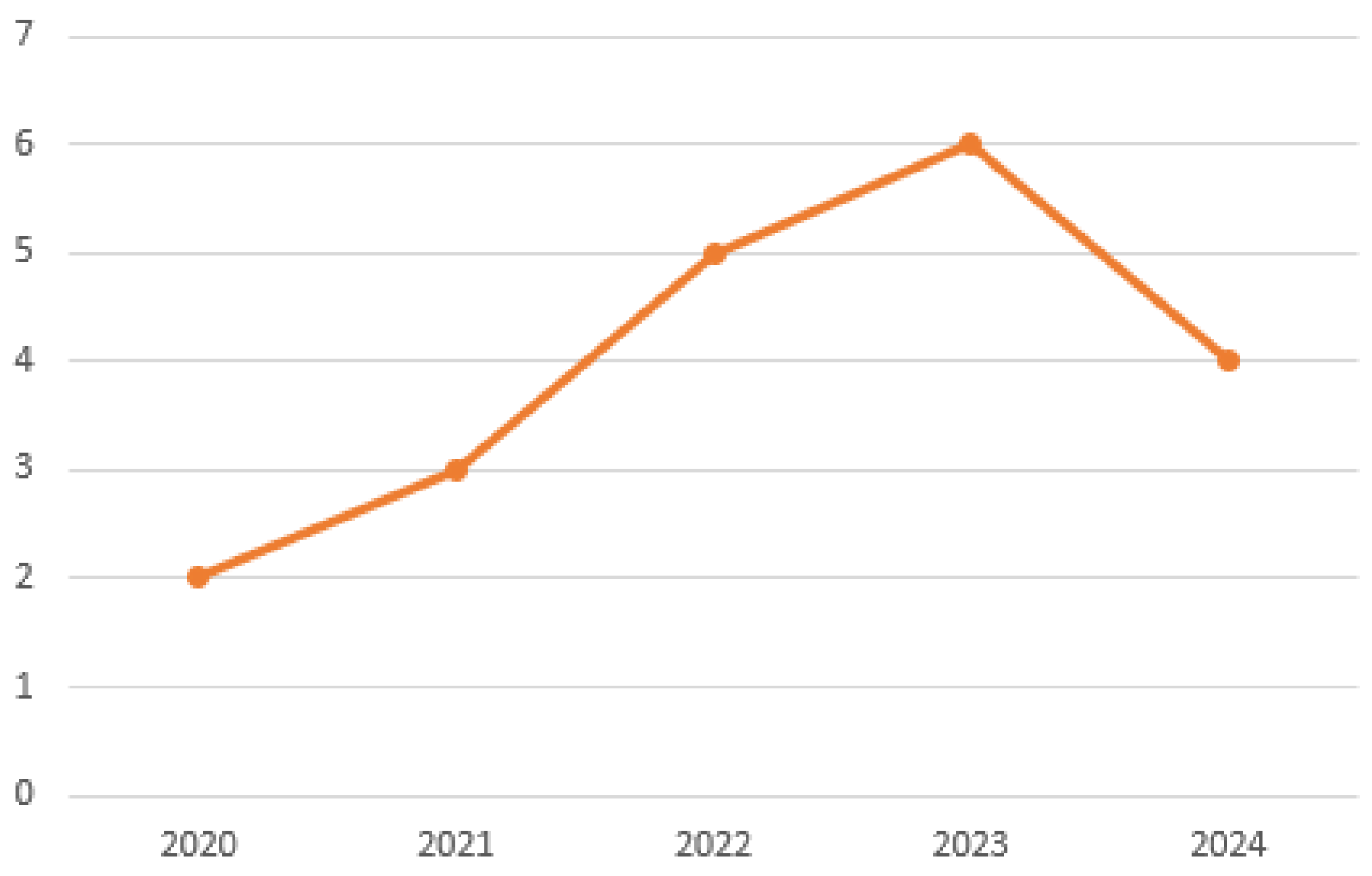
Figure 2.
Annual scientific production. Own elaboration.
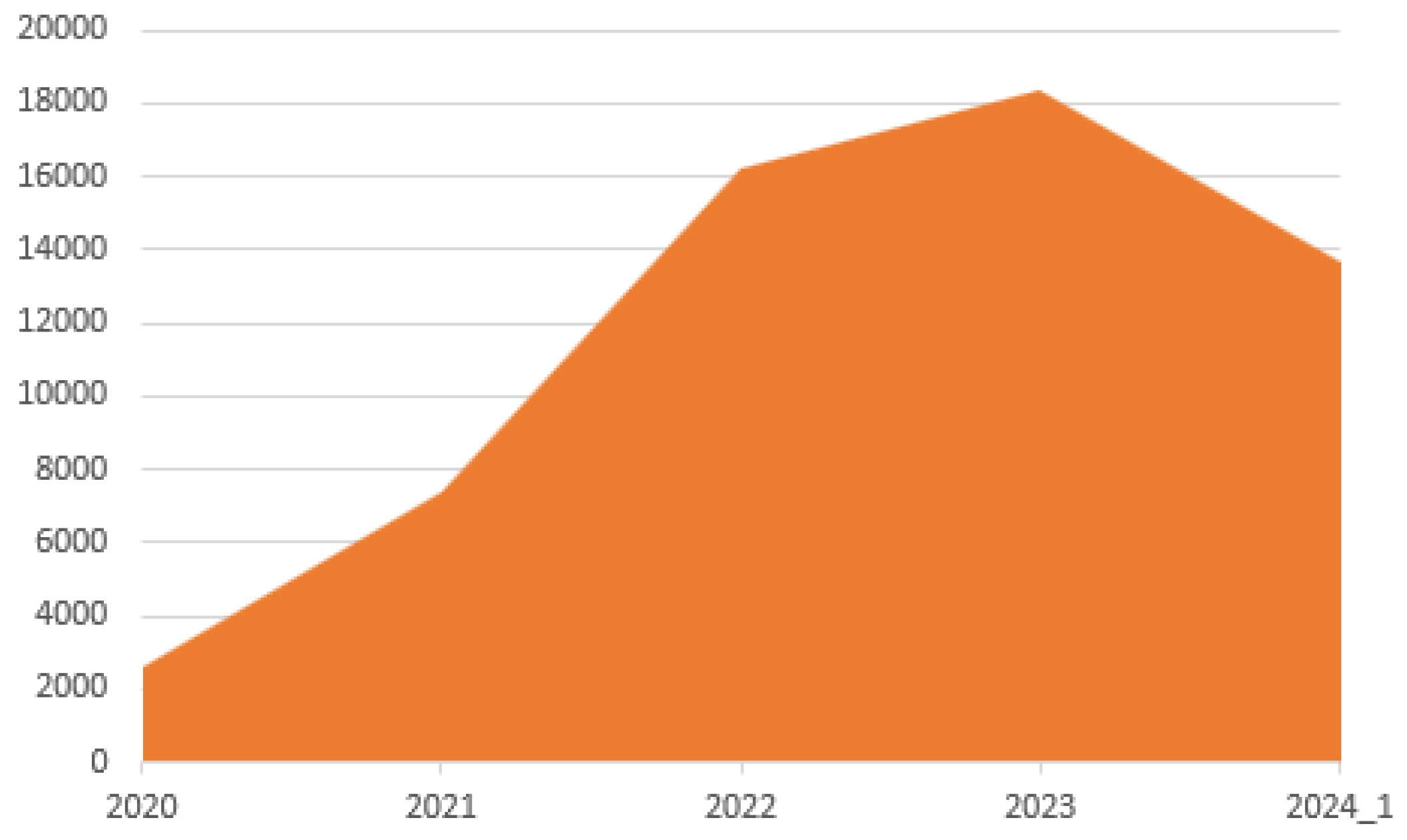
Figure 3.
Academic research interest in the field of consensus algorithms applied to Blockchain technology. Own Elaboration.
Figure 3.
Academic research interest in the field of consensus algorithms applied to Blockchain technology. Own Elaboration.
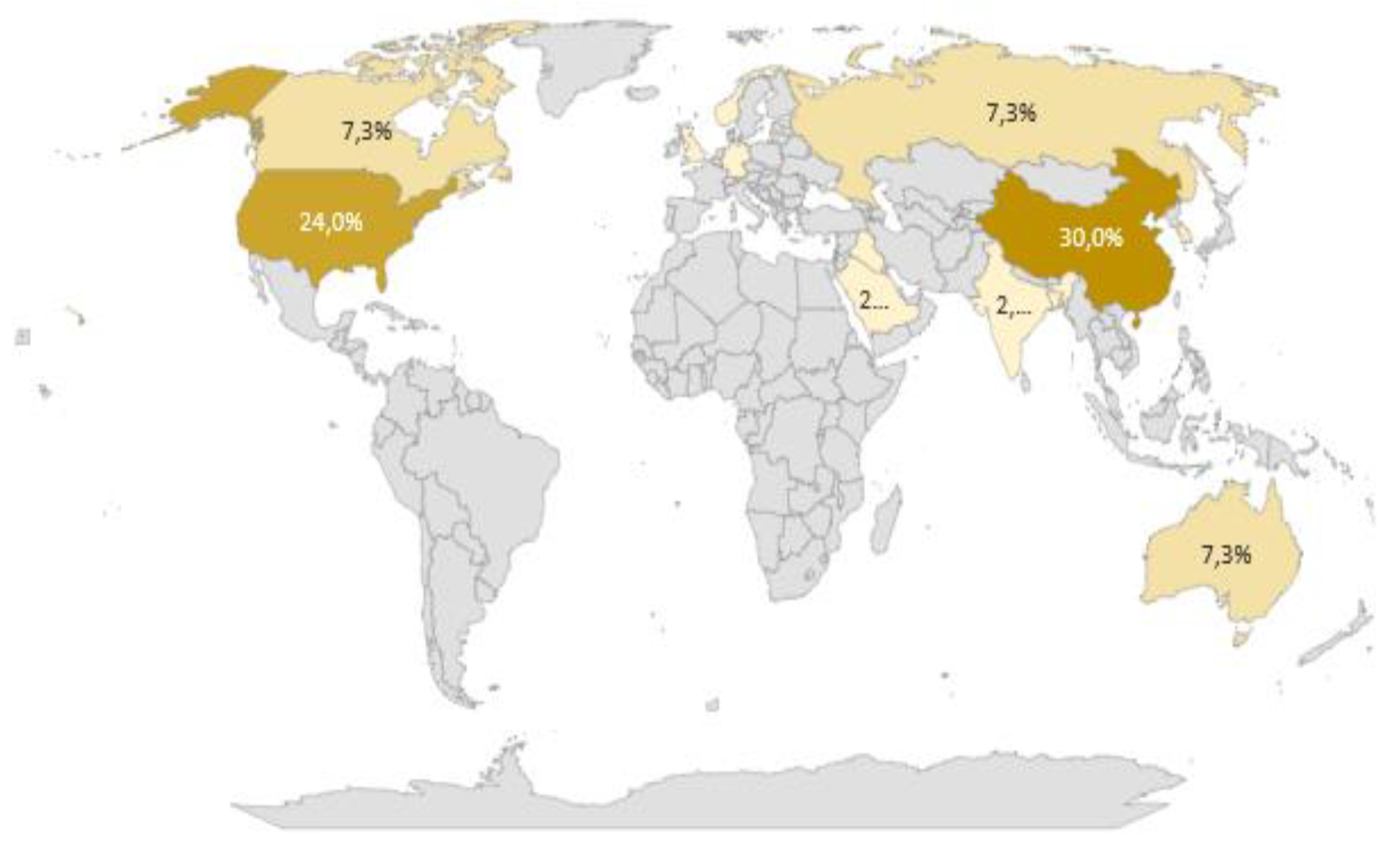
Figure 4.
Percentage of articles in each category. Own Elaboration.
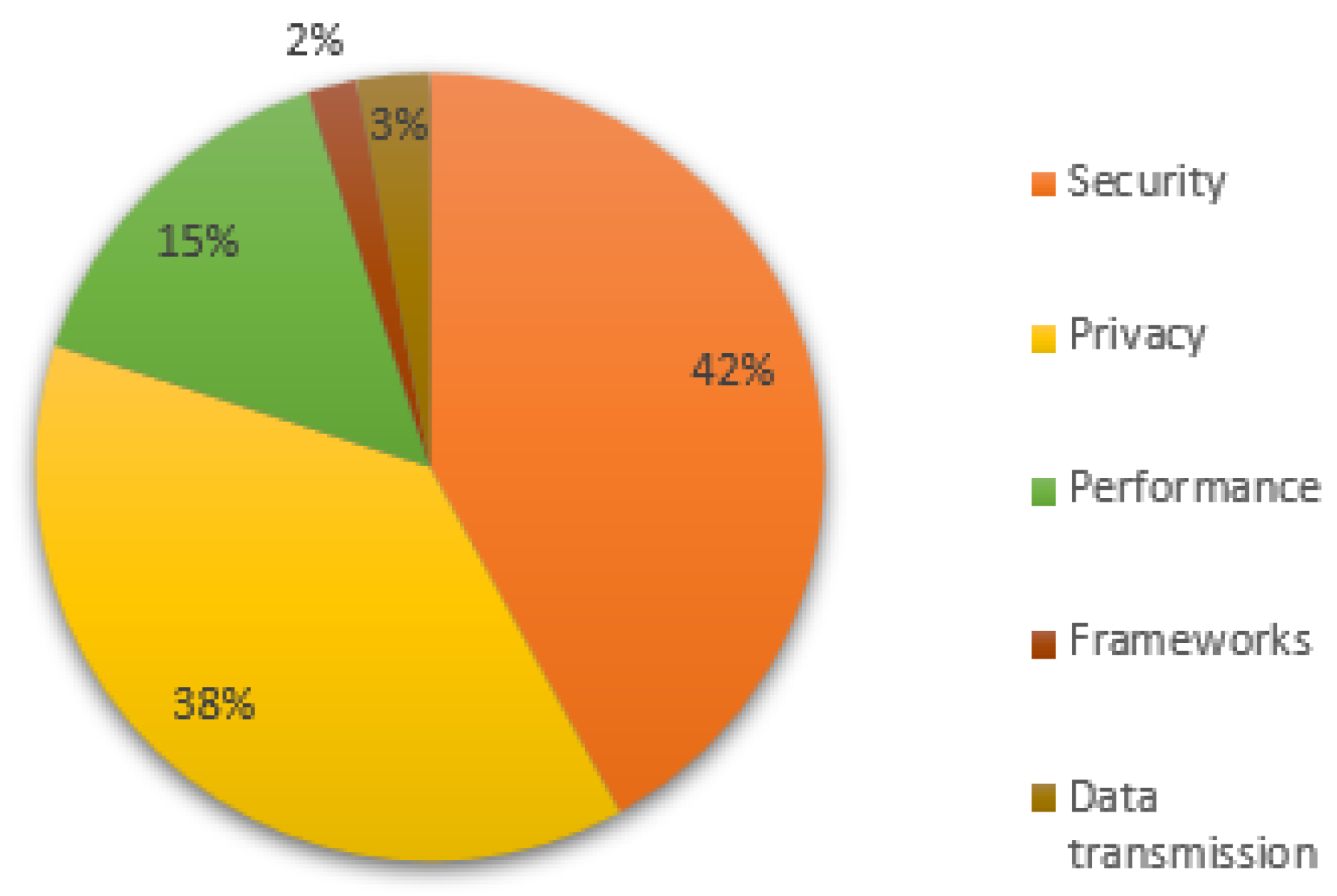
Figure 5.
Relevant topics by year. Own elaboration.
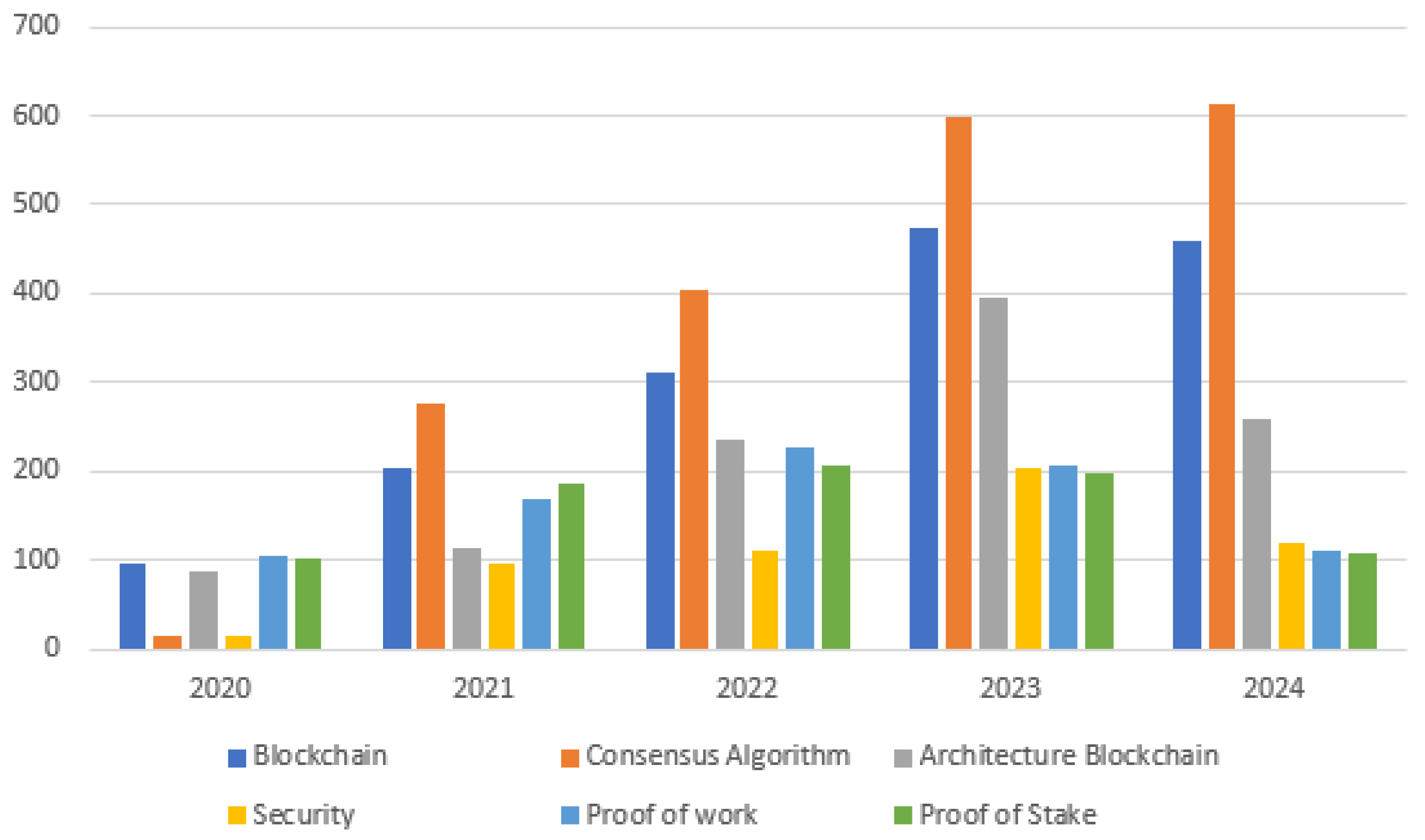
Table 1.
Inclusion and exclusion criteria for systematic mapping. Own elaboration.
| Inclusion Criteria | Exclusion Criteria |
|---|---|
|
|
Table 3.
Relevant Articles. Own elaboration.
| AUTHOR | QUALIFICATION | YEAR |
|---|---|---|
| Bamakan, S. y otros | A survey of blockchain consensus algorithms performance evaluation criteria. | 2020 |
| Ferdous, M. S. y otros | Blockchain consensus algorithms: A survey. | 2020 |
| Li, D. | Green technology innovation path based on blockchain algorithm | 2021 |
| Khan, S. A. R. y otros | Green data analytics, blockchain technology for sustainable development, and sustainable supply chain practices: evidence from small and medium enterprises. | 2021 |
| Sharma, A. y otros | Sustainable smart cities: convergence of artificial intelligence and blockchain. | 2021 |
| Jiang, S. y otros | A tertiary review on blockchain and sustainability with focus on Sustainable Development Goals. | 2022 |
| Sasikumar, A.y otros | Sustainable smart industry: a secure and energy efficient consensus mechanism for artificial intelligence enabled industrial internet of things | 2022 |
| Alofi, A. y otros | Optimizing the energy consumption of blockchain-based systems using evolutionary algorithms: A new problem formulation. | 2022 |
| Liu, Y. y otros | An incentive mechanism for sustainable blockchain storage. | 2022 |
| Wang, C. y otros | Sustainable blockchain-based digital twin management architecture for IoT devices. | 2022 |
| Alzoubi, Y. I., & Mishra, A. | Green blockchain–A move towards sustainability. | 2023 |
| Biswas, D. y otros | Traceability vs. sustainability in supply chains: The implications of blockchain. | 2023 |
| Li, H. y otros | Decentralized energy management of microgrid based on blockchain-empowered consensus algorithm with collusion prevention. | 2023 |
| Liu, Y. y otros | Mechanism design for blockchain storage sustainability. | 2023 |
| Wendl, M. y otros | The environmental impact of cryptocurrencies using proof of work and proof of stake consensus algorithms: A systematic review. | 2023 |
| Yang, Z. y otros. | Blockchain technology in building environmental sustainability: A systematic literature review and future perspectives. | 2023 |
| Alazab, M., y otros | Industry 4.0 Innovation: A Systematic Literature Review on the Role of Blockchain Technology in Creating Smart and Sustainable Manufacturing Facilities | 2024 |
| Giganti, P. y otros | The impact of blockchain technology on enhancing sustainability in the agri-food sector: A scoping review. | 2024 |
| Rani, P. y otros | Toward a greener future: A survey on sustainable blockchain applications and impact. | 2024 |
| Rukhiran, M., y otros | Sustainable Optimizing Performance and Energy Efficiency in Proof of Work Blockchain: A Multilinear Regression Approach. | 2024 |
Table 4.
Relevant authors by country. Own Elaboration.
| AUTHOR | COUNTRY |
|---|---|
| Ahmed Zahir | China |
| Amirhossein Motavali | Canada |
| Avinash Kshirsagar | India |
| Beng Chin OOI | Singapore |
| Brian Armstrong | USA |
| Changpeng Zhao | China |
| Craig Steven Wright | Australia |
| Elaine Shi | Canada |
| Emin Gün Sirer | USA |
| F.Richard Yu | Canada |
| Fred Ehrsam | USA |
| Gavin Andresen | USA |
| Gavin Wood | United Kingdom |
| hal finney | USA |
| Hong Ning Dai | China |
| Jae Kwon | South Korea |
| Jiang Peng | Germany |
| Kyungbaek Kim | South Korea |
| Md Sadek Ferdous | Bangladesh |
| Meihui ZHANG | China |
| Mingxiao du | China |
| Mohammad Jabed Morshed Chowdhury | Australia |
| Nick Sabo | USA |
| Renchao Xie | China |
| Rui Liu | USA |
| Sam Bankman-Fried | USA |
| Satoshi Nakamoto | USA |
| Sergey Nazarov | Russia |
| Sergey Nazarov | Russia |
| Seyed Mojtaba Hosseini Bamakan | Iran |
| Shaoan Xie | USA |
| Shikah J. Alsunaidi | Saudi Arabia |
| Tao Huang | China |
| Tien Tuan Anh Dinh | Australia |
| Ting Chen | China |
| Vitalik Buterin | Russia |
| Xiangping Chen | China |
| Xiangwei Wang | China |
| Xiaoqi Li | China |
| Yan Zhang | Norway |
| Zibin Zheng | China |
Table 5.
Keywords of relevant articles. Own elaboration.
| KEYWORD | NUMBER OF ARTICLES IN WHICH IT APPEARS | RELEVANCE |
|---|---|---|
| Blockchain | 903 | high |
| Consensus Algorithms | 874 | high |
| Proof of work | 724 | Half |
| Proof of stake | 705 | Half |
| Delegated proof of stake | 672 | Low |
| Byzantine fault tolerance | 400 | Low |
| Smart contracts | 568 | Low |
| Architecture Blockchain | 908 | high |
| forks | 200 | Low |
| Security | 603 | high |
| Decentralization | 412 | Low |
| Tokenomics | 285 | Low |
| Network security | 681 | Low |
| Cryptography | 698 | Low |
Table 6.
Comparison of evaluation criteria between relevant algorithms. Own elaboration.
| Consensus Algorithm |
Energy Consumption |
Energy Efficiency |
Carbon Footprint | Resource Usage |
|---|---|---|---|---|
| Proof of Work (PoW) | Very High | Low | High | High (Mining) |
| Proof of Stake (PoS) | Low | High | Low | Low |
| Delegated Proof of Stake (DPoS) | Very Low | High | Very Low | Low |
| Proof of Authority (PoA) | Very Low | High | Very Low | Low |
| Hybrid Algorithms (PoW/PoS) | Moderate | Medium | Moderate | Moderate |
Table 7.
Comparison of equilibrium criteria. Own elaboration.
| Consensus Algorithm | Security | Scalability | Sustainability |
|---|---|---|---|
| Proof of Work (PoW) | Very High | Low | Low |
| Proof of Stake (PoS) | High | Medium | High |
| Delegated Proof of Stake (DPoS) | Medium | High | Very High |
| Proof of Authority (PoA) | Medium | High | Very High |
| Hybrid Algorithms (PoW/PoS) | High | Medium | Medium |
Disclaimer/Publisher’s Note: The statements, opinions and data contained in all publications are solely those of the individual author(s) and contributor(s) and not of MDPI and/or the editor(s). MDPI and/or the editor(s) disclaim responsibility for any injury to people or property resulting from any ideas, methods, instructions or products referred to in the content. |
© 2024 by the authors. Licensee MDPI, Basel, Switzerland. This article is an open access article distributed under the terms and conditions of the Creative Commons Attribution (CC BY) license (http://creativecommons.org/licenses/by/4.0/).
Copyright: This open access article is published under a Creative Commons CC BY 4.0 license, which permit the free download, distribution, and reuse, provided that the author and preprint are cited in any reuse.


