

Submitted:
11 September 2024
Posted:
14 September 2024
You are already at the latest version
Abstract
Background: Regular moderate-vigorous intensity exercise is recommended for adults as it can improve longevity and reduce health risks associated with a sedentary lifestyle. However, there are barriers to achieving intense exercise that may be addressed using virtual reality (VR) as a tool to promote exercise intensity and adherence, particularly through visual feedback and competition. The purpose of this work is to compare visual feedback and competition within fully-immersive VR to enhance exercise intensity and user experience of exercise for young adults; and to describe and compare visual attention during each of the conditions. Methods: Young adults (21- 34 years old) bicycled in three 5-minute VR conditions (visual feedback, self-competition and competition against others). Exercise intensity (cycling cadence and % of maximum heart rate) and visual attention (derived from a wearable eye tracking sensor) were measured continuously. User experience was measured by an intrinsic motivation questionnaire, perceived effort and participant preference. A repeated measures ANOVA with paired t-test post-hoc tests was conducted to detect differences between conditions. Results: Participants exercised at a higher intensity and had higher intrinsic motivation in the two competitive conditions compared to visual feedback. Further, participants preferred the competitive conditions and only reached a vigorous exercise intensity during self-competition. Visual exploration was higher in visual feedback compared to self-competition. Conclusion: For young adults bicycling in VR, competition promoted higher exercise intensity and motivation compared to visual feedback.
Keywords:
Virtual reality
; bicycling
; aerobic exercise
; wearable sensors
; visual feedback
; competition
; eye-tracking
; visual attention
; motivation
; enjoyment
1. Introduction
The guidelines for physical activity and exercise in the United States recommend 150 minutes of moderate-high intensity aerobic exercise per week for adults. 1 Adhering to this guideline, can help people maintain a healthy weight, lower high blood pressure, and delay the onset of several chronic diseases [1,2,3]. Despite the known benefits of exercise, 20-25% of Americans aged 18-39 do not meet this requirement, with adherence among young adults decreasing with age [4]. Commonly reported barriers to explain these low adherence rates are reports of exercise being boring and inconvenient and physical factors such as discomfort during and after exercise [5]. A group of undergraduate students in Canada (average age 23 years old) reported time commitments, lack of available resources, lack of interest, and cost among their top barriers [6]. Considering these barriers, factors like motivation and enjoyment may be important to consider in promoting adherence to high-intensity exercise.
Enhancing motivation to exercise may help reduce the known barriers to exercise, improve adherence to exercise and help individuals achieve the established benefits of regular exercise. Intrinsic motivation has been defined in Ryan & Deci 2000 as “doing an activity for the inherent satisfaction of the activity itself” [7]. As intrinsic motivation is directly related to the task being performed, the task (exercise) can be modified to foster intrinsic motivation. Self-determination theory (SDT) underlies intrinsically motivated behavior and highlights different elements or properties of a task that could foster intrinsic motivation [8,9]. The specific reasons behind one’s motivation to perform an action fall along a spectrum of self-determination, whereby high levels of self-determination are associated with perception of having a choice or agency in deciding to perform the action. The level of self-determination in the motivation behind a behavior is associated with how robust the behavior is (adherence). Self-determination is closely tied to intrinsic motivation, whereby an action is pursued because the action itself is inherently enjoyable regardless of other associated outcomes or external consequences of the action. Intrinsically motivated behaviors are those with the highest degrees of self-determination, as an individual performing the task finds it inherently interesting or enjoyable [9,10].
VR has been proposed as a tool to facilitate exercise and improve motivation. VR uses visual and auditory stimuli as well as feedback promoting interaction with the computer-generated simulation, that may translate to enhanced enjoyment and motivation to exercise. These interactive elements provide information to users that is relevant to the task [11] and may motivate them to exercise at higher intensities for longer periods of time [12,13,14].
In addition to visual feedback, competition in VR may provide an additive effect for promoting intense exercise and increasing motivation. Studies in healthy adults have shown that using competitive stimuli in VR can enhance exercise intensity and motivation & enjoyment [15,16]. Specifically during a VR bicycling task where participants were instructed to compete against their own performance on previous trials, exercise intensity and motivation were higher compared to a non-competitive condition [17]. Healthy young adults in an 8-session (over four weeks) study competed against bicycle riders (virtual opponents) that represented their previous best times. In each session, participants were instructed to perform better than the trial from their previous session. Ghost avatar cyclists pedaled along the track representing participants’ times from previous sessions, a form of competition based on reference to one’s own performance and self-modeling feedback [18]. In the control group, participants bicycled in the same virtual environment (VE) but without other riders on the road. Participants exercised at a higher intensity (faster cadence) and enjoyed the activity more compared to a control group that did not compete against their previous best trial. Self-competition improved task-related performance and motivation for healthy young adults as assessed across several domains of the IMI. Therefore, self-competition may promote intrinsically-motivated behavior and enhance exercise performance [17].
This motivation to exercise at a higher intensity in competitive settings may depend on several personal characteristics, including competitiveness, a trait that is often associated with outperforming another person in a wide range of competitive scenarios, ranging from sports to tasks in academic or work settings. Competitive profiles have been explored identifying different elements of competitiveness, such as self-developmental, hyper-competitiveness, and anxiety-driven, may be important to consider [19]. These competitive profiles are related to individual perceptions of competition and may provide valuable insight into understanding how motivated an individual will be to engage in competitive exercise. However, there are only a handful of studies reporting on motivation to exercise in the context of competitive profiles, with a dearth of literature specifically investigating the specific profiles described above [19].
In addition to intrinsic motivation, visual attention may serve to explain behavior during exercise in VR, particularly as an underlying mechanism that may drive exercise intensity [20]. Eye movements have been closely linked to spatial attention, primarily in theories of selective attention, whereby individuals focus on a particular area of a vast visual field therefore selecting where to direct their attention. This continuous process of sampling a visual field based on attention to different elements of the field highlights the close link between visual attention and eye movements. Literature in this area supports the theory that voluntary movement of the eyes requires a movement or shift in one’s spatial attention first. Wearable eye-tracking sensors embedded within VR headsets can be conveniently utilized to measure selective attention in pre-specified areas of the visual field [21,22]. These measures of visual attention may capture an external focus of attention during tasks. Though visual attention measured with eye-tracking sensors may probe the mechanism associating attention with exercise intensity during virtual cycling, it has not been reported in the literature. Understanding attention during VR exercise tasks may provide insight into how participants interact with the simulation and whether the stimuli are associated with exercise intensity [11].
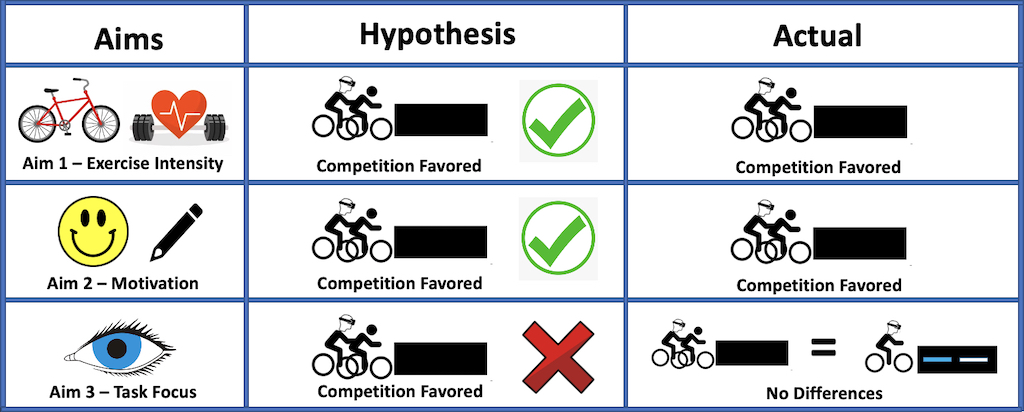
The purpose of this study is to use a custom VR system implementing various sensors to gain insight into exercise intensity, motivation, enjoyment, and visual attention. We hypothesize that competition will produce higher neuromuscular & cardiovascular intensity, motivation, and enjoyment compared to visual feedback based on previous studies for healthy adults in the literature. Through an exploratory aim, we also hypothesize that attention on the task will be higher during competitive VR bicycling compared to visual feedback as a higher exercise intensity and more positive user experience of exercise may be related to a higher task-related focus of attention [23].
2. Materials and Methods
2.1. Participants & Sample Size Justification
An a priori power analysis was conducted using cycling power output data (Watts) published in Michael et al 2020, comparing competitive to non-competitive bicycling for healthy adults in a fully-immersive virtual reality [17]. The power analysis conducted in G*Power [24], determined that 17 participants would be required to reach a power level of 0.80 (Cohen’s f =0.35, moderate effect size, correlation between repeated measures = 0.5). Accounting for a 30% attrition rate, 25 participants were recruited [25]. The study was approved by the Institutional Review Board at the Rutgers School of Health Professions (Pro2021002091) and was also registered at ClinicalTrials.Gov (NCT05253703).
2.2. Participant Screening
All participants were screened for eligibility. The screening included readiness for activity using the PARQ+ 2021 [26] and depression using the PHQ-9 [27]. Inclusion Criteria were: age 21-44 years old, Able to ride a stationary upright bicycle, Able to provide informed consent. Exclusion Criteria were: a recent history of severe heart disease, severe lung disease, uncontrolled diabetes, traumatic brain injury or any other neurological disorder (failed PARQ+ Screening), unable to follow directions or sign a consent form, inadequate vision or hearing ability to see or hear a television, unstable medical condition or musculoskeletal disorder such as severe arthritis, recent knee surgery, hip surgery, or any other condition that the investigators determine would impair the ability to ride the bicycle, any other medical condition that prevents bicycling, moderate depression (score of 10 or more on PHQ-9) [27].
2.3. Experimental Setup
Custom virtual cycling simulations were developed using the Unity 3D game engine. 3D assets were created using 3DS Max, Maya as well as purchased from the Unity store. The HTC Vive Unity developer kit allowed for customization of the virtual environment (VE) to display on the head mounted display (HMD). C# was used to program the game logic, interactions and feedback in the virtual environment, User interface (UI) controls as well as read the Wahoo RPM Cadence Pod (1 Hz) attached to the bike via an ANT+ protocol. Cycling cadence data from the sensors was integrated into the program to control the speed of the bicycle in the VE being projected in the HMD. Heart rate (HR) was recorded continuously via an optical wristband sensor validated for moderate-high intensity exercises (Polar OH1, collected at 1 Hz) [28]. Importantly, the environment was customizable as the exercise intensity targets were adjusted to each person’s performance. The HMD also included integrated wearable eye-tracking technology that captured eye movements continuously throughout all 3 cycling bouts (50-60 Hz). Design of the simulations accounted for important features to include in VE design such as field of view [29], spatial frequency [30,31], color contrast [32], texture and scale of objects [29,32], and previous experience by the research team in designing VEs [14].
For all conditions, participants bicycled on a stationary upright bike, the COSMED Ergoselect 100, with resistance set between 30-50 Watts. The resistance was adjusted based on participant preference and was held constant across all 3 conditions. Participants also chose whether they wanted to exercise with (n=10) or without (n=15) a facemask (COVID mask), but this was consistent across all 3 trials for the given participant.
2.4. Research Procedures
2.4.1. Baseline Assessment
All participants provided informed consent before participating in the study. Participants completed a questionnaire about personal factors including age, gender, previous VR use, and competitiveness. Competitiveness was measured with a validated 12-item inventory scored on a Likert scale of 1-7 called the Multi-dimensional Competitive Orientation Inventory (MCOI) [19]. The MCOI has been validated in healthy adults in Hungary (aged 18-59 years) and is a way to measure competitiveness in terms of 4 different competitive profiles: lack of interest, anxiety-driven, hyper-competitive, self-developmental [19]. A self-developmental competitive profile indicates that the participant perceives competitive scenarios to both assess and improve one’s performance. A hyper-competitive profile indicates that the participant is willing to win at all costs and is less concerned about personal growth and development in competitive scenarios as winning is the primary concern. The final 2 profiles are associated with avoidance of competitions: anxiety-driven and lack of interest. An anxiety-driven profile is associated with feelings of anxiety in competitive scenarios. A lack-of-interest profile is associated with the absence of enjoyment or sense of meaning in competitions [19]. Though the MCOI does not have any known cutoffs by which individuals can be categorized as having one of these competitive profiles, participants in this study were classified based on the mean scores for each of the 4 subscales. Participants were classified as having a certain competitive profile based in their highest of 4 domains of the mCOI. If there was a tie, participants were classified as having a mixed competitive profile [19].
2.4.2. Familiarization
Participants donned the HMD and bicycled in the three different conditions until they executed each cycling task correctly, were accustomed to the HMD, and understood the Borg Scale for RPE (Rating of Perceived Exertion) assessment [33]. After familiarization, there was a brief period of rest to restore HR to baseline before starting the 1st condition. See Figure 1 for an overview of the study protocol.
2.4.3. Cycling Conditions
Baseline cycling cadence was established for each condition. Participants were instructed to cycle at a comfortable pace that they could maintain for 30 minutes. This comfortable baseline pace was used to set the target cadence (rate at which the visual markers were presented or rate of the virtual competitive cyclist) for participants during the given trial. The target cadence was set at a pace that was 25% higher than comfortable baseline pace. 14 Participants were familiarized with each condition prior to data collection. Explicit instructions about the goal of each trial were provided before the trial began. The 3 conditions were counter-balanced, with competitive conditions in one block and visual feedback in the other block, as follows. Sequence A) - Feedback, Competition (other), Competition (self). Sequence B) - Feedback, Competition (self), Competition (other). Sequence C) - Competition (other), Competition (self), Feedback. Sequence D) - Competition (self), Competition (other), Feedback.
Visual Feedback: The cyclist was instructed to cycle at a pace that would turn the road markers blue. If the cyclist pedaled at a speed that was below the target cadence, the markers would remain white. If the cyclist cycled at a pace that was above the target cadence the markers would turn from white to blue, serving as visual feedback for the user to maintain the pace above the target. Summary feedback about cadence was provided at one-minute intervals. Instructions to the participant were: “The goal of this activity is to bicycle fast enough to make the markers on the road turn from white to blue.” This simulation and protocol design was iterated from previous work in the lab, implementing virtual bicycling simulations for persons post-stroke [34,35] and for persons with PD [36,37].
Competition against Others: The virtual cyclist used in both competitive conditions was controlled by the computer program [38]. Participants were instructed to cycle fast enough to pass the virtual agent who was traveling at their target cadence. Once the cyclist passed the virtual agent, another agent appeared further ahead on the road (traveling at the target cadence). The goal of the activity was to pass as many virtual agents as possible within the 5-minute condition. Instructions to the participant were: “The goal of this activity is to pass as many cyclists as you can.” Self-Competition: This condition was similar to the previous competition condition. However, participants were instructed that the virtual agent represented their best time. Therefore, the condition was framed as competition against oneself as the goal was to perform better than their best time by passing as many other virtual agents as possible. Instructions to the participant were: “The goal of this activity is to beat your own time by passing as many cyclists as you can.”
2.5. Outcomes
2.5.1. Neuromuscular and Cardiovascular Intensity
Cycling cadence (RPM) data were collected at 1 Hz and averaged across the time series for each participant. Heart rate data collected at 1 Hz were averaged and normalized for age for each participant using the Karvonen formula for maximum HR (Max HR = 220 – age) [39]. Based on each participants maximum HR, a percent of maximum heart rate (%MaxHR) was calculated as (%MaxHR = average HR / max HR) for each condition.
2.5.2. User Experience of Exercise
User experience of exercise, defined as motivation and enjoyment, was measured using the Intrinsic Motivation Inventory (IMI) total score and subscales [40]. The IMI is a method to assess intrinsic motivation based on the self-determination theory (SDT) [7]. There are several subscales that are all related to different components of SDT. The primary subscale is the interest & enjoyment subscale as it measures feelings that are inherent to the task. It is closely related to autonomy and self-determination as individuals are more likely to be intrinsically motivated to perform a behavior if they find it inherently interesting or enjoyable. Competence is another subscale that is positively correlated with intrinsic motivation and measures one’s self-assessment of the quality of their performance in a task. The value & usefulness subscale is important to consider when assessing the internalization of a given behavior, as individuals are more likely to be intrinsically motivated to perform a task in the long-term if they understand and have internalized its value. Finally the effort & importance subscale is often considered a consequence of motivated behavior rather than a direct measure of intrinsic motivation, since individuals that are motivated to perform a behavior are more likely to expend more energy and effort in the behavior and perceive that it was important for them to work hard and perform their best on the task.
Particular subscales of the IMI were chosen in congruence with the study purpose. The full subscale of interest/enjoyment was also collected (7 items) as this is a direct measure of intrinsically motivated behavior. Further, the full subscale of effort/importance was collected (5 items) and 2 items were collected each from the value & usefulness and perceived competence subscales. A total IMI score was calculated by averaging all 16 items, ranging from 1-7 with higher scores indicating higher motivation (see Figure S1).
RPE was measured with the Borg Scale which has been validated in the healthy population [33]. RPE scores range from 6-20 and higher RPE scores represent higher perceptions of effort. At the end of the session, participants ranked in which condition they worked the hardest and which condition they liked the most and offered comments.
2.5.3. Visual Attention
Visual attention was operationally defined using several measures of task focus and visual exploration were derived from eye-tracking data collected from wearable sensors integrated into the VR display. Eye-tracking data were collected through the HTC Vive Pro Eye at 50-60 Hz using the Vive SRanipal SDK. Invalid eye-tracking data were removed from each dataset, by identifying datapoints where one or both of the eyes were closed (pupils not detected). Valid gaze data were binned into different regions over the course of the entire trial, according to the following procedure. Dwell time percentage (DTP) on regions of interest was the primary method by which visual outcomes were generated from eye-tracking data [41]. The DTP quantifies what percentage of the total valid gazes were directed at different regions. It was derived from raw eye-tracking data, representing positions in space where participants were looking at any given time collected at roughly 18 milliseconds (50-60 Hz). These gazes were mapped in space over the duration of the trial and visualized as a heatmap representing a spatiotemporal measure – a proxy for attention (see Figure 2). The points on this were binned to measure attention in two different ways, task focus and visual exploration [41].
Task focus was operationally defined as the % of total valid trial time that the participants spent looking at the road. The road region directly in front of the participant in the direction of travel was chosen as the location representing task focus as the stimuli relevant to the task, ie road markers (for the visual feedback condition) and the virtual cyclist (for the competition condition) were always located in this region. Visual exploration was measured through 3 separate variables. Rightward gazes are operationally defined as gazes directed to the right of the road (10 degrees off road center), roadside gazes are directed away from the road center either to the left or the right (30 degrees off road center, where the road is no longer visible in peripheral vision), and water gazes are directed toward a body of water in the simulation on the right of the track. All values are expressed as percentages of all valid gazes during each 5-minute trial to normalize the values and control for the total number of valid gazes.
2.6. Data Analysis
Differences between conditions were first analyzed using a 3x1 one-way repeated measure ANOVA (rmANOVA) for each outcome. The Mauchly Test was performed prior to the rmANOVA to assess sphericity, and a Greenhouse-Geisser correction was performed if the result of the Mauchly Test resulted in a p-value < 0.05. Prior to performing post-hoc tests, data were inspected for normality. Normal distribution was determined with Shapiro-Wilk Tests (p<0.05) and visual inspection. Nonparametric post-hoc Wilcoxon Ranked-Sum Test were performed instead of paired t-tests when the data failed normality tests. When performing post-hoc tests, a Bonferroni-corrected value of alpha = 0.0167 (0.05 / 3) was utilized to adjust for 3 separate post-hoc analyses.
3. Results
3.1. Demographics
Participants included 25 healthy adults (18 male) with a mean age of 26.5 years old (22-34). Sixteen had fully-immersive virtual reality experience, and 9 bicycled regularly for exercise. Following the IPAQ guidelines, 12 participants had high physical activity levels, and the remaining 13 participants had moderate physical activity levels [42]. The majority of participants had a self-developmental competitive profile (n=19), followed by anxiety-driven (n=3), mixed profiles (n=2), and lack of interest (n=1). For a full summary of participants characteristics, see Table 1.
3.2. Exercise Intensity
Age-adjusted heart rate was significantly different across the 3 conditions. Competition conditions had higher heart rates than feedback conditions (both p < 0.01). There were no statistically significant differences between the 2 competitive conditions (W=118, p > 0.0167). Cycling cadence was significantly different across the 3 conditions. Faster cadences were observed in the competitive conditions compared to feedback (both p < 0.01). There was no difference between the competitive conditions (t(24) = -1.92, p > 0.0167). See Figure 3 for plots of raw cadence and age-adjusted HR for each condition. See Tables S1 & S2 for data from the statistical analyses.
3.3. User Experience of Exercise
The total score of the IMI was significantly higher in the 2 competitive conditions compared to feedback (both p < 0.01). There were no statistically significant differences between the 2 competitive conditions (p > 0.0167). The effort subscale of the IMI was higher in both competitive conditions compared to feedback (both p < 0.01). There were no statistically significant differences between the 2 competitive conditions (p >0.0167). The enjoyment subscale of the IMI was significantly higher during self-competition compared to feedback (W = 32.5, p = 0.007). There were no statistically significant differences between feedback and competition against others or between the 2 competitive conditions (both p >0.0167). The change in RPE from start to end of trial, was significantly different across the 3 conditions. RPE was significantly higher in the competitive conditions compared to feedback (both p < 0.001). There were no statistically significant differences between the 2 competitive conditions (p > 0.0167). In post-session debriefing, 16 of the participants (64%) said they enjoyed self-competition the most. Additionally, 21 of the participants (84%) said they worked the hardest in self-competition. See Table 2 for a summary of measures of the user experience of exercise in each condition.
3.4. Visual Attention
The task focus was not significantly different across the 3 conditions. Roadside gazes were significantly differences across the 3 conditions. Roadside gazes were higher in visual feedback compared to self-competition (W = 31.0, p = 0.002). There were no statistically significant differences in the other comparisons. Rightward gazes were not significantly different across the 3 conditions. Water gazes were significantly different across the 3 conditions indicating more water gazes during feedback compared to self-competition (W = 27.0, p = 0.011). There were no statistically significant differences in the other comparisons. See Figure 4 for plots of visual attention in each condition. See Table 3 for a summary of measures of visual attention in each condition.
4. Discussion
4.1. Exercise Intensity
Consistent with our hypothesis, cardiovascular and neuromuscular exercise intensity were both higher in the competitive conditions compared to visual feedback. On average across all young adults, cardiovascular exercise intensity was at least 68% of age-adjusted maximum HR and average cadence exceeded 100 rpm across all conditions. Only during the self-competition condition, did participants reach a vigorous cardiovascular intensity on average (77% or higher) [1]. Participants bicycled at an average cadence of 100-120 rpm across all 3 conditions. It is important to note that the purpose of this study was to drive high-cadence bicycling at lower resistances. Compared to high-resistance bicycling, lower resistances may reduce muscle fatigue so that participants can sustain aerobic exercise in their target HR zone for longer periods of time [43,44,45]. Therefore, this VR simulation may be valuable at promoting sustained aerobic exercise at a high cadence in a target HR zone, though longer bicycling bouts over longer time spans may be necessary to study effects on improving cardiovascular fitness.
4.2. User Experience of Exercise
Partially consistent with our hypothesis, intrinsic motivation and enjoyment were higher in the self-competition compared to visual feedback and competition against others conditions. However, contrary to our hypothesis, RPE was greater during competition. Across all 3 conditions, young adults reported high intrinsic motivation, considering that the total IMI score and several domains of the IMI all exceeded the “somewhat true” anchor (score of 4/7) on the IMI. Therefore, across all 3 conditions young adults had high enjoyment, considered it important to expend energy in each task (effort and importance), and had high total motivation during all 3 tasks. Comparing the 3 conditions, young adults had a higher effort/importance rating in the two competitive conditions compared to the visual feedback condition, which is congruent with the findings that they worked harder and reported a higher perceived exertion in these 2 competitive conditions. Further, the total IMI score and the IMI interest/enjoyment score were both higher in self-competition compared to visual feedback. However, there was no difference in enjoyment comparing visual feedback to competition against others. These findings may be partially explained by the competitive profiles of the young adults, as the majority of participants had a self-developmental competitive profile which could be related to their higher enjoyment to exercise only in the competitive condition that was framed as competing against oneself.
Although there were no differences in exercise intensity or perceived effort between the 2 competitive trials, participants ranked self-competition as the most strenuous of the 3 conditions (88%, n = 22). Similarly, though there were no differences in any of the user experience outcomes between the two competitive conditions, the majority of participants (64%, n = 16) liked the self-competition condition the most. These findings indicate that participants preferred the self-competitive condition when reflecting on the session after experiencing all 3 conditions, despite no differences in motivation and enjoyment between the 2 competitive conditions using the IMI.
There are important implications of these findings that may be related to the SDT and the subscales of the IMI used in the study. Higher effort and importance scores might be related to higher motivation to bicycle in the competitive conditions. Higher scores on the interest and enjoyment subscale of the IMI (a direct measure of intrinsic motivation) suggest that participants had high autonomy and feelings of self-directed behavior in the competitive conditions. Those who were motivated to complete the task may have found that successful completion of the task was important to them. This higher importance in completing the task may have resulted in faster cycling cadences, as pedaling faster would result in passing more riders on the road. The increases in HR (higher cardiovascular intensity) are directly related to the higher neuromuscular intensity and may have resulted in higher perception of effort as well. Only in the self-competitive condition did young adults work at a vigorous exercise intensity, and this was the only competitive condition that had significantly higher scores on the interest/enjoyment subscale of the IMI. Therefore, higher interest/enjoyment could reflect an increase in intrinsic motivation to accomplish the task associated with faster pedaling and cardiovascular demand.
It is important to consider that most individuals in the study were moderately to highly active according to their scores on the IPAQ and had relatively high baseline cadences (averaging over 68 RPM at their comfortable cycling cadences). Furthermore, in the visual feedback condition, despite pedaling at over 100 rpm on average and having a high average HR (68% of Max HR), participants still reported a 13 on the RPE scale, a measure corresponding to a “light” perception of effort. This low reporting of the RPE might be partially explained by the physical activity profiles of participants, as individuals who are accustomed to routine intense exercise may not perceive exercise at this intensity to be difficult or challenging. However, in the competitive conditions, participants averaged an RPE score corresponding to a “hard” perception of effort, reflecting the higher cadences (115-120 rpm) and HR (75-78% of maximum HR). Therefore, measures of exercise intensity, enjoyment, and motivation may be related to the fact that the study population consisted mostly of physically active young adults.
Though larger samples and more analyses would be required to study the relationship of competitive profiles to motivation to exercise, the trends from the findings in this study regarding user experience of exercise and competitive profiles may be congruent with findings by Song et al 2013, where individuals who were classified as “high competitive” preferred the competitive over the non-competitive exercise condition [46]. This study used a custom 4-item questionnaire with items related to how participants felt about competition in general. The students were classified as either “high competitive” or “low competitive” and then randomly assigned into 2 groups, one where they competed against others in exergames and another where they played exergames alone. Participants classified as highly competitive enjoyed the competitive condition more, were intrinsically motivated to continue playing the exergames, and rated their gaming experiences more favorably compared to their non-competitive counterparts [46]. Findings from this study are also consistent with those from an article by Michael et al 2020 in which young adults bicycled in a VR condition that is most similar to the self-competition condition implemented in this study [17].
4.3. Visual Attention
Partially consistent with our hypothesis, task focus was higher in the competitive conditions condition compared to the visual feedback condition, though these findings were not statistically significant. Further, visual exploration was lower in the competitive conditions, with statistically significant findings only when comparing self-competition to visual feedback. Lower visual exploration in the competitive conditions may imply a higher task focus.
Visual focus on the task measured using eye-tracking data was high across all 3 conditions, with participants on average spending at least 73% of the trial focusing on the task. This finding suggests that the use of visual stimuli administered through fully-immersive VR (namely visual feedback markers and competitive riders) can focus attention during high-intensity exercise. Though task focus was higher in the two competitive conditions, there were no statistically significant differences across all 3 conditions, which may be partially due to the large variability in visual behaviors across participants.
Visual exploration was highest in the feedback condition, measured with roadside gazes and gazes specifically on a body of water in the scene, which was accompanied by chirping birds and a parked bicycle by the waterside. This finding of lower visual exploration during the conditions in which participants were exercising at a higher intensity could reflect a tendency of participants who exercise at a higher intensity (or perceive they are working harder) to explore the environment less or vice versa.
4.4. Limitations & Future Directions
One of the main limitations of the study is the measurement of motivation over a short timescale (three 5-minute bicycling bouts). High measures of intrinsic motivation were reported across all 3 conditions, but these findings could be related to the novelty of the VR simulation and the bicycling tasks. Understanding intrinsic motivation during longer bouts of competitive VR bicycling can also provide insight into adherence to exercise, as sustained exercise (multiple sessions per week) is important to achieving and maintaining the health benefits of exercise [1].
Future directions include exploring the relationships between competitive profiles and study outcomes to provide further insight into the relationship between competitiveness and motivation to exercise. The high prevalence of self-developmental competitive profiles among participants in this study may be related to the higher exercise intensity in the self-competition condition, their motivation to exercise, and their history of engaging in moderate and vigorous intensity regularly. Studying other populations, such as older adults and participants with different health conditions, will extend our understand of VR as a tool to increase exercise intensity, motivation and visual attention with aging and disease.
5. Conclusions
Bicycling in fully immersive virtual environments promoted moderate cardiovascular and neuromuscular exercise intensity in both visual feedback and competitive conditions. Participants preferred the competitive conditions and only reached a vigorous exercise intensity during self-competition, which was congruent with their self-developmental competitive profiles. Measures of visual attention validated a task-relevant focus of attention. While there were no significant differences in task focus across all 3 conditions, there was lower visual exploration in the self-competition condition compared to visual feedback. This study also demonstrated that the use of a custom VR system implementing various wearable sensors to monitor visual attention, exercise intensity, and perception of effort in real-time, is tolerable during short bouts of bicycling in VR.
Supplementary Materials
The following supporting information can be downloaded at the website of this paper posted on Preprints.org.
Author Contributions
Conceptualization, J.P. and J.D.; methodology, J.P. and J.D.; software, J.P. and J.D.; validation J.P. and J.D; formal analysis, J.P.; investigation, J.P. and J.D; resources, J.P. and J.D.; data curation, J.P.; writing—original draft preparation, J.P.; writing—review and editing, J.P. and J.D.; visualization J.P. and J.D.; supervision, J.D.; project administration, J.P. and J.D.; funding acquisition, J.P. and J.D. All authors have read and agreed to the published version of the manuscript.
Funding
This research was funded by the National Institute on Aging, grant number 1R15AG063348 (PI Deutsch) and grant number 1F30AG072807 (PI Palmieri).
Institutional Review Board Statement
The study was conducted in accordance with the Declaration of Helsinki. The IRB protocol was approved by Rutgers University (Pro2021002091) on November 27, 2023 and is currently active until November 26, 2025.
Informed Consent Statement
Informed consent was obtained from all subjects involved in the study.
Data Availability Statement
The original contributions presented in the study are included in the article/supplementary material, further inquiries can be directed to the corresponding author.
This article is a revised and expanded version of a paper entitled [Visual Attention in Virtual Reality: Comparing Visual Feedback and Competition in A Virtual Cycling Environment (VCYCLE-Competition)], which was presented at [International Conference on Virtual Rehabilitation (ICVR 2022), Rotterdam, Netherlands, July 2022] [47].
Acknowledgments
The authors would like to thank Dr. Lisa Alcock for her guidance on measuring visual attention through interpretation of eye-tracking data. We would also like to thank Dr. James Parrott for guidance on data analysis. Finally we would like to thank several students who were involved with data collection and entry: Tucker Voelbel, Amanda O’Hara, Meg Tsai.
Conflicts of Interest
The authors declare no conflicts of interest.
Abbreviations
The following abbreviations are used in this manuscript:
| VR | Virtual Reality |
| SDT | Self-Determination Theory |
| VE | Virtual Environment |
| HMD | Head Mounted Display |
| HR | Heart Rate |
| UI | User Interface |
| MCOI | Multi-Dimensional Competitive Orientation Inventory |
| RPE | Rating of Perceived Exertion |
| RPM | Revolutions per Minute |
| IMI | Intrinsic Motivation Inventory |
| DTP | Dwell Time Percentage |
| rmANOVA | Repeated Measures ANOVA |
References
- American College of Sports Medicine, R.D.E.J.K.L.G.M.M., ACSM’s guidelines for exercise testing and prescription. 2018.
- Posadzki, P., D. Pieper, R. Bajpai, H. Makaruk, N. Könsgen, A.L. Neuhaus, and M. Semwal, Exercise/physical activity and health outcomes: an overview of Cochrane systematic reviews. BMC public health, 2020. 20(1): p. 1724-1724. [CrossRef]
- Ruegsegger, G.N. and F.W. Booth, Health Benefits of Exercise. Cold Spring Harb Perspect Med, 2018. 8(7). [CrossRef]
- Du, Y., B. Liu, Y. Sun, L.G. Snetselaar, R.B. Wallace, and W. Bao, Trends in Adherence to the Physical Activity Guidelines for Americans for Aerobic Activity and Time Spent on Sedentary Behavior Among US Adults, 2007 to 2016. JAMA Netw Open, 2019. 2(7): p. e197597. [CrossRef]
- Myers, R.S. and D.L. Roth, Perceived benefits of and barriers to exercise and stage of exercise adoption in young adults. Health Psychol, 1997. 16(3): p. 277-83.
- Pellerine, L.P., N.W. Bray, J.R. Fowles, J.A. Furlano, A. Morava, T.S. Nagpal, and M.W. O’Brien, The Influence of Motivators and Barriers to Exercise on Attaining Physical Activity and Sedentary Time Guidelines among Canadian Undergraduate Students. Int J Environ Res Public Health, 2022. 19(19). [CrossRef]
- Ryan, R.M. and E.L. Deci, Self-determination theory and the facilitation of intrinsic motivation, social development, and well-being. Am Psychol, 2000. 55(1): p. 68-78. [CrossRef]
- Deci, E.L. and R.M. Ryan, Intrinsic Motivation and Self-Determination in Human Behavior. 1985: Springer.
- Ryan, R.M., Control and information in the intrapersonal sphere: An extension of cognitive evaluation theory. Journal of Personality and Social Psychology, 1982. 43(3): p. 450-461. [CrossRef]
- Guay, F., R.J. Vallerand, and C. Blanchard, On the assessment of situational intrinsic and extrinsic motivation: The Situational Motivation Scale (SIMS). Motivation and Emotion, 2000. 24: p. 175-213. [CrossRef]
- Wulf, G. and R. Lewthwaite, Optimizing performance through intrinsic motivation and attention for learning: The OPTIMAL theory of motor learning. Psychonomic Bulletin & Review, 2016. 23(5): p. 1382-1414. [CrossRef]
- Gomez, D.H., J.R. Bagley, N. Bolter, M. Kern, and C.M. Lee, Metabolic Cost and Exercise Intensity During Active Virtual Reality Gaming. Games Health J, 2018. 7(5): p. 310-316.
- Qian, J., D.J. McDonough, and Z. Gao, The Effectiveness of Virtual Reality Exercise on Individual’s Physiological, Psychological and Rehabilitative Outcomes: A Systematic Review. International journal of environmental research and public health, 2020. 17(11): p. 4133. [CrossRef]
- Gallagher, R., H. Damodaran, W.G. Werner, W. Powell, and J.E. Deutsch, Auditory and visual cueing modulate cycling speed of older adults and persons with Parkinson’s disease in a Virtual Cycling (V-Cycle) system. Journal of NeuroEngineering and Rehabilitation, 2016. 13(1): p. 77. [CrossRef]
- Gleason, P. and J. Kim, Exercise and Competitive Sport: Physiology, Adaptations, and Uncertain Long-Term Risks. Current Treatment Options in Cardiovascular Medicine, 2017. 19: p. 79. [CrossRef]
- Marker, A.M. and A.E. Staiano, Better Together: Outcomes of Cooperation Versus Competition in Social Exergaming. Games Health J, 2015. 4(1): p. 25-30.
- Michael, A. and C. Lutteroth, Race Yourselves: A Longitudinal Exploration of Self-Competition Between Past, Present, and Future Performances in a VR Exergame, in Proceedings of the 2020 CHI Conference on Human Factors in Computing Systems. 2020, Association for Computing Machinery: Honolulu, HI, USA. p. 1–17.
- Wulf, G. and R. Lewthwaite, Optimizing performance through intrinsic motivation and attention for learning: The OPTIMAL theory of motor learning. Psychon Bull Rev, 2016. 23(5): p. 1382-1414. [CrossRef]
- Orosz, G., I. Tóth-Király, N. Büki, K. Ivaskevics, B. Bőthe, and M. Fülöp, The Four Faces of Competition: The Development of the Multidimensional Competitive Orientation Inventory. Frontiers in Psychology, 2018. 9(779). [CrossRef]
- Clay, V., P. König, and S. König, Eye Tracking in Virtual Reality. Journal of eye movement research, 2019. 12(1): p. 10.16910/jemr.12.1.3.
- Mahon, A., A.D.F. Clarke, and A.R. Hunt, The role of attention in eye-movement awareness. Atten Percept Psychophys, 2018. 80(7): p. 1691-1704. [CrossRef]
- Mathôt, S. and J. Theeuwes, Visual attention and stability. Philos Trans R Soc Lond B Biol Sci, 2011. 366(1564): p. 516-27. [CrossRef]
- Ekkekakis, P., The Dual-Mode Theory of affective responses to exercise in metatheoretical context: II. Bodiless heads, ethereal cognitive schemata, and other improbable dualistic creatures, exercising. International Review of Sport and Exercise Psychology, 2009. 2(2): p. 139-160. [CrossRef]
- Erdfelder, E., F. Faul, and A. Buchner, GPOWER: a general power analysis program. Behavior Research Methods, Instruments, & Computers, 1996. 28: p. 1-11. [CrossRef]
- Mayr, U., D. Wozniak, C. Davidson, D. Kuhns, and W.T. Harbaugh, Competitiveness across the life span: the feisty fifties. Psychology and aging, 2012. 27(2): p. 278-285. [CrossRef]
- Bredin, S.S., N. Gledhill, V.K. Jamnik, and D.E. Warburton, PAR-Q+ and ePARmed-X+: new risk stratification and physical activity clearance strategy for physicians and patients alike. Can Fam Physician, 2013. 59(3): p. 273-7.
- Kroenke, K., R.L. Spitzer, and J.B. Williams, The PHQ-9: validity of a brief depression severity measure. Journal of general internal medicine, 2001. 16(9): p. 606-613. [CrossRef]
- Hettiarachchi, I.T., S. Hanoun, D. Nahavandi, and S. Nahavandi, Validation of Polar OH1 optical heart rate sensor for moderate and high intensity physical activities. PLoS One, 2019. 14(5): p. e0217288. [CrossRef]
- Powell, W., The influence of virtual reality systems on walking behaviour: A toolset to support application design. 2013.
- Banton, T., J. Stefanucci, F. Durgin, A. Fass, and D. Proffitt, The Perception of Walking Speed in a Virtual Environment. Presence, 2005. 14(4): p. 394-406. [CrossRef]
- Holden, M.K., Virtual Environments for Motor Rehabilitation: Review. CyberPsychology & Behavior, 2005. 8(3): p. 187-211.
- Stone, L.S. and P. Thompson, Human speed perception is contrast dependent. Vision Research, 1992. 32(8): p. 1535-1549. [CrossRef]
- BORG, G.A.V., Psychophysical bases of perceived exertion. Medicine & Science in Sports & Exercise, 1982. 14(5): p. 377-381.
- Deutsch, J., M. Myslinski, M. Kafri, R. Ranky, M. Sivak, C. Mavroidis, and J. Lewis, Feasibility of Virtual Reality Augmented Cycling for Health Promotion of People Post-Stroke. Journal of neurologic physical therapy : JNPT, 2013. 37. [CrossRef]
- Ranky, R., M. Sivak, J. Lewis, V. Gade, J. Deutsch, and C. Mavroidis, VRACK - Virtual Reality Augmented Cycling Kit: Design and validation. 2010. 135-138.
- Gallagher, R., Cueing, feedback and directed attention embedded in a virtual environment modulate temporal and spatial bicycling features of healthy older adults and people with Parkinson’s disease. 2017.
- Gallagher, R., H. Damodaran, W.G. Werner, W. Powell, and J.E. Deutsch, Auditory and visual cueing modulate cycling speed of older adults and persons with Parkinson’s disease in a Virtual Cycling (V-Cycle) system. Journal of neuroengineering and rehabilitation, 2016. 13(1): p. 77-77. [CrossRef]
- Fox, J., S.J. Ahn, J.H. Janssen, L. Yeykelis, K.Y. Segovia, and J.N. Bailenson, Avatars Versus Agents: A Meta-Analysis Quantifying the Effect of Agency on Social Influence. Human–Computer Interaction, 2015. 30(5): p. 401-432. [CrossRef]
- Karvonen, M.J., E. Kentala, and O. Mustala, The effects of training on heart rate; a longitudinal study. Ann Med Exp Biol Fenn, 1957. 35(3): p. 307-15.
- McAuley, E., T. Duncan, and V.V. Tammen, Psychometric Properties of the Intrinsic Motivation Inventory in a Competitive Sport Setting: A Confirmatory Factor Analysis. Research Quarterly for Exercise and Sport, 1989. 60(1): p. 48-58. [CrossRef]
- Vansteenkiste, P., D. Van Hamme, P. Veelaert, R. Philippaerts, G. Cardon, and M. Lenoir, Cycling around a Curve: The Effect of Cycling Speed on Steering and Gaze Behavior. PLOS ONE, 2014. 9(7): p. e102792. [CrossRef]
- Craig, C.L., A.L. Marshall, M. Sjöström, A.E. Bauman, M.L. Booth, B.E. Ainsworth, M. Pratt, U. Ekelund, A. Yngve, J.F. Sallis, and P. Oja, International physical activity questionnaire: 12-country reliability and validity. Med Sci Sports Exerc, 2003. 35(8): p. 1381-95.
- Abbiss, C., J. Peiffer, and P. Laursen, Optimal cadence selection during cycling. ECU Publications, 2009. 10.
- Ament, W. and G.J. Verkerke, Exercise and fatigue. Sports Med, 2009. 39(5): p. 389-422. [CrossRef]
- de Melo Dos Santos, R., F.C.E. Costa, T.S. Saraiva, and B. Callegari, Muscle fatigue in participants of indoor cycling. Muscles Ligaments Tendons J, 2017. 7(1): p. 173-179. [CrossRef]
- Song, H., J. Kim, K. Tenzek, and K. Lee, The effects of competition and competitiveness upon intrinsic motivation in exergames. Computers in Human Behavior, 2013. 29: p. 1702–1708. [CrossRef]
- Palmieri JL, Deutsch JE. Visual Attention in Virtual Reality: Comparing Visual Feedback and Competition in A Virtual Cycling Environment (VCYCLE-Competition). International Conference on Virtual Rehabilitation (ICVR 2022); 2022 July; Rotterdam, Netherlands.
Figure 1.
An overview of the study protocol in a single session. There are three trials competition (self or others) and feedback. Single cohort, repeated measures.
Figure 1.
An overview of the study protocol in a single session. There are three trials competition (self or others) and feedback. Single cohort, repeated measures.
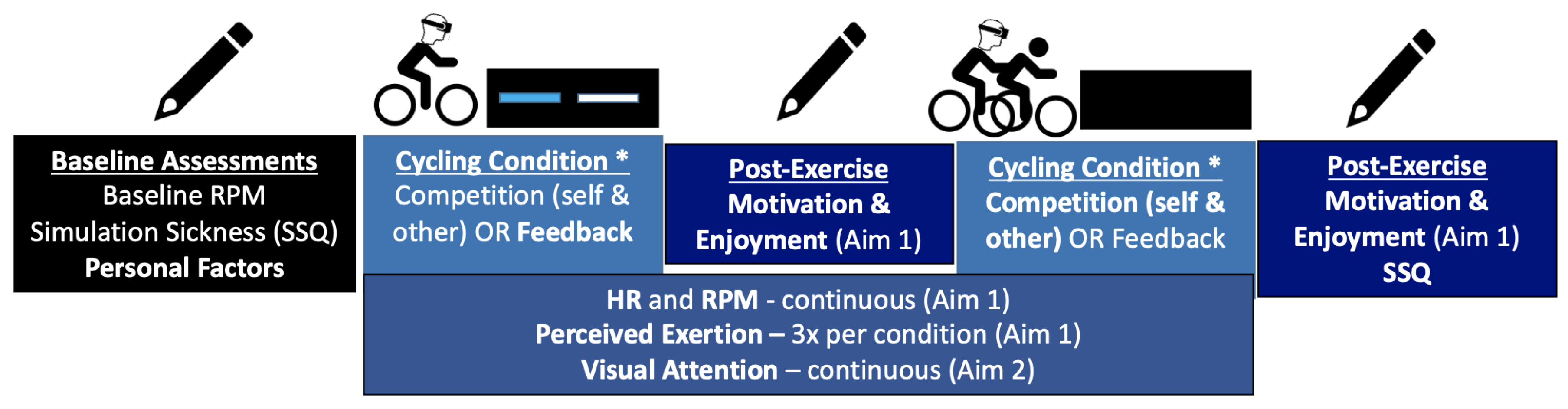
Figure 2.
Breakdown of the virtual environment to categorize and analyze eye movements in VR.
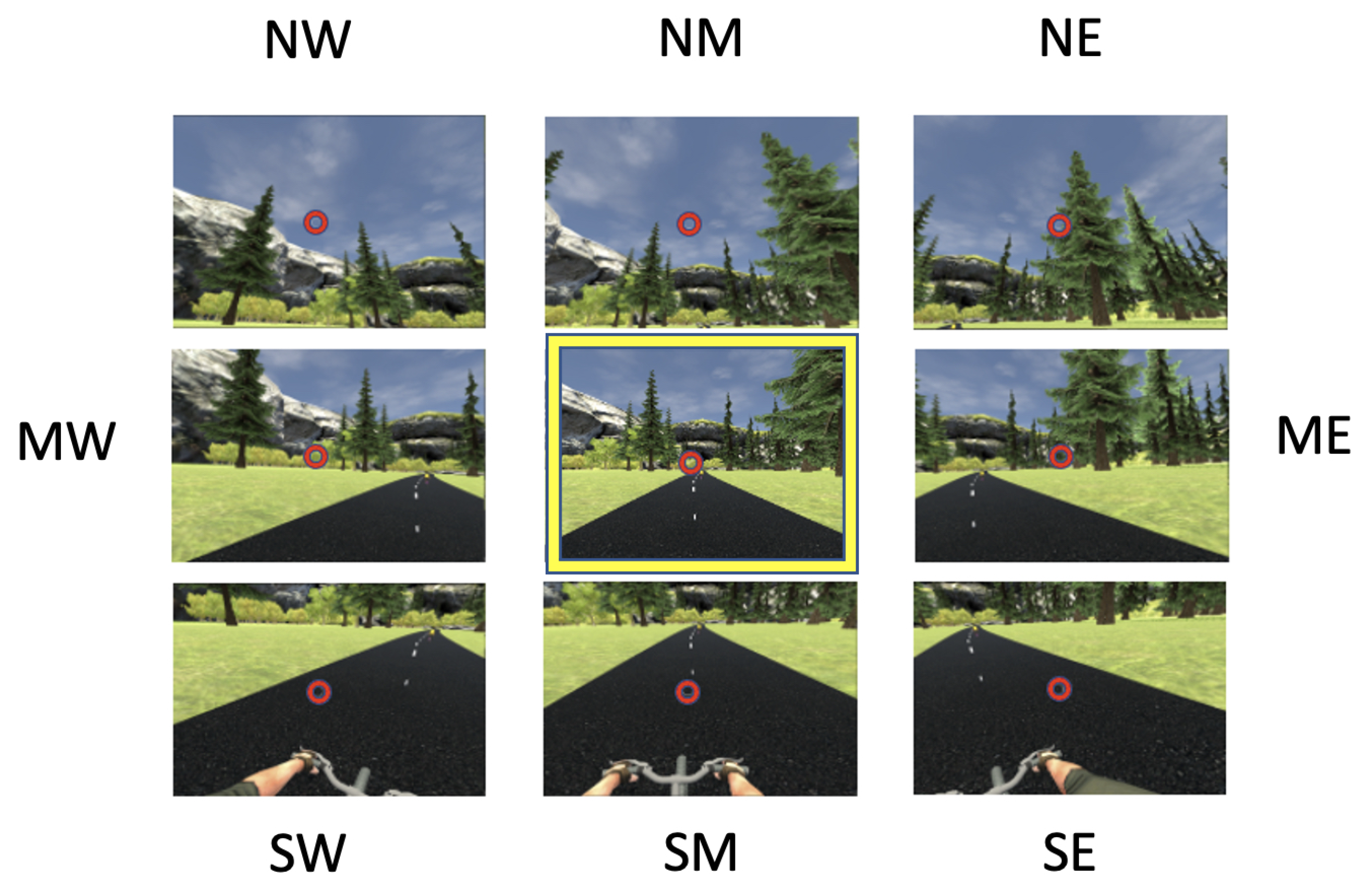
Figure 3.
Exercise intensity in 3 conditions. The asterisk indicates statistically significant differences in each competitive condition compared to visual feedback (p < 0.0167). Cardiovascular intensity was higher in competition against others compared to visual feedback (t(24) = 4.74, p < 0.001) and in self-competition compared to visual feedback (W = 284, p < 0.001) Neuromuscular intensity was higher in competition against others compared to visual feedback (t(24) = 6.04, p < 0.001) and in self-competition compared to visual feedback (t(24) = 7.53, p < 0.001).
Figure 3.
Exercise intensity in 3 conditions. The asterisk indicates statistically significant differences in each competitive condition compared to visual feedback (p < 0.0167). Cardiovascular intensity was higher in competition against others compared to visual feedback (t(24) = 4.74, p < 0.001) and in self-competition compared to visual feedback (W = 284, p < 0.001) Neuromuscular intensity was higher in competition against others compared to visual feedback (t(24) = 6.04, p < 0.001) and in self-competition compared to visual feedback (t(24) = 7.53, p < 0.001).
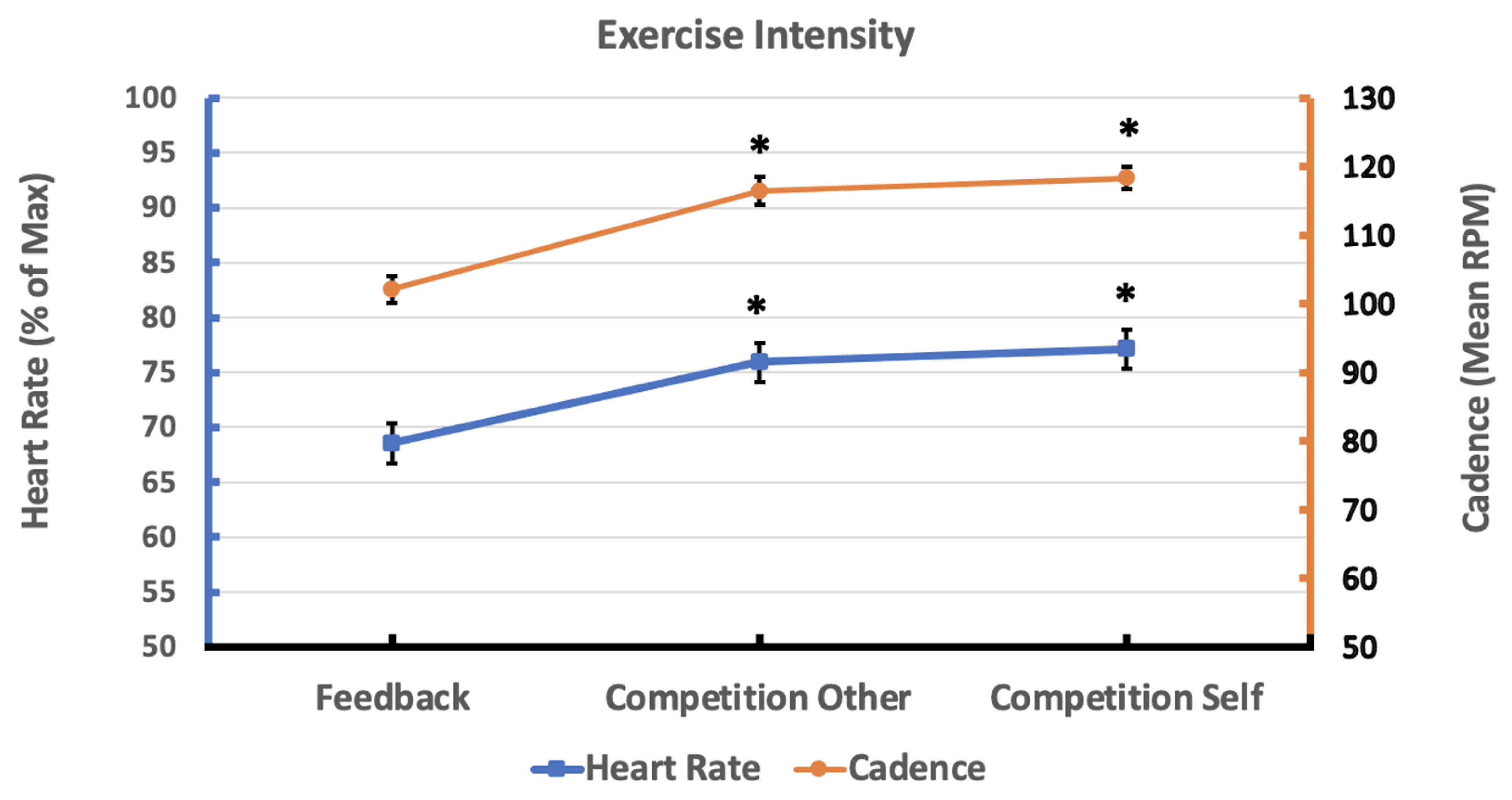
Figure 4.
Visual attention in 3 conditions. Task focus is operationally defined as the percentage of valid gazes falling in the center square.
Figure 4.
Visual attention in 3 conditions. Task focus is operationally defined as the percentage of valid gazes falling in the center square.
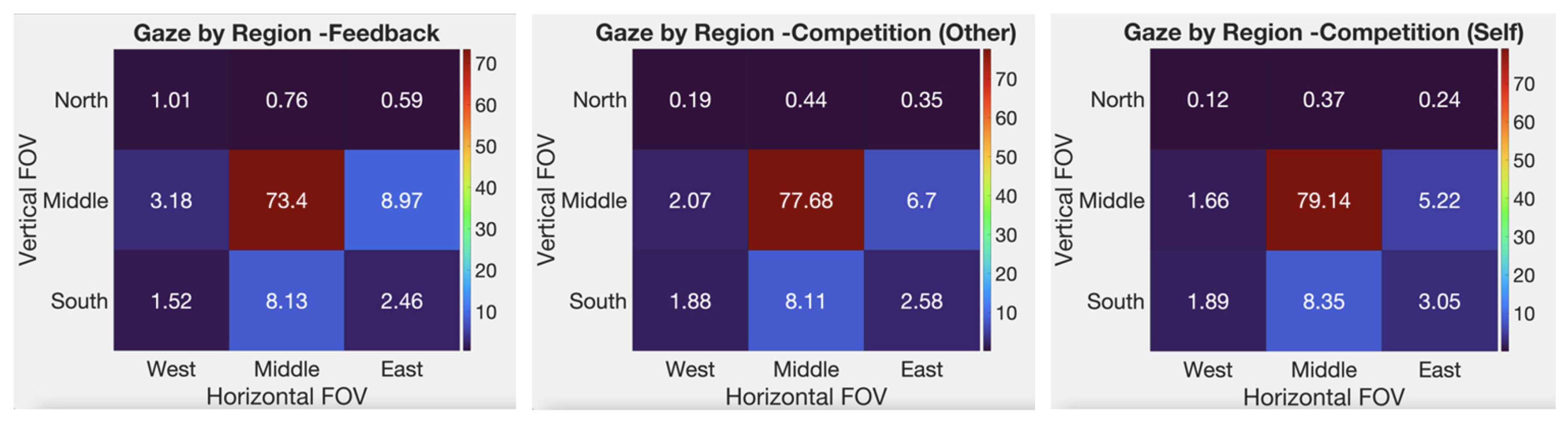

Table 1.
Participant characteristics . Baseline cadence is a bicycling cadence (revolutions per minute – rpm) at which participants felt they would comfortably cycle for 30 minutes..
Table 1.
Participant characteristics . Baseline cadence is a bicycling cadence (revolutions per minute – rpm) at which participants felt they would comfortably cycle for 30 minutes..
| Characteristic | Value |
|---|---|
| N (Female, Male) | 25 (7,18) |
| Age (mean years, range) | 26.5 (22-34) |
| VR Experience (n) | 16 (64%) |
| Bicycling Regularly | 9 (36%) |
| Physical Activity (MET-Minutes, std) | 2943 (1810) |
| Low Activity (n) | 0 |
| Moderate Activity (n) | 13 |
| High Activity (n) | 12 |
| Baseline Cadence (rpm, std) | 68.6 (4.0) |
Table 2.
Measures of the user experience of exercise for all participants across 3 conditions. Standard deviations are indicated in parentheses, and IQRs are indicated for outcomes failing normality assumptions.
Table 2.
Measures of the user experience of exercise for all participants across 3 conditions. Standard deviations are indicated in parentheses, and IQRs are indicated for outcomes failing normality assumptions.
| Feedback | Competition (Other) | Competition(Self) | |
|---|---|---|---|
| Endpoint RPE ( / 20) | 13.0 (12-13) | 15.7 (2) * | 16.0 (15-18) * |
| Change in RPE (End - Start) | 5.0 (1.8) | 8.12 (2.1) * | 8.80 (2.2) * |
| IMI Effort ( / 7) | 4.8 (1.5) | 6.0 (5.1 - 6.6) * | 6.2 (5.7 - 6.8) * |
| Worked Hardest (Rank During Debriefing) | 1 (4%) | 3 (12%) | 21 (84%) * |
| IMI Enjoyment ( / 7) | 5.5 (1.0) | 5.7 (0.9) | 6.1 (5.0 - 6.8) * |
| IMI Total ( / 7) | 5.4 (0.9) | 5.8 (0.7) * | 5.9 (0.8) * |
| Liked Most (Rank During Debriefing) | 5 (20%) | 4 (16%) | 16 (64%) * |
* Indicates significant differences compared to visual feedback condition (alpha = 0.0167).
Table 3.
Measures of visual attention for all participants across 3 conditions. Task focus is a measure of how much time the participant spent focusing on task-relevant stimuli located near the center of the road. Visual exploration is measured through 3 separate variables. Rightward gazes are gazes directed to the right of the road, roadside gazes are directed away from the road center, and water gazes are directed toward a body of water in the simulation on the right of the track. All values are expressed as percentages of all valid gazes during each 5-minute trial. Standard deviations are indicated in parentheses, and IQRs are indicated for outcomes failing normality assumptions.
Table 3.
Measures of visual attention for all participants across 3 conditions. Task focus is a measure of how much time the participant spent focusing on task-relevant stimuli located near the center of the road. Visual exploration is measured through 3 separate variables. Rightward gazes are gazes directed to the right of the road, roadside gazes are directed away from the road center, and water gazes are directed toward a body of water in the simulation on the right of the track. All values are expressed as percentages of all valid gazes during each 5-minute trial. Standard deviations are indicated in parentheses, and IQRs are indicated for outcomes failing normality assumptions.
| Feedback | Competition (Other) | Competition(Self) | |
|---|---|---|---|
| Task Focus (%) | 73.4 (15) | 77.7 (13) | 79.1 (14) |
| Roadside Gazes (%) | 1.90 (0.43 - 3.01) | 0.59 (0.20 - 2.03) | 0.59 (0.15 - 0.87) * |
| Rightward Gazes (%) | 7.4 (4.4 - 12.1) | 6.5 (3.6 - 9.1) | 4.3 (3.7 - 5.9) |
| Water Gazes (%) | 0.153 (0 - 0.85) | 0 (0 - 0.17) | 0 (0 - 0.11) * |
* Indicates significant differences compared to visual feedback condition (alpha = 0.0167).
Disclaimer/Publisher’s Note: The statements, opinions and data contained in all publications are solely those of the individual author(s) and contributor(s) and not of MDPI and/or the editor(s). MDPI and/or the editor(s) disclaim responsibility for any injury to people or property resulting from any ideas, methods, instructions or products referred to in the content. |
© 2024 by the authors. Licensee MDPI, Basel, Switzerland. This article is an open access article distributed under the terms and conditions of the Creative Commons Attribution (CC BY) license (http://creativecommons.org/licenses/by/4.0/).
Copyright: This open access article is published under a Creative Commons CC BY 4.0 license, which permit the free download, distribution, and reuse, provided that the author and preprint are cited in any reuse.


