

Submitted:
11 September 2024
Posted:
12 September 2024
You are already at the latest version
Preprints on COVID-19 and SARS-CoV-2
Abstract
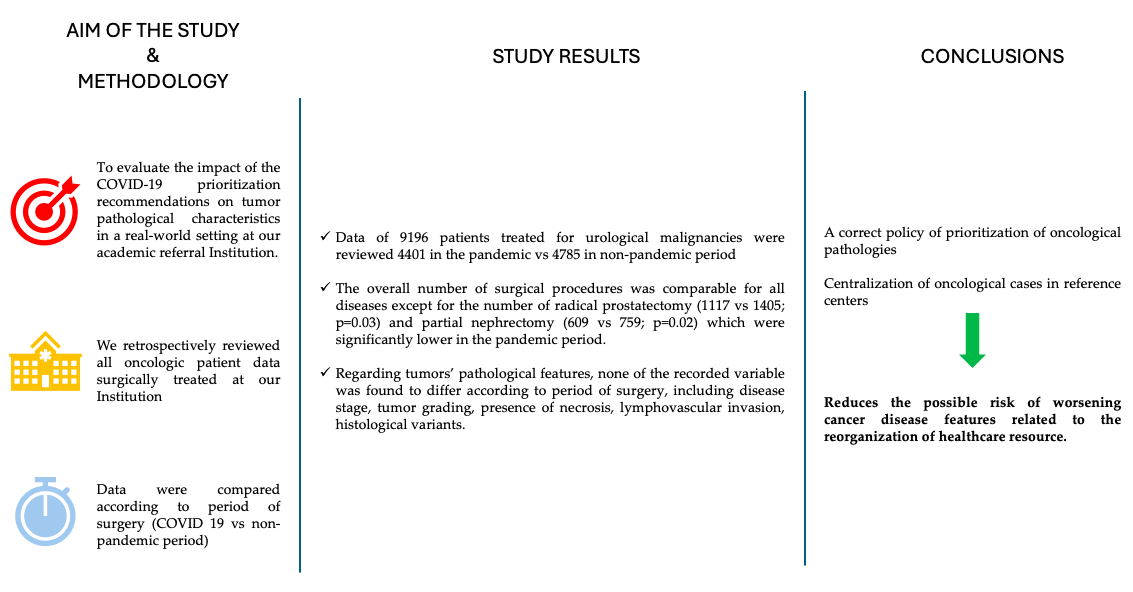
Background: In response to the COVID-19 pandemic, the European Association of Urology (EAU) Guidelines defined priority groups to guide the prioritization of surgery for urological malignancies. The objective of this study was to evaluate the impact of the COVID-19 prioritization recommendations on tumor pathological characteristics in a real-world setting at our academic referral Institution.
Methods: We compared baseline and pathological tumor features of all patients with urological malignancies treated during the pandemic period (2020-2021) versus in the post-pandemic period (2022-2023). Our institution adhered to the International recommendations and prioritized those cases defined as “high-risk”.
Results: Data of 9196 patients treated for urological malignancies were reviewed and grouped according to period of surgery (4401 in the pandemic vs 4785 in non-pandemic period). The overall number of surgical procedures was comparable for all diseases except for the number of radical prostatectomy (1117 vs 1405; p=0.03) and partial nephrectomy (609 vs 759; p=0.02) which were significantly lower in the pandemic period. Regarding tumors’ pathological features, none of the recorded variable was found to differ according to period of surgery, including disease stage, tumor grading, presence of necrosis, lymphovascular invasion, histological variants.
Conclusion: A correct policy of prioritization of oncological pathologies during emergency periods and a centralization of oncological cases in reference centers reduces the possible risk of worsening cancer disease features related to the reorganization of healthcare resources.
Keywords:
Oncology
; COVID-19
; Pandemic
; Healthcare
1. Introduction
The COVID-19 pandemic constituted a global health crisis, significantly impacting numerous countries, including Italy, which faced an urgent necessity to reorganize its healthcare system to optimize resource allocation. The field of urology was notably affected, necessitating adjustments in both outpatient and inpatient care, with a particular emphasis on the prioritization of surgical procedures [1,2]. In response, urology centers were compelled to prioritize surgical interventions for cancer patients, implementing restrictions on elective procedures to maximize healthcare resources and minimize the risk of nosocomial infections [3,4]. Consequently, the International Associations of Urology swiftly recommended a prioritization framework for urologic surgeries, considering factors such as disease aggressiveness, the impact of short-term delays on patient outcomes, and the availability of alternative treatments [5,6]. High-priority cases identified included patients with bladder cancer (BCa) requiring transurethral resection (TUR-B) or radical cystectomy (RC), upper-track urothelial carcinoma (UTUC) necessitating radical nephroureterectomy (RNU), locally advanced prostate cancer (PCa) requiring radical prostatectomy (RARP), renal cell carcinoma (RCC) undergoing radical nephrectomy (RN), testicular cancer necessitating orchiectomy, and penile cancer requiring penectomy. Our institution experienced operational constraints during the critical pandemic period (2020-2021) but adhered to international and governmental guidelines for prioritizing urological cancer surgeries. Nevertheless, delays were observed, particularly among patients at heightened risk of COVID-19 infection and those requiring temporary isolation due to infection. The objective of this study was to evaluate the impact of the COVID-19 prioritization recommendations on tumor pathological characteristics in a real-world setting by comparing patients treated during the pandemic period (2020-2021) with those treated in the post-pandemic period (2022-2023) at our academic referral Institution.
2. Materials and Methods
2.1. Patient Data and Data Collection
All patient data confirmed with urology cancer and treated from 2020 to 2023 in an elective surgical setting at our Institution (Careggi Hospital – Florence, Italy) were retrospectively reviewed. In detail, we collected baseline data and tumor-related features of patients who underwent RARP for PCa, TURB and/or RC for BCa, RNU for high-risk UTUC, partial nephrectomy (PN) or RN for renal cancer. Surgeries were grouped according to the time-period of execution and in particular Covid-19 pandemic (2020 – 2021) and non Covid-19 pandemic (2022-2023) period. The timeframe assignment of each cohort was set in accordance with the Italian national lockdown restrictions. Patient demographic data were recorded including gender, age at surgery, Charlson comorbidity index (CCI) [7], American Society of Anesthesiologists (ASA) physical status classification system [8] and specific disease-related baseline features such as presence of symptoms, tumor diameter and/or complexity, prostatic-specific antigen (PSA) serum level for PCa patients. Tumors were classified according to the prognostic AJCC tumor, lymph node, metastasis (TNM)-based staging system [9], ISUP 2016 grading for bladder and prostate [10,11] and Fuhrman Nuclear Grade for renal carcinoma based on cellular appearance [12]. We excluded from the analysis cases having definitive benign histotype and palliative indication.
2.2. Statistical Analysis
Categorical variables were reported as absolute numbers and proportions while continuous variables as medians with interquartile ranges (IQR) or means with standard deviation (SD) when appropriate. Chi-square and Mann–Whitney U-tests were performed for categorical and continuous variables to compare the populations, respectively. Statistical analyses were performed using STATA 13 (Stata Corp., College Station, TX, USA). All tests were two-sided and p < 0.05 was considered as statistically significant.
3. Results
In this study data of 9196 patients treated for urological malignancies were reviewed and grouped according to period of surgery (pandemic vs non-pandemic period). The overall number of surgical procedures was slightly inferior during the pandemic period despite the difference was not significant (4401 vs 4785). Only radical prostatectomy (1117 vs 1405; p=0.03) and partial nephrectomy (609 vs 759; p=0.02) distribution saw a significant reduction during the global pandemic. Baseline Patients’ and tumors’ characteristics are reported in Table 1.

Table 1.
Baseline patient- and disease- features stratified for period of surgery.
| Pandemic period (2020 – 2021) n = 4401 |
Non Pandemic period (2022 – 2023) n = 4785 |
p-value | |||
| 1117 | 1405 | 0.03 | |||
| PROSTATECTOMY (n = 2522) |
Age, median (IQR); years | 66 (60 - 71) | 68 (60 - 71) | 0.11 | |
| ASA score, median (IQR) | 2 (2 - 2) | 2 (2 - 3) | 0.06 | ||
| CCI score, median (IQR) | 3 (3 - 4) | 3 (3 - 4) | 0.09 | ||
| PSA serum level, median (IQR); ng/mL | 10 (6 - 14) | 7 (5 - 13) | 0.02 | ||
| 1861 | 1890 | 0.21 | |||
| TURBT (n = 3751) |
Gender, n. (%) | Male | 1144 (61.5) | 1192 (63.1) | 0.21 |
| Female | 717 (38.5) | 698 (36.9) | |||
| Age, median (IQR); years | 71 (64 – 78) | 70 (65 -77) | 0.28 | ||
| ASA score, median (IQR) | 2 (2 - 3) | 2 (2 - 3) | 0.11 | ||
| CCI score, median (IQR) | 4 (3 - 4) | 4 (3 - 4) | 0.24 | ||
| 252 | 246 | 0.18 | |||
| CISTECTOMY (n = 508) |
Gender, n. (%) | Male | 173 (68.7) | 163 (66.4) | 0.33 |
| Female | 79 (31.3) | 83 (33.6) | |||
| Age, median (IQR); years | 73 (66 – 78) | 74 (66 – 78) | 0.18 | ||
| ASA score, median (IQR) | 2 (2 - 3) | 2 (2 - 3) | 0.11 | ||
| CCI score, median (IQR) | 4 (3 - 4) | 4 (3 - 4) | 0.24 | ||
| 170 | 185 | 0.34 | |||
| NEPHROURETERECTOMY (n = 355) |
Gender, n. (%) | Male | 121 (71.4) | 127 (68.8) | 0.57 |
| Female | 49 (28.6) | 58 (31.2) | |||
| Age, median (IQR); years | 70 (62 – 70) | 70 (60 – 68) | 0.43 | ||
| ASA score, median (IQR) | 2 (2 - 3) | 2 (2 - 3) | 0.48 | ||
| CCI score, median (IQR) | 2 (2 - 3) | 2 (2 - 3) | 0.33 | ||
| Hydronephrosis, n. % | 89 (52.5) | 93 (50.1) | 0.17 | ||
| 190 | 201 | 0.24 | |||
| RADICAL NEPHRECTOMY (n = 391) |
Gender, n. (%) | Male | 113 (59.5) | 116 (58.0) | 0.33 |
| Female | 77 (40.5) | 85 (42.0) | |||
| Age, median (IQR); years | 60 (52 - 68) | 61 (52 - 68) | 0.41 | ||
| ASA score, median (IQR) | 2 (2 - 3) | 2 (2 - 3) | 0.38 | ||
| CCI score, median (IQR) | 3 (3 - 4) | 3 (3 - 4) | 0.22 | ||
| Symtomps, n. (%) | 44 (23.2) | 38 (19.1) | 0.07 | ||
| 609 | 759 | 0.02 | |||
| PARTIAL NEPHRECTOMY (n = 1468) |
Gender, n. (%) | Male | 352 (57.7) | 447 (59.0) | 0.51 |
| Female | 257 (42.3) | 312 (41.0) | |||
| Age, median (IQR); years | 61 (50 – 67) | 63 (52 – 68) | 0.24 | ||
| ASA score, median (IQR) | 2 (2 – 2) | 2 (2 – 2) | 0.31 | ||
| CCI score, median (IQR) | 2 (2 - 3) | 2 (2 - 3) | 0.32 | ||
| PADUA score, median (IQR) | 8 (7 – 9) | 8 (7 – 9) | 0.29 | ||
| 86 | 89 | 0.33 | |||
| ORCHIECTOMY (n = 175) |
Age, median (IQR); years | 34 (25 - 42) | 36 (26 - 44) | 0.41 | |
| ASA score, median (IQR) | 1 (1 – 1) | 1 (1 – 1) | 0.28 | ||
| CCI score, median (IQR) | 0 (0 – 0) | 0 (0 – 0) | 0.24 | ||
| Tumor diameter, median (IQR); mm | 2.1 (0.8 – 2.8) | 1.9 (0.6 – 2.8) | 0.33 | ||
| 16 | 10 | 0.28 | |||
| PENECTOMY (n = 26) |
Age, median (IQR); years | 75 (72 – 78) | 76 (68 – 77) | 0.18 | |
| ASA score, median (IQR) | 3 (2 – 3) | 3 (2 – 3) | 0.22 | ||
| CCI score, median (IQR) | 4 (3 - 4) | 4 (3 - 4) | 0.28 | ||
ASA: Americal Society of Anesthesiology; CCI: Charlson Comorbidity Index; PSA: Prostate Specific Antigen.
After stratified for surgical procedure, no difference was recorded regarding patients’ age and sex distribution as well as their ASA score and comorbidity burden. Tumors’ features and clinical presentation were also comparable between the two period except for median PSA level in those patients undergoing radical prostatectomy where it was found considerably higher during global pandemic (median 10 [IQR 6 – 14] vs 7 [IQR 5 – 13]; p= 0.02). Table 2 presents the tumors’ pathological features including stage, grading, presence of necrosis, lymphovascular invasion, histological variants. None of the recorded variable was found to differ according to period of surgery.
Table 2.
Pathological tumor features stratified for period of surgery.
| Pandemic period (2020 – 2021) n = 4401 |
Non Pandemic period (2022 – 2023) n = 4785 |
p-value | ||||
| 1117 | 1405 | 0.03 | ||||
| PROSTATECTOMY (n = 2522) |
pT stage, n. (%) | pT2 | 424 (37.9) | 542 (38.5) | 0.18 | |
| pT3a | 511 (45.7) | 602 (43.0) | ||||
| pT3b | 177 (16.0) | 254 (18.0) | ||||
| pT4 | 5 (0.4) | 7 (0.5) | ||||
| pN+, n. (%) | 159 (14.2) | 210 (14.9) | 0.24 | |||
| ISUP grade, median (IQR) | 3 (2 – 4) | 3 (2 – 4) | 0.33 | |||
| 1861 | 1890 | 0.21 | ||||
| TURBT (n = 3751) |
pT stage, n. (%) | pTis | 53 (2.8) | 58 (3.1) | 0.14 | |
| pTa | 786 (42.2) | 776 (41.1) | ||||
| pT1 | 893 (47.9) | 871 (46.0) | ||||
| pT2 | 129 (7.1) | 185 (9.8) | ||||
| Tumor Grade, n. (%) | Low | 998 (53.6) | 1022 (54.0) | 0.38 | ||
| High | 863 (46,4) | 868 (46.0) | ||||
| Concomitant CIS, n. (%) | 241 (12.9) | 205 (10.8) | 0.29 | |||
| 252 | 246 | 0.18 | ||||
| CISTECTOMY (n = 508) |
pT stage, n. (%) | pT2 | 105 (41.6) | 111 (45.1) | 0.41 | |
| pT3a | 95 (37.6) | 89 (36.1) | ||||
| pT3b | 45 (18.1) | 37 (15.2) | ||||
| pT4 | 7 (2.7) | 9 (3.6) | ||||
| pN+, n. (%) | 41 (16.2) | 38 (15.4) | 0.38 | |||
| Histology variant, n. (%) | 32 (12.6) | 32 (13.0) | 0.28 | |||
| 170 | 185 | 0.34 | ||||
| NEPHROURETERECTOMY (n = 355) |
pT stage, n. (%) | pT1 | 43 (25.2) | 39 (21.0) | 0.17 | |
| pT2 | 96 (56.4) | 109 (58.9) | ||||
| pT3 | 29 (17.0) | 33 (18.0) | ||||
| pT4 | 2 (1.4) | 4 (2.1) | ||||
| pN+, n. (%) | 25 (14.7) | 31 (16.7) | 0.24 | |||
| Lymphovascular invasion, n. (%) | 53 (25.2) | 46 (24.8) | 0.28 | |||
| Histology variant, n. (%) | 19 (11.1) | 17 (9.1) | 0.45 | |||
| 190 | 201 | 0.24 | ||||
| RADICAL NEPHRECTOMY (n = 391) |
pT stage, n. (%) | pT1b | 24 (12.6) | 27 (13.4) | 0.19 | |
| pT2 | 69 (36.3) | 70 (34.8) | ||||
| pT3a | 81 (42.6) | 89 (44.2) | ||||
| pT3b/c | 10 (5.2) | 13 (6.4) | ||||
| pT4 | 6 (3.3) | 2 (1.2) | ||||
| pN+, n. (%) | 40 (21.0) | 38 (18.9) | 0.31 | |||
| Nuclear grade, median (IQR) | 3 (3 – 4) | 3 (3 – 4) | ||||
| Necrosis, n. (%) | 64 (33.6) | 72 (35.8) | 0.22 | |||
| 609 | 759 | 0.02 | ||||
| PARTIAL NEPHRECTOMY (n = 1468) |
pT stage, n. (%) | pT1a | 339 (55.6) | 401 (52.8) | 0.44 | |
| pT1b | 158 (25.9) | 221 (29.1) | ||||
| pT2 | 28 (4.5) | 36 (4.8) | ||||
| pT3a | 84 (14.0) | 101 (13.3) | ||||
| Nuclear grade, median (IQR) | 2 (1 – 3) | 2 (1 – 3) | 0.19 | |||
| Necrosis, n. (%) | 93 (13.1) | 101 (13.3) | 0.56 | |||
| 86 | 89 | 0.33 | ||||
| ORCHIECTOMY (n = 175) |
Disease Stage, n. (%) | Ia | 19 (22.0) | 17 (19.1) | 0.26 | |
| Ib | 18 (22.1) | 22 (24.7) | ||||
| Is | 20 (23.2) | 15 (16.8) | ||||
| II | 21 (23.4) | 26 (29.3) | ||||
| III | 8 (9.3) | 9 (10.1) | ||||
| Lymphovascular invasion, n. (%) | 15 (17.4) | 17 (19.1) | 0.19 | |||
| Non-seminomatous germ cell tumours, n. (%) | 39 (45.3) | 38 (42.6) | 0.22 | |||
| 16 | 10 | 0.28 | ||||
| PENECTOMY (n = 26) |
Disease Stage, n. (%) | I | 4 (25.0) | 3 (30.0) | 0.37 | |
| IIa | 5 (31.2) | 4 (40.0) | ||||
| IIb | 3 (18.7) | 2 (20.0) | ||||
| IIIa | 3 (18.7) | 1 (10.0) | ||||
| IIIb | 1 (6.4) | 0 (0.0) | ||||
| IV | 0 | 0 (0.0) | ||||
| Histopathological Grading, median, (IQR) | 2 (1 - 3) | 2 (1 – 3) | 0.22 | |||
4. Discussion
This study aims to assess the impact of the COVID-19 pandemic and the subsequent prioritization recommendations on the stage and grade of genitourinary malignancies at our institution. Numerous reports have evaluated the pandemic’s effect on surgical volumes across various cancer types [13,14]. In urologic oncology, many researchers have reported a reduction in elective oncological surgeries and an increase in surgical wait times [15,16]. This decline is attributable to the healthcare system’s burden, pandemic-induced fears, public reluctance, social isolation, and quarantine measures. At our center, we adhered to the International Guidelines proposed by the European Association of Urology (EAU) panel [6], prioritizing high-risk oncological surgeries. We observed no significant change in the total number of surgical procedures for oncological diseases, except for a reduction in RARP (1117 vs. 1405 in the pandemic and non-pandemic periods, respectively, p=0.03) and PN (609 vs. 759 in the pandemic and non-pandemic periods, respectively, p=0.02). This reduction may be due to the increased acceptance of alternative therapeutic strategies, such as active surveillance, in patients with low-risk prostate cancer (PCa) and small renal masses. Conversely, we continued to offer surgical treatment with curative intent to patients with suspected aggressive PCa and localized renal cell carcinoma (RCC), as evidenced by the higher median prostate-specific antigen (PSA) levels among PCa patients during the COVID-19 period [10 (6 - 14) vs. 7 (5 - 13) ng/mL]. On the other hand we did not notice a significant variation in the number of surgical procedures conducted for urothelial cancer patients, as well as for those with testicular or penile cancer, that often require rapid surgical intervention which could not be postponed. The consistent volume of elective surgical activity at our institution can be attributed to our role as a referral center, where urgent and oncologic procedures were prioritized even during the pandemic. This finding aligns with other studies conducted in referral institutions [17], while a systematic review indicated that low-volume centers experienced negative impacts on surgical delays and outcomes [18,19]. Additionally, we examined potential variations in tumor grade and stage between the pandemic and non-pandemic periods. Our analysis revealed no significant differences in pathological stage, tumor grade, or other indicators of disease aggressiveness (e.g., lymphovascular invasion, tumor necrosis, histological variants). These findings underscore the effectiveness of International Guidelines on surgical activity prioritization, demonstrating that, when carefully followed, they provide a valuable framework for guiding clinical and surgical practices during emergent situations [20]. The EAU Guidelines on surgical prioritization during the COVID-19 pandemic have been validated as independent predictors of oncological outcomes across different disease contexts [21,22,23]. In alignment with these guidelines, we endeavored to maintain a waiting period of 30 days for patients requiring RC, RN, RNU, orchiectomy, and penectomy, while prioritizing candidates for RARP, PN, and TURB-T based on imaging and baseline disease features, particularly those with suspected high-risk tumors. Although delays were inevitable in some cases, existing scientific evidence supports our approach, as several studies have highlighted that PCa, localized RCC, and superficial BCa can generally be deferred for 1 to 3 months without compromising survival outcomes [24,25].
This study has certain limitations. Primarily, it provides a snapshot of a single-center experience, which may not be generalizable to other healthcare settings. Furthermore, we were unable to assess alternative treatment modalities employed during the pandemic. Additionally, we did not compare the median duration of waiting lists for urological malignancies during the pandemic versus the non-pandemic period, limiting our ability to evaluate the impact of such delays on clinical outcomes.
Despite these limitations, our study offers a robust real-world analysis of the impact of prioritization recommendations on elective surgical activities during the COVID-19 pandemic in an academic referral institution, as well as an evaluation of potential variations in tumor stage and grade across a large patient population.
5. Conclusion
The present study showed that in an academic referral Institution, adhering to International recommendations for prioritizing “high risk” malignancies cases resulted in no worsening of tumor pathological features for all urological malignancies. Centralization through referral centers and proper prioritization strategies are key to face emerging scenario.
Author Contributions
Conceptualization: Antonio Andrea Grosso, Andrea Minervini; Methodology: Antonio Andrea Grosso, Riccardo Campi, Fabrizio Di Maida; Formal analysis: Antonio Andrea Grosso, Riccardo Campi; Data curation: Francesco Lupo Conte, Vincenzo Cangemi, Rossella Catanzaro, Nassima Doumit, Neliana Kucuku, Alessio Pecoraro; Writing—original draft preparation: Antonio Andrea Grosso, Alessio Pecoraro; Writing—review and editing: Andrea Minervini, Andrea Mari, Sergio Serni, Lorenzo Masieri; Supervision: Andrea Minervini, Sergio Serni.
Funding
None.
Institutional Review Board Statement
The study was conducted in accordance with the Declaration of Helsinki.
Informed Consent Statement
Informed consent was obtained from all subjects involved in the study.
Data Availability Statement
Data available on request due to restrictions eg privacy or ethical.
Acknowledgments
None.
Conflicts of Interest
The authors declare no conflict of interest.
References
- Campi R, Tellini R, Grosso AA, Amparore D, Mari A, Viola L, et al. Deferring Elective Urologic Surgery During the COVID-19 Pandemic: The Patients’ Perspective. Urology. 2021 Jan;147:21-26. [CrossRef]
- Amparore D, Campi R, Checcucci E, Piana A, Sica M, Grosso AA, et al. Patients’ perspective on the use of telemedicine for outpatient urological visits: Learning from the COVID-19 outbreak. Actas Urol Esp (Engl Ed). 2020 Nov;44(9):637-638. English, Spanish. [CrossRef]
- Naspro R, Da Pozzo LF. Urology in the time of corona. Nat Rev Urol. 2020 May;17(5):251-253. [CrossRef]
- Amparore D, Campi R, Checcucci E, Sessa F, Pecoraro A, Minervini A, et al. Forecasting the Future of Urology Practice: A Comprehensive Review of the Recommendations by International and European Associations on Priority Procedures During the COVID-19 Pandemic. Eur Urol Focus. 2020 Sep 15;6(5):1032-1048. [CrossRef]
- Stensland KD, Morgan TM, Moinzadeh A, Lee CT, Briganti A, Catto JWF, et al. Considerations in the Triage of Urologic Surgeries During the COVID-19 Pandemic. Eur Urol. 2020 Jun;77(6):663-666. [CrossRef]
- Ribal MJ, Cornford P, Briganti A, Knoll T, Gravas S, Babjuk M, et al. EAU Section Offices and the EAU Guidelines Panels. European Association of Urology Guidelines Office Rapid Reaction Group: An Organisation-wide Collaborative Effort to Adapt the European Association of Urology Guidelines Recommendations to the Coronavirus Disease 2019 Era. Eur Urol. 2020 Jul;78(1):21-28. doi: 10.1016/j.eururo.2020.04.056 Quan H, Li B, Couris CM, Fushimi K, Graham P, Hider P, et al. Updating and validating the Charlson comorbidity index and score for risk adjustment in hospital discharge abstracts using data from 6 countries. Am J Epidemiol. 2011 Mar 15;173(6):676-82. [CrossRef]
- Knuf KM, Maani CV, Cummings AK. Clinical agreement in the American Society of Anesthesiologists physical status classification. Perioper Med (Lond). 2018 Jun 19;7:14. [CrossRef]
- Quan H, Li B, Couris CM, Fushimi K, Graham P, Hider P, et al. Updating and validating the Charlson comorbidity index and score for risk adjustment in hospital discharge abstracts using data from 6 countries. Am J Epidemiol. 2011 Mar 15;173(6):676-82. [CrossRef]
- Amin MB, Greene FL, Edge SB, Compton CC, Gershenwald JE, Brookland RK, et al. The Eighth Edition AJCC Cancer Staging Manual: Continuing to build a bridge from a population-based to a more “personalized” approach to cancer staging. CA Cancer J Clin. 2017 Mar;67(2):93-99. [CrossRef]
- Epstein JI, Egevad L, Amin MB, Delahunt B, Srigley JR, Humphrey PA; Grading Committee. The 2014 International Society of Urological Pathology (ISUP) Consensus Conference on Gleason Grading of Prostatic Carcinoma: Definition of Grading Patterns and Proposal for a New Grading System. Am J Surg Pathol. 2016 Feb;40(2):244-52. [CrossRef]
- WHO Classification of Tumours Editorial Board. WHO Classification of Tumours. Urinary and male genital tumours. International Agency for Research on Cancer 5th Edn.; Vol 8. 2022. https://publications.iarc.fr/610.
- Moch H, Cubilla AL, Humphrey PA, Reuter VE, Ulbright TM. The 2016 WHO Classification of Tumours of the Urinary System and Male Genital Organs-Part A: Renal, Penile, and Testicular Tumours. Eur Urol. 2016 Jul;70(1):93-105. [CrossRef]
- Rutter MD, Brookes M, Lee TJ, Rogers P, Sharp LJG. Impact of the COVID-19 pandemic on UK endoscopic activity and cancer detection: a National Endoscopy Database Analysis. Gut . 2021;70(3):537–543 .
- Jacob L, Loosen SH, Kalder M, Luedde T, Roderburg C, Kostev KJC. Impact of the COVID-19 pandemic on cancer diagnoses in general and specialized practices in Germany. Cancers . 2021;13(3):408.
- Wang J, Vahid S, Eberg M, Milroy S, Milkovich J, Wright FC, et al. Clearing the surgical backlog caused by COVID-19 in Ontario: a time series modelling study. CMAJ. 2020 Nov 2;192(44):E1347-E1356.
- Uimonen M, Kuitunen I, Paloneva J, Launonen AP, Ponkilainen V, Mattila VM. The impact of the COVID-19 pandemic on waiting times for elective surgery patients: A multicenter study. PLoS One. 2021 Jul 6;16(7):e0253875.
- Oderda M, Soria F, Rosi F, Calleris G, Mazzoli S, Giordano A, et al. COVID-19 pandemic impact on uro-oncological disease outcomes at an Italian tertiary referral center. World J Urol. 2022 Jan;40(1):263-269.
- Tachibana I, Ferguson EL, Mahenthiran A, Natarajan JP, Masterson TA, Bahler CD, et al. Delaying Cancer Cases in Urology during COVID-19: Review of the Literature. J Urol. 2020 Nov;204(5):926-933.
- Chan VW, Tan WS, Asif A, Ng A, Gbolahan O, Dinneen E, et al. Effects of Delayed Radical Prostatectomy and Active Surveillance on Localised Prostate Cancer-A Systematic Review and Meta-Analysis. Cancers (Basel). 2021 Jun 30;13(13):3274.
- Campi R, Amparore D, Capitanio U, Checcucci E, Salonia A, Fiori C, et al. Assessing the Burden of Nondeferrable Major Uro-oncologic Surgery to Guide Prioritisation Strategies During the COVID-19 Pandemic: Insights from Three Italian High-volume Referral Centres. Eur Urol. 2020 Jul;78(1):11-15.
- Campi R, Tellini R, Grosso AA, Pecoraro A, Mari A, Raspollini MR, et al. Exploring the Diversity and Predictors of Histopathological Findings Across the European Association of Urology Guidelines Office Rapid Reaction Group Priority Groups for Patients with Renal Tumors: Implications for Individualized Prioritization of Renal Cancer Care. Eur Urol Open Sci. 2021 Oct 28;34:5-9.
- Tandogdu Z, Collins J, Shaw G, Rohn J, Koves B, Sachdeva A, et al. Management of patients who opt for radical prostatectomy during the coronavirus disease 2019 (COVID-19) pandemic: an international accelerated consensus statement. BJU Int. 2021 Jun;127(6):729-741.
- Cakir OO, Castiglione F, Tandogdu Z, Collins J, Alnajjar HM, Akers C, et al. Management of penile cancer patients during the COVID-19 pandemic: An eUROGEN accelerated Delphi consensus study. Urol Oncol. 2021 Mar;39(3):197.e9-197.e17.
- Taheri D, Jahanshahi F, Khajavi A, Kafi F, Pouramini A, Farsani RM, et al. The Impact of Covid-19 Pandemic on Genitourinary Cancers Stage and Grade. Clin Genitourin Cancer. 2023 Feb;21(1):84-90.
- Diamand R, Ploussard G, Roumiguié M, Oderda M, Benamran D, Fiard G, et al. Timing and delay of radical prostatectomy do not lead to adverse oncologic outcomes: results from a large European cohort at the times of COVID-19 pandemic. World J Urol. 2021 Jun;39(6):1789-1796.
Disclaimer/Publisher’s Note: The statements, opinions and data contained in all publications are solely those of the individual author(s) and contributor(s) and not of MDPI and/or the editor(s). MDPI and/or the editor(s) disclaim responsibility for any injury to people or property resulting from any ideas, methods, instructions or products referred to in the content. |
© 2024 by the authors. Licensee MDPI, Basel, Switzerland. This article is an open access article distributed under the terms and conditions of the Creative Commons Attribution (CC BY) license (http://creativecommons.org/licenses/by/4.0/).
Copyright: This open access article is published under a Creative Commons CC BY 4.0 license, which permit the free download, distribution, and reuse, provided that the author and preprint are cited in any reuse.


