

Submitted:
16 September 2024
Posted:
20 September 2024
Read the latest preprint version here
Abstract
In this paper I dig deep down along the slope of what touches me deeply – a democratic decline in climate politics. I follow the course of critical researchers in management and organisation studies, striving to move away from traditional, horizontal norms of academic writing that focus on counting rather than content and elision the author from the text, towards a more vertical writing acknowledging the value of incorporating the voice of the author. Embodying and resonating with my own emotional experiences of hate and threat campaigns, not locking my own vulnerabilities in, I analyse qualitatively the use, reasons, contents, senders and targets of such nasty rhetoric in Swedish climate politics, and the implications thereof for democracy. At the moment, a far-right populist nativist party holds tangible powers dictating the content and process of Swedish climate politics. In less than two years, Swedish climate politics have turned into an antidemocratic divisive politics portraying climate science as “a point of view”, female journalists writing about climate change and climate policy as “crypto environmentalists”, “motherfuckers” and “moron hags” that should be “fired” and “raped”, and the climate justice movement as “terrorists” and “a threat to Swedish democracy” that should be “sent to prison” and “executed”. Such nasty rhetoric is used not only by anonymous trolls in social media, but by the prime minister, cabinet ministers and parliamentarians, even in debates in the Swedish parliament. It has inspired the far-right extremist movement to use physical violence. Use of nasty politics aims to silence the opponents to the government’s climate policy, the political opposition, climate scientists, the climate justice movement and journalists, breaching liberal and deliberative democratic norms such as legitimacy, accountability and justice. It is a powerful tactic that leaves its targets with an anxious fear of losing control and often a need for disappearance. Many targets resign or stay silent. I chose to break the silence and write differently about the issue.
Keywords:
climate politics
; democracy
; far-right populism
; hate
; nasty politics
; neoliberalism
; threats
; vulnerability
1. Prologue
All of a sudden
I was a target
Of hate and threats
A point had been reached were I, as academic scholar and civil servant of democracy, could not stay silent. With reference to freedom of speech, the Swedish police force granted the violent far-right extremist neo-Nazi organisation, the Nordic Resistance Movement (NMR)2, a permit to demonstrate at the Almedalen week in 2018, the main Swedish and the world’s largest forum for democratic dialogue between politicians, private sector actors, civil society organisations and interested citizens. Plenty of legal and democracy experts, analysts and influencers claimed that such a permit may lead to violence and that there were legal grounds for not permitting the NMR demonstration. I reacted and commented on Facebook that the police were cowards and could do better #1312. Being a football fan, I had previously witnessed the police in different Swedish cities beating innocent men, women, teenagers and children at football matches. I had previously witnessed the police riding horses right through groups of people. My trust in the Swedish police force, its leaders, wasn’t particularly strong at the time. Permitting a violent, antidemocratic neo-Nazi organisation to demonstrate at the hallmark of Swedish democratic dialogue on loose legal grounds was an ‘in-your-face’ provocation to Swedish democracy and to me.
This sparked the worst months in my life. A well-known far-right influencer took note that I was a researcher and worked as deputy director in the Government Offices of Sweden, claiming that I was a scam criticising the Swedish police force. This was followed by months of accusations, intimidations and incitement by hundreds of anonymous accounts on Twitter, Facebook and phone calls during daytime and in the middle of the nights. I was displayed as an enemy to the ‘people’. My name, picture, home address and telephone number were posted on far-right extremist internet forums displaying their enemies. I was a shame for the Government Offices. A man claiming to be a police officer stalked me from different anonymous phone numbers for two months, claiming that I had to come to court to defend myself or else I would be sentenced to prison. I should be sacked from my jobs. My bones should be broken. I should be killed. It was not only me that was threatened. My family and everyone working with me should have their bones broken.
This whole situation was completely new to me. I had been threatened before, by drunkards in night streets of Stockholm, but not me as a person and not related to my personal, political opinions. I was just a random man that got bullied. Those occasions were isolated and ended in an instant after me acting calmly, not responding and backing away. In this new situation I was attacked as a person, for my political opinion. My kids were threatened because they were my kids. It left me with an anxious fear that I couldn’t control or influence the inflow of evil other than closing my Twitter account, changing name on my Facebook account and turn off my mobile. The only way to handle the situation was through isolation and disappearance. But why should I have to disappear for using my constitutional right? I couldn’t do it completely. I had to go to work, get my kids from school, answer the phone, run, shop food, meet with friends and family. But leaving home every morning was anxious, as was getting home. What or who would wait for me and my family outside the entrance of our house? Will there be someone following or waiting for me to physically harm or kill me? The anxiety exacerbated by not knowing when the inflow of hatred and threats would end. Would it continue for a week, a couple of weeks, a month, several months or longer? At some points the angst created darkness and depression. I lost my self-esteem and intrinsic value as a human being. Who am I? Why was I bereft of my voice?
The perpetrators succeeded in their tactics. I fell silent for more than five years. I censored my posts on social media. I stopped commenting Swedish politics, which was hard since I had worked with and analysed Swedish politics for about 15 years at the time.
2. Nasty Politics and Nasty Rhetoric
In later years, the kind of hate and threat campaign I was encountering has got a name, at least in social science circles—nasty politics. Nasty politics is an “umbrella term for a set of tactics that politicians can use to insult, accuse, denigrate, threaten and in rare cases physically harm their domestic opponents” (Zeitzoff, 2023, p. 6). Nasty rhetoric, which is at the centre of nasty politics is characterised by divisive and contentious rhetoric with insults and threats that entrenches polarisation and ‘us vs. them’ narratives (Zeitzoff, 2023). All kinds of nasty rhetoric are designed to denigrate, deprecate, hurt and delegitimise their target(s) and contains elements of hatred and aggression, but incitement is more likely to provoke actual violence. Insults or name-calling influence how people make judgement and interpret situations (Kalmoe et al., 2018), and could sometimes include dehumanising and enmity rhetoric, saying that opponents should be eliminated (Cassese, 2021). Accusations include accusing opponents of doing something illegal or shady, or promulgating conspiracy theories about opponents, e.g., that they are controlling the economy or involved in voter fraud (Radnitz, 2021). Intimidation and veiled threats are more threatening since they are advocating action against an opponent, e.g., that they should be investigated or sent to prison. Incitement is the most threatening rhetoric before physical violence. It includes politicians or people in political movements threatening or encouraging violence against opponents, which if the statement is followed would imply physical harm to opponents (Valcore et al., 2023; Zeitzoff, 2023). And it does. “Speech can and does inspire crime” (Cohen-Almagor et al., 2018, p. 38; Schweppe & Perry, 2021).
2.1. Nasty Rhetoric and Far-Right Populism
Democracy is in decline around the world. As many as 71 % of the world’s population live in autocracies, which is an increase from 48 % ten years ago (V-Dem Institute, 2024). The decline is particularly strong in Eastern Europe and South and Central Asia. Populist parties have increased their votes in every election to national parliaments in Europe since the 1980s and autocratisation is increasing (Mudde, 2004, 2021). To reach their political aims of autocratisation, it is common that populists parties and movements disseminate conspiracy theories about the state of society or use nasty politics and rhetoric (Lührmann et al., 2020; Mudde, 2021; Zeitzoff, 2023). Populist far-right parties refer to a homogeneous ‘people’—the popular—as a counterpoint to the ‘political elite’ that created the social problems they see today. Various ‘disaster narratives’ or ‘anxiety narratives’ play an important role for the success of the far-right populist parties (Kinnvall & Svensson, 2022). Such discourses refer to a constant state of crisis of the nation, caused by long-term mismanagement by the corrupt mainstream elite. The far-right parties portray themselves as the saviour of the nation, the welfare state, and the people. But, as found by Kinnvall and Svensson (2022) and Ketola and Odmalm (2023), it is the idea or fantasy of a crisis rather than an actual crisis that works best for far-right populist parties in their communication with the ‘people’.
Based on the work of Mouffe (2013), Chang (2019) and Olson (2020) have shown that nasty politics is not only about what is conveyed explicitly by use of language. Political sentiments are often emotional and affective, thus “determined by viscerally experienced sentiments and a physically imagined sense of rightness or wrongness, rather than one that is worked out through rational means. This aligns with notions of persuasion that stress pathos—the evocation of feeling—as an at least as important part of rhetoric as logos and ethos—the logical/evidentiary and the communicator’s conveyed sense of authority, respectively” (Olson, 2020, p. 154).
Emotions are central not only in nasty rhetoric but in the structural and affective changes that underlie populist mobilisation and the polarisation of everyday insecurities in general (Kinnvall & Svensson, 2022). Populism is defined by emotional appeals to the people, anti-elitism, and the exclusion of out-groups who are routinely blamed and scapegoated for perceived grievances and social ills (Aalberg & de Vreese, 2016). Political persuaders, particularly populists, use language or images to affect emotions, perceptions of knowledge, belief, value, and action. Compared to legal or legislative persuasion that typically require logic and rationality, political rhetoric operate in a world where it is not required for “every statement be logically defensible” (McBath & Fisher, 1969, p. 17). In relation, ‘emotional governance’ can be seen as techniques of surveillance, control, and manipulation, i.e., how society governs emotions through cultural and institutional processes, “meaning the ways in which it affords individuals with a sense of what is regarded as appropriate and inappropriate behaviour and the circumstances in which certain emotions (e.g., fear, hatred, and contempt) become acceptable” (Crawford, 2014, p. 536). Emotional rhetoric is central in reproduction of structural power and power relations between ‘us’ and ‘them’ as it pays attention to collective emotions as ‘patterns of relationships’ and ‘belonging’ (Kinnvall & Svensson, 2022).
Donald Trump is well-known for his use of right-wing populist nasty rhetoric promoting hatred and violence (Valcore et al., 2023). He “is not the only world leader who is accused of publicly denigrating people based on their racial, ethnic or religious backgrounds” (Piazza (2020, para. 2), but he violated numerous democratic and political norms in both the delivery and content of his speeches (e.g., Jamieson & Taussig, 2017; Ross & Rivers, 2020). The use of nasty rhetoric and the strategic agency and impacts of far-right nativist populist movements and parties on democracy is well-known in policy domains such as migration and identity policy (Yılmaz, 2012; Lutz, 2019; Weeks & Allen, 2023; Svatoňová & Doerr, 2024) and is now used also in the climate policy domain.
2.2. Nasty Rhetoric in Climate Politics
While the polarising rhetoric used in politics to frame contesting views of advocates and deniers on climate change have been studied extensively (e.g., Eubanks, 2015; Sharman & Howarth, 2017; Bsumek et al. 2019; Nordensvärd & Ketola, 2022; Pandey, 2024), research on nasty rhetoric in climate politics is sparse. Knight and Greenberg (2011) analysed adversarial framing oriented to reputation discrediting in Canadian social movement/counter-movement relations. Both sides were found to discredit their opponents based on combinations of practices, moral character, competence and qualifications, social associations, and real versus apparent motivations, with motivations tying other dimensions together.
Entering the sphere of elected politicians, then President Donald Trump openly called newly elected congress woman Alexandria Ocasio-Cortez—the initiator of the US Green New Deal which strategically modifies traditional hierarchies in the US—a “nasty woman” and said that many of the newly elected congress women should “go back to their countries” (Miller & Bloomfield, 2022). This shows the power dynamics circling not only female politicians but also climate policy.
A lot of nasty rhetoric is found in social media, particularly X/Twitter where senders can be anonymous (Oltmann et al., 2020). Anderson and Huntington (2017) found that while instances of incivility and sarcasm were low overall in Twitter discussions on climate change and climate politics, such attack discourse was mainly used by right-leaning people. In the last five years, the climate justice movement and its figurehead number one, Greta Thunberg, has been the target of hate attacks in social media, often related to gender (Agius et al., 2021; Andersson, 2021; White, 2022; Arce-García et al., 2023). Uncivil hate attacks from climate skeptic far-right people are also targeting journalists reporting about climate change, climate mitigation policy and climate activism, aiming to discredit journalists and newspapers but also to undermine the deliberative function of online user forums (Björkenfeldt & Gustafsson, 2023; Schulz-Tomančok & Woschnagg, 2024).
2.3. Aim of the Paper
Analysing the democracy–climate policy nexus, more specifically the impacts on democracy of cultural and structural policy entrepreneurship in Swedish climate policymaking, von Malmborg (2024a) found serious use of nasty rhetoric. As described in two essays in Swedish culture magazines (von Malmborg, 2024b, 2024c), it is no longer a strategy and tactic only of the anonymous far-right movement but also of several ministers in the current government, including the prime minister, to use hate and threats in their rhetoric to delegitimise their opponents, particularly climate activists, but also climate scientists and climate journalists. A leading Swedish newspaper recently described Swedish climate politics as “a musty rant with accusations of betrayal, sin and devil pacts”.3 This is a dangerous phenomenon—for those being targeted by attacks and for liberal and deliberative democracy.
Given the rise of nasty politics, with its nasty rhetoric, in Swedish climate politics, this paper aims at digging deeper along the slope of what touches me deeply—a democratic decline in climate politics—a wicked problem that needs strong democracy to be governed. More specifically, I aim to explore and explain in-depth the use of nasty rhetoric, i.e., insult, accusation, intimidation, incitement and physical violence (cf. Zeitzoff, 2023), in climate politics. Who is using it and in which forums? Who is targeted? Why is it used? What are the implications for democracy?
2.4. Reflections on Writing about Nasty Rhetoric
2.4.1. Writing Differently
How we approach academic writing is important. A groundswell of resistance towards ‘scientific’ norms of academic writing in critical management and organisation studies claims that these norms are “restrictive, inhibit the development of knowledge and excise much of what it is to be human from our learning, teaching and research” (Gilmore et al., 2019; p. 3). They claim that in a similar way that we can “employ different methods in our research, there is also a requirement for those who stand outside of the scientific writing doctrine to write differently” (Gilmore et al., 2019, p. 4).
Barbara Czarniawska-Joerges (1995) was a pioneer in experimental forms of writing, using novels and poems to critically understand organisations and management to reach beyond the often-stultifying formats inculcated by ‘scientific’ norms, and engage and absorb the readers so that learning happens almost unknowingly through emotions (Parker, 2014; Kociatkiewicz & Kostera, 2016). While some advocate writing differently to communicate less abstractly (Grey & Sinclair, 2006), others suggest that a burst of creativity might follow if academics were loosened from the binds of traditional academic writing that elision the author from the text (Gilmore et al., 2019). Drawing on the works of Cixous (1976), writing differently acknowledges the value of incorporating the voice and material presence of the author (Höpfl, 2007), aiming to provide a mode of writing that develops a distinct, affective feminist politics for research seeking to effect concrete changes in challenging gendered structures (Vacchani, 2019). Of course, the presence of the writer’s physical body remains speculative, yet there are writers who write of their bodies and the body has the potential to become a site of power and change, albeit a contested space. Other writings speak of writing from the body, embodying and giving voice to the writer’s emotions, not locking in her vulnerabilities (e.g., Pullen & Rhodes, 2008; Helin, 2019). Embodiment of the writer’s emotions, often fear and angst, is the most common approach to writing differently in management and organisation studies (see e.g., Beavan, 2019; Boncori & Smith, 2019; Helin, 2023), and the approach I use in this paper.
Writing differently does not seek to escape from academic rigour. The aim is to deepen and broaden our understanding of different phenomena in society, organisations and politics through research and theorising in which the writing itself contributes to research and theory. It is not trying to replace academic writing with art forms such as poetry, novels, autobiographies, music and painting. Doing so would be to abandon the riches that academic research offers. Rather, writing differently aim to enrich knowledge through maintaining academic rigour while slipping the surly bonds of stultifying writing bound to a comforting but empty, homogenous and horizontal temporality following the chronological time from the past to the future, moving towards a more vertical temporality that shift focus from counting to content, and to a cognitive process that leads to problematising instead of harmonising, contextualising instead of neutralising, and specifying instead of generalising (cf. Bränström Öhman, 2012). As proposed by French philosopher of science and phenomenologist Gaston Bachelard (2013), a vertical temporality is multidimensional and connected to sensing simultaneities, a time of complexity and multitude, a time of the body that can host contradictory feelings. It is a time of the instant, that will always die and make every moment unique. Contrary to the aim of traditional academic writing based on horizontal temporality to fill gaps, writing differently based on a vertical temporality aims at creating gaps by thought-provoking research and academic texts on instants that take us by surprise (Helin, 2023). Writing differently aims at “broadening, widening and deepening knowledge and understanding by giving our ideas space in which they can flourish, create new meanings, help us learn and become human” (Gilmore et al., 2019, p. 4).
2.4.2. Embodying Vulnerabilities to Understand Nasty Rhetoric
I’m not interested in analysing the development of nasty rhetoric or its frequency in a horizontal temporality, but what it really represents in a more vertical temporality, beyond time as represented by the clock. Nasty rhetoric aims at evocating feelings and emotionally hurt its targets, making people afraid and anxious (Chang, 2019; Olson, 2020). It aims at demonising and dehumanising people, making the silent and disappear from the political conversation. Analysing nasty rhetoric only by what is conveyed explicitly by use of language, pictures and physical action would give a flat understanding of the phenomenon. Following the course of scholars in critical management and organisation studies, writing differently to enhance our understanding of society and organisations, I write this paper somewhat differently still adhering to norms of academic rigour. Embodying emotions and writing vulnerable about my own experiences of and emotions related to political hate and threat campaigns in the prologue and throughout the paper, my intention is to emotionally engage and absorb the readers to enhance learning through feeling, or at least imagining, the pain, fear and angst that comes with being a target of nasty rhetoric and being dehumanised (cf. Parker, 2014; Kociatkiewicz & Kostera, 2016; Page, 2017; Beavan, 2019). Nasty rhetoric is nasty emotional. Writing differently about nasty rhetoric, describing emotions of fear and angst, thus adds a human and inevitable dimension to the otherwise soulless presentation of language and pictures of political hatred and threats. Writing about different insults, accusations, intimidations, incitements and physical violence, I may report when they happened in chronological time to give the reader an understanding of the context, but not to analyse how nasty rhetoric developed. I analyse them as a set of instants (cf. Bachelard, 2013). In this sense, “this is how we can go deep in the sense of associating with that which is most important to us as well as finding ways to fly high and be connected to something bigger through writing” (Helin, 2023, p. 382).
Writing differently, embodying my own emotions and vulnerabilities could provide an opportunity for the possibilities of wonder, passion, disgust and imagination in critical policy studies (cf. Carlsen & Sandelands, 2015), and passionate, engaged learning about new possibilities for thinking and be(com)ing (cf. Shotter & Tsoukas, 2014). I hope that I, through writing differently, can touch vulnerable flesh and invoke new political and ethical practices in politics and policymaking to delegitimise nasty rhetoric (cf. Helin, 2019; Henderson & Black, 2017). Even the smallest vertical movement to engagement with non-linear forms of temporality, addressing the instant, might help in moving toward such a vulnerable ethics (Page, 2017).
3. Method and Materials
As mentioned, this paper digs deeper into use of nasty rhetoric in climate politics. Who is using it and in which forums? Who is targeted? Why is it used? Is there a difference in levels of hate and threat between different groups of users? What are the implications for democracy? I do this in a qualitative case study of Sweden, analysing rhetoric used in texts, photos and audio-visual material. Sweden is chosen as a case since the use of nasty rhetoric has sky-rocketed in only a few years, with far-right nativist populist Sweden Democrats (SD) with roots in neo-fascism (Rydgren & van der Meiden, 2016; Widfeldt, 2023) being the second largest party in the Swedish parliament (Riksdag), leading to a populist polarisation of Swedish climate politics.
The literature as well as my own experiences tell that social media is an important forum for nasty rhetoric, i.a. due to its wide reach and the possibility of anonymity (Benkler et al., 2018; Olson, 2020; Agius et al., 2021). However, I have not systematically analysed posts on social media platforms such as Facebook, Instagram, TikTok or X/Twitter, were presumably much insult and hate is expressed. This choice was made because of the anonymity problem. I do not only want to identify which kind of rhetoric is used, but who (a person or an organisation) uses it. It was recently confirmed by SD party leader Jimmie Åkesson that SD has used and will continue to use anonymous accounts, particularly on TikTok, to avoid getting non-anonymous and official accounts reported and closed due to their frequent use of sarcasm, insults and hate. Data on the use of nasty rhetoric in other forums such as official policy documents, debates, articles, op-eds etc., was collected using qualitative text analysis of secondary written and audio-visual material (Annex 1).
To identify relevant interpellation debates in the Riksdag, where members of the Riksdag debate with the responsible minister, I screened all debates in the Riksdag archive. In all, twelve debates on climate policy and related issues were held from November 2022 to May 2024. Articles, editorials and op-eds in newspapers, magazines and blogs were identified through Boolesk searches in Retriever Mediearkivet4 during June 2024, the largest media archive in the Nordic countries, covering more than 1 000 newspapers, magazines etcetera. Searches were made using the terms presented in Table 1 in different combinations. Some terms, like antidemocratic, sabotage/saboteur and terrorism/terrorists, were included since such accusations on climate activists were widely discussed in national media in early 2024. To identify relevant blogs, searches were made on Google during June 2024 using search terms such as ‘climate activist’ and ‘climate activism’.
As for newspapers, magazines and blogs, I found editorials, op-eds and articles commenting the Tidö government’s nasty climate politics in left, green, social democrat, liberal, conservative and far-right press. In all, 91 editorials, op-eds, news articles, blogs, TV programmes, and radio programmes were identified, reporting and discussing the use of nasty rhetoric in Swedish climate politics between January 2022 and August 2024.
In this written, visual and audio-visual material, I identified expressions of sarcasm, insults, uncivil hate and threats. Nasty rhetoric is usually emotional and affective, but the emotions are not necessarily contained in the message itself, but they can be triggered by it and be used to anticipate a phenomenon (Chang, 2019; Olson, 2020). Nasty rhetoric can also be expressed visually (Bleiker, 2018), where far-right populism deploys a range of visual images to portray its ideas, such as Pepe the Frog memes (Bedford, 2017) that I received plenty of during the hate and threats attacks I experienced. In attacking climate policy and climate activists, they also use memes of Greta Thunberg showing emotions to distinguish ‘rational men’ from ‘emotional women’ (White, 2022). Thus, I have also identified subtle expressions of nasty rhetoric, e.g., refusal to give interviews, photos and videos of rhetorical actions. These expressions and emotions were coded in relation to type of nasty rhetoric as suggested by Zeitzoff (2023), i.e., insult, accusation, intimidation, incitement and physical violence. Each expression was also coded with reference to sender, partisanship (or organisational belonging if not a politician) of the sender, position in the party/organisation of the sender, target, if it was a firsthand expression or a response to a previous accusation or threat, and finally media used for communication.
4. A Far-Right Turn of Swedish Climate Policy
Before presenting, analysing and reflecting on the use of nasty rhetoric, it is necessary to present the context of contemporary Swedish climate policy in which nasty rhetoric is employed. This includes the far-right populist takeover of Swedish politics in general as well as the conflicts in Swedish climate politics.
4.1. Far-Right Populist Takeover
Sweden has been considered a bastion of strong liberal democracy since the end of World War II, able to develop and maintain a green and equitable welfare state (Boese et al., 2022; Silander, 2024). However, the 2022 elections to the Swedish Riksdag marks a shift, when SD won 20.54 % of the votes and 73 out of 349 seats, overtaking for the first time the conservative Moderate party’s (M) long since place as the second largest party in the Riksdag. This progress made SD gain formal powers in the Riksdag, holding the chairs in the committees of justice, labour market, foreign affairs and industry, and having direct influence over the government in most policy areas. Bargaining on who was to form a government for the 2022–2026 term resulted in the Tidö Agreement (Tidö parties, 2022) between SD and a liberal-conservative troika of M, the Christian Democrats (KD) and the Liberals (L). SD will support an M-KD-L government (the so-called Tidö government), under the condition that SD take part in decisions in six policy areas to undergo a rapid paradigm shift: climate and energy, criminality, economic growth and household economy, education, migration and integration, and public health, of which criminality, migration and climate change are deemed the most important (Rothstein, 2023). SD holds no seats in the cabinet but has political staff in the Prime Minister’s Office within the Government Offices of Sweden. In that sense, SD holds tangible powers, but does not need to take formal responsibility for the government’s decisions. In all, the Tidö party quartet holds majority with 176 of 349 seats in the Riksdag, while the opposition, consisting of the Social Democrats (S), the Centre Party (C), the Green Party (MP), and the Left Party (V), holds 173 seats.
Initially, SD was extremist and violent, but with the election of current party leader Jimmie Åkesson in 2005, SD tried to distance itself from its neo-fascist past and erect a more respectable façade to gain legitimacy (Rydgren & van der Meiden, 2016; Widfeldt, 2023). However, they have continued to combine populism and anti-pluralism/authoritarianism with nativism—the longing for a homogenous nation state—and propose populist and illiberal policies in many areas, primarily migration but also social and environmental policy (Hellström, 2023). In recent years, SD has even hailed Victor Orbán’s Hungary, the worst example of autocratisation in the world (Meléndez & Rovira Kaltwasser, 2021; Mudde, 2021; Boese et al., 2022; Silander, 2024; V-Dem Institute, 2024), as a role model regarding ‘democratic’ governance. The turning back to its roots of SD has become much more evident since the elections in 2022. In campaigning for the EU elections in June 2024, SD once again pushed hard for repatriation of non-ethnic Europeans and claimed the conspiracy theory that S leads a population exchange to get more voters. This is in spite of the SD party leader in 2023 claimed that repatriation is a rhetoric of neo-Nazis and not related to SD. Due to the success of SD, Sweden is currently one of the strongholds of far-right populists in the EU (Widfeldt, 2023), with a pan-European network of far-right organisations to help them (Schlembach, 2011).
Reviewing the Tidö government’s first year in power, Civil Rights Defenders (CRD, 2023) as well as the United Nations Association of Sweden (UNAS, 2023), identified several signs of autocratisation in Sweden and reasons for concern related to the strong influence of SD on the government. Such concerns have been raised also by democracy scholars (Rothstein, 2023; Silander, 2024; V-Dem Institute, 2024; von Malmborg, 2024a), identifying several signs of autocratisation in Sweden. The autocratisation process can be hard to identify since it often takes place gradually in democratic states (Sato et al., 2022). It is the sum of the decisions and the style of governance of illiberal and anti-democratic actors that leads to defective democracies, that is, those with increasingly illiberal characteristics (Merkel & Lührmann, 2021). It is this whole that worries, or as stated by Merkel and Lührmann (p. 870), “if the illiberal virus persists long enough, it transforms the liberal dimension, polarizes the political space, and may affect the institutional core of democracies as well”.
When being part of the ruling elite, like SD in Sweden, the far-right uses democratic institutions to erode democratic functions, e.g., censoring media, imposing restrictions on civil society, harassing activists, protesting, and promoting polarisation through disrespect of counterarguments and pluralism (Lührmann et al., 2020; Mudde, 2021; V-Dem Institute, 2024). Far-right populist parties are based on a unitary, non-pluralist, unmediated, and unaccountable vision of society’s public interest, and stresses responsiveness and requires voters to delegate authority to leaders who equate the public interest with a putative will of the people (Caramani, 2017). Populists adhere to a substantive conception of the public interest, that there is One True vision and an Ultimate Goal which they themselves are rightful to interpret (cf. Bitonti, 2017; Mudde, 2004, 2021). Populists may invoke the values of democracy, but usually do not advocate mass involvement in decision-making. Nor is it always the will of ‘the people’ they invoke. While sometimes talking the language of ‘the people’, populists do not present themselves as responsive to popular will. They present themselves as acting as much on their own will and invite their audience to identify with them for exactly that (White, 2023). Populists themselves have the answer to what is in the public interest.
Regarding the role and agency of SD, it is important that they “sacralize their core ideas and predominantly employ virtue ethical justification strategies, positioning themselves as morally superior to other parties” (Vahter & Jakobson, 2023, p. 1). They assign essentialist value to their key political concepts, a stance that sharply contrasts with the moral composition of the rest of the political spectrum adhering to liberal and deliberative perspectives on democracy.
4.2. The Role Model
Sweden has long since been an international frontrunner and role model in climate policy (Matti et al., 2021), advocating high ambitions in global and EU climate governance as well as nationally. In 2017, the Swedish Riksdag adopted with support of all parties but SD a new climate policy framework5, including:
- A target that Sweden should have net-zero emissions of greenhouse gases (GHGs) and be climate neutral by 2045;
- A Climate Act, stating that the government must present policies for reaching the target, present to the Riksdag (i) annual climate reports in the budgetary bill and (ii) a Climate Action Plan (CAP) at the latest the calendar year after general elections to the Riksdag; and
- Establishment of the Swedish Climate Policy Council (SCPC)6, an independent and interdisciplinary expert body of distinguished researchers on climate change and climate policy tasked with evaluating the alignment of the government’s overall policy with the 2045 climate target.
Based on proposals of the previous red-green coalition government of S and MP (2014–2022), the Riksdag also adopted interim targets covering GHG emissions in the EU effort sharing agreement (i.e., excluding emissions covered by the EU emissions trading system (EU ETS) and emissions and uptake from the land-use sectors):
- Emissions in 2030 should be 63 % lower than emissions in 1990;
- Emissions from domestic transport, excluding domestic aviation, should be at least 70 % lower by 2030 compared to 2010; and
- Emissions in 2040 should be 75 % lower than emissions in 1990.
Sweden’s GHG emissions in total decreased by approximately 37 % from 1990 to 2022 and a decoupling of emissions and economic growth began in 1992, when Sweden introduced carbon dioxide taxation as the second country in the world. Sweden’s annual per capita emissions of GHG are less than 75 % of the global average (Swedish Environmental Protection Agency; SWEPA, 2023).
4.3. The Scapegoat
The long-term downward trend of GHG emissions has changed rapidly since the Tidö government supported by SD entered office. The four parties wanted a radical change of Swedish climate policy and governance—a paradigm shift. SD has long since been vocal as a climate change denier (Jylhä et al., 2020; Vihma et al., 2021), wanting to abort national climate targets and climate policies. SD is culturally and cognitively motivated by conflicting ‘evil’ beliefs of previous governments for decades, both S-led and M-led. Like other European far-right populist parties, SD is mobilising a ‘cultural war’ on strong climate policies, polarising the ‘people’ and the ‘elite’ (Cunningham et al., 2024). Climate policy was purposefully included in the Tidö Agreement by SD, which opened a window of opportunity for SD to dictate and veto the government’s climate policy. The resulting climate policies can be summarised in three claims (cf. von Malmborg, 2024a):
- Increasing emissions,
- A climate action plan without action, and
- Downplaying EU climate policy.
Being a climate denier, SD wanted to abort all Swedish climate targets, but after bargaining with the government in finalising the CAP, they now accept the target of climate neutrality by 2045. In return, they managed to reduce climate policy ambitions in general by deleting short- and medium-term actions important to reach long-term climate targets and providing incentives to enable Swedish business to gain leadership in the green transition.
The climate policies proposed and adopted by the Tidö parties were welcomed by the Confederation of Swedish Enterprise and its neoliberal think tank Timbro, but widely and heavility criticised domestically by the political opposition, SCPC, the Swedish Finance Policy Council (SFPC, an institution similar to the SCPC with focus on finance and economic policy), government authorities, climate scientists, the environmental and social justice movement, business associations, editorial writers in leading national newspapers, and political debaters for its lack of short- and medium-term domestic action, manipulation of information, focus on more inquiries despite a time of climate emergency, and a large focus on climate compensation in other countries.7 SCPS and SWEPA (2024) claimed that the government’s existing policies lead to drastic increases of annual GHG emissions, corresponding to more than 10 % of Sweden’s total annual emissions, and that the CAP will not suffice for Sweden to reach the target on climate neutrality by 2045, nor Sweden’s responsibilities in relation to EU’s 2030 climate target.
Beside domestic criticism, the new climate policies were criticised also internationally,8 claiming that Sweden is losing its role as climate policy frontrunner and risk dragging the EU down with it. The European Commission has rejected Sweden’s application for funding from the EU Recovery Fund since Sweden will meet neither national nor EU climate targets for 2030.9
One argument of the Tidö parties to meet the critique was a reference to strong EU climate policy with the European Green Deal and the Fit for 55 package, most of which were adopted during the Swedish Presidency of the Council of the EU, reducing the need for strong domestic policies. While prime minister Kristersson (M) and climate minister Pourmokhtari (L) referred to strong EU policy as a reason not to propose strong domestic climate policies, KD and SD voiced concerns about ambitious EU-level climate policy. Prior to the EU elections in June 2024, SD’s top candidate, Charlie Weimers, as well as SD’s environment and climate policy spokesperson, Martin Kinnunen, told that SD wants to repeal the European Green Deal and Fit for 55.10
While being criticised by the ‘elite’, the Tidö parties claim that their climate policies are ‘popularly legitimate’, that it follows the will of ‘the people’. But as discussed by von Malmborg (2024a), recent polls in Sweden show that it is hardly in resonance with views of population. Four out of five Swedes who consider the climate issue to be very important, and they have little confidence in the Tidö parties’ climate policy. In addition, 75 % of the M-KD-L voters are critical of the government’s climate policy. ‘Popular legitimacy’ as claimed by the Tidö parties should not be understood as legitimacy from the perspective of the majority, but as legitimacy from SD’s and the Tidö government’s right-wing populist perspective with dissonant claims of climate justice (Fischer et al., 2024). According to themselves, the Tidö parties are the true interpreter of the ‘popular will’, defining and interpreting truth claims while turning a deaf ear to the population, business and researchers. This has led to an increasing Manichean polarisation in Swedish climate politics, where we also find widespread use of nasty rhetoric as a tactics and strategy of cultural-institutional and particularly structural entrepreneurship (Boasson & Huitema, 2017) used by SD and the Tidö government to influence people’s perceptions and enhance governance influence by altering the prevailing distribution of power and information (von Malmborg, 2024a).
5. Nasty Rhetoric in Swedish Climate Politics
As set out in the Tidö Agreement, the Tidö parties aim for a paradigm shift to radically change Swedish climate policy, which they thought was costly, ineffective and illegitimate among citizens. They use plenty of resources and strategies to reach their aim (von Malmborg, 2024a, 2024b, 2024c). SD acts in a way that can be described as an ‘activistic’ policy entrepreneur (cf. Arnold, 2021), deploying a broad set of strategies to influence the Tidö government to change perceptions and beliefs on climate change, climate policy instruments, and the structure and process of climate governance. They also aimed to please past voters and influence future voters at local and regional level, dependent on travelling by car and living close to wind farms.
SD has been successful in influencing M, KD and L, but the long term cultural-institutional entrepreneurism of SD to deny climate change as a political problem despite overwhelming evidence from climate scientists has born little fruit in the Swedish population. Almost 80 % of the population has little confidence in the Tidö parties’ climate policy. Thus, to reach their aims, SD and later on the Tidö government also adopted structural entrepreneurship strategies (von Malmborg, 2024a). SD influenced the government to limit public participation in climate policy discussions and limit the possibilities for critics to voice their concerns, using insults, accusations, intimidation and incitement to demonise, delegitimise and threaten their opponents to silence (von Malmborg, 2024b).
It was recently revealed by different Swedish media that SD’s communications office, inspired by Donald Trump and directed by the party leader, deliberately runs a ‘troll factory’ since at least prior to the Riksdag elections in 2018.11 Using anonymous ‘troll accounts’ in social media, SD has deliberately and systematically spread misinformation and conspiracy theories to shape opinion, manipulate voters and incite dissenters by spreading insults, hate and threats to political opponents in MP, S, C and V, and to journalists, climate scientists and groups and individuals in the climate justice movement scrutinising and criticising SD and the Tidö government, in an act to entrench the ‘us vs. them’ and the ‘people vs. elite’ narratives. Nasty rhetoric is obviously an outspoken strategy and tactic of SD. A lot of SD’s nasty rhetoric is targeted at climate activists, which alongside C and MP are the main enemies of SD. But SD did not only use nasty rhetoric targeting the political opposition. It was revealed that they also insulted and used sarcasm towards leading politicians in the Tidö government, for being part of The Cry (a foul word for the ‘elite’). SD continues to claim that it represents the ‘people’ but is deeply involved in The Cry since more than a decade.12 SD’s insults towards the government were criticised by the prime minister, who required an excuse and that posts on social media were deleted, but he did not criticise the widespread use of anonymous accounts and nasty rhetoric in general. The opposition condemned SD for delegitimising rules and norms of liberal democracy.
5.1. The Tidö Parties and the Far-Right Movement as Sender
From the data collected, it is found that nasty rhetoric mainly appears in social media (as open posts and through direct messages), via e-mail and phone calls, in articles in the daily press, but also in political meetings and debates in the Riksdag. No use of nasty rhetoric was found in policy documents of the government or the Riksdag, or on the Riksdag parties’ webpages. In the following sections, I present explicit examples of nasty rhetoric, the senders and different targets and target groups in relation to types of nasty rhetoric.
5.1.1. Insults
In the first Riksdag party leader debate after the Tidö government entered office, SD party leader Jimmie Åkesson claimed that the previous S-MP government as well as C and V are “emotional” on climate policy, “not basing it on facts”, and that everything is about the “children and what children think”.13
In October 2023, Swedish climate targets were debated in the Riksdag. Referring to allegations of the opposition about a leaked document from the government’s climate strategy investigator, Prof. John Hassler, published the day after the debate,14 climate minister Romina Pourmokhtari (L) insulted the opposition claiming that “it’s a bit like debating with a strawman. It is claimed here that we would abolish climate laws and targets. Those are very big words.”15
When presenting the CAP, prime minister Ulf Kristersson (M), rhetorically insulted the previous S-MP government and its climate policy, claiming that S and MP’s “symbol politics is now replaced by things that have a real effect”.16 Climate minister Pourmokhtari was annoyed by journalists asking about short-term measures to reach the 2030-targets, calling them “quiz questions”.
In preparing the CAP, the Tidö government organised a national climate meeting, and a series of ‘open afterwork meetings’ in different cities to collect views and suggestions for the CAP. But in breach of the Tidö agreement, saying that civil society should be included in consultations on climate policy, climate scientists and the environmental and climate justice movement, e.g., Greenpeace, Fridays for Future (FFF) and Extinction Rebellion (XR)17, were not invited. According to the government, their voices and opinions were “not relevant”. In a similar vein, prime minister Kristersson and the climate policy spokesperson of SD, Martin Kinnunen, dismissed the scientifically based critique of the CAP presented by the SCPC as “just an opinion”, which the Tidö government did not need to care about. The insulting of climate scientists was also used by the press secretary of climate minister Pourmokhtari, commenting a feature on the government’s climate policy in Swedish public service radio18 on her X/Twitter account: “Incredibly negative feature about climate policy on Swedish Radio today where the environmental debater Mikael Karlsson got a lot of space”. She manipulatively called Karlsson an “environmental debater” even though he is associate professor in environmental science, doing active research on climate leadership.
With the CAP, the ‘green’ right considered they have won big. The “extreme environmentalism” advocated by MP—the “political arm of the climate justice movement”—they campaigned against is unhooked and instead SD has been lashed to long term climate targets.19 Far-right media refers to climate activists as “leftish activists” and “muppets”.20 In a similar vein, neoliberal think tank Timbro, owned by business association Confederation of Swedish Enterprise, published an essay claiming “climate alarmists” are “religious doomsday prophets” that cause more harm to the world than GHG emissions.21
Journalists in newspapers and television reporting on climate change, climate policy and climate activism have increasingly received insults in social media and by e-mail. Insults are targeted at both male and female journalists, but female journalists seem to receive more hate and more aggressive hate, such as “left pack”, “crypto environmentalist”, “motherfucker” and “moron hag”.22 But male journalists scrutinising the actions of the far-right movement related to climate activists are also seriously harassed, starting with insults but rapidly expanding to accusations or intimidations. An SD-related media person attacked a male journalist in an interview, where part of the interview was posted on social media and set in motion a hate drive:23
You are a showman, an idiot, a dishonest person, a political activist. There is no reason for me to be serious with you. The only way I can treat you is to fool around. I will post this conversation just so you know.”
5.1.2. Accusations
In mid 2010s, Swedish climate denialists and the far-right movement accused established media of “censoring the climate debate” and being “climate alarmist propaganda centres”. Similarly, the radical right accused established media of belonging to the “left-liberal conspiracy”.24
As part of the campaign for the national elections in 2022, SD’s climate policy spokesperson Kinnunen and social policy spokesperson Clara Aranda accused the environmental movement, climate activists, MP and C for being “infantile” and using a rhetoric that “scares children and young people to climate anxiety”.25
Prior to presenting the CAP, climate minister Pourmokhtari (L) cancelled a meeting where the cement industry would launch its roadmap for fossil free competitiveness due to an alleged “security risk” posed by the fact that one of the notified participants was a retired engineer and member of Scientist Rebellion, a subgroup of XR.26
At the same time Swedish prime minister Kristersson’s (M) accused XR in his official Instagram account for being “totalitarian” and “poses a threat to Swedish democratic political processes”.27 Shortly after, two members of the Riksdag representing M accused XR and other climate activists on social media of being “terrorists”.28 Both the prime minister and climate minister Pourmokhtari continued to accuse XR and its subgroup Mother Rebellion of “pretending to care for the climate and just want to destroy the democratic discussion in an illegal way”.29
5.1.3. Intimidation
The Tidö parties were critical towards the critique on their CAP. In most cases it stopped at insults and accusations. But SD’s climate policy spokesperson thought that the report from SCPC contained “little of value for climate policy” and questioned the existence of SCPC and threatened to “revise their mandate”.30
In 2019, then SD spokesperson on legal policy Tobias Andersson, now chair of the Riksdag’s industry and energy committee, coordinated a confrontation with climate activists to diminish and mock the climate movement because it sells in SD’s ranks and becomes extremely shared. SD wanted to paint the environmental movement as hippies estranged from the world and connect them with MP, who is a sharp opponent to SD in the migration issue. In the confrontation, 20 people from SD’s youth organisation and SD members of the Riksdag infiltrated and filmed participants in a demonstration organised by Fridays for Future (FFF). Through confrontative and edited interviews they humiliated and intimidated young female climate activists in social media, making them look stupid and ignorant.31
In 2022, Tobias Andersson (SD) and Johan Forsell (M), then spokesperson on legal policy issues now minister of trade and development aid, accused climate activists performing traffic blockades at demonstrations of being “saboteurs”, and that they should be charged for “sabotage” instead of “disobedience to law enforcement”.32 This change was later supported by current minister of justice Gunnar Strömmer (M), saying that the actions of climate activists must be seen as sabotage so that they can be “sentenced to prison”.33 In 2022, without any change of legislation, prosecutors around Sweden started to charge climate activists for sabotage and several activists were sentenced to prison by district courts but were later acquitted in the Court of Appeal. Several climate activists felt that this change in the judicial system was an act of political commission.34
In 2023, Andersson posted an interpellation to justice minister Strömmer—an instrument usually used by the opposition to debate questions with the minister in charge, not for representatives of political parties in power to legitimise proposals—about legal measures on climate activists. Andersson proposed and minister Strömmer agreed that the government will investigate a sharpening of penalties for sabotage, so that climate activists can be sentenced to longer periods in prison.35
In spring 2024, this act of intimidation was further accentuated when Andersson (SD) deliberately walked across a banner of climate activists, including Greta Thunberg, demonstrating and blocking the entrance to the Swedish Riksdag (Figure 1). According to a Swedish journalist, scrutinising SD’s political strategies for several years, the picture “illustrates well how the Tidö parties treat climate policy. They are going very hard on climate activists right now. The Tidö parties increase emissions very much and at the same time talk about increasing the punishment of climate activists.”36 However, a Swedish journalism professor comments a film on a SD-related YouTube channel of the same event,37 showing how Andersson redirects his steps when identifying Greta Thunberg, noting that the climate activists are laughing at Andersson: “This guy thinks he’s tough, but just looks small and gave them free PR”.
Besides climate activists, journalists are a widely targeted group of nasty rhetoric. Public service journalists have experienced an increase of insults and incitement since 2019 when financing of Swedish public service changed from a licence fee to taxation. Swedish public service television’s first climate correspondent, a woman, tells that: “Since then, I’ve been getting more e-mails of the type ‘Damn you, I pay your salary and will make sure you’re fired’”.38
A similar act of intimidation of journalists, although more subtle, was the long-term refusal of climate minister Pourmokhtari (L) to be interviewed by journalists with focus on environment, sustainability and climate policy.39 This strategy restricted journalists from doing their job to scrutinise the Tidö parties’ climate and environmental policies.
5.1.4. Incitement
In spring 2022, some months before national elections in Sweden, far-right extremists media site Exakt24, linked to far-right extremist party Alternative for Sweden (AfS) and SD, launched a campaign against climate activists, or climate extremists as they called them. Activists in XR are particularly targeted. In chat rooms filled with Nazi symbols and Nazi rhetoric about race traitors, followers, some of them members of the neo-Nazi NMR, are encouraged to infiltrate and seek accommodation with activists in XR.40 Mastermind behind the campaign, a well-known extremist journalist with ties to AfS and the Swedish white power movement, has posted photos, names, addresses and phone numbers of climate activists on far-right extremist websites as an incitement for further harassment and physical violence. I have later learned that it was the very same person who posted my photo, name, address and phone number on far-right extremist websites.
Few have come to embody the disdain towards climate activists and MP as clearly as the influencer and former member of the Riksdag for S, Jan Emanuel Johansson, who started a new far-right populist party ahead of the 2024 EU elections. In a video on Instagram,41 he appears next to what is supposed to represent a dead person wrapped in a black garbage bag, with a sign tied around the body: “I regret that I voted for the Green Party last election”.
An SD-related media profile, also engaged with far-right extremist Exakt24 posted openly on his X/Twitter account that “I am a little skeptical that the state should execute people. But when it comes to @vatmarker, I am willing to make an exception to my principles”.42 As often, it was claimed by the sender to be humouristic, but it was an explicit call for physically harming climate activists, particularly in Återställ Våtmarkerna (Eng. Restore Wetlands), which contrary to XR and FFF is a climate activist group that not only use peaceful, non-violent civil disobedience in their actions. They block roads and highways, throw paint on works of art in museums and interrupt artist performances in live broadcasts.
As mentioned, climate journalists are often targeted with insults. Particularly female journalists are also targeted with incitement via e-mail from male climate skeptics, often of sexual nature with threats of rape. Another strategy used by far-right extremists targeting journalists is to post pictures, names, addresses and phone numbers on extremist sites such as Exakt24 or in Telegram channels. They also include family members, like parents and children in the hate campaigns:43
His mother is from Norway, have not examined her. But the daddy is an imported vote cattle from Chile. The Social Democrats picked up thousands of communists in the 70s to secure the election win.44
5.1.5. Physical Violence
Some days after the campaign against XR in spring 2022, XR reported that five masked people attacked a climate action, and that one activist had been kicked. About an hour after the attack, the far-right extremist that organised the campaign appeared at the spot with video camera and studio light but did not get any interviews. “They weren’t so talkative last night when I came by with a studio light and everything...”, he wrote in his Telegram channel. In a later post, he questioned that the attack on XR really took place but added that he distances himself from the event “if it is true”.45
Another act of physical violence was experienced in late April 2024, when five masked members of a neo-Nazi fight club attacked a political meeting in Gubbängen, a suburb south of Stockholm, organised by V and MP on how to deal with the nasty politics of the far-right movement and its implications for democracy.46
5.2. The Opposition and the Climate Movement as Sender
The Tidö parties, the far-right movement and neoliberal think tanks are not the only one to use nasty rhetoric in Swedish climate politics. From the data, it is found that oppositional politicians, civil society organisations and scientists are also using it, in response to how they perceive of the politics of the Tidö parties and its supporters.
5.2.1. Insults
In the first Riksdag party leader debate after the Tidö government entered office, then party leader of MP Per Bolund called the prime minister a “provoking naked liar”, for his claim that the S-MP government decided to decommission four nuclear power plants, when in fact it was the owners that took the decision since the plants were old, not safe and unprofitable, based on policies that also M and KD approved.47
In the first Riksdag debate on climate policy after the elections, Left party spokesperson Tony Haddou (V) claimed that the climate minister is “very contradictory and largely illogical”, and “that it echoes a bit empty when the climate minister talks about the so-called ambitious climate policy”, which will increase emissions and imply that Sweden will most likely not reach its climate targets.48
The government purposefully discriminated the climate movement and climate scientists from participating in the national climate meeting in 2023. As a response Greenpeace and FFF organised a demonstration outside the meeting. Together with 14 other environmental organisations, they also wrote an op-ed. Climate scientists also wrote op-eds in leading newspapers before and after the meeting. While the former were rather subtle in insulting the government, inviting people to an action outside the ”climate meeting” which included “civil society organisations”, with quotation marks insinuating that the meeting was not a real climate meeting and that civil society organisations were not properly represented,49 the latter were more explicit, calling the government’s climate meeting a “joke”, a “play for the galleries” and a “spectacle”.50
The opposition was critical to the CAP. The S climate policy spokesperson, Anna-Caren Sätherberg, called it “a napkin sketch and a broken promise”.51 Member of the Riksdag, Jytte Guteland (S), a former Member of the European Parliament, confirmed that climate minister Pourmokhtari is rhetorically skilled and eager to get into debates but that, “right now it is very obvious to the Swedish people, journalists and politicians in this chamber that the climate minister is standing in front of an empty shop window.”52
With the exclusive focus of the Tidö parties on nuclear power to mitigate climate change, critical journalists have asked energy minister Ebba Busch (KD) about the reasons for the government to suddenly shift and suggest state funding of new nuclear power plants. The answer given, ‘that it is a natural law’, did not please the journalists, why a politics journalist of Dagens Nyheter, claimed that the lure of nuclear power is “an erogenous zone to the government”.53
5.2.2. Accusations
In the first Riksdag debate on climate policy after the 2022 elections, Left party spokesperson Andrea Andersson Tay (V) accused the climate minister and Tidö parties of “letting climate policy cover the bubbling frustration over society’s injustices”, that their climate policy with reduced taxation of petrol and diesel “is a support that will largely go to high income earners in the metropolitan municipalities” and “a sham to hide the fact that the right-wing parties are basically pursuing the same policies they have always done: policies designed to benefit the wealthiest in society”.54 Tony Haddou (V) continued by accusing M and KD of denying the need for strong climate policies: “The finance minister (M) shrugs; ‘It’s no big deal if Sweden misses the climate targets. If we don’t do it, we don’t do it’. KD have been mostly happy to move money from rail to road and are in some kind of ‘nuclear Tourette’s state of mind’”.
MP party leader Märta Stenevi went further in the same debate, accusing the climate minister of being a minister in an:
extremely weak puppet government that could only take office after a comprehensive agreement was made with the right-wing extremists in SD, /…/ We are debating with a liberal climate minister who runs SD’s climate policy.
She also accused the prime minister’s ambition to “calmly sit down with researchers, industry and various bodies to ‘chisel out the policy that will take us to the finish line’”, of being worrying because it signals that this “puppet government” does not understand the urgency of containing global warming, and that:
It is clueless at best and cynical at worst—you increase emissions today and hope that someone else will solve the situation in the future.
The question of a puppet government, with SD as puppet master, was brought up also in two Riksdag debates on preparations of the CAP and a debate on the green transition. First, Anna-Caren Sätherberg (S) accused climate minister Pourmokhtari (L) of being ambiguous:
The climate minister first said: ‘No, SD are not involved.’ Then she says that ‘there is preparation, as always, among civil servants in the Government Office’. Her party leader, labour market minister Johan Pehrson (L), came out in the same newspaper and said that ‘SD must be involved in designing the CAP to the highest degree’.
Rhetorically, Sätherberg asked “Is there a crack in the Liberals? Is there a rift between the labour market minister and the climate minister? /…/ I can’t get it together. Someone somewhere knows something that I can’t find out.”55
Second, Elin Söderberg (MP) and Jytte Guteland (S) posed the same questions, but added two-fold critique on the preparations of the CAP; that the government seems to abdicate on the CAP and present it as a government letter rather than a government bill, which sidesteps the Riksdag, and that the government communicates with the opposition through media rather than personal meetings.56 Guteland referred to the prime minister’s claim that the government should seek broad support for the CAP from many parties, when she mentioned:
I represent the largest party in the Riksdag—it is not far-fetched to think that we could be one of these parties. Yet we have seen no such contacts. Then one begins to think about whether this rhetoric is a way to divert thoughts from the lack of concreteness in climate policy.
Guteland also questioned the attitude of the climate minister, constantly referring to herself as a liberal minister in a right-wing government in which SD has no ministers, that:
In politics the motto ‘I can do it myself’ works very poorly. In politics, it’s about creating trust and making sure that you get joint decisions and can make them together with others—not least in Sweden’s Riksdag, this is completely decisive. Therefore, this superhero attitude is not satisfactory. /…/ What becomes very visible from the outside, and which I am convinced that the Swedish people also see, is that the climate minister stands very alone in an uncomfortable situation because the support that exists for this government rests on a climate skeptic party. What SD says in this house does not support an ambitious climate policy, and the same applies to the Tidö Agreement.
Debating the government’s policy for a green transition, Daniel Vencu Velasquez Castro (S) posed a similar crititque of the attitude of industry and energy minister Ebba Busch (KD) towards the puppet mastery of SD:57
What does it mean when the government does not have with it those who actually run the government? The actions of SD together with the government’s policy, where environmental and climate policy are allowed to take a beating in favour of proposals born out of climate skepticism, means that Sweden’s transition is threatened. /…/ The concrete thing we have is that SCPC states that for the first time in 20 years, political decisions contribute to increasing emissions in Sweden. The other concrete thing we have is that the government is controlled by SD, who do not want any change.
In a follow-up debate on the CAP, Elin Söderberg (MP) accused climate minister Pourmokhtari of “expressing herself misleadingly regarding climate policy, which is extremely serious”.58
In its critique of the Tidö parties’ climate policies, SFPC was rather outspoken for being a national authority, accusing the Tidö parties of (SFPC, 2024, p. 15; author’s highlight in italics):
Lacking a coherent and comprehensible strategy to reach both the Swedish and the EU’s climate targets by 2030. /…/ We believe that the government’s CAP does not provide clear and concrete information about how the climate targets are to be reached; it rests on hopes that future actions will lead to the achievement of the targets.
SCPC was even more outspoken in their critique and accusations (2024, p. 8; author’s highlight in italics):
The Tidö parties provides a misleading picture of the action plan’s expected contribution to achieving the goal. The claim that the action plan leads ‘all the way to net zero’ is factually flawed.
On a more general level, S party leader Magdalena Andersson wrote a critical op-ed in the largest newspaper in Sweden six months after the Tidö government entered office, accusing the government of showing totalitarian tendencies—that:
instead of a traditional government, we have a right-wing regime led by Sweden Democrats. A regime that uses its position of power to threaten and silence critical voices. /…/ The SD led government destroys what makes Sweden Swedish.
On a similar tack, MP leader Märta Stenevi accused SD party leader of being a Nazi in a party leader debate in Swedish public service television.
5.2.3. Intimidation
Following the climate policy proposals in the government’s budgetary bills for 2023 and 2024 and the CAP, three out of four parties in the Riksdag opposition (C, MP and V) tabled a motion of non-confidence in mid-January 2024, calling for the setting aside of climate minister Pourmokhtari for failing to deliver policies that reduce emissions.59 The critique towards Pourmokhtari largely refers to the fact that she herself promised to resign if Sweden does not meet Swedish and EU climate targets.60 In addition to C, MP and V, critical liberal voices from local and regional levels demanded the resignation of Pourmokhtari because she and L gave way to SD’s influence over the CAP which implied crossing several red lines of L party programme and ideology.61 Motions of non-confidence are a legitimate instrument for the opposition to question the acts of ministers, but it was often abused by the M-SD-KD-L quartet towards the S-MP governments in 2014–2022, why S abstained from voting. They were sceptical of using an instrument they had criticised. When the Riksdag voted, the critics did not gather enough support for getting Pourmokhtari set aside. These intimidations have continued in a more subtle form online, with blogs like Skiftet running a campaign for the resignment of Pourmoktari.62
6. Understanding Nasty Rhetoric in Climate Politics
6.1. Who Uses and Who Are the Targets of Nasty Rhetoric?
6.1.1. Hate and Murder of Elected Politicians Equals Terrorism
Nasty rhetoric is not a new phenomenon in Swedish politics. In the 1970s and 80s, the hatred of prime minister Olof Palme (S) was prominent. In the early 1970s, one could hear and read rumours that Palme was a “drug addict”, a “Russian spy”, a “manic liar” and a “communist”. In the 1980s, hatred of Palme increased sharply. According to Swedish history professor, Dick Harrison, one of the more elaborate and offensive attacks on Palme as a politician and person was the book “Who is Olof Palme?”, published by Timbro in 1984.63 The book describes Palme as a “double nature”, a “deformed and dangerous person with demonic traits”. The hatred of Palme also spread through caricature pictures on posters, badges, t-shirts and car stickers. Bullet boards were made with Palme’s face. It is not yet clear who murdered Palme and why in February 1986, but there were many far-fetched conspiracy theories and hateful attacks against him at this time.
Since the Syrian civil war, a main target of Swedish far-right hate and threats was the former leader of the Centre Party and minister for enterprise, Annie Lööf.64 Together with Green Party politicians, she stood up for socio-liberal green values, a humane migration policy and criticised the turn to nasty rhetoric in Swedish politics. For this, she was called “Sharia-Annie” and was accused of being a “traitor” that should be brought to the “neo-Nazi court and executed”. Even her family was threatened. In 2022, national coordinator of psychiatry, Ing-Marie Wieselgren, was murdered by a well-known far-right extremist during the Almedalen week. Some days later it was found that Annie Lööf was the number one target—that she should also have been killed. After years of steady-fast resistance against the haters—“They shouldn’t fucking win”—anxiety and fear made her fed up with politics, crying herself to sleep, and Lööf resigned as party leader and from all political assignments.65 Hatred of the Centre Party grew proportionally in line with the Centre Party’s poll successes. The haters were a mixture of the extreme right, SD, non-party members between SD and M, and some right-wing politicians in M and KD. These right-wing voices were loud and aggressive and can be described as more socially conservative, with a look back to “the times before the immigration wave” in 2015.66 Lööf stood in the way of SD gaining a real influence in Swedish politics. SD had fallen on the Centre Party’s parliamentary mandate too many times and that is why there was so much focus on Lööf. A picture was constantly painted that Lööf stands in the way, and that she stands for something evil. The killer and later sentenced terrorist in Almedalen had been portrayed as a lonely madman in media, but Lööf realised that he was not alone at all. She recognised the hatred, the contempt for politicians and the conspiracy theories all too well. It hooks onto what she and many other elected officials have been exposed to for many years by digital internet warriors who hide behind their computer screens: “traitor”, “assassinate”, “kill”.
Data from the Swedish National Council for Crime Prevention (BRÅ, 2023a) shows that about one third of politically elected representatives at local, regional and national level were targeted by hate and threats during the election year 2022, mainly via social media. Almost 70 % of these were exposed more than once. Women and young people and representatives of the Green Party are targeted more often than others. In most cases the perpetrators were anonymous, but if identifiable, they were usually angry middle-aged men often related to the far-right (extremist) movement.
6.1.2. Right-wing nasty rhetoric as a double-edged sword
In addition to liberal and green politicians as targets, hate and threats targeting climate researchers, journalists writing about climate change and particularly climate activists have increased since the Covid-19 pandemic. Hate crimes related to climate change is not yet a category in Swedish statistics and hate crime surveys (BRÅ, 2023b). Just weeks before the 2022 national elections in Sweden, independent left newspaper Dagens ETC revealed that a group of online warriors are paid by SD and receive orders from the party leadership to create campaigns against authorities and political opponents.67 A month after the disclosure, M, KD and L entered a government collaboration with the support of SD. Several people who are active in the climate debate testify that hatred and threats have increased even more since then. As described, the full range of nasty rhetoric, from insults to physical violence, is used.
The fact that people uttering insults, accusations and intimidations towards journalists, researchers and activists now occupy high political positions in the government and the Riksdag can be considered an important reason for the increase in threats—nasty rhetoric has become normalised when the prime minister and other cabinet ministers and people with leading positions in the Riksdag use it, calling XR “totalitarian”, “terrorists”, “saboteurs” and “a threat to Swedish climate governance and Swedish democracy” that should be “sent to prison”. Insults, accusations, intimidations and incitements are made openly, mainly in social media from official accounts of ministers and other politicians. Surprisingly, intimidations targeting climate activists are also made in national radio as well as political debates in the Riksdag.
In line with the findings of Wahlström et al. (2021), the rhetoric on climate activists as criminals (saboteurs and anti-democratic terrorists) give rise to emotions of hate crime offenders such as vindictiveness, disgust and hate, and calls for retribution and execution. It’s a double-edged sword dehumanising the ‘enemies’ and mobilising supporters to intensify and expand the hate and threat towards the ‘enemies’. Similar findings have been reported in studies of hate crime in the US, where defensive hate crime offenders react to a perceived intrusion upon their dominant status in society, e.g., fear of lost status or economic distress (McDevitt et al., 2002). Legitimation of violent actions by appealing to higher loyalties is complemented by a “denial of injury by framing violence as ‘educational’ and denial of the victim through dehumanisation or by framing violence as ‘just retribution’” (Wahlström et al., 2021, p. 3307).
My empirical data reveals that party representatives rarely criticise other politicians in person, but other political parties. Three exceptions are the re-accusations of previous targets: (i) former MP leader Bolund calling the prime minister a “provoking naked liar”, (ii) former MP party leader Stenevi calling SD party leader a “Nazi”, and (iii) S spokesperson Guteland criticising the climate minister for her “superhero attitude”. Swedish politics is not as person fixated as, for example, American politics. The Government makes collective decisions. All ministers must agree. Except for the hate on Greta Thunberg, the same holds true for nasty rhetoric of politicians targeting climate activists or researchers. It is primarily the organisations, not the persons who are targeted. The situation is different for anonymous haters orchestrated by SD and AfS, who display names, photos, addresses and phone numbers of individual climate activists, journalists and other ‘enemies’ like me on far-right extremist web forums.
But it is not only the right-wing government and its supporters in the far-right movement that use nasty rhetoric. The political opposition in the Riksdag and to a lesser extent climate scientists and climate activists, use it. However, they use it differently and with a different purpose. Insults and accusations are targeted towards the government as a collective or directly towards prime minister Kristersson and climate minister Pourmokhtari in response to what they consider to be inferior climate policy in substance and process, and the lack of leadership of prime minister Kristersson and climate minister Pourmokhtari. Usually it entails insults and accusations, with only one case of intimidation—a motion of non-confidence, which is a legitimate but sometimes misused instrument of the Swedish constitution. Being climate minister, Pourmokhtari is set to take the hit, although everyone understands that she is only a “liberal minister in SD’s puppet government”. Like Kamala Harris and Tim Walz are calling Donald Trump and J.D. Wance “weird”, former party leaders of MP, Per Bolund and Märta Stenevi show with their accusations and the eye of a child that the prime minister and climate minister are “naked emperors”. They lack credible political reforms, no visions of building a climate neutral society, nothing. Their response to the climate emergency is Tourette-like tirades about new nuclear power at upfront taxation costs of SEK 300–600 billion and several thousand SEK in increased monthly electricity bills for Swedish households.68 The rhetoric of Bolund and Stenevi is probably more successful than the rhetoric of S party leader Andersson. Warning voters by painting authoritarian threat scenarios like “threat to democracy” is difficult and, in the worst case, can strengthen the image of the strong leader. On the contrary, an everyday call to laugh at the emperor’s nakedness can arouse broad popular engagement.69 This is indicated by the results of the 2024 EU elections, were Swedish left-wing and green parties more than doubled their votes compared to the national elections in 2022, collecting almost 25 % of the votes in total. Far-right populist and climate sceptical SD dropped from 20.5 % in the national elections to 13 % in the EU elections, for the first time ever getting reduced support in a nationwide election. The main reason for the success of the red–green parties and decline of SD was the high interest in climate policy among the voters, ranking it as a top three issue in the elections.
While nasty rhetoric cannot be ruled out from the repertoire of climate activists, they are usually adhering to deliberative views on democracy and value pluralism and the good argument, where hate has little or no place. On the contrary, climate activists use civil disobedience, are ‘radically kind’ and use humour in digital activism to transform democracy (Pickard et al., 2020; Sloam et al., 2022; Chiew et al., 2024). For instance, Greta Thunberg added the Portuguese word “pirralha” (Eng. brat) to her X/Twitter profile after being mocked by former Brazilian president José Bolsonaro for being a “pirralha” in December 2019. She also updated her X/Twitter bio with the words “A very happy young girl looking forward to a bright and wonderful future” after being mocked by former president Donald Trump with the same words in October 2019 (Vowles & Hultman, 2021a; White, 2022). The humouristic turn was also evident in Greta Thunberg’s response to Tobias Andersson’s (SD) intimidation outside the entrance of the Riksdag—a laughter.
Another difference between insults and accusations of the Tidö parties, the far-right movement and Timbro compared to the opposition, climate researchers and climate activists is that the former are grasped from thin air, based on emotions, while the latter are based on substance and facts. The prime minister and the climate minister accused climate activists of being a threat to Swedish democracy, but without legal grounds, only emotions. When S party leader Magdalena Andersson accused SD of being a threat to democracy, and MP leader Märta Stenevi accused climate minister Pourmokhtari of being minister in a “puppet government”, these accusations have concrete bearing on results and conclusions from democracy research (e.g., Silander, 2024; V-Dem Institute, 2024; von Malmborg, 2024b, 2024c). They were not slurs, but well-substantiated claims and accusations.
6.2. Why Is Nasty Rhetoric Used?
It is quite obvious that the highest representatives of the Tidö parties as well as opponents of economic and industrial change regard climate activists as a threat. The activists formulate, on the basis of climate research, system criticism. The Tidö parties’ response is to demonise non-violent climate activism and relativise Nazi attacks with spray bottles and fist fights. Climate activists are “a threat to democracy”, “totalitarian forces” or simply “terrorists” to be “sent to prison” and “executed”. Such accusations are not a matter of isolated occasions, and it cannot be considered innocent mistakes. The words come from the highest-ranking politicians, including the prime minister, whose rhetoric is agitating that climate activists really are a threat to democracy.
When Nazis recently attacked participants in an antifascist meeting in the Stockholm suburb of Gubbängen, the same politicians were not as sharp in their words. After the attack, a clear dividing line emerged between the Tidö parties and the opposition.70 The opposition parties’ respective party leaders used the epithet “right-wing extremist” or described it as a “Nazi attack”. Among the Tidö parties, things sounded different. They did not take the word Nazi in their mouths, and it seemed to chafe with the prefix “right” in the second most reasonable term (right-wing extreme). Minister of industry and energy Ebba Busch (KD) and labour market minister Johan Pehrson (L) chose “anti-democratic forces” instead. Prime minister Ulf Kristersson (M) did not mention the perpetrators at all but spoke sweepingly about how “an attack on a democratic meeting is an attack on our entire democracy”. When another Nazi attack targeting the premises of V occurred in mid-August, neither the prime minister nor any other minister commented the crime.71 They are silent.
How is it possible that we have a political climate in Sweden where the Tidö government and its supporter SD talk about climate activists as if they were Nazis, but not about Nazis as... Nazis? I would like to believe that these politicians know that climate activists are not dangerous to people of society, that their actions are not a question of any threat to democracy. The only threat climate activists pose is to expose the failures of the Tidö parties and previous governments, and to form opinion for what possibly scares politicians and transition averted business more than appearing bad: an economic and political system that is fundamentally changing. That Greta Thunberg has gone from pet peeve to pariah among the Tidö parties, the Confederation of Swedish Enterprise and Timbro is no coincidence. The change coincides with a sharpening of the climate activists’ message—economic degrowth (Heikkurinen, 2021). It is about the realisation that the whole economic system is wrongly inverted (Bailey et al., 2011; Davidson, 2012). An insight transformed into a critique of the neo-liberal economic system and its focus on economic growth (Euler, 2019; Khmara & Kronenberg, 2020). In addition, a critique of the (neo-)liberal democratic system with its increasing focus on markets and limited participation, as opposed to a more deliberative ecological democracy (von Malmborg, 2024a). And this is what politicians who paint a threatening picture of climate activists, are afraid of. And therefore, such voices must be silenced.
Nasty politics with denigrating and deprecating rhetoric is a powerful tactic for politicians to persuade followers to perform hate crimes and violent actions to silence the opponents (Valcore et al., 2023; Zeitzoff, 2023). Deprecation, i.e., insults and accusations in order to make claims about political action, may be a precursor to more targeted violent rhetoric and action, and act as a provocation and incitement to addressees and bystanders rather than words that wound the targets of this speech/text. As mentioned by Valcore et al. (2023, p. 251), “deprecation is a perlocutionary message and permission to hate not because of some characteristic of the hated other, but for what has presumably been done by the hated other to the safe, clean, Arcadian, white world the speaker cherishes”.
That is also why neoliberal think tanks such as Atlas Network and Timbro have orchestrated lobbying in Sweden72 and worldwide73, financed by the oil and gas industry, to initiate climate denying movements and cast doubt on climate science and climate policy, influence politicians, and attack climate activists (Ekberg & Pressfeldt, 2022; Walker, 2023). The current Swedish prime minister and minister of justice, both from M, worked in Timbro at the time. Eight ministers in the current government, including the climate minister, were educated at Timbro. Timbro also approached SD to make them take on a sceptical position on climate change and climate policy.74 After having championed environmentalism, being an important ingredient in ‘blood and soil’ nationalist narratives, 75 SD and other far-right populist parties started to deny climate change a decade or two ago, and is, based on a combination of anti-establishment rhetoric and communication of doubt, industrial/breadwinner masculinities and ethnonationalism, mobilising a ‘culture war’ on strong climate policies (Hultman et al., 2019; Jylhä et al., 2020; Agius et al., 2021; Vihma et al., 2021; Vowles & Hultman, 2021a). The look back to a great national past during the oil-fueled record years of the 1950s and 60s, when men had lifelong jobs in industry and sole access to society’s positions of power.
Accusing Swedish established media of being “climate alarmist propaganda centres” belonging to a “left-liberal conspiracy”, SD and other nationalist right-wing groups built their own ecosystem of digital media of news sites, blogs, video channels and anonymous troll accounts, which did not have to relate to the rules of press ethics. Using nasty rhetoric was central to the strategy.76 And the tie between ministers in the Tidö government and climate denying SD is tighter and stronger than the Tidö Agreement. At the centre is Timbro and the Confederation of Swedish Enterprise, two of few organisations that welcomed the Tidö climate policies. The agency of the Tidö government on climate policy, including nasty rhetoric, is not only formed by populism, but also libertarian neoliberalism. In fact, many strategies and actions of far-right populists around the world ascend from libertarian philosophy and neoliberal economics and the ‘There is no Alternative’ (TINA) narratives used to support it (Goldwag, 2017; Séville, 2017).
6.3. Implications for Democracy
Scholars of democracy (Rothstein, 2023; Silander, 2024; V-Dem Institute, 2024; von Malmborg, 2024a) as well as CRD77 argues that the current developments in Sweden, with increasingly nasty politics, risk weakening Sweden’s democracy and may be the first step in the process of gradual autocratisation overseen by democratically elected but antidemocratic leaders. Even the editorial offices of Sweden’s largest newspapers, independently liberal Dagens Nyheter, and independent social democrat Aftonbladet are worried of the development, arguing that “Sweden is now taking step after step towards less and less freedom”.78
In more and more parts of the world, including Sweden, climate activists are using civil disobedience to protest the lack of governments’ action to reduce GHG emissions. Practicing civil disobedience means to engage in a battle over legitimacy and is a performative act aimed at a target audience that seeks to delegitimise opponents (Berglund & Schmidt, 2020). Failure to understand these manifestations considering the right to demonstrate is a mistake, in a potentially dangerous and antiliberal democratic direction where constitutional rights are at stake. The right to demonstrate is a central building block in every democratic society. In Sweden, it is protected in the constitution and through several international conventions. Even civil disobedience is covered by the right to demonstrate if violence is not used.
Since 2020, 310 persons have been charged in Swedish courts for different crimes related to non-violent climate actions, some of them several times.79 Of these, 200 persons have been convicted, mainly to fines or suspended sentence. Swedish human rights experts warned in September 2022 that climate activists who temporarily stopped traffic while demonstrating suddenly began to be prosecuted for sabotage.80 Between summer 2022 and 2023, 25 persons were convicted for sabotage 2022, some of which were sentenced to prison.81 A similar development has been seen in other European countries, e.g., Austria, France, Germany, Spain and the UK. UN special rapporteur on environmental organisation rights under the Aarhus Convention, Michel Forst, claims in a recent report that “by categorizing environmental activism as a potential terrorist threat, by limiting freedom of expression and by criminalizing certain forms of protests and protesters, these legislative and policy changes contribute to the shrinking of the civic space and seriously threaten the vitality of democratic societies” (Forst, 2024, p. 11).
In the past, the freedom of demonstration has always been seen as an overriding traffic concern, and demonstrators who refused to move at the request of the police have been charged with disobedience to law enforcement. It is a crime that carries a fine. The new tougher criminal classification of sabotage, advocated by leading SD and M politicians in the government and the Riksdag, gives the police the right to preventive interception of people who organise a demonstration, even without concrete criminal suspicions. Swedish law professors Anna-Sara Lind and Mikael Ruotsi consider the new classification to be disproportionate. “Limitations of constitutional rights may only take place in the manner specified in the constitution”, she writes and specify that it is, among other things, about “objectives that are acceptable in a democratic society” and that a “restriction may also not extend so far that it constitutes a threat to the free formation of opinion”.82 Many of those who are prosecuted are afraid to participate in new climate protests, while others may be radicalised and potentially more violent.83 Some activists have been prosecuted and sentenced several time, up to six times in a few years. They believe that their invocation of the emergency law as a defence for their actions, the acute climate situation we are in, is not taken seriously by the courts and must be tested again and at higher instances. One activists, sentences twice and waiting for new trials mention:84
“In the judgments, prejudicial judgments are taken up that are completely irrelevant, it is written briefly that the emergency law is not applicable without explanation, and it is written that we have to accept the risk that the state takes around the climate disaster.”
The new legal praxis, cheered by M and SD politicians including the minister of justice, can be seen as a threat to human rights and freedom of demonstration. Giving the police the right to preventive interception of people in visitation and security zones without concrete criminal suspicions, was recently proposed by the Tidö parties to curb gang criminality, another key policy area of the Tidö Agreement. The proposal was highly criticised by the Discrimination Ombudsman and the Chancellor of Justice for having unacceptable risks for discrimination and violating the protection against arbitrary intervention found in the constitutional Form of Government law and the European Convention.85 It has also been criticised by commentators in media and academia, claiming that the new legislation, which also includes a law on prohibition to stay, may be used by the police to harass climate activists86 and according to sociology professor emeritus Masoud Kamali (2024) “creates a surveillance society that easily exceeds the Orwellian dystopia of a society”.
This confirms the scholarly concerns about nasty politics, focusing on the implications for democracy (Zeitzoff, 2023). When politicians view their opponents as traitors or illegitimate, they violate a core principle in liberal and deliberative democracy, i.e., pluralism of ideas (von Malmborg, 2024a). Uncivil disagreement between political opponents breeds general mistrust in politics (Mutz & Reeves, 2005). The literature tells that some politicians make these nasty appeals (i) to grab media attention and attention of targeted groups (Ballard et al., 2022), (ii) to be persuasive and strike an emotional chord and solidify ingroup members (Schulz et al., 2020; Dimant, 2023), and (iii) pave the way for democratic breakdown (Levitsky & Ziblatt, 2018). Nasty politics is often seen as the weapon of outsiders and influences the kinds of politicians that run for office (Zeitzoff, 2023). This has been the case for SD since the middle of the 2010s, when they had no power, but they continue to use it while in power and part of The Cry ‘elite’ which they hate, and they are accompanied by ministers in the government. Its repeated use can turn voters off from politics and make them less likely to participate. In summary, Zeitzoff (2023, p. 53) argues that nasty politics bear some positive effects to democracy since it provides a tactic for marginalised groups and politicians to exercise power, but that the negative impacts are more detrimental, the latter three have been identified and described in this study:
- It makes people more cynical of democracy and less willing to vote and participate.
- Politicians in power can use nasty politics as a tool to demonise their political rivals and stay in power, eroding the democracy in the process.
- An increase in nasty politics leads good politicians to choose not to run and to retire, and nastier politicians take their place.
- Heightened nasty politics precedes actual political violence.
What is not problematised by Zeitzoff is the nasty rhetoric towards journalists. Independent media play an important role to raise awareness in societies, which is why the first actions of autocratisers are often directed against established media (Laebens & Lührmann, 2021). Attacks on public service and independent media and can discourage critical scrutiny of power. In Sweden, the Tidö parties, the far-right movement and other climate sceptics consider climate journalists in established media to belong to a left-liberal conspiracy censoring the climate debate and being climate alarmist propaganda centres. Besides hate and threats targeting journalists, the Tidö parties have recently reviewed of guidelines for public service, proposing that journalism in the future must be evaluated by external reviewers, among other things based on how they manage to reach the groups where trust is currently at its lowest. In early February 2024, the Swedish far-right movement protested outside the headquarters of Swedish public service television and radio, accusing them of not being versatile enough—not giving space and time to conspiracy theories.87 Public service has to adapt the content to a certain type of political opinion, which goes against basic journalistic principles of impartiality, neutrality of consequences and truth-seeking (Bjereld, 2024). As a response, Swedish public service television and radio have decided not to keep their climate correspondents.88
7. Conclusions
Perceiving a threat to the current economic system and the economic growth paradigm, and from a ‘politics of necessity’ instead of a ‘politics of choice’ shaped by the climate emergency (White, 2023), neoliberal think tanks, liberal-conservative and far-right populist politicians in Sweden and other European countries are demounting climate policy (Buzogány & Mohamad-Klotzbach, 2022; Marquardt et al., 2022). The political opposition, female journalists, climate scientists and particularly climate activists have become targets of nasty politics and nasty rhetoric. Aiming to demonise, dehumanise, delegitimise and ultimately silence the critics of neoliberal and populist far-right climate policy, climate science is described as “just an opinion”, green politicians as “strawmen” that should be “killed”, female climate journalists as “left pack” and “moron hags” that “will be raped”, and climate activists as “totalitarian terrorists” and “a threat to democracy” that should be “sent to prison” and “executed”. Such nasty rhetoric is not empty words. Each case is an instant in a multidimensional web. Even if it comes into being after a long process it appears suddenly, instantaneously (cf. Bachelard, 2013), hitting the targets hard without warning.
Political sentiments in nasty rhetoric stress the evocation of feeling, aiming at dehumanising and hurting people emotionally (Chang, 2019; Olson, 2020). It instantaneously does something to people. Some get pissed off, bite the bullet and try to win the battle: “They shouldn’t fucking win”. Some respond with humour. Some respond with nasty rhetoric of a less violent form, showing with the eye of a child and based on science that the truly nasty ones are wicked and naked like the emperor. People house contradictory emotions in a vertical temporality (Bachelard, 2013). But if the hate and threats keep coming, they eventually run out of energy and resign. Most people, like me, isolate and silence, disappear from the public political conversation—forever or for some years. No matter how we, as targets of nasty rhetoric, respond, we are marked with fear and angst of losing control of our own lives, losing our self-esteem and intrinsic value as human beings, especially if we have been targeted by intimidation and incitement—threats of legal repression, physical harm or even death. Fear and angst about who is waiting outside or inside the entrance door to our homes, what is in the envelop or parcel on the door mat, what is the next step, and when or if ever it will stop. It is a fear we cannot control ourselves. Proper anxiety. You start to question what is important in life. Anxiety becomes darkness.
Traditional norms of academic writing excise much of what it is to be human from our research and learning (Gilmore et al., 2019). Writing differently about dehumanising nasty rhetoric in Swedish climate politics, embodying my vulnerabilities and emotions, the fear and anxiety related to people—humans—receiving hate and threats, adds an inevitable dimension to the otherwise soulless presentation of words and pictures of political hatred and threats. Writing differently can be seen as “earthquakes that shift the tectonic plates of management learning to usher in something new” (Gilmore et al., 2019, p. 9). The same would be true for policy studies or social sciences in general. I hope that this paper can help the reader and the critical policy studies community to understand and learn more engaged about nasty rhetoric as a phenomenon targeting humans and invoke new political and ethical practices to delegitimise nasty politics and nasty rhetoric (cf. Gilmore et al., 2019; Helin, 2023).
8. Epilogue
As a target of nasty rhetoric, I fell silent for about four years. I had a desire to come back to write and talk about the decline of Swedish democracy and the nasty aspects of Swedish climate politics. Not in a traditional way, because nasty politics is not traditional politics. Echoing the words of Sylvia Plath (1986), I had a desire to write differently, vulnerably, to ease my mind:
I write only because
There is a voice within me
That will not be still.
Funding
This research was financed by the Swedish Energy Agency (Grant No. P2022-00877).
Acknowledgements
The author is grateful to valuable comments from Jenny Helin.
Conflicts of Interest
The author reports there are no competing interests to declare.
Appendix A

Table A1.
Data sources for analysing nasty rhetoric in Swedish climate politics.
References
- Aalberg, T.; De Vreese, C. (2016) Introduction: Comprehending populist political communication, In: Populist Political Communication in Europe, Aalberg, T.; Esser, F.; Reinemann, C.; De Vreese, C.; Stromback, J. (Eds.), London: Routledge; 3-11.
- Agius, C.; Bergman Rosamond, A.; Kinnvall, C. Populism, ontological insecurity and gendered nationalism: Masculinity, climate denial and Covid-19. Politics, Religion & Ideology 2021, 21, 432–450. [Google Scholar] [CrossRef]
- Anderson, A.A.; Huntington, H.E. Social media, science, and attack discourse: How twitter discussions of climate change use sarcasm and incivility. Science Communication 2017, 39, 598–620. [Google Scholar] [CrossRef]
- Andersson, M. The climate of climate change: Impoliteness as a hallmark of homophily in YouTube comment threads on Greta Thunberg’s environmental activism. Journal of Pragmatics 2021, 178, 93–107. [Google Scholar] [CrossRef]
- Arce-García, S.; Díaz-Campo, J.; Cambroneo-Saiz, B. Online hate speech and emotions on Twitter: a case study of Greta Thunberg at the UN Climate Change Conference COP25 in 2019. Social Network Analysis and Mining 2023, 13, 48. [Google Scholar] [CrossRef]
- Arnold, G. Does entrepreneurship work? Understanding what policy entrepreneurs do and whether it matters. Policy Studies Journal 2021, 49, 968–991. [Google Scholar] [CrossRef]
- Bachelard, G. (2013) Intuition of the Instant, Evanston, IL: Northwestern University Press.
- Bailey, I.; Gouldson, A.; Newell, P. Ecological modernisation and the governance of carbon: A critical analysis. Antipode 2011, 43, 682–703. [Google Scholar] [CrossRef]
- Ballard, P.J.; Hoyt, L.T.; Yazdani, N.; Kornbluh, M.; Cohen, A.K.; Davis, A.L.; Hagan, M.J. (2022). Election-related sociopolitical stress and coping among college students in the United States. Journal of American College Health, early view, 1-11. [CrossRef]
- Beavan, K. (Re)writing woman: Unshaming shame with Cixous. Management Learning 2019, 50, 50–73. [Google Scholar] [CrossRef]
- Bedford, K. Pepe the Frog and the rise of alternative-right memes. The Point Magazine 2017, 26 April 2017. http://www.thepointmagazine.com.au/post.php?s=2017-04-26-pepe-the-frog-and-the-rise-of-alternative-right-memes.
- Benkler, Y.; Faris, R.; Roberts, H. (2018) Network Propaganda: Manipulation, Disinformation and Radicalization in American Politics, Oxford, UK: Oxford University Press.
- Berglund, O.; Schmidt, D. (2020) Extinction Rebellion and Climate Change Activism: Breaking the Law to Change the World, London: Palgrave Macmillan. [CrossRef]
- Bitonti, A. (2017) The role of lobbying in modern democracy: A theoretical framework, In: Lobbying in Europe: Public Affairs and the Lobbying Industry in 28 EU Countries, Bitonti, A.; Harris, P. (eds.), London: Palgrave Macmillan; 17-30.
- Bjereld, U. SD:s hat påverkar public service framtid, Magasinet Konkret 2024, 14 May 2024. https://magasinetkonkret.se/sds-hat-paverkar-public-service-framtid/.
- Björkenfeldt, O.; Gustafsson, L. Impoliteness and morality as instruments of destructive informal social control in online harassment targeting Swedish journalists. Language & Communication 2023, 93, 172–187. [Google Scholar] [CrossRef]
- Bleiker, R. (2018) Visual Global Politics, Oxford: Routledge.
- Boasson, E.L.; Huitema, D. Climate governance entrepreneurship: Emerging findings and a new research agenda. Environment and Planning C: Politics and Space 2017, 35, 1343–1361. [Google Scholar] [CrossRef]
- Boese, V.A.; Lundstedt, M.; Morrison, K.; Sato, Y.; Lindberg, S.I. State of the world 2021: Autocratization changing its nature? Democratization 2022, 29, 983–1013. [Google Scholar] [CrossRef]
- Boncori, I.; Smith, C. I lost my baby today: Embodied writing and learning in organizations. Management Learning 2019, 50, 74–86. [Google Scholar] [CrossRef]
- BRÅ (2023a) Politikernas trygghetsundersökning 2023: Förtroendevaldas utsatthet och oro för trakasserier, hot och våld under valåret 2022, Report 2023:14, Stockholm: The Swedish National Council for Crime Prevention. https://bra.se/publikationer/arkiv/publikationer/2023-11-09-politikernas-trygghetsundersokning-2023.
- BRÅ (2023b) Hate crimes reported to the police in 2022, Report 2023:16, Stockholm: The Swedish National Council for Crime Prevention. https://bra.se/bra-in-english/home/publications/archive/publications/2023-12-14-hate-crimes-reported-to-the-police-in-2022.
- Bränström Öhman, A. (2012) Leaks and leftovers: Reflections on the practice and politics of style in feminist academic writing, In Emergent Writing Methodologies in Feminist Studies, Livholts, M. (ed.), New York: Routledge; 27-40.
- Bsumek, P.K.; Schwarze, S.; Peeples, J.; Schneider, J. Strategic gestures in Bill McKibben’s climate change rhetoric. Frontiers in Communication 2019, 4, 40. [Google Scholar] [CrossRef]
- Caramani, D. Will vs. reason: The populist and technocratic forms of political representation and their critique to party government. American Political Science Review 2017, 111, 54–67. [Google Scholar] [CrossRef]
- Carlsen, A.; Sandelands, L. First passion: Wonder in organizational inquiry. Management Learning 2015, 46, 373–390. [Google Scholar] [CrossRef]
- Cassese, E.C. Partisan dehumanization in American politics. Political Behavior 2021, 43, 29–50. [Google Scholar] [CrossRef]
- Czarniawska-Joerges, B. Narration or science? Collapsing the division in organization studies. Organization 1995, 2, 11–33. [Google Scholar] [CrossRef]
- Chang, W.L. The impact of emotion: A blended model to estimate influence on social media. Information Systems Frontiers 2019, 21, 1137–1151. [Google Scholar] [CrossRef]
- Chiew, S.; Mayes, E.; Maiava, N.; Villafaña, D.; Abhayawickrama, N. Funny climate activism? A collaborative storied analysis of young climate advocates’ digital activisms. Global Studies of Childhood 2024, 14, early view. [Google Scholar] [CrossRef]
- Cixous, H. The laugh of the Medusa. Signs: Journal of Women in Culture and Society 1976, 1, 875–893. [Google Scholar] [CrossRef]
- Cohen-Almagor, R. Taking North American white supremacist groups seriously: The scope and challenge of hate speech on the internet. International Journal for Crime, Justice, and Social Democracy 2018, 7, 38–57. [Google Scholar] [CrossRef]
- CRD (2023) Ett år med Tidöavtalet: Det är helheten som oroar (One year with the Tidö Agreement: It is the overall pattern that worries), Stockholm: Civil Rights Defenders Sweden. https://crd.org/wp-content/uploads/2023/12/Civil-Rights-Defenders-granskning-Ett-ar-med-Tido.
- Crawford, N.C. Institutionalizing passion in world politics: Fear and empathy. International Theory 2014, 6, 535–557. [Google Scholar] [CrossRef]
- Cunningham, K.; Hix, S.; Dennison, S.; Laermont, I. (2024) A Sharp Right Turn: A Forecast for the 2024 European Parliament Elections, Berlin: European Council on Foreign Relations. https://ecfr.eu/publication/a-sharp-right-turn-a-forecast-for-the-2024-european-parliament-elections/.
- Davidson, S. The insuperable imperative: A critique of the ecologically modernizing state. Capitalism Nature Socialism 2012, 23, 31–50. [Google Scholar] [CrossRef]
- Dimant, E. Hate Trump’s love: The impact of political polarization on social preferences. Management Science 2023, 70, 1–31. [Google Scholar] [CrossRef]
- Ekberg, K.; Pressfeldt, V. A road to denial: Climate change and neoliberal thought in Sweden, 1988–2000. Contemporary European History 2022, 31, 627–644. [Google Scholar] [CrossRef]
- Eubanks, P. (2015) The Troubled Rhetoric and Communication of Climate Change: The Argumentative Situation, London: Routledge.
- Euler, J. The commons: A social form that allows for degrowth and sustainability. Capitalism Nature Socialism 2018, 30, 158–175. [Google Scholar] [CrossRef]
- Fischer, A.; Joosse, S.; Strandell, J.; Söderberg, N.; Johansson, K.; Boonstra, W.J. How justice shapes transition governance—a discourse analysis of Swedish policy debates. Journal of Environmental Planning and Management 2024, 67, 1998–2016. [Google Scholar] [CrossRef]
- Forst, M. (2024) State repression of environmental protest and civil disobedience: a major threat to human rights and democracy, Position Paper by UN Special Rapporteur on Environmental Defenders under the Aarhus Convention, February 2024, Geneva: United Nations Economic Commission for Europe. https://unece.org/sites/default/files/2024-02/UNSR_EnvDefenders_Aarhus_Position_Paper_Civil_Disobedience_EN.pdf.
- Gilmore, S.; Harding, N.; Helin, J.; Pullen, A. Writing differently. Management Learning 2019, 50, 3–10. [Google Scholar] [CrossRef]
- Goldwag, A. (2017) Accelerating the climate of hate: The Austrian school of economics, Hayek, and ‘The New Hate’, In: Hayek. A Collaborative Biography, Leeson, R. (ed.), Cham: Palgrave Macmillan; 175-189.
- Grey, C.; Sinclair, A. Writing differently. Organization 2006, 13, 443–453. [Google Scholar] [CrossRef]
- Heikkurinen, P. The nature of degrowth: Theorising the core of nature for the degrowth movement. Environmental Values 2021, 30, 367–385. [Google Scholar] [CrossRef]
- Helin, J. Dream writing: Writing through vulnerability. Qualitative Inquiry 2019, 25, 95–99. [Google Scholar] [CrossRef]
- Helin, J. Temporality lost: A feminist invitation to vertical writing that shakes the ground. Organization 2023, 30, 380–395. [Google Scholar] [CrossRef]
- Hellström, A. The populist divide in far-right political discourse in Sweden: Anti-immigration claims in the Swedish socially conservative online newspaper Samtiden from 2016 to 2022. Societies 2023, 13, 108. [Google Scholar] [CrossRef]
- Henderson, L.; Black, A. Splitting the world open: Writing stories of mourning and loss. Qualitative Inquiry 2017, 24, 260–269. [Google Scholar] [CrossRef]
- Höpfl, H. The codex, the codicil and the codpiece: Some thoughts on diminution and elaboration in identity formation. Gender, Work and Organization 2007, 14, 6619–6632. [Google Scholar] [CrossRef]
- Hultman, M.; Björk, A.; Viinikka, T. (2019) The far right and climate change denial, In The Far Right and the Environment: Politics, Discourse and Communication, Forchtner, B. (ed.), London: Routledge; 121-136. https://books.google.se/books?id=qBmvDwAAQBAJ&pg=PT16&dq=info:OJFZ9oVXewJ:scholar.google.com/&lr=&hl=sv&source=gbs_toc_r&cad=2.
- Jamieson, K.H.; Taussig, D. Disruption, demonization, deliverance, and norm destruction: The rhetorical signature of Donald J. Trump. Political Science Quarterly 2017, 132, 619–650. [Google Scholar] [CrossRef]
- Jylhä, K.M.; Strimling, P.; Rydgren, J. Climate change denial among radical right-wing supporters. Sustainability 2020, 12, 10226. [Google Scholar] [CrossRef]
- Kalmoe, N. P.; Gubler, J. R.; Wood, D. A. Toward conflict or compromise? How violent metaphors polarize partisan issue attitudes. Political Communication 2017, 35, 333–352. [Google Scholar] [CrossRef]
- Kamali, M. (2024) Visitationszoner skapar ett övervakningssamhälle, Magasinet Konkret, 1 March 2024. https://magasinetkonkret.se/visitationszoner-skapar-bara-ett-overvakningssamhalle/.
- Kociatkiewicz, J.; Kostera, M. Grand plots of management bestsellers: Learning from narrative and thematic coherence. Management Learning 2016, 47, 324–342. [Google Scholar] [CrossRef]
- Ketola, M.; Odmalm, P. (2023) The end of the world is always better in theory: The strained relationship between populist radical right parties and the state-of-crisis narrative, In: Political Communication and Performative Leadership, Lacatus, C.; Meibauer, G.; Löfflmann, G. (Eds.), London: Palgrave Macmillan; 163-177.
- Khmara, Y.; Kronenberg, J. Degrowth in the context of sustainability transitions: In search of a common ground. Journal of Cleaner Production 2020, 267, 122072. [Google Scholar] [CrossRef]
- Kinnvall, C.; Svensson, T. Exploring the populist ‘mind’: Anxiety, fantasy, and everyday populism. The British Journal of Politics and International Relations 2022, 24, 526–542. [Google Scholar] [CrossRef]
- Knight, G.; Greenberg, J. Talk of the enemy: Adversarial framing and climate change discourse. Social Movement Studies 2011, 10, 323–340. [Google Scholar] [CrossRef]
- Laebens, M.G.; Lührmann, A. What halts democratic erosion? The changing role of accountability. Democratization 2021, 28, 908–928. [Google Scholar] [CrossRef]
- Levitsky, S.; Ziblatt, D. (2018) How Democracies Die, New York City: Crown.
- Lührmann, A.; Gastaldi, L.; Hirndorf, D.; Lindberg, S.I. (2020) Defending Democracy Against Illiberal Challengers: A Resource Guide. Gothenburg: V-Democracy Institute/University of Gothenburg. https://www.v-dem.net/documents/21/resource_guide.
- Lutz, P. Variation in policy success: radical right populism and migration policy. West European Politics 2019, 42, 517–544. [Google Scholar] [CrossRef]
- Marquardt, J.; Oliveira, C.; Lederer, M. Same, same but different? How democratically elected right-wing populists shape climate change policymaking. Environmental Politics 2022, 31, 777–800. [Google Scholar] [CrossRef]
- Matti, S.; Petersson, C.; Söderberg, C. The Swedish climate policy framework as a means for climate policy integration: an assessment. Climate Policy 2021, 21, 1146–1158. [Google Scholar] [CrossRef]
- McBath, J.H.; Fisher, W.R. Persuasion in presidential campaign communication. Quarterly Journal of Speech 1969, 55, 17–25. [Google Scholar] [CrossRef]
- McDevitt, J.; Levin, J.; Bennett, S. Hate crime offenders: An expanded typology. Journal of Social Issues 2002, 58, 303–317. [Google Scholar] [CrossRef]
- Meléndez, C.; Rovira Kaltwasser, C. Negative partisanship towards the populist radical right and democratic resilience in Europe. Democratization 2021, 28, 949–969. [Google Scholar] [CrossRef]
- Merkel, W.; Lührmann, A. Resilience of democracies: responses to illiberal and authoritarian challenges. Democratization 2021, 28, 869–884. [Google Scholar] [CrossRef]
- Miller, C.O.; Bloomfield, E.F. “You can’t be what you can’t see”: Analyzing Alexandria Ocasio-Cortez’s environmental rhetoric, Journal of Contemporary Rhetoric 2022, 12, 1-16. http://contemporaryrhetoric.com/wp-content/uploads/2022/06/Miller_Bloomfield_12_1_1.
- Mouffe, C. (2013) Agonistics: Thinking the World Politically, London: Verso.
- Mudde, C. The populist Zeitgeist. Government and Opposition 2004, 39, 541–563. [Google Scholar] [CrossRef]
- Mudde, C. Populism in Europe: An illiberal democratic response to undemocratic liberalism. Government and Opposition 2021, 56, 577–597. [Google Scholar] [CrossRef]
- Mutz, D.C.; Reeves, B. The new videomalaise: Effects of televised incivility on political trust. American Political Science Review 2005, 99, 1–15. [Google Scholar] [CrossRef]
- Nordensvärd, J.; Ketola, M. Populism as an act of storytelling: analyzing the climate change narratives of Donald Trump and Greta Thunberg as populist truth-tellers. Environmental Politics 2022, 31, 861–882. [Google Scholar] [CrossRef]
- Olson, G. (2020) Love and hate online: Affective politics in the era of Trump, In: Violence and Trolling on Social Media: History, Affect, and Effects of Online Vitriol, Polak, S.; Trottier, D. (eds.), Amsterdam, NL: Amsterdam University Press; 153-178. [CrossRef]
- Oltmann, S.M.; Cooper, T.B.; Proferes, N. How Twitter’s affordances empower dissent and information dissemination: An exploratory study of the rogue and alt government agency Twitter accounts. Government Information Quarterly 2020, 37, 101475. [Google Scholar] [CrossRef]
- Page, T. Vulnerable writing as a feminist methodological practice. Feminist Review 2017, 115, 13–29. [Google Scholar] [CrossRef]
- Pandey, S. (2024) A comparative rhetorical analysis of Trump and Biden’s climate change speeches: Framing strategies in politics. Journal of Technical Writing and Communication, early view. [CrossRef]
- Parker, M. (2014) Writing: What can be said, by who, and where? In Critical Management Research: Reflections from the Field, Jeanes, E.; Huzzard, T. (Eds.), London: Sage; 211-226.
- Piazza, J.A. (2020b) When politicians use hate speech political violence increases, The Conversation, 28 September 2020. https://theconversation.com/when-politicians-use-hate-speech-political-violence-increases-146640.
- Pickard, S.; Bowman, B.; Arya, D. “We are radical in our kindness”: The political socialisation, motivations, demands and protest actions of young environmental activists in Britain. Youth and Globalization 2020, 2, 251–280. [Google Scholar] [CrossRef]
- Plath, S. (1986) Letters Home, London: Faber and Faber.
- Pullen, A.; Rhodes, C. Dirty writing. Culture and Organization 2008, 14, 241–259. [Google Scholar] [CrossRef]
- Radnitz, S. (2021) Revealing Schemes: The Politics of Conspiracy in Russia and the post-Soviet Region, Oxford: Oxford University Press.
- Ross, A.S.; Rivers, D.J. Donald Trump, legitimisation and a new political rhetoric. World Englishes 2020, 39, 623–637. [Google Scholar] [CrossRef]
- Rothstein, B. The shadow of the Swedish right. Journal of Democracy 2023, 34, 36–49. [Google Scholar] [CrossRef]
- Rydgren, J.; van der Meiden, S. (2016) Sweden, Now a Country Like All the Others? The Radical Right and the End of Swedish Exceptionalism, Sociology Working Paper Series 25, Stockholm: Stockholm University, Department of Sociology. https://su.figshare.com/ndownloader/files/26487815.
- Sato, Y.; Lundstedt, M.; Morrison, K.; Boese, V.; Lindberg, S. (2022) Institutional Order in Episodes of Autocratization, V-Dem Working Paper 133, Gothenburg, SE: V-Dem Institute. [CrossRef]
- Sharman, A.; Howarth, C. Climate stories: Why do climate scientists and sceptical voices participate in the climate debate? Public Understanding of Science 2017, 26, 826–842. [Google Scholar] [CrossRef]
- Schlembach, R. The transnationality of European nationalist movements. Revue Belge de Philosophie d’Histoire 2011, 89, 1331–1350. [Google Scholar] [CrossRef]
- Schulz, A.; Wirth, W.; Müller, P. We are the people and you are fake news: A social identity approach to populist citizens’ false consensus and hostile media perceptions. Communication Research 2020, 47, 201–226. [Google Scholar] [CrossRef]
- Schulz-Tomančok, A.; Woschnagg, F. Credibility at stake. A comparative analysis of different hate speech comments on journalistic credibility and support on climate protection measures. Cogent Social Sciences 2024, 10, early view. [Google Scholar] [CrossRef]
- Schweppe, J.; Perry, B. A continuum of hate: Delimiting the field of hate studies. Crime, Law and Social Change 2021, 77, 503–528. [Google Scholar] [CrossRef]
- Séville, A. (2017) ‘There is no Alternative’: Politik zwischen Demokratie und Sachzwang, Frankfurt am Main, Germany: Campus Verlag.
- Shotter, J.; Tsoukas, H. Performing phronesis: On the way to engaged judgment. Management Learning 2014, 45, 377–396. [Google Scholar] [CrossRef]
- Silander, D. (2024) Problems in Paradise? Changes and Challenges to Swedish Democracy, Leeds, UK: Emerald.
- Sloam, J.; Pickard, S.; Henn, M. Young people and environmental activism: The transformation of democratic politics’. Journal of Youth Studies 2022, 25, 683–691. [Google Scholar] [CrossRef]
- Statistics Sweden (2024) National accounts: GDP from the consumption side (ENS2010), supply balance, seasonally adjusted current prices, MSEK by consumption and quarter 1980Q1–2023Q3, Stockholm: Statistics Sweden. https://www.statistikdatabasen.scb.se/pxweb/sv/ssd/START__NR__NR0103__NR0103B/NR0103ENS2010T10SKv/.
- Svatoňová, E.; Doerr, N. How anti-gender and gendered imagery translate the Great Replacement conspiracy theory in online far-right platforms. European Journal of Politics and Gender 2024, 7, 83–101. [Google Scholar] [CrossRef]
- SWEPA (2023) Press release: Swedish GHG emissions reduced with 5 % in 2022, Stockholm: Swedish Environmental Protection Agency. https://www.naturvardsverket.se/om-oss/aktuellt/nyheter-och-pressmeddelanden/2023/juni/sveriges-klimatutslapp-minskade-med-fem-procent-under-2022/.
- SWEPA (2024) Naturvårdsverkets underlag till regeringens klimatredovisning 2024, Stockholm: Swedish Environmental Protection Agency. https://www.naturvardsverket.se/49732a/globalassets/amnen/klimat/klimatredovisning/naturvardsverkets-underlag-till-regeringens-klimatredovisning-2024.
- Tidö Parties (2022) Tidöavtalet: En överenskommelse för Sverige (Tidö Agreement: An agreement for Sweden), 14 October 2022, Tidö, SE: Moderaterna, Kristdemokraterna, Liberalerna, Sverigedemokraterna. https://www.liberalerna.se/wp-content/uploads/tidoavtalet-overenskommelse-for-sverige-slutlig.pdf.
- UNAS (2023) Varningslampor blinkar för demokratin i Sverige, Stockholm: United Nations Association of Sweden. https://fn.se/aktuellt/varldshorisont/varningslampor-blinkar-for-demokratin-i-sverige/.
- V-Dem Institute (2024) Democracy Winning and Losing at the Ballot: Democracy Report 2024, Gothenburg, SE: University of Gothenburg. https://v-dem.net/documents/43/v-dem_dr2024_lowres.pdf.
- Vachhani, S.J. Rethinking the politics of writing differently through écriture feminine. Management Learning 2019, 50, 11–23. [Google Scholar] [CrossRef]
- Vahter, M.; Jakobson, M.L. (2023) The moral rhetoric of populist radical right: The case of the Sweden Democrats. Journal of Political Ideologies. [CrossRef]
- Valcore, J.; Asquith, N.L.; Rodgers, J. “We’re led by stupid people”: Exploring Trump’s use of denigrating and deprecating speech to promote hatred and violence. Crime, Law and Social Change 2023, 80, 237–256. [Google Scholar] [CrossRef]
- Vihma, A.; Reischl, G.; Andersen, A.N. A climate backlash: Comparing populist parties’ climate policies in Denmark, Finland, and Sweden. The Journal of Environment & Development 2021, 30, 219–239. [Google Scholar] [CrossRef]
- Vowles, K.; Hultman, M. Dead white men vs. Greta Thunberg: Nationalism, misogyny, and climate change denial in Swedish far-right digital media. Australian Feminist Studies 2021, 36, 414–431. [Google Scholar] [CrossRef]
- Vowles, K.; Hultman, M. Scare-quoting climate: The rapid rise of climate denial in the Swedish far-right media ecosystem. Nordic Journal of Media Studies 2021, 3, 79–95. [Google Scholar] [CrossRef]
- von Malmborg, F. Strategies and impacts of policy entrepreneurs: Ideology, democracy, and the quest for a just transition to climate neutrality. Sustainability 2024, 16, 5272. [Google Scholar] [CrossRef]
- von Malmborg, F. (2024b) Tidöpolitiken hotar både klimatet och demokratin, Syre, 6 April 2024. https://tidningensyre.se/2024/06-april-2024/tidopolitiken-hotar-bade-klimatet-och-demokratin/.
- von Malmborg, F. (2024c) Regeringens klimatpolitik är populistisk, Magasinet Konkret, 12 March 2024. https://magasinetkonkret.se/regeringens-klimatpolitik-ar-populistisk/.
- Wahlström, M.; Törnberg, A.; Ekbrand, H. Dynamics of violent and dehumanizing rhetoric in far-right social media. New Media & Society 2021, 23, 3290–3311. [Google Scholar] [CrossRef]
- Walker, J. Silencing the Voice: The fossil-fuelled Atlas Network’s campaign against constitutional recognition of indigenous Australia. Cosmopolitan Civil Society 2023, 15, 105–125. [Google Scholar] [CrossRef]
- Weeks, A.C.; Allen, P. Backlash against “identity politics”: far right success and mainstream party attention to identity groups. Politics, Groups, and Identities 2023, 11, 935–953. [Google Scholar] [CrossRef]
- White, M. Greta Thunberg is ‘giving a face’ to climate activism: Confronting anti-feminist, anti-environmentalist, and ableist memes. Australian Feminist Studies 2022, 36, 396–413. [Google Scholar] [CrossRef]
- White, J. (2023) What Makes Climate a Populist Issue? Grantham Research Institute on Climate Change and the Environment Working Paper 401, London: London School of Economics and Political Science. https://www.lse.ac.uk/granthaminstitute/wp-content/uploads/2023/09/working-paper-401-White.pdf.
- Widfeldt, A. (2023) The far-right Sweden, In: The Routledge Handbook of Far-Right Extremism in Europe, Kondor, K.; Littler, M. (eds.), London: Routledge; 193-206.
- Yılmaz, F. Right-wing hegemony and immigration: How the populist far-right achieved hegemony through the immigration debate in Europe. Current Sociology 2012, 60, 368–381. [Google Scholar] [CrossRef]
- Zeitzoff, T. (2023) Nasty Politics: The Logic of Insults, Threats and Incitement, Oxford: Oxford University Press.
Figure 1.
Tobias Andersson (SD) intimidating Greta Thunberg and other climate activists.
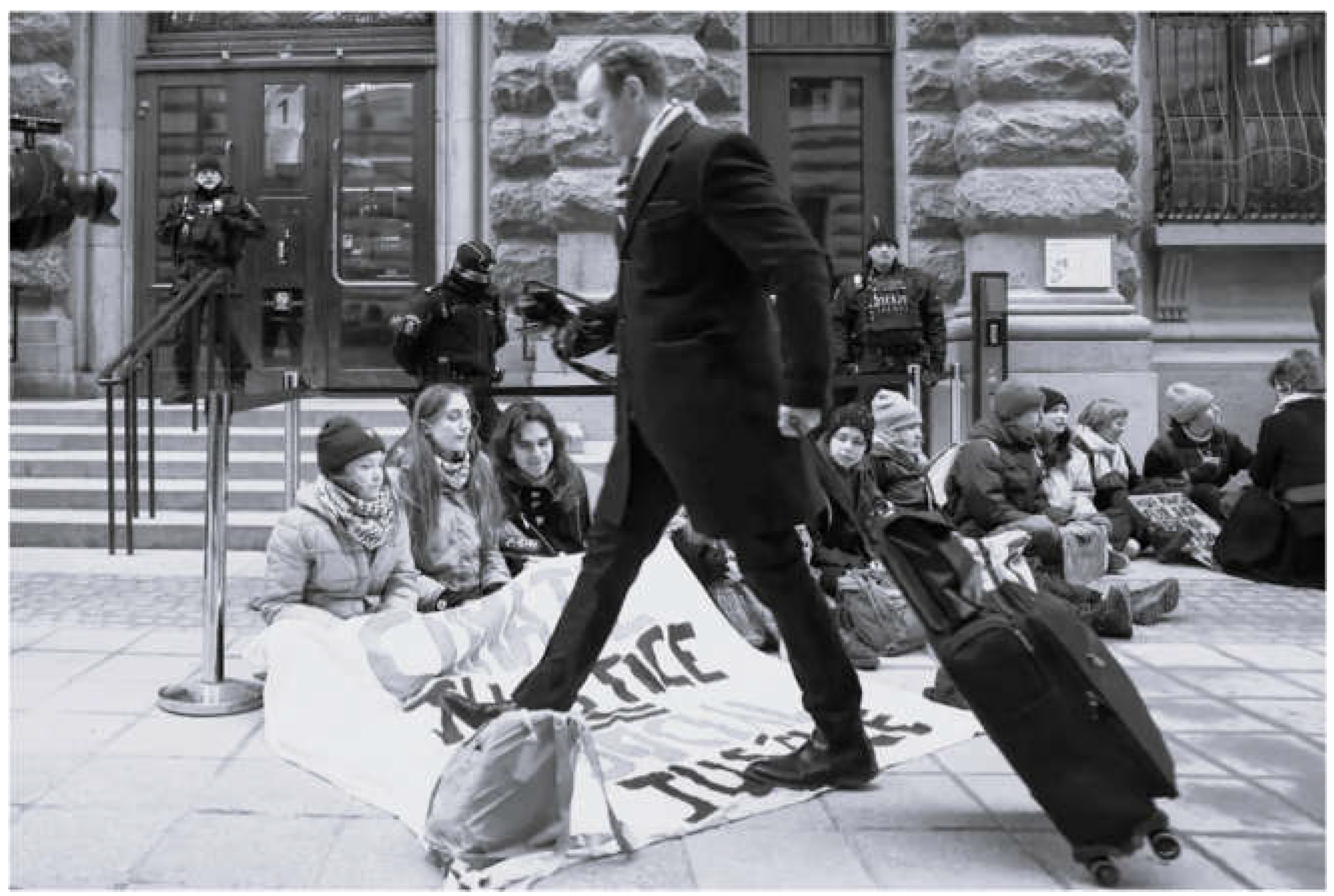
Table 1.
Search terms for articles, editorials and op-eds.
| Accus* | Delegitim* | Insult* | Liberal* | Sabot* |
| Activis* | Democra* | Intimidat* | Muppet | Terroris* |
| Agress* | Demon* | Journalis* | Nazi* | The Crya |
| Antidemocra* | Elit* | Legitim* | Populis* | Threat* |
| Climate | Hate | Liar | Repress* | Violen* |
a Foul language for the “elite”, in Swedish “klägget”, used by populists as well as advocates of deliberative democracy.
Disclaimer/Publisher’s Note: The statements, opinions and data contained in all publications are solely those of the individual author(s) and contributor(s) and not of MDPI and/or the editor(s). MDPI and/or the editor(s) disclaim responsibility for any injury to people or property resulting from any ideas, methods, instructions or products referred to in the content. |
© 2024 by the authors. Licensee MDPI, Basel, Switzerland. This article is an open access article distributed under the terms and conditions of the Creative Commons Attribution (CC BY) license (http://creativecommons.org/licenses/by/4.0/).
Copyright: This open access article is published under a Creative Commons CC BY 4.0 license, which permit the free download, distribution, and reuse, provided that the author and preprint are cited in any reuse.