

Submitted:
11 September 2024
Posted:
11 September 2024
Read the latest preprint version here
Abstract
This paper explores the concept of agency behaviour within complex adaptive systems, leveraging the Mindset Agency Theory (MAT) framework. The connection between agents within an agency population reveal a remarkable capacity for adaptation. MAT can help one understand the "why" behind adaptability through the key dualities: affect-cognition and tangible-intangible. The affect-cognition duality acknowledges the interplay between emotions and rational thought, enabling understanding of how internal states like emotions influence behaviour and shape the social structures that agents inhabit. Similarly, the tangible-intangible duality illuminates how agencies interact with their environment, recognising that observable behaviours are just one piece of the puzzle. Are also important, and previously missing from MAT are beliefs, both core beliefs and self-efficacy beliefs. These can be formalised as traits, taking value states from within a spectrum ranging between tangible and intangible poles. This becomes relevant in the digital age, where navigating information complexities requires acknowledging the dynamics of beliefs and values. With respect to environmental influences on agency, technology is special since it acts as an amplifier with the potential to intensify both positive and negative aspects of the proposed dualities by elaborating emotional responses (affect) while simultaneously creating echo chambers that limit exposure to diverse viewpoints (cognition). By understanding how core beliefs and self-efficacy beliefs interact, strategies can develop to navigate these complexities.
Keywords:
Agency Behaviour
; Complex Adaptive Systems
; Mindset Agency Theory (MAT)
; Affect-cognition and Tangible-intangible
; Traits
; Core beliefs
; Self-efficacy beliefs
; adaptation and Behaviour
; Technology
1. Introduction
This study centres on the interplay between formative traits, those that characterise agencies, avatars of the complex adaptive systems that operate as living systems with an adaptive capacity for autonomous intentional action in their changing environments [1]. Navigating an era of complex social phenomena and rapid technological advance, it becomes increasingly important to understand how these formative traits mutually interact. They are susceptible to environmental change, including technological advancements that have revolutionised access to information and connectivity. The traits, which define agency character, also determine agency potential for action, are subject to the transformative effects in a changing environment that includes digital tools and platforms.
The paper employs Mindset Agency Theory (MAT) to examine how agency traits, influenced by affective and cognitive factors, interact to shape behaviour. MAT views agency through a cybernetic lens, suggesting that traits exist in dynamic and polar states, responding reflexively to environmental stimuli. This framework is used to explore how new technologies can impact core beliefs and self-efficacy beliefs, thereby influencing agents' agency.
MAT posits that agency traits are adaptive and can evolve in response to environmental changes like the emergence of new technologies. These technologies have the potential to reshape foundational traits underlying agency, affecting how agents perceive and respond to their environment. Core beliefs (fundamental assumptions about oneself and the world) and self-efficacy beliefs (confidence in one's ability to perform tasks) are critical aspects of agency that can be significantly influenced by technological advancements. By integrating beliefs into MAT, the paper enhances the theory's explanatory scope. Traditionally, MAT has focused on traits without explicitly considering beliefs as configurable aspects. By formally configuring MAT to include beliefs, the theory becomes more comprehensive, allowing for a detailed exploration of how beliefs interact with other formative traits and values in a digitally interconnected world. MAT's perspective on the adaptive capacity of agencies suggests that agents can self-organise and adapt their beliefs and behaviours in response to technological changes. For example, exposure to new technologies may bolster self-efficacy beliefs by providing tools and platforms for skill development and achievement. Conversely, technological advancements could challenge existing core beliefs by introducing new paradigms or disrupting established norms. This illustrates the importance of explicitly treating beliefs as formative traits with formal relationships to other traits. Such an approach is essential for comprehensively examining how agents navigate and adapt to the complexities of a modern, technology-driven society.
Agency may be considered to be composed of a population of agents together creating a complex web of mutual interactions able to adaptively respond to their environments. This is a characteristic complexity that reflect the theoretical underpinnings of complex adaptive systems. Such systems are composed of numerous interacting agents, each possessing unique traits and motivations, and they exhibit emergent properties – unforeseen consequences that arise from the collective behaviour of the system's constituent elements. These elements are distinguished through two dualities, the tangible-intangible duality and the affect-cognition duality. By exploring these dualities within the framework of the MAT framework, a deeper understanding of how agents interact with their environment can emerge explain how their internal states influence their behaviour and the trajectory of the agency structure they inhabit.
MAT, as a trait theory, is capable of characterising the interactive intangible properties of agency that influence behaviour. It currently has twelve traits to do this that influence agency behaviour within the two domains of affect and cognition, but it lacks a clear framework for incorporating beliefs. To bridge this gap, this study seeks to assimilate established candidate belief theories into MAT. Configuring selected theories for this will consume much of this paper. By selecting theories that align with MAT’s structure, a clearer understanding of the interplay between technology, beliefs, values, and their subsequent effects can develop. Two belief theories are relevant, that relating to Bandura’s [2] notion of self-efficacy beliefs which are fundamentally cognitive processes, and core beliefs which fall between cognition and affect. Core beliefs inherently contain a cognitive component. This is because they are essentially cognitive constructs—they are the fundamental convictions and assumptions we hold about ourselves, others, and the world around us [3]. These beliefs are formed through experiences and interpretations of those experiences, which are cognitive processes, and are formed through learning, reasoning, and interpreting experiences. They are maintained by cognitive biases that filter information to confirm these beliefs [4]. They influence the cognitive appraisal of situations, which in turn affects emotional responses. The appraisal process is cognitive and involves evaluating whether something is a threat, loss, or challenge, based on one’s core beliefs. While core beliefs can trigger emotional responses, it is the cognitive interpretation of events, filtered through these beliefs, that often gives rise to emotions.
However, core beliefs can be assigned to the affect domain due to their impact on emotional well-being [5]. This can be rationalised by understanding the intrinsic link between core beliefs and affect. Core beliefs are fundamental perceptions about oneself, others, and the world that are developed early in life and are central to our emotional well-being [6]. They are often automatic and can significantly influence emotional reactions in various situations. The nature of this is that core beliefs are important for emotional regulation, able to trigger emotional responses and influence the intensity and duration of these emotions [7]. The affective domain encompasses emotions and feelings, and core beliefs are often the underlying cause of affective responses. Negative core beliefs can predispose agents to experience negative emotions more frequently and intensely [8]. Core beliefs can predict affective states, so that someone with a pessimistic core belief about the future (“Things will never work out for me”) is more likely to experience anxiety and hopelessness [9]. While self-efficacy beliefs are assigned to the cognitive domain due to their relation to perceived capabilities and decision-making, core beliefs are more aligned with the affect domain because they are closely tied to one’s emotional experiences and self-concept. By assigning core beliefs to the affect domain, the significant impact these deeply held convictions have on emotions and feelings is acknowledged, which is consistent with the domain’s focus on emotional processes and states. This alignment facilitates a more comprehensive understanding of the interplay between beliefs and emotions, which is essential for development and psychological interventions. The e affective domain involves how agents internalise beliefs and allow them to guide behaviour. As beliefs become more deeply ingrained, they move from simple awareness to becoming a part of the agent’s value system, ultimately influencing and characterising consistent behaviour [10].
Through MAT, the paper seeks to elucidate how technology intersects with agency core beliefs, self-efficacy beliefs, and cognitive values. Through a comprehensive examination of empirical research, theoretical frameworks, and practical illustrations, the study aims to uncover the intricate mechanisms through which technology influences affective and cognitive processes, shapes belief systems, and impacts agency behaviour. To do this a structured approach will be followed in this paper that explores the influence of technology on agency. After this introductory overview, emphasis will be assigned to considering the role of technology in shaping beliefs, values, and agency. Moving on, a narrative will be offered on the nature of the new technologies of social media and AI, followed by looking at the nature of core beliefs and how they different from self-efficacy beliefs. MAT and its developmental trajectory will then be examined, delineating its foundational elements and highlighting the absence of explicit consideration for belief within its framework. The configuration of belief theories will then be undertaken. Subsequently, the paper explores how technology indirectly impacts fundamental beliefs and values, distinguishing between core beliefs and self-efficacy beliefs. It elucidates the mechanisms through which technology shapes perceptions, social dynamics, and societal norms, paving the way for the proposed integration of these insights into the MAT framework. This integration, facilitated through a configuration approach, is posited to enhance our comprehension of agency in the digital era. Finally, some consideration is given to pragmatic contexts prior to a conclusion. This will look at Hungary, identifying its background, and exploring how it has used social media and AI to promote its illiberal political regime.
2. Understanding Values and Beliefs
2.1. Values and Beliefs
Cognitive values play a central role in shaping our identity, priorities, and actions. They serve as the foundational principles that guide our decision-making and behaviour in various situations. Cognitive values reflect what we truly believe in, what we hold dear, and what matters most to us. They are deeply ingrained in our identity and influence the goals we set, the decisions we make, and the paths we choose in life [11,12].
Understanding and identifying cognitive values can provide insights into our motivations, beliefs, and behaviours, helping us navigate complex situations and make choices aligned with our true selves. By recognising the essence of cognitive values, one gains a deeper understanding of who we are and what drives us. When exploring the intersection of technology with human behaviour, recognising the influence of cognitive values is essential. Values shape how one interacts with the environment, what is prioritised, and how decisions are made. Thus, for instance, a cognitive value of perseverance, which reflects a fundamental orientation towards challenges and obstacles in life, may align with a belief in an ability to overcome challenges and achieve success. These values emphasise immediate, tangible outcomes and sensory experiences, including material wealth, physical pleasure, and practical achievements. Additionally, cognitive values encompass cognitive intangibles such as personal growth, intellectual pursuits, and emotional fulfilment, reflecting our aspirations for self-improvement and fulfilment beyond the material realm. An important theory of cognitive values was proposed by Sorokin [13] in his Sociocultural Dynamics, arguing that cognitive values are bipolar in nature and can take Sensate (tangible) or Ideational (intangible) states.
When core beliefs align with Sensate cognitive values, agents may prioritise tangible goals and focus on achieving concrete results. For example, a belief in one's ability to succeed in a competitive business environment may align with a cognitive value of financial success. In contrast, Ideational cognitive values emphasise intellectual and spiritual development, growth, and future possibilities. They may include such notions as wisdom, creativity, and exploration. When core beliefs align with ideational cognitive values, agents may prioritise personal growth, learning, and the pursuit of meaningful experiences. For example, a belief in one's ability to make a positive impact on society may align with a cognitive value of social justice or altruism.
Self-efficacy beliefs are different from core beliefs, and refer to an agent's confidence in their ability to successfully accomplish tasks. When these beliefs meet challenges and achieve goals in specific domains of life that align with cognitive values, agents experience a deep sense of authenticity and fulfilment. They are more likely to pursue goals that resonate with their values, leading to a greater sense of meaning and purpose in their endeavours. Conversely, when self-efficacy beliefs conflict with cognitive values, agents may experience inner turmoil and a sense of dissonance, leading to uncertainty and indecision. The interplay between core beliefs, cognitive values, and self-efficacy is intricate and multifaceted. Positive core beliefs, aligned with empowering self-efficacy beliefs and cognitive values, create a foundation for confidence, resilience, and growth. Conversely, negative core beliefs, conflicting with self-efficacy beliefs and cognitive values, can hinder personal development and well-being. So, core beliefs, cognitive values, and self-efficacy are interconnected elements of human cognition and identity. By recognising how these aspects interact and influence each other, agents can acquire a deeper understanding of the interactions between self and the environment.
By configuring a theory of core beliefs with one of cognitive values, a richer understanding of how technology shapes human behaviour can arise. Core beliefs represent the deeply ingrained convictions and assumptions agents hold about themselves, others, and the world, while cognitive values signify the fundamental principles and ideals that guide their actions and decisions. By combining these two theoretical constructs in an appropriate framework, one can gain a deeper understanding of the complex dynamics at play. Core beliefs and values provide the foundation upon which agents evaluate and respond to technological advancements, shaping their attitudes, motivations, and behaviours in the digital age. For instance, agents with core beliefs centred around self-efficacy and adaptability may embrace technology as a tool for personal growth and empowerment, leveraging its capabilities to enhance their skills and pursue their goals. On the other hand, those with cognitive values emphasising privacy and autonomy may approach technology with caution, prioritising the safeguarding their personal data and preserving their freedom of choice.
By configuring these theoretical frameworks together, one can uncover the underlying mechanisms driving agency behaviour in technological contexts, shedding light on the intricate interplay between agent beliefs, values, and agency in the face of technological advancements. Such a framework, if appropriate, can helps the analysis of the complex interplay of agent traits, cultural contexts, and the influence of technology.
The framework that will be adopted here is that of Mindset Agency Theory (MAT). This is a metatheoretical framework designed for modelling and diagnosing agency (an avatar of a complex adaptive system) within culturally diverse populations. MAT, as a cybernetic multi-ontology framework, delineates five formative traits defining agency character. It is concerned with the evolutionary development of mindset, including culture, and how these can be modelled to understand and explain agency theory. The theory has been developed through the exploration of various philosophical attributes, meta-theory, and the connection of agency theory to mindset. It provides a transparent derivation of Maruyama’s mindscapes that represent personality characteristics, which can be used to explain outcomes and associations within complex situations, and is the foundation upon which we build our model. It explores how technology interacts with our fundamental characteristics, influencing how we process information, interact with others, and even how we organise ourselves within a group.
From here on, we will look more carefully at core beliefs and self-efficacy beliefs. We then explore how these two facets of self-efficacy interact with Sorokin's value systems—whether we prioritise tangible results (Sensate values) or intellectual pursuits (Ideational values). We'll also see how these interactions influence the very fabric of a culture, where shared values foster a sense of belonging.
2.2. Core and Self-Efficacy Beliefs
Core beliefs and self-efficacy are interrelated yet distinct aspects of agency. Core beliefs encompass deeply ingrained assumptions about oneself, others, and the world, often established early in life and exerting pervasive influence over thoughts, emotions, and behaviours, and once activated they affect how we see things, give rise to related (either positive or negative) automatic thoughts and assumptions [14]. In contrast, self-efficacy, as conceptualised by Bandura [15], pertains to an agent's confidence in their ability to effectively perform specific tasks or attain goals across various contexts [16].
Core beliefs are deeply ingrained convictions or assumptions about oneself, others, and the world, typically established early in life and exerting a profound influence over thoughts, emotions, and actions, and where negative core beliefs give rise to pathologies that result in psychological problems like depression and guilt [17]. They shape an agent's self-perception and identity across various life domains, often intersecting with beliefs related to confidence, competence, and effectiveness within specific realms. These intertwined beliefs not only mould agents' self-conceptions but also significantly impact their disposition delivering strategic trajectories, behaviour and overall psychological well-being. Whether manifested in academic pursuits, social interactions, physical endeavours, problem-solving efforts, or emotional resilience, deeply ingrained beliefs integral to agency self-sense can profoundly shape their self-perception and their functionality.
In refining our theoretical framework and integrating belief, it is essencial to establish a more formal basis for the construct. Traditional psychological theories often depict self-efficacy beliefs and core beliefs as unipolar constructs, characterised by a singular value state—such as high or low self-efficacy, and positive or negative core beliefs [18]. However, an alternative is to recognise epistemologically independent value states. Tangible attributes are measurable and observable, whereas intangible aspects, such as internal beliefs and subjective experiences, are not directly observable. The presence of dichotomous belief states, such as those seen in conditions like depression—where agents oscillate between "successfulness" and "worthlessness" [19]—suggests a form of core belief bipolarity, highlighting a need for a formal theory addressing bipolar value states. To bridge this gap, we propose a rule: incorporating both a tangible pole (representing observable behaviours and outcomes) and an intangible pole (referring to internal beliefs and subjective experiences) within a conceptual framework. This approach fosters epistemic independence between trit poles that can facilitate dynamic interaction between them. This results in a more generalisable framework that allows one to explore and understand the unique characteristics and contributions of each without conflating them. It also enhances clarity, especially with respect to empirical investigation, and facilitates the development of more effective interventions tailored to diverse psychological contexts.
Recognising the interplay between these poles enhances our comprehension of belief systems, particularly in the context of mental health conditions where the tangible outcomes may not always align with the intangible self-perceptions. This dualistic approach not only acknowledges the complexity of human cognition but also provides a flexible framework that can be applied across various disciplines. Philosophically, by acknowledging the dual epistemically independent tangible-intangible poles in dynamic interaction create a significant degree of variety from which unque agency characterisations arise. It encompasses not only the external, physical world but also the inner, subjective world. In the context of belief systems, this dualistic approach is particularly useful since it recognises that beliefs are not just abstract concepts floating in a vacuum; they have practical implications and manifest in tangible ways. Conversely, our tangible experiences can shape and inform our intangible beliefs, creating a dynamic interplay between the two.
Aristotle's provides some interesting insights that can be used as a point for our theoretical endeavour. He distinguished between Actuality and Potentiality [20] thereby offering a useful framework for converting a bipolar variable with epistemic dependence into one that is epistemically independent. In Aristotle's ontology, Actuality represents the current state or form of an entity, encompassing its tangible and observable attributes and manifestations at a given moment. Conversely, Potentiality signifies the inherent and intangible capacities or possibilities within an entity, indicating what it could become under certain conditions or influences, even if those potentials are not currently realised. This duality implies a dynamic interplay between what is and what could be—an essential aspect of human existence. This framework provides recognition of the dynamic nature of traits recognising that their variations impact on behaviour due to the emphasis placed on the interplay between Potentiality and Actuality. In Aristotle's ontology, Potentiality represents inherent capacities or possibilities within an entity, while Actuality denotes its current state or form. This distinction implies that agents possess the potential for change and development, with their current state being influenced by both internal characteristics and external factors.
Transitioning from Aristotle's framework to Albert Ellis' [21] Rational Emotive Behaviour Therapy (REBT) involves recognising the pragmatic application of Aristotle’s philosophical concept. REBT centres on core beliefs while emphasising the interconnection between thoughts, emotions, and behaviours, with a focus on challenging irrational beliefs that underpin psychological distress. Ellis' model aligns with Aristotle's emphasis on the dynamic interplay between Potentiality and Actuality by acknowledging the malleability of cognitive processes and the possibility of cognitive restructuring. Ellis proposed that our thoughts, emotions, and behaviours are interconnected, and that irrational beliefs underpin emotional disturbances and maladaptive behaviours.
Ellis’ model can be conceptualised as a formative trait of core beliefs that operates within a dynamic interplay of Active (conscious or manifest) and Latent (subconscious or underlying) states, each representing distinct aspects of agency cognitive and affective functioning. In line with Aristotle’s philosophy, the two value states are in continual dynamic interaction [22]. When faced with a challenging situation, agencies may experience heightened anxiety or frustration due to their irrational beliefs, such as demanding perfection or catastrophising potential outcomes [23]. However, the Latent state pertains to the underlying, subconscious beliefs that influence cognitive processing and emotional responses. These Latent beliefs may stem from early life experiences, societal norms, or deeply ingrained cognitive schemas that shape worldviews and self-concepts. Despite being less accessible to conscious awareness, Latent irrational beliefs exert a profound influence on thoughts, feelings, and behaviours [22].
It should also be recognised that the Active and Latent value states conform to the proposed tangible-intangible rule. The Active state is tangible because it involves conscious attributes that are observable and measurable. It is the aspect of cognition that we are aware of and can report on, such as our reactions to current events or stimuli. For example, feeling anxious or frustrated in response to a challenging situation is part of the Active state because these experiences are directly accessible to consciousness and are behaviourally observable. On the other hand, the Latent state is intangible because it comprises the subconscious beliefs and cognitive processes that underlie conscious experience. These are not directly observable and are often difficult to measure. The Latent state includes deep-seated beliefs and schemas formed from past experiences and societal influences, which shape our worldview and self-concept without our immediate awareness [24,25].
Self-efficacy beliefs are context-specific and subject to variation across domains of life. Whether manifesting in academic, social, physical, problem-solving, or emotional domains, deeply ingrained self-efficacy beliefs that are integral to a sense of self and impacting the self-concept and identity, are generalisable across various situations [26]. These interwoven beliefs are not only pivotal in shaping one’s self-image but also exert a significant impact on behaviour, trajectory formation, and general well-being [27]. Like core beliefs, self-efficacy beliefs may be regarded as having an Active and Latent value state that are in dynamic interaction. Serving as a lens through which agencies interpret their abilities and potential, they influence the cognitive values they prioritise and the behaviours they engage in.
3. Mindset Agency Theory
Complex adaptive systems operate through agency, the ability to act with intention, make choices, and exert influence within an environment. MAT, grounded in cybernetics, is designed to represent agency through a metatheoretical framework designed to analyse and diagnose agency issues. It conceptualises agencies and their population of agents as diverse and recognises its capacity to adapt and maintain stability within a changing environment. MAT I a trait theory that started with 10 formative traits that defined agency character across affective and cognitive domains [1]. These included two sociocognitive traits (cognitive style and cognitive values), and three dispositional traits. This as amended by Yolles and Rautakivi [28] (2024) to include in cognition with cognitive style the trait of social organisation. Then Yolles [29] upgraded the affect domain to include physiological arousal and cognitive interpretation. Despite the interconnectedness between cognition and affect, the current framework lacks explicit consideration of belief. Here we address this gap by examining how technology influences fundamental beliefs and values, ultimately shaping agency.
By distinguishing between core beliefs and self-efficacy beliefs and integrating them into MAT, we can achieve a more holistic understanding of the environmental factors influencing agency. Core beliefs can align with specific cognitive styles. For example, a person with a core belief in openness may exhibit a more exploratory cognitive style. Confirmation bias, where agents favour information that confirms existing beliefs, can also be influenced by core beliefs. Self-efficacy beliefs interact with cognitive styles in various ways. Agents with high self-efficacy are more likely to approach tasks with confidence, aligning with a proactive cognitive style. Conversely, low self-efficacy can lead to task avoidance, fostering a more passive approach. Similarly, core beliefs and self-efficacy beliefs shape social organization traits. Core beliefs emphasising individualism may lead towards Gesellschaft, while those emphasizing community may resonate with Gemeinschaft.
To this framework Yolles and Fink then applied the ideas of Sagiv and Schwartz [38], transforming CAT into MAT. Sagiv and Schwartz’s work is pivotal in understanding values and their impact on behaviour and well-being. Their research explores the direct relationships between different types of values and subjective well-being, and postulate that well-being is influenced not only by the types of values an agent holds but also by the congruence between personal values and the prevailing value environment. This, in the context of Maruyama’s Mindscape theory, contribute to a trait theory perspective by providing a structured way to categorise and understand how values influence agency dispositions. Thus, values are not just abstract ideals but have concrete implications for how agencies and their agents perceive the world and react to it. This aligns with the holistic cybernetic approach of Mindscape theory [39] which seeks to model and analyse the complex interplay between psychological factors, sociopolitical dynamics, and organisational change. The outcome from these theoretical configurations has been a formalised trait theory that accounts for the dynamic nature of values within agencies. This allows for a more flexible representation of agency dispositions, acknowledging that values and the contexts in which they operate are crucial in shaping behaviour and decision-making processes within complex adaptive systems. Additionally, the four essentially cognitive mindscape distinctions that Maruyama identified have been shown to be directly derivable from MAT, together with four additional Mindset distinctions.
Figure 1 offer a framework that captures the dynamic and recursive nature of complex adaptive systems that can also be recognised as general living systems when expressed in terms of Varela’s [40] concept of autopoiesis. Autopoiesis is a self-production process that operates as a process intelligence, this referring to the networks within an agency that select, process, and manifest elements from one system into another, facilitating an agency flow of information and energy. The model is substructural in the sense that its contents are intangible and their interactions create imperatives for superstructural behaviour. Thus, complex systems arise from the interaction of sub-agencies, which are part of a larger fractal structure. The fractal metaphor suggests that these systems repeat across different levels, each defining a specific sub-context of agency. The operative system is a fabric of information that parametrically describes the relationship between agency internal and external parameters. Behaviour is determined when any of its attributes are activated given the appropriate conditions, thereby delivering agency responses to external stimuli and is part of the process intelligences that facilitate action. The dispositional system is a strategic and regulatory structure that represents how the agency processes information and expresses emotions. It shapes social relationships and interactions, influencing agency regulation and behaviour. This system is also a key component of process intelligences, as it involves transforming information into meaningful patterns. The sustentative system supports agency sustainability. This model incorporates the concepts of operative and figurative intelligence, which are derived from Piaget’s theory of cognitive development [41]. Piaget described operative intelligence as responsible for the representation and manipulation of the dynamic aspects of reality. Operative intelligence is a representation autopoiesis, which refers to the self-creation and maintenance of living systems, and Schwarz’s autogenesis, which describes the self-organising processes of systems. For Piaget, figurative intelligence deals with the static aspects of reality, though here it is regarded as a second order form of autopoiesis. By autopoiesis is meant the system’s ability to maintain and recreate itself, while figurative intelligence relates to the system’s structure and information processing (autogenesis). This integration allows the theory to model complex, real-world situations and anticipate patterns of behaviour, providing a comprehensive framework for understanding the dynamics of agency dispositions within a holistic cybernetic approach.
Figure 1.
Mindset Agency Theory Substructural Model (with appended superstructure), where Agency Fractal is embedded in the Dispositional Sys.
Figure 1.
Mindset Agency Theory Substructural Model (with appended superstructure), where Agency Fractal is embedded in the Dispositional Sys.
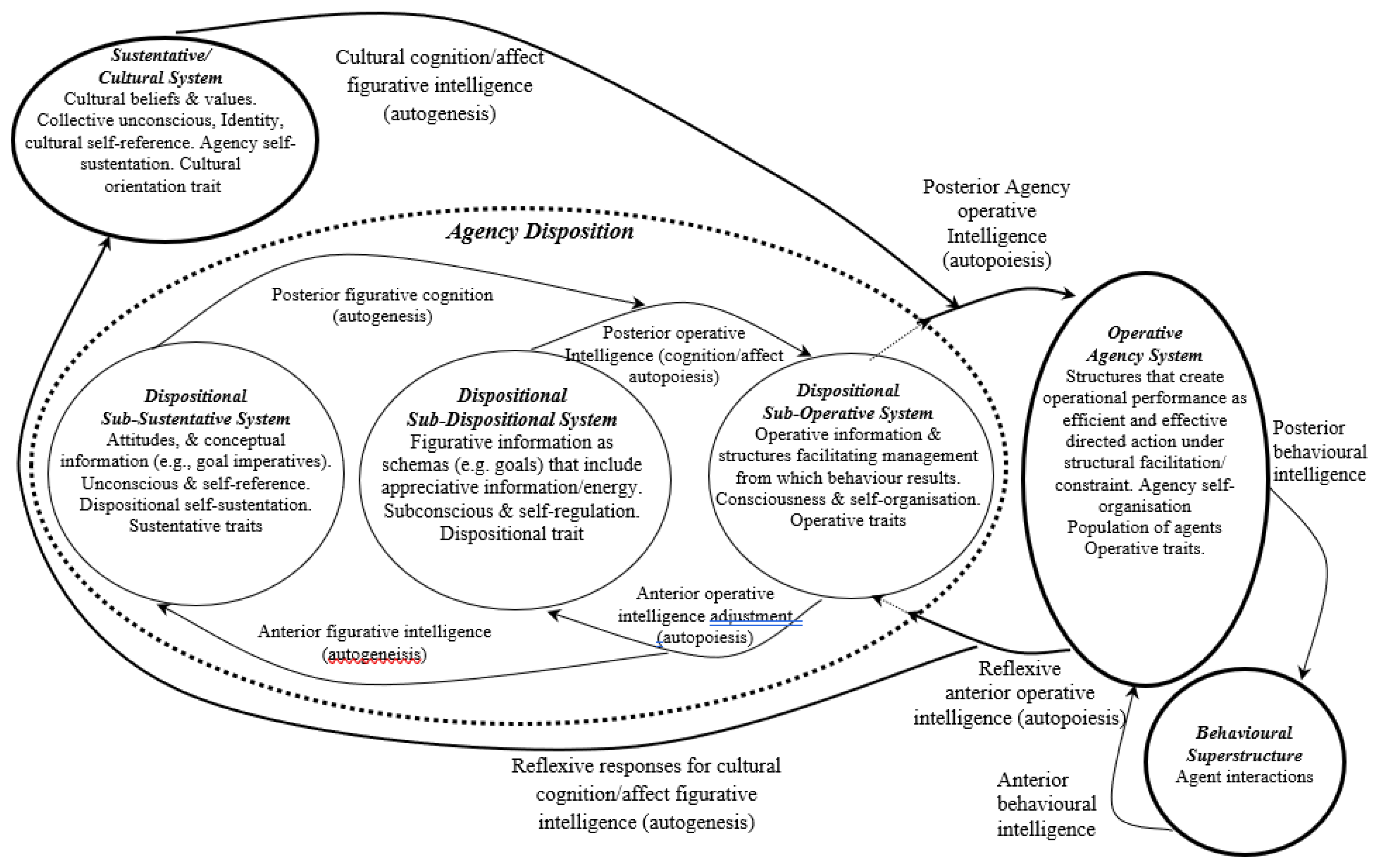
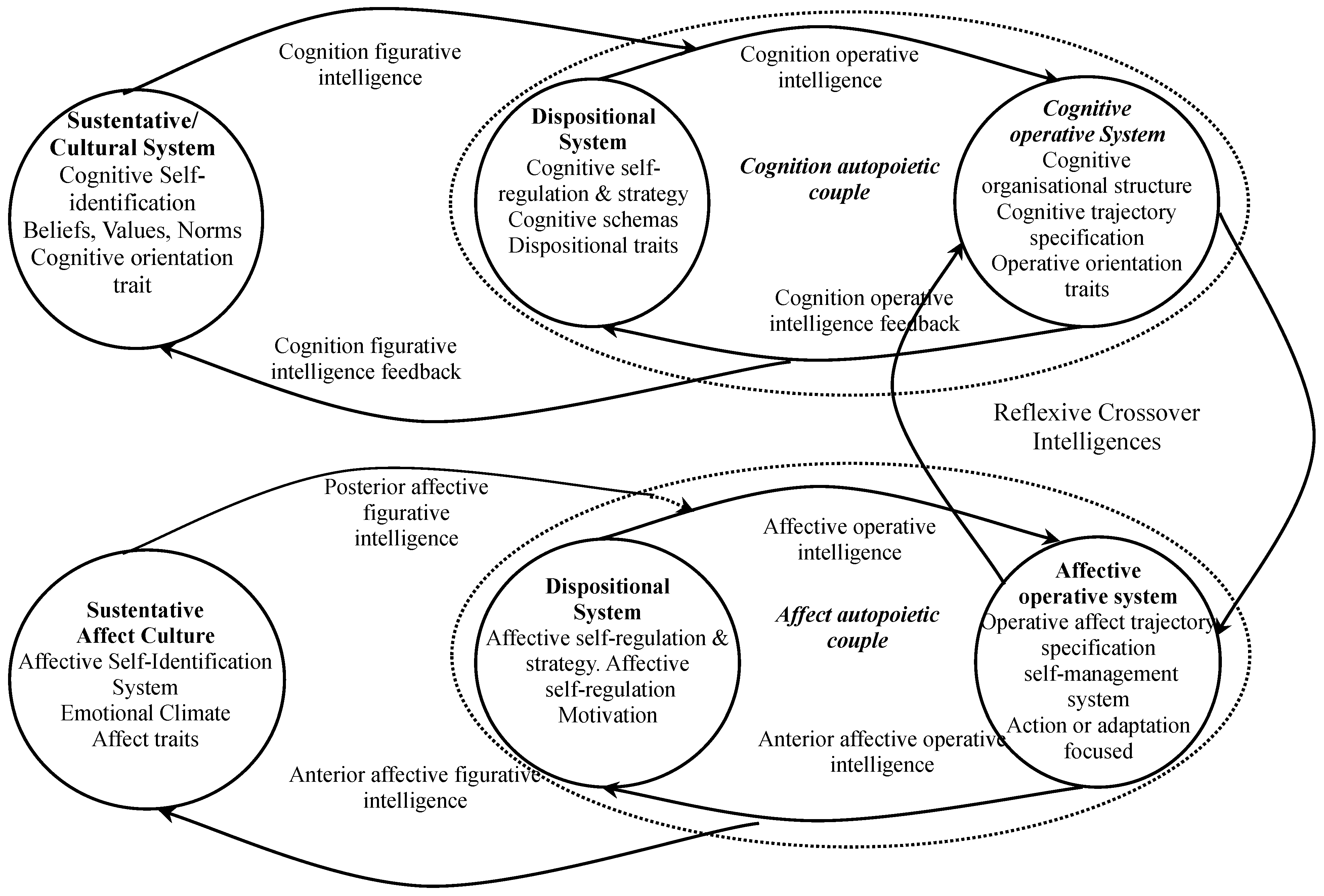
This figure may be seen as a model of cognition, where the process intelligences provide information flow between the different systems indicated, thus satisfying Maruyama’s primary interest in cognition, while essentially neglecting affect. Drawing on the ideas of Gross [42] there should be a similar structure as in Figure 1 relating to affect. In Figure 2 we show the relationship between the affect and cognition systems where cognition and affect exchange information an energy through their affective-cognition intelligences.
The intelligences that connect the affect operative system to the cognitive operative system are referred to as Crossover Intelligence that Gross has indicated refers to the affect-cognition interrelationship. This form of intelligence represents the processes that bridge affect processes with cognition ones enabling cross-over to develop. It encapsulates the dynamic and reciprocal influence of emotions on cognitive operations within an agency, highlighting the integral role of affect in shaping cognitive responses to environmental stimuli. MAT may be seen as belonging to the realm of organisational psychology. This framework identifies the intricacies of how agencies acquire and process information. At its heart lies the cognitive style trait, characterized by bipolar values of Patterning and Dramatising. This trait serves as a lens through which to understand how agencies perceive and interpret information, shedding light on the myriad cognitive approaches that shape their decision-making processes. Whether agencies lean towards structured patterns or thrive in the realm of dynamic narratives, MAT unveils the cognitive diversity that permeates organizational dynamics. Its scope also extends beyond agent cognition to encompass the broader social fabric within which agencies operate. Drawing upon Ferdinand Tönnies' [43] theory of social organisation, MAT distinguishes between Gemeinschaft (community) and Gesellschaft (society) as types of social relationships. By integrating these concepts, MAT unveils the intricate social dynamics that underpin agency interactions, offering insights into the forces that shape their coherence and functionality.
Figure 2.
MAT Model Showing Interactions between Cognition and Affect.
As a diagnostic tool, MAT emerges as a beacon of clarity amidst the complexities of organisational behaviour. By linking trait instabilities with agency pathologies such as narcissism and paradoxical behaviour, MAT enables practitioners to pinpoint dysfunctions within agencies and chart a course towards coherence and functionality. Whether grappling with issues of leadership efficacy or grappling with cultural clashes, MAT provides a roadmap for navigating the labyrinthine landscape of organisational psychology. Its applicability transcends cultural boundaries, making it an invaluable tool for diagnosing complex agencies with diverse cultural milieus. By offering insights into how cultural diversity impacts agency behaviour, MAT empowers practitioners to navigate the nuances of cross-cultural dynamics with finesse and precision. In the ever-evolving landscape of agency psychology, MAT stands as a testament to the power of cognitive exploration. With its incorporation of cognitive styles, its integration of social organisation theory, and its diagnostic capabilities, MAT becomes more than useful in exploring agency coherence and functionality in complex environments.
MAT is a formative trait theory so far identifying 6 traits for cognition, 1 of which is cultural values, 3 are cognition dispositional traits, and the last 2 are operative traits designated as cognitive style, and social organisation. Cognitive style refers to an agent’s preferred way of processing information, making decisions, and approaching problem-solving, and within MAT it is characterized by the bipolar values of Patterning–Dramatising. Patterning emphasises structured tangible systematic thinking, while the Dramatising leans toward intuitive intangible creative thinking. Cognitive style influences how agencies acquire, process, and interpret information, shaping their trajectory formation (decision-making and strategic planning processes). Social organisation focuses on an agency’s relationships with others and its position within social structures. It considers how agencies interact with their environment, collaborate with other entities, and navigate social dynamics. It also plays an important role in determining an agency’s influence, access to resources, and ability to achieve its goals. Within MAT, understanding an agency’s social organisation sheds light on its network of connections, alliances, and affiliations. These two traits—cognitive style and social organisation—provide valuable insights into an agency’s mindset, behaviour, and capacity for purposeful action. By examining how agencies acquire information and navigate social contexts, MAT contributes to a deeper understanding of human agency within diverse cultural settings.
3.2. Beliefs and Values as Traits
The sustentative dimension of agency underscores the significance of beliefs which, along with cognitive values and emotional climate, are foundational to culture. Of the two classes of belief that our interest extends to, consideration will first be applied to cognition self-efficacy. The Active polar value state influences dispositional tendencies, structural organization, and behavioural patterns. These beliefs, reflecting an ability to manage tasks and face challenges, are important to processes of adaptation under change. Its interaction with Sensate cognitive values can lead to direct and measurable results. In contrast, when aligned with Ideational values, which emphasise abstract and intangible concepts, Active self-efficacy can promote intellectual enrichment and a deeper grasp of ideas.
Latent self-efficacy beliefs [44] are posited as a repository for prospective development and adaptation. Though not manifest, they possess the capacity to exert considerable influence and direct behaviour when catalysed by specific situational exigencies or impediments. They encapsulate a plethora of unrealized possibilities, each with its own likelihood of manifestation contingent upon the agent’s encounters with novel exigencies. Upon the advent of such exigencies, these latent beliefs may surface, proffering alternative modalities of cognition and action that resonate with the agent’s evolving self-schema and proficiencies. The dynamic nature of this latent potential is underscored by its susceptibility to a multitude of determinants, including intrinsic personal attributes, extrinsic environmental factors, and the trajectory of experiential accumulation. The actualisation of these latent beliefs is a probabilistic occurrence, sculpted by the intricate interplay of these multifarious influences. It is through this probabilistic prism that the transformative capacity of Latent self-efficacy beliefs in fostering agent growth and cultural progression can be comprehended.
The affect domain has core beliefs and emotional climate as formative traits. The polar value states of core belief are Active and Latent which are interactive and dynamic. Those of emotional climate are tangible Security, which nurtures an environment that bolsters Active core beliefs, and which leads to a proactive and confident approach to change. These beliefs, when engaged, propel agencies to embrace new challenges with assurance and vigour. Conversely, in a climate dominated by intangible Fear, Latent core beliefs may come to the forefront, prompting a more cautious and strategic approach. This emotional state encourages a reflective stance that contributes to an effective adaptation process.
Core beliefs, deeply rooted and affectively charged, play a pivotal role in shaping emotional responses and self-concept. These beliefs, through their synergy, direct behaviour, mould environmental engagement, and mediate the internalization of events, thereby informing the analytical process and enhancing diagnostic acumen. This dynamic is crucial in guiding strategic life trajectories and behaviours as noted by Madsen [45]. The interplay between Sensate and Ideational value states within an agency belief system is marked by a fluidity that allows for shifts in dominance, reflecting evolutionary progressions. This fluidity is underpinned by the epistemological independence of the bipolar value states, which enables the coexistence of both reinforcing and contradictory beliefs within the same mental framework.
Beliefs, much like values, are fundamental components of culture. Affective core beliefs and cognitive self-efficacy beliefs provide agencies with the ability to hold contrasting belief states simultaneously. This dual capability, whether these beliefs are aligned synergistically or opposed antisynergistically, grants agencies the flexibility to navigate complex situations and reconcile conflicting information. It enables them to adapt their beliefs in response to changing circumstances and integrate diverse perspectives, fostering both affective and cognitive flexibility and enhancing creativity in problem-solving. By understanding the dynamic and multifaceted nature of affect and cognition, as well as considering the concept of epistemological independence, we gain insight into how agencies manage beliefs and shape future trajectories.
Beliefs, whether self-efficacy or core, embody dynamic characteristics that shape our cognitive landscape. When in a Latent state, beliefs demonstrate a fluid responsiveness to our interactions with the external environment. Not being static entities, they remain malleable and evolve with the accumulation of novel experiences and insights. Analogous to quantum superposition, beliefs can simultaneously embody multiple potential states, awaiting activation through lived encounters. Upon manifestation, they solidify into definitive convictions that not only influence but actively determine behaviour.
There are distinctions, however, with self-efficacy and core beliefs, where they each have distinct patterns. Self-efficacy beliefs exhibit a more transient nature, transitioning from potentiality to certainty in response to specific tasks or challenges. In contrast, core beliefs are deeply entrenched and resistant to swift alteration. Serving as the bedrock of our cognitive architecture, they shape our perceptions and responses on a fundamental level. Unlike self-efficacy beliefs, which may adapt relatively quickly, core beliefs often persist as enduring narratives, deeply etched into our psyche. These foundational convictions, once established, require sustained and transformative experiences to recalibrate. Thus, while self-efficacy beliefs teeter on the precipice of possibility, adapting to the intricacies of our lived experiences, core beliefs anchor us to our fundamental worldview, shaping the contours of our existence and guiding our interpretation of the world around us.
Returning to epistemological independence, this informs our understanding of trajectory forming processes (like decision-making in human societies), as agencies process competing beliefs and information. It highlights the importance of cognitive flexibility in adapting beliefs and strategies to fit the context. Epistemological independence has cultural implications, as it reflects cultural norms and values regarding belief diversity and tolerance for ambiguity. It underscores the importance of cultivating affective and cognitive flexibility and openness, both at the agency and agent levels, to navigate pragmatic complexities. By promoting an appreciation for diverse perspectives and encouraging critical thinking, epistemological independence lays the foundation for intellectual growth, innovation.
3.3. The Interplay Between Beliefs, Values, and Cultural Dynamics
The MAT framework provides a comprehensive lens through which to analyse the interplay between agency as created and defined by its population of agents, and the environment. Within this framework, agency traits, cognitive styles, and social organization are dissected across three distinct systems: Operative, Figurative, and Sustentative. The operative system encompasses traits related to an agent's cognitive style and social organization. Cognitive style, characterized by bipolar values such as tangible Dramatising and intangible Pattering, influences how agents process information and form trajectories. Social Organization, represented by values like tangible Gesellschaft and intangible Gemeinschaft, reflects the nature of an agent's social interactions and relationships. The pairing of these traits within the operative system indicates the coherence or incoherence of an agent's cognitive and social functioning. The figurative system comprises traits that shape agent disposition and character. While specific traits within this system are not elaborated on here, they contribute to the overall psychological agency makeup, influencing its attitudes, emotions, and behavioural tendencies. The sustentative (or cultural) system focuses on cultural values and norms that inform agent and collective behaviour. Originally featuring a cultural trait, the system primarily functions as a Values trait derived from Sorokin's distinction between Sensate and Ideational values. These values represent fundamental principles and ideals that guides agency behaviour and shapes cultural dynamics that impact its agents.
The MAT framework gains further depth by explicitly incorporating the concept of beliefs. This dynamic model recognises both tangible Active and intangible Latent beliefs, offering valuable insights into how agents perceive and interact with environmental influences. By examining the interaction between beliefs and values, we can identify patterns that influence agent and collective well-being and viability. The relationship between core/self-efficacy beliefs and cognitive values is intricate and bidirectional, playing pivotal roles in shaping an agent’s cultural identity and influencing their actions within society. Self-efficacy beliefs as an agency confidence to cognitively succeed at something. In contrast, core beliefs are deeply ingrained assumptions about oneself, others, and the world, and they serve as the affective foundation upon which agents build their perceptions and interpretations of reality. These beliefs form the lens through which agents view themselves and navigate their environments.
Beliefs may influence the formation and prioritisation of cognitive values, as an agent's perceptions of themselves and its abilities shape its moral and ethical frameworks. Positive beliefs can align closely with cognitive values, reinforcing and amplifying them [46]. For example, beliefs in one's capability and competence can align with values such as perseverance and achievement, leading agents to prioritise goals and behaviours that reflect these values. Cognitive values can serve as validators for beliefs. When agents succeed in aligning their actions with their values and achieve desired outcomes, it reinforces their belief in their capabilities. This positive reinforcement strengthens both their core beliefs and cognitive values, creating a reinforcing cycle. Strong beliefs can also lead agents to reevaluate their cognitive values. For instance, strong agency belief strongly in an ability to overcome challenges and achieve success may result in the prioritising of values related to personal growth and resilience. Beliefs can also influence the selection of cognitive values. Agents with strong beliefs in their ability to lead and influence others may prioritize values related to leadership, such as integrity and responsibility. Their confidence in their capabilities may lead them to adopt and prioritize values that align with their perceived strengths.
Understanding the dynamic interaction between beliefs and cognitive values is essential for comprehending the complexities of cultural systems and their impact on agent agency and societal structures [47]. It elucidates how beliefs and values contribute to the development of cultural identity and influence collective behaviours, attitudes, and social dynamics. Moreover, Recognising the bidirectional nature of this relationship informs interventions aimed at promoting adaptive beliefs and values that foster agent and societal well-being.
Core beliefs and self-efficacy beliefs are intertwined constructs that significantly influence an agent's cognitive processes, affective responses, and behavioural tendencies. Understanding their interaction within cultural dynamics provides valuable insights into identity formation, societal norms, and collective behaviours. The formation of self-efficacy as core beliefs often begins early in life, rooted in foundational experiences during childhood and adolescence. These experiences, such as successes, failures, and interactions with significant others, lay the groundwork for an agent's beliefs about their capabilities and worth. Self-efficacy intertwines with core beliefs, influencing and being influenced by deeply ingrained assumptions about oneself, others, and the world. Over time, positive self-efficacy beliefs can reinforce positive core beliefs, while negative self-efficacy beliefs may contribute to the formation of negative core beliefs. There exists dynamic reflexivity between self-efficacy and core beliefs, wherein each aspect continually informs and shapes the other. Positive experiences that affirm one's abilities bolster self-efficacy, reinforcing positive core beliefs, while negative experiences may challenge and potentially alter both self-efficacy and core beliefs.
The development of self-efficacy into core beliefs is intricately tied to environmental factors, spanning familial, social, cultural, and institutional contexts. Environments that cultivate encouragement, validation, and avenues for skill enhancement play a pivotal role in nurturing positive self-efficacy beliefs, which in turn bolster corresponding core beliefs. Both self-efficacy and core beliefs are dynamic constructs that evolve over time, shaped by ongoing experiences and shifting circumstances. Agents continually adjust their perceptions of their abilities and self-worth in response to environmental feedback and personal interpretations of their encounters. While self-efficacy can stem from core beliefs, it represents just one pathway among others. Core beliefs profoundly shape an individual's self-view and perspective on the world, while self-efficacy beliefs specifically revolve around confidence in accomplishing tasks and achieving goals. While core beliefs indirectly influence self-efficacy by shaping how agents interpret their experiences and assess their capabilities, self-efficacy beliefs can also develop autonomously, influenced by diverse factors such as past experiences, social interactions, and environmental cues. Thus, while core beliefs contribute to the formation of self-efficacy, they do not exclusively determine it, as self-efficacy can emerge through a blend of influences [48].
Understanding the interconnectedness between core beliefs, self-efficacy beliefs, and cultural dynamics can likely provide valuable insights into human behaviour and societal norms. It underscores the importance of creating environments that support the development of positive self-efficacy beliefs and core beliefs, fostering resilience, well-being, and adaptive functioning in agents and communities. Additionally, Recognising the dynamic nature of these constructs informs culturally sensitive interventions aimed at promoting positive identity formation and psychological flourishing across diverse cultural contexts.
3.4. Polar State Interaction
Given that a formative trait exists that has bipolar value state, that are interactive and epistemically independent, then the relationship between the states in that interaction determines the properties adopted by that trait, and this contributes to agency character. We are aware that agency has 7 affect and 7 cognition traits, this giving 28 different polar states that, through mutual if indirect interaction, generates a highly complex matrix of influences. This paper has centred on 2 of new belief traits and their interaction with cognitive values to create the sustentative agency domain culture. It has been shown that the interaction between core and self-efficacy beliefs provides a number of possibilities that enable culture to be coherent. Coherence is required of culture is to perform its sustentative agency function. This is made much more complex when the considering the relationship between the bipolar value states. These can impart stability to the trait when the states are synergistic, but instability when they are antisynergistic, i.e., in conflict. As an illustration we can consider the very well-studied values trait originally proposed by Sorokin (1985) that was introduced in MAT at an early stage of its development.
The values trait in MAT is bipolar with two epistemically independent polar states, Sensate and Ideational. Pitirim Sorokin spent decades exploring the relationship between these values states, applying them to long-range temporal aspects of socioculture. But they are also relevant for short term. Their relationship may be synergistic when Sensate and Ideational values work together benefiting a sociocultural environment. They may also be or antisynegistic, when Sensate and Ideational values work against each other creating conflict. In the former case, the cultural values trait is stable, while in the latter it indicates instability. This trait has until now formed the basis of the sustentative mechanism in MAT, and value trait instabilities have been deemed to result in a lack of sustentative functionality that works against any possibility of agency homeostasis. In other words, agency becomes instrumental.
Sorokin’s theory suggests that agencies oscillate between Sensate and Ideational cultural states due to the ascendency and decline of each of the value states as they dynamically interact. A Sensate culture is one that values the material and the empirical, focusing on the here and now, with an emphasis on sensory experience [49,50,51,52]. It is characterised by a pursuit of material wealth, empirical knowledge, and sensory pleasure. On the other hand, an Ideational culture places value on the spiritual and the transcendent. It is less concerned with material possessions and more with moral and spiritual matters, seeking meaning beyond the physical world.
When these two value states are in balance, Sorokin referred to this as an Idealistic culture, which combines elements of both Sensate and Ideational cultures. This balance allows for a society that appreciates the material without losing sight of the spiritual, potentially leading to a stable and harmonious sociocultural environment. However, when there is a dominance of one value state over the other, or when the two are in conflict, it can lead to cultural instability. For instance, an overemphasis on Sensate values might lead to materialism and moral decay, while an overemphasis on Ideational values might result in neglect of practical concerns and a retreat from the world [53].
Sorokin’s analysis of cultural dynamics is not just a historical or philosophical inquiry; it has practical implications for understanding societal changes and conflicts. It suggests that for a society to thrive, there must be a dynamic balance between the Sensate and Ideational values. This balance is crucial for the sustentative functionality of a society, which in turn supports agency homeostasis—the ability of agents and institutions to act effectively within their environment. In modern times, the relevance of Sorokin’s theory can be seen in the ongoing debates about the role of technology, the pursuit of economic growth versus sustainability, and the tension between individualism and community values. By understanding the interplay between Sensate and Ideational values, we can better navigate the complexities of our contemporary world and work towards a more balanced and stable society.
The relationship between Active and Latent self-efficacy beliefs, as well as Active and Latent core beliefs, can be understood in a similar interactive manner as the Sensate and Ideational aspects, though self-efficacy has been explored much more deeply. Active self-efficacy beliefs are those that are currently influencing behaviour; they are the beliefs that an agent is consciously aware of and is using to guide their actions. For example, a student who believes they are capable of achieving a high score on an exam (active self-efficacy belief) is likely to study diligently and approach the exam with confidence. Latent self-efficacy beliefs, on the other hand, are not currently active but can be activated by certain triggers or situations. These beliefs are part of an agency belief system but are not always at the forefront of their thoughts or actions. They can become active when the agency encounters a situation that calls for a specific belief to be applied.
Similarly, Active core beliefs are those that are currently shaping agency perception of itself and the world. These are deeply held beliefs that are actively influencing one’s thoughts and behaviours. For instance, if someone has an Active core belief that they are competent, this belief will colour their interactions and self-perception in various situations. Latent core beliefs are deeply held beliefs that are not currently influencing behaviour because they are not part of agency conscious awareness. However, they can become Active when triggered by specific events or emotional states. For example, someone may have a latent core belief of being unlovable, which may not usually affect their daily interactions but can become active and influence their behaviour during times of relationship stress. Latent core beliefs can deliver coping strategies during times of distress, which can in turn impact psychological health [54].
Applying the same principles as used to examine the way in which values shift over time, it is feasible to consider the dynamic interaction between Active and Latent beliefs. Latent beliefs can become active depending on the context, and active beliefs can recede into latency when they are not relevant to the current situation. This dynamic is similar to the interplay between sensate (concrete, observable) and ideational (abstract, conceptual) aspects, where both influence an agent’s experience and behaviour, but their prominence can shift based on the context and demands of the environment. Understanding the interplay between Active and Latent self-efficacy and core beliefs is important since it can assist to design interventions that not only address the beliefs that are currently influencing behaviour but also those that may become influential in the future. It can also ensure a more comprehensive understanding of an agent’s belief system and how it affects their motivation, behaviour, and overall well-being.
\The connection between cultural values, emotional climate, and self-efficacy beliefs is complex and multifaceted, reflecting the intricate relationships between these factors. Specifically, cultural values can shape the way agents perceive and experience emotions, which in turn influences their self-concept and sense of agency [59]. This dynamic interplay between cultural values, emotional climate, and self-efficacy beliefs can lead to a labyrinth of coherent/incoherent and stable/unstable relationships, ultimately impacting the capacity of culture to have an adequate sustentative influence on agency.
Here we can try to conceptualise the interplay between agency core belief systems, self-efficacy beliefs, and the cultural and emotional climate milieus within which they operate. The focus is on two key dynamics: synergy and antagonism. Synergy emerges when these elements converge to facilitate a smooth and efficacious course of action. Conversely, antagonism arises when they clash, leading to internal dissonance and hindering agency effectiveness.
3.5. Belief as a Trait and its Stability
When discussing belief within a cognitive context, we are specifically referring to self-efficacy belief. When considered as a formative trait, this can be said to have stability which is determined from the interaction between its bipolar states, i.e., between Active self-efficacy and Latent self-efficacy beliefs. These belief states contribute to agency stability and coherence within the cognitive framework. Active self-efficacy beliefs reflect agency's active, present belief in itself or others, and are concerned with immediate confidence in its abilities. When Active and Latent self-efficacy beliefs mutually interact, their relationship can vary depending on the alignment or divergence of their orientations and expressions. Conflict arises when their orientations towards action and potential are discordant. This happens when agencies exhibit a disparity between their outward expressions of confidence and their underlying, perhaps unacknowledged, beliefs about their capabilities. For instance, agencies may outwardly project confidence and competence in a task or situation (Active self-efficacy), but internally harbour doubts or insecurities (Latent self-efficacy), leading to cognitive dissonance and potentially undermining their performance or decision-making. Conversely, Active and Latent self-efficacy beliefs can find balance when they are aligned and mutually reinforcing. This occurs when agencies demonstrate coherence between their outward expressions of confidence and their internal beliefs about their capabilities. In such cases, agencies not only project confidence and competence in action but also genuinely believe in an ability to succeed, leading to enhanced performance, resilience, and adaptive behaviour. This alignment fosters a sense of congruence and authenticity, enabling agencies or their agents to navigate challenges with confidence and efficacy. This interaction between Active and Latent self-efficacy beliefs can lead to either conflict or synergy depending on the congruence or incongruence between their outward expressions and internal orientations towards action and potential.
Overall, the stability of self-efficacy belief depends on the alignment between Latent beliefs and Active self-efficacy. When self-efficacy belief is aligned with Sensate values (emphasising tangible experiences and practical outcomes), Active self-efficacy can lead to cultural synergy. Similarly, when aligned with Ideational values (focusing on abstract ideas and conceptual understanding), intellectual growth is fostered. Latent self-efficacy beliefs represent an agent’s underlying beliefs—a reservoir of potential and possibility. This may not be immediately visible but can influence behaviour when activated by specific contexts or challenges. Congruence and assurance occur when agency perceived potential (Latent self-efficacy) aligns harmoniously with their current experiences or performance (Active self-efficacy), cultivating a sense of balance and assurance. For example, agency believing strongly in its inherent capabilities (Latent) and consistently achieves intended goals (Active) experiences this alignment. Discordance and instability arise when there is discord between Latent and Active self-efficacy, leading to instability and uncertainty. Misalignment between perceived potential and current abilities may result in fluctuations in confidence, motivation, and self-assurance. Such discord can hinder effective navigation of challenges. The term cultural synergy has been used to describe either of these conditions. This refers to the seamless integration of an agent’s cognition beliefs and values with those of their cultural context.
Let us now consider affect, where interest lies in core beliefs. These play a pivotal role in shaping emotional responses and behavioural tendencies. Similar to the cognitive domain, the stability of affect core beliefs relies on the interaction between two dimensions: Active core beliefs and Latent core beliefs. Active core beliefs represent the immediate, consciously-held convictions about oneself and the world, influencing emotional reactions and responses to external stimuli. On the other hand, Latent core beliefs are the underlying, often subconscious, convictions that influence emotional experiences and responses, emerging in specific contexts or triggered by certain situations.
When Active and Latent core beliefs interact, their relationship can either be stable or unstable. Conflict arises when there is a discordance between Active and Latent core beliefs. This occurs when agents outwardly express confidence, security, or fearlessness (Active core beliefs) but internally harbour doubts, insecurities, or anxieties (Latent core beliefs). For example, someone may project confidence and bravado in social situations (Active core beliefs) while secretly feeling anxious or inadequate (Latent core beliefs). This internal conflict can lead to emotional turmoil, inconsistency in behaviour, and difficulty in managing emotions effectively [60]. Conversely, stability in affective responses occurs when there is alignment between Active and Latent core beliefs. This alignment occurs when agents authentically embody their outward expressions of confidence, security, or optimism (Active core beliefs) with their internal beliefs and convictions (Latent core beliefs). For instance, someone who genuinely feels secure, confident, and hopeful (Latent core beliefs) tends to exhibit consistent behaviours and emotional responses that reflect these positive convictions (Active core beliefs). This alignment fosters emotional resilience, authenticity, and a sense of emotional well-being [61].
Overall, the stability of affect core beliefs depends on the congruence between Active and Latent core beliefs. When Active core beliefs align with prevailing emotional states and experiences, agents are better equipped to manage their emotions, navigate challenges, and maintain emotional equilibrium. Conversely, conflict between Active and Latent core beliefs can lead to emotional instability, inconsistency in behaviour, and difficulties in emotional regulation. This instability can be argued as equivalent to cognitive dissonance, defined as a state of tension that occurs when a person holds two cognitions that are psychologically inconsistent with one another [62]. However, this notion of cognitions defined to include ideas, attitudes, beliefs, behaviours as well as emotions [63,64], so that the definition bundles cognition with affect. Since affect and cognition are strictly speaking distinct, Cooper’s definition might be better adjusted to define dissonance as the misalignment between two psychological conditions within or across cognition and affect, indicative of when they are inconsistent with one another, resulting in psychological tension. Thus, cognitive dissonance can occur with misalignment between self-efficacy belief and cognitive values, while affective dissonance occurs with a misalignment between core beliefs and emotional climate.
In the discourse of psychology, a clear distinction between cognitive and affective dissonance aids in understanding the intricacies of human behaviour and emotional experiences. Cognitive dissonance, a concept rooted in Festinger's [65] theory, delineates a state of mental discomfort arising from the simultaneous presence of conflicting beliefs, ideas, or values within an agent's cognitive framework [66]. Such incongruence engenders feelings of unease, prompting agents to seek resolution to alleviate the discomfort. Key facets of cognitive dissonance encompass the recognition of inconsistency, ensuing discomfort, and the deployment of various strategies for resolution.
The core of cognitive dissonance lies in the existence of conflicting thoughts, beliefs, or behaviours, whether internally generated or externally influenced. This incongruity manifests as a state of mental tension or unease, compelling agents to strive for equilibrium by resolving the conflict. Strategies to mitigate cognitive dissonance include modifying beliefs or behaviours, rationalising actions to justify them, or evading dissonant information altogether [65]. Illustrated through an example involving environmental beliefs and driving habits, cognitive dissonance elucidates how agents grapple with conflicting ideals and endeavour to restore cognitive harmony through behaviour change, rationalization, or information avoidance. In contrast, affective dissonance [67], while sharing conceptual parallels with cognitive dissonance, focuses specifically on incongruities between outwardly expressed emotions and latent emotional states rooted in core beliefs. This discrepancy engenders emotional discord, impeding agents' ability to authentically navigate emotional experiences. Affective dissonance emanates from the misalignment between actively expressed emotions and underlying, often subconscious, emotional convictions [68]. This mismatch evokes feelings of discomfort, potentially hindering agents' capacity to respond authentically to situations. Strategies to mitigate affective dissonance encompass adjusting expressed emotions to align with inner feelings, addressing the root causes of emotional incongruence, or reframing situations to facilitate emotional authenticity. Exemplified through a scenario involving social anxiety and the pressure to appear confident, affective dissonance illuminates the challenges agents encounter when reconciling outwardly projected emotions with internal emotional states. Strategies such as expressing true feelings, addressing underlying anxiety, or reframing social expectations demonstrate efforts to alleviate affective dissonance and foster emotional congruence.
Understanding affective and cognitive dissonance serves and under what conditions is might arise (Table 1) is valuable in navigating social interactions, fostering emotional authenticity, and enhancing emotional self-regulation. By acknowledging and addressing discrepancies between expressed emotions and latent emotional states, agents can cultivate greater emotional resilience and authenticity in their interactions with others and themselves [69].
3.6. Interaction between Beliefs and Values
Beliefs and values are interconnected [70], whether referring to affect-based core beliefs or cognition-based self-efficacy beliefs. When both Active and Latent self-efficacy beliefs align with prevailing cultural norms, it fosters a sense of coherence and unity. In cultures characterised by balance, agent self-efficacy beliefs resonate with overarching agency values, reinforcing collective identity and ethos. Cultural coherence arises when there is alignment between agency self-efficacy and cultural (cognitive) values, while conflicts between dispositional aspirations and societal norms can lead to feelings of estrangement and cultural fragmentation. Thus, the interplay between self-efficacy beliefs and cultural values significantly impacts both personal development and cultural evolution. Stability, congruence, and cultural synergy contribute to resilient and cohesive cultural identities, while discordance may hinder progress and cohesion. Coherence indicates alignment or compatibility between self-efficacy beliefs and cultural values, defining a measure of cultural synergy that constitutes stability and functionality in the cultural system. For example, when Active self-efficacy beliefs align with Sensate values, there is coherence, as both emphasise practical outcomes and tangible results. Similarly, coherence is observed when Latent self-efficacy beliefs align with Ideational values, fostering intellectual growth and conceptual understanding. In these cases, the cultural system functions effectively as an anchor, providing a cohesive framework for agent behaviour and agency dynamics.
Beliefs and values are interconnected [70], whether referring to affect-based core beliefs or cognition-based self-efficacy beliefs. When both Active and Latent self-efficacy beliefs align with prevailing cultural norms, it fosters a sense of coherence and unity. In cultures characterised by balance, agent self-efficacy beliefs resonate with overarching agency values, reinforcing collective identity and ethos. Cultural coherence arises when there is alignment between agency self-efficacy and cultural (cognitive) values, while conflicts between dispositional aspirations and societal norms can lead to feelings of estrangement and cultural fragmentation. Thus, the interplay between self-efficacy beliefs and cultural values significantly impacts both personal development and cultural evolution. Stability, congruence, and cultural synergy contribute to resilient and cohesive cultural identities, while discordance may hinder progress and cohesion. Coherence indicates alignment or compatibility between self-efficacy beliefs and cultural values, defining a measure of cultural synergy that constitutes stability and functionality in the cultural system. For example, when Active self-efficacy beliefs align with Sensate values, there is coherence, as both emphasise practical outcomes and tangible results. Similarly, coherence is observed when Latent self-efficacy beliefs align with Ideational values, fostering intellectual growth and conceptual understanding. In these cases, the cultural system functions effectively as an anchor, providing a cohesive framework for agent behaviour and agency dynamics.
Moving on to affect, when an agent’s Active core beliefs align with an emotional climate of Fear, it means that their beliefs about their abilities are in harmony with feelings of fear or anxiety. Here, Fear results in the need to seek isolation, be non-cooperative due to insecurity and anxiety, create a potential for aggression, and the feeling of being scared [71]. Conversely, Security is the condition of trusting, being confident, satisfied with a situation, supporting solidarity with others, and feeling hopeful. In this scenario, agency cautious behaviour and risk avoidance are in line with a perception of their capabilities, contributing to a coherent mindset. For example, an agency with a Fear of failure may have core beliefs that align with this fear, leading to approach tasks cautiously and avoid taking risks. Conversely, when core beliefs do not align with Security, conflict arises. This lack of alignment can hinder trajectory formation or action-taking processes. For instance, if agency belief lies in an ability to succeed but is surrounded by a climate of Security and comfort, it may struggle to take risks or make bold decisions that could lead to improved viability. This conflict weakens agency ability to adapt and respond effectively to challenges, leading to incoherence.
Conflict arises when Latent core beliefs are at odds with an emotional climate of Fear. This means that agency's underlying beliefs about ability do not align with feelings of fear or anxiety. This lack of alignment may manifest as hesitation, anxiety, or self-doubt in trajectory formation processes. For example, an agency with Latent beliefs in its abilities may still feel anxious or hesitant when faced with challenges, leading to incoherence between their beliefs and emotions [72]. Conversely, when Latent core beliefs align with an emotional climate of Security, it promotes confidence and proactive behaviour. This alignment reinforces agency resilience and adaptability, facilitating effective coping strategies in the face of adversity. For instance, if agency belief is invested in abilities and is surrounded by a climate of Security and support, they are more likely to approach challenges with confidence and resilience, leading to coherence.
This explanation is summarised in Table 2, where incoherence refers to a lack of harmony or consistency between different elements within a system. Incoherence signifies a scenario where there is a conflict or mismatch between agency self-efficacy beliefs and the cultural values they are embedded within. This conflict undermines the coherence of the cultural system, as the values that typically serve as guiding principles for behaviour may not align with agency beliefs about their capabilities or worth. As a result, the cultural system may not effectively serve as an agency anchor leading to potential instability or dysfunction. The table illustrates how the alignment or misalignment of Active and Latent self-efficacy beliefs with Sensate and Ideational values can lead to either a synergistic or conflicting outcome, significantly impacting personal development and cultural evolution. Synergy fosters a stable and coherent culture, while conflict can challenge progress and cohesion.
To explore the table, consider that agency comprises a diverse population of agents, each embodying a unique blend of beliefs and values. These agents navigate through a complex and diverse cultural landscape and emotional climate. Within this intricate terrain, there is a framework akin to a map, facilitating comprehension of the intricate interplay between agency self-efficacy beliefs, core beliefs, cultural values, and the prevailing emotional climate.
Within the domain of cognition, agency possesses self-efficacy beliefs that are either Active or Latent or some balance between them. Active self-efficacy beliefs are consciously acknowledged and utilised by agents in their daily endeavours. They represent the conviction that one can effectively execute behaviours to achieve desired outcomes. When these beliefs harmonise with Sensate values, which prioritise tangible, sensory experiences, a seamless resonance ensues, leading to practical outcomes. This coherence fosters a cultural environment where problem-solving and trajectory formation are rooted in practicality, valuing immediate results. Conversely, when Active self-efficacy beliefs encounter Ideational values, emphasising abstract principles and ideals, discord emerges (Jin et al., 2023). This incoherence can impede conceptual development and intellectual growth, as the practical approach of agents clashes with the aspirational vision of their culture, potentially hindering collective progress.
Latent self-efficacy beliefs, lying dormant until activated, play a pivotal role in shaping agency dynamics. When these Latent beliefs conflict with Sensate values, tension arises within the cultural fabric. The agency's untapped potential is stifled by a culture that fails to nurture or recognise it, leading to a disconnect between dispositional growth and cultural expectations. In contrast, when Latent self-efficacy beliefs align with Ideational values, a fertile ground for intellectual and conceptual development is cultivated. This alignment strengthens the cultural framework, encouraging agents to explore and commit to abstract ideals and long-term goals, fostering a culture of innovation and deep understanding.
This conceptual framework, embodied by the table, serves as a guide through agency cultural and emotional climate landscape. It offers insights into how the alignment or misalignment of beliefs and values can influence cognitive processes, affective responses, and behaviours, shaping agency journeys within their cultural milieu. It is a tale of coherence and incoherence, of harmony and discord, and of the continuous quest for understanding and adaptation in the complex tapestry of human society. The table also provides a structured approach to comprehending the interplay between an agent’s self-efficacy beliefs, core beliefs, cultural values, and emotional climate. It is therefore a useful resource for both theoretical exploration and practical application in understanding agency behaviour within cultural contexts.
Furthermore, in examining agency attributes of self-efficacy beliefs and cognitive values, as well as core beliefs and emotional affect, it becomes apparent how cognitive and affect dimensions interact to shape agency dynamics. This conceptual framework delineates eight distinct scenarios, each representing potential intersections between types of belief and values for cognition and emotion. These scenarios offer a structured approach to understanding how agencies cognitively appraise information and emotionally respond to internal and external stimuli, illuminating the complex interplay between belief systems and value orientations within group contexts.
While cognition primarily deals with internal processes such as perception, reasoning, and memory, it also interacts with external attributes albeit indirectly. These external attributes are internalised, and encompass environmental stimuli, contextual factors, and social influences that impact cognitive processes and trajectory formation. For instance, sensory input from the environment and inter-agent social interactions provides context, guide attention, and shape mental representations of reality, thereby influencing cognitive processes. So, this holistic framework provides a comprehensive understanding of how cognition, emotion, action, and coherence intersect to shape agent behaviour and outcomes within agency dynamics, offering valuable insights for both analysis and application.
In discussing Active and Latent beliefs within the affective context, we refer to core beliefs, and within cognition, we refer to self-efficacy beliefs. However, it's important to recognise that both affect and cognition play interactive roles in shaping and interpreting beliefs. Affect influences how agents emotionally respond to and prioritise certain cultural values, while cognition determines how agents interpret and make sense of those values. Synergy between Active and Latent beliefs with Sensate and Ideational value states depends on their alignment. When these beliefs resonate with respective values, coherence is fostered, leading to a harmonious mindset and behaviour. For instance, if an agent holds Latent beliefs that prioritises tangible achievements and empirical evidence, these beliefs may resonate well with Sensate values, fostering coherence. Conversely, if beliefs conflict with Sensate values, discordance may lead to cognitive dissonance or internal conflict, potentially causing confusion or ambivalence. Similarly, synergy between Active and Latent beliefs with Ideational values depends on alignment. When beliefs resonate with Ideational values, a coherent cognitive framework is established. However, contradictions may lead to cognitive dissonance or tension, causing internal conflict or uncertainty. Thus, the synergy between Active and Latent self-efficacy beliefs with Sensate and Ideational value states depends on their alignment and congruence, influencing agency behaviour and outcomes.
Agency culture, consisting of shared beliefs, values, norms, practices, and behaviours, is shaped by the interaction between cognitive values and self-efficacy beliefs. In a coherent culture, values and beliefs are synchronized, fostering unity and purpose. Consistency creates a reinforcement between them, leading to stability over time. Conversely, incoherent cultures experience disconnects between values and beliefs, leading to confusion and instability. Partly coherent cultures exhibit a blend of alignment and misalignment, demonstrating adaptability but posing challenges in maintaining balance.
Disposition, encompassing both cognitive and affective personality traits, serves as a foundational element shaping agency behavioural patterns and character within various contexts. As Yolles and Rautakivi [28] note, cognitive disposition influences agency intellectual autonomy, figurative mastery, and operative hierarchy, while affective disposition encompasses traits such as stimulation, ambition, and dominance. These dispositional traits provide a lens through which agency perceives and interacts with its environment, guiding its responses to internal and external stimuli.
In understanding the function of disposition, it becomes evident that these inherent qualities play an important role in guiding agency behaviour and trajectory formation processes. Cognitive disposition, for instance, influences agency orientations with respect to individualism, hierarchy, and social patterning, thereby shaping its organisational structure, leadership style, and communication practices. Similarly, affective disposition influences agency emotional responses, motivational drives, and interpersonal dynamics, impacting its overall emotional climate and social interactions. However, despite the significance of disposition in shaping agency character, there are instances where it may be temporarily disregarded or overridden, particularly in the context of interactions with sociocultural traits. This temporary disregard can be attributed to several factors.
Firstly, the influence of sociocultural factors on behaviour can sometimes outweigh disposition. Cultural beliefs, cognitive values and norms with emotional climates within a given context may exert a strong influence on agency behaviour, leading it to prioritise collective interests or societal expectations over agent predispositions. Social organisation (with bipolar value states of Gesellschaft and Gemeinschaft) and cognitive style (with value states Dramatising and Patterning) will also be important to indicate functional coherence.
Secondly, agencies may adapt their behaviours and attitudes to align with the prevailing sociocultural context, demonstrating a degree of flexibility and responsiveness to external demands. This adaptation reflects the agency's ability to navigate diverse environments and adjust its strategies to fit the cultural nuances and expectations of different contexts. Finally, goal alignment may also influence the temporary disregard of disposition. In pursuit of specific objectives or outcomes, agencies may prioritise actions or attitudes that align with the desired goals, even if they diverge from their inherent disposition. This goal-oriented behaviour underscores agency strategic orientation and its pragmatic willingness to adjust its approach to achieve desired results.
Thus, while disposition serves as a fundamental aspect of agency character, its influence may be subject to temporary disregard or modification in response to the complexities of the sociocultural environment. This adaptive capacity highlights the dynamic nature of agency behaviour and the importance of considering both dispositional traits and contextual factors in understanding organisational dynamics and trajectory formation processes.
3.7. Cognitive and Affective Trait Dimensions
Exploring the cognitive and affective dimensions of agency sheds light on how agents navigate their environments and make decisions. Cognitive disposition encompasses how they process information, make judgments, and approach tasks, while affective disposition involves their emotional attitudes and responses. Together, these dimensions shape agents' behaviours, motivations, and interactions with others.
Within cognitive disposition, agents may exhibit tendencies towards collectivism, prioritising group goals and social harmony, or towards intellectual autonomy, valuing agent achievement and self-reliance. This cognitive orientation intertwines with concepts such as figurative mastery, where agents seek external control and accomplishment, and affective autonomy, where they strive for balance and peaceful coexistence. Additionally, cognitive disposition can be influenced by operative hierarchy, leading agents to adhere to social norms and structures or advocate for equality and justice.
In the domain of affective disposition, agents may display emotional attitudes of containment, emphasizing self-control and delayed gratification, or stimulation, seeking emotional arousal that can vary in polarity. Figurative motivation activation further influences their behaviour, with some driven by ambition and others by a desire for protection and security. Operative emotion management plays a significant role in regulating agents' emotional responses, with some seeking dominance and influence over others while others value submission and respect for authority. Affect cultural aspects, such as emotional climate, contribute to creating either secure and trusting environments or insecure and uncooperative ones.
Exploring both the tangible and intangible dimensions of cognitive and affective traits offers profound insights into human behaviour and decision-making processes. Table 3 and Table 4 serve as a comprehensive guide, delineating the traits along with their inherent characteristics. This facilitates an improved appreciation of how these traits impact agency stability, responsiveness to environmental stimuli, and interactions within social contexts.
The relationships between different traits play a significant role in shaping the overall character of the agency. These relationships can be both complementary and conflicting, influencing how traits interact and manifest in various contexts. Complementary relationships occur when traits reinforce or support each other, leading to a cohesive and harmonious agency character. For example, if agency exhibits traits of intellectual autonomy, such as prioritising independent thought and agent achievement, and also demonstrates traits of Active self-efficacy, believing in achieving tangible goals through action and initiative, these traits may complement each other. Agency ability to think independently may align with its proactive approach to goal achievement, resulting in a character characterised by self-reliance and initiative. Conversely, conflicting relationships between traits can lead to tensions and inconsistencies within the agency character. For instance, if agency displays traits of dominance, seeking control and influence over others, and also exhibits traits of empathy, understanding, and acceptance of others' perspectives, these trait value states may conflict with each other. Agency desire for control may also clash with its capacity for empathy, leading to internal conflicts and challenges in interpersonal interactions.
The dynamic interplay between the polar cognitive values states that traits can adopt can collectively give rise to emergent properties that shape the overall agency character. These emergent properties arise from the complex interactions and synergies between different trait values states, resulting in unique patterns of behaviour, trajectory formation processes, and responses to the environment. For example, agency characterised by a combination of dominance and ambition may exhibit emergent properties such as assertiveness, goal-oriented behaviour, and a drive for success. Overall, the relationships between different traits are integral to understanding the overall character of the agency. Whether complementary or conflicting, these relationships contribute to the complexity and richness of agency behaviour, influencing its interactions with the environment and shaping its identity and functioning over time.
Understanding the stability of agency traits involves examining the interplay between tangible and intangible polar value states. This interplay is important since it determines whether traits are synergistic, contributing to stability, or antagonistic, leading to instability. For instance, cognitive disposition traits such as cognitive embeddedness are influenced by the balance between tangible values like intellectual autonomy and intangible values like social embeddedness. Stability in this domain is achieved when there is a harmonious balance between valuing independent thought and personal achievement (tangible) and prioritizing social harmony and cooperation (intangible). When these value states are aligned, they foster trait stability, nurturing personal growth and societal cohesion [73].
Within the cognitive cultural framework, both cognitive values and self-efficacy beliefs significantly influence the formation of a stable cultural identity. Cognitive values, categorised as Sensate (prioritising tangible material possessions and sensory experiences) or Ideational (focusing on knowledge and intangible attributes), define an agent's value orientation. Self-efficacy beliefs, further distinguished as Active (representing current capabilities) or Latent (indicating potential), contribute to the perception of agency within a cultural context. Ultimately, a stable cultural identity is achieved when there is congruence between these cognitive values (encompassing both tangible and intangible aspects) and an agent's sense of agency. Affective cultural traits, including emotional climate and core beliefs, also rely on the interaction between tangible and intangible polar value states. Stability in affective disposition ensues when an agency’s emotional attitudes and responses align with both tangible and intangible values within its social and cultural context. Trait stability is deeply rooted in the synergy between tangible and intangible polar value states within each trait domain. When these states are congruent, they enhance stability by promoting consistent behaviour, attitudes, and beliefs. Conversely, a mismatch between tangible and intangible aspects can lead to instability, cognitive dissonance, and emotional turmoil within an agency. Thus, a thorough understanding of the interplay between these value states is essential for predicting trait stability in various areas of agency operation.
Agency capacity for informed trajectory formation and intentional action is a fundamental aspect of experience. This capacity is navigated through a complex interplay of cognitive and affective dispositions. These dispositions are not merely passive traits; they serve as the strategic and regulatory dimensions of our actions, influencing the paths we choose and propelling us forward. There are two primary dimensions of disposition: cognitive and affective. Cognitive disposition through which agency positions itself in its environment, significantly impacts strategic choices. Agencies with a high collectivism disposition, which prioritise group goals, may adopt strategies that emphasise collaboration and collective achievement. In contrast, those with a strong intellectual autonomy disposition may focus on individual initiatives, seeking opportunities for self-improvement and advancement.
Dispositions also shape our motivation and approach to goal attainment. The interplay between a mastery orientation, which seeks accomplishment, and affective autonomy, which values independence, drives our actions. An agent with a high mastery orientation may engage in thorough planning and take calculated risks to achieve proficiency. On the other hand, someone with a harmony disposition may favor strategies that promote collaboration and compromise, aiming for peaceful coexistence and conflict avoidance. This dynamic interplay of dispositions underscores the complexity of agency behaviour and its influence on stability and change.
The role of hierarchy, embedded within our cognitive disposition, further guides our navigation. Those with a hierarchical disposition might strategically follow established structures and demonstrate loyalty to authority figures. Conversely, agents high in egalitarianism might chart a course that involves questioning authority and advocating for fairness, ensuring equal opportunities and rights for all. Agency affective disposition, encompassing how it manages emotions, acts as the regulator for the engine of action fuelled by cognitive tendencies. Those high in containment might strategically suppress emotions to avoid impulsive decisions, ensuring calculated and logical responses. Conversely, agents with a stimulation disposition might leverage their emotions strategically, using excitement or joy to motivate themselves and others towards achieving goals.
The nature of agency goals and aspirations, influenced by its figurative motivation activation within the affective disposition, further shapes its strategic course. Driven by ambition, agents might strategically focus actions on attaining external rewards and recognition. On the other hand, those high in protection might prioritise minimising risks and prioritise security, charting a course focused on safety and stability.
Finally, the way emotions are expressed and utilised in social interactions, as dictated by operative emotion management disposition, plays an important role in navigating agency. Agents high in dominance might strategically manipulate emotions, asserting their authority and influencing situations to their advantage. Conversely, those with a submission disposition might prioritise compliance and respect for authority, strategically navigating interactions by following established norms and expectations. Thus, dispositions, a complex interplay of cognitive and affective tendencies, act as the strategic and regulative dimensions of agency. They chart the course of action, fuel agency drive, regulate agency emotional responses, and ultimately shape agency strategic and behavioural trajectories.
Agency, under the influence of environmental stimulation can significantly impact agency and their agent psyche, including core beliefs, self-efficacy beliefs, affective disposition, and cognitive disposition. These external stimuli serve as catalysts, prompting a re-evaluation of one’s agency in light of new information or capabilities. As such, the influence of environmental factors may manifest differently across these dimensions, altering the trajectory of an agency behaviour. For instance, the introduction of a new technology might enhance agency self-efficacy beliefs, thereby strengthening their cognitive disposition towards mastery and ambition. Simultaneously, it could alter the affective disposition by stimulating new emotional attitudes or motivations, leading to a recalibration of how dominance or submission is expressed within the sociocultural context. Therefore, the dynamic interplay between dispositions and environmental stimulation underscores the fluidity of agency.
Core beliefs, the deeply ingrained convictions about self and others, are susceptible to modification or reinforcement through exposure to new information, experiences, and social interactions. Environmental stimuli, including technological advancements, can shape agents’ perceptions of themselves and their surroundings, potentially leading to shifts in core beliefs regarding self-worth, competence, and reality. Self-efficacy beliefs, reflecting agency confidence in its ability to accomplish specific tasks or goals, can also be influenced by environmental factors. Engagement with new technologies, such as online learning platforms or social media communities, can provide agents with opportunities to acquire new skills, knowledge, and social support networks, thereby affecting their beliefs about their capabilities.
Affective disposition, encompassing agents’ emotional attitudes and regulation strategies, may be influenced by environmental stimuli, albeit to a lesser immediate extent. While exposure to emotionally charged content or social interactions can elicit emotional responses, the enduring patterns of emotional regulation characteristic of affective disposition may remain relatively stable in the short term. Similarly, cognitive disposition, which shapes agents’ cognitive frameworks and decision-making processes, may undergo shifts in response to environmental stimulation, albeit requiring more prolonged engagement and reflection. Exposure to diverse perspectives and information, facilitated by technology or other environmental factors, can challenge existing cognitive orientations and foster cognitive flexibility and openness to new ideas.
3.8. Mindsets
Table 5 in our analysis provides a structured framework for delineating mindsets according to their underlying dispositional and sociocultural traits, as well as their orientation towards either stimulation or containment. This taxonomy facilitates a nuanced understanding of the diverse cognitive and affective patterns that characterize agent psychological profiles. Within this framework, dispositional traits are regarded as inherent and enduring facets of an agent's psyche, reflecting innate predispositions and tendencies. In contrast, sociocultural traits encompass learned behaviours and values that are shaped by the social and cultural milieu in which an agent is situated, rendering them subject to variation across contexts and over time.
Mindsets are further distinguished based on their orientation towards either stimulation or containment. Stimulation-oriented mindsets are characterized by a propensity for novelty, challenge, and excitement, driving agents towards exploration and growth. Conversely, containment-oriented mindsets prioritize security, stability, and order, leading agents to seek familiarity and predictability in their environments. The typology presented in Table 4 delineates eight distinct mindsets (though there may be more), each defined by a unique combination of affective and cognitive traits, as well as its corresponding orientation. For instance, the Dominant Sanguine (DS) mindset is characterized by affective traits of stimulation and security, coupled with cognitive traits such as Intellectual Autonomy, Sensate, and Dramatising. Notably, this mindset exhibits a predisposition towards both stimulation and individualism. Furthermore, the table elucidates how these mindsets manifest across various domains, including physiological arousal, social interactions (Gesellschaft), mastery, and others. For instance, agents with a stimulation-oriented mindset may gravitate towards challenging tasks and engage in risk-taking behaviours, while those with a containment-oriented mindset may exhibit a preference for stable routines and aversion to situations involving uncertainty or potential threats.
4. Discussion: MAT and Evaluating the Impact of Technology
The web of interactions between the agents of a population that constructs agency, as explored in this paper, reveals a remarkable capacity for adaptation and responsiveness – a hallmark of complex adaptive systems. Here, Mindset Agency Theory framework provides a powerful lens to understand the "why" behind this adaptability. By integrating the affect-cognition and tangible-intangible dualities within MAT, a deeper comprehension is unlocked of how internal states influence behaviour, and shape the trajectory of the social structures that agents inhabit. The “how” is a different story, and has been commented on in previous publications.
The affect-cognition duality acknowledges the interplay between emotions and rational thought. Affect, often characterised by urgency and motivation, is a propellent for action. Cognition refines these actions, ensuring strategic goal achievement. This dynamic interplay mirrors Daoist yin-yang philosophy, where seemingly opposing forces create harmony. In a crisis, the surge of fear (affect) compels us to fight or flee, while long-term planning relies on deliberate cognitive processing. Understanding this relationship between affect and cognition is important for comprehending complexity, where the intricate relationship between emotions and rationality shapes agent and agency behaviour.
The nature of complexity can be seen in terms of both ontology and epistemology. From an ontological perspective, distinguishing complexity into a substructure of the intangible and a superstructure of the tangible, thereby creating a tangible-intangible duality, sheds light on how agencies and their agents interact with their environment. This duality recognises that observable behaviours are just one piece of the puzzle. Underlying attribute that may include beliefs, motivations, and cognitive values, also play a critical role. By analysing observable changes alongside shifts in these internal states, one can gain a more complete understanding of how agency structures adapt. By bridging the gap between the observable and the internal, the tangible-intangible duality offers a powerful lens for comprehending complex adaptive systems. This duality is a reflection reminiscent of dialectical dualism which refers to the dynamic interplay between tangible, material aspects and intangible, conceptual aspects within a system. This concept recognises that these two sets of elements are not isolated; instead, they are interconnected and influence each other in a mutually constitutive manner. The tangible and intangible aspects are seen as part of a continuous process of interaction and transformation, which is a key principle in understanding the complexity of systems [74,75]. The ontological dualism created by the substructure-superstructure relationship can be seen in terms of Jackson’s [76] perspective who recognises a dualism rather than a duality that exists through an ontological interdependence.
The notion of epistemological dualism refers to the philosophical stance that there are two fundamentally different kinds of qualities of an entity that pertains to knowledge about it. This dualism acknowledges that these two types of entity are distinct in their nature and cannot be fully reconciled or reduced to one another. In the context of complex processes, epistemological dualism often suggests that understanding the dynamics of change requires both empirical knowledge, which is derived from sensory experience and observation, and rational knowledge, which is based on reasoning and theoretical deduction. However, amor generalised representation is distinguishing between the dual tangible-intangible entities, which provides complementary insights into the mechanisms of change, each contributing a unique perspective that enhances our overall comprehension.
Drawing on the ideas of Eric Schwarz [36], which are set within a complexity perspective, we can redefine traditional forms of ontological dualism [77] and epistemological dualism [78]. This redefinition leads us to the concepts of neo-ontology and neo-epistemology, both of which embrace the principles of complexity science. Ontology, influenced by complexity, recognises that reality is not merely a collection of separate entities but a dynamic interplay of systems where the tangible and intangible are deeply interconnected. This view acknowledges that emergent properties arise from these interactions, which cannot be fully understood through traditional reductionist approaches. Similarly, neo-epistemology, informed by complexity, understands knowledge as an emergent phenomenon that arises from the interaction between tangible empirical data and intangible theoretical constructs. It moves beyond the traditional dualistic view that separates empirical observation and rational deduction as distinct sources of knowledge. Instead, it sees them as part of a continuum, where knowledge is a product of the complex interplay between what can be observed and what can be conceptualised.
In this context, Table 6 emphasises the distinction between the tangible and intangible properties of events in reality as understood through knowledge. Both the tangible and intangible are essential for a comprehensive understanding of reality within the frameworks of neo-ontology and neo-epistemology, which appreciate the complexity and interconnectedness of all phenomena. The table presents four perspectives on reality: Ontological Dualism, Neo-Ontological Dualism, Epistemological Dualism, and Neoepistemological Dualism, each offering distinct insights into the nature of reality and knowledge acquisition. Ontological Dualism divides reality into two realms: the mental and the physical. Neo-ntological Dualism portrays reality as a complex system where tangible and intangible elements are interconnected, acknowledging emergent properties arising from their interaction. Epistemological Dualism suggests that knowledge is derived from empirical observation and rational deduction. Neoepistemological Dualism adds a crucial dimension by recognising the "variability of principles," which implies an understanding that the guiding principles of reality can vary depending on contextual factors. This perspective emphasises the dynamic nature of principles shaped by context and experience. Each perspective also touches on interconnectedness, reductionism, causality, emergence, change dynamics, and contextual factors, contributing to a comprehensive understanding of reality and its complexities.
It has been explained that beliefs were a previously missing explicit element in the MAT framework, where implicit considerations of belief are unable to create formal relationships and their impact of formative traits and hence behaviour. Recognising beliefs as formative traits that can range from tangible (concrete and observable) to intangible (abstract and internal) enhances our understanding of affect, cognition, and identity. This insight becomes particularly relevant in the digital age, where navigating the complexities of information requires acknowledging the inherent dynamics of beliefs and values, enabling a more informed appreciation of the complex interaction between agency and the environment and the potential challenges. These include, information overload, which occurs with an overwhelming volume of information available online making it difficult to discern credible sources from unreliable ones [79]. Algorithms on social media and search engines tend to show users content that aligns with their existing beliefs, reinforcing those beliefs and limiting exposure to diverse perspectives. This can exacerbate polarisation and reduce critical thinking [80]. The rapid spread of false information can also shape beliefs and perceptions in ways that are hard to correct once established. This is particularly challenging in environments where speed and virality often trump accuracy [81]. More, online content often appeals to emotions to maximise engagement. This can manipulate affective responses, leading agents to make decisions based on emotional reactions rather than rational analysis [82]. There is also an ability to curate online personas can affect self-efficacy and self-identity. The discrepancy between an agent's online persona and their real-life experiences can lead to identity issues and reduced self-esteem [83]. The pervasive collection of data online poses significant privacy concerns, and agents may feel constantly monitored, impacting their behaviour and sense of autonomy [84] (Zuboff, 2019). Finally, the lack of equal access to digital technologies and the internet creates a disparity that can exacerbate existing inequalities and limit opportunities for those without adequate access [85]. Recognising such challenges is important for developing strategies to navigate the digital landscape effectively and gain a deeper understanding of how beliefs and values interact with technology to shape agency and social dynamics. As understanding agency behaviour becomes more complex, there is a growing need for a flexible approach that incorporates the concept of duality within the MAT framework. This integrated perspective provides valuable insights into phenomena such as the widespread dissemination of conspiracy theories, which thrive in the digital realm.
Here, the affect-cognition duality plays a pivotal role: agents encountering information online may be swayed by the immediate emotional resonance of conspiracy narratives, leading them to embrace or propagate these ideas without thorough cognitive scrutiny. Conversely, cognitive processes may later come into play as agents rationalise or construct justifications for their beliefs, aligning them with their emotional inclinations [86]. This dynamic underscore the multifaceted nature of agency behaviour in the digital realm and highlights the importance of navigating these complexities within societal frameworks.
The agency environment in the digital age presents a unique challenge to the traditional framework of understanding human experience through dualities like affect-cognition and tangible-intangible. Technology acts as an amplifier, potentially intensifying both the positive and negative aspects of these dualities. Social media platforms provide a prime example. These platforms leverage algorithms that promote content users are likely to engage with, creating "echo chambers" [87]. Users are primarily exposed to information and perspectives that confirm their existing beliefs, potentially amplifying emotions while simultaneously limiting exposure to diverse viewpoints crucial for critical thinking and cognitive development [88]. This constant reinforcement of existing beliefs can solidify core beliefs, the fundamental assumptions we hold about ourselves and the world. Technology also blurs the lines between the tangible and the intangible. Online personas on social media platforms, carefully curated agent presentations, become tangible manifestations of the desires, aspirations, and sense of identity [89]. The ability to curate this online persona can influence self-efficacy beliefs, which are our perceptions of our ability to achieve goals and overcome challenges. Successfully crafting a desired online image can boost self-efficacy, while negative feedback or a mismatch between desired and perceived online image can lower it. These examples demonstrate the limitations of traditional dualities in capturing the complexity of human experience in the digital age. Social media platforms do not simply impact susceptible agents through distinct channels like emotions or cognition. They create a complex interplay between these aspects, shaping cognition and affect, and presenting a virtual reality that potentially impacts the core beliefs and self-efficacy beliefs of agents.
Recognising beliefs as a trait that can range from tangible (concrete and observable) to intangible (abstract and internal) enhances our understanding of affect, cognition, and identity. This newfound insight becomes particularly relevant in the digital age, where navigating the complexities of information requires acknowledging the inherent dynamics of beliefs and values. By doing so, one may gain a more informed understanding of agency and the environment, along with its potential challenges. Realising that agency behaviour becomes increasingly complex in the digital age creates demands for a more adaptable approach that incorporates the concept of duality within the MAT framework. This integration offers valuable insights into phenomena like the proliferation of conspiracy theories, which find fertile ground in the digital landscape. Here, the affect-cognition duality plays a pivotal role: agents encountering information online may be swayed by the immediate emotional resonance of conspiracy narratives, leading them to embrace or propagate these ideas without thorough cognitive scrutiny. Conversely, cognitive processes may later come into play as agents rationalise or construct justifications for their beliefs, aligning them with their emotional inclinations [86]. Such a dynamic underscores the many facets of agency behaviour and highlights the importance of navigating these complexities within societal frameworks.
Monbiot elucidates his argument further by drawing a distinction between "conspiracy fictions" and "conspiracy theories." This distinction helps illuminate the varied spectrum of belief systems. "Conspiracy fictions" refer to baseless or outlandish claims with little to no evidence, while "conspiracy theories" encompass well-documented instances of covert activities that genuinely threaten societal well-being [86]. This nuanced differentiation clarifies the range of belief systems in modern discourse, highlighting the continuum from irrational and unfounded ideas to evidence-based and rational analyses. Such precision is crucial for addressing the challenges of the digital age, underscoring the necessity for critical awareness in understanding technology's impact on societal frameworks.
MAT provides a comprehensive framework for understanding how technology interacts with fundamental characteristics, known as formative traits, to influence cognitive styles and social organization. At its core, MAT posits that agents possess formative traits that shape their behaviours, beliefs, and interactions with the world around them. These formative traits encompass various dimensions of human cognition, personality, and sociocultural orientation. Within the MAT framework, technology plays a pivotal role in shaping these formative traits and their subsequent expression in cognitive styles and social organization. Technology encompasses a broad range of tools, systems, and platforms that facilitate communication, information processing, and interaction in both personal and organizational contexts.
A similar arrangement applies to the 6 traits for the affect dimension, 1 of which is emotional climate (manifested from affective values), 3 are affect dispositional traits, and the last 2 are operative traits. Here, however, the task was to extend MAT to 7 affect and 7 cognition traits by introducing belief. This need arises because environmental influences, like technology, can shape formative traits, particularly beliefs, by providing new opportunities for learning, communication, and self-expression. For example, exposure to educational software and online resources can enhance agents' openness to experience by facilitating access to diverse perspectives and knowledge domains. Similarly, social media platforms can shape agents' extraversion and agreeableness by providing channels for social interaction and relationship maintenance.
Moreover, technology impacts cognitive styles by shaping the way agents process information and engage with digital content. The prevalence of multimedia content and interactive interfaces in digital environments can promote a narrative cognitive style, characterized by holistic thinking and qualitative reasoning. Conversely, analytical cognitive styles may be reinforced by the abundance of data-driven tools and analytical software that prioritize logical reasoning and quantitative analysis. Furthermore, technology influences social organisation by shaping the nature of interpersonal relationships and group dynamics. Online communities and social networking sites facilitate the formation of virtual communities based on shared interests and affiliations, fostering a sense of belonging and collective identity. Conversely, digital platforms for e-commerce and transactional interactions promote a transactional model of social organization, where relationships are primarily instrumental and goal-oriented.
In this complex technological landscape, the MAT framework becomes even more significant. By understanding how beliefs, motivations, and self-efficacy interact with the digital world, we can develop strategies to navigate its potential pitfalls. Cultivating critical thinking skills (cognition) can help us filter information overload and challenge biases presented online. Additionally, Recognising the intangible aspects of online interactions (e.g., the motivations behind social media posts) can foster empathy and understanding in virtual spaces.
The tangible-intangible duality manifests in how conspiracy fictions interact with online environments. Tangibly, these fictions take the form of digital content, spreading rapidly through social media platforms and websites. Intangibly, they tap into deep-seated fears, desires, and suspicions, exploiting emotional vulnerabilities and belief systems [90]. The anonymity and fluidity of online spaces further blur the distinction between tangible and intangible, allowing conspiracy theories to propagate and mutate rapidly. Conspiracy fictions are often built on mistrust of authority and mainstream narratives, finding fertile ground in digital echo chambers where like-minded agents reinforce each other’s beliefs while dismissing dissenting voices [91]. The combination of affective resonance and cognitive rationalisation within these echo chambers creates a self-reinforcing cycle that can be difficult to penetrate with evidence-based reasoning alone [90].
In the context of MAT, understanding how beliefs, motivations, and self-efficacy interact with the digital landscape enables the proliferation of conspiracy theories to be addressed. Strategies to combat this phenomenon could include promoting digital literacy and critical thinking skills to empower agents to navigate online information more discerningly. Additionally, fostering a sense of community and belonging in online spaces based on constructive dialogue and mutual respect can help mitigate the allure of conspiracy narratives.
Ultimately, by applying the principles of neo-ontological and neo-epistemological duality within the MAT framework to the digital age, we can gain insights into the complex interplay between technology, human psychology, and societal dynamics. This facilitates the development of more effective interventions to counteract the spread of conspiracy theories and promote a healthier online discourse. Additionally, integrating formal relationships that include core beliefs and self-efficacy enhances MAT by providing a comprehensive understanding of how these beliefs influence agent behaviour and agency dynamics. Core beliefs shape worldviews, while self-efficacy affects confidence in one's abilities. Explicitly considering these beliefs allows for a nuanced explanation of how internal states and motivations drive actions, adapting and responding to complex environments. This integration constructs a more coherent narrative of agency behaviour, especially in the digital age, where belief systems significantly impact social structures and interactions.
The tangible-intangible relationship within the MAT framework is paramount, is an extended reflection of Sorokin’s original conceptualisation [13], emerges from the philosophical exploration of the relationship between ordinary and fundamental ontology [92] and is akin to the 6th century Daoist yin-yang [93] concept in which such dualities can create harmony and balance. Here, Yin represents qualities that are often intangible, such as darkness, passivity, and introspection, while yang embodies tangible aspects like light, activity, and outward expression [94]. These forces are not static but dynamically interact, influencing each other and creating a continuous flow. This interplay highlights that the tangible cannot exist without the intangible, and vice versa, emphasising the interconnectedness and mutual dependency of all aspects of existence. This duality helps in understanding the complexity of systems, where both observable (tangible) actions and underlying (intangible) motivations and beliefs are essential for a holistic comprehension. This relationship underscores how tangible elements, such as observable behaviours and actions, are inextricably linked with intangible factors like beliefs, motivations, and cognitive values. These dual aspects are mutually influential and continuously interact, much like the yin and yang, each giving rise to the other and maintaining a dynamic equilibrium. Recognising this interplay enhances our understanding of how agencies and their agents adapt to complex environments. The tangible-intangible duality reflects the interconnectedness and transformation within systems, emphasising that observable phenomena cannot be fully comprehended without considering the underlying, often hidden, intangible attributes. This holistic perspective allows for a more nuanced analysis of agency behaviour and system adaptability, highlighting the importance of both empirical observation and theoretical insight in navigating and understanding complex adaptive systems.
References
- Yolles, M., Fink, G., A configuration approach to mindset agency theory: A formative trait psychology with affect, cognition and behaviour, Cambridge, UK: Cambridge University Press., 2021.
- Bandura, A., Self-efficacy: The exercise of control, New York: W H Freeman/Times Books/ Henry Holt & Co., 1997.
- Riso, L. P., du Toit, P. L., Stein, D. J., Young, J. E., Cognitive schemas and core beliefs in psychological problems: A scientist-practitioner guide, Washington DC: American Psychological Association., 2007.
- Yovel, I., Mor, N., & Shakarov, H., “State Measure of Cognitive Beliefs,” APA PsycTests. 2014. [CrossRef]
- Wilkinson, D., “The Ultimate Guide to Changing People’s Beliefs, Values and Emotional Reactions – The Affective Domain,” The OR Briefings. https://oxford-review.com/blog-ultimate-guide-changing-beliefs-values-emotional-reactions/, 2024.
- Becerra, R., Preece, D. A., Gross, J. J., “Assessing beliefs about emotions: Development and validation of the Emotion Beliefs Questionnaire,” PLoS one, 15(4), p. e0231395. https://journals.plos.org/plosone/article?id=10.1371/journal.pone.0231395, 2020.
- Ford, B. Q., Gross, J. J., “Why beliefs about emotion matter: An emotion-regulation perspective,” Current Directions in Psychological Science, pp. Current Directions in Psychological Science, 27(1), 74-81, 2018. [CrossRef]
- Gross, J. J., “The emerging field of emotion regulation: An integrative review,” Review of General Psychology, pp. 2(3), 271-299, 1998.
- Ford, B. Q., Gross, J. J., “Why beliefs about emotion matter: An emotion-regulation perspective,” Current Directions in Psychological Science, pp. 27(1), 74-81, 2018. [CrossRef]
- Bloom, B.S., Engelhart, M.D., Furst, E.J., Krathwohl, D.R., Taxonomy of Educational Objectives, London:. Longmans. (https://web.archive.org/web/20201212072520id_/https://www.uky.edu/~rsand1/china2018/texts/Bloom%20et%20al%20-Taxonomy%20of%20Educational%Objectives.pdf), 1956.
- Hitlin, S., “Values as the core of personal identity,” Drawing links between two theories of self. Social Psychology Quarterly, p. 66(2)118–137, 2003.
- Hitlin, S., “Values, Personal Identity, and the Moral Self,” in Handbook of Identity Theory and Research, New York, NY., Springer, 2011, pp. 515-530.
- Sorokin, P., Social and Cultural Dynamics: A Study of Change in Major Systems of Art, Truth, Ethics, Law and Social Relationships, New York: Routledge., 1985.
- Greenburger, D., Padesky, C.A., Mind Over Mood, New Yok & London: The Guilford Press. (http://students.aiu.edu/submissions/profiles/resources/onlineBook/z9q3Q6_Mind_Over_Mood_Change.pdf), 2016.
- Bandura, A., “Reflections on self-efficacy,” Advances in behaviour research and therapy, pp. 1(4), 237-269, 1978. [CrossRef]
- Lopez-Garrido, G., “Bandura’s Self-Efficacy Theory Of Motivation In Psychology,” Simply Psychology, pp. https://www.simplypsychology.org/self-efficacy.html, 2023, July 10.
- Roux, L. A., “Destructive thinking within religion: a psycho-pastoral approach,” Doctoral dissertation, Stellenbosch University. (https://scholar.sun.ac.za/server/api/core/bitstreams/bac826bb-499c-4907-aa49-fa1bd66ce260/content), Stellenbosch,, 2013.
- Pajares, F., Valiante, “Self-Efficacy Beliefs and Motivation in Writing Development,” in Handbook of writing research, New York, The Guilford Press, 2006, p. 158–170.
- Madelin, R., “Actions Against Depression, Health and Consumer Protection Directorate-General,,” European Commission. https://ec.europa.eu/health/archive/ph_determinants/life_style/mental/docs/depression_en.pdf, Brussels, 2004.
- Aristotle, Metaphysics, Oxford: The Clarendon Press https://classics.mit.edu/Aristotle/metaphysics.html, 1924.
- Ellis, A., “Changing rational-emotive therapy (RET) to rational emotive behaviour therapy (REBT),” Journal of Rational-Emotive & Cognitive-Behaviour Therapy, pp. 13(2), 85–89, 1995.
- Ellis, A., & Ellis, D. J., Rational emotive behaviour therapy, Washington, DC.: American Psychological Association., 2011.
- Browne, C. M., Dowd, E. T., Freeman, A.Browne, C. M., Dowd, E.T., Freeman, A., “Rational and irrational beliefs and psychopathology,” in Rational and irrational beliefs: Research, theory, and clinical practice, Oxford, UK, Oxford University Press., 2010, pp. 149-171.
- Eysenck, M. W., & Keane, M. T., Cognitive psychology: A student’s handbook (7th ed.), Psychology Press, 2015.
- Montefinese M, Ambrosini E, Visalli A, Vinson D., “Catching the intangible: a role for emotion?,” Behavioural and Brain Sciences, p. 2020;43:e138, 2020. [CrossRef]
- Reisberg, D., The Oxford handbook of cognitive psychology., Oxford, UK: Oxford University Press, 2013.
- Schwartz, S.J., Meca, A., Petrova, M., “Who Am I and Why Does It Matter? Linking Personal Identity and Self-Concept Clarity,” in Self-Concept Clarity, Cham, Springer, 2017, pp. 171-191.
- Yolles, M., Rautakivi, T., “Diagnosing Complex Organisations with Diverse Cultures—Part 1: Agency Theory,” Systems, p. 12(8), 2024.
- Yolles, M., “The Great Reset. Opportunity or Threat?,” in 8th Business Systems Laboratory International Symposium "The Great Reset. Opportunity or Threat?”, Palermo, Italy., 2024, Jan 11##.
- Maruyama, M., “Metaorganization of Information: Information in a Classificational Universe, Relational Universe, and Relevantial Universe,” Cybernetica, pp. 8(4) 224-236, 1965.
- Maruyama, M., “Non-Classificational Information and Non-Informational Communication,” Dialectica, pp. 26(1, March)51, 1972.
- Maruyama, M., “Dynamics Among Business Practice, Aesthetics, Science, Politics and Religion,” Cultural Dynamics, p. 1; 309, 1988.
- Yolles, M., Fink, G., “Migrating Personality Theories Part 2: Towards a Theory of the Balanced Personality?,” Kybernetes, pp. 38(6)1461-1490, 2009.
- Gonsowski, J.C., “The Myers-Briggs Type Indicator: Mapping to Circumplex and Five-Factor Models, The Enneagram and the MBTI,” Electronic Journal, pp. 8: tap3x.net/EMBTI/j8gonsowski.html, accessed June 2007, 1999.
- Harvey, R.J., Murry, W.D., Markham, S.E.,, “A “Big Five” Scoring System for the Myers-Briggs Type Indicator,” in Annual Conference of the Society for Industrial and Organizational Psychology, Orlando, 1995.
- Schwarz, E., “Can Real Life Complex Systems Be Interpreted with the Usual Dualist Physicalist Epistemology - Or is a Holistic Approach Necessary?,” pp. Autogenesis, Université de Neuchâtel, CH-2000 Neuchâtel, Switzerland. https://www.uranos.ch/research/references/Schwarz_2002/Schwarz%20A.pdf, 2002.
- Miller, J.G., Living Systems, New York, N,Y.: McGraw-Hill., 1978.
- Sagiv, L., Schwartz, S.H., “Value priorities and subjective well-being: direct relations and congruity effects,” Eur. J. Soc. Psychol., pp. 30: 177-198, 2000.
- Maruyama, M., “Mindscapes, individuals, and cultures in management,” Journal of Management Inquiry, pp. 2(2), 140-155., 1993.
- Varela, F. G., Principles of Biological Autonomy, Amsterdam, Netherlands: Elsevier North-Holland., 1979.
- Piaget, J., The Psychology of Intelligence, London: Routledge & Kegan Paul, 1950.
- Gross, J. J. “The emerging field of emotion regulation: An integrative review,” Review of General Psychology, pp. 2(3), 271-299., 1998.
- Tönnies, F. Community and Society (Gemeinschaft und Gesellschaft)., Michigan: Translated and edited by Charles P. Loomis. Michigan State University Press., 1957.
- Bandura, A. Self-Efficacy: The Exercise of Control., New York: W.H. Freeman and Company., 1977.
- Madsen, J. K. The Psychology of Micro-Targeted Election Campaigns, Palgrave MacMillan, 2019.
- Bandura, A. Social foundations of thought and action: A social cognitive theory, Prentice-Hall., 1986.
- Oyserman, D. “Culture as situated cognition: Cultural mindsets, cultural fluency and meaning-making.,” European Review of Social Psychology,, pp. 22, 164-214., 2011.
- Schunk, D. H. “Self-efficacy and academic learning,” Educational Psychologist, pp. 26(4), 207-225., 1991.
- Ubersax, J.F., “Pitirim Sorokin – Sensate, Ideational, and Idealistic Cultures,,” https://www.john-uebersax.com/pdf/SorokinCulturalOrientations.pdf, 2014, January 4.
- Russell , F. , “Critic of the Sensate Culture: Rediscovering the Genius of Pitirim Sorokin,” Intercollegiate Studies Institute, https://isi.org/modern-age/critic-of-the-sensate-culture-rediscovering-the-genius-of-pitirim-sorokin/, 2014, October 18.
- Zuzanek, J., “Time, leisure and well-being,” Routledge., New York, 2020.
- Dreher, R., “Sorokin & Twilight Of The Sensate,” The American Conservative, https://www.theamericanconservative.com/sorokin-twilight-of-the-sensate/, 2013, Aug. 14.
- Eckhardt, W., “Sorokin's Studies of Revolution And War,” Peace Research, pp. 13(4)182-190. https://www.jstor.org/stable/23684990, 1981.
- Krumrei, E. J., Pirutinsky, S., & Rosmarin, D. H., “Jewish spirituality, depression, and health: An empirical test of a conceptual framework,” International journal of behavioural medicine, pp. 20, 327-336. https://digitalcommons.pepperdine.edu/cgi/viewcontent.cgi?article=1166&context=faculty_pubs, 2013.
- Inagaki, Y., “The Relationships Between Self-Confidence, Self-Efficacy, Motivation, and Social and Temporal Comparisons Among Foreign Language Learners,” JACET Journal, p. 66:39–56., 2022.
- Perrykkad, K., Sherwell, C., Kirby, J., Hohwy, J., “Beliefs about action efficacy mediate the relationship between self-concept clarity and self-reported compassionate action. Psychology of Consciousness: Theory, Research, and Practice,” Advace online publication, 2023. [CrossRef]
- Vilppu, H., Laakkonen, E., Laine, A. et al., “Learning strategies, self-efficacy beliefs and academic achievement of first-year preservice teachers: a person-centred approach,” Eur J Psychol Educ, 2023. [CrossRef]
- Cowan, H.R, McAdams D.P, Mittal V.A., “Core beliefs in healthy youth and youth at ultra high-risk for psychosis: Dimensionality and links to depression, anxiety, and attenuated psychotic symptoms,” Dev Psychopathol, pp. 31(1):379-392, 2019, Feb. [CrossRef]
- Markus, H., Kitayama, S., “Culture and the self: Implications for cognition, emotion, and motivation,” Psychological Review, pp. 98(2), 224-253, 1991.
- Wong, Q. J. J., Gregory, B., Gaston, J. E., Rapee, R. M., Wilson, J. K., & Abbott, M. J., “Core Beliefs Questionnaire (CBQ),” PsycTESTS, 2017. [CrossRef]
- Wong, Q. J. J., & Heeren, A., “Understanding the dynamic interaction of maladaptive social-evaluative beliefs and social anxiety: A latent change score model approach,” Cognitive Therapy and Research, pp. 45(6), 1164–1179, 2021. [CrossRef]
- Tavris, C., & Aronson, E., Mistakes Were Made (But Not by Me): Why We Justify Foolish Beliefs, Bad Decisions, and Honest Mistakes, Houghton Mifflin, 2007.
- Cooper, J., “Cognitive dissonance: Revisiting Festinger’s end of the world study,” in Social psychology: Revisiting the classic studies, Los Angeles, Sage Publications, 2012, p. 42 – 56.
- Burke, S., Schmidt, G., Wagner, S., Hoffman, R., & Hanlon, N., “Cognitive Dissonance in Social Work,” Journal of Public Child Welfare, 2017. [CrossRef]
- Festinger, L., A Theory of Cognitive Dissonance, Stanford, USA: Stanford University Press., 1957.
- Aronson, E., “The Theory of Cognitive Dissonance: A Current Perspective,” in Advances in Experimental Social Psychology, Academic Press, 1969, pp. Vol. 4, pp. 1-34.
- De Vos, G. A., “Affective dissonance and primary socialization: Implications for a theory of incest avoidance,” Ethos, pp. 3(2), 165-182, 1975.
- Kuo, Y.-K., Batool, S., Devi, S., Tahir, T., & Yu, J., “Exploring the impact of emotionalized learning experiences on the affective domain: A comprehensive analysis,” Heliyon, pp. 10(1), Article e23263, 2024. [CrossRef]
- Cook, M. A., & Newins, A. R., “Social anxiety and dissociation: the moderating role of emotion regulation,” Motivation and Emotion, pp. 45, 345–353, 2021.
- Kesberg, R., Keller, J., “The Relation Between Human Values and Perceived Situation Characteristics in Everyday Life,” Front. Psychol., p. 9, 2018, Sept. 13. [CrossRef]
- Crompton, C. J., & MacPherson, S. E., “Human agency beliefs affect interaction behaviours and task performance when learning with computerised partners,” Computers in Human Behavior, pp. 101, 60-67, 2019.
- von Gal, A., Fabiani, G., Piccardi, L., “Climate change anxiety, fear, and intention to act,” Frontiers in Psychology, p. 15: https://www.frontiersin.org/journals/psychology/articles/10.3389/fpsyg.2024.1341921/pdf, 2024.
- Anusic, I., Schimmack, U., Stability and change of personality traits, self-esteem, and well-being: Introducing the meta-analytic stability and change model of retest correlations, Psycnet. 2016. [CrossRef]
- Norrie, A., “Dialectical critical realism, complexity and the psychology of blame,” Journal for the Theory of Social Behaviour, p. 1–18, 2024. [CrossRef]
- Scheiner, T., “If We Want to Get Ahead, We Should Transcend Dualisms and Foster Paradigm Pluralism,” in Compendium for Early Career Researchers in Mathematics Education, Cham. ICME-13 Monographs. Springer, 2019. [CrossRef]
- Jackson, W. A., “Dualism, duality and the complexity of economic institutions,” International Journal of Social Economics, pp. 26(4), 545-558. https://pure.york.ac.uk/portal/files/54375551/Dualism_Duality_and_the_Complexity_of_Economic_Institutions.pdf, 1999.
- Mensch, J.R., “Ontological Dualism: The Real and the Ideal,” in Husserl’s Phenomenology, Cham. Springer, 2023, pp. Vol. 238, pp. 23-45. [CrossRef]
- Chiodo, S., “The Virtue of Epistemological Dualism,” Philosophia, pp. 42, 681–693, 2014. [CrossRef]
- Bawden, D., & Robinson, L., “The dark side of information: Overload, anxiety and other paradoxes and pathologies,” Journal of Information Science, pp. 35(2), 180-191, 2009.
- Pariser, E., The Filter Bubble: What the Internet is Hiding from You, Penguin Press, 2011.
- Vosoughi, S., Roy, D., & Aral, S., “The spread of true and false news online,” Science, pp. 359(6380), 1146-1151, 2018.
- Pennycook, G., & Rand, D. G., “The Implied Truth Effect: Attaching Warnings to a Subset of Fake News Stories Increases Perceived Accuracy of Stories Without Warnings,” Management Science, pp. 66(11), 4944-4957, 2018.
- Przybylski, A. K., Murayama, K., DeYoung, C. K., Ryan, R. M., & Weinstein, N., “How social media use relates to self-esteem and narcissism among college students: Self-presentation, perceived social connection, and social comparison.,” Personality and Social Psychology Bulletin, pp. 39(8), 937-953. https://www.researchgate.net/publication/305766785_Narcissism_and_Social_Media_Use_A_Meta-Analytic_Review, 2013.
- Zuboff, S., The Age of Surveillance Capitalism: The Fight for a Human Future at the New Frontier of Power, PublicAffairs, 2019.
- van Dijk, J. A. G. M., The Digital Divide, Polity, 2020.
- Monbiot, G., “You’re going to call me a Holocaust denier now, are you? George Monbiot comes face to face with his local conspiracy theorist,” The GUardian, pp. https://www.theguardian.com/lifeandstyle/2024/may/04/youre-going-to-call-me-a-holocaust-denier-now-are-you-george-monbiot-comes-face-to-face-with-his-local-conspiracy-theorist, 4 May 2024.
- Sunstein, C. R., Republic.com 2.0, Princeton, USA: Princeton University Press, 2009.
- Bakshy, E., Messing, S., & Adamic, L. A., “Exposure to ideologically diverse news and opinion on Facebook,” Science, pp. 348(6239), 1130-1133., 2015.
- Renner, N., “How Social Media Shapes Our Identity,” The New Yorker, pp. https://www.newyorker.com/books/under-review/how-social-media-shapes-our-identity, 8 August 2019.
- Miller, W. R., & Rollnick, S., Motivational Interviewing: Helping People Change (3rd ed.), New York: Guilford Press., 2013.
- Tober, G., “Motivational Interviewing: Helping People Change,” Alcohol and Alcoholism, pp. 48(3), 376–377, 2013. [CrossRef]
- Oppy, G., “Ontological Arguments,” in Stanford Encyclopedia of Philosophy, 2019, pp. https://plato.stanford.edu/entries/ontological-arguments/.
- Laozi., Dao De Jing: A Philosophical Translation (trans. Roger T. Ames and David L. Hall)., Ballantine, 2006.
- Wang, R.R., “Yinyang (Yin-Yang),” in Internet Encyclopeadia of Philiosophy, https://iep.utm.edu/yinyang/, 2004.

Table 1.
Stability/Instability of Beliefs due to Polar Value State Interactions.
| Belief Trait | Stability Condition | Description | Example |
|---|---|---|---|
| Cognitive Self-Efficacy Belief |
Stable | Alignment between Active and Latent beliefs. | Agency believes strongly in its capabilities (Latent) and consistently achieves goals (Active). |
| Unstable (Cognitive Dissonance) | Discord between Active and Latent beliefs. | Agency projects confidence (Active) but harbours doubts (Latent), leading to dissonance. | |
| Affective Core Belief | Stable | Alignment between Active and Latent beliefs. | Someone genuinely feels secure (Latent) and consistently exhibits confidence (Active). |
| Unstable (Affective Dissonance) | Discord between Active and Latent beliefs. | Someone projects confidence (Active) but feels anxious (Latent), leading to emotional turmoil. |
Table 2.
Postulated Cultural synergy and the Cognition/Affect Relationship to Self-Efficacy/Core Beliefs in relation to Cognitive Values.
Table 2.
Postulated Cultural synergy and the Cognition/Affect Relationship to Self-Efficacy/Core Beliefs in relation to Cognitive Values.
| Self-Efficacy Beliefs | Cultural Values | |
|---|---|---|
| Sensate (Tangible) | Ideational (Intangible) | |
| Active (Tangible) | Coherence is achieved when active self-efficacy beliefs are in sync with sensate cultural values, leading to actions that produce immediate and tangible results. This reflects an agency’s ability to pragmatically assess situations and respond with practical solutions. Focus on achieving pragmatic results aligns with Sensate emphasis on concreteness (e.g., developing clear action plans). Leads to effective solutions. Incoherence arises if these beliefs become inflexible, failing to accommodate evolving sensate values that may require a more nuanced or innovative approach. Inflexible focus on immediate results hinders adaptation to changing Sensate values (e.g., missing opportunities due to over-reliance on established methods). |
Coherence can occur if agency self-efficacy beliefs incorporate both practical actions and the pursuit of ideational values, creating a balanced approach that respects both immediate needs and future aspirations. Active self-efficacy balanced with pursuit of Ideational values creates a balanced approach for both practical needs and future goals (e.g., using practical skills to achieve long-term goals). Incoherence occurs when there is a clash between the agency’s focus on pragmatic outcomes and ideational cultural values that prioritise abstract principles and long-term visions. Misalignment can stifle intellectual growth and limit agency conceptual development. Overemphasis on immediate results from self-efficacy clashes with Ideational values (e.g., sacrificing innovation for quick wins). |
| Latent (Intangible) | Coherence can emerge if these latent beliefs are activated, guiding the agency towards practical actions that resonate with sensate values, thus harmonizing internal convictions with external behaviours. Activation of latent beliefs supporting practical actions aligns with Sensate focus on tangible outcomes (e.g., drawing on past experiences to solve problems effectively). Incoherence manifests when Latent self-efficacy beliefs fail to influence outward actions in a way that aligns with the Sensate cultural emphasis on observable results. This disconnect can lead to tension within the agency as it struggles to reconcile its internal beliefs with external expectations. Latent self-efficacy beliefs fail to influence actions towards Sensate value of observable results (e.g., undervaluing one's skills and not taking initiative). |
Coherence is present when latent self-efficacy beliefs underpin inward adaptation that is congruent with ideational cultural values. This alignment fosters intellectual growth and nurtures a commitment to abstract ideals, enhancing the agency’s conceptual understanding and emotional resonance with its cultural identity. Latent self-efficacy promotes internal adaptation that aligns with Ideational values (e.g., subconsciously seeking creative solutions). Incoherence can arise if these beliefs begin to challenge or distance the agency from its ideational values, leading to scepticism or a withdrawal from engagement with abstract principles, thereby disrupting agency cultural coherence. Latent beliefs challenge or distance the agency from Ideational values (e.g., underlying skepticism towards long-term visions). |
| Core Beliefs | Emotional Climate | |
| Security (Tangible) | Fear (Intangible) | |
| Active (Tangible) | Coherence occurs when active core beliefs promote actions that reinforce a sense of security, such as establishing clear protocols and safety measures. This alignment leads to a fortified sense of well-being and stability within the agency. Incoherence can emerge if the agency’s active core beliefs inadvertently encourage behaviours that compromise security, such as neglecting due diligence or failing to anticipate potential threats, thereby weakening the agency’s overall sense of safety. |
Coherence is achieved when active core beliefs align with a cautious approach, which is appropriate in a climate of fear. This reflects an agency’s prudent and vigilant stance, ensuring that actions taken are measured and risks are carefully assessed. Incoherence arises if the agency’s active core beliefs encourage risk-taking or aggressive strategies that contradict the need for caution, potentially exacerbating the climate of fear and leading to reckless decisions. |
| Latent (Intangible) | Coherence is present when latent core beliefs subconsciously underpin a secure emotional climate, contributing to a deep-seated sense of safety and resilience. Beliefs act as a buffer, reinforcing the agency’s capacity to withstand challenges. Incoherence arises with environmental changes, appearance of threats, cultural shifts, internal changes, technological advancements, psychological factors, communication breakdowns, resource constraints, regulatory changes, and global events. Can result in Latent core beliefs misalignment with current security needs, causing strife and undermining agency maintenance of a stable/secure environment. |
Coherence can manifest if latent core beliefs subconsciously support a cautious response to fear, providing a stable foundation for the agency’s actions even if not overtly expressed. This underlying support helps maintain a consistent approach to managing fear. Incoherence occurs if latent core beliefs are in conflict, leading to internal dissonance and anxiety, which can paralyse trajectory formation and hinder agency ability to respond effectively to fear-inducing situations. |
Table 3.
Formative Cognition Traits where Trait Settlement of Value States Creates Agency Cognition Character.
Table 3.
Formative Cognition Traits where Trait Settlement of Value States Creates Agency Cognition Character.
| Subagency Type | Cognition Trait | Intangible Trait Value | Cues for Tangible Value States | Tangible Trait Value | Cues for Intangible Value States |
|---|---|---|---|---|---|
| Sustentative | Core Values | Ideational | Abstract concept related to intellectual pursuits and creativity. Cognitive autonomy. Seeks/values knowledge and understanding over tradition and authority. Learning and exploring new ideas. Curiosity or creativity. | Sensate | Connected with possessions and materialism. Values tangible and concrete things over abstract and intangible ones. with this nature seek to acquire and possess material resources and may display greed or ambition. |
| Self-Efficacy Belief | Latent | Subconscious and unobservable. Holds the potential for significant influence and behaviour change when triggered by specific situational demands. Encompasses unrealised possibilities that may surface with the encounter of new challenges. Activation of latent beliefs can introduce alternative cognition and behavioural strategies tailored to an agent's evolving self-concept and capabilities. | Active | Action related. Concerned with current events or stimuli, encompassing conscious awareness with its resulting affective and behavioural responses. Reflects confidence in the ability to manage tasks and challenges, leading to proactive and assertive behaviour in adapting to change. | |
| Disposition | Sub-Sustentaive | Embeddedness | Social relationships, identification, participation, shared goals, order, tradition, security, and wisdom. Collective, social harmony/equality, values group membership and identity, cooperation/ compromise for the common good | Intellectual Autonomy | Agent uniqueness, expression, meaning, and independence. Values independent thought, prioritises agent achievement, emphasises self-reliance |
| Sub-dispositional | Harmony | Psychological states or attitudes. Tendency to accept and adapt to situations without resistance or complaint. Seeks to maintain peace and balance, may display tolerance or flexibility. | Mastery + Affective Autonomy | Observed via assertive behaviour/expressions of confidence. Self-assertion. Opinions/ feelings confident and open. Seeks to influence/persuade others. May display dominance or leadership. | |
| Sub-Operative | Egalitarianism | Influences social interactions and perceptions. Equality. The belief that all agents have equal rights and opportunities regardless of social status or role. Agents seek to promote fairness and justice and may display solidarity or empathy. | Hierarchy | Observed through behaviour and social structures. Conformity. Accept and follow norms and expectations of an agent’s social position/status. Agents seek to fulfil and perform roles, and display loyalty/ obedience. | |
| Operative | Cognitive Style | Patterning | Influences social dynamics and interactions. Centres on social relationship configurations. Tendency to form and maintain complex and diverse social networks based on collective benefit and action delay through observation. Agents seek to optimise and coordinate their social interactions and may display pragmatism or strategizing. | Dramatising | Expressive behaviour and charisma, which are observable and tangible in social interactions Interagency relations. Tendency to focus on and enhance self-interest and benefit through action-oriented and expressive behaviour. Agents seek to attract and impress others and may display charisma or dramatisation |
| Social Organisation | Gemeinschaft | Shapes social cohesion and identity. Traditional, rural, and collectivistic communities with a strong sense of loyalty and shared values. Agents seek to preserve and honour their cultural heritage and may display devotion or reverence. | Gesellschaft | Reflected in societal structures and behaviours. Modern, urban, and impersonal societies focusing on individualism and pursuing agency interests. Agents seek to adapt and innovate in their changing environment and may display independence or ambition. |
Table 4.
Formative Affect Traits where Trait Settlement of Value States Creates Agency Affect Character.
Table 4.
Formative Affect Traits where Trait Settlement of Value States Creates Agency Affect Character.
| Agency Type | Affect Trait | Intangible Trait Value | Cues for Intangible Value States | Tangible Trait Value | Cues for Tangible Value States |
|---|---|---|---|---|---|
| Sustentative | Emotional Climate | Fear | Subjective experiences that influence behaviour. Seeks isolation due to fear, non-cooperative due to insecurity and anxiety, potential for aggression, concern caused by being scared. | Security | Observable behaviour reflecting a sense of safety and stability. Trusting, confident, satisfied with situation, solidarity with others, is encouraged, hopeful. |
| Core Beliefs | Latent | Subconscious and unobservable. Represent potential states that can be activated in response to specific emotional contexts. These beliefs remain malleable and responsive to experiences, embodying multiple potential states until solidified into definitive convictions through lived encounters. | Active | Observable through behaviour. Deeply rooted beliefs influence emotional responses and self-concept, guiding behaviour and shaping environmental interactions. | |
| Dispositional | Sub-sustentative | Stimulation | Influences behaviour, feeling & mood through negative or positive contexts. Context positive as an assertion for dominance in emotional attitude: passionate, emotional and sensitive, full of joy and exuberance, tend to be delighted by experiences, seek exciting situations that might provide ecstasy, elation, and joviality. Openness, serene, intense, independent, and quite creative. Context positive as a demand for conjoint balance with containment: tend to be angry and hostile, may tend to panic and paranoia, be susceptible to annoyance, rage, disgust, and grief. This may emerge as outburst from apparent containment. |
Containment | Reflected in actions and responses. Dependability, restraint, self-possession, self-containment, self-control, self-discipline, self-governance, self-mastery, self-command, moderateness, and continence. |
| Sub-Dispositional | Ambition | Aspiration, intention, enthusiasm for initiative, objectives important, desire, hope, and wish, enterprise, craving or longing for something appealing, ardor is important, aggressiveness, the killer instinct. | Protection | Observable actions taken to ensure safety and stability/security, defensive shield for immunity/salvation, safekeeping, conservation, a need for insurance, preservation, and safeguard. | |
| Sub-Operative | Dominance | Observed through behaviours and interactions asserting authority. Control, domination, and rule for supremacy and hegemony, power-seeking, situational pre-eminence, sovereignty, ascendancy, authority, and command over dominion, susceptibility for narcissism and vanity. | Submission | Compliance, conformity, obedience, subordination, and subjection, allegiances, deference, observance, lack of resistance, loyalty, devotion, passiveness, fealty, resignation, homage, fidelity. | |
| Operative | Emotional Management | Empathetic | The ability to emotionally understand what other people feel, see things from their point of view, and imagine yourself in their place. Accepting, compassionate, sensitive, and sympathetic to the emotions and experiences of others. | Missionary | Observed through actions and rhetoric aimed at persuasion. Imposition of ideas on others, encourages others to be proponents of the ideas by converting or heralding or promoting them to others, potential as a propagandist and revivalist. |
| Reactivity Management | Cognitive-interpretation | Internal cognitive processes not directly observable but influence emotional responses. Attributing and assessing the source and importance of physiological arousal. Involves intangible mental processes that can Recognise and evaluate the source and importance of physiological arousal, shaping the type and intensity of experienced emotions. | Physiological-arousal | Observable physical responses like stress and activation may be measured/observed directly. Involves the ability to modulate physical arousal and manage stress, and elicits a heightened state of tangible component activation like product innovation or buying behaviour. |
Table 5.
A Variety of 8 Affect and 8 Cognition Mindsets.
| Affect Mindsets | Dispositional Affect Traits | Sociocultural Affect Traits | Cognition Mindsets | Dispositional Cognition Traits | Sociocultural Cognition Traits |
|---|---|---|---|---|---|
| Stimulation Oriented | Individualism Oriented | ||||
| DS: Dominant Sanguine |
Stimulation Ambition Dominance |
Security + Active Self-Efficacy Beliefs Missionary + Physiological-Arousal |
HI: Hierarchical Individualism |
Intellectual Autonomy Mastery + Affective autonomy Hierarchy |
Sensate + Active Self-Efficacy Beliefs Dramatising + Gesellschaft |
| MD: Moderate Sanguine |
Stimulation Ambition Submission |
Security + Active Self-Efficacy Beliefs Missionary + Physiological-Arousal |
EI: Egalitarian Individualism |
Intellectual Autonomy Mastery + Affective autonomy Egalitarianism |
Sensate + Active Self-Efficacy Beliefs Dramatising + Gesellschaft |
| RM: Reformer Melancholic |
Stimulation Protection Dominance |
Fear + Latent Self-Efficacy Beliefs. Missionary + Physiological-Arousal Security |
HS: Hierarchical Synergism |
Intellectual Autonomy Harmony Hierarchy |
Sensate + Active Self-Efficacy Beliefs Patterning + Gemeinschaft |
| SM: Subversive Melancholic |
Stimulation Protection Submission |
Fear + Latent Self-Efficacy Beliefs. Empathetic + Cognitive-Interpretation |
ES: Egalitarian Synergism |
Intellectual Autonomy Harmony Egalitarianism |
Sensate + Active Self-Efficacy Beliefs Patterning + Gemeinschaft |
| Containment Oriented | Collectivist Oriented | ||||
| EC: Expansive Choleric |
Containment Ambition Dominance |
Fear + Latent Self-Efficacy Beliefs. Empathetic + Cognitive-Interpretation |
HP: Hierarchical Populism |
Embeddedness Mastery + Affective autonomy Hierarchy |
Ideational + Latent Self-Efficacy Beliefs Dramatising + Gesellschaft |
| CP: Compliant Phlegmatic | Containment Ambition Submission |
Fear + Latent Self-Efficacy Beliefs. Empathetic + Cognitive-Interpretation |
EP: Egalitarian Populism |
Embeddedness Mastery + Affective autonomy Egalitarianism |
Ideational + Latent Self-Efficacy Beliefs Dramatising + Gesellschaft |
| DC: Defensive Choleric |
Containment Protection Dominance |
Fear + Latent Self-Efficacy Beliefs. Missionary + Physiological-Arousal |
HC: Hierarchical Collectivism |
Embeddedness Harmony Hierarchy |
Ideational + Latent Self-Efficacy Beliefs Patterning + Gemeinschaft |
| DP: Dormant Phlegmatic Fatalism |
Containment Protection Submission |
Fear + Latent Self-Efficacy Beliefs. Empathetic + Cognitive-Interpretation |
EC: Egalitarian Collectivism |
Embeddedness Harmony Egalitarianism |
Ideational + Latent Self-Efficacy Beliefs Patterning + Gemeinschaft |
Table 6.
Distinction between Ontological and Epistemological Dualism for various attributes of Complexity.
Table 6.
Distinction between Ontological and Epistemological Dualism for various attributes of Complexity.
| Aspect | Ontological Dualism | Neo-Ontological Dualism | Epistemological Dualism | Neoepistemological Dualism |
|---|---|---|---|---|
| Nature of Reality | Reality consists of two fundamentally distinct kinds: the mental (intangible) and the physical (tangible). | Reality is a complex system where the tangible and intangible are interconnected, and emergent aspects arise from this interplay. | Knowledge of reality is derived from two distinct sources: empirical observation (tangible) and rational deduction (intangible). | Knowledge of reality emerges from the interplay between the tangible and intangible |
| Interconnectedness | The mental and physical realms are typically viewed as separate and independent. | Emphasises the non-linear interdependence and interaction between the tangible substructure and intangible superstructure. | Separates the tangible aspects of reality from the intangible, emphasizing a clear distinction between them. | The tangible and intangible are independent, and dynamic between them delivers knowable properties. |
| Reductionism | Tends to be reductionist, suggesting that phenomena can be explained by examining separate entities. | Rejects reductionism, proposing that reality cannot be fully understood by analyzing its components in isolation. | Often reductionist, aiming to break down complex reality into simpler, more fundamental elements. | Challenges reductionism, advocating for a holistic understanding of reality though both tangible and intangible aspects. |
| Causality | Adheres to linear causality, where cause and effect are distinct and sequential. | Promotes a non-linear causality with feedback loops, where cause and effect are mutually influential. | Adopts a linear approach to causality, where the tangible and intangible are built by establishing cause-and-effect relationships. | Embraces a complex causality, where the tangible and intangible are connected through networks of cause and effect. |
| Emergence | Does not account for emergent aspects; focuses on the aspects of agent, separate substances. | Recognises emergent aspects that are not present in agent components but arise from the system as a whole. | Views the tangible and intangible as static, with new insights adding incrementally to the existing body of knowledge. | Views the tangible and intangible as dynamic, with new insights emerging from the interaction of existing ideas. |
| Change and Dynamics | Perceives entities as static and unchanging within their respective realms. | Views reality as dynamic, constantly evolving, and adapting through self-organization. | Considers the tangible and intangible to be accumulative and progressive, building upon past discoveries. | Considers the tangible and intangible interactions to be adaptive and evolutionary, shaped by context and experience. |
| Contextual Factors | Often disregards the influence of context and environment on separate entities. | Considers context and environment as integral to the behaviour and evolution of reality. | Tends to abstract the tangible and intangible from their context, aiming for universal principles. | Emphasises the importance of context in shaping the tangible and intangible, recognising the variability of principles. |
Disclaimer/Publisher’s Note: The statements, opinions and data contained in all publications are solely those of the individual author(s) and contributor(s) and not of MDPI and/or the editor(s). MDPI and/or the editor(s) disclaim responsibility for any injury to people or property resulting from any ideas, methods, instructions or products referred to in the content. |
© 2024 by the author. Licensee MDPI, Basel, Switzerland. This article is an open access article distributed under the terms and conditions of the Creative Commons Attribution (CC BY) license (https://creativecommons.org/licenses/by/4.0/).
Copyright: This open access article is published under a Creative Commons CC BY 4.0 license, which permit the free download, distribution, and reuse, provided that the author and preprint are cited in any reuse.