
Submitted:
09 September 2024
Posted:
10 September 2024
You are already at the latest version
Abstract
The aim of the study was to explore attitudes towards climate change among wilderness seekers. The subjects were 273 (M=23.15; SD=7.72) adults. The respondents completed four questionnaires: Wilderness Novelty Seeking Scale, Wilderness Self-Efficacy Sale, Wilderness Courage Scale and Attitude Towards Climate Changes Scale.
There were three distinct profiles of the respondents: Curious, who are interested in the wilderness but lack the skills and courage to explore dangerous wilderness places; Adventurous, who actively seek experiences in dangerous wilderness places and have survival skills; and Indifferent, who have little interest in the wilderness. The participants in these profiles differed in terms of attitude toward climate change. The Curious and Adventurous groups were significantly more concerned about climate change. In addition, they were more likely to believe that climate change is already having a negative impact on the lives of people in the places where they live. Furthermore, the Curious group experienced positive feelings towards climate change less often than the Adventurous group. On the other hand, the Curious group experienced significantly more negative feelings in relation to climate change. Finally, wilderness seekers (Curious and Adventurous) were statistically more likely to engage in pro-environmental behaviors in the context of climate change compared to the Indifferent group.
Keywords:
wilderness
; climate change
; outdoor recreation
; attitude
1. Introduction
Climate change and weather is a result of natural factors but also of man-made greenhouse gases. The sources of these gases are the fossil fuels burned in power stations, transport, industry and households, agriculture and land-use changes, such as deforestation, waste disposal in landfills and the use of industrial fluorinated gases [1,2]. The effects of climate change can be seen in the increasing frequency of heat waves, droughts, floods, heavy rainfall and hurricanes, and a significant portion of those consequences are interrelated, causing each other to amplify [3,4,5]. Extreme weather conditions arising from our climate changing also have a large economic impact, and fixing the results on natural disasters consumes significant amount of means and resources. These weather events cause a range of damage and destruction in various sectors, such as agriculture, forestry and tourism [6,7,8,9]. The consequences of climate change also have a negative impact on human health, both physical and mental [10]. Consequently, climate change may have a significant impact on sustainable development.
Although there are visible consequences of global warming and pollution, some people may ignore these signals because of the potential impact on profits and the cost of reorganization of the economy and production. As a result, there are those who deny climate change, seeing it as a whim, which is considered a maladaptive attitude that can lead to actions or lack thereof, contributing to the continuous growth of negative climate-related changes [11].
There is also a substantial group of people working to stop climate change, which is considered an adaptive response – wilderness seekers.
A wilderness is one three basic types of nature, the remaining two being domesticated and urban [12]. Both domesticated and urban environments have been affected by human activity, while the wilderness has been not or only to a minimal amount. Wilderness areas are an important part of the natural world. They are usually characterized by a lack of human influence, forest and vegetation cover, isolation, and solitude [13]. A wilderness can consist of diverse natural types, such as forests, seas, or mountains. Wilderness areas can serve as physical and psychological spaces for exploration, relaxation, adventure or education and scientific research. They can allow us to gain knowledge both about the natural environment as well as self-knowledge, including better insight into one affects the environment [14].
For wilderness seekers wilderness areas can serve as physical and psychological spaces for exploration, relaxation, adventure, education and scientific research. Visitors to natural areas often seek unique and unfamiliar experiences that are different from their other life experiences [15]. The popularity of curiosity and the exploration of a wilderness area is on the rise, with an increasing number of people engaging in such activities as mountaineering, canoeing/kayaking, diving, or cross-country running [15,16].
The benefits of wilderness exploration are numerous and diverse, and have been found to include physical health, improved psychological well-being, strengthened relationships, better management of uncertainty, increased responsibility for oneself and others, skill development, and a greater sense of happiness, relaxation and connection with nature. Several constructs have been developed to examine the motivated performance of individuals in nral environments and anticipate their involvement. These constructs include sensation seeking, intrinsic motivation, self-efficacy and flow [17,18,19,20,21,22].
Climate and weather changes can be unpredictable and rapid in wilderness areas. Therefore it is important to acknowledge that exploring a wilderness in difficult weather conditions can carry significant risks, including the possibility of serious injury or even death [23,24]. Explorers of the wilderness must be highly skilled and fit. Furthermore, it is important not only to possess the ability to adapt to uncertain weather circumstances, but also to have confidence in one's own ability to do so [25]. If despite experiencing personal risk, explorers are able to continue their activity in the wilderness, they display an old virtue - courage [26].
Wilderness seekers see climate change in nature. This could make them more sure that climate change is real and needs to be fixed. According to recent studies, wilderness explorers can be characterized by a high level of worry and concern about the threats resulting from climate change. The magnitude of this concern depends on what type of outdoor activity they participate in, the time they spend in the natural environment, their exposure to the effects of climate change and also what drives them to spend time in a natural environment [27].
The vast majority of adventurers are aware of the problem of climate change and are willing to take action to reduce it. Most prefer environmentally friendly forms of travel, such as cycling, walking or train travel, which produce fewer CO2 emissions. In addition, many adventurers are getting involved in social action, organising s'mores or helping local communities adapt to climate change. Finally, more and more travellers are choosing sustainable options, such as eco-friendly hotels or eating local produce, to reduce their carbon footprint [28].
An interest in and experience of wilderness can shape a particular attitude to the natural environment. Attitudes are one of the predictors of support for adapting to climate change policies, and they are also an important factor in us becoming more environmentally aware [29,30]. Attitudes in general but also towards climate change can be analyzed on three levels [31]. The first level includes people's opinions about the causes, consequences or ways of dealing with climate change (cognitive component). The second level describes emotions evoked by climate change (affective component). The last level consists of behavior’s related to climate change (behavioral component).
Attitudes toward climate change vary widely across different personality traits, demographics, cultures, and regions. A greater proportion of younger people express concern about climate change and demonstrate greater support for aggressive climate action than older generations. This is frequently ascribed to their longer future perspective and greater exposure to climate education [32,33].
A positive correlation exists between the level of education attained and the extent of concern about climate change. Those with higher levels of education are more likely to possess a deeper understanding of the scientific principles and the urgency of the issue. Political beliefs exert a significant influence on attitudes towards climate change. In numerous countries, those with left-wing political views are more likely to acknowledge climate change and support mitigation efforts, whereas those with right-wing views may be more sceptical or prioritise economic growth over environmental regulation. Individuals residing in regions that are experiencing the most severe consequences of climate change, such as coastal areas or regions prone to droughts, frequently demonstrate heightened levels of concern. Conversely, those in regions that are less affected by the issue may perceive it as a distant problem [34,35].
Wilderness seekers tend to be young, educated people with different political views, living in different geographical regions. Furthermore, those who seek the wilderness are a diverse group. Some are interested in the wilderness, read books and watch movies about it, and dream of undertaking expeditions to remote locations. However, they do not engage in the practical aspects of experiencing wild nature. They lack the requisite skills to do so. In contrast, others confront the challenges of the wild natural world, despite their personal fears and difficulties [36,37].
This research aims to explore this research gap and analyze attitudes to climate change among wilderness seekers who have varying levels of curiosity, competence and courage to engage in wilderness activities.
2. Method
2.1. Procedure
The data required for this research was collected electronically via the Internet with the use of Google Forms, which allows the construction of an interactive form similar enough to its traditional paper equivalent. To maintain the quality of the obtained data, we used control questions, ensuring the person filling out the form online was doing so carefully.
The researchers asked the participants whether they liked to spend their free time in natural environment (not necessarily in the wilderness). Those who liked to spend their free time in nature were invited to participate in the research.
Every participant gave their consent to take part in this study. They were informed about the purpose of this research, ensured about their anonymity and had the option to withdraw from the study.
The current project was approved by the Bioethics Committee of the Institute of Psychology at the University of Szczecin (25/2023; date of approval: 09 November 2023). Data collection took place between December 2023 and January 2024.
2.2. Participants
We conducted a study with 295 participants, but due to inadequate answers to the control questions, we took into account the data collected from 273 participants—189 women (69.23%), 80 men (29.30%) and 4 people who identified as non-binary (1.47%). The age of the participants ranged from 18 years old to 64 years old (M = 23.15; SD = 7.72). The vast majority of the participants lived in cities (84.98%, n = 232), with only 15.02% living in villages (n = 41). When it comes to the acquired education of the sample, the data is as follows: 54.58% of participants had secondary education (n = 149), 42.12% had university education (n = 115), 2.56% had primary education (n = 7), and 0.73% had a vocational education (n = 2).
All of the respondents lived in the Pomeranian Region (Poland) near the Baltic Sea. There are also numerous rivers, lakes, two coastal national parks (Slowinski National Park and Wolinski National Park) and thirteen local landscape parks in this region.
In regard to time spent in the natural environment, during the summer 4.03% (n = 11) of the participants spent no time in the natural environment, 21.61% (n = 59) spent seven weeks or more time in the natural environment. In the autumn, 11.72% (n = 32) spent no time in the natural environment and 3.30% (n = 9) spent seven or more weeks in the natural environment. The highest percentage of collected samples (28.21%; n = 77) spent one week in the natural environment during the autumn. During the winter, 26.01% (n = 71) spent no time in the natural environment, but 34.43% (n = 94) spent one week there. The least number of participants spent six weeks there (1.10%; n = 3). In the spring time 6.96% of the participants (n = 19) spent no time in the natural environment and 10.62% (n = 17) spent there seven or more weeks, with the highest percentage being 18.68% (n = 51)—three weeks spent in the natural environment. Focusing on how many weekends the participants spend in the natural environment yearly, 6.96% (n = 19) of participants spend from zero to two weekends there, 7.33% (n = 20) spend 21 or more weekends, with the highest percentage being 16.12% (n = 44) at nine to ten weekends spent there yearly.
2.3. Measurement
2.3.1. Wilderness Novelty Seeking Scale (WNSS)
The WNSS measures interest in the wild natural environment [38]. The questionnaire consists of one 10-item scale and has a good internal consistency of Cronbach’s α = 0.84. Responses are rated on a four-point Likert scale ranging from 1 (absolutely untrue) to 4 (absolutely true). Some examples of items are: I'm interested in stories about travels to wild and distant parts of the world; In my spare time I like reading travel books about the world's wild places; I would like to be one of the people who are the first to discover an unusual natural place which is difficult to reach.
2.3.2. Wilderness Self-Efficacy Scale (WSES)
The WSES measures one’s competences in the wilderness [39]. The scale consists of 9 items and forms a reliable tool (Cronbach’s α = 0.88).
Responses are rated on a four-point Likert scale ranging from 1 (absolutely untrue) to 4 (absolutely true). Some examples of items are: I can start a fire in the wilderness without matches, lighters, etc.; I can read animal tracks; I can indicate north in the wilderness.
2.3.3. Wilderness Courage Scale (WCS)
The WCS measures one’s courage in the wild natural environment [40]. This questionnaire consists of 7 items and has a satisfactory reliability with Cronbach’s α = 0.81.
Responses are rated on a four-point Likert scale ranging from 1 (absolutely untrue) to 4 (absolutely true). Some examples of items are: I explore places in the wilderness that cause stress; I go in for the wilderness in such natural places which are attractive yet cause fear in me.
2.3.4. Attitude towards Climate Changes Scale
To investigate attitudes towards climate change, the study employed the semantic differential tool. This tool consisted of 24 items, divided into three thematic blocks: opinions on climate change, emotions related to climate change, and behaviors in the context of climate change. Opinions about climate change include the following questions: interest in climate change, the impact of climate change on human lives, the perception of climate change as a threat to modern civilization, the perception of climate change as a threat to species living in the natural environment, opportunities to stop climate change, impact of individuals on climate change and causes of climate change
Based on the Plutchik classification, emotions related towards climate change were following: joy, trust, fear, surprise, sadness, disgust, anger and premonition [41].
The questionnaire also included following proenvironmental behaviors: minimizing household waste production and disposal, separation of household waste for recycling purposes, saving water, saving electricity, reduction of the use of my car in favor of low-emission modes of transport (e.g. public transport, bicycle), participating in campaigns and initiatives for the environment and having a limit on the purchase of new goods (See: Appendix).
3. Results
Clustering analysis (K-means clustering) for the wilderness scales (WNSS, WSES, WCS) was performed as the first statistical analysis. The purpose of the clustering analysis was the extraction of basic clusters for individuals who have different profiles on the wilderness scales. In other words, we were looking for participants who scored similar on the Wilderness Scales within a given cluster and had different scores compared to those grouped in other clusters.
Different numbers of clusters were tested. The results of the K-means clustering method showed that the cluster model with the best fit was the three-cluster model. In this model, the between-group variance is higher than the within-group variance (higher between-group variance than within-group variance is an important criterion for extracting clusters) (see Table 1).
The first cluster comprised 98 participants who scored lower on the Wilderness Self-Efficacy Scale and Wilderness Courage Scale and scored higher on the Wilderness Novelty Seeking Scale (Curious). The second cluster contained 95 respondents who had higher scores on the all-wilderness scales (Adventurous). The last cluster included 80 participants who received low scores on all wilderness scales (Indifferent) (See Figure 1).
In the next step, we compared the scores on attitude towards climate change (cognitive component, affective component and behavioral component) in the three clusters of participants (Curious, Adventurous and Indifferent).
Table 2 presents scores on opinions about climate changes in three groups of participants.
The research findings suggest that wilderness seekers are significantly more concerned about climate change than wilderness Indifferent (p < 0.01). In addition, they (especially the Curious) are more likely to believe that climate change is already having an impact on the lives of people in the places where they live (p < 0.05). Curious people are also more likely than other groups to believe that climate change will have much more negative consequences (p < 0.05). They see it as a real threat to modern civilization and to other species living on our planet (p < 0.01). Curious people are also more likely to see a link between their own behavior and climate change. This is especially true compared to the avoidant group (p < 0.05).
In turn, Table 3 presents scores on opinions about climate changes in the three groups of participants.
As the Table 3 shows, the Curious group experienced positive feelings (joy, trust) less often than Adventurous (p < 0.015; p < 0.01). On the other hand, this group experienced significantly more negative feelings (sadness, disgust, anger) in relation to climate change, especially in comparison to the Indifferent group (p < 0.01).
Finally, Table 4 presents scores on pro-ecological behaviors in the context of climate change for the three groups of participants.
The results in Table 4 show that wilderness seekers are statistically more likely to engage in pro-environmental behaviors compared to the Indifferent group (p < 0.01). Wilderness seekers (both Curious and Adventurous) statistically more often minimize household waste production, save water and electricity than the Indifferent group (p < 0.01). They also limit the purchase of new goods and participate more often in ecological campaigns and initiatives (p < 0.01).
4. Discussion
The study aimed to analyze the attitude towards climate change among wilderness seekers. In order to identify the profiles of the study participants, a cluster analysis was carried out. The results indicated three profiles: people interested in the wilderness, people exploring the wilderness, and those not interested in the wilderness.
The participants who scored high on the novelty wilderness seeking scale and low on the other scales used were classified as Curious. Adventurous individuals not only have an interest in the wilderness but they also possess the competence to survive and explore remote and challenging areas. The last profile is for those who are not interested in the wilderness at all (Indifferent).
Individuals seeking wilderness experiences are more likely to be concerned about climate change, its threats, and its negative impacts on human and other species' lives than people who are not interested in the wilderness. The interest in nature issues among the group of wilderness seekers is likely the reason for this result, as climate and weather are inherent aspects of the natural environment. Additionally, personal experiences of people exploring the wilderness and observations of changes caused by climate change in the natural environment may contribute to this result. Those without personal experience in the wilderness may not notice such changes, leading to less interest in climate change. These results are consisted with the research of Aslan, Köçer & Mizrak and Knight & Hao [11,12].
The interesting results focus on the emotions caused by climate change. Research suggests that individuals who are curious about the wilderness but do not actively seek out dangerous places in the wilderness, experience more negative emotions than those who do explore the risky places in the wilderness. Perhaps this is the result of a certain general predisposition of these people (Curious) to experience negative emotions more often than risk takers (Adventurous).
The possibility that negative emotions may contribute to the reluctance of curious individuals to explore the natural environment is worth considering. It is plausible that the stress caused by exploring the wilderness is a deterrent for this group of people. In contrast, individuals who engage in wilderness exploration for the sake of adventure, experience more positive emotions in relation to climate change than those who do so out of curiosity [15]. This group may possess a general mechanism that predisposes them to experience positive emotions. Exploring the wilderness requires an optimistic attitude and positive emotions. It is not surprising that those who are not interested in wilderness have a weaker emotional response to it. A lack of interest leads to a lack of emotional connection. This is a common phenomenon where lack of interest leads to a lack of emotional response.
It is also possible that the differences established in this study in the affect experienced by Curious and Adventurous could be caused by their personal experiences in the natural environment or lack thereof. We can speculate that both groups at some point came across negative images of ruined by climate change natural sceneries. However, Adventurous who participate in activities taking place in still flourishing wildernesses and experience the beauty of nature themselves, can have more of a positive view of the wild environment and its chance to survive the consequences of climate change. On the other hand, Curious, who lack such personal experience of nature, but yet are interested in the matter of climate change, did not have the opportunity to witness still existing wildlife, but they did come across information about the negative aspects of climate change and images presented by the media of destroyed natural areas, which could contribute to their more negative affective response altogether.
Individuals with an interest in the wilderness are more inclined to engage in pro-ecological activities. This finding appears to be associated with attitudes towards climate change. For those who are curious and adventurous, climate change is a significant issue with negative consequences, motivating them to take action to protect the climate. It can be concluded that this group of individuals holds a consistent stance on climate change.
4.1. Limitations and Future Directions
The study mainly involved young people, making it difficult to generalize the results to the wider population. Future research should include participants from other age groups. The study did not control for the gender variable. The results regarding the trait of sensation seeking (a variable determining involvement in taking on risky challenges in the natural environment) indicate that the gender variable may modify the research results.
The research focused on curiosity and wilderness exploration without analyzing any specific activity in the natural environment. Future research could consider the type of wilderness activity undertaken when analyzing attitudes towards climate change, such as mountain climbing, kayaking, sailing or diving.
It is possible that the pool of issues regarding attitudes towards climate change may be modified in future research. It could also be valuable to explore more the affective component of an attitude towards climate change to determine its predicators. Additionally, it may be beneficial to inquire with wilderness seekers about the aspects of climate change that were not included in this study. This may reveal new opinions, a different list of emotions, or new pro-ecological activities.
4.2. Conclusions
Participating in activities in the wilderness and even general curiosity about the wild natural environment can have an impact on one's attitudes regarding climate change. Depending on whether a person spends time in the wilderness or not, they can have different beliefs regarding climate change, and their affective responses towards it may differ, as well as their environmentally conscious behavior.
These findings could be useful in creating future programs and campaigns aiming to promote more eco-friendly attitudes, which could benefit both the people involved by spending more time in the natural environment and the wild natural scenery itself.
Disclosures
None.
Appendix A
Attitudes towards climate change questionnaire
The statements below are about people’s attitudes towards climate change and their beliefs in this regard. Read each statement carefully and mark your answer on a scale from 1 to 7.
- A.
- Cognitive component of an attitude towards climate change.
| 1 | How interested are you in climate change? | ||||||||
| I am not interested at all | 1 | 2 | 3 | 4 | 5 | 6 | 7 | I am very interested | |
| 2 | When do you think climate change will start to significantly affect the lives of people in the country you live in? | ||||||||
| In the distant future | 1 | 2 | 3 | 4 | 5 | 6 | 7 | It already does | |
| 3 | What do you think are/will be the consequences of climate change? | ||||||||
| Definitely positive | 1 | 2 | 3 | 4 | 5 | 6 | 7 | Definitely negative | |
| 4 | Do you think climate change is a threat to modern civilization? | ||||||||
| It is not a threat at all | 1 | 2 | 3 | 4 | 5 | 6 | 7 | It is the biggest threat | |
| 5 | Do you think that climate change is a threat to species living in the natural environment? | ||||||||
| It is not a threat at all | 1 | 2 | 3 | 4 | 5 | 6 | 7 | It is the biggest threat | |
| 6 | Do you think that it will be possible to stop climate change? | ||||||||
| Definitely not |
○ 1 |
○ 2 |
○ 3 |
○ 4 |
○ 5 |
○ 6 |
○ 7 |
Definitely yes | |
| 7 | Do you think that your actions can affect climate change? | ||||||||
| Not at all |
○ 1 |
○ 2 |
○ 3 |
○ 4 |
○ 5 |
○ 6 |
○ 7 |
They definitely can | |
| 8 | What is the cause of climate change in your opinion? | ||||||||
| The effect of natural processes |
○ 1 |
○ 2 |
○ 3 |
○ 4 |
○ 5 |
○ 6 |
○ 7 |
The effect of human activity | |
- B.
- Emotional component of the attitude towards climate change.
When you think about the impact of climate change on your future, what feelings do you experience? Mark your answer on a scale from 1 to 7.
| 1 | Joy | ||||||||
| Never |
○ 1 |
○ 2 |
○ 3 |
○ 4 |
○ 5 |
○ 6 |
○ 7 |
Always | |
| 2 | Trust | ||||||||
| Never |
○ 1 |
○ 2 |
○ 3 |
○ 4 |
○ 5 |
○ 6 |
○ 7 |
Always | |
| 3 | Fear | ||||||||
| Never |
○ 1 |
○ 2 |
○ 3 |
○ 4 |
○ 5 |
○ 6 |
○ 7 |
Always | |
| 4 | Surprise | ||||||||
| Never |
○ 1 |
○ 2 |
○ 3 |
○ 4 |
○ 5 |
○ 6 |
○ 7 |
Always | |
| 5 | Sadness | ||||||||
| Never |
○ 1 |
○ 2 |
○ 3 |
○ 4 |
○ 5 |
○ 6 |
○ 7 |
Always | |
| 6 | Disgust | ||||||||
| Never |
○ 1 |
○ 2 |
○ 3 |
○ 4 |
○ 5 |
○ 6 |
○ 7 |
Always | |
| 7 | Anger | ||||||||
| Never |
○ 1 |
○ 2 |
○ 3 |
○ 4 |
○ 5 |
○ 6 |
○ 7 |
Always | |
| 8 | Premonition | ||||||||
| Never |
○ 1 |
○ 2 |
○ 3 |
○ 4 |
○ 5 |
○ 6 |
○ 7 |
Always | |
- C.
- Behavioral component of an attitude towards climate change.
How often do you take the following actions to protect nature and climate? Mark your answers on a scale from 1 to 7.
| 1 | I minimize the production of waste generated by my household. | ||||||||
| Never |
○ 1 |
○ 2 |
○ 3 |
○ 4 |
○ 5 |
○ 6 |
○ 7 |
Always | |
| 2 | I separate the waste produced by my household for recycling. | ||||||||
| Never |
○ 1 |
○ 2 |
○ 3 |
○ 4 |
○ 5 |
○ 6 |
○ 7 |
Always | |
| 3 | I save water. | ||||||||
| Never |
○ 1 |
○ 2 |
○ 3 |
○ 4 |
○ 5 |
○ 6 |
○ 7 |
Always | |
| 4 | I save electricity. | ||||||||
| Never |
○ 1 |
○ 2 |
○ 3 |
○ 4 |
○ 5 |
○ 6 |
○ 7 |
Always | |
| 5 | I save paper. | ||||||||
| Never |
○ 1 |
○ 2 |
○ 3 |
○ 4 |
○ 5 |
○ 6 |
○ 7 |
Always | |
| 6 | I limit driving my car in favor of low-emission transport (e.g. public transport, bicycle). | ||||||||
| Never |
○ 1 |
○ 2 |
○ 3 |
○ 4 |
○ 5 |
○ 6 |
○ 7 |
Always | |
| 7 | I participate in ecological campaigns and initiatives. | ||||||||
| Never |
○ 1 |
○ 2 |
○ 3 |
○ 4 |
○ 5 |
○ 6 |
○ 7 |
Always | |
| 8 | I limit the amount of new goods I buy. | ||||||||
| Never |
○ 1 |
○ 2 |
○ 3 |
○ 4 |
○ 5 |
○ 6 |
○ 7 |
Always | |
References
- Stern, D.I.; Kaufmann, R.K. Anthropogenic and natural causes of climate change. Climatic Change 2014, 122, 257–269. [Google Scholar] [CrossRef]
- Siddiqui, A.H.; Hasnain, M.D.; Alam, M.; Fatima, S. Climate Change: Causes, Impacts and Solutions. International Research Journal of Engineering and Technology 2022, 9, 928–934. [Google Scholar]
- Holme, P.; Rocha, J.C. Networks of climate change: connecting causes and consequences. Applied Network Science 2003, 8, 1–20. [Google Scholar] [CrossRef]
- Marsz, A.A.; Sobkowiak, L.; Styszyńska, A.; Wrzesiński, D. Causes and course of climate change and its hydrological consequences in the Greater Poland region in 1951-2020. Queastiones Geographicae 2022, 41, 183–206. [Google Scholar] [CrossRef]
- Newman, R.; Noy, I. The global costs of extreme weather that are attributable to climate change. Nature Communications 2023, 14, 6103. [Google Scholar] [CrossRef]
- Odimegwu, F. Tourism & Climate change: An assessment of relationships between tourism and climate change; LAP LAMBERT Academic Publishing, 2020; 56. [Google Scholar]
- Szegleti, Z.; Czóbel, S.; Zimmermann, Z.; Horváth, F. How do Central European forest stands respond to climate change—Review. Columella—Journal of Agricultural and Environmental Sciences 2020, 7, 35–46. [Google Scholar] [CrossRef]
- Hewer, M.J.; Gough, W.A. Thirty years of assessing the impacts of climate change on outdoor recreation and tourism in Canada. Tourism Management Perspectives 2017, 26, 179–182. [Google Scholar] [CrossRef]
- Nicholls, S. Climate change, tourism and outdoor recreation in Europe. Managing Leisure 2006, 11, 151–163. [Google Scholar] [CrossRef]
- Filho, W.L.; Vidal, D.G.; Dinis, M.A. Climate Change and Health Hazards: Addressing Hazards to Human and Environmental Health from a Changing Climate. 2023; pp. 1–472. [Google Scholar]
- van Valkengoed, A.; Steg, L. The Psychology of Climate Change Adaptation; Cambridge university Press, 2019; pp. 1–75. [Google Scholar]
- Barbiero, G.; Berto, R.; Senes, G.; Fumagalli, N. Wilderness Is the Prototype of Nature Regardless of the Individual’s Connection to Nature. An Empirical Verification of the Solastalgia Effect. International Journal of Environmental Research and Public Health 2023, 20, 6354. [Google Scholar] [CrossRef] [PubMed]
- Kliskey, A.D. Linking the wilderness perception mapping concept to the recreation opportunity spectrum. Environmental Management 1998, 22, 79–88. [Google Scholar] [CrossRef] [PubMed]
- Hammit, W.E.; Symmonds, M.C. Wilderness. In The encyclopedia of ecotourism; Weaver, D.B., Ed.; CABI Publishing, 2001; pp. 327–345. [Google Scholar]
- Douglas, M.L.; Borrie, W.T.; Bosak, K. The emotional presence of nature: Exploring affect in human-wilderness relations. Leisure Studies 2023, 447–462. [Google Scholar] [CrossRef]
- Buckley, R. Adventure Tourism Management; Elsevier, 2010; pp. 1–268. [Google Scholar]
- Zuckerman, M. Behavioral expressions and biosocial bases of sensation seeking; 1994; pp. 1–463. [Google Scholar]
- Ryan, R.M.; Deci, E.L. Intrinsic and Extrinsic Motivations: Classic Definitions and New Directions. 2000, 25, 54–67. [Google Scholar] [CrossRef] [PubMed]
- Bandura, A. Self-efficacy: Toward a unifying theory of behavioral change. Psychological Review 1997, 84, 191–215. [Google Scholar] [CrossRef]
- Llewellyn, D.J.; Sanchez, X. Individual differences and risk taking in rock climbing. Psychology of Sport and Exercise 2008, 99, 413–426. [Google Scholar] [CrossRef]
- Llewellyn, D.J.; Sanchez, X.; Asghar, A.; Jones, G. Self-efficacy, risk taking and performance in rock climbing. Personality and Individual Differences 2008, 45, 75–81. [Google Scholar] [CrossRef]
- Csikszentmihályi, M. Flow: The psychology of optimal experience; Harper & Row, 1990; pp. 1–303. [Google Scholar]
- Buckley, R. To analyze thrill, define extreme sports. Frontiers in Psychology 2018, 9, 1216. [Google Scholar] [CrossRef]
- Próchniak, P.; Próchniak, A. Adventure Recreation in Blue Spaces and the Wellbeing of Young Polish Adults. International Journal of Environmental Research and Public Health 2023, 20, 4472. [Google Scholar] [CrossRef]
- Morton, P.M.; Kummerfeldt, P. Wilderness survival. Emerg Med Clin North Am. 2004, 22, 475–509. [Google Scholar] [CrossRef]
- Brymer, E.; Oades, L.G. Extreme sports: A positive transformation in courage and humility. Journal of Humanistic Psychology 2009, 49, 114–126. [Google Scholar] [CrossRef]
- Aslan, R.; Köçer, M.S.; Mizrak, S. Worry about Climate Change of Outdoor Recreation Participants: A Case Study in Türkiye. Weather, Climate, and Society 2023, 15, 801–812. [Google Scholar] [CrossRef]
- Knight, K.W.; Hao, F. Is Outdoor Recreation Associated with Greater Climate Change Concern in the United States? Sustainability 2022, 14, 3520. [Google Scholar] [CrossRef]
- Bandura, A. Social cognitive theory: An agentic perspective. Annual Review of Psychology 2001, 52, 1–26. [Google Scholar] [CrossRef]
- Próchniak, P.; Ossowski, A. Development and Validation of the Curiosity of Climate Changes Scale. Psychology Research and Behavior Management 2023, 4829–4838. [Google Scholar] [CrossRef]
- Stern, P.C. Toward a Coherent Theory of Environmentally Significant Behavior. Journal of Social Issues 2000, 56, 407–424. [Google Scholar] [CrossRef]
- Aronson, E.; Wilson, T.D.; Akert, R.M.; Sommers, S.R. Social Psychology; 2016; pp. 1–624. [Google Scholar]
- Rothermich, K.; Johnson, E.K.; Griffith, R.M.; Beingolea, M.M. The influence of personality traits on attitudes towards climate change - An exploratory study. Personality and Individual Differences 2021, 168. [Google Scholar] [CrossRef]
- Ayalon, L.; Roy, S. The role of chronological age in climate change attitudes, feelings, and behavioral intentions: The case of null results. PLoS One 2023, 18, 1–12. [Google Scholar] [CrossRef]
- Bergquist, M.; Nilsson, A.; Harring, N.; et al. Meta-analyses of fifteen determinants of public opinion about climate change taxes and laws. Nat. Clim. Chang. 2022, 12, 235–240. [Google Scholar] [CrossRef]
- Poortinga, W.; Whitmarsh, L.; Steg, L.; Böhm, G.; Fisher, S. Climate change perceptions and their individual-level determinants: A cross-European analysis. Global Environmental Change 2019, 55, 25–35. [Google Scholar] [CrossRef]
- Rosa, C.D.; Collado, S. Experiences in Nature and Environmental Attitudes and Behaviors: Setting the Ground for Future Research. Front Psychol. 2019, 10, 763. [Google Scholar] [CrossRef] [PubMed]
- Próchniak, P. The Wilderness Novelty Seeking Scale. Perceptual & Motor Skills: Physical Development & Measurement 2014, 119, 577–690. [Google Scholar]
- Próchniak, P. Wilderness Survival Self-Efficacy Scale (WSSES). Ecopsychology 2017, 3, 172–181. [Google Scholar] [CrossRef]
- Próchniak, P. Wilderness Courage Scale (WCS). Journal of Human Performance in Extreme Environments 2017, 3, 1–10. [Google Scholar] [CrossRef]
- Plutchik, R. The Nature of Emotions: Human emotions have deep evolutionary roots, a fact that may explain their complexity and provide tools for clinical practice. American Scientist 2001, 89, 344–350. [Google Scholar] [CrossRef]
Figure 1.
Profiles of wilderness scores.
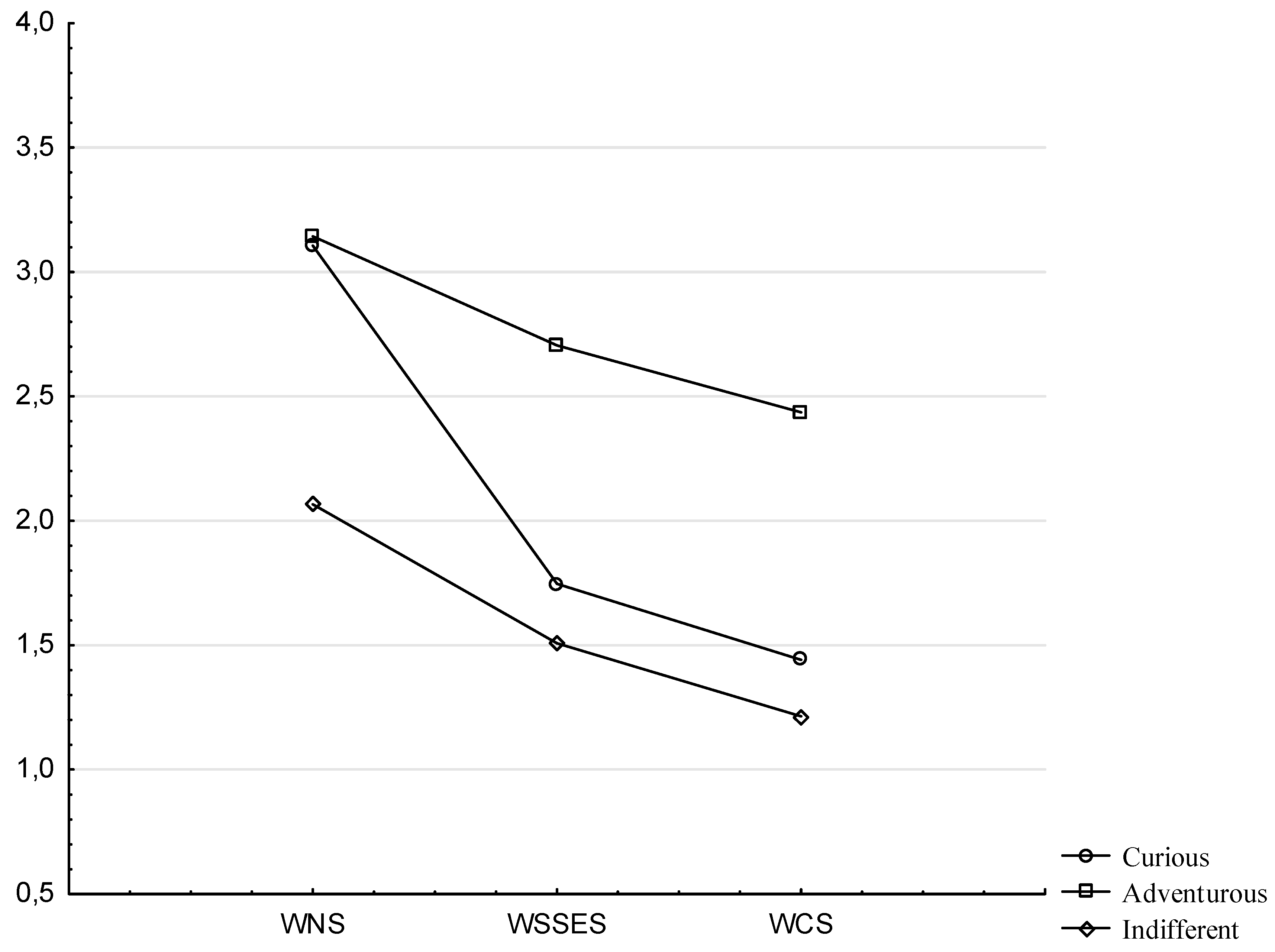

Table 1.
Variance Within and Between Groups for Wilderness Scales; The Results of Clustering Analysis.
Table 1.
Variance Within and Between Groups for Wilderness Scales; The Results of Clustering Analysis.
| Model | Variable | Variance between group | df | Variance within group | Df | F | P |
| Two Clusters | WNS | 25.32 | 1 | 89.84 | 271 | 76.38 | 0.01 |
| WSES | 70.42 | 1 | 69.51 | 271 | 274.53 | 0.01 | |
| WCS | 70.19 | 1 | 68.10 | 271 | 279.31 | 0.01 | |
| Three Clusters | WNS | 63.38 | 2 | 51.78 | 270 | 165.23 | 0.01 |
| WSES | 72.87 | 2 | 67.06 | 270 | 146.71 | 0.01 | |
| WCS | 76.79 | 2 | 61.50 | 270 | 168.55 | 0.01 |
Table 2.
Comparisons opinions about climate change in three groups of participants.
| Curious (1) N = 98 |
Adventurous (2) N = 95 |
Indifferent (3) N = 80 |
F | ||||
| M | SD | M | SD | M | SD | ||
| 1. Interest in climate change | 4.68 | 1.38 | 4.37 | 1.61 | 3.56 | 1.56 | 12.52; 1-3 **, 2-3 ** |
| 2. Impact of climate change on human lives | 5.77 | 1.66 | 5.51 | 1.59 | 5.26 | 1.71 | 2.11; 1-3 * |
| 3. Consequences of climate change | 6.30 | 0.99 | 5.85 | 1.50 | 5.91 | 1.21 | 3.67; 1-2 *, 1-3 * |
| 4. Perception of climate change as a threat to modern civilization | 5.91 | 1.15 | 5.33 | 1.42 | 5.17 | 1.40 | 7.97; 1-2 **, 1-3 ** |
| 5. Perception of climate change as a threat to species living in the natural environment | 6.34 | 0.90 | 5.85 | 1.33 | 5.97 | 1.22 | 4.69; 1-2 **, 1-3 ** |
| 6. Opportunities to stop climate change | 3.17 | 1.25 | 3.10 | 1.48 | 3.25 | 1.27 | 0.25 |
| 7. Impact of individuals on climate change | 4.60 | 1.55 | 4.46 | 1.79 | 4.12 | 1.52 | 1.94; 1-3 * |
| 8. Cause of climate change | 5.56 | 1.22 | 5.38 | 1.53 | 5.40 | 1.20 | 0.48 |
* p < 0.05; ** p < 0.01.
Table 3.
Comparisons emotions about climate change in three groups of participants.
| Curious N = 98 |
Adventurous N = 95 |
Indifferent N = 80 |
F | ||||
| M | SD | M | SD | M | SD | ||
| Joy | 2.05 | 1.13 | 2.47 | 1.52 | 2.26 | 1.25 | 2.49; 1-2 * |
| Trust | 2.01 | 1.13 | 2.43 | 1.40 | 2.17 | 1.24 | 2.70; 1-2 ** |
| Fear | 5.33 | 1.31 | 4.66 | 1.77 | 4.40 | 1.49 | 8.98; 1-2 **, 1-3 ** |
| Surprise | 3.72 | 1.67 | 3.54 | 1.52 | 3.30 | 1.50 | 1.60 |
| Sadness | 5.44 | 1.43 | 4.78 | 1.72 | 4.46 | 1.59 | 9.08; 1-2 **, 1-3 ** |
| Disgust | 4.23 | 1.77 | 3.74 | 1.86 | 3.55 | 1.87 | 3.35; 1-3 * |
| Anger | 4.91 | 1.66 | 4.51 | 1.84 | 4.15 | 1.76 | 4.23; 1-3 ** |
| Premonition | 4.18 | 1.54 | 4.11 | 1.57 | 3.70 | 1.49 | 2.46, 1-3 * |
* p < 0.05; ** p < 0.01.
Table 4.
Comparisons proecological behaviors in the context of climate change in the three groups of participants.
Table 4.
Comparisons proecological behaviors in the context of climate change in the three groups of participants.
| Curious N = 98 (1) |
Adventurous N = 95 (2) |
Indifferent N = 80 (3) |
F | ||||
| M | SD | M | SD | M | SD | ||
| 1. Minimizing household waste production and disposal | 4.96 | 1.35 | 5.13 | 1.62 | 4.53 | 1.74 | 3.30; 2-3 * |
| 2. Separating household waste for recycling purposes | 5.75 | 1.67 | 5.89 | 1.57 | 5.48 | 1.66 | 1.36 |
| 3. Saving water | 5.51 | 1.25 | 5.34 | 1.41 | 4.73 | 1.54 | 7.24; 1-3 **, 2-3 ** |
| 4. Saving electricity | 5.32 | 1.45 | 5.21 | 1.58 | 4.47 | 1.78 | 7.07; 1-3 **, 2-3 ** |
| 5. Saving paper | 5.29 | 1.33 | 5.09 | 1.63 | 4.60 | 1.74 | 4.49; 1-3 ** |
| 6. Reducing the use of my car in favor of low-emission modes of transport (e.g. public transport, bicycle), | 4.98 | 1.93 | 4.64 | 2.08 | 4.62 | 2.24 | 0.91 |
| 7. Participating in campaigns and initiatives for the environment | 2.54 | 1.53 | 2.57 | 1.78 | 1.75 | 1.23 | 7.31; 1-3 **, 2-3 ** |
| 8. Having a limit on purchases of new goods. | 4.36 | 1.53 | 4.33 | 1.64 | 1.75 | 1.23 | 7.90; 1-3 **, 2-3 ** |
* p < 0.05; ** p < 0.01.
Disclaimer/Publisher’s Note: The statements, opinions and data contained in all publications are solely those of the individual author(s) and contributor(s) and not of MDPI and/or the editor(s). MDPI and/or the editor(s) disclaim responsibility for any injury to people or property resulting from any ideas, methods, instructions or products referred to in the content. |
© 2024 by the authors. Licensee MDPI, Basel, Switzerland. This article is an open access article distributed under the terms and conditions of the Creative Commons Attribution (CC BY) license (http://creativecommons.org/licenses/by/4.0/).
Copyright: This open access article is published under a Creative Commons CC BY 4.0 license, which permit the free download, distribution, and reuse, provided that the author and preprint are cited in any reuse.


