

Submitted:
06 September 2024
Posted:
06 September 2024
You are already at the latest version
Abstract
When experiencing a variety of family negative events, families recognized as having high family resilience maintain and improve family functioning. It is important, therefore, to be able to assess families lacking in family resilience in order to prevent, reduce, or ameliorate family symptoms. The purpose of this study was to clarify the state of exerted family resilience in order to create an assessment scale for insufficiencies in family resilience (IFR). Family resilience is defined as “when a family becomes aware of family symptoms, its power to autonomously and actively improve its own family functions.” The results of a literature review of 22 cases from 16 studies on family resilience and the results of 28 semi-structured interviews with 28 parenting-age families in Japan were qualitatively categorized, and directed content analysis was conducted based on the Concentric Sphere Family Environment Theory. A total of 157 labels, with a total of 23 categories and 47 subcategories, such as “Can utilize relatives,” “Family members can communicate with members of other families,” “Family members can share information,” “All family members can communicate with one another,” “All family members can cooperate with one another,” and “Can share time with family,” was revealed. Thus, a variety of diverse aspects contributing to a family’s resilience, including family member interactions, entire family interactions, use of social resources, and religious and spiritual support, were revealed. The results of this study should be linked to the creation of the IFR.
Keywords:
family resilience
; family assessment
; item development
; directed content analysis
; Concentric Sphere Family Environment Theory
1. Introduction
Family support aims at maintaining and improving family functioning in the target family system unit, and it targets the family as a living organization. However, in today’s society, families are becoming diverse, making it more difficult for families to solve problems on their own. It is considered that rather than unilateral support from others to solve problems, families are more likely to improve their self-care skills through the support of others and to continue to practice the solutions they themselves devised, which are more likely to be put into practice [1]. Under these circumstances, the concept of family resilience has attracted much attention in family support.
Resilience is a construct that has garnered considerable attention from social scientists, policy makers, and public and private organizations. Resilience has long been emphasized as warranting additional research [2,3]. The origins of the concept of resilience stem from early psychiatric literature in which children who appeared to be invulnerable to adverse life situations were examined. Resilience, the ability to recover or cope successfully despite substantial adversity [4], has received significant attention from various domains [5]. Although many deprived or traumatized children were hindered from psychological growth or found themselves confined to a situation in which they were victimized, Rutter [6] noted that about half of the children exposed to high-risk circumstances and who overcame them were able to lead loving and productive lives, and went on to raise their own children well. However, in the 1990s, research on people who had been at risk but whose problems did not manifest themselves was conducted, with an interrelationship between the individual and the environment observed, and redefined as a dynamic and changeable process [7]. Research on resilience expanded to include various age ranges and disadvantaged states, such as poverty and violence [6,8], abuse [9], chronic illness [10,11], and catastrophic life events [12,13].
Resilience has been viewed as residing within the individual, with the family often dismissed as dysfunctional [14]. Since the late 1990s, however, attention has focused on families that have demonstrated strength and problem-solving skills in the face of crisis. Walsh’s adaptation of the concept of resilience in the family led to the study of family resilience, which emerged from psychology and was used in a variety of domains [14]. Subsequently, McCubbin and McCubbin [15] have defined family resilience as “characteristics, dimensions, and properties of families which help families to be resilient to disruption in the face of change, and adaptive in the face of crisis situation.” This concept is useful in formulation of responses to one of the enduring mysteries of family dynamics: why some families continually live well together and respond positively to challenges, whereas others in similar circumstances do not cope well. Family resilience entails more than surviving a crisis, but also offers the potential for growth out of adversity. By weathering a crisis together, a family can emerge more loving, stronger, and more resourceful in meeting future challenges [11,16].
To provide family support, it is first necessary to identify which families need family support. One example of a family condition that requires family support is the state in which family resilience is lacking. In order to provide support to families experiencing difficulties due to a lack of family resilience, a scale that facilitates determining which families need support is needed.
Hohashi [17] proposed the Concentric Sphere Family Environment Theory (CSFET), a middle-range family nursing theory, that holistically aims at the high-dimension family existence approaching the family system unit from the aspect of chrono and spatial axes, focusing on the family environment that acts on family well-being (Figure 1). CSFET includes family resilience as a functional indicator. Hohashi [1] defines family resilience as “when a family becomes aware of family symptoms, its power to autonomously and actively improve its own family functions.” In order to enable family assessments of the family environment and condition of family well-being upon which the CSFET is based, the Family/Family Environment Assessment Model (FFEAM) was developed and well organized to correspond with the system of practice [18]. Specifically, the FFEAM [18] is constructed of a “family observation/interview” containing seven tools and a “measurement test” containing seven tools. In this way, multiple tools were developed and introduced, which enable even beginners to collect data with high efficiency and reliability, and enable family assessments. However FFEAM does not yet offer a scale to screen for the degree of family resilience.
In this study, we use a literature review and semi-structured interviews to understand the state of family resilience being demonstrated based on the framework of CSFET, and to develop items of the family conditions for measuring family resilience.
2. Methods
2.1. Definition of Terms
We define “the circumstances in which the family demonstrates family resilience” as “circumstances in which some family symptoms exist in the family and family functioning is diminished” based on Hohashi’s definition of family resilience [1]. “Family symptoms” are “problematic conditions (such as problems, issues, difficulties or suffering) in the family system unit, comprehensively assessed by a nursing professional based on subjective and objective family data” [19]. “Family functions” are defined as “cognitive functions of the family and its cognitive power over the family and the family environment, which arise from the family role actions conducted by individual family members” [20]. Family system unit is “another term for family to clarify that the family is a system and a unit” [1].
2.2. Literature Review
We carried out searches on Ichushi-Web, Japan’s only comprehensive medical literature database, and set the target year to “all” and the article type to “excluding conference proceedings.” The search keywords were “family AND resilience,” “family resilience,” “family AND resiliency,” “family resiliency,” and finally all the OR searches.
The subject keyword yielded 350 potential articles up to December, 2019. With reference to the title and abstract, we checked that the content described a situation in which the family demonstrated family resilience. However, even when a search obtained a hit, the literature did not necessarily focus on “family resilience” but rather mostly discussed “individual resilience.” Hence, it has been difficult to extract the state that a family demonstrated family resilience directly from the literature. A total of 16 references, including 22 cases, were included in the study that provided examples of families undergoing difficulties due to some family symptoms and subsequently demonstrated family resilience (Table 1).
2.3. Family Interview
2.3.1. Participants
The interviews were conducted in two areas in Japan from 2017 to 2019: an urban city with a population of approximately 1.5 million, and a rural city on a remote island with a population of approximately 34,000. We targeted parenting families who were aware that family resilience is lacking or had been lacking, because families in their child-rearing years are more likely to experience adverse events [6]. We recruited participants through distribution research requests. In the urban city, 1,820 copies were distributed (427 copies in 2017, 1,393 copies in 2018) to 17 facilities, including pediatric outpatient clinics, nursery schools, and so on. In the rural city, 545 copies were distributed to 14 facilities in 2019, including a kindergarten, a special support school, and so on. Thirty-four families applied (seven in 2017, 18 in 2018, nine in 2019), and we explained the outline of the study a second time. We obtained letters of consent from 28 families, and conducted interviews with mothers and/or fathers (five in 2017, 14 in 2018, nine in 2019) (Table 2).
2.3.2. Data Collection
The data were collected through semi-structured interviews based on the Family Environment Observation/Interview (FEO/I) [18], Family Environment Map (FEM) [21], and Family Environment Assessment Index (FEAI) [22]. All these tools were developed by Hohashi based on the CSFET.
We first used FEM, an assessment tool to understand the composition of the family and the relationship within and outside the family. The FEM is a qualitative tool for visualizing the family structure and kin structure and relationships between individuals. The interview guide was constructed based on the FEAI. The FEAI is a qualitative tool for assessing the family well-being and problematic family conditions. It is composed of 43 items and is provided with sample questions to conduct the culturally congruent family assessments. Examples of questions are: What sort of situation has your family found to be difficult? How did your family handle the situation? FEO/I is “a format for centralizing and recording various information required for family assessments, family interviews/meetings, and so on.” and we always brought FEO/I with us during the interview period.
The interviews were recorded using an IC recorder with the consent of the participants, and a verbatim record was created. The average interview length was 83 min (range 118-50 min).
2.4. Data Analysis
The two data sources, a literature review and semi-structured interviews, were used to enhance the trustworthiness of the analysis. In order to clarify the state of the family in which family resilience is demonstrated, directed content analysis [23] was conducted based on the CSFET. The goal of a directed content analysis approach is to validate or extend conceptually a theoretical framework or theory. Existing theory or research can help focus the research question and it can help researchers begin by identifying key concepts or variables as initial coding categories [23].
The literature and transcripts were read numerous times to achieve a correct understanding. Sentences describing the state of family resilience were extracted and summarized to create a single meaning unit. We also included situations in which a family overcame difficulties due to the effects of the family member’s behavior on the entire family. After summarizing the meaning units into subcategories and categories according to the commonality of contents, they were classified according to the perspective of four systems of the CSFET: family external environment system, family internal environment system, family system unit, and family chrono environment system. Nine researchers with expertise in the field of family nursing were involved in the analysis process.
2.5. Ethical Considerations
This study was reviewed and approved by the institutional review board of the researchers’ university (Reference No.: 454-3). When family members took part in semi-structured interviews, both orally and in writing, they received an explanation of the purpose of the study, anticipated risks and benefits, confidentiality protection, and the participant’s right to refuse participation or to withdraw from the research at any time.
3. Results
A total of 157 labels were extracted and, for a conceptual approximation to categories, were summarized in 47 subcategories and in 23 categories, and were placed in four themes (Table 3).
3.1. Theme 1: Family External Environmental System
3.1.1. Can Utilize Relatives
Families overcame family difficulties by utilizing their relatives. Family members required hospitalization or care due to illness, disability, becoming pregnant, death, or when multiples of these family events occurred. When such events made it difficult for them to live on their own, the family sought support from the couple’s parents or siblings to help with household chores and childcare, and in some cases, to have them come to stay with them at home. Family also used their relatives not only for direct support, but also for psychological support. For example, they shared concerns about family difficulties with relatives.
3.1.2. Can Utilize Friends
Families overcame family difficulties by utilizing friends. Family members were able to discuss their internal family problems with close friends on a regular basis, which spared them from having to deal with family problems and helped them to overcome family difficulties. By actively building friendships at school, they were able to have a community outside of the family, which provided psychological support to family members and helped them to overcome family difficulties.
3.1.3. Can Utilize Co-Workers
Families overcame family difficulties by utilizing co-workers. Speaking to the co-workers about family concerns, such as the illness and death of a family member or the raising of a disabled child, helped family members to avoid keeping family problems within the family and to overcome difficulties. In addition, going to the workplace and getting involved with co-workers gave the family members a chance to interact with people outside the family, which helped family members feel relaxed and relieved, and helped family members to overcome their difficulties.
3.1.4. Can Utilize Peers
Families could overcome difficulties by utilizing someone who had experienced a similar event. If a family hardship arises due to an event that was not previously experienced, the family sought solutions by approaching others to hear about their experiences of how they actually dealt with the event and asking them for advice on their current family situation. They also interacted with mothers of children with the same disabilities as their own children, and attended family group sessions for psychological support.
3.1.5. Can Utilize People in Locality
Families were able to overcome family difficulties by utilizing people in their locality. Families of children with disabilities were able to overcome difficulties during disasters and other emergencies because they formed a supportive relationship with people in the community who were able to help them on a regular basis. They also used the local community for psychological support by using it as a refuge from family difficulties.
3.1.6. Can Utilize Professionals
Families overcame family difficulties by utilizing professionals. When a family member had an illness or disability, the family member shared concerns with a physician, nursing professional or counselor for psychological support. Families were also able to obtain the professional support they needed for their families and family members by seeking support from professionals.
3.1.7. Can Utilize School
Families can use the school to help them overcome their difficulties. Talking to the school about their child’s disability helped them obtain psychological support, and discussing their child’s school life helped them to create a suitable educational environment for their child.
3.1.8. Can Utilize Social Welfare System
Families overcame family difficulties by utilizing the social welfare system. In the event of a family member’s death, they were able to provide financial support by using survivor’s pensions and the social welfare system for disabled children. In addition, using the facilities for people with disabilities also allowed them to interact with society.
3.1.9. Can Obtain Support from Religion
Families overcame family difficulties by obtaining support from religion. During a period of time that families were debilitated by the stress of parenting, the family relied on the inspiration they received from their original religion for spiritual support.
3.2. Theme 2: Family Internal Environmental System
3.2.1. Family Members Can Communicate with Members of Other Families
In families that overcame difficulties, family members communicated with members of other families to help the family overcome its difficulties. Family members shared their concerns with members of other families about problems that occurred within the family, problems between family members, and family members’ own problems. Family members were also able to alleviate their own psychological stress by sharing their concerns about their children’s disabilities and childcare with members of other families, rather than keeping them to themselves. In addition, when a family member was in distress, the family member’s suffering was alleviated when members of other families approached the family members to acknowledge their pain and feelings and to offer beneficial advice. Discussions among family members about family problems led to practical solutions and helped the family to overcome difficulties.
3.2.2. Family Members Can Share Information
In families that overcame difficulties, family members shared information with each other to help the family overcome its difficulties. After receiving the diagnosis, family members had acquired the correct knowledge of their child’s disability by researching books, the internet, and by inquiring to experts. The gathering of information about treatment and counseling also helped the family to provide appropriate modifications for family members with disabilities. Sharing what one family member knew about the care and education of children with disabilities with other family members helped family members to accept the family’s current situation.
3.2.3. Family Members Can Accept Current Situation
In families that overcame difficulties, family members accepted the current situation to help the family overcame their difficulties. Family members adapted to the situation by understanding the current situation of different values and the difficulties arising from other family members’ disabilities. In addition, family members were able to change the situation by reviewing their own behavior through objectively examining the family member’s situation as well as that of the family as a whole. Families with children having allergies and disabilities were able to switch their minds and change the way they perceive things by taking a positive view of the current situation instead of being pessimistic. Family members who were initially unable to accept the family member’s disability were able to accept the disability by expressing their thoughts and feelings about the disability, which ultimately helped the family member to overcome difficulties.
3.2.4. Family Members Can Clearly Understand Their Roles
In families that overcame difficulties, family members clearly understood their roles to help the family overcome their difficulties. There was a shift in family member roles, with the grandmother taking the mother’s place in raising the child and fulfilling the mother’s role in the case of a family with a neglectful mother, and the grandfather fulfilling the father’s role in the case of a family where the father was not present owing to a single mother household. There was also a subjective family belief that if father himself could recognize their role as fathers and what they should do for their families as fathers, they could overcome their current family difficulties. In addition, the division of household and childcare roles among family members reduced the members’ respective burdens.
3.2.5. Family Members Can Support Other Family Members
In families that overcame difficulties, family members supported other family members to help the family overcome their difficulties. The family began to regain its balance as other family members encouraged the independence of family members who had been confined to their rooms or who had misbehaved. Also, when a family member became fatigued or neurotic due to the family member’s childcare, disability, or household chores, or when a family member’s disability necessitated special accommodations, family members acted on behalf of other family members by helping with household chores, childcare, and helping with mood swings.
3.2.6. Appropriate Distance Can Be Maintained between Family Members
Families overcame family difficulties by maintaining an appropriate distance between family members. The panic-prone members of the family dealt with each other by keeping a certain distance between them so that each of them did not panic. Taking care not to involve the children in parental issues has helped the family was able to get through a divorce, which can be considered a difficult family affair.
3.2.7. Can Maintain Family Members’ Beliefs for Emotional Support
Families overcame family difficulties by holding beliefs for supporting family members. Families that did not have good marital relationships were able to raise their children by supporting the family’s previously held beliefs.
3.3. Theme 3: Family System Unit
3.3.1. All Family Members Can Communicate with One Another
In families that overcame difficulties, all family members communicated with one another to help the family overcome its difficulties. Family members shared their concerns within the family by opening up about what they found difficult about raising a child with a disability. Also, when a family member was unaided in caring for a child with a disability, the family communicated with one another and worked together within the family.
3.3.2. All Family Members Can Share Information
In families that overcame difficulties, all family members share information to help the family overcome its difficulties. Families with low birth weight babies were able to share all aspects of information known by family members about their disability with all family members, and significant differences in the amount of information within the family were not observed.
3.3.3. All Family Members Can Understand the Current Situation
In families that overcame difficulties, all family members understood the current situation to help the family overcome its difficulties. When a family member had a problem, such as caregiving, inheritance, or a scandal caused by a family member, or when a child’s university education became a financial hardship due to increased expenses, the family was able to deal with the situation constructively by understanding what was occurring. The family also properly identified what is currently needed for the family member with a disability and took the necessary actions.
3.3.4. All Family Members Can Cooperate with One Another
In families that overcame difficulties, all family members cooperated with one another to help the family overcome its difficulties. All family members worked together and helped each other to deal with the complexities of international marriage, litigation involving family members who died as a result of a mishap, and family financial difficulties.
3.4. Theme 4: Family Chrono Environment System
3.4.1. Can Utilize Past Experiences
Families overcame family difficulties by utilizing past experiences. The family drew on the family members’ childcare experience and professional experiences to raise their disabled children. The family was also confident in the fact that the family had overcome many difficulties in the past and was dealing with new challenges.
3.4.2. Can Share Time with Family
Families overcame family difficulties by sharing time with family. Spending time together with other family members or with the family as a whole made a positive difference in family relationships. Children who had been institutionalized because of difficulties with family members’ relationships with each other formed good family relationships by being trained how to make their way home, and families that had had difficulty accepting their children with disabilities became more accepting of their disabilities and to feel like a family when they spent time together, and as a result awareness of being a family began to grow. In addition, relationships within the family improved as family members quit their jobs to spend more time with their families.
3.4.3. Can Share Objectives with Family
Families overcame family difficulties by sharing objectives with family. Families whose children were in the Neonatal Intensive Care Unit (NICU) could target other children who were being discharged ahead of them, and families whose children had disabilities could overcome the difficulties that were currently occurring by targeting other children with the same disabilities.
4. Discussion
Categories have been classified according to the system of the CSFET (Figure 1): These include nine categories for the family external environment system, seven categories for the family internal environment system, four categories for the family system unit, and three categories for the family chrono environment system.
In the family internal environment system, it was found that the conditions are generally easier to visualize, such as family cooperation and communication between family members/family members to overcome family difficulties. On the other hand, the status “Family members can maintain an appropriate distance between family members” indicates that families need a distance and that spending time together does not necessarily lead to overcoming difficulties. These considerations suggest that support for the family internal environment system should not only foster engagement between family members, but also support distance between them [24].
As Walsh [16] pointed out, healthy families have the strength to admit when they need help and are more likely to turn to extended family, friends, neighbors, community services, or counseling. That is, not only the internal relations within the family but also the relations with the outside of the family help the family to overcome difficulties. In the family external environment system, it is revealed not only a state of seeking support from outside the family such as through “Can ask relatives for support,” “Can ask peers for advice,” and “Can seek professional for help,” but also a state of being able to change one’s mood by interacting with people outside the family such as “Can interact with friends,” “Can interact with people at workplace,” “Can interact with peers,” and “Can interact with people in locality” can lead to positive results. In addition, it was found that family members felt a sense of relief when they shared their concerns about family difficulties with people outside the family, such as “Can share concerns with relatives,” ” Can share concerns with friends,” “Can share concerns with people at workplace,” “Can share concerns with professionals,” and “Can share concerns with school,” rather than through substantial cooperation, and that people outside the family were able to provide emotional support to the family members. The findings also revealed religion-related conditions such as “Can obtain support from religion” and spirituality-related conditions such as “Can maintain family members’ beliefs for emotional support” that were related to one’s beliefs. These were also evident in a study that conducted a conceptual analysis of family resilience and identified the factors that constitute family resilience, which stated that spirituality and religious beliefs appear to serve as powerful protectors often embraced by resilient families [13]. Furthermore, from the perspective of the family chrono environment system, which is a major asset of CSFET, it is clear that family resilience is related to the family chronicles of the family. We believe that the subcategories cover a wide range of family resilience, from family internal environmental systems to family chrono environmental systems [25].
Families lacking in family resilience are unable to overcome difficult situations on their own, and therefore need support in drawing on their strengths. Nurses have a major role to play in helping patients’ families overcome difficult situations on their own. However, because it is unclear which family members should be supported, and as it may be difficult for families to ask for help from a third party, families lacking family resilience often cannot obtain support from a third party when they encounter troublesome situations and therefore are unable to overcome their difficulties [26]. We believe that with such families in the community, the assessment scale for insufficiencies in family resilience (IFR), which will be developed based on this study, will be useful for nurses to identify families that are lacking in family resilience and need intervention, and in assisting their receiving support from a third party.
This study targeted families in the parenting period. Although data on families were refined, because the characteristics of families in the child-rearing phase are thought to have an impact on the results, there is a need to increase the number of attributes of the target families and continue to conduct semi-structured interviews to further refine the data and generalize the results. Examples of target family for which new data need to be added in the future include families with a family member in need of care, families with a family member with a disability, irrespective of the child-rearing period, and older adult-only households. Because this study was limited to identifying the state of family resilience, it is necessary to advance development of the assessment scale for insufficiencies in family resilience (IFR) questionnaire to the next stage, and weigh each item for practical use to verify its practicality for supporting families.
5. Conclusions
The concept of family resilience has been gaining attention in numerous areas. Hohashi defined family resilience as “when a family becomes aware of family symptoms, its power to autonomously and actively improve its own family functions.” This study used a literature review and semi-structured interviews to create items to identify conditions that demonstrate family resilience. A total of 157 labels, 47 subcategories, and 23 categories were extracted. The categories are classified according to the system of Concentric Sphere Family Environment Theory (CSFET): nine categories for the family external environment system, seven categories for the family internal environment system, four categories for the family system unit and three categories for the family chrono environment system. A variety of states were analyzed, such as family member interactions, whole family interactions, use of social resources, and religious and spiritual support, revealing the diversity of family resilience. The results of this study should be linked to the creation of the assessment scale for insufficiencies in family resilience (IFR).
References
- Hohashi, N. Understanding family health care nursing through applicable terminology: Studies on fundamental family nursing and family functioning (Ver. 3.1); Editex: Kawasaki, Japan, 2023; ISBN 978-4-903320-71-7. [Google Scholar]
- McDonald, A. Family resilience: An interview with Froma Walsh, MSW, PhD. Fam J. 2013, 21, 235–240. [Google Scholar] [CrossRef]
- Simon, J.B.; Murphy, J.J.; Smith, S.M. Understanding and fostering family resilience. Fam J. 2005, 13, 427–436. [Google Scholar] [CrossRef]
- Rutter, M. Resilience in the face of adversity. Protective factors and resistance to psychiatric disorder. Br J Psychiatry. 1985, 147, 598–611. [Google Scholar] [CrossRef] [PubMed]
- Earvolino-Ramirez, M. Resilience: A concept analysis. Nurs Forum. 2007, 42, 73–82. [Google Scholar] [CrossRef] [PubMed]
- Rutter, M. Psychosocial resilience and protective mechanisms. Am J Orthopsychiatry. 1987, 57, 316–331. [Google Scholar] [CrossRef] [PubMed]
- Luthar, S.S.; Cicchetti, D.; Becker, B. The construct of resilience: A critical evaluation and guidelines for future work. Child Dev. 2000, 71, 543–562. [Google Scholar] [CrossRef] [PubMed]
- Luthar, S.S. Poverty and children’s adjustment; SAGE Publications: Thousand Oaks, CA, 1999; ISBN 978-0761905196. [Google Scholar]
- Cicchetti, D.; Rogosch, F.A. The role of self-organization in the promotion of resilience in maltreated children. Dev Psychopathol. 1997, 9, 797–815. [Google Scholar] [CrossRef] [PubMed]
- McCubbin, M.; Balling, K.; Possin, P.; Frierdich, S.; Bryne, B. Family resiliency in childhood cancer. Fam Relat. 2002, 51, 103–111. [Google Scholar] [CrossRef]
- White, N.; Richter, J.; Koeckeritz, J.; Munch, K.; Walter, P. “Going forward”: Family resiliency in patients on hemodialysis. J Fam Nurs. 2004, 10, 357–378. [Google Scholar] [CrossRef]
- Clay, R.A. Research on 9/11: What psychologists have learned so far. Monit Psychol. 2002, 33, 28. Available online: www.apa.org/monitor/sep02/federal (accessed on 28 August, 2024).
- Black, K.; Lobo, M. A conceptual review of family resilience factors. J Fam Nurs. 2008, 14, 33–55. [Google Scholar] [CrossRef] [PubMed]
- Walsh, F. The concept of family resilience: Crisis and challenge. Fam Process. 1996, 35, 261–281. [Google Scholar] [CrossRef] [PubMed]
- McCubbin, H.; McCubbin, M. Typologies of resilient families: Emerging roles of social class and ethnicity. Fam Process. 1988, 37, 247–254. [Google Scholar] [CrossRef]
- Walsh, F. Strengthening family resilience; Guilford Press: New York, NY, 2015; ISBN 978-1462522835. [Google Scholar]
- Hohashi, N.; Honda, J. Development of the Concentric Sphere Family Environment Model and companion tools for culturally congruent family assessment. J Transcult Nurs. 2011, 22, 350–361. [Google Scholar] [CrossRef] [PubMed]
- Hohashi, N. Understanding family health care nursing through applicable terminology: Concentric Sphere Family Environment Theory (Ver. 3.4); Editex: Kawasaki, Japan, 2023; ISBN 978-4-903320-66-3. [Google Scholar]
- Hohashi, N. Understanding family health care nursing through applicable terminology: Family symptomatology (Ver. 3.4); Editex: Kawasaki, Japan, 2023; ISBN 978-4-903320-69-4. [Google Scholar]
- Hohashi, N. Understanding family health care nursing through applicable terminology: Studies on fundamental family nursing and family functioning (Ver. 3.1); Editex: Kawasaki, Japan, 2023; ISBN 978-4-903320-71-7. [Google Scholar]
- Hohashi, N. The Japanese Version of the Family Environment Map (FEM-JA) (Ver. 3.2JA); Editex: Kawasaki, Japan, 2023; ISBN 978-4-903320-63-2. [Google Scholar]
- Hohashi, N.; Watanabe, M. Family Environment Assessment Index (FEAI-JA) (Ver. 3.4); N. Hohashi, Ed.; Editex: Kawasaki, Japan, 2023; ISBN 978-4-903320-62-5. [Google Scholar]
- Hsieh, H.F.; Shannon, S.E. Three approaches to qualitative content analysis. Qual Health Res. 2005, 15, 1277–1288. [Google Scholar] [CrossRef] [PubMed]
- Liu, Y. The relationship between resilience, interactive distance, and college students’ online mathematics learning engagement: A longitudinal study. Psychol Res Behav Manag. 2024, 20, 1129–1138. [Google Scholar] [CrossRef] [PubMed]
- Stainton, A.; Chisholm, K.; Kaiser, N.; Rosen, M.; Upthegrove, R.; Ruhrmann, S.; Wood, S.J. Resilience as a multimodal dynamic process. Early Interv Psychiatry. 2019, 13, 725–732. [Google Scholar] [CrossRef] [PubMed]
- Russell, L.T.; Coleman, M.; Ganong, L.H.; Gayer, D. Divorce and childhood chronic illness: A grounded theory of trust, gender, and third-party care providers. J Fam Nurs. 2016, 22, 252–278. [Google Scholar] [CrossRef] [PubMed]
Figure 1.
Model diagram of Concentric Sphere Family Environment Theory (CSFET) (Ver. 3.4).
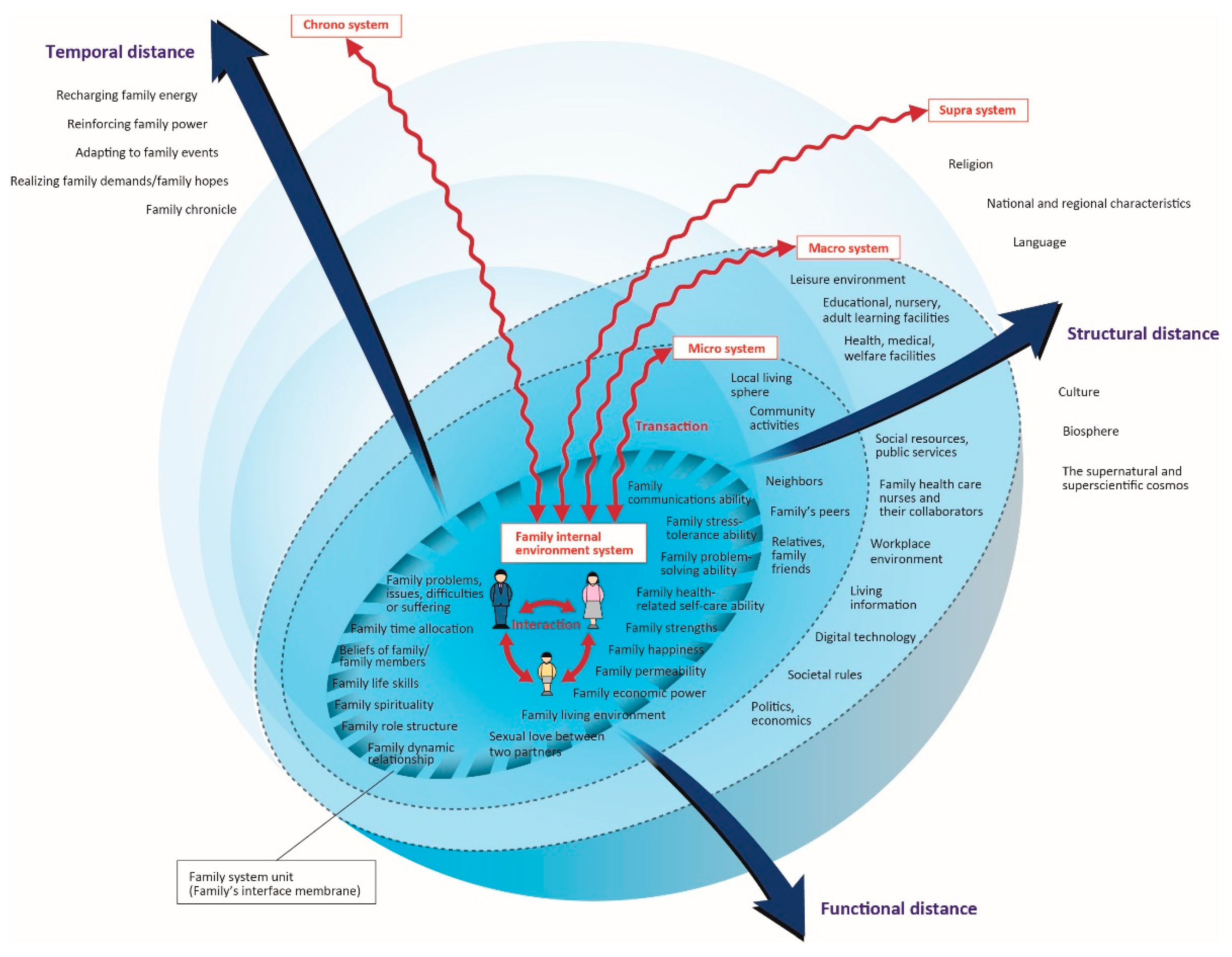

Table 1.
Source of family cases used in literature review (N of literatures = 16, N of family cases = 22).
Table 1.
Source of family cases used in literature review (N of literatures = 16, N of family cases = 22).
| Case number | Family case | Reference |
|---|---|---|
| 1 | A family having a child with nervous tic symptoms | Tokutsu, S. Connecting a family of three generations of living together: Progress of family casework with a family of 8-year-olds with nervous tic symptoms. Stud Soc Work. 1993, 19, 221-228. |
| 2 | A family whose eldest son had schizophrenia and was confined to his room | Tokutsu, S. Family resilience approach on the context of narrative family therapy and social casework. J Kansai Univ Welf Sci. 1999, 3, 35-50. Available online: www.fuksi-kagk-u.repo.nii.ac.jp/record/734/files/708kagk.pdf (accessed on 28 August, 2024). |
| 3 | A family whose children has been left with severe disabilities resulting from an accident | Irie, Y. Concept analysis of family resilience. Int Buddhist Univ Bull. 2002, 57, 95-105. |
| 4 | A family whose eldest son was a homicide victim | Miyoshi, K. Loss, recovery and family relevance: A perspective from family systems. Res Fam Probl Counsel. 2003, 2, 21-30. |
| 5 | A family in which a difference in values emerged between the husband and wife | Tokutsu, S. Toward the development of a family resilience inventory. J Kansai Univ Welf Sci. 2003, 7, 119-132. Available online: www.fuksi-kagk-u.repo.nii.ac.jp/record/412/files/KD200301.pdf (accessed on 28 August, 2024). |
| 6, 7 | A family that had difficulty accepting their child’s disability | Irie, Y.; Tsumura, C. Development of a family intervention model to facilitate resilience in families of children with intellectual disabilities. J Jpn Acad Nurs Sci. 2011, 31, 34-35. [https://doi.org/10.5630/jans.31.4_34] |
| 8 | A family having a child in need of medical care | Takahashi, I. A concept analysis of family resilience: Usability of family support for children with diseases and disorders. J Jap Soc Child Health Nurs. 2013, 22, 1-8. [https://doi.org/10.20625/jschn.22.3_1] |
| 9 | A family that kept their disabled daughter locked up in their home for decades | Takano, Y.; Okamoto, Y.; Koya, M.; Morita. S.; Ikeda, T. How a disabled person’s family recovered resilience through intervention by a daughter-in-law who became a companion for the disabled person. Hiroshima Psychol Res. 2015, 14, 27-35. [https://doi.org/10.15027/37496] |
| 10 | A family of a single mother raising a developmentally disabled child | Tanaka, M. Study on feelings of loss and grief of a mother with a child diagnosed with autistic spectrum disorder. Grief Care. 2015, 3, 115-135. |
| 11 | A family in which the parents are divorced and the father and daughter are living together | Fujita, H. The resilience of children who have experienced their parents’ divorce: A qualitative study of children’s narratives of greater impacts of divorce and the recovery process. Jap J Fam Psychol. 2016, 30, 1-16. [https://doi.org/10.57469/jafp.30.1_1] |
| 12 | Families in which the father physically abuses the daughter, the daughter behaves delinquently, and the daughter and stepmother do not get along | Aizawa, M. Building resilience of parents and children in social care: Through the adjustment of parent-child relationship in a child independence support facility. Educ Med. 2017, 65, 1026-1033. |
| 13 | A family whose father was hospitalized for subarachnoid hemorrhage | Furuhashi, T. Support for children and mothers whose husbands unexpectedly received emergency and intensive care. Jap J Child Nurs, Monthly. 2017, 40, 1537-1542. |
| 14 | A family having a child with disabilities that was affected by the disaster | Hosotani, N.; Ishimaru, M.; Miyazaki, M. The impact of relationships with local residents on children with developmental disabilities and their families during a disaster. J Chiba Acad Nurs Sci. 2017, 23, 21-31. Available online: www.opac.ll.chiba-u.jp/da/curator/104112/S13448846-23-1-P021-HOS.pdf (accessed on 28 August, 2024). |
| 15 | A family in which the husband and the husband’s mother are cancer patients and the husband is terminally ill | Kitada, S. A study of palliative care in home care medicine in terms of resilience. Jap J Psychosomatic Med. 2017, 57, 152-159. [https://doi.org/10.15064/jjpm.57.2_152] |
| 16, 17, 18, 19, 20, 21 | A family whose children were born with low birth weight | Minami, K.; Shimada, K.; Fujita, K. Family resilience according to the narratives of parents of very low and extremely low birth weight infants. J Jpn Acad Midwifery. 2017, 31, 153-164. [https://doi.org/10.3418/jjam.JJAM-2017-0025] |
| 22 | A family with a dysfunctional marriage, a mother with abusive experiences and depression, and a child with developmental disabilities | Ono, M.; Yoshikawa, T. Child with developmental disorder and family resilience. Jap J Med Psychol Study Infant. 2017, 26, 103-109. |
Table 2.
Sociodemographic characteristics of families participating in the semi-structured interviews (N of family = 28).
Table 2.
Sociodemographic characteristics of families participating in the semi-structured interviews (N of family = 28).
| Characteristics | M | SD | Range |
|---|---|---|---|
| Age (years) Husband Wife N of family members N of children N of family member(s) with a disease/illness/disability N of husband’s sibling(s) N of wife’s sibling(s) |
40.18 38.68 8.14 2.29 2.07 2.43 3.14 |
5.37 5.47 4.36 1.01 1.49 1.21 2.01 |
30-49 27-49 3-18 1-5 0-6 1-5 1-12 |
| n | % | ||
| Family type Nuclear family Extended family Family structure Two-parent family Single mother family Husband employed 1 Yes No Wife employed Yes No |
26 2 26 2 26 0 20 8 |
92.9 7.1 92.9 7.1 100 0 71.4 28.6 |
Note: 1 N of families with husband was 26 in total.
Table 3.
Identified family conditions for measuring family resilience (literature review: N of cases = 22, family interviews: N of family = 28).
Table 3.
Identified family conditions for measuring family resilience (literature review: N of cases = 22, family interviews: N of family = 28).
| System | Category | Subcategory |
|---|---|---|
| Family external environment system | Can utilize relatives | Can share concerns with relatives Can ask relatives for support |
| Can utilize friends | Can share concerns with friends Can interact with friends |
|
| Can utilize co-workers | Can share concerns with people at workplace Can interact with people at workplace |
|
| Can utilize peers | Can interact with peers Can listen to peers Can ask peers for advice Can take part in the family group |
|
| Can utilize people in locality | Can establish a supportive relationship with people in locality Can interact with people in locality |
|
| Can utilize professionals | Can share concerns with professionals Can seek professional for help |
|
| Can utilize school | Can share concerns with school Can discuss matters with school |
|
| Can utilize social welfare system | Can make use of social insurance system Can make use of social welfare system |
|
| Can obtain support from religion | Can obtain support from religion | |
| Family internal environment system | Family members can communicate with members of other families | Family members can share concerns with other family members Family members can understand feelings of other family members Family members can advise other family members Family members can talk to other family members |
| Family members can share information | Family members can share information that family needs Family members can gather information |
|
| Family members can accept current situation | Family members can accept current situation of other family members Family members can accept current situation of the family Family members can accept current situation positively Family members can accept the disability of other family members |
|
| Family members can clearly understand their roles | Family can make the family role transition Family members can recognize their own family members’ roles Family members can share the family role |
|
| Family members can support other family members | Can encourage the autonomy of family members Family members can act to support other family members |
|
| Appropriate distance can be maintained between family members | Family members can maintain an appropriate distance between family members Can keep other family members out of trouble |
|
| Can maintain family members’ beliefs for emotional support | Can maintain family members’ beliefs for emotional support | |
| Family system unit | All family members can communicate with one another | All family members can share concerns with one another All family members can talk to one another |
| All family members can share information | All family members can share information | |
| All family members can understand the current situation | All family members can understand the current situation | |
| All family members can cooperate with one another | All family members can cooperate with one another | |
| Family chrono environment system | Can utilize past experiences | Family members can utilize past experiences Family can utilize past experiences |
| Can share time with family | Family member can share time with family All family members can share time with family |
|
| Can share objectives with family | Can share objectives with family |
Note: System classifications are based on systems of Concentric Sphere Family Environment Theory (CSFET).
Disclaimer/Publisher’s Note: The statements, opinions and data contained in all publications are solely those of the individual author(s) and contributor(s) and not of MDPI and/or the editor(s). MDPI and/or the editor(s) disclaim responsibility for any injury to people or property resulting from any ideas, methods, instructions or products referred to in the content. |
© 2024 by the authors. Licensee MDPI, Basel, Switzerland. This article is an open access article distributed under the terms and conditions of the Creative Commons Attribution (CC BY) license (http://creativecommons.org/licenses/by/4.0/).
Copyright: This open access article is published under a Creative Commons CC BY 4.0 license, which permit the free download, distribution, and reuse, provided that the author and preprint are cited in any reuse.


