

Submitted:
04 September 2024
Posted:
05 September 2024
You are already at the latest version
Abstract
Goat milk is a nutritious food, with high levels of vitamins and minerals. In this context, there is a growing need to improve preservation techniques. Thus, the present work was developed with the aim of drying goat milk using a spray dryer. Chemical, physical, and physicochemical analyses of powdered goat milk and reconstituted goat milk were performed, as well as the characterization of raw goat milk. The statistical model used was the full factorial design 2³ + 3, observing the Pareto Diagram and Analysis of Variance to study the effect of atomization frequency (Hz), inlet temperature (°C), and peristaltic pump rotation (rpm) on the responses for the powdered and reconstituted product. The planning was executed with eleven trials, including nine different trials and three central points. For the analysis of the planning at a 95% confidence level, the Statistica 8.0 software was used. The results showed that atomization frequency and inlet temperature had the greatest effect on the powdered product and the reconstituted food, respectively. Therefore, the importance of drying this food is evident as it offers several advantages for the food industry and consumers.
Keywords:
atomization
; preservation
; statistica
1. Introduction
The Northeast is the largest producer of goat milk in Brazil, with Paraíba being the main producer [1]. Goat milk production in Brazil is estimated at 6.1 million liters per year on average, which equates to approximately 97,918 liters per day. 67% of the total annual production comes from family farming, making this product an alternative form of production due to its added value, and of great economic importance to some regions [2].
Goat milk possesses nutritional characteristics that make it a recommended food by doctors for various sectors of the population: children, the elderly, and individuals allergic to cow’s milk [3]. This species’ milk has high nutritional value and its consumption is recognized for bringing significant health benefits, including improved digestibility, which is important for the nutrition of children and the elderly, and lower allergenicity compared to cow’s milk, making it an option for the diet of individuals allergic to cow’s milk [4].
Goat milk presents some peculiarities, such as smaller fat globules (2-3 μm) and absence of agglutinin substance, which contribute to increased digestibility, as well as lower concentration of the αs1 portion of casein (20%), which minimizes allergic problems in humans [5]. Moreover, it is known to have beneficial effects on physiological functions and to reduce chronic diseases [4].
As goat milk consumption and production increase, there is a need to improve technology and hygiene in obtaining, transporting, and preserving it. One of the main preservation methods is spray drying, widely used in the food industry, particularly for transforming liquids into powder due to its cost-effectiveness, flexibility, and continuous operation [6].
According to Oliveira et al. (2020), there are several advantages that the dehydration process offers. Besides extending the food’s shelf life, it preserves aromatic components at room temperature for extended periods, protects against enzymatic and oxidative degradation, reduces volume and consequently lowers costs related to transportation, packaging, and storage. Additionally, it ensures product availability year-round, even for seasonal foods. Moreover, powdered goat milk is less susceptible to microbial action [8].
Various researchers have dedicated themselves to studying this species’ milk, conducting analyses on its characteristics and employing different preservation methods. For instance, Queiroz et al. (2021) utilized spray drying in their study to characterize powdered goat milk with and without lactose hydrolysis and with or without maltodextrin addition. They analyzed the physicochemical characteristics of the products post-drying and under different storage conditions. In another study, Oliveira et al. (2021) investigated the influence of atomization drying conditions on the properties of whole goat milk.
The production of powdered milk involves a drying process aimed at preserving the nutritional components and characteristics of the milk. Thus, goat milk drying has proven to be a viable alternative for product conservation. Therefore, this study aims to establish experimental investigations on the spray drying of powdered goat milk.
2. Materials and Methods
The goat milk was acquired in the city of Prata, in the state of Paraíba - PB, stored in insulated containers at a temperature of 1°C, and transported to the Food Engineering Laboratory at the Federal University of Campina Grande - PB, where it was pasteurized and all steps for the research development were carried out.
2.1. Experimental Design
A 2³ + 3 factorial design was adopted, with three central points, using atomization frequency (Hz), inlet temperature (°C), and peristaltic pump rotation (rpm) as independent variables for obtaining powdered goat milk. Statistica 8.0 software was used for the design analysis.
Table 1 shows the levels related to the independent variables.
The design included 8 different levels and three central points, totaling 11 experiments, as shown in Table 2.
2.2. Drying
For the drying of goat milk, the TP - S50 spray dryer equipment model was used. The milk was pumped with a peristaltic pump through a silicone hose to the top of the dryer (atomizer), where the liquid was transformed into small droplets that came into contact with heated air inside the drying chamber. The heated air removed water from the droplets, resulting in a fine powder that passed through a cyclone and was collected in a container.
The produced material was weighed, vacuum-sealed in impermeable plastic bags, and stored in tightly sealed containers with silica gel to prevent moisture absorption from the ambient air until analysis.
2.3. Physicochemical Analyses
For fresh goat milk, analyses were conducted for water content, ash, carbohydrates, pH, acidity, and specific gravity, following the standards described by Instituto Adolfo Lutz (2008). Using the Master Classic equipment, values for proteins, lipids, lactose, non-fat solids, electrical conductivity, and freezing point depression were determined.
Analyses for both goat milk and powdered milk included wetting properties, solubility, bulk density, tapped density, water content, acidity, ash content, angle of repose, and yield, performed according to Instituto Adolfo Lutz (2008) analytical standards. Reconstituted goat milk was analyzed for lipid content, non-fat solids, density, protein, lactose, freezing point depression, pH, and electrical conductivity, using the Master Classic equipment.
2.4. Statistical Analysis
Statistical regression analysis and analysis of variance (ANOVA) were performed using Statistica 8.0 software.
3. Results and Discussion
Goat milk possesses particular chemical, physicochemical, organoleptic, and nutritional properties, with a whiter color than cow milk, caused by the absence of β-carotene, as this species converts this component into vitamin A in the milk. It is more digestible, has a mild odor, and a sweet and pleasant taste [12,13].
Normative Instruction No. 37 of 31/10/2000 [14] stipulates that the physicochemical characteristics of goat milk should be evaluated by the levels of water, fat, lactose, pH, acidity, non-fat solids, density, cryoscopic index, total protein, and ash. Thus, Table 3 presents the data obtained from the physicochemical characterization of raw goat milk, compared to the data provided in the Normative Instruction.
It can be observed in Table 3 that the values found for raw goat milk are close to the values established by the current legislation [14]. According to Amaral, Amaral, and Neto (2011), the composition of goat milk is altered by factors such as breed, lactation stage, health status, volume of milk produced, and the animal’s age. Goat milk showed a water content of 87.9%, a value close to the standard defined by legislation and higher than the value found by Silva et al. (2012), who, when studying pasteurized goat milk, obtained 86.78% for water content.
For protein, a value of 3.36% was obtained, very similar to Lima et al. (2021), who, when studying glycerin-based diets, observed values similar to this research in their control treatment, where they obtained 3.07% for goat milk protein. The lipid content found was 3.50%, a value close to that obtained by Pádua et al. (2019) of 3.01% in samples of whole milk from pooled breed goats. Conversely, Santos et al. (2019), working with goat milk obtained at different lactation stages over 5 months, found the lipid content varied between 2.94% and 4.20%, with the lowest value found in the second month, which could be attributed to increased milk production due to the lactation peak. According to Silva and Favarin (2020), the lipid results have been one of the highlights for goat milk, being more digestible compared to cow milk, having a greater buffering capacity, and being rich in short-chain fatty acids, which allows better utilization of the product by the body.
For ash (0.71%) and acidity (0.14%), the values support those obtained by Oliveira et al. (2016), who found 0.14% for acidity and 0.80% for ash when analyzing goat milk for cheese production. The carbohydrate content depends on the values obtained for the aforementioned parameters, presenting a high value of 20.06%.
The average lactose content (5.0%) reached a value higher than the minimum required by legislation, similar to Pádua et al. (2019), who obtained values ranging between 4.94% and 5.0%. Lactose is the main osmotic component of milk, being one of the most stable nutrients in the chemical composition of milk and responsible for drawing water into the alveoli, so higher lactose production determines higher milk production with a consequent decrease in the concentration of other components [21].
The observed average non-fat solid content (NFS) was 8.39%, corresponding to the legislation, which stipulates that the NFS content of goat milk of any variety should not be less than 8.20%. For specific mass, the value found was 1028.82 kg/m³, within the range determined by legislation and very close to the values found by Santos et al. (2019), who obtained an average density of 1027.31 kg/m³ for goat milk.
Considering the values of electrical conductivity (5.32 mS/cm²) and freezing point (-0.57), it is noted that the values were very close to those obtained by Lima et al. (2021), being 5.34 and -0.52 for electrical conductivity and freezing point, respectively.
The results of the 2³ + 3 factorial design for the dependent variables in the goat milk powder process can be seen in Table 4.
As observed in Table 4, the 11 trials exhibited low water content, as expected for powdered foods. The acidity content ranged from 1.08% (lowest pump speed) to 1.24% (highest pump speed). This same relationship was seen with the solubility analysis, ranging from 0.72g/min (lowest pump speed) to 1.86g/min (highest pump speed). Regarding the variables wettability, ash content, and angle of repose, the lowest values were found in the trials with the lowest atomization frequency.
When analyzing bulk density and tapped density, it can be seen that they have similar relationships. The highest values corresponded to a lower inlet temperature and maximum pump speed, while the lowest values corresponded to the opposite: higher inlet temperature and lower pump speed.
Additionally, it is noted that the experiment achieved a yield of less than 50%, which is due to the low concentration of solids in goat milk. Furthermore, it was observed that trials with a higher atomization frequency achieved better yields. The pump speed is directly related to the atomization frequency, as higher pump speeds do not atomize properly, consequently reducing the yield.
With these results, an analysis of the experimental design was conducted to verify the effects of the independent variables on the responses. The analysis included significant and non-significant effects of atomization frequency, inlet temperature, and pump speed on the responses for goat milk powder. According to this analysis, for the responses of wettability, bulk density, and tapped density, no parameter was statistically significant, but they showed determination coefficient values above 70%.
The solubility response had only one statistically significant factor, the inlet temperature, with a determination coefficient of 85%. The water content had two statistically significant factors, the inlet temperature and the interaction between atomization frequency and inlet temperature, with a determination coefficient of 94%.
Regarding acidity and ash content, only the pump speed and the interaction between atomization frequency and inlet temperature were statistically significant, as the other effects had p-values greater than 0.05. Acidity had a determination coefficient of 90% and ash content 98%.
When analyzing the angle of repose, it was found that only two effects were statistically significant, the atomization frequency and the interaction between atomization frequency and pump speed, with a determination coefficient of 89%.
The yield response had two statistically significant factors, the inlet temperature and the interaction between inlet temperature and pump speed, with a determination coefficient of 97%.
Subsequently, a Pareto Chart (Figure 1) was constructed to graphically interpret the effects and interactions of each variable on the responses. All factors appearing to the right of the vertical rejection limit line (p = 0.05) were significant at a 95% confidence level.
Following the analysis of the Pareto Chart, regression analysis was conducted, disregarding the non-statistically significant factors, to extract the possible encoded mathematical models for each response under study.
Thus, the encoded mathematical models for the variables were:
Solubility = 1.296 – 0.344IT
Water Content = 3.692 – 0.443IT + 0.345ITxPS
Acidity = 1.626 + 0.033PS – 0.042AfxIT
Ash Content = 4.530 + 0.112PS – 0.102AfxIT
Angle of Repose = 21.306 + 0.391AF + 0.615 AFxPS
Yield = 33.182 + 5.875 IT – 1.625 IT x PS
After the regression analysis with significant factors, an analysis of variance (ANOVA) was performed to verify if the encoded models are statistically valid. The p-values and the determination coefficient (R²) were analyzed at a 95% confidence level.
According to this analysis, it was found that the encoded mathematical models for the responses of solubility, water content, acidity, ash content, angle of repose, and yield were statistically significant, with R² values of 81%, 77%, 65%, 94%, 84%, and 93%, respectively. Therefore, for these cases, their respective response surfaces and contour plots could be established.
However, the dependent variables wettability, bulk density, and tapped density were not statistically significant in the effects or regression analysis, but they showed R² values of 79%, 75%, and 79%, respectively. Hence, no mathematical models representing these variables could be extracted. Thus, the response surfaces and contour plots generated for wettability, bulk density, and tapped density were disregarded.
Regarding reconstituted goat milk, the results obtained from the 2³ + 3 experimental design for the responses of Lipids, Non-fat Dry Extract, Density, Protein, Lactose, Freezing Point, and Electrical Conductivity can be seen in Table 5.
When analyzing Table 5, it is observed that the values for reconstituted goat milk are close to those obtained for raw goat milk. Regarding protein, lactose, non-fat solids, freezing point, and electrical conductivity, the highest values were achieved with a higher atomization frequency and lower peristaltic pump speed.
For the pH and lipid content responses, trial 4 had the highest result, as it presented the highest levels of atomization frequency and inlet temperature. The density variable showed the highest result in trial 6, where the peristaltic pump speed was higher.
The data treatment for reconstituted goat milk was conducted similarly to the procedure used for the analysis of goat milk powder. Thus, a 2³ + 3 design analysis was performed to verify the effects of the independent variables on the responses for reconstituted goat milk.
The analysis included significant and non-significant effects of atomization frequency, inlet temperature, and pump speed on the responses of lipids, non-fat dry extract, density, protein, lactose, freezing point, and electrical conductivity.
According to this analysis, for the responses of lipids and proteins, two factors were statistically significant: the inlet temperature and the interaction between inlet temperature and peristaltic pump speed.
For the responses of density and lactose, each had only one statistically significant factor: the peristaltic pump speed and the interaction between inlet temperature and peristaltic pump speed, respectively. However, their determination coefficients were higher than 80%.
The pH response had statistically significant factors in atomization frequency, inlet temperature, and the interaction between atomization frequency and inlet temperature. Its R² was 97%.
However, when analyzing non-fat dry extract, freezing point, and electrical conductivity, it was observed that no factor was statistically significant, as the p-value was greater than 0.05. Their determination coefficients were higher than 70%.
After analyzing the effects, a Pareto Chart (Figure 2) was created to describe the effects of each variable on the response. The vertical line that intersects the effects indicates the rejection limit (p = 0.05), so only the effects to the right of this line should be considered in the response evaluation.
When analyzing the charts, it is observed that for the non-fat dry extract, freezing point, and electrical conductivity, all effects are within the null hypothesis region for 95% confidence (p < 0.05). This means that no analysis showed significant effects on the responses. For the other analyses studied, it is noted that they presented statistically significant effects at a 95% confidence level.
Following the Pareto analysis, regression analysis was conducted, disregarding the non-statistically significant factors, to extract the possible encoded mathematical models for each response under study.
Thus, the mathematical models for the dependent variables were:
Density = 1033.984 + 1.702PS
Protein = 3.556 – 0.115IT + 0.150ITxPS
Lactose = 5.267 + 0.231ITxPS
pH = 6.294 + 0.024AF + 0.033IT + 0.031AfxIT
The dependent variables of lipids, non-fat solids, freezing point, and electrical conductivity did not present significant effects or regression analysis, and thus, no respective mathematical models representing them could be extracted.
After the regression analysis with the significant factors, an analysis of variance (ANOVA) was performed to validate the mathematical model. The validation of the encoded model was done by analyzing the determination coefficient at 95% confidence with a p-value less than or equal to 0.05.
According to this analysis, it was found that the encoded mathematical models for the responses of density, protein, lactose, and pH were statistically significant. Therefore, their respective response surfaces and contour plots could be established for these responses.
5. Conclusions
In view of the results, it was possible to observe that the dependent variables solubility, water content, acidity, ash content, angle of repose, and yield were statistically significant for powdered goat milk. For reconstituted goat milk, the statistically significant responses were density, protein, lactose, and pH.
Moreover, higher atomization frequencies result in better yields; however, lower frequencies lead to larger particles, resulting in poor yields. Conversely, higher peristaltic pump rotation rates hinder proper atomization, consequently reducing yield.
Author Contributions
J.Q.F.: Conceptualization, Writing—Original Draft; M.E.R.M.C.-M.: Methodology, Resources; M. E. M. D.: Methodology, Resources; F.M.S.: Validation, Formal Analysis; V. B. H.: Investigation; M.T.L.F: Software, Data Curation; A.S.L.: Supervision; M.O.P.M.: Writing—Review and Editing. All authors have read and agreed to the published version of the manuscript.
Funding
This research received no external funding.
Data Availability Statement
We The authors declare that the data supporting the conclusions of this study are available within the article. If any raw data files are needed in another format, they will be available from the corresponding author upon reasonable request.
Conflicts of Interest
The authors declare no conflicts of interest.
References
- SEBRAE Mercado de Caprinos: Produtos e Serviços Demandados. Available online: https://respostas.sebrae.com.br/mercado-de-caprinos-produtos-e-servicosdemandados/ (accessed on 10 July 2021).
- IBGE -Instituto Brasileiro de Geografia e Estatística Censo Agropecuário 2006 e 2017. Available online: https://sidra.ibge.gov.br (accessed on 6 September 2021).
- Wang, L.; Ren, C.; You, J.; Fan, Y.; Wan, Y.; Zhang, Y.; Wang, F.; Huang, M. A Novel Fluorescence Reporter System for the Characterization of Dairy Goat Mammary Epithelial Cells. Biochem. Biophys. Res. Commun. 2015, 458, 783–789. [Google Scholar] [CrossRef] [PubMed]
- Santos, J.V.Í.; Lima Junior, A.C.; Araújo, T.G.P.; Farias, B.J.P.; Lisboa, A.C.C. Avaliação Da Qualidade Do Leite de Cabra Em Uma Propriedade No Município de Monteiro - Pb. Rev. Craibeiras Agroecol. 2019, 4, e7682. [Google Scholar] [CrossRef]
- Madureira, K.M.; Gomes, V.; Saraújo, W.P. Características Físico-Químicas e Celulares Do Leite de Cabras Saanen, Alpina e Toggenburg. Rev. Bras. Ciência Veterinária 2017, 24, 39–43. [Google Scholar] [CrossRef]
- Freitas, E. de F.M.; Lopes, L. de L.; Alves, S.M. de F.; Campos, A.J. de Efeito Da Maltodextrina No Sumo Da Polpa de Abacaxi Pérola Atomizado. Rev. Ciências Agrárias 2019, 42, 271–280. [Google Scholar]
- Oliveira, W.E. da S.; Lira, E. da S.; Alves, A.J.L.; Cavalcante, J. de A.; Romão, T.D.; Moreira, M.F.; Ribeiro Neto, E.N. Estudo Da Distribuição de Ar Em Secador e Influência Na Qualidade Do Produto Seco. Brazilian J. Dev. 2020, 6, 49857–49864. [Google Scholar] [CrossRef]
- Claeys, W.L.; Verraes, C.; Cardoen, S.; De Block, J.; Huyghebaert, A.; Raes, K.; Dewettinck, K.; Herman, L. Consumption of Raw or Heated Milk from Different Species: An Evaluation of the Nutritional and Potential Health Benefits. Food Control 2014, 42, 188–201. [Google Scholar] [CrossRef]
- Queiroz, E.S.; Lopes Rezende, A.L.; Perrone, Í.T.; Francisquini, J. d. A.; Fernandes de Carvalho, A.; Germano Alves, N.M.; Cappa de Oliveira, L.F.; Stephani, R. Spray Drying and Characterization of Lactose-Free Goat Milk. LWT 2021, 147, 111516. [Google Scholar] [CrossRef]
- Oliveira, A.H.; Mata, M.E.R.M.C.; Fortes, M.; Duarte, M.E.M.; Pasquali, M.; Lisboa, H.M. Influence of Spray Drying Conditions on the Properties of Whole Goat Milk. Dry. Technol. 2021, 39, 726–737. [Google Scholar] [CrossRef]
- Instituto Adolfo Lutz 1a Edição Digital. Métodos físicos-quimicos para análise Aliment. 2008.
- Furtado, M.M. Fabricação de Queijo de Leite de Cabra, 6th ed.; Nobel: São Paulo, 1988. [Google Scholar]
- Park, Y.W.; Haenlein, G.F.W. Handbook of Milk of Non-Bovine Mammals; 2008; ISBN 0813820510.
- Brasil Instrução Normativa No 37, de 31 de Outubro de 2000. Available online: https://sidago.agrodefesa.go.gov.br/site/adicionaisproprios/protocolo/arquivos/408781.pdf (accessed on 6 August 2024).
- Amaral, D.S. do; Amaral, D.S. do; Neto, L.G. de M. Tendências de Consumo de Leite de Cabra: Enfoque Para a Melhoria Da Qualidade. Rev. verde Agroecol. e Desenvolv. sustentável 2011, 6, 39–42.
- Silva, M. da C.M. da; Santana,; Yânez André Gomes; Melo, S.S.; Leal, N.; R.G.F. Elaboração, Caracterização e Avaliação de Kefir à Base de Leite de Cabra. PUBVET 2012, 6, 15. [Google Scholar]
- Lima, A.M.; da Cruz, G.R.B.; da Costa, R.G.; Ribeiro, N.L.; Beltrão Filho, E.M.; de Sousa, S.; Justino, E. da S.; Dos Santos, D.G. Physical-Chemical and Microbiological Quality of Milk and Cheese of Goats Fed with Bidestilated Glycerin. Food Sci. Technol. 2021, 41, 25–33. [Google Scholar] [CrossRef]
- Pádua, F.S.; Couto, E.P.; Nero, L.A.; De Aguiar Ferreira, M. Physical Chemical and Microbiological Quality of Goat Milkproduced in Distrito Federal. Cienc. Anim. Bras. 2019, 20, 1–9. [Google Scholar] [CrossRef]
- Silva, H.W. da; F.; Sidnei A Importância Econômica Da Criação De Cabra Leiteira the Economic Importance of Dairy Goat Breeding for Rural Development. 2020, 22, 46–53.
- Oliveira, K.A.M.; Jardim, D.M.; Chaves, K.S.; Oliveira, G.V.; Vidigal, M.C.T.R. Avaliação Físico-Química, Microbiológica E Sensorial De Queijo Minas Frescal De Leite De Cabra Desenvolvido Por Acidificação Direta E Fermentação Lática. Rev. do Inst. Laticínios Cândido Tostes 2016, 71, 166. [Google Scholar] [CrossRef]
- Peruzzi, A.Z.; Monreal, A.C.D.; Caramalac, S.M.; Caramalac, S.M. Avaliação Da Produção Leiteira e Análise Centesimal Do Leite de Ovelhas Da Raça Santa Inês. Agrarian 2016, 9, 182–191. [Google Scholar]
Figure 1.
Pareto Charts for the responses of: (a) Wettability, (b) Solubility, (c) Apparent Density, (d) Compacted Density, (e) Water Content, (f) Acidity, (g) Ash, (h) Angle of Repose, and (i) Yield.
Figure 1.
Pareto Charts for the responses of: (a) Wettability, (b) Solubility, (c) Apparent Density, (d) Compacted Density, (e) Water Content, (f) Acidity, (g) Ash, (h) Angle of Repose, and (i) Yield.
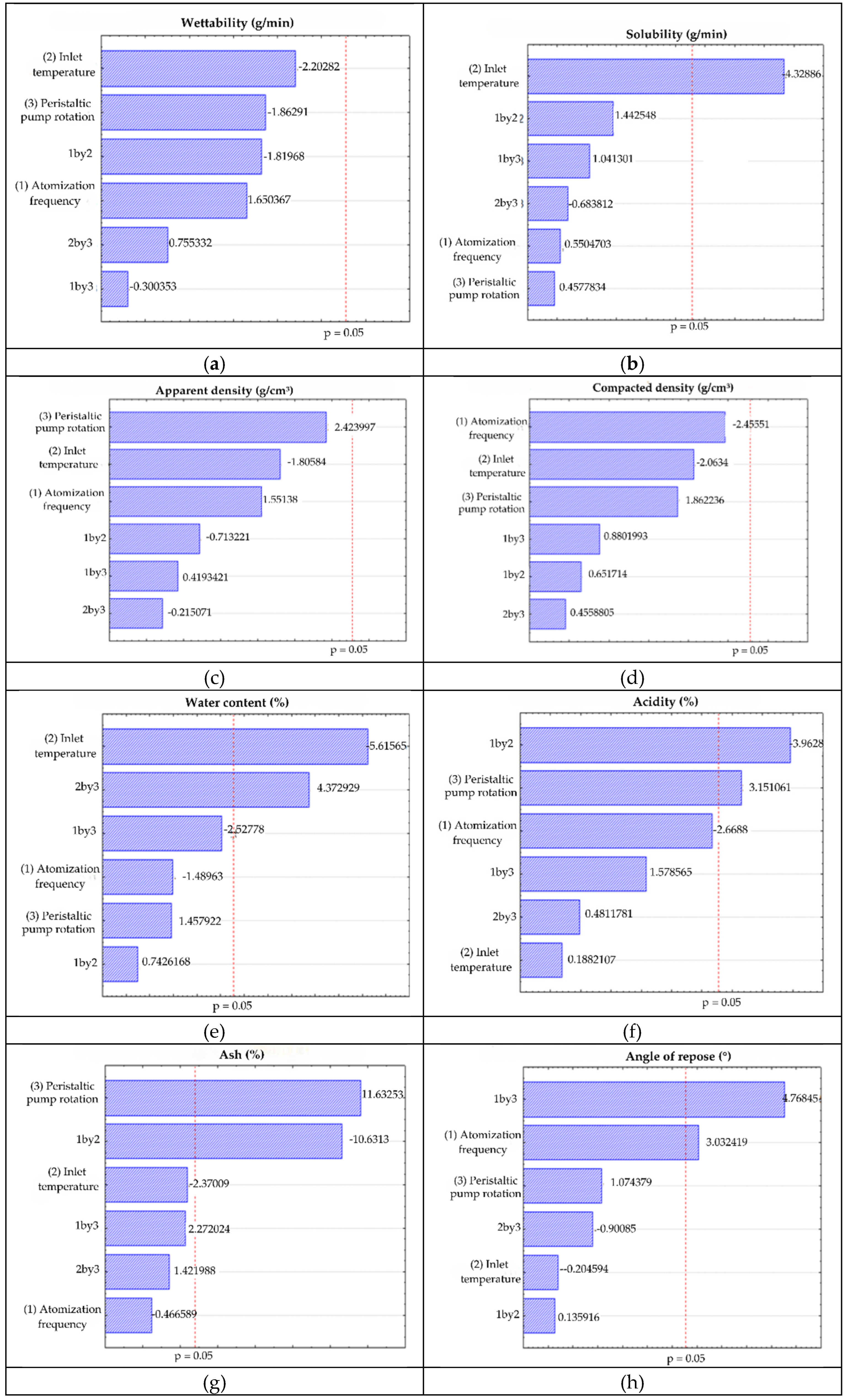
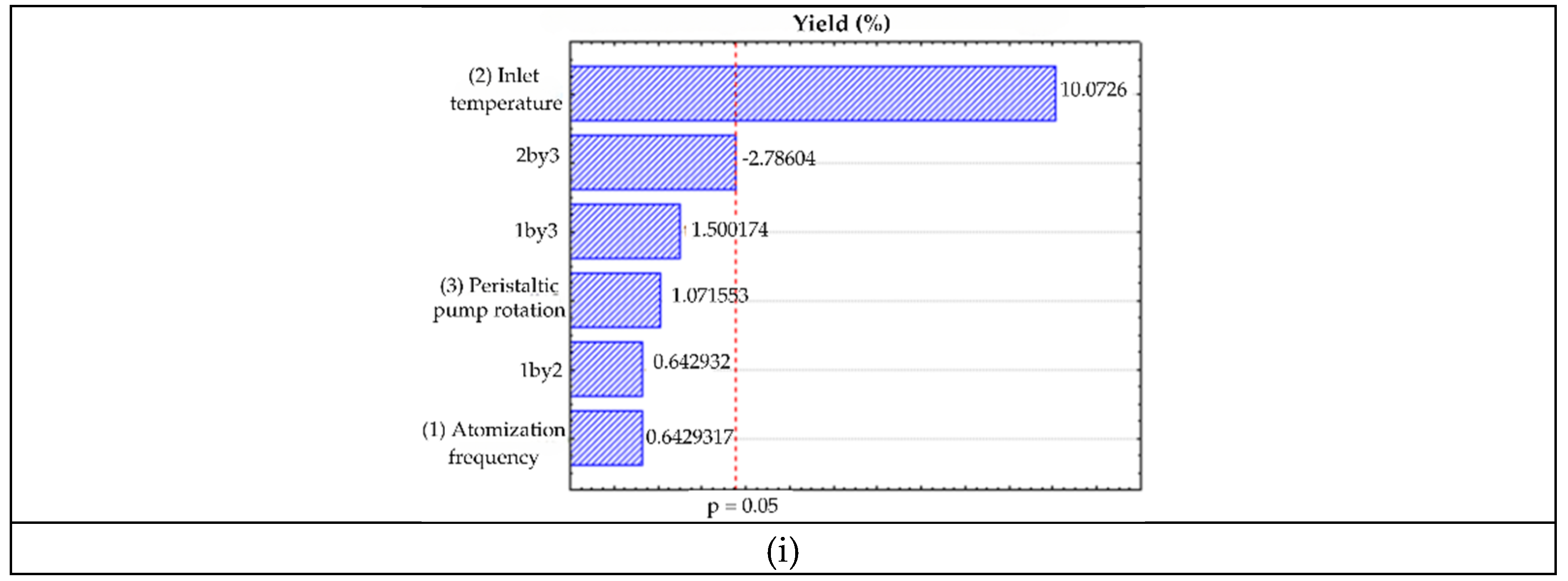
Figure 2.
Pareto Charts for: (a) lipid content, (b) non-fat dry extract, (c) density, (d) protein, (e) lactose, (f) freezing point, (g) pH, and (h) electrical conductivity.
Figure 2.
Pareto Charts for: (a) lipid content, (b) non-fat dry extract, (c) density, (d) protein, (e) lactose, (f) freezing point, (g) pH, and (h) electrical conductivity.
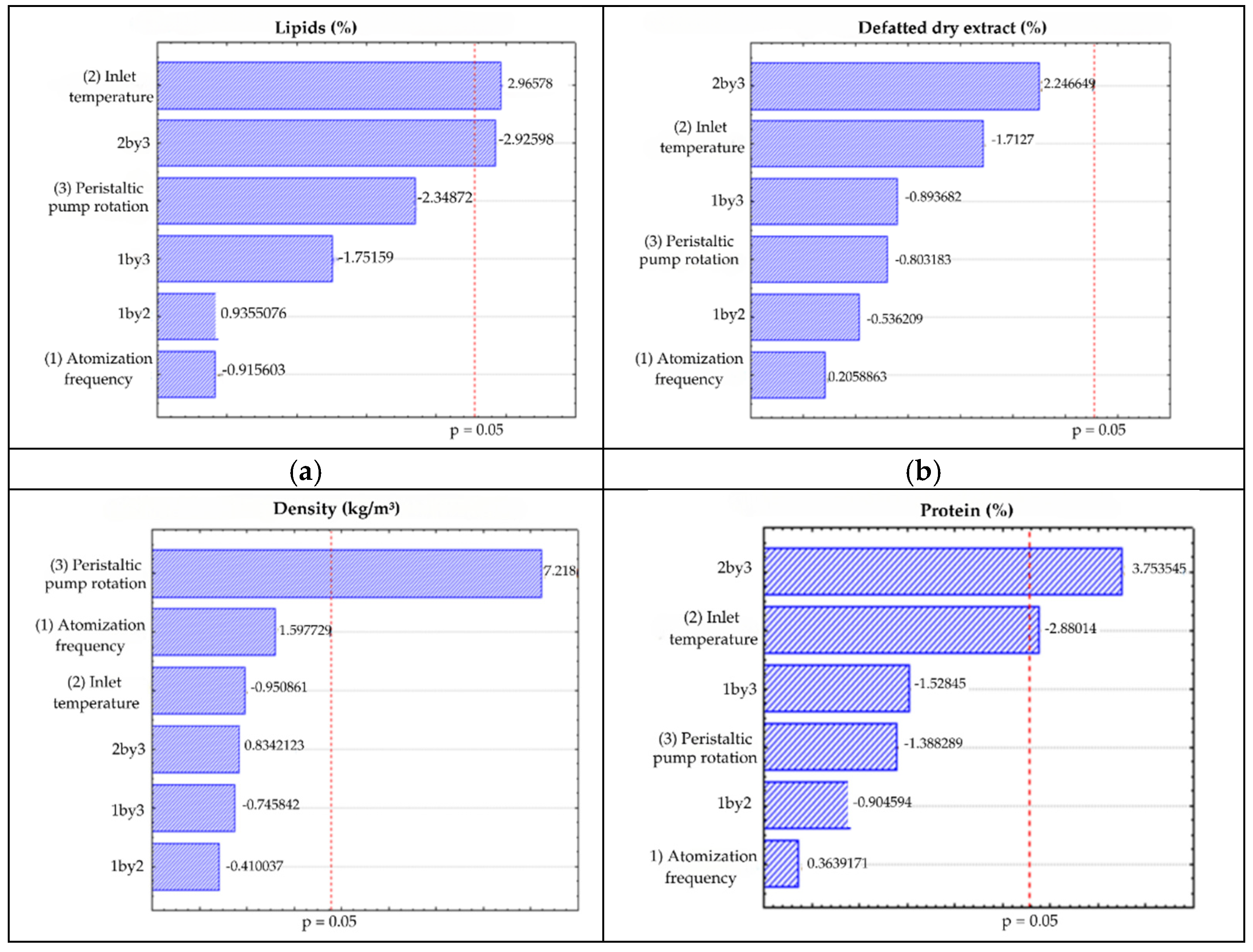
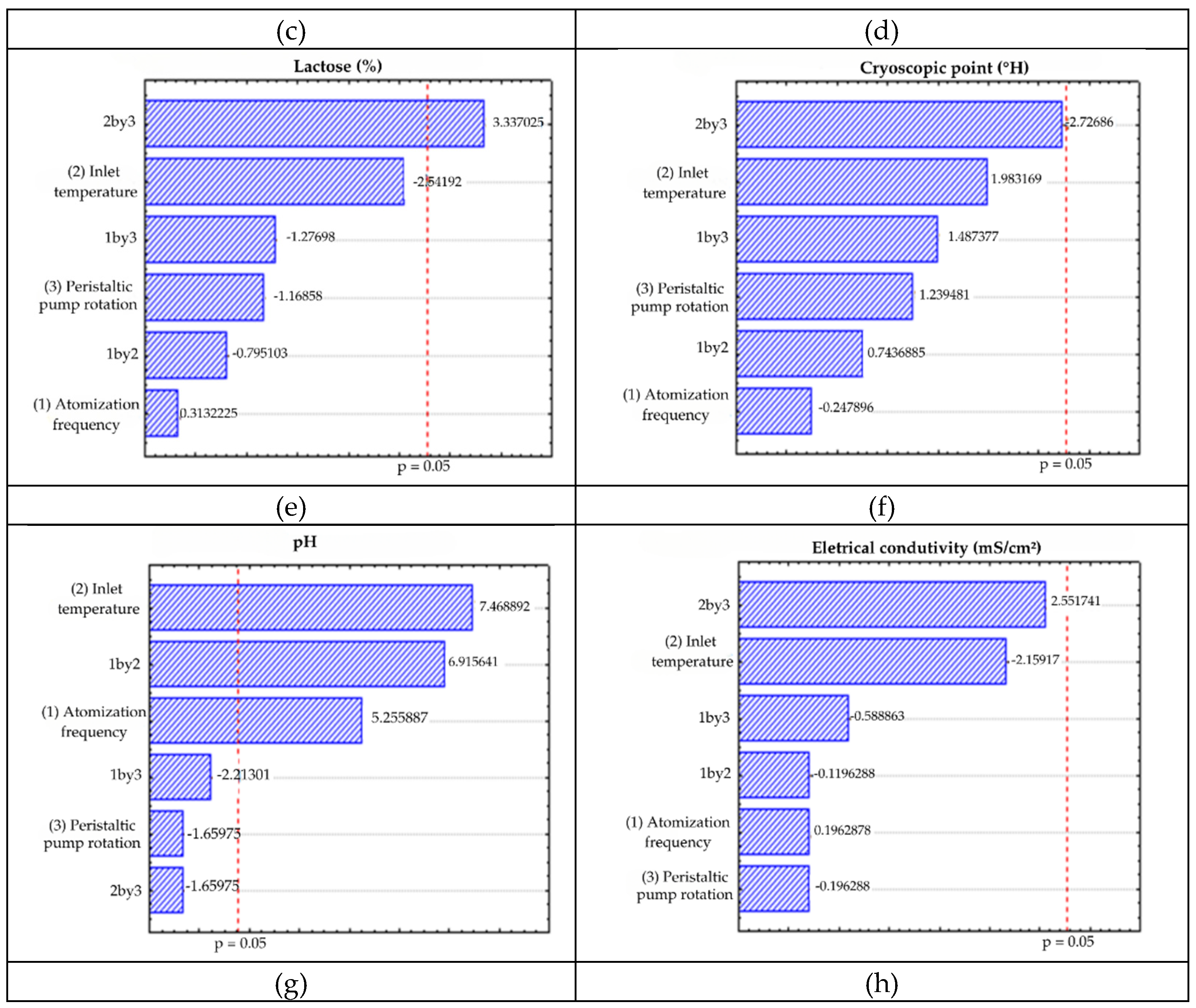

Table 1.
Levels in Relation to the Independent Variables.
| Levels | Atomization Frequency (Hz) | Inlet temperature (°C) | Peristaltic pump rotation (rpm) |
|---|---|---|---|
| -1 | 300 | 160 | 60 |
| 0 | 400 | 180 | 70 |
| +1 | 500 | 200 | 80 |
Table 2.
Experimental Design Matrix 2³ with Three Central Points.
| Assays | Atomization Frequency (Hz) | Inlet temperature (°C) | Peristaltic pump rotation (rpm) |
|---|---|---|---|
| 1 | (-1) 300 | (-1) 160 | (-1) 60 |
| 2 | (+1) 500 | (-1) 160 | (-1) 60 |
| 3 | (-1) 300 | (+1) 200 | (-1) 60 |
| 4 | (+1) 500 | (+1) 200 | (-1) 60 |
| 5 | (-1) 300 | (-1) 160 | (+1) 80 |
| 6 | (+1) 500 | (-1) 160 | (+1) 80 |
| 7 | (-1) 300 | (+1) 200 | (+1) 80 |
| 8 | (+1) 500 | (+1) 200 | (+1) 80 |
| 9 | (0) 400 | (0) 180 | (0) 70 |
| 10 | (0) 400 | (0) 180 | (0) 70 |
| 11 | (0) 400 | (0) 180 | (0) 70 |
Table 3.
Characterization of raw goat milk analyses.
| Parameters | Obtained values | Standard * |
|---|---|---|
| Water content (%) | 87.90 | 87.50 |
| Proteins (%) | 3.36 | Minimum 2.80 |
| Lipids (%) | 3.50 | Around 2.90 |
| Ash (%) | 0.71 | Minimum 0.70 |
| Carbohydrates (%) | 20.06 | --** |
| pH | 6.45 | 6.45 |
| Acidity (%) | 0.14 | 0.13 a 0.18 |
| Lactose (%) | 5.00 | Minimum 4.30 |
| Non-fat solids (%) | 8.39 | Minimum 8.20 |
| Specific mass (kg/m³) | 1028.82 | 1028-1034 |
| Eletrical conductivity (mS/cm²) | 5.32 | --** |
| Cryoscopic point (°H) | -0.570 | -0.550 a 0.585 |
* according to Normative Instruction 37 of October 31, 2000; ** not listed in Normative Instruction 37 of 2000.
Table 4.
Results of the Full Experimental Design 2³ + 3 for Goat Milk Powder.
| Assays | Wett. (g/min) |
Solub. (g/min) |
Apaar. Dens (g/cm³) |
Comp. Dens. (g/cm³) |
Water content (%) |
Acidity (%) | Ash (%) | Rest Angle (°) | Yield (%) |
|---|---|---|---|---|---|---|---|---|---|
| 1 | 0.15 | 1.82 | 0.23 | 0.46 | 4.41 | 1.15 | 4.37 | 21.06 | 25 |
| 2 | 0.18 | 1.22 | 0.25 | 0.44 | 4.49 | 1.12 | 4.53 | 20.93 | 24 |
| 3 | 0.16 | 0.72 | 0.25 | 0.46 | 2.77 | 1.18 | 4.51 | 21.56 | 40 |
| 4 | 0.13 | 1.16 | 0.17 | 0.33 | 2.99 | 1.08 | 4.24 | 20.79 | 39 |
| 5 | 0.14 | 1.54 | 0.31 | 0.52 | 4.38 | 1.14 | 4.53 | 20.69 | 27 |
| 6 | 0.16 | 1.86 | 0.27 | 0.45 | 3.59 | 1.21 | 4.76 | 22.32 | 31 |
| 7 | 0.12 | 0.81 | 0.25 | 0.45 | 4.03 | 1.24 | 4.71 | 20.02 | 29 |
| 8 | 0.14 | 1.00 | 0.25 | 0.44 | 3.55 | 1.13 | 4.55 | 22.42 | 28 |
| 9 | 0.16 | 1.33 | 0.24 | 0.43 | 3.51 | 1.15 | 4.53 | 21.28 | 34 |
| 10 | 0.16 | 1.36 | 0.24 | 0.43 | 3.48 | 1.15 | 4.58 | 21.64 | 35 |
| 11 | 0.16 | 1.43 | 0.24 | 0.42 | 3.44 | 1.15 | 4.53 | 21.66 | 35 |
Wett. – Wettability; Solub. – Solubility; Appar. Dens. – Apparent Density; Comp. Dens. – Compacted Density.
Table 5.
Results of the complete 2³ + 3 experimental design for reconstituted goat milk.
| Assays | Lipidis (%) | NFS (%) | Density (kg/m³) | Protein (%) | Lactose (%) | Cryoscopic point (°H) | pH | Eletrical condutivity (mS/cm²) |
|---|---|---|---|---|---|---|---|---|
| 1 | 3.21 | 10.28 | 1031.98 | 3.79 | 5.64 | -0.68 | 6.26 | 5.07 |
| 2 | 3.05 | 10.64 | 1032.97 | 3.92 | 5.83 | -0.71 | 6.25 | 5.10 |
| 3 | 3.48 | 8.77 | 1031.03 | 3.24 | 4.80 | -0.58 | 6.27 | 4.87 |
| 4 | 3.78 | 9.23 | 1032.23 | 3.41 | 5.04 | -0.62 | 6.41 | 4.90 |
| 5 | 3.26 | 9.24 | 1035.04 | 3.41 | 5.06 | -0.61 | 6.27 | 4.97 |
| 6 | 3.11 | 9.43 | 1035.92 | 3.48 | 5.17 | -0.62 | 6.25 | 4.97 |
| 7 | 3.33 | 9.88 | 1035.47 | 3.64 | 5.41 | -0.66 | 6.27 | 5.00 |
| 8 | 3.04 | 9.18 | 1035.38 | 3.38 | 5.03 | -0.60 | 6.35 | 4.97 |
| 9 | 3.38 | 8.64 | 1034.61 | 3.52 | 5.06 | -0.60 | 6.28 | 4.90 |
| 10 | 3.27 | 9.88 | 1034.52 | 3.64 | 5.41 | -0.66 | 6.30 | 5.00 |
| 11 | 3.26 | 9.71 | 1034.69 | 3.70 | 5.49 | -0.66 | 6.29 | 5.07 |
Disclaimer/Publisher’s Note: The statements, opinions and data contained in all publications are solely those of the individual author(s) and contributor(s) and not of MDPI and/or the editor(s). MDPI and/or the editor(s) disclaim responsibility for any injury to people or property resulting from any ideas, methods, instructions or products referred to in the content. |
© 2024 by the authors. Licensee MDPI, Basel, Switzerland. This article is an open access article distributed under the terms and conditions of the Creative Commons Attribution (CC BY) license (https://creativecommons.org/licenses/by/4.0/).
Copyright: This open access article is published under a Creative Commons CC BY 4.0 license, which permit the free download, distribution, and reuse, provided that the author and preprint are cited in any reuse.


