

Submitted:
01 September 2024
Posted:
05 September 2024
You are already at the latest version
Abstract
Burnout, characterized by emotional and physical exhaustion, poses a significant challenge to adolescent athletes, particularly in high-intensity sports like basketball. Emotional Intelligence (EI) is the ability to manage emotions, which is negatively associated with burnout. Emotional labor, including strategies of surface acting (SA), deep acting (DA), and genuine expression (GE), is a potential key role in emotion management between EI and burnout for athletes. This study aims to investigate the relationship between EI and burnout, as well as the mediating role of emotional labor strategies among adolescent basketball players. Our cross-sectional study, conducted in youth sports schools in four different places of China, involved 260 basketball players. Our study found EI to be negatively associated with burnout. SA and GE were identified as significant mediators in this relationship, with SA positively associated with burnout and GE negatively associated. These findings suggest that enhancing EI and optimizing emotional labor strategies could be key in mitigating burnout among young athletes, thereby improving their well-being and performance.
Keywords:
adolescent athletes
; emotional intelligence
; burnout
; emotional labor
; basketball players
1. Introduction
Burnout is a syndrome of emotional and physical exhaustion, which has become a critical concern for athletes, particularly adolescents who are navigating the developmental challenges of their sport and personal growth[1,2]. Characterized by a range of symptoms including reduced sense of accomplishment, physical and emotional exhaustion, and sport devaluation, burnout can erode an athlete's motivation, performance, and overall enjoyment of their sport[1]. The syndrome not only affects the individual athlete but can also reverberate through their support systems, including coaches, families, and peers. The consequences of athlete burnout are far-reaching, leading to issues such as decreased performance, increased risk of injury, early attrition in youth sports, and even a direct threat to the goal of lifelong physical activity and the wide-ranging health benefits that it provides [3,4]. The increasing professionalization of youth sports has raised concerns about the early specialization and intense training regimens that young athletes are subjected to. This trend is often blamed for the heightened risk of overuse injuries, overtraining, and most notably, athlete burnout. The pressure to excel from a young age, coupled with the belief that early specialization is the key to future success in sports, can result in excessive training loads[4]. This, in turn, may diminish the athletes' intrinsic motivation and pleasure derived from sports participation, leading to a paradoxical increase in burnout and dropout rates.
Sport is an environment where individuals need to motivate themselves to achieve long-term goals through hard training[5]. Moreover, athletes are required to consistently cope with the stress of hard training and competitive pressure, and this includes understanding and regulating their emotions and those of other individuals (e.g., teammates, opponents, coaches, referees, and spectators)[6]. Among the factors influencing an athlete's susceptibility to burnout, emotional intelligence (EI) stands out as a significant predictor. EI, firstly proposed by Salovey and Mayer in 1990, consisting of the abilities to accurately appraise, express, regulate emotion, and to motivate, plan, and achieve by using feelings in one’s life[7]. Mayer described the concept of EI as follows, “the ability to perceive accurately, appraise, and express emotion; the ability to access and/or generate feelings when they facilitate thought; the ability to understand emotion and emotional knowledge; and the ability to regulate emotions to promote emotional and intellectual growth”[8]. The Four-Branch Model of EI views from four areas: (a) accurately perceiving emotion, (b) using emotions to facilitate thought, (c) understanding emotion, and (d) managing emotion[8,9]. EI is a determining psychological skill in the field of sport, which has an influence on emotional control by athletes, decision making, and sporting performance itself[10]. Athletes with high EI are often better equipped to handle stress, maintain motivation, gain achievements, and foster positive relationships with teammates and coaches[11,12,13]. These attributes are crucial in the high-stakes environment of team sports like basketball, where EI is particularly crucial as the foundation for communication and coordination.
Emotional labor is the process of managing feelings and expressions to achieve the professional requirements of emotion when interacting with customers, co-workers and superiors[14]. Emotional labor strategies encompass surface acting (SA), deep acting (DA), and genuine expression (GE)[15]. Surface acting involves altering visible emotional expressions without changing internal feelings, often entailing the suppression or feigning of emotions to meet external demands[16]. Deep acting, on the other hand, is proactive and involves regulating internal emotions to align with desired expressions, reflecting a more authentic emotional experience[17]. Genuine expression represents the spontaneous and unconstrained display of emotions that are naturally felt and deemed appropriate in each context[18]. These strategies highlight the dynamic nature of emotion regulation in various professional and performance-oriented settings.
Emotional labor has been proved to corelate with both EI and burnout. Study shows that antecedent variables of emotional labor strategies may include positive emotions, negative emotions, performance rules, customer orientation and emotional demand–ability matching, which mainly depends on EI[19]. Many experimental results have demonstrated that EI and emotional labor strategy have a specific correlation[20,21,22,23]. In addition, emotional labor is a job stressor that leads to burnout[24]. Among three emotional labor strategies, SA is more likely to cause emotional exhaustion due to the effort required to fake or suppress negative emotions, and consistently produces emotional exhaustion that results in diminished well-being[24,25]. Existing research has confirmed the relationship between emotional labor and burnout among teachers, nurses, dental hygienists, and firefighters all over the world[26,27,28,29].
Given the escalating professionalization and intensification of training regimens in youth sports, it is critical to understand the factors that contribute to or protect against burnout. This study seeks to investigate the mediating role of emotional labor strategies—SA, DA, and GE—between EI and burnout. We intend to provide insights into how different emotional labor strategies may either exacerbate or alleviate the burnout symptoms experienced by young athletes. The findings are expected to contribute to the development of targeted interventions aimed at enhancing EI and optimizing emotional labor strategies to improve athletes' well-being and performance.
2. Materials and Methods
2.1. Participants
A cross-sectional study was conducted in the youth sports schools in Shanghai, Chongqing, Fujian Province, and Shandong Province during March and April, 2024. A total of 277 samples of athletes among basketball players from professional teams were obtained. All athletes were familiarized with the research procedures and signed the informed consent before the survey. Participants volunteered for the study without any recompense. Data were collected through an online survey platform. After excluding 86 invalid questionnaires, 260 samples were involved for data analysis.
2.2. Measurements
Participants were asked to fill in a questionnaire consisting of Wong and Law Emotional Intelligence Scale, a mixed scale to examine emotional labor, Athlete Burnout Questionnaire, gender, age, years of training, and national certificated athletic level.
2.2.1. Emotional Intelligence
The Wong and Law Emotional Intelligence Scale (WLEIS) was used to measure EI[30]. According to the definition of Mayer and Salovey, this scale covers the ability to understand one’s own emotions, to understand the emotions of others, to regulate one’s own emotions and to use one’s own emotions[31]. The WLEIS is comprised of 16 items such as: ‘I really understand what I feel’ and ‘I have good control of my own emotions’ with four subscales corresponding to the four components of EI: self-emotional appraisal, others' emotional appraisal, regulation of emotion, and use of emotion[32]. Each item in the WLEIS is scored on a 7-point Likert scale ranging from 1 (totally disagree) to 7 (totally agree). A higher score of the scale indicates a higher level of EI. The Chinese version of the WLEIS has shown adequate internal consistency and validity[33,34]. The Cronbach’s alpha for the total WLEIS was 0.916 in this study.
2.2.2. Emotional Labor
Emotional labor consists of three strategies: SA, DA, and GE. SA and DA were examined using Emotional Labor Scale by Brotheridge and Lee[35]. For SA, four items were included. One sample item for SA was “Hide my true feelings about a situation.” For DA, three items were involved, and one sample item was “Make an effort to actually feel the emotions that I need to display to others.” The response format was a 5-point Likert scale ranging from 1 (never) to 5 (always). Brotheridge and Lee reported an alpha of 0.86 for SA and 0.89 for DA, respectively. GE was examined using a three-item scale based on the measures of expression of naturally felt emotions developed by Diefendorff et al. Participants were asked to indicate the extent to which they expressed their spontaneous and situational emotions on a 5-point Likert scale from 1 (never) to 5 (always) appropriately. The three items were (a) “I express genuine emotions to athletes,” (b) “I naturally experience appropriate emotions and express so,” and (c) “I express the emotions that I spontaneous”. In this study, we adopted the mixed total scale to investigate the emotional labor strategies, the Cronbach’s alpha of which was 0.793 in this study.
2.2.3. Burnout
Athlete Burnout Questionnaire (ABQ) was used to measure participants’ burnout[1]. The ABQ includes 15 items measuring emotional/physical exhaustion (5 items), reduced sense of accomplishments (5 items) and sport devaluation (5 items). Responses were measured on a 5-point Likert scale ranging from 1 (never) to 5 (always). Previous research has consistently revealed that the ABQ had satisfactory validity and reliability[36,37,38]. The Cronbach’s alpha for the total ABQ was 0.861 in our study.
2.3. Statistics and Analysis
All data were imported into Microsoft Excel for reorganizing and SPSS 24.0 for statistical analysis. Correlations among variables were examined using Pearson’s correlation. The mediating effect and the mediation model of emotional labor strategies between EI and burnout were examined on PROCESS v4.1. The confidence level was set at α=0.05.
3. Results
3.1. Demographic Characteristics
Descriptive statistics on gender, age, years of training, and athletics level are presented in Table 1 by means and standard deviations (M±SD) for continuous variables, or number and percentages (%) for categorical variables. Among the 260 participants aged 15.1±1.95, 70 (26.9%) are males. The years of training for athlete participants ranges from 1 year to 10 years, with an average of 3.93±2.48 years. Nearly half of the athlete participants have obtained a national first-class or second-class athletic level, while the other athlete participants have not yet obtained athletic level certification due to the limitation of age or training years.
3.2. Common Method Bias Test
There may be a common method deviation when using the questionnaire survey method. Harman’s univariate analysis was used to test the common method bias, and all variables were analyzed by non-rotating principal component analysis. The test results showed that there are 9 factors with eigenvalues greater than 1. The contribution rate of the first factor was 28.11%, far lower than the critical value of 40%[39], indicating the data in this study without serious common method bias.
3.3. Correlation Analysis
The bi-variate correlations between investigated variables are presented in Table 2. There is a broad correlation between variables, which provides a reliable basis for subsequent analysis and modeling. Gender, age, years of training, and athletic level are positively correlated with SA, DA, and burnout. EI is negatively correlated with gender. There is a basic correlation between EI, SA, DA, GE and burnout.
3.4. Associations of EI and Emotional Labor Strategies with Burnout
The results of hierarchical linear regression analysis on the associations of EI and the three emotional labor strategies with burnout are presented in Table 3. VIFs of all variables are less than 5, suggesting that multi-collinearity was not an issue in the estimate. Model 1 showed the basic linear regression model of the covariates, with a total explaining effect of 10%. After adjusting for gender, age, years of training, and athlete level in Model 2, EI was negatively associated with burnout (β=-0.276, p<0.001). EI accounted for an additional 21.4% of the variance of burnout. In Model 3, SA was positively associated with fatigue (β=0.307, p<0.001), whereas GE was negatively associated with fatigue (β=-0.252, p<0.001). However, DA was not significantly associated with fatigue (β=0.112, p =0.066). These emotional labor strategies accounted for an additional 9.5% of the variance of burnout. When these emotional labor strategies were added in Model 3, the absolute value β of EI was diminished. Therefore, three dimensions of emotional labor strategies could probably become mediators in the association between EI and burnout.
3.5. Mediating Effect of Emotional Labor
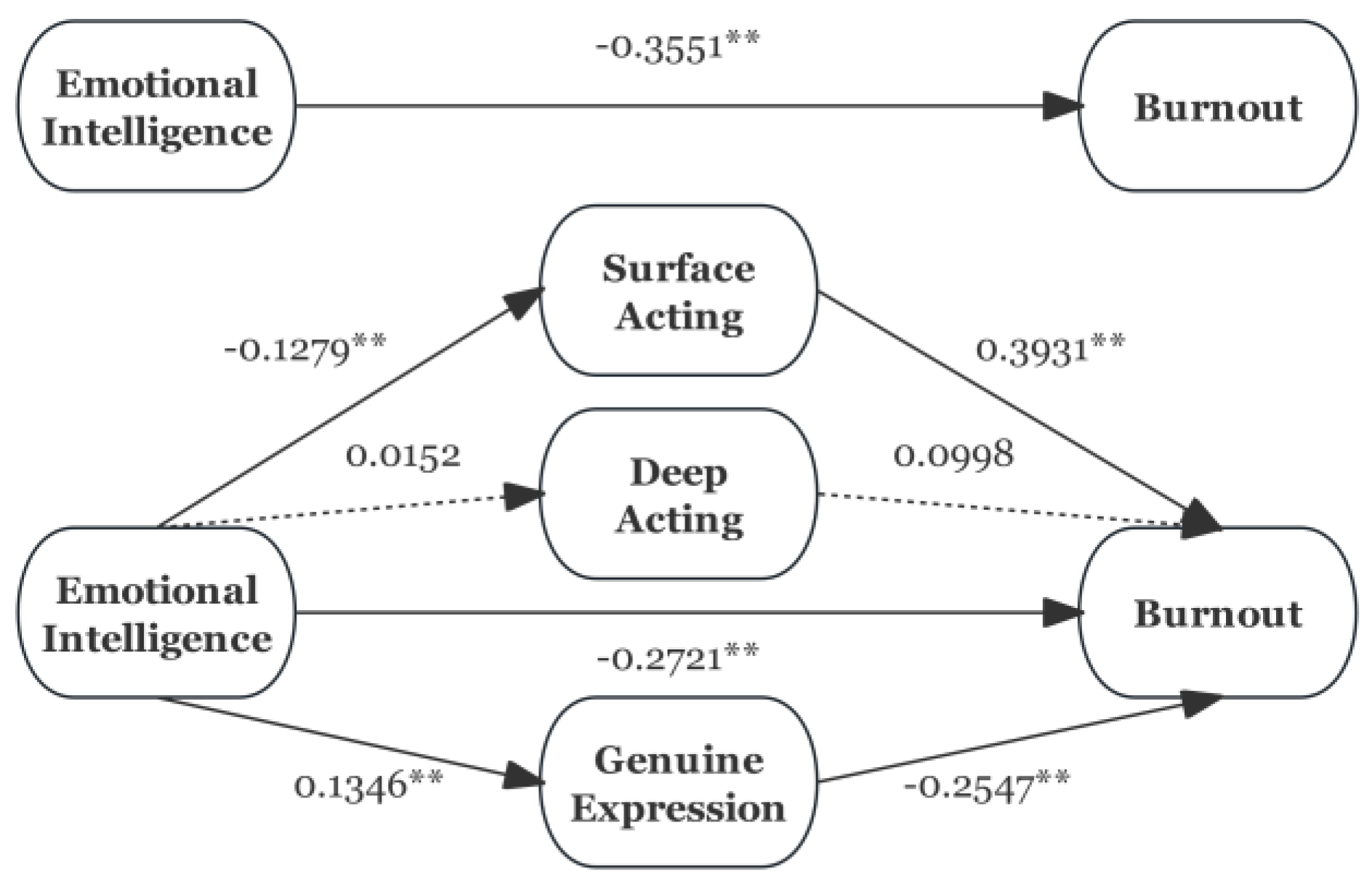
The mediating effect of three emotional labor strategies between EI and burnout was examined using Model 4 of PROCESS developed by Hayes. The result was shown in Table 4 and Table 5. The total predictive effect of EI on burnout (c) was negatively significant. After adding three emotional labor strategies, the effects of EI on SA (a1) and GE (a3) were significant, while SA (b1) and GE (b3) also had significant effects on burnout, respectively. The direct effect of EI on burnout (c’) was still significant with three mediating variables. The indirect effect of SA and GE between EI and burnout was negative. However, DA was negatively related with EI (b1) or burnout (b2), indicating a non-significant pathway. In addition, the proportions of mediating roles of SA and GE were 14.17% and 9.66% in the total effect of EI on burnout, respectively.
Figure 1.
Mediation model of three emotional labor strategies between EI and burnout.
4. Discussion
This study could be one of the few to investigate the relationship between EI and burnout among young athletes. We examined the associations of EI and burnout with emotional labor among adolescent basketball players. The findings indicate that higher levels of EI were associated with lower levels of burnout. Moreover, it also examined the mediation effects of three emotional labor strategies from EI to burnout. Among the three emotional labor strategies, SA and GE were observed to mediate the relationship between EI and burnout. SA was positively associated with burnout, while GE was negatively associated with burnout.
The results showed that EI was negatively correlated with burnout. Previous studies have focused on three groups: doctors, teachers, and students to investigate this correlation. Consistent with our results, people with high levels of EI were more likely to have lower levels of burnout[40,41,42]. A study of 68 medical students used 4 questionnaires to measure EI and burnout which showed that high EI was associated with decreased levels of burnout[43]. Furthermore, a 5-year cohort study showed that general surgery residents populations generally have high levels of burnout. The study demonstrated that each subfield of EI was negatively correlated with burnout[44].
In addition to previous findings, EI also plays a pivotal role in the field of sport as a predictor of identified regulation, introjected regulation and external regulation[45]. Studies have shown that athletes with higher EI tend to have better self-regulation of emotions and the ability to understand emotions of others (e.g., teammates, coaches, etc.)[5]. Firstly, adolescent athletes need long periods of high-intensity repetitive training. Secondly, they must face pressure from coaches, parents, and many other aspects. Under this circumstance, they are more prone to show negative emotions and even be affected to induce psychological problems such as depression and anxiety. Thirdly, they need to complete equally challenging academic tasks while completing training and competition tasks. Eventually, in order to sustain these parallel endeavors, adolescent athletes may risk burnout[46]. EI can provide individuals with the ability to adapt to stressful situations and serve as their protective factor[47]. Therefore, those with high EI have better ability to reduce burnout through emotional regulation strategies to adapt to stress.
Furthermore, this study found that the three emotional labor strategies were not equally associated with burnout among adolescent basketball players. Specifically, our study found that SA was positively associated with burnout, while there was negative associated between GE and burnout. In addition, DA was not associated with burnout. Our results agree with those of a study by Kim in a group of hospital nurses which demonstrated that increased use of SA can lead to an increase in burnout. While, utilizing GE as emotional labor strategy was associated with less burnout[27]. These results could be explained using the conservation of resources (COR) theory by Hobfoll[48]. SA requires a significant number of cognitive resources to repress one's true emotions. In contrast, using GE as an emotional labor strategy to express emotions consumes fewer resources[49]. When athletes are in a high-pressure environment for a long time, their prolonged SA undoubtedly increases their emotional resources, leading to long-term burnout[50].
Our study found that EI affects three emotional labor strategies in different ways. The study found that EI was negatively associated with SA, and positively associated with GE. However, EI was not associated with DA. Our findings are consistent with those of a study by Psilopanagioti et al., which showed a negative correlation between EI and SA[20]. Commonly, People with low emotional intelligence tend to be more likely to employ SA, which means that people with low emotional intelligence have less ability to control and regulate their emotions and are unable to resolve negative emotions in time. Hence, they will only adjust their emotions in their expressions and not truly adjust the actual emotions inside[19]. Sliter et al conducted a study to investigate the associations of age, emotional labor strategies, and EI in service occupations. The age of the study participants ranged from 18 to 68 years. The study found that EI partially affects the association between age and emotional labor strategies[22]. This may also help to explain the findings of this study as to why adolescents may be more prone to use SA strategies. Therefore, as adolescents, they are also more likely to show their true emotions.
Furthermore, our finding indicated that SA and GE partially mediate the associations of EI and burnout. Similarly, Liu et al found in a cross-sectional study that emotional labor strategies can be effective in reducing burnout through EI[23]. Our findings suggests that interventions targeting emotional labor strategies may be effective in reducing burnout in adolescent athletes. For example, adolescent athletes could be trained to improve their ability to manage their emotions in high-pressure environments, thereby promoting the use of effective coping strategies for emotional labor and ultimately reducing burnout.
Our study could be one of the first to focus on adolescent basketball players to investigate the relationship of EI and burnout with emotional labor strategies. However, it still has several limitations. Firstly, this study is a cross-sectional design. The observed results do not reflect causality. Future studies could use a longitudinal design to examine the causal relationships between EI, emotional labor strategies, and burnout over time. Secondly, the study in this article was conducted on adolescent basketball players, of which the results obtained may not be applicable in other sports or individual projects. Future study could consider distributing the questionnaire among a wider group of athletes. Lastly, gender may be a potential moderating factor. However, limited by the sample size in this study, it was insufficient to support analyzing gender differences in the mediating model.
5. Conclusions
The burnout of adolescent basketball players is an issue of concern value. Our findings indicated that EI was negatively associated with burnout. Moreover, the findings suggest that emotional labor strategies may play a mediating role in this relationship. EI could indirectly reduce burnout through the mediating effect of SA and GE strategies. Furthermore, this study highlights the importance of the use of emotional labor strategies to mitigate negative consequences of EI on athletes' burnout.
Author Contributions
W.X. & Y.T. contributed equally as first authors in this study. Conceptualization, W.X.; methodology, W.X. and Y.T.; software, Y.T.; validation, H.W.; investigation, W.X.; resources, W.X.; data curation, Y.T.; writing—original draft preparation, W.X. and Y.T.; writing—review and editing, W.X. and H.W.; visualization, Y.T.; supervision, Y.H., G.L. and H.W. All authors have read and agreed to the published version of the manuscript.
Funding
This research received no external funding.
Institutional Review Board Statement
The study was conducted in accordance with the Declaration of Helsinki, and approved by the Ethics Review Committee for Human Science and Technology of Shanghai Jiao Tong University (No. E2021100I).
Acknowledgments
The authors are grateful to all participants, coaches, schools, and staff for their support and assistance in this study.
Conflicts of Interest
The authors declare no conflicts of interest.
References
- Raedeke, T.D.; Smith, A.L. Development and Preliminary Validation of an Athlete Burnout Measure. J Sport Exerc Psychol 2001, 23, 281–306. [Google Scholar] [CrossRef] [PubMed]
- Eklund1, R.C.; DeFreese, J.D. Athlete Burnout. In Handbook of Sport Psychology; 2020; pp. 1220–1240.
- Seehusen, C.N.; Howell, D.R.; Potter, M.N.; Walker, G.A.; Provance, A.J. Athlete Burnout Is Associated With Perceived Likelihood of Future Injury Among Healthy Adolescent Athletes. Clin Pediatr (Phila) 2023, 62, 1269–1276. [Google Scholar] [CrossRef] [PubMed]
- Brenner, J.S.; Watson, A. Overuse Injuries, Overtraining, and Burnout in Young Athletes. Pediatrics 2024, 153. [Google Scholar] [CrossRef] [PubMed]
- Laborde, S.; Dosseville, F.; Allen, M.S. Emotional intelligence in sport and exercise: A systematic review. Scandinavian Journal of Medicine & Science in Sports 2016, 26, 862–874. [Google Scholar] [CrossRef]
- Meyer, B.B.; Fletcher, T.B. Emotional Intelligence: A Theoretical Overview and Implications for Research and Professional Practice in Sport Psychology. Journal of Applied Sport Psychology 2007, 19, 1–15. [Google Scholar] [CrossRef]
- Salovey, P.; Mayer, J.D. Emotional Intelligence. Imagination, Cognition and Personality 1990, 9, 185–211. [Google Scholar] [CrossRef]
- Mayer, J.D.; Roberts, R.D.; Barsade, S.G. Human Abilities: Emotional Intelligence. Annual Review of Psychology 2008, 59, 507–536. [Google Scholar] [CrossRef]
- Mayer, J.D.; Salovey, P.; Caruso, D.R.; Sitarenios, G. Measuring emotional intelligence with the MSCEIT V2.0. Emotion 2003, 3, 97–105. [Google Scholar] [CrossRef]
- Mercader-Rubio, I.; Ángel, N.G. The Importance of Emotional Intelligence in University Athletes: Analysis of Its Relationship with Anxiety. International Journal of Environmental Research and Public Health 2023, 20, 4224. [Google Scholar] [CrossRef]
- Ubago-Jiménez, J.L.; González-Valero, G.; Puertas-Molero, P.; García-Martínez, I. Development of Emotional Intelligence through Physical Activity and Sport Practice. A Systematic Review. Behavioral Sciences 2019, 9, 44. [Google Scholar] [CrossRef]
- Kopp, A.; Jekauc, D. The Influence of Emotional Intelligence on Performance in Competitive Sports: A Meta-Analytical Investigation. Sports 2018, 6, 175. [Google Scholar] [CrossRef]
- Lott, G.H.; Turner, B.A. Collegiate Sport Participation and Student-Athlete Development through the Lens of Emotional Intelligence. Journal of Amateur Sport 2019, 4, 1–28. [Google Scholar] [CrossRef]
- Diefendorff, J.M.; Croyle, M.H.; Gosserand, R.H. The dimensionality and antecedents of emotional labor strategies. Journal of Vocational Behavior 2005, 66, 339–357. [Google Scholar] [CrossRef]
- Lee, Y.H.; Chelladurai, P. Affectivity, Emotional Labor, Emotional Exhaustion, and Emotional Intelligence in Coaching. Journal of Applied Sport Psychology 2016, 28, 170–184. [Google Scholar] [CrossRef]
- Grandey, A.A. Emotion regulation in the workplace: a new way to conceptualize emotional labor. J Occup Health Psychol 2000, 5, 95–110. [Google Scholar] [CrossRef] [PubMed]
- Gross, J.J. The Emerging Field of Emotion Regulation: An Integrative Review. Review of General Psychology 1998, 2, 271–299. [Google Scholar] [CrossRef]
- Ashforth, B.E.; Humphrey, R.H. Emotional Labor in Service Roles: The Influence of Identity. Academy of Management Review 1993, 18, 88–115. [Google Scholar] [CrossRef]
- Yanyu, G.; Jizu, L. The effect of emotional intelligence on unsafe behavior of miners: the role of emotional labor strategies and perceived organizational support. International Journal of Occupational Safety and Ergonomics 2023, 29, 515–527. [Google Scholar] [CrossRef]
- Psilopanagioti, A.; Anagnostopoulos, F.; Mourtou, E.; Niakas, D. Emotional intelligence, emotional labor, and job satisfaction among physicians in Greece. BMC Health Services Research 2012, 12, 463. [Google Scholar] [CrossRef]
- Yin, H.-b.; Lee, J.C.K.; Zhang, Z.-h.; Jin, Y.-l. Exploring the relationship among teachers' emotional intelligence, emotional labor strategies and teaching satisfaction. Teaching and Teacher Education 2013, 35, 137–145. [Google Scholar] [CrossRef]
- Sliter, M.; Chen, Y.; Withrow, S.; Sliter, K. Older and (Emotionally) Smarter? Emotional Intelligence as a Mediator in the Relationship between Age and Emotional Labor Strategies in Service Employees. Experimental Aging Research 2013, 39, 466–479. [Google Scholar] [CrossRef] [PubMed]
- Liu, L.; Xu, P.; Zhou, K.; Xue, J.; Wu, H. Mediating role of emotional labor in the association between emotional intelligence and fatigue among Chinese doctors: a cross-sectional study. BMC Public Health 2018, 18, 881. [Google Scholar] [CrossRef] [PubMed]
- Jeung, D.Y.; Kim, C.; Chang, S.J. Emotional Labor and Burnout: A Review of the Literature. Yonsei Med J 2018, 59, 187–193. [Google Scholar] [CrossRef] [PubMed]
- Yagil, D. The mediating role of engagement and burnout in the relationship between employees' emotion regulation strategies and customer outcomes. European Journal of Work and Organizational Psychology 2012, 21, 150–168. [Google Scholar] [CrossRef]
- Kariou, A.; Koutsimani, P.; Montgomery, A.; Lainidi, O. Emotional Labor and Burnout among Teachers: A Systematic Review. International Journal of Environmental Research and Public Health 2021, 18, 12760. [Google Scholar] [CrossRef]
- Kim, J.S. Emotional Labor Strategies, Stress, and Burnout Among Hospital Nurses: A Path Analysis. J Nurs Scholarsh 2020, 52, 105–112. [Google Scholar] [CrossRef]
- Jeung, D.Y.; Lee, H.O.; Chung, W.G.; Yoon, J.H.; Koh, S.B.; Back, C.Y.; Hyun, D.S.; Chang, S.J. Association of Emotional Labor, Self-efficacy, and Type A Personality with Burnout in Korean Dental Hygienists. J Korean Med Sci 2017, 32, 1423–1430. [Google Scholar] [CrossRef]
- Jeung, D.Y.; Chang, S.J. Moderating Effects of Organizational Climate on the Relationship between Emotional Labor and Burnout among Korean Firefighters. Int J Environ Res Public Health 2021, 18. [Google Scholar] [CrossRef]
- Law, K.S.; Wong, C.S.; Song, L.J. The construct and criterion validity of emotional intelligence and its potential utility for management studies. J Appl Psychol 2004, 89, 483–496. [Google Scholar] [CrossRef]
- Weng, H.-C.; Hung, C.-M.; Liu, Y.-T.; Cheng, Y.-J.; Yen, C.-Y.; Chang, C.-C.; Huang, C.-K. Associations between emotional intelligence and doctor burnout, job satisfaction and patient satisfaction. Medical Education 2011, 45, 835–842. [Google Scholar] [CrossRef]
- Wong, C.-S.; Law, K.S. The effects of leader and follower emotional intelligence on performance and attitude: An exploratory study. The Leadership Quarterly 2002, 13, 243–274. [Google Scholar] [CrossRef]
- Di, M.; Deng, X.; Zhao, J.; Kong, F. Psychometric Properties and Measurement Invariance Across Sex of the Wong and Law Emotional Intelligence Scale in Chinese adolescents. Psychological Reports 2022, 125, 599–619. [Google Scholar] [CrossRef] [PubMed]
- Ma, J.; Peng, W.; Pan, J. Investigation into the correlation between humanistic care ability and emotional intelligence of hospital staff. BMC Health Services Research 2022, 22, 839. [Google Scholar] [CrossRef]
- Brotheridge, C.M.; Lee, R.T. Testing a conservation of resources model of the dynamics of emotional labor. J Occup Health Psychol 2002, 7, 57–67. [Google Scholar] [CrossRef] [PubMed]
- Dong, L.; Zou, S.; Fan, R.; Wang, B.; Ye, L. The influence of athletes' gratitude on burnout: the sequential mediating roles of the coach-athlete relationship and hope. Front Psychol 2024, 15, 1358799. [Google Scholar] [CrossRef] [PubMed]
- Saarinen, M.; Phipps, D.J.; Bjørndal, C.T. Mental health in student-athletes in Norwegian lower secondary sport schools. BMJ Open Sport Exerc Med 2024, 10, e001955. [Google Scholar] [CrossRef]
- Grugan, M.C.; Olsson, L.F.; Vaughan, R.S.; Madigan, D.J.; Hill, A.P. Factorial validity and measurement invariance of the Athlete Burnout Questionnaire (ABQ). Psychology of Sport and Exercise 2024, 73, 102638. [Google Scholar] [CrossRef]
- Podsakoff, P.M.; MacKenzie, S.B.; Lee, J.Y.; Podsakoff, N.P. Common method biases in behavioral research: a critical review of the literature and recommended remedies. J Appl Psychol 2003, 88, 879–903. [Google Scholar] [CrossRef]
- Almeneessier, A.S.; Azer, S.A. Exploring the relationship between burnout and emotional intelligence among academics and clinicians at King Saud University. BMC Med Educ 2023, 23, 673. [Google Scholar] [CrossRef]
- Molero Jurado, M.D.M.; Pérez-Fuentes, M.D.C.; Martos Martínez, Á.; Barragán Martín, A.B.; Simón Márquez, M.D.M.; Gázquez Linares, J.J. Emotional intelligence as a mediator in the relationship between academic performance and burnout in high school students. PLoS One 2021, 16, e0253552. [Google Scholar] [CrossRef]
- Loi, N.M.; Pryce, N. The Role of Mindful Self-Care in the Relationship between Emotional Intelligence and Burnout in University Students. J Psychol 2022, 156, 295–309. [Google Scholar] [CrossRef] [PubMed]
- Blanchard, C.; Kravets, V.; Schenker, M.; Moore, T., Jr. Emotional intelligence, burnout, and professional fulfillment in clinical year medical students. Med Teach 2021, 43, 1063–1069. [Google Scholar] [CrossRef] [PubMed]
- Gleason, F.; Baker, S.J.; Wood, T.; Wood, L.; Hollis, R.H.; Chu, D.I.; Lindeman, B. Emotional Intelligence and Burnout in Surgical Residents: A 5-Year Study. J Surg Educ 2020, 77, e63–e70. [Google Scholar] [CrossRef] [PubMed]
- Mercader-Rubio, I.; Ángel, N.G.; Ruiz, N.F.O.; Carrión-Martínez, J.J. Emotional intelligence as a predictor of identified regulation, introjected regulation, and external regulation in athletes. Front Psychol 2022, 13, 1003596. [Google Scholar] [CrossRef] [PubMed]
- Gustafsson, H.; Sagar, S.S.; Stenling, A. Fear of failure, psychological stress, and burnout among adolescent athletes competing in high level sport. Scand J Med Sci Sports 2017, 27, 2091–2102. [Google Scholar] [CrossRef]
- Ciarrochi, J.; Deane, F.P.; Anderson, S. Emotional intelligence moderates the relationship between stress and mental health. Personality and individual differences 2002, 32, 197–209. [Google Scholar] [CrossRef]
- Hobfoll, S.E. Stress, culture, and community: The psychology and philosophy of stress; Springer Science & Business Media: 2004.
- Deng, H.; Wu, H.; Qi, X.; Jin, C.; Li, J. Stress Reactivity Influences the Relationship between Emotional Labor Strategies and Job Burnouts among Chinese Hospital Nurses. Neural Plast 2020, 2020, 8837024. [Google Scholar] [CrossRef]
- Song, J.; Liu, F.; Li, X.; Qu, Z.; Zhang, R.; Yao, J. The Effect of Emotional Labor on Presenteeism of Chinese Nurses in Tertiary-Level Hospitals: The Mediating Role of Job Burnout. Front Public Health 2021, 9, 733458. [Google Scholar] [CrossRef]

Table 1.
Demographic characteristics.
| Variables | n (N=260) |
|---|---|
| Gender | |
| Male | 70(26.9%) |
| Female | 190(73.1%) |
| Age | 15.10±1.95 |
| YoT | 3.93±2.48 |
| Level | |
| First-class | 65(25.0%) |
| Second-class | 44(16.9%) |
| None | 151(58.1%) |
* Abbreviations: YoT-Years of Training.
Table 2.
Correlation between variables.
| Gender | Age | YoT | Level | EI | SA | DA | GE | Burnout | |
| Gender | 1 | ||||||||
| Age | 0.11 | 1 | |||||||
| YoT | 0.207** | 0.558** | 1 | ||||||
| Level | 0.376** | 0.620** | 0.563** | 1 | |||||
| EI | -0.254** | -0.051 | 0.097 | -0.072 | 1 | ||||
| SA | 0.352** | 0.228** | 0.246** | 0.340** | -0.169** | 1 | |||
| DA | 0.298** | 0.143* | 0.170** | 0.193** | 0.019 | 0.614** | 1 | ||
| GE | 0.098 | 0.045 | 0.068 | 0.061 | 0.168** | 0.420** | 0.506** | 1 | |
| Burnout | 0.281** | 0.302** | 0.282** | 0.418** | -0.499** | 0.430** | 0.215** | -0.118 | 1 |
* Abbreviations: YoT-Years of Training; EI-Emotional Intelligence; SA- Surface Acting; DA-Deep Acting; GE-Genuine Expression. * p<0.05; **p<0.01.
Table 3.
Associations of EI and emotional labor strategies with burnout.
| Model | Variables | β | t | p | LLCI | ULCI | VIF | R2 | ΔR2 | F |
|---|---|---|---|---|---|---|---|---|---|---|
| Model 1 | 0.2 | 0.2 | 15.932 | |||||||
| Gender | 0.157 | 2.559 | 0.011 | 0.055 | 0.421 | 1.202 | ||||
| Age | 0.086 | 1.127 | 0.261 | -0.022 | 0.082 | 1.873 | ||||
| YoT | 0.044 | 0.611 | 0.542 | -0.026 | 0.05 | 1.638 | ||||
| Level | -0.281 | -3.454 | 0.001 | -0.348 | -0.095 | 2.103 | ||||
| Model 2 | 0.414 | 0.214 | 35.94 | |||||||
| Gender | 0.018 | 0.328 | 0.743 | -0.136 | 0.19 | 1.293 | ||||
| Age | 0.013 | 0.197 | 0.844 | -0.04 | 0.049 | 1.898 | ||||
| YoT | 0.164 | 2.614 | 0.009 | 0.011 | 0.078 | 1.705 | ||||
| Level | -0.276 | -3.957 | 0 | -0.326 | -0.109 | 2.103 | ||||
| EI | -0.489 | -9.643 | 0 | -0.42 | -0.277 | 1.117 | ||||
| Model 3 | 0.509 | 0.095 | 32.54 | |||||||
| Gender | -0.052 | -0.994 | 0.321 | -0.235 | 0.077 | 1.405 | ||||
| Age | 0.001 | 0.023 | 0.982 | -0.041 | 0.042 | 1.906 | ||||
| YoT | 0.13 | 2.236 | 0.026 | 0.004 | 0.066 | 1.718 | ||||
| Level | -0.223 | -3.435 | 0.001 | -0.277 | -0.075 | 2.154 | ||||
| EI | -0.416 | -8.477 | 0 | -0.365 | -0.228 | 1.232 | ||||
| SA | 0.307 | 4.957 | 0 | 0.174 | 0.404 | 1.965 | ||||
| DA | 0.112 | 1.844 | 0.066 | -0.007 | 0.209 | 1.89 | ||||
| GE | -0.252 | -4.684 | 0 | -0.319 | -0.13 | 1.474 |
* Abbreviations: YoT-Years of Training; EI-Emotional Intelligence; SA-Surface Acting; DA-Deep Acting; GE-Genuine Expression.
Table 4.
Mediating effect of emotional labor.
| Outcome variable |
Predictive variable |
Fitting indicators | Coefficients | |||||||
|---|---|---|---|---|---|---|---|---|---|---|
| R | R2 | F | β | SE | t | p | LLCI | ULCI | ||
| Burnout | 0.4985 | 0.2485 | 85.3155 | |||||||
| EI | -0.3551 | 0.0384 | -9.2366 | 0 | -0.4308 | -0.2794 | ||||
| SA | 0.1689 | 0.0285 | 7.5736 | |||||||
| EI | -0.1279 | 0.0465 | -2.752 | 0.0063 | -0.2195 | -0.0364 | ||||
| DA | 0.0193 | 0.0004 | 0.0963 | |||||||
| EI | 0.0152 | 0.0491 | 0.3104 | 0.7565 | -0.0815 | 0.1119 | ||||
| GE | 0.1684 | 0.0284 | 7.5328 | |||||||
| EI | 0.1346 | 0.049 | 2.7446 | 0.0065 | 0.038 | 0.2311 | ||||
| Burnout | 0.6542 | 0.4279 | 47.6911 | |||||||
| EI | -0.2721 | 0.0356 | -7.6379 | 0 | -0.3422 | -0.2019 | ||||
| SA | 0.3931 | 0.0593 | 6.6267 | 0 | 0.2763 | 0.5099 | ||||
| DA | 0.0998 | 0.0579 | 1.7234 | 0.086 | -0.0142 | 0.2139 | ||||
| GE | -0.2547 | 0.051 | -4.9964 | 0 | -0.3551 | -0.1543 | ||||
* Abbreviations: EI-Emotional Intelligence; SA- Surface Acting; DA-Deep Acting; GE-Genuine Expression.
Table 5.
Direct, indirect and total effect.
| Path | Effect | BootSE | BootLLCI | BootULCI | Percentage | |
|---|---|---|---|---|---|---|
| Direct(c') | -0.2721 | 0.0356 | -0.3422 | -0.2019 | 76.63% | |
| Indirect | EL(a*b) | -0.083 | 0.0231 | -0.1266 | -0.0387 | 23.37% |
| SA(a1*b1) | -0.0503 | 0.0205 | -0.0918 | -0.0101 | 14.17% | |
| DA(a2*b2) | 0.0015 | 0.0067 | -0.0128 | 0.0159 | -0.42% | |
| GE(a3*b3) | -0.0343 | 0.0161 | -0.069 | -0.0058 | 9.66% | |
| Total(c) | -0.3551 | 0.0384 | -0.4308 | -0.2794 | 100% | |
* Abbreviations: EL-Emotional Labor; SA-Surface Acting; DA-Deep Acting; GE-Genuine Expression.
Disclaimer/Publisher’s Note: The statements, opinions and data contained in all publications are solely those of the individual author(s) and contributor(s) and not of MDPI and/or the editor(s). MDPI and/or the editor(s) disclaim responsibility for any injury to people or property resulting from any ideas, methods, instructions or products referred to in the content. |
© 2024 by the authors. Licensee MDPI, Basel, Switzerland. This article is an open access article distributed under the terms and conditions of the Creative Commons Attribution (CC BY) license (http://creativecommons.org/licenses/by/4.0/).
Copyright: This open access article is published under a Creative Commons CC BY 4.0 license, which permit the free download, distribution, and reuse, provided that the author and preprint are cited in any reuse.


