

Submitted:
02 September 2024
Posted:
04 September 2024
You are already at the latest version
Abstract
The abundant and renewable resources from fruit byproducts are getting emphasis on their valorization. These byproducts are suspected of possible toxications during cultivation, harvesting, transporting, preservation, or processing. Hence, presenting scientific overviews of the toxicological qualities and detoxification trends of these byproducts is critical to implicating their possible valorization. This review emphasized the toxicological qualities of byproducts from fruits for which the maximum global production occurred in 2022. In this review, heavy metals (As, Cd, Co, Cr, Ni, Pb, and Hg), mycotoxins, toxicant organic compounds, anti-nutritional factors, and pesticide/fungicide residues of the selected fruit byproducts were discussed. Current trends to reduce possible toxicants of these byproducts during their valorization were emphasized. Novel functional foods valorized from these fruit byproducts and future perspectives of detoxification were also focused on in this review.
Keywords:
Toxicology
; qualities
; detoxification
; fruit
; byproducts
; valorization
1. Introduction
The global population is growing rapidly, which demands more resources. Alongside the expanding growth of fruit production, optimum utilization mechanisms of their byproducts are very important. Improving the valorization of fruit byproducts not only ensures proper utilization of agricultural products but also protects environmental pollution. However, some toxic components may be available in these fruit byproducts. Sufficient data on their toxicity should be available for every fruit byproduct. In case of available toxicant component proper reduction mechanism are required before valorization.
Our current living style, food processing method adopted, nature of food sources, and food market globalization are susceptible to food poisoning. Therefore, many organizations such as the Food and Drug Administration (FDA), Food Safety Commission of Japan (FSCJ), European Food Safety Authority (EFSA), and World Health Organization (WHO) from different countries have been developing regulations on food toxicological qualities. Food poisoning agents in fruit byproducts are chemical and natural toxins which can be originated from factors associated with the raw material making up of food products, microorganisms, processing, and conservation conditions. Toxicants from excessive heavy metals, nitrates, oxalates, mycotoxins, and pesticide residues are the main sources of health hazards. Consumption of foods containing maximum concentrations of toxins leads to health hazards. Hence, food supplements, cosmetics, and pharmaceuticals produced from fruit byproducts should ensure high food quality and safety levels.
Agro-food-byproducts are susceptible to toxicants during maturation, harvesting, preservation, and processing. Although agro-food-byproducts are cheaper sources, profitable for local economies, and contain potentially functional ingredients, consumers and the food industries need details of their nutritional and toxicological qualities to be able to make use of them. Health hazards mainly mycotoxins such as aflatoxins, orchratoxin A, patulin, zearalenone, and deoxynivalenol present in fruits and its products cause health effects of mutagenic, neurotoxic, nephrotoxic, hepatic carcinoma, and immunodeficiency respectively [1]. To minimize the risk of mycotoxin contamination, storing fruit byproducts properly and discarding any visibly mouldy or spoiled produce is important. Toxic heavy metals such as lead, cadmium, chromium, cobalt, and nickel can cause harmful damage to humans. These heavy metals excessively build up in edible plant and fruit bodies from the ecosystem where they are cultivated such as from downstream of factories leather (use chromium and other chemicals). Besides, the range of hazard quotient for As, Cd, Cr, Co, Cu, Ni, Hg, and Pb should be determined [2, 3]. Another potentially toxic component in fruit byproducts is pesticide residues. To reduce pesticide exposure, it is advisable to wash the fruit thoroughly before consumption and consider purchasing organic produce whenever possible. Certain fruits also contain naturally occurring toxic compounds that can be harmful if consumed excessively. For example, some nightshade fruits contain solanine, a glycoalkaloid that acts as a natural defense mechanism against pests and diseases [4, 5]. Oxalates are another toxic component that can be present in fruit byproducts. Oxalates are naturally occurring substances found in many plants. Hence, ingesting high amounts of oxalates can lead to the formation of kidney stones in susceptible individuals [6]. Nitrites have been with an increased risk of cancer and other health issues. To minimize nitrite formation, storing these fruit byproducts properly (refrigerated) and avoiding overheating them is recommended. Toxicological and anti-nutrient qualities of many fruit byproducts have not been given much attention and most of the time these parts are discarded with their hidden food, nutraceuticals, and pharmaceutical potential not realized. Hence, evaluating the toxicological and anti-nutrient contents of these byproducts so that the knowledge derived can be used to encourage the use of the byproducts, while also encouraging adequate consumption of fruits, is a value-added application that this review tries to address.
Liu, et al. [7] applied shell thickness-dependent Raman enhancement of silver-coated gold nanoparticles to measure pesticide residues at apple, grape, pear, peach, and mango fruit peels. They reported that pesticide residues named as thiram (1.46-7.23 ng/cm2), chlorpyrifos (0.14-0.7 μg/cm2), and methyl parathion (0.025-0.5 μg/cm2) were found in each of the fruit peels, in which the maximum thiram (7.23 ng/cm2) was observed in mango peel.
Mycotoxins, toxic heavy metals such as arsenic (As), lead (Pb), cadmium (Cd), chromium (Cr), cobalt (Co), and nickel (Ni), pesticide residues, Oxalates, nitrate have Recommended Daily Intake (RDI). Excessively presence of minerals (heavy minerals), saponin, alkaloid, hydrocyanic acid, oxalate, tannins, phytates, and nitrates in fruit byproducts compared to recommended daily allowance (Recommended Daily Intake (RDI)) are considered as toxicant components. The range of hazard quotient (mg/kg) for As, Cd, Cr, Co, Cu, Ni, and Pb are 2.71–11.38, 0.60–3.32, 0.81–3.18, 0.03–0.09, 0.09–0.26, 0.08–0.34 and 0.83–2.23 respectively [3]. The acceptable Daily Intake (ADI) limit or toxicity level of dietary nitrates is 3.7 mg/kg body weight according to the regulations of the Joint Expert Committee of Food and Agriculture (JECFA) and the European Commission’s Scientific Committee on Food (SCF) [8]. Recommended Daily Intake values of potassium, magnesium, iron, zinc, manganese, copper, phosphorus, and calcium for adults are 4.6 g/day, 260 mg/day, 14 mg/day, 7 mg/day, 2.3 mg/day, 900 µg/day, 700 mg/day, and 1000 mg/day, correspondingly [9]. Based on the WHO [10] recommendation, the monthly intake level should be < 0.2 mg/100 g for Aluminium; 0.21 mg/100 g for arsenic (As) and lead (Pb); and 0.25 mg/100 g for cadmium (Cd). Moreover, the maximum lead (Pb) limit for edible parts of crops for human health is 0.02 mg /100 g. Pineapple skin contained lead beyond this maximum limit (0.64 mg /100 g analyzed in dry base), whereas fruit byproducts such as orange peel, watermelon rind, banana peel, apple pomace, strawberry pomace, grape pomace lead contents were insignificantly detected (blow 0.1 µg/L) [11, 12]. According to Oyeyinka and Afolayan [13], fresh banana (M. sinensis) peel contains a lower alkaloid (0.66 g/100 g), oxalate (37.0 g/100 g), phytate ( 2.78 g/100 g) and saponin (6.57 g/100 g) than boiled peel extract of the fruit that composed alkaloid (1.76 g/100 g), oxalate (40.2 g/100 g), and saponin (8.12 g/100 g). Except for oxalate, the alkaloid, phytate, and saponin in this study report are in a safe level for human consumption of the fruit peel. According to the study conducted on the local fruits in Incheon, Korea, the most frequently detected pesticide residues were chlorfenapyr, procymidone, etofenprox, pendimethalin, fluopyram, and azoxystrobin [5].
The anti-nutritional effect of oxalate (a salt formed from oxalic acid) is it can bind to nutrients preventing their absorption. Hence, consuming foods containing high concentrations of oxalic acid can cause nutritional deficiencies and irritation of the lining of the gut. Moreover, from the flavonoid groups, tannins are anti-nutrients that cause health effects. Mainly it involves in chelation of minerals like iron and zinc, which then reduce their absorption, as well as inhibit digestive enzymes, thus causing precipitate proteins [14]. Fruits and berries contain high amounts of oxalates, cyanide-inducing glycoside, amygdalin, sambunigrin, hydrocyanic acid, and toxins [15-18].
Our study tires to give a comprehensive review of the availability of heavy metals (As, Cd, Co, Cr, Ni, Pb, and Hg), mycotoxins, toxicant organic compounds, anti-nutritional factors, and pesticide/fungicide residues in fruit byproducts that have maximum (>1.2 million tons) global production from FAOSTAT during the year of 2022 [19]. Moreover, the current detoxification trends for the selected fruit byproducts were discussed. Utilization of their byproducts for better inspiration of future research and the discovery of biofuel, food ingredients, pharmaceutical, and cosmetic products are getting interest.
2. Fruits with maximum global production and their byproducts
The global production, consumption, and generation of waste and fruits byproducts are increasing from year to year. According to the FAOSTAT database, the fruits with large production during 2022 are bananas, watermelons, apples, oranges, grapes, and the remaining fruits are depicted in Figure 1 in decreasing order [19]. Many fruits are wasted during harvesting, transportation, and processing, and byproducts are produced. Studies have been reporting that from the total fruit weight about 30–50% accounts for fruit waste and byproducts [20]. Nearly half of the fruit parts are discarded in terms of peels, seeds, rinds, husks, rags, roots, and pomace during the day-to-day activities in homes and agro-processing industries. These fruit byproducts are important plant sources containing many bioactive substances, dietary fiber, minerals, and others [21]. Considering their maximum production and byproducts that could be generated, we prioritized discussing the toxicity of the fruits with global production greater than 1.2 million tonnes.
Potential toxicants that can persist in the bioactive compounds extracted from fruit byproducts are mycotoxins, pesticides, biogenic amines, heavy metals, and microbial contaminations. These contaminants are the main causes of the extracted product's safety, such as biological instability, potential for rapid auto-oxidation, potential pathogenic contaminations, high levels of active enzymes, and high water activity [22].
Many fruit byproducts contain potential contaminants such as heavy metals mycotoxin, ant-nutritional contaminants, organic contaminants (biogenic amines), and pesticides [21]. The heavy metals (As, Cd, Co, Cr, Ni, and Pb) present in the prioritized fruit byproducts are summarized in Table 1. Moreover, the selected fruit byproducts containing mycotoxins, toxicant organic compounds, anti-nutritional factors, and pesticide/fungicide residues are presented in Table 2.
Studying the amounts and the toxicity level of the waste and byproducts of the prioritized fruits is demanded for better valorization. In particular, the bananas have the maximum global production in 2022 (Figure 1). The banana peel represents about 35% of the total fresh harvest mass of ripe fruit, a rich source of dietary fiber, protein, essential amino acids, polyunsaturated fatty acids, antioxidant compounds, and potassium [23]. About 25-30% of the apple's total content is represented by byproducts which include seeds and peels. Moreover, nearly 20% of the original grape weight accounts for its byproducts mainly pomace (skins, stems, and residual pulp) and seeds. Besides, the mango processing produces byproducts that range from 40 to 60%, from which about 10–20% represents peels, 10–25% is for seeds, and 15–20% is for kernels. Citrus fruit also creates about 50–70% byproducts, which represent seed (1–10%), peel (flavedo and albedo) (range 60–65%), and internal tissues (30–35%) (Juice sac residues and rag) [24, 25]. The industrial processing of avocados produces byproducts that account for 21–30% of the total, including residues like seeds and peels. Similarly, fresh processing of pineapples creates about 35–46% byproduct mainly residual pulp, peels (30% to 42%), stems (5% core and stem share), and a core only (10%) [24, 26]. As mentioned above, the fruits contained considerable byproducts which could be utilized for types of product development. Hence, ensuring the toxicity of these byproducts for better sustainability and feasibility of valorization is very required.
3. Toxicological qualities of citrus fruit byproducts
Citrus fruits are well known sour fruits such as oranges, lemons, limes, tangerines, and grapefruit. Czech, et al. [27] classified citrus fruits like orange, pomelo (Citrus maxima), mandarins, lemon, and grapefruits. The byproducts of citrus fruits (Rag, peel, and seeds) account for about 50% [28].
Heavy metals mainly lead, cadmium, chromium, copper, lead, and nickel were found in orange, lemon, and grapefruit peels as well as in grape skin extracts [29-31]. Bożym, et al. [32] analyzed heavy metals (Cd, Cr, Ni, and Pb) present in grape and orange peels as shown in Table 1. Analysis of these heavy metals revealed that their concentrations are within the permissible limits for anaerobic digestion to produce biogas.
The heavy metals reported in citrus fruit peel such as orange (Cd=0.00049, Pb = 0.01 mg/kg), lemon (Cd = 0.00047, Pb = 0.0188 mg/kg), red grapefruit (Cd = 0.0019, Pb= 0.03 mg/kg), mandarin (Cd = 0.00062, Pb = 0.02 mg/kg), lime (Cd = 0.0265, Pb= 0.00046 mg/kg), and pomelo (Cd = 0.00136, Pb = 0.0296 mg/kg) were considered Cd and Pb. According to the norms for heavy metals (Regulation 1275/2013 and Ordinance 10/2009), the limit for animal feed consumption for cadmium is 1 mg/kg and 10 mg/kg for lead. Hence, the reported heavy metal concentrations are below these limits [33].
Mateus, et al. [34] investigated heavy metal concentrations in citrus byproducts mainly from orange (Citrus sinensis), lemon (Citrus limon), and lime (Citrus aur antifulia) considering As, Cd, Co, Hg, Ni, and Pb. The concentrations of these heavy metals are summarized in Table 1. They reported that the Hg in all the lemon, orange, and lime; and the As in orange and lime byproducts was reported as below the detection limit.
The heavy metal (lead and cadmium) analysis conducted on citrus fruit peels (orange, pomelo, lemon, and grapefruits) as shown in Table 1 was reported by Czech, et al. [29]. However, according to WHO (0.1-0.2 mg/kg fresh weight of fruit for lead and 0.05 mg/kg for cadmium), the reported results are not beyond the acceptable levels. Moreover, they reported that the peels of these fruits contained tannins (Table 2). The concentration of tannins in grape, orange, and pomelo fruit peels may limit the use of these fruit peels, which demand reduction mechanisms.
According to the European Commission [35], heavy metals and other metals of safety concern (mg/Kg) analyzed in lyophilized citrus byproducts (lemon. orange, and lime) should have a maximum residual level of As (0.02 mg/kg, Cd (0.02 mg/kg), Co (not applicable), Hg (not applicable), Ni (not applicable), and Pb (0.1 mg/kg). The citrus byproducts reviewed in the present study are below this maximum residual level.
The mineral binding anti-nutrients such as oxalates and phytic acid concentrations in citrus fruits (lemon, orange, and grapes) pomace were investigated as negligible amounts (Table 2). Hence, the pomace of these fruits can be valorized into value-added products [36]. However, the presence of tannins should be considered.
Mycotoxins such as aflatoxins (AFB1, AFB2, AFG1, and AFG2), ochratoxin A (OTA), zearalenone (ZEA), toxin T2 (T2), and fumonisins (FB1 and FB2) were found in orange, lemon, or lime pomace. Moreover, alternariol (AOH), and alternariol mono-methyl ether (AME) were determined in other citrus fruit byproducts such as tangerine (Citrus reticulata) peels (range from 0.003 to 0.017 mg/Kg) [34, 37].
Mateus, et al. [34] studied the presence of pesticide residues in fresh citrus pomace. Mainly they determined these pesticides in orange (Pyriproxyfen = 0.027, Fludioxonil = 0.355, Imazalil = 0.007, and Pyrimethanil = 2.77 mg/kg), lemon (Pyriproxyfen = 0.039, Fludioxonil = 0.008, Propiconazole = 0.008, and Pyrimethanil = 3.8 mg/kg), and lime (Fludioxonil = 0.009, Flutriafol = 0.11, Propiconazole = 0.008, Imazalil = 1.49. and Tebuconazole = 0.076 mg/Kg) pomace.
Socas-Rodríguez, et al. [38] studied the pesticides in citrus byproducts. They reported that malathion (0.045 mg/kg) and pyriproxyfen (0.0495 mg/kg) were found dominantly in the studied citrus byproduct samples. The malathion was below MRL whereas the pyriproxyfen was found approximately near to the MRL (0.05 mg/kg). However, other types of pesticides studied were below the detection limit (from 0.0085-0.1288 mg/kg).
Mycotoxins such as alternariol (AOH) and alternariol mono-methyl ether (AME) were found in citrus fruit by-products. In particular, alternariol a type of mycotoxin was identified in tangerine (Citrus reticulata) peels [34].
According to the maximum residual level (MRL) developed by European Food Safety, et al. [39] of some fungicides such as carbendazim (0.2 mg/kg), thiabendazole (7 mg/kg), imazalil (4 mg/kg), and insecticides such as λ-cyhalothrin (0.2 mg/kg), carbofuran (0.01 mg/kg), and chlorpyrifos (1.5 mg/kg); the reviewed results of the fungicides and insecticides in citrus fruits are below the MRLs.
3.1. Oranges
Orange fruit is the fourth globally produced fruit (Figure 1). Large amounts of orange fruit are utilized for juice production, which accounts for about 85% of total processed consumption [40]. Its byproducts are peels, seeds, and pomace.
The heavy metals (Cr, Ni, and Pb) analyzed in orange fruit (Citrus sinensis) seeds and peels were reported as beyond the recommended daily intake set by WHO/FAO (2007) (Cr = 0.05-0.2, Ni = 1.4, and Pb = 0.214 mg/day) which are summarized in Table 1 [41]. Hence, careful handling of these byproducts is required when valorized in functional foods.
Citrus aurantium (L) is commonly known as bitter orange, sour orange, seville orange, bigarade orange, or marmalade orange, which is a rich source of many bioactive compounds. Oral administration of these fruit peel extracts did not cause mortality or signs of acute toxicity in mice at a 2000 mg/kg dose. Hence, this fruit peel can extract many non-toxic phytoconstituents [42].
Essential oils extracted from bitter orange peel were studied for their oral administration toxicity in mice from 48 h to 14 days with a concentration of 2000 mg/kg. It is reported that any of clinical symptoms, acute toxicity or mortality, as well as no change in food intake, behavior, or body weight were observed on the tested mice at the specified time. Other studies have also proven that oral administration of mice with a dose of 5000 mg/kg essential oils did not show any such toxicity except reducing serum total cholesterol of the mice at 10 mg/kg of essential oils from these extracts [42, 43].
The pesticide residues (imidacloprid, abamectin, cypermethrin, and prochloraz) in orange fruits were particularly distributed in its peels and the second most distributions were in the fruit pomace (Table 2). Washing during the fruit process can reduce the pesticide residues from 43.6 to 85.4%. The fruit pomace that passed the juice extraction process contained residues from 46.0–94.7% of imidacloprid, abamectin, cypermethrin, and prochloraz. However, the residue carbendazim was found to lower concentration. Hence, unless proper removal of these pesticide residues is applied valorizing the orange fruit byproducts could have health effects [44].
Epicarp layer of orange fruit containing tryptoquialanines A and C was found (Table 2). However, these concentrations were found within the range of limits of tremorgenic mycotoxins, which can cause deleterious effects on vertebrates [45].
Pesticides like imidacloprid, carbendazim, abamectin, cypermethrin, prochloraz, thiabendazole, and carbaryl; mycotoxins such as fumonisin B1, tryptoquialanines A, and tryptoquialanines C are present in peels and orange by-products [44-46].
The anti-nutritional factors reported in orange fruit peels were oxalates (997.8 mg/kg), hydrogen cyanides (397.9 mg/kg), alkaloids (54.4 mg/kg), and phytates (23 mg/kg). The reported value for hydrogen cyanide in orange fruit peel is below the threshold value (below 3500 mg/ kg) reported as the safety limit [47].
In general, orange fruit peels can be valorized into valuable products by applying toxicity reduction mechanisms. Figure 2 shows some toxicant components present in orange fruit peels.
3.2. Pomelos
Pomelos is a type of citrus fruit, that includes sweet oranges (Citrus sinensis), lemons (Citrus limon), limes (Citrus aurantifulia), tangerines (Citrus reticulata), and grapefruit (Citrus paradisi). About 166.4 million tonnes of these fruits and other citrus fruits (mandarins, clementines, pomelos, grape fruits) were globally produced during 2022 [34]. About 9.6 million tonnes of pomelos were produced during 2022 (Figure 1). The pomelo peel extract accounts 19.56% of the total fresh fruit weight [48].
Li, et al. [49] analyzed the total concentration of pesticides in the pomelo waste parts (epicarp and seeds of pomelo fruit). They reported that the epicarp (0.216 mg/kg) contained the highest than the mesocarp (0.0095 mg/kg), endocarp (0.0044 mg/kg), seed (0.0038 mg/kg), and pulp (0.0011 mg/kg). The reported concentrations were below the acceptable daily intake limit.
Pomelo peels contain heavy metals like Cd and Ni (Table 1), which are below the maximum level set by the European Commission [35].
Pu, et al. [50] assessed pomelo seed oil cytotoxicity in human liver LO2 and human liver cancer HepG2 cells. They reported that IC50 values of the Pomelo seed oils were in the range of 16.31 mg/mL and 28.8 mg/mL, which is acceptable since the non-cytotoxic compounds have IC50 values greater than 1 mg/mL. The cytotoxicity dose of the Majia pomelo seed oil concentration tested in human liver cancer HepG2 cells was in the range of 500 μg/mL to 4000 μg/mL, which were also found non-toxic.
3.3. Mandarin
The etoxazole concentration (0.010~0.637 mg/kg), which is a type of pesticide in citrus (Citrus reticulata Blanco) peel was found larger than its pulp part (0.010~0.011 mg/kg). However, the chronic dietary risk of etoxazole in this fruit peel was in an acceptable range (0.035~0.951%) of the daily consumption recommended dosage [51].
Rossi, et al. [52] studied the cytotoxic effects of essential oil (EO) extracted from Citrus deliciosa fruit peels harvested at different stages of maturation (immature, intermediate, and mature) against HT-29 cells. They reported that the peel extract from mature fruit showed significant cytotoxic properties (IC50 of 110 μg/mL). Hence, bioactive compounds present in these fruit peels like monoterpenes and citronellol can kill or damage cells, and slow or stop the development of rapidly proliferating cancer cells [53].
3.4. Lemon
Lemon fruit structure is divided into albedo, flavedo, and pulp. The albedo and flavedo are byproducts of lemon during its juice production, which are the main sources of pectin, cellulose, essential oils, and pigments. Moreover, the albedo is rich in flavonoids like hesperidin and eriocitrin [54]. The heavy metal concentrations analyzed in kaffir lime peel considered were Cr, Co, Ni, Pb, Cd, Pb, and Hg as shown in Table 1. In this study, all except Hg (Hg = 0.0145 mg/kg) were reported below the detection limit [55]. However, other toxicity studies on fruit peels are scarcely studied. Hence, the valorization of the lemon fruit peel should be done with further investigations of toxicities.
3.5. Grape
Grapefruit is the fifth globally produced fruit with 74.9 million tons (Figure 1). The fruit skins, stems, and seeds of grapefruit account for about 20%, mostly found as pomace during grape juice processing [28].
Grape skin extract contained potential safety hazards such as pesticides (cyprodinil, dimethomorph, and feamoxadone), mycotoxins (ochratoxin A), biogenic amines (Ethanolamine and ethylamine), and heavy metals (Cd and Pb) [31]. In particular, Moncalvo, et al. [31] investigated the pesticide residues (cyprodinil, dimethomorph, and feamoxadone) as well as heavy metals in grape skin powders and extracts. The concentration of these pesticide residues shown in Table 2 is below the minimum recommended limit set by the European Union (cyprodinil = 15, dimethomorph = 15, and feamoxadone = 10 mg/kg). Similarly, the heavy metal concentrations are also below the minimum recommended limit (Pb = 0.23 and Cd = 0.23 mg/kg). The biogenic amines analyzed in waste grape skin powders were also found below the toxicity level. The mycotoxin (Ochratoxin A = 0.1-0.32x10⁻³ mg/kg) content in grape skin powders was also below the maximum residue levels for ochratoxin (0.01 mg/kg). Furthermore, from the review reported by Georganas, et al. [56] the potential hazards found in grape pomace were heavy metals such as As, Pb, Cd, and Ni), toxins like ochratoxin A, and biogenic amines.
Proanthocyanidins are part of polyphenols which are used as plant pigments and are found in grape seeds and skins. Proanthocyanidins found in bioactive extracts from grape seeds and skins were studied for their acute oral toxicity, genotoxicity, and lethal dose 50 (LD50). It is reported that their LD50 is greater than 5000 mg/kg and up to 2000 mg/kg did not show genotoxicity (micronucleated erythrocytes for 72 h treatments) [57, 58]. Moreover, during daily administration of 1420 mg polyphenols enriched with ellagitannin extracts for four weeks, human safety was also found safe [59]. Figure 3 depicts some toxicant components present in grapefruit pomace.
4. Toxicological qualities of tropical fruit byproducts
Tropical fruit byproducts considered here are the peel, pomace and/or seed from avocado, pineapple, banana, papaya, watermelon, and melon fruits.
Tropical fruit byproducts contained hazard heavy metals. de Matuoka e Chiocchetti, et al. [60] studied the heavy metals (Co and Cr) present in banana, papaya, and pineapple peels, summarized in Table 1. The amounts are above the range of hazard quotient (Cr = 0.81–3.18 mg/kg), (Co = 0.03–0.09 mg/kg) respectively [3]. Moreover, the heavy metals analyzed in pineapple and banana peels were As, Cd, Sn, Hg, and Pb. In both peels, low concentrations of these heavy metals were reported (Table 1). In particular, the Arsenic (As), Tin (Sn), Mercury (Hg), and lead (Pb) were <1x10⁻³ mg/Kg [61].
Hassan, et al. [62] studied heavy metal concentrations in avocado seeds and watermelon silage and considered Cr and Ni concentrations. They reported that both fruit byproducts contained insignificant (negligible) Ni. However, the Cr concentrations in avocado seeds and watermelon silage were 0.57-2.29 mg/kg and 4.65.
The anti-nutritional contaminants present in avocado seeds were tannins, alkaloids, phytates, and oxalates, the reported concentrations are summarized in Table 2 [63]. Moreover, the anti-nutritional factors reported in pineapple, banana, and watermelon fruit peels were oxalates, hydrogen cyanides, alkaloids, and phytates, and their concentrations are presented in Table 2. The reported values for hydrogen cyanide in these fruit peels are below the threshold value (below 3500 mg/ kg) reported as the safety limit [47].
The amount of toxic substances summarized in this review can vary from place to place and from measurement to measurement techniques applied. Hence, the reported toxicant components imply that the byproducts should be valorized with the application of further toxicant reduction techniques.
4.1. Avocado
Avocados have nine million tons of global production (Figure 1). Avocados contain peel (7–15%) and stone (including the seed) (14–24%) waste parts of the total fresh fruit weight. These waste parts are sources of many functional components such as antioxidants, bio-oil, bioethanol, etc [64].
The heavy metals analysis considering Co and Pb in avocado seeds was reported as insignificant [63]. Hence, avocado fruit seeds can be valorized for many applications.
Cytotoxicity study conducted on avocado agro-industrial by-products (peel and seed) of two verities (Hass and Fuerte) did not exhibit a cytotoxicity effect on RAW 264.7 cells. Specifically, the cytotoxicity test was performed at different concentrations ranging from 0.1–100 μg/mL of the fruit verities peels and seeds extract and concentrations up to 10 μg/mL have no cytotoxicity effect [65].
Other toxicant compositions in avocado fruit byproducts are scarcely studied. Hence, further toxicity studies on these byproducts are required to fully valorise them.
4.2. Pineapple
Pineapples have about 29.4 million tons of global production. Therefore, much of its byproducts can be valorized into valuable products. The pineapple fruit waste accounts for 60% of the weight of pineapple fruit interns of peeled skin, core, crown end, etc. [66].
As, Cd, Cr, Co, and Pb were found in pineapple peels (Table 1) [60, 61]. The As concentration is almost insignificant, whereas the Cr and Co amounts are considerable. Hence, careful treatment is required before valorization.
The main reasons for mycotoxins development in fruit byproducts are the refrigeration temperature conditions and water activity during storage. In a study on mycotoxins toxicity (aflatoxin B2, aflatoxin G1, and ochratoxin A) levels (shown in Table 2) in pineapple shells were determined below the detection limits (2.9 x10⁻³ mg/kg) [67].
Oxalates and phytic acid concentrations in pineapple pomace are negligible (Table 2), which assures its applicability for value-added products [36].
Stępień, et al. [68] reported the pineapple skin infected with mycotoxin mainly containing fusarium (250 mg/kg). The US Food and Drug Administration (FDA) mycotoxin exposure guidelines state that the total fusarium in cereal foods should be 2–4 mg/kg. Hence, the reported result can be hazardous to human health without proper pretreatment.
Wanwimolruk, et al. [69] analyzed pesticide residues in unpeeled pineapples and reported that considering carbaryl (0.262 mg/kg), carbofuran (1.43 mg/kg), fenobucarb (0.01 mg/kg), isoprocarb (0.313 mg/kg), and propachlor (0.015 mg/kg). Moreover, they analyzed the peeled pineapples which contained much lower than the unpeeled.
In general, pineapple skins are not safe for valorizing into food products as well as for animal forages without detoxification of their toxicants. Other toxicological qualities of fruit by-products are scarcely studied.
4.3. Banana
According to the FAOSTAT database [19], bananas were the first globally produced fruit in 2022 (Figure 1). During the banana processing, the peel part accounts about for 35%. Hence, this percentage of the banana fruit is wasted throughout the processing unless it can be valorized.
The heavy metals analyzed in banana peels were As, Cd, Cr, Co, and Pb, and their concentrations are summarized in Table 1 [30, 60, 61]. In all the analyzed reports, the concentrations of the heavy metals are below the range of the hazardous limits [3].
Šeremet, et al. [70] studied the cytotoxicity of banana peel extract on cells of tongue epithelium (CAL 27), colon epithelial cells (Caco-2), and liver cells (HepG2) in a range of 0.014-10 mg/mL extract concentration and treatment times of 0.5, 1, and 2 hours. They reported polysaccharides containing banana peel aqueous extract has no cytotoxic/proliferative effect on epithelium (CAL 27) and liver cells (HepG2) at any of the tested concentrations or treatment times whereas, 10 mg/mL of the polysaccharides free aqueous extract has shown slight proliferative effect in all three treatment times on the colon epithelial cells (Caco-2).
Fusarium proliferatum is a fungal species that causes crown rot in banana fruits mainly occurring during infection on postharvest [71]. Studies have shown that fumonisin B1 can contaminate banana peels during postharvest [71, 72]. Gomes, et al. [73] reviewed pesticide concentrations in bananas. Accordingly, they reported that pesticides such as chlorpyrifos and methiocarb, which are within the minimum residual limit set by Codex. Moreover, Mohd Zaini, et al. [74] summarized the anti-nutrient composition of banana peel processing using different processing conditions (Table 2). From their report, the phytate, alkaloids, oxalate, and glycoside content in the banana processed by fermentation has shown the maximum concentrations compared to the banana processed by microwave drying, boiling, and air and oven drying methods. A large concentration of glycosides was found in banana peel [75]. Cyanogenic glycosides are the main precursor of hydrogen cyanide (HCN) which can be converted through hydrolysis. Glycosides are carcinogens and HCN are also toxic substance which are formed during the chemical reaction of acids with metal cyanides [74]. Furthermore, the banana and papaya peels contain about 900 mg/kg and 500 mg/kg of tannins [76]. This value could be varied due to different conditions. Hence, careful reduction mechanisms of banana fruit peel contaminants are required during valorization.
4.4. Papaya
Papayas have 13.8 million tons of global production in 2022 as shown in Figure 1 [19]. The waste part (byproduct) of papaya rind and seeds accounts for 10% to 20% [28]. Hence, much of the fruit waste can be valorized into valuable products.
Availability of heavy metals such as As, Cd, Cr, Co, Ni, and Pb were reported in papaya fruit byproducts, and their concentrations are summarized in Table 1[60, 77, 78]. Except for the Cr is slightly higher, all the reported heavy metals were below the range of the hazardous limits [3].
Kumar, et al. [77] investigated the presence of higher nickel in a mature papaya peel (13.2 mg/kg) than in young peel (7.96 mg/kg), mature seed (7.41 mg/kg), and yang seed (5.99 mg/kg). Moreover, about 7.36 mg/kg and 6.41 mg/kg of chromium in mature and young peel were determined respectively. Similarly, the cobalt analyzed in mature seeds and young peels were 0.15 mg/kg and 0.4 mg/kg respectively. In another study reported by Vinha, et al. [78], the heavy metal types of chromium, cobalt, arsenic, cadmium, nickel, and lead were determined as summarized in Table 1.
The anti-nutritional factors such as tannins, oxalates, and phytate analyzed in pawpaw (Carica papaya) seed flour are presented in Table 2 [79]. Toxicants in papaya seed such as phytates (3.04%), glucosinolates (10%), tannins (6.35%), and isothiocyanate (0.03%) were analyzed as dry weight of defatted seed meal. Compared to other toxicants glucosinolates account for the highest proportion of the fruit seed. Besides, the presence of isothiocyanate in the papaya seed oil implies the thioglucosinolate present in the seed hydrolysis to some degree by the thioglycosidase enzyme [80]. Thus, the presence of these toxicants limits the use of papaya seed and its oil for animal or human consumption unless further processing to remove these toxicants could be adopted. Pineapple skin contains larger (597 mg/kg) total toxic metal contents than orange peel, watermelon rind, banana peel, apple pomace, strawberry pomace, and grape pomace which contain all below 50 mg/kg [11].
4.5. Watermelon
Watermelon fruit have global production of 100 million tons in 2022 [19], which is the second most highly produced fruit. The watermelon fruit contains a high amount of water (91%) and sugar (6%). From its total weight of analysis, it consists of rind and seeds, which account for 40% to 45% [81].
Heavy metal concentrations of Citrullis lanatus (watermelon) and Citrullus colocynthis (egusi melon) seeds varieties were reported considering selenium (13 -28 mg/kg), cadmium (0.008-0.1 mg/kg), and lead (0.06-0.09 mg/kg). These heavy metal concentrations are below the acceptable daily intake level (Pb = 0.21 - 0.25 and Cd = 0.06 - 0.07 mg/day) developed by FAO/WHO regulations [82].
In a study conducted on pesticide residues (diazinon, dimethoate, and metalaxyl) in flesh and the flesh plus peel (rind) of watermelon samples, the dimethoate was found in higher concentration (diazinon =2.1x10⁻⁵ mg/kg, dimethoate = 1.95x10⁻³ mg/kg, and metalaxyl = 2.9x10⁻⁵ mg/kg) in the rind part. However, this was much lower than the recommended maximum residue limits (MRL) (dimethoate = 2 x10⁻² mg/kg) [83]. Hence, properly treated watermelon rind could be the main source of bioactive compound recovery, functional, nutraceutical, and industrial applications [84, 85].
Jyothi lakshmi and Kaul [86] investigated the antinutritional quality of watermelon whole meal seeds. They reported that the phytate (9900 mg/kg), tannin (32x105 mg/kg), and oxalate (2130 mg/kg). These amounts could cause health effects and require pretreatment of the watermelon byproducts before consumption or valorization.
4.6. Melon
About 28.6 million tons of melon and other related fruit products were produced globally in 2022 (Figure 1). Melon byproducts mainly peels and seeds account for 58% to 62% of the raw material is discarded as residue. These waste parts are rich sources of nutritional qualities, bioactive compounds, and other valuable products [87]. Therefore, many of these fruit byproducts could be valorized into valuable products.
Ant-nutritional contaminants such as saponins, oxalates, phytates, and tannins were found in melon by-products, and their concentrations are presented in Table 2 [14]. Other hazardous heavy metals, toxicant organic compounds, mycotoxins, and pesticides/fungicides were scarcely studied on fruit melon byproducts. Hence, further studies on these issues are advisable for better valorization.
5. Fruit berries (strawberries, blackberries, cranberries and raspberries)
Fruit berries contain byproducts that can be valorized into many products. The Inedible fractions of blueberries, Cranberries, raspberries, and strawberries from different literature data were reviewed by De Laurentiis, et al. [88]. They reported that blueberries (9-15%), Cranberries (14-17%), raspberries (0%), and strawberries (2-6%) fractions found. Except for the blueberries and strawberries, other fruit berry byproduct toxicity analysis was scarcely studied. Therefore, further investigations on toxicity analysis are required before valorizing them.
Some studies indicated that the berry fruit byproducts are susceptible to mycotoxins. In particular, mycotoxins like alternariol, monomethyl ether, tentoxin, aflatoxins, and ochratoxin A were found in fruit berry byproducts [89]. Moreover, some fungicides such as carbendazim and thiophanatemethyl (Table 2) were found beyond the maximum residual level (MRL) developed by European Food Safety, et al. [39], which are carbendazim (0.1 mg/kg) and thiophanatemethyl (0.1 mg/kg).
5.1. Blueberries
Shotyk [90] studied the heavy metals in wild blueberries and raspberries considering the metals such as Cd, Cr, and Co their amounts are summarized in Table 1. They reported that the RS berries contained slightly lower toxic elements considering the established limit of 0.01 mg/100g (according to Regulation (EC) No. 396/2005 of the European Parliament and Council).
The chlorpyrifos-methyl concentration (4.27×10⁻³ mg/kg) in the blueberry bluecrop variety was reported below the established limit of 0.01 mg/100g (according to the Regulation (EC) No. 396/2005 of the European Parliament and Council) [91]. Moreover, other blueberries from Serbia contained thiametoxan and azoxytrobin (shown in Table 2) below the above-mentioned established limit [92].
5.2. Strawberries
The Cr (1.47x10⁻⁶-3.41×10⁻⁶ mg/kg) and Ni (2.33x10⁻⁶-3.56x10⁻⁶ mg/kg) analyzed in strawberry fruits grown in different mediums containing different minerals were found containing below the maximum daily intake limit (Ni = 0.002 mg/kg and Cr = 1.5 mg/kg) [93].
Shao, et al. [94] studied pesticides, phthalates, and heavy metals in strawberries grown in Shanghai, China. Phthalates such as bis-2-ethylhexyl phthalate (DEHP), diisobutyl phthalate (DIBP), and dibutyl phthalate (DBP), as well as heavy metal residues like lead (Pb), cadmium (Cd), and nickel (Ni) were detected in strawberry pomace. Moreover, the dominantly detected pesticides were procymidone, acetamiprid, boscalid, and carbendazim and their concentrations are summarized in Table 2. They reported that the pesticides, bis-2-ethylhexyl phthalate, diisobutyl phthalate, and dibutyl phthalate, as well as the lead, cadmium, and nickel, were below the estimated daily intake.
Strawberry press-cake is the main source of ellagitannins and dietary fiber, which are important for human health. Total pesticides (2.143 mg/kg) mainly containing fungicides and insecticides present in this byproduct. The acceptable daily intake (%ADI) of pesticides in the ellagitannins should be between 0.2%-4.1% [95]. Hence, this strawberry press-cake is in the acceptable range for a human dose which is equivalent to 100 g of strawberries.
The maximum residual level (MRL) of some fungicides such as carbendazim (0.1 mg/kg), thiabendazole (0.05 mg/kg), imazalil (0.05 mg/kg), thiophanatemethyl (0.1 mg/kg) and insecticides such as λ-cyhalothrin (0.01 mg/kg), carbofuran (0.05 mg/kg), formethanate (0.05 mg/kg), and fenoxicarbp (0.05 mg/kg) in strawberries was developed by European Food Safety, et al. [39]. Except for the carbendazim (0.1 mg/kg) and thiophanatemethyl (0.1 mg/kg) in strawberries were reported equivalent to the maximum residual level, all the analyzed fungicides and pesticides were below the MRLS [95]. Hence, since the concentrations of the above fungicides and pesticides can vary from area to area as well as during measurements, their reduction mechanisms is very required during valorization.
6. Toxicological qualities of other fruits byproducts
Many other fruit byproducts listed below are also produced globally produced. According to the study reported by De Laurentiis, et al. [88], conducted on the amount of fruit purchased and related unavoidable wastes by EU households in 2010, apples (1.2 metric tons), apricots (0.03 metric ton), cherries (0.05 metric ton), and sour cherries (0.01 metric ton) were reported as waste.
Some hazardous metals, mycotoxins, toxicant organic compounds, anti-nutritional factors, and pesticides/fungicides were reported that present in fruit byproducts. For instance, pesticides such as thiram, chlorpyrifos, and methyl parathion were found in apple and mango fruit peels [7].
6.1. Cherry
Cherries have a global production of 2.8 million tons in 2022 that is shown in Figure 1 [19]. However, about 0.05 metric tons of fruits are unavoidable wastes [88]. Hence, many of these byproducts can be valorized into many valuable products.
Pesticide residues in sweet Cherry pits analyzed beyond the Maximum Residue Level set by the European Commission, 2005 (0.01 mg/kg for imidacloprid and phosmet) were phosmet (0.023-0.439 mg/kg) and imidacloprid (0.029 mg/kg). However, many of the other types of pesticide residuals were reported below the maximum residual limit (Table 2). The total pesticide residues in this fruit seeds were reported ranging from 0.139 mg/kg to 2.544 mg/kg [96].
Mateus, et al. [96] analyzed the availability of mycotoxins in sweet cherry pits. They reported that none of the mycotoxins from the analyzed nine mycotoxins (AFs, OTA, ZEA, T2, and FBs) were found in the sweet cherry pits.
The valorization methods of cherry byproducts should consider a further analysis of hazardous metals, mycotoxins, pesticides, anti-nutritional factors, and toxicant organic components, since limited studies have been conducted.
6.2. Apple
Apple is the third globally most-produced with 95.8 million tons in 2022 (Figure 1). During the study conducted on the amount of fruit purchased and related unavoidable wastes by EU households in 2010, apples had 1.2 metric tons of unavoidable waste [88]. During the apple processing its pomace, peel, and seeds are found as byproducts.
Some studies have reported that apple peels contain heavy metals such as Cr and Cd. In particular, the heavy metal concentrations (Cu=3.7, Zn=4.13, Cr=2.25, and Cd=0.002 mg/kg) analyzed in apple peel were below the safety qualification for agricultural products except for chromium (Cr = 0.5 mg/kg) [97]. Moreover, heavy metals (Cd, Cr, Ni, and Pb) found in apple pomace were analyzed below the permissible limits to implicate their non-toxicity during biogas production (Table 1) [32].
Fruit byproducts may contain naturally occurring plant toxins like cyanogenic glycosides, which include amygdalin. In particular, the amygdalin composition studied in apple seeds (from 1000-4000 mg/kg) is higher than its pulp fruit juice. Hence, excessive ingestion of this fruit seed can cause sub-acute cyanide poisoning. However, fruit processing methods such as crushing, fermentation, boiling, soaking, and drying help to reduce the cyanide contents in such fruits [98]. Similarly, the naphthaleneacetic acid residue on 7 varieties of apple skin was found 43.3 mg/kg [99].
From the review reported by Georganas, et al. [56] the potential hazards found in apple by-products were amygdalin, pesticides (e.g., neonicotinoids and arsenic-based pesticides), patulin. The amygdalin is found in the apple seeds which can cause acute cyanide poisoning in humans with the consumption of about 800 g of apple pomace. Moreover, the pesticide residues like neonicotinoids and acetamiprid were detected in apple pomace. Fungicides such as thiophanate, carbendazim, and pyrimethanil in apple pomace were detected in apple pomace although the reported amounts were below the toxicity level set by the United States Environmental Protection Agency (EPA) [100].
Pavicich, et al. [101] investigated alternaria mycotoxins such as alternariol (AOH), alternariol monomethyl ether (AME), alternariol monomethyl ether 3-sulfate (AME-3-S), altenuene (ALT), tenuazonic acid (TeA), tentoxin (TEN), alternariol 3-glucoside (AOH-3-G), alternariol monomethyl ether 3-glucoside (AME-3-G), and altertoxin-I (ATX-I), alternariol 3-sulfate (AOH-3-S) present in apple by-products (pomace). These byproducts passed through different processing (grinding, clarification, centrifugation, and water evaporation) were found to contain ether 3-sulfate (AME-3-S), and alternariol monomethyl ether 3-glucoside (AME-3-G) (Table 2). Alternaria mycotoxins are considered relatively stable and their contamination levels can be reduced during apple concentrate processing listed above.
The anti-nutritional factors reported in apple fruit peels were oxalates, hydrogen cyanides, alkaloids, and phytates, and their concentrations are summarized in Table 2. The reported value for hydrogen cyanide in this fruit peel is below the threshold value (below 3500 mg/ kg) reported as the safety limit [47].
Pesticides such as boscalid and deltamethrin mainly concentrate in the apple skin rather than the pulp and their removal mechanism are thermal process. However, pesticides like acetamiprid cannot be reduced by drying, wet pasteurization, and frying processes except by using the lyophilization method [102].
The overall analysis of the reported data on the toxicity of apple fruit byproducts is healthy for further valorization. However, due to these data varying from production place to place and from measurement to measurement, the valorization method should be done concurrently with toxicity investigations.
6.3. Mango
Mangoes and their related fruits have a global production of 59.2 million tons in 2022 (Figure 1). Mango processing has byproducts mainly peel and stone, which account for 45% of the total fresh fruit weight.
de Matuoka e Chiocchetti, et al. [60] investigated the heavy metals (Co = 28 and Cr = 0.33 mg/kg) present in mango fruit peels. The reported amounts are above the range of hazard quotient (Cr = 0.81–3.18 mg/kg), and (Co = 0.03–0.09 mg/kg) respectively [3]. Hence, a careful reduction method of these heavy metals is required.
Mango peels contain higher phytic acid (254.8 mg/kg) and oxalate (724 mg/kg) than its pulp part [103]. Moreover, mango seed kernels contain a large amount (153x103 mg/kg) of tannins [76]. The anti-nutritional factors reported in mango fruit peels were oxalates, hydrogen cyanides, alkaloids, and phytates, whose concentrations are summarized in Table 2. The reported hydrogen cyanide concentration in mango fruit peels is below the threshold value (below 3500 mg/ kg) reported as the safety limit [47]. Moreover, the anti-nutritional contaminants present in mango kernel flour were tannins, phytic acid, oxalates, and HCN. The reported concentrations (mg/kg) for tannins, phytic acid, oxalates, and HCN were 1027.4, 1149.8, 213.4, and 0.00 respectively [104]. These anti-nutritional factors are below the safety limit stated above.
6.4. Plum
The plums and sloes have together a global production of 12.4 million tons in 2022 (Figure). According to the study conducted on the amount of fruit purchased and related unavoidable wastes by EU households in 2010, from the 0.58 metric tons of plums and sloes purchased about 0.04 metric tons were reported as unavoidable waste [88].
Mohammadi-Moghaddam, et al. [105] analyzed heavy metals such as As, Cd, Ni, Hg, and Pb in the black plum peel. They reported that the Hg, Cd, and Pb were absent, whereas As and Ni were 1.2 mg/kg and 2.8 mg/kg respectively. Moreover, Akter, et al. [106] reported the heavy metal such as As, Cd, Co, Ni, Pb, and Hg concentrations in Plum kernels. They reported that the As and Hg concentrations were <0.1 mg/kg. These heavy metal concentrations were reported as below the tolerable upper intake level recommended by many Food Safety authorities.
Other toxicity reports were scarcely reported. Hence further studies are required to fully valorize the plum fruit byproducts.
6.5. Peaches
Peaches and nectarines together have a global production of 26.4 million tons in 2022 as shown in Figure 1. According to the study conducted on the amount of fruit purchased and related unavoidable wastes by EU households in 2010, from the 1.85 metric tons of peaches and nectarines purchased, about 0.16 metric tons were reported as unavoidable waste [88].
The mineral content of peach fruit homogenized with its peel and pulp was analyzed. The heavy metals considered in this study were reported as chromium (Cr = 0.17-1.38 mg/kg) and lead (Pb <0.10 mg/kg). These results are below the maximum permissible limit value (2.3 mg/kg) for human consumption [107].
Other toxicity properties of the peach fruit byproducts are scarcely investigated. Hence, further studies are required for better valorization of the byproducts.
6.6. Apricot
Apricots have a global production of 3.9 million tons in 2022 (Figure 1). According to the study conducted on the amount of fruit purchased and related unavoidable wastes by EU households in 2010, from the 0.4 metric tons of apricot fruit purchased, about 0.03 metric tons were reported as unavoidable waste [88]. Hence, the unavoidable waste can be valorized into valuable products.
Heavy metals cobalt (Co), cadmium (Cd), and lead (Pb) were studied in apricot kernel and pomace. The heavy mineral concentration reported in the apricot kernel and pomace was summarized in Table 1. However, the concentration of lead (Pb) in these byproducts was reported as insignificant [108]. The amygdalin content in apricot seeds (Amygdalin = 52,000 mg/kg) did not induce any effect in rabbit spermatozoa conducted in vivo. In particular, the dose of apricot seeds (3.0 mg AMG/kg body weight) on the rabbit spermatozoa parameters did not induce any change [109].
The anti-nutritional contaminants present in apricot kernel flour were tannins, phytic acid, oxalates, and HCN. Moreover, these anti-nutritional factors were investigated in raw peach fruit kernel flour. The concentrations of these anti-nutritional factors are presented in Table 2 [104].
The Aflatoxin B1 and B2 present in apricot kernels were measured in the range of 0.0017 to 22.451 mg/kg, in this study removing the discolored kernels was able to remove 97.3%–99.5% of the total aflatoxins [110].
Generally, the apricot byproducts have less toxicity although further confirmation tests are important during valorization.

Table 1.
Dominant heavy metals in fruit byproducts.
| Commodity | Heavy metals (mg/kg) | References | ||||||
| As | Cd | Cr | Co | Ni | Pb | |||
| Apple | Peel Seed Pomace |
<1 | 0.57-3.8 | <1 | <1 | [32, 62, 97] | ||
| Apricot | Kernel Pomace |
0.1-6 |
2.7-35.7 | [108] | ||||
| Avocados | Seeds | 0.57-2.29 | 0.00 | 0.00 | [62, 63] | |||
| Bananas | Peels | <0.0001 | 0.0013-0.18 | 1.42-4.04 | 0.4-47.2 | 0.0038-0.64 | [30, 60, 61] | |
| Blueberries | Pomace | 0.011 | 0.242 | 0.08 | 0.592 | 0.73 | [90] | |
| Grape | Peel/skin/ pomace |
<0.5 | 0.18-2.41 | <0.5 | 0.021-1.11 | [29, 31, 32] | ||
| Lemons | Peels byproducts |
0.004 | 0.00047- 0.25 | 1.04 | 0.038 | 0.973-1.24 | 0.0188- 0.22 | [29, 30, 34] |
| Limes | Byproducts | ND | 0.003 | 0.073 | 1.678 | 0.128 | [34] | |
| Mangoes | 0.33 | 28.0 | [60] | |||||
| Orange | Peel Seed |
<0.5 | 1.04–4.14 |
0.015 | 0.05-2.36 | 0.01-1.75 |
[29, 30, 32, 34, 41] | |
| Papayas | Peel Seed |
0.0287-0.03 | 0.0027-0.00685 | 0.278-7.36 | 0.4-219 | 0.246-13.2 | 0.03-0.044 | [60, 77, 78] |
| Peaches | 0.17-1.38 | <0.10 | [107] | |||||
| Pineapples | Peels | <0.0001 | 0.0074 | 8.77 | 70.3 | 0.0027 | [60, 61] | |
| Plums | Peels | 1.2 | ND | 2.8 | ND | [105, 106] | ||
| Kernels | <0.1 | 0.13 | 0.2 | 1.7 | 0.13 | |||
| Pomelos | Peels | 1.36x10⁻³ | 0.0296 | [29] | ||||
| Raspberries | Pomace | 0.0084 | 0.116 | 0.073 | 0.762 | 0.047 | [90] | |
| Strawberry | Pomace | 0.0078 | <0.01 |
0.00336 | 0.0011 | [93, 94] | ||
| Mandarins | 0.00062 | 0.020 | [33] | |||||
| Watermelons | Peel Seed |
0.008-0.1 | 4.65 | 0.06-0.09 | [62, 82] | |||
ND; Not determined.
Table 2.
Toxicant compounds in fruit byproducts.
| Commodity | Mycotoxins (mg/kg) |
Toxicant organic compounds (mg/kg) |
Anti-nutritional contaminants (mg/kg) |
Fungicide/Pesticide residues (mg/kg) |
References | ||
|---|---|---|---|---|---|---|---|
| Apple | Peel/skin Seed Pomace |
AOH-3-S = 1.4-10.8x10⁻³ AME-3-S = 1.7-10x10-3 |
Naphthaleneacetic acid = 0.433 Amygdalin = 1000-4000 |
Oxalates = 890.7 Hydrogen cyanides = 960.4 Alkaloids = 79.9 Phytates = 14.2 |
Acetamiprid = 72-81 |
[47, 98, 99, 101, 102] | |
| Apricots | Seeds | Aflatoxin B1 and B2 = 0.0017- 22.451 | Amygdalin = 52,000 | Tannins = 1564.4 Phytic acid = 1171.5 Oxalates = 156 |
[104, 109, 110] | ||
| Avocados | Seeds | Tannins = 7.6 Alkaloids = 54 Phytates = 4.4 Oxalates = 44 |
[63] | ||||
| Bananas | Peels | Phytate = 2.11 - 9270 Alkaloids = 0.45 - 5.45 Oxalate = 20 - 8280 Glycosides 149020 Tannin = 900 |
Chlorpyrifos = 0.11–0.8 methiocarb = 0.014-0.183 |
[73, 74] | |||
| Blueberries | Pomace | Chlorpyrifos-methyl = 4.27x10⁻³ thiametoxan 5.15x10⁻³ azoxytrobin 0.187 |
[91, 92] | ||||
| Grapes | Peel/skin Pomace |
Ochratoxin A = 0.1-0.32x10⁻³ | Oxalate = 0.6-0.7 Tannins = 0.274-0.41 |
Cyprodinil = 1.07-1.94 dimethomorph = 0.56-2.73 Feamoxadone = 1.55 |
[29, 31, 36] | ||
| Lemons | Peels/Pomace | Oxalate = 0.4-0.5 Tannins = 0.28 |
Pyriproxyfen = 0.039 Fludioxonil = 0.008 Propiconazole = 0.008 Pyrimethanil = 3.8 |
[29, 34, 36] | |||
| Limes | Pomace | Fludioxonil = 0.009 Flutriafol = 0.11 Propiconazole = 0.008 Imazalil = 1.49 Tebuconazole = 0.076 |
[34] | ||||
| Mangoes | Putrescine = 0.9 | Phytic acid = 254.8 Oxalate = 724 Tannin = 153x103 |
[76, 103, 111] | ||||
| Orange | Peel Pomace |
tryptoquialanine A = 248.1 tryptoquialanine C = 375.80 |
Putrescine = 11.34–151.1 | Tannins = 0.228 Oxalates = 1.2-997.8 Hydrogen cyanides = 397.9 Alkaloids = 54.4 Phytates = 23.4 |
Etoxazole = 0.010~0.637 Imidacloprid = 162.16 Carbendazim = 372.1 Abamectin = 0.261 Cypermethrin = 495.6 Prochloraz = 8.11.7 |
[29, 36, 44, 45, 47, 51, 111] | |
| Papayas | Peel | Putrescine = 5.3–19.3 | Tannin = 17.6-500 Oxalate = 0.6 Phytate = 0.6 |
[76, 79, 111] | |||
| Peaches | Seeds | Putrescine = 1.82–2.02 | Tannins = 5137.6 Phytic acid = 2126.3 Oxalates = 385.9 HCN = 372 |
[104, 111] | |||
| Pears | Putrescine = 23.6–24.2 | [111] | |||||
| Pineapples | Pineapple shell Pomace |
Fusarium = 250 Aflatoxin B2 = 0.008 x10⁻³ Aflatoxin G1 = 0.013-0.033 x10⁻³ Ochratoxin A = 0.051 x10⁻³ |
Putrescine =1.39–7.96 | Oxalates = 0.4-1290.6 Hydrogen cyanides = 715 Alkaloids = 161.9 Phytates = 19.9 |
Carbaryl = 0.262 Carbofuran = 14.3 Fenobucarb = 0.01 Isoprocarb = 0.313 Propachlor = 0.015 |
[36, 47, 67-69, 111] | |
| Pomelos | Peels | Tannins = 0.315 | Total pesticides = 0.216 | [29] | |||
| Strawberry | Pomace | Putrescine = 2.04–6.42 bis-2-ethylhexyl phthalate (DEHP) = 0.25 diisobutyl phthalate (DIBP) = 0.283 and dibutyl phthalate (DBP) and 0.222 |
Total pesticides = 2.143 Procymidone = 0.7 acetamiprid = 0.212 boscalid = 0.745 carbendazim = 0.13 |
[94, 95, 111] | |||
| Tangerines | Peels | Alternariol = 0.003 - 0.017 | [34] | ||||
| Watermelons | Peel | Phytate = 9900 Tannin = 32x105 Oxalate = 2130 Hydrogen cyanides = 1210.2 Alkaloids = 100.9 |
Dimethoate = 1730 | [47, 83, 86] | |||
7. Current trends on fruit byproduct toxicant reduction
Several foods worldwide are contaminated by pesticides and mycotoxins due to the pollution of fruits, vegetables, and cereals [112-118]. Pesticide reduction constitutes one of the Sustainable Development Goals (SDGs). Gavahian et al. (2020) reported on the use of innovative food processing technologies, including high-pressure processing (HPP), pulsed electric fields (PEF), cold plasma (CP), supercritical carbon dioxide (SC-CO2), and ultrasound (USN) processing, as those with good potential for mycotoxin and pesticide reduction. They depend on processing parameters, the type of pesticide/mycotoxin, and the food matrix. Some of the thermal, chemical, and non-thermal mechanisms of toxicant reduction are depicted in Figure 4.
In the same context, Adebo, et al. [119] studied novel non-thermal food processing techniques, particularly high-pressure processing, pulsed electric filed, cold plasma, and ultrasound processing for the decontamination of mycotoxins in food with complete decontamination of mycotoxins at some cases. They also discussed the mechanisms by which reduction/elimination occurs. This takes place through the decomposition of toxins after collision with ions/electrons. Cleavage of bonds, structural degradation of the mycotoxin structure, and cleavage of functional groups are the immediate effects after this decomposition. Other mechanisms include Photolysis/photolytic damage leading to an attack on double bonds and/or heterocyclic moieties in the mycotoxin molecule, dihydroxylation, dehydrogenation, modification of terminal furan ring/alteration, and hydrolysis of lactone ring.
Natural and chemical decontamination of mycotoxins leading to significantly reduced levels in foods with no generation of degradable toxic by-products has been discussed by Agriopoulou, et al. [120].
Prevention strategies should also be followed throughout the food production chain. Management should take place before any fungal infestation; the second step of control should be during the period of fungal invasion of plant material and mycotoxin production; and the third step should be initiated when the agricultural products have been identified as heavily contaminated as reported by Jouany [121].
Wang, et al. [122] suggested that protective agents, including plant extracts, yeast products, bacteria, peptides, enzymes, H2, oligosaccharides, amino acids, adsorbents, vitamins, and selenium could be reduced effectively deoxynivalenol (DON) -induced organ toxicity.
Fu, et al. [123] showed that zearalenone (ZEN) exposure resulted in oxidative stress and ferroptosis by glutathione-dependency. Moreover, melatonin supplementation through enhanced productions of glutathione peroxidase 4 and glutathione alleviated ZEN-induced abnormalities. Similarly, Zhang, et al. [124] discussed the detoxification of aflatoxin B1 (AFB1) in ducks’ primary hepatocytes by the key glutathione S-transferase (GST) isozymes.
Essential oils (EOs) with broad-range antimicrobial effectiveness, low toxicity, and diverse mechanisms of action have been discussed by Prakash, et al. [125] with detailed mechanistic understanding, safety profile, and risk assessment. Singh, et al. [126] referred to the use of Coleus aromaticus essential oil, with thymol as the major compound as a natural antimicrobial agent against food-spoilage bacteria and A. flavus and AFB1 contamination to extend the shelf-life of food products.
Toxic mechanisms of multiple mycotoxins have been reviewed in the editorial New insight into mycotoxins and bacterial toxins [127].
Lowering pesticide residue levels in foods can be carried out by washing, blanching, peeling, thermal treatments, alkaline electrolyzed water washing, cold plasma, ultrasonic cleaning, ozone treatment, and enzymatic treatment [128, 129]. Significance of precision agricultural practices and integrated pest management techniques has been mentioned by the review of Munir, et al. [130].
Organic farming methods have been demonstrated to lower the amount of pesticides consumed through food [131]. In addition, integrated pest management (IPM) techniques- integrating chemical, biological, cultural, and physical approaches to control pests- reduce insecticide applications by 95 % while leading to the preservation or increase of crop yields by conserving wild pollinators [132].
Dietary fibers and prebiotics recovery from fruits and vegetable wastes and by-products display important biological activities, such as gut microbiota modulation, lowering the glycemic load. These have been mentioned by the review of Pop, et al. [133] also addressing aspects, such as recovery and extraction procedures, characterization, and utilization in different food matrixes.
Proper waste management practices, including waste reduction, safe handling, and appropriate treatment should be followed to alleviate from climate change, environmental degradation, and human health problems. Circularity and sustainable growth are solutions to these problems along with thermophilic microbes in the bioremediation of waste as reported by Najar, et al. [134]. These thermophiles emphasize biotechnology and industrial bioprocesses progressions towards the build-up of a zero-carbon maintainable bio-economy [135]. Since thermophiles (heat-loving bacteria) can endure extremely high temperatures, they are a major source of various industrial and biotechnological applications with production of enzymes such as amylase, cellulase, protease, xylanases, pullulanases, pectinases, chitinases, esterases, dehydrogenases, isomerases [136, 137].
Thermophilic microbes have been utilized as sources of therapeutic agents, in the food industries, bioremediation, and valorization [138-140].
Moreover, hazardous pollutant remediation from contaminated environments could be carried out by myco-remediation, a green and eco-friendly tool for pollution management as reported by Navina, et al. [141], Bhattacharya, et al. [142] and Kalia, et al. [143] due to their abundance in hyphal network, heavy metal resistance, generation of hydrolytic and degradative enzymes, high surface area to volume ratio, site for metal-binding proteins, high stability and flexibility towards different temperatures and pH. A wide range of contaminants, including pesticides, hydrocarbons, heavy metals, and various synthetic substances can be removed or reduced. Bioremediation refers to the use of organisms for elimination or reduction of pollutants (Khatua et al., 2023).
Three different mechanisms for expunging the environmental pollutants and initiating a balance in the environment are followed by fungi undergoes including, bioconversion, biodegradation and biosorption. Myco-remediation includes the involvement of fungi in the myco-extraction process to remove heavy metals from polluted materials. Fungi accumulate heavy metals and then extraction of heavy metals takes place along with their secure disposal of from their biomass [144].
8. Novel functional foods from fruit byproducts freed from toxication
Many functional foods can be derived from different food byproducts. Fruits contain vitamins, antioxidants, minerals, and dietary fiber.
Globally, 14 percent of food is lost from harvest. Food loss and waste (FLW) affect food security and nutrition negatively and significantly lead to greenhouse gas (GHG) emissions, environmental pollution, degradation of natural ecosystems and biodiversity loss (https://www.fao.org/policy-support/policy-themes/food-loss-food-waste/en/).
Same for fruit waste where despite the reduction in fruit waste there is still a need for an improvement in bio-waste utilization.
One such example is pineapple due to its excellent organoleptic quality and nutritional quality and good source of phenolic compounds. Animal feed and the pharmaceutical industry constitute the recipients of the pineapple by-products constituting approx.. 29–40% shell, 9–10% core, 2–6% stem, and 2–4% crown, representing approximately 50% (w/w) of the total weight of the pineapple [67]. The by-products contain dietary fiber, vitamins, minerals, phenolic compounds, and other bioactive compounds [145-148]. Natural sources of dietary fibre, antioxidants, pectin, enzymes, organic acids, food additives, essential oils, etc. through different methods of extractions, purifications and fermentations could be derived from pineapple waste utilization as reported by Roda and Lambri [149].
Peaches can be consumed fresh, processed and used as animal feed or fertilizers, or disposed of in landfills. Peach byproducts can be the origin consisting of pulp and peel/skin, constituting 15–28 % of the initial weight [150, 151]. These byproducts could be converted into bioplastics at approximately $1000 per ton of biomass [152]. Bioactive compounds, particularly polyphenols originate from peach juice byproducts (PB), which can produce various compounds such as food additives, antioxidants for pharmaceuticals and cosmetics, and fermentable sugars for bioproducts [153].
Some challenges that need to be taken into account include the fruit maturity and the stage of processing which affect the composition of the byproducts from fruit processing [151]. Another significant problem might be the ineffective characterization of the phenolic content in the extraction of the non-extractable phenolic compounds affecting the underestimation of the real antioxidant capacity and potential of the feedstocks [154, 155]. The polyphenol profile of both extractable polyphenols (EPP) and hydrolyzable polyphenols (HPP) from peach byproducts and peach peels has been determined [156, 157].
Sample preparation and storage conditions are additional factors that need to be carefully designed to prevent perishability and preserve the bioactive components. Reduction of the water content to below 15 % is suitable for maintenance of the microbiological quality of dehydrated vegetables while achieving volume reduction [158].
García-Aparicio, et al. [159] assessed the generation of the peach byproduct (PB) at the pulp refinement stage for juice concentrate production, as feedstock for a biorefinery for the simultaneous production of fermentable sugars and novel functional products. Different conventional and novel enzymatic extraction methods were applied to extract extractable and non-extractable bioactive compounds such as oven drying and freeze drying. They proposed the development of novel functional products for food/feed sectors from the solid residue enriched in recalcitrant phenolic compounds and proteins. Table 3 presents the use of some fruit byproducts in the food industry (Adapted from Teshome, et al. [24]). Moreover, Table 4 presents medicinal and pharmaceutical use from the exploitation of fruit byproducts.
9. Conclusions
Many of the prioritized fruit byproducts have lower toxicity levels, which analyzed in terms of heavy metals (As, Cd, Co, Cr, Ni, Pb, and Hg), mycotoxins, toxicant organic compounds, anti-nutritional factors, and pesticide/fungicide residues. However, for fully valorisation of these by-products pre-treatment mechanisms should be applied to reduce their toxicity. A holistic revalorization of these byproducts with regard to major components, such as fermentable sugars, and value-added components such as the phenolic compounds is required. Details regarding composition, bioactive compounds profile (free and bound compounds), antioxidant capacity and the impact of the drying process are essential for the development of processes and technologies for their reuse, and targeting of industrial sectors for their exploitation. Mycotoxin detoxification and pesticide reduction mechanisms and control strategies have been discussed being highly beneficial for the development of food safety and security. The heavy metals, mycotoxins, toxicant organic compounds, anti-nutritional contaminants, and fungicide/Pesticide residues of some byproducts of fruits prioritized in our study were scarcely studied, Hence, toxicity analysis of each of these fruit byproducts demands further investigations.
Author Contributions
“Conceptualization, Z.T., and T.V.; methodology, Z.T., and T.V; software, Z.T..; validation, Z.T., and T.V.; formal analysis, Z.T., and T.V.; investigation, Z.T., and T.V.; resources Z.T., and T.V.; data curation, Z.T., and T.V.; writing—original draft preparation, Z.T., and T.V.; writing—review and editing, Z.T. S.S and T.V.; visualization, Z.T., and T.V.; S.S and T.V.; project administration, T.V.; funding acquisition, T.V. All authors have read and agreed to the published version of the manuscript.
Funding
This research received no external funding.
Conflicts of Interest
The authors declare no conflict of interest.
References
- Pushparaj, K., A. Meyyazhagan, M. Pappuswamy, A. Mousavi Khaneghah, W.-C. Liu, and B. Balasubramanian, Occurrence, identification, and decontamination of potential mycotoxins in fruits and fruit by-products. Food Frontiers. 2023. 4(1): p. 32-46. [CrossRef]
- Gebrekidan, A., Y. Weldegebriel, A. Hadera, and B. Van der Bruggen, Toxicological assessment of heavy metals accumulated in vegetables and fruits grown in Ginfel river near Sheba Tannery, Tigray, Northern Ethiopia. Ecotoxicology and Environmental Safety. 2013. 95: p. 171-178. [CrossRef]
- Abuzed Sadee, B. and R. Jameel Ali, Determination of heavy metals in edible vegetables and a human health risk assessment. Environmental Nanotechnology, Monitoring & Management. 2023. 19: p. 100761. [CrossRef]
- Nepal, B. and K. J. Stine, Glycoalkaloids: Structure, Properties, and Interactions with Model Membrane Systems. Processes. 2019. 7(8): p. 513.
- Park, B.K., S.H. Kwon, M.S. Yeom, K.S. Joo, and M.J. Heo, Detection of pesticide residues and risk assessment from the local fruits and vegetables in Incheon, Korea. Scientific Reports. 2022. 12(1): p. 9613. [CrossRef]
- Salgado, N., M.A. Silva, M.E. Figueira, H.S. Costa, and T.G. Albuquerque, Oxalate in Foods: Extraction Conditions, Analytical Methods, Occurrence, and Health Implications. Foods. 2023. 12(17): p. 3201.
- Liu, B., G. Han, Z. Zhang, R. Liu, C. Jiang, S. Wang, and M.-Y. Han, Shell Thickness-Dependent Raman Enhancement for Rapid Identification and Detection of Pesticide Residues at Fruit Peels. Analytical Chemistry. 2012. 84(1): p. 255-261. [CrossRef]
- Uddin, R., M.U. Thakur, M.Z. Uddin, and G.M.R. Islam, Study of nitrate levels in fruits and vegetables to assess the potential health risks in Bangladesh. Scientific Reports. 2021. 11(1): p. 4704. [CrossRef]
- Santos, C.M.d., C.M.P.d. Abreu, J.M. Freire, E.d.R. Queiroz, and M.M. Mendonça, Chemical characterization of the flour of peel and seed from two papaya cultivars. Food Science and Technology. 2014. 34(2): p. 353-357.
- WHO, Health impacts of chemicals, W.H.O. (WHO), Editor. 2015, World Health Organization (WHO): Geneva, Switzerland.
- Kuppusamy, S., K. Venkateswarlu, and M. Megharaj, Evaluation of nineteen food wastes for essential and toxic elements. International Journal of Recycling of Organic Waste in Agriculture. 2017. 6(4): p. 367-373.
- Hong, C., Y. Jia, X. Yang, Z. He, and P. Stoffella, Assessing lead thresholds for phytotoxicity and potential dietary toxicity in selected vegetable crops. Bulletin of environmental contamination and toxicology. 2008. 80(4): p. 356-361.
- Oyeyinka, B.O. and A.J. Afolayan, Comparative Evaluation of the Nutritive, Mineral, and Antinutritive Composition of Musa sinensis L.(Banana) and Musa paradisiaca L.(Plantain) Fruit Compartments. Plants. 2019. 8(12): p. 598.
- Silva, M.A., T.G. Albuquerque, R.C. Alves, M.B.P.P. Oliveira, and H.S. Costa, Melon (Cucumis melo L.) by-products: Potential food ingredients for novel functional foods? Trends in Food Science & Technology. 2020. 98: p. 181-189. [CrossRef]
- Shendge, A.K., S. Panja, T. Basu, N.B. Ghate, and N. Mandal, Ameliorating effects of white mulberry on iron-overload-induced oxidative stress and liver fibrosis in Swiss albino mice. Food and Chemical Toxicology. 2021. 156: p. 112520. [CrossRef]
- Erukainure, O.L., N.Z. Msomi, B.K. Beseni, V.F. Salau, O.M. Ijomone, N.A. Koorbanally, and M.S. Islam, Cola nitida infusion modulates cardiometabolic activities linked to cardiomyopathy in diabetic rats. Food and Chemical Toxicology. 2021. 154: p. 112335. [CrossRef]
- Dhanisha, S.S., S. Drishya, and C. Guruvayoorappan, Pithecellobium dulce induces apoptosis and reduce tumor burden in experimental animals via regulating pro-inflammatory cytokines and anti-apoptotic gene expression. Food and Chemical Toxicology. 2022. 161: p. 112816. [CrossRef]
- Inanc, M.E., S. Gungor, D. Yeni, F. Avdatek, V. Ipek, R. Turkmen, O. Corum, H. Karaca, and A. Ata, Protective role of the dried white mulberry extract on the reproductive damage and fertility in rats treated with carmustine. Food and Chemical Toxicology. 2022. 163: p. 112979. [CrossRef]
- FAOSTAT, Food and Agricultural Data, FAO, Editor. 2022, FAOSTAT DOI: https://www.fao.org/faostat/en/#data.
- Jiménez-Moreno, N., I. Esparza, F. Bimbela, L.M. Gandía, and C. Ancín-Azpilicueta, Valorization of selected fruit and vegetable wastes as bioactive compounds: Opportunities and challenges. Critical Reviews in Environmental Science and Technology. 2020. 50(20): p. 2061-2108. [CrossRef]
- Hasan, M.M., M.R. Islam, A.R. Haque, M.R. Kabir, K.J. Khushe, and S.M.K. Hasan, Trends and challenges of fruit by-products utilization: insights into safety, sensory, and benefits of the use for the development of innovative healthy food: a review. Bioresources and Bioprocessing. 2024. 11(1): p. 10. [CrossRef]
- Vilas-Boas, A.A., M. Pintado, and A.L.S. Oliveira Natural Bioactive Compounds from Food Waste: Toxicity and Safety Concerns. Foods, 2021. 10,. [CrossRef]
- Gomes, S., B. Vieira, C. Barbosa, and R. Pinheiro, Evaluation of mature banana peel flour on physical, chemical, and texture properties of a gluten-free Rissol. Journal of Food Processing and Preservation. 2022. 46(8): p. e14441. [CrossRef]
- Teshome, E., T.A. Teka, R. Nandasiri, J.R. Rout, D.V. Harouna, T. Astatkie, and M.M. Urugo, Fruit by-products and their industrial applications for nutritional benefits and health promotion: a comprehensive review. Sustainability. 2023. 15(10): p. 7840.
- Yu, J. and M. Ahmedna, Functional components of grape pomace: their composition, biological properties and potential applications. International Journal of Food Science & Technology. 2013. 48(2): p. 221-237. [CrossRef]
- Choonut, A., M. Saejong, and K. Sangkharak, The Production of Ethanol and Hydrogen from Pineapple Peel by Saccharomyces Cerevisiae and Enterobacter Aerogenes. Energy Procedia. 2014. 52: p. 242-249. [CrossRef]
- Czech, A., E. Zarycka, D. Yanovych, Z. Zasadna, I. Grzegorczyk, and S. Kłys, Mineral Content of the Pulp and Peel of Various Citrus Fruit Cultivars. Biological Trace Element Research. 2020. 193(2): p. 555-563. [CrossRef]
- Sagar, N.A., S. Pareek, S. Sharma, E.M. Yahia, and M.G. Lobo, Fruit and Vegetable Waste: Bioactive Compounds, Their Extraction, and Possible Utilization. Comprehensive Reviews in Food Science and Food Safety. 2018. 17(3): p. 512-531. [CrossRef]
- Czech, A., A. Malik, B. Sosnowska, and P. Domaradzki, Bioactive Substances, Heavy Metals, and Antioxidant Activity in Whole Fruit, Peel, and Pulp of Citrus Fruits. International Journal of Food Science. 2021. 2021(1): p. 6662259. [CrossRef]
- Saleem, M. and M.T. Saeed, Potential application of waste fruit peels (orange, yellow lemon and banana) as wide range natural antimicrobial agent. Journal of King Saud University - Science. 2020. 32(1): p. 805-810. [CrossRef]
- Moncalvo, A., L. Marinoni, R. Dordoni, G. Duserm Garrido, V. Lavelli, and G. Spigno, Waste grape skins: evaluation of safety aspects for the production of functional powders and extracts for the food sector. Food Additives & Contaminants: Part A. 2016. 33(7): p. 1116-1126. [CrossRef]
- Bożym, M., I. Florczak, P. Zdanowska, J. Wojdalski, and M. Klimkiewicz, An analysis of metal concentrations in food wastes for biogas production. Renewable Energy. 2015. 77: p. 467-472. [CrossRef]
- Neshovska, H., Determination of heavy metal content (CD and PB) in citrus feed raw material. 2023.
- Mateus, A.R.S., S. Mariño-Cortegoso, S.C. Barros, R. Sendón, L. Barbosa, A. Pena, and A. Sanches-Silva, Citrus by-products: A dual assessment of antioxidant properties and food contaminants towards circular economy. Innovative Food Science & Emerging Technologies. 2024. 95: p. 103737. [CrossRef]
- Commission, E., Commission regulation (EU) 2023/915 of 25 April 2023 on maximum levels for certain contaminants in food and repealing regulation (EC), in no 1881/2006, O.J.o.t.E. Union, Editor. 2023 p. 103–157.
- Nagarajaiah, S.B. and J. Prakash, Chemical Composition and Bioactivity of Pomace from Selected Fruits. International Journal of Fruit Science. 2016. 16(4): p. 423-443. [CrossRef]
- Soares Mateus, A.R., S. Barros, A. Pena, and A. Sanches-Silva, Chapter Two - The potential of citrus by-products in the development of functional food and active packaging, in Advances in Food and Nutrition Research, E. Capanoglu, M.D. Navarro-Hortal, T.Y. Forbes-Hernández, and M. Battino, Editors. 2023, Academic Press. p. 41-90 DOI:Â . [CrossRef]
- Socas-Rodríguez, B., J.A. Mendiola, M.Á. Rodríguez-Delgado, E. Ibáñez, and A. Cifuentes, Safety assessment of citrus and olive by-products using a sustainable methodology based on natural deep eutectic solvents. Journal of Chromatography A. 2022. 1669: p. 462922. [CrossRef]
- European Food Safety, A., L. Carrasco Cabrera, and P. Medina Pastor, The 2020 European Union report on pesticide residues in food. EFSA Journal. 2022. 20(3): p. e07215. [CrossRef]
- Liu, Y., E. Heying, and S.A. Tanumihardjo, History, Global Distribution, and Nutritional Importance of Citrus Fruits. Comprehensive Reviews in Food Science and Food Safety. 2012. 11(6): p. 530-545. [CrossRef]
- Simeon, E.O., N.S. Amamilom, and I.W. Azuka, Metal assessment and phytochemical screening of orange fruit (Citrus sinensis) seeds and peels. Journal of Pharmacognosy and Phytochemistry. 2018. 7(3): p. 709-714.
- Benayad, O., M. Bouhrim, S. Tiji, L. Kharchoufa, M. Addi, S. Drouet, C. Hano, J.M. Lorenzo, H. Bendaha, M. Bnouham, and M. Mimouni Phytochemical Profile, α-Glucosidase, and α-Amylase Inhibition Potential and Toxicity Evaluation of Extracts from Citrus aurantium (L) Peel, a Valuable By-Product from Northeastern Morocco. Biomolecules, 2021. 11,. [CrossRef]
- Costa, C.A.R.A., T.C. Cury, B.O. Cassettari, R.K. Takahira, J.C. Flório, and M. Costa, Citrus aurantium L. essential oil exhibits anxiolytic-like activity mediated by 5-HT1A-receptors and reduces cholesterol after repeated oral treatment. BMC Complementary and Alternative Medicine. 2013. 13(1): p. 42. [CrossRef]
- Li, Y., B. Jiao, Q. Zhao, C. Wang, Y. Gong, Y. Zhang, and W. Chen, Effect of commercial processing on pesticide residues in orange products. European Food Research and Technology. 2012. 234(3): p. 449-456. [CrossRef]
- de Vilhena Araújo, É., P.H. Vendramini, J.H. Costa, M.N. Eberlin, C.C. Montagner, and T.P. Fill, Determination of tryptoquialanines A and C produced by Penicillium digitatum in oranges: Are we safe? Food Chemistry. 2019. 301: p. 125285. [CrossRef]
- Teixeira, F., B.A. Santos, G. Nunes, J.M. Soares, L.A. Amaral, G.H. Souza, J.T. Resende, B. Menegassi, B.P. Rafacho, K. Schwarz, E.F. Santos, and D. Novello Addition of Orange Peel in Orange Jam: Evaluation of Sensory, Physicochemical, and Nutritional Characteristics. Molecules, 2020. 25,. [CrossRef]
- Romelle, F.D., A. Rani, and R.S. Manohar, Chemical composition of some selected fruit peels. European Journal of Food Science and Technology. 2016. 4(4): p. 12-21.
- Phuong, T.N.Q., P. Van Hung, and N.T.L. Phi, Extraction of flavonoids in pomelos’ peels using Box-Behnken response surface design and their biological activities. Vietnam Journal of Science, Technology and Engineering. 2021. 63(2): p. 52-57.
- Li, X., S. Song, F. Wei, X. Huang, Y. Guo, and T. Zhang, Occurrence, distribution, and translocation of legacy and current-use pesticides in pomelo orchards in South China. Science of The Total Environment. 2024. 913: p. 169674. [CrossRef]
- Pu, S.-m., R.-h. Liang, J. Chen, C.-m. Liu, C.-j. Xu, M.-s. Chen, and J. Chen, Characterization and evaluation of Majia pomelo seed oil: A novel industrial by-product. Food Chemistry Advances. 2022. 1: p. 100051. [CrossRef]
- Wang, Z., J. Pang, C. Liao, Q. Zhang, and D. Sun, Determination of etoxazole in different parts of citrus fruit and its potential dietary exposure risk assessment. Chemosphere. 2021. 268: p. 128832. [CrossRef]
- Rossi, R.C., S.R. da Rosa, P. Weimer, J.G. Lisbôa Moura, V.R. de Oliveira, and J. de Castilhos, Assessment of compounds and cytotoxicity of Citrus deliciosa Tenore essential oils: From an underexploited by-product to a rich source of high-value bioactive compounds. Food Bioscience. 2020. 38: p. 100779. [CrossRef]
- Bhuia, M.S., M.A. Aktar, R. Chowdhury, J. Ferdous, M.A. Rahman, M.S.A. Hasan, and M.T. Islam, Therapeutic potentials of ononin with mechanistic insights: A comprehensive review. Food Bioscience. 2023. 56: p. 103302. [CrossRef]
- Martínez-Zamora, L., M. Cano-Lamadrid, F. Artés-Hernández, and N. Castillejo Flavonoid Extracts from Lemon By-Products as a Functional Ingredient for New Foods: A Systematic Review. Foods, 2023. 12,. [CrossRef]
- Lubinska-Szczygeł, M., A. Kuczyńska-Łażewska, M. Rutkowska, Ż. Polkowska, E. Katrich, and S. Gorinstein Determination of the Major By-Products of Citrus hystrix Peel and Their Characteristics in the Context of Utilization in the Industry. Molecules, 2023. 28,. [CrossRef]
- Georganas, A., E. Giamouri, A.C. Pappas, E. Zoidis, M. Goliomytis, and P. Simitzis Utilization of Agro-Industrial By-Products for Sustainable Poultry Production. Sustainability, 2023. 15,. [CrossRef]
- Lluís, L., M. Muñoz, M. Rosa Nogués, V. Sánchez-Martos, M. Romeu, M. Giralt, J. Valls, and R. Solà, Toxicology evaluation of a procyanidin-rich extract from grape skins and seeds. Food and Chemical Toxicology. 2011. 49(6): p. 1450-1454. [CrossRef]
- Sano, A., Safety assessment of 4-week oral intake of proanthocyanidin-rich grape seed extract in healthy subjects. Food and Chemical Toxicology. 2017. 108: p. 519-523. [CrossRef]
- Heber, D., N.P. Seeram, H. Wyatt, S.M. Henning, Y. Zhang, L.G. Ogden, M. Dreher, and J.O. Hill, Safety and Antioxidant Activity of a Pomegranate Ellagitannin-Enriched Polyphenol Dietary Supplement in Overweight Individuals with Increased Waist Size. Journal of Agricultural and Food Chemistry. 2007. 55(24): p. 10050-10054. [CrossRef]
- de Matuoka e Chiocchetti, G., E.A. De Nadai Fernandes, M.A. Bacchi, R.A. Pazim, S.R.V. Sarriés, and T.M. Tomé, Mineral composition of fruit by-products evaluated by neutron activation analysis. Journal of Radioanalytical and Nuclear Chemistry. 2013. 297(3): p. 399-404. [CrossRef]
- Aboul-Enein, A.M., Z.A. Salama, A.A. Gaafar, H.F. Aly, F. Abou-Elella, and H.A. Ahmed, Identification of phenolic compounds from banana peel (Musa paradaisica L.) as antioxidant and antimicrobial agents. Journal of chemical and pharmaceutical research. 2016. 8(4): p. 46-55.
- Hassan, M., A. Belanche, E. Jiménez, I. Rivelli, A.I. Martín-García, A. Margolles, and D.R. Yáñez-Ruiz, Evaluation of the nutritional value and presence of minerals and pesticides residues in agro-industrial by-products to replace conventional ingredients of small ruminant diets. Small Ruminant Research. 2023. 229: p. 107117. [CrossRef]
- OKOYE, O.O.F.N.C., Comparative Study of the Constituents of the Fruits Pulps and Seeds of Canarium ovatum, Persea americana and Dacryodes edulis. Jordan Journal of Chemistry (JJC). 2017. 12(2): p. 113-125.
- García-Vargas, M.C., M.D. Contreras, and E. Castro Avocado-Derived Biomass as a Source of Bioenergy and Bioproducts. Applied Sciences, 2020. 10,. [CrossRef]
- Tremocoldi, M.A., P.L. Rosalen, M. Franchin, A.P. Massarioli, C. Denny, E.R. Daiuto, J.A.R. Paschoal, P.S. Melo, and S.M. de Alencar, Exploration of avocado by-products as natural sources of bioactive compounds. PLoS One. 2018. 13(2).
- Yusof, Y., S.A. Yahya, and A. Adam, Novel Technology for Sustainable Pineapple Leaf Fibers Productions. Procedia CIRP. 2015. 26: p. 756-760. [CrossRef]
- Santos, D.I., C.F. Martins, R.A. Amaral, L. Brito, J.A. Saraiva, A.A. Vicente, and M. Moldão-Martins Pineapple (Ananas comosus L.) By-Products Valorization: Novel Bio Ingredients for Functional Foods. Molecules, 2021. 26,. [CrossRef]
- Stępień, Ł., G. Koczyk, and A. Waśkiewicz, Diversity of Fusarium species and mycotoxins contaminating pineapple. Journal of Applied Genetics. 2013. 54(3): p. 367-380. [CrossRef]
- Wanwimolruk, C., S. Wanwimolruk, K. Kuaykaimuk, J. Buddhaprom, P. Saenserm, and S. Soikham, Food Safety of Thailand’s Pineapples, Bananas, and Dragon Fruits from Pesticide Contamination: a Study Using GC-MS Analysis. Philippine Journal of Science. 2022. 151(6B): p. 2315-2326.
- Šeremet, D., K. Durgo, S. Jokić, A. Huđek, A. Vojvodić Cebin, A. Mandura, J. Jurasović, and D. Komes, Valorization of Banana and Red Beetroot Peels: Determination of Basic Macrocomponent Composition, Application of Novel Extraction Methodology and Assessment of Biological Activity In Vitro. Sustainability. 2020. 12(11): p. 4539.
- Xie, L., Q. Yang, Y. Wu, J. Xiao, H. Qu, Y. Jiang, and T. Li, Fumonisin B1 Biosynthesis Is Associated with Oxidative Stress and Plays an Important Role in Fusarium proliferatum Infection on Banana Fruit. Journal of Agricultural and Food Chemistry. 2023. 71(13): p. 5372-5381. [CrossRef]
- Xie, L., Y. Wu, Y. Wang, Y. Jiang, B. Yang, X. Duan, and T. Li, Fumonisin B1 induced aggressiveness and infection mechanism of Fusarium proliferatum on banana fruit. Environmental Pollution. 2021. 288: p. 117793. [CrossRef]
- Gomes, H.d.O., J.M.C. Menezes, J.G.M. da Costa, H.D.M. Coutinho, R.N.P. Teixeira, and R.F. do Nascimento, Evaluating the presence of pesticides in bananas: An integrative review. Ecotoxicology and Environmental Safety. 2020. 189: p. 110016. [CrossRef]
- Mohd Zaini, H., J. Roslan, S. Saallah, E. Munsu, N.S. Sulaiman, and W. Pindi, Banana peels as a bioactive ingredient and its potential application in the food industry. Journal of Functional Foods. 2022. 92: p. 105054. [CrossRef]
- Ozabor, P., A. Ojokoh, A. Wahab, and O. Aramide, Effect of fermentation on the proximate and antinutrient composition of banana peels. Int J Biotechnol. 2020. 9(2): p. 105-17.
- Melesse, A., H. Steingass, M. Schollenberger, and M. Rodehutscord, Component composition, in vitro gas and methane production profiles of fruit by-products and leaves of root crops. The Journal of Agricultural Science. 2018. 156(7): p. 949-958. [CrossRef]
- Kumar, S.S., G.T. V, K. K, and M. John, Antioxidant potential and mineral elemental profiling of young and mature fruit and leaf of Carica papaya L. cultivar 'Red Lady'. Journal of Trace Elements and Minerals. 2024. 9: p. 100166. [CrossRef]
- Vinha, A.F., A.S.G. Costa, L. Espírito Santo, D.M. Ferreira, C. Sousa, E. Pinto, A. Almeida, and M.B.P.P. Oliveira High-Value Compounds in Papaya By-Products (Carica papaya L. var. Formosa and Aliança): Potential Sustainable Use and Exploitation. Plants, 2024. 13,. [CrossRef]
- Ibrahim, S., E.D. Inelo, and M.O. Eke, Physico-chemical, alveograph and anti-nutritional properties of breads formulated from wheat and pawpaw (Carica papaya) seed flour blends. Asian Food Science Journal. 2021. 20(3): p. 72-85.
- Marfo, E., O. Oke, and O. Afolabi, Chemical composition of papaya (Carica papaya) seeds. Food Chemistry. 1986. 22(4): p. 259-266.
- Capossio, J.P., M.P. Fabani, M.C. Román, X. Zhang, J. Baeyens, R. Rodriguez, and G. Mazza Zero-Waste Watermelon Production through Nontraditional Rind Flour: Multiobjective Optimization of the Fabrication Process. Processes, 2022. 10,. [CrossRef]
- Falade, O.S., I.O. Otemuyiwa, A.S. Adekunle, S.A. Adewusi, and O. Oluwasefunmi, Nutrient composition of watermelon (Citrullis lanatus (Thunb.) Matsum. &Nakai) and egusi melon (Citrullus colocynthis (L.) Schrad.) seeds. Agriculturae Conspectus Scientificus. 2020. 85(1): p. 43-49.
- Wanwimolruk, S., O. Kanchanamayoon, S. Boonpangrak, and V. Prachayasittikul, Food safety in Thailand 1: it is safe to eat watermelon and durian in Thailand. Environmental Health and Preventive Medicine. 2015. 20(3): p. 204-215. [CrossRef]
- Zia, S., M.R. Khan, M.A. Shabbir, and R.M. Aadil, An update on functional, nutraceutical and industrial applications of watermelon by-products: A comprehensive review. Trends in Food Science & Technology. 2021. 114: p. 275-291. [CrossRef]
- Zia, S., M.R. Khan, R.M. Aadil, and I.G. Medina-Meza, Bioactive Recovery from Watermelon Rind Waste Using Ultrasound-Assisted Extraction. ACS Food Science & Technology. 2024. 4(3): p. 687-699. [CrossRef]
- Jyothi lakshmi, A. and P. Kaul, Nutritional potential, bioaccessibility of minerals and functionality of watermelon (Citrullus vulgaris) seeds. LWT - Food Science and Technology. 2011. 44(8): p. 1821-1826. [CrossRef]
- Rolim, P.M., L.M.A.J. Seabra, and G.R. de Macedo, Melon By-Products: Biopotential in Human Health and Food Processing. Food Reviews International. 2020. 36(1): p. 15-38. [CrossRef]
- De Laurentiis, V., S. Corrado, and S. Sala, Quantifying household waste of fresh fruit and vegetables in the EU. Waste Management. 2018. 77: p. 238-251. [CrossRef]
- Juan, C., J. Mañes, G. Font, and A. Juan-García, Determination of mycotoxins in fruit berry by-products using QuEChERS extraction method. LWT. 2017. 86: p. 344-351. [CrossRef]
- Shotyk, W., Trace elements in wild berries from reclaimed lands: Biomonitors of contamination by atmospheric dust. Ecological Indicators. 2020. 110: p. 105960. [CrossRef]
- Dorosh, O., V.C. Fernandes, C. Delerue-Matos, and M.M. Moreira Blueberry Pruning Wastes: From an Undervalued Agricultural Residue to a Safe and Valuable Source of Antioxidant Compounds for the Food Industry. Foods, 2024. 13,. [CrossRef]
- Milinčić, D.D., U.D. Vojinović, A.Ž. Kostić, M.B. Pešić, B.D. Špirović Trifunović, D.V. Brkić, M.Ž. Stević, M.O. Kojić, and N.S. Stanisavljević, In vitro assessment of pesticide residues bioaccessibility in conventionally grown blueberries as affected by complex food matrix. Chemosphere. 2020. 252: p. 126568. [CrossRef]
- Tozzi, F., G. Renella, C. Macci, G. Masciandaro, C. Gonnelli, I. Colzi, L. Giagnoni, S. Pecchioli, S. Nin, and E. Giordani, Agronomic performance and food safety of strawberry cultivated on a remediated sediment. Science of The Total Environment. 2021. 796: p. 148803. [CrossRef]
- Shao, W.-C., Y.-Y. Zang, H.-Y. Ma, Y. Ling, and Z.-P. Kai, Concentrations and Related Health Risk Assessment of Pesticides, Phthalates, and Heavy Metals in Strawberries from Shanghai, China. Journal of Food Protection. 2021. 84(12): p. 2116-2122. [CrossRef]
- Sójka, M., A. Miszczak, P. Sikorski, K. Zagibajło, E. Karlińska, and M. Kosmala, Pesticide residue levels in strawberry processing by-products that are rich in ellagitannins and an assessment of their dietary risk to consumers. NFS Journal. 2015. 1: p. 31-37. [CrossRef]
- Mateus, A.R.S., S.C. Barros, S.M. Cortegoso, R. Sendón, L. Barbosa-Pereira, K. Khwaldia, G. Pataro, G. Ferrari, M. Breniaux, R. Ghidossi, A. Pena, and A. Sanches-Silva, Potential of fruit seeds: Exploring bioactives and ensuring food safety for sustainable management of food waste. Food Chemistry: X. 2024. 23: p. 101718. [CrossRef]
- Wang, Q., J. Liu, and S. Cheng, Heavy metals in apple orchard soils and fruits and their health risks in Liaodong Peninsula, Northeast China. Environmental Monitoring and Assessment. 2014. 187(1): p. 4178. [CrossRef]
- Bolarinwa, I.F., C. Orfila, and M.R.A. Morgan, Determination of amygdalin in apple seeds, fresh apples and processed apple juices. Food Chemistry. 2015. 170: p. 437-442. [CrossRef]
- Skinner, R.C., J.C. Gigliotti, K.-M. Ku, and J.C. Tou, A comprehensive analysis of the composition, health benefits, and safety of apple pomace. Nutrition Reviews. 2018. 76(12): p. 893-909. [CrossRef]
- Lyu, F., S.F. Luiz, D.R. Azeredo, A.G. Cruz, S. Ajlouni, and C.S. Ranadheera Apple Pomace as a Functional and Healthy Ingredient in Food Products: A Review. Processes, 2020. 8,. [CrossRef]
- Pavicich, M.A., M. De Boevre, A. Vidal, F. Iturmendi, H. Mikula, B. Warth, D. Marko, S. De Saeger, and A. Patriarca, Fate of free and modified Alternaria mycotoxins during the production of apple concentrates. Food Control. 2020. 118: p. 107388. [CrossRef]
- Hrynko, I., P. Kaczyński, M. Pietruszyńska, and B. Łozowicka, The effect of food thermal processes on the residue concentration of systemic and non-systemic pesticides in apples. Food Control. 2023. 143: p. 109267. [CrossRef]
- Madalageri, D.M., P. Bharati, and U. Kage, Physicochemical properties, nutritional and antinutritional composition of pulp and peel of three mango varieties. Int. J. Educ. Sci. Res. 2017. 7: p. 81-94.
- Sorour, M., A.-H. Mehanni, S.M. Hussein, and M.A. Mustafa, Utilization of Treated Seed Kernel Flours of Some Fruits in Biscuit Manufacture. European Journal of Nutrition & Food Safety. 2022: p. 1-13.
- Mohammadi-Moghaddam, T., A. Firoozzare, M. Kariminejad, M. Sorahi, and Z. Tavakoli, Black plum peel as a useful by-product for the production of new foods: chemical, textural, and sensory characteristics of Halva Masghati. International Journal of Food Properties. 2020. 23(1): p. 2005-2019. [CrossRef]
- Akter, S., M.E. Netzel, M.T. Fletcher, U. Tinggi, and Y. Sultanbawa Chemical and Nutritional Composition of Terminalia ferdinandiana (Kakadu Plum) Kernels: A Novel Nutrition Source. Foods, 2018. 7,. [CrossRef]
- Mihaylova, D., A. Popova, I. Desseva, N. Petkova, M. Stoyanova, R. Vrancheva, A. Slavov, A. Slavchev, and A. Lante Comparative Study of Early- and Mid-Ripening Peach (Prunus persica L.) Varieties: Biological Activity, Macro-, and Micro- Nutrient Profile. Foods, 2021. 10,. [CrossRef]
- Tareen, A.K., M.A. Panezai, A. Sajjad, J.K. Achakzai, A.M. Kakar, and N.Y. Khan, Comparative analysis of antioxidant activity, toxicity, and mineral composition of kernel and pomace of apricot (Prunus armeniaca L.) grown in Balochistan, Pakistan. Saudi Journal of Biological Sciences. 2021. 28(5): p. 2830-2839. [CrossRef]
- Kolesar, E., E. Tvrda, M. Halenar, M. Schneidgenova, L. Chrastinova, L. Ondruska, R. Jurcik, A. Kovacik, E. Kovacikova, P. Massanyi, and A. Kolesarova, Assessment of rabbit spermatozoa characteristics after amygdalin and apricot seeds exposure in vivo. Toxicology Reports. 2018. 5: p. 679-686. [CrossRef]
- Zivoli, R., L. Gambacorta, L. Piemontese, and M. Solfrizzo Reduction of Aflatoxins in Apricot Kernels by Electronic and Manual Color Sorting. Toxins, 2016. 8,. [CrossRef]
- Sánchez-Pérez, S., O. Comas-Basté, J. Rabell-González, M.T. Veciana-Nogués, M.L. Latorre-Moratalla, and M.C. Vidal-Carou Biogenic Amines in Plant-Origin Foods: Are they Frequently Underestimated in Low-Histamine Diets? Foods, 2018. 7,. [CrossRef]
- Cámara, M.A., S. Cermeño, G. Martínez, and J. Oliva, Removal residues of pesticides in apricot, peach and orange processed and dietary exposure assessment. Food Chemistry. 2020. 325: p. 126936. [CrossRef]
- Campagnollo, F.B., K.C. Ganev, A.M. Khaneghah, J.B. Portela, A.G. Cruz, D. Granato, C.H. Corassin, C.A.F. Oliveira, and A.S. Sant'Ana, The occurrence and effect of unit operations for dairy products processing on the fate of aflatoxin M1: A review. Food Control. 2016. 68: p. 310-329. [CrossRef]
- Khaneghah, A.M., Y. Fakhri, L. Abdi, C.F.S.C. Coppa, L.T. Franco, and C.A.F. de Oliveira, The concentration and prevalence of ochratoxin A in coffee and coffee-based products: A global systematic review, meta-analysis and meta-regression. Fungal Biology. 2019. 123(8): p. 611-617. [CrossRef]
- Nabizadeh, S., N. Shariatifar, E. Shokoohi, S. Shoeibi, M. Gavahian, Y. Fakhri, A. Azari, and A. Mousavi Khaneghah, Prevalence and probabilistic health risk assessment of aflatoxins B1, B2, G1, and G2 in Iranian edible oils. Environmental Science and Pollution Research. 2018. 25(35): p. 35562-35570. [CrossRef]
- Bhat, R.V., Human health problems associated with current agricultural food production. Asia Pacific journal of clinical nutrition. 2008. 17.
- Gomiero, T., Food quality assessment in organic vs. conventional agricultural produce: Findings and issues. Applied Soil Ecology. 2018. 123: p. 714-728. [CrossRef]
- González, N., M. Marquès, M. Nadal, and J.L. Domingo, Occurrence of environmental pollutants in foodstuffs: A review of organic vs. conventional food. Food and Chemical Toxicology. 2019. 125: p. 370-375. [CrossRef]
- Adebo, O.A., T. Molelekoa, R. Makhuvele, J.A. Adebiyi, A.B. Oyedeji, S. Gbashi, M.A. Adefisoye, O.M. Ogundele, and P.B. Njobeh, A review on novel non-thermal food processing techniques for mycotoxin reduction. International Journal of Food Science & Technology. 2021. 56(1): p. 13-27. [CrossRef]
- Agriopoulou, S., E. Stamatelopoulou, and T. Varzakas Advances in Occurrence, Importance, and Mycotoxin Control Strategies: Prevention and Detoxification in Foods. Foods, 2020. 9,. [CrossRef]
- Jouany, J.P., Methods for preventing, decontaminating and minimizing the toxicity of mycotoxins in feeds. Animal Feed Science and Technology. 2007. 137(3): p. 342-362. [CrossRef]
- Wang, P., Q. Yao, X. Meng, X. Yang, X. Wang, Q. Lu, and A. Liu, Effective protective agents against organ toxicity of deoxynivalenol and their detoxification mechanisms: A review. Food and Chemical Toxicology. 2023. 182: p. 114121. [CrossRef]
- Fu, W., C. Dai, Z. Ma, Q. Li, D. Lan, C. Sun, X. Wu, J. Li, and S. Wang, Enhanced glutathione production protects against zearalenone-induced oxidative stress and ferroptosis in female reproductive system. Food and Chemical Toxicology. 2024. 185: p. 114462. [CrossRef]
- Zhang, Y., K.-X. Cao, Q.-J. Niu, J. Deng, L. Zhao, M.M. Khalil, N.A. Karrow, K. Kuča, and L.-H. Sun, Alpha-class glutathione S-transferases involved in the detoxification of aflatoxin B1 in ducklings. Food and Chemical Toxicology. 2023. 174: p. 113682. [CrossRef]
- Prakash, B., P.P. Singh, V. Gupta, and T.S. Raghuvanshi, Essential oils as green promising alternatives to chemical preservatives for agri-food products: New insight into molecular mechanism, toxicity assessment, and safety profile. Food and Chemical Toxicology. 2024. 183: p. 114241. [CrossRef]
- Singh, P.P., A.K. Jaiswal, T.S. Raghuvanshi, and B. Prakash, Insights into the antimicrobial efficacy of Coleus aromaticus essential oil against food-borne microbes: Biochemical and molecular simulation approaches. Food and Chemical Toxicology. 2023. 182: p. 114111. [CrossRef]
- Nie, T., Q. Wu, M. Long, W. Wu, and K. Kuca, New insight into mycotoxins and bacterial toxins: Toxicity assessment, molecular mechanism and food safety (preface to the special issue of food and chemical toxicology on the outcomes of Myco & bacterial toxin). Food and Chemical Toxicology. 2024. 188: p. 114655. [CrossRef]
- Pathak, V.M., V.K. Verma, B.S. Rawat, B. Kaur, N. Babu, A. Sharma, S. Dewali, M. Yadav, R. Kumari, S. Singh, A. Mohapatra, V. Pandey, N. Rana, and J.M. Cunill, Current status of pesticide effects on environment, human health and it’s eco-friendly management as bioremediation: A comprehensive review. Frontiers in Microbiology. 2022. 13.
- Mir, S.A., B.N. Dar, M.M. Mir, S.A. Sofi, M.A. Shah, T. Sidiq, K.V. Sunooj, A.M. Hamdani, and A. Mousavi Khaneghah, Current strategies for the reduction of pesticide residues in food products. Journal of Food Composition and Analysis. 2022. 106: p. 104274. [CrossRef]
- Munir, S., A. Azeem, M. Sikandar Zaman, and M. Zia Ul Haq, From field to table: Ensuring food safety by reducing pesticide residues in food. Science of The Total Environment. 2024. 922: p. 171382. [CrossRef]
- Leskovac, A. and S. Petrović Pesticide Use and Degradation Strategies: Food Safety, Challenges and Perspectives. Foods, 2023. 12,. [CrossRef]
- Pecenka, J.R., L.L. Ingwell, R.E. Foster, C.H. Krupke, and I. Kaplan, IPM reduces insecticide applications by 95% while maintaining or enhancing crop yields through wild pollinator conservation. Proceedings of the National Academy of Sciences. 2021. 118(44): p. e2108429118.
- Pop, C., R. Suharoschi, and O.L. Pop Dietary Fiber and Prebiotic Compounds in Fruits and Vegetables Food Waste. Sustainability, 2021. 13,. [CrossRef]
- Najar, I.N., P. Sharma, R. Das, S. Tamang, K. Mondal, N. Thakur, S.G. Gandhi, and V. Kumar, From waste management to circular economy: Leveraging thermophiles for sustainable growth and global resource optimization. Journal of Environmental Management. 2024. 360: p. 121136. [CrossRef]
- Antranikian, G. and W.R. Streit, Microorganisms harbor keys to a circular bioeconomy making them useful tools in fighting plastic pollution and rising CO2 levels. Extremophiles. 2022. 26(1): p. 10. [CrossRef]
- Najar, I.N., M.T. Sherpa, S. Das, S. Das, and N. Thakur, Microbial ecology of two hot springs of Sikkim: Predominate population and geochemistry. Science of The Total Environment. 2018. 637-638: p. 730-745. [CrossRef]
- Najar, I.N., M.T. Sherpa, S. Das, and N. Thakur, Bacterial diversity and functional metagenomics expounding the diversity of xenobiotics, stress, defense and CRISPR gene ontology providing eco-efficiency to Himalayan Hot Springs. Functional & Integrative Genomics. 2020. 20(4): p. 479-496. [CrossRef]
- Banerjee, A., S. Sarkar, T. Govil, P. González-Faune, G. Cabrera-Barjas, R. Bandopadhyay, D.R. Salem, and R.K. Sani, Extremophilic Exopolysaccharides: Biotechnologies and Wastewater Remediation. Frontiers in Microbiology. 2021. 12.
- Mehta, R., P. Singhal, H. Singh, D. Damle, and A.K. Sharma, Insight into thermophiles and their wide-spectrum applications. 3 Biotech. 2016. 6(1): p. 81. [CrossRef]
- Turner, P., G. Mamo, and E.N. Karlsson, Potential and utilization of thermophiles and thermostable enzymes in biorefining. Microbial Cell Factories. 2007. 6(1): p. 9. [CrossRef]
- Navina, B.K., N.K. Velmurugan, P. Senthil Kumar, G. Rangasamy, J. Palanivelu, P. Thamarai, A.S. Vickram, A. Saravanan, and A. Shakoor, Fungal bioremediation approaches for the removal of toxic pollutants: Mechanistic understanding for biorefinery applications. Chemosphere. 2024. 350: p. 141123. [CrossRef]
- Bhattacharya, A., D. Gola, P. Dey, and A. Malik, Synergistic and Antagonistic Effects on Metal Bioremediation with Increasing Metal Complexity in a Hexa-metal Environment by Aspergillus fumigatus. International Journal of Environmental Research. 2020. 14(6): p. 761-770. [CrossRef]
- Kalia, S., A. Bhattacharya, S.K. Prajapati, and A. Malik, Utilization of starch effluent from a textile industry as a fungal growth supplement for enhanced α-amylase production for industrial application. Chemosphere. 2021. 279: p. 130554. [CrossRef]
- Khatua, S., J. Simal-Gandara, and K. Acharya, Myco-remediation of plastic pollution: current knowledge and future prospects. Biodegradation. 2024. 35(3): p. 249-279. [CrossRef]
- Debnath, P., P. Dey, A. Chanda, and T. Bhakta, A Survey on Pineapple and its medicinal value. Scholars Academic Journal of Pharmacy. 2012. 1(1): p. 24-29.
- Ketnawa, S., P. Chaiwut, and S. Rawdkuen, Pineapple wastes: A potential source for bromelain extraction. Food and Bioproducts Processing. 2012. 90(3): p. 385-391. [CrossRef]
- Banerjee, S., V. Ranganathan, A. Patti, and A. Arora, Valorisation of pineapple wastes for food and therapeutic applications. Trends in Food Science & Technology. 2018. 82: p. 60-70. [CrossRef]
- de Toledo, N.M.V., L.P. Nunes, P.P.M. da Silva, M.H.F. Spoto, and S.G. Canniatti-Brazaca, Influence of pineapple, apple and melon by-products on cookies: physicochemical and sensory aspects. International Journal of Food Science & Technology. 2017. 52(5): p. 1185-1192. [CrossRef]
- Roda, A. and M. Lambri, Food uses of pineapple waste and by-products: a review. International Journal of Food Science & Technology. 2019. 54(4): p. 1009-1017. [CrossRef]
- Plazzotta, S., R. Ibarz, L. Manzocco, and O. Martín-Belloso, Optimizing the antioxidant biocompound recovery from peach waste extraction assisted by ultrasounds or microwaves. Ultrasonics Sonochemistry. 2020. 63: p. 104954. [CrossRef]
- Amariz, A., M.A.C.d. Lima, and R.E. Alves, Quality and antioxidant potential of byproducts from refining of fruit pulp. Food Science and Technology. 2018. 38: p. 203-209.
- Esparza, I., N. Jiménez-Moreno, F. Bimbela, C. Ancín-Azpilicueta, and L.M. Gandía, Fruit and vegetable waste management: Conventional and emerging approaches. Journal of Environmental Management. 2020. 265: p. 110510. [CrossRef]
- Rudke, C.R.M., A.A.F. Zielinski, and S.R.S. Ferreira, From Biorefinery to Food Product Design: Peach (Prunus persica) By-Products Deserve Attention. Food and Bioprocess Technology. 2023. 16(6): p. 1197-1215. [CrossRef]
- Pérez-Jiménez, J., S. Arranz, and F. Saura-Calixto, Proanthocyanidin content in foods is largely underestimated in the literature data: An approach to quantification of the missing proanthocyanidins. Food Research International. 2009. 42(10): p. 1381-1388. [CrossRef]
- Pérez-Jiménez, J. and F. Saura-Calixto, Fruit peels as sources of non-extractable polyphenols or macromolecular antioxidants: Analysis and nutritional implications. Food Research International. 2018. 111: p. 148-152. [CrossRef]
- Rodríguez-González, S., I.F. Pérez-Ramírez, D.M. Amaya-Cruz, M.A. Gallegos-Corona, M. Ramos-Gomez, O. Mora, and R. Reynoso-Camacho, Polyphenol-rich peach (Prunus persica L.) by-product exerts a greater beneficial effect than dietary fiber-rich by-product on insulin resistance and hepatic steatosis in obese rats. Journal of Functional Foods. 2018. 45: p. 58-66. [CrossRef]
- Mihaylova, D., A. Popova, I. Desseva, I. Dincheva, and Y. Tumbarski Valorization of Peels of Eight Peach Varieties: GC–MS Profile, Free and Bound Phenolics and Corresponding Biological Activities. Antioxidants, 2023. 12,. [CrossRef]
- Gamboa-Santos, J., A.C. Soria, T. Fornari, M. Villamiel, and A. Montilla, Optimisation of convective drying of carrots using selected processing and quality indicators. International Journal of Food Science & Technology. 2013. 48(10): p. 1998-2006. [CrossRef]
- García-Aparicio, M.d.P., F. Castro-Rubio, and M.L. Marina, Unlocking peach juice byproduct potential in food waste biorefineries: Phenolic compounds profile, antioxidant capacity and fermentable sugars. Bioresource Technology. 2024. 396: p. 130441. [CrossRef]
- Choi, Y.-S., Y.-B. Kim, K.-E. Hwang, D.-H. Song, Y.-K. Ham, H.-W. Kim, J.-M. Sung, and C.-J. Kim, Effect of apple pomace fiber and pork fat levels on quality characteristics of uncured, reduced-fat chicken sausages. Poultry Science. 2016. 95(6): p. 1465-1471. [CrossRef]
- Huc-Mathis, D., C. Journet, N. Fayolle, and V. Bosc, Emulsifying properties of food by-products: Valorizing apple pomace and oat bran. Colloids and Surfaces A: Physicochemical and Engineering Aspects. 2019. 568: p. 84-91. [CrossRef]
- Perussello, C.A., Z. Zhang, A. Marzocchella, and B.K. Tiwari, Valorization of Apple Pomace by Extraction of Valuable Compounds. Comprehensive Reviews in Food Science and Food Safety. 2017. 16(5): p. 776-796. [CrossRef]
- Ayala-Zavala, J.F., V. Vega-Vega, C. Rosas-Domínguez, H. Palafox-Carlos, J.A. Villa-Rodriguez, M.W. Siddiqui, J.E. Dávila-Aviña, and G.A. González-Aguilar, Agro-industrial potential of exotic fruit byproducts as a source of food additives. Food Research International. 2011. 44(7): p. 1866-1874. [CrossRef]
- Rotta, E.M., D.R. de Morais, P.B.F. Biondo, V.J. dos Santos, M. Matsushita, and J.V. Visentainer, Use of avocado peel (Persea americana) in tea formulation: a functional product containing phenolic compounds with antioxidant activity. Acta Scientiarum. Technology. 2016. 38(1): p. 23-29.
- Bankar, A., B. Joshi, A.R. Kumar, and S. Zinjarde, Banana peel extract mediated novel route for the synthesis of silver nanoparticles. Colloids and Surfaces A: Physicochemical and Engineering Aspects. 2010. 368(1): p. 58-63. [CrossRef]
- Vu, H.T., C.J. Scarlett, and Q.V. Vuong, Phenolic compounds within banana peel and their potential uses: A review. Journal of Functional Foods. 2018. 40: p. 238-248. [CrossRef]
- Satari, B. and K. Karimi, Citrus processing wastes: Environmental impacts, recent advances, and future perspectives in total valorization. Resources, Conservation and Recycling. 2018. 129: p. 153-167. [CrossRef]
- Espitia, P.J.P., W.-X. Du, R.d.J. Avena-Bustillos, N.d.F.F. Soares, and T.H. McHugh, Edible films from pectin: Physical-mechanical and antimicrobial properties - A review. Food Hydrocolloids. 2014. 35: p. 287-296. [CrossRef]
- Mainente, F., A. Menin, A. Alberton, G. Zoccatelli, and C. Rizzi, Evaluation of the sensory and physical properties of meat and fish derivatives containing grape pomace powders. International Journal of Food Science & Technology. 2019. 54(4): p. 952-958. [CrossRef]
- Acun, S. and H. Gül, Effects of grape pomace and grape seed flours on cookie quality. Quality Assurance and Safety of Crops & Foods. 2014. 6(1): p. 81-88.
- Mattos, G.N., R.V. Tonon, A.A.L. Furtado, and L.M.C. Cabral, Grape by-product extracts against microbial proliferation and lipid oxidation: a review. Journal of the Science of Food and Agriculture. 2017. 97(4): p. 1055-1064. [CrossRef]
- Ajila, C.M., M. Aalami, K. Leelavathi, and U.J.S.P. Rao, Mango peel powder: A potential source of antioxidant and dietary fiber in macaroni preparations. Innovative Food Science & Emerging Technologies. 2010. 11(1): p. 219-224. [CrossRef]
- Ashoush, I.S. and M.G.E. Gadallah, Utilization of mango peels and seed kernels powders as sources of phytochemicals in biscuit. 2011.
- Adilah, A.N., B. Jamilah, M.A. Noranizan, and Z.A.N. Hanani, Utilization of mango peel extracts on the biodegradable films for active packaging. Food Packaging and Shelf Life. 2018. 16: p. 1-7. [CrossRef]
- Torres-León, C., A.A. Vicente, M.L. Flores-López, R. Rojas, L. Serna-Cock, O.B. Alvarez-Pérez, and C.N. Aguilar, Edible films and coatings based on mango (var. Ataulfo) by-products to improve gas transfer rate of peach. LWT. 2018. 97: p. 624-631. [CrossRef]
- Kodagoda, K. and R. Marapana, Development of non-alcoholic wines from the wastes of Mauritius pineapple variety and its physicochemical properties. 2017.
- Arshad, Z.I.M., A. Amid, F. Yusof, I. Jaswir, K. Ahmad, and S.P. Loke, Bromelain: an overview of industrial application and purification strategies. Applied Microbiology and Biotechnology. 2014. 98(17): p. 7283-7297. [CrossRef]
- Gonzalez, J., W. Donoso, N. Sandoval, M. Reyes, P. Gonzalez, M. Gajardo, E. Morales, A. Neira, I. Razmilic, J.A. Yuri, and R. Moore-Carrasco, Apple Peel Supplemented Diet Reduces Parameters of Metabolic Syndrome and Atherogenic Progression in ApoE−/− Mice. Evidence-Based Complementary and Alternative Medicine. 2015. 2015(1): p. 918384. [CrossRef]
- Tremocoldi, M.A., P.L. Rosalen, M. Franchin, A.P. Massarioli, C. Denny, É.R. Daiuto, J.A.R. Paschoal, P.S. Melo, and S.M.d. Alencar, Exploration of avocado by-products as natural sources of bioactive compounds. PloS one. 2018. 13(2): p. e0192577.
- Araújo, R.G., R.M. Rodriguez-Jasso, H.A. Ruiz, M.M.E. Pintado, and C.N. Aguilar, Avocado by-products: Nutritional and functional properties. Trends in Food Science & Technology. 2018. 80: p. 51-60. [CrossRef]
- Yu, X., H. Lin, Y. Wang, W. Lv, S. Zhang, Y. Qian, X. Deng, N. Feng, H. Yu, and B. Qian, d-limonene exhibits antitumor activity by inducing autophagy and apoptosis in lung cancer. OncoTargets and Therapy. 2018. 11(null): p. 1833-1847. [CrossRef]
- Miller, J.A., P.A. Thompson, I.A. Hakim, H.H.S. Chow, and C.A. Thomson, d-Limonene: a bioactive food component from citrus and evidence for a potential role in breast cancer prevention and treatment. Oncology Reviews. 2011. 5(1): p. 31-42. [CrossRef]
- Burton-Freeman, B.M., A.K. Sandhu, and I. Edirisinghe, Mangos and their bioactive components: adding variety to the fruit plate for health. Food & Function. 2017. 8(9): p. 3010-3032. [CrossRef]
- Maxwell, E.G., N.J. Belshaw, K.W. Waldron, and V.J. Morris, Pectin – An emerging new bioactive food polysaccharide. Trends in Food Science & Technology. 2012. 24(2): p. 64-73. [CrossRef]
- Wang, X., L. Gao, H. Lin, J. Song, J. Wang, Y. Yin, J. Zhao, X. Xu, Z. Li, and L. Li, Mangiferin prevents diabetic nephropathy progression and protects podocyte function via autophagy in diabetic rat glomeruli. European Journal of Pharmacology. 2018. 824: p. 170-178. [CrossRef]
- Nowicka, P. and A. Wojdyło, Content of bioactive compounds in the peach kernels and their antioxidant, anti-hyperglycemic, anti-aging properties. European Food Research and Technology. 2019. 245(5): p. 1123-1136. [CrossRef]
Figure 1.
Global production of fruits by the year of 2022 [19].
Figure 1.
Global production of fruits by the year of 2022 [19].
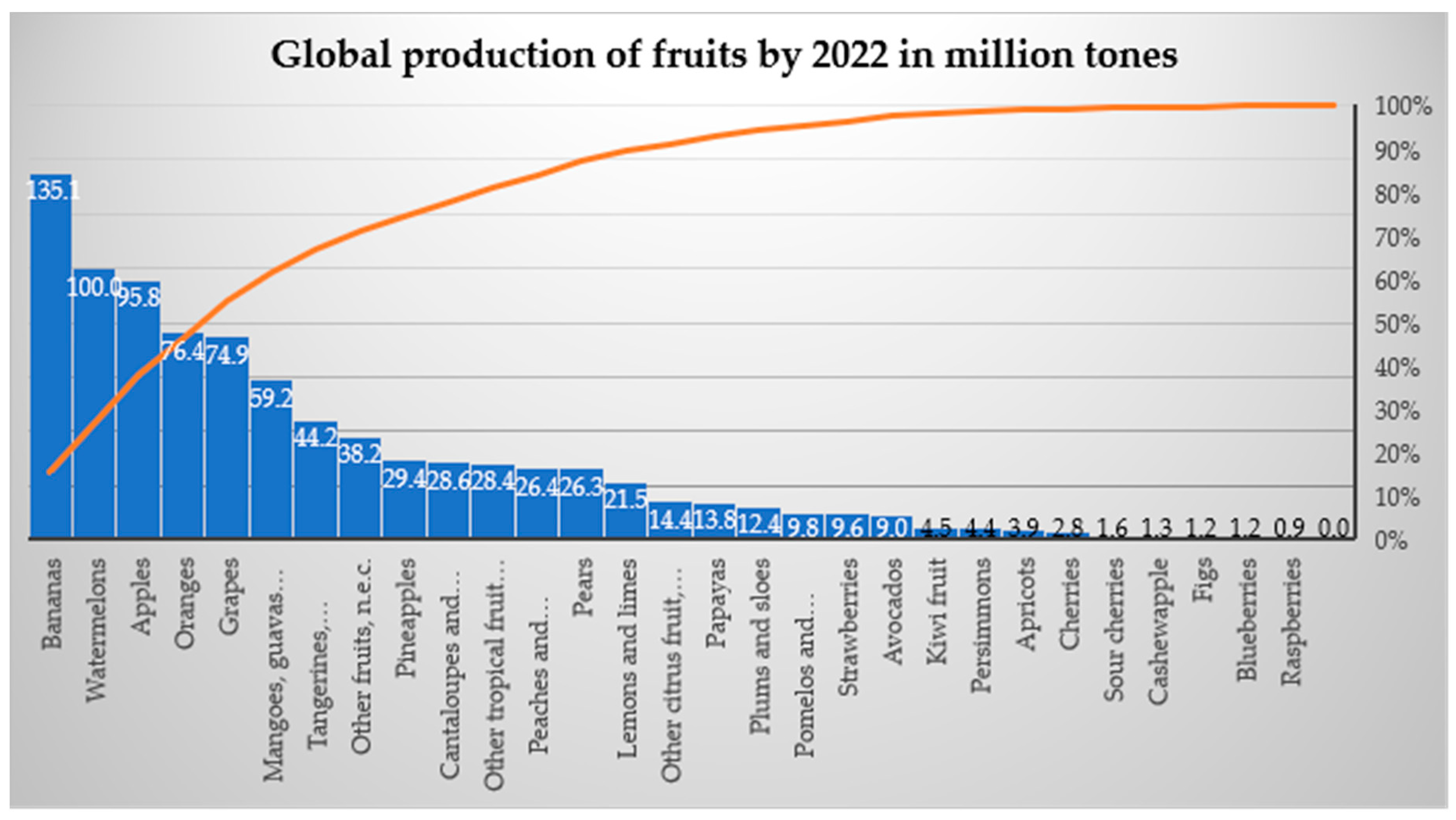
Figure 2.
Toxicant elements and chemicals in orange fruit byproduct (peel).
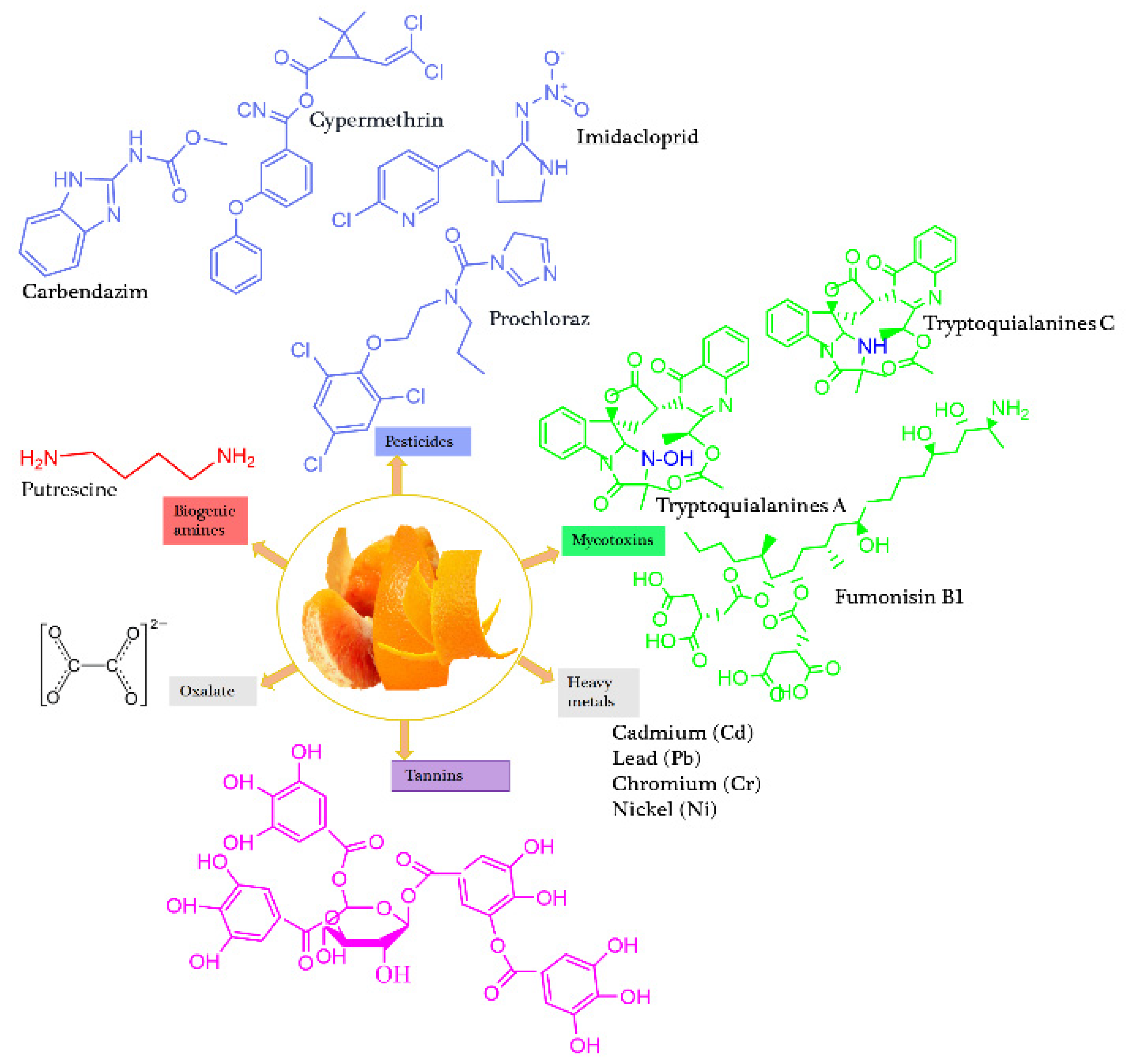
Figure 3.
Toxicant elements and chemicals in grapefruit byproduct (pomace).
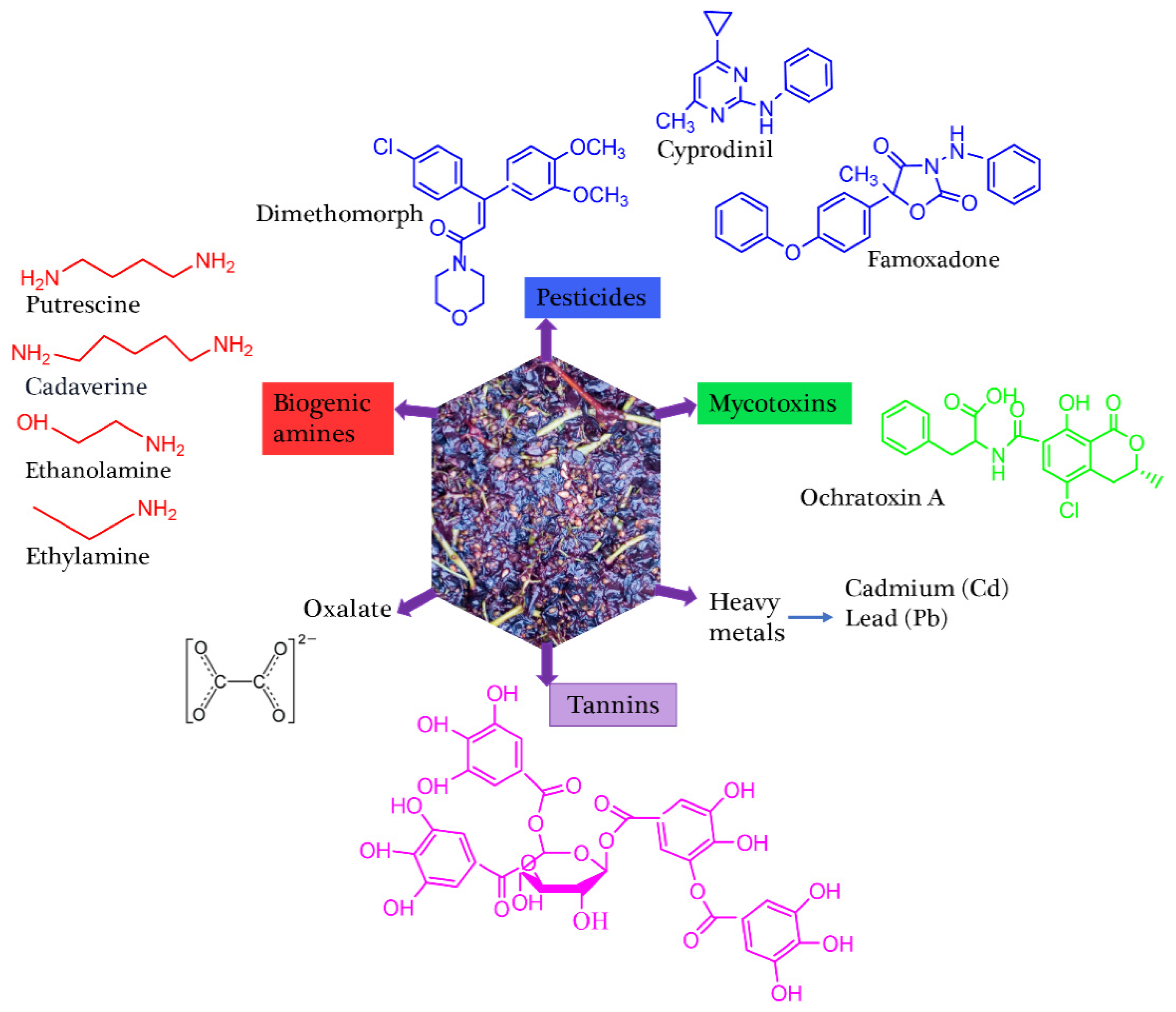
Figure 4.
Methods for fruit byproduct toxicity reduction.
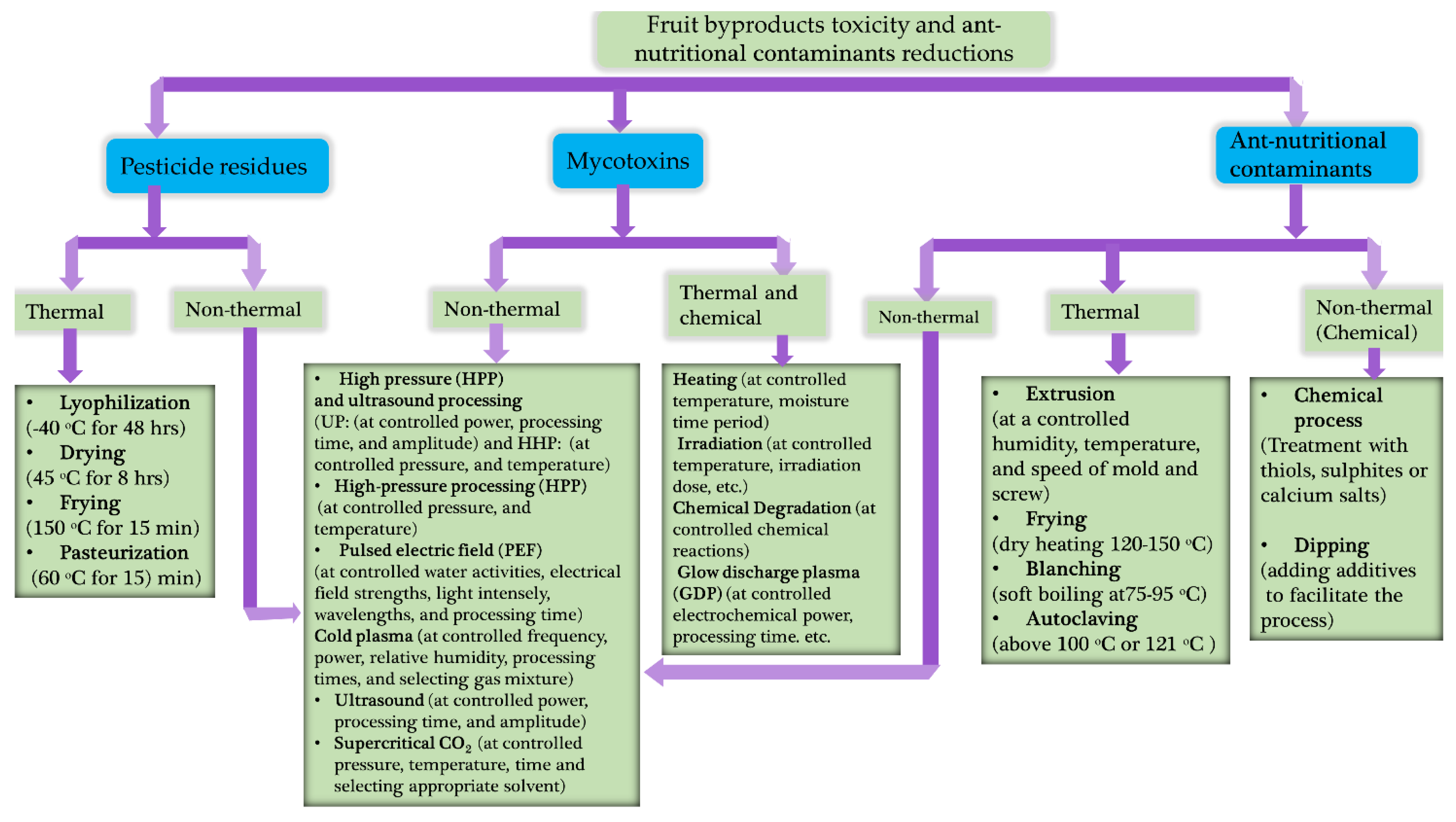
Table 3.
Uses of some fruit byproducts in the food industry.
| Fruit byproducts | Functional foods | References |
|---|---|---|
| Apple pomace | dietary fiber source in baked foods, chicken-meat-based sausages, and yogurt products, stabilizer for oil-water emulsions | [160-162] |
| Avocado by-product and avocado peels | antioxidants, antimicrobials, food additives (colorants, flavorings, and thickening agents), functional beverage formulation | [163, 164] |
| Banana peel | Antioxidant, antibacterial, antifungal activity, blood sugar reduction, lowering of cholesterol, anti-angiogenic activity and neuro-protective effect, synthesis of bio-inspired silver nanoparticles | [165, 166] |
| Citrus peel | Source of molasses, pectin, oil, and limone, thickener, emulsifier, and stabilizer in many foods, pectin being used as a polymeric matrix for edible films for active food pack by-product | [167, 168] |
| Grape pomace | Grape pomace powders contained in meat and fish derivatives, fiber in bakery products, oil from grape seed | [169-171] |
| Mango peel | Antioxidant and dietary fiber in macaroni, sources of phytochemicals in biscuits, edible films | [172-175] |
| Pineapple peel, core and stem | Pineapple peel can be used as a nutrient in fermentation processes being a rich source of sugar, core can be used in pineapple juice concentrates, vinegar, and wine production, pineapple stem contains bromelain enzyme and its extraction can be used as a meat tenderizer, bread dough improver. | [176, 177] |
Table 4.
Medicinal and pharmaceutical uses from the exploitation of fruit byproducts (adapted from Teshome, et al. [24].
Table 4.
Medicinal and pharmaceutical uses from the exploitation of fruit byproducts (adapted from Teshome, et al. [24].
| fruit byproducts | Medicinal and pharmaceutical exploitation | References |
|---|---|---|
| Apple peel | Reduces metabolic syndrome and atherogenic progression | [178] |
| Avocado peel | inhibitor for the inflammation mediator nitric oxide by a possible reduction of free radicals during inflammation, anticancer, antidiabetic, and antihypertensive effects | [179, 180] |
| Banana peel | antioxidant, antibacterial, antifungal activity, reduce blood sugar, lower cholesterol, and show anti-angiogenic activity and neuro-protective effect, silver nanoparticles, which are used as antimicrobials to pathogenic fungi |
[165, 181] |
| Citrus pulp and seed | Therapeutic effect on lung cancer in mice and breast cancer in mice and rats shown by D-limonene. | [181, 182] |
| Mango | Anti-inflammatory and antioxidative properties during obesity, diabetes, CVD, and skin cancer in vivo studies, reduction of carcinogenesis | [183-185] |
| Peach kernel | Phenols, carotenoids, and cyanogenic glycosides of peach kernel possess antidiabetic, antioxidative, and anti-aging properties | [186] |
Disclaimer/Publisher’s Note: The statements, opinions and data contained in all publications are solely those of the individual author(s) and contributor(s) and not of MDPI and/or the editor(s). MDPI and/or the editor(s) disclaim responsibility for any injury to people or property resulting from any ideas, methods, instructions or products referred to in the content. |
© 2024 by the authors. Licensee MDPI, Basel, Switzerland. This article is an open access article distributed under the terms and conditions of the Creative Commons Attribution (CC BY) license (http://creativecommons.org/licenses/by/4.0/).
Copyright: This open access article is published under a Creative Commons CC BY 4.0 license, which permit the free download, distribution, and reuse, provided that the author and preprint are cited in any reuse.


