

Submitted:
13 November 2024
Posted:
14 November 2024
You are already at the latest version
Abstract
Fruits are susceptible to a diverse range of postharvest rots that can reduce quality if preventive measures are not taken in time. In this study, samples of orange cv. 'Maltaise' and apple cvs. ‘Golden Delicious' and 'Richared' were sorted without infection or injury, treated or not with sodium metabisulfite (SMB), then placed in cold storage for 20, 42 or 59-61 days, followed by a shelf life of 6 or 15 days. The degree of fruit infection, weight loss and physicochemical characteristics were analyzed at each storage period. Our results indicate that adequate postharvest storage depends on the type of fruit, the duration of cold storage and shelf life. The heat map grouped 'Richared' apples close to its fresh state, without developing rot or perceptible weight loss for 60 days at low temperature (6°C) and 15 days of shelf life. These red apples performed better during storage than the “Golden”, especially in terms of storability and total flavonoids. Apples of 'Golden' showed better storage stability than 'Maltaise', which could be stored properly for up to 20 days at 6°C, followed by a 15-day shelf life, regardless of treatment with sodium metabisulfite. The longer the oranges were stored, the greater the risk of infection and the physicochemical properties, in this case flavonoids, decreased. The chemical criteria (TSS, pH) of apples and oranges were not affected by soaking in SMB, being similar to that of untreated fruit. However, treating fruit with SMB is regarded as unlikely due to its low effectiveness in preventing fruit decay during long-term storage. Cluster analysis showed that total polyphenols were linked to poor storability, while flavonoids, hardness and TSS were clustered with better storability. This suggests that flavonoids may be a more reliable indicator of storage suitability than total polyphenols.
Keywords:
Postharvest
; pathogen
; severity
; physicochemical
; bioactive compounds
1. Introduction
Annual production of pome fruit and citrus in Tunisia was estimated at 139,000 and 36,500 tonnes respectively [1]. A large quantity of these fruits is usually stored at low temperature after harvesting, then gradually sold on the local market or exported to various countries. The incidence of post-harvest diseases can affect the quality and limit the shelf life of fresh horticultural produce at different stages of the cold chain. Post-harvest and pre-retail food loss was estimated at 13.2% of global food production [2], while food waste from retail, catering and households was estimated at 19% of global food production [3], giving a total food loss and waste index of 32.2%.
Packinghouses generally use synthetic fungicides to treat fruit before storage, in addition to the antifungal treatments carried out in orchards before harvest, in order to limit waste and losses, first in the field and then during storage. When applied in excessive quantities, these fungicides can have an impact on the environment and present a risk to human health [4,5,6,7]. Countries importing fresh fruit apply strict regulations concerning minimum levels of pesticide residues in the edible part of fresh produce [8]. A sharp reduction in the use of synthetic pesticides is therefore essential. For all these reasons, the research is on for safe and environmentally friendly applications to reduce post-harvest deterioration in fruit quality.
Some organic and inorganic salts have been considered promising agents for pre- and post-harvest treatments [9]. Natural compounds classified as GRAS, such as sodium carbonates/bicarbonates, calcium chloride and silicate, have in some cases extended the shelf life of fresh fruit after harvesting [10,11,12]. For example, GRAS salts such as calcium chloride, sodium bicarbonate/carbonate and potassium sorbate/bicarbonate/carbonate have been used to test their ability to prevent post-harvest gray mold [13,14,15]. Postharvest diseases in citrus fruit were also tested using organic salts such as sodium carbonate/bicarbonate/benzoate/parabens and potassium sorbate [16,17,18,19]. Palou et al. [20] pointed out that these salts are frequently used in packinghouses to protect citrus fruit from rot. Additionally, potassium sorbate has been evaluated for its efficacy against apple blue rot (P. expansum), either as a standalone treatment or in combination with thiabendazole. The findings indicated that potassium sorbate exhibited reduced efficacy when used alone [21]. The low efficacy of salt can be attributed to several factors, including its low persistence, irregular distribution on the fruit surface, and susceptibility to degradation by the P. expansum fungus
Another group of salts, sulfites, used as preservatives and/or additives, have been applied to prevent rotting of fruits such as tomatoes, grapes, raspberries, blueberries and apricots [22,23,24,25]. They act as antioxidants by reducing microorganisms, inhibiting non-enzymatic browning and catalyzing various enzymatic reactions [26,27,28]. One sulfite salt is sodium metabisulfite (SMB), a compound generally recognized as safe (GRAS). According to Allagui and Ben Amara [29], the use of SMB as a preventive measure failed to prevent fruit rot due to fungal infection, while curative treatment with a 0.5% dose was effective.
In this study, semi-commercial-scale experiments were performed on oranges and apples. Fruits were treated/untreated with SMB, and stored for up to 61 days at 6°C, followed by 6 or 15 additional days of shelf life period at ambient temperature (18 °C). Rot incidence, disease severity, physical and chemical analyses were undertaken initially on fresh fruit and immediately after cold storage or shelf life.
The objectives of the study were to:
- -
- Evaluate under semi-commercial conditions the efficacy of SMB in maintaining the quality of uninjured and apparently infection-free apple and orange fruit during storage
- -
- Compare the preservative performance of three types of fruit during storage
- -
- Unravel the pathological and physicochemical properties of the three kind of fruit as a function of storage periods, based on eight attributes including weight loss, fungal infection, total phenols and flavonoids
2. Materials and Methods
2.1. Fruit Samples
Fresh oranges cv. ‘Maltaise’ and apples cvs. ‘Golden’and ‘Richared’ were obtained from a supermarket in Ariana (Tunis). Fruits with no visible defects were sorted and prepared for one of the planned antifungal treatments, then to be stored at 6 °C for 20, 42 and 59-61 days, plus 6 or 15 days of shelf-life after each storage period.
2.2. Fruit Treatments
The oranges and apples were separated into lots each containing 25 fruits. For each type of fruit, six lots were organized, three of which were untreated (control) apart from initial sorting, used as control and three of which were treated with SMB. For each of the three storage periods, one untreated and one-treated lots of each cultivar were taken for assessment.
According to a previous study [29], SMB was effective against postharvest rot at 0.5 % fruit dip. This concentration was used in the current experiments. The treatment consisted of soaking the fruit lot separately in a basin containing 10 liters of tap water in which 50 g of SMB was dissolved (conc. 0.5%). After soaking for 1 to 2 minutes, the fruit were left to air dry for 2 hours, then stored at 6 °C ± 1 °C for periods ranging from 20, 42 and 59-61 days followed by days of shelf life. During storage, the relative humidity inside the cold room was between 90% and 95%.
After each storage period, the respective lots of ‘Maltaise’ fruit were exposed to a shelf life at room temperature (18 ± 1°C) of 15 days (after 20 days of cold storage) and of 6 days (after 42 or 59 days of cold storage). For apples, the shelf life was 15 days regardless of the storage period. All analyses were carried out after each cold storage period and for each shelf life.
2.3. Assessment of Fruit Quality
At the end of each storage period, fruit weight was determined and the weight loss (WL) was calculated in percentage using the following formula:
where Pi is the initial weight before storage, Pcs is the weight determined just after a particular cold storage such 20, 42 or 59 days, Psl is the weight determined after a particular shelf life.
Disease incidence for each storage period and shelf life was calculated as:
where Ncs is the number of infected fruit detected after a respective cold storage, Nsl is the number of infected fruit newly detected after a respective shelf life; N is the initial number of fruit. The infected fruit are those showing fungal infection even if this infection is minimal, i.e. less than 1 mm in diameter.
Disease severity (DS) was also estimated on the individual infected fruit following an empirical 0 –5 rating scale according to the fruit surface infected [30]: 0, healthy fruit; 1, 1–20 % infected; 2, 21–40 % infected; 3, 41–60 % infected; 4, 61– 80 % infected; 5, ≥ 81% infected. This DS allowed the use of the McKinney’s disease index (MI) calculated according to McKinney [31] (Eq.1):
Fruit hardness was determined per storage period on three randomized fruits from both equatorial sides using a 3 mm diameter sensor of fruit hardness tester (LT Lutron FR-5105) and the force was expressed in Newton (N).
Three randomly picked oranges were juiced (without the peel) using a domestic blender and the pure juice was used for analysis. For apples, three randomly taken fruits were cut into 1 cm cubic pieces (without stalk or calyx) and these pieces, including the peel, were weighed and juiced by adding the same weight of distilled water (one time dilution).
One droplet by sample juice was used to determine the TSS, expressed in percentage using a digital hand refractometer (Hanna instruments HI96801). The pH of each sample juice was determined using a handled pH/ORP meter (AZ8651). Each measurement was replicated three times.
The total phenol content (TPC) was determined using the Folin-Ciocalteu (Folin-C) method as described by Singleton et al. [32] with some modification. In a cuvette, 100 µL of one time diluted juice was mixed with 100 µL Folin-C to which was added, after 2 min, 300 µL of sodium carbonate solution (20 %, NaCO3). After 2 h incubation, absorbance was read at 750 nm using a UV-vis spectrophotometer. The absorbance determined was compared with the standard curve for gallic acid (0.02 - 0.10 g L-1) to determine the TPC, which is expressed as the mass of gallic acid equivalent (mg GAE/100 g of apple juice). Each measurement was taken in triplicate.
To determine the total flavonoid content, 250 µl of the orange/apple juice was mixed with 1.25 ml of distilled water to which 75 µl of sodium nitrate was added. This mixture was left to react for 5 minutes, then 150 µl of aluminium chloride (2%) was added and the mixture was left to react for 5 minutes. This mix was completed with 500 µl of sodium hydroxide NaOH (1M) and 3 ml of distilled water. The absorbance of this solution was determined at 510 nm to find the total flavonoid content expressed in mg catechin/100 mg, using a catechin calibration curve.
2.4. Statistical Analysis
Data were subjected to analysis of variance (ANOVA) using Statgraphics Centurion 16 software. Mean differences were separated by the honestly significant difference (HSD) procedure using Tukey test at p ≤ 0.05. A hierarchical cluster analysis with ‘ClustVis’ web tool for visualizing clustering of multivariate data using heat map.
3. Results
3.1. Quality of Oranges After Cold Storage and Shelf Life
3.1.1. Weight Loss, Disease Incidence and Disease Severity
After 20 days’ storage of oranges at 6°C, weight loss was limited to a very low rate of 0.3% for both untreated and treated fruit, but this loss increased with longer cold storage, mainly for SMB-treated fruit (Table 1). Thus, after 42 days, the treated fruit recorded a weight loss of 65.8% compared with 5.3% for the untreated oranges, i.e. an excess loss of 60.5% due to the SMB treatment alone. At the end of the 59 days-cold storage period, the highest weight loss was 61.2% for treated oranges compared with 33.3% for untreated oranges. This represents an additional loss of 27.9% linked to the SMB treatment in cold storage. With regard to weight loss during shelf life after discarding the infected fruit of cold storage, it appears that the weight loss was higher varying from 21.4% (20+15SL) to 100% (59+6SL) for treated fruit and from 3.1% (20+15SL) to 100% (59+6SL) for untreated oranges.
The incidence of the disease on treated and untreated ‘Maltaise’ was zero during cold storage for 20 days. Absence of fruit infection was also observed on untreated fruit during the 15 days of storage at room temperature (shelf life). Fungal infection began on treated fruit after 15 days of storage following 20 days of cold storage, as well as on fruit stored for 42 days or more. The results showed that the incidence of infection during the latter storage periods varied between 4% and 64% in untreated ‘Maltaise’ fruit, compared with 18.2% and 100% in fruit treated with 0.5% SMB. On the other hand, the disease severity determined using the Mckinney’s disease index varied between 3.2% and 25.7% in untreated ‘Maltaise’ and between 10.9% and 80% in those treated with SMB. The results demonstrate that the incidence and severity of infection on ‘Maltaise’ oranges, in addition to weight loss, were minimal and comparable between treated and untreated fruit during the 20-day cold storage period. However, as storage duration increased, the untreated fruit exhibited a diminished susceptibility with regard to these parameters
For the last shelf life (59 +6SL), the weight loss of the untreated ‘Maltaise’ was 100%, while the disease incidence was 64.3% and not 100%. In fact, the rest of the uninfected fruit, at this stage of fruit monitoring, was defective due to the change in color and texture of the rind, which became pale and dry, and therefore unfit for consumption (lost).
3.1.2. Physicochemical Properties
The initial total soluble solids (TSS) content of fresh oranges was 11.5%, showing a slight increase over the different storage periods, varying between 12 and 12.7% in untreated fruit and between 11.6 % and 12.6 % in treated fruit (Table 1).
The initial pH of the orange juice was 3, increasing between 3.1 and 3.7 during storage, with no difference between the pH of treated and untreated oranges.
The initial hardness of the fruit was 15.3 N, varying over the storage periods between 10.4 and 16.2 N, but these averages were not significantly different between treated and untreated fruit for the respective storage periods.
The initial total polyphenol content (TPC) of fresh oranges was 174 mg GAE /100 g of orange juice. This content remained unchanged in oranges stored for 20 days at 6°C, with values ranging from 171.2 to 174 mg GAE/100g, without significant difference (p ≤ 0.05) between treated and untreated oranges. Over a longer storage period, including shelf life, the TPC showed significant different levels of decrease and increase, ranging from 148 to 171.8 mg/100g, with a slightly higher level for the fruit treated with SMB.
The initial total flavonoid content (TFC) determined in fresh fruit was 132.9 mg catechin /100g, which was slightly reduced to 114.8 – 116 mg catechin /100g after 20 days storage at 6°C. These TFC were reduced, after 42 and 59 days of cold storage, to 47.8-48.6 mg catechin/100g for treated fruit and 41.2-76.6 mg catechin /100 g for untreated fruit. During shelf life, the TFC remained low with a higher content in the untreated fruit except for (20+15SL) (Table 1).
Overall, the physicochemical properties of ‘Maltaise’ remained unaltered by SMB treatment, cold storage period or shelf life. However, there was a notable decline in TFC and hardness with prolonged storage.
3.2. Quality of Red Apples cv. ‘Richared’ After Cold Storage and Shelf Life
3.2.1. Weight Loss and Disease Incidence
The weight loss of ‘Richared’ apples ranged from 0.24% (after 20 days cold storage) to 2.88% after 75 days (60 days cold storage and 15 days shelf life). This low weight loss after prolonged storage should be attributed to a physiological process and not to fungal infection, as the incidence of disease was zero regardless of the storage period (Table 2).
3.2.2. Physicochemical Properties
The initial hardness of the fruit was 16.3 N (Table 2). This attribute decreased to 14.3 N after 20-42 days of cold storage with no significant difference between treated and untreated apples. After 61 days, hardness reached 13 N for both treated and untreated apples. After 15 days in shelf life following 20, 42 and 61 days of storage at 6°C, the fruit hardness varied between 14.4 and 9.3 N for untreated fruit and between 13.1 and 12.1 N for treated fruit. Overall, the hardness of treated and untreated fruit decreased slowly and similarly during cold storage, but relatively higher during shelf life, particularly for untreated fruit.
The initial TSS of the juice of fresh apples was 14.2% (Table 2). This TSS concentration fell slightly, particularly after 42 days of cold storage (11.3-11.6 %) and after 61 days of cold storage (12.5-12.9 %). Shelving the fruit did not affect this trait, whose content fluctuated between 14 and 12.2%. Fruit treatment was not a distinguishing criterion for the TSS content compared to the untreated fruit. No significant change was recorded in this trait during shelf life compared with cold storage.
The pH initially recorded on fresh apple juice was 4 and remained at an average of 4.1 for up to 20 days of cold storage. A slight decrease in pH was recorded at 3.4 and 3.3 after 42 days of cold storage for treated and untreated apples respectively, which increased to 4.1-4.3 during 61 days of cold storage. No significant change was detected in this characteristic over the shelf life compared with cold storage.
The initial TPC of fresh apples was 108.8 mg GAE/100g of juice. This trait was maintained without significant change during the different cold storage periods ranging between 103.2 to 113.2 mg GAE/100g, with no significant differences between untreated and treated fruit, except for treated apples after 61 cold storage days, which was 123.2 mg GAE/100g. For the shelf life, an increase in this parameter was observed, varying between 121 and 133 mg GAE/100g, which represents an increase of around 20 mg GAE/100g compared with the values for this parameter in apples (treated or untreated) stored at low temperature.
The TFC of fresh apple juice was 156.8 mg catechin/100g. This initial content decreased with cold storage, reaching 85.2 mg catechin/100g, the lowest value measured after 61 days of cold storage for untreated apples compared with 116.4 mg catechin/100g for treated apples. The TFC values ranged from 91.4 mg catechin/100g, for treated fruit after 42 days of cold storage, to 109.2 mg catechin/100g, after 20 days of cold storage for untreated fruit. With regard to shelf life, the TFC showed irregular variations ranging from 68.2 mg catechin/100g (42d+15SL) to 127.6 mg catechin/100g (61d+15SL). Nevertheless, for the short storage period between 20, 20+15SL and 42, the TFC of the untreated apples was higher than that of the treated apples, but this situation was reversed for the longer period between 42+15SL, 61 and 61+15SL showing higher TFC values for the treated apples.
3.3. Quality of Yellow Apples cv. ‘Golden’ After Cold Storage and Shelf Life
3.3.1. Weight Loss, Disease Incidence and Disease Severity
In the absence of disease incidence, weight loss of the yellow apples ranged from 0.21-0.47% (20 days after cold storage) to 0.54-0.75% (42 and 61 days after cold storage for treated fruit) (Table 3). When fungal infections developed on the apples, weight loss was higher, ranging from 7.94% (42 days after cold storage for untreated fruit) to 31.59% (61+15SL for treated fruit) (Table 3).
The extent of weight loss was related to the incidence of disease, which ranged from 7.7% to 30%, and Mckinney disease index, which ranged from 3.08% to 18% (Table 3). Fruit treatment had no positive effect on fruit health at the start of cold storage, since even untreated fruit were unaffected. The effect of treatment only began to show after 42 days of cold storage, with the exception of the 61+15SL period, when treated fruit were much more contaminated (31.59% compared with 3.5% for untreated fruit).
3.3.2. Physicochemical Properties
The hardness values of the cv. ‘Golden’ are reported in Table 3. The initial hardness of the fruit was 12.5 N. This value decreased slightly to around 11.1 N (11.0 to 11.2) throughout the cold storage periods for untreated fruit. For treated fruit, values for this characteristic decreased from 13.2 N (20 days of cold storage) to 10.0 N (61 days of cold storage). During shelf life, fruit hardness showed a downward trend, mainly after 61+15SL, reaching 7.6 N, but with no difference between treated and untreated fruit.
The initial TSS of the fresh apple juice was 14.4% (Table 3). This content remained unchanged after 20 days of cold storage for both untreated and treated fruit. For longer periods of cold storage, the untreated fruit showed little change in content, which fluctuated between 12.3% and 13.5%. On the other hand, the treated fruit showed gradual decreases in this content to 12.2% and 10.8% respectively after 42 and 61 days of cold storage. For shelf life, the TSS was relatively high in untreated fruit, unlike treated fruit, which showed decreases in relation to the length of the storage period, decreasing from 12% to 9.7% (Table 3).
The initial pH of the fresh apple juice was 3.9 (Table 3). This pH was kept within the range of 4 (between 3.9 and 4.3), with the exception of the fruit stored for 42 days in cold storage, which pH was 3.1. There was no difference between the pH of treated and untreated fruit.
Total phenolic content was around 90-93 mg GAE/100g at the end of the 20 days of cold storage (Table 3), showing a significant reduction during storage compared with that detected in fresh fruit, which was 132 mg GAE/100g. Fruit stored for longer periods (42 and 61 days) yielded more phenols, with levels ranging from 102 to 121.2 mg GAE/100g (Table 3). There was no significant difference between untreated and SMB-treated fruit. During the 15-day shelf-life, total phenols accumulated more in untreated fruit than treated fruit after the first 20 days of cold storage, reaching 149.6 mg GAE/100g (untreated fruit) and 130.6 mg GAE/100g (treated fruit), as well as after 61 days of cold storage. The observed increase in phenolic compound content over the shelf life followed relatively low values during cold storage period. On the other hand, the phenolic content of the fruits in the shelf life did not show such an increase after 42 days of cold storage, as these levels were relatively high during the 42-day cold storage. In addition, there was insignificant difference between the phenols of treated and untreated fruit, whatever the storage period.
The initial flavonoid content of ‘Golden’ juice was 136.4 mg catechin/100g (Table 3). Significant differences were recorded between treated and untreated fruit, with the exception of the last shelf life 61+15SL where both contents were low and close (43.2-44.4 mg catechin/100g). Thus, the flavonoid content of treated apples was much higher than that of untreated fruit, in some cases twice as high (79 to 145, 21.8 to 43.6 and 62 to 122.6 mg catechin/100g). For each of the shelf life periods, the flavonoid content of treated and untreated fruit was lower than that of cold-preserved fruit. In this way, TFCs were better titrated in fruit that had been previously treated and kept cold.
3.4. Heat Map Inference
A hierarchical cluster analysis was performed in the form of a heat map based on a defined Euclidean metric distance. This exploratory analysis is aimed at determining possible relationships between parameters taken from fruit samples in storage.
The heat map made it possible to group the fruit samples into two main clusters based on fungal infection and fruit quality at later stages of storage. Group A covers fruit from apple cultivars, while Group B covers especially orange fruit (Figure 1). Within Group A, there are two distinct subgroups: A1 and A2, with the A1 sub-group being abundant in terms of hardness, TSS, pH and TFC, while in the A2 sub-group, these quality characteristics are less abundant. The A1 characterizes fresh fruit of ‘Golden’ and ‘Richared’, the 20 days of cold storage (C1) for “Golden” and “Richared”, the L1 (untreated) shelf life of ‘Richared’ and the C3 and L3 of “Richared”. These results underline that the quality of fruit after short-term storage would be kept like that of fresh fruit, and that ‘Richared’ fruit would retain the initial quality as long as cold storage and shelf life are extended. The A2 subgroup includes apple samples subjected to the shelf life L1, L2 and L3 for ‘Golden’ and to L1 (treated) and L2 for ‘Richared’ as well as C3 for ‘Golden’. Although these parameters in the heat map were less colorful and therefore less abundant in the A2 than in the A1, no fungal disorders were recorded in these samples, mainly for cv. ‘Richared’. This sub-group implies that apple fruit quality would be affected particularly during shelf life, especially in the case of ‘Golden’.
Group B, separating ‘Maltaise’ fruit samples and, to a lesser extent, some apple samples, is divided into two subgroups B1 and B2. Subgroup B1 is abundant with other quality criteria including TPC, TFC and fruit hardness, clustering together fresh oranges with the C1, L1 and L2 untreated oranges, and the C2 treated ‘Golden’ and ‘Richared’ fruit. This indicates that, although these apple samples were less well preserved than their counterparts were during other storage periods, they kept much longer and in the same category as fresh oranges.
The subgroup B2 associates orange samples conserved during longer time as C2, L2 and C3, L3 except for the sample of untreated ‘Golden’ under C2 storage (Figure 1). In this subgroup, decay incidence and severity as well as weight loss and TPC were highly abundant in the heat map indicating that these fruit samples were the most affected by longer storage. Clearly, the heat map did not devote any particular grouping highlighting the treatment/non-treatment aspect. This indicates that treatment has not played a distinctive role in differentiating it from untreated fruit.
4. Discussion
The effect of the GRAS salt sodium metabisulfite was evaluated for its ability to control fungal decay on oranges and apples and to keep fruit quality after cold storage and during shelf life.
Soaking oranges in SMB, albeit at a lower concentration, was reported to favor the growth of Penicillium spp. Such growth was linked to oxidation reactions and to a decrease in pH at the surface of the pericarp, thus affecting the dynamics of the pericarp microflora [33,34]. In our previous surveys, green and blue molds, caused by Penicillium digitatum and P. italicum respectively, were the most devastating fungal species of stored ‘Maltaise’. Dipping oranges inoculated with P. digitatum in a 0.5% aqueous solution of sodium metbisulfite significantly reduced fungal decay when the treatment was applied curatively [29]. In the present experiments, the treatment was applied preventively, since the fruit were used without any signs of injury or fungal attack. Our results showed that treating healthy oranges with SMB seems inappropriate, given that no better post-treatment protection has been provided, particularly after prolonged storage of more than 40 days. Over time, this treatment appears to make the fruit more susceptible to fungal infection, in contrast to untreated oranges, which were better preserved, probably by an antagonistic microbiome that was unaffected by SMB treatment. We confirm here, under semi-commercial conditions, our previous results obtained with inoculated fruit, namely that SMB is ineffective when used preventively. Regarding the effect of salts on brown rot, Lyousfi et al. [35] pointed out that sodium bicarbonate, copper sulphate and ammonium bicarbonate, combined with cold storage (4°C), reduced the impact of rot on apples at concentrations ranging from 0.5 to 5%. Our results showed that the treatment of intact fruit with the SMB salt did not provide a convincing control of fruit rot.
For the stored fruit still free of fungal infection, weight loss did not exceed 3% for oranges cv. ‘Maltaise’, 2.8% for yellow Golden and 0.8 % for red apple. For example, the weight loss of cold-preserved apple cultivars was 2.22% for ‘Red Delicious’ and 2.91% for ‘Golden Delicious’ [36], in the same range as our results. In the absence of infection, the range of weight loss reached during the storage of fruit would be commercially acceptable. This loss of weight, which is difficult to escape or remedy, may be linked to physiological mechanisms such as the exchange of gas and water between the environment and the fruit’s pericarp during the respiration process. It has been pointed out that the natural wax in the pericarp of oranges decreases during cold storage, which can further increase respiration [37]. Weight loss in apples depends on the cultivar, skin structure and chemical composition of the wax layer, all of which influence water loss, leading to a reduction in cell turgor pressure and consequent softening of the apple [38].
On the other hand, disease incidence and severity generally increased as storage extended beyond 40 days, although untreated fruit were still less affected. Untreated oranges and apples were healthier, with less weight loss and lower incidence and severity of rot than treated fruit as storage time increased. These results emphasized that there is no need to treat the fruit intended to cold storage, provided that the appropriate cold storage and the shelf life for each type of fruit are respected. Our results suggest that ‘Maltaise’ oranges, despite a winter environment characterized by high citrus fungal infection pressure, could be stored for up to 35 days (20 d at 6°C +15 d SL at ambient temperature). Then, yellow apples could be stored for up to 61 days in cold storage and finally red apples for over 75 days (61d at 6°C +15 d SL). Red apples seem to be a good candidate for long-term cold storage. Youssef et al. [19] revealed that postharvest decay was lower on water-treated than on wax-treated citrus fruit (rot incidence 7% compared with 11%). Prolonged storage results in increased senescence and rotting of the fruit due to changes in enzymatic reactions leading to the release of some fermentative metabolites that induce fungal infection and deteriorate the quality of the stored fruit [39]. In addition, the ageing of fruit allows the multiplication of certain microbial agents capable of producing enzymes that degrade the fruit walls, thus facilitating the development of rots over time [40]. It was highlighted that ‘Golden Delicious’ has a tender epidermal layer and a cortical tissue moderately susceptible to P. expansum [41].
Most postharvest fruit’s pathogens require a wound to initiate infection. Resistance of the epidermis to breakage may be an important factor in resistance of apple cultivars to decay. For this, some cultivars are more susceptible to decay than the others are. A path for fungal spores’ entrance could be through the open sinus or calyx tube. During our study, we observed a number of fungal infections starting from the calyx of apples, mainly in the cultivar ‘Golden’. Therefore, injured or rotten fruit must be carefully sorted and removed, leaving only healthy fruit for long storage.
Initially, the cv. ‘Richared’ was harder than the cv. ‘Golden’. However, the hardness of both fruit cultivars significantly decreased with prolonged storage. The hardness of oranges was not significantly different between treated and untreated fruit for the respective storage periods, although this characteristic decreased as the storage period increased. This indicates that interaction of the SMB with the fruit pericarp during storage is unlikely. As fruit shelf life increases, apples soften, which could be due to reduced water content, increased respiration, changes in pectin content [42] and more active starch hydrolysis [36]. Cell wall polysaccharides are among the compounds responsible for the fruit’s firmness. Degradation of these compounds by hydrolytic enzymes during ripening should lead to softening of the fruit pericarp [43] and could explain the reduction in fruit hardness as storage time increases, taking into account the differences in firmness noted between apple cultivars [44].
The TSS and pH are important organoleptic properties of fruits [45], which are correlated with fruit’s texture and composition [36]. In our results, the TSS of orange juice increased slightly during the first storage period. During subsequent storage periods, the TSS remained unchanged for treated and untreated oranges, implying an early conversion of available organic acids into sugar, given that the total soluble constituents of citrus juice are 10 % organic acids and 80 % sugars [46]. The pH of the fruit juice rose rapidly during the first 20 days of cold storage and then remained stable throughout the rest of the storage period, with no significant difference between storage periods or between treated and untreated fruit. This increase in pH should be linked to the rapid transformation of organic acids into sugar components [37].
In contrast to oranges, TSS content in both apple cultivars decreased after the first 20 days of storage. At the end of 60 days’ storage, the lowest TSS content was detected in “Golden” treated fruit, compared with “Richared” fruit. Butkeviciute et al. [44] described such decreasing trend of the soluble solid content during storage of some fruit samples. As the fruit’s shelf life increases, it has been reported that apples soften due to changes in the pectin content of the cells, imparting a progressive bitterness to the fruit [42] in relation to the balance of sugar and organic acid contents. As a result, pH decreased for ‘Golden’ and ‘Richared’ apples at the end of 40 days of cold storage in our trials, with no difference between treated and untreated apples.
Citrus and apples fruit are rich in bioactive compounds such as polyphenols [47], which are a source of antioxidants that inhibit free radicals [48]. A decrease in TPC in ‘Valencia’ oranges was recorded after 40 days storage at 6°C, which was attributed to fruit senescence [49], loss of astringent flavor and changes in enzyme activity, with phenolic degradation being responsible for the decrease in TPC [50]. Our analyses showed that the TPC of oranges stored at 6°C was lower than that of freshly harvested ‘Maltaise’ fruit. This decrease was more pronounced in some samples of untreated fruit than in those of treated fruit. In apples, our findings indicated that the ‘Golden’ cultivar and, to a lesser extent, the ‘Richared’ cultivar exhibited a reduction in TPC compared to fresh fruit. Furthermore, both cultivars demonstrated an increase in this trait during the shelf-life period in comparison to cold storage.
This accumulation of TPC is greater in ‘Golden’ than in ‘Richared’, although ‘Golden’ seems to be less suitable for long storage than ‘Richared’. This reverse situation was more pronounced in ‘Maltaise’, which had more total phenolic content but less storage capacity. This result is corroborated by the heat map, which groups TPC with traits (disease incidence and severity) that indicate less aptitude for storage. This may suggest that total polyphenols are more indicative of lower tolerance to prolonged cold storage. Nevertheless, Adyanthaya et al. [51], working on four apple varieties stored in a cold room (6°C) for 3 months, pointed out that a possible combination of phenolic metabolites and antioxidant enzymes is essential for better postharvest preservation. Moreover, Sun et al. [52] hypothesised a possible relationship between the phenolic content of wild apples and their postharvest resistance to blue mould (P. expansum) decay. For example, it was reported that cold storage reduced the phenolic contents in different apple cultivars [53]; the TPC of the four apple cultivars was reduced after 4 months of storage at 2°C. However, other studies have shown that the phenolic compound of apple cultivars remains relatively constant during storage [54].
Flavonoids are plant secondary metabolites with a polyphenolic structure, widely present in fruits and vegetables [55]. Flavonoids, generally yellow in color, are responsible for much of the flavor and color of flowers [56]. Our results showed that the flavonoid content of ‘Maltaise’ was maintained without significant variation after 20 days of cold storage and 15 days of shelf life compared to the initial content. However, longer cold storage and shelf life significantly reduced the total flavonoid content, although the untreated ‘Maltaise’ maintained a relatively higher content than the treated fruit. With regard to total flavonoids in apples, a rapid decrease in this nutritional compound was recorded after the first 20 days of storage compared to the content of fresh fruit. The rate of this decrease depended on the apple cultivar, as a sharp reduction in this compound was observed for the cultivar ‘Golden’ after long storage and shelf life, compared with the cultivar ‘Richared’, which maintained a relatively higher TFC as storage time lengthened. The heat map revealed a strong link between TFC, hardness and TSS, that could be indicators of quality preservation during long-term storage. This suggests that flavonoids are a putative biomarker of storability, unlike total phenolic. In a survey conducted by Konstantinou et al. [57] on apples stored in packinghouses in Greece, four varieties, including Golden Delicious, were examined. The findings revealed a negative correlation between susceptibility to Botrytis cinerea and flavonoids, while susceptibility to Punicillium expansum was negatively correlated with fruit firmness. These results align with those obtained in the present study.
5. Conclusions
Our results indicate that successful postharvest fruit preservation depends on the type of fruit, its quality after sorting, the duration of cold storage and the shelf life. The ‘Richared’ apple cultivar retained its nutritional and sanitary properties without developing rot or noticeable weight loss for 60 days at low temperature (6°C) and 15 days of shelf life. This red apple performed better during storage than the yellow ‘Golden’ cultivar, especially in terms of storability and total flavonoids. Apples of cv. “Golden” showed better stability during storage than oranges of cv. “Maltaise”. The latter were adequately stored for up to 20 days at 6°C, followed by a 15-day shelf life, irrespective of sodium metabisulfite treatment. As storage time progressed, the risk of infection of the oranges increased, associated with a degradation of certain physicochemical properties, including flavonoids. The nutritional value (TSS, pH) of apples and oranges was not affected by soaking in SMB, being similar to that of untreated fruit. However, treatment of fruit with SMB is unlikely due to its minimal effectiveness in preventing fruit rot in long-term storage. It has been proposed that characteristics such as flavonoid content, hardness and total soluble solids (TSS) may serve as markers of the fruit’s storage suitability. Conversely, polyphenol content has been identified as an indicator of susceptibility to long-term storage.
Author Contributions
M.B.A. (Mohamed Bechir Allagui); Conceptualization, Data curation, Formal analysis, Investigation, Methodology, Project administration, Resources, Supervision, Validation, Visualization, Writing—original draft preparation, and writing—review and editing, M.B.A. (Mouna Ben Amara); Data curation, Formal analysis, Software, Visualization, Writing—original draft preparation, and writing—review and editing. All authors have read and agreed to the published version of the manuscript.
Funding
The Ministry of Higher Education and Scientific Research of Tunisia funded this research in the framework of PRIMA, project acronym StopMedWaste ‘Innovative Sustainable technologies TO extend the shelf-life of Perishable MEDiterranean fresh fruit, vegetables and aromatic plants and to reduce WASTE’, Project Number 1556.
Data Availability Statement
Data are included within the article.
Conflicts of Interest
The authors declare no conflicts of interest. The funders had no role in the design of the study; in the collection, analyses, or interpretation of data; in the writing of the manuscript; or in the decision to publish the results.
References
- Groupement Interprofessionnel des Fruits, Report of 2023. Available online: https://gifruits.com/ (accessed on 11.10.2024).
- FAO, Food and Agriculture Organization of the United Nations. SDG Global Food Loss and Waste, 2023. Food Loss and Waste Database | Technical Platform on the Measurement and Reduction of Food Loss and Waste | Food and Agriculture Organization of the United Nations.
- UNEP, Food Waste Index Report 2024. Food Waste Index Report 2024 | UNEP - UN Environment Programme.
- Alaoui, A.; Christ, F.; Silva, V., Vested, A.; Schlünssen, V.; González, N.; … & Geissen, V. Identifying pesticides of high concern for ecosystem, plant, animal, and human health: A comprehensive field study across Europe and Argentina. Sci environ 2024, 948, 174671.
- Triantafyllidis, V.; Kosma, C.; Karabagias, I. K.; Zotos, A.; Pittaras, A.; Kehayias, G. Fungicides in Europe During the Twenty-first Century: a Comparative Assessment Using Agri-environmental Indices of EU27. Water Air Soil Pol 2022, 233, 52. [Google Scholar] [CrossRef]
- Soheilifard, F.; Marzban, A.; Raini, M.G.; Taki, M.; van Zelm, R. Chemical footprint of pesticides used in citrus orchards based on canopy deposition and off-target losses. Sci Environ 2020, 732, 139118. [Google Scholar] [CrossRef] [PubMed]
- Fantke, P.; Jolliet, O. Life cycle human health impacts of 875 pesticides. Int J of Life Cycle Assess 2016, 21, 722–733. [Google Scholar] [CrossRef]
- Sivakumar, D.; Bautista-Baños, S. A review on the use of essential oils for postharvest decay control and maintenance of fruit quality during storage. Crop Prot 2014, 64, 27–37. [Google Scholar] [CrossRef]
- Romanazzi, G.; Lichter, A.; Gabler, F. M.; Smilanick, J. L. Recent advances on the use of natural and safe alternatives to conventional methods to control postharvest gray mold of table grapes. Postharvest Biol and Technol 2012, 63, 141–147. [Google Scholar] [CrossRef]
- Strano, M.C.; Altieri, G.; Allegra, M.; Di Renzo, G.C.; Paterna, G.; Matera, A.; Genovese, F. Postharvest technologies of fresh citrus fruit: Advances and recent developments for the loss reduction during handling and storage. Hortic 2022, 8, 612. [Google Scholar] [CrossRef]
- Alaoui, F.T.; Askarne, L.; Boubaker, H.; Boudyach, E.H.; Aoumar, A.A.B. Control of Gray Mold Disease of Tomato by Postharvest Application of Organic Acids and Salts. Plant Pathol J 2017, 16, 62–72. [Google Scholar]
- Mehyar, G. F.; Al-Qadiri, H. M.; Abu-Blan, H. A.; Swanson, B. G. Antifungal effectiveness of potassium sorbate incorporated in edible coatings against spoilage molds of apples, cucumbers, and tomatoes during refrigerated storage. J Food Sci 2011, 76, 210–217. [Google Scholar] [CrossRef]
- Karabulut, O.A.; Romanazzi, G.; Smilanick, J. L. Postharvest ethanol and potassium sorbate treatments of table grapes to control gray mold. Postharv Biol Technol 2005, 37, 129–134. [Google Scholar] [CrossRef]
- Nigro, F.; Schena, L.; Ligorio, A.; Pentimone, I.; Ippolito, A.; Salerno, M.G. Control of table grape storage rots by pre-harvest applications of salts. Postharvest Biol Technol 2006, 42, 142–149. [Google Scholar] [CrossRef]
- Youssef, K.; Roberto, S. R. Applications of salt solutions before and after harvest affect the quality and incidence of postharvest gray mold of ‘Italia’table grapes. Postharvest Biol Technol 2014, 87, 95–102. [Google Scholar] [CrossRef]
- Montesinos-Herrero, C.; Moscoso-Ramírez, P.A.; Palou, L. Evaluation of sodium benzoate and other food additives for the control of citrus postharvest green and blue molds. Postharvest Biol Technol 2016, 115, 72–80. [Google Scholar] [CrossRef]
- Moscoso-Ramírez, P.A.; Palou, L. Preventive and curative activity of postharvest potassium silicate treatments to control green and blue molds on orange fruit. Eur J Plant Pathol 2014, 138, 721–732. [Google Scholar] [CrossRef]
- Moscoso-Ramírez, P.A.; Montesinos-Herrero, C.; Palou, L. Characterization of postharvest treatments with sodium methylparaben to control citrus green and blue molds. Postharvest Biol Technol 2013, 77, 128–137. [Google Scholar] [CrossRef]
- Youssef, K.; Ligorio, A.; Nigro, F.; Ippolito, A. Activity of salts incorporated in wax in controlling postharvest diseases of citrus fruit. Postharvest Biol Technol 2012, 65, 39–43. [Google Scholar] [CrossRef]
- Palou, L., Ali, A., Fallik, E., Romanazzi, G. GRAS, plant-and animal-derived compounds as alternatives to conventional fungicides for the control of postharvest diseases of fresh horticultural produce. Postharvest Biol Technol 2016, 122, 41-52.
- Fadda, A.; Barberis, A.; D’Aquino, S.; Palma, A.; Angioni, A.; Lai, F.; Schirra, M. Residue levels and performance of potassium sorbate and thiabendazole and their co-application against blue mold of apples when applied as water dip treatments at 20 or 53 C. Postharvest Biol Technol 2015, 106, 33–43. [Google Scholar] [CrossRef]
- Mühlbeier, D.T.; Ribeiro, L.T.; Higuchi, M.T.; Khamis, Y.; Junior, O. J. C.; Koyama, R.; Roberto, S. R. SO2-generating pads reduce gray mold in clamshell-packaged ‘Rubi’table grapes grown under a two-cropping per year system. Semina: Ciências Agrárias 2021, 42, 1069-1086.
- Ahmed, S.; Roberto, S.R.; Domingues, A.R.; Shahab, M.; Junior, O.J.C.; Sumida, C. H.; De Souza, R.T. Effects of different sulfur dioxide pads on Botrytis mold in ‘Italia’table grapes under cold storage. Horticulturae 2018, 4, 29. [Google Scholar] [CrossRef]
- Salur-Can, A.; Türkyılmaz, M.; Özkan, M. Effects of sulfur dioxide concentration on organic acids and β-carotene in dried apricots during storage. Food Chem 2017, 221, 412–421. [Google Scholar] [CrossRef]
- Rodriguez, J.; Zoffoli, J. P. Effect of sulfur dioxide and modified atmosphere packaging on blueberry postharvest quality. Postharvest Biol Technol 2016, 117, 230–238. [Google Scholar] [CrossRef]
- Yan, F. ; Cui,J.; Wang,C.; Tian,X.; Li, D.; Wang,Y.; Zhang,B.; Feng,L.; Huang, S.; Ma, X. Real-time quantification for sulfite using a turn-on NIR fluorescent probe equipped with a portable fluorescence detector, Chinese Chem Letters 2022, 33, 4219-4222.
- Treesuwan, K.; Jirapakkul, W.; Tongchitpakdee, S.; Chonhenchob, V.; Mahakarnchanakul, W.; Tongkhao, K. Sulfite-free treatment combined with modified atmosphere packaging to extend trimmed young coconut shelf life during cold storage. Food Control 2022, 139, 109099. [Google Scholar] [CrossRef]
- Afoakwah, A.N. Anti-browning methods on fresh-cut fruits and fruit juice: African J Biol Sci 2020, 2, 27-32.
- Allagui, MB.; Ben Amara, M. Effectiveness of Several GRAS Salts against Fungal Rot of Fruit after Harvest and Assessment of the Phytotoxicity of Sodium Metabisufite in Treated Fruit. J Fungi 2024, 10, 359. [Google Scholar] [CrossRef] [PubMed]
- Romanazzi, G.; Feliziani, E.; Santini, M.; Landi, L. Effectiveness of postharvest treatment with chitosan and other resistance inducers in the control of storage decay of strawberry. Postharvest Biol Technol 2013, 75, 24–27. [Google Scholar] [CrossRef]
- McKinney, H.H. Influence of soil temperature and moisture on infection of wheat seedlings by Helminthosporium sativum. J Agric Res 1923, 26, 195–218. [Google Scholar]
- Singleton, V.L.; Orthofer, R.; Lamuela-Raventos, R.M. Colorimetry of total phenolics with phosphomolybdic-phosphotungstic acid reagents. Meth Enzymol 1999, 299, 152–178. [Google Scholar] [CrossRef]
- Lichter, A. Zutkhy, Y.; Sonego, O.D.; Kaplunov,T.; Sarig, P.; Ben-Arie, R. Ethanol controls postharvest decay of table grapes.
- Postharvest Biol Technol 2002, 24, 301-308.
- Latifa, A.; Idriss, T.; Hassan, B.; Amine, S. M.; El-Hassane, B.; Abdellah, A. B. A. Effects of organic acids and salts on the development of Penicillium italicum: the causal agent of citrus blue mold. Plant Pathol J 2011, 10, 99–107. [Google Scholar] [CrossRef]
- Lyousfi, N.; Legrifi, I.; Ennahli, N.; Abdelali, B.; Said, A.; Laasli, S.; Handaq, N.; Belabess, Z.; Ait Barka, E.; Lahlali, R. Evaluating food additives based on organic and inorganic salts as antifungal agents against Monilinia fructigena and maintaining postharvest quality of apple fruit. J of Fungi 2023, 9, 762. [Google Scholar] [CrossRef]
- Jan, I.; Rab, A. Influence of storage duration on physico-chemical changes in fruit of apple cultivars. J Animal Plant Sci 2012, 22, 708–714. [Google Scholar]
- Habibi, F.; Guillén, F.; Serrano, M.; Valero, D. Physicochemical changes, peel colour, and juice attributes of blood orange cultivars stored at different temperatures. Horticulturae 2021, 7, 320. [Google Scholar] [CrossRef]
- Goulao, L. F.; Almeida, D. P.; Oliveira, C. M. Effect of enzymatic reactions on texture of fruits and vegetables. In Enzymes in Fruit and Vegetable Processing, Bayindirli, A. Eds.; CRC Press. Taylor & Francis Group 6000 Broken Sound Parkway NW, Suite 300, US, 2010, pp. 85-136.
- Ben Amara, M.; Abdelli, S.; De Chiara, M.L.V.; Pati, S.; Amodio, M.L.; Colleli, G.; Ben Abda, J. Changes in quality attributes and volatile profile of ready-to-eat “Gabsi” pomegranate arils as affected by storage duration and temperatures. J Food Process Preserv 2021, 45, e14415. [Google Scholar] [CrossRef]
- Sun, Y.; Tao, R.; Ju, Y.; Duan, J.; Xie, Q.; Fan, B.; Wang, F. Natural active products in fruit postharvest preservation: A review. Food Front 2024, 5, 2043–2083. [Google Scholar] [CrossRef]
- Spotts, R.A.; Cervantes, L.A.; Mielke, E. A. Variability in postharvest decay among apple cultivars. Plant Dis 1999, 83, 1051–1054. [Google Scholar] [CrossRef] [PubMed]
- Billy, L.; Mehinagic, E.; Royer, G.; Renard, C.M.; Arvisenet, G.; Prost, C.; Jourjon, F. Relationship between texture and pectin composition of two apple cultivars during storage. Postharvest Biol Technol 2008, 47, 315–324. [Google Scholar] [CrossRef]
- Martínez-Blay, V.; Taberner, V.; Pérez-Gago, M. B.; Palou, L. Control of major citrus postharvest diseases by sulfur containing food additives. Int J Food Microbiol 2020, 330, 108713. [Google Scholar] [CrossRef] [PubMed]
- Butkeviciute, A.; Viskelis, J.; Viskelis, P.; Liaudanskas, M.; Janulis, V. Changes in the biochemical composition and physicochemical properties of apples stored in controlled atmosphere conditions. Appl Sci 2021, 11, 6215. [Google Scholar] [CrossRef]
- Lu, L.; Zuo, W.; Wang, C.; Li, C.; Feng, T.; Li, X.; Chen, X. Analysis of the postharvest storage characteristics of the new red-fleshed apple cultivar ‘meihong’. Food Chem 2021, 354, 129470. [Google Scholar] [CrossRef]
- Lado, J.; Rodrigo, M. J.; Zacarías, L. Maturity indicators and citrus fruit quality. Stewart Postharvest Review 2014, 10, 1–6. [Google Scholar]
- Sánchez-Moreno, C.; Plaza, L.; de Ancos, B.; Cano, M.P. Quantitative bioactive compounds assessment and their relative contribution to the antioxidant capacity of commercial orange juices. J Sci Food Agric 2003, 83, 430–439. [Google Scholar] [CrossRef]
- Iturralde-García, R.D.; Cinco-Moroyoqui, F.J.; Martínez-Cruz, O.; Ruiz-Cruz, S.; Wong-Corral, F.J.; Borboa-Flores, J.; Cornejo-Ramírez, Y.I.; Bernal-Mercado, A.T.; Del-Toro-Sánchez, C.L. Emerging Technologies for Prolonging Fresh-Cut Fruits’ Quality and Safety during Storage. Horticulturae 2022, 8, 731. [Google Scholar] [CrossRef]
- Rapisarda, P.; Bianco, M.L.; Pannuzzo, P.; Timpanaro, N. Effect of cold storage on vitamin C, phenolics and antioxidant activity of five orange genotypes [Citrus sinensis (L.) Osbeck]. Postharvest Biol Technol 2008, 49, 348–354. [Google Scholar]
- Yang, M.; Zheng, E.; Lin, Z.; Miao, Z.; Li, Y.; Hu, S.; Gao, Y.; Jiang, Y.; Pang, L.; Li, X. Melatonin Rinsing Treatment Associated with Storage in a Controlled Atmosphere Improves the Antioxidant Capacity and Overall Quality of Lemons. Foods 2024, 13, 3298. [Google Scholar] [CrossRef]
- Adyanthaya, I., Kwon, Y. I., Apostolidis, E., & Shetty, K. Apple postharvest preservation is linked to phenolic content and superoxide dismutase activity. Journal of Food Biochemistry 2009, 33(4), 535–556.
- Sun, J.; Janisiewicz, W.J.; Nichols, B.; Jurick II, W.M.; Chen, P. Composition of phenolic compounds in wild apple with multiple resistance mechanisms against postharvest blue mold decay. Postharvest Biol Technol 2017, 127, 68–75. [Google Scholar] [CrossRef]
- Napolitano, A.; Cascone, A.; Graziani, G.; Ferracane, R.; Scalfi, L.; Di Vaio, C.; Ritieni, A.; Fogliano, V. Influence of variety and storage on the polyphenol composition of apple flesh. J Agric Food chem 2004, 52, 6526–6531. [Google Scholar] [CrossRef] [PubMed]
- Carbone, K.; Giannin, B. ; Picchi,V.; Lo Scalzo, R.; Cecchini, F. Phenolic composition and free radical scavenging activity of dif ferent apple varieties in relation to the cultivar, tissue type and storage. Food Chem 2011, 127, 493–500.
- Panche, A. N.; Diwan, A. D., Chandra, S. R. Flavonoids: an overview. J Nutri Sci 2016, 5, e47.
- Patil, M.; Murumkar, C. The Classes and Biosynthesis of Flavonoids. In Flavonoids as Nutraceuticals 2024 (pp. 233-251). Apple Academic Press.
- Konstantinou, S.; Karaoglanidis, G. S.; Bardas, G. A.; Minas, I. S.; Doukas, E.; Markoglou, A. N. Postharvest fruit rots of apple in Greece: Pathogen incidence and relationships between fruit quality parameters, cultivar susceptibility, and patulin production. Plant Dis 2011, 95:666-672.
Figure 1.
Hierarchical cluster analysis for predicting the link between different physicochemical properties and fungal infection criteria in oranges of cv. ‘Maltaise’ and apples of both cvs. ‘Richared’ and ‘Golden’ during different storage periods. The A and B represent cluster code; A1, A2, B1, and B2 represent sub-clusters of A and B, respectively. O: orange; G: apple cv. ‘Golden’; R: apple cv. ‘Richared’; FO: fresh orange; FG: fresh ‘Golden; FR: fresh ‘Richared’; C1, C2 and C3 are cold storage periods of 20, 42 and 59-61 days respectively. L1, L2 and L3 are the storage times in relation to the respective cold storage periods; T: treated; N: untreated. The square of cluster A is in a level of abundance (0-2), the square of cluster B in a level of abundance (0-4) while the circle of sub-cluster B1 is in a level of abundance (0-1).
Figure 1.
Hierarchical cluster analysis for predicting the link between different physicochemical properties and fungal infection criteria in oranges of cv. ‘Maltaise’ and apples of both cvs. ‘Richared’ and ‘Golden’ during different storage periods. The A and B represent cluster code; A1, A2, B1, and B2 represent sub-clusters of A and B, respectively. O: orange; G: apple cv. ‘Golden’; R: apple cv. ‘Richared’; FO: fresh orange; FG: fresh ‘Golden; FR: fresh ‘Richared’; C1, C2 and C3 are cold storage periods of 20, 42 and 59-61 days respectively. L1, L2 and L3 are the storage times in relation to the respective cold storage periods; T: treated; N: untreated. The square of cluster A is in a level of abundance (0-2), the square of cluster B in a level of abundance (0-4) while the circle of sub-cluster B1 is in a level of abundance (0-1).
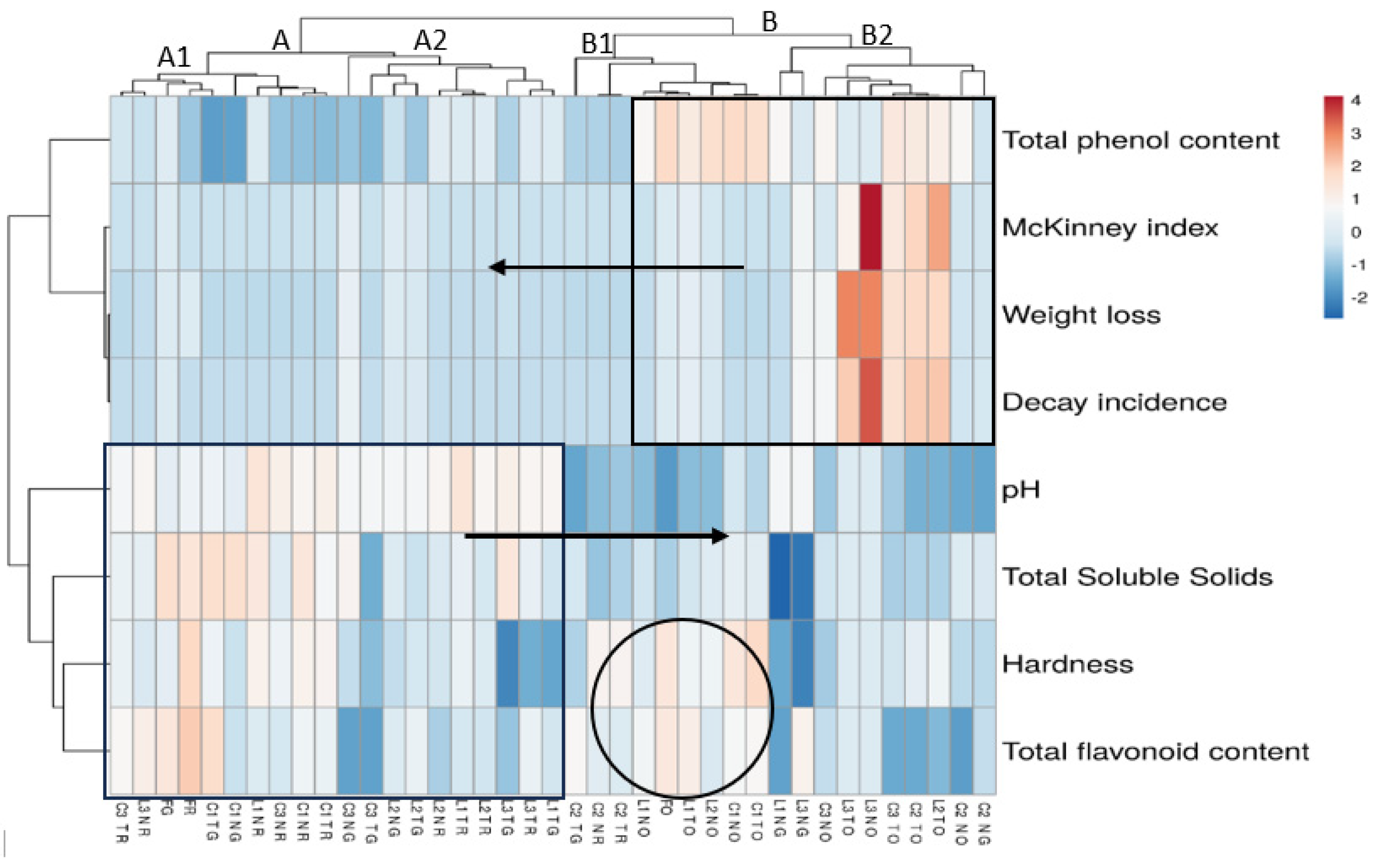

Table 1.
Weight loss, decay incidence, disease severity and physicochemical properties of oranges of cv. ‘Maltaise’ stored at 6°C during 20, 42 or 59 days followed by 15 days shelf life for the first storage period of 20 days and by 6 days shelf life for 42 and 59 cold storage. The fruit were untreated or treated with 0.5% SMB.
Table 1.
Weight loss, decay incidence, disease severity and physicochemical properties of oranges of cv. ‘Maltaise’ stored at 6°C during 20, 42 or 59 days followed by 15 days shelf life for the first storage period of 20 days and by 6 days shelf life for 42 and 59 cold storage. The fruit were untreated or treated with 0.5% SMB.
| STORAGE PERIOD (DAYS) | 0 | 20 | +15 SL | 42 | +6 SL | 59 | +6 SL | |
|---|---|---|---|---|---|---|---|---|
|
WEIGHT LOSS1 (%) |
Untreated |
0 |
0.29 0.32 |
3.10 | 5.33 | 13.34 | 33.26 | 100 |
|
Treated |
21.45 |
65.81 |
68.76 |
61.24 |
100 |
|||
|
DISEASE INCIDENCE (%) |
Untreated |
0 |
0 0 |
0 | 4.0 | 9.5 | 29.2 | 64.3 |
|
Treated |
18.2 |
64.0 |
66.7 |
52.4 |
100.0 |
|||
|
MCKINNEY’S DISEASE INDEX (%) |
Untreated |
0 |
0 0 |
0 | 3.2 | 3.8 | 5.8 | 25.7 |
|
Treated |
10.9 |
41.6 |
53.3 |
31.4 |
80.0 |
|||
|
TSS (%) |
Untreated | 11.5 ± 0.3ab | 12.7 ± 0.1a | 12 ± 0.15a | 12.5 ± 0.1a | 12.4 ± 0.1a | 12.0 ± 0.0a |
nd |
|
Treated |
12.6 ± 0.2a | 12.1+0.02a | 11.6 + 0.1ab | 11.6 ± 0.1ab | 11.5 ± 0.1ab | |||
| PH | Untreated |
3.0 ± 0.01a |
3.7 ± 0.05a | 3.3 ± 0.02a | 3.3 ± 0.02a | 3.1 ± 0a | 3.4 ± 0.02a |
nd |
| Treated | 3.5 ± 0.02a | 3.3 ± 0a | 3.2 ± 0a | 3.2 ± 0.02a | 3.4 ± 0.01a | |||
|
HARDNESS (N) |
Untreated | 15.3 ± 2.4a | 15.2 ± 0.7a | 12.3 ± 0.5b | 13.4 ± 1.5a | 11.0 ± 1.3b | 10.4 ± 1.7b |
nd |
| Treated | 16.2 ± 0.3a | 13.3 ± 2.7a | 13.3 ± 2.9a | 12.7 ± 3.0b | 11.6 ± 1.7b | |||
|
TOTAL PHENOLS (MG GAE /100 G) |
Untreated |
174.0 ± 7.4a |
174.9± 25.2a | 145.8 ± 2.0b |
149.5 ± 2.9b | 171.9.0 ± 29a | 151.1 ± 13.3b |
nd |
| Treated | 171.3 ± 3.9a | 168.9 ±15.8a | 161.8 ± 6.1b | 158.4 ± 3.2b | 163.0 ± 2.8b | |||
|
TOTAL FLAVONOIDS (MG CATECHIN /100 G) |
Untreated |
132.9± 18.2a |
114.8 ± 5.2b | 111.4 ± 2.7b | 41.2 ± 14.5d | 89.8 ± 1.8c | 76.7 ± 14.7c |
nd |
| Treated | 116.0± 14.9b | 127.9 ± 4.7b | 47.8 ± 22.7c | 64.0 ± 2.4c | 48.6 ± 4.2c |
1 Weight loss is relative to each storage period Abbreviations SL: Shelf life, TSS: Total soluble solids, GAE: Gallic acid equivalent, nd: Not determined due to total deterioration caused by fungal infection. For each attribute, the means in the same row with different letters are significantly different, according to Tukey’s HSD test p ≤ 0.05.
Table 2.
Weight loss, disease incidence and physicochemical properties of apple cv. ‘Richared’ stored at 6°C during 20, 42 or 61 days followed by 15 days shelf life for each cold storage. The fruit were untreated/treated with 0.5% SMB.
Table 2.
Weight loss, disease incidence and physicochemical properties of apple cv. ‘Richared’ stored at 6°C during 20, 42 or 61 days followed by 15 days shelf life for each cold storage. The fruit were untreated/treated with 0.5% SMB.
| Storage period (days) | 0 | 20 | +15 SL | 42 | +15 SL | 61 | +15 SL | |
|---|---|---|---|---|---|---|---|---|
| Weight loss (%)1 | Untreated |
0 |
0.28 | 1.29 | 0.59 | 1.85 | 0.97 | 2.62 |
| Treated | 0.24 | 1.69 | 0.45 | 2.12 | 0.62 | 2.88 | ||
|
Disease incidence (%) |
Untreated |
0 |
0 | 0 | 0 | 0 | 0 | 0 |
| Treated | 0 | 0 | 0 | 0 | 0 | 0 | ||
|
Hardness (N) |
Untreated | 16.3 ± 1.2a | 14.3 ± 2.5a | 14.5 ± 1.4a | 14.3 ± 2.2a | 11.6 ± 1.4b | 13.3 ± 0.6a | 9.3 ± 1.0b |
| Treated | 14.3 ± 0.7a | 13.1 ± 1.1a |
14.3 ± 2.0a |
12.2 ± 1.8a |
13.0 ± 2. 5a |
12.1 ± 1.5a |
||
| TSS (%) | Untreated | 14.2 ± 1.3a | 14.1 ± 0.1a | 14.0 ± 0.0a | 11.3 ± 0.1b | 12.3 ± 0.1b | 12.5 ± 0.1b | 12.8 ± 0.0b |
|
Treated |
13.2 ± 0.2a | 12.8 ± 0.0b | 11.6 ± 0.0b | 12.2 ± 0.0b | 12.9 ± 0.1a | 12.7 ± 0.1a | ||
| pH | Untreated | 4.0 ± 0.03a | 4.2 ± 0.0a | 4.5 ± 0.0a | 3.3 ± 0.0b | 4.2 ± 0.0a | 4.3 ± 0.0a | 4.2 ± 0.0a |
| Treated | 4.3 ± 0.0a | 4.5 ± 0.0a | 3.4 ± 0.0b | 4.2 ± 0.0a | 4.1 ± 0.0a | 4.2 ± 0.0a | ||
|
Total phenols (mg GAE /100 g) |
Untreated | 108.7 ± 0.9c | 116.3± 10.7ab | 129.7 ± 3.1a | 113.0 ± 7.1b | 133.1 ± 3.4a | 116.3 ± 1.9b | 131.2 ± 7.3a |
|
Treated |
103.2 ± 6.4ab | 130.6 ± 1.7a | 111.7 ± 7.5b | 131.2 ± 5.1a | 123.3 ± 5.3ab | 121.1 ±10.7a | ||
|
Total flavonoids (mg catechin /100 g) |
Untreated | 156.8±20.7a | 122.2 ±27.9a | 92.5 ± 6.1b | 96.7 ± 1.8c | 68.2 ± 2.0d | 85.2 ± 16.4c | 104.0 ±1.2c |
|
Treated |
103.7 ± 8.7c | 86.3 ± 5.2d | 91.3 ± 11.1d | 81.7 ± 5.8e | 116.4 ± 5.8c | 127.6 ±18.7b |
1 Weight loss is relative to each storage period. Abbreviations SL: Shelf life, TSS: Total soluble solids, GAE: Gallic acid equivalent. For each attribute, the means in the same row with different letters are significantly different, according to Tukey’s HSD test p ≤ 0.05.
Table 3.
Weight loss, disease incidence, disease severity and physicochemical properties of apple cv. ‘Golden’ stored at 6°C during 20, 42 or 61 days followed by 15 days shelf life for each cold storage. The fruit were untreated/treated with 0.5% SMB.
Table 3.
Weight loss, disease incidence, disease severity and physicochemical properties of apple cv. ‘Golden’ stored at 6°C during 20, 42 or 61 days followed by 15 days shelf life for each cold storage. The fruit were untreated/treated with 0.5% SMB.
| Storage period (days) |
0 | 20 | +15 SL | 42 | +15 SL | 61 | +15 SL | |
|---|---|---|---|---|---|---|---|---|
| Weight loss (%)1 | Untreated |
0 |
0.47 | 1.96 | 7.94 | 14.67 | 24.19 | 3.50 |
| Treated | 0.21 | 1.98 | 0.54 | 10.96 | 0.75 | 31.59 | ||
| Disease incidence (%) | Untreated Treated |
0 |
0 0 |
0 0 |
7.7 0 |
11.1 10.0 |
23.08 0 |
0 30.0 |
|
Mckinney’s disease index (%) |
Untreated | 0 | 0 | 3.08 | 8.9 | 10.8 | 0 | |
|
Treated |
0 |
0 |
0 |
0 |
6.0 |
0 |
18.0 |
|
| Hardness (N) | Untreated | 12.6 ± 1.4a | 11.2 ± 0.7b | 9.2 ± 0.9c | 11.0 ± 1.7b | 11.2 ± 2.2b | 11.1 ± 2.0 b | 7.7 ± 1.1c |
|
Treated |
13.2 ± 1.5a |
9.0 ± 0.6c |
10.7 ± 1.4b |
11.7 ± 2.1b |
10.0 ± 2.1b |
7.6 ± 0.8c |
||
| TSS (%) | Untreated | 14.4 ± 0a | 14.4 ± 0a | 9.3 ± 0.01c | 12.3 ± 0.1b | 12.4 ± 0.0b | 13.5± 0.1a | 14.1 ± 0.5a |
|
Treated |
14.4 ± 0.2a |
12.0 ± 0.0b |
12.2 ± 0.0b |
11.9 ± 0.1b |
10.8 ± 0.1c |
9.7 ± 0.1c |
||
| pH | Untreated | 3.9 ± 0.04a | 3.9 ± 0.04a | 4.1 ± 0.02a | 3.1 ± 0.01b | 4.1 ± 0.01a | 4.1 ± 0.01a | 4.3 ± 0.01a |
|
Treated |
4.0 ± 0.005a |
4.2 ± 0.01a |
3.1 ± 0.01b |
4.1 ± 0.01a |
4.1 ± 0.0a |
4.1 ± 0.01a |
||
|
Total phenols (mg GAE /100 g) |
Untreated | 131.9 ± 6.5b | 93.1 ± 29.4c | 149.6 ± 22.7a | 121.2± 13.4b | 119.6 ± 11.5b | 107.5 ± 2.8c | 113.7±4.9c |
|
Treated |
89.9 ±13.5d | 130.6 ± 40.0a | 113.8 ± 6.9c | 108.9 ± 17.4c | 102.0 ± 21.0c | 128.5±7.1b | ||
|
Total flavonoids (mg catechin /100 g) |
Untreated | 136.4±1.2a | 79.0 ± 3.5c | 43.5 ± 5.2d | 77.1 ± 2.9c | 91.7 ± 16.4b | 122.5 ± 6.9a | 43.2 ± 1.8d |
|
Treated |
145.7 ± 3.1a | 82.5 ± 11.6c | 117.5 ±24.5a | 103.7 ± 19.3b | 62.0 ± 4.7d | 44.3±11.6d |
1 Weight loss is relative to each storage period. Abbreviations SL: Shelf life, TSS: Total soluble solids, GAE: Gallic acid equivalent. For each attribute, the means in the same row with different letters are significantly different, according to Tukey’s HSD test p ≤ 0.05.
Disclaimer/Publisher’s Note: The statements, opinions and data contained in all publications are solely those of the individual author(s) and contributor(s) and not of MDPI and/or the editor(s). MDPI and/or the editor(s) disclaim responsibility for any injury to people or property resulting from any ideas, methods, instructions or products referred to in the content. |
© 2024 by the authors. Licensee MDPI, Basel, Switzerland. This article is an open access article distributed under the terms and conditions of the Creative Commons Attribution (CC BY) license (https://creativecommons.org/licenses/by/4.0/).
Copyright: This open access article is published under a Creative Commons CC BY 4.0 license, which permit the free download, distribution, and reuse, provided that the author and preprint are cited in any reuse.


