

Submitted:
31 August 2024
Posted:
02 September 2024
You are already at the latest version
Abstract
This paper presents the Aether Physics Model (APM), a novel theoretical framework that offers a unified description of the fundamental forces and weak interaction. The APM proposes a quantum Aether composed of discrete units, recognizes two distinct charge manifestations, and treats all charges as distributed. Using dimensional analysis and simple equations, the APM derives force equations that unify gravity, electromagnetism, and the strong forces and the weak interaction. The model makes specific predictions about force strengths, maximum mass density, and fine structure constants for protons and neutrons. These predictions align with existing observations and offer new avenues for experimental testing. The APM addresses the limitations of the Standard Model while providing a more intuitive explanation for phenomena like the quantum Hall effect and Casimir effect. If validated, the APM could revolutionize our understanding of space, matter, and fundamental forces.
Keywords:
unified force theory
; quantum aether
; distributed charge
; fundamental forces
; dimensional analysis
1. Introduction
The quest to understand the fundamental nature of the Universe has been a driving force in physics for centuries. Today, the Standard Model of particle physics stands as our most comprehensive framework for describing the behavior of subatomic particles and three of the fundamental forces. However, despite its remarkable success in predicting and explaining a wide range of phenomena, the Standard Model faces significant limitations and leaves several crucial questions unanswered, as thoroughly discussed in Langacker’s authoritative textbook (Langacker, 2017). This comprehensive work provides an up-to-date perspective on the achievements and challenges of the Standard Model [1,2].
Among these challenges are the inability to incorporate gravity into its framework, the nature of dark matter and dark energy, and the unexplained matter-antimatter asymmetry in the Universe. Arkani-Hamed et al. (2018) address these issues in their influential paper on the hierarchy problem and extra dimensions, highlighting the ongoing challenges in reconciling gravity with particle physics [3,4]. Furthermore, the Standard Model relies on many arbitrary parameters and fails to provide a unified description of the fundamental forces and weak interaction. Wells (2017) critically examines this naturalness issue in particle physics, emphasizing the need for theories beyond the Standard Model [5].
This paper presents the Aether Physics Model (APM) in response to these challenges. This novel theoretical framework offers a unified description of the fundamental forces and weak interaction and addresses many of the Standard Model’s limitations. The APM proposes a return to the concept of an Aether but reimagined in a quantum context as a dynamic and discrete medium composed of fundamental units called Aether units [6].
Figure 1.
Aether Unit viewed in five dimensions of space resonance. Strings of mass have circular geometry. The electrostatic charge is spherical in geometry. The strong charge (or electromagnetic charge) has toroidal geometry. All physical existence comes together in the Aether with tubular double loxodrome geometry.
Figure 1.
Aether Unit viewed in five dimensions of space resonance. Strings of mass have circular geometry. The electrostatic charge is spherical in geometry. The strong charge (or electromagnetic charge) has toroidal geometry. All physical existence comes together in the Aether with tubular double loxodrome geometry.
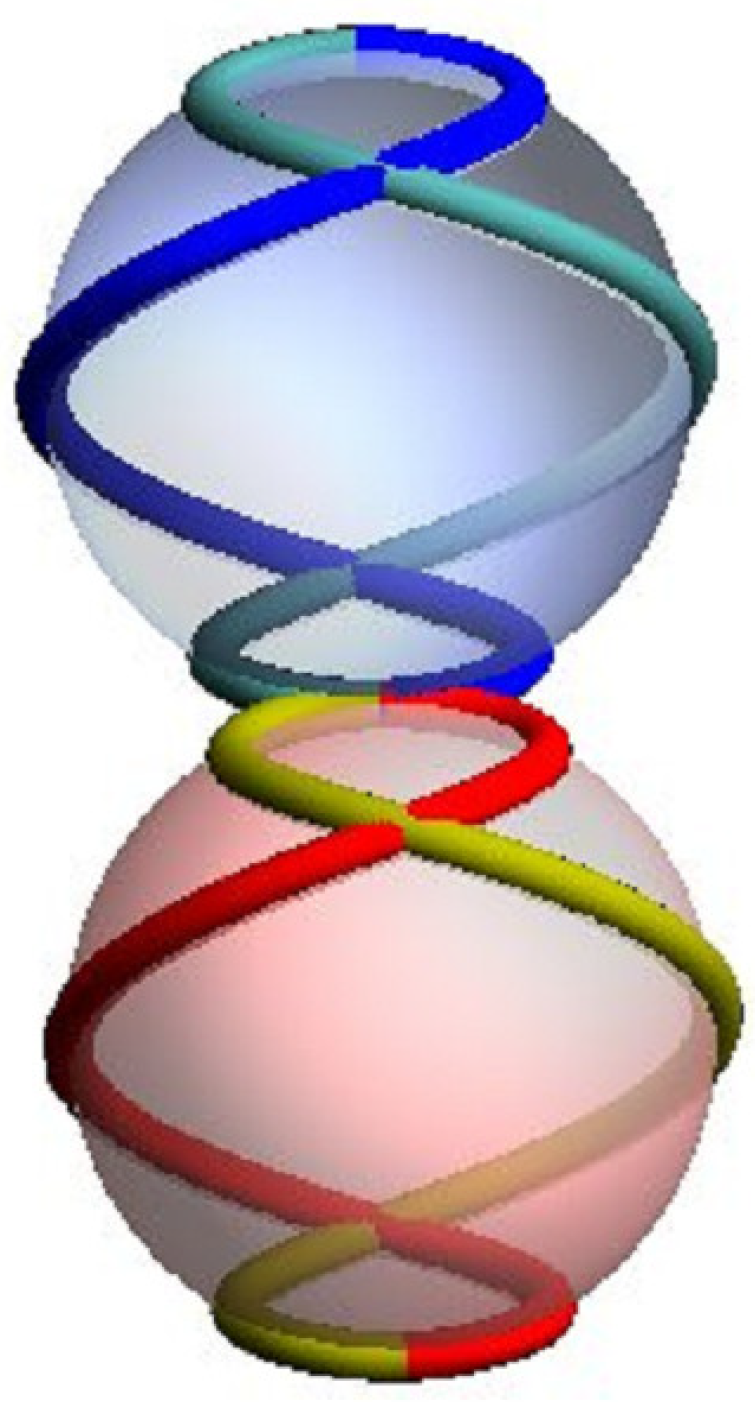
Central to the APM is recognizing two distinct manifestations of charge—electrostatic and magnetic—and the principle that all charge is inherently distributed (squared). This perspective builds upon but diverges from the standard understanding of charge in particle physics, as comprehensively documented in the Review of Particle Physics by Olive and the Particle Data Group (2014) [7].
Figure 2.
The toroids in this figure have different radii but identical surface areas. This is why all subatomic particles share the same quantum surface area as the Compton wavelength squared.
Figure 2.
The toroids in this figure have different radii but identical surface areas. This is why all subatomic particles share the same quantum surface area as the Compton wavelength squared.
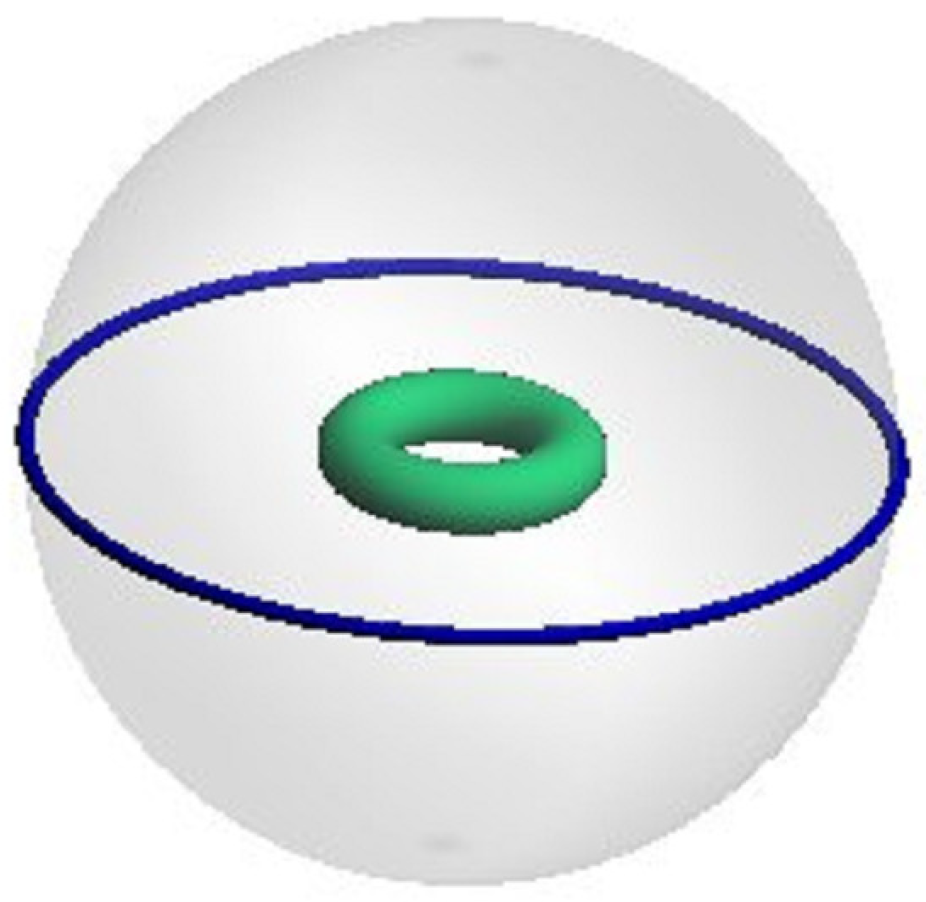
A vital aspect of the APM is its proposal that subatomic particles have a toroidal structure. This concept aligns with the model’s loxodrome geometry and provides a novel way to conceptualize particle properties. Because toroids have two radii, the minor radius and the major radius, they can have varying radii lengths but still have the same surface area. Because all subatomic particles have the same surface area, we can graphically represent them as tubular loxodromes (referred to simply as “loxodromes”) while using the quantum distance squared as their surface area.
The APM derives its predictions using straightforward dimensional analysis and simple equations, avoiding the need for complex mathematical abstractions that often distance theory from physical reality. Despite its departure from mainstream views, The APM remains consistent with recent experimental observations and offers elegant explanations for phenomena such as the quantum Hall effect. Stern’s (2020) review of the fractional quantum Hall effect provides a current benchmark against which the APM’s explanations can be evaluated. The APM offers elegant explanations for phenomena such as the Casimir effect. Klimchitskaya and Mostepanenko’s (2021) comprehensive overview of recent developments in Casimir effect research provides a current benchmark against which the APM’s explanations can be evaluated [8,9].
2. Methods
The Aether Physics Model employs a rigorous mathematical framework based on dimensional analysis and fundamental physical constants. This approach allows for a straightforward yet powerful description of physical phenomena, avoiding the need for complex mathematical abstractions while maintaining consistency with observed reality.
2.1. Dimensional Analysis Approach
The APM utilizes a Quantum Measurement Units (QMU) system based on the concept of distributed charge and the distinction between electrostatic and magnetic charges. Key aspects of this dimensional analysis include:
- All charge dimensions are always distributed (squared)
- Most charge-related quantities are expressed in terms of magnetic charge rather than elementary charge
- The use of quantum measurements to construct units, rather than relying on arbitrary or macro-scale measurements
This approach reevaluates several standard electrical units, such as conductance, capacitance, inductance, permittivity, and permeability.
2.2. Key Constants and Their Relationships
The APM introduces and utilizes several fundamental constants:
- Compton wavelength (Compton wavelength of the electron, the quantum distance empirically associated with light)
- Quantum frequency (Defined as , where c is the speed of photons.)
- Maximum Aether mass (Maximum mass an Aether unit can contain)
- Aether unit (Aether unit constant, the quantum rotating magnetic field, equal to times Coulomb’s constant)
- (a proposed fundamental reciprocal force that permeates all of space)
These constants are interrelated through fundamental equations:
Where is the maximum magnetic charge of the Aether.
2.3. Derivation of Force Equations
Using these constants and relationships, the APM derives equations for the fundamental forces:
- Gravitational Force:
Where G is Newton’s gravitational constant.
- 2.
- Electrostatic Force:
Where kc is Coulomb’s electrostatic constant.
- 3.
- Magnetic (Strong) Force:
- 4.
- Weak Interaction:
- ○
- Expressed as a ratio of electrostatic to magnetic charges:
Where α is the electron fine structure constant, p is the proton equivalent and is the magnetic charge of the proton, n is the neutron equivalent and is the magnetic charge of the neutron.
Magnetic Charge Values
The APM introduces the concept of magnetic charge for subatomic particles. The magnetic charge values for the electron, proton, and neutron are as follows:
These values are derived from the particles’ angular momentum and the Aether’s conductance:
Where: h is Planck’s constant ()
hp is the proton’s angular momentum ()
hn is the neutron’s angular momentum ()
Cd is the Aether’s conductance ( )
The angular momentum values for the proton and neutron are calculated as:
Where and are the masses of the proton and neutron, respectively, c is the speed of photons, and is the Compton wavelength.
These force equations demonstrate the unification of the fundamental forces and weak interaction within the APM framework derived from the Gforce and the properties of the Aether units. Notably, the weak interaction is not a force but a ratio of the electrostatic to magnetic charge dimensions. The equations and their resulting relative strengths present a strong case for a unified force theory for several reasons:
- Common Origin: All the forces are derived from the same fundamental constants (, ) and properties of the Aether (, ). This suggests a standard underlying structure.
- Consistent Framework: The equations follow a similar structure, differing mainly in the specific Aether properties they involve (magnetic charge, electrostatic charge, mass).
- Accurate Predictions: The relative strengths derived from these equations closely match observed values, spanning about 41 orders of magnitude from the strong force to gravity.
- Simplicity: The equations are relatively simple and intuitive, based on fundamental constants and properties rather than requiring complex mathematical constructs.
- Unification of Gravity: Unlike the Standard Model, this approach naturally incorporates gravity into the same framework as the other forces.
- Explanatory Power: These equations explain previously unexplained constants (like the fine structure constants) and phenomena (like the relationship between quantum and cosmological scales through the Schwarzschild radius).
- Testable Predictions: The model makes specific, testable predictions about things like proton and neutron fine structure constants.
By expressing all fundamental forces in terms of the Gforce and the properties of Aether units, the APM achieves a level of unification that has long been sought in physics. This unified framework provides a coherent description of known phenomena and offers new insights into the nature of space, matter, and their interactions.
3. Results
3.1. Unified Prediction of Relative Force Strengths
- Strong Force: 1
- Electrostatic Force: ~10−2
- Weak Interaction: ~10−6
- Gravity: ~10−41
These predictions arise naturally from the relationships between the Gforce, Aether units, and charge manifestations, providing a more coherent picture than the varied predictions of the Standard Model, as shown in Table 1.
3.2. Maximum Mass per Space Quantum and the Schwarzschild Radius
The APM predicts a maximum mass () that can be contained within an Aether unit. Remarkably, the ratio of this maximum mass to the Compton wavelength () is equal to the Schwarzschild radius for a black hole:
This prediction provides a profound link between quantum-scale phenomena and large-scale cosmological effects, offering a potential bridge between Quantum Mechanics and General Relativity.
3.3. Magnetic Charge and the Quantum Hall Effect
The APM’s concept of magnetic charge finds strong support in the observed quantum Hall effect, particularly in its “fractional” manifestations. The quantum magnetic flux observed in these experiments aligns precisely with the APM’s predictions for the magnetic charge of electrons:
Where is the quantum magnetic flux constant, is the charge conversion factor in Quantum Measurement Units (QMU), and mflx is the magnetic flux unit in QMU.
3.4. Casimir Effect and Magnetic Charge
The original equation for the Casimir effect, derived by Hendrik Casimir in 1948, calculates the attractive force between two plates. The quantum length and area are used for measurement analysis, and the calculation is based on the distance separating the plates.
The Aether Physics Model (APM) offers an alternative interpretation of the Casimir effect, emphasizing the role of magnetic charge rather than virtual photons. By modifying Casimir’s equation to use the APM unit for photons (phtn) and expressing force in APM units (forc), we obtain:
Where forc equals . Interestingly, the numerical factor is very close to , the inverse geometrical constant of the Aether in the APM. This suggests the Casimir equation could potentially be rewritten as:
The original Casimir value differs from this proposed form by only 3.3%, within the 5% margin of error reported by Lamoreaux’s 1996 empirical measurements [9].
In the APM framework, is equivalent to the product of the electron’s magnetic charge and Coulomb’s constant:
This allows the Casimir equation to be reframed in terms of magnetic charge:
This formulation suggests the Casimir effect may arise from the magnetic charge of electrons in the metal plates interacting via a modified form of Coulomb’s law. While not following an inverse square relationship, the force increases rapidly at small distances, consistent with Lamoreaux’s observations.
Using quantum length units, equation (23) simplifies as the APM’s magnetic force equation for electrons:
This analysis suggests the Casimir effect experiments may provide evidence for the existence of electron magnetic charge and support the APM’s conceptualization of photons. Further investigation is warranted to explore these potential implications.
3.5. Predicted Fine Structure for Protons and Neutrons
The APM predicts the existence of fine structure constants not only for electrons (the well-known (α) but also for protons (p) and neutrons (n):
4. Discussion
The Aether Physics Model offers several advantages over the Standard Model and other theories, particularly its unified approach to fundamental forces, its elegant mathematical framework, and its ability to address long-standing issues in physics.
4.1. Unification of Forces
Unlike the Standard Model, which fails to incorporate gravity and doesn’t fully unify the strong force, the APM provides a unified framework for the fundamental forces and weak interaction, deriving them from the Gforce and its interactions with Aether units. This approach contrasts with other unification attempts, such as loop quantum gravity, which was comprehensively reviewed by Ashtekar and Pullin (2017), highlighting the ongoing challenge of force unification in physics [10].
4.2. Gravity
The APM incorporates gravity naturally within its framework, relating it to the maximum mass of Aether units and providing a potential bridge between Quantum Mechanics and General Relativity. This approach aligns with ongoing efforts to reconcile these theories, as discussed in Oriti’s (2014) paper on the emergence of space and time in quantum gravity [11].
4.3. Particle Masses
While the Standard Model requires the Higgs mechanism to explain particle masses, the APM explains particle masses as emergent properties of the interaction between dark matter strings and Aether units, providing a more fundamental explanation. This alternative view can be contrasted with the Standard Model’s approach, thoroughly documented in the Review of Particle Physics by Tanabashi et al. (2018) [12].
4.4. Dark Matter and Dark Energy
The APM explains dark matter and dark energy, describing dark matter as one-dimensional mass strings and relating dark energy to the Gforce. This novel perspective can be compared to current dark matter research trends, as outlined in Bertone and Tait’s (2018) Nature paper, which provides an up-to-date overview of the field [13].
4.5. Mathematical Framework
In contrast to the Standard Model’s complex mathematical formulations, the APM uses straightforward dimensional analysis and simple equations, maintaining a closer connection to physical reality. This approach differs from other modern theories, such as those discussed in Polchinski’s (2017) comprehensive review of string theory, which often involve highly abstract mathematical frameworks [14].
4.6. Consistency with Experimental Observations
The APM’s predictions demonstrate remarkable consistency with existing experimental observations, particularly in areas where the Standard Model faces challenges. The comprehensive Review of Particle Physics by Patrignani and the Particle Data Group (2016) provides a wealth of experimental data against which these predictions can be evaluated. The APM’s ability to precisely predict the relative strength of forces explains quantum phenomena like the Hall effect and Casimir effect. The significance of these phenomena, particularly the quantum Hall effect, is highlighted in von Klitzing’s (2017) review, which provides an authoritative benchmark for evaluating the APM’s explanations. The link between quantum and cosmological physics through the Schwarzschild radius relationship offers strong support for its validity [15,16].
5. Conclusion
The Aether Physics Model introduces an innovative approach to fundamental physics, offering solutions to long-standing problems and paving the way for new theoretical and experimental exploration. Just as the entirety of the Standard Model cannot be encompassed in a single journal publication and relies on intricate and interconnected concepts, the complete Aether Physics Model cannot be contained within this single article. The main points of the APM Unified Force Theory are outlined, along with references to our other publications. While it challenges many established concepts in physics, the APM has the potential to offer a more comprehensive and unified understanding of nature, making it an intriguing subject for further research. As we continue to expand our knowledge of the Universe, theories like the APM play a pivotal role in advancing scientific progress, questioning our assumptions, and sparking new ways of contemplating the fundamental nature of reality.
References
- Langacker, P. (2017). The Standard Model and Beyond (2nd ed.). CRC Press. https://www.taylorfrancis.com/books/oa-mono/10.1201/b22175/standard-model-beyond-paul-langacker.
- Arkani-Hamed, N. , Dimopoulos, S., & Dvali, G. (2018). The hierarchy problem and new dimensions at a millimeter. Physics Letters B, 429(3-4), 263-272. [CrossRef]
- Wells, J. D. (2017). Naturalness, Extra-Empirical Theory Assessments, and the Implications of Skepticism. Foundations of Physics, 47(5), 612-624. [CrossRef]
- Buckley, M. R., & Peter, A. H. G. (2018). Gravitational probes of dark matter physics. Physics Reports, 761, 1-60. [CrossRef]
- Baer, H. , Choi, K. Y., Kim, J. E., & Roszkowski, L. (2015). Dark matter production in the early Universe: beyond the thermal WIMP paradigm. Physics Reports, 555, 1-60. [CrossRef]
- Thomson III, D. W. & Bourassa, J. D. Secrets of the Aether. (Quantum AetherDynamics Institute, 2005). https://sota.aetherwizard.com/unified-force-theory.
- Olive, K. A., & Particle Data Group. (2014). Review of particle physics. Chinese Physics C, 38(9), 090001. [CrossRef]
- Stern, A. (2020). Fractional quantum Hall effect. Annual Review of Condensed Matter Physics, 11, 25-46. https://www.nature.com/articles/s41578-024-00694-x.
- Lamoreaux, S. K. Demonstration of the Casimir force in the 0.6 to 6 μm range. Phys. Rev. Lett. 78, 5 (1997). [CrossRef]
- Glashow, S. L. (1980). Towards a unified theory: Threads in a tapestry. Reviews of Modern Physics, 52(3), 539-543. [CrossRef]
- Oriti, D. (2014). Disappearance and emergence of space and time in quantum gravity. Studies in History and Philosophy of Science Part B: Studies in History and Philosophy of Modern Physics, 46, 186-199. [CrossRef]
- Tanabashi, M., et al. (Particle Data Group). (2018). Review of Particle Physics. Physical Review D, 98(3), 030001. [CrossRef]
- Bertone, G., & Tait, T. M. (2018). A new era in the search for dark matter. Nature, 562(7725), 51-56. [CrossRef]
- Polchinski, J. (2017). String theory to the rescue. Reviews of Modern Physics, 89(3), 035007. https://arxiv.org/pdf/1512.02477.
- Patrignani, C., & Particle Data Group. (2016). Review of Particle Physics. Chinese Physics C, 40(10), 100001. [CrossRef]
- von Klitzing, K. (2017). Quantum Hall Effect and Metrology. Annual Review of Condensed Matter Physics, 8, 13-30. [CrossRef]

Table 1.
Relative Strengths of Forces According to Various Authorities.
| Relative Strengths of Forces According to Various Authorities | ||||||||
| Aether Physics Model | AIP Handbook 1 |
Q is for Quantum2 |
Hyper Physics3 |
Forces of Nature4 | Wolfram5 | Particle Physics6 | PHYSNET7 | |
| Strong Force | 1 | 1 | 1 | 1 | 1 | 1 | ~1 at large distance <1 at small distance |
1 |
| Electrostatic Force | ||||||||
| Weak Interaction | ||||||||
| Gravity | ||||||||
1.Gray, Dwight E., American Institute of Physics Handbook (McGraw Hill Book Company, 1972) p 8-277; 2. Gribbin, John, Q IS FOR QUANTUM: An Encyclopedia of Particle Physics (Touchstone, New York, 2000) p 168; 3. http://hyperphysics.phy-astr.gsu.edu/hbase/forces/couple.html; R. Nave, Georgia State University; 4. http://www.ph.surrey.ac.uk/partphys/chapter6/nature.html; University of Surrey; 5. http://scienceworld.wolfram.com/physics/FundamentalForces.html; Eric W. Weisstein; 6. http://www.shef.ac.uk/physics/teaching/phy304/interactions.html; C N Booth, University of Sheffield; 7. Mesgun Sebhatu, “The Standard Model of Fundamental Particles and Their Interactions” (Project PHYSNET, Michigan State University, Michigan USA).
Disclaimer/Publisher’s Note: The statements, opinions and data contained in all publications are solely those of the individual author(s) and contributor(s) and not of MDPI and/or the editor(s). MDPI and/or the editor(s) disclaim responsibility for any injury to people or property resulting from any ideas, methods, instructions or products referred to in the content. |
© 2024 by the authors. Licensee MDPI, Basel, Switzerland. This article is an open access article distributed under the terms and conditions of the Creative Commons Attribution (CC BY) license (http://creativecommons.org/licenses/by/4.0/).
Copyright: This open access article is published under a Creative Commons CC BY 4.0 license, which permit the free download, distribution, and reuse, provided that the author and preprint are cited in any reuse.


