
Submitted:
29 August 2024
Posted:
02 September 2024
You are already at the latest version
Abstract
Objectives: Teachers’ intention understanding ability reflects their professional insight, which is the basis for effective classroom teaching activities. However, the cognitive process and brain mechanism of how teachers understand students' action intention in class are still unclear; Methods: This study used event-related potential (ERP) technology to explore the cognitive neural differences in intention understanding ability among teachers with different levels of knowledge and experience. The experiment used the comic strips paradigm to examine the ability of expert and novice teachers to understand students’ normative and non-normative classroom actions under different text prompts (“how” and “why”); Results: The results revealed that in the late time window, expert teachers induced larger P300 and LPC amplitudes when they understood students' classroom action intentions, while the N250 amplitudes induced by novice teachers in the early time window were significantly larger. In addition, for both types of teachers, when understanding the intentions behind students’ normative actions, the N250 amplitude was the most significant, while the P300 and LPC amplitudes were more significant for non-normative actions.; Conclusions: This study found that teachers at varying professional development stages had different time processing processes in intention understanding ability, which supported teachers' brain electrophysiological activities related to social ability.
Keywords:
Expert-novice teacher
; Understanding of intentions
; Classroom actions
; Teachers' professional insight
; event-related potential
1. Introduction
Teaching expertise includes the application of professional knowledge, problem-solving, pattern recognition, insight, and other cognitive components. Among them, insight, as one of the most important components of teaching expertise, is mainly reflected in the understanding of students' intentions [1]. Intention understanding refers to a cognitive model in which individuals can observe and understand the psychological state behind others’ actions [2,3]. It consists of four stages: first, identifying actions; second, representing the target behavior; third, understanding the causal relationship between actions and intentions, and finally generating perceptions and physical re-experiences [4,5,6].
In such a complex environment as the classroom, teachers have the challenge to notice and interpret many different events, which is crucial for effective classroom management [7]. In turn, classroom management has been shown to have an impact on student achievement [8,9,10].
1.1. Influence of Expertise Level on Individual Action Recognition
With the development of interdisciplinary science and technology, researchers have investigated and studied how different expertise level affects sensory processing. For example, professional chess players employ more advanced visual search strategies when judging the board [11,12], with stronger pattern recognition ability [13]. Advanced chess players have a higher alpha EEG (electroencephalogram) power spectrum when completing difficult ends than novice players [14]. In tennis players, the ERP (event-related potential) component of the expert group activated earlier and more strongly in motion-in-depth perception of the tennis ball [15].
In the field of teacher education, there are obvious differences between experts and novice teachers in their cognitive processing of classroom teaching situation information [1,16,17,18,19]. Specifically, compared to novices, expert teachers can more quickly identify events in the classroom [17], pay attention to students’ actions earlier [20], and prevent interference from students’ disruptive behavior by identifying behavior and event cues as soon as possible [7,19]. It can be seen that expertise level has a significant impact on teachers’ identification of students’ classroom behaviors. However, current research mainly focuses on revealing the behavioral differences in teachers' recognition patterns of students' classroom behaviors, while the cognitive neural processes of more advanced action recognition patterns, that is, how teachers understand students' action intentions in the classroom, have not been fully elucidated.
1.2. Theoretical Basis and Neural Mechanism of Action Intention Understanding
Embodied cognition theory provides a new perspective for studying the cognitive structure of teachers’ initial perception and deep understanding of students’ classroom actions [21,22,23,24]. This theory states that individuals can deepen their understanding of action intentions by observing the behaviors of others and their own experiences [4,6]. Within the framework of embodied cognition theory, teachers understand students’ intentions in classroom actions by mobilizing personal experience when observing students’ behaviors and showing keen teaching insights [22]. This is closely related to the neural basis of embodied cognition.
Cognitive neuroimaging studies have shown that inferring others’ intentions within the framework of embodied cognition theory relies on an inferior frontoparietal action observation network and a putative social brain network, including the posterior superior temporal sulcus (pSTS), temporoparietal junction (TPJ), and anterior cingulate cortex [25,26,27]. The above studies used functional magnetic resonance imaging (fMRI) to clearly explain the spatial distribution of the brain when it comes to understanding intention. However, fMRI is lacking in temporal resolution. Millisecond event-related potential (ERP) technology can provide a technical means to reveal the temporal characteristics of the intended understanding. By analyzing the characteristics of the ERP waveform, such as amplitude and latency, we can infer how the brain processes different intentions and their time characteristics. Research shows that the main ERP components related to intention understanding include the N250, P300, and late positive component (LPC) [28]. The N250 visual ERP component produces a more pronounced attention-enhancing effect in the face of familiar stimuli. This means that in the early stages of brain processing, there is a stronger attention-driven response to familiar stimuli to enhance its processing and perception [29]. It has been found that the posterior parietal region of the brain significantly triggers the N250 component 200-250 ms after stimulus presentation, when individuals observe others performing reasonable actions compared to unreasonable actions [30]. P300 reflects the brain's perception of novel stimuli and processing of negative intentions [31,32]. Huang et al. by using the comic strips paradigm, asked participants to judge the intentions of two characters as friendly cooperative, hostile conflict, and neutral actions in succession [28]. The results showed that 300 ms after stimulus presentation, negative hostile intentions induced a more positive P300 than positive friendly and neutral intentions. LPC appears at a later stage after the stimulus is presented, usually after 400 ms. Studies have shown that LPC is closely related to processes such as emotional processing and social cognition [33]. LPC index is widely used in the task of identifying communicative intention. Wang et al. found that the amplitude of LPC induced by understanding communicative intention in an individual’s brain was significantly larger than that of personal intention, while the amplitude of LPC induced by personal intention was larger than that of physical intention [34].
1.3. Research Paradigm of Action Intention Understanding
The experimental paradigm of action intention understanding is to use specific research designs and methods to deeply study the observer's cognitive process of the intention behind other people's actions. In previous studies using the comic strip paradigm, in which subjects were asked to infer relationships and behavioral attributes between two pictures, each trial typically consisted of two pictures, the priming stimulus was an action preparation picture, and the target stimulus was an action execution picture. This design allows researchers to explore how the actions of the person being observed in the picture are performed [35,36].
When we observe a target performing an action, we generally get two pieces of information, one is how the target performs the action, and the other is why the target performs the action [35,37]. For example, based on the action of "brushing teeth", we can obtain information: why the action is performed (e.g., "clean teeth") and how to perform it (e.g., "use a toothbrush"). However, previous research focused more on the specific execution methods and paid less attention to the reasons behind the execution of actions. In order to fill this research gap, the current study further expanded the experimental paradigm and aimed to deeply explore the cognitive neural differences in "how" and "why" behaviors are performed to more fully reveal the cognitive process of action intention understanding.
In terms of experimental stimulation, this study used how/why text prompts as the priming stimulus, and students' classroom actions as the observation objects for the target stimulation. Wang et al. classified not listening carefully as students' problematic non-normative actions, while behaviors that promoted clear attention were classified as students' normative actions [18]. At the same time, teachers will subconsciously identify the normativeness of students’ behavior [38]. Therefore, this study subdivided students' classroom actions into normative and non-normative behaviors to further explore teachers' understanding of students' action intentions and the potential impact of different actions on teachers' intention understanding.
1.4. Study Hypotheses
In order to investigate the behavioral and cognitive neural differences of teachers with different expertise level in understanding students' classroom action intentions, we recruited expert and novice teachers and linked the "how/why" text prompts with action pictures, so that teachers were asked to infer students' classroom action intentions, and we used event related potential technology to explore the neural mechanisms of this process. Hence, we proposed four hypotheses:
Hypothesis 1: Due to different professional levels, expert teachers and novice teachers will have different reaction times and accuracy on how and why students perform classroom actions, and will have different comprehensibility of students' classroom behaviors before and after the experiment.
Hypothesis 2: Due to different professional levels, there will be significant differences in ERP results between expert teachers and novice teachers when understanding students' classroom action intentions.
Hypothesis 3: Since the early N250 amplitude induced by rationalizing action in previous studies was larger, the late P300 induced by negative action was larger, and the LPC was at a later stage after the stimulus appears [31,34,39], we therefore assumed that at the early stage of stimulus processing, the N250 amplitude caused by normative action will be more significant than the N250 amplitude caused by non-normative action; in the later stage of stimulus processing, the amplitude of P300 and LPC caused by non-normative action will be more significant than the amplitude caused by normative action.
Hypothesis 4: There will be an interaction between expertise level, text prompts, action type and teachers’ brain (brain regions and hemispheres).
2. Materials and Methods
2.1. Participants
This study used a mixed experimental design of 2 (expertise level: expert vs. novice) × 2 (text prompt: how vs. why) × 2 (action type: normative vs. non-normative), with expertise level as the between-subject variable, and text prompt and action type as the within-subject variables. A total of 46 teachers were recruited in this study, however, 8 participants were excluded because of large artifacts [39], resulting in a final sample of 38 participants for analysis. The sample included 19 expert teachers (6 male, mean age = 41.32 ± 5.45 years, teaching experience = 189.34 ± 64.27 months) and 19 novice teachers (5 male, mean age = 21.05 ± 1.93 years, teaching experience = 7.00 ± 2.84 months). Calculations using the G*Power software showed a total sample size of 24, meaning 12 participants per group (effect size f = 0.25, α = 0.05, power = 0.80) [40,41]. All participants were right-handed and had a normal or corrected-to-normal vision. The ethics committee approved the study, which was conducted according to the principles outlined in the Declaration of Helsinki.
2.1.1. Expert Teachers
In line with previous studies [42,43,44], teachers were considered experts if they met the following criteria: (1) school leaders or education authorities provided a list of candidates based on the relevant characteristics of expert teachers, and (2) based on meeting Criterion 1, expert teachers had been teaching for over 10 years and were approved by the local government to have a professional title of Grade I or above [45]. Expert teachers were selected from schools in different cities in Zhejiang Province, China.
2.1.2. Novice Teachers
Novice teachers were also selected based on existing national and international studies’ screening criteria [43,44]. The novice teachers included senior college students and new teachers. Senior college students studied at education-focused universities, experienced teacher training, and participated in school practice for more than three months. New teachers had been working for less than five years [43]. The senior students were mainly from normal university, while the novice teachers were from schools in different cities in Zhejiang Province.
2.2. Materials
To enhance ecological validity, the experimental materials were taken with digital cameras. Extant literature has shown that compared with cartoon pictures, real-person photos have higher ecological validity [46,47,48]. The student actor was a male middle school student (age = 15 years, height = 168cm), and his hairstyle, figure, and dress conformed to the typical characteristics of Chinese students. Students’ normative (e.g., sitting upright, listening attentively, raising their hand to speak) and non-normative (e.g., sleeping, playing on mobile phones, whispering) actions in class were mainly classified according to Ding et al. [49]. The materials included 150 initial photos, half of which were normative actions and half of which were non-normative actions. To exclude differences in participants’ electroencephalographic (EEG) data caused by different physical attributes and task difficulty levels, facial expressions and gaze direction were blurred and the character’s body orientation was matched. All photos were sized to 472 × 354 pixels and matched for luminance, contrast, and color saturation, using Adobe Photoshop 7.0. Twenty teachers (age range: 26–43 years) were selected to evaluate the difficulty and normality degrees of actions (score range: 1–5). No significant differences were found in the difficulty (p > 0.05), but a significant difference was identified in the normality (p < 0.001). Finally, 70 pictures that met the requirements were selected (normative: 36, non-normative: 34, see Figure 1; specific information on materials is shown in the Appendix A).
2.3. Subjective Measurements
Before the task, all participants were asked to report their individual teaching-related experience (e.g., teaching experience, professional title, teaching subject) to assess their professional competence, rate the comprehensibility of the student’s classroom actions (1 = incomprehension, 7 = comprehension), and complete the Chinese version of the Interpersonal Reactivity Index (IRI-C; Cronbach’s α of the IRI-C ranges between 0.61–0.85 [50]) to evaluate their dispositional empathy, which consists of four dimensions: Empathic Concern (EC), Perspective Taking (PT), Fantasy (FS), and Personal Distress (PD). (1) Empathic Concern (EC), the tendency of individuals to respond with sympathy and attention to those in distress; (2) Perspective Taking (PT), the tendency of individuals to take the ideas of others; (3) Fantasy (FS), individual’s empathetic response to a fictional character; (4) Personal Distress (PD), the anxiety and discomfort that individuals experience when they see others suffering [50]. After the task, participants were asked to rate their comprehension of the student’s classroom actions again to compare whether their ability to comprehend the student’s actions improved following the experiment.
2.4. Experimental Procedure
All participants were required to complete 8 practice trials before the formal experiment, and eight action pictures were used as practice materials rather than formal experimental materials. In each trial, a fixation point (“+”) of 500ms was displayed first to remind participants to concentrate and begin the experiment. Then, a 1500ms text prompt was presented. At the “how” level, participants needed to consider how the student executed the action in class (e.g., “take out the pen from the pencil case”), and at the “why” level, they needed to consider why the student executed the action in class (e.g., “the reason to take out a pen is to take notes”). Then, participants were shown pictures of normative or non-normative classroom actions for 2000ms. Participants were asked to press “1” on the keyboard if the classroom action was normative and “2” if it was non-normative. Finally, participants were asked to rate the comprehensibility of the action on a seven-point scale based on the text prompt (1 = incomprehension, 7 = comprehension), and then press the key corresponding to their rating to move to the next trial (Figure 2). The presentation order was pseudo-random, with a total of four blocks in the formal experiments, with 64 trials under each block (32 trials each for normative and non-normative actions). The entire experiment lasted 30–40 minutes; the study used E-prime 3.0 for programming. A Dell LED computer monitor (13.3 inches, 60Hz refresh rate, 2560 × 1600 resolution) was used. Participants were 50cm away from the screen.
2.5. Electrophysiological Recording and Analysis
EEG data were recorded using the 64-channel Brain Product equipment according to the extended international 10–20 system. The sampling frequency was 500Hz, AC acquisition was adopted, the filter bandpass was 0.1~100Hz, and the impedance between all electrodes and scalp was maintained below 5 kΩ. During EEG recording, all electrodes used FCz as the reference electrode. During offline analysis, they were converted to whole brain averages for re-reference. Offline signal processing was performed using EEGLAB and the ERPLAB Toolbox [51,52]. A filter with a bandpass of 0.1~30Hz was used to remove high-frequency noise. Independent component analysis (ICA) was used to reject blinks and eye movement artifacts. All trials in which EEG voltages exceeded a threshold of ±75μV were excluded from the analysis. EEG data were segmented in epochs from 200ms before to 1000ms after stimulus onset. The moments when the picture of the intended level of the starting stimulus and picture of the action type of the target stimulus appeared were marked. According to the experimental conditions, the ERPs waveform was superimposed to obtain the average total waveform of each participant.
According to previous action intention understanding research [28,34,48,53], an observation and analysis of the total average graph, nine electrode sites were selected for analysis: F3/Fz/F4, C3/Cz/C4, P3/Pz/P4. The time window of the N250 wave was 170–270 ms after stimulation, the time window of the P300 wave was 270–450 ms, and the LPC time wave window was 450–750 ms. Since early components are relatively sharp and late components are relatively gentle, early components were measured by the peak value and LPC was measured by average amplitude.
SPSS22.0 was used to conduct repeated 2 (expertise level: expert vs. novice) × 2 (text prompt: how vs. why) × 2 (action type: normative vs. non-normative) ANOVAs for behavior data with response time, accuracy, and comprehensibility as dependent variables. For EEG data, to avoid false positive results, we analyzed the EEG data in two parts. In the first part, a 2×2×3×3 repeated measures analysis of variance (ANOVA) was conducted on N250, P300, and LPC, with expertise level as the between-subjects factor variable, and action type, brain region, and hemisphere as within-subjects factor variables. In the second part, a 2×2×3×3 repeated measures ANOVA was performed on N250, P300, and LPC, with expertise level as the between-subjects factor variable, and text prompt, brain region, and hemisphere as within-subjects factor variables. The degrees of freedom of the F-value and its significant p-values were adjusted using the Greenhouse–Geisser test, and Bonferroni corrections were used for multiple comparisons.
3. Results
3.1. Subjective Measurements
The independent samples t-test results showed significant differences between the expert and novice teachers in the three dimensions of the IRI-C scale (Tabel 1): expert teachers scored significantly higher than novice teachers in perspective-taking (PT), fantasy (FS), and empathy concern (EC; ps < 0.001), but no significant difference was found in personal distress (PD) (p = 0.5). A two-factor repeated measures ANOVA was conducted on expertise level and comprehension of students’ classroom actions before and after the experiment. The results showed that the main effects of expertise level and test time were significant (ps < 0.05). Expert teachers scored significantly higher than novice teachers for comprehensibility of students’ classroom actions, and the degree of comprehensibility of students’ classroom actions was significantly higher after the experiment compared with before.
The interaction between expertise level and test time was not significant, F(1,36) = 0.019, p = 0.890, ηp2 = 0.001(Table 2). In summary, the subjective measurement report results support part of Hypothesis 1, that is, expert teachers have a higher comprehensibility of students' classroom action before and after the experiment than novice teachers.

Table 1.
Descriptive statistics for psychological measurements (M ± SD).
| Expert teacher | Novice teacher | |
| M ± SD | M ± SD | |
| PT1 | 21.05 ± 2.272 | 17.89 ± 2.923 |
| FS | 22.32 ± 3.845 | 17.84 ± 2.794 |
| EC | 24.37 ± 3.515 | 18.47 ± 1.775 |
| PD | 15.74 ± 4.012 | 14.89 ± 3.588 |
| Pre-test | 5.68 ± 0.946 | 4.74 ± 0.991 |
| Post-test | 6.11 ± 0.737 | 5.11 ± 1.049 |
1Pre and Post-test in the comprehensibility of classroom action. PT: perspective-taking; FS: fantasy; EC: empathy concern; PD: personal distress.
3.2. Behavioral Results
Table 3 shows the results for reaction time, accuracy, and comprehensibility of text prompts on actions. For reaction time, the main effect of text prompt was significant, F (1, 36) = 4.93, p < 0.05, ηp2 = 0.12, with reactions being faster at the “how” level (733 ± 195.47 ms) than the “why” level (756.96 ± 209.07 ms). Regarding accuracy rate, the results showed a significant main effect of action type, F (1, 36) = 13.17, p < 0.01, ηp2 = 0.27, with the accuracy rate being higher for non-normative actions (95.89 ± 5.31%), compared with normative actions (87.64 ± 12.02%). The interaction between text prompt and action type was significant, F (1, 36) = 5.76, p < 0.05, ηp2 = 0.14. Simple effects analysis showed that the accuracy rate was higher at the “how” level (89.06 ± 1.83%) than at the “why” level (86.23 ± 2.10%) for normative actions. For non-normative actions, the difference between levels was not significant (p = 0.260). The comprehensibility of text prompts on actions results showed that the main effect of text prompt was significant, F (1, 36) = 11.18, p < 0.01, ηp2 = 0.24 (Table 3), with comprehensibility being higher at the “how” level (6.08 ± 0.96) than the “why” level (5.93 ± 1.05). The main effect of action type was significant, F (1, 36) = 22.48, p < 0.001, ηp2 = 0.38, with comprehensibility being higher for normative actions (6.45 ± 0.55) than for non-normative actions (5.56 ± 1.15). The main effect of expertise level is not significant, F (1, 36) = 2.133, p = 0.153, ηp2 = 0.056. The three-factor interaction is not significant (ps > 0.05).
In contrast, these results do not support the Hypothesis 1 that expert and novice teachers differ in response time and accuracy. The reason for this result may be that during the experimental procedures, both types of teachers combined text prompts to form rapid explicit behavior judgments on students' actions. Therefore, it is necessary to further examine the time processing process of the two types of teachers' intention understanding based on EEG results.
3.3. Electrophysiological results
3.3.1. The First Four-Factor Analysis
3.3.1.1. N250 Component
As shown in Figure 3, N250 components were observed in the 170–270 ms time window. The results showed that the main effect of expertise level was significant, F (1, 36) = 17.23, p < 0.001, ηp2 = 0.32. The N250 amplitude induced by novice teachers (0.36 ± 0.22 μV) was significantly larger than that induced by expert teachers (1.65 ± 0.22 μV; p < 0.001). The main effect of action type was significant, F (1, 36) = 4.70, p < 0.05, ηp2 = 0.12, with normative actions (0.92 ± 0.16 μV) induced a larger N250 amplitude than non-normative actions (1.90 ± 0.16 μV; p < 0.05). The interaction between expertise level and brain region was significant, F (2, 72) = 3.70, p < 0.05, ηp2 = 0.09. Simple effects analysis showed that, in the frontal and central region, novice teachers induced a more negative N250 amplitude than expert teachers (ps < 0.001). No significant difference was found in the parietal region (p = 0.853). The interaction of action type and brain region was significant, F (2, 72) = 4.08, p < 0.05, ηp2 = 0.10. Simple effects analysis showed that, in the frontal and central region, normative actions induced a more negative N250 amplitude than non-normative actions (ps < 0.001). No significant difference was found in the parietal region (p = 0.315). The interaction between action type and brain hemisphere was significant, F (2, 72) = 7.36, p < 0.001, ηp2 = 0.17. Simple effects analysis showed that, in the left hemisphere and center line, normative actions induced a larger N250 amplitude than non-normative actions (ps < 0.001); in the right hemisphere, non-normative actions induced a larger N250 amplitude than normative actions (p < 0.05).
In summary, it can be seen that differences in the expertise level of teachers and their understanding of different classroom action intentions have been found in the fronto-central region of the brain, the N250 amplitude of novice teachers was more negative than that of expert teachers, teachers understand that the N250 amplitude of students' normative action intentions were more negative than that of non-normative actions.
3.3.1.2. P300 Component
As Figure 3 shows, P300 components were observed in the 270–450 ms time window. The results showed that the main effect of expertise level was significant, F (1, 36) = 11.37, p < 0.001, ηp2 = 0.24. Expert teachers (1.63 ± 0.21 μV) induced a larger P300 amplitude than novice teachers (0.64 ± 0.21 μV; p < 0.001). The main effects of the action type were significant, F (1, 36) = 8.94, p < 0.01, ηp2 = 0.20, non-normative actions (1.26 ± 0.16 μV) induced a larger P300 amplitude than normative actions (1.01 ± 0.15 μV; p < 0.01).
The interaction between expertise level and brain region was significant, F (2, 72) = 4.21, p < 0.05, ηp2 = 0.11. A simple effects analysis showed that, in the frontal and central region, expert teachers induced a larger P300 amplitude than novice teachers (ps < 0.01). No significant difference was found in the parietal region (p = 0.434). The interaction of action type and brain region was significant, F (2, 72) = 10.92, p < 0.001, ηp2 = 0.23. Simple effects analysis showed that, in the frontal and central region, non-normative actions induced a larger P300 amplitude than normative actions (ps < 0.001). In the parietal region, normative actions induced a larger P300 amplitude than non-normative actions (p < 0.05). The interaction between action type and brain hemisphere was significant, F (2, 72) = 21.69, p < 0.001, ηp2 = 0.38. Simple effects analysis showed that, in the left hemisphere and center line, non-normative actions induced a larger P300 amplitude than normative actions (ps < 0.001); in the right hemisphere, normative actions induced a larger P300 amplitude than normative actions (p < 0.05). Interestingly, the interaction of action type, brain hemisphere, and brain region was significant, F (4, 144) = 3.33, p < 0.05, ηp2 = 0.09. At F3, Fz, C3, and Cz electrode points, non-normative action induced a larger P300 amplitudes than normative action (ps < 0.001). At C4 and P4 electrode points, normative action induced larger P300 amplitudes than non-normative action (ps < 0.001). No significant difference was found at P3 and Pz electrode points.
Different from the previous N250 amplitude, in the left fronto-central area of the brain, especially at the F3, Fz, C3, and Cz electrode points, the P300 amplitude of expert teachers was larger than that of novice teachers. The P300 amplitude of teachers' understanding of students' intentions for non-normative actions was larger than that of normative actions.
3.3.1.3. Late Positive Component
As shown in Figure 3, LPC was observed in the 450–750 ms time window. The main effect of expertise level was significant, F (1, 36) = 3.85, p < 0.05, ηp2 = 0.097. Expert teachers (1.07 ± 0.20 µV) induced a larger LPC amplitudes than novice teachers (0.50 ± 0.20 µV; p < 0.05). The main effect of action type was significant, F (1, 36) = 14.10, p = 0.001, ηp2 = 0.28, non-normative actions (0.99 ± 0.16 μV) induced a larger LPC amplitude than normative actions (0.59 ± 0.15 μV; p < 0.001).
The interaction between expertise level and action type was significant, F (1, 36) = 3.92, p < 0.05, ηp2 = 0.105. Simple effects analysis showed that in the normative action condition, expert teachers induced a larger LPC amplitudes than novice teachers (p < 0.05). No significant difference was found in the non-normative action condition (p = 0.256). The interaction of action type and brain region was significant, F (2, 72) = 8.86, p < 0.001, ηp2 = 0.20. Simple effects analysis showed that, in the frontal and central region, non-normative actions induced a more positive LPC amplitude than normative actions (ps < 0.001). No significant difference was found in the parietal region (p = 0.45). The interaction between action type and brain hemisphere was significant, F (2, 72) = 18.67, p < 0.001, ηp2 = 0.34. Simple effects analysis showed that, in the left hemisphere, center line and right hemisphere, non-normative actions induced a larger LPC amplitude than normative actions (ps < 0.05). Surprisingly, we also found the interaction between action type, brain hemisphere, and brain region was significant, F (4, 144) = 3.83, p < 0.01, ηp2 = 0.10. At the F3, Fz, C3, and Cz electrode points, non-normative action inducing a larger LPC amplitudes than normative actions (ps < 0.001). At the P4 electrode point, normative action inducing a larger LPC amplitudes than non-normative action (p < 0.01), no significant difference was found between P3 and Pz electrode points (ps > 0.05).
Consistent with the previous P300 amplitude, in the left fronto-central area of the brain, especially at the F3, Fz, C3, and Cz electrode points, the LPC amplitude of expert teachers was more positive than that of novice teachers. The LPC amplitude of teachers' understanding of students' intentions for non-normative actions was more positive than that for normative actions.
Overall, the first four factors analysis results supported our Hypothesis 2, 3, and partially Hypothesis 4 that, there was a significant difference in ERP results between expert teachers and novice teachers when understanding students’ classroom action intentions; in terms of action types, the N250 amplitude induced by normative actions was more significant than that caused by non-normative actions, and the amplitudes of P300 and LPC caused by non- normative actions were more significant than those induced by normative actions; there was an interaction between expertise level, action type and teacher brain.
3.3.2. The Second Four-Factor Analysis
3.3.2.1. N250
As shown in Figure 4, the results showed the main effects of expertise level and text prompts were not significant (ps > 0.05). The interaction of expertise level and brain region was significant, F (2, 72) = 8.85, p < 0.001, ηp2 = 0.20. Simple effects analysis showed that in the frontal region, novice teachers induced a larger N250 amplitude than expert teachers (p < 0.001). In the parietal region, expert teachers induced a larger N250 amplitude than novice teachers (p < 0.05). There is no significant difference in the central region. Interestingly, the interaction between expertise level, brain region, and brain hemisphere was significant, F (4, 144) = 3.04, p < 0.05, ηp2 = 0.08. A simple simple effects analysis showed that, at the F3, F4 electrode, novice teachers induced a larger N250 amplitude than expert teachers (ps < 0.05); at the P3, P4 electrode, expert teachers induced a larger N250 amplitude than novice teachers (ps < 0.05).
Same as the first four-factor analysis, whether text prompts are used as priming stimuli or student action types are used as target stimuli, in the frontal lobes of the brain (especially at the F3 and F4 electrode points) was found that teachers’ expertise levels have differences in understanding students’ classroom action intention, the N250 amplitude of novice teachers was more negative than that of expert teachers
3.3.2.2. P300
As shown in Figure 4, the results showed the main effect of text prompts was significant, F (1,36) = 5.79, p < 0.05,ηp2 = 0.13. "Why" (0.93 ± 0.12 μV) induced a larger P300 amplitudes than "how" (0.73 ± 0.13 μV; p < 0.01). The interaction between text prompt, brain region, and hemisphere was significant, F (2,72) = 6.21, p < 0.001,ηp2 = 0.15. Simple simple effects analysis showed that, at the F3, C3, and P3 electrode, "why" induced a larger P300 amplitude than “how” (ps < 0.05), and at the F4 electrode point, “how” induced a larger P300 amplitude than “why” (p < 0.001).
Compared with the first four-factor analysis, also in the left hemisphere of the brain (especially F3, C3, and P3 electrode points), it was found that the P300 amplitude of teachers' understanding of why students perform action intentions was more positive than how to perform action intentions.
3.3.2.3. LPC
As shown in Figure 4, the results showed the main effect of expertise level was significant, F (1, 36) = 4.41, p < 0.05, ηp2 = 0.11. Expert teachers (1.07 ± 0.13 μV) induced a larger LPC amplitude than novice teachers (-0.23 ± 0.13 μV; p < 0.05). The interaction between expertise level, brain region, and brain hemisphere was significant, F (4,144) = 2.72, p < 0.05, ηp2 = 0.07. Simple simple effects analyses showed that, at electrode sites F3, Fz, C3, and P3 electrode, expert teachers induced larger LPC amplitudes than novice teachers (ps < 0.05).
Same as the first four-factor analysis, whether text prompts are used as priming stimuli or student action types are used as target stimuli, in the left fronto-central area of the brain (especially at F3, Fz, C3, and P3 electrode points), expert teachers have more positive LPC amplitudes than novice teachers.
In sum, Part of Hypothesis 4 was confirmed in the second four-factor analysis, that is, there was an interaction between expertise level, text prompts, and teacher brain.
Figure 5.
Action type and text prompt of differential wave in different expertise level.
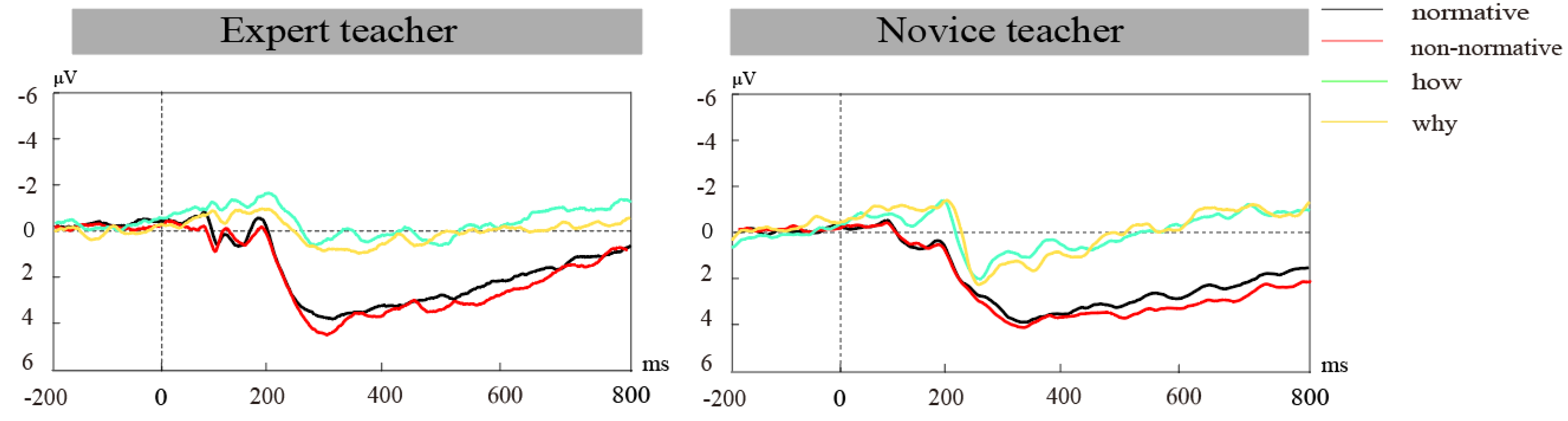
3.3.3. Topographical Map
This study focuses on the differences between expert and novice teachers in understanding normative and non-normative classroom actions, and this difference is confirmed by brain topography (Figure 6). On the one hand, there is a trend of stepwise activation enhancement in the 170–270 ms, 270–450 ms, and 450–750 ms time windows, indicating that the teacher understands the student's intention to a larger degree of late activation. On the other hand, expert teachers have larger brain activation than novice teachers in the270–450 ms and 450–750 ms time windows, which is the same as the ERP results.
4. Discussion
This study used the comic strips paradigm to explore the behavioral and cognitive neural differences in intention understanding between expert and novice teachers. Our subjective measurement results show that expert teachers have a significantly higher comprehensibility of student classroom action before and after the experiment than novice teachers, and score higher on PT, FS, and ES in the IRI-C scale; behavioral results show that expert teachers and novice teachers there were no significant differences in reaction time and accuracy rate, but there were significant differences in ERP results. Specifically, expert teachers showed larger P300 and LPC in the later stages of classroom action-type processing, while novice teachers showed larger N250 in the early stages. Furthermore, students' normative actions induced more negative N250 amplitudes, whereas non-normative actions induced more positive P300 and LPC amplitudes.
Teachers must engage in many cognitive activities to guide student learning [54], and development helps identify meaningful patterns in the classroom, which in turn enables teachers to improve interactions with students [55]. The results of this study further extend this idea, and teachers must not only be able to distinguish and identify students' actions in the classroom, but also understand the potential neural mechanisms underlying student behavioral intentions in the classroom.
4.1. Teachers’ Behavioral Performance Judging Students’ Action Intentions
The subjective measurement results showed that expert teachers scored higher on perspective-taking, fantasy, and empathy concern than novice teachers. This is in line with previous findings that expert teachers have higher empathy thinking ability owing to their rich teaching experience [56]. And expert teachers had a higher level of understanding of students' classroom actions after the experiment than novice teachers, a result consistent with earlier research on expert teachers' classroom knowledge. Berliner proposed that expert teachers have richer classroom knowledge than novice teachers, are easier to understand and can quickly process complex information, express problems flexibly, and discover meaningful patterns in complexities and problems [57]. However, novice teachers need to invest cognitive resources in understanding the resources and ways in which classroom problems arise. In this study, due to their high expertise level, expert teachers demonstrated the advantages of developing and automating classroom knowledge, as reflected in their understanding of students' action intentions.
Contrary to expectations, this study did not find a significant difference between expert and novice teachers in behavior performance. This result may be explained by the fact that due to the particularity of the EEG task state experimental procedure. In order to conduct subsequent accurate data analysis, subjects need to superimpose multiple sets of blocks and multiple trails in a short period of time. Therefore, in the experimental paradigm of intention understanding, the teacher combined the 1500ms text prompt priming stimulus to form a rapid judgment on the 2000ms student action target stimulus, which judgment cannot be revealed in the explicit behavioral performance results.
4.1. N250 Reflects Novice Teachers’ Preliminary Classifications of Students’ Action Intentions
The teacher's understanding of students' intentions in classroom actions based on text prompts is revealed in the ERP results. One interesting finding is that in the early time window, novice teachers induced larger N250 amplitudes than expert teachers, both of which activated fronto-central areas of the brain. The prefrontal lobe is an important brain region for teachers to infer students' mental states and intentions [58]. Frontal areas are mainly involved in intellectual functions [59,60], such as an individual's understanding of others' intentions, goals, beliefs, and desires [61,62], indicated that both types of teachers produced intentional understanding processing.
Novice teachers have larger activation of early ERP components. Similar to the results of previous eye movement studies on teacher expertise, Haataja et al. found that when teachers observe students, their attention may also be driven by specific tasks, such as gathering information about their cognitive processes [63]. This conscious allocation of attention requires more top-down mechanisms. And the process is linked to teaching expertise. As time goes by, novice teachers are unable to effectively process all incoming information and decide which visual cues are most relevant. Instead, they need to spend time developing and automating their own understanding of the classroom, thus forming larger activation in the early stages of EEG processing. Furthermore, N250 amplitude is related to the direction of individual attention [64]. Familiar faces can attract or maintain attention, eliciting more negative N250 amplitudes than the presentation of unfamiliar faces [64,65,66]. The larger N250 amplitudes elicited by familiar faces are consistent with the larger amplitudes elicited by normative actions in the present study.
4.2. P300 and LPC Reflect the Late Processing of Expert Teachers' Intention Understanding
What is surprising is that expert teachers' P300 and LPC amplitudes were more larger than novice teachers' at 270–450 and 450–750ms after stimulus presentation. P300 amplitude is modulated by knowledge experience [67]. For example, the P300 amplitude induced by individuals with high exercise experience when processing specific exercise-related information is significantly higher than the P300 amplitude evoked by individuals with poor exercise experience [15]. LPC reflects the brain's processing of higher-level theory of mind [34]. Our results extend previous research arguing that, there are significant differences in the way expert and novice teachers perceive classroom time, interpret students' nonverbal behavior, and understand classroom interactions [7]. That is, in the later time window, expert teachers produced larger activation, revealing a deeper, knowledge-based interpretation of what they perceived.
P300 amplitudes and LPC amplitudes for non-normative actions larger than for normative actions. P300 reflects the relationship between stimulus evaluation and response, involving attention processing and negative information evaluation [68]. P300 amplitude is larger when faced with an unlikely event and when participants incorrectly predict the event [69]. Krol and El-Deredy used image sequences as experimental material and found that participants produced larger P300 amplitudes when presented with pictures that did not match the expected sequence [70]. In a teaching scenario, non-normative classroom behavior requires more attention from the teacher, so the teacher needs to expend more effort in inferring the cognitive processes of more active students compared to quiet students with more subtle behaviors [71]. Thus, when students showed non-normative behaviors that teachers could not predict, teachers produced larger P300 amplitudes, reflecting their cognitive activation in response to unexpected stimuli. The LPC component in the late stage is related to more complex social cognitive processing. This study is consistent with previous findings on LPC [34,48,53], reflecting teachers develop deeper cognitive processing of subsequent intention understanding.
4.3. Future Research
Our study offers some promising preliminary findings on the potential participation of the brain in the social capability of expert and novice teachers. Our results also suggest future research directions. Firstly, given the improvement in teachers’ perceived comprehensibility of students’ classroom actions and dispositional empathy, future studies should plan and analyze the effect of interventions aimed at strengthening the training of novice teachers’ social capacity. They might be provided with practical opportunities to work on their perceptions and interpretations of, and responses to, classroom information, as well as their understanding of classroom teaching to flexibly respond to various uncertainties. Approaches such as reflective practice (e.g., [72]) and teacher collaboration (e.g., [73]) might become fertile ground for future research on the topic in relation to teacher professional development. Secondly, from the perspective of emotion and motivation, future research might provide new insights into the mechanism of teachers’ intention understanding ability. Thirdly, considering that Berliner points to cultural differences in the criteria that are set to define an expert teacher, cross-cultural similarities and differences might be addressed in subsequent studies [57]. Fourthly, future research should consider if the findings of this study about the intention understanding ability of expert teachers are extended to (and related to) other teaching expertise areas (e.g., whether expert teachers’ selective attention and knowledge-based reasoning in professional insight will have the same impact on the brain). Overall, expanding the educational neuroscience research on teachers’ social abilities might help to improve teaching practice. In the future, studies in experimental and natural contexts should complement each other to ensure the ecological validity of the findings, especially considering that the interpretation of normative and non-normative actions might be context-dependent.
5. Conclusions
This study combined behavioral and ERP techniques to explore the dynamic processing time course of teachers’ brains in understanding students’ classroom action intentions. We found that, compared with novices, expert teachers better understood students' behavioral intentions in class, as reflected in the P300 and LPC amplitudes in the late time window, but novice teachers performed better on the N250 amplitude in the early time window. In addition, the N250 amplitude caused by normative actions was more significant, while the P300 and LPC amplitudes caused by non-normative actions were more significant. From the perspective of cognitive neuroscience, this study shows that expert teachers produce late and sustained processing in understanding students' classroom action intentions, and text prompts and action types are important indicators that affect teachers' understanding intentions.
Author Contributions
Yishan Lin: Conceptualization, Methodology, Software, Validation, Writing - original draft. Rui Li: Formal analysis, Investigation, Writing - original draft. Jesús Ribosa: Data curation, Visualization, Writing - review & editing. David Duran: Conceptualization, Data curation, Visualization, Writing - review & editing. Binghai Sun: Resources, Supervision, Funding acquisition, Project administration.
Funding
This work was supported by the China Scholarship Council (No. 202308330514)
Institutional Review Board Statement
Not applicable.
Informed Consent Statement
Not applicable.
Data Availability Statement
The data are available from the corresponding authors for research purposes only.
Conflicts of Interest
The authors declare no conflict of interest.
Appendix A
Experimental Materials
Select 10 teachers (half male and half female, age = 26-43), and used E-Prime procedure to judge the normalization of students' classroom actions (normative action press the “F” key, non-normative action pressed the “J” key). Then, the teacher was asked to evaluate the difficulty of the judgment in five points according to his own feelings (1=very easy, 5=very difficult). Pictures with reaction time of more than 2000 ms and accuracy rate of less than 70% were eliminated.
Independent sample t-test was used to test the task difficulty. The result shows that there is no significant difference in task difficulty (t = 1.28, p > 0.05; normative action: M±SD = 1.38±0.33; non-normative action: M ± SD = 1.29±0.29).
Select another 10 teachers (half male and half female, age = 27~42), and evaluate the degree of normative or non-normative degree of each group of photos by 5 points (1= very non-normative, 5=very normative). The independent sample t-test results show that, the two conditions have significant differences (t = 33.27, p < 0.001), the photo score under the non-normative condition (M ± SD = 1.42 ± 0.27) was less than that of the normative condition (M ± SD = 4.27 ± 0.44), and finally 5 photos with a rating of about 3 points were excluded (4 for normative actions and 1 for non-normative actions). Finally, 70 images that met the requirements were screened out (normative: 36, non-normative: 34). Among them, 8 groups were used as practice experimental materials and were not used as formal experimental materials.
References
- Berliner, D. C. Describing the behavior and documenting the accomplishments of expert teachers. Bulletin of Science, Technology & Society. 2004, 24(3), 200–212. [CrossRef]
- Blakemore, S.-J., & Decety, J. From the perception of action to the understanding of intention. Nature Reviews Neuroscience. 2001, 2(8), 561–567. [CrossRef]
- Den Ouden, H. E. M., Frith, U., Frith, C., & Blakemore, S.-J. (2005). Thinking about intentions. NeuroImage, 28(4), 787–796. [CrossRef]
- Grafton, S. T. Embodied cognition and the simulation of action to understand others. Annals of the New York Academy of Sciences.2009, 1156(1), 97–117. [CrossRef]
- Niedenthal, P. M. Embodying Emotion. Science. 2007, 316(5827), 1002–1005. [CrossRef]
- Ortigue, S., Sinigaglia, C., Rizzolatti, G., & Grafton, S. T. Understanding Actions of Others: The Electrodynamics of the Left and Right Hemispheres. A High-Density EEG Neuroimaging Study. PLoS ONE.2010, 5(8), e12160. [CrossRef]
- Wolff, C. E., Jarodzka, H., & Boshuizen, H. P. A. See and tell: Differences between expert and novice teachers’ interpretations of problematic classroom management events. Teaching and Teacher Education. 2017, 66, 295–308. [CrossRef]
- Brophy, J. History of research on classroom management. In C. Evertson & C. Weinstein (Eds.). Handbook of classroom management: Research, practice and contemporary issues (pp. 17–43). 2006, Erlbaum.
- Freiberg, J. H. Classroom management and student achievement. In J. Hattie, & E. M. Anderman (Eds.), International guide to student achievement (pp. 228–231). 2013, Routledge. [CrossRef]
- Kunter, M., Klusmann, U., Baumert, J., Richter, D., Voss, T., & Hachfeld, A. Professional competence of teachers: Effects on instructional quality and student development. Journal of Educational Psychology. 2013, 105(3), 805–820. [CrossRef]
- Küchelmann, T., Velentzas, K., Essig, K., Koester, D., & Schack, T. Expertise-dependent perceptual performance in chess tasks with varying complexity. Frontiers in Psychology. 2022, 13, 986787. [CrossRef]
- Sheridan, H., & Reingold, E. M. Chess players’ eye movements reveal rapid recognition of complex visual patterns: Evidence from a chess-related visual search task. Journal of Vision. 2017, 17(3), 4. [CrossRef]
- Wright, M. J., Gobet, F., Chassy, P., & Ramchandani, P. N. ERP to chess stimuli reveal expert-novice differences in the amplitudes of N2 and P3 components. Psychophysiology, 2013, 50 (10), 1023-1033.
- Villafaina, S., Castro, M. A., Pereira, T., Carvalho Santos, A., & Fuentes-García, J. P. Neurophysiological and autonomic responses of high and low level chess players during difficult and easy chess endgames – A quantitative EEG and HRV study. Physiology & Behavior. 2021, 237, 113454. [CrossRef]
- Wang, C., Yan, A., Deng, W., & Qi, C. Effect of Tennis Expertise on Motion-in-Depth Perception at Different Speeds: An Event-Related Potential Study. Brain Sciences. 2022, 12(9), 1160. [CrossRef]
- Arbuckle, C., & Little, E. Teachers’ perceptions and management of disruptive classroom behaviour during the middle years (years five to nine). Australian Journal of Educational & Developmental Psychology. 2004, 4, 59–70.
- Hattie, J. Visible learning: A synthesis of over 800 meta-analyses relating to achievement. 2009, Routledge.
- Wang, F., Lu, Y., Duan, C., Zhou, Z. Teacher’s perception of students’ classroom behavior: An eye movements Study. Psychological Development and Education. 2013, 29(4), 391-399. [in Chinese]. Retrieved from http://www.devpsy.com.cn/CN/Y2013/V29/I4/391.
- Wolff, C. E., Jarodzka, H., & Boshuizen, H. P. A. Classroom management scripts: A theoretical model contrasting expert and novice teachers’ knowledge and awareness of classroom events. Educational Psychology Review. 2021, 33(1), 131–148. [CrossRef]
- Star, J. R., & Strickland, S. K. Learning to observe: Using video to improve preservice mathematics teachers’ ability to notice. Journal of Mathematics Teacher Education. 2008, 11(2), 107–125. [CrossRef]
- Delafield-Butt, J. T., & Adie, J. The embodied narrative nature of learning: Nurture in school: Learning embodied narrative patterns. Mind, Brain, and Education. 2016, 10(2), 117–131. [CrossRef]
- Ke, F., Lee, S., & Xu, X. Teaching training in a mixed-reality integrated learning environment. Computers in Human Behavior. 2016, 62, 212–220. [CrossRef]
- Kemp, R. The embodied performance pedagogy of Jacques Lecoq. Connection Science. 2017, 29(1), 94–105. [CrossRef]
- Pennington, J. L., Brock, C. H., Salas, R. G., & Gavelek, J. R. Repositioning white monolingual English-speaking teachers’ conceptions of language: Counterstories and embodied Learning. Urban Education. 2019, 004208591988434. [CrossRef]
- Aglioti, S. M., Cesari, P., Romani, M., & Urgesi, C. Action anticipation and motor resonance in elite basketball players. Nature Neuroscience. 2008, 11(9), 1109–1116. [CrossRef]
- Grafton, S. T., Schmitt, P., Van Horn, J., & Diedrichsen, J. Neural substrates of visuomotor learning based on improved feedback control and prediction. NeuroImage. 2008, 39(3), 1383–1395. [CrossRef]
- Rizzolatti, G., & Sinigaglia, C. Further reflections on how we interpret the actions of others. Nature. 2008, 455(7213), 589. [CrossRef]
- Huang, L., Yang, X., Huang, Z., Wang, Y. Brain spatio-temporal dynamics of understanding kind versus hostile intentions based on dyadic body movements. Acta Psychologica Sinica. 2019, 51(5), 557–570. [CrossRef]
- Folstein, J. R., Monfared, S. S., & Maravel, T. The effect of category learning on visual attention and visual representation. Psychophysiology. 2017, 54(12), 1855–1871. [CrossRef]
- Proverbio, A. M., & Riva, F. RP and N400 ERP components reflect semantic violations in visual processing of human actions. Neuroscience Letters. 2009, 459(3), 142–146. [CrossRef]
- San Martín, R., Appelbaum, L. G., Pearson, J. M., Huettel, S. A., & Woldorff, M. G. Rapid Brain Responses Independently Predict Gain Maximization and Loss Minimization during Economic Decision Making. The Journal of Neuroscience. 2013, 33(16), 7011–7019. [CrossRef]
- Ullsperger, M., Fischer, A. G., Nigbur, R., & Endrass, T. Neural mechanisms and temporal dynamics of performance monitoring. Trends in Cognitive Sciences. 2014, 18(5), 259–267. [CrossRef]
- Pauligk, S., Kotz, S.A. & Kanske, P. Differential Impact of Emotion on Semantic Processing of Abstract and Concrete Words: ERP and fMRI Evidence. Sci Rep. 2019, 9, 14439. [CrossRef]
- Wang, Y., Huang, L., Lin, C., Zhang, Z., Liang, F., & Shen, D. Spatio-temporal Brain Dynamics of Understanding Social Versus Private Intentions: An Electrical Neuroimaging Study. NeuroQuantology. 2012, 10(4). [CrossRef]
- Spunt, R. P., Falk, E. B., & Lieberman, M. D. Dissociable neural systems support retrieval of how and why action knowledge. Psychological Science. 2010, 21(11), 1593–1598. [CrossRef]
- Vezich, I. S., Katzman, P. L., Ames, D. L., Falk, E. B., & Lieberman, M. D. Modulating the neural bases of persuasion: Why/how, gain/loss, and users/non-users. Social Cognitive and Affective Neuroscience. 2017, 12(2), 283–297. [CrossRef]
- Spunt, R. P., Kemmerer, D., & Adolphs, R. The neural basis of conceptualizing the same action at different levels of abstraction. Social Cognitive and Affective Neuroscience. 2016, 11(7), 1141–1151. [CrossRef]
- Chang, J., & Song, J. A case study on the formation and sharing process of science classroom norms. International Journal of Science Education. 2016, 38(5), 747–766. [CrossRef]
- Wang, J., & Li, H. Neural Correlates of the Attentional Bias Towards Subliminal Pornographic Cues in Individuals with Tendencies Toward Problematic Pornography Use: An ERP Study Using a Dot-Probe Task. Archives of Sexual Behavior. 2024, 1-14.
- Faul, F., Erdfelder, E., Lang, A.-G., & Buchner, A. G*Power 3: A flexible statistical power analysis program for the social, behavioral, and biomedical sciences. Behavior Research Methods. 2007, 39(2), 175–191. [CrossRef]
- Leng, H., Liu, Y., Li, Q., Wu, Q., Li, D., & Jiang, Z. Outcome Evaluation Affects Facial Trustworthiness: An Event-Related Potential Study. Frontiers in Human Neuroscience. 2020, 14, 514142. [CrossRef]
- Qi, C., Liang, H., Zuo, S., & Li, R. Comparing competency-oriented student activities between expert and novice teachers in China: Insights from an epistemic network analysis (ENA). Education and Information Technologies, 2024, 1-28.
- Sun, B., Xiao, W., Feng, X., Shao, Y., Zhang, W., & Li, W. Behavioral and brain synchronization differences between expert and novice teachers when collaborating with students. Brain and Cognition. 2020, 139, 105513. [CrossRef]
- Sun, B., Xiao, W., Lin, S., Shao, Y., Li, W., & Zhang, W. Cooperation with partners of differing social experience: An fNIRS-based hyperscanning study. Brain and Cognition. 2020, 154, 105803. [CrossRef]
- Meyer, H. Novice and expert teachers' conceptions of learners’ prior knowledge. Science Education. 2004, 88(6), 970–983. [CrossRef]
- Bahnemann, M., Dziobek, I., Prehn, K., Wolf, I., & Heekeren, H. R. Sociotopy in the temporoparietal cortex: Common versus distinct processes. Social Cognitive and Affective Neuroscience, 2010, 5(1), 48–58. [CrossRef]
- Decety, J., & Cacioppo, S. The speed of morality: A high-density electrical neuroimaging study. Journal of Neurophysiology. 2012, 108, 3068-3072. [CrossRef]
- Wang, Y. W., Lin, C. D., Yuan, B., Huang, L., Zhang W. X., & Shen, D. L. Person perception precedes theory of mind: An event related potential analysis. Neuroscience, 2010, 170(1), 238–246. [CrossRef]
- Ding, M., Li, Y., Li, X., & Kulm, G. Chinese teachers’ perceptions of students’ classroom misbehaviour. Educational Psychology. 2008, 28(3), 305–324. [CrossRef]
- Huang, X., Li, W., Sun, B., Chen, H., & Davis, M. H. The validation of the Interpersonal Reactivity Index for Chinese teachers from primary and middle schools. Journal of Psychoeducational Assessment. 2012, 30(2), 194–204. [CrossRef]
- Delorme, A., & Makeig, S. Eeglab: an open source toolbox for analysis of single-trial eeg dynamics including independent component analysis. Journal of Neuroscience Methods. 2004, (1), 134. [CrossRef]
- Lopez-Calderon, J., & Luck, S. ERPLAB: an open-source toolbox for the analysis of event-related potentials. Frontiers in Human Neuroscience. 2014, 8, 213. [CrossRef]
- Wang, Y., Huang, L., Zhang, Z., Song, J., & Bai, L. Kindness or hostility? Brain dynamics of understanding interactive intentions of other people. Scientia Sinica (Vitae). 2014, 44(7), 736–746. [CrossRef]
- Duffy, G. G., Miller, S., Parsons, S., & Meloth, M. Teachers as metacognitive professionals. In D. J. Hacker, J. Dunlosky, & A. C. Graesser (Eds.), Handbook of metacognition in education (pp. 240e256). 2009, New York, NY: Routledge.
- Putnam, R. T. Structuring and adjusting content for students: A study of live and simulated tutoring of addition. American Educational Research Journal, 1987, 24(1), 13e48. [CrossRef]
- O’Keefe, P., & Johnston, M. Perspective taking and teacher effectiveness: A connecting thread through three developmental literatures. Journal of Teacher Education. 1989, 40(3), 20–26. [CrossRef]
- Berliner, D. C. Learning about and learning from expert teachers. International Journal of Educational Research. 2001, 35, 463e482. [CrossRef]
- Nozawa, T., Sakaki, K., Ikeda, S., Jeong, H., Yamazaki, S., Kawata, K. H. dos S., Kawata, N. Y. dos S., Sasaki, Y., Kulason, K., Hirano, K., Miyake, Y., & Kawashima, R. Prior physical synchrony enhances rapport and inter-brain synchronization during subsequent educational communication. Scientific Reports. 2019, 9(1), 12747. [CrossRef]
- Gilbert, S. J., Spengler, S., Simons, J. S., Steele, J. D., Lawrie, S. M., Frith, C. D., & Burgess, P. W. Functional specialization within rostral prefrontal cortex (area 10): A meta-analysis. Journal of Cognitive Neuroscience. 2006, 18(6), 932–948. [CrossRef]
- Stephens, G. J., Silbert, L. J., & Hasson, U. Speaker–listener neural coupling underlies successful communication. Proceedings of the National Academy of Sciences. 2010, 107(32), 14425–14430. [CrossRef]
- Gallagher, H. L., & Frith, C. D. Functional imaging of ‘theory of mind’. Trends in Cognitive Sciences. 2003, 7(2), 77–83. [CrossRef]
- Vogeley, K., Bussfeld, P., Newen, A., Herrmann, S., Happé, F., Falkai, P., Maier, W., Shah, N. J., Fink, G. R., & Zilles, K. Mind Reading: Neural Mechanisms of Theory of Mind and Self-Perspective. NeuroImage. 2001, 14(1), 170–181. [CrossRef]
- Haataja, E., Moreno-Esteva, E. G., Salonen, V., Laine, A., Toivanen, M., & Hannula, M. S. Teacher's visual attention when scaffolding collaborative mathematical problem solving. Teaching and Teacher Education. 2019, 86, 102877. [CrossRef]
- Pierce, L. J., Scott, L. S., Boddington, S., Droucker, D., Curran, T., & Tanaka, J. W. The N250 Brain Potential to Personally Familiar and Newly Learned Faces and Objects. Frontiers in Human Neuroscience. 2011, 5. [CrossRef]
- Devue, C., & Brédart, S. Attention to self-referential stimuli: Can I ignore my own face? Acta Psychologica. 2008, 128(2), 290–297. [CrossRef]
- Herzmann, G. Increased N250 amplitudes for other-race faces reflect more effortful processing at the individual level. International Journal of Psychophysiology, 2016, 57–65. [CrossRef]
- Inagaki, K., Wagatsuma, N., & Nobukawa, S. The effects of driving experience on the P300 event-related potential during the perception of traffic Scenes. International Journal of Environmental Research and Public Health. 2021, 18(19), 10396. [CrossRef]
- Petruo, V. A., Stock, A.-K., Münchau, A., & Beste, C. A systems neurophysiology approach to voluntary event coding. NeuroImage. 2016, 135, 324–332. [CrossRef]
- Tueting, P., Sutton, S., & Zubin, J. Quantitative evoked potential correlates of the probability of events. Psychophysiology. 1970, 7(3), 385–394. [CrossRef]
- Król, M., & El-Deredy, W. (2015). The clash of expectancies: Does the P300 amplitude reflect both passive and active expectations? Quarterly Journal of Experimental Psychology. 2015, 68(9), 1723–1734. [CrossRef]
- Seidel, T., Schnitzler, K., Kosel, C., Stürmer, K., & Holzberger, D. Student characteristics in the eyes of teachers: Differences between novice and expert teachers in judgment accuracy, observed behavioral cues, and gaze. Educational Psychology Review. 2020, 20-32. [CrossRef]
- Sellars, M. Teachers and change: The role of reflective practice. Procedia-Social and Behavioral Sciences, 2012, 55, 461–469. [CrossRef]
- Vangrieken, K., Dochy, F., Raes, E., & Kyndt, E. Teacher collaboration: A systematic review. Educational Research Review. 2015, 15,.
Figure 1.
Examples of experimental materials.
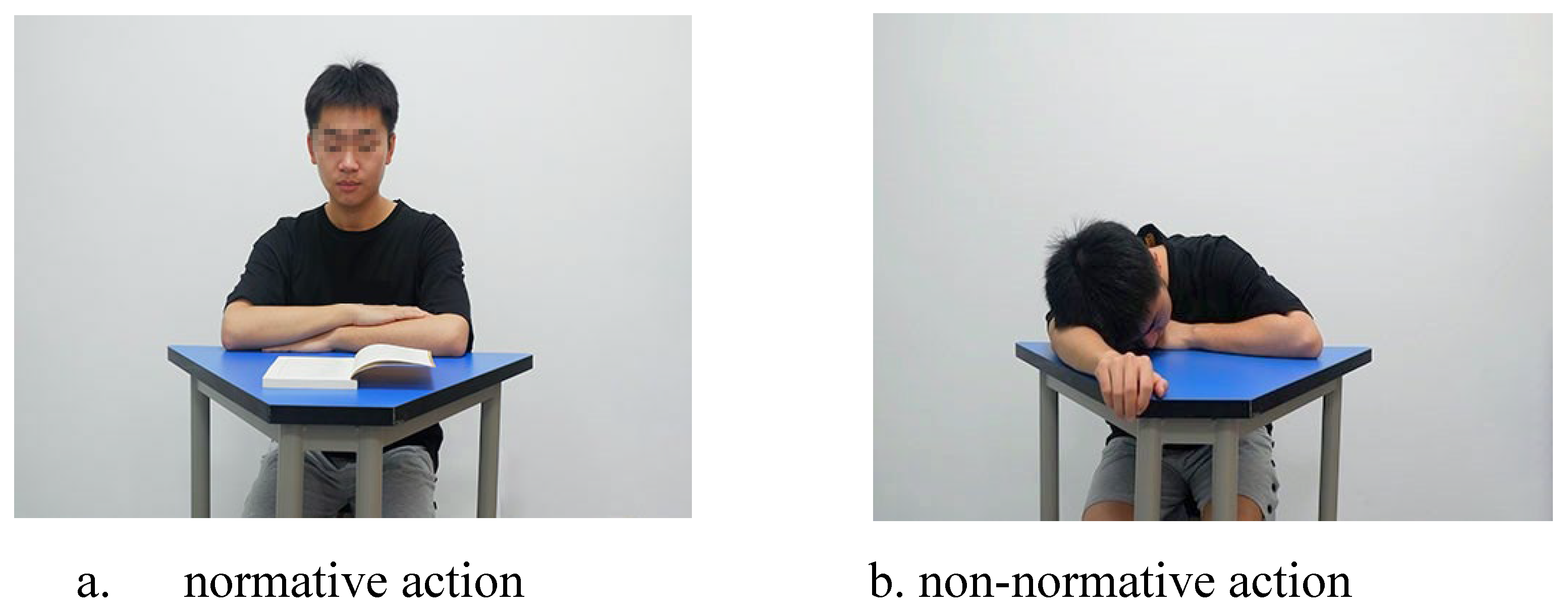
Figure 2.
The flow map.
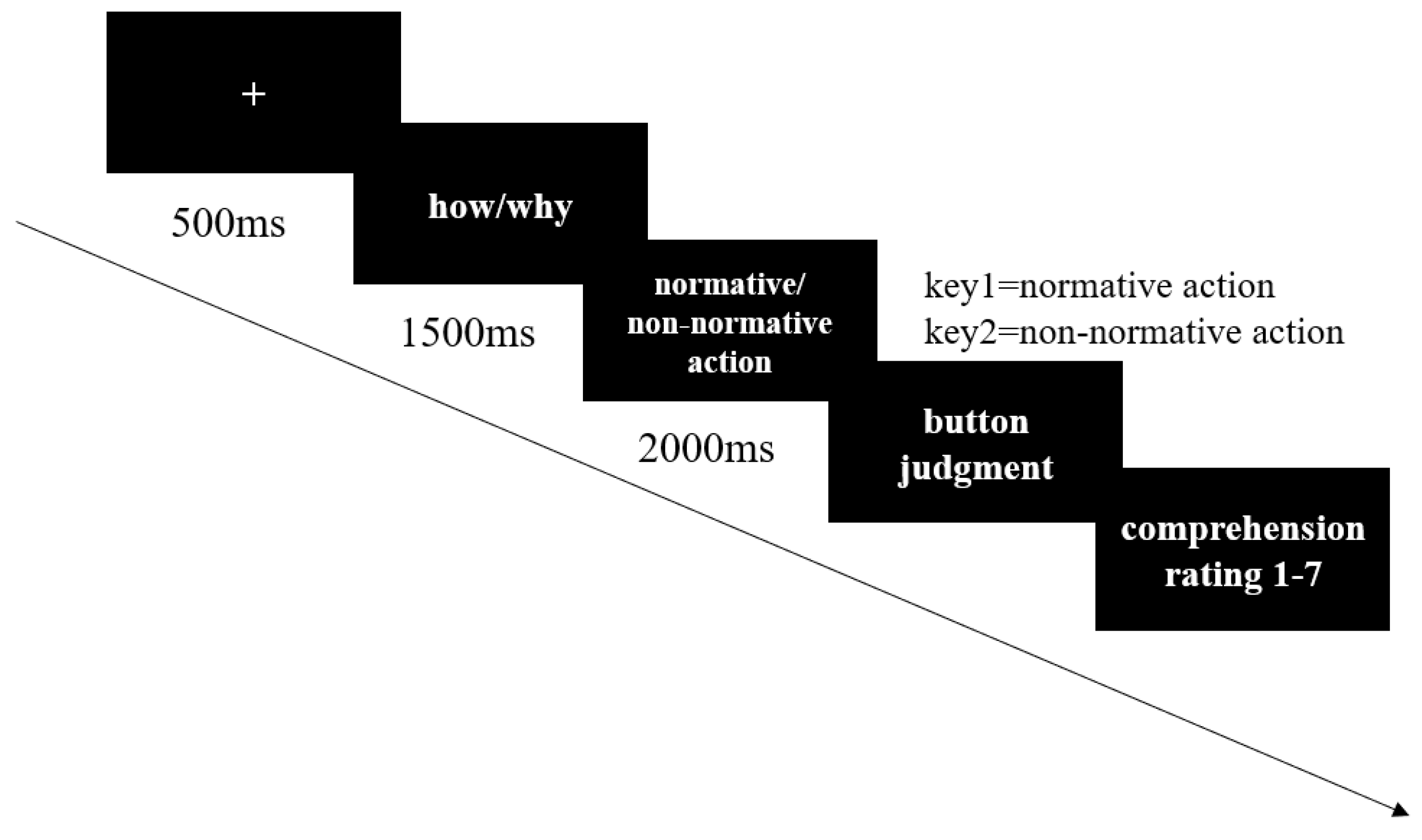
Figure 3.
Expertise level and action type of differential wave in different electrode points.
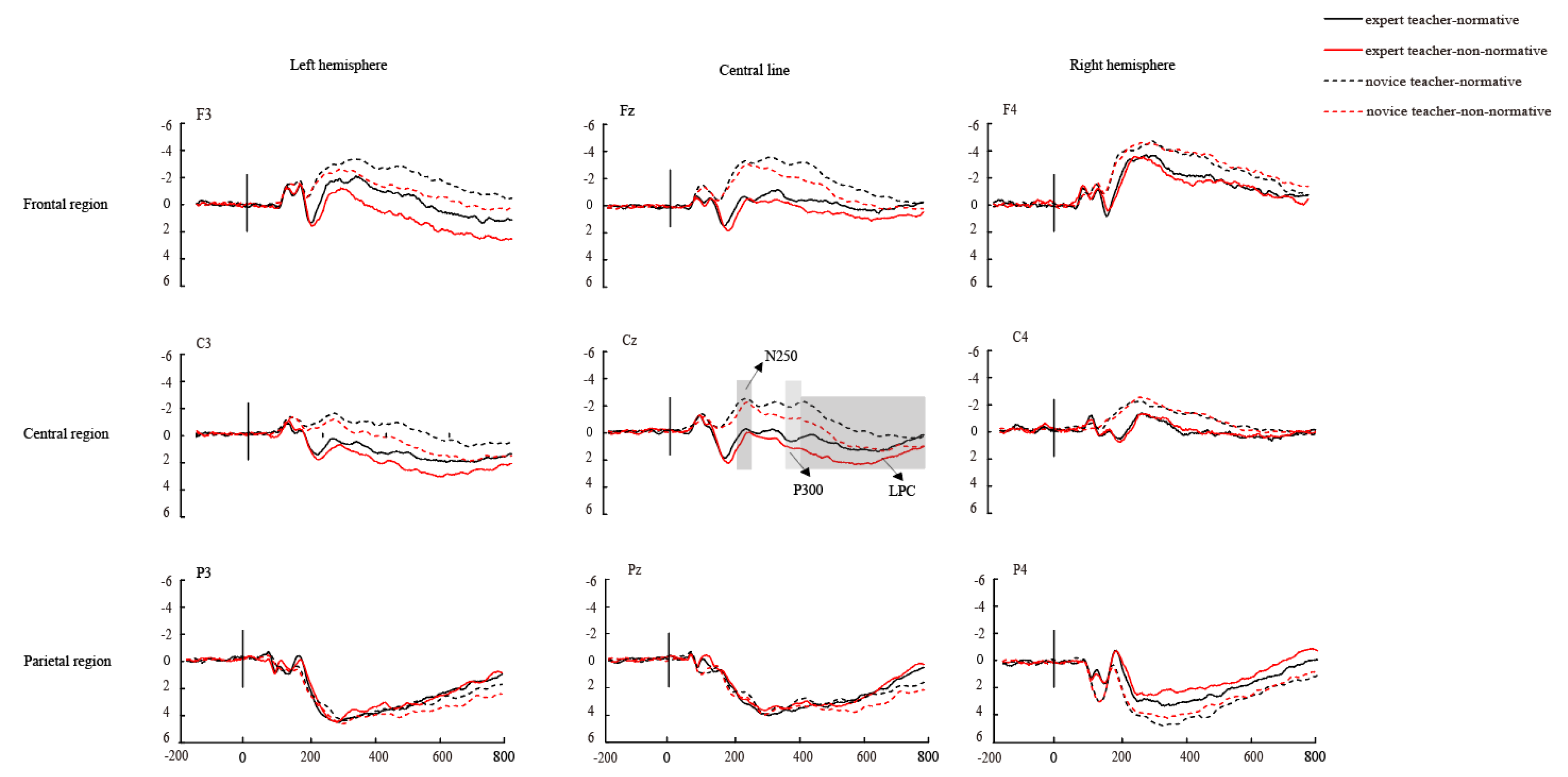
Figure 4.
Expertise level and text prompt of differential wave in different electrode points.
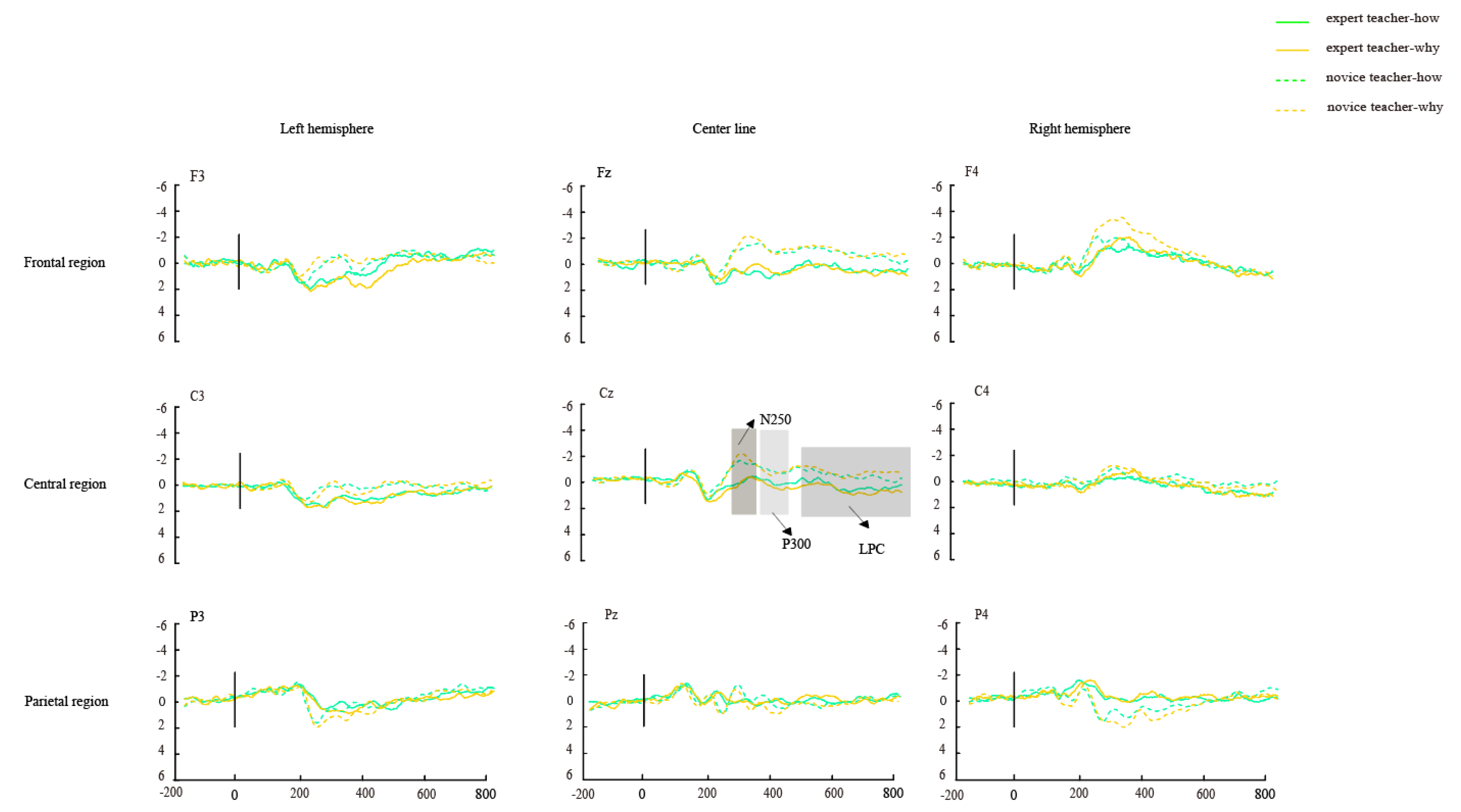
Figure 6.
Topographical maps of expertise level and action type in N250, P300, and LPC.
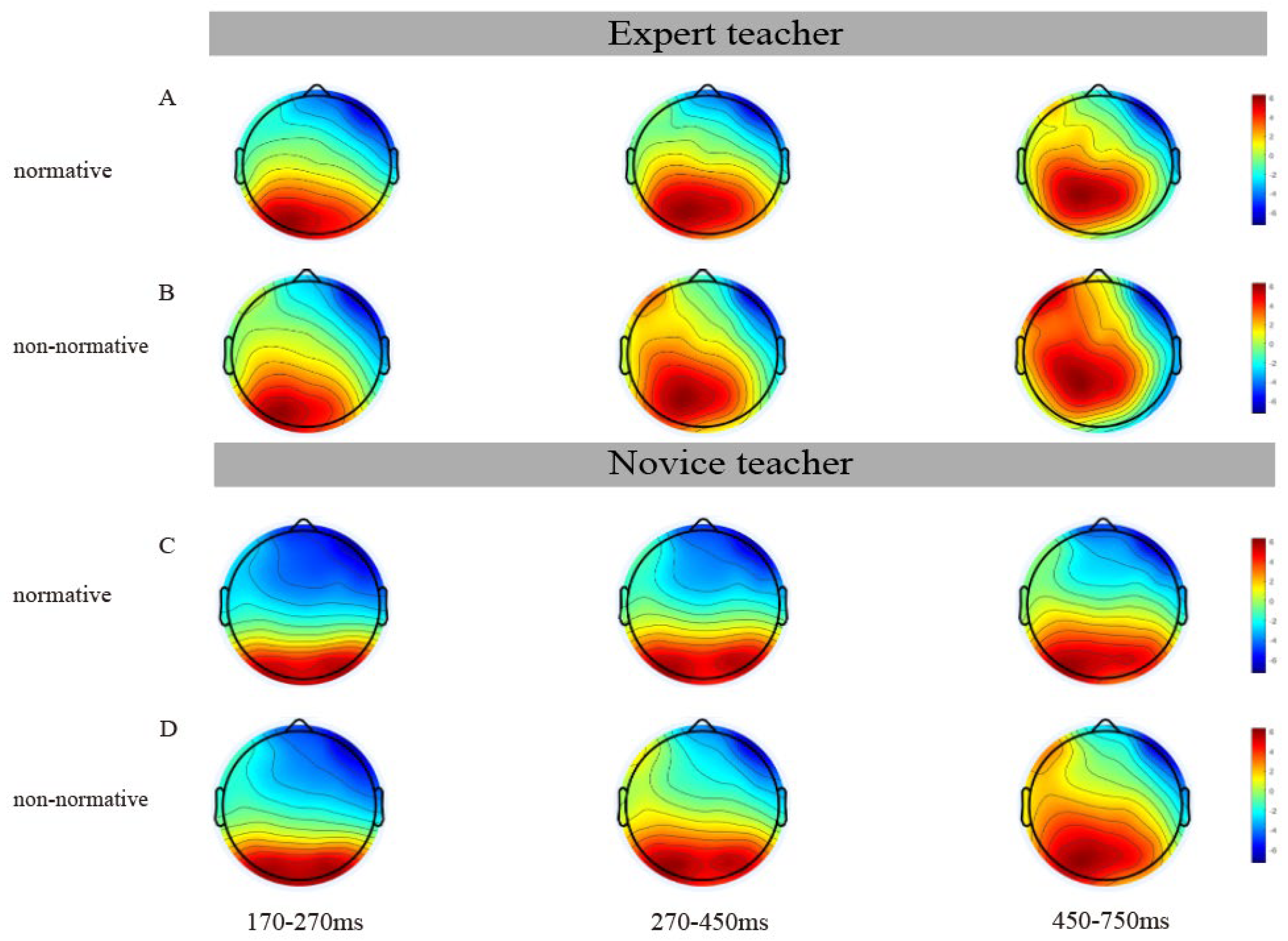
Table 2.
Two-Factor Repeated Measures ANOVA for Expertise Level and Test Time.
| SS | df | MS | F | p | ηp2 | |
| Expertise level | 18.02 | 1 | 18.02 | 16.70 | 0.001*** | 0.32 |
| Test time | 2.96 | 1 | 2.96 | 4.34 | 0.044* | 0.11 |
| Expertise level*Test time | 0.01 | 1 | 0.01 | 0.02 | 0.894 | 0.001 |
* means p < 0.05, the difference is significant; *** means p < 0.001, the difference is extremely significant.
Table 3.
Reaction time (ms), accuracy (%), and comprehensibility results of two groups.
| Expert (M ± SD) | Novice (M ± SD) | |||
| normative | non-normative | normative | non-normative | |
| how-RT | 717.03 ± 145.69 | 768.39 ± 145.74 | 722.98 ± 232.18 | 723.60 ± 247.07 |
| why-RT | 754.28 ± 160.02 | 774.69 ± 144.69 | 744.68 ± 258.22 | 754.19 ± 261.54 |
| how-ACC | 88.08 ± 13.28 | 83.34 ± 7.00 | 90.05 ± 8.78 | 97.70 ± 2.29 |
| why-ACC | 84.95 ± 12.23 | 95.07± 6.32 | 87.50 ± 13.59 | 97.45 ± 3.13 |
| how-comprehensibility | 6.67 ± 0.43 | 5.76 ± 0.94 | 6.37 ± 0.53 | 5.52 ± 1.27 |
| why-comprehensibility | 6.56 ± 0.52 | 5.67 ± 1.02 | 6.21 ± 0.64 | 5.29 ± 1.36 |
Disclaimer/Publisher’s Note: The statements, opinions and data contained in all publications are solely those of the individual author(s) and contributor(s) and not of MDPI and/or the editor(s). MDPI and/or the editor(s) disclaim responsibility for any injury to people or property resulting from any ideas, methods, instructions or products referred to in the content. |
© 2024 by the authors. Licensee MDPI, Basel, Switzerland. This article is an open access article distributed under the terms and conditions of the Creative Commons Attribution (CC BY) license (http://creativecommons.org/licenses/by/4.0/).
Copyright: This open access article is published under a Creative Commons CC BY 4.0 license, which permit the free download, distribution, and reuse, provided that the author and preprint are cited in any reuse.


