

Submitted:
26 August 2024
Posted:
28 August 2024
You are already at the latest version
Abstract
Against the backdrop of the European Union's commitment to achieve climate neutrality by 2050, efforts to improve energy efficiency are being intensified. The manufacturing industry is a key focal point of these endeavors due to its high final electrical energy demand, while simultaneously facing a growing shortage of skilled workers crucial for meeting established goals. Expert systems (ESs) offer the chance to overcome this challenge by automatically identifying potential energy efficiency improvements and thereby playing a significant role in reducing electricity consumption. This paper systematically reviews state-of-the-art approaches of ESs aimed at improving energy efficiency in industry, with a focus on manufacturing. The literature search yields 1668 results, of which 62 articles published between 1987 and 2024 are analyzed in depth. These publications are classified according to the system boundary, manufacturing type, application perspective, application purpose, ES type, and industry. Furthermore, we examine the structure, implementation, utilization, and development of ESs in this context. Through this analysis, the review reveals research gaps, pointing toward promising topics for future research.

Keywords:
sustainability
; climate neutrality
; industrial processes
; energy analysis
; optimization
1. Introduction
Climate change is one of the most imperative topics of modern times. The European Climate Law addresses this threat by setting a net greenhouse gas emissions reduction target of at least -55 % by 2030, compared to 1990 levels [1]. Energy use plays a critical role in the pursuit of this objective, as it was the source for almost three-quarters of global emissions in 2016. The industry sector is responsible for about 30 % of emissions, with energy use accounting for 24.2 %, making it the main source of emissions. [2] To achieve decarbonization, efforts are being made to increase the share of electricity in all sectors, and its share of final energy consumption is projected to rise from 20 % today to over 50 % by 2050. Since the industry sector was already the largest consumer of final electric energy in 2019, representing 41.9 %, there is an imperative urgency to take action [3].
In response to this challenge, companies are prioritizing energy efficiency improvements as a way to simultaneously achieve affordability, supply security, and climate goals [4]. Energy efficiency is a measure that quantifies the utilization of energy in relation to the output or yield of services, goods, commodities, or energy [5]. Increasing energy efficiency therefore means making better use of existing resources. According to a 2022 global survey conducted among over 2,200 industrial companies in 13 countries, 97 % of them had either already invested or were planning to invest in energy efficiency. Moreover, 89 % of these companies anticipated increasing their energy efficiency investments over the next five years, while 52 % had the ambitious goal of achieving net zero within the same timeframe [4]. However, despite the increase in energy efficiency in the manufacturing sector in recent years, there is still considerable potential for further improvement [6]. Especially energy submetering of individual industrial processes is low, showing a deficiency of monitoring and targeting systems that are crucial for effective energy management and energy efficiency efforts. The survey also found that a lack of specialized contractors, a lack of digital skills in the workforce, and uncertainty about how to improve energy efficiency are significant barriers to investing in energy efficiency improvements [4].
The conclusion of a study undertaken by the International Energy Agency suggests that this situation could be improved with digitalization [7]. Expert systems (ESs) are one type of advanced computer technology that have emerged from research in the field of artificial intelligence (AI) and are designed specifically to assist in decision making [8]. They pose a chance to overcome mentioned barriers by combining expert knowledge and analyzing energy data to automatically identify energy efficiency potentials [9]. In general, ESs, also referred to as knowledge-based systems or inference-based programs, can be described as computer programs that leverage expertise to solve problems and provide advice [8]. Unlike conventional applications, these systems emulate human reasoning by representing human knowledge and employ heuristic or approximate methods to solve problems [10]. Within organizational knowledge management, ESs can thereby serve as knowledge carriers and knowledge mediators, thus contributing to the qualification of personnel and reducing the shortage of skilled workers [11]. This further distinguishes ESs from the inherent complexity and limited explainability of other AI applications for decision support, such as machine learning and deep learning models [12]. The intelligent activity that characterizes ESs is the use of knowledge for their processing and not just information. Information exists by itself without a context, whereas knowledge has the added dimension that something is done to process the information. [8] Energy data from a machine would be information. Reading measurement data, determining which energy efficiency potentials are present and drawing conclusions on how to exploit existing energy efficiency potentials is the use of knowledge about energy data. This knowledge must be provided by human experts to develop the ES.
There are several literature reviews covering ESs in general and ESs or AI to optimize industrial production. [13] presents an overview of the development of ESs based on a literature review and a classification of articles from 1995 to 2004 into eleven methods. The respective applications of ESs for the associated methods are also given. This publication thus provides an overview of the various applications and techniques of ESs. However, [13] does not address the use of ESs to increase energy efficiency and does not analyze any publications in this area. [14] examine literature from 1983 to 2015 dealing with decision support models for energy-efficient production planning. For this purpose, procedures for production systems, energy price laws and energy efficiency criteria are considered. Although this literature analysis focuses on improving energy efficiency in production, it does not include ESs to achieve this objective. Similar to [13,15] provides a broad overview of ESs and its applications from 1984 to 2016. In comparison to [13,15] introduces an indicator to estimate and compare the success of ES applications. Among many other applications of ESs, this publication also deals with those in production. Nevertheless, applications for increasing energy efficiency are not discussed. [16] focuses his literature review on applications of ESs in production planning regarding the handling of different products, process planning, tool selection, welding and product development between 1981 and 2016, but without considering energy efficiency.
Unlike the previously cited reviews, this work focuses on ESs to overcome environmental and economic challenges by improving energy efficiency in manufacturing. Production describes the combination of goods and services to create new goods, while manufacturing is understood as a sub-area of production that describes the actual process of creating goods [17]. Other industrial sectors are also considered to ensure that the scope of the study is not overly restricted and to allow possible conclusions to be drawn about manufacturing. This is done through a systematic literature review (SLR) with a comprehensive overview. Starting from a total of 1668 publications, the 62 most relevant publications are extracted and categorized according to system boundary, manufacturing type, application perspective, application purpose, ES type, and industry.
The remainder of this paper is organized as follows: Section 2 describes the methodological approach of the SLR, which is then applied in Section 3. This involves all steps, from narrowing down the topic to identifying research gaps. Finally, Section 4 draws a conclusion and presents proposals for future research.
2. Review Methodology
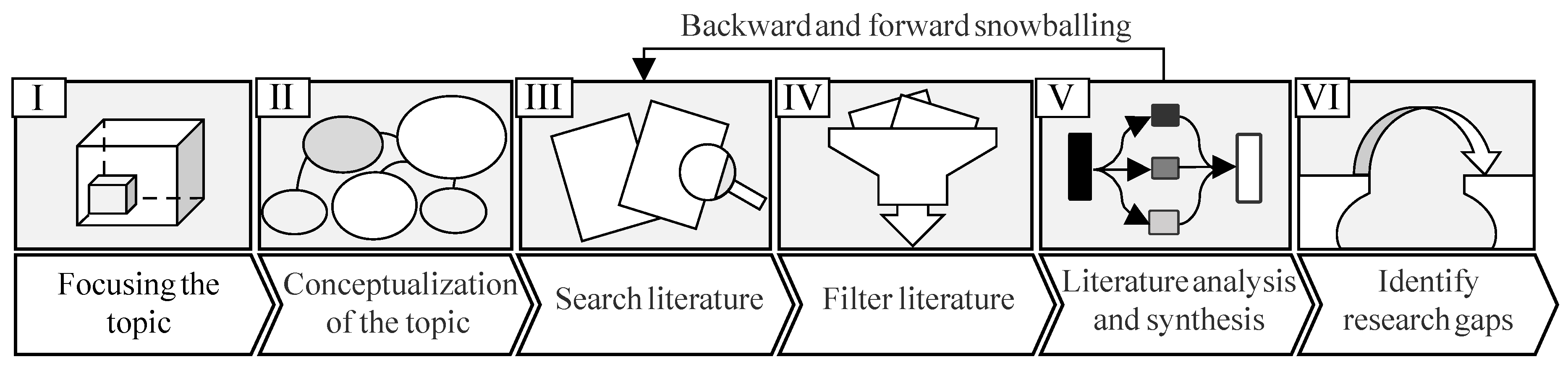
To identify relevant publications on ESs for improving energy efficiency in manufacturing, a SLR is conducted. A SLR is a formal approach which aims to reduce bias due to overly restrictive selection of the available literature and to ensure a rigorous process [18]. Moreover, a SLR can clarify the state of research on a topic and highlight gaps and areas requiring further research [19]. The SLR in this paper follows the approach of [20] as well as [21], which is complemented with elements of [18] and consists of seven consecutive steps shown in Figure 1. First, the topic is narrowed and conceptualized. When narrowing the topic (I), categories and their definitions are formulated, as consistent classifications help to ensure reliability when conducting content analyzes. In the conceptualization (II), research questions for the review itself as well as inclusion and exclusion criteria are formulated. Moreover, the keywords and the search query string are defined. Subsequently, databases suitable for the topic area are selected and searched (III). For this purpose, databases of previous literature analyses covering the same topic area or suggestions of university libraries for databases of individual research fields can be examined. For the literature search we only consider metadata (title, abstract, keywords). Thereby it is prevented that the search terms are contained only in the bibliography of the found publications. After merging hits from different databases, literature is filtered (IV) by applying the defined inclusion and exclusion criteria. In the next step, the full texts of the remaining publications are thoroughly analyzed (V). This involves extracting and summarizing relevant information from the publications. By performing backwards and forward snowballing additional relevant publications are identified. Backward snowballing means using the reference list of selected literature to identify new publications to include. Forward snowballing, on the other hand, is carried out to find publications that cite the selected publication. The added publications pass through steps (III) to (V) again. During the synthesis (VI) of the literature essential characteristics are categorized. Finally, the findings are summarized, conclusions are derived with regard to the research questions, and research gaps are identified (VII).
3. Literature Review
3.1. Narrowing the Topic
To narrow the topic, relevant categories and associated dimensions are identified as shown in Figure 2. The classification scheme is based on [22] for the field of energy modeling in the manufacturing industry. In addition to the narrowing of the topic, the classification supports defining keywords for the search query string and the literature analysis.
Figure 1.
Methodological steps for a systematic literature review (own illustration adapted from [23] based on [24]).
3.1.1. System Boundary
In the context of energy-related ES applications in industry, five dimensions are distinguished regarding the system boundary.
- Factory: Distinct physical entity containing multiple devices [25].
- Manufacturing cell/ line: Logical organization of multiple machines to achieve a better division of labor [26].
- Machine: Entity required to perform a specific production task [27].
- Component: Individual parts or consumers of a machine which represent the lowest hierarchical level for energy metering [28].
- Process: Value-adding and non-value-adding technical operations [26].
3.1.2. Manufacturing type
Manufacturing systems can be characterized by their manufacturing type, which is determined by the frequency of repetition of a product or product group to be manufactured [26].
- Job-shop manufacturing: Custom manufacturing, i.e. according to customer requirements, in which products are only manufactured once.
- Repetitive manufacturing: Products are manufactured at irregular intervals. If orders are repeated, less preparation is required.
- Variant manufacturing: Similar products of the same basic type, which generally involve similar manufacturing effort.
- Serial manufacturing: Mostly contract manufacturing of standardized products in limited quantities.
- Mass manufacturing: Manufacturing large quantities for an anonymous market. High initial investment costs, but low in relation to the sum of manufactured products.
3.1.3. Application Perspective
Adapted from [22], the application perspective subdivides the phases in which an ES is useful.
- Engineering: ESs are used for energy-optimized design at a high level of abstraction, e.g. by supporting the selection of sustainable technologies.
- Process planning: The objective of applying ESs in this phase is to plan and optimize manufacturing processes with regard to energy efficiency prior to actual operation, e.g. by optimizing parameters
- Operation: In the phase in which the actual manufacturing process takes place, ESs are utilized to improve the energy efficiency of the operation, e.g. by detecting inefficient operating points.
3.1.4. Application Focus
Two dimensions can be distinguished on which studies in the field of energy optimization focus.
3.1.5. Expert System Type
ESs include a user interface, a knowledge base, and an inference engine. The interactions between humans and ESs happen via the user interface, e.g. to define a problem (input) or to read out the results (output). The knowledge base is the programmed knowledge of the expert and contains all pertinent facts and relationships as well as the rules or heuristics to solve problems. The inference engine is the "intelligent" part of an ES which can apply the knowledge from the knowledge base to solve the problem. [8]
The way in which knowledge is represented within the knowledge base and how it is processed within the inference engine differs depending on the ES type. The typification of ESs in this paper is based on the categories in [13].
- Rule-based expert system: A rule-based ES represents information in the form of IF-THEN-rules. These rules are applied to perform operations on data in order to reach a conclusion [13].
- Fuzzy expert system: Fuzzy ESs are characterized by dealing with uncertainties using fuzzy logic. While rule-based ESs only allow conditions or conclusions that are either true or false, fuzzy ESs allow also conditions or conclusions that are partly true or false. This approach is based on the premise that human experts often decide without precisely quantified information [13].
- Machine learning (ML) based expert system: This type of ES uses ML as its "intelligent" component to solve problems. Like ESs, ML belongs to the domain of AI and combines a collection of data-driven algorithms that can learn from data without being explicitly programmed. ML also includes deep learning and reinforcement learning. [31]
- Hybrid expert system: Hybrid ESs are a combination of several previously mentioned types or a previously mentioned type with a further approach. Further approaches can be mathematical optimization methods or physical simulation models.
3.1.6. Application Purpose
There are several reasons for the application of ESs that can contribute to energy efficiency improvements.
- Transparency: To reduce the energy consumption in industry, stakeholders need a sufficient level of energy transparency to create a meaningful basis for decision-making [32]
- Optimization: Optimization in the context of this work means improving energy efficiency as far as necessary and feasible.
- Prediction: Prediction means determining unknown values from known inputs. For energy analysis, this means that the available observations at time t are used to predict the energy or energy efficiency at the same time t. [22]
- Forecasting: Statements are made about the future. In energy analyses, future values t+x for energy or energy efficiency are estimated based on current and/or past information at time t. [33]
3.2. Conceptualization of the Topic
In the conceptualization, research questions are raised, inclusion and exclusion criteria are defined, and keywords as well as the search query string are formulated.
3.2.1. Research Questions
The following research questions (RQ) emerged for the SLR, which are intended to lead to the identification of research gaps:
- RQ-1 Which industries deploy ESs to increase energy efficiency?
- RQ-2 How have ESs been applied in the manufacturing industry to enhance energy efficiency?
- RQ-3 How are ESs for improving energy efficiency in industry structured and implemented?
- RQ-4 How are ESs for improving energy efficiency in industrial applications developed?
3.2.2. Inclusion and Exclusion Criteria
Inclusion (IC) and exclusion (EC) criteria are defined in advance to ensure consistent filtering within the literature search. Only those publications that pass this selection process are analyzed in depth.
- IC-1 Studies written in English or German
- IC-2 Reviewed studies
- IC-3 Online full text availability
- IC-4 Empirical studies with a focus on ESs to improve energy efficiency in industry
- EC-1 Studies that do not meet the inclusion criteria
- EC-2 Duplicates
- EC-3 Excerpts from research results
- EC-4 Surveys or reviews (however, should they pertain to this review, they are integrated into Section 1 to address related work)
3.2.3. Keywords and Search Query String
The keywords and the search query string are determined based on the classification in Figure 2. We focus on industrial applications and do not restrict the search to a specific manufacturing type, application perspective, or application purpose. However, to find literature that is more relevant to the objective of this review, the search is limited by specifying the application focus and AI technique. For the search query, keywords and their synonyms are concatenated with "OR" operators to broaden the search. By using asterisks (*), words sharing a common root are included in the search as well. The search is restricted by using "AND" operators. The chosen keywords and their logical connections are presented in Table 1.
3.3. Search and Filter Literature
Literature databases were selected based on [23,34,35], which are literature reviews related to energy efficiency and flexibility in industry. Thus, the five electronic databases selected are: Web of Science [36], ScienceDirect [37], IEEE Xplore [38], SpringerLink [39] and WorldCat [40]. The functionality and syntax of these databases differ slightly. ScienceDirect, for example, does not support wildcards such as asterisk (*), other databases including SpringerLink do not allow limiting the search to the abstract, so the search string has to be adjusted for a feasible filtering. The search queries used, and the number of results found are listed in Table 1. Figure 3 provides an overview of the literature search and filtering process. A total of 1668 publications are found by entering the search query. When checking the titles, 1521 publications are filtered out according to the inclusion and exclusion criteria, so that only 147 results remain. This number decreases to 69 articles after examining the abstract. By screening the full texts, another 18 publications are excluded. However, 11 publications are added through the snowball search. This results in a total of 62 publications for a detailed analysis.
3.4. Literature Analysis and Synthesis
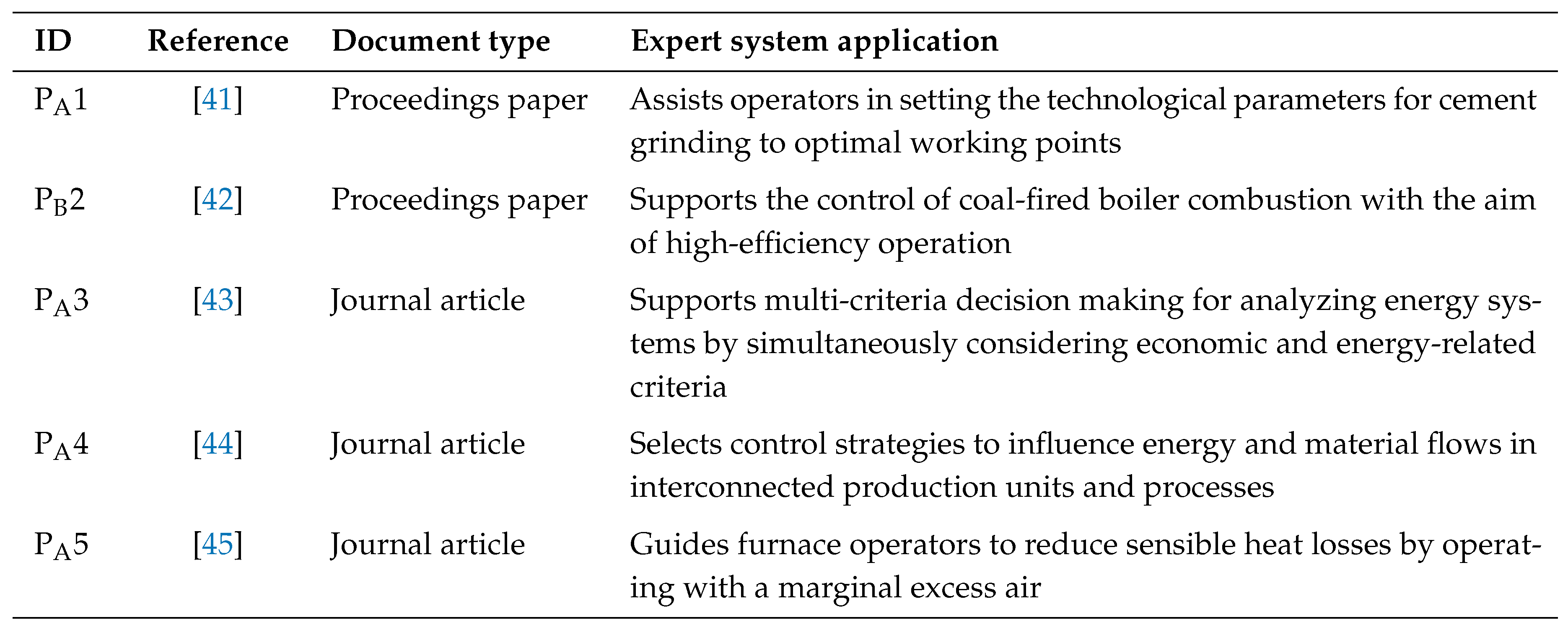
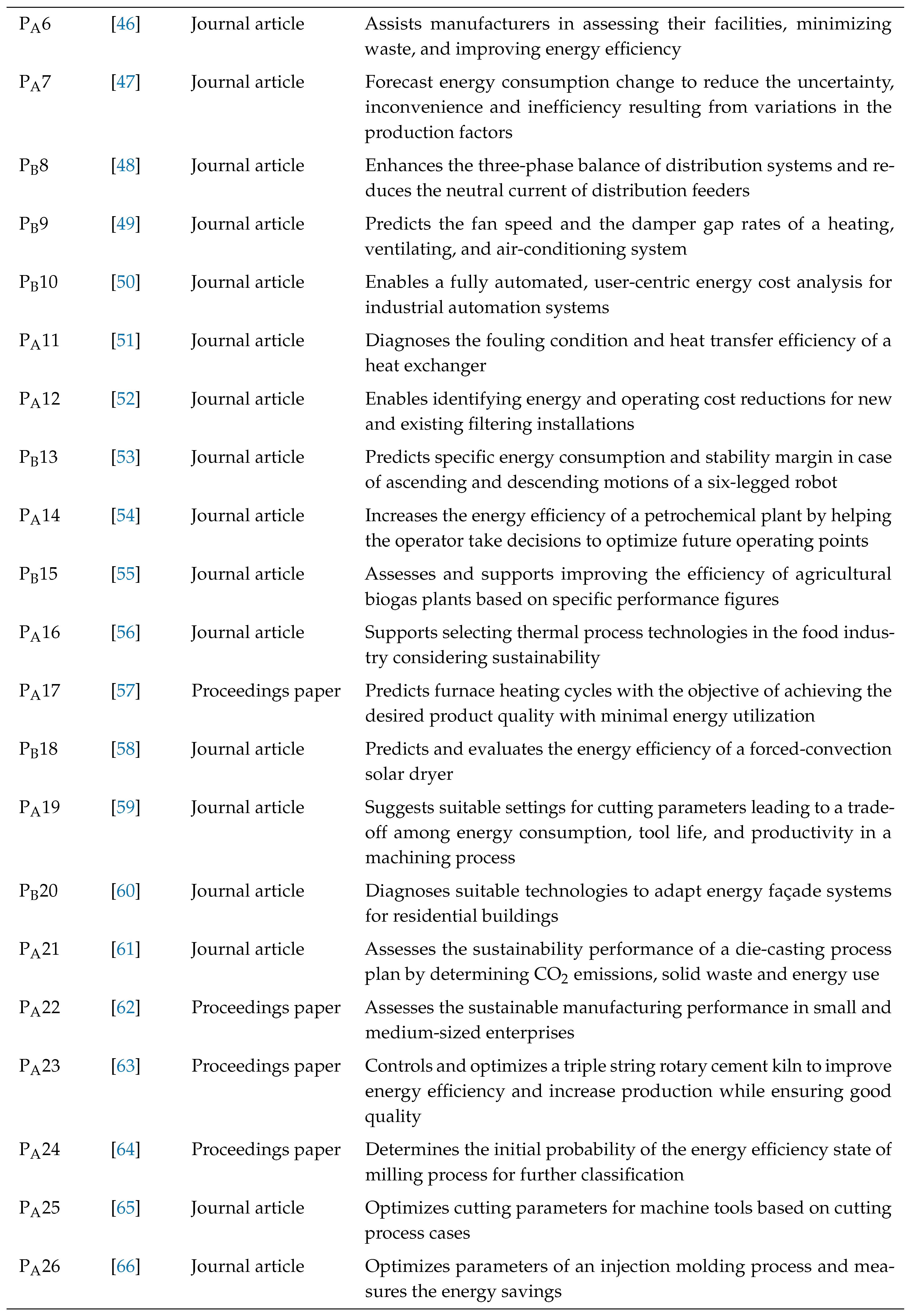
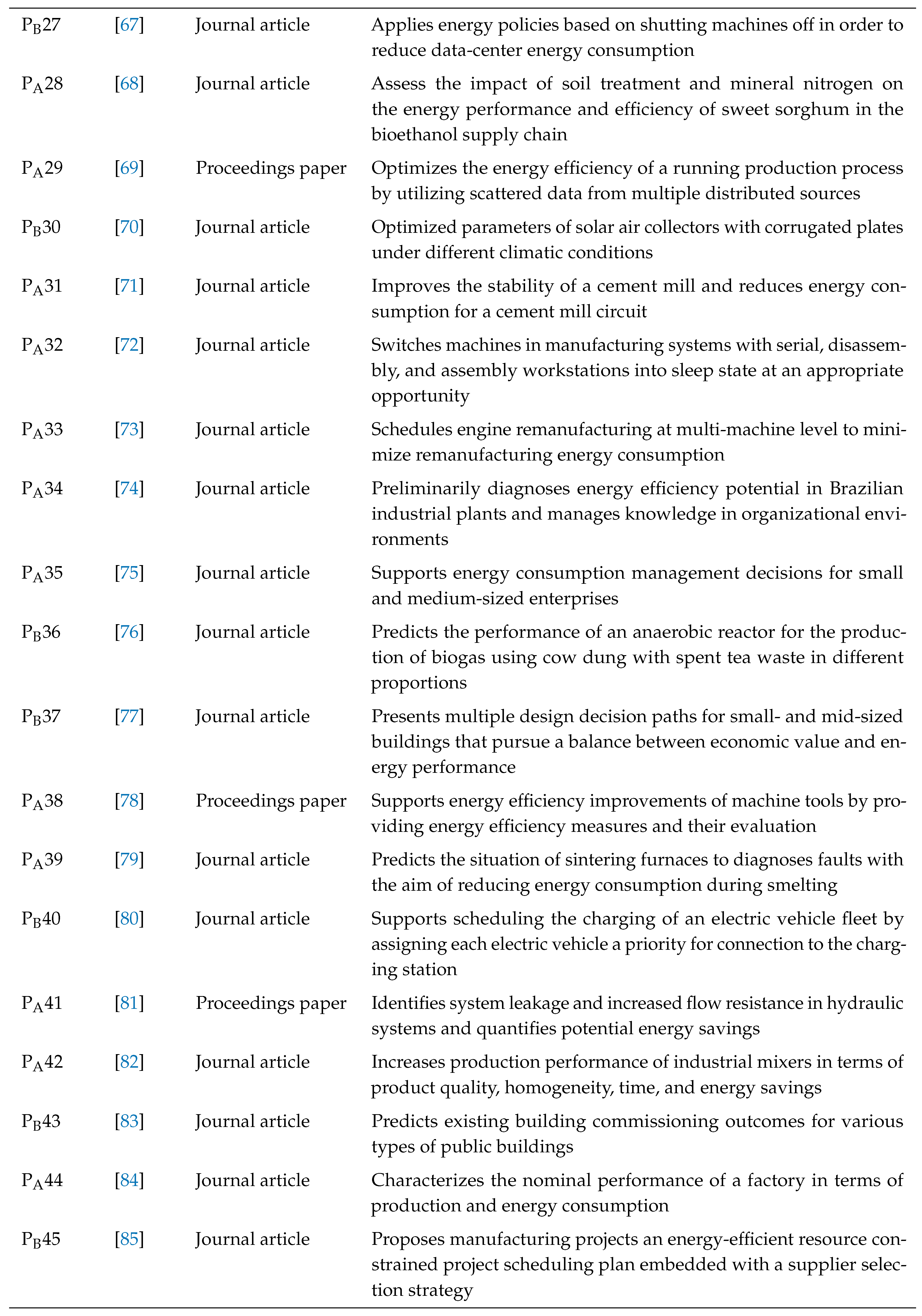
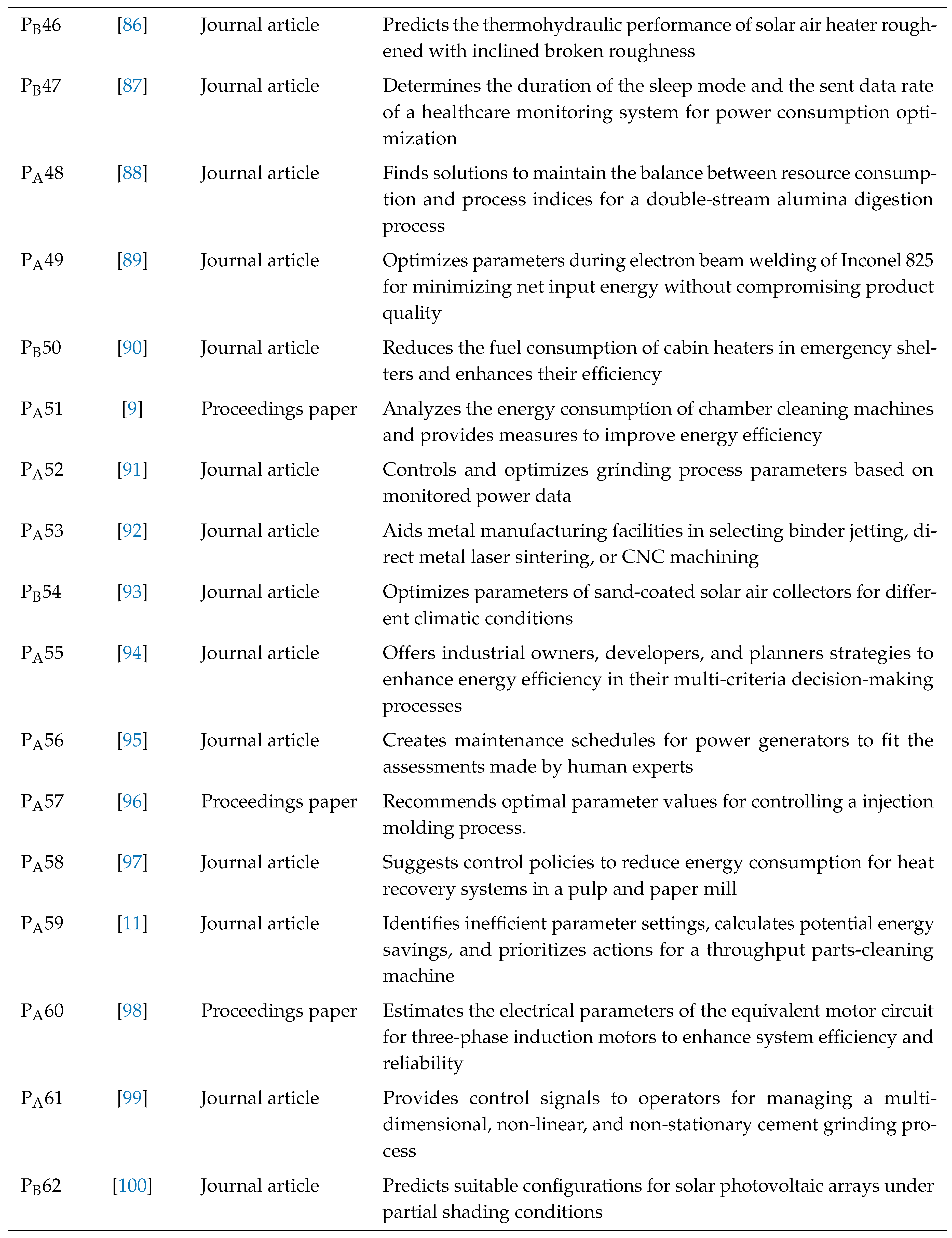
Within the scope of the literature analysis and synthesis, initially descriptive information such as the publishing year, the document type and the ES applications are extracted from the 62 selected publication. Each publication is assigned an identifier (ID) for subsequent analyses. The IDs are characterized by a number and an index, whereby the number is a consecutive sequence starting with the oldest and ending with the most recent publication. The index contains the relevance groups defined by the application areas of the ESs. Group A includes ESs within manufacturing and group B for other industries.

Table 2.
Overview of analyzed publications.
3.4.1. Data Sources and Publication Trend
The 62 publications include a total of 49 journal articles and 13 proceedings papers, whereby both document types are distributed rather evenly throughout the years. As presented in Figure 4, the publications are not concentrated on a small number of journals or conference proceedings but are spread across a total of 48 sources. The highest concentration can be observed in Expert Systems and Application with 6 publications. Other sources listed in Figure 4 are represented by 2 publications each. The remaining 38 journals and conference proceedings are each represented by a single publication.
Figure 5 shows the number of analyzed publications throughout the years, separated by both relevance groups. No time restriction was set for the literature search, which means that publications from 1987 to 2024 could be reviewed. The year 2024 is not fully covered since the search was carried out in August 2024. Up to 2009, only occasional studies were published. From 2012 onwards, an increase in the average number of publications over the years can be observed for both groups. Furthermore, it is noticeable that the average number of publications in Group A has increased significantly more than in Group B over the last ten years.
3.4.2. Authors Country Distribution
The authors’ affiliation is an additional source of information that is extracted from the metadata of the selected publications. Figure 6 visualizes the authors’ distribution across the individual countries. Most authors are affiliated with China (38). Followed by a double-digit number of authors from Germany (29), India (28), the United States (14) and Spain (14). The continents where most authors are concentrated are Asia (110), Europe (86) and North America (18). The remaining authors originate from South America (9), Africa (9) and Australia (4). There is no observable trend of a particular change in the frequency of publication from individual countries or continents over certain time periods.
3.4.3. Literature Categorization
In this section, publications in relevance group A are categorized in accordance with Figure 2 by system boundary, manufacturing type, application perspective, application purpose and ES type. Since publications in relevance group B do not address manufacturing, they are only categorized by application perspective, application purpose and ES type.
Regarding the system boundary (Table 3), all dimensions are covered, whereby the actual manufacturing process predominates with over one third of the publications in group A. In terms of the manufacturing type (Table 4), it can be observed that the use of ESs is concentrated on serial and mass manufacturing, i.e. on larger quantities. Concerning the application perspective (Table 5), most of the studies address process planning and operation. The application purpose of ESs (Table 6) is primarily to create energy transparency and optimization, but there are also some publications that predict or forecast information in the context of energy efficiency. Among the ES types (Table 7), pure ML-based ESs are the least common. The other three dimensions, rule-based ES, fuzzy ES and hybrid ES, are approximately evenly represented. Hybrid ESs are combinations of rule-based and fuzzy ESs (PA16), rule-based and ML-based ESs (PA11, PA35, PA38, PA52), fuzzy and ML-based ESs (PA4, PB9, PB13, PB18, PB54, PB56, PA59), rule-based or fuzzy ESs using mathematical optimization algorithms (PA25, PA45, PA48, PA49), ML-based ESs combined with simulation models (PA41, PA57, PA58) and a rule-based ES coupled with simulation models (PB10).
3.5. Identify Research Gaps
Answers to the research questions raised in Section 3.2.1 are provided in the following and discussed to identify research gaps.
3.5.1. Classification of ESs by Industries
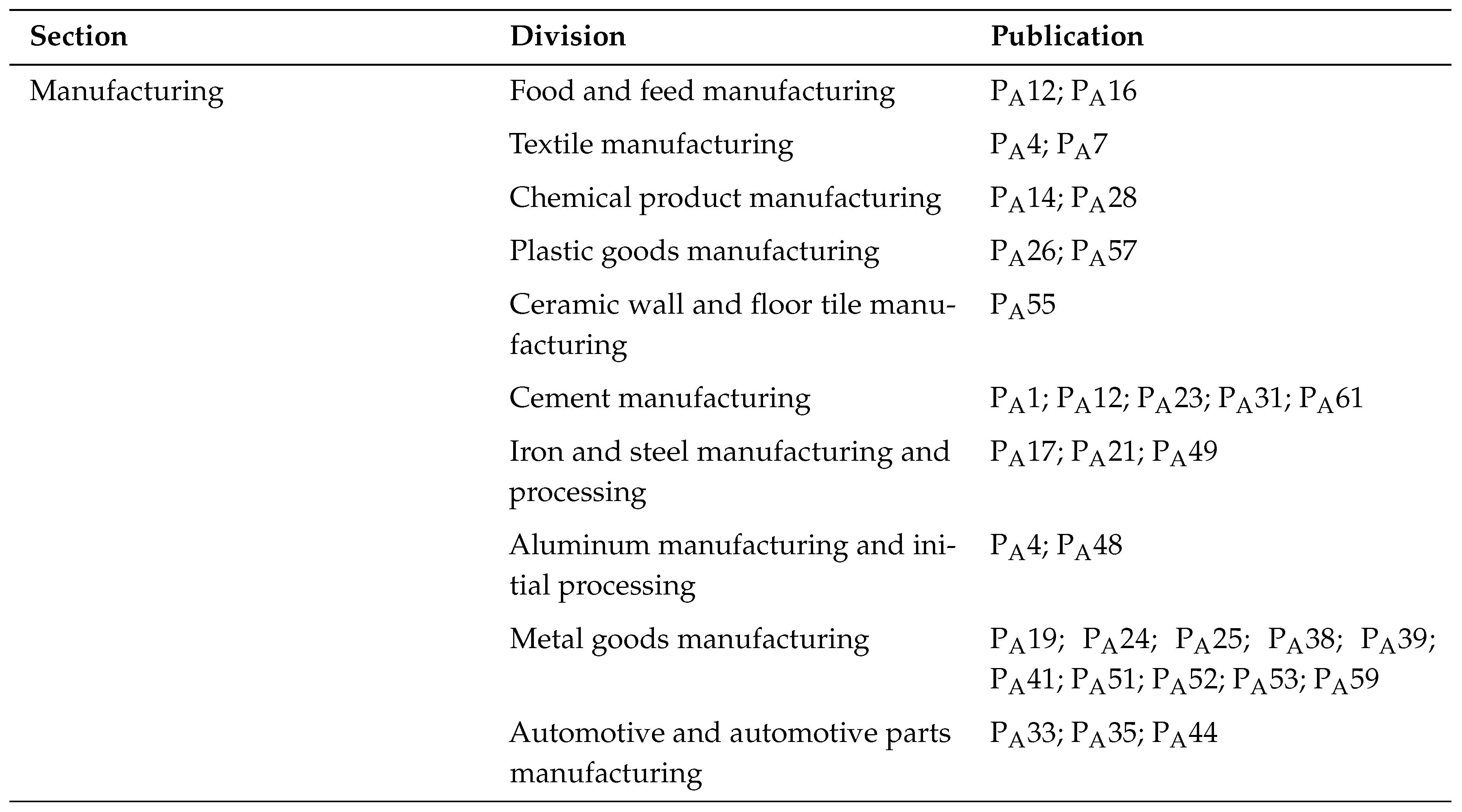
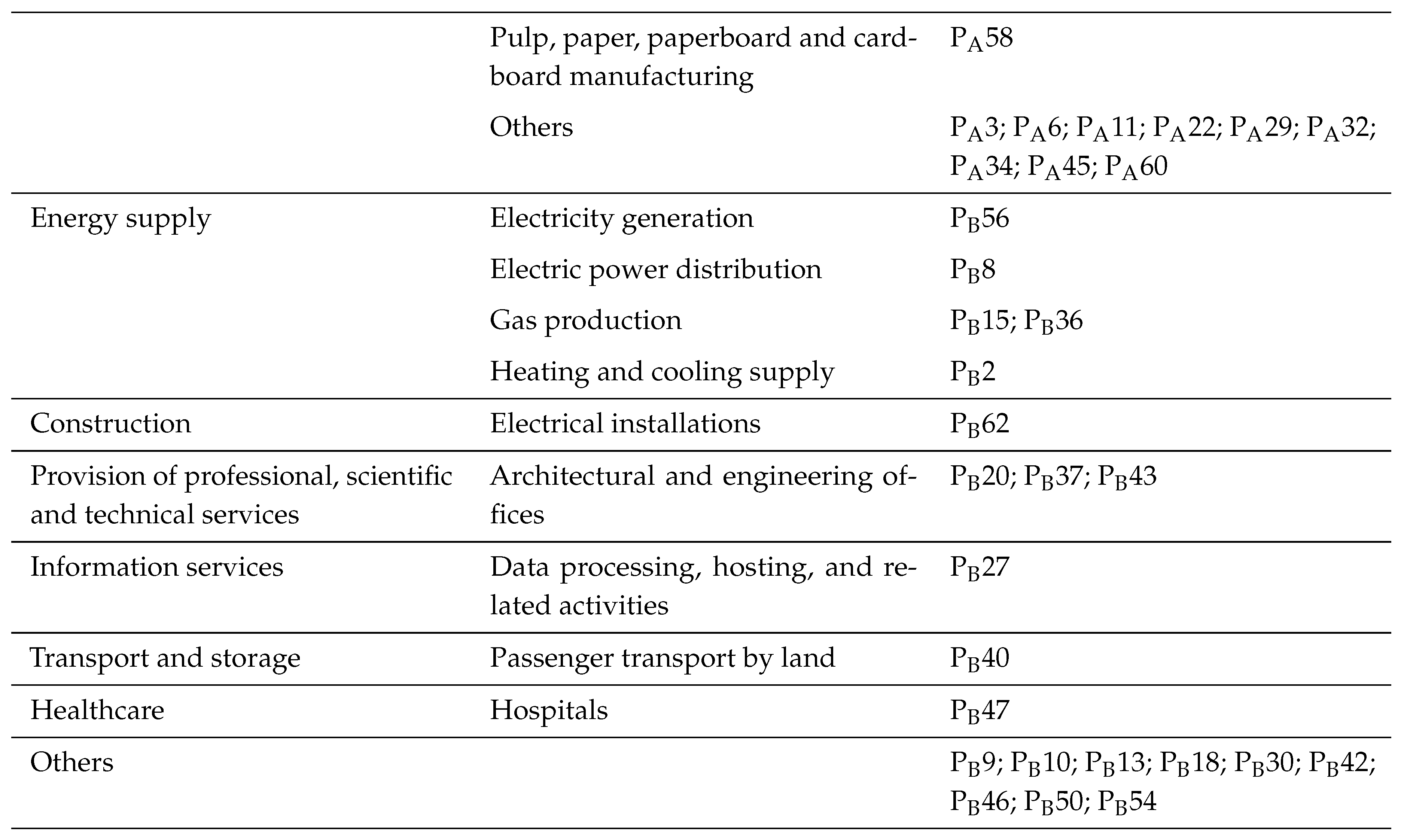
For answering RQ1, in which industries ESs are used to increase energy efficiency, the classification of economic sectors of the Federal Statistical Office in Germany is considered. The classification is hierarchically structured and is divided into sections, which are separated into divisions [101].
Table 8 summarizes the analyzed publications according to this classification scheme. We can classify the publications into seven industries. Some publications cannot be assigned clearly because they deal with cross-sectional technologies or do not provide any information about the exact industry. There is a noticeable concentration of the use of ESs in the manufacturing of metal goods. Furthermore, Table 8 shows again that with 66 % the majority of ESs for improving energy efficiency are deployed in manufacturing (relevance group A).
3.5.2. Utilizations of ESs in Industry
Regarding the question of how ESs are applied to enhance energy efficiency in manufacturing (RQ2), it can be observed that ESs with a wider system boundary are more transferable than others with a more restricted system boundary. Thus, [46,47,62,74,75,94] describe ESs with system boundaries covering entire factories but are rather utilized for preliminary or generic energy analyses. Some other publications with a more limited system boundary such as [9,51,56,61,78] are applicable for similar use cases with few or no adjustments. The remaining publications in relevance group A describe ESs that are largely limited to individual case studies and cannot be transferred to other machines, systems or processes without further modification.
The classification in Table 5 also shows that the utilization of ESs is strongly focused on either planning manufacturing processes regarding energy efficiency before actual operation or optimization during operation. ESs are deployed less frequently for energy-efficient planning of new energy systems. Furthermore, according to Table 6, the primary purpose of ESs is to create energy transparency as a basis for subsequent improvement processes as well as to contribute directly to improving energy efficiency.
3.5.3. Structure and Implementations of ESs
RQ3 addresses the structure and implementation of ESs. All ESs described within the analyzed 62 publications feature an implicit or explicit knowledge base, an inference engine, and a user interface, which are interconnected as shown in Figure 7. Some of the publications, for instance [74,75], additionally include distinct knowledge acquisition and explanation modules.
The expertise stored in the knowledge base can be represented in various forms. These include mathematical formulas [41], historical measurement data [42] physical and technical relationships [44], rules [48], and facts [56]. Furthermore, as outlined by [74], the knowledge base can be divided into short-term and long-term memory. The short-term memory stores information for particular use cases for which ESs are applied. Whereas the long-term memory stores more general relationships, which correspond to the heuristic knowledge of human experts. Knowledge can be acquired using different techniques. Literature surveys are explicitly mentioned by [56,92] as well as expert consultations by [56,74,92]. The optional knowledge acquisition module enables the knowledge base to be enriched with new content while the ES is already deployed. Depending on the ES type (Table 7), it varies how the knowledge is represented in the knowledge base and how the inference engine utilizes the knowledge stored in the knowledge base to gain insights or solve problems.
The communication between humans and the ES (human-machine interface) can be realized by different means, including interactive questionnaires [41], dialog boxes [46], measurement data inputs [9], text outputs and graphics [60]. The process interface enables the connection to other technical systems for the uni- or bidirectional transfer of data [102]. Other technical systems can be, for example, sensors or programmable logic controllers [11,81]. At least one of the two interface types is required to input information about the present situation. The optional explanation module clarifies the reasoning process in order to make it comprehensible and thus promote acceptance of the findings presented by the ES [74].
As the analyzed publications reveal, the software implementation of ES can be highly diverse. [41] use Fortran and Assembler as programming languages. More recent publications implement their ESs in Excel [56], C language [59], CLIPS [74], Python [78], and LabVIEW [91]. [11,65,81,83,96,97] use combinations of different programming languages to integrate simulation models or databases as part of the ESs.
3.5.4. Development of ESs for Industrial Applications
Many analyzed publications follow similar sequential and sometimes iterative steps in the development of their ES. These steps are:
- Situation analysis: Create an overview of the situation and examine the problem to be solved [47].
- Creation of a knowledge base and knowledge representation: Knowledge is gathered and represented as described in subSection 3.5.3.
- Application and validation: The ES can be qualitatively validated via user interviews and quantitatively through case studies [83].
[11,74,83] specify corresponding development methods. [74] follow an incremental development model exclusively for the computational implementation, without providing a detailed description of the individual phases. [83] base the entire development of their ES on a design science method. The method described by [83] comprises three phases: conceptual design phase, tool development phase, as well as application and validation phase. During the conceptual design, influential factors are selected, calculation rules are defined and iteratively refined. Subsequently, the computational implementation follows during the tool development. Finally, the ES is validated both qualitatively and quantitatively. [11] adopt the approach from [83] to manufacturing. This involves identifying relevant consumers and controllable parameters, acquiring measurement data, developing ML models and simulation models, defining energy performance indicators, formulating a rule base and finally integrating all subsystems. References to practical implementation are provided for each step. Following [83], both the application and the validation are carried out, after which further refinements are possible. Additionally, in [11], personas with necessary capabilities are described for each development step.
To summarize, various development approaches for ESs can be found with some similarities in the context of improving industrial energy efficiency. Most development approaches, except for those described by [11,74,83], cannot be associated with a superior methodological approach. In the field of manufacturing, solely [11] offer a process model with a detailed description of the individual steps for developing ESs to increase energy efficiency. However, it is limited exclusively to the consideration of a single machine and requires the time-consuming development of an analytical simulation model as a core element [11].
4. Conclusion
This paper presents a SLR that identifies, summarizes, and analyzes ESs aimed at improving energy efficiency in industry, with a particular focus on manufacturing. By following a formal approach consisting of six consecutive steps, we sought to minimize bias and enhance the reliability of the literature selected. This rigorous process led to the in-depth analysis of 62 publications. The findings were organized by classifying the proposed ESs according to system boundary, manufacturing type, application perspective, application purpose, and ES type. The research questions raised were addressed, and several research gaps were identified.
Regarding existing literature concerning ESs, the main contribution of this work lies in the special focus on improving energy efficiency in manufacturing, although other industries were also considered to provide a comprehensive assessment. This study offers a structured classification of ESs across various dimensions, industries, and contexts, examining their structure, implementation, utilization, and development within the scope of energy efficiency. However, it is important to acknowledge the limitations of this study, including its reliance on digital sources and the exclusion of older publications, which may introduce a bias toward recent findings. Additionally, the language restriction could have led to the exclusion of relevant studies published in other languages.
Despite these limitations, this study provides a thorough review of the current state of the art in the domain of ESs for energy efficiency in manufacturing. The analysis led to several noteworthy observations. While Figure 5 illustrates an increase in the number of publications, it remains unclear whether this trend reflects a growing interest in the topic or a broader expansion in research output. However, the comparison between relevance groups reveals a more pronounced growth in group A publications over the past decade, likely due to heightened attention to sustainability in manufacturing. Additionally, the analysis of authors’ country affiliations in Figure 6 suggests that countries with large populations, strong secondary economic sectors, and substantial research investments have contributed more significantly to this area of research. Moreover, the answer given to RQ1 (Table 8) combined with the categorization by manufacturing type (Table 4) indicates that ESs for improving energy efficiency are of particular interest to companies with high energy consumption and large output quantities. This could be related to the initial development effort arising from the lack of established process models (RQ4) and the low transferability of ESs to other use cases (RQ2).
The answers provided to the research questions revealed research gaps that can be addressed in future research. Thus, the question arises why ESs are used more frequently in certain industries (RQ1) than in others and what reasons, such as energy consumption, output quantities or digitalization, play a decisive role in this. Furthermore, it became apparent that in most cases ESs are not transferable to other machines, systems, or processes (RQ2). While advantageous for increasing energy efficiency and preserving knowledge, it also means a high initial development effort for each individual use case, which can pose a barrier to implementation. Exploring the transferability aspect in the development of ESs could be a subject of future research. Regarding the structure and implementation of ESs (RQ3), it has been revealed that although all described ESs have a knowledge base, an inference engine and a user interface, their implementation is highly diverse. Therefore, a tailored software tool (expert system shell [103]) could simplify the development process considerably. For the development of ESs to increase energy efficiency in manufacturing (RQ4), it was also pointed out that there is still no universally applicable methodology, which can lead to higher initial costs and may act as a barrier to the broader adoption of ESs. Hence, future research could aim to design a more broadly applicable methodology and streamlined software framework for the development of such ESs.
Author Contributions
Conceptualization, B.I.; methodology, B.I.; formal analysis, B.I.; investigation, B.I.; resources, M.W.; data curation, B.I.; writing—original draft preparation, B.I.; writing—review and editing, B.I., M.F. and M.W.; visualization, B.I.; supervision, M.W.; project administration, B.I.; funding acquisition, M.W. All authors have read and agreed to the published version of the manuscript.
Funding
This research was funded by the German Federal Ministry of Economic Affairs and Climate Action (BMWK) within the project KI4ETA (grant number 03EN2053A).
Data Availability Statement
No data was used for the research described in the article.
Acknowledgments
The authors gratefully acknowledge financial support from the German Federal Ministry of Economic Affairs and Climate Action (BMWK) and project supervision by the project management Jülich (PtJ).
Conflicts of Interest
The authors declare no conflicts of interest.
Abbreviations
The following abbreviations are used in this manuscript:
| AI | Artificial intelligence |
| ES | Expert system |
| EC | Exclusion criteria |
| IC | Inclusion criteria |
| ID | Identifier |
| ML | Machine learning |
| P | Publication |
| RQ | Research question |
| SLR | Systematic literature review |
References
- European Parliament, Council of the European Union. Regulation (EU) 2021/1119. https://eur-lex.europa.eu/legal-content/EN/TXT/?uri=CELEX%3A32021R1119, accessed on 29.11.2024.
- Ritchie, H.; Roser, M.; Rosado, P. CO2 and Greenhouse Gas Emissions. https://ourworldindata.org/co2-and-greenhouse-gas-emissions, accessed on 27.07.2024.
- International Energy Agency. Key World Energy Statistics 2021. https://www.iea.org/reports/key-world-energy-statistics-2021/final-consumption, accessed on 27.07.2024.
- ABB Ltd. Accelerating Ambition: How global industry is speeding up investment in energy efficiency. https://www.energyefficiencymovement.com/wp-content/uploads/2022/04/ABB-Energy-Efficiency-Survey-Report-2022.pdf, accessed on 16.08.2024.
- Deutsches Institut für Normung, e.V. . Energy management systems – Requirements with guidance for use (ISO 50001:2018): German version EN ISO 50001:2018, 2018 ed.; Number 50001 in 03.100.70; 27.015, Beuth Verlag GmbH: Berlin, 2018. [Google Scholar]
- International Energy Agency. Energy Efficiency 2022. https://www.iea.org/reports/energy-efficiency-2022, accessed on 31.07.2024.
- International Energy Agency. Digitalization and Energy. https://www.iea.org/reports/digitalisation-and-energy, accessed on 06.11.2023.
- DeTore, A.W. An introduction to expert systems. Journal of insurance Medicine 1989, 21, 233–236. [Google Scholar]
- Ioshchikhes, B.; Elserafi, G.; Weigold, M. An Expert System-Based Approach For Improving Energy Efficiency Of Chamber Cleaning Machines. In Proceedings of the Conference on Production Systems and Logistics (CPSL 2023); publish-Ing.: Offenburg; 2023. [Google Scholar] [CrossRef]
- Jackson, P. Introduction to Expert Systems, 3rd ed.; Addison-Wesley Longman Publishing Co., Inc: USA, 1998. [Google Scholar]
- Ioshchikhes, B.; Frank, M.; Elserafi, G.; Magin, J.; Weigold, M. Developing Expert Systems for Improving Energy Efficiency in Manufacturing: A Case Study on Parts Cleaning. Energies 2024, 17, 3417. [Google Scholar] [CrossRef]
- Hassija, V.; Chamola, V.; Mahapatra, A.; Singal, A.; Goel, D.; Huang, K.; Scardapane, S.; Spinelli, I.; Mahmud, M.; Hussain, A. Interpreting Black-Box Models: A Review on Explainable Artificial Intelligence. Cognitive Computation 2024, 16, 45–74. [Google Scholar] [CrossRef]
- Liao, S.H. Expert system methodologies and applications—a decade review from 1995 to 2004. Expert Systems with Applications 2005, 28, 93–103. [Google Scholar] [CrossRef]
- Biel, K.; Glock, C.H. Systematic literature review of decision support models for energy-efficient production planning. Computers & Industrial Engineering 2016, 101, 243–259. [Google Scholar] [CrossRef]
- Wagner, W.P. Trends in expert system development: A longitudinal content analysis of over thirty years of expert system case studies. Expert Systems with Applications 2017, 76, 85–96. [Google Scholar] [CrossRef]
- Kumar, L.S.P. Knowledge-based expert system in manufacturing planning: state-of-the-art review. International Journal of Production Research 2019, 57, 4766–4790. [Google Scholar] [CrossRef]
- Piller, F.T. Einführung: Informationsrevolution und industrielle Produktion. In Mass Customization; Picot, A., Reichwald, R., Franck, E., Eds.; Springer Fachmedien Wiesbaden GmbH: Wiesbaden, 2006; pp. 1–9. [Google Scholar]
- Tranfield, D.; Denyer, D.; Smart, P. Towards a Methodology for Developing Evidence-Informed Management Knowledge by Means of Systematic Review. British Journal of Management 2003, 14, 207–222. [Google Scholar] [CrossRef]
- Feak, C.B.; Swales, J.M. Telling a Research Story: Writing a Literature Review, 2 ed.; The University of Michigan Press: Ann Arbor, 2009. [Google Scholar] [CrossRef]
- Reynolds, N.; Simintiras, A.; Vlachou, E. International business negotiations. International Marketing Review 2003, 20, 236–261. [Google Scholar] [CrossRef]
- Glock, C.H.; Hochrein, S. Purchasing Organization and Design: A Literature Review. Business Research 2011, 4, 149–191. [Google Scholar] [CrossRef]
- Walther, J.; Weigold, M. A Systematic Review on Predicting and Forecasting the Electrical Energy Consumption in the Manufacturing Industry. Energies 2021, 14, 968. [Google Scholar] [CrossRef]
- Panten, N. Deep Reinforcement Learning zur Betriebsoptimierung hybrider industrieller Energienetze; Schriftenreihe des PTW: Innovation Fertigungstechnik, Shaker Verlag: Düren, 2019. [Google Scholar]
- vom Brocke, J.; Simons, A.; Niehaves, B.; Reimer, K.; Plattfaut, R.; Cleven, A. Reconstructing the giant: On the importance of rigour in documenting the literature search process. European Conference on Information Systems, 2009.
- Duflou, J.R.; Sutherland, J.W.; Dornfeld, D.; Herrmann, C.; Jeswiet, J.; Kara, S.; Hauschild, M.; Kellens, K. Towards energy and resource efficient manufacturing: A processes and systems approach. CIRP Annals 2012, 61, 587–609. [Google Scholar] [CrossRef]
- Westkämper, E. Einführung in die Organisation der Produktion; Springer-Lehrbuch, Springer: Berlin and Heidelberg, 2006. [Google Scholar]
- Weck, M. Werkzeugmaschinen 4; Springer Berlin Heidelberg: Berlin, Heidelberg, 2006. [Google Scholar] [CrossRef]
- Kara, S.; Bogdanski, G.; Li, W. Electricity Metering and Monitoring in Manufacturing Systems. In Glocalized Solutions for Sustainability in Manufacturing; Hesselbach, J., Herrmann, C., Eds.; Springer Berlin Heidelberg: Berlin, Heidelberg, 2011; pp. 1–10. [Google Scholar]
- International Organization for Standardization. Machine tools - Environmental evaluation of machine tools - Part 1: Design methodology for energy-efficient machine tools, 2017 ed.; International Organization for Standardization,: Geneva, 2017. [Google Scholar]
- Verein Deutscher Ingenieure, e.V. Energy-flexible factory: Fundamentals; Number 5207-1 in 91.120.10, VDI-Gesellschaft Produktion und Logistik (GPL): Düsseldorf, 2020. [Google Scholar]
- Ongsulee, P. Artificial intelligence, machine learning and deep learning. 2017 15th International Conference on ICT and Knowledge Engineering (ICT&KE), 2017, pp. 1–6. [CrossRef]
- Posselt, G. Towards Energy Transparent Factories; Springer International Publishing: Cham, 2016. [Google Scholar]
- Box, G.E.P.; Jenkins, G.M.; Reinsel, G.C.; Ljung, G.M. Time Series Analysis: Forecasting and Control, 5th Edition, 5 ed.; John Wiley and Sons Inc.: Hoboken, New Jersey, 2015. [Google Scholar]
- dos Santos, S.B.A.; Soares, J.M.; Barroso, G.C.; Prata, B.d.A. Demand response application in industrial scenarios: A systematic mapping of practical implementation. Expert Systems with Applications 2023, 215, 119393. [Google Scholar] [CrossRef]
- Solnørdal, M.; Foss, L. Closing the Energy Efficiency Gap—A Systematic Review of Empirical Articles on Drivers to Energy Efficiency in Manufacturing Firms. Energies 2018, 11, 518. [Google Scholar] [CrossRef]
- Clarivate. Web of Science. https://www.webofscience.com/wos/woscc/basic-search, accessed on 08.08.2024.
- Elsevier. ScienceDirect. https://www.sciencedirect.com/, accessed on 08.08.2024.
- IEEE. IEEE Xplore. https://ieeexplore.ieee.org, accessed on 08.08.2024.
- SpringerNature. SpringerLink. https://link.springer.com/, accessed on 08.08.2024.
- OCLC. WorldCat. https://www.worldcat.org, accessed on 08.08.2024.
- Keviczky, L.; Bányász, C.; Haber, R.; Hilger, M. Cemexpert: An Expert System for the Cement Grinding Process. IFAC Proceedings Volumes 1987, 20, 157–162. [Google Scholar] [CrossRef]
- Miyayama, T.; Tanaka, S.; Miyatake, T.; Umeki, T.; Miyamoto, Y.; Nishino, K.; Harada, E. A combustion control support expert system for a coal-fired boiler. Proceedings IECON ’91: 1991 International Conference on Industrial Electronics, Control and Instrumentation, 1991, pp. 1513–1516 vol.2. [CrossRef]
- Zhu, M.S.; Wang, B.X.; Xiao, Y.H. A multi-criteria decision making procedure for the analysis of an energy system. Journal of Thermal Science 1992, 1, 221–225. [Google Scholar] [CrossRef]
- Tuma, A.; Haasis, H.D.; Rentz, O. Development of emission orientated production control strategies using fuzzy expert systems, neural networks and neuro-fuzzy approaches. FUZZY SETS AND SYSTEMS 1996, 77, 255–264. [Google Scholar] [CrossRef]
- Kontopoulos, A.; Krallis, K.; Koukourakis, E.; Denaxas, N.; Kostis, N.; Broussaud, A.; Guyot, O. A hybrid, knowledge-based system as a process control `tool’ for improved energy efficiency in alumina calcining furnaces. APPLIED THERMAL ENGINEERING 1997, 17, 935–945. [Google Scholar] [CrossRef]
- Dunning, S.; Segee, B.; Allen, V. A Self-Assessment Software Application for Industrial Manufacturers. Energy Engineering 1999, 96, 70–77. [Google Scholar] [CrossRef]
- Lau, H.; Cheng, E.; Lee, C.; Ho, G. A fuzzy logic approach to forecast energy consumption change in a manufacturing system. Expert Systems with Applications 2008, 34, 1813–1824. [Google Scholar] [CrossRef]
- Lin, C.H.; Chen, C.S.; Chuang, H.J.; Huang, M.Y.; Huang, C.W. An Expert System for Three-Phase Balancing of Distribution Feeders. IEEE Transactions on Power Systems 2008, 23, 1488–1496. [Google Scholar]
- Soyguder, S.; Alli, H. Predicting of fan speed for energy saving in HVAC system based on adaptive network based fuzzy inference system. Expert Systems with Applications 2009, 36, 8631–8638. [Google Scholar] [CrossRef]
- Beck, A.; Göhner, P. An approach for model-based energy cost analysis of industrial automation systems. Energy Efficiency 2012, 5, 303–319. [Google Scholar] [CrossRef]
- Garcia, R.F. Improving heat exchanger supervision using neural networks and rule based techniques. Expert Systems with Applications 2012, 39, 3012–3021. [Google Scholar] [CrossRef]
- Klein, G.M.; Schrooten, T.; Neuhaus, T. Reduction of Energy Demand for Industrial Dedusting Plants. Chemie Ingenieur Technik 2012, 84, 1121–1129. [Google Scholar] [CrossRef]
- Roy, S.S.; Pratihar, D.K. Soft computing-based approaches to predict energy consumption and stability margin of six-legged robots moving on gradient terrains. Applied Intelligence 2012, 37, 31–46. [Google Scholar] [CrossRef]
- Monedero, I.; Biscarri, F.; León, C.; I. Guerrero, J.; González, R.; Pérez-Lombard, L. Decision system based on neural networks to optimize the energy efficiency of a petrochemical plant. Expert Systems with Applications 2012, 39, 9860–9867. [Google Scholar] [CrossRef]
- Djatkov, D.; Effenberger, M.; Martinov, M. Method for assessing and improving the efficiency of agricultural biogas plants based on fuzzy logic and expert systems. Applied Energy 2014, 134, 163–175. [Google Scholar] [CrossRef]
- Do, T.T.H.; Schnitzer, H.; Le, T.H. A decision support framework considering sustainability for the selection of thermal food processes. JOURNAL OF CLEANER PRODUCTION 2014, 78, 112–120. [Google Scholar] [CrossRef]
- Mitra, S.; Singh, R.K.; Mondal, A.K. An Expert System Based Process Control System for Silicon Steel Mill Furnace of Rourkela Steel Plant. 2014 Fourth International Conference of Emerging Applications of Information Technology, 2014, pp. 29–33. [CrossRef]
- Bagheri, N.; Tarabi, N.; Javadikia, H. Development and evaluation of an adaptive neuro-fuzzy interface models to predict performance of a solar dryer. Agricultural Engineering International : The CIGR e-journal 2015, 17, 112–121. [Google Scholar]
- Iqbal, A.; Zhang, H.C.; Kong, L.L.; Hussain, G. A rule-based system for trade-off among energy consumption, tool life, and productivity in machining process. JOURNAL OF INTELLIGENT MANUFACTURING 2015, 26, 1217–1232. [Google Scholar] [CrossRef]
- Ochoa, C.E.; Capeluto, I.G. Decision methodology for the development of an expert system applied in an adaptable energy retrofit façade system for residential buildings. Renewable Energy 2015, 78, 498–508. [Google Scholar] [CrossRef]
- Singh, P.P.; Madan, J. A computer-aided system for sustainability assessment for the die-casting process planning. The International Journal of Advanced Manufacturing Technology 2016, 87, 1283–1298. [Google Scholar] [CrossRef]
- Singh, S.; Olugu, E.U.; Musa, S.N. Development of Sustainable Manufacturing Performance Evaluation Expert System for Small and Medium Enterprises. Procedia CIRP 2016, 40, 608–613. [Google Scholar] [CrossRef]
- Teja, R.; Sridhar, P.; Guruprasat, M. Control and Optimization of a Triple String Rotary Cement Kiln using Model Predictive Control. IFAC-PapersOnLine 2016, 49, 748–753. [Google Scholar] [CrossRef]
- Cai, Y.; Shao, H. (Eds.) Energy Efficiency State Identification in Milling Processing Based on Improved HMM, Vol. Volume 2: Additive Manufacturing; Materials, International Manufacturing Science and Engineering Conference, 2017. [CrossRef]
- Deng, Z.; Zhang, H.; Yahui, F.; Wan, L.; Lv, L. Research on intelligent expert system of green cutting process and its application. JOURNAL OF CLEANER PRODUCTION 2018, 185, 904–911. [Google Scholar] [CrossRef]
- Cheng, C.C.; Liu, K.W. Optimizing energy savings of the injection molding process by using a cloud energy management system. Energy Efficiency 2018, 11, 415–426. [Google Scholar] [CrossRef]
- Fernández-Cerero, D.; Fernández-Montes, A.; Ortega, J.A. Energy policies for data-center monolithic schedulers. Expert Systems with Applications 2018, 110, 170–181. [Google Scholar] [CrossRef]
- Garofalo, P.; Campi, P.; Vonella, A.V.; Mastrorilli, M. Application of multi-metric analysis for the evaluation of energy performance and energy use efficiency of sweet sorghum in the bioethanol supply-chain: A fuzzy-based expert system approach. Applied Energy 2018, 220, 313–324. [Google Scholar] [CrossRef]
- Burow, K.; Franke, M.; Deng, Q.; Hribernik, K.; Thoben, K.D. Sustainable Data Management for Manufacturing. 2019 IEEE International Conference on Engineering, Technology and Innovation (ICE/ITMC), 2019, pp. 1–5. [CrossRef]
- Debnath, S.; Reddy, J.; Jagadish. ; Das, B. An expert system-based modeling and optimization of corrugated plate solar air collector for North Eastern India. Journal of the Brazilian Society of Mechanical Sciences and Engineering 2019, 41. [Google Scholar] [CrossRef]
- Simmons, A.; Sarao, G.; Campain, D. A Cement Mill Upgrade Story Reboot. 2019 IEEE-IAS/PCA Cement Industry Conference (IAS/PCA), 2019, pp. 1–8. [CrossRef]
- Wang, J.; Fei, Z.; Chang, Q.; Li, S.; Fu, Y. Multi-state decision of unreliable machines for energy-efficient production considering work-in-process inventory. INTERNATIONAL JOURNAL OF ADVANCED MANUFACTURING TECHNOLOGY 2019, 102, 1009–1021. [Google Scholar] [CrossRef]
- Zhao, J.; Peng, S.; Li, T.; Lv, S.; Li, M.; Zhang, H. Energy-aware fuzzy job-shop scheduling for engine remanufacturing at the multi-machine level. Frontiers of Mechanical Engineering 2019, 14, 474–488. [Google Scholar] [CrossRef]
- Buccieri, G.P.; Balestieri, J.A.P.; Matelli, J.A. Energy efficiency in Brazilian industrial plants: knowledge management and applications through an expert system. JOURNAL OF THE BRAZILIAN SOCIETY OF MECHANICAL SCIENCES AND ENGINEERING 2020, 42. [Google Scholar] [CrossRef]
- Grigoras, G.; Neagu, B.C. An Advanced Decision Support Platform in Energy Management to Increase Energy Efficiency for Small and Medium Enterprises. APPLIED SCIENCES-BASEL 2020, 10. [Google Scholar] [CrossRef]
- Khayum, N.; Rout, A.; Deepak, B.B.V.L.; Anbarasu, S.; Murugan, S. Application of Fuzzy Regression Analysis in Predicting the Performance of the Anaerobic Reactor Co-digesting Spent Tea Waste with Cow Manure. Waste and Biomass Valorization 2020, 11, 5665–5678. [Google Scholar] [CrossRef]
- Kim, S.H.; Nam, J. Can Both the Economic Value and Energy Performance of Small- and Mid-Sized Buildings Be Satisfied? Development of a Design Expert System in the Context of Korea. Sustainability 2020, 12, 4946. [Google Scholar] [CrossRef]
- Petruschke, L.; Elserafi, G.; Ioshchikhes, B.; Weigold, M. Machine learning based identification of energy efficiency measures for machine tools using load profiles and machine specific meta data. MM Science Journal 2021, 2021, 5061–5068. [Google Scholar] [CrossRef]
- Qu, N.; You, W. Design and fault diagnosis of DCS sintering furnace’s temperature control system for edge computing. PloS one 2021, 16, e0253246. [Google Scholar] [CrossRef]
- Davydenko, L.; Davydenko, N.; Bosak, A.; Bosak, A.; Deja, A.; Dzhuguryan, T. Smart Sustainable Freight Transport for a City Multi-Floor Manufacturing Cluster: A Framework of the Energy Efficiency Monitoring of Electric Vehicle Fleet Charging. Energies 2022, 15, 3780. [Google Scholar] [CrossRef]
- Ioshchikhes, B.; Borst, F.; Weigold, M. Assessing Energy Efficiency Measures for Hydraulic Systems using a Digital Twin. Procedia CIRP 2022, 107, 1232–1237. [Google Scholar] [CrossRef]
- Kalayci, O.; Pehlivan, I.; Coskun, S. Improving the performance of industrial mixers that are used in agricultural technologies via chaotic systems and artificial intelligence techniques. TURKISH JOURNAL OF ELECTRICAL ENGINEERING AND COMPUTER SCIENCES 2022, 30, 2418–2432. [Google Scholar] [CrossRef]
- Li, P.; Lu, Y.; Qian, Y.; Wang, Y.; Liang, W. An explanatory parametric model to predict comprehensive post-commissioning building performances. Building and Environment 2022, 213, 108897. [Google Scholar] [CrossRef]
- Mendia, I.; Gil-Lopez, S.; Grau, I.; Del Ser, J. A novel approach for the detection of anomalous energy consumption patterns in industrial cyber–physical systems. Expert Systems 2022. [Google Scholar] [CrossRef]
- Rahman, H.F.; Chakrabortty, R.K.; Elsawah, S.; Ryan, M.J. Energy-efficient project scheduling with supplier selection in manufacturing projects. Expert Systems with Applications 2022, 193, 116446. [Google Scholar] [CrossRef]
- Rahmati, A.H.; Nikbakht, A.M. Fuzzy-based modeling of thermohydraulic aspect of solar air heater roughened with inclined broken roughness. Neural Computing and Applications 2022, 34, 2393–2412. [Google Scholar] [CrossRef]
- Taleb, H.; Nasser, A.; Andrieux, G.; Charara, N.; Cruz, E.M. Energy Consumption Improvement of a Healthcare Monitoring System: Application to LoRaWAN. IEEE Sensors Journal 2022, 22, 7288–7299. [Google Scholar] [CrossRef]
- Wang, X.l.; Lu, M.y.; Wei, S.m.; Xie, Y.f. Multi-objective optimization based optimal setting control for industrial double-stream alumina digestion process. Journal of Central South University 2022, 29, 173–185. [Google Scholar] [CrossRef]
- Choudhury, B.; Chandrasekaran, M. Electron Beam Welding Investigation of Inconel 825 and Optimize Energy Consumption Using Integrated Fuzzy Logic-Particle Swarm Optimization Approach. International Journal of Fuzzy Systems 2023, 25, 1377–1399. [Google Scholar] [CrossRef]
- Duman, E.; Seckin, D. Enhancing the efficiency of cabin heaters in emergency shelters after earthquakes through an optimized fuzzy controller. Building Simulation 2023, 16, 1759–1776. [Google Scholar] [CrossRef]
- Wang, J.; Tian, Y.; Hu, X.; Fan, Z.; Han, J.; Liu, Y. Development of grinding intelligent monitoring and big data-driven decision making expert system towards high efficiency and low energy consumption: experimental approach. JOURNAL OF INTELLIGENT MANUFACTURING 2023. [Google Scholar] [CrossRef]
- Perera, J.C.; Gopalakrishnan, B.; Bisht, P.S.; Chaudhari, S.; Sundaramoorthy, S. A Sustainability-Based Expert System for Additive Manufacturing and CNC Machining. Sensors (Basel, Switzerland) 2023, 23. [Google Scholar] [CrossRef] [PubMed]
- Reddy, J.; Jagadish. ; Das, B.; Debnath, S. Experimental investigation and optimization of sand-coated solar air collector parameters by fuzzy-MCDM integrated decision approach. Journal of Thermal Analysis and Calorimetry 2023, 148, 5543–5556. [Google Scholar] [CrossRef]
- Banadkouki, M.R.Z. Selection of strategies to improve energy efficiency in industry: A hybrid approach using entropy weight method and fuzzy TOPSIS. Energy 2023, 279, 128070. [Google Scholar] [CrossRef]
- Ilić, D.; Žarković, M. Machine learning for power generator condition assessment. Electrical Engineering 2023, 106, 2691–2703. [Google Scholar] [CrossRef]
- Mohamed, E.G.; Ahmed, M.; Redouane, M. Smart Energy Consumption Control System While Respecting the Quality of the Injection Molded Product. 2023 3rd International Conference on Innovative Research in Applied Science, Engineering and Technology (IRASET). IEEE, 2023, pp. 1–6.
- Nadim, K.; Ouali, M.S.; Ghezzaz, H.; Ragab, A. Learn-to-supervise: Causal reinforcement learning for high-level control in industrial processes. Engineering Applications of Artificial Intelligence 2023, 126, 106853. [Google Scholar] [CrossRef]
- Lourenço, G.; de Arruda, G.T.; La Correia de Rosa, V.E.; Castoldi, M.F.; Goedtel, A.; de Souza, W.A. Three-Phase Induction Motor Electrical Parameter Estimation Using Artificial Neural Networks. 2024 International Symposium on Power Electronics, Electrical Drives, Automation and Motion (SPEEDAM). IEEE, 2024, pp. 883–888. [CrossRef]
- Pawuś, D.; Paszkiel, S. Identification and Expert Approach to Controlling the Cement Grinding Process Using Artificial Neural Networks and Other Non-Linear Models. IEEE Access 2024, 12, 26364–26383. [Google Scholar] [CrossRef]
- Sharma, M.; Pareek, S.; Singh, K. An efficient power extraction using artificial intelligence based machine learning model for SPV array reconfiguration in solar industries. Engineering Applications of Artificial Intelligence 2024, 129, 107516. [Google Scholar] [CrossRef]
- Statistisches Bundesamt. Klassifikation der Wirtschaftszweige 2008 (WZ 2008). https://www.destatis.de/DE/Methoden/Klassifikationen/Gueter-Wirtschaftsklassifikationen/Downloads/klassifikation-wz-2008-3100100089004-aktuell.pdf?__blob=publicationFile, accessed on 18.06.2024.
- Wehking, K.H.; Albrecht, W.; Becker, J.; Hager, H.J.; Kille, C.; Popp, J.; Scherner, T.; Yousefifar, R. Technisches Handbuch Logistik; Springer Vieweg: Berlin and Heidelberg, 2020. [Google Scholar]
- Quinn, K. Expert system shells: What to look for. Reference Services Review 1990, 18, 83–86. [Google Scholar] [CrossRef]
Figure 2.
Categories and dimensions for classification based on [22]).
Figure 2.
Categories and dimensions for classification based on [22]).
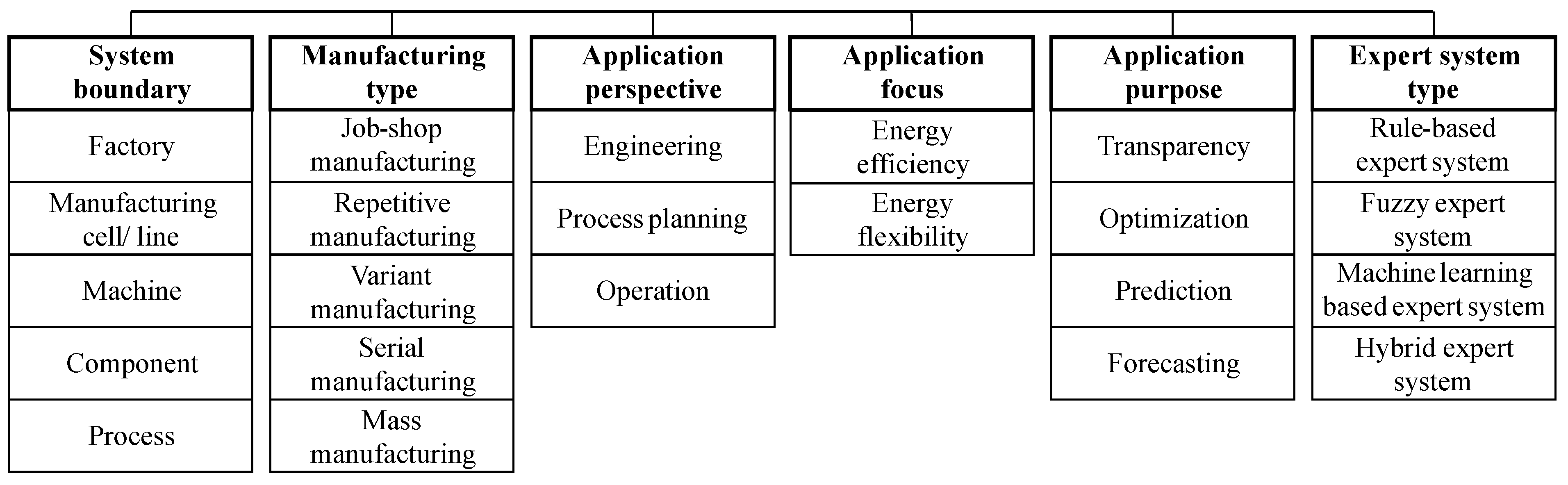
Figure 3.
Overview of the literature search and filtering. Illustration based on [22].
Figure 3.
Overview of the literature search and filtering. Illustration based on [22].
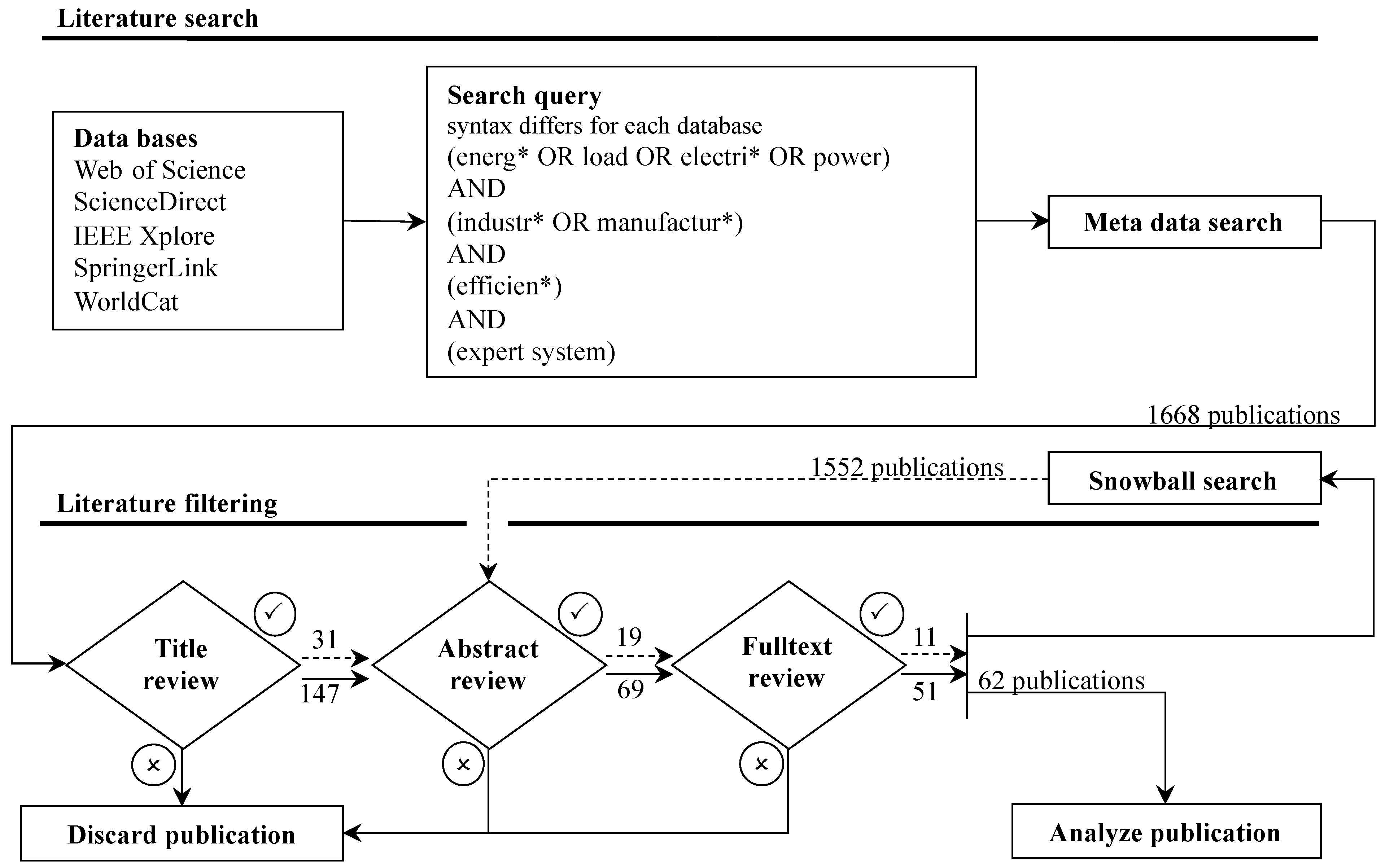
Figure 4.
Journal and proceedings distribution.
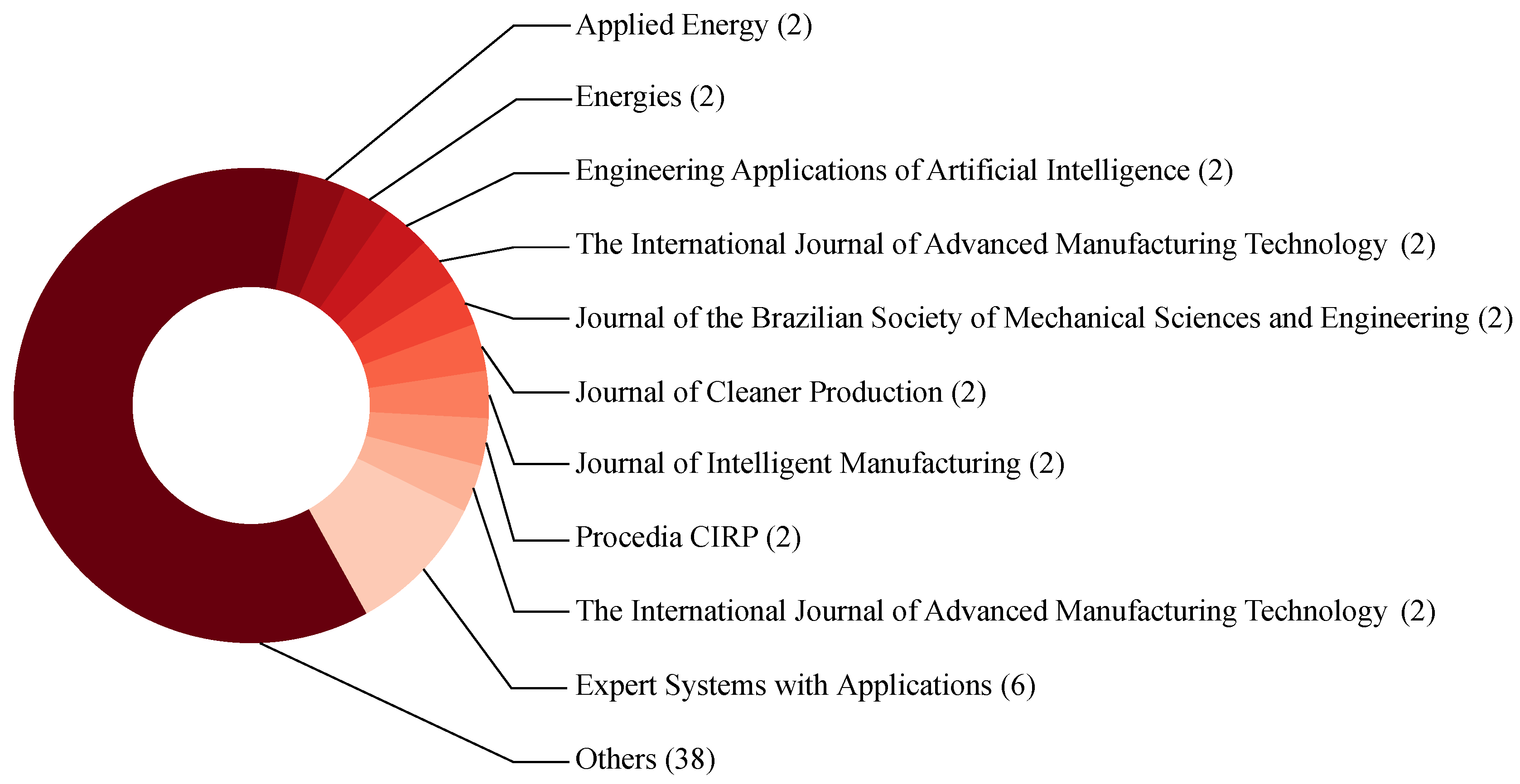
Figure 5.
Publishing years of the analyzed publications.
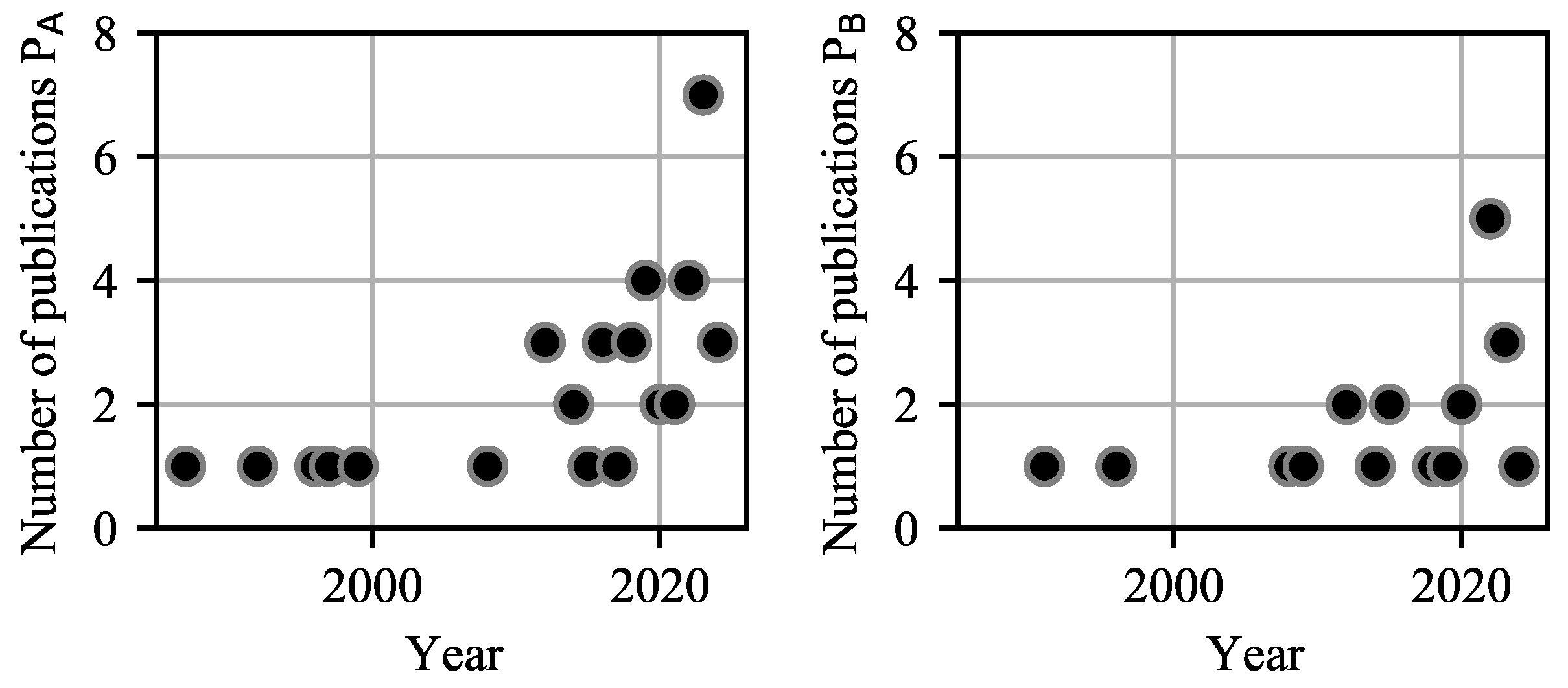
Figure 6.
Authors country distribution.
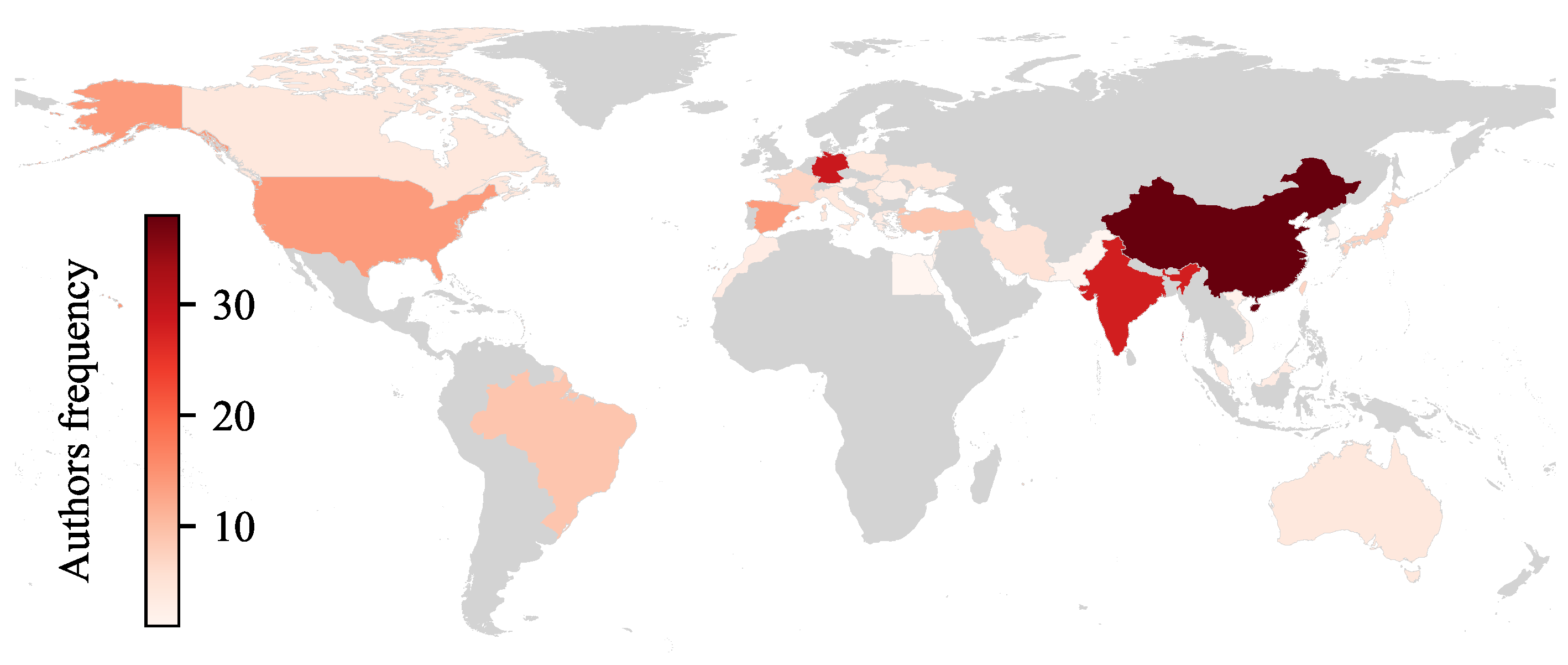
Figure 7.
Simplified structure of ESs.
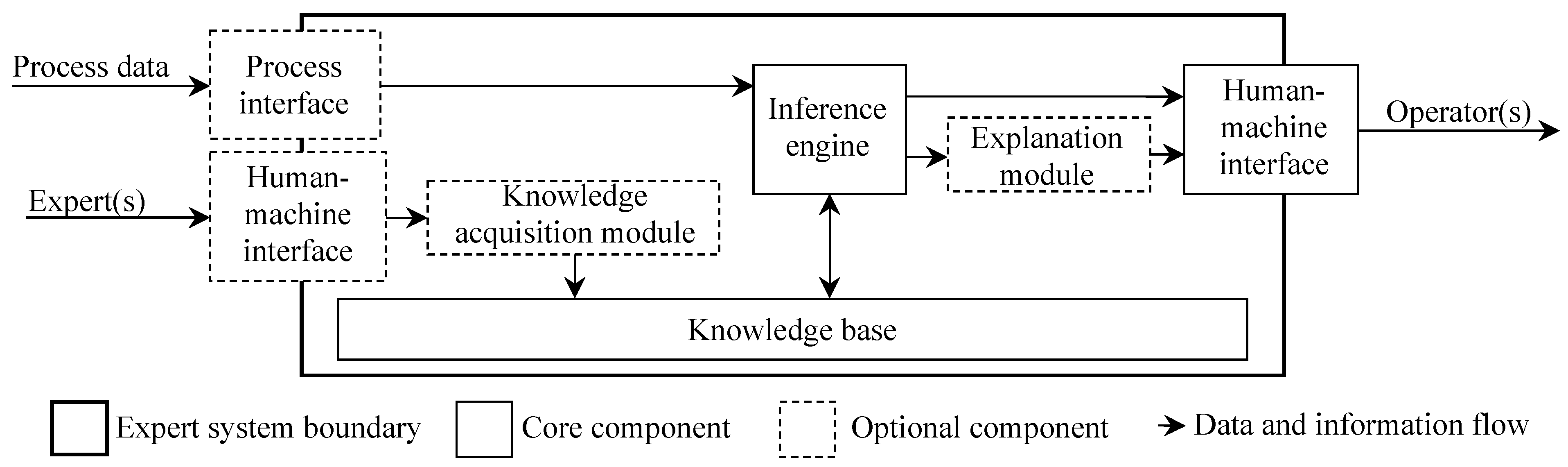
Table 1.
Databases and applied search queries on August 08, 2024.
| Database | Search query | Number of results |
|---|---|---|
| Web of Science | ((TS=(energ*) OR TS=(load) OR TS=(electri*) OR TS=(power)) AND (TS=(industr*) OR TS=(manufactur*)) AND (TS=(efficien*)) AND (TS=(expert system))) | 817 |
| ScienceDirect | (energy OR load OR electricity OR power) AND (industry OR manufacturing) AND (efficiency) AND (expert system) | 128 |
| IEEE Xplore | ("All Metadata": energ* OR load OR electri* OR power) AND ("All Metadata": industr* OR manufactur*) AND ("All Metadata": efficien*) AND ("All Metadata": expert system) | 139 |
| SpringerLink | ("energy efficiency") AND (industr* OR manufactur*) AND ("expert system") | 270 |
| WorldCat | (energy efficiency) AND (industr* OR manufactur*) AND ("expert system") | 314 |
Table 3.
Categorization of group A publications by system boundaries.

Table 4.
Categorization of group A publications by manufacturing type.

Table 5.
Categorization of group A publications by application perspective.

Table 6.
Categorization of publications by application purpose.

Table 7.
Categorization of publications by expert system type.

Table 8.
Industry classification.
Disclaimer/Publisher’s Note: The statements, opinions and data contained in all publications are solely those of the individual author(s) and contributor(s) and not of MDPI and/or the editor(s). MDPI and/or the editor(s) disclaim responsibility for any injury to people or property resulting from any ideas, methods, instructions or products referred to in the content. |
© 2024 by the authors. Licensee MDPI, Basel, Switzerland. This article is an open access article distributed under the terms and conditions of the Creative Commons Attribution (CC BY) license (http://creativecommons.org/licenses/by/4.0/).
Copyright: This open access article is published under a Creative Commons CC BY 4.0 license, which permit the free download, distribution, and reuse, provided that the author and preprint are cited in any reuse.


