

Submitted:
13 June 2024
Posted:
14 June 2024
You are already at the latest version
Abstract
Despite energy-related financial concerns and the growing demand for sustainability, many energy efficiency measures are not being implemented in industrial practice. There are a number of reasons for this, including a lack of knowledge about energy efficiency potentials and the assessment of energy savings as well as the high workloads of employees. This article describes the systematic development of an expert system, which offers a chance to overcome these obstacles and contribute significantly to increasing the energy efficiency of production machines. The system employs data-driven regression models to identify inefficient parameter settings, calculate achievable energy savings, and prioritize actions based on a fuzzy rule base. Proposed measures are first applied to an analytical real-time simulation model of a production machine to verify that constraints required for the specified product quality are met. This provides the machine operator with the expert means to apply proposed energy efficiency measures to the physical entity. We demonstrate the development and application of the system for a throughput parts cleaning machine in the metalworking industry.
Keywords:
sustainability
; climate neutrality
; fuzzy reasoning
; energy analysis
; optimization
1. Introduction
Parts cleaning processes are often necessary for removing solid contamination, such as metal particles and chippings, or filmic contamination, such as oil and grease [1]. This is required due to the importance of clean and dry surfaces for the success of downstream processes, as well as the overall quality and appearance of the parts [2]. When configuring a cleaning process, several variables affect the process outcome, making it quite difficult to select the optimal configuration in terms of performance and energy requirement. Generally, operators of cleaning machines initially follow recommendations provided by the manufacturer of the cleaning equipment and proceed to iteratively adjust the process parameters towards minimal requirements [2]. Consequently, cleaning processes tend to be configured to “overclean” and “overdry” parts, leading to excessive energy use. Furthermore, the lack of transparency and concrete guidelines make the configuration process time-consuming and error-prone when no experts are available since it usually requires experience to efficiently follow through the process iterations.
As process heat applications, the included steps, cleaning, rinsing and drying exhibit substantial energy savings potential due to different forms of energy losses, mostly of thermal nature [3]. Hence, most energy savings potentials are related to the heat supply of the cleaning machine, e.g., temperature setting and thermal insulation [4]. As shown in the research project ETA-Fabrik, optimizing the mechanical force during cleaning and rinsing can help save up to 20.5 % of a cleaning machine’s total energy consumption by allowing a temperature reduction while maintaining process quality [5]. The research project LoTuS presents more complex energy efficiency measures, e.g., the implementation of internal and external waste heat utilization and replacement of convective drying with alternative drying technologies [6]. Furthermore, it is shown that merely preventing overdrying by reducing the drying temperature can enable energy savings of 57 % of the drying system’s energy requirement [6].
Despite the benefit of improving energy efficiency, barriers impede the widespread adoption of measures within parts cleaning processes. These barriers can be categorized into technical, economic, and organizational dimensions. Technical challenges arise from the complexity of existing production processes, making the integration of energy-efficiency measures critical with regard to risk assessment for linked production processes where the quality of the cleaning process directly affects the following production process. Economical barriers can arise by uncertain cost estimations for the implementation of efficiency measures which make the objective evaluation of the measures impossible. The third dimension of common barriers is the organizational dimension. Often the responsibility for defining energy efficiency measures is not embodied within the same position that understands the related processes [7].
To overcome the mentioned barriers, expert systems (ESs) present a probate solution as already shown by [8]. ESs, a subset of artificial intelligence, leverage advanced algorithms and domain-specific knowledge to emulate human decision-making processes. In the context of improving energy efficiency, ESs offer a systematic and intelligent approach for analyzing complex data, identifying optimization opportunities, and recommending tailored strategies for specific manufacturing processes. By providing manufacturers with insights and decision-support tools, ESs hold the potential to streamline the adoption of energy efficiency measures.
ESs for improving energy efficiency in the metal-working industry have already been the subject of several studies. [9] describe a system that suggests suitable settings for a metal-cutting process based on experimental measurement data to achieve a trade-off between energy consumption, tool lifespan, and productivity. [10] also aim to raise the energy efficiency of metal-cutting processes. For this purpose, they develop an ES that optimizes cutting parameters for machine tools using cutting process cases. [11] introduce a system that can be applied to different machine tools using machine learning models and assesses proposed energy efficiency measures. Further research, such as that by [12,13], also presents ESs that optimize machine parameters in the metal-working industry for the purpose of increasing energy efficiency. [14] apply physical simulation models to verify the impacts of suggested energy efficiency measures. Thus, changes in the system can be anticipated and ES recommendations can be confirmed. However, [14] consider a hydraulic test bench and not a production machine as a use case. Regarding parts cleaning, [8] present an ES for preliminary energy analysis of several similar chamber cleaning machines. [15], on the other hand, focus on the development and application of an ES providing in-depth analysis for a single chamber cleaning machine.
The comprehensive systematic development of ESs to increase energy efficiency in manufacturing is barely addressed in the literature. [16] employ an incremental development model exclusively for computational implementation, omitting an explanation of the distinct phases. The ES development delineated by [17] is based on a design science method (DSM) and encompasses three phases: the conceptual design phase, the tool development phase, as well as the application and validation phase. In the conceptual design phase, influential factors are chosen, calculation rules are established, and iteratively refined. Following this, the computational implementation takes place during the tool development phase. Ultimately, the ES undergoes both qualitative and quantitative validation. However, [17] focus on predicting the commissioning of existing buildings, which is why not all development steps are transferable to the manufacturing context. [15] present a stepwise procedure for so-called stationary ESs, i.e., those that analyze a single production machine in depth.
This work aims to refine the procedure described by [15] for individual development steps, including the creation of a knowledge base, knowledge representation and validation of the overall ES. For this purpose, the approach of [17] is adapted for manufacturing. Apart from refining the methodology for the systematic development of ESs in manufacturing, the novelty of this work lies in the integration of physical simulation models of entire production machines to verify the effects of recommended energy efficiency measures on the machining process. To demonstrate the application of the methodology, parts cleaning in the metal-working industry is taken as a use case.
The remainder of this work is organized as follows: Section 2 briefly introduces the concept of ESs along with their elements and functions. Section 3 presents the methodology for developing ESs. This encompasses the personas and capabilities necessary to apply the methodology, along with the decision-support process of the implemented ES. Section 4 demonstrates the application of the presented methodology for a throughput parts cleaning machine and Section 5 concludes by discussing the outcomes and providing a perspective on future research.
2. Expert Systems
ESs, also referred to as knowledge-based systems or inference-based programs, are computer programs that are designed to solve problems or to assist in decision-making [18]. In contrast to conventional applications, ESs emulate human reasoning by representing human knowledge and utilizing heuristic or approximate methods to address problems [19]. Heuristics represent cause-and-effect relationships that act just like rules. These relationships consist of IF-THEN structures in which the IF part represents the causes (antecedent) and the THEN part the effects (consequent). The knowledge of a human expert is inherently heuristic as well and often provides quick solutions with acceptable accuracy. An algorithmic approach, on the other hand, can provide solutions with much higher precision, but often it is not reasonable or even impossible to solve problems with such precision. The knowledge stored and processed in an ES originates from domain experts and can be supplemented by technical literature within the same domain [16].
The transfer of heuristic knowledge and experience from human experts to computers is a crucial element in the development of ESs as outlined in detail in Section 3, but it is also relevant in the context of knowledge management. Knowledge management describes the identification, creation, renewal, and application of knowledge that is of strategic importance to the organization. In this context, ESs have the capability to retain the knowledge, expertise, problem-solving skills, and experience of the organization’s experts [16].
[16] characterize different elements of ESs:
- Knowledge base: Stores expert knowledge and can be divided into short-term and long-term memory. The long-term memory stores rules representing heuristic knowledge of human experts. Whereas the short-term memory corresponds to a database in which the facts used by the rules are stored or removed.
- Inference engine: Emulates the reasoning of human experts by utilizing the knowledge stored in the knowledge base. It matches the facts from the short-term memory with the rules from long-term memory to draw conclusions or solve problems.
- User interface: Serves as the communication environment between the user and the ES.
- Explanation module: Clarifies the reasoning performed by the inference engine to make it comprehensible for the user and thus increase its credibility and acceptance.
- Knowledge acquisition module: Enables updating the knowledge base with new content while the ES is already deployed.
The explanation and knowledge acquisition module are optional and are not frequently found in ESs. However, they are particularly valuable for continuous energy improvement as well as knowledge preservation and knowledge transfer within this context.
3. Methodology
[20] describe the starting point of the DSM as the definition of the environment, which is an interaction of people, organizational and technical systems that pursue a specific objective. [21] specifies these to improve energy efficiency in organizations. For the methodology presented in this section, additional personas, i.e., personifications of a group with certain abilities, are defined. Furthermore, this research work adapts the DSM-based approach of [17] to manufacturing with the aim of supporting machine operators in increasing energy efficiency through suitable actions. For this, steps for developing stationary ESs are incorporated from [15].
3.1. Personas and Description
Four personas with different capabilities are required to develop ESs according to our approach (see Table 1). The machine operator represents the worker at the machine with experience and responsibility for changing machine settings. The energy manager is familiar with energy management [22] and can therefore evaluate energy utilization in the company and derive actions to improve energy efficiency. Expert knowledge is acquired by the knowledge engineer and represented in a structured form within the computer program. The modeler’s persona encompasses the development of both data-driven and physical simulation models to represent the behavior of real systems within virtual instances. Each persona is required to work towards the common target of improving energy efficiency. Whereby several personas may also be represented by one real individual and the required personas do not necessarily have to be the company’s internal resources. As stated by [22], everyone involved needs to be aware of the benefits of achieving energy targets and the influence of their activities in this regard.
3.2. Methodological Framework
Following [17], the methodology shown in Figure 1 consists of three phases: conceptual design, implementation, as well as application and validation. The conceptual design phase involves planning the steps that are necessary to develop the ES. These steps are realized using different methods within the implementation phase. As a result of the implementation, artifacts are created that need to be validated and, if necessary, adjusted. The following section describes the three phases with the individual steps, the proposed methods, and the resulting artifacts in detail.
In the initial step of the conceptual design phase, energetically relevant consumers are identified and prioritized for further attention. The prioritization can be achieved by taking into account the nominal power and estimated utilization time [23]. If historical energy data is available, it can be used for a more objective and precise prioritization. To maintain simplicity, the number of electrical consumers considered in subsequent steps should be restricted. Nonetheless, all pertinent components should be taken into consideration, and their selection can be based on methods such as Pareto analysis or an energy portfolio approach [23,24].
The next step is to identify the parameters that are both controllable and have an energy impact. The controllable parameters, including their technological limits, can be determined from the technical documentation or by interviewing the machine operator, while their energy impact can be estimated by an energy manager.
This is followed by the generation and acquisition of data, for which experiments must be designed and conducted. The data is distinguished between energy data and parameter data. For the development of data-driven models, a data set is required in which both data streams are linked (labeled data). Once the ES has been deployed, energy data no longer needs to be measured because it is predicted by the data-driven models [15]. The development of data-driven models can be carried out according to the CRoss-Industry Standard Process model for the development of Machine Learning applications with Quality assurance methodology (CRISP-ML(Q)) [25].
The prediction of electrical energy at given parameter settings is realized by data-driven models due to the comparatively low metering effort [26]. Other relevant physical relationships of the machine are represented in the simulation model. Additionally, functional segregation is realized through the different model types: Data-driven models for quantifying energy-saving potentials and simulation models for verifying recommended actions.
The development of simulation models is a multi-phase process. First, the overall simulation goal is defined. Based on that, qualitative and quantitative model aspects are formulated. This includes the identification of components and necessary structures of the real-world application that need to be simulated. Afterwards, relations between the identified structures are isolated and qualitatively described. Here different approaches for the description of the interaction can be applied (greybox, whitebox, blackbox) [27]. Given the physical nature of production equipment, an object-oriented modeling procedure is useful. Therefore, the different components are organized hierarchically and categorized into classes and subclasses [28]. Following this, the implementation of the models takes place. Different modeling languages can be exploited which aim at facilitating the process of developing differential equation systems for the components and systems. Finally, the developed model is validated by conducting real-world experiments.
The next step is to define appropriate energy performance indicators (EnPIs), which are metrics that quantify the results in terms of energy efficiency and energy use [21]. The definition of EnPIs is supported by the energy manager. The EnPIs are subsequently used to build a rule base. A fuzzy rule base is recommended for the ES, as it also allows conditions or conclusions that are partially true or false. The fuzzy approach is based on the premise that human experts often make decisions without precisely quantified information [29].
The steps mentioned so far result in data-driven models, simulation models, and a fuzzy rule base. These three artifacts are each validated qualitatively through user interviews as well as quantitatively through case studies. This can lead to weaknesses in the artifacts being identified and a refinement and reassessment becoming necessary [20]. Finally, the artifacts are integrated into a comprehensive ES, which is also validated and refined if necessary. Refinements are also possible after the deployment, for instance, due to new consumers or degradation (concept drift) of data-driven models.
3.3. Decision Support Process
The decision support process of the implemented ES is shown in Figure 2. Initially, inefficient parameter settings of the present state are identified by the ES. In the next step, the data-driven models predict the energy consumption for the given parameter settings, and the difference, i.e., potential energy savings, to the optimum parameter settings is calculated. Actions are then prioritized according to the rule base. The actions proposed by the ES can then be applied by the operator on the virtual instance of the machine. This enables the machine operator to verify that the constraints required for the specified product task are met. If the conditions are met, the action can be applied to the actual production machine. If not, the corresponding action is discarded, and any remaining actions can be tested and applied.
4. Case study: Throughput Cleaning Machine
The case study considers the cleaning of metallic guide discs for gearboxes, which are contaminated with cutting oil. The parts feature through-holes and blind holes on the upper surface. The process takes place in a throughput parts cleaning machine (TPCM) manufactured by BvL Oberflächentechnik GmbH and schematically illustrated in Figure 3. At the entry, parts are placed on the conveyor belt and then pass through the cleaning, rinsing and pre-drying zone. Afterwards, they are transported by another conveyor through the drying zone before finally reaching the outlet. For cleaning and rinsing, aqueous detergent is heated by electric heating elements in 500 l tanks, pressurized by pumps and sprayed onto the parts via spray nozzles. In the drying chamber, convective drying is achieved through the circulation and heating of an air mass flow, which is subsequently directed onto the surface of the parts. Furthermore, the moist air from entry and pre-drying zone is extracted and dehumidified by the vapor condensation to support pre-drying.
4.1. Relevant Consumers and Controllable Parameters
Historical energy data at the component level over a representative period is already available for the TPCM. The measurement results are shown within a Pareto diagram in Figure 4. According to the results, the heaters and pumps for the rinsing and cleaning tanks, the air heater and fan for drying, and the vapor condenser together account for over 90 % of the cumulative electrical energy. Consequently, the remaining consumers are not pursued for further steps. The consultation involving the machine operator and the energy manager leads to the identification of the parameters that can be controlled among the relevant consumers. The temperature and pressure settings (gauge pressures) for the fluid can be adjusted during the cleaning and rinsing stages. Additionally, the temperature and fan speed can be varied during the drying phase. The vapor condenser does not have any controllable parameters. Table 2 provides a summary of the controllable parameters.
4.2. Data Acquisition and Development of Data-Driven Models
The parameters of this system can be regarded as independent of each other based on an expert interview with the machine operator and a correlation analysis. As presented in [15], it is possible that consumers have several controllable parameters and therefore multivariate regressions are necessary. However, in the case of the TPCM, each consumer has only one variable parameter, as listed in Table 2. Thus, the electrical power can be modeled by univariate regressions as a function of the parameter setting for each consumer. For data acquisition, the parameters are varied respectively to ensure that a stationary load profile is established for each set parameter value. Consequently, an average active power can be determined for each set parameter value. The electrical power is measured with a metering device at a sampling rate of 1 Hz and transmitted via Modbus TCP. The parameter values can be read and written through a connection to the programmable logic controller (PLC) via OPC UA. Consequently, a regression model can be built for each consumer. To avoid overfitting to the data, we choose models with low complexity and few model parameters, which also offer the advantage of better comprehensibility. For evaluating the models, the coefficient of determination () and the root mean square error are applied. The coefficient of determination represents the ratio of the variance in the dependent variable () that can be predicted from the independent controllable variables and ranges from 0 to 1 [30]. The indicates how well a function curve is fitted to the available data and is expressed in the same units as the dependent variable, i.e., in Watt in this paper [31]. Linear regressions provide an appropriate means of data-driven modeling for fluid temperature () and drying air temperature (). Recognizable non-linear relationships emerge from the data of the remaining consumers. Hence, second-degree polynomial regressions are selected for the modeling of both pump pressures ( and ) and third-degree polynomial regressions for the modeling of the drying speed (). The average active power derived from the data acquisition (sample data) are shown with the regression models and their metric values in Figure 5. The data-driven implementation utilizes the Python library scikit-learn [32].
4.3. Development of the Simulation Model
The development of the simulation model for the TPCM follows the methodological procedure described in subSection 3.2. Modelica is used as a modelling language with the software tool Dymola [33]. The simulation aims to analyze the impact of the suggested parameter adaptions on the cleaning and drying process. The main components are the cleaning zone with the cleaning tank, the washing zone with the washing tank, and the drying zone with the related vapor condenser and ventilation unit. The mentioned components are modeled as sub-models on the basis of the Modelica Standard Library [34]. The cleaning and washing tanks have similar designs. An electric heating unit is used to provide the thermal energy required to heat the water in the corresponding tanks. Open fluid tanks represent the water mass and thus the thermal storage capacity while convective thermal energy losses are simulated with thermal resistors. The tanks are linked to the cleaning or washing zone via a fluid port connection. Fluid transport is modeled by the application of the Bernoulli law, using pipe models with defined pressure loss and pump models with corresponding characteristic curves for the pressure loss and the volume flow (1D Modelica models). The cleaning and washing process is modeled by defining a water mass flow that represents the mechanical pressure on the parts during the cleaning process. Evaporation of the water is modeled using a moist air volume, which is parameterized by the mass flow and the specific enthalpy of the water coming out of the washing or cleaning tank. Thermal resistors are integrated to model the heat transfer to the surroundings of the part models. The heat capacity of the parts is represented by generic thermal masses that are linked to the air volume. As with the washing and cleaning process, the drying zone is represented by a moist air volume. A heat interface connection enables the heat transfer to the environment to be modeled. The associated parts are also represented by thermal masses. For the vapor condenser, the two media modeling approach of the cleaning and washing zone is reused. Here, the moist air volume is characterizing the conditions for the condensation process with a control strategy implemented based on the relative humidity of the exhaust air from the drying zone. The water volume is used as the representation for the heat transfer necessary to enable the re-cooling of the air volume to enable the condensation process. Here external fluid port connections are modelled due to the external re-cooling of the vapor condenser. The described sub-models are combined to create the overall model of the TPCM by the connection of the moist air flow. According to the cleaning process, the moist air flow originates in the cleaning and washing zone and is transmitted with the parts to the drying zone. From there, the ventilation unit directs the humid air into the vapor condenser. The ventilation unit is modeled as a pump, which is also represented by a characteristic curve for the mass flow and pressure loss. The described parameters in Table 2 are used as input values for the control of the TPCM’s components. According to the applied modeling language Modelica, these parameters are represented by a table value assignment. The overall simulation model of the TPCM is integrated in a test model environment, where the ambient conditions of the production surrounding are modeled by temperature value definitions and hydraulic condition descriptions. The last step of the simulation model development is the validation. The necessary experimental data is gained during the described experiments in Section 4.2. The described simulation model is accessible via GitHub [35], while the relevant machine parameter data sets are accessible via the TUDatalib [36].
4.4. Energy Performance Indicators and Rule Base
We define the average active power as the base measure for the energy assessment, which is reached during stationary operation of the individual consumers as described in Section 4.2. The savings potential is calculated according to Equation (1) for each consumer i as the difference between the stationary active power with the value (V) of current settings of a controllable process parameter (CPP) and the energetically optimal parameter settings . The energetically optimal parameter settings are values that result from the experiments and are stored in the knowledge base of the ES.
For comparability, the absolute savings potential is normalized by the minimum () and maximum savings potentials ().
The optimization potential of the controllable parameters is defined as another EnPI [15]. It is determined according to Equation (3) as the normalized difference between the current and optimal value of a CPP.
As a result, the priority number can be determined using the and the . It indicates a higher urgency to undertake actions as the value increases. is determined using a Mamdani fuzzy inference [37], which is based on the 9 fuzzy rules in Table 3. The basic idea of the rule base is to prioritize actions higher if small relative parameter changes (quantified by ) result in high absolute reductions in the average active power (quantified by ). For the membership functions of the three variables in the fuzzy system, trapezoidal and triangular functions are connected with the linguistic values ’low’, ’medium’ and ’high’ on the basis of an assessment by the knowledge engineer and energy manager, which are shown to be suitable in the validation of the expert system in Section 4.6. The membership functions (see Figure 6a) enable the input and output variables to be assigned truth values. Thus the resulting need for action, represented by the priority number , can take on not only low, medium, or high priority, but also states in between. The priority number for different combinations of the normalized savings potential and optimization potential is shown in Figure 6b.
4.5. Integration
For the final step, the individual artifacts, i.e., the data-driven models, the simulation model and the rule base, are linked together. The artifacts are integrated in Jupyter Notebook, which is a web application for creating and sharing computational documents [38]. The notebook, which covers the overall expert system, is organized as a tree structure. The knowledge base and the user interface are functionally separated notebook pages. The knowledge base contains illustrations and explanations of the TPCM, the description of the controllable parameters, the definition of EnPIs, the rule base and the addresses of the required data points on the PLC. By executing the user interface in online mode, the current parameter values are automatically read from the PLC, all EnPIs are calculated and finally prioritized actions are returned. For better comprehensibility, the results are also displayed graphically. Furthermore, an offline mode allows the expert system to be operated without a connection to the PLC or to test alternative parameter values manually. Alongside the models, Python scripts are also integrated into the notebook, which the user of the expert system does not have to actively access and which enable features such as connecting to the PLC.
4.6. Application and Validation
During the development process, the ES is successively adjusted based upon feedback. In this subsection, the focus lies on quantitative validation through case studies. This involves using the ES for different parameter combinations, of which the results of one example run are presented in the following. The visualization for the current and optimum operating points, the regression models and the energy saving potential indicated by the shaded area are shown in Figure 7. This provides transparency in the solution finding process by the ES. Furthermore, the operator can immediately recognize the characteristic curves and the areas in which small parameter changes result in disproportionately high energy savings. The corresponding results of the calculated EnPIs are listed in Table 4. Accordingly, the highest priority is given to optimizing the fluid temperature , followed in descending order of priority by the drying fan speed , the drying air temperature and the two pump pressures , .
The operator can test whether the optimum energy values defined in the ES meet the boundary conditions required for the cleaning and drying task by applying the recommended measures to the simulation model. For this particular case, at least 30 °C should be maintained in the cleaning and rinsing zone and at least 26 °C in the drying zone in the stationary state. In Figure 8 the simulation model provides the temperatures in the cleaning, rinsing and drying zones for a time sequence. The temperatures achieved meet the necessary process boundaries in accordance with the operator’s requirements for this particular use case.
Additionally to the analysis of the physical metrics during process start up, the simulation model allows a timely-coupled evaluation of the cleaning and drying process. Therefore, an analysis on the productivity impact (e.g., cycle time) in relation to the cleaning process metrics is possible.
5. Discussion and Conclusions
This article presents a systematic approach to the development of ESs for production machines and demonstrates it using a TPCM. The ES process is based on established approaches for energetic improvement workflows, ranging from the creation of energy transparency to the identification of potential energy savings and the formulation of recommendations for action. Integrating simulation models additionally offers the opportunity of testing the impact of energy efficiency measures on the machining process environment. Furthermore, the ES offers the benefits of reproducible and possibly objective proposals, acting as a repository for knowledge and the ability to use data-driven regression models for virtual energy metering. The implementation involves separate data-driven modelling of electrical quantities and analytical modelling of other quantities. The analytical simulation model, as presented, reveals the impact of measures on different zones of the TPCM, enabling the machine operator to make fact-based assessments of the influence on the production result. Adjustments to the simulation model are required to model potential direct consequences on the conveyed metal parts. In particular, the static thermal masses must be complemented with dynamic masses, which are put through by the conveyor belt.
During the implementation of the methodology for the use case shown, the authors also found that the effort required for analytical modelling is significantly higher than for data-driven electrical modelling. Consequently, it can be concluded that the development effort can be substantially reduced if analytical modelling is dispensed with, while still retaining a high level of benefit for the system. In future work, the methodology presented will be generalised so that it is not limited to individual production machines, but can be applied to several machines at a higher level of abstraction. It is also possible to consider energy flexibility in addition to energy efficiency in order to utilise the ES for demand response applications.
Author Contributions
Conceptualization, B.I. and M.F.; methodology, B.I. and M.F.; software, B.I. and M.F.; validation, B.I., M.F. and J.M.; formal analysis, B.I. and M.F.; investigation, B.I. and J.M.; resources, M.W.; data curation, B.I., M.F. and J.M.; writing—original draft preparation, B.I., M.F., G.E., J.M.; writing—review and editing, B.I., M.F., G.E., J.M. and M.W.; visualization, B.I., M.F. and J.M.; supervision, M.W.; project administration, B.I.; funding acquisition, M.W. All authors have read and agreed to the published version of the manuscript.
Funding
This research was funded by the German Federal Ministry of Economic Affairs and Climate Action (BMWK) grant number 03EN2053A.
Data Availability Statement
Acknowledgments
The authors gratefully acknowledge financial support from the German Federal Ministry of Economic Affairs and Climate Action (BMWK) for the project KI4ETA (grant agreement No. 03EN2053A) and project supervision by the project management Jülich (PtJ).
Conflicts of Interest
The authors declare no conflicts of interest.
Abbreviations
The following abbreviations are used in this manuscript:
| CPP | Controllable Process Parameter |
| CRISP-ML(Q) | CRoss-Industry Standard Process model for the development of |
| Machine Learning applications with Quality assurance methodology | |
| DSM | Design science method |
| EnPIs | Energy performance indicators |
| ES | Expert System |
| OPC UA | Open Platform Communications Unified Architecture |
| PLC | Programmable logic controller |
| TPCM | Throughput cleaning machine |
References
- Rögner, F.H. (Ed.) Markt- und Trendanalyse in der Industriellen Teilereinigung 2020; Fraunhofer-Institut für Organische Elektronik, Elektronenstrahl- und Plasmatechnik: Dresden, 2021. [Google Scholar]
- McLaughlin, M.C.; Zisman, A.S. The aqueous cleaning handbook: A guide to critical-cleaning procedures, techniques, and validation, fourth edition ed.; AI Technical Communications: White Plains, NY, 2007. [Google Scholar]
- Bayerisches Landesamt für Umwelt. Energieeinsparung in Lackierbetrieben - Langfassung: Klima schützen - Kosten senken, 2006.
- Blesl, M.; Kessler, A. Energy Efficiency in Industry; Springer: Berlin, Heidelberg, 2021. [Google Scholar] [CrossRef]
- Abele, E.; Beck, M.; Flum, D.; Schraml, P.; Panten, N.; Junge, F.; Bauerdick, C.; Helfert, M.; Sielaff, T.; Daume, C.; Weber, M.; Strobel, N.; Redelberger, A.; Pototzky, L.; Rothenbücher, S.; Landgraf, G.; Rummel, W.; Heimbach, K.; Haase, P.; Stock, S.; Schwarz, J.; Schaal, S.; Kunde, R.; Krönauer, A. Gemeinsamer Schlussbericht zum Projekt ETA-Fabrik: Energieeffiziente Fabrik für interdisziplinäre Technologie- und Anwendungsforschung, 2019.
- LoTuS. LoTuS - Leistungsoptimierte Trocknung und Sauberkeit: Energetische Trockenprozessoptimierung und -vernetzung für eine energieeffiziente Reinigungsanlage, 2023.
- Jaffe, A.B.; Stavins, R.N. The energy-efficiency gap What does it mean? Energy Policy 1994, 22, 804–810. [Google Scholar] [CrossRef]
- Ioshchikhes, B.; Elserafi, G.; Weigold, M. An Expert System-Based Approach For Improving Energy Efficiency Of Chamber Cleaning Machines. In Proceedings of the Conference on Production Systems and Logistics (CPSL 2023); publish-Ing.: Offenburg; 2023. [Google Scholar]
- Iqbal, A.; Zhang, H.C.; Kong, L.L.; Hussain, G. A rule-based system for trade-off among energy consumption, tool life, and productivity in machining process. JOURNAL OF INTELLIGENT MANUFACTURING 2015, 26, 1217–1232. [Google Scholar] [CrossRef]
- Deng, Z.; Zhang, H.; Yahui, F.; Wan, L.; Lv, L. Research on intelligent expert system of green cutting process and its application. JOURNAL OF CLEANER PRODUCTION 2018, 185, 904–911. [Google Scholar] [CrossRef]
- Petruschke, L.; Elserafi, G.; Ioshchikhes, B.; Weigold, M. Machine learning based identification of energy efficiency measures for machine tools using load profiles and machine specific meta data. MM Science Journal 2021, 2021, 5061–5068. [Google Scholar] [CrossRef]
- Choudhury, B.; Chandrasekaran, M. Electron Beam Welding Investigation of Inconel 825 and Optimize Energy Consumption Using Integrated Fuzzy Logic-Particle Swarm Optimization Approach. International Journal of Fuzzy Systems 2023, 25, 1377–1399. [Google Scholar] [CrossRef]
- Development of grinding intelligent monitoring and big data-driven decision making expert system towards high efficiency and low energy consumption: experimental approach. JOURNAL OF INTELLIGENT MANUFACTURING 2023. [CrossRef]
- Ioshchikhes, B.; Borst, F.; Weigold, M. Assessing Energy Efficiency Measures for Hydraulic Systems using a Digital Twin. Procedia CIRP 2022, 107, 1232–1237. [Google Scholar] [CrossRef]
- Ioshchikhes, B.; Weigold, M. Development of Stationary Expert Systems for Improving Energy Efficiency in Manufacturing. In 17th CIRP Conference on Intelligent Computation in Manufacturing Engineering - CIRP ICME ’23; 2023.
- Buccieri, G.P.; Balestieri, J.A.P.; Matelli, J.A. Energy efficiency in Brazilian industrial plants: knowledge management and applications through an expert system. JOURNAL OF THE BRAZILIAN SOCIETY OF MECHANICAL SCIENCES AND ENGINEERING 2020, 42. [Google Scholar] [CrossRef]
- Li, P.; Lu, Y.; Qian, Y.; Wang, Y.; Liang, W. An explanatory parametric model to predict comprehensive post-commissioning building performances. Building and Environment 2022, 213, 108897. [Google Scholar] [CrossRef]
- DeTore, A.W. An introduction to expert systems. Journal of insurance Medicine 1989, 21, 233–236. [Google Scholar]
- Jackson, P. Introduction to Expert Systems, 3rd ed.; Addison-Wesley Longman Publishing Co., Inc: USA, 1998. [Google Scholar]
- Hevner, A.R.; March, S.T.; Park, J.; Ram, S. Design Science in Information Systems Research. MIS Q 2004, 28, 75–105. [Google Scholar] [CrossRef]
- Deutsches Institut für Normung, e.V. . Energy management systems – Measuring energy performance using energy baselines (EnB) and energy performance indicators (EnPI) – General principles and guidance (ISO 50006:2014), 2014.
- Deutsches Institut für Normung, e.V. . Energy management systems – Requirements with guidance for use (ISO 50001:2018): German version EN ISO 50001:2018, 2018.
- Blesl, M.; Kessler, A. Energieeffizienz in der Industrie; Springer Vieweg: Berlin and Heidelberg, 2013. [Google Scholar]
- Thiede, S. Energy Efficiency in Manufacturing Systems; Springer Berlin Heidelberg: Berlin, Heidelberg, 2012. [Google Scholar]
- Studer, S.; Bui, T.B.; Drescher, C.; Hanuschkin, A.; Winkler, L.; Peters, S.; Müller, K.R. Towards CRISP-ML(Q): A Machine Learning Process Model with Quality Assurance Methodology. Machine Learning and Knowledge Extraction 2021, 3, 392–413. [Google Scholar] [CrossRef]
- Posselt, G. Towards Energy Transparent Factories; Springer International Publishing: Cham, 2016. [Google Scholar] [CrossRef]
- Pelz, P.F.; Groche, P.; Pfetsch, M.E.; Schaeffner, M. (Eds.) Mastering Uncertainty in Mechanical Engineering, 2021 ed., 1st ed.; Springer Tracts in Mechanical Engineering, Springer International Publishing and Imprint Springer: Cham, 2021. [Google Scholar] [CrossRef]
- Fritzson, P. Principles of object-oriented modeling and simulation with Modelica 3.3 : a cyber-physical approach, second edition ed.; IEEE Press: Piscataway, NJ, 2015. [Google Scholar]
- Liao, S.H. Expert system methodologies and applications—a decade review from 1995 to 2004. Expert Systems with Applications 2005, 28, 93–103. [Google Scholar] [CrossRef]
- Ozer, D.J. Correlation and the coefficient of determination. Psychological Bulletin 1985, 97, 307–315. [Google Scholar] [CrossRef]
- Hodson, T.O. Root-mean-square error (RMSE) or mean absolute error (MAE): when to use them or not. Geoscientific Model Development 2022, 15, 5481–5487. [Google Scholar] [CrossRef]
- Pedregosa, F.; Varoquaux, G.; Gramfort, A.; Michel, V.; Thirion, B. Scikit-learn: Machine Learning in Python. In Journal of Machine Learning Research; 2011; Vol. 12, pp. 2825–2830.
- Modelica Association. Modelica Language Specification 3.5, 2000.
- Modelica Association. Modelica Standard Library: Free library to model mechanical (1D/3D), electrical (analog, digital, machines), magnetic, thermal, fluid, control systems and hierarchical state machines., 2020.
- Ioshchikhes, B.; Frank, M.; Elserafi, G.; Magin, J. Developing Expert Systems for Improving Energy Efficiency in Manufacturing: A case study on parts cleaning. https://github.com/MichaelGeFr/MDPI_Energies_2024_Expert_System.
- Frank, M.; Magin, J. ; TU Darmstadt. Throughput Cleaning Machine YUKON DAD-2 BL. [CrossRef]
- E. H. Mamdani.; S. Assilian. An experiment in linguistic synthesis with a fuzzy logic controller. International Journal of Man-Machine Studies 1975, 7, 1–13. [Google Scholar] [CrossRef]
- F. Loizides.; B. Schmidt.; Thomas Kluyver.; Benjamin Ragan-Kelley.; Fernando Pérez.; Brian Granger.; Matthias Bussonnier.; Jonathan Frederic.; Kyle Kelley.; Jessica Hamrick.; Jason Grout.; Sylvain Corlay.; Paul Ivanov.; Damián Avila.; Safia Abdalla.; Carol Willing., Eds. Jupyter Notebooks – a publishing format for reproducible computational workflows, 2016.
Figure 1.
Overall methodology.
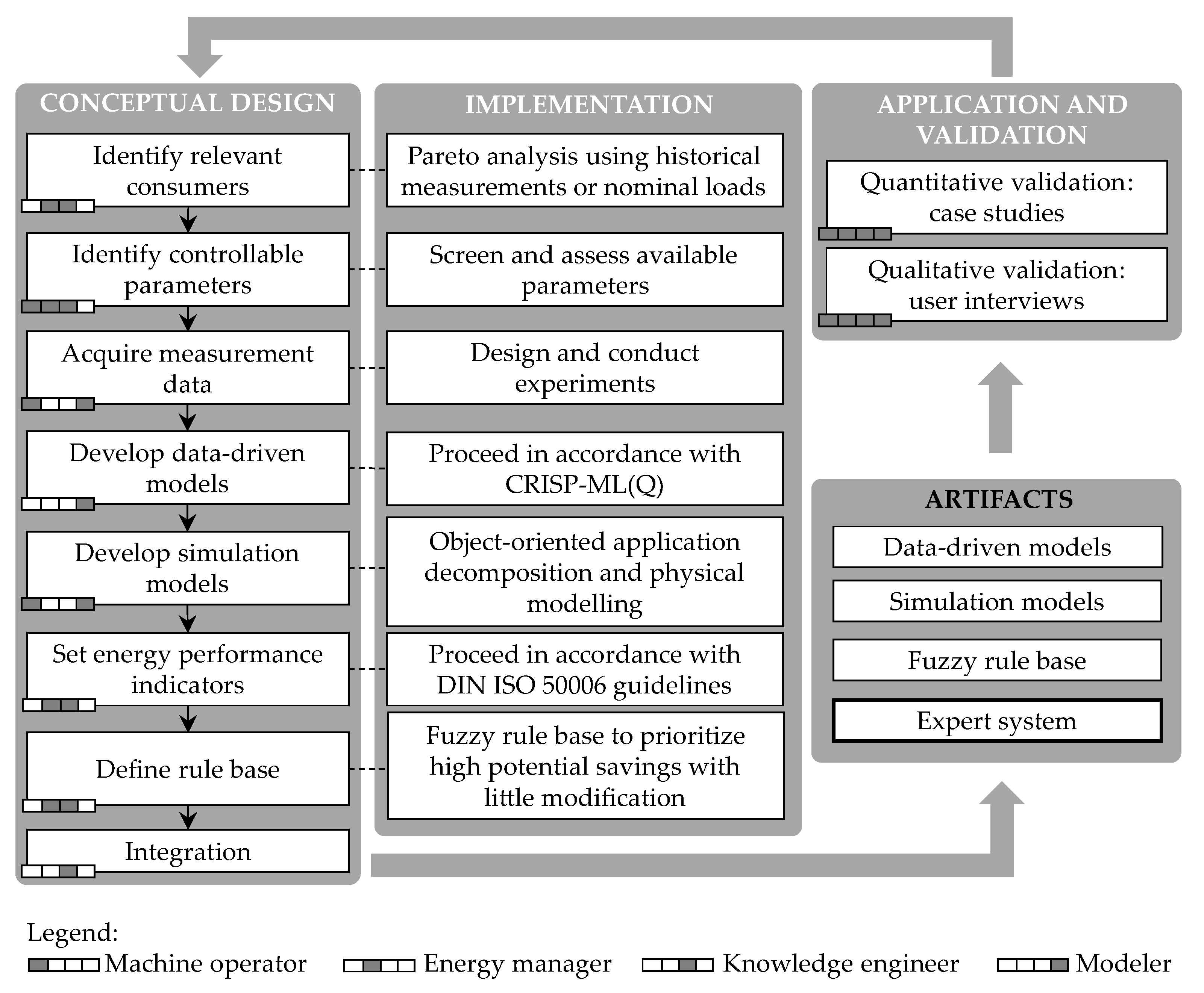
Figure 2.
Decision support process.
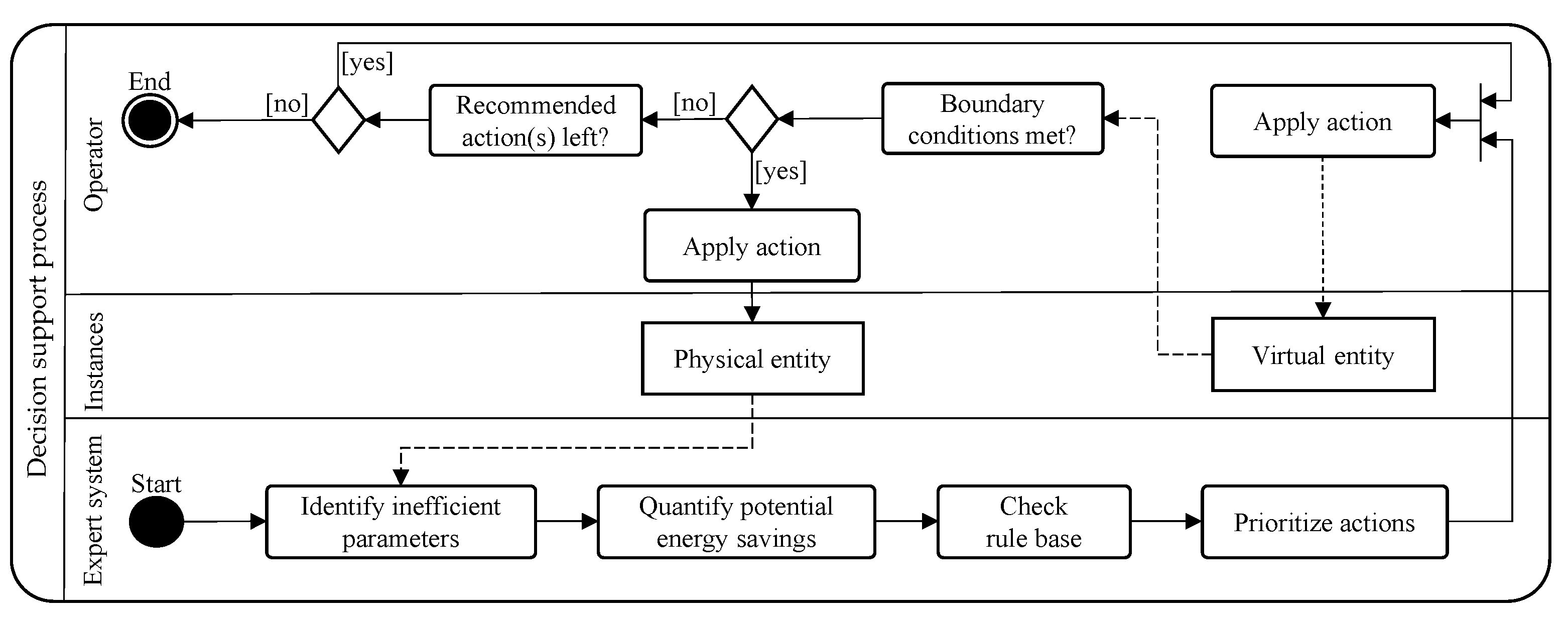
Figure 3.
Scheme of the TPCM.
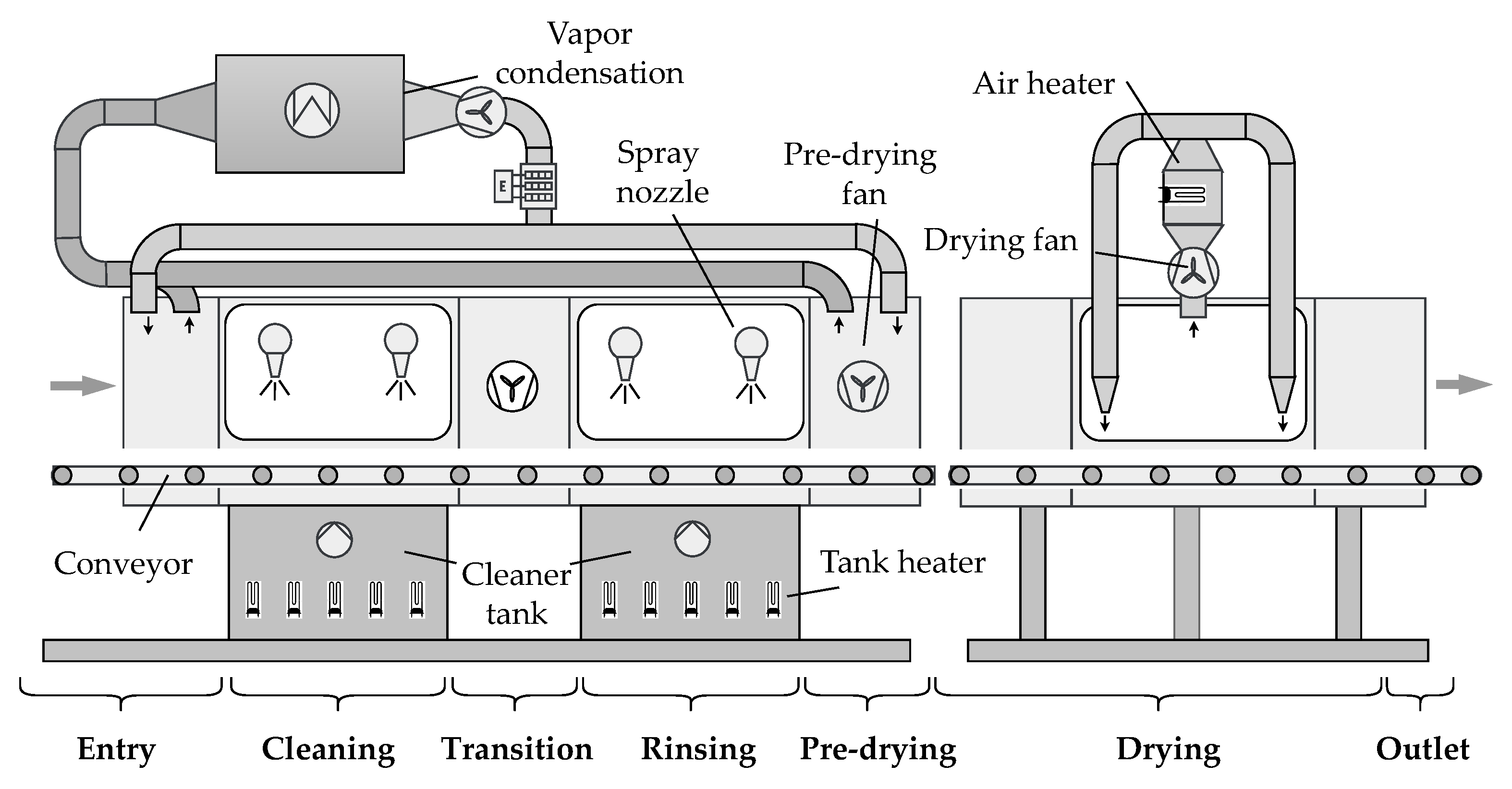
Figure 4.
Pareto analysis for prioritization of consumers based on historical data.
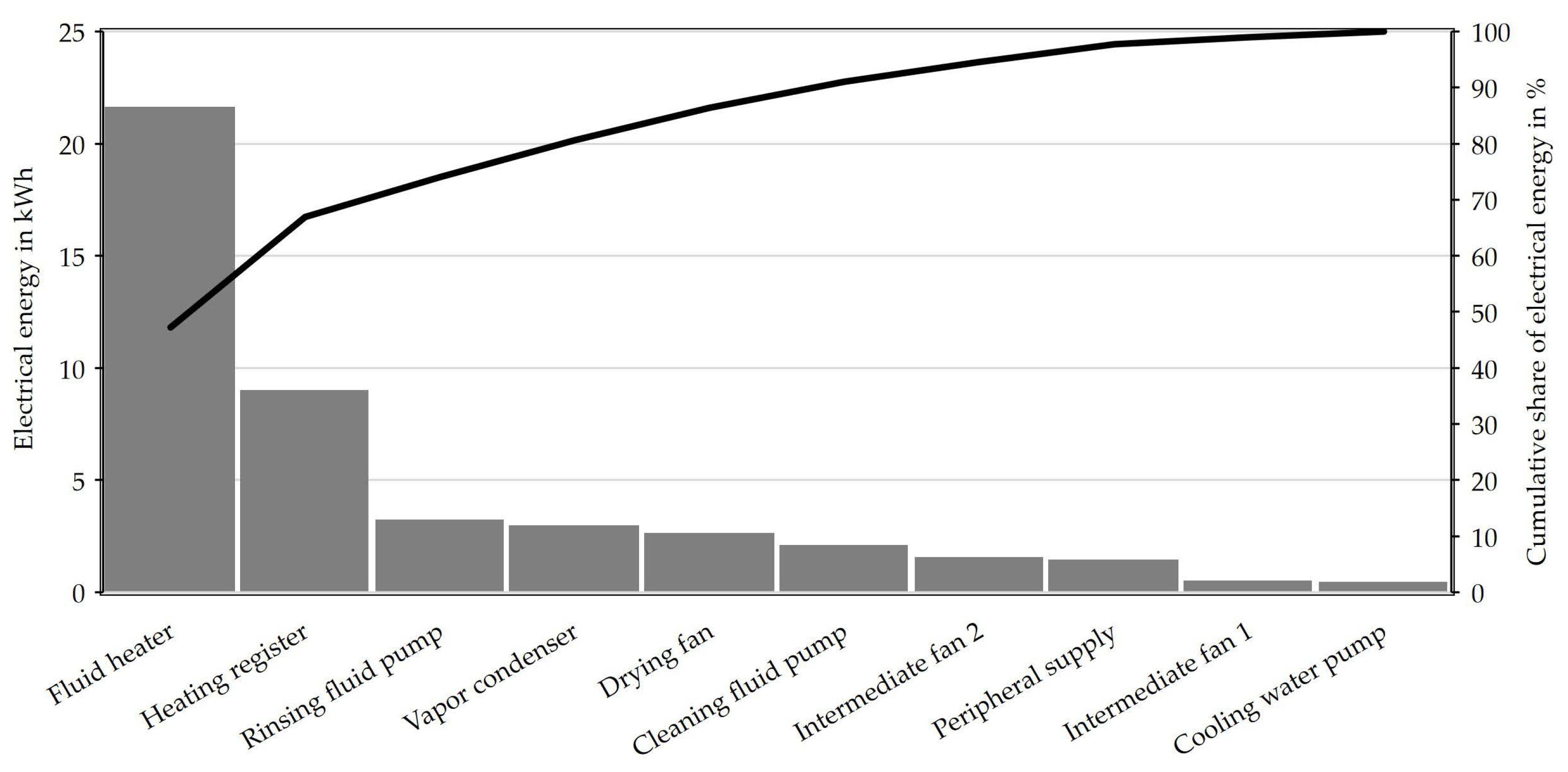
Figure 5.
Regression models with metric values.
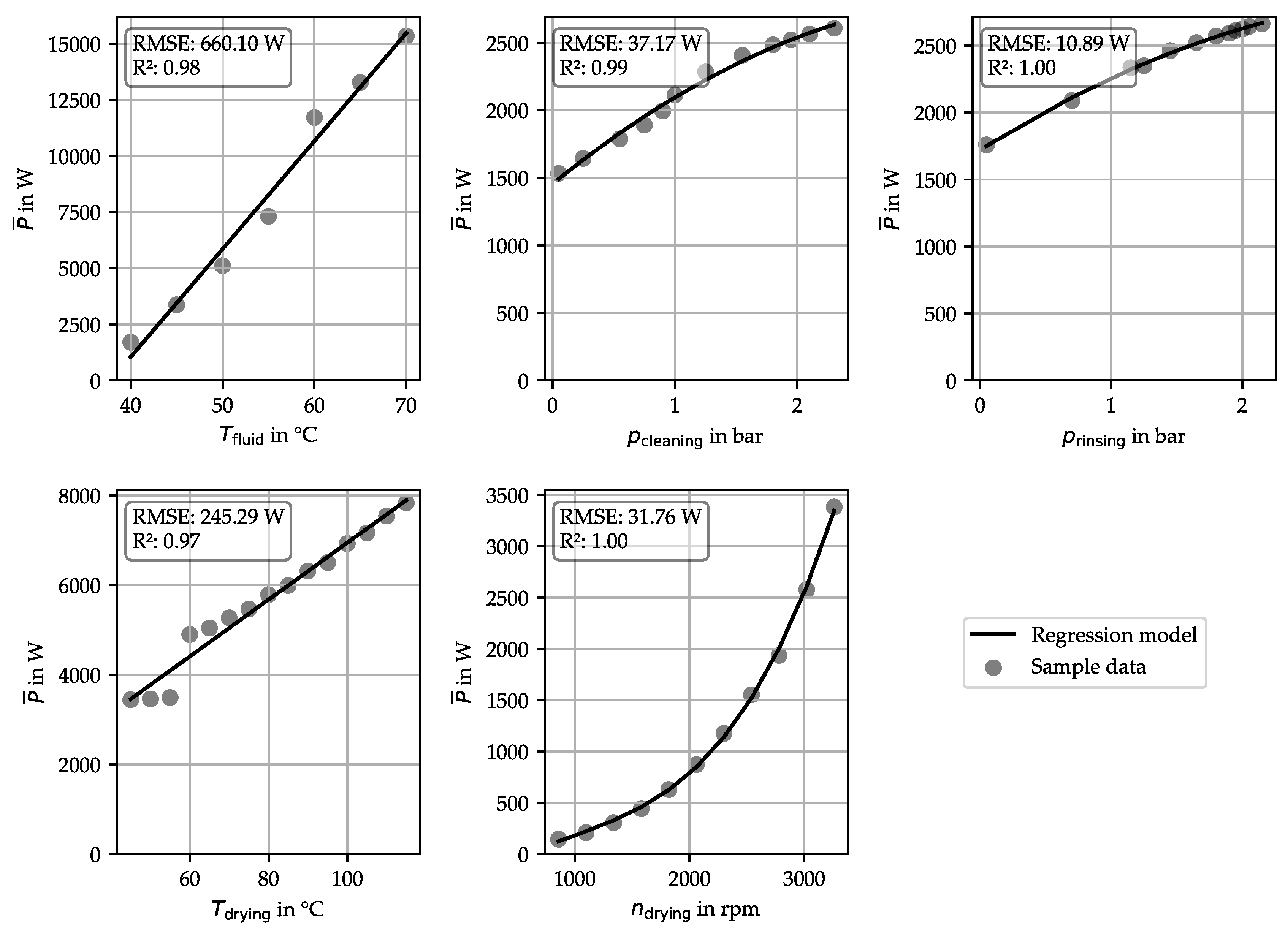
Figure 6.
(a) Membership functions of the fuzzy inputs (, ) and output (). (b) Fuzzy surface of the output variable () for different combinations of input values (, ).
Figure 6.
(a) Membership functions of the fuzzy inputs (, ) and output (). (b) Fuzzy surface of the output variable () for different combinations of input values (, ).
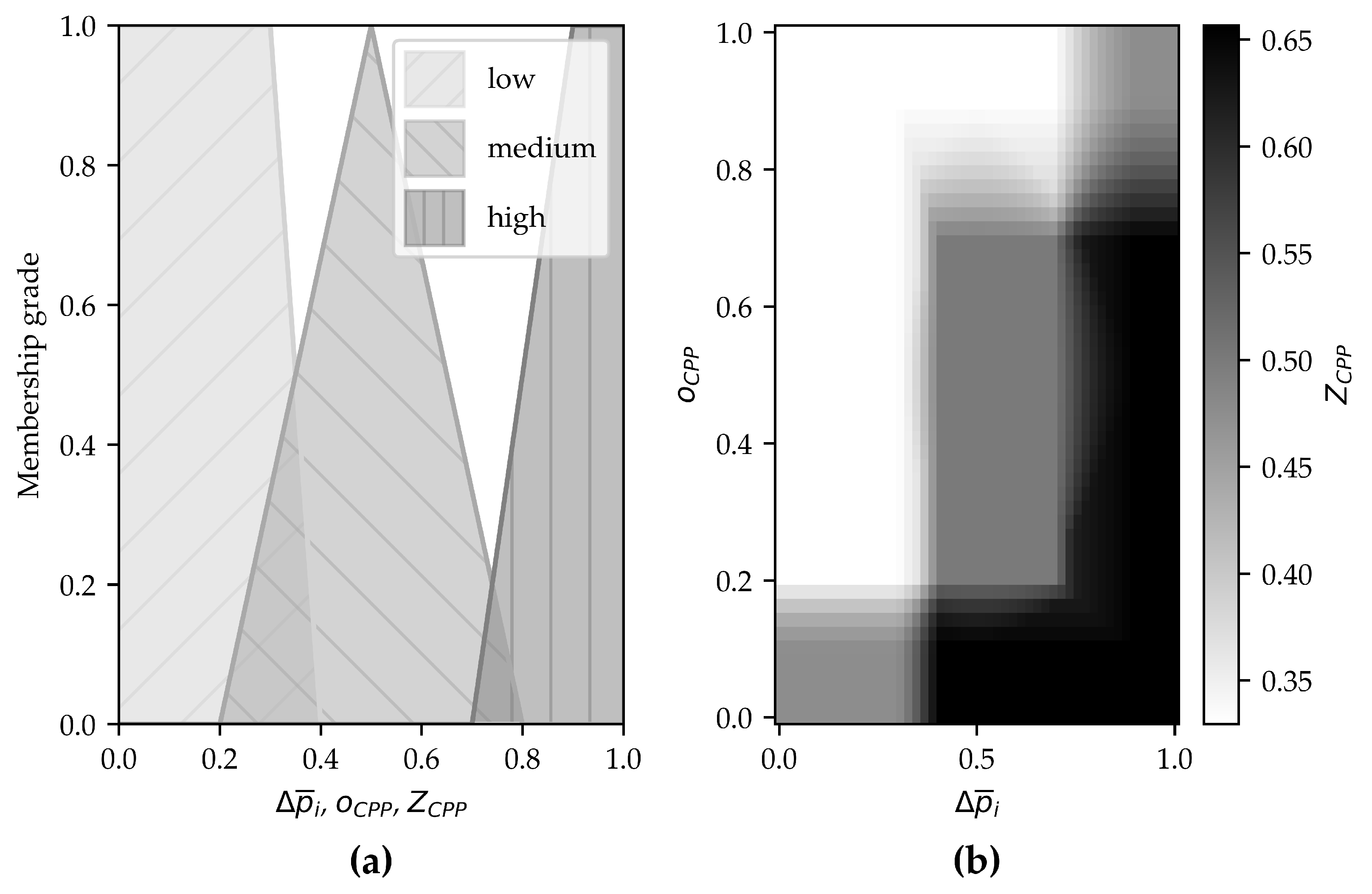
Figure 7.
Visualization of potential energy savings.
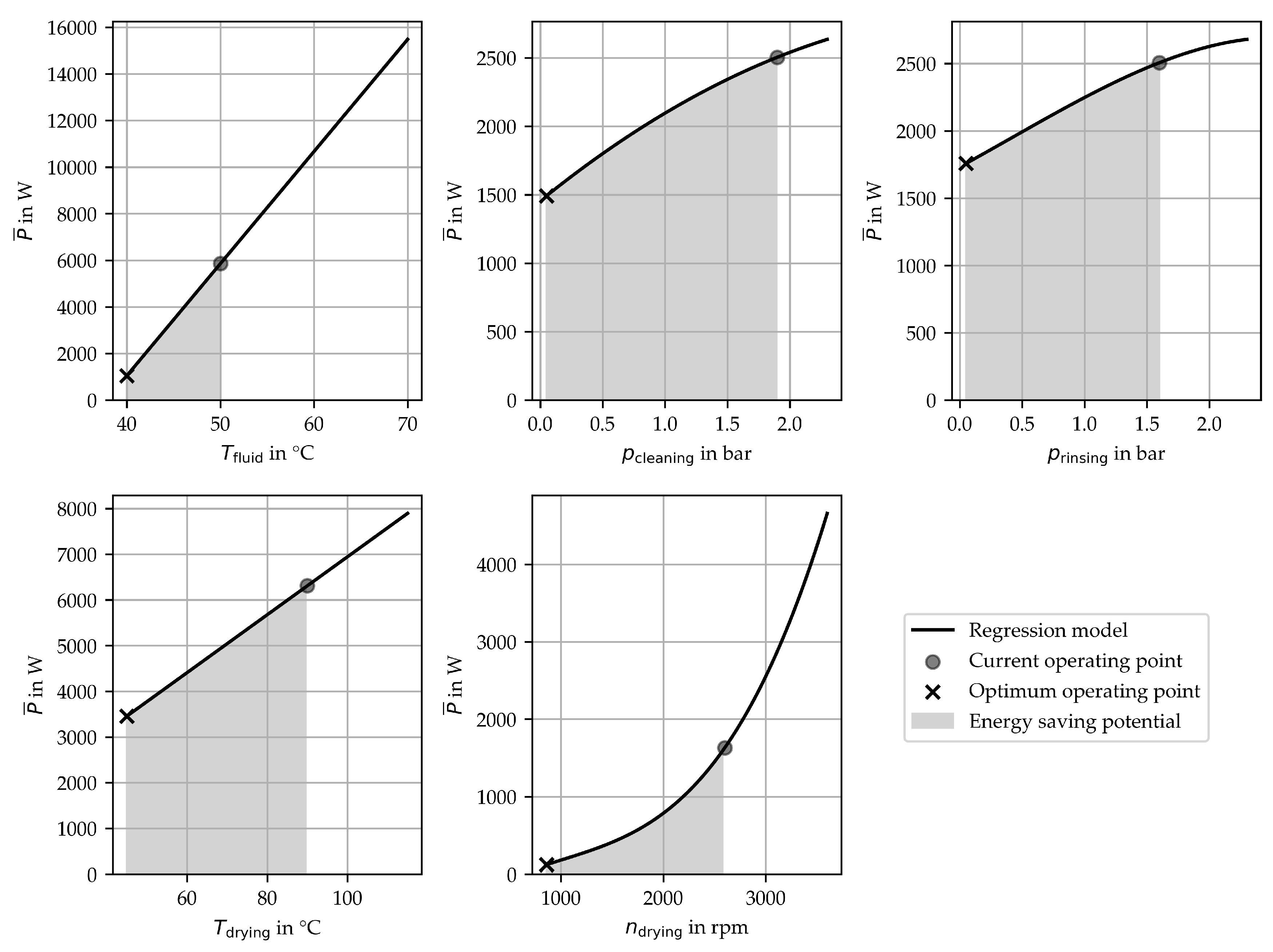
Figure 8.
Visualization of the simulation output.
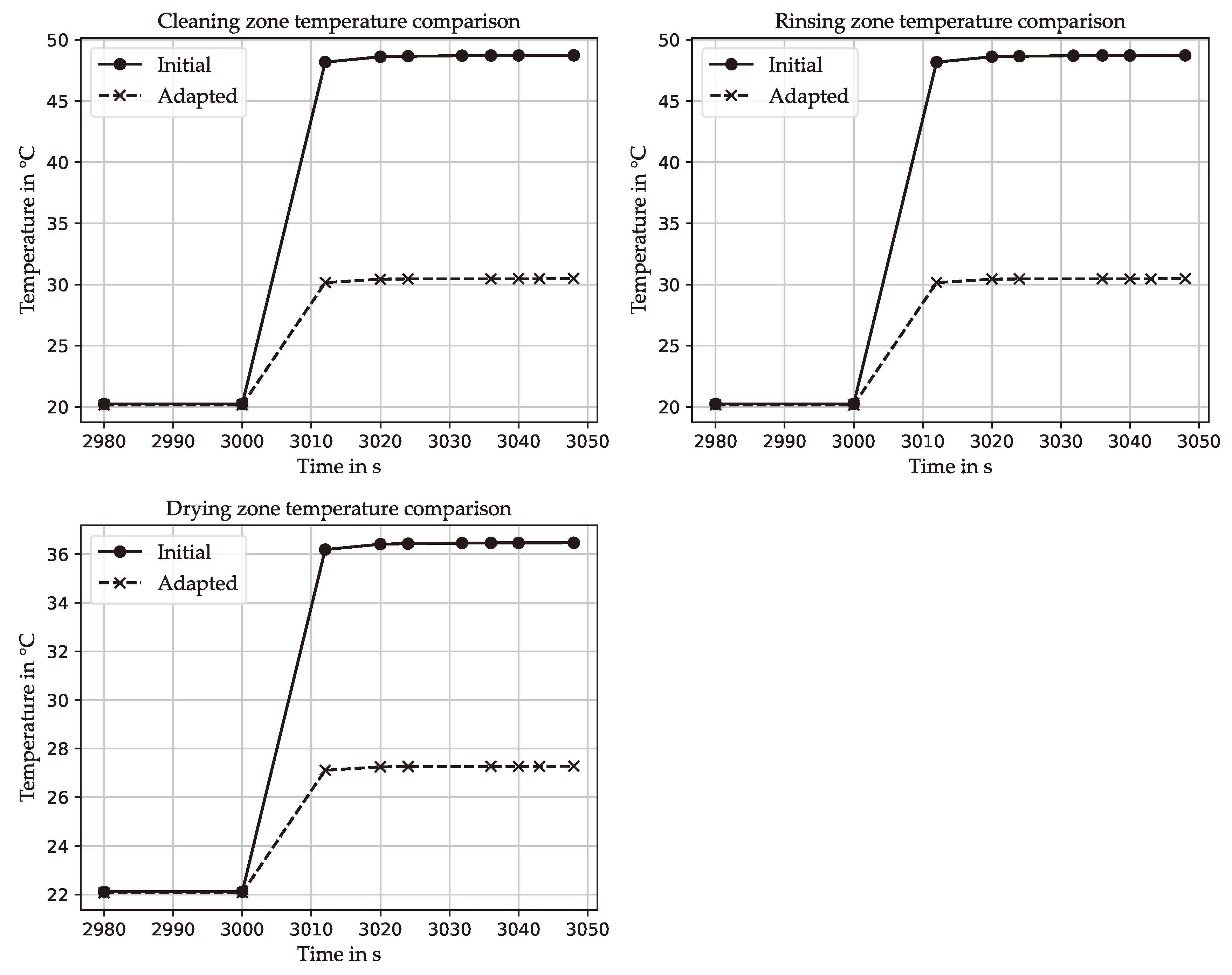

Table 1.
Overview of personas.
| Persona | Description |
|---|---|
| Machine operator | Responsible for operating the machine and experienced in the manufacturing process |
| Energy manager | Evaluates processes from an energy perspective and assesses current energy utilization |
| Knowledge engineer | Acquires knowledge by experts and research to represent it in a computer system |
| Modeler | Acquires data and builds data-driven or physical models to represent the behavior of complex systems |
Table 2.
Identified controllable parameters for the TPCM.
| Consumer | Parameter | Range |
|---|---|---|
| Fluid heater | Fluid temperature | (40 – 70) °C |
| Cleaning fluid pump | Cleaning pump pressure | (0.5 - 2.3) bar |
| Rinsing fluid pump | Rinsing pump pressure | (0.05 - 2.3) bar |
| Heating register | Drying air temperature | (45 – 120) °C |
| Drying fan | Drying fan speed | (860 – 3300) rpm |
Table 3.
Rule base for the fuzzy rule-based expert system.
| Premise (IF) | Consequent (THEN) |
|---|---|
| is high AND is low | is high |
| is medium AND is low | is medium |
| is low AND is low | is medium |
| is high AND is medium | is medium |
| is medium AND is medium | is medium |
| is low AND is medium | is medium |
| is high AND is high | is medium |
| is medium AND is high | is medium |
| is low AND is high | is low |
Table 4.
Resulting EnPIs for the presented application.
| CPP | ||||
|---|---|---|---|---|
| 4810.4 | 1.0 | 0.33 | 0.66 | |
| 1012.66 | 0.07 | 0.82 | 0.33 | |
| 748.37 | 0.0 | 0.69 | 0.38 | |
| 2853.59 | 0.52 | 0.64 | 0.44 | |
| 1509.11 | 0.19 | 0.64 | 0.60 |
Disclaimer/Publisher’s Note: The statements, opinions and data contained in all publications are solely those of the individual author(s) and contributor(s) and not of MDPI and/or the editor(s). MDPI and/or the editor(s) disclaim responsibility for any injury to people or property resulting from any ideas, methods, instructions or products referred to in the content. |
© 2024 by the authors. Licensee MDPI, Basel, Switzerland. This article is an open access article distributed under the terms and conditions of the Creative Commons Attribution (CC BY) license (http://creativecommons.org/licenses/by/4.0/).
Copyright: This open access article is published under a Creative Commons CC BY 4.0 license, which permit the free download, distribution, and reuse, provided that the author and preprint are cited in any reuse.


