

Submitted:
29 August 2024
Posted:
02 September 2024
Read the latest preprint version here
Abstract
Anxiety-based cognitive distortions pertaining to somatic perception (ABCD-SP) - primarily catastrophizing, fear avoidance and kinesiophobia- have been repeatedly linked to worsening chronic, non-cancer pain (CNCP) outcomes of increased disability, amplified pain, ineffective opioid use, and opioid misuse. Several studies have suggested that treating ABCD-SP can improve pain outcomes. Utilizing a narrative review of proposed mechanisms, published patient perspectives, and study correlates connecting these cognitive distortions with CNCP outcomes, a better practice approach to the delivery of standard clinical CNCP care can be deduced. These recommendations require relatively few resources to implement and have the potential to lead to more effective CNCP treatment on a large scale.
Keywords:
chronic pain
; catastrophizing
; fear avoidance
; kinesiophobia
; opioids
; anxiety
; depression
1. Introduction
Chronic, non-cancer pain (CNCP) is estimated to affect more than 100 million adults in the United States and generally satisfactory remedies continue to be elusive [1,2]. Within the pain management field, recent treatment standards have resulted in secondary problems for the individual patient and in the greater public health arena, such as: ostracizing patient stigma [3,4], morbidity and mortality from adverse medication effects [5], the rise and reign of the opioid epidemic [6], and skyrocketed costs of managed care [4]. The financial burden of morbidity related to CNCP is more than that of the afflictions of heart disease and cancer combined, and has been tallied to be over 600 billion dollars per year in the United States.[2] Identifying more effective and efficient care approaches for those who suffer with CNCP continues to be a priority need in US healthcare.
Pain catastrophizing is the most common cognitive distortion seen in patients with chronic pain, and severe catastrophizing is prevalent for nearly 40% of people experiencing CNCP.[7,8] This belief paradigm has been linked to maladaptive behavior and resulting negative CNCP sequelae[9] exemplified by increased disability, [13,14,15] pain intensity, [17,18] emotional distress,[10] absenteeism, [14] and ineffective opioid use [17,19]. Cognitive distortions are defined as faulty or inaccurate thinking, perceptions, or beliefs [9]. Catastrophizing is characterized by the belief that the worst possible outcome will occur when in a setting that may be serious and upsetting, but is not necessarily disastrous [9]. Pain catastrophizing is associated with feelings of helplessness to succumb to a catastrophic outcome, as well as hypervigilance to behave in a way that avoids stimulus that may insight discomfort in painful areas [20]. The pervasiveness of this symptomatology withing the chronic pain experience, in both frequency and influence, warrant attention when looking to improve the quality of CNCP treatment.
Ineffective opioid use and misuse are pervasive problem that contribute to poor patient outcomes and to larger public health concerns regarding the opioid epidemic [4,5,17]. The negative sequelae of full mu agonist long term opioid therapy (LTOT) are numerous and well documented, and are amplified when patients fail to experience reasonable functional and analgesic satisfaction from such therapy. Adverse effects range from immediate [22] (cognitive impairment, misuse and abuse liability, potentially fatal respiratory depression and – in the case of methadone- cardiac arrhythmias [23]) to long term and insidious (hypogonadism [24], immune compromise [25], and hyperalgesia [26,27]). The chronicity incurred from LTOT use is burdensome not only to the individual, but to society as a whole, in the form of increased managed care charges [4], longer lengths of disability [6] and a nationally depressed life expectancy due to rising fatal opioid-related overdoses [6,28,29].
Due to abundant evidence of the synergy between pain-related catastrophizing and worsening negative sequelae of CNCP, care planning to assess and address this cognitive distortion should be a foundational part of the CNCP treatment. Utilizing a narrative review of proposed mechanisms, published patient perspectives, and study correlates connecting this cognitive distortion with disability, pain levels, and/or ineffective opioid use or misuse, a better practice approach for pain clinicians can be deduced, rooted in holistic clinical assessment, abundant patient education, supportive fear quiescence, and therapeutic confrontation of concerns. This new approach requires few resources to implement and has the potential to lead to a more effective CNCP treatment on a large scale.
2. Anxiety-Based Cognitive Distortions Pertaining to Somatic Perception (ABCD-SP)
More than one assessment scale has been validated in an attempt to quantify the clinical significance of the contribution of pain-related catastrophizing to the morbidity of CNCP. Most literature examines the relationship between CNCP sequelae as related to this cognitive distortion via one of the following: The Fear Avoidance Beliefs Questionnaire (FAB), The Pain Catastrophizing Scale (PCS) and the Tampa Scale of Kinesiophobia (TSK) (Table 1). Due to the plurality of these validated tools, this paper has adopted an encompassing term to discuss the significance of their contribution to the morbidity of CNCP: Anxiety-Based Cognitive Distortions Pertaining to Somatic Perception (ABCD-SP).
2.1. An Overview of The Role of ABCD-SP in the Negative Sequelae of CNCP
ABCD-SP in the setting of CNCP have been repeatedly linked to worsening pain outcomes. Such beliefs, and resulting maladaptive behaviors, have been associated with increased disability, [13,14,15] pain intensity, [17,18] emotional distress, [10] and absenteeism [14]. Studies have shown that fear of movement and reinjury is a better predictor of self-reported disability and treatment failure than biomedical findings or pain intensity levels [36,37,38]. ABCD-SP have also been documented to affect opioid use in terms of prolonging postoperative use, increasing opioid craving, and contributing to general misuse [17,39,40].
Objectively, improvement in ABCD-SP can be visualized on functional MRI, and improvements correlate with a decreased pain state.[43,44] Catastrophizing has been shown to recruit regions of the brain that evoke a more intense suffering response to mild pain, and an inability to decouple and suppress more intense pain when compared to controls [43]. A successful decrease of catastrophizing via cognitive behavioral therapy (CBT) has been shown on functional MRI to increase grey matter mass, an anatomical substance known to generally be reduced in volume and density in patients who suffer with chronic pain [44].
Perhaps most persuasive regarding the import of ABCD-SP to CNCP-related morbidity are the studies that suggest treating ABCD-SP can reverse some of the negative sequelae associated with CNCP. It has been documented that treatment campaigns targeting ABCD-SP can have a positive effect on the clinical outcomes of somatic symptom prevalence and the length of pain episodes when effectively reduced [31,45,46]. Some studies have shown efficacy harnessing ABCD-SP education to affect positive change in disability length related to CNCP [45,48].
2.2. ABCD-SP Validated Assessment Tools
2.2.a. The Fear Avoidance Beliefs Questionnaire (FAB)
The Fear Avoidance Beliefs Questionnaire (FAB) was designed to measure fear-avoidance beliefs about physical activity and work, and it has strongly correlated these beliefs with work loss and pain [11]. The FAB consists of two subscales: Work (FAB-W) and Physical Activity (FAB-PA). Several studies have investigated the reliability of the FAB for the assessment of fear avoidance among patients with various etiologies of CNCP [31,36,49]. A higher FAB score has consistently been shown to correlate with an increased probability of current and future work loss and disability [11,14,15] as well as social withdrawal.[16] While the relationship between an elevated FAB score and increased disability and pain remain correlated, the optimal cut off for determining a significant FAB score in relation to negative chronicity in CNCP varies according to the pain context [49,51,52]. Higher FAB scores have also been shown to significantly predict treatment failure [49,50]. FAB analysis has also been used to determine which clinical interventions have a better likelihood of a successful outcome to decrease patient-reported disability and pain [49,50,51]. An elevated FAB-PA has been shown to be a strong correlate with the inability to cease ineffective LTOT use, more so than morphine equivalent levels and elevated Current Opioid Misuse Measures (COMM) scores [17].
Several studies have examined the relationship between improved disability and treatment of CNCP via graded exposures that confront fear avoidant beliefs and behaviors to improve patient self-efficacy and overall disability [57,58,59]. FAB targeted educational campaigns have had positive effects on beliefs and clinical outcomes [31,45,46]. Specifically, one study found that successfully lowering fear avoidance scores in patients with chronic back pain, through an educational campaign, resulted in subsequently decreased patient reports of disability [45].
2.2.b. The Pain Catastrophizing Scale (PCS)
The PCS determines a patient’s level of pain catastrophizing, which is tested by assessing the elements of rumination, magnification, and helplessness [35]. It was created to better assess the relationship between greater pain intensity, negative pain-related thoughts, and greater emotional distress. Higher scores have been shown to significantly correlate with a prediction of pain intensity and emotional distress, [35,39,41] and have also been implicated as a risk factor for increased disability length, [48,54,58] pain interference, [62] and delayed return to work [34]. Preoperative catastrophizing can even predict higher postoperative pain levels and poorer patient-reported postoperative satisfaction following minimally invasive implantations [63] and surgery [64,65,66]. It has been postulated that this correlation may contribute to increased use of health care services and higher costs to the health care system [68].
Targeted therapy to improve catastrophizing has been shown to significantly improve pain outcomes. Pain intensity and disability have been shown to improve with improved PCS scores when maladaptive beliefs were challenged via education and cognitive restructuring, even when such interventions occurred on a purely theoretical and cognitive level [54]. Combined physical therapy (PT) with treatment to minimize psychological catastrophizing barriers improves return to work rates [48,58]. One study reported this treatment combination had a 25% higher return to work rate than physical therapy alone [48]. PCS score improvements have also been correlated with successful cessation of ineffective LTOT in a population for whom cessation had not been previously achievable through usual care methods [18].
2.2.c. The Tampa Scale of Kinesiophobia (TSK)
The TSK is a measure of fear of movement, injury or reinjury [32] and has been validated for use in assessing comorbidities of chronic pain from multiple etiologies, including backpain, neck pain, lower limb complaints [69,70], and fibromyalgia [12,32,71]. Increased TSK scores are implicated in decreased physical performance and increased pain intensity, depressive symptoms, pain-related anxiety, and disability [12,72]. Like the PCS and FAB, the TKS has also been associated with ineffective opioid use and misuse. [17,18,19] Several studies have shown that high kinesiophobia is an independent risk factor for less satisfactory treatment outcomes [69,70,73]. Also, similar to the other ABCD-SP assessments, studies show that targeted cognitive exercises for decreasing kinesiophobia can improve disability [73] and pain [74] when combined with PT better than PT alone, [75,76,77] and can improve pain intensity and physical function [78,79,80].
3. Pathology of Anxiety-Based Cognitive Distortions Pertaining to Somatic Perception – Proposed Mechanisms
The Fear Avoidance Belief and Behavior Model (Figure 1) [11,17,49] can be visually represented to illustrate the different trajectories for patients with a low fear reaction, versus patients with a catastrophizing reaction to their pain experience. The basic tenet of the model is that the way in which pain is interpreted leads to two potential pathways. When pain is perceived as no, or low, threat, patients are likely to behave in a way that confronts real, or perceived, factors that limit their pursuit of meaningful endeavors. This step of confrontation is imperative to eventually overcome those limitations and move toward recovery. In the case of opioid use, the low fear pathway leads to only use a short course of opioids before decreasing use, or ceasing use altogether, thus minimizing or eliminating adverse medication effects [17].
In contrast, a maladaptive cycle may be initiated when pain is perceived through a catastrophizing lens. Catastrophizing entails, among other things, a sense of overwhelm and powerlessness to succumb to external, negative forces and experiences [9,54] This gives rise to pain-related fear, activity avoidance, experience escape (including prolonged opioid use, or misuse) and a negativity-biased hypervigilance. These propensities lead to a progressive withdrawal from meaningful activities and an eventual decline in the physical and emotional capability to access resiliency-building experiences and tools, as previously identified activities of meaning become unattainable. While avoiding the stimuli suspected, or proven, to provoke pain can be adaptive in the acute pain stage, it paradoxically entrenches disability and reliance upon opioids in the subacute and chronic stages of pain. Eventually, the long-term consequences of deconditioning due to disuse [81] and mood deterioration, [21,39,82] result in increased morbidity [6,29] and decreased ability to recruit and access alternative, resilience-building, non-opioid chronic pain coping mechanisms [17].
Several things can accelerate and amplify the maladaptive cycle. Receiving threatening information about a diagnosis can understandably send a patient’s focus to worst-case scenario possibilities. However, uncertainty about a diagnosis can be just as disturbing as threatening information [11,85]. Lack of understanding about the significance of pain is one of the main reasons for patients with CNCP to appear to the Emergency Department (ED) for care [86]. Negative affectivity and mood disorders, especially anxiety and depression, [87,88] coexisting in the patient also promote and propel the catastrophizing cycle via a distortion of negativity bias [85]. Also, a history of trauma – even if it precedes the inciting pain event- can propel this maladaptive cycle. A large body of evidence shows that numerous morbidities are accelerated, if not generated, by exposures to adverse childhood experiences (ACEs) [89] which foster general hypervigilance and negativity bias in daily experiences, resulting in increased catastrophizing and pain-related suffering, among multiple other poorer health outcomes [90].
Fear avoidance of movement due to pain, from the stance of learning theory, is a self-perpetuating dynamic in which a small sensory insult – or even the threat of such an insult- can propel anticipation of hyperbolized potential consequences and create -and reinforce- global, habitual and maladaptive behavior [91]. These anticipations of pain hinder trials of adaptive activity. When the expectation of catastrophic pain is not confronted, it cannot be disproved, leading to further maladaptive beliefs and behaviors, deconditioning, and disability [11,17,92]. As Vlaeyen et al. state in their paper describing the Fear Avoidance Model, “Avoidance can be used as a source of information to derive danger, for example: “I am avoiding, therefore there must be danger.” The relief that the expected threat did not occur may reinforce avoidance behavior, and hence maintain it.” [85].
This uninterrupted cyclic dynamic is also applicable in the context of problematic LTOT usage, as many patients associate the action of taking a scheduled opioid with that of prophylactically avoiding or escaping pain, and thus rarely confront the unadulterated experience of their physical nociception, spiraling deeper into habitual opioid administration and the resulting adverse effects of LTOT use. This dynamic is compounded in opioid use, as it is triply reinforced by dopaminergic incentivization and abrupt abstinence syndrome disincentivization [17].
4. The Call for a Belief and Behavior Action Plan (BBAP)– Theoretical Considerations
Using a reverse-engineering approach to the Fear Avoidance Belief and Behavior Model, entry points for promoting a more healthful ABCD-SP dynamic in the pursuit of better CNCP outcomes emerge for the pain clinician (Figure 2). The maladaptive cycle is amplified and accelerated when the patient perceives threatening illness information, uncertainty of diagnosis and prognosis, and the perception of powerlessness to succumb to an overwhelming amount of negative sequela. Thus, initial and on-going quality communication between a clinician and patient about pain etiology, treatment, and prognosis is substantive to the patient’s pain experience and treatment outcome potential. Much as the technique of Motivational Interviewing has been a highly effective and relatively easy treatment technique to disseminate to improve significant measures in multiple chronic physical and psychological diseases [94], there is an opening for a simple - yet sophisticated - change in clinicians’ approach to communication about the pathology of CNCP with patients. Specifically needed is a patient-centered, individualized approach to treatment planning that develops empowered agency and supports therapeutic ABCD-SP identification and confrontation within the scope of patient-identified activities and endeavors of meaning. This treatment approach should address patient-disclosed fears, concerns, and misconceptions in a supportive, open-ended, and ongoing manner, and should culminate in the clinical facilitation of a patient-generated Belief and Behavior Action Plan (BBAP) for CNCP
To begin to formulate what a BBAP for CNCP would entail, we must first look beyond data and diagrams to the patient perspective. Numerous reports have documented patients’ dislike, and frank objection, to medical discussions involving “catastrophizing” and like terms. Many patients have called the concept of categorizing their pain experience in this way – as a maladaptive psychological response and behavior - as condescending, and even disenfranchising [95]. Some feel that validated terms used within the medical community to assess and address ABCD-SP carry connotations of “pain shame” [96]. Patients have reported that the label of “catastrophizer” is perceived as unempathetic, stigmatizing, blaming, judgmental, dismissive, minimizing and weaponizable as a tool to selectively restrict treatment [95]. Some have even contended that the term “catastrophizing” can harbor systemic racism and microaggression, especially when a care plan has failed to distinguish between an ABCD-SP and a generalized stress response to the overall institution of medicine, which for some is a construct fraught with inaccessibility [97], injustice, inequality and discrimination. [98,99]. One group of scholars has set about renaming the phenomena of catastrophizing altogether [100]. Despite the mounting volume of these valid and important voices, many feel resigned that medical stigma will eventually undermine any nomenclature revision attempt to create a patient-centered term used to describe the ABCD-SP that are a prominent feature in the CNCP experience [101].
Semantically, the notion of categorizing the ABCD-SP experienced by so many with CNCP as an added pathology is arguably redundant, if not excessively persecutory– a point that has also been made by patients and advocacy groups [95,96]. Pain is defined as, “An unpleasant sensory and emotional experience associated with actual or potential tissue damage, or described in terms of such damage.” [102] Literally, the emotional experience associated with potential tissue damage is real pain, and consequently, treating the ABCD-SP should be conceived of as providing holistic pain care. Thus, ABCD-SP should be evaluated for and addressed, like other associated pain symptoms and features- such as radicular symptoms or paresthesia- in every case of CNCP. Each of these features should be associated with the appropriate treatment line item in a comprehensive care plan, just as a different medication class might be used for neuropathic versus axial pain.
The above discussion begins to illuminate the need for a paradigm shift in the conceptual construct of not only the patient, but also the medical provider. First and foremost, patients need to be approached with empathy. While this may seem self-evident, empathy is not a universal patient experience for patients with CNCP, who have likely experienced diagnosis-associated discrimination and marginalization from the general and medical communities [103]. Aside from maintaining the integrity of the Hippocratic oath, empathy and trust are imperative to bring about fertile ground for true cognitive, physical & prognostic change for patients with CNCP [104]. In a cohort study that included 1470 adults with chronic low back pain, physician empathy was more strongly associated with favorable outcomes pertaining to pain, function and quality of life than were nonpharmacological treatments, opioid therapy, and lumbar spine surgery [105]. This approach bears particular portent in the contemporary environment where many patients have become “opioid refugees” [106,107,108]. This dynamic is compounded for populations experiencing generalized discrimination due to racial, ethnic, gender or sexual backgrounds or identities that differ from that of their clinician [109,110,111].
5. Creating a Belief and Behavior Action Plan (BBAP) - Clinical Considerations
Creating a comprehensive and empathetic BBAP for CNCP begins with thorough information gathering on the part of the clinician. An effective pain evaluation and assessment must go far beyond the “OPQRST” (Onset, Palliation/Provocation, Quality, Radiation, Severity, Timing) that is taught in training. It should include a comprehensive mood assessment as well as a healthcare literacy reconciliation between what the patient has been told and what the patient understands -and believes- about their diagnosis and prognosis. Also included should be a cataloging & recording of the patient’s pain-related concerns; a recollection of the patient’s similar past experiences; adequate time to discuss expectations about potentially affected patient-identified meaningful activities. A thorough clinician will also be cognizant of a potential history of actual or perceived disenfranchisement, discrimination, or implicit bias on the part of the medical system toward the patient [111,112]. It has been postulated that inquiring about this last experience openly and early may help avoid repeat offenses on the part of unintending clinicians, and facilitate a more equitable and effective therapeutic relationship [98]. Any and all of the factors above – and potentially more – can be nidi for anxiety that can ignite and fuel the fear avoidance belief and behavior cycle [13,85,98] and each symptom – and associated belief and behavior- should be documented, triaged, and revisited every visit as part of the symptomatology requiring palliative and restorative CNCP care planning.
The goal of the BBAP for CNCP should be to end with a patient-empowering care plan strongly rooted in patient self-efficacy. The patient and clinician should work together to create a menu of patient treatment options, independent of the part of the care plan that relies upon a medical, rehabilitative, or behavioral health clinician. To assign the appropriate patient-administered actions to the BBAP, the patient’s descriptions of symptoms should be cataloged in terms of levels of severity and physical and emotional distress, along with an associated detailing of the default patient behavioral reaction to these symptoms. These scenarios should then be examined individually and optimized when effective, and gently challenged and replaced when they have been ineffective in the past. The end result is that the patient should leave every clinical visit with an approachable and navigable treatment action plan documenting several ways in which they have control and agency to access pressure release valves for the full spectrum of pain flare severity that may occur. These BBAP interventions should include features that are accessible when in and out of the home, and which represent treatment modalities from a variety of dimensions, including: behavioral, physical, social, medical, spiritual, occupational.
Clinical efficiency and the demands of billable time have been cited as a barriers to more encompassing CNCP care planning [113]. Cultivating a BBAP that fosters patient empowerment and autonomy, and adequately addresses patient-specific healthcare literacy and individualized concerns, requires time and resources that clinicians are often disincentivized to employ during their limited billable minutes. However, this nearly ubiquitous impediment of limited clinical facetime stems from an unbalanced cost-benefit equation, especially during the initial visit. It is problematic on several fronts that providing a minimally invasive surgery or procedure may take as much time - and reimburse exponentially better - than a thorough face to face conversation with a patient seeking palliation for a pain complaint, and that a clinician can complete several billable prescription refill visits in the time it takes to thoroughly communicate with one patient. The counterproductivity of this dynamic is illustrated further by research that suggests that patients will be less satisfied with the outcomes of these same interventions [63], surgeries [64,65,66], and medications [17] if their ABCD-SP aren’t adequately addressed first. Thus, attempts to conserve clinical resources by delaying holistic pain care rooted in emotional resiliency building, stress reduction, health education and facilitated human connection has often resulted in higher overall managed care costs regarding patients with CNCP [4].
6. Creating a Belief and Behavior Action Plan (BBAP)- Recommendations and Practical Considerations
Regardless of the confines of medical system reimbursement structures, clinical and practical considerations can be combined to implement many, if not all, of the following derived, better- practice recommendations to create a BBAP for CNCP (Figure 2.):
Figure 2.
Belief and Behavior Action Plan (BBAP) for CNCP: The better-practice treatment approach is recommended to be inserted by clinicians at specifically identified care plan intervals - indicated by striped arrows- in order to shunt treatment outcomes toward more adaptive outcomes. Abbreviations: ctu/ctu’d= continue/continued; d/o = disorders; dx= diagnostic; px = prognostic.
Figure 2.
Belief and Behavior Action Plan (BBAP) for CNCP: The better-practice treatment approach is recommended to be inserted by clinicians at specifically identified care plan intervals - indicated by striped arrows- in order to shunt treatment outcomes toward more adaptive outcomes. Abbreviations: ctu/ctu’d= continue/continued; d/o = disorders; dx= diagnostic; px = prognostic.
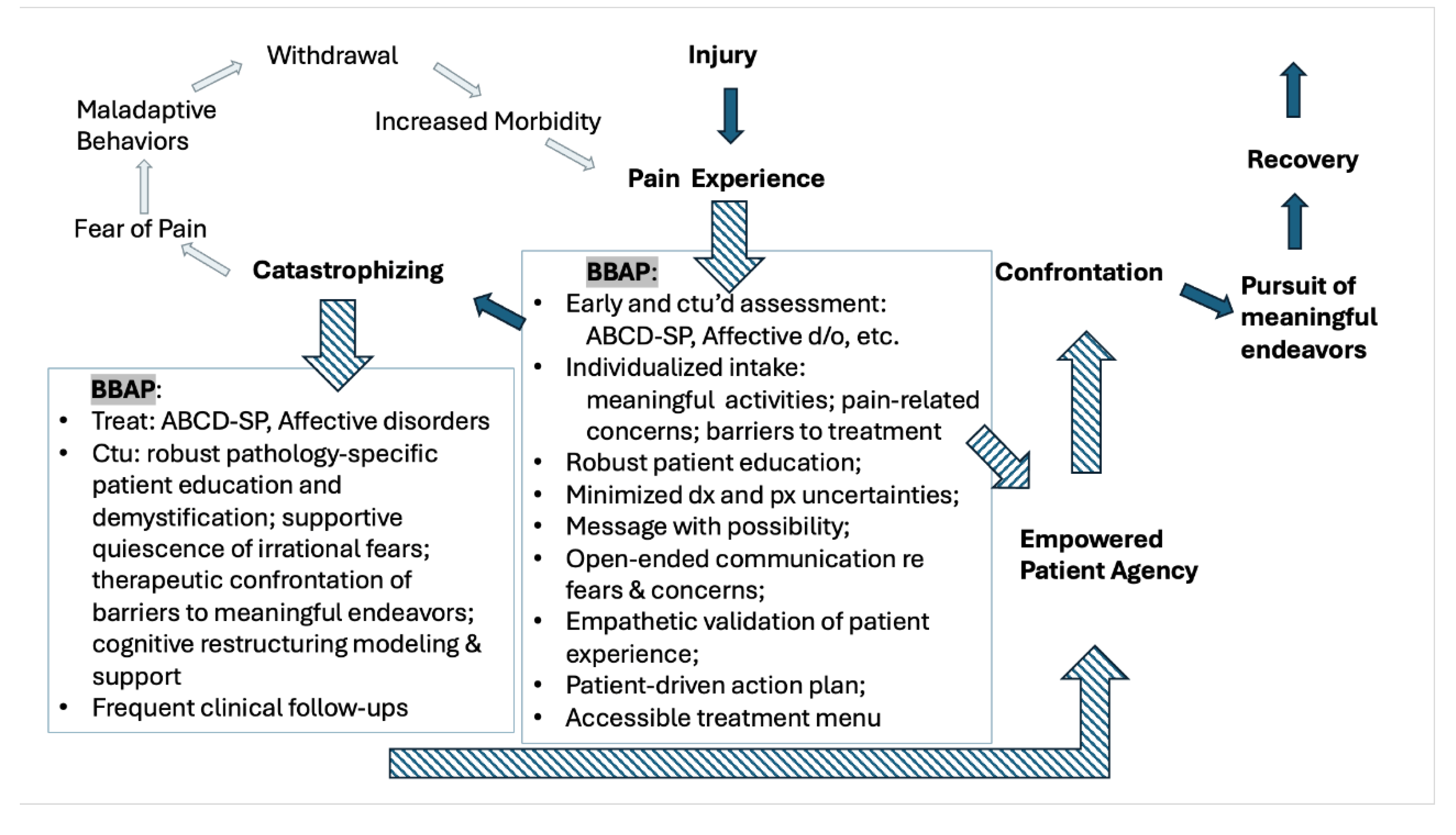
-
Utilize standardized assessments and short answer questionnaires upon initial evaluation, and periodically and follow up, to assess and monitor ABCD-SP rehabilitative interference potential:
-
Standardized assessments:
-
Short answer questionnaires to catalogue patients’ perceptions regarding:
-
Activities of meaning to lay the groundwork to create an individualized care plan to:
-
-
Implement an intentional BBAP inquiry and communication strategy and style in the clinical visit:
- Invest heavily in the first visit by performing a deep exploration and inquiry into the patient’s pain experience and their current related beliefs and resulting behaviors [94].
- Use validating active listening, which has been shown to increase patient adherence to care planning [118].
-
Lean into, and address head-on, patient’s accounts of suffering and fear in the clinical setting, so as to:
- dispel the ability of these sentiments to hijack adaptive recovery processes when the patient ruminates alone [86].
- decrease the suffering of invisibility that patients with CNCP often face. While it’s difficult for clinicians to focus on a patients’ suffering because of the accompanying sense of clinical impotence, and frequent lack of objective solutions, simply witnessing the patient’s subjective suffering experience may decrease suffering in itself [119].
- Be cognizant of both the implicit and explicit messages inherent in communications imparted by the clinician to the patient about diagnosis and prognosis. Positive self-perceptions and health-related optimism correlate with improve pain suffering, pain-related disability [85,88,90] and even improved longevity [123]. When possible and appropriate, choose vocabulary and descriptors that de-escalate the patient’s perceived threat of nociceptive input, and highlight functional and meaningful possibility.
- Message with mindfulness of potential trauma-affected hyper arousal and increased sensitivity to pain [124].
-
Increase healthcare literacy and promote pathological understanding:
- Ask patients to paraphrase their understanding of their injury, pain and pathology. Note terminology used and connect medical terminology to patient’s perceptions and descriptions to promote demystification [50,85]. Correct misconceptions and maintain patient-generated frame of reference and terminology, when appropriate.
- Consider inviting a call and paraphrased repeat opportunity between the clinician and the patient to improve comprehension of pathology and related care plan.
- Assuming the standard use of language interpreters to bridge translation barriers, also employ visual aids and physical models to engage multiple patient learning style preferences to explain not only pathology, but the mechanisms of pain symptomatology in an effort to decrease anxiety related to somatic presentations.
-
Orient to when fear of catastrophe is warranted.
- Debrief previous urgent, or emergent, clinical visits to seek pain treatment. Discuss causational factors and care plan for future episodes in the form of improved medication organization, strategized BBAP interventions, change of medication regimen for more effective analgesia, change of formulary or treatment type for improved access, etc.
- Orient to “red flag” signs and symptoms that medically warrant emergent attention and educate to differentiate from chronic, stable stimuli.
-
BBAP components should include:
-
Cultivation of an empowering, patient-driven action plan to complement the larger treatment plan containing the following elements:
- Facilitation of a menu of active, self-care options to address various pain levels and flares. Includes features accessible in and out of the home, and which represent treatment modalities from a variety of psychosocial domains: behavioral, physical, social, medical, spiritual, occupational, etc.
-
Minimized barriers- and the “gate keeper” nature- of clinical treatment options where possible, and within the confines of evidence-based care, which inherently promote a role of helplessness, perceptions of scarcity, and an external locus of control.
-
7. Discussion & Limitations
The recommendation for the pain clinician to create a BBAP doesn’t discount the significant role that psychologists and other allied professionals contribute to the myriad facets of CNCP treatment via an interdisciplinary care plan. In fact, most studies have shown greatest success addressing ABCD-SP via multimodal efforts, especially when including physical therapies, CBT, and/or Acceptance and Commitment Therapy [132]. However, CNCP is frequently and synergistically associated with barriers to accessibility and resources [125], such as these. Thus, the recommendation to implement a BBAP approach for CNCP is non-exclusive and low-risk, and requires little in terms of resource investment.
8. Conclusions
Due to abundant evidence of the synergy between ABCD-SP and worsening negative sequelae of CNCP, care planning to assess and address ABCD-SP via a BBAP should be a foundational part of the CNCP treatment. While a multidisciplined approach is ideal, the role of the individual pain clinician is poised to have a profound effect on a patient’s formation - and either maintenance or dissipation - of ABCD-SP, which is a determinant of pain severity and morbidity. CNCP is a multifaceted bio-psycho-social diagnosis, and treatment requires a complex, holistic approach. Maximizing every treatment avenue available is imperative to improve CNCP-related outcomes on the individual and public health fronts. Utilizing a better-practice BBAP is a low risk, low-cost intervention that has the potential to yield high gains on an individual and public health level at a time when gains are sorely needed.
Funding
This research received no external funding.
Conflicts of Interest
The authors declare no conflict of interest.
References
- S. M. Rikard, “Chronic Pain Among Adults — United States, 2019–2021,” MMWR Morb Mortal Wkly Rep, vol. 72, 2023. [CrossRef]
- T. J. Smith and B. E. Hillner, “The Cost of Pain,” JAMA Network Open, vol. 2, no. 4, p. e191532, Apr. 2019. [CrossRef]
- “Opioid Refugees: Patients Adrift in Search of Pain Relief,” MPR. Accessed: May 06, 2020. [Online]. Available: https://www.empr.com/home/mpr-first-report/painweek-2013/opioid-refugees-patients-adrift-in-search-of-pain-relief/.
- M. J. Silva and Z. Kelly, “The Escalation of the Opioid Epidemic Due to COVID-19 and Resulting Lessons About Treatment Alternatives,” American Journal of Managed Care, vol. 26, no. 7, Jun. 2020, [Online]. Available. [CrossRef]
- M. J. Silva, Z. Coffee, Goza, Jessica, and Rumril, Kelly, “Microinduction to Buprenorphine from Methadone for Chronic Pain: Outpatient Protocol with Case Examples,” J Pain Palliat Care Pharmacother., no. 36(1):40-48, Mar. 2022,. [CrossRef]
- Dowell D, Haegerich TM, Chou R., “CDC Guideline for Prescribing Opioids for Chronic Pain — United States, 2016. MMWR Recomm Rep 2016;65(No. RR-1):1–49.” 2016. [CrossRef]
- C. Alcon, E. C. Alcon, E. Bergman, J. Humphrey, R. M. Patel, and S. Wang-Price, “The Relationship between Pain Catastrophizing and Cognitive Function in Chronic Musculoskeletal Pain: A Scoping Review,” Pain Res Manag, vol. 2023, p. 5851450, Sep. 2023. [CrossRef]
- B. Brouwer et al., “Biopsychosocial baseline values of 15 000 patients suffering from chronic pain: Dutch DataPain study,” Reg Anesth Pain Med, vol. 45, no. 10, pp. 774–782, Oct. 2020. [CrossRef]
- “APA Dictionary of Psychology.” Accessed: Jul. 19, 2024. [Online]. Available: https://dictionary.apa.org/.
- “PCSManual_English.pdf.” Accessed: May 08, 2020. [Online]. Available: http://sullivan-painresearch.mcgill.ca/pdf/pcs/PCSManual_English.pdf.
- G. Waddell, M. G. Waddell, M. Newton, I. Henderson, D. Somerville, and C. J. Main, “A Fear-Avoidance Beliefs Questionnaire (FABQ) and the role of fear-avoidance beliefs in chronic low back pain and disability,” Pain, vol. 52, no. 2, Art. no. 2, Feb. 1993. [CrossRef]
- R. Neblett, M. M. R. Neblett, M. M. Hartzell, T. G. Mayer, E. M. Bradford, and R. J. Gatchel, “Establishing clinically meaningful severity levels for the Tampa Scale for Kinesiophobia (TSK-13),” European Journal of Pain, vol. 20, no. 5, pp. 701–710, 2016. [CrossRef]
- M. J. L. Sullivan, M. O. M. J. L. Sullivan, M. O. Martel, D. Tripp, A. Savard, and G. Crombez, “The relation between catastrophizing and the communication of pain experience,” Pain, vol. 122, no. 3, pp. 282–288, 2006. [CrossRef]
- S. J. Linton and W. S. Shaw, “Impact of Psychological Factors in the Experience of Pain,” Physical Therapy, vol. 91, no. 5, Art. no. 5, May 2011. [CrossRef]
- G. Waddell, D. G. Waddell, D. Somerville, I. Henderson, and M. Newton, “Objective clinical evaluation of physical impairment in chronic low back pain,” Spine, vol. 17, no. 6, pp. 617–628, Jun. 1992. [CrossRef]
- H. Philips and M. Jahanshahi, “The components of pain behaviour report.,” Behaviour research and therapy, 1986. [CrossRef]
- M. J. Silva, Z. M. J. Silva, Z. Coffee, C. Ho Alex Yu, and M. O. Martel, “Anxiety and Fear Avoidance Beliefs and Behavior May Be Significant Risk Factors for Chronic Opioid Analgesic Therapy Reliance for Patients with Chronic Pain – Results from a Preliminary Study,” Pain Medicine, no. pnab069, Feb. 2021. [CrossRef]
- M. J. Silva, Z. M. J. Silva, Z. Coffee, C. H. A. Yu, and J. Hu, “Changes in Psychological Outcomes after Cessation of Full Mu Agonist Long-Term Opioid Therapy for Chronic Pain,” Journal of Clinical Medicine, vol. 12, no. 4, Art. no. 4, Jan. 2023. [CrossRef]
- M. J. Silva, Z. M. J. Silva, Z. Coffee, and C. H. Yu, “Prolonged Cessation of Chronic Opioid Analgesic Therapy: A Multidisciplinary Intervention,” The American Journal of Managed Care, vol. 28, no. 2, pp. 60–65, Feb. 2022. [CrossRef]
- J. Borkum, “Maladaptive Cognitions and Chronic Pain: Epidemiology, Neurobiology, and Treatment,” Journal of Rational-Emotive & Cognitive-Behavior Therapy, vol. 28, pp. 4–24, Mar. 2010. [CrossRef]
- M. J. Silva, Z. M. J. Silva, Z. Coffee, and C. H. Yu, “The Correlation of Psychological Questionnaire Response Changes After Cessation of Chronic Opioid Analgesic Therapy in Patients with Chronic Pain,” Manuscript submitted for publication, 2020.
- N. I. on D. Abuse, “Prescription Opioids DrugFacts,” National Institute on Drug Abuse. Accessed: Oct. 19, 2020. [Online]. Available: https://www.drugabuse.gov/publications/drugfacts/prescription-opioids.
- E. F. Wedam, G. E. E. F. Wedam, G. E. Bigelow, R. E. Johnson, P. A. Nuzzo, and M. C. P. Haigney, “QT-interval effects of methadone, levomethadyl, and buprenorphine in a randomized trial,” Arch Intern Med, vol. 167, no. 22, pp. 2469–2475, Dec. 2007. [CrossRef]
- T. Antony, S. Y. T. Antony, S. Y. Alzaharani, and S. H. El-Ghaiesh, “Opioid-induced hypogonadism: Pathophysiology, clinical and therapeutics review,” Clinical and Experimental Pharmacology and Physiology, vol. 47, no. 5, pp. 741–750, 2020. [CrossRef]
- T. K. Eisenstein and T. J. Rogers, “Drugs of Abuse,” in Neuroimmune Pharmacology, T. Ikezu and H. E. Gendelman, Eds., Cham: Springer International Publishing, 2017, pp. 661–678. [CrossRef]
- L. F. Chu, M. S. L. F. Chu, M. S. Angst, and D. Clark, “Opioid-induced hyperalgesia in humans: Molecular mechanisms and clinical considerations,” Clin J Pain, vol. 24, no. 6, pp. 479–496, Aug. 2008. [CrossRef]
- M. Lee, S. M. M. Lee, S. M. Silverman, H. Hansen, V. B. Patel, and L. Manchikanti, “A comprehensive review of opioid-induced hyperalgesia,” Pain Physician, vol. 14, no. 2, pp. 145–161, Apr. 2011.
- R. A. Rudd, “Increases in Drug and Opioid-Involved Overdose Deaths — United States, 2010–2015,” MMWR Morb Mortal Wkly Rep, vol. 65, 2016. [CrossRef]
- J. Xu, “Mortality in the United States, 2018,” no. 355, Art. no. 355, 2020.
- N. I. on D. Abuse, “Overdose Death Rates,” National Institute on Drug Abuse. Accessed: Jun. 09, 2021. [Online]. Available: https://www.drugabuse.gov/drug-topics/trends-statistics/overdose-death-rates.
- S. Z. George, J. M. S. Z. George, J. M. Fritz, J. E. Bialosky, and D. A. Donald, “The effect of a fear-avoidance-based physical therapy intervention for patients with acute low back pain: Results of a randomized clinical trial,” Spine (Phila Pa 1976), vol. 28, no. 23, pp. 2551–2560, Dec. 2003. [CrossRef]
- R. P. Miller, S. H. R. P. Miller, S. H. Kori, and D. D. Todd, “The Tampa Scale: A Measure of Kinisophobia,” The Clinical Journal of Pain, vol. 7, no. 1, Art. no. 1, Mar. 1991.
- K. Hudes, “The Tampa Scale of Kinesiophobia and neck pain, disability and range of motion: A narrative review of the literature,” J Can Chiropr Assoc, vol. 55, no. 3, pp. 222–232, Sep. 2011.
- H. Adams, T. H. Adams, T. Ellis, W. D. Stanish, and M. J. L. Sullivan, “Psychosocial factors related to return to work following rehabilitation of whiplash injuries,” J Occup Rehabil, vol. 17, no. 2, pp. 305–315, Jun. 2007. [CrossRef]
- M. J. L. Sullivan, S. R. M. J. L. Sullivan, S. R. Bishop, and J. Pivik, “The Pain Catastrophizing Scale: Development and Validation,” Psychological Assessment, no. 7(4), pp. 524–532, 1995. [CrossRef]
- J. W. Vlaeyen, A. M. J. W. Vlaeyen, A. M. Kole-Snijders, A. M. Rotteveel, R. Ruesink, and P. H. Heuts, “The role of fear of movement/(re)injury in pain disability,” J Occup Rehabil, vol. 5, no. 4, Art. no. 4, Dec. 1995. [CrossRef]
- G. Crombez, J. W. G. Crombez, J. W. Vlaeyen, P. H. Heuts, and R. Lysens, “Pain-related fear is more disabling than pain itself: Evidence on the role of pain-related fear in chronic back pain disability,” Pain, vol. 80, no. 1–2, Art. no. 1–2, Mar. 1999. [CrossRef]
- M. M. Wertli, R. M. M. Wertli, R. Eugster, U. Held, J. Steurer, R. Kofmehl, and S. Weiser, “Catastrophizing—A prognostic factor for outcome in patients with low back pain: A systematic review,” The Spine Journal, vol. 14, no. 11, pp. 2639–2657, Nov. 2014. [CrossRef]
- G. T. T. Helmerhorst, A.-M. G. T. T. Helmerhorst, A.-M. Vranceanu, M. Vrahas, M. Smith, and D. Ring, “Risk Factors for Continued Opioid Use One to Two Months After Surgery for Musculoskeletal Trauma,” JBJS, vol. 96, no. 6, Art. no. 6, Mar. 2014. [CrossRef]
- J. Arteta, B. J. Arteta, B. Cobos, Y. Hu, K. Jordan, and K. Howard, “Evaluation of How Depression and Anxiety Mediate the Relationship Between Pain Catastrophizing and Prescription Opioid Misuse in a Chronic Pain Population,” Pain Med, vol. 17, no. 2, Art. no. 2, Feb. 2016. [CrossRef]
- M. O. Martel, R. N. M. O. Martel, R. N. Jamison, A. D. Wasan, and R. R. Edwards, “The Association Between Catastrophizing and Craving in Patients with Chronic Pain Prescribed Opioid Therapy: A Preliminary Analysis,” Pain Med, vol. 15, no. 10, Art. no. 10, Oct. 2014. [CrossRef]
- M. O. Martel, A. D. M. O. Martel, A. D. Wasan, R. N. Jamison, and R. R. Edwards, “Catastrophic thinking and increased risk for prescription opioid misuse in patients with chronic pain,” Drug and Alcohol Dependence, vol. 132, no. 1, Art. no. 1, Sep. 2013. [CrossRef]
- D. A. Seminowicz and K. D. Davis, “Cortical responses to pain in healthy individuals depends on pain catastrophizing,” Pain, vol. 120, no. 3, pp. 297–306, Feb. 2006. [CrossRef]
- D. A. Seminowicz et al., “Cognitive-behavioral therapy increases prefrontal cortex gray matter in patients with chronic pain,” J Pain, vol. 14, no. 12, pp. 1573–1584, Dec. 2013. [CrossRef]
- K. Burton, G. K. Burton, G. Waddell, K. M. Tillotson, and N. Summerton, “Information and advice to patients with back pain can have a positive effect. A randomized controlled trial of a novel educational booklet in primary care,” Spine, vol. 24, no. 23, pp. 2484–2491, Dec. 1999. [CrossRef]
- J. W. S. Vlaeyen and S. Morley, “Cognitive-behavioral treatments for chronic pain: What works for whom?,” Clin J Pain, vol. 21, no. 1, pp. 1–8, Feb. 2005. [CrossRef]
- P. Jellema, H. E. P. Jellema, H. E. van der Horst, J. W. S. Vlaeyen, W. A. B. Stalman, L. M. Bouter, and D. A. W. M. van der Windt, “Predictors of Outcome in Patients With (Sub)Acute Low Back Pain Differ Across Treatment Groups,” Spine, vol. 31, no. 15, pp. 1699–1705, Jul. 2006. [CrossRef]
- M. J. L. Sullivan, H. M. J. L. Sullivan, H. Adams, T. Rhodenizer, and W. D. Stanish, “A psychosocial risk factor--targeted intervention for the prevention of chronic pain and disability following whiplash injury,” Phys Ther, vol. 86, no. 1, pp. 8–18, Jan. 2006. [CrossRef]
- J. W. Vlaeyen and S. J. Linton, “Fear-avoidance and its consequences in chronic musculoskeletal pain: A state of the art,” Pain, vol. 85, no. 3, pp. 317–332, Apr. 2000. [CrossRef]
- M. Leeuw, M. E. J. B. M. Leeuw, M. E. J. B. Goossens, S. J. Linton, G. Crombez, K. Boersma, and J. W. S. Vlaeyen, “The fear-avoidance model of musculoskeletal pain: Current state of scientific evidence,” J Behav Med, vol. 30, no. 1, Art. no. 1, Feb. 2007. [CrossRef]
- J. M. Fritz and S. Z. George, “Identifying psychosocial variables in patients with acute work-related low back pain: The importance of fear-avoidance beliefs,” Phys Ther, vol. 82, no. 10, pp. 973–983, Oct. 2002.
- S. Z. George, J. M. S. Z. George, J. M. Fritz, and R. E. Erhard, “A comparison of fear-avoidance beliefs in patients with lumbar spine pain and cervical spine pain,” Spine, vol. 26, no. 19, Art. no. 19, Oct. 2001. [CrossRef]
- S. Z. George, J. M. S. Z. George, J. M. Fritz, and D. W. McNeil, “Fear-avoidance beliefs as measured by the fear-avoidance beliefs questionnaire: Change in fear-avoidance beliefs questionnaire is predictive of change in self-report of disability and pain intensity for patients with acute low back pain,” Clin J Pain, vol. 22, no. 2, Art. no. 2, Feb. 2006. [CrossRef]
- T. Ryum and T. C. Stiles, “Changes in pain catastrophizing, fear-avoidance beliefs, and pain self-efficacy mediate changes in pain intensity on disability in the treatment of chronic low back pain,” Pain Rep, vol. 8, no. 5, p. e1092, Sep. 2023. [CrossRef]
- K. Boersma, S. K. Boersma, S. Linton, T. Overmeer, M. Jansson, J. Vlaeyen, and J. de Jong, “Lowering fear-avoidance and enhancing function through exposure in vivo. A multiple baseline study across six patients with back pain,” Pain, vol. 108, no. 1–2, pp. 8–16, Mar. 2004. [CrossRef]
- E. Besen, B. E. Besen, B. Gaines, S. J. Linton, and W. S. Shaw, “The role of pain catastrophizing as a mediator in the work disability process following acute low back pain,” Journal of Applied Biobehavioral Research, vol. 22, no. 1, p. e12085, 2017. [CrossRef]
- J. R. de Jong, J. W. S. J. R. de Jong, J. W. S. Vlaeyen, P. Onghena, M. E. J. B. Goossens, M. Geilen, and H. Mulder, “Fear of movement/(re)injury in chronic low back pain: Education or exposure in vivo as mediator to fear reduction?,” Clin J Pain, vol. 21, no. 1, pp. 9–17; discussion 69-72, 2005. [CrossRef]
- T. Ryum, H. T. Ryum, H. Hartmann, P. Borchgrevink, K. De Ridder, and T. C. Stiles, “The effect of in-session exposure in Fear-Avoidance treatment of chronic low back pain: A randomized controlled trial,” European Journal of Pain, vol. 25, no. 1, pp. 171–188, Jan. 2021. [CrossRef]
- J. W. S. Vlaeyen, J. J. W. S. Vlaeyen, J. de Jong, M. Geilen, P. H. T. G. Heuts, and G. van Breukelen, “The treatment of fear of movement/(re)injury in chronic low back pain: Further evidence on the effectiveness of exposure in vivo,” Clin J Pain, vol. 18, no. 4, pp. 251–261, 2002. [CrossRef]
- L. E. Simons, “Fear of pain in children and adolescents with neuropathic pain and complex regional pain syndrome,” PAIN, vol. 157, p. S90, Feb. 2016. [CrossRef]
- J. A. Cleland, J. M. J. A. Cleland, J. M. Fritz, and G. P. Brennan, “Predictive validity of initial fear avoidance beliefs in patients with low back pain receiving physical therapy: Is the FABQ a useful screening tool for identifying patients at risk for a poor recovery?,” Eur Spine J, vol. 17, no. 1, Art. no. 1, Jan. 2008. [CrossRef]
- Y. Yuan et al., “The relationship between emotion regulation and pain catastrophizing in patients with chronic pain,” Pain Med, vol. 25, no. 7, pp. 468–477, Jul. 2024. [CrossRef]
- J. C. Rosenberg, D. M. J. C. Rosenberg, D. M. Schultz, L. E. Duarte, S. M. Rosen, and A. Raza, “Increased pain catastrophizing associated with lower pain relief during spinal cord stimulation: Results from a large post-market study,” Neuromodulation, vol. 18, no. 4, pp. 277–284; discussion 284, Jun. 2015. [CrossRef]
- P. R. Pinto, T. McIntyre, R. Ferrero, A. Almeida, and V. Araújo-Soares, “Predictors of acute postsurgical pain and anxiety following primary total hip and knee arthroplasty,” J Pain, vol. 14, no. 5, pp. 502–515, May 2013. [CrossRef]
- L. H. Høvik, S. B. Winther, O. A. Foss, and K. H. Gjeilo, “Preoperative pain catastrophizing and postoperative pain after total knee arthroplasty: A prospective cohort study with one year follow-up,” BMC Musculoskelet Disord, vol. 17, p. 214, May 2016. [CrossRef]
- R. S. Khan et al., “Catastrophizing: A predictive factor for postoperative pain,” Am J Surg, vol. 201, no. 1, pp. 122–131, Jan. 2011. [CrossRef]
- T. Teunis, A. G. J. T. Teunis, A. G. J. Bot, E. R. Thornton, and D. Ring, “Catastrophic Thinking Is Associated With Finger Stiffness After Distal Radius Fracture Surgery,” J Orthop Trauma, vol. 29, no. 10, pp. e414-420, Oct. 2015. [CrossRef]
- E. Gibson and M. T. Sabo, “Can pain catastrophizing be changed in surgical patients? A scoping review,” Can J Surg, vol. 61, no. 5, pp. 311–318, Oct. 2018. [CrossRef]
- R. L. Chimenti et al., “Elevated Kinesiophobia Is Associated With Reduced Recovery From Lower Extremity Musculoskeletal Injuries in Military and Civilian Cohorts,” Phys Ther, vol. 102, no. 2, p. pzab262, Nov. 2021. [CrossRef]
- M. Örücü Atar, Y. M. Örücü Atar, Y. Demir, E. Tekin, G. Kılınç Kamacı, N. Korkmaz, and K. Aydemir, “Kinesiophobia and associated factors in patients with traumatic lower extremity amputation,” Turk J Phys Med Rehabil, vol. 68, no. 4, pp. 493–500, Nov. 2022. [CrossRef]
- J. Roelofs, L. J. Roelofs, L. Goubert, M. Peters, J. Vlaeyen, and G. Crombez, “The Tampa Scale for Kinesiophobia: Further examination of psychometric properties in patients with chronic low back pain and fibromyalgia,” EUROPEAN JOURNAL OF PAIN, vol. 8, no. 5, Art. no. 5, 2004.
- G. Varallo et al., “Does Kinesiophobia Mediate the Relationship between Pain Intensity and Disability in Individuals with Chronic Low-Back Pain and Obesity?,” Brain Sci, vol. 11, no. 6, p. 684, May 2021. [CrossRef]
- W. Van Bogaert et al., “Influence of Baseline Kinesiophobia Levels on Treatment Outcome in People With Chronic Spinal Pain,” Phys Ther, vol. 101, no. 6, p. pzab076, Jun. 2021. [CrossRef]
- Saracoglu, M. I. Arik, E. Afsar, and H. H. Gokpinar, “The effectiveness of pain neuroscience education combined with manual therapy and home exercise for chronic low back pain: A single-blind randomized controlled trial,” Physiother Theory Pract, vol. 38, no. 7, pp. 868–878, Jul. 2022. [CrossRef]
- Malfliet et al., “Blended-Learning Pain Neuroscience Education for People With Chronic Spinal Pain: Randomized Controlled Multicenter Trial,” Phys Ther, vol. 98, no. 5, pp. 357–368, May 2018. [CrossRef]
- G. Bodes Pardo, E. G. Bodes Pardo, E. Lluch Girbés, N. A. Roussel, T. Gallego Izquierdo, V. Jiménez Penick, and D. Pecos Martín, “Pain Neurophysiology Education and Therapeutic Exercise for Patients With Chronic Low Back Pain: A Single-Blind Randomized Controlled Trial,” Arch Phys Med Rehabil, vol. 99, no. 2, pp. 338–347, Feb. 2018. [CrossRef]
- H. Kim and S. Lee, “Effects of pain neuroscience education on kinesiophobia in patients with chronic pain: A systematic review and meta-analysis,” Physical Therapy Rehabilitation Science, vol. 9, no. 4, pp. 309–317, Dec. 2020. [CrossRef]
- R. Andias, M. R. Andias, M. Neto, and A. G. Silva, “The effects of pain neuroscience education and exercise on pain, muscle endurance, catastrophizing and anxiety in adolescents with chronic idiopathic neck pain: A school-based pilot, randomized and controlled study,” Physiother Theory Pract, vol. 34, no. 9, pp. 682–691, Sep. 2018. [CrossRef]
- L.-H. Lin, T.-Y. L.-H. Lin, T.-Y. Lin, K.-V. Chang, W.-T. Wu, and L. Özçakar, “Pain neuroscience education for reducing pain and kinesiophobia in patients with chronic neck pain: A systematic review and meta-analysis of randomized controlled trials,” European Journal of Pain, vol. 28, no. 2, pp. 231–243, 2024. [CrossRef]
- L. Wood et al., “Pain catastrophising and kinesiophobia mediate pain and physical function improvements with Pilates exercise in chronic low back pain: A mediation analysis of a randomised controlled trial,” Journal of Physiotherapy, vol. 69, no. 3, pp. 168–174, Jul. 2023. [CrossRef]
- B. Savych, D. B. Savych, D. Neumark, and R. Lea, “Do Opioids Help Injured Workers Recover and Get Back to Work? The Impact of Opioid Prescriptions on Duration of Temporary Disability,” Industrial Relations: A Journal of Economy and Society, vol. 58, no. 4, Art. no. 4, 2019. [CrossRef]
- Grattan, M. D. Sullivan, K. W. Saunders, C. I. Campbell, and M. R. Von Korff, “Depression and Prescription Opioid Misuse Among Chronic Opioid Therapy Recipients With No History of Substance Abuse,” Ann Fam Med, vol. 10, no. 4, Art. no. 4, Jul. 2012. [CrossRef]
- F. Scherrer et al., “The Prescription Opioids and Depression Pathways Cohort Study,” J Psychiatr Brain Sci, vol. 5, 2020. [CrossRef]
- F. Scherrer et al., “Characteristics of new depression diagnoses in patients with and without prior chronic opioid use,” J Affect Disord, vol. 210, pp. 125–129, Mar. 2017. [CrossRef]
- J. W. S. Vlaeyen, G. J. W. S. Vlaeyen, G. Crombez, and S. J. Linton, “The fear-avoidance model of pain,” PAIN, vol. 157, no. 8, p. 1588, Aug. 2016. [CrossRef]
- J. A. Vogel, K. L. J. A. Vogel, K. L. Rising, J. Jones, M. L. Bowden, A. A. Ginde, and E. P. Havranek, “Reasons Patients Choose the Emergency Department over Primary Care: A Qualitative Metasynthesis,” J Gen Intern Med, vol. 34, no. 11, pp. 2610–2619, Nov. 2019. [CrossRef]
- H. Rogers and S. G. Farris, “A meta-analysis of the associations of elements of the fear-avoidance model of chronic pain with negative affect, depression, anxiety, pain-related disability and pain intensity,” Eur J Pain, vol. 26, no. 8, pp. 1611–1635, Sep. 2022. [CrossRef]
- E. L. Zale and J. W. Ditre, “Pain-Related Fear, Disability, and the Fear-Avoidance Model of Chronic Pain,” Curr Opin Psychol, vol. 5, pp. 24–30, Oct. 2015. [CrossRef]
- V. J. Felitti et al., “Relationship of childhood abuse and household dysfunction to many of the leading causes of death in adults. The Adverse Childhood Experiences (ACE) Study,” Am J Prev Med, vol. 14, no. 4, Art. no. 4, May 1998. [CrossRef]
- V. Tidmarsh, R. V. Tidmarsh, R. Harrison, D. Ravindran, S. L. Matthews, and K. A. Finlay, “The Influence of Adverse Childhood Experiences in Pain Management: Mechanisms, Processes, and Trauma-Informed Care,” Front Pain Res (Lausanne), vol. 3, p. 923866, Jun. 2022. [CrossRef]
- W. E. Fordyce, J. L. W. E. Fordyce, J. L. Shelton, and D. E. Dundore, “The modification of avoidance learning pain behaviors,” J Behav Med, vol. 5, no. 4, pp. 405–414, Dec. 1982. [CrossRef]
- J. Schmidt, “Cognitive factors in the performance level of chronic low back pain patients,” J Psychosom Res, vol. 29, no. 2, pp. 183–189, 1985. [CrossRef]
- S. Rachman and C. Lopatka, “Accurate and inaccurate predictions of pain,” Behaviour Research and Therapy, vol. 26, no. 4, pp. 291–296, Jan. 1988. [CrossRef]
- S. Rubak, A. S. Rubak, A. Sandbæk, T. Lauritzen, and B. Christensen, “Motivational interviewing: A systematic review and meta-analysis,” Br J Gen Pract, vol. 55, no. 513, pp. 305–312, Apr. 2005.
- F. Webster et al., “Patient Responses to the Term Pain Catastrophizing: Thematic Analysis of Cross-sectional International Data,” The Journal of Pain, vol. 24, no. 2, pp. 356–367, Feb. 2023. [CrossRef]
- U. P. Foundation, “‘Catastrophizing’: A form of pain shaming,” U.S. Pain Foundation. Accessed: Jul. 24, 2024. [Online]. Available: https://uspainfoundation.org/blog/catastrophizing-a-form-of-pain-shaming/.
- Atkins and, K. Mukhida, “The relationship between patients’ income and education and their access to pharmacological chronic pain management: A scoping review,” Can J Pain, vol. 6, no. 1, pp. 142–170. [CrossRef]
- S. Maharaj, N. V. S. Maharaj, N. V. Bhatt, and J. P. Gentile, “Bringing It in the Room: Addressing the Impact of Racism on the Therapeutic Alliance,” Innov Clin Neurosci, vol. 18, no. 7–9, pp. 39–43, 2021.
- H. Strand et al., “Racism in Pain Medicine: We Can and Should Do More,” Mayo Clinic Proceedings, vol. 96, no. 6, pp. 1394–1400, Jun. 2021. [CrossRef]
- D. Amtmann et al., “The Concerns About Pain (CAP) Scale: A Patient-Reported Outcome Measure of Pain Catastrophizing,” The Journal of Pain, vol. 21, no. 11, pp. 1198–1211, Nov. 2020. [CrossRef]
- M. J. L. Sullivan and D. A. Tripp, “Pain Catastrophizing: Controversies, Misconceptions and Future Directions,” The Journal of Pain, vol. 25, no. 3, pp. 575–587, Mar. 2024. [CrossRef]
- S. N. Raja et al., “The Revised IASP definition of pain: Concepts, challenges, and compromises,” Pain, vol. 161, no. 9, pp. 1976–1982, Sep. 2020. [CrossRef]
- “U.S. Department of Health and Human Services (2019, May). Pain Management Best Practices Inter-Agency Task Force Report: Updates, Gaps, Inconsistencies, and Recommendations. Retrieved from U. S. Department of Health and Human Services website: https://www.hhs.gov/ash/advisory-committees/pain/reports/index.html”.
- D. J. Bean, A. D. J. Bean, A. Dryland, U. Rashid, and N. L. Tuck, “The Determinants and Effects of Chronic Pain Stigma: A Mixed Methods Study and the Development of a Model,” The Journal of Pain, vol. 23, no. 10, pp. 1749–1764, Oct. 2022. [CrossRef]
- J. C. Licciardone, Y. J. C. Licciardone, Y. Tran, K. Ngo, D. Toledo, N. Peddireddy, and S. Aryal, “Physician Empathy and Chronic Pain Outcomes,” JAMA Network Open, vol. 7, no. 4, p. e246026, Apr. 2024. [CrossRef]
- T. Zaman and J. Striebel, “Opioid Refugees: A Diverse Population Continues to Emerge,” p. 16. csamnews_fall2015_v41_n1.pdf.
- “Opioid refugees: How the fentanyl crisis led to a backlash against doctors that’s leaving people in pain,” The Georgia Straight. Accessed: May 06, 2020. [Online]. Available: https://www.straight.com/news/1043911/opioid-refugees-how-fentanyl-crisis-led-backlash-against-doctors-thats-leaving-people.
- “[Report] | The Pain Refugees, by Brian Goldstone,” Harper’s Magazine. Accessed: May 06, 2020. [Online]. Available: https://harpers.org/archive/2018/04/the-pain-refugees/.
- S. E. Burke et al., “Do Contact and Empathy Mitigate Bias Against Gay and Lesbian People Among Heterosexual Medical Students? A Report from Medical Student CHANGES,” Acad Med, vol. 90, no. 5, pp. 645–651, May 2015. [CrossRef]
- Abd-Elsayed, A. M. Heyer, and M. E. Schatman, “Disparities in the Treatment of the LGBTQ Population in Chronic Pain Management,” J Pain Res, vol. 14, pp. 3623–3625, Nov. 2021. [CrossRef]
- Z. D. Bailey, N. Z. D. Bailey, N. Krieger, M. Agénor, J. Graves, N. Linos, and M. T. Bassett, “Structural racism and health inequities in the USA: Evidence and interventions,” Lancet, vol. 389, no. 10077, pp. 1453–1463, Apr. 2017. [CrossRef]
- W. J. Hall et al., “Implicit Racial/Ethnic Bias Among Health Care Professionals and Its Influence on Health Care Outcomes: A Systematic Review,” Am J Public Health, vol. 105, no. 12, pp. e60-76, Dec. 2015. [CrossRef]
- M. Cate Polacek et al., “Healthcare Professionals’ Perceptions of Challenges to Chronic Pain Management,” vol. 26, Apr. 2020, Accessed: Aug. 05, 2024. [Online]. Available: https://www.ajmc.com/view/healthcare-professionals-perceptions-of-challenges-to-chronic-pain-management.
- R. Atkins, “INSTRUMENTS MEASURING PERCEIVED RACISM/RACIAL DISCRIMINATION: REVIEW AND CRITIQUE OF FACTOR ANALYTIC TECHNIQUES,” International journal of health services : Planning, administration, evaluation, vol. 44, no. 4, p. 711, 2014. [CrossRef]
- M. L. Wang and O. Jacobs, “From Awareness to Action: Pathways to Equity in Pain Management,” Health Equity, vol. 7, no. 1, pp. 416–418, Aug. 2023. [CrossRef]
- J. Edgoose, M. J. Edgoose, M. Quiogue, and K. Sidhar, “How to Identify, Understand, and Unlearn Implicit Bias in Patient Care,” fpm, vol. 26, no. 4, pp. 29–33, Jul. 2019.
- F. Perugino, V. F. Perugino, V. De Angelis, M. Pompili, and P. Martelletti, “Stigma and Chronic Pain,” Pain Ther, vol. 11, no. 4, pp. 1085–1094, Dec. 2022. [CrossRef]
- S. J. Linton, K. S. J. Linton, K. Boersma, K. Vangronsveld, and A. Fruzzetti, “Painfully reassuring? The effects of validation on emotions and adherence in a pain test,” Eur J Pain, vol. 16, no. 4, pp. 592–599, Apr. 2012. [CrossRef]
- D. Koesling and C. Bozzaro, “Chronic pain patients’ need for recognition and their current struggle,” Med Health Care Philos, vol. 24, no. 4, pp. 563–572, 2021. [CrossRef]
- M. M. Hanssen, M. L. M. M. Hanssen, M. L. Peters, J. W. S. Vlaeyen, Y. M. C. Meevissen, and L. M. G. Vancleef, “Optimism lowers pain: Evidence of the causal status and underlying mechanisms,” Pain, vol. 154, no. 1, pp. 53–58, Jan. 2013. [CrossRef]
- P. Forum, “COVID-19 Pandemic Impact on Patients, Families & Individuals in Recovery from a SUD,” APF. Accessed: Jun. 15, 2021. [Online]. Available: https://www.addictionpolicy.org/post/covid-19-pandemic-impact-on-patients-families-individuals-in-recovery-fromsubstance-use-disorder.
- L. Goubert, G. L. Goubert, G. Crombez, and S. Van Damme, “The role of neuroticism, pain catastrophizing and pain-related fear in vigilance to pain: A structural equations approach,” PAIN, vol. 107, no. 3, p. 234, Feb. 2004. [CrossRef]
- B. R. Levy, M. D. B. R. Levy, M. D. Slade, S. R. Kunkel, and S. V. Kasl, “Longevity increased by positive self-perceptions of aging,” J Pers Soc Psychol, vol. 83, no. 2, pp. 261–270, Aug. 2002. [CrossRef]
- J. B. Yamin, S. M. J. B. Yamin, S. M. Meints, and R. R. Edwards, “Beyond pain catastrophizing: Rationale and recommendations for targeting trauma in the assessment and treatment of chronic pain,” Expert Review of Neurotherapeutics, vol. 24, no. 3, pp. 231–234, Mar. 2024. [CrossRef]
- Maly and A., H. Vallerand, “Neighborhood, Socioeconomic, and Racial Influence on Chronic Pain,” Pain Manag Nurs, vol. 19, no. 1, pp. 14–22, Feb. 2018. [CrossRef]
- “Cognitive restructuring: Steps, technique, and examples.” Accessed: Mar. 19, 2024. [Online]. Available: https://www.medicalnewstoday.com/articles/cognitive-restructuring.
- M. G. Newman, T. M. G. Newman, T. Erickson, A. Przeworski, and E. Dzus, “Self-help and minimal-contact therapies for anxiety disorders: Is human contact necessary for therapeutic efficacy?,” J Clin Psychol, vol. 59, no. 3, pp. 251–274, Mar. 2003. [CrossRef]
- E. Mayo-Wilson and P. Montgomery, “Media-delivered cognitive behavioural therapy and behavioural therapy (self-help) for anxiety disorders in adults,” Cochrane Database Syst Rev, no. 9, p. CD005330, Sep. 2013. [CrossRef]
- “Somatoform Disorders | AAFP.” Accessed: Aug. 07, 2024. [Online]. Available: https://www.aafp.org/pubs/afp/issues/2007/1101/p1333.html.
- “Catastrophizing misinterpretations predict somatoform-related symptoms and new onsets of somatoform disorders - ScienceDirect.” Accessed: Aug. 07, 2024. [Online]. Available: https://www.sciencedirect.com/science/article/abs/pii/S0022399915300271.
- H. Seto and M. Nakao, “Relationships between catastrophic thought, bodily sensations and physical symptoms,” Biopsychosoc Med, vol. 11, p. 28, Nov. 2017. [CrossRef]
- R. Schütze, C. R. Schütze, C. Rees, A. Smith, H. Slater, J. M. Campbell, and P. O’Sullivan, “How Can We Best Reduce Pain Catastrophizing in Adults With Chronic Noncancer Pain? A Systematic Review and Meta-Analysis,” The Journal of Pain, vol. 19, no. 3, pp. 233–256, Mar. 2018. [CrossRef]
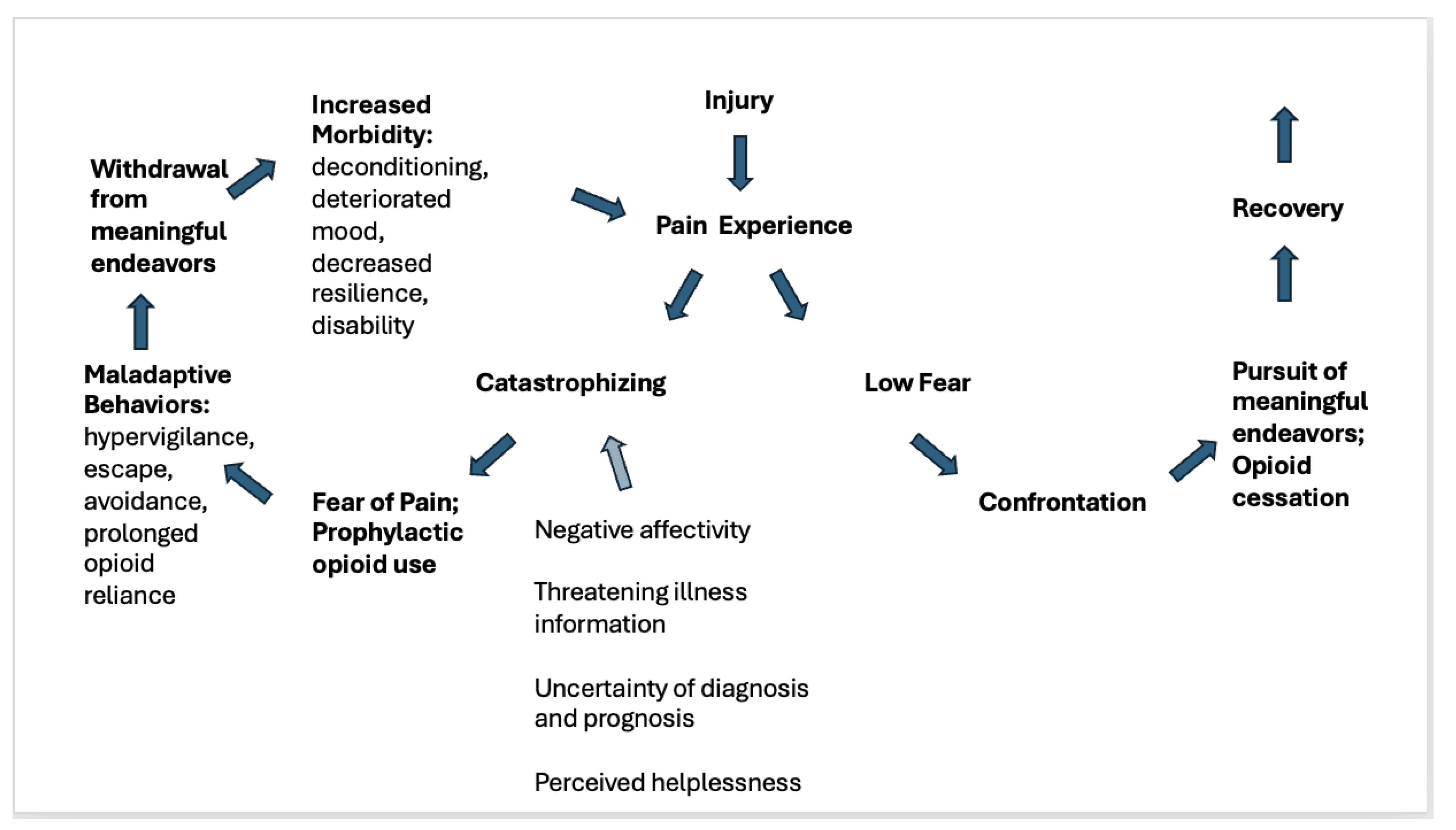

Table 1.
Table of Assessments for Anxiety-Based Cognitive Distortions Pertaining to Somatic Perception (ABCD-SP).
Table 1.
Table of Assessments for Anxiety-Based Cognitive Distortions Pertaining to Somatic Perception (ABCD-SP).
| Fear Avoidance Beliefs Questionnaire—Work and Physical Activity (FAB-Wand PA)[11,17,31] | Two subscales (FAB-W: 0-42; FAB-PA 0-24) in which higher scores indicate more severe pain and disability due to fear avoidance beliefs about work and physical activity, respectively. Various score thresholds have been documented as associated with clinical relevancy and specific negative chronicity of CNCP. Higher scores have been associated with poor physical and manual therapy results and low return to work rates after an injury. |
| Tampa Scale of Kinesiophobia (TKS)[32,33] | A measure of fear of movement and reinjury. Scores range from 17–68, with higher scores being of higher severity. Higher TKS scores have been correlated with higher disability and pain scores. |
| Pain Catastrophizing Scale (PCS)[19,34,35] | Assesses levels of catastrophizing. In initial validation, a score of 30 or more correlated with high unemployment, self-declared “total” disability, and clinical depression. However, various lower score thresholds have been documented as associated with clinical relevancy for specific negative chronicity of CNCP. |
Disclaimer/Publisher’s Note: The statements, opinions and data contained in all publications are solely those of the individual author(s) and contributor(s) and not of MDPI and/or the editor(s). MDPI and/or the editor(s) disclaim responsibility for any injury to people or property resulting from any ideas, methods, instructions or products referred to in the content. |
© 2024 by the authors. Licensee MDPI, Basel, Switzerland. This article is an open access article distributed under the terms and conditions of the Creative Commons Attribution (CC BY) license (http://creativecommons.org/licenses/by/4.0/).
Copyright: This open access article is published under a Creative Commons CC BY 4.0 license, which permit the free download, distribution, and reuse, provided that the author and preprint are cited in any reuse.


