
Submitted:
23 August 2024
Posted:
26 August 2024
You are already at the latest version
Abstract
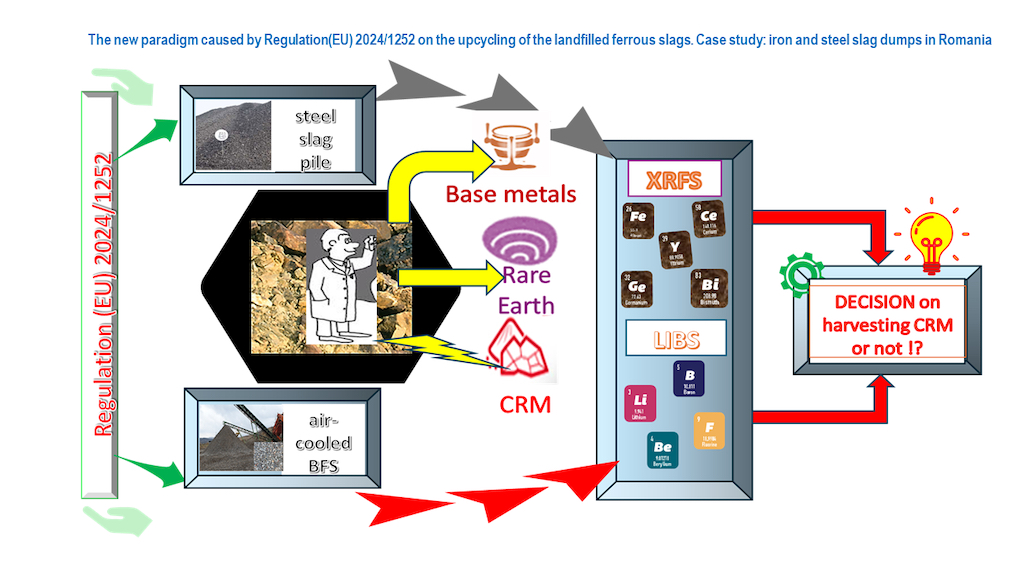
The production of a ton of steel in an integrated steel plant generates of approximately 1 ton of ferrous slag. A great part of ferrous slags is recycled in civil and road construction etc., but a huge amount is still dumped. Recycling ferrous slag as cement precursor was considered the upcycling route. Regulation (EU) 2024/1252 requires the Member States to provide information, until November 2026, on the critical raw materials (CRM) amount in their secondary resources and on quantification methods used for. This study addresses two synergic objectives: ensuring the reliability of XRFS results and screening for CRM in ferrous slags based on XRFS outcomes. The main novelty of the paper is the way of ensuring the reliability of the XRFS results based on weighted arithmetic mean and on the maximum likelihood approach. Secondly, the XRFS measurements carried on ferrous slags demonstrate that they contain significant amounts of CRM like Ba, Sr, Y, etc. XRFS cannot detect light CRM. Our preliminary LIBS measurements on ferrous slags disclosed the presence of Li and Be. The drawbacks of the XRFS technique impose further research to develop an integrated XRFS, LIBS and XRD procedure for comprehensive and trustworthy CRM screening in extractive waste piles.
Keywords:
upcycling
; ferrous slags
; critical raw materials
; Regulation(EU) 2024/1252
; trustworthy screening
; analytical performance characteristics
; XRFS
; LIBS
1. Introduction
Steel is and will remain for a long time the main metal vector that drives the top branches of the modern economy (automotive industry, metallic construction, food industry, aircraft and defense industries, etc.) [1,2]. Also, cast iron plays an important role in different industrial sectors like machine construction, sewerage construction, but mainly as the precursor of the steel alloys [2,3,4]. Unfortunately, the production a ton of steel in an integrated steel plant implies the generation of approximately 2 tons of waste [5,6,7]. Among the unavoidable wastes and by-products generated by an integrated steel plant are iron and steel slags that play technological beneficial roles during iron oxide reduction in blast furnace or during smelting and refining the composition of a steel grade [3,7]. During the last century and in the first decades of the third millennium huge amount of ferrous slags has been accumulated in Romania as landfilled piles at Galati, Hunedoara, Călan, Târgoviște etc. Though, the production of the iron and steel in Romania diminish in the last decade, ferrous slag still accumulates in dumps [8]. These dumps have created environmental detriments through flying dust pollution, surface and underground water pollution through rainwater leaching and visual discomfort [9]. In addition, some of industrial waste deposits enter under incidence of the Cause 301/17 of the European Court of Justice (ECJ). Cause 301/17 stated that Romania has not fulfilled its obligations under Article 14 letter (b) of Directive 1999/31 concerning the obligation to take all necessary measures to close, as quickly as possible, 68 landfills which, in accordance with Article 8 of the said directive, have not received an authorization to allow them to continue to function [10]. The metallurgical waste dump Călan is included in the list of the deposits of non-hazardous industrial waste subject to Cause 301/17 as being operated by S.C. FOREVER - S.R.L. Călan [11]. This deposit ceased storage waste before July, 2009 [11]. The Călan dump storages mainly blast furnace slag (BFS) and associated waste resulted from pig iron production and from foundry shops that were integrated in the Călan steel plant. [11,12]. A similar status has the steel slag deposit Târgoviste which has accumulated significant amount of steel slag and associated wastes.
The ferrous slags have been subjected under debate regarding its status i.e. waste or not waste [13,14]. Thus, the ferrous slags were classified as waste according to the European Waste Catalog entries [15]: 10 02 01 waste from the processing of slag; 10 02 02 unprocessed slags. The European Waste Catalog was adopted in Romania and the above entries are mentioned in a recent governmental document i.e. in OUG 92/2021, approved by Law 17/2023 art. 8 para. (3) Appendix no. 1 [12]. The revised position paper of EUROFER in 2023 clearly states that “Slag is a by-product of the steelmaking process” [14]. The ferrous slag status of by-product is very important as a waste which ceases to be waste, also ceases to be waste for the purpose of the recovery and recycling targets set out in Directives 94/62/EC and another relevant CE legislation [17].
Recently, the Regulation (EU) 2024/1252, further on referred as Regulation, has turned the paradigm of the historical and ongoing slag dumps from the source of environmental detriment into a potential secondary resource which can mitigate the access risk of the EU to raw materials that are essential for its economy and for critical raw materials (Article 8) [18]. Moreover, Regulation stipulates: “By 24 November 2027, Member States shall adopt and implement measures to promote the recovery of critical raw materials from extractive waste, in particular from closed extractive waste facilities”. Also, Regulation (Art.27) laid down the obligation of the operators of the extractive waste facilities from each EU Member Stare “to provide to the competent authority a preliminary economic assessment study regarding the potential recovery of critical raw materials, from waste stored in their facilities by 24 November 2026. The study shall at least include an estimation of the quantities and concentrations of critical raw materials contained in the extractive waste and in the extracted volume and an assessment of their technical and economic recoverability. Operators shall specify the methods used to estimate those quantities and concentrations.” Ferrous slags enter to the incidence of Regulation as they are the results of the processing of the iron ores that are among the main target of the extractive industry [20,21]. Consequently, the upcycling route of the ferrous slag as cement precursor loses its prevalence. Thus, before the issuing of this regulation, the using of the ferrous slags as precursor in cement industry was considered an upcycling approach, while, in the new context, the new upcycling route for ferrous slags has turned as precursor of the critical raw materials (CRM) [22,23,24]. To fulfill this new trend, it is mandatory to screen for CRMs in the targeted waste deposit to identify which of CRMs has a significant abundance [26]. The presence of CRMs into ferrous slags have been addressed in the literature [26,27]. The were reported that the concentrations of REE in blast furnace slags are several times higher than in those other metallurgical slags [26,27,28].
In the frame of the new paradigm of slag upcycling, this paper addresses a preliminary screening for CRMs in the iron slag from Călan dump and in the steel slag from Târgoviște dump. The screening for CRM in a stockpile implies a complex serial process consisting of preliminary investigation of the site, construction of the site conceptual model based on available information, site inspection, planning the sampling campaign, sample collection, on-site sample preparation, sample transport to laboratories, laboratory measurements, data analysis and, finally, construction of the source model regarding targeted analytes [29,30,31]. Such a complex process needs financial and human considerable efforts. In our case, there is no available information of the CRM contents in the Călan and Târgoviște dumps, neither on the main composition of the substances deposited in these piles. All the knowledge about Călan dump is that it was used for deposition of the blast furnace slag (BFS) coming out of Călan iron plant during 1886-2007[2]. Most probably, waste associated to pig iron production and casting like blast furnace dust, used sand, waste linings etc. were co-deposited on Călan dump. Also, limited data are available on Electric Arc Furnace (EAF) slag deposited nearby Târgoviște, Colanu village [32]. Being aware of the information lack about CRMs abundance in these dumps, a preliminary study was conducted to ground a more pertinent study in case where the results of this study are positive. Also, this study aims to establish the performance characteristics of the XRFS technique, which is the cheapest and the most accessible technique for measuring the composition of the solid wastes [33,34]. XRFS reported compositions of the blast furnace slags encompassed both oxides and elemental mass concentrations. [22,31,33]. The characteristics of the analytical performances of the XRFS technique can be assessed through the limit of quantifications, the accuracy and the relative expanded uncertainty for each constituent [34,35].
Taking into account the above considerations, we addressed two synergic objectives in this study i.e. establishing the analytical performances of our XRFS laboratory procedure dedicated to ferrous slag investigation and screening for CRM in dumped ferrous slags. Both objectives are critical for complying with the requirements of the Regulation because the lack of accuracy of the measurement will compromise the screening for CRM, while non-screening for CRM contravenes to the requirements of Regulation. The study was conducted on a certified reference material made from steel slag aiming assessing the characteristics of analytical performance of the XRFS procedure. Subsequently, XRFS measurement were conducted on four ferrous slags aliquots (2 of EAF slag and 2 of air-cooled BFS , aka ACBFS). The main novelty of the paper is the way of ensuring the reliability of the XRFS results. Another important novelty of the paper is the way in which the performance characteristics of the XRFS procedure were established based on weighted arithmetic mean and on the maximum likelihood approach. The XRFS measurements carried on ferrous slags demonstrate that they contain significant amounts of CRM like Ba, Bi, Sr, Ti, W, Y, etc. Our preliminary LIBS measurements on these slags disclosed the presence of light CRM like Li and Be, that cannot be detected by XRFS. Further researches are envisaged to develop an integrated XRFS, LIBS and XRD procedure for comprehensive and reliable CRM screening in ferrous slag dumps.
2. Materials and Methods
The first XRFS measurements were carried on the certified reference material, Certificate No. 050616-101-Slag, provided by Brammer Standard Company, Inc. The material is a fine powder that was dried for one hour at 105 oC and mix well before using. The steel slag samples were obtained from the Târgovişte (Colanu) slag dump. The aliquots were prepared from slag fraction 8-63 mm (Figure 1.a).
The collected gross sample of EAF slag weighed approximately 4 kg. The gross sample were crushed, grinded and milled until achieving a powdered state. The sieved fraction through a 1mm mesh was coned and quartering and a subsampling of circa 0.2 kg were delivered to an advanced milling into a ball mill Retsch PM100. The milled process lasted until the residue on the sieve (65 μm mesh) was less than 10%. The powder passed through 65 μm mesh sieve undergoes a subsampling through coned and quartering and circa 50 g of powder was selected for XRFS measurements. The XRFS measurements were carried with a Xepos ED(P)-XRF spectrometer (SPECTRO Analytical GmbH) which uses three secondary scattering targets in order to diminish the background intensity of the X-ray fluorescence spectra, which help increasing the sensitivity of the instrument in detection the light elements from Na to Ti. The aliquot for XRFS measurement were prepared as Pressed Pellet. The pellet contains 6.25 g of powdered slag and 1.75 g of lithium tetraborate. The XRF spectra were processed with the Turboquant Pellets analytical program which can delivered elemental composition or a combination of oxide and elemental composition aka bond composition. The same aliquot preparation and XRFS measurement processes were applied to the ACBFS samples (Figure1.b).
The accuracy of the XRFS measurement procedure for an analyte was estimated as the absolute relative difference between the certified value of the reference sample and the weighted mean obtained through repeated measurements on the aliquots prepared from reference material. The weighted arithmetic mean was calculated as:
where is the weighted arithmetic mean of a suite of measurements; is the measured concentration in ith round; is the weight of the Ci variable;
The common practice in mathematical statistics is to consider the measurand as a random variable, written with capitals, while its value is written in small letters. The term in Eq.(1) can be considered as the occurrence probability of the ci value aka weight of Ci variable.
The variance of the weighted mean, V(, is calculated as:
where is the variance of the measurand. is consider an independent random variable for every i=1...n.
The maximum likelihood approach imposes the minimization of the value, which, in turn, implies that derivatives:
The solution of the system made of n equations of the form Eq. (3), with the unknowns wi, 1=1..n, is:
In the frame of the maximum likelihood approach the weight of Ci is:
Substituting given by Eq.(5) in Eq.(2), one obtains:
The performance characteristics of the XRFS procedure considered in this paper are: relative accuracy and uncertainty ratio, defined as follows:
- ➢
- Relative accuracy (RA) is the ration between accuracy and the certified value:
- ➢
- Uncertainty ratio (RU) is the ratio between measurement uncertainty and certified uncertainty where they are of the same type i.e. compound uncertainty or expanded uncertainty. The RU is expressed as rational number.
The characteristics are qualitatively assessed according to Table 1.
Once having evidences that our XRFS procedure provides reliable outcomes then we proceed with slag characterization as a potential source of positive minerals and possible as CRM secondary resources. Also, the chemical character of a slag was estimated according to the conventional practice using the basicity index, denoted BI, which is the ratio between the content of basic oxides and acidic oxides [21]:
where the concentrations of the oxides are given in %wt.
The strongest basic oxides ranked in descendent order are: Na2O, K2O, CaO, MgO, BaO, FeO, MnO, Cu2O, NiO, ZnO, Fe2O3, Cr2O3, PbO [21]. Al2O3 is consider as amphoteric oxide [21]. The strongest acid oxides are SiO2, V2O5, Cr2O3, MoO3, WO3, Mn2O7 [21].
The basic ferrous slags are many times sub-divided based on the CaO/SiO2 concentration ratio as follows [21]: a) weak basic slag for CaO/SiO2 < 1.5; b) average basic slags for CaO/SiO2 = 1.6 -:- 2.5; c) strongly basic slag for CaO/SiO2 > 2.5.
3. Results and Discussions
The results of 4 repeated measurements carried on aliquots prepared from powdered BS 101-3 reference material are posted in Table 2.
In the Table 2 are posted only the components that can be compared with the certified composition values given in the Certificate No. 050616-101-SLAGS (Table 3). The synthetic analysis of the XRFS measuring performances are shown in Table 3 where are posted the weighted arithmetic mean of the 4 repeated measurements (, the expanded measurement uncertainty with 95% degree of confidence, denoted U(95%), calculated for the coverage factor k=2, RA, RU and QMPC parameters.
As could be seen in Table 3 the measurement uncertainties calculated in the frame of the maximum likelihood are less than the certified uncertainties i.e. RU<1. Also, the RA exceeds 5% only in two cases whose characteristics of performance were considered as being of good quality. In all other cases, the performance characteristics of the measurements are very good and excellent.
The BI of the certified steel slag calculated with certified values has a BI=3.98 while BI calculated with the measured values is 3.81. The BI values are close each other and differ with circa 4.4%. The ratio / calculated based on certified values is 2.86 while that calculated based on measured values is 2.90 i.e. the ratios differ with circa 1.4%. Both ratios let one qualifies the slag as a strongly basic slag. The values of the BI and of the ratio / obtained on certified slag show also that the XRFS procedure we use is robust and reliable. Thus, we have been confident that the measurement values we obtained on 4 slag aliquots are reliable and could serve as a preliminary surveying for CRM in the above-mentioned slag piles. The XRFS measurement results obtained on aliquots prepared from ACBFS and EAF slags are posted in Table 4.
The data presented in Table 4 are as they are delivered by the Turboquant software, therefore the common law of the same number of digits cannot be respected in Table 4. This is also due to the large differences between the values of the measured concentrations. However, the concentrations of major constituents (values measured in %wt.) are comparable with literature data and can be considered as reliable [26,33].
The BI of the investigated slags and their CaO/SiO2 ratios are given in Table 5.
The screening for CRM implies data analysis at ppm level therefore a selection of the CRM measured by XRFS and their concentrations in ppm (wt.) is given in Table 6. The maximum value of a CRM concentration (Cmax) is shown in the 10th column of the table, while in 11th is posted its abundance in Earth crust [37]. The 12th column contains the 1-digit rounded ratio between the measured concentration and its known concentration in Earth crust (CEC). The reader should be aware that the concentration of a CRM in Table 6 refers to its oxide while the reference value of CEC is for element. Thus, the ratio in column 12th is informative. For a comparison element to element, the composition in Table 6 must be recalculated. This is not an impossible task, but for the present case, it is beyond the scope of this study.
The CRM like Ti and Mn are abundant in EAF slags. Also, EAF can be suspected as a secondary source for Ta, W and Bi that are abundant in case of W and Bi (hundred times) and about 10 times in case of Ta. BFS slags can be considered as abundant in V and quite rich in As, Ba and Hf. Though, Y and Sr are not on the CRM list, it worth noting that these elements are abundant in the slag we investigated. The presence of the very important light CRM like Li, Be, B and F cannot be investigated by XRFS technique.
To overcome this drawback, preliminary LIBS measurements were carried on some ACBFS lumps at SciAps Laboratory in Germany, using SciAps Z903 LIBS Analyzer instrument. One of the LIBS spectra is shown in Figure 2, where the images of the sample and of 3 laser spots are shown as insets.
Figure 2 clearly shows the presence of the characteristic lines of light elements as H, Li, O, Mg etc. A semi-quantitative estimation of the elemental composition of the sample is given in Table 7.
The data in Table 7 attest the potential of LIBS technique to measure elemental concentration in a large range i.e. from ppm to %wt., but LIBS needs proper calibration on ferrous slags to provide reliable quantitative results. In this direction, we consider that LIBS in combination with XRFS and XRD measurements on the same aliquots can provide a more thoroughly analysis of the CRM into ferrous slags. Accordingly, further researches are foreseen to get an integrated XRFS, LIBS and XRD procedure for CRM trustworthy screening as Regulation requires
4. Conclusions
This study is a first step in grounding the screening process for CRM in ferrous slag dumps in Romania, at least, to come in line with the requirements of the REGULATION (EU) 2024/1252.
The performance characteristics of the XRFS procedure we used to measure the chemical composition of the ferrous slags (ACBFS, EAF) are fitted to the purpose of this study. Hence, the posted results in the paper are deemed as reliable.
This study demonstrates that the Călan and Târgoviște ferrous slag dumps contain significant amounts CRM like Ti, V, Mn, Bi even W incorporated in their oxides. Also, important elements like Y, Sr, Ba can be deemed as being in significative amounts in these slag dump.
The preliminary LIBS measurements demonstrate that light CRM like Li and Be are contained in ferrous slags.
Noteworthy, the XRFS, even XRD cannot detect light CRM, hence they cannot ensure a trustworthy screening for entire list of CRM. Therefore, the paper emphasizes the need for an integrated XRFS, LIBS and XRD procedure for reliable screening of the CRM in secondary resources, as Regulation requires.
The authors are aware of the importance of the sampling plan and statistical data processing as critical factors for the decision on harvesting CRM from these secondary resources. Hence, further researches are foreseen on this topic.
Author Contributions
Conceptualization, A.L.T, I.P., Z.K., and R.N.T; methodology, A.L.T., I.P, Z.K., A.P. and G.I.; validation, I.P., C.U. and D.F.M.; formal analysis, A.P and F.N.; investigation, A.L.T., I.P, P.G., C.U., F.N and R.N.T.; resources, A.L.T., Z.K., I.G and D.F.M; data curation, A.P., C.U. and D.F.M.; writing—original draft preparation, I. P., P.G, R.N.T. and G.I.; writing—review and editing, I. P., P.G, R.N.T. and G.I.; visualization, I.P., C.U. and R.N.T.; supervision, A.L.T., I.P.; project administration, A.L.T. and I.P.; funding acquisition, A.L.T., Z.K. and D.F.M. All authors have read and agreed to the published version of the manuscript.
Funding
This research received no external funding.
Data Availability Statement
The data are available at request.
Acknowledgments
The authors would like to thank Kristof Endre, the CEO of KIMET.Ltd, Targu Secuiesc, Romania, for his advice on using LIBS in our researches and for facilitating LIBS measurements at SciAps Laboratory, Germany.
Conflicts of Interest
The authors declare no conflicts of interest.
References
- Nicolae, M.; Sohaciu, M.G.;Dumitrescu, R.; Ciuca, S.; Nicolae, A., Vectors of Sustainable Development and Global Knowledge in the Metallic Materials Industry in Romania. Sustainability, 2022, 14, 9911. [CrossRef]
- Riposan, I.; Stan, S.; History of Metallurgy in book Mechanics, Processing Techniques and Constructions, Publishing House of the Romanian Academy, Bucharest, Romania, 2019, volume 24, pp. 61-106, ISBN 978-973-27-3054-6. (in Romanian).
- Riposan, I., Chira, I., Chisamera, M., Sofroni,L., Stan S., Cast Iron. In book: Treatise on the Science and Engineering of Metallic Materials, Ed. AGIR, Bucharest, Romania, 2009, Vol. 3, pp. 463-580. (in Romanian).
- Popescu, N., Saban R., Bunea D., Pencea I., Material Science for Mechanical Engineering, Ed. Fair Partner Publishers, Bucharest, Romania, 2000, vol. 1., pp. 213-226.
- Mihaiescu D.C., Predeanu, G., Panaitescu C., Characterization of some Blast Furnace Waste Dusts, U.P.B. Sci. Bull., Series B, 2014, Vol. 76, Iss. 1, 2014, pp.227 – 234.
- Ciocan A., Assessment of Blast Furnace Slag Transformation into Value Added By-Products on Basis on Knowledge of Slag Characteristics, The Annals of “Lower danube” University of Galati. Fascicle Ix. Metallurgy and Materials Science, 2012, No. 4 , ISSN 1453 – 083X.
- Piatak, N.M., Ettler, V., Metallurgical Slags: Environmental Geochemistry and Resource Potential, Edited by The Royal Society of Chemistry, 2021, Published by the Royal Society of Chemistry, Electronic ISSN: 2516-2632, www.rsc.org.
- Baicoianu, V., Parvu M., Activity of the metallurgical sector, Ed. National Institute of Statistics, Bucharest, Romania, 2023, pp.1-4, ISSN 1841-41769; ISSN-L 1841-4176., Available at https://insse.ro/cms/sites/default/files/field/publicatii/activitatea_sectorului_metalurgic_2023.pdf, accessed on June, 8, 2024.
- https://adevarul.ro/stiri-locale/galati/un-munte-de-deseuri-de-22-de-ori-mai-mare-decat-1686240.html; accessed on June, 19, 2024.
- Cause C-301/17. ECLI identifier: ECLI:EU:C:2018:846; Available at https://eur-lex.europa.eu/legal-content/RO/ALL/?uri=CELEX:62017CJ0301, accessed on June 20,2024.
- Emergency Ordinance no. 96 of November 2, 2023, regarding some measures to improve the efficiency of waste management, as well as for the modification and completion of some normative acts. Official Gazette no. 1003 of November 3, 2023. https://www.eea.europa.eu/help/glossary/eea-glossary/european-waste-catalogue-1, accessed on May, 13, 2024.
- Emergency Ordinance no. 92 of August 19, 2021 regarding the waste regime Issuer: The Government of Romania, 2021, published in the Official Gazette no. 820 of August 26, 2021.
- https://www.euroslag.com/wp-content/uploads/2019/01/Position_Paper_April_2012.pdf, accessed on 08 July 2024.
- EUROFER position paper on the registration duties for downstream users of multi-constituent substances (MCS) in the steel industry Revised August 2023, https://www.eurofer.eu/assets/publications/position-papers/reach-position-papers/Position-paper-on-MCS.V2.pdf. accessed on 08 July 2024.
- https://www.eea.europa.eu/help/glossary/eea-glossary/european-waste-catalogue-1. accessed on 08 July 2024.
- DIRECTIVE 2008/98/EC OF THE EUROPEAN PARLIAMENT AND OF THE COUNCIL of. November 2008 on waste and repealing certain Directives (Text with EEA relevance) Official Journal of the European Union 22.11.2008 available at https://eur-lex.europa.eu/legal-content/EN/TXT/PDF/?uri=CELEX:32008L0098. accessed on 08 May 2024.
- European Parliament and Council Directive 94/62/EC of 20 December 1994 on packaging and packaging waste availabe at http://data.europa.eu/eli/dir/1994/62/oj, accessed on 09 May 2024.
- REGULATION (EU) 2024/1252 OF THE EUROPEAN PARLIAMENT AND OF THE COUNCIL of 11 April 2024 establishing a framework for ensuring a secure and sustainable supply of critical raw materials and amending Regulations (EU) No 168/2013, (EU) 2018/858, (EU) 2018/1724 and (EU) 2019/1020, available at https://eur-lex.europa.eu/eli/reg/2024/1252/oj, accessed on 08 July 2024.
- Hidalgo, I., Kamiński, J. The iron and steel industry: A global market perspective. Gospod Surowcami Miner 2011; 27(3): 5-28.
- ProSUM project: Prospecting Secondary raw materials in the Urban mine and Mining wastes; https://www.prosumproject.eu/ accessed on 19 July, 2024.
- Carcea I., Roman, C., Chelariu R., Metallurgical Process Engineering, 2006, Ed. Performantica, Iaşi, Romania, pp 262-276, ISBN 978-973-730-326-4, (in Romanian).
- Timiș A.L. , Pencea I., Karas, Z, Turcu R.N., Niculescu F., Sztacho P., Ghiţă M., Macovei A.C. DESTRO approach for up-cycling the air-cooled blast furnace slag old dumps. Case Study Călan, U.P.B. Sci. Bull., Series B, 2024, Vol. 86, Iss. 2, 201-213.
- Blengini, G., Mathieux, F., Mancini, L.Nyberg M., Viegas H.M. et al., Recovery of critical and other raw materials from mining waste and landfills: State of play on existing practices, 2019 , Publications Office of the European Union, Luxembourg, ISBN 978-92-76-08568-3, doi:10.2760/600775, JRC116131., available at https://op.europa.eu/en/publication-detail/-/publication/4b410d88-a774-11e9-9d01-01aa75ed71a1/language-en; accessed on 19 September 2022. [CrossRef]
- "Critical Raw Materials: ensuring secure and sustainable supply chains for EU's green and digital future". European Commission. 16 March 2023, available at https://ec.europa.eu/commission/presscorner/detail/en/ip_23_1661; accessed on 08 June 2024.
- https://single-market-economy.ec.europa.eu/sectors/raw-materials/areas-specific-interest/critical-raw-materials_en, accessed on 23 July 2024.
- Zimmermann T., Gößling-Reisemann S., Critical materials and dissipative losses: a screening study, Sci. Total. Environ. 2013, 461-462:774-80. [CrossRef] [PubMed]
- Kasina, M., Michalik, M., Iron Metallurgy Slags as a Potential Source of Critical Elements - Nb, Ta and REE. Mineralogia, 2016, 47(1/4), 15–28. [CrossRef]
- Särkkä H., Kaartinen T., Hannus E., Assessing the opportunities of landfill mining as a source of critical raw materials in Europe. 16th International waste management and landfill symposium, 2-6 October 2017, Sardinia, Italy. http://hdl.handle.net/2318/1651576; available at https://dspace.lib.cranfield.ac.uk/server/api/core/bitstreams/d73cb7e8-08df-4443-b8b4-0dc4bb7ddda3/content, accessed on 20 August 2024.
- Methodology of July 16, 2020 for the investigation of potentially contaminated sites and contaminated ones Published in the Official Gazette no. 823 bis of September 8, 2020, Romania (in Romanian).
- Baldassarre, G.; Fiorucci, A.; Marini, P. Recovery of Critical Raw Materials from Abandoned Mine Wastes: Some Potential Case Studies in Northwest Italy. Mater. Proc. 2023, 15, 77. [CrossRef]
- Pencea, I., Turcu R.N., Popescu-Argeș, A. C., Timiș, A.L., Priceputu, A., Ungureanu, C., Matei E., Nedelcu, L., Petrescu, M.I., Niculescu, F. An improved balanced replicated sampling design for preliminary screening of the tailings ponds aiming at zero-waste valorization. A Romanian case study. J. Env. Manag., 2023, V. 331, 117260. [CrossRef]
- https://haldatgv.weebly.com/acasa.html.
- Jonczy I. Bartłomiej G., Wieczorek A.N., Gerle A., Nuckowski P., Staszuk M. Characteristics of the phase and chemical composition of blast furnace slag in terms of the possibility of its economic use. Gospodarka Surowcami Mineralnymi – Mineral Resources Management, 2022, 38(4), 153–172.
- Pencea I, Instrumental methods and techniques for elemental analysis of materials, chapter 8, in book series "Treatise on Materials Science and Engineering", vol. 5, entitled: "Final processing technologies of metallic materials", Agir Publishing House, 2011, pp. 1057-1239, ISBN: 978-973-720-391-5 (in Romanian).
- Rousseau R. M., Detection limit and estimate of uncertainty of analytical XRF results. The Rigaku Journal, 2001, Vol. 18, No.2, pp. 33-47.
- https://en.wikipedia.org/wiki/Weighted_arithmetic_mean, accessed on 25 July, 2024.
- https://en.wikipedia.org/wiki/Abundance_of_elements_in_Earth%27s_crust, accessed on 25 July, 2024.
Figure 1.
Images of dumped steel and BFS slags: a) steel slag pile; b) ACBFS pile.
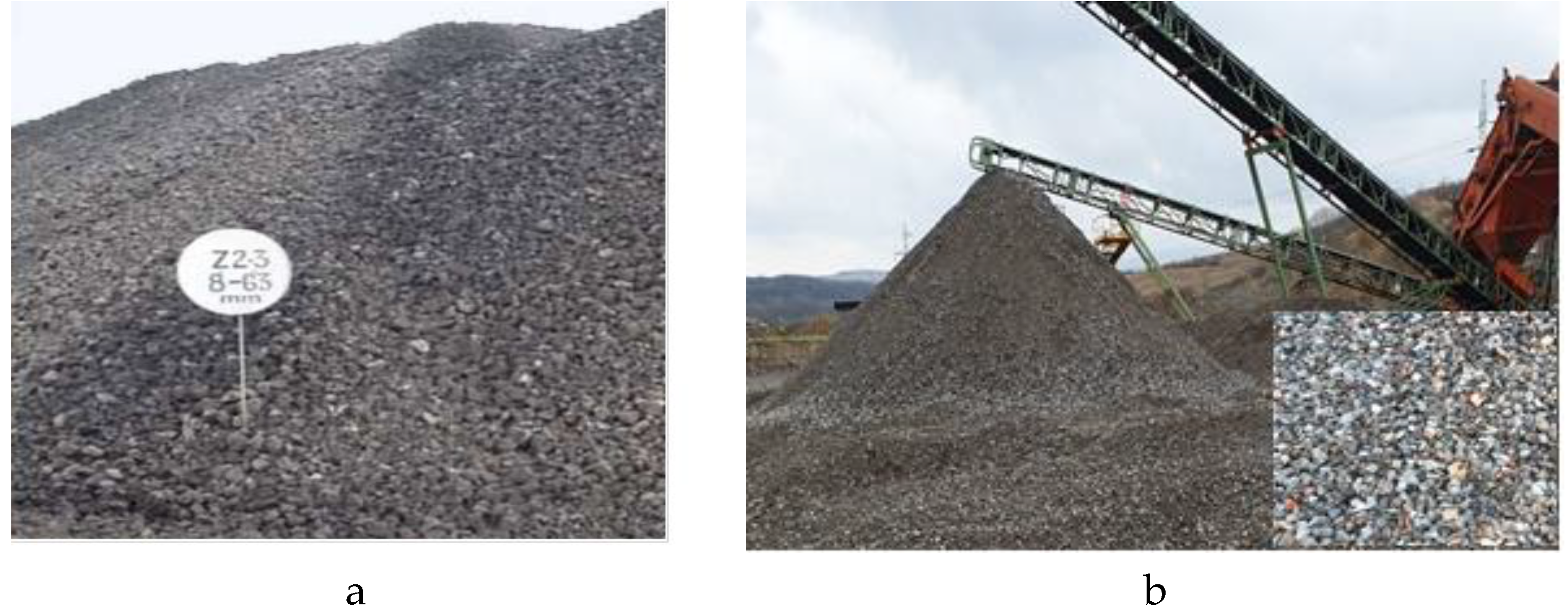
Figure 2.
LIBS spectrum obtained on an ACBFS lump and inset images of the spotted areas.
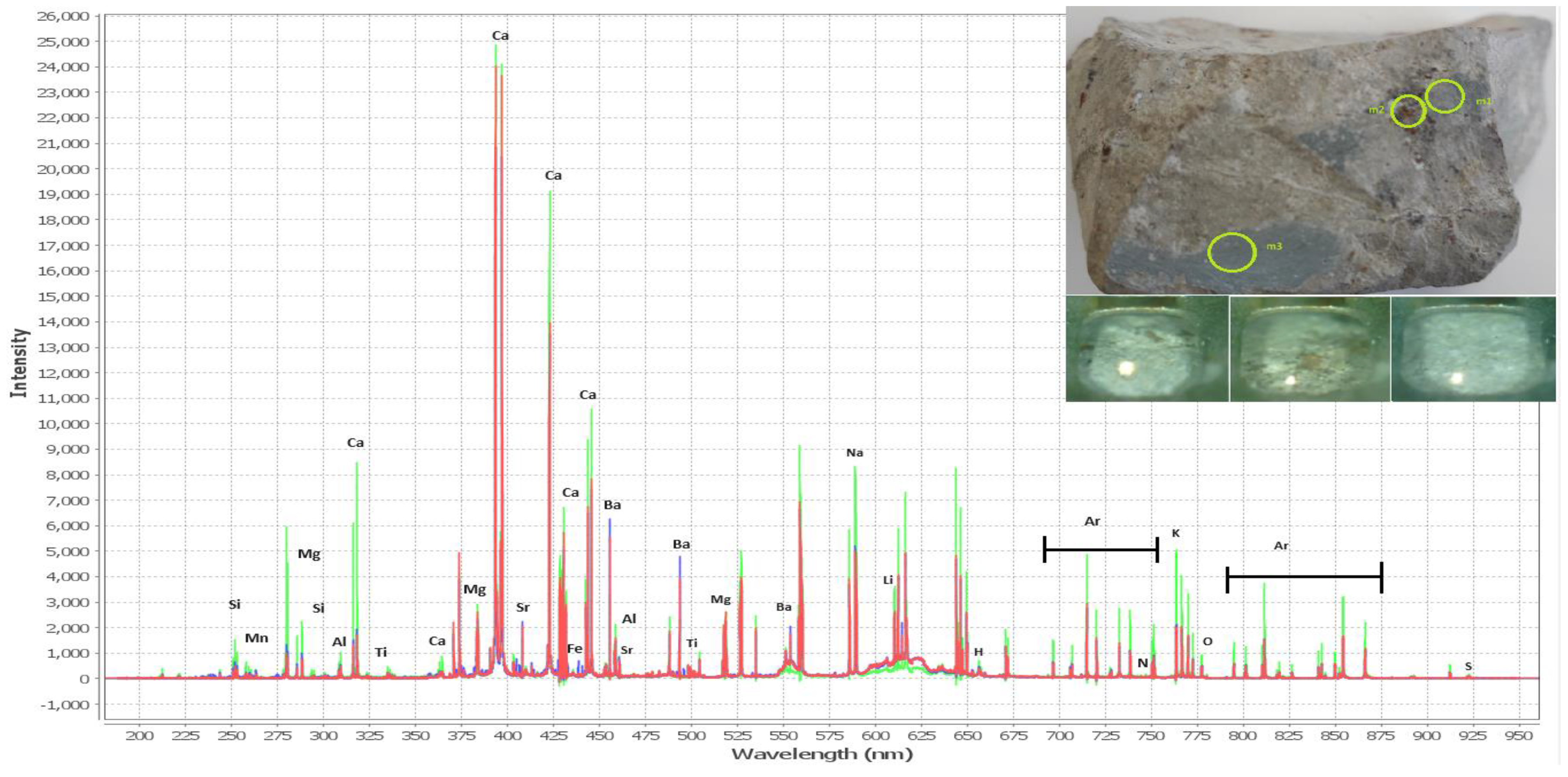

Table 1.
The criteria matrix for qualifying the XRFS measurement characteristics of performances. .
RA
|
<=3% | >3% & <=5% | >5$&<=10% | >10%&<15% | >15% |
RU
| |||||
| <=1 | excellent | very good | good | acceptable* | unacceptable** |
| >1&<=2 | very good | good | acceptable* | unacceptable** | unacceptable** |
| >2& <2.5 | good* | acceptable* | unacceptable** | unacceptable | unacceptable** |
* the measurement procedure must be checked and corrected or taking actions for improving. ** the measurement procedure must be cast off.
Table 2.
Measurement results obtained in 4 repeated trials carried on the MRC BS 101-3 aliquots.
| Symbol | Measurement no. 1 | Measurement no. 2 | Measurement no. 3 | Measurement no. 4 | ||||
| C[%] | SD[%] | C[%] | SD[%] | C[%] | SD[%] | C[%] | SD[%] | |
| Na2O | 0.027 | 0.027 | 0.031 | 0.0017 | 0.029 | 0.0006 | 0.0222 | 0.0254 |
| MgO | 3.212 | 0.006 | 2.757 | 0.0052 | 3.161 | 0.024 | 3.098 | 0.007 |
| Al2O3 | 1.940 | 0.004 | 0.950 | 0.0033 | 1.507 | 0.01 | 1.455 | 0.004 |
| SiO2 | 18.670 | 0.010 | 18.280 | 0.01 | 18.820 | 0.02 | 18.76 | 0.01 |
| P2O5 | 0.794 | 0.001 | 0.588 | 0.0013 | 0.794 | 0.0029 | 0.782 | 0.0015 |
| SO3 | 0.481 | 0.001 | 0.471 | 0.0009 | 0.496 | 0.00071 | 0.501 | 0.001 |
| K2O | < 0.0012 | 0.000 | < 0.0012 | 0 | 0.046 | 0.0033 | 0.046 | 0.0015 |
| CaO | 53.640 | 0.040 | 54.480 | 0.04 | 53.640 | 0.04 | 53.65 | 0.04 |
| TiO2 | 1.034 | 0.008 | 0.977 | 0.008 | 0.982 | 0.0037 | 0.932 | 0.008 |
| MnO | 5.313 | 0.007 | 5.459 | 0.007 | 5.131 | 0.008 | 5.188 | 0.007 |
| Fe2O3 | 15.080 | 0.010 | 15.640 | 0.01 | 14.940 | 0.01 | 15.78 | 0.01 |
Table 3.
Performance characteristics of the measured constituents.
| Symbol | Certified values* | Measured values | RA | RU | QMPC** | ||
| C[%wt.] | U(95%) | [%wt.] | U(95%) | [%] | - | - | |
| Na2O | 0.028 | 0.005 | 0.029 | 0.001 | 3.6 | 0.20 | Very good |
| MgO | 3.094 | 0.1 | 2.99 | 0.007 | 3.4 | 0.07 | Very good |
| Al2O3 | 1.467 | 0.04 | 1.386 | 0.004 | 5.5 | 0.10 | Good |
| SiO2 | 18.764 | 0.4 | 18.589 | 0.011 | 0.9 | 0.03 | Excellent |
| P2O5 | 0.769 | 0.08 | 0.767 | 0.002 | 0.3 | 0.03 | Excellent |
| SO3 | 0.474 | 0.02 | 0.488 | 0.001 | 3.0 | 0.05 | Excellent |
| K2O | 0.046 | 0.043 | 0.046 | 0.003 | 0.0 | 0.07 | Excellent |
| CaO | 53.597 | 0.4 | 53.852 | 0.04 | 0.5 | 0.10 | Excellent |
| TiO2 | 0.918 | 0.05 | 0.982 | 0.006 | 7.0 | 0.12 | Good |
| MnO | 5.19 | 0.2 | 5.282 | 0.007 | 1.8 | 0.04 | Excellent |
| Fe2O3 | 15.697 | 0.2 | 15.36 | 0.01 | 2.1 | 0.05 | Excellent |
* The certified values were recalculated as to associate Fe2O3 to Fe and SO3 to S to facilitate comparison among the XRFS results and the value specified in the certificate of the MRC. ** Qualificative of the Measurement Performance per Constituent.
Table 4.
The compositions of the ACBFS and EAF slags measured by XRFS and their assigned SDs.
| Sample no. 1 ACBFS | Sample no. 2. ACBFS | Sample no. 3 EAF | Sample no.4 EAF | |||||
| Symbol | C[%wt] | SD[%wt] | C[%wt] | SD[%wt] | C[%wt] | SD[%wt] | C[%wt] | SD[%wt] |
| Na2O | 0.689 | 0.024 | 0.796 | 0.023 | 0.1974 | 0.0045 | 0.1274 | 0.0045 |
| MgO | 3.318 | 0.009 | 3.853 | 0.009 | 8.0507 | 0.024 | 9.0499 | 0.024 |
| Al2O3 | 7.85 | 0.01 | 8.38 | 0.01 | 4.8814 | 0.017 | 5.7292 | 0.017 |
| SiO2 | 39.077 | 0.03 | 35.61 | 0.03 | 18.36 | 0.02 | 17.49 | 0.02 |
| P2O5 | 0.6341 | 0.0017 | 0.06594 | 0.0017 | 1.0462 | 0.0011 | 0.9443 | 0.0011 |
| SO3 | 0.3738 | 0.0009 | 0.3628 | 0.0009 | 0.2402 | 0.001 | 0.22294 | 0.0009 |
| Cl | 0.01471 | 0.00007 | 0.01432 | 0.00007 | 0.0206409 | 0.0023 | 0.021096 | 0.0021 |
| K2O | 0.59 | 0.006 | 0.567 | 0.005 | 0.4291 | 0.0046 | 0.4205 | 0.0046 |
| CaO | 45.751 | 0.009 | 46.595 | 0.008 | 39.8723 | 0.02 | 41.0099 | 0.02 |
| TiO2 | 0.08426 | 0.0045 | 0.3754 | 0.0045 | 0.5016 | 0.0027 | 0.5099 | 0.0027 |
| V2O5 | 0.0144 | 0.0013 | 0.0152 | 0.0013 | < 0.0010 | (0.0) | < 0.0010 | (0.0) |
| Cr2O3 | 0.02599 | 0.00046 | 0.0211 | 0.00041 | 0.0439 | 0.0014 | 0.0446 | 0.0014 |
| MnO | 0.1117 | 0.0007 | 0.1136 | 0.0007 | 8.157 | 0.009 | 7.154 | 0.009 |
| Fe2O3 | 1.024 | 0.004 | 2.792 | 0.004 | 19.574 | 0.004 | 18.044 | 0.004 |
| CoO | 0.0016 | 0.00023 | 0.00149 | 0.00023 | < 0.00090 | (0.0) | < 0.00090 | (0.0) |
| NiO | 0.00674 | 0.0001 | 0.00715 | 0.0001 | < 0.00064 | (0.0) | < 0.00064 | (0.0) |
| CuO | 0.02565 | 0.00015 | 0.02646 | 0.00015 | 0.0018 | 0.00012 | 0.0013 | 0.0001 |
| ZnO | 0.0124 | 0.0003 | 0.1294 | 0.0003 | < 0.00038 | (0.0) | < 0.00038 | (0.0) |
| Ga | 0.00127 | 0.00004 | 0.0012 | 0.00004 | < 0.00027 | (0.00024) | < 0.00027 | (0.00024) |
| Ge | < 0.00005 | 0 | < 0.00005 | 0 | < 0.00020 | (0.0) | < 0.00020 | (0.0) |
| As2O3 | 0.00088 | 0.00009 | 0.00137 | 0.00009 | < 0.00026 | (0.0) | < 0.00026 | (0.0) |
| Se | 0.00005 | 0.00002 | 0.00004 | 0.00002 | 6.997E-05 | 1.224E-05 | 3.724E-05 | 2.073E-05 |
| Br | 0.00121 | 0.00002 | 0.00129 | 0.00002 | 0.0010355 | 3.027E-05 | 0.0010228 | 3.646E-05 |
| Rb2O | 0.00842 | 0.00003 | 0.00872 | 0.00003 | 0.00133 | 0.00004 | 0.00125 | 0.00004 |
| SrO | 0.01702 | 0.00004 | 0.01753 | 0.00004 | 0.02274 | 0.00009 | 0.02267 | 0.00009 |
| Y | 0.00217 | 0.00003 | 0.0021 | 0.00003 | 0.00146 | 0.00005 | 0.00132 | 0.00005 |
| ZrO2 | 0.02943 | 0.00024 | 0.02939 | 0.00023 | < 0.00068 | (0.0) | < 0.00068 | (0.0) |
| Nb2O5 | 0.00122 | 0.00007 | 0.0014 | 0.00007 | 0.0003057 | 0.0001394 | 0.0003692 | 6.585E-05 |
| Mo | 0.00081 | 0.00006 | 0.00057 | 0.00006 | 0.0005034 | 7.537E-05 | 0.000275 | 9.291E-07 |
| Ag | 0.00053 | 0.00016 | < 0.00020 | 0 | 0.0007 | 0.0002 | 0.0008 | 0.0002 |
| Cd | 0.00041 | 0.00006 | < 0.00020 | 0 | 0.0003392 | 4.45E-05 | 0.006 | 0.0002 |
| SnO2 | 0.00274 | 0.00013 | 0.00246 | 0.00012 | 0.0022775 | 0.0001135 | 0.0048764 | 0.0002223 |
| Sb2O5 | 0.0009 | 0.00011 | 0.00073 | 0.0001 | 0.0015668 | 0.0001561 | 0.0009223 | 0.0001542 |
| Te | < 0.00030 | 0 | < 0.00030 | 0 | < 0.00030 | 0 | < 0.00030 | 0 |
| I | < 0.00030 | 0 | < 0.00030 | 0 | < 0.00030 | 0 | < 0.00030 | 0 |
| Cs | 0.00095 | 0.00059 | < 0.00040 | 0 | 0.0004141 | 0.0009731 | 0.0013 | 0.0003 |
| Ba | 0.0681 | 0.001 | 0.0753 | 0.001 | 0.0065294 | 0.0006314 | 0.02697 | 0.0002283 |
| La | < 0.00020 | 0 | < 0.00020 | 0 | < 0.00020 | 0 | < 0.00020 | 0 |
| Ce | 0.00345 | 0.00076 | 0.0042 | 0.00069 | 0.0009416 | 0.0005315 | 0.0011329 | 0.0006711 |
| Hf | 0.00054 | 0.00007 | 0.00079 | 0.00009 | 0.0005665 | 5.67E-05 | 0.00024 | 7.589E-05 |
| Ta2O5 | < 0.00063 | 0 | < 0.00063 | 0 | 0.00186 | 0.00027 | 0.00154 | 0.00024 |
| WO3 | 0.00184 | 0.00014 | 0.00203 | 0.00015 | 0.00485 | 0.00025 | 0.00457 | 0.00025 |
| Hg | < 0.00010 | 0 | < 0.00010 | 0 | < 0.00010 | 0 | < 0.00010 | 0 |
| Tl | 0.00012 | 0.00002 | 0.00012 | 0.00002 | 0.0001413 | 3.384E-05 | 3.799E-05 | 0.0001805 |
| PbO | 0.0218 | 0.0001 | 0.02135 | 0.0001 | < 0.00038 | (0.0) | < 0.00038 | (0.0) |
| Bi | 0.0021 | 0.0002 | < 0.00010 | 0 | < 0.00010 | 0 | 0.0023 | 0.0008 |
| Th | 0.00087 | 0.00004 | 0.00091 | 0.00004 | 0.00094 | 0.00007 | 0.00087 | 0.00007 |
| U | 0.00007 | 0.00001 | 0.00007 | 0.00001 | < 0.00010 | 0.00003 | < 0.00010 | 0.00003 |
| 99.8 | 99.9 | 100.5 | 99.9 | |||||
* The certified values were recalculated as to associate Fe2O3 to Fe and SO3 to S to facilitate comparison among the XRFS results and the value specified in the certificate of the MRC. ** Qualificative of the Measurement Performance per Constituent.
Table 5.
The BI and CaO/SiO2 values for the investigated slags.
| Sample | Sample no.1 ACBFS | Sample no. 2 ACBFS | Sample no. 3 EAF | Sample no.4 EAF |
| BI | 1.3 | 1.5 | 2.4 | 2.7 |
| CaO/SiO2 | 1.2 | 1.3 | 2.2 | 2.3 |
| Basicity | Wb* | Wb* | Ab** | Ab** |
* -weak basic slag, **- average basic slag.
Table 6.
Excerpt from Table 4 regarding the concentrations (in ppm wt.) of the CRMs found in slag samples and their assigned SDs.
Table 6.
Excerpt from Table 4 regarding the concentrations (in ppm wt.) of the CRMs found in slag samples and their assigned SDs.
| Symbol | S1-BFS | S2-BFS | S3-EAF | S4-EAF | Cmax | CEC | Cmax/ CEC | Slag type | ||||
| C | SD | C | SD | C | SD | C | SD | C | C | - | - | |
| TiO2 | 842.6 | 45 | 3754 | 45 | 5016 | 27 | 5099 | 27 | 5099 | 0.56 | 9025 | EAF |
| V2O5 | 144 | 13 | 152 | 13 | < 10 | 0 | < 10 | 0 | 152 | 0.01 | 12667 | BFS |
| MnO | 1117 | 7 | 1136 | 7 | 81570 | 90 | 71540 | 90 | 81570 | 0.1 | 858631 | EAF |
| CoO | 16 | 2.3 | 14.9 | 2.3 | < 9.0 | 0 | < 9.0 | 0 | 16 | 25 | 0.6 | BFS |
| NiO | 67.4 | 1 | 71.5 | 1 | < 6.4 | 0 | < 6.4 | 0 | 71.5 | 84 | 0.9 | BFS |
| CuO | 256.5 | 1.5 | 264.6 | 1.5 | 18 | 1.2 | 13 | 1 | 264.6 | 60 | 4.4 | BFS |
| Ga | 12.7 | 0.4 | 12 | 0.4 | < 2.7 | 0 | < 2.7 | 0 | 12.7 | 19 | 0.7 | BFS |
| Ge | <0.5 | 0 | <0.5 | 0 | < 2.0 | 0 | < 2.0 | 0 | 0 | 1.5 | 0.0 | * |
| As2O3 | 8.8 | 0.9 | 13.7 | 0.9 | < 2.6 | 0 | < 2.6 | 0 | 13.7 | 1.8 | 7.6 | BFS |
| SrO | 170.2 | 0.4 | 175.3 | 0.4 | 227 | 0.9 | 226.7 | 0.9 | 227.4 | 370 | 0.6 | EAF |
| Nb2O5 | 12.2 | 0.7 | 14 | 0.7 | 3.1 | 1.4 | 3.7 | 0.7 | 14 | 20 | 0.7 | BFS |
| Ba | 681 | 10 | 753 | 10 | 65.3 | 6.3 | 269.7 | 2.3 | 753 | 425 | 1.8 | BFS |
| Ce | 34.5 | 7.6 | 42 | 6.9 | 9.4 | 5.3 | 11.3 | 6.7 | 42 | 66.5 | 0.6 | BFS |
| Hf | 5.4 | 0.7 | 7.9 | 0.9 | 5.7 | 0.6 | 2.4 | 0.8 | 7.9 | 3 | 2.6 | BFS |
| Ta2O5 | < 6.3 | 0 | < 6.3 | 0 | 18.6 | 2.7 | 15.4 | 2.4 | 18.6 | 2 | 9.3 | EAF |
| WO3 | 18.4 | 1.4 | 20.3 | 1.5 | 48.5 | 2.5 | 45.7 | 2.5 | 48.5 | 1.25 | 38.8 | EAF |
| Bi | 21 | 2 | <1.0 | 0 | <1.0 | 0 | 23 | 8 | 23 | 0.08 | 270.6 | EAF |
Table 7.
Semi-quantitative estimation of the elemental composition of the ACBFS lump.
| Element | Li | Be | C | Na | Mg | Al | Si | K | Ca | Ti | Mn | Fe |
| Unit | ppm | ppm | %wt. | %wt. | %wt. | %wt. | %wt. | %wt. | %wt. | %wt. | %wt. | %wt. |
| Value | 90 | 10 | 0.69 | 0.37 | 1.87 | 11.2 | 10.4 | 1.98 | 19.9 | 0.37 | 0.13 | 0.22 |
| Uncertainty* | 2 | 1 | 0.16 | 0.15 | 0.53 | 2.0 | 2.0 | 0.35 | 1.9 | 0.07 | 0.01 | 0.04 |
* measurement uncertainty provided by the LIBS equipment as 2 times the standard deviation.
Disclaimer/Publisher’s Note: The statements, opinions and data contained in all publications are solely those of the individual author(s) and contributor(s) and not of MDPI and/or the editor(s). MDPI and/or the editor(s) disclaim responsibility for any injury to people or property resulting from any ideas, methods, instructions or products referred to in the content. |
© 2024 by the authors. Licensee MDPI, Basel, Switzerland. This article is an open access article distributed under the terms and conditions of the Creative Commons Attribution (CC BY) license (http://creativecommons.org/licenses/by/4.0/).
Copyright: This open access article is published under a Creative Commons CC BY 4.0 license, which permit the free download, distribution, and reuse, provided that the author and preprint are cited in any reuse.


