

Submitted:
21 August 2024
Posted:
22 August 2024
You are already at the latest version
Abstract
Objectives: The goal of this pilot study was to validate and introduce a new AI tool (algorithm), providing and comparing (1) the periodontal/peri-implant diagnosis between professional (specialist) and automated tool, (2) risk assessment and prognostication with the algorithm, and (3) establish cut-off limits for clinically significant disease with a new score system (GF-PeDRA score). Methods: All patients were evaluated by two evaluators, and in case of any divergence, the case was revisited and discussed until clarification and definition. The validation sample constituted 221 patients. The AI tool (GF-PeDRA©) had eighteen parameters to be assessed, involving systemic and local predictors, achieving an octadecagon (an eighteen-sided polygon). The parameters were: (1) The highest probing depth (PD); (2) Number of interproximal sites with bone loss; (3) The highest clinical attachment loss (CAL); (4) Maximum radiographic bone loss (RBL); (5) Bleeding on probing (% BoP); (6) Bone loss pattern; (7) Tooth loss including periodontally hopeless teeth planned for extraction; (8) Evidence of progression over five years; (9) Need for complex rehabilitation; (10) Patient’s age; (11) CAL and biofilm accumulation; (12) Smoking; (13) Diabetes; (14) Extension and distribution of the disease; (15) Peri-implant disease; (16) Other systemic conditions (other than diabetes); (17) Furcation involvement; and (18) Necrotizing lesion. A new score system (GF-PeDRA© score) based on the percentual of the octadecagon area is obtained; if the area was ≥0% to ≤9%, the prognosis is good; ≥10% and ≤ 24%, it is fair; ≥25% and ≤37%, poor; ≥38% and ≤49%, it is questionable; and between ≥50% to ≤100%, the prognosis is hopeless. Results: 221 patients were enrolled, with a mean age of 46.73. 5301 teeth were examined. 187 non-smokers (84.62%) and 34 smokers (15.38%) were included. 193 (87.33%) patients did not have diabetes, whereas 28 (12.67%) had. Comparing the diagnosis between both evaluators, k=0.83; all disagreed cases were re-discussed, and a final decision/diagnosis was reached. After this, the diagnosis found was contrasted with the diagnosis achieved by GF-PeDRA© and a perfect agreement was observed, 100% (k=1.0). 28 patients were diagnosed as periodontally healthy, 55 with plaque-induced gingivitis, and 138 with periodontitis. Only one case of molar/incisor pattern was observed. No peri-implant disease or necrotizing condition was found. The mean CAL found was 3.19 mm; 25 patients (11.31%) had a furcation involvement. The mean percentual of BoP found was 28.67% (median = 19%; maximum: 100%; minimum: 100%); and the mean PD was 5.31 mm. The mean of the new GF-PeDRA© score (ranging from 0% to 100%) was 28.64%, with a median of 32.2% (minimum: 0.6% and maximum: 64.1%). Then, analyzing the GF-PeDRA© score of 221 patients enrolled, 48 (21.73%) were sorted as a Good prognosis for periodontal treatment, 43 (19.45%) had a Fair prognosis, 43 (19.45%) had a Poor prognosis, 68 (30.77%) had a Questionable prognosis, and 19 (8.60%) had a Hopeless prognosis. Conclusion: The new AI tool (GF-PeDRA©) was validated and proved to be extremely helpful in diagnosing and providing risk assessment and prognosis.
Keywords:
risk assessment
; periodontics
; periodontal assessment
; prognosis
; diagnosis
; artificial intelligence
; algorithm
; periodontology
Introduction
The new classification system for periodontal and peri-implant diseases and conditions was introduced in 2018 following an International Workshop's deliberations and consensus reports [1]. It is the most evidence-based and clinically relevant system ever proposed. It is considered the first major update to the classification since 1999 [2]. The main areas of improvement were (1) facilitating an international language for clinical communication and population surveys of disease prevalence, (2) enabling proper diagnosis and prognostication for patient communication and education, (3) ensuring the implementation of appropriate treatment, and (4) enabling research into the etiology, pathogenesis, natural history, and treatment strategies. Since then, educational institutions and dentists began to utilize this new classification following the stipulated principles. It includes re-classification of disease modalities into novel schemes, including staging and grading for periodontitis, indicating the severity and extent of the disease, and considering the patient’s overall health status [3]. As with all new system implementations, a learning curve is inevitably necessary through the experiences and correct interpretations of the guidelines.
Predictive, preventive, personalized, and participatory Periodontology (‘5Ps’) [4] represents the future of Periodontics. A predictive approach using high-tech tools for diagnosis permits a better detection of patients at risk and the early diagnosis of periodontitis/peri-implantitis when it is easier to treat successfully. It will be organized as a personalized prevention based on a single patient’s genetic and microbiological status, and customized therapy will be tailored to the medical reality of the specific patient. Finally, the patient's active role will be emphasized through participatory collaboration.
Within the limitation of chair-side appointments, the risk assessment for periodontal/peri-implant treatments has become the most essential factor in determining predictability. Periodontal risk assessment is a systematic approach to evaluating an individual's likelihood of developing periodontal disease or experiencing its progression. This process is essential for identifying at-risk individuals and implementing preventive or therapeutic interventions tailored to their specific needs. Then, several periodontal risk assessment tools were already developed and validated [5,6]. Therefore, a systematic review [6] addressed five risk assessment tools. One of them, and the most used and accepted, is named the Periodontal Risk Assessment (PRA) [7]. It was presented as a valid system by studies, which indicated that patients could be identified at high risk for periodontal re-infection and progression after treatment by using only six criteria.
However, only six, or eight parameters, or a low number of factors analyzed to predict a periodontal risk assessment, facing all the advances in the periodontal/peri-implant classification, can be insufficient and transmit a “total” reality about the patient’s periodontal/peri-implant condition. Then, there is a lack of inclusion of some parameters to be evaluated; e.g., non-chronic cases of periodontitis, necrotizing cases, other extreme complexities of information requested, which is often not simple to obtain, and the absence of possible risk factors (environmental exposures and genetic predispositions, e.g.) resulting in a non-complete assessment of the patient. Hence, such requirements can be essential for establishing an unbiased prognostication system.
Thus, the goal of this pilot study was to validate and introduce a new AI tool (algorithm), providing and comparing (1) the periodontal/peri-implant diagnosis between professional (specialist) and automated tool, (2) risk assessment and prognostication with the algorithm, and (3) establish cut-off limits for clinically significant disease with a new score system (GF-PeDRA score). Moreover, this tool will provide a practical and visible chart to help clinicians better demonstrate and explain the findings to the patients. This is the first time that a periodontal/peri-implant diagnosis and automated tool (GF - Periodontal Diagnosis and Risk Assessment [GF-PeDRA©]), evaluating 18 points, is reported in the literature, reporting a significant and visible spider chart with automatic updates, improving the understanding, the teachability, and comprehension of the patient’s periodontal/peri-implant condition, observing the progression and potential risk factors.
Materials and Methods
This pilot study was approved by the local research ethical committee and was conducted in compliance with Good Clinical Practice and the Helsinki Declaration. Before inclusion, all patients signed the informed consent, permitting their inclusion. The recruitment period and study duration were from April 2022 to July 2023. All of them were evaluated by an expert/specialist in Periodontics (GVOF, 16 years of experience) and individually revised by a general dentist (JCHF, 14 years of clinical experience); in case of any divergence, the case was revisited and discussed until clarification and definition. The validation sample was constituted of 221 patients.
Eligibility Criteria
It included patients (≥ 18 years old) who were periodontally evaluated in the clinic of the university during the period of recruitment and assessment, without any restriction for systemic condition or language. It excluded any patient who demonstrated the desire to non-participate and refused to sign the informed consent.
GF-PeDRA© Presentation
As for other tolls, no single factor can be attributed to the development of periodontal/peri-implant diseases. The following eighteen parameters and the options, involving systemic and local predictors, have been identified by analyzing the current literature and included in this new toll, permitting the creation of an octadecagon (an eighteen-sided polygon) (Figure 1):
1. The highest probing depth (PD) – the options found were: A. 0 - 3 mm; B. 4 mm; C. 5 mm; D. 6 mm; and > 6 mm;
2. Number of interproximal sites with bone loss – the options available here were: A. 0; B. 1; C. 2; D. > 2 and < 8; E. ≥ 8 and < 12; and F. ≥ 12;
3. The highest clinical attachment loss (CAL) – the options for this item were: A. 0; B. 1 - 2 mm; C. 3 - 4 mm; and D. > 4 mm;
4. Maximum radiographic bone loss (RBL), represented by the percentage (%) of bone loss – A. 0%; B. 5%; C. 10%; D. 12%; E. 14%; F. 15%; G. 21%; H. 28%; I. 34%; J. 40%; K. 46%; L. 51%; M. 56%; N. 61%; O. 66%; P. 71%; Q. 76%; R. 81%; S. 86%; T. 91%; and U. 100%;
5. Percentage of sites with bleeding on probing (BoP) – A. 0-3%; B. 4-7%; C. 7-9%; D. ≥10%, E. ≤30%; and F. >30% up to 100%;
6. Bone loss pattern: A. None; B. Horizontal bone loss; and C. Vertical bone loss;
7. Tooth loss including periodontally hopeless teeth planned for extraction: A. No one; B. None due to periodontitis; C. Loss of up to 4 teeth due to periodontitis; and D. Loss of 5 or more teeth due to periodontitis;
8. Evidence of progression over 5 years – A. No loss; B. < 2 mm; C. = 2; and D. > 2 mm;
9. Need for complex rehabilitation – the options here were: A. No need; B. < 20 remaining teeth; C. Masticatory dysfunction; D. Bite colapse, drifting, or flaring; and E. Secondary occlusal trauma (mobility > II);
10. Patient’s age, which varied from 13 to 120 years old;
11. CAL and biofilm accumulation: A. No CAL and no/low level of biofilm; B. Lower attachment loss in spite of heavy biofilm deposits; C. Attachment loss proportionate with biofilm levels; and D. Higher disproportionate attachment loss to biofilm levels;
12. Smoking: A. Non-smoker; B. < 10 cigarretes/day; and C. ≥ 10 cigarretes/day;
13. Diabetes: A. Non-diabetic (HbA1C up to 5.6%); B. HbA1C > 5.6% and < 7.0%; and C. HbA1C > 7.0%;
14. Extension and distribution of the disease: A. Healthy periodontium; B. Localized (up to 30%); C. Generalized (> 30%); D. Molar-incisor (localized, ≤ 30%); and E. Molar-incisor (generalized, > 30%);
15. Peri-implant disease: A. Without implant(s) or with healthy implant(s) in the mouth; B. Peri-implant mucositis up to 2 implants; C. Peri-implant mucositis in 3 implants or more; D. Peri-implantitis in 1 implant; E. Peri-implantitis in 2 implants; F. Peri-implantitis in 3 implants; and G. Peri-implantitis in 4 or more implants;
16. Other systemic conditions (other than diabetes): A. No; B. Yes. 1 or 2, but controlled; C. Yes. 3 or more, but controlled; D. Yes. 1 or 2, non-controlled; and E. Yes. 3 or more, non-controlled;
17. Furcation involvement: A. No; B. Class I furcation (< 3mm of horizontal attachment loss); C. Class II furcation (3mm or more of horizontal attachment loss); D. Class III furcation (Through & Through furcation involvement without direct clinical visualization); E. Class IV furcation (Through & Through furcation involvement with direct clinical visualization); and
18. Necrotizing lesion: A. No; B. Gingival necrosis, Gingival pain, Spontaneous bleeding, Ulceration of the gingival margin, and halitosis; C. Severe deep pain, Spontaneous bleeding, Halitosis, Gingival necrosis, Punched-out gingival papilla (inverted architecture), Loss of alveolar bone, Pseudomembrane formation, Lymph gland enlargement, Low-grade fever.
Following the 2017 World Workshop on the Classification of Periodontal and Peri-implant Diseases (Tonetti, Greenwell, & Kornman, 2018), these eighteen parameters have been combined in an octadecagon that permits to provide an automated diagnosis and visualizes the risk for disease development. Each vector/factor has its own scale for risk profiles, as detailed above. For some parameters, the response was dichotomic: yes or no; and for others, there was an increase in the level according to the presentation. A comprehensive evaluation using this functional diagram provided an individual total risk profile and prognosis for the periodontal treatment, with the presentation of a new score system, GF-PeDRA© score, based on the percentual (%) of the area obtained. If the area was found between, and including, ≥0% to ≤9%, the prognosis is good; ≥10% and ≤ 24%, it is fair; ≥25% and ≤37%, poor; ≥38% and ≤49%, it is questionable; and between ≥50% to ≤100%, the prognosis is hopeless. According to the data inserted for each item, there is a new design presented in the octodecagon, suggesting then, a different GF-PeDRA score and prognosis.
Statistical Analysis
All descriptive analysis was performed. The comparison between professionals was evaluated, inter-reliability agreement, using the Cohen’s kappa test as well as the ascertain of the results comparing professionals and the automated GF-PeDRA© tool.
RESULTS
Demographic Data
A total of 221 patients were enrolled (57.6% female and 42.4% male), with a mean age of 46.73 years (ranging from 18 to 93 years). 5301 teeth were examined. Sorting them by age, 18 individuals were ≥18 and ≤20 years old (y.o.); 35 were ≥21 and ≤30 y.o.; 37 were ≥41 and ≤50 y.o.; 34 were ≥51 and≤ 60 y.o.; and 62 were >60 y.o. 187 non-smokers (84.62%) were included and 34 smokers (15.38%); 21 of them smoked <10 cigarettes/day and 13 smoked ≥10 cigarettes/day. 193 (87.33%) patients did not have diabetes, whereas 28 (12.67%) had (8 with HbA1C ≥7.0% and 20 with HbA1c >5.6% and <7.0%) (Table 1).
Clinical Data
28 patients were diagnosed as periodontally healthy, 55 with plaque-induced gingivitis, and 138 with periodontitis. Stratifying Periodontitis cases: 33 patients were diagnosed with Periodontitis I (A =10; B=19; and C=4); 18 had Periodontitis II (A=1; B=11; and C=6); 35 with Periodontitis III (A=3; B=20; and C=12); and 52 with Periodontitis IV (A=0; B=35; and C=17). Only one case of molar/incisor pattern was observed. No peri-implant disease or necrotizing condition was found.
The mean CAL found was 3.19 mm (maximum CAL: 14 mm; minimum CAL: zero); the mean of non-adjacent interdental surfaces with an interproximal bone loss was 6 (six) per patient. The bone loss pattern was in 135 cases horizontal (61.09%) and, in 3 cases, vertical (1.36%). 25 patients (11.31%) had a furcation involvement. The mean percentual of BoP found was 28.67% (median = 19%; maximum: 100%; minimum: 100%). The mean PD was 5.31 mm (median: 5 mm; maximum: 14 mm; minimum: 2 mm) (Table 1).

Table 1.
Data collected from each patient with the necessary information – Part 1.
| Patient | Age | Maximum PD (mm) | How many non-adjacent surfaces with interproximal bone loss? | Interdental CAL (mm) | Maximum RBL (% of root length) (bite-wing) | Bone loss pattern | Tooth loss including periodontally hopeless teeth planned for extraction | Need for complex rehabilitation due to any of the following: | BOP (%) | Has peri-implant disease? | Direct evidence of Progression (RBL) over 5 years | CAL and biofilm | ||||||||||
|---|---|---|---|---|---|---|---|---|---|---|---|---|---|---|---|---|---|---|---|---|---|---|
| 1 | 44 | 6 | 9 | 5 | 33 | horizontal | None due to Periodontitis | No need | 40 | no | = 2 mm | Lower attachment loss in spite of heavy biofilm deposits | ||||||||||
| 2 | 66 | 5 | 12 | 5 | 40 | horizontal | None due to Periodontitis | < 20 remaining teeth; bite colapse | 50 | no | < 2 mm | Attachment loss proportionate with biofilm levels | ||||||||||
| 3 | 79 | 5 | 5 | 7 | 50 | horizontal | None due to Periodontitis | < 20 remaining teeth | 0 | no | = 2 mm | Attachment loss proportionate with biofilm levels | ||||||||||
| 4 | 30 | 5 | 0 | 0 | 0 | - | - | no need | 40 | no | - | No CAL and no/low level of biofilm | ||||||||||
| 5 | 20 | 5 | 0 | 0 | 0 | - | - | no need | 100 | no | - | No CAL and no/low level of biofilm | ||||||||||
| 6 | 23 | 4 | 0 | 0 | 0 | - | - | no need | 13 | no | - | No CAL and no/low level of biofilm | ||||||||||
| 7 | 36 | 5 | 0 | 0 | 0 | - | - | no need | 85 | no | - | No CAL and no/low level of biofilm | ||||||||||
| 8 | 37 | 6 | 7 | 7 | 60 | horizontal | Loss up to 4 teeth - periodontitis | bite colapse | 60 | no | > 2 mm | Attachment loss proportionate with biofilm levels | ||||||||||
| 9 | 75 | 5 | 0 | 2 | 10 | horizontal | - | no need | 15 | no | = 2 mm | Attachment loss proportionate with biofilm levels | ||||||||||
| 10 | 61 | 4 | 0 | 0 | 0 | - | None due to Periodontitis | no need | 10 | no | - | No CAL and no/low level of biofilm | ||||||||||
| 11 | 58 | 6 | 7 | 8 | 90 | horizontal | Loss of 5 or more teeth - periodontitis | Masticatory disfunction | 23 | no | > 2 mm | Attachment loss proportionate with biofilm levels | ||||||||||
| 12 | 36 | 6 | 0 | 0 | 0 | - | None due to Periodontitis | no need | 70 | no | - | No CAL and no/low level of biofilm | ||||||||||
| 13 | 44 | 5 | 13 | 2 | 20 | horizontal | None due to Periodontitis | no need | 85 | no | = 2 mm | Lower attachment loss in spite of heavy biofilm deposits | ||||||||||
| 14 | 25 | 4 | 0 | 0 | 0 | - | - | no need | 85 | no | - | No CAL and no/low level of biofilm | ||||||||||
| 15 | 43 | 8 | 3 | 6 | 50 | horizontal | No | no need | 15 | no | > 2 mm | Attachment loss proportionate with biofilm levels | ||||||||||
| 16 | 57 | 5 | 6 | 5 | 30 | horizontal | None due to Periodontitis | no need | 8 | no | = 2 mm | Attachment loss proportionate with biofilm levels | ||||||||||
| 17 | 20 | 4 | 0 | 0 | 0 | - | no one | no need | 15 | no | - | No CAL and no/low level of biofilm | ||||||||||
| 18 | 18 | 4 | 0 | 0 | 0 | - | no one | no need | 10 | no | - | No CAL and no/low level of biofilm | ||||||||||
| 19 | 47 | 3 | 0 | 0 | 0 | - | no one | no need | 0 | no | - | No CAL and no/low level of biofilm | ||||||||||
| 20 | 70 | 7 | 3 | 6 | 40 | horizontal | None due to Periodontitis | < 20 remaining teeth; masticatory disfunction | 90 | no | = 2 mm | Lower attachment loss in spite of heavy biofilm deposits | ||||||||||
| 21 | 78 | 6 | 8 | 8 | 40 | horizontal | None due to Periodontitis | drifting | 40 | no | = 2 mm | Attachment loss proportionate with biofilm levels | ||||||||||
| 22 | 58 | 5 | 0 | 0 | 0 | - | no one | no need | 20 | no | - | No CAL and no/low level of biofilm | ||||||||||
| 23 | 51 | 6 | 20 | 6 | 40 | horizontal | no one | no need | 20 | no | = 2 mm | Attachment loss proportionate with biofilm levels | ||||||||||
| 24 | 30 | 6 | 0 | 0 | 0 | - | no one | no need | 90 | no | - | No CAL and no/low level of biofilm | ||||||||||
| 25 | 60 | 7 | 7 | 7 | 50 | horizontal | None due to Periodontitis | < 20 remaining teeth | 15 | no | = 2 mm | Attachment loss proportionate with biofilm levels | ||||||||||
| 26 | 53 | 14 | 13 | 13 | 70 | horizontal | Loss of 5 or more teeth - periodontitis | bite colapse | 33 | no | > 2 mm | Attachment loss proportionate with biofilm levels | ||||||||||
| 27 | 31 | 4 | 0 | 0 | 0 | - | no one | no need | 15 | no | - | No CAL and no/low level of biofilm | ||||||||||
| 28 | 69 | 4 | 4 | 1 | 14 | horizontal | None due to Periodontitis | no need | 0 | no | < 2 mm | Attachment loss proportionate with biofilm levels | ||||||||||
| 29 | 52 | 5 | 0 | 0 | 0 | - | no one | no need | 15 | no | - | No CAL and no/low level of biofilm | ||||||||||
| 30 | 63 | 6 | 5 | 3 | 26 | horizontal | None due to Periodontitis | no need | 92 | no | < 2 mm | Lower attachment loss in spite of heavy biofilm deposits | ||||||||||
| 31 | 36 | 5 | 3 | 1.5 | 25 | horizontal | no one | no need | 14 | no | = 2 mm | Attachment loss proportionate with biofilm levels | ||||||||||
| 32 | 58 | 6 | 5 | 3 | 40 | horizontal | no one | no need | 6 | no | < 2 mm | Attachment loss proportionate with biofilm levels | ||||||||||
| 33 | 37 | 4 | 0 | 0 | 0 | - | None due to Periodontitis | < 20 remaining teeth | 5 | no | - | No CAL and no/low level of biofilm | ||||||||||
| 34 | 37 | 5 | 0 | 0 | 0 | - | None due to Periodontitis | no need | 10 | no | - | No CAL and no/low level of biofilm | ||||||||||
| 35 | 56 | 5 | 10 | 7 | 47 | horizontal | Loss of 5 or more teeth - periodontitis | < 20 remaining teeth | 25 | no | = 2 mm | Attachment loss proportionate with biofilm levels | ||||||||||
| 36 | 31 | 4 | 0 | 0 | 0 | - | no | no need | 40 | no | - | No CAL and no/low level of biofilm | ||||||||||
| 37 | 42 | 4 | 0 | 0 | 0 | - | None due to Periodontitis | no need | 45 | no | - | No CAL and no/low level of biofilm | ||||||||||
| 38 | 37 | 5 | 17 | 2 | 14 | horizontal | None due to Periodontitis | no need | 20 | no | = 2 mm | Attachment loss proportionate with biofilm levels | ||||||||||
| 39 | 18 | 4 | 0 | 0 | 0 | - | no | no need | 3 | no | - | No CAL and no/low level of biofilm | ||||||||||
| 40 | 60 | 11 | 11 | 12 | 70 | horizontal | Loss of 5 or more teeth - periodontitis | < 20 remaining teeth; bite colapse | 100 | no | > 2 mm | Attachment loss proportionate with biofilm levels | ||||||||||
| 41 | 62 | 4 | 0 | 0 | 0 | - | no one | no need | 6 | no | - | No CAL and no/low level of biofilm | ||||||||||
| 42 | 52 | 5 | 0 | 0 | 0 | - | None due to Periodontitis | no need | 5 | no | - | No CAL and no/low level of biofilm | ||||||||||
| 43 | 34 | 5 | 0 | 0 | 0 | - | no | no need | 40 | no | - | No CAL and no/low level of biofilm | ||||||||||
| 44 | 32 | 4 | 0 | 0 | 0 | - | no | no need | 8 | no | - | No CAL and no/low level of biofilm | ||||||||||
| 45 | 28 | 4 | 0 | 0 | 0 | - | no | no need | 33 | no | - | No CAL and no/low level of biofilm | ||||||||||
| 46 | 24 | 3 | 0 | 0 | 0 | - | no | no need | 5 | no | - | No CAL and no/low level of biofilm | ||||||||||
| 47 | 53 | 4 | 0 | 0 | 0 | - | None due to Periodontitis | no need | 33 | no | - | No CAL and no/low level of biofilm | ||||||||||
| 48 | 18 | 2 | 0 | 0 | 0 | - | no | no need | 25 | no | - | No CAL and no/low level of biofilm | ||||||||||
| 49 | 23 | 5 | 0 | 0 | 0 | - | no | no need | 11 | no | - | No CAL and no/low level of biofilm | ||||||||||
| 50 | 67 | 5 | 2 | 8 | 43.5 | horizontal | Loss of 5 or more teeth - periodontitis | < 20 remaining teeth; masticatory disfunction | 0 | no | > 2 mm | Attachment loss proportionate with biofilm levels | ||||||||||
| 51 | 30 | 4 | 0 | 0 | 0 | - | no | no need | 75 | no | - | No CAL and no/low level of biofilm | ||||||||||
| 52 | 47 | 5 | 4 | 4.5 | 45 | horizontal | None due to Periodontitis | no need | 70 | no | = 2 mm | Lower attachment loss in spite of heavy biofilm deposits | ||||||||||
| 53 | 71 | 5 | 13 | 5 | 45 | horizontal | None due to Periodontitis | < 20 remaining teeth | 50 | no | = 2 mm | Attachment loss proportionate with biofilm levels | ||||||||||
| 54 | 20 | 5 | 0 | 0 | 0 | - | no | no need | 15 | no | - | No CAL and no/low level of biofilm | ||||||||||
| 55 | 46 | 4 | 0 | 0 | 0 | - | no | no need | 0 | no | - | No CAL and no/low level of biofilm | ||||||||||
| 56 | 41 | 6 | 15 | 6 | 65 | vertical | None due to Periodontitis | no need | 14 | no | > 2 mm | Higher disproportionate attachment loss to biofilm levels | ||||||||||
| 57 | 25 | 4 | 0 | 0 | 0 | - | no | no need | 29 | no | - | No CAL and no/low level of biofilm | ||||||||||
| 58 | 57 | 5 | 17 | 6 | 65 | horizontal | None due to Periodontitis | no need | 6 | no | > 2 mm | Attachment loss proportionate with biofilm levels | ||||||||||
| 59 | 18 | 5 | 0 | 0 | 0 | - | no | no need | 35 | no | - | No CAL and no/low level of biofilm | ||||||||||
| 60 | 21 | 3 | 0 | 0 | 0 | - | no | no need | 43 | no | - | No CAL and no/low level of biofilm | ||||||||||
| 61 | 37 | 7 | 23 | 4 | 43 | horizontal | None due to Periodontitis | no need | 40 | no | = 2 mm | Attachment loss proportionate with biofilm levels | ||||||||||
| 62 | 50 | 6 | 8 | 6 | 41 | horizontal | None due to Periodontitis | no need | 17 | no | = 2 mm | Attachment loss proportionate with biofilm levels | ||||||||||
| 63 | 24 | 9 | 27 | 6 | 50 | horizontal | no | no need | 100 | no | > 2 mm | Attachment loss proportionate with biofilm levels | ||||||||||
| 64 | 18 | 5 | 0 | 0 | 0 | - | no | no need | 24 | no | - | No CAL and no/low level of biofilm | ||||||||||
| 65 | 21 | 4 | 0 | 0 | 0 | - | no | no need | 90 | no | - | No CAL and no/low level of biofilm | ||||||||||
| 66 | 45 | 6 | 2 | 2 | 14 | horizontal | None due to Periodontitis | no need | 80 | no | = 2 mm | Attachment loss proportionate with biofilm levels | ||||||||||
| 67 | 25 | 7 | 26 | 2 | 30 | horizontal | no | no need | 100 | no | > 2 mm | Attachment loss proportionate with biofilm levels | ||||||||||
| 68 | 24 | 3 | 0 | 0 | 0 | - | None due to Periodontitis | < 20 remaining teeth | 30 | no | - | No CAL and no/low level of biofilm | ||||||||||
| 69 | 34 | 5 | 7 | 1 | 1 | horizontal | None due to Periodontitis | no need | 35 | no | < 2 mm | Attachment loss proportionate with biofilm levels | ||||||||||
| 70 | 45 | 8 | 19 | 5 | 49 | horizontal | no | no need | 40 | no | = 2 mm | Attachment loss proportionate with biofilm levels | ||||||||||
| 71 | 40 | 7 | 25 | 4 | 40 | horizontal | no | no need | 100 | no | = 2 mm | Lower attachment loss in spite of heavy biofilm deposits | ||||||||||
| 72 | 52 | 11 | 8 | 8 | 80 | horizontal | Loss of 5 or more teeth - periodontitis | < 20 remaining teeth | 0 | no | > 2 mm | Attachment loss proportionate with biofilm levels | ||||||||||
| 73 | 45 | 8 | 19 | 5 | 49 | horizontal | no | no need | 40 | no | < 2 mm | Attachment loss proportionate with biofilm levels | ||||||||||
| 74 | 33 | 4 | 0 | 0 | 0 | - | None due to Periodontitis | no need | 17.6 | no | - | No CAL and no/low level of biofilm | ||||||||||
| 75 | 57 | 5 | 5 | 2 | 20 | horizontal | None due to Periodontitis | < 20 remaining teeth | 50 | no | < 2 mm | Attachment loss proportionate with biofilm levels | ||||||||||
| 76 | 47 | 5 | 5 | 4 | 20 | horizontal | None due to Periodontitis | no need | 30 | no | = 2 mm | Attachment loss proportionate with biofilm levels | ||||||||||
| 77 | 63 | 5 | 13 | 2 | 25 | horizontal | no | no need | 22 | no | > 2 mm | Attachment loss proportionate with biofilm levels | ||||||||||
| 78 | 65 | 5 | 12 | 6 | 50 | horizontal | Loss of 5 or more teeth - periodontitis | Masticatory disfunction | 3 | no | = 2 mm | Attachment loss proportionate with biofilm levels | ||||||||||
| 79 | 18 | 4 | 0 | 0 | 0 | - | no | no need | 7 | no | - | No CAL and no/low level of biofilm | ||||||||||
| 80 | 36 | 4 | 0 | 0 | 0 | - | None due to Periodontitis | < 20 remaining teeth | 9.7 | no | - | No CAL and no/low level of biofilm | ||||||||||
| 81 | 40 | 4 | 9 | 5 | 25 | horizontal | none due to Periodontitis | bite colapse | 60 | no | = 2 mm | Attachment loss proportionate with biofilm levels | ||||||||||
| 82 | 33 | 6 | 18 | 6 | 40 | horizontal | none due to Periodontitis | no need | 37 | no | = 2 mm | Attachment loss proportionate with biofilm levels | ||||||||||
| 83 | 44 | 8 | 6 | 12 | 80 | vertical | Loss up to 4 teeth - periodontitis | < 20 remaining teeth | 21 | no | > 2 mm | Attachment loss proportionate with biofilm levels | ||||||||||
| 84 | 65 | 5 | 7 | 6 | 30 | horizontal | none due to Periodontitis | < 20 remaining teeth | 8 | no | = 2 mm | Attachment loss proportionate with biofilm levels | ||||||||||
| 85 | 63 | 6 | 13 | 4 | 8 | horizontal | none due to Periodontitis | no need | 40 | no | < 2 mm | Attachment loss proportionate with biofilm levels | ||||||||||
| 86 | 23 | 5 | 19 | 2 | 6 | horizontal | no | no need | 31 | no | < 2 mm | Attachment loss proportionate with biofilm levels | ||||||||||
| 87 | 70 | 6 | 13 | 3 | 10 | horizontal | none due to Periodontitis | no need | 15 | no | = 2 mm | Attachment loss proportionate with biofilm levels | ||||||||||
| 88 | 30 | 7 | 4 | 4 | 10 | horizontal | none due to Periodontitis | no need | 16 | no | = 2 mm | Attachment loss proportionate with biofilm levels | ||||||||||
| 89 | 42 | 7 | 14 | 7 | 15 | horizontal | none due to Periodontitis | no need | 39 | no | = 2 mm | Attachment loss proportionate with biofilm levels | ||||||||||
| 90 | 42 | 11 | 12 | 14 | 52 | horizontal | Loss of 5 or more teeth - periodontitis | < 20 remaining teeth, Bite collapse | 100 | no | > 2 mm | Attachment loss proportionate with biofilm levels | ||||||||||
| 91 | 53 | 6 | 7 | 4 | 40 | horizontal | none due to Periodontitis | drifting | 60 | no | = 2 mm | Attachment loss proportionate with biofilm levels | ||||||||||
| 92 | 18 | 4 | 0 | 0 | 0 | - | none due to Periodontitis | no need | 32 | no | - | No CAL and no/low level of biofilm | ||||||||||
| 93 | 18 | 6 | 0 | 0 | 0 | - | no | no need | 90 | no | - | No CAL and no/low level of biofilm | ||||||||||
| 94 | 42 | 4 | 8 | 0.5 | 5 | vertical | no | no need | 15 | no | < 2 mm | Attachment loss proportionate with biofilm levels | ||||||||||
| 95 | 75 | 4 | 5 | 5 | 20 | horizontal | none due to Periodontitis | no need | 14 | no | = 2 mm | Attachment loss proportionate with biofilm levels | ||||||||||
| 96 | 34 | 4 | 0 | 0 | 0 | - | none due to Periodontitis | no need | 5 | no | - | No CAL and no/low level of biofilm | ||||||||||
| 97 | 36 | 5 | 7 | 1 | 10 | horizontal | none due to Periodontitis | no need | 15 | no | = 2 mm | Attachment loss proportionate with biofilm levels | ||||||||||
| 98 | 29 | 4 | 0 | 0 | 0 | - | no | no need | 19 | no | - | No CAL and no/low level of biofilm | ||||||||||
| 99 | 30 | 5 | 2 | 1 | 10 | horizontal | none due to Periodontitis | no need | 26 | no | < 2 mm | Attachment loss proportionate with biofilm levels | ||||||||||
| 100 | 21 | 4 | 0 | 0 | 0 | - | no | no need | 16 | no | - | No CAL and no/low level of biofilm | ||||||||||
| 101 | 58 | 7 | 5 | 6 | 50 | horizontal | Loss of 5 or more teeth - periodontitis | < 20 remaining teeth, Bite collapse | 90 | no | = 2 mm | Lower attachment loss in spite of heavy biofilm deposits | ||||||||||
| 102 | 58 | 8 | 13 | 5 | 56 | horizontal | none due to Periodontitis | no need | 60 | no | = 2 mm | Attachment loss proportionate with biofilm levels | ||||||||||
| 103 | 72 | 4 | 5 | 1 | 10 | horizontal | none due to Periodontitis | < 20 remaining teeth, Bite collapse | 15 | no | < 2 mm | Attachment loss proportionate with biofilm levels | ||||||||||
| 104 | 40 | 8 | 18 | 9 | 43 | horizontal | none due to Periodontitis | no need | 20 | no | > 2 mm | Attachment loss proportionate with biofilm levels | ||||||||||
| 105 | 61 | 4 | 6 | 7 | 40 | horizontal | none due to Periodontitis | < 20 remaining teeth, Bite collapse | 23 | no | = 2 mm | Attachment loss proportionate with biofilm levels | ||||||||||
| 106 | 65 | 4 | 0 | 0 | 0 | - | no | no need | 2 | no | - | No CAL and no/low level of biofilm | ||||||||||
| 107 | 32 | 5 | 19 | 5 | 23 | horizontal | none due to Periodontitis | no need | 19 | no | = 2 mm | Attachment loss proportionate with biofilm levels | ||||||||||
| 108 | 88 | 4 | 0 | 6 | 30 | horizontal | none due to Periodontitis | < 20 remaining teeth, Bite collapse | 25 | no | = 2 mm | Attachment loss proportionate with biofilm levels | ||||||||||
| 109 | 78 | 7 | 7 | 6 | 60 | horizontal | Loss of 5 or more teeth - periodontitis | < 20 remaining teeth, Bite collapse | 19 | no | = 2 mm | Attachment loss proportionate with biofilm levels | ||||||||||
| 110 | 62 | 7 | 21 | 5 | 43 | horizontal | none due to Periodontitis | no need | 40 | no | = 2 mm | Attachment loss proportionate with biofilm levels | ||||||||||
| 111 | 56 | 6 | 12 | 6 | 65 | horizontal | Loss of 5 or more teeth - periodontitis | < 20 remaining teeth, Bite collapse, masticatory disfunction | 17 | no | = 2 mm | Attachment loss proportionate with biofilm levels | ||||||||||
| 112 | 38 | 5 | 0 | 0 | 0 | - | none due to Periodontitis | drifting | 7.1 | no | - | No CAL and no/low level of biofilm | ||||||||||
| 113 | 61 | 4 | 9 | 6 | 48 | horizontal | Loss of 5 or more teeth - periodontitis | < 20 remaining teeth, masticatory disfunction | 0 | no | = 2 mm | Attachment loss proportionate with biofilm levels | ||||||||||
| 114 | 48 | 6 | 18 | 3 | 20 | horizontal | none due to Periodontitis | no need | 39 | no | < 2 mm | Attachment loss proportionate with biofilm levels | ||||||||||
| 115 | 35 | 5 | 7 | 2 | 10 | horizontal | none due to Periodontitis | no need | 9 | no | = 2 mm | Attachment loss proportionate with biofilm levels | ||||||||||
| 116 | 28 | 6 | 0 | 0 | 0 | - | none due to Periodontitis | no need | 80 | no | - | No CAL and no/low level of biofilm | ||||||||||
| 117 | 39 | 4 | 0 | 0 | 0 | - | none due to Periodontitis | no need | 27 | no | - | No CAL and no/low level of biofilm | ||||||||||
| 118 | 66 | 5 | 2 | 6 | 50 | horizontal | Loss of 5 or more teeth - periodontitis | < 20 remaining teeth, masticatory disfunction | 30 | no | = 2 mm | Attachment loss proportionate with biofilm levels | ||||||||||
| 119 | 18 | 3 | 0 | 0 | 0 | - | no | no need | 29 | no | - | No CAL and no/low level of biofilm | ||||||||||
| 120 | 68 | 7 | 2 | 5 | 60 | horizontal | Loss of 5 or more teeth - periodontitis | Secondary occlusal trauma (mobility II) | 25 | no | = 2 mm | Attachment loss proportionate with biofilm levels | ||||||||||
| 121 | 65 | 7 | 18 | 5 | 45 | horizontal | Loss of 5 or more teeth - periodontitis | masticatory disfunction | 1 | no | = 2 mm | Attachment loss proportionate with biofilm levels | ||||||||||
| 122 | 59 | 4 | 16 | 8 | 75 | horizontal | none due to Periodontitis | no need | 25 | no | > 2 mm | Attachment loss proportionate with biofilm levels | ||||||||||
| 123 | 73 | 6 | 14 | 5 | 76 | horizontal | none due to Periodontitis | Bite colapse, Drifiting, Flaring | 3 | no | = 2 mm | Attachment loss proportionate with biofilm levels | ||||||||||
| 124 | 70 | 5 | 16 | 6 | 32 | horizontal | Loss of 5 or more teeth - periodontitis | Bite colapse, Drifiting, Flaring | 30 | no | < 2 mm | Attachment loss proportionate with biofilm levels | ||||||||||
| 125 | 76 | 4 | 3 | 2 | 25 | horizontal | none due to Periodontitis | < 20 remaining teeth, Bite collapse, masticatory disfunction | 13 | no | = 2 mm | Attachment loss proportionate with biofilm levels | ||||||||||
| 126 | 29 | 5 | 0 | 0 | 0 | - | none due to Periodontitis | no need | 2 | no | - | No CAL and no/low level of biofilm | ||||||||||
| 127 | 31 | 5 | 0 | 0 | 0 | - | no | no need | 15 | no | - | No CAL and no/low level of biofilm | ||||||||||
| 128 | 28 | 7 | 6 | 4 | 40 | horizontal | no | no need | 100 | no | = 2 mm | Attachment loss proportionate with biofilm levels | ||||||||||
| 129 | 50 | 5 | 0 | 0 | 0 | - | none due to Periodontitis | no need | 7 | no | - | No CAL and no/low level of biofilm | ||||||||||
| 130 | 68 | 5 | 3 | 5 | 33 | horizontal | Loss of up to 4 teeth - periodontitis | < 20 remaining teeth | 15 | no | = 2 mm | Attachment loss proportionate with biofilm levels | ||||||||||
| 131 | 51 | 6 | 19 | 5 | 32.3 | horizontal | none due to Periodontitis | no need | 15 | no | < 2 mm | Attachment loss proportionate with biofilm levels | ||||||||||
| 132 | 41 | 5 | 5 | 2 | 20 | horizontal | no | no need | 34 | no | = 2 mm | Attachment loss proportionate with biofilm levels | ||||||||||
| 133 | 24 | 6 | 13 | 3 | 28 | horizontal | none due to Periodontitis | no need | 61 | no | > 2 mm | Attachment loss proportionate with biofilm levels | ||||||||||
| 134 | 62 | 3 | 0 | 0 | 0 | - | none due to Periodontitis | < 20 remaining teeth | 0 | no | - | No CAL and no/low level of biofilm | ||||||||||
| 135 | 47 | 5 | 22 | 7 | 28 | horizontal | none due to Periodontitis | no need | 24 | no | = 2 mm | Attachment loss proportionate with biofilm levels | ||||||||||
| 136 | 50 | 3 | 3 | 1 | 10 | horizontal | none due to Periodontitis | < 20 remaining teeth | 7 | no | < 2 mm | Attachment loss proportionate with biofilm levels | ||||||||||
| 137 | 72 | 6 | 18 | 10 | 37 | horizontal | none due to Periodontitis | < 20 remaining teeth | 1 | no | = 2 mm | Attachment loss proportionate with biofilm levels | ||||||||||
| 138 | 77 | 6 | 1 | 6 | 35 | horizontal | Loss of 5 or more teeth - periodontitis | < 20 remaining teeth, Bite collapse, masticatory disfunction, Secondary occlusal trauma | 2 | no | = 2 mm | Attachment loss proportionate with biofilm levels | ||||||||||
| 139 | 59 | 6 | 18 | 5 | 37 | horizontal | none due to Periodontitis | no need | 35 | no | = 2 mm | Attachment loss proportionate with biofilm levels | ||||||||||
| 140 | 18 | 4 | 0 | 0 | 0 | - | no one | no need | 0 | no | - | No CAL and no/low level of biofilm | ||||||||||
| 141 | 54 | 5 | 7 | 3 | 33 | horizontal | none due to Periodontitis | no need | 2 | no | = 2 mm | Attachment loss proportionate with biofilm levels | ||||||||||
| 142 | 64 | 4 | 12 | 6 | 40 | horizontal | none due to Periodontitis | no need | 21 | no | = 2 mm | Attachment loss proportionate with biofilm levels | ||||||||||
| 143 | 42 | 5 | 5 | 2 | 4 | horizontal | none due to Periodontitis | < 20 remaining teeth | 67 | no | < 2 mm | Attachment loss proportionate with biofilm levels | ||||||||||
| 144 | 75 | 6 | 12 | 11 | 46 | horizontal | none due to Periodontitis | no need | 88 | no | = 2 mm | Lower attachment loss in spite of heavy biofilm deposits | ||||||||||
| 145 | 64 | 5 | 4 | 1 | 24 | horizontal | none due to Periodontitis | no need | 83 | no | = 2 mm | Lower attachment loss in spite of heavy biofilm deposits | ||||||||||
| 146 | 28 | 6 | 0 | 0 | 0 | - | no one | no need | 18 | no | - | No CAL and no/low level of biofilm | ||||||||||
| 147 | 31 | 5 | 0 | 0 | 0 | - | no one | no need | 2 | no | - | No CAL and no/low level of biofilm | ||||||||||
| 148 | 29 | 7 | 16 | 4 | 32 | horizontal | none due to Periodontitis | no need | 7 | no | > 2 mm | Attachment loss proportionate with biofilm levels | ||||||||||
| 149 | 30 | 4 | 0 | 0 | 0 | - | none due to Periodontitis | no need | 28 | no | - | No CAL and no/low level of biofilm | ||||||||||
| 150 | 19 | 3 | 0 | 0 | 0 | - | no one | no need | 11 | no | - | No CAL and no/low level of biofilm | ||||||||||
| 151 | 39 | 6 | 5 | 2 | 14 | horizontal | none due to Periodontitis | no need | 8 | no | = 2 mm | Attachment loss proportionate with biofilm levels | ||||||||||
| 152 | 76 | 4 | 2 | 1 | 33 | horizontal | none due to Periodontitis | no need | 8 | no | = 2 mm | Attachment loss proportionate with biofilm levels | ||||||||||
| 153 | 45 | 5 | 0 | 0 | 0 | - | none due to Periodontitis | no need | 10 | no | - | No CAL and no/low level of biofilm | ||||||||||
| 154 | 56 | 4 | 7 | 1 | 10 | horizontal | none due to Periodontitis | < 20 remaining teeth | 29 | no | < 2 mm | Attachment loss proportionate with biofilm levels | ||||||||||
| 155 | 58 | 6 | 5 | 6 | 37 | horizontal | Loss of 5 or more teeth - periodontitis | < 20 remaining teeth, Bite collapse, masticatory disfunction | 45 | no | < 2 mm | Attachment loss proportionate with biofilm levels | ||||||||||
| 156 | 34 | 4 | 0 | 0 | 0 | - | no one | no need | 13 | no | - | No CAL and no/low level of biofilm | ||||||||||
| 157 | 77 | 6 | 3 | 5 | 40 | horizontal | Loss of 5 or more teeth - periodontitis | < 20 remaining teeth, Bite collapse | 21 | no | = 2 mm | Attachment loss proportionate with biofilm levels | ||||||||||
| 158 | 71 | 4 | 4 | 6 | 43 | horizontal | Loss of 5 or more teeth - periodontitis | < 20 remaining teeth | 21 | no | = 2 mm | Attachment loss proportionate with biofilm levels | ||||||||||
| 159 | 64 | 7 | 5 | 4 | 38 | horizontal | none due to Periodontitis | no need | 6 | no | = 2 mm | Attachment loss proportionate with biofilm levels | ||||||||||
| 160 | 67 | 5 | 11 | 6 | 35 | horizontal | none due to Periodontitis | < 20 remaining teeth | 14 | no | < 2 mm | Attachment loss proportionate with biofilm levels | ||||||||||
| 161 | 71 | 5 | 11 | 7 | 40 | horizontal | none due to Periodontitis | < 20 remaining teeth | 23 | no | = 2 mm | Attachment loss proportionate with biofilm levels | ||||||||||
| 162 | 48 | 4 | 0 | 0 | 0 | - | no one | no need | 16 | no | - | No CAL and no/low level of biofilm | ||||||||||
| 163 | 29 | 4 | 0 | 0 | 0 | - | none due to Periodontitis | no need | 43 | no | - | No CAL and no/low level of biofilm | ||||||||||
| 164 | 26 | 6 | 0 | 0 | 0 | - | no one | no need | 31 | no | - | No CAL and no/low level of biofilm | ||||||||||
| 165 | 69 | 5 | 8 | 2 | 30 | horizontal | none due to Periodontitis | no need | 16 | no | = 2 mm | Attachment loss proportionate with biofilm levels | ||||||||||
| 166 | 32 | 4 | 0 | 0 | 0 | - | none due to Periodontitis | no need | 4 | no | - | No CAL and no/low level of biofilm | ||||||||||
| 167 | 30 | 5 | 0 | 0 | 0 | - | none due to Periodontitis | no need | 4 | no | - | No CAL and no/low level of biofilm | ||||||||||
| 168 | 74 | 7 | 8 | 7 | 70 | horizontal | Loss of 5 or more teeth - periodontitis | < 20 remaining teeth, Bite collapse, masticatory disfunction | 17 | no | = 2 mm | Attachment loss proportionate with biofilm levels | ||||||||||
| 169 | 32 | 5 | - | 6 | - | horizontal | none due to Periodontitis | < 20 remaining teeth, Bite collapse, masticatory disfunction, Secondary occlusal trauma | 67 | no | = 2 mm | Attachment loss proportionate with biofilm levels | ||||||||||
| 170 | 74 | 4 | 4 | 5 | 50 | horizontal | Loss of 5 or more teeth - periodontitis | < 20 remaining teeth, masticatory disfunction | 5 | no | < 2 mm | Attachment loss proportionate with biofilm levels | ||||||||||
| 171 | 60 | 7 | 7 | 10 | 63 | horizontal | Loss of 5 or more teeth - periodontitis | < 20 remaining teeth | 100 | no | > 2 mm | Attachment loss proportionate with biofilm levels | ||||||||||
| 172 | 32 | 4 | 6 | 2 | 23 | horizontal | none due to Periodontitis | < 20 remaining teeth | 52 | no | < 2 mm | Attachment loss proportionate with biofilm levels | ||||||||||
| 173 | 34 | 5 | 0 | 0 | 0 | - | none due to Periodontitis | no need | 41 | no | - | No CAL and no/low level of biofilm | ||||||||||
| 174 | 56 | 5 | 7 | 7 | 35 | horizontal | Loss of 5 or more teeth - periodontitis | < 20 remaining teeth | 19 | no | = 2 mm | Attachment loss proportionate with biofilm levels | ||||||||||
| 175 | 18 | 6 | 0 | 0 | 0 | - | no one | no need | 67 | no | - | No CAL and no/low level of biofilm | ||||||||||
| 176 | 52 | 5 | 2 | 5 | 20 | horizontal | none due to Periodontitis | < 20 remaining teeth | 8 | no | = 2 mm | Attachment loss proportionate with biofilm levels | ||||||||||
| 177 | 61 | 5 | 5 | 1 | 10 | horizontal | none due to Periodontitis | no need | 5 | no | < 2 mm | Attachment loss proportionate with biofilm levels | ||||||||||
| 178 | 54 | 7 | 23 | 7 | 15 | horizontal | none due to Periodontitis | no need | 43 | no | = 2 mm | Attachment loss proportionate with biofilm levels | ||||||||||
| 179 | 48 | 4 | 16 | 6 | 22 | horizontal | none due to Periodontitis | no need | 20 | no | < 2 mm | Attachment loss proportionate with biofilm levels | ||||||||||
| 180 | 45 | 6 | 6 | 6 | 33 | horizontal | none due to Periodontitis | Bite colapse, Drifiting, Flaring | 5 | no | < 2 mm | Attachment loss proportionate with biofilm levels | ||||||||||
| 181 | 46 | 4 | 0 | 0 | 0 | - | no one | no need | 15 | no | - | No CAL and no/low level of biofilm | ||||||||||
| 182 | 27 | 5 | 0 | 0 | 0 | - | no one | no need | 65 | no | - | No CAL and no/low level of biofilm | ||||||||||
| 183 | 48 | 5 | 0 | 0 | 0 | - | no one | no need | 3 | no | - | No CAL and no/low level of biofilm | ||||||||||
| 184 | 78 | 4 | 5 | 4 | 10 | horizontal | none due to Periodontitis | no need | 3 | no | < 2 mm | Attachment loss proportionate with biofilm levels | ||||||||||
| 185 | 21 | 5 | 0 | 0 | 0 | - | no one | no need | 19.7 | no | - | No CAL and no/low level of biofilm | ||||||||||
| 186 | 61 | 5 | 13 | 5 | 4 | horizontal | none due to Periodontitis | no need | 13 | no | < 2 mm | Attachment loss proportionate with biofilm levels | ||||||||||
| 187 | 93 | 7 | 10 | 8 | 17 | horizontal | Loss of up to 4 teeth - periodontitis | no need | 9.5 | no | < 2 mm | Attachment loss proportionate with biofilm levels | ||||||||||
| 188 | 33 | 5 | 0 | 0 | 0 | - | no one | no need | 3 | no | - | No CAL and no/low level of biofilm | ||||||||||
| 189 | 43 | 5 | 2 | 1 | 3 | horizontal | none due to Periodontitis | no need | 49 | no | = 2 mm | Attachment loss proportionate with biofilm levels | ||||||||||
| 190 | 62 | 4 | 0 | 0 | 0 | - | none due to Periodontitis | < 20 remaining teeth | 4 | no | - | No CAL and no/low level of biofilm | ||||||||||
| 191 | 43 | 6 | 3 | 6 | 10 | horizontal | none due to Periodontitis | no need | 66 | no | = 2 mm | Attachment loss proportionate with biofilm levels | ||||||||||
| 192 | 69 | 7 | 20 | 9 | 30 | horizontal | none due to Periodontitis | no need | 33 | no | = 2 mm | Attachment loss proportionate with biofilm levels | ||||||||||
| 193 | 25 | 4 | 0 | 0 | 0 | - | no one | no need | 8 | no | - | No CAL and no/low level of biofilm | ||||||||||
| 194 | 26 | 5 | 0 | 0 | 0 | - | none due to Periodontitis | no need | 52 | no | - | No CAL and no/low level of biofilm | ||||||||||
| 195 | 71 | 5 | 0 | 1 | 10 | horizontal | none due to Periodontitis | masticatory disfunction | 0 | no | < 2 mm | Attachment loss proportionate with biofilm levels | ||||||||||
| 196 | 50 | 7 | 13 | 7 | 24 | horizontal | none due to Periodontitis | no need | 13 | no | = 2 mm | Attachment loss proportionate with biofilm levels | ||||||||||
| 197 | 18 | 4 | 0 | 0 | 0 | - | no one | no need | 0 | no | - | No CAL and no/low level of biofilm | ||||||||||
| 198 | 63 | 7 | 21 | 8 | 33 | horizontal | none due to Periodontitis | no need | 19 | no | = 2 mm | Attachment loss proportionate with biofilm levels | ||||||||||
| 199 | 46 | 6 | 14 | 8 | 54 | horizontal | none due to Periodontitis | Bite collapse, masticatory disfunction | 2 | no | < 2 mm | Attachment loss proportionate with biofilm levels | ||||||||||
| 200 | 49 | 6 | 14 | 5 | 10 | horizontal | none due to Periodontitis | no need | 2 | no | > 2 mm | Attachment loss proportionate with biofilm levels | ||||||||||
| 201 | 76 | 5 | 6 | 2 | 18 | horizontal | none due to Periodontitis | Bite colapse, Drifiting, Flaring | 4 | no | < 2 mm | Attachment loss proportionate with biofilm levels | ||||||||||
| 202 | 42 | 5 | 0 | 0 | 0 | - | Loss of up to 4 teeth - periodontitis | Bite colapse, Drifiting, Flaring | 1 | no | - | No CAL and no/low level of biofilm | ||||||||||
| 203 | 62 | 5 | 6 | 9 | 15 | horizontal | none due to Periodontitis | < 20 remaining teeth, Bite collapse, masticatory disfunction | 93 | no | = 2 mm | Lower attachment loss in spite of heavy biofilm deposits | ||||||||||
| 204 | 63 | 6 | 16 | 8 | 31 | horizontal | none due to Periodontitis | no need | 79.5 | no | > 2 mm | Attachment loss proportionate with biofilm levels | ||||||||||
| 205 | 53 | 5 | 16 | 5 | 30 | horizontal | no one | no need | 59 | no | = 2 mm | Attachment loss proportionate with biofilm levels | ||||||||||
| 206 | 80 | 4 | - | 7 | 36 | horizontal | Loss of 5 or more teeth - periodontitis | < 20 remaining teeth, Bite collapse, masticatory disfunction | 28 | no | = 2 mm | Attachment loss proportionate with biofilm levels | ||||||||||
| 207 | 25 | 5 | 0 | 0 | 0 | - | no one | no need | 27.6 | no | - | No CAL and no/low level of biofilm | ||||||||||
| 208 | 45 | 6 | 3 | 2 | 0 | horizontal | none due to Periodontitis | no need | 6 | no | < 2 mm | Attachment loss proportionate with biofilm levels | ||||||||||
| 209 | 34 | 6 | 4 | 3 | 27.6 | horizontal | none due to Periodontitis | < 20 remaining teeth | 53 | no | = 2 mm | Attachment loss proportionate with biofilm levels | ||||||||||
| 210 | 20 | 4 | 0 | 0 | 0 | - | no one | no need | 45 | no | - | No CAL and no/low level of biofilm | ||||||||||
| 211 | 44 | 6 | 0 | 0 | 0 | - | none due to Periodontitis | < 20 remaining teeth | 6 | no | - | No CAL and no/low level of biofilm | ||||||||||
| 212 | 29 | 5 | 0 | 0 | 0 | - | no one | no need | 7 | no | - | No CAL and no/low level of biofilm | ||||||||||
| 213 | 66 | 6 | 4 | 9 | 18 | horizontal | Loss of 5 or more teeth - periodontitis | drifting | 2.5 | no | < 2 mm | Attachment loss proportionate with biofilm levels | ||||||||||
| 214 | 65 | 8 | 13 | 6 | 23 | horizontal | none due to Periodontitis | Bite collapse, drifting | 9 | no | = 2 mm | Attachment loss proportionate with biofilm levels | ||||||||||
| 215 | 59 | 6 | 6 | 8 | 10 | horizontal | Loss of 5 or more teeth - periodontitis | < 20 remaining teeth, Bite collapse, masticatory disfunction | 13 | no | = 2 mm | Attachment loss proportionate with biofilm levels | ||||||||||
| 216 | 18 | 5 | 0 | 0 | 0 | - | no one | no need | 26 | no | - | No CAL and no/low level of biofilm | ||||||||||
| 217 | 59 | 9 | 23 | 6 | 22 | horizontal | none due to Periodontitis | no need | 29 | no | = 2 mm | Attachment loss proportionate with biofilm levels | ||||||||||
| 218 | 66 | 5 | 2 | 1 | 6 | horizontal | no one | no need | 1 | no | < 2 mm | Attachment loss proportionate with biofilm levels | ||||||||||
| 219 | 58 | 4 | 3 | 1 | 8.4 | horizontal | no one | no need | 4 | no | < 2 mm | Attachment loss proportionate with biofilm levels | ||||||||||
| 220 | 65 | 6 | 9 | 11 | 70 | horizontal | Loss of 5 or more teeth - periodontitis | < 20 remaining teeth, Bite collapse, masticatory disfunction, Secondary occlusal trauma | 6 | no | = 2 mm | Attachment loss proportionate with biofilm levels | ||||||||||
| 221 | 59 | 6 | 8 | 7 | 20 | horizontal | Loss of up to 4 teeth - periodontitis | drifting | 23 | no | > 2 mm | Attachment loss proportionate with biofilm levels | ||||||||||
| Patients were Classified as B when it was the first appointment as well as = 2 mm for progression in RBL (no evidence of at least 5 years). Green background = Periodontal healthy; Yellow background = gingivitis; No background = Periodontitis. | ||||||||||||||||||||||
Table 1.
(continued). Data collected from each patient with the necessary information – Part 2.
| Patient | Risk factor: Smoking | Risk factor: Diabetes | Has any other systemic condition (besides diabetes)? | Determine extension and distribution | Furcation? | Necrotizing lesion |
Number of remnant teeth |
|---|---|---|---|---|---|---|---|
| 1 | non-smoker | HbA1C ≥ 7.0% | no | generalized (> 30%) | no | no | 9 |
| 2 | smoke < 10 | no | 1-2, controlled | generalized (> 30%) | no | no | 23 |
| 3 | non-smoker | no | >2, controlled | localized (< 30%) | no | no | 17 |
| 4 | smoke > 10 | no | no | localized (< 30%) | no | no | 32 |
| 5 | non-smoker | no | no | generalized (> 30%) | no | no | 32 |
| 6 | non-smoker | no | no | localized (< 30%) | no | no | 28 |
| 7 | non-smoker | no | no | generalized (> 30%) | no | no | 32 |
| 8 | non-smoker | no | no | generalized (> 30%) | no | no | 21 |
| 9 | non-smoker | no | 1-2, controlled | generalized (> 30%) | no | no | 25 |
| 10 | non-smoker | no | >2, controlled | localized (< 30%) | no | no | 26 |
| 11 | non-smoker | no | no | generalized (> 30%) | Class I | no | 20 |
| 12 | non-smoker | no | 1-2, controlled | generalized (> 30%) | no | no | 32 |
| 13 | smoke < 10 | HbA1c > 5.6% and < 7.0% | 1-2, controlled | generalized (> 30%) | no | no | 30 |
| 14 | non-smoker | no | no | generalized (> 30%) | no | no | 30 |
| 15 | non-smoker | no | 1-2, non-controlled | generalized (> 30%) | Class I | no | 32 |
| 16 | non-smoker | no | no | localized (< 30%) | no | no | 24 |
| 17 | non-smoker | no | no | localized (< 30%) | no | no | 32 |
| 18 | non-smoker | no | no | localized (< 30%) | no | no | 28 |
| 19 | smoke < 10 | no | no | - | no | no | 17 |
| 20 | non-smoker | no | 1-2, controlled | generalized (> 30%) | no | no | 11 |
| 21 | non-smoker | no | 1-2, controlled | generalized (> 30%) | no | no | 27 |
| 22 | non-smoker | HbA1c > 5.6% and < 7.0% | no | localized (< 30%) | no | no | 23 |
| 23 | non-smoker | no | 1-2, controlled | generalized (> 30%) | no | no | 31 |
| 24 | smoke < 10 | no | 1-2, controlled (pregnant) | generalized (> 30%) | no | no | 28 |
| 25 | non-smoker | no | 1-2, controlled | generalized (> 30%) | no | no | 17 |
| 26 | smoke < 10 | no | no | generalized (> 30%) | Class II | no | 24 |
| 27 | non-smoker | no | 1-2, controlled | localized (< 30%) | no | no | 30 |
| 28 | non-smoker | no | 1-2, controlled | generalized (> 30%) | no | no | 24 |
| 29 | non-smoker | no | no | localized (< 30%) | no | no | 30 |
| 30 | non-smoker | no | >2, controlled | generalized (> 30%) | no | no | 22 |
| 31 | non-smoker | no | 1-2, controlled | localized (< 30%) | no | no | 29 |
| 32 | non-smoker | no | no | localized (< 30%) | no | no | 29 |
| 33 | non-smoker | no | 1-2, controlled | localized (< 30%) | no | no | 21 |
| 34 | non-smoker | no | 1-2, controlled | localized (< 30%) | no | no | 30 |
| 35 | non-smoker | no | no | generalized (> 30%) | no | no | 17 |
| 36 | non-smoker | no | no | generalized (> 30%) | no | no | 31 |
| 37 | non-smoker | no | no | generalized (> 30%) | no | no | 26 |
| 38 | smoke > 10 | no | 1-2, controlled | generalized (> 30%) | no | no | 30 |
| 39 | non-smoker | no | no | - | no | no | 28 |
| 40 | non-smoker | no | >2, controlled | generalized (> 30%) | Class III | no | 15 |
| 41 | non-smoker | no | 1-2, controlled | - | no | no | 27 |
| 42 | smoke < 10 | no | no | - | no | no | 24 |
| 43 | non-smoker | no | no | generalized (> 30%) | no | no | 31 |
| 44 | non-smoker | no | no | - | no | no | 28 |
| 45 | non-smoker | no | no | generalized (> 30%) | no | no | 32 |
| 46 | non-smoker | no | no | - | no | no | 28 |
| 47 | non-smoker | no | no | generalized (> 30%) | no | no | 23 |
| 48 | non-smoker | no | no | localized (< 30%) | no | no | 26 |
| 49 | non-smoker | no | no | localized (< 30%) | no | no | 32 |
| 50 | non-smoker | no | 1-2, controlled | generalized (> 30%) | no | no | 4 |
| 51 | non-smoker | no | no | generalized (> 30%) | no | no | 27 |
| 52 | non-smoker | no | no | localized (< 30%) | no | no | 26 |
| 53 | non-smoker | no | 1-2, controlled | generalized (> 30%) | no | no | 19 |
| 54 | non-smoker | no | no | localized (< 30%) | no | no | 27 |
| 55 | non-smoker | no | 1-2, controlled | - | no | no | 28 |
| 56 | non-smoker | no | 1-2, controlled | localized molar-incisor pattern | Class I | no | 30 |
| 57 | non-smoker | no | no | localized (< 30%) | no | no | 32 |
| 58 | non-smoker | no | 1-2, controlled | generalized (> 30%) | Class II | no | 28 |
| 59 | non-smoker | no | no | generalized (> 30%) | no | no | 32 |
| 60 | non-smoker | no | no | generalized (> 30%) | no | no | 28 |
| 61 | non-smoker | no | no | generalized (> 30%) | no | no | 27 |
| 62 | non-smoker | no | no | localized (< 30%) | no | no | 29 |
| 63 | non-smoker | no | no | generalized (> 30%) | no | no | 28 |
| 64 | non-smoker | no | no | localized (< 30%) | no | no | 28 |
| 65 | non-smoker | no | no | generalized (> 30%) | no | no | 32 |
| 66 | non-smoker | no | >2, controlled | localized (< 30%) | no | no | 29 |
| 67 | non-smoker | no | no | generalized (> 30%) | no | no | 30 |
| 68 | non-smoker | no | no | localized (< 30%) | no | no | 13 |
| 69 | non-smoker | no | no | localized (< 30%) | no | no | 26 |
| 70 | smoke > 10 | no | no | generalized (> 30%) | no | no | 28 |
| 71 | non-smoker | no | no | generalized (> 30%) | no | no | 32 |
| 72 | non-smoker | no | no | generalized (> 30%) | no | no | 12 |
| 73 | smoke > 10 | no | no | generalized (> 30%) | no | no | 28 |
| 74 | non-smoker | no | no | localized (< 30%) | no | no | 17 |
| 75 | smoke < 10 | no | 1-2, controlled | generalized (> 30%) | no | no | 15 |
| 76 | smoke > 10 | no | no | localized (< 30%) | Class II | no | 25 |
| 77 | non-smoker | HbA1C ≥ 7.0% | 1-2, controlled | localized (< 30%) | no | no | 29 |
| 78 | non-smoker | HbA1c > 5.6% and < 7.0% | >2, controlled | generalized (> 30%) | no | no | 23 |
| 79 | non-smoker | no | no | localized (< 30%) | no | no | 28 |
| 80 | smoke > 10 | no | no | localized (< 30%) | no | no | 22 |
| 81 | non-smoker | no | no | localized (< 30%) | no | no | 24 |
| 82 | smoke < 10 | no | no | generalized (> 30%) | no | no | 25 |
| 83 | non-smoker | HbA1c > 5.6% and < 7.0% | no | localized (< 30%) | Class I | no | 23 |
| 84 | non-smoker | no | no | generalized (> 30%) | no | no | 15 |
| 85 | non-smoker | no | no | generalized (> 30%) | no | no | 25 |
| 86 | non-smoker | no | no | generalized (> 30%) | no | no | 32 |
| 87 | non-smoker | HbA1c > 5.6% and < 7.0% | >2, controlled | generalized (> 30%) | no | no | 20 |
| 88 | non-smoker | no | 1-2, controlled | localized (< 30%) | no | no | 24 |
| 89 | non-smoker | no | 1-2, controlled | localized (< 30%) | no | no | 31 |
| 90 | smoke > 10 | no | 1-2, non-controlled | generalized (> 30%) | Class I | no | 16 |
| 91 | non-smoker | no | no | localized (< 30%) | no | no | 26 |
| 92 | non-smoker | no | no | generalized (> 30%) | no | no | 24 |
| 93 | non-smoker | no | no | generalized (> 30%) | no | no | 32 |
| 94 | non-smoker | no | no | localized (< 30%) | no | no | 28 |
| 95 | non-smoker | no | no | localized (< 30%) | no | no | 26 |
| 96 | non-smoker | no | 1-2, controlled | localized (< 30%) | no | no | 24 |
| 97 | non-smoker | no | no | localized (< 30%) | no | no | 29 |
| 98 | non-smoker | no | no | localized (< 30%) | no | no | 30 |
| 99 | smoke < 10 | no | 1-2, non-controlled | localized (< 30%) | no | no | 25 |
| 100 | non-smoker | no | no | localized (< 30%) | no | no | 28 |
| 101 | non-smoker | HbA1c > 5.6% and < 7.0% | no | generalized (> 30%) | no | no | 20 |
| 102 | non-smoker | no | 1-2, non-controlled | generalized (> 30%) | no | no | 24 |
| 103 | non-smoker | no | 1-2, controlled | localized (< 30%) | no | no | 17 |
| 104 | non-smoker | no | no | generalized (> 30%) | no | no | 30 |
| 105 | smoke < 10 | no | 1-2, controlled | generalized (> 30%) | no | no | 9 |
| 106 | non-smoker | no | no | localized (< 30%) | no | no | 24 |
| 107 | smoke < 10 | no | no | generalized (> 30%) | no | no | 23 |
| 108 | non-smoker | no | 1-2, controlled | generalized (> 30%) | no | no | 4 |
| 109 | non-smoker | no | 1-2, controlled | generalized (> 30%) | no | no | 19 |
| 110 | non-smoker | no | no | generalized (> 30%) | no | no | 27 |
| 111 | smoke > 10 | HbA1c > 5.6% and < 7.0% | >2, controlled | generalized (> 30%) | no | no | 19 |
| 112 | non-smoker | no | no | localized (< 30%) | no | no | 28 |
| 113 | smoke < 10 | HbA1c > 5.6% and < 7.0% | 1-2, controlled | generalized (> 30%) | no | no | 10 |
| 114 | smoke < 10 | no | no | generalized (> 30%) | no | no | 26 |
| 115 | non-smoker | no | 1-2, non-controlled | generalized (> 30%) | no | no | 27 |
| 116 | non-smoker | no | 1-2, controlled | generalized (> 30%) | no | no | 30 |
| 117 | non-smoker | no | no | localized (< 30%) | no | no | 25 |
| 118 | non-smoker | HbA1c > 5.6% and < 7.0% | 1-2, controlled | generalized (> 30%) | no | no | 5 |
| 119 | non-smoker | no | no | localized (< 30%) | no | no | 28 |
| 120 | non-smoker | no | 1-2, controlled | generalized (> 30%) | no | no | 24 |
| 121 | non-smoker | no | >2, controlled | generalized (> 30%) | no | no | 26 |
| 122 | non-smoker | no | 1-2, controlled | generalized (> 30%) | no | no | 22 |
| 123 | non-smoker | no | 1-2, controlled | generalized (> 30%) | no | no | 24 |
| 124 | non-smoker | HbA1c > 5.6% and < 7.0% | 1-2, controlled | generalized (> 30%) | no | no | 24 |
| 125 | non-smoker | no | no | generalized (> 30%) | Class I | no | 18 |
| 126 | non-smoker | no | no | localized (< 30%) | no | no | 31 |
| 127 | non-smoker | no | no | localized (< 30%) | no | no | 28 |
| 128 | smoke > 10 | no | 1-2, controlled | generalized (> 30%) | no | no | 28 |
| 129 | non-smoker | no | 1-2, controlled | - | no | no | 29 |
| 130 | non-smoker | no | 1-2, controlled | generalized (> 30%) | no | no | 24 |
| 131 | smoke < 10 | no | no | generalized (> 30%) | no | no | 25 |
| 132 | non-smoker | no | no | localized (< 30%) | no | no | 29 |
| 133 | non-smoker | no | no | generalized (> 30%) | no | no | 27 |
| 134 | non-smoker | HbA1c > 5.6% and < 7.0% | 1-2, controlled | - | no | no | 12 |
| 135 | non-smoker | no | 1-2, controlled | generalized (> 30%) | no | no | 27 |
| 136 | non-smoker | no | no | localized (< 30%) | no | no | 16 |
| 137 | non-smoker | no | no | generalized (> 30%) | no | no | 23 |
| 138 | non-smoker | no | 1-2, controlled | generalized (> 30%) | no | no | 6 |
| 139 | non-smoker | no | no | generalized (> 30%) | no | no | 25 |
| 140 | non-smoker | no | no | - | no | no | 32 |
| 141 | non-smoker | no | 1-2, controlled | generalized (> 30%) | no | no | 24 |
| 142 | non-smoker | no | 1-2, controlled | generalized (> 30%) | Class II | no | 27 |
| 143 | non-smoker | no | 1-2, controlled | generalized (> 30%) | no | no | 16 |
| 144 | non-smoker | no | 1-2, controlled | generalized (> 30%) | Class I | no | 24 |
| 145 | non-smoker | no | 1-2, controlled | localized (< 30%) | no | no | 26 |
| 146 | smoke < 10 | no | no | localized (< 30%) | no | no | 28 |
| 147 | non-smoker | no | no | - | no | no | 30 |
| 148 | non-smoker | no | no | generalized (> 30%) | no | no | 27 |
| 149 | non-smoker | no | no | localized (< 30%) | no | no | 22 |
| 150 | non-smoker | no | no | localized (< 30%) | no | no | 32 |
| 151 | non-smoker | HbA1c > 5.6% and < 7.0% | 1-2, controlled | localized (< 30%) | no | no | 27 |
| 152 | non-smoker | no | no | localized (< 30%) | no | no | 24 |
| 153 | non-smoker | no | no | localized (< 30%) | no | no | 24 |
| 154 | non-smoker | HbA1c > 5.6% and < 7.0% | >2, controlled | generalized (> 30%) | no | no | 22 |
| 155 | smoke < 10 | no | 1-2, controlled | generalized (> 30%) | Class II | no | 7 |
| 156 | non-smoker | no | no | localized (< 30%) | no | no | 32 |
| 157 | non-smoker | HbA1c > 5.6% and < 7.0% | 1-2, controlled | generalized (> 30%) | no | no | 7 |
| 158 | non-smoker | no | no | generalized (> 30%) | no | no | 16 |
| 159 | non-smoker | HbA1C ≥ 7.0% | 1-2, controlled | localized (< 30%) | no | no | 27 |
| 160 | non-smoker | HbA1C ≥ 7.0% | 1-2, controlled | generalized (> 30%) | no | no | 23 |
| 161 | non-smoker | no | no | generalized (> 30%) | no | no | 17 |
| 162 | non-smoker | no | no | localized (< 30%) | no | no | 31 |
| 163 | non-smoker | no | no | generalized (> 30%) | no | no | 28 |
| 164 | non-smoker | no | no | generalized (> 30%) | no | no | 30 |
| 165 | non-smoker | HbA1C ≥ 7.0% | 1-2, controlled | generalized (> 30%) | no | no | 25 |
| 166 | non-smoker | no | no | - | no | no | 24 |
| 167 | non-smoker | no | no | - | no | no | 28 |
| 168 | non-smoker | no | 1-2, controlled | generalized (> 30%) | no | no | 18 |
| 169 | smoke > 10 | no | no | generalized (> 30%) | no | no | 5 |
| 170 | smoke < 10 | no | >2, non-controlled | generalized (> 30%) | no | no | 14 |
| 171 | non-smoker | HbA1C ≥ 7.0% | 1-2, controlled | generalized (> 30%) | no | no | 16 |
| 172 | smoke < 10 | no | no | generalized (> 30%) | no | no | 14 |
| 173 | non-smoker | HbA1c > 5.6% and < 7.0% | no | generalized (> 30%) | no | no | 28 |
| 174 | non-smoker | no | no | generalized (> 30%) | Class II | no | 13 |
| 175 | non-smoker | no | 1-2, controlled | generalized (> 30%) | no | no | 28 |
| 176 | non-smoker | no | 1-2, controlled | generalized (> 30%) | no | no | 15 |
| 177 | non-smoker | no | no | localized (< 30%) | no | no | 25 |
| 178 | non-smoker | no | 1-2, controlled | generalized (> 30%) | Class III | no | 25 |
| 179 | smoke < 10 | no | no | generalized (> 30%) | no | no | 26 |
| 180 | smoke < 10 | no | no | localized (< 30%) | Class II | no | 23 |
| 181 | non-smoker | no | no | localized (< 30%) | Class I | no | 28 |
| 182 | non-smoker | no | no | generalized (> 30%) | no | no | 30 |
| 183 | non-smoker | no | 1-2, controlled | - | no | no | 28 |
| 184 | non-smoker | HbA1c > 5.6% and < 7.0% | >2, controlled | generalized (> 30%) | no | no | 23 |
| 185 | non-smoker | no | no | localized (< 30%) | no | no | 32 |
| 186 | non-smoker | no | 1-2, controlled | generalized (> 30%) | no | no | 25 |
| 187 | non-smoker | no | >2, controlled | generalized (> 30%) | no | no | 23 |
| 188 | non-smoker | no | no | - | no | no | 28 |
| 189 | non-smoker | no | no | localized (< 30%) | no | no | 24 |
| 190 | non-smoker | no | >2, controlled | localized (< 30%) | no | no | 12 |
| 191 | non-smoker | no | no | generalized (> 30%) | no | no | 27 |
| 192 | non-smoker | no | 1-2, controlled | generalized (> 30%) | no | no | 26 |
| 193 | non-smoker | no | no | - | no | no | 24 |
| 194 | non-smoker | no | no | generalized (> 30%) | no | no | 28 |
| 195 | non-smoker | no | 1-2, controlled | localized (< 30%) | no | no | 20 |
| 196 | non-smoker | no | no | generalized (> 30%) | Class I | no | 20 |
| 197 | non-smoker | no | no | localized (< 30%) | no | no | 34 |
| 198 | non-smoker | no | no | generalized (> 30%) | Class I | no | 25 |
| 199 | smoke < 10 | no | no | generalized (> 30%) | no | no | 21 |
| 200 | smoke > 10 | no | 1-2, controlled | generalized (> 30%) | Class II | no | 22 |
| 201 | non-smoker | HbA1c > 5.6% and < 7.0% | 1-2, controlled | localized (< 30%) | no | no | 24 |
| 202 | non-smoker | no | no | - | no | no | 27 |
| 203 | non-smoker | no | 1-2, controlled | generalized (> 30%) | no | no | 12 |
| 204 | smoke > 10 | no | 1-2, controlled | generalized (> 30%) | Class I | no | 22 |
| 205 | non-smoker | no | no | generalized (> 30%) | no | no | 25 |
| 206 | non-smoker | no | 1-2, controlled | generalized (> 30%) | no | no | 3 |
| 207 | non-smoker | no | no | localized (< 30%) | no | no | 32 |
| 208 | non-smoker | HbA1c > 5.6% and < 7.0% | >2, controlled | localized (< 30%) | no | no | 23 |
| 209 | non-smoker | no | no | generalized (> 30%) | no | no | 16 |
| 210 | non-smoker | no | no | generalized (> 30%) | no | no | 31 |
| 211 | non-smoker | no | no | - | no | no | 21 |
| 212 | non-smoker | no | 1-2, controlled | - | no | no | 32 |
| 213 | non-smoker | HbA1c > 5.6% and < 7.0% | 1-2, controlled | generalized (> 30%) | Class I | no | 20 |
| 214 | non-smoker | no | 1-2, controlled | generalized (> 30%) | Class I | no | 23 |
| 215 | smoke > 10 | no | 1-2, controlled | generalized (> 30%) | no | no | 9 |
| 216 | non-smoker | no | no | localized (< 30%) | no | no | 32 |
| 217 | non-smoker | HbA1C ≥ 7.0% | 1-2, controlled | generalized (> 30%) | Class II | no | 30 |
| 218 | non-smoker | no | 1-2, controlled | localized (< 30%) | no | no | 28 |
| 219 | non-smoker | no | no | localized (< 30%) | no | no | 28 |
| 220 | non-smoker | HbA1c > 5.6% and < 7.0% | 1-2, controlled | generalized (> 30%) | no | no | 15 |
| 221 | non-smoker | HbA1C ≥ 7.0% | >2, controlled | generalized (> 30%) | Class I | no | 25 |
| Patients were Classified as B when it was the first appointment as well as = 2 mm for progression in RBL (no evidence of at least 5 years). Green background = Periodontal healthy; Yellow background = gingivitis; No background = Periodontitis. | |||||||
GF-PeDRA© Score and Inter-Agreement Level
Comparing the diagnosis individually achieved by the evaluators, there was a good level of agreement (k=0.83). Therefore, 37 out of 221 patients were revised (Table 2, red letters), and the cases were discussed to a tie-break and to give the final clinical periodontal diagnosis. Then, all patients received a final periodontal diagnosis. Afterward, all information was inserted into the AI tool (GF-PeDRA©), and the diagnosis for each patient was automatically obtained; this AI diagnosis (GF-PeDRA©) was compared to the final clinical periodontal diagnosis found, resulting in a perfect agreement level (100%, k=1.0) (Table 2).
Furthermore, the new GF-PeDRA© score was achieved for each patient (possible range from 0% to 100%). The mean GF-PeDRA© score was 28.64%, with a median of 32.2% (minimum: 0.6% and maximum: 64.1%). Then, analyzing the GF-PeDRA© score of 221 patients enrolled, 48 (21.73%) were sorted as a Good prognosis for periodontal treatment, 43 (19.45%) had a Fair prognosis, 43 (19.45%) had a Poor prognosis, 68 (30.77%) had a Questionable prognosis, and 19 (8.60%) had a Hopeless prognosis. Table 2 presents details of the results per patient.
Discussion
The concept of periodontal risk assessment was introduced as a systematic approach to evaluating a patient's risk of developing periodontal disease. It is worth remembering that periodontal disease is a prevalent condition that affects millions of people worldwide, posing significant risks to oral and systemic health. Thereby, accurate risk assessment is critical for the effective management and prevention of periodontal disease, guiding clinicians in tailoring preventive and therapeutic strategies to individual patients. Over the years, various tools have been developed and modified to enhance their predictive accuracy and clinical utility. But, observing many shortcomings, this article aimed to introduce, test, and validate a new AI tool for periodontal diagnosis, risk assessment, and prognosis of periodontal treatments (GF-PeDRA©).
To verify it, an algorithm was used in 221 patients, obtaining a complete inter-agreement rate (100%) with the final diagnosis provided by the evaluators. Moreover, this tool provided a practical and visible chart, one specific for professionals and another one for patients, to better demonstrate and explain the findings. This is the first time in the literature that a periodontal/peri-implant diagnosis and automated tool (GF - Periodontal Diagnosis and Risk Assessment [GF-PeDRA©]) involving the evaluation of a higher of items (n=18), is assessed, based on the new classification system for periodontal and peri-implant condition, improving thus the understanding, the teachability, and comprehension of the patient’s periodontal/peri-implant condition, observing the progression and potential risk factors.
Compared to one of the most important tools (PRA) [7], which intends to help generate data and information for the clinician, GF-PeDRA© has thrice the number of parameters. The criteria used in PRA are summarized in a hexagonal functional diagram, identifying patients as low, moderate, or high risk. All the factors assessed were also included in the new AI tool (GF-PeDRA©), and are: (1) probing pocket depth (PPD), (2) Tooth loss (number of missing teeth from 1 to 28 [wisdom teeth are not included]), (3) BoP (bleeding on probing), (4) Bone loss over age (BL/age, % alveolar bone loss) – reporting the amount of alveolar bone loss at the most advanced site in increments of 10% (if used periapical radiographs, the % alveolar bone loss is compared with the distance 1mm apical from the cement-enamel junction (CEJ) to the root apex; if bitewing radiographs, percentual [%] alveolar bone loss is calculated with 10% per 1mm), (5) the environment considering only smoker condition (non-smoker, former smoker [if tobacco use cessation preceded 5 years or more], occasional smoker [for up to 10 cigarettes per day], smoker [for up to 20 cigarettes per day]), and heavy smoker [more than 20 cigarettes per day are used], and (6) Systemic condition of the patient (considered Diabetes type I or II, IL-1 polymorphism, or stress).
Even though this risk assessment system is validated and internationally used, with advances in research and changes in the classification, non-precise or complete information has been transmitted to dentists and patients, which is grounded only in a low number of factors. For example, PRA permits: (1) selection of 2, 4, or 6 sites per tooth/implant; (2) it considers tooth loss without the justification of the reason for the extraction performed; (3) factors/parameters are lacking to evaluate more precisely the severity (interdental clinical attachment loss [CAL]), complexity (furcation involvement; masticatory dysfunction; secondary occlusal trauma; severe ridge defects, bite collapse, drifting, flaring; less than 20 remaining teeth), and extension (localized, generalized, or molar/incisor pattern) of the disease; (4) it includes significantly personal parameters which are difficult to define and compare, such as stress and socio-economic factors, and (5) all parameters included in the PRA system have the same weight, which can generate a non-realistic result, although this fact is not simple to adjust.
Other tools were developed to improve the patient’s assessment. One was the Modified Periodontal Risk Assessment (M-PRA) [8], designed to address limitations in the traditional PRA model, incorporating additional risk factors and refining the weight of existing ones. It retained four PRA factors (BoP, number of sites with PPD≥5 mm, tooth loss, and smoking) and re-defined or included others, genetic factors, systemic conditions beyond diabetes, and more detailed assessments of local factors such as plaque control and occlusal trauma. M-PRA differs from PRA in (1) the environmental factors - systemic and genetic factors are specifically defined as diabetes status and the interplay of dental-systemic factors that account for dental factors, (2) BL/age is replaced with attachment level/age, (3) other factors such as the estimative of the socio-economic or stress, and (4) the scores on each trajectory ranged between 1 and 5/based on a coding system rather than using actual factor thresholds such as BoP percent, or numbers of pockets ≥ 5 mm. This tool, M-PRA, improved the patient assessment, but some items are not simple to define (e.g., socio-economical characteristics and stress).
Genetic factors are correlated to predisposition and play a crucial role in periodontal disease susceptibility. Polymorphisms in specific genes, such as those encoding interleukins and other inflammatory mediators, have been linked to an increased risk of periodontitis [9]. Even though it is highly important, it is not a simple factor to be observed and was indirectly approached in GF-PeDRA©. Systemic conditions beyond diabetes permit understanding reciprocal actuation of other systemic conditions (cardiovascular disease, osteoporosis, and obesity, e.g.) on the periodontal condition and vice-versa. These conditions are associated with systemic inflammation, exacerbating periodontal disease [10]. The importance of local factors was considered in the M-PRA model, which places great emphasis on plaque control, occlusal trauma, and the presence of restorations, which can act as plaque traps and contribute to periodontal disease [11]. Owing to the importance of these local factors, GF-PeDRA© also considered including them.
In 2010, Lindskog et al. [12] presented an algorithm that is a web-based analytic tool that integrates some risk predictors. The tool calculates scores indicating levels of risk for chronic periodontitis in the dentition (Level I - patient risk score [DRSdentition]). If an elevated risk is observed, it prognosticates disease progression tooth by tooth (Level II - tooth risk score [DRStooth]). The systemic predictors used are: (1) age in relation to the history of chronic periodontitis, (2) family history of chronic periodontitis, (3) systemic disease (diabetes, immunopathies and hematologic disorders, hereditary disorders relevant to formation and maintenance of connective tissue and bone, granulomatous disease, osteoporosis, renal disorders, inflammatory vascular disease, Sjögren syndrome, and rheumatism) and related diagnoses (medication leading to decreased salivation, pregnancy, malnutrition and obesity, and alcoholism), (4) result of skin provocation test to assess the patient’s inflammatory reactivity, (5) patient cooperation and disease awareness, (6) socioeconomic status, (7) smoking habits, and (8) the therapist’s experience with periodontal care; whereas for local predictors: (1) bacterial plaque (oral hygiene), (2) endodontic pathology, (3) furcation involvement, (4) angular bony destruction, (5) radiographic marginal bone loss, (6) periodontal probing depth, (7) periodontal bleeding on probing, (8) marginal dental restorations, and (9) increased tooth mobility. Although this is an exciting tool, again, some of the parameters are not easy to define, and significant non-precision is kept.
In addition to PRA, m-PRA, and the web-based analytic tool, other risk assessment models have been developed to provide more comprehensive and individualized assessments. Periodontal Risk Calculator (PRC) is also a web-based tool that integrates a broader range of risk factors, including patient demographics, medical history, and detailed clinical parameters. It provides a more personalized risk profile and is helpful for clinical practice and patient education [13]. Another is the Periodontal Risk Assessment Tool (PRAT), which uses a scoring system based on clinical and systemic risk factors. It was designed to be user-friendly and provides a simple yet effective way for clinicians to assess and communicate periodontal risk [14].
Some parameters were standard for a periodontal assessment tool, such as smoking and diabetes, two of the most significant risk factors or true acknowledged modifiers factors. Smoking has been consistently linked with an increased risk of periodontitis due to its adverse effects on the immune response and tissue healing [15]. Similarly, diabetes is associated with an elevated risk of periodontal disease, primarily due to the impact of hyperglycemia on immune function and tissue integrity [16]. Other recognized parameters are Periodontal Pocket Depth and BoP, which are direct indicators of periodontal health; probing depth measures pseudo pocket or the severity of tissue destruction, while BoP reflects inflammation level and disease activity [7].
A comparative analysis of risk assessment models revealed significant differences in their approach to risk assessment; some focus more on clinical parameters, whereas others emphasize systemic and genetic factors. Studies have shown that M-PRA and PRC offer higher predictive accuracy compared to traditional PRA, particularly in identifying patients at risk for rapid disease progression [17]. Including genetic and systemic factors in M-PRA enhanced its ability to identify high-risk individuals who may not exhibit severe clinical symptoms; otherwise, it became the assessment more reliable but less practical in the daily application due to the difficulty of having that information. Therefore, the clinical utility of these models varies depending on their complexity and the resources available to the practitioner. For example, PRC and PRAT are more accessible to general practitioners due to their simplicity, while M-PRA and genetic testing require more specialized knowledge and equipment [18]. Similarly to PRC and PRAT, even though there is a higher number of questions and factors to be observed, GF-PeDRA© can be considered a simple tool, with high accuracy.
Moreover, it is possible to observe that the tools developed and reported above are older than the new classification system (2017/2018), making them non-updated, even though they are helpful. GF-PeDRA© is providing an update and includes more reliable items (1. The highest PD; 2. the number of interproximal sites with bone loss; 3. the highest CAL; 4. maximum RBL; 5. %BoP; 6. bone loss pattern; 7. tooth loss including periodontally hopeless teeth; 8. evidence of progression over 5 years; 9. need for complex rehabilitation; 10. patient’s age; 11. CAL and biofilm accumulation; 12. smoking; 13. diabetes; 14. extension and distribution of the disease; 15. peri-implant disease; 16. other systemic conditions (other than diabetes); 17. furcation involvement; and 18. necrotizing lesion), although some are not easy to reach. Also, as a limitation, it is necessary to consider a longer period to obtain all data, making the result more precise and reliable.
Conclusion
The new AI tool (GF-PeDRA©) was validated and proved to be extremely helpful in diagnosing periodontal/peri-implant conditions. It provides a new and feasible score system for risk assessment (GF-PeDRA© score) and prognosis of periodontal treatments. Therefore, the longitudinal evaluation of patients is recommended to confirm the proposed prognosis and improve the reliability of this new system.
Author Contributions
Conceptualization, GVOF, JCHF; methodology, GVOF, JCHF; software, GVOF, JCHF; validation, GVOF, JCHF; formal analysis, GVOF, JCHF; investigation, GVOF, JCHF; resources, GVOF, JCHF; data curation, GVOF, JCHF; writing—original draft preparation, GVOF, JCHF; writing—review and editing, GVOF, JCHF; visualization, GVOF, JCHF; supervision, GVOF; project administration, GVOF; funding acquisition, ø. All authors have read and agreed to the published version of the manuscript.
Funding
This research received no external funding.
Institutional Review Board Statement
CP University-PT (IRB n. 2022-314).
Informed Consent Statement
All patients signed previously the informed consent for participation in this study.
Conflicts of Interest
The authors declare no conflict of interest.
References
- Papapanou, P.N., Sanz, M., Buduneli, N., Dietrich, T., Feres, M., Fine, D.H., Flemmig, T.F., Garcia, R., Giannobile, W.V., Graziani, F., Greenwell, H., Herrera, D., Kao, R.T., Kebschull, M., Kinane, D.F., Kirkwood, K.L., Kocher, T., Kornman, K.S., Kumar, P.S., Loos, B.G., Machtei, E., Meng, H., Mombelli, A., Needleman, I., Offenbacher, S., Seymour, G.J., Teles, R., Tonetti, M.S. Periodontitis: Consensus report of workgroup 2 of the 2017 World Workshop on the Classification of Periodontal and Peri-Implant Diseases and Conditions. J Periodontol, 2018, 89(S1), S173-S182. [CrossRef]
- Armitage, G.C. Development of a classification system for periodontal diseases and conditions. Ann Periodontol, 1999, 4(1), 1-6. [CrossRef]
- Takedachi, M., Shimabukuro, Y., Sawada, K., Koshimizu, M., Shinada, K., Asai, H., Mizoguchi, A., Hayashi, Y., Tsukamoto, A., Miyago, M., Nishihara, F., Nishihata, T., Shimabukuro, M., Kurakami, H., Sato, T., Hamazaki, Y., Iwayama, T., Fujihara, C., Murakami, S. Evaluation of periodontitis-related tooth loss according to the new 2018 classification of periodontitis. Sci Rep, 2022, 12, 11893. [CrossRef]
- Cafiero C, Matarasso S. Predictive, preventive, personalised and participatory periodontology: ‘the 5Ps age’ has already started. EPMA J, 2013, 4, 16.
- Heitz-Mayfield, L.J. (2005). Disease progression: Identification of high-risk groups and individuals for periodontitis. J Clin Periodontol, 2005, 32(Suppl 6), 196–209. [CrossRef]
- Lang, N.P., Suvan, J.E., Tonetti, M.S. Risk factor assessment tools for the prevention of periodontitis progression a systematic review. J Clin Periodontol, 2015, 42(Suppl 16), S59–S70. [CrossRef]
- Lang, N.P., Tonetti, M.S. Periodontal risk assessment (PRA) for patients in supportive periodontal therapy (SPT). Oral Health Prev Dent, 2003, 1(1), 7–16.
- Chandra, R.V. Evaluation of a novel periodontal risk assessment model in patients presenting for dental care. Oral Health Prev Dent, 2007, 5(1), 39-48.
- Kornman, K. S., Crane, A., Wang, H.Y., di Giovine, F.S., Newman, M.G., Pirk, F.W., Wilson, T.G., Higginbottom, F.L., Duff, G.W. The interleukin-1 genotype as a severity factor in adult periodontal disease. J Clin Periodontol, 1997, 24(1), 72-77. [CrossRef]
- Genco, R.J., Borgnakke, W.S. Risk factors for periodontal disease. Periodontol 2000, 2013, 62(1), 59-94.
- Van der Velden, U. Purpose and problems of periodontal disease classification. Periodontol 2000, 2003, 32(1), 13-21.
- Lindskog, S., Blomlöf, J., Persson, I., Niklason, A., Hedin, A., Ericsson, L., Ericsson, M., Järncrantz, B., Palo, U., Tellefsen, G., Zetterström, O., Blomlöf, L. Validation of an algorithm for chronic periodontitis risk assessment and prognostication: risk predictors, explanatory values, measures of quality, and clinical use. J Periodontol, 2010, 81(4), 584-593. [CrossRef]
- Page, R.C., Krall, E.A., Martin, J.A., Mancl, L., Garcia, R.I. Validity and accuracy of a risk calculator in predicting periodontal disease. J Am Dental Assoc, 2002, 133(5), 569-576. [CrossRef]
- Chapple, I.L.C., Van der Weijden, F., Doerfer, C., Herrera, D., Shapira, L., Polak, D., Madianos, P., Louropoulou, A., Machtei, E., Donos, N., Greenwell, H. Primary prevention of periodontitis: managing gingivitis. J Clin Periodontol, 2006, 42(S16), S71-S76. [CrossRef]
- Kinane, D.F., Chestnutt, I.G. (2000). Smoking and periodontal disease. Crit Rev Oral Biol Med, 2000, 11(3), 356-365.
- Mealey, B.L., Oates, T.W. (2006). Diabetes mellitus and periodontal diseases. J Periodontol, 2006, 77(8), 1289-1303. [CrossRef]
- Tonetti, M.S., Pini-Prato, G., Cortellini, P. Periodontal regeneration of human intrabony defects. IV. Determinants of healing response. J Periodontol, 2005, 66(6), 544-550. [CrossRef]
- Trombelli, L., Tatakis, D.N., Scapoli, C., Bottega, S., Orlandini, E., Tosi, M. Modulation of clinical expression of plaque-induced gingivitis. II. Identification of "high-responder" and "low-responder" subjects. J Clin Periodontol, 2004, 31(4), 239-252. [CrossRef]
Figure 1.
GF-PeDRA© tool for Diagnosis, Risk assessment with a new score system, and Prognosis.
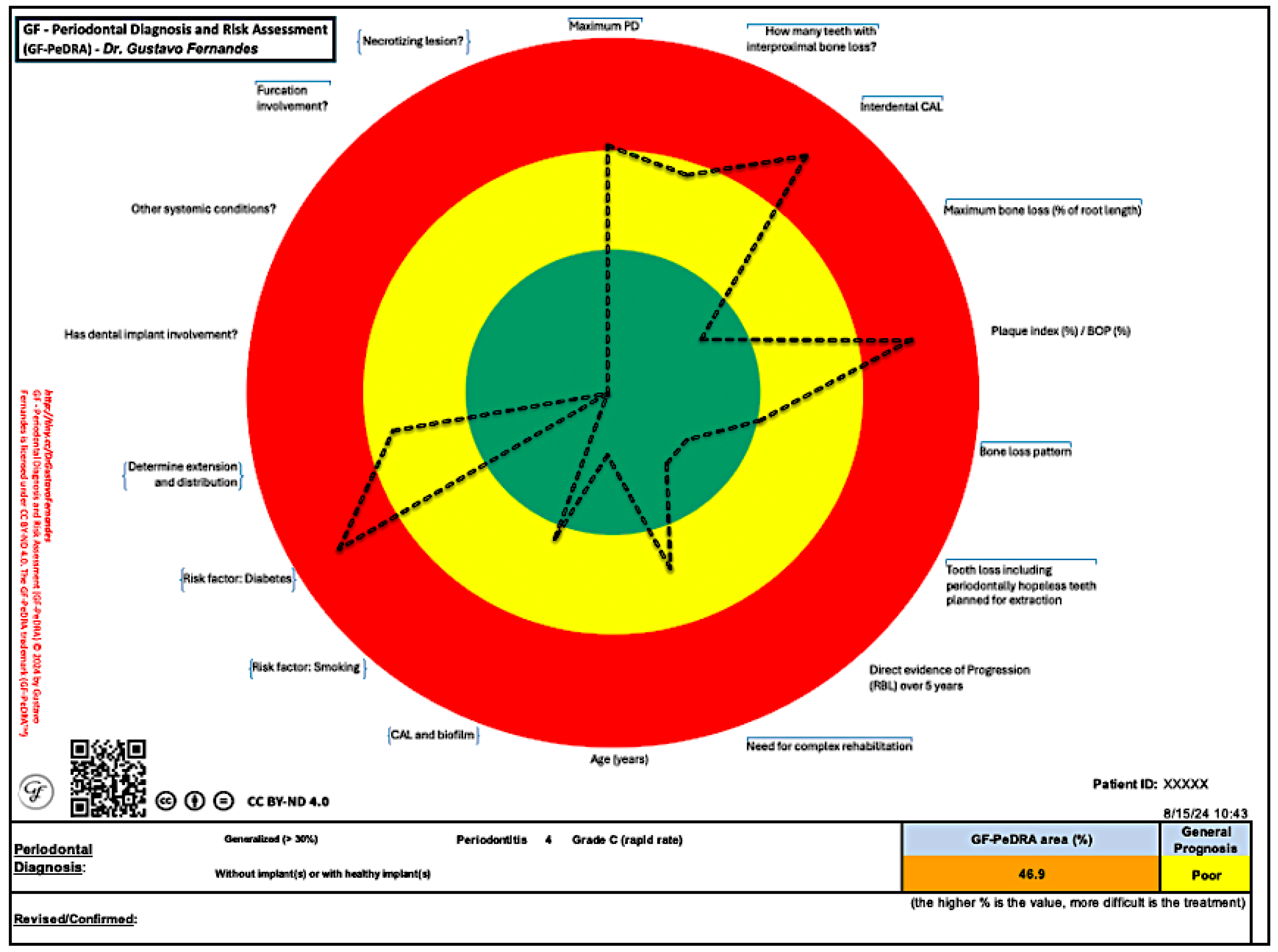
Table 2.
Diagnosis reported by evaluators and found in the GF-PeDRA© tool; and GF-PeDRA© score for prognosis.
Table 2.
Diagnosis reported by evaluators and found in the GF-PeDRA© tool; and GF-PeDRA© score for prognosis.
| Patient number |
Diagnosis (GVOF) |
Diagnosis (JCHF) |
Final Diagnosis (after discussion) |
Diagnosis (GF-PeDRA©) |
GF-PeDRA score (0-100%) |
Prognosis |
|---|---|---|---|---|---|---|
| 1 | Periodontitis III-C | Periodontitis IV-C | Periodontitis III-C | Periodontitis III-C | 41.4 | Questionable |
| 2 | Periodontitis IV-B | Periodontitis IV-B | Periodontitis IV-B | Periodontitis IV-B | 47.9 | Questionable |
| 3 | Periodontitis IV-B | Periodontitis IV-B | Periodontitis IV-B | Periodontitis IV-B | 41 | Questionable |
| 4 | gingivitis | gingivitis | gingivitis | gingivitis | 16.8 | Fair |
| 5 | gingivitis | gingivitis | gingivitis | gingivitis | 15.4 | Fair |
| 6 | gingivitis | Healthy periodontium | gingivitis | gingivitis | 9.4 | Good |
| 7 | gingivitis | gingivitis | gingivitis | gingivitis | 15.4 | Fair |
| 8 | Periodontitis III-C | Periodontitis IV-C | Periodontitis IV-C | Periodontitis IV-C | 48.8 | Questionable |
| 9 | Periodontitis I-B | Periodontitis I-B | Periodontitis I-B | Periodontitis I-B | 25.4 | Poor |
| 10 | gingivitis | gingivitis | gingivitis | gingivitis | 12.7 | Fair |
| 11 | Periodontitis IV-C | Periodontitis IV-C | Periodontitis IV-C | Periodontitis IV-C | 51.5 | Hopeless |
| 12 | gingivitis | gingivitis | gingivitis | gingivitis | 17.4 | Fair |
| 13 | Periodontitis I-B | Periodontitis II-B | Periodontitis I-B | Periodontitis I-B | 36.7 | Poor |
| 14 | gingivitis | gingivitis | gingivitis | gingivitis | 11.2 | Fair |
| 15 | Periodontitis III-C | Periodontitis III-C | Periodontitis III-C | Periodontitis III-C | 39.8 | Questionable |
| 16 | Periodontitis III-B | Periodontitis III-B | Periodontitis III-B | Periodontitis III-B | 32.4 | Poor |
| 17 | gingivitis | gingivitis | gingivitis | gingivitis | 7.4 | Good |
| 18 | gingivitis | gingivitis | gingivitis | gingivitis | 7.4 | Good |
| 19 | Healthy periodontium | Healthy periodontium | Healthy periodontium | Healthy periodontium | 1.7 | Good |
| 20 | Periodontitis IV-B | Periodontitis IV-B | Periodontitis IV-B | Periodontitis IV-B | 46.6 | Questionable |
| 21 | Periodontitis IV-B | Periodontitis IV-B | Periodontitis IV-B | Periodontitis IV-B | 48.2 | Questionable |
| 22 | gingivitis | gingivitis | gingivitis | gingivitis | 11.4 | Fair |
| 23 | Periodontitis III-B | Periodontitis III-B | Periodontitis III-B | Periodontitis III-B | 40.2 | Questionable |
| 24 | gingivitis | gingivitis | gingivitis | gingivitis | 17.1 | Fair |
| 25 | Periodontitis IV-B | Periodontitis IV-B | Periodontitis IV-B | Periodontitis IV-B | 44.8 | Questionable |
| 26 | Periodontitis IV-C | Periodontitis IV-C | Periodontitis IV-C | Periodontitis IV-C | 59.8 | Hopeless |
| 27 | gingivitis | gingivitis | gingivitis | gingivitis | 7.4 | Good |
| 28 | Periodontitis I-B | Periodontitis I-B | Periodontitis I-B | Periodontitis I-B | 24.4 | Fair |
| 29 | gingivitis | gingivitis | gingivitis | gingivitis | 9.7 | Good |
| 30 | Periodontitis II-B | Periodontitis II-B | Periodontitis II-B | Periodontitis II-B | 39.1 | Questionable |
| 31 | Periodontitis I-B | Periodontitis I-B | Periodontitis I-B | Periodontitis I-B | 27.1 | Poor |
| 32 | Periodontitis II-B | Periodontitis II-B | Periodontitis II-B | Periodontitis II-B | 26.8 | Poor |
| 33 | Healthy periodontium | Healthy periodontium | Healthy periodontium | Healthy periodontium | 7.4 | Good |
| 34 | gingivitis | gingivitis | gingivitis | gingivitis | 11.7 | Fair |
| 35 | Periodontitis III-B | Periodontitis IV-B | Periodontitis IV-B | Periodontitis IV-B | 45.7 | Questionable |
| 36 | gingivitis | gingivitis | gingivitis | gingivitis | 11.2 | Fair |
| 37 | gingivitis | gingivitis | gingivitis | gingivitis | 13.2 | Fair |
| 38 | Periodontitis I-C | Periodontitis I-C | Periodontitis I-C | Periodontitis I-C | 37.7 | Poor |
| 39 | Healthy periodontium | Healthy periodontium | Healthy periodontium | Healthy periodontium | 2.9 | Good |
| 40 | Periodontitis IV-C | Periodontitis IV-C | Periodontitis IV-C | Periodontitis IV-C | 64.1 | Hopeless |
| 41 | Healthy periodontium | gingivitis | Healthy periodontium | Healthy periodontium | 1.5 | Good |
| 42 | Healthy periodontium | Healthy periodontium | Healthy periodontium | Healthy periodontium | 7.4 | Good |
| 43 | gingivitis | gingivitis | gingivitis | gingivitis | 13.5 | Fair |
| 44 | Healthy periodontium | gingivitis | Healthy periodontium | Healthy periodontium | 3.2 | Good |
| 45 | gingivitis | gingivitis | gingivitis | gingivitis | 11.2 | Fair |
| 46 | Healthy periodontium | Healthy periodontium | Healthy periodontium | Healthy periodontium | 0.6 | Good |
| 47 | gingivitis | gingivitis | gingivitis | gingivitis | 13.2 | Fair |
| 48 | gingivitis | gingivitis | gingivitis | gingivitis | 6.4 | Good |
| 49 | gingivitis | gingivitis | gingivitis | gingivitis | 9.7 | Good |
| 50 | Periodontitis IV-B | Periodontitis IV-C | Periodontitis IV-C | Periodontitis IV-C | 43.4 | Questionable |
| 51 | gingivitis | gingivitis | gingivitis | gingivitis | 11.2 | Fair |
| 52 | Periodontitis II-B | Periodontitis III-B | Periodontitis II-B | Periodontitis II-B | 32.1 | Poor |
| 53 | Periodontitis IV-B | Periodontitis IV-B | Periodontitis IV-B | Periodontitis IV-B | 45.6 | Questionable |
| 54 | gingivitis | Healthy periodontium | gingivitis | gingivitis | 9.7 | Good |
| 55 | Healthy periodontium | Healthy periodontium | Healthy periodontium | Healthy periodontium | 1.0 | Good |
| 56 | molar/incisor Periodontitis III-C | molar/incisor Periodontitis III-C | molar/incisor Periodontitis III-C | molar/incisor Periodontitis III-C | 52.6 | Hopeless |
| 57 | gingivitis | gingivitis | gingivitis | gingivitis | 7.4 | Good |
| 58 | Periodontitis III-C | Periodontitis IV-C | Periodontitis III-C | Periodontitis III-C | 40.2 | Questionable |
| 59 | gingivitis | gingivitis | gingivitis | gingivitis | 13.5 | Fair |
| 60 | gingivitis | gingivitis | gingivitis | gingivitis | 10.2 | Fair |
| 61 | Periodontitis II-C | Periodontitis II-C | Periodontitis II-C | Periodontitis II-C | 41.3 | Questionable |
| 62 | Periodontitis III-B | Periodontitis III-B | Periodontitis III-B | Periodontitis III-B | 36.2 | Poor |
| 63 | Periodontitis III-C | Periodontitis III-C | Periodontitis III-C | Periodontitis III-C | 41.6 | Questionable |
| 64 | gingivitis | gingivitis | gingivitis | gingivitis | 9.7 | Good |
| 65 | gingivitis | gingivitis | gingivitis | gingivitis | 11.2 | Fair |
| 66 | Periodontitis I-B | Periodontitis I-B | Periodontitis I-B | Periodontitis I-B | 31.2 | Poor |
| 67 | Periodontitis I-C | Periodontitis I-B | Periodontitis I-C | Periodontitis I-C | 36.1 | Poor |
| 68 | gingivitis | gingivitis | gingivitis | gingivitis | 12.3 | Fair |
| 69 | Periodontitis I-A | Periodontitis I-A | Periodontitis I-A | Periodontitis I-A | 31.5 | Poor |
| 70 | Periodontitis III-C | Periodontitis III-C | Periodontitis III-C | Periodontitis III-C | 45 | Questionable |
| 71 | Periodontitis II-B | Periodontitis II-B | Periodontitis II-B | Periodontitis II-B | 39 | Questionable |
| 72 | Periodontitis IV-C | Periodontitis IV-C | Periodontitis IV-C | Periodontitis IV-C | 46.8 | Questionable |
| 73 | Periodontitis III-C | Periodontitis III-C | Periodontitis III-C | Periodontitis III-C | 45 | Questionable |
| 74 | gingivitis | gingivitis | gingivitis | gingivitis | 9.4 | Good |
| 75 | Periodontitis I-B | Periodontitis IV-B | Periodontitis I-B | Periodontitis I-B | 38.5 | Questionable |
| 76 | Periodontitis II-C | Periodontitis II-C | Periodontitis II-C | Periodontitis II-C | 35.2 | Poor |
| 77 | Periodontitis I-C | Periodontitis I-C | Periodontitis I-C | Periodontitis I-C | 34.1 | Poor |
| 78 | Periodontitis IV-B | Periodontitis IV-B | Periodontitis IV-B | Periodontitis IV-B | 49.6 | Questionable |
| 79 | Healthy periodontium | Healthy periodontium | Healthy periodontium | Healthy periodontium | 3.5 | Good |
| 80 | Healthy periodontium | gingivitis | Healthy periodontium | Healthy periodontium | 12.4 | Fair |
| 81 | Periodontitis IV-C | Periodontitis IV-B | Periodontitis IV-B | Periodontitis IV-B | 39 | Questionable |
| 82 | Periodontitis III-B | Periodontitis IV-B | Periodontitis III-B | Periodontitis III-B | 43.3 | Questionable |
| 83 | Periodontitis IV-C | Periodontitis IV-C | Periodontitis IV-C | Periodontitis IV-C | 55.5 | Hopeless |
| 84 | Periodontitis IV-B | Periodontitis IV-B | Periodontitis IV-B | Periodontitis IV-B | 41 | Questionable |
| 85 | Periodontitis II-A | Periodontitis II-A | Periodontitis II-A | Periodontitis II-A | 42.3 | Questionable |
| 86 | Periodontitis I-A | Periodontitis I-A | Periodontitis I-A | Periodontitis I-A | 35.9 | Poor |
| 87 | Periodontitis II-B | Periodontitis II-B | Periodontitis II-B | Periodontitis II-B | 41.5 | Questionable |
| 88 | Periodontitis II-B | Periodontitis II-B | Periodontitis II-B | Periodontitis II-B | 33.5 | Poor |
| 89 | Periodontitis III-B | Periodontitis III-B | Periodontitis III-B | Periodontitis III-B | 40.6 | Questionable |
| 90 | Periodontitis IV-C | Periodontitis IV-C | Periodontitis IV-C | Periodontitis IV-C | 63.3 | Hopeless |
| 91 | Periodontitis II-B | Periodontitis II-B | Periodontitis II-B | Periodontitis II-B | 40.3 | Questionable |
| 92 | gingivitis | gingivitis | gingivitis | gingivitis | 17.4 | Fair |
| 93 | gingivitis | gingivitis | gingivitis | gingivitis | 15.4 | Fair |
| 94 | Periodontitis I-A | Periodontitis II-A | Periodontitis I-A | Periodontitis I-A | 26.8 | Poor |
| 95 | Periodontitis III-B | Periodontitis III-B | Periodontitis III-B | Periodontitis III-B | 29.4 | Poor |
| 96 | Healthy periodontium | Healthy periodontium | Healthy periodontium | Healthy periodontium | 3.5 | Good |
| 97 | Periodontitis I-B | Periodontitis I-B | Periodontitis I-B | Periodontitis I-B | 26.3 | Poor |
| 98 | gingivitis | gingivitis | gingivitis | gingivitis | 7.4 | Good |
| 99 | Periodontitis I-B | Periodontitis I-B | Periodontitis I-B | Periodontitis I-B | 27.7 | Poor |
| 100 | gingivitis | Healthy periodontium | gingivitis | gingivitis | 7.4 | Good |
| 101 | Periodontitis IV-B | Periodontitis IV-B | Periodontitis IV-B | Periodontitis IV-B | 53.1 | Hopeless |
| 102 | Periodontitis III-B | Periodontitis III-B | Periodontitis III-B | Periodontitis III-B | 48.4 | Questionable |
| 103 | Periodontitis I-A | Periodontitis I-A | Periodontitis I-A | Periodontitis I-A | 32.2 | Poor |
| 104 | Periodontitis III-C | Periodontitis IV-C | Periodontitis III-C | Periodontitis III-C | 42.2 | Questionable |
| 105 | Periodontitis IV-B | Periodontitis IV-B | Periodontitis IV-B | Periodontitis IV-B | 42.9 | Questionable |
| 106 | Healthy periodontium | Healthy periodontium | Healthy periodontium | Healthy periodontium | 2.9 | Good |
| 107 | Periodontitis III-B | Periodontitis IV-B | Periodontitis III-B | Periodontitis III-B | 39.3 | Questionable |
| 108 | Periodontitis IV-B | Periodontitis IV-B | Periodontitis IV-B | Periodontitis IV-B | 37.3 | Poor |
| 109 | Periodontitis IV-B | Periodontitis IV-B | Periodontitis IV-B | Periodontitis IV-B | 52.6 | Hopeless |
| 110 | Periodontitis III-B | Periodontitis III-B | Periodontitis III-B | Periodontitis III-B | 43.3 | Questionable |
| 111 | Periodontitis IV-C | Periodontitis IV-C | Periodontitis IV-C | Periodontitis IV-C | 58.2 | Hopeless |
| 112 | Healthy periodontium | Healthy periodontium | Healthy periodontium | Healthy periodontium | 5.8 | Good |
| 113 | Periodontitis IV-B | Periodontitis IV-B | Periodontitis IV-B | Periodontitis IV-B | 46.3 | Questionable |
| 114 | Periodontitis II-B | Periodontitis II-B | Periodontitis II-B | Periodontitis II-B | 37.6 | Poor |
| 115 | Periodontitis I-B | Periodontitis I-B | Periodontitis I-B | Periodontitis I-B | 30 | Poor |
| 116 | gingivitis | gingivitis | gingivitis | gingivitis | 17.4 | Fair |
| 117 | gingivitis | gingivitis | gingivitis | gingivitis | 9.4 | Good |
| 118 | Periodontitis IV-B | Periodontitis IV-B | Periodontitis IV-B | Periodontitis IV-B | 47.1 | Questionable |
| 119 | gingivitis | gingivitis | gingivitis | gingivitis | 8.4 | Good |
| 120 | Periodontitis IV-B | Periodontitis III-B | Periodontitis IV-B | Periodontitis IV-B | 50 | Hopeless |
| 121 | Periodontitis IV-B | Periodontitis IV-B | Periodontitis IV-B | Periodontitis IV-B | 50.8 | Hopeless |
| 122 | Periodontitis III-C | Periodontitis III-C | Periodontitis III-C | Periodontitis III-C | 40.2 | Questionable |
| 123 | Periodontitis IV-C | Periodontitis IV-C | Periodontitis IV-C | Periodontitis IV-C | 46.6 | Questionable |
| 124 | Periodontitis IV-B | Periodontitis IV-B | Periodontitis IV-B | Periodontitis IV-B | 52.7 | Hopeless |
| 125 | Periodontitis I-B | Periodontitis I-B | Periodontitis I-B | Periodontitis I-B | 30.2 | Poor |
| 126 | Healthy periodontium | Healthy periodontium | Healthy periodontium | Healthy periodontium | 5.2 | Good |
| 127 | gingivitis | Healthy periodontium | gingivitis | gingivitis | 9.7 | Good |
| 128 | Periodontitis II-C | Periodontitis II-C | Periodontitis II-C | Periodontitis II-C | 40.8 | Questionable |
| 129 | Healthy periodontium | Healthy periodontium | Healthy periodontium | Healthy periodontium | 5.8 | Good |
| 130 | Periodontitis IV-B | Periodontitis IV-B | Periodontitis IV-B | Periodontitis IV-B | 43.2 | Questionable |
| 131 | Periodontitis III-B | Periodontitis III-B | Periodontitis III-B | Periodontitis III-B | 41.9 | Questionable |
| 132 | Periodontitis II-B | Periodontitis I-B | Periodontitis I-B | Periodontitis I-B | 26.6 | Poor |
| 133 | Periodontitis II-C | Periodontitis II-C | Periodontitis II-C | Periodontitis II-C | 39 | Questionable |
| 134 | Healthy periodontium | Healthy periodontium | Healthy periodontium | Healthy periodontium | 7.5 | Good |
| 135 | Periodontitis III-B | Periodontitis IV-B | Periodontitis III-B | Periodontitis III-B | 39.6 | Questionable |
| 136 | Periodontitis I-A | Periodontitis I-A | Periodontitis I-A | Periodontitis I-A | 23.1 | Fair |
| 137 | Periodontitis IV-B | Periodontitis IV-B | Periodontitis IV-B | Periodontitis IV-B | 40 | Questionable |
| 138 | Periodontitis IV-B | Periodontitis IV-B | Periodontitis IV-B | Periodontitis IV-B | 37.3 | Poor |
| 139 | Periodontitis III-B | Periodontitis III-B | Periodontitis III-B | Periodontitis III-B | 41.6 | Questionable |
| 140 | Healthy periodontium | Healthy periodontium | Healthy periodontium | Healthy periodontium | 1 | Good |
| 141 | Periodontitis II-B | Periodontitis II-B | Periodontitis II-B | Periodontitis II-B | 24.9 | Fair |
| 142 | Periodontitis III-B | Periodontitis III-B | Periodontitis III-B | Periodontitis III-B | 34.8 | Poor |
| 143 | Periodontitis I-A | Periodontitis II-A | Periodontitis I-A | Periodontitis I-A | 30.1 | Poor |
| 144 | Periodontitis III-B | Periodontitis III-B | Periodontitis III-B | Periodontitis III-B | 39.2 | Questionable |
| 145 | Periodontitis I-B | Periodontitis I-B | Periodontitis I-B | Periodontitis I-B | 24.9 | Fair |
| 146 | gingivitis | gingivitis | gingivitis | gingivitis | 13.3 | Fair |
| 147 | Healthy periodontium | Healthy periodontium | Healthy periodontium | Healthy periodontium | 3.3 | Good |
| 148 | Periodontitis II-C | Periodontitis II-C | Periodontitis II-C | Periodontitis II-C | 35.7 | Poor |
| 149 | gingivitis | gingivitis | gingivitis | gingivitis | 9.4 | Good |
| 150 | gingivitis | gingivitis | gingivitis | gingivitis | 6.4 | Good |
| 151 | Periodontitis I-B | Periodontitis I-B | Periodontitis I-B | Periodontitis I-B | 29.8 | Poor |
| 152 | Periodontitis I-B | Periodontitis I-B | Periodontitis I-B | Periodontitis I-B | 21.6 | Fair |
| 153 | gingivitis | gingivitis | gingivitis | gingivitis | 9.7 | Good |
| 154 | Periodontitis I-B | Periodontitis I-B | Periodontitis I-B | Periodontitis I-B | 35.6 | Poor |
| 155 | Periodontitis IV-B | Periodontitis IV-B | Periodontitis IV-B | Periodontitis IV-B | 55 | Hopeless |
| 156 | gingivitis | Healthy periodontium | gingivitis | gingivitis | 7.4 | Good |
| 157 | Periodontitis IV-B | Periodontitis IV-B | Periodontitis IV-B | Periodontitis IV-B | 51.7 | Hopeless |
| 158 | Periodontitis IV-B | Periodontitis III-B | Periodontitis IV-B | Periodontitis IV-B | 41.8 | Questionable |
| 159 | Periodontitis II-C | Periodontitis II-C | Periodontitis II-C | Periodontitis II-C | 35.1 | Poor |
| 160 | Periodontitis IV-C | Periodontitis IV-C | Periodontitis IV-C | Periodontitis IV-C | 45.5 | Questionable |
| 161 | Periodontitis IV-B | Periodontitis IV-B | Periodontitis IV-B | Periodontitis IV-B | 40.9 | Questionable |
| 162 | gingivitis | gingivitis | gingivitis | gingivitis | 7.4 | Good |
| 163 | gingivitis | gingivitis | gingivitis | gingivitis | 13.2 | Fair |
| 164 | gingivitis | gingivitis | gingivitis | gingivitis | 14.3 | Fair |
| 165 | Periodontitis I-C | Periodontitis I-C | Periodontitis I-C | Periodontitis I-C | 37.1 | Poor |
| 166 | Healthy periodontium | Healthy periodontium | Healthy periodontium | Healthy periodontium | 3.5 | Good |
| 167 | Healthy periodontium | Healthy periodontium | Healthy periodontium | Healthy periodontium | 5.2 | Good |
| 168 | Periodontitis IV-B | Periodontitis IV-B | Periodontitis IV-B | Periodontitis IV-B | 54.9 | Hopeless |
| 169 | Periodontitis IV-C | Periodontitis IV-C | Periodontitis IV-C | Periodontitis IV-C | 40.4 | Questionable |
| 170 | Periodontitis IV-B | Periodontitis IV-B | Periodontitis IV-B | Periodontitis IV-B | 44.6 | Questionable |
| 171 | Periodontitis IV-C | Periodontitis IV-C | Periodontitis IV-C | Periodontitis IV-C | 54.5 | Hopeless |
| 172 | Periodontitis I-B | Periodontitis I-B | Periodontitis I-B | Periodontitis I-B | 34.5 | Poor |
| 173 | gingivitis | gingivitis | gingivitis | gingivitis | 17.1 | Fair |
| 174 | Periodontitis IV-B | Periodontitis IV-B | Periodontitis IV-B | Periodontitis IV-B | 47.3 | Questionable |
| 175 | gingivitis | gingivitis | gingivitis | gingivitis | 17.1 | Fair |
| 176 | Periodontitis IV-B | Periodontitis IV-B | Periodontitis IV-B | Periodontitis IV-B | 35.7 | Poor |
| 177 | Periodontitis I-A | Periodontitis I-A | Periodontitis I-A | Periodontitis I-A | 22.4 | Fair |
| 178 | Periodontitis III-B | Periodontitis III-B | Periodontitis III-B | Periodontitis III-B | 47 | Questionable |
| 179 | Periodontitis III-B | Periodontitis IV-B | Periodontitis III-B | Periodontitis III-B | 37 | Poor |
| 180 | Periodontitis IV-C | Periodontitis IV-B | Periodontitis IV-B | Periodontitis IV-B | 44.1 | Questionable |
| 181 | gingivitis | Healthy periodontium | gingivitis | gingivitis | 10 | Fair |
| 182 | gingivitis | gingivitis | gingivitis | gingivitis | 15.1 | Fair |
| 183 | Healthy periodontium | Healthy periodontium | Healthy periodontium | Healthy periodontium | 4.9 | Good |
| 184 | Periodontitis II-B | Periodontitis II-B | Periodontitis II-B | Periodontitis II-B | 29.5 | Poor |
| 185 | gingivitis | gingivitis | 9.7 | Good | ||
| 186 | Periodontitis III-A | Periodontitis III-A | Periodontitis III-A | Periodontitis III-A | 38 | Questionable |
| 187 | Periodontitis III-A | Periodontitis III-A | Periodontitis III-A | Periodontitis III-A | 42.6 | Questionable |
| 188 | Healthy periodontium | Healthy periodontium | Healthy periodontium | Healthy periodontium | 3.3 | Good |
| 189 | Periodontitis I-B | Periodontitis I-B | Periodontitis I-B | Periodontitis I-B | 31.8 | Poor |
| 190 | Healthy periodontium | Healthy periodontium | Healthy periodontium | Healthy periodontium | 10.7 | Fair |
| 191 | Periodontitis III-B | Periodontitis III-A | Periodontitis III-A | Periodontitis III-A | 36.3 | Poor |
| 192 | Periodontitis III-B | Periodontitis III-B | Periodontitis III-B | Periodontitis III-B | 44 | Questionable |
| 193 | Healthy periodontium | gingivitis | Healthy periodontium | Healthy periodontium | 3.5 | Good |
| 194 | gingivitis | gingivitis | gingivitis | gingivitis | 22 | Fair |
| 195 | Periodontitis I-A | Periodontitis I-A | Periodontitis I-A | Periodontitis I-A | 25.5 | Poor |
| 196 | Periodontitis III-B | Periodontitis IV-B | Periodontitis III-B | Periodontitis III-B | 41.7 | Questionable |
| 197 | Healthy periodontium | Healthy periodontium | Healthy periodontium | Healthy periodontium | 7.5 | Good |
| 198 | Periodontitis III-B | Periodontitis III-B | Periodontitis III-B | Periodontitis III-B | 42.4 | Questionable |
| 199 | Periodontitis IV-C | Periodontitis IV-C | Periodontitis IV-C | Periodontitis IV-C | 45.3 | Questionable |
| 200 | Periodontitis III-C | Periodontitis III-C | Periodontitis III-C | Periodontitis III-C | 41.2 | Questionable |
| 201 | Periodontitis I-B | Periodontitis I-B | Periodontitis I-B | Periodontitis I-B | 33.4 | Poor |
| 202 | Healthy periodontium | Healthy periodontium | Healthy periodontium | Healthy periodontium | 14.3 | Fair |
| 203 | Periodontitis IV-B | Periodontitis IV-B | Periodontitis IV-B | Periodontitis IV-B | 43.3 | Questionable |
| 204 | Periodontitis III-C | Periodontitis III-C | Periodontitis III-C | Periodontitis III-C | 47.2 | Questionable |
| 205 | Periodontitis III-B | Periodontitis III-B | Periodontitis III-B | Periodontitis III-B | 37.1 | Poor |
| 206 | Periodontitis IV-B | Periodontitis IV-B | Periodontitis IV-B | Periodontitis IV-B | 42.2 | Questionable |
| 207 | gingivitis | gingivitis | gingivitis | gingivitis | 9.7 | Good |
| 208 | Periodontitis I-B | Periodontitis I-B | Periodontitis I-B | Periodontitis I-B | 28.9 | Poor |
| 209 | Periodontitis II-B | Periodontitis IV-B | Periodontitis II-B | Periodontitis II-B | 39.7 | Questionable |
| 210 | gingivitis | gingivitis | gingivitis | gingivitis | 11.2 | Fair |
| 211 | Healthy periodontium | Healthy periodontium | Healthy periodontium | Healthy periodontium | 11.6 | Fair |
| 212 | Healthy periodontium | gingivitis | Healthy periodontium | Healthy periodontium | 5.5 | Good |
| 213 | Periodontitis IV-B | Periodontitis IV-B | Periodontitis IV-B | Periodontitis IV-B | 47.1 | Questionable |
| 214 | Periodontitis IV-B | Periodontitis IV-B | Periodontitis IV-B | Periodontitis IV-B | 47.7 | Questionable |
| 215 | Periodontitis IV-C | Periodontitis IV-C | Periodontitis IV-C | Periodontitis IV-C | 51.3 | Hopeless |
| 216 | gingivitis | gingivitis | gingivitis | gingivitis | 9.7 | Good |
| 217 | Periodontitis III-C | Periodontitis III-C | Periodontitis III-C | Periodontitis III-C | 48 | Questionable |
| 218 | Periodontitis I-A | Periodontitis II-A | Periodontitis I-A | Periodontitis I-A | 19.4 | Fair |
| 219 | Periodontitis I-A | Periodontitis I-A | Periodontitis I-A | Periodontitis I-A | 18.2 | Fair |
| 220 | Periodontitis IV-C | Periodontitis IV-C | Periodontitis IV-C | Periodontitis IV-C | 51.4 | Hopeless |
| 221 | Periodontitis IV-C | Periodontitis III-C | Periodontitis IV-C | Periodontitis IV-C | 50.7 | Hopeless |
Disclaimer/Publisher’s Note: The statements, opinions and data contained in all publications are solely those of the individual author(s) and contributor(s) and not of MDPI and/or the editor(s). MDPI and/or the editor(s) disclaim responsibility for any injury to people or property resulting from any ideas, methods, instructions or products referred to in the content. |
© 2024 by the authors. Licensee MDPI, Basel, Switzerland. This article is an open access article distributed under the terms and conditions of the Creative Commons Attribution (CC BY) license (http://creativecommons.org/licenses/by/4.0/).
Copyright: This open access article is published under a Creative Commons CC BY 4.0 license, which permit the free download, distribution, and reuse, provided that the author and preprint are cited in any reuse.


