

Submitted:
21 August 2024
Posted:
21 August 2024
You are already at the latest version
Abstract
Tropical regions face unique challenges in building sustainability due to high temperatures, humidity, and heavy rainfall. While building energy regulations are essential for promoting energy efficiency, their effectiveness in addressing tropical climate conditions needs to be studied more. This research aims to systematically investigate tropical building sustainability issues and evaluate the impacts of building energy regulations on these challenges. The study will identify gaps in current regulations by analyzing existing research and recommend strategies for developing more comprehensive frameworks that promote sustainable building practices in tropical regions. This research contributes to developing effective policies and strategies for achieving sustainable and energy-efficient built environments in tropical climates.
Keywords:
Building energy regulations
; Tropical climate
; Sustainable buildings
; Energy efficiency
; Passive design
1. Introduction
The built environment significantly impacts global resource consumption and environmental pollution (UNEP, 2022). Promoting building sustainability is crucial for mitigating these impacts and ensuring a healthy planet for future generations. In tropical regions, achieving building sustainability presents unique challenges. The tropics cover a vast region characterized by distinct climatic conditions, vegetation patterns, and economic realities significantly influencing building sustainability practices.
In the tropics, high temperatures and humidity throughout the year create a significant demand for space cooling, often leading to increased energy consumption from mechanical air conditioning systems (Bulbaai & Halman, 2021). These traditional cooling methods can contribute to greenhouse gas emissions and raise concerns about long-term energy security (Jaysawal et al., 2022).
Furthermore, tropical climates often experience heavy rainfall, requiring careful design considerations to manage water runoff and prevent moisture infiltration within buildings (Bachrun et al., 2019). Sustainable building practices in these regions must address these specific climatic factors to optimize energy efficiency, resource conservation, and occupant comfort.
Building energy regulations are a cornerstone for promoting energy efficiency in the construction sector (Lu et al., 2020). These regulations establish minimum performance standards for building energy consumption (International Energy Agency, 2023). By setting these standards, they:
- i.
- Drive innovation: Regulations encourage developing and adopting energy-efficient technologies and building practices (Roberta, 2021). Builders and designers are incentivized to find creative solutions to meet or exceed the established thresholds.
- ii.
- Reduce operational costs: Buildings that comply with energy regulations are more efficient, leading to lower energy bills for occupants and owners (European Commission, 2020).
- iii.
- Minimize environmental impact: Reduced energy consumption in buildings reduces greenhouse gas emissions, contributing to a more sustainable built environment (Lu et al., 2020).
While building energy regulations are instrumental in driving energy efficiency in the construction industry, a critical gap exists in understanding how effectively they address the unique challenges of achieving building sustainability in tropical climates (Aste et al., 2020). Existing regulations often prioritize generic energy consumption metrics, potentially overlooking factors like high temperatures, humidity, and the potential for passive cooling techniques specific to tropical environments (Jaysawal et al., 2022). This can lead to situations where buildings meet baseline energy efficiency requirements but still rely heavily on mechanical cooling systems, ultimately undermining the potential benefits for overall building sustainability (Bachrun et al., 2019).
This research gap necessitates a systematic review of building energy regulations to identify areas where they may fall short in addressing the specificities of tropical climates. By analyzing existing research, this study aims to bridge this knowledge gap and inform the development of more comprehensive regulations that promote sustainable building practices in tropical regions.
This research aims to systematically investigate tropical building sustainability issues to evaluate the impacts of building energy regulations. Building energy regulations are essential for promoting energy efficiency in the construction sector (International Energy Agency, 2023). However, their effectiveness in addressing the unique challenges of tropical climates still needs to be explored.
Through a systematic review of existing academic Literature, this study will:
- i.
- Examine tropical building sustainability issues.
- ii.
- Examine building energy regulation issues.
- iii.
- Investigate the impacts of building energy regulation on tropical building sustainability.
- iv.
- Analyze the gaps in building energy regulations on overall tropical building sustainability.
By analyzing relevant research, this study aims to bridge the knowledge gap in this area and inform the development of more comprehensive building energy regulations better suited to promoting sustainable buildings in tropical contexts.
2. Methodology
This research employed a systematic review methodology to analyze the relationship between building energy regulations and tropical building sustainability issues. A systematic review provides a rigorous and transparent approach to identifying and synthesizing relevant research (Tawfik et al., 2019).
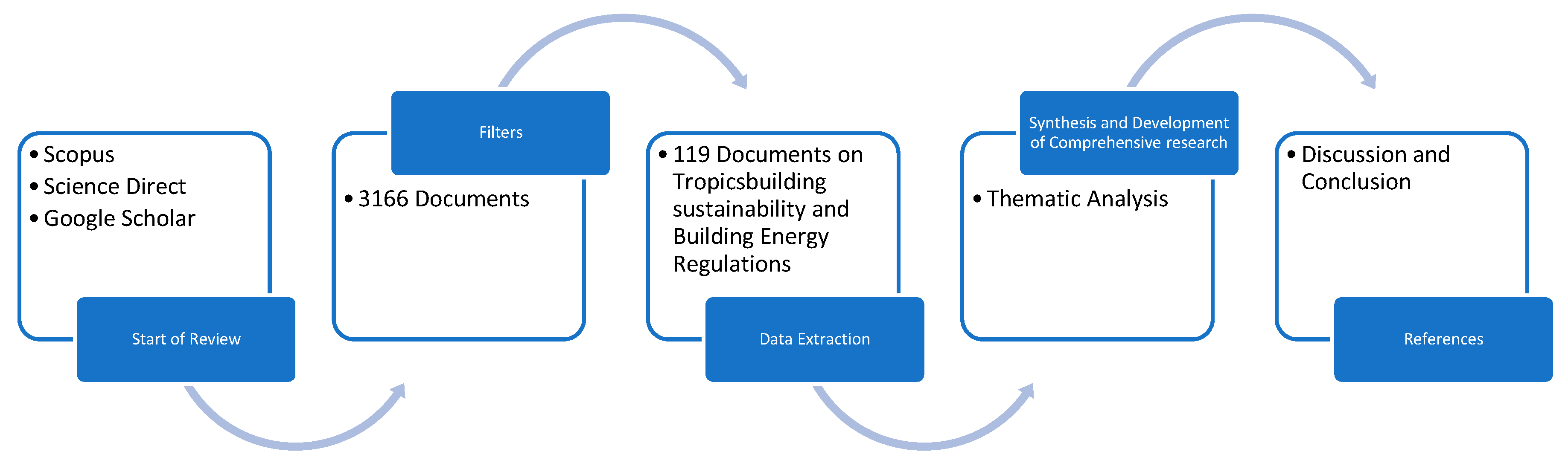
The review utilized multiple academic databases relevant to building science, sustainability, and energy efficiency. Examples include Scopus, Science-direct and Google-scholar. A comprehensive search string was developed by combining keywords related to tropical building sustainability, building energy regulations, energy efficiency (in tropical climates), sustainable building practices, tropical building design, climate-responsive architecture (Howick et al., 2022) Boolean operators (and, or, not) was used to ensure a focused search that retrieves relevant studies. The search was limited to peer-reviewed academic journals published in English within the last five years (2020-2024) to ensure access to the most recent research findings.
Studies were included in the review once they met the following criteria:
- i.
- Focus: The study addresses the relationship between building energy regulations and tropical building sustainability.
- ii.
- Research Method: The study employs empirical research methods (e.g., case studies, surveys, comparative analysis) to analyze the effectiveness or limitations of building energy regulations in tropical contexts.
- iii.
- Publication Type: The study is a peer-reviewed research article published in an academic journal.
- iv.
- Language: The study is published in English.
Studies were excluded for the following reasons:
- i.
- They focused on non-tropical climates.
- ii.
- They primarily discuss theoretical frameworks without empirical analysis of regulations.
- iii.
- They were non-academic publications such as editorials, opinion pieces, or book reviews.
- iv.
- They were published in languages other than English.
Following the initial search and inclusion/exclusion criteria application, the retrieved studies were further assessed through a full-text review. Data was extracted from the included studies using a pre-designed data extraction form. This form captured vital information such as the study's research question, methodology, findings related to regulations and tropical building sustainability, and any identified limitations of regulations in achieving overall sustainability goals.
A thematic analysis approach was then employed to identify recurring themes and patterns across the included studies (Braun & Victoria, 2006). This allowed for the synthesis of existing research and the development of a comprehensive understanding of how building energy regulations address – or fail to address – the specific challenges of sustainable building practices in tropical regions.
Figure 1.
Research Methodological Process.
3. Literature Review
Reviewed Literature are discussed under the following sub-themes:
- i.
- Tropical building sustainability principles
- ii.
- Building energy regulations and their impact on energy efficiency in general.
- iii.
- The limitations of current regulations in addressing tropical contexts
3.1. Tropical Building Sustainability Principles
To optimize energy efficiency and environmental impact in hot and humid regions, building design must incorporate tropical sustainability principles. These principles prioritize natural ventilation, solar heat reduction, thermal insulation, and the use of eco-friendly materials.
Natural ventilation is a cornerstone of sustainable building design in tropical climates. By harnessing the power of wind and temperature differences, it reduces reliance on energy-intensive mechanical cooling systems. Effective natural ventilation systems not only enhance indoor air quality but also contribute to thermal comfort by expelling hot, humid air and introducing fresh air into living spaces. Studies have shown that buildings designed with effective natural ventilation strategies can significantly improve thermal comfort. For instance, Jiang et al. (2023) found that incorporating cross-ventilation and stack ventilation in building designs can reduce indoor temperatures by up to 3°C, thus decreasing the need for air conditioning. Additionally, the strategic placement of windows and vents and atriums and courtyards can enhance airflow and promote passive cooling (Stasi et al., 2024).
Solar control is another critical aspect of tropical building sustainability. It involves managing the amount of solar radiation entering a building to minimize heat gain and reduce cooling loads. Effective solar control can be achieved through shading devices, reflective materials, and the orientation of the building. By employing shading devices like overhangs, louvers, and external blinds, it's possible to regulate sunlight, preventing direct exposure while admitting softened light. According to a study by Rana et al. (2021), buildings equipped with adjustable shading devices can reduce cooling energy consumption by up to 20%. Using reflective materials for roofs and facades also significantly reflects solar radiation and reduces heat absorption (Irfeey et al., 2023).
To counter the intense heat in tropical areas, thermal insulation is vital for minimizing heat transfer through building components. By creating a thermally efficient environment, it lessens the dependence on mechanical cooling systems. Research by Falzon et al. (2023) indicates that using high-performance insulation materials, such as reflective foils and insulated concrete forms, can enhance the thermal performance of buildings and achieve significant energy savings.
The choice of sustainable materials is crucial for the overall sustainability of tropical buildings. Materials with low thermal mass and high reflectivity are preferred to minimize heat gain. Additionally, using locally sourced, renewable, and recycled materials can reduce the environmental impact of construction and promote resource efficiency. A study by Madhushan et al. (2023) highlights the benefits of using bamboo, a renewable material with excellent thermal properties, in tropical building construction. The research demonstrates that bamboo-based construction can reduce carbon emissions and enhance the sustainability of buildings in tropical regions.
Integrating these principles into a cohesive design approach is vital for maximizing the sustainability of tropical buildings. Holistic design strategies that combine natural ventilation, solar control, thermal insulation, and sustainable materials can create energy-efficient, comfortable, and environmentally friendly buildings. For example, a case study by Deshpande et al. (2023) on commercial buildings in Mumbai demonstrated that incorporating these principles resulted in a significant reduction in energy consumption compared to conventional buildings. The buildings utilized green building design strategies through extensive use of green roofs, solar panels, and floor area optimization.
In conclusion, tropical building sustainability principles, including natural ventilation, solar control, thermal insulation, and sustainable materials, enhance buildings' energy efficiency and environmental performance in hot and humid climates. By adopting these principles, architects and designers can create energy-efficient, comfortable, and environmentally sustainable buildings.
3.2. Building Energy Regulations and Their Impact on Energy Efficiency
Building energy regulations have been instrumental in promoting energy efficiency and reducing carbon emissions in the construction and operation of buildings. These regulations typically contain a range of requirements, including standards for insulation, windows, heating and cooling systems, lighting, and integrating renewable energy sources. The impact of these regulations on energy efficiency has been widely studied, revealing successes and areas needing improvement.
Energy efficiency standards are a fundamental component of building energy regulations. These standards establish minimum performance criteria for various building components, ensuring that new constructions and major renovations meet specific energy efficiency benchmarks. Studies have shown that stringent energy efficiency standards can significantly reduce energy consumption in buildings. For instance, implementing the 2020 EU Energy Performance of Buildings Directive (EPBD) resulted in a 25% reduction in energy use in new buildings (European Commission, 2020). Similar impacts have been observed in other regions with robust energy codes (Office of NEPA Policy and Compliance, 2020)
The building envelope, including walls, roofs, and windows, plays a critical role in a building's energy performance. Regulations that mandate high levels of thermal insulation and the use of energy-efficient windows can drastically reduce the need for heating and cooling, which are major energy consumers in buildings. A Buyak (2023) study found that buildings compliant with insulation standards based on the Swedish norms in Kyiv, Ukraine, consumed 32% less energy for heating and cooling than those built to meet the base version of thermal resistance.
HVAC systems are significant contributors to energy consumption in buildings. Regulations often require the installation of energy-efficient HVAC systems and regular maintenance to ensure optimal performance. The introduction of minimum energy performance standards (MEPS) for HVAC systems in Australia led to a 20% improvement in energy efficiency (Berry et al., 2022). Furthermore, incentivizing advanced HVAC technologies, such as variable refrigerant flow (VRF) systems, has shown substantial energy savings (Olatunde et al., 2024).
Lighting regulations typically mandate using energy-efficient lighting fixtures and controls, such as LED lights and automatic dimming systems. According to a report by the International Energy Agency (International Energy Agency, 2023), the global adoption of energy-efficient lighting could reduce electricity demand for lighting by 50%. Regulations promoting intelligent lighting systems have also contributed to significant energy savings by ensuring that lights are only used when necessary (Oluseyi et al., 2020).
Incorporating renewable energy sources like solar panels into building energy regulations can enhance energy efficiency and sustainability. The California Building Standards Code (Title 24) requires all new residential buildings to include solar photovoltaic systems, resulting in a substantial increase in renewable energy generation and a corresponding decrease in grid electricity consumption (California Energy Commission, 2020).
Performance-based regulations, which focus on the actual energy performance of buildings rather than prescriptive measures, are gaining traction. These regulations often require buildings to achieve specific energy use intensity (EUI) targets. The research of Su et al. (2022) revealed a consistent annual energy efficiency growth of 1.8%, resulting in a total energy consumption reduction of 29.9% during the study period.
3.3. The Limitations of Current Regulations in Addressing Tropical Contexts
While building energy regulations have effectively promoted energy efficiency and reduced carbon emissions, they often need to catch up when applied to tropical contexts. The unique climatic conditions and environmental challenges of tropical regions require tailored approaches that are only sometimes adequately addressed by existing regulations.
Many building energy regulations are developed with temperate climates in mind, leading to guidelines that may not be suitable for tropical conditions. For example, insulation standards that retain heat in colder climates can lead to overheating in tropical regions. According to Bo et al. (2022), these inappropriate standards can increase reliance on air conditioning, negating the intended energy savings. Similarly, building envelope requirements that are effective in temperate climates may not account for the high humidity and intense solar radiation typical of tropical areas, leading to inefficiencies (Liu et al., 2022)
Natural ventilation, shading, and reflective materials are key passive design strategies for achieving and maintaining thermal comfort in tropical environments. However, many building energy regulations emphasize active systems like HVAC and insulation, often overlooking the benefits of passive design (Papadakis & Katsaprakakis, 2023). For instance, the research by Jaouaf et al. (2024) highlights that while passive cooling techniques can reduce energy consumption by over 40%, they need to be sufficiently incorporated into regulatory frameworks.
Regulations often prescribe using specific materials and construction techniques that may not be locally available or appropriate for tropical climates. The study by Ochedi et al. (2023) points out that many energy efficiency standards are based on materials and technologies prevalent in developed countries, which can be costly or unsuitable in tropical developing regions. Using local materials and traditional construction methods, often more sustainable and better suited to the local climate, is rarely incentivized.
While integrating renewable energy sources like solar power is beneficial, current regulations may only partially exploit the potential of these resources in tropical regions. The California Building Standards Code (Title 24) mandates solar installations for new buildings, but similar mandates are less common in tropical regions despite their high solar potential (California Energy Commission, 2020). Oluseyi et al. (2020) research emphasizes that tropical regions could significantly benefit from more aggressive renewable energy requirements.
Building energy regulations are often rigid and need to account for the diverse conditions within tropical regions. For example, coastal areas, highlands, and tropical urban centers have different environmental challenges and energy needs. Su et al. (2022) argue that more than a one-size-fits-all approach to regulation is needed in such varied contexts. Regulations need to be more adaptable to local conditions to be effective.
Even when regulations are well-designed, implementation and enforcement can be challenging in tropical regions due to limited resources and technical expertise. Buyak et al. (2023) highlight that in many tropical developing countries, there is a significant gap between regulatory requirements and actual building practices. This gap is often due to a need for more trained professionals, insufficient funding, and weak regulatory oversight.
The socio-economic context of many tropical regions also poses challenges. High poverty levels and limited access to financial resources can make it difficult to comply with energy regulations that require expensive technologies or materials. Smith and Brown (2020) note that without financial incentives or support, the uptake of energy-efficient measures remains low in these regions.
4. Findings
4.1. Key Findings from the Systematic Review
The systematic review identified several key themes where current building energy regulations fall short in addressing the specific needs of tropical climates. These themes include gaps in regulations regarding natural ventilation, lack of emphasis on building materials suited for hot and humid climates, inadequate integration of renewable energy, insufficient focus on passive design strategies, and challenges in implementation and enforcement.
1. Gaps in Regulations Regarding Natural Ventilation:
Natural ventilation is crucial in tropical climates to reduce reliance on air conditioning and maintain indoor air quality. However, current building energy regulations often must address adequate natural ventilation in tropical buildings. According to Bo et al. (2024), many regulations prioritize mechanical ventilation systems, leading to increased energy consumption and higher operational costs. Furthermore, the study by Liu et al. (2022) highlights the fact that buildings designed with natural ventilation in mind can achieve significant energy savings and improve occupant comfort. However, this approach needs to be more represented in regulatory frameworks.
2. Lack of Emphasis on Building Materials Suited for Hot and Humid Climates:
The choice of building materials significantly impacts energy efficiency and thermal comfort in tropical climates. Many existing regulations are based on materials commonly used in temperate regions, which may not be suitable for hot and humid environments. Ochedi et al. (2022) emphasize that using local materials, such as bamboo or adobe, can enhance buildings' sustainability and energy performance in tropical regions. However, these materials should be included in standardized regulations, limiting their adoption and benefits.
3. Inadequate Integration of Renewable Energy:
Tropical regions, with their abundant sunlight, offer immense potential for harnessing renewable energy, particularly through solar power. Despite this, current regulations still need to exploit this potential fully. Oluseyi et al. (2020) research indicates that while some regulations, such as California's Title 24, mandate solar installations, similar mandates are less prevalent in tropical countries (California Energy Commission, 2020). More emphasis must be placed on renewable energy integration to ensure the ability to reduce carbon emissions and energy costs significantly.
4. Insufficient Focus on Passive Design Strategies:
Implementing passive design techniques like shading, orientation, and reflective roofing is essential to optimize energy consumption in tropical regions. However, many building energy regulations are overly prescriptive, focusing on active systems rather than encouraging innovative passive design solutions. Papadakis et al. (2023) found that buildings incorporating passive cooling techniques could reduce energy consumption by up to 40%, yet these strategies must be sufficiently promoted in current regulatory frameworks.
5. Challenges in Implementation and Enforcement:
Implementing and enforcing building energy regulations pose significant challenges, particularly in tropical developing countries. Buyak et al. (2021) highlight that regulatory compliance is often low due to limited technical expertise, inadequate funding, and weak enforcement mechanisms. Additionally, the socio-economic context, characterized by high poverty levels and limited access to resources, further complicates the effective implementation of energy-efficient measures (Berry et al., 2022).
6. Performance-Based vs. Prescriptive Regulations:
The review also reveals a critical distinction between performance-based and prescriptive regulations. Performance-based regulations, which focus on a building's actual energy efficiency, are more adaptable to the varied climatic conditions found in tropical regions. Su et al. (2022) demonstrated that performance-based regulations in Singapore led to a 15% reduction in energy use intensity (EUI) for commercial buildings, suggesting a more practical approach for tropical contexts than rigid prescriptive measures.
4.2. Effects of Gaps in Regulations on Overall Building Sustainability in Tropical Region
The identified gaps in building energy regulations significantly hinder the achievement of overall building sustainability in tropical regions. This analysis explores how these gaps affect energy efficiency, occupant comfort, environmental impact, and economic viability, drawing on recent research findings.
1. Inadequate Natural Ventilation Requirements:
The lack of emphasis on natural ventilation in current regulations leads to increased reliance on air conditioning systems, which are major energy consumers. In tropical climates, where temperatures and humidity are high, natural ventilation can significantly reduce energy consumption by leveraging the natural airflow to cool buildings. Bo et al. (2024) argues that the heavy reliance on mechanical cooling systems in buildings, coupled with a lack of regulatory support for natural ventilation, is leading to increased energy consumption and higher greenhouse gas emissions. Furthermore, poor indoor air quality due to insufficient ventilation can adversely affect occupant health and productivity (Liu et al., 2022).
2. Unsuitable Building Materials:
Regulations that do not promote using materials suited for hot and humid climates lead to inefficient buildings. Materials designed for temperate climates often fail to provide adequate thermal comfort in tropical conditions, resulting in higher energy demands for cooling. Ochendi et al. (2023) highlight that local materials, such as bamboo or adobe, offer better thermal performance and sustainability in tropical regions. The absence of incentives or guidelines for using these materials means that buildings are often constructed with inappropriate, energy-intensive alternatives, undermining sustainability goals.
3. Insufficient Renewable Energy Integration:
With their abundant solar resources, tropical regions have significant potential for renewable energy integration. However, the need for robust regulatory mandates for renewable energy adoption limits the deployment of solar technologies. Oluseyi et al. (2023) note that solid regulations are necessary for the transition to renewable energy to be faster, and buildings continue to rely on fossil fuels, contributing to environmental degradation. This gap prevents the achievement of energy self-sufficiency and reduces the potential for lowering carbon footprints.
4. Overemphasis on Active Systems Over Passive Design:
An overemphasis on active systems, such as HVAC, over passive design strategies results in higher energy consumption and operational costs. Passive design strategies, including shading, building orientation, and reflective roofing, are highly effective in tropical climates but must be more represented in current regulations. Papadakis (2023) demonstrates that buildings incorporating passive cooling can achieve substantial energy savings. Overemphasis on passive design within regulations may stifle the development of technologies and practices that can significantly enhance energy efficiency and environmental sustainability.
5. Challenges in Implementation and Enforcement:
Rigorous enforcement and implementation of building energy regulations are essential for environmental sustainability. In many tropical regions, weak enforcement mechanisms and limited technical expertise lead to poor compliance with existing regulations. Buyak et al. (2021) emphasize that the lack of capacity and resources for proper implementation undermines the effectiveness of energy regulations. This gap results in buildings failing to meet energy efficiency standards and failing to achieve sustainability objectives.
6. Socio-Economic Barriers:
The socio-economic context of tropical regions, characterized by high poverty levels and limited financial resources, exacerbates the challenges in achieving sustainable buildings. Regulations that only account for these barriers by providing financial incentives or support for energy-efficient technologies are effective. Berry et al. (2020) posited that with adequate financial mechanisms, adopting sustainable practices and technologies is improved, impeding overall sustainability efforts.
5. Conclusion
The systematic review emphasizes the importance of tailoring building energy regulations to the specificities of tropical climates. Key points of the research highlight the significant gaps in current regulations and their impact on building sustainability in tropical regions.
Many current building energy regulations are designed with temperate climates in mind, leading to inefficiencies when applied to tropical regions. The unique climatic conditions, such as high temperatures and humidity, necessitate customized approaches (Bo et al., 2022) (Liu et al., 2022). Current regulations often neglect the importance of natural ventilation, which is crucial for reducing reliance on air conditioning and improving indoor air quality in tropical climates. Emphasizing natural ventilation can significantly reduce energy consumption (Bo et al., 2022).
Regulations prescribe materials and construction techniques suited for temperate climates, which could be more efficient in tropical conditions. Promoting local, sustainable materials better suited to tropical climates can enhance energy performance and sustainability (Ochedi & Taki, 2022). Despite the high potential for solar energy in tropical regions, current regulations still need to exploit this resource fully. More robust mandates for renewable energy integration can substantially reduce carbon emissions and energy costs (Oluseyi et al., 2020).
Regulations predominantly focus on active systems like HVAC, often overlooking passive design strategies that are highly effective in tropical climates. Promoting passive design solutions such as shading and building orientation can save energy (Papadakis & Katsaprakakis, 2023). Effective implementation and enforcement of building energy regulations are hampered by limited technical expertise, inadequate funding, and weak regulatory oversight. Improving compliance mechanisms is essential for achieving energy efficiency and sustainability goals (Buyak et al., 2023).
High poverty levels and limited financial resources in tropical regions pose significant barriers to adopting energy-efficient technologies and practices. Financial support and incentives are crucial to overcoming these barriers (Smith & Brown, 2020).
5.1. Recommendations
The research emphasizes that to achieve overall building sustainability in tropical regions, it is crucial to tailor building energy regulations to specific climatic, environmental, and socio-economic conditions. Key recommendations include:
- i.
- Enhancing Natural Ventilation Requirements: Prioritize natural ventilation and passive cooling techniques in building codes.
- ii.
- Promoting Local and Climate-Suited Materials: Incentivize using locally available, sustainable materials with better thermal performance.
- iii.
- Strengthening Renewable Energy Mandates: Implement more aggressive renewable energy requirements, particularly solar energy.
- iv.
- Supporting Passive Design Strategies: Develop regulations emphasizing passive design solutions tailored to tropical climates.
- v.
- Improving Implementation and Enforcement: Enhance regulatory compliance through capacity building, financial incentives, and robust enforcement mechanisms.
- vi.
- Addressing Socio-Economic Barriers: Develop financial support mechanisms and incentives to make sustainable building practices accessible and affordable.
By addressing these gaps and tailoring regulations to the specificities of tropical climates, the sustainability of buildings in these regions can be significantly improved, leading to better energy efficiency, reduced environmental impact, and enhanced occupant comfort.
5.2. Areas for Further Research
Based on the research outlined in the abstract, several areas for further investigation emerge:
- i.
- Case Studies: In-depth case studies of specific tropical regions can provide detailed insights into the effectiveness of building energy regulations in different climatic and cultural contexts.
- ii.
- Policy Implementation: Research on the implementation challenges and opportunities for building energy regulations in tropical countries can inform policy improvements.
- iii.
- Economic Analysis: Assessing the economic impacts of building energy regulations on building owners and occupants in tropical regions is essential for understanding the cost-benefit implications.
- iv.
- Occupant Behavior: Investigating the role of occupant behavior in energy consumption and the effectiveness of regulations in influencing behavior change.
- v.
- Indigenous Knowledge: Integrating traditional building practices and knowledge into modern building energy regulations.
Suggested Research Topics are as follows;
- i.
- The Impact of Building Energy Regulations on Indoor Environmental Quality in Tropical Office Buildings
- ii.
- Comparative Analysis of Building Energy Regulations in Southeast Asian Countries
These research topics allow a deeper exploration of specific aspects of the broader research question. They can contribute to developing more effective and context-specific building energy policies.
Author Contributions
O. D. Babalola: Supervision, Writing – original draft, Writing – review & editing. U. K. Ugah: Conceptualization, Methodology, Validation, Writing – original draft, Writing – review & editing. E. Y. Ekeh: Writing – original draft, Writing – review & editing.
Acknowledgements
The authors would like to thank Covenant University, Ota, Nigeria, for the support and resources provided throughout the research process. We are also grateful to the anonymous reviewers for their constructive criticism and insightful comments, which significantly enhanced the quality of this paper.
References
- Aste, N., Butera, F., Adhikari, R. S., & Leonforte, F. (2020). Sustainable Building Design for Tropical Climates. In R. S. Adhikari, C. Rossi, & S. D. Torre, Innovative Models for Sustainable Development in Emerging African Countries (pp. 37-46). Ireland: Saint Philip Street Press. [CrossRef]
- Bachrun, A. S., Zhen, T., & Gani, A. C. (2019). Building Envelope Component to Control Thermal Indoor Environment in Sustainable Building: A Review. SINERGI, 23(2), 79-98. [CrossRef]
- Berry, S., Moore, T. M., & Ambrose, M. (2022, January 22). Australia's Experience of Combining Building Energy Standards and Disclosure Regulation. Frontiers in Sustainable Cities, 4. [CrossRef]
- Bo, R., Shao, Y., Xu, Y., Yu, Y., Guo, H., & Chang, W.-S. (2022). Research on the Relationship between Thermal Insulation Thickness and Summer Overheating Risk: A Case Study in Severe Cold and Cold Regions of China. Building, 12(7), 1032. [CrossRef]
- Braun, V., & Victoria, C. (2006). Using thematic analysis in psychology. Qualitative Research In Psychology, 3(2), 77-101. [CrossRef]
- Bulbaai, R., & Halman, J. I. (2021). Energy-Efficient Building Design for a Tropical Climate: A Field Study on the Caribbean Island Curaçao. Sustainability, 13(23), 13274. [CrossRef]
- Buyak, N., Deshko, V., Bilous, I., Anatoliy, P., Sapunov, A., & Biriukov, D. (2023, November 15). Dynamic interdependence of comfortable thermal conditions and energy efficiency increase in a nursery school building for heating and cooling period. Energy, 283, 129076. [CrossRef]
- California Energy Commission. (2020). Building Energy Efficiency Standards. Retrieved from https://www.energy.ca.gov/: https://www.energy.ca.gov/programs-and-topics/programs/building-energy-efficiency-standards.
- de Dear, R., & Brager, G. S. (2002, July). Thermal comfort in naturally ventilated buildings: Revisions to ASHRAE Standard 55. Energy and Buildings, 34(6), 549–561. [CrossRef]
- Deshpande, A., Pagare, A., & Tomar, A. (2024). Assessing the efficacy of green building design strategies in minimizing energy consumption in commercial buildings of Mumbai: A building performance analysis. International Journal of Science and Research Archive, 11(01), 031-039. [CrossRef]
- Dilli, A. S., Varghese, T., & Naseer, M. A. (2010). Climate Responsive Design for Comfortable Living in Warm-Humid Climate. Design Principles and Practices An International Journal—Annual Review, 4(2), 29-38. [CrossRef]
- European Commission. (2020, October 14). Renovation Wave: doubling the renovation rate to cut emissions, boost recovery, and reduce energy poverty. Retrieved from https://ec.europa.eu: https://ec.europa.eu/commission/presscorner/detail/en/ip_20_1835.
- Falzon, J., Gonzi, R. E., Loganathan, T., & Grima, S. (2023). High-Performance High-Rise Buildings (HRB): A Case in Tropical Climate Construction. European Research Studies Journal, 26(4), 391–404.
- Gou, Z. (2016). Green building for office interiors: challenges and opportunities. Facilities, 34(11/12), 614–629. [CrossRef]
- Howick, J., Koletsi, D., A-loannidis, J. P., Madigan, C., Pandis, N., Loef, M.,... Schmidt, S. (2022). Most healthcare interventions tested in Cochrane Reviews are not effective according to high-quality evidence: a systematic review and meta-analysis. Journal of Clinical Epidemiology, 148, 160–169. [CrossRef]
- IEA. (2020). Global Energy Review 2020. Paris: IEA. Retrieved from https://www.iea.org/reports/global-energy-review-2020.
- International Energy Agency. (2023). Breakthrough Agenda Report 2023. Retrieved July 15, 2024, from https://www.iea.org: https://www.iea.org/reports/breakthrough-agenda-report-2023/buildings.
- Irfeey, A. M., Jamei, E., Chau, H.-W., & Ramasubramanian, B. (2023). Enhancing Occupants’ Thermal Comfort in Buildings by Applying Solar-Powered Techniques. Architecture, 3(2), 213-233. [CrossRef]
- Jaouaf, S., Bensaad, B., & Habib, M. (2024). Passive strategies for energy-efficient educational facilities: Insights from a Mediterranean primary school. Energy Reports, 11, 3653-3683. [CrossRef]
- Jaiswal, R. K., Chakraborty, S., Devaraj, E., & Padmanaban, S. (2022). Concept of net zero energy buildings (NZEB) - A literature review. Cleaner Engineering and Technology, 11(3), 100582. [CrossRef]
- Jiang, Z., Kobayashi, T., Yamanaka, T., & Sandberg, M. (2023). A literature review of cross ventilation in buildings. Energy and Buildings, 291, 113143. [CrossRef]
- Kubota, T., & Toe, D. H. (2015). Application of passive cooling techniques in vernacular houses to modern urban houses: A case study of Malaysia. Procedia - Social and Behavioral Sciences, 179, 29-39. [CrossRef]
- Liu, Z., Hou, J., Zhang, L., Dewancker, B. J., Meng, X., & Hou, C. (2022). Research on energy-saving factors adaptability of exterior envelopes of university teaching-office buildings under different climates (China) based on orthogonal design and EnergyPlus. Heliyon, 8(8), e10056. [CrossRef]
- Lu, Y., Khan, Z. A., Alvarez-Alvarado, M. S., Zhang, Y., Huang, Z., & Imran, M. (2020). A Critical Review of Sustainable Energy Policies for the Promotion of Renewable Energy Sources. Sustainability, 12(12), 5078. [CrossRef]
- Madhushan, S., Buddika, S., Bandara, S., Navaratnam, S., & Abeysuriya, N. (2023). Uses of Bamboo for Sustainable Construction—A Structural and Durability Perspective—A Review. Sustainability, 15(14), 11137. [CrossRef]
- Ochedi, E. T., & Taki, A. (2022). A framework approach to the design of energy-efficient residential buildings in Nigeria. Energy and Built Environment, 3(3), 384–397. [CrossRef]
- Office of NEPA Policy and Compliance. (2020). EA-2020: Energy Efficiency Standards for New Federal Low-Rise Residential Buildings’ Baseline Standards Update (RIN1904-AD56). Retrieved July 15, 2024, from https://www.energy.gov/: https://www.energy.gov/nepa/ea-2020-energy-efficiency-standards-new-federal-low-rise-residential-buildings-baseline.
- Olatunde, T. M., Okwandu, A. C., Akande, D. O., & Sikhakhane, Z. Q. (2024). Review of energy-efficient HVAC technologies for sustainable buildings. International Journal of Science and Technology Research Archive, 06(02), 012-020. [CrossRef]
- Olgyay, V., Lyndon, D., Reynolds, J., & Yeang, K. (2015). Design with Climate: Bioclimatic Approach to Architectural Regionalism - New and Expanded Edition. New Jersey: Princeton University Press.
- Oluseyi, P. O., Somefun, T. E., Babatunde, O. M., Akinbulire, T. O., Babayomi, O. O., Isaac, S. A., & Babatunde, D. E. (2020). Evaluation of Energy-efficiency in Lighting Systems for Public Buildings. International Journal of Energy Economics and Policy, 10(6), 435-439.
- Papadakis, N., & Katsaprakakis, D. A. (2023). A Review of Energy Efficiency Interventions in Public Buildings. Energies, 16(17), 6329. [CrossRef]
- Rana, J., Hasan, R., & Sobuz, H. R. (2021). An investigation on the impact of shading devices on energy consumption of commercial buildings in the context of subtropical climate. Smart and Sustainable Built Environment, 11(3), 661-691. [CrossRef]
- Roberta, S. (2021). Building Labelling in Brazil: A Focus on Energy Efficiency. In A. Franco, & C. Del Gaudio, Design Ecovisions: Research on Design and Sustainability In Brazil (Vol. 2, pp. 87–99). CA: Blucher Open Access.
- Stasi, R., Ruggiero, F., & Berardi, U. (2024). Influence of cross-ventilation cooling potential on thermal comfort in high-rise buildings in a hot and humid climate. Building and Environment, 248, 111096. [CrossRef]
- Su, B., Goh, T., Ang, B. W., & Ng, T. S. (2022). Energy consumption and energy efficiency trends in Singapore: The case of a meticulously planned city. Energy Policy, 161, 112732. [CrossRef]
- Tawfik, G. M., Dila, K. A., Mohamed, M. Y., Tam, D. N., Kien, N. D., Ahmed, A. M., & Huy, N. T. (2019, August 1). A step-by-step guide for conducting a systematic review and meta-analysis with simulation data. Tropical Medicine and Health, 47(46). [CrossRef]
- UNEP. (2022, November 9). 2022 Global Status Report for Buildings and Construction. Retrieved from United Nations Environment Programme: https://www.unep.org/resources/publication/2022-global-status-report-buildings-and-construction.
- Wong, I. L. (2017). A review of daylighting design and implementation in buildings. Renewable and Sustainable Energy Reviews, pp. 74, 959–968. [CrossRef]
Disclaimer/Publisher’s Note: The statements, opinions and data contained in all publications are solely those of the individual author(s) and contributor(s) and not of MDPI and/or the editor(s). MDPI and/or the editor(s) disclaim responsibility for any injury to people or property resulting from any ideas, methods, instructions or products referred to in the content. |
© 2024 by the authors. Licensee MDPI, Basel, Switzerland. This article is an open access article distributed under the terms and conditions of the Creative Commons Attribution (CC BY) license (http://creativecommons.org/licenses/by/4.0/).
Copyright: This open access article is published under a Creative Commons CC BY 4.0 license, which permit the free download, distribution, and reuse, provided that the author and preprint are cited in any reuse.


