

Submitted:
19 August 2024
Posted:
22 August 2024
You are already at the latest version
Abstract
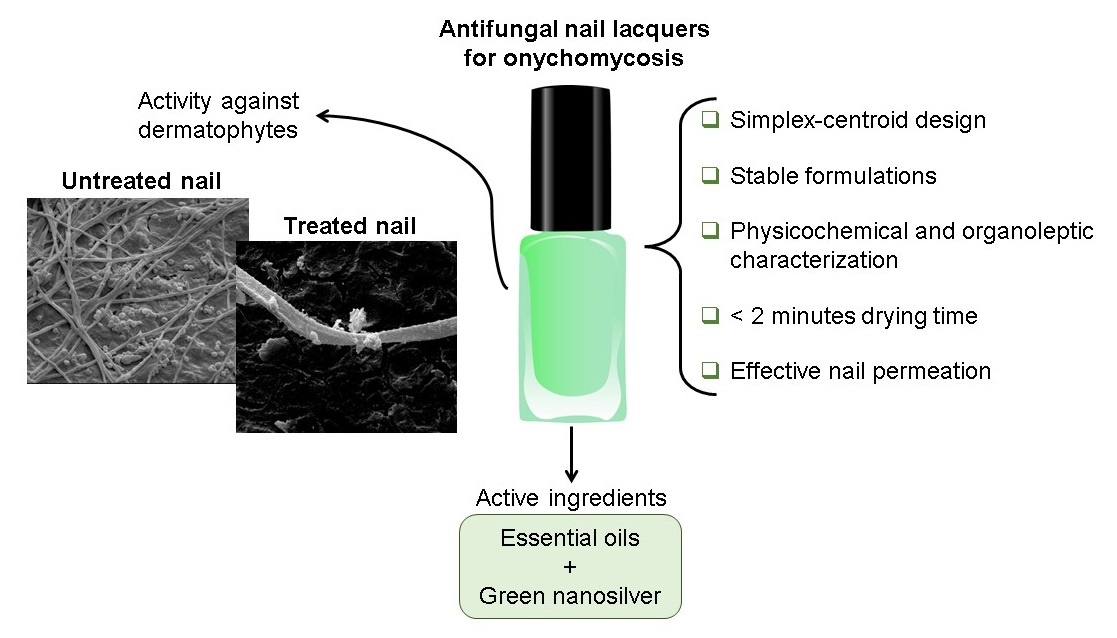
Onychomycosis is a common fungal nail infection for which new antibiotics are needed to overcome antifungal resistance and other limitations of conventional treatments. This study reports the development of antifungal nail lacquers containing oregano essential oil (OEO), rosemary essential oil (REO), and/or biogenic silver nanoparticles (bioAgNP). The formulations (F) were tested against dermatophytes by agar diffusion, ex vivo nail infection, and scanning electron microscopy techniques. They were evaluated pharmacotechnically and by FTIR-PAS to access permeation across the nail plate. F-OEO and F-OEO/Ag were promising for the final nail lacquer formulation, they permeated through the nail plate and showed antifungal efficacy against dermatophytes-contaminated nails after 5 days of treatment. The treated nails had decreased hyphae and spores compared to untreated control; the hyphae were atypically flattened which indicates loss of cytoplasmic content due to damage to cytoplasmic membrane. Formulations were stable after centrifugation and thermal stress, maintaining organoleptic and physicochemical characteristics. F-OEO and F-OEO/Ag had pH compatible with the nail, and drying time (59-90 s) within the reference for nail lacquer. For the first time, OEO and bioAgNP were incorporated in a nail lacquer, resulting in a natural and nanotechnological antifungal product for onychomycosis that may combat microbial resistance.
Keywords:
Nail mycosis
; Antifungal nail lacquer
; Topical therapy
; Green nanotechnology
; Oregano essential oil
; Trichophyton spp.
; Microsporum spp.
1. Introduction
The nail plate is a rigid structure, made of a hard substance called keratin, that protects the ends of the fingers and toes [1]. Several nail disorders are seen in clinical practice; they can be associated to nutritional deficiencies, aging, trauma, use of medications, haematological or endocrinological causes, among others [1,2]. Infectious diseases such as onychomycosis, pulmonary tuberculosis, and syphilis also can cause damage to the nail plate. Onychomycosis is the most common nail disorder [3,4,5].
Onychomycosis is a fungal infection that commonly affects the toenails. It is caused by dermatophytes, yeasts, and saprophytic mold. Trichophyton rubrum, which is a species of dermatophyte fungus, is the most frequent etiological agent. When this nail infection is caused by dermatophytes, this condition is called tinea unguium. The onychomycosis prevalence range is1-8%, and its incidence is increasing. The disease is associated with genetic predisposition [5].
Dermatophytes are free-living in the environment, but they are keratinophilic fungi that have the capacity to infect keratinized tissue such as the nails. Onychomycosis is usually preceded by an asymptomatic hyperkeratotic tinea pedis. The use of shoes provides an environment (warm, dark, and humid) that favours the fungal growth; the traumatic pressure on the nail unit can break the hyponychial seal and allow the access of dermatophytes to the nail bed. Dermatophytes produce keratinases that allow infection to spread through the tissue. The acute lesion involves spongiosis, acanthosis, papillomatosis with edema, and hyperkeratosis. Inflammation occurs at the site of infection and the infection may progress to a chronic state in which there is high amount of compact hyperkeratosis, hypergranulosis, acanthosis, and papillomatosis with infiltrate [5]. The infected nail begins to present a dystrophic appearance, showing color change, onycholysis, and hyperkeratosis, in addition to causing pain and discomfort to the individual [6,7].
In addition to the physical discomfort, it is important to highlight the strong psychological impact resulting from onychomycosis. The appearance of diseased nails may affect the self-esteem of the patients, generating feelings of embarrassment, anguish and even leading to social isolation, thus profoundly damaging their quality of life. Therefore, antifungal therapies are used to treat this pathology [8,9].
Topical and oral therapies with antifungal agents are the most used in the treatment of onychomycosis. Most of them are synthetic and show fungistatic action, such as azoles, tavaborole, terbinafine, amorolfine, and ciclopirox. However, both treatments have limitations. Oral therapy is limited by emerging antifungal resistance, potential hepatotoxicity, multiple side effects and risk of drug interactions; in the case of topical therapy, the long treatment time and low drug permeation across the nail plate are limiting factors [10,11,12].
Therefore, the research and development of new antifungal agents and new antifungal formulations are necessary to overcome the limitations of the available ones [13]. Antifungal alternatives include bioactive compounds derived from plants, animals, microorganisms, nanotechnology processes, and antimicrobial combinations [14,15,16].
Essential oils have been shown to be a potential alternative for the treatment of onychomycosis [17]. Essential oils are plant-derived, lipophilic, and volatile liquids, composed mainly of terpenoids. They have pharmacological properties, including anti-inflammatory, antioxidant, analgesic, and antimicrobial activities, because of these they find use in pharmaceutical, healthcare, food, and cosmetic sectors [18,19]. Essential oils are generally recognized as safe (GRAS) for their intended use [20].
Oregano essential oil (OEO) has a broad spectrum of antimicrobial action, including against dermatophytes [21,22]. This oil is composed mainly of carvacrol and thymol, which are phenolic compounds directly responsible for the antimicrobial mechanism of OEO [23]. Carvacrol and thymol alter the permeability of the microbial cytoplasmic membrane and they act as a proton exchanger, removing cytoplasmic content and acidifying the interior of the microorganism [24,25,26].
Rosemary essential oil (REO) also has an antifungal effect, including against fungi that cause onychomycosis [27]. This oil composition shows polyphenolic profile containing carnosic acid, carnosol, rosmarinic acid, and hesperidin as major components. The antimicrobial mechanism of REO occurs through the interaction of its phenolic components with the microorganism cytoplasmic membrane, causing leakage of cytoplasmic content, and morphological and functional alteration of membrane [28].
Due to their composition and lipophilicity, both oils affect the lipid bilayer of the membrane which is an essential and vital structure for the microorganism [18]. Although the main components of both OEO and REO are directly responsible for their antimicrobial mechanism of action, their minor compounds also contribute indirectly to the bioactivity of oils, for example, by acting synergistically with the main active ingredients [29,30]. However, both essential oils present characteristic smell, which may limit their application [31]; therefore, combining them with non-essential oil active ingredient is a strategy to minimize these undesirable organoleptic effects Our research group proposes the association of OEO and/or REO with bioAgNP to overcome these issues.
Nanotechnology has contributed to the development of antifungals, such as silver nanoparticles [32], which can be obtained by physical, chemical or biological synthetic routes [33]. The advantage of the green nanotechnology is that it leads to silver nanoparticles production using eco-friendly and low-cost methods [34]. The present study used biogenic silver nanoparticles (bioAgNP) which were synthesized by green nanotechnology, using the fungus Fusarium oxysporum. The synthesis of these bioAgNP is well characterized and validated [24,35,36,37]. In addition, the antimicrobial activity, including against fungi, has been extensively studied by our research group [38,39,40,41].
Previously we developed antimicrobial products containing bioAgNP or essential oils as active ingredients, such as hydrogel for wounds [42], topical formulation for acne-causing bacteria [43], and hydrogel as topical systems for delivery active into vagina mucosa [44]. Therefore, our research group proposes the development of a nail lacquer containing OEO, REO, and/or bioAgNP for onychomycosis treatment. This article highlights the development and pharmacotechnical characterization of these nail lacquers, and their antifungal efficacy tested in ex vivo assay and scanning electron microscopy. These nail lacquers may combat microbial resistance, as it has a combination of active ingredients that have been proven to minimize the emergence of resistance [24], in addition to positively impacting health and reducing social consequences in patients with onychomycosis.
2. Results
2.1. Study of the Active Ingredients
2.1.1. Antifungal Effect by Agar Diffusion Technique
The fungal growth was strongly and moderately inhibited by OEO and REO respectively. The bioAgNP showed no antifungal effect by agar diffusion technique, since bioAgNP-treated fungi and untreated fungi control showed similar growth. The result is shown in Figure 1.
2.1.2. Minimum Inhibitory and Minimum Fungicide Concentrations
All the actives (OEO, REO, and bioAgNP) and silver-based compounds (bioAgNP and AgNO3) inhibited the growth of all fungal species tested in this study (Table 1). All active ingredients are fungicides, as seen in Table 2. In the supplementary material, the Table S1 shows the concentration unit conversion for essential oils and bioAgNP.
2.1.3. Cytotoxicity Evaluation
The CC50 values of each active for VERO cells were shown in Table 3.
2.2. Study of the Nail Lacquer Formulations
2.2.1. Antifungal Effect by Agar Diffusion Technique
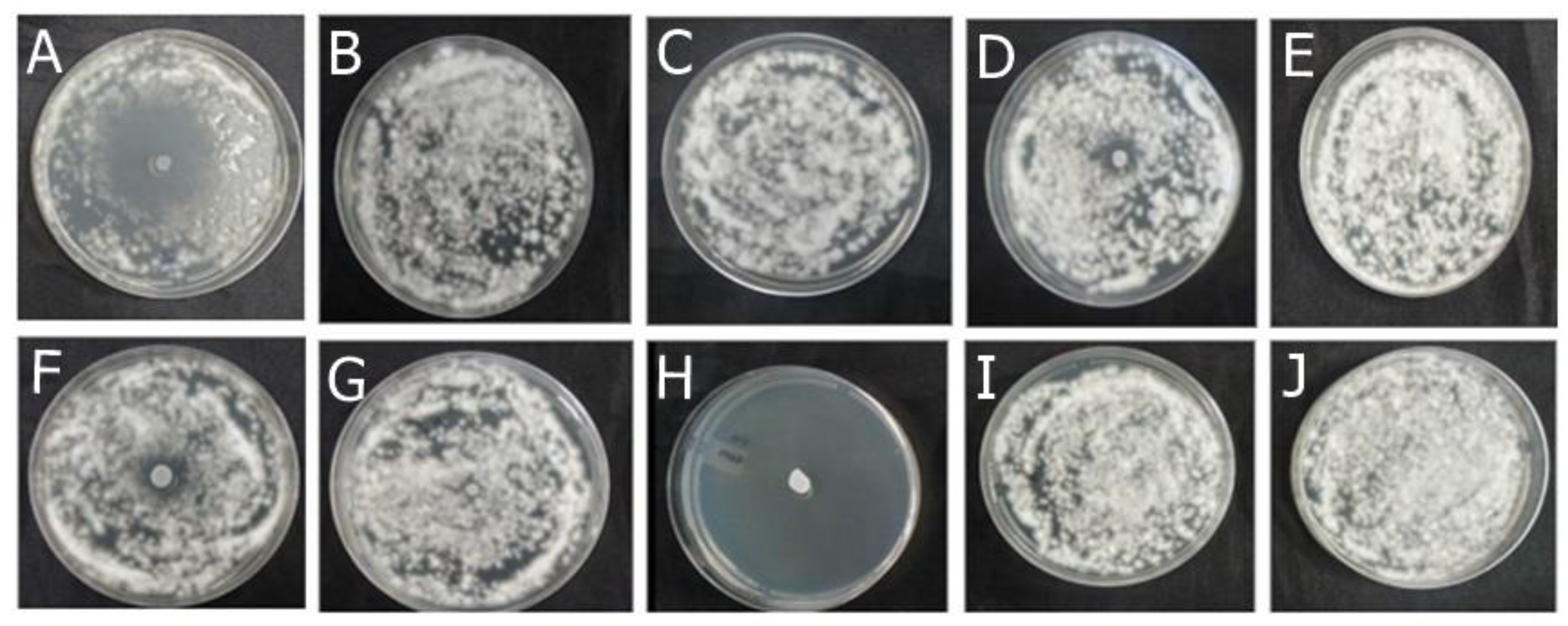
Among the formulations developed in this study, F-OEO inhibited the growth of all fungi tested; Tricophyton mentagrophytes (), Tricophyton rubrum (Figure 3), Microsporum canis (Figure 4), and Microsporum gypseum (Figure 5), according to the agar diffusion technique. The BF did not inhibit fungal growth, indicating that the antifungal effect of F-OEO is due to the presence of the active ingredient.
Figure 2.
Antifungal effect of the formulations (F) without and with actives (OEO, REO, and bioAgNP) alone and in combination against Tricophyton mentagrophytes. (A) F-OEO. (B) F-REO. (C) F-Ag. (D) F-OEO/REO. (E) F-REO/Ag. (F) F-OEO/Ag. (G) F-OEO/REO/Ag. (H) RF (reference formulation with amorolfine hydrochloride). (I) BF (base formulation without active). (J) Fungal growth control (without formulation).
Figure 2.
Antifungal effect of the formulations (F) without and with actives (OEO, REO, and bioAgNP) alone and in combination against Tricophyton mentagrophytes. (A) F-OEO. (B) F-REO. (C) F-Ag. (D) F-OEO/REO. (E) F-REO/Ag. (F) F-OEO/Ag. (G) F-OEO/REO/Ag. (H) RF (reference formulation with amorolfine hydrochloride). (I) BF (base formulation without active). (J) Fungal growth control (without formulation).
2.2.2. Ex Vivo Antifungal Effect
After 5 days of treatment, the formulations already showed antifungal efficacy. Only F-OEO, F-OEO + REO, F-OEO + Ag, and RF inhibited the growth of all fungi tested from the 5th to the 15th day of treatment, as shown in Chart 1.
2.2.3. Ex Vivo Permeation
Figure 6A shows the FTIR-PAS absorption spectra (obtained in the region from 3000 to 1000 cm-1) of F-OEO, F-REO, F-Ag, F-OEO + REO + Ag, and BF; these formulations presented similar spectral patterns with variations in band intensity. Figure 6B shows the detection of these characteristic bands on the ventral surface of the nail, after topical application of the formulations on its dorsal surface, indicating that permeation through the nail has occurred.
As shown in Figure 7, the mensurable permeation on the nail ventral surface was obtained by integrating the area under the absorption curve of formulations (band region centered at 1758, 1242 and 1079 cm-1) subtracted from the area of the control nail. F-OEO + REO + Ag presents a significantly greater permeation compared to all analysed formulations, F-OEO and F-REO present similar permeation, and F-Ag showed significantly lower permeation compared to other formulations.
2.2.4. Selection of The Best Nail Lacquer Formulations
OEO and bioAgNP were the active ingredients that showed the greatest antimicrobial activity against the microorganisms tested. However, as F-Ag presented the lowest permeation, F-OEO and F-OEO+Ag were selected to continue with studies regarding pharmacotechnical evaluation, stability analysis, and analysis of antifungal efficacy by SEM.
2.2.4. Pharmacotechnical Characterization of the Selected Formulations: Centrifugation Test, Organoleptic Characteristics, pH, Density, and Drying Time
The three formulations remained homogeneous after being subjected to centrifugation; their pre-stability makes them suitable for being subjected to subsequent characterizations. Both F-OEO and F-OEO + Ag formulations differed from BF in terms of color and odor. The first is slightly yellowish due to OEO and the second one is brown due to bioAgNP; both had a characteristic smell of OEO and maintained the same homogeneous appearance as the control. The formulations had a pH and density of approximately 4 and 10 g/cm3 respectively. The drying time for formulations was from 1 to 1.5 minute. All the pharmacotechnical characteristics of formulations were shown in Table 2. The photodocumentation of the formulations is presented in the supplementary material (Figure S1).

Table 2.
Pharmacotechnical characteristics of formulations containing OEO or OEO plus bioAgNP.
| Pharmacotechnical characteristics | F-OEO | F-OEO + Ag | BF |
|---|---|---|---|
| Centrifuge test | NPSP | NPSP | NPSP |
| Aspect | homogeneous liquid | homogeneous liquid | homogeneous liquid |
| Color | slightly yellowish | brown | colorless |
| Odor | OEO | OEO | ethyl acetate |
| pH | 4.0 | 4.4 | 4.4 |
| Density (g/cm3) | 9.99 ± 0.07 | 10.1 ± 0.01 | 9.91 ± 0.004 |
| Drying time (s) | 59.45 ± 1.98 | 90.30 ± 7.81 | 74.06 ± 2.21 |
NPSP: No phase separation or precipitation; OEO: Oregano essential oil.
2.2.5. Preliminary Stability Study
After exposure to thermal stress, the formulations F-OEO, FOEO + Ag and BF remained unchanged. They showed homogeneous aspect, without any signs of phase separation or precipitation; they also maintained the organoleptic characteristics and pH (4.1) presented in the Table 2.
2.2.6. Antifungal Efficacy shown by Scanning Electron Microscopy
Figure 8A–C show scanning electron micrographs of the effect of the formulations containing OEO, F-OEO and F-OEO + Ag, against Tricophyton mentagrophytes grown in nails. The untreated nail sample showed hyphae with typical morphology (Figure 8A); micrograph of higher magnification shows spores with typical size and hyphae and spores with intact surface (Figure 0B). Nail samples treated with F-OEO (Figure 8B and Figure 8C) or F-OEO + Ag (Figure 8D and Figure 8E) showed extremely reduced number of hyphae and spores compared to the untreated control. Fungal hyphae treated with F-OEO + Ag were damaged, they were flatter than their typical morphology.
3. Discussion
Onychomycosis is a chronic fungal infection that is difficult to treat, since conventional therapies lead to low cure rates and the antifungal resistance is a global public health concern, such as terbinafine-resistant dermatophytosis. Some conventional nail lacquers for topical treatment of onychomycosis promote low complete cure rates, being 15.2–17.8% for amorolfine 5% (RF used in our study) [45]. Our study shows the powerful action of new nail lacquers containing OEO and bioAgNP as actives, alone and in combination, against dermatophyte fungi that cause onychomycosis, such as T. mentagrophytes, T. rubrum, M. canis, and M. gypseum. Combination therapy of antifungals is advantageous compared to monotherapies, as it improves the efficacy of the product and prevents the emergence of resistance [46].
The agar diffusion technique showed that OEO has an expressive antifungal action, REO has moderate antifungal activity, and bioAgNP did not inhibit fungal growth. Only formulations containing OEO, especially F-OEO, have shown antimicrobial effect by this technique. This simple and low-cost test estimates the antimicrobial effect, but with low accuracy [47,48]; due to its qualitative nature, this test did not the antifungal effect of bioAgNP and REO. The absence of an inhibition halo or small inhibition halo can be attributed to the difficulty of metal nanoparticles or essential oil diffusing in the agar due to their size [49] and lipophilicity [50] respectively. Furthermore, the formulations probably did not show an antifungal effect because the actives are diluted in nail lacquer vehicle, so the active concentration is low to diffuse through the agar. Therefore, quantitative and more sophisticated tests were carried out to investigate the antifungal effect of the active ingredients and formulations [42,44,49,50].
This research showed that the OEO has fungicide activity. The three tested actives (OEO, REO, and bioAgNP) at low doses inhibited the growth of the four species of dermatophytes tested, in agreement with previous studies. As can be seen in our study, MIC values ranged from 0.047 to 0.094 % (v/v) for OEO, from 0.188 to 0.250 % (v/v) for REO, and from 0.001 to 0.004% (v/v) for bioAgNP. Parrish et al. (2020) [21] reported that the MIC of OEO ranged from < 0.12 to 0.5 % (v/v) against Trichophyton spp. and from 0.5 to 0.25 % (v/v) against Microsporum spp.. Chaftar et al. [51] reported that REO MIC ranged from 1.80 to >8.80 mg/mL against several fungi, including dermatophytes. For silver nanoparticles with diameter of 4 nm and synthesized by photo-assisted reduction, Mousavi, Salari and Hadizadeh [52] reported MIC value of 200 mg/mL against M. canis, 180 μg/mL against T. mentagrophytes, and 170 μg/mL against M. gypseum. For Fusarium oxysporym-bioAgNP, the same nano silver tested in our study, the MIC ranged from 4 to 8 μg/mL for species of Aspergillus [36] and from 1.74 to 4.35 μg/mL for Candida albicans [53].
Some slight variations in MIC of compounds from different studies may happen. OEO and REO are actives derived from plants, so they vary in their chemical composition depending on climate, geography, extraction methods, among others [54,55]. Silver nanoparticles may vary in size, morphology, type and presence of stabilizing agents, and surface charge; these characteristics influence their antimicrobial activity [56,57]. In addition, different fungal strains used in several studies may have structural and metabolic variations that influence their sensitivity to the antimicrobials tested. Besides that, different studies employ distinct techniques for microbiological analysis, which affect the conclusion with regard to the antimicrobial activity.
Despite the MIC variations discussed above, the antimicrobial properties of OEO, REO, and bioAgNP are widely described in the literature. The antimicrobial effect of OEO is mainly due to its phenolic compounds, such as carvacrol and thymol [23,24,26]. The main components of REO responsible for its antimicrobial activity are polyphenolic coumpouns such as carnosic acid, carnosol, rosmarinic acid and hesperidin [28]. For silver nanoparticles, there is evidence that the antimicrobial activity is influenced by the release of Ag+ ions, but it is important to consider that the nanoparticle coat can influence its mechanism of action and the coat varies for nanoparticles from different studies [56,58]. The composition of the active ingredient influences its antifungal activity as well as its toxicity, so the preliminary cytotoxicity test was carried out n out research.
According the results of the present study, the bioAgNP and OEO showed low toxicity to VERO cells, since their CC50 values were greater than their MIC; both actives were chosen to be incorporate in the final nail lacquer formulation. The REO tested here showed low CC50, whose value is lower than its MIC values. OEO and REO are considered GRAS (Generally Recognized as Safe) by FDA [20], which justifies our choice to incorporate them as active ingredients in nail lacquer formulations. Our study also developed formulations containing OEO and/ou REO in combination with bioAgNP; the combined antimicrobial therapy was used as strategy to reduce needed dose of each active and to combat antifungal resistance [24,59,60,61,62].
The ex vivo nail infection assay was chosen to test the antifungal efficacy of the nail lacquer, as it simulates the conditions of an onychomycosis treatment with the application of formulations directly to previously infected nails. Only F-OEO, F-OEO/REO, and F-OEO/bioAgNP showed antifungal efficacy similar to the commercial formulation containing amorolfine hydrochloride; they inhibited the growth of the four fungal species after five days of treatment. To promote treatment against onychomycosis, the antifungal nail polish needs to permeate the nail.
The FTIR-PAS absorption spectra of formulations (F-OEO, F-REO, F-Ag, F-OEO/REO/bioAgP, and BF), before being applied to the nail, showed similar spectral patterns with variations in band intensity. The main spectral peaks identified are attributed to C-H stretching hydrocarbons at 2968 and 2877 cm-1, C=O stretching in carbonyl groups at 1758 cm-1, C-O bonds at 1242 cm-1, and C-O-C bonds at 1056 cm-1 [63,64,65]. The control nail presented peaks centered at 2921 and 2853 cm-1, which are attributed to CH2 stretching of lipids; at 1657, 1542,1452 and 1238 cm-1 corresponding to bands I, II and III of the amide functional group; and at 1079 cm-1 of the C-C of DNA skeleton [66]. After 30 min of contact between the nail and the formulation, the spectra show an increase in peaks intensity at 1758, 1242 and 1079 cm-1, indicating absorption of the nail lacquer. The presence of these bands on the ventral surface of the nail demonstrates the permeation capacity of the nail lacquer.
The permeation of an active ingredient through the nail plate may be influenced by its physicochemical properties (size, charge, and lipophilicity), the formulation properties (vehicle nature, pH, concentration of the active ingredient), the nail (degree of hydration and stage of the disease), and also by interactions with the keratin network present in the nail [67,68].
The molecular weight of antifungal agent is the most important property for it to permeate the nail plate; the higher its molecular weight, the lower its permeation. The increase in lipophilicity accompanies the increase in molecular weight of compounds of the same class (e.g., n-alcohols), reducing their permeation. Essential oils are composed of low molecular weight molecules, so their permeation is facilitated in the nail plate [67,69].
The charge ou absence of charge of an active is also a relevant parameter for its permeation. Non-ionic agents can be up to 10 times more permeable than their ionized counterparts. In this case, the low permeability of ionized agent is possibly due to two factors: (1) the increase in the size of the structure caused by the hydration of the ionized species and (2) the electrostatic repulsion between the charges of the species and the keratin, if they are equal [67]. In our study, the bioAgNP releases Ag+ ions that may be undergoing hydration; this possibly justify the low permeation of F-Ag formulation.
Nails affected by onychomycosis tend to become thicker and more porous, which increases the permeation of the active ingredient from dorsal to ventral region. The degree of hydration of the nail also seems to facilitate nail permeation [68]. It is important to highlight the permeation can be improved by the use of physical methods, such as sanding, lasers and photodynamic therapy, or keratolytic agents, such as urea, thioglycolic acid, and salicylic acid [70,71]. Additionally, a permeation enhancer can be incorporated into the formulation of nail lacquer.
The actives OEO and bioAgNP showed the greatest antifungal activity in this study. However, F-Ag permeated little across the nail, the formulations F-OEO and F-OEO/Ag were selected for pharmacotechnical analysis and antifungal confirmation by SEM.
The formulations (BF, F-OEO, and F-OEO/Ag) were stable, without any macroscopic alteration, after being subjected to the 3200 rpm. It is worth noting that centrifugation simulates the effect of gravity on the sample. Thus, this test allows us to anticipate instabilities that may occur in the product in the future, such as sedimentation, phase separation, or coalescence [72]. Since all formulations passed the centrifugation test, they were subjected to thermal stress in a second stability test (preliminary stability) [73].
After being subjected to thermal stress, the formulations remained stable in terms of their pH and organoleptic characteristics. BF, F-OEO, and F-OEO/Ag formulations kept their more acidic pH which is compatible with the nail [74]. The three formulations maintained their homogeneous liquid aspect. Their color and odor did not change; they preserved slightly yellowish for F-OEO, brown for F-OEO/Ag, and colorless for BF. Formulation containing OEO maintained the odor characteristic oil.
According to Joshi, Sharma and Pathak [75], the time required for nail lacquer to form a film is from one to two minutes. The formulations BF, F-OEO, and F-OEO/Ag presented drying time within the reference range (less than two minutes). F-OEO formulation dried more quickly than the BF, the presence of OEO reduced the drying time, since essential oils are easily volatilized [19]. F-OEO/Ag was the formulation that took the longest time to dry, the presence of the bioAgNP probably delayed the solvent evaporation.
The SEM observations confirmed the antifungal effect of nail lacquers F-OEO and F-OEO/Ag in contaminated nails. This analysis by electron microscopy revealed an intense reduction in the number of hyphae and no spore of treated-nails when compared to untreated nail (control). It is possible to verify hyphae with morphological alteration (flat hyphae) in the F-OEO/Ag-treated sample, suggesting extravasation of intracellular content. Other studies have already showed that OEOm carvacrol, thymol, and nanosilver increase membrane permeability of microorganisms, making them to lose their cytoplasmic content [24,25,26,56,58]. Using SEM analysis, Zulu et al. [76] showed that OEO caused alteration of hypha morphology, such as reduced volume and exhibiting breakage in Penicillium digitatum. Bocate et al. [36] reported that exposure of Aspergillus ochraceus to bioAgNP strongly reduced spore germination and caused fungal cell damage, with the formation of short and unbranched hyphae.
This study reports two nail lacker formulations, F-OEO and F-OEO/bioAgNP, as promising alternative of topical treatment for onychomycosis. The combination of OEO and bioAgNP in the nail lacquer is strategic to both improve their antimicrobial activity and combat microbial resistance. A previous study, conducted by our research group, on the antimicrobial mechanism of this combination suggests that the oil increases the permeability of the microorganism cytoplasmic membrane, facilitating the entry of nanosilver. Besides that, this combination prevented the emergence of resistance to both antimicrobials in a microorganism test model [24], probably because the combination makes it impossible to activate the metal resistance mechanism, which is normally via an efflux pump [77], since the combination, mainly due to the oil, acts on the cytoplasmic membrane.
4. Materials and Methods
4.1. Antifungal Agents
4.1.1. Essential Oils
Oregano vulgare essential oil (OEO) and Rosmarinus officinalis essential oil (REO) were obtained from Ferquima Industry and Commerce of Essential Oil (São Paulo, Brazil). Both oils were extracted of leaves by steam distillation, and their main characteristics were described in a company technical report. Density was 0.9468 g/mL for OEO and 0.9130 g/mL for REO. The main components of OEO were as follows: 72% carvacrol, 2% thymol, 4.5% gamma-terpinene, 4% para-cymene, and 4% linalool. The main components of REO were as follows: 40% 1.8 cineole, 15% camphor, 13% alpha-pinene, 7% beta-pinene, and 3% limonene.
4.1.2. Biogenically Synthetized Silver Nanoparticles (bioAgNP)
The biogenic silver nanoparticles (bioAgNP) were obtained from the Department of Microbiology at Universidade Estadual de Londrina. They were biogenically synthetized according to a previously established method using Fusarium oxysporum [35]. The fungus was grown in a liquid medium containing malt extract (2%) and yeast extract (5%) for 7 days at 30 °C. The fungal biomass was collected by filtration and it was added at 0.1 g/mL in sterile distilled water; it was kept under agitation (150 rpm) for 72 h at 30 °C. Then, aqueous solution components were separated by filtration; AgNO3 at 10 mM was added to this solution followed by incubation at 30 °C in the dark for 14 days. After reduction of silver nitrate by fungal-free solution components, the bioAgNP were obtained characterized in terms of size using Zeta-APS instrument (Matec Applied Sciences, USA), and morphology using scanning electron microscopy. Average bioAgNP diameter was 90 nm. The bioAgNP show spherical shape [36].
4.2. Development of Nail Lacquer Formulations
The nail lacquer formulation was developed based on the 5-free marketing concept, which means that the products are free of potentially allergenic components such as dibutyl phthalate (DBP), 2-nitrotoluene, toluene, furfural, and formaldehyde. All formulations were composed of the following ingredients: cellulose acetate butyrate, isopropyl alcohol, ethyl acetate and sucrose acetate butyrate. The simplex-centroid experimental design was used to optimize the concentrations of actives alone and in binary or ternary combination [78] as shown in the Figure 9 and Table 3. Eight nail lacquer formulations were developed as follows: base formulation or BF (without OEO, REO, and bioAgNP), F1 (with OEO), F2 (with REO), F3 (with bioAgNP), F4 (with both OEO and REO), F5 (with both REO and bioAgNP), F6 (with both OEO and bioAgNP), and F7 (with OEO, REO and bioAgNP).
Table 3.
Concentration of active ingredients (%, v/v) in the developed nail lacquer formulations. Seven formulations containing oregano essential oil (OEO), rosemary essential oil (REO) and/or biogenic silver nanoparticles were developed (bioAgNP).
Table 3.
Concentration of active ingredients (%, v/v) in the developed nail lacquer formulations. Seven formulations containing oregano essential oil (OEO), rosemary essential oil (REO) and/or biogenic silver nanoparticles were developed (bioAgNP).
| Formulations | OEO | REO | bioAgNP |
|---|---|---|---|
| F-OEO | 7 | - | - |
| F-REO | - | 7 | - |
| F-Ag | - | - | 2.5 |
| F-OEO/REO | 3.5 | 3.5 | - |
| F-REO/Ag | - | 3.5 | 1.25 |
| F-OEO/Ag | 3.5 | - | 1.25 |
| F-OEO/REO/Ag | 2.33 | 2.33 | 0.83 |
| BF | - | - | - |
BF: base formulation.
A commercial nail lacquer containing 5% (w/v) amorolfine hydrochloride was used in this study as a reference formulation (RF) for comparisons.
4.3. Pharmacotechnical Characterization of Nail lacquer Formulations
4.3.1. Pre-Stability Study
For pre-stability study, 5g of each formulation were placed in conical test tubes and subjected to centrifugation at 3200 rpm for 30 minutes at 25 °C. Subsequently, each formulation sample was visually analyzed in order to detect possible instability signs such as coalescence, phase separation and/or sedimentation [73].
4.3.2. Organoleptic Characterization
The formulations were evaluated regarding their appearance, color and odor, directly in the transparent glass bottle in which each one was packaged after 24 h of their production, according to the methodological guide [72]. For appearance analysis, the formulations were visually analyzed to observe the presence or absence of alterations such as phase separation, precipitation or turbidity. The color of each formulation was visually evaluated under white light and on black background. Their odor was directly accessed by human olfactory perception.
4.3.3. Physicochemical Characterization
The pH value of each formulation was determined using a digital pH meter, calibrated with buffer solutions (pH 4 and pH 7) at 25 ± 5°C, whose electrode were inserted directly into the sample [72].
The density evaluation was carried out using a glass pycnometer. The density value of formulations was obtained using equation 1 [72].
Where:
d = Relative density of formulation in g/cm3
M2 = Mass in g of the pycnometer containing the formulation
M1 = Mass in g of the pycnometer containing water
M0 = Mass in g of the empty pycnometer
4.3.4. Determination of Film Drying Time
The drying time of the developed nail lacquers was evaluated by applying a thin layer of formulation (100 µL) on a Petri dish, using an applicator, according SHAH and JOBANPUTRA [79], with modifications. The time required for the nail lacquer to form a dry film that can be touched was determined. This test was carried out in triplicate; the result was expressed in seconds representing the average of the three measurements.
4.3.5. Preliminary Stability Study
The preliminary stability study was carried out in accordance with the Cosmetic Products Stability Guide [73].The formulations were submitted to thermal stress for 15 days, following 24h-cycle of altering temperature: 4 ± 2 °C or 40 ± 2 °C (75 ± 5% RH). After 15 days, they were evaluated regarding pH and organoleptic parameters; the results obtained were compared with those found before stability test.
4.4. Antifungal Activity of Actives and Nail Lacquer Formulations
4.4.1. Fungal Species
Four fungal species were used in this study: Trichophyton rubrum, Trichophyton mentagrophytes, Microsporum canis, and Microsporum gypseum. The microorganisms were provided by Laboratory of Medical Mycology and Oral Microbiology of Unversidade Estadual de Londrina (Londrina, Paraná, Brazil). All fungal samples were stored in solution containing 40% (v/v) glycerol (Merck) at -20°C.
To obtain fungal culture to perform antimicrobial efficacy tests, initially each microorganism was transferred to test tubes containing potato dextrose agar (BDA) and it was incubated at 25 ± 5 °C for approximately 14 days.
4.4.2. Analysis of Antifungal Activity of Actives and Formulations by Disk Diffusion Method
This assay was performed in triplicate according to Nweze et al. [80], with modifications. A volume of 100 µL of fungal spore suspension at 104/mL was spread on the surface of the BDA placed in Petri dish. Then, 10 µL of the active ingredient (OEO, REO, or bioAgNP) or formulations was added to the agar surface in the center of the Petri dish. The fungus inoculated with the test compound was incubated at 25 ± 5 °C for 72 h. The antimicrobial effect of the active ingredients or formulations was identified by the absence or reduction of mycelial fungal growth.
4.4.3. Determination of Minimum Inhibitory Concentration of the Actives
Determination of the minimum inhibitory concentration (MIC) of each antimicrobial (OEO, REO, and bioAgNP) was performed with broth microdilution [81,82]. For OEO and REO, an alcoholic solution was initially prepared with each essential oil (40%; v/v). The bioAgNP were not diluted in alcohol due to their hydrophilic nature. The different concentrations of active ingredients (OEO, REO, or bioAgNP) were prepared by serial dilution in RPMI medium. RPMI alone and RPMI containing each of the antimicrobials separately were tested as sterility controls. Untreated fungi inoculated on the RPMI was tested as growth control. The MIC was defined as the lowest antimicrobial concentration that inhibited visible growth after 72 h of treatment at 25 ± 5 °C. All assays were carried out in triplicate.
4.4.4. Determination of Minimum Fungicidal Concentration (MFC) of the Actives
Minimal fungicidal concentration (MFC) of each antimicrobial (OEO, REO, or bioAgNP) was determined by subculturing 10 µL from broth dilution MIC and above concentrations in BDA without antimicrobials. After incubation at 25 ± 5 °C for 72 h, the MFC was defined as the lowest concentration required to completely kill the tested fungus [83]. All assays were performed in triplicate.
4.4.5. Ex Vivo Evaluation of Antifungal Efficacy of the Nail Lacquer Formulations
Human nail samples were collected from both female and male volunteers with age ranging from 18 to 60 years old. The nails were obtained by normal cutting, without the need of specific training for the task; they were stored in a clean container and then autoclaved for later use. As cut nails are considered ex vivo material, there was no need to submit this study to the ethics committee.
Ex vivo evaluation of antifungal efficacy of the nail lacquer formulations was performed according to previous studies [84,85], with modifications. Nail units were added to 10 mL of fungal spore suspension at 105/mL. The fungal suspension containing nails were incubed at 25°C at 150 rpm for 2 h. Then, the contaminated nails were transferred to Petri dishes containing cotton moistened with sterilized water; they were incubated at 25 ± 5 °C for 14 days. After this period of time, the nails were after with the formulations, including BF and RF, on alternate days for 15 days. On the 5th, 10th and 15th days of treatment, a fragment of nail was cut and transferred to PDA to evaluate microbial growth.
4.4.6. Investigation of Antifungal Lacquer Efficacy by Scanning Electron Microscopy
Nail fragments infected with T. mentagrophytes and post-treated with the selected formulations were analyzed by scanning electron microscopy (SEM). Untreated nail was used as control. For SEM analyses, sample (treated and untreated nails) preparation was performed according to [86], with modifications. Each nail sample was fixed (for 1 h) by immersion in 0.1 M sodium cacodylate buffer (pH 7.2) containing 3% (v/v) formaldehyde, 2% (v/v) paraformaldehyde following three washing steps (10 min each) with a sodium cacodylate. Then, samples were post-fixed in OsO4 1% for 1 h at room temperature and they were washed again as previously described. Fixed nails were dehydrated in an ethanol gradient (50, 60, 70, 80, 90, and 100% v/v), critical point-dried using CO2 (BALTEC CPD 030 Critical Point Dryer), coated with gold (BALTEC SDC 050 Sputter Coater), and observed under a SEM (FEI Quanta 200).
4.5. Analysis of Nail lacquer Permeation
The permeation study of formulations was accessed by Fourier transform infrared photoacoustic spectroscopy (FTIR-PAS). Before the measurements, the photoacoustic cell and sample were purged with helium gas and the cell was then sealed. The spectra were collected in the spectral range between 3000 and 1000 cm-1, with a resolution of 8 cm-1, and an average of 128 scans. Photoacoustic spectra were obtained in dorsal face of nail and in the ventral face of the nail. The depth of the nail sample contributing to the photoacoustic signal was estimated using the thermal diffusion length (µs) (Equation 2); taking the thermal diffusivity of the nail as D=10 × 10-4 cm2/s-1 [87] and the variation of f = 303.74 at 101.25 Hz, the value of µs varies from 7.2 to 12.5 µm.
Where:
D = Thermal diffusivity of the sample (cm2/s)
f = Modulation frequency at the chosen wavenumber (Hz)
f’ = Laser modulation frequency
v = Wave number
v’ = Laser wavenumber
Nails fragments were obtained from an adult volunteer who was 23 years old. The nail samples were manually cut into similar parts with approximately 0.3 × 0.3 cm and an average thickness of 408 µm. Before applying the formulation, using sandpaper, approximately 30 µm were removed from the dorsal surface of the nail structure. Next, the FTIR-PAS spectrum of the both dorsal and ventral nail was obtained; spectra of the nail lacquer formulations alone were also obtained. Then, 5 µL of formulation was applied to the nail dorsal surface; after 30 minutes, a spectral measurement was made on the ventral surface of the nail to evaluate the permeation of the formulation. Sample preparation is shown in Figure 10.
4.6. Cytotoxicity Assay of Antifungal Actives
Toxicity analysis of the active ingredients was performed against VERO cell lines (monkey kidney cells) in 96-well plates. VERO cells were grown in RPMI medium 1640 (Gibco) at 37 °C and 5% CO2 until cell monolayer is formed in the wells. Non-adherent cells were removed by washing with PBS. Then, confluent cells were treated, for 24 h at 37◦C in5%CO2, with different concentrations of active ingredients, whose maximum values were 7% (v/v) for OEO, 7% for OEA, and 2.5% (v/v) for bioAgNP. After treatment time, the medium was removed and the wells were gently washed with PBS. Cell viability was determined by MTT [3-(4,5-dimethyl-2-thiazolyl)-2,5-diphenyl-2H-tetrazolium] assay, according to the manufacturer’s recommendation. Untreated VERO cells were used as control for 100 % viability. The 50% cytotoxic concentration (CC50) was defined as the antimicrobial concentration required to reduce cell viability by 50% compared to untreated control.
4.7. Statistical Analysis
The data were subjected to analysis of variance (ANOVA), followed by the Tukey test. Values of p < 0.05 were considered significant.
4.8. Experimental Design
Figure 11 shows the experimental design of this study, indicating the methodological steps in the order in which they occurred.
5. Conclusion
In conclusion, F-OEO and F-OEO/Ag are a promising antifungal alternative for topical treatment of onychomycosis. Both formulations presented potent antifungal efficacy, good permeation, proven stability, and pharmacological characteristics suitable for a nail lacquer. Both nail lackers are eco-frientdly products, since they contain actives obtained by green nanotechnology and plant-derived active ingredients classified as GRAS by the FDA. Further studies are needed to test the in vivo efficacy of both formulations.
Supplementary Materials
The following supporting information can be downloaded at the website of this paper posted on Preprints.org, Figure S1: Color analysis of the final formulations of the antifungal nail lacker; Table S1: Concentration unit conversion for oregano essential oil (OEO), rosemary essential oil (REO) and biogenic silver nanoparticles (bioAgNP).
Author Contributions
S.S., biosynthesis of bioAgNP, formal analysis of the results and comparison of them with literature, rewriting, review and editing the final version of the article; N.R.O., conception and drafting of the study, planning and carrying out the experiments, collection and analysis of data, and writing the original article; M.S. and L.V.C.H, carrying out and data analysis of permeation assay; M.L.B., assistance and guidance in FTIR-PAS assay; G.N., assistance and guidance in bioAgNP biosynthesis, and critical review of the article; R.K.T.K., assistance and guidance in bioAgNP biosynthesis and with microbiological techniques; L.A.P., co-supervision, assistance and guidance in the mycological test; A.A.S.G.L., conception and drafting of the study, design and planning of experiments, supervision, project administration, funding acquisition, critical review of the article, and final approval of the version to be published. All authors have read and agreed to the published version of the manuscript.
Funding
Sara Scandorieiro was funded by a Postdoctoral Fellowship (Coordination for the Improvement of Higher Education Personnel – CAPES) whose file number is 88887.803735/2023-00. This study was financed in part by CAPES – Finance Code 001 and by Conselho Nacional de Desenvolvimento Científico e Tecnológico—CNPq whose file number is 302271/2023-6.
Data Availability Statement
Not applicable.
Acknowledgments
The authors thank the Laboratory of Electron Microscopy and Microanalysis, Universidade Estadual de Londrina.
Conflicts of Interest
The authors declare no conflict of interest.
References
- Baswan, S.; Kasting, G.B.; Li, S.K.; Wickett, R.; Adams, B.; Eurich, S.; Schamper, R. Understanding the Formidable Nail Barrier: A Review of the Nail Microstructure, Composition and Diseases. Mycoses 2017, 60, 284–295. [Google Scholar] [CrossRef]
- Lee, D.K.; Lipner, S.R. Optimal Diagnosis and Management of Common Nail Disorders. Ann Med 2022, 54, 694–712. [Google Scholar] [CrossRef] [PubMed]
- Lee, D.K.; Lipner, S.R. Optimal Diagnosis and Management of Common Nail Disorders. Ann Med 2022, 54, 694–712. [Google Scholar] [CrossRef] [PubMed]
- Leung, A.K.C.; Lam, J.M.; Leong, K.F.; Hon, K.L.; Barankin, B.; Leung, A.A.M.; Wong, A.H.C. Onychomycosis: An Updated Review. Recent Pat Inflamm Allergy Drug Discov 2019, 14, 32–45. [Google Scholar] [CrossRef]
- Bodman, M.A.; Syed, H.A.; Krishnamurthy, K.
- Chen, K.L. Histopathologic Characterization of Onychomycosis in Nailbiopsies: A Retrospective Case Series of 19 Patients. J Cutan Pathol. 2023, 50, 103–105. [Google Scholar] [CrossRef] [PubMed]
- Bodman, M.A.; Syed, H.A.; Krishnamurthy, K. Onychomycosis Available online:. Available online: https://www.ncbi.nlm.nih.gov/books/NBK441853/ (accessed on 30 July 2024).
- Hong, J.-S.; Suh, M.-K.; Lee, K. A Study of the Quality of Life in Patients with Toenail Onychomycosis. Korean Journal of Dermatology 2019, 433–440. [Google Scholar]
- Tosti, A.; Vlahovic, T.C.; Arenas, R. Onychomycosis: An Illustrated Guide to Diagnosis and Treatment. 2017. [Google Scholar]
- Lee, D.K.; Lipner, S.R. Optimal Diagnosis and Management of Common Nail Disorders. Ann Med 2022, 54, 694–712. [Google Scholar] [CrossRef]
- Sajeed, M.; Wei, L.; Murdan, S. What Can GP Data Tell Us about the Treatment of Onychomycosis in the UK? Skin Health and Disease 2022, 2. [Google Scholar] [CrossRef]
- Gupta, A.K.; Venkataraman, M.; Renaud, H.J.; Summerbell, R.; Shear, N.H.; Piguet, V. A Paradigm Shift in the Treatment and Management of Onychomycosis. Skin Appendage Disord 2021, 7, 351–358. [Google Scholar] [CrossRef]
- Guinea, J. New Trends in Antifungal Treatment: What Is Coming Up? Revista Espanola de Quimioterapia 2023, 36, 59–63. [Google Scholar] [CrossRef]
- Matrose, N.A.; Obikeze, K.; Belay, Z.A.; Caleb, O.J. Plant Extracts and Other Natural Compounds as Alternatives for Post-Harvest Management of Fruit Fungal Pathogens: A Review. Food Biosci 2021, 41. [Google Scholar] [CrossRef]
- Gómez-Gaviria, M.; Chávez-Santiago, J.O.; Martínez-Álvarez, J.A.; Mora-Montes, H.M. Animal-Derived Therapeutic Alternatives for Candidiasis Treatment. Academia Biology 2023. [CrossRef]
- Hetta, H.F.; Ramadan, Y.N.; Al-Kadmy, I.M.S.; Ellah, N.H.A.; Shbibe, L.; Battah, B. Nanotechnology-Based Strategies to Combat Multidrug-Resistant Candida Auris Infections. Pathogens 2023, 12. [Google Scholar] [CrossRef] [PubMed]
- Nickles, M.A.; Lio, P.A.; Mervak, J.E. Complementary and Alternative Therapies for Onychomycosis: A Systematic Review of the Clinical Evidence. Skin Appendage Disord 2022, 8, 269–279. [Google Scholar] [CrossRef] [PubMed]
- Żukowska, G.; Durczyńska, Z. Properties and Applications of Essential Oils: A Review. Journal of Ecological Engineering 2024, 25, 333–340. [Google Scholar]
- Siddiqui, T.; Khan, M.U.; Sharma, V.; Gupta, K. Terpenoids in Essential Oils: Chemistry, Classification, and Potential Impact on Human Health and Industry. Phytomedicine Plus 2024, 4. [Google Scholar] [CrossRef]
- Food and Drug Administration (FDA) Generally Recognized as Safe (GRAS) Available online:. Available online: https://www.fda.gov/food/food-ingredients-packaging/generally-recognized-safe-gras (accessed on 29 August 2021).
- Parrish, N.; Fisher, S.L.; Gartling, A.; Craig, D.; Boire, N.; Khuvis, J.; Riedel, S.; Zhang, S. Activity of Various Essential Oils Against Clinical Dermatophytes of Microsporum and Trichophyton. Front Cell Infect Microbiol 2020, 10. [Google Scholar] [CrossRef] [PubMed]
- Puškárová, A.; Bučková, M.; Kraková, L.; Pangallo, D.; Kozics, K. The Antibacterial and Antifungal Activity of Six Essential Oils and Their Cyto/Genotoxicity to Human HEL 12469 Cells. Sci Rep 2017, 7. [Google Scholar] [CrossRef]
- Walasek-Janusz, M.; Grzegorczyk, A.; Malm, A.; Nurzyńska-Wierdak, R.; Zalewski, D. Chemical Composition, and Antioxidant and Antimicrobial Activity of Oregano Essential Oil. Molecules 2024, 29. [Google Scholar] [CrossRef]
- Scandorieiro, S.; Rodrigues, B.C.D.; Nishio, E.K.; Panagio, L.A.; de Oliveira, A.G.; Durán, N.; Nakazato, G.; Kobayashi, R.K.T. Biogenic Silver Nanoparticles Strategically Combined With Origanum Vulgare Derivatives: Antibacterial Mechanism of Action and Effect on Multidrug-Resistant Strains. Front Microbiol 2022, 13. [Google Scholar] [CrossRef]
- Ultee, A.; Bennik, M.H.J.; Moezelaar, R. The Phenolic Hydroxyl Group of Carvacrol Is Essential for Action against the Food-Borne Pathogen Bacillus Cereus. Appl Environ Microbiol 2002, 68, 1561–1568. [Google Scholar] [CrossRef]
- Lambert, R.J.W.; Skandamis, P.N.; Coote, P.J.; Nychas, G.-J.E. A Study of the Minimum Inhibitory Concentration and Mode of Action of Oregano Essential Oil, Thymol and Carvacrol. J Appl Microbiol 2001, 91, 453–462. [Google Scholar] [CrossRef] [PubMed]
- Orchard, A.; Van Vuuren, S.F.; Viljoen, A.M. Commercial Essential Oil Combinations against Topical Fungal Pathogens. Nat Prod Commun 2019, 14, 151–158. [Google Scholar] [CrossRef]
- Nieto, G.; Ros, G.; Castillo, J. Antioxidant and Antimicrobial Properties of Rosemary (Rosmarinus Officinalis, L.): A Review. Medicines 2018, 5, 98. [Google Scholar] [CrossRef] [PubMed]
- de Sousa, D.P.; Damasceno, R.O.S.; Amorati, R.; Elshabrawy, H.A.; de Castro, R.D.; Bezerra, D.P.; Nunes, V.R. V.; Gomes, R.C.; Lima, T.C. Essential Oils: Chemistry and Pharmacological Activities. Biomolecules 2023, 13. [Google Scholar] [CrossRef]
- Marchese, A.; Arciola, C.R.; Barbieri, R.; Silva, A.S.; Nabavi, S.F.; Sokeng, A.J.T.; Izadi, M.; Jafari, N.J.; Suntar, I.; Daglia, M.; et al. Update on Monoterpenes as Antimicrobial Agents: A Particular Focus on p-Cymene. Materials 2017, 10. [Google Scholar] [CrossRef] [PubMed]
- Cimino, C.; Maurel, O.M.; Musumeci, T.; Bonaccorso, A.; Drago, F.; Souto, E.M.B.; Pignatello, R.; Carbone, C. Essential Oils: Pharmaceutical Applications and Encapsulation Strategies into Lipid-Based Delivery Systems. Pharmaceutics 2021, 13, 1–35. [Google Scholar] [CrossRef]
- León-Buitimea, A.; Garza-Cervantes, J.A.; Gallegos-Alvarado, D.Y.; Osorio-Concepción, M.; Morones-Ramírez, J.R. Nanomaterial-Based Antifungal Therapies to Combat Fungal Diseases Aspergillosis, Coccidioidomycosis, Mucormycosis, and Candidiasis. Pathogens 2021, 10. [Google Scholar] [CrossRef]
- Iravani, S.; Korbekandi, H.; Mirmohammadi, S. V; Zolfaghari, B. Synthesis of Silver Nanoparticles: Chemical, Physical and Biological Methods; 2014; Vol. 9;
- Salem, S.S. A Mini Review on Green Nanotechnology and Its Development in Biological Effects. Arch Microbiol 2023, 205. [Google Scholar] [CrossRef]
- Durán, N.; Marcato, P.D.; Alves, O.L.; De Souza, G.I.H.; Esposito, E. Mechanistic Aspects of Biosynthesis of Silver Nanoparticles by Several Fusarium Oxysporum Strains. J Nanobiotechnology 2005, 3. [Google Scholar] [CrossRef]
- Bocate, K.P.; Reis, G.F.; de Souza, P.C.; Oliveira Junior, A.G.; Durán, N.; Nakazato, G.; Furlaneto, M.C.; de Almeida, R.S.; Panagio, L.A. Antifungal Activity of Silver Nanoparticles and Simvastatin against Toxigenic Species of Aspergillus. Int J Food Microbiol 2019, 291, 79–86. [Google Scholar] [CrossRef]
- Marcato, P.D.; Parizotto, N. V.; Martinez, D.S.T.; Paula, A.J.; Ferreira, I.R.; Melo, P.S.; Durán, N.; Alves, O.L. New Hybrid Material Based on Layered Double Hydroxides and Biogenic Silver Nanoparticles: Antimicrobial Activity and Cytotoxic Effect. J Braz Chem Soc 2013, 24, 266–272. [Google Scholar] [CrossRef]
- Scandorieiro, S.; Rodrigues, B.C.D.; Nishio, E.K.; Panagio, L.A.; de Oliveira, A.G.; Durán, N.; Nakazato, G.; Kobayashi, R.K.T. Biogenic Silver Nanoparticles Strategically Combined With Origanum Vulgare Derivatives: Antibacterial Mechanism of Action and Effect on Multidrug-Resistant Strains. Front Microbiol 2022, 13. [Google Scholar] [CrossRef] [PubMed]
- Scandorieiro, S.; Teixeira, F.M.M.B.; Nogueira, M.C.L.; Panagio, L.A.; de Oliveira, A.G.; Durán, N.; Nakazato, G.; Kobayashi, R.K.T. Antibiofilm Effect of Biogenic Silver Nanoparticles Combined with Oregano Derivatives against Carbapenem-Resistant Klebsiella Pneumoniae. Antibiotics 2023, 12. [Google Scholar] [CrossRef] [PubMed]
- Scandorieiro, S.; de Camargo, L.C.; Lancheros, C.A.C.; Yamada-Ogatta, S.F.; Nakamura, C. V.; de Oliveira, A.G.; Andrade, C.G.T.J.; Duran, N.; Nakazato, G.; Kobayashi, R.K.T. Synergistic and Additive Effect of Oregano Essential Oil and Biological Silver Nanoparticles against Multidrug-Resistant Bacterial Strains. Front Microbiol 2016, 7. [Google Scholar] [CrossRef] [PubMed]
- Bocate, K.P.; Reis, G.F.; de Souza, P.C.; Oliveira Junior, A.G.; Durán, N.; Nakazato, G.; Furlaneto, M.C.; de Almeida, R.S.; Panagio, L.A. Antifungal Activity of Silver Nanoparticles and Simvastatin against Toxigenic Species of Aspergillus. Int J Food Microbiol 2019, 291, 79–86. [Google Scholar] [CrossRef]
- Scandorieiro, S.; Kimura, A.H.; de Camargo, L.C.; Gonçalves, M.C.; da Silva, J.V.H.; Risso, W.E.; de Andrade, F.G.; Zaia, C.T.B.V.; Lonni, A.A.S.G.; dos Reis Martinez, C.B.; et al. Hydrogel-Containing Biogenic Silver Nanoparticles: Antibacterial Action, Evaluation of Wound Healing, and Bioaccumulation in Wistar Rats. Microorganisms 2023, 11. [Google Scholar] [CrossRef]
- Filipe, G.A.; Bigotto, B.G.; Baldo, C.; Gonçalves, M.C.; Kobayashi, R.K.T.; Lonni, A.A.S.G.; Celligoi, M.A.P.C. Development of a Multifunctional and Self-Preserving Cosmetic Formulation Using Sophorolipids and Palmarosa Essential Oil against Acne-Causing Bacteria. J Appl Microbiol 2022, 133, 1534–1542. [Google Scholar] [CrossRef]
- Morguette, A.E.B.; Bigotto, B.G.; Varella, R. de L.; Andriani, G.M.; Spoladori, L.F. de A.; Pereira, P.M.L.; de Andrade, F.G.; Lancheros, C.A.C.; Nakamura, C.V.; Syogo Arakawa, N.; et al. Hydrogel Containing Oleoresin From Copaifera Officinalis Presents Antibacterial Activity Against Streptococcus Agalactiae. Front Microbiol 2019, 10. [Google Scholar] [CrossRef]
- Maskan Bermudez, N.; Rodríguez-Tamez, G.; Perez, S.; Tosti, A. Onychomycosis: Old and New. Journal of Fungi 2023, 9. [Google Scholar] [CrossRef]
- Fisher, M.C.; Alastruey-Izquierdo, A.; Berman, J.; Bicanic, T.; Bignell, E.M.; Bowyer, P.; Bromley, M.; Brüggemann, R.; Garber, G.; Cornely, O.A.; et al. Tackling the Emerging Threat of Antifungal Resistance to Human Health. Nat Rev Microbiol 2022, 20, 557–571. [Google Scholar] [CrossRef] [PubMed]
- Flanagan, J.N.; Steck, T.R. The Relationship Between Agar Thickness and Antimicrobial Susceptibility Testing. Indian J Microbiol 2017, 57, 503–506. [Google Scholar] [CrossRef] [PubMed]
- Chiu, C.T.; Lai, C.H.; Huang, Y.H.; Yang, C.H.; Lin, J.N. Comparative Analysis of Gradient Diffusion and Disk Diffusion with Agar Dilution for Susceptibility Testing of Elizabethkingia Anophelis. Antibiotics 2021, 10. [Google Scholar] [CrossRef] [PubMed]
- Chung, E.; Ren, G.; Johnston, I.; Matharu, R.K.; Ciric, L.; Walecka, A.; Cheong, Y.K. Applied Methods to Assess the Antimicrobial Activity of Metallic-Based Nanoparticles. Bioengineering 2023, 10. [Google Scholar] [CrossRef]
- Scorzoni, L.; Sangalli-Leite, F.; de Lacorte Singulani, J.; de Paula e Silva, A.C.A.; Costa-Orlandi, C.B.; Fusco-Almeida, A.M.; Mendes-Giannini, M.J.S. Searching New Antifungals: The Use of in Vitro and in Vivo Methods for Evaluation of Natural Compounds. J Microbiol Methods 2016, 123, 68–78. [Google Scholar] [CrossRef] [PubMed]
- Chaftar, N.; Girardot, M.; Labanowski, J.; Ghrairi, T.; Hani, K.; Frère, J.; Imbert, C. Comparative Evaluation of the Antimicrobial Activity of 19 Essential Oils. Adv Exp Med Biol 2016, 901. [Google Scholar] [CrossRef]
- Mousavi, S.A.A.; Salari, S.; Hadizadeh, S. Evaluation of Antifungal Effect of Silver Nanoparticles against Microsporum Canis, Trichophyton Mentagrophytes and Microsporum Gypseum. Iran J Biotechnol 2015, 13. [Google Scholar] [CrossRef]
- Longhi, C.; Santos, J.P.; Morey, A.T.; Marcato, P.D.; Duran, N.; Pinge-Filho, P.; Nakazato, G.; Yamada-Ogatta, S.F.; Yamauchi, L.M. Combination of Fluconazole with Silver Nanoparticles Produced by Fusarium Oxysporum Improves Antifungal Effect against Planktonic Cells and Biofilm of Drug-Resistant Candida Albicans. Med Mycol 2016, 54, 428–432. [Google Scholar] [CrossRef]
- Leyva-López, N.; Gutiérrez-Grijalva, E.P.; Vazquez-Olivo, G.; Heredia, J.B. Essential Oils of Oregano: Biological Activity beyond Their Antimicrobial Properties. Molecules 2017, 22. [Google Scholar] [CrossRef]
- Gavahian, M.; Chu, Y.-H. Ohmic Accelerated Steam Distillation of Essential Oil from Lavender in Comparison with Conventional Steam Distillation. Innovative Food Science & EmergingTechnologies 2018, 50, 34–41. [Google Scholar] [CrossRef]
- Menichetti, A.; Mavridi-Printezi, A.; Mordini, D.; Montalti, M. Effect of Size, Shape and Surface Functionalization on the Antibacterial Activity of Silver Nanoparticles. J Funct Biomater 2023, 14. [Google Scholar] [CrossRef]
- Durán, N.; Durán, M.; de Jesus, M.B.; Seabra, A.B.; Fávaro, W.J.; Nakazato, G. Silver Nanoparticles: A New View on Mechanistic Aspects on Antimicrobial Activity. Nanomedicine 2016, 12, 789–799. [Google Scholar] [CrossRef] [PubMed]
- Gautam, S.; Das, D.K.; Kaur, J.; Kumar, A.; Ubaidullah, M.; Hasan, M.; Yadav, K.K.; Gupta, R.K. Transition Metal-Based Nanoparticles as Potential Antimicrobial Agents: Recent Advancements, Mechanistic, Challenges, and Future Prospects. Discover Nano 2023, 18. [Google Scholar] [CrossRef]
- Scandorieiro, S.; de Camargo, L.C.; Lancheros, C.A.C.; Yamada-Ogatta, S.F.; Nakamura, C. V.; de Oliveira, A.G.; Andrade, C.G.T.J.; Duran, N.; Nakazato, G.; Kobayashi, R.K.T. Synergistic and Additive Effect of Oregano Essential Oil and Biological Silver Nanoparticles against Multidrug-Resistant Bacterial Strains. Front Microbiol 2016, 7. [Google Scholar] [CrossRef]
- Scandorieiro, S.; Teixeira, F.M.M.B.; Nogueira, M.C.L.; Panagio, L.A.; de Oliveira, A.G.; Durán, N.; Nakazato, G.; Kobayashi, R.K.T. Antibiofilm Effect of Biogenic Silver Nanoparticles Combined with Oregano Derivatives against Carbapenem-Resistant Klebsiella Pneumoniae. Antibiotics 2023, 12. [Google Scholar] [CrossRef] [PubMed]
- Baid, S. Combating Antifungal Resistance Available online:. Available online: https://asm.org/articles/2022/november/combatting-antifungal-resistance (accessed on 9 July 2024).
- Chudzik, B.; Bonio, K.; Dabrowski, W.; Pietrzak, D.; Niewiadomy, A.; Olender, A.; Malodobry, K.; Gagoś, M. Synergistic Antifungal Interactions of Amphotericin B with 4-(5-Methyl-1,3,4-Thiadiazole-2-Yl) Benzene-1,3-Diol. Sci Rep 2019, 9. [Google Scholar] [CrossRef] [PubMed]
- Goudarzi, M.; Mir, N.; Mousavi-Kamazani, M.; Bagheri, S.; Salavati-Niasari, M. Biosynthesis and Characterization of Silver Nanoparticles Prepared from Two Novel Natural Precursors by Facile Thermal Decomposition Methods. Sci Rep 2016, 6. [Google Scholar] [CrossRef] [PubMed]
- LUO, X.; SEDMAN, J.; ISMAIL, A.A. Microencapsulation of Oregano (Origanum Vulgare L.), Rosemary (Rosmarinus Officinalis L.) and Sage (Salvia Officinalis L.) Essential Oils in β-Lactoglobulin. J Food Sci Technol 2019, 4, 970–985. [Google Scholar] [CrossRef]
- Pola, C.C.; Medeiros, E.A.A.; Pereira, O.L.; Souza, V.G.L.; Otoni, C.G.; Camilloto, G.P.; Soares, N.F.F. Cellulose Acetate Active Films Incorporated with Oregano (Origanum Vulgare) Essential Oil and Organophilic Montmorillonite Clay Control the Growth of Phytopathogenic Fungi. Food Packag Shelf Life 2016, 9, 69–78. [Google Scholar] [CrossRef]
- Veiga, F.F.; De Castro-Hoshino, L. V.; Sato, F.; Bombassaro, A.; Vicente, V.A.; Mendes, V.; Baesso, M.L.; Negri, M.; Svidzinski, T.I.E. Fusarium Oxysporum Is an Onychomycosis Etiopathogenic Agent. Future Microbiol 2018, 13, 1745–1756. [Google Scholar] [CrossRef]
- Murdan, S. Enhancing the Nail Permeability of Topically Applied Drugs. Expert Opin Drug Deliv 2008, 5, 1267–1282. [Google Scholar] [CrossRef]
- Baswan, S.; Kasting, G.B.; Li, S.K.; Wickett, R.; Adams, B.; Eurich, S.; Schamper, R. Understanding the Formidable Nail Barrier: A Review of the Nail Microstructure, Composition and Diseases. Mycoses 2017, 60, 284–295. [Google Scholar] [CrossRef]
- Yu, Y.Q.; Yang, X.; Wu, X.F.; Fan, Y. Bin Enhancing Permeation of Drug Molecules Across the Skin via Delivery in Nanocarriers: Novel Strategies for Effective Transdermal Applications. Front Bioeng Biotechnol 2021, 9. [Google Scholar] [CrossRef] [PubMed]
- Petrilli, R.; Lopez, R.F.V. Physical Methods for Topical Skin Drug Delivery: Concepts and Applications. Brazilian Journal of Pharmaceutical Sciences 2018, 54. [Google Scholar] [CrossRef]
- Hmingthansanga, V.; Singh, N.; Banerjee, S.; Manickam, S.; Velayutham, R.; Natesan, S. Improved Topical Drug Delivery: Role of Permeation Enhancers and Advanced Approaches. Pharmaceutics 2022, 14. [Google Scholar] [CrossRef] [PubMed]
- Agência Nacional de Vigilância Sanitária (ANVISA) Guia de Controle de Qualidade de Produtos Cosméticos: Uma Abordagem Sobre Os Ensaios Físicos e Químicos. Brasil 2008.
- Agência Nacional de Vigilância Sanitária (ANVISA) Guia de Estabilidade de Produtos Cosméticos 2004, 1. Agência Nacional de Vigilância Sanitária (ANVISA) Guia de Estabilidade de Produtos Cosméticos 2004, 1.
- Singh, M.A. The Brief Study on the Human Nail. International Journal of Innovative Research in Computer Science & Technology. 2022. [Google Scholar] [CrossRef]
- Joshi, M.; Sharma, V.; Pathak, K. Matrix Based System of Isotretinoin as Nail Lacquer to Enhance Transungal Delivery across Human Nail Plate. Int J Pharm 2015, 478, 268–277. [Google Scholar] [CrossRef] [PubMed]
- Zulu, L.; Gao, H.; Zhu, Y.; Wu, H.; Xie, Y.; Liu, X.; Yao, H.; Rao, Q. Antifungal Effects of Seven Plant Essential Oils against Penicillium Digitatum. Chemical and Biological Technologies in Agriculture 2023, 10. [Google Scholar] [CrossRef]
- Graves, J.L.; Tajkarimi, M.; Cunningham, Q.; Campbell, A.; Nonga, H.; Harrison, S.H.; Barrick, J.E. Rapid Evolution of Silver Nanoparticle Resistance in Escherichia Coli. Front Genet 2015, 5. [Google Scholar] [CrossRef]
- Neto, B.B.; Scarminio, S.L.; Bruns, R.E. Como Fazer Experimentos: Pesquisa e Desenvolvimento Na Ciência e Na Indústria; Bookman, Ed.; 4th ed.; Porto Alegre, 2010;
- Shah, V.H.; Jobanputra, A. Enhanced Ungual Permeation of Terbinafine HCl Delivered Through Liposome-Loaded Nail Lacquer Formulation Optimized by QbD Approach. AAPS PharmSciTech 2018, 19, 213–224. [Google Scholar] [CrossRef]
- Nweze, E.I.; Mukherjee, P.K.; Ghannoum, M.A. Agar-Based Disk Diffusion Assay for Susceptibility Testing of Dermatophytes. J Clin Microbiol 2010, 48, 3750–3752. [Google Scholar] [CrossRef] [PubMed]
- Clinical and Laboratory Standards Institute (CLSI) M38-A2 Reference Method for Broth Dilution Antifungal Susceptibility Testing of Filamentous Fungi 2008.
- Tullio, V.; Nostro, A.; Mandras, N.; Dugo, P.; Banche, G.; Cannatelli, M.A.; Cuffini, A.M.; Alonzo, V.; Carlone, N.A. Antifungal Activity of Essential Oils against Filamentous Fungi Determined by Broth Microdilution and Vapour Contact Methods. J Appl Microbiol 2007, 102, 1544–1550. [Google Scholar] [CrossRef]
- Hammer, K.A.; Carson, C.F.; Riley, T. V. In Vitro Activity of Melaleuca Alternifolia (Tea Tree) Oil against Dermatophytes and Other Filamentous Fungi. Journal of Antimicrobial Chemotherapy 2002, 50, 195–199. [Google Scholar] [CrossRef]
- Quatrin, P.M.; Lana, D.F.D.; Kaminski, T.F.A.; Fuentefria, A.M. Fungal Infection Models: Current Progress of Ex Vivo Methods. Mycoses 2019, 62. [Google Scholar] [CrossRef]
- Scott, A.R.E.; Filchardson, M.D. Early Events in the Invasion of the Human Nail Plate by Trichophyton Mentagrophytes; 1995; Vol. 133;
- de Oliveira, A.G.; Murate, L.S.; Spago, F.R.; Lopes, L. de P.; Beranger, J.P. de O.; Martin, J.A.B.S.; Nogueira, M.A.; Mello, J.C.P. de; Andrade, C.G.T. de J.; Andrade, G. Evaluation of the Antibiotic Activity of Extracellular Compounds Produced by the Pseudomonas Strain against the Xanthomonas Citri Pv. Citri 306 Strain. Biological Control 2011, 56, 125–131. [Google Scholar] [CrossRef]
- Dias, D.T.; Steimacher, A.; Bento, A.C.; Neto, A.M.; Baesso, M.L. Thermal Characterization in Vitro of Human Nail: Photoacoustic Study of the Aging Process. Photochem Photobiol 2007, 83, 1144–1148. [Google Scholar] [CrossRef] [PubMed]
Figure 1.
Antifungal effect of the active ingredients OEO (A), REO (B), and bioAgNP (C) against the dermatophytes Tricophyton mentagrophytes (1), Tricophyton rubrum (2), Microsporum canis (3) and Microsporum gypseum (4). Cultures of the respective fungi without the active ingredients were used as growth control (D).
Figure 1.
Antifungal effect of the active ingredients OEO (A), REO (B), and bioAgNP (C) against the dermatophytes Tricophyton mentagrophytes (1), Tricophyton rubrum (2), Microsporum canis (3) and Microsporum gypseum (4). Cultures of the respective fungi without the active ingredients were used as growth control (D).
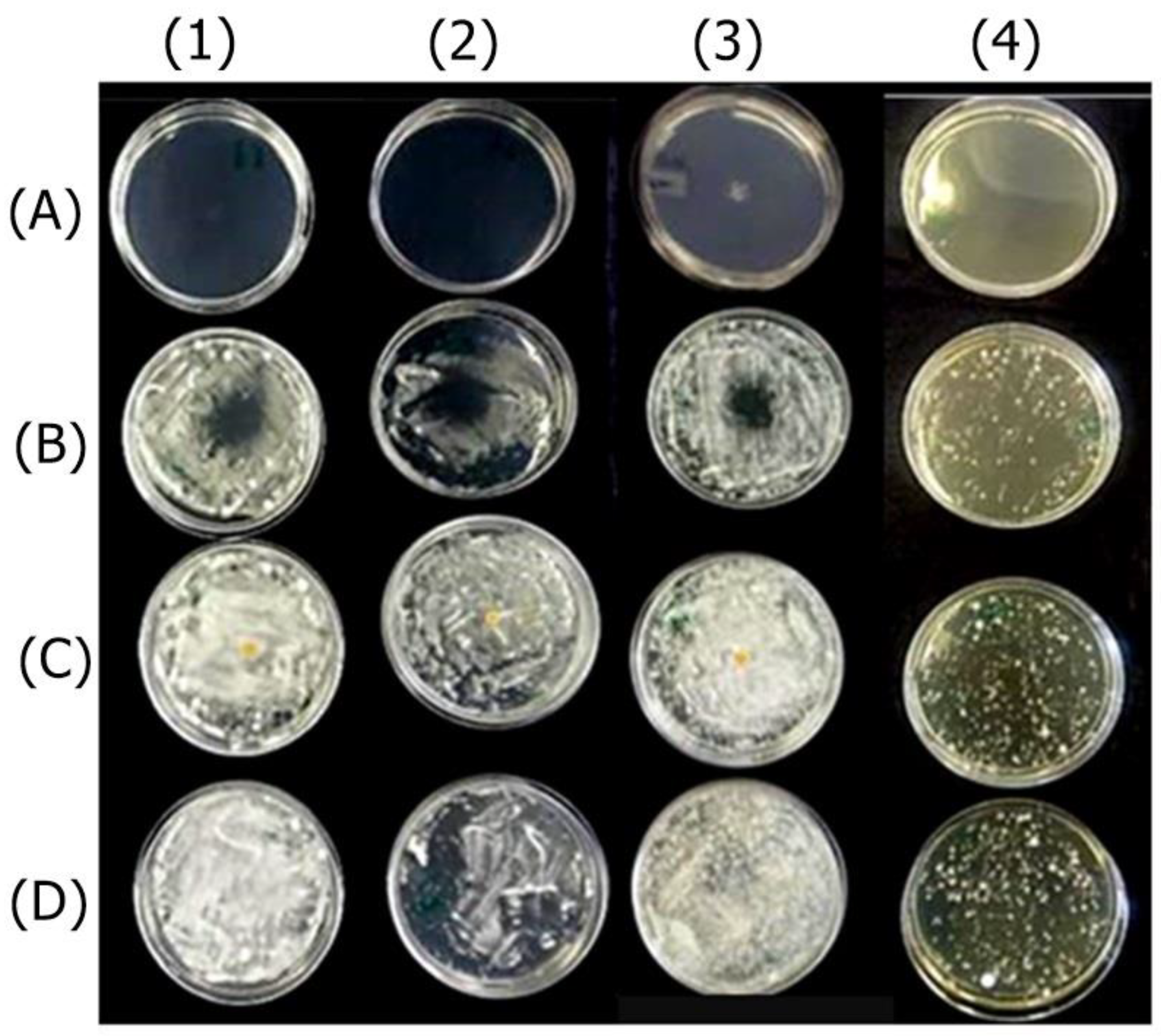
Figure 3.
Antifungal effect of the formulations (F) without and with actives (OEO, REO, and bioAgNP) alone and in combination against Tricophyton rubrum. (A) F-OEO. (B) F-REO. (C) F-Ag. (D) F-OEO/REO. (E) F-REO/Ag. (F) F-OEO/Ag. (G) F-OEO/REO/Ag. (H) RF (reference formulation with amorolfine hydrochloride). (I) BF (base formulation without active). (J) Fungal growth control (without formulation).
Figure 3.
Antifungal effect of the formulations (F) without and with actives (OEO, REO, and bioAgNP) alone and in combination against Tricophyton rubrum. (A) F-OEO. (B) F-REO. (C) F-Ag. (D) F-OEO/REO. (E) F-REO/Ag. (F) F-OEO/Ag. (G) F-OEO/REO/Ag. (H) RF (reference formulation with amorolfine hydrochloride). (I) BF (base formulation without active). (J) Fungal growth control (without formulation).
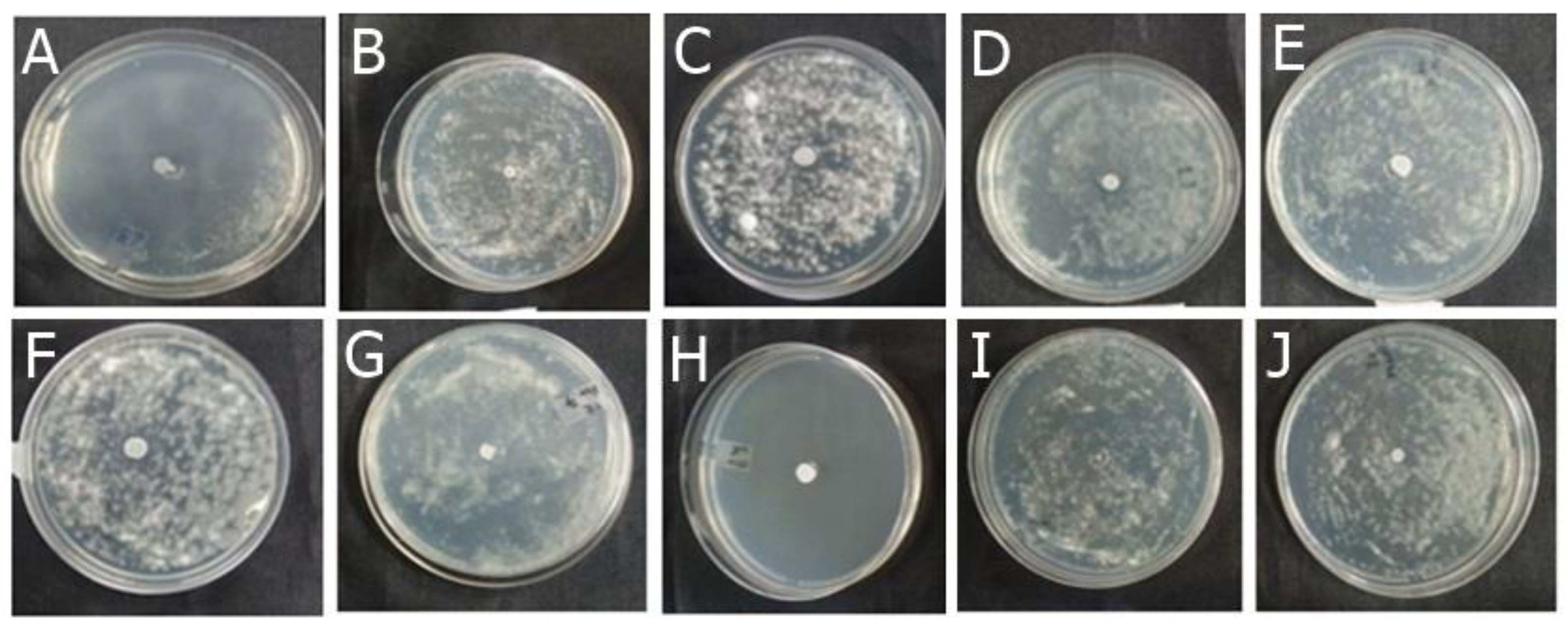
Figure 4.
Antifungal effect of the formulations (F) without and with actives (OEO, REO, and bioAgNP) alone and in combination against Microsporum canis. (A) F-OEO. (B) F-REO. (C) F-Ag. (D) F-OEO/REO. (E) F-REO/Ag. (F) F-OEO/Ag. (G) F-OEO/REO/Ag. (H) RF (reference formulation with amorolfine hydrochloride). (I) BF (base formulation without active). (J) Fungal growth control (without formulation).
Figure 4.
Antifungal effect of the formulations (F) without and with actives (OEO, REO, and bioAgNP) alone and in combination against Microsporum canis. (A) F-OEO. (B) F-REO. (C) F-Ag. (D) F-OEO/REO. (E) F-REO/Ag. (F) F-OEO/Ag. (G) F-OEO/REO/Ag. (H) RF (reference formulation with amorolfine hydrochloride). (I) BF (base formulation without active). (J) Fungal growth control (without formulation).
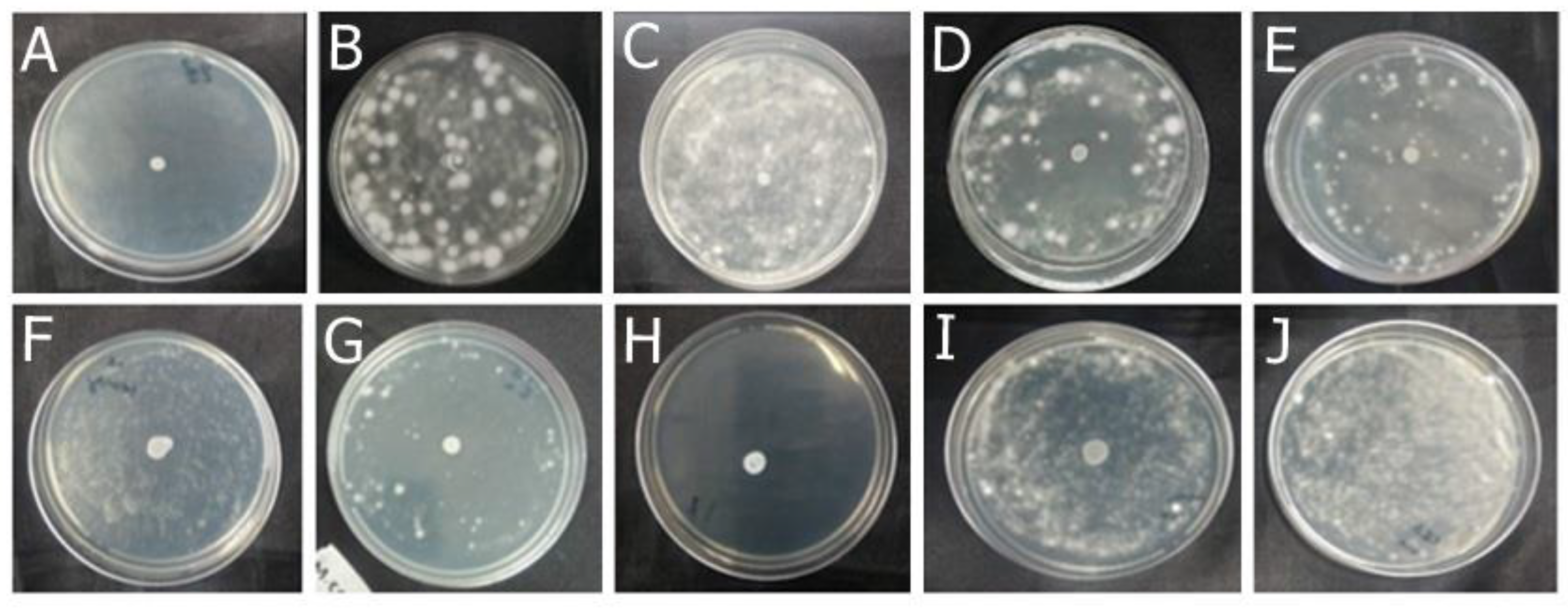
Figure 5.
Antifungal effect of the formulations (F) without and with actives (OEO, REO, and bioAgNP) alone and in combination against Microsporum gypseum. (A) F-OEO. (B) F-REO. (C) F-Ag. (D) F-OEO/REO. (E) F-REO/Ag. (F) F-OEO/Ag. (G) F-OEO/REO/Ag. (H) RF (reference formulation with amorolfine hydrochloride). (I) BF (base formulation without active). (J) Fungal growth control (without formulation).
Figure 5.
Antifungal effect of the formulations (F) without and with actives (OEO, REO, and bioAgNP) alone and in combination against Microsporum gypseum. (A) F-OEO. (B) F-REO. (C) F-Ag. (D) F-OEO/REO. (E) F-REO/Ag. (F) F-OEO/Ag. (G) F-OEO/REO/Ag. (H) RF (reference formulation with amorolfine hydrochloride). (I) BF (base formulation without active). (J) Fungal growth control (without formulation).
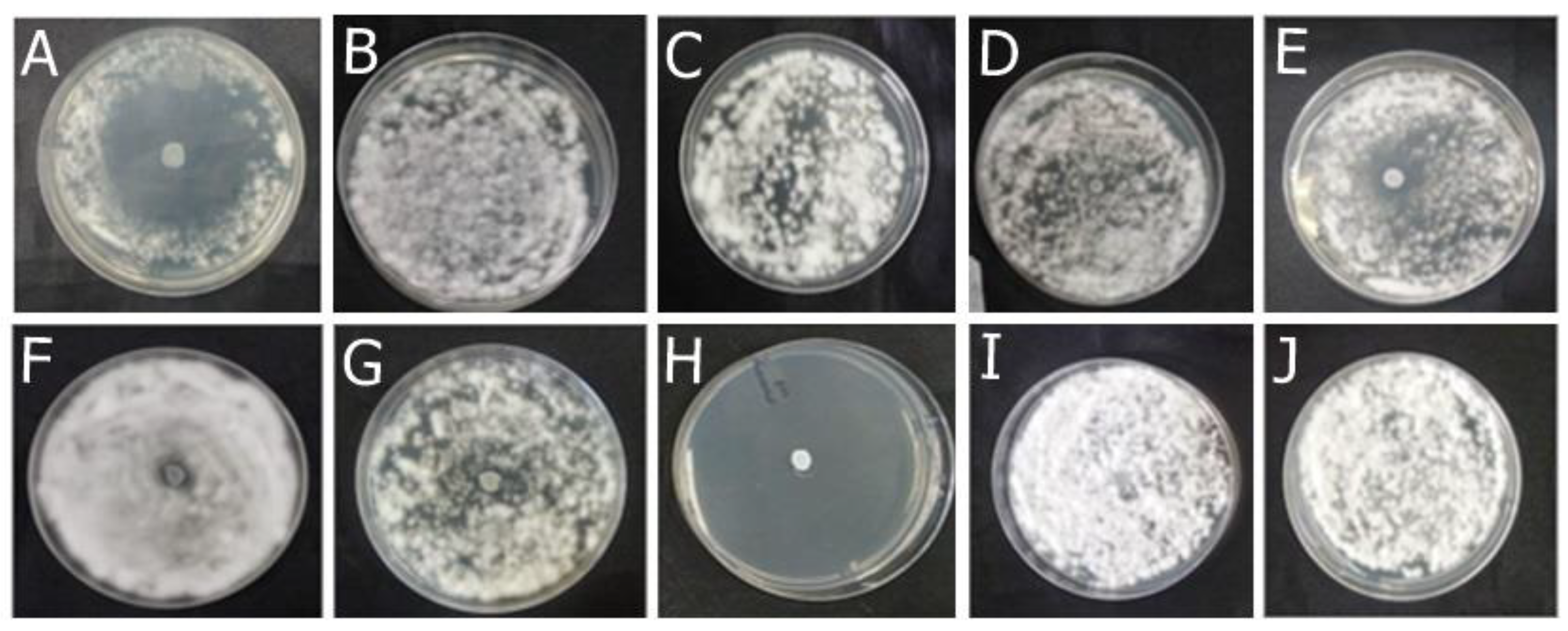
Chart 1.
Ex vivo antifungal effect of the formulations containing oregano (OEO), rosemary essential oil (REO) and/or biogenic silver nanoparticles (bioAgNP) against several fungi species grown in nails. Three treatment times (5 days, 10 days and 15 days) were tested for each formulation. Base formulation (BF) without active was tested as fungal grown control. For comparison, a commercial reference formulation (RF) was also tested. The positive sign indicates that the formulation showed antifungal efficacy. The negative sign indicates that the formulation did not show antifungal efficacy.
Chart 1.
Ex vivo antifungal effect of the formulations containing oregano (OEO), rosemary essential oil (REO) and/or biogenic silver nanoparticles (bioAgNP) against several fungi species grown in nails. Three treatment times (5 days, 10 days and 15 days) were tested for each formulation. Base formulation (BF) without active was tested as fungal grown control. For comparison, a commercial reference formulation (RF) was also tested. The positive sign indicates that the formulation showed antifungal efficacy. The negative sign indicates that the formulation did not show antifungal efficacy.
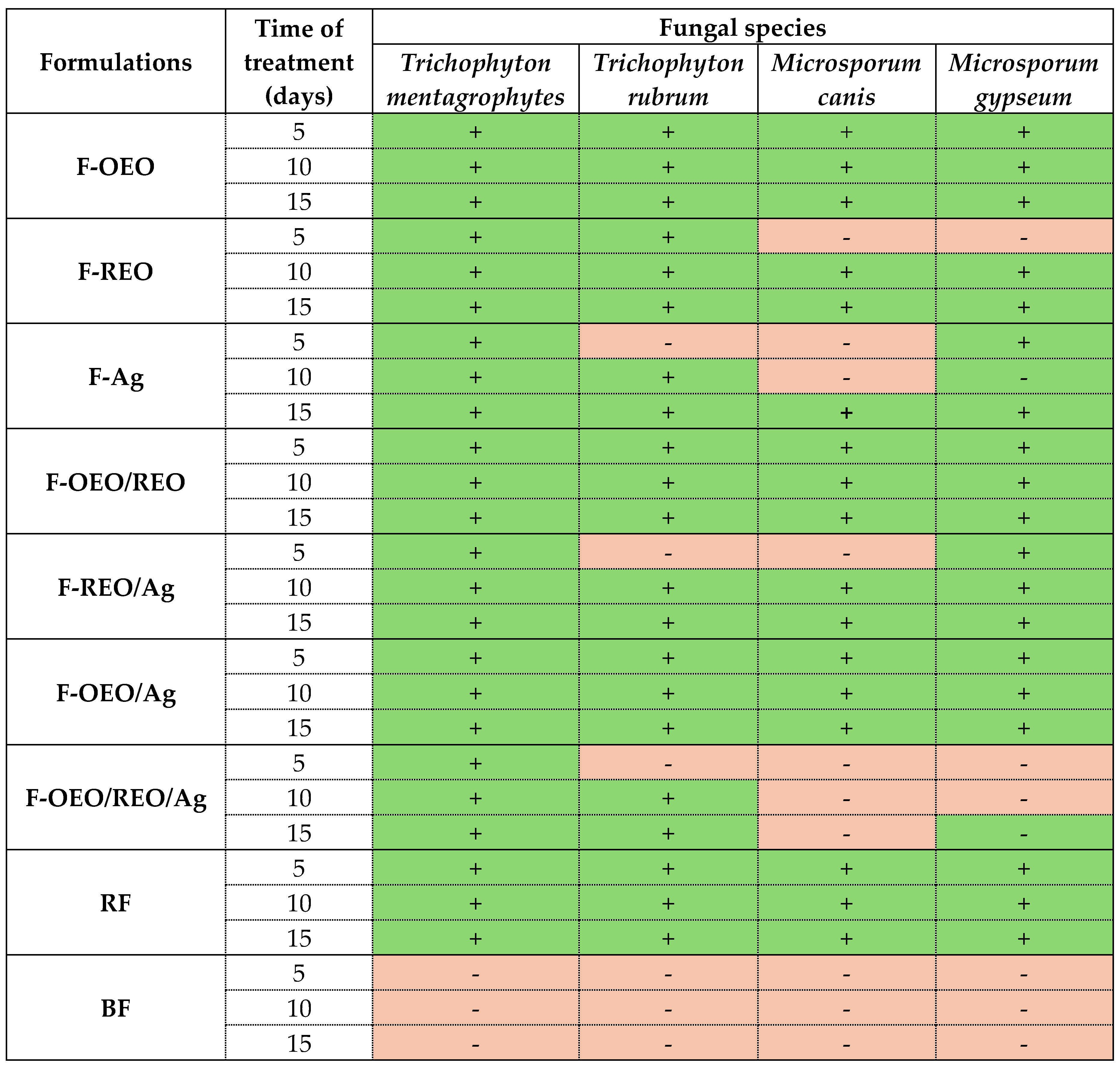
Figure 6.
Absorption spectra obtained by FTIR-PAS of formulations and untreated and treated nail: (A) Formulations F-OEO, F-REO, F-Ag, F-OEO + REO + Ag, and BF. (B) Dorsal (top graph) and ventral (bottom graph) region of the nail without nail lacquer (control) and after 30 minutes of contact with the formulations.
Figure 6.
Absorption spectra obtained by FTIR-PAS of formulations and untreated and treated nail: (A) Formulations F-OEO, F-REO, F-Ag, F-OEO + REO + Ag, and BF. (B) Dorsal (top graph) and ventral (bottom graph) region of the nail without nail lacquer (control) and after 30 minutes of contact with the formulations.
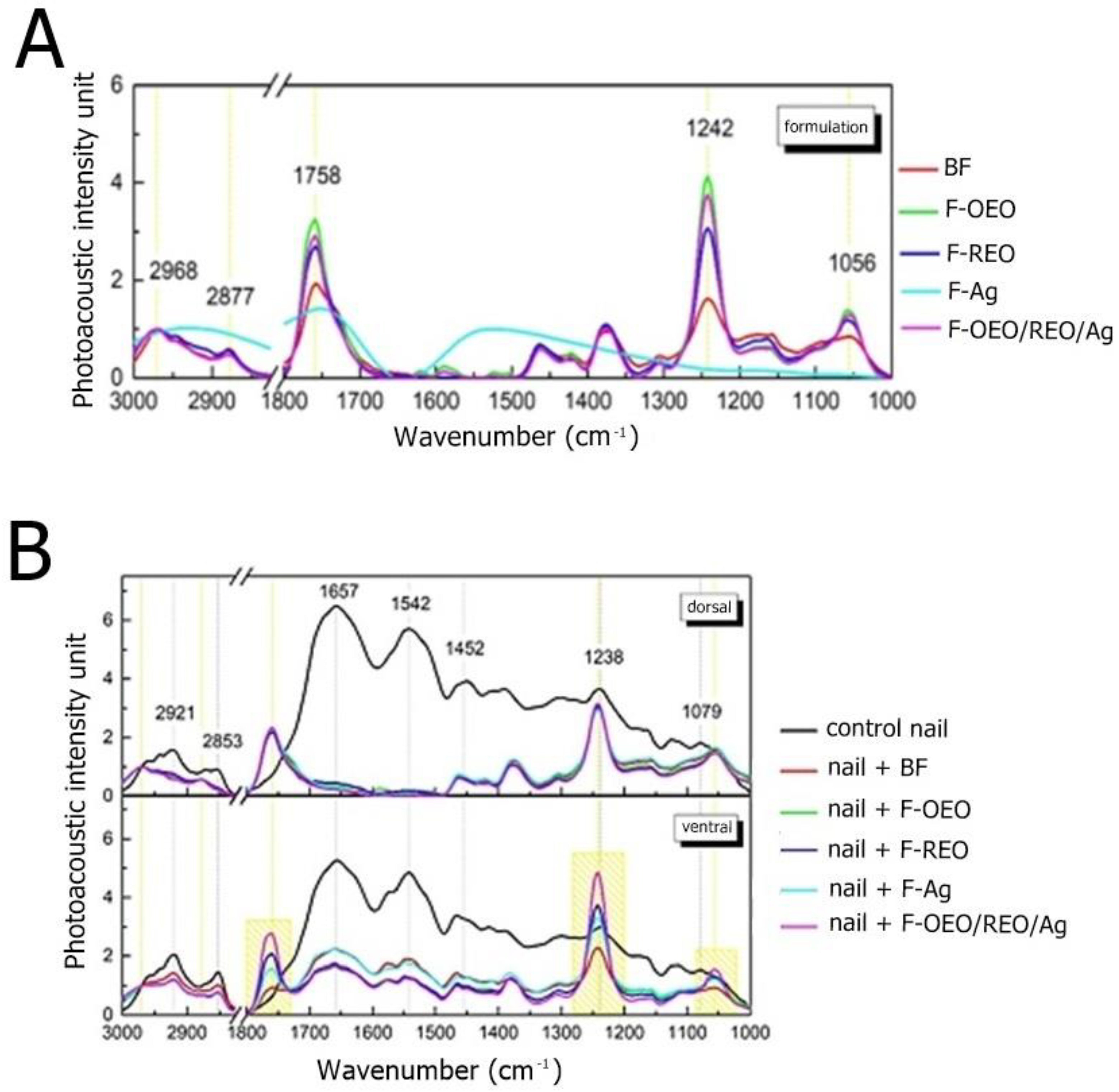
Figure 7.
Area under the curve obtained through an integral for the bands centered at 1758, 1242 and 1079 cm-1, subtracting the area of the control nail in this region. Each value represents the mean ± standard deviation of group (n = 10 nails). One-way ANOVA followed by Tukey’s test, with p<0.05.
Figure 7.
Area under the curve obtained through an integral for the bands centered at 1758, 1242 and 1079 cm-1, subtracting the area of the control nail in this region. Each value represents the mean ± standard deviation of group (n = 10 nails). One-way ANOVA followed by Tukey’s test, with p<0.05.
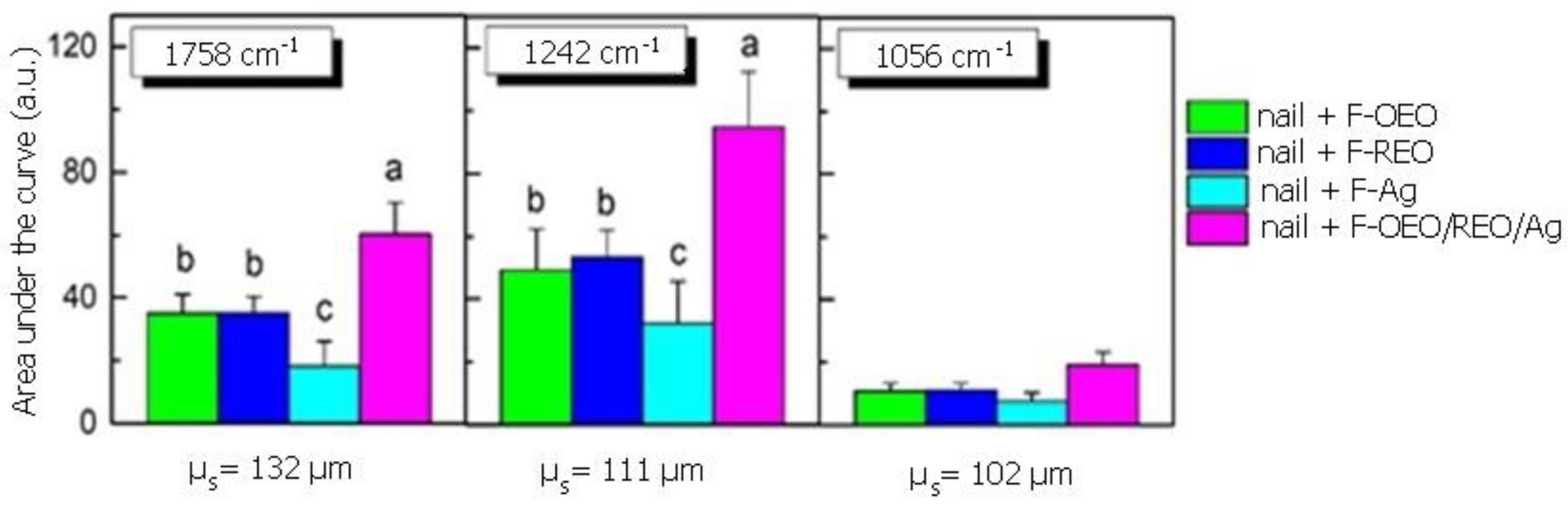
Figure 8.
Scanning electron micrographs of the antifungal effect of the formulations containing oregano (OEO) alone ou in combination with biogenic silver nanoparticles (bioAgNP) against Tricophyton mentagrophytes grown in nails. (A) Untreated nail control (1,200 ×). (B) Untreated nail control (2,400 ×). (C) Nail treated with F-OEO (1,200 ×). (D) Nail treated with F-OEO (2,400 ×). (E) Nail treated with F-OEO + Ag (1,200 ×). (F) Nail treated with F-OEO + Ag (2,400 ×).
Figure 8.
Scanning electron micrographs of the antifungal effect of the formulations containing oregano (OEO) alone ou in combination with biogenic silver nanoparticles (bioAgNP) against Tricophyton mentagrophytes grown in nails. (A) Untreated nail control (1,200 ×). (B) Untreated nail control (2,400 ×). (C) Nail treated with F-OEO (1,200 ×). (D) Nail treated with F-OEO (2,400 ×). (E) Nail treated with F-OEO + Ag (1,200 ×). (F) Nail treated with F-OEO + Ag (2,400 ×).
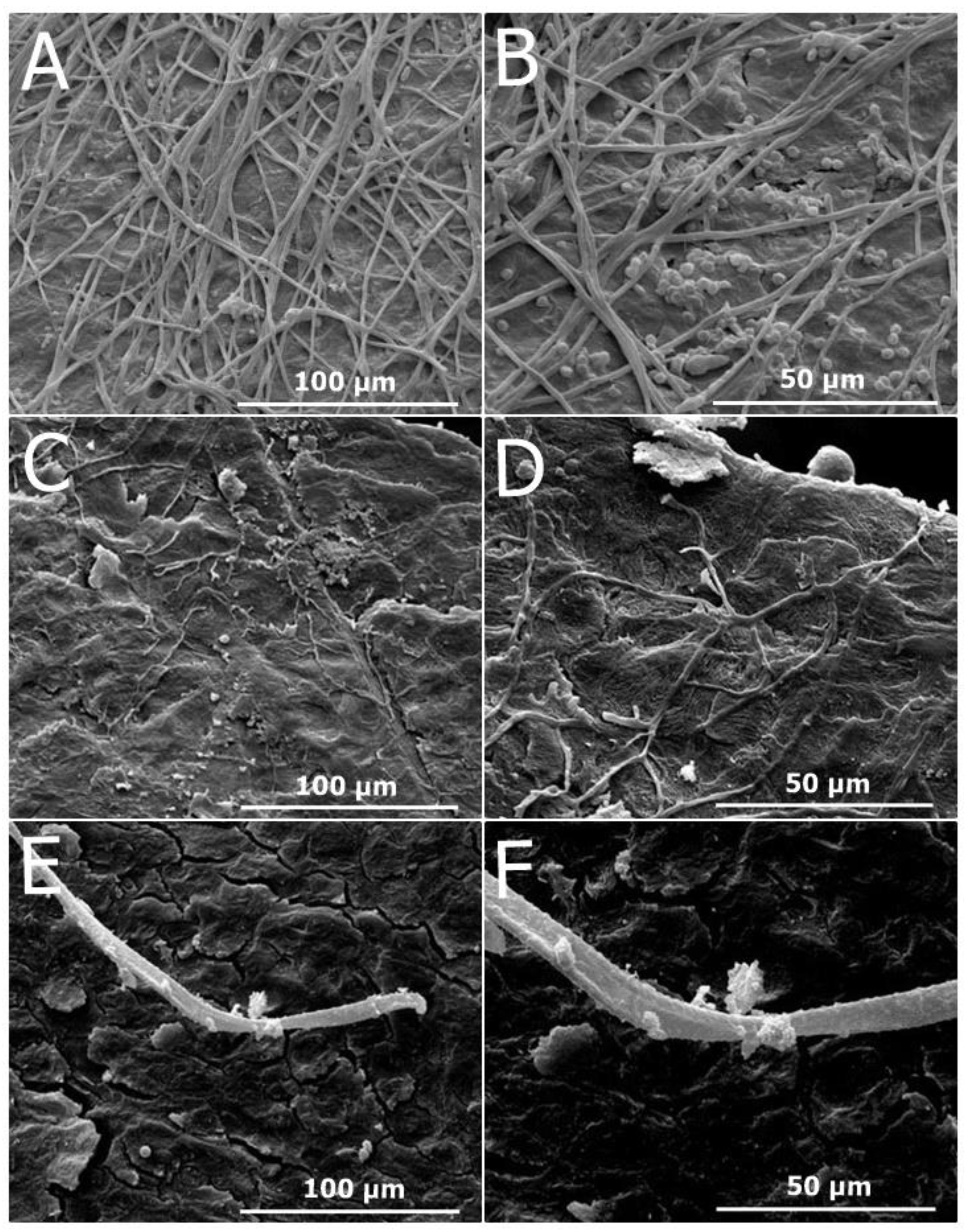
Figure 9.
Simplex-centroid experimental design used to define the concentration of actives alone and in binary or ternary combination. (1) Formulation containing OEO alone. (2) Formulation containing REO alone. (3) Formulation containing bioAgNP alone. (4) Formulation containing OEO plus REO. (5) Formulation containing REO plus bioAgNP. (6) Formulation containing OEO plus bioAgNP. (7) Formulation containing ternary combination of actives; OEO + REO + bioAgNP.
Figure 9.
Simplex-centroid experimental design used to define the concentration of actives alone and in binary or ternary combination. (1) Formulation containing OEO alone. (2) Formulation containing REO alone. (3) Formulation containing bioAgNP alone. (4) Formulation containing OEO plus REO. (5) Formulation containing REO plus bioAgNP. (6) Formulation containing OEO plus bioAgNP. (7) Formulation containing ternary combination of actives; OEO + REO + bioAgNP.
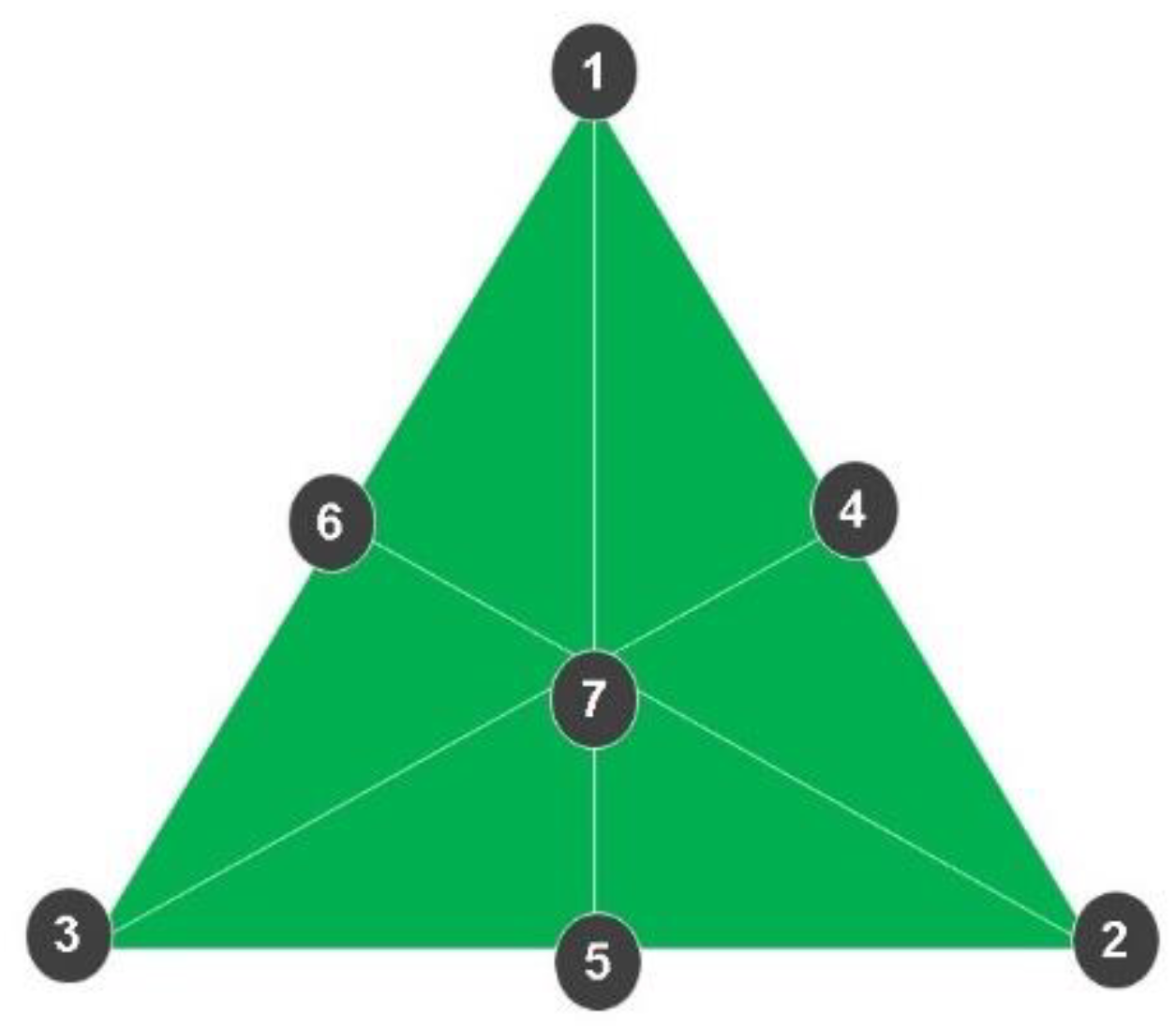
Figure 10.
Schematic diagram of nail permeation of the nail lacquers BF, F-OEO, F-REO, F-Ag, and F-OEO/REO/Ag. It represents an ex vivo assay, in which nails were treated on the dorsal layer with the formulations, and after 30 minutes the ventral layer was analyzed by FTIR-PAS.
Figure 10.
Schematic diagram of nail permeation of the nail lacquers BF, F-OEO, F-REO, F-Ag, and F-OEO/REO/Ag. It represents an ex vivo assay, in which nails were treated on the dorsal layer with the formulations, and after 30 minutes the ventral layer was analyzed by FTIR-PAS.
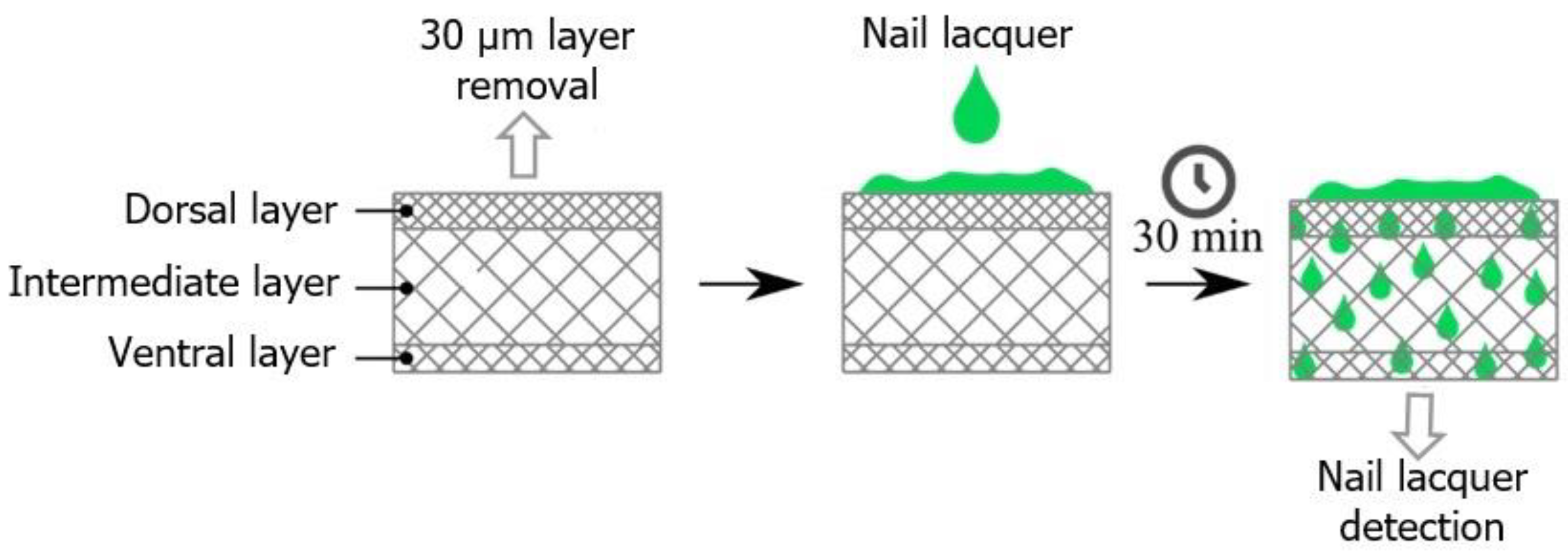
Figure 11.
Schematic diagram of the experimental procedure. Initially, the active ingredients (OEO, REO, and bioAgNP) were tested against dermatophyte fungi (T. rubrum, T. mentagrophytes, M. canis e M. gypseum, using agar diffusion and broth microdilution techniques, to determine the fungal growth inhibition halo and the efficient concentrations (MIC and MFC) of each active respectively. The citotoxicity os actives was tested by MTT assay. Then the the nail lacquer formulations were manipulated and subjected to the following tests in sequence: stability centrifugation test, antimibrobial ex vivo test using fungal-contamined nail (it was performed against the four fungal species), permeation across the nail analysis using FTIR-PAS, antifungal study by SEM, drying time assay, evaluation of organoleptic and physical-chemical characteristics, and preliminary stability study. The tests were performed in the order indicated by the arrows. Some tests were performed with all formulations, and others were carried out with some formulations. Green diamond: it indicates all formulations. Green circle: it indicates five formulations . Green star: it indicate the promissing the formulations for the final product.
Figure 11.
Schematic diagram of the experimental procedure. Initially, the active ingredients (OEO, REO, and bioAgNP) were tested against dermatophyte fungi (T. rubrum, T. mentagrophytes, M. canis e M. gypseum, using agar diffusion and broth microdilution techniques, to determine the fungal growth inhibition halo and the efficient concentrations (MIC and MFC) of each active respectively. The citotoxicity os actives was tested by MTT assay. Then the the nail lacquer formulations were manipulated and subjected to the following tests in sequence: stability centrifugation test, antimibrobial ex vivo test using fungal-contamined nail (it was performed against the four fungal species), permeation across the nail analysis using FTIR-PAS, antifungal study by SEM, drying time assay, evaluation of organoleptic and physical-chemical characteristics, and preliminary stability study. The tests were performed in the order indicated by the arrows. Some tests were performed with all formulations, and others were carried out with some formulations. Green diamond: it indicates all formulations. Green circle: it indicates five formulations . Green star: it indicate the promissing the formulations for the final product.
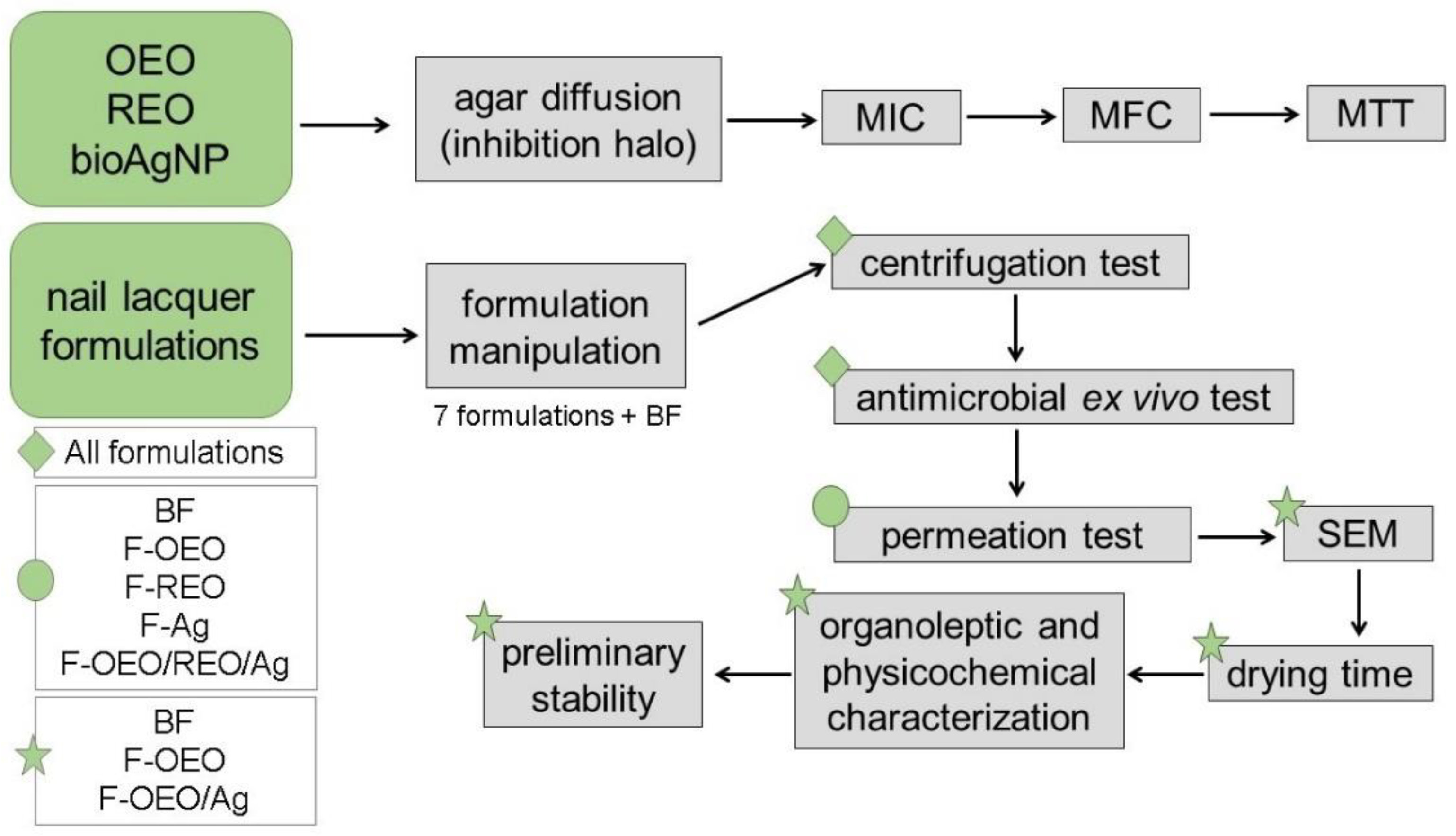
Table 1.
Mean of minimal inhibitory concentrations of oregano essential oil (OEO) rosemary essential oil (REO), and biogenic silver nanoparticles (bioAgNP).
Table 1.
Mean of minimal inhibitory concentrations of oregano essential oil (OEO) rosemary essential oil (REO), and biogenic silver nanoparticles (bioAgNP).
| Fungal species | OEO (%, v/v) | REO (%, v/v) | bioAgNP (%, v/v) |
|---|---|---|---|
| Trichophyton mentagrophytes | 0.047 ± 0.02 | 0.188 ± 0.09 | 2.93×10 -3 ± 0.01 |
| Trichophyton rubrum | 0.047 ± 0.02 | 0.188 ± 0.09 | 1.46×10⁻³ ± 0.00 |
| Microsporum canis | 0.094 ± 0.04 | 0.188 ± 0.09 | 1.93×10⁻³ ± 0.00 |
| Microsporum gypseum | 0.063 ± 0.00 | 0.250 ± 0.00 | 3.90×10⁻³ ± 0.00 |
Table 2.
Minimum fungicidal concentration of oregano essential oil (OEO) rosemary essential oil (REO), and biogenic silver nanoparticles (bioAgNP).
Table 2.
Minimum fungicidal concentration of oregano essential oil (OEO) rosemary essential oil (REO), and biogenic silver nanoparticles (bioAgNP).
| Fungal species | OEO (%, v/v) | REO (%, v/v) | bioAgNP (%, v/v) |
|---|---|---|---|
| Trichophyton mentagrophytes | 0.133 | 0.250 | > 0.25 |
| Trichophyton rubrum | 0.063 | 0.125 | 8.14×10⁻⁴ |
| Microsporum canis | 0.208 | > 0.250 | > 1.95×10⁻³ |
| Microsporum gypseum | 0.078 | > 0.250 | > 3.91×10⁻⁴ |
Table 3.
Cytotoxic concentration for 50% of VERO cells (CC50/72h) of oregano essential oil (OEO), rosemary essential oil (REO), and biogenic silver nanoparticles (bioAgNP) after 72 h of treatment.
Table 3.
Cytotoxic concentration for 50% of VERO cells (CC50/72h) of oregano essential oil (OEO), rosemary essential oil (REO), and biogenic silver nanoparticles (bioAgNP) after 72 h of treatment.
| Active | CC50/72h (%, v/v) |
|---|---|
| OEO | > 7.00 |
| REO | 0.049 |
| bioAgNP | 1.33 |
Disclaimer/Publisher’s Note: The statements, opinions and data contained in all publications are solely those of the individual author(s) and contributor(s) and not of MDPI and/or the editor(s). MDPI and/or the editor(s) disclaim responsibility for any injury to people or property resulting from any ideas, methods, instructions or products referred to in the content. |
© 2024 by the authors. Licensee MDPI, Basel, Switzerland. This article is an open access article distributed under the terms and conditions of the Creative Commons Attribution (CC BY) license (http://creativecommons.org/licenses/by/4.0/).
Copyright: This open access article is published under a Creative Commons CC BY 4.0 license, which permit the free download, distribution, and reuse, provided that the author and preprint are cited in any reuse.


