

Submitted:
16 August 2024
Posted:
19 August 2024
You are already at the latest version
Abstract
Over the coming decades, global freshwater withdrawals are expected to grow, especially in low and middle-income countries. Unless there are significant improvements in the efficiency of water use by economies, freshwater stress, crises and scarcity will worsen. This paper explores further the economic relationship between water use efficiency and scarcity. Because growing scarcity of freshwater in many regions and countries is not adequately reflected in markets, there is often insufficient incentives for investment and innovation to improve the efficiency of water use. To explore further changes in water use efficiency across countries, we conduct a panel analysis of water productivity changes for 130 countries over 1995 to 2020. Countries with lower initial levels of water use efficiency tended to have higher water productivity growth, whereas more agriculturally dependent economies displayed lower improvements in water use efficiency. Better institutional quality and capacity for innovation may also increase water use efficiency. We discuss the implications of these results for improving water use productivity in economies, and in particular, the opportunities and challenges for improving water markets and trades to alleviate water scarcity. We conclude by identifying further areas of research.
Keywords:
freshwater stress
; water markets
; water productivity
; water scarcity
; water use efficiency
1. Introduction
Over the coming decades, global freshwater withdrawals are expected to grow, driven by rapid population growth, socioeconomic development, urbanization, and growing water needs from the agriculture, industry, and energy sectors [1,2,3,4]. Most of this increase in water use will occur in low and middle-income, or developing, countries. As a result, insufficient water for human, industry or ecosystem use is considered one of the most perilous global risks to economies over the next ten years [15]. This risk will be further exacerbated by population growth and climate change [2,3,6].
Critical to avoiding chronic water scarcity and crises is for economies to improve significantly the efficiency of their use of freshwater withdrawals. Water use efficiency, sometimes also called water productivity, indicates how much value of output an economy can create for each unit of water used. It is usually measured in terms of dollars of real gross domestic product ($ GDP) per cubic meter (m3) of freshwater withdrawals.
Improving water productivity is essential to reducing freshwater stress, which is the amount of water withdrawn for irrigation, livestock, industry and domestic uses as a share of available freshwater resources [7,8,9]. But to date, progress has been mixed. Although water-use efficiency rose 9%, from $17.4/m3 in 2015 to $18.9/m3 in 2020, around 2.4 billion people lived in water-stressed countries in 2020, of which almost 800 million lived in countries suffering from high or extreme water stressed [10].
Unless there are significant improvements in water productivity in the coming decades, freshwater stress will worsen globally. Under current trends, annual water withdrawals in 2050 will be 20-50% higher than they were in 2020 [2,3]. By 2050, an additional 1 billion people are expected to face extreme water stress, even if the world limits global temperature rise to 1.3-2.4 oC [3]. Extreme weather events accompanying climate change, including more frequent and severe droughts and heat waves, are likely to further exacerbate freshwater stress in many countries and regions [11,12,13].
This paper explores further the economic relationship between water use efficiency and scarcity. As we outline in the next section, one of the main hindrances to improving water use efficiency is that the growing scarcity of freshwater in many regions and countries is not adequately reflected in markets. It is therefore important to understand more fully recent trends in water use efficiency across countries. We conduct a panel analysis of 130 countries over 1995 to 2020 to examine the possible relationships behind changes in water use efficiency during this period. Countries with lower initial levels of water use efficiency tended to have higher water productivity growth, whereas more agriculturally dependent economies displayed lower improvements in water use efficiency. Better institutional quality and capacity for innovation may also increase water use efficiency. We discuss the implications of these results for improving water use productivity in economies, and in particular, the opportunities and challenges for improving water markets and trades to alleviate water scarcity. We conclude by identifying further areas of research.
2. Water Scarcity, Markets and Efficiency
If a region or country faces increasing stress on available water supplies because of growing demand from various uses, then one would expect the markets for all water uses to reflect rising scarcity. Figure 1 indicates how this should happen.
Suppose that in a region, limited freshwater sources are available in any year. The initial supply of this water is indicated by the relatively steep curve S0 in Figure 1A, where more water may be supplied to the regional economy, but only through incurring high economic and ecological costs from providing additional supply. All the annual uses of water by individuals in the region for agricultural, industrial, and domestic purposes comprise the demand D0 for water in the economy. In the regional water market, a quantity of Q0 million cubic meters (106m3) of water will be supplied and used each year at the price of P0 per cubic meter.
However, if the regional economy and population are growing, then there will be an increase in the overall demand for water used each year. As shown in Figure 1A, in the short run, demand will shift outward from D0 to DSR. The resulting rise in demand relative to available supply indicates an increasing water scarcity. The price of water will increase significantly to PSR, and because all users have to pay higher prices, the quantity used will increase only slightly to QSR.
Over time, water users in the economy will likely respond to the higher prices of scarce water by reducing their use. For example, farmers could install more efficient pumping and irrigation systems to conserve the water they use for crop production, industries may install water-saving technologies and recycle more water, and households might reduce how much they water their lawns and buy appliances that use less water. All these conservation measures would eventually reduce the overall demand for water even as the population and economy continue to grow.
Figure 1B shows that the long-run response is a decline in demand from DSR to DLR. Meanwhile, the regional government and utility companies responsible for managing water supplies and delivering them to users will invest in improving the operation and management of reservoirs, delivery networks, and services, reducing leaks and other losses, and upgrading treatment, recycling, and wastewater reuse. Over the long run, the result may be more annual freshwater supplies, as Figure 1B indicates increases from SSR to SLR. Consequently, if water scarcity is reflected in markets, the long-term response to rising prices should eventually correct the problem. In addition, more output in the economy will be produced per cubic meter of freshwater withdrawal, and thus water use efficiency will have improved considerably.
Unfortunately, one important reason for the growing problems of water stress and scarcity in many regions and countries is that the markets for water do not reflect scarcity. Instead, the way in which water is managed today in much of the world is shaped by patterns of property rights, public supply, and other institutions inherited from past eras when water was relatively abundant and not increasingly scarce [1].
When water is relatively abundant, there is a tendency to assume that plenty of water is available to meet rising demand and at little additional economic cost or environmental damage. Moreover, to support supplying more water as cheaply as possible to meet growing demand, new water infrastructure projects, delivery networks, and treatment systems are often subsidized, and the impacts on the surrounding environment from diverting and depleting water from aquatic ecosystems are ignored. The result is a chronic underpricing of water in markets, meaning they fail to reflect the full costs of rising scarcity [1,4,11].
Figure 2 illustrates the problem when markets do not respond to the full costs of rising water scarcity. Suppose our region has limited sources of freshwater available in any year. Supplying more water to the regional economy still incurs large increases in economic and ecological costs, but subsidies and the disregard for environmental damages artificially lower the supply costs in the market. As shown in Figure 2A, the initial demand for water is still D0, but now the supply of water is perceived to be a relatively flat curve S0. The market and policy failures mean that more water is supplied at little recognized additional cost in the market. Because the true additional economic and ecological costs of supplying more water are not considered, the full costs of the growing scarcity of water are not indicated in prices. Therefore, although the initial price and water use are the same as before, P0 and Q0, the market response to an increase in demand will be very different.
Once again, rising incomes and population growth are expected to cause an increase in the overall demand for water used each year, and as shown in Figure 2A, D0 will shift outwards to DSR. But now, more water will be supplied at little perceived additional cost to meet this rising demand. When the market for water does not reflect the growing scarcity of water because it does not consider the true additional economic and ecological costs of increasing supply, the result is that the price of water barely rises from P0 to PSR, even though water scarcity has worsened in the region.
The long-run implications could be even more significant. As Figure 2B indicates, the failure of price to rise in response to increasing scarcity means that water users in the region have little or no incentive to conserve, and there will be insufficient investment and innovation to expand supply and improve the efficiency of water use. Increasing economic growth and population will lead to a rise in the demand for water in the long run to DLR, and the resulting higher levels of water withdrawals relative to available freshwater could mean that the region approaches or even exceeds extremely high water stress. Yet price, in the long run, is not serving as an indicator of this impending scarcity, as PLR ≈ PSR ≈ P0. The underpricing of water prevents efficient and sustainable management of this valuable resource, and water productivity will remain relatively low.
3. Explaining Water Use Efficiency
If the full costs of water scarcity are not reflected adequately in markets and chronic underpricing persists, it is important to understand more fully recent trends in water use efficiency across countries.
As noted in the Introduction, water use efficiency is usually measured in terms of dollars of real gross domestic product ($ GDP) per cubic meter (m3) of freshwater withdrawals. The inverse of this indicator is water use intensity, which is the amount of water used for every unit of economic output, usually measured in terms of m3 of total water withdrawal per dollar of real GDP. Consequently, economies experiencing improvements in water use efficiency exhibit declining water intensity of their aggregate output.
Growth in water withdrawals is decomposed by [7] through applying a “water” Kaya identity, which is an approach frequently used to track the key factors underlying energy-related carbon emissions [14,15]. According to this decomposition, the three factors determining growth in water withdrawals of an economy are growth in population, income per capita and water intensity.1 As most economies experience population growth and would like income per capita to increase, decoupling water withdrawals from economic growth will require substantial reductions in the water intensity of economies, which is achieved through raising their water productivity ($ GDP/m3).
As irrigation for agriculture is the economic sector responsible for much (around 70% on average) of the world’s water use, many have pointed to the mismanagement and overuse of water in this sector as a key hindrance to reducing water intensity of economies [8,11,16,17]. To examine this link further, [7] conducts a pairwise comparison between water intensity of output and agriculture’s share of water use (averaged over 2010-2020) for 51 developed countries and 113 low and middle-income countries. Water intensity is positively correlated with agriculture’s share of total water withdrawals in both sets of countries, but the magnitude of this relationship is much more substantial for developing countries. For example, on average across the developed countries of the sample, a percentage-point increase in the share of water used in agriculture is associated with a 1.8% growth in the overall water intensity of their economies, whereas for developing economies an increase in agriculture’s water share is associated with 3.2% growth in water intensity.
These results suggest that less water used in agriculture, which is likely to depend on the relative importance of agriculture to the overall economy, could reduce the overall water intensity of economic output significantly. From 2015 to 2020, the global improvement in water use efficiency ranged from below $3/m3 in economies that depend on agriculture to over $50/m3 in highly industrialized or service-based economies [10]. Studies for the United States and European countries that decompose the impacts of improving water productivity on water withdrawal trends confirm that the overall structural dependence of an economy on agriculture is an important determinant of changes in water use efficiency [18,19,20,21,22,23].
Other important factors identified in improving water productivity include the quality of institutions and governance and the capacity for innovation [1,9,11,18]. These can often be self-reinforcing. For example, [9] (p. 8868) notes that one reason for the recent “decoupling” of water withdrawals from population and economic growth in the United States is “substantial technological improvements driven, in part, by federal regulations on industrial wastewater discharges and by state and federal appliance efficiency standards have reduced the amount of water required to meet urban, industrial, and agricultural needs.” In comparison, one explanation for the poor water productivity of many low and middle-income economies is inefficient water governance and institutions. That is, “any economy-wide productivity gains of increased water use appear to be outstripped by the increasing environmental and social costs as countries devote more infrastructure and institutions to achieving greater water security” [24] (p. 501).
4. Materials and Methods
The following analysis explores further the possible relationships behind changes in water use efficiency outlined in the previous section. The main hypothesis we examine is that, for any country, changes in water use efficiency over any given time period are associated with both the initial level of water use efficiency as well as on the overall dependence of the economy on agriculture. To test this hypothesis, the paper employs a panel analysis of five-year intervals from 1995-2020 for 130 countries. In addition, we include control variables to account for the possible influence of institutional quality, innovation and other macroeconomic factors on changes in water use efficiency.
Our estimation strategy assumes that the average annual change in water use efficiency of economy i over a period of T years beginning at initial year t can be specified as
where wit is the initial level of water use efficiency ($/m3), ait is initial agricultural dependency (i.e., agricultural value-added share of GDP) and Zit is a vector of initial control variables over [t,T] that may also explain changes in water use efficiency.
We estimate the following log-linear regression of (1)
If , we fail to reject the null hypothesis that the annual average change in water use efficiency over each [t,T] period is not affected by the initial level of water use efficiency or agricultural dependence of the economy in time t.
We apply our analysis to country-level observations for 130 countries over 1995-2020 divided into five-year time periods, i.e. 1995-2000, 2000-2005, 2005-2010, 2010-2015 and 2015-2020. Our measure of water use efficiency is water productivity (constant 2015 US$ GDP per cubic meter of total freshwater withdrawal), which comes from the World Bank World Development Indicators (https://databank.worldbank.org/source/world-development-indicators). We also obtain from the WDI our indicator for agricultural dependency, which is agriculture, forestry, and fishing value added (% of GDP). We derive a measure of institutional quality based on an average of the six governance and institutional indicators for each country in from the World Bank Worldwide Governance Indicators (https://databank.worldbank.org/source/worldwide-governance-indicators). As this institutional quality measure is scaled from -2.5 to 2.5, it is the only initial variable in the analysis that is not in natural logarithm. We proxy innovation by a human capital index based on years of schooling and returns to education from Penn World Table (PWT) 10.1 (https://www.rug.nl/ggdc/productivity/pwt/pwt-releases/pwt100). We use three additional macroeconomic controls from the WDI: urban population (% of total population), gross fixed capital formation (% of GDP) and trade openness (total exports and imports as a % of GDP).
Note that broad macroeconomic variables, such as initial income per capita and population, are not included as explanatory variables in our analysis. This is for two reasons. First, these economy-wide variables are likely to be correlated with the more specific variables representing agricultural dependency, institutional quality, innovation and other macroeconomic influences that might possibly impact changes in water use efficiency over time. Second, as noted in the previous discussion of the water Kaya identity in Section 3, income per capita, population and water intensity are separate factors determining annual water withdrawals of an economy. Therefore, growth in income and population should not also be used to explain changes in water use efficiency over time.
As there are only five short time periods in total, we employ one-way fixed effects panel analysis of (2) with standard errors clustered at the country level. We perform our analysis on all 130 countries as well as the sub-set of 84 low and middle-income countries. Because of missing observations for some countries, the sample of countries declines when additional controls are added to the analysis.
5. Results
Figure 3 shows the trend from 1995 to 2020 in average water use efficiency for the 130 countries of our sample, which includes 46 high-income and 84 low and middle-income countries.
For all countries, water use efficiency has been steadily increasing (Figure 3). However, water productivity is significantly greater in richer as opposed to developing countries. In 1995, water productivity was $70.6 per m3 in high-income economies and $17.4 per m3 in low and middle-income economies. By its peak in 2019, water productivity reached $164.9 per m3 in high-income countries and $44.5 per m3 in developing countries.
Figure 4 confirms that, over 1995 to 2020, water use efficiency was much higher in richer as opposed to poorer countries. On average over this period, water productivity was $13.8 per m3 in low-income economies, $20.6 per m3 in lower middle-income countries, $61.1 per m3 in upper middle-income economies, and $115.0 per m3 in high-income countries.
The results of the panel analysis are depicted in Table 1. Columns (1) to (3) depict three regression outcomes for all 130 countries, and columns (4) to (6) contain the same three regressions for the sub-sample of 84 countries. Columns (2) and (4) are the regressions without any controls, regressions (2) and (5) additionally include institutional quality and human capital, and columns (3) and (6) are the regressions with all five controls.
Across all six regressions of Table 1, the estimated coefficients on initial water use efficiency and agricultural dependency, i.e. b1 and b2 in (2), are negative, significant and approximately the same magnitude. These results indicate that we can reject the null hypothesis that the annual average change in water use efficiency over each five-year period from 1995 to 2020 is not affected by the initial level of water use efficiency or agricultural dependence of the economy.
The negative coefficient for b1 implies that, on average, countries with low initial water productivity tended to experience higher annual average growth in water use efficiency over each five-year period from 1995 to 2020 compared to countries with higher initial water productivity. The negative coefficient for b2 suggests that economies that were more dependent on agriculture had lower growth in water use efficiency compared to those economies that were less agriculturally dependent. These negative relationships appear to be greater for the sub-sample of low and middle-income economies (see columns (4)-(6) in Table 1).
When both institutional quality and human capital are included in the regressions, they have a positive and significant impact on changes in water use efficiency (see columns (2) and (5) in Table 1). Countries with better institutional quality and improved capacity for innovation tended to have higher water productivity growth over each five-year interval from 1995 to 2020. None of the additional controls appear to influence changes in water use efficiency except for urban population as a percentage share of total population, which has a positive and significant effect. However, as columns (3) and (6) show, the coefficients for institutional quality and human capital are still positive but no longer significant.2 One possible reason for this outcome is collinearity between, on the one hand, urban population (% total), and on the other, institutional quality and human capital.
In sum, the results of our analysis indicate that, over every five-year period from 1995 to 2020, countries with lower initial levels of water use efficiency tended to have higher water productivity growth, whereas more agriculturally dependent economies displayed lower improvements in water use efficiency. These relationships were especially strong among low and middle-income economies. There is some evidence that better institutional quality and capacity for innovation were also associated with higher water productivity growth, but this effect may also be related to a higher share of the population in urban areas.
6. Discussion
The implications of our results are somewhat mixed for rapidly improving water use efficiency, and thus reducing freshwater withdrawals and the threat of scarcity, in most economies. The overall trend since 1995 across countries is for improving water use efficiency, and those countries with the lowest initial water productivity display on average faster growth in water use efficiency. However, many economies, especially among low and middle-income countries, remain structurally dependent on agriculture, exhibit poor institutional quality and lack sufficient capacity (e.g. human capital) for innovation. As our analysis shows, these factors appear to have limited increases in water use efficiency across economies over 1995-2020.
If countries want to improve water use efficiency more rapidly, and thus avoid problems of scarcity, one approach would be to address the problem of underpricing of water in markets discussed in Section 2. For example, the Global Commission on the Economics of Water has stressed that ending the underpricing of water must be a priority for water management worldwide: “We must cease underpricing water. Proper pricing and targeted support for the poor will enable water to be used more efficiently in every sector, more equitably in every population and more sustainably both locally and globally” [4] (p. 17). Consequently, water policies and institutions that fail to address underpricing “compound water scarcity by encouraging wasteful extraction of water and ecosystem degradation. This creates perverse incentives that fail to balance water use with supply, protect freshwater ecosystems and support necessary technological innovations” [11] (p. 2).
However, transitioning from a situation where water scarcity is not reflected in markets (e.g., Figure 2) to one where markets increasingly respond to growing water scarcity (e.g., Figure 1) is not easy. There are examples from around the world where well-functioning water markets and trades have facilitated water conservation and re-allocation [1, [11,25,26,27,28,29,30,31,32,33,34]. This has occurred through both selling water from low-value users (e.g. irrigation) to high-value users (e.g. municipalities), or through transacting water between high-cost and less-cost users within the same sector (e.g. irrigation).
But establishing water markets and trades incurs significant transaction costs, which are the additional administrative and other costs incurred in organizing and participating in a market or implementing a new government policy, pricing reform or regulation. Keeping transaction costs as low as possible requires unique regulatory, institutional and governance conditions. The lack of such conditions often limits the effectiveness of water trading and markets as a solution to managing excessive freshwater withdrawals and scarcity, whereas if the institutional and regulatory impediments have been overcome, the necessary policy and administrative conditions for reforming water markets and trades to reflect rising scarcity often arise [1,11,31,33]. The lessons learned from successful implementation can help identify the policy and administrative conditions and reforms necessary to enable governments and jurisdictions to develop water trading arrangements that are efficient, equitable and within sustainable limits [33,35].
Three conditions that appear especially important for establishing water markets are a rights system in which water reallocation is legalized; separating water rights and landownership to enable water trades; and ending forfeiture rules decreeing that water rights are lost if the water is not used for a certain period [28,29,33,34,36]. For example, [36] found that 58 regions and countries satisfied all three conditions for the creation of water markets. In addition to the western United States and the Murray–Darling Basin in Australia, they include Chile, Indonesia, Vietnam, Korea and South Africa, Russia, some states in India, and various other countries. Another 66 regions and countries satisfied at least one or two of the legal conditions for creating water markets.
An additional concern regarding water trading is that it can cause environmental externalities. However, a recent review of the role of water trade and environmental degradation of the Murray-Darling Basin in Australia indicates that water trade can be associated with both positive and negative environmental impacts [37]. For example, although water trade in this region has led to changing patterns of surface water consumption, improved irrigation efficiency, and higher rates of groundwater extraction, their impact on increased salinity and water bank degradation is somewhat mixed. In addition, large-scale water entitlement buyback schemes to protect water flow rates, especially during periods of droughts, have provided broader positive environmental benefits [37].
In the end, increasing water scarcity, more frequent and extreme droughts, and growing water crises may prove to be the catalyst for water market and pricing reforms [11]. For example, [38] found that droughts, climate change and other environmental concerns were instrumental in improving river basin management and planning, including the use of water markets, in three critical and large river basins: the Colorado in the United States and Mexico, the Yellow (Huang He) in China, and the Murray-Darling in Australia. Water-related events, such as droughts, floods or water impacts from pollution, have also been the main instigators not just for improved river basin governance but also for reforms of water policies in agriculture [25]. Similarly, droughts were influential in instigating water policy and pricing reforms in Spain, Australia, and California, USA [26].
7. Conclusions
Critical to avoiding chronic water scarcity and crises is for economies to improve significantly the efficiency of their end use of freshwater withdrawals and to induce investments and innovations that increase effective water supplies. Unless there are significant improvements in water productivity in the coming decades, freshwater stress will worsen globally. Moreover, as the true additional economic and ecological costs of water scarcity are not considered, and the full costs of the growing scarcity of freshwater in many regions and countries are not adequately reflected in markets, there are often insufficient incentives for investment and innovation to improve the efficiency of water use. The global risks to economies and societies from increasing water scarcity will be exacerbated by population growth, economic development and climate change.
Our panel analysis of water productivity changes for 130 countries from 1995 to 2020 finds that countries with lower initial levels of water use efficiency tended to have higher water productivity growth, whereas more agriculturally dependent economies displayed lower improvements in water use efficiency. Better institutional quality and capacity for innovation may also increase water use efficiency. Although there is scope to improve water productivity and reduce scarcity through water markets and trades, a number of major institutional and policy challenges exist.
Our exploration of the economics of water scarcity and efficiency suggests several important areas for future research.
There needs to be more studies that analyze and decompose the impacts of improving water productivity on freshwater withdrawal trends across countries [7,18,19,20,21,22,23]. This is especially important to explore the influence of agricultural dependency, institutional quality, innovation and other macroeconomic factors in more detail.
Future research should also explore the effectiveness of water markets and trades in alleviating scarcity and improving water use efficiency. In particular, the lessons learned from successful examples of implementation can help identify the policy and administrative conditions and reforms necessary to enable governments and jurisdictions to develop water markets and trading arrangements that help improve efficient and sustainable use [33,35,36,37].
Finally, there is an urgent need to examine the challenges and opportunities facing low and middle-income economies. This includes understanding better the factors influencing changes in water use productivity in these economies, as well as the unique conditions that they face in establishing water markets and trades.
Author Contributions
Conceptualization, E.B. and J.B.; methodology, E.B.; formal analysis, E.B.; writing—original draft preparation, E.B. and J.B; writing—review and editing, E.B. and J.B. All authors have read and agreed to the published version of the manuscript.
Funding
This research received no external funding.
Institutional Review Board Statement
Not applicable.
Informed Consent Statement
Not applicable.
Data Availability Statement
The original data presented in the study are openly available from the website sources indicated in this paper.
Conflicts of Interest
The authors declare no conflict of interest.
| 1 | According to the “water” Kaya identity constructed for water by [7], the three constituent factors of annual water withdrawals (W) of an economy are population (N), income per capita (GDP/N) and the water intensity of output (W/GDP), i.e. Thus, the identity implies that the growth in water withdrawals for a country or group of countries can be at least partially attributed to growth in water intensity, GDP per person and population. See [7] for further details. |
| 2 | This outcome also occurs if just urban population (% total) is the only additional control variable included alongside institutional quality and human capital. In addition, if urban population (% total) is the only excluded control variable, then institutional quality and human capital are positive and significant but the other macroeconomic control variables are not. |
References
- Barbier, E.B. The Water Paradox: Overcoming the Global Crisis in Water Management; Yale University Press: New Haven and London, 2019. [Google Scholar]
- Boretti, A.; Rosa, L. Reassessing the projections of the World Water Development Report. NPJ Clean Water 2019, 2, 15. [Google Scholar] [CrossRef]
- Kuzma, S.; Saccoccia, L.; Chertock, M. 25 countries, housing one-quarter of the population, face extremely high water stress. Insights. August 16, 2023. World Resources Institute: Washington, D.C. Available online: https://www.wri.org/insights/highest-water-stressed-countries (accessed on 31 May 2024).
- Mazzucato, M.; Okonjo-Iweala, N.; Rockström, J.; Shanmugaratnam, T. Turning the Tide: A Call to Collective Action; Global Commission on the Economics of Water: Paris, 2023. [Google Scholar]
- World Economic Forum (WEF). The Global Risks Report 2024, 19th edition; WEF: Geneva, 2024. [Google Scholar]
- DiStefano, T.; Kelly, S. Are we in deep water? Water scarcity and its limits to economic growth. Ecological Economics 2017, 142, 130–147. [Google Scholar] [CrossRef]
- Barbier, E.B. Water and economic growth in developed and developing countries. Water Economics and Policy 2024, 10. [Google Scholar] [CrossRef]
- Food and Agricultural Organization (FAO) of the United Nations and UN Water. Progress on change in water-use efficiency. Global status and acceleration needs for SDG indicator 6.4.1; FAO: Rome, 2021. [Google Scholar]
- Gleick, P.H. Transitions to freshwater sustainability. Proceedings of the National Academy of Sciences 2019, 115, 8863–8871. [Google Scholar] [CrossRef] [PubMed]
- United Nations (UN). The Sustainable Development Goals Report 2023. UN: New York, 2023.
- Barbier, E.B. The economics of managing water crises. Philosophical Transactions of the Royal Society A 2022, 380, 20210295. [Google Scholar] [CrossRef]
- IPCC. Climate Change 2021: The Physical Science Basis. Contribution of Working Group I to the Sixth Assessment Report of the Intergovernmental Panel on Climate Change (eds V Masson-Delmotte et al.) Cambridge University Press: Cambridge, UK, 2021.
- Vicente-Serrano, S.M.; Peña-Angulo, D.; Beguería, S.; Domínguez-Castro, F.; Tomás-Burguera, M.; Noguera, I.; Gimeno-Sotelo, L.; El Kenawy, A. Global drought trends and future projections. Philosophical Transactions of the Royal Society A 2022, 380, 20210285. [Google Scholar] [CrossRef] [PubMed]
- Kaya, Y. The role of CO2 removal and disposal. Energy Conversion and Management 1995, 36, 375–380. [Google Scholar] [CrossRef]
- Fankhauser, S.; Jotzo, F. Economic growth and development with low-carbon energy. Wiley Interdisciplinary Reviews: Climate Change 2018, 9, e495. [Google Scholar] [CrossRef]
- D’Odorico, P.; Chiarelli, D.D.; Rosa, L.; Bini, A.; Zilberman, D.; Rulli, M.C. The global value of water in agriculture. Proceedings of the National Academy of Sciences 2020, 117, 21985–21993. [Google Scholar] [CrossRef]
- Hertel, T.; Liu, J. Implications of water scarcity for economic growth. In Economy-Wide Modeling of Water at Regional and Global Scales; Wittwer, G., Ed.; Springer: Singapore, 2019; pp. 11–35. [Google Scholar]
- Debaere, P.; Kurzendoerfer, A. Decomposing US water withdrawal since 1950. Journal of the Association of Environmental and Resource Economists 2017, 4, 155–196. [Google Scholar] [CrossRef]
- Di Cosmo, V.; Hyland, M.; Llop, M. Disentangling water usage in the European Union: A decomposition analysis. Water Resources Management 2014, 28, 1463–1479. [Google Scholar] [CrossRef]
- Du, Y.; Wang, R.; Zimmerman, J.B. Assessing the Progress toward a Water-Efficient Economy in the United States from 1985 to 2015. Environmental Science & Technology 2024, 58, 8696–8708. [Google Scholar]
- Duarte, R.; Pinilla, V.; Serrano, A. Income, economic structure and trade: Impacts on recent water use trends in the European Union. Sustainability 2018, 10, 205. [Google Scholar] [CrossRef]
- Llop, M. Decomposing the changes in water intensity in a Mediterranean region. Water Resources Management 2019, 33, 3057–3069. [Google Scholar] [CrossRef]
- Marston, L.T.; Lamsal, G.; Ancona, Z.H.; Caldwell, P.; Richter, B.D.; Ruddell, B.L.; Rushforth, R.R.; Davis, K.F. Reducing water scarcity by improving water productivity in the United States. Environmental Research Letters 2020, 15, 094033. [Google Scholar] [CrossRef]
- Barbier, E.B. Water and growth in developing countries. In Handbook of Water Economics; Dinar, A., Schwabe, K., Eds.; Edward Elgar Publishing: Cheltenham, UK, 2015; pp. 500–512. [Google Scholar]
- Gruère, G.; Ashley, C.; Cadilhon, J. Reforming water policies in agriculture: Lessons from past reforms. OECD Food, Agriculture and Fisheries Papers No. 113. OECD: Paris, 2018.
- Berbel, J.; Esteban, E. Droughts as a catalyst for water policy change: Analysis of Spain, Australia (MDB), and California. Global Environmental Change 2019, 58, 101969. [Google Scholar] [CrossRef]
- Convery, F.J. Reflections – shaping water policy: what does economics have to offer? Review of Environmental Economics and Policy 2013, 7, 156–174. [Google Scholar] [CrossRef]
- Debaere, P.; et al. Water markets as a response to scarcity. Water Policy 2014, 16, 625–649. [Google Scholar] [CrossRef]
- Dinar, A.; Pochat, V.; Albiac-Murillo. J., eds. Water Pricing Experiences and Innovations. Global Issues in Water Policy 9, Springer: Dorcrecht, 2015.
- Easter, K.W.; Huang, Q’, eds. Water Markets for the 21st Century: What Have We Learned? Global Issues in Water Policy 11, SpringerL Dordrecht, 2014.
- Grafton, R.Q.; Libecap, G.; McGlennon, S. /; Landry, C.; O’Brien, B. An integrated assessment of water markets: a cross-country comparison. Review of Environmental Economics and Policy 2011, 5, 219–239. [Google Scholar] [CrossRef]
- Olmstead, S.M. The economics of managing scarce water resources. Review of Environmental Economics and Policy 2010, 4, 179–198. [Google Scholar] [CrossRef]
- Wheeler, S.A., ed. Water Markets: A Global Assessment. Edward Elgar: Cheltenham, UK, 2021.
- Hanemann, M.; Young, M. Water rights reform and water marketing: Australia vs the US West. Oxford Review of Economic Policy 2020, 36, 36,108–131. [Google Scholar] [CrossRef]
- Wheeler, S.A.; Loch, A.; Crase, L.; Young, M.; Grafton, R.Q. Developing a water market readiness assessment framework. Journal of Hydrology 2017, 552, 807–820. [Google Scholar] [CrossRef]
- Endo, T.; Kakinuma, K.; Yoshikawa, S.; Kanae, S. Are water markets globally applicable? Environmental Research Letters 2018, 13, 034032. [Google Scholar] [CrossRef]
- Wheeler, S.A. Debunking Murray-Darling Basin water trade myths. Australian journal of agricultural and resource economics 2022, 66, 797–821. [Google Scholar] [CrossRef]
- Grafton, R.Q.; Pittock, J.; Davis, R.; Williams, J.; Fu, G.; Warburton, M.; Udall, B.; McKenzie, R.; Yu, X.; Che, N.; Connell, D. Global insights into water resources, climate change and governance. Nature Climate Change 2013, 3, 315–321. [Google Scholar] [CrossRef]
Figure 1.
Water scarcity is reflected in markets: (A) In the short run, an increase in demand will cause a rise in the price of water. (B) In the long run, , the rise in price provides incentives for water users to conserve and will induce investments and innovations that will increase effective supplies. Water use efficiency improves and scarcity will eventually diminish.
Figure 1.
Water scarcity is reflected in markets: (A) In the short run, an increase in demand will cause a rise in the price of water. (B) In the long run, , the rise in price provides incentives for water users to conserve and will induce investments and innovations that will increase effective supplies. Water use efficiency improves and scarcity will eventually diminish.
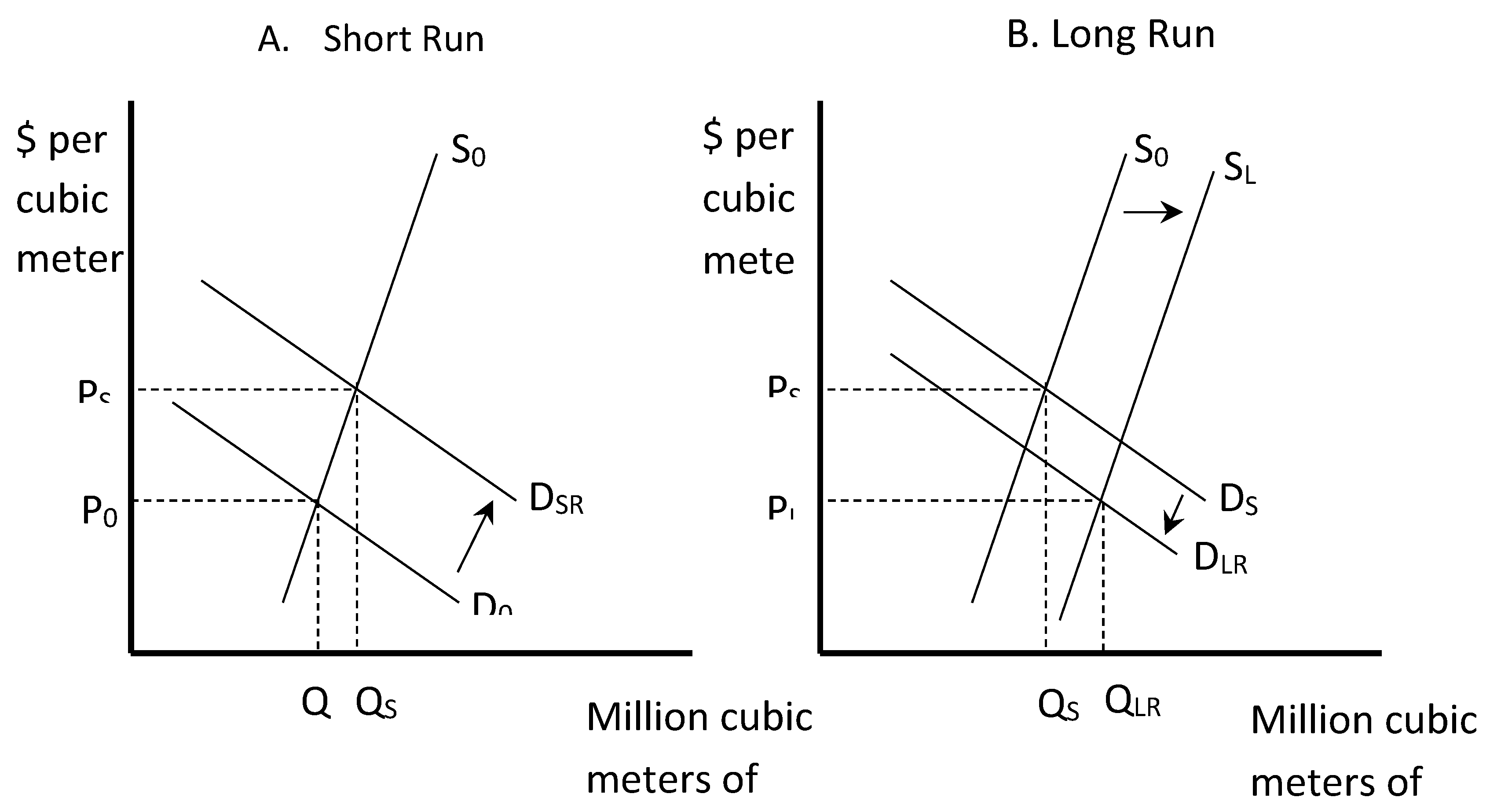
Figure 2.
Water scarcity is not reflected in markets: (A) In the short run, an increase in demand will cause little change in the price of water. (B) In the long run, there will be little incentive for water users to conserve or for additional investments and innovations to expand effective supplies. Rising demand could bring the region close to, or even exceed, extremely high water stress levels, and water use efficiency is low, yet this impending scarcity is still not reflected in the market.
Figure 2.
Water scarcity is not reflected in markets: (A) In the short run, an increase in demand will cause little change in the price of water. (B) In the long run, there will be little incentive for water users to conserve or for additional investments and innovations to expand effective supplies. Rising demand could bring the region close to, or even exceed, extremely high water stress levels, and water use efficiency is low, yet this impending scarcity is still not reflected in the market.
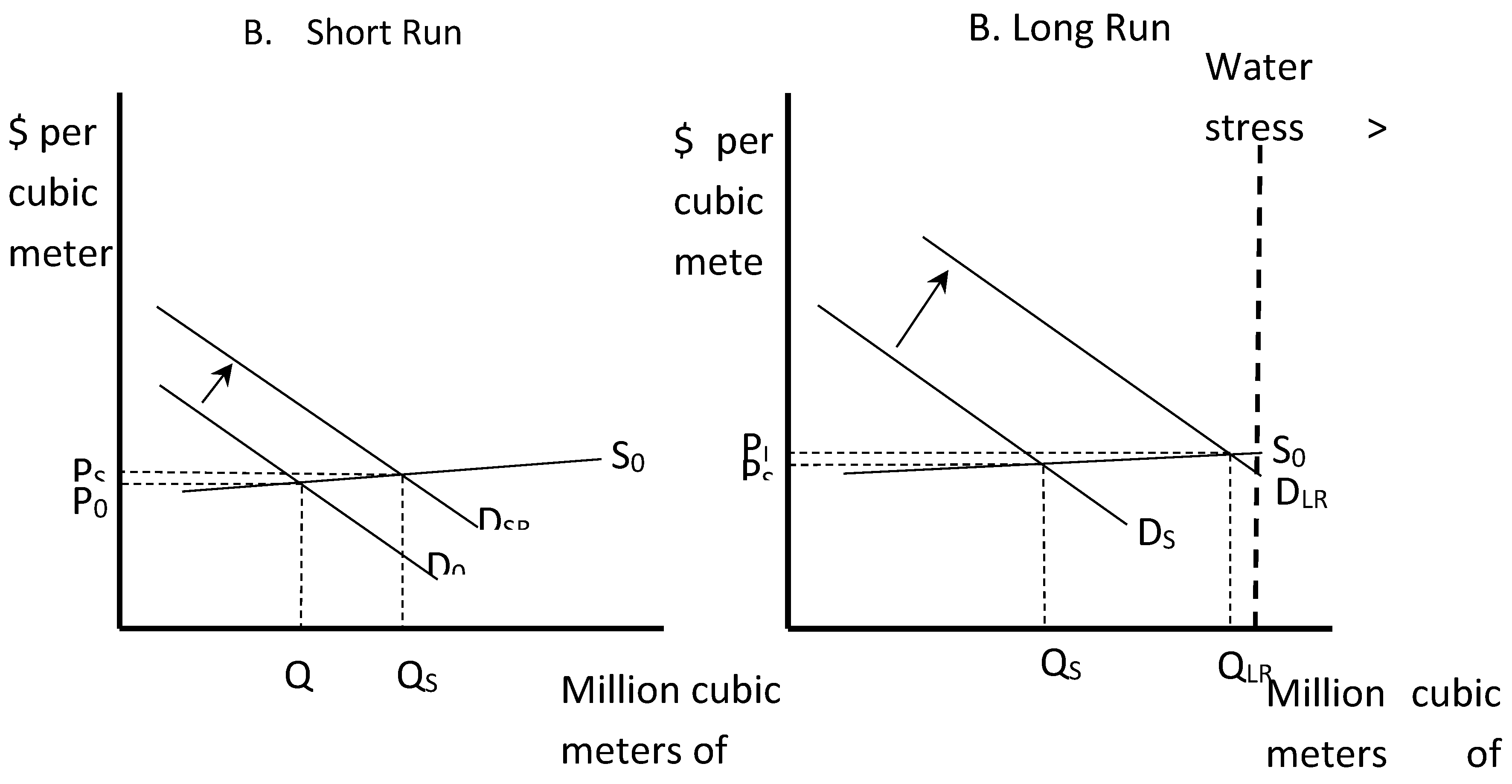
Figure 3.
Water use efficiency trends, 1995-2020. Data are for 130 countries (46 high-income and 84 low and middle-income). Income classifications are based on the 2023-24 World Bank Classification of Countries and Income Groups. High-income countries have $13, 846 or more gross national income (GNI) per capita in 2022, and low and middle-income economies have GNI per capita less than $13, 846. Data are from World Bank, World Development Indicators, http://databank.worldbank.org/data [Accessed on December 18, 2023].
Figure 3.
Water use efficiency trends, 1995-2020. Data are for 130 countries (46 high-income and 84 low and middle-income). Income classifications are based on the 2023-24 World Bank Classification of Countries and Income Groups. High-income countries have $13, 846 or more gross national income (GNI) per capita in 2022, and low and middle-income economies have GNI per capita less than $13, 846. Data are from World Bank, World Development Indicators, http://databank.worldbank.org/data [Accessed on December 18, 2023].
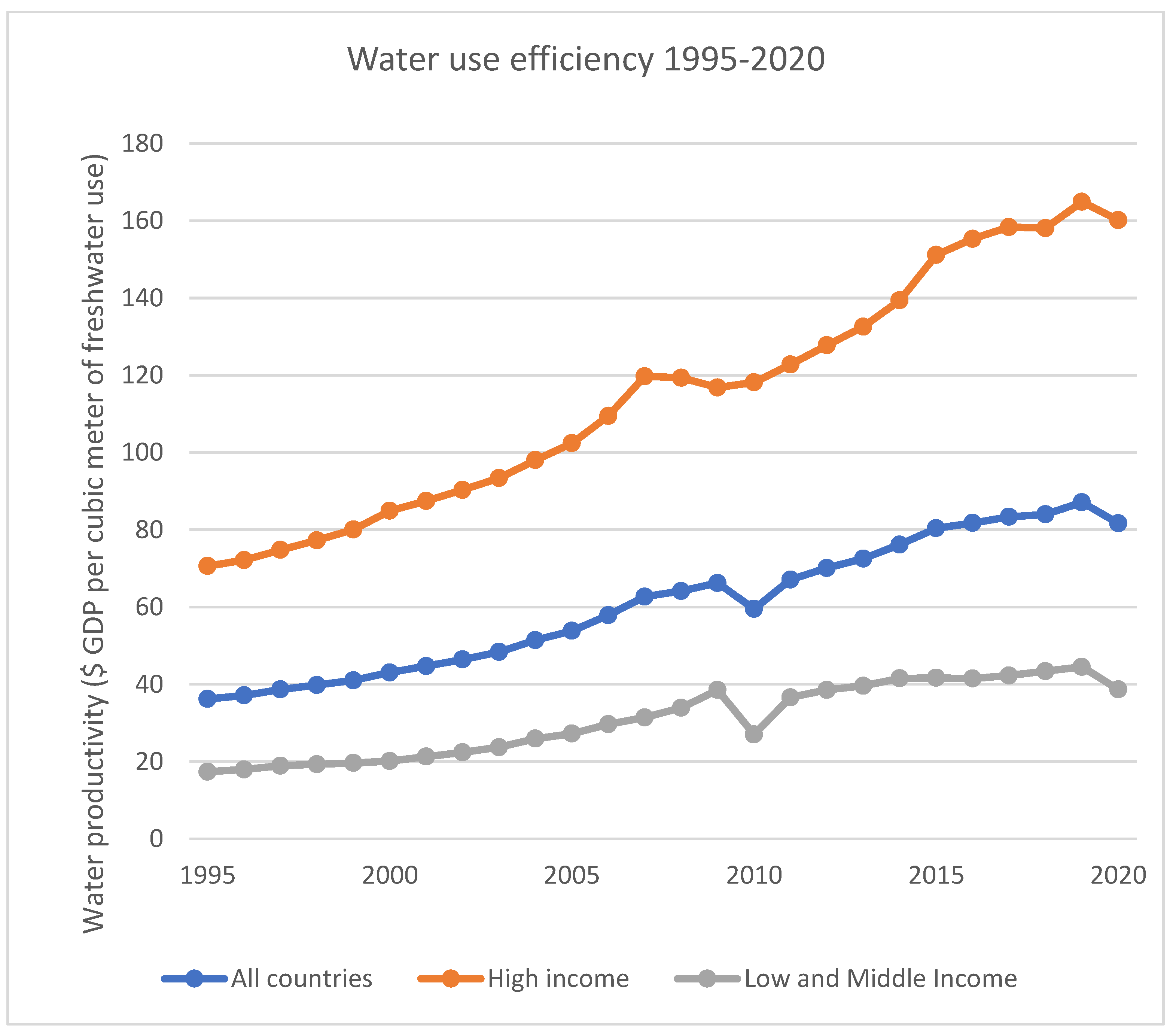
Figure 4.
Average water use efficiency over 1995-2020 by income group. Data are for 130 countries (46 high-income and 84 low and middle-income). Income classifications are based on the 2023-24 World Bank Classification of Countries and Income Groups. Low-income economies are defined as those with a gross national income (GNI) per capita of $1,135 or less in 2022; lower middle-income economies are those with a GNI per capita between $1,136 and $4,465; upper middle-income economies are those with a GNI per capita between $4,466 and $13,845; high-income economies are those with a GNI per capita of $13,846 or more.. Data are from World Bank, World Development Indicators, http://databank.worldbank.org/data [Accessed on December 18, 2023].
Figure 4.
Average water use efficiency over 1995-2020 by income group. Data are for 130 countries (46 high-income and 84 low and middle-income). Income classifications are based on the 2023-24 World Bank Classification of Countries and Income Groups. Low-income economies are defined as those with a gross national income (GNI) per capita of $1,135 or less in 2022; lower middle-income economies are those with a GNI per capita between $1,136 and $4,465; upper middle-income economies are those with a GNI per capita between $4,466 and $13,845; high-income economies are those with a GNI per capita of $13,846 or more.. Data are from World Bank, World Development Indicators, http://databank.worldbank.org/data [Accessed on December 18, 2023].
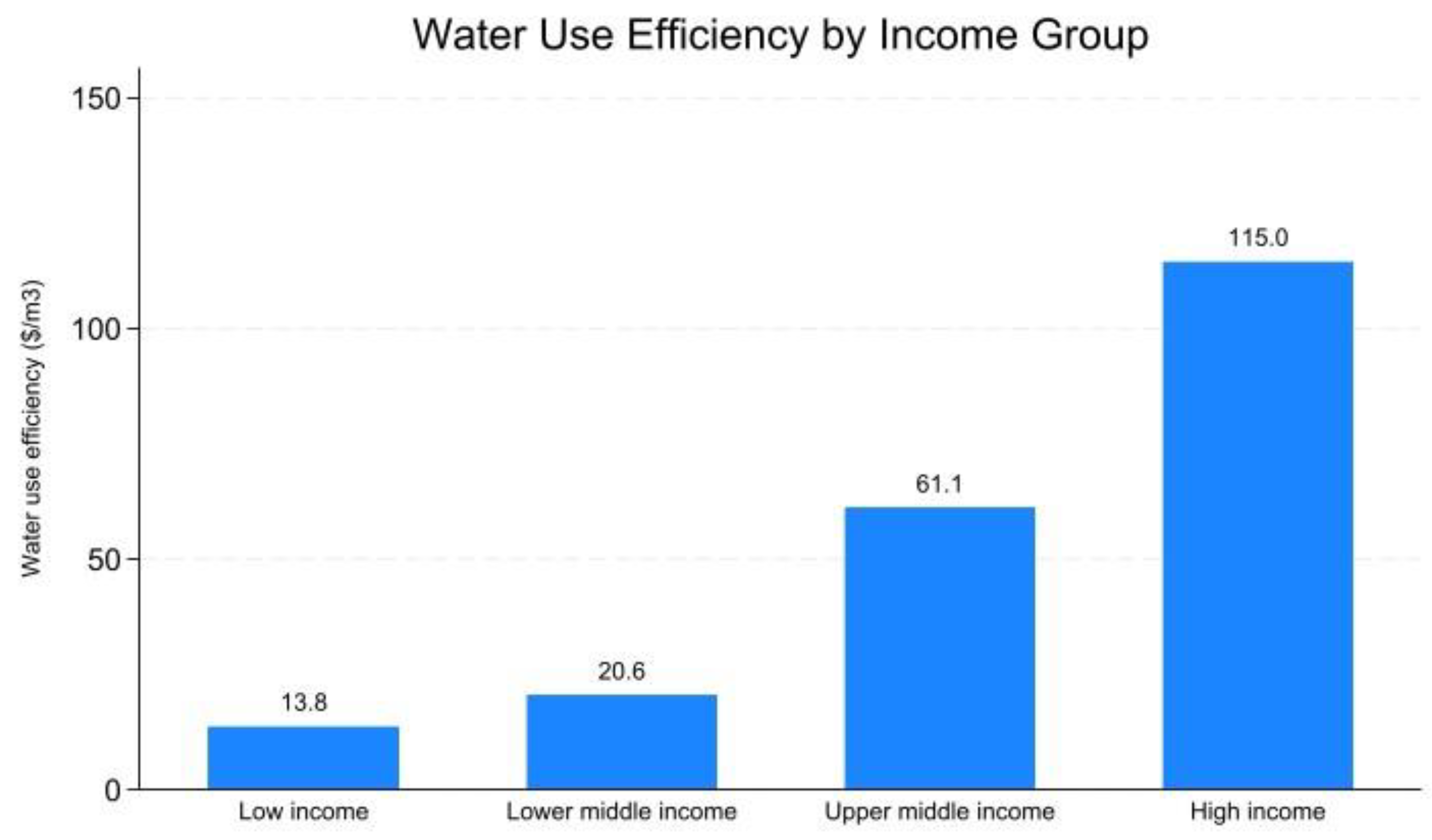

Table 1.
Water use efficiency panel analysis, 1995-2020.
| Dependent variable: Annual average change in water use efficiency [t, T] | ||||||
| All Countries | Low and Middle-Income Countries | |||||
| Variables | (1) | (2) | (3) | (4) | (5) | (6) |
| Water use efficiency ($/m3) | -6.043*** | -7.071*** | -6.243*** | -7.450*** | -9.075*** | -8.569*** |
| (1.150) | (1.357) | (1.120) | (1.410) | (1.592) | (0.894) | |
| Agricultural dependency (% GDP) | -3.372*** | -2.570** | -2.435** | -4.593*** | -3.587** | -3.630*** |
| (1.095) | (1.227) | (1.215) | (1.204) | (1.365) | (1.155) | |
| Institutional quality | 2.957* | 1.975 | 3.317* | 1.453 | ||
| (1.601) | (1.477) | (1.854) | (1.588) | |||
| Human capital | 11.917*** | 4.985 | 13.926*** | 3.321 | ||
| (4.133) | (4.354) | (4.094) | (4.090) | |||
| Urban population (% total) | 9.212*** | 12.834*** | ||||
| (2.990) | (3.023) | |||||
| Gross fixed capital formation (% GDP) | 0.110 | 0.914 | ||||
| (0.748) | (0.727) | |||||
| Trade (% GDP) | -0.301 | -0.518 | ||||
| (0.640) | (0.526) | |||||
| Constant | 26.672*** | 18.161*** | -14.635 | 31.090*** | 24.707*** | -19.627* |
| (4.801) | (6.044) | (11.329) | (5.621) | (7.266) | (10.134) | |
| Observations | 630 | 559 | 518 | 404 | 343 | 311 |
| R-squared | 0.163 | 0.179 | 0.180 | 0.214 | 0.247 | 0.281 |
| Number of countries | 130 | 115 | 109 | 84 | 71 | 66 |
| Country FE | Yes | Yes | Yes | Yes | Yes | Yes |
Robust standard errors in parentheses. All independent variables are in initial year t and are in natural logarithms except for institutional quality (range -2.5 to 2.5). *** p<0.01, ** p<0.05, * p<0.1.
Disclaimer/Publisher’s Note: The statements, opinions and data contained in all publications are solely those of the individual author(s) and contributor(s) and not of MDPI and/or the editor(s). MDPI and/or the editor(s) disclaim responsibility for any injury to people or property resulting from any ideas, methods, instructions or products referred to in the content. |
© 2024 by the authors. Licensee MDPI, Basel, Switzerland. This article is an open access article distributed under the terms and conditions of the Creative Commons Attribution (CC BY) license (http://creativecommons.org/licenses/by/4.0/).
Copyright: This open access article is published under a Creative Commons CC BY 4.0 license, which permit the free download, distribution, and reuse, provided that the author and preprint are cited in any reuse.


