

Submitted:
12 August 2024
Posted:
15 August 2024
You are already at the latest version
Abstract
This paper explores the influence of GenAI chatbot (ChatGPT) and AI-based simulation (SimVenture) on the start-up intention through the mediating roles of entrepreneurship educational outcomes; entrepreneurship cognition, entrepreneurship competencies, and innovation spirit of students in higher education institutions in the Middle East. The proposed conceptual framework was empirically tested with partial least squares structural equation modeling using 166 survey responses from fourth-year undergraduate students enrolled in business administration programs in four higher education institutions in the Middle East region. The findings reveal that ChatGPT significantly promotes start-up intention, while ChatGPT has insignificant influence on entrepreneurship educational outcomes. Conversely, the SimVenture platform negatively influences start-up intention. Additionally, the SimVenture platform significantly improves entrepreneurship educational outcomes; thereby entrepreneurship educational outcomes directly influence start-up intention. Furthermore, the mediation paths show ChatGPT has an insignificant indirect influence on start-up intention through the mediating roles of entrepreneurship educational outcomes, while the SimVenture platform exhibits a notable indirect influence on startup intentions through improved entrepreneurship educational outcomes. These findings seek to provide insights for higher education institutions in the Middle East region in leveraging GenAI chatbot (ChatGPT) and AI-based simulation (SimVenture) to enhance entrepreneurial knowledge, awareness, competencies, and the spirit of innovation, which leads to promoting students’ intentions to start their businesses. Theoretically, the study contributes to filling the gap in the existing literature between AI tools and entrepreneurship education. This study is among the first to empirically explore the influences of GenAI chatbot (ChatGPT) and AI-based simulation (SimVenture) on entrepreneurship educational outcomes and the intention of students to embark on entrepreneurial ventures. It highlights the need for understanding AI technologies as distinct pedagogical tools.
Keywords:
artificial intelligence
; GenAI chatbot
; ChatGPT
; Ai‐based simulation
; SimVenture
; entrepreneurship education
; entrepreneurship cognition
; entrepreneurship competencies
; innovation spirit
; start‐up intention
; higher education
; middle east
1. Introduction
Since the Industrial Revolution, the younger generation has become the most entrepreneurial, and with this major shift has come similar increases in entrepreneurship education through growth and development in entrepreneurship-related curricula and programs. Peter Drucker’s quote, “The entrepreneurial mystique? It’s not magic, it’s not mysterious, and it has nothing to do with the genes. It’s a discipline. And, like any discipline, it can be learned” (Drucker, 1985). This statement prompted researchers to question: Can entrepreneurship be taught? Numerous researchers have conducted empirical studies to support Drucker’s view comes from a 10-year (1985 to 1994) literature review of enterprise, entrepreneurship, and small business management education that reported, “. . . most of the empirical studies surveyed indicated that entrepreneurship can be taught, or at least encouraged, by entrepreneurship education” (Gorman et al., 1997, P. 63). The question of whether entrepreneurship can be taught is obsolete. Nowadays, academics have gone deeper than teaching entrepreneurship through usual methods. Academics are now striving to take advantage of intelligent technologies and integrate them into entrepreneurship education, such as artificial intelligence (AI) technology. For two decades, academics have sought to understand entrepreneurship through several sources: academic journals, textbooks on entrepreneurship, books on entrepreneurship, biographies or autobiographies of entrepreneurs, compendiums on entrepreneurs, periodical news, Venture periodicals, Newsletters, Proceedings of conferences, and Government publications (Kuratko, 2005). But at present, with the emergence of the AI boom, AI can be adopted as a vital source in understanding entrepreneurship by analyzing market trends, consumer behavior, and competitor strategies by processing large data sets from various sources, including social media, news articles, and market reports. This helps entrepreneurs identify opportunities, potential challenges and areas for innovation. Accordingly, AI is a buzzword that now expands beyond computer science to encompass all fields. According to Pedro et al. (2019), AI is the rationality of computers, systems, or software, as well as human performance. Artificial Intelligence (AI) is a trend in educational technologies that mostly affects higher education. It relieves instructors of some of their responsibilities through automation, saving time and personnel cost (Ifenthaler et al., 2024). All levels of educational institutions have adopted artificial intelligence (AI) in the teaching and learning of science, technology, engineering, and mathematics; nevertheless, social science finds it difficult to employ this intelligent technology due to lack of organized content (Roll & Wylie, 2016). As AI has been demonstrated to offer potential for personalized learning, facial recognition and feedback, and administrative task management, its application in education has grown. As stated by Holmes et al. (2019), AI is being used to personalize instruction for students so they can focus on their areas of difficulty and capitalize on their strengths. This favorable characteristic is attributed to the fact that the program is tailored uniquely to each student, given the nature of the students in the entrepreneurship field, where students are different in terms of their cognition and skills, as well as their levels of innovation spirit. This personalized approach complements the dynamic nature of technology-based simulations such as SimVenture and VentureBlocks which Yasin & Hafeez (2018) suggest offer more engaging and hands-on alternatives to traditional methods. By integrating AI-based Simulation technologies; teachers can enhance entrepreneurship education, providing a customized and immersive learning environment, and aligns closely with real-world entrepreneurial practices. Bawack & Tchokoté (2024) have also noted that through the use of AI, the company environments can be mimicked and the students can practice their business skills in a risk-free environment.
The other side of AI is generative chatbots such as OpenAI’s ChatGPT, GPT-4, Playground, DALL ⋅ E 3, and Sora, Anthropic’s Claude, Google’s Gemini (previously Bard), Stability AI’s Stable Diffusion 3, and Runaway’s Gen-2. Generative artificial intelligence (GenAI) has great importance in enhancing entrepreneurial practices and activities by generating ideas, analyzing data, and helping to solve problems. In the same context, GenAI has worked to facilitate entrepreneurship learning processes. (Winkler et al., 2023; Fayolle, 2018; Neck & Greene, 2011). Moreover, Duong et al. (2024) describe how GenAI such as ChatGPT uses NLP to deliver fun and efficient learning that enhances students’ problem-solving and decision-making abilities.
This study seeks to enrich the existing literature on integrating AI tools into entrepreneurship education. This emperical study is the first to explore the influence of AI-driven entrepreneurship education, specifically GenAI chatbot (ChatGPT) and AI-based simulation (SimVenture) on start-up intention through the mediating roles of entrepreneurship education outcomes, (entrepreneurship cognition, entrepreneurship competencies, and innovation spirit) in the higher education institutions in the Middle East region.
After providing a brief review of the literature and identifying the research gap, we identified the research questions as follows:
RQ1: How does GenAI chatbot (ChatGPT) influence start-up intention of students in higher education institutions in the Middle East?
RQ2: How does AI-based simulation (SimVenture) influence start-up intention of students in higher education institutions in the Middle East?
RQ3: How does GenAI chatbot (ChatGPT) influence entrepreneurship educational outcomes of students in higher education institutions in the Middle East?
RQ4: How does AI-based simulation (SimVenture) influence entrepreneurship educational outcomes of students in higher education institutions in the Middle East?
RQ5: How do entrepreneurship educational outcomes influence start-up intention of students in higher education institutions in the Middle East?
RQ6: How does GenAI chatbot (ChatGPT) influence start-up intention through the mediating roles of entrepreneurship educational outcomes of students in higher education institutions in the Middle East?
RQ7: How does AI-based simulation (SimVenture) influence start-up intention through the mediating roles of entrepreneurship educational outcomes of students in higher education institutions in the Middle East?
2. Literature Review
2.1. Artificial Intelligence
The history of AI dates back from the mid twentieth century, with leading early scholars such as Alan Turing and John McCarthy who had started the idea of the modern progressive science. Turing, in his famous paper Computing Machinery and Intelligence presented in 1950 posed the question ‘Can machines think?’ and as part of the proposal for an identification of a procedure for this Turing put forward what is today referred to as the Turing Test (Turing, 1950). and then McCarthy used for the first time in 1956 the term “Artificial Intelligence”, which is considered as the official start of the AI as an academic field (McCarthy, et al., 1955).
During the 1960s and 1970s, the work based on symbolic processing contributed much to the advancements of the AI technology and during the early 1980’s it led to the creation of expert systems which were defined as computer programs which were purposed to solve specific problems that are much similar to that of an expert professional in that certain field (Feigenbaum, 1980). However, it was found that due to the constraints of these initial systems for instance, being highly reliant on rule based programming; AI has witnessed a stagnation known as the “AI winter’. An AI winter is a time in the history of artificial intelligence research when funding and interest are lower (AI Newsletter, 2005).
Most of us remember the historic event in 1996 when the Deep Blue team developed a computer capable of defeating world chess champion Garry Kasparov. The computer beats the world chess champion! ...And the computer succeeded in defeating the best chess player in the world at that time. The Deep Blue team has already astonished the world by outlining in magazines, “Machine Intelligence Beats Human Intelligence.” Machine intelligence has been developed and is now known as artificial intelligence. The revival of AI started around the late 1990s and early 2000s propelled by the birth of machine learning that is a branch of AI that tries to train machines on data. This transition happened due to enhanced computation capacity and generality of big data (Domingos, 2012). The enhancement of the neural networks and deep learning later pushed AI into higher innovations and refining the models which could perform complex tasks such as image and speech recognition (LeCun et al., 2015).
The period between the year 2000 and 2024 can be attributed as an era of marked progress in the area of Artificial Intelligence and evident incorporation from the sphere of technology into society. The early 2000’s saw the birth of AI basic growth, upon the development of machine learning’s such as support vector machines and deep learning setting the pace for enhanced algorithms (Russell & Norvig, 2016). Robotic and automation innovation came into the picture with products like iRobot’s Roomba while programming smart cars was seen in programs like DARPA’s Grand Challenge (Lin & Goodrich, 2009; Thrun, et al., 2006).
From 2006 to 2010, deep learning was developed which led to significant improvements in image recognition and language processing (Hinton et al., 2006). Such as Google Translate or IBM Watson in translating languages and in diagnosing health conditions (Ferrucci et al., 2013; Le & Schuster, 2016). One of the developments that we saw in 2010 was the technology voice to a mobile phone user, which was launched by Apple’s Siri.
Starting in 2016 and going up to 2020, AI had huge surprises: a boom in natural language processing with transformer models like BERT and GPT-3; enhanced AI abilities in understanding and generation of human language (Devlin et al., 2018; Brown, et al., 2020). In 2023, the sharpeness of large language models or LLMs like ChatGPT dramatically changed the AI’s performance and its capability to create enterprise value. These new generative AI practices are such that deep learning models can then be fine-tuned on unstructured massive unannotated data (IBM., 2023).
After presenting the historical development of artificial intelligence, Table 1 reports the most cited definitions of artificial intelligence.
In this study, the authors relied on (1) GenAI chatbot such as OpenAI’s ChatGPT. (2) AI-based simulation, such as SimVenture Business Simulations. Google (2023) defines generative AI as a technology that generates text, images, music, audio, and video. GenAI then “uses the learned patterns to generate new content.” GenAI shines brightly in the world of AI for it moves away from the old route of AI which was all about leaning on machine learning (ML) and predicting stuff based on what happened before. Stepping away from what was once common GenAI draws on the strength of large language models (LLMs) and those dealing with art and video to develop new writings and stuff that mixes text with other modes (Wharton School 2023).
The general framework of SimVenture is that it is a business simulation tool designed to provide an experience, in the form of small business venture mimicry. It is popular in educational and training circumstances to teach entrepreneurship, business organization and management, and decision-making. This aspect makes the platform quite realistic and more engaging since the targeted skills are practiced with an aspect of handling a virtual business entity (SimVenture, 2024).
2.2. Entrepreneurship Education
Entrepreneurship Education is essential to a successful learning journey that meets the demands of the workplace since it improves students’ involvement in the dynamic corporate world and their causal and linear grasp of strategic thinking (Lazear, 2004). Any pedagogical [program] or process of education for entrepreneurial attitudes and abilities is referred to as entrepreneurial education (EE) (Fayolle et al., 2006, p. 702). EE has been around for a while and has become quite common (Kuratko, 2005). However, various stages of growth are the focus of different types of EE (Bridge, O’Neill, & Cromie, 1998; Gorman, Hanlon, & King, 1997). According to this concept, EE is the process that gives individual the knowledge and abilities they need to take advantage of opportunities (Li, et al., 2023).
The fundamentals of entrepreneurship are being taught at many colleges and educational institutions so that students can initiate their own project, comprehend the dynamics that change in tumultuous contexts, and then take advantage of profitable chances (Iwu, et al., 2021). Academics have listed numerous types of EE that are aimed at particular groups of people (Jamieson, 1984; Liñán, 2004). For example, Jamieson (1984) considered three type of EE: (1) education for awareness, (2) preparation for aspiring entrepreneurs, and (3) management training for existing. Moreover, Liñán (2004) revealed four different types of EE: (1) education for awareness, (2) education for start-up, (3) entrepreneurial dynamism, and (4) continuing education for existing entrepreneurs.
2.3. AI in Entrepreneurship Education (AIEE)
With the rapid development of artificial intelligence and the several advantages it offers, academics have worked to benefit from artificial intelligence and integrate it with teaching and learning. Table 2 shows various research papers that detail the use of AI in the teaching and learning of entrepreneurship and the type of artificial intelligence encompassing AI-based simulation, GenAI such as ChatGPT, machine learning, and big data. It is in the educational context where these technologies are employed to support learners and improve students’ entrepreneurial knowledge, competencies, and spirit. The previous study used various research methods (e.g., qualitative studies, quantitative, and systematic reviews) applied in different regions of the world. Neural networks and other machine learning technologies are also discussed concerning the educational process in entrepreneurship. In the experimental research conducted by Botha et al. (2021), the authors explore the applicability of the concept of the neural networks in the teaching process in Zambia, specifically, in understanding the patterns and trends in business-related activities and integrating the outcomes of the analysis into students’ knowledge of entrepreneurship. Likewise, Xu & Zhang (2021) in China employs wavelet neural networks to analyze unsustainable signals, which in return offer students with valuable information about the time and frequency area. These studies draw emphasis on self-development of machine learning technologies to enhance the condition of analytical and cognitive properties concerning the EE.
Big data analytics is another relative significant AI technology implemented into the EE. Al-Darras & Tanova (2022) further expand the big data analytics model with regard to the roles that the mediating variable of entrepreneurial orientation plays between big data analytics capabilities and organizational agility. The quantitative study conducted in Jordan shows that the value of entrepreneurial orientation mediates the link between big data analytics capabilities and agility. Consequently, based on the suggestion of Sedkaoui (2018) considered that students’ practice of entrepreneurship is also of vital importance when properly designed with business processes as well as learning requirements and can lead to improved performance as well as the quality of decisions made. These studies continue to support the use of big data analysis in the enhancement of students’ abilities to address big data problems and support decision-making processes.
Table 2 also presents other AI technologies used in EE as found in other studies. Citing the study of Liang et al. (2021) from China, the author explains how SPA-VFS and GRNN algorithms are used in accomplishing the use of diverse AI techniques in the educational contexts. Tkachenko et al. (2019) focus on the analysis of the neuro-fuzzy regulator model from the cognitive point of view, while giving the qualitative notes on the use of this model in the field of entrepreneurial training. Moreover, Chen et al. (2021) do a systematic review of Wiki and Facebook social media, FLYGBY and SimVenture serious games, and Massive Open Online Courses (MOOCs) to demonstrate the collaboration and learners’ engagement in the online EE. In this study, we concentrate on GenAI chatbot (ChatGPT) and AI-based simulation (SimVenture) and integrated these tools into EE among students of higher education institutions in the Middle East.
2.4. Hypotheses Development
One of the advantages of ChatGPT is generating creative ideas and helping entrepreneur in designing strategic plans. According to Joosten et al. (2024) AI-generated ideas are better than human-generated ideas. the idea of using ChatGPT can be equally suitable for managing business processes and decision-making as it can enhance the methods of business management and strategic decision-making by increasing business efficiency, productivity, and quality of decision-making. Regarding the benefits that can be offered by ChatGPT, it is possible to list the following: ChatGPT will serve as an intelligent assistant for enterprises, as it allows prompt responses, detailed data analyses and creates user-specific communication (Jusman et al., 2023).
We believe ChatGPT is a vital tool in boosting entrepreneurs’ intentions to start their own business and help in conducting a feasibility study. Gürsoy & Doğan (2023), identified strengths, weaknesses, opportunities and threats of applying ChatGPT in financial markets while doing a SWOT analysis. Therefore, acquiring knowledge of the relationship between the identified features allowed to conclude that ChatGPT can have certain advantages in financial analysis and the decision-making process.
In addition, Fu et al. (2024) suggested that ChatGPT experienced difficulties in understanding terms that were specific to planning, however, it would minimize human mistakes by capturing details in complex planning documents. ChatGPT has a role in several areas that entrepreneurs can benefit n shaping start-up intentions by enhancing various stages of the entrepreneurial process. There are several advantages offered by ChatGPT that cover a broad range. In addition to customer insights, these advantages include market research, virtual assistantship, market entry strategies, segmentation, marketing plans, and product development (Tarabah & Amin, 2024). In this regard, we believe that chatGPT is a vital tool and aid for entrepreneurs in generating creative ideas and assisting in designing strategic plans. It is possible to characterize chatGPT as a management consultant. Based on above, the study hypotheses can be developed as follows:
Hypothesis 1a.
ChatGPT has a positive influence on start-up intention of students in higher education institutions in the Middle East.
Hypothesis 1b.
ChatGPT positively influences start-up intention through the mediating role of entrepreneurship cognition of students in higher education institutions in the Middle East.
Hypothesis 1c.
ChatGPT positively influences start-up intention through the mediating role of entrepreneurship competencies of students in higher education institutions in the Middle East.
Hypothesis 1d.
ChatGPT positively influences start-up intention through the mediating role of innovation spirit of students in higher education institutions in the Middle East.
SimVenture is a highly specific and virtual business simulation game concerning the idea of a small business which further impacts the start-up intentions of the students in a significant manner. This tool is commonly applied in entrepreneurship education to foster learners’ understanding of business environments and running enterprises. By the application of SimVenture, the users gain practical skills in financial control and analysis, designing the marketing plan, and operating management which are the core components of entrepreneurship. This kind of training and practice not only builds students’ commercial awareness but also prepares students for the spirit and abilities that viable opportunities exist in the real business environment (Beckem & Watkins, 2012). Another area that is affected by SimVenture is the decision-making skills. The simulation presents the students with strategic decisions that are real-life like and hence the development of critical thinking and problem solving skills. As Pittaway & Cope (2007) indicated, this kind of learning-by-doing is particularly important for the enhancement of decision making skills that in turn affect the start-up intentions. Moreover, it also increases the confidence of the students in their entrepreneurial abilities through the risk-free environment that is offered by SimVenture to allow the students to practice, take risks, and even fail. This enhanced self efficacy leads to a higher level of actual intent to start a real business (Zhao et al., 2005). Based on above, the study hypotheses can be developed as follows:
Hypothesis 2a.
SimVenture has a positive influence on start-up intention of students in higher education institutions in the Middle East.
Hypothesis 2b.
SimVenture positively influences start-up intention through the mediating role of entrepreneurship cognition of students in higher education institutions in the Middle East.
Hypothesis 2c.
SimVenture positively influences start-up intention through the mediating role of entrepreneurship competencies of students in higher education institutions in the Middle East.
Hypothesis 2d.
SimVenture positively influences start-up intention through the mediating role of innovation spirit of students in higher education institutions in the Middle East.
Entrepreneurs can overcome their hesitation to try out new technologies and increase the scope of their experimentation activities when there is a high-quality technology (Gupta, 2024). One of the technologies that university students have come to rely on to solve their assignments, academic projects, and other matters is the ChatGPT tool. We believe that adopting technologies that help students learn and remove barriers to building knowledge and saving time is important. However, considering ChatGPT, we doubt the accuracy of the data it offers. Accordingly, another prominent theme in the Table 2 is the adoption of GenAI technologies, particularly ChatGPT, in EE. Duong et al. (2024) indicates that the use of ChatGPT in entrepreneurship has a favorable impact on the ability to recognize opportunities, digital entrepreneurial knowledge, and self-efficacy. It was also discovered that the effects of AI-related stimuli on digital entrepreneurial intention and conduct were considerably mediated by digital entrepreneurial self-efficacy. Similarly, Herani & Angela (2024) mentioned that if young people believe that GenAI technology adoption will take a lot of effort, they will be much more motivated to participate in digital entrepreneurship if they believe that the tool will be very helpful for their future company ventures. Moreover, Duong et al. (2024) showed that using ChatGPT significantly enhanced perceptions of AI competencies, the ability to recognize business opportunities, and the confidence to pursue digital entrepreneurship. Students make significant progress in learning the information required for scientific entrepreneurship. Using a narrative scripting technique in conjunction with AI ChatGPT can open up new learning opportunities for learners (George-Reyes et al., 2024).
The integration of ChatGPT stimulates entrepreneurial creativity by enabling entrepreneurs to figure out innovative ideas, try out cutting-edge business models, and come up with inventive answers to challenging problems (Sieja & Wach, 2023). After presenting previous studies that integrated GenAI in EE, we note that the literature still needs empirical studies (quantitative methods) that provide evidence about the integration of GenAI cahtbot (ChatGPT) into EE and the extent of its impact on the entrepreneurship educational outcomes of students of higher educational institutions. Accordingly, the study hypotheses can be developed as follows:
Hypothesis 3.
ChatGPT has a positive influence on the entrepreneurship cognition of students in higher education institutions in the Middle East.
Hypothesis 4.
ChatGPT has a positive influence on the entrepreneurship competencies of students in higher education institutions in the Middle East.
Hypothesis 5.
ChatGPT has a positive influence on the innovation spirit of students in higher education institutions in the Middle East.
Entrepreneurship Simulation is the Startup Game is a hybrid computer game and real-world experience created to help students comprehend the startup process from a range of constrained perspectives. As they work to launch their company, players might assume the roles of employee, funder, or founder. In addition to hiring staff members and competing with other founders and their businesses, players also accept funding from investor players (Fox et al., 2018). Numerous works are devoted to AI-based simulations to use them as teaching materials in the field of entrepreneurship. For example, Bawack & Tchokoté (2024) highlight that; business digital games such as SimVenture allows students a controlled realistic environment to practice and self assess their business skills within a simulated corporate environment. Likewise, Baruah et al. (2019) review the implementation of online business simulation systems like SimVenture Evolution and SimVenture Validate which enable students to manage and validate their business ideas. Such kinds of technologies can assist students in developing numerous competencies that are necessary to enhance their entrepreneurial qualities. In this way, organizing business simulation through SimVenture, students develop their innovative thinking and entrepreneurial skills in contexts and situations of real life (Baruah & Mao, 2021). These simulations are evaluated by the studies using experimental research methodologies regarding the effect of such simulations on student’s entrepreneurial knowledge and competencies and innovation spirit.
Through the business simulation, students were able to confront their weaknesses, overcome some of them, and advance their learning significantly. The use of SimVenture increased students’ understanding of business in general and the difficulties faced by entrepreneurs (Williams, 2015). Thus, SimVenture is an efficient agent of knowledge transformation into practice that has a positive impact on formation of entrepreneurship cognition, competencies and innovation spirit. The assigned group work simulation enhances the emergence of key entrepreneurial personal factors and perspectives to nurture the successful entrepreneurial mindset amongst students in the contemporary entrepreneurial world. Such results proved the relevance of the integration of the simulation-based decision-making methodology into the educational process of students-entrepreneurs and showed the possibilities of using such an approach to improve the educational process and outcomes for students. Accordingly, the study hypotheses can be developed as follows:
Hypothesis 6.
SimVenture has a positive influence on the entrepreneurship cognition of students in higher education institutions in the Middle East.
Hypothesis 7.
SimVenture has a positive influence on the entrepreneurship competencies of students in higher education institutions in the Middle East.
Hypothesis 8.
SimVenture has a positive influence on the innovation spirit of students in higher education institutions in the Middle East.
Students with a strong awareness, knowledge, and understanding of entrepreneurial concepts have a greater chance of starting a business (Krueger Jr et al., 2000). Which in line with Shane & Venkataraman (2000) indicated that individuals with high levels of entrepreneurial cognition exhibit superior ability to spot opportunities in the market. This capability increases their inclination to initiate their own businesses. Consequently, entrepreneurship cognition influences how individuals perceive risk and make decisions. Entrepreneurs with developed cognitive frameworks are more adept at assessing risks. They make informed decisions, which increases their confidence in managing uncertainties of entrepreneurship (Mitchell, et al., 2002). This confidence, known as entrepreneurial self-efficacy further strengthens their intention to launch business (Chen et al., 1998). Educational programs and environmental factors also shape entrepreneurship cognition. Programs that teach opportunity recognition enhance cognitive frameworks. Risk management skills contribute significantly to problem-solving abilities. These components can increase start-up intentions among aspiring entrepreneurs. Exposure to role models and supportive ecosystems reinforces positive attitudes. Such factors motivate individuals to pursue ventures in start-up environments (Fayolle & Gailly, 2015). Accordingly, a hypothesis is developed as follows:
Hypothesis 9.
Entrepreneurship cognition has a positive influence on start-up intention of students in higher education institutions in the Middle East.
Numerous studies have shown that entrepreneurship competencies have a significant effect on start-up intentions. According to Lans et al. (2008), the acquisition of skills in such areas as financial management and strategic planning increases the level of self-assessed business confidence and makes individuals more likely to be ready for business. Sánchez (2013) pointed out that EE enhances these competences, which increases entrepreneurial intention levels. McGee et al. (2009) identified entrepreneurial self-efficacy as a mediating variable in the relationship between entrepreneurship competences and start-up intentions. According to Fayolle and Gailly (2015), programs aimed at developing such competences as the ability to see opportunities or risk management have a positive effect on entrepreneurial attitudes and intentions. From all of the above, it can be well emphasized that good entrepreneurship competences act as motivating factors for encouraging individuals to go in for start-up business. Based on above, the hypothesis can develop as follows:
Hypothesis 10.
Entrepreneurship competencies have positive influence on start-up intention of students in higher education institutions in the Middle East.
According to previous studies, an innovation spirit greatly enhances it by creating an environment that is conducive to creativity and where individuals can create new ideas for business (Kirkley, 2016). It also helps improve problem-solving skills among entrepreneurs so that they can go about their daily challenges more innovatively (Amabile, 2018). Risk-taking and resilience are other components embedded in an innovation spirit which are important dimensions when facing entrepreneurial uncertainties (Zhao et al., 2005). Promoting educational programs on creativity may further enhance these effects thereby increasing entrepreneurial intentions (Nielsen & Lassen, 2012). Accordingly, a hypothesis is developed as follows:
Hypothesis 11.
Innovation spirit has a positive influence on start-up intention of students in higher education institutions in the Middle East.
Based on above, we proposed the conceptual framework in Figure 1 as follows:
3. Materials and Methods
3.1. Context of the Study
The emphasis on the use of AI in teaching entrepreneurship is consistent with Middle Eastern countries’ efforts to enhance strategy, which is considering the development of knowledge-based economies and supportive ecosystems for entrepreneurship. In this regard, the management of universities in the region is gradually integrating AI technologies into their programs to equip students to face the challenges of today’s business environments. Some of these institutions include Bath Spa University (UAE), Institute of Management Technology (UAE), MSA University Cairo (Egypt) and Qatar University (Qatar) and the interaction between themselves and the intended EE students’ forms rich insights into how AI is affecting and would impact on start-up intentions. These institutions were chosen due to their status as SimVenture clients and software users (SimVenture, 2024). This fits in with the context of the study in AI-driven entrepreneurship education and business simulation tools. One of the programs offered at the Institute of Management Technology (UAE) is Bachelor of Business Administration (BBA), and it has a comprehensive curriculum in entrepreneurship. In the third year of the program, “Entrepreneurship” coded BBA216 is scheduled to introduce students into basic principles as well as advanced concepts of entrepreneurship. This course acts as a basis for comprehending entrepreneurial principles and practices by students. In the second semester, students have an option to take other elective courses such as “Entrepreneurship Simulation” with code BBA430. SimVenture platform oriented, this elective teaches students through business simulations using hands-on applications that boost their entrepreneurial skills as well as decision-making abilities. The purpose of these courses is therefore integrating theoretical knowledge with practical applications to build competencies needed by graduates when they engage real life entrepreneurial challenges. At Bath Spa University, Business Administration program is offered with majors in Human Resource Management (HRM) and Marketing. This affords a relevant business curriculum matched to provide students with all necessary knowledge and skills needed in the business field. During the second semester of the second year, students majoring in HRM and Marketing subjects are required to take the Entrepreneurship course. Hence, it is expected that after completing this course, the students will have a grasp of the basic concepts relating to entrepreneurship. It encourages them to explore innovative business ideas and develop entrepreneurial mindsets. During the first semester of the third year, students specializing in HRM and Marketing take a course “Enterprise; Creating your business”. This course is continued from the prior course “Entrepreneurship” in which this course provides the real-world experiences of students regarding the initiation and management of new business firms. Finally, it concentrates on important processes in business planning and analysis, course as well as strategic management to prepare students for challenges of creating and managing business enterprises. However, Bath Spa University offers external courses related to the Entrepreneurship Simulation (SimVenture) after the third year of program.
BA of Marketing and International Business program at MSA University Cairo offers Entrepreneurship and Small Business Management courses in the third year. However, the Business Simulation course is not compulsory or an elective course, but rather an independent course that students are free to join. The course is called the “The stock market simulation course” and is offered to students of the Faculty of management Sciences. Similarity, Qatar University also provides an undergraduate BA of Business Administration and Marketing program, which teaches entrepreneurship courses and provides a business simulation (SimVenture) course, but it is not compulsory for students.
The focus on AI-driven EE aligns with strategic objectives of Middle Eastern countries to build knowledge-based economies and foster entrepreneurial ecosystems. In this context universities in the region are incorporating AI technologies into their curricula. They aim to better prepare students for demands of modern business landscapes. Institutions such as Bath Spa University (UAE), Institute of Management Technology (UAE) MSA University Cairo (Egypt) and Qatar University (Qatar) are at the forefront of this educational innovation. They provide fertile ground for examining the influence of AI-driven EE on entrepreneurship educational outcomes and students’ start-up intentions.
3.2. Research Method
The current study adopts a quantitative research method to examine the influence of GenAI chatbots (ChatGPT) and AI-based simulation (SimVenture) on students’ start-up intentions through the mediating role of entrepreneurship educational outcomes in higher education institutions in the Middle East; thus, the need for a quantitative method that is based on facts and figures and which can easily analyze the relationship between variables statistically (Creswell, 2014). This method will help in making an evidence-based conclusion since it will be centered on numerical data and statistical analysis, about the influences of ChatGPT and Simventure on the mediating variables of entrepreneurship cognition, competencies, and innovation spirit, and subsequently determining students’ intention to start a business. Several studies have used the quantitative method to measuring ChatGPT in EE (Duong et al., 2024; Herani & Angela, 2024). This study is similar in the method used to measure ChatGPT in EE. Still, this study is the first to rely on the quantitative method (survey) to measure the SimVenture platform EE, compared to most previous studies that relied on the quantitative approach (experiments) or qualitative to explore the relationship between the SimVenture platform in EE, as shown in Table 2.
3.3. Sample and Procedures
The study sample consisted of fourth-year undergraduate students enrolled in business administration programs or related programs in four universities in the Middle East that offer a business simulation course for the SimVentur platform. As shown in Table 3, we collected 166 questionnaires by designing an online questionnaire through Google Forms and publishing a Google Drive link in Facebook and WhatsApp groups for fourth-year students, especially in groups related to SimVenture business simulation courses. The student was required to meet two filter questions: student was allowed to complete the questionnaire if he (1) used ChatGPT in education (2) and had completed the SimVenture business simulation course. Otherwise, or if one of the two questions was not met, the student was completely excluded from the study sample.
3.4. Scale Items Development of ChatGPT and SimVenture
While qualitative methods have been used in several studies to evaluate ChatGPT, it has also been assessed quantitatively, using frameworks like the Technology Acceptance Model (TAM) as shown in Table 2. Nonetheless, this paper seeks to measure ChatGPT in EE on two primary dimensions: learning enhancement and student engagement fostered by ChatGPT. We posit that the TAM is not appropriate to assess ChatGPT in EE since it does not capture the specific objectives of this research. After a careful review of the available literature, it was found that there were no scales specifically for EE appropriate to this study. The evidence further exposed this particular need for a new scale, for capturing the typical dimensions of ChatGPT in EE. Hence, in order to realize the objectives set down in this study, the development of a tailored scale is inevitable.
This extends to the measurement of SimVenture. Scholars have more recently been narrowing down to the evaluation of SimVenture as far as EE is concerned and its impact on educational outcomes using quantitative experimental research method. This approach is considered appropriate and has proven its effectiveness in measuring the effects of SimVenture. However, in this study, we pursued a different method where we applied a quantitative survey research method to assess SimVenture in EE and how it affects students’ educational outcomes and intentions to start their businesses.
We developed a new survey instrument based on the Likert scale for use in quantitative surveys (see Appendix) after drawing insights from previous quantitative experimental studies as shown in Table 2. This approach would help measure the nuanced impact that SimVenture has on students’ startup intentions, thus giving a fuller picture of how far it helps foster EE.
3.5. Measurement of Entrepreneurship Outcomes and Start-Up Intention
Entrepreneurship cognition was measure using 5 items scale adopted from (Alqahtani, 2023; Bian et al., 2021). While Entrepreneurship competencies was measure using 5 items scale adopted from (San-Martin et al., 2022; Ismail, et al., 2019; Adeniyi, 2023). Additionally, innovation spirit was measure using 3 items scale adopted form (Lee et al., 2019; Bian et al., 2021). Finally, start-up intention was measure using 9 items scale adopted from (Lee et al., 2019). A five-point Likert scale was used to rate each item (1 = strongly disagreed and 5 = strongly agreed).
3.6. Filter Question
This study has two filter question; (1) Do you use ChatGPT in learning? This question is answered with yes or no, so if the answer is (no), please do not proceed the questionnaire, as you are not part of the required sample. This also applies to the question (2) Did you complete the SImVenture course?
3.7. Pilot Study
Conducting a pilot study is important in the research process since it allows the refinement of the research instruments, procedures, and overall design to be done before the full-scale study. In regard to this research on the effect of AI-driven tools like ChatGPT and SimVenture on EE and students’ start-up intentions, a pilot study was done having a sample of 28 undergraduate students from selected universities in the Middle East. A reliability test was conducted to confirm the item’s validity and reliability, and Cronbach’s Alpha was utilized to measure the consistency and reliability of the results.
Table 4 shows the results of Cronbach’s Alpha reliability test of the constructs items of the questionnaire. The results of reliability test indicates that all the factors with Cronbach’s Alpha values are highest than 0.7 which is acceptable according to (Hair et al., 2010). All the factors had a high and very excellent Cronbach’s Alpha values. Moreover overall the questionnaire had an excellent and high and Cronbach’s Alpha value with 0.977 including 34 items.
3.8. Data Analysis
We collected data from the above-mentioned Middle Eastern universities students, and analyzed the data using SPSS V. 26 to test pilot study and descriptive analysis, and SmartPLS V. 4. Partial least square structural equation modeling (PLS-SEM) was used, which leads to a statistical examination of the relationships between the factors of the adoption model. The reason for choosing PLS-SEM for data analysis was that it has been shown to work well with complex models.
4. Results
4.1. Demographic Profile of Respondents
The Table 5 describes the gender and nationalism of the participants in the study. Regarding the gender distribution, the sample involves 166 respondents; 62% of which are male (103), while 38% are female (63). This means that the study has more male participants compared to females, hence a clear gender bias in the sample. With respect to nationality, Egyptian participants are dominant having comprised 52% of the sample (87 participants). The second most represented group is participants associated with UAE where 43 participants constitute 26 percent of the total. Another 5% or 9 individuals of the sample are from Qatar. Furthermore, there is ‘Other’ account, which comprises 17% of the sample, (n=27).
4.2. Descriptive Statistics
Table 6 provides a summary of the descriptive statistics and correlation matrix for all variables. The mean of ChatGPT variable is 3. 232 and its standard deviation of 0. 999, which means that the respondents’ level of the students is between unspecific to agree with a slightly negative skewness of -0. 221, which means that the distribution had more participants scoring slightly above the mean and fewer participants scoring much higher than the mean and a kurtosis of -0. 328 which is flatter than normal. It is also obvious that the mean of SimVenture variable is 3. 934 and the standard deviation of 0. 894, which mean that the students’ respondents are between unspecific to agree. It has a skewness of -0. 957, which means that the distribution is more negatively skewed with the scores more concentrated above the mean and the kurtosis is 1. 289 which is closer to 1 and indicates a more peaked distribution. The mean of Entrepreneurship Cognition (EC) is 4. 018 and a standard deviation of 0. 953, which indicates that participants overall have a positive attitude towards cognition in entrepreneurship. The skewness of -1.031 and kurtosis of 0. 808 suggest that the distribution is negatively skewed but has a normal distribution at the peak. ECS mean was 3.559 and the standard deviation of 0. 948, it is moderate in perceived competencies among the participants. The results obtained in the correlation matrix show that there is a correlation between the variables. Most importantly, it is evident that SimVenture (SV) has high positive correlation with Entrepreneurship Cognition (EC) 0. 835** and Innovation Spirit (IS) 0. 829** this infurs that high interaction with SimVenture enhances high level of entrepreneurship cognition and innovation spirit. A positive and significant relationship exists between the SI and all the other variables particularly with the IS with a coefficient of 0. 931 ** implying that a positive change in the innovation spirit will greatly affect the start-up intention positively. Also, there are positive relations between EC and ECS, which are significant and equal to 0. 777* thereby suggesting that, cognitive involvement in entrepreneurship is related to perceived competencies.
4.3. Measurement Model Evaluation
Measurement Model Evaluation provides an analysis of six constructs: Using Factor Loadings (FL), Cronbach’s Alpha (α), Composite Reliability (CR), Average Variance Extracted (AVE), and Variance Inflation Factor (VIF), reliability as well as validity for the seven constructs, namely, ChatGPT, SimVenture, Entrepreneurship Cognition, Entrepreneurship Competencies, Innovation Spirit, and Start-Up Intention will be deemed assessable. All the constructs demonstrate a reliable internal consistency with the values of Cronbach’s Alpha and Composite Reliability above the threshold level of 0. 7, indicating excellent reliability (Barrett, 2007). As shown in Table 7; therefore, the model was reliable. After that, factor loadings, average variance extracted (AVE), and composite reliability (CR) were calculated in order to verify the validity and discrimination of the measurement model. Therefore, when factor sizes and AVE values are greater than 0.5 and CR values are greater than 0.7, convergent validity is confirmed. Additionally, cronbach ‘s Alpha for constructs between 0.919 and 0.971. When the VIF value is higher than 5, multicollinearity appears, which is a sufficiently high percentage (Shahzad et al., 2022). Moreover, the majority of VIF values are below 5 revealing that there is little to no serious multicollinearity between the constructs.
4.4. Structural Model Evaluation
This study aims to explore the influence of GenAI chatbot (ChatGPT) and AI-based simulation (SimVenture) on the students’ start-up intention through the mediating roles of entrepreneurship outcomes (entrepreneurship cognition, entrepreneurship competencies, and innovation spirit) in the higher education institutions in the Middle East region. Structure equation model was conducted using the BOOTSTRAP method in SmartPLS4 software to test the study’s hypotheses. Therefore, this analysis examined both direct and indirect influence of GenAI chatbots (ChatGPT) and AI-based simulation (SimVenture) on students’ start-up intention. Figure 2 shows the graphical outputs of the structure model of C, SV, EC, ECS, IS, and SI.
As shown in Table 8, GenAI chatbot (ChatGPT) had a significant positive influence on start-up intention (β = 0.053, P < 0.05), which provides support for hypothesis H1a. In addition, AI-based simulation (SimVenture) had a significant negative influence on start-up intention; where (β = -0.109, P < 0.05), the hypothesis H2.a was not supported. Therefore, these results highlight the direct influence of both GenAI chatbot (ChatGPT) and AI-based simulation (SimVenture) on start-up intention. Accordingly, the results showed that GenAI chatbot (ChatGPT) had a significant positive influence on entrepreneurship cognition; where (β = 0.009, P > 0.05), the hypothesis H3 was not supported. Moreover, the analysis path of the direct effect of H4 from GenAI chatbot (ChatGPT) to entrepreneurship competencies is also not supported; where (β = 0.063, P > 0.05). Lastly, according to the direct effect of GenAI chatbot (ChatGPT), the path showed that GenAI chatbot (ChatGPT) had an insignificant influence on innovation spirit, where (β = 0.071, P > 0.05), which H5 was not supported.
AI-based simulation (SimVenture) had a significant positive influence on entrepreneurship cognition; where (β = 0.833, P < 0.001), AI-based simulation (SimVenture) had a significant positive influence on entrepreneurship competencies; where (β = 0.636, P < 0.001), and AI-based simulation (SimVenture) had a significant positive influence innovation spirit; where (β = 0.792, P < 0.001), which H6, H7, and H8 was supported. Subsequently, entrepreneurship cognition had a significant negative influence on start-up intention; where (β = -0.109, P < 0.001), which H9 was not supported. In addition, entrepreneurship competencies had a significant positive influence on start-up intention; where (β = 0.140, P < 0.01). Moreover, innovation spirit had a significant positive influence on start-up intention; where (β = 0.657, P < 0.001), which indicates that H10 and H11 were supported.
According to the mediation path, GenAI chatbot (ChatGPT) had an insignificant indirect influence on start-up intention through the mediating role of entrepreneurship cognition; where (β = 0.003, P > 0.05). Furthermore, GenAI chatbot (ChatGPT) had an insignificant influence on start-up intention through the mediating role of entrepreneurship competencies; where (β = 0.009, P > 0.05). Additionally, GenAI chatbot (ChatGPT) had an insignificant influence on start-up intention through the mediating role of innovation spirit; where (β = 0.047, P > 0.05), which H1b, H1c, and H1d were not supported.
AI-based simulation (SimVenture) had a significant indirect positive influence on start-up intention through the mediating role of entrepreneurship cognition; where (β = 0.243, P < 0.001), AI-based simulation (SimVenture) had a significant indirect positive influence on start-up intention through the mediating role of entrepreneurship competencies; where (β = 0.089, P < 0.05), and AI-based simulation (SimVenture) had a significant indirect positive influence on start-up intention through the mediating role of innovation spirit; where (β = 0.520, P < 0.001), which H2b, H2c, H2d had full mediation.
5. Discussion
This study aims to explore the influence of AI-driven EE, specifically GenAI chatbot (ChatGPT) and AI-based simulations (SimVenture) on start-up intention through the mediating roles of entrepreneurship educational outcomes, (entrepreneurship cognition, entrepreneurship competencies, and innovation spirit) in the higher education institutions in Middle East region. The findings of this paper provide insights into how these AI tools, especially GenAI chatbot (ChatGPT) and AI-based simulation (SimVenture) influence the students’ knowledge and awareness of entrepreneurship principles and concepts, moreover promoting the students’ competencies for solving problems, enhancing leadership and communication skills, and the ability on developing strategies. Additionally, the findings provide insights into how ChatGPT and SimVenture Platform influence the students’ creative idea generation, and willingness to take calculated risks, and how these influence the intention to start-up businesses among the students in the Middle Eastern universities. The results of this study indicated that GenAI chatbots (ChatGPT) had a significant positive influence on the start-up intention of business among students in Middle Eastern universities. This result is in line with previous research that AI chatbot (ChatGPT) could effectively improve learning experiences to provide individual and instant feedback, hence enhancing entrepreneurial intentions (Duong et al., 2024; George-Reyes et al., 2024). The ability of ChatGPT to role-play real business conversations and situations might have facilitated this increase in start-up intentions by picturing students as actively engaged entrepreneurs. Su & Liu (2023) had seen that the language processing abilities of ChatGPT, as an AI, brought out these unique benefits in education by improving learners’ engagement and motivation. Tarabah & Amin (2024) highlight that ChatGPT has several advantages in business such as market research, virtual assistantship, market entry strategies, segmentation, marketing plans, and product development.
Additionally, this study found that AI-based simulation (SimVenture) had a significant negative influence on the start-up intention of business among students in Middle Eastern universities. However, this result represents H2a which was not supported. This could probably be due to the fact that students receive certain difficulties within the simulation environment which perhaps can negatively impact their desire to be an entrepreneur. Prior research has also established that, although simulations such as SimVenture gives real feel of managing a business, at times the settings may sometime overwhelm the learners and as a result, decrease the desire of becoming an entrepreneur (Baruah and Mao, 2021; Williams, 2015). It is thus paramount that the educators counter balance the issue of complexity of the simulation with reasonable directions to ensure that the students’ entrepreneurial spirit is kept engaged. Subsequently, the result of the influence of AI GenAI chatbot (ChatGPT) on entrepreneurship cognition was insignificant. This result, however, are not supported by others such as Winkler et al., (2023) and George-Reyes et al. (2024) that found ChatGPT has an evidence-based grounding in cognitive learning outcomes. Perhaps one reason for this difference might be due to the level of educational context and how ChatGPT was actually implemented in that curriculum. Moreover, students may need more scaffolded ChatGPT interactions to support cognitive processing. GenAI chatbot (ChatGPT) also had no significant effect on entrepreneurship competencies. This goes against prior work arguing that AI platforms can develop vocational and practical business expertise (Duong, 2024). One possible explanation for this is that ChatGPT, though informative in the abstract sense does not provide practical experience as well designed simulations do which might be necessary to influence more specific skills development. The insignificant effect of GenAI chatbot (ChatGPT) on innovation spirit implies that although ChatGPT can lead to the students engaging in an interactive discussion, it may not raise their innovative thinking needed for creative problem-solving, this result is contrary to the study Sieja & Wach (2023) argued that the integration of ChatGPT stimulates entrepreneurial creativity by enabling entrepreneurs to figure out innovative ideas, try out cutting-edge business models, and come up with inventive answers to challenging problems.
The result of the study showed that SimVenture had a significant positive influence on entrepreneurship cognition, competencies and innovation spirit among higher education students in Middle East. Therefore, the use of SimVenture platform by students improves their knowledge on entrepreneurship concepts, thus improving their problem solving, leadership, communication, and thinking skills. These findings are consistent with existing literature such as Bawack & Tchokoté (2024) emphasize that; students can evaluate their business skills by playing digital business games like SimVenture. Furthermore, SimVenture improved the knowledge of students about business in general and the challenges faced by entrepreneurs (Williams, 2015). Hence Baruah & Mao (2021) mentioned that SimVenture develops students’ innovation thinking and entrepreneurial skills.
Furthermore, the results showed that the entrepreneurship educational outcomes (entrepreneurship cognition, competencies, and innovation spirit) had significant positive influence on start-up intention among higher education students in Middle East. These results in lines with the findings of previous studies such as Krueger Jr. et al. (2000) indicated that students who possess a strong awareness, knowledge, and grasp of entrepreneurial ideas are better prepared to start a business. According to Lans et al. (2008), obtaining business management skills raises an individual’s self-assessed business confidence and boosts the chances of being prepared for the business world. While Nielsen and Lassen (2012) indicated that enhancing educational programs on creativity increases entrepreneurial intentions.
Moreover, the results of the mediating roles of entrepreneurship educational outcomes (entrepreneurship cognition, competencies, and innovation spirit) showed that the mediation of entrepreneurship educational outcomes between the influences of GenAI chatbot (ChatGPT) on start-up intention was insignificant. This suggests that while ChatGPT is effective in directly engaging students, it may lack the cognitive skills needed to make entrepreneurs start their businesses. This finding contrasts with a study by (Duong et al., 2024) which concluded that adoption of ChatGPT significantly improves digital entrepreneurial self-efficacy, perceived AI competencies, and awareness of entrepreneurial opportunities. It was discovered that attitudes toward digital entrepreneurship are positively impacted by digital entrepreneurial self-efficacy, and that this, in turn, promotes digital entrepreneurial intention. ChatGPT’s efficiency is a motivation for entrepreneurs to start their businesses because of the advantages offered by artificial intelligence technology (Herani & Angela, 2024). In addition to the indirect effects of AI-based simulation (SimVenture) on start-up intention, the results showed significant positive indirect effects. Which in line with the findings of Chen et al. (2021), who confirmed that simulations provide a deeper understanding of business dynamics, thereby fostering a stronger intention to pursue entrepreneurial ventures. (Chen et al., 2021). Moreover, SimVenture simulation game experience develops business skills (Botha et al., 2021). Thus, Baruah et al. (2019) pointed out that AI-based simulation games in EE enhance innovative thinking.
5.1. Theoretical Contributions
This study is among the first to empirically explore influences of GenAI chatbot (ChatGPT) and AI-based simulation (SimVenture) on entrepreneurship educational outcomes and intention of students to start a business. It highlights need for understanding of AI technologies as distinct pedagogical tools. Each of these technologies makes unique contributions to learning experiences. This research provides insights into potential of using these AI tools in EE in higher education institutions in Middle East. Furthermore, this study concluded that there was insignificant effect of ChatGPT on entrepreneurship cognition, entrepreneurial competencies, and innovation spirit. In contrast, the finding indicated that ChatGPT influences the intention to start-up entrepreneur ventures, which contributes to this study that ChatGPT acts as a motivator for students in shaping their intentions towards starting their businesses, as ChatGPT has advantages such as enhancing the educational experience, analyzing data, and supporting in decision making.
The findings of this study indicated that AI-based Simulations (SimVenture) had a significant positive influence on entrepreneurship educational outcomes (entrepreneurship cognition, entrepreneurship competencies, and innovation spirit). This study contributes to the importance of the SimVenture platform in teaching entrepreneurship to students by conducting a virtual business simulation, which leads to increasing knowledge and awareness of entrepreneurship concepts, and also enhances problem-solving, analysis, and decision-making skills, in addition to developing creative thinking among students in generating new ideas and calculating risk tolerance.
Therefore, this study adopted three mediating variables (entrepreneurship cognition, entrepreneurship competencies, and innovation spirit) and explored their impact on enhancing students’ intentions to start their entrepreneurial journey. The study concluded that there were positive significant impacts of (cognition, entrepreneurial competencies, and innovation spirit) on start-up intention. Students’ good knowledge and awareness of entrepreneurship principles and concepts, their ability to solve problems, make decisions, and think innovatively, all of these factors contribute to enhancing students’ intentions to start their businesses and engage in the practical field of entrepreneurship.
In addition to the importance of the mediating variables (entrepreneurship cognition, entrepreneurship competencies, and innovation spirit), the results showed their importance in clarifying the relationship between AI technologies (GenAI and AI-based simulations) and start-up intentions. As for ChatGPT, it did not have an indirect effect on start-up intentions, while an indirect effect was found for SimVenture on start-up intentions. The study contributes that the SimVenture platform, as a virtual business simulation game, has a vital and effective role in enhancing start-up intentions by expanding knowledge and awareness of entrepreneurship concepts among students, enhancing their entrepreneurial competencies, and developing their spirit of innovation.
Moreover, this study contributes to drawing the attention of higher educational institutions in the Middle East to the importance of GenAI chatbots and business simulation games in enhancing students’ intention to embark on the entrepreneurial journey and start their own businesses by raising levels of knowledge and awareness of entrepreneurship concepts, enhancing their competencies and embodying the spirit of innovation. Thus, this study contributes to enriching the existing literature on entrepreneurship education in higher education institutions by taking advantage of AI technologies such as GenAI chatbots (ChatGPT) and AI-based simulation (Simventure).
5.2. Practical Implications
According to the findings of this study, we have presented a set of recommendations to decision makers and those responsible for implementation in higher education institutions in the Middle East, as shown in Table 9:
5.3. Limitations & Future Research
The study presented a conceptual framework that explains the influence of AI-driven entrepreneurship education, specifically GenAI chatbots (ChatGPT) and AI-based simulations (SimVenture) on start-up intention through the mediating roles of entrepreneurship education outcomes, (entrepreneurship cognition, entrepreneurship competencies, and innovation spirit) in the higher education institutions in Middle East region. However, some limitations may be presented as the basis for future research and can be explained in the following points:
- The study relied on ChatGPT and SimVenture and integrated them into entrepreneurship education and measured their impact on start-up intention, thus we suggest exploring the impact through different AI tools such as Duolingo, Coursera, Capsim platform.
- This study concluded that ChatGPT did not influence entrepreneurship cognition, entrepreneurship competencies, and innovation spirit. Therefore, we suggest that researchers conduct further studies in this context, may researchers find different results.
- This study found no impact of SimVenture on start-up intention. Therefore, we suggest that researchers conduct further studies in this context, may researchers find different results.
- This study explored the influence of AI-driven entrepreneurship education, specifically GenAI chatbot (ChatGPT) and AI-based simulations (SimVenture) on start-up intention through the mediating roles of entrepreneurship education outcomes, (entrepreneurship cognition, entrepreneurship competencies, and innovation spirit) in the higher education institutions in Middle East region. We suggest that researchers conduct further studies that measure these effects on higher education institutions in different geographic areas.
Funding
This research received no external funding. The authors have not received financial support from commercial, institutional, or governmental sources for this study.
Institutional Review Board Statement
Not applicable.
Informed Consent Statement
Not applicable.
Data Availability Statement
The raw data supporting the conclusions of this article will be made available by the authors on request.
Acknowledgments
The authors would like to thank the management of Bath Spa University, MSA University Cairo, Qatar University, Institute of Management Technology, and also the faculty members for providing a conducive environment to undertake the study. The authors would also like to thank the Editors and anonymous reviewers for their careful reading of our manuscript and their many insightful comments and suggestions.
Conflicts of Interest
The authors declare no conflicts of interest.
Appendix A

Table A1.
Questionnaire items.
| Variable | Code | Items |
|---|---|---|
| ChatGPT | Enhance Learning | |
| C1 | ChatGPT has significantly improved my understanding of entrepreneurship concepts. | |
| C2 | Interacting with ChatGPT has enhanced my learning experience. | |
| C3 | ChatGPT provides helpful feedback that aids my learning process. | |
| Engagement | ||
| C4 | Using ChatGPT makes the entrepreneurship course more interesting. | |
| C5 | I am more motivated to participate in the course activities when using ChatGPT. | |
| C6 | I enjoy the conversational aspect of learning with ChatGPT. | |
| C7 | ChatGPT enhances my enthusiasm for learning about entrepreneurship. | |
| SimVenture | Enhance Learning | |
| SV1 | SimVenture has significantly improved my understanding of entrepreneurial concepts. | |
| SV2 | Using SimVenture has deepened my comprehension of real-world business challenges. | |
| SV3 | SimVenture provides a practical learning experience that complements theoretical knowledge. | |
| SV4 | I feel that SimVenture has enhanced my decision-making skills in business scenarios. | |
| SV5 | SimVenture effectively illustrates complex entrepreneurial processes. | |
| Effectiveness | ||
| SV6 | I would recommend using SimVenture to other students studying entrepreneurship. | |
| Entrepreneurship cognition | Understanding of entrepreneurial concepts | |
| EC1 | I understand the principles of entrepreneurship. | |
| Recognition of business opportunities | ||
| EC2 | I am aware of various business opportunities. | |
| EC3 | I understand the process of developing a business plan. | |
| EC4 | I can differentiate between successful and unsuccessful entrepreneurial ventures. | |
| Entrepreneurship competencies | Problem-solver | |
| ECS1 | I am confident in my ability to solve business-related problems effectively | |
| Leadership Skills | ||
| ECS2 | I have strong decision-making skills that help me in entrepreneurial activities. | |
| ECS3 | I possess leadership skills that enable me to motivate team effectively. | |
| Communication skills | ||
| ECS4 | I am proficient in communicating my business ideas persuasively. | |
| Strategy development | ||
| ECS5 | I can develop business strategies successfully. | |
| Innovation spirit | Creativity and idea generation | |
| IS1 | I am always looking for new ways to solve problems creatively | |
| Willingness to take calculated risks | ||
| IS2 | I enjoy experimenting with new ideas, even if there is a risk of failure. | |
| IS3 | I am motivated to pursue new opportunities in business. | |
| Start-up intention | SI1 | I will challenge myself to be an entrepreneur in the future. |
| SI2 | I am excited when I think of starting a business. | |
| SI3 | I have a lot of passion for starting a business. | |
| SI4 | I plan to run my business one day. | |
| SI5 | I want to be a manager by starting a business rather than being an employee | |
| SI6 | I will start a business even if there are a lot of risks. | |
| SI7 | I would like to start a business whenever I have a great item | |
| SI8 | I think start-ups are attractive despite the risk of failure | |
| SI9 | I will challenge myself to be an entrepreneur in the future. |
References
- Abaddi, S. (2023). GPT revolution and digital entrepreneurial intentions. Journal of Entrepreneurship in Emerging Economies. [CrossRef]
- Adeniyi, A. O. (2023). The mediating effects of entrepreneurial self-efficacy in the relationship between entrepreneurship education and start-up readiness. Humanities and Social Sciences Communications, 10(2), pp. 1-14. [CrossRef]
- AI Newsletter. (2005). AI Expert Newsletter. Retrieved Jan 17, 2024, from https://www.ainewsletter.com/newsletters/aix_0501/#w.
- Al-Darras, O. M., & Tanova, C. (2022). From Big Data Analytics to Organizational Agility: What Is the Mechanism? SAGE Open, 12(2). [CrossRef]
- Al-Omar, S., Alalawneh, A., & Harb, A. (2024). The impact of entrepreneurship education on entrepreneurial intention: the moderating role of perceived governmental support. Education+ Training. [CrossRef]
- Alqahtani, M. (2023). Artificial intelligence and entrepreneurship education: A paradigm in Qatari higher education institutions after COVID-19 pandemic. International Journal of Data and Network Science, 7(6), pp. 695-706. [CrossRef]
- Amabile, T. M. (2018). Creativity in context: Update to the social psychology of creativity. Routledge. [CrossRef]
- Ausat, A. M., Rachman, A., Rijal, S., Suherlan, S., & Azzaakiyyah, H. K. (2023). Application of ChatGPT in improving operational efficiency in the context of entrepreneurship. Jurnal Minfo Polgan, 12(1), pp. 1220-1228. [CrossRef]
- Barrett, P. (2007). Structural equation modelling: Adjudging model fit. Personal. Individ. Differ, 42(5), pp. 815–824. [CrossRef]
- Baruah, B., & Mao, S. (2021). An effective game-based business simulation tool for enhancing entrepreneurial skills among engineering students. In 2021 19th International Conference on Information Technology Based Higher Education and Training (ITHET) (pp. 01-06). IEEE. [CrossRef]
- Baruah, B., Ward, A., & Jackson, N. (2019). On-line business simulation platforms for teaching entrepreneurship to engineering students in Higher Education. In 2019 29th annual conference of the European association for education in electrical and information engineering (EAEEIE) (pp. 1-7). IEEE. [CrossRef]
- Bawack, R., & Tchokoté, I. D. (2024). Linking Business Games to Business and Entrepreneurship Education: Insights from a Bibliometric and Literature Review. Theoretical Economics Letters, 14(2), pp. 436-467. [CrossRef]
- Beckem, J. M., & Watkins, M. (2012). Bringing life to learning: Immersive experiential learning simulations for online and blended courses. Journal of Asynchronous Learning Networks, 16(5), pp. 61-70. Retrieved from https://eric.ed.gov/?id=EJ1000091.
- Bian, F., Wu, C. H., Meng, L., & Tsai, S. B. (2021). A study on the relationship between entrepreneurship education and entrepreneurial intention. International Journal of Technology, Policy and Management, 21(1), pp. 1-19. [CrossRef]
- Botha, M., Pohl, M., & Mubita, L. (2021). Modelling the relationship between prior entrepreneurial exposure, entrepreneurship education and entrepreneurial action using neural networks. Development Southern Africa, 38(2), pp. 264-281. [CrossRef]
- Bridge, S., O’Neill, K., & Cromie, S. (1998). Understanding enterprise, entrepreneurship and small firms. London: Macmillan.
- Brown, T., Mann, B., Ryder, N., Subbiah, M., Kaplan, J. D., Dhariwal, P., & Amodei, D. (2020). Language models are few-shot learners. Advances in neural information processing systems, 33, pp. 1877-1901. Retrieved from https://proceedings.neurips.cc/paper_files/paper/2020/file/1457c0d6bfcb4967418bfb8ac142f64a-Paper.pdf.
- Chen, C. C., Greene, P. G., & Crick, A. (1998). Does entrepreneurial self-efficacy distinguish entrepreneurs from managers? Journal of business venturing, 13(4), pp. 295-316. [CrossRef]
- Chen, L., Ifenthaler, D., & Yau, J. Y.-K. (2021). Online and blended entrepreneurship education: a systematic review of applied educational technologies. Entrepreneurship Education, 4(2), pp. 191-232. [CrossRef]
- Creswell, J. (2014). Research design: Qualitative, quantitative, and mixed methods approaches (4th ed.). London: Sage publication.
- Devlin, J., Chang, M. W., Lee, K., & Toutanova, K. (2018). Bert: Pre-training of deep bidirectional transformers for language understanding. arXiv:1810.04805. [CrossRef]
- Domingos, P. (2012). A few useful things to know about machine learning. Communications of the ACM, 55(10), pp. 78-87. [CrossRef]
- Drucker, P. F. (1985). Innovation and entrepreneurship. New York: Harper & Row. [CrossRef]
- Duong, C. D., Nguyen, T. H., Chu, T. V., Pham, T. V., & Do, N. D. (2024). Whether ChatGPT adoption inspires higher education students’ digital entrepreneurial intention? An integrated model of the SCCT and the TP. International Journal of Innovation Scie. [CrossRef]
- Dyer, J. H., Gregersen, H. B., & Christensen, C. (2008). Entrepreneur behaviors, opportunity recognition, and the origins of innovative ventures. Strategic entrepreneurship journal, 2(4), pp. 317-338. [CrossRef]
- European Commission. (2020). White Paper on Artificial Intelligence—A European approach to excellence and trust. pp. 1-26. Retrieved from https://commission.europa.eu/publications/white-paper-artificial-intelligence-european-approach-excellence-and-trust_en.
- Fayolle, A. (2018). Personal views on the future of entrepreneurship education. In A research agenda for entrepreneurship education (pp. 127–138). Edward Elgar Publishing. [CrossRef]
- Fayolle, A., & Gailly, B. (2015). The Impact of Entrepreneurship Education on Entrepreneurial Attitudes and Intention: Hysteresis and Persistence. Journal of Small Business Management, 53(1), pp. 75-93. [CrossRef]
- Fayolle, A., Gailly, B., & Lassas-Clerc, N. (2006). Assessing the impact of entrepreneurship education programmes: a new methodology. Journal of European industrial training, 30(9), pp. 701-720. [CrossRef]
- Feigenbaum, E. A. (1980). Knowledge engineering: the applied side of artificial intelligence. Department of Computer Science, Stanford University. Retrieved from https://stacks.stanford.edu/file/druid:qy055zd8682/qy055zd8682.pdf.
- Ferrucci, D., Levas, A., Bagchi, S., Gondek, D., & Mueller, E. T. (2013). Watson: beyond jeopardy! Artificial Intelligence, 199, pp. 93-105. [CrossRef]
- Fox, J., Pittaway, L., & Uzuegbunam, I. (2018). Simulations in entrepreneurship education: Serious games and learning through play. Entrepreneurship Education and Pedagogy, 1(1), pp. 61-89. [CrossRef]
- Fu, X., Wang, R., & Li, C. (2024). Can ChatGPT evaluate plans? Journal of the American Planning Association, 90(3), pp. 525-536. [CrossRef]
- George, A. S., & George, A. H. (2023). A review of ChatGPT AI’s impact on several business sectors. Partners universal international innovation journal, 1(1), pp. 9-23. [CrossRef]
- George-Reyes, C. E., Vilhunen, E., Avello-Martínez, R., & López-Caudana, E. (2024). Developing scientific entrepreneurship and complex thinking skills: creating narrative scripts using ChatGPT. In Frontiers in Education, 9, p. 1378564. [CrossRef]
- Google. (2023). What is generative ai and what are its applications? Google Cloud. Retrieved June 28, 2024, from https://cloud.google.com/use-cases/generative-ai.
- Gorman, G., Hanlon, D., & King, W. (1997). Some research perspectives on entrepreneurship education, enterprise education and education for small business management: a ten-year literature review. International small business journal, 15(3), pp. 56-77. [CrossRef]
- Gorman, G., Hanlon, D., & King, W. (1997). Some Research Perspectives on Entrepreneurship Education, Enterprise Education and Education for Small Business Management: A Ten-Year Literature Review. International Small Business Journal, 15(3), pp. 56-77. [CrossRef]
- Gupta, V. (2024). An empirical evaluation of a generative artificial intelligence technology adoption model from entrepreneurs’ perspectives. . Systems, 12(3), p. 103. [CrossRef]
- Gürsoy, S., & Doğan, M. (2023). Examining The Use of ChatGPT in Financial Markets with Swot Analysis. TroyAcademy, 8(3), pp. 296-305. [CrossRef]
- Hair, J. F., Black, W. C., Babin, B. J., Anderson, R. E., & Tatham, R. L. (2010). Multivariate data analysis: A global perspective (7 ed.). Upper Saddle River, NJ: Pearson.
- Hair, J., Howard, M., & Nitzl, C. (2020). Assessing measurement model quality in PLS-SEM using confirmatory composite analysis,. Journal of Business Research, 109, pp. 101–110. [CrossRef]
- Herani, R., & Angela, J. (2024). Navigating ChatGPT: catalyst or challenge for Indonesian youth in digital entrepreneurship? Journal of Entrepreneurship in Emerging Economies. [CrossRef]
- Hinton, G. E., Osindero, S., & Teh, Y.-W. (2006). A fast learning algorithm for deep belief nets. Neural Computation, 18(7), pp. 1527-1554. [CrossRef]
- Holmes, W., Bialik, M., & Fadel, C. (2019). Artificial intelligence in education promises and implications for teaching and learning. MA, USA: Center for Curriculum Redesign. doi:https://discovery.ucl.ac.uk/id/eprint/10139722/.
- IBM. (2023). What is Artificial Intelligence? Retrieved Jan 25, 2024, from https://www.ibm.com/topics/artificial-intelligence.
- Ifenthaler, L. C., Yau, J. Y.-K., & Sun, W. (2024). Artificial intelligence in entrepreneurship education: a scoping review. Education+ Training. [CrossRef]
- Ismail, A., Adnan, W. N., Masek, A., Hassan, R., Hashim, S., & Ismail, M. E. (2019). Effectiveness of entrepreneurship programmes in developing entrepreneurship skills towards quality TVET graduates. Journal of Technical Education and Training, 11(1), pp. 81–086. [CrossRef]
- Iwu, C. G., Opute, P. A., Nchu, R., Eresia-Eke, C., Tengeh, R. K., Jaiyeoba, O., & Aliyu, O. A. (2021). Entrepreneurship education, curriculum and lecturer-competency as antecedents of student entrepreneurial intention. The International Journal of Management Education, 19(1), p. 100295. Retrieved from https://philpapers.org/archive/IWUEEC.pdf. [CrossRef]
- Jacobsen, L. J., & Weber, K. E. (2023). The promises and pitfalls of ChatGPT as a feedback provider in higher education: An exploratory study of prompt engineering and the quality of AI-driven feedback. [CrossRef]
- Jamieson, I. (1984). Schools and enterprise. Education for Enterprise, 1(1), pp. 7–18.
- Joosten, J., Bilgram, V., Hahn, A., & Totzek, D. (2024). Comparing the ideation quality of humans with generative artificial intelligence. IEEE Engineering Management Review, 52(2), pp. 153-164. [CrossRef]
- Jusman, I. A., Ausat, A. M., & Sumarna, A. (2023). Application of chatgpt in business management and strategic decision making. Jurnal Minfo Polgan, 12(2), pp. 1688-1697. [CrossRef]
- Kangiwa, B. I., Oludare, O. E., Nassarawa, H. S., Abubakar, N. S., Efeoma, E. L., & Enefola, H. A. (2024). Leveraging Artificial Intelligence for Enhancing Entrepreneurship and Creativity in STEM Education. Journal of Educational Research and Practice, 4(8), pp. 149-162. Retrieved from https://berkeleypublications.com/bjerp/article/view/196.
- Kirkley, W. W. (2016). Creating ventures: decision factors in new venture creation. Asia Pacific Journal of Innovation and Entrepreneurship, 10(1), pp. 151-167. [CrossRef]
- Krueger Jr, N. F., Reilly, M. D., & Carsrud, A. L. (2000). Competing models of entrepreneurial intentions. Journal of business venturing, 15(5-6), pp. 411-432. [CrossRef]
- Kuratko, D. F. (2005). The emergence of entrepreneurship education: Development, trends, and challenges. Entrepreneurship theory and practice, 29(5), pp. 577-597. [CrossRef]
- Lans, T., Hulsink, W. I., Baert, H., & Mulder, M. (2008). Entrepreneurship education and training in a small business context: Insights from the competence-based approach. Journal of enterprising culture, 16(4), pp. 363-383. [CrossRef]
- Lazear, E. P. (2004). Balanced skills and entrepreneurship. American Economic Review, 94(2), pp. 208–211. [CrossRef]
- Le, Q. V., & Schuster, M. (2016). A neural network for machine translation, at production scale. Retrieved Jan 25, 2024, from https://research.google/blog/a-neural-network-for-machine-translation-at-production-scale/.
- LeCun, Y., Bengio, Y., & Hinton, G. (2015). Deep learning. nature, 521(7553), pp. 436-444. Retrieved from https://www.nature.com/articles/nature14539. [CrossRef]
- Lee, J., Kim, D., & Sung, S. (2019). The effect of entrepreneurship on start-up open innovation: Innovative behavior of university students. Journal of Open Innovation: Technology, Market, and Complexity, 5(4), p. 103. [CrossRef]
- Li, G., Long, Z., Jiang, Y., Huang, Y., Wang, P., & Huang, Z. (2023). Entrepreneurship education, entrepreneurship policy and entrepreneurial competence: mediating effect of entrepreneurship competition in China. Education + Training, 65 (4), pp. 607-629. [CrossRef]
- Liang, Y., Wang, H., & Hong, W.-C. (2021). Sustainable development evaluation of innovation and entrepreneurship education of clean energy major in colleges and universities based on SPA-VFS and GRNN optimized by chaos bat algorithm. Sustainability, 13 (11), p. 5960. [CrossRef]
- Lin, L., & Goodrich, M. A. (2009). UAV intelligent path planning for wilderness search and rescue. In 2009 IEEE/RSJ International Conference on Intelligent Robots and Systems (pp. 709-714). IEEE. [CrossRef]
- Liñán, F. (2004). Intention-based models of entrepreneurship education. Piccola Impresa/Small Business, 3, pp. 11–35. Retrieved from https://www.researchgate.net/publication/235937886_Intention-Based_Models_of_Entrepreneurship_Education.
- McCarthy, J. (2007). What is artificial intelligence? Retrieved from http://www-formal.stanford.edu/jmc/.
- McCarthy, J., Minsky, M. L., Rochester, N., & Shannon, C. E. (1955). A Proposal for the Dartmouth Summer Research Project on Artificial Intelligence. Dartmouth Conference (pp. 12-14). Wiley. doi:https://onlinelibrary.wiley.com/doi/pdf/10.1609/aimag.v27i4.1904. [CrossRef]
- McGee, J. E., Peterson, M., Mueller, S. L., & Sequeira, J. M. (2009). Entrepreneurial self–efficacy: Refining the measure. Entrepreneurship theory and Practice, 33(4), pp. 965-988. [CrossRef]
- Mitchell, R. K., Busenitz, L., Lant, T., McDougall, P. P., Morse, E. A., & Smith, J. B. (2002). Toward a theory of entrepreneurial cognition: Rethinking the people side of entrepreneurship research. Entrepreneurship theory and practice, 27(2), pp. 93-104. [CrossRef]
- Nazari, N. N., & Abd Rani, S. H. (2022). Entrepreneurship education and entrepreneurial competencies among university students. Voice of Academia, 18(2), pp. 199-209. Retrieved from https://ir.uitm.edu.my/id/eprint/65621/1/65621.pdf.
- Neck, H. M., & Greene, P. G. (2011). Entrepreneurship education: known worlds and new frontiers. Journal of small business management, 49(1), pp. 55-70. [CrossRef]
- Nielsen, S. L., & Lassen, A. H. (2012). Identity in entrepreneurship effectuation theory: a supplementary framework. International Entrepreneurship and Management Journal, 8, pp. 373-389. [CrossRef]
- Nilsson, N. J. (2010). The Quest for Artificial Intelligence. Cambridge University Press. Retrieved from https://ai.stanford.edu/~nilsson/QAI/qai.pdf.
- Ofosu-Ampong, K. (2023). Advances in sustainable technologies’ adoption: A research agenda for smart grid. SDGs in Africa and the Middle East Region, pp. 1-21. [CrossRef]
- Pedro, F., Subosa, M., Rivas, A., & Valverde, P. (2019). Artificial Intelligence in Education: Challenges and Opportunities for Sustainable Development. Paris: The United Nations Educational, Scientific and Cultural Organization. Retrieved from https://hdl.handle.net/20.500.12799/6533.
- Pennetta, S., Anglani, F., & Mathews, S. (2024). Navigating through entrepreneurial skills, competencies and capabilities: A systematic literature review and the development of the entrepreneurial ability model. Journal of Entrepreneurship in Emerging Economies, 16(4), pp. 1144-1182. [CrossRef]
- Pittaway, L., & Cope, J. (2007). Simulating entrepreneurial learning: Integrating experiential and collaborative approaches to learning. Management learning, 38(2), pp. 211-233. [CrossRef]
- Ratten, V., & Usmanij, P. (2021). Entrepreneurship education: Time for a change in research direction? The International Journal of Management Education, 19(1), p. 100367. [CrossRef]
- Roll, I., & Wylie, R. (2016). Evolution and revolution in artificial intelligence in education. International journal of artificial intelligence in education, 26(2), pp. 582-599. [CrossRef]
- Russell, S., & Norvig, P. (2016). Artificial Intelligence: A Modern Approach. Pearson Education. Retrieved from https://thuvienso.hoasen.edu.vn/handle/123456789/8967.
- Sánchez, J. C. (2013). The impact of an entrepreneurship education program on entrepreneurial competencies and intention. Journal of small business management, 51(3), pp. 447-465. [CrossRef]
- San-Martin, P., Perez, A., Fernandez-Laviada, A., & Palazuelos, E. (2022). The effect of role model teachers on students’ entrepreneurial competencies and intentions. Education + Training, 64(7), pp. 962-980. [CrossRef]
- Sedkaoui, S. (2018). How data analytics is changing entrepreneurial opportunities? International Journal of Innovation Science, 10(2), pp. 274-294. [CrossRef]
- Shane, S., & Venkataraman, S. (2000). The promise of entrepreneurship as a field of research. Academy of management review, 25(1), pp. 217-226. [CrossRef]
- Sieja, M., & Wach, K. (2023). Revolutionary artificial intelligence or rogue technology? The promises and pitfalls of ChatGPT. International Entrepreneurship Review, 9(4), pp. 101-115.
- SimVenture. (2024). SimVenture Clients | Globally Trusted. Retrieved May 4, 2024, from https://simventure.com/clients/.
- SimVenture. (2024). SimVenture Startup Story: Revolutionising Entrepreneurship Education Tools. Retrieved Jan 28, 2024, from https://simventure.com/about-us/startup-story/.
- Su, Y., & Liu, Z. (2023). A study of ChatGPT empowering college students’ innovation and entrepreneurship education in the context of China. International Journal of New Developments in Education, 5(13), pp. 1-7. [CrossRef]
- Tarabah, N. E., & Amin, M. E. (2024). ChatGPT and Its Role in Revolutionizing Digital Marketing and Enhancing Customer Engagement. In Leveraging ChatGPT and Artificial Intelligence for Effective Customer Engagement (pp. 69-92). IGI Global. [CrossRef]
- Thrun, S., Montemerlo, M., Dahlkamp, H., Stavens, D., Aron, A., Diebel, J., & Py, F. (2006). Stanley: The robot that won the DARPA Grand Challenge. Journal of Field Robotics, 23(9), pp. 661-692. [CrossRef]
- Tkachenko, V., Kuzior, A., & Kwilinski, A. (2019). Introduction of artificial intelligence tools into the training methods of entrepreneurship activities. Journal of Entrepreneurship Education, 22(6), pp. 1-10. Retrieved from https://www.researchgate.net/publication/338237181_INTRODUCTION_OF_ARTIFICIAL_INTELLIGENCE_TOOLS_INTO_THE_TRAINING_METHODS_OF_ENTREPRENEURSHIP_ACTIVITIES.
- Turing, A. M. (1950). Mind. Mind, 59(236), pp. 433-460. Retrieved from http://www.jstor.org/page/info/about/policies/terms.jsp.
- Wharton School. (2023). Practical ai for instructors and students part 1: introduction to ai for teachers and students [Video]. Retrieved June 3, 2024, from https://www.youtube.com/watch?v=t9gmyvf7JYo&t nqh_x0026;list=PLwRdpYzPkkn302_rL5RrXvQE8j0jLP02j&tnqh_x0026;index=1.
- Williams, D. (2011). Impact of Business Simulation Games in Enterprise Education. In: Paper presentations of the 2010 University of Huddersfield Annual Learning and Teaching Conference (pp. 11-20). Huddersfield: University of Huddersfield. Retrieved from https://eprints.hud.ac.uk/id/eprint/9651/.
- Williams, D. (2015). The impact of SimVenture on the development of entrepreneurial skills in management students. Industry and Higher Education, 29(5), pp. 379-395. [CrossRef]
- Winkler, C., Hammoda, B., Noyes, E., & Gelderen, M. V. (2023). Entrepreneurship Education at the Dawn of Generative Artificial Intelligence. Entrepreneurship Education and Pedagogy, 6(4), pp. 579–589. [CrossRef]
- Xu, C., & Zhang, Z. (2021). The effect of law students in entrepreneurial psychology under the artificial intelligence technology. Frontiers in Psychology, 12, p. 731713. [CrossRef]
- Yasin, N., & Hafeez, K. (2018). Enterprise simulation gaming: Effective practices for assessing student learning with SimVenture Classic and VentureBlocks. Experiential Learning for Entrepreneurship: Theoretical and Practical Perspectives on Enterprise Education (pp. 51-69). Springer. [CrossRef]
- Zhao, H., Seibert, S. E., & Hills, G. E. (2005). The mediating role of self-efficacy in the development of entrepreneurial intentions. Journal of applied psychology, 90(6), pp. 1265-1272. [CrossRef]
Figure 1.
Proposed conceptual framework.
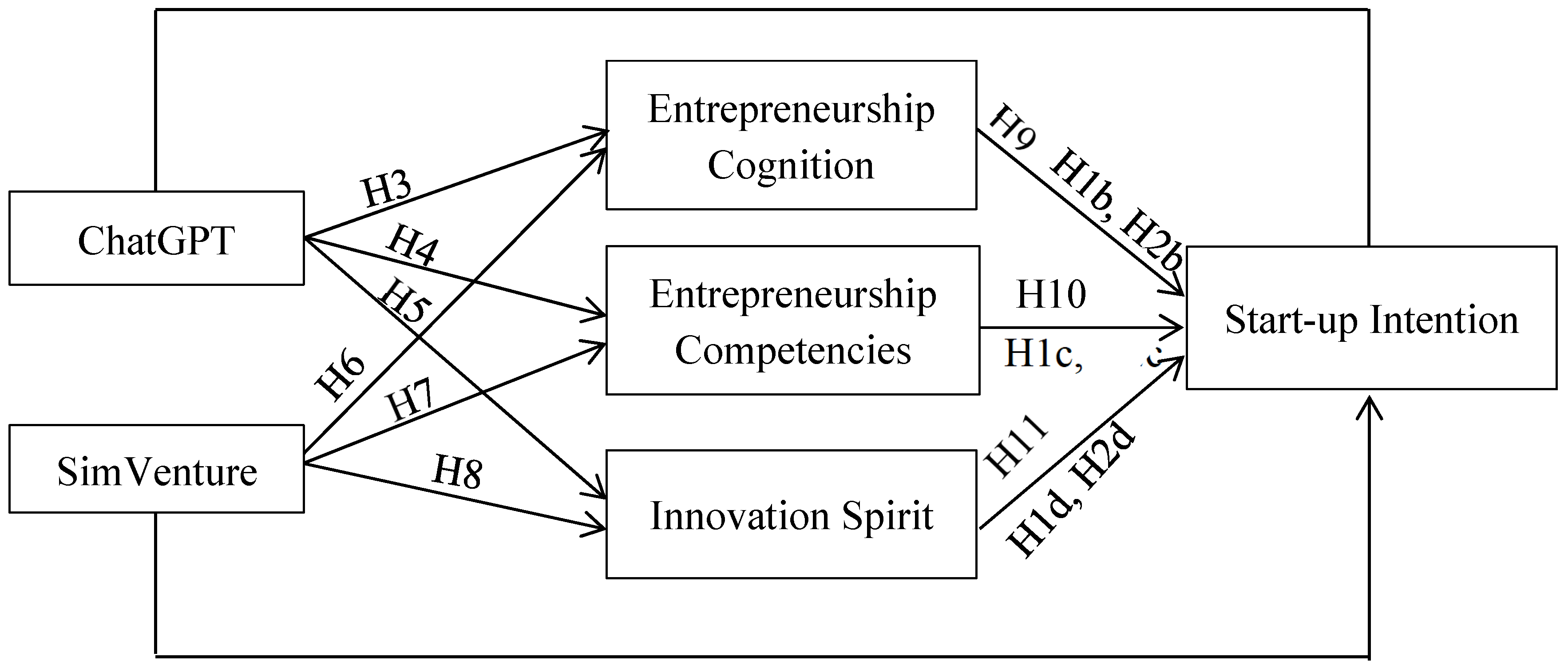
Figure 2.
Graphical outputs of the structure model.
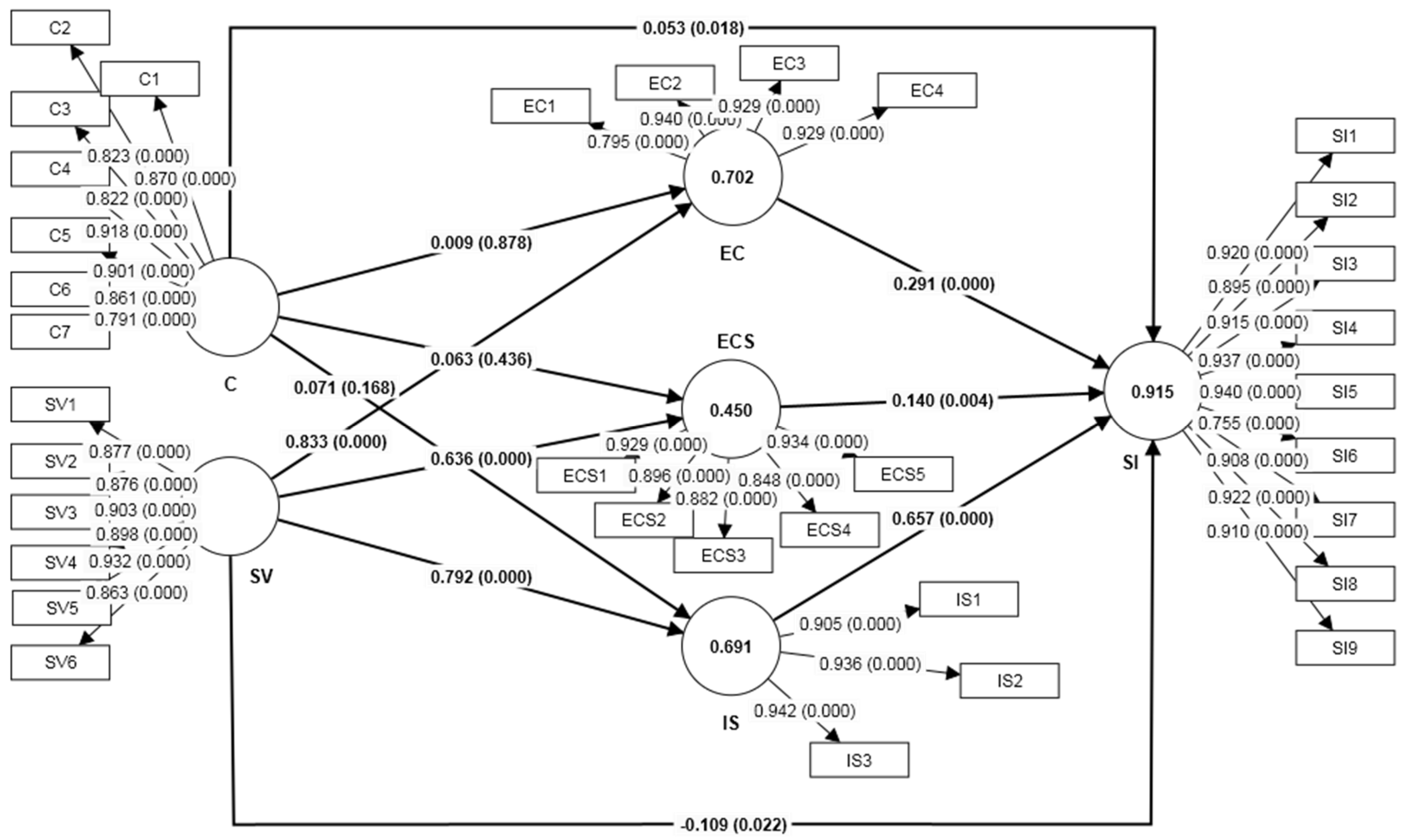
Table 1.
Most cited definitions of artificial intelligence.
| Author | Definition |
|---|---|
| IBM (2023) | AI is the technology that makes it possible for machines to mimic human intelligence and problem-solving skills on computers. |
| European Commission (2020, p.2) | AI is a group of technologies that combines computing power, algorithms, and data. |
| Pedro et al. (2019, p.8) | AI is the rationality of computers, systems, or software, as well as human performance. |
| Russell & Norvig (2016, p. 60) | the study of [intelligent] agents that receive precepts from the environment and take action. |
| Nilsson (2010, p. 13) | AI is the process of turning machines into intelligent beings; intelligence is the characteristic that allows an object to operate sensibly and predictably in its surroundings. |
| McCarthy (2007, p.2) | Defined as It is the engineering and science of creating intelligent devices, particularly computer programs. |
Table 2.
AIEE.
| Authors | Adoption of AI technology | Definition of applied AI technology |
Research method |
Area |
|---|---|---|---|---|
| Bawack & Tchokoté (2024) | AI-based simulations (Digital Business Games, e.g., SimVenture) | Digital business games, which will hereafter be referred to as “business games” for simplicity, are interactive digital learning tools that mimic a company setting and allow students to practice or assess their hard and soft business skills. | Review | Global |
| Duong et al. (2024) | GenAI (ChatGPT) | ChatGPT is AI chatbot, which make use of sophisticated natural language processing (NLP) algorithms, have become extremely effective tools for companies all over the world. | Quantitative research (survey) | Vietnam |
| Kangiwa, et al. (2024) | AI-based simulations (Business Simulations and Virtual Reality (VR) environments) | Virtual reality (VR) and business simulations are two potent AI tools that provide entrepreneurs with hands-on learning experiences. | Qualitative research | Not specified |
| George-Reyes, et al. (2024) | GenAI (ChatGPT) | Not provide direct definition, but describing ChatGPT in education | Quantitative research (Experiment) | Ecuador |
| Herani & Angela (2024) | GenAI (ChatGPT) | Not provide direct definition, but describing ChatGPT in education | Quantitative research (survey) | Indonesia |
| Winkler et al. (2023) | GenAI (ChatGPT) | GenAI is the most recent development in AI, big data, and machine learning, is capable of carrying out a wide range of natural language processing (NLP) tasks. | Qualitative research | Global |
| Alqahtani (2023) | Machin Learning, Natural Language, Expert Systems, and Machine Vision | Not provide direct definition, but describing them. | Quantitative research (survey) | Qatar |
| Ausat et al. (2023) | GenAI (ChatGPT) | ChatGPT is a language model created by OpenAI that uses artificial intelligence. | Qualitative research | Global |
| Su & Liu (2023) | GenAI (ChatGPT) | ChatGPT is a sophisticated language learning model created by OpenAI, an American artificial intelligence research center. | Qualitative research | China |
| Abaddi (2023) | GenAI (ChatGPT) | Not provide direct definition, but describing ChatGPT in education | Quantitative research (survey) | Jordan |
| Al-Darras & Tanova (2022) | Big data (data analytics) | Large-scale heterogeneous data that can be sorted and examined with a wide range of tools (e.g., Apache Hadoop, Apache Spark, Microsoft Azure, and Tableau Software) | Quantitative research (survey) | Jordan |
| Liang et al. (2021) | SPA-VFS and GRNN | Not provided directly, but describing and combining two algorithms | Quantitative research (Experiment) | China |
| Botha et al. (2021) | Machine learning (neural networks) |
a method for seeing trends and patterns in a series of actions |
Quantitative research (Experiment) | Zambia |
| Xu & Zhang (2021) | Machine learning (Wavelet neural network) |
Wavelet analysis technology is a useful tool for analyzing unstable signals in the time and frequency domains. | Quantitative research (Experiment) | China |
| Chen et al. (2021) | social media (Wiki, Facebook), serious games (FLYGBY and SimVenture), and Massive Open Online Courses platform (Massive Open Online Courses platform), | Numerous online courses on entrepreneurial education are available on Coursera. In summary, social media was used to promote collaboration among participants in online and blended entrepreneurship education; serious games were employed to raise student enjoyment and engagement; and Massive Open Online Courses offered a platform in addition to excellent learning materials. |
Systematic review | Global |
| Baruah & Mao (2021) | AI-based simulations (SimVenture) | Game-based business simulation is so good at simulating a real-world business, it’s regarded as one of the most significant teaching and learning resources in entrepreneurship education. | Quantitative research (Experiment) | Not specified |
| Tkachenko et al. (2019) | Machine learning (model of neuro-fuzzy regulator) |
the standpoint of cognitive understanding of information and development of the entrepreneurial training | Qualitative research | Not specified |
| Baruah, et al. (2019) | AI-based simulations (SimVenture) | SimVenture which offer students a real-world taste of managing a company and proving their creative ideas. |
Review | Global |
| Sedkaoui (2018) | Big data (data analytics) | Big data is terabytes (1013 bytes), petabytes (1015 bytes), and larger categories of online data compose the majority of IG data, which is predominantly network-generated on a large-scale volume, by diversity, and velocity. | Qualitative research | Not specified |
| Williams (2015) | AI-based simulations (SimVenture) | SimVenture is a business simulation game created by entrepreneurs for entrepreneurs. | Quantitative research (Experiment) | UK |
| Williams (2011) | AI-based simulations (SimVenture) | Not provide directly, bust describe it as SimVenture aims to engage young people’s brains and foster business, entrepreneurship, and entrepreneurial thinking while making learning engaging, relevant, and fun. |
Quantitative research (Experiment) | UK |
| This study | GenAI (ChatGPT) and AI-based simulations (SimVenture) | Not provide direct definition, but describing ChatGPT and SimVenture in EE | Quantitative research (survey) | Middle East |
Table 3.
Characteristics of the Study Sample of Fourth-Year Undergraduate Students in Business Programs Utilizing ChatGPT and SimVenture.
Table 3.
Characteristics of the Study Sample of Fourth-Year Undergraduate Students in Business Programs Utilizing ChatGPT and SimVenture.
| University | Country | Questionnaire completed |
|---|---|---|
| Bath Spa University | UAE | 32 |
| MSA University Cairo | Egypt | 97 |
| Qatar University | Qatar | 11 |
| Institute of Management Technology | UAE | 26 |
| Total | Middle East Region | 166 |
Table 4.
Cronbach’s Alpha Reliability Test Results.
| Factors | Cronbach’s Alpha | Comments | No. of Items |
|---|---|---|---|
| ChatGPT | 0.952 | Excellent | 7 |
| SimVenture | 0.965 | Excellent | 6 |
| Entrepreneurship Cognition | 0.918 | Excellent | 3 |
| Entrepreneurship Competencies | 0.939 | Excellent | 5 |
| Innovation Spirit | 0.939 | Excellent | 3 |
| Start-Up Intention | 0.973 | Excellent | 9 |
| Overall | 0.977 | Excellent | 34 |
Table 5.
Demographic Profile of Respondents.
| Variables | Categories | N | % |
|---|---|---|---|
| Gender | Male | 103 | 62% |
| Female | 63 | 38% | |
| Total | 166 | 100% | |
| Nationality | Qatar | 9 | 5% |
| United Arab Emirates | 43 | 26% | |
| Egypt | 87 | 52% | |
| Other | 27 | 17% | |
| Total | 166 | 100% |
Table 6.
The results of descriptive statistics and correlations matrix.
| Variables | Mean | S.D | Skewness | Kurtosis | C | SV | EC | ECS | IS | SI |
|---|---|---|---|---|---|---|---|---|---|---|
| C | 3.232 | 0.999 | -0.221 | -0.328 | 1 | |||||
| SV | 3.934 | 0.894 | -0.957 | 1.289 | 0.503** | 1 | ||||
| EC | 4.018 | 0.953 | -1.031 | 0.808 | 0.427** | 0.835** | 1 | |||
| ECS | 3.559 | 0.948 | -0.470 | 0.051 | 0.364** | 0.668** | 0.777* | 1 | ||
| IS | 3.839 | 0.994 | -0.650 | -0.154 | 0.465** | 0.829** | 0.821** | 0.716** | 1 | |
| SI | 3.812 | 0.989 | -0.695 | -0.195 | 0.484** | 0.798** | 0.868** | 0.783** | 0.931** | 1 |
Notes: N= 166, ** Correlation is significant at the 0.01 level (2-tailed); C = ChatGPT; SV = SimVenture; EC = Entrepreneurship cognition; ECS = Entrepreneurship competencies; IS = Innovation spirit; SI = Start-up intention.
Table 7.
Measurement Model Evaluation.
| Constructs | Items | FL | α | CR | AVE | VIF |
|---|---|---|---|---|---|---|
| ChatGPT | 0.939 | 0.947 | 0.950 | |||
| C1 | 0.870 | 6.037 | ||||
| C2 | 0.823 | 3.577 | ||||
| C3 | 0.822 | 2.561 | ||||
| C4 | 0.918 | 9.311 | ||||
| C5 | 0.901 | 6.550 | ||||
| C6 | 0.861 | 3.626 | ||||
| C7 | 0.791 | 2.472 | ||||
| SimVenture | 0.948 | 0.950 | 0.959 | |||
| SV1 | 0.877 | 3.620 | ||||
| SV2 | 0.876 | 3.129 | ||||
| SV3 | 0.903 | 5.307 | ||||
| SV4 | 0.898 | 4.144 | ||||
| SV5 | 0.932 | 7.036 | ||||
| SV6 | 0.863 | 3.257 | ||||
| Entrepreneurship Cognition | 0.921 | 0.929 | 0.945 | |||
| EC1 | 0.795 | 1.889 | ||||
| EC2 | 0.940 | 5.279 | ||||
| EC3 | 0.929 | 4.230 | ||||
| EC4 | 0.929 | 5.248 | ||||
| Entrepreneurship Competencies | 0.940 | 0.941 | 0.954 | |||
| ECS1 | 0.929 | 5.470 | ||||
| ECS2 | 0.896 | 3.550 | ||||
| ECS3 | 0.882 | 3.116 | ||||
| ECS4 | 0.848 | 2.591 | ||||
| ECS5 | 0.934 | 5.643 | ||||
| Innovation Spirit | 0.919 | 0.920 | 0.949 | |||
| IS1 | 0.905 | 2.552 | ||||
| IS2 | 0.936 | 4.348 | ||||
| IS3 | 0.942 | 4.628 | ||||
| Start-Up Intention | ||||||
| SI1 | 0.920 | 0.971 | 0.973 | 0.975 | 7.320 | |
| SI2 | 0.895 | 6.193 | ||||
| SI3 | 0.915 | 8.829 | ||||
| SI4 | 0.937 | 9.904 | ||||
| SI5 | 0.940 | 11.880 | ||||
| SI6 | 0.755 | 2.633 | ||||
| SI7 | 0.908 | 10.991 | ||||
| SI8 | 0.922 | 8.459 | ||||
| SI9 | 0.910 | 9.567 |
Note(s): FL = Factor loadings, VIF = Variance inflation factor, CR = Composite reliability, AVE = Average variance extracted, α = Cronbach’s alpha.
Table 8.
The results of hypothesis testing.
| Path | β-values | Mean | STDEV | t-values | P-values | Decision | |
|---|---|---|---|---|---|---|---|
| Direct Effects | |||||||
| H1a | C → SI | 0.053 | 0.056 | 0.022 | 2.368 | 0.018* | Supported |
| H2a | SV → SI | -0.109 | -0.109 | 0.048 | 2.299 | 0.022* | Not Supported |
| H3 | C → EC | 0.009 | 0.008 | 0.058 | 0.153 | 0.878 | Not Supported |
| H4 | C → ECS | 0.063 | 0.070 | 0.081 | 0.779 | 0.436 | Not Supported |
| H5 | C → IS | 0.071 | 0.075 | 0.052 | 1.378 | 0.168 | Not Supported |
| H6 | SV → EC | 0.833 | 0.833 | 0.036 | 23.055 | *** | Supported |
| H7 | SV → ECS | 0.636 | 0.630 | 0.086 | 7.428 | *** | Supported |
| H8 | SV → IS | 0.792 | 0.788 | 0.050 | 15.782 | *** | Supported |
| H9 | EC → SI | -0.109 | 0.295 | 0.063 | 4.648 | *** | Not Supported |
| H10 | ECS → SI | 0.140 | 0.147 | 0.049 | 2.860 | 0.004** | Supported |
| H11 | IS → SI | 0.657 | 0.643 | 0.064 | 10.284 | *** | Supported |
| Indirect Effects | |||||||
| H1b | C -> EC -> SI | 0.003 | 0.002 | 0.018 | 0.148 | 0.883 | Not Supported |
| H1c | C -> ECS -> SI | 0.009 | 0.009 | 0.012 | 0.745 | 0.456 | Not Supported |
| H1d | C -> IS -> SI | 0.047 | 0.049 | 0.035 | 1.344 | 0.179 | Not Supported |
| H2b | SV -> EC -> SI | 0.243 | 0.246 | 0.054 | 4.515 | *** | Full Mediation |
| H2c | SV -> ECS -> SI | 0.089 | 0.095 | 0.041 | 2.175 | 0.030* | Full Mediation |
| H2d | SV -> IS -> SI | 0.520 | 0.506 | 0.052 | 10.041 | *** | Full Mediation |
Notes: N= 166, *** designates that the coefficient is significant with p < 0.001, ** means significance at the 1% significance level with p < 0.01, and * indicates significance at the 5% significance level with p < 0.05; C = ChatGPT; SV = SimVenture; EC = Entrepreneurship cognition; ECS = Entrepreneurship competencies; IS = Innovation spirit; SI = Start-up intention.
Table 9.
Recommendations & Implementation Mechanisms.
| Recommendations | Implementation Mechanisms | |
|---|---|---|
| Boosting students’ intentions to start their businesses by leveraging the benefits of ChatGPT | Who? | Management of educational institutions Cooperation between the business administration and the IT department |
| How? | Design courses related to teaching GenAI chatbots (ChatGPT) to benefit from its advantages in the business scope, training on market analysis, developing strategic plans, and analyzing documents to reduce human errors and improve customer experience (Tkachenko et al., 2019). | |
| Cost? | ChatGPT is less expensive than relying on human resources (George & George, 2023). | |
| Improving students’ experiences on the Simventure platform | Who? | Management of educational institutions Cooperation between the business administration and the IT department |
| How? | Instead, make the SimVenture business simulation course a compulsory course instead of an elective course. This provides students with the impression that the business simulation course is important, allowing students to train seriously and effectively on entrepreneurial activities without financial risks. | |
| Cost? | Virtual learning environment (SimVenture) is lower cost than physical resources, travel, and infrastructure | |
| Develop competencies with AI simulation | Who? | Curriculum Designers and Faculty |
| How? | In designing a SimVenture course, the focus should be on the development of entrepreneurial competencies such as the ability to solve problems and to make decisions. | |
| Promote Innovation Spirit through AI Technologies | Who? | Teachers |
| How? | By providing AI-driven projects that help provide innovative solutions to problems. | |
Disclaimer/Publisher’s Note: The statements, opinions and data contained in all publications are solely those of the individual author(s) and contributor(s) and not of MDPI and/or the editor(s). MDPI and/or the editor(s) disclaim responsibility for any injury to people or property resulting from any ideas, methods, instructions or products referred to in the content. |
© 2024 by the authors. Licensee MDPI, Basel, Switzerland. This article is an open access article distributed under the terms and conditions of the Creative Commons Attribution (CC BY) license (http://creativecommons.org/licenses/by/4.0/).
Copyright: This open access article is published under a Creative Commons CC BY 4.0 license, which permit the free download, distribution, and reuse, provided that the author and preprint are cited in any reuse.


