
Submitted:
14 August 2024
Posted:
15 August 2024
You are already at the latest version
Abstract
The scientific community has explored new packaging materials due to environmental challenges and pollution from plastic waste. Bacterial cellulose (BC), produced by bacteria like Gluconaceto-bacter xylinus, shows high potential for food preservation due to its exceptional mechanical strength, high crystallinity, and effective barrier properties against gases and moisture, making it a promising alternative to conventional plastics. This review highlights recent advances in BC production, particularly agro-industrial residues, which reduce costs and enhance environmental sustainability. Incorporating antimicrobial agents into BC matrices has also led to active packaging solutions that extend food shelf life and improve safety. A bibliometric analysis reveals a significant increase in research on BC over the last decade, reflecting growing global interest. Key research themes include the development of BC-based composites and the exploration of their antimicrobial properties. Critical areas for future research include improving BC production's scalability and economic via-bility and its integration with other biopolymers. These developments emphasize BC's potential as a sustainable packaging material and its role in the circular economy through waste valorization.
Keywords:
bacterial cellulose
; food packaging
; biopolymer
; sustainable materials
; waste utilization
; innovative packaging
1. Introduction
Food packaging plays a primary role in preserving the quality and safety of food products by protecting them from external contamination and extending their shelf life. The primary materials currently used for food packaging include plastics, paper, glass, and metals. Plastics, such as polyethylene terephthalate (PET), high-density polyethylene (HDPE), and polypropylene (PP), are widely used due to their excellent barrier properties, durability, and relatively low cost. On the other hand, paper and cardboard are commonly used for secondary and transport packaging. At the same time, glass and metals, such as aluminum, are preferred for products that require rigid barriers against light, oxygen, and moisture.
However, among these materials, plastics are the most prevalent and problematic in terms of environmental impact. PET, HDPE, and PP are widely used in food packaging due to their versatility and efficiency in protecting products. Nevertheless, the durability that makes plastics so effective also contributes to their negative environmental impact. Over 8 million tons of plastic are estimated to end up in the oceans yearly, causing significant harm to marine life and ecosystems [1]. Additionally, petroleum-derived plastics are responsible for many greenhouse gas emissions, contributing to climate change [2].
Plastic pollution also has severe implications for human health. Recently, studies have revealed the presence of microplastics in the human body. Microplastics have been found in blood samples, feces, and even human tissues, raising concerns about the long-term effects of these materials on the body[3,4]. The ingestion of microplastics can occur through the consumption of contaminated food and water, as well as through the inhalation of airborne particles. The potential effects of microplastics on human health include inflammation, cellular toxicity, and hormonal disruption, although further research is needed to understand these impacts fully [5].
The growing concern over environmental sustainability and the negative impacts of plastic waste has driven the search for more eco-friendly alternatives. In this context, bacterial cellulose (BC) emerges as a promising and sustainable option for food packaging. BC is a biopolymer produced by various strains of bacteria, notably Gluconacetobacter xylinus, as well as Acetobacter hansenii, Komagataeibacter sucrofermentans, and Gluconacetobacter hansenii, through fermentation processes. This material exhibits promising characteristics, such as high purity, mechanical strength, flexibility, and excellent barrier properties against gases and moisture [6,7]. Additionally, BC is biodegradable, compostable, and can be produced from renewable sources, making it an attractive alternative to petroleum-derived plastics [8].
BC has several advantages over plant cellulose, highlighted in Table 1. One key benefit of BC is its higher purity, as it is free from lignin and hemicellulose, unlike plant cellulose. Its three-dimensional network of nanofibers and high crystallinity result in superior mechanical properties, such as greater tensile strength and flexibility. Additionally, BC provides barrier properties against gases and moisture, surpassing plant cellulose.
These advantages make BC a promising option for various applications, especially in areas that require high-performance and biocompatible materials, such as food packaging. The interest in BC has grown due to its physical properties and significant environmental advantages. In addition to the mentioned properties, BC exhibits high water retention capacity, excellent transparency, and a highly organized nanofibrillar structure that contributes to its outstanding barrier properties against gases and moisture. These characteristics make BC an effective alternative to conventional packaging materials. The environmental advantages of BC include its biodegradability and compostability, allowing it to decompose quickly in the environment without leaving toxic residues [9]. Furthermore, BC production can utilize renewable sources and agricultural by-products, reducing dependence on fossil resources and minimizing environmental impact. Recently, technological advancements have enabled the large-scale production of BC, making its commercial application viable in various sectors, including the food industry. Studies have shown that BC-based packaging can compete in performance with conventional materials while significantly reducing environmental impact [8]. In addition to its physical and mechanical properties of interest, incorporating antimicrobial agents into bacterial cellulose (BC) structure can further enhance packaged foods’ safety and shelf life [10]. This is particularly relevant for the food industry, where product safety and extended shelf life are top priorities.
Given the above, this review article aims to explore the properties, production methods, current applications, and potential future uses of bacterial cellulose in food packaging. The diversity of characteristics and uses of this biomaterial will be discussed, as well as the technical challenges and research and development perspectives necessary to establish BC as a sustainable and innovative solution for the packaging industry. A systematic analysis of articles published between 2010 and 2023 was performed to conduct this study, using databases such as Scopus and Web of Science. Patents addressing technological and environmental aspects related to the use of BC in food packaging were also investigated. The review included a critical evaluation of BC production methods, its physical and functional properties, and its applications in different types of packaging. Finally, we propose future research directions, including optimizing fermentation processes and developing BC-based composite materials to maximize their positive impact on the industry and the environment.
2. Bibliometric Research Methodology
To conduct a comprehensive bibliometric analysis on using residues to produce bacterial cellulose (BC), we utilized the Bibliometrix package developed for the R software. This method enables us to identify research trends, key authors, influential journals, and collaboration networks, providing a detailed overview of the current research landscape in this field.
3.1. Defining the Scope of Research
The search terms were carefully defined to ensure comprehensive and relevant data collection. Key terms “bacterial cellulose” and “food packaging” were used. The analysis period was set to the last 10 years (2013-2023) to include the most recent and relevant research.
3.2. Data Collection and Analysis
Searches were performed in Scopus databases using the predefined terms, and the results were exported in .bib format, compatible with the Bibliometrix package. The exported data were filtered to remove duplicates, focusing on articles, reviews, and conference papers. Thus, the bibliometric analysis was performed using the Scopus (SC) (www.scopus.com) databases, searching for the terms “Bacterial cellulose” and “Bacterial cellulose food.” The papers were selected based on their relevance, number of citations, and connection to the theme. After Removing duplicate files, the papers were stored in Mendeley® software for further analysis. Then, exported and analyzed information such as author details, first author’s institution, corresponding author’s institution, first author’s country, corresponding author’s country, publication year, scientific journal, keywords, abstract, and title using VOSviewer and the Bibliometrix package. The papers were stored in Mendeley® software for further analysis.
3. Bibliometric Research Results
The bibliometric analysis highlighted the growing interest in BC across multiple scientific areas. After removing duplicate entries, we identified 12,726 publications focused on bacterial cellulose and 1,678 publications addressing its applications in the food industry. Figure 1 illustrates the scientific output over the last 10 years (2014-2024) related to “Bacterial cellulose” and “Bacterial cellulose in food”. The data indicate a significant increase in publications related to bacterial cellulose, especially from 2016 onwards, with a peak observed around 2022. This trend reflects the growing interest in CB as a versatile biopolymer, driven by its potential applications in several areas, including biomedicine, electronics, and food packaging. Publications specifically focused on the application of bacterial cellulose in the food industry show a more modest but steady increase over the same period. Although the total number of publications in this area remains lower than that of general CB research, the upward trend suggests that the potential of CB in food applications is gaining recognition and attracting increasing attention from researchers.
Figure 2 presents a three-field graph that illustrates the correlation between the title, keywords, and sources of the published articles, indicating the connection between the most represented keywords and the journals in which these works were published. In the title field, terms such as “cellulose,” “bacterial,” “production,” and “packaging” dominate, reflecting the focus of research on the production and application of bacterial cellulose, especially in the context of packaging. The correlation between these terms and keywords, such as “bacterial cellulose,” “food packaging,” “antibacterial activity,” and “chitosan,” demonstrates the areas of interest within the research, such as antimicrobial functionality and the use of biopolymers in active packaging. The source field reveals the leading journals that publish these articles, such as the International Journal of Biological Macromolecules, Carbohydrate Polymers, and Food Chemistry. These journals are directly connected with the predominant keywords, indicating that they are the primary vehicles for disseminating research related to bacterial cellulose and specific trends.
The global distribution of publications on bacterial cellulose in food applications reveals a significant research concentration in some leading nations. China is the main contributor, followed by India and the United States (Figure 3). Significant investment in biotechnology and sustainable materials in China aligns with global sustainability and plastic waste reduction goals, positioning the country as a leader in this research area. European countries like Italy and Spain play a significant role in researching biopolymers and sustainable materials, supported by EU policies that promote the circular economy and reduce single-use plastics. Brazil is the main contributor in Latin America in the southern hemisphere, indicating the increasing importance of research on sustainable materials in the region and the potential for utilizing local natural resources as substrates to produce bacterial cellulose. Iran, Canada, and South Korea are also investigative hubs for researching bacterial cellulose, indicating this development area’s global impact.
Figure 4 categorizes the research themes, providing in-depth insight into the evolution and scientific priorities within the field of bacterial cellulose in food applications. The Motor Themes located in the upper right quadrant, such as “bacteria,” “cellulase,” and “biodegradation,” indicate that the biological basis and fundamental processes related to the production and degradation of bacterial cellulose are well-established areas of study and critical to advancing the field. These results suggest that a deep understanding of these processes may be necessary for the development of new applications of bacterial cellulose, particularly in packaging that requires specific characteristics such as controlled biodegradability and interaction with microbial environments. The Basic Themes present in the lower right quadrant, including “bacterial cellulose,” “antibacterial activity,” “food packaging,” and “chitosan,” reveal research areas that, despite being widely recognized as necessary, are still at an early or intermediate stage of development. Suggesting that while the potential of bacterial cellulose as a packaging material is already recognized, technical and scientific challenges must be overcome. For example, the development of packaging with effective antibacterial activity using compounds such as chitosan is an area that requires further study to optimize the functionality and commercial viability of these materials.
The Niche Themes in the upper left quadrant, such as “dietary fiber,” “gut microbiota,” and “microbiota,” indicate that there are specific and highly specialized subfields that, although not the central focus of bacterial cellulose research in food, have significant relevance in specific contexts. These results suggest continued interest in exploring how bacterial cellulose may interact with human health, possibly in areas related to nutrition and microbiota, thus expanding the scope of BC applications beyond packaging.
On the other hand, the Emerging or Declining Themes in the lower left quadrant, such as “probiotics,” “smart packaging,” and “Bacillus subtilis,” present future research directions. “Smart packaging” as an emerging theme indicates a growing interest in developing packaging solutions that protect food and interact with the environment or content, responding to changes or indicating product quality. This suggests a promising area of technological innovation that could significantly advance food safety and extend the shelf life of packaged products. Thus, although there are well-established areas, such as fundamental biological processes, there is still much room for innovation and development in emerging areas.
Figure 5A presents a conceptual map resulting from a factor analysis, which maps the applications of bacterial cellulose in food across different scientific domains. This map is essential to understand how the topics are interrelated and which research areas are most influential or emerging. In the yellow region, there are strong connections between terms such as “optimization,” “fermentation,” and “characterization” and bacteria such as Komagataeibacter xylinus and Acetobacter xylinus. These topics are associated with developing and refining biotechnological processes to produce bacterial cellulose. This indicates a focus on optimizing production and characterizing the properties of cellulose, aiming to improve the efficiency and stability of fermentation processes.
The blue region dominates the map and highlights the wide range of applications of bacterial cellulose, including “antibacterial properties,” “active packaging,” and “food safety.” The proximity of terms such as “nanocellulose,” “chitosan,” “mechanical properties,” and “biodegradability” points to a significant interest in exploring bacterial cellulose composites for food packaging applications, aiming to improve food’s functional properties and safety by demonstrating the potential of bacterial cellulose to replace traditional materials, due to its biodegradability and antibacterial applications. In the red region, there are topics such as “silver nanoparticles,” “cellulose fibrils,” and “cellulose nanocrystals,” which are associated with improving the barrier properties of packaging materials. This indicates that research focused on developing nanocomposites that offer improved barrier properties against gases and moisture, essential for food preservation and shelf-life extension.
The green region groups terms such as “antioxidants,” “cellulose nanofibers,” and “gelatin” suggest a focus on research seeking to incorporate antioxidant compounds into bacterial cellulose films to improve food preservation and their nutritional properties. The combination with cellulose nanofibers also suggests an effort to improve the structure and functionality of the films, making them more efficient and versatile. Finally, the pink region, although smaller, highlights the use of antioxidant compounds such as “curcumin,” known for its preservative properties.
Additionally, Figure 5B is a hierarchical representation that groups terms related to “bacterial cellulose food” applications based on their conceptual similarities. The dendrogram revealed several branches that reflect specific focus areas in bacterial cellulose research. For example, there is a cluster that connects terms such as “antibacterial properties,” “active food packaging,” “chitosan,” and “nanocomposites.” These terms are often studied together, suggesting an emphasis on the functional properties of bacterial cellulose, especially in the development of packaging that requires antibacterial and active protective characteristics. Another significant cluster involves terms such as “fermentation,” “characterization,” “production,” and “stability,” which focus on optimizing and characterizing bacterial cellulose production processes. This connection underscores the importance of ensuring the consistency and quality of the material for its subsequent applications, reflecting the need for control of biotechnological processes. Also, the interconnection of terms related to barrier properties and nanotechnology, such as “cellulose nanocrystals,” “silver nanoparticles,” and “barrier properties,” suggesting a focus on improving the barrier properties of food packaging, using nanotechnology and specific additives, such as silver nanoparticles, known for their antimicrobial properties.
In addition, terms such as “curcumin,” “antioxidant activity,” and “incorporation of bioactive compounds” appear grouped, indicating a growing interest in the incorporation of compounds that can extend the shelf life of packaged foods, protecting them from oxidation and other deterioration processes. Finally, the dendrogram revealed a cluster focused on “nanomaterials,” “nanofibrillated cellulose,” and “cellulose fibrils,” suggesting that research is also directed toward manipulating the nanoscopic structure of bacterial cellulose to improve its mechanical and barrier properties. This highlights how production, characterization, and practical application are interconnected and how integrating nanotechnology and bioactive compounds may improve the development of more efficient and functional food packaging.
The co-occurrence network of terms related to the applications of “bacterial cellulose food” (Figure 6) highlights the interconnections between the main topics and the frequency with which these terms appear together in the scientific literature, which is represented in Table 2. At the center of the network, the term “bacterial cellulose” emerges as the core, reflecting its high centrality and relevance in research. From this core, several branches connect “bacterial cellulose” to other vital topics, represented by circles of different sizes that indicate their relative importance. The green cluster presents terms such as “antibacterial activity,” “food packaging,” and “nanocellulose,” suggesting a substantial focus on the functional properties of bacterial cellulose. This includes the development of packaging that acts as a physical barrier and offers active antibacterial protection, addressing a critical need in food safety. The co-occurrence of these terms indicates a breakthrough in exploring bacterial cellulose as a multifunctional material suitable for active packaging applications.
In the red cluster, terms such as “cellulose,” “biofilm,” and “cellulose nanofibrils” indicate a focus on optimizing production processes and exploring the structural characteristics of bacterial cellulose. Research in this area aims to improve materials’ mechanical properties and stability, adjusting their structures to maximize efficiency and applicability in different industrial contexts, including the packaging sector.
The blue cluster, which includes terms such as “fermentation,” “Acetobacter xylinum,” and “food waste,” reflects the importance of microbiological aspects in the bacterial cellulose production process. This cluster suggests a growing interest in optimizing fermentation conditions and exploring the use of food waste as substrates, promoting a more sustainable and cost-effective approach to bacterial cellulose production.
On the other hand, the purple cluster, with terms such as “silver nanoparticles” and “barrier properties,” points to research seeking to improve the barrier properties of packaging through nanotechnology. This cluster highlights the potential to create packaging materials with superior moisture and gas protection capabilities, which may improve long-term food preservation. Furthermore, the yellow cluster, which includes terms such as “antioxidant activity” and “curcumin,” suggests research on incorporating bioactive compounds into bacterial cellulose materials. This indicates an innovative approach to creating packaging that protects food and contributes to its preservation through antioxidant properties, extending its shelf life and improving nutritional quality.
4. Deposited Patents in the Area of BC Production for Packaging
BC has garnered considerable attention in the food packaging industry due to its properties, such as biodegradability, high tensile strength, and the potential for functionalization. For example, the patent by Jiazhou et al. [11] presents the development of an edible packaging material derived entirely from bacterial cellulose. Also, the patent by Jian-Jiang Zhong et al. [12] focuses on enhancing the cost-efficiency and functionalization of BC. This patent describes a method for producing food packaging films that integrate BC with other biocompatible materials such as starch, sorbitol, and glycerin. By optimizing material composition, this patent addresses a significant challenge in BC commercialization—high production costs—making it more feasible for large-scale use in the food industry.
Additionally, the patent by Hess et al. [13] presents a significant advancement in the scalability and application of BC. This patent outlines the production of BC gels that can be processed into films or coatings for food packaging. The innovation emphasizes the material barrier properties against oxygen and moisture, extending the shelf life of food products, a significant concern in the food packaging industry. Also, Missoum et al. [14] present a different approach by exploring the thermoforming of BC into rigid or semi-rigid containers. The thermoforming process allows for creating complex shapes and structures that protect food products while remaining environmentally friendly.
The patent by Tajima et al. [15] addresses the BC need for dispersibility and compatibility with other materials. This patent describes a process for producing highly dispersible BC using specific bacterial strains, which enhances its integration with other biodegradable materials in composite films. The use of alternative carbon sources like molasses and glycerol not only reduces production costs but also improves the sustainability of the BC production process. Chen et al. [16] focus on the functionalization of BC by incorporating antimicrobial agents into the BC matrix to create active packaging. This is a significant advancement in the field, as it enables the packaging material to actively contribute to preserving the food it encases by inhibiting microbial growth. This functionality is particularly valuable for packaging perishable foods, where spoilage due to microbial contamination is a significant concern. By integrating antimicrobial properties into the packaging, this patent offers the dual benefit of protection and preservation, extending the shelf life of food products while reducing the reliance on chemical preservatives.
Finally, the patent by Stanley et al. [17] discusses the structural enhancement of BC through the formation of composites with other biopolymers or nanoparticles. This patent demonstrates BC’s versatility, showcasing how its mechanical properties can be tailored to meet the specific demands of different packaging applications. The enhanced tensile strength and flexibility achieved through this process make BC composites suitable for replacing conventional plastic materials, particularly in applications where durability and performance are critical.
5. BC Properties and Applications
Bacterial cellulose (BC) has unique physical, mechanical, and functional properties, making it a promising material for various applications, including food packaging. This section provides a detailed discussion of the critical properties of BC, drawing from recent studies.
BC comprises nanometric fibers of highly pure cellulose arranged in a highly crystalline three-dimensional network. BC exhibits superior crystallinity to plant-based cellulose, enhancing mechanical and thermal properties [18]. The tensile strength of BC can vary significantly depending on production conditions, with studies reporting values of up to 200-300 MPa, comparable to some synthetic plastics [19]. Additionally, BC demonstrates excellent flexibility, allowing it to be shaped into various forms and sizes, a critical feature for packaging applications.
5.1. BC Films
Bacterial cellulose (BC) films have shown promise in packaging fresh produce, such as fruits and vegetables, by extending shelf life by reducing respiration rates and delaying ripening [20]. Research indicates that BC films coated with antimicrobial compounds, such as essential oils, effectively inhibit pathogens, enhancing food safety [21].
In a recent study, laminated films composed of bacterial cellulose (BC) and chitosan enriched with grape bagasse extract and glycerol were developed as active packaging materials. These films demonstrated enhanced mechanical strength, significant antioxidant capacity, and effective lipid oxidation delay when applied as separators for Havarti cheese. The results showed a 67.3% reduction in lipid oxidation over 60 days of storage, highlighting the potential of these laminated films to extend the shelf life of cheese and possibly other food products. The addition of grape bagasse extract provided antioxidant properties and contributed to the film’s mechanical flexibility and thermal stability, making it a promising eco-friendly alternative for food packaging applications [22].
Li et al. [23] developed a multifunctional pH-responsive film by incorporating enzymatically produced bacterial nanocellulose into a konjac glucomannan (KGM)-based matrix stabilized with camellia oil Pickering emulsion. The films exhibited enhanced mechanical strength, with tensile strength reaching up to 37.43 MPa, and improved thermal stability and antioxidant properties. The inclusion of 0.4% EBNC significantly enhanced the colorimetric performance of the film, enabling it to act as an effective indicator for monitoring shrimp freshness by displaying visible color changes in response to pH variations. Additionally, the films demonstrated excellent water vapor permeability, reduced to 2.334 × 10⁻¹¹ g Pa-1 s-1 m-1, representing a 47.6% decrease. These findings underscore the potential of EBNC-based Pickering emulsions in advancing intelligent food packaging solutions.
Mesgari et al. [24] developed a bacterial cellulose (BC)/xanthan gum/cerium oxide (CeO2) nanoparticle composite film for active food packaging. The CeO2 nanoparticles were synthesized with an average size of 50 nm. They demonstrated potent antimicrobial properties, inhibiting the growth of Escherichia coli by 93.7% and Staphylococcus aureus by 98% at a concentration of 1250 μg/mL. The composite film showed excellent mechanical properties, thermal stability, and water vapor barrier capabilities, with a water vapor permeability (WVP) reduction to 3.02 × 10⁻¹¹g/m2 s Pa. Additionally, the films exhibited significant antioxidant activity, with a DPPH radical scavenging capacity of 72% at 1250 μg/mL. The study concluded that the BC/XG/CeO2 nanocomposite film is a promising material for extending the shelf life of food products, especially in applications requiring antimicrobial and antioxidant properties.
Ma et al. [25] developed active films based on bacterial cellulose (BC) and polyvinyl alcohol (PVA) by incorporating Perilla essential oil (PEO) Pickering emulsions stabilized with soybean protein isolate-chitosan nanoparticles (SPI-CSNPs). The resulting composite films exhibited improved mechanical properties, with a tensile strength ranging from 94.75 MPa to 62.02 MPa and elongation at break values increasing from 26.78% to 55.62% as the concentration of SCEO increased. Additionally, the films demonstrated enhanced thermal stability and significantly improved antioxidant and antibacterial activities. Specifically, the DPPH radical scavenging activity of the films reached up to 62.32%. In contrast, the antibacterial activity, measured as the diameter of the inhibition zone, increased to 27.3 mm for Escherichia coli and 30.46 mm for Staphylococcus aureus. These findings indicate that the BC/PVA-SCEO composite films effectively extended the shelf life of chilled beef by up to 14 days, showcasing their potential as a promising material for food preservation applications.
Zhou et al. [26] developed highly pH-sensitive bacterial cellulose nanofibers/gelatin-based intelligent films by loading them with anthocyanin and curcumin in various ratios (10:0, 0:10, 2:8, 5:5, and 8:2). These films exhibited significant color changes in response to pH variations, making them practical for monitoring the freshness of fresh pork. Among the tested formulations, the films with a curcumin-to-anthocyanin ratio of 5:5 demonstrated the best mechanical and antioxidant properties and high sensitivity to pH changes. When applied as packaging for fresh pork, these films effectively maintained the meat’s freshness, with total volatile elemental nitrogen (TVB-N) values remaining below the spoilage threshold of 25 mg/100 g for three days, indicating their potential as intelligent packaging materials for extending the shelf life of meat products.
Retegi et al. [27] explored the development of bacterial cellulose (BC) films with varying porosities to enhance their mechanical properties. The study involved compressing BC pellicles, produced by Gluconobacter xylinum, under different pressures (10, 50, and 100 MPa) to control the films’ porosity and, consequently, their mechanical behavior. The results indicated that increasing the compression pressure led to higher tensile strength and elongation at break, with tensile strengths of 87.5 MPa, 165.0 MPa, and 182.5 MPa for films compressed at 10, 50, and 100 MPa, respectively. The study also found a reduction in porosity from 13.6% at 10 MPa to 3.2% at 100 MPa, correlating with improved film density and crystallinity. These findings suggest that controlling the microstructure of BC films through compression molding can significantly influence their mechanical performance, making them suitable for high-performance applications in food packaging.
Abdelkader et al. [28] developed an eco-friendly, pH-sensitive film by immobilizing red cabbage extract (RCE) within bacterial cellulose (BC) to serve as a sensor for microbial contamination and gamma irradiation in stored cucumbers. The study demonstrated that the RCE-BC film exhibited significant color changes corresponding to pH shifts caused by bacterial growth, with a strong correlation (R² = 0.91) between color change and bacterial count. Additionally, the RCE-BC films effectively detected gamma irradiation doses, showing a gradual decrease in color intensity with increasing radiation, which could be used to monitor the preservation of cucumbers. The films successfully detected contamination and irradiation within the first five days of storage, making them a promising tool for intelligent food packaging.
Chen et al. [9] developed fully biodegradable packaging films using oil-infused bacterial cellulose (OBC) for fresh food storage. The OBC films exhibited significant improvements in mechanical properties, including a 3.4-fold increase in elongation at break and enhanced optical transparency with a transmittance of 82.6% at 500 nm. These films demonstrated a water vapor transmission rate (WVTR) of 101.7 g/m²/day and an oxygen transmission rate (OTR) of 418 cm³/m²/day, which are substantially lower than those of pure bacterial cellulose films. When used to package strawberries, the OBC films achieved a 0% moldy rate after 5 days at 23°C, in contrast to 100% for poly(ethylene) packaging. Additionally, the OBC films degraded completely in moist soil within 9 days, maintaining their high biodegradability while offering superior protection for fresh produce.
5.2. BC Coatings
Coatings with bacterial cellulose (BC) are applied directly to the surface of perishable foods to form a protective barrier, which is particularly beneficial for products like meats that gain from reduced oxygen exposure (Gorgieva & Trček, 2019).
Deng et al. [29] developed an ecological packaging material by combining bacterial cellulose (BC) with ethyl cellulose (EC) to create a pure cellulose film with enhanced water resistance and mechanical properties. The EC-BC films demonstrated remarkable tensile strength, reaching 195.3 ± 23.2 MPa, and maintained stability in liquid environments, with a wet tensile strength of 136.9 ± 24.2 MPa after 30 minutes of immersion in water. Additionally, the films exhibited excellent biodegradability, fully degrading within 40 days when buried in soil, and demonstrated a significant reduction in environmental impact compared to conventional single-use plastics. These findings suggest that EC-BC films could serve as a sustainable alternative for food packaging, addressing the environmental challenges posed by traditional plastics.
Muhammed et al. [30] developed a multifaceted bacterial cellulose (BC) film by incorporating citrus pectin (CP) and thyme essential oil (TEO) through ex-situ fabrication for use in active food packaging. The BC-CP1/TEO2 composite film significantly enhanced mechanical strength, increasing tensile strength from 126.37 MPa to 183.24 MPa and substantially reducing water vapor permeability from 3.69 × 10⁻¹¹ g.m-1.s-1.Pa-1 to 2.69 × 10⁻¹¹ g.m-1.s-1.Pa-1. The film exhibited exceptional antibacterial and antibiofilm properties, effectively inhibiting the growth of Escherichia coli and Staphylococcus aureus, as well as superior UV-blocking capabilities. The BC-CP1/TEO2 film efficiently preserved grapes for a 9-day storage period, and the film outperformed both pristine BC and conventional plastic packaging in maintaining grape quality.
Doğan [31] developed native bacterial cellulose (BC) films derived from kombucha pellicles, exploring their potential as active food packaging materials. The study utilized various plant infusions, including black tea, green tea, rosehip, coffee, and licorice, to produce BC films with distinct properties. Notably, green tea-based films exhibited significant antioxidant activity, with DPPH and ABTS radical scavenging capacities of 74.22% and 81.59%, respectively, attributed to their high phenolic content. Additionally, these films demonstrated antimicrobial properties against Escherichia coli, Staphylococcus aureus, and Bacillus cereus, with green tea-based films showing the highest efficacy. The study highlighted that the different plant infusions influenced the films’ mechanical and barrier properties, making these kombucha-derived BC films promising candidates for environmentally friendly, active food packaging solutions.
Carullo et al. [32] investigated the development of bio-nanocomposite coatings using acid-derived bacterial cellulose nanocrystals (BCNCs) as organic fillers to enhance the oxygen barrier properties of packaging films. The study involved the incorporation of BCNCs, produced through hydrochloric and sulfuric acid hydrolysis, into a pullulan-based matrix applied to polyethylene terephthalate (PET) films. The resulting coatings significantly improved the PET films’ oxygen transmission rate (OTR), reducing it from approximately 120 cm³/m²/day to as low as 2 cm³/m²/day. This enhancement was achieved while maintaining the films’ original optical clarity and mechanical properties, making them a promising alternative for high-performance food packaging applications. The findings underscore the potential of using BCNCs to develop sustainable, high-barrier packaging materials that could replace conventional plastic-based options.
6. Enhancing the Properties of Bacterial Cellulose
Bacterial cellulose (BC) possesses exceptional natural properties, making it a promising candidate for various applications. However, several techniques for modifying and enhancing BC properties have been explored to maximize its potential and expand its functionalities.
The cross-linking process led to a substantial increase in tensile strength, from 12.41 MPa in the non-cross-linked alginate film to 32.76 MPa in the cross-linked Alg-Ant-CBPE4 film, representing a 164% enhancement. This increase in mechanical strength is crucial for packaging applications where durability and resistance to mechanical stress are essential. It also improved water vapor permeability (WVP), reducing it to 2.03 gm-1s-1pa-1 [33].
Yang et al. [34] developed antibacterial aerogels using bacterial cellulose (BC) reinforced with carboxymethyl cellulose (CMC) and cross-linked with citric acid (CA). The cross-linking with CA significantly improved the aerogels’ mechanical strength, increasing the hardness from 1272 to 2676 N as the BC content was raised from 0% to 0.3%. The presence of CA also improved the aerogels’ water absorption capacity and maintained their structural integrity, even in moist environments. Furthermore, the CA cross-linking led to a more organized microstructure with smaller pores, which enhanced the aerogels’ mechanical stability and water absorption capabilities. These cross-linked aerogels demonstrated antibacterial solid properties against Listeria monocytogenes, Staphylococcus aureus, Escherichia coli, and Salmonella, effectively extending the shelf life of fresh beef by maintaining lower pH levels and reducing total viable bacterial counts over seven days of storage.
The addition of nanoparticles may also enhance the packaging potential of BC. Miao et al. [35] developed a multifunctional bacterial cellulose (BC)-based film by incorporating curcumin-embedded Pickering emulsions stabilized with natural protein-polysaccharide hybrid nanoparticles (PPH NPs). The BC-PE-Cur films exhibited reduced water vapor transmission rate (WVTR) and water vapor permeability (WVP), decreasing by approximately 90% compared to pure BC films. Moreover, curcumin provided the films with strong antibacterial properties, with the BC-PE-Cur 3:7 films showing a bacteriostatic rate of over 99% against E. coli and S. aureus. The films also demonstrated significant antioxidant capacity, with DPPH and ABTS radical scavenging activities increasing to 27% and 74%, respectively, making them highly effective in preventing lipid oxidation in packaged foods.
Zhou et al. [36] investigated the synthesis and characterization of bacterial cellulose nanofibers (BCNs) loaded with silver nanoparticles (AgNPs) through different pretreatment methods, including no treatment, sodium hydroxide activation, and TEMPO-mediated oxidation. The study found that the TEMPO-mediated oxidation (O-BCNs/Ag) produced the most uniformly dispersed and smallest AgNPs, with an average diameter of 20.25 nm, compared to 27.91 nm for sodium hydroxide-activated BCNs and 35.07 nm for untreated BCNs. The O-BCNs/Ag nanoparticles demonstrated the highest silver content at 2.98 wt%, leading to superior antibacterial activity, particularly against E. coli O157, where the inhibition zone reached 10.8 mm. The study also highlighted the enhanced antioxidant properties of the O-BCNs/Ag nanoparticles, with a DPPH radical scavenging activity of 22.78%, significantly higher than the other methods.
The production of hybrid materials has also enhanced BC’s properties. Khattak et al. [37] developed antibacterial hydrogels using bacterial cellulose (BC) combined with chitosan (Ch) and impregnated with silver sulfadiazine (SSD), which significantly enhanced the mechanical and antimicrobial properties of the resulting material. The study demonstrated that including SSd improved the hydrogel’s potential to inhibit the growth of gram-positive (Staphylococcus aureus) and gram-negative (Escherichia coli) bacteria. The most effective hydrogel formulation, SBC4, showed a 99% reduction in bacterial viability after 5 hours of contact, indicating an intense antibacterial activity.
Chen et al. [21] developed active films using a composite of chitosan (CS), polyvinyl alcohol (PVA), and BC integrated with ginger essential oil (GEO). Including BC and GEO significantly improved the films’ mechanical, barrier, and antimicrobial properties, making them suitable for packaging sea bass (Lateolabrax japonicus). The tensile strength of the films increased, presenting the CPB0.8 film achieving the highest strength at 11.80 MPa, indicating that the cross-linking and interactions between CS, PVA, BC, and GEO created a more robust film structure. Incorporating GEO also improved the films’ water vapor permeability (WVP) and oxygen permeability (OP). WVP decreased by 19.74% and OP by 35% compared to the control film without BC and GEO. These improvements are crucial for extending the shelf life of perishable products like fish. The CPB0.8 film also demonstrated superior antimicrobial activity, with complete inhibition of S. aureus and significant reductions in E. coli and P. fluorescens counts.
Agüero et al. [38] explored the use of bacterial cellulose (BC) obtained from kombucha fermentation in spent coffee grounds as a reinforcing antioxidant filler in plasticized polylactic acid (PLA)-based films. The study demonstrated that incorporating BC from spent coffee grounds (SCK) into the PLA matrix, plasticized with maleinized linseed oil (MLO), enhanced the mechanical and thermal properties of the resulting biocomposite films. The films exhibited improved tensile strength and modulus, with the PLA-MLO/5 SCK formulation achieving a tensile strength of 31.2 MPa and a modulus of 1639.2 MPa. These properties indicate better stress transfer and interaction between the SCK particles and the PLA matrix. Additionally, the films showed significant antioxidant activity, with a DPPH radical inhibition of up to 37.08% for the PLA-MLO/5 CK (from pristine coffee grounds) formulation. The inclusion of SCK also contributed to maintaining the material’s compostability, with the films showing substantial disintegration under composting conditions. These findings highlight the potential of using BC derived from food waste, such as spent coffee grounds, to create sustainable, active packaging materials with enhanced mechanical, thermal, and antioxidant properties.
Additionally, nanolayer coating application on the CB may enhance its barrier potential. Dao et al. [39] developed a bacterial cellulose (BC)-zinc oxide (ZnO) nanocomposite film using a low-cost hydrothermal method. The ZnO nanolayer, with a thickness of approximately 45 nm, was coated on the 3D scaffold structures of BC derived from kombucha fermentation. The resulting BC-ZnO nanocomposite demonstrated significant antimicrobial properties, showing nearly 100% bactericidal and fungicidal effectiveness against Escherichia coli and Candida albicans, respectively. The nanocomposite was also tested in vivo for its antifungal activity on apples, where it successfully inhibited mold growth for six days, maintaining the freshness of the fruit. The ZnO nanolayer significantly reduced the pore size of the BC scaffold from 491.89 nm to 121.97 nm, enhancing its filtering efficiency. This allowed the BC-ZnO film to reduce the microbial population drastically, filtering E. coli from 10^8 CFU/mL to a few thousand CFU/mL and C. albicans from 10^7 CFU/mL to just a few cells per milliliter. These results suggest that BC-ZnO nanocomposites could serve as effective antimicrobial coatings for food packaging, offering protection and extended shelf life for perishable goods.
Frota et al. [40] developed a superhydrophobic coating for food packaging using bacterial cellulose nanofibrils (BCn) functionalized with silicon dioxide (SiO2) and combined with beeswax (BW). The functionalization process significantly enhanced the hydrophobicity of the BCn, resulting in a coating with a contact angle (CA) of 153° and a slip angle (SA) of 3°, indicating strong water repellency. The study highlighted that the BCn-SiO2 coating effectively repelled liquid foods like honey, yogurt, and chocolate sauce without leaving residues. This is critical for reducing food waste by ensuring complete product drainage from packaging. The coatings demonstrated remarkable mechanical durability, maintaining superhydrophobicity even after multiple abrasion cycles and exposure to temperature variations. The incorporation of SiO2 into the BCn structure provided increased thermal stability, with the onset of thermal degradation occurring at 245°C for the functionalized material. Additionally, the coating’s self-cleaning properties were confirmed by successfully removing silica sand particles, further validating its potential for practical food packaging applications.
7. Waste Use and Environmental Impact in CB Production
BC has garnered attention in the environmental and economic sectors due to its properties and potential for sustainable applications. However, large-scale BC production faces significant economic challenges, primarily due to high costs and the need for more efficient processes. Traditional BC production relies on expensive culture media, such as Hestrin-Schramm (HS) medium, substantially increasing costs. Nonetheless, exploring agro-industrial waste and low-cost materials as alternative carbon sources for BC production presents a significant opportunity to reduce environmental impacts [41]. Studies have shown that waste materials like orange peel [42] and sugarcane bagasse [43] can provide sufficient nutrients for efficient BC production while mitigating the adverse environmental effects of improper disposal. Furthermore, as a biodegradable biopolymer, BC offers a promising solution to the global plastic waste crisis, providing an alternative to petroleum-derived polymers that persist in the environment.
The application of BC in food packaging and other environmentally friendly materials is a significant stride towards reducing our reliance on non-biodegradable plastics. Its water retention properties, high mechanical strength, and biodegradability make it an excellent candidate for replacing packaging plastics, significantly reducing pollution and contributing to a cleaner environment [20].
Table 3 provides a comprehensive overview of CB production using different microorganisms and agro-industrial residues as substrates. The type of residue used, the microorganisms employed, and specific fermentation conditions directly influence CB productivity and final product characteristics. For example, the microorganism Gluconacetobacter entanii was used to produce BC from pecan shell residues, resulting in a productivity of 2.81 g/L at a production rate of 0.10 g/L/day. This production occurred under pH 3.5 and 30 °C fermentation over 28 days. Substrate preparation, including sonication and characterization of BC by SEM, FTIR, XRD, TGA, DSC, and XPS, showed its potential for applications in biocomposites for biomedical uses [44].
Another example is the production of BC using Gluconacetobacter xylinus from spruce wood hydrolysate, resulting in a productivity of 8.2 g/L and a production rate of 0.59 g/L/day under conditions of pH 5.0 and 30 °C for 12 to 14 days. Alkaline treatment prepared the substrate, highlighting the material’s potential for biomedical applications [45].
The table also highlights the use of wine industry waste for the production of CB by Gluconacetobacter xylinus, resulting in a productivity of 6.56 g/L and a rate of 0.38 g/L/day. Fermentation occurred at pH 6.0 and 28 °C for 48 hours, using corn liquor as a supplement. The characterization of CB by SEM, FTIR, XRD, TGA, and DMA demonstrated that the material has promising properties for several industrial applications [46]

Table 3.
Bacterial cellulose production using different wastes: microorganisms, fermentation conditions, and results.
Table 3.
Bacterial cellulose production using different wastes: microorganisms, fermentation conditions, and results.
| Microorganisms | Bacterial Cellulose Production (g/L) | Productivity Rate (g/L day) | Used Waste | Fermentation Conditions (Temperature, pH, Time) | Substrate Preparation Method | Supplementation | BC Characterization | Potential Applications | Ref. |
|---|---|---|---|---|---|---|---|---|---|
| Gluconacetobacter entanii | 2.81 | 0.10 | Pecan nutshell | pH 3.5, 30 ºC, 28 days | Sonication | - | SEM, FTIR, XRD, TGA, DSC, XPS | Biocomposites for biomedical applications | [47] |
| Gluconacetobacter sacchari | 1.28 | 0.01 | Dry olive mill | pH 4.5 | Acidic hydrolysis | HS medium | SEM, FTIR, XRD | Biomedical applications | [48] |
| Gluconacetobacter xylinus | 8.2 | 0.59 | Spruce hydrolysate | pH 5.0, 30 ºC, 12-14 days | Alkali treatment | - | - | Biomedical applications | [45] |
| Gluconacetobacter xylinus | 6.56 | 0.38 | Wine industry residue | pH 6.0, 28 ºC, 48 h | Blending | Corn steep liquor | SEM, FTIR, XRD, TGA, DMA | - | [49] |
| Komagataeibacter rhaeticus MSCL 1463 | 6.9 | 0.69 | Cheese whey | pH 4.0, 30 ºC, 10 days | Enzymatic hydrolysis | Corn steep liquor | XRD, SEM | - | [50] |
| Acetobacter xylinus NCIM 2526 | 7.01 | 1.00 | Sweet lime pulp | 28.9 ºC, pH 5.65, 7 days | Sun drying, autoclave | - | SEM, FTIR, XRD, DSC, TGA | Biomedical applications | [51] |
| Acetobacter xylinum ATCC 23767 | 2.66 | 0.44 | Sugarcane bagasse, Moso bamboo, Corncob, Wheat straw, Rice straw | 30 ºC, 6 days | Alkali-catalyzed glycerol organosolv (ALGO) pretreatment, enzymatic hydrolysis | - | SEM, FTIR, XRD | Biomedical and cosmetics application | [52] |
| Kombucha SCOBY | - | - | Agricultural waste | RT, 15 days | Thermic treatment | Sucrose | SEM, FTIR, XRD, TGA, DSC | Food packaging | [53] |
| Komagataeibacter xylinus | 5.68 | 0.81 | Spent sulfite liquor | pH 5.5, 30 ºC, 7 days. | Ultrafiltration | - | FT-IR, SEC, SEM | Food packing | [54] |
| Gluconobacter oxydans MG2021 and Komagataeibacter hansenii GA2016 | 25.02% (w/w) | - | Bread waste hydrolysate | 30 ºC, pH 4.5, 14 days | Acid hydrolysis | - | FT-IR, TGA, SEM, XRD | Packing applications | [55] |
| Komagataeibacter rhaeticus QK23 | 2.57 | 0.10 | Asparagus peel waste | pH 4.5, 30 ºC, 25 days. | Acid hydrolysis | - | FT-IR, AFM, XRD | Food industry | [56] |
| Stenotrophomonas sp | 8.83 | 0.63 | Banana peel waste | pH 7.0, 30 ºC, 14 days | - | - | FTIR, TGA | Biomedical, food packing, cosmetics and electrical applications | [57] |
| Komagataeibacter intermedius | 12.16 | 1.73 | Jasminum sambac | pH 6.0, 30 ºC, 7 days | Thermal extraction | Glucose | FT-IR, XRD, FIB-SEM | Biomedical and food packing | [58] |
| Komagataeibacter intermedius | 14.58 | 2.08 | Camellia sinensis | pH 6.0, 30 ºC, 7 days | Thermal extraction | Glucose | FIB-SEM, FT-IR, XRD | Biomedical and food packing | [58] |
| Kombucha SCOBY | 47.0 | 7.83 | Soybean whey (SW) | pH 4.5, 28 ºC, 6 days | Enzymatic hydrolysis | - | SEM, AFM, FT-IR, XRD, TGA | Biomedical and paper industry | [59] |
| Kombucha SCOBY | 83.0 | 13.83 | Soybean hydrolysate (SH) | pH 4.5, 28 ºC, 6 days | Enzymatic hydrolysis | - | SEM, AFM, FT-IR, XRD, TGA | Biomedical and paper industry | [59] |
| Gluconacetobacter xylinus | 6.13 | 0.77 | Orange peel hydrolysate | 30 ºC, 8 days | Enzymatic hydrolysis | - | SEM, FTIR | Biomedical applications | [60] |
| Komagataeibacter xylinus | 2.55 | 0.17 | Pineapple core | RT, pH 4.0, 15 days | Thermal treatment | Glucose | SEM, FTIR, XRD, TGA, DSC | Biomedical applications | [61] |
| Achromobacter sp. | 1.22 | 0.09 | Mango peel waste (MPW) | 28 ºc, 14 days | Acid treatment | - | ATR-FTIR, XRD, SEM, HRTEM | Biomedical | [62] |
| Kombucha SCOBY | - | - | Spent coffee grounds (SCK) | 25 ºC, 30 days | Infusion preparation | Sucrose | SEM, TGA, DSC, DPPH | Food packing | [38] |
| Kombucha SCOBY | 6.05 | 0.43 | Kitchen waste (KW) | 28 ºC, 14 days | Enzymatic hydrolysis | - | SEM, Tensile tester | Medicine, food and textiles industries | [63] |
Another notable microorganism, Komagataeibacter rhaeticus, was used to produce BC from whey, an abundant residue from the dairy industry. The productivity reached 6.9 g/L at a rate of 0.69 g/L/day under pH 4.0 and 30 °C conditions for 10 days. Enzymatic hydrolysis of the substrate, supplemented with corn liquor, resulted in BC characterized by XRD and SEM, suitable for several industrial applications [50]. Another example is the production of BC using hydrolyzed orange peel residues with Gluconacetobacter xylinus, which reached a productivity of 6.13 g/L in 8 days, under pH 5.5 and 30 °C. The resulting BC was characterized by SEM and FTIR, indicating its potential for biomedical applications [60]. The use of Kombucha SCOBY to produce CB from soybean hydrolysate also stands out, achieving exceptional productivity of 83 g/L and a production rate of 13.83 g/L/day. Fermentation conditions included pH 4.5 and 28 ºC for 6 days. The characterization of CB by SEM, AFM, FTIR, XRD, and TGA revealed that the material has ideal properties for application in the biomedical and paper industries [59]. The table also shows the efficiency of Komagataeibacter intermedius in the production of CB from Camellia sinensis (green tea) residues, with a productivity of 14.58 g/L and a rate of 2.08 g/L/day. Fermentation was carried out at pH 6.0 and 30 °C for 7 days, and characterization by FIB-SEM, FTIR, and XRD suggested that the produced CB is suitable for applications in both the biomedical and food packaging industries [58].
These results underscore the importance of fermentation conditions, and the types of waste used in CB production efficiency and properties. The feasibility of using agro-industrial waste as substrates for CB production is evident, and integrating these approaches into industrial processes can lead to more sustainable and economically viable CB production systems, offering innovative alternatives for replacing traditional plastic materials in various applications. The sustainable production of CB using industrial and agricultural waste is a promising research area that aims to reduce costs and minimize environmental impact. Several types of waste have been explored as substrates for CB production, resulting in more economical and environmentally friendly processes. Agricultural residues, such as peels and bagasse, are rich sources of carbon that can be converted into efficient substrates for BC production. For example, pineapple residues, rich in sugars and nutrients, have shown the potential to produce BC with good mechanical and barrier properties [64]. Sugarcane bagasse, an abundant byproduct of the sugar and ethanol industry, can also be hydrolyzed to release fermentable sugars, facilitating the production of BC with quality comparable to that obtained from traditional substrates[52].
In addition to agricultural residues, industrial residues, especially from the food industry, are also viable for BC production. Whey, a byproduct of the dairy industry, is a rich source of lactose that can be fermented to produce high-purity BC with good mechanical properties [8]. Waste from the beer production process, such as malt bagasse and residual yeast, can also be used as substrates, resulting in a more sustainable BC production process [65]. Another significant example is the use of black liquor, a byproduct of the pulp and paper industry. This residue contains a high concentration of organic compounds that can be converted into a substrate for BC production, resulting in a product with good structural and mechanical properties [66].
The efficiency of BC production from waste can be increased through the enzymatic hydrolysis of lignocellulosic residues, such as sugarcane bagasse and rice straw. This process releases fermentable sugars, increasing carbon availability for BC production. Depending on the characteristics of the waste and the cultivation conditions, both submerged fermentation and semi-solid fermentation are used for BC production from waste [67]
Recent studies exemplify the diversity and effectiveness of using waste in BC production. For example, using soybean waste as a substrate showed that the BC produced has good barrier properties and is suitable for food packaging [68]. Potato waste, rich in starch, has also been converted into a substrate for BC production, resulting in a product with high crystallinity and mechanical strength [69]. This can also contribute to environmental sustainability by utilizing by-products that would otherwise be discarded. Furthermore, integrating CB production into a circular economy approach, where waste from one process is used as input for another, can create more sustainable and economically viable production systems [70].
8. Challenges and Limitations for the Use of BC as Food Packaging
Despite the numerous advantages and potential applications of bacterial cellulose (BC) in food packaging, technical, economic, and regulatory challenges remain to be overcome for its widespread commercial adoption.
8.1. Technical Challenges for Using BC in Packaging Materials
The utilization of bacterial cellulose as a material for food packaging encounters several technical challenges that need to be overcome to guarantee its feasibility on an industrial scale. While the production of BC in laboratory environments is well-established, the transition to large-scale production poses complexities. Stringent control of large-scale fermentation is essential to ensure the consistency and uniformity of the final product, both of which are crucial for its suitability in food packaging. Any variations in fermentation conditions, such as pH, temperature, and aeration, can lead to alterations in the microstructure of BC, directly impacting its mechanical properties, barrier properties, and biodegradability [67].
The engineering of composite materials poses a significant challenge. BC may have limitations in mechanical and barrier properties when used alone, particularly against gases and water vapor. Therefore, it is essential to integrate BC with other materials, such as biodegradable polymers or functional coatings, to develop packaging that meets the stringent requirements of the food industry [71]. However, there are technical issues related to the compatibility between BC and other materials and the maintenance of desired properties after combining, which are still in the research and development phase. The creation of composite materials incorporating advanced technologies, such as antimicrobial coatings and smart sensors, represents a promising field, but it requires innovative solutions for adhesion, uniformity, and durability issues [72,73]
In addition, integrating BC as a packaging material into industrial processes necessitates a comprehensive review of the entire production chain. The adjustment of equipment to handle BC and its combination with other materials may necessitate considerable investments. Standardizing production processes poses a challenge as variations in the final material’s characteristics can arise from different bacterial strains and cultivation substrates. It’s important to consider the interaction between bacterial cellulose and food components. Bacterial cellulose has a nanofibrillar structure that enables it to retain high amounts of water, which can benefit certain purposes. However, it may also present challenges when contacting high moisture or lipophilic compounds in food. The absorption of water by bacterial cellulose can harm its barrier properties, potentially compromising its ability to protect against the permeation of gas and water vapor. This protection is essential for preserving perishable foods [74]
Furthermore, acidic or basic food components have the potential to affect the bacterial cellulose matrix, leading to possible changes in its structural stability and performance. For instance, exposure to organic acids in foods could partially break down cellulose fibers, diminishing the material’s mechanical strength (REF). Similarly, interaction with lipids may pose compatibility challenges. Since BC is hydrophilic, it might not effectively prevent oils and fats from migrating unless modified or coated with other materials [75].
The industrial implementation of BC as a large-scale packaging material presents significant challenges, especially in modifying existing machinery. Adapting processing equipment to accommodate the unique characteristics of this biomaterial is crucial, as BC’s distinct rheological and mechanical properties differ from those of synthetic polymers. This may require reconfiguring extrusion, molding, and coating processes in industrial settings. Equipment typically used in traditional industrial processes for materials like polyethylene or polypropylene may not be well-suited for handling bacterial cellulose without significant modifications. The viscosity and consistency of bacterial cellulose pulp can present challenges in pumping and extrusion systems, where consistent and continuous flow is crucial [76]. BC’s high water retention capacity also requires adjustments to drying and molding processes to achieve the desired strength and stiffness properties without compromising its structural integrity.
Additionally, producing BC films and sheets frequently used in packaging may call for new lamination and coating techniques to preserve the material’s gas and moisture barrier properties [77]. The integration of additives, functional coatings, or the amalgamation of BC with other materials on current production lines may require investments in new machinery types or modifications to accommodate hybrid processes. Energy efficiency is a key factor to consider in industrial processes utilizing BC. The production of BC can be energy-intensive, particularly during stages like fermentation and drying. As a result, optimizing energy efficiency through machinery adaptation is crucial. This can be achieved by utilizing technologies that reduce energy consumption, such as heat recovery systems or renewable energy sources.
8.2. Economic Aspects for the Application of BC
The global bacterial cellulose market is booming. In 2023, the market value of CB was estimated at approximately USD 608.71 million and is expected to reach USD 1,396.94 million by 2030. This growth represents a compound annual growth rate (CAGR) of 12.6% between 2024 and 2030, as illustrated in the graph. This growth is driven by CB’s versatility, which finds application in various sectors such as textiles, cosmetics, food, and biomedical devices (Profshare Market Research, 2024).
Large-scale CB production using methods that increase production from laboratory cultures is being intensively researched, which increases the potential supply in the market. CB production’s economic viability depends on production costs and increased demand in emerging and established markets [78]. However, despite the apparent environmental advantages, large-scale BC production still faces challenges, such as optimizing cultivation conditions to maximize production efficiency and minimize resource use [79]. Using waste as a carbon source also presents a significant opportunity to reduce production costs by adding value to an underutilized byproduct.
In addition, BC’s versatility, with applications in biomedicine, biodegradable packaging, and tissue engineering, increases its market value, making its production economically attractive. However, BC’s competitiveness relative to other materials still depends on technological advances that allow for the reduction of production costs and the increase in scale. The industrialization of BC production requires investment in infrastructure and research to develop more efficient bacterial strains and more economical and sustainable cultivation processes [80].
Economic feasibility analyses show that despite the high initial investment required for constructing large-scale BC production facilities, automation and using waste as raw materials can significantly reduce operating costs, making these investments viable in the long term [80]. The production of CB is capital intensive, but innovations in production processes and the use of low-cost substrates could make this production economically viable, exploiting the vast potential of CB from an environmental and economic perspective.
CB is a highly versatile biomaterial applicable in various scientific sectors, including papermaking, electronics, and biomedical devices (BMD) [81,82]. Population growth and technological advances are additional factors driving the market. The continued development of more efficient and sustainable production methods and expanding CB in new applications are essential to unlocking CB’s full commercial potential. Technological advances are being developed to monitor and adjust these conditions in real-time, using automated bioreactors and high-precision sensors. However, for CB to establish itself as a viable alternative to other biomaterials, such as PLA and PHA, innovations are needed that allow for more efficient and larger-scale production without compromising environmental sustainability or the quality of the final product.
8.3. Regulatory and Consumer Acceptance Challenges
The adoption of nanocellulose, including bacterial cellulose, in food packaging shows promise due to its exceptional barrier properties, moisture retention, and antimicrobial activity. However, regulatory and acceptance challenges persist. Nanocellulose, while biodegradable and renewable, must comply with stringent food safety regulations. Due to the low toxicity of BC, it may comply with the European Union’s Regulation (EC) No 10/2011, which outlines specific requirements for polymers in food contact, emphasizing that they may not present harm or release toxic compounds into foods [83]. Also, Regulation (EC) No 1935/2004 mandates that materials intended for food contact must not transfer their constituents to food in quantities that could endanger human health or bring about unacceptable changes in the composition of the food, in which BC tends to outperform plastics that may be harmful to humans [84].
Though CB has presented low regulatory concerns, the regulation of nanomaterials in food varies significantly between countries. The European Union and Switzerland have specific provisions in their legislation, while other nations rely on non-binding guidelines. Mandatory labeling of nanomaterials is an essential advancement in the EU. However, countries like the United States and Brazil still lack specific regulations for nanotechnology-based products [85].
Regulatory approval for using bacterial cellulose (BC) in food packaging faces complex challenges, as it requires rigorous demonstration of its safety, efficacy, and compliance with market-specific standards. Regulations vary significantly across regions and countries, with distinct criteria that may include testing for toxicity, biodegradability, and interaction with food. This regulatory diversity complicates the global introduction of BC and can result in high costs and lengthy approval times, creating additional hurdles for manufacturers and developers.
In addition to regulatory barriers, consumer acceptance plays a vital role in the success of new packaging materials. While CB offers clear benefits regarding sustainability and safety, public perception can be influenced by several factors, including unfamiliarity with the material and concerns about its durability and effectiveness compared to traditional plastics. To overcome these barriers, it is essential to educate consumers about the environmental advantages of CB, such as its biodegradability and lower environmental impact compared to conventional materials. Awareness campaigns and transparency about production processes and safety certifications can facilitate market adoption of the material. However, the perception of higher costs associated with CB packaging can be a significant barrier to its widespread acceptance. Many consumers may be reluctant to pay a premium for sustainable packaging, especially in markets where awareness of environmental issues is still emerging. Overcoming this resistance requires effective marketing strategies that highlight the ecological benefits and the long-term value of CB, such as potential food waste reduction and environmental impact. Collaborating with stakeholders such as governments and NGOs to promote tax incentives or subsidies for sustainable products can also be an effective strategy to reduce the impact of cost on consumer acceptance.
9. Perspectives and Conclusions
Bacterial cellulose (BC) presents a promising material for food packaging applications, owing to its unique properties and environmental benefits. The bibliometric analysis revealed a significant increase in publications on BC in recent years, underscoring the growing interest and importance of this topic within the scientific community. Key authors and institutions identified in the analysis have substantially contributed to advancing knowledge and technologies associated with BC production and application.
Research on BC has primarily focused on improving production scalability and exploring new methods to incorporate additional functionalities, such as antimicrobial properties. Advances in genetic engineering and optimization of fermentation conditions hold the potential to reduce costs and enhance the efficiency of BC production, making it a viable alternative to conventional packaging materials. Moreover, integrating BC into a circular economy by utilizing agricultural and industrial waste as substrates promotes environmental sustainability and offers an economical solution for BC production. The robust collaborations between researchers from different countries identified in the collaboration network analysis suggest a global and multidisciplinary approach to overcoming the technical and economic challenges associated with BC.
BC has immense potential to revolutionize the food packaging industry. However, to solidify its position as a sustainable and innovative solution, it is essential to continue investing in research and development that enhances its properties and enables large-scale production. Future research directions should focus on discovering new waste utilization methods, optimizing processes, and developing composite materials to maximize BC’s positive impact on the industry and the environment.
Author Contributions
Aida Aguilera Infante-Neta: Writing—original draft preparation, Methodology, Investigation, Software, Data Curation, Formal Analysis. Alan Portal D’Almeida: Writing—original draft preparation, Methodology, Investigation, Software, Data Curation, Formal Analysis. Tiago Lima de Albuquerque: Writing—original draft preparation, Conceptualization, Supervision, Visualization, Resources, Investigation, Formal Analysis.
Data Availability Statement
Data will be made available on request
Acknowledgments
The authors would like to thank Fundação Cearense de Apoio ao Desenvolvimento Científico e Tecnológico (FUNCAP); Conselho Nacional de Desenvolvimento Tecnológico (CNPq); and Universidade Federal do Ceará for the Programa de Bolsas de Iniciação Científica (PIBIC) scholarships awarded.
Conflicts of Interest
The authors declare no conflicts of interest.
References
- Geyer, R.; Jambeck, J.R.; Law, K.L. Production, Use, and Fate of All Plastics Ever Made. Sci. Adv. 2017, 3. [Google Scholar] [CrossRef] [PubMed]
- Zheng, J.; Suh, S. Strategies to Reduce the Global Carbon Footprint of Plastics. Nat. Clim. Chang. 2019, 9, 374–378. [Google Scholar] [CrossRef]
- Ragusa, A.; Svelato, A.; Santacroce, C.; Catalano, P.; Notarstefano, V.; Carnevali, O.; Papa, F.; Rongioletti, M.C.A.; Baiocco, F.; Draghi, S.; et al. Plasticenta: First Evidence of Microplastics in Human Placenta. Environ. Int. 2021, 146, 106274. [Google Scholar] [CrossRef] [PubMed]
- Schwabl, P.; Köppel, S.; Königshofer, P.; Bucsics, T.; Trauner, M.; Reiberger, T.; Liebmann, B. Detection of Various Microplastics in Human Stool. Ann. Intern. Med. 2019, 171, 453–457. [Google Scholar] [CrossRef] [PubMed]
- Wright, S.L.; Kelly, F.J. Plastic and Human Health: A Micro Issue? Environ. Sci. Technol. 2017, 51, 6634–6647. [Google Scholar] [CrossRef] [PubMed]
- Iguchi, M.; Yamanaka, S.; Budhiono, A. Bacterial Cellulose—a Masterpiece of Nature’s Arts. J. Mater. Sci. 2000, 35, 261–270. [Google Scholar] [CrossRef]
- Klemm, D.; Schumann, D.; Udhardt, U.; Marsch, S. Bacterial Synthesized Cellulose — Artificial Blood Vessels for Microsurgery. Prog. Polym. Sci. 2001, 26, 1561–1603. [Google Scholar] [CrossRef]
- Jozala, A.F.; de Lencastre-Novaes, L.C.; Lopes, A.M.; de Carvalho Santos-Ebinuma, V.; Mazzola, P.G.; Pessoa-Jr, A.; Grotto, D.; Gerenutti, M.; Chaud, M.V. Bacterial Nanocellulose Production and Application: A 10-Year Overview. Appl. Microbiol. Biotechnol. 2016, 100, 2063–2072. [Google Scholar] [CrossRef] [PubMed]
- Chen, G.; Wang, K.; Chen, P.; Cai, D.; Shao, Y.; Xia, R.; Li, C.; Wang, H.; Ren, F.; Cheng, X.; et al. Fully Biodegradable Packaging Films for Fresh Food Storage Based on Oil-Infused Bacterial Cellulose. Adv. Sci. 2024, 11. [Google Scholar] [CrossRef]
- Cazón, P.; Vázquez, M. Bacterial Cellulose as a Biodegradable Food Packaging Material: A Review. Food Hydrocoll. 2021, 113, 106530. [Google Scholar] [CrossRef]
- Jiazhou, L.; Yuping, X.; Ronglin, H.; Xin, Z.; Dongqing, Z. Bacterial Cellulose Edible Packaging Product and Production Method Thereof 2011, CN102211689A.
- Jian-Jiang, Zhong; Wei, P.; Lifang, F.; Yaqin, Z.; Guojian, B. Jian-Jiang Zhong; Wei, P.; Lifang, F.; Yaqin, Z.; Guojian, B. Preparation Method of Food Packaging Film Based on Bacterial Nano-Cellulose 2020, CN11147119.
- Hess, A.J.; Smalyukh, I.I.; Liu, Q.; Cruz, J.A.D. La; Abraham, E.; Cherpak, V.; Senyuk, B. Bacterial Cellulose Gels, Process for Producing and Methods for Use 2024, US2024/0158601A1.
- Missoum, K.; Zeboudj, L.; Niederreiter, G. Thermoformed Cellulose-Based Food Packaging 2022, WO2022/048876A1.
- Tajima, K.; Kose, R.; Sakurai, H. Bacterial Cellulose and Bacterium Producing It. 2018, US9879295B2.
- Chen, M.; Wu, V.S.; Falk, D.; Cheatham, C.; Cullen, J.; Hoehn, R. Patient Navigation in Cancer Treatment: A Systematic Review. Curr. Oncol. Rep. 2024, 26, 504–537. [Google Scholar] [CrossRef] [PubMed]
- Stanley, S.K.; Broyles, N.S.; Winuk, A.J.; Hayes, J.C.; Charlotte, E.; Boswell; Arent, L.M. FLEXIBLE BARRIER PACKAGING DERIVED FROM RENEWABLE RESOURCES 2014, US8871319B2.
- Ul-Islam, M.; Khan, S.; Ullah, M.W.; Park, J.K. Comparative Study of Plant and Bacterial Cellulose Pellicles Regenerated from Dissolved States. Int. J. Biol. Macromol. 2019, 137, 247–252. [Google Scholar] [CrossRef]
- Marestoni, L.D.; Barud, H. da S.; Gomes, R.J.; Catarino, R.P.F.; Hata, N.N.Y.; Ressutte, J.B.; Spinosa, W.A. Commercial and Potential Applications of Bacterial Cellulose in Brazil: Ten Years Review. Polimeros 2021, 30. [Google Scholar] [CrossRef]
- Azeredo, H.M.C.; Barud, H.; Farinas, C.S.; Vasconcellos, V.M.; Claro, A.M. Bacterial Cellulose as a Raw Material for Food and Food Packaging Applications. Front. Sustain. Food Syst. 2019, 3. [Google Scholar] [CrossRef]
- Chen, X.; Lan, W.; Xie, J. Characterization of Active Films Based on Chitosan/Polyvinyl Alcohol Integrated with Ginger Essential Oil-Loaded Bacterial Cellulose and Application in Sea Bass (Lateolabrax Japonicas) Packaging. Food Chem. 2024, 441, 138343. [Google Scholar] [CrossRef]
- Vázquez, M.; Flórez, M.; Cazón, P. A Strategy to Prolong Cheese Shelf-Life: Laminated Films of Bacterial Cellulose and Chitosan Loaded with Grape Bagasse Antioxidant Extract for Effective Lipid Oxidation Delay. Food Hydrocoll. 2024, 156. [Google Scholar] [CrossRef]
- Li, S.; Liu, R.; Zhao, J.; Zhang, S.; Hu, X.; Wang, X.; Gao, Z.; Yuan, Y.; Yue, T.; Cai, R.; et al. Enzymatically Green-Produced Bacterial Cellulose Nanoparticle-Stabilized Pickering Emulsion for Enhancing Anthocyanin Colorimetric Performance of Versatile Films. Food Chem. 2024, 453, 139700. [Google Scholar] [CrossRef] [PubMed]
- Mesgari, M.; Matin, M.M.; Goharshadi, E.K.; Mashreghi, M. Biogenesis of Bacterial Cellulose/Xanthan/CeO2NPs Composite Films for Active Food Packaging. Int. J. Biol. Macromol. 2024, 273, 133091. [Google Scholar] [CrossRef]
- Ma, Y.; Cao, Y.; Zhang, L.; Yu, Q. Preservation of Chilled Beef Using Active Films Based on Bacterial Cellulose and Polyvinyl Alcohol with the Incorporation of Perilla Essential Oil Pickering Emulsion. Int. J. Biol. Macromol. 2024, 271, 132118. [Google Scholar] [CrossRef]
- Zhou, S.; Li, N.; Peng, H.; Yang, X.; Lin, D. The Development of Highly PH-Sensitive Bacterial Cellulose Nanofibers/Gelatin-Based Intelligent Films Loaded with Anthocyanin/Curcumin for the Fresh-Keeping and Freshness Detection of Fresh Pork. Foods 2023, 12. [Google Scholar] [CrossRef] [PubMed]
- Retegi, A.; Gabilondo, N.; Peña, C.; Zuluaga, R.; Castro, C.; Gañan, P.; de la Caba, K.; Mondragon, I. Bacterial Cellulose Films with Controlled Microstructure-Mechanical Property Relationships. Cellulose 2010, 17, 661–669. [Google Scholar] [CrossRef]
- Abdelkader, R.M.M.; Hamed, D.A.; Gomaa, O.M. Red Cabbage Extract Immobilized in Bacterial Cellulose Film as an Eco-Friendly Sensor to Monitor Microbial Contamination and Gamma Irradiation of Stored Cucumbers. World J. Microbiol. Biotechnol. 2024, 40, 1–15. [Google Scholar] [CrossRef] [PubMed]
- Deng, Y.; Wu, S.; Zhu, T.; Gou, Y.; Cheng, Y.; Li, X.; Huang, J.; Lai, Y. Ecological Packaging: Creating Sustainable Solutions with All-Natural Biodegradable Cellulose Materials. Giant 2024, 18, 100269. [Google Scholar] [CrossRef]
- Muhammed, A.P.; Thangarasu, S.; Manoharan, R.K.; Oh, T.H. Ex-Situ Fabrication of Engineered Green Network of Multifaceted Bacterial Cellulose Film with Enhanced Antimicrobial Properties for Post-Harvest Preservation of Table Grapes. Food Packag. Shelf Life 2024, 43, 101284. [Google Scholar] [CrossRef]
- Doğan, N. Native Bacterial Cellulose Films Based on Kombucha Pellicle as a Potential Active Food Packaging. J. Food Sci. Technol. 2023, 60, 2893–2904. [Google Scholar] [CrossRef] [PubMed]
- Carullo, D.; Rovera, C.; Bellesia, T.; Büyüktaş, D.; Ghaani, M.; Santo, N.; Romano, D.; Farris, S. Acid-Derived Bacterial Cellulose Nanocrystals as Organic Filler for the Generation of High-Oxygen Barrier Bio-Nanocomposite Coatings. Sustain. Food Technol. 2023, 1, 941–950. [Google Scholar] [CrossRef]
- Li, S.; Wang, X.; Luo, Y.; Chen, Z.; Yue, T.; Cai, R.; Muratkhan, M.; Zhao, Z.; Wang, Z. A Green Versatile Packaging Based on Alginate and Anthocyanin via Incorporating Bacterial Cellulose Nanocrystal-Stabilized Camellia Oil Pickering Emulsions. Int. J. Biol. Macromol. 2023, 249, 126134. [Google Scholar] [CrossRef] [PubMed]
- Yang, J.; Zhang, X.; Chen, L.; Zhou, X.; Fan, X.; Hu, Y.; Niu, X.; Xu, X.; Zhou, G.; Ullah, N.; et al. Antibacterial Aerogels with Nano-silver Reduced in Situ by Carboxymethyl Cellulose for Fresh Meat Preservation. Int. J. Biol. Macromol. 2022, 213, 621–630. [Google Scholar] [CrossRef] [PubMed]
- Miao, W.; Gu, R.; Shi, X.; Zhang, J.; Yu, L.; Xiao, H.; Li, C. Indicative Bacterial Cellulose Films Incorporated with Curcumin-Embedded Pickering Emulsions: Preparation, Antibacterial Performance, and Mechanism. Chem. Eng. J. 2024, 495, 153284. [Google Scholar] [CrossRef]
- Zhou, S.; Peng, H.; Zhao, A.; Zhang, R.; Li, T.; Yang, X.; Lin, D. Synthesis of Bacterial Cellulose Nanofibers/Ag Nanoparticles: Structure, Characterization and Antibacterial Activity. Int. J. Biol. Macromol. 2024, 259, 129392. [Google Scholar] [CrossRef] [PubMed]
- Khattak, S.; Qin, X.T.; Huang, L.H.; Xie, Y.Y.; Jia, S.R.; Zhong, C. Preparation and Characterization of Antibacterial Bacterial Cellulose/Chitosan Hydrogels Impregnated with Silver Sulfadiazine. Int. J. Biol. Macromol. 2021, 189, 483–493. [Google Scholar] [CrossRef] [PubMed]
- Agüero, A.; Lascano, D.; Ivorra-Martinez, J.; Gómez-Caturla, J.; Arrieta, M.P.; Balart, R. Use of Bacterial Cellulose Obtained from Kombucha Fermentation in Spent Coffee Grounds for Active Composites Based on PLA and Maleinized Linseed Oil. Ind. Crops Prod. 2023, 202, 116971. [Google Scholar] [CrossRef]
- Dao, K.Q.; Hoang, C.H.; Van Nguyen, T.; Nguyen, D.H.; Mai, H.H. High Microbiostatic and Microbicidal Efficiencies of Bacterial Cellulose-ZnO Nanocomposites for in Vivo Microbial Inhibition and Filtering. Colloid Polym. Sci. 2023, 301, 389–399. [Google Scholar] [CrossRef]
- Frota, M.M.; Miranda, K.W.E.; Marques, V.S.; Miguel, T.B.A.R.; Mattos, A.L.A.; Miguel, E. de C.; Santos, N.L. dos; Souza, T.M. de; Salomão, F.C.C.S.; Farias, P.M. de; et al. Modified Bacterial Nanofibril for Application in Superhydrophobic Coating of Food Packaging. Surfaces and Interfaces 2024, 46. [Google Scholar] [CrossRef]
- Kamal, T.; Ul-Islam, M.; Fatima, A.; Ullah, M.W.; Manan, S. Cost-Effective Synthesis of Bacterial Cellulose and Its Applications in the Food and Environmental Sectors. Gels 2022, 8, 552. [Google Scholar] [CrossRef] [PubMed]
- Tsouko, E.; Maina, S.; Ladakis, D.; Kookos, I.K.; Koutinas, A. Integrated Biorefinery Development for the Extraction of Value-Added Components and Bacterial Cellulose Production from Orange Peel Waste Streams. Renew. Energy 2020, 160, 944–954. [Google Scholar] [CrossRef]
- Lin, S.-P.; Huang, S.-H.; Ting, Y.; Hsu, H.-Y.; Cheng, K.-C. Evaluation of Detoxified Sugarcane Bagasse Hydrolysate by Atmospheric Cold Plasma for Bacterial Cellulose Production. Int. J. Biol. Macromol. 2022, 204, 136–143. [Google Scholar] [CrossRef] [PubMed]
- Dórame-Miranda, R.F.; Gámez-Meza, N.; Medina-Juárez, L.Á.; Ezquerra-Brauer, J.M.; Ovando-Martínez, M.; Lizardi-Mendoza, J. Bacterial Cellulose Production by Gluconacetobacter Entanii Using Pecan Nutshell as Carbon Source and Its Chemical Functionalization. Carbohydr. Polym. 2019, 207, 91–99. [Google Scholar] [CrossRef] [PubMed]
- Guo, X.; Cavka, A.; Jönsson, L.J.; Hong, F. Comparison of Methods for Detoxification of Spruce Hydrolysate for Bacterial Cellulose Production. Microb. Cell Fact. 2013, 12, 1–14. [Google Scholar] [CrossRef]
- Cerrutti, P.; Roldán, P.; García, R.M.; Galvagno, M.A.; Vázquez, A.; Foresti, M.L. Production of Bacterial Nanocellulose from Wine Industry Residues: <scp>I</Scp> Mportance of Fermentation Time on Pellicle Characteristics. J. Appl. Polym. Sci. 2016, 133. [Google Scholar] [CrossRef]
- Dórame-Miranda, R.F.; Gámez-Meza, N.; Medina-Juárez, L.; Ezquerra-Brauer, J.M.; Ovando-Martínez, M.; Lizardi-Mendoza, J. Bacterial Cellulose Production by Gluconacetobacter Entanii Using Pecan Nutshell as Carbon Source and Its Chemical Functionalization. Carbohydr. Polym. 2019, 207, 91–99. [Google Scholar] [CrossRef] [PubMed]
- Gomes, F.P.; Silva, N.H.C.S.; Trovatti, E.; Serafim, L.S.; Duarte, M.F.; Silvestre, A.J.D.; Neto, C.P.; Freire, C.S.R. Production of Bacterial Cellulose by Gluconacetobacter Sacchari Using Dry Olive Mill Residue. Biomass and Bioenergy 2013, 55, 205–211. [Google Scholar] [CrossRef]
- Cerrutti, P.; Roldán, P.; García, R.M.; Galvagno, M.A.; Vázquez, A.; Foresti, M.L. Production of Bacterial Nanocellulose from Wine Industry Residues: Importance of Fermentation Time on Pellicle Characteristics. J. Appl. Polym. Sci. 2016, 133, 1–9. [Google Scholar] [CrossRef]
- Kolesovs, S.; Neiberts, K.; Semjonovs, P.; Beluns, S.; Platnieks, O.; Gaidukovs, S. Evaluation of Hydrolyzed Cheese Whey Medium for Enhanced Bacterial Cellulose Production by Komagataeibacter Rhaeticus MSCL 1463. Biotechnol. J. 2024, 19. [Google Scholar] [CrossRef] [PubMed]
- Pandey, A.; Singh, A.; Singh, M.K. Novel Low-Cost Green Method for Production Bacterial Cellulose. Polym. Bull. 2024, 81, 6721–6741. [Google Scholar] [CrossRef]
- Long, L.; Chen, J.; Cao, Y.; Huang, C.; Feng, S.; Yang, H.; Tian, D. Valorization of Straw Biomass into Lignin Bio-Ink, Bacterial Cellulose and Activated Nanocarbon through the Trade-off Alkali-Catalyzed Glycerol Organosolv Biorefinery. Chem. Eng. J. 2024, 484, 149549. [Google Scholar] [CrossRef]
- Koreshkov, M.; Takatsuna, Y.; Bismarck, A.; Fritz, I.; Reimhult, E.; Zirbs, R. Sustainable Food Packaging Using Modified Kombucha-Derived Bacterial Cellulose Nanofillers in Biodegradable Polymers. RSC Sustain. 2024, 2, 2367–2376. [Google Scholar] [CrossRef]
- Distler, T.; Huemer, K.; Leitner, V.; Bischof, R.H.; Groiss, H.; Guebitz, G.M. Production of Bacterial Cellulose by Komagataeibacter Intermedius from Spent Sulfite Liquor. Bioresour. Technol. Reports 2023, 24, 101655. [Google Scholar] [CrossRef]
- Güzel, M. Valorisation of Bread Wastes via the Bacterial Cellulose Production. Biomass Convers. Biorefinery 2024. [Google Scholar] [CrossRef]
- Quiñones-Cerna, C.; Rodríguez-Soto, J.C.; Barraza-Jáuregui, G.; Huanes-Carranza, J.; Cruz-Monzón, J.A.; Ugarte-López, W.; Hurtado-Butrón, F.; Samanamud-Moreno, F.; Haro-Carranza, D.; Valdivieso-Moreno, S.; et al. Bioconversion of Agroindustrial Asparagus Waste into Bacterial Cellulose by Komagataeibacter Rhaeticus. Sustainability 2024, 16, 736. [Google Scholar] [CrossRef]
- Kumari, R.; Sakhrie, M.; Kumar, M.; Vivekanand, V.; Pareek, N. Enhanced Production of Bacterial Cellulose Employing Banana Peel as a Cost-Effective Nutrient Resource. Brazilian J. Microbiol. 2023, 54, 2745–2753. [Google Scholar] [CrossRef]
- Avcioglu, N.H. Eco-Friendly Production of Bacterial Cellulose with Komagataeibacter Intermedius Strain by Using Jasminum Sambac and Camellia Sinensis Plants. J. Polym. Environ. 2024, 32, 460–477. [Google Scholar] [CrossRef]
- Liu, X.; Cao, L.; Wang, S.; Huang, L.; Zhang, Y.; Tian, M.; Li, X.; Zhang, J. Isolation and Characterization of Bacterial Cellulose Produced from Soybean Whey and Soybean Hydrolyzate. Sci. Rep. 2023, 13, 16024. [Google Scholar] [CrossRef] [PubMed]
- Kuo, C.-H.; Huang, C.-Y.; Shieh, C.-J.; Wang, H.-M.D.; Tseng, C.-Y. Hydrolysis of Orange Peel with Cellulase and Pectinase to Produce Bacterial Cellulose Using Gluconacetobacter Xylinus. Waste and Biomass Valorization 2019, 10, 85–93. [Google Scholar] [CrossRef]
- Mardawati, E.; Rahmah, D.M.; Rachmadona, N.; Saharina, E.; Pertiwi, T.Y.R.; Zahrad, S.A.; Ramdhani, W.; Srikandace, Y.; Ratnaningrum, D.; Endah, E.S.; et al. Pineapple Core from the Canning Industrial Waste for Bacterial Cellulose Production by Komagataeibacter Xylinus. Heliyon 2023, 9, e22010. [Google Scholar] [CrossRef] [PubMed]
- Hasanin, M.S.; Abdelraof, M.; Hashem, A.H.; El Saied, H. Sustainable Bacterial Cellulose Production by Achromobacter Using Mango Peel Waste. Microb. Cell Fact. 2023, 22, 24. [Google Scholar] [CrossRef] [PubMed]
- Weihua, Q.; Hong, R.; Qianhui, W. Production of Bacterial Cellulose from Enzymatic Hydrolysate of Kitchen Waste by Fermentation with Kombucha. Biomass Convers. Biorefinery 2023, 13, 14485–14496. [Google Scholar] [CrossRef]
- Aili Hamzah, A.F.; Hamzah, M.H.; Che Man, H.; Jamali, N.S.; Siajam, S.I.; Ismail, M.H. Recent Updates on the Conversion of Pineapple Waste (Ananas Comosus) to Value-Added Products, Future Perspectives and Challenges. Agronomy 2021, 11, 2221. [Google Scholar] [CrossRef]
- Rachwał, K.; Waśko, A.; Gustaw, K.; Polak-Berecka, M. Utilization of Brewery Wastes in Food Industry. PeerJ 2020, 8, e9427. [Google Scholar] [CrossRef]
- Quijano, L.; Rodrigues, R.; Fischer, D.; Tovar-Castro, J.D.; Payne, A.; Navone, L.; Hu, Y.; Yan, H.; Pinmanee, P.; Poon, E.; et al. Bacterial Cellulose Cookbook: A Systematic Review on Sustainable and Cost-Effective Substrates. J. Bioresour. Bioprod. 2024. [Google Scholar] [CrossRef]
- Lahiri, D.; Nag, M.; Dutta, B.; Dey, A.; Sarkar, T.; Pati, S.; Edinur, H.A.; Abdul Kari, Z.; Mohd Noor, N.H.; Ray, R.R. Bacterial Cellulose: Production, Characterization, and Application as Antimicrobial Agent. Int. J. Mol. Sci. 2021, 22, 12984. [Google Scholar] [CrossRef] [PubMed]
- Yu, Z.; Sun, L.; Wang, W.; Zeng, W.; Mustapha, A.; Lin, M. Soy Protein-Based Films Incorporated with Cellulose Nanocrystals and Pine Needle Extract for Active Packaging. Ind. Crops Prod. 2018, 112, 412–419. [Google Scholar] [CrossRef]
- Ciecholewska-Juśko, D.; Broda, M.; Żywicka, A.; Styburski, D.; Sobolewski, P.; Gorący, K.; Migdał, P.; Junka, A.; Fijałkowski, K. Potato Juice, a Starch Industry Waste, as a Cost-Effective Medium for the Biosynthesis of Bacterial Cellulose. Int. J. Mol. Sci. 2021, 22, 10807. [Google Scholar] [CrossRef] [PubMed]
- Natsia, A.; Tsouko, E.; Pateraki, C.; Efthymiou, M.-N.; Papagiannopoulos, A.; Selianitis, D.; Pispas, S.; Bethanis, K.; Koutinas, A. Valorization of Wheat Milling By-Products into Bacterial Nanocellulose via Ex-Situ Modification Following Circular Economy Principles. Sustain. Chem. Pharm. 2022, 29, 100832. [Google Scholar] [CrossRef]
- Wu, F.; Misra, M.; Mohanty, A.K. Challenges and New Opportunities on Barrier Performance of Biodegradable Polymers for Sustainable Packaging. Prog. Polym. Sci. 2021, 117, 101395. [Google Scholar] [CrossRef]
- Kono, H.; Sogame, Y.; Purevdorj, U.-E.; Ogata, M.; Tajima, K. Bacterial Cellulose Nanofibers Modified with Quaternary Ammonium Salts for Antimicrobial Applications. ACS Appl. Nano Mater. 2023, 6, 4854–4863. [Google Scholar] [CrossRef]
- Amorim, L.F.A.; Mouro, C.; Riool, M.; Gouveia, I.C. Antimicrobial Food Packaging Based on Prodigiosin-Incorporated Double-Layered Bacterial Cellulose and Chitosan Composites. Polymers (Basel). 2022, 14, 315. [Google Scholar] [CrossRef] [PubMed]
- Silva, F.A.G.S.; Dourado, F.; Gama, M.; Poças, F. Nanocellulose Bio-Based Composites for Food Packaging. Nanomaterials 2020, 10, 2041. [Google Scholar] [CrossRef] [PubMed]
- Sari, A.K.; Majlan, E.H.; Loh, K.S.; Wong, W.Y.; Alva, S.; Khaerudini, D.S.; Yunus, R.M. Effect of Acid Treatments on Thermal Properties of Bacterial Cellulose Produced from Cassava Liquid Waste. Mater. Today Proc. 2022, 57, 1174–1178. [Google Scholar] [CrossRef]
- Vinogradov, M.I.; Makarov, I.S.; Golova, L.K.; Gromovykh, P.S.; Kulichikhin, V.G. Rheological Properties of Aqueous Dispersions of Bacterial Cellulose. Processes 2020, 8, 423. [Google Scholar] [CrossRef]
- Fillat, A.; Martínez, J.; Valls, C.; Cusola, O.; Roncero, M.B.; Vidal, T.; Valenzuela, S. V.; Diaz, P.; Pastor, F.I.J. Bacterial Cellulose for Increasing Barrier Properties of Paper Products. Cellulose 2018, 25, 6093–6105. [Google Scholar] [CrossRef]
- Skiba, E.A.; Budaeva, V. V.; Ovchinnikova, E. V.; Gladysheva, E.K.; Kashcheyeva, E.I.; Pavlov, I.N.; Sakovich, G. V. A Technology for Pilot Production of Bacterial Cellulose from Oat Hulls. Chem. Eng. J. 2020, 383, 123128. [Google Scholar] [CrossRef]
- Zhong, C. Industrial-Scale Production and Applications of Bacterial Cellulose. Front. Bioeng. Biotechnol. 2020, 8. [Google Scholar] [CrossRef] [PubMed]
- Tsouko, E.; Pilafidis, S.; Kourmentza, K.; Gomes, H.I.; Sarris, G.; Koralli, P.; Papagiannopoulos, A.; Pispas, S.; Sarris, D. A Sustainable Bioprocess to Produce Bacterial Cellulose (BC) Using Waste Streams from Wine Distilleries and the Biodiesel Industry: Evaluation of BC for Adsorption of Phenolic Compounds, Dyes and Metals. Biotechnol. Biofuels Bioprod. 2024, 17, 1–17. [Google Scholar] [CrossRef] [PubMed]
- Mishra, S.; Singh, P.K.; Pattnaik, R.; Kumar, S.; Ojha, S.K.; Srichandan, H.; Parhi, P.K.; Jyothi, R.K.; Sarangi, P.K. Biochemistry, Synthesis, and Applications of Bacterial Cellulose: A Review. Front. Bioeng. Biotechnol. 2022, 10. [Google Scholar] [CrossRef] [PubMed]
- Swingler, S.; Gupta, A.; Gibson, H.; Kowalczuk, M.; Heaselgrave, W.; Radecka, I. Recent Advances and Applications of Bacterial Cellulose in Biomedicine. Polymers (Basel). 2021, 13, 412. [Google Scholar] [CrossRef] [PubMed]
- Palanisamy, S.; Selvaraju, G.D.; Selvakesavan, R.K.; Venkatachalam, S.; Bharathi, D.; Lee, J. Unlocking Sustainable Solutions: Nanocellulose Innovations for Enhancing the Shelf Life of Fruits and Vegetables – A Comprehensive Review. Int. J. Biol. Macromol. 2024, 261, 129592. [Google Scholar] [CrossRef] [PubMed]
- Acharyya, P.P.; Sarma, M.; Kashyap, A. Recent Advances in Synthesis and Bioengineering of Bacterial Nanocellulose Composite Films for Green, Active and Intelligent Food Packaging. Cellulose 2024. [Google Scholar] [CrossRef]
- Souza, E.; Gottschalk, L.; Freitas-Silva, O. Overview of Nanocellulose in Food Packaging. Recent Pat. Food. Nutr. Agric. 2019, 11, 154–167. [Google Scholar] [CrossRef] [PubMed]
Figure 1.
Scientific production over the past 10 years (2014-2024) about (■) “Bacterial cellulose” and (●) “Bacterial cellulose food.”
Figure 1.
Scientific production over the past 10 years (2014-2024) about (■) “Bacterial cellulose” and (●) “Bacterial cellulose food.”
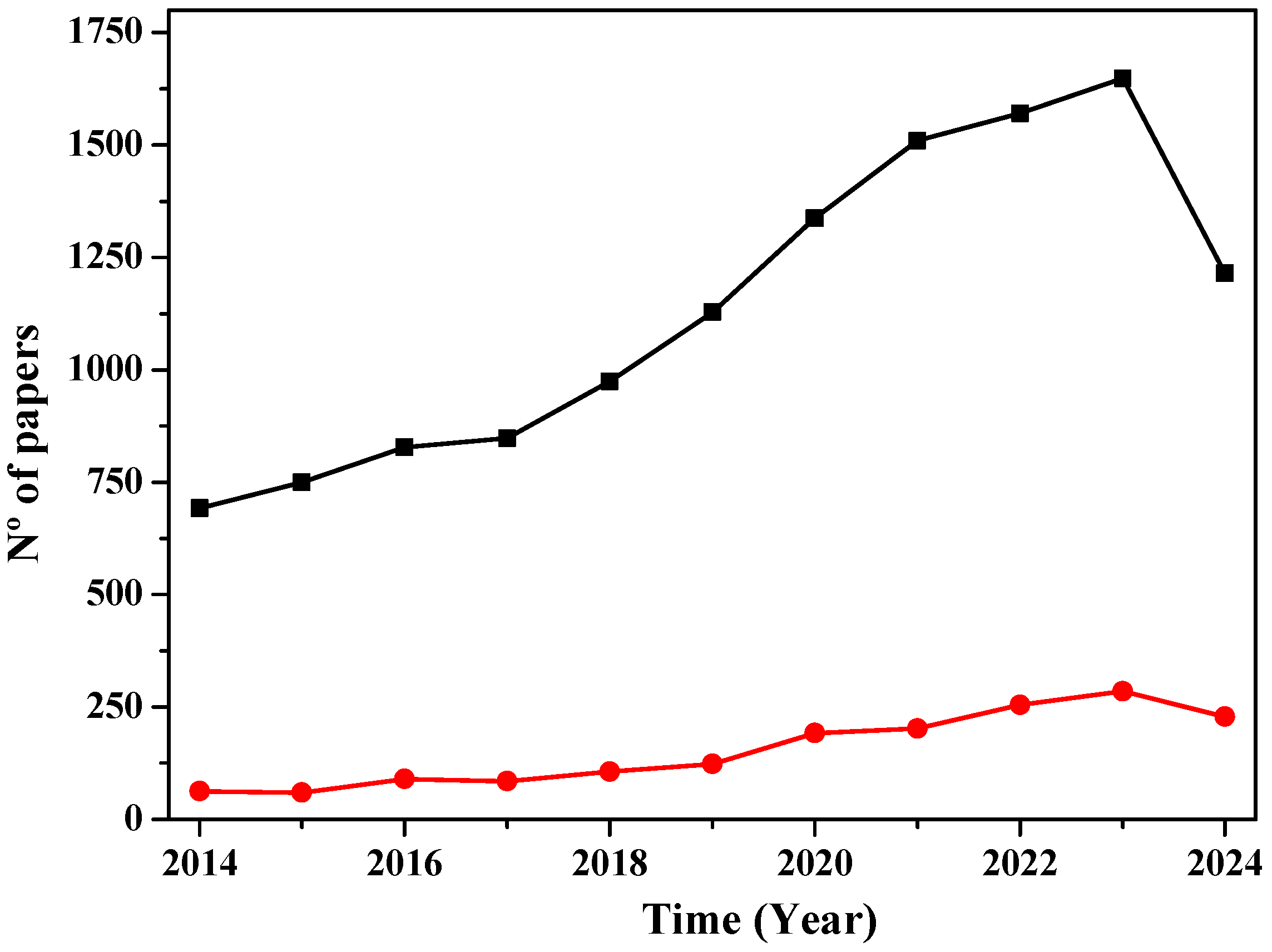
Figure 2.
Three-field plot representing the correlation between the title, keywords, and source of the published papers.
Figure 2.
Three-field plot representing the correlation between the title, keywords, and source of the published papers.
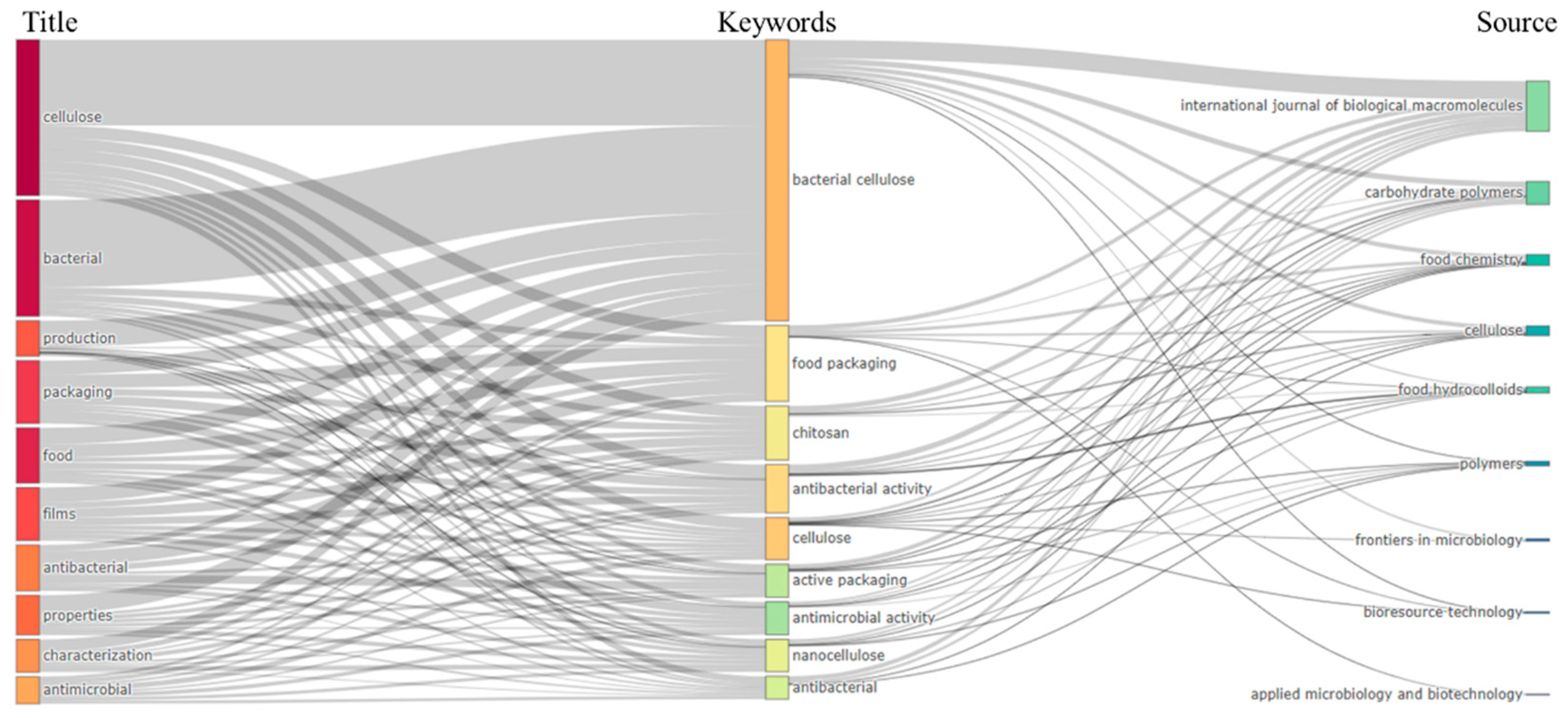
Figure 3.
Top Countries by Number of Publications on “Bacterial Cellulose in Food Applications,” Highlighting the Leading 10 Nations.
Figure 3.
Top Countries by Number of Publications on “Bacterial Cellulose in Food Applications,” Highlighting the Leading 10 Nations.
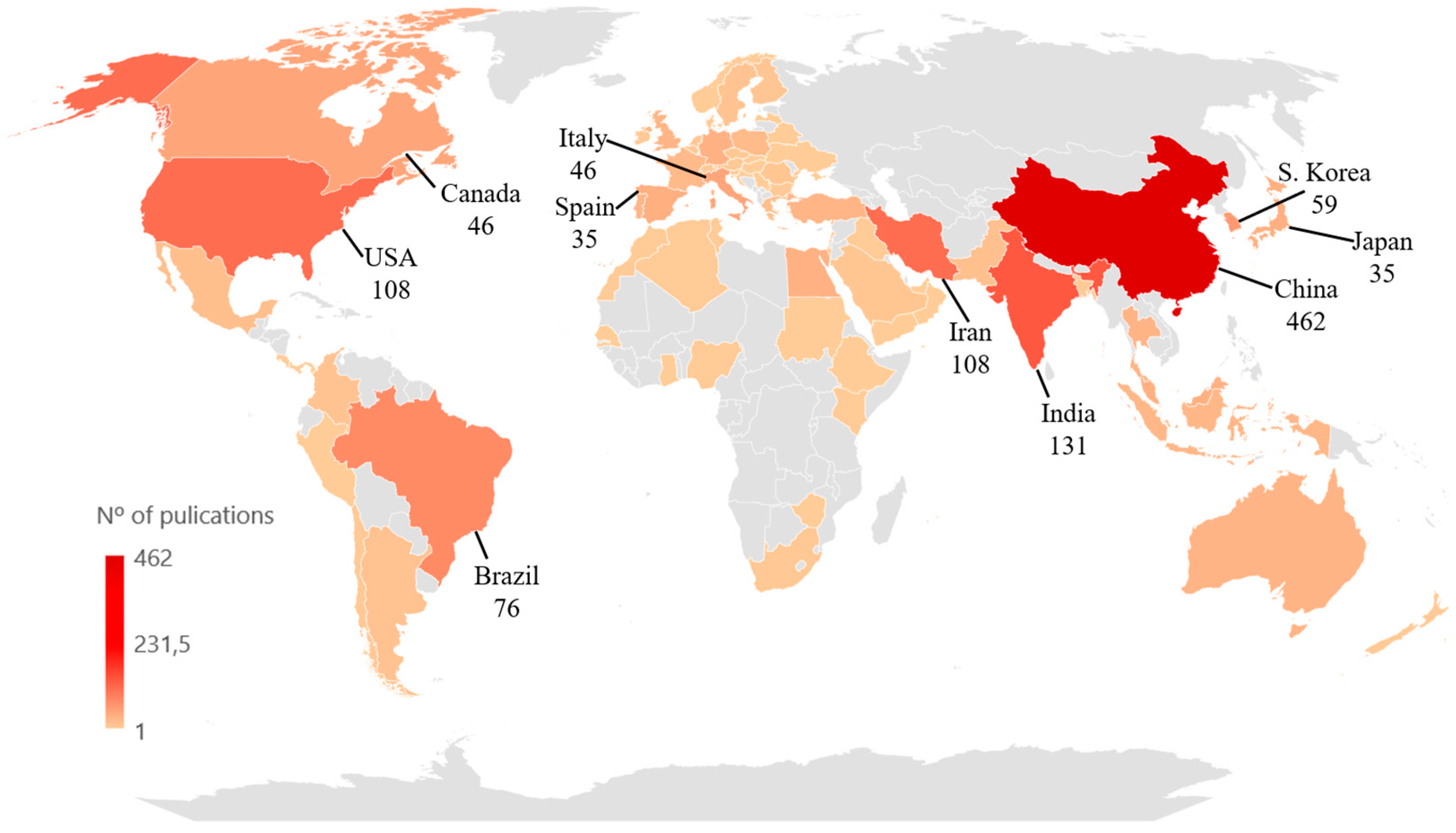
Figure 4.
Thematic map over “bacterial cellulose food.”.
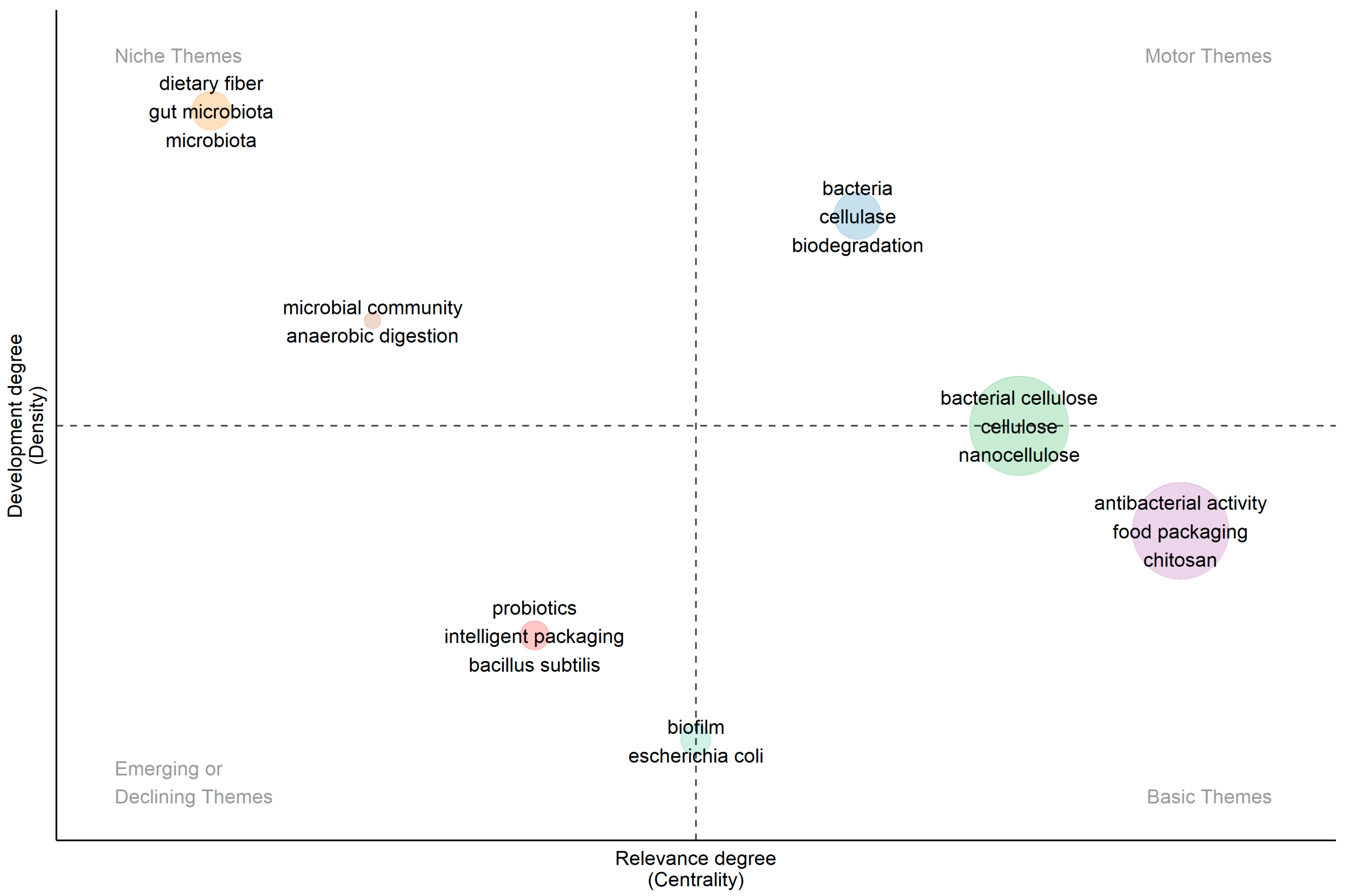
Figure 5.
(A) Factorial analysis and (B) dendrogram of “Bacterial cellulose food” applications.
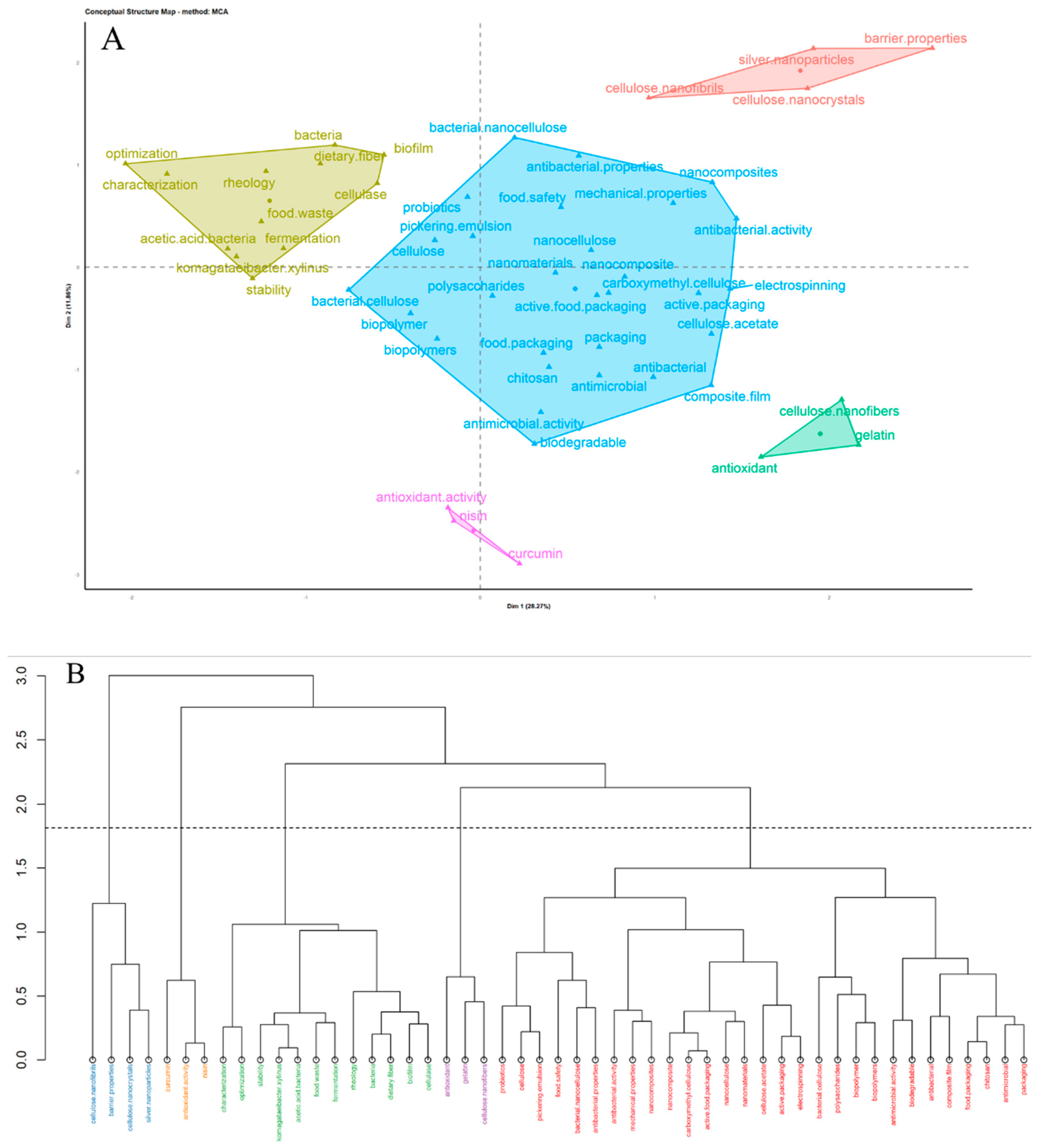
Figure 6.
Keyword cluster map for bacterial cellulose food applications.
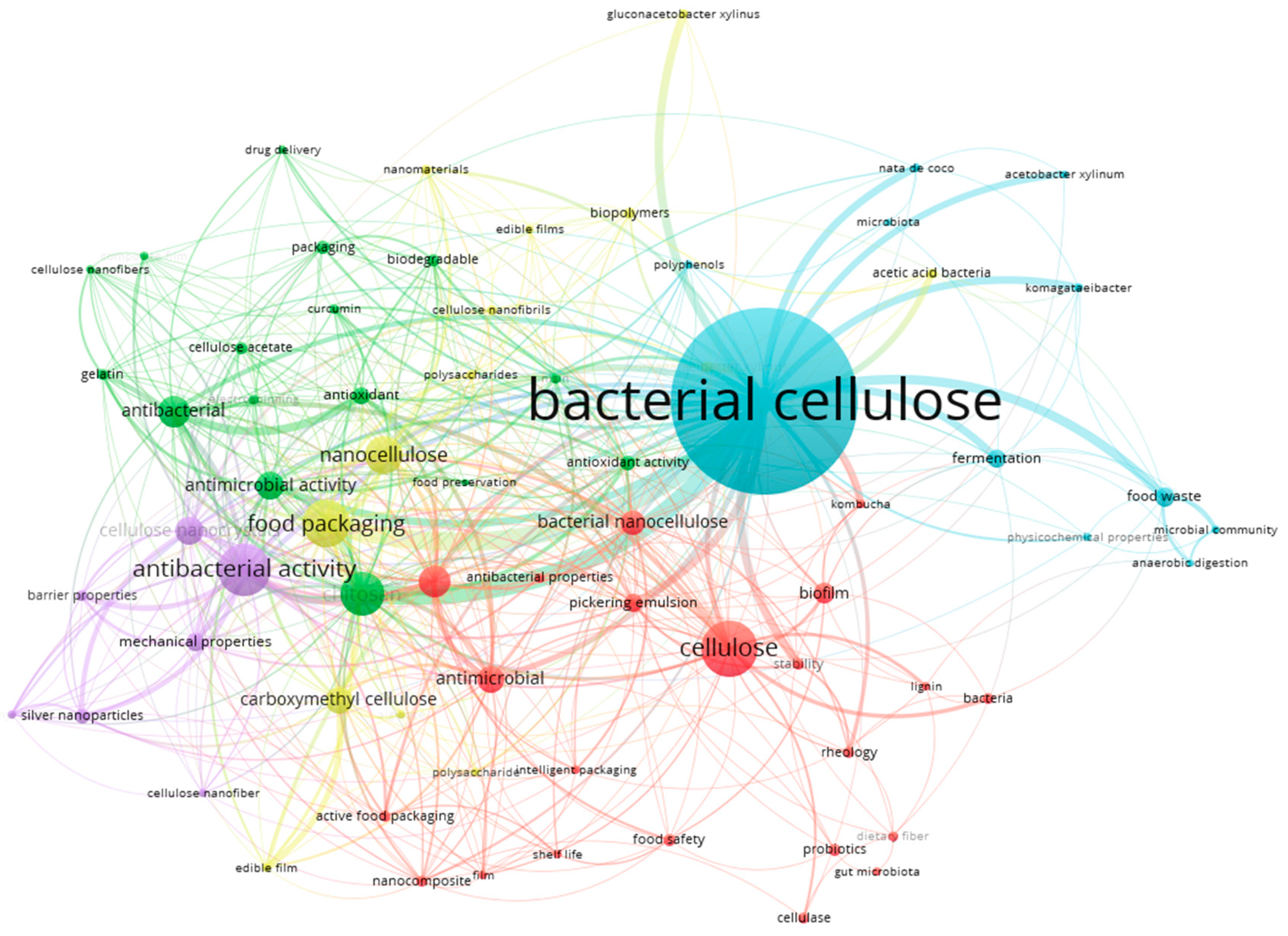
Table 1.
Comparison of properties between bacterial cellulose and traditional plant cellulose.
| Property | Bacterial Cellulose | Plant Cellulose |
|---|---|---|
| Source | Produced by bacteria, especially Gluconacetobacter xylinus | Derived from plants such as cotton, wood, and bamboo |
| Purity | High purity, free of lignin and hemicellulose | Contains lignin, hemicellulose, and other components |
| Structure | Three-dimensional network of nanofibers | Fibers arranged in hierarchical structures |
| Crystallinity | High crystallinity | Varies depending on the source and treatment |
| Mechanical Strength | High tensile strength (up to 200 MPa) | Variable strength (40-200 MPa) depending on the source and treatment |
| Flexibility | High flexibility | Less flexible compared to bacterial cellulose |
| Barrier Properties | Excellent barrier against gases and moisture | Variable barrier properties, generally inferior to bacterial cellulose |
| Biocompatibility | Naturally non-toxic, high biocompatibility | High biocompatibility but may contain impurities that need to be removed |
| Source | Produced by bacteria, especially Gluconacetobacter xylinus | Derived from plants such as cotton, wood, and bamboo |
| Purity | High purity, free of lignin and hemicellulose | Contains lignin, hemicellulose, and other components |
| Structure | Three-dimensional network of nanofibers | Fibers arranged in hierarchical structures |
Table 2.
Keyword occurrence and total link strength in the context of bacterial cellulose applications in food packaging.
Table 2.
Keyword occurrence and total link strength in the context of bacterial cellulose applications in food packaging.
| Keyword | Occurrence | Total Link Strength | Keyword | Occurrence | Total Link Strength |
|---|---|---|---|---|---|
| Bacterial cellulose | 349 | 314 | Antimicrobial | 41 | 64 |
| Food Packing | 76 | 117 | Antibacterial | 49 | 63 |
| Chitosan | 69 | 109 | Cellulose nanocrystals | 42 | 62 |
| Antibacterial activity | 84 | 104 | Antimicrobial activity | 43 | 61 |
| Cellulose | 92 | 82 | Carboxymethyl cellulose | 41 | 53 |
| Active packing | 48 | 76 | Antioxidant | 24 | 46 |
| Nanocellulose | 58 | 72 | Mechanical properties | 27 | 44 |
Disclaimer/Publisher’s Note: The statements, opinions and data contained in all publications are solely those of the individual author(s) and contributor(s) and not of MDPI and/or the editor(s). MDPI and/or the editor(s) disclaim responsibility for any injury to people or property resulting from any ideas, methods, instructions or products referred to in the content. |
© 2024 by the authors. Licensee MDPI, Basel, Switzerland. This article is an open access article distributed under the terms and conditions of the Creative Commons Attribution (CC BY) license (http://creativecommons.org/licenses/by/4.0/).
Copyright: This open access article is published under a Creative Commons CC BY 4.0 license, which permit the free download, distribution, and reuse, provided that the author and preprint are cited in any reuse.


