
Submitted:
13 August 2024
Posted:
14 August 2024
You are already at the latest version
Abstract
With the rapid consumer adoption of mobile devices such as tablets and smart phones, the tele-traffic has experienced a tremendous growth, low power technologies are highly desirable for future communication networks. In this paper, we consider an ambient backscatter (AB) based user cooperation (UC) scheme for mmWave wireless powered communication networks (WPCN) with lens antenna arrays. Firstly, we formulate an optimization problem to maximize the minimum rate of two users by jointly designing power and time allocation. Then we introduce auxiliary variables and transform the original problem into a convex form. Finally, we propose an efficient algorithm to solve the transformed problem. Simulation results demonstrate that the proposed AB based UC scheme outperforms the competing schemes, thus improve the fairness performance of throughput in WPCN.
Keywords:
ambient backscatter
; user cooperation
; WPCN
; lens antenna array
1. Introduction
1.1. Motivation
With the continuous evolution of wireless networks, the sixth-generation (6G) communication is expected to provide ubiquitous connectivity, ultrabroadband and integrated sensing and communication, which will enable many significant application scenarios such as internet of things (IoT), intelligent transportation, environmental monitoring and so on [1,2,3]. It is estimated that the number of global network terminals will reach 125 billion by 2030, and there will be as high as 100 IoT connections per cubic meter [4]. Limited by device size and deployment environment, some IoT devices are energy constrained. Therefore, in addition to enhancing the spectrum efficiency, low power technologies are highly desirable for future communication networks.
In this regard, wireless energy transfer (WET) relying on radio frequency (RF) transmission is a potential technology which provides sufficient power supply to energy constrained wireless systems. Moreover, the seamless combination of WET and wireless communication expands a hot research topic, i.e. wireless powered communication networks (WPCN) [5,6,7]. In WPCN, a harvest-then-transmit (HTT) protocol is proposed in [8], where the users first harvest energy from the RF signals broadcast by a hybrid access point (HAP) in the downlink (DL), and then transmit their information to the HAP in the uplink (UL). However, the users located far away from the HAP harvest much less energy than those close to the HAP, but have to consume more energy to transmit data back to the HAP, which is named as a “doubly near far” user unfairness problem. With consideration of the fairness issue, user cooperation (UC) is an effective approach, in which the user far from the HAP cooperate with its adjacent user to transmit signals to the HAP.
Several UC schemes for WPCN have been developed based on different models [9,10,11]. The authors in [9] design the optimal energy beamforming and time assignment to investigate the system infermation transmission performance limit with two single-antenna users and a HAP. The authors in [10] consider a reconfigurable intelligent surface (RIS) assisted UC in a WPCN. Then they jointly optimize the transmit time and power allocations of the two users and the passive array coefficients on reflecting the wireless energy and information signal to maximize the common minimum throughput of the system. In [11], the authors jointly optimize time allocation, power allocation, and energy beamforming vectors to maximize the energy-efficiency (EE) in the scenario comtains two UC users and separated power station and information receiver.
A major design issue of the existing user cooperation schemes is that the overhead consumed on information exchange between the collaborating users. Specifically, a new low-cost ambient backscatter communication (AmBC) technique [12] allows users to transmit information by passively backscattering environment RF signals, thus achieving device battery conservation. Compared with the HTT mode, the IoT devices operating in backscatter mode have lower power consumption [13]. In AmBC systems, a backscatter device (BD) leverages existing surrounding modulated ambient signals (generated from RF sources like Wi-Fi access points, TV towers or base stations from the cellular network) for communication [14]. The BD modulates the backscattered signal by switching between the two modes: a backscattering mode, when the BD antenna is short-circuited, and a transmission mode, when the BD antenna is open-circuited. These modes are used to indicate bit `0’ and bit `1’. Typically, the backscatter receiver (BR) is equipped with an energy detector (ED) [15] to calculate the received power levels of AmBC signals and then mapping them to corresponding transmitted signals from the BD. Consequently, the AmBC system is energy effcient without active RF signal transmission and also spectrally effcient as it shares the spectrum of the ambient RF source. Actually, except for ambient backscatter (AB), there are two types of backscatter modes: the bistatic backscatter (BB) for which the RF emitter and BR could be separately deployed and the monostatic backscatter (MB) for which the RF emitter and BR are colocated [16]. Unlike the other two types, the device with the AB mode communicates by modulating and reflecting surrounding ambient signals thus does not require dedicated spectrum and energy [17].
However, ambient backscatter communication entails the dependence on unpredictable data traffic to provide the required excitation signal for the IoT devices that use backscattering. Hence, the WPCN systems need to provide active RF signals with energy-efficient technologies like mmWave multiple-input multiple-output (MIMO) communication, which has become a key candidate technology for future cellular networks due to the availability of large spectrum resources at higher frequencies and high energy efficiency with beamforming. In addition, mmWave technology is appropriate for various short-range wireless communication scenarios such as IoT due to its short wavelength and wide frequency band.
1.2. Related Work
The mmWave-based communication systems with WPCN has been attracted much attentions in the recent researches. In [18], the authors studied the WPT performance of mmWave band with a typical low-power device. Compared to the lower frequency, the WPCN in mmWave bands can provide a better energy tranfer coverage with optimal parameters. Furthermore, the authors in [19] investigated the performance of WPT of a massive mmWave WPCN, and the simulation results demonstrated that the mmWave WPT gained superior efficiency than WPCNs with low frequency. The authors in [20] introduced a more practical non-linear energy harvesting model in massive mmWave WPCN system and analysed the potential performance of WPT. The beam outage probability and energy outage probability of mmWave WPCN was investigated in [21] with a random energy beamforming scheme, and the distribution of energy receivers was followed by the homogeneous Poisson point process (HPPP). Then the authors analysed the optimal performance of mmWave WPCN system. In [22], the authors jointly designed the transmit power, beamforming and power split coefficient for the optimization of transmission performance of the WPCN-based mmWave with the imperfect channel state information (CSI). By exploiting the advantages of multiple antennas, energy beamforming can be adopt to transfer energy signals to all users in mmWave WPCN. However, the conventional fully digital beamforming schemes result in unaffordable costs in terms of power consumption and RF chains.
1.3. Our Contributions
In this paper, we consider an AB based UC scheme in mmWave WPCN with multi-antennas on the HAP. We equip HAP with a discrete lens array (DLA) [23], which reduces the complexity and cost of the RF hardware as well as improving the power budget due to the lens’ energy-focusing capability [24]. In consideration of user fairness, we first formulate an optimization problem to maximize the minimum rate of two users by jointly designing power and time allocation. In order to solve this nonconvex problem, we then introduce auxiliary variables and transform the original problem into a convex form. Finally, we propose an efficient algorithm to solve this problem. Simulation results demonstrate that compared to conventional UC schemes based on active communication, the proposed passive AB based UC scheme can effectively enhance the throughput performance of energy-constrained devices in mmWave WPCN. As we know, this scenario has not been investigated.
1.4. Notation and Paper Organization
The rest of this paper is organized as follows. Section 2 presents the AB based UC system model and formulates the optimization problem. The proposed algorithm is developed in Section 3. In Section 4, we analyze the results of our experiments, and Section 5 concludes the paper.
Notation: In this paper, lower-case letter denotes the -th element of matrix . Upper-case and lower-case boldface letters and denote a matrix and a vector, respectively. , , and represent the transpose, conjugate transpose, Frobenius norm and trace of matrix , respectively. is the identity matrix and denotes the expectation operation.
2. System Model and Problem Formulation
We consider a mmWave WPCN consisting of one HAP and two single-antenna users (i.e., and ). The HAP is equipped with a DLA, comprising antennas and one RF chain. The network topology is shown in Figure 1, without loss of generality, we assume these three nodes are placed in a straight line. The HAP has fixed power supply, while the two users need to harvest energy from the received signals broadcast by the HAP in the DL WET phase. The harvested energy is stored in an energy buffer (e.g., rechargeable battery), then the users transmit information in the UL wireless information transmission (WIT) phase.
2.1. Channel Model
We assume that both WET and WIT operate over the same frequency band, and the channel reciprocity holds between the DL and UL. The beamspace channel matrix, , is transformed from the physical spatial MIMO channel:
where is a discrete Fourier transformation (DFT) matrix corresponding to DLAs [23] at the HAP, is the spatial domain channel vector between the HAP and user k. The DFT matrix consists of the array steering vectors of orthogonal beams (directions) spread over the entire angular domain, i.e.:
where with are the normalized spatial directions, are the corresponding array steering vectors, where is an index set of array elements.
Assuming transmission in a general multi-path environment, the channel can be written as:
the terms and represent the line-of-sight (LoS) and the l-th non-line-of-sight (NLoS) channel vectors between the HAP and user k, respectively. Furthermore, denote the complex channel gains, while represent the corresponding spatial directions. Here we only consider the azimuth angles of departure (AoD)1 for convenience, but the extension to a 3D scenario is straightforward and does not influence the feature of the problem. We assume that the beamspace channel matrix is perfectly estimated by the HAP [24,25].
2.2. The Protocol Description
As shown in Figure 1, the system operates in four phases. In the first phase of duration , the HAP transmits energy signal with the fixed power . The received energy signal at user k can be expressed as
in which satisfying is the transmitted signal, is the beamspace channel vector between the HAP and user k, is the beam selection vector with only one non-zero element 1, is the additive zero-mean circular complex Gaussian noise at user k, where denotes the noise variance.
The HAP emits energy to all users with beam selection to improve WET. We select the beam with maximum magnitude [23] to transfer as much power as possible for each user. It is assumed that the energy harvested from noise can be neglected. Thus, the expected energy harvested by user k can be expressed as
where the energy converting efficiency, , is assumed fixed and equal for all users.
In the second phase with amount of time, harvests energy from an incident signal transmitted by the HAP, and also backscatters different fraction of the incident signal to to transmit “0” or “1”, respectively. In consequence, uses non-coherent detection techniques, e.g., energy detector [12], to decode the transmitted bit. If transmits a bit “0”, receives only the energy signal from the HAP:
where satisfying is the transmitted signal. On the other hand, when transmits a bit “1”, receives combination of signals from both the HAP and , i.e.:
where is the signal attenuation coefficient due to the reflection at , denotes the channel coefficient between and .
We apply a power splitting scheme in , i.e., the received RF signal is split into two parts with a constant splitting factor . Accordingly, part of the RF signal power is harvested, and the rest part is used for information decoding (ID). The circuit of ID introduces an extra noise, . We assume is independent of . As a result, the signal at the ID receiver and energy decoder can be written as:
where when backscatters “1”, and when transmits “0”. We assume that “0” and “1” are transmitted with equal probability without loss of generality. Then we can get the harvested energy by , which is given by:
Note that here we assume the signal backscattered from is uncorrelated with the signal received directly from the HAP due to the random modulation during the backscatter phase. Besides, keeps its battery level unchanged, as the energy consumption on the operation of backscatter transmitter can be neglected due to the harvested energy during this phase. We also assume a fixed backscattering data rate bps, and the sampling rate of backscatter receiver at is , which means the receiver takes samples of each bit. We can get the bit error probability (BER) of using an optimal energy detector to decode the received one-bit information: [15]
The communication process can be modeled as a binary symmetric channel, whose capacity is defined as bit per channel use, i.e.,
And the effective bit rate from to can be expressed as:
In the third phase of duration , transmits information to the HAP and simultaneously by exhausting the energy harvested in the first phase. The average transmit power of is given by
The received signal at the HAP and can be expressed as
where is the beam selection vector which chooses the largest element of the UL channel just like , satisfying is the complex base-band signal of , denotes the receiver noise at HAP.
In the last phase, first transmits ’s signal to the HAP with power and time , after that, transmits its own signal to the HAP with power and time . We can obtain the total energy consumed by in the last phase constrained by the energy harvested in the first and second phase:
We also have a total time constraint of time allocations :
where T denotes the block duration in which the channel is static. Without loss of generality, we assume . Then the achievable rates of transmitting ’s signal from to and the HAP in the third phase, and from to the HAP in the last phase can be written as
Thus, the achievable rates of and within the duration can be obtained [9]
2.3. Problem Formulation
Under the max-min throughput criterion, we formulate the optimization problem by jointly designing power and time allocation of , and the HAP. The optimization problem can be formulated as
where . Note that when we set , the original problem (19) reduces to the case of a conventional UC scheme without AB. Furthermore, if we set , (19) reduces to a case of WPCN without UC, which means the far user does not cooperate with the near user to transmit its information to the HAP.
3. Problem Transformation
Problem (19) is nonconvex due to the multiplicative terms in constraint (15), so we introduce auxiliary variables satisfying and to deal with coupled variables and . Then and in the original problem can be rewritten as functions of and . Besides, as is defined in (13), and can be re-expressed as functions of :
where
are all constants. We also introduce an auxiliary variable R satisfying . Then, we can transform the original problem (Section 2.3) into an equivalent form expressed as
In which , , and are all concave functions. As and are affine functions of , we can find that problem (22) is convex, which can be addressed with existing convex optimization tools and algorithms, e.g. the CVX tool [26] and the interior point method. Finally, when we get the solution of (22), the optimal solution of can be obtained with and .
4. Simulation Results
In this section, We consider a mmWave WPCN consisting of one HAP and two single-antenna users. The system configuration is defined by the following choice of parameters: the HAP is equipped with a DLA, comprising antennas and one RF chain. Power of the HAP is set to 0 dBW. The noise power of all receivers is set to -100 dBW, and the noise power of ID circuit is set to -100 dBW. The energy converting efficiency . The power splitting factor of is and the signal attenuation coefficient is . We also choose two transmitting rates of AB for comparation, i.e., Mbps and Mbps, and the corresponding sample rate of AB is 6 times of , i.e., . The channel model parameters are set as [27]: 1) one LoS link and NLoS links; 2) and obey the uniform distribution within ; 3) The LOS channel gain , where is the antenna power gain, m/s is the speed of light, is the distance between user k and the HAP, GHz is the carrier frequency of mmWave band. The channel gain between and is , where is the distance between and . We set the NLOS channel gain .
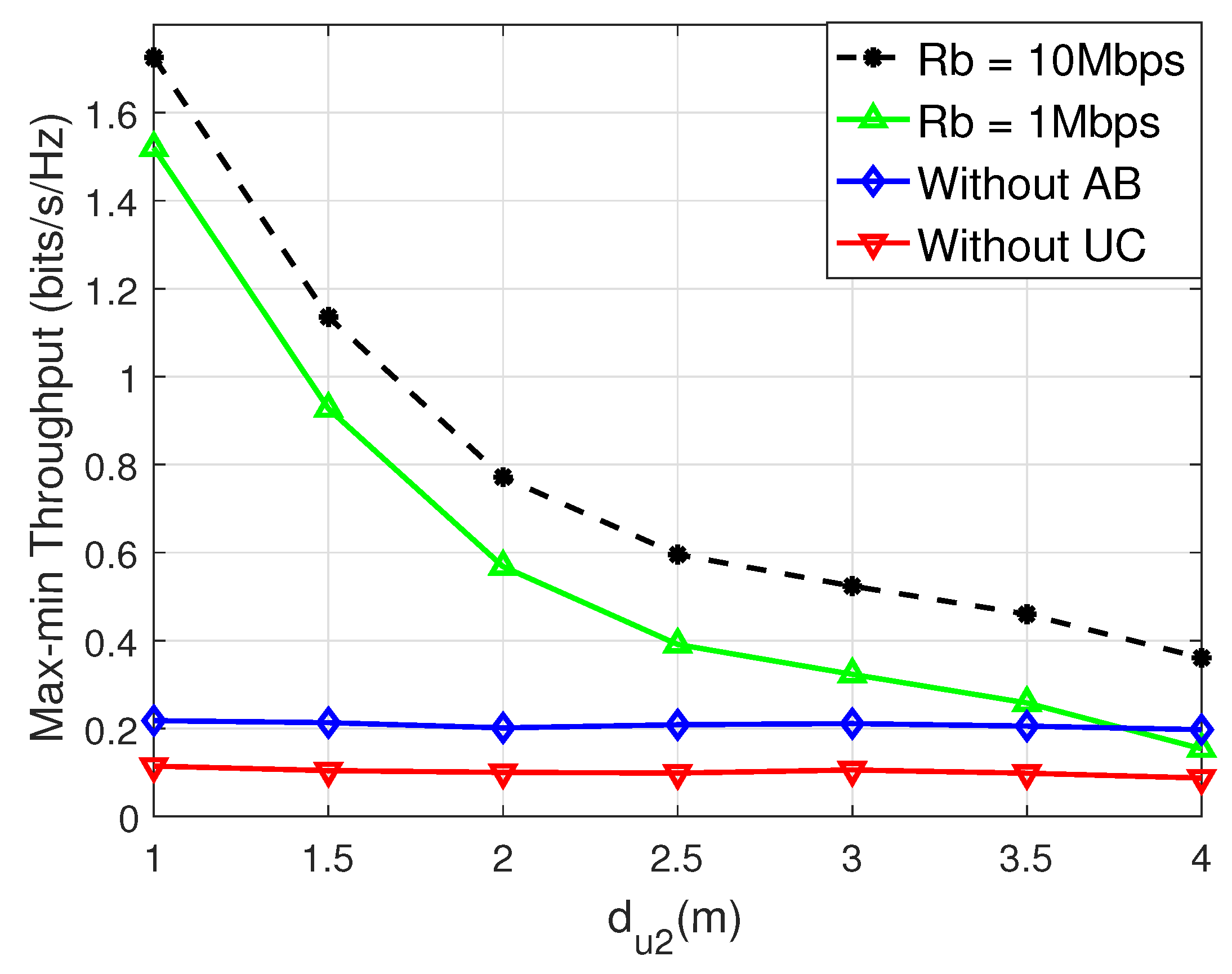
In the rest of this section, we compare the max-min rate performance versus , , and for different schemes, i.e., the AB based UC schemes with Mbps and Mbps (shown as and in simulaton results respectively), a UC scheme without AB (shown as "Without AB" in simulaton results), and a conventional scheme without UC (shown as "Without UC" in simulaton results). In Figure 2, we change the trasmitting power of the HAP from 1 W to 4 W. We can observe that the performances of all schemes are improved with increasing trasmitting power , and the proposed AB based UC schemes have better performance than other competing schemes. The scheme with has a better performance than the scheme with , which is owing to the higher reduce more power consumption of information transmission between and .
In Figure 3, we change the number of antennas at the HAP from 8 to 64. We can observe that the performances of all schemes are improved with increasing number of antennas which benefits from the energy capability of lens array. Similarly, the proposed AB based UC schemes have better performance than other competing schemes, which shows the AB technology can improve the performance of UC system.
In Figure 4, we set , and m, and change from 4 m to 7 m. We can find that the performances of all schemes decrease when is getting longer, this is because the channel between and HAP attenuates more severely as increases. We can observe that the performance of AB based UC schemes decrease more slowly than other schemes, which means the use of passive AB can effectively reduce the energy consumptions and thus improve the throughput performance. Hence, simulation results demonstrate the advantage of applying AB to improve the throughput performance of UC scheme in WPCN.
In Figure 5, we set , and m, and change from 1 m to 4 m. We can find that the performance of the scheme without UC hardly changes with , as its performance is mainly limited by the weak channel between the HAP and the farther user . On the other hand, the performances of AB based UC schemes increase when is getting shorter, this is because when decreases, the distance between and will increase, then needs more energy to transmit actively to the helping , and the use of passive AB can effectively reduce the energy consumptions and thus improve the throughput performance.
5. Conclusions
In this paper, we have considered an AB based UC scheme in mmWave WPCN with lens antenna arrays. In particular, we have formulated an optimization problem to maximize the minimum rate of two users by jointly designing power and time allocation. After that, we have introduced auxiliary variables and transformed the original problem into a convex form. Then we have proposed an efficient algorithm to solve the transformed problem. Simulation results have demonstrated that the AB based UC scheme outperforms the competing schemes, thus improved the throughput fairness performance in mmWave WPCN.
Author Contributions
Conceptualization: R.G., R.Y.; methodology: R.G., R.Y.; software: J.Y., C.X.; investigation: R.G., G.W., J.Y.; resources: R.G., R.Y.; data curation: J.Y., C.X.; writingâoriginal draft preparation: R.G., J.Y.; writingâreview and editing: R.G., R.Y.; visualization: R.G., G.W.; funding acquisition: R.G., R.Y. All authors have read and agreed to the published version of the manuscript.
Funding
This work was supported in part by the China Postdoctoral Science Foundation under Grant 2023M743063 and the Zhejiang Provincial Postdoctoral Scholarship under Grant ZJ2022107, in part by the National Natural Science Foundation of China under Grant 61771429, Grant 62302197 and Grant 62271438, Zhejiang Provincial Natural Science Foundation of China under Grant LQ23F020006.
Acknowledgments
The authors would like to thank the China Postdoctoral Science Foundation, the Zhejiang Provincial Postdoctoral Scholarship, National Natural Science Foundation of China (NSFC), Zhejiang Provincial Natural Science Foundation of China (ZPNSFC), Hangzhou City University and Zhejiang University for support this work.
Conflicts of Interest
The authors declare that there is no conflict of interests regarding the publication of this paper.
References
- M. Latva-Aho and K. Leppanen, “Key drivers and research challenges for 6G ubiquitous wireless intelligence,” Univ. Oulu, Oulu, Finland, White Paper 1, 2019. Available: http://urn.fi/urn:isbn:9789526223544.
- X. You et al., “Towards 6G wireless communication networks: Vision, enabling technologies, and new paradigm shifts,” Sci. China Inf. Sci., vol. 64, no. 1, pp. 1-74, 2021.
- R. Guo, Y. Tang, C. Zhang, et al., “Prospects and Challenges of THz Precoding,” Chinese Journal of Electronics, vol. 31, no. 3, pp. 488-498, 2022. [CrossRef]
- M. Alsabah et al., “6G Wireless Communications Networks: A Comprehensive Survey,” IEEE Access, vol. 9, pp. 148191-148243, 2021. [CrossRef]
- Y. Zeng, B. Clerckx and R. Zhang, “Communications and signals design for wireless power transmission,” IEEE Trans. Commun., vol. 65, no. 5, pp. 2264-2290, May 2017. [CrossRef]
- G. Yang, Q. Zhang and Y. C. Liang, “Cooperative ambient backscatter communication systems for future internet-of-things”, IEEE Internet Things J., vol. 5, no. 2, pp. 1116-1130, Jan. 2018.
- C. Yang, X. Wang and K. W. Chin, “On maxâmin throughput in backscatter-assisted wirelessly powered IoT”, IEEE Internet Things J., vol. 7, no. 1, pp. 137-147, Jan. 2020.
- S. Zhong and X. Wang, “Transmission scheduling for hybrid backscatter-HTT nodes”, IEEE Internet Things J., vol. 8, no. 3, pp. 1769-1782, Feb. 2021. [CrossRef]
- X. Di, K. Xiong, P. Fan, H.-C. Yang, and K. B. Letaief, “Optimal resource allocation in wireless powered communication networks with user cooperation,” IEEE Trans. Wireless Commun., vol. 16, no. 12, pp. 7936-7949, 2017. [CrossRef]
- Y. Zheng, S. Bi, Y. J. Zhang, Z. Quan, and H. Wang, “Intelligent reflecting surface enhanced user cooperation in wireless powered communication networks,” IEEE Wireless Commun. Lett., vol. 9, no. 6, pp. 901-905, 2020. [CrossRef]
- A. M. Ahmed, Z. Wang, H. T. Belay and X. Wan, “Energy-Efficient Optimization for WPCN System Based on User Cooperation,” in 2022 27th Asia Pacific Conference on Communications (APCC), Jeju Island, Korea, Republic of, pp. 329-333, 2022.
- X. Lu, D. Niyato, H. Jiang, D. I. Kim, Y. Xiao and Z. Han, “Ambient backscatter assisted wireless powered communications,” IEEE Wireless Commun., vol. 25, no. 2, pp. 170-177, Apr. 2018. [CrossRef]
- Y. Zhuang, X. Li, H. Ji, H. Zhang and V. C. M. Leung, “Optimal resource allocation for RF-powered underlay cognitive radio networks with ambient backscatter communication”, IEEE Trans. Veh. Technol., vol. 69, no. 12, pp. 15216-15228, Dec. 2020. [CrossRef]
- Y. Zhuang, X. Li, H. Ji, and H. Zhang, “Exploiting hybrid SWIPT in ambient backscatter communication-enabled relay networks: Optimize power allocation and time scheduling,” IEEE Internet Things J., vol. 9, no. 24, pp. 24655-24668, Dec. 2022. [CrossRef]
- Z. Liu, S. Zhao, Y. Yang, K. Ma, and X. Guan, “Toward hybrid backscatter-aided wireless-powered Internet of Things networks: Cooperation and coexistence scenarios,” IEEE Internet Things J., vol. 9, no. 8, pp. 6264-6276, Apr. 2022. [CrossRef]
- C. Yang, X. Wang, and K.-W. Chin, “On max-min throughput in backscatter-assisted wirelessly powered IoT,” IEEE Internet Things J., vol. 7, no. 1, pp. 137-147, Jan. 2020. [CrossRef]
- Yunkai Hu, Peng Wang, Zihuai Lin, Ming Ding, Ying-Chang Liang, “Performance Analysis of Ambient Backscatter Systems With LDPC-Coded Source Signals”, IEEE Trans. Veh. Technol., vol. 70, no. 8, pp. 7870-7884, Aug. 2021. [CrossRef]
- T. A. Khan, A. Alkhateeb, and R. W. Heath, “Millimeter wave energy harvesting,” IEEE Trans. Wireless Commun. Vol. 15, no. 9, pp. 6048-6062, Sep. 2016. [CrossRef]
- T. A. Khan and R. W. Heath, “Wireless power in millimeter wave tactical networks,” IEEE Signal Process. Lett., vol. 24, no. 9, pp. 1284-1287, Sep. 2017.
- T. X. Tran, W. Wang, S. Luo, and K. C. Teh, “Nonlinear energy harvesting for millimeter wave networks with large-scale antennas,” IEEE Trans. Vehi. Technol., vol. 67, no. 10, pp. 9488-9498, Oct. 2018. [CrossRef]
- C. Psomas and I. Krikidis, “Energy beamforming in wireless powered mmWave sensor networks,” IEEE J. Sel. Areas Commun., vol. 37, no. 2, pp. 424-438, Feb. 2019. 10.1109/jsac.2018.2872381.
- G. Kwon, H. Park, and M. Z. Win, “Joint beamforming and power splitting for wideband millimeter wave SWIPT systems,” IEEE J. Sel. Topics Signal Process., vol. 15, no. 5, pp. 1211-1227, Aug. 2021. [CrossRef]
- R. Guo, Y. Cai, M. Zhao, Q. Shi, B. Champagne and L. Hanzo, “Joint Design of Beam Selection and Precoding Matrices for mmWave MU-MIMO Systems Relying on Lens Antenna Arrays,” IEEE J. Sel. Topics Signal Process., vol. 12, no. 2, pp. 313-325, May 2018. [CrossRef]
- R. Guo, Y. Cai, Q. Shi, M. Zhao and B. Champagne, “Joint design of beam selection and precoding for mmWave MU-MIMO systems with lens antenna array,” in Proc. IEEE 28th Annu. Int. Symp. Pers., Indoor, Mobile Radio Commun. (PIMRC), Oct. 2017, pp. 1-5.
- S. Abeywickrama, C. You, R. Zhang and C. Yuen, “Channel Estimation for Intelligent Reflecting Surface Assisted Backscatter Communication,” IEEE Wireless Commun. Lett., vol. 10, no. 11, pp. 2519-2523, Nov. 2021. [CrossRef]
- CVX Research, Inc. CVX: Matlab software for disciplined convex programming, version 2.0 beta. [Online]. Available: http://cvxr.com/cvx.
- X. Gao, L. Dai, Z. Chen, Z. Wang, and Z. Zhang, “Near-optimal beam selection for beamspace mmWave massive MIMO systems,” IEEE Commun. Lett., vol. 20, no. 5, pp. 1054-1057, May 2016. [CrossRef]
Short Biography of Authors
 |
| Rongbin Guo received the B.S. degree in Communication Engineering from Southwest Jiaotong University, Chengdu, China, in 2013, and the Ph.D degree in communication and information systems from Zhejiang University, Hangzhou, China, in 2018. From January 2019 to March 2022, he was an assistant professor with Research Center for Intelligent Network, Zhejiang Lab, Hangzhou, China. He currently holds a post-doctoral position at the School of Information and Electrical Engineering, Zhejiang University City College, Hangzhou, China and the College of Computer Science and Technology, Zhejiang University, Hangzhou, China. His research interests include B5G/6G communication systems, algorithm design for MIMO communication systems, and signal processing for wireless communications. |
 |
| Rui Yin (M’13-S’19) received the B.E. degree in Computer Engineering from Yanbian University in 2001, China, the M.S. degree in Computer Engineering from KwaZulu-Natal University in Durban, South Africa in 2006, and the Ph.D. degree in Information and Electronic Engineering from Zhejiang University in 2011, respectively. From March 2011 to June 2013, he was a research fellow at the Department of Information and Electronic Engineering, Zhejiang University, China. He is now a professor in the School of Information and Electrical Engineering at Zhejiang University City College, China, and a joint honorary research fellow in the School of Electrical, Electronic and Computer Engineering at University of Kwa-Zulu Natal, South Africa. His research interests mainly focus on radio resource management in LTE unlicensed, millimeter wave cellular wireless networks, HetNet, cooperative communications, massive MIMO, optimization theory, game theory, and information theory. Prof. Yin regularly serves as the technical program committee (TPC) boards of prominent IEEE conferences such as ICC, GLOBECOM and PIMRC and chairs some of their technical sessions and reviwer for IEEE TWC, IEEE TVT, IEEE Tcom, IEEE Wireless Communications, IEEE Communications Magazine, IEEE Network, and IEEE TSP journals |
 |
| Guan Wang received his PhD in Computer Science and Technology from Zhejiang University in 2022. He is currently working as an assistant researcher at the School of Information and Electrical Engineering, Hangzhou City University, China. His research interests include engineering design, multi-objective optimization and uncertainty handling. |
 |
| Congyuan Xu received the Ph.D. degree in Electronics Science and Technology from Zhejiang University, Hangzhou, China in 2019, and the B.S. degree in Applied Physics from Xidian University, Xi’an, China, in 2013. Currently, he is a lecturer in the College of Information Science and Engineering, Jiaxing University, Jiaxing, China. His research interests focus on machine intelligence and cyberspace security. |
 |
| Jiantao Yuan received the B.E. degree in electronic and information engineering from Dalian University, Dalian, China, in 2009, the M.S. degree in signal and information processing from The First Research Institute of Telecommunications Technology, Shanghai, China, in 2012, and the Ph.D. degree from the College of Information Science and Electrical Engineer, Zhejiang University, Hangzhou, China. He was with Datang mobile communication equipment co. LTD, Shanghai, China, from 2012 to 2013, where he was involved in LTE network planning and optimization. He used to work as a post-doctoral fellow at the Institute of Ocean Sensing and Networking of the Ocean College of Zhejiang University, Hangzhou, China, from 2019 to 2021. He is now working at School of Information and Electrical Engineering, Zhejiang University City College, Hangzhou, China. His research interests include cross-layer protocol design, 5G new-radio based access to unlicensed spectrum (NR-U), and ultra-reliable low latency communications (uRLLC). |
| 1 | For simplicity, we assume that the elevation AoD is zero. This is practically valid if the separation distance between users and the HAP is much larger than their height difference. |
Figure 1.
System model and transmission protocol for UC.
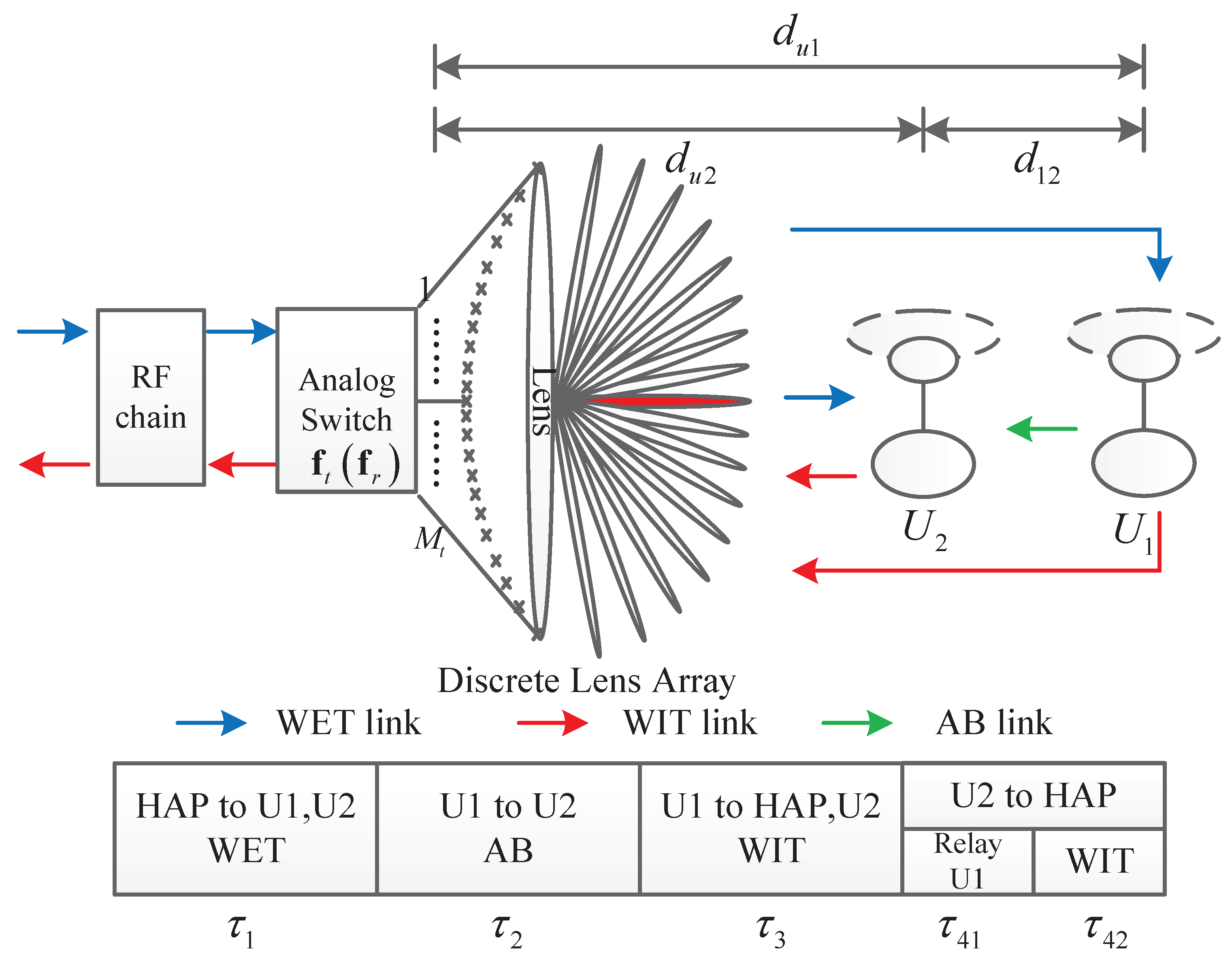
Figure 2.
Performance of different schemes.
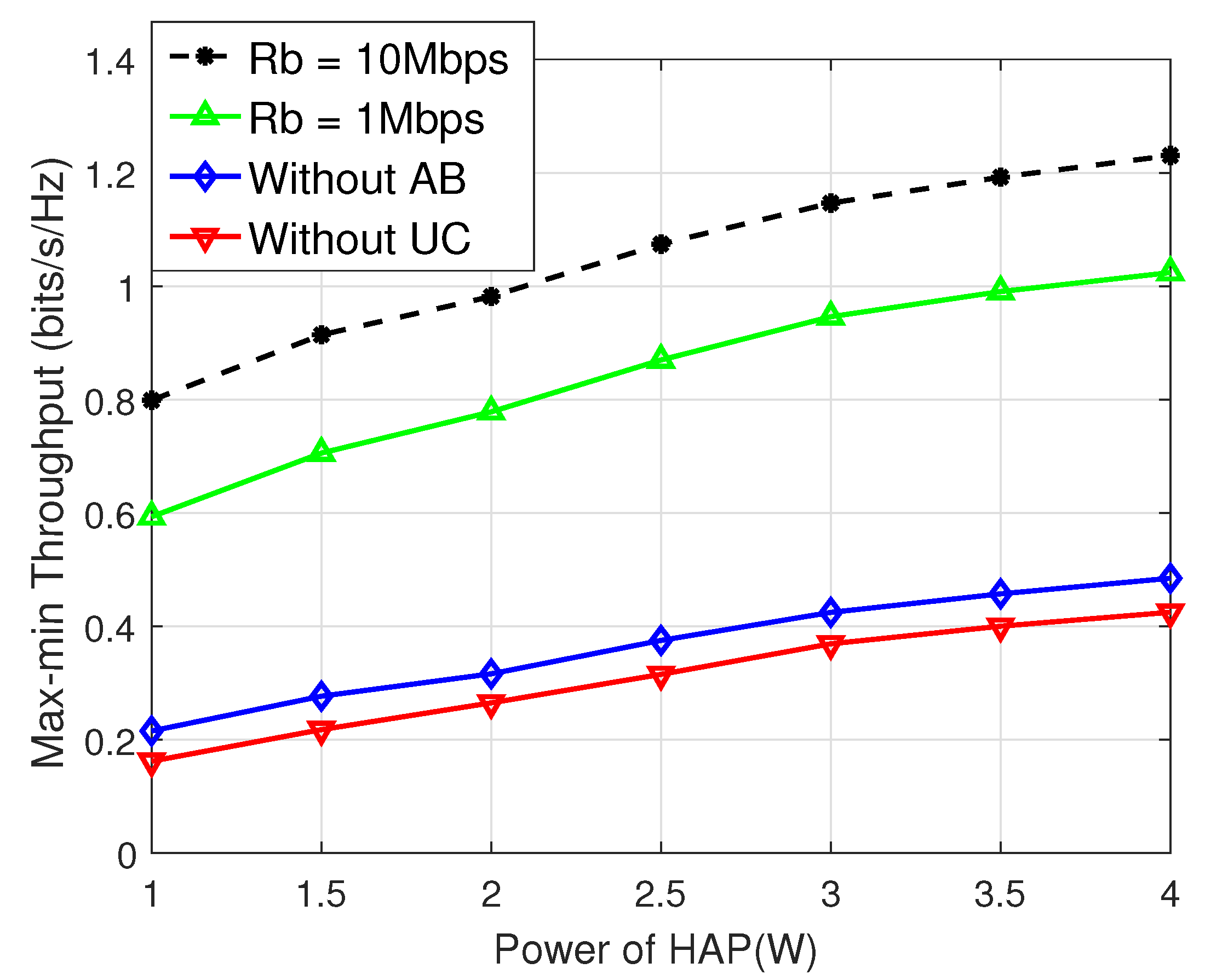
Figure 3.
Performance of different schemes
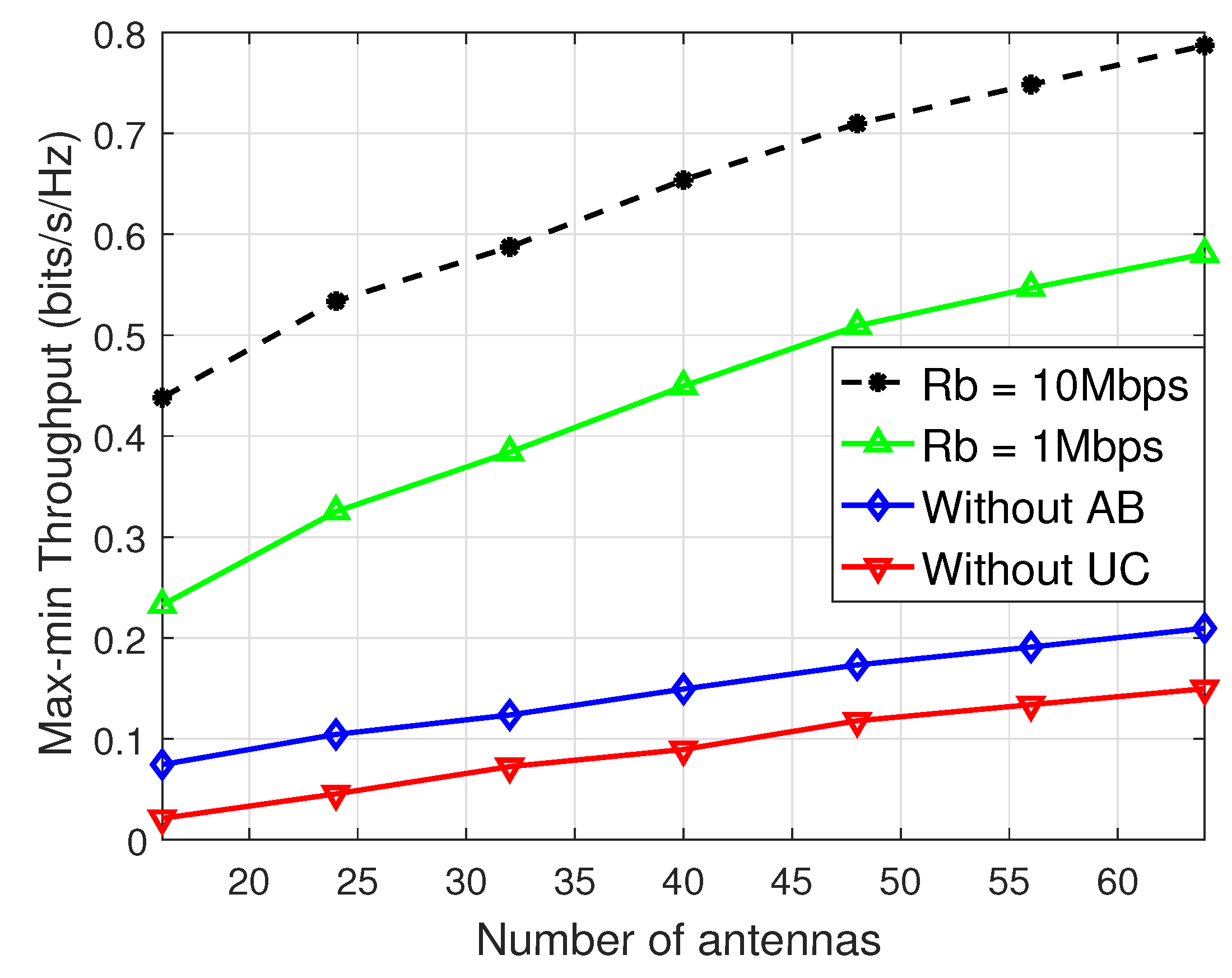
Figure 4.
Performance of different schemes
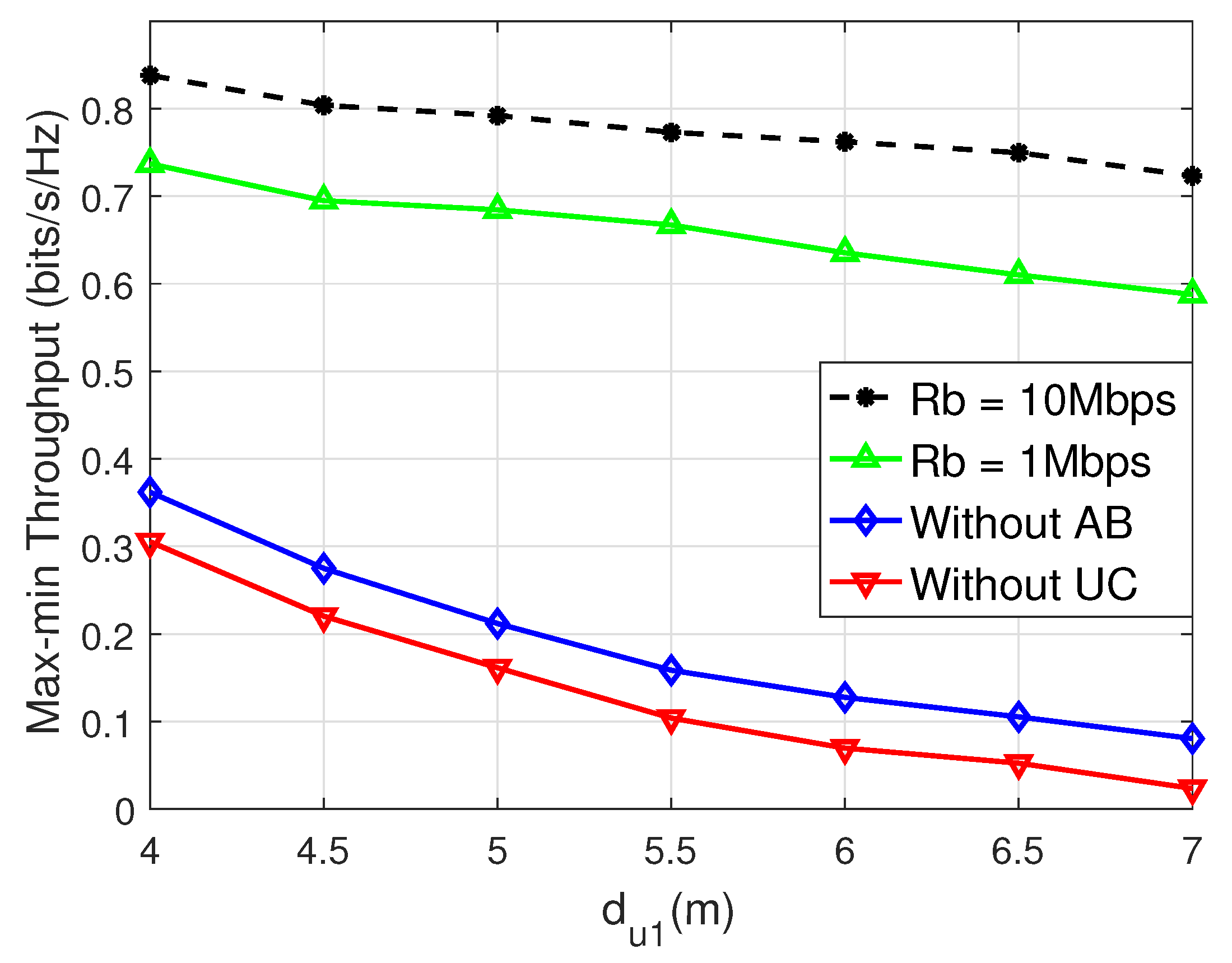
Figure 5.
Performance of different schemes
Disclaimer/Publisher’s Note: The statements, opinions and data contained in all publications are solely those of the individual author(s) and contributor(s) and not of MDPI and/or the editor(s). MDPI and/or the editor(s) disclaim responsibility for any injury to people or property resulting from any ideas, methods, instructions or products referred to in the content. |
© 2024 by the authors. Licensee MDPI, Basel, Switzerland. This article is an open access article distributed under the terms and conditions of the Creative Commons Attribution (CC BY) license (http://creativecommons.org/licenses/by/4.0/).
Copyright: This open access article is published under a Creative Commons CC BY 4.0 license, which permit the free download, distribution, and reuse, provided that the author and preprint are cited in any reuse.


