

Submitted:
14 August 2024
Posted:
14 August 2024
You are already at the latest version
Abstract
The purpose of this manuscript is to examine the extent to which Polish SMEs use digital marketing tools in the context of their impact on economic performance. The choice of the objective is due to the research gap related to the lack of studies on the impact of the use of digital marketing tools on economic performance by SME companies in Poland. In order to achieve the objective, a two-stage approach was used. The first stage identified the degree of use of digital marketing tools by Polish SMEs compared to EU countries based on secondary data. The second stage analyzed the impact of the use of selected digital marketing and sales communication tools on the economic performance of Polish SMEs. The analysis was based on primary data, which were the results of surveys conducted on a sample of 574 Polish SMEs in the industrial sector. The analysis used statistical methods such as difference significance tests (Mann-Whitney U test, ANOVA Kruskal-Wallis test and Dunn's post-hoc tests), Kendall's rank correlation coefficient and Multivariate Adaptive Regression Splines (MARSplines). The results obtained have theoretical and practical values. The theoretical implications are the enrichment of the marketing concept of customer value creation taking into account the digital customer, which is also the originality of the research. Practical implications refer to indicating to SME managers the need for, as well as ways of implementing and financing digital technologies within the framework of various EU programs for digital transformation of member states.
Keywords:
digital transformation
; customer communication and sales tools
; small and medium-sized enterprise
; economic results
; quantitative methods
1. Introduction
Digital technology and Industry 4.0 tools have been employed increasingly in companies operating in all economic sectors. The digital transformation takes place the fastest and most broadly in large companies which have much higher investment, financial and HR opportunities. Companies implement new solutions and obtain significant benefits primarily in the area of production and logistics [1,2,3], but also in the area of marketing activities, customer communication and service [4,5,6]. New technology and digital tools constitute significant development potential for SMEs as well [7,8,9,10] as they offer a chance of increased innovation and improved operating effectiveness [11,12,13,14]. This is particularly important for the Polish economy based primarily on small and medium-sized enterprises. The SME sector accounts for 99.8% of all enterprises, of which: 97.2% are micro-enterprises (2.3 million), 2.1% are small enterprises (48.7 thousand), 0.6% are medium-sized companies (14.6 thousand). [15] The share of the SME structure in the EU is similar. According to the Annual Report on European SMEs 2022/2023, SMEs number 24,281,159, which is more than 99.8% of pre-enterprises in the European Union, of which 93.5% (22,744,173) are micro enterprises, 5.5% (1,332,200) are small enterprises and 0.8% (204,786) are medium-sized enterprises. [16]
Digital transformation has taken place not only for supply, but also for demand, changing the consumers’ purchasing methods and habits, their ways of thinking, their mindset and lifestyle. A new type of a digital customer is being created with different requirements and preferences concerning the company offering. The digital customer is conscious of their needs and rights, is more critical and demanding, looks for convenience and comfort, but primarily for a customized offer [17,18,19]. To satisfy the digital customer’s needs and expectations, appropriate marketing activities are required. Today's marketing requires the application of new strategies based on close and ongoing cooperation between the consumer and the manufacturer or service provider at all stages of offer development, from design, through production and product assessment, to sale and after-sale services. This outcome can be achieved using modern technology and digital communication channels [20,21].
To address the challenges brought about by the fourth digital revolution and new requirements of digital customers, SMEs should implement digital technology to facilitate all areas of their operations, including marketing activities responsible for customer service and satisfaction. It should be noted that the digital transformation taking place in Polish companies can also be a form of action for the Sustainable Transition. Among the 17 global Sustainable Development Goals, Goal 9 addresses the need to develop innovation, industry and infrastructure [22].
The topics of digital transformation and the use of digital marketing tools by Polish SMEs have been the subject of many studies [23,24,25,26], but they did not deal with the context of economic performance. They mainly concerned the direction and degree of use of digital marketing tools by Polish SMEs. Research on the impact of the use of these tools on economic performance has not been undertaken. Thus, a research gap was identified, which our study seeks to fill.
Given the importance of SMEs for the Polish economy and the opportunities of digitization and technology 4.0 for improving company effectiveness, the major objective of this paper is to evaluate the use of the digital communication and sale tools are used by Polish SMEs in the context of economic results. Accordingly, the following main research question (MRQ) was formulated: Is the use of digital marketing and sale tools by SMEs in Poland reflected in their economic results?
In order to achieve the goal and find an answer to the stated main research question, a two-step approach was used:
- First step – to assess the degree of use of digital marketing tools by Polish SMEs against the EU average based on secondary data (reports of the European Commission, Eurostat, Statistics Poland),
- Second step - to evaluate the application of the digital communication and sale tools by Polish SMEs in the context of economic results based on primary data (survey results) and statistical methods.
The following statistical methods were used: difference significance tests (Mann-Whitney U test, ANOVA Kruskal-Wallis test and Dunn’s tests post-hoc), Kendall's rank correlation coefficient and Multivariate Adaptive Regression Splines (MARSplines). Survey results were used for statistical studies. The survey was carried out based on a sample of 574 small and medium-sized enterprises in the industrial sector. The respondents were top managers. The survey took place from December 2019 to April 2020.
2. Literature Review
2.1. Development of New Technology in Marketing and Customer Service
New digital technology related to the fourth industrial revolution brings about changes in the operations of business entities across all industries and sectors. The pending digital transformation covers all the areas of social and economic life. The digital transformation means a change of the way of thinking and approach to management, development of new business models to provide anticipated values to contemporary customers and meet the challenge of new competition dimensions for all companies, including SMEs, [27,28,29]. Digital transformation takes place by using the Internet and by implementing cutting-edge technology and Industry 4.0 tools, including cloud computing, Big data, Artificial Intelligence (AI), Internet of things, 3D printing, virtual reality, blockchain, mobile devices, robotics systems etc. to the processes of designing, production, logistics, marketing and sale [30,31]. However, it should be emphasized that although the digital transformation has taken place by using the above technology, the success does not result from the implementation of more modern or more innovative solutions [32,33,34]. The digital transformation which guarantees success requires apt use of suitable tools to learn and understand customers’ needs and increasing requirements better, followed by the development and delivery of a satisfactory offer in a fast, simple and convenient way. The drivers behind the digital transformation are technology and Industry 4.0 tools used in marketing and customer-oriented [35].
The digital transformation in marketing has taken place for many years [36,37,38,39]. The Internet, digital communication channels and social media have offered new opportunities to carry out marketing activities and to develop and implement integrated market strategies [40,41,42,43]. The marketing transformation has referred primarily to customer communication and relations, product promotion and advertising, sale process implementation and to the broadly-taken customer service. This is where modern communication tools which have been improved continuously in line with technical and technological progress have been used for years. Fraccastoro et al. [44] enumerated sale communication tools based on their digitization extent: (1) “traditional” sale communication tools, using face-to-face contact, phone calling and postal services; (2) “digital” sale communication tools, involving emails, websites, search engine optimization, online meeting and chatting platform (e.g. Skype, WhatsApp, Google Hangouts); (3) “social media” sale communication tools, such as social networking sites (e.g. Facebook, Twitter, Instagram, LinkedIn etc.), online blogs (e.g. Quora and Capterra), and content communities (e.g. YouTube). For more than a dozen years, SMEs have been using second and third digitization degree tools for their customer contacts. Recently, those trends and company digitization process have been accelerated by the pandemic [45].
SMEs have been using websites, SMS, emails and social media a lot in their marketing activities [46,47,48,49]. Developing their own websites, SMEs may present their offering to many recipients at the same time, share more detailed information concerning their operations (e.g. CSR, charitable or sponsoring activities) or organize advertising campaigns online. SMS or email sending allows to reach individual customers, fulfill their requirements and develop closer relationships.
Even more opportunities are offered by social media, including Facebook, Twitter, Instagram, LinkedIn, Pinterest, Massenger and YouTube [50,51]. Social media not only ensure ongoing, close contacts with customers, but also enable communication between the company customers, feedback exchange and product recommendations which contributes to building consumers’ trust and loyalty. Many advantages of social media make them a major marketing and sale tool as social media are widely used by salepeople [36,52,53,54,55,56]. Moreover, the global reach of the Internet and the social media offer SMEs a chance of internationalization and foreign expansion [44,48,57].
Modern technology and Industry 4.0 tools offer immense potential for marketing activities. The Internet of things, big data, cloud computing etc. ensure fast collection, processing and analysis of large quantities of data concerning buyers, demand forecasting, preparation/development of customized products [58]. 3D printing, sensor technologies and visualization enable to develop the offer together with the customer, to test the products, to improve them and to generate marketing innovations. Artificial Intelligence revolutionizes the development of marketing campaign content and customer relation management, thus reducing marketing costs significantly [59,60]. Finally, mobile tools and digital applications offer multiple alternative payment methods which are convenient for customers, including the Internet banking, mobile payments using a phone, smartphone or a watch (Blik, FNC, HCE), mobile wallets, digital currencies (such as Bitcoin), virtual card etc. [7,61,62,63].
In view of the above considerations, a research question was formulated:
RS 1: Is the use of the digital communication and sale tools by Polish SMEs at the same level as in the EU?
2.2. Measurable Benefits of Modern Tool Implementation
Small and medium-sized enterprises have been implementing new technology and digital marketing tools to a growing extent as well as using their potential and opportunities in response to a growing pressure of the competitive environment and prospective benefits. The studies carried out by many authors recently show that SMEs using e-marketing tools and digital technology achieve the following positive outcomes:
Social media and other digital tools allowing multi-channel, international communication offer SMEs a chance of easier expansion to foreign markets, acquisition of customers in different countries globally [70,71] and international brand development [72]. For example, using the digital platform called Alibaba by SMEs in New Zealand allowed those companies to enter the Chinese market successfully [73].
The said marketing effects translated into measurable benefits, including:
Consequently, this results in improved competitiveness and strategic advantage building [53,69,81,82,83].
It is worth mentioning that modern tools allowed many small and medium-sized enterprises to survive the pandemic thanks to the remote communication and customer service. This was proved e.g. by studies carried out following the Covid-19 crisis in 518 Chinese SMEs [84]. The study authors proved as well that digitization contributes to improved SME economic results. Generally speaking, the pandemic accelerated the digital transformation in SMEs. More than one third of Polish SMEs increased their digital platform use, 18% of companies invested in digital tools (purchase of new hardware and software) and 20% of companies made their product and service offer more modern and changed thanks to digitization [85].
In view of the above considerations, a research question was established:
RS 2: What impact have the use of traditional and digital marketing communication and sale tools of Polish SMEs on economic performance?
3. Materials and Methods
3.1. Theoretical Basis and Justification for the Choice of Research Methodology
The methodology of this study is based on the use of secondary data, primary data obtained by survey, and quantitative methods to compile them. Similar approaches using survey data and quantitative methods were used by the authors in both earlier and later studies.
Omar, S. I. et al. [86] based his research on the impact of digital marketing on business performance on survey data and compiled it using statistical methods: descriptive analysis, convergence validity tests, Cronbach`s alpha, Fornell-Larcker criterion analysis, evaluation structural research model. Amoah, J., & Jibril, A. B. [87] for research on the use of social media as an innovative communication and advertising tool by Ghanaian SMEs, used the questionnaire method and the Partial Least Square-Structural Equation Modelling (PLS-SEM) method to develop them. Kolawole [88], on the other hand, used descriptive statistics, analysis of variance, Z-test and Ordinary Least Squared (OLS) regression to study the impact of digital marketing on the performance of Nigerian MSPs to develop the primary data. Brzaković, A. et al. [89] to determine how digital marketing elements affect service quality variables in (SMEs) in the Republic of Serbia used the following mathematical and statistical methods to process the obtained survey results: descriptive statistics, correlation analysis, regression analysis, ANOVA test, multiple linear correlation and regression analysis. On the other hand, Pollak, F., Markovic, P. [90] used mathematical statistics methods: Pearson's chi-square test, contingency coefficient C, Cramer's coefficient V, cluster analysis to examine the relationship between entity size and digital marketing adoption, based on data from the SME sector of Central Europe. Similar methodology was also used in later studies conducted by, among others, Kurniawan, M., A. et al. [91] and Cao & Weerawardena [92]. Kurniawan et al, used a 5-point Likert scale based survey and quantitative methods to determine the extent to which digital marketing channels are used to optimize business performance among SMEs in Jakarta: Pearson correlation analysis, multiple regression analysis, and ANOVA. And Cao & Weerawardena used SmartPLS 4 software to test their hypotheses, which uses the Partial Least Squares (PLS) path modeling method. They also used statistical methods: Cronbach's α; descriptive statistics, correlations, and average variance extracted.
Taking into account the existing body of research on the use of digital marketing tools by small and medium-sized enterprises, in our research we used the following methods: survey and statistical methods. Then, considering the purpose of our research, the research questions and the quality of the survey data (5-point Likert scale, non-parametric data), the following research methods were used to compile the data:
- -
- Cronbach's alpha test- a test used to assess the reliability of surveys, and required for survey design,
- -
- Kolmogorov-Smirnov test- the test used to assess the normality distri-bution of the variables and required to determine the selection of further statistical tools,
- -
- Mann-Whitney U test- the test is suitable to test differences of 2 groups for ordi-nal dependent variable (Likert scale),
- -
- ANOVA Kruskal-Wallis tests and Dunn's post-hoc tests - test is suitable for the number of samples exceeding 2, for ordinal dependent variable (Likert scale),
- -
- Kendall's rank correlation coefficient- a coefficient used in socioeconomic research to examine the relationship between variables that are rated in a Likert scale survey,
- -
- MARSplines (Multivariate Adaptive Regression Splines)-a non-parametric statistical regression me-method used to establish model predictors.
3.2. Sample
Two types of data were used for the study. The first type is secondary data, obtained from reports of the European Commission, Eurostat, Statistics Poland.
The second type of data is primary data (results) obtained from surveys. The survey was performed for the industrial sector companies under section C of the Polish Classification of Activities and covered 23 chapters of industrial processing PCA. The selection of manufacturing companies stemmed from the fact that Industry 4.0 solutions are employed mostly in manufacturing processes.
The study was commissioned by the Department of Organization and Management of the Silesian University of Technology. It was conducted by a professional research company. The questions for the questionnaire were developed by researchers at the Silesian University of Technology. The questionnaire concerned the issue of Industry 4.0 in the SME sector in Poland and included up to 100 closed questions (Likert scale) and 3 open questions.
The survey was carried out using an anonymous questionnaire. The link to the questionnaire was sent by email to the companies. The respondents were top managers because they possess most detailed information on the company. The survey took place from December 2019 to April 2020. It covered 900 companies, with responses returned by 613 of them. The companies were selected on a random basis. To confirm the statistic sample representativeness, the test power was analyzed. The analyzed test power for the entire group of companies was 1.0.
For the present analysis, data of 574 companies was used, as out of a group of 613 enterprises, not all of them met the criteria of small and medium-sized, or did not provide information on the number of persons employed, annual turnover or balance sheet total. Based on the definition in force in Poland and the European Union, small and medium-sized enterprises are considered to be those that employed 10 to 249 people and their annual turnover did not exceed EUR 50 million or their balance sheet total did not exceed EUR 43 million.
The statistical analysis used 16 questions on the use of customer communication and sales instruments, barriers to their implementation and economic effects of companies. These questions are an excerpt from the presented comprehensive research. The list of questions is Table A1 (Appendix). The survey questions were closed-ended ones. For answers, Likert scale was used (1 – no, 2 – rather no, 3 – difficult to say, 4 – rather yes, 5 – yes).
3.3. Procedure
The procedure consisting of two parts was used to achieve the research objective and answer the main research question. Its flow chart is shown in Figure 1.
In the first stage, in order to answer the first specific research question (RS1), an analysis was made of the degree of use of modern communication and customer service tools by Polish SMEs in comparison with other European Union countries. Data from EU reports and provided by Statistics Poland was used. The results of that analysis were the background and point of reference for the analysis of the results of the survey concerning the use of instruments for customer communication and sale by the Polish SMEs in the context of economic results. In this way, research methods were triangulated which allowed for a broader context of observations and more in-depth analytical conclusions.
The second stage of the research was subordinate to answering the second specific research question (RS2). It included analysis of the survey results, which consisted of preliminary analysis and statistical analysis. The preliminary analysis involved assessing the validity and reliability of the survey instrument, including verification of the null research hypothesis H0 1.
H0 1 The distribution of the analyzed variables (Q1-Q16) is a normal distribution
Statistical analysis included verification of the following null research hypotheses:
- H0 2 Companies use traditional and modern customer communication methods to the same extent
- H0 3 Companies use traditional and modern sale methods to the same extent
- H0 4 Obstacles on the part of the company and of the customers limit modern technology implementation to the same extent
- H0 5 Companies use traditional and modern customer service tools to the same extent
- H0 6 Using particular communication and sale methods and obstacles to their implementation do not influence the economic results of the company
- H0 7 The implementation of modern technologies in the area of sale and customer service affects the individual economic effects to the same extent
3.4. Research Tools
The tools and statistics presented in Table 1 were used to carry out the presented research procedure.
For the first stage, i.e. comparative analysis of secondary data from the European Commission and CSO reports, the research tools used were deductive reasoning and structural analysis.
The analysis of the survey results first required a preliminary analysis. It concerned an assessment of the reliability of the survey questionnaire, where Cronbach's alpha test was used as a research tool. This was followed by an analysis of the distribution of normality of variables . For this purpose, the null hypothesis Ho1 was formulated and it was verified using Kolmogorov-Smirnov test. Determining the normality distribution of the variables was essential for selecting further statistical tools for analysis.
Various methods were used for the main statistical analysis. Box-plots were used for preliminary hypothesis analysis of H0 2- H0 5 and H0 7. Then Mann-Whitney U test was used to statistically verify H0 2, H0 4 and H0 5 hypotheses. This test is suitable to test differences of 2 groups for ordinal dependent variable (Likert scale). H0 3 and H0 7 hypotheses were verified using ANOVA Kruskal-Wallis and post-hoc tests. This test is suitable for the number of samples exceeding 2, for ordinal dependent variable (Likert scale). Hypothesis H06 was verified using two statistical tools: Kendall's rank correlation coefficient and MARSplines.
4. Results
4.1. Statistical Data Analysis
When it comes to using digital tools for marketing and customer service, Polish SMEs employ them to a limited extent. According to the data by Statistics Poland, in 2021 most medium-sized companies (89.3%) and more than one half of small ones (67.2%) had their own website used primarily to present the offer and price lists [93]. A low percentage of small and medium-sized companies used their website for online service or offer customization (Figure 2).
Social media are not popular with SMEs. According to Statistics Poland, in 2021 just over 40% of small companies and less than 60% of medium-sized companies used any social media (Figure 3). The most popular social media include Facebook, LinkedIn, GoldenLine and Google. More advanced information exchange tools of Wiki were used by a negligible number of small (2.3%) and medium-sized enterprises (4.9%) [93].
Polish SMEs use Industry 4.0 tools in marketing, sale and customer service to a highly limited degree. The use of selected tools, including cloud services, Internet of things and Artificial Intelligence in 2021 is presented in Table 2.
It is clear that the Polish SMEs use the digital tools to a limited extent. Cloud services are used solely for e-mail and by just a bit more than 30% of medium-sized companies and less than 20% of small ones. The Internet of things is used by ca. 5% of medium-sized companies and a negligible percentage of small ones (1.7%). Even fewer small and medium-sized enterprises use artificial intelligence (e.g. chatbots and voicebots) for their marketing and sale process, i.e. 1.7% of medium-sized and 0.9% of small companies respectively [93] .
Although modern digital technologies and mobile tools used in marketing activities can provide tangible benefits, SMEs are not realizing their full potential. The pace and scope of the digital transformation of SMEs are constrained by many obstacles and barriers, both internal and external. The most frequently cited barriers to the implementation and use of modern tools in marketing activities by SMEs (including communication and sales tools), regardless of country or industry, are: financial constraints, too much risk of new investment, insufficient expertise and low competence of employees [62,63]
The use of digital technology by EU state companies is assessed annually by the European Commission using a DESI (Digital Economy and Society Index) subindex, i.e. Integration of Digital Technology (IDT). Based on this index and on the overall DESI, Poland score makes it one of the last countries among EU states. In 2022, in the Digital Economy and Society Index ranking, Poland took 24th place among 27 EU member states, obtaining the index of 40.5, i.e. below the EU average of 52.3 [94]. For several recent years, the IDT index was several percentage points lower than the EU average although this gap has been decreasing (Figure 4).
Just 40% of the Polish SMEs achieved at least the basic level of the digital technology use index. This was much lower than the EU average of 55%.
IDT assesses online sale by SMEs. As shown in Figure 5 just over 10% of the Polish SMEs sell online although this percentage has been increasing year to year [94]. However, it is several percentage points lower than the EU average.
Based on Eurostat data, it is possible to compare the so-called digital intensity level of SMEs in Poland and in other EU countries. The index evaluates companies based on the number of digital technologies they use: 0-3: very low, 4-6: low, 7-9: high, 10-12: very high. As shown in Figure 6, the very high and high levels are represented by 28.9% of Polish SMEs, while the EU average is 32.4%. The low level is found in more EU SMEs (37.6%) than Polish SMEs (33.4%). However, the very low level was reported in a larger number of Polish SMEs (7.8 pp more) [95]. In terms of this indicator presented, Poland ranks 20th. A distance of 28.2pp separates Poland's SME sec-tor from Finland, a country with the highest digital intensity level (very high and high 57.1%).
As for the use of the most advanced digital technologies (Big Data and AI), far fewer Polish SMEs use these tools (Figure 7). Big data technologies are used by only 8% of Polish SMEs, which is 6pp. than the EU average. The use of AI is even weaker, with only 3% of companies using these solutions. Against the EU average, this is more than half as much [96].
Summarizing the assessment of the degree of use of digital communication and sales tools by Polish and EU SMEs, it should be noted that the overall level of digitization of Polish SMEs is lower than the EU average. The IDT Index in 2022 was lower than the EU average by 13.2 pp. (Figure 4), and the high and very high digital intensity level represents less 3.5 pp. of Polish SMEs (Figure 6). The use of digital tools in the sphere of marketing communication and sales is also lower (online sales were used by 4pp. fewer Polish SMEs than the EU average in 2022, Figure 4). Even lower is the use of the most advanced cyber technologies, such as Big data and AI (Figure 6).
4.2. Summary of Survey Results
The preliminary analysis assessed the reliability of the survey questionnaire and variable distribution normality. Based on the Cronbach's alpha test, it was confirmed that the validity of the developed research tool is acceptable. The value of the standardized Cronbach’s alpha coefficient for the analyzed survey is 0.701876. The results of Cronbach's alpha test for individual survey questions are presented in Table A2.
In order to test the distribution of normality of the variables, the null hypothesis was formulated:
H0 1 The distribution of the analyzed variables (Q1-Q16) is a normal distribution
The variables were the analyzed questions Q1 to Q16 (Table A1). The results of Kolmogorov-Smirnov test (with the significance level of α = 0,05) provided basis for rejecting the hypothesis of the individual variable distribution normality (Table A3). Consequently, the alternative hypothesis was accepted and non-parametric tests were used for further analyses.
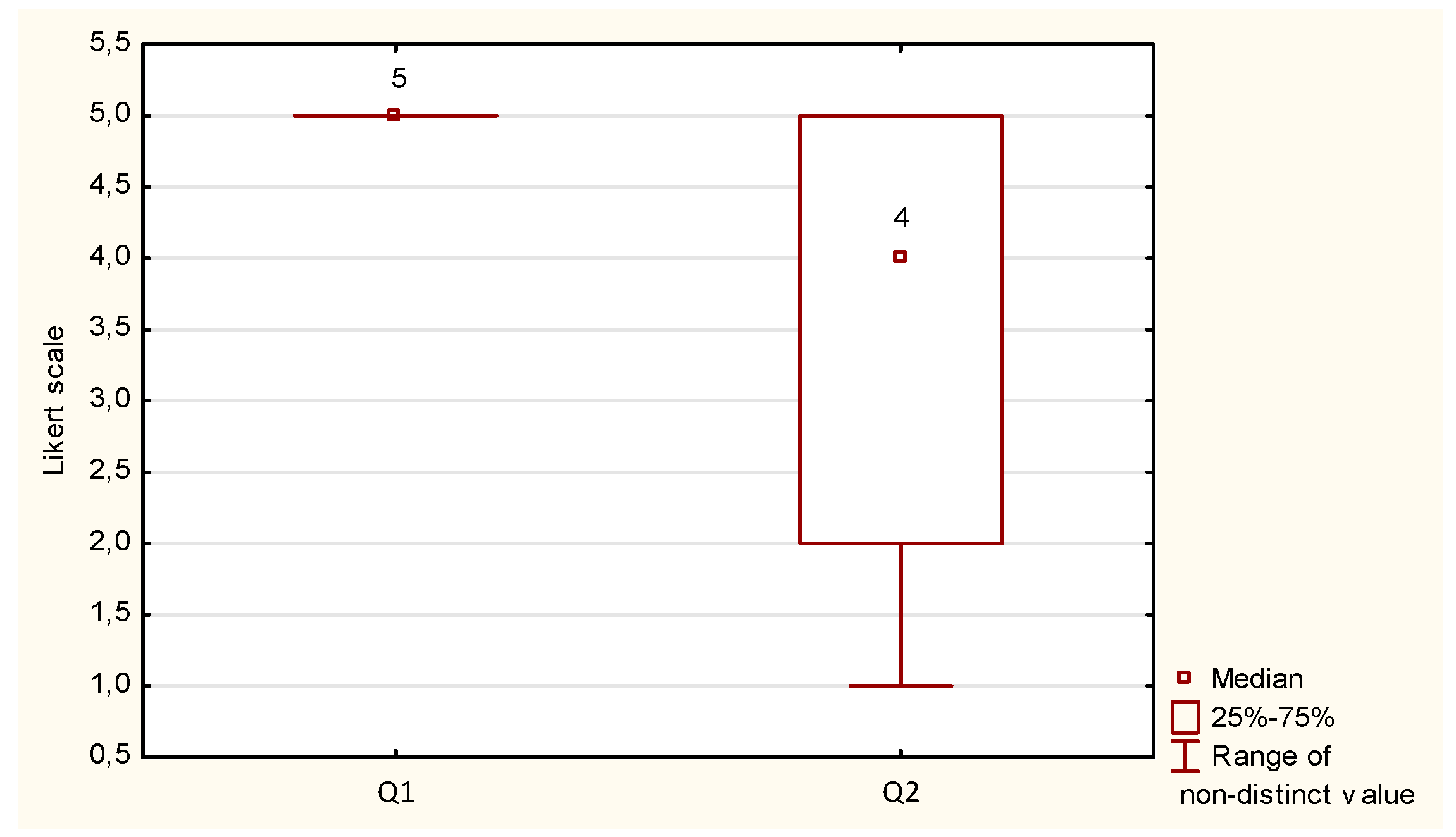
The preliminary box-plot analysis (diagram 8) reveals differences in answers concerning methods of customer communication. The median of responses to question Q1 is 1 (yes). Interestingly, the interquantile range and the typical range are 0 which means that all respondents declared that they used traditional customer communication methods, i.e. meeting in the company seat, phone, traditional mail and email. However, when it comes to questions Q2, the response median is 4 meaning that one half of respondents use (yes) modern communication methods and the other half do not know or do not use them. Those are such tools as Facebook, Twitter, Instagram, WhatsApp, Messenger, livechat and a mobile application. The interquartile range is from 2.0 to 5.0 which indicates different answers.
The results of the Mann-Whitney U test (p = 0.0000), with the adopted significance level (α = 0.05) indicate rejection of the verified null hypothesis (Table A4). This means that the survey indicates that the differences of the customer communication methods used are statistically significant. Thus, null hypothesis H0 2 was rejected and the alternative hypothesis was accepted. Consequently, companies use traditional and modern customer communication methods to a different extent.
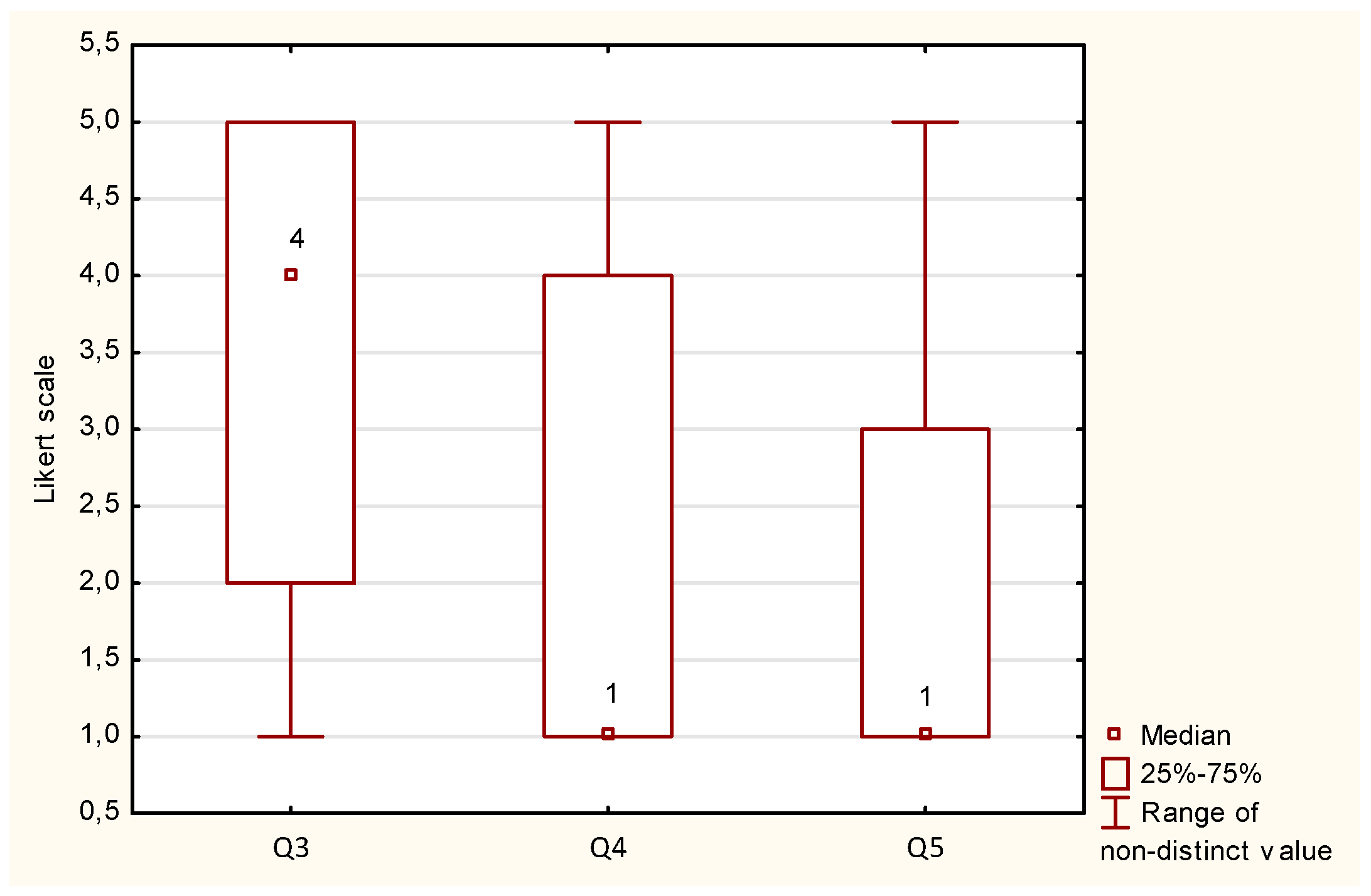
When analyzing the methods of purchasing by the analysed companies (diagram 9), the response median is 4 for question Q3. This means that one half of respondents said definitive “yes” to selling in the company seat. It can be seen that the interquantile range between the first and the third quantile is high, meaning diverse responses. Some respondents answered definitively “yes”, but some other “rather not”.
For questions Q4 and Q5, the response median is 1.0. This means that one half of respondents said definitively “no” relating to the use of modern sale methods. However, the response difference is different for individual methods. For the sale using own e-shop (question Q4), responses range from “rather yes” to “no” (the interquantile range is from 4.0 (“rather yes”) to 1.0 (“no”)). Referring to sale via other e-shops which offer our products, the response ranged from “difficult to say” to “no” (the interquantile range from 1 to 3). This means that if companies decide to use modern sale methods, they tend to prefer their own e-shops.
The result of Kruskal-Wallis test (p = 0) at the accepted level of significance (α = 0.05) indicate rejection of the verified null hypothesis (Table A5). This means that responses to at least one question differ statistically from the others. The post-hoc test analysis provided grounds for the conclusion that there are statistically significant differences between all three responses to questions. This means that companies use traditional and modern sale methods to a different extent. All the same, null hypothesis H0 3 was rejected and the alternative hypothesis was accepted.
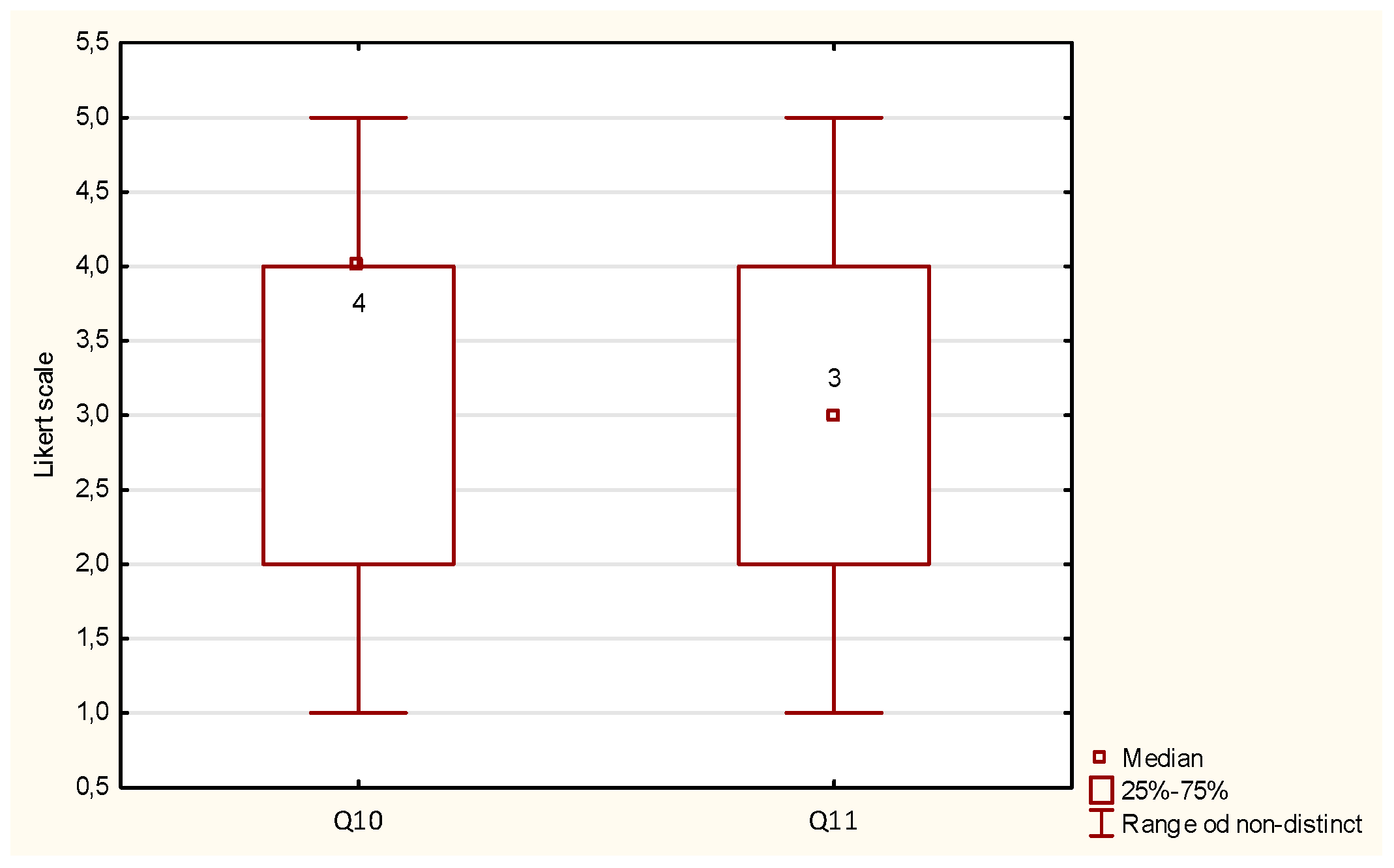
The preliminary analysis of responses (based on diagram 10) indicates differences in obstacles restricting the implementation of modern technology on the part of the company and of the customers. The median of responses to the question Q10 concerning the obstacles on the company’s part is 4.0 (“rather yes”). This means that one half of respondents indicated limitations (“yes”), including absence of funds, low employee competence, absence of expertise.
On the other hand, the median of responses to the question Q11 relating to the obstacles on the customer’s part is 3.0, i.e. “difficult to say”. This refers to the reluctance to use new technology, no expertise, no trust in mobile devices and artificial intelligence. This means that one half of respondents said “yes” and the other half said “no” to identifying the obstacles to the modern technology implementation in customer service with the buyer’s limitations.
The results of the Mann-Whitney U test (p = 0.0001), with the adopted significance level (α = 0.05) indicate rejection of the verified null hypothesis (Table A6). This means that there are statistically significant differences between the groups of responses to questions Q10 and Q11. Hence, the obstacles on the part of the company and of the customers limit modern technology implementation to a different extent. This means that null hypothesis H0 4 was rejected and the alternative hypothesis was accepted.
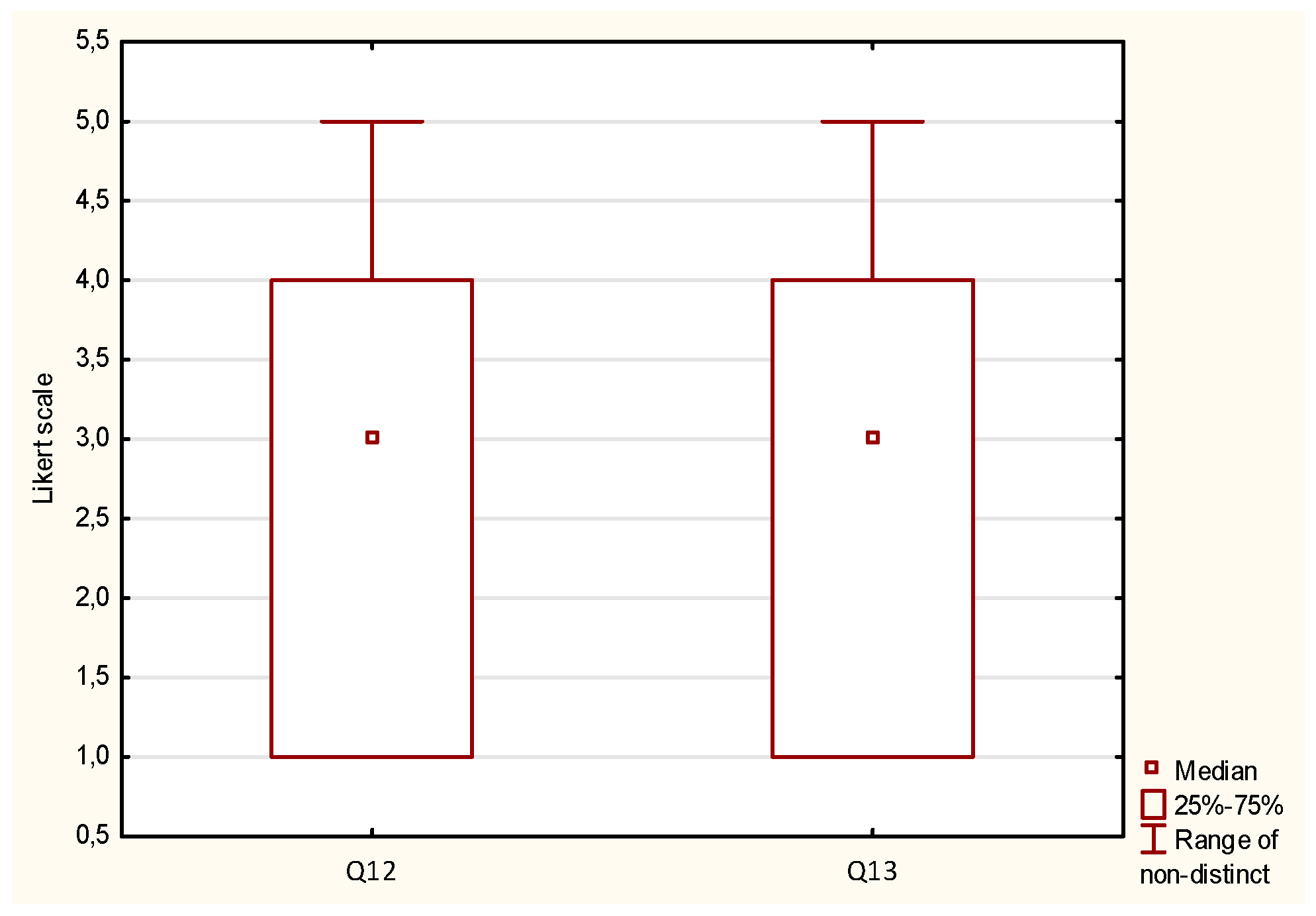
When analyzing the responses plotted in diagram 11, relating to the company website allowing to select a product matching the customer’s expectations and needs (question Q12), the response median is 3.0 (“difficult to say”). This means that one half of respondents selecting “yes” or “rather yes” have a website, and the other half do “not” or “rather not”. The same results were obtained for responses to questions connected with preparing the company for digital customer service (question Q13). The median is 3.0. This means that one half of respondents “yes” and “rather yes” declare that the company is prepared to serve customers doing shopping or handling any official matters by means of mobile devices, whereas the other half do “not” or “rather not”.
The results of the Mann-Whitney U-test (p = 0.2564), with the accepted level of significance (α = 0.05) indicate that there is no basis for rejecting the verified null hypothesis (Table A7). There are no statistically significant differences in the extent to which digital customer service tools are used. This means that null hypothesis H0 5 was confirmed.
H0 6Using particular communication and sale methods and obstacles to their implementation do not influence the economic results of the company
When analyzing the Kendall's rank correlation coefficient between different responses to questions concerning the methods of customer communication and service and economic results (Table 3), the following regularities can be seen. For question Q1, there are statistically significant correlations for the first (Q14), second (Q15) and the third (Q16) economic result. This means that the traditional communication methods allow the companies to carry out investments with positive ROI (Q14). However, relating to the effects: profitability higher than competitors (Q15) and increase of revenues higher than those earned by competitors (Q16), the correlation is significant, but negative. This means that using solely traditional methods of customer communication results in lower profitability and reduced revenues when compared to the ones earned by competitors.
It is different for modern communication methods (question Q2). A significant positive correlation with all economic results is found. New technological solutions for customer communication contribute to the effective investments (Q14), company profitability higher than that of its competitors (Q15) and revenue increase higher than earned by competitors (Q16).
When analyzing the relationship between responses to the questions concerning sale methods and economic results, the use of traditional methods (Q3) is not reflected in the financial results (there are no statistically significant correlations). For sale using own e-shop (Q4), this contributes to profitability higher than achieved by competitors (Q15) and to the revenue increase higher than earned by competitors (Q16). On the other hand, selling using other e-shops (Q5) which offer our products results solely in the revenue increase higher than earned by competitors (Q16).
When analyzing the relationships between obstacles to implementing cutting-edge solutions in customer service and the economic results, there is a statistically significant correlation when compared to ROI (Q14), profitability (Q15) and revenue increase (Q16) for obstacles on the company’s part (Q10). This is a negative correlation meaning that the obstacles contribute to reducing ROI, lower profitability and decreasing revenue when compared to competitors. The obstacles on the customer’s part (Q11) do not have any statistically significant impact on the company economic results.
Considering responses to questions concerning the company website which allows to select a product matching customers’ expectations and needs (Q12), Kendall's coefficient indicates correlation with responses concerning higher company profitability than that of its competitors (Q15). This means that running a website with a product offer contributes to company profitability.
When analyzing the relationship between responses to questions connected with the level of the company preparation to serve digital customers (Q13) and economic results, it is correlated (in a statistically significant way) with responses to questions concerning the profitability (Q 15) and the increase in profits higher than those earned by competitors (Q16). This means that the company preparation to serve customers who do shopping or handle any official matters using mobile devices has a favorable impact on the profitability and the obtained revenues higher than those earned by the competitors.
Mulitvariate Adaptive Regression Splines were used to complete the verification of the null research hypothesis H0 6. Detailed results are shown in Table 4.
Analyzing the results of MARSplines, then for the dependent variable Q14, the best predictors are Q 2 and Q 10. Thus, the economic effect in the form of a positive return on investment is statistically significantly influenced by the use of modern digital tools for communication with the customer (Q2) and barriers to the implementation of modern technologies in the area of customer service occurring on the side of the company (Q10).
Considering the results obtained for the independent variable Q15, for it the best predictors are also Q 2 and 10. Thus, the significant statistical determinants of the company's profitability higher than its competitors are the use of modern digital tools for communication with customers (Q2) and barriers on the part of the company regarding the implementation of modern digital technologies in the area (Q10).
Identifying the predictors using the MARSplines method for the independent variable Q 16, they are: Q1, Q2, Q4 and Q10. Thus, the factors determining the economic effect - revenue growth higher than that of competitors, in addition to the use of modern digital tools for communication with customers (Q2) and barriers to the implementation of modern technologies in the area of customer service (on the part of the company) (Q10), are also the use of traditional methods of communication with customers (Q1) and sales through its own online store (Q4).
Summing up the survey results, verification of null hypothesis H0 6 offered ambiguous results. Using Kendall's rank correlation coefficient method, the presented null hypothesis was rejected for questions O1, Q2, Q4, Q5, Q10, Q 12 and Q13 and the alternative hypothesis was accepted. There is a statistically significant impact (correlation) of the listed variables on the economic results. However, for questions Q3 and Q11, null hypothesis H0 6 was confirmed. Using solely traditional sale methods and obstacles limiting implementation of cutting-edge solutions on the customer’s part do not affect economic results of the company.
The results obtained from MARSplines indicate that the null hypothesis H0 6 is rejected for questions Q2 and Q 10 and the alternative hypothesis was accepted. The use of modern digital tools for communicating with customers (Q2) and barriers to implementing modern technologies in the customer service area occurring on the company's side (Q10) have a statistically significant impact (are significantly statistical predictors) for all economic outcomes (Q14, Q15 and Q16). In addition, the variables Q1 (use of traditional methods of communication with customers) and Q 4 (sales through its own online store) are statistically significant determinants for the result- revenue growth higher than competitors (Q16). With regard to the remaining questions, hypothesis H0 6 was confirmed. Thus, other factors do not affect the company's economic performance.
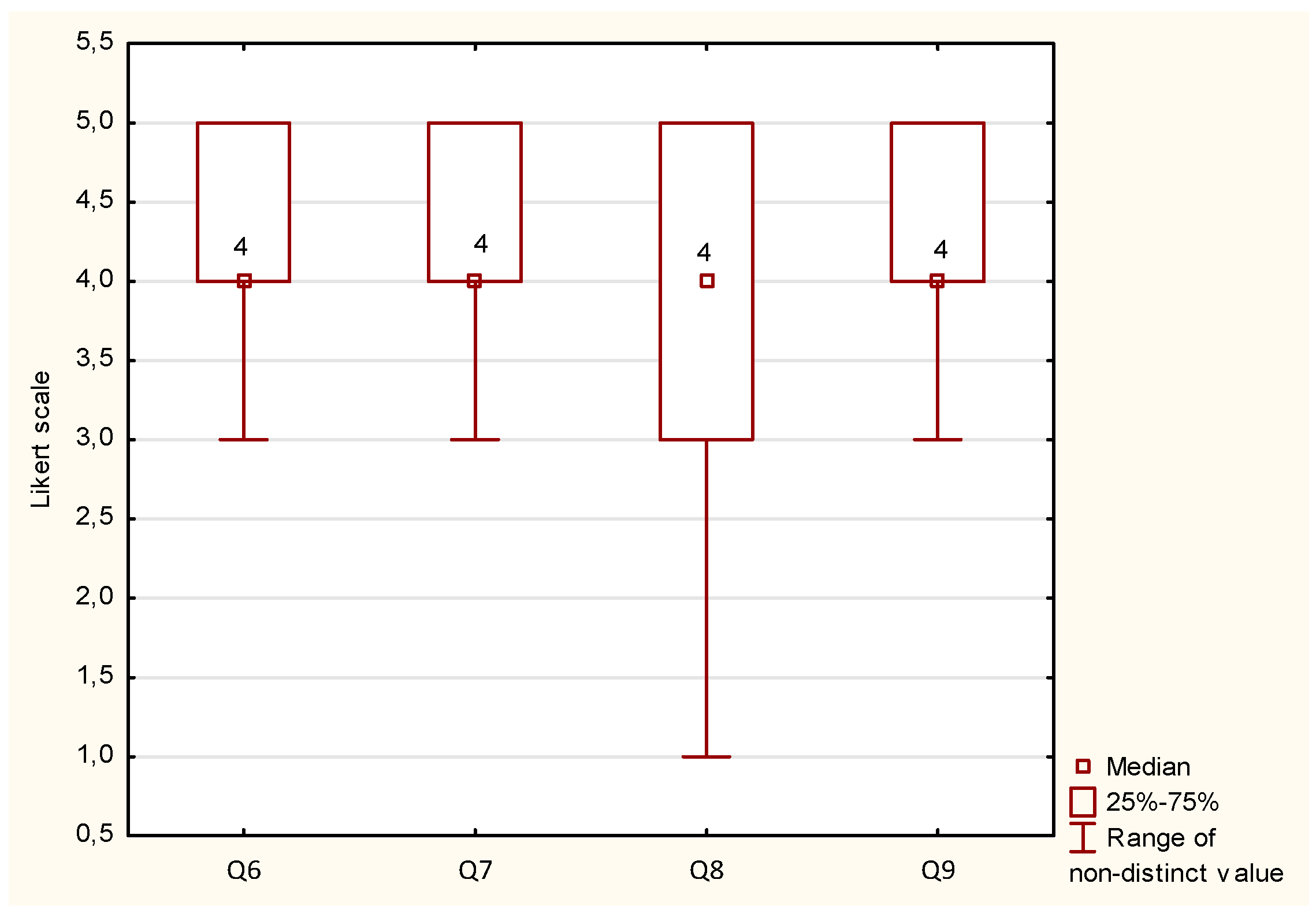
When examining responses to the questions on the impact of cutting-edge technology in the customer service area on the economic result (diagram 12), the response median is always 4. This means that more than one half of respondents indicated that the implementation of cutting-edge technology in the customer relations area “yes” influences the economic results, whereas the other half selected “difficult to say” or “no”. For question Q8 (improved financial results), both the interquantile range and the typical range (responses provided) is higher, which indicates higher diversity of responses.
The result of Kruskal-Wallis tests (p = 0) at the accepted level of significance (α = 0.05) indicate rejection of the verified null hypothesis (Table A8). This means that responses to at least one question differ statistically from the others. The post-hoc tests carried out indicate that this refers to the response to question Q8, meaning the impact on the improved financial results. The difference between the discussed effect and any other effects may be attributed to the modern solution implementation costs which accompany investment projects and, depending on their value, may exert either positive or negative impact on the financial results. Hence, null hypothesis H0 7 was rejected, the alternative hypothesis was accepted.
A summary of the results of the verification of all null hypotheses is presented in Table 5.
5. Discussion
The obtained results confirm earlier observations concerning the limited use of modern customer communication and sale tools by small and medium-sized enterprises in Poland [94]. Relating to customer communications, all enterprises use traditional tools, including meetings in the company seat, phone, traditional mail and email. However, using modern digital communication instruments, e.g. Facebook, Twitter, Instagram, WhatsApp, Messenger, livechat or a mobile application is less popular with the studied companies in Poland.
Using modern customer communication methods has a favorable impact on the companies’ economic results, i.e. on the return on investment, on the company profitability higher than that of its competitors and on the revenue increase higher than earned by competitors. On the other hand, using solely traditional tools is not sufficient to obtain positive economic results or even leads to a decrease in profitability and reduced sale revenues when compared to competitors. These conclusions are consistent with the results of the previous studies which revealed that the digital communication channels using the Internet and social media offer new opportunities of marketing activities [40,41,42,43]. Besides an ongoing, close contact with customers, they enable communication between company customers, opinion exchange and product recommendations which contributes to building consumer trust and loyalty and, consequently, to improving economic results [50,51].
According to the studies carried out for Polish companies, there are also differences between using modern and traditional tools for customer service. Running own e-shop or selling via other e-shops are more rarely used than the traditional sale in the company seat. Similar trends are revealed by statistics for the United Kingdom and other European states of 2019 according to the Office for National Statistics, ONS, and Eurostat [97]. It turns out that small and medium-sized enterprises do not display high readiness for online sale, in particular when compared to large enterprises.
Referring to the studied companies, the sale carried out solely in brick-and-mortar shops does not improve economic results. However, modern sale methods contribute to such results. Selling in own e-shop contributes to the revenues higher than those of competitors. The results are consistent with the results of studies indicating that using e-marketing tools and digital technology by SMEs is reflected in positive economic results. The instruments contribute to building brand awareness and brand loyalty [54,66,67,68], improved customer service, increased customer satisfaction and loyalty [67,69], which results in a growing number of new customers [4,65].
The limited extent of using modern communication and customer service tools by Polish companies should be attributed to the obstacles to their implementation. The main group of obstacles indicated by the studied companies included the obstacles on the enterprise’s part, e.g. the absence of funds, low employee competences, no expertise. Those are the most often selected obstacles to implementing digital marketing tools in SMEs, regardless of the country or sector [12,35,64].
The studies reveal that, despite the existing limitations to using cutting-edge communication and sales solutions, the companies expect that they will improve economic results. This refers to improved speed and proficiency of service, customer satisfaction and company image. Some companies identify those activities with improved financial results, whereas other associate them with the need to pay extra costs.
The presented results concerning the anticipated economic benefits of using modern sale and customer service tools are confirmed by the earlier SME studies both in developed and in developing economies. The survey of ca. 2 thousand SMEs from Europe and North America carried out more than a dozen years ago revealed positive effects of using Internet tools on financial results and increased efficiency [57]. Similar conclusions were drawn by the authors studying Swedish SMEs in 2017 [98]. One of the most recent studies reveal positive effects of digital transformation in European SMEs [99]. The authors prove that companies using cutting-edge digital tools in their operations have better and faster access to higher numbers of customers, are more flexible and competitive, and thus able to obtain better financial results. The positive impact of implementing modern marketing tools (i.e. online advertising, social media, emailing) on financial results is also indicated by the studies in SMEs sector in developing countries, including Ghana, Nigeria, Kenya or Malaysia [100].
In conclusion, it should be noted that the results of the present study are partially consistent with the results of similar studies conducted in other countries, but also fill the indicated research gap. On the basis of the present study, an assessment was made of the extent to which Polish SMEs use modern communication and sales methods and how this affects their economic performance. The studies also indicate the limited degree of use of e-marketing tools and digital technologies and the use of traditional customer communication channels and sales methods by Polish SMEs. This situation is due to the fact that the Polish economy is still struggling with problems left over from the centrally planned economy. These include low levels of investment and innovation, low spending on business research and development, and a complicated legal system for businesses [15]. In addition, Polish SMEs pointed to the importance of barriers to the implementation of modern digital forms of communication occurring on the side of the company, which negatively affect economic performance. This situation is related to the specifics of the Polish SME sector. It is characterized by high fragmentation (95% of all enterprises are microenterprises) [15]. In turn, it is mainly for the microenterprise, due to limited financial, material, intellectual resources, that the barriers associated with the implementation of digital technologies are particularly difficult to overcome. In an economy with a fragmented business structure, it is more difficult to implement modern, expensive tools, including digital tools.
The results thus provide new quantitative information on the links between digital transformation in marketing activities and the effectiveness of Polish SMEs. They can provide a basis for international comparisons to identify differences in the degree of use of digital marketing tools by SMEs operating in economies with different levels of development. They can also be a reference point for more detailed industry research. While the present research focused only on industrial companies, it can be assumed that there are differences in the use of digital marketing tools across industries (e.g., between manufacturing and retail). In addition, these results may be helpful for SME managers to prepare plans, strategies and good practices that increase digital customer satisfaction and loyalty.
The topic addressed in this manuscript is important and timely due to the very rapid development of Industry 4.0 technology and, in the near future, Industry 5.0 [101,102,103]. Studies have shown that the use of traditional marketing tools alone is insufficient to achieve satisfactory economic results. In contrast, the use of modern methods of communicating with customers has a positive impact on the economic performance of companies. Thus, companies should seek and implement more and more modern solutions of Industry 4.0 and Industry 5.0, which condition them to obtain economic results better than their competitors. Amiri et al. [104], analyzing trends and directions for future research in the area of digital marketing in small and medium-sized businesses, indicate that the use of AI in its various forms (machine learning, data mining, text mining, neural networks, big data, and artificial human) is a dominant theme in recent research. In addition, the au-tors suggest that future research directions may include: personalized marketing, the use of such social media marketing activities as data-driven, chat-bot, interactive, engagement, and influencer marketing applications. They also emphasize that future researchers should focus on the financial, technological, and po-positioning aspects of small and medium-sized companies toward adopting and implementing new digital marketing technologies. Our research is part of this future trend.
It is also worth noting that the implementation of modern digital transformation tools and solutions in enterprises promotes one of the Sustainable Development Goals - Goal 9: Industry, innovation and infrastructure. Modern technologies, based on “clean” energy sources, innovative production systems, ensuring higher efficiency and saving of raw materials can serve such functions of sustainable development as reduction of harmful emissions, rational management of resources or increase of social welfare [105,106]. Solutions in the sphere of customer communication and service (such as personalization, online sales, livechat) make it possible to forecast demand more accurately, better match supply and demand, reduce time and service costs, which promotes more rational use of resources.
6. Conclusions
The purpose of the article was to examine the extent to which Polish SMEs use digital marketing tools in the context of their impact on economic performance.
A review of the literature on the subject indicated that the ongoing digital transformation in marketing offers new opportunities for customer communication and sales activities. Small and medium-sized enterprises are increasingly adopting new technologies and digital marketing tools and exploiting their potential and opportunities in response to the growing competitive environment and potential benefits. Studies conducted in various countries show that SMEs using digital sales and customer communication solutions allow them to achieve positive economic results. In contrast, there is a lack of research on the impact of the use of these tools on the economic performance of Polish and small businesses. Therefore, a research gap was identified, which this study sought to fill.
On the basis of the research conducted, the main research question was answered, that the use of the modern methods of communication and sales by Polish SMEs has a positive impact on economic results. In addition, the results of the study provided a basis for answering specific questions and verifying research hypotheses. Based on them, it can be concluded that:
- Polish SMEs make lower use of modern digital tools for communication and sales compared to companies in the EU,
- the studied companies use modern communication and sale tools to a low extent as they mostly employ traditional channels and methods;
- the obstacles to implementing modern communication and sale methods referring to the limitations on the company’s part decrease economic results. These are: the absence of sufficient funds, insufficient expertise and employees’ competence;
- the studied companies perceive the positive effect of the modern solutions on the financial results but see also that this entails future investment expenditure.
Thus, the obtained results provide new quantitative information on the associations between the digital transformation in marketing activities and the effectiveness of Polish SMEs. They have important theoretical and practical implications.
Theoretical Implications:
- deepening the concept of Schultz Integrated Marketing Communications - IMC [108],
- basis for international comparisons in the use of digital marketing tools by SMEs in different economies,
- basis for cross-industry comparisons.
Practical Implications
Given the obtained results, earlier studies and experiences of developed countries relating to the use of modern customer communication and service methods by small and medium-sized enterprises, it is possible to indicate numerous practical implications. They refer primarily to the need to implement institutional activities limiting the identified obstacles [109,110]. They include:
- organization of training and providing advice to micro-, small and medium-sized enterprise managers relating to the adaptation of human resources and innovation processes to the digital era challenges;
- development of intensive courses developing digital skills of SME employees relating to artificial intelligence, cybersecurity and blockchain;
- financial support for SMEs in their efforts to increase the advanced technology use, e.g. for buying license and software enabling to implement digital solutions;
- informing SMEs and encouraging them to create start-up ecosystems, increase the number of digital innovation hubs (DIH) in connection with the Startup Europe initiative and the European Network;
- activities oriented toward the development and improvement of the Enterprise Europe Network offering services adapted to SME’s needs.
Research Limitations and Directions for Further Research
The research presented in the article has several limitations. First, the survey research applies only to Polish SMEs. Second, the research covers companies in the industrial processing sector. Third, the research was based on the results of surveys conducted with SME executives, without including data on the financial performance of these companies.
The obtained results and their limitations indicate directions for further studies. Limited to SME sector, subsequent studies could evaluate the impact of modern digital tools on the economic and financial results of small and medium-sized companies in various EU states. Broader studies could also cover large enterprises which would allow to assess the differences of such interdependencies depending on the company size.
These and many other studies [57,98,100] were based on survey methods which have their flaws. Future studies could be based on using mixed methods comprising the combination of surveys and financial data from the studied companies’ reports [99].
Another interesting direction of studies would be the analysis and effectiveness assessment of the institutional activities supporting the digital transformation on EU and national level.
Further research may also focus on the use of cutting-edge technologies, such as artificial intelligence and algorithm-based marketing [104]. In addition, they can be directed at the assumptions of the Industry 5.0 concept, which takes into account social aspects and sustainability goals.
Author Contributions
Conceptualization, D.S and A.R.; methodology, D.S and A.R.; validation D.S and A.R.; formal analysis, D.S and A.R. ; investigation, D.S and A.R..; data curation, D.S and A.R; writing—original draft preparation, D.S and A.R..; visualization, D.S and A.R. All authors have read and agreed to the published version of the manuscript.
Funding
The APC was funded by The Silesian University of Technology (Poland), grant number BK-264/ROZ1/2024 (13/010/BK_24/0081).
Institutional Review Board Statement
According to our University Ethical Statement, following, the following shall be regarded as research requiring a favorable opinion from the Ethic Commission in the case of human research (based on document in polish: https://prawo.polsl.pl/Lists/Monitor/Attachments/7291/M.2021.501.Z.107.pdf): research in which persons with limited capacity to give informed or research on persons whose capacity to give informed or free consent to participate in research and who have a limited ability to refuse research before or during their implementation, in particular: children and adolescents under 12 years of age, persons with intellectual disabilities persons whose consent to participate in the research may not be fully voluntary prisoners, soldiers, police officers, employees of companies (when the survey is conducted at their workplace), persons who agree to participate in the research on the basis of false information about the purpose and course of the research (masking instruction, i.e., deception) or do not know at all that they are subjects (in so-called natural experiments); research in which persons particularly susceptible to psychological trauma and mental health disorders are to participate mental health, in particular: mentally ill persons, victims of disasters, war trauma, etc., patients receiving treatment for psychotic disorders, family members of terminally or chronically ill patients; research involving active interference with human behavior aimed at changing it research involving active intervention in human behavior aimed at changing that behavior without direct intervention in the functioning of the brain, e.g., cognitive training, psychotherapy psychocorrection, etc. (this also applies if the intended intervention is intended to benefit (this also applies when the intended intervention is to benefit the subject (e.g., to improve his/her memory); research concerning controversial issues (e.g., abortion, in vitro fertilization, death penalty) or requiring particular delicacy and caution (e.g., concerning religious beliefs or attitudes towards minority groups) minority groups); research that is prolonged, tiring, physically or mentally exhausting. Our research is not done on people meeting the mentioned condition. Any of the researched people: any of them had limited capacity to be informed, any of them had been susceptible to psychological trauma and mental health disorders, the research did not concern the mentioned-above controversial issues, the research was not prolonged, tiring, physically or mentally exhausting.
Informed Consent Statement
In accordance with our University Ethical Statement, this research does not require informed consent (based on the document in Polish: https://prawo.polsl.pl/Lists/Monitor/Attachments/7291/M.2021.501.Z.107.pdf) . Our research is not conducted on individuals who meet the condition outlined in the above regulation . None of the subjects: had limited capacity to be informed, were not susceptible to psychological trauma or mental health disorders, the study did not involve the controversial issues mentioned above, the study was not prolonged, strenuous, physically or mentally exhausting.
Data Availability Statement
The research data can be provided upon request to the corresponding author.
Conflicts of Interest
The authors declare no conflicts of interest.
Appendix A

Table A1.
List of survey questions subject to the statistical analysis.
| Question no. |
Question |
|---|---|
| Q1 | In our company, we communicate with our customers using traditional methods (meeting in the company seat, phone, traditional mail, email etc.) |
| Q2 | In our company, we communicate with our customers using modern communication methods (Facebook, Twitter, Instagram, WhatsApp, Messenger, livechat, mobile application) |
| Q3 | Our company customers most often buy using traditional methods in the company seat |
| Q4 | Our company customers most often buy from our e-shop |
| Q5 | Our company customers most often buy from other e-shops offering our products |
| Q6 | Modern technology implementation in customer service area contributes to improved service speed and effectiveness |
| Q7 | Modern technology implementation in customer service area contributes to increased customer satisfaction |
| Q8 | Modern technology implementation in customer service area contributes to improved financial results |
| Q9 | Modern technology implementation in customer service area contributes to improved company image |
| Q10 | Major obstacles to implementing cutting-edge technology in the customer service area are the ones on the company’s part (e.g. absence of funds, low employee competences, absence of expertise). |
| Q11 | Major obstacles to implementing cutting-edge technology in the customer service area are the ones on the customers part (unwillingness to use new technology, no expertise, no trust in mobile devices and artificial intelligence) |
| Q12 | Our website allows to select a product/service meeting specific expectations and needs of customers (customize a product/service). |
| Q13 | We are fully prepared to serve digital customers (customers using mobile devices to do shopping or handle official matters etc.). |
| Q14 | In our company, we have positive return on investment. |
| Q15 | Profitability of our company is higher than that of competitors. |
| Q16 | Revenue increase in our company is higher than that of competitors. |
Table A2.
Cronbach’s analysis.
| variable | Scale summary: Mean=54.5209 St. deviation=8.40565 N valid:574 Cronbach's alpha: 0.690498 Standardized alpha: 0.707787 Average correlation between items: 0.143114 |
||||
|---|---|---|---|---|---|
| Mean when removed | Value when removed | St. deviation when removed | Total item corr. | Alpha when removed | |
| Q1 | 49.82753 | 69.95110 | 8.363677 | 0.013513 | 0.697062 |
| Q2 | 50.94599 | 59.76189 | 7.730582 | 0.341092 | 0.669848 |
| Q3 | 50.94599 | 70.05806 | 8.370070 | -0.077460 | 0.729879 |
| Q4 | 52.37282 | 58.43243 | 7.644111 | 0.405820 | 0.659885 |
| Q5 | 52.41115 | 60.86231 | 7.801430 | 0.309551 | 0.674342 |
| Q6 | 50.39373 | 60.60456 | 7.784893 | 0.516028 | 0.652622 |
| Q7 | 50.45645 | 59.81256 | 7.733858 | 0.598068 | 0.645295 |
| Q8 | 50.64808 | 60.18626 | 7.757980 | 0.516881 | 0.651386 |
| Q9 | 50.33972 | 60.98738 | 7.809442 | 0.541732 | 0.652296 |
| Q10 | 51.15505 | 66.17283 | 8.134668 | 0.118613 | 0.697552 |
| Q11 | 51.41463 | 66.90823 | 8.179745 | 0.115372 | 0.695450 |
| Q12 | 51.59756 | 60.08020 | 7.751142 | 0.338188 | 0.670184 |
| Q13 | 51.70557 | 58.88369 | 7.673571 | 0.435813 | 0.656255 |
| Q14 | 50.67073 | 66.79577 | 8.172868 | 0.147738 | 0.690865 |
| Q15 | 51.39199 | 66.36726 | 8.146610 | 0.260211 | 0.680796 |
| Q16 | 51.53659 | 66.45424 | 8.151947 | 0.251563 | 0.681431 |
Table A3.
Variable distribution normality test of Kolmogorov-Smirnov.
| Statistics value | value p | Report | |
|---|---|---|---|
| Q1 | 0.44421 | p<0.01 | Based on the result of Kolmogorov-Smirnov test: p < ,01 at the significance level α = 0.05, the hypothesis of normality of distribution for all variables should be rejected. |
| Q2 | 0.24763 | p<0.01 | |
| Q3 | 0.25666 | p<0.01 | |
| Q4 | 0.35623 | p<0.01 | |
| Q5 | 0.35566 | p<0.01 | |
| Q6 | 0.26014 | p<0.01 | |
| Q7 | 0.24364 | p<0.01 | |
| Q8 | 0.23986 | p<0.01 | |
| Q9 | 0.26711 | p<0.01 | |
| Q10 | 0.23646 | p<0.01 | |
| Q11 | 0.17765 | p<0.01 | |
| Q12 | 0.18604 | p<0.01 | |
| Q13 | 0.16099 | p<0.01 | |
| Q14 | 0.25938 | p<0.01 | |
| Q15 | 0.34096 | p<0.01 | |
| Q16 | 0.32985 | p<0.01 |
Table A4.
Mann-Whitney U test results for the comparisons of the groups of responses to questions Q1 and Q2.
Table A4.
Mann-Whitney U test results for the comparisons of the groups of responses to questions Q1 and Q2.
| Variable | Mann-Whitney U test (with a continuity correction) Relative to the variable: question Indicated results are significant with p < 0.05000 |
||||||||
|---|---|---|---|---|---|---|---|---|---|
| Rank total Q1 | Rank total Q2 | U | Z | p | With corrections | p | N valid Q1 | N valid Q2 | |
| Answer (Likert scale) | 396007.00 | 263519.00 | 98494.00 | 11.79 | p<0.0001 | 13.38 | p<0.0001 | 574.00 | 574.00 |
Table A5.
Results of ANOVA Kruskal-Wallis test and post-hoc analysis for the groups of responses to questions Q3, Q4 and Q5.
Table A5.
Results of ANOVA Kruskal-Wallis test and post-hoc analysis for the groups of responses to questions Q3, Q4 and Q5.
| Dependent: Answer | ANOVA Kruskal-Wallis rank; Independent (grouping) variable: question Kruskal-Wallis test: H (2, N = 1722) = 279.9311 p = 0.000 | |||
|---|---|---|---|---|
| Code | N valid | Rank total | Average rank | |
| Q3 | 1 | 574 | 647578.00 | 1128.18 |
| Q4 | 2 | 574 | 420432.50 | 732.46 |
| Q5 | 3 | 574 | 415492.50 | 723.85 |
| Dependent: Likert scale (answers) |
Value p for multiple (two-way) comparisons; answer Independent (grouping) variable: question Kruskal-Wallis test: H (2, N = 1722) = 279.9311 p = 0.000 |
|||
| Q3 R:1128.2 | Q4 R:732.46 | Q5 R:723.85 | ||
| Q3 | p<0.0001 | p<0.0001 | ||
| Q4 | p<0.0001 | 1.0000 | ||
| Q5 | p<0.0001 | 1.0000 | ||
Table A6.
The results of Mann-Whitney U test results for the comparison of responses to questions Q10 and Q11.
Table A6.
The results of Mann-Whitney U test results for the comparison of responses to questions Q10 and Q11.
| Variable | Mann-Whitney U test (with a continuity correction) Relative to the variable: question Indicated results are significant with p < 0.05000 | ||||||||
|---|---|---|---|---|---|---|---|---|---|
| Rank total Q10 | Rank total Q11 | U | Z | p | With corrections | p | N valid Q10 | N valid Q11 | |
| Answer (Likert scale) | 351945.50 | 307580.50 | 142555.50 | 3.95 | 0.00 | 4.06 | p<0.0001 | 574.00 | 574.00 |
Table A7.
The results of Mann-Whitney U test results for the comparison of responses to questions Q12 and Q13.
Table A7.
The results of Mann-Whitney U test results for the comparison of responses to questions Q12 and Q13.
| Variable | Mann-Whitney U test (with a continuity correction) (Sheet2) Relative to the variable: question Indicated results are significant with p < 0.05000 | ||||||||
|---|---|---|---|---|---|---|---|---|---|
| Rank total Q12 | Rank total Q13 | U | Z | p | With corrections | p | N valid Q12 | N valid Q13 | |
| answer | 336138.50 | 323387.50 | 158362.50 | 1.14 | 0.26 | 1.16 | 0.25 | 574.00 | 574.00 |
Table A8.
Results of ANOVA Kruskal-Wallis test and post-hoc analysis for the groups of responses to questions Q6, Q7, Q8 and Q9.
Table A8.
Results of ANOVA Kruskal-Wallis test and post-hoc analysis for the groups of responses to questions Q6, Q7, Q8 and Q9.
| Dependent: answer | ANOVA Kruskal-Wallis rank; answer (Sheet2) Independent (grouping): question Kruskal-Wallis test: H (3, N = 2296) = 31.51557 p = 0.0000 | |||
|---|---|---|---|---|
| Code | N valid | Rank total | Average rank | |
| Q6 | 1 | 574 | 690001.50 | 1202.09 |
| Q7 | 2 | 574 | 654514.00 | 1140.27 |
| Q8 | 3 | 574 | 592927.50 | 1032.97 |
| Q9 | 4 | 574 | 699513.00 | 1218.66 |
| Dependent: answer | Value p for multiple (bilateral) comparisons; answer (Sheet2) Independent (grouping) variable: question Kruskal-Wallis test: H (3, N = 2296) = 31.51557 p = 0.0000 | |||
| Q6 R:1202.1 | Q7 R:1140.3 | Q8 R:1033.0 | Q9 R:1218.7 | |
| Q6 | 0.6848 | 0.0001 | 1.0000 | |
| Q7 | 0.6848 | 0.0367 | 0.2708 | |
| Q8 | 0.0001 | 0.0367 | p<0.0001 | |
| Q9 | 1.0000 | 0.2708 | p<0.0001 | |
References
- Reddy, S.; Reinartz, W. Digital transformation and value creation: sea change ahead. GfK Marketing Intelligence Review (GFK MIR), 2017, 9(1), 10-17. [CrossRef]
- Delanogare, L.S.; Benitez, G. B.; Ayala, N. F.; Frank, A. G. The expected contribution of Industry 4.0 technologies for industrial performance. Int. J. Prod. Econ. 2018, 204, 383-394. [CrossRef]
- Bai, Ch.; Dallasega, P.; Orzes, G.; Sarkis, J. Industry 4.0 technologies assessment: A sustainability perspective. Int. J. Prod. Econ. 2020, 229. [CrossRef]
- Taiminen, H.,; Karjaluoto, H. The usage of digital marketing channels in SMEs. J. Small Bus. Enterp. Dev. 2015, 22(4), 633-651. [CrossRef]
- Bacile, T.J. Digital customer service and customer-to-customer interactions: investigating the effect of online incivility on customer perceived service climate. J. Serv. Manag. 2020, 31 (3), 441-464. [CrossRef]
- Sun, Y.; Yang, C.; Shen, X.-L.; Wang, N. When digitalized customers meet digitalized services: A digitalized social cognitive perspective of omnichannel service usage. Int. J. Inf. Manag, 2020, 54, 102200. [CrossRef]
- Ulas, D. Digital Transformation Process and SMEs. Procedia Comput. 2019, 158, 662–671. [CrossRef]
- Chan, C. M. L.; Teoh, S. Y.; Yeow, A.; Pan, G. Agility in responding to disruptive digital innovation: Case study of an SME. Inf. Syst. J. 2018, 29(2), 1-20. [CrossRef]
- Li, L., Su, F.; Zhang, W.; Mao, J.-Y. Digital transformation by SME entrepreneurs: A capability perspective. Inf. Syst. J. 2017. 28(6), 1129 – 1157. [CrossRef]
- Matt, D.; Rauch, E. SME 4.0: The Role of Small- and Medium-Sized Enterprises in the Digital Transformation. In Industry 4.0 for SMEs. Challenges, Opportunities and Requirements. Dominik T. Matt, V. Modrák, H. Zsifkovits Eds., Palgrave Macmillan: London 2020. [CrossRef]
- Cesaroni, F.M.; Consoli, D. Are small businesses really able to take advantage of social media? Electron. J. Knowl. Manag. 2015, 13(4), 257-268.
- Cenamor, J.; Parida, V.; Wincent, J. (2019). How entrepreneurial SMEs compete through digital platforms: The roles of digital platform capability, network capability, and ambidexterity. J. Bus. Res. 2019, 100, 196-206. [CrossRef]
- Kavoura, A.; Maris, G.; Masouras, A. Entrepreneurial Development and Innovation in Family Businesses and SMEs. Business Science Reference, IGI Global: Hershey, USA 2020.
- Masouras, A.; Pistikou, V.; Komodromos, M. Innovation Analysis in Cypriot Small and Medium-sized Enterprises and the Role of the European Union. In Entrepreneurship, Institutional Framework and Support Mechanisms in the EU, Apostolopoulos, N., Chalvatzis, K. and Liargovas, P. Eds., Emerald Publishing Limited: Bingley 2021. [CrossRef]
- Report on the state of small and medium-sized enterprises in Poland, 2023. PARP. Warsaw 2023, pp. 6-7.
- Di Bella, L.; Katsinis, A.; Laguera Gonzalez, J.; Odenthal, L.; Hell, M.; Lozar, B. Annual Report on European SMEs 2022/2023, Publications Office of the European Union: Luxembourg 2023. [CrossRef]
- Smith, K. T. Mobile advertising to Digital Natives: preferences on content, style, personalization, and functionalityJ. Strateg. Mark. 2019, 27(1), 67-80. [CrossRef]
- Szwajca, D. Digital Customer as a Creator of the Reputation of Modern Companies. FoM, 2019, 11(1), 255–266. [CrossRef]
- Jain, G.; Paul, J.; Shrivastava, A. Hyper-personalization, co-creation, digital clienteling and transformation. J. Bus. Res. 2021, 124, 12-23. [CrossRef]
- Olson, E. M.; Olson, K. M.; Czaplewski, A. J.; Key, T. M. Business strategy and the management of digital marketing. Bus. Horizons 2021, 64(2), 285-293. [CrossRef]
- Grabowska, S.; Saniuk, S. Modern Marketing for Customized Products Under Conditions of Fourth Industrial Revolution. In Industry 4.0. A global perspective. Duda, J., Gąsior, A. Eds. Routledge: New York 2021a.
- Barbier, E. B.; Burgess, J. C. The Sustainable Development Goals and the systems approach to sustainability, Economics, 17, 2017. [CrossRef]
- Lemańska-Majdzik A;, Okręglicka M. Wykorzystanie technologii informacyno-komunikacyjnych jako determinanta rozwoju przedsiębiorstw sektora MSP – wyniki badań. Przegląd Organizacji, 2017, 6, 44-50. [CrossRef]
- Ziółkowska, M. J. Digital Transformation and Marketing Activities in Small and Medium-Sized Enterprises. Sustainability 2021, 13(5), 2512. [CrossRef]
- Witek-Hajduk, M.K.; Grudecka, A.M.; Napiórkowska, A. E-commerce in the internet-enabled foreign expansion of Polish fashion brands owned by SMEs. J. Fash. Mark. Manag. 2022, 26(1), 51-66. [CrossRef]
- Lewandowski, M. Marketing activities on the Internet in the era of the first wave of the pandemic COVID-19 in the SME sector in Poland. Zbliżenia Cywilizacyjne 2023, XIX (1), 87-105).
- Hebbert, L. Digital Transformation: Build your Organization’s Future for the Innovation. Bloomsburry Publishing Plc: London 2017.
- Bouwman, H.; Nikou, S.; Molina-Castillo, F. J.; De Reuver, M. The impact of digitalization on business models. Digit. Policy Regul. G. 2018. 20(2), 105–124. [CrossRef]
- Grabowska, S.; Saniuk, S. Challenges of business model concept of small- and medium-sized enterprise cooperation. In Industry 4.0. A glocal perspective. Eds. Duda, J., Gąsior, A. Eds. Routledge: New York 2021b.
- Moreira F.; Ferreira, M. J.; Seruca, I. 4.0 – the emerging digital transformed enterprise? Procedia Comput. 2018, 138, 525–532. [CrossRef]
- Grube, D.; Malik, A. A.; Bilberg, A. SMEs can touch Industry 4.0 in the Smart Learning Factory. Procedia Manuf. 2019, 31, 219–224. [CrossRef]
- Andriole, S. Five myths about digital transformation. "MIT Sloan Manag. Rev. 2017, 58(3), 20-22.
- Fabrizi, B.; Lam, E.; Girard, K.; Irvin, V. Digital Transformation Is Not About Technology. Harv. Bus. Rev, 2019, 3, March 13.
- Vial, G. Understanding digital transformation: a review and a research agenda. J. Strateg. Inf. Syst. 2019, 28(2), 118-144. [CrossRef]
- Peter, M.K.; Kraft, C.; Lindeque, J. Strategic action fields of digital transformation: an exploration of the strategic action fields of swiss SMEs and large enterprises. Journal of Strategy Management (JSM), 2020, 13(1), 160–180. [CrossRef]
- Lamberton, C.; Stephen, A. T. A thematic exploration of digital, social media, and mobile marketing: Research evolution from 2000 to 2015 and an agenda for future inquiry. J. Mark. 2016, 80(6), 146-172. [CrossRef]
- Kannan, P. K.,; Li, H. A. Digital Marketing: A Framework, Review and Research AgendaInt. J. Res. Mark. 2017, 34(1), 22-45. [CrossRef]
- Kim, J., Kang, S.; Lee, K. H. Evolution of digital marketing communication: Bibliometric analysis and network visualization from key articles. J. Bus. Res. 2021, 130, 552-563. [CrossRef]
- Krishen, A. S.; Dwivedi, Y. K.; Bindu, N.; Kumar, K. S. A broad overview of interactive digital marketing: A bibliometric network analysis. J. Bus. Res. 2021, 131, 183-195. [CrossRef]
- Melewar, T.C.; Nichola, S. The Internet revolution: Some global marketing implications. Mark. Intell. Plan. 2003, 21(6), 363-369. [CrossRef]
- Berthon, P.R.; Pitt, L.F.; Plangger, K.; Shapiro, D. (2012). Marketing meets web 2.0, social media and creative consumers: Implications for international marketing strategy. Bus. Horizons, 2012, 55(3), 261-271. [CrossRef]
- Hendrix, P. E. How digital technologies are enabling consumers and transforming the practice of marketing. J. Mark. Theory Pract. 2014, 22(2), 149-150. [CrossRef]
- Charlesworth, A. Internet Marketing: A practical approach. Third edition. Routledge: London 2018.
- Fraccastoro, S.; Gabrielsson, M.; Pullins, E. B. The integrated use of social media, digital, and traditional communication tools in the B2B sales process of international SMEs. Int. Bus. Rev. 2021, 30(4), 101776. [CrossRef]
- Amankwah-Amoah, J.; Khan, Z.; Wood, G.; Knight, G. COVID-19 and digitalization: The great acceleration. J. Bus. Res. 2021, 136, 602–611. [CrossRef]
- Barnes, D.; Clear, F.; Harindranath, G.; Dyerson, R., Harris, L.; Rea, A. Web 2.0 and micro-businesses: an exploratory investigation. J. Small Bus. Enterp. Dev. 2012, 19(4), 687-711. [CrossRef]
- Cacciolatti. L. A.; Fearne, A. (2013). Marketing intelligence in SMEs: implications for the industry and policy makers. Mark. Intell. Plan, 2013, 31(1), 4-26. [CrossRef]
- Omar, F. I.; Othman, N. A.; Hassan, N. A. Digital inclusion of ICT and its implication among entrepreneurs of small and medium enterprises Int. j. eng. adv. technol. 2019, 8(5), 747-752. [CrossRef]
- Odoom, R.; Anning-Dorson, T.; Acheampong, G. Antecedents of social media usage and performance benefits in small- and medium-sized enterprises (SMEs). J. Enterp. Inf. 2017, 30(3), 383-399. [CrossRef]
- Hanna, R., Rohm, A.; Crittenden, V. L. We’re all connected: the power of the social media ecosystem. Bus. Horiz. 2011, 54(3), 265-273. [CrossRef]
- Salo, J. Social media research in the industrial marketing field: Review of literature and future research directions. Ind. Mark. Manag. 2017, 66, 115-129. [CrossRef]
- Lacoste, S. Perspectives on social media and its use by key account managers. Ind. Mark. Manag. 2016, 54, 33-43. [CrossRef]
- Itani, O. S.; Agnihotri, R.; Dingus, R. Social media use in B2B sales and its impact on competitive intelligence collection and adaptive selling: Examining the role of learning orientation as an enabler. Ind. Mark. Manag. 2017, 66, 64-79. [CrossRef]
- Bill, F., Feurer, S. & Klarmann, M., Salesperson social media use in business-to-business relationships: An empirical test of an integrative framework linking antecedents and consequences. Journal of the Academy of Marketing Science, 2020, 48, 734-752. [CrossRef]
- Müller, J. M., Pommeranz, B., Weisser,J. & Voigt, K. I., Digital, Social Media, and Mobile Marketing in industrial buying: Still in need of customer segmentation? Empirical evidence from Poland and Germany. Industrial Marketing Management,2018, 73, 70-83. [CrossRef]
- Tlapana, T. & Dike, A., Social Media Usage Patterns amongst Small and Medium Enterprises (SMMEs) in East London, South Africa. Global Media Journal, 2020, 18(35):212.
- Arnone, L. & Deprince, E., Small firms internationalization: Reducing the psychic distance using social networks. Global Journal of Business Research, 2016, 10(1), 55-63. https://ssrn.com/abstract=2825461.
- Varadarajan, R., Welden, R. B., Arunachalam, S., Haenlein, M. & Gupta, S., Digital product innovations for the greater good and digital marketing innovations in communications and channels: Evolution, emerging issues, and future research directions. International Journal of Research in Marketing, 2021, 39(2), 482-501. [CrossRef]
- van Esch, P. & Black, J. S., Artificial Intelligence (AI): Revolutionizing Digital Marketing. Australasian Marketing Journal, 29(3), 2021, 199-203. [CrossRef]
- Chmielarz, W., The Usage of Smartphone and Mobile Applications from the Point of View of Customers in Poland. Information, 11 (4),2020, 220. [CrossRef]
- Szumski, O., Digital payment methods within Polish students - leading decision characteristics. Procedia Computer Science, 2020, 176, 3456-3465. [CrossRef]
- Taiminen, H., Ensio Karjaluoto, H. & Nevalainen, M., Digital channels in the internal communication of a multinational Corporation. Corporate Communications An International Journal, 2014, 19(3), 275-286. [CrossRef]
- Styvén, M. E., Wallström, Å., Benefits and barriers for the use of digital channels among small tourism companies. Scandinavian Journal of Hospitality and Tourism, 2019, 19(1), 27-46. [CrossRef]
- Taiminen, H.M., Karjaluoto, H., The usage of digital marketing channels in SMEs. Journal of Small Business and Enterprise Development, 2015, 22(4), pp. 633-651.
- de Vries, L., Gensler, S., & Leeflang, P. S., Effects of traditional advertising and social messages on brand-building metrics and customer acquisition. Journal of Marketing, 2017 81(5), 1–15. [CrossRef]
- Hudson, S., Huang, L., Roth, M. S., & Madden, T. J. ,The influence of social media interactions on consumer–Brand relationships: A three-country study of brand perceptions and marketing behaviors. International Journal of Research in Marketing, 2016, 33(1), 27–41. [CrossRef]
- Kumar, A., Bezawada, R., Rishika, R., Janakiraman, R., & Kannan, P. K., From social to sale: The effects of firm-generated content in social media on customer behavior. Journal of Marketing, 2016, 80(1), 7–25. [CrossRef]
- Ismail, A. R., The Influence of Perceived Social Media Marketing Activities on Brand Loyalty: The Mediation Effect of Brand and Value Consciousness. Asia Pacific Journal of Marketing and Logistics, 2017, 29(1), 129-144. [CrossRef]
- Adam, M., Ibrahim, M., Ikramuddin, I. & Syahputra, H., The Role of Digital Marketing Platforms on Supply Chain Management for Customer Satisfaction and Loyalty in Small and Medium Enterprises (SMEs) at Indonesia. International Journal of Supply Chain Management, 2020, 9(3), 1210-1220. [CrossRef]
- Okazaki, S., & Taylor, C. R., Social media and international advertising: Theoretical challenges and future directions. International Marketing Review, 2013, 30(1), 56–71. [CrossRef]
- Alarc´on-del-Amo, M., Rialp-Criado, A., & Rialp-Criado, J., Examining the impact of managerial involvement with social media on exporting firm performance. International Business Review, 2018, 27(2), 355–366. [CrossRef]
- Gao, H., Tate, M., Zhang, H., Chen, S., & Liang, B., Social media ties strategy in international branding: An application of resource-based theory. Journal of International Marketing, 2018, 26(3), 45–69. [CrossRef]
- Jin, H., & Hurd, F., Exploring the impact of digital platforms on SME internationalization: New Zealand SMEs use of the Alibaba platform for Chinese market entry. Journal of Asia-Pacific Business, 2018, 19(2), 72–95. [CrossRef]
- Karjaluoto, H., Mustonen, N. & Ulkuniemi, P., The role of digital channels in industrial marketing communications. Journal of Business & Industrial Marketing, 2015, 30(6), 703-710. [CrossRef]
- Wang, W. Y., Pauleen, D. J., & Zhang, T., How social media applications affect B2B communication and improve business performance in SMEs. Industrial Marketing Management, 2016, 54, 4–14. [CrossRef]
- Hoffman, D. L., & Fodor, M., Can you measure the ROI of your social media marketing? MIT Sloan Management Review, 2010, 52(1).
- Mokhtar, N.F., Internet marketing adoption by small business enterprises in Malaysia. International Journal of Business and Social Science, 2015, 6(1), 59–65.
- Johnston, D. A., Wade, M. & Mcclean, R., Does e-Business Matter to SMEs? A Comparison of the Financial Impacts of Internet Business Solutions on European and North American SMEs. Journal of Small Business Management, 2007, 45(3), 354-361. [CrossRef]
- Chong, W. K., Man, K. L. & Kim, M., The impact of e-marketing orientation on performance in Asian SMEs: a B2B perspective. Enterprise Information Systems, 2018, 12(1), 4-18. [CrossRef]
- Deryabina, G., & Trubnikova, N., Digital B2B communications: economic and marketing effect. Lecture Notes in Networks and Systems, 2020, 87. [CrossRef]
- Nobre, H., & Silva, D., Social Network Marketing Strategy and SME Strategy Benefits. Journal of Transnational Management, 2014, 19(2), 138-151. [CrossRef]
- Cepel, M., Stasiukynas, A., Kotaskova, A., & Dvorsky, J., Business environment quality index in the sme segment. Journal of Competitiveness, 2018, 10(2), 21-40. [CrossRef]
- Rydzewska, A., Influence of financialization on the business activity of non-financial enterprises in Poland. Ekonomia i Prawo. Economics and Law, 2023, 22(4), 777–807. [CrossRef]
- Guo, H., Yang, Z. & Huang, R., The digitalization and public crisis responses of small and medium enterprises: Implications from a COVID-19 survey. Frontiers of Business Research in China, 2020, 14, 19. [CrossRef]
- Szwajca D. & Rydzewska A., Digital transformation as a challenge for SMES in POLAND in the context of crisis relating to Covid-19 pandemic. Scientific Papers of Silesian University of Technology, Organization and Management, 2022, 161, 289-305. [CrossRef]
- Omar, S. I. et al. Digital Marketing: An Influence towards Business Performance among Entrepreneurs of Small and Medium Enterprises, Int. J. Acad. Res. 2020, 10(9), 126-141. [CrossRef]
- Amoah, J.; Jibril, A. B. Inhibitors of social media as an innovative tool for advertising and MARKETING communication: Evidence from SMEs in a developing country. Innovative Marketing, 2020, 16(4), 164-179. [CrossRef]
- Kolawole, R. Does digital marketing adoption enhance the performance of micro and small enterprises? Evidence from women entrepreneurs in Ado-Odo Ota Local Government Area, Ogun State, Nigeria. Int. J. Manag. Rev. 2022, 17(1), 160-173. [CrossRef]
- Brzaković, A. et al. Empirical Analysis of the Influence of Digital Marketing Elements on Service Quality Variables in the Small- and Medium-Sized Enterprises Sector in the Republic of Serbia. Sustainability 2021, 13(18), 10264. [CrossRef]
- Pollak, F.; Markovic, P. Size of Business Unit as a Factor Influencing Adoption of Digital Marketing: Empirical Analysis of SMEs Operating in the Central European Market. Adm. Sci. 2021, 11, 71. [CrossRef]
- Kurniawan, M. A. et al. Utilization of Digital Marketing Channels to Optimize Business Performance Among SMEs In Jakarta, Indonesia. International Journal of Innovation and Business Strategy (IJIBS), 2023, 18(1), 16-25. [CrossRef]
- Cao, G. & Weerawardena, J. (2023). Strategic use of social media in marketing and financial performance: The B2B SME context. Industrial Marketing Management, 2023, Vol. 111, 41-54. [CrossRef]
- Społeczeństwo informacyjne w Polsce w 2022 r. GUS, Warszawa 2022. Retrieved 04.07.2024 from https://stat.gov.pl/obszary-tematyczne/nauka-i-technika-spoleczenstwo-informacyjne/spoleczenstwo-informacyjne/spoleczenstwo-informacyjne-w-polsce-w-2022-roku,2,12.html.
- Poland in the Digital Economy and Society Index. European Commission. https://digital-strategy.ec.europa.eu/en/policies/desi-poland.
- Digitalisation in Europe – 2023 edition, Eurostat, https://ec.europa.eu/eurostat/web/interactive-publications/digitalisation-2023.
- Cyfryzacja sektora MSP w Polsce. Związek Przedsiębiorców i Pracodawców, październik 2023. https://zpp.net.pl/wp-content/uploads/2023/11/02.11.2023-Raport-Cyfryzacja-sektora-MSP-w-Polsce.pdf.
- Are small businesses ready to compete as consumers move online?, Retrieved 20.11.2023 from https://www.economicsobservatory.com/question/are-small-businesses-ready-compete-consumers-move-online.
- Beheshti,H. M & Sangari, E. S., The benefits of e-business adoption: an empirical study of Swedish SMEs. Service Business 2017, 1(3), 233-346. [CrossRef]
- Skare, M., de las Mercedes de Obesso, M. & Ribeiro-Navarrete, S., Digital transformation and European small and medium enterprises (SMEs): A comparative study using digital economy and society index data. International Journal of Information Management, 2023, 68. 102594. [CrossRef]
- Etim, G.S., James E.E., Nnana, A. N., Okeowo, V. O., E-marketing Strategies and Performance of Small and Medium-sized Enterprises: A New-normal Agenda. Journal of Business and Management Studies, 2021, 3(2), 162-172. [CrossRef]
- Xu, X. et al. Industry 4.0 and Industry 5.0—Inception, conception and perception. J. Manuf. Syst. 2021, 61, 530-535. [CrossRef]
- Huang, S. Industry 5.0 and Society 5.0—Comparison, complementation and co-evolution. J. Manuf. Syst. 2022, 64, 424-428.
- Jaiwant, S.V. The Changing Role of Marketing: Industry 5.0 - the Game Changer. In Transformation for Sustainable Business and Management Practices: Exploring the Spectrum of Industry 5.0, Saini, A. and Garg, V. Eds.; Emerald Publishing Limited: Leeds, 2023, pp. 187-202. [CrossRef]
- Amiri, A.M.; Kushwaha, B.P.; Singh, R. Visualisation of global research trends and future research directions of digital marketing in small and medium enterprises using bibliometric analysis. J. Small Bus. Enterp. Dev, 2023, 30(3), 621-641. [CrossRef]
- Ghobakhloo, M., Industry 4.0, digitization, and opportunities for sustainability. Journal of Cleaner Production, 2020, 252. [CrossRef]
- Oláh, J., Novotná, A., Sarihasan, I., Erdei, E., & Popp, J., Examination of The Relationship Between Sustainable Industry 4.0 and Business Performance. Journal of Competitiveness, 2022, 14(4), 25-43. [CrossRef]
- Weinstein, A. Creating Superior Customer Value in the Now Economy. J. Creat. Value, 2020, 6(1), 20-33. [CrossRef]
- Schultz, D. E.; Patti, C. H. The evolution of IMC: IMC in a customer-driven marketplace. J. Mark. Commun. 2009, 15(2–3), 75–84. [CrossRef]
- Vrchota,J., Volek, T. and Novotna, M., Factors Introducing Industry 4.0 to SMES, Social Sciences, 2019 8 (5), p. 130.
- Masouras, A., Pistikou, V. and Komodromos, M., Innovation Analysis in Cypriot Small and Medium-sized Enterprises and the Role of the European Union, Apostolopoulos, N., Chalvatzis, K. and Liargovas, P. (Ed.) Entrepreneurship, Institutional Framework and Support Mechanisms in the EU, Emerald Publishing Limited, Bingley, 2021, pp. 115-131. [CrossRef]
Figure 1.
Research procedure.
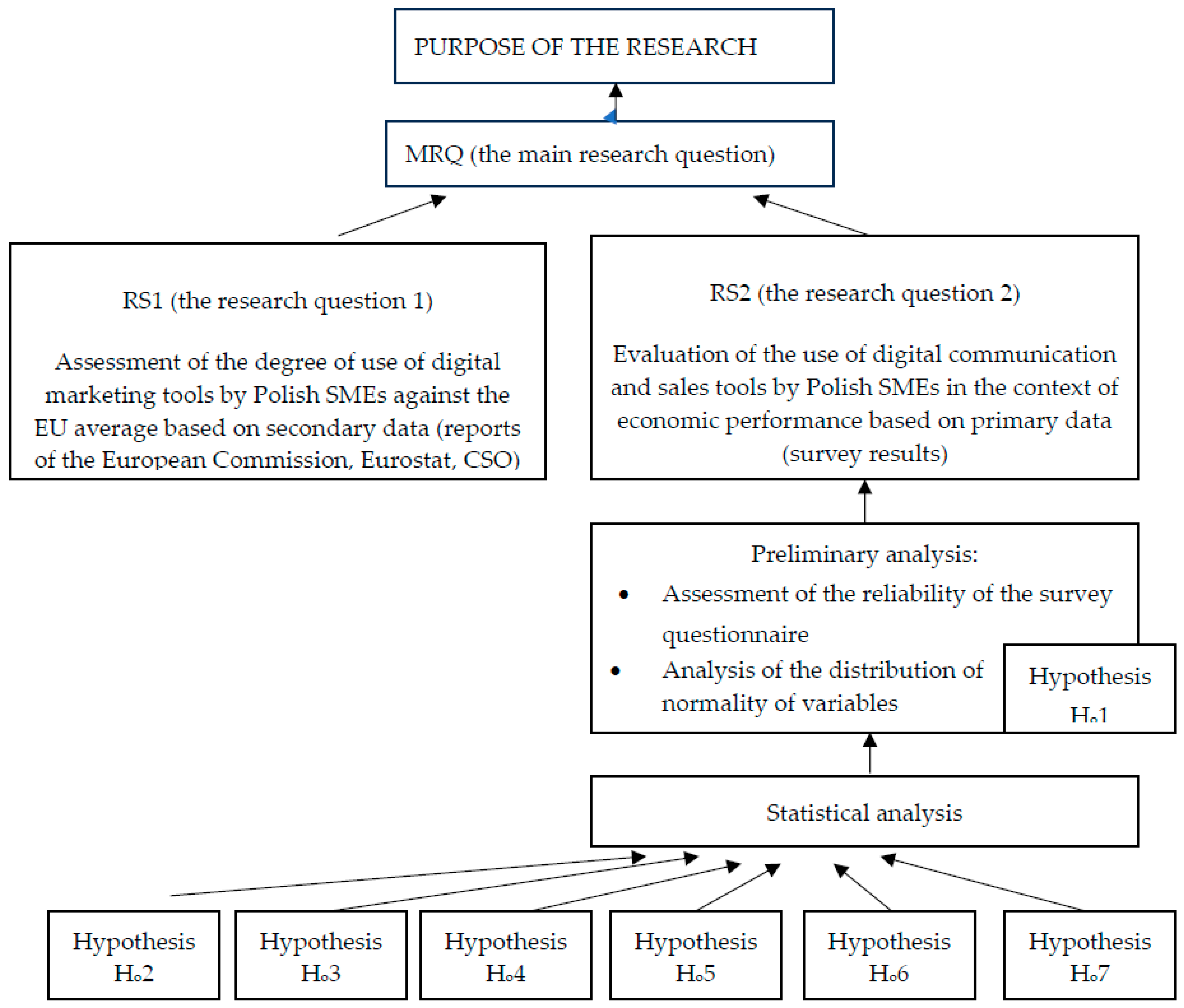
Figure 2.
Facilities offered by Polish SME websites (2021) Source: Own work based on: Społeczeństwo informacyjne w Polsce w 2022 r. GUS, Warszawa 2022. https://stat.gov.pl/obszary-tematyczne/nauka-i-technika-spoleczenstwo-informacyjne/spoleczenstwo-informacyjne/spoleczenstwo-informacyjne-w-polsce-w-2022-roku,2,12.html.
Figure 2.
Facilities offered by Polish SME websites (2021) Source: Own work based on: Społeczeństwo informacyjne w Polsce w 2022 r. GUS, Warszawa 2022. https://stat.gov.pl/obszary-tematyczne/nauka-i-technika-spoleczenstwo-informacyjne/spoleczenstwo-informacyjne/spoleczenstwo-informacyjne-w-polsce-w-2022-roku,2,12.html.
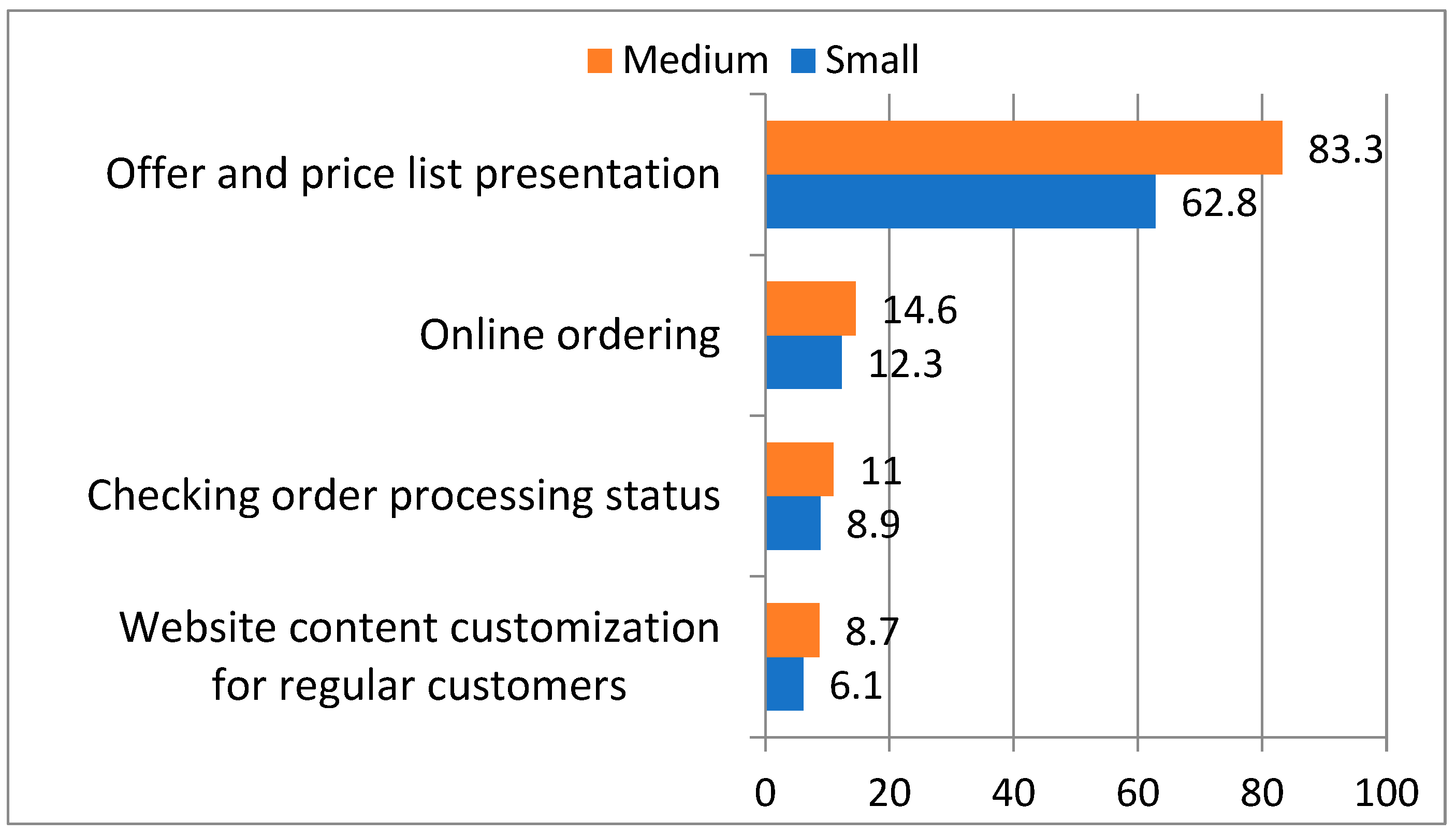
Figure 3.
Social media use by Polish SMEs in 2021 Source: Own work based on: Społeczeństwo informacyjne w Polsce w 2022 r. GUS 2022. https://stat.gov.pl/obszary-tematyczne/nauka-i-technika-spoleczenstwo-informacyjne/spoleczenstwo-informacyjne/spoleczenstwo-informacyjne-w-polsce-w-2022-roku,2,12.html.
Figure 3.
Social media use by Polish SMEs in 2021 Source: Own work based on: Społeczeństwo informacyjne w Polsce w 2022 r. GUS 2022. https://stat.gov.pl/obszary-tematyczne/nauka-i-technika-spoleczenstwo-informacyjne/spoleczenstwo-informacyjne/spoleczenstwo-informacyjne-w-polsce-w-2022-roku,2,12.html.
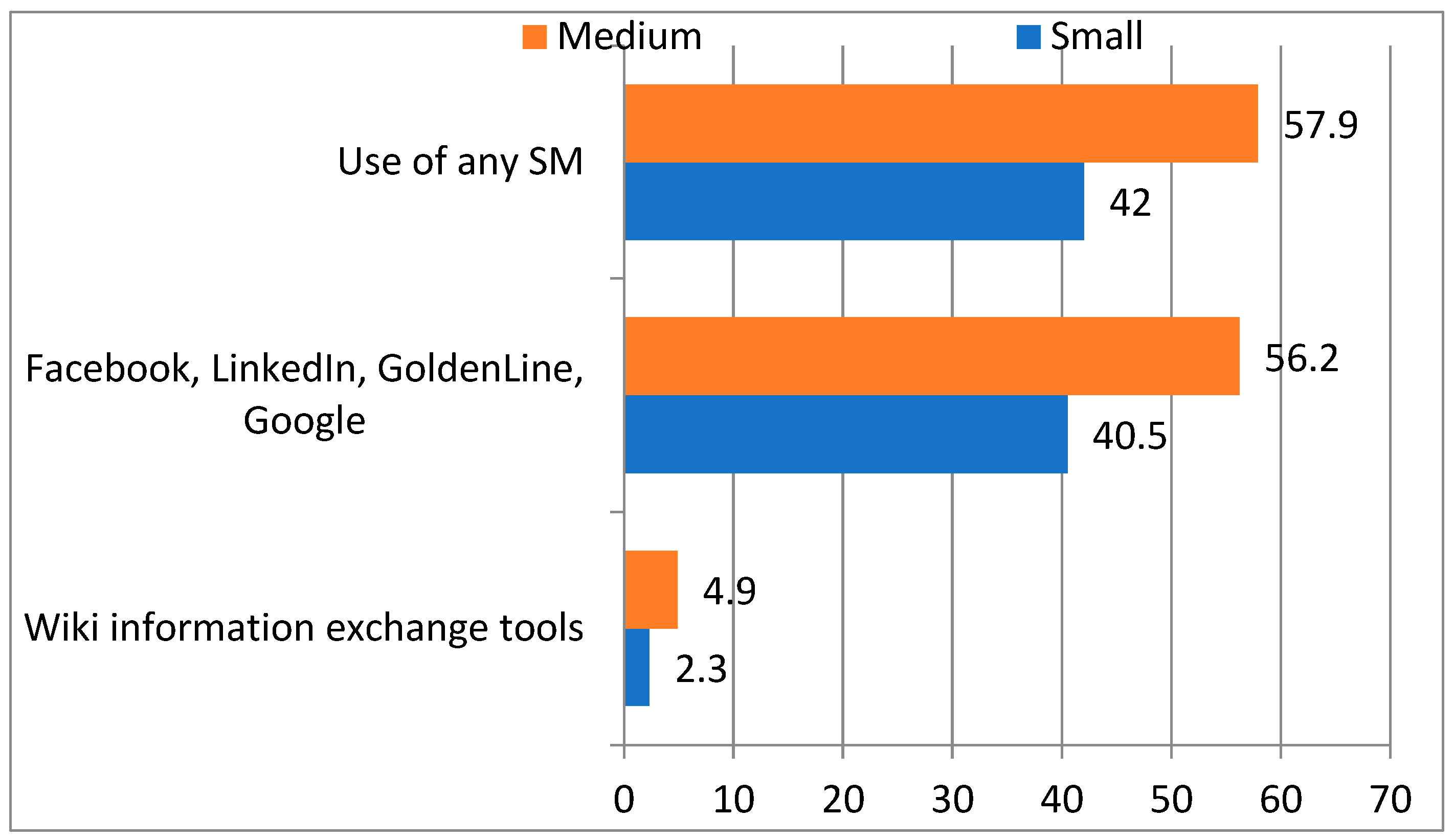
Figure 4.
IDT in Poland and EU in 2019–2022. Source: Own work based on: Poland in the Digital Economy and Society Index. European Commission, 2022. https://digital-strategy.ec.europa.eu/en/policies/desi-poland.
Figure 4.
IDT in Poland and EU in 2019–2022. Source: Own work based on: Poland in the Digital Economy and Society Index. European Commission, 2022. https://digital-strategy.ec.europa.eu/en/policies/desi-poland.
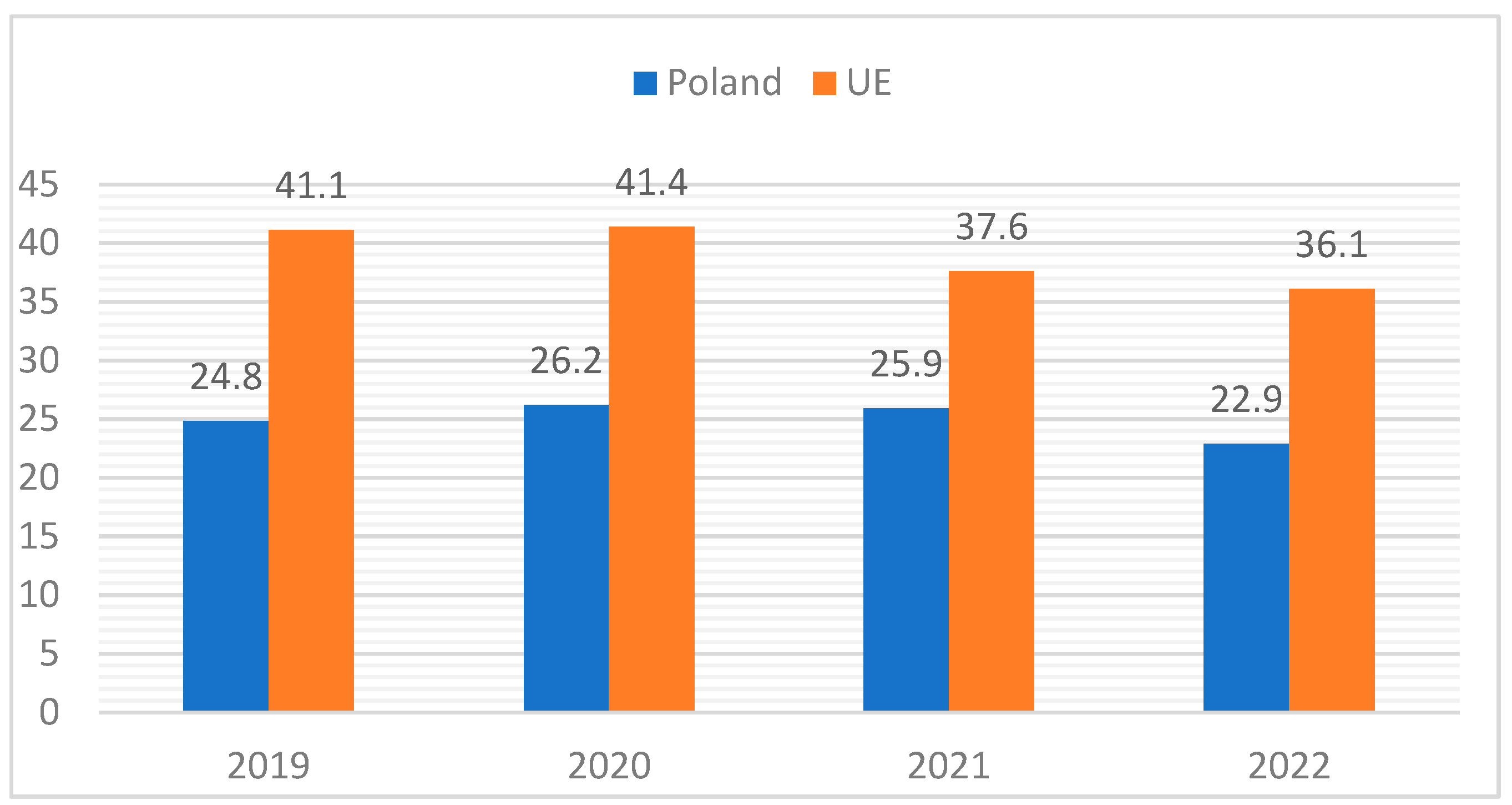
Figure 5.
Polish SMEs selling online when compared to EU in 2019–2022 Source: Own work based on: Poland in the Digital Economy and Society Index. European Commission, 2022. https://digital-strategy.ec.europa.eu/en/policies/desi-poland.
Figure 5.
Polish SMEs selling online when compared to EU in 2019–2022 Source: Own work based on: Poland in the Digital Economy and Society Index. European Commission, 2022. https://digital-strategy.ec.europa.eu/en/policies/desi-poland.
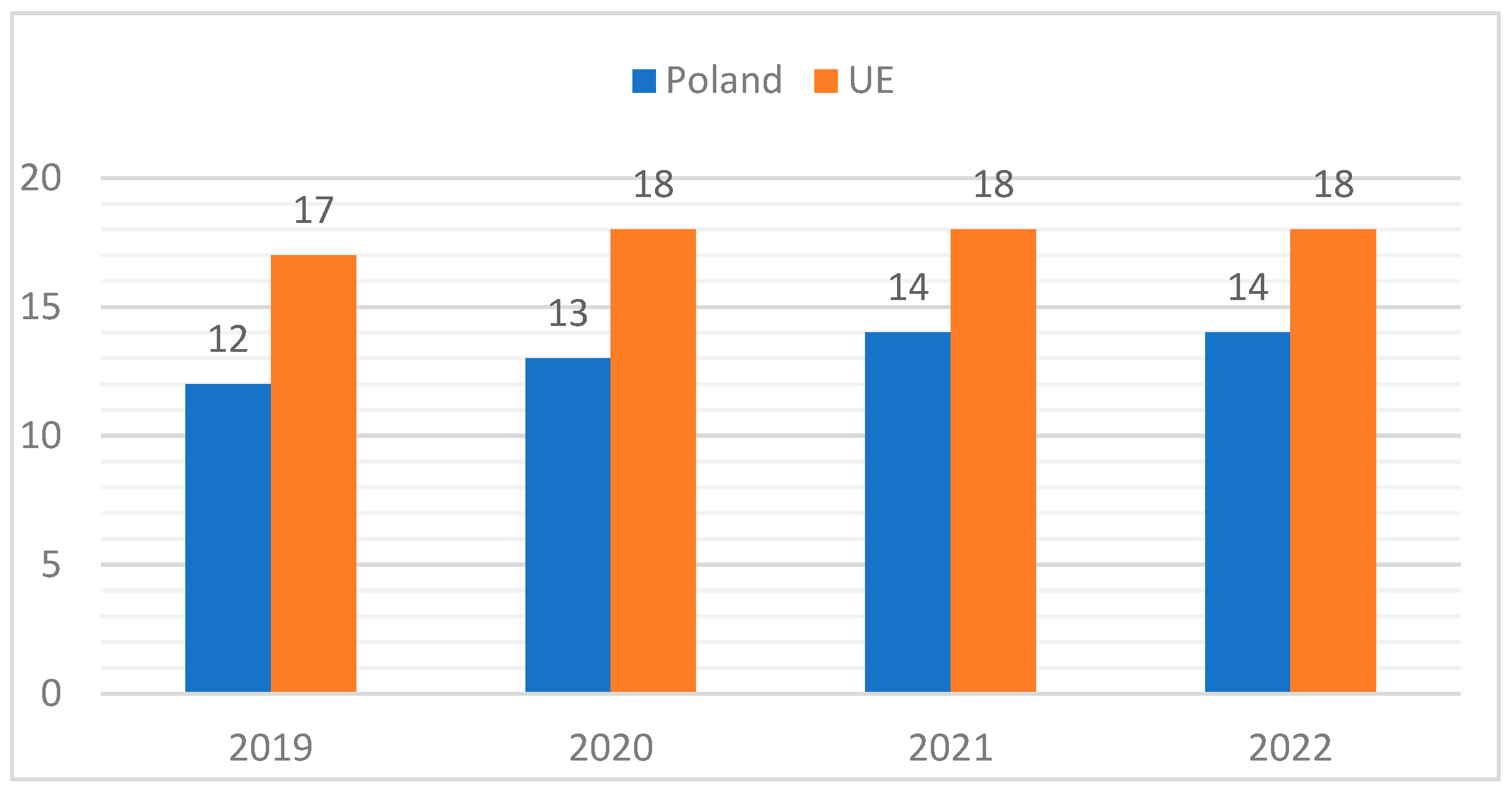
Figure 6.
Digital intensity level in Polish SMEs and EU, 2022. Source: Digitalisation in Europe – 2023 edition, Eurostat, https://ec.europa.eu/eurostat/web/interactive-publications/digitalisation-2023.
Figure 6.
Digital intensity level in Polish SMEs and EU, 2022. Source: Digitalisation in Europe – 2023 edition, Eurostat, https://ec.europa.eu/eurostat/web/interactive-publications/digitalisation-2023.
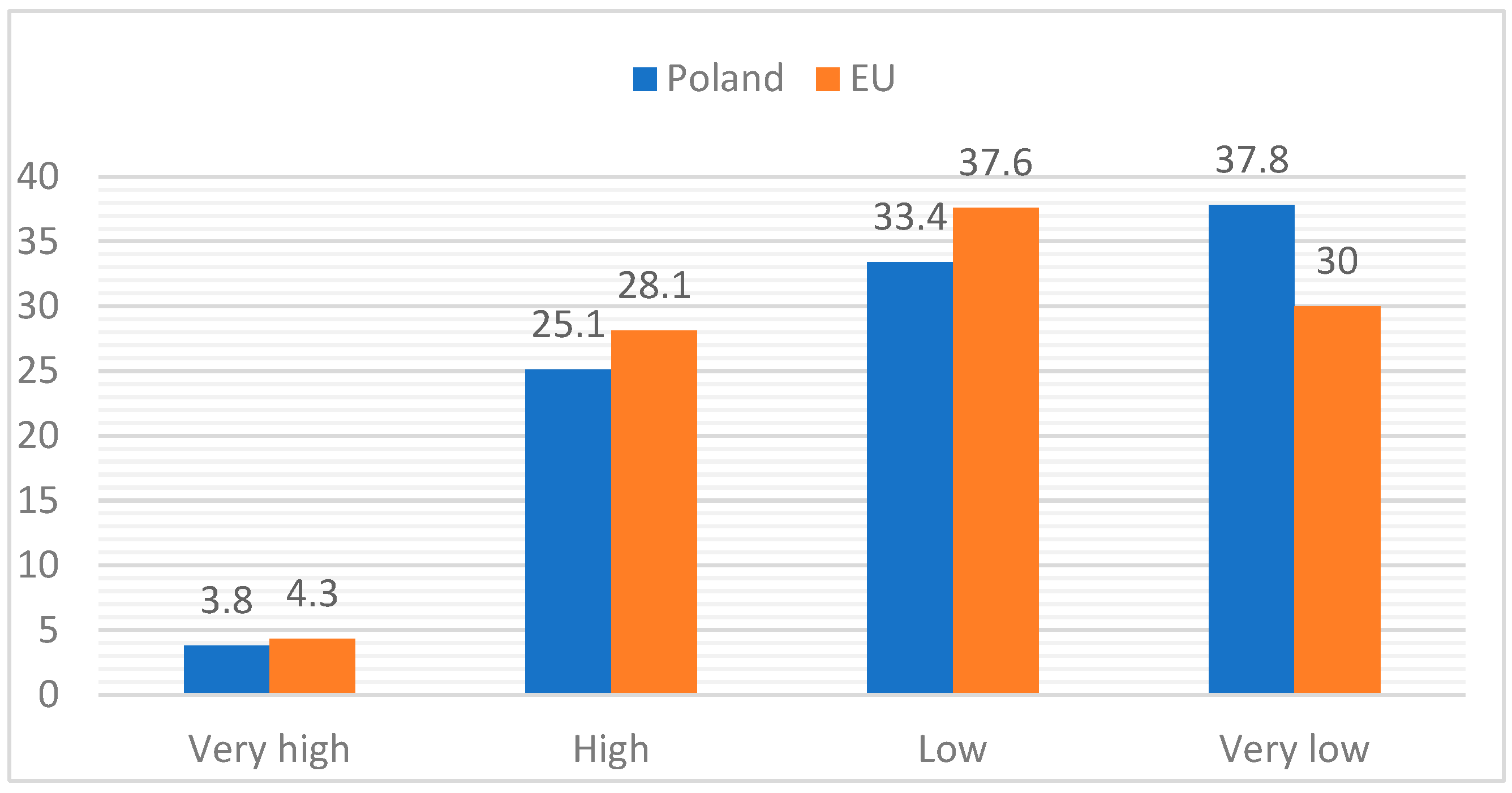
Figure 7.
Wykorzystanie zaawansowanych technologii przez polskie MSP na tle średniej dla UE. Sources: Cyfryzacja sektora MSP w Polsce. Związek Przedsiębiorców i Pracodawców, październik 2023. https://zpp.net.pl/wp-content/uploads/2023/11/02.11.2023-Raport-Cyfryzacja-sektora-MSP-w-Polsce.pdf.
Figure 7.
Wykorzystanie zaawansowanych technologii przez polskie MSP na tle średniej dla UE. Sources: Cyfryzacja sektora MSP w Polsce. Związek Przedsiębiorców i Pracodawców, październik 2023. https://zpp.net.pl/wp-content/uploads/2023/11/02.11.2023-Raport-Cyfryzacja-sektora-MSP-w-Polsce.pdf.
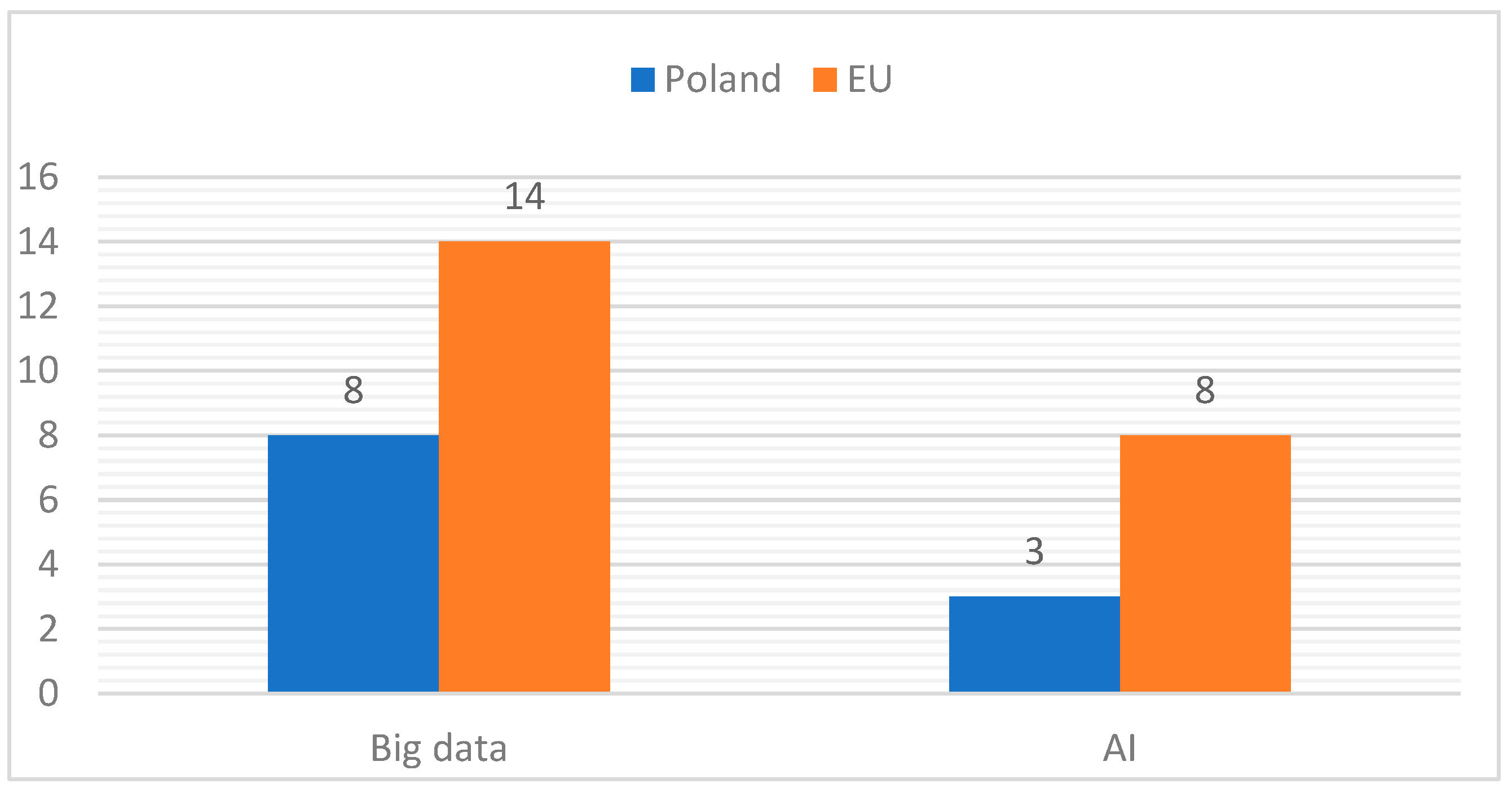
Table 1.
Research tools.
| Analysis type | Research tools |
| Analysis of statistical data Research Questions : RS 1 | |
| Comparative analysis of secondary data derived from reports by the European Commission, Eurostat and Statistics Poland | Deductive reasoning and structural analysis |
| Analysis of the survey results Research Question : RS 2 | |
| Preliminary analysis | |
| Assessment of the reliability of the survey questionnaire | Cronbach’s alpha test |
| Analysis of the distribution of normality of variables Verification of null research hypothesis H0 1 |
Kolmogorov-Smirnov test |
| Statistical analysis | |
| Verification of null research hypotheses | |
| H0 2; H0 4; H0 5 | Box-plots, Mann-Whitney U test |
| H0 3; H0 7 | Box-plots, ANOVA Kruskal-Wallis tests and Dunn’s post-hoc tests |
| H0 6 | Kendall's rank correlation coefficient/ MARSplines |
Table 2.
The use of selected Industry 4.0 tools by Polish SMEs.
| Industry 4.0 tools | Medium-sized companies | Small companies | |
|---|---|---|---|
| Cloud services | 33.5% | 19.2% | |
| CRM | 7.9% | 3.8% | |
| Internet of things | In general | 31.8% | 14.9% |
| Customer service | 5.1% | 1.7% | |
| Artificial Intelligence | In general | 5.0% | 1.9% |
| Marketing and sale | 1.7% | 0.9% | |
Source: Own work based on: Społeczeństwo informacyjne w Polsce w 2022 r. GUS 2022. https://stat.gov.pl/obszary-tematyczne/nauka-i-technika-spoleczenstwo-informacyjne/spoleczenstwo-informacyjne/spoleczenstwo-informacyjne-w-polsce-w-2022-roku,2,12.html; Raport o stanie sektora małych i średnich przedsiębiorstw w Polsce. PARP, Warszawa 2023, 66-69.
Table 3.
Kendall's rank correlation coefficient.
| Variable | Kendall's tau correlation. BD removed in pairs. Marked correlation coefficients are significant with p <0.05000 |
||
| Q14 | Q15 | Q16 | |
| Q1 | 0,081956 | -0,067188 | -0,100356 |
| Q2 | 0,117383 | 0,129314 | 0,103223 |
| Q3 | 0,028331 | 0,016375 | -0,000893 |
| Q4 | 0,002843 | 0,097389 | 0,126442 |
| Q5 | 0,015420 | 0,051675 | 0,074143 |
| Q10 | -0,112189 | -0,070817 | -0,073550 |
| Q11 | -0,024304 | 0,030237 | 0,015573 |
| Q12 | -0,006976 | 0,072175 | 0,052036 |
| Q13 | 0,049448 | 0,068068 | 0,088144 |
Table 4.
MARSplines results for dependent variables Q14, Q15, Q 16 and independent variables Q1,Q2,Q3,Q4,Q5, Q10, Q11, Q12, Q13.
Table 4.
MARSplines results for dependent variables Q14, Q15, Q 16 and independent variables Q1,Q2,Q3,Q4,Q5, Q10, Q11, Q12, Q13.
| Characteristics | Dependent variable | ||
|---|---|---|---|
| Q14 | Q15 | Q16 | |
| Model equation | Q14 = 3,98687048471834e+000 - 1,07316216029357e-001*max(0; Q10-1,00000000000000e+000) + 2,72355316354401e-001*max(0; Q2-4,00000000000000e+000) | Q15 = 3,37263580519805e+000 - 1,18537225996519e-001*max(0; 4,00000000000000e+000-Q2) - 6,01555038434376e-002*max(0; Q10-1,00000000000000e+000) | Q16 = 3,51939935571921e+000 - 7,21101480713554e-002*max(0; 4,00000000000000e+000-Q2) + 5,94604120550734e-002*max(0; Q4-1,00000000000000e+000) - 6,01464024944235e-002*max(0; Q10-1,00000000000000e+000) - 1,08129596432386e-001*max(0; Q1-1,00000000000000e+000 |
| Penalty | 2.000000 | 2.000000 | 2.000000 |
| Threshold | 0.000500 | 0.000500 | 0.000500 |
| GCV error | 1.128497 | 0.662174 | 0.675047 |
| Predictors | Number of references to each predictor | ||
| Q14 | Q15 | Q16 | |
| Q1 | 0 | 0 | 1 |
| Q2 | 1 | 1 | 1 |
| Q3 | 0 | 0 | 0 |
| Q4 | 0 | 0 | 1 |
| Q5 | 0 | 0 | 0 |
| Q10 | 1 | 1 | 1 |
| Q11 | 0 | 0 | 0 |
| Q12 | 0 | 0 | 0 |
| Q13 | 0 | 0 | 0 |
Table 5.
Summary of methods and results of research hypothesis verification.
| Null hypothesis | Method of verification | Result |
|---|---|---|
| H0 1 | Kolmogorov-Smirnov test | The null hypothesis was rejected, the alternative hypothesis was accepted |
| H0 2 | Mann-Whitney U test | The null hypothesis was rejected, the alternative hypothesis was accepted |
| H0 3 | ANOVA Kruskal-Wallis tests and Dunn’s post-hoc tests | The null hypothesis was rejected, the alternative hypothesis was accepted |
| H0 4 | Mann-Whitney U test | The null hypothesis was rejected, the alternative hypothesis was accepted |
| H0 5 | Mann-Whitney U test | The null hypothesis was accepted |
| H0 6 | Kendall's rank correlation coefficient/ MARSplines | Ambiguous results |
| H0 7 | ANOVA Kruskal-Wallis tests and Dunn’s post-hoc tests | The null hypothesis was rejected, the alternative hypothesis was accepted |
Disclaimer/Publisher’s Note: The statements, opinions and data contained in all publications are solely those of the individual author(s) and contributor(s) and not of MDPI and/or the editor(s). MDPI and/or the editor(s) disclaim responsibility for any injury to people or property resulting from any ideas, methods, instructions or products referred to in the content. |
© 2024 by the authors. Licensee MDPI, Basel, Switzerland. This article is an open access article distributed under the terms and conditions of the Creative Commons Attribution (CC BY) license (http://creativecommons.org/licenses/by/4.0/).
Copyright: This open access article is published under a Creative Commons CC BY 4.0 license, which permit the free download, distribution, and reuse, provided that the author and preprint are cited in any reuse.


