

Submitted:
11 August 2024
Posted:
14 August 2024
You are already at the latest version
Abstract
Given the conceptual confusion between resilience and sustainability in organizations in the literature, the present study reviews the 27-year global literature on resilience and sustainability in organizations to clarify the relationship between the two, and derive a framework as cutting-edge knowledge on how to ensure resilience and sustainability in organizations. Findings uncover five schools of thought: Sustainable Business Strategy, Predictive Analytics, Sustainable Supply Chain, Ecological Resilience and Sustainable Leadership. A cutting-edge framework, comprising sustainability practices, sustainability outputs, sustainability and resilience outcomes, is derived to guide future research and inform practitioners on how to ensure resilience and sustainability in their organizations.
Keywords:
resilience
; sustainability
; sufficiency economy
; sustainable leadership
; sustainable development
; corporate sustainability
1. Introduction
Sustainability and resilience in organizations have emerged as an important industrial strategic outlook. At the same time, the industry has also encountered concerns over sustainability and resilience due to the fast-paced nature of the environment. Sustainability and resilience are two distinct areas of research that have primarily been studied independently [1]. Due to the documented reciprocal effects, the study of the overlap between sustainability and resilience is still in its early stages, which hampers organizational leaders' ability to enhance their own corporate performance and likelihood of survival. Although few recent studies [2,3] have investigated the relationship between resilience and sustainability, they have not explored the entire collective body of knowledge on resilience and sustainability in organizations, and its underlying intellectual structure. Confusion about the concepts and implementation methods of sustainability and resilience in organizations also remains.
This study conducts a comprehensive analysis of the existing literature to analyze and evaluate the relationship between resilience and sustainability in organizations, focusing on key observations and trends in the knowledge domain. It begins by emphasizing the areas where knowledge is lacking, the contributions made, and the research questions raised. This is then followed by a description of the methodology employed to answer the questions. Findings as well as implications for researchers and practitioners are also discussed. Among them is a novel framework to improve the prospect of resilience and sustainability in organizations.
2. Knowledge Gaps, Contributions, and Research Questions
Scholars have interpreted organizational sustainability and resilience in a variety of ways. As a consequence, the phrases “sustainability” and “resilience” have been used in numerous different ways. While some define them as synonymous, others maintain that they are completely distinct and unconnected [4]. Marchese et al. [4] found that within the literature, there are three main management frameworks that govern the organization of sustainability and resilience. These frameworks include: (1) viewing resilience as a part of sustainability, (2) considering sustainability as a part of resilience, and (3) treating resilience and sustainability as distinct objects. The first contribution of the current study is to define "organizational resilience" and "organizational sustainability" more broadly in order to systematically direct worldwide research efforts, given the varied and occasionally contradicting viewpoints surrounding these concepts.
Both sustainability and resilience are employed to characterize a system [5]. This could be any system, from the global economy to the mental or physical health of a single individual. One commonality between sustainability and resilience is their shared focus on the long-term state and durability of a system or feature, both in the face of disturbances and under regular operating conditions [6]. Sustainability and resilience are both employed to characterize a highly dynamic system [5], and sustainability problems necessitate a dynamic approach [7]. Consequently, no existing framework/model [8,9,10,11] is dynamic, with the exception of the interim theory by Kantabutra and Ketprapakorn [11], which necessitates further development. We utilize the dynamic character of resilience and sustainability problems to direct our review, thereby addressing an additional gap.
Furthermore, there is a lack of understanding on the practical approaches for attaining resilience [8]. It is still uncertain how resilient organizations may be created, and to what degree this can be achieved [9]. Organizational resilience and sustainability are interconnected in the literature. Nevertheless, the existing organizational resilience models [8,9,10,11] solely focus on particular elements such as resilience processes, crisis management, and organizational growth, without considering sustainability performance. Therefore, it is necessary to develop a complete organizational resilience theoretical framework that includes overall sustainability [8]. While Kantabutra and Ketprapakorn [7] have proposed a new organizational theory of resilience to address the gap in the literature, the theory is currently in a preliminary stage and needs additional refinement. Additional information is required to elucidate the operational dynamics of organizational resilience in the ever-evolving business landscape. Specifically, there is a lack of information regarding the specific ways in which resilience is implemented on a daily basis within an organization to maintain the long-term viability of the company. This study addresses the lack of a resilience model for organizational leaders to ensure the sustainability of their businesses by proposing a model, as the cutting-edge knowledge derived from the present study.
Thus, the current study investigates the global body of knowledge on the relationship between resilience and sustainability in organizations by exploring its intellectual structure, identifying influential scholars, and trendy topics among scholars in the knowledge domain. Informed by these analyses, cutting-edge knowledge on organizational resilience and sustainability will be derived along with policy and managerial implications. It will conclude by outlining future research directions for scholars and research implications. The present study addresses the research questions (RQs) below.
RQ #1: Which scholars have had the most influence on the field of resilience and sustainability in organizations during the past 27 years?
RQ #2: What is the intellectual structure that defines the knowledge base on resilience and sustainability in organizations?
RQ #3: Which documents have had the most impact on the 27-year accumulation of knowledge on resilience and sustainability in organizations?
RQ #4: Which topics in the body of knowledge on sustainability and resilience in organizations are most interesting to scholars?
RQ #5: What is the cutting-edge body of the knowledge base on resilience and sustainability in organizations in response to the dynamic nature resilience and sustainability problems?
3. Organizational Resilience versus Sustainability
The idea of sustainability has been around for decades and has changed over the years [12]. An important factor in this development is the influence of many "intellectual and political streams of thought that have molded concepts of sustainability" [12] (p.3). Organizational sustainability is based on the idea of enhancing the ecological, social, and economic systems inside corporate operations [13]. Because sustainability ensures the company's continued operation and growth without jeopardizing its ability to meet future demands, it is an important guiding principle [14,15].
Sustainability is a complex term that can be interpreted differently in different fields, such as sustainable competitive advantage in strategic management or sustainable development in corporate sustainability [16]. However, there is an agreement on the economic, social, and environmental ramifications of this idea [17]. Wilson [18] defines organizational sustainability as an organizational management set of concepts that still recognizes the need for businesses to expand and be successful, but with a significantly stronger focus on the public reporting of the three domain outputs. Thus, we define organizational sustainability as an organization's leadership and management strategy that allows it to expand while also delivering social, environmental, and economic benefits.
Resilience is a notion that refers to the ability of complex adaptive systems to evolve and interact across different time periods and geographical areas [19]. Resilience has been recognized and explored in various fields, with each field emphasizing different parts of the notion. As a result, there are multiple definitions of resilience that are interconnected. Within the context of organizational resilience, social resilience encompasses more than just reacting to a singular catastrophe. It necessitates the continuous capacity to foresee and adjust to evolving conditions [20]. Although there is increasing interest among scholars and practitioners in organizational resilience, its conception is still in its nascent phase [8]. The idea of resilience has faced longstanding criticism due to its ambiguity and absence of a universally accepted definition [10]. Resilience, while still having some unanswered questions, is undeniably a result of the interactions within a dynamic system operating in a dynamic environment [21,22]. Based on a recent analysis conducted by Kantabutra and Ketprapakorn [7], the different notions of organizational resilience indicate that organizations possess the capacity to successfully navigate sudden environmental changes, ensuring not only their survival but also their prosperity. Organizational resilience, as described in this study, refers to an organization's capacity to improve its adaptability and buffering capability in order to efficiently address unexpected environmental changes. This enables the organization to recuperate and fortify its present condition by adaptively re-creating itself for the future in response to the evolving environment.
Given that organizational sustainability refers to the leadership and management approach adopted by a company to achieve growth while simultaneously producing positive social, environmental, and economic outputs, the company can do so only when it possesses an organizational capacity that enhances both adaptability and buffering capacity in response to sudden external changes, allowing the company to recover and reinforce its current structure by vigorously re-creating itself for the future in line with the surrounding changes. Therefore, resilience and sustainability in organizations are related in some complex ways because resilience capacity allows the organizations to be able to grow and concurrently deliver benefits to the society, environment and economy.
4. Methodology
The Integrated Systematic Literature Review technique (ISLR) [23], which is discussed in a step-by-step manner, is utilized in the present study. Initially, a rudimentary keyword search is performed, superseded by a comprehensive examination of existing literature to locate suitable literature that is pertinent to the topic. Subsequently, a bibliometric analysis is performed, which is then superseded by the identification of the primary findings derived from the analysis. Subsequently, the findings are analyzed and a theoretical framework is finally constructed, drawing on the significant literature identified through the bibliometric study. The study is concluded by addressing areas of limited understanding, difficulties, and potential avenues for future investigation.
The current study utilizes the Preferred Reporting Items for Systematic Reviews and Meta-analysis (PRISMA) to identify pertinent literature. This literature is then analyzed using bibliometric analysis to provide visual representation. Ultimately, the coding methodology is employed to examine and integrate the latest knowledge on organizational resilience and sustainability into a framework.
4.1. Preferred Reporting Items for Systematic Reviews and Meta-Analysis (PRISMA)
We adhere to the PRISMA criteria [24] when conducting a comprehensive evaluation of the literature on resilience and sustainability in organizations. The study utilizes published documents from the Scopus database, which is renowned for its credibility in the field of research [25]. According to Scopus, it is more comprehensive than other databases since it provides a greater amount of worldwide information (ranging from 50% to 230% more, depending on the location) compared to its closest competitor, especially in the social science subject. Furthermore, the co-citation analysis method, which will be elaborated upon later, enables the incorporation of significant documents that are not present in Scopus into the study.
A keyword search is implemented to identify documents from the Scopus database, followed by a search for published documents that are pertinent to the topics of resilience and sustainability in organizations. The following step is to conduct an initial literature review to identify the most frequently occurring keywords: "organizational resilience" or "corporate resilience" and "organizational sustainability" or "corporate sustainability." They are employed as in keywords, abstracts, and search titles.
Serving as the guidelines for the screening procedure, the inclusion/exclusion criteria are outlined in Table 1 below. Peer-reviewed journal articles in English are the sole focus of the investigation. To conduct a thorough literature assessment on resilience and sustainability in organizations, we maintain an indeterminate Scopus search timeframe to ensure that all pertinent articles are located, irrespective of their publication date. The initial article that Scopus identifies as being of interest was published in 1997. We are able to only look forward to July 2024, as our data capture occurred in that month.
Resulting in 552 documents, the search string is below.
(TITLE-ABS-KEY ( organizational AND resilience ) OR TITLE-ABS-KEY ( corporate AND resilience ) AND TITLE-ABS-KEY ( organizational AND sustainability ) OR TITLE-ABS-KEY ( corporate AND sustainability ) ) AND ( LIMIT-TO ( DOCTYPE , "ar" ) ) AND ( LIMIT-TO ( PUBSTAGE , "final" ) OR LIMIT-TO ( PUBSTAGE , "aip" ) ) AND ( LIMIT-TO ( SRCTYPE , "j" ) ) AND ( LIMIT-TO ( LANGUAGE , "English" ) )
Two researchers conduct a fundamental content analysis to verify the document's eligibility during the eligibility stage. In order to guarantee their relevance to sustainability and resilience in organizations, all abstracts are reviewed. Consensual decision-making between the two parties resolves any discrepancies. All documents are eligible. All eligible documents go through the bibliometric analysis, resulting in five documents for the final stage of framework development. Figure 1 depicts the overall screening process.
4.2. The Bibliometric Analysis
The descriptive statistics of the literature are presented using the bibliometric analysis. A science map is generated using the VOSviewer software version 1.6.18 [26,27]. A science map consists of nodes, each representing authors, documents, or keywords. A science map enables researchers to obtain a comprehensive understanding of research trends by analyzing word occurrences, co-citations, and citations. The units of analysis in the current investigation are the author and document. Citation analysis is used as a metric to assess impact when the number of unique article downloads is not available, as some publishers do not disclose this information [28].
The co-citation analysis approach is used to identify research fronts, as it is more precise than directly citing and using bibliographic coupling, and it produces coherent and distinctive results [29,30]. The co-citation approach, as recommended by Zupic and Cater [31], may be used to assess the associated characteristics and to visually represent the resulting framework of knowledge pertaining to resilience and sustainability in organizations. This can be achieved by examining the frequency at which a Scopus document is referenced by another Scopus or non-Scopus document.
The co-citation analysis is also employed to assess the relational features and structure of a knowledge base [31] by calculating the frequency with which a Scopus article has been cited by another article inside or outside the Scopus database. Ultimately, the keyword occurrence analysis reveals the "research front" and hot topics in the knowledge domain [29,31].
4.3. Cutting-Edge Knowledge: Framework Development
A framework is defined by its ontological, epistemological, and methodological assumptions, with each idea serving a specific purpose related to ontology or epistemology [32]. Ontological assumptions, as articulated by Guba and Lincoln [33], pertain to one's comprehension of the fundamental nature of knowledge, reality, existence, and action. The epistemological assumptions relate to understanding the fundamental nature of reality and the underlying mechanisms that govern its operation. The present study examines the ontological and epistemological assumptions that contribute to resilience and sustainability of organizations. A framework is not simply a collection of ideas, but rather a meticulously structured system in which each thought serves a crucial function. Miles and Huberman [34] (p.440) define a conceptual framework as one that "lays out the key factors, constructs, or variables, and presumes relationships among them". We use this framework concept to review relevant literature.
In order to ascertain the most current and cutting-edge knowledge in the domain of resilience and sustainability in organizations, we initiate the process by gathering relevant data. Using the prior bibliometric analysis, we have determined the authors and their papers that are related to the topic. Subsequently, these papers serve as the input for the last stage. To initiate the development of an organizational resilience and sustainability framework, performing a thorough analysis of the academic literature is crucial. This method necessitates employing a methodical, clear, and replicable strategy to identify, assess, and assess the existing corpus of documented research [35]. According to Cooper [36], linking relevant research studies helps to identify current achievements in a particular field and highlight important challenges that need to be resolved. A preliminary evaluation of the articles' contents is performed to determine their suitability for inclusion or exclusion. An article must satisfy two distinct requirements in order to be eligible for inclusion. Firstly, the source must come from a peer-reviewed publication, which means it has been carefully evaluated by professionals in the relevant field. Furthermore, the article must specifically address the topics of resilience and sustainability within organizational contexts.
Considering that a framework is a structure that encompasses the three essential components of a fundamental theory - "what," "how," and "why" - and is a form of theory [37], we employ the theory building approach when developing the framework to ensure resilience and sustainability of organizations. During the process of theory-building, many plausible, logical, empirical, and/or epistemological claims [37] are analyzed and assessed, resulting in the identification of new themes. Since theory creation is an ongoing process, the suggested framework has the potential to be enhanced in the future by theorists who encounter new relevant information [38]. Furthermore, theorizing is specifically defined as the process of creating new ideas or concepts that can be tested through empirical research [38]. Therefore, a set of essential theoretical statements that propose research inquiries and generalizations is formulated to direct future study [39]. Finally, a framework for organizational resilience and sustainability is constructed as a rhetorical method to generate insights.
We use the coding process to find new themes in the articles we have identified as part of the theory-building process. To find the knowledge parts, the coding method [40] is used. This method first looks for themes that run through all the articles that have been identified. It is done by reading each identified article each and every line, as well as each and every paragraph [41]. After that, we put these codes into groups of ideas that are linked. These are called "open codes." There are often more than one open code during the open coding process [42]. The researchers have to put together open codes that are closely linked and combine to form a single set of main ideas [41]. Resilience and sustainability are definitely linked to the main focal core codes. This comes up easily during the coding process because of the search keywords that are used. All of the influential core codes are interconnected with the primary focal core codes in some manner. The researchers must determine the connections between the influential and focal core codes [42], utilizing the existing literature. These influential core codes are fundamentally shaping notions towards the focal core codes.
Theorists have used several ways to name the resulting codes or constructs [43]. Nevertheless, we strive to employ an "established construct" approach [43] to the greatest extent in our work, facilitating comprehension and tracking of knowledge advancement by scholars. After assigning names to all constructions, we determine the link between them. During this phase, the process of conceptualizing is structured and causality is established, bringing about the development of a framework. The framework is underpinned by theoretical assumptions that are rooted in fundamental psychological, economic, or social dynamics. These assumptions serve as a basis for selecting components and establishing causal links.
5. Findings
In this section, the findings are presented and discussed to address the research questions. The results of the author and document co-citation and citation analyses are presented, preceded by a discussion of the conclusions from the co-occurrence study.
5.1. Citation and Co-Citation Analyses
In order to address RQ #1, we analyze the citations and co-citations of authors and documents, as described and elucidated in the following sections.
5.1.1. Analyses of Author Citation and Co-citation
This section identifies prominent scholars on resilience and sustainability in organizations by bibliometric analysis [44]. It reveals the ranking of researchers based on the amount of relevant publications and citations, as well as their influence and the clusters of thought they belong to.
According to the findings, Ivanov, D. is the top cited author in this knowledge domain with 703 citations, while the most productive authors are Linnenluecke, M.K. and Wamsler, C., each with three documents.

Table 3.
Top 10 authors of the organizational resilience & sustainability knowledge domain ranked by co-citations, 1997–July, 2024.
Table 3.
Top 10 authors of the organizational resilience & sustainability knowledge domain ranked by co-citations, 1997–July, 2024.
| Rank order | Author | Co-citations |
|---|---|---|
| 1 | Folke, C. | 172 |
| 2 | Ivanov, D. | 146 |
| 3 | Holling, C.S. | 127 |
| 4 | Walker, B. | 112 |
| 4 | Bansal, P. | 90 |
| 5 | Gunasekaran, A. | 88 |
| 6 | Sarkis, J. | 86 |
| 6 | Sutcliffe, K.M. | 83 |
| 7 | Ringle, C.M. | 82 |
| 8 | Sarstedt, M. | 80 |
The top co-cited author in the knowledge domain of resilience & sustainability in organizations is Folke, C. with 172 co-citations. Based on the author citation and co-citation analyses, it is evident that Ivanov, D., Bansal, P., and Sarkis, J. are the most influential figures in the field of knowledge related to the connection between resilience and sustainability in organizations. This is because they appear on both rankings, indicating their influence in this specific knowledge domain and its underlying conceptual foundation.
The author's co-citation map in Figure 2 reveals the intellectual structure of the organizational sustainability and resilience knowledge domain. It identifies five key clusters that represent different schools of thought in this field, the answer to RQ #2.
There are five different schools of thought that arise when discussing resilience and sustainability in organizaions, each of which provides a different perspective on the relationship between resilience and sustainability in organizations: Sustainable Business Strategy (the red cluster), Predictive Analytics (the green cluster), Sustainable Supply Chain (the dark blue cluster), Ecological Resilience (the yellow cluster) and Sustainable Leadership (the purple cluster). The top-three scholars for each school are shown in Table 4 below.
The first red cluster, spearheaded by Bansal, P., Linnenluecke, M.K., and Sutcliffe, K.A., stands as the most extensive, comprising 56 researchers. The green cluster, which consists of 50 scholars, is led by Ringle, C.M., Sarstedt, M., and Hair, J.F. It is the second largest cluster. The third largest cluster, consisting of 36 scholars, is led by Ivanov, D., Gunasekaran, A., and Sarkis, J., and is represented by the color dark blue. The fourth cluster, highlighted in yellow, comprises 35 scholars, with Folke, C., Holling, C.S., and Walker, B. serving as the group's leaders. The purple cluster's final school of thought consists of nine scholars, with Kantabutra, S., Avery, G.C., and Freeman, R.E. leading the group.
5.1.2. Analyses of Document Citation and Co-citation
To find the answer to RQ#3, key documents on resilience and sustainability in organizations are identified through the bibliometric analysis [44]. Clearly, seven out of the first ten most cited articles (Table 5) recognize the relationship between resilience and sustainability. Only two focuses on resilience alone, and one on sustainability. In terms of sustainable development domain, seven out of ten focus on the economy, one on the society and environment, and one on the environment. The top cited document is authored by Fiksel, J., the third most cited author on the list of top cited authors. The second most cited document is written by Ortiz-de_Mandojana, N. and Bansal, P., who are ranked as the fourth most frequently cited authors on the list of highly cited authors. The third most cited document is written by Ivanov, D., who is one of the most frequently cited authors on the list of highly cited authors.
In terms of document co-citation (Table 6), eight of the first ten most co-cited articles focuses on resilience alone, one on sustainability and one on both resilience and sustainability. In terms of sustainable development domain, the economy has dominated the ranking of top co-cited documents with only one document on the environment. The top co-cited document focusing on the environment is authored by Holling, C.S. who is ranked 3rd in the list of top author co-citations. The second most co-cited article is authored by Linnenluecke, M. K., who is the fifth most cited author in the list of top author citations. The article produced by Ortiz-de-Mandojana, N. and Bansal, P. is ranked third in terms of co-citations. This study is regarded as prominent in the field of resilience and sustainability in organizations due to its inclusion in both document citation and co-citation analyses. It holds significant influence in the particular field of knowledge and its fundamental conceptual basis. Ortiz-de-Mandojana, N. and Bansal, P. belong to the Sustainable Business Strategy school of thought.
5.2. Co-Occurence Analysis
The co-occurrence analysis is used to provide the answer to RQ#4. It incorporates thematic specialization into the knowledge domain of organizational resilience and sustainability studies, in addition to citation analysis [31]. The search for co-occurrence is established to leverage "Author keywords" as the criterion, with a minimum threshold of five occurrences of a term. This decision is made because authors are considered the most trustworthy authority in determining the relevance of their reports to the subjects of resilience and sustainability in organizations.
Out of a total of 2,017 keywords, only 55 satisfy the threshold criteria. In Figure 3, the co-word map illustrates the degree of focus on several subjects pertaining to resilience and sustainability in organizations. A connecting line symbolizes the strength of a link, while the thickness of a node reflects the relationship between key-word nodes.
Shown in Table 7, the top ten frequently co-occurring keywords from the analysis are sustainability (157 occurrences), resilience (150 occurrences), organizational resilience (41 occurrences), Covid-19 (37 occurrences), sustainable development (27 occurrences), corporate social responsibility (24 occurrences), climate change (22 occurrences), leadership (16 occurrences), corporate sustainability (14 occurrences), risk management (12 occurrences), and supply chain resilience (12 occurrences), revealing that these keywords are subjects of significance among scholars studying resilience and sustainability in organizations.
Considering the dynamic nature of the research front, scholars are known to promptly adapt to changes in the environment, particularly when new knowledge is introduced. Zupic and Cater [31] and Boyack and Klavans [29] argue that the science map can effectively depict the "research front" in the knowledge base of resilience and sustainability in organizations. Therefore, the science mapping is created to illustrate the most trendy subjects and cutting-edge research areas, as depicted in Figure 3.
In terms of recency, the keyword co-occurrence map indicates that scholars conducted research on climate change prior to 2019. Given scholarly interest in climate change, resilience emerged as a keyword around mid-2019. Sustainability and organizational resilience have become popular among scholars and emerged as a keyword approximately the same time around early 2020. The trendiest topics are Industry 4.0 and Industry 5.0, emerging around early 2023.
6. Discussion of the Findings
According to the author citation analysis, Ivanov, D. is the top cited author in this knowledge domain with 703 citations, while the most productive authors are Linnenluecke, M.K. and Wamsler, C., each with three documents. This analysis result suggests that Ivanov, D. is the preeminent scholar in the specialized domain of resilience and sustainability in organizations. In terms of author co-citation analysis result, we can draw that Folke, C. is the preeminent scholar in the foundational knowledge that forms the basis of the field of resilience and sustainability in organizations. Looking closely into the profiles of Ivanov, D. and Folke, C., these results are logical since Ivanov, D. has studied supply chain resilience and Folke, C. has studied ecological resilience. Supply chain is a major area of sustainability research [63,64], while ecological resilience is fundamental to resilience and sustainability in organizations since human activities such as the decrease in biodiversity, the exploitation of natural resources, pollution, and changes in land use have a negative impact on ecological resilience.
The author citation and co-citation analyses help us figure out which authors are the most important in the domain of resilience and sustainability in organizations by looking at authors who have influenced both the specific knowledge body on resilience and sustainability in organizations via author citation analysis and the underpinning conceptual foundation of the knowledge body via author co-citation analysis. Three authors, namely Ivanov, D., Bansal, P., and Sarkis, J., are included on both the lists of top author citation and co-citation analyses, collective research of which will be discussed and used to inform the development of a novel framework in the following Framework Development section.
The author's co-citation analysis identifies five distinct schools of thought that serve as the basis for the knowledge domain of resilience and sustainability in organizations. The Predictive Analytics school of thought suggests that the knowledge domain is predominantly empirical and quantitative, which is not a surprise since scholars have been trying to find a universal approach to organizational resilience and sustainability. All of the top three co-cited scholars focus on Partial Least Squares Structural Equation Modeling (PLS SEM). The Ecological Resilience school of thought is logically located as a foundation for the knowledge domain since human activities certainly affect the ecology, and thus resilience and sustainability of the organizations they are in. It must be noted that these two schools of thought are outside the organizational boundary, unlike the other three schools of Sustainability Business Strategy, Sustainable Supply Chain and Sustainable Leadership that are within the organizational boundary, the objective of the present study.
Looking more closely into the Sustainable Business Strategy School of Thought, Bansal, P. has focused her work on sustainable business strategy, while Linnenluecke, M.K. and Sutcliffe, K.A. have focused their work respectively on organizational adaptation uncertainty and risk management within an organization. It must be noted that Sutcliffe, K.A. is not contained in our Scopus data set, the advantage of co-citation analysis that can bring in an influential author outside the Scopus data set.
The School of Sustainable Supply Chain is the third largest cluster within this knowledge domain, which is expected since Supply Chain Management is a major area of sustainability research [63,64]. Supply chain affects a wide range of stakeholders, a reason it is pivotal to ensuring a sustainable and resilient organization. Ivanov, D. focuses on supply chain resilience, while Gunasekaran, A., and Sarkis, J., respectively, concentrate on supply chain management and ecological supply chain management. Similarly, it must be noted that Gunasekaran, A. is not contained in our Scopus data set. As the advantage of co-citation analysis, he is brought into the present study because his work on supply chain management is fundamental to the knowledge domain of resilience and sustainability in organizations.
As the smallest school of thought on Sustainable Leadership, this cluster comprises Kantabutra, S., Avery, G.C., and Freeman, R.E. Kantabutra, S. and Avery, G.C. have focused their research on Sustainable Leadership that emphasizes the necessity of taking care of a whole range of stakeholders. This explains why Freeman, R.E. is in this same cluster since he is well known of his Stakeholder theory. Sustainable Leadership brings about sustainability and resilience in organizations. It must be noted that Freeman, R.E. is not contained in our Scopus data set. He appears in the author co-citation analysis because his Stakeholder theory has influenced the knowledge domain of resilience and sustainability in organizations.
In terms of the distance among the clusters, the schools of Predictive Analytics and Sustainable Supply Chain are located closely, suggesting that Sustainable Supply Chain scholars have significantly used PLS SEM. The Sustainable Business Strategy and the Sustainable Leadership schools of thought are located far away from each other because the Sustainable Business Strategy focuses on a high-level strategy for organizational adaptation, while the Sustainable Leadership focuses on a holistic approach to ensure both organizational resilience and sustainability. Both schools are also located far away from the Sustainable Supply Chain school because they are not focusing on just one function, but the whole organization. The Sustainable Supply Chain school is also unrelated to the Ecological Resilience school, which suggests a new research direction for Supply Chain scholars to relate their future research to ecology to ensure resilience and sustainability in their organizations.
In terms of author keyword occurrence analysis, it is expected that both resilience and sustainability dominate the ranking with Sustainability and Resilience as the top two. Noticeably, Covid-19 appears forth on the ranking, suggesting that scholars must have paid more attention to the resilience and sustainability phenomenon during or after the Covid-19 pandemic. Among the top keywords, we can also group them into three categories of resilience, sustainability and others: Resilience (150), Organizational Resilience (41), and Supply Chain Resilience (12); Sustainability (157), Sustainable Development (27), and Corporate Sustainability (14); and Covid-19 (37), Corporate Social Responsibility (24), Climate Change (22), Leadership (16) and Risk Management (12).
In terms of recency, climate change was the topic of study in 2018. It also appears that scholars have investigated resilience before sustainability, starting in late 2019. Later, sustainability emerged in mid-2020 and organizational resilience in early 2021 as a topic of study. Relatively recent is Covid-19 as a topic of study in mid-2022, followed by digital transformation, industry 4.0 and industry 5.0 in 2023. Other keywords appear to be an approach to achieve resilience and sustainability in organizations, including sustainable leadership, risk management, systems thinking, sustainability management and ESG.
7. Cutting-Edge Knowledge in the Organizational Resilience & Sustainability Knowledge Domain
In this section, we select only scholars from the three schools of thought on Sustainable Business Strategy, Sustainable Supply Chain and Sustainable leadership, given the objective of the study to explore the knowledge domain of resilience and sustainability within an organization. The other two schools are not within the organizational boundary.
Based up the author citation and co-citation analyses, we have identified Ivanov, D., Sarkis, J., Bansal, P. and Linnenluecke, M.K., Avery, G.C. and Kantabutra, S. as the authors who are most influential in the knowledge domain of resilience and sustainability in organizations, as evidenced by their rankings in both author citation and co-citation analyses, an indication of their influence over the specific body of knowledge in the organizational resilience & sustainability knowledge domain and its underpinning conceptual foundation. Therefore, we explore their collective work (see Table 8) in this knowledge domain and derive a cutting-edge knowledge on resilience and sustainability in organizations in this section. In total, we analyze 14 articles, including the most influential document by Bansal, P. identified earlier.
To provide the answer to RQ#5, from the 14 articles, we have identified seven articles that are relevant to creating a holistic framework to ensure resilience and sustainability in organizations. The articles by Ivanov, D. and Sarkis J. are specific to supply chain management, while the articles by Linnenluecke, M.K. are specific to climate change. Given their highly specific nature, they are excluded in the subsequent framework development. Finally, we include only articles by Bansal, P., Avery, G.C., and Kantabutra, S. because they are relevant to developing a holistic framework to ensure resilience and sustainability in organizations.
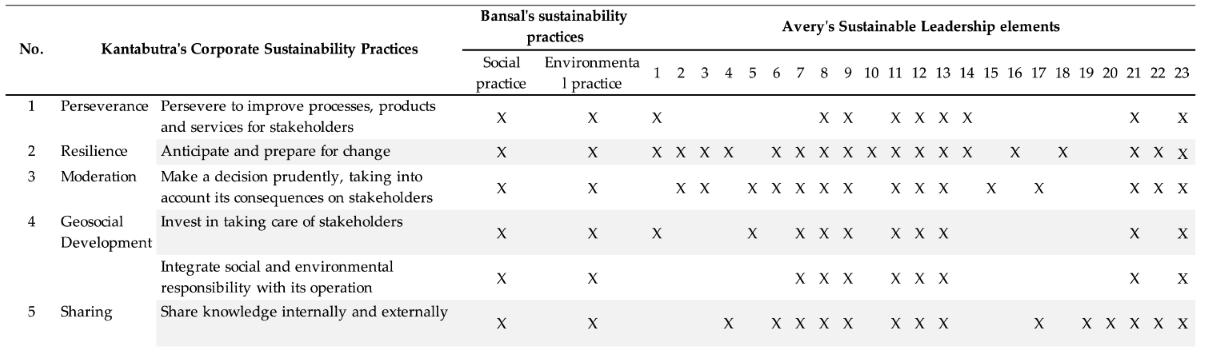
Based on the articles from Bansal, Avery and Kantabutra, the coding process reveals four emerging themes of sustainability practice, sustainability output, sustainability outcome and resilience outcome. The corporate sustainability practices of Perseverance, Resilience Development, Moderation, Geosocial Development, and Sharing, as well as the 23 sustainable leadership practices, give rise to the sustainability practice theme, as shown in Table 9. The sustainability output theme emerges from the results of the corporate sustainability practices and sustainable leadership practices, including economic/ financial performance, environmental performance and social performance outputs. The sustainability outcome theme emerges from the results of delivering the sustainability outputs, including brand & reputation, long-term shareholder value and long-term stakeholder return. Finally, the resilience outcome theme emerges from the results of delivering sustainability outputs, including market leadership, financial volatility, survival rates and crisis endurance.
In our current investigation, outputs are tangible consequences that are documented in a variety of formats, including a management plan, indicating the conclusion of the decision-making process. Outcomes, in this context, specifically denote specific changes in human perceptions or future behaviors that directly result from the outputs. These changes are considered intermediate effects within a mid-range time span.
Informed by the identified articles and the broader literature [73], we attempt to understand the relationships between the emerged constructs. The triple bottom line outcomes, which include economic/financial performance, environmental performance, and social performance, are the consequence of the sustainability practices of Perseverance, Resilience Development, Moderation, Geosocial Development, and Sharing, which in turn leads to sustainability outcomes of improved brand and reputation, increased shareholder value over the long run, and enhanced returns for stakeholders over the long term. These sustainability outputs also lead to resilience outcomes of improved market leadership, financial volatility, survival rates and crisis endurance. It must be noted that the outputs and outcomes, once successfully delivered, are fed back to strengthen the sustainability practices as informed by the system theory of corporate sustainability [73]. On the other hand, if not successful, the sustainability practices are adjusted to ensure another successfully delivery of outputs and outcomes. This feedback loop is included in response to the wicked sustainability problems.
This framework illuminates the perplexing relationship between organizational resilience and sustainability in the literature by illustrating that organizational resilience is a consequence of the deliverance of sustainability outputs following the implementation of sustainability practices. In addition, resilience outcomes can improve the sustainability outcomes. The final framework and its relationships are shown in Figure 4 below.
Based on the framework, the following propositions can be developed.
P1: The sustainability outputs of economic/financial performance, environmental performance, and social performance are achieved through the sustainability practices of Perseverance, Resilience Development, Moderation, Geosocial Development, and Sharing.
P2: The sustainability outcomes of enhanced brand and reputation, long-term shareholder value, and long-term stakeholder return are the result of the sustainability outputs of economic/financial performance, environmental performance, and social performance.
P3: The sustainability outputs of economic/ financial performance, environmental performance and social performance lead to the delivery of resilience outcomes of improved market leadership, financial volatility, survival rates and crisis endurance
P4: The resilience outcomes of improved market leadership, financial volatility, survival rates and crisis endurance lead to the delivery of sustainability outcomes of enhanced brand & reputation, long-term shareholder value, and long-term stakeholder return
P5: The sustainability practices of Perseverance, Resilience Development, Moderation, Geosocial Development, and Sharing are reinforced or adjusted by the sustainability outputs of economic/financial performance, environmental performance, and social performance.
P6: The sustainability practices of Perseverance, Resilience Development, Moderation, Geosocial Development, and Sharing are reinforced or adjusted as a result of the sustainability outcomes of enhanced brand & reputation, long-term shareholder value, and long-term stakeholder return.
P7: The resilience outcomes of improved market leadership, financial volatility, survival rates and crisis endurance lead to reinforcing or adjusting the sustainability practices of Perseverance, Resilience Development, Moderation, Geosocial Development and Sharing
8. Future Research Directions
Initially, it is possible that future studies will determine the measured items for the following constructs: sustainability practices: Perseverance, Resilience Development, Moderation, Geosocial Development, and Sharing; sustainability outputs: financial, environmental, and social performance; sustainability outcomes: improved market leadership, financial volatility, survival rates, and crisis endurance; and resilience outcomes: enhanced brand and reputation, long-term shareholder value, and long-term stakeholder return. These measured items will help future researchers in terms of both developing a questionnaire and conducting a quantitative study, and interview questions and conducting a qualitative study to explore a relationship.
Clearly, future research can explore the seven propositions. They can explore whether and how the achievement of the sustainability results is facilitated by the five sustainability practices. In addition, since the relationship between the sustainability outputs and outcomes are rarely explored in the literature, future research can explore whether and how sustainability outcomes are derived from sustainability outputs. The results will be a significant contribution to the field of sustainable development. Future research can also explore if and how the relationship between sustainability outcomes and resilience outcomes exist over time.
Finally, future studies can investigate the links between the constructs of sustainability practices, sustainability outputs, sustainability outcomes and resilience outcomes quantitatively whether they exist and statistically significant, including the reciprocal ones.
9. Managerial Implications
Although the Resilience & Sustainability in Organization (RSiO) framework has just been developed, it is informed by the existing theoretical and empirical literature. Thus, some managerial implications can be drawn.
First, practicing corporate leaders may adopt or adapt the five Corporate Sustainability practices. They may compare their existing practices against the five sustainability practices or the 23 sustainable leadership elements. After the comparison, they may have to adjust or add new sustainability practices that are not being implemented.
Many companies have already adopted the UN Sustainable Development Goals (SDGs) as part of their sustainability reporting. These SDGs are actually sustainability outputs. For those who have not adopted the SDGs, they can start by identifying relevant economic/financial, environmental and social indicators, collecting the data, and monitoring and managing them.
In terms of sustainability outcomes, these can be done through conducting a brand awareness survey among stakeholders annually. They should identify a broad range of stakeholders who are indirectly or directly affected by their business operation, including shareholders, customers, surrounding community members, academics, journalists, local government, and request them to respond to the survey. The survey should contain measured items about stakeholder perception toward their company brand and reputation and how the company benefits them.
It is quite challenging to capture resilience outcomes of market leadership, crisis endurance, financial volatility and survival rates. As for the ability to maintain a market leadership, practicing corporate leaders can observe their market share over time if they can maintain a significant market share. Similarly, the ability to endure a crisis and survival rates can be observed over time. As for financial volatility of listed companies, practicing corporate leaders can observe their share price over time if it is moving (both up and down) quickly and steeply, and record its frequency per year.
In continue to improve both resilience and sustainability in their organization, practicing corporate leaders should, once an output or outcome is delivered, revisit their sustainability practices to see if there is a room for improvement or if a practice should be confirmed as a right practice to continue.
10. Conclusions
We have provided the answer to RQ #1, Ivanov, D., Bansal, P. and Sarkis, J. are the most influential in the knowledge domain of the relationship between resilience and sustainability in organizations. We have also provided the answer to RQ #2. The knowledge base is characterized by five distinct schools of thought, each of which provides a different perspective on the relationship between resilience and sustainability in organizations. They are Sustainable Business Strategy, Predictive Analytics, Sustainable Supply Chain, Ecological Resilience and Sustainable Leadership. Leading scholars for each school have also been identified. In finding the answer for RQ #3, we conducted document citation and co-citation analyses. The most influential document is the paper by Ortiz-de-Mandojana, N. and Bansal, P., entitled “The long-term benefits of organizational resilience through sustainable business practices”, published in 2016 by the Strategic Management Journal.
For RQ #4, a keyword co-occurrence analysis is performed to determine the answer. The first ten commonly co-occurring keywords are sustainability (157 cases), resilience (150 cases), organizational resilience (41 cases), Covid-19 (37 cases), sustainable development (27 cases), corporate social responsibility (24 cases), climate change (22 cases), leadership (16 cases), corporate sustainability (14 cases), risk management (12 cases), and supply chain resilience (12 cases), revealing that these keywords are pertinent to scholars of organizational resilience and sustainability. The trendiest topics among them are Industry 4.0 and Industry 5.0, emerging around early 2023.
Finally, derived from the articles by Bansal, Avery and Kantabutra, we have developed a framework called Resilience and Sustainability in Organization (RSiO) as the cutting-edge body of knowledge in the knowledge domain of resilience and sustainability in organizations in response to the dynamic nature resilience and sustainability problems. The framework includes the sustainability practices of Moderation, Perseverance, Resilience Development, Geosocial Development, and Sharing; sustainability outputs of social, economic, and financial performance; resilience outcomes of improved market leadership, financial volatility, survival rates, and crisis endurance; and sustainability outcomes of enhanced brand and reputation, long-term shareholder value, and long-term stakeholder return. The outputs and outcomes, once successfully delivered, are fed back to strengthen the sustainability practices. On the other hand, if not successful, the sustainability practices are adjusted to ensure another successfully delivery of outputs and outcomes. Propositions, future research directions and managerial implications have also been discussed.
References
- Fahimnia, B.; Pournader, M.; Siemsen, E.; Bendoly, E.; Wang, C. Behavioral operations and supply chain management–a review and literature mapping. Decision Sciences, 2019, 50, 1127–1183. [Google Scholar] [CrossRef]
- Ciasullo, M. V.; Chiarini, A.; Palumbo, R. Mastering the interplay of organizational resilience and sustainability: Insights from a hybrid literature review. Business Strategy and the Environment, 2024, 33, 1418–1446. [Google Scholar] [CrossRef]
- Florez-Jimenez, M. P.; Lleo, A.; Ruiz-Palomino, P.; Muñoz-Villamizar, A. F. Corporate sustainability, organizational resilience, and corporate purpose: a review of the academic traditions connecting them. Review of Managerial Science 2024, 1–38. [Google Scholar] [CrossRef]
- Marchese, D.; Reynolds, E.; Bates, M. E.; Morgan, H.; Clark, S. S.; Linkov, I. Resilience and sustainability: Similarities and differences in environmental management applications. Science of the total environment, 2018, 613, 1275–1283. [Google Scholar] [CrossRef] [PubMed]
- Carpenter, S.; Walker, B.; Anderies, J. M.; Abel, N. From metaphor to measurement: resilience of what to what? . Ecosystems, 2001, 4, 765–781. [Google Scholar] [CrossRef]
- Fiksel, J.; Goodman, I.; Hecht, A. Resilience: navigating toward a sustainable future. Solutions, 2014, 5, 38–47. [Google Scholar]
- Kantabutra, S.; Ketprapakorn, N. Toward an organizational theory of resilience: an interim struggle. Sustainability, 2021, 13, 13137. [Google Scholar] [CrossRef]
- Duchek, S. Organizational resilience: a capability-based conceptualization. Business Research, 2020, 13, 215–246. [Google Scholar] [CrossRef]
- Duit, A. Resilience thinking: Lessons for public administration. Public administration, 2016, 94, 364–380. [Google Scholar] [CrossRef]
- Hillmann, J.; Guenther, E. Organizational resilience: a valuable construct for management research? . International journal of management reviews, 2021, 23, 7–44. [Google Scholar] [CrossRef]
- Williams, T. A.; Gruber, D. A.; Sutcliffe, K. M.; Shepherd, D. A.; Zhao, E. Y. Organizational response to adversity: Fusing crisis management and resilience research streams. Academy of management annals, 2017, 11, 733–769. [Google Scholar] [CrossRef]
- Kidd, C. V. The evolution of sustainability. Journal of agricultural and environmental ethics, 1992, 5, 1–26. [Google Scholar] [CrossRef]
- CIPD. Responsible and Sustainable Business: HR leading the way – A collection of “thought pieces”. CIPD, London; 2012.
- Colbert, B. A.; Kurucz, E. C. Three conceptions of triple bottom line business sustainability and the role for HRM. Human Resource Planning, 2007, 30. [Google Scholar]
- Boudreau, J. W.; Ramstad, P. M. Talentship, talent segmentation, and sustainability: A new HR decision science paradigm for a new strategy definition. Human Resource Management: Published in Cooperation with the School of Business Administration, The University of Michigan and in alliance with the Society of Human Resources Management, 2005, 44, 129–136. [Google Scholar] [CrossRef]
- Gomez-Trujillo, A. M.; Gonzalez-Perez, M. A. What do we know about organizational sustainability and international business? . Management of Environmental Quality: An International Journal, 2020, 31, 292–305. [Google Scholar] [CrossRef]
- Park, S. B. Multinationals and sustainable development: Does internationalization develop corporate sustainability of emerging market multinationals? . Business Strategy and the Environment, 2018, 27, 1514–1524. [Google Scholar] [CrossRef]
- Wilson, M. Corporate sustainability: What is it and where does it come from. Ivey business journal, 2003, 67, 1–5. [Google Scholar]
- Folke, C. Resilience: The emergence of a perspective for social–ecological systems analyses. Global Environmental Change, 2006, 16, 253–267. [Google Scholar] [CrossRef]
- Hamel, G.; Valikangas, L. The quest for resilience. icade. Revista de la Facultad de Derecho 2003, 355–358. [Google Scholar]
- Lerner, R. M. Resilience as an attribute of the developmental system: Comments on the papers of Professors Masten & Wachs. Annals of the New York academy of sciences, 2006, 1094, 40–51. [Google Scholar] [PubMed]
- Lerner, R. M. Concepts and theories of human development. Routledge: London, 2018.
- Ketprapakorn, N. Toward an Asian corporate sustainability model: An integrative review. Journal of Cleaner Production, 2019, 239, 117995. [Google Scholar] [CrossRef]
- Moher, D.; Liberati, A.; Tetzlaff, J.; Altman, D. G. ; Prisma Group. Preferred reporting items for systematic reviews and meta-analyses: the PRISMA statement. International Journal of Surgery, 2010, 8, 336–341. [Google Scholar] [PubMed]
- Mongeon, P.; Paul-Hus, A. The journal coverage of Web of Science and Scopus: a comparative analysis. Scientometrics, 2016, 106, 213–228. [Google Scholar] [CrossRef]
- Van Eck, N. J.; Waltman, L. Visualizing bibliometric networks. In Measuring scholarly impact: Methods and practice. Springer International Publishing: Cham, 2014, p. 285-320.
- Cobo, M. J.; López-Herrera, A. G.; Herrera-Viedma, E.; Herrera, F. Science mapping software tools: Review, analysis, and cooperative study among tools. Journal of the American Society for information Science and Technology, 2011, 62, 1382–1402. [Google Scholar] [CrossRef]
- Plume, A.; Kamalski, J. Article downloads: An alternative indicator of national research impact and cross-sector knowledge exchange. Research Trends, 2014, 1, 5. [Google Scholar]
- Boyack, K. W.; Klavans, R. Co-citation analysis, bibliographic coupling, and direct citation: Which citation approach represents the research front most accurately? . Journal of the American Society for information Science and Technology, 2010, 61, 2389–2404. [Google Scholar] [CrossRef]
- Surwase, G.; Sagar, A.; Kademani, B. S.; Bhanumurthy, K. Co-citation analysis: An overview, Bombay Science Librarians’ Association: Mymbai, 2011.
- Zupic, I.; Čater, T. Bibliometric methods in management and organization. Organizational research methods, 2015, 18, 429–472. [Google Scholar] [CrossRef]
- Jabareen, Y. Building a conceptual framework: philosophy, definitions, and procedure. International journal of qualitative methods, 2009, 8, 49–62. [Google Scholar] [CrossRef]
- Guba, E. G.; Lincoln, Y. S. Competing paradigms in qualitative research. Handbook of qualitative research, 1994, 2, 105. [Google Scholar]
- Miles, M. B.; Huberman, A. M. Qualitative data analysis: An expanded sourcebook. SAGE: US, 1994.
- Fink, D. Guidelines for the successful adoption of information technology in small and medium enterprises. International journal of information management, 1998, 18, 243–253. [Google Scholar] [CrossRef]
- Cooper, H. M. Synthesizing research: A guide for literature reviews. SAGE: US, 1998.
- Whetten, D. A. What constitutes a theoretical contribution? . Academy of Management Review, 1989, 14, 490–495. [Google Scholar] [CrossRef]
- Beard, A. The language of politics (Vol. 121). Routledge: London, 2000.
- Kaplan, R. S. Innovation action research: creating new management theory and practice. Journal of Management Accounting Research, 1998, 10, 89. [Google Scholar]
- Kantabutra, S.; Ketprapakorn, N. Toward a theory of corporate sustainability: A theoretical integration and exploration. Journal of Cleaner Production, 2020, 270, 122292. [Google Scholar] [CrossRef]
- Parker, L. D.; Roffey, B. H. Methodological themes: back to the drawing board: revisiting grounded theory and the everyday accountant’s and manager’s reality. Accounting, Auditing & Accountability Journal, 1997, 10, 212–247. [Google Scholar]
- Strauss, A.; Corbin, J. Basics of qualitative research. SAGE: Newbury Park, 1990.
- Shepherd, D. A.; Patzelt, H. Trailblazing in entrepreneurship: Creating new paths for understanding the field. Springer Nature: Germany, 2017.
- McCain, K. W. Mapping authors in intellectual space: A technical overview. Journal of the American Society for Information Science (1986-1998), 1990, 41, 433. [Google Scholar] [CrossRef]
- Fiksel, J. Designing resilient, sustainable systems. Environmental Science & Technology, 2003, 37, 5330–5339. [Google Scholar]
- Ortiz-de-Mandojana, N.; Bansal, P. The long-term benefits of organizational resilience through sustainable business practices. Strategic Management Journal, 2016, 37, 1615–1631. [Google Scholar] [CrossRef]
- Ivanov, D. Viable supply chain model: integrating agility, resilience and sustainability perspectives—lessons from and thinking beyond the COVID-19 pandemic. Annals of Operations Research, 2022, 319, 1411–1431. [Google Scholar] [CrossRef] [PubMed]
- Sarkis, J. Supply chain sustainability: learning from the COVID-19 pandemic. International Journal of Operations & Production Management, 2020, 41, 63–73. [Google Scholar]
- Linnenluecke, M. K.; Griffiths, A.; Winn, M. Extreme weather events and the critical importance of anticipatory adaptation and organizational resilience in responding to impacts. Business Strategy and the Environment, 2012, 21, 17–32. [Google Scholar] [CrossRef]
- Fahimnia, B.; Jabbarzadeh, A. Marrying supply chain sustainability and resilience: A match made in heaven. Transportation Research Part E: Logistics and Transportation Review, 2016, 91, 306–324. [Google Scholar] [CrossRef]
- Ates, A.; Bititci, U. Change process: a key enabler for building resilient SMEs. International Journal of Production Research, 2011, 49, 5601–5618. [Google Scholar] [CrossRef]
- Feola, G.; Nunes, R. Success and failure of grassroots innovations for addressing climate change: The case of the Transition Movement. Global Environmental Change, 2014, 24, 232–250. [Google Scholar] [CrossRef]
- Winn, M.; Kirchgeorg, M.; Griffiths, A.; Linnenluecke, M. K.; Günther, E. Impacts from climate change on organizations: a conceptual foundation. Business Strategy and the Environment, 2011, 20, 157–173. [Google Scholar] [CrossRef]
- Negri, M.; Cagno, E.; Colicchia, C.; Sarkis, J. Integrating sustainability and resilience in the supply chain: A systematic literature review and a research agenda. Business Strategy and the Environment, 2021, 30, 2858–2886. [Google Scholar] [CrossRef]
- Holling, C. S. Resilience and stability of ecological systems. Annual Review of Ecology and Systematics, 1973, 4, p. 1–23. [Google Scholar] [CrossRef]
- Linnenluecke, M. K. Resilience in business and management research: A review of influential publications and a research agenda. International Journal of Management Reviews, 2017, 19, 4–30. [Google Scholar] [CrossRef]
- Burnard, K.; Bhamra, R. Organisational resilience: development of a conceptual framework for organisational responses. International Journal of Production Research, 2011, 49, 5581–5599. [Google Scholar] [CrossRef]
- Lengnick-Hall, C. A.; Beck, T. E.; Lengnick-Hall, M. L. Developing a capacity for organizational resilience through strategic human resource management. Human Resource Management Review, 2011, 21, 243–255. [Google Scholar] [CrossRef]
- Bhamra, R.; Dani, S.; Burnard, K. Resilience: the concept, a literature review and future directions. International Journal of Production Research, 2011, 49, 5375–5393. [Google Scholar] [CrossRef]
- Teece, D. J.; Pisano, G.; Shuen, A. Dynamic capabilities and strategic management. Strategic Management Journal, 1997, 18, 509–533. [Google Scholar] [CrossRef]
- Annarelli, A.; Nonino, F. Strategic and operational management of organizational resilience: Current state of research and future directions. Omega, 2016, 62, 1–18. [Google Scholar] [CrossRef]
- He, H.; Harris, L. The impact of Covid-19 pandemic on corporate social responsibility and marketing philosophy. Journal of Business Research, 2020, 116, 176–182. [Google Scholar] [CrossRef] [PubMed]
- Hallinger, P. Science mapping the knowledge base on educational leadership and management from the emerging regions of Asia, Africa and Latin America, 1965–2018. Educational Management Administration & Leadership, 2020, 48, 209–230. [Google Scholar]
- Hallinger, P. A meta-synthesis of bibliometric reviews of research on managing for sustainability, 1982–2019. Sustainability, 2021, 13, 3469. [Google Scholar] [CrossRef]
- Ivanov, D. The Industry 5.0 framework: viability-based integration of the resilience, sustainability, and human-centricity perspectives. International Journal of Production Research, 2023, 61, 1683–1695. [Google Scholar] [CrossRef]
- Beggs, P.J.; Zhang, Y.; Bambrick, H.; Berry, H.L.; Linnenluecke, M.K.; Trueck, S.; Bi, P.; Boylan, S.M.; Green, D.; Guo, Y.; Hanigan, I.C.; Johnston, F.H.; Madden, D.L.; Malik, A.; Morgan, G.G.; Perkins-Kirkpatrick, S.; Rychetnik, L.; Stevenson, M.; Watts, N. and Capon, A.G.. The 2019 report of the MJA–Lancet Countdown on health and climate change: a turbulent year with mixed progress. Medical Journal of Australia, 2019, 211, 490–491. [Google Scholar] [CrossRef] [PubMed]
- Suriyankietkaew, S.; Avery, G. Sustainable leadership practices driving financial performance: Empirical evidence from Thai SMEs. Sustainability, 2016, 8, 327. [Google Scholar] [CrossRef]
- Avery, G. C.; Bergsteiner, H. How BMW successfully practices sustainable leadership principles. Strategy & Leadership, 2011, 39, 11–18. [Google Scholar]
- Kantabutra, S. Measuring corporate sustainability: A Thai approach. Measuring Business Excellence, 2014, 18, 73–88. [Google Scholar] [CrossRef]
- Kantabutra, S.; Siebenhuner, T. Predicting corporate sustainability: A Thai approach. Journal of Applied Business Research (JABR), 2011, 27, 123–134. [Google Scholar] [CrossRef]
- Ketprapakorn, N.; Kantabutra, S. Sustainable social enterprise model: Relationships and consequences. Sustainability, 2019, 11, 3772. [Google Scholar] [CrossRef]
- Kantabutra, S. Exploring the corporate sustainability process: A Thai perspective. International Journal of Productivity and Quality Management, 2017, 22, 170–189. [Google Scholar] [CrossRef]
- Kantabutra, S. Toward a system theory of corporate sustainability: an interim struggle. Sustainability, 2022, 14, 15931. [Google Scholar] [CrossRef]
Figure 1.
Document screening flowchart
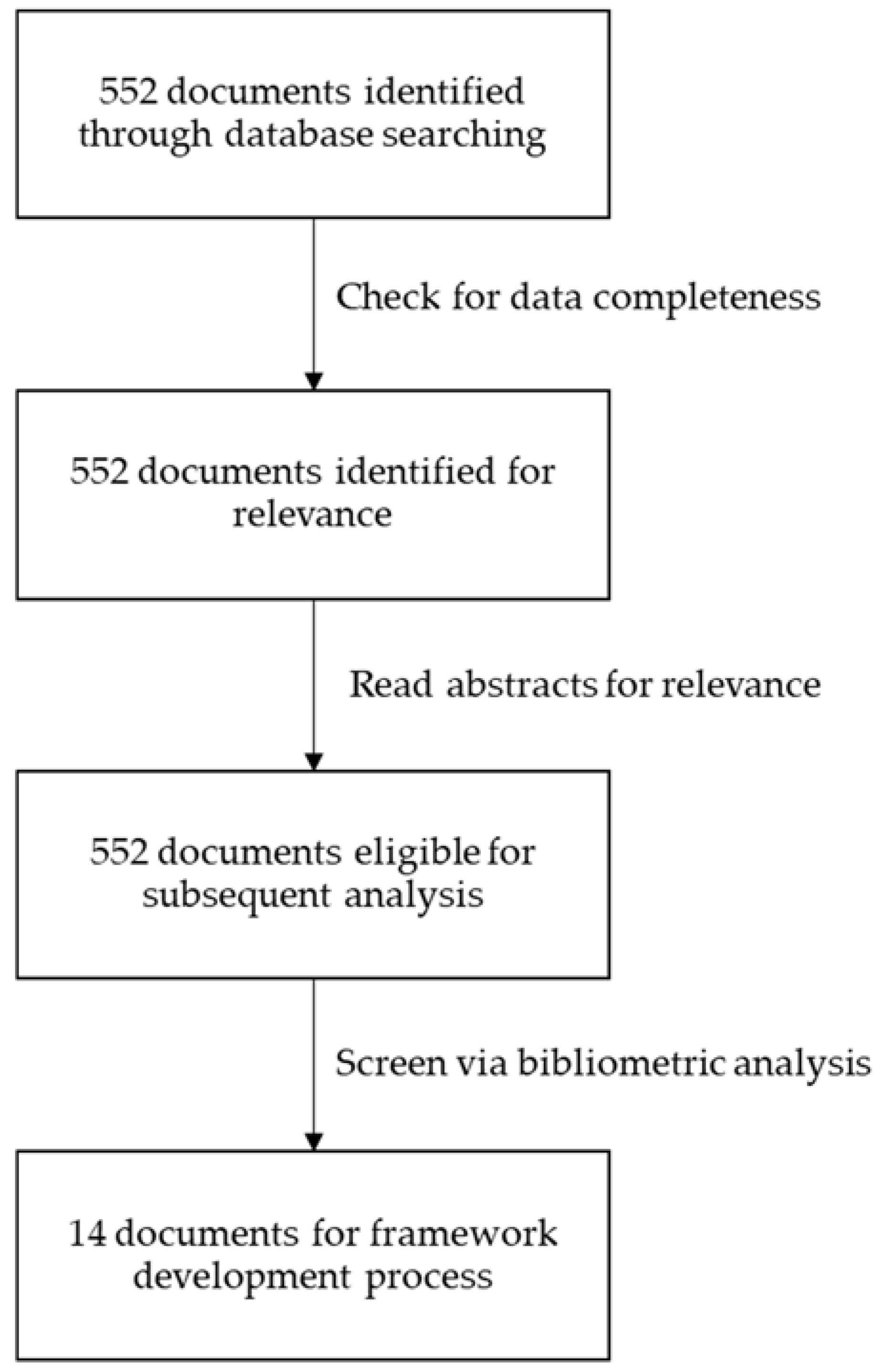
Figure 2.
Author co-citation analysis of resilience and sustainability in organizations, 1997- July, 2024.
Figure 2.
Author co-citation analysis of resilience and sustainability in organizations, 1997- July, 2024.
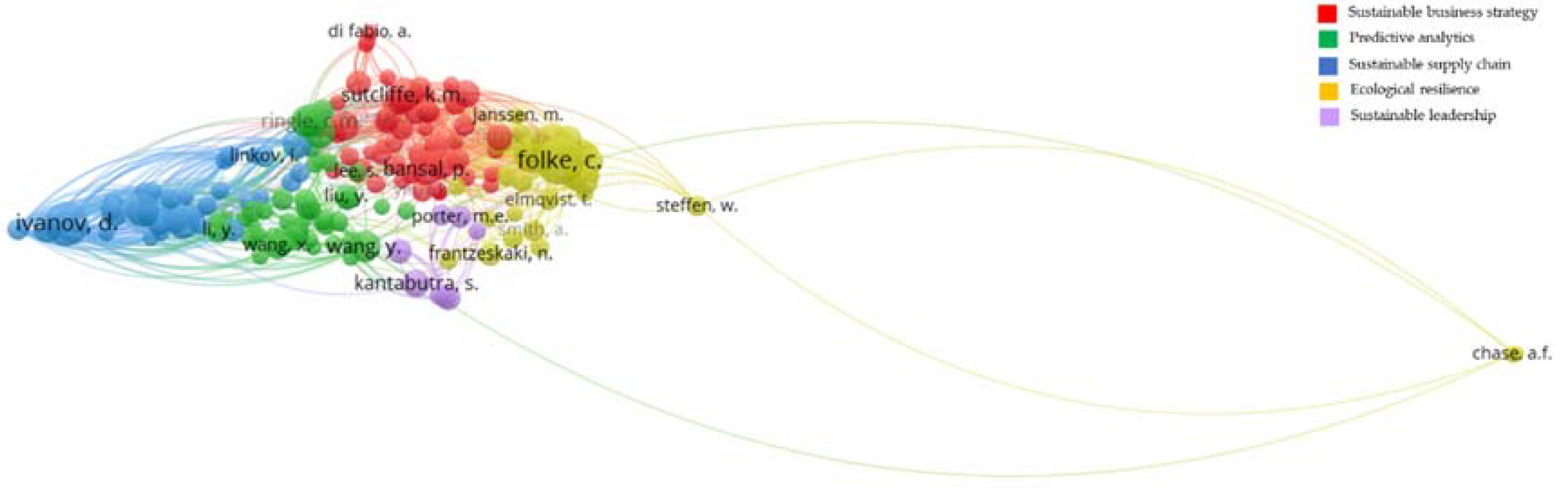
Figure 3.
Virtualization map of word co-occurrence in the organizational resilience and sustainability literature by recency, 1997- July, 2024.
Figure 3.
Virtualization map of word co-occurrence in the organizational resilience and sustainability literature by recency, 1997- July, 2024.
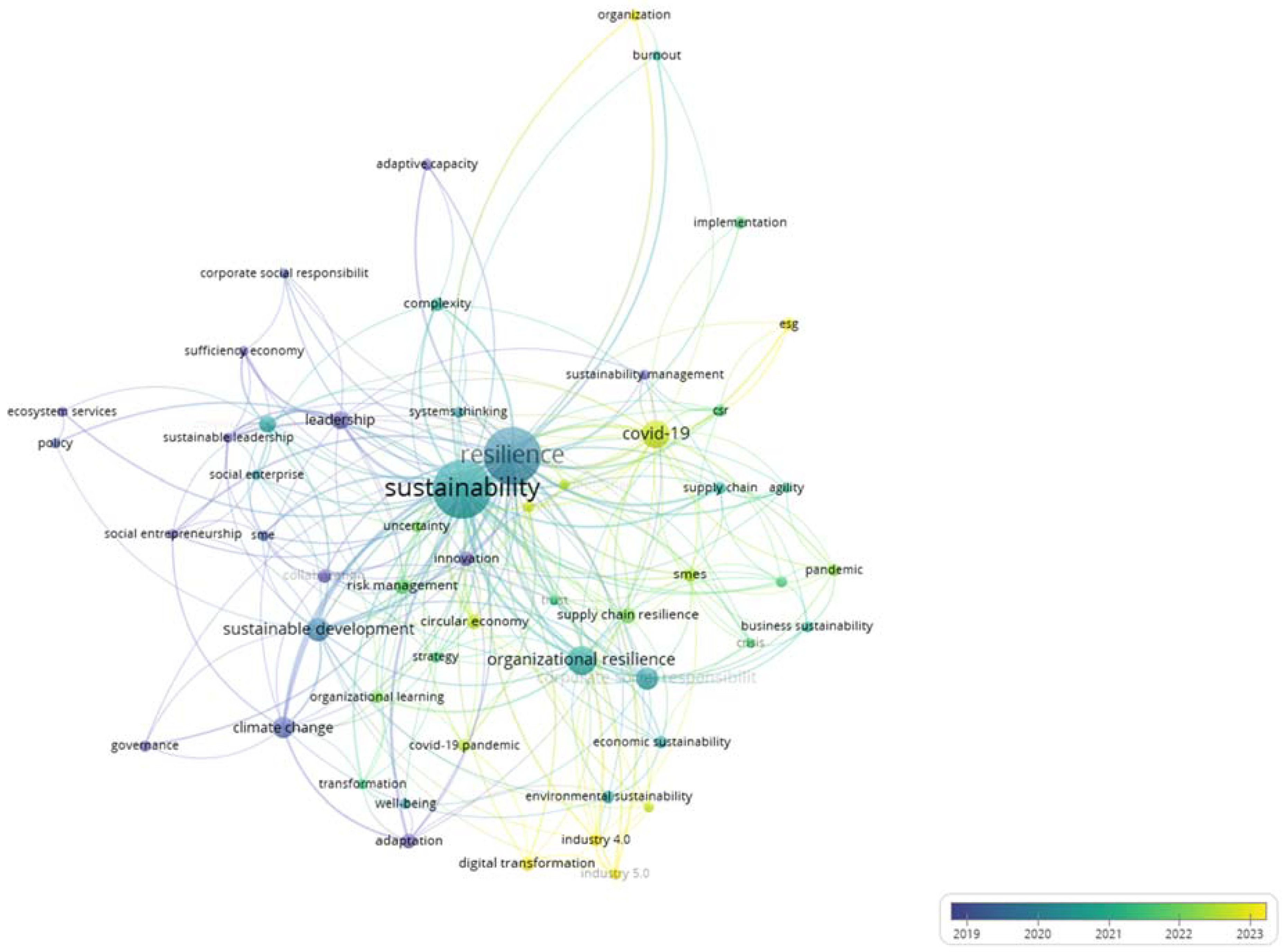
Figure 4.
Resilience & Sustainability in Organization (RSiO) Framework.
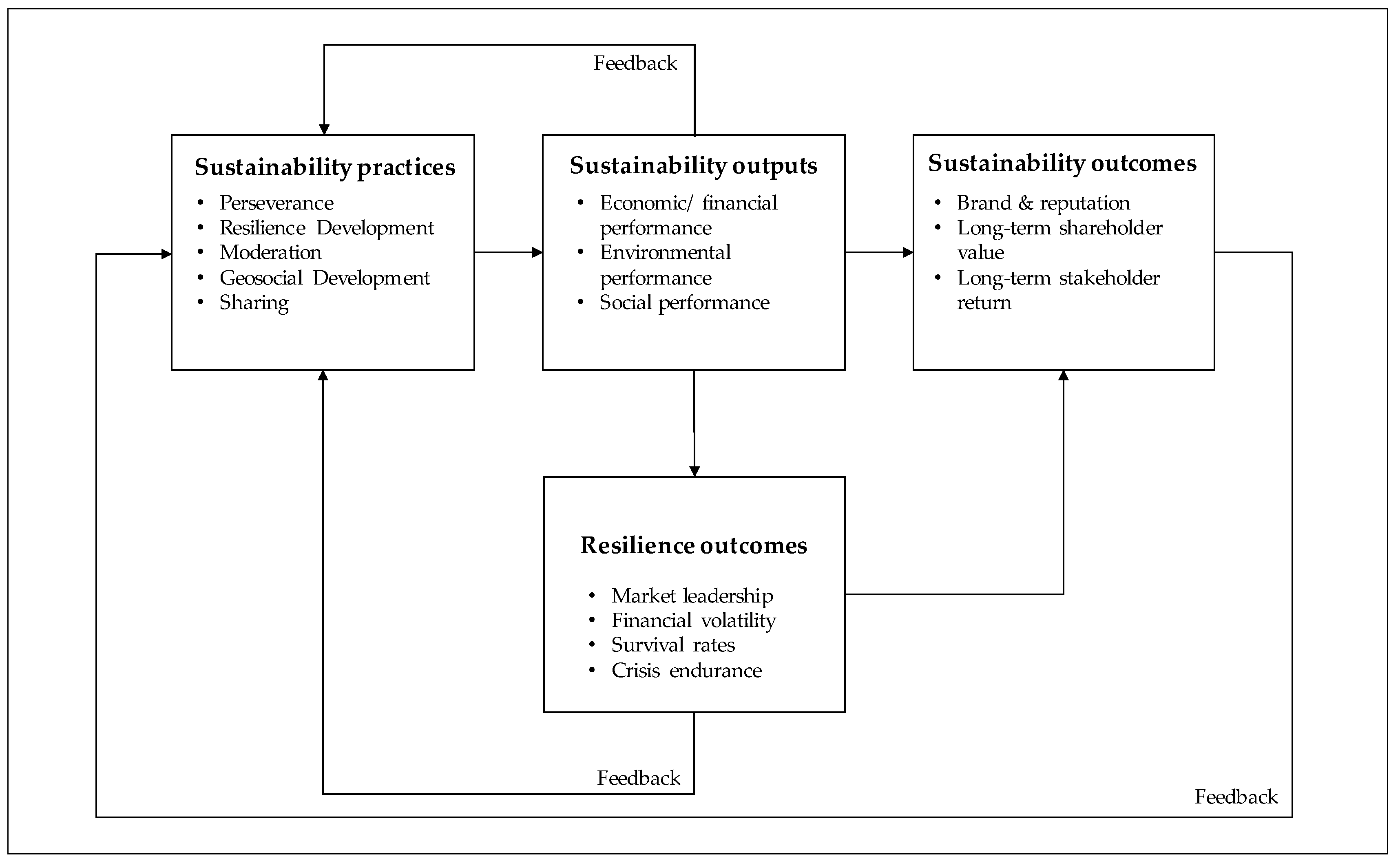
Table 1.
Criteria for literature inclusion and exclusion.
| Selection criteria | Inclusion | Exclusion |
|---|---|---|
| Type of access | All | Non-accessible |
| Period of literature | Undefined – 2024 | - |
| Subject area | Organization management aspects |
Others |
| Type of document | Journal | All the rest |
| Language | English | All others |
Table 2.
Top 10 authors of the organizational resilience & sustainability knowledge domain ranked by citations, 1997– July 2024.
Table 2.
Top 10 authors of the organizational resilience & sustainability knowledge domain ranked by citations, 1997– July 2024.
| Rank order | Author | No. of documents | Citations |
|---|---|---|---|
| 1 | Ivanov, D. | 2 | 703 |
| 2 | Sarkis, J. | 2 | 599 |
| 3 | Fiksel, J. | 1 | 560 |
| 4 | Bansal, P. | 1 | 551 |
| 4 | Ortiz-de_Mandojana, N. | 1 | 551 |
| 5 | Linnenluecke, M.K. | 3 | 517 |
| 6 | Griffiths, A. | 2 | 469 |
| 6 | Winn, M. | 2 | 469 |
| 7 | Wamsler, C. | 3 | 274 |
| 8 | Fahimnia, B. | 1 | 243 |
| 8 | Jabbarzadeh, A. | 1 | 243 |
Table 4.
Top three scholars by School of Thought, 1997 – July, 2024.
| Rank order |
Sustainable business strategy |
Co-citations | Predictive analytics |
Co-citations | Sustainable supply chain | Co-citations |
|---|---|---|---|---|---|---|
| Red cluster | Green cluster |
Dark blue cluster |
||||
| 1 | Bansal, P. | 90 | Ringle, C.M. | 82 | Ivanov, D. | 146 |
| 2 | Linnenluecke, M.K. | 89 | Sarstedt, M. | 80 | Gunasekaran, A. | 88 |
| 3 | Sutcliffe, K.A. | 83 | Hair, J.F. | 75 | Sarkis, J. | 86 |
|
Rank order |
Ecological resilience |
Co-citations | Sustainable leadership | Co-citations | ||
| Yellow cluster |
Purple cluster | |||||
| 1 | Folke, C. | 172 | Kantabutra, S. | 58 | ||
| 2 | Holling, C.S. | 127 | Avery, G.C. | 51 | ||
| 3 | Walker, B. | 112 | Freeman, R.E. | 45 |
Table 5.
Top 10 documents of the organizational resilience & sustainability knowledge domain ranked by citations, 1997– July 2024.
Table 5.
Top 10 documents of the organizational resilience & sustainability knowledge domain ranked by citations, 1997– July 2024.
| Rank order | Document | Citations | Theme | Focal sustainable development domain |
|---|---|---|---|---|
| 1 | Fiksel, J. (2003). Designing resilient, sustainable systems. Environmental Science & Technology, 37(23), 5330-5339. [45] | 560 | Resilience & Sustainability | Environment |
| 2 | Ortiz-de-Mandojana, N., & Bansal, P. (2016). The long-term benefits of organizational resilience through sustainable business practices. Strategic Management Journal, 37(8), 1615-1631. [46] | 551 | Resilience & Sustainability | Economy |
| 3 | Ivanov, D. (2022). Viable supply chain model: integrating agility, resilience and sustainability perspectives—lessons from and thinking beyond the COVID-19 pandemic. Annals of Operations Research, 319(1), 1411-1431. [47] | 535 | Resilience & Sustainability | Economy |
| 4 | Sarkis, J. (2020). Supply chain sustainability: learning from the COVID-19 pandemic. International Journal of Operations & Production Management, 41(1), 63-73. [48] |
415 | Sustainability | Economy |
| 5 | Linnenluecke, M. K., Griffiths, A., & Winn, M. (2012). Extreme weather events and the critical importance of anticipatory adaptation and organizational resilience in responding to impacts. Business Strategy and the Environment, 21(1), 17-32. [49] | 265 | Resilience | Economy |
| 6 | Fahimnia, B., & Jabbarzadeh, A. (2016). Marrying supply chain sustainability and resilience: A match made in heaven. Transportation Research Part E: Logistics and Transportation Review, 91, 306-324. [50] | 243 | Resilience & Sustainability | Economy |
| 7 | Ates, A., & Bititci, U. (2011). Change process: a key enabler for building resilient SMEs. International Journal of Production Research, 49(18), 5601-5618. [51] | 227 | Resilience | Economy |
| 8 | Feola, G., & Nunes, R. (2014). Success and failure of grassroots innovations for addressing climate change: The case of the Transition Movement. Global Environmental Change, 24, 232-250. [52] | 221 | Resilience & Sustainability | Society & Environment |
| 9 | Winn, M., Kirchgeorg, M., Griffiths, A., Linnenluecke, M. K., & Günther, E. (2011). Impacts from climate change on organizations: a conceptual foundation. Business Strategy and the Environment, 20(3), 157-173. [53] | 204 | Resilience & Sustainability | Economy |
| 10 | Negri, M., Cagno, E., Colicchia, C., & Sarkis, J. (2021). Integrating sustainability and resilience in the supply chain: A systematic literature review and a research agenda. Business Strategy and the Environment, 30(7), 2858-2886. [54] | 184 | Resilience & Sustainability | Economy |
Table 6.
Top 10 documents of the organizational resilience & sustainability knowledge domain ranked by co-citations, 1997– July 2024.
Table 6.
Top 10 documents of the organizational resilience & sustainability knowledge domain ranked by co-citations, 1997– July 2024.
| Rank order | Document | Citations | Theme | Focal sustainable development domain |
|---|---|---|---|---|
| 1 | Holling, C. S. (1973). Resilience and stability of ecological systems. [55] | 16 | Resilience | Environment |
| 2 | Linnenluecke, M. K. (2017). Resilience in business and management research: A review of influential publications and a research agenda. International Journal of Management Reviews, 19(1), 4-30. [56] | 14 | Resilience | Economy |
| 3 | Ortiz-de-Mandojana, N., & Bansal, P. (2016). The long-term benefits of organizational resilience through sustainable business practices. Strategic Management Journal, 37(8), 1615-1631. [46] | 10 | Resilience & Sustainability | Economy |
| 4 | Burnard, K., & Bhamra, R. (2011). Organisational resilience: development of a conceptual framework for organisational responses. International Journal of Production Research, 49(18), 5581-5599. [57] | 9 | Resilience | Economy |
| 5 | Lengnick-Hall, C. A., Beck, T. E., & Lengnick-Hall, M. L. (2011). Developing a capacity for organizational resilience through strategic human resource management. Human Resource Management Review, 21(3), 243-255. [58] | 8 | Resilience | Economy |
| 6 | Duchek, S. (2020). Organizational resilience: a capability-based conceptualization. Business Research, 13(1), 215-246. [8] | 7 | Resilience | Economy |
| 6 | Bhamra, R., Dani, S., & Burnard, K. (2011). Resilience: the concept, a literature review and future directions. International Journal of Production Research, 49(18), 5375-5393. [59] | 7 | Resilience | Economy |
| 6 | Teece, D. J., Pisano, G., & Shuen, A. (1997). Dynamic capabilities and strategic management. Strategic Management Journal, 18(7), 509-533. [60] | 7 | Resilience | Economy |
| 6 | Annarelli, A., & Nonino, F. (2016). Strategic and operational management of organizational resilience: Current state of research and future directions. Omega, 62, 1-18. [61] | 7 | Resilience | Economy |
| 6 | He, H., & Harris, L. (2020). The impact of Covid-19 pandemic on corporate social responsibility and marketing philosophy. Journal of Business Research, 116, 176-182. [62] | 7 | Sustainability | Economy |
Table 7.
Top 10 keywords of the organizational resilience & sustainability knowledge domain by rank order based on co-concurrence, 1997– July, 2024.
Table 7.
Top 10 keywords of the organizational resilience & sustainability knowledge domain by rank order based on co-concurrence, 1997– July, 2024.
| Rank order | Keyword | Occurrences |
|---|---|---|
| 1 | Sustainability | 157 |
| 2 | Resilience | 150 |
| 3 | Organizational resilience | 41 |
| 4 | Covid-19 | 37 |
| 5 | Sustainable development | 27 |
| 6 | Corporate social responsibility | 24 |
| 7 | Climate change | 22 |
| 8 | Leadership | 16 |
| 9 | Corporate sustainability | 14 |
| 10 | Risk management | 12 |
| 10 | Supply chain resilience | 12 |
Table 8.
Articles from the most influential authors in the knowledge domain of resilience and sustainability in organizations.
Table 8.
Articles from the most influential authors in the knowledge domain of resilience and sustainability in organizations.
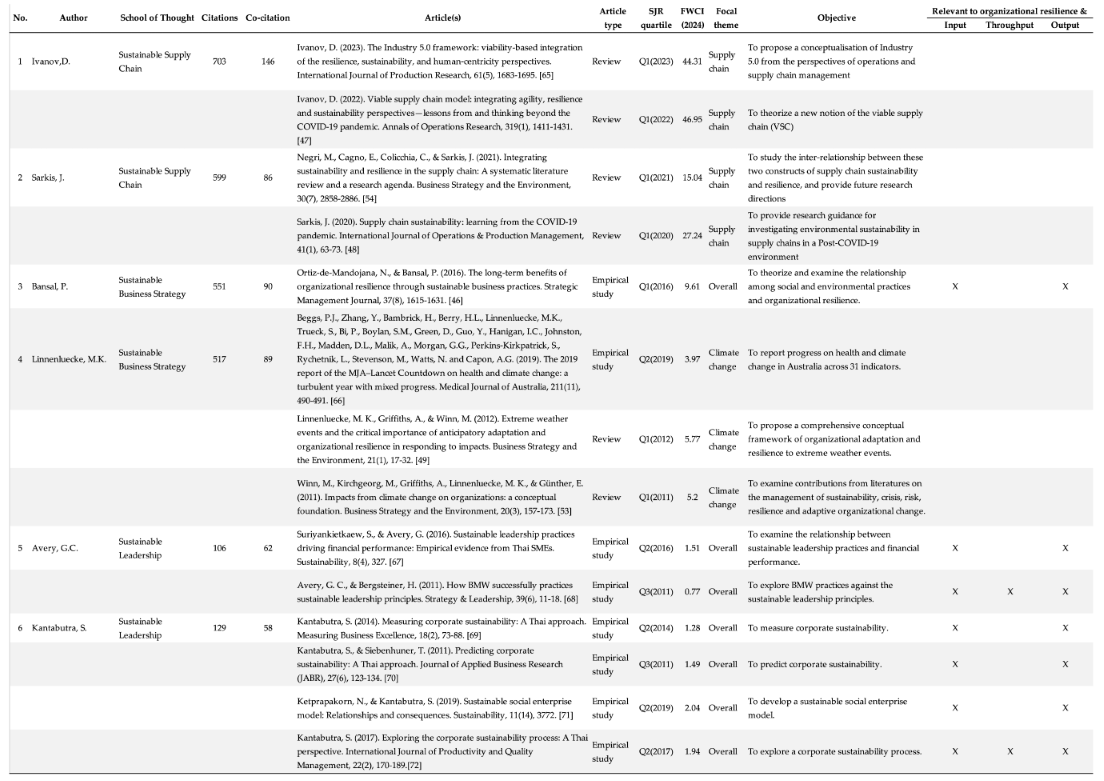 |
Table 9.
Emerged sustainability practice to ensure resilience and sustainability in organizations.
 |
 |
Disclaimer/Publisher’s Note: The statements, opinions and data contained in all publications are solely those of the individual author(s) and contributor(s) and not of MDPI and/or the editor(s). MDPI and/or the editor(s) disclaim responsibility for any injury to people or property resulting from any ideas, methods, instructions or products referred to in the content. |
© 2024 by the authors. Licensee MDPI, Basel, Switzerland. This article is an open access article distributed under the terms and conditions of the Creative Commons Attribution (CC BY) license (http://creativecommons.org/licenses/by/4.0/).
Copyright: This open access article is published under a Creative Commons CC BY 4.0 license, which permit the free download, distribution, and reuse, provided that the author and preprint are cited in any reuse.


