

Submitted:
12 August 2024
Posted:
12 August 2024
You are already at the latest version
Abstract
Dogs and cats have become the most influential and successful pets through long-term domestication. People keep them for various reasons, such as their functional roles or for physical or psychological support. However, why humans are so attached to dogs and cats remains unclear. A comprehensive understanding of the current state of human preferences for dogs and cats and the potential influential factors behind it is required. Here, we investigate this question using two independent online datasets and anonymous questionnaires. We find that current human preferences for dogs and cats are relatively higher than for most other interests, such as games and music. Genetic variations, gender, age, and economic development levels notably influence these preferences for dogs and cats. Specifically, dog and cat ownership is significantly heritable (h2 = 0.43, 95%CI: 0.35 -0.51) and further analysis found that women, young people, and those with higher incomes are more likely to keep dogs and cats, and the primary reason is to gain emotional support. Our study provides insights into why humans get so attached to dogs and cats and establishes a foundation for developing co-evolutionary models.
Keywords:
human preferences
; pet(s)
; dogs
; cats
; heritability
1. Introduction
Dogs and cats are the most influential and successful pets [1,2,3]. Despite ongoing debates about the time and place of dogs’ origin [4,5,6], it is widely accepted that dog was probably the first domesticated animal [7]. They have been companions to humans for at least more than 15,000 years, according to the archaeological record, and even longer, according to genome analysis [8,9,10] Cats have a relatively shorter history of domestication, with evidence supporting a timeline dating back to 9,500 years ago [11,12]. Still, both dogs and cats hold an important place in humans’ hearts and lives. According to the latest survey of the American Pet Products Association (APPA), approximately 49% of households in the United States own dogs, and 35% of households own cats in 2023-2024, far exceeding the ownership of ornamental fish, which ranks third with the proportion of 10%. Humans are so attached to dogs and cats that they are willing to lavish much affection, time and money on their pets, even though this investment does not directly benefit their fitness [13,14,15]. Researches indicate that dog and cat owners view their pets as family members [16,17,18]. Even to some extent, dogs and cats can occupy social positions similar to those of partners [19,20] and children [21] in the home.
Why humans are so attached to dogs and cats remains a long study question, and it was one of the 125 scientific questions jointly published by Shanghai Jiao Tong University (SJTU) and the journal of ‘Science’ (Biology: Why do humans get so attached to dogs and cats?) in 2021. Previous studies have offered some explanations for this question. Dogs and cats may first be domesticated for functional roles such as hunting, herding and protecting food from rodents [22,23] and still be kept for practical purposes in modern life. On the other hand, some people keep dogs or cats since they can offer social, physical and psychological support. Dogs and cats may provide similar companionship as family members [19,20,21,24]. In addition, numerous researches have shown that they can relieve people’s mental stress, improve emotional well-being and provide therapeutic support [15,25,26,27,28,29,30]. Human preferences for dogs and cats may also be influenced by genetic variations. A study on twins showed that the heritability of dog ownership is high in both genders (57% for women and 51% for men) [31]. Apart from those, there are other factors that may affect human preferences for dogs and cats, such as gender, age or individual income. For instance, it is widely accepted that women tend to be more compassionate and exhibit stronger attachment behaviors, affect and caregiving than men [32,33]. Younger adults have higher cognitive empathy than older adults [34,35], which may make them more attached to dogs and cats. While age and wealth may determine how much energy, time and money a person can devote to dogs and cats and thus affect the degree of preferences [14].
Though many studies have attempted to explain why humans get so attached to dogs and cats, most of them mainly focus on one single factor and lack generality. To better answer this question, a more comprehensive and systematic investigation is required, especially its current situation and potential influencing factors. Given that humans have developed a variety of preferences, such as games and music, it is necessary to determine to what extent humans currently prefer dogs and cats compared to other forms of entertainment and how different factors influence that preference. Here, we used data from online video platforms and anonymous questionnaires to get a more comprehensive and systematic overview of the human preferences for dogs and cats. We aimed to 1) obtain the current situation of human preferences for dogs and cats and 2) investigate what factors could influence human preferences for dogs and cats and how strong an impact they have. We first evaluated how much humans prefer dogs and cats by investigating how much more they prefer videos about dogs and cats compared to other videos on other topics. Then, we calculated the heritability of people’s preferences for dogs and cats based on the information about dog and cat ownership of the questionnaire respondents and their family members. Meanwhile, we investigated the main reasons why they chose or planned to have dogs or cats. Finally, we verified the potential factors (i.e. age, gender, individual income, psychological factors) that may have an effect and the extent of their impact by analyzing the basic information of video audiences and questionnaire respondents. Specifically, we posited that young people, women, and those with high incomes were likelier to keep dogs and cats than older people, men, and those with lower incomes.
2. Materials and Methods
2.1. Data Collection
Bilibili videos
To get an overview of human preferences for dogs and cats, we chose Bilibili to collect video data. It is one of the leading streaming platforms in China, containing 326 million users up to 2022. It provides videos on various topics such as anime, music, games, fashion, movies, and pets, and users are allowed to watch, like and comment on these videos. Meanwhile, the platform classifies different videos into different channels based on their subject matter, which makes it easy for us to get the audience's preferences for different types of videos. Bilibili has selected 96 channels as ‘popular channels’, containing almost all the most popular videos. To avoid over-categorization, we reclassified the 96 popular channels into 15 categories according to the channel's theme (Table S1). For example, three pet-related channels (“Cute pets”, “Dogs”, and “Cats”) are grouped into the "Pets" category. For each channel, we define videos with more than one million views as “popular videos”. We then counted a) the number of popular videos, b) the number of plays of popular videos and c) the number of likes of popular videos of each category from 2009, when the platform was established, to 2021, using them as indicators of human preferences for different types of videos. In the end, we collected a total of 1,248 records.
Online questionnaires
To understand the influence of genetic and other factors on human preferences for dogs and cats, we designed an online questionnaire (https://wj.qq.com/s2/13778005/f591/) using Tencent Questionnaire (https://wj.qq.com/) and distributed it to the user base of the platform, as well as WeChat and QQ, the major communication platforms in China in January 2024. Detailed questions are listed in Supplementary Table S2. The purpose of the questionnaire was not disclosed to the participants. In addition to basic information such as gender, age, and whether they or their immediate family own dogs or cats, we also asked the respondents who had experience or plans of owning dogs or cats why they chose to do so. Therefore, we could learn whether they raised dogs or cats to meet certain needs (such as house guarding and emotional support) or were influenced by family genetic factors. We excluded questionnaires with errors or incomplete responses and ended up with 500 valid questionnaires.
Douyin (TikTok) videos
Douyin (TikTok) is another mainstream short-video platform in China. It is easier to access and reaches a larger number of users. To collect data on dog and cat videos from Douyin, we used a data analysis platform called Feigua (https://dy.feigua.cn). This platform will rank videos each month according to the number of comments and provide basic information such as the number of plays of videos and comments. Also, it can offer information such as the gender (man or woman), age distribution (6 age groups: 0-17, 18-23, 24-30, 31-40, 41-50, and over 50 years old), and the region (top 10 provinces in China in terms of number of commenters) of the video audience based on the sample of the latest commenters. To analyze how different factors affect people’s preferences for dogs and cats, we collected the above information from the top 100 pet videos every month from August 2022 to July 2023. Furthermore, we obtained the Gross Domestic Product (GDP) information for different provinces from the National Bureau of Statistics of China (China Statistical Yearbook 2023) to measure regional economic development. Since pet videos include animals other than dogs and cats, we ended up with 1,006 dog and cat videos out of 1,200.
2.2. Data Analyses
The current situation of human preferences for dogs and cats
We obtained the current human preferences for dogs and cats from the dataset collected from Bilibili. Different categories were ranked according to their average number of plays, likes, and popular videos per category per year so that we could see how much people liked dog and cat videos relative to other types of videos. Moreover, we used linear regression to analyze how people's preferences for different categories of videos change over time.
Heritability and causes of dog and cat ownership
For the 500 valid questionnaires collected, we estimated the heritability of dog and cat ownership by linear regressions according to whether the respondents and their parents and grandparents own or have owned dogs or cats. Specifically, we used "0" to represent family members without pets, "1" for those who own/have owned a dog or dogs, "2" for those who own/have owned a cat or cats, and "3" for those who own/have owned both a dog and a cat (or both dogs and cats). Then, we calculated the heritability of dog and/or cat ownership by calculating the mean of regression coefficients of dog and/or cat ownership between offspring and their parents, parents and paternal grandparents, and parents and maternal grandparents.
Among the 472 respondents with experience or a plan to adopt dogs or cats, we listed five main reasons for having dogs or cats and asked them if they agreed. These options are 1) for health improvement, 2) because of religious or cultural issues, 3) to gain emotional value (or compensation), 4) for practical use like guarding or catching rats (treating them as tools), and 5) following the trend (i.e., people around are all having pets). By calculating the proportion of yes or no for each option, we can know whether people prefer dogs and cats because of their utility attributes, or they treat them as substitutes for family members, or a need for psychological release.
Factors that influence the preferences for dogs and cats
We used the dataset of Douyin (TikTok) videos to investigate how potential factors influence human preferences for dogs and cats. Analyses were done by fitting linear mixed-effects models using the lme4 package [36] in R 4.2.2 [37]. We used the number of comments on videos as the response variable to represent the audience's preferences. The identity of the videos (Video_ID) and the region where the publisher was located (Region) were taken as random effects, while the type of the videos (two levels: dog or cat), the gender (two levels: man or woman), the age (6 levels: 0-17, 18-23, 24-30, 31-40, 41-50, or > 50 years old) and the economic level (GDP, a continuous variable) of the audience were taken as fixed effects.
3. Results
3.1. The Current Situation of Human Preferences for Dogs and Cats
According to our statistics, humans prefer videos that include dogs and cats to most other subjects (Figure 1). Regarding the number of plays and likes of popular videos, the Pet category ranked fourth out of 15, while the Pet category ranked third in the number of popular videos. Furthermore, we found that the growth trend of these three indicators in the Pet category ranked fourth out of 15 categories, indicating the growing trend in human preferences for dog and cat videos is relatively high across all categories (Figure S1).
3.2. Heritability and Causes of Dog and Cat Ownership
In this study, the heritability of owning a dog or cat was 0.43 (95% CI: 0.35-0.51). Specifically, the regression coefficients of three groups, Parents-Offspring, Grandparents-Parents, and Maternal grandparents-Parents, were 0.44 (95% CI, 0.37-0.52), 0.44 (95% CI, 0.36-0.53), and 0.42 (95% CI, 0.33-0.50), respectively (Figure 2). As for the reasons for keeping a dog (dogs) or a cat(cats), 85.8% of the respondents believe that keeping dogs and cats has an emotional value, 31.6% believe that it is good for health, 41.3% treat dogs and cats as tools, 25.2% of the respondents keep dogs and cats to follow the popular trend, and only 6.1% choose to do so for religious or cultural reasons (Figure 3). Furthermore, among those who believe owning a dog or cat can obtain emotional value, most respondents agree that dogs and cats can compensate for the emotional void from the absence or loss of a spouse or partner (Figure S2).
3.3. Factors That Influence the Preferences for Dogs and Cats
We found that videos about dogs got more comments than videos about cats (t = 3.7, P < 0.001, Table 1 and Figure 4). Woman viewers commented more than man viewers (t = 137.4, P < 0.001). At the same time, the level of economic development also impacted the audience's preferences. More commenters came from the region with a higher level of economic development (e.g. Guangdong, t = 7.6, P < 0.001). Among the viewers who left comments, the proportion of different age groups was also significantly different. In general, young people left more comments than old ones.
4. Discussion
While previous studies have provided some explanations for why humans are so attached to dogs and cats, a more comprehensive and systematic overview of the human preferences for dogs and cats is required. Using three independent datasets (i.e., Bilibili videos, online questionnaires and Douyin (Tik Tok) videos, we found that humans prefer videos that include dogs and cats to most other subjects (Figure 1); there is significant heritability of owning either a cat or dog or both (Figure 2); and gender, age and economic development impacted the audience's preferences significantly (Figure 4, Table 1). Overall, our study highlights the current situation and influencing factors of human preferences for dogs and cats.
Surveys have compared the proportion of households of dogs and cats with other pets [38,39,40,41,42]. However, few studies try to compare the level of preferences for dogs and cats with other preferences in modern life. In this study, using the dataset of online videos (i.e., Bilibili videos), we found that, both the number and the growth trend, preferences for dogs and cats are relatively high compared to other types of preferences such as games and music (Figure 1, Figure S1). This pattern gives us a more comprehensive picture of the current situation of human preferences for dogs and cats. Moreover, the results also confirmed that humans are indeed attached to dogs and cats [43,44]. Since that the results here were based on online videos, they might not totally reflect the situation of daily life. For instance, most people might be biased toward games, fun videos, and movies that only exist virtually online. This might underestimate the degree of preferences for dogs and cats. Another confusing factor that needs to be considered is that people with dogs or cats in daily life might be less frequently on the internet (e.g., they have to look after their pets). In this respect, future studies directly investigating the situation of preferences for dogs and cats in daily life are more appealing.
In this study, we found a significant heritability of owning either a cat or dog or both (Figure 2). Our findings align with a recent study showing that the heritability of dog ownership was 0.51 for men and 0.57 for women [31]. These similarities between the current and previous studies indicate that human preferences for dogs and cats are influenced by genetic variations and potentially under selection [45,46]. Furthermore, for the reasons of having a dog or a cat or both, previous studies showed that functional roles and companionship are the two main reasons [47,48,49,50,51]. Yet, these studies did not compare the relative importance of these reasons simultaneously or within a study. In our study, we have listed five main reasons at the same time and evaluated their relative importance. We found that keeping dogs and cats to obtain emotional support accounted for the largest proportion (85.8%), followed by treating dogs and cats as tools (41.3%), health (31.6%), following the popular trend (25.2%) and religious or cultural issues (6.1%) (Figure 3). These new results offered new insights into the research of human attachment to dogs and cats. In the initial stages of the relationship between humans and pets, the primary consideration was the functional roles of dogs and cats. Historically, dogs assisted humans with hunting, guarding and protection [52,53,54,55,56], while cats helped humans by protecting food supplies [57,58]. However, as societal productivity developed, the need for emotional companionship gradually became the main reason for humans to keep dogs and cats [59,60]. This shift highlights a dynamic process of human preferences for dogs and cats, reflecting an evolutionary change from practical utility to emotional appreciation, which is an interesting and valuable research topic and deserves further study.
In addition to genetic variations, other potential factors may affect human preferences for dogs and cats, such as gender, age or individual income. Generally, we found that women, younger people, and those with higher income had stronger preferences for dogs and cats compared to men, older ones and people with lower income (Table 1, Figure 4). Additionally, our findings reveal that humans show a higher level of interest in dogs compared to cats (Table 1 and Figure 4a), which corresponds with the current status of dogs being the most popular pets (33.4% of households owned dogs, and 22.5% owned cats) [39]. In previous studies, how different factors affect human preferences for dogs and cats has not yet come to a unified definition. Our findings (Table 1 and Figure 4b,c) align with a recent study reported by Fraser showing that younger people and women are more likely to be pet owners in New Zealand [61]. Similarly, some studies support the notion that women have stronger preferences [62,63,64], while a few suggest that men have stronger preferences [65]. These discrepancies may be attributed to regional differences, with varying cultural traditions potentially influencing the results. Still, it is important to note that since our data source is online videos, differences in the ability of different age groups to access the Internet may affect our estimates of their preferences. For example, the preferences for dogs and cats may be underestimated among elders who use the Internet less and minors who are primarily restricted from using the Internet. When it comes to individual income, we found that regional GDP was positively correlated with the number of comments. This is similar to the positive correlation between the number of pets and the GDP of different states in the USA (data from Wiki). Higher income levels likely make it more feasible to afford the costs of owning dogs and cats. People living in a relatively more developed area may also find it easier at work and have more leisure time to keep a dog or cat in real life [66]. In summary, each factor that affects the degree of human preferences for dogs and cats might not be independent of each other, and different research methods may also lead to different conclusions.
In this study, we did not consider the morphological or psychological traits of the animals, such as appearance, age and personality, because they are difficult to quantify from the videos. Previous studies have shown that the traits of dogs and cats can also influence human preferences for them. For instance, several research indicated that the appearance of dogs is the main factor that highly influences people’s decisions to buy or adopt them [67,68,69]. Humans may choose some features that are thought to be associated with an infantile aesthetic, such as bigger eyes and a larger space between the eyes [70]. Also, dogs that can enhance paedomorphism (change the eye size and height by raising the inner brow) through greater facial flexibility are found to be more desirable to humans [71]. Additionally, the animal’s age also potentially affects people’s decisions on whether or not to have a dog. According to the research by Brown [72], the length of a dog's stay in a shelter increases with its age, which means the older the dog is, the less likely it is to be adopted. Similarly, studies conducted in Australia and Italy find that the public tends to acquire a dog as a puppy [73,74]. This tendency may be associated with the preference for infantile-like features, the opinion that a puppy can be trained to acquire good habits, or just because the owner wants to experience the “puppy stage” of a dog’s life [68]. Apart from this, researchers also find that how animals behave when interacting with humans can affect human attachment to pets, which we cannot fully study in our work with online videos and questionnaires. A study by Protopopova and Wynne [75] shows that dogs that are willing to respond to potential adopters are more likely to be adopted. Similar studies have also found that a dog's temperament and its behavior during interactions with people can influence human attitudes toward them [69,74]. In short, future work that considers these aspects (i.e., the traits of pets and their social behaviour) in conjunction with the characteristics of the owners (such as personality, gender, age, and economic status) could provide a more thorough understanding of factors that influence human preferences for these pets.
Human preferences for dogs and cats are never one-sided. This interesting question involves a complex interplay of evolving human tastes, the selection of various dog and cat breeds, the dynamic characteristics of these animals, and their impact on people. On the one hand, humans selectively breed dogs and cats according to their own preferences and needs, even if certain traits can lower individual fitness. For example, Scottish Fold cats with osteochondrodysplasia [76] and French Bulldogs, which are more prone to health issues than other breeds [77], are still being chosen by humans. On the other hand, some believe that cats and dogs change their ancestral behaviors to function as social releasers, eliciting human parental care [13] and may thus gain higher fitness. In summary, this is a co-evolutionary process of mutual selection. However, research in this area is still lacking, particularly in co-evolutionary model construction and simulations. Using comprehensive mathematical simulations and models can delve deeper into the impact of human behavior on the evolution of dogs and cats. We should emphasise these aspects more, as they will help us understand how humans and dogs and cats have influenced each other throughout their long companionship, and why humans are so attached to these animals.
5. Conclusions
In conclusion, this study demonstrated that human preferences for dogs and cats are relatively higher than for most other interests, and are notably influenced by ge-netic variations, gender, age, and economic development levels. Our findings provide insights into why humans are so attached to dogs and cats, and establish a foundation for future research on the co-evolution of human preferences and pets.
Supplementary Materials
The following supporting information can be downloaded at the website of this paper posted on Preprints.org., Figure S1: Growth trends of 15 types of preferences over 13 years (2009-2021); Figure S2: The proportion of respondents (yes or no) that answered a pet (or pets) could compensate the emotional void from the absence or loss of 1) parents, 2) spouse or partner, 3) children; Table S1: Classification of 96 popular channels into 15 types of human’s preferences from the website Bilibili; Table S2: Questions listed in our online anonymous questionnaire.
Author Contributions
X.Z. and D.W. designed the study; X.Z., Y.H. and D.W. produced the data and performed the analysis; all authors wrote the manuscript and approved the submission of the current version. All authors have read and agreed to the published version of the manuscript.
Institutional Review Board Statement
All works were performed according to the protocols approved by the Institutional Animal Care and Use Committee of the Institute of Zoology, Chinese Academy of Sciences, China. All online video data were sourced from publicly available content on websites. All online questionnaires were conducted through a web-based survey platform and were completed anonymously. For the questionnaire work, we fully informed participants about the anonymity guarantee and the purpose of the research. Their data will be securely stored, and there will be no associated risks.
Informed Consent Statement
Informed consent was obtained from all subjects involved in the study.
Data Availability Statement
The data underlying this article are available in the Dryad Digital Repository at https://doi.org/10.5061/dryad.qfttdz0rr
Acknowledgments
D.W. is funded by the Chinese Academy of Sciences (CAS Pioneer Hundred Talents program); the Hainan Institute of National Park and Hainan Province Science and Technology Special Fund (HINP, KY-24ZK02, ZDYF2023RDYL01); and the National Natural Science Foundation of China (32270452).
Conflicts of Interest
The authors declare no conflicts of interest.
References
- Driscoll, C.A.; Macdonald, D.W.; O’Brien, S.J. From Wild Animals to Domestic Pets, an Evolutionary View of Domestication. Proc. Natl. Acad. Sci. 2009, 106, 9971–9978. [Google Scholar] [CrossRef] [PubMed]
- Blouin, D.D. Understanding Relations between People and Their Pets. Sociology Compass 2012, 6, 856–869. [Google Scholar] [CrossRef]
- Hart, L.A. Dogs as Human Companions: A Review of the Relationship. The domestic dog: Its evolution, behaviour and interactions with people 1995, 161–178.
- Wang, G.; Zhai, W.; Yang, H.; Fan, R.; Cao, X.; Zhong, L.; Wang, L.; Liu, F.; Wu, H.; Cheng, L.; et al. The Genomics of Selection in Dogs and the Parallel Evolution between Dogs and Humans. Nat. Commun. 2013, 4, 1860. [Google Scholar] [CrossRef] [PubMed]
- Bergström, A.; Frantz, L.; Schmidt, R.; Ersmark, E.; Lebrasseur, O.; Girdland-Flink, L.; Lin, A.T.; Storå, J.; Sjögren, K.-G.; Anthony, D.; et al. Origins and Genetic Legacy of Prehistoric Dogs. Science 2020, 370, 557–564. [Google Scholar] [CrossRef] [PubMed]
- Pang, J.-F.; Kluetsch, C.; Zou, X.-J.; Zhang, A. -b.; Luo, L.-Y.; Angleby, H.; Ardalan, A.; Ekstrom, C.; Skollermo, A.; Lundeberg, J.; et al. mtDNA Data Indicate a Single Origin for Dogs South of Yangtze River, Less Than 16,300 Years Ago, from Numerous Wolves. Mol. Biol. Evol. 2009, 26, 2849–2864. [Google Scholar] [CrossRef] [PubMed]
- The Domestic Dog: Its Evolution, Behaviour, and Interactions with People; Serpell, J., Ed.; 1. publ.; Cambridge Univ. Press: Cambridge, 1995; ISBN 978-0-521-42537-7.
- Larson, G.; Karlsson, E.K.; Perri, A.; Webster, M.T.; Ho, S.Y.W.; Peters, J.; Stahl, P.W.; Piper, P.J.; Lingaas, F.; Fredholm, M.; et al. Rethinking Dog Domestication by Integrating Genetics, Archeology, and Biogeography. PROCEEDINGS OF THE NATIONAL ACADEMY OF SCIENCES OF THE UNITED STATES OF AMERICA 2012, 109, 8878–8883. [Google Scholar] [CrossRef] [PubMed]
- Frantz, L.A.F.; Mullin, V.E.; Pionnier-Capitan, M.; Lebrasseur, O.; Ollivier, M.; Perri, A.; Linderholm, A.; Mattiangeli, V.; Teasdale, M.D.; Dimopoulos, E.A.; et al. Genomic and Archaeological Evidence Suggest a Dual Origin of Domestic Dogs. Science 2016, 352, 1228–1231. [Google Scholar] [CrossRef] [PubMed]
- Ding, Z.-L.; Oskarsson, M.; Ardalan, A.; Angleby, H.; Dahlgren, L.-G.; Tepeli, C.; Kirkness, E.; Savolainen, P.; Zhang, Y.-P. Origins of Domestic Dog in Southern East Asia Is Supported by Analysis of Y-Chromosome DNA. Heredity 2012, 108, 507–514. [Google Scholar] [CrossRef] [PubMed]
- Driscoll, C.A.; Menotti-Raymond, M.; Roca, A.L.; Hupe, K.; Johnson, W.E.; Geffen, E.; Harley, E.H.; Delibes, M.; Pontier, D.; Kitchener, A.C.; et al. The Near Eastern Origin of Cat Domestication. Science 2007, 317, 519–523. [Google Scholar] [CrossRef] [PubMed]
- Lyons, L. Cat Domestication and Breed Development. In Proceedings of the 10th World Congress on Genetics Applied to Livestock Production. Canada; 2014.
- Archer, J. Why Do People Love Their Pets? Evolution and Human behavior 1997, 18, 237–259. [Google Scholar] [CrossRef]
- Bir, C.; Ortez, M.; Olynk Widmar, N.J.; Wolf, C.A.; Hansen, C.; Ouedraogo, F.B. Familiarity and Use of Veterinary Services by US Resident Dog and Cat Owners. Animals 2020, 10, 483. [Google Scholar] [CrossRef] [PubMed]
- Kalenkoski, C.M.; Korankye, T. Enriching Lives: How Spending Time with Pets Is Related to the Experiential Well-Being of Older Americans. Appl. Res. Qual. Life 2022, 17, 489–510. [Google Scholar] [CrossRef]
- Bodsworth, W.; Coleman, G.J. Child–Companion Animal Attachment Bonds in Single and Two-Parent Families. Anthrozoös 2001, 14, 216–223. [Google Scholar] [CrossRef]
- Charles, N. ‘Animals Just Love You as You Are’: Experiencing Kinship across the Species Barrier. Sociology 2014, 48, 715–730. [Google Scholar] [CrossRef]
- Bouma, E.M.C.; Reijgwart, M.L.; Dijkstra, A. Family Member, Best Friend, Child or ‘Just’ a Pet, Owners’ Relationship Perceptions and Consequences for Their Cats. Int. J. Environ. Res. Public. Health 2021, 19, 193. [Google Scholar] [CrossRef] [PubMed]
- Walsh, F. Human-Animal Bonds I: The Relational Significance of Companion Animals. Fam. Process 2009, 48, 462–480. [Google Scholar] [CrossRef]
- Evans-Wilday, A.S.; Hall, S.S.; Hogue, T.E.; Mills, D.S. Self-Disclosure with Dogs: Dog Owners’ and Non-Dog Owners’ Willingness to Disclose Emotional Topics. Anthrozoös 2018, 31, 353–366. [Google Scholar] [CrossRef]
- Greenebaum, J. It’s a Dog’s Life: Elevating Status from Pet to “Fur Baby” at Yappy Hour. Soc. Anim. 2004, 12, 117–135. [Google Scholar] [CrossRef]
- Ritvo, H. Pride and Pedigree: The Evolution of the Victorian Dog Fancy. Victorian Stud. 1986, 29, 227–253. [Google Scholar]
- Linseele, V.; Van Neer, W.; Hendrickx, S. Evidence for Early Cat Taming in Egypt. J. Archaeol. Sci. 2007, 34, 2081–2090. [Google Scholar] [CrossRef]
- Auster, C.J.; Auster-Gussman, L.J.; Carlson, E.C. Lancaster Pet Cemetery Memorial Plaques 1951–2018: An Analysis of Inscriptions. Anthrozoös 2020, 33, 261–283. [Google Scholar] [CrossRef]
- Friedmann, E.; Gee, N.R.; Simonsick, E.M.; Barr, E.; Resnick, B.; Werthman, E.; Adesanya, I. Pet Ownership and Maintenance of Physical Function in Older Adults—Evidence from the Baltimore Longitudinal Study of Aging (BLSA). Innovation in Aging 2023, 7, igac080. [Google Scholar] [CrossRef] [PubMed]
- Ogata, N.; Weng, H.-Y.; L. McV. Messam, L. Temporal Patterns of Owner-Pet Relationship, Stress, and Loneliness during the COVID-19 Pandemic, and the Effect of Pet Ownership on Mental Health: A Longitudinal Survey. PLoS One 2023, 18, e0284101.
- Krause-Parello, C.A.; Gulick, E.E.; Basin, B. Loneliness, Depression, and Physical Activity in Older Adults: The Therapeutic Role of Human–Animal Interactions. Anthrozoös 2019, 32, 239–254. [Google Scholar] [CrossRef]
- Mičková, E.; Machová, K.; Daďová, K.; Svobodová, I. Does Dog Ownership Affect Physical Activity, Sleep, and Self-Reported Health in Older Adults? Int. J. Environ. Res. Public. Health 2019, 16, 3355. [Google Scholar] [CrossRef] [PubMed]
- Allen, K.; Blascovich, J.; Mendes, W.B. Cardiovascular Reactivity and the Presence of Pets, Friends, and Spouses: The Truth about Cats and Dogs. Psychosomatic medicine 2002, 64, 727–739. [Google Scholar] [PubMed]
- Friedmann, E.; Thomas, S.A. Pet Ownership, Social Support, and One-Year Survival after Acute Myocardial Infarction in the Cardiac Arrhythmia Suppression Trial (CAST). The American journal of cardiology 1995, 76, 1213–1217. [Google Scholar] [CrossRef] [PubMed]
- Fall, T.; Kuja-Halkola, R.; Dobney, K.; Westgarth, C.; Magnusson, P.K. Evidence of Large Genetic Influences on Dog Ownership in the Swedish Twin Registry Has Implications for Understanding Domestication and Health Associations. Scientific reports 2019, 9, 7554. [Google Scholar] [CrossRef] [PubMed]
- Lee, E.E.; Govind, T.; Ramsey, M.; Wu, T.C.; Daly, R.; Liu, J.; Tu, X.M.; Paulus, M.P.; Thomas, M.L.; Jeste, D.V. Compassion toward Others and Self-Compassion Predict Mental and Physical Well-Being: A 5-Year Longitudinal Study of 1090 Community-Dwelling Adults across the Lifespan. Transl. Psychiatry 2021, 11, 397. [Google Scholar] [CrossRef] [PubMed]
- Prato-Previde, E.; Fallani, G.; Valsecchi, P. Gender Differences in Owners Interacting with Pet Dogs: An Observational Study. Ethology 2006, 112, 64–73. [Google Scholar] [CrossRef]
- Beadle, J.N.; de la Vega, C.E. Impact of Aging on Empathy: Review of Psychological and Neural Mechanisms. Frontiers in psychiatry 2019, 10, 331. [Google Scholar] [CrossRef] [PubMed]
- Kelly, M.; McDonald, S.; Wallis, K. Empathy across the Ages:“I May Be Older but I’m Still Feeling It”. Neuropsychology 2022, 36, 116. [Google Scholar] [CrossRef]
- Bates, D.; Mächler, M.; Bolker, B.; Walker, S. Fitting Linear Mixed-Effects Models Using Lme4. J. Stat. Softw. 2015, 67. [Google Scholar] [CrossRef]
- R Core Team R: A Language and Environment for Statistical Computing; R Foundation for Statistical Computing, 2022.
- Downes, M.; Canty, M.J.; More, S.J. Demography of the Pet Dog and Cat Population on the Island of Ireland and Human Factors Influencing Pet Ownership. Prev. Vet. Med. 2009, 92, 140–149. [Google Scholar] [CrossRef] [PubMed]
- Toribio, J.-A.L.M.; Norris, J.M.; White, J.D.; Dhand, N.K.; Hamilton, S.A.; Malik, R. Demographics and Husbandry of Pet Cats Living in Sydney, Australia: Results of Cross-Sectional Survey of Pet Ownership. J. Feline Med. Surg. 2009, 11, 449–461. [Google Scholar] [CrossRef] [PubMed]
- Murray, J.K.; Browne, W.J.; Roberts, M.A.; Whitmarsh, A.; Gruffydd-Jones, T.J. Number and Ownership Profiles of Cats and Dogs in the UK. Vet. Rec. 2010, 166, 163–168. [Google Scholar] [CrossRef]
- Murray, J.K.; Gruffydd-Jones, T.J.; Roberts, M.A.; Browne, W.J. Assessing Changes in the UK Pet Cat and Dog Populations: Numbers and Household Ownership. Vet. Rec. 2015, 177, 259–259. [Google Scholar] [CrossRef] [PubMed]
- Applebaum, J.W.; Peek, C.W.; Zsembik, B.A. Examining U.S. Pet Ownership Using the General Social Survey. Soc. Sci. J. 2023, 60, 110–119. [Google Scholar] [CrossRef]
- Zasloff, R.L. Measuring Attachment to Companion Animals: A Dog Is Not a Cat Is Not a Bird. Appl. Anim. Behav. Sci. 1996, 47, 43–48. [Google Scholar] [CrossRef]
- Meehan, M.; Massavelli, B.; Pachana, N. Using Attachment Theory and Social Support Theory to Examine and Measure Pets as Sources of Social Support and Attachment Figures. Anthrozoös 2017, 30, 273–289. [Google Scholar] [CrossRef]
- Jacobson, K.C.; Hoffman, C.L.; Vasilopoulos, T.; Kremen, W.S.; Panizzon, M.S.; Grant, M.D.; Lyons, M.J.; Xian, H.; Franz, C.E. Genetic and Environmental Influences on Individual Differences in Frequency of Play with Pets among Middle-Aged Men: A Behavioral Genetic Analysis. Anthrozoös 2012, 25, 441–456. [Google Scholar] [CrossRef]
- Kovács, K.; Virányi, Z.; Kis, A.; Turcsán, B.; Hudecz, Á.; Marmota, M.T.; Koller, D.; Rónai, Z.; Gácsi, M.; Topál, J. Dog-Owner Attachment Is Associated With Oxytocin Receptor Gene Polymorphisms in Both Parties. A Comparative Study on Austrian and Hungarian Border Collies. Front. Psychol. 2018, 9, 435. [Google Scholar] [CrossRef] [PubMed]
- McConnell, A.R.; Brown, C.M.; Shoda, T.M.; Stayton, L.E.; Martin, C.E. Friends with Benefits: On the Positive Consequences of Pet Ownership. J. Pers. Soc. Psychol. 2011, 101, 1239–1252. [Google Scholar] [CrossRef] [PubMed]
- Hoffmann, R.; Lagerkvist, C.J.; Hagberg Gustavsson, M.; Holst, B.S. An Empirical Examination of the Conceptualization of Companion Animals. BMC Psychology 2018, 6, 15. [Google Scholar] [CrossRef] [PubMed]
- Bray, E.E.; Otto, C.M.; Udell, M.A.; Hall, N.J.; Johnston, A.M.; MacLean, E.L. Enhancing the Selection and Performance of Working Dogs. Frontiers in veterinary science 2021, 8, 644431. [Google Scholar] [CrossRef] [PubMed]
- Cobb, M.L.; Otto, C.M.; Fine, A.H. The Animal Welfare Science of Working Dogs: Current Perspectives on Recent Advances and Future Directions. Frontiers in veterinary science 2021, 8, 666898. [Google Scholar] [CrossRef] [PubMed]
- Hall, N.J.; Johnston, A.M.; Bray, E.E.; Otto, C.M.; MacLean, E.L.; Udell, M.A. Working Dog Training for the Twenty-First Century. Frontiers in veterinary science 2021, 8, 646022. [Google Scholar] [CrossRef] [PubMed]
- Lupo, K.D. When and Where Do Dogs Improve Hunting Productivity? The Empirical Record and Some Implications for Early Upper Paleolithic Prey Acquisition. J. Anthropol. Archaeol. 2017, 47, 139–151. [Google Scholar] [CrossRef]
- Guagnin, M.; Perri, A.R.; Petraglia, M.D. Pre-Neolithic Evidence for Dog-Assisted Hunting Strategies in Arabia. J. Anthropol. Archaeol. 2018, 49, 225–236. [Google Scholar] [CrossRef]
- Van Der Weyde, L.K.; Kokole, M.; Modise, C.; Mbinda, B.; Seele, P.; Klein, R. Reducing Livestock-Carnivore Conflict on Rural Farms Using Local Livestock Guarding Dogs. Journal of Vertebrate Biology 2020, 69, 20090–20091. [Google Scholar] [CrossRef]
- Marker, L.; Pfeiffer, L.; Siyaya, A.; Seitz, P.; Nikanor, G.; Fry, B.; O’flaherty, C.; Verschueren, S. Twenty-Five Years of Livestock Guarding Dog Use across Namibian Farmlands. Journal of Vertebrate Biology 2021, 69, 20115–1. [Google Scholar] [CrossRef]
- Pacheco-Cobos, L.; Winterhalder, B. Ethnographic Observations on the Role of Domestic Dogs in the Lowland Tropics of Belize with Emphasis on Crop Protection and Subsistence Hunting. Hum. Ecol. 2021, 49, 779–794. [Google Scholar] [CrossRef]
- Crowley, S.L.; Cecchetti, M.; McDonald, R.A. Our Wild Companions: Domestic Cats in the Anthropocene. Trends Ecol. Evol. 2020, 35, 477–483. [Google Scholar] [CrossRef] [PubMed]
- Cecchetti, M.; Crowley, S.L.; McDonald, R.A. Drivers and Facilitators of Hunting Behaviour in Domestic Cats and Options for Management. Mammal Rev. 2021, 51, 307–322. [Google Scholar] [CrossRef]
- Udell, M.A.R.; Dorey, N.R.; Wynne, C.D.L. What Did Domestication Do to Dogs? A New Account of Dogs’ Sensitivity to Human Actions. Biol. Rev. 2010, 85, 327–345. [Google Scholar] [CrossRef] [PubMed]
- King, T.; Marston, L.C.; Bennett, P.C. Breeding Dogs for Beauty and Behaviour: Why Scientists Need to Do More to Develop Valid and Reliable Behaviour Assessments for Dogs Kept as Companions. Appl. Anim. Behav. Sci. 2012, 137, 1–12. [Google Scholar] [CrossRef]
- Fraser, G.; Huang, Y.; Robinson, K.; Wilson, M.S.; Bulbulia, J.; Sibley, C.G. New Zealand Pet Owners’ Demographic Characteristics, Personality, and Health and Wellbeing: More Than Just a Fluff Piece. Anthrozoös 2020, 33, 561–578. [Google Scholar] [CrossRef]
- Hirschenhauser, K.; Meichel, Y.; Schmalzer, S.; Beetz, A.M. Children Love Their Pets: Do Relationships between Children and Pets Co-Vary with Taxonomic Order, Gender, and Age? Anthrozoös 2017, 30, 441–456. [Google Scholar] [CrossRef]
- Martens, P.; Hansart, C.; Su, B. Attitudes of Young Adults toward Animals—the Case of High School Students in Belgium and The Netherlands. Animals 2019, 9, 88. [Google Scholar] [CrossRef] [PubMed]
- Kim, S.-A.; Kenyon, C.J.; Cheong, S.; Lee, J.; Hart, L.A. Attitudes and Practices toward Feral Cats of Male and Female Dog or Cat Owners and Non-Owners in Seoul, South Korea. Frontiers in Veterinary Science 2023, 10, 1230067. [Google Scholar] [CrossRef] [PubMed]
- Kim, W.-H.; Min, K.-D.; Cho, S.; Cho, S. The Relationship between Dog-Related Factors and Owners’ Attitudes toward Pets: An Exploratory Cross-Sectional Study in Korea. Frontiers in veterinary science 2020, 7, 493. [Google Scholar] [CrossRef] [PubMed]
- Bick, A.; Fuchs-Schündeln, N.; Lagakos, D. How Do Hours Worked Vary with Income? Cross-Country Evidence and Implications. Amer. Econ. Rev. 2018, 108, 170–199. [Google Scholar] [CrossRef]
- Packer, R.M.A.; Murphy, D.; Farnworth, M.J. Purchasing Popular Purebreds: Investigating the Influence of Breed-Type on the Pre-Purchase Motivations and Behaviour of Dog Owners. Animal welfare 2017, 26, 191–201. [Google Scholar] [CrossRef]
- Holland, K.E. Acquiring a Pet Dog: A Review of Factors Affecting the Decision-Making of Prospective Dog Owners. Animals 2019, 9, 124. [Google Scholar] [CrossRef] [PubMed]
- Weiss, E.; Miller, K.; Mohan-Gibbons, H.; Vela, C. Why Did You Choose This Pet?: Adopters and Pet Selection Preferences in Five Animal Shelters in the United States. Animals 2012, 2, 144–159. [Google Scholar] [CrossRef] [PubMed]
- Hecht, J.; Horowitz, A. Seeing Dogs: Human Preferences for Dog Physical Attributes. Anthrozoös 2015, 28, 153–163. [Google Scholar] [CrossRef]
- Waller, B.M.; Peirce, K.; Caeiro, C.C.; Scheider, L.; Burrows, A.M.; McCune, S.; Kaminski, J. Paedomorphic Facial Expressions Give Dogs a Selective Advantage. PLoS one 2013, 8, e82686. [Google Scholar] [CrossRef] [PubMed]
- Brown, W.P.; Davidson, J.P.; Zuefle, M.E. Effects of Phenotypic Characteristics on the Length of Stay of Dogs at Two No Kill Animal Shelters. J. Appl. Anim. Welfare Sci. 2013, 16, 2–18. [Google Scholar] [CrossRef] [PubMed]
- King, T.; Marston, L.C.; Bennett, P.C. Describing the Ideal Australian Companion Dog. Appl. Anim. Behav. Sci. 2009, 120, 84–93. [Google Scholar] [CrossRef]
- Diverio, S.; Boccini, B.; Menchetti, L.; Bennett, P.C. The Italian Perception of the Ideal Companion Dog. Journal of Veterinary Behavior 2016, 12, 27–35. [Google Scholar] [CrossRef]
- Protopopova, A.; Wynne, C.D.L. Adopter-Dog Interactions at the Shelter: Behavioral and Contextual Predictors of Adoption. Appl. Anim. Behav. Sci. 2014, 157, 109–116. [Google Scholar] [CrossRef]
- Malik, R.; Allan, G.; Howlett, C.; Thompson, D.; James, G.; McWHIRTER, C.; Kendall, K. Osteochondrodysplasia in Scottish Fold Cats. Aust. Vet. J. 1999, 77, 85–92. [Google Scholar] [CrossRef] [PubMed]
- O’Neill, D.G.; Packer, R.M.A.; Francis, P.; Church, D.B.; Brodbelt, D.C.; Pegram, C. French Bulldogs Differ to Other Dogs in the UK in Propensity for Many Common Disorders: A VetCompass Study. Canine Medicine and Genetics 2021, 8, 13. [Google Scholar] [CrossRef] [PubMed]
Figure 1.
Box plots of the number of (a) plays, (b) likes, and (c) popular videos of 15 types of preferences. The diamond shape represents the mean value. The line inside the box shows the median. The box represents the interquartile range (IQR), containing the middle 50% of the data from the 25th percentile (Q1) to the 75th percentile (Q3). The whiskers extend to 1.5 times the interquartile range (IQR) from the 25th percentile (Q1) and the 75th percentile (Q3). Points outside the whiskers are outliers.
Figure 1.
Box plots of the number of (a) plays, (b) likes, and (c) popular videos of 15 types of preferences. The diamond shape represents the mean value. The line inside the box shows the median. The box represents the interquartile range (IQR), containing the middle 50% of the data from the 25th percentile (Q1) to the 75th percentile (Q3). The whiskers extend to 1.5 times the interquartile range (IQR) from the 25th percentile (Q1) and the 75th percentile (Q3). Points outside the whiskers are outliers.
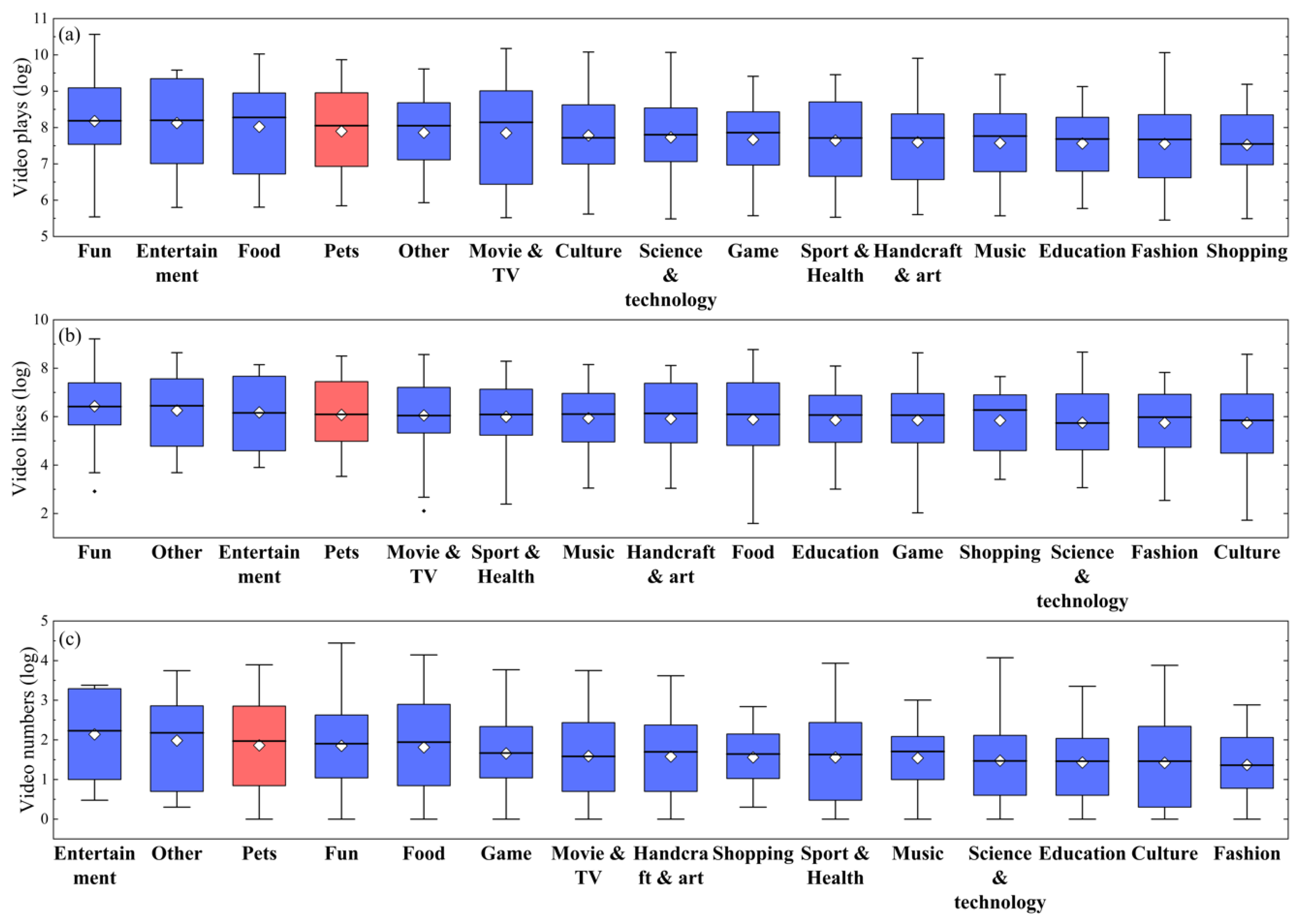
Figure 2.
The heritability of dog or cat ownership. Here, "0" means no pets, "1" for owning dogs, "2" for owning cats, "3" for owning both dogs and cats. Linear regressions were used to calculate the heritability of dog or cat ownership.
Figure 2.
The heritability of dog or cat ownership. Here, "0" means no pets, "1" for owning dogs, "2" for owning cats, "3" for owning both dogs and cats. Linear regressions were used to calculate the heritability of dog or cat ownership.
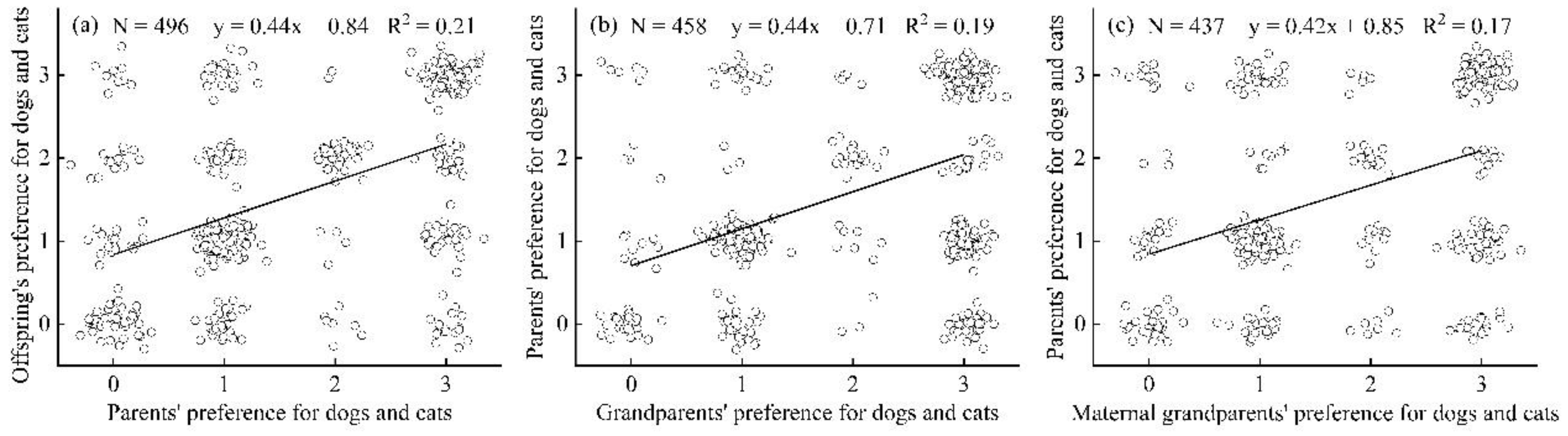
Figure 3.
The proportion of respondents (yes or no) that answered the reasons for having dogs or cats. These five options are: 1) for health improvement, 2) because of religious or cultural issues, 3) to gain emotional value (or compensation), 4) for practical use like guarding or catching rats (treating them as tools), and 5) following the trend (i.e., people around are all having pets).
Figure 3.
The proportion of respondents (yes or no) that answered the reasons for having dogs or cats. These five options are: 1) for health improvement, 2) because of religious or cultural issues, 3) to gain emotional value (or compensation), 4) for practical use like guarding or catching rats (treating them as tools), and 5) following the trend (i.e., people around are all having pets).
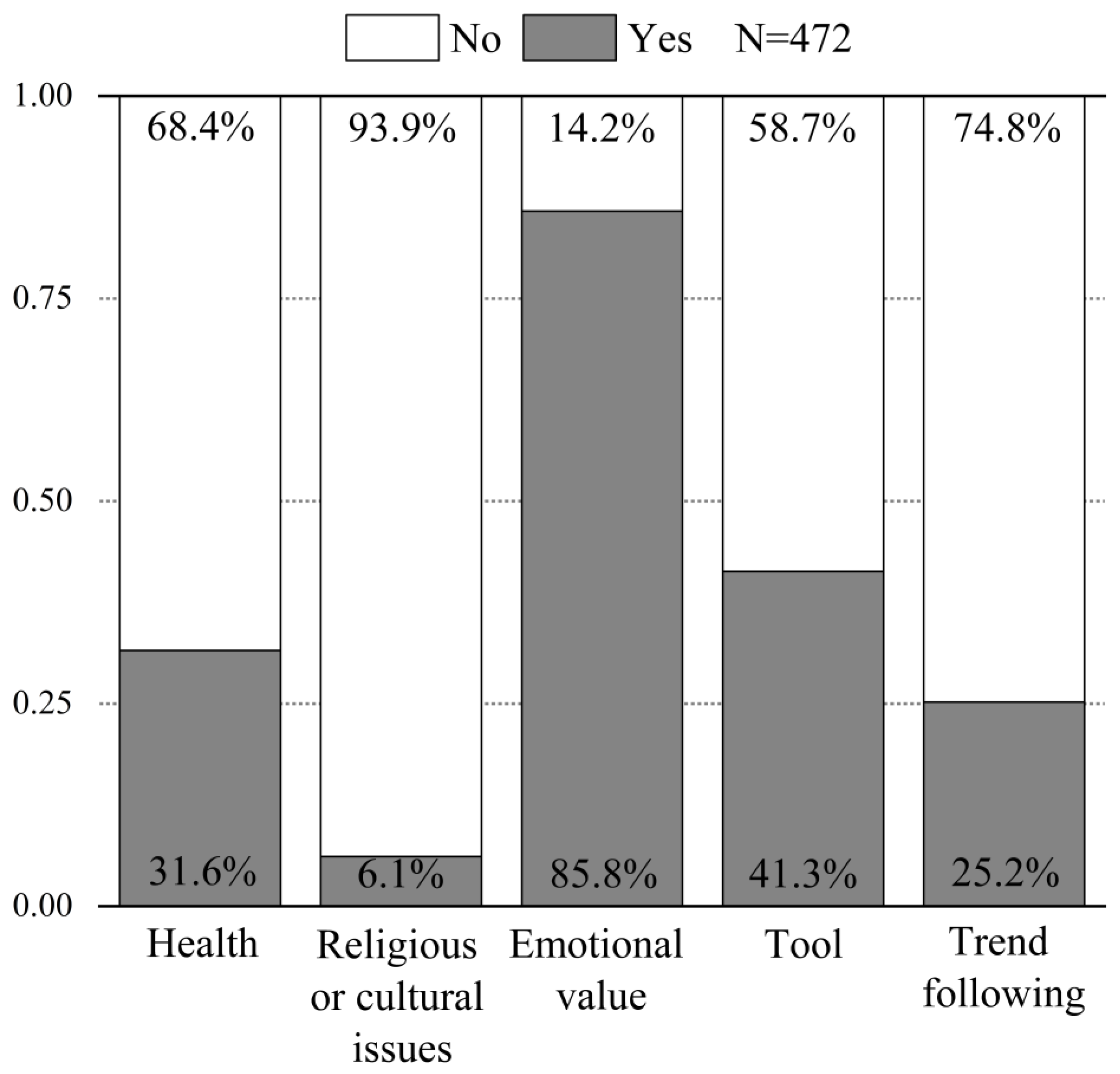
Figure 4.
Factors influencing human preferences for dogs and cats: a) comparison between different types of videos; b) comparison between different age groups; c) comparison between genders; d) the relationship between the number of comments and the level of regional economic development.
Figure 4.
Factors influencing human preferences for dogs and cats: a) comparison between different types of videos; b) comparison between different age groups; c) comparison between genders; d) the relationship between the number of comments and the level of regional economic development.
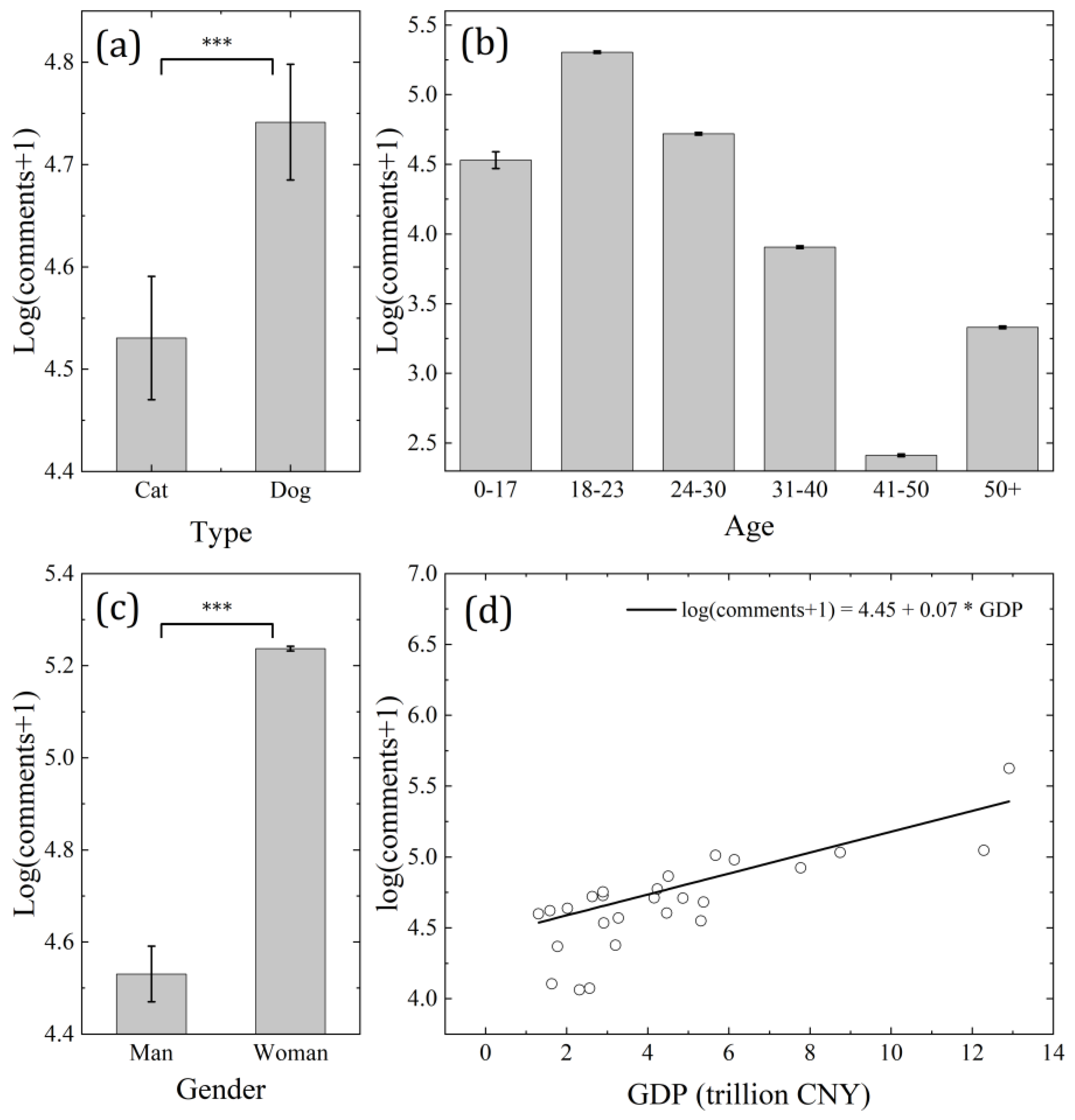

Table 1.
Results of the linear mixed-effects model analysis of factors influencing human preferences for dogs and cats. We used the number of comments on videos as the response variable to represent the audience's preferences. The identity of the videos (Video_ID) and the region where the publisher was located (Region) were taken as random effects, while the type of the videos (two levels: dog or cat), the gender (two levels: man or woman), the age (6 levels: 0-17, 18-23, 24-30, 31-40, 41-50, or > 50 years old) and the economic level (GDP, a continuous variable) of the audience were taken as fixed effects.
Table 1.
Results of the linear mixed-effects model analysis of factors influencing human preferences for dogs and cats. We used the number of comments on videos as the response variable to represent the audience's preferences. The identity of the videos (Video_ID) and the region where the publisher was located (Region) were taken as random effects, while the type of the videos (two levels: dog or cat), the gender (two levels: man or woman), the age (6 levels: 0-17, 18-23, 24-30, 31-40, 41-50, or > 50 years old) and the economic level (GDP, a continuous variable) of the audience were taken as fixed effects.
| Effects | Estimates ± SE | t value | P value |
| Random effects | |||
| Video ID (N = 1006) | 0.794 | ||
| Region (N = 26) | 0.015 | ||
| Residual | 0.798 | ||
| Fixed effects | |||
| Intercept | 4.527 ± 0.061 | ||
| Woman | 0.707 ± 0.005 | 137.4 | <0.001 |
| Dog | 0.211 ± 0.057 | 3.7 | <0.001 |
| GDP | 0.063 ± 0.008 | 7.6 | <0.001 |
| Age 18-23 | 0.775 ± 0.009 | 87.0 | <0.001 |
| Age 24-30 | 0.189 ± 0.009 | 21.2 | <0.001 |
| Age 31-40 | -0.625 ± 0.009 | -70.1 | <0.001 |
| Age 41-50 | -2.119 ± 0.009 | -237.8 | <0.001 |
| Age 50+ | -1.200 ± 0.009 | -134.7 | <0.001 |
Disclaimer/Publisher’s Note: The statements, opinions and data contained in all publications are solely those of the individual author(s) and contributor(s) and not of MDPI and/or the editor(s). MDPI and/or the editor(s) disclaim responsibility for any injury to people or property resulting from any ideas, methods, instructions or products referred to in the content. |
© 2024 by the authors. Licensee MDPI, Basel, Switzerland. This article is an open access article distributed under the terms and conditions of the Creative Commons Attribution (CC BY) license (http://creativecommons.org/licenses/by/4.0/).
Copyright: This open access article is published under a Creative Commons CC BY 4.0 license, which permit the free download, distribution, and reuse, provided that the author and preprint are cited in any reuse.


