

Submitted:
31 July 2024
Posted:
01 August 2024
You are already at the latest version
Abstract
The research of tangible creativity support tools (T-CSTs) has been increasing in recent years. However, there is a lack of review that interprets what T-CSTs trends must be considered and how challenging opinions should be broken. Hence, a focused and critical review of existing studies is necessary. This paper analyzed 86 studies related to T-CSTs following the PRISMA protocol. First, the research tendencies were extracted and provided a basic knowledge construction. Then, we extracted primary research questions, categorized the adopted design and technological solutions, and identified the researchers’ hypotheses-validation. Last, we proposed research gap, challenge and potential opportunities for future researchers and designers. This review will benefit people in the fields of tangible interaction, design studies and education.
Keywords:
human‐computer interaction
; creativity support tools
; tangible interface
; interaction design
1. Introduction
Creativity is the distinct and advanced cognitive capacity for human beings. It enables individuals to extend their cognitions beyond traditional constraints and empirical principles, thus generate innovative ideas (Robinson, 2008; Allen, 2018). Nevertheless, given the fact that human creativity is influenced by multiple internal factors (e.g., cognitive abilities, personality traits, motivation, etc.) and external factors (e.g., social and cultural influences, resources, environmental conditions, etc.), it is necessary to leverage design tools to alleviate limitations and facilitate effective creative output (Amabile, 1983; Csikszentmihalyi, 1996; Runco and Jaeger, 2012). With the development of human-computer interaction (HCI), the concept of Creativity Support Tools (CSTs) was generated. CSTs help individuals to refine their immature conceptions in creation (Bonnardel and Zenasni, 2010). CSTs support creativity by integrating interdisciplinary knowledge, promoting teamwork, and increasing efficiency in idea iteration phase (Shneiderman, 2009; Shneiderman, 2006; Zagalo and Branco, 2015; Derda et al., 2022). With the assistance of CSTs, traits of creative output can be improved, e.g., flexibility (Jansson and Smith, 1991), aesthetics (Zuo, 1998), appropriateness (Sternberg, 1999), novelty (Dym et al., 2005), concept (Colton et al., 2011) and originality (Runco and Jaeger, 2012).
Traditional CSTs work on a graphic user interface (GUI) (e.g., digital screen), also known as Graphic Creativity Support Tools (G-CSTs). However, the technical affordance of G-CST for supporting creative scenarios has been questioned, for its limitation generated from manipulation in pixel screens (Cheng et al., 2011; Zuckerman et al., 2013; Gutiérrez Posada et al., 2014). For instance, GUI is difficult for digitally disadvantaged groups (e.g., patients with cognitive and limbic deficits) to input effective information.
Tangible User Interface (TUI) is a medium in which users interact with digital information in a physical environment (Ishii, 2008). In HCI, augmented bodily perception can reinforce information processing and contribute to mental intelligence (Foglia and Wilson, 2013). On the one hand, TUI heightened the capacity of sensing and manipulating the physical world, facilitated interaction with the digital world by leveraging the affordance of physical objects, surfaces, and spaces. On the other hand, TUI also enhances human’s naturalness of interaction by materializing digital data in physical world (MIT Media Lab, 2022). Overall, TUI provides users with higher levels of realism, physical interaction, and rich sensory experiences (e.g., multi-touch, kinesthetic, voice-controlled, haptic, and adaptive interaction) (Zuckerman et al., 2013).
With the effective integration of TUI, the performance of CST can be improved, such as more embodied cognition (El-Zanfaly et al., 2022), flexible manipulation (Le Goc et al., 2020), and high technical affordance (Alex et al., 2021), thus, the interest of Tangible Creativity Support Tools (T-CSTs) is emerging. However, T-CSTs’ transformative development might not have received enough attention. Besides, T-CSTs lack well-defined research framework, making conducting a systematic review difficult. Here, we proposed two research questions:
- RQ 1: What are the research trends of T-CSTs?
- RQ 2: What are the future T-CSTs’ research opportunities?
To address these two questions, an analysis of the research question generation, artifact design, technological actualization, evaluation, summarization and critical comments of related T-CSTs research, were given. From this, current trends and potential future opportunities of T-CSTs were identified to assist researchers and designers in their early-stage exploration.
2. The Collection of Research Samples
2.1. Methodology
Research samples were collected following the PRISMA protocol (Moher et al., 2009) (see Figure 1). Details of the sample selection are provided below.
Database choice. To search for research samples, we utilized a range of databases, including Web of Science, ACM Digital Library, IEEE Xplore, Engineering Village, Science Direct, and other relevant sources. Selecting Web of Science for our search allowed us to access a comprehensive citation database covering a broad range of scientific disciplines, including computer science, engineering, and social sciences. This ensured that we could obtain research samples across diverse topics, making our study more comprehensive. The ACM Digital Library and IEEE Xplore databases contain a significant amount of design and empirical research related to T-CSTs, with a focus on sample designs that are well-aligned with the research style of HCI. Additionally, the remaining databases utilized in this study contain numerous research samples that were conducted using comprehensive and rigorous methods, making them important to consider. Through the use of these databases in combination, we were able to identify as many eligible research samples as possible for screening in this study.
Searching strategy. The following terms and connectors were used for the query: (‘Creativity Support Tools’ OR ‘Creative Enhancement’ OR ‘Creative Reinforcement’ OR ‘Creative Empowerment’ OR ‘Creative Improvement’) AND Interaction, technology, AND technique. The initial search was carried out on September 25, 2021, and the second search for Creativity support systems / Tangible / Natural user interfaces was finished on June 22, 2022.
Screening criteria. Our screening criteria is shown in Figure 1. 1258 papers were found in Web of Science (N=277), Engineering Village (N=273), ACM Digital library (N=256), IEEE Xplore (N=125), Science Direct (N=70), and Others (N=257). After removing duplicates, 905 accessible documents remained. To avoid inaccurate titles (i.e., technical enhancement of comprehensive learning ability), we further screened the samples according to the abstracts and 470 papers were removed. Then, we reviewed the complete text of rest samples carefully, leaving 61 papers that meet the following criteria: 1) The study must include detailed TUI-based prototypes. 2) The study should have well-defined research question, objective, concept, experiment, detailed data, and result. 4) The studies must be published in journals or conferences. Further, to ensure a balanced collection of research samples, we employed two methods to supplement the sample size. On the one hand, we added potential samples that were cited by researchers in the existing collected sample set (N=10). On the other hand, we utilized other approaches to add to the screening list, such as selecting appropriate samples from the authors' other research projects in the existing collected sample set (N=15). As a result, this research contained 86 T-CSTss work, 64.8% are conference papers, and 35.2% are journal publications, all in English (see Table A1 in Appendix for detailed information on collected samples).
2.2. Overview of Publication
The screened samples dated back to 2011, and approximately 70% of the papers were published in the past five years (see Figure 2A) and showed positively growing tendency. The most referred topic is education (N=29), other, e.g., art (N=16), business (N=11), work (N=10) and life (N=3) were also covered (see Figure 2B). Moreover, the forms of technical presentation of samples were extracted in Figure 2C. The Internet of things (IoT) related prototypes and toolkits (N=25), virtual reality/augmented reality (VR/AR) (N=20), and social robots (N=17) were mainstream solutions.
Social Network Analysis (SNA) method was adopted (Barnes, 1969) to investigate the knowledge structure of T-CSTs. The keywords of these papers were chosen to build the text dataset. We de-duplicated the raw data and reduced their tense and lexicon. Some technology nouns and concepts were also merged. Further, the analyzed result was visualized using Gephi 0.9.2 (Bastian et al., 2009) (see Figure 3). The SNA results showed three development stages of T-CSTs with three years as a period.
In the initial period (2011-2014), T-CSTs researchers mainly focused on Work, Business, and Art topics. The emergence of nodes like Materiality, Augmented Multi-Touch, Multi-modal, and Natural User Interface, among others, indicated that researchers began to focus on the materiality of TUI and introduced it into the construction of CSTs (see labels in the blue rounded rectangle in Figure 3A). Then, T-CSTs established the basic knowledge structure in the transitional period (2015-2018), T-CSTs’ research process became more abundant with interdisciplinary collaboration, as shown on the labels in the yellow rounded rectangle in Figure 3B. The design form of prototypes became more diversified, such as Sensor-Based Furniture, Motion Picture and Analysis, and Sketch-based Modeling. Considerable research related to Rehabilitation and Education showed that TUI served digitally disadvantaged users.
In the mature period (2019-2022), the knowledge structure has been further developed in-depth. The emergence of buzzwords, such as Smart Home and Helmet Mounted Display, indicated that non-specialized domains, such as Entertainment and Life, became the emerging interest of T-CSTs. Furthermore, many research of the Art and Education engaged in diverse technical forms, such as 3D User Interface, Collaborative Music Making, Sonic Interaction Design, Augmented and Alternative Communication, Grasping-type interface, and Embedded Sensing Devices (see labels in the blue rounded rectangle in Figure 3C). Besides, Nature User Interface (NUI), Visualization, Machine Learning, and AR received much attention regarding technological solutions.
3. The Analysis of Research Construction
3.1. Theoretical Frameworks of T-CSTs Research
Theoretical frameworks for enhancing creativity offer analytical approaches to examine research samples. such as the 4P Framework (Rhodes, 1961), the Psychological Model of Creativity (Sternberg, 2021), and the Creativity 4.0 Model (Bruno and Canina, 2019), etc., as shown in Figure 4. Research samples can be broadly classified into five categories: external influence, capable affordance, behavioral stimulation, thinking space, and conceptual expression.
3.2. Research Aims
These studies revolved different research aims, respectively. Most studies focused on the external influence (N=33) of T-CSTs, emphasizing the integration of dispersed creative resources through improving team collaboration, so called organizational creativity (Ehrenberg et al., 2018, Alves-Oliveira et al., 2020; Thorn, 2021). They researched on how technology encouraged collective activities in innovative culture, equal opportunities, cross-functional collaboration, agile management, resource integration, and inclusive environment (Men et al., 2018; Le Goc et al., 2020; Blanco et al., 2022; Schmill et al., 2022).
Many studies concentrated on leveraging T-CSTs to increase capable affordance (N=26) for digitally disadvantaged users. The affordance, natural interaction and cognitive load of T-CSTs were their primary exploration (Yamaoka and Kakehi, 2013; Lee et al., 2017; Endow et al., 2022, Costa et al., 2019; Chen et al., 2021).
For behavioral stimulation (N=12), these studies employed playfulness and positive experience to stimulate user engagement in creative activities (Baur et al., 2018; Belakova et al., 2021). How to leverage the rich physical and sensory experiences of T-CSTs to create a more immersive and engaging environment became their aim.
Several studies aimed at design thinking (N=9), researchers compared how T-CSTs assisted creators’ diversified thinking processes. Representative topics mainly included STEAM-related approaches, e.g., hands-on practice (Thieme et al., 2011; Jou and Wang, 2015; Kim, 2020; Hubbard et al., 2022), verbal creativity (Alves-Oliveira et al., 2020; Hu et al., 2021; Thorn, 2021), storytelling guidance (Cullen and Metatla, 2019; Hirsch et al., 2021; Somma et al., 2021).
For conceptual expression (N=5), some work explored the technical forms, regarding the effectiveness improvement, uniqueness, and diversity of creative expressions. Their topics centered on expression styles and immersive technologies, such as improv creative behaviors (Yamaguchi et al., 2017; Campos et al., 2014) and multi-sensory environments (Seo et al., 2017; Yang et al., 2018; Cullen and Metatla, 2019; Sabuncuoglu, 2020).
3.3. Design Solutions of T-CSTs
This section revealed the design solutions of T-CSTs, as visualized in Figure 5.
TUI optimized external influence for creativity training, aimed at improving their collaboration. Various designs are Co-creations, e.g., AR-based system for effective communication (Jessen et al., 2020), tangible storytelling tools for rehabilitation (Neate et al., 2020; Cullen and Metatla, 2019). Some artifacts developed embodied visual environments (Yang et al., 2018; Costa et al., 2019; Lottridge, 2022).
Researchers optimized the affordance for non-professionals and beginners by designing more user-friendly components to reduce recognition burden, such as lowering the threshold of expressing with electronic textiles design (Endow et al., 2022), improving the accuracy of physical modeling for architectural exploration (Nasman and Cutler, 2013), and establishing the multi-sensory memory of piano beginners (Branje and Fels, 2014).
T-CSTs affected creators’ engagement and behavior, especially for long-term and remote environments. For example, to encourage creative workers to manage their schedules, tangible calendar Monomizo was developed to cultivate reasonable working habits (Jang et al., 2019). The multi-sensory VR/AR environment was also prevalent for emotion regulation (Fujinami et al., 2018; Dube and İnce, 2019; Somma et al., 2021).
Artifacts focused on design thinking leveraged heuristic activities for creative beginners in daily lives with interactive features. Human-robot interaction (HRI) systems with heuristic functions (e.g., verbal guidance, behavioral imitation, and drawing) were developed for storytelling training (Alves-Oliveira et al., 2020; Elgarf et al., 2021; Ali et al. 2021; Ali et al., 2022). IoT toolkits PlushPal allowed children to build machine learning-based models through interaction with customized toys (Tseng et al., 2021).
Conceptual expression studies optimized the expressive behavior of artists (e.g., musicians, dancers, and performing artists) by enhancing their emotions. For example, TwinkleBall (Yamaguchi et al., 2017) generated real-time music, ImprovBot (Rond et al., 2019) inspired improv creativity, and preference-driven computational design (Urban Davis et al., 2021; Lin et al., 2020; Guo et al., 2022).
3.4. Prototyping Technologies
To achieve the experiment and application of the design solutions, many mainstream technologies were utilized in the development process. The main solutions include social robots for instructive avatars, IoT toolkits for technological affordance, VR/AR for embedded experience, augmented tools for augmented working, and interactive tablets for collaboration.
Social robot is a co-creative agent, offers an external setting that assists creative process, such as the definition of creative space, evaluation of similar examples, consideration of alternative schemes, and engagement of creative conflict (Kahn et al., 2014; Kahn et al., 2016). Social robots equipped devices with multi-sensory input for extracting humans’ creative intention, such as visual information (Cosentino et al., 2014), text information (Lin et al., 2020; Hu et al.,2021; Ali et al., 2022), and verbal information (Elgarf et al., 2021; Ali et al., 2021).
DIY toolkits assisted hands-on and concrete actualization of mental imagery by providing electronic materials to build, experiment, and reflect on their creative thinking. These toolkits include components such as moisture, force, potentiometer, ultrasonic sensors, LED, DC motor, buzzer, LCD (Somma et al., 2021), etc. Some toolkits decreased the difficulty of construction, such as FritzBot for conversational instruction (Chen et al., 2021), Makey Makey (MM) and TronicBoard for low-burden programming (Makela and Vellonen, 2018; Senaratne et al., 2022).
VR/AR enhanced creativity by enabling users to manipulate and engage with virtual objects and environments in a realistic and immersive manner, thereby providing new opportunities for simulating natural behaviors. Based on head-mounted devices (HMDs) and motion capture devices, users could release more unrestrained behaviors, like jumping, running, squatting, etc. Some researchers designed advanced manipulation modes, such as handle-operated 3D sketching modeling (Jackson et al., 2016; Yang et al., 2018) , gesture-based collaborative music making (Men and Bryan-Kinns, 2018; Costa et al., 2019), somatic sense-based sandbox playing (Fröhlich et al., 2018) and posture-located dancing (Lottridge et al., 2022). Several AR studies embedded GUI tools (Dube and Ince, 2019; Jessen et al., 2020; Im and Rogers, 2021) , and one utilized AR glasses (Campos et al., 2014).
Augmented tools provided accessible interfaces for idea generation and collaboration, enabling users to efficiently capture thoughts and concepts. Many tools integrated IoTs components to expand their functionality, for example, integrating gesture sensors into wearable devices (Liu et al., 2012; Tseng et al., 2021; Martelloni et al., 2021) and instruments (Law et al., 2019) , augmenting pens with accelerometer sensors (Cox and Semwal, 2020) , interactive products with physical manipulation input (Wang et al., 2014; Chen et al., 2019; Hirsch et al., 2021).
Interactive tablets served as collaboration platforms in the creative process for human-computer and team collaboration. For example, Sand playground work platforms (El-Zanfaly et al., 2022) and robotic arms (Law et al., 2019) enable cooperative manipulation of physical components, while All4One facilitate multi-person brainstorming (Lee et al., 2017).
3.5. Evaluation of T-CSTs Solutions
The research sample experiments were 38% qualitative, 30% quantitative, and 32% mixed-method studies. The most common evaluation scenario was conducted in workshops, where participants were required to complete tasks and provide feedback using different T-CSTs assessment forms. For example, researchers required participants to dance, paint, or build 3D models in a VR environment (Urban Davis et al., 2021; Lottridge et al., 2022) to evaluate external factors or engage in game-breaking with a social robot (Ali et al., 2021; Blanco et al., 2022).
Observation method was used in 32% studies, while questionnaires and data modeling were utilized in 30% experiments. Furthermore, 16% researchers analyzed user behavior data from device history and self-reports. One T-CSTs study used data mining and machine learning (Blanco et al., 2022), and two studies adopted physiological signal evaluations (Yang et al., 2018; Zhi et al., 2015).
The sample had a median of 16 participants and 25 in average. 56% of the experiments were designed for participants without a creative background, while 34% were for professionals, the rest involved both.
The evaluation standards could be divided into two categories: creativity-oriented and technology-oriented, which focus on measuring augmented human behaviors and technical performance, respectively. 31% studies were conducted using a variety of scales. The creativity-oriented standards adopted high-profile scale, like the Test of Creative Thinking-Drawing Production (TCT-DP) (Alves-Oliveira et al., 2020; Ali et al., 2021), the Laban Movement Analysis (LMA) (Yamaguchi and Kadone, 2017) and Intrinsic Motivation Inventory (IMI) (Baur et al., 2018). The technology-oriented standards generally used the System Usability Scale (SUS) ( Cibrian et al., 2017; Costa et al., 2019; Guo et al., 2022) and The National Aeronautics and Space Administration Task Load Index (NASA-TLX) (Dube and Ince, 2019; Chen et al., 2021). Furthermore, a few scales combined both creativity and technology, such as the Creativity Support Index (CSI) (Fujinami et al., 2018).
We quantified their standards, as shown in Figure 6. Expressivity, Originality, Novelty, and Surprise of creative output were considered for creativity-oriented evaluation. Meanwhile, the Accuracy of artifacts used in idea expression was also mentioned. Furthermore, researchers concentrated on evaluating behavioral stimulations, which reflected the improvement of human attitudes toward artifacts, such as, Engagement, Interest, User Experience, and Satisfaction. There was also terms for technology evaluations, such as Usability, Usefulness, Function, etc.
Most of the researchers’ hypotheses were validated, and their feedback was visualized in Figure 7. In technology-oriented evaluation, many studies valused the Effectiveness of T-CSTs (Yamaguchi and Kadone, 2017; Fujinami et al., 2018; Endow et al., 2022). Their findings for the creativity-centered evaluation include a Change of mindset (Ali et al., 2022; Matthews et al., 2022), Higher interest (Hubbard et al., 2021; Lottridge et al., 2022). Meanwhile, researchers also pointed out that technique understandability, the criteria of tasks, the selection of participants, and the adaptability of the actual scenario were essential for T-CSTs researches.
4. Discussion
The review result demonstrates the value of T-CSTs. First, the usage of T-CSTs improved user comprehension, engagement, and immersion. Second, T-CSTs integrated sensing devices into the development process, allowing expression through body movements and verbal interactions. Third, T-CSTs’ afforded low-cost behavior patterns that benefits non-professional creators. Chapter 2.2 gave an overview of publications, including publishing tendencies and knowledge graph. The quantity of T-CSTs publications has grown in recent years.
It appears that much attention has been directed toward digitally disadvantaged groups, like children, rehabilitation groups. 33.7% of T-CSTs research focused on students to mine the exploratory epistemic inclusiveness of TUI, including enjoyment, playfulness, and esthetics of interaction. For example, the child-centered design space was afforded by embedding computation in physical environment (Elgarf et al., 2021; Blanco et al., 2022; Lahav and Wolfson, 2022). However, rehabilitation-related T-CSTs research received less attention and the elderly group did not appear in our sample.
From section 3. 2 Research Aims of T-CSTs, researchers raised questions focusing on effective co-creation, technological affordance, motivation arousal, content assistance, and augmented imagination. All these research questions involved technical, theoretical, and practical topics.
In section 3.3 Design Solutions, T-CSTs researchers combined design thinking and research methodologies to develop HCI tools to support creativity, e.g., cultivating critical thinking skills, reinforcing the effectiveness of ideas, and optimizing creative scaffolds, while creativity expression was less aimed at.
T-CSTs researchers utilized emotion-related (e.g., Enjoyment, Surprising) as indicators of evaluation, but they are used as the design concepts of CST received limited attention. Hence, further exploration is necessary to determine whether and how these emotion-related and personality-related attributes can enhance creative performance in the design process potentially.
Section 3.4 Prototyping Technologies summarized how researchers implement TUI into design. Although most technologies actualized their hypotheses, some research still points out deficiencies in technical affordance (Jackson and Keefe, 2016), understandability (Strawhacker and Bers, 2015) and usability (Vishkaie, 2018) of manipulation.Although some studies have attempted to address the challenges of manipulation through the use of psychological interventions, this type of approach may not accurately reflect user adaptation to the technology. It is possible that biological channels was an under-appreciated but powerful solution. Recently, abundant biological models of creativity enabled us to capture the biological state of a user’s intention and develop a more intelligent interaction system. However, almost all T-CSTs researchers have not yet utilized this. Although T-CSTs has a good technological paradigm to actualize creative application, improving the level of natural interaction is necessary to decrease the human cognitive load. Flexible technological paradigm should enable users to use them unobtrusively and operate at the periphery of their creative attention (Weiser and Brown, 1996).
Section 3.4 Evaluation of solutions described T-CSTs researchers’ experimental methods, including participants, data collection, etc. Researchers selected quantitative, qualitative, and mixed evaluation methods based on their needs, such as long-term self-reporting and standard data collection in a laboratory setting. We recorded the evaluation items during data collection and found that both creativity and usability-oriented evaluation items were involved. The diversity of assessment approaches was an excellent advantage of T-CSTs but developing a standardized toolbox for a higher level of flexibility and rigidity in the evaluation was still essential.
T-CSTs showed a notable strength in diverse human-centered development and research solutions. Therefore, it is necessary to establish T-CSTs as a distinct discipline for greater attention. For theoretical application, a limited number of early research built on identifiable theoretical foundations for handling creativity-supported problems. Researchers used artifact designs to understand, test, and update creativity-supported theories. However, many studies formulated and approached the research question from a phenomenon-based and technological perspective, hindering the development of theoretical applications. Artifacts were construed as one-off exploratory prototypes in most T-CSTs cases without unified standards. Although many research have significant contributions, researchers did not extract or propose their theoretical benefits to construct systematic models for follow-up researchers.
5. Reflection & Opportunities
This chapter reflected on the research trends and proposed future opportunities to answer research question 2:
5.1. Emphasize the Research on Everyday Creativity Assistance
Professional creativity is not the only capacity that should be augmented by T-CSTs. Everyday creativity should also be considered, although it may not result in generating clear-cut, genius-level creative outputs in the short term (Merrotsy, 2013), i.e., humans’ novel interpretation of experiences, actions, and events in the long-term cognitive activities (Kaufman and Beghetto, 2009). Everyday creativity has similarities with professional creativity and has the potential to evolve into professional creativity (Runco, 2014).
However, several papers researched on everyday creativity, i.e., LoverBox (Thieme et al., 2011), AR-based face makeup system (Treepong et al., 2018) and T4Tags 2.0 (Bellucci et al., 2019). T4Tags 2.0 allowed non-technical users to explore the smart home through easily triggered programs. LoverBox promoted the daily video-based co-creation to strengthen lovers’ sense of belonging and intimacy. Nevertheless, T-CSTs are confronted with potential technical challenges :
- Hybrid materiality and interactive forms influence how interactivity is perceived by individuals, making affordance of TUI difficult to measure (Jung et al., 2017). However, using personalized intervention in TUI’s component design can help users to build in-depth and controllable mental models during interaction. For example, by incorporating AI or generative components into hardware, e.g., the detection of users’ creativity preferences, users can customize manipulation components and interaction forms to their cognitive processing, then facilitate long-term adoption of T-CSTs.
- T-CSTs could guide individuals to reflect on their self-directed and expression rather than providing excessive assistance. With reflection design, users can build a deeper understanding of creative space and give insight into the problems in everyday creation (Baumer et al., 2014).
- Evaluating the enhancement of everyday creativity by conducting experiments and workshops might be challenging to define augmented performance. Combining long-term and in-situ research approaches could capture the creators’ variation of augmented indicators and avoid various biases, e.g., the novelty effect (Rutten et al., 2021).
5.2. Utilize the Inclusiveness of the Tangible User Interface for Patients
T-CSTs offer inclusive usage patterns for patients. Traditional rehabilitation technologies might have limitations regarding affordance, exploratory capabilities, and patient persistence. T-CSTs arouse patients’ cognitive attributes, e.g., learn-by-doing, and improve their sensory skills, e.g., control sense of limbs, motivate patients to enhance their engagement in task-oriented therapy.
Our samples demonstrated TUI’s applicability in improving patients’ cognitive, sensory, and neuromuscular engagement in rehabilitation. First, the playfulness of T-CSTs offered embodied interactive feedback intuitively and enhanced the effectiveness of therapeutic intention (Seo et al., 2017; Cibrian et al., 2017; Neate et al., 2020; Alex et al., 2021). Second, T-CSTs with multi-sensory components, e.g., tactile manipulation, was utilized to bring comprehensive cognitive conditions in addressing patients’ limited perceptual affordance (Cullen and Metatla, 2019; Sabuncuoglu et al., 2020; Somma et al., 2021). Third, in neuromuscular rehabilitation, TUI was applied to supply scientific, controllable, and regular limb training (Baur et al., 2018). These studies have shown T-CSTs’ potential in rehabilitation. However, the current scenario of rehabilitation therapy might be limited and could be expanded.
- The concept of gamification can supply more engaging and satisfying experiences for users by arousing users’ mental flow (Xiao et al., 2022). Based on gamification in component design, T-CSTs encourage patients to engage in physical activities to develop their collaboration, motor skills, and spatial cognition.
- T-CSTs could introduce therapy research through collaboration with professional rehabilitation scholars. Some effective therapies could be explored, such as Cognitive Stimulation Therapy for the elderly and caregivers (Fink, 2010; Pric and Tinker, 2014), meditation (Ding et al., 2014), aerobic exercise (Román et al., 2018) and yoga (Donnegan et al., 2018), alpha/theta neurofeedback for musical learners (Gruzelier, 2014).
5.3. Design Artifacts to Boost Creativity Expression
To improve the novelty and originality of creative outputs, T-CSTs could further stimulate users’ profound creativity by enhancing users’ emotions and personalities.
The literature did not show enough attention on augmenting creativity expression for emotional intervention. Emotion-supported research involved emotional arousal, reflection, and emotion presentation, which are embodied by vibrate feedback to stimulate inspiration (Giannoulis and Sas, 2013), robot to train storytelling ability (Peng et al., 2020) and VR environment to train theatrical rehearsal (Bouville et al., 2016). There are research gaps in the accuracy of assessment methods, telematic usage scenarios, and individualized emotional mechanisms.
- Emotional assessment method in our sample tends to be single, relying on qualitative methods, such as self-report (Jang et al., 2019) and observation (Jones et al., 2020) and questionnaire (Peng et al., 2020). Researchers could improve the quality and accuracy of emotion caption with implicit and quantitative approaches (e.g., language, facial expressions, and galvanic skin response).
- It is worthwhile to explore emotional creativity in telematic usage scenarios. Some remote T-CSTs cases were distributed artifacts but did not concentrate on emotional creativity, like online sketching and idea-generation tools for remote meetings (Lee et al., 2017), telematic synchronous system for music learning (Thorn et al., 2021), motion-capture-based VR stage space for immersive dance (Lottridge et al., 2022). Researchers could conduct extensive emotion-related research for emotional scenarios in T-CSTs.
- There was no theoretical consensus regarding the relationship between emotion and creativity, such as viewpoints disputed in the positive and negative states (Lofy, 1998; Charyton et al., 2009), self-regulation from the properties of creative task (Zenasni and Lubart, 2002) and the activation level (De Dreu et al., 2008). Therefore, the individualized emotional mechanism of creativity needs to be further explored to elicit diversified emotional effects.
- Personality-supported cases use AI to amplify human personalities in design. T-CSTs researchers could further expedite the collaboration between humans and AI, allowing users to generate personality efficiently. For example, an AI-based multi-media environment could integrate users’ personalities to build a more rhythmic, aesthetic, and immersive setting for better personalized expression.
5.4. Interact with Biological Data
Researchers could focus on the potential integration with biological mechanisms of creativity in informational input while using T-CSTs. Individual differences in creative performance are upon creativity-related psychological parameters, and neurobiological systems further determine these psychological features (Jauk, 2019). Multi-modal biological mechanisms of creativity relevant traits (e.g., imagination, emotion, motivation) improve humans’ behavioral interpretability in creative performance (Martindale, 1999). For instance, the secretion of dopamine explains the improvement of creative motivation, which influences novelty-seeking and creativity-driven (Flaherty, 2005; DeYoung, 2013; Zaidel, 2014). Further, many imaging studies involved in detecting dopamine secretion and creative performance, e.g., using functional magnetic resonance imaging to capture creators’ Aha!-moment to find insightful solutions (Tik et al., 2018). Therefore, with the biosensors or detection equipment, T-CSTs can understand humans’ creative and decision-making intentions.
Here, three T-CSTs cases were collected involving biological modalities: VibeRate (Giannoulis and Sas, 2013) measured emotional arousal during inspiration-gathering phase using galvanic skin response sensors. One study used Electroencephalogram to control physical objects to improve mental concentration (Zhi et al., 2015). Eye-tracking system was also adopted (Guo et al., 2022). However, several points should be considered:
- First, most current biological mechanisms for creativity used emotion as predictive mediator, other traits did not receive much attention. Researchers could consider multiple factors for augmenting creativity to decrease the bias of bio-based prediction. Take attention as an example, researchers could take it as one of the predictors with others, e.g., emotion, motivation, and choose to correspond biological modal to actualize.
- Second, using a single biological modality to understand the creation process may not be precise enough. Multi-modal design techniques can free user’s mental resources to reduce mental workload (Oviatt, 2006). A well-designed multi-modal system fusing two or more information sources can reduce recognition uncertainty (Oviatt, 2002). Multi-modal data facilitates the development of reliable and accurate recognition model for creativity.
- Researchers should promote the robustness of the devices and consider whether sensing devices might undermine the effects of creative expression. Some creative behaviors involve physical activities, such as dancing, performing, and brainstorming. For robustness, users’ adaptivity, ongoing task, dialogue, environmental context, and input modes collectively generate constraints for the biological status detection.
5.5. Decrease Physical & Cognitive Load for Natural Interaction
To facilitate users’ physical and mental engagement in the creative process, TUI could be used to reduce their cognitive and physical load in complex manipulation (Oviatt et al., 2006; Falcao et al., 2015). Therefore, further enhancing the operation affordance through interface design could decrease the human mental cognitive load. For example, with the help of heuristic creative conversation, users can execute creative tasks in a more mentally focused way (Kahn et al., 2014; Kahn et al., 2016). To diminish human physical load, T-CSTs reduced extraneous distractions while conducting creative tasks. For example, VR-based T-CSTs helped users to reach higher levels of self-confidence, flow status, and pleasant experience with less physical burden (Jackson et al., 2016; Yang et al., 2018; Costa et al., 2019).
Although users interacted with TUIs in relatively low-burden ways, long-term interaction may also cause physical exhaustion, like neck and spin (Dube et al., 2019). For example, AR display only can supply users with a limited collaborative space. The integration with GUI assistive devices in TUI-based tasks can reduce human error and improve decision-making by displaying real-time feedback. Thus, the relationship between the two types of interfaces should be further explored. In our samples, T-CSTs researchers applied GUI patterns such as tablets and projection in complex HRI tasks to give users visualized information to understand creativity-supported functions (Baur et al., 2018; Hu et al., 2021; Ali et al., 2022). We suggest GUI applications further improve visibility and streamline the creative process using focused interactive modules (icons and menus).
5.6. Balance and Standardize the Evaluation Process
Scientific research emphasizes the progress of knowledge, while design pursues the novel concepts and outcome. T-CSTs research as the combination of design and research, should balance the flexibility and rigidity in the evaluation procedures (Zimmerman and Forlizzi, 2014). So, using a mixed-methods approach, which incorporates both quantitative and qualitative measures, can improve the accuracy of evaluation. For example, Quantitative data such as task completion time and user satisfaction can provide a direct understanding of the T-CSTs’ performance, while qualitative measures such as interviews and observations can provide a more subjective and nuanced understanding of the tool’s impact. Qualitative measures can also help to identify external factors that affects user satisfaction.
It is necessary to develop a systematic toolbox to evaluate T-CSTs to improve the standardization of the evaluation procedure. Standardized evaluation is critical for improving effectiveness, evidence-based development, user-centered design, and research advancement. Furthermore, it enables the gathering of empirical evidence to indicate future directions and compare different tools and approaches.
6. Limitation
All the research opportunities we proposed to stem from the inductive trend we extracted from existing T-CSTs papers, yet this scoping review had several limitations. Firstly, our selection and inclusion process may have bias and cannot fully represent trends and opportunities in the T-CSTs field due to the varying perspectives and preferences of different scholars and the potential limitations of the search strategy employed. Secondly, given the nascent stage of research in this area, as evidenced by the quality of the articles reviewed, the identification of trends and opportunities should be viewed with some caution, as these are likely to evolve as the field matures. Lastly, this review focuses primarily on studies published in English, which may have resulted in the exclusion of relevant research published in other languages.
7. Conclusions
This scoping review showed a first-time attempt to induct the current trend and critically discussed future opportunities of T-CSTs. We extract the research trend based on 86 publications by analyzing their research process of research question generation, artifact design, technological application, and evaluation.
Drawing on our key findings and critical reflection, we identify several opportunities to solve current research gaps, shown below: (1) Further research is needed to fully explore the potential of T-CSTs in facilitating everyday creativity, concentrating on developing in-depth mental models, reflective design, and longitudinal evaluations. (2) T-CSTs offer more inclusive concepts for constructing interaction forms that should be expanded further, with consideration for higher gamification and broader scenarios. (3) More attention should be given to augmenting expressive creativity by improving humans’ emotional states. Researchers should address research gaps related to the accuracy of assessment methods, telematic usage scenarios, and individualized emotional mechanisms. (4) To improve T-CST’s effectiveness in identifying human creative intention, researchers could focus on the diverse predictive bio-mediators, multi-modal data sources, and usage stability of T-CSTs. (5) Natural interaction still faces ergonomic challenges of physical load. Researchers may consider the implementation of assistive GUI devices. (6) To improve the effectiveness of results, researchers can develop mixed methods and standardized toolboxes.
In design practice, we structured the development process of T-CSTs prototypes systematically, offering a clear guide for industry professionals. Then, we explored T-CSTs’ potential applications and innovative significance in various domains. With this research, industry professionals can gain a better understanding of T-CSTs technology and apply it to a variety of practical scenarios. Last, this review provided a comprehensive analysis and explanation of the key issues in T-CSTs, facilitating a better understanding of the trends and opportunities in this field.
Appendix
Screening Samples of Review

Table A1.
Screening samples of this review.
| Authors and Times | Entry Point(s) | Augmented Factor(s) | Application | Name of Artifacts | Technological Actualization | Design Purposes | Contribution type | Used Scale & Standard |
|---|---|---|---|---|---|---|---|---|
| (Lottridge et al., 2022) | Integration;Expression | Situation;Emotion;Driven Force | Art | BeatSaber (Demo), OhShape, Tilt Brush | VR Applications with Matching handle | Reinforcement of user experience | Qualitative study | Subjective definition |
| (El-Zanfaly et al., 2022) | Integration; | Cooperation; | BusinessInnovation | Sand Playground | Tabletop Systems with a Projection system | Formation and implementation of collaboration | Qualitative study | Subjective definition |
| (Ali et al., 2022) | Integration;Execution | Cooperation;Mindset;Rhythm | Education | Escape!Bot | Social Robots with GUI Application | Formation of mindset | Mixed-Method study | Subjective definition |
| (Guo et al., 2022) | Availability; | Ability; | BusinessInnovation | VibeRate | Productivity tools | Optimization of threshold and skill | Quantitative study | SUS |
| (Senaratne et al., 2022) | Availability; | Knowledge; | Rehabilitation | TronicBoards | IoT Toolkits | Optimization of threshold and skill | Qualitative study | Subjective definition |
| (Blanco et al., 2022) | Integration; | Cooperation; | Education | Nikivision | IoT Toolkits with a Projection system | Formation and implementation of collaboration | Quantitative study | Educational data mining (EDM) |
| (Matthews et al., 2022) | Integration;Execution | Cooperation;Mindset; | Education | Animettes | IoT Toolkits | Formation and implementation of collaboration | Qualitative study | Subjective definition |
| (Endow et al., 2022) | Availability; | Ability; | Art | Embr LCTD | IoT Toolkits | Ideal manifestation | Quantitative study | Subjective definition |
| (Li et al., 2022) | Integration;Availability | Cooperation;Ability;Mindset | Education | stayFOCUSed, Group Hexagon, Tower, Remolight, Glowing Wand | IoT Toolkits | Ideal manifestation | Mixed-Method study | User experience |
| (Lahav et al., 2022) | Availability; | Ability; | Education | Osmo Tangram | IoT Kits with GUI Application | Improvement of intelligence | Quantitative study | Subjective definition |
| (Thorn, 2021) | Implementation; | Motivation; | Education | Unnamed | Wearable products with GUI Application | Ideal manifestation | Quantitative study | Subjective definition |
| (Urban Davis et al., 2021) | Integration;Expression | Cooperation;Situation;Personality | BusinessInnovation | Calliope 3D modeling | VR Applications | Formation and implementation of collaboration | Qualitative study | Subjective definition |
| (Alex et al., 2021) | Implementation;Integration | Motivation;Situation; | Rehabilitation | Unnamed | VR Applications | Reinforcement of user experience | Qualitative study | Subjective definition |
| (Ali et al., 2021) | Integration; | Cooperation;Situation; | Education | Jibo | Social Robots with GUI Application | Ideal manifestation | Mixed-Method study | TCT-DP |
| (Hubbard et al., 2021) | Execution;Implementation | Mindset;Rhythm;Driven Force | Entertainment | DIY Fluffy Robots | Social Robots with GUI Application | Improvement of cognition and knowledge | Mixed-Method study | Affinity diagramming and thematic analysis |
| (Hu et al., 2021) | Integration; | Cooperation;Situation; | Art | Kuri | Social Robots with a Projection system | Ideal manifestation | Mixed-Method study | Factors of Divergent Thinking |
| (Elgarf et al., 2021) | Integration;Execution | Cooperation;Situation;Rhythm | Entertainment | CUBUS and NAO robot | Social Robots with GUI Application | Formation of mindset | Quantitative study | Subjective definition |
| (Ali et al., 2021) | Integration;Execution | Cooperation;Situation;Mindset | Entertainment | Jibo | Social Robots with GUI Application | Formation of mindset | Mixed-Method study | TTCT, TCT-DP |
| (Belakova and Mackay, 2021) | Integration;Implementation | Situation;Driven Force; | Work | SonAmi | Productivity tools with Cup | Ideal manifestation | Qualitative study | Subjective definition |
| (Somma et al., 2021) | Availability;Execution | Ability;Mindset;Driven Force | Rehabilitation | Unnamed | IoT Toolkits with GUI Application | Improvement of cognition and knowledge | Mixed-Method study | Subjective definition |
| (Chen et al., 2021) | Availability; | Ability;Knowledge; | Education | FritzBot | IoT Toolkits | Optimization of threshold and skill | Quantitative study | USE, NASA-TLX |
| (Hirsch et al., 2021) | Availability;Implementation | Knowledge;Motivation; | Art | Unnamed | IoT Products | Improvement of cognition and knowledge | Quantitative study | Subjective definition |
| (Tseng et al., 2021) | Implementation;Availability | Motivation;Ability;Emotion | Entertainment | PlushPal | IoT Kits with GUI Application | Ideal manifestation | Mixed-Method study | Subjective definition |
| (Martelloni et al., 2021) | Availability;Implementation | Ability;Driven Force; | Art | Unnamed | Instruments | Reinforcement of user experience | Qualitative study | Subjective definition |
| (Im and Rogers, 2021) | Expression;Implementation | Emotion;Motivation; | Education | Draw2Code | AR Applications with GUI Application | Improvement of cognition and knowledge | Qualitative study | Subjective definition |
| (Jones et al., 2020) | Implementation; | Motivation; | BusinessInnovation | Wearable Bits | Wearable products | Optimization of threshold and skill | Qualitative study | Subjective definition |
| (Segura et al., 2020) | Implementation;Integration | Motivation;Situation; | Education | VR-OCLS | VR Applications with Matching handle | Promotion of environment and situation | Qualitative study | Subjective definition |
| (Neate et al., 2020) | Availability; | Knowledge;Ability; | Rehabilitation | CreaTable | Tabletop Systems with GUI Application | Optimization of threshold and skill | Qualitative study | Subjective definition |
| (Kim, 2020) | Execution;Implementation | Mindset;Driven Force; | Education | EPL-based robot | Social Robots | Formation of mindset | Quantitative study | Subjective definition |
| (Alves-Oliveira et al., 2020) | Execution;Implementation | Mindset;Motivation;Driven Force | Education | YOLO | Social Robots | Formation of mindset | Quantitative study | TCT-DP, CREA |
| (Peng et al., 2020) | Expression;Execution | Emotion;Mindset; | Education | Unnamed | Social Robots | Emotional awakening | Quantitative study | Subjective definition |
| (Lin et al., 2020) | Integration;Implementation | Cooperation;Motivation; | BusinessInnovation | Cobbie | Social Robots | Reinforcement of user experience | Mixed-Method study | CSI |
| (Sabuncuoglu, 2020) | Availability;Integration | Ability;Situation; | Rehabilitation | Unnamed | IoT Toolkits | Optimization of threshold and skill | Qualitative study | Subjective definition |
| (Cox and Semwal, 2020) | Integration; | Situation; | Art | Line-Storm Ludic System | IoT Toolkits with GUI Application | Promotion of environment and situation | Qualitative study | Subjective definition |
| (Jessen et al., 2020) | Availability; | Ability; | BusinessInnovation | Unnamed | AR Applications | Ideal manifestation | Quantitative study | Objective definition |
| (Le Goc et al., 2020) | Integration; | Cooperation; | Entertainment | Zooid | AR Applications with Lego Mindstorms | Formation and implementation of collaboration | Qualitative study | Subjective definition |
| (Costa et al., 2019) | Integration; | Situation; | Art | Songverse | VR Applications with Matching handle | Reinforcement of user experience | Mixed-Method study | SUS |
| (Rond et al., 2019) | Integration; | Situation; | Art | ImprovBot | Social Robots | Ideal manifestation | Qualitative study | Subjective definition |
| (Jang et al., 2019) | Implementation; | Motivation;Driven Force; | Work | Monomizo | Productivity tools | Reinforcement of user experience | Qualitative study | Subjective definition |
| (Aslan et al., 2019) | Availability;Integration | Ability;Situation; | Work | Unnamed | Productivity tools with GUI Application | Reinforcement of user experience | Quantitative study | Subjective definition |
| (Bellucci et al., 2019) | Availability; | Ability; | Life | T4Tags 2.0 | Life and home supple | Ideal manifestation | Mixed-Method study | Subjective definition |
| (Tamashiro et al., 2019) | Implementation; | Motivation; | Education | Unnamed | IoT Toolkits | Ideal manifestation | Qualitative study | Subjective definition |
| (Chou et al., 2019) | Implementation;Execution | Motivation;Driven Force;Mindset | Education | e-Tuning | IoT Toolkits with GUI Application | Optimization of threshold and skill | Quantitative study | Subjective definition |
| (Masril et al., 2019) | Availability;Execution | Ability;Mindset; | Entertainment | Lego Mindstorms | IoT Toolkits | Formation of mindset | Quantitative study | TKF |
| (Cullen and Metatla, 2019) | Availability;Implementation | Ability;Motivation; | Rehabilitation | Unnamed | IoT Kits | Formation of mindset | Qualitative study | Subjective definition |
| (Chen et al., 2019) | Expression; | Emotion; | Entertainment | Humming box | IoT Kits | Formation of mindset | Qualitative study | Subjective definition |
| (Scheidt and Pulver, 2019) | Availability; | Ability; | Education | Any-Cubes | IoT Kits | Improvement of cognition and knowledge | Qualitative study | Subjective definition |
| (Law et al., 2019) | Integration; | Situation; | BusinessInnovation | Nameless HRCD system | Interactive Systems with GUI Application | Management of workspace | Mixed-Method study | Subjective definition |
| (Dube and ince, 2019) | Integration; | Situation; | Art | Nameless device | AR Applications with GUI Application | Reinforcement of user experience | Quantitative study | Think-aloud approach, User Interaction Satisfaction (QUIS), the Computer Usability Satisfaction Questionnaire, NASA Task Load Index (NASA TLX) |
| (Sarkar et al.,2019) | Integration;Execution | Cooperation;Mindset; | Education | Unnamed | AR Applications with GUI Application | Formation and implementation of collaboration | Mixed-Method study | Guilford’s test of divergent thinking |
| (Men and Bryan-Kinns, 2018) | Availability;Integration | Ability;Situation; | Art | LeMo | VR Applications with Matching handle | Management of workspace | Qualitative study | Subjective definition |
| (Eteokleous et al., 2018) | Availability;Execution | Knowledge;Mindset; | Education | Multi-prototype | Social Robots | Formation of mindset | Quantitative study | TTCT |
| (Yang et al., 2018) | Integration; | Situation; | BusinessInnovation | Unnamed | VR Applications with Matching handle | Ideal manifestation | Quantitative study | K-DOCS, EEG |
| (Fujinami et al., 2018) | Execution; | Mindset; | Art | UnicrePaint | Tabletop Systems with GUI Application | Ideal manifestation | Mixed-Method study | CSI |
| (Baur et al., 2018) | Availability; | Ability; | Rehabilitation | ARMin+musical environment | Social Robots with GUI Application | Ideal manifestation | Quantitative study | IMI |
| (Ehrenberg et al., 2018) | Integration; | Situation; | Work | SENSE-SEAT | Productivity tools | Promotion of environment and situation | Qualitative study | Subjective definition |
| (Mäkelä and Vellonen, 2018) | Availability; | Ability;Knowledge; | Education | Makey Makey | IoT Toolkits | Optimization of threshold and skill | Qualitative study | Subjective definition |
| (Treepong et al., 2018) | Availability; | Ability; | Life | Unnamed | AR Applications with GUI Application | Ideal manifestation | Quantitative study | Subjective definition |
| (Vishkaie, 2018) | Implementation; | Motivation; | Education | Unnamed | AR Applications with Wearable product | Reinforcement of user experience | Qualitative study | Subjective definition |
| (Nguyen et al., 2017) | Integration; | Situation; | Work | Vremire | VR Applications with GUI Application | Promotion of environment and situation | Qualitative study | SSQ |
| (Kountouras and Zannos, 2017) | Integration;Implementation | Cooperation;Motivation; | Education | GESTUS | Tabletop Systems | Formation and implementation of collaboration | Mixed-Method study | Subjective definition |
| (Lee et al., 2017) | Integration; | Cooperation; | Work | All4One | Tabletop Systems with the Projection system | Ideal manifestation | Qualitative study | Subjective definition |
| (Yamaguchi and Kadone, 2017) | Expression;Availability | Emotion;Ability; | Education | TwinkleBall | IoT Products with GUI Application | Optimization of threshold and skill | Quantitative study | LMA |
| (Seo et al., 2017) | Execution; | Mindset; | Rehabilitation | Unnamed | IoT Kits | Formation of mindset | Qualitative study | Subjective definition |
| (Cibrian et al., 2017) | Availability; | Ability; | Rehabilitation | BendableSound | Interactive Systems | Optimization of threshold and skill | Mixed-Method study | SUS |
| (Bouville et al., 2016) | Integration; | Situation; | Art | Unnamed | VR Applications | Promotion of environment and situation | Qualitative study | Subjective definition |
| (Jackson et al., 2016) | Integration; | Situation; | Art | Lift-Off | VR Applications with Intelligent pen | Ideal manifestation | Mixed-Method study | Subjective definition |
| (Kahn et al., 2016) | Execution;Availability | Mindset;Ability; | Education | ATR’s Robovie | Social Robots with Sand table | Formation of mindset | Mixed-Method study | Subjective definition |
| (Tintarev et al., 2016 | Availability; | Ability;Knowledge; | Education | Unnamed | IoT Toolkits | Optimization of threshold and skill | Qualitative study | Subjective definition |
| (Zhi et al., 2015 | Implementation; | Motivation;Driven Force; | Education | Unnamed | Social Robots with Lego Mindstorms | Ideal manifestation | Quantitative study | EEG |
| (Strawhacker and Bers, 2015) | Integration;Execution | Situation;Mindset; | Education | LEGO WeDo | IoT Toolkits with GUI Application | Promotion of environment and situation | Mixed-Method study | Solve Its |
| (Jou and Wang, 2015) | Execution; | Mindset; | Education | Unnamed | Interactive Systems | Formation of mindset | Quantitative study | CCTST, PAC |
| (Kahn et al., 2014) | Integration;Availability | Situation;Ability; | BusinessInnovation | ATR’s Robovie | Social Robots with GUI Application | Ideal manifestation | Qualitative study | Subjective definition |
| (Cosentino et al., 2014 | Integration; | Situation; | Art | WB-4 robot system | Social Robots | Ideal manifestation | Quantitative study | Subjective definition |
| (Wang et al., 2014) | Execution; | Mindset; | Education | StoryCube | IoT Kits with GUI Application | Formation of mindset | Qualitative study | Subjective definition |
| (Branje and Fels, 2014) | Availability; | Ability;Knowledge; | Art | Vibrochord | Instruments | Ideal manifestation | Quantitative study | Instrument characteristics |
| (Salvador-Herranz et al., 2014) | Integration; | Cooperation; | Work | Unnamed | AR Applications with a Projection system | Formation and implementation of collaboration | Qualitative study | Subjective definition |
| (Campos et al., 2014) | Execution; | Mindset; | Work | Second Look | AR Applications | Ideal manifestation | Qualitative study | Subjective definition |
| (Yamaoka and Kakehi, 2013) | Integration; | Situation; | Work | DePENd | Productivity tools with GUI Application | Promotion of environment and situation | Mixed-Method study | Subjective definition |
| (Nasman and Cutler, 2013) | Availability; | Ability;Knowledge; | BusinessInnovation | Unnamed | Interactive Systems with a Projection system | Optimization of threshold and skill | Mixed-Method study | Subjective definition |
| (Barbosa et al., 2013) | Availability;Implementation | Ability;Driven Force; | Art | Illusio | Instruments | Reinforcement of user experience | Qualitative study | Subjective definition |
| (Giannoulis and Sas, 2013) | Expression | Emotion | BusinessInnovation | VibeRate | Wearable | Ideal manifestation | Quantitative study | Subjective definition |
| (Schmitt et al., 2012) | Integration; | Cooperation; | Work | Unnamed | Tabletop Systems with a Projection system | Ideal manifestation | Qualitative study | Subjective definition |
| (Liu et al., 2012) | Expression;Availability | Emotion;Ability; | Education | Unnamed | IoT Products with GUI Applications | Optimization of threshold and skill | Quantitative study | LMA |
| (Thieme et al., 2011) | Implementation;Expression | Motivation;Driven Force;Emotion | life | Lovers' box | Life and home supple | Optimization of threshold and skill | Qualitative study | Subjective definition |
References
- Alahakone, A. U., & Senanayake, S. M. N. A. (2009). Vibrotactile feedback systems: Current trends in rehabilitation, sports and information display. 2009 IEEE/ASME International Conference on Advanced Intelligent Mechatronics, 1148–1153. [CrossRef]
- Alex, M., Wünsche, B. C., & Lottridge, D. (2021). Virtual reality art-making for stroke rehabilitation: Field study and technology probe. International Journal of Human-Computer Studies, 145, 102481. [CrossRef]
- Ali, S., Devasia, N. E., & Breazeal, C. (2022). Escape!Bot: Social Robots as Creative Problem-Solving Partners. Creativity and Cognition, 275–283. [CrossRef]
- Ali, S., Devasia, N., Park, H. W., & Breazeal, C. (2021). Social Robots as Creativity Eliciting Agents. In FRONTIERS IN ROBOTICS AND AI (Vol. 8). [CrossRef]
- Ali, S., Park, H. W., & Breazeal, C. (2021). A social robot’s influence on children’s figural creativity during gameplay. International Journal of Child-Computer Interaction, 28, 100234. [CrossRef]
- Alladi, S., Meena, A., Kaul, S., & others. (2002). Cognitive rehabilitation in stroke: Therapy and techniques. Neurol India, 50(suppl), S102–S108.
- Allen , V. P., Hanchett Hanson, M., Baer, J., Barbot, B., Clapp, E. P., Corazza, G. E., Hennessey, B., Kaufman, J. C., Lebuda, I., Lubart, T., Montuori, A., Ness, I. J., Plucker, J., Reiter-Palmon, R., Sierra, Z., Simonton, D. K., Neves-Pereira, M. S., & Sternberg, R. J. (2020). Advancing Creativity Theory and Research: A Socio-cultural Manifesto. The Journal of Creative Behavior, 54(3), 741–745. [CrossRef]
- Allen, M. (2018, May 12). THE POWER OF CREATIVITY IN 21ST CENTURY LEARNING. CHAPEL HILL CHUAUNCY HALL. https://blog.chch.org/the-power-of-creativity-in-21st-century-learning.
- Alves-Oliveira, P., Arriaga, P., Cronin, M. A., & Paiva, A. (2020). Creativity Encounters Between Children and Robots. 2020 15th ACM/IEEE International Conference on Human-Robot Interaction (HRI), 379–388.
- Amabile, T. M. (1983). The social psychology of creativity: A componential conceptualization. Journal of Personality and Social Psychology, 45(2), 357–376. [CrossRef]
- Aslan, I., Weitz, K., Schlagowski, R., Flutura, S., Valesco, S. G., Pfeil, M., & André, E. (2019). Creativity Support and Multimodal Pen-Based Interaction. 2019 International Conference on Multimodal Interaction, 135–144. [CrossRef]
- Barbosa, J., Calegario, F., Teichrieb, V., Ramalho, G., & Cabral, G. (2013). Illusio: A drawing-based digital music instrument. Proceedings of the International Conference on New Interfaces for Musical Expression, 499–502.
- Barnes, J. A. (1969). Graph Theory and Social Networks: A Technical Comment on Connectedness and Connectivity. Sociology, 3(2), 215–232. [CrossRef]
- Bastian, M., Heymann, S., & Jacomy, M. (2009, March). Gephi: an open source software for exploring and manipulating networks. In Proceedings of the international AAAI conference on web and social media (Vol. 3, No. 1, pp. 361-362). [CrossRef]
- Baumer, E. P. S., Khovanskaya, V., Matthews, M., Reynolds, L., Schwanda Sosik, V., & Gay, G. (2014). Reviewing Reflection: On the Use of Reflection in Interactive System Design. Proceedings of the 2014 Conference on Designing Interactive Systems, 93–102. [CrossRef]
- Baur, K., Speth, F., Nagle, A., Riener, R., & Klamroth-Marganska, V. (2018). Music meets robotics: A prospective randomized study on motivation during robot aided therapy. In JOURNAL OF NEUROENGINEERING AND REHABILITATION (Vol. 15). [CrossRef]
- Belakova, J., & Mackay, W. E. (2021). SonAmi: A Tangible Creativity Support Tool for Productive Procrastination. ACM International Conference Proceeding Series, ACM SIGCHI-. [CrossRef]
- Bellucci, A., Vianello, A., Florack, Y., Micallef, L., & Jacucci, G. (2019). Augmenting objects at home through programmable sensor tokens: A design journey. International Journal of Human-Computer Studies, 122, 211–231. [CrossRef]
- Best, J. R. (2010). Effects of physical activity on children’s executive function: Contributions of experimental research on aerobic exercise. Developmental Review, 30(4), 331–351. [CrossRef]
- Benedek, M., Bruckdorfer, R., & Jauk, E. (2020). Motives for Creativity: Exploring the What and Why of Everyday Creativity. The Journal of Creative Behavior, 54(3), 610–625. [CrossRef]
- Blanco, B. B., Rodriguez, J. L. T., López, M. T., & Rubio, J. M. (2022). How do preschoolers interact with peers? Characterising child and group behaviour in games with tangible interfaces in school. International Journal of Human-Computer Studies, 165, 102849. [CrossRef]
- Bonnardel, N., & Zenasni, F. (2010). The Impact of Technology on Creativity in Design: An Enhancement? Creativity and Innovation Management, 19(2), 180–191. [CrossRef]
- Bouville, R., Gouranton, V., & Arnaldi, B. (2016). Virtual reality rehearsals for acting with visuet alffects. Proceedings - Graphics Interface, 0, 125–132.
- Bown, O., & Blevis, E. (2015). Approaches to evaluation in HCI. Morgan & Claypool Publishers.
- Branje, C., & Fels, D. I. (2014). Playing vibrotactile music: A comparison between the Vibrochord and a piano keyboard. International Journal of Human-Computer Studies, 72(4), 431–439. [CrossRef]
- Bruno, C., & Canina, M. (2019). Creativity 4.0. Empowering creative process for digitally enhanced people. The Design Journal, 22(sup1), 2119–2131. [CrossRef]
- Campbell, D. T. (1960). Blind variation and selective retentions in creative thought as in other knowledge processes. Psychological Review, 67, 380–400. [CrossRef]
- Campos, P., Goncalves, F., Martins, M., Campos, M., & Freitas, P. (2014). Second Look: Combining wearable computing and crowdsourcing to support creative writing. Proceedings of the NordiCHI 2014: The 8th Nordic Conference on Human-Computer Interaction: Fun, Fast, Foundational, 959–962. [CrossRef]
- Carroll, E. A. (2011). Convergence of Self-Report and Physiological Responses for Evaluating Creativity Support Tools. Proceedings of the 8th ACM Conference on Creativity and Cognition, 455–456. [CrossRef]
- Charyton, C., Hutchison, S., Snow, L., Rahman, M. A., & Elliott, J. O. (2009). Creativity as an Attribute of Positive Psychology: The Impact of Positive and Negative Affect on the Creative Personality. Journal of Creativity in Mental Health, 4(1), 57–66. [CrossRef]
- Chen, C., Tang, Y., Xie, T., & Druga, S. (2019). The humming box: AI-powered Tangible Music Toy for Children. CHI PLAY 2019 - Extended Abstracts of the Annual Symposium on Computer-Human Interaction in Play, 87–95. [CrossRef]
- Chen, T., Xu, L., & Zhu, K. (2021). FritzBot: A data-driven conversational agent for physical-computing system design. International Journal of Human-Computer Studies, 155, 102699. [CrossRef]
- Cheng, L. K., Der, C. S., Sidhu, M. S., & Omar, R. (2011). GUI vs. TUI: engagement for children with no prior computing experience. Electronic Journal of Computer Science and Information Technology, 3(1).
- Cho, I.-Y. (2015, October 31). Technology Requirements for Wearable User Interface. Journal of the Ergonomics Society of Korea. The Ergonomics Society of Korea. [CrossRef]
- Chou, C.-H., Su, Y.-S., & Chen, H.-J. (2019). Interactive teaching AIDS integrating building blocks and programming logic. Journal of Internet Technology, 20(6), 1709–1720.
- Cibrian, F. L., Peña, O., Ortega, D., & Tentori, M. (2017). BendableSound: An elastic multisensory surface using touch-based interactions to assist children with severe autism during music therapy. International Journal of Human-Computer Studies, 107, 22–37. [CrossRef]
- Colton, S., Charnley, J., & Pease, A. (2011, December 1). Computational creativity theory: The FACE and IDEA descriptive models.
- Cosentino, S., Petersen, K., Lin, Z., Bartolomeo, L., Sessa, S., Zecca, M., & Takanishi, A. (2014). Natural human-robot musical interaction: Understanding the music conductor gestures by using the WB-4 inertial measurement system. Advanced Robotics, 28(11), 781–792. [CrossRef]
- Costa, W., Ananias, L., Barbosa, I., Barbosa, B., De’ Carli, A., Barioni, R. R., Figueiredo, L., Teichrieb, V., & Filgueira, D. (2019). Songverse: A Music-Loop Authoring Tool Based on Virtual Reality. 2019 21st Symposium on Virtual and Augmented Reality (SVR), 216–222. [CrossRef]
- Cox, H., & Semwal, S. K. (2020). Line-Storm Ludic System: An Interactive Augmented Stylus and Writing Pad for Creative Soundscape. Computer Science Research Notes, 3001, 63–72. [CrossRef]
- Cropley, A. (2006). In Praise of Convergent Thinking. Creativity Research Journal, 18(3), 391–404. [CrossRef]
- Crowley, K., & Cakir, M. (2016). Evaluating the design and use of tangible user interfaces in educational settings: A review of the literature. International Journal of Human-Computer Studies, 94, 41-56.
- Csikszentmihalyi, M. (1997). Flow and Creativity. Namta Journal, 22(2), 60-97.
- Csikszentmihalyi, M. (1997). Flow and the psychology of discovery and invention. HarperPerennial, New York, 39.
- Cullen, C., & Metatla, O. (2019). Co-designing Inclusive Multisensory Story Mapping with Children with Mixed Visual Abilities. In PROCEEDINGS OF ACM INTERACTION DESIGN AND CHILDREN (IDC 2019) (pp. 361–373). [CrossRef]
- Davis, N., Winnemöller, H., Dontcheva, M., & Do, E. Y.-L. (2013). Toward a Cognitive Theory of Creativity Support. Proceedings of the 9th ACM Conference on Creativity & Cognition, 13–22. [CrossRef]
- De Dreu, C. K. W., Baas, M., & Nijstad, B. A. (2008). Hedonic tone and activation level in the mood-creativity link: Toward a dual pathway to creativity model. Journal of Personality and Social Psychology, 94, 739–756. [CrossRef]
- Derda, I. (2022). “Did you know that David Beckham speaks nine languages?”: AI-supported production process for enhanced personalization of audio-visual content. Creative Industries Journal, 0(0), 1–16. [CrossRef]
- DeYoung, C. G. (2013). The neuromodulator of exploration: A unifying theory of the role of dopamine in personality. Frontiers in Human Neuroscience, 7. [CrossRef]
- Ding, X., Tang, Y.-Y., Tang, R., & Posner, M. I. (2014). Improving creativity performance by short-term meditation. Behavioral and Brain Functions, 10(1), 9. [CrossRef]
- Donnegan, K. F., Setti, A., & Allen, A. P. (2018). Exercise and Creativity: Can One Bout of Yoga Improve Convergent and Divergent Thinking? Journal of Cognitive Enhancement, 2(2), 193–199. [CrossRef]
- Dube, T. J., & İnce, G. (2019). A novel interface for generating choreography based on augmented reality. International Journal of Human-Computer Studies, 132, 12–24. [CrossRef]
- Dym, C. L., Agogino, A. M., Eris, O., Frey, D. D., & Leifer, L. J. (2005). Engineering Design Thinking, Teaching and Learning. Journal of Engineering Education, 94(1), 103–120. [CrossRef]
- Dziedziewicz, D., & Karwowski, M. (2018). Development of children's creative visual imagination: A theoretical model and enhancement programmes. In Creativity and Creative Pedagogies in the Early and Primary Years (pp. 23-33). Routledge.
- Ehrenberg, N., Silva, J. L., & Campos, P. (2018). SENSE-SEAT: Challenging Disruptions in Shared Workspaces Through a Sensor-Based Seat. In PROCEEDINGS OF THE TWELFTH INTERNATIONAL CONFERENCE ON TANGIBLE, EMBEDDED and EMBODIED INTERACTION (TEI’18) (pp. 260–265). [CrossRef]
- Elgarf, M., Skantze, G., & Peters, C. (2021). Once upon a Story: Can a Creative Storyteller Robot Stimulate Creativity in Children? Proceedings of the 21st ACM International Conference on Intelligent Virtual Agents, IVA 2021, 60–67. [CrossRef]
- EL-Zanfaly, D., Huang, Y., & Dong, Y. (2022). Sand Playground: Designing Human-AI Physical Interface for Co-Creation in Motion. Creativity and Cognition, 49–55. [CrossRef]
- Endow, S., Rakib, M. A. N., Srivastava, A., Rastegarpouyani, S., & Torres, C. (2022). Embr: A Creative Framework for Hand Embroidered Liquid Crystal Textile Displays. Proceedings of the 2022 CHI Conference on Human Factors in Computing Systems. [CrossRef]
- Eteokleous, N., Nisiforou, E., & Christodoulou, C. (2020). Creativity Thinking Skills Promoted Through Educational Robotics. Advances in Intelligent Systems and Computing, 946 AISC, 57–68. [CrossRef]
- Falcao, C., Lemos, A. C., & Soares, M. (2015). Evaluation of Natural User Interface: A Usability Study Based on the Leap Motion Device. Procedia Manufacturing, 3, 5490–5495. [CrossRef]
- Fink, A., Grabner, R. H., Benedek, M., Reishofer, G., Hauswirth, V., Fally, M., Neuper, C., Ebner, F., & Neubauer, A. C. (2009). The creative brain: Investigation of brain activity during creative problem solving by means of EEG and FMRI. Human Brain Mapping, 30(3), 734–748. [CrossRef]
- Fink, A., Grabner, R. H., Gebauer, D., Reishofer, G., Koschutnig, K., & Ebner, F. (2010). Enhancing creativity by means of cognitive stimulation: Evidence from an fMRI study. NeuroImage, 52(4), 1687–1695. [CrossRef]
- Flaherty, A. W. (2005). Frontotemporal and dopaminergic control of idea generation and creative drive. Journal of Comparative Neurology, 493(1), 147–153. [CrossRef]
- Foglia, L., & Wilson, R. A. (2013). Embodied cognition. WIREs Cognitive Science, 4(3), 319–325. [CrossRef]
- Ford, C. M. (1996). A Theory of Individual Creative Action in Multiple Social Domains. Academy of Management Review, 21(4), 1112–1142. [CrossRef]
- Forgas, J.P. (Ed.). (2006). Affect in Social Thinking and Behavior (1st ed.). Psychology Press. [CrossRef]
- Frayling, C. (1993). Research in art and design. Royal College of Art Research Papers, 1, 1–5.
- Frich, J., MacDonald Vermeulen, L., Remy, C., Biskjaer, M. M., & Dalsgaard, P. (2019). Mapping the Landscape of Creativity Support Tools in HCI. Proceedings of the 2019 CHI Conference on Human Factors in Computing Systems, 1–18. [CrossRef]
- Frich, J., MacDonald Vermeulen, L., Remy, C., Biskjaer, M. M., & Dalsgaard, P. (2019). Mapping the Landscape of Creativity Support Tools in HCI. Proceedings of the 2019 CHI Conference on Human Factors in Computing Systems, 1–18. [CrossRef]
- Fujinami, K., Kosaka, M., & B., I. (2018). Painting an apple with an apple: A tangible tabletop interface for painting with physical objects. Proceedings of the ACM on Interactive, Mobile, Wearable and Ubiquitous Technologies, 2(4). [CrossRef]
- Gabriel, A., Monticolo, D., Camargo, M., & Bourgault, M. (2016). Creativity support systems: A systematic mapping study. Thinking Skills and Creativity, 21, 109–122. [CrossRef]
- Gemperle, F., Kasabach, C., Stivoric, J., Bauer, M., & Martin, R. (1998). Design for wearability. Digest of Papers. Second International Symposium on Wearable Computers (Cat. No.98EX215), 116–122. [CrossRef]
- Giannoulis, S., & Sas, C. (2013). VibeRate, an affective wearable tool for creative design. 2013 Humaine Association Conference on Affective Computing and Intelligent Interaction, 594–599.
- Glăveanu, V. P. (2013). Rewriting the Language of Creativity: The Five A’s Framework. Review of General Psychology, 17(1), 69–81. [CrossRef]
- Glaveanu, V. P., Hanchett Hanson, M., Baer, J., Barbot, B., Clapp, E. P., Corazza, G. E., Hennessey, B., Kaufman, J. C., Lebuda, I., Lubart, T., Montuori, A., Ness, I. J., Plucker, J., Reiter-Palmon, R., Sierra, Z., Simonton, D. K., Neves-Pereira, M. S., & Sternberg, R. J. (2020). Advancing Creativity Theory and Research: A Socio-cultural Manifesto. The Journal of Creative Behavior, 54(3), 741–745. [CrossRef]
- Groskop, V. (2021). The democratization of creativity: How the internet is changing the way we make things. The Guardian. https://www.theguardian.com/technology/2021/apr/12/the-democratisation-of-creativity-how-the-internet-is-changing-the-way-we-make-things.
- Gruzelier, J. H., Holmes, P., Hirst, L., Bulpin, K., Rahman, S., Run, C. van, & Leach, J. (2014). Replication of elite music performance enhancement following alpha/theta neurofeedback and application to novice performance and improvisation with SMR benefits. Biological Psychology, 95, 96–107. [CrossRef]
- Gruzelier, J. (2009). A theory of alpha/theta neurofeedback, creative performance enhancement, long distance functional connectivity and psychological integration. Cognitive Processing, 10(1), 101–109. [CrossRef]
- Guilford, J. P. (1967). The nature of human intelligence. McGraw-Hill.
- Guo, S., Shi, Y., Xiao, P., Fu, Y., Lin, J., Zeng, W., & Lee, T.-Y. (2022). Creative and Progressive Interior Color Design with Eye-Tracked User Preference. ACM Trans. Comput.-Hum. Interact. [CrossRef]
- Gutiérrez Posada, J. E., Hayashi, E. C. S., & Baranauskas, M. C. C. (2014). On Feelings of Comfort, Motivation and Joy that GUI and TUI Evoke. In A. Marcus (Ed.), Design, User Experience, and Usability. User Experience Design Practice (pp. 273–284). Springer International Publishing.
- Hirsch, L., Mall, C., & Butz, A. (2021). Do Touch This: Turning a Plaster Bust into a Tangible Interface. ACM International Conference Proceeding Series, ACM SIGCHI-. [CrossRef]
- Hollender, N., Hofmann, C., Deneke, M., & Schmitz, B. (2010). Integrating cognitive load theory and concepts of human–computer interaction. Computers in Human Behavior, 26(6), 1278–1288. [CrossRef]
- Horan, R. (2009). The Neuropsychological Connection Between Creativity and Meditation. Creativity Research Journal, 21(2–3), 199–222. [CrossRef]
- Hu, Y., Feng, L., Mutlu, B., & Admoni, H. (2021). Exploring the Role of Social Robot Behaviors in a Creative Activity. Designing Interactive Systems Conference 2021, 1380–1389. [CrossRef]
- Huang, F., Fan, J., & Luo, J. (2015). The neural basis of novelty and appropriateness in processing of creative chunk decomposition. NeuroImage, 113, 122–132. [CrossRef]
- Hubbard, L. J., Chen, Y., Colunga, E., Kim, P., & Yeh, T. (2021). Child-Robot Interaction to Integrate Reflective Storytelling Into Creative Play. Creativity and Cognition. [CrossRef]
- Im, H., & Rogers, C. (2021). Draw2Code: Low-Cost Tangible Programming for Creating AR Animations. Proceedings of Interaction Design and Children, IDC 2021, 427–432. [CrossRef]
- Ishii, H. (2008). "Tangible bits". Proceedings of the 2nd international conference on Tangible and embedded interaction - TEI '08. pp. xv. [CrossRef]
- Ishii, H., & Ullmer, B. (1997, March). Tangible bits: towards seamless interfaces between people, bits and atoms. In Proceedings of the ACM SIGCHI Conference on Human factors in computing systems (pp. 234-241).
- Jackson, B., & Keefe, D. F. (2016). Lift-Off: Using Reference Imagery and Freehand Sketching to Create 3D Models in VR. IEEE Transactions on Visualization and Computer Graphics, 22(4), 1442–1451. [CrossRef]
- Jang, S., Kim, S., Noh, B., & Park, Y.-W. (2019). Monomizo: A tangible desktop artifact providing schedules from E-ink screen to paper. DIS 2019 - Proceedings of the 2019 ACM Designing Interactive Systems Conference, 1123–1130. [CrossRef]
- Jansson, D. G., & Smith, S. M. (1991). Design fixation. Design Studies, 12(1), 3–11. [CrossRef]
- Jauk, E. (2019). A bio-psycho-behavioral model of creativity. Current Opinion in Behavioral Sciences, 27, 1–6. [CrossRef]
- Jessen, A., Hilken, T., Chylinski, M., Mahr, D., Heller, J., Keeling, D. I., & Ruyter, K. de. (2020). The playground effect: How augmented reality drives creative customer engagement. Journal of Business Research, 116, 85–98. [CrossRef]
- Jones, L., Nabil, S., McLeod, A., & Girouard, A. (2020). Wearable bits: Scaffolding creativity with a prototyping toolkit for wearable e-Textiles. TEI 2020 - Proceedings of the 14th International Conference on Tangible, Embedded and Embodied Interaction, 165–177. [CrossRef]
- Jou, M., & Wang, J. (2015). The use of ubiquitous sensor technology in evaluating student thought process during practical operations for improving student technical and creative skills. In BRITISH JOURNAL OF EDUCATIONAL TECHNOLOGY (Vol. 46, Issue 4, pp. 818–828). [CrossRef]
- Jung, H., Wiltse, H., Wiberg, M., & Stolterman, E. (2017). Metaphors, materialities, and affordances: Hybrid morphologies in the design of interactive artifacts. Design Studies, 53, 24–46. [CrossRef]
- Kahn, P. H., Kanda, T., Ishiguro, H., Gill, B. T., Shen, S., Ruckert, J. H., & Gary, H. E. (2016). Human creativity can be facilitated through interacting with a social robot. ACM/IEEE International Conference on Human-Robot Interaction, 2016-April, 173–180. [CrossRef]
- Kahn, P. H., Kanda, T., Ishiguro, H., Shen, S., Gary, H. E., & Ruckert, J. H. (2014). Creative Collaboration with a Social Robot. Proceedings of the 2014 ACM International Joint Conference on Pervasive and Ubiquitous Computing, 99–103. [CrossRef]
- Kaufman, J. C., & Beghetto, R. A. (2009). Beyond Big and Little: The Four C Model of Creativity. Review of General Psychology, 13(1), 1–12. [CrossRef]
- Kim, S. U. (2020). A Comparative Study on the Effects of Hands-on Robot and EPL Programming Activities on Creative Problem-Solving Ability in Children. Proceedings of the 2020 2nd International Conference on Modern Educational Technology, 49–53. [CrossRef]
- Kitchner, K.S. (1983). Cognition, metacognition and epistemic cognition: A three-level model of cognitive processing.Human Development, 26, 222–232. [CrossRef]
- Kongkasuwan, R., Voraakhom, K., Pisolayabutra, P., Maneechai, P., Boonin, J., & Kuptniratsaikul, V. (2016). Creative art therapy to enhance rehabilitation for stroke patients: A randomized controlled trial. Clinical Rehabilitation, 30(10), 1016–1023. [CrossRef]
- Kounios, J., & Beeman, M. (2009). The Aha! Moment: The Cognitive Neuroscience of Insight. Current Directions in Psychological Science, 18(4), 210–216. [CrossRef]
- Kountouras, S., & I., Z. (2017). Gestus: Teaching soundscape composition and performance with a tangible interface. Proceedings of the International Conference on New Interfaces for Musical Expression, 336–341.
- Lahav, O. & Ana Wolfson. (2022). Enhancing spatial skills of young children with special needs using the Osmo Tangram based on tangible technology versus a Tangram card game. Virtual Reality. [CrossRef]
- Law, M. V., Jeong, J., Kwatra, A., Jung, M. F., & Hoffman, G. (2019). Negotiating the Creative Space in Human-Robot Collaborative Design. Proceedings of the 2019 on Designing Interactive Systems Conference, 645–657. [CrossRef]
- Le Goc, M., Zhao, A., Wang, Y., Dietz, G., Semmens, R., & Follmer, S. (2020). Investigating Active Tangibles and Augmented Reality for Creativity Support in Remote Collaboration. In C. Meinel & L. Leifer (Eds.), Design Thinking Research: Investigating Design Team Performance (pp. 185–200). Springer International Publishing. [CrossRef]
- Lee, H., Je, S., & Bianchi, A. (2017). All4One: A Moderated Sketching Tool for Supporting Idea-Generation with Remote Users. IASDR 2017, 7th International Conference. [CrossRef]
- Li, Y., Kothiyal, A., Weber, T., Rossmy, B., Mayer, S., & Hussmann, H. (2022). Designing Tangible as an Orchestration Tool for Collaborative Activities. Multimodal Technologies and Interaction, 6(5). [CrossRef]
- Lin, Y., Guo, J., Chen, Y., Yao, C., & Ying, F. (2020). It Is Your Turn: Collaborative Ideation With a Co-Creative Robot through Sketch. In Proceedings of the 2020 CHI Conference on Human Factors in Computing Systems (pp. 1–14). Association for Computing Machinery. [CrossRef]
- Liu, C.-C., Liu, K.-P., Wang, P.-H., Chen, G.-D., & Su, M.-C. (2012). Applying tangible story avatars to enhance children’s collaborative storytelling. In BRITISH JOURNAL OF EDUCATIONAL TECHNOLOGY (Vol. 43, Issue 1, pp. 39–51). [CrossRef]
- Liu, W. (2010). Natural user interface- next mainstream product user interface. 2010 IEEE 11th International Conference on Computer-Aided Industrial Design & Conceptual Design 1, 1, 203–205. [CrossRef]
- Lofy, M. M. (1998). The impact of emotion on creativity in organizations. Empowerment in Organizations, 6(1), 5–12. [CrossRef]
- Lottridge, D., Weber, R., McLean, E.-R., Williams, H., Cook, J., & Bai, H. (2022). Exploring the Design Space for Immersive Embodiment in Dance. 2022 IEEE Conference on Virtual Reality and 3D User Interfaces (VR), 93–102. [CrossRef]
- Lubart, T. (2005). How can computers be partners in the creative process: Classification and commentary on the Special Issue. International Journal of Human-Computer Studies, 63(4), 365–369. [CrossRef]
- Lubart, T.I., & Thornhill-Miller, B. (2019). Creativity: An overview of the 7C’s of creative thought. In R.J. Sternberg & J. Funke (Eds.), The psychology of human thought. Heidelberg, Germany: Heidelberg University Press.
- Luckenbach, T. A. (1986). Managers at Work: Encouraging “Little C” and “Big C” Creativity. Research Management, 29(2), 9–10. [CrossRef]
- Mäkelä, S., & Vellonen, V. (2018). Designing for appropriation: A DIY kit as an educator’s tool in special education schools. International Journal of Human-Computer Studies, 118, 14–23. [CrossRef]
- Malinin, L. H. (2016). Creative Practices Embodied, Embedded, and Enacted in Architectural Settings: Toward an Ecological Model of Creativity. Frontiers in Psychology, 6. [CrossRef]
- Martelloni, A., McPherson, A., & Barthet, M. (2021). Guitar augmentation for Percussive Fingerstyle: Combining self-reflexive practice and user-centred design. Proceedings of the International Conference on New Interfaces for Musical Expression. [CrossRef]
- Martindale, C. (1999). Biological bases of creativity. Handbook of creativity, 2, 137-152.
- Masril, M., Hendrik, B., Theozard Fikri, H., Hazidar, A. H., Priambodo, B., Naf’An, E., Handriani, I., Pratama Putra, Z., & Kudr Nseaf, A. (2019). The Effect of Lego Mindstorms as an Innovative Educational Tool to Develop Students’ Creativity Skills for a Creative Society. Journal of Physics: Conference Series, 1339(1). [CrossRef]
- Matthews, S., Kaiser, K., & Wiles, J. (2022). Animettes: A design-oriented investigation into the properties of tangible toolkits that support children’s collaboration-in-making activities. International Journal of Child-Computer Interaction, 33, 100517. [CrossRef]
- Mayseless, N., Eran, A., & Shamay-Tsoory, S. G. (2015). Generating original ideas: The neural underpinning of originality. NeuroImage, 116, 232–239. [CrossRef]
- Mednick, S. (1962). The associative basis of the creative process. Psychological Review, 69(3), 220–232. [CrossRef]
- Men, L., & Bryan-Kinns, N. (2018). LeMo: Supporting Collaborative Music Making in Virtual Reality. 2018 IEEE 4th VR Workshop on Sonic Interactions for Virtual Environments (SIVE), 1–6. [CrossRef]
- Merrotsy, P. (2013). A Note on Big-C Creativity and Little-c Creativity. Creativity Research Journal, 25(4), 474–476. [CrossRef]
- MIT Media Lab. (2022). Tangible Media Group | Vision. Retrieved November 23, 2022, from https://tangible.media.mit.edu/vision/.
- Moher, D., Liberati, A., Tetzlaff, J., Altman, DG., The PRISMA Group. (2009) Preferred reporting items for systematic reviews and meta-analyses: the PRISMA statement. PLoS Med 6(7):e1000097. [CrossRef]
- Nasman, J., & Cutler, B. (2013b). Evaluation of user interaction with daylighting simulation in a tangible user interface. Automation in Construction, 36, 117–127. [CrossRef]
- Neate, T., Roper, A., Wilson, S., Marshall, J., & Cruice, M. (2020). CreaTable Content and Tangible Interaction in Aphasia. Conference on Human Factors in Computing Systems - Proceedings, ACM SIGCHI-. [CrossRef]
- Nguyen, C., DiVerdi, S., Hertzmann, A., & Liu, F. (2017). Vremiere: In-headset virtual reality video editing. Conference on Human Factors in Computing Systems - Proceedings, 2017-May, 5428–5438. [CrossRef]
- Norman, D. (2004). Introduction to This Special Section on Beauty, Goodness, and Usability. Human-Computer Interaction, 19, 311–318. [CrossRef]
- Norman, D. A. (2010). Natural User Interfaces Are Not Natural. Interactions, 17(3), 6–10. [CrossRef]
- Oviatt, S. (2002). Breaking the Robustness Barrier: Recent Progress on the Design of Robust Multi-modal Systems (M. V. Zelkowitz, Ed.; Vol. 56, pp. 305–341). Elsevier. [CrossRef]
- Oviatt, S. (2006). Human-Centered Design Meets Cognitive Load Theory: Designing Interfaces That Help People Think. Proceedings of the 14th ACM International Conference on Multimedia, 871–880. [CrossRef]
- Oviatt, S. (2006). Human-Centered Design Meets Cognitive Load Theory: Designing Interfaces That Help People Think. Proceedings of the 14th ACM International Conference on Multimedia, 871–880. [CrossRef]
- Peng, Y., Feng, Y.-L., Wang, N., & Mi, H. (2020). How children interpret robots’ contextual behaviors in live theatre: Gaining insights for multi-robot theatre design. 2020 29th IEEE International Conference on Robot and Human Interactive Communication (RO-MAN), 327–334. [CrossRef]
- Price, K. A., & Tinker, A. M. (2014). Creativity in later life. Maturitas, 78(4), 281–286. [CrossRef]
- Raymond, J. (2009). Interactions of attention, emotion and motivation. In N. Srinivasan (Ed.), Attention (Vol. 176, pp. 293–308). Elsevier. [CrossRef]
- Remy, C., MacDonald Vermeulen, L., Frich, J., Biskjaer, M. M., & Dalsgaard, P. (2020). Evaluating Creativity Support Tools in HCI Research. Proceedings of the 2020 ACM Designing Interactive Systems Conference, 457–476. [CrossRef]
- Rhodes, M. (1961). An Analysis of Creativity. The Phi Delta Kappan, 42(7), 305–310.
- Robinson, J. R. (2008). Webster’s Dictionary definitions of creativity. Online Journal of Workforce Education and Development 3(2). http://wed.siu.edu/Journal/VolIIInum2/Article_1.pdf Accessed 20.06.11 Accessed 20.06.11.
- Román, P. Á. L., Vallejo, A. P., & Aguayo, B. B. (2018a). Acute Aerobic Exercise Enhances Students’ Creativity. Creativity Research Journal, 30(3), 310–315. [CrossRef]
- Rond, J., Sanchez, A., Berger, J., & Knight, H. (2019). Improv with Robots: Creativity, Inspiration, Co-Performance. 2019 28th IEEE International Conference on Robot and Human Interactive Communication (RO-MAN), 1–8. [CrossRef]
- Runco, M. A. (2014). “Big C, Little c” Creativity as a False Dichotomy: Reality is not Categorical. Creativity Research Journal, 26(1), 131–132. [CrossRef]
- Runco, M. A., & Jaeger, G. J. (2012). The Standard Definition of Creativity. Creativity Research Journal, 24(1), 92–96. [CrossRef]
- Russell, J. A. (1980). A circumplex model of affect. Journal of Personality and Social Psychology, 39, 1161–1178. [CrossRef]
- Rutten, I., Bogaert, L. V. den, & Geerts, D. (2021). From Initial Encounter With Mid-Air Haptic Feedback to Repeated Use: The Role of the Novelty Effect in User Experience. IEEE Transactions on Haptics, 14(3), 591–602. [CrossRef]
- Sabuncuoglu, A. (2020). Tangible music programming blocks for visually impaired children. TEI 2020 - Proceedings of the 14th International Conference on Tangible, Embedded and Embodied Interaction, 423–429. [CrossRef]
- Salvador-Herranz, G., Bañó, M., Contero, M., & Camba, J. (2014). A collaborative design graphical tool based on Interactive Spaces and Natural Interfaces: A case study on an international design project. Proceedings of the 2014 IEEE 18th International Conference on Computer Supported Cooperative Work in Design (CSCWD), 510–515. [CrossRef]
- Sarkar, P., Sakhardande, P., Oza, U., & Pillai, J. (2019). Study of augmented reality interaction mediums (AIMs) towards collaboratively solving open-ended problems. ICCE 2019 - 27th International Conference on Computers in Education, Proceedings, 1, 472–477.
- Scheidt, A., & Pulver, T. (2019). Any-Cubes: A Children’s Toy for Learning AI: Enhanced Play with Deep Learning and MQTT. Proceedings of Mensch Und Computer 2019, 893–895. [CrossRef]
- Schmitt, L., Buisine, S., Chaboissier, J., Aoussat, A., & Vernier, F. (2012). Dynamic tabletop interfaces for increasing creativity. Computers in Human Behavior, 28(5), 1892–1901. [CrossRef]
- Segura, R. J., del Pino, F. J., Ogayar, C. J., & Rueda, A. J. (2020). VR-OCKS: A virtual reality game for learning the basic concepts of programming. Computer Applications in Engineering Education, 28(1), 31–41. [CrossRef]
- Senaratne, H., Ananthanarayan, S., & Ellis, K. (2022). TronicBoards: An Accessible Electronics Toolkit for People with Intellectual Disabilities. Conference on Human Factors in Computing Systems - Proceedings, ACM SIGCHI-. [CrossRef]
- Sengewald, T., & Roth, A. (2020). User Experience of Creativity Support Tools-A Literature Review in a Management Context. Wirtschaftsinformatik (Zentrale Tracks), 1857–1869.
- Seo, J. H., Aravindan, P., & Sungkajun, A. (2017). Toward Creative Engagement of Soft Haptic Toys with Children with Autism Spectrum Disorder. Proceedings of the 2017 ACM SIGCHI Conference on Creativity and Cognition, 75–79. [CrossRef]
- Shapiro, L., & Spaulding, S. (2021). Embodied Cognition. In E. N. Zalta (Ed.), The Stanford Encyclopedia of Philosophy (Winter 2021). Metaphysics Research Lab, Stanford University. https://plato.stanford.edu/archives/win2021/entries/embodied-cognition/.
- Shneiderman, B. (2009). Creativity Support Tools: A Grand Challenge for HCI Researchers. In M. Redondo, C. Bravo, & M. Ortega (Eds.), Engineering the User Interface: From Research to Practice (pp. 1–9). Springer London. [CrossRef]
- Shneiderman, B., Fischer, G., Czerwinski, M., Resnick, M., Myers, B., Candy, L., Edmonds, E., Eisenberg, M., Giaccardi, E., Hewett, T., Jennings, P., Kules, B., Nakakoji, K., Nunamaker, J., Pausch, R., Selker, T., Sylvan, E., & Terry, M. (2006). Creativity Support Tools: Report From a U.S. National Science Foundation Sponsored Workshop. International Journal of Human–Computer Interaction, 20(2), 61–77. [CrossRef]
- Somma, F., Di Fuccio, R., Lattanzio, L., & Ferretti, F. (2021). Multisensorial tangible user interface for immersive storytelling: A usability pilot study with a visually impaired child. CEUR Workshop Proceedings, 2817.
- Statista. (2022). Revenue of short video platforms worldwide from 2019 to 2022. Retrieved from https://www.statista.com/statistics/1168456/revenue-short-video-platforms-worldwide/.
- Sternberg, R. J. (2006). Creating a vision of creativity: The first 25 years. Psychology of Aesthetics, Creativity and the Arts, S, 2–12. [CrossRef]
- Sternberg, R. J. (Ed.). (1999). Handbook of creativity. Cambridge University Press.
- Sternberg, R. J., & Karami, S. (2021). What Is Wisdom? A Unified 6P Framework. Review of General Psychology, 25(2), 134–151. [CrossRef]
- Sternberg, R. J., & Karami, S. (2022). An 8P Theoretical Framework for Understanding Creativity and Theories of Creativity. The Journal of Creative Behavior, 56(1), 55–78. [CrossRef]
- Stewart, R. (2019). Cords and Chords: Exploring the Role of E-Textiles in Computational Audio. Frontiers in ICT, 6. [CrossRef]
- Strawhacker, A., & Bers, M. U. (2015). “I want my robot to look for food”: Comparing Kindergartner’s programming comprehension using tangible, graphic and hybrid user interfaces. International Journal of Technology and Design Education, 25(3), 293–319. [CrossRef]
- Tamashiro, M. A., Burd, L., & Roque, R. (2019). Creative Learning Kits for Physical Microworlds: Supporting the Making of Meaningful Projects Using Low-Cost Materials. Proceedings of the 18th ACM International Conference on Interaction Design and Children, 514–519. [CrossRef]
- Thieme, A., Wallace, J., Thomas, J., Chen, K. L., Krämer, N., & Olivier, P. (2011). Lovers’ box: Designing for reflection within romantic relationships. International Journal of Human-Computer Studies, 69(5), 283–297. [CrossRef]
- Thorn, S. (2021). Telematic Wearable Music: Remote Ensembles and Inclusive Embodied Education. Audio Mostly 2021, 188–195. [CrossRef]
- Tik, M., Sladky, R., Luft, C. D. B., Willinger, D., Hoffmann, A., Banissy, M. J., Bhattacharya, J., & Windischberger, C. (2018). Ultra-high-field fMRI insights on insight: Neural correlates of the Aha!-moment. Human Brain Mapping, 39(8), 3241–3252. [CrossRef]
- Tintarev, N., Reiter, E., Black, R., Waller, A., & Reddington, J. (2016). Personal storytelling: Using Natural Language Generation for children with complex communication needs, in the wild…. International Journal of Human-Computer Studies, 92–93, 1–16. [CrossRef]
- Treepong, B., Mitake, H., & Hasegawa, S. (2018). Makeup Creativity Enhancement with an Augmented Reality Face Makeup System. In COMPUTERS IN ENTERTAINMENT (Vol. 16, Issue 4). [CrossRef]
- Tseng, T., Murai, Y., Freed, N., Gelosi, D., Ta, T. D., & Kawahara, Y. (2021). PlushPal: Storytelling with Interactive Plush Toys and Machine Learning. Proceedings of Interaction Design and Children, IDC 2021, 236–245. [CrossRef]
- UNESCO. (2022, September 17). Cultural Times. The First Global Map of Cultural and Creative Industries. UNESCO. https://en.unesco.org/creativity/files/culturaltimesthefirstglobalmapofculturalandcreativeindustriespdf.
- Urban Davis, J. anderson, F., Stroetzel, M., Grossman, T., & Fitzmaurice, G. (2021). Designing Co-Creative AI for Virtual Environments. Creativity and Cognition. [CrossRef]
- Vishkaie, R. (2018). The Role of Wearable Technology in Children’s Creativity. In A. Sourin, O. Sourina, C. Rosenberger, & M. Erdt (Eds.), 2018 INTERNATIONAL CONFERENCE ON CYBERWORLDS (CW) (pp. 443–446). [CrossRef]
- Wang, D., He, L., & Dou, K. (2014). StoryCube: Supporting children’s storytelling with a tangible tool. The Journal of Supercomputing, 70(1), 269–283. [CrossRef]
- Wang, Y., Dai, Y., Li, Q., & Zhu, H. (2022). The Dilemma and Strategies to Realize Smart Manufacturing under the Concept of “Human-machine Collaboration + Short Video Communication” in Greater Bay Area. Proceedings of the 2022 International Conference on Creative Industry and Knowledge Economy (CIKE 2022), 46–54. [CrossRef]
- Weiser, M., & Brown, J. S. (1996). Designing calm technology. PowerGrid Journal, 1(1), 75-85. http://www.powergrid.com/1.01/calmtech.htm.
- Woodman, R. W., Sawyer, J. E., & Griffin, R. W. (1993). Toward a Theory of Organizational Creativity. Academy of Management Review, 18(2), 293–321. [CrossRef]
- Xiao, R., Wu, Z., & Hamari, J. (2022). Internet-of-Gamification: A Review of Literature on IoT-enabled Gamification for User Engagement. International Journal of Human–Computer Interaction, 38(12), 1113–1137. [CrossRef]
- Yamaguchi, T., & Kadone, H. (2017). Bodily Expression Support for Creative Dance Education by Grasping-Type Musical Interface with Embedded Motion and Grasp Sensors. Sensors, 17(5). [CrossRef]
- Yamaoka, J., & Kakehi, Y. (2013). DePENd: Augmented sketching system using ferromagnetism of a ballpoint pen. UIST 2013 - Proceedings of the 26th Annual ACM Symposium on User Interface Software and Technology, 203–210. [CrossRef]
- Yang, X., Lin, L., Cheng, P.-Y., Yang, X., Ren, Y., & Huang, Y.-M. (2018). Examining creativity through a virtual reality support system. Educational Technology Research and Development, 66(5), 1231–1254. [CrossRef]
- Zabelina, D. L. (2018). Attention and creativity. In R. E. Jung & O. Vartanian (Eds.), The Cambridge handbook of the neuroscience of creativity (pp. 161–179). Cambridge University Press. [CrossRef]
- Zagalo, N., Branco, P. (2015). The Creative Revolution That Is Changing the World. In: Zagalo, N., Branco, P. (eds) Creativity in the Digital Age. Springer Series on Cultural Computing. Springer, London. [CrossRef]
- Zaidel, D. W. (2014). Creativity, brain, and art: Biological and neurological considerations. Frontiers in Human Neuroscience, 8. [CrossRef]
- Zenasni, F., & Lubart, T. (2002). Effects of mood states on creativity. Current psychology letters, (8), 33-50. [CrossRef]
- Zhi, D., Wu, Z., Li, W., Zhao, J., Mao, X., Li, M., & Ma, M. (2015). Education-oriented portable brain-controlled robot system. 2015 IEEE International Conference on Robotics and Biomimetics (ROBIO), 1018–1023. [CrossRef]
- Zimmerman, J., & Forlizzi, J. (2014). Research Through Design in HCI. In J. S. Olson & W. A. Kellogg (Eds.), Ways of Knowing in HCI (pp. 167–189). Springer New York. [CrossRef]
- Zuckerman, O., & Gal-Oz, A. (2013). To TUI or not to TUI: Evaluating performance and preference in tangible vs. Graphical user interfaces. International Journal of Human-Computer Studies, 71(7), 803–820. [CrossRef]
- Zuo, L. (1998). Creativity and Aesthetic Sense. Creativity Research Journal, 11(4), 309–313. [CrossRef]
Figure 1.
The procedure and screening criteria of literature collection.
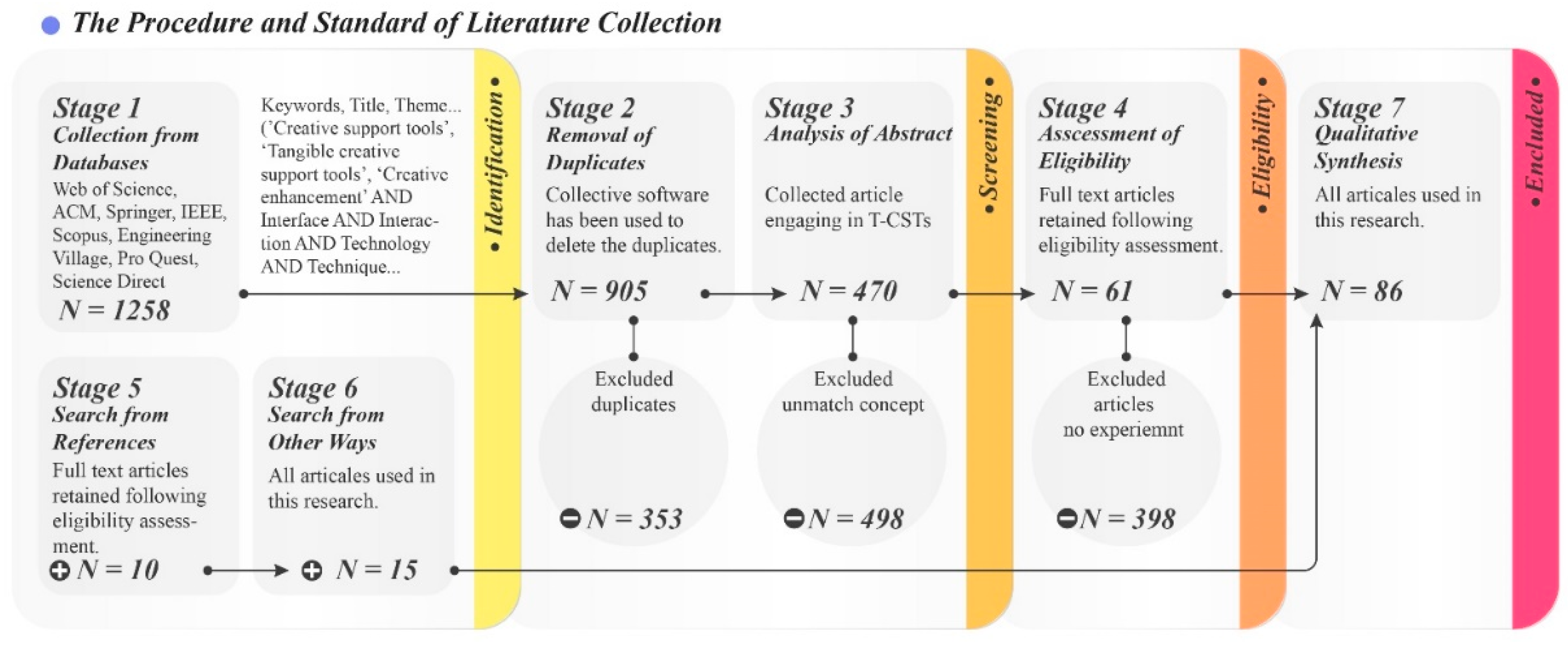
Figure 2.
The publication tendency of T-CSTs, (A) numbers of publications per year, (B) research topics, (C) forms of artifacts.
Figure 2.
The publication tendency of T-CSTs, (A) numbers of publications per year, (B) research topics, (C) forms of artifacts.
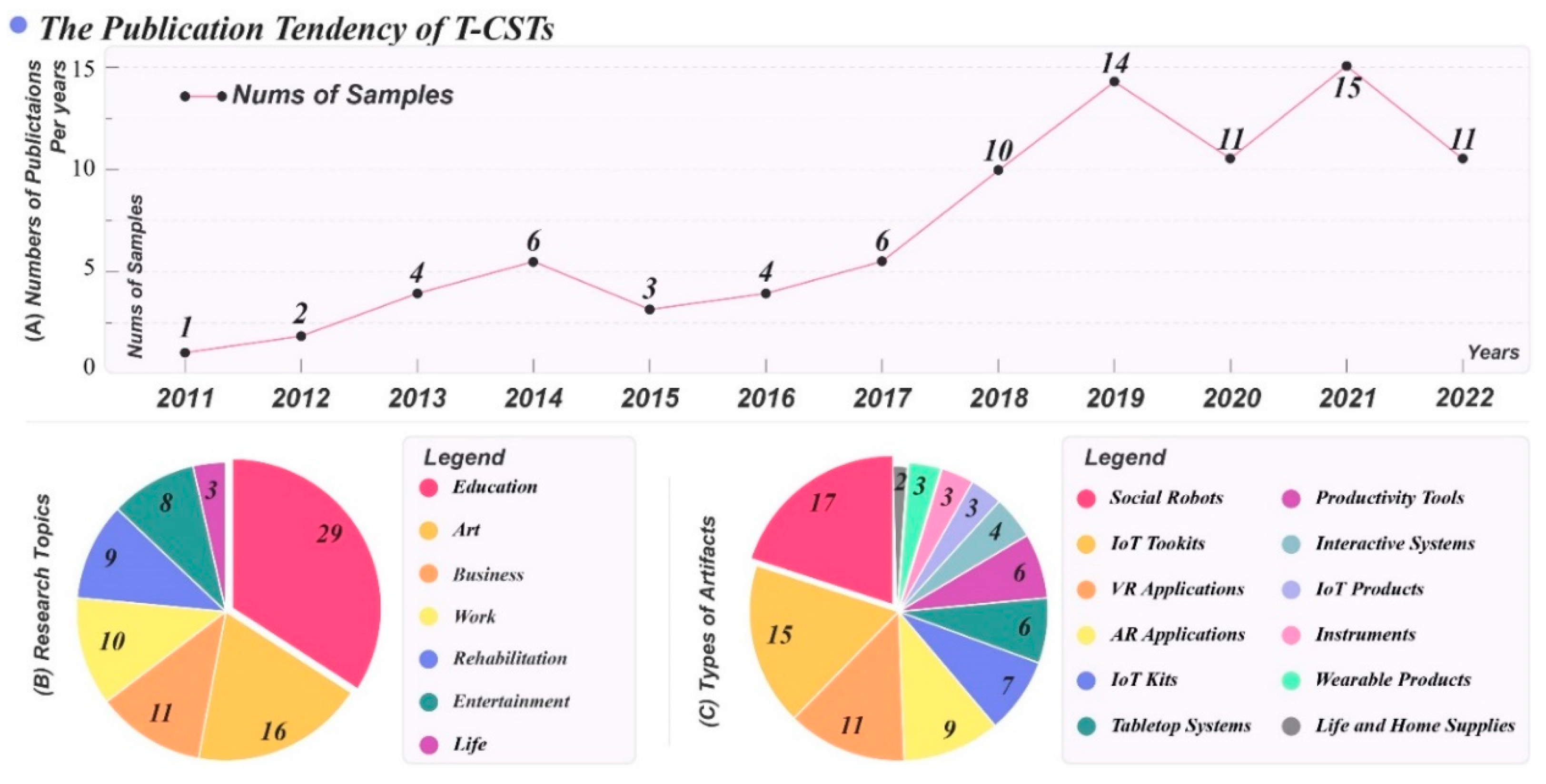
Figure 3.
The analysis of knowledge content of T-CSTs in Initial and transitional Periods. (A) initial period (2011-2014), (B) transitional period (2011-2018), (C) mature period (2019-2022).
Figure 3.
The analysis of knowledge content of T-CSTs in Initial and transitional Periods. (A) initial period (2011-2014), (B) transitional period (2011-2018), (C) mature period (2019-2022).
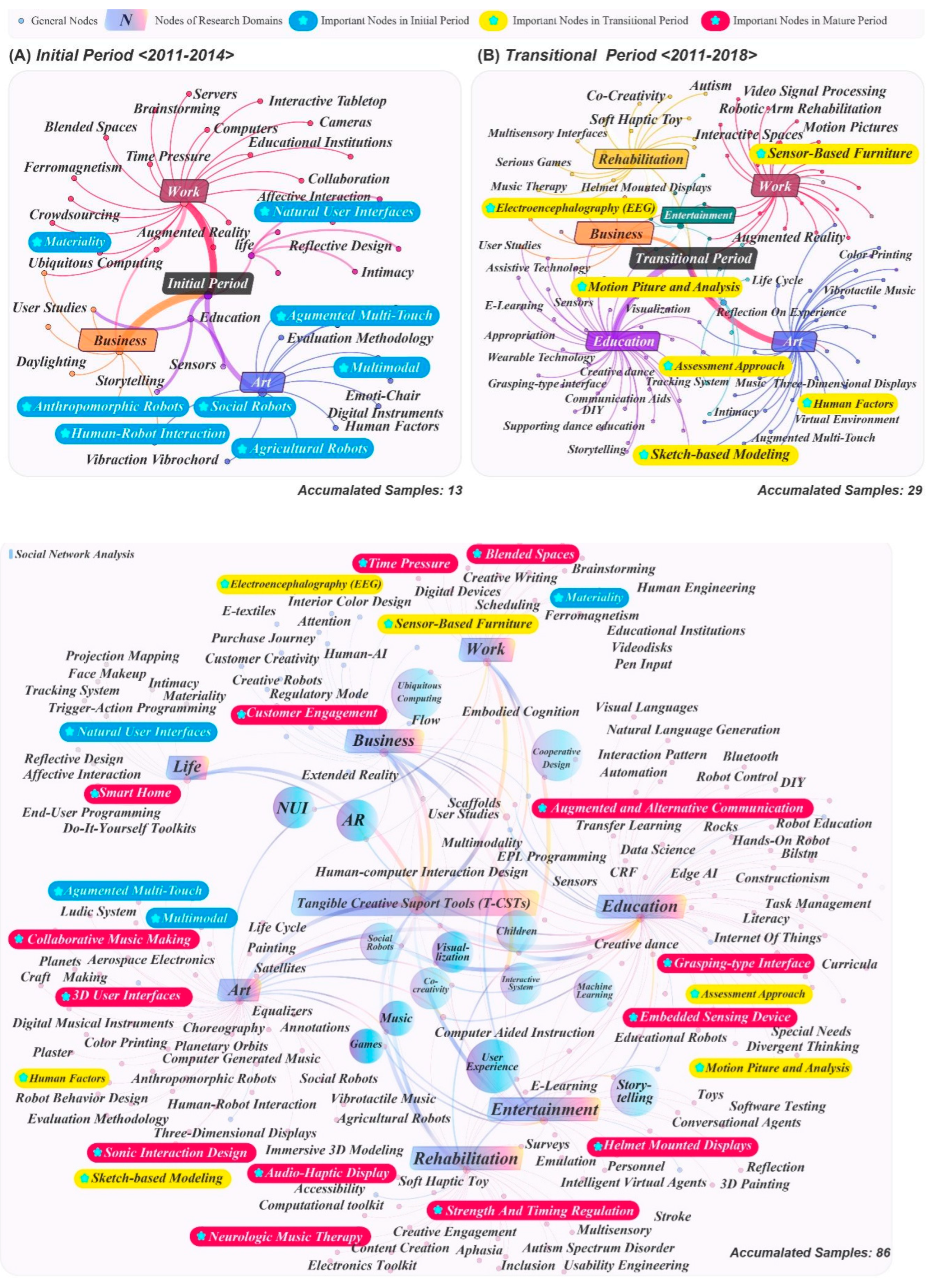
Figure 4.
The entry points and augmented factors extracted from multiple theoretical models.
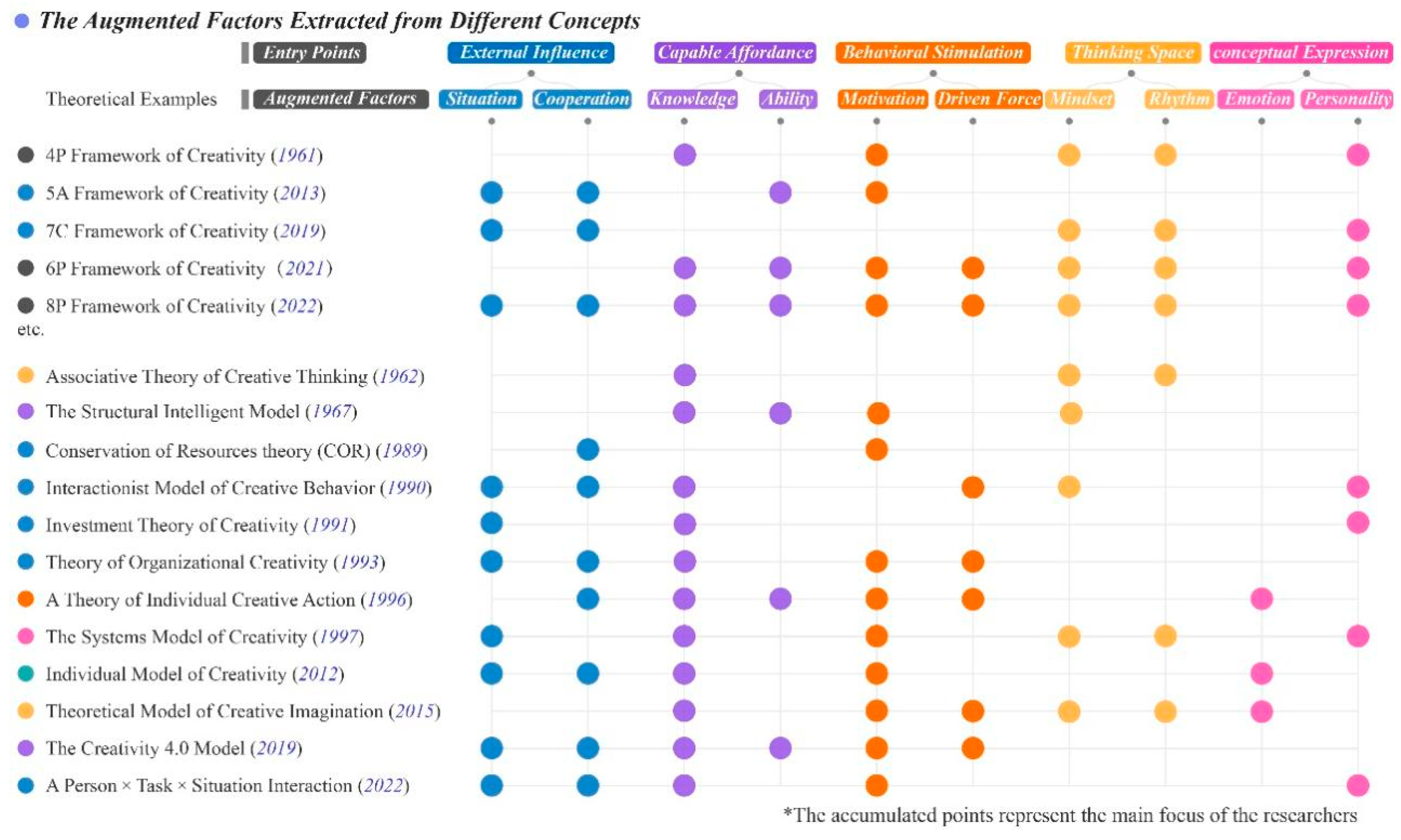
Figure 5.
Analysis of artifact design.
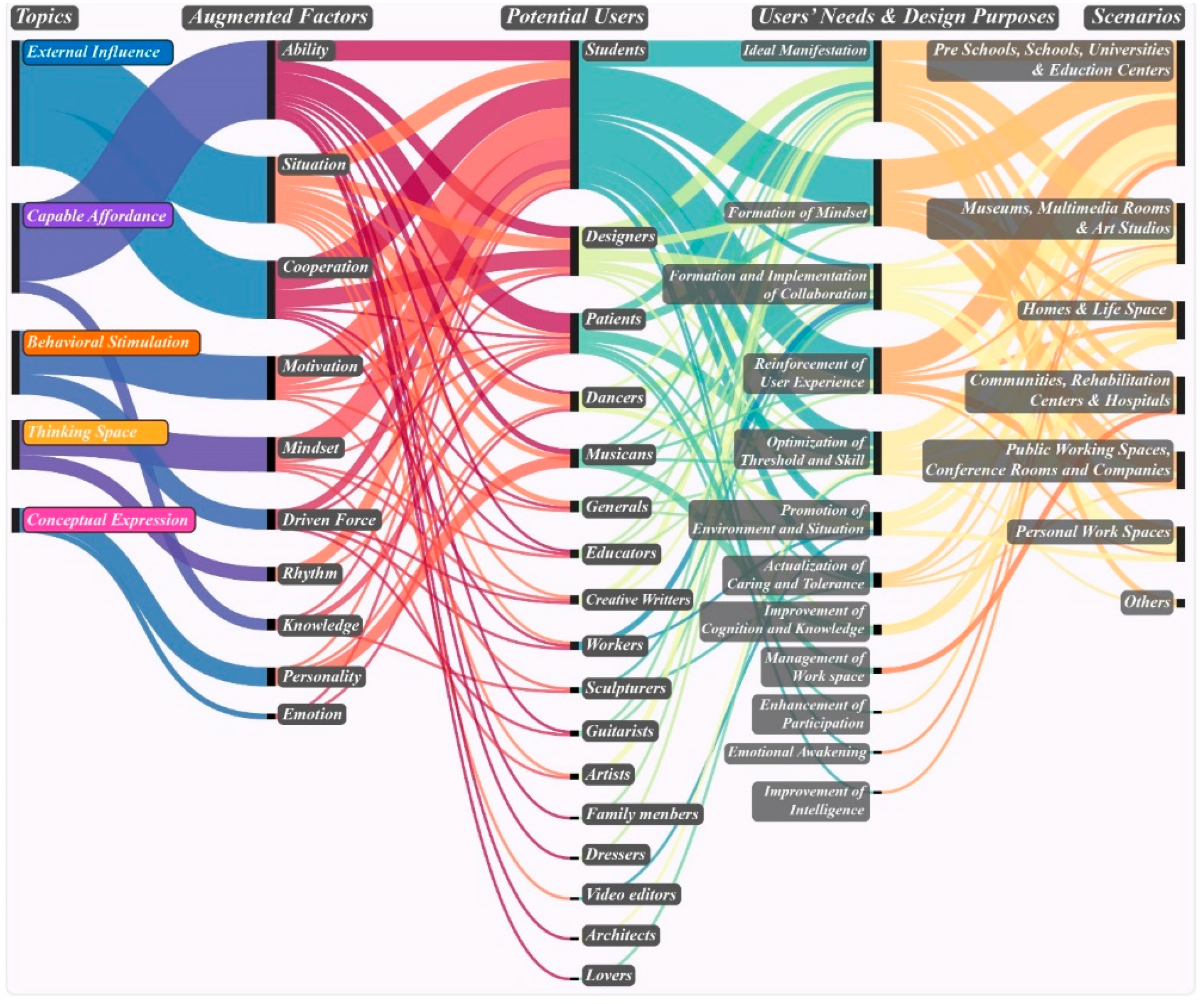
Figure 6.
Important factors in T-CSTs evaluation: (A) creativity-oriented evaluation, (B) technology-oriented evaluation.
Figure 6.
Important factors in T-CSTs evaluation: (A) creativity-oriented evaluation, (B) technology-oriented evaluation.
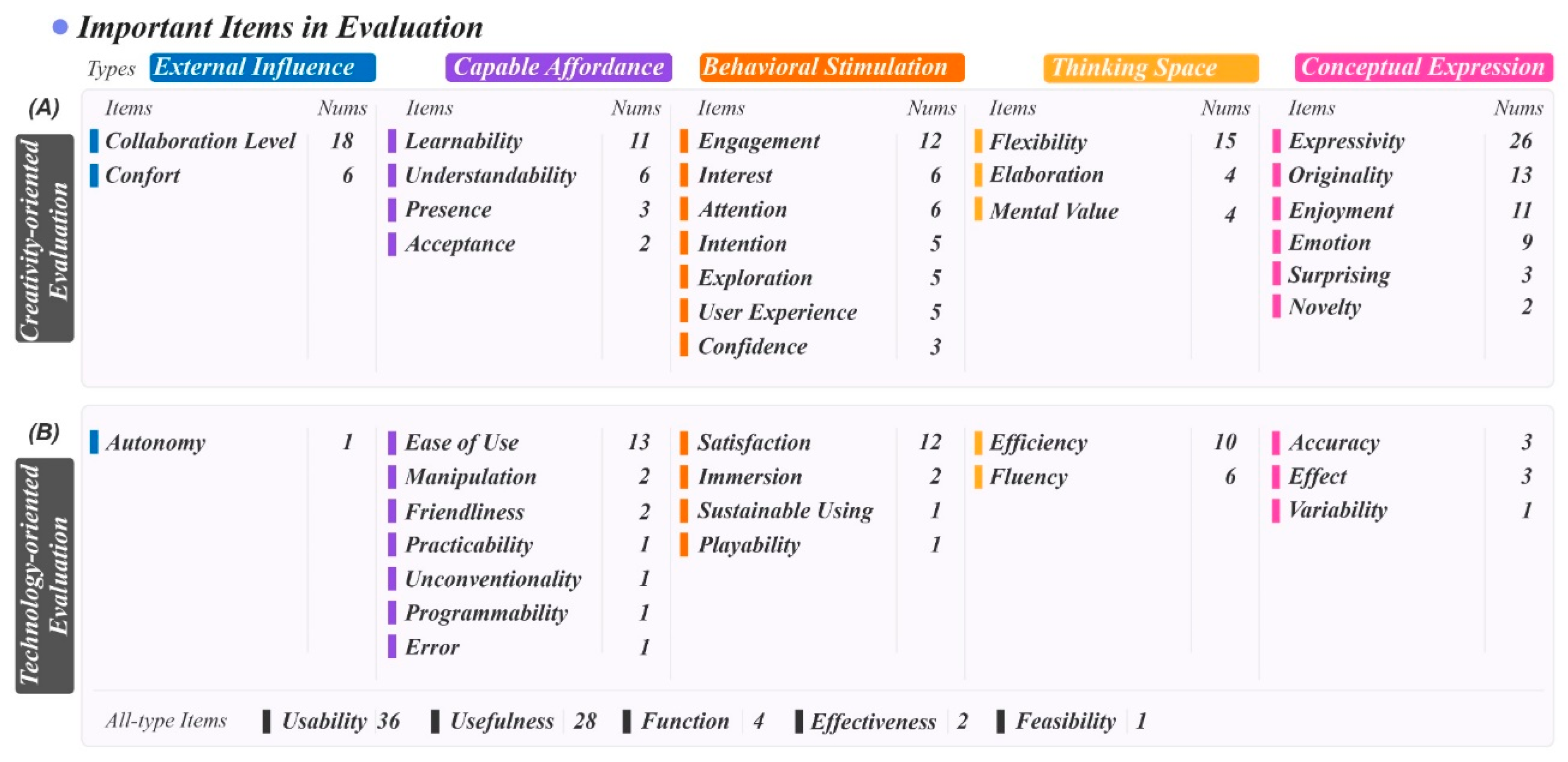
Figure 7.
Users’ performance using artifacts.
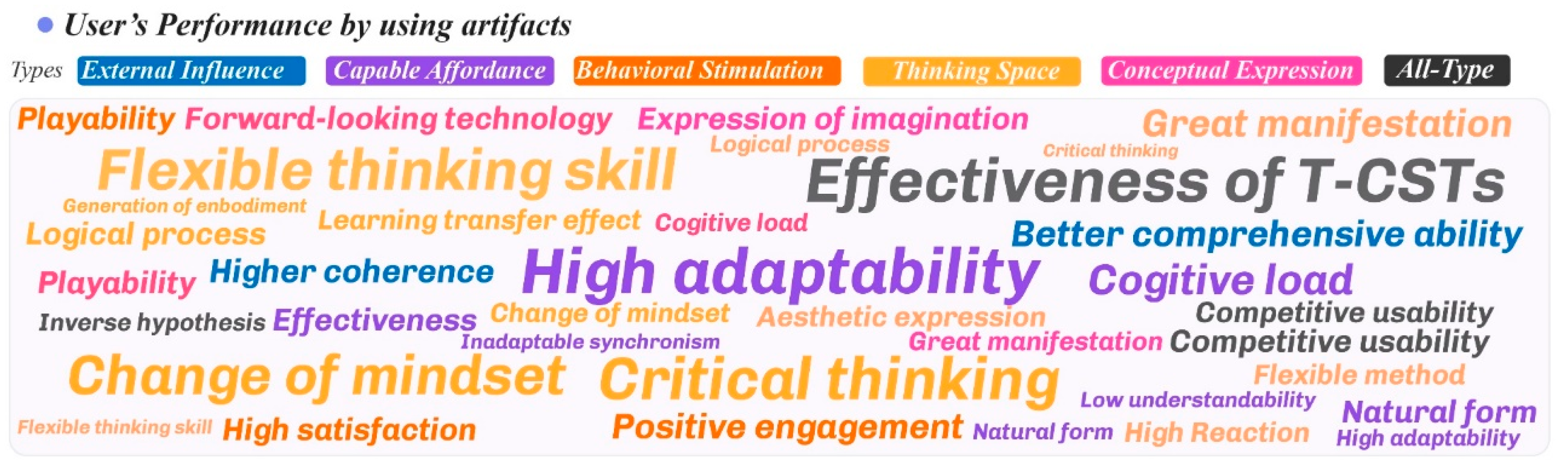
Disclaimer/Publisher’s Note: The statements, opinions and data contained in all publications are solely those of the individual author(s) and contributor(s) and not of MDPI and/or the editor(s). MDPI and/or the editor(s) disclaim responsibility for any injury to people or property resulting from any ideas, methods, instructions or products referred to in the content. |
© 2024 by the authors. Licensee MDPI, Basel, Switzerland. This article is an open access article distributed under the terms and conditions of the Creative Commons Attribution (CC BY) license (http://creativecommons.org/licenses/by/4.0/).
Copyright: This open access article is published under a Creative Commons CC BY 4.0 license, which permit the free download, distribution, and reuse, provided that the author and preprint are cited in any reuse.


