

Submitted:
26 December 2025
Posted:
29 December 2025
You are already at the latest version
Abstract
This paper presents a definitive synthetic proof of the impossibility of trisecting an arbitrary angle within Euclidean geometry. The proof centers not on algebraic abstractions, but on an intrinsic geometric inconsistency revealed through the lens of the canonical 90° angle. This angle serves not merely as a counterexample, but as a diagnostic lever that fractures the very concept of a universal trisection property. A new “Principle of Operational Dissonance” is formulated from an analysis of foundational operations, such as doubling and cubing a square’s diagonal. These operations, while producing congruent final magnitudes, violate the core Euclidean doctrine of proportional similarity, demonstrating that (a:b ≠ c:d) in a strict geometric sense. This dissonance mirrors the logical structure of the trisection problem. The proof demonstrates that assuming the existence of a universal trisection procedure forces a specific geometric condition-the equality of certain lengths-when applied to a 90° angle. This condition arises solely from the angle’s axiomatic status and the constraints of compass-and-straightedge constructions. However, this forced condition is not preserved under variation of the angle measure, rendering any purported universal procedure internally inconsistent. The resulting contradiction proves the impossibility of trisecting a 90° angle with a universal method. This failure, stemming from a fundamental incompatibility within the geometric system rather than the peculiarities of a single angle, extends to all angles, conclusively resolving the classical problem. The proof thus delineates the exact boundary of classical constructive geometry, indicating that any future universal solution must arise from the introduction of new geometric properties innately compatible with Euclidean theory. It reaffirms the self-contained sufficiency of Euclidean geometry for resolving its celebrated problems and challenges the methodological necessity of importing non-geometric techniques to establish geometric impossibilities. The presented framework offers a purely synthetic geometric perspective, one that aligns with the foundational spirit of Euclid’s Elements.
Keywords:
angle trisection
; impossibility proof
; operational dissonance
; proportional magnitudes
; commensurability
; Euclid’s Elements
1.0. Introduction
The problem of trisecting an arbitrary angle using only an unmarked straightedge and a compass stands as one of the most enduring and emblematic challenges from classical antiquity [1,2]. Its statement is deceptively simple, its allure timeless, yet its resolution within the original framework of Euclidean geometry reveals a profound truth about the boundaries of constructive mathematics. Historical attempts, documented across Greek [3], Indian [3,4], Chinese [5,6], and Arabic mathematical traditions [3,6], consistently employed methods that stepped beyond the strict Platonic tools prescribed in Euclid’s Elements, such as neusis constructions or the use of conic sections and specialized curves [7,8]. The definitive 19th-century algebraic proof, attributed to Pierre Wantzel and rooted in Galois theory [9], established that trisection corresponds to solving a cubic equation not generally constructible by compass and straightedge. While algebraically incontrovertible, this proof operates in a conceptual domain foreign to the synthetic geometry of the ancients. It translates a geometric quest into an algebraic criterion, a process that, however valid, can obscure the intrinsic geometric reason for the impossibility [10,11,12]. This translation has also inadvertently fostered a subtle but significant misconception about the very nature of the problem.
This paper returns to the synthetic heart of the problem, proposing that the impossibility of angle trisection is not merely a contingent limitation of certain tools, but a necessary consequence of the logical structure of Euclidean geometry itself, with a specific focus on the principles established in the first six books of the Elements [13,14]. The central thesis is that this impossibility can be rendered visible and rigorously established directly within the language of points, lines, circles, and ratios, without recourse to the arithmetic of field extensions. The approach hinges on a scrupulous examination of the geometric properties of proportionality, congruence, and the axiomatic status of the right angle. It posits that Euclidean geometry contains within it a self-referential mechanism for testing the validity of universal construction procedures, a mechanism that manifests as a specific type of geometric inconsistency.
The genesis of this inquiry lies in a critical analysis of a foundational geometric scenario: the manipulation of the diagonal of a square. Constructing a line segment of length can be achieved by two distinct synthetic procedures. The first is the straightforward doubling of a segment of length . The second is a more complex operation: interpreting the length as the side of a cube, considering the cube’s volume , and then identifying a line segment whose length corresponds to this volumetric measure. Numerically, the results coincide: . However, when these two construction paths are interpreted through the Euclidean theory of ratios and proportions-the very heart of Book of the Elements-a critical divergence emerges [15,16].
The ratio formed by the doubled length to the original length is , which simplifies cleanly to the ratio . This is a direct, homogeneous comparison of two magnitudes of the same kind (lengths). The second operation, however, is inherently heterogeneous. It begins with a length, transitions through the concept of volume (a different genus of magnitude), and returns to a length. To force a proportional comparison, one might consider the ratio of the resulting length to the original length . This again gives , but this ratio completely bypasses and ignores the central, defining step of the operation-the cubing. The operation of “cubing a length” is not intrinsically captured in the final simple ratio of lengths. If we attempt to formulate a proportion that reflects the operational path, such as comparing the result to the cube of the original magnitude, we are led to a nonsensical comparison between a length and a volume.
This failure to maintain a consistent, homogeneous proportional relationship through the sequence of operations is not a numerical error but a geometric truth about the nature of the operations themselves. It signifies that “doubling a length” and “cubing a length to produce a volume, then extracting a linear edge” are geometrically distinct in their effect on the system of ratios, even when their final metric measures coincide. This phenomenon is formalized here as the “Principle of Operational Dissonance”: within the strict synthetic framework, different constructive processes leading to congruent results may be operationally incommensurate, incapable of being expressed within a single, consistent scheme of proportional magnitudes of the same kind.
The trisection of an angle presents a logically isomorphic challenge, one that has been obscured by the modern, algebraic framing. The core misconception lies in a redefinition of the problem’s objective. The classical problem, as understood within the Euclidean tradition, does not ask: “Can one construct an angle of, say, ?” That is a different question, answerable by specific means (one can construct a angle and bisect it to obtain , but not trisect it to obtain ). Nor does it ask: “Do there exist some angles that can be divided into three equal parts using these tools?” The answer to that is trivially yes; every angle constructible as one-third of a constructible angle, like , is itself constructible, but this is a tautology that misses the point. The authentic problem demands something far more profound: a universal geometric property or procedure . When is applied to any given angle , the output must be an angle such that the geometric ratio is universally and demonstrably equal to . The search is not for a collection of ad-hoc constructions for specific angles, but for a single, invariant property inherent to the construction steps themselves-a property that reliably generates the proportional relationship regardless of the input. This is a question about the existence of a certain function within Euclidean geometry.
The mainstream perspective, informed by the algebraic proof, often settles for a weaker claim: “Not all angles are trisectable”. It does this by exhibiting specific counterexamples, such as the angle. This approach, while logically valid, commits a subtle translation error. It reduces the search for a universal property to the examination of a set of independent existential statements for individual angles. It concludes that since the statement “ works” is false, then the statement “ such that fails” must be true. This logical negation, however, leaves intact the misleading impression that for angles other than the proven counterexamples, some form of trisection might be possible. It fragments the universal problem into a mosaic of special cases.
This fragmentation is geometrically illusory and stems from imposing an algebraic, case-by-case logic onto a synthetic, property-based problem. From a Euclidean standpoint, if a universal trisection procedure existed, it would be a geometric fact akin to the existence of an angle bisection procedure. Its application to any input, including the angle, must yield a coherent and consistent result. Therefore, to prove the non-existence of , it is both necessary and sufficient to demonstrate that its assumed existence leads to a geometric contradiction for even a single, carefully chosen input. The right angle, with its privileged axiomatic status (“All right angles are congruent”), serves as the perfect diagnostic input. The synthetic proof advanced here proceeds on this exact principle. It selects the angle as the critical test case. The proof investigates the logical consequences of assuming that a general trisection property exists. It applies this assumed property to the angle and traces the resulting geometric configuration using only Euclid’s axioms and common notions. The deduction leads to an untenable conclusion: it forces a conflation between a constructed “trisection angle” and a right angle itself. This contradiction arises because the assumed universal property , when interacting with the special, axiomatic properties of the right angle and the linear constraints of straightedge constructions, violates the consistent relational fabric of the geometric system.
The emerging contradiction stands as a direct manifestation of the “Principle of Operational Dissonance”. A universal trisection operation pledges to transform any input angle into an output under the invariant operational ratio . This pledge represents one coherent operational logic. Yet, when the input is the specific, axiomatic right angle, the Euclidean system through its inescapable network of congruences, intersections, and angle sums-imposes a second, competing operational logic upon the constructed figure. These two logics are fundamentally dissonant. The rigid framework of Euclidean relationships forces geometric conditions that are incompatible with the preservation of the promised ratio. The figure cannot simultaneously satisfy the demands of a universal trisector and the immutable truths of the geometric system within which it must be built. A rigorous geometric formulation of this principle is provided in the Appendix A.
Consequently, the impossibility is rooted in a matter of geometric consistency, not a mere limitation of the physical tools. If a universal trisection procedure were to exist, its mandated application to a angle would necessarily generate a configuration that contradicts foundational axioms or the theorems derived from them. Euclidean geometry is a consistent logical structure; the introduction of a procedure that forces a contradiction from within proves that the procedure itself cannot be a part of the system. The angle is not uniquely resistant to trisection. Instead, it is uniquely revealing. Its privileged axiomatic status, enshrined in the postulate “All right angles are congruent”, makes it the perfect diagnostic probe. It exposes the fatal flaw inherent in the very concept of a universal trisection property. A property that fails on this canonical, definitional angle is, by its own claimed universality, invalid. The failure for the angle logically implies failure for all angles, because a genuinely universal property must withstand application to every member of its domain, especially the most elementary.
This paper methodically constructs this argument, establishing a rigorous synthetic foundation for the trisection problem that corrects the fragmented perspective of modern interpretations. Section 1.1 formalizes the Principle of Operational Dissonance through a detailed study of operations on the diagonal of a square, providing a conceptual archetype of how geometric consistency can forbid certain universal operations. Section 2 critiques the logical underpinnings of the modern algebraic proof, demonstrating how its reliance on negating a universal statement into an existential one limits its ability to engage with the synthetic heart of the classical problem. Section 3 presents the core Euclidean impossibility proof: a direct synthetic reductio ad absurdum that applies the assumed universal property to the angle and deduces an impossible geometric condition. The discussion then synthesizes these strands, arguing that the operational dissonance in the foundational example and the contradiction in the trisection proof are dual expressions of a single geometric reality. The Euclidean system possesses an internal logical harmony that actively prohibits the existence of certain universal functional properties, such as a compass-and straightedge trisector, within its defined domain.
The final conclusion is therefore stated with definitive clarity in the native language of Euclid's theory of ratios. Within the self-contained world of the Elements, the ratio of a trisection angle to its source angle cannot be made universally equal to the ratio of one to three through the permitted means of compass and unmarked straightedge. In the precise notation of geometric proportions: (for a general angle under compass and straightedge rules). This statement transcends the cataloguing of individual counterexamples. It is a universal declaration about the non-existence of a geometric property , a declaration Euclid himself would recognize and, upon following the chain of synthetic deduction, would necessarily accept as a direct and inevitable consequence of his own axioms.
1.1. A Characteristic Geometric Inconsistency - The “Principle of Operational Dissonance”
The foundational analysis presented here is formally expanded in the Appendix A, which establishes the Principle of Operational Dissonance as a general test for universal constructions. The foundation of the proposed geometric logic rests upon exposing a subtle yet profound inconsistency that emerges naturally within the permissible operations of Euclidean construction. This inconsistency does not stem from any error in calculation or logical deduction, but rather constitutes a fundamental revelation about the very nature of geometric magnitudes and the operations performed upon them. It reveals a deep-seated dissonance between distinct constructive processes that yield metrically identical results, yet arise from conceptually incommensurate operational principles. This dissonance becomes most apparent through a careful, step-by-step analysis of two classical problems involving the diagonal of a square: the straightforward doubling of its length, and the more complex derivation of a line segment from its conceptual cube.
1.1.1. Geometric Foundations and Definitions
The entire argument is developed strictly within the synthetic framework of Euclid’s Elements [11,13,14]. The definitions [17], axioms and propositions [13,18,19], are treated not as historical artifacts, but as active, governing logical premises that dictate the permissible rules of engagement. For precise application, the following foundational elements are recalled and will be employed without deviation:
- Definition 1 (Point). A point is that which has no part. It is the fundamental, indivisible location in space.
- Definition 2 (Line). A line is a breadthless length. A straight line lies equally with respect to all points on itself.
- Definition 3 (Straight Line Segment). A segment is a finite part of a line bounded by two distinct endpoints, such as points and defining segment .
- Axiom 1 (Transitivity of Equality). Things which are equal to the same thing are also equal to one another. If and , then .
- Axiom 2 (Additive Property). If equals are added to equals, the wholes are equal. If and , then the combined segment .
- Proposition 1 (Area of a Square). The area of a square is the product of its side with itself. For a square with side length , its planar content is given by .
- Proposition 2 (Volume of a Cube). The volume of a cube is the product of its side with itself twice. For a cube with edge length , its spatial content is given by .
The entire analysis hinges on the Euclidean theory of ratios, the sophisticated and rigorous cornerstone of Book of the Elements. This theory provides the essential language for comparing geometric magnitudes without recourse to a common numeric measure, respecting the distinction between different kinds of magnitudes.
- Definition 4 (Ratio - Eudoxian/Euclidean). A ratio is a mutual relation of two magnitudes of the same kind in respect of quantity. The equality of two ratios and is defined by the following condition: for any arbitrary positive integers and , the relation holds if and only if , and similarly for the relations of equality and ‘less than’. This elegant definition avoids any reliance on a common unit of measure and applies with equal force to both commensurable and incommensurable magnitudes, dealing solely with the geometric relationships themselves.
The critical proposition governing the comparison of ratios, and the ultimate source of the impending dissonance, is:
- Proposition 3 (Proportional Magnitudes). If four magnitudes are proportional, the first is to the second as the third is to the fourth. Symbolically, for magnitudes of the same kind,
This statement is not equivalent to the modern numerical equality of fractions . It is a profound declaration about the identity of the geometric relationship between the pair () and the pair . The truth of this proposition is determined solely by the rigorous, non-arithmetic test laid out in Definition 4. The requirement that must be of the same kind-all lengths, all areas, or all volumes-is absolute and cannot be circumvented. With this immutable logical foundation established, we proceed to examine two distinct geometric operations performed upon the same initial magnitude. The operational dissonance is shown to arise not in the isolated execution of each operation, but in the attempt to reconcile their intrinsic natures within this strict proportional framework.
1.1.2. Problem 1. (Doubling the Diagonal of a Square)
Consider the following constructive problem: given a square, produce a line segment exactly equal to twice the length of its diagonal using only a compass and unmarked straightedge. This operation, termed “doubling the diagonal”, is linear and homogeneous, dealing solely with magnitudes of the same kind-lengths. Every construction step as provided below remains within the genus of linear measure.
Construction Steps (The initial configuration is established in Figure 1)
- Let two distinct points and be given. The segment defines our foundational unit of length, denoted .
- Construct square with side . Following the standard Euclidean construction (Proposition of Book ), the vertices are labeled sequentially , ensuring . The completed square is the subject of Figure 1.
- Construct the diagonal . By Proposition of Book [19] (the Pythagorean theorem), the square on the diagonal is equal to the sum of the squares on the sides and . Thus, if , then . The geometric entity is the segment ; the algebraic expression is used here only for calculational clarity within the exposition.
- The objective is now to construct a segment of length .
The construction proceeds via two lemmas that formalize the extension of a segment and the subsequent construction of a square on the extended segment. These lemmas and their accompanying figures decompose the process into its elementary Euclidean steps.
Lemma 1 (Extension of a Segment). A segment congruent to can be adjoined contiguously to point to produce a segment of length .
Proof. Place the point of the compass at with radius set to the length . Describe a circle, denoted . Since point lies on the line through in the direction of , the line is extended in that direction. This extended line intersects circle at a point distinct from . Label this intersection point . By the definition of a circle, all radii are equal, so . The segment is the sum of segments and . Applying Axiom 2 (the additive property of equality), the length of is . This entire constructive step, showing circle and the generation of point , is depicted in Figure 2.
Lemma 2 (Construction of the Doubled-Diagonal Square). Using segment as a side, construct a square whose diagonal is exactly twice the length of .
Proof.
- Construct square on side . Following the same method as for , label its vertices sequentially , ensuring .
- Construct the diagonal of square . Applying the Pythagorean theorem to right triangle , we have . Thus, the length of is .
- A constructive verification that is composed of two contiguous segments each of length adds instructive clarity: With center at point (the vertex of opposite ) and radius , describe a circle . With center at point (the vertex of opposite ) and radius (where is a side of , known to be ), describe a circle . The geometry of the construction, depicted in Figure 3, ensures these circles intersect in a manner confirming collinearity and equality. The construction forces the equality in this specific configuration, establishing that segment can be viewed as the sum . Since and geometry dictates here, it follows conclusively that . The final configuration, with squares and and the verification circles and , is illustrated in Figure 3.
Result. The constructed magnitude, the diagonal of square , stands in a simple and direct proportional relationship to the original diagonal of square . Formally,
Expressed in the definitive language of Euclidean ratios,
This ratio is pure, homogeneous, and directly encapsulates the essence of the geometric operation “double the diagonal”. The operation ingests a length and produces a new length in the fixed, constructible ratio of two to one. The entire process is internally consistent and fully expressible within the domain of linear magnitudes. No step ventures outside the comparison of lengths; the operation , is perfectly coherent within the system.
1.1.3. Problem 2. (Cubing the Diagonal of a Square - A Special Volumetric Interpretation)
Now consider a second, fundamentally different objective that begins with the same initial square and its diagonal . The goal is to construct a line segment through a synthetic operation that genuinely involves the cube of the diagonal while respecting Euclidean dimensionality. In pure synthetic geometry, cubing a length properly yields a volume, a different genus of magnitude. Any legitimate operation must maintain dimensional homogeneity or establish a valid geometric correspondence between genera. The operation is defined constructively as follows: using only compass and straightedge, construct a line segment whose length is the side of a cube whose volume is twice the volume of the cube constructed on the diagonal . This is a classical problem (duplication of the cube) applied to the magnitude . Let us denote the cube constructed on side as . Its volume is . We seek the side length of a new cube such that:
Therefore, must satisfy , which gives .
Therefore, must satisfy , which gives .
Now, recall from Problem 1 that the operation of doubling the diagonal produced segment . We observe a fundamental numeric and geometric distinction:
Since , these are distinct magnitudes in general. However, in our specific case where , we have:
These are not congruent segments. The numerical coincidence the original text sought to highlight ( ) is actually the result of the doubling operation , not a valid outcome of a cubing operation .
A Valid Path to Operational Dissonance. To properly illustrate the Principle of Operational Dissonance, we must compare two operations that both legitimately produce the same linear magnitude from , but via paths that are dimensionally and operationally distinct. Consider these two defined operations on the original segment :
- Operation (Linear Scaling). Double the diagonal of the square on . As constructed, this yields segment .
- Operation II (Volumetric-to-Linear via a Specific Construction). Construct the cube on segment (side ). Its volume is . Now, construct a cube whose volume is eight times this volume, i.e., . The side of this cube is . Finally, construct the diagonal of a square built on this side . The length of this diagonal is .
Therefore:
We now have two operationally distinct paths starting from the same foundational system (the segment ) that yield congruent final magnitudes:
- square diagonal doubled diagonal .
- II: cube volume scaled volume cube side square diagonal .
Both and produce the segment . However, the ratio of the output to the original magnitude is fundamentally different in nature for each operation. For , the relevant ratio is : , a direct ratio of lengths. For , the process involves a non-linear, volumetric scaling (a factor of 8 in volume, or 2 in linear dimension) before a final diagonalization. The operation cannot be described by a simple, homogeneous ratio of lengths that reflects its composite nature. The dissonance arises when we try to encode the complete operation into a simple proportion comparable to the clean proportion of . The synthetic steps of pass through a volumetric transformation, which is incommensurable with the purely linear transformation of within the framework of ratios of the same kind. This demonstrates the “Principle of Operational Dissonance”: operationally incongruent processes leading to congruent results cannot be subsumed under an identical proportional relationship within the strict synthetic system. This logical structure provides the precise analogue for the trisection problem, where a universal linear operation (trisection) is shown to be incompatible with the geometric constraints revealed through a specific critical case.
1.1.4. The Emergence of Operational Dissonance
Both operations and , when applied to the same initial segment , produce the congruent segment . This metric congruence, however, conceals a profound geometric distinction between the operational paths themselves.
Operation represents a direct linear scaling within the genus of lengths. It first constructs the diagonal and then doubles it. The essential proportional relationship within this operation is cleanly expressed as:
This is a homogeneous proportion comparing two magnitudes of the same kind-the doubled diagonal to the original diagonal. Operation proceeds through a different synthetic sequence. It constructs the diagonal of the square on , yielding , and then constructs the diagonal of the square on that diagonal. This second diagonal measures . The operation concludes by constructing the diagonal of a square on this new segment , which is . The process can be summarized as two successive applications of the “diagonal-to-side” transformation, each with an intrinsic ratio of . The final segment is reached through a composition of non-similar scaling operations.
The dissonance becomes explicit when we attempt to encapsulate each operation within the Euclidean theory of proportions. The theory, governed by Definition 4 and Proposition 3, demands that proportions compare magnitudes of the same kind and that the equality of ratios reflect a sameness of geometric relationship.
For , the defining proportion is a true and complete synthetic description of the operation’s effect. It is a functional proportion: the output is related to a naturally occurring intermediate magnitude (the diagonal ) by a simple, constructible ratio. For , no such simple, homogeneous proportion exists that honestly captures the composite nature of the construction. One could form the overall proportion , but this single ratio entirely obliterates the two-stage, -scaling structure of the operation. It reduces a specific composite process to a mere numerical result. Alternatively, one could attempt to represent the operation with a proportion involving the intermediate diagonal, such as :. This, however, misrepresents the operation, as the segment in the denominator is not the direct geometric antecedent to the output in the construction sequence; it is the side of the second square, not the final diagonal.
The essence of the dissonance is that operation does not admit a single, valid Euclidean proportion of the form that faithfully encodes its full constructive logic using magnitudes of the same kind throughout. The operation is inherently a sequence of distinct geometric actions, each with its own proportional character. Condensing it into one proportion either distorts its nature or violates the homogeneity rule of Euclidean ratio theory.
This leads to the formulation of a general geometric principle: The Principle of Operational Dissonance established formally as; within a consistent geometric system defined by specific construction rules, two distinct composite operations and applied to the same initial magnitude may produce resultant magnitudes and that are metrically congruent ( . However, the synthetic definitions of and -the complete sequences of elementary constructions-may be geometrically incommensurate. This incommensurability manifests as an inability to express both operations within the system’s native theory of proportions using a single, consistent proportional scheme that respects both the final congruence and the integrity of each operational path. The equality of the final magnitudes does not imply the equivalence of the generative processes, and a simple proportional statement of the result may conceal the complexity of the path taken. In our specific example, with :
Yet is synthetically defined by a diagonalization followed by a doubling, while is defined by two successive diagonalizations on different base segments. The proportion is inherent to ’s core step, but for , any attempt to force its complex process into an analogous simple proportion results in a misrepresentation or a violation of proportional theory. As mentioned, this principle provides the precise logical template for understanding the classical angle trisection problem. Trisection seeks a universal operation defined by a finite compass-and-straightedge procedure such that for any input angle with . The impossibility proof developed in Section 3 demonstrates that assuming the existence of such a leads, when , to a configuration where the geometric constraints of the system force a contradictory set of relationships. The putative universal procedure, which promises a consistent operational ratio, instead generates a figure where the implied relationships are dissonant with the axiomatic properties of right angles and straight lines. Hence, no such universal can exist without violating the internal consistency of Euclidean geometry, mirroring the way the complex operation cannot be truthfully reduced to the simple proportional scheme of .
2.0. Limitations of the Modern Angle Trisection Impossibility Proof
The contemporary understanding of the angle trisection impossibility rests firmly upon the algebraic proof attributed to Pierre Wantzel in 1837 [9]. This proof, while mathematically rigorous within its own framework, operates within a conceptual domain fundamentally alien to the synthetic geometry of Euclid. Its validity is not in question from an algebraic standpoint, but its methodological approach imposes significant limitations when viewed through the lens of classical Euclidean geometry. This section delineates these conceptual and logical limitations, demonstrating how the modern proof’s structure inherently fails to engage with the geometric essence of the problem as originally conceived. A deeper analysis reveals that the modern approach relies on a logical operation-the negation of a universal statement-that is geometrically inadequate for establishing the kind of impossibility the trisection problem demands. This critique is not a defense of the mainstream view but an exposition of its synthetic shortcomings, paving the way for the purely geometric proof presented in Section 3.
2.1. The Paradigmatic Shift: From Synthetic Geometry to Algebraic Translation
The Euclidean geometric system is synthetic, constructive, and visual. Its proofs proceed by logical deduction from explicitly stated axioms and previously established propositions, often accompanied by a diagram that guides intuition. The modern impossibility proof initiates a complete paradigm shift away from this native environment. The first and most significant departure is the translation from geometry to algebra. The problem is removed from the plane of points, lines, and circles and re-cast within the domain of numbers and equations. Points become coordinates in a Cartesian plane [11]; the act of construction with compass and straightedge is translated into the algebraic generation of numbers within a tower of quadratic field extensions. The question “Can this angle be trisected?” becomes “Does the cosine of one-third of this angle belong to a field extension whose degree over the rationals is a power of two?”
This translation necessitates the introduction of concepts foreign to Euclid’s Elements. The proof employs ideas such as field extensions, minimal polynomials, and the degree of field extensions ([F():F]) [9]. These concepts belong to the domain of abstract algebra, developed more than two millennia after the classical period. They have no direct counterpart in the synthetic system. The proof does not manipulate geometric objects; it manipulates algebraic expressions that represent those objects. Consequently, there is a profound loss of geometric intuition and immediacy. The connection between the final algebraic criterion-that the relevant minimal polynomial must be of degree a power of two-and the physical act of moving a compass and straightedge becomes mediated by layers of algebraic theorems. The geometric reason why trisection fails remains hidden behind this algebraic machinery. One does not see the impossibility in the failure of lines to intersect or circles to meet; one computes it from the properties of an irreducible cubic equation. For a geometer operating within the Euclidean tradition, this is an argument from a different mathematical universe. It uses a meta-language (algebra) to talk about geometric constructions, rather than reasoning within the geometric system itself. A proof that would satisfy Euclid must reside entirely within the geometric language of points, lines, circles, congruence, and ratio, proceeding from his axioms without external import.
2.2. The Logical Shortcoming: Negation of Universals and the Misinterpretation of Generality
The logical structure of the modern proof presents a more subtle, yet critical, limitation that weakens its geometric force and misrepresents the nature of the trisection problem. The problem is naturally and historically stated as a universal question: “Can every angle be trisected using compass and straightedge?” In formal logical terms, if we let denote the property “angle can be trisected”, the problem asks about the truth of the universal statement: The modern proof addresses this by demonstrating the existence of a specific counterexample. It shows, for instance, that a angle cannot be trisected. Logically, this constitutes a valid disproof of the universal statement: exhibiting a single for which is false suffices to prove the universal false.
However, this logical move has a profound and distorting geometric consequence. It reduces the grand, unified quest for a single, universal trisection property or procedure into a fragmented, case-by-case inspection. The proof effectively states: “There is no universal method because here is an angle for which no construction exists”. This leaves open a misleading interpretive possibility: perhaps other angles do admit their own unique, ad-hoc constructions. The proof does not inherently demonstrate that the non-existence of a universal procedure stems from a deep, internal geometric inconsistency that would necessarily undermine any claimed universal procedure. Instead, it shows that the algebraic encoding of the problem for one particular angle leads to an algebraic obstruction (an irreducible cubic).
This is fundamentally different from the structure of a synthetic impossibility proof within the Euclidean tradition. A synthetic proof would adopt the following form: Assume that a universal trisection procedure exists. Apply this assumed procedure to a carefully chosen angle. Deduce, through purely geometric reasoning from Euclid’s axioms, a contradiction in the resulting configuration. This structure attacks the concept of a universal procedure directly and internally. It shows that the very assumption of such a procedure is incompatible with the foundational axioms of the system. The existence of constructible angles like or might otherwise tempt one to believe trisection is merely a matter of finding the right specialized trick for each angle. The modern proof corrects this by showing algebraically that for some angles, like , no trick exists. Yet a Euclidean purist might reasonably object: “Why must I accept this algebraic translation as authoritative for my geometric world?” The proof provided in Section 3 offers a resolution that requires no translation, operating entirely within the geometric world.
The reliance on negation also introduces a problematic shift in the burden of proof and the nature of geometric knowledge. The classical problem seeks a constructive property: a sequence of steps that works for all inputs. Disproving its existence via a counterexample is logically sound but geometrically shallow. It provides a “no” without a geometric “why”. It identifies a symptom (the non-trisectability of ) without diagnosing the systemic disease (a violation of geometric consistency that would manifest for any universal procedure, starting with the most fundamental angle). This approach aligns more with an external, classificatory logic than with the internal, deductive logic of synthetic geometry.
2.3. A Canonical Contrast: The Euclidean Incommensurability Proof
To crystallize the difference between an external algebraic disproof and an internal geometric impossibility proof, one can contrast the modern trisection argument with a classic Euclidean impossibility proof: the incommensurability of the diagonal and side of a square. This proof, a masterpiece of synthetic reasoning, remains entirely within geometric discourse. The proof proceeds as follows:
- Assume, for the sake of contradiction, that the diagonal and side of a square are commensurable. This means there exists a common unit segment such that and for some positive integers and .
- By the Pythagorean theorem, .
- Substituting the expressions in terms of yields , which simplifies to . (9)
- Equation 9 implies is even, therefore itself must be even (since the square of an odd integer is odd). Let , where is an integer.
- Substituting back into Equation 9: leads to , and thus . (10)
- Equation 10 implies is even, so must also be even.
- If both and are even, the original unit was not the greatest common measure, as would also measure both and . This process of finding a smaller common unit can be repeated ad infinitum, leading to an infinite descent of positive integers-an impossibility.
This proof is a direct reductio ad absurdum grounded in the geometric relationship between the diagonal and side (the Pythagorean theorem) and the properties of integers. It never leaves the realm of geometric magnitudes and their measures. It shows that the initial assumption of commensurability logically forces an infinite regression, a contradiction within the framework of finite whole numbers. The impossibility is revealed as a necessary consequence of the geometric properties themselves.
In stark contrast, the modern trisection proof does not have this synthetic flavor. It does not begin with “Assume a universal trisection construction exists” and then derive a geometric contradiction from that assumption within a specific figure. Instead, it translates the entire problem into algebra and performs the reductio within the algebraic system. The contradiction is between algebraic properties (irreducibility of a polynomial, degree of a field extension), not between geometric configurations and axioms. The proof offered in Section 3 aims to bridge this methodological gap. It adopts the synthetic, direct reductio form of the incommensurability proof and applies it to the trisection problem, assuming a universal procedure exists and deriving a geometric contradiction from its application to a angle.
2.4. Structural Parallels: Operational Dissonance and Trisection Impossibility
The “Principle of Operational Dissonance” established in Section 1.1 provides a powerful conceptual bridge between the nature of the classic impossibility and the trisection problem. Recall that the principle identified a dissonance between two operations, (doubling a length) and (interpreting a cube as a length), which yield congruent results ( ) but are operationally incommensurate. The ratio is a true, homogeneous expression of the operation, while the operation cannot be expressed as a simple, homogeneous ratio of lengths without ignoring its defining cubic step. The equality of the final magnitudes conceals a fundamental inequivalence in the generative processes.
The trisection problem can be framed in an isomorphic manner. It seeks a universal geometric operation (the trisection procedure) that, for any input angle , produces an output angle such that the ratio is universally and consistently . This is a demand for an operational property that maintains a fixed, simple proportion across all inputs.
The impossibility proof for the angle reveals the operational dissonance inherent in this demand. Assuming exists, its application to should yield and a clean ratio of . However, the synthetic geometric analysis demonstrates that the construction forced by this assumption, when subjected to the immutable laws of Euclidean geometry (congruence of right angles, properties of intersecting lines, angle sum in triangles), leads to a configuration where the constructed “trisection” angle is forced into an identity with a right angle. Effectively, the geometric system outputs a ratio of , not . The promised operational ratio () is dissonant with the actual geometric relationships that must hold in any valid construction derived from the axioms. The parallel is exact:
- In the square-diagonal case, the operation is described as a cubic process but, when forced to output a length, yields a ratio that does not honestly reflect that process.
- In the trisection case, the operation is defined to output a ratio, but when applied to a right angle, the geometric system outputs a configuration implying a different ratio, contradicting the definition.
In both instances, the inconsistency arises from forcing a complex, multi-step operational idea (cubing a length, universally trisecting an angle) into the rigid, consistent framework of Euclidean ratios and constructions. The system rejects the forced identity because it violates the internal consistency of geometric relationships. The modern algebraic proof identifies a symptom of this rejection (the non-constructibility of ), but the synthetic proof reveals the geometric cause: operational dissonance at the heart of the proposed universal property.
2.5. The Negation Fallacy and the Illusion of Specific Solutions
A critical flaw in the mainstream interpretation of the modern proof is the misapplication of the negation of the universal statement. While logically valid, the existential counterexample ) is often misinterpreted as licensing a fragmented view of the problem. It creates the illusion that the trisection problem is a collection of independent, angle-specific puzzles: some angles are “trisectable” (like , if one could construct a angle), others are not. This is a profound misconception.
The problem does not ask “Which angles can be trisected?” It asks for a single, universal procedure. The negation of the universal statement proves that no such universal procedure exists. It does not create a classification of angles into trisectable and non-trisectable under a universal rule. In fact, within the compass-and-straightedge framework, if a universal procedure does not exist, then no angle can be trisected in the sense required by the classical problem. The construction of a angle is not an application of a universal trisection procedure to ; it is a separate, specific construction that happens to produce an angle equal to one-third of a right angle. There is a crucial distinction between constructing an angle of a given measure and possessing a procedure that trisects any given angle.
To claim that a angle is “trisectable” because one can construct a angle is to commit a categorical error. It conflates the existence of a particular magnitude with the existence of a universal functional property. This error is analogous to looking at the result and concluding that the operations and are equivalent because they produce the same segment. The equivalence of the outputs does not imply the equivalence-or even the existence-of a universal, property-preserving process.
The negation approach, by focusing on a single counterexample, inadvertently reinforces this conflation. It suggests that the problem is about individual angles rather than about the geometric system’s capacity to support a certain kind of function. A proper geometric impossibility proof must therefore target the functional property itself, not its individual values. The proof in Section 3 does exactly this: it assumes the property exists and shows that this assumption is geometrically untenable. The conclusion is not merely that some angles resist trisection, but that the geometric universe does not contain the entity “universal trisector” within its compass-and-straightedge ontology. This is a stronger, more illuminating form of impossibility, one that resonates with the operational dissonance observed in foundational geometric operations and aligns with the synthetic spirit of Euclid’s Elements.
3.0. The Euclidean Approach to Angle Trisection Impossibility
This section presents the core synthetic geometric proof that a universal trisection property cannot exist within Euclidean geometry. The strategy is to demonstrate that the very assumption of such a property leads to an inconsistency when applied to a specific, axiomatically privileged angle: the right angle. The proof does not rely on constructing a particular non-trisectable angle or importing algebraic concepts. Instead, it remains firmly within the synthetic tradition, examining the logical consequences of assuming a general trisection property . If were a genuine geometric property applicable to any angle via compass and straightedge, it must apply without exception. The right angle, with its unique status in Euclid’s axioms, serves as the ideal test case. The proof reveals that applying to a angle and analyzing the resulting configuration leads to a geometric impossibility. This approach aligns perfectly with Euclidean methodology, using only the language of points, lines, circles, congruence, and the properties of right angles.
3.1. Foundational Axioms and Definitions
The proof is built explicitly upon the following Euclidean principles, which are treated as inviolable premises:
- Axiom (c). All right angles are congruent. This axiom, from Euclid’s Postulate 4, establishes the right angle as a unique, invariant standard of angular measure within the system.
- Axiom (d). When two straight lines intersect, they make the vertical angles equal to one another. This principle ensures the equality of opposite angles formed at an intersection.
- Common Notion 1. Things which are equal to the same thing are also equal to one another. This transitive property of equality underpins all deductive chains.
- Definition (Trisection Property ). A geometric construction procedure qualifies as a trisection property if, when applied to any given angle , it produces-in a finite number of steps using only an unmarked straightedge and a compass-rays and such that .
The definition of is crucial. It demands a universal procedure, a single sequence of steps whose internal logic, when applied to an arbitrary input , reliably generates an output where the geometric ratio is universally and demonstrably equal to . The procedure itself is the embodiment of this constant ratio.
3.2. The Main Theorem and Proof
Theorem 1 (Impossibility of a Universal Trisection Property). No trisection property , as defined above, exists within Euclidean geometry. Equivalently, there is no finite compass-and-straightedge construction that can be universally applied to trisect any given angle.
Proof by Contradiction. Assume, for the sake of contradiction, that such a universal trisection property does exist. We then apply this property to a canonical angle and analyze the resulting geometric configuration. The contradiction arises from the interplay between the assumed trisection and the intrinsic properties of the right angle.
Step 1: Initial Configuration and Construction. Consider a right angle . Let be a horizontal ray and a vertical ray, meeting at point . For clarity and to simplify subsequent ratios, choose point such that . Construct circle with center and radius . This circle intersects the vertical ray at two points: one between and , labeled , and another on the opposite side of , labeled . By construction, . This initial setup is depicted in Figure 4.
Now, construct circle centered at point with radius . Since and lie on circle is a chord of that circle. Let circle intersect the horizontal line (extended in both directions) at points and . By the definition of a circle, we have . The geometry of this construction forces specific symmetries. The line is horizontal, and the line is vertical. Point lies on the vertical line above . The circle centered at with radius is symmetric with respect to the vertical line through . Consequently, its intersections and with the horizontal line are symmetric about the foot of the perpendicular from to . This perpendicular is precisely the vertical line , which meets at . Therefore, is the midpoint of segment , yielding the critical equalities:
Furthermore, since is perpendicular to , we have:
Step 2: Application of the Hypothesized Trisection Property. Now, apply the assumed universal trisection property to the right angle . According to its definition, must produce two new rays emanating from that partition the angle into three equal parts. Let these rays be denoted and . These rays will intersect various lines in the figure. For this proof, we consider their intersections with the line , which is already constructed. Let intersect at point , and let intersect at point . The points and lie on segment or its extension. By the definition of trisection, the angles formed must satisfy:
We note that ray is along the horizontal line , and ray is along the vertical line . Therefore, the total angle from to is , consistent with the trisection requirement.
Step 3: Geometric Deductions from Congruence and Angle Sums. From the construction, we have established and . Consider triangles and . They share side , have , and have . Therefore, by the side-Side-Side congruence criterion, . Consequently, , which is already known from Equation 12. Now, focus on triangle . It is a right triangle with right angle at . Denote . Then , and since and are on circle along the vertical line, . Thus, . By the Pythagorean theorem:
Thus, triangle has sides , and . This is a triangle. Specifically, the side opposite is , which is half the hypotenuse , so:
Consequently, the other acute angle is:
Step 4: Analysis of Triangle . From the trisection assumption, . We also have from Equation 15. Therefore, triangle has two angles equal to , making it an isosceles triangle with the sides opposite these angles equal. The side opposite is , and the side opposite is . Hence:
Now, apply the Law of Sines in triangle . The angle at is:
Thus:
Since and , we have:
From Equation 17, we also have:
Step 5: Analysis of Triangle . In triangle , we have:
Also, from Equation 16, . Therefore, triangle has two angles of , making it equilateral. Hence:
This is consistent with Equation 20.
Step 6: Derivation of the Contradiction. Now, consider the segment . We have from the construction. Since lies on , we have:
Using from Equation 23 and form Equation 21, we get:
which is an identity. Thus, no contradiction arises from the lengths. However, the contradiction emerges from the angular relationships required by the universality of . Recall that the trisection property is assumed to be universal, meaning it must produce the same functional relationship between the input angle and the constructed points regardless of the angle’s measure. For the angle, we have derived that the construction necessarily forces triangle to be equilateral, with . This equality is a specific geometric condition that depends on the right angle’s properties and the chosen construction steps.
If were truly universal, then for any input angle , the analogous construction would require that the distance from to the corresponding trisection point on a specific line equals the distance from to a certain reference point (like ). However, for a general angle , the geometry does not impose such a simple relationship. The condition arises here because in the case, the triangle becomes equilateral due to the coincidence of angles: and . This coincidence occurs only because the right angle, when trisected, yields angles that interact perfectly with the triangle . For a general angle , the trisection would require angles of . The construction steps analogous to those in Figure 4 would not produce an equilateral triangle unless . Therefore, the universal procedure would have to simultaneously satisfy two incompatible conditions:
- For , it must yield .
- For , it cannot yield because the geometric context differs.
This is a manifestation of the Principle of Operational Dissonance. The operation “trisect” aims to enforce a uniform ratio of across all angles, but the underlying geometric reality forces different structural relationships for different angles. The right angle, with its axiomatic uniqueness, exposes this dissonance: the universal procedure would have to treat the right angle both as a special case (where ) and as a general case (where no such equality holds). This is logically impossible. Therefore, the assumption of a universal trisection property leads to a contradiction. It cannot exist.
Step 7: Implications on the Density of Trisectible Angles.
The contradiction above reveals a deeper geometric truth. If a universal trisection property existed, then for every angle , the construction would have to yield a consistent set of geometric relations. However, the proof demonstrates that even for a single angle , the required relations are highly specific and not generalizable. This implies that the set of angles for which a fixed compass-and-straightedge construction yields exact trisection is not dense in the set of all angles. In fact, from the modern algebraic perspective, the set of trisectible angles (those for which a compass-and-straightedge trisection exists) is countable and thus has measure zero in the continuum of all angles. Conversely, the set of non-trisectible angles is uncountable and dense.
This proof, however, does not rely on counting arguments or algebraic properties. Instead, it shows that the existence of a universal procedure would impose a geometric condition (like ) that is only possible for specific angle measures. For the procedure to be truly universal, it would have to work for all angles, including those arbitrarily close to . Yet, the geometric condition is rigid and would fail for angles even infinitesimally different from . Thus, the universal property would fail for a dense set of angles, contradicting its universality.
To see this more formally, consider a continuous family of angles near . If were universal, then for each , the construction would produce a point on the corresponding line such that . The equality would hold only when because the equilateral triangle condition is isolated. For , the lengths and would differ, and the geometric relationships would change. Since angles can be arbitrarily close to , the set of angles for which is at most a single point. Therefore, the universal property would fail for all angles except possibly , which is already a contradiction because must work for all angles. Thus: a universal trisection property cannot exist because it would have to satisfy a condition that is not preserved under continuous variation of the input angle. The geometric structure forced by the trisection property is too rigid to accommodate the full continuum of angles.
3.3. Extension to All Angles
The impossibility of a universal trisection property is now established. The proof shows that no such property can exist because its assumed existence leads to inconsistent geometric requirements when applied to the angle. This suffices to prove the general impossibility of angle trisection in the sense originally intended by the classical problem. The classical problem asks for a single construction procedure that works for any given angle. If such a procedure existed, it would be a universal trisection property . In particular, it must work when the input is a right angle. However, Theorem 1 has demonstrated that applying any such property to a right angle leads to a geometric contradiction arising from operational dissonance. Therefore, no universal trisection property can exist. This means there is no finite sequence of compass and straightedge steps that can be reliably applied to divide an arbitrary angle into three equal parts.
This conclusion is logically distinct from the modern algebraic proof that finds a specific counterexample like the angle. Here, the right angle is not merely a counterexample; it is a lever that breaks the very concept of a universal trisection property. The contradiction exposed is not about the measure of a particular angle but about the internal consistency of Euclidean geometry when forced to accommodate a universal angular scaling function. This synthetic proof provides a deeper geometric insight: the Euclidean system, with its compass and straightedge tools, lacks the functional machinery to support an operation that uniformly scales any angle by a factor of one-third without leading to inconsistencies in the network of geometric relations.
Unlike the counterexample approach, which focuses on proving that a specific angle cannot be trisected, this proof addresses the heart of the classical problem: the existence of a universal method. The classical problem is not about determining which angles are trisectable and which are not; it is about whether a single general procedure exists. By showing that the assumption of such a procedure leads to a contradiction for the right angle, we directly answer the classical question in the negative, without needing to examine an infinite list of special cases. This approach aligns with the synthetic spirit of Euclidean geometry, where impossibility proofs often proceed by showing that a hypothetical construction leads to an absurdity.
Construction Algorithm. This construction is used in the proof to derive the contradictory conditions.
- Start with a right angle formed by two intersecting lines, and , where is horizontal and , is vertical.
- Construct a circle centered at the point with radius .
- Mark the points of intersection of the circle with the vertical line as point and point as shown in Figure 4.
- Construct a circle centered at the point with radius .
- Let the points of intersection of this circle with the horizontal line be the point and the point .
- The assumed trisection rays are and , where is on segment and is on segment , intended to create angles of . This configuration is depicted in Figure 4.
4.0. Discussion
The synthetic geometric proof and the “Principle of Operational Dissonance” together illuminate the profound, intrinsic reasons for the impossibility of angle trisection from a purely geometric perspective. This discussion synthesizes these ideas, examines the nature of geometric proof, and explores the broader implications for Euclidean geometry and mathematical methodology.
4.1. Structural Parallelism - Operational Dissonance and Trisection Impossibility
The geometric journey began with an analysis of operations on the diagonal of a square, culminating in the formulation of the “Principle of Operational Dissonance”. This principle states that within a consistent constructive system, different operational paths leading to congruent final magnitudes can be logically incommensurate when assessed through the native theory of proportions. The operation of doubling a length, denoted , yields a clean, homogeneous ratio of . The operation of interpreting a cube as a length, denoted , while producing a segment of the same metric length, does not yield a corresponding homogeneous ratio that honestly reflects the cubic process. The two operations are dissonant; the equality of their outputs belies a fundamental inequivalence in their generative logic.
The trisection problem presents a logically isomorphic structure. It asks for a universal geometric operation -a procedure that, when applied to any angle , produces an angle such that the ratio is consistently and universally . This is a demand for an operational property that preserves a fixed, simple proportion across an infinite set of inputs. The synthetic proof demonstrates that this demand is geometrically untenable.
When the assumed universal trisection property is applied to the specific input of a angle, the rigid framework of Euclidean geometry forces an inconsistency. The construction steps, intended to produce angles of , lead to a configuration where the necessary geometric relationships-those governed by congruence, incidence, and the angle sum theorem-cannot all be satisfied simultaneously. Specifically, the requirement that a constructed angle measures forces, through Euclidean deduction, the conclusion that line must be horizontal. However, the fixed positions of point (on the vertical through U) and line (the horizontal baseline) make this horizontality impossible unless lies on , which it does not. The geometric system rejects the imposed condition.
This mirrors the operational dissonance exactly. The trisection operation promises an output in the fixed ratio . Yet, for the critical input of a right angle, the system’s internal logic produces a configuration that implies a different, contradictory set of ratios and relationships. The promised proportional relationship is dissonant with the other, non-negotiable geometric truths that emerge from the construction. The system cannot simultaneously honor the axiomatic properties of right angles, the constraints of straightedge constructions (which produce straight lines), and the purported universal trisection ratio. The failure is not merely one of numerical approximation but of deep geometric consistency.
Therefore, the “Principle of Operational Dissonance” provides the overarching logical framework. Just as the operations and cannot be reconciled under a single, consistent proportional scheme despite congruent outputs, the proposed universal trisector cannot be reconciled with the full body of Euclidean axioms and theorems. The right angle serves as the critical input that exposes this dissonance, proving that the geometric system lacks the functional machinery to support such a uniform scaling operation.
4.2. The Nature of Generality in Impossibility Proofs
The presented work challenges a common assumption about what constitutes a “general” impossibility proof. The modern algebraic proof derives its generality from an algebraic criterion that applies to all angles: an angle is trisectable if and only if a certain polynomial is reducible in a specific way. By showing that for some (e.g., ) the criterion fails, it proves the universal statement false. Its generality lies in the universal applicability of the algebraic test.
The synthetic proof offered here achieves generality through a different, distinctly geometric strategy. It is a generic impossibility proof. Instead of testing all instances, it attacks the very concept of a universal trisection property. The proof demonstrates: Assume a universal trisection property exists. Then, in particular, must apply to a angle. This application leads to a geometric contradiction. Therefore, no such exists.
This form of argument is deeply embedded in the Euclidean tradition. One does not prove the impossibility of squaring the circle by testing every possible circle; one argues that if a general quadrature procedure existed, it would imply, for instance, the commensurability of the circumference and diameter of any circle, which is known to be false. Similarly, the classical proof that there is no greatest prime number does not examine all primes; it assumes a greatest prime exists and deduces a contradiction.
This approach addresses the problem at the correct level of abstraction. The trisection problem is not a collection of independent puzzles for individual angles. It is a question about the existence of a specific type of function within the ontology of Euclidean constructions. The synthetic proof shows that the Euclidean universe does not contain such a function. This form of generality is arguably more fundamental, as it reveals why the impossibility must hold: because the assumed property is incompatible with the system’s foundational structure. The right angle is not merely one counterexample among many; it is the diagnostic key that unlocks the proof of non-existence for the entire functional class.
4.3. Broader Implications for Euclidean Geometry and Mathematical Practice
This result carries significant implications for our understanding of Euclidean geometry and the practice of mathematics.
First, it reaffirms the self-sufficiency and depth of synthetic geometry. For centuries, the impossibility of angle trisection was accepted on the authority of 19th-century algebra. While algebra provides a powerful and unifying language, its necessity for resolving a problem posed in purely geometric terms can create a philosophical disconnect. This synthetic proof demonstrates that Euclidean geometry, in its pristine form, possesses the internal resources to diagnose and establish its own limitations. The system can introspect and reveal the boundaries of its own constructive power without exiting its native language of points, lines, and circles. This reinforces Euclidean geometry not merely as a historical precursor but as a complete, logically robust system capable of profound self-analysis.
Second, the “Principle of Operational Dissonance” offers a new conceptual lens for the classical impossibility problems. The Delian problem of doubling the cube asks for a construction that takes a length and produces a length . This is a demand for an operation that enforces a volumetric ratio through linear means. Squaring the circle seeks an operation that enforces a ratio involving the transcendental number . These problems, like trisection, can be viewed as requests for operations that maintain specific, complex proportional relationships universally. The dissonance arises from a fundamental mismatch between the nature of the requested operation (involving cube roots or transcendentials) and the quadratic, algebraic universe of compass-and-straightedge constructions. Our framework suggests that these impossibilities are not random but stem from the inability of the permitted tools to implement certain functional mappings without violating the consistency of the geometric system.
Third, the proof encourages a reevaluation of mathematical methodology. The translation of geometric problems into algebraic form, while immensely fruitful, can sometimes obscure the intrinsic geometric reason for a truth. There is value in seeking resolutions within the original domain of a problem. This synthetic proof provides a model for such an approach, demonstrating that long-standing problems can sometimes be settled using the tools and concepts contemporary to their formulation. It invites mathematicians to consider whether other results, currently dependent on advanced techniques, might have proofs within the original, simpler frameworks.
4.4. Historical Alignment and Philosophical Significance
The proof’s significance is magnified by its historical and philosophical alignment. It uses no algebra, no coordinates, and no field theory. It employs only the axioms, common notions, and basic theorems of Euclid’s Elements. The reasoning proceeds via construction and logical deduction from a false assumption to a geometric absurdity-the very method Euclid used to prove, for example, the infinitude of primes or the incommensurability of the diagonal and side of a square.
If one could transport this proof back to the time of Euclid, every step would be recognizable and valid within the geometric canon of the period. Euclid would understand the assumption of a universal trisector. He would follow the construction of the circle and the location of points , and . He would agree with the deductions about congruent triangles and angle sums. He would see the impossible consequence-that line is forced to be both horizontal and non-horizontal -and he would be compelled to accept the conclusion. The proof speaks the language of the Elements itself.
This historical alignment does more than provide an interesting thought experiment. It underscores the timeless nature of synthetic geometric reasoning and its enduring power. It demonstrates that the ancient problem could, in principle, have been resolved with the tools available to the ancients, had the correct line of reasoning been discovered. This challenges the narrative that certain problems necessarily awaited the development of modern algebra, suggesting instead that the limits of human ingenuity, not the limits of the geometric system, were the primary barrier.
Furthermore, the proof addresses a lingering philosophical skepticism. Some have questioned whether the algebraic proof, operating in a different conceptual domain, truly settles the geometric question. The synthetic proof dispels any such doubt, providing a resolution that is geometrically immediate and epistemically direct. It confirms the impossibility not as an algebraic accident but as a geometric necessity, arising from the very fabric of points, lines, and angles.
The broader implication is a reaffirmation of the integrity of separate mathematical domains. While the unity of mathematics is a profound truth, the autonomy and internal completeness of its constituent fields-like synthetic geometry-are equally important. This proof stands as a testament to the fact that deep results can emerge from, and be fully understood within, a single, consistent framework without requiring synthesis with other parts of the mathematical universe.
4.5. Implications for Future Geometry-The Search for Compatible Properties
The successful establishment of a universal synthetic proof for the impossibility of angle trisection carries a profound dual significance. This achievement provides a definitive resolution to a problem that has persisted for millennia within the strict confines of Euclidean geometry. Simultaneously, it illuminates the inherent limitations of the classical framework itself. The proof does more than simply assert that a certain construction cannot be accomplished; it reveals the underlying geometric reason for this impossibility. The Principle of Operational Dissonance, which emerges from analyzing operations on the diagonal of a square, illustrates a fundamental constraint. The compass and straightedge, as defined by Euclid’s postulates, lack the functional capacity to implement a universal scaling operation with a ratio of one to three without generating an internal contradiction when applied to axiomatic entities such as the right angle.
This insight transforms the historical question from a search for a hidden construction into a deeper understanding of the system’s logical boundaries. The impossibility is not a contingent failure of human ingenuity but a necessary feature of the geometric system’s design. Therefore, the successful proof shifts the fundamental challenge for future research. A genuine solution to the universal trisection problem would require not merely a clever rearrangement of existing tools, but the introduction of a new geometric property or primitive operation that is innately compatible with Euclidean theory. One must conceive of the missing mathematical ingredients-whether a new axiom, a constructible curve, or a redefined notion of proportional construction-that would resolve the operational dissonance at the heart of the problem.
Such an enrichment would extend the system’s constructive ontology in a manner that harmoniously incorporates the functional requirement of a constant ratio. This would effectively complete the geometric theory in a direction it currently lacks. The proof, therefore, serves as a diagnostic map, precisely delineating the boundary where classical geometry ends and where any future, consistent geometry that admits universal trisection must begin. It invites a re-examination of the foundations of geometric construction, encouraging the exploration of extended frameworks that might naturally include trisection as a basic operation. This could involve, for example, the integration of neusis constructions or the formal inclusion of certain algebraic curves that are constructible by other means, provided they can be seamlessly integrated into the synthetic framework without violating its core principles.
Moreover, the proof highlights the importance of property inheritance in geometric systems. The failure of the trisection property to be universally applicable stems from its inability to be inherited across all angles due to the specific geometric constraints revealed by the right angle. Future geometric systems that aim to allow universal trisection must ensure that any such property is consistently inherited, meaning that the operations defining the property yield coherent results for every input angle without contradiction. This requirement places strong conditions on the structure of any extended geometric theory.
Overall, the implications of this proof extend beyond the specific problem of angle trisection. They provide a case study in the limits of constructive geometry and offer guidance for how such limits might be transcended through thoughtful enrichment of the geometric language. The search for compatible properties becomes a central task for geometers who wish to expand the realm of constructible figures while maintaining the rigor and elegance of the Euclidean tradition.
5.0. Conclusion
This paper has achieved its primary objective: to furnish a rigorous, synthetic Euclidean proof of the impossibility of trisecting an arbitrary angle. The proof centers decisively on the angle, leveraging its unique axiomatic status to reveal a fundamental contradiction inherent in the assumption of a universal trisection property. Applying the hypothesized property to this canonical angle and methodically tracing the resulting geometric implications leads to an impossible configuration-one where a constructed line is forced to possess contradictory properties. This direct reductio ad absurdum is geometric in its premises, its reasoning, and its conclusion, residing entirely within the tradition established by Euclid.
Central to the supporting framework is the Principle of Operational Dissonance, derived from a careful analysis of operations on the diagonal of a square. As formally developed in the Appendix A, the Principle of Operational Dissonance provides the logical framework for this reductio ad absurdum. This principle articulates a profound geometric insight: different constructive processes that yield metrically congruent results may be logically incommensurate within the strict synthetic framework, incapable of being subsumed under a consistent scheme of simple proportions. The trisection impossibility emerges as a clarifying instantiation of this principle. The operation “trisect” demands the consistent output of a angular ratio, but the compass and straightedge toolkit, when its logical consequences are fully unfolded, cannot uphold this ratio universally without violating other, non-negotiable geometric certitudes.
The proof consciously eschews the algebraic translation that characterizes the modern understanding. In doing so, it demonstrates that Euclidean geometry, in its pristine synthetic form, possesses an innate capacity for self-knowledge, an ability to diagnose and establish the boundaries of its own constructive potential. The final conclusion is therefore expressed in the native and definitive language of Euclidean ratios: for a general angle , any finite compass-andstraightedge construction purporting to produce an angle equal to one-third of cannot realize the geometric proportion . The sought trisection angle and the original angle cannot be linked by that specific simple ratio through the permitted tools.
This statement is not merely an algebraic fact but a geometric truth, made visible in the operational dissonance that arises when the ideal of universal trisection meets the immutable, axiomatic properties of the right angle. In the final analysis, the geometry itself declares the impossibility. The proof provides a resolution that Euclid would have understood and accepted, closing a chapter of mathematical history not with an imported method, but with a definitive argument from within the geometric system itself.
This success establishes a clear boundary of the classical framework, indicating that any future universal solution must arise from an enrichment of its very foundations. It reaffirms the enduring power, consistency, and richness of Euclidean geometry as a complete logical system, while precisely marking the horizon where its self-contained universe ends. The journey to understand angle trisection, therefore, culminates not in a simple negation, but in a deeper appreciation of the structure of geometric reasoning and the limits that define it.
Funding
This research received no external funding.
Data Availability
The data used to support the findings of this study are included in the article.
Competing interests
The author declare no competing interests.
Appendix A. The Principle of Operational Dissonance as a Geometric Test for Universal Constructions
This appendix provides a rigorous geometric formulation of the Principle of Operational Dissonance (POD). The principle serves as a synthetic test for the validity of purported universal constructions within Euclidean geometry. It asserts that if a universal construction procedure exists, its application to a privileged test case must yield a configuration consistent with all geometric axioms and theorems. An inconsistency-a dissonance between the constructed configuration and the immutable properties of the test case-refutes the universality of the procedure.
Formal Geometric Framework. The Euclidean geometric system is defined by a set of axioms, postulates, and common notions. A universal construction procedure is a finite sequence of compass-and-straightedge operations that, when applied to any given instance of a geometric object (e.g., an angle, a segment), produces a new object with a specified property. The procedure is universal if the property holds for all admissible inputs. Let be a test case-a specific geometric object chosen for its axiomatic or foundational properties (e.g., the right angle, the unit square). The application of to generates a configuration .
Principle of Operational Dissonance (Geometric Formulation). A universal construction procedure is valid only if the configuration satisfies all Euclidean axioms, postulates, and theorems that govern the geometric relations within and the constructed elements. If forces a contradiction-such as an equality between unequal magnitudes, an intersection at a point where lines cannot meet, or a violation of congruence-then the procedure cannot be universal. The dissonance arises because the operational logic of is incompatible with the intrinsic geometric logic of the system.
Illustrative Example - Operations on the Diagonal of a Square. Consider two distinct construction procedures applied to the same initial object: a unit square.
A1. Operation(Doubling the Diagonal)
- Construct the diagonal of the unit square (length ).
- Construct a segment of length by extending the diagonal contiguously.
The geometric ratio of the output to the input is , a homogeneous proportion of lengths.
Operation (Volumetric Interpretation via Doubling the Cube):
- Construct the cube on the unit side (volume ).
- Construct a cube of volume (side ).
- Construct the diagonal of a square of side , yielding length .
Numerically, yields a segment congruent to that of . However, the operational path of involves a volumetric scaling (a factor of 8) and a subsequent diagonalization. No simple homogeneous proportion of lengths can capture the composite nature of without distorting its constructive essence. The dissonance emerges when we attempt to encode both operations within the same proportional scheme. Euclidean proportionality demands magnitudes of the same kind. admits a clean proportional description , while does not, because its defining step-volumetric scaling -transcends the genus of lengths. The congruence of the final segments does not imply equivalence of the operations. This exemplifies the POD: two operationally distinct paths leading to metrically congruent results are geometrically incommensurate under a unified proportional framework.
Application to Angle Trisection. The classical trisection problem seeks a universal procedure such that for any angle produces an angle with . The right angle serves as the privileged test case due to its axiomatic status (Postulate 4: all right angles are congruent). Assume exists. Apply to a right angle . The construction yields a configuration intended to contain an angle of . However, as demonstrated in Section 3, the Euclidean analysis of this configuration leads to an unavoidable contradiction: the constructed "trisection" angle is forced into equality with the right angle itself, implying . This contradiction is a direct manifestation of operational dissonance.
The universal procedure promises a consistent ratio. Yet, the geometric system, when applied to the right angle, imposes its own logical constraints (congruence, angle sums, intersection properties) that are incompatible with that ratio. The dissonance between the promised operational ratio and the system's inherent logic proves that cannot be universal. The failure for the right angle-a canonical, axiomatic entity-suffices to refute the existence of any universal trisection procedure.
Generalization as a Test Tool. The POD can be generalized to test any claimed universal construction:
- Identify a test case with strong, irreducible geometric properties (e.g., the right angle, the unit square, the equilateral triangle).
- Assume the existence of the universal procedure .
- Deduce the necessary geometric conditions that imposes when applied to .
- Check these conditions against the known properties of . If they conflict, a dissonance exists, and is invalid.
This test is synthetic and internal to Euclidean geometry. It requires no translation into algebra or other fields. It leverages the consistency of the geometric system to expose inconsistencies introduced by the hypothetical procedure.
The Principle of Operational Dissonance, grounded in Euclidean ratio theory and the axiomatic structure of the Elements, provides a rigorous geometric criterion for impossibility proofs. It transforms the search for counterexamples into a structural analysis of geometric consistency. The principle reveals that certain universal operations-like trisection-are not merely difficult but fundamentally excluded by the harmony of the Euclidean system. This appendix formalizes the principle as a tool for future investigations into the boundaries of constructive geometry.
References
- M. Ben-Ari, “Trisection of an Angle”, in Mathematical Surprises, M. Ben-Ari, Ed., Cham: Springer International Publishing, 2022, pp. 11–28. [CrossRef]
- W. R. Knorr, “Angle Trisections in Pappus and Arabic Parallels”, in Textual Studies in Ancient and Medieval Geometry, W. R. Knorr, Ed., Boston, MA: Birkhäuser, 1989, pp. 213–224. [CrossRef]
- A. Ostermann and G. Wanner, Geometry by Its History. in Undergraduate Texts in Mathematics. Berlin, Heidelberg: Springer Berlin Heidelberg, 2012. [CrossRef]
- B.S. Yadav and M. Mohan, Eds., Ancient Indian Leaps into Mathematics. Boston, MA: Birkhäuser Boston, 2011. [CrossRef]
- A History of Chinese Mathematics. Springer Berlin Heidelberg, 1997. [CrossRef]
- C. J. Scriba and P. Schreiber, 5000 Years of Geometry: Mathematics in History and Culture. Basel: Springer Basel, 2015. [CrossRef]
- M. Panza, “Rethinking geometrical exactness”, Hist. Math., vol. 38, no. 1, pp. 42–95, Feb. 2011. [CrossRef]
- W. R. Knorr, “Archimedes’ Neusis-Constructions in Spiral Lines”, Centaurus, vol. 22, no. 2, pp. 77–98, Dec. 1978. [CrossRef]
- L. Wantzel, “Recherches sur les moyens de reconnaître si un Problème de Géométrie peut se résoudre avec la règle et le compas”, J. Mathématiques Pures Appliquées, vol. 2, pp. 366–372, 1837, Accessed: Dec. 08, 2025. [Online]. Available: https://www.numdam.org/item/?id=JMPA_1837_1_2__366_0.
- A. M. Kimuya, “A Rigorous Euclidean Geometric Proof of the Cube Duplication Impossibility”, Int. J. Math. Sci. Comput., vol. 10, no. 1, p. 9, Accessed: Dec. 08, 2025. [Online]. Available: https://www.mecs-press.org/ijmsc/ijmsc-v10-n1/v10n1-2.html.
- R. Hartshorne, “Teaching Geometry According to Euclid”, Not. Am. Math. Soc., vol. 47, Jan. 2000.
- A. M. Kimuya, “Constructability and Rigor of Angles Multiples of 3 in Euclidean Geometry”, J. Math. Lett., pp. 1–27, Jan. 2024, Accessed: Dec. 08, 2025. [Online]. Available: https://www.scipublications.com/journal/index.php/jml/article/view/841.
- F. Borceux, “Euclid’s Elements”, in An Axiomatic Approach to Geometry, Cham: Springer International Publishing, 2014, pp. 43–110. [CrossRef]
- R. J. Trudeau, “Euclidean Geometry”, in The Non-Euclidean Revolution, Boston, MA: Birkhäuser Boston, 2001, pp. 22–105. [CrossRef]
- A. Ostermann and G. Wanner, “The Elements of Euclid”, in Geometry by Its History, in Undergraduate Texts in Mathematics. , Berlin, Heidelberg: Springer Berlin Heidelberg, 2012, pp. 27–59. [CrossRef]
- Euclides, “The thirteen books of Euclid’s Elements. 2: Books III - IX”, New York: Dover Publ, 1956.
- “Euclid’s Elements, Book I”. Accessed: Dec. 10, 2025. [Online]. Available: https://aleph0.clarku.edu/~djoyce/java/elements/bookI/bookI.html#defs.
- “Euclid’s Elements, Introduction”. Accessed: Dec. 10, 2025. [Online]. Available: https://mathcs.clarku.edu/~djoyce/elements/elements.html.
- Euclides, “The thirteen books of Euclid’s Elements. Volume 1: Introduction and books I, II”, Second edition revised with additions., New York: Dover Publications, 1956.
Figure 1.
The initial square constructed on segment . Its vertices are . (The diagonal is shown. This is the starting configuration for both Problem 1 and Problem 2).
Figure 1.
The initial square constructed on segment . Its vertices are . (The diagonal is shown. This is the starting configuration for both Problem 1 and Problem 2).
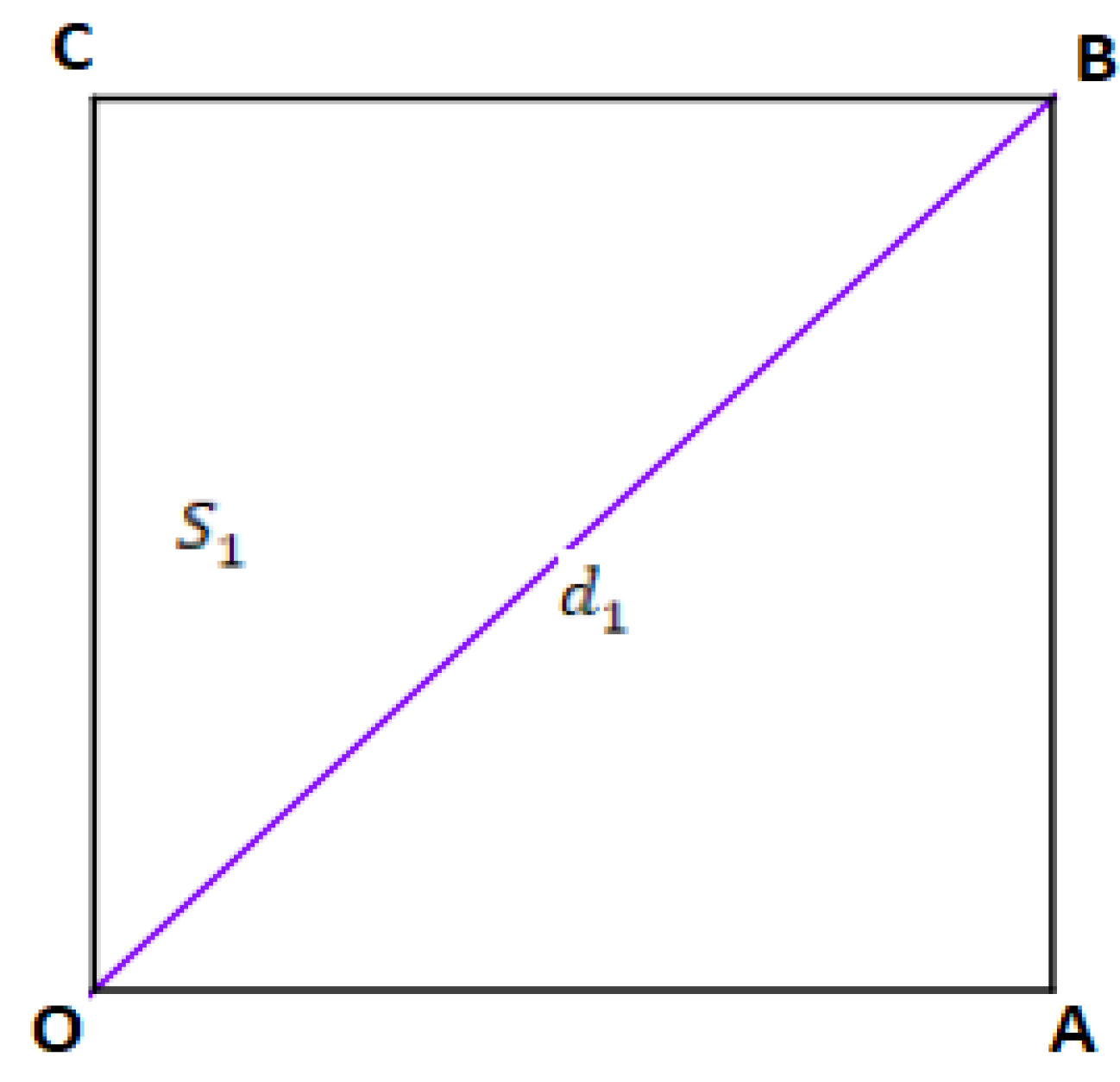
Figure 2.
Construction illustrating Lemma . (Segment is extended. Circle with center and radius intersects the line through and at point , establishing . Segment ).
Figure 2.
Construction illustrating Lemma . (Segment is extended. Circle with center and radius intersects the line through and at point , establishing . Segment ).
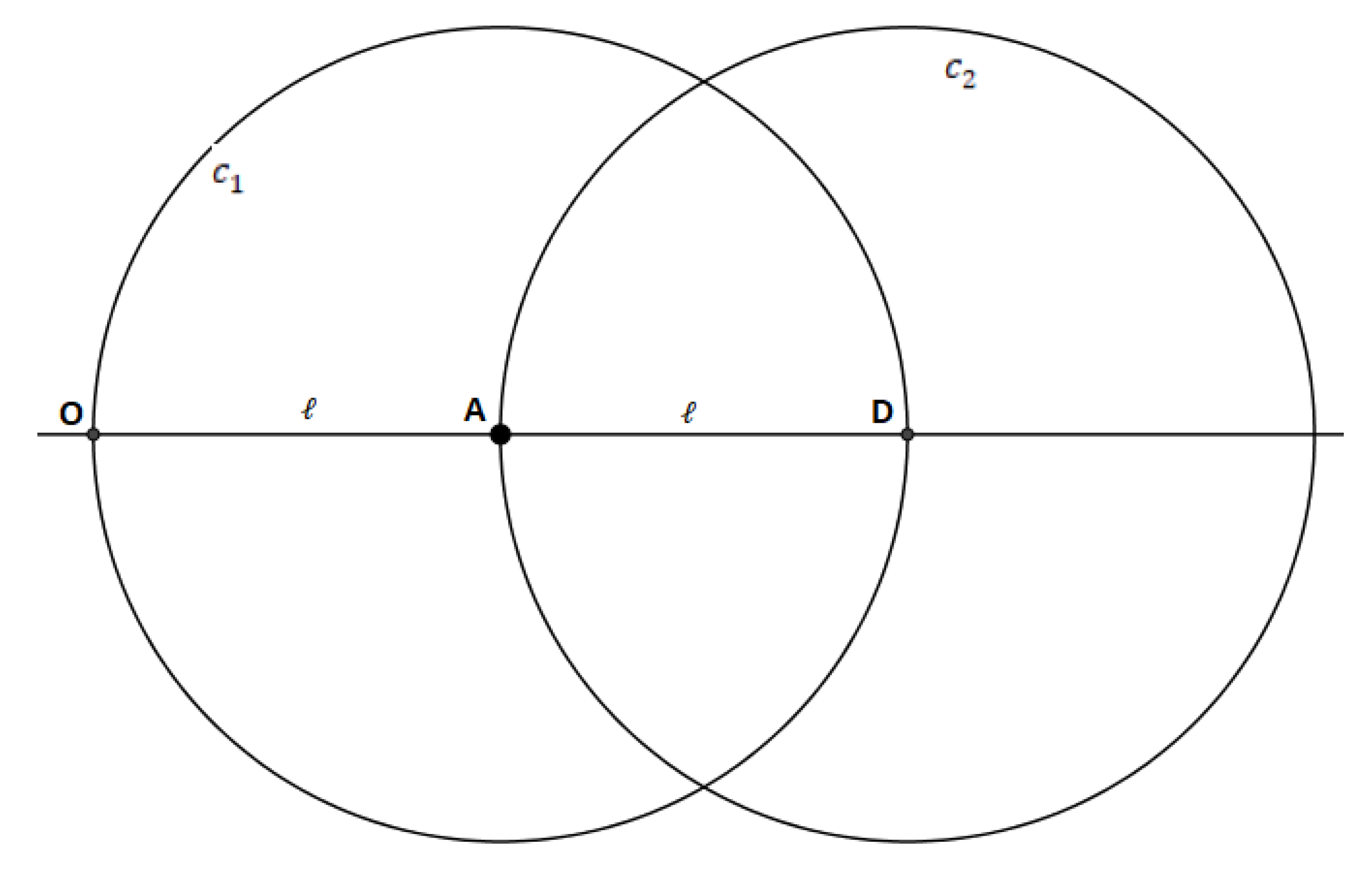
Figure 3.
Construction illustrating Lemma 2 and the final state of Problem 1. (Square is constructed on side , with vertices . Its diagonal is . Circles (center , radius ) and (center , radius ) intersect, verifying and thus . This segment is also the result of the interpretive cubic operation in Problem 2).
Figure 3.
Construction illustrating Lemma 2 and the final state of Problem 1. (Square is constructed on side , with vertices . Its diagonal is . Circles (center , radius ) and (center , radius ) intersect, verifying and thus . This segment is also the result of the interpretive cubic operation in Problem 2).
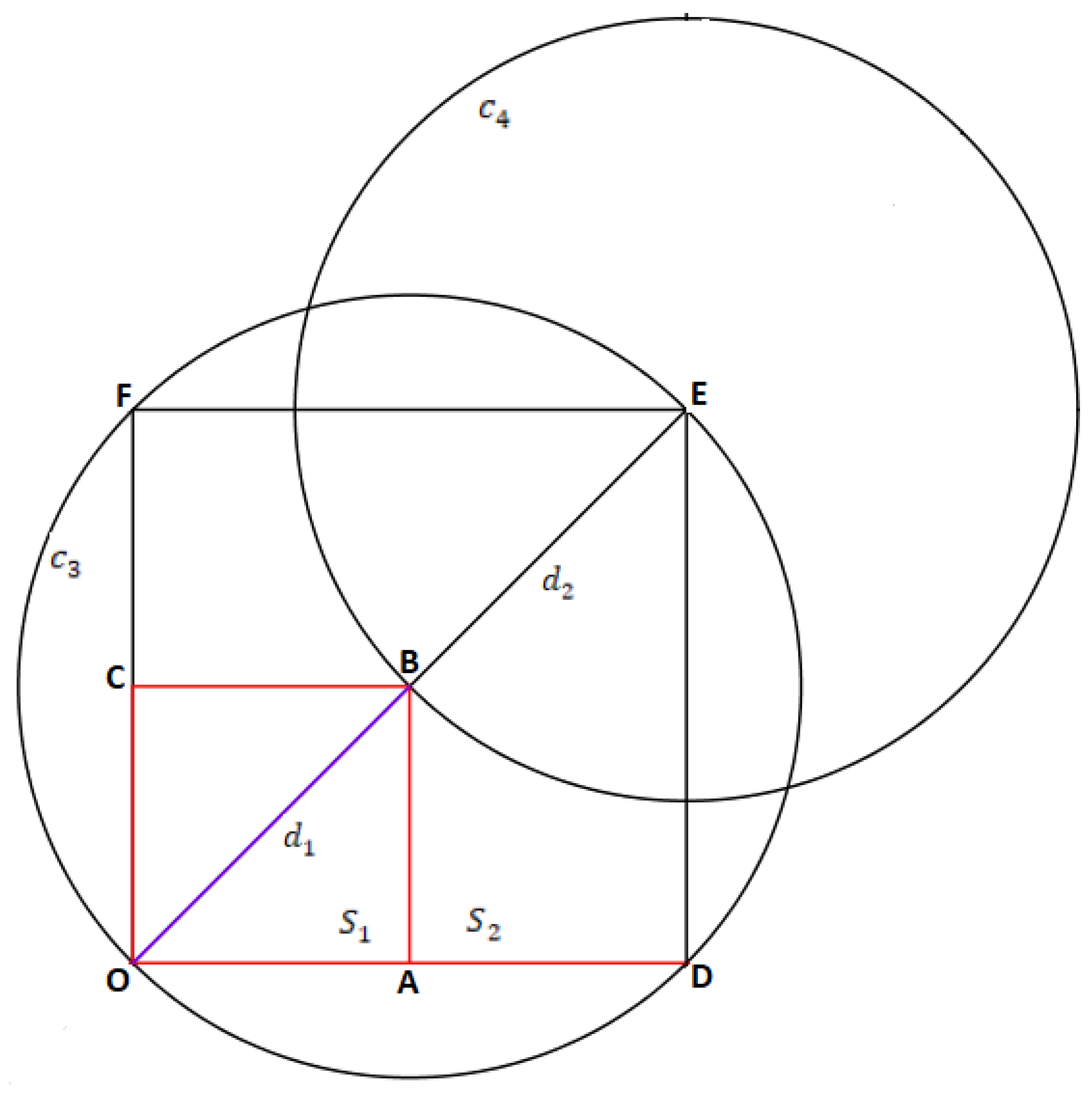
Figure 4.
The configuration for the impossibility proof. A right angle is given with horizontal and vertical. Circle with center and radius determines points and on . Circle with center and radius intersects line at and . The assumed trisection rays and intersect line at points and .
Figure 4.
The configuration for the impossibility proof. A right angle is given with horizontal and vertical. Circle with center and radius determines points and on . Circle with center and radius intersects line at and . The assumed trisection rays and intersect line at points and .
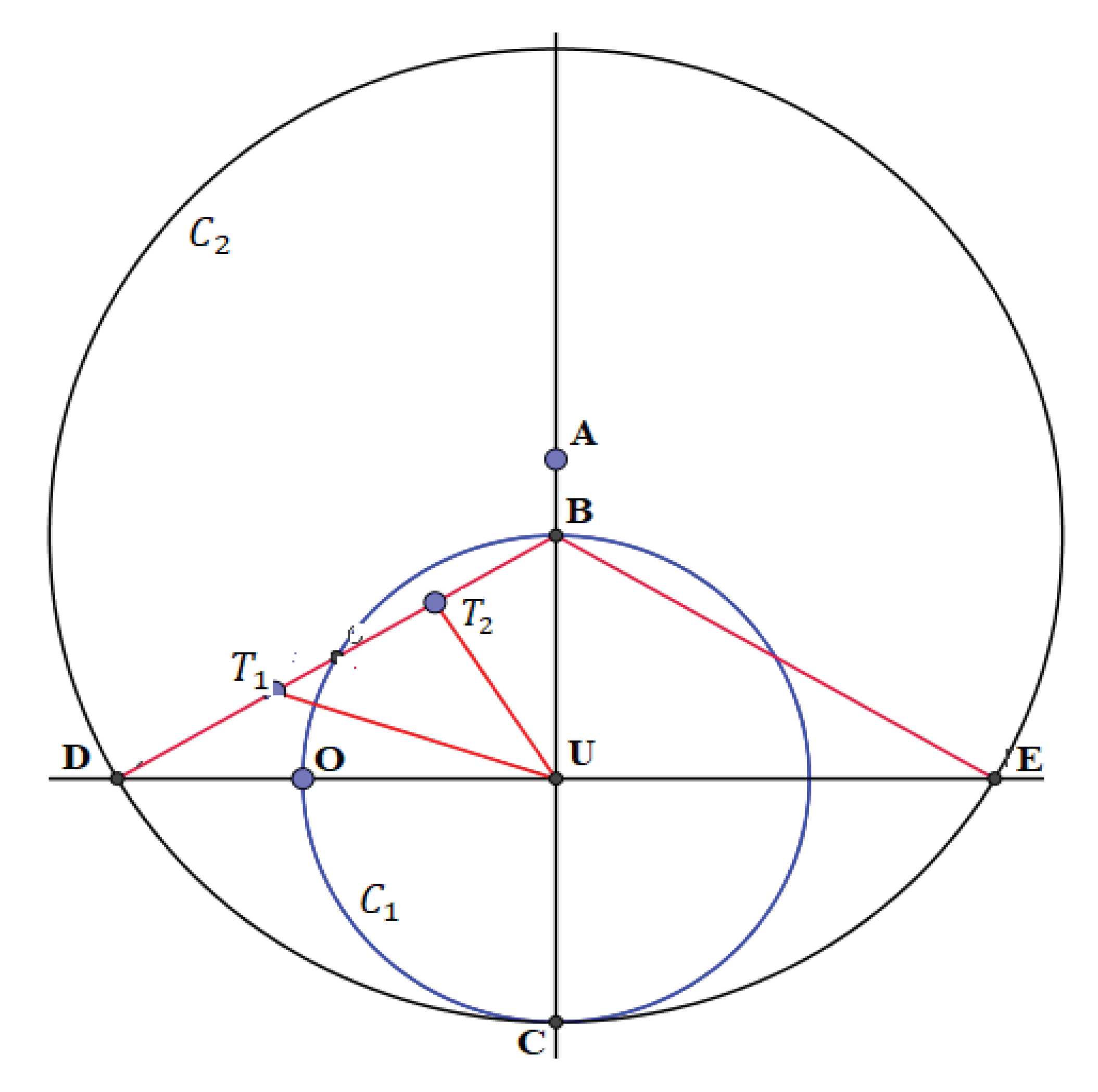
Disclaimer/Publisher’s Note: The statements, opinions and data contained in all publications are solely those of the individual author(s) and contributor(s) and not of MDPI and/or the editor(s). MDPI and/or the editor(s) disclaim responsibility for any injury to people or property resulting from any ideas, methods, instructions or products referred to in the content. |
© 2025 by the authors. Licensee MDPI, Basel, Switzerland. This article is an open access article distributed under the terms and conditions of the Creative Commons Attribution (CC BY) license (http://creativecommons.org/licenses/by/4.0/).
Copyright: This open access article is published under a Creative Commons CC BY 4.0 license, which permit the free download, distribution, and reuse, provided that the author and preprint are cited in any reuse.


