

Submitted:
27 July 2024
Posted:
30 July 2024
Read the latest preprint version here
Abstract
The One Health approach often reaches classrooms through Environmental Education (EE), which aims to guide society's response to halt the ongoing environmental, health, economic, and value crises. However, this goal has not been achieved. One reason is that EE teaching has traditionally focused on learning isolated ecological concepts and standardized solutions. Additionally, teacher training has tended to neglect didactic content knowledge, resulting in a reduced capacity to influence students' concerns and behaviours. Despite EE's multidimensional nature, ineffective didactic strategies have prevented students from acquiring the systemic vision needed to address eco-social problems and devise sustainable solutions in line with the Sustainable Development Goals (SDGs). In this context, this work proposes strategies to improve EE teaching through the One Health approach to achieve Transformative Environmental Education (TEE). The practical examples presented demonstrate successful EE initiatives that integrate One Health into classrooms using effective methods promoted by Science Education research. Effective EE should inspire critical thinking, empowerment, and student reflection, fostering a deep understanding of socio-environmental issues and innovative solutions from early education to create committed citizens. Therefore, achieving TEE requires reforming teacher training programs to strengthen didactic competencies and promote transformative educational practices, emphasising systems thinking, scientific and epistemic practices, and environmental justice awareness.
Keywords:
Education for Sustainability
; GreenComp
; LifeComp
; One Health
; Scientific Practices
; Systems Thinking
; TeachComp
; Transformative Environmental Education
1. Introduction
As early as 2004, the Wildlife Conservation Society proposed 12 priorities (Manhattan Principles) to combat threats to human and animal health. From these, the concept “One Health, One World™” was established [1], which evolved into the current One Health approach promoted by FAO, WOAH and WHO [2]. This term constitutes a concept of health that goes far beyond the absence of clinical disease, and therefore should not be addressed solely within the healthcare domain, but also through health education as a cross-cutting theme at all educational levels.
Thus, the One Health approach encompasses three interconnected and interdependent dimensions (Figure 1): human health, animal health, and environmental health [3,4,5,6,7,8,9,10,11].
Human health is defined as the physical, mental, and social well-being of humans. Animal health should be considered similarly, encompassing the well-being of all consumers within the food web (animals other than humans). Lastly, environmental health should be understood as the state of the ecosystem where the flow of matter and energy occurs correctly. In this context, this third dimension of One Health includes all abiotic factors (physical and chemical), producers in the food web (plants, and autotrophic microorganisms), and other biological agents of the ecosystem that are neither human nor animal (e.g., fungi, protozoa, prokaryotes). The latter are crucial because they refer to a multitude of microorganisms, including viruses and bacteria, which play fundamental roles in ecosystem dynamics and global health. Recognising the importance of these microorganisms is essential for understanding the complex interactions that affect the health of all living beings and for developing effective strategies for disease prevention and control.
Examples of the interconnection between habitat destruction, sustainability, and One Health are manifold [5]. One of the most recent would be the COVID-19 pandemic [9], which is linked to situations [12] such as deforestation (SDG 15), the wildlife trade (SDGs 8, 11, 12, and 15), the economy of impoverished regions in Southeast Asia (SDGs 1, 8, and 10), healthcare (SDG 3), and low-quality education (SDG 4).
Similar examples would be situations such as the emergence of vector-borne emerging diseases like West Nile virus [5], Zika and Chikungunya viruses, or malaria plasmodium (SDG 3), easily transmitted in large cities (SDG 11) by mosquitoes lacking predators (bats, frogs, sparrows, spiders, and so on) in urban environments (SDG 15). This underscores the importance of a healthy ecosystem to sustain urban biodiversity that controls the emergence of new disease-transmitting species [13,14].
Lastly, another case could be the emergence of thawing pathogens (SDGs 3 and 15) from permafrost due to global warming (SDGs 7 and 13), becoming active and affecting other living beings. For instance, the outbreak of Bacillus anthracis in Siberia from thawed reindeer carcasses over a century old [15]. This incident affected numerous reindeer and a group of people living in the area, suggesting a potential risk of new pandemic pathogens emerging, given the discovery of dozens of giant viruses frozen for over 30,000 years in Siberian permafrost in recent years [16].
In this new context, citizens need to be educated about the origins of recent health crises such as Ebola, Zika, SARS, and avian and swine influenza in order, where possible, to try to prevent the emergence of new ones [14,17]. These examples underscore how environmental degradation and resource overexploitation facilitate the emergence of diseases that harm population health and require a systemic vision to be understood and addressed [18]. The current situation, primarily driven by greenhouse gas emissions over the last two centuries, has altered the atmospheric composition and raised the planet’s average temperature [19,20]. Consequently, this has led to changes in ecosystem water regimes, melting ice caps, and rising sea levels [21]. Furthermore, the use of cosmetic, phytosanitary, and pharmaceutical products, along with the discharge of chemical waste from industrial, domestic, and agricultural activities, leads to the accumulation of pollutants in the soil [22,23,24], surface and groundwater [25,26,27,28], and even within the food web [29,30,31]. This accumulation poses significant concerns for human, animal, and environmental health [32].
All these stresses on ecosystems disrupt the homeostasis of living organisms, causing severe harm and limiting their survival [33]. These changes occur so rapidly that evolutionary adaptations cannot keep pace with the new conditions. So much so that the planet’s biodiversity has been drastically reduced in recent years [34], and this process is accelerating due to the interconnectedness required for the correct flow of matter and energy within ecosystems [33]. As more organisms disappear, the remaining ones face greater challenges to survive. Consequently, environmental health has been severely compromised, with worrying implications for both animal and human health.
It is evident, therefore, that solving these problems is not easy and requires understanding that this crisis is a complex interplay of various environmental issues in the Anthropocene [5,18,20,35,36] such as climate change, biodiversity loss, deforestation, pollution, and resource depletion, among others, all of which are intricately linked (systemic vision). For instance, deforestation is not merely an ecological issue; it is also tied to economic activities, land use policies, and social practices. Similarly, pollution and climate change are interconnected through industrial processes and energy consumption patterns, which are influenced by economic and policy decisions. Therefore, addressing these challenges requires a multidimensional analysis that considers not only ecological factors but also the social, economic, and political dimensions that drive these problems [5,18,35].
It is also essential to define the origins of this environmental crisis, recognising that it is anthropogenic and therefore eco-social [9], and the result of decades of unsustainable human practices and policies [36,37,38,39]. In this sense, social demands in response to the environmental crisis of the 1960s called for the equitable redistribution of the benefits and burdens of exploiting and using the natural environment and its resources, leading to the concept of Environmental Justice [37,40,41].
For its part, the term Environmental Education (EE) was also defined [42] to guide society’s orderly response to the environmental crisis. This definition proposed that EE should be a multidimensional approach, enabling each individual to fully understand the environment and its connections with society (including the environmental impacts of human actions), and find effective solutions to address environmental problems. This conception has been preserved in various International Conferences on Environmental Education [43,44,45,46]. It is worth noting that the most significant change occurred with the publication of the 2030 Agenda [38] and its new paradigm of multidimensionality: the Sustainable Development Goals [39]. Therefore, EE encompasses various dimensions such as ecological, economic, social, cultural, and health. To reach the public, it is necessary for these dimensions to be integrated through another dimension: education. This has two components: pedagogical and didactic. The first organizes at the curricular level the knowledge that must be acquired at each educational stage; the second defines the appropriate strategies and tools in classroom practice to convey a comprehensive model of EE (Figure 2).
It is important to note that environmental problems are becoming increasingly severe, and EE has not yet been able to reverse the eco-social crisis, as several authors already predicted years ago [47,48]. In this context of unresolved environmental crises and the absence of pro-environmentalism among some citizens (partly due to misinformation that prevents them from acting to protect the environment, and even leading to the denial of issues such as climate change and pandemics) [49], this work aims to reflect on the current state of the issue and define possible strategies for improving the teaching of Environmental Education from a One Health approach, steering it towards truly Transformative Environmental Education (TEE).
2. Classroom Practice in Environmental Education: The Road to its Hegemonic Narrative
To raise awareness and promote conservation behaviours, EE (recently named Education for Sustainability or Education for Sustainable Development) (e.g., [50]) has for years been proposed by society as the main driver of change for unsustainable actions that cause socio-environmental problems [38,39] such as climate change, biodiversity loss, emergence of invasive species, pollution and resource depletion. As mentioned, these issues are all interconnected and require holistic approaches to be addressed.
Therefore, EE is a multidisciplinary and multidimensional area of knowledge [50,51]. In fact, since its origin it has been incorporating any narratives and/or approaches related to the environment into its theoretical framework [50,52]. This voracity to include any aspect of this field has been further boosted by the advent of the hyper-connected Agenda 2030 and the SDGs. As a result, it has evolved into a macroarea of knowledge with a transdisciplinary spirit but a multidisciplinary reality, making it a hodgepodge.
For its part, the One Health approach is rooted in the connection between Veterinary, Medicine and Ecology, and, although its objective is practical (solving real health problems), to be truly understood, these fields must be integrated and addressed together theoretically in the classroom. However, the analysis of current educational curricula shows that EE teaching has focused mainly on the environmental health dimension (ecology-related content) [51,53], and on the human health dimension driven by anthropocentrism (human body content, hygienic practices, healthy eating) [5,54].
In any case, to fully assimilate the One Health approach, it is essential to address the three dimensions in an integrated manner, rather than separately or in pairs (animal-human health; environmental-human health; animal-environmental health). This need has become even more evident in the wake of the COVID-19 pandemic [55]. Despite this being true at the curricular level, traditionally the One Health concept has been more closely tied to the fields of Veterinary and human Medicine, with the primary focus on preventing zoonotic diseases, and with less focus on the role of the environment as a contributing factor to human and animal health [56], even though there are diseases that can be prevented by developing sustainable lifestyles (e.g., responsible consumption, sustainable cities, ecosystem protection). However, the One Health approach has recently been including environmental health-related concerns such as food security, climate change adaptation and biodiversity that reinforce the need to work out the interdependence between its three dimensions [57].
The unsuccessful transition from multidisciplinarity to transdisciplinarity in EE when incorporating a new approach, in this case One Health, is likely due to the lack of organization within its internal dimensions, which can only be integrated through education and specifically through effective didactics (Figure 3). However, as shown in Figure 3, the emphasis has predominantly been on the ecological, economic, and social aspects [50], neglecting other important dimensions (animal and human health, ethics, politics) [36]. For this reason, when EE aims to be the driving force for behaviour change that promotes sustainability and to play its role in citizen literacy within the One Health approach, it often uses ineffective didactic strategies that have been in place for over 50 years [51].
These seemingly unsuccessful methodologies (Figure 4) have often merely conveyed the existence of socio-environmental problems and reproduced standard, decontextualized solutions, which are presumed valid for all citizens [58,59,60]. They fail to recognize that people’s actions are based on their individual justifications, motivated by many reasons beyond knowing what should be done [36,61,62]. Additionally, as standard solutions are often far removed from the interests and willingness to act of citizens, responsibility is frequently shifted to others, with solutions focusing on law and technological advancements [63] that might mitigate environmental degradation (Figure 4). Hence, EE traditional teaching does not align with the needs or the original purpose for which it was created [51].
At this point, it should be noted that any key idea from other approaches related to EE field of knowledge, whether complementary or counter-narratives, is incorporated into its theoretical framework [50,64]. However, this incorporation often limits the dissemination of these ideas, as they become “arrested” by EE when ineffective EE educational strategies are applied to teach them. This issue arises from the lack of a successful symbiosis between EE and Science Education teaching practices [62].
For instance, this “arrest” occurs when typical EE teaching strategies are used to teach the One Health approach, as they often fail to integrate its three dimensions in a holistic way [5,65]. Consequently, as previously mentioned, learning situations related to environmental health are brought into the classroom primarily from an ecological perspective [51,53], and may occasionally be presented from a human health perspective when discussing diseases in topics related to the human body [54].
It should also be pointed out that a hegemonic narrative is a paradigm that is widespread and predominantly accepted by the population [50,64]. In this context, the natural evolution of ideas gives rise to alternative, complementary, or even counter-narratives. When a hegemonic narrative is widely established, it tends to develop mechanisms to avoid being displaced (resistances). Given its body of doctrines, it is capable of incorporating and integrating new narratives into its paradigm, thereby minimising their expansion or significantly limiting their dissemination, and even causing them to disappear over time [50,64]. Therefore, it appears that the traditional EE would be acting as a hegemonic narrative, “phagocytising” the One Health approach (complementary narrative), similar to what has happened with other concepts such as Environmental Justice, Eco-social/Socio-environmental Education, and even the SDGs and Education for Sustainability [52].
In this context, despite previous efforts, it is crucial to enhance the application of the One Health approach in classrooms [5,6,7]. To achieve this, redefining teacher training in EE is advisable [17,51,63,66,67]. This redefinition should focus on incorporating effective strategies (resources, methodologies) that enhance the didactic dimension of teaching competence (Figure 2), as so far improvements in EE teacher training have primarily concentrated on pedagogical issues (curricular rather than didactic) and conceptual knowledge [51]. As will be discussed below, these strategies should enable educators to design learning situations that pose realistic socio-environmental problems using a transdisciplinary approach, thus requiring the integration of the three dimensions of One Health that EE has traditionally fragmented (Figure 3).
3. How is Environmental Education Approached in Teacher Training?
Despite decades of emphasis on the environmental crisis from the educational field, behavioural changes in the population have not occurred and/or have not been sufficient [51]. The recurring limitations identified as the cause are consistently the same: insufficient teacher training in both content knowledge and didactic content knowledge, and the need for high-quality didactic resources that truly impact students [67,68].
EE has traditionally focused on learning ecological concepts [52,58]. This could be attributed to the tendency of many teachers to instruct in the way they were taught and to the fact that initial teacher training has historically overlooked the importance of didactic content knowledge [51]. This situation results in a diminished capacity to effectively influence their future students’ concerns and behaviours [52,58,60]. In fact, several studies indicate that teachers lack sufficient training in content knowledge [67,69], despite their training focusing on it, as well as in didactic content knowledge [67,70]. Consequently, focusing teacher training primarily on content rather than its didactics has led to teachers developing a disinterest in science and avoiding science-related content in the classroom. Additionally, due to low didactic content knowledge, teachers often have a low self-perception of their ability to effectively address EE topics beyond basic concepts like recycling [59]. This results in them steering clear of these topics in their teaching [67].
It is evident that this situation must change, benefiting from the fact that the environmental legislative framework has also evolved since the Paris Agreement. Thus, the European Union’s decarbonisation program has compelled member states to enact corresponding laws. For instance, Spain’s Law 7/2021 on climate change and energy transition has influenced the development of the new educational law [71], which now includes the One Health approach within the framework of eco-social Education, forcing this integrative vision of health into the classroom. Nevertheless, the regulations governing initial teacher training in Spain date back to 2007 [72,73] and do not adequately prepare professionals for this new context. Therefore, continuous and updated initial teacher training in EE is crucial to delivering effective educational proposals in the classroom. This involves integrating the One Health approach into EE teaching programs, as there are currently few such initiatives (e.g., [17,74]). This reorientation could enhance students’ awareness and engagement (sustainable attitudes and behaviours), especially in the early educational stages, where there is greater potential to influence behaviours [75,76,77,78,79].
In this context, and as we will explore in more detail in the next section, there is a growing consensus among educators and policymakers on the need to promote transformative and effective EE teaching [51,67]. This approach aims to empower learners to critically engage with environmental issues, understand their systemic nature, and develop the skills necessary to advocate for sustainable solutions [62,67]. It involves moving beyond merely transmitting information about environmental problems and standardized solutions, towards fostering a deep understanding of issues from multiple perspectives, collaboratively searching for evidence-based solutions, and making informed decisions [17,80].
4. Discussion
4.1. Emphasising the Didactic Dimension of Environmental Education in Teacher Training
As mentioned above, initial teacher education programs in EE have neglected the development of specific didactic knowledge [51], even though they should focus on equipping teachers with the competencies needed to effectively address EE in the classroom. This requires, above all, developing the capacity of teachers to design and implement activities that have an emancipatory/transformative impact on students [80]. Following the European nomenclature of competencies such as GreenComp [76] or LifeComp [81], this could be referred to as TeachComp. These are activities that challenge students with realistic socio-scientific problems, promoting deeper understanding and students’ systems and critical thinking, considering the multidimensionality of environmental problems and reflecting on their complexity, as there are many dimensions (both epistemic and non-epistemic) that influence awareness, decision-making, or informed citizen participation in relation to any socio-environmental issue.
4.2. Integration of GreenComp and LifeComp Competences in the “TeachComp” During Teacher Training
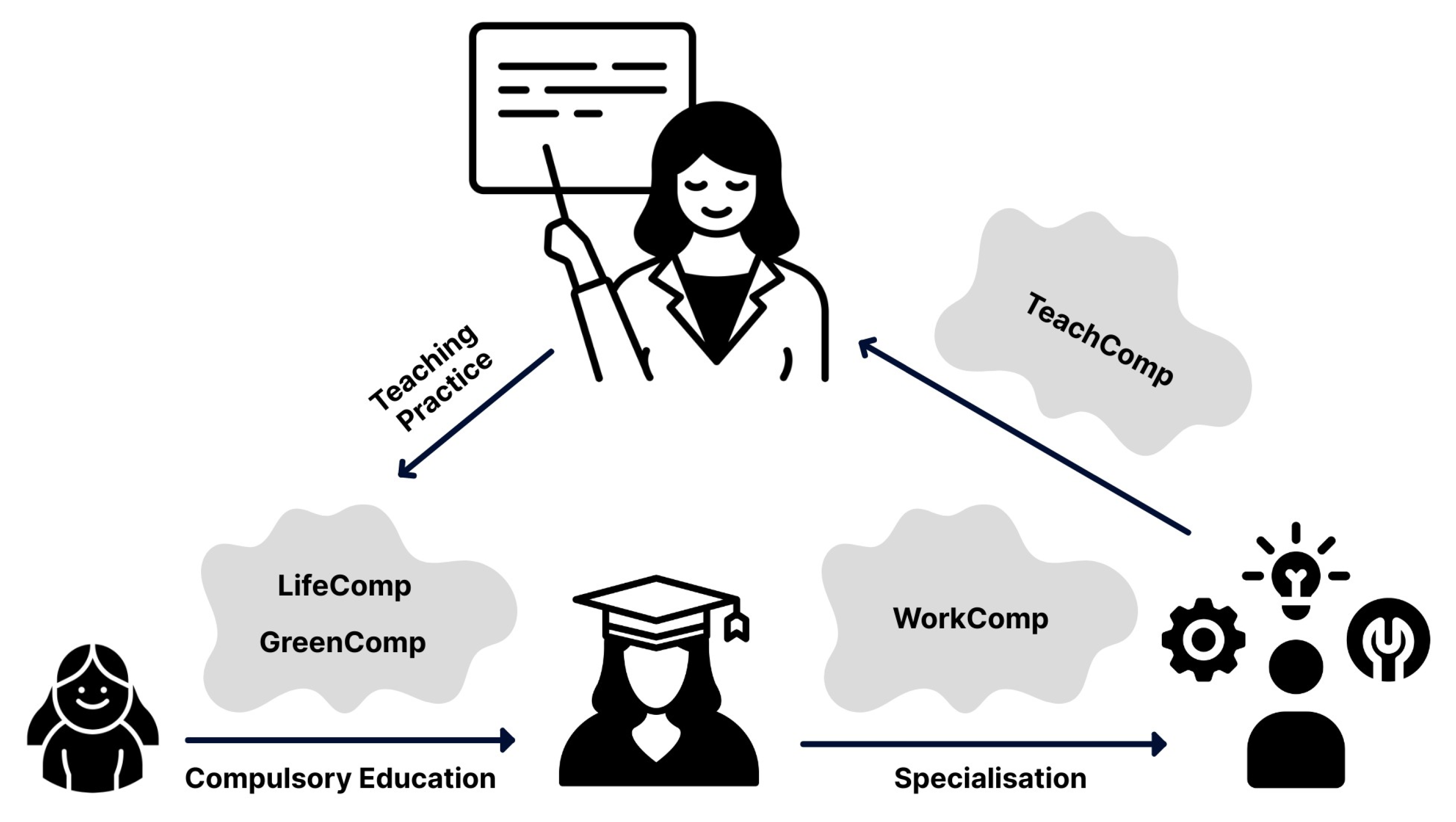
The one coined as TeachComp in this work (Figure 5) would include two other competencies that European reference frameworks propose for all citizens, regardless of their profession, and that initial teacher trainees should have already acquired: LifeComp [81], which focuses on the development of life skills such as learning to learn, and GreenComp [76], which involves developing a basic understanding and practical skills to address environmental challenges from multiple perspectives. This includes implementing sustainable solutions in daily life (e.g., waste reduction, recycling, energy efficiency, use of renewable energy, and adoption of responsible consumption habits), actively participating in community initiatives, and making informed decisions that promote sustainability in various contexts while evaluating the systemic impact of those decisions.
In fact, teachers initial training should focus on developing the didactic dimension of both competences. Thus, GreenComp for teachers would involve developing teaching methods that integrate sustainability into the school curriculum and implementing active methodologies that promote scientific practices through the exploration of realistic environmental issues. Teachers should be trained to model and promote sustainable values, inspiring students to adopt an environmental ethic and develop the skills necessary to act sustainably in their daily lives.
Additionally, LifeComp for teachers would encompass the development of essential skills for managing personal, social, and professional lives, while preparing students to face the challenges of the 21st century. This includes fostering self-awareness, time and stress management, effective communication, collaboration, critical thinking, efficient problem-solving, uncertainty management, creativity, innovation, civic engagement, ethical responsibility, and the ability to formulate integrated and balanced solutions in a complex and constantly changing world.
By incorporating GreenComp and LifeComp into compulsory education through a TEE approach (Figure 5), educators can empower students (citizens) to not only understand the interconnection between environmental issues but also to develop skills to effectively address these problems [82]. This approach not only strengthens students’ environmental literacy but also prepares them to be informed and committed agents of change for sustainability in their communities, both in their everyday lives and in their professional careers (WorkComp).
Furthermore, integrating both competencies into teacher training programs could empower educators to teach about the interconnectedness of environmental and health issues. This approach not only aligns with the One Health paradigm but also prepares students to think critically and act responsibly in tackling global health challenges.
4.3. What Skills do International Scientific Frameworks Aim to Foster in Today’s Citizens?
Promoting TEE requires not only a change in teacher training but also in the very structure of how EE is taught and learned in classrooms [51]. New curricula and transformative educational approaches should focus on developing students’ ability to think critically about environmental issues from multiple perspectives and to advocate for positive changes in their communities [63,66,80].
In response to the current context of globalization and crises (environmental, health, economic, values), the Strategic Vision Expert Group (SVEG), tasked with designing the PISA 2025 standardised tests, proposed updating its scientific framework [35]. Thus, the scientific competencies considered in these tests will be threefold: Explain phenomena scientifically; Construct and evaluate designs for scientific enquiry and interpret scientific data and evidence critically; and Research, evaluate and use scientific information for decision making and action. This is particularly relevant today, given that society is ‘infodemic’ due to the vast amount of data to which it has access, which are not always valid and reliable (misinformation) [49]. When it comes to information labelled as ‘scientific’ (obtained within and outside formal educational spaces), people often do not doubt its validity or rigor. Even less so if it comes from a researcher or a teacher (authority principle), even if it is not well-founded [83]. However, adequate scientific education should encourage students to remain sceptical of new information, to question whether there are conflicts of interest behind it, whether there is scientific consensus and whether the sources are relevant and reliable [84,85].
Furthermore, the scientific framework of PISA 2025 also proposes to measure the “Agency in the Anthropocene” [35]. This agency requires understanding that human impacts have significantly altered Earth’s systems and continue to do so. To measure this, the SVEG suggests considering three competencies in environmental sciences: Explain the impact of human interactions with Earth’s systems; Make informed decisions to act based on evaluation of diverse sources of evidence and application of creative and systems thinking to regenerate and sustain the environment; and Demonstrate hope and respect for diverse perspectives in seeking solutions to socio-ecological crises.
To ensure students not only succeed in these tests but also thrive in the world they live in, it is crucial that throughout their compulsory schooling [78], ideally starting from early childhood, they engage in classroom activities that foster the development of these competencies [75,77,79]. In the context of this work, this is especially relevant for addressing issues related to One Health. Therefore, it is essential to promote the One Health approach in the teaching of EE [5], as it is being successfully implemented in some compulsory education initiatives [7,63]. As evidenced in the following section, a didactic method to support this is to integrate scientific and epistemic practices into the usual classroom culture.
4.4. Practical Examples: Redefining the Didactic Approach of Environmental Education towards Transformative Environmental Education
Historical examples such as Rachel Carson’s advocacy for pesticide regulation illustrate the transformative potential of individual actions to influence environmental policies and raise public awareness. By introducing these examples in the classroom, educators can demonstrate the importance of environmental stewardship to students and empower them to advocate for sustainable practices in their daily lives.
To illustrate the practical application of the aforementioned principles, three examples of successful EE initiatives developed by our research team in response to contemporary environmental challenges are presented. These examples integrate the One Health approach into classrooms through effective teaching methods (Figure 3).
4.4.1. Example 1 Within the Framework of Primary Education: Activity That Addresses the Problem of Raptors Deficiency in Wetlands and Its Consequences for Human, Animal, and Environmental Health
The chapter titled “Towards Transformative Environmental Education: Effective Activities for Primary Education” [17] aligns with didactic strategies aimed at developing a systemic vision, scientific and epistemic practices, and environmental justice awareness in the following ways:
- Systems thinking: The activity is designed to foster a systemic vision of the presented environmental issue that integrates the One Health approach. It requires students to understand the complex ecological relationships and the role of top predators in maintaining ecosystem balance, highlighting the implications of their absence for human, animal, and environmental health (disease transmission).
- Scientific and epistemic practices: The activity promotes the development of scientific practices such as inquiry, modelling, and argumentation to enhance the understanding of ecological issues. Students engage in these practices by formulating hypotheses, collecting and analysing data, and constructing increasingly sophisticated scientific arguments and models based on available evidence. This process helps students develop a deeper understanding of scientific concepts and the nature of scientific inquiry (how science is constructed).
- Awakening environmental justice: The activity is designed to raise awareness of environmental justice by illustrating how the degradation of wetlands affects organisms, emphasising the importance of preserving ecological balance for the well-being of all species. Environmental degradation, such as climate change, is primarily driven by high-impact actions in hyper-urbanised areas, which ultimately affect more natural rural areas, jeopardising ecosystem balance. Therefore, the inhabitants of these areas suffer the most from the consequences, despite being less responsible for the damage (unequal distribution of the benefits and burdens of environmental harm).
4.4.2. Example 2 Within the Framework of Secondary Education: Activity on Reproductive Problems in Animals and Humans Caused by Environmental Contamination From Pesticides
The article titled “Does Pollution Only Affect Human Health? A Scenario for Argumentation in the Framework of One Health Education” [63] aligns with didactic strategies aimed at developing a systemic vision, scientific and epistemic practices, and environmental justice awareness in the following ways:
- Systems thinking: The activity enables students to develop a systemic understanding of the interconnections between environmental pollution and the reproductive health of animals and humans by integrating evidence-based argumentation, the One Health approach, and complexity-based solutions. This approach allows students to analyse the multifaceted nature of environmental challenges and propose well-reasoned solutions to reduce pollution and its effects.
- Scientific and epistemic practices: The activity emphasises the importance of students applying scientific skills such as identifying relevant data, establishing cause-and-effect relationships, and evaluating evidence to support conclusions. Engaging in evidence-based argumentation within the context of One Health education can enhance students’ scientific reasoning and environmental literacy. Additionally, delving into how scientific ideas are constructed, the role of data and evidence in science (argumentation as a process of critical evaluation and evolution towards sophisticated models, using evidence to support scientific explanations, and so on), could implicitly improve their epistemic practices.
- Awakening environmental justice: The activity fosters a sense of global citizenship and environmental responsibility by encouraging students to propose solutions that take into account both planetary and human health.
4.4.3. Example 3 Within the Framework of Teacher Training: Activity on the Sustainability of Avocado Production and Consumption in the World
The article titled “Is Consuming Avocados Equally Sustainable Worldwide? An Activity to Promote Eco-Social Education in Science Education” [66] aligns with didactic strategies aimed at developing a systemic vision, scientific and epistemic practices, and environmental justice awareness in the following ways:
- Systems thinking: The activity encourages students to analyse the sustainability of avocado consumption from multiple perspectives, including ecological, economic, political, and social aspects. By providing materials that encompass various viewpoints, students are prompted to adopt a holistic view to understand the complexity of the case and make informed decisions about it.
- Scientific and epistemic practices: Through the activity, pre-service teachers must make informed decisions about the sustainability of avocado consumption in countries like Spain (southern regions), considering factors such as resource depletion that may render its continuous production unfeasible. This fosters the development of their scientific reasoning and critical thinking skills, recognising the limitations of the available data for certain claims, the importance of seeking consensus, and the value of considering alternative viewpoints (thus implicitly working on epistemic practices).
- Awakening Environmental Justice: The activity promotes eco-social education by involving students in debates and reflections on environmental justice and sustainability, deepening their understanding of the issues and making them feel engaged in solving environmental problems. The ultimate goal is that the knowledge acquired will lead to changes in everyday behaviour including sustainable use and consumption of resources.
5. Conclusions
As educators committed to EE, it is essential to reflect on our role in promoting sustainability and environmental justice both inside and outside the classroom. However, what truly matters in teaching is not the teacher’s private actions but their professional ability to awaken critical thinking, empowerment, and reflection in students regarding their actions, their consequences, and possible solutions to the problems they face. An effective teacher has the skill to inspire students to question the world around them, critically analyse the causes and effects of socio-environmental issues and seek innovative and sustainable solutions.
Educational interventions will have a greater impact if they begin at early educational levels, as it is during these stages that values are formed and the capacity for reflection and analysis is developed. By instilling the importance of individual and collective responsibility in protecting the environment and promoting social justice from a young age (which is not always the case), generations of committed and capable citizens can be created, ready to face future challenges with a critical and proactive approach.
Achieving truly TEE (in both actions and thoughts) requires not only reforming teacher training programs to strengthen didactic competencies in EE but also promoting transformative educational approaches in classroom practices (systems thinking, scientific and epistemic practices and environmental justice awareness). Therefore, both during their training and in their subsequent professional practice, teachers should face and propose activities with no obvious solutions, addressing socio-environmental issues from various perspectives that students should connect.
In this study, we find issues related to One Health of particular interest, as it is currently a significant topic in society (especially after the COVID-19 pandemic). The reason is that it allows us to promote environmental protection while safeguarding our own health, which is advantageous for encouraging actions since personal interest aligns with environmental concerns (“anthropocentric selfishness”). If teachers experience and assimilate its benefits during their training, they are more likely to transfer this way of working to their classrooms in the future (TeachComp).
6. Future Directions
In addition to improving teachers’ didactic content knowledge, to achieve meaningful behavioural change towards pro-environmental practices, it is crucial to understand the factors influencing individual decisions beyond common scientific knowledge. Several studies have identified various determinants shaping people’s environmental attitudes and behaviours, including psychological, social, and cultural factors.
Thus, according to some authors (e.g., [86]), psychological elements, such as the perception of environmental risk and the emotional connection to nature, play a key role in whether or not pro-environmental behaviours are adopted (Eco-anger or Eco-anxiety, respectively). In addition, social factors, such as social norms and the influence of reference groups, as well as cultural differences in perceptions of nature and sustainability can also influence actions taken [50,87]. Understanding these dynamics is essential for designing effective interventions that align with the perspectives and values of different social groups.
In short, to maximize the impact of EE in promoting pro-environmental behaviours, it is important to integrate EE more effectively into school curricula (including the One Health approach), provide continuous teacher training in effective methodologies (including scientific practices), and foster intersectoral collaboration among educators, scientists, policymakers, and community leaders, in alignment with SDG 17: Partnerships for the Goals. Additionally, investing in multidisciplinary research that explores the intersection of psychology, sociology, anthropology, and education is crucial for understanding how pro-environmental behaviours are formed and sustained. If these factors are considered, teachers and educational researchers may succeed in transforming education into a genuine driver of change, rather than a contributor to the persistence of the problem.
Author Contributions
Conceptualization, J.M.P.-M. and T.E.-M.; writing—original draft preparation, T.E.-M.; writing—review and editing, J.M.P.-M. and T.E.-M.; visualization, T.E.-M.; project administration, J.M.P.-M. and T.E.-M.; funding acquisition, J.M.P.-M. All authors have read and agreed to the published version of the manuscript.
Funding
This research was supported by Ministry of Science and Innovation (PID2021-122310NB-I00), by the City Council of El Oso - Ministry of Social Rights and Agenda 2030 projects (FUAM 2023/0089 – 149400 and 2024/0109 – 149400), and by the III Edition of the Programme for the Promotion of Knowledge Transfer of the Universidad Autónoma de Madrid (FUAM, 0375/2022, 465059). The invitation to contribute toward this Section was free of charge.
Conflicts of Interest
The authors declare no conflicts of interest. The funders had no role in the design of the study; in the collection, analyses, or interpretation of data; in the writing of the manuscript; or in the decision to publish the results.
References
- Cook, R.A.; Karesh, W.B.; Osofsky, S.A. The Manhattan Principles on “One World, One Health” Buildling interdisciplinary bridges to health in a globalized world. Wildlife Conservation Society. New York, USA, (29/11/2004).
- Food and Agriculture Organization of the United Nations (FAO), World Organisation for Animal Health (OIE) y World Health Organization (WHO). Taking a multisectoral one health approach: A tripartite guide to addressing zoonotic diseases in countries. WHO, FAO and OIE: Geneve, Switzerland, 2019, p. 166. Available online: https://www.who.int/publications/i/item/9789241514934 (Accessed on 25 July 2024).
- Amuasi, J.H.; Lucas, T.; Horton, R.; Winkler, A.S. Reconnecting for our future: The Lancet One Health Commission. Lancet 2020, 395, 1469–1471. [Google Scholar] [CrossRef] [PubMed]
- AVMA (American Veterinary Medical Association). One Health: A new professional imperative. AVMA: Washington, DC, USA, 2008, p. 76. Available online: https://www.avma.org/sites/default/files/resources/onehealth_final.pdf (Accessed on 25 July 2024).
- Barrett, M.A.; Bouley, T.A.; Stoertz, A.H.; Stoertz, R.W. Integrating a One Health approach in education to address global health and sustainability challenges. Front. Ecol. Environ. 2011, 9, 239–245. [Google Scholar] [CrossRef]
- Conrad, P.A.; Mazet, J.A.; Clifford, D.; Scott, C.; Wilkes, M. Evolution of a transdisciplinary “One Medicine–One Health” approach to global health education at the University of California, Davis. Prev. Vet. Med. 2009, 92, 268–274. [Google Scholar] [CrossRef]
- Haxton, E.; Lindberg, A.; Troell, K.; Redican, K.J. One Health education meets science. Infect. Ecol. Epidemiol. 2015, 5, 30264. [Google Scholar] [CrossRef] [PubMed]
- Kahn, L.H.; Kaplan, B.; Monath, T.P.; Steele, J.H. Teaching “One Medicine, One Health”. Am. J. Med. 2008, 121, 169–170. [Google Scholar] [CrossRef] [PubMed]
- Karesh, W. (2020). Championing “One Health”. Bull. World Health Organ. 2020, 98, 652–653. [Google Scholar] [CrossRef]
- Shamas, N.; Baffoe-Bonnie, H. Antimicrobial Resistance: Research and Action Towards the One Health Approach. J. Infect. Public Health 2023, 16, 1. [Google Scholar] [CrossRef]
- The Lancet (Editorial). Zoonoses: Beyond the human-animal-environment interface. Lancet 2020, 396, 1. [Google Scholar] [CrossRef] [PubMed]
- Vallés, C.; Rodríguez-Losada, N.; Pérez-Martín, J.M.; Abril, A.M. Where does this coronavirus come from? [¿De dónde proviene este coronavirus?] In Science education in times of Covid-19. From didactic research to the classroom [Enseñanza de las ciencias en tiempos de Covid-19. De la investigación didáctica al aula]; Abril, A.M., Blanco, A., Franco, A.J., Eds.; Graó: Barcelona, Spain, 2021; pp. 63–74. [Google Scholar]
- Lee, J.M.; Wasserman, R.J.; Gan, J.Y.; Wilson, R.F.; Rahman, S.; Yek, S.H. Human Activities Attract Harmful Mosquitoes in a Tropical Urban Landscape. EcoHealth 2020, 17, 52–63. [Google Scholar] [CrossRef] [PubMed]
- Schmeller, D.S.; Courchamp, F.; Killeen, G. Biodiversity loss, emerging pathogens, and human health risks. Biodivers. Conserv. 2020, 29, 3095–3102. [Google Scholar] [CrossRef] [PubMed]
- Ezhova, E.; Orlov, D.; Suhonen, E.; Kaverin, D.; Mahura, A.; Gennadinik, V.; Kukkonen, I.; Drozdov, D.; Lappalainen, H.K.; Melnikov, V.; Petäjä, T.; Kerminen, V.-M.; Zilitinkevich, S.; Malkhazova, S.M.; Christensen, T.R.; Kulmala, M. Climatic Factors Influencing the Anthrax Outbreak of 2016 in Siberia, Russia. EcoHealth 2021, 18, 217–228. [Google Scholar] [CrossRef] [PubMed]
- Alempic, J.-M.; Lartigue, A.; Goncharov, A.E.; Grosse, G.; Strauss, J.; Tikhonov, A.N.; Fedorov, A.N.; Poirot, O.; Legendre, M.; Santini, S.; et al. An Update on Eukaryotic Viruses Revived from Ancient Permafrost. Viruses 2023, 15, 564. [Google Scholar] [CrossRef] [PubMed]
- Guevara-Herrero, I.; Esquivel-Martín, T.; Fernández-Huetos, N.; Pérez-Martín, J.M. . Towards Transformative Environmental Education: Effective Activities for Primary Education. In Interdisciplinary Approach to Fostering Change in Schools. A.M. Güneş, E. Yünkül, Eds.; IGI-Global: Hershey, USA, 2024. (in press) [Google Scholar]
- McAlister, M.M.; Zhang, Q.; Annis, J.; Schweitzer, R.W.; Guidotti, S.; Mihelcic, J.R. Systems thinking for effective interventions in global environmental health. Environ. Sci. Technol. 2022, 56, 732–738. [Google Scholar] [CrossRef] [PubMed]
- Jay, A.K.; Crimmins, A.R.; Avery, C.W.; Dahl, T.A.; Dodder, R.S.; Hamlington, B.D.; Lustig, A.; Marvel, K.; Méndez-Lazaro, P.A.; Osler, M.S.; Terando, A.; Weeks, E.S.; Zycherman, A. Overview: Understanding risks, impacts, and responses. In Fifth National Climate Assessment. Crimmins, A.R., Avery, C.W., Easterling, D.R., Kunkel, K.E., Stewart, B.C., Maycock, T.K., Eds.; U.S. Global Change Research Program: Washington, DC, USA, 2023; p. 47. [Google Scholar] [CrossRef]
- Watts, N.; Adger, W.N.; Agnolucci, P.; Blackstock, J.; Byass, P.; Cai, W.; Chaytor, S.; Colbourn, T.; Collins, M.; Cooper, A.; Cox, P.M.; Depledge, J.; Drummond, P.; Ekins, P.; Galaz, V.; Grace, D.; Graham, H.; Grubb, M.; Haines, A.; Hamilton, I.; Hunter, A.; Jiang, X.; Li, M.; Kelman, I.; Lott, M.; Lowe, R.; Luo, Y.; Mace, G.; Maslin, M.; Nilsson, M.; Oreszczyn, T.; Pye, S.; Quinn, T.; Svendsdotter, M.; Venevsky, S.; Warner, K.; Xu, B.; Yand, J.; Yin, Y.; Yu, C.; Zhang, Q.; Gong, P.; Montgomery, H.; Costello, A. Health and climate change: Policy responses to protect public health. Lancet 2015, 386, 1861–1914. [Google Scholar] [CrossRef] [PubMed]
- IPCC. Summary for Policymakers. In: Climate Change 2023: Synthesis Report. Contribution of Working Groups I, II and III to the Sixth Assessment Report of the Intergovernmental Panel on Climate Change [Core Writing Team, Lee, H., Romero, J. (eds.)]. IPCC: Geneva, Switzerland, 2023; pp. 1–34. [CrossRef]
- Malvar, J.L.; Santos, J.L.; Martín, J.; Aparicio, I.; Alonso, E. Occurrence of the main metabolites of the most recurrent pharmaceuticals and personal care products in Mediterranean soils. J. Environ. Manage. 2021, 278, 111584. [Google Scholar] [CrossRef]
- Neto, B.M.S.; Combi, T.; Taniguchi, S.; Albergaria-Barbosa, A.C.; Ramos, R.B.; Figueira, R.C.L.; Montone, R.C. Persistent organic pollutants (POPs) and personal care products (PCPs) in the surface sediments of a large tropical bay (Todos os Santos Bay, Brazil). Mar. Pollut. Bull. 2020, 161, 111818. [Google Scholar] [CrossRef] [PubMed]
- Olowoyo, J.O.; Mugivhisa, L.L. Evidence of uptake of different pollutants in plants harvested from soil treated and fertilized with organic materials as source of soil nutrients from developing countries. Chem. Biol. Technol. Agric. 2019, 6, 28. [Google Scholar] [CrossRef]
- Chaturvedi, P.; Shukla, P.; Giri, B.S.; Chowdhary, P.; Chandra, R.; Gupta, P.; Pandey, A. Prevalence and hazardous impact of pharmaceutical and personal care products and antibiotics in environment: A review on emerging contaminants. Environ. Res. 2021, 194, 110664. [Google Scholar] [CrossRef] [PubMed]
- Ebele, A.J.; Oluseyi, T.; Drage, D.S.; Harrad, S.; Abdallah, M.A.E. Occurrence, seasonal variation and human exposure to pharmaceuticals and personal care products in surface water, groundwater and drinking water in Lagos State, Nigeria. Emerg. Contam. 2020, 6, 124–132. [Google Scholar] [CrossRef]
- Sanusi, I.O.; Olutona, G.O.; Wawata, I.G.; Onohuean, H. Occurrence, environmental impact and fate of pharmaceuticals in groundwater and surface water: A critical review. Environ. Sci. Pollut. Res. 2023, 30, 90595–90614. [Google Scholar] [CrossRef] [PubMed]
- Xu, M.; Huang, H.; Li, N.; Li, F.; Wang, D.; Luo, Q. Occurrence and ecological risk of pharmaceuticals and personal care products (PPCPs) and pesticides in typical surface watersheds, China. Ecotoxicol. Environ. Saf. 2019, 175, 289–298. [Google Scholar] [CrossRef] [PubMed]
- Duarte, B.; Gameiro, C.; Matos, A.R.; Figueiredo, A.; Silva, M.S.; Cordeiro, C.; Caçador, I.; Reis-Santos, P.; Fonseca, V.; Cabrita, M.T. First screening of biocides, persistent organic pollutants, pharmaceutical and personal care products in Antarctic phytoplankton from Deception Island by FT-ICR-MS. Chemosphere 2021, 274, 129860. [Google Scholar] [CrossRef] [PubMed]
- Fu, Q.; Meyer, C.; Patrick, M.; Kosfeld, V.; Rüdel, H.; Koschorreck, J.; Hollender, J. Comprehensive screening of polar emerging organic contaminants including PFASs and evaluation of the trophic transfer behavior in a freshwater food web. Water Res. 2022, 218, 118514. [Google Scholar] [CrossRef] [PubMed]
- Zhang, H.; Kelly, B C. Sorption and bioaccumulation behavior of multi-class hydrophobic organic contaminants in a tropical marine food web. Chemosphere 2018, 199, 44–53. [Google Scholar] [CrossRef] [PubMed]
- Brack, W.; Barceló Culleres, D.; Boxall, A.B.A.; Budzinski, H.; Castiglioni, S.; Covaci, A.; Dulio,V.; Escher, B.I.; Fantke, P.; Kandie, F.; Fatta-Kassinos, D.; Hernández, F.J.; Hilscherová, K.; Hollender, J.; Hollert, H.; Jahnke, A.; Kasprzyk-Hordern, B.; Khan, S.J.; Kortenkamp, A.; Kümmerer, K.; Lalonde, B.; Lamoree, M.H.; Levi, Y.; Lara-Martín, P.A.; Montagner, C.C.; Mougin, C.; Msagati, T.; Oehlmann, J.; Posthuma, L.; Reid, M.; Reinhard, M.; Richardson, S.D.; Rostkowski, P.; Schymanski, E.; Schneider, F.; Slobodnik, J.; Shibata, Y.; Snyder, S.A.; Fabriz-Sodré, F.; Teodorovic, I.; Thomas, K.V.; Umbuzeiro, G.A.; Viet, P.H.; Yew-Hoong, K.-G.; Zhang, X.; Zuccato, E. One planet: One health. A call to support the initiative on a global science–policy body on chemicals and waste. Environ. Sci. Eur. 2022; 34, 21. [CrossRef] [PubMed]
- Urban, M.C. Accelerating extinction risk from climate change. Science 2015, 348, 571–573. [Google Scholar] [CrossRef]
- Directorate General for Communication from European Parliament. Biodiversity loss: What is causing it and why is it a concern? European Parliament: Brussels, Belgium, 2020. Available online: https://www.europarl.europa.eu/pdfs/news/expert/2020/1/story/20200109STO69929/20200109STO69929_en.pdf (Accessed on 25 July 2024).
- OECD. PISA 2025 Science Framework (draft). Paris, France, 2023, p. 93. Available online: https://pisa-framework.oecd.org/science2025/assets/docs/PISA_2025_Science_Framework.pdf (Accessed on 25 July 2024).
- Walker, C. Tomorrow’s leaders and today’s agents of change? Children, sustainability education and environmental governance. Child. Soc. 2017, 31, 72–83. [Google Scholar] [CrossRef]
- Hurtado-Hurtado, J.; Hämäläinen, V.; Ruuska, T.; Heikkurinen, P. Care as pluriversal strategy? Caring in counter-hegemonic struggles in the degrowth and environmental justice movements. Globalizations 2024, 1–21. [Google Scholar] [CrossRef]
- United Nations Organization. Transforming Our World: The 2030 Agenda for Sustainable Development; UN: New York, USA, 2015; Available online: https://unctad.org/system/files/official-document/ares70d1_es.pdf (Accessed on 25 July 2024).
- UNESCO. Education for Sustainable Development Goals; UNESCO: Paris, France, 2017; Available online: https://unesdoc.unesco.org/ark:/48223/pf0000247444 (Accessed on 25 July 2024).
- Agyerman, J. Environmental justice and sustainability. In Handbook of sustainable development, Atkinson, Dietz G.S., Neumayer, E., Eds.; Edward Elgar: Cheltenham, United Kingdom, 2007; pp. 171–188. [Google Scholar] [CrossRef]
- Grass, R. Environmental education and environmental justice: A three circles perspective. Pathways to Outdoor Communication 1995, 5, 9–13. [Google Scholar]
- Stapp, W.B. The concept of environmental education. Environmental Education 1969, 1, 30–31. [Google Scholar] [CrossRef]
- United Nations Organization. Guidelines and principles of environmental law. Stockholm Declaration. UN: Stockholm, Sweden, 1972:. Available online: https://wedocs.unep.org/bitstream/handle/20.500.11822/29567/ELGP1StockD_SP.pdf?sequence=5&isAllowed=y (Accessed on 25 July 2024).
- UNESCO. Belgrade Charter: A general framework for environmental education. International Seminar on Environmental Education; UNESCO: Belgrade, 1975; Available online: https://unesdoc.unesco.org/ark:/48223/pf0000027608_spa (Accessed on 25 July 2024).
- UNESCO. Tbilisi: United Nations Educational, Scientific and Cultural Organization with UNEP. Intergovernmental Conference on Environmental Education organized by UNESCO in co-operation with UNEP; UNESCO: Tbilisi, 1978; Available online: https://unesdoc.unesco.org/ark:/48223/pf0000032763_spa (Accessed on 25 July 2024).
- United Nations Organization. Our Common Future. United Nations General Assembly; UN: Moscow, 1987; Available online: https://sustainabledevelopment.un.org/content/documents/5987our-common-future.pdf (Accessed on 25 July 2024).
- Ripple, W.J.; Wolf, C.; Newsome, T.M.; Barnard, P.; Moomaw, W.R. “World Scientists’ Warning of a Climate Emergency. ” BioScience 2020, 70, 100–112. [Google Scholar] [CrossRef]
- Ripple, W.J.; Wolf, C.; Newsome, T. M.; Galetti, M.; Alamgir, M.; Crist, E.; Mahmoud, M.I.; Laurance, W.F. ; and 15,364 Scientist Signatories from 184 Countries. “World Scientists’ Warning to Humanity: A Second Notice.” BioScience 2017, 67, 1026–1028. [Google Scholar] [CrossRef]
- Lewandowsky, S. Liberty and the pursuit of science denial. Curr. Opin. Behav. Sci. 2021, 42, 65–69. [Google Scholar] [CrossRef]
- Svalfors, U. Education for sustainable development and multidimensional implementation. A study of implementations of sustainable development in education with the curriculum of upper secondary school in Sweden as an example. Discourse and Communication for Sustainable Education 2017, 8, 114–126. [Google Scholar] [CrossRef]
- Reid, A.; Dillon, J.; Ardoin, N.; Ferreira, J.A. Scientists’ warnings and the need to reimagine, recreate, and restore environmental education. Environ. Educ. Res. 2021, 27, 783–795. [Google Scholar] [CrossRef]
- Guevara-Herrero, I.; Pérez-Martín, J. M.; Bravo-Torija, B. Impact of the Sustainable Development Goals on educational research on Environmental Education. Rev. Eureka Ensen. Divulg. Cienc. 2023, 20. [Google Scholar] [CrossRef]
- Martínez-Pena, I.; Uskola, A.; and Puig, B. (2024). What is the trainee teacher’s notion of Antibiotic Resistance from the ‘One Health’ approach? Rev. Eureka Ensen. Divulg. Cienc. 2024, 21. [Google Scholar] [CrossRef]
- Carrasquer-Álvarez, B.; Ponz-Miranda, A.; Gavidia-Catalán, V. Environmental health competencies in textbooks. Rev. Eureka Ensen. Divulg. Cienc. 2023, 20. [Google Scholar] [CrossRef]
- Ogunseitan, O.A. One Health and the Environment: From Conceptual Framework to Implementation Science. Environment 2022, 64, 11–21. [Google Scholar] [CrossRef]
- Essack, S.Y. Environment: The neglected component of the One Health triad. Lancet Planet. Health 2018, 2, e238–e239. [Google Scholar] [CrossRef] [PubMed]
- Harrison, S.; Kivuti-Bitok, L.; Macmillan, A.; Priest, P. EcoHealth and One Health: A theory-focused review in response to calls for convergence. Environ. Int. 2019, 132, 105058. [Google Scholar] [CrossRef] [PubMed]
- Guevara-Herrero, I.; Bravo-Torija, B.; Pérez-Martín, J.M. Educational Practice in Education for Environmental Justice: A Systematic Review of the Literature. Sustainability 2024, 16, 2805. [Google Scholar] [CrossRef]
- Klein, J.; Rauchwerk, S. Ecological literacy: Meanings and approaches. In Across the spectrum: Resources for environmental educators, 3rd ed.; Monroe, M.C., Krasny, M.E., Eds.; North American Association for Environmental Education: Florida, USA, 2016; pp. 65–84. [Google Scholar]
- Roldán-Arcos, S.; Pérez-Martín, J.M.; Esquivel-Martín, T. Education for Environmental Justice: What Proposals are Being Made? Revista Internacional de Educación para la Justicia Social 2022, 11, 11–27. [Google Scholar] [CrossRef]
- Bamberg, S.; Rees, J.; Seebauer, S. Collective climate action: Determinants of participation intention in community-based pro-environmental initiatives. J. Environ. Psychol. 2015, 43, 155–165. [Google Scholar] [CrossRef]
- Wals, A.E.; Brody, M.; Dillon, J.; Stevenson, R.B. Convergence between science and environmental education. Science 2014, 344, 583–584. [Google Scholar] [CrossRef]
- Esquivel-Martín, T.; Pérez-Martín, J.M.; Bravo-Torija, B. Does Pollution Only Affect Human Health? A Scenario for Argumentation in the Framework of One Health Education. Sustainability 2023, 15, 6984. [Google Scholar] [CrossRef]
- Bengtsson, S.L. Hegemony and the politics of policy making for education for sustainable development: A case study of Vietnam. J. Environ. Educ. 2016, 47, 77–90. [Google Scholar] [CrossRef]
- Rabinowitz, P.M.; Natterson-Horowitz, B.J.; Kahn, L.H.; Kock, R.; Pappaioanou, M. Incorporating one health into medical education. BMC Med. Educ. 2017, 17, 1–7. [Google Scholar] [CrossRef] [PubMed]
- Guevara-Herrero, I. Is Consuming Avocados Equally Sustainable Worldwide? An Activity to Promote Eco-Social Education from Science Education. Educ. Sci. 2024, 14, 560. [Google Scholar] [CrossRef]
- Pérez-Martín, J. M.; Esquivel-Martín, T. The challenge of sizing environmental competence for teachers through their perceptions during initial training [El reto de dimensionar la competencia ambiental para maestros/as a través de sus percepciones durante la formación inicial]. In General competences in initial teacher education: Experiences and guidelines for their development [Las competencias generales en la formación inicial docente: Experiencias y orientaciones para su desarrollo]; Cañadas, L., Rappoport, S., Eds.; Dykinson, Madrid, Spain, 2022; pp. 36–47.
- Zhou, G. Environmental Pedagogical Content Knowledge: A Conceptual Framework for Teacher Knowledge and Development. In Educating Science Teachers for Sustainability; Stratton, S., Hagevik, R., Feldman, A., Bloom, M., Eds.; ASTE Series in Science Education. Springer; Cham.: Switzerland, 2015; pp. 185–204. [Google Scholar] [CrossRef]
- Álvarez-García, O.; Sureda-Negre, J.; Comas-Forgas, R. (2018). Evaluation of pre-service teachers’ environmental competences: Case study. Enseñanza Cienc. 2018, 36, 117–141. [Google Scholar] [CrossRef]
- Mora-Penagos, W.M.; Guerrero-Guevara, N. (2022). Key environmental competences in the teaching activities of science teachers. [Las competencias ambientales clave en las actividades docentes del profesorado de Ciencias]. Tecné, Episteme y Didaxis 2022, 51, 299–316. [Google Scholar] [CrossRef]
- Ministry of Education and Vocational Training (Spain). Organic Law 3/2020, of 29 December, which amends Organic Law 2/2006, of 3 May, on Education. Off. State Gaz. 2020, 340, 122868–122953. [Google Scholar]
- Ministry of Education and Science (Spain). Ministerial Order regulating the Early Childhood Education Teaching Profession. ECI/3854/2007. Off. State Gaz. 2007, 312, 53735–53738. [Google Scholar]
- Ministry of Education and Science (Spain). Ministerial Order regulating the Primary Education Teaching Profession. ECI/3857/2007. Off. State Gaz. 2007, 312, 53747–53750. [Google Scholar]
- Puig, B.; Uskola, A. Understanding Pandemics Such as COVID-19 through the Lenses of the “One Health” Approach. Sustainability 2021, 13, 13389. [Google Scholar] [CrossRef]
- Ardoin, N.M.; Bowers, A.W. Early childhood environmental education: A systematic review of the research literature. Educ. Res. Rev. 2020, 31, 100353. [Google Scholar] [CrossRef] [PubMed]
- Bianchi, G.; Pisiotis, U; Cabrera-Giraldez, M. GreenComp The European sustainability competence framework, Punie, Y., Bacigalupo, M., eds.; EUR 30955 EN, Publications Office of the European Union, Luxembourg, 2022. [CrossRef]
- Davis, J. Revealing the research ‘hole’ of early childhood education for sustainability: A preliminary survey of the literature. Environ. Educ. Res. 2009, 15, 227–241. [Google Scholar] [CrossRef]
- Olsson, D.; Gericke, N. The adolescent dip in students’ sustainability consciousness. J. Environ. Educ. 2016, 47, 35–51. [Google Scholar] [CrossRef]
- Villanueva-Cabezas, J.P.; Winkel, K.D.; Campbell, P.T.; Wiethoelter, A.; Pfeiffer, C. One Health education should be early, inclusive, and holistic. Lancet Planet. Health 2022, 6, e188–e189. [Google Scholar] [CrossRef] [PubMed]
- Valladares, L. Scientific literacy and social transformation. Sci. Educ. 2021, 30, 557–587. [Google Scholar] [CrossRef] [PubMed]
- Sala, A.; Punie, Y.; Garkov, V.; Cabrera-Giraldez, M. LifeComp: The European Framework for Personal, Social and Learning to Learn Key Competence, EUR 30246 EN, Publications Office of the European Union, Luxembourg, 2020. [CrossRef]
- Favier, T.; Van Gorp, B.; Cyvin, J.B.; Cyvin, J. Learning to teach climate change: Students in teacher training and their progression in pedagogical content knowledge. J. Geogr. Higher Educ. 2021, 45, 594–620. [Google Scholar] [CrossRef]
- Werner da Rosa, C.; Otero, J. Influence of source credibility on students’ noticing and assessing comprehension obstacles in science texts. Int. J. Sci. Educ. 2018, 40, 1653–1668. [Google Scholar] [CrossRef]
- Howell, E.L.; Brossard, D. (Mis)informed about what? What it means to be a science-literate citizen in a digital world. Proc. Natl. Acad. Sci. USA 2021, 118, e1912436117. [Google Scholar] [CrossRef] [PubMed]
- Lederman, N.G.; Lederman, J.S. I read it on the Internet, it has to be true! J. Sci. Teach. Educ. 2016, 27, 795–798. [Google Scholar] [CrossRef]
- Coffey, Y.; Bhullar, N.; Durkin, J.; Islam, M.S.; and Usher, K. Understanding eco-anxiety. J. Climat. Change Health 2021, 3, 100047. [Google Scholar] [CrossRef]
- Ardoin, N.M. Toward an interdisciplinary understanding of place: Lessons for environmental education. Can. J. Environ. Educ. 2006, 11, 112–126. [Google Scholar]
Figure 1.
Image representing the interconnection and interdependence among the three dimensions of One Health: human health, animal health, and environmental health.
Figure 1.
Image representing the interconnection and interdependence among the three dimensions of One Health: human health, animal health, and environmental health.
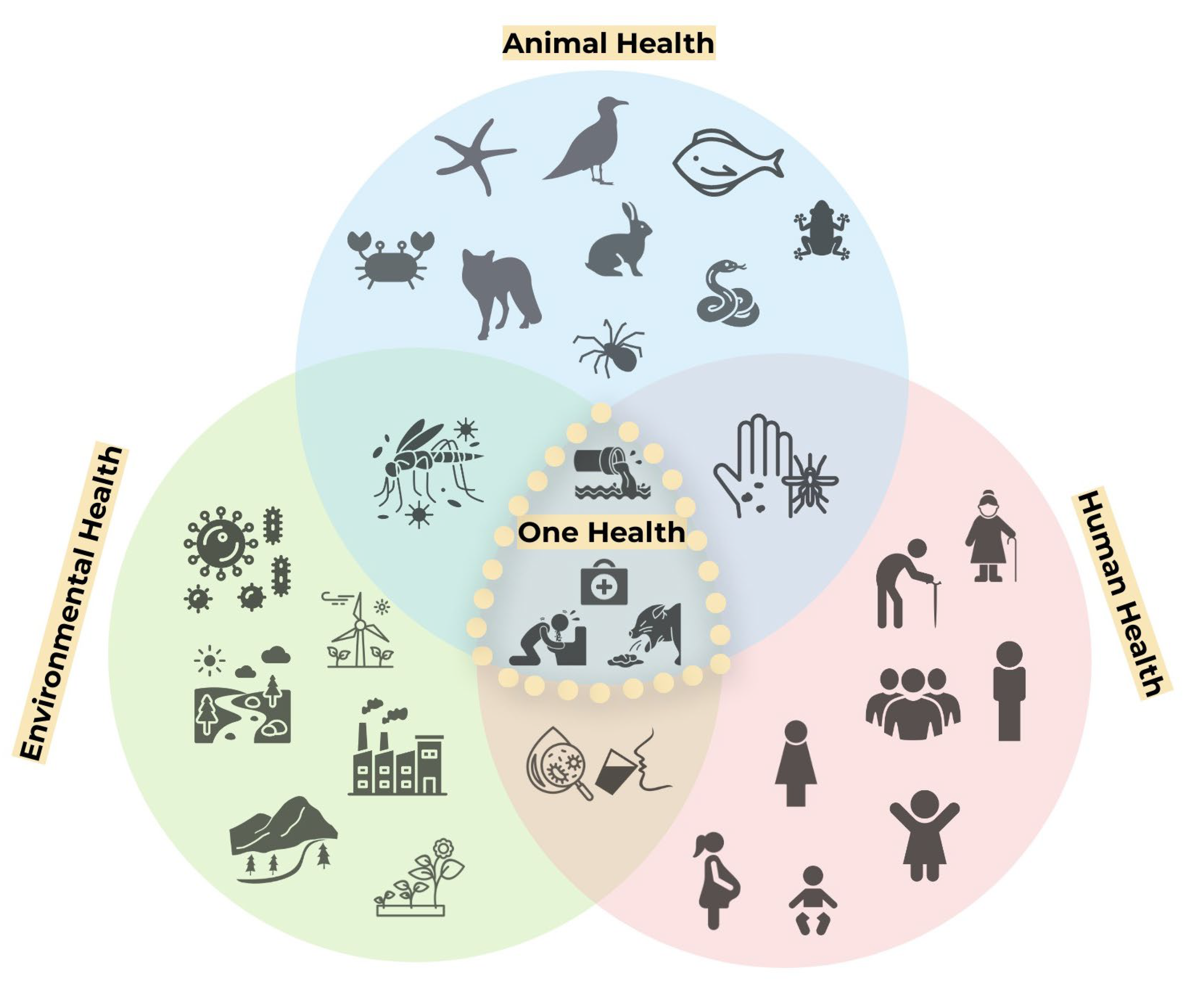
Figure 2.
Comprehensive model of Environmental Education representing some of its dimensions and how the educational dimension is responsible for integrating them.
Figure 2.
Comprehensive model of Environmental Education representing some of its dimensions and how the educational dimension is responsible for integrating them.
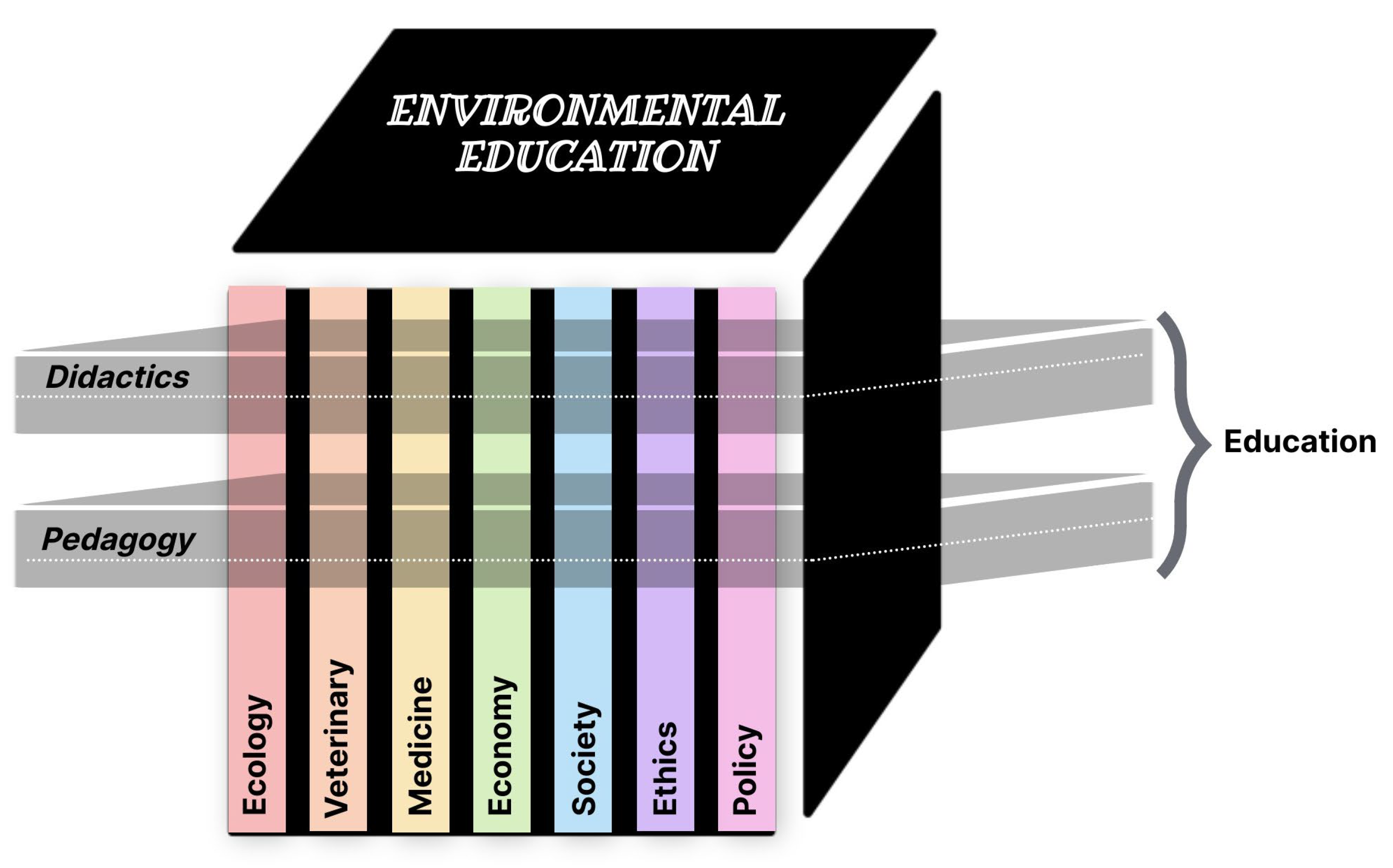
Figure 3.
Incorporation of the One Health approach in two opposing models of Environmental Education (on the left, an unbalanced model; on the right, an emancipatory/transformative model), based on the effectiveness of educational practice (didactics).
Figure 3.
Incorporation of the One Health approach in two opposing models of Environmental Education (on the left, an unbalanced model; on the right, an emancipatory/transformative model), based on the effectiveness of educational practice (didactics).
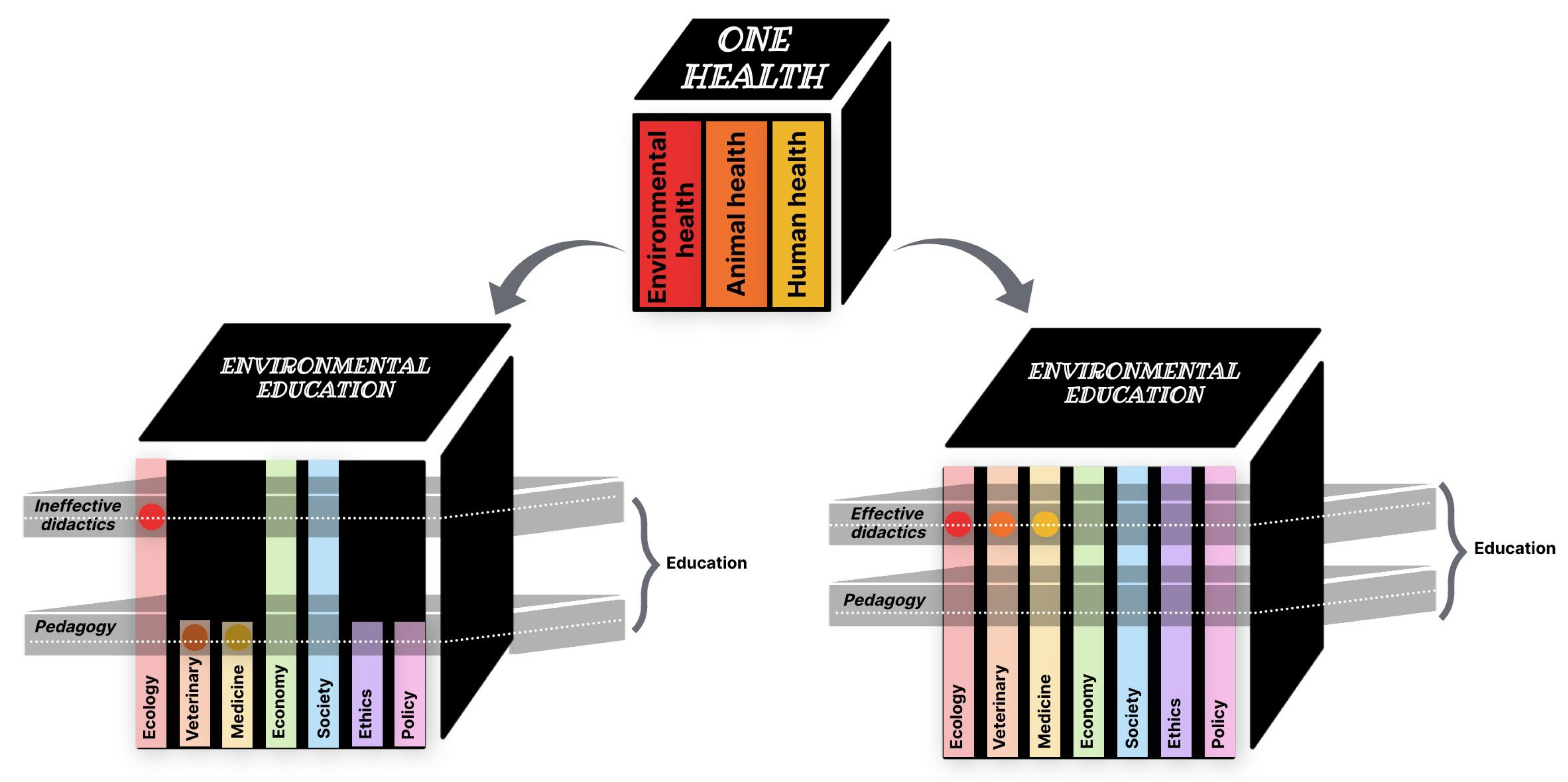
Figure 4.
Limitations of traditional EE teaching.
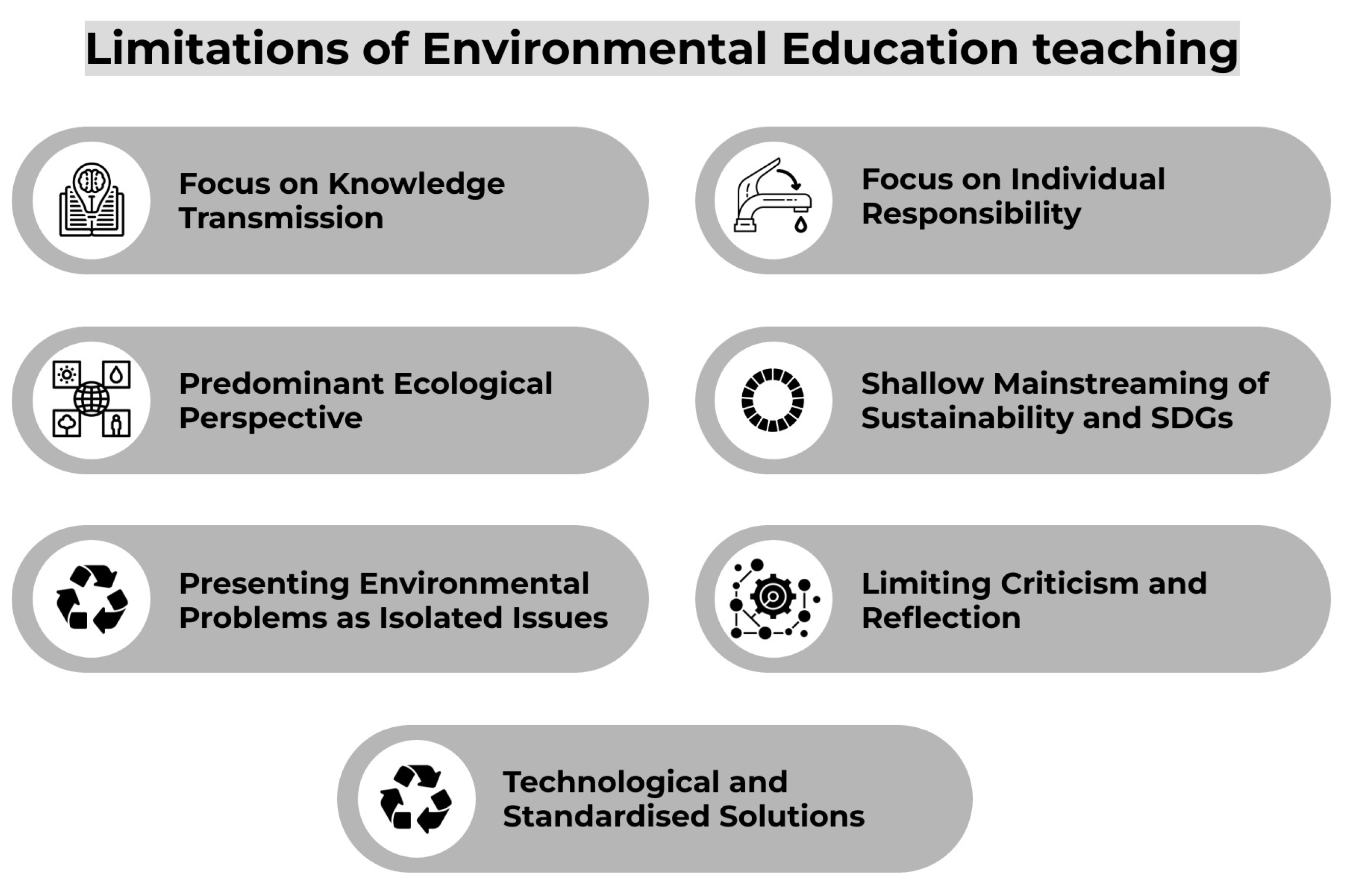
Figure 5.
Image depicting the acquisition of GreenComp and LifeComp competencies by citizens during compulsory schooling, and how these become part of their specialisation in any profession. In the case of educators, the TeachComp competence they develop would influence how they impart GreenComp and LifeComp in the classroom.
Figure 5.
Image depicting the acquisition of GreenComp and LifeComp competencies by citizens during compulsory schooling, and how these become part of their specialisation in any profession. In the case of educators, the TeachComp competence they develop would influence how they impart GreenComp and LifeComp in the classroom.
Disclaimer/Publisher’s Note: The statements, opinions and data contained in all publications are solely those of the individual author(s) and contributor(s) and not of MDPI and/or the editor(s). MDPI and/or the editor(s) disclaim responsibility for any injury to people or property resulting from any ideas, methods, instructions or products referred to in the content. |
© 2024 by the authors. Licensee MDPI, Basel, Switzerland. This article is an open access article distributed under the terms and conditions of the Creative Commons Attribution (CC BY) license (http://creativecommons.org/licenses/by/4.0/).
Copyright: This open access article is published under a Creative Commons CC BY 4.0 license, which permit the free download, distribution, and reuse, provided that the author and preprint are cited in any reuse.


