

Submitted:
15 October 2024
Posted:
15 October 2024
You are already at the latest version
Abstract
The locality condition of probabilities underpinning the derivation of Bell inequalities can be violated classically. The wave function collapse of an entangled state of single photons results in the factorization of quantum probabilities. It is possible to differentiate, locally, between ensemble probabilities of single detections with and without wave function collapse for the alleged quantum nonlocality. The theoretical concept of photonic quantum nonlocality cannot be implemented physically because of the quantum Rayleigh scattering of single photons. A distinction needs to be made between the correlation of individual, single measurements of pure states and the correlation of the measurement ensemble of the mixed states. The correlation operator of Pauli vector operators delivers the same probabilities of correlated detections of photons for both independent and multi-photon states as for ‘entangled’ states of photons. As single-photon sources are not needed, the design and implementation of quantum computing operations and other devices will be significantly streamlined.
Keywords:
Quantum Rayleigh scattering
; correlations of polarization states
; quantum nonlocality
1. Introduction
Recent background briefing articles [1,2] reveal significant difficulties in the implementation of practical quantum computers based on the concepts of entangled states and quantum nonlocality-related correlations of detected single photons [3,4] despite heavy resources having been invested in the last two decades. This is not surprising given the omissions of quantum physical processes and many physical contradictions that have been allowed to persist in the professional literature of leading journals.
Quantum correlations are identified through a product of operators [3,4]. In the case of polarization states, these operators correspond to the Pauli spin vectors for 2 x 2 detections between two orthogonal channels at each location. The benchmark for quantum correlations takes the form of Bell-inequalities [3,4] which should be violated only by quantum probabilities calculated as the expectation values of a product of operators in the context of wavefunctions describing, e.g., polarization-entangled single photons.
The effect of quantum nonlocality is meant to synchronize the detections recorded at the two locations A and B for polarization-entangled states of photons. In the caption to Figure 1 of [5], one reads: “…if both polarizers area aligned along the same direction (a=b), then the results of A and B will be either (+1; +1) or (-1; -1) but never (+1; -1) or (-1; +1.); this is a total correlation as can be determined by measuring the four rates with the fourfold detection circuit.” Yet, the quantum correlation is supposed to take place at the level of each pair of entangled photons rather than between averaged values, or rates, of the two distributions; but such an outcome has never been reported. The maximal, experimentally measured probability of coincident counts reported in the landmark experiments of refs. [6,7] is 2x10--4 (or 0.0002) which was achieved with highly non-entangled states and raising doubts about the existence of Bohr’s nonlocality.
Additionally, the Bell parameter of Eq (4) in [4] would actually vanish as and according to the expectation values [4; p. 422] of , for detection settings and of the polarization states for coincident detections. Thus, , failing to violate the Clauser-Horne-Shimony-Holt (CSHS) inequality despite involving the strongest quantum correlations. This fact should have rung alarm bells about the irrelevance of the Bell-type inequalities as an indicator of strong correlations between the same order elements of two sequences. This shortcoming will be elaborated on in this article.
From an experimental perspective, the correlation probability of simultaneous detections between two binary-valued sequences is evaluated from a third sequential distribution calculated as the temporal vector or dot product of the two initial sequences and leading to where are assigned binary values for no-detection or detection of an event, respectively. For any two ensembles of measurements, the values of the correlation or joint probability will depend on the sequential orders of the two separate ensembles at locations A and B, and can exceed the product of the local probabilities, i.e., of . Therefore, as the quantum formalism does not provide any information about those sequential orders, any artificial boundary such as Bell-inequalities is physically meaningless, because for the same values of the local probabilities, , the higher values of will lead to a violation of the Bell inequality in the classical regime. Bell inequalities can be easily violated with independent photons [8,9,10].
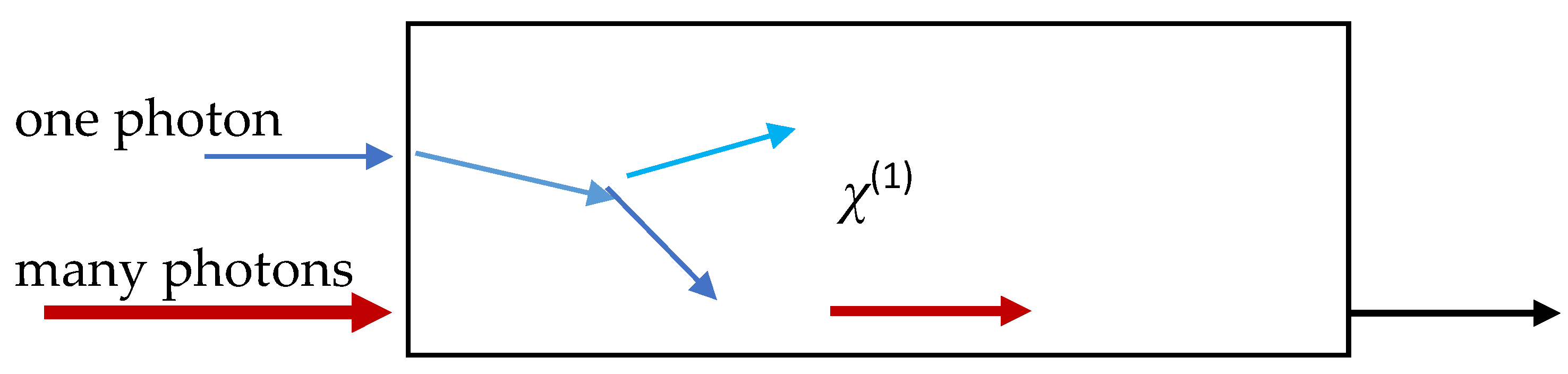
Equally, the experimental results of ref. [11] alleging propagation of single photons through the atmosphere over a distance of more than 100 km are physically impossible because of the quantum Rayleigh scattering [12,13] of single photons which will prevent synchronized detections. A physically meaningful explanation was presented in refs. [14,15] and can be summarized as follows. The spontaneously emitted photons in the nonlinear crystal undergo parametric amplification forming a group of identical photons. This group of photons can overcome the quantum Rayleigh scattering through quantum Rayleigh stimulated emission. This is illustrated in Figure 1 of this article and detailed in refs. [14,15].
Additionally, a sub-section of ref. [4] headlined “More nonlocality with less entanglement” leads one to the anomaly of nonlocality. “Astonishingly, it turns out that in certain cases, and depending on which measure of nonlocality is adopted, less entanglement can lead to more nonlocality.” [4; p. 442]. “Remarkably, it turns out that this threshold efficiency can be lowered by considering partially entangled states. ….This astonishing result was the first demonstration that sometimes less entanglement leads to more nonlocality “ [4; p. 464].
“Since it is expressed in terms of the probabilities for the possible measurement outcomes in an experiment, a Bell inequality is formally a constraint on the expected or average behavior of a local model. In an actual experimental test, however, the Bell expression is estimated only from a finite set of data and one must take into account the possibility of statistical deviations from the average behaviour” [4, p. 466]. For a distinction between probability and frequency of occurrence, the reader is directed to ref. [16]
Experiments designed to close loopholes linked to hidden variables are based on statistical considerations of Bell inequalities. But these inequalities ignore loopholes arising from physical interactions such as the quantum Rayleigh scattering of single photons and the polarization correlations between Stokes vectors. Such physical contradictions and inconsistencies are outlined in Section 2 of this article in relation to local measurements of polarization entangled photons. In Section 3, a distinction is made between the correlation of coincident detections of photons and the correlation between ensembles of measurements, as well as pointing out the flaws of the Bell inequalities. Section 4 scrutinizes landmark experiments [6,7] in view of the analytic results of the previous sections, explaining the failure to develop practical quantum computers and putting forward practical ways of processing data states on the Poincaré sphere. Physical aspects of the possibility to achieve quantum-strong correlations with independent, multi-photon states facilitating qubit rotations will be discussed in Section 5, and final conclusions are listed in Section 6.
2. Physically Meaningful Wavefunctions
A series of contradictions and inconsistencies can be identified in the theory and experiments involving the concept of quantum nonlocality:
1) Quantum Rayleigh scattering [12,13] prevents a straight-line propagation of a single photon, thereby ruling out coincident detections of the original pair of photons;
3) Polarimetric, local measurements of a maximally entangled photon result in a zero-expectation value [10]. For a local measurement of the Pauli operators , in the context of a Bell state , the expectation values vanish, i.e., , ( being the identity operator) delivering no information for a comparison between the two pair ensembles at locations A and B;
4) Experimental results alleging evidence of quantum nonlocality are obtained with low levels of entanglement instead of maximally entangled states [6,7];
5) The quantum nonlocality is meant to operate between the two pair-photons but Bell inequalities deal with the correlation between ensemble averages [3,4];
6) The wavefunction collapse upon the first measurement reduces the entangled state to a product state, with the probability of projective rotation of the polarization state being identical to that of an independent state.
These contradictions and inconsistencies are addressed in this article in the context of the following guidelines:
- Reproducibility of experimental results is a basic principle of scientific methodology. Any apparent correlation between two measurements carried out with identical physical systems and under identical conditions is bound to produce identical distributions of outcomes, whether quantum or classical. Therefore, for any quantum effect of nonlocality between two single and entangled photons to be identified, the symmetry correlation needs to be removed from the picture;
- The concept of wave function collapse involving an entangled state of photons upon a first measurement is analyzed based on the von Neumann’s projection postulate [3; eq. (C28)];
- A second type of wave function collapse in the case of an entangled state composed of two product terms will lead, upon collapse through measurement, to only one product term, which actually eliminates the entanglement before the second measurement; and,
- Each of the two separate detectors has only one setting or channel open for receiving the incoming photon. This configuration will remove the mix-up between two-channel detectors, i.e., 1 x 1 correlation as opposed to 2 x 2 correlations for Pauli operators.
2.1. Factorizing Quantum Probabilities Associated with Entangled States
It is claimed [3; p.583] that “… the probability distribution defined by an entangled state does not satisfy the principle of statistical separability, even when the parts are far apart in space.” This statement is contradicted by the formalism of the wave function collapse, or reduction, upon a first measurement at location A, which is followed by a second one at location B, as analysed in [17] and expanded in this subsection.
If the optical source emits a time-dependent stream of polarized pair-photons, only one term of the entangled state, e.g., either or will be present at any given time for an individual measurement but not both. This physical reality is disregarded by the mixed quantum state, but is reintroduced through the wave function collapse, breaking up the “entanglement” between the two photons and bringing a time-dependence into the process of individual measurements analogous to the time-resolved detection of single photons [17].
A different approach would be to evaluate the probability of detection at location B in two possible circumstances:
1. No detection takes place at location A, so that the projective measurement at location B involves the operator acting on the initial state
and resulting in the probability of detection
after setting and . An identical result is obtained for the first detection at location A, i.e., .
2. A first detection takes place at location A involving the projective operator , which results in the intermediary state for the projective amplitudes and , so that the reduced or collapsed wave function becomes:
where denotes the normalised wave function for the calculation of the detection probability at location B, conditional on a detection at location A. The normalization factor for the collapsed wave function corresponds to the probability of detection for the first measurement, and after substituting for from Eq (4) we have:
Based on the normalized state , the probability of detection at location B following a detection at location A becomes in this case, for a projective measurement:
This result which can be found in [3; Sec.19.5] implies that for, regardless of the values of , the local probability of detection could peak at unity. This theoretical outcome is easily testable experimentally for direct evidence of a quantum nonlocal effect influencing the second measurement after the wave function collapse. But this has never been done either because of the quantum Rayleigh scattering of a single-photon and/or the non-existence of such a nonlocal effect. The product of the local probabilities of Eqs. (2) and (6) equals the expression of the joint probability for simultaneous detections at both locations A and B, that is:
after inserting from Eqs. (4) and (5) in the equality (7a). The equality (7b) provides a direct calculation of the joint probability, confirming the validity of the derivation. With the conditional probability of local detection being, mathematically, lower than, or at best, equal to the local probability of detection in the absence of a first detection, i.e., , the formalism of wave function collapse gives rise to a factorization of local probabilities and imposes an upper bound on the quantum joint probability, in clear contradiction to the conventional assumption [3; p.538,4]. This formalism delivers average values of the ensembles rather than correlation between the sequential orders of the detections, as explained in the Introduction section and Appendix A. The possibility of factorizing the quantum probability for joint events as in (7a) is identical to the classical case of joint probabilities with the second local probability being conditioned on a first detection. This strong similarity between the classical and quantum joint probabilities renders the local condition of separability [3,4] irrelevant for the derivation of Bell inequalities.
However, as local measurements at location B result in a difference between =1/2 and , experimental proof, or otherwise, of any quantum nonlocal effects can be verified by carrying out two ensembles of measurements, one with a prior detection at location A and the second one without such a detection. Additionally, by switching on and off the measurement at location A, a signal would be detected at location B between zero and non-zero probabilities, by simply coordinating the two filters’ angles to be equal for the zero probability of joint detections.
The use of a global quantum state which is time- and space-independent for the description of a time-dependent source output has led in many cases to physically impossible conclusions which were, nonetheless, taken as the “miracles” of quantum optics and quantum mechanics. In other words, even though information about the quantum system can be obtained from each individual measurement, the predictions of expected values of dynamic variables are based on global quantum states which discard a great deal of information.
The analogous correlation function for independent photons evaluated through projective measurements is presented in Appendix B, to reveal the possibility of complete unity correlation between two one-setting detectors unlike Eqs. (7) which limit the correlation to a 0.5 value.
2.2. System-Descriptive Wavefunctions for Time-Varying Inputs
Our quest for a physically meaningful wave function is based on the first paragraph of the review [18] which reads:
“A quantum state is what one knows about a physical system. The known information is codified in a state vector , or in a density operator , in a way that enables the observer to make the best possible statistical predictions about any future interactions (including measurements involving the system). [18], p. 299.
The maximally entangled state of is time-independent corresponding to a mixed quantum state composed of two pure product states. For only one pair of photons being generated at any given time [6,7,11] the time-dependent wavefunction will result in two data sets being measured at different times, one for each product term, with or, and the basis states being aligned with the x and y axes of the joint frame of coordinates in the measurement space.
The following paragraph is highly indicative of the shortcomings associated with an approach or formalism that deliberately overlooks physical elements and aspects of experimental setups. This paragraph reads [18]:
“In order to prepare a heralded photon, a parametric down-conversion (PDC) setup is pumped relatively weakly so it generates, on average, much less than a single photon pair per laser pulse (or the inverse PDC bandwidth). The two generated photons are separated into two emission channels according to their propagation direction, wavelength, and/or polarization. Detection of a photon in one of the emission channels (labelled trigger or idler) causes the state of the photon pair to collapse, projecting the quantum state in the remaining (signal) channel into a single-photon state.” [18], p. 311.
Experiments of correlated polarization states in the quantum regime would have one photon per radiation mode propagate in a straight-line in a dielectric medium in order to synchronize their detections. Yet, the quantum Rayleigh scattering [12,13] would prevent such a straight-line propagation, thereby making a synchronized detection impossible.
As derived and explained in [14,15], the parametric amplification is unavoidable and is accompanied by a phase-pulling effect which leads to the optimal condition for amplification. The alleged collapse of the state of the pair of photons, upon detection of one of them, into a single-photon state of the photon assumes that a single photon per radiation mode can propagate across a dielectric medium in a straight-line to the target photodetector. As explained previously [12,13], this assumption is ruled out by the existence of the quantum Rayleigh scattering in dielectric media such as optical fibres and beam splitters. But the parametrically amplified group of photons will propagate in a straight-line by recapturing an absorbed photon through the quantum Rayleigh stimulated emission [14,15]. Additionally, the formation in a beam splitter of groups of identical photons through quantum Rayleigh stimulated emission is presented in [14,15].
2.3. The Quantum Case of Time-Dependent Correlation Functions
The conventional interpretation of coincident detections of a pair of polarization-entangled photons would have one photon each reach photodetectors A and B, spatially separated. But the two possible polarization states of each photon are mutually exclusive in time so that two data sets are probed separately at the level of each individual quantum event, with the statistical distribution of the mixed state describing the overall two ensembles of events. Thus, a physically meaningful wavefunction describing the two data sets will have a time dependence of only one pair of photons being present at any given time, e.g.,:
where or, and are aligned with the x and y axes of the joint frame of coordinates in the measurement space. The ensemble averages of the coefficients are: resulting, mathematically, in a maximally entangled state for an ensemble of measurements.
The common approach [3, Sec.19.5] would have the input photon absorbed through the annihilation operator , followed by a rotation of the creation operator and the appearance of the photon along the polarization filter’s orientation .
For one photon projected onto the filter state at location A, the detection probability of one photon at orientation angle , following the collapse of the wave function upon the first sequential measurement, introduces a time dependence of the two mutually exclusive terms. For the sum of the two terms, the probability of photodetection at location A is:
And, similarly, for the location B:
This time-dependence reproduces the time variation at the source output. Consequently, the entangled state plays no role in the detection processes of the two time-separated ensembles of measurements.
For two simultaneous detections, one each at A and B, the probability of coincident detections takes the form:
The time-separation at the source is given by or. This time-dependence is reproduced through the wavefunction collapse upon the first measurement. The first measurement returns a random detection, while the second measurement does not involve the original entangled state.
Two data sets of measurements are recorded, one for each term of two photons in Eq (8), leading to the separate probabilities ( j =1 or 2). And the sum of probabilities obtained for the sum of the two data sets of pairs of photons becomes by combining Eqs. (9-11):
after setting for the statistical average of . As an example, we set to obtain that for any value of , including , in contrast to Eq (7b).
The two ensembles of detections do not overlap temporally, and their correlation is determined by the sequential orders of the ‘1’s and ‘0’s and can vary from one ensemble to another. The physical absence of the interference term is brought about by the two temporally non-overlapping detections [17, Eq (9)]. The two data sets occur at different times and any correlation can only be mathematical.
The correlation probability calculated for the entangled state is:
which appears to indicate a physical correlation of measured ensembles; however, all states need to be populated simultaneously, which experimentally happens, as a result of the parametric amplification of the spontaneously emitted photons [14,15]. The number of photons simultaneously present in the system is much larger than two.
The correlation between quantum mixed states of polarizations can also be obtained between classical states of polarization in the Jones representation. The correlation function is the overlap between two state vectors and leading to . This result is equivalent to the correlation of polarization states on the the Poincaré sphere [10].
3. Classical Joint Probabilities Exceeding the Product of Local Probabilities
As explained in the Introduction, a joint probability of coincident detections that is larger than the product of the two local probabilities, i.e., can be easily obtained with classical distributions of binary values of ‘1’ and ‘0’.
The derivation of Bell inequalities is based on the locality assumption [3,4], that is: “The joint probability distribution of obtaining outcomes a and b for measurements x and y, should factorize” [4] into:
where for local statistics, the probabilities for outcomes a and b are , respectively. The variable is meant to provide a correlation between the two measurements as a result of some past event involving the two separated systems of photons. The equality of Eq (14) limits, arbitrarily or intentionally, the contribution of the ‘hidden variables’ in order to justify the argument that any larger value of is due to the quantum effect of nonlocality.
Mathematically, the derivation of Bell inequalities would have ‘hidden’ variables impact the statistical averages of simultaneous measurements. It is stated in [4; p.588] that: “In typical experiments, the complete specification of the state represented by λ is not available— for example, the values of the hidden variables cannot be determined—so the strong separability condition must be averaged over a distribution ρ(λ) that represents the experimental information that is available.” Additionally, “…the condition for statistical independence” [4; p. 588] is:
“For the typical situation in which the complete state λ is not known, the Bell parameter S (λ) should be replaced by the experimentally relevant quantity “ [4, p. 589] which leads to the Clauser-Horne-Shimony-Holt inequality. However, as pointed out in the Introduction, the CHSH inequality does not capture the presence of maximally entangled states, for which purpose it was derived, subject to the limitation of Eq (14). Further shortcomings of Bell inequalities can be found in Appendix A.
The Clauser- Horne inequality used in [6,7] involves only joint probabilities of outcomes, and is written for further consideration as:
But, with only two photons present at any given time, this inequality requires four different ensembles of measurements for the four pairs of settings which are probed at separate times. By contrast, the quantum nonlocality is supposed to act at the level of each pair of photons [5]. In Eq (16), e.g., stands for a detection at location A for setting and no detection at location B for setting. However, the inequality (16) cannot be violated even with optimal conditions because of the opposite requirements for the difference and sum of probabilities as explained in the next paragraph.
With identical devices and settings, the quantum effect of nonlocality should maximize the joint probabilities on the left-hand side of Eq (16) and minimize the probabilities on its right-hand side. For example, with the probabilities are set equal and , leading to maximal values of and . On the right-hand side of Eq (16), minimal probability values for the detections of ‘1’s coinciding with ‘0’s are calculated by subtracting from the larger probability for ‘1’s the lower probability for ‘1’s, i.e., . Equally, . Inserting these values into Eq (16), we have 0.8 0.2 < 2 (0.8 0.2) = 1.2, which does not violate the CH inequality. Once again, as explained in the Introduction, the condition for the joint probability being the product of local probabilities as the criterion above which quantum effects are meant to occur is physically unsubstantiated, particularly so, in view of the product of local probabilities derived in Eqs. (7) and the experimental results of [8,9].
Experimentally, however, very low probabilities of detections are recorded because of the quantum Rayleigh scattering of single photons. The experimental violation of Eq (16) in [6,7] is possible because of the parametric amplification of the spontaneous emission in the original nonlinear crystal, so that the presence of multiple photons per radiation modes enhances the probability of coupling and detecting ‘1’s, which will be considered in the following sub-sections 3.1-3.3.
Overall, the hidden variables of the Bell inequalities play no role in the derivation of the inequalities. Physically, ‘hidden’ variables should be included in the wave functions associated with physical processes and linked to the mechanisms, processes, effects, etc. that bring about those detected outcomes. In this context, time-varying inputs, averaged over fluctuating local conditions, lead to the existence of multi-photon wave fronts which are mistaken for single photons.
3.1. Physical Factors Reducing the Correlations of Coincident Detections
For classical probabilities any hidden variable will be set aside, and the following ratio of classical probabilities can be obtained from Eq (14) with
This ratio can be larger than unity, indicating a stronger correlation between measurements than the locality condition of Eq (14) which was arbitrarily defined. This will happen for two series of individual binary outputs of ‘1’ and ‘0’, with all the detections ‘1’ of b coinciding with detections ‘1’ of a. For the same ensemble averages, the correlation value of the one-to-one same order component, may vary from zero to the minimum of the two probabilities.
By contrast, for an input of multi-photon states, loss effects may not annihilate all the input photons, so that the number of detections increases regardless of the projective probability which provides a mathematical average. For a single-photon input, the density distribution per solid angle of the mixed quantum state arising from spontaneous emission that follows the radiation pattern of an oscillating dipole is [19,20]:
where the solid angle of emission is , the polar angle between the electric dipole vector and the polarization vector of the emitted photon is, and is the azimuthal angle in the plane perpendicular to the dipole [19,20]. It is this distribution of the Rayleigh spontaneously emitted photons over the range {}, that randomly rotates the polarization state of the absorbed photons.
Physically, however, one single photon is scattered randomly by quantum Rayleigh photon-dipole interactions. By contrast, a group of identical photons can propagate in a straight line inside a dielectric medium through quantum Rayleigh stimulated emission. This process of stimulated emission can also amplify a spontaneously emitted photon with a rotated polarization, particularly so if the polarization modulator and analyser enable the propagation of a lossless mode [14,15].
3.2. Correlations of Coincident Detections of Independent Photons
A series or an ensemble of detection measurements is mathematically cast into a temporal vectoralong polarization output angle , and for a polarization input setting . The elements of the data vector are for a detection event or no detection, respectively, of the m-th order element. Thus, has the following averaged number of ‘1’ terms summed over the probing times for one photon of polarization H or V in the measurement frame of coordinates:
where specifies the quantum efficiency of cross-polarization coupling, , namely, the total number of events is split equally between the two input H or V polarizations, is the polarization angle of the analysing filter at location A, is a rotation setting of the electro-optic modulator, the probing times are and is the probability of detecting a pulse, for input H or V and polarization filter rotated by . For input polarization V, orthogonal to H, the rotation angle is: and the probability of detection along is . The average number of ‘0’s is found from the expression: .
The correlation vector of simultaneous detections between two arbitrary and random series and or ensembles, at locations A and B, respectively, is expressed as the product of the two m-th order terms, of simultaneous or coincident detections leading to
an average of ’1’s or joint probability of simultaneous detections:
By considering all possible combinations in Eq. (20), it is obvious that the order of the random distributions of the two sequences will determine the value of the joint probability of correlation whose maximal value equals the lowest of the two local probabilities . The values of may exceed the definition of the local condition for independent probabilities, i.e., ) where and .
A distinction needs to be made between the probability of coincident events at the level of each individual event, and the product of probabilities of ‘1’s in each ensemble of measurements which is, in fact, the product of the averaged values of detections in the polarization states.
From a physical perspective, identical systems operated in identical ways will yield identical distributions of outcomes, which is critical in the reproduction of experimental results. Given the low quantum efficiencies of ‘single-photon’ detections, the performance of correlated outputs can be significantly increased by launching, into the two systems, groups of identical photons as generated by the parametric amplification in the original crystal [10,14,15], or externally controlled number of photons [8,9]. In such circumstances, the likelihood of a few photons reaching the output photodetectors simultaneously will be even larger than the probability of Eq. (20).
3.3. Polarization-Controlled Correlated Output of Multi-Photon States
With multiple photons propagating in both input orthogonal states of polarization H and V, one can control the output intensity through interference of the intrinsic fields of groups of identical photons coupled onto the filter’s polarization state of rotation angle . Following the results of [14,15] that identified dynamic and coherent number states , and recalling the non-Hermicity of the field operators [15], we find that , which provides a complex field amplitude [15], for the time-dependent evolutions of photonic beam fronts. The output intensity, for fluctuating numbers of photons and the expectation number of the interference between pure states, take the forms:
where is the visibility with ) , and is the temporal overlap between the intrinsic optical fields of the photons whose derivation is available in [15]. The time-varying phases of the two polarization states are , and the time-average is indicated by the angled brackets.
By varying parameters in Eq (22), the lowest number of photons can become larger than zero, which increases the probability of detection. Overall, the more photons are trapped in the system through quantum Rayleigh spontaneous emission [14,15], the more likely it is for groups of identical photons to form through quantum Rayleigh stimulated emission. As a result, single photons coalesce into groups of multi-photon states, thereby changing the statistical outcomes.
4. A Scrutiny of Landmark Experiments
The concept of quantum nonlocality emerged from the mathematical formalism of quantum mechanics, but its practical implementation in quantum optics needs to comply with the well-established processes involving light-matter interactions. Yet, in order to push through the concept of photonic quantum nonlocality, various researchers chose to ignore the basics of optical physics, and, instead invoked statistical calculations which are contradicted by the physical reality, as demonstrated in the Introduction and Section 2 of this article.
Significant physical contradictions have been overlooked in the opinion article by Aspect [5] hailing the results of refs. [6] and [7] as “definitive proof” of one measurement influencing remotely another measurement, bringing about the end of the Einstein-Bohr debate. However, in this Section a scrutiny of these landmark experiments [6,7] disproves the existence of photonic quantum nonlocality as its theory is riddled with physical contradictions and inconsistencies as outlined in Section 2 of this article.
Experimental evidence of strong-quantum correlations obtained with non-entangled photons [8] were published in early 2020 but were overlooked because they did not fit the prevailing interpretation [5]. Equally, a growing body of analytic developments before and after 2015 have repeatedly demonstrated the statistical nature [21,22,23,24,25,26] of quantum nonlocality experiments. Recently, the quantum Rayleigh scattering of single photons [12] has been identified as a physical mechanism undermining the implementation of the concept of quantum nonlocality.
The concept of quantum nonlocality was summarized by Aspect in the first paragraph of ref. [5] as “the idea that a measurement on one particle in an entangled pair could affect the state of the other—distant—particle.” The alleged physical effect was illustrated for the entangled state
of two polarized photons shown in the inset to Figure 1 of [5] for which “quantum mechanics predicts that the polarization measurements performed at the two distant stations will be strongly correlated“. Another quotation of interest is: “In what are now known as Bell’s inequalities, he showed that, for any local realist formalism, there exist limits on the predicted correlations.” However, independent photons or multi-photon states also deliver quantum-strong correlation functions because the Pauli spin operators act on the polarization state regardless of the number of photons it carries. In this context, the overlap, in the measurement Hilbert space, between two polarization Stokes vectors measured separately at two distant locations generate the same correlation functions [8,9,10], thereby explaining the comparison of the experimental outcomes without invoking ‘quantum nonlocality’.
4.1. The Quantum Rayleigh Scattering of Single Photons
Although well-documented, e.g., [19,20] four decades ago, the physical process of quantum Rayleigh scattering has been consistently ignored in the conventional theory of quantum optics [3]. A single photon cannot propagate in a straight-line inside a dielectric medium because of the quantum Rayleigh scattering associated with photon-dipole interactions. Groups of photons are created through parametric amplification in the nonlinear crystal in which spontaneous emissions first occur, generating pair photons from a pump photon. Such a group of photons will maintain a straight line of propagation by recapturing an absorbed photon through stimulated Rayleigh emission [14,15]. The assumption that spontaneously emitted, parametrically down-converted individual photons cannot be amplified in the originating crystal because of a low level of pump power would, in fact, prevent any sustained emission in the direction of the phase-matching condition because of the Rayleigh spontaneous scattering [14,15]. As pointed out in Eq (18), the spatial distribution of the spontaneously emitted photons spans a broad solid angle, not only the direction of the phase-matching condition.
Evidence of single-photon scattering can be found in ref. [7], in the Supplemental Material reporting that “In our experiment no photons are detected during a large number of trials, and these trials contribute little to the Bell violation.” Equally, the experiments of [7] “… employed single-photon optical time domain reflectometry (OTDR) to measure the transit time of light through all the optical fibers and some of the free-space optical paths in the experimental setup.”
The probability of detecting a photon and its quantum effect is reported in Table S-II on page 16 [7], to be less than 0.001%. This extremely low level of maximal detection probability is also reported in Figure 3 of ref. [6]. It should be obvious that such extremely low probabilities cannot describe the presence of a physical phenomenon. Rather, these probabilities would indicate random statistical measurements which are consistent with the statistical explanation for measurements of correlated outputs [21,22,23,24,25,26].
Physically, quantum entanglement of photonic states implies a strong correlation between the same properties of the same variable or degree of freedom measured separately on each of the two entangled photons. These properties are the consequence of a common past interaction between these photons and those properties generated in the common interaction can be carried away from the position and time of that interaction.
Even recent experiments [27] using optically nonlinear crystals for parametric down-conversion of photons, report detection probabilities lower than 0.1%, pointing out that “The raw data are sifted” for a particular purpose. All these bring to the fore the unavoidable amplification of spontaneously emitted photons [14,15]. An indication of the existence of the quantum Rayleigh scattering can be seen from the extensive loss of photons that has been a constant feature of photon coincidence counting. For example, ref. [27] reports on page 3 of the Supplementary Information: “The success probability of the entanglement generation process, i.e., detection of a photon after an excitation pulse, equals 5.98 ×10⁻³ and 1.44 × 10⁻³ for Alice’s device and Bob’s device, respectively”. A typical percentage of lost photons is, at least, 99.9% as mentioned independently.
These very low values of successful detections are indicative of the photon-dipole interactions of absorption and re-emission given the Avogadro number of 6.022 × 10²³ of atoms per mole.
4.2. The Absence of Quantum Nonlocality Upon Sequential Measurements
The joint probability of detecting simultaneous photons depends on the random orders in the locally detected sequences, as explained in Section 3. Classical distributions of joint probabilities can easily exceed the value of their products as explained in the Introduction and Appendix A. A formalism based on wave function collapse – requiring a first detection followed by a second one – leads to the possibility of detecting locally the assumed existence of the quantum nonlocality effect, as described by Eqs. (7).
Quantum nonlocality is claimed to influence the measurement of the polarization state of one photon at location B, which is paired with another photon measured at location A. The two photons are said to be components of the same entangled state. Maximally entangled states, such as of Eq. (23), represented in the same frame of coordinates of horizontal (x) and vertical (y) polarizations, would deliver the strongest correlation values between separate measurements of polarization states recorded at the two locations A and B.
Nevertheless, the experimental results of refs. [6] and [7] revealed a low level of entanglement, with the reported mixed states having one component much larger than the other, thereby allowing for measurements of non-entangled product states. From equations (2) of both references [6,7], their experimental optimal ratios of the two amplitudes are 2.9 and 0.961/0.276, respectively, in [6] and [7].
If a collapse of the wave function is to take place for entangled photons upon detection of a photon at either location, then the two separate measurements do not coincide. In this case, a polarimetric local measurement vanishes for the maximally entangled Bell states, e.g., , with being the identity operator, and the projecting Pauli operators are in this case and Thus, a physical contradiction arises as local experimental outcomes determine the mixed quantum state of polarization of the ensemble to be compared with its pair quantum state. As a matter of physical measurement, for the partially entangled state of , with, the local measurement will deliver indicating that the largest expectation value, i.e., will be achieved with pure states, for either , or . Upon comparison of the two separately measured data sets, the strongest correlation will be detected for pure product states which are, in fact, obtained theoretically by invoking wavefunction collapse upon measurement.
This overlooked feature of maximally entangled Bell states renders them incompatible with the polarimetric measurements carried out to determine the state of polarization of photons, thereby explaining the experimental results of ref. [8,9] which were obtained with independent photons, indicating the possibility of obtaining quantum-strong correlations without independent photons as pointed out in ref. [10]. The wave function collapse would bring about a product state as part of a time-dependent partial ensemble of measurements.
The mixed quantum state is space- and time-independent and considered to be a global state which can be used in any context, anywhere, and at any time. Nevertheless, the Hilbert spaces of the two photons move away from each other and do not overlap spatially, so that any composite Hilbert space is mathematically generated by means of a tensor product at a third location where the comparison of data is performed. Even so, the absence of a Hamiltonian of interaction renders any suggestion of a mutual influence, during the probing, physically impossible [21].
4.3. Correlation Functions
Maximally entangled states, represented in the same frame of coordinates of horizontal and vertical polarizations, would deliver the strongest values of the correlation function for the Pauli spin vectors operators:
for identical inputs to the two separate apparatuses, with the polarization filters rotated by an angle , respectively, from the horizontal axis. However, quantum-strong correlations with independent photons have been demonstrated experimentally [8,9] but ignored by legacy journals because they did not fit in with the theory of quantum nonlocality. The same correlation function is obtained ‘classically’, as a result of the overlap of two polarization Stokes vectors of the polarization filters on the Poincaré sphere [10]. The Stokes parameters correspond to the expectation values of the Pauli spin operators [10].
The correlation function is a numerical calculation as opposed to a physical interaction. Thus, the numerical comparison of the data sets is carried out at a third location C where the reference system of coordinates is located for comparison or correlation calculations of the two sets of measured data, and does not require physical overlap of the observables whose operators are aligned with the system of coordinates of the measurement Hilbert space onto which the detected state vectors are mapped. In this case, the correlation operator can be reduced to [28]; [Eq. (A6)]:
where the polarization vectors and identify the orientation of the detecting polarization filters in the Stokes representation, and is the Pauli spin vector (with). The presence of the identity operator in Eq. (25) implies that, when the last term vanishes for a linear polarization state, the correlation function is determined by the orientations of the polarization filters. This can be easily done with independent and linearly polarized states, such as:
where the index j= A or B identifies the photodetector. The same state reaches both detectors.
The polarization operator projects the incoming states onto the measurement Hilbert space for comparison of the two separate data sets. The polarization measurement operators of produce the output states
which, analogously to the overlapping inner product of two state vectors, lead to the correlation function of [10]:
The quantum correlation function of Eq. (28) between two independent states of polarized photons is equivalent to the overlap of their Stokes vectors on the joint Poincaré sphere of the measurement Hilbert space. Quantum-strong correlation are possible with independent states of photons [8,9,10] because the source of the correlation is the polarization states of the detecting filters or analyzers, making any claim of quantum nonlocality unnecessary.
5. Physical Aspects and Discussion of Physical Processes
At least three critical elements have been ignored in the interpretations of experimental results alleging proof of quantum nonlocality: 1) the quantum Rayleigh scattering involving photon-dipole interactions in a dielectric medium, which prevents a single photon from propagating in a straight-line, thereby obstructing the synchronized detections of initially paired-photons; 2) the unavoidable parametric amplification of the spontaneously emitted photons in the nonlinear crystal of the original source; and 3) the experimental evidence of quantum-strong correlations between polarization states or statistical ensembles of multi-photon, independent states.
The existence of the quantum Rayleigh (QR) scattering was well documented back in the 1970s in textbooks [19,20] and its absence from the theory of Quantum Optics developed since the early 1980s is still a puzzling question. A possible answer would be that the “miracles” of quantum optics would have needed explaining by other physical means, requiring a multi-disciplinary approach.
The concept of quantum nonlocality claims the existence of a strong correlation between measurements involving two entangled photons generated as a pair. The Bell inequalities impose a limit on the calculated correlation probabilities between ensembles of measurements involving an unlimited number of pairs of photons. But Bell inequalities can be experimentally violated with expectation values from independent and multi-photon states [8,9], because the correlations can also be generated classically [10]
Equally, as explained in the Introduction and Appendix A, joint classical probabilities can exceed the value of their product. There is no physical evidence of quantum non-locality for the simple reason that the Bell inequalities involve ensemble averages, whereas the quantum non-locality effect would act at the level of each qubit of photons or individual pairs of spatially separated, apparently entangled particles. As explained in Section 2, upon the first detection of an entangled pair of photons, the joint probability become factorized as the product of the two local probabilities, bringing about the possibility of local detection of an apparent quantum nonlocality. But such an experiment is yet to be carried out despite its simplicity.
The theoretical concept of photonic quantum nonlocality cannot be implemented physically because of the quantum Rayleigh scattering of single photons. A physical scrutiny of landmark experiments [6,7] has been undertaken. These articles reported that measured outcomes were fitted with quantum states possessing a dominant component of non-entangled photons, thereby contradicting their own claim of quantum nonlocality. With probabilities of photon detections lower than 0.01 %, the alleged quantum nonlocality cannot be classified as a resource for developing quantum computing devices, despite recent publicity. Experimental evidence of a feasible process for quantum-strong correlations has been identified [8,9] in terms of correlations between independent and multi-photon states evaluated as Stokes vectors on the Poincaré sphere. As single-photon sources are not needed, the design and implementation of quantum computing operations and other devices will be significantly streamlined.
It is a common practice among the proponents of quantum nonlocality to ignore any physically meaningful interpretation of the relevant experiments. For example, a special issue on Quantum Nonlocality [29] does not mention at all any articles which disprove the concept of quantum nonlocality. Instead, rather contradictory statements were presented: “The quantum nonlocality also has an operational meaning for us, local observers, who can live only in a single world. Given entangled particles placed at a distance, a measurement on one of the particles instantaneously changes the quantum state of the other, from a density matrix to a pure state“. “What seems to be an unavoidable aspect of nonlocality of the quantum theory—which is present even in the framework of all worlds together—is entanglement. Measurement on one system does not change the state of the other system in the physical universe, but in each world created by the measurement, the state of the remote system is different. The entanglement, that is, the nonlocal connection between the outcomes of measurements shown to be unremovable using local hidden variables, is the ultimate nonlocality of quantum systems” [29]. Yet, all these statements have been proven to be unsubstantiated in the various Sections of this article, and in references [21,22,23,24,25,26], as well as experimentally [8,9].
Equally, the popular promotion [30] of research articles makes rather exaggerated claims such as: “The phenomenon of quantum nonlocality defies our everyday intuition. It shows the strong correlations between several quantum particles some of which change their state instantaneously when the others are measured, regardless of the distance between them.” Such interpretations can be easily disproved [21,22,23,24,25,26].
6. Conclusions
This article identifies several physical omissions and contradictions which have been overlooked in the literature of photonic quantum nonlocality and which disprove the aspects or elements of quantum nonlocality. The propagation of single photons in a straight-line inside a dielectric medium is impossible because of the quantum Rayleigh scattering.
The wave function collapse for entangled photons leads to a factorization of the quantum probability of joint detections for 1x1 correlation, which has been previously ignored. This will enable a local determination of the entangled state and the alleged quantum nonlocality, if its existence is to be proved or disproved.
Equally, the function reduction upon a first measurement, as required for a quantum ‘nonlocal’ interaction, leads to a vanishing expectation value for the Pauli operators in the context of a Bell-state, i.e., maximally entangled photons. The strong correlation functions can also be obtained with independent states of photons obviating the need for entangled photons. Overall, the locality condition underpinning Bell-type inequalities is easily violated with non-entangled and classical states of polarization [8,9,10].
The full analogy between the Pauli operators and the Stokes polarization measurements should enable the use of multi-photon states for the implementation of output correlations because any rotations on the Poincaré sphere involve only the state itself rather than the number of photons it carries.
Finally, a distinction needs to be drawn between the mathematical formalism of quantum mechanics which allows for any assumption to be made, and its implementation subject to the physical processes of optical physics in which the field of quantum optics is grounded. The latter will limit the range of conclusions that can be inferred from the former.
Overall, the editorial guidelines of legacy journals, e.g., Physical Review Letters, of rejecting outright and without any consideration, well-substantiated rebuttals of quantum non-locality, led to the citation of the 2022 Nobel Prize Committee being incomplete and misleading, and its reconsideration will be appropriate, in view of the well-documented shortcomings of the Bell inequalities as far back as 1980, e.g., [31].
Appendix A – The Physical Irrelevance of Bell Inequalities
As pointed out in ref. [4], in typical experiments of correlated outputs, the results of the joint probability of simultaneous or synchronized detections of two sequential ensembles of binary values, do not equal the product of the two separate probabilities of detection at locations A and B for outcome and corresponding to local settings and , respectively:
where are assigned binary values for no-detection or detection of an event, respectively.
In an attempt to explain experimental outcomes obtained with quantum events, it was suggested to convert Eq. (A1) into an equality of local factors [4]:
by introducing a “hidden” variable whose role would be to create a correlation between the two binary-valued sequences with randomly distributed terms of ‘0’s and ‘1’s, for probabilities of detection . However, from a physical perspective, the correlation of simultaneous detections is evaluated from a third sequential distribution calculated as the vector or dot product of the two initial sequences and :
with the values of the correlation or joint probability ranging above and below the product . For the arbitrary upper limit of Eq (A2) renders any further derivation physically irrelevant as it is intentionally limited in value. However, Clauser and Horne instead of correcting this mistake, adopted it and derived two Bell-type inequalities [4,6,7,11] in the form of functions of probabilities , with being the normalized distribution of hidden variables. Those inequalities can be easily violated with classical probabilities of Eq (A3) which can be larger than the product of the separate probabilities [8,9]. Later on, neither Aspect, nor Zeilinger noticed the statistical problem of Eq (A2), with the landmark experiments of [6] and [7] employing strongly non-entangled photons to violate the Clauser-Horne inequality.
The quantum correlation function for detecting one photon at location A and its pair-photon at location B, is defined in terms of four probabilities between two orthonormal detection-settings at each of the two locations A and B, for eigenvalues , respectively, of local settings , and leading to the linear combination of probabilities [3,4]:
where and . Fluctuations in the number of detections would give rise to a spread in the values of and . This correlation function is normally linked to the polarimetric Stokes measurements or the quantum Pauli vector operators and has the same form in both the quantum and classical regimes [10], so that its use in the Clauser-Horne-Shimony-Holt (CHSH) inequality cannot discriminate between quantum and classical outcomes. The quantum counting is sequential whereas the classical counting consists of only one sampling step.
For the CHSH inequality [11], the correlation probability is where is the number of coincident counts of photons and is the number of all coincident detections for all four settings . However, this normalization is mathematical because the physical number of initiated photon-pairs is very much larger as photons are lost between the source and the photodetectors, for various reasons, thereby throwing doubt about the real statistics. This normalization makes a violation of the CHSC impossible as .
The Clauser-Horne (CH) inequality has arbitrary values for the two measurement settings, i.e., as well as are set separately. The CH inequality also contains correlations between ‘1’s and ‘0’s, so that, in terms of binary-valued probabilities and similar forms, [6,7], the inequality is written as:
with the normalization factor of initiated events being used. But, as only one term of the four terms is measured in any given run, the linear combination would relate the maximal values on the left-hand side to the minimal values on the right-hand side. With such probabilities for all four terms, the opposite requirements of the inequality for the coincident detections of (1;1) on the left-hand side, and for only one-location detection (1;0) or (0;1) on the right-hand side, make a violation impossible, mathematically, unless arbitrary values are selected from various data sets. In this case, the inequality becomes physically meaningless.
Appendix B - Linking Projective Measurements to the Theoretical Correlation Function of Independent Photons
Quantum correlations are evaluated as the expectation values of a product of operators [3,4]. For the projective operators corresponding to the polarization filters with one detection setting at each of the two locations A and B, respectively, the probability of coincident detections has the form, cf. [4, Eq 13]:
with and identifying the states of the polarization filters, and for the Hermitian conjugate state. For the polarization-entangled photons, the outcomes consist of the overlap between two state vectors rotated on the Poincaré sphere and are defined as the correlation function between two (mixed) states; by contrast, experimentally, the probability of coincident detections is calculated from the sum of products of overlapping terms, i.e., , as defined in the Introduction, and identifies the fraction of simultaneous detections at the level of each quantum event. This discrepancy is part of the disconnect between theory and measurement.
For the basis states of the shared measurement Hilbert space, the projective amplitudes are , , and . The correlation function of magnitude between filter polarization states and for independent states of photons becomes:
This correlation of Eq (B5) is composed of three terms. The projections of the input states onto the respective filters are given by the sum of the sine and cosine functions, while the term indicates the overlap between the two filters. The magnitude of this correlation function or probability of coincident detections can reach a peak of unity for the symmetric case of , outperforming the coincidence values of 0.5 obtained with entangled states of photons as presented in Section 2.1.
Supplementary Materials
The following supporting information can be downloaded at the website of this paper posted on Preprints.org.
References
- Gent, E. Quantum Computing’s Hard, Cold Reality Check: Hype is everywhere, skeptics say, and practical applications are still far away. IEEE Spectrum 2023. Available online: https://spectrum.ieee.org/quantum-computing-skeptics.
- Brooks, M. The race to find quantum computing’s soft spot. Nature 2023, 617, S1–S3. [Google Scholar] [CrossRef] [PubMed]
- Garrison, C.; Chiao, R.Y. Quantum Optics; Oxford University Press, 2008. [Google Scholar]
- Brunner, N.; Cavalcanti, D.; Pironio, S.; Scarani, V.; Wehner, S. Bell nonlocality. Rev. Mod. Phys. 2014, 86, 419–478. [Google Scholar] [CrossRef]
- Aspect, A. Closing the Door on Einstein and Bohr’s Quantum Debate. Physics 2015, 8, 123. [Google Scholar] [CrossRef]
- Giustina, M.; et al. Significant-Loophole-Free Test of Bell’s Theorem with Entangled Photons. Phys. Rev. Lett. 2015, 115, 250401. [Google Scholar] [CrossRef]
- Shalm, L.K.; et al. Strong Loophole-Free Test of Local Realism. Phys. Rev. Lett. 2015, 115, 250402. [Google Scholar] [CrossRef]
- Iannuzzi, M.; Francini, R.; Messi, R.; Moricciani, D. Bell-type Polarization Experiment With Pairs Of Uncorrelated Optical Photons. Phys. Lett. A 2020, 384, 126200. [Google Scholar] [CrossRef]
- Ivashkin, A.; Abdurashitov, D.; Baranov, A.; Guber, F.; Morozov, S.; Musin, S.; Strizhak, A.; Tkachev, I. Testing entanglement of annihilation photons. Sci. Rep. 2023, 13, 7559. [Google Scholar] [CrossRef]
- Vatarescu, A. Polarimetric Quantum-Strong Correlations with Independent Photons on the Poincaré Sphere. Quantum Beam Sci. 2022, 6, 32. [Google Scholar] [CrossRef]
- Ursin, R.; et al. Entanglement-based quantum communication over 144 km. Nature Phys. 2007, 3, 481–486. [Google Scholar] [CrossRef]
- Vinogradov, A.P.; Shishkov, V.Y.; Doronin, I.V.; Andrianov, E.S.; Pukhov, A.A.; Lisyansky, A.A. Quantum theory of Rayleigh scattering. Opt. Express 2021, 29, 2501–2520. [Google Scholar] [CrossRef] [PubMed]
- Vatarescu, A. The Scattering and Disappearance of Entangled Photons in a Homogeneous Dielectric Medium. Rochester Conference on Coherence and Quantum Optics (CQO-11). 2019. [Google Scholar] [CrossRef]
- Vatarescu, A. The Quantum Regime Operation of Beam Splitters and Interference Filters. Quantum Beam Sci. 2023, 7, 11. [Google Scholar] [CrossRef]
- Vatarescu, A. Instantaneous Quantum Description of Photonic Wavefronts and Applications. Quantum Beam Sci. 2022, 6, 29. [Google Scholar] [CrossRef]
- Tipler, F.J. Quantum nonlocality does not exist. PNAS 2014, 111, 11281–11286. [Google Scholar] [CrossRef] [PubMed]
- Legero, T.; Wilk, T.; Kuhn, A.; Rempe, G. Time-resolved two-photon quantum interference. Appl. Phys. B 2003, 77, 797–802. [Google Scholar] [CrossRef]
- Lvovsky, A.I.; Raymer, M.G. Continuous-variable optical quantum-state tomography. Rev. Mod. Phys. 2009, 81, 299–332. [Google Scholar] [CrossRef]
- Louisell, W.H. Quantum Statistical Properties of Radiation; John Wiley & Sons: Hoboken, NJ, USA, 1973. [Google Scholar]
- Marcuse, D. Principles of Quantum Electronics; Academic Press: Cambridge, MA, USA, 1980. [Google Scholar]
- Griffiths, R.B. Nonlocality claims are inconsistent with Hilbert-space quantum mechanics. Phys. Rev. A 2020, 101, 022117. [Google Scholar] [CrossRef]
- Tipler, F.J. Quantum nonlocality does not exist. PNAS 2014, 111, 11281–11286. [Google Scholar] [CrossRef]
- Hess, K. What Do Bell-Tests Prove? A Detailed Critique of Clauser-Horne-Shimony-Holt Including Counterexamples. J. Mod. Physics 2021, 12, 1219–1236. [Google Scholar] [CrossRef]
- Boughn, S. Making Sense of Bell’s Theorem and Quantum Nonlocality. Found. Phys. 2017, 47, 640–657. [Google Scholar] [CrossRef]
- Khrennikov, A. Get Rid of Nonlocality from Quantum Physics. Entropy 2019, 21, 806–815. [Google Scholar] [CrossRef] [PubMed]
- Kupczynski, M. Closing the Door on Quantum Nonlocality. Entropy 2018, 20, 877–890. [Google Scholar] [CrossRef] [PubMed]
- Zhang, W.; van Leent, T.; Redeker, K.; Garthoff, R.; Schwonnek, R.; Fertig, F.; Eppelt, S.; Rosenfeld, W.; Scarani, V.; Lim, C.C.W.; Weinfurter, H. A device-independent quantum key distribution system for distant users. Nature 2022, 607, 687–691. [Google Scholar] [CrossRef] [PubMed]
- Gordon, J.P.; Kogelnik, H. PMD fundamentals: Polarization mode dispersion in optical fibers. PNAS 2000, 97, 4541–4550. [Google Scholar] [CrossRef]
- Vaidman, L.; Nonlocality, Q. Quantum Nonlocality. Entropy 2019, 21, 447. [Google Scholar] [CrossRef]
- ScienceDaily, Quantum-nonlocality at all speeds, Date: June 16, 2021.
- Kracklauer, A.F. Bell’s “Theorem”: loopholes vs. conceptual flaws. Open Phys. 2017, 15, 754–761. [Google Scholar] [CrossRef]
Figure 1.
Schematic of one photon being randomly scattered inside a dielectric medium, while a group of identical photons propagates in a straight-line.
Figure 1.
Schematic of one photon being randomly scattered inside a dielectric medium, while a group of identical photons propagates in a straight-line.
Disclaimer/Publisher’s Note: The statements, opinions and data contained in all publications are solely those of the individual author(s) and contributor(s) and not of MDPI and/or the editor(s). MDPI and/or the editor(s) disclaim responsibility for any injury to people or property resulting from any ideas, methods, instructions or products referred to in the content. |
© 2024 by the authors. Licensee MDPI, Basel, Switzerland. This article is an open access article distributed under the terms and conditions of the Creative Commons Attribution (CC BY) license (http://creativecommons.org/licenses/by/4.0/).
Copyright: This open access article is published under a Creative Commons CC BY 4.0 license, which permit the free download, distribution, and reuse, provided that the author and preprint are cited in any reuse.


