

Submitted:
26 July 2024
Posted:
30 July 2024
You are already at the latest version
Abstract
It is widely recognized that rapid urbanization and urban change are defining traits of the contemporary era, bringing both daunting challenges and hopeful opportunities. It is therefore critical that we have a clear and actionable model of the nature of urban space and the dynamics of its functions and dysfunctions to guide policy and practice. Yet the field today includes a range of definitions that are often inconsistent and often conflating very different properties of urban land, often expressed in some version of the conflated characterization, “over half of humanity now lives in cities.” In the last several decades, more articulated theoretical models have been advanced, with notable differences and discrepancies as well as partial commonalities. Here we assess the various models, and we formulate a consolidated and “consilient” theoretical model that may help guide policy and practice through an era of increasingly daunting urban challenges. In particular, the model focuses upon the cellular network structure of public and private spaces, and the dynamics of their evolution under human control – a theoretical model we refer to as Place Network Theory.
Keywords:
Urban land
; urbanism
; Place Network Theory
1. Introduction
It is common today to read a variation of the statement, “over half of humanity now lives in cities” [1,2]. Yet it is unclear exactly what is meant by “cities” in such statements, since so many different urban forms exist today: urban, suburban, and exurban; formal and informal; low-density and high-density; mixed in use and segregated by use; and so on.
The salient fact is that, contrary to the deceptively univalent terminology, half of humanity does not live in one type of urban structure. We live in many different types, with very different characteristics of density, pattern, resource use, impacts on the environment, and other impacts on human and planetary well-being, for better or worse. If we wish to improve the outcomes for urban dwellers and for the natural ecologies on which they depend, it is therefore essential that we understand these varying types and their varying impacts. From there we can identify the types that are most likely to achieve positive outcomes, so that they can be the targets of our policies and practices. This in turn will prompt us to examine the nature of urban land, whose characteristics are too often assumed without critical examination.
The MIT urbanist Kevin Lynch, writing in 1984, spoke of the need to identify “good city form” because, he said, “values are an inevitable ingredient of decision” by planners, builders, policymakers, and citizens. These values need to be open to critical examination and comparison, because “when values lie unexamined, they are dangerous” [3] (p. 1). Yet at that time, he observed that “the normative theory of city form is in woeful state” – its questionable value assumptions are cleverly concealed within “immaculate scientific structures” [3] (p. 2). We may ask, 40 years later, whether this is still the case – the core research question for this paper. Our finding is that although many normative models of urban land have been proposed and debated since, we are still indeed in woeful need of a more consistent, consilient model that draws on the evidence and values of urban land users across the globe. We conclude with a formulation of its outlines and next steps.
2. Materials and Methods
The paper begins with a survey of theoretical models of urban land since Lynch (and in one case, before), and it seeks to examine their commonalities, differences, unique contributions, and embedded human values. After a section of analysis, it then draws out a consolidated model, which we refer to as Place Network Theory (for reasons that will become apparent). We then examine the model’s application to some contemporary urban challenges, including the challenge of implementation in the context of institutional, economic and technological “lock-in” (difficulty of changing a historically incidental pattern). We conclude with a discussion of an agenda for further research, as well as actions for implementation.
3. Survey of Models
Since about 1950, a number of theoretical models of urban land have been proposed by well-published urban scholars. Among them we will consider here as a representative sample:
- Classical-Modernist ideal forms (reformulated by Le Corbusier and others in the 1930s, and dominant up to and including Lynch’s time).
- Kevin Lynch and “the image of the city” (1959) and “good city form” (1984).
- Jane Jacobs and “organized complexity” (1961).
- Bill Hillier and “Space Syntax” centrality (1976-2019).
- Christopher Alexander and “patterns of a timeless way of building” (1964-2003).
- New Urbanism and walkable mixed use (1993-2024).
- Santa Fe Institute’s “new science of cities” (2007-2024).
In addition to these authors, we survey several other disciplines making contributions to theories of urban land, including sociology and Latour’s “Actor-Network Theory;” environmental psychology and “biophilia;” and mathematics, information and symmetry theory.
3.1. Classical-Modernist Ideal Forms.
Lynch described two examples of this model in his book Good City Form, including “the cosmic city” and “the machine city” [3]. They both have in common an ideal form that is an expression of a pre-existing order, and one that clearly segregates the city into component parts. In the case of the cosmic city, the parts are those of the cosmic order and its geometry (line, square, circle, etc). In the case of the machine city, the parts are the segregated functional elements of a machine: the literal machines of vehicles and their arterials, but also building types, street types and activity types, all sorted into functional relationships.
Elements of both city types were combined in the model of the “functional city” formulated in the highly influential Charter of Athens, published in a 1943 book of the same name by the architect Le Corbusier [4]. The Charter was developed in part by an influential group of modern European architects on a cruise from Marseilles, France to Athens, Greece – although there is reason to question how much Le Corbusier later inserted his own concepts and formulations into the final published document [5]. Nonetheless, the CIAM Athens Charter proved seminal in providing the blueprint for the development of postwar urban land, by combining elements of both Classical and (reformulated) modernist urban ideals.
At the core of the Classical-modernist city is a public realm created and maintained by authority, in which less public or fully private objects (buildings and yards) take their place within a pre-ordained spatial order. This order is rigidly hierarchical – a characteristic that turns out to have fateful consequences, as we will examine in detail later.
Note that cities built under the Classical-modernist model did not necessarily adhere to it strictly, as there were certainly many examples of spontaneous and informal urban structures throughout history. These features were not, however, accounted for by the model itself.
3.2. Kevin Lynch and the “Image of the City”
Lynch clarified the structure of public space in his essentially cognitive model of urban land presented in his 1959 book, The Image of the City [7]. He proposed that cities needed to be “imageable” to their users, by featuring cognitively legible elements including paths, nodes, edges, landmarks, and districts. In his 1984 book Good City Form, he further elaborated the cognitive and functional factors to be evaluated and incorporated into the public realm, including vitality, access, sense, fit and control, and two “meta-criteria,” efficiency and justice [3] (pp. 111-120).
In this sense, Lynch went well beyond the Classical-modernist model of public space as an undifferentiated tableau in which more private buildings stake out their solitary positions. In his model, public space is a highly articulated realm with distinct regions and legible relationships.
3.3. Jane Jacobs and “Organized Complexity”
Jacobs, a New York City-based urban journalist, was famous for emphasizing the informality at the heart of public life, and the spontaneous order that was constantly arising within the public realm. This order might easily be mistaken for disorder because it is complex, and it relies on diversity for its process of organization: diversity of uses, activities, people and buildings [7].
Moreover, unlike the static Classical-modernist model, Jacobs’ model of urban land is in a continuous dynamic process. This is not a process administered solely by authorities, but rather, one of self-organization and co-creation by the citizens themselves as well as authorities at multiple scales of space and time. As Jacobs put it, “Cities have the capability of providing something for everybody, only because, and only when, they are created by everybody” [7] (p. 238).
Jacobs also articulated a helpful dynamic model of the nature of public space. She differentiated between “general land” – essentially the public space networks of the city – and “special land,” spaces that restrict the free movement of citizens, including more private buildings and yards. Although superficially similar to the Classical-modernist conception of public and non-public spaces, Jacobs’ model included the central consideration of movement and its dynamics. Specifically, areas where movement was restricted could see emergent negative effects, including what she termed “border vacuums” – essentially areas of social and economic decline. By contrast, areas of free movement and diverse interaction were more likely to self-organize into regions of creativity and economic productivity, especially through the “knowledge spillovers” that occurred through the casual encounters of those with social “weak ties” (those not directly acquainted). These findings have become more established in the literature since Jacobs’ time [8,9,10].
3.4. Bill Hillier and “Space Syntax Centrality”
Hillier took Jacobs’ ideas further into a formal graph-theory model of spatial networks, also with echos of Lynch’s work on paths and nodes. His Space Syntax methodology was “a set of techniques for analysing spatial layouts and human activity patterns in buildings and urban areas [addressing] where people are, how they move, how they adapt, how they develop and how they talk about it” [11]. According to University College London’s Space Syntax Online web portal, Space Syntax is founded on two fundamental propositions:
- Space is not a background to human activity, but is intrinsic to it.
- Space is first and foremost configurational. In other words, what happens in any individual space – a room, corridor, street or public space – is fundamentally influenced by the relationships between that space and the network of spaces to which it is connected.
As with Lynch’s model, Space Syntax is concerned with navigability and the cognitive experience of the city. However, Space Syntax moves well beyond cognitive impacts to understand how patterns of movement affect patterns of vitality and economic interaction and urban behaviors, including retail sales, crime patterns and the like. It does so by graphing “centrality,” that is, the degree of connectivity of one node or path (axis) to adjacent elements, and to the network as a whole. The methodology has been used successfully in a number of urban projects around the globe, including several high-profile pedestrian projects in London [12].
Space Syntax reveals a fundamental characteristic of urban land, namely the part-whole relationship of individual paths and nodes to the overall network. Unlike the Classical-modernist model, where urban land is an undifferentiated field, Space Syntax sees a highly articulated structure with important impacts on movement and activity. Moreover, this structure is physical and not only cognitive, as is Lynch’s model, and it can be mapped with practical results, unlike Jacobs’ more conceptual observation of “general land,” “special land” and “border vacuums.”
3.5. Christopher Alexander and the “Semilattice” Patterns of a “Timeless Way of Building”
Around the same time as Jacobs’ earlier work, the architect Christopher Alexander made a number of influential observations about the nature of urban land and urban design in his 1964 book Notes on the Synthesis of Form [13]. The elements of a design problem, including an urban design problem, had an essential part-whole relationship that could be graphed in what he referred to as “diagrams” (later to be called “patterns”). Parts were related either by “strong forces” or “weak forces,” and those bound together with strong forces had the characteristic of recurrent configurations.
Crucially, these configurations were not perfectly ordered into neat hierarchies, but had overlapping relationships forming what he referred to as “semilattices” (sets with overlapping interrelationships). In his highly influential 1965 paper, “A City is Not a Tree,” Alexander made an explicit argument that many key relationships in cities are not neatly ordered into hierarchies or mathematical “trees,” but have the characteristic of overlapping and reciprocal relationships – what we would today refer to as web-networks [14].
For Alexander, this was not disorder, but a higher form of order, in contrast to the profoundly restricted order of tree-like urban relationships:
“The enormity of this restriction is difficult to grasp. It is a little as though the members of a family were not free to make friends outside the family, except when the family as a whole made a friendship... It must be emphasized, lest the orderly mind shrink in horror from anything that is not clearly articulated and categorized in tree form, that the idea of overlap, ambiguity, multiplicity of aspect and the semilattice are not less orderly than the rigid tree, but more so. They represent a thicker, tougher, more subtle and more complex view of structure” [14] (pp. 24-25).
Alexander further developed his concept of “patterns” in the 1977 book A Pattern Language: Towns, Buildings, Construction [15], and its 1979 companion The Timelesss Way of Building [16]. Both books observed that humans had already been dealing intuitively with overlapping web-network relationships in cities, through their own corresponding overlapping web-network relationships of language. In contrast to, say, a simple ordered list, most expressions of language had a structure more like that of poetry, with overlapping connections between words and sentences that corresponded to the overlapping relationships and meanings of life, including urban life.
For Alexander, the pattern language methodology was a formal recapitulation of what humans had been doing unself-consciously for centuries, in their “timeless” ways of building and designing. It was a technique for restoring the essential connective relationships (but more recently severed ones) of urban land and its built structures.
Alexander’s later work focused on the human and natural processes that generated environmental structure. His 2003 four-volume series The Nature of Order: An Essay on the Art of Building and the Nature of the Universe observed that urban land is in continuous transformation, partially preserving environmental structures and partially breaking their symmetries [17]. These transformations produced new symmetries and new geometric properties. In tantalizingly incomplete work, Alexander proposed a series of methodologies to exploit these insights and to generate richer environmental structures, including generative codes, sequences, harmony-seeking computations, and new applications of pattern languages [18].
Alexander’s contribution enriches the model of urban land by further articulating a dynamic field of transformations of spatial regions and their relationships. Beyond an abstract understanding of urban land and space, Alexander presented concrete methodologies for understanding and acting on urban land to improve human and planetary well-being [19].
3.6. New Urbanism and Walkable Mixed Use
One of the most influential movements to take forward ideas from Lynch, Jacobs, Alexander and Hillier has been the USA-based Congress for the New Urbanism (CNU), a gathering of architects, urbanists and others calling for reforms of the modernist “tree” city. Indeed, the CNU and its “New Urbanism” movement drew explicitly from the Athens Charter, while making key reversals of its principles.
The CNU grew out of a 1991 USA meeting held at the Ahwanee Lodge in Yosemite National Park. The meeting had been convened by urban designer Peter Katz, a staff member at California’s Local Government Commission (organizeded by then-governor Jerry Brown). Six architects at the meeting later founded the Congress for the New Urbanism and hired Katz as Executive Director. The organization then formulated a charter, ratified in 1996, that identified “disinvestment in central cities, the spread of placeless sprawl, increasing separation by race and income, environmental deterioration, loss of agricultural lands and wilderness, and the erosion of society’s built heritage as one interrelated community-building challenge.” It further recognized that “physical solutions by themselves will not solve social and economic problems, but neither can economic vitality, community stability, and environmental health be sustained without a coherent and supportive physical framework” [20].
The CNU also explicitly recognized, in contrast to the Athens Charter, the importance of development and redevelopment that respects “historical patterns, precedents, and boundaries;” that “Neighborhoods should be compact, pedestrian friendly, and mixed-use;” that “cities and towns should be shaped by physically defined and universally accessible public spaces;” and that “A primary task of all urban architecture and landscape design is the physical definition of streets and public spaces as places of shared use” [20]. No longer was public space a fluid and undifferentiated realm, but rather, it was defined by, and must be intimately related to, the buildings that enclosed it. This was a reflection of Jacobs’ and Hillier’s conceptions of urban space as an essential structure shaping human activity and its impacts, no less so than the structure of rooms in a building.
The CNU also went beyond the others to recognize the technical and economic forces that shaped urbanism, including zoning codes, transportation engineering standards, bank lending rules, and all the other myriad systems that define what can be built and what cannot. Hence these systems must also be reformed, going far beyond declarations and principles to formulate an agenda to reform these institutional systems. The CNU has therefore been involved in developing and implementing new traffic standards, partnering with the Institute of Transportation Engineers; new energy and environmental sustainability standards, partnering with the US Green Building Council; new funding mechanisms, partnering with the US Department of Housing and Urban Development, Department of Transportation and Environmental Protection Agency; new zoning codes, partnering with US and international municipalities; and other similar projects for institutional form [21].
In this sense, the CNU has recognized the complex evolutionary nature of urbanism as well as the systems that generate it. Citizens co-produce the city, and should do so; but so do the rules, laws, standards, economic incentives and disincentives, mental models, educational practices, institutional dynamics, and all the other aspects of what may be called the “operating system for urban growth.” All these aspects must be understood and confronted if we are to understand and effectively manage urban land.
3.7. Santa Fe Institute and a “New Science of Cities”
A further contribution to urban land has been made by the Santa Fe Institute (SFI). Growing out of the Manhattan Project, the SFI was created to study complex adaptive systems from an interdisciplinary perspective, including physical, computational, biological, and social systems [22]. In the last two decades, several of its scholars have turned their attention to cities, notably including physicists Geoffrey West and Luis Bettencourt. Their work focuses on the network effects of city agglomerations, and the “superlinear scaling patterns” (producing more benefits per area of land) of economic and social indicators, including cultural development and economic opportunity. At the same time, they noted that cities demonstrate “sublinear scaling of infrastructure” – that is, as their networks densify, their consumption of resources and other infrastructure demands becomes more efficient [23,24].
Bettencourt and West expressed a debt of gratitude to Jacobs and Alexander – indeed, West once joked that “we’re just doing Jacobs with the math” [25]. Bettencourt noted that Alexander’s 1965 essay “A City is Not a Tree” remains “a landmark in our thinking about cities and design” [26] (p. 45) and that “the concepts of mixing and of the networked structure are the main focus” of the paper, as they are in later work [26] (p. 48). But new work has begun to tease out the self-organizing characteristics of these networks, focusing on the problem of adaptation and evolution in cities [26] (p. 55). Bettencourt noted the debt of New Urbanism to Alexander and “A City is Not a Tree,” with its emphasis on local mixed uses and modes of transportation. However, the remaining challenge is to understand deeper network dynamics, and “the linkages between the structure of socioeconomic networks of the city,” its physical spaces “and their mutual co-evolution” [26] (pp. 53-54).
Beyond the specific insights of evolutionary socio-spatial networks, perhaps the most significant contribution of SFI’s work and the “new science of cities” has been to show that cities perform best economically and environmentally when they feature pervasive human connectivity, when they adapt to human psychological dynamics, and when they offer some control of spatial structure to residents as distributed agents [27].
3.7. Other Sources
In addition to these contributions from the fields of urban design and city science, we can observe other important contributions from sociology, environmental psychology, neuroscience, mathematics and symmetry theory.
3.7.1. Sociology and Latour’s Actor-Network Theory
There is of course a large body of work in sociology on urban phenomena, as there is in geography and other related social sciences. Numerous sociologists have made findings about urban dynamics and the role of urban land, some of which were discussed by Jacobs, Alexander and others. For our purposes, perhaps the most relevant is the work of the sociologist Bruno Latour, in his formulation of Actor-Network Theory (ANT). In this theory, social phenomena are understood as networks of relationships among actors, which can be people, institutions, or even spaces within the city. These networks are dynamic, constantly being formed, maintained, and transformed through interactions among their constituent actors. Actors align their interests with other actors, enroll other actors in the network, and negotiate roles and identities [28].
It may seem counter-intuitive that non-human actors can “negotiate” or “enroll” – but a key idea is that both human and non-human actors can have agency. For example, institutions can have rules that actively shape and limit human actions, and processes by which those rules are adopted. Similarly, regions of space can also interactively shape human action (e.g. a door in a wall prevents movement, unless it is opened by a user) [29].
This actor-network is constantly transforming at many scales, evolving as the result of many interactions and further structural evolutions. The actors include specific regions of space, each with their specific boundaries and (modifiable) points of control. These room-like places undergo transformations that increase or decrease their connectivity, and further articulate their nested relationships (e.g. gates within yards, yards within neighborhoods, etc) [30].
3.7.2. Environmental Psychology, Neuroscience and “Biophilia”
There is growing evidence from environmental psychology that the characteristics of human environments have impacts on human well-being and even health [31,32,33]. These characteristics are important not only in landscapes, but in the geometric characteristics of buildings themselves [34,35]. These characteristics include natural shapes and patterns such as fractals, spirals, and detailed textures and patterns that echo natural complexity. They also include cognitively legible patterns such as small groups of elements, repeating motifs, and [36,37].
At the same time, a growing field of research in neuroaesthetics is showing that what is commonly referred to as beauty is not a purely social construct, but a definable structural attribute that contributes to human well-being. This form of beauty is “not a luxury, but an essential ingredient in nourishing the emotional brain” and an important attribute of urban environments [38,39].
There is also evidence that the urban characteristics we consider most beautiful and desirable are those that arise through natural processes, including biological growth and traditional cultural crafts – a point made by Christopher Alexander in his book The Nature of Order [17] (Book Two, pp. 85-106). The reason we often find traditional cities and buildings beautiful is not that they evoke nostalgia or other semiotic associations, but that their craft-like processes of creation and the patterns they produce are better adapted to our own evolutionary history and cognitive needs.
3.7.3. Mathematics and Symmetry Theory
There is also a potentially significant contribution to urban land from the large and growing body of research on the phenomenon of symmetry across many fields, including physics, biology, information theory, and architecture [40]. In the field of architecture, the subject has a rich and complex history, although in much of contemporary theory and practice, its conception is simplistic and largely neglected [41]. By contrast, in mathematics the topic of symmetry remains dynamic, incorporating a rich diversity of symmetric transformations and resulting geometric structures. These include not only the familiar bilateral symmetries but also rotational, translational, scaling, and myriad combinations (Figure 1, Figure 2). There are also rich tiling symmetries that also occur in certain traditional architectures around the world (Figure 3).
The symmetries of the natural world, and those of many built environments, often arise from processes known as “symmetry-breaking,” in which structures with simpler symmetric characteristics are disrupted. The result is often new and more complex symmetries with intricate new geometric properties (Figure 4). Christopher Alexander noted that such processes give rise to much of the richness and beauty of human environments, including their fine-grained cellular structure [17] (Book Two, pp. 387-414).
We can begin to see that the structure of urban land does tend to arise from such processes when not obstructed, and does incorporate these characteristics that are beneficial to their residents. We can also observe a number of forces that might obstruct or distort their formation – mechanized systems, automobiles, industrial-scale buildings and the like – and we might not be surprised, given the previous discussion, if we learn that they generate negative impacts.
4. Analysis of the Models
We can now summarize the theoretical contributions of the surveyed models as follows:
- Urban land consists of a public realm that is (partially) created and governed by authority. (Classical-Modernist)
- Urban land is articulated into cognitively legible elements. (Lynch.)
- Urban land is a mixing network of physical spaces, both public and private, whose elements are coproduced by citizens as well as authorities. (Jacobs.)
- The spaces of urban land are related to one another within an evolving global network of paths and nodes, whose properties of connectivity and centrality can be identified and mapped. (Hillier.)
- Urban land consists of overlapping networks of relationships that co-evolve into stable patterns at many scales. (Alexander.)
- Urban land is a complex evolutionary system that is shaped by myriad institutional and human (user) forces, and at its heart is a strong public realm that is shaped and supported by buildings and their edges. (New Urbanism.)
- Urban land benefits from the catalytic effect of agglomeration densities, particularly those that exploit human contact within public space networks. This agglomeration produces socioeconomic benefits, while reducing consumption, emissions and ecological impacts per capita (Santa Fe Institute.)
- Urban land is a dynamic structure that interacts with human and institutional actors, transforming and co-evolving with human activities to further articulate urban structures. (Latour.)
- Urban land creates impacts upon its residents, including the impact of aesthetic experience on well-being, walking, exercise, interaction, and socioeconomic development. (Environmental psychology, neuroscience and biophilia.)
- Urban land undergoes a continuous symmetry-breaking process, resulting in the dynamic formation of new symmetries and new creative possibilities. Some of these processes naturally recapitulate older patterns and aesthetic characteristics that are considered beautiful and desirable by users. (Mathematics and symmetry theory.)
These ten contributions are summarized in Figure 5 below.
5. Toward a Consilient Model
We are now in a position to formulate a more unified model of urban land, and one with essential characteristics that are consistent regardless of the scale or location of the settlement (urban, suburban, rural hamlet, large, medium, small, etc). We refer to this as a “normative model” – a form of urban land that is optimally structured to exploit the benefits previously discussed. Echoing Latour and the others, we refer to this model of urban land as Place Network Theory.
By contrast, many other forms of urban land may exist that do not exploit these benefits, or that do so through historically exceptional means – for example, by stripping and consuming resources at unsustainable rates. These forms of urban land are variously referred to as “sprawl,” “modern suburbs,” “car-dependent cities,” “neighborhoods in decline,” or other examples of sub-optimal and unsustainable urban structure.
The normative model herein proposes, then, that optimal urban land consists of a “place network” (or overlapping series of them) with the following attributes:
- It is cellular, that is, it consists of enclosed units of space, each identifiable (e.g. as a “place”), each with a legible boundary, and one or more modifiable points of connectivity. These range from the most private (bedrooms, bathrooms) to the most public (streets and frontages) and encompass all the myriad types of spaces between (living rooms, entry halls, galleries, porches, courtyards, yards, informal claimed spaces with tacit rules of use, etc.)
- It is a web-network, with multiple overlapping connections, but also with roughly hierarchical relationships.
- It is a structure that is fundamentally public at the largest scales. The public space network of the city forms the essential connective matrix binding together all the other spaces of the city.
- It is co-produced by the users, and by other institutional actors, including people and also their rules, laws, standards, protocols, specifications, and cognitive models.
- It is evolutionary and adaptive, that is, it is responsive to new conditions, and able to modify its structure iteratively through time.
- It transforms over multiple scales of time and space, from the largest scales of city street networks to the smallest scales of drawers and cabinet enclosures, and from the immediate adjustments of window blinds and the like to the construction and reconstruction of a city over centuries.
- It contains information symmetries that provide for stigmergic coordination of functions in the city, facilitating self-organization.
- It presents a rich cognitive experience for users, arising from its structural transformations and making them legible, and supportive of health and well-being.
6. Discussion and Conclusion
As we have seen, the common unitary definition of “cities” too often conflates very different forms of urban land. This paper argues that there is one normative form of urban land that is particularly critical in generating all the natural benefits given to us by cities, without requiring unsustainably large injections of resources. It contains a particular overlapping network structure in which pervasive human-scale public space connects and unites all other spaces, and promotes efficient contact and interaction.
This model goes well beyond the model that still dominates: the Classical-Modernist conception of private buildings as sculptural objects set within an undifferentiated tableau of public space. It recognizes, and calls for support of, a much more intricate structure of spatial regions, each with intricate forms of adjustable connectivity.
There are of course many more aspects of this model to explore, including the relationship between its generative structure and its cognitive features; its more formal versus informal and tacit aspects; its self-organizing versus externally structured aspects; and especially, the many ways it can be created and sustained as a beneficial form of urban land. Future research should certainly explore these and many other aspects of the model. Given the daunting challenges of this era, and the central role of cities and towns in meeting them, such an agenda could not be more urgent.
Conflicts of Interest
The author declares no conflicts of interest.
References
- United Nations. World Urbanization Prospects: 2018 Revision; United Nations Department of Economic and Social Affairs: New York, NY, USA, 2018. Available online: https://population.un.org/wup/Publications/Files/WUP2018-Report.pdf (Accessed July 17, 2024).
- World Bank Group. Urban Population (% of total population). Available online: https://data.worldbank.org/indicator/SP.URB.TOTL.IN.ZS (accessed on July 17, 2024).
- Lynch, K. Good City Form. MIT Press, Cambridge, MA USA:1984.
- Le Corbusier. La Charte d'Athenes. La Librairie Plon, Paris, France: 1943.
- Gold, J.R. Creating the Charter of Athens: CIAM and the Functional City, 1933-43. Town Planning Review. 1998 Jul 1;69(3):225. [CrossRef]
- Lynch, K. Image of the City. MIT Press: Cambridge, USA,1959.
- Jacobs, J. The Death and Life of Great American Cities. Random House, New York, USA: 1961.
- Roche MP. Taking innovation to the streets: microgeography, physical structure, and innovation. Review of Economics and Statistics. 2020 Dec 1;102(5):912-28. [CrossRef]
- Desrochers P, Leppälä S. Opening up the ‘Jacobs Spillovers’ black box: local diversity, creativity and the processes underlying new combinations. Journal of Economic Geography. 2011 Sep 1;11(5):843-63.
- Florida R, Adler P, Mellander C. The city as innovation machine. In Transitions in regional economic development 2018 Oct 18 (pp. 151-170). Routledge.
- University College London. Space Syntax Online (Overview). Available online: https://www.spacesyntax.online/overview-2/ (Accessed on July 25, 2024).
- van Nes A, Yamu C, Space Syntax Applied in Urban Practice. In Introduction to Space Syntax in Urban Studies (van Nes A, Yamu C., Eds.). Springer: London UK 2021:213-37.
- Alexander, C. Notes on the Synthesis of Form. Harvard University Press: Cambridge, MA USA, 1964.
- Alexander, C. A City is Not a Tree. In A City is Not a Tree: 50th Anniversary Edition (Mehaffy, M., Ed.) Sustasis Press, Portland, OR USA: 2015.
- Alexander, C., Ishikawa, S., Silverstein, M., Jacobson, M., Fiksdahl-King, I., Angel, S. A Pattern Language: Towns, Buildings, Construction. Oxford University Press, New York, USA: 1977.
- Alexander, C. The Timeless Way of Building. Oxford University Press, New York, NY USA: 1977.
- Alexander, C. The Nature of Order: An Essay on the Art of Building and the Nature of the Universe. Center for Environmental Structure, Berkeley, CA USA: 1979.
- Alexander, C., Moore Alexander, M., Hanson, B., Mehaffy, M.,Schmidt, R. Implementing Generative Codes: The Organizational and Procedural Framework For Planning, Building, And Enabling The Use of Generative Codes to Create Community. Available online: https://www.livingneighborhoods.org/library/fieldguide-v10.pdf (accessed July 25, 2024).
- Alexander, C. Sustainability and Morphogenesis. The Birth of a Living World. Berkeley: Center for Environmental Structure. 2004 Oct. Available online: https://www.livingneighborhoods.org/library/schumacher-pages-1-28.pdf (accessed on July 25, 2024).
- Congress for the New Urbanism. Charter of the New Urbanism. CNU.org, 1996. Available online: https://www.cnu.org/who-we-are/charter-new-urbanism (accessed on July 25, 2024).
- Congress for the New Urbanism. What We Do. Cnu.org, 2024. Available online: https://www.cnu.org/what-we-do (accessed on July 25, 2024.).
- Santa Fe Institute. About. Available online: https://santafe.edu/about/overview (accessed on July 25, 2024).
- Bettencourt LMA, Lobo J, Helbing D, Kühnert C, West GB. Growth, innovation, scaling, and the pace of life in cities. Proc Natl Acad Sci USA. 2007;104(17):7301-6.
- Bettencourt LMA, West GB. A unified theory of urban living. Nature. 2010;467(7318):912-3. [CrossRef]
- West, G. (Santa Fe Institute, Santa Fe, NM USA). Personal communication, 2010.
- Bettencourt, L.M.A. The Complexity of Cities and the Problem of Urban Design. In A City is Not a Tree: 50th Anniversary Edition; M. Mehaffy, Ed.; Sustasis Press: Portland OR USA; 2015; pp. 45-61.
- Mehaffy, M. 5 Key Themes Emerging From the “New Science of Cities.” Bloomberg.com. Available online: https://www.bloomberg.com/news/articles/2014-09-19/5-key-themes-emerging-from-the-new-science-of-cities (accessed on July 25, 2024).
- Latour B. Reassembling the Social: An Introduction to Actor-Network-Theory. Oxford University Press: Oxford, UK; 2005.
- Farias I, Bender T, editors. Urban Assemblages: How Actor-Network Theory Changes Urban Studies. Routledge: London, UK; 2010.
- Latour, B., and Hermant, E. Paris: Invisible City. Translated from the French by Liz Carey-Libbrect, in Latour, B. and Hermant, E., Paris: ville invisible. Paris: La Découverte-Les Empêcheurs de penser en rond. Available from https://architecturalnetworks.research.mcgill.ca/assets/invisible_paris_latour-min.pdf (accessed on July 25, 2024).
- Ulrich RS. View through a window may influence recovery from surgery. Science. 1984; 224(4647):420-421. [CrossRef]
- van den Berg AE, Hartig T, Staats H. Preference for nature in urbanized societies: stress, restoration, and the pursuit of sustainability. J Soc Issues. 2007; 63(1):79-96. [CrossRef]
- Maas J, Verheij RA, de Vries S, Spreeuwenberg P, Schellevis FG, Groenewegen PP. Morbidity is related to a green living environment. J Epidemiol Community Health. 2009; 63(12):967-973. [CrossRef]
- Salingaros NA. Biophilia and Healing Environments: Healthy Principles for Designing the Built World. Terrapin Bright Green: New York, NY USA, 2015.
- Kellert SR, Heerwagen JH, Mador ML, editors. Biophilic design: the theory, science, and practice of bringing buildings to life. John Wiley & Sons: Hoboken NJ USA, 2008.
- Miller GA. The magical number seven, plus or minus two: some limits on our capacity for processing information. Psychol Rev. 1956; 63(2):81-97. [CrossRef]
- Gobet F, Lane PC, Croker S, Cheng PC, Jones G, Oliver I, et al. Chunking mechanisms in human learning. Trends Cogn Sci. 2001; 5(6):236-43. [CrossRef]
- Zeki, S. (2019) Beauty in Architecture: Not a Luxury — Only a Necessity, Architectural Design, 89, 5, 14–19. [CrossRef]
- Zeki S, Chén OY, Romaya JP. The biological basis of mathematical beauty. Frontiers in human neuroscience. 2018 Nov 30;12:467. [CrossRef]
- Mehaffy MW. The Impacts of symmetry in architecture and urbanism: Toward a new research agenda. Buildings. 2020 Dec 19;10(12):249. [CrossRef]
- Mehaffy M, Salingaros N. Symmetry in architecture: Toward an overdue reassessment. Symmetry Cult. Sci. 2021; 32:311-43. [CrossRef]
Figure 1.
Examples of (a) reflectional, (b) rotational, (c) translational and (d) scaling symmetries in natural forms (tiger face, sun corona, mother and baby ducks, and fern leaves). Left image: S Taheri via Wikimedia Commons. Other images in public domain.
Figure 1.
Examples of (a) reflectional, (b) rotational, (c) translational and (d) scaling symmetries in natural forms (tiger face, sun corona, mother and baby ducks, and fern leaves). Left image: S Taheri via Wikimedia Commons. Other images in public domain.
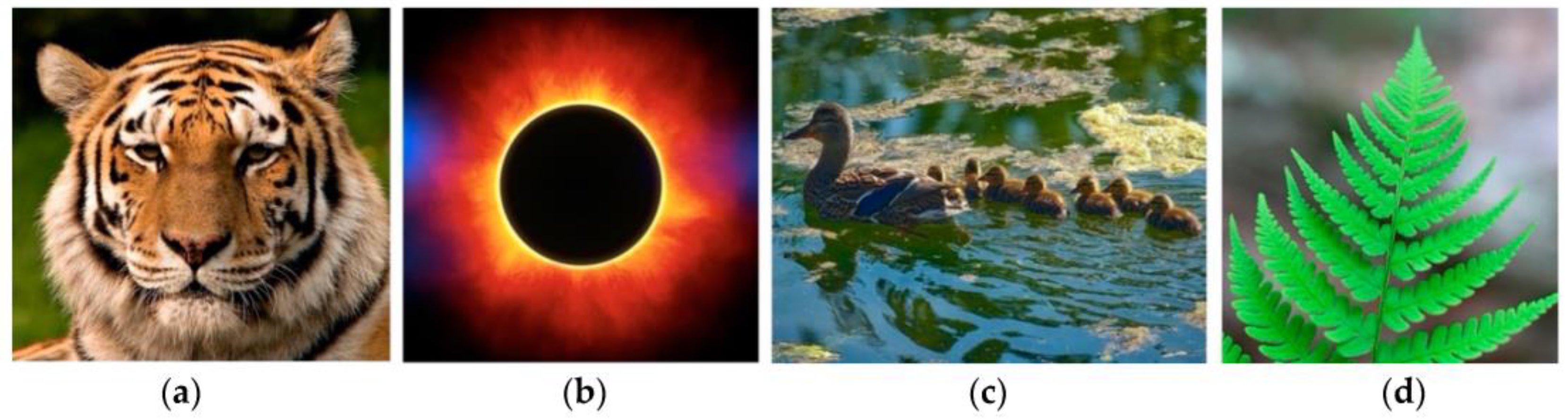
Figure 2.
Examples of (a) reflectional, (b) rotational, (c) translational and (d) scaling symmetries in human architectural forms (Classical façade, stained glass window, archway tile motif, repeating arch shapes at different sizes). Images: Ryan Kaldari (left) and Thomas Ledi (second from left) via Wikimedia Commons. Other images in public domain.
Figure 2.
Examples of (a) reflectional, (b) rotational, (c) translational and (d) scaling symmetries in human architectural forms (Classical façade, stained glass window, archway tile motif, repeating arch shapes at different sizes). Images: Ryan Kaldari (left) and Thomas Ledi (second from left) via Wikimedia Commons. Other images in public domain.
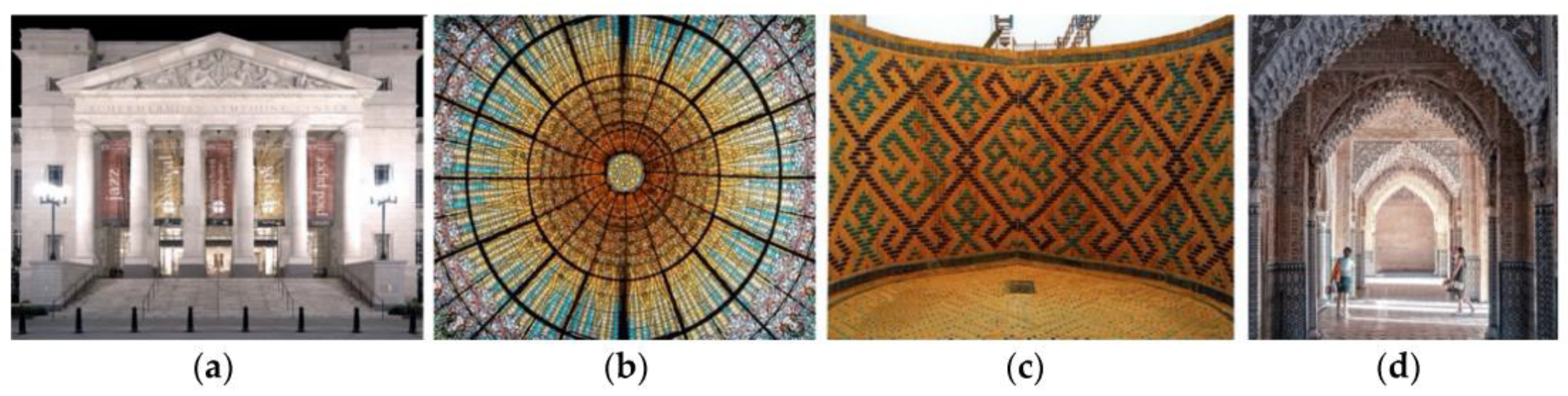
Figure 3.
A simple glide reflection (a), and a more complex “wallpaper group” (b), similar to the tiling patterns of many traditional cultures. A figure is repeated, then reflected again along a glide axis. This process may be repeated to produce larger groups. Images: Kelvinsong and Martin von Gagern via Wikimedia Commons.
Figure 3.
A simple glide reflection (a), and a more complex “wallpaper group” (b), similar to the tiling patterns of many traditional cultures. A figure is repeated, then reflected again along a glide axis. This process may be repeated to produce larger groups. Images: Kelvinsong and Martin von Gagern via Wikimedia Commons.
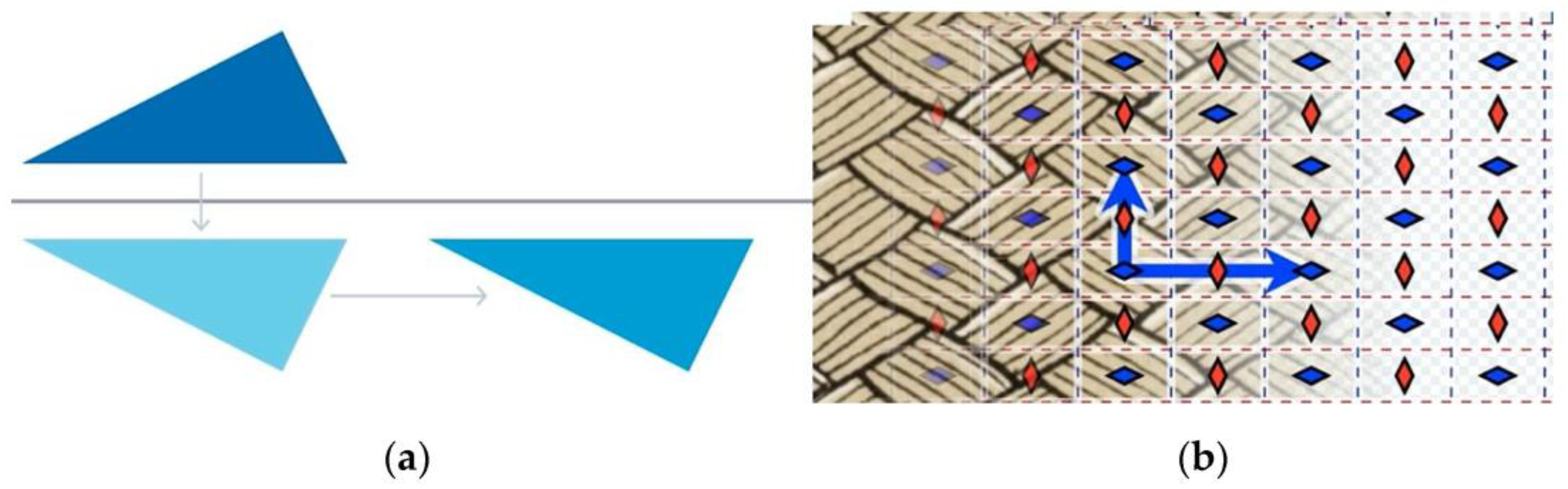
Figure 4.
An example of symmetry breaking in a drop of milk as it collides with a thin sheet of milk, shown in a famous series of photos by Harold Edgerton. The new structure is not a disordered mess, but in fact exhibits new forms of symmetry at smaller scales. Such processes are thought to be fundamental to the generation of structure in biological and natural systems, and even human cultural systems. Images: courtesy of the Edgerton Digital Collections.
Figure 4.
An example of symmetry breaking in a drop of milk as it collides with a thin sheet of milk, shown in a famous series of photos by Harold Edgerton. The new structure is not a disordered mess, but in fact exhibits new forms of symmetry at smaller scales. Such processes are thought to be fundamental to the generation of structure in biological and natural systems, and even human cultural systems. Images: courtesy of the Edgerton Digital Collections.
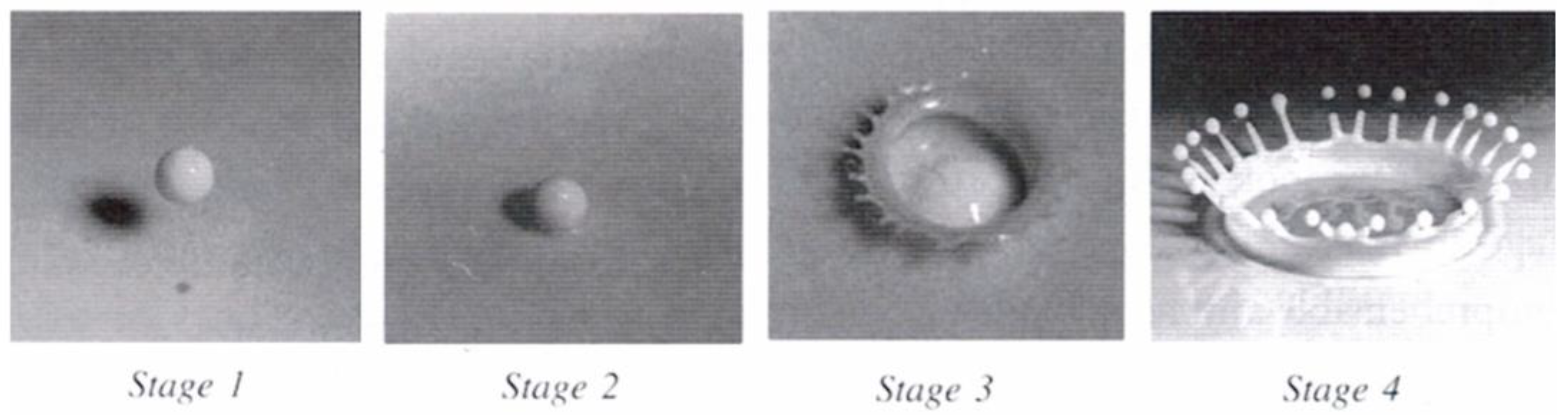
Figure 5.
Summary of the models and their contributions, showing considerable overlap but also distinct contributions of each.
Figure 5.
Summary of the models and their contributions, showing considerable overlap but also distinct contributions of each.
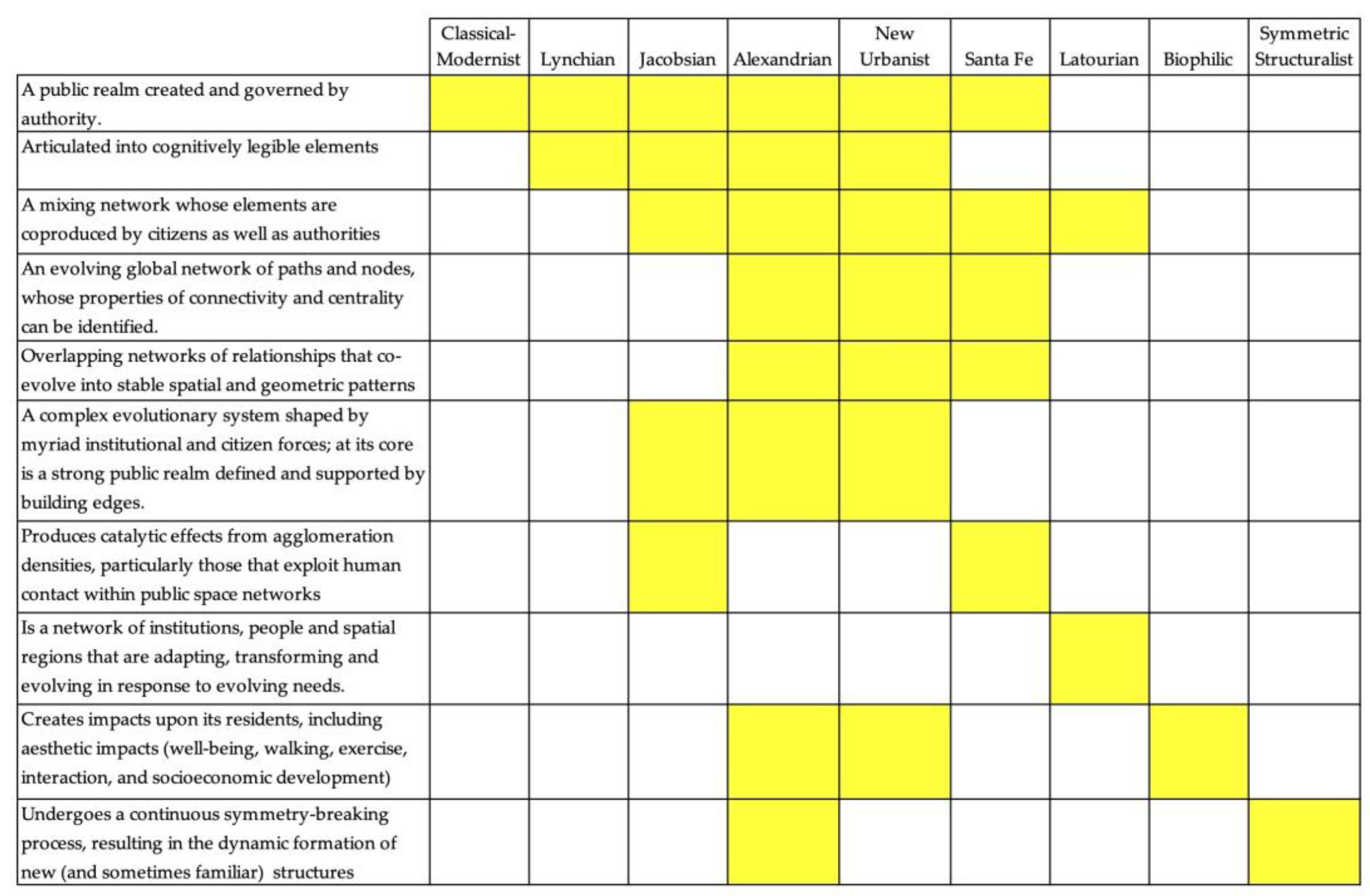
Figure 6.
Photo montage of an ordinary “high street” in London, showing a “place network” – a dizzying number of connections of movement, sight, sound, and various combinations of them. Photo by the author.
Figure 6.
Photo montage of an ordinary “high street” in London, showing a “place network” – a dizzying number of connections of movement, sight, sound, and various combinations of them. Photo by the author.
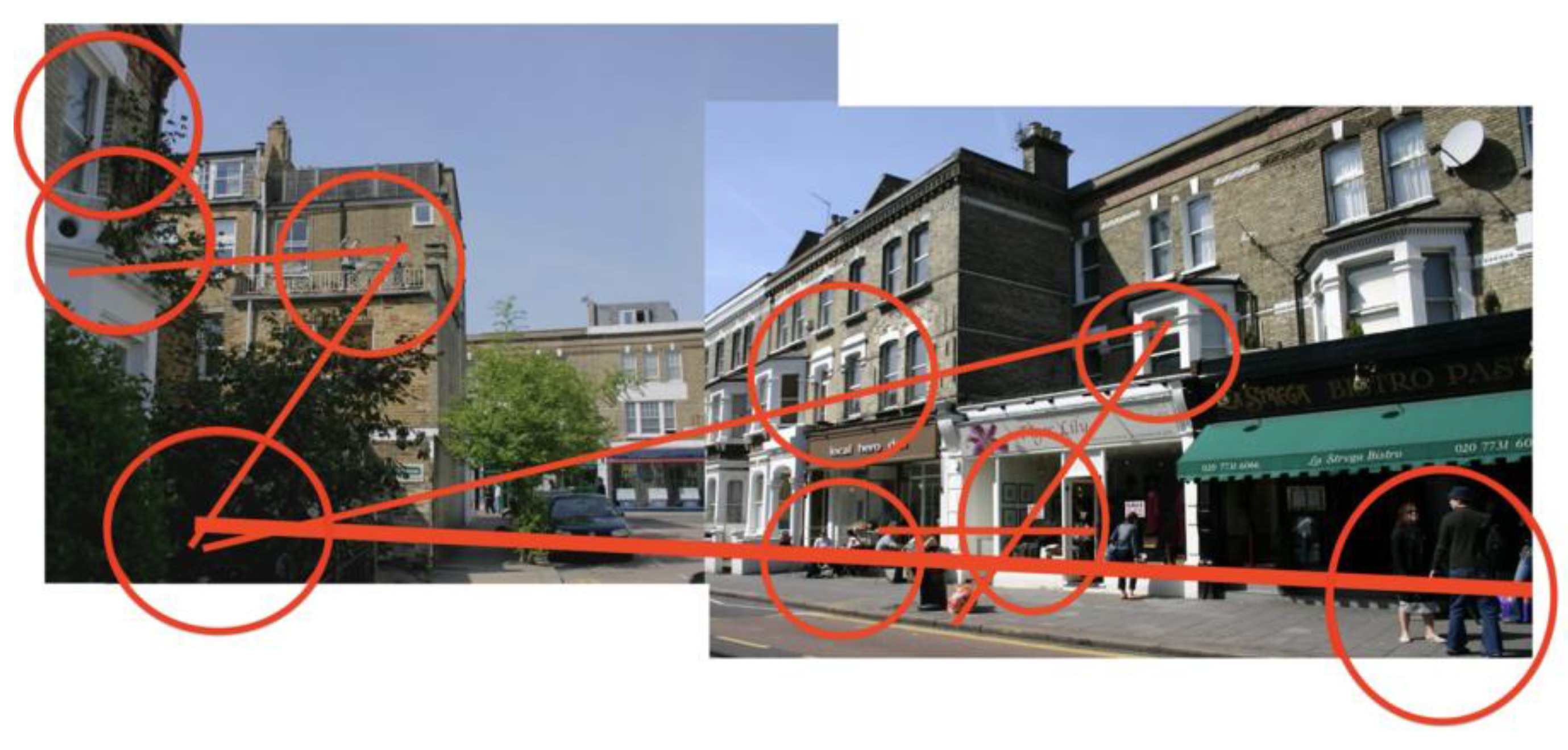
Figure 7.
A general schema of “place networks” – literal rooms, or room-like spaces, with boundaries and membrane-like connects that can be controlled (doors, windows, gates, etc). Image by the author.
Figure 7.
A general schema of “place networks” – literal rooms, or room-like spaces, with boundaries and membrane-like connects that can be controlled (doors, windows, gates, etc). Image by the author.
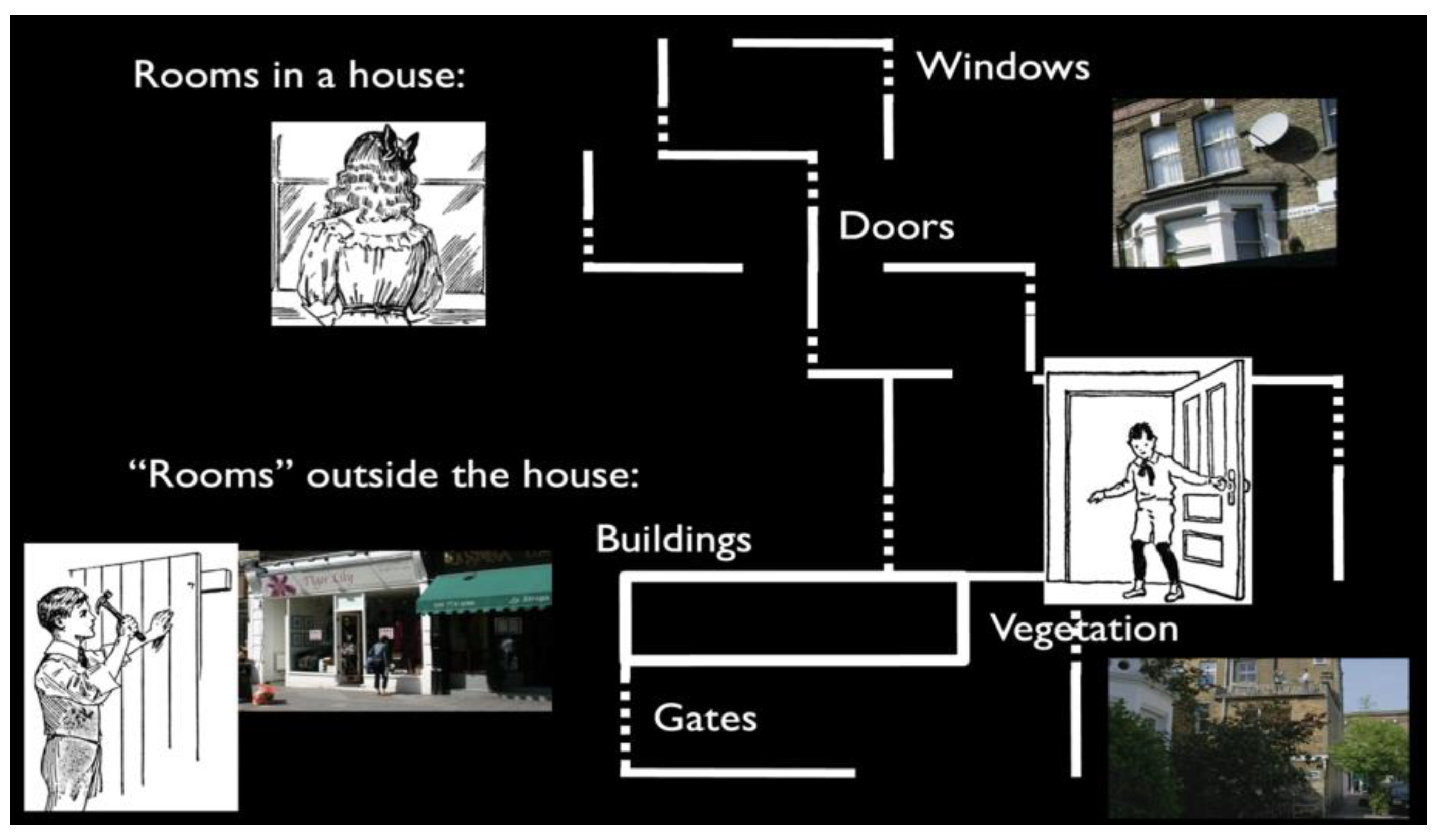
Figure 8.
The same locale as in Figure 6, but five years later. Not only new businesses and new signage can be seen, but also new articulations of the place network, including new terraces with fences and a new stoop. Photos by the author.
Figure 8.
The same locale as in Figure 6, but five years later. Not only new businesses and new signage can be seen, but also new articulations of the place network, including new terraces with fences and a new stoop. Photos by the author.
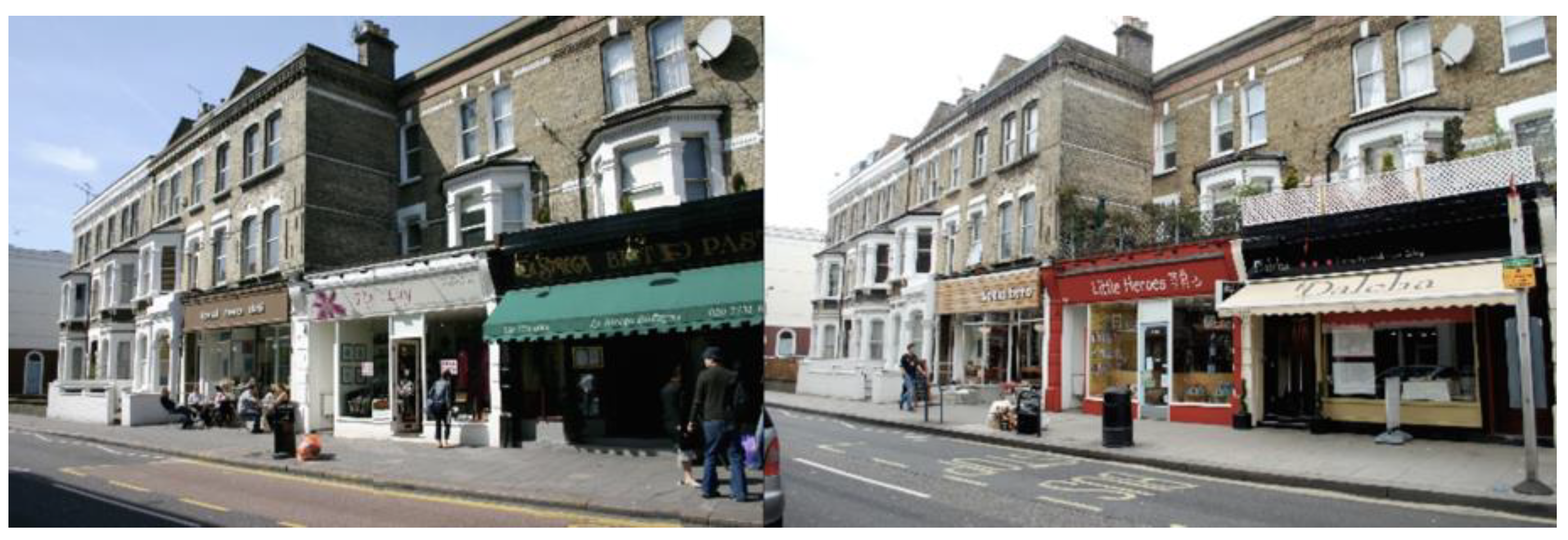
Figure 9.
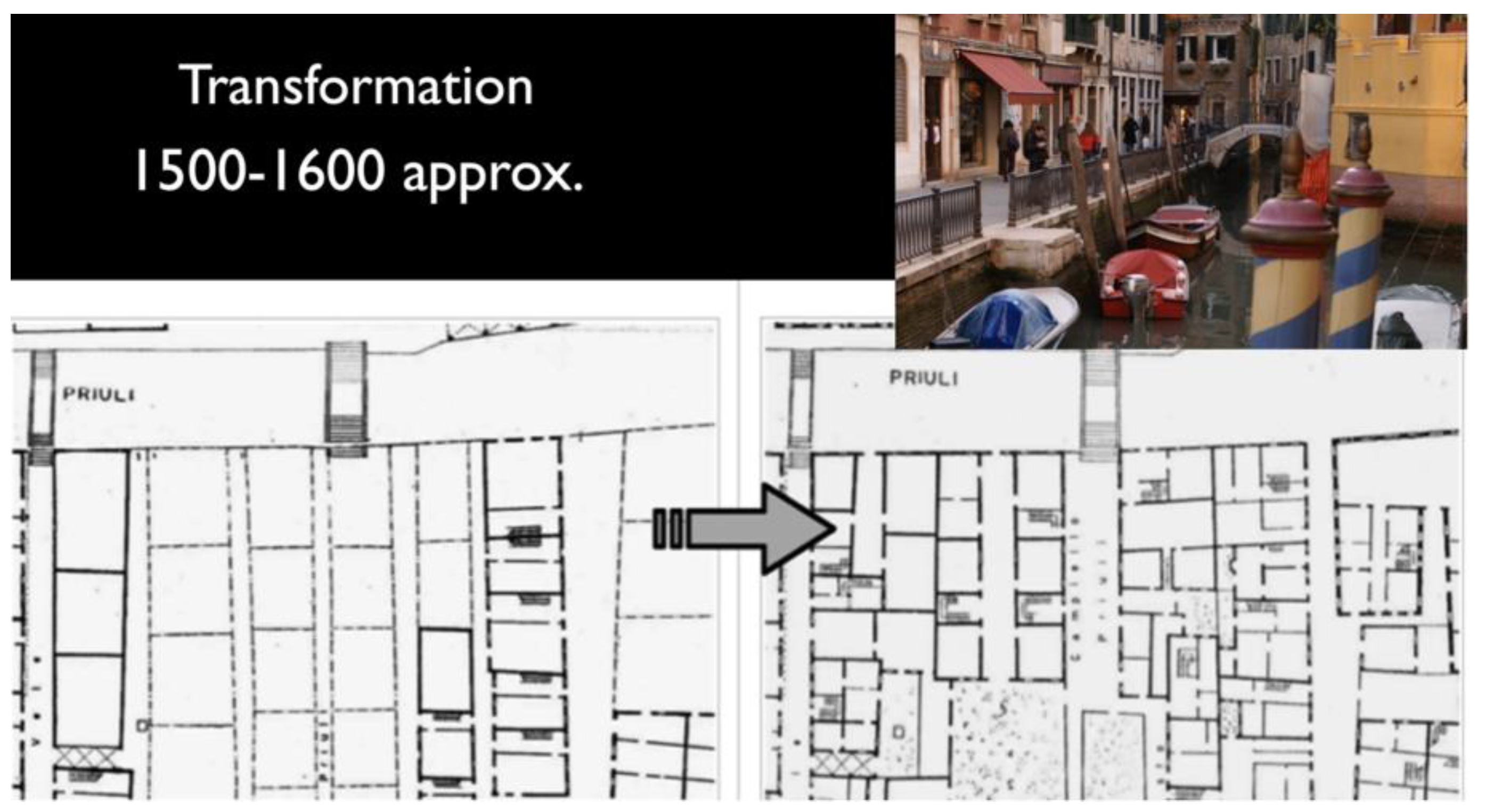
Transformation of the cadastral plan of Venice over about 100 years, including its densifying and enriching place networks, in a drawing by Muratori (1959). The result of these myriad large and small transformations is the beautiful city that is so admired and sought out by tourists today. Source: Muratori, S. (1959). Studi per una operante storia urbana di Venezia. Roma: Instituto Poligrafico dello Stato, Libreria dello Stato. (Used with permission.).
Figure 9.
Transformation of the cadastral plan of Venice over about 100 years, including its densifying and enriching place networks, in a drawing by Muratori (1959). The result of these myriad large and small transformations is the beautiful city that is so admired and sought out by tourists today. Source: Muratori, S. (1959). Studi per una operante storia urbana di Venezia. Roma: Instituto Poligrafico dello Stato, Libreria dello Stato. (Used with permission.).
Disclaimer/Publisher’s Note: The statements, opinions and data contained in all publications are solely those of the individual author(s) and contributor(s) and not of MDPI and/or the editor(s). MDPI and/or the editor(s) disclaim responsibility for any injury to people or property resulting from any ideas, methods, instructions or products referred to in the content. |
© 2024 by the authors. Licensee MDPI, Basel, Switzerland. This article is an open access article distributed under the terms and conditions of the Creative Commons Attribution (CC BY) license (http://creativecommons.org/licenses/by/4.0/).
Copyright: This open access article is published under a Creative Commons CC BY 4.0 license, which permit the free download, distribution, and reuse, provided that the author and preprint are cited in any reuse.


