
Submitted:
28 July 2024
Posted:
30 July 2024
You are already at the latest version
Abstract
This study explores innovation and sustainability within the Construction, Environment, and Territory (CAT) curriculum in Italian Upper Secondary Schools. It begins with an overview of Education for Sustainable Development (ESD) and its integration at various educational levels, focusing on technical/vocational curricula in Upper Secondary Education. The study examines the evolution of the technician's role, the CAT pathway in the Italian educational system, and comparisons with other European contexts. It analyzes the alignment between skills developed during the CAT course and the professional competencies required by the community and job market. A survey conducted among recent graduates and companies involved in the Pathways for Transversal Skills and Orientation (PCTO) at a CAT-focused school reveals significant training and professional needs related to Sustainable Development. To address these needs, the study proposes integrating ministerial programs in professional disciplines such as Topography, Building and Technological Systems Design, and Geopedology, Economics, and Appraisal, with new modules dedicated to Sustainable Development. These modules are to be integrated into the last three years of the course, utilizing the autonomy and flexibility in curricular planning per-mitted by current regulations. Additionally, the proposal includes actions to redistribute existing educational modules within ministerial programs without increasing teaching hours. An initial step in updating professional discipline programs involves implementing a cross-disciplinary educational path within Civic Education, focusing on Sustainable Mobility. The investigation, evaluation, and educational design process presented in this study aims to serve as a model for swiftly implementing structured curriculum reforms, emphasizing educational innovation and comprehensive student preparation to meet emerging social and professional needs.
Keywords:
Education for Sustainable Development (ESD)
; Technical and Vocational Education
; Curriculum Innovation
; Professional Competencies
; Sustainable Mobility
1. Introduction
The link between Education and Sustainable Development (SD) is now well established [1]. From this perspective, as a widely accepted view, we can say that Education equips individuals with the essential knowledge, skills, and ethical principles necessary for responsible behaviors and decisions that promote environmental stewardship, economic prosperity, and social justice for present and future generations [2,3]. Education of individuals, therefore, fosters global citizenship, crucial for a culture of sustainability supporting long-term development [4].
Following the 1972 Stockholm Conference, the UNEP-UNESCO Intergovernmental Conference on Environmental Education, held in Tbilisi in 1977, emphasized education as a critical component of SD. It underscored the need for skills development to address environmental problems and encouraged participation from various social groups [5]. Ten years after the Tbilisi Conference, the Brundtland Report "Our Common Future" published in 1987 by the World Commission on Environment and Development [6] further solidified the concept of SD leading therefore to a clear affirmation of the importance of Education for Sustainability [7].
The 1992 Rio Summit's Agenda 21 [8] recognized Education for Sustainable Development (ESD) as a lever for public awareness about the importance of sustainability. Ten years later, the World Summit on Sustainable Development (WSSD) of Johannesburg in 2002 produced several key outcomes aimed at reinforcing global commitments to SD. Although ESD were not prominently featured in the Political Declaration or the Plan of Implementation, the WSSD offered stakeholders committed to ESD to refine their objectives, enhance partnerships, and advance their implementation strategies [9]. Among the side events held at Ubuntu during the main summit of Johannesburg, one specifically focused on ESD. Thus, the Ubuntu Declaration on Education and Science and Technology for Sustainable Development [10] called for an initiative to strengthen science and technology education for SD. The agenda emphasized the importance of reviewing school and university programs and curricula to better address the challenges and opportunities of SD. The programs’ review would have focused on plans at local, regional, and national levels, creating balanced learning modules that integrate skills, knowledge, ethics, and values.
Following the commitments made at the WSSD, the United Nations General Assembly, at the end of 2002, declared the Decade of Education for Sustainable Development (2005-2014). It was emphasized that education must play a pivotal role in ensuring sustainable livelihood opportunities and a secure future for young people [11]. This program encouraged participating countries to align their educational systems with the principles of ESD to promote transformations in knowledge, values, and attitudes with the aim of fostering a more equitable and sustainable society. It also called for the establishment of specific strategies for implementation, monitoring, and assessment ESD [12].
UNESCO framed its efforts to promote ESD within an International Implementation Scheme (IIS) for the decade based on four major thrusts: improving access to and retention in quality basic education; reorienting existing educational programs to address sustainability; increasing public understanding and awareness of sustainability; and providing training to advance sustainability across all sectors [13]. In the following 10 years, various events and initiatives adopted by Member States showed the continuous commitment of the United Nations to promoting ESD.
In September 2015, all United Nations Member States adopted the 2030 Agenda for Sustainable Development, a global action plan aimed at ensuring peace, prosperity, and protection of the planet [14]. At the heart of the 2030 Agenda are the 17 Sustainable Development Goals (SDGs), among which SDG4 the role of Primary and Secondary Education as well as life skills and vocational education and training in addressing sustainability challenges. [14] [15]. More recently, the UNESCO Transforming Education Summit held in New York in 2022 emphasized the importance of transforming educational systems to address future challenges, calling for a profound and integrated review of educational goals and curricula within the framework of SDG 4 [16]. UNESCO prioritized five key action areas for rethinking ESD, combining scientific knowledge with the skills needed to change society and save the planet: policy advancement, transforming learning environments, building educator capacities, empowering youth, and accelerating local action [16]. Lastly, the 2023 SDG Summit in New York promoted a new phase of accelerated progress towards achieving the SDGs. During the summit, the importance of transforming education as a key to addressing future challenges and promoting SD was highlighted, as an action for building capacity and activating synergies for accelerating transformations [17].
As we have seen from this brief review regarding the link between Education/Training and Sustainable Development/Social Responsibility, ESD is recognized as essential for addressing global challenges such as climate change, environmental degradation, and social inequality. Actually, ESD empowers individuals to become effective, competent, critical, and responsible agents of change in the direction of SD [18,19,20]. As also highlighted by SDG4 of the UN's 2030 Agenda [14], ESD must begin at the earliest levels of school systems. Evidence from UNESCO's International Bureau of Education (IBE) suggests that ESD initiatives and projects are more likely to take hold in contexts where Primary and Secondary Schools have greater flexibility and autonomy to introduce locally relevant content and secure parental interest and community participation in school-based projects [12].
Given the significant attention that has been accorded to ESD over the past few decades, seeking the best way to transform our learning methods to drive meaningful change [21], it is crucial to examine its role in Upper Secondary Education (USE) [22]. Worldwide, USE is typically offered to students aged 14-19 and it bridges compulsory education and higher education or the workforce, allowing students to solidify their foundational knowledge and acquire specialized skills to face life and work. The successful integration of educational, scholastic, training, and professional curricula, considering country-specific variations, place USE at the forefront of ESD initiatives, as well as it serves as a catalyst for innovation, research, and the development of critical skills required for the social, economic, and environmental transformations necessary to achieve sustainability [23]. Thus, curricula at this level must be adaptable to the evolving needs of the global economy and SD demands [24].
A key function of USE in promoting sustainability lies in its emphasis on interdisciplinary learning. Integrating environmental and sustainability issues using this approach fosters a comprehensive understanding of interconnected global systems and the impact of human activity on the environment [25]. Thus, combining Science, Technology, Engineering, and Mathematics (STEM) disciplines with Social Sciences and Humanities equips students with a holistic understanding of sustainable practices within a scientific and technological context. This integration should extend beyond theoretical aspects, encompassing real-life situations, out-of-classroom work, and community-engaged sustainability projects. Case studies, surveys, collaborative work, and promoting sustainable lifestyles can further support curricular programs and initiatives that reflect local circumstances. It goes without saying that, in this context, a crucial element in addressing ESD is teacher preparation. Reorienting teacher education to address ESD requires not only the inclusion of relevant content and competencies but also the promotion of an understanding of the values of sustainability and the development of reflective practices for continuous improvement [12].
Following this interdisciplinary approach to education and training, with the contribution of updated and motivated teachers, a modern USE system can be equipped to enhances theoretical knowledge, cognitive abilities, critical thinking, and problem-solving skills [26,27] within a framework of both intragenerational and intergenerational integration, which are essential for addressing SD.
Within the ever-relevant context of SD in education and professional training, engaging with a significant research theme of recent years —supported by increasing contributions in the literature well-documented in recent reviews [28,29,30]— this paper provides an analysis focused mainly on USE, particularly on the technical and vocational training curricula [31]. The core theme of this work concerns the innovative skills and the integration of ESD for the Construction, Environment, and Territory Upper Secondary Graduation in Italy, highlighting the novelty of the competencies required of these technicians, who traditionally hold significant importance in Italian society and economy.
The paper, after addressing the broader aspects of the educational and professional pathway, offers a direct perspective by analyzing the results of a study conducted in an Upper Secondary School in the Milan metropolitan area and proposing a partial redesign of the students' curricula. These curricular changes, feasible within the autonomy granted to schools by Italian regulations, are structured in compliance with the constraints imposed on ministerial programs, in such a way as to accommodate general considerations about ESD and specific feedback from a panel of graduated students and partner companies.
The paper is structured as follows. Section 2 will address the characteristics of educational systems, particularly the Italian USE framework, and the curricular aspects for Construction, Environment, and Territory education path in the Upper Secondary School level. It will then present a survey conducted with recent graduates and partner companies. Section 3 will analyze the survey results, identifying critical issues and proposing a new vision and mission for the curricula to embrace SD. Section 4 will discuss implementing a new curricular program to integrate innovative skills for SD. Section 5 will contain the main conclusion and the key highlights.
2. Materials and Methods
2.1. School systems
School systems are designed to provide structured education to students from early childhood through to adulthood. These systems vary widely across different countries, reflecting cultural, economic, and political contexts. As shown in Figure 1, a school system is typically divided into several distinct stages [32]:
- Early Childhood Education (ECE), often referred to as preschool, caters to children typically aged 3 to 6. This stage is crucial for the development of cognitive, social, and motor skills. It lays the foundation for lifelong learning and well-being by promoting early literacy and numeracy, as well as fostering socialization and emotional regulation. The emphasis during this phase is on play-based learning, which helps children develop essential skills in a natural and engaging environment. Research has shown that high-quality ECE programs can lead to better academic performance, higher rates of high school graduation, and even increased earnings later in life [33].
- Primary Education (PE), serving children from approximately ages 6 to 11 or 12, is compulsory in most countries and aims to provide basic literacy and numeracy skills. This stage also introduces students to fundamental concepts in subjects such as Science, Social Studies, and the Arts. PE is designed to build a solid foundation of knowledge and skills that will be essential for further learning and personal development. The curriculum at this level is typically broad, covering a wide range of subjects to ensure a well-rounded education. Effective primary education has been linked to higher levels of educational attainment, better health outcomes, and increased economic productivity [34].
- Secondary Education is generally divided into Lower (LSE) and Upper (USE) stages, serving students from about ages 12 to 18. LSE continues the work of PE, consolidating basic skills and knowledge while beginning to introduce more specialized subjects. USE often offers more diverse pathways, including academic, technical, and vocational tracks, catering to students' varied interests and future aspirations. This stage is critical for preparing students for higher education, vocational training, or direct entry into the workforce. Secondary Education aims to develop critical thinking, problem-solving skills, and a deeper understanding of complex subjects, which are vital for personal and professional success. Access to quality secondary education has been shown to have a significant impact on economic growth and social development [35].
- Tertiary Education (TE) includes universities, colleges, and vocational training institutes, offering undergraduate, graduate, and postgraduate programs. This stage provides advanced education and training in a wide array of fields, from the humanities and sciences to technical and professional disciplines. TE is crucial for the development of specialized knowledge and skills, research capabilities, and the cultivation of critical and innovative thinking. It plays a significant role in driving economic development and social progress by producing a highly skilled and knowledgeable workforce [36], linked to increased innovation, productivity, and competitiveness in the global economy [37].
Throughout these educational stages, the school systems aim to provide a balanced development of intellectual, practical, and social skills, through a variety of curricula designed to adapt to the evolving needs of society and the economy, promoting not only academic excellence but also ethical and civic values. It's worthing of note that recent reforms, particularly in European counties, have emphasized the importance of competencies such as digital literacy, critical thinking, and sustainability, reflecting broader educational goals [38]. Effective school systems also strive to address issues of equity and inclusion, ensuring access to quality education for all students, regardless of their socioeconomic background, gender, or special needs. This involves providing adequate resources, support services, and targeted interventions to help disadvantaged students overcome barriers to learning [39]. Furthermore, school systems are increasingly recognizing the importance of fostering Social and Emotional Learning (SEL), which includes skills such as self-awareness, self-management, social awareness, relationship skills, and responsible decision-making [40].
2.3. Italian School System
Italy's education system offers a comprehensive path from early childhood through to higher education [41]. Following the Scuola dell'Infanzia (i.e., ECE) for children aged 3-6, students progress to the mandatory Scuola Primaria (i.e., PE) from ages 6-11, acquiring foundational literacy, numeracy, and subject knowledge. The Scuola Secondaria di Primo Grado (i.e., LSE) caters to students aged 11-14, deepening their understanding of various subjects and fostering critical thinking skills.
The next level is the Scuola Secondaria di Secondo Grado (i.e., USE), spanning five years and divided into distinct curricular tracks. Licei offer a more academic curriculum with specializations such as classical studies, scientific studies, languages, and arts, preparing students primarily for TE. Istituti Tecnici focus on both theoretical and practical knowledge in fields such as technology, economics, and administration, providing pathways to both TE and vocational studies, or the workforce. Istituti Professionali, on the other hand, emphasize vocational training and are designed to equip students with specific skills needed in various trades and professions
Upon completing USE, students receive a “Diploma di Maturità” (i.e., USE Baccalaureate Diploma), necessary for access TE. The Italian TE system comprises universities, polytechnics, and academies, offering undergraduate, graduate, and doctoral programs.
2.3. From Tradition to Innovations for the Construction, Environment, and Territory Technician
Within the Italian USE, the Istituti Tecnici Costruzioni, Ambiente e Territorio – CAT (Construction, Environment, and Territory) program equips students with both theoretical knowledge and practical skills for careers in construction, environmental management, and land surveying [42]. This five-year path aligns with the concept of Technical and Vocational Education and Training (TVET) defined by UNESCO and the OECD [32,43], preparing students for direct entry into the workforce or further education.
The CAT curriculum emphasizes Science, Technology, Engineering, and Mathematics (i.e., S.T.E.M.) disciplines, integrating them with general high school subjects. This focus prepares students for various career paths, often solidified through internships. Graduates earn a diploma in Construction, Environment, and Territory. Thus, the CAT technician is the evolution of the traditional figure of the Geometra a highly skilled technician in Italy, responsible for land surveying, construction projects, and ensuring regulatory compliance [44].
In the Italian context, the figure of the Geometra has always assumed a crucial and strategic role in the construction sector. Its importance traces its roots back to the post-World War I period, when this profession was institutionalized through the Royal Decree no. 274 of 1929 [45], replacing the traditional figure of the land surveyor. The term geometra derives from the concept of geometry, sharing its etymology with the Greek word γεωμέτρης [gheōmétrēs], which translates to land measurer. This connotation distinguished the profession until the 1970s, when the introduction of optical-mechanical technologies, followed by those related to computing and electronics, revolutionized the construction industry, prompting an ever-increasing diversity of required skills.
Historically in Italy, the Geometra have operated in close synergy with architects and engineers in construction design and management. In the 1970s, their prestige grew among other professional figures in the sector, both due to the limited number of graduate technicians and the need to meet the demands arising from the economic boom and post-war reconstruction of the 1950s and 1960s. In this context, these practicians particularly distinguished themselves in small and medium-sized civil works in less urbanized areas.
Before the so-called Gelmini reform [46,47], access to the profession, upon registration with the Provincial Roll, was guaranteed by a USE Diploma from the Isituti Tecnici per Geometri. Currently, because of this reform, the qualification is obtained after the USE Diploma from the Istituti Tecnici Tecnologici Costruzioni Ambiente Territorio - CAT (Technical Technological Schools for Construction Environment Territory) and passing a State Exam enabling registration with the Provincial Roll of the relevant residence. Admission to the State Exam can also be obtained by attending and passing a specific professional training course organized by the provincial rolls, a Higher Technical Education and Training (IFTS) course, or a program at the Higher Technical Institutes (ITS). Once the qualification process is completed, the professional is officially recognized through registration with the Provincial Roll. For those intending to enter the job market without pursuing university studies, the IFTS courses and attendance at the ITS constitute opportunities for professional development. The ITS, established in 2008 [48], activated a few years later and now renamed ITS Academy [49], are high-technology schools organized according to a participatory model involving companies, universities, scientific and technological research centers, local authorities, and the educational and training system. The courses, accessible through a selection process open to USE graduates interested in qualified entry into the workforce, are typically structured over four semesters and award a higher technician diploma. Training pathways are offered in six technological areas considered strategic for the country's economic development and competitiveness. Among these are the two areas closest to the CAT educational path, relating to "energy efficiency", for those wishing to work professionally in the environment, ecological sustainability, renewable sources, and sustainable construction, and "sustainable mobility" centered on innovation, sustainability, and the mobility of people, goods, and related infrastructure and management systems. The IFTS [50], also accessible with a USE diploma, are structured as one-year courses aimed at training medium to high-level technical professionals in sectors affected by technological innovations, at the end of which a certificate of higher technical specialization is obtained. Within the European Qualifications Framework (EQF), the qualification levels associated with these institutes are placed at EQF Level 5 (corresponding to post-secondary non-university qualifications, such as higher technician diplomas).
The CAT USE Diploma allows direct access to any university degree program. Recently, the Colleges of Geometras have contributed to defining an innovative four-year curriculum [51] in some universities, emphasizing a pragmatic and "learning by doing" strategy. In this perspective, the Ministry of Education and Research has defined [52] a new professional-oriented degree class in technical professions for building and territory, whereby the final exam for a degree in Technical Professions for Building and Territory [53] directly qualifies for professional practice. This program consists in theoretical lessons, practical activities, and internships, with training that spans from foundational disciplines to specific subjects. Students are trained to effectively respond to sector demands through a theoretical and practical education, including internships and practical activities also at external entities [52].
The CAT USE Diploma corresponds to EQF Level 4, signifying factual and theoretical knowledge, practical skills to solve problems, and the ability to work autonomously within a defined context [54]. This framework recognizes CAT as comparable to technical and vocational programs across the European Union. Among the educational systems in force in the European Union, technical education is generally included in the USE, with specific names and durations for the different national contexts [55]. In some cases, such as in Italy, it is clearly distinguished from the general type (i.e., Licei) and partially included in the professional type (i.e., Professional Institutes) [55]; in other contexts, however, it is more distinctly separated from the professional type to be included within a more general path, as in France (Lycée Général et Technologique on one side, and Lycée Professionnel on the other), or it presents features that draw from both types, as in Germany (Realschule and Berufsfachschule) [55].
The Italian CAT USE Diploma particularly approximates the Baccalauréat Technologique of the French Technological Lycée in the section Sciences et Technologies de l'Industrie et du Développement durable (STI2D), although this is still classified as a general type [55]. In these institutes, the student deepens one of the four specialties provided during the three-year course: architecture and construction; energy and environment; technological innovation and eco-design; information and digital systems. The Baccalauréat Technologique STI2D does not allow immediate entry into the job market but is intended for further studies. For quicker access to work, students choose a course at a Section de Technicien Supérieur activated in a higher education institute with a technical or professional orientation or an apprenticeship to obtain a Brevet de Technicien Supérieur (BTS), or they obtain a Diplôme Universitaire de Technologie (DUT) awarded at an Institut Universitaire de Technologie (IUT).
In Germany, the technical education system, regulated at the level of the various federal states, is quite different, and generally, there is no school corresponding to the educational offer of an Italian CAT institute. Generally, a certain technical orientation can be chosen right after primary education by attending a Realschule [55]. This secondary school, which is also classified as a general type, offers a broad curriculum focused on teaching subjects related to various technical sectors, with a duration of 4 to 6 years (generally longer than the Hauptschule, which is more professionally oriented, and shorter than the Gymnasium, which prepares for academic studies, both still classified as general types). Achieving the final title from the Realschule is the minimum level to access qualified professions. Moreover, a good academic career at a Realschule allows one to continue with the completion of the Gymnasium, to obtain the Abitur, which enables access to university education. Once secondary studies are concluded, German professionalizing education provides three alternatives, continuing in a training path that may include education at a technical higher school (Berufsfachschule) and apprenticeship (Ausbildung), or education at a Fachhochschule (University of Applied Sciences) [55]. The Fachhochschulen, with a duration of 4 years, fit into a tertiary education system oriented toward applied technical professions (including, for example, that of the surveyor and technical drafter). These high-level professionalizing schools are characterized by a strong combination of theoretical and practical training, which is complemented by intense collaboration with companies aimed at concretizing future professional opportunities.
In conclusion, the articulation of the CAT path and its integration with ITS, IFTS, and professionally oriented degrees clearly indicates an orientation towards high-quality USE, in line with European standards and in a perspective of harmonizing technical skills. This is intended to prepare up-to-date technical professionals open to employment opportunities in an increasingly broad context for disciplinary interests and territorial dimensions.
2.4. Vocational Study Subjects and Expected Competencies for CAT Students
The five-year CAT curriculum follows a three-phase structure. The first two years emphasize foundational subjects like Mathematics, Physics, Chemistry, Computer Science, Drawing, Language, and Literature. These subjects provide a strong base for the specialized courses introduced in the subsequent two years. In this second phase, students delve into Topography, Road Design, Construction Design, Facilities and Technological Systems Engineering, Geopedology, Economics, and Appraisal. However, the curriculum maintains a crucial link to core disciplines, ensuring a well-rounded education. The final year focuses intensively on preparing students for the culminating State Exam, the official recognition of their acquired knowledge and skills.
The program's core objective is to train highly specialized graduates in construction and environmental management. Throughout their studies, students acquire in-depth knowledge of materials, construction technologies, and methodologies. This expertise is complemented by strong skills in topography and computing, enabling graduates to assess land properties (technical and economic aspects), design construction projects, manage construction sites and facilities, and conduct topographical surveys. These combined skills empower them to collaborate on complex projects or handle smaller-scale endeavors independently.
Topography, a traditional domain of the Geometra profession, holds particular importance within the CAT program. This subject focuses on the accurate and detailed representation of the earth's surface, drawing upon scientific disciplines like mathematics and geodesy. However, its significance extends beyond simple mapping. The ability to represent, calculate, and interpret topographical data is crucial for practical applications like land subdivision, boundary determination, and earth volume computation in construction and road infrastructure projects.
Design of Buildings and Technological Systems exemplifies the program's emphasis on integrated knowledge. These disciplines blend knowledge from chemistry, materials science, and construction science and technology. Students analyze the properties of various building materials and structures, gaining a comprehensive understanding from historical architectural techniques to the latest digitalization trends. Notably, the curriculum prioritizes the integration of these competencies into a unified project, incorporating Computer Aided Design (CAD), three-dimensional modeling and Building Information Modeling (BIM) methodologies. This approach ensures graduates are prepared for the evolving construction industry.
The disciplines of Geopedology, Economics, and Appraisal form another cornerstone of the CAT curriculum. Here, students acquire the mathematical and economic tools necessary to navigate the real estate market. The training extends beyond economic aspects, encompassing legal, cadastral, and environmental impact assessments.
2.5. An Investigation into the Current Issues for a New Vision/Mission of the CAT Graduate
Currently, the teaching programs in CAT curriculum conform to the guidelines of the former Ministry of Education, University and Research (MIUR), now the Ministry of Education and Merit (MIM) [56,57,58]. As noted, rapid technological advancements, automation, and a focus on sustainability necessitate adaptable skillsets. Without future-oriented curriculum updates, the profession might become less attractive to the job market.
Recognizing this gap, in some way technical institutes and teacher councils are trying to propose curriculum revisions, anticipating the ministerial mechanisms of curriculum and teaching program redefinition. In this direction, for example, Pathways for Transversal Skills and Orientation (PTSO) have been introduced to bridge the gap between education and practical needs in the professional world. As clearly outlined by the MIUR guidelines [59], PTSO must be considered not as mere occasional experiences, but as an element of the study plan and of concurrent educational renewal. Despite these efforts and initiatives, students on one hand and companies on the other, continue to perceive a certain misalignment between the curricula and job market demands.
This paper explores this issue through a survey conducted during the period July - August 2023 at the Giuseppe Maggiolini Institute in Parabiago, Italy. The survey targets recent graduates and companies partnering with the institute's PTSO program. The survey, primarily aimed at collecting feedback from students and external companies, was designed, and executed by the authors of this work with the shared intentions of the School Principal and faculty from the CAT department.
The first survey was administered to students who graduated in the academic years 2021-22 and 2022-23, totaling 127 respondents from 6 graduating classes. The questionnaire comprises seven sections, each dedicated to a specific aspect of the educational experience. Table 1 presents the topic, main content, and nature of the questions and evaluations asked to students for each section of the questionnaire. For the second survey, seventy-three companies and institutions that participated as partners in the PCTO (Pathways for Transversal Skills and Orientation) were contacted to take part in the survey. They were asked to provide feedback on the competencies observed in students during their internship activities through a questionnaire. Out of the 73 companies contacted, 48 participated in the survey. Table 2 presents the topic and main contents for each section of the second questionnaire. Each company or institution was asked to rate the observed level of competence using a scale from 1 to 5, where 1 indicates inadequate competence and 5 denotes excellent competence.
3. Results
3.1. Analysis of Needs and Evaluation of the Critical Issues Highlighted by Recent Graduates
Results from Section 1 of the students’ survey show that for the majority (80%) of interviewed students, the teaching programs are not fully aligned with labor market needs, although the teaching quality is generally perceived as good by 54% of respondents (with 82% considering it at least adequate) and with 97% positive feedback on the laboratory approach of the study program. In particular, clear suggestions emerged from the students, with strong interest in topics such as energy, the environment, and sustainable mobility, advocating for the integration of these topics into the study programs. Analyzing the expressed opinions more deeply: 38.08% of students want greater attention to energy-saving issues; 26.93% emphasize the importance of environmental sustainability; 18.89% highlight the importance of sustainable mobility; smaller percentages, 5.88%, desire a focus on professional work and 6.81% on surveying and monitoring topics, while only 1.24% prioritize site management and safety.
Section 2 of the survey revealed various opinions regarding the learning support resources and services. Only 9.45% were completely satisfied with the resources and services offered, while 56.69% found these services adequate but believed they could be improved, and 33.86% deemed them entirely insufficient. In summary, most respondents believe there is room for improvement in resources and services, with particular attention to implementing digital resources, career guidance initiatives, and additional tutoring support. Among the improvement suggestions, it was noted that: 15.50% hoped for an expansion of the library, including online resources; 27.91% proposed the adoption of digital books for more interactive learning; 24.03% suggested organizing career days to explore job opportunities; 32.56% saw the need to intensify afternoon remedial courses.
In Section 3 of the survey, 54.18% of students described the school environment as neutral, 29.35% as stimulating and welcoming, 13.45% as stressful and unwelcoming, while the remaining 3.02% provided other descriptions. Regarding teacher attitudes, 54.87% of students perceived exceptional support, 38.15% found support but with some exceptions, and 6.98% felt a lack of support from teachers. Suggestions for improving teacher-student interaction included: more individual attention at 67.14%, scheduled quizzes at 16.98%, and more group work at 13.61%.
From Section 4 of the survey, it emerges that the decision regarding future plans is equally divided between the willingness to enter the workforce immediately and the desire to acquire further skills by continuing academic studies. Specifically, 46.18% of participants intend to start working immediately after graduation, 41.34% want to continue their academic studies, 12.48% have not yet decided, while none expressed an intention to undertake both activities simultaneously. Ease of employment and income prospects emerge as key factors in participants' choices. For those wishing to continue their studies, the influencing factors in the choice of institution or course include: opportunities in the engineering sector (32.78%), creativity development in architecture or design (28.78%), convenience in reaching the university (14.58%), and future income potential (23.86%).
From Sections 5 and 6, as visualized in the graphs in Figure 2, students clearly indicate the need for multidisciplinary training that can prepare professionals for professional challenges. Students highlight the importance of skills related to energy saving, environmental sustainability, and safety in today's work environment. The focus on sustainability emerges as a multidisciplinary necessity, with skills ranging from energy consumption analysis to environmental and territorial risk management. The following graphs illustrate the percentage distributions of responses provided by the entire sample in detail.
Finally, regarding suggestions or comments on the study program, 62% highlight the opportunity to clearly frame CAT courses in terms of SD, while 20% suggest increasing the number of practical activity hours. Smaller percentages indicate the need to enhance the use of calculation software (14%) and, more generally, modern technologies (4%). The results can be summarized as follows:
- Students perceive a certain misalignment between teaching programs and labor market needs, despite generally appreciating the overall quality and laboratory approach of the course.
- There is a strong interest from students in topics such as sustainability, energy saving, and sustainable mobility, highlighting the need to integrate them more into the study programs.
- Opinions on learning support resources and services vary: while some students are satisfied, a significant portion believes there is ample room for improvement, particularly regarding the introduction of digital resources, career guidance initiatives, and remedial courses.
- The school environment is generally perceived as neutral by most students, although a significant percentage finds it stimulating and welcoming. Teacher attitudes are generally seen as supportive, but suggestions for improving interaction include more individual attention and group work.
- Regarding post-graduation plans, students are equally divided between those inclined to enter the workforce and those aspiring to continue academic studies. A notable percentage of recent graduates remain undecided, and no students are inclined to pursue both alternatives simultaneously. Among those intending to continue their studies, the choice of path is distributed with few variations between the engineering sector for ease of employment and the architecture and design sector for the potential to develop creativity. Future income potential also emerges as important, while proximity to the chosen university is less motivating.
- There is a clear request for training that emphasizes multidisciplinary and sustainability, preparing students to face future professional challenges. Students desire courses that highlight environmental sustainability, value the use of modern technologies, and increase practical activity hours.
3.2. Analysis of needs and evaluation of the critical issues highlighted by partner companies
From the analysis of the data collected through the PCTO partners’ questionnaire and summarized in Table 3 and Figure 4, a complex picture emerges regarding the preparation of CAT students during their internship. This is the overall picture that emerges considering the opinions expressed in the questionnaires completed by the participating companies and institutions:
- The students showed good preparation in the technical field. Their ability to learn and use new technologies is appreciated, as is their knowledge and use of specific IT tools and their ability to analyze and solve technical problems.
- Among communication and relational skills, teamwork, adaptability, and time management were particularly appreciated by the companies, suggesting that students are ready to effectively integrate into work environments and can work well in teams and interact effectively with colleagues. Other skills in this area, such as active listening and adaptability, were also positively evaluated. However, there is a clear area for improvement in the ability to write reports or documents, suggesting the need for further training and support in this area.
- For leadership skills, there is room for further progress according to the companies' assessments, especially in terms of taking responsibility, decision-making ability, and motivation. These skills are crucial for professional growth, and encouraging students to develop them could significantly help in their future careers.
- For industry-specific competences, those related to Drawing, Project, and Regulations, Topographic Survey, and Construction Materials received particularly high evaluations, indicating a solid preparation in the classical areas of the surveyor's role. Interns also demonstrate a good understanding of Safety Regulations on Construction Sites. However, competences in risk management and the application of workplace safety measures were rated only sufficient, indicating a possible need for further training in these areas.
- The areas related to Environment and Sustainability and Energy Saving received lower evaluations, indicating a possible lack of training or practical experience in these emerging and increasingly relevant sectors in the CAT technician profession. These sectors represent growth opportunities for students and, consequently, areas where additional resources and attention should be focused on the training pathways.
3.3. Elaborating a New Vision and Mission for CAT Graduates towards SD
The needs and requirements that emerged from the survey presented in the previous sections are evident and require timely and concrete responses. In this direction, it appears imperative to undertake a reform of ministerial programs to include current topics mainly related to environmental sustainability. This is precisely the connotation that in France the most similar technical training paths to CAT technicians have assumed, namely the STI2D - Sciences et Technologies de l’Industrie et du Développement Durable (Science and Technology for Industry and Sustainable Development).
However, this requires hardly short implementation times. Thus, these revision needs could be effectively anticipated by the schools themselves, thanks to their project and educational autonomy. Indeed, schools have the autonomous capacity to adapt their programs, and this could be used to rethink some elements of the traditional educational structure by opening it up to new needs. In this way, schools could act directly, respecting the prerogatives and within the framework of the general programming dictated by the Ministry, and make targeted decisions to integrate current and now fundamental topics, such as energy saving, environmental sustainability, and sustainable mobility.
In many political and research contexts [12,60,61], the growing importance of SD as an educational and training imprint has been emphasized, identifying teachers as real agents of change towards sustainability. On the other hand, students have also clearly expressed the importance, from their perspective, of the quality of teaching, participation, support, and engagement that teachers are able to demonstrate in their relationship with the class and with the individual students. Thus, in the context of CAT training, the role of teachers becomes twofold, concerning both the education of active and aware citizens and the training of competent technicians to respond to the challenges imposed by a rapidly evolving context. It should be noted that a significant obstacle in acting in this way could be the lack of specific training among senior teachers on sustainability issues. While younger teachers are already oriented towards these topics thanks to updated training, older age groups may not have equally adequate preparation. This disparity could compromise the effectiveness of teaching and the transmission of fundamental skills, also considering an updated revision of the teaching programs. To maximize the effectiveness of interventions, it is essential that the operational decisions to be undertaken favor collaboration between teachers of different generations, creating a possible, desirable, and profitable exchange of knowledge and skills. On the other hand, the National Teacher Training Plan [62] could be seen as a central key element to update and elevate teachers' skills, simultaneously responding to the needs of students and the demands of the professional market.
At this point, the question arises as to how to make the professionalizing CAT disciplines up to date with the times in terms of innovations for SD. Before answering, it is necessary to quickly review the professionalizing CAT disciplines to identify if and how ministerial programs address sustainability issues.
For the discipline of Topography, which finds one of its most significant educational applications in Highway Design, sustainability issues are mainly expressed as designing infrastructures with minimal impact and identifying sustainable mobility solutions. At the design and organizational level, sustainable mobility solutions are proposed as a key to addressing SD challenges, promoting the creation of efficient, ecologically compatible, and socially inclusive transportation systems. Actually, the importance of sustainable mobility goes beyond the environmental issue; it also affects people's quality of life, public health, and the attractiveness of cities for investments, job creation, and competitiveness. This requires infrastructural, technological, and managerial interventions that adapt the transportation offer accordingly and change citizens' habits to make them aware and active in choosing less impactful and smart transportation solutions. Contrary to the centrality of the aspects outlined above, traditional ministerial programs in the field of Topography and Highway Design do not address sustainability issues, except for some minor references related to environmental integration.
As for the discipline of Design of Buildings and Technological System, SD issues are mainly expressed as efficiency, saving, and wise use of materials and technologies. Considering a traditional context for the CAT technician, that of residential construction, future homes will have to ensure, both during the construction phase and in their useful life, a rational consumption of material and energy resources. A sustainable building must be designed to be safe, efficient, and comfortable, favoring sustainable, natural, or low-impact construction materials, well insulated to reduce thermal losses and energy consumption, and using high-efficiency heating and cooling systems. With self-production of energy using photovoltaic or geothermal systems, renewable and sustainable electricity will be available, reducing consumption. These can also be optimized by using efficient technological solutions and high-efficiency class appliances. Home automation can also play a key role in the sustainable buildings of tomorrow: the smart home will use home automation to optimize the use of daily resources, for example, efficiently managing lighting, heating, ventilation, and the operation of appliances. The topics mentioned above, particularly for civil buildings, however, extensively involve the entire construction production and plant design for all civil, commercial, and industrial uses. Despite this rapid review of extremely current topics, SD is only marginally addressed in traditional ministerial programs, without formalization of the content.
For the discipline of Geopedology, Economics, and Appraisal, a decisive element is environmental prevention and restoration. Environmental prevention translates into implementing good design practices for the sustainable management of resources and raising public awareness, according to a proactive approach aimed at pre-evaluating impacts and acting decisively to minimize them. Environmental restoration involves actions aimed at restoring components and connections in damaged ecosystems, working with preliminary analyses and evaluations to define objectives, identify actions, and monitor results. The recovery of degraded environmental situations is, in fact, an emerging issue often combined with the themes and problems of hydrogeological instability and environmental and territorial safety and protection. Another fundamental aspect is waste management, to promote hierarchy and circularity as well as the appropriate final treatment and disposal of non-fully recyclable components, involving citizens, businesses, and institutions. It should be noted that, in this case, some themes related to environmental sustainability are addressed in the Environmental Appraisal module during the fifth year. However, even in this segment of disciplines, the need to further integrate and deepen topics in the programs emerges, particularly during the third year, when the discipline serves as a broader container for environmentally themed topics.
4. Discussion
4.1. Integrating Sustainability into Curricular Programs: Considerations and Intervention Hypotheses
This section summarizes the discussion process following the conclusion of the survey campaign, and the subsequent definition of some immediately implementable interventions in the educational programming.
As recalled in the introductory sections, the possibility of direct action by the school, in response to the concrete and evident need for cultural and professional innovation, is guaranteed while respecting the prerogatives and within the framework of the general programming dictated by the Ministry. Within this action framework, however, the effective interventions on the programs and the distribution of educational modules, pose a real challenge. On one side of the scale lies the number of topics to be covered—plus the addition of new current topics—while on the other side lies a predetermined number of hours for each discipline. The integration of emerging requests thus implies finding a new balance between traditional and innovative educational content and the actual hours available for professionalizing disciplines.
The intervention hypotheses identified by the authors of this work and proposed for discussion within the CAT faculty department, and here briefly presented, were oriented towards a reconfiguration of the educational modules of the three CAT professionalizing subjects throughout the entire three-year period, with the constraint of keeping the respective weekly hourly load unchanged.
4.1.1. Topography and Highway Design
The revision, formulated by the authors and submitted for internal discussion within the CAT professionalizing department for the innovation of the discipline's program content, was oriented towards the inclusion of themes related to sustainable mobility design. The action on the educational program included three new modules:
- Agenda 2030: SD and Sustainable Mobility, Smart City and Smart Roads;
- Acoustics and vehicle noise reduction in highway design;
- Control of air pollutants and ecosystem protection in highway design.
In the first new educational module, the contents and targets of Agenda 2030 [14] can be addressed, and various topics related to sustainable mobility and the sustainable development of infrastructure networks can be explored in depth. The essential characteristics of sustainable mobility planning and its realization through the drafting and adoption of the Sustainable Urban Mobility Plan (PUMS) [63] will be introduced. This can then lead to a discussion on environmental sustainability from an innovative and technological perspective, addressing themes and issues related to the smart city and smart roads, with reference to innovative approaches to urban and infrastructure design and management using smart and interconnected technologies [64]. For an adequate treatment of the topics included in this module, a time commitment of 8 hours has been allocated.
For the second new educational module, the topics covered include the basic concepts of acoustics applied to highway design, starting from the concept of noise and sound level to study the essential elements for measuring and evaluating environmental noise. This can continue with the study of vehicle noise, the identification of its causes, and the containment actions. Then, the main analytical models for estimating the acoustic impact of highway infrastructure can be addressed, to be used in the design field to identify the most sustainable solutions for the environment and the communities. The final part of the module can delve into the design techniques of transportation infrastructure capable of minimizing acoustic discomfort and the technological and design aspects of sound-absorbing barriers, with attention to different materials and the creation of naturalistic arrangements and bio-walls. For this module, a total time commitment of 12 hours can be allocated.
Moving on to the new third module, the first part can be dedicated to the analysis of air pollution and the impacts of atmospheric emissions from vehicle traffic. The various pollutants will be cataloged and characterized in relation to their effects on health and the environment, and the methods and means to reduce their impact will be analyzed. The module aims to introduce highway design solutions, including natural engineering techniques, to reduce the effect of air pollution from traffic. The second part of the module will focus on environmental protection and the technical solutions that can be adopted to ensure biodiversity and maintain the integrity and functionality of ecosystems. Specific solutions for creating ecological corridors may be presented, with the provision of bridges, tunnels, or elevated passages in areas crossed by highway infrastructure to ensure the ecological continuity and to allow animal species to cross the road, thus reducing the risk of collisions with vehicles. For this module, a total time commitment of 8 hours can be allocated.
To cover the topics of the three new modules, an estimated 28 hours are required, which are best allocated entirely to the fifth year due to the complexity and multidisciplinary nature of the subjects. Assuming the annual teaching load of 132 hours for the subject remains unchanged, adjustments to the distribution of modules in the third and fourth years are necessary. We propose advancing some elements of the surveying module to the third year (specifically, area calculation), recovering about 16 hours in the fifth year. Additionally, we suggest rationalizing the highway design module by reducing the hours dedicated to road design theory and history, as well as adjusting the traffic analysis part based on the students' actual mathematics and statistics knowledge, recovering about 12 hours in the fifth year.
4.1.2. Design of Buildings and Technological System
This same approach can be applied to this discipline by integrating sustainability topics through the activation of two new educational modules:
- Natural Construction Materials and Sustainable Architecture;
- Energy Saving in Construction.
The content of the first new module can focus on the study of natural construction materials (e.g., wood, bamboo, raw earth, hemp, low-impact concrete, natural insulators, etc.) and the advantages of their use compared to traditional materials. This module can address various topics related to sustainable architecture and construction (environmental integration, bioclimatic design, renewable energy, rainwater harvesting systems, etc.) and introduce eco-friendly practices for the design and construction of eco-sustainable buildings. A total of 30 hours can be allocated for this module.
In the first part of the second new module, regulatory references related to energy needs can be introduced, followed by the study of calculation methodologies. In the second part of the module, renewable energy production systems (photovoltaic solar panels, solar thermal, wind turbines, heat pumps, biomass, and cogeneration systems) and criteria for the most advantageous choice based on the current project situation can be presented and discussed. This module can require a total of 50 hours.
To cover the topics of the two new modules, a significant commitment of 80 hours is estimated, which should ideally be distributed starting from the third year to optimize integration with other teaching modules. In the proposed distribution of this teaching load, it has been considered to:
- Move the Science of Construction Materials module from the third year to the second year in the discipline of Applied Sciences and Technologies, freeing up approximately 60 hours in the third year;
- Use 30 of the 60 freed hours in the third year for the new module Natural Construction Materials and Sustainable Architecture;
- Move the Construction Technology module from the fourth year to the third year, using the remaining 30 hours, to support students' first design experiences, thus freeing up 30 hours in the fourth year;
- Use the 30 hours freed in the fourth year for the new module Energy Saving in Construction, along with an additional 20 hours derived from the coordinated and harmonized activities of existing Technical Physics modules.
4.1.3. Geopedology, Economics, and Appraisal
For this discipline, the integration of a single new module dedicated to Environmental Degradation and Sustainable Environmental Management' has been planned, to be placed in the third year of the course. The module will develop knowledge on SD and environmental prevention, deepening the study of environmental degradation phenomena and prevention and restoration strategies. Topics such as hydrogeological risk and instability, as well as various aspects of environmental engineering related to sustainable waste management and the protection of protected areas and biodiversity, can be addressed. This module may require a total of 15 hours.
For the new module of the discipline Geopedology, Economics, and Appraisal, the situation appears much less problematic due to the substantial number of hours available (99 hours), within which the 15 hours needed for the new module can be derived with minimal changes to the existing situation. It is important to highlight the opportunity to place this new module at the beginning of the third year to provide a common foundation for SD in the other disciplines of the study program as well.
4.2. Civic Education and Sustainable Mobility: A First Test for Redefining Curricular Programs
The proposals for reorganizing the educational programs therefore contain the action lines to innovate, in a short time and leveraging the flexibility and autonomy of the educational institutions, the curriculum for the CAT USE Diploma by enriching their professional skills with the most recent themes of environmental sustainability.
The timing of the discussion, following the survey campaign that took place in July and August 2023, did not allow for the reorganization proposals to be activated for the 2023-2024 academic year. The desire to act proactively to meet the educational needs of students and the necessity for a new environmental awareness, both social and professional, prompted the CAT department of the school to immediately start a phase of experimentation within the framework of the transversal teaching of Civic Education.
An Italian law of 2019 [65], in fact, introduced this transversal teaching in PE, LSE and USE as a fundamental moment in the educational context, with the aim of forming responsible and active citizens, promoting conscious participation in community life in respect of rules, rights, and duties. Within the framework provided by current regulations, Civic Education is thus conceived as a broad and articulated concept: not a specific discipline but a matrix of values that connects content from various subjects.
The Ministry's Guidelines for the teaching of civic education [66], include three conceptual pillars to which all the various themes to be addressed in teaching can be traced: Constitution, Digital Citizenship, and Sustainable Development. Specifically, regarding SD, the Guidelines specify that the objectives not only concern the protection of the environment and natural resources but also the creation of living environments and cities, the choice of inclusive ways of living that respect the fundamental rights of individuals. These include health, psychophysical well-being, food security, equality among individuals, decent work, quality education, and the safeguarding of the material and immaterial heritage of communities.
In an educational context such as that of USE, in addition to "knowing how to do" technicians it is essential to also consider "knowing how to be" citizens. Future professionals must be not only experts in their field but also aware of the social and environmental role they play, capable of positively influencing society and actively contributing to building a more sustainable world. The multidisciplinary approach not only enriches specific technical skills but also stimulates the critical thinking, creativity, and ethical sensitivity of the future citizen. Based on these considerations, starting from the 2023-2024 school year, the school has activated in the fifth year of CAT, within the 33 hours allocated to the transversal teaching of Civic Education, the educational path Sustainable Mobility - Agenda 2030 presented in the schedule in Table 4.
5. Conclusions
This study provides a comprehensive analysis of innovation and sustainability within the Construction, Environment, and Territory (CAT) curriculum in Italian Upper Secondary Schools. By examining the intersection of educational outcomes and professional competencies, the research identifies crucial areas for development to meet evolving social and professional demands.
The following highlights help to summarize the contents of the paper by emphasizing the analyses and discussions:
- Historical Context and Evolution: The historical link between education and Sustainable Development (SD) is outlined, emphasizing milestones such as the 1972 Stockholm Conference, the 1987 Brundtland Report, and the 2015 UN Sustainable Development Goals (SDGs).
- Current Educational Framework: The structure of Italian upper secondary education, particularly the CAT curriculum, is analyzed and compared with other European systems to highlight strengths and areas for improvement.
- Survey Insights: Findings from surveys conducted among recent graduates and companies involved in the Pathways for Transversal Skills and Orientation (PCTO) are presented, revealing significant training and professional needs related to sustainable development.
- Curricular Proposals: The integration of sustainable development modules into existing CAT disciplines such as Topography, Building and Technological Systems Design, and Geopedology Economics and Estimation is proposed, focusing on sustainable mobility, energy efficiency, and environmental management.
- Implementation Strategy: The feasibility of implementing these curricular changes within the autonomy granted to educational institutions by Italian regulations is discussed, ensuring alignment with ministerial programs without increasing teaching hours.
- Civic Education Integration: A cross-disciplinary educational path within Civic Education focusing on sustainable mobility is introduced, promoting a holistic approach to environmental issues.
The proposed curriculum reforms aim to foster educational innovation and better prepare students for professional challenges, emphasizing the importance of sustainability in their future roles. From this perspective, the first step, with the Civic Education and 2030 Agenda Integration will also serve to better calibrate the proposals for reorganizing teaching to effectively transform them into new skills for future professionals, as a crucial test to implement a structured and comprehensive reform on the theme of sustainability in the CAT course in a short time.
Author Contributions
Conceptualization, A.P. and G.F.; methodology, A.P. and G.F.; formal analysis, A.P.; investigation, A.P. and G.F.; resources, G.F.; data curation, G.F.; writing—original draft preparation, A.P. and G.F.; writing—review and editing, A.P.; supervision, A.P. All authors have read and agreed to the published version of the manuscript
Funding
This research received no external funding
Institutional Review Board Statement
All confidentiality regulations were strictly followed in the collection and processing of questionnaire responses from anonymous student and company samples.
Acknowledgments
The authors thank the school principal and all the teachers of the CAT department at ITEET Maggiolini in Parabiago (Milan) for supporting this research, and the students and partner companies and institutions for participating in the survey by completing the interview questionnaires.
Conflicts of Interest
The author G.F. is a teacher at the school where the survey was conducted. However, the opinions expressed in this paper are solely those of the authors and do not represent the views of the school as an institution.
References
- Kioupi, V.; Voulvoulis, N. Education for sustainable development: A systemic framework for connecting the SDGs to educational outcomes. Sustainability 2019, 11, 6104. [Google Scholar] [CrossRef]
- Trevors, J.T.; Saier, M.H. Education for humanity. Water Air Soil Pollut. 2010, 206, 1–2. [Google Scholar] [CrossRef] [PubMed]
- Laurie, R.; Nonoyama-Tarumi, Y.; Mckeown, R.; Hopkins, C. Contributions of education for sustainable development (ESD) to quality education: A synthesis of research. J. Educ. Sustain. Dev. 2016, 10, 226–242. [Google Scholar] [CrossRef]
- UNESCO. Education for Sustainable Development Goals: Learning Objectives. Paris: UNESCO, 2017.
- United Nations Educational, Scientific, and Cultural Organization – United Nations Environment Programme (UNESCO-UNEP). Final Report: Intergovernmental Conference on Environmental Education, Tbilisi (USSR), 14-26 October 1977; UNESCO-UNEP: Paris, France, 1978.
- United Nations Educational, Scientific, and Cultural Organization – United Nations Environment Programme (UNESCO-UNEP). Sustainable development via environmental education. Connect 1988, 13, 2.
- World Commission on Environment and Development. Our Common Future; Oxford University Press: Oxford, UK, 1987.
- United Nations Conference on Environment and Development (UNCED). Agenda 21 - program of action for sustainable development: Rio declaration on environment and development. United Nations: New York, NY, USA, 1992.
- United Nations. Report of the World Summit on Sustainable Development, Johannesburg, South Africa, 26 August-4 September 2002; United Nations: New York, NY, USA, 2002.
- UNESCO. Ubuntu declaration on education and science and technology for sustainable development. World Summit on Sustainable Development, Johannesburg, South Africa, 2002.
- UNESCO. Education for sustainable development and climate change. Policy Dialogue, 4; UNESCO Doc. No. ED-2009/WS/10; UNESCO: Paris, France, 2009.
- Buckler, C.; Creech, H. Shaping the future we want: UN Decade of Education for Sustainable Development; final report. UNESCO: Paris, France, 2014.
- UNESCO. United Nations Decade of Education for Sustainable Development (2005-2014): international implementation scheme; ED/DESD/2005/PI/01; UNESCO: Paris, France, 2005.
- United Nations. Transforming Our World: The 2030 Agenda for Sustainable Development. United Nations: New York, NY, USA, 2015. Available online: https://sustainabledevelopment.un.org/content/documents/21252030%20Agenda%20for%20Sustainable%20Development%20web.pdf (accessed on 9 July 2023).
- Sachs-Israel, M. The SDG 4-education 2030 agenda and its framework for action–the process of its development and first steps in taking it forward. Bildung und Erziehung 2016, 69, 269–290. [Google Scholar] [CrossRef]
- UNESCO. Reimagining our futures together: A new social contract for education; Educational and Cultural Organization of the United Nations: Paris, France, 2021.
- United Nations, Independent Group of Scientists appointed by the Secretary-General. Global Sustainable Development Report 2023: Times of crisis, times of change: Science for accelerating transformations to sustainable development; United Nations: New York, NY, USA, 2023. Available online: https://sdgs.un.org/sites/default/files/2023-09/FINAL%20GSDR%202023-Digital%20-110923_1.pdf (accessed on 9 July 2023).
- Tiwary, A. R. Sustaining Education, Educating Sustainability. Education & Learning in Developing Nations 2023, 1, 24–25, (accessed on 9 July 2023). [Google Scholar] [CrossRef]
- Doichinova, K. Learning for sustainability - competences and expectations. Acta Scientifica Naturalis 2023, 10, 47–56, (accessed on 9 July 2023). [Google Scholar] [CrossRef]
- Gordon, I.J.; Bawa, K.; Bammer, G.; et al. Forging future organizational leaders for sustainability science. Nat. Sustain. 2019, 2, 647–649. [Google Scholar] [CrossRef]
- Glasser, H. Toward robust foundations for sustainable well-being societies: Learning to change by changing how we learn. In Sustainability, Human Well-Being, and the Future of Education; Springer: Berlin, Germany, 2018. [Google Scholar]
- Taylor, N.; Quinn, F.; Jenkins, K.; Miller-Brown, H.; Rizk, N.; Prodromou, T.; Serow, P.; Taylor, S. Education for sustainability in the Secondary Sector—A review. J. Educ. Sustain. Dev. 2019, 13, 102–122. [Google Scholar] [CrossRef]
- OECD. Education at a Glance 2020: OECD Indicators; OECD Publishing: Paris, France, 2020. [Google Scholar]
- Yuldashevich, M. S. Innovative-Variative Approach To The Process Of Training Of Public Education Workers As A Developing Model Of Professional Development. Am. J. Soc. Sci. Educ. Innov. 2021, 3, 266–280. [Google Scholar] [CrossRef]
- European Commission. Eurydice Brief: Secondary Education in Europe: Key Features; EACEA: Brussels, Belgium, 2018. [Google Scholar]
- Kersánszki, T.; de Meester, J.; Spikic, S.; Takács, J. M. Opportunities for integrated education in STEM. Opus et Educatio 2022, 9, 2. [Google Scholar] [CrossRef]
- Monika, P.S.; Suharno, S.; Rahmasari, L. Effectiveness of Science Technology Engineering Mathematics Problem Based Learning (STEMPBL) and Science Technology Engineering Mathematics Project Based Learning (STEM PjBL) to Improve Critical Thinking Ability. J. Penelitian Pendidikan IPA 2023, 9, 9593–9599. [Google Scholar] [CrossRef]
- Cini, A.; Funova, A.; Kaur, S.; Larsen, K.H.; Matar, M.; Lund, R.W.B.; Milosevic, N.; Brevik, L.M.; Enderwitz, A.; Reedy, G.; Wright, S. Conceptualising and operationalising ‘sustainable education’(Circle U. Think and Do Tank on the Future of Higher Education Insight Paper); Circle U.: 2023. https://www.circle-u.eu/resources/publications/reports/cose-report-on-sustainable-education-2023.pdf (accessed on 9 July 2023).
- Yang, C.; Xiu, Q. A bibliometric review of education for sustainable development, 1992–2022. Sustainability 2023, 15, 10823. [Google Scholar] [CrossRef]
- Ismail, I.; Riandi, R.; Kaniawati, I.; Permanasari, A.; Sopandi, W.; Supriyadi, S. Education for Sustainable Development in Secondary School: A Review and Bibliometric Analysis. KnE Soc. Sci. 2024, 1270–1280. [Google Scholar] [CrossRef]
- Forsler, A.; Nilsson, P.; Walan, S. Teaching for sustainable development in vocational education. J. Biol. Educ. 2024, 1–14. [Google Scholar] [CrossRef]
- OECD. Education at a Glance 2019: OECD Indicators. Available online: https://www.oecd-ilibrary.org/education/education-at-a-glance-2019_f8d7880d-en (accessed on 9 July 2023).
- Heckman, J. J. The economics of inequality: The value of early childhood education. Am. Educ. 2011, 35, 31–47. [Google Scholar]
- Hanushek, E. A.; Woessmann, L. The role of cognitive skills in economic development. J. Econ. Lit. 2008, 46, 607–668. [Google Scholar] [CrossRef]
- Barro, R.J.; Lee, J.W. A new data set of educational attainment in the world, 1950–2010. J. Dev. Econ. 2013, 104, 184–198. [Google Scholar] [CrossRef]
- World Bank. Tertiary Education. 2017. Available online: https://www.worldbank.org/en/topic/tertiaryeducation (accessed on 9 July 2023).
- Bloom, D.E.; Canning, D.; Chan, K.; Luca, D.L. Higher education and economic development in Africa (Vol. 102). Washington, DC: World Bank, 2006.
- European Commission. Council Recommendation on Key Competences for Lifelong Learning. 2018. Available online: https://ec.europa.eu/education/education-in-the-eu/council-recommendation-on-key-competences-for-lifelong-learning_en (accessed on 9 July 2023).
- OECD. Equity in Education: Breaking Down Barriers to Social Mobility. 2018. Available online: https://www.oecd.org/education/equity-in-education-9789264073234-en.htm (accessed on 9 July 2023).
- Brush, K.E.; Jones, S.M.; Bailey, R.; Nelson, B.; Raisch, N.; Meland, E. Social and emotional learning: From conceptualization to practical application in a global context. Life Skills Educ. Youth: Crit. Perspect. 2022, 43-71.
- Eurydice. National Education Systems: Italy. 2020. Available online: https://eurydice.eacea.ec.europa.eu/national-education-systems/italy/overview (accessed on 9 July 2023).
- MIUR. Istituti Tecnici - Settore Tecnologico. 2018. Available online: https://www.miur.gov.it/istituti-tecnici (accessed on 9 July 2023).
- UNESCO. Strategy for Technical and Vocational Education and Training (TVET) (2016-2021). 2016. Available online: https://unesdoc.unesco.org/ark:/48223/pf0000245239 (accessed on 9 July 2023).
- CNG, Consiglio Nazionale Geometri e Geometri Laureati. 2024. Available online: https://www.cng.it/web/guest/come-diventare-geometra (accessed on 9 July 2023).
- R.D. 274/1929 - Regulation for the profession of surveyor. Gazz. Uff., No. 63, 15 March 1929.
- D.L. 112/2008 - Urgent provisions for economic development, simplification, competitiveness, stabilization of public finance, and tax equalization. Subsequently, Law 133/2008. Gazz. Uff., No. 195, 21 August 2008 - Ordinary Supplement No. 196.
- D.L. 137/2008 - Urgent provisions in the field of education and universities. Subsequently, Law 169/2008. Gazz. Uff., No. 256, 31 October 2008.
- D.P.C.M. 25/01/2008 - Guidelines for the reorganization of the Higher Technical Education and Training System and the establishment of Higher Technical Institutes. Gazz. Uff., No. 48, 26 February 2008.
- L. 99/2022 - Establishment of the Higher Technical Education System. Gazz. Uff., Serie Generale No. 173, 26 July 2022.
- L. 144/1999 - Measures regarding investments, delegation to the Government for the reorganization of employment incentives and the regulations governing INAIL, as well as provisions for the reorganization of social security institutions. Gazz. Uff., No. 118, 22 May 1999 - Ordinary Supplement No. 99.
- D.D. 2451/2021 - Ministry of Education, Department for the Education and Training System, National Plan for Innovation in the Organization for the Expansion and Adaptation of the Experimentation of Four-Year Upper Secondary Education Paths to the Objectives of the National Recovery and Resilience Plan #NextGenerationItalia. Reg. Decr. Dip. R.0002451.07-12-2021.
- D.M. 446/2020 - Definition of new professional-oriented degree classes in technical professions for construction and land (LP-01), agrarian, food and forestry technical professions (LP-02), industrial and information technical professions (LP-03). Gazz. Uff., No. 227, 12 September 2020.
- L. 163/2021 - Provisions regarding qualifying university degrees. Gazz. Uff., Serie Generale No. 276, 19 November 2021.
- European Commission, Directorate-General for Employment, Social Affairs and Inclusion. The European qualifications framework – Supporting learning, work and cross-border mobility – 10th anniversary. Publications Office, 2018. Available online: https://op.europa.eu/en/publication-detail/-/publication/4e8acf5d-41eb-11e8-b5fe-01aa75ed71a1/language-en (accessed on 9 July 2023).
- European Commission/EACEA/Eurydice. The Structure of the European Education Systems 2023/24 Schematic Diagrams. Eurydice Facts and Figures. Publications Office, 2023. Available online: https://eurydice.eacea.ec.europa.eu/publications/structure-european-education-systems-20232024-schematic-diagrams (accessed on 9 July 2023).
- MIUR Dir. 4/2012 - Guidelines for the second biennium and fifth year for the courses of Technical Institutes pursuant to Article 8, paragraph 3 of DPR 15 March 2010, No. 88. Ministero dell'Istruzione, dell'Università e della Ricerca, 16 January 2012.
- MIUR Dir. 5/2012 - Guidelines for the second biennium and fifth year for the courses of Professional Institutes pursuant to Article 8, paragraph 3 of DPR 15 March 2010, No. 87. Ministero dell'Istruzione, dell'Università e della Ricerca, 16 January 2012.
- MIUR Dir. 57/2010 - Guidelines for the transition to the new system of technical institutes pursuant to Article 8, paragraph 3 of the decree of the President of the Republic 15 March 2010, No. 88. Ministero dell'Istruzione, dell'Università e della Ricerca, 15 July 2010.
- L. 145/2018 - State budget for the financial year 2019 and multi-year budget for the three-year period 2019-2021. Gazz. Uff., Serie Generale No. 302, 31 December 2018 - Ordinary Supplement No. 62.
- Calvano, G. La formazione dei docenti all’Agenda 2030 per la “nuova” Educazione Civica. Il punto di vista dei docenti neoassunti della Provincia di Bari. Annali online della Didattica e della Formazione Docente 2020, 12, 247–268. [Google Scholar]
- Potter-Nelson, E.M.; O’Neil, J.K. Role of teachers on education for sustainable development. In Encyclopedia of Sustainability in Higher Education; Filho, W.L., Ed.; Springer: Cham, Switzerland, 2019. [Google Scholar]
- L. 107/2015 - Reform of the national education and training system and delegation for the reorganization of existing legislative provisions. Gazz. Uff., Serie Generale No. 162, 15 July 2015.
- D.M. 396/2019 - Guidelines for urban sustainable mobility planning. Gazz. Uff., Serie Generale No. 207, 4 September 2019.
- Pompigna, A.; Mauro, R. Smart roads: A state of the art of highways innovations in the Smart Age. Eng. Sci. Technol. Int. J. 2022, 25, 100986. [Google Scholar] [CrossRef]
- L. 92/2019 - Introduction of civic education in schools. Gazz. Uff., No. 195, 21 August 2019.
- D.M. 35/2020 - Guidelines for the teaching of civic education (Annex A). Gazz. Uff., 22 June 2020.
Figure 1.
Educational stages of a typical school system.
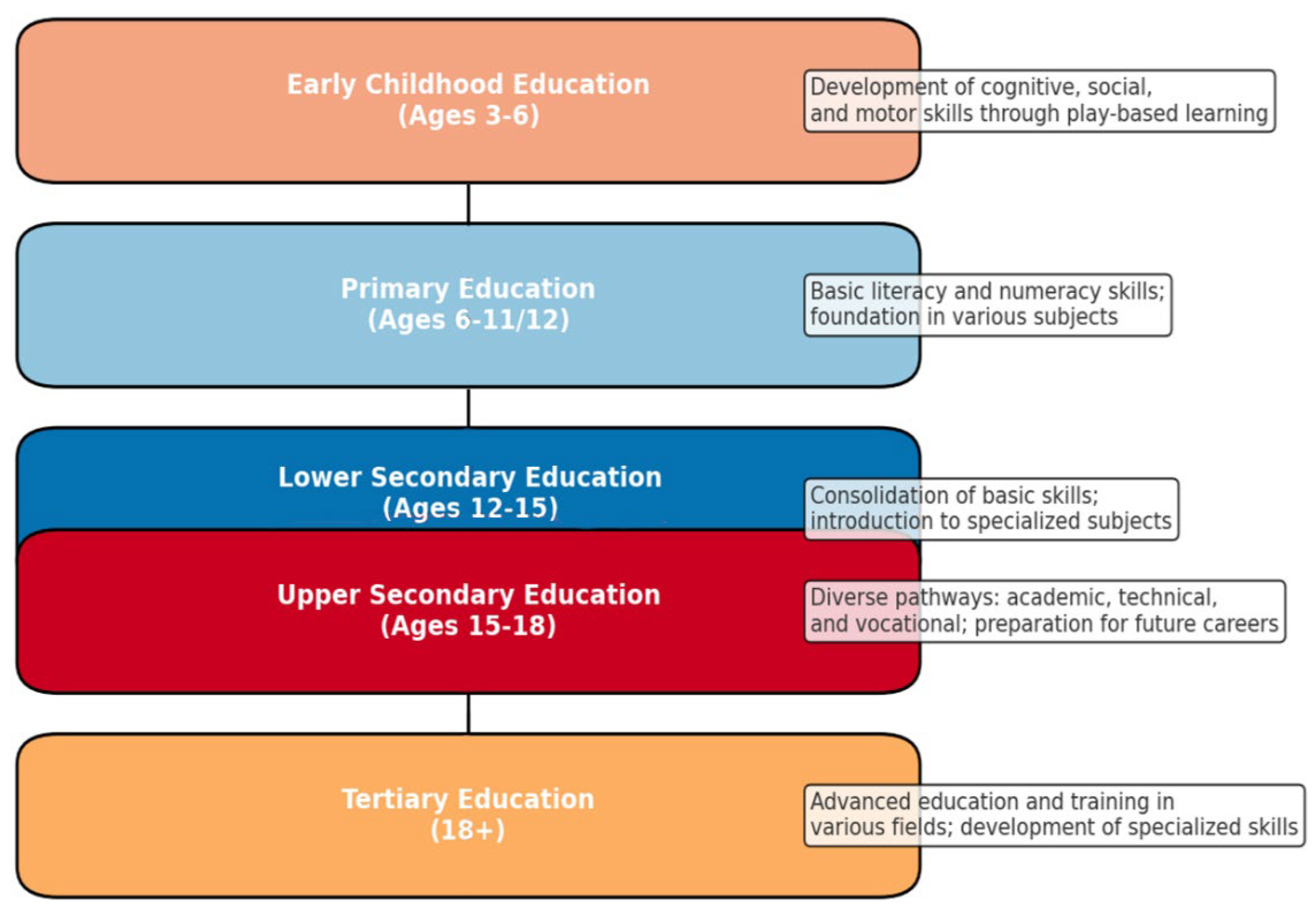
Figure 2.
Skills for the Workplace and Sustainability, and Safety and Plant Monitoring: (a) energy saving and environmental sustainability; (b) for sustainable mobility and technical plants; (c) safety and fire prevention; (d) cogeneration plants (combined production of energy and heat).
Figure 2.
Skills for the Workplace and Sustainability, and Safety and Plant Monitoring: (a) energy saving and environmental sustainability; (b) for sustainable mobility and technical plants; (c) safety and fire prevention; (d) cogeneration plants (combined production of energy and heat).

Figure 4.
Average assessment of the level of industry-specific competence.
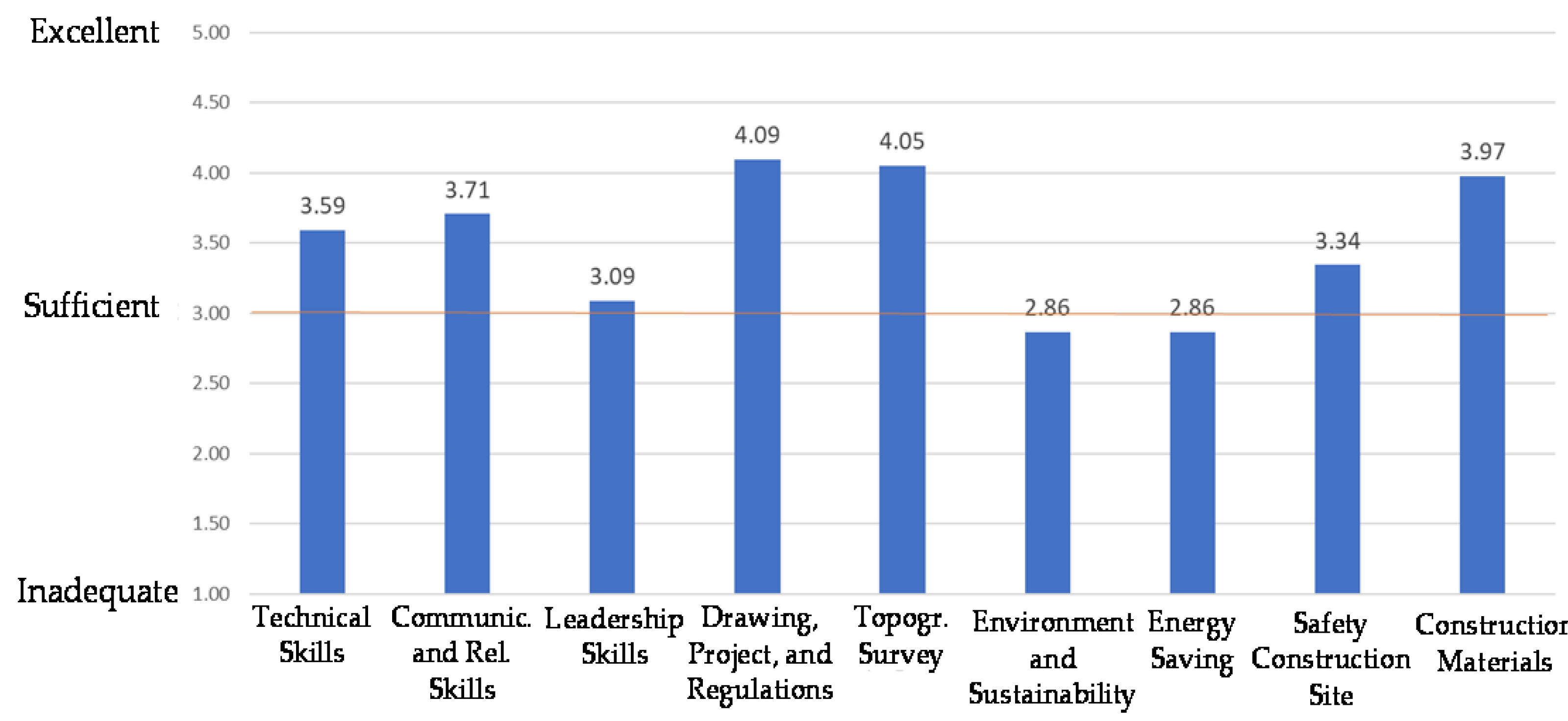

Table 1.
Overview of the questionnaire for students (survey topics, contents, questions and evaluations).
Table 1.
Overview of the questionnaire for students (survey topics, contents, questions and evaluations).
| Section | Survey Topic | Contents | Questions and Evaluations |
|---|---|---|---|
| 1 | Teaching Quality | Assessment of teaching quality, practical lab experience, and curriculum relevance. | Students were asked to provide an overall assessment of the quality of the teaching received, listing the aspects they most appreciated and evaluating their practical laboratory experience. Finally, they were asked whether they believe the teaching programs are up-to-date and, if not, which topics should be integrated or enhanced. |
| 2 | Services and Support | Perceptions of school’s resources and services | Students were asked to provide their perceptions of the school's resources and services, such as libraries, tutoring, and career guidance |
| 3 | School Environment and Teacher Attitudes | Reflection on the school's atmosphere and teacher support. | Students were invited to reflect on the School Environment and Teacher Attitudes, describing the atmosphere of the Institute and indicating the perceived level of interest and availability from teachers in supporting their educational path. |
| 4 | Future Prospects | Graduates' plans regarding further studies or starting to work. | Students were asked to express their future intentions regarding continuing their studies and/or entering the workforce. |
| 5 | Skills for the Workplace and Sustainability | Integration of environmental sustainability skills into the study program. | Students were invited to indicate which environmental sustainability skills they believe should be integrated into the study program |
| 6 | Safety Skills and Plant Monitoring | Enhancement of workplace safety, fire prevention, and plant monitoring skills. | Students were to reflect on specific skills related to workplace safety, fire prevention, and plant monitoring that could potentially be enhanced in the CAT course. |
| 7 | Additional Opinions | Additional suggestions or comments | Students were given the opportunity to freely express additional suggestions or comments on the study program or the school in general. |
Table 2.
Overview of the questionnaire for companies and institutions (survey topics and contents).
| Section | Survey Topic | Contents |
|---|---|---|
| 1 | Technical Skills | Related to the ability to learn and utilize new technologies, familiarity with specific computer tools, and the capacity to analyze and solve technical problems. |
| 2 | Communication and Interpersonal Skills | Related to the students' ability to listen actively, write reports or documents, work in teams, adapt to various situations, and manage time and deadlines. |
| 3 | Leadership Skills | Related to taking responsibility, decision-making abilities, and the capability to motivate and inspire others |
| 4 | Industry-Specific Skills | Divided into various subcategories such as design, planning, regulations, topographic surveying, environment, sustainability, energy saving, safety, site management, and building materials |
Table 3.
Average assessment of competence provided by the companies or institutions.
| Category | Specific Competence | Average |
|---|---|---|
| Technical Skills | Ability to learn and use new technologies | 3.73 |
| Knowledge and use of specific IT tools | 3.52 | |
| Ability to analyze and solve technical problems | 3.52 | |
| Communication and Relational Skills | Active listening | 3.98 |
| Competence in writing reports or documents | 2.92 | |
| Teamwork and collaboration | 4.29 | |
| Adaptability and flexibility | 3.68 | |
| Time management and meeting deadlines | 3.66 | |
| Leadership Skills | Taking responsibility | 3.04 |
| Decision-making ability | 3.04 | |
| Motivation and inspiration of others | 3.19 | |
| Drawing, Project, and Regulations | Knowledge of drawing standards | 4.24 |
| Knowledge of project techniques | 3.89 | |
| Ability to propose solutions and use CAD tools | 4.15 | |
| Topographic Survey | Knowledge of survey methods and tools | 4.34 |
| Knowledge of cadastral updating practices | 4.16 | |
| Ability to perform surveys independently | 3.66 | |
| Environment and Sustainability | Understanding of environmental issues | 3.04 |
| Ability to propose eco-sustainable solutions | 2.87 | |
| Knowledge of sustainability principles | 2.68 | |
| Energy Saving | Knowledge of energy saving strategies | 2.98 |
| Ability to identify energy saving opportunities | 2.86 | |
| Involvement in energy efficiency projects | 2.75 | |
| Safety and Construction Site | Understanding of safety regulations in construction sites | 3.78 |
| Knowledge of risk management procedures | 3.21 | |
| Application of workplace safety measures | 3.04 | |
| Construction Materials | Knowledge of construction materials and their properties | 4.13 |
| Ability to select appropriate materials | 4.00 | |
| Competence in the use of materials | 3.79 |
Table 4.
Proposal for the Sustainable Mobility – Agenda 2030 module for the transversal teaching of Civic Education.
Table 4.
Proposal for the Sustainable Mobility – Agenda 2030 module for the transversal teaching of Civic Education.
| THEMATIC PATH - SUSTAINABLE MOBILITY - AGENDA 2030 |
|---|
| COMPETENCES |
| Educational, Cultural, and Professional Profile for Upper Secondary Schools: 1- European Key Competences Digital competence: Ability to use new technologies proficiently and critically to find, produce, exchange, and present various types of digital content. Personal-social competence and learning to learn: Ability to organize information and time, manage one's educational path, and contribute in contexts where one is called to intervene. 2- Annex to Legislative Decree 226/2005 integrated by Annex C Civic Education Guidelines: Understanding the constitutional and administrative organization of our country to fulfill one’s duties as a citizen and exercise political rights with awareness at territorial and national levels. Being aware of the values and rules of democratic life. Participating in cultural debate. Grasping the complexity of existential, moral, political, social, economic, and scientific problems and formulating reasoned personal responses. |
| FIRST TRIMESTER |
| TOPOGRAPHY - 8 hours Roads and smart cities: a step towards sustainable mobility. |
| ENGLISH - 3 hours Smart cities. |
| DESIGN OF BUILDINGS AND TECHNOLOGICAL SYSTEM - 4 hours Energy saving and sustainability |
| SECOND PENTAMESTER |
| ITALIAN AND HISTORY - 6 hours Perception and analysis of the current urban conurbation of our cities. |
| CONSTRUCTION SITE - 2 hours Electrical energy safety and charging stations for new electric mobility. |
| PHYSICAL EDUCATION - 2 hours Safe and sustainable driving |
| APPRAISAL - 4 hours Environmental impacts of new mobility: the paradigm shift that is the change in emissions |
| MATHEMATICS - 2 hours Statistical studies on emissions from electric vehicles and battery disposal in the future. |
| TOPOGRAPHY - 2 hours Smart roads: how to improve traffic flows and reduce emissions due to traffic jams. Traffic and queue models. |
| INVOLVED DISCIPLINES |
|
History – Italian Mathematics Topography – Appraisal and Construction Design and Systems Construction site management and safety Physical education |
| HOURS |
| 33-hour module (15 in the trimester and 18 in the pentamester) |
|
TEACHING METHODS Cooperative learning Flipped classroom Dialogical lesson Traditional lesson Problem solving Videos Dedicated websites |
|
ASSESSMENT OF LEARNING Ongoing knowledge assessment: Oral and review questions on topics covered in previous lessons Competence assessment At the end of the course, students will work in groups to complete a real-world task through the creation of a multimedia product. The presentation will delve into the theme of sustainable mobility and the cities of the future. |
Disclaimer/Publisher’s Note: The statements, opinions and data contained in all publications are solely those of the individual author(s) and contributor(s) and not of MDPI and/or the editor(s). MDPI and/or the editor(s) disclaim responsibility for any injury to people or property resulting from any ideas, methods, instructions or products referred to in the content. |
© 2024 by the authors. Licensee MDPI, Basel, Switzerland. This article is an open access article distributed under the terms and conditions of the Creative Commons Attribution (CC BY) license (http://creativecommons.org/licenses/by/4.0/).
Copyright: This open access article is published under a Creative Commons CC BY 4.0 license, which permit the free download, distribution, and reuse, provided that the author and preprint are cited in any reuse.


