

Submitted:
27 July 2024
Posted:
29 July 2024
You are already at the latest version
Abstract
Research interest in the occurrence, distribution, fate, and toxicity of N-(1,3-Dimethylbutyl)-N’-phenyl-p-phenylenediamine (6PPD) quinone, a derivative of the tire amino antioxidant 6PPD in urban environments, has surged. While several studies have found that 6PPD quinone exhibits acute, reproductive, and behavioral toxicity as well as mutagenicity and hepatotoxicity in aquatic and terrestrial animals, its environmental exposure data are fragmented and lack coherence across the source-to-exposure continuum, making it difficult to use for risk assessment and regulatory purposes. The present work developed an aggregate exposure pathway (AEP) framework to integrate the exposure data. An AEP network was developed for the atmospheric deposition of 6PPD quinone from tire wear in the Pearl River Delta, which led to human exposure. The 6PPD quinone research was organized, visualized, and evaluated with pertinent knowledge gaps identified using the weight of evidence assessment. Eight key exposure states were identified, with only two having high confidence levels and three having low confidence levels. Empirical support for the key transitional relationships decreased from High to Low from the source to the target site, indicating an urgent need for downstream mechanistic data. The proposed AEP framework integrated diverse 6PPD quinone research, facilitating a mechanistic understanding of the source-to-outcome continuum, as well as the development of quantitative predictive models for future research and environmental regulation.
Keywords:
tire derived chemicals
; cumulative risk assessment
; conceptual site model
; air pollution
1. Introduction
Chemical pollution is a major global challenge and is estimated to contribute to at least 1.8 million deaths per year [1]. Although there are more than 350,000 commercially available synthetic chemicals [2], less than 0.1% have data on environmental distribution, transport, transformation, and toxicity [3]. With hundreds of new synthetic chemicals being manufactured each year, current production, consumption, and environmental discharge surpass efforts to link human and wildlife exposure to potential adverse health outcomes [4].
Humans and wildlife often come into contact with a complex mixture of chemicals released by multiple sources, transported by multiple pathways, transformed and partitioned by multiple processes, and simultaneously or sequentially taken up through multiple routes before eliciting a biological response [5]. Moreover, experts from different disciplines, such as analytical chemistry, atmospheric chemistry, (eco)toxicology, environmental and occupational health, and epidemiology, often use different tools to qualitatively and quantitatively characterize the contact between receptors (i.e., humans and wildlife) with chemical stressors to elucidate how the sources, pathways, and mechanisms of exposure influence exposure temporality (nature, magnitude, type, frequency, duration, and latency) and lead to deleterious health effects [6]. Hence, current exposure data are often disjointed and fragmented, making it difficult to use them to effectively inform regulatory policies, support sustainable solutions, and protect humans and wildlife.
Advances in technology have expanded the identification and quantification of known chemical stressors in environmental and biological samples to unknown known and unknown chemicals using suspect screening and non-target analysis, respectively [7]. These developments have enabled the characterization of the exposure temporality of complex chemical mixtures across the source-to-target site continuum. However, this improved ability to generate high-throughput exposure data has not been complemented by a corresponding improvement in the approaches that assess the link between the state of the chemical stressors in the receptor and the sources, pathways, and mechanisms of exposure. Recently, direct analysis of urban runoff using high-resolution mass spectrometry identified N-(1,3-dimethylbutyl)-N′-phenyl-p-phenylenediamine (6PPD) quinone, a transformation product of 6PPD (an amino antioxidant added to tires), as a chemical stressor that caused the annual acute mortality of Coho salmon in the Pacific Northwest [8]. While this study showed the importance of identifying unknown unknowns in environmental risk assessment, the resultant surge in studies on the environmental occurrence, transport, transformation, and toxicity of 6PPD quinone shows the necessity of coordination, organization, and harmonization in exposure assessment across disciplines.
Since the first detection of 6PPD quinone in the environment, the number of publications on 6PPD quinone has increased by 1,100% from five in 2021 to 55 in the first seven months of 2024. Several critical narrative reviews have organized, summarized, evaluated, and synthesized the 6PPD quinone literature, focusing on its environmental [9], fate [10,11], toxicity [12], chemical analysis [13,14], and human exposure [15,16]. While the reviews managed to identify data gaps and offer recommendations, they were limited in facilitating integration across the source-to-target site continuum in a manner that promoted exposure prediction, optimization of exposure data use, and empirically identifying relevant data needs.
There is an urgent need for mechanism-based holistic integration of the surging but disjointed and fragmented exposure data of 6PPD quinone into coherent evidence to support effective human and environmental risk assessment. The aggregate exposure pathway (AEP) framework offers a mechanistic link between source and target sites by organizing, optimizing, integrating, and evaluating exposure data [17]. An AEP is a collation of evidence of the ‘plausible and empirically supported’ biotic and abiotic causative relationship between environmental emission and state of the chemical stressor at the target site, that is, target site exposure (TSE) (Figure 1) [18]. It requires quantitative and qualitative spatiotemporal data on the transfer of chemical stressors from the source to the receptor, their subsequent contact with the receptor, and the transformation of the chemical receptor before and after contact. Using systems thinking, an AEP can be envisioned as a cascade of key events beginning from the source where a chemical stressor is formed or discharged into the environment, environmental transport and transformation processes in environmental compartments, chemical exposure and the respective pathways and patterns, and the chemodynamics or toxicokinetics and toxicodynamics that yield the TSE [17,19]. Each of the key events is called the key exposure state (KES), and the causal relationship between adjoining KES is called the key transitional relationship (KTR). The KES offers verifiability for the AEP, for example increase in 6PPD quinone in indoor dust over time or in specific areas while KTR offers ‘unit of inference or extrapolation’, for example formation of 6PPD quinone in air or adsorption of 6PPD quinone on sediments [18].
The source and TSE are specialized types of KES that describe the state of the chemical stressor (i.e., concentration/amount, duration, frequency, and nature) at the site of environmental emission, and biological receptors that initiate a response at the molecular or cellular level, respectively. However, the TSE can be a chemical stressor in an environmental sink (i.e., abiotic, e.g., 6PPD quinone concentration in sediments) if the objective is to assess environmental accumulation or persistence. In addition, TSE is associated with a molecular initiating event for an adverse outcome pathway (AOP) framework, which is widely used to link internal exposure to biological responses in organisms [17]. Linking the various KES (i.e., sources, exposure media, and external and internal exposures) of a chemical stressor, such as 6PPD quinone, using the respective KTRs creates a visual pathway or AEP network that could offer coherent mechanistic information on the transfer of 6PPD quinone to humans and wildlife and the corresponding deleterious biological effects. The developed AEP network could provide critical information to support 6PPD quinone regulations. Although studies using the AEP framework remain scarce despite its immense potential benefits for improving risk assessment, the AEP framework has been used in site-based cumulative risk assessments of perchlorate [20,21], microplastics [22], and phthalates [23]. The present study used the AEP framework to integrate exposure pathways and processes of 6PPD quinone by assessing its existing exposure data, empirically identifying data gaps using a weight-of-evidence approach, illustrating the utility of AEP networks using a site-based case study focusing on an urban center in China, and offering recommendations for regulations and future studies.
2. Materials and Methods
2.1. Study Area
Located in South China in the southern subtropical zone, the Pearl River Delta covers 56,000 km2 and includes megacities such as Guangzhou, Shenzhen, and Hong Kong. With average annual rainfall of 1,600-2,300 mm and temperature of 21.4-22.4 °C, the PRD has a subtropical monsoon climate marked by wet summers between May and October and dry winters between November and April [24]. The PRD has a population of 86 million, contributing 6.1% to the total population of China, despite covering less than 1% of the total area of China [25]. Between 2000 and 2019, the GDP of the PRD increased eight times to 1.28 trillion US dollars. Besides causing a significant decline in forest, grass, and river land cover, rapid industrialization and urbanization in the PRD have caused severe air, soil, and water pollution [25]. In addition, there are 13.8 million private vehicles in the PRD and over 62,600 km on highways [26]. Vehicle emissions are recognized as the main source of atmospheric pollution in the PRD, and vehicle emissions have evolved from exhaust discharges to non-exhaust discharges, such as tire wear. Hence, an AEP was developed to assess 6PPD quinone exposure in the PRD, with a focus on human exposure following atmospheric deposition.
2.2. Literature Search and Selection
Twelve published original research articles on the occurrence, chemodynamics, and toxicokinetics of 6PPD quinone were evaluated to assemble and assess the 6PPD quinone AEP network. Original research articles (n = 127) were mined using a systematic literature search of the SCOPUS database on July 23, 2024. The search strings used were “ 6PPD-quinone “ or “ 6PPD quinone.” Articles not from China or Hong Kong (n = 74), review articles (n = 5), and articles not in English (n = 1) were excluded. The remaining 47 articles were initially screened by checking their titles and abstracts, which resulted in the exclusion of review articles (n = 2). The study areas were checked in each article and those that included Guangdong, Shenzhen, and Hong Kong were selected (n = 12). Laboratory studies assessing the physicochemical behavior in environmental media and toxicokinetics were also included (n = 3).
2.3. Assembling and Assessing the 6PPD Quinone AEP Network
All selected articles were grouped into KES (source, interim KES, and TSE), and the KTRs connecting them were identified. Only atmospheric deposition and roadside dust were included as sources (KES1 and KES2, respectively), although studies have identified artificial turf and wastewater treatment plants as sources of 6PPD quinone [27,28]. The concentration of 6PPD quinone in KSE1-KSE7 was determined using ultrahigh-performance liquid chromatograph equipped with triple-quadrupole mass spectrometer with a limit of detection of 0.03 - 1.0 pg m-3 in KES1, 0.24 - 0.37 ng/g in KES2, 0.05 ng/L in urban runoff (KES3), 0.09 - 0.160 in surface water (KES4), and 0.05 ng/g in fish (KSE5). However, no detection limit has been reported for human serum (KSE 6) or cerebrospinal fluid (KSE7).
The strength of the exposure data to support the developed 6PPD quinone AEP network was assessed using the weight-of-evidence approach developed by Peng et al. (Table 1)[22]. Based on the four criteria developed by the OECD for AOP frameworks, the essentiality of the KES and theoretical plausibility, empirical support, and quantitative evidence of the KTR linking the two KES was critically examined. The quality of support was scored as Low, Moderate or High in ascending order, with data gaps noted.
3. Results and Discussion
The 6PPD quinone source, transfer, and contact pathways in the Pearl River Delta region were described using an AEP network assembled using eight KSEs (Figure 2). Aerial deposition of particulate matter and road dust were considered the sources of 6PPD quinone; each KSE was supported by three [29,30,36] and four studies [31,32,33,34] respectively. The initial exposure medium was urban runoff (KSE3), which is supported by four studies that investigated the distribution of 6PPD quinone [34,35,36,37]. Receiving rivers (KSE4) were the secondary exposure media [34,36,37]. External exposure in fish (KSE5)[38] was determined using the reported whole-body concentration, whereas that in humans (KSE6) was based on human biomonitoring [39,40]. The initial internal exposure was estimated using the 6PPD quinone concentration in human blood serum (KSE6)[39,40,41] whereas the secondary internal exposure was estimated using the concentration in cerebrospinal fluid (KSE7) [42] as the 6PPD quinone crossed the blood-cerebrospinal fluid barrier (BCSFB). Primary dopaminergic neurons were considered the target site exposure (KSE8) since there was only one investigation relevant to TSE in the PRD [42].
3.1. Essentiality of the Key Exposure States
The KES represented a measurable change in the physicochemical state of 6PPD quinone essential for the movement of 6PPD quinone along the AEP, leading to exposure at a specific target site. Hence, essentiality assessed whether the manipulation (blocking (direct evidence), modulation attenuation (indirect evidence)) of upstream events alters downstream events. The essentiality of KES1 was Low because there was a single indirect evidence showing that the ratio of 6PPD/6PPD-quinone in ambient air (KSE1) was similar to that in road dust (KES2)[34], which suggested that KSE1 was the source of 6PPD quinone downstream, as previously suggested [32]. There was multiple direct evidences linking road dust (KSE2) to downstream 6PPD quinone distribution, including urban runoff (KSE3) and rivers (KS4) [34]. Hence, the essentiality of KES2 is deemed high. Liu et al. offered indirect evidence that small-intensity rainfall washed off road dust (KSE2) and increased the concentration of 6PPD quinone in urban runoff (KES3) [35]. The essentiality of urban runoff (KSE3) was deemed high, as there was multiple direct evidences showing that urban runoff increased the 6PPD quinone concentration in surface water (KES4) [37]. Previous studies have found that the concentrations of 6PPD and 6PPD quinone were higher in KSE3 than in KSE4, and this shower urban runoff acted as a non-point source of 6PPD quinone in receiving rivers [36,37]. The essentiality of KSE4 was deemed moderate, as multiple direct evidences showed that 6PPD quinone in surface water bioaccumulated in fish with a log bioaccumulation factor of 1.3–1.9 in nine fish species, which is low [38]. Human exposure (KSE6) following the consumption of fish was based on dietary exposure estimates (KSE5) [38], providing a single indirect evidence linking KSE5 to KSE6; thus, KSE5 was deemed low. The essentiality of KES6 was deemed moderate as there were two studies that detected 6PPD quinone in blood serum (KSE6)[39,41] and a single indirect evidence that detected 6PPD quinone concentration in both blood and cerebrospinal fluids (KSE7)[42] which suggested that 6PPD quinone crossed the BCSFB. Studies on human biomonitoring of 6PPD quinone remain scarce, and there is an overreliance on exposure estimates that limit the essentiality of internal exposure and target-site exposure KESs.
3.2. Theoretical Plausibility of Key Transitional Relationships
The chemodynamics and toxicokinetics of 6PPD quinone are primarily influenced by physicochemical processes in the environment. An AEP describes physicochemically plausible key event cascades linking the source to interim KES and the target site. To achieve this, an AEP should answer the question of whether there is a mechanistic relationship between upstream and downstream KES. It is widely understood that organic pollutants in air are major determinants of the concentration of organic pollutants in road dust because adsorption of organic pollutants directly to road dust particles and indirectly via adsorption to ambient particulate matter followed by deposition of the ambient particulate matter to road dust contributes to the air-dust partitioning of organic pollutants [43]. The theoretical plausibility of KTR1 was deemed moderate, as a previous study demonstrated that particle size influenced the adsorption rates of 6PPD quinone on road dust [32]. However, there are currently no studies on the deposition rates of particulate matter-associated 6PPD quinone in road dust. The theoretical plausibility of KTR2 was deemed moderate because a previous study found partitioning of 6PPD quinone from road dust to water fitted to a pseudo-first-order kinetic model with organic carbon–water partition coefficients (log KOC) of 3.2 in dust from arterial roads and 3.5 in residential roads, respectively [44]. However, there is a major knowledge gap regarding the effect of the physicochemical properties of road dust on 6PPD quinone log KOC.
Organic pollutants in urban runoff are often transported to receiving waters attached to suspended particles, with the amounts partitioned to the water column depending on the physicochemical properties of the organic pollutant. Urban runoff formation is mainly determined by landscape morphology and rainfall intensity, and the same factors determine the amount of organic pollutants that reach receiving waters [45]. However, there is a partial mechanistic understanding of the causal relationship between urban runoff and the phase partitioning of 6PPD quinone in receiving waters. Data from a previous study revealed that 6PPD quinone contains field-based suspended particles with a water partition coefficient (Kd) of 0.029 [37]. For that reason, the theoretical plausibility of KTR3 was deemed moderate. Additional studies are needed to quantify the phase partitioning of 6PPD quinone from urban runoff to receiving rivers.
The bioaccumulation and trophic transfer of 6PPD quinone in fish have been shown in a single field study [38]. In addition, there is extensive evidence showing that bioaccumulation in fish occurs via aqueous uptake of organic pollutants in the surface water column (i.e., bioconcentration) and dietary ingestion of contaminated prey (biomagnification). Bioconcentration in fish has been shown to increase with hydrophobicity, as a significant positive correlation between the logarithmic octanol–water partitioning coefficients (log KOW) and the aqueous uptake rate constant (ku) of organic pollutants usually has a positive relationship in fish, suggesting that bioconcentration increases with an increase in hydrophobicity [46]. In addition, fish are sometimes exposed to 6PPD quinone attached to tire-wear particles. A previous study found that 6PPD quinone attached to tire wear particles had high bioaccessibility, as it readily solubilized in fish gut fluids, and its solubilization kinetics followed a logarithmic model [47]. This is because 6PPD quinone is formed by the oxidation of 6PPD at the surface of tire wear particles. Therefore, the theoretical plausibility of KTR4 was deemed moderate.
Following the consumption of contaminated fish, bioaccumulation occurs when organic pollutants cross the intestinal epithelial membrane and enter the bloodstream. Depending on their chemical structure and physicochemical properties, organic pollutants can cross this first physiological barrier through active transport, passive transcellular pathways, or facilitated paracellular pathways [48]. The log KOW (4.3) and polar surface area (24.05 Å2) which are between −1.0 and 5.9 and below 131.6Å2 [49]. Based on these three mechanistic models, 6PPD quinone has a high potential to cross the intestinal epithelial membrane. Although no studies have confirmed the mechanistic model of 6PPD quinone in the human gastrointestinal tract, the theoretical plausibility of KTR5 was deemed high because there is a widely accepted mechanistic understanding of the transfer of chemical pollutants from fish to human blood.
The movement of endogenous substances and xenobiotics across the blood-cerebrospinal fluid barrier (BCSFB) is a highly regulated process that allows the importation of nutrients and ions and exportation of metabolic waste while limiting the free diffusion of xenobiotics [50]. Organic pollutants may cross the BCSFB via transcellular pathways rather than paracellular diffusion, because the BCSFB consists of tightly connected choroid plexus epithelial cells [51]. Studies have found that xenobiotics may cross the BCSFB when they have a molecular weight below 400 Da, polar surface area below 44.8, log Kow around 2.8, and can form less than eight hydrogen bonds [51,52]. However, permeability can be influenced by human factors such as age, activities, and health status. The theoretical plausibility of KTR6 was deemed low since 6PPD quinone has a higher log Kow and moderate lipophilicity, which implies that it might not readily cross the BCSFB.
Mitochondria are organelles that represent the primary target sites for some organic pollutants. They contain two lipid bilayers that divide the intermembrane space of the matrix. The outer lipid bilayer is rich in cholesterol and allows the free diffusion of small molecules with molecular weight below 10k Da. In contrast, the inner membrane does not contain cholesterol and is relatively impermeable, allowing active transport. Compared with the intermembrane space (pH = 6.9), the matrix was slightly alkaline (pH = 8.0) and had a net negative charge [53]. These environments ensure that mitochondria maintain metabolic homeostasis. However, the same environment promotes the uptake of organic pollutants, especially amphiphilic xenobiotics, into the matrix and inner membrane [53]. This leads to the disruption of mitochondrial function and permeability [54]. As 6PPD quinone is amphiphilic, has a molecular weight below 10k Da, and is moderately lipophilic, it can readily diffuse through the outer membrane, sorb onto the inner membrane, and possibly accumulate in the matrix. Mechanistic understanding of this process in neuronal mitochondria is still unclear; hence, the theoretical plausibility of KTR7 was deemed low.
3.3. Empirical Support for the Key Transitional Relationships
Empirical support improves confidence in the KTR by evaluating concordance in exposure temporality between adjacent KESs. It offers spatiotemporal empirical data that show the dependence and sequential changes between two adjacent KESs. This entails assessing experimental data evaluating KES associations, as reflected by partition coefficients of the organic pollutant between adjacent environmental media, environmental media, biological receptors, and adjacent biological receptors. It can also be reflected by the temporal relationships of the organic pollutants across each phase combination, for example, the volume of distribution in blood, half-life in environmental media, or rate of volatilization. As there are limited studies showing causal relationships between the 6PPD quinone concentration in the atmosphere and road dust, the empirical support for KTR1 was deemed moderate. In contrast, multiple studies demonstrated time, spatial, and concentration dependence of urban runoff on road dust as well as receiving waters on urban runoff, indicating high empirical support for both KTR2 and KTR3, respectively. While there is empirical support for the bioaccumulation and bioconcentration of organic pollutants in fish and humans, there is limited directed evidence specific for 6PPD quinone in humans while there is a single one for fish; thus, the empirical support for KTR4 and KTR5 were deemed moderate and low, respectively. Since no empirical data supporting the spatiotemporal distribution of 6PPD quinone in blood-cerebrospinal fluid and cerebrospinal fluid-neuronal mitochondria interfaces are available, the empirical support for both KTR 6 and KTR7 was deemed low.
3.4. Quantititave Understanding of the Key Transitional Relationships
Despite the importance of quantitative analysis of downstream KTRs, such as KTR6, which is essential for connecting the AEP to an AOP, as well as upstream KTRs, such as KTR2 and KTR2, which are essential for developing pollution mitigation strategies, there is a dearth of studies offering comprehensive quantitative understanding of the KTRs in the 6PPD quinone AEP. At present, quantitative structure-activity relationships are mainly used to estimate the phase transfer properties of 6PPD quinone in environmental media and biological receptors. Changes in road dust are difficult to predict based on 6PPD quinone concentration and spatiotemporal distribution because 6PPD quinone can be transferred to road dust directly from tire wear particles passing through the road. Additionally, atmospheric conditions differ across regions, making it difficult to generalize the deposition of 6PPD quinone on road dust. Hence, the quantitative understanding of KTR1 was deemed low. In contrast, there is evidence that changes in urban runoff and receiving rivers can be predicted by changes in road dust and urban runoff. For receiving rivers, discharge from wastewater treatment plants, direct atmospheric deposition to the river or indirectly to upstream lakes, and seepage from landfills can confound their dependence on urban runoff. No study has quantitatively assessed the contributions of these different sources to the presence of 6PPD quinone in rivers. Hence, a quantitative understanding of KTR2 and KTR3 was deemed moderate. The bioaccumulation factor of 6PPD quinone was experimentally shown to be moderate, indicating that there were considerable uncertainties in predicting its concentration in fish based on river water concentrations. In contrast, no studies have linked concentrations in fish and human serum, blood and cerebrospinal fluid, cerebrospinal fluid, and neuronal mitochondria. For this reason, the quantitative understanding of KTR4-7 was deemed low.
4. Applications of the Aggregate Exposure Pathway to Advance Risk Assessment
Constructing a site-specific risk model using an AEP is imperative when conducting community-based cumulative risk assessment. As shown in this study, an AEP can identify and connect environmental media and organisms using a mechanistically grounded exposure pathway, which is essential for predicting exposure risks and characterizing primary exposure risk drivers. In the case study presented, the AEP facilitated the organization of mechanistic exposure data in different environmental media (i.e., air, road dust, urban runoff, and rivers) and organisms (i.e., fish and humans); the critical data gaps that limit the prediction of 6PPD quinone exposure temporality in one environmental compartment based on an adjacent one, demonstrated the impact of uncertainties in exposure pathways and mechanisms, and leveraged available data from other organic contaminants or locations to improve mechanistic understanding promoting interoperability.
The constructed 6PPD quinone AEP framework could facilitate the harmonization, collation, and integration of 6PPD quinone exposure, which is essential for developing an effective exposure data repository. As more exposure data, locations, and key exposure states are added to the AEP framework, comparisons of source, external exposure, internal exposure, and target site exposure across space and time will become easier. While most studies included in the case study used LC-MS/MS to identify and quantify 6PPD quinone in environmental media and biological samples, some studies did not include validation parameters such as the limit of detection, making it difficult to have confidence in the reported concentrations. Peng et al. recommended that an AEP should include standardized protocols for sampling, extraction, separation, detection, and quantification of the stressor [22]. Furthermore, identifying and assessing KESs and KTRs helped identify critical knowledge gaps. For example, despite the widespread use of exposure models to estimate human exposure to organic pollutants following the consumption of contaminated food, empirical evidence supporting this remains scarce. Additionally, the assessment of the Weight of Evidence revealed a gap in the current understanding of the transfer of 6PPD quinone in human blood to the target site. This is probably because of the ethical challenges in conducting such studies. However, with the recent development of organoids, organ-specific in vitro assessments can be conducted to better understand the mechanism of the transfer of organic pollutants.
While the developed AEP could be used to collect further evidence for a location-based cumulative risk assessment, there are some limitations that should be considered. Potential sources of 6PPD, such as artificial turf, landfills, and wastewater treatment plants, were not included in the study. An AEP cannot include all potential sources and interim key exposure sites, as this might overly complicate it. However, with advances in database construction and machine learning, such complex AEP are possible. It is important to note that 6PPD quinone is a chiral compound, which means that it exists as an enantiomer, which may have different phase transfer properties. Chiral compounds have similar physical properties in an achiral environment; however, in a chiral environment, such as human blood, epithelial membranes, and biological target sites, they behave differently. Previous studies have shown that adsorption of chiral pollutants in sludge and soil is enantioselective. However, in this case study, it was assumed that the physicochemical properties of the 6PPD quinone enantiomers from the source site to the target site were similar. Further studies are required to confirm this assumption.
Supplementary Materials
The following supporting information can be downloaded at the website of this paper posted on Preprints.org.
Funding
This research received no external funding.
Institutional Review Board Statement
Not applicable.
Informed Consent Statement
Not applicable.
Data Availability Statement
All data used is available in the Supplementary Materials.
Conflicts of Interest
The author declare no conflicts of interest.
References
- Fuller, R.; Landrigan, P.J.; Balakrishnan, K.; Bathan, G.; Bose-O’Reilly, S.; Brauer, M.; Caravanos, J.; Chiles, T.; Cohen, A.; Corra, L.; et al. Pollution and Health: A Progress Update. Lancet Planet. Health 2022, 6, e535–e547. [Google Scholar] [CrossRef]
- Wang, Z.; Walker, G.W.; Muir, D.C.G.; Nagatani-Yoshida, K. Toward a Global Understanding of Chemical Pollution: A First Comprehensive Analysis of National and Regional Chemical Inventories. Environ. Sci. Technol. 2020, 54, 2575–2584. [Google Scholar] [CrossRef]
- Muir, D.C.G.; Getzinger, G.J.; McBride, M.; Ferguson, P.L. How Many Chemicals in Commerce Have Been Analyzed in Environmental Media? A 50 Year Bibliometric Analysis. Environ. Sci. Technol. 2023, 57, 9119–9129. [Google Scholar] [CrossRef]
- Persson, L.; Carney Almroth, B.M.; Collins, C.D.; Cornell, S.; de Wit, C.A.; Diamond, M.L.; Fantke, P.; Hassellöv, M.; MacLeod, M.; Ryberg, M.W.; et al. Outside the Safe Operating Space of the Planetary Boundary for Novel Entities. Environ. Sci. Technol. 2022, 56, 1510–1521. [Google Scholar] [CrossRef]
- Caplin, A.; Ghandehari, M.; Lim, C.; Glimcher, P.; Thurston, G. Advancing Environmental Exposure Assessment Science to Benefit Society. Nat. Commun. 2019, 10, 1236. [Google Scholar] [CrossRef]
- Lioy, P.J.; Smith, K.R. A Discussion of Exposure Science in the 21st Century: A Vision and a Strategy. Environ. Health Perspect. 2013, 121, 405–409. [Google Scholar] [CrossRef]
- Price, E.J.; Vitale, C.M.; Miller, G.W.; David, A.; Barouki, R.; Audouze, K.; Walker, D.I.; Antignac, J.-P.; Coumoul, X.; Bessonneau, V.; et al. Merging the Exposome into an Integrated Framework for “Omics” Sciences. iScience 2022, 25. [Google Scholar] [CrossRef]
- Tian, Z.; Zhao, H.; Peter, K.T.; Gonzalez, M.; Wetzel, J.; Wu, C.; Hu, X.; Prat, J.; Mudrock, E.; Hettinger, R.; et al. A Ubiquitous Tire Rubber–Derived Chemical Induces Acute Mortality in Coho Salmon. Science 2021, 371, 185–189. [Google Scholar] [CrossRef]
- Zoroufchi Benis, K.; Behnami, A.; Minaei, S.; Brinkmann, M.; McPhedran, K.N.; Soltan, J. Environmental Occurrence and Toxicity of 6PPD Quinone, an Emerging Tire Rubber-Derived Chemical: A Review. Environ. Sci. Technol. Lett. 2023, 10, 815–823. [Google Scholar] [CrossRef]
- Chen, X.; He, T.; Yang, X.; Gan, Y.; Qing, X.; Wang, J.; Huang, Y. Analysis, Environmental Occurrence, Fate and Potential Toxicity of Tire Wear Compounds 6PPD and 6PPD-Quinone. J. Hazard. Mater. 2023, 452, 131245. [Google Scholar] [CrossRef]
- Ihenetu, S.C.; Xu, Q.; Khan, Z.H.; Kazmi, S.S.U.H.; Ding, J.; Sun, Q.; Li, G. Environmental Fate of Tire-Rubber Related Pollutants 6PPD and 6PPD-Q: A Review. Environ. Res. 2024, 258, 119492. [Google Scholar] [CrossRef]
- Bohara, K.; Timilsina, A.; Adhikari, K.; Kafle, A.; Basyal, S.; Joshi, P.; Yadav, A.K. A Mini Review on 6PPD Quinone: A New Threat to Aquaculture and Fisheries. Environ. Pollut. 2024, 340, 122828. [Google Scholar] [CrossRef]
- Cao, G.; Zhang, J.; Wang, W.; Wu, P.; Ru, Y.; Cai, Z. Mass Spectrometry Analysis of a Ubiquitous Tire Rubber-Derived Quinone in the Environment. TrAC Trends Anal. Chem. 2022, 157, 116756. [Google Scholar] [CrossRef]
- Khan, F.R.; Rødland, E.S.; Kole, P.J.; Van Belleghem, F.G.A.J.; Jaén-Gil, A.; Hansen, S.F.; Gomiero, A. An Overview of the Key Topics Related to the Study of Tire Particles and Their Chemical Leachates: From Problems to Solutions. TrAC Trends Anal. Chem. 2024, 172, 117563. [Google Scholar] [CrossRef]
- Kazmi, S.S.U.H.; Xu, Q.; Tayyab, M.; Pastorino, P.; Barcelò, D.; Yaseen, Z.M.; Khan, Z.H.; Li, G. Navigating the Environmental Dynamics, Toxicity to Aquatic Organisms and Human Associated Risks of an Emerging Tire Wear Contaminant 6PPD-Quinone. Environ. Pollut. 2024, 356, 124313. [Google Scholar] [CrossRef]
- Jin, R.; Venier, M.; Chen, Q.; Yang, J.; Liu, M.; Wu, Y. Amino Antioxidants: A Review of Their Environmental Behavior, Human Exposure, and Aquatic Toxicity. Chemosphere 2023, 317, 137913. [Google Scholar] [CrossRef]
- Tan, Y.-M.; Leonard, J.A.; Edwards, S.; Teeguarden, J.; Egeghy, P. Refining the Aggregate Exposure Pathway. Environ. Sci. Process. Impacts 2018, 20, 428–436. [Google Scholar] [CrossRef]
- Teeguarden, J.G.; Tan, Y.-M.; Edwards, S.W.; Leonard, J.A.; Anderson, K.A.; Corley, R.A.; Kile, M.L.; Simonich, S.M.; Stone, D.; Tanguay, R.L.; et al. Completing the Link between Exposure Science and Toxicology for Improved Environmental Health Decision Making: The Aggregate Exposure Pathway Framework. Environ. Sci. Technol. 2016, 50, 4579–4586. [Google Scholar] [CrossRef]
- Tan, Y.-M.; Leonard, J.A.; Edwards, S.; Teeguarden, J.; Paini, A.; Egeghy, P. Aggregate Exposure Pathways in Support of Risk Assessment. Curr. Opin. Toxicol. 2018, 9, 8–13. [Google Scholar] [CrossRef]
- Hines, D.E.; Conolly, R.B.; Jarabek, A.M. A Quantitative Source-to-Outcome Case Study to Demonstrate the Integration of Human Health and Ecological End Points Using the Aggregate Exposure Pathway and Adverse Outcome Pathway Frameworks. Environ. Sci. Technol. 2019, 53, 11002–11012. [Google Scholar] [CrossRef]
- Hines, D.E.; Edwards, S.W.; Conolly, R.B.; Jarabek, A.M. A Case Study Application of the Aggregate Exposure Pathway (AEP) and Adverse Outcome Pathway (AOP) Frameworks to Facilitate the Integration of Human Health and Ecological End Points for Cumulative Risk Assessment (CRA). Environ. Sci. Technol. 2018, 52, 839–849. [Google Scholar] [CrossRef]
- Peng, G.; Lin, Y.; van Bavel, B.; Li, D.; Ni, J.; Song, Y. Aggregate Exposure Pathways for Microplastics (mpAEP): An Evidence-Based Framework to Identify Research and Regulatory Needs. Water Res. 2022, 209, 117873. [Google Scholar] [CrossRef]
- Clewell, R.A.; Leonard, J.A.; Nicolas, C.I.; Campbell, J.L.; Yoon, M.; Efremenko, A.Y.; McMullen, P.D.; Andersen, M.E.; Clewell, H.J.; Phillips, K.A.; et al. Application of a Combined Aggregate Exposure Pathway and Adverse Outcome Pathway (AEP-AOP) Approach to Inform a Cumulative Risk Assessment: A Case Study with Phthalates. Toxicol. In Vitro 2020, 66, 104855–104855. [Google Scholar] [CrossRef]
- Chen, S.; Zhu, Z.; Liu, X.; Yang, L. Variation in Vegetation and Its Driving Force in the Pearl River Delta Region of China. Int. J. Environ. Res. Public. Health 2022, 19, 10343. [Google Scholar] [CrossRef]
- Lin, Y.; Ma, J.; Zhang, Z.; Zhu, Y.; Hou, H.; Zhao, L.; Sun, Z.; Xue, W.; Shi, H. Linkage between Human Population and Trace Elements in Soils of the Pearl River Delta: Implications for Source Identification and Risk Assessment. Sci. Total Environ. 2018, 610–611, 944–950. [Google Scholar] [CrossRef]
- HKTDC Research PRD Economic Profile. Available online: https://research.hktdc.com/en/data-and-profiles/mcpc/provinces/guangdong/pearl-river-delta (accessed on 26 July 2024).
- Cao, G.; Wang, W.; Zhang, J.; Wu, P.; Qiao, H.; Li, H.; Huang, G.; Yang, Z.; Cai, Z. Occurrence and Fate of Substituted P-Phenylenediamine-Derived Quinones in Hong Kong Wastewater Treatment Plants. Environ. Sci. Technol. 2023, 57, 15635–15643. [Google Scholar] [CrossRef]
- Zhao, F.; Yao, J.; Liu, X.; Deng, M.; Chen, X.; Shi, C.; Yao, L.; Wang, X.; Fang, M. Occurrence and Oxidation Kinetics of Antioxidant P-Phenylenediamines and Their Quinones in Recycled Rubber Particles from Artificial Turf. Environ. Sci. Technol. Lett. 2024, 11, 335–341. [Google Scholar] [CrossRef]
- Wang, W.; Cao, G.; Zhang, J.; Chen, Z.; Dong, C.; Chen, J.; Cai, Z. P-Phenylenediamine-Derived Quinones as New Contributors to the Oxidative Potential of Fine Particulate Matter. Environ. Sci. Technol. Lett. 2022, 9, 712–717. [Google Scholar] [CrossRef]
- Zhang, Y.; Xu, C.; Zhang, W.; Qi, Z.; Song, Y.; Zhu, L.; Dong, C.; Chen, J.; Cai, Z. P-Phenylenediamine Antioxidants in PM2.5: The Underestimated Urban Air Pollutants. Environ. Sci. Technol. 2022, 56, 6914–6921. [Google Scholar] [CrossRef] [PubMed]
- Zhang, Y.; Yan, L.; Wang, L.; Zhang, H.; Chen, J.; Geng, N. A Nation-Wide Study for the Occurrence of PPD Antioxidants and 6PPD-Quinone in Road Dusts of China. Sci. Total Environ. 2024, 922, 171393. [Google Scholar] [CrossRef] [PubMed]
- Deng, C.; Huang, J.; Qi, Y.; Chen, D.; Huang, W. Distribution Patterns of Rubber Tire-Related Chemicals with Particle Size in Road and Indoor Parking Lot Dust. Sci. Total Environ. 2022, 844, 157144. [Google Scholar] [CrossRef] [PubMed]
- Huang, W.; Shi, Y.; Huang, J.; Deng, C.; Tang, S.; Liu, X.; Chen, D. Occurrence of Substituted P-Phenylenediamine Antioxidants in Dusts. Environ. Sci. Technol. Lett. 2021, 8, 381–385. [Google Scholar] [CrossRef]
- Cao, G.; Wang, W.; Zhang, J.; Wu, P.; Zhao, X.; Yang, Z.; Hu, D.; Cai, Z. New Evidence of Rubber-Derived Quinones in Water, Air, and Soil. Environ. Sci. Technol. 2022, 56, 4142–4150. [Google Scholar] [CrossRef] [PubMed]
- Liu, Y.-H.; Mei, Y.-X.; Liang, X.-N.; Ge, Z.-Y.; Huang, Z.; Zhang, H.-Y.; Zhao, J.-L.; Liu, A.; Shi, C.; Ying, G.-G. Small-Intensity Rainfall Triggers Greater Contamination of Rubber-Derived Chemicals in Road Stormwater Runoff from Various Functional Areas in Megalopolis Cities. Environ. Sci. Technol. 2024, 58, 13056–13064. [Google Scholar] [CrossRef] [PubMed]
- Zhang, H.-Y.; Huang, Z.; Liu, Y.-H.; Hu, L.-X.; He, L.-Y.; Liu, Y.-S.; Zhao, J.-L.; Ying, G.-G. Occurrence and Risks of 23 Tire Additives and Their Transformation Products in an Urban Water System. Environ. Int. 2023, 171, 107715. [Google Scholar] [CrossRef] [PubMed]
- Zhang, R.; Zhao, S.; Liu, X.; Tian, L.; Mo, Y.; Yi, X.; Liu, S.; Liu, J.; Li, J.; Zhang, G. Aquatic Environmental Fates and Risks of Benzotriazoles, Benzothiazoles, and p-Phenylenediamines in a Catchment Providing Water to a Megacity of China. Environ. Res. 2023, 216, 114721. [Google Scholar] [CrossRef] [PubMed]
- Wei, L.-N.; Wu, N.-N.; Xu, R.; Liu, S.; Li, H.-X.; Lin, L.; Hou, R.; Xu, X.-R.; Zhao, J.-L.; Ying, G.-G. First Evidence of the Bioaccumulation and Trophic Transfer of Tire Additives and Their Transformation Products in an Estuarine Food Web. Environ. Sci. Technol. 2024, 58, 6370–6380. [Google Scholar] [CrossRef] [PubMed]
- Song, S.; Gao, Y.; Feng, S.; Cheng, Z.; Huang, H.; Xue, J.; Zhang, T.; Sun, H. Widespread Occurrence of Two Typical N, N’-Substituted p-Phenylenediamines and Their Quinones in Humans: Association with Oxidative Stress and Liver Damage. J. Hazard. Mater. 2024, 468, 133835. [Google Scholar] [CrossRef]
- Du, B.; Liang, B.; Li, Y.; Shen, M.; Liu, L.-Y.; Zeng, L. First Report on the Occurrence of N-(1,3-Dimethylbutyl)-N′-Phenyl-p-Phenylenediamine (6PPD) and 6PPD-Quinone as Pervasive Pollutants in Human Urine from South China. Environ. Sci. Technol. Lett. 2022, 9, 1056–1062. [Google Scholar] [CrossRef]
- Chen, C.; Gao, L.; Ding, P.; Zhang, S.; Wang, X.; Yang, K.; Zhou, Y.; Chi, B.; Tuo, X. The Potential Impact of 6PPD and Its Oxidation Product 6PPD-Quinone on Human Health: A Case Study on Their Interaction with Human Serum Albumin. Chemosphere 2024, 362, 142675. [Google Scholar] [CrossRef]
- Fang, J.; Wang, X.; Cao, G.; Wang, F.; Ru, Y.; Wang, B.; Zhang, Y.; Zhang, D.; Yan, J.; Xu, J.; et al. 6PPD-Quinone Exposure Induces Neuronal Mitochondrial Dysfunction to Exacerbate Lewy Neurites Formation Induced by α-Synuclein Preformed Fibrils Seeding. J. Hazard. Mater. 2024, 465, 133312. [Google Scholar] [CrossRef] [PubMed]
- Kim, E.-A.; Koh, B. Utilization of Road Dust Chemical Profiles for Source Identification and Human Health Impact Assessment. Sci. Rep. 2020, 10, 14259. [Google Scholar] [CrossRef] [PubMed]
- Hiki, K.; Yamamoto, H. Concentration and Leachability of N-(1,3-Dimethylbutyl)-N′-Phenyl-p-Phenylenediamine (6PPD) and Its Quinone Transformation Product (6PPD-Q) in Road Dust Collected in Tokyo, Japan. Environ. Pollut. 2022, 302, 119082. [Google Scholar] [CrossRef] [PubMed]
- Anh, N.T.; Can, L.D.; Nhan, N.T.; Schmalz, B.; Luu, T.L. Influences of Key Factors on River Water Quality in Urban and Rural Areas: A Review. Case Stud. Chem. Environ. Eng. 2023, 8, 100424. [Google Scholar] [CrossRef]
- Wang, H.; Xia, X.; Liu, R.; Wang, Z.; Zhai, Y.; Lin, H.; Wen, W.; Li, Y.; Wang, D.; Yang, Z.; et al. Dietary Uptake Patterns Affect Bioaccumulation and Biomagnification of Hydrophobic Organic Compounds in Fish. Environ. Sci. Technol. 2019, 53, 4274–4284. [Google Scholar] [CrossRef] [PubMed]
- Masset, T.; Ferrari, B.J.D.; Dudefoi, W.; Schirmer, K.; Bergmann, A.; Vermeirssen, E.; Grandjean, D.; Harris, L.C.; Breider, F. Bioaccessibility of Organic Compounds Associated with Tire Particles Using a Fish In Vitro Digestive Model: Solubilization Kinetics and Effects of Food Coingestion. Environ. Sci. Technol. 2022, 56, 15607–15616. [Google Scholar] [CrossRef] [PubMed]
- Chmiel, T.; Mieszkowska, A.; Kempińska-Kupczyk, D.; Kot-Wasik, A.; Namieśnik, J.; Mazerska, Z. The Impact of Lipophilicity on Environmental Processes, Drug Delivery and Bioavailability of Food Components. Microchem. J. 2019, 146, 393–406. [Google Scholar] [CrossRef]
- Hu, X.; Zhao, H. (Nina); Tian, Z.; Peter, K.T.; Dodd, M.C.; Kolodziej, E.P. Chemical Characteristics, Leaching, and Stability of the Ubiquitous Tire Rubber-Derived Toxicant 6PPD-Quinone. Environ. Sci. Process. Impacts 2023, 25, 901–911. [Google Scholar] [CrossRef] [PubMed]
- Silva-Adaya, D.; Garza-Lombó, C.; Gonsebatt, M.E. Xenobiotic Transport and Metabolism in the Human Brain. NeuroToxicology 2021, 86, 125–138. [Google Scholar] [CrossRef]
- Hou, M.; Zhang, B.; Fu, S.; Cai, Y.; Shi, Y. Penetration of Organophosphate Triesters and Diesters across the Blood–Cerebrospinal Fluid Barrier: Efficiencies, Impact Factors, and Mechanisms. Environ. Sci. Technol. 2022, 56, 8221–8230. [Google Scholar] [CrossRef]
- Wager, T.T.; Chandrasekaran, R.Y.; Hou, X.; Troutman, M.D.; Verhoest, P.R.; Villalobos, A.; Will, Y. Defining Desirable Central Nervous System Drug Space through the Alignment of Molecular Properties, in Vitro ADME, and Safety Attributes. ACS Chem. Neurosci. 2010, 1, 420–434. [Google Scholar] [CrossRef] [PubMed]
- Meyer, J.N.; Leung, M.C.K.; Rooney, J.P.; Sendoel, A.; Hengartner, M.O.; Kisby, G.E.; Bess, A.S. Mitochondria as a Target of Environmental Toxicants. Toxicol. Sci. 2013, 134, 1–17. [Google Scholar] [CrossRef] [PubMed]
- Scatena, R.; Bottoni, P.; Botta, G.; Martorana, G.E.; Giardina, B. The Role of Mitochondria in Pharmacotoxicology: A Reevaluation of an Old, Newly Emerging Topic. Am. J. Physiol.-Cell Physiol. 2007, 293, C12–C21. [Google Scholar] [CrossRef] [PubMed]
Figure 1.
A schematic of the aggregate exposure pathway with each component representing a key exposure state. The source and target site exposure are the initial and terminal key exposure states while the exposure media and external and internal exposure are the interim key exposure states. The internal exposure and target site exposure can be abiotic. Adapted with permission from Teeguarden et al. (2016). Copyright 2016.
Figure 1.
A schematic of the aggregate exposure pathway with each component representing a key exposure state. The source and target site exposure are the initial and terminal key exposure states while the exposure media and external and internal exposure are the interim key exposure states. The internal exposure and target site exposure can be abiotic. Adapted with permission from Teeguarden et al. (2016). Copyright 2016.
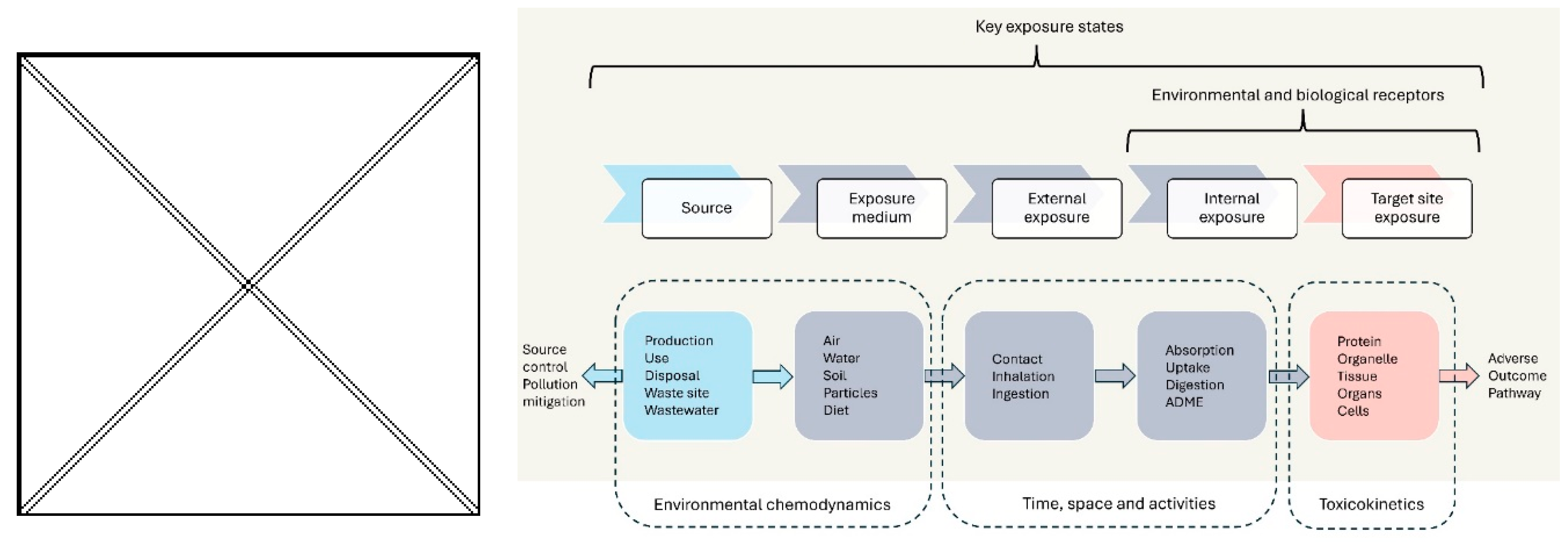
Figure 2.
The 6PPD quinone aggregate exposure pathway for atmospheric deposition in Pearl River Delta leading to human exposure. Series of rectangles beginning with one labelled Ambient air ending with one labelled Neuronal mitochondrial dysfunction represent key exposure states (KES) while the connecting arrows represent the key transitional relationships (KTR). The bold letters represent confidence levels; H - High, M - Moderate, L - Low.
Figure 2.
The 6PPD quinone aggregate exposure pathway for atmospheric deposition in Pearl River Delta leading to human exposure. Series of rectangles beginning with one labelled Ambient air ending with one labelled Neuronal mitochondrial dysfunction represent key exposure states (KES) while the connecting arrows represent the key transitional relationships (KTR). The bold letters represent confidence levels; H - High, M - Moderate, L - Low.
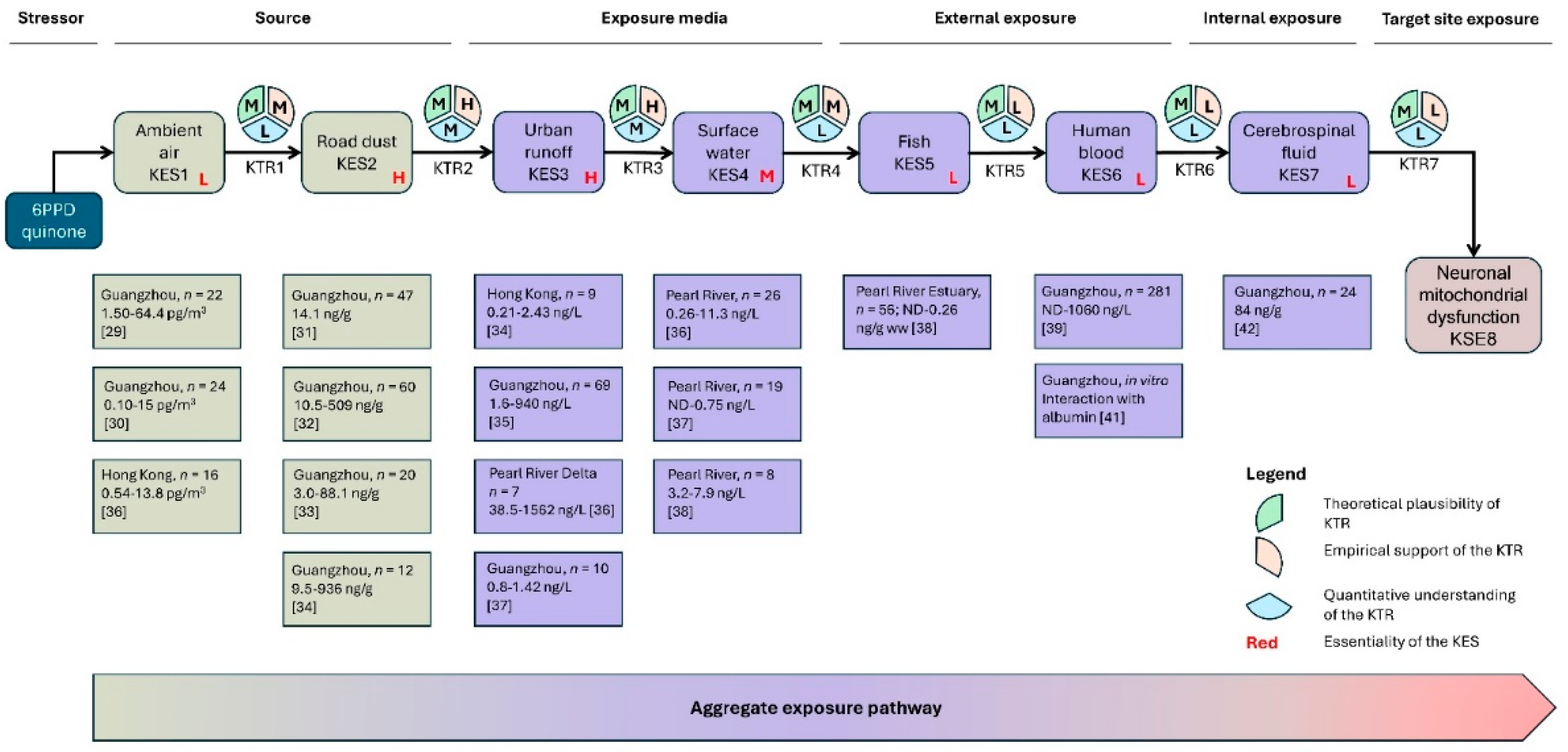

Table 1.
Criteria for Weight of Evidence assessment of the key exposure states and the key transitional relationships proposed by Peng et al. (2022). Used with permission from Elsevier under Creative Commons CC-BY license.
Table 1.
Criteria for Weight of Evidence assessment of the key exposure states and the key transitional relationships proposed by Peng et al. (2022). Used with permission from Elsevier under Creative Commons CC-BY license.
| Category | Criterion | Confidence level | ||
|---|---|---|---|---|
| High | Moderate | Low | ||
| Essentiality of the KES | KESdownstream will be reduced/will not take place if KESupstream is reduced/stopped. | Multiple lines of direct evidence, with no inconsistencies or contradictions. | Some direct evidence or multiple lines of indirect evidence, or limited number of inconsistencies or contradictions. | No direct evidence or considerable inconsistencies or contradictions. |
| Theoretical plausibility of the KTR | Theoretical knowledge supporting dependent and sequential change of two adjacent KESs. | Widely accepted and in-depth mechanistic understanding supporting the causal relationship between KESupstream and KESdownstream. | Partial mechanistic understanding with known knowledge gaps. | No or limited theoretical understanding. |
| Empirical support for the KTR | Empirical data supporting dependent and sequential change of two adjacent KESs, with temporal, spatial and incidence concordance. | Multiple lines of evidence with high temporal, spatial and incidence concordance, no or few data gaps or conflicting data. | Some direct evidence or multiple lines of indirect evidence, with some temporal, spatial and incidence concordance, and a limited number of inconsistencies or contradictions. | No or very limited evidence. |
| Quantitative understanding of the KTR | Quantitative model describing dependent and sequential change of two adjacent KESs. | Precise prediction of KESdownstream from KESupstream with a low uncertainty. Key modulating factors and feedback or feedforward are fully captured in the model. The model is generalized across the applicability domains of the AEP. | Precise prediction of KESdownstream from KESupstream with a high uncertainty. Key modulating factors and feedback or feedforward are not fully captured in the model. The model is only valid for a limited number of cases in the applicability domains of the AEP. | Only qualitative or semi-quantitative understanding. Known modulating factors and/or known feedback/feedforward mechanisms are not captured. |
Disclaimer/Publisher’s Note: The statements, opinions and data contained in all publications are solely those of the individual author(s) and contributor(s) and not of MDPI and/or the editor(s). MDPI and/or the editor(s) disclaim responsibility for any injury to people or property resulting from any ideas, methods, instructions or products referred to in the content. |
© 2024 by the authors. Licensee MDPI, Basel, Switzerland. This article is an open access article distributed under the terms and conditions of the Creative Commons Attribution (CC BY) license (http://creativecommons.org/licenses/by/4.0/).
Copyright: This open access article is published under a Creative Commons CC BY 4.0 license, which permit the free download, distribution, and reuse, provided that the author and preprint are cited in any reuse.


