

Submitted:
26 July 2024
Posted:
30 July 2024
You are already at the latest version
Abstract
The American Civil War has been commemorated with a great variety of monuments, memorials, and markers. These monuments were erected for a variety of reasons, beginning with memorialization of the fallen and later to honor aging veterans, commemoration of significant anniversaries associated with the conflict, memorialization sites of conflict, and celebration of the actions of military leaders. Sources reveal that during both the Jim Crow and Civil Rights eras, many were erected as part of an organized propaganda campaign to terrorize African American communities and distort the past by promoting a ‘Lost Cause’ narrative. Through subsequent decades, to this day, complex and emotional narratives have surrounded interpretive legacies of the Civil War. Instruments of commemoration, through both physical and digital intervention approaches, can be provocative and instructive, as the country deals with a slavery legacy and the commemorated objects and spaces surrounding Confederate inheritances. Today, all of these potential factors and outcomes, with internationally relevance, are surrounded by swirls of social and political contention and controversy, including the remembering/forgetting dichotomies of cultural heritage. The modern dilemma turns on the question: In today’s new era of social justice, are these monuments primarily symbols of oppression, or can we see them, in select cases, alternatively as sites of conscience and reflection encompassing more inclusive conversations about commemoration? What we save or destroy and assign as the ultimate public value of these monuments rests with how we answer this question. In this essay, drawing from the testimony of scholars and artists, I address the conceptual landscape of approaches to the presentation and evolving participatory narratives of Confederate monuments that range from absolute expungement and removal to more restrained ideas such as in situ re-contextualization, removal to museums, and preservation-in-place.
Keywords:
commemorative narratives
; removal vs. preservation-place
; recontextualization
; new era of social justice
; monuments
; memory
; remembering and forgetting
; American Civil War
; Confederate
; cultural narratives
Introduction
The American Civil War of 1861-1865 was the single most tumultuous episode in the history of the United States, with about 620,000 soldiers killed on both sides. The casualties at one single battle alone (Gettysburg) were approximately 51,000 (American Battlefield Trust n.d.). This is not to mention the great follow-on social and political upheavals caused by emancipation, Reconstruction, and the legacy of racial tensions that remain today. As Janney (2013) notes, reconciliation among war veterans was conditional, and reconciliation and reunion were not the same. Veterans from both sides may have shaken hands at battlefield reunions, but they did not shrink from promoting the righteousness of their own side. These veterans often professed stark differences in their interpretations of the meaning of the war, and these differences were reflected by their respective monuments, cemeteries, and veterans' organizations.
The Civil War monuments installed by communities across the North and South from the 1860s into the first quarter of the 20th century transformed the civic landscape and the place of the military in national life. In this way, the United States became a leading contributor to the transatlantic canon of war memorials (Brown 2019). These monuments have served as tools to facilitate remembering, commemorating, passing on knowledge, and expressing values and meanings (Smith 2006:83). As vessels of memory, these monuments and memorials were/are reflections of culture and history (Baugher et al 2024). Commemorations can take the form of a great variety of monuments, memorials, and markers. They were erected for a variety of reasons, beginning with memorialization of the fallen and later to honor aging veterans, commemoration of significant anniversaries associated with the conflict, and celebration of the actions of military leaders. Many of them were placed in cemeteries (Figure 1A). and parks (Figure 1B). However, later, during both the Jim Crow and Civil Rights eras, many more were “Erected as part of an organized propaganda campaign to terrorize African American communities, [and that] these memorials distort the past by promoting the Lost Cause narrative” (SPLC 2016).
For many white southerners, the legacy of the war is linked, for better or worse, to ancestral associations with the Confederacy and the antebellum south. Accompanying the stories of Confederate army veterans, surviving statues and memorials provided a tangible link to an acknowledged, if not increasingly interrogated, past as artifacts of glory. On the flip side is the realization that instruments of commemoration and memory can be provocative, sometimes violently so, in modern commemorations such as the slavery era and other commemorated objects and spaces of Confederate legacies, becoming artifacts of pain. Since white nationalists and neo-Nazis appear to be claiming Confederate symbols as part of their heritage, they have unfortunately co-opted those images and statuary monuments beyond any capacity to neutralize them, at least in the short term. We are left with these questions: What did(do) these monuments represent in the past versus the present? Should they be conserved (in situ, moved to a new public space, or placed in a museum), removed from the public eye altogether, or destroyed?
In this essay, drawing from the testimony of scholars and artists, I address the conceptual landscape of approaches to the presentation and evolving participatory narratives of Confederate monuments that range from absolute expungement and removal to more restrained ideas such as in situ re-contextualization, removal to museums, and preservation-in-place. Questions revolve around seeing them as symbols of oppression, inviting expungement, or as sites of conscience and reflection, inviting various forms of re-interpretation of tangible and intangible relationships? I will describe monuments as symbols in the “Lost Cause” narrative and their place in enduring Confederate legacies. I will make the case, and offer examples, that symbolic remnants, such as graffiti-laded pedestals, if not the in situ original towering statues themselves, should be left in place as sites of conscience and reflection that can be socially useful in public interpretation, both as symbols of protest and disruptions of space, creating disturbances of space and vision that can be provocative and didactic. Notwithstanding their provocative nature, I also address their potential value as sculptural works of art that invite aesthetic and artistic interpretations. I speak to the urgent and fractious national debate over public monuments that erupted in America, when some people risk imprisonment to topple long-ignored hunks of marble, while others form armed patrols to defend them. As part of the protests that followed the murder of George Floyd in 2020, a new wave of removal of Confederate monuments and symbols was resisted by some local officials. While offering personal reflections, I outline evolving participatory narratives, through both physical and digital intervention. Why do we care so much about statues? Which ones should stay up and which should come down? Who makes these decisions?
Total Expungement vs. Selected Preservation and Recontextualization of Sites as Places of Conscience and Reflection
From 2020 to 2023, a centerpiece for public discussion was the removal of statues and pedestals on Richmond, Virginia’s Monument Avenue (NPS 1970; Driggs 1997), a tree-lined grassy mall dividing the eastbound and westbound downtown traffic. It was originally named for its emblematic complex of statues and other structures honoring those who fought for the Confederacy. Richmond is important symbolically because it was the capital of the Confederacy. Other than the battlefield statues and memorials at Civil War battlefields and cemeteries, Monument Avenue was one of the most notorious grouping of statues honoring Confederate leaders. Between 1890 and 1925, during the height of the Jim Crow era, Monument Avenue development greatly expanded with the addition of architecturally significant houses, churches, apartment buildings, and significantly, a series of commemorative statues to Confederate heroes, including Robert E. Lee and James Ewell Brown (J.E.B.) Stuart. These monuments were removed from their pedestals in 2021, leaving the monument to Arthur Ashe, memorializing the African American tennis champion, dedicated in 1996, remaining. In the wake of protests that followed the death of George Floyd in 2020, the monument of Lee increasingly became a venue to project images of racial justice and empowerment, such as ballerinas dancing at the base of the plinth, to video projections of George Floyd, Malcolm X, Angela Davis, and others onto the statue. The graffiti-laden Lee statue (Figure 2B) is described as the most influential work of protest art since World War II (La Force et al 2020).
Recontextualization, or “changing the signs,” is sometimes offered as a way to mitigate the offensive qualities of Confederate statues to African Americans. However, the image of the equestrian statue and the triumphal supporting column of Lee (now removed) on Monument (Figure 2A), is perhaps too ingrained in our collective cultural heritage (see the “Treachery of Images” discussion below) to allow for disruption by a recontextualized presentation. If we are going to seek just representation of these statues in our public spaces, we may have to find another way (Beetham 2018). Ironically, following the Civil War, Robert E. Lee argued specifically against commemorating the war. He died five years after the war ended, but while he was alive, Lee stressed his belief that the country should move past the war. “I think it wiser…, he said, “…not to keep open the sores of war but to follow the examples of those nations who endeavored to obliterate the marks of civil strife, to commit to oblivion the feelings engendered…Erecting monuments…would have the effect of retarding, instead of accelerating its accomplishment; of continuing, if not adding to, the difficulties under which the Southern people labour” (PBS Hews Hour 2017). From this quote, we can surmise that Lee knew his history, that countries that erased visible signs of civil war recovered from conflicts quicker; keeping these symbols alive would perpetuate divisions. He therefore likely would not have condoned his becoming the object of a cult of personality for the South.
The question arises: Is it possible to honor somebody by doing the very thing that person asked you not to do? If not, the statue honoring Lee is not a statue honoring Lee; it has forcibly hijacked his personage and appropriated his name, image, history, and symbolism to something else: the cause of white supremacy (Beetham 2018). However, in what was a paradoxical, fascinating, grassroots, outpouring of participatory public artisanship, the graffiti tagged statue of Lee (now removed) was reinterpreted as a powerful symbol of the Black Lives Matter movement (Figure 2B).
On reflection, even with the statue of Lee removed, would it have better served prospects for reflection and memory, if that indeed is our desire, to have at least kept the graffiti-laden podium as a Site of Conscience (ICSC 2019): a physical site used to engage the public in programs that stimulate dialogue on pressing social issues; to share opportunities for public involvement and positive action on the issues raised at the site; and to promote justice and universal principles of human rights? Could we then possess greater opportunities to publicly discuss layers representing episodes of time and meaning manifested as literal coats of paint? Or are some monuments so harmful that they should be removed? These are discussions that communities need to have and not just be made by the people in power who have been maintaining the status quo.
If the local community has decided that the statue proper had to be removed, if left in place as an in situ artifact, the graffiti-adorned pedestal (Figure 2B) would have symbolized what could have been interpreted as a new era of social justice that arose in the 2020s. In October 2020, the New York Times Style Magazine named it the most influential work of protest art since World War II (La Force et al 2020). Albeit a source of controversy, by removing it, groups with diverse opinions have lost a focal point, a place of reference, to begin the conversations of healing and building trust among divergent points of view in the local community.
African American writer Cassandra Jackson (2022:196-197) has described a similar sentiment with an example from Baltimore, where, when the statues were removed, the pedestals at three sites remained standing. The then-mayor suggested empty pedestals remain and include plaques explaining what was removed from them and why. But even without plaques, the pedestals “invite reflection, learning, and [serve as] a poignant sign of the ongoing struggle for reconciliation and justice.” The pedestals, Jackson explains, function as a disturbance of vision. They take up space, yet their emptiness reminds us of what is not there. What better symbol for the passing of time and ideas than an empty pedestal whose former occupant is no longer deemed relevant to the space in which he once resided? The empty pedestals create both a link to the historical past and a powerful departure from it as they also forecast a new future. The grove where one of these pedestals stands was rededicated to Harriet Tubman, “a woman who escaped enslavement in Maryland only to return to slave states to free countless others from bondage'' (Jackson 2022:196). Thus, rather than replace one statue with another, the city renamed the land where it stands, a preexisting grove, pointing to a future that honors the liberation of all people.
In Richmond, the conversations surrounding the Monument Avenue statues could occur alternately at the planned Virginia Emancipation and Freedom Monument, a permanent 12-foot structure celebrating the emancipation of slaves and freedom, also located in Richmond. As of this writing, although plans have not yet been articulated, the removed statues and pedestals on Monument Avenue will be housed and interpreted at the Black History Museum in partnership with the Valentine Museum (Mary Lauderdale, Director of Collections, personal communication, 2022), hopefully offering opportunities for future conversations and public discussions about their evolving significance, symbolism, and meaning.
That many have traditionally seen statues and other commemorative sites as places of reflection and memory about the past and the present is corroborated by the fact that many of them have been placed on the National Register of Historic Places (NRHP) (Figure 1A; NPS 1970). Nevertheless, for Civil War commemorations, the deeply held beliefs, legends, and myths of the Confederacy are hard to overcome. The fundamental questions today are: What gets commemorated [who commemorates?], what gets remembered [who remembers?], and what gets forgotten or silenced [who forgets and silences?].
The South lost the war but won the battle for the narrative, the historical account of the war, and its aftermath, notwithstanding that most northerners believed it was a good thing that the South had lost, and that slavery had been destroyed. Following the war, and continuing today, the Lost Cause of the Confederacy, or simply the “Lost Cause,” was promoted as an American pseudo-historical, negationist ideology that advocates the belief that the cause of the Confederate States during the American Civil War was a just and heroic one. This ideology has fostered the belief that slavery was just and moral, because the enslaved were happy, even grateful, and slavery made possible economic prosperity. Thus, the Lost Cause defines the war as a struggle primarily waged to save the Southern way of life and to protect "states’ rights", including the right to secede from the Union, but does not mention the “right” to legally continue slavery, even though it was a key point in the Confederate Constitution. It casts the Civil War as the “War of Northern Aggression,” and minimizes or completely denies the central roles of slavery and white supremacy in the build-up to, and outbreak of, the war. Ironically, the Confederate government was not strong on state rights, as the Confederate Constitution forbad the emancipation of enslaved persons, rather than leaving it up to individual states to decide (Gordon 2022). One particularly intense wave of Lost Cause activity occurred in the decade leading up to World War I, as the last Confederate veterans were dying out and a push was made to preserve their memories, although with white supremacist overtones. We can interpret a second wave of Lost Cause activity occurring in reaction to growing public support for racial equality during the Civil Rights Movement of the 1950s and 1960s. During this time, advocates of a renewed Lost Cause movement sought to ensure future generations of Southern whites would learn about the Souths "true" reasons for fighting the war, and therefore continue to support White supremacist policies.
As historian Karen Cox (2021a) has noted, during Jim Crow and the Civil Rights Movement, if Blacks had actively resisted the erection of Confederate monuments, they might have been lynched. It is no coincidence that most Confederate monuments went up between 1890 and 1920, the same period that lynching peaked in the South. Lynching and Confederate monuments served to tell African Americans that they were second class citizens (see Figure 4B). In a significant portion of the white Southern community, efforts to make African Americans equivalent to white Americans were resisted vigorously, often violently, and, successfully. As the nation was enduring a preoccupation with the effects of the Great Depression and witnessing the great international human rights offensives leading up to World War II, lynchings were less common (Cox 2021b), although they continued after the war.
A number of momentous events, including the 2015 murder of 9 Black parishioners in a Charleston, South Carolina church, the 2017 demonstrations in Charlottesville, Virginia, where one person was killed, as well as subsequent tragic events such as the murder of George Floyd and nationwide protests over systemic racism in the summer of 2020 – taken together with the January 6, 2021 Make America Great Again (MAGA) riot at the U.S. Capitol and other subsequent civil protests and disturbances -- have sharpened public attention to the controversies surrounding public display of all things “Confederate” and caused many to reflect on the how, why, when, and where for the historical stories and myths that these statuary artifacts represent.
Aspects of the Lost Cause narrative mythology, including glorification of Civil War heroes and white supremacist views, were adopted even in the North and other regions of the United States: it was not just a southern phenomenon. However, grand equestrian statues of Union generals that definitely did not celebrate the Lost Cause narrative were erected in the North. Until well into the 21st century, not many monuments were erected that countered these Lost Cause sentiments. Within the Lost Cause narrative, there was no room for sentimentalities. Rather, traits such as glorified heroism, sacrifice, and valor of soldiers were emphasized in narratives, and monuments symbolized these narratives. These expressions are carried to a militant extreme by followers of white nationalists ideologues who think of monument removal as an attack on their Confederate heritage (Christmas 2022: 108-109).
The Movement Toward Monument Removal and 21st Century Iconoclasm
American memory began in iconoclasm, of tearing down symbols. After the public reading of the Declaration of Independence ordered by George Washington upon arrival of the document in New York City on July 9, 1776, a crowd surged to Bowling Green and tore down the equestrian statue of George III dedicated six years earlier. This symbolic regicide was a profoundly antimilitary and anti-authoritarian protest (Brown 2019; Baugher et al 2024).
Although questioning of the appropriateness of publicly displayed monuments had existed earlier, the movement to remove them was greatly accelerated after the Charleston church shooting in 2015. Many urban areas in the United States have removed monuments and memorials on public property dedicated to the Confederacy, and some, such as Silent Sam in North Carolina, have been torn down by protestors (Reuters 2017). The momentum to remove Confederate memorials further quickened after later high-profile incidents such the Unite the Right rally in 2017 and the murder of George Floyd in 2020. As part of the protests that followed the killing of George Floyd, accompanied by continued police shootings and other racially charged events, coincidentally during the height of the COVID-19 pandemic and energized by the Black Lives Matter movement, a new wave of removal of Confederate monuments and symbols commenced. The removals have been driven by the belief that the monuments glorify white supremacy, memorialize an unrecognized, treasonous government whose founding principle was the perpetuation of slavery, and that the presence of these Confederate memorials over a hundred years after the subjugation of the Confederacy continues to disenfranchise and alienate African Americans.
Political reactions at state and local levels have been profound and emotional. The Alabama law prohibiting the removal of historical monuments was deliberately broken by the mayor of Birmingham, who said that the penalty fine was preferable to the unrest that would follow if it were not removed (Hearst Television 2020). The Governor of North Carolina removed three Confederate monuments at the North Carolina Capitol that the legislature had in effect made illegal to remove (Hearst Television 2020). In Decatur, Georgia, near Atlanta, county officials finally relented to public pressure and declared a Confederate statue on County grounds a “public nuisance” before removing it (AJC 2021). The U.S. Military has embarked upon a course of rebranding in deciding to rename Fort Bragg and other military bases named for Confederate generals. Notwithstanding President Trump’s June 26, 2020, Executive Order that declared the policy of the United States is to prosecute to the fullest extent permitted under Federal law, and as appropriate, any person or any entity that destroys, damages, vandalizes, or desecrates a monument, memorial, or statue within the United States (Federal Register 2020), the U.S. Navy and U.S. Marine Corps have prohibited the display of the Confederate flag. The wave of expungements and removals also expanded outside the United States to remove statues of enslavers in England, Ireland, Belgium, New Zealand, and many other countries. The objects of the protests grew to include statues to people who profited from the Atlantic slave trade, abused Indigenous peoples, and to other public art seen as offensive because of European colonialist exploitation (CBC 2020).
These actions can be seen as examples of 21st century iconoclasm, and perhaps a modern version of damnatio memoriae (Tronchin 2023; Hanson 2016), where those in favor of removal saw the monuments to Robert E. Lee and other Confederate leaders as so offensive that they needed to be expunged, if only to prevent them from becoming lighting rods attracting a plethora of radical right organizations and groupings. Supporters of removal remind us that the monuments were erected during the height of the Jim Crow era of racial segregation in the South from 1877 to the 1960s and were material expressions of that race-based prejudice (see Figure 4B). And they also remind, recontextualizing or changing the inscriptions on monuments may not work (Mitchell 2020); if an inscribed monument functions as the physical embodiment of the collective decisions of a community, then it logically follows that a reversal of that decision should entail the removal of the monument (Low 2020:240). Furthermore, as Beiner (2021:61) has highlighted about the toppling of monuments in reaction to memorialization stemming from English colonialism in Ireland, “…Those who partake in decommemorating see themselves as agents of oblivion, determined to efface an undesirable memory. But in the very act of calling attention to an offensive monument, they are in effect agents of memory, unwittingly reviving remembrance of the memorial they seek to uproot.” And, he adds, quoting Lowenthal (1999), the “art of forgetting requires making decisions about “what to keep and what to let go, to salvage or to shred or shelve, to memorialize or to anathematize” (Beiner 2021:60-61). In retrospect, since iconoclasm is nothing new in human history, there is nothing especially problematic about continuing its practice, especially when the goal of reconciling the United States with its past might be achieved.
Speaking against arguments of effacement, one could contend that the removal of Jim Crow-inspired monuments detracts from our capacity to witness the materiality of prejudice. While retaining them runs the risk of their continuing capacity to inspire racism, removing them runs an even greater risk of infantilizing a population thought to be incapable of confronting its past. One is reminded of the famous George Santayana quote: “Those who cannot remember the past are condemned to repeat it.” (Santayana 1905). The desire to commemorate in this case is now firmly balanced by the desire to expunge from cultural memory, and through this to create new presents and futures. One can understand how the sensibilities of some participants are offended, but complete expungement means that we lose these artifacts as places for reflection and as opportunities for dialogue to affect a clearer understanding of what happened and why it is so important to our presents and futures (Murray 2021).
The Interpretation and Presentation Strategies of Recontextualization
One treatment option between removal and retention is recontextualization. The implication for the imagery associated with “problem” monuments is that a possible alternative to removing the monuments is to relabel or recontextualize them by adding new plaques or inscriptions and place them alongside the controversial or negative aspects of their historic background (Beetham 2020). I am reminded of the example, described above (Jackson 2022), from Baltimore, where the mayor suggested that empty pedestals remain and include plaques explaining what was removed from them and why. Recontextualization, some contend, is a way of preserving the built environment while providing necessary information about the past. For example, with the Confederate Memorial in Forsyth Park, Savannah, Georgia (Figure 1B), the city council approved recommendations that the monument be renamed from “Confederate Monument” to “Civil War Memorial,” and further to install a new bronze plaque with this text: “This memorial was originally erected in 1875 to the Confederate dead, redesigned in 1879, and rededicated in 2018 to all the dead of the American Civil War.” (City of Savannah 2020; Luciana Spracher, City of Savannah Archivist, personal communication, 2022). As of this writing, we can consider this to be a successful example of recontextualization in that the headline-generating public protests of the statue have subsided. But others have argued that recontextualization will not work in many cases (Thompson 2020; Katz 2018). There is no way, they contend, like the case of the Magritte’s panting of the pipe (see discussion below), that text inserted alongside a monument that would counteract the power of the large visual symbol, unless that text is written on a billboard or superimposed on the monument in some way.
Thompson (2020) dips disparagingly deeper in describing research that shows that, at historic sites, visitors often ignore information that conflicts with what they already believe about history. Thompson describes the dilemmas facing management agencies such as the National Park Service, whose mantra to preserve historic and natural resources “unimpaired” (NPS n.d.). While existing signage or applied in situ inscriptions at Civil War parks and sites is generally teamed unacceptable or inaccurate by both laypersons and historians, the majority of site visitors are engaged in reinforcing what they already know and believe. Their reaction to the site and its interpretive messages depends almost exclusively on who they are and what prior knowledge (and biases) they brought with them to the site. Thompson cites an example from Australia where research reveals that people do not go to historical sites to learn but will respond to written and video messages that provide emotional connections in constructive ways. An example from the Immigration Museum of Melbourne uses tools such as an interactive simulation of a hate speech incident on a tram to guide visitors into thinking about the experience of discrimination from different points of view. The experience may be uncomfortable, but an evocative connection (and take away memory) is made. We can also take a cue, she says, from researchers and scholars who have been looking at the most efficient ways to fight the spread of conspiracy theories and other false information conveyed in a visual form such as altered photos and videos. Studies suggest, she says, that these visuals are more memorable and shared with greater frequency on social media than textual misinformation.
Beyond Scripted Messages: The Treachery of Images and the Power of Art
Given that visual imagery always holds a variety of meanings beyond the artist's intent, artistic expressions, be they paintings, sculpture, or other modes of fabrication, can and often do take on a life of their own in terms of meaning and impression (Middleton 2003). Art, says art expert Sarah Beetham (2018), can have an underlying meta message conveyed by paralanguage, such as René Magritte’s famous provocative painting “The Treachery of Images with label “Ceci n’est pas une pipe” (This is not a pipe), with an interpretation that the pipe in the painting is not a pipe, but rather a drawing of a pipe, thus the “treachery” of the drawing “masquerading” as a real pipe (Beetham 2018). With some exceptions, Western artists had been concerned traditionally with illusionistic representations of the natural world. Magritte upends centuries of tradition. as the word “pipe” is not an actual pipe any more than Magritte’s painting is; both are symbols that stand in for the real thing (Beetham 2018). By the same token, Civil War-related statues, such as the one of Robert E. Lee (Figure 2A), is likewise artistic rendering or narrative that has taken on a variety of possible meanings and impressions beyond the original purpose and intent.
Debates and Approaches to Monument Removal in a New Era of Social Justice
Some, including many African Americans, argue that the mere presence of Confederate monuments, in what have become predominantly Black cities, has had more damning meaning for the future of Black citizens. Says Cassandra Jackson (Jackson 2022:194-195), “Already victims of redlining and segregation via white flight, urban Black people who walk among monuments to the Confederacy face visual evidence not only of their powerless position in their own communities.” This condition bore a striking contrast to her experience and that of other rural Black people who encountered Confederate monuments in white-controlled spaces. To them, the Confederate figures gaze over the land like symbolic masters, demoting Black leaders to overseers who tend other people's property. Black communities who seek to resist Confederate symbology in public space have come to believe that landscapes can be invested with the power to oppress and empower people and that landscapes can be changed and thus so can the power dynamics embedded in the landscape. They believe, Jackson contends, that spatial representation and manifestation of power can change over time, be disrupted across space. Jackson believes that effectively shifting the meaning of a monument requires that one first interrupt these day-to-day ways of seeing and thus destabilize the understanding of ourselves and our relationship to the physical and social landscape.
Art historian Erin Thompson (2022:159) has argued that the removing of monuments must accompany the adding of new ones. In a new era of social justice, she argues, America needs new monuments to honor ideas, actions, and persons that previous generations would have found repugnant or impossible. One existing example in Richmond is the removal of the 1890 statue of Robert E. Lee (Figure 2A), leaving the 1996 monument to Arthur Ashe unaffected. To this end, our discussions of social justice need to be qualified by the realization that many African American and other minorities have not shared in the benefits.
An interpretive approach by a museum is its encounter with Confederate monuments at the Houston Museum of African American Culture in 2020. The museum had volunteered to house the “Spirit of the Confederacy,” a twelve-foot high statue of a winged, muscular nude man, after it has been removed from a local park. The statue had been erected to much white establishment fanfare on Robert E. Lee's birthday in January 1908. The museum placed it in a courtyard surrounded by a fence. Part of the fence framing consists of eye-shaped sculptures by a Black artist that are “keeping watch.” In this case, the museum intends for the power of the interpretive message of the statue being fenced in to overcome both Confederate glorification motives of 1908 and the artistic and aesthetic power of the statue as a work of art. This project can be seen as an example of unconventional recontextualization, albeit removed from its original setting, within a controlled environment that does not involve merely adding an interpretive sign (Thompson 2022:150-154).
While a discussion of museum statuary presentations is beyond the scope of this essay, as publicly “trusted institutions,” they play an important role in addressing the problems and controversies of not only Confederate statuary, but also other storms of debate, such as over Native American depictions (Boston.com 2024).
Does Total Expungement of Confederate Monuments Achieve Social Justice?
Memorialization can address enslavement and other atrocities as it aims to translate the suffering of the past into ethical commitments to creating a better future through education and commemoration. It is thus an intervention into public memory, where artworks and objects on display grapple with difficult truths relating to colonialism, enslavement, lynching, and their legacies. The expedited removal of monuments, particularly on courthouse and government grounds, is “a beneficial step toward the nation's healing,” said Geoff Ward, a professor of African and African American studies at Washington University in St. Louis who has mapped out visual symbols of racism. But he is concerned that necessary conversations about racial injustice that people of color are asking for in their communities are failing to happen each time a statue is taken down. "This is a familiar U.S. scenario," Ward said, "seeking to quickly move on and declare matters settled rather than dealing with issues and really processing traumas" (Ortiz 2020; Washington University of St. Louis 2019).
Should some monuments be saved as places of conscious reflection, and as suggested by Professor Ward, and preserved as sites for open discussion and reflection about violence and conflicts and the processing of the societal traumas they produce? The period 2016-2021 saw a profound change in public attitudes and general acceptance that public display of Confederate symbols, such as what has become known as the “Confederate battle flag,” contributes to social turmoil and should be removed from public discourse. Even at Stone Mountain, Georgia, where a monumental rock carving ninety feet tall has served to symbolize the celebration of Confederate legacies, state officials are weighing options to incrementally change the way the Confederacy is portrayed there (NPR 2021). But, with the modern trend toward monument removal, what will be the focal points for community conversations about diversity and inclusion stemming from the Civil War era? (Thompson 2022:161-173).
Personal Reflections on Confederate Heritage
For some, including me, the Confederate legacy is a perplexing and paradoxical cultural inheritance. Pulitzer Prize-winning journalist Tony Horwitz (1999) reflected on his childhood obsession with the Confederacy that collided with hard adult realities about race and culture in America. He set out on a year-long trek through the landscape of the Civil War, traveling in several southern states to investigate the fascination and obsession that America still had in the late 20th century for the war. He encountered many colorful characters and hard-core reenactors who commonly seek escape from the complexity and bustle of modern life while also enjoying the camaraderie of “discovering” the past. Trading notes with park rangers, as I have done during my life and career, Horwitz realized, as I have, that much of what he knew was more myth than fact. He points out, and I concur, that many academic and professional historians have failed, as interpreters and teachers, to connect with readers, encouraging special interest individuals and groups to do their own research and draw their own conclusions about the spectacle and meaning of the Civil War. He discovered a profoundly disaffected nation, where battles over the Confederate flag, strong antigovernment sentiment, and enduring ignorance and bigotry invite some dispiriting conclusions about the prospects for black/white reconciliation. His travel experience convinced him of the intensity of unresolved racial tensions and white supremacism, predicting some of the traumatic events and social unrest that we have seen in the first decades of the 21st century.
A lot of the Confederate symbolism revolves around the specter of Robert E. Lee. At the center of the “Unite the Right” rally that turned deadly in Charlottesville in 2017, for example, was a protest of the city’s plan to remove a statue of Lee. White supremacists, neo-Nazis and others have made monuments to the Confederate commanding general a flashpoint — at times marching to keep them standing. In a compelling memoir narrative, former army officer and head of West Point’s history department, Ty Seidule (2021), in Robert E. Lee and Me, challenges the myths, falsehoods, and misinformation of the Confederate Lost Cause legacy, and the postwar exaggerated adoration of Lee. Having grown up in a sea of Lee idolization, and continuing at his alma mater, Washington and Lee University, and at West Point, Seidule took in completely the lost cause myth. His curiosity and research, however, exposed the myth of Lee. In a unique blend of history and reflection, Seidule meticulously deconstructs the facts about the Confederacy and its undisputed primary goal of maintaining the plantation system of slave labor and the subjugation of Black Americans. In this intensely personal account, Seidule challenges the deeply held legends and myths of the Confederacy that the whole country, not just the South, still has a difficult time articulating and accepting.
Evolving Participatory Narratives
I have attempted in this essay to make the case that, although many monuments have now been removed, destroyed, or replaced (Autry 2020), we should not be in such a hurry “in the emotion of the moment” to destroy or remove them, and not see them solely as symbols of oppression, but instead envision them as sites of conscience and reflection. We should not try to rewrite history; we should endeavor to learn from it. I am not talking about simply adding new plaques or inscriptions to place them alongside the controversial aspects of their historic background. I am saying that the dedicated statues, memorials, and landscapes can be seen as places where multiple voices can be heard, and opinions debated, in open and inclusive public arenas.
Noted historian Karen Cox (2021b) has asserted that there is no common ground when it comes to Confederate monuments. To Cox, polarizing debates over their meaning have intensified in recent years into political maneuvering and prompted some states to pass laws that preserve the statues, while legal battles are waged to remove them, and unruly crowds have sometimes taken matters into their own hands. Monument defenders, she contends, have responded with gerrymandering and "heritage" laws intended to block efforts to remove these statues, but hard as they worked to preserve the Lost Cause vision of southern history, civil rights activists, Black elected officials, and groups of ordinary people fought harder to take the story back.
In a new era of social justice, especially in the aftermath of the 2020 murder of George Floyd, authors such as Cox (2021b) and Hartley (2021) have joined the chorus of condemnation in opposing the continuation of the in situ display of Confederate monuments. As expressed above, we may look back on this movement to remove monuments with regret that at least some of them were not left in place as testimonials and places of reflection on understanding the roots of white supremacy activism and what this means (has meant) to modern society and communities. If all these tangible sites of reflection are expunged, the country will lose an important educational tool about the Civil War and its effects. What tangible remains will be available for interpretation and reflection to future generations in telling the public stories of diversity in this era of American history? the country would lose an important educational tool about the Civil War and its effects Future generations may note that the statues were removed but the problems associated with racism were not.
Acceptance of diversity as an important, if not the most important, ingredient and strength in the American social fabric. Diversity has, and always will, sustain us if we allow it to persevere. We need to begin a facilitated dialogue (Jameson 2022) among a variety of constituencies toward the recognition that monuments and memorials are part of history and that not all should be removed, but rather used as places and points of reflection about the value of diversity in American political and social fabric. The facilitated dialogue model places all parties in a non-threatening, “safe” environment where the experiences of participants are shared and explored; it joins the experiences and expertise of participants to think through the conditions and opportunities necessary to impact the topic or issue being discussed. Facilitated dialogue creates a structured space where participants can actively listen to each other’s perspectives and experiences. This helps in building empathy and understanding across diverse groups.
Research by Zúñiga et al. (2007) highlights how facilitated dialogues can lead to increased understanding and appreciation of diversity. They explain how this communication technique can be leveraged for positive social change and has proven effective in fostering more inclusive conversations about diversity by promoting understanding, social justice, educational enrichment, and community cohesion. Facilitated intergroup dialogue as applied in the United States, they contend, has been grounded in the assumptions that interpersonal and cross-group relations on campus are affected by the histories and current realities of intergroup conflict in the United States and that these conflicts must be explored through “dialogic” encounters. In contrast to “banking” approaches to diversity education in which the teacher-expert deposits knowledge into students as if they were empty vessels waiting to be filled. Dialogic interaction promotes active, generative, and transformative connections and explorations among participants and between participants and facilitators. Intergroup dialogue recognizes the importance of listening and speaking honestly and openly to encourage shared meaning and improved interpersonal communication and relationships. It is a critical-dialogical approach that integrates three core educational goals: consciousness raising, building relationships across differences and conflicts, and strengthening individual and collective capacities to promote social justice. These goals provide a conceptual framework for the design and practice of intergroup dialogue (Zúñiga et al 2007). An open forum of discussion and debate such as has been presented for the Lee and new Emancipation monuments in Richmond (PBS News 2021), mentioned above, would be an ideal scenario for intergroup facilitated dialogue and more inclusive conversations on the issues.
Alternative Community Narratives: Physical vs Digital Intervention
I will outline two modes of community intervention in developing counter or alternative narratives of commemoration and how these have been applied for the heritage of the Confederacy.
One option of community intervention is physical intervention. In an era of fervent memorialization and contentious debates about who and what should be commemorated in the public sphere, the conversation up to now has largely been limited to physical monuments such as statues, plaques, and landmarks.
[H3]Physical Intervention: Heroic Figures on Horseback as Metaphorical Symbols of Dominance and Oppression
Notwithstanding that equestrian statues are seen by some as providing connections to the growth of militarism in late 19th century in the United States (Brown 2019), and many are seen historically as symbols of oppression as discussed here, an important dimension to this discussion is the consideration that the monuments are works of art, and that artistic rendering of the statues and memorials gives them power for a variety of possible artistic interpretations and impressions. The deeply embedded concepts of power and virtue, and at the same time exhibiting grace and elegance, i.e., their “soul’ or pathos, of heroic figures on horseback have been exploited from early antiquity through to modern times. Since antiquity, the equestrian monument had been an emblem of imperial authority precisely because it depicted the sovereign as a military commander.
The tradition of statues of heroic figures on horseback, carried through the ages as far back as Alexander the Great, is reflected in the statues of Lee and J.E.B. Stuart in Richmond (Figure 3) and reveals a common theme: a message of military prowess and leadership. Although the specific messaging of any given equestrian statue changes through iconographic details, the basic model persists, as do the core themes of power and virtue.
Figure 3.
Statue details. A: Confederate General J.E.B. Stuart, statue erected 1910, now removed (Photo by Hal Jespersen, public domain); B: “Rumours of War” statue, intended to be oppositional to the J.E.B. Stuart statute, was installed in December 2019 at the Virginia Museum of Fine Arts. (Creative Commons Attribution-ShareAlike 4.0 License, Tyler Walter).
Figure 3.
Statue details. A: Confederate General J.E.B. Stuart, statue erected 1910, now removed (Photo by Hal Jespersen, public domain); B: “Rumours of War” statue, intended to be oppositional to the J.E.B. Stuart statute, was installed in December 2019 at the Virginia Museum of Fine Arts. (Creative Commons Attribution-ShareAlike 4.0 License, Tyler Walter).
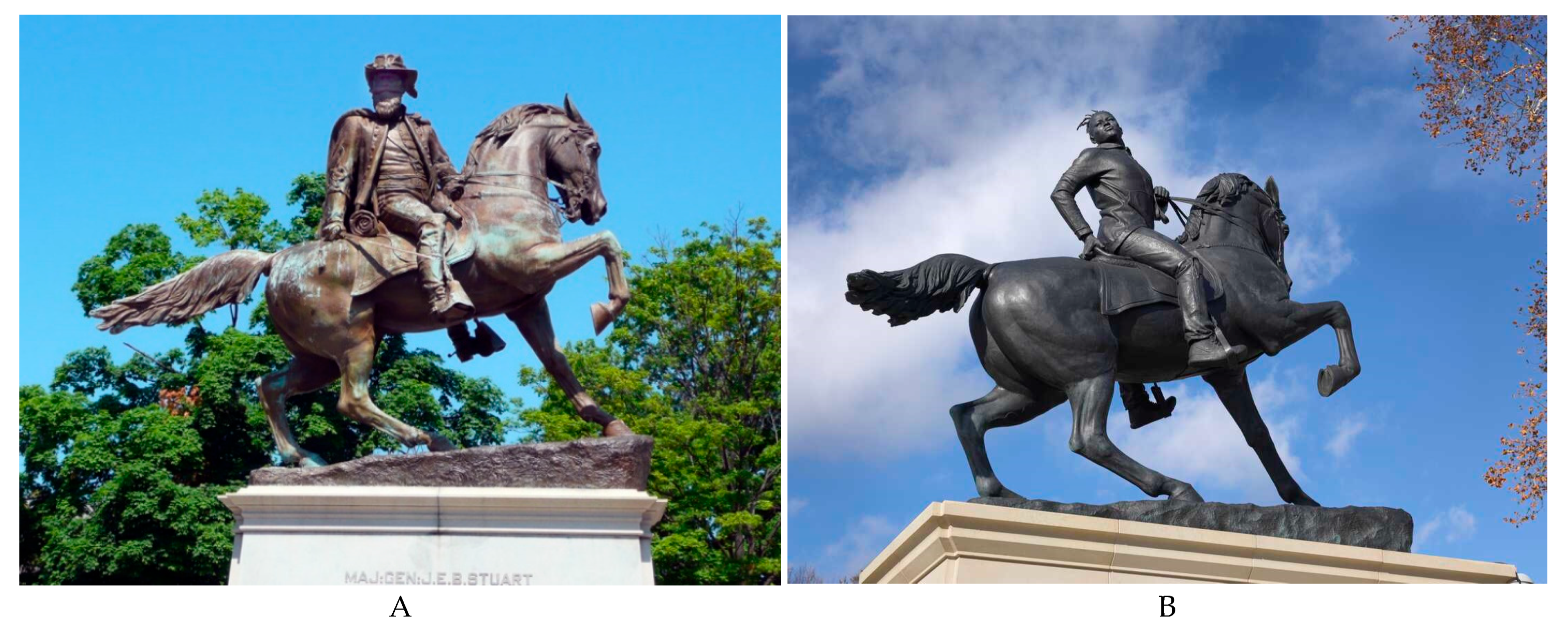
In 2019, in Richmond, Virginia, an African American sculptor erected a statue on horseback that mimics, replete with modern clothing, the classic “heroic” Confederate figure of J.E.B. Stuart (Figure 3A) and in the classic pose of the equestrian warrior in antiquity. In this case, the African American “Rumours of War” statue (Figure 3B) by artist Kehinde Wiley provides an officially recognized counter narrative to the nearby Confederate statue. “Rumors of War” is a bronze monumental equestrian statue of an African American youth wearing modern-styled dreadlocks in a ponytail, jeans ripped at the knees, and Nike high- top sneakers. It was created in response to the statue of Confederate General J.E.B. Stuart in Richmond which was in turn based upon the 1889 statue of Sir James Outram on horseback by the British sculptor John Henry Foley which stands in Calcutta, India (LOC n.d.; Driggs 1997). “Rumors of War” was originally unveiled in September 2019, in New York's Times Square. In December 2019, it traveled to its permanent home at the Virginia Museum of Fine Arts in Richmond, at the head of Arthur Ashe Boulevard, where it was situated near a row of Confederate statues and monuments, including the statue of J.E.B. Stuart [now removed], on the city's Monument Avenue (Randolph 2020).
Ironically, by removing the statue of J.E.B. Stuart on Monument Avenue in Richmond, the effect is to substantially diminish the storytelling power and counter-narrative effectiveness of “Rumours.” We may also have lost an opportunity for facilitated dialogue using the J.E.B. Stuart (Figure 3A) and “Rumours of War” (Figure 3B) statues as focal points where the experiences of diverse participants would be shared, explored, and debated about complex issues. In this sense, as with the Lee monument graffiti-laden pedestal,
Digital Intervention in Devising Alternative Narratives
Beyond the physical interventions of metaphorical projections of power, these statuary structures advance comparatively narrow cultural narratives about the past, requiring significant capital to establish, and allow limited interaction or annotation by the public. As a result, there is limited opportunity for most Americans to participate in what gets remembered – and yet the hunger is there, visible in heated debates, defaced statues and renamed spaces cropping up in communities across the nation. Another vehicle for counter or alternative narratives is digital intervention. With a theoretical underpinning in collected memory studies and public history, the Digital Atlas of Southern Memory (DASM), created by Caroline Klibanov (2019) of the MIT Museum presented a prototype for a platform that can enable broader participation in the commemoration process (Figure 4A).
The idea is that DASM users can explore a map of the South that reveals which narratives are represented by existing named public spaces and other memorials. If they find that the dominant narratives do not tell their personal story, they can add new digital monuments, have debates about statues and other named spaces, or annotate the existing ones by providing context, suggesting alterations and changes, or expressing an opinion. The DASM presents several narratives in the South for which there are reliable data and displays them in a way that encourages interaction and reflection. Although today the numbers of Confederate-related placenames and nomenclatures are trending downward (AP 2022), the map reflects, as of 2019, streets and public schools in the South named for Confederate generals, Civil Rights Movement leaders, and U.S. presidents. (Klibanov 2019). With a theoretical underpinning in memory studies and public history, the Digital Atlas of Southern Memory presents a prototype for enabling broader participation in the commemoration process. The project aims to be an engine for doing what public history should do: meet modern, digital audiences where they are; help them connect with their own history, and awaken a curiosity – and usually, an opinion – about what they hope will be remembered. Focusing on the American South, a region that historically has taken an active role in constructing narratives about its past, the DASM (Klibanov 2019) is comprised of two parts:
- (1)
- the visualization component reveals what people in the region choose to remember through monuments, named public spaces and other commemorative forms. The prototype showcases names of public schools and streets in order to surface narratives that are more subtly embedded in daily life than statues and plaques;
- (2)
- the interactive component provides a forum for the public to alter the record of collected memory if they find that the dominant narratives do not tell their story. Users can add new digital monuments; hold debates about statues and named spaces; and annotate existing ones by providing context, suggesting alterations, or expressing an opinion. The project prototype invites suggestions for new “memories” and for adding context to existing sites.
Although the participatory functions of DASH are still under development, the goal is to create a crowdsourced, interactive, and very much living map, capturing the past and present of commemoration. It is designed to model a participatory, broad-based form of commemoration. The value of DASH is that it provides an illustration of a digital platform that can be established as forums for collected memory and interpretive narratives for archaeological objects and sites, a digital model for addressing both tangible and intangible values linked to archaeologically derived information, objects, and sites. It could be used in a variety of settings, such as schools, community centers, senior citizen centers, libraries, historical societies, and by a wide variety of diverse interest groups.
When the full participatory functions of DASH that are envisioned are developed, communities facing renaming debates for schools, buildings or streets will have a digital platform for discussion and debate. They can then use it to annotate the living map, facilitate discussions, and capture options and opinions from their community. Cultural organizations can also view other “hot” areas of debate on the map and zoom in to see how and what is being discussed there, which may be useful for their own work. Communities may want to download the data for their particular county and use it in the legislative process or to make a case for winning a grant to host an arts competition to build a new statue (Klibanov 2019).
Figure 4.
A: Illustration showing geographical place name distributions form the Digital Atlas of Southern Memory (DASM), Klibanov 2019); B: Chart showing the number of Confederate monuments, schools, and other iconography by year (Nilsson 2020; SPLC 2016; Creative Commons Attribution-Share Alike 4.0 International license, Wikimedia. [alt text: Figure 4, A: Illustration map showing geographical place name distributions form the Digital Atlas of Southern Memory (DASM)]; B: Chart showing the number of Confederate monuments, schools, and other iconography by year (Nilsson 2020; SPLC 2016; Creative Commons Attribution-Share Alike 4.0 International license, Wikimedia].
Figure 4.
A: Illustration showing geographical place name distributions form the Digital Atlas of Southern Memory (DASM), Klibanov 2019); B: Chart showing the number of Confederate monuments, schools, and other iconography by year (Nilsson 2020; SPLC 2016; Creative Commons Attribution-Share Alike 4.0 International license, Wikimedia. [alt text: Figure 4, A: Illustration map showing geographical place name distributions form the Digital Atlas of Southern Memory (DASM)]; B: Chart showing the number of Confederate monuments, schools, and other iconography by year (Nilsson 2020; SPLC 2016; Creative Commons Attribution-Share Alike 4.0 International license, Wikimedia].
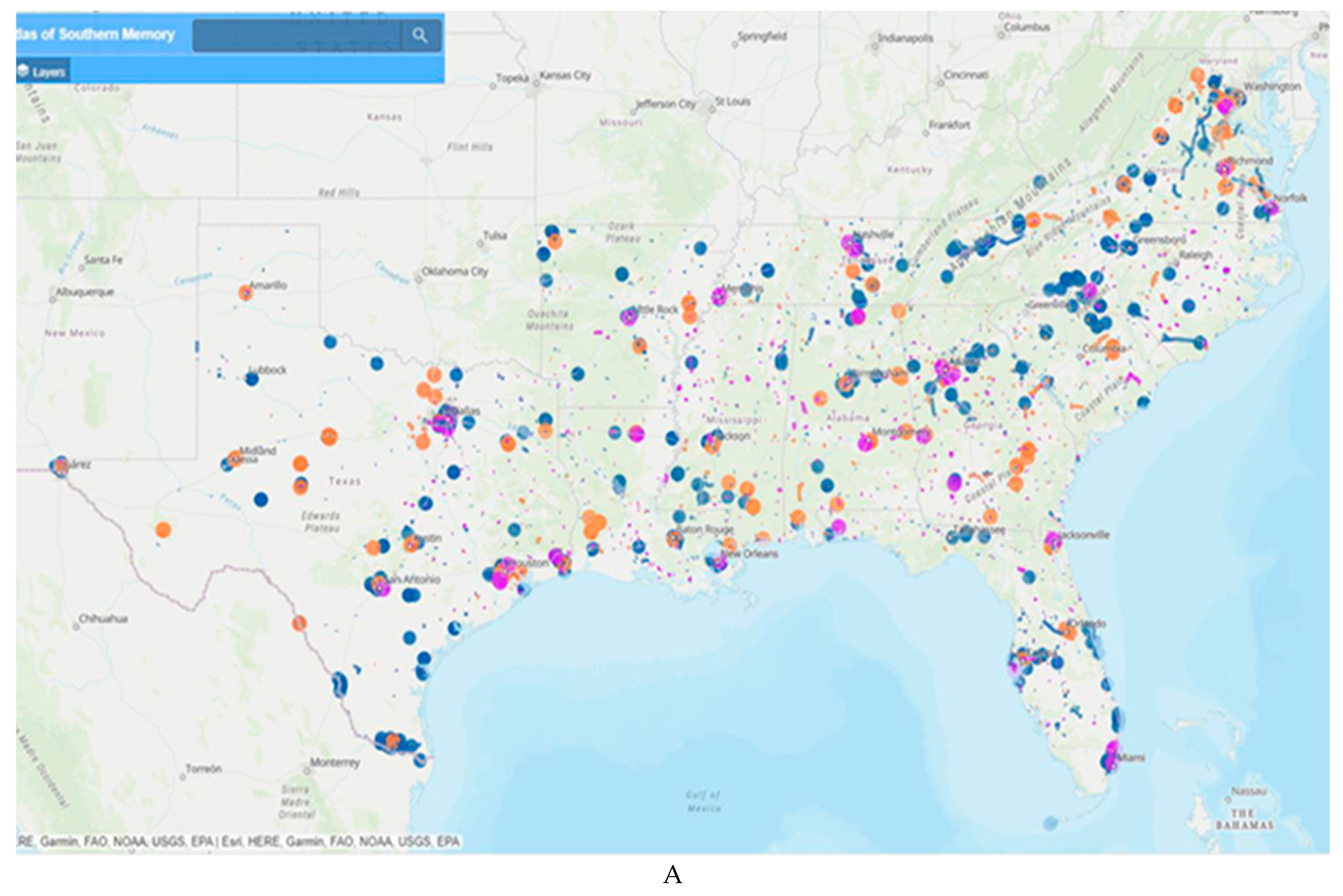
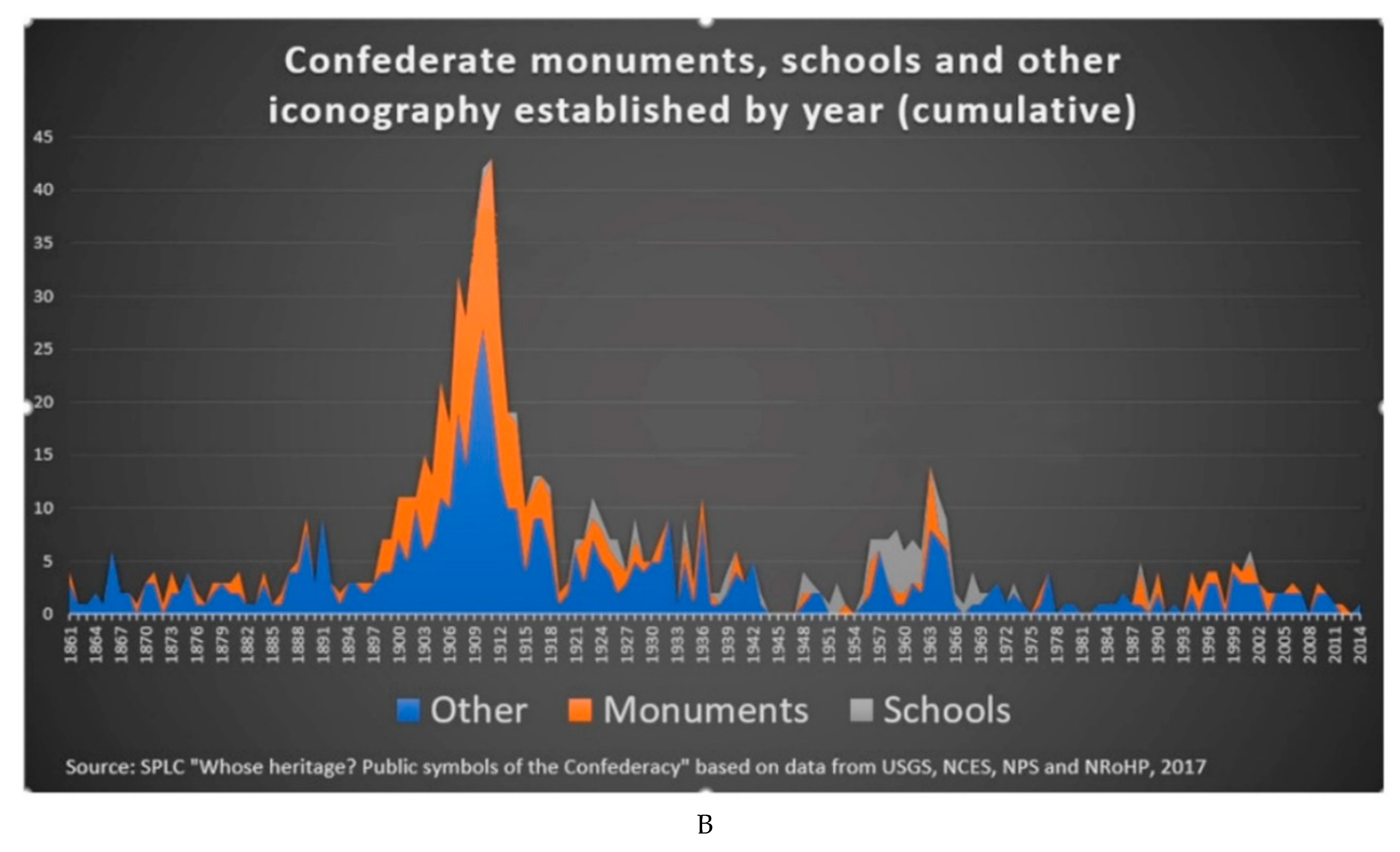
We can compare the DASM digital model to a report issued by SPLC (2016) that identified a remarkably ubiquitous number of Confederacy-related labels and names throughout the U.S. This report compiles the collective history of memorials and monuments to Confederate soldiers in the Civil War, and provides a list of all known monuments, parks, schools, roads, and municipalities honoring them. This can be compared to a chart prepared by the Southern Poverty Law Center (SPLC) showing the number of Confederate monuments, schools, and other iconography by year (Figure 4B).
It is likely that, while some of these placenames and locations have been renamed, most have not, and some, after an official name change, are debating whether to change the name back to its former status (Kiser 2024). Nevertheless, there are increasing examples of how these kinds of interpretive narratives can potentially manifest lasting change in the real world. In Hollywood, Florida, for instance, city commissioners have renamed Lee Street to Louisville Street, Forrest Street to Savannah Street, and Hood Street to Macon Street (AP 2017). Two schools in Birmingham, Alabama, one of the epicenters of the Civil Rights Movement, have changed their names from Robert E. Lee High School to Dr. Percy Julian High School, and Jefferson Davis High School has become JAG High School, representing three Figs of the civil rights movement: Judge Frank Johnson, the Reverend Ralph Abernathy, and the Rev. Robert Graetz (AP 2022). These examples show how we can create more meaningful, democratic, and lasting memorials for the diverse communities we hope to generate and sustain.
The Cultural Processes of Remembering and Forgetting
In recent decades, what has been termed as today’s “memory boom” or “era of memory” originated in a theoretical moment in the 1980s that posited social amnesia as the defining characteristic of contemporary society (Viejo-Rose 2015). It was this preoccupation with what appeared to be a widespread trend of forgetting, of rupture with the past and an obsession with experiencing the present, which led to the focus on memory and the emergence of memory studies, and this had a transformative effect on ways of understanding heritage. According to studies reported by cultural heritage professor Dacia Viejo-Rose (2015), memory is both a kind of knowledge and a form of action. Defined as a form of action, heritage becomes political and manipulative with vast implications for practices and policies. Studying how traumatic events are publicly remembered has become a focus of heritage studies because it brings to light the ethical and political, the uses and abuses, of both social memory and heritage.
International Parallels to the Debates on Removal vs. Preservation=in-Place
International parallels and examples of monuments as vessels of memory and reflection, and also rapturous forgetting (Michell 2020), of cultural history abound. Examples of memory/forgetting within a symbolic landscape as a kind of historical archive are seen in post-WWII Europe (Fuchs 2012. One is the history of the treatment of the ruins of bombed out Dresden. For seventy years following WWII, some of the ruins were preserved; i.e., the 1945 remaining ruins of the Frauenkirche baroque church. These ruins were left for nearly half a century as a war memorial by the East German government (remembering). Following the reunification of Germany in 1990, the church was reconstructed (forgetting) (Fuchs 2012). Another is the village of Oradour-sur-Glane, that, before the war, was a quiet, rural community in central France. In 1944, the village was left in ruins after German Waffen-SS troops massacred hundreds of villagers before burning the village to the ground. The ruins are preserved in situ. Today, tourists can visit the old town to see crumbling walls, cars, and other household items left untouched for the last 74 years. The purpose of the preservation of the ruins of this village is to remind the world of the Nazi atrocities suffered by not only the French but also other civilian populations (National WWII Museum 2018).
Ylimaunu and Mullins (2024) describe a somewhat parallel situation of remembering and forgetting in Finland, where, unlike in the United States, there was no openly discussed public dialogue about the causes of its civil war. Comparing Confederate monuments’ disposition to anti-communists statues in the former Soviet sphere of influence, Forest and Johnson (2020) showed that, while their students at a Canadian university appreciated the diverse strategies adopted by post-communist societies for Soviet monuments, they found it more difficult to respond to Confederate monument defenders who charged that removal would be “erasing history.” They add that their pedagogical experience led them to think and talk differently about why this is the case and to recognize that other strategies may also be effective in confronting these painful reminders of our troubled past and present. They cite conservative scholar Victor Davis Hanson (2016; 2024) who employs the Roman practice of damnatio memoriae (damnation of memory), mentioned earlier in this essay; where defenders make a moral argument that the historical record must not be altered to fit contemporary sensibilities where the symbolic landscape is a kind of historical archive from which items should never be removed. But this interpretation ignores, Forest and Johnson (2020) say, the socio-political power relations embedded in a monument’s original construction. In the absence of an alternative theory of forgetting, opponents focus on monument removal and leave open the charge of seeking to erase the past. They concluded that, although some Confederate monuments have had informational plaques installed to provide historical context, this practice represents a much more minimalist, even unobtrusive response. Reflecting on the bolder and broader range of post-communist strategies, they realized that advocates for removal should defend this choice not just in contrast to retention but with other potentially meaningful and effective options, such as recontextualization.
Demshuk (2023) provides an example of a conflicted statue from the Soviet era with his account of the Karl Marx monument in Leipzig’s central Karl Marx Square. Built on the site of a former church, and exiled (rather than retained or destroyed), the statue was moved a remote courtyard through a socially and politically wrought process that saw an evolution of publicly expressed aesthetic values after the fall of the Soviet Union in 1989-1991. Interestingly for this essay, Demshuk makes a case that this exiling process informs conversations about controversies and emotions surrounding the disposition of Confederate monuments and has affected similar retention/removal disputes about monuments in Ukraine. Since the Russian invasions of 2014 and 2022, Ukrainians have made a point of reclaiming their heritage and discarding Soviet eras symbols. The “Mother Ukraine” statue was erected in in Kyiv in 1981. The towering 200-foot (61-meter) statue is one of the nation’s most recognizable landmarks (AP 2023). Created in the image of a fearless female warrior, the statue holds a sword and a shield. A great symbolic move in 2023 was the replacement of the Soviet hammer-and-sickle symbol on the shield with Ukraine’s trident coat of arms. Both of these examples, in Leipzig and Kyiv, demonstrate the memory/forgetting dichotomies of evolving cultural heritage narratives and meanings attached to the statues.
A few years ago, artist Volodymyr Kuznetsov made an eloquent gesture. In the hills above Kyiv is a giant metal arch that symbolizes the friendship of the Ukrainian and Russian peoples. Within the arch, Kuznetsov created a “crack.” The artist gave the monument a new interpretation while preserving its historical integrity (Figure 5). In May 2022, while Ukrainians were fighting to repel the Russian invasion in the East and the capital was still being attacked, the Kyiv City Council decided to let the arch stand and to rename it the “Arch of Freedom of the Ukrainian People” (Molier 2023).
A YouTube documentary entitled “Toppling Soviet statues - How should history be remembered?” (DW 2023) posted in 2023 addressed the arguments being made, in the aftermath of Russia’s 2014 and 2022 invasions of Ukraine, for the removal or destruction vs. retention strategies of preservation in place, recontextualization, or placement in a museum, as well as their values as works of art and vessels of memory, of monuments in Ukraine from the Russian-dominated Soviet era (Molier 2023). The video revealed the international relevancy and uncanny parallels to the issues and discussions in this essay, made more poignant by the fact that millions of Ukrainians have been killed, injured, and displaced---and even more poignancy for me since I visited Ukraine during my NPS career in an advisory capacity four times prior to the 2014 invasion and have a Ukrainian wife.
Discussion and Conclusions
Recent years have seen a profound change in public attitudes and acceptance that the Confederate symbols, in particular what has become known as the “Confederate battle flag” that has been appropriated by racist hate groups, contribute to social turmoil, and should be faded out of public discourse. A similar attitude has been projected about Confederate-related monuments, and this opinion continues today. However, some people take the position that certain monuments and memorials should not be removed or destroyed but should be saved and perhaps recontextualized, as Professor Geoff Ward from the department of African American Studies at Washington University in St. Louis and others has asserted. I have offered an example in Savannah, Georgia, where recontextualization seems to have been n effective in reducing tensions associated with Confederate monuments, while also noting a case of unconventional recontextualization involving a radical change in setting a Houston museum. I refer to research that describes the dilemmas facing management agencies such as the National Park Service, whose mantra to preserve historic and natural resources “unimpaired” (NPS n.d.). Cited examples show that, while existing signage or applied in situ inscriptions at Civil War parks and sites is generally teamed unacceptable or inaccurate by both laypersons and historians, the majority of site visitors are engaged in reinforcing what they already know and believe.
Depending on one’s perspective, Confederate monuments and other forms of commemoration symbolize either a grand “lost cause” heritage, a perplexed and paradoxical cultural and personal inheritance, or symbols and focal points of racism, bigotry, discrimination, and hate. At the polar extremes, one side speaks glory, while the other side speaks pain. Both sides echo the inheritance of coping with the profound human cost of both a transformational and tragic war. Most of the monuments were not created in isolation, but rather as political statements and consequences of power struggles in society. For some, they are places of reflection and memory about the past as it relates to the present. In an era of renewed iconoclasm in the 21st century, Civil War related commemorations are indeed controversial and modern attitudes about them speak to central questions of what gets remembered and how these monuments and remembrances are treated going forward. Adding to the socio-political complexity in the United States is the fact that scores of these monuments are formally listed on the National Register of Historic Places. Another dimension to the discussion is the statues’ or memorials’ artistic rendering and the power this gives them for variety of interpretations and impressions. An enduring legacy is that the monuments have always been, and continue to be, highly politicized. Today’s public dialogue challenges the deeply held legends and myths of the Confederacy that the whole country, not just the South, still has a hard time articulating and accepting. These evolving narratives reflect multifaceted layers of meaning and changing opportunities available or public reflection and interpretation. There is no doubt that many of the statues should be taken down and, in their place, erected monuments and memorials that correct the exclusion of Blacks to the Civil War and its transformative legacy.
I have mentioned two categories of participatory interpretive intervention available to audiences. Both have the potential to produce expanded cultural narratives. Physical intervention produces onsite discussion, interaction, and feedback, such as with “Rumors of War,” located at the Virginia Museum of Fine Arts in Richmond. These interventions can function as a disturbance of vision in the landscape, creating interruptions and provocations that have the potential to change the statues’ meanings as sites of conscience and reflection (Jackson 2022:198). Digital intervention, with potential to be a more democratic and widely accessible, is exemplified by the developing DASM project. Digital intervention encourages creating, changing, and enhancing audience participation, change engagement, and empowerment. Today, through participatory digital technologies and other forms of social media, individuals and the public can, beyond physical intervention, influence what gets remembered and how it is commemorated, interpreted, and preserved. The intersections of dissent and translational storytelling through digital media can disrupt traditional narratives of the past. Public resource managers can use these principles to introduce multiple and diverse voices in shaping messages and stories about the past. Objects displayed in a museum environment such as oppositional displays, or displays with alternative messages, have potential to utilize both physical and digital intervention as part of the educational and interpretive message. We can use these methods to challenge representations of people in the past, and ultimately contemporary perceptions of culture, diversity, and inclusiveness.
I argue that if all traces of tangible monuments are removed, neighborhoods and regions and countries will lose an important educational tool and focal point for reflection and community dialogue about the Civil War and its effects. While, in many cases, convincing arguments can be made for removal, the irony is, in removing them from their original settings, the effect is to substantially diminish the storytelling power, authenticity, and effectiveness of potential counter-narrative debates and discussions. I have given two suggested examples of why we should not, in the emotion of the moment, necessarily be in a hurry to remove or destroy all monument remains. If left in place as an in situ artifact, for example, the graffiti-adorned pedestal of the Lee monument on Monument Avenue in Richmond could have been interpreted as symbolizing a new era of social justice that arose in the 2020s. We might compare this to the decision to leave a remnant of the World Trade Center building in situ, the Hiroshima Peace Memorial, or the leaving of a portion of bombed out Coventry, England in place, where, rather than sweeping away the ruins or rebuilding a replica of the former church, it was decided to preserve the remains of the old Cathedral as a moving reminder of the folly and waste of war. I cite examples of this phenomenon at Dresden, Germany and at the French village of Oradour-sur-Glane. Similarly, with the removal of the Richmond’s J.E.B. Stuart statue, notwithstanding the understandable complex social and political motivations and controversies surrounding removal, the power of “Rumours of War” as the antithesis and response to the J.E.B. Stuart statue is diminished in its intended symbolic, educational, and interpretive roles.
I have discussed the cultural process of remembering and forgetting as this applies to Confederate legacies and other contested heritages internationally. In these cases, I believe, in the absence of an alternative theory of forgetting, opponents who focus on monument removal leave open the charge of seeking to erase the past.
The modern dilemma turns on the question: Are these monuments primarily symbols of oppression, or can we see them, at least in some cases, alternatively as sites of conscience and reflection and as places for community agoras for “processing traumas” and more inclusive conversations about commemoration? Within the remembering/forgetting dichotomies of cultural heritage, what we save or destroy and assign as the ultimate public value of these monuments rests with how we answer this question.
References
- AJC (Atlanta Journal-Constitution). 2021. “Confederate group sues over removal of Decatur monument.” https://www.ajc.com/news/atlanta-news/confederate-group-sues-over-removal-of-decatur-monument/MQ7BY4PLRJHSFI5WFFDRXGUWDM/, accessed on 22 June 2021.
- American Battlefield Trust. n.d. Military Losses in American Wars. https://www.battlefields.org/learn/articles/civil-war-casualties, accessed on 15 June 2024.
- AP (Associated Press). 2017 “Florida city to rename streets honoring Confederate generals.” (July 4, 2017). https://apnews.com/article/9af89fea48254378846a459c5d0f412d, accessed on 24 April 2021.
- 2022 “Alabama’s capital removes Confederate names from 2 schools.” (November 13, 2022). https://ksltv.com/511474/alabamas-capital-removes-confederate-names-from-2-schools/, accessed on 3 April 2023.
- 2023 “Ukraine replaces Soviet hammer and sickle with trident on towering Kyiv monument”.
- https://apnews.com/article/mother-ukraine-monument-soviet-emblem-trident-5c0f509d476835c6ce5e93599a2ec28c accessed on 16 June 2024.
- Autry, Enoc. “Restored Confederate monument rededicated.".
- 2020 https://www.augustachronicle.com/story/news/2019/10/27/screven-county-confederate-monument-rededicated-after-original-toppled/2436946007/, accessed 24 August 2023.
- Baugher, Sherene, John H. Jameson, and Richard Veit. 2024 Introduction. In Monuments and Memory: Archaeological Perspectives on Commemoration, John H Jameson, Sherene Baugher, and Richard Veit (eds), University Press of Florida [scheduled Dec. 2024].
- Beiner, Guy. 2021 When Monuments Fall: The Significance of Decommemorating. Éire-Ireland 56(1), 33-61. [CrossRef]
- Bergen Community College. 2017 History and Heritage, Memory and Memorialization: Confederate Monuments After Charlottesville. PDF: https://bergen.edu/wp-content/uploads/History-and-Heritage-Memory-and-Memorialization-Confederate-Monuments-After-Charlottesville.pdf, accessed 12 December 2022.
- Beetham, Sarah. 2020 Recontextualizing Monuments and the Treachery of Images.
- https://sarahbeetham.com/2018/05/18/recontextualizing-monuments-and-the-treachery-of-images/, accessed on28 June 2020.
- Blight, David W. 2001 Race and Reunion: The Civil War in American Memory. Cambridge: Harvard University Press, Cambridge, MA.
- Boston.com. 2024 “‘Remove it’: What readers said about the MFA ‘Appeal’ statue controversy.” https://www.boston.com/community/readers-say/2024/06/14/mfa-appeal-statue-controversy/, received on 16 June 2024).
- Brown, Rachel. 2017 Why the U.S. Capitol Still Hosts Confederate Monuments. National Geographic. https://www.nationalgeographic.com/history/article/charlottesville-confederate-memorials-civil-war-racism-history, accessed on 20 March 2021.
- Brown, Thomas J. 2019 Civil War Monuments and the Militarization of America Chapel Hill: University of North Carolina Press, pp1-12.
- CBC (Canadian Broadcasting Corporation). 2020 U.S. military reviewing its ties to Confederate symbols, names https://www.cbc.ca/news/world/us-military-confederate-symbols-1.5605943, accessed on 14 April 2021 .
- Christmas, Danielle. 2022 Weaponizing Silent Sam: Heritage Politics and The Third Revolution. In Reading Confederate Monuments. Maria Segar, editor, p. 101-109. Jackson: University of Mississippi Press, Jackson.
- City of Savannah (Georgia, USA). 2020 Civil War Memorial Task Force Additional Recommendations Final Report.
- Savannah City Council Workshop, October 8, 2020.
- Cox, Karen L. 2021a Karen L. Cox, "No Common Ground." Politics and Prose, May 5, 2021, Zoom session. https://www.youtube.com/watch?v=DxPg-wbrKCs, assessed on 12 December 2022.
- 2021b No Common Ground: Confederate Monuments and the Ongoing Fight for Racial Justice. Chapel Hill: The University of North Carolina Press, Chapel Hill.
- Demshuk, Andrew. 2023 “Exiling Karl Marx from Karl Marx Square: The Political Lives of a Leipzig Monument before and after 1989,” Journal of Contemporary History, Volume 59, Issue 1.
- Driggs, Sarah S. 1997 "Monument Avenue Historic District" (PDF). National Historic Landmark Nomination. US Department of the Interior, National Park Service, p. 8. PDF: chrome-extension://efaidnbmnnnibpcajpcglclefindmkaj/https://www.dhr.virginia.gov/wp-content/uploads/2018/04/127-0174_Monument_Avenue_HD_1997_Nomination_NHL-4.pdf, accessed on 1 June 2020.
- DW (Deutsche Welle). 2023 “Toppling Soviet statues - How should history be remembered?” DW Documentary, English Version. https://www.youtube.com/watch?v=c4MPajt_tlY, accessed on 19 May 2023.
- Federal Register. 2020 Executive Order 13933 of June 26, 2020, “Protecting American Monuments, Memorials, and Statues and Combating Recent Criminal Violence.” FR Doc. 2020-14509. https://www.federalregister.gov/documents/2020/07/02/2020-14509/protecting-american-monuments-memorials-and-statues-and-combating-recent-criminal-violence, accessed on @4 April 2021.
- Faust, Drew Gilpin. 2008 This Republic of Suffering: Death and the American Civil War. Vintage, New York, NY.
- Fuchs, Ann. 2012 After the Dresden Bombing: Pathways of Memory, 1945 to the Present (Palgrave Macmillan Memory Studies). New York: Palgrave Macmillan.
- Forest, Benjamin, and Juliet Johnson. 2020 "Confederate Monuments and the Problem of Forgetting." Cultural Geographies in Practice, Vol. 26(1) 127–131.
- Gershon, Livia. 2022 “Richmond’s Robert E. Lee Statue Is Headed to a Black History Museum.” Smithsonian Magazine, January 5, 2022. https://www.smithsonianmag.com/smart-news/richmond-confederate-monuments-headed-to-black-history-museum-180979319/, accessed on 16 January 2022.
- Gordon, Lesley J. 2022 "Civil War Legacy in the South," C-SPAN Lectures in History, University of Alabama, April 22, 2022, lecture. https://www.c-span.org/video/?519565-1/civil-war-legacy-south, accessed on 5 July 2022.
- Hanson, Victor Davis. 2016 “The hypocrisy behind the student renaming craze." Investor’s Business Daily. https://www.investors.com/politics/commentary/victor-davis-hanson-the-hypocrisy-behind-the-student-renaming-craze/, accessed on 21 June 2024.
- 2024 Introduction. In The End of Everything: How Wars Descend into Annihilation. pp. 1-10. Basic Books.
- Hartley, Roger C. 2021 Monumental Harm. Columbia: University of South Carolina Press.
- Hearst Television. 2020 As Confederate monuments come down, some states have laws that protect their removal, July 10, 2020. https://www.thetelegraph.com/news/article/As-Confederate-monuments-come-down-some-states-15382654.php, accessed on 15 December 2020.
- Heartfield, James. 2017 Should Nelson’s column come down? https://www.spiked-online.com/2017/08/24/should-nelsons-column-come-down/, accessed on !2 December 2022.
- Horwitz, Tony. 1999 Confederates in the Attic. Vintage, New York, NY.
- Jackson, Cassandra. 2022 Rewriting the Landscape: Black Communities and the Confederate Monuments They Inherited. In Reading Confederate Monuments. P. 194-197. Edited by Maria Segar. Jackson: University of Mississippi Press, Jackson.
- Jameson, John H. 2022 Facilitated Dialogue and the Evolving Philosophies on the Public Interpretation of Cultural Heritage Sites. In Creating Participatory Dialogue in Archaeological and Cultural Heritage Interpretation: International Perspectives, edited by John H. Jameson and Sherene Baugher, pp. 9-24, Springer, Cham, Switzerland. [CrossRef]
- Janney Caroline E. 2013 Remembering the Civil War: Reunion and the Limits of Reconciliation. (The Littlefield History of the Civil War Era.), p. 3. Chapel Hill: University of North Carolina Press.
- Katz, Brigit. 2018 “New Historic Marker Highlights Nathan Bedford Forrest’s Ties to the Slave Trade” Smithsonian.com https://www.smithsonianmag.com/smart-news/new-historic-marker-highlights-nathan-bedfordforrests-ties-slave-trade-180968419/(18 March 2018).
- Kiser, Uriah. 2024 “Poll Results: Majority call for restoring Stonewall Jackson’s Name to High School.” Potomac Local News, May 13, 2024. https://www.potomaclocal.com/2024/05/13/poll-results-majority-call-for-restoring-stonewall-jacksons-name-to-high-school, accessed on 14 June 2024.
- Klibanov, Caroline. 2019 Digital Atlas of Southern Memory (DASM). https://web.northeastern.edu/nulab/the-atlasof-southern-memory/, accessed on 4 March 2021.
- La Force, Thessaly, Zoë Lescaze, Nancy Hass, and M.H. Miller.
- 2020 The 25 Most Influential Works of American Protest Art Since World War II. New York Times Style Magazine. https://www.nytimes.com/2020/10/15/t-magazine/most-influential-protest-art.html, accessed on 18 April 2021.
- Levin, Kevin M. 2017 "Interpreting the Civil War at Museums and Historic Sites." Rowman & Littlefield.
- LOC (Library of Congress). n.d. Statue of Sir James Outram, Calcutta, 1889. https://www.loc.gov/item/2002705675/, accessed on 21 June 2024.
- Low, Polly. 2020 Remembering, Forgetting, and Rewriting The Past: Athenian Inscriptions and Collective Memory. Histos Supplement 11.
- Lowenthal, David. 1999 “Preface,” in The Art of Forgetting, Adrian Forty and Susanne Küchler, editors, p. xi.
- Berg, Oxford and New York.
- Mitchell, Kirk. 2020 "Confederate Monuments and the Problem of Forgetting." Southern Cultures, vol. 26, no. 2, 2020, pp. 80-100.
- Moliar, Yevheniia. 2023 “Ukraine must stop destroying its cultural heritage. In tearing down Soviet public statues and mosaics, the country is erasing a part of its own history.” Politico Magazine, 11 March 2023 https://www.spectator.co.uk/article/ukraine-must-stop-destroying-its-cultural-heritage/, accessed on 28 May 2023.
- Murray, Tim. 2021 “Adventures in Post-Colonial Archaeology: 1.” Barngroup Histories of Archaeology Research Network Weblog, July 8, 2021. https://harngroup.wordpress.com/2021/07/08/adventures-in-post-colonial-archaeology-1/, accessed on 17 July 2021.
- NPS (National Park Service, United States Department of Interior). n.d. “Our Mission.” https://www.nps.gov/aboutus/index.htm, accessed on 15 June 2024.
- 1970 “Monument Avenue Historic District,” National Register of Historic Places Nomination Form. https://www.dhr.virginia.gov/wp-content/uploads/2018/04/127-0174_Monument_Avenue_HD_1969_NRHP_nomination_Final.pdf, accessed on 1 June 2020.
- National WWII Museum. 2018 “Oradour-sur-Glane: Martyred Village: The visible remains of Nazi brutality".
- https://www.nationalww2museum.org/war/articles/oradour-sur-glane-martyred-village, accessed on 14 June 2024.
- Nilsson, Jeff. 2020 How the Lost Cause Myth Led to Confederate “Monument Fever” What caused the South to start building Confederate monuments long after the end of the war? Saturday Evening Post. https://www.saturdayeveningpost.com/2020/06/how-the-lost-cause-myth-led-to-confederate-monument-fever/, accessed on 15 January 2021.
- NBC. 2021 “Civil War,” a documentary film. https://www.msnbc.com/the-reidout/watch/new-civil-war-documentary-examines-americans-differing-narratives-on-pivotal-conflict-123904581988, accessed on 1 December 2021.
- Ortiz, Eric. 2020 “These Confederate statues were removed. But where did they go?” NBC News. https://www.nbcnews.com/news/us-news/these-confederate-statues-were-removed-where-did-they-go-n1240268, accessed on 12 April 2023.
- NPR (National Public Radio). 2021 “Confederate Imagery On Stone Mountain Is Changing, But Not Fast Enough For Some.” https://www.npr.org/2021/06/21/1007924006/confederate-imagery-on-stone-mountain-is-changing-but-not-fast-enough-for-some?ft=nprml&f=1001, accessed on 22 June 2021.
- PBS Hews Hour. 2017 Robert E. Lee opposed Confederate monuments. August 15, 2017. https://www.pbs.org/newshour/nation/robert-e-lee-opposed-confederate-monuments, accessed on 15 December 2019.
- 2021 WATCH: Emancipation monument unveiled in Richmond, Virginia. https://www.pbs.org/newshour/arts/watch-live-emancipation-monument-unveiled-in-richmond-virginia#:~:text=A%20new%20emancipation%20monument%20was,man%20freed%20from%20chattel%20slavery, accessed on 28 April 2023.
- Randolph, Noah A. 2020 Continued Entanglements: Between Equestrian Oba and Rumors Of War A Thesis.
- Unpublished thesis. Temple University, May 2020. https://scholarshare.temple.edu/bitstream/handle/20.500.12613/3445/TETDEDXRandolph-temple-0225M-14038.pdf?sequence=1, accessed on 20 September 2020.
- Reuters. 2017 "U.S. cities step up removal of Confederate statues, despite Virginia". Reuters. August 16, 2017.
- https://www.reuters.com/article/us-virginia-protests-statues-idUSKCN1AV0XE, accessed on 1 March 2021.
- Santayana, George. 1905 Reason in Common Sense: The Life of Reason Volume 1. Reason in Common Sense/Chapter XII, Page 284. https://en.wikisource.org/wiki/Reason_in_Common_Sense/Chapter_XII, accessed on 12 April 2023.
- Seidule, Ty. 2021 Robert E. Lee and Me: A Southerner's Reckoning with the Myth of the Lost Cause. St. Martin's Press, New York, NY.
- Sims, Lowery Stokes. 2021 "Revealing Histories: Re-Contextualizing Confederate Monuments." Smithsonian Magazine, 2021.
- Smith, Laurajane. 2006 Uses of Heritage. New York: Routledge, New York, NY.
- Smithsonian Institution. 2020 “Virginia Museum Will Lead Efforts to Reimagine Richmond Avenue Once Lined With Confederate Monuments.” Smithsonian Magazine https://www.smithsonianmag.com/smart-news/, accessed on 20 December 2020.
- SPLC (Southern Poverty Law Center). 2016 Whose Heritage? Public Symbols of the Confederacy. Contributors: Booth Gunter, Jamie, Kizzire, and Cindy Kent. Montgomery, Alabama. https://dataspace.princeton.edu/bitstream/88435/dsp01cc08hj26s/3/whoseheritagesplc.pdf, accessed on 26 February 2021.
- The Clio. n.d. J.E.B. Stuart Monument Introduction. https://theclio.com/entry/32263, accessed 15 March 2021.
- Tompkins, Mandy Gibson, and Gabriel A Reich. 2017 Confederate Monuments: Heritage, Racism, Anachronism, and Who Gets to Decide? Social Education 81(6), pp. 356–362, National Council for the Social Studies.
- Thompson, Erin L. 2020 “Why Just ‘Adding Context’ to Controversial Monuments May Not Change Minds.” Smithsonian Magazine, December 18, 2020.
- 2022 Smashing Statues: The Rise and Fall of America's Public Monuments. New York: Norton.
- Tronchin, Francesca. 2023 A Beginner’s Gude to Ancient Rome: Damnatio memoriae—Roman sanctions against memory. Khan Academy.
- https://www.khanacademy.org/humanities/ancient-art-civilizations/roman/beginners-guide-rome/a/damnatio-memoriaeroman-sanctions-against-memory#:~:text=Condemning%20memory-,Damnatio%20memoriae,of%20enemy%20to%20the%20state. accessed on 1 May 2023.
- Viejo-Rose, Dacia. 2015 “Cultural heritage and memory: untangling the ties that bind“ Culture & History Digital Journal 4(2) December 2015, pp. 2-5. [CrossRef]
- Washington University of St. Louis. 2020 “Truths and Reckonings: The Art of Transformative Racial Justice” Exhibit https://artsci.wustl.edu/events/truths-and-reckonings-art-transformative-racial-justice, accessed on 18 April 2021.
- Ylimaunu, Timo, and Paul R. Mullins. 2024 “Memorializing Defeat: Remembering Civil Wars in Finland and USA.” In Monuments and Memory: Archaeological Perspectives on Commemoration, John H Jameson, Sherene Baugher, and Richard Veit (eds), University Press of Florida [scheduled Dec. 2024].
- Zúñiga, Ximena., Biren Nagda, Mark Chester, and Adena Cytron-Walker. 2007 Intergroup Dialogue In Higher Education: Meaningful Learning About Social Justice (ASHE Higher Education Report, Vol. 32, pp. 1-110.
Short Biography of Authors
John H. Jameson is retired from U.S. National Park Service where he was a recipient of the Sequoia Award for career achievements. His work has encompassed a broad range of projects in cultural heritage management, preservation, and interpretation in several regions of the United States and Europe. He is a founding member of the ICOMOS Interpretation and Presentation Committee and UNESCO Working Group. He has edited and contributed to several seminal works on cultural heritage public interpretation.
Figure 1.
A: The Confederate Memorial in Fulton, Kentucky, erected 1902, listed on the National Register of Historic Places. (Creative Commons Attribution-Share Alike 4.0 International license, Wikimedia Commons; B: Confederate Memorial in Forsyth Park, Savannah, Georgia. Photo by John H Jameson, 2022.
Figure 1.
A: The Confederate Memorial in Fulton, Kentucky, erected 1902, listed on the National Register of Historic Places. (Creative Commons Attribution-Share Alike 4.0 International license, Wikimedia Commons; B: Confederate Memorial in Forsyth Park, Savannah, Georgia. Photo by John H Jameson, 2022.

Figure 2.
A: Triumphal statue of Robert E. Lee on Monument Avenue in Richmond, Virginia, prior to removal. The Lee statue received a 2018 epitaph “Ceci n’est pas un hero” (“This is not a hero”) (Beetham 2018; Creative Commons Attribution-Share Alike 4.0 International license, Wikimedia Commons); B: The “decorated” statue of General Lee on Richmond’s Monument Avenue, statue and graffiti-laden podium now removed, stood as a moving witness to the Black Lives Matter movement. Photo courtesy of Richard Veit, 2020.
Figure 2.
A: Triumphal statue of Robert E. Lee on Monument Avenue in Richmond, Virginia, prior to removal. The Lee statue received a 2018 epitaph “Ceci n’est pas un hero” (“This is not a hero”) (Beetham 2018; Creative Commons Attribution-Share Alike 4.0 International license, Wikimedia Commons); B: The “decorated” statue of General Lee on Richmond’s Monument Avenue, statue and graffiti-laden podium now removed, stood as a moving witness to the Black Lives Matter movement. Photo courtesy of Richard Veit, 2020.
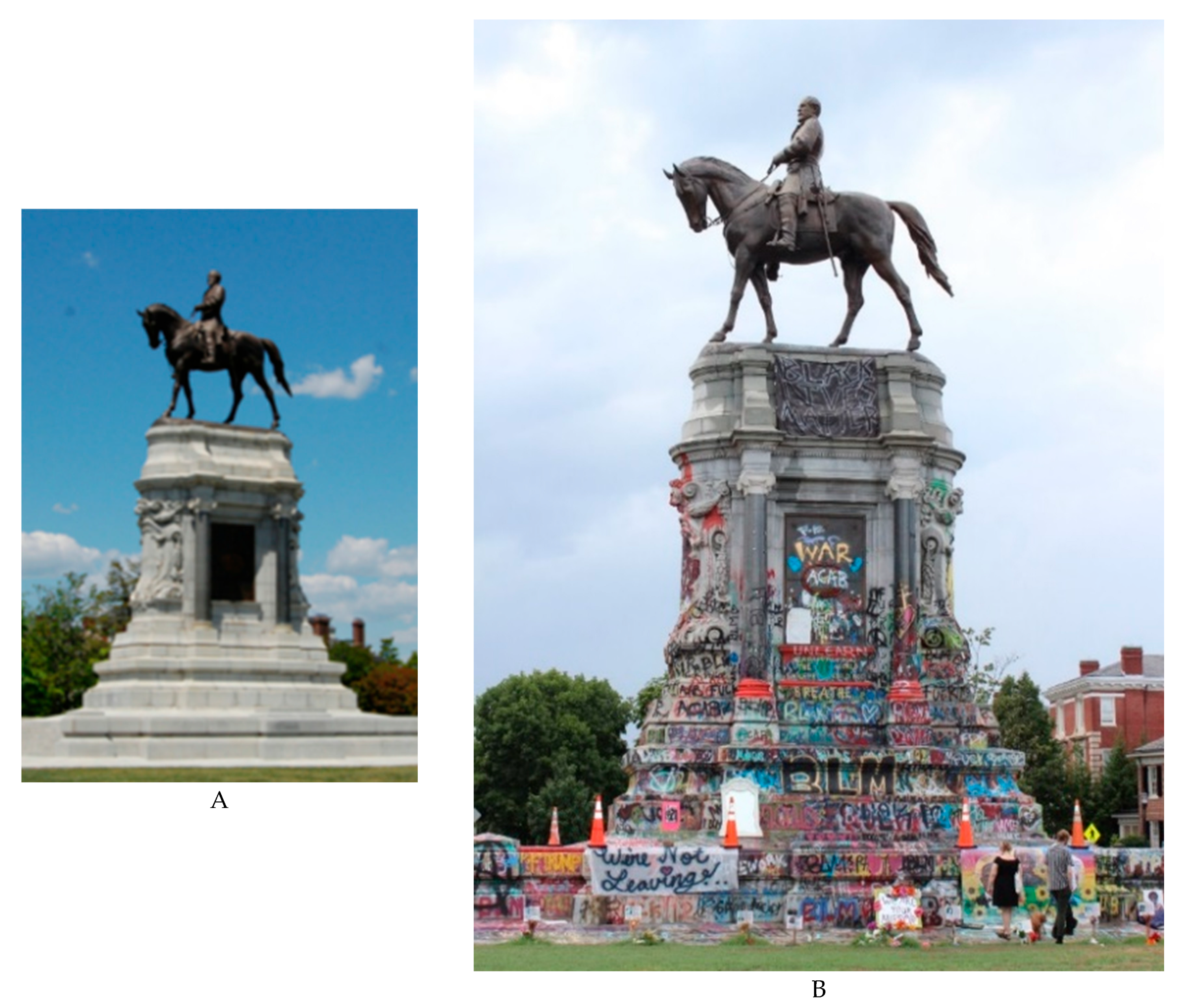
Figure 5.
The monument once known as the Arch of the Peoples' Friendship has long been a source of controversy in Kyiv. In 2018, a "crack" sticker was added on the arch to symbolize the fracture of the Ukrainian-Russian relationship. It still stands, but, following the outbreak of war in February 2022, the towering metal parabola was rededicated as the “Arch of Freedom of the Ukrainian People.” Photo: Volodymyr Bondar, licensed under the Creative Commons Attribution-Share Alike 4.0 International.
Figure 5.
The monument once known as the Arch of the Peoples' Friendship has long been a source of controversy in Kyiv. In 2018, a "crack" sticker was added on the arch to symbolize the fracture of the Ukrainian-Russian relationship. It still stands, but, following the outbreak of war in February 2022, the towering metal parabola was rededicated as the “Arch of Freedom of the Ukrainian People.” Photo: Volodymyr Bondar, licensed under the Creative Commons Attribution-Share Alike 4.0 International.
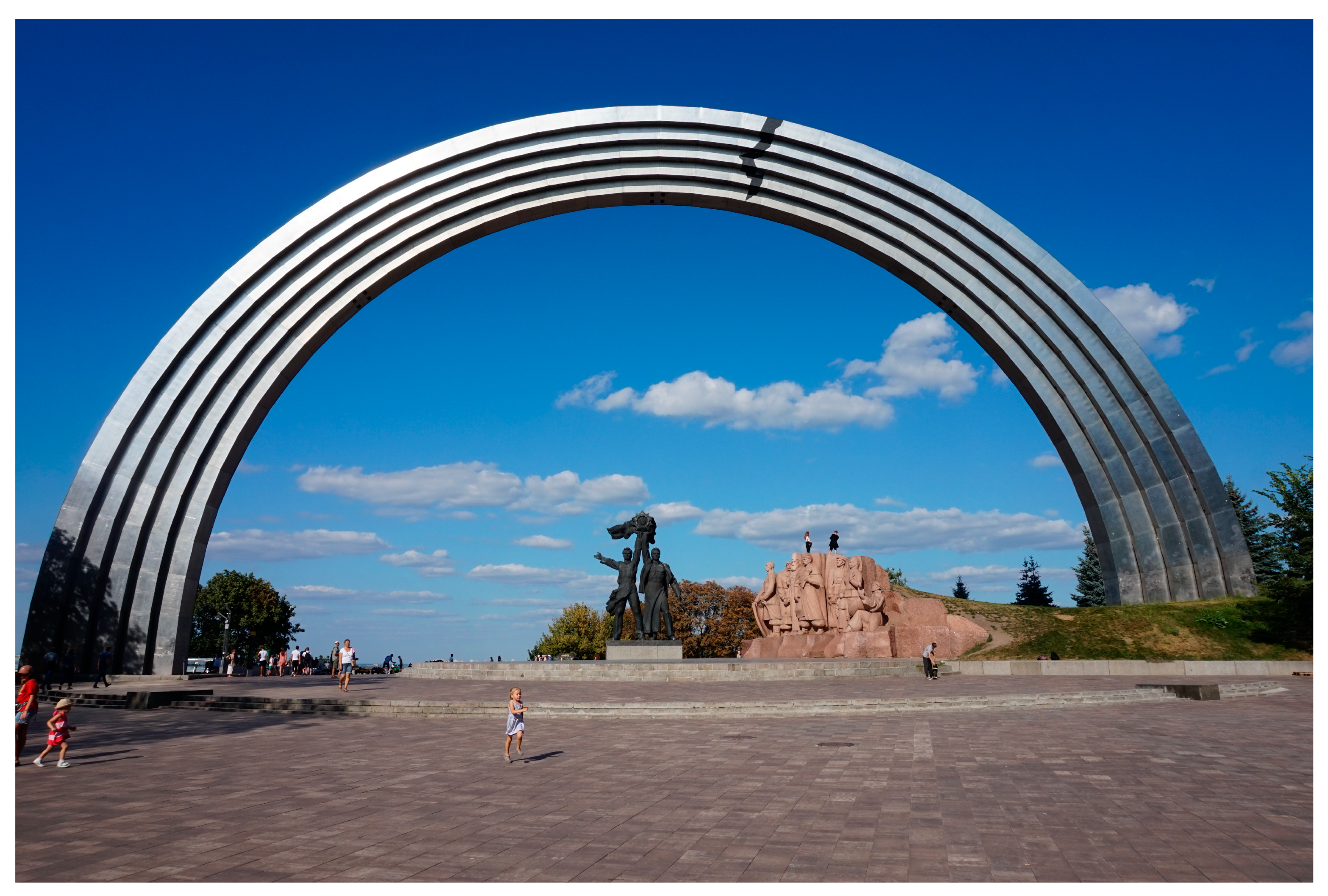
Disclaimer/Publisher’s Note: The statements, opinions and data contained in all publications are solely those of the individual author(s) and contributor(s) and not of MDPI and/or the editor(s). MDPI and/or the editor(s) disclaim responsibility for any injury to people or property resulting from any ideas, methods, instructions or products referred to in the content. |
© 2024 by the authors. Licensee MDPI, Basel, Switzerland. This article is an open access article distributed under the terms and conditions of the Creative Commons Attribution (CC BY) license (http://creativecommons.org/licenses/by/4.0/).
Copyright: This open access article is published under a Creative Commons CC BY 4.0 license, which permit the free download, distribution, and reuse, provided that the author and preprint are cited in any reuse.


