
Submitted:
26 July 2024
Posted:
29 July 2024
You are already at the latest version
Abstract
Previous studies have acknowledged the impact of weather changes on retail uncertainty. They primarily focus on understanding how weather conditions affect offline consumer behavior and aiming to develop effective marketing strategies. However, there is little research on the complex impact of weather on online shopping behavior. To bridge this gap, we conduct a study with a sample of 261 consumers from China with shopping experience in Community Retail Shops (CRSs). We utilize the S-O-R model and theories including meteorological emotional effect theory, emotional coherence and meteorological psychology to propose and validate models elucidating the relationship between weather and consumers' online shopping behavior in CRS. Our findings reveal that weather conditions affect consumers' spending patterns and purchase diversity, mediating by consumers' emotion and risk aversion, when they comfortably shop online at home. Furthermore, employing the fsQCA model, we identify the critical path through which weather conditions and consumer types influence risk aversion awareness. The results provide management implications for retailers to develop online marketing strategies for different consumer types.
Keywords:
Community Retail Shops
; weather conditions
; S-O-R
; online purchasing behavior
; risk aversion awareness
1. Introduction
With Bed Bath & Beyond, the domestic merchandise retail stores formed in 1971 and counted among the Fortune 500 and the Forbes Global 2000, filing for bankruptcy in April 2023. The retail industry is now facing unprecedented challenges [1,2,3,4], as the transformation of internal e-commerce continues to affect brick-and-mortar retail [4]. Moreover, external climate change is increasing uncertainty in the retail industry [1,5]. Most countries around the world are experiencing unprecedented extreme weather events. Over the same period, retail sales in the UK fell sharply, with food sales down 2.6% and non-food sales decrease by 1.7% in July, mainly due to the rainy weather which kept consumers at home rather than hanging out for shopping.
With the internal and external threats, retailers are gradually adapting to new retail formats [6,7]. For example, Walmart's "Online Supermarket" and Yonghui Supermarket's "Yonghui Shopping" allow consumers to place orders online and enjoy home delivery services. New retail was proposed by Alibaba in 2016 and defined as "a mode in which businesses rely on the internet, focus on consumers, and deeply integrate online services and offline experiences with the advanced technologies such as big data and artificial intelligence [8,9]."
With the rapid development of e-commerce, the operation mode of community group buying has huge market potential [10,11]. Community Retail Shop (abbr. CRS) has become a key focus for convenience stores to expand the business under the new retail format guided by China Convenience Store Development Report 2021. The online order-delivery-to-home service model has significantly reduced consumers' offline shopping costs [12,13]. As the covid-19 triggers changes in consumer shopping habits [14,15,16], CRS has put more emphasis on online business design. CRS mainly sells fresh produce, which is vulnerable to weather when stored and distributed [17]. For example, heat weather increases the cost of product waste and lead to a profit loss if consumers are less likely to shop. Therefore, studying the mechanisms by which weather affects online consumer shopping behavior has practical implications for CRS retailers.
Recent studies have explored the factors that influence consumer online shopping [14,18,19,20,21], but the impact of complex weather changes on consumer online shopping behavior is often overlooked. Previous studies have concluded three aspects of reason that weather has on sales in offline stores. First, weather can influence consumers' decisions to go out and make purchases[22]. Second, weather conditions can affect the purchase pattern as the factors, such as purchase motivation (essential or leisure), travel costs, and weather conditions, may influence the decision process of consumers [5]. Finally, consumers' purchase behavior when entering a shop is influenced by factors such as in-store promotions, and customers' sensitivity to promotional discounts varies with different weather conditions [23].
Considering that CRS's offline order-delivery-to-home model, the impact of weather factors on such consumer shopping behavior seems to be less related to the three aspects summarized above, but consumers can be influenced by weather conditions even when shopping online. Uncomfortable weather conditions can influence human financial decision through psychological mechanisms [24,25] and the psychological effect of weather may change the shopping habits [26]. In other words, weather can affect people's psychological state, which in turn affects their shopping behavior. For instance, positive moods may lead consumers to spend more money [27,28,29].
Most of previous studies adopt secondary data to reveal the impact of weather on retail performance, often neglecting the psychological mechanisms by which consumer’s purchase behavior influences the relationship [22,30,31,32,33,34,35,36]. To investigate the mechanism of weather influence on CRS consumers' online shopping behavior, we construct and validate a theoretical framework by integrating the S-O-R model and theories including meteorological emotional effect theory, emotional coherence and meteorological psychology. The framework explains how weather affects CRS consumers' responses to online shopping behavior from affective and cognitive perspectives. Furthermore, we adopt the fsQCA model to reveal the critical path of weather and consumer type combinations on risk aversion awareness. Our study fills the current gap in retail research of factors that would influence consumers' online shopping behavior and provides managerial insights on how to tailor marketing campaigns to different consumer types.
This paper is structured as follows. Section II provides a review of relevant literature. Section III proposes the research hypothesis about the relevant theoretical base. Section IV describes the design of the scenario experiment and the construction of the model. Section V presents the empirical analysis. Finally, Sections VI makes a conclusion and sets out the managerial suggestion.
2. Background Literature
2.1. Review of Weather Factors’ Impact on Human Psychology
The psychological impact of weather on humans is manifested in cognitive terms. Medical research has shown that air pollution can adversely affect human cognitive function [37,38] and impair human cognitive abilities [39,40,41]. In addition to existing studies that focus on common weather metrics such as temperature and air quality, Izadi, et al. [42] found that different directions of air currents affect human cognition. Risk aversion perception is a common type of cognitive ability that refers to a human attitude toward coping with risky situations. In the field of finance, empirical studies on weather and financial purchase behavior have shown that awareness of risk aversion plays a mediating role between the two [24,25,43].
The effect of weather on the human psychology also reflects in emotions. Persinger and Levesque [44] found that different combinations of weather events could explain 40% of human moods. Unlike the effects on cognition, the emotional aspects are more concrete and direct [45]. For example, rainy weather produces negative moods in humans [46]. Sunlight produces positive moods in humans [47,48,49], and artificial sunlight can reduce symptoms of seasonal affective disorder (SAD)[50,51,52]. In addition, warm temperatures make people feel more comfortable and produce positive moods [47,48], and lower humidity is more pleasant [45]. Recent research has begun to focus on the impact of temperature on consumer behavior. Yang, et al. [53] innovatively discussed how the impact of temperature on consumers' emotions may change their attitudes towards nostalgic advertising. This study contributes to the literature on temperature in marketing.
2.2. Review of Psychological Impact on Consumer Buying Behavior
There is limited research on the impact of consumer risk aversion on purchase behavior. Huang, et al. [54] compared the differences in consumer risk appetite among sales channels and showed that consumers who preferred shopping offline were more risk-averse than those who preferred to shopping online [55]. Lundberg, et al. [56] innovatively showed that indoor ambient temperature influences consumers' risk-taking and thus their purchasing decisions.
Existing research suggests that weather affects human moods, which in turn affects purchase decisions [57]. Positive moods have a strong positive effect on consumers' purchase intentions [27,28,29,58]. This is supported by the fact that people not only show positive self-rewards and thus buy more [28,58,59], but also give higher ratings to goods [60,61,62].
2.3. Consumer Behavior Research Based on the S-O-R Model
The S-O-R theoretical model in psychology originated from stimulus-response (S-R) theory [63]. Berlo and Gulley [64] argued that the simple S-R model was inadequate to explain the relationships, and Woodworth [65] rejected the inadequacies of S-R theory [65,66], proposing that the external stimulus was the driving force and the mechanism was the whole organism. Stimulus, organism, and response can be identified as parts of the behavior and environment that influence the individual psychology and therefore behavior [67].
The S-R model explains the response to stimuli, while the S-O-R model explains how and when to respond to stimuli [68]. The S-O-R model has three components [69]. Stimulus is the 'trigger' that causes a change in the individual's internal and external states. Organism refers to the individual's emotional and cognitive state due to the stimulus [70]. In response to external stimuli, the organism produces intrinsic and extrinsic behavioral 'responses' (Response). Stimulus (S) is a factor consisting of the external environment that affects the individual, such as the weather in this study; organism (O) is a change in mental state in response to a stimulus, such as the individual's moods and risk aversion; and response (R) represents the individual's response behavior in response to the stimulus, such as the consumer's online purchasing behavior.
The S-O-R model has been widely used in the research related to consumer purchasing intentions [71,72,73,74]. Ma, Zhang, Ding and Wang [72]employed the Stimulus-Organism-Response (S-O-R) model to examine the influence of online shopping experience on customer engagement and online purchase intention in the presence of weak and strong social ties. The results revealed a favorable impact of online shopping experience on customer engagement, subsequently leading to an increased online purchase intention within both the strong and weak ties cohorts. Eroglu, Machleit and Davis [74] applied the S-O-R model to the study of online shopping, regarding environmental features and the atmosphere of the shopping website as external stimuli and the user's internal emotional state as the organism to study the user's response behavior. Thus, the S-O-R model provides a structured research perspective and a solid theoretical foundation for exploring the influence of consumers' purchase intentions [75].
In sum, from the perspective of individual consumer behavior, there is limited research on the impact of weather on consumers' psychological performance and thus on online purchasing behavior. And the complete theoretical framework is also lacking. However, the S-O-R model is now widely used in the mechanism study of consumers' purchase intention, and it is suitable to provide the basis for the research design and framework.
3. Hypotheses and Conceptual Model
Within the framework of S-O-R, we develop hypotheses and construct a conceptual model based on meteorological emotional effect theory, emotional coherence and meteorological psychology.
3.1. Influence of Weather Factors on Human Moods
Meteorological emotional effect theory states that changes in meteorology can affect a person's emotional state [33,44]. Human perception of weather could be divided into "favorable" and "unfavorable weather." Favorable meteorological conditions can lead to positive moods [45].
Emotions are of vital importance in human's daily life. Emotions constitute fundamental aspect of human cognitive and psychological states. Emotions can be classified into two distinct categories, positive and negative emotions. Positive emotions encompass a spectrum of pleasurable feelings that serve as reflections of a consumer's overall sense of well-being [76]. The strongest influences on consumer mood are temperature, weather including sunny, rainy or snowy, and air quality.
Human prefers warm temperatures to cold temperatures. Warm temperatures make people feel more comfortable and produce positive moods [47,48]. In contrast, people feel more comfortable when the temperature is around 25 degrees Celsius [77].
There are different weather types, including sunny, cloudy, overcast, rainy, snowy and more. Sunny days are considered better than other weather types. Previous research has shown that sunny days elicit positive moods and increase consumer spending [78]. Cloudy, overcast and other similar weather types have more cloud cover and less sunlight exposure, which can elicit negative moods. Severe weather, such as rain and snow, can exacerbate negative human moods [22,30,77,79,80] and impede human travel while increasing travel costs [81].
Air quality has been widely known to affect human health [82]. As people have become more aware of air quality, the Air Quality Index (AQI) has become a key weather variable and lower AQI has a positive effect on human health [64]. People exposed to chronic air pollution have been shown to experience negative moods such as stress and anxiety [83]. Therefore, we propose Hypothesis H1a-H1c based on Meteorological emotional effect theory:
H1a. Warm temperature positively influences the customer's mood.
H1b. Favorable weather type (e.g., sunny) positively impacts the customer's mood.
H1c. Improved air quality positively impacts the customer's mood.
3.2. Influence of Weather Factors on Risk Aversion Awareness
Meteorological psychology suggests that meteorological factors such as temperature and sunlight affect individual cognitive abilities [30,39,84]. Risk perception is an important part of consumer cognitive psychology, which can make consumers feel anxious [85]. Meteorological factors can affect consumers' risk perception and lead to a sense of risk aversion. In some cases, risk aversion is a consumer strategy for managing risk. For instance, consumers attempt to mitigate risk by changing their original plans, thereby minimizing potential losses [86,87].
Risk aversion awareness is the realization that certain actions or efforts are required to avoid potential losses associated with inherent risks. It denotes a conscious understanding of the negative outcomes or detrimental effects that may result from engaging in risky behavior. By acknowledging the possible losses linked to specific risks, individuals and organizations can make decisions and implement suitable measures to mitigate or minimize the exposure to such risks [88].
Consumers' risk tolerance diminishes during unfavorable weather periods [25], thereby resulting in increased risk aversion awareness [89,90,91] and subsequently causing deviations in consumption plans [79]. Shafi and Mohammadi [90] regarded cloud cover as a proxy for weather conditions and found that weather-induced risk aversion leads to a reduction in consumer contributions to crowdfunding activities. And in rainy weather, consumers become risk-averse, which encourages them to buy more products at once. Unfavorable weather conditions create more uncertainty and increase consumers' risk aversion awareness. Therefore, we propose Hypothesis H2a-H2c based on Meteorological psychology:
H2a. Cold temperature is likely to increase the customer's risk aversion awareness.
H2b. Unfavorable weather types (e.g., rainy or snowy) is likely to increase the customer's risk aversion awareness.
H2c. Terrible air quality is likely to increase the customer's risk aversion awareness.
3.3. Influence of Moods on Online Shopping Behavior for CRSs
Emotional coherence is one of the two emotional mechanisms proposed by Kivetz [92]. Emotional congruence refers to people reacting in accordance with their moods, while emotional regulation refers to people trying to control their moods through various means. In line with previous research, we focus on consumers' emotional congruence.
Due to the complex and diverse structure of consumer groups and the variety of their needs, individuals’ consumption behavior can be influenced by their moods at different stages with different results [93,94,95]. This influence is reflected in various ways [96], including the timing of purchases, consumption expenditure, and the frequency of one-off purchases.
Donovan and Rossiter [59] found that positive moods motivate consumers to purchase a greater number of goods, leading to increased consumer spending. Additionally, positive moods tend to cause consumers to spend more time selecting products [28,59]. Consumers influenced by positive moods may change their original purchase plans and increase the variety and quantity of goods purchased. Therefore, we propose Hypotheses H3 and H4 based on consumer emotional coherence:
H3. Positive mood can increase consumer spending.
H4. Positive mood can increase consumer purchase abundance.
3.4. Influence of Risk Aversion Awareness on CRSs’ Online Purchasing Behavior
Bauer [97] states that risk aversion awareness is concerned with subjective risk rather than objective risk. Thus, risk aversion awareness emphasizes the likelihood of unfavorable consequences of a purchase that the consumer is aware of before making the purchase [98]. Unfavorable weather is associated with increased risk aversion awareness and negative anticipatory attitudes, which in turn lead to pessimism and preference for conservative choices [99,100]. In adverse weather conditions, consumers' sense of conservative choice leads individuals to avoid the psychological discomfort and physical safety risks associated with going outside [101]. And there is a tendency to buy necessities online to stock up on essentials [102]. Thus, weather-related risk aversion awareness thus increases consumer spending [79,103,104] and generates high operating profits for retailers [91]. At the same time, consumers typically purchase a wide variety of goods to hedge against the risks associated with uncertainty about future weather. Therefore, we propose Hypotheses H5 and H6:
H5. High risk aversion awareness is likely to increase consumer spending.
H6. High risk aversion awareness is likely to increase consumer purchase abundance.
In summary, the conceptual model is shown in Figure 1.
4. Research Design and Method
4.1. Data Sources
4.1.1. Scenario Experimental Design
Drawing on existing research on weather and consumer behavior, we design scenario experiments to explore consumers' cognitive states in response to different weather factors and whether they decided to shop online, what items they purchased, and what the amount they spent (Figure 2).
To mitigate participant fatigue and ensure high-quality data, we carefully consider the number of questions and duration of the scenario study. Moreover, we utilize one week of actual weather data from both the winter and summer seasons of 2021 in the Haidian district of Beijing to inform the weather factors in the scenario study, namely the Winter Consumer Purchase Scenario (WCPC) and the Summer Consumer Purchase Scenario (UCPC). The reason to choose these two seasons is that these two seasons possess distinct weather characteristics, which facilitate the observation of objective phenomena. Also, the reason to chose seven days as a period is that it encompasses both weekdays and weekends, which aligns with typical consumer purchasing behavior.
Our scenario experiment design process can be proposed as follows:
(1) The scenario description is as follows: "Suppose you reside in District A of Beijing's Haidian district and have access to a CRS, which offers online ordering with home delivery. We present 18 main products, complete with images to aid in your understanding, based on the actual inventory of the shop. The prices are determined by historical sales data and will satisfy your basic material needs. You need to make daily purchasing decisions for two weeks based on the weekly weather information provided, and we will provide you with a cumulative expense list after each purchase."
(2) The seasonal orientation and task description are as follows: "Suppose it is winter, you are tasked with making daily purchases of consumer goods based on the weather information provided for one week. Each day, you need to make the following decisions: a) whether to make a purchase; b) which shopping method to use; c) the number of items to purchase; or enter 0 if you do not intend to buy the item."
(3) The weather information includes temperature ranges, weather types (sunny, rainy or snowy), and air quality for today and tomorrow. To enhance visual clarity, a static weather image is introduced in the corresponding background of the picture.
(4) Consumers are required to provide three types of information.
In filling out the stimulus information, consumers could use a 1-10 Likert scale to rate daily weather conditions based on temperature, weather type (sunny, rainy or snowy), and air quality. This approach is necessary as each participant resides in a unique environment and geographical location, and thus different weather factors will produce varying levels of stimulation for them [105].
In filling out the cognitive information, consumers will indicate their level of mood and risk aversion awareness. A comprehensive four-dimensional approach (E1-E4) is used to measure mood [106]. This approach aims to assess consumers' positive emotions, which include feelings of happy, relaxed, excitedly and lively [106,107]. Each dimension is rated on a 1-10 Likert scale, ranging from strongly disagree to strongly agree. The robust measurement framework makes it easy to determine whether consumers' emotional states tend to be positive or negative. The final score indicating mood deriving from the mean scores of E1, E2, E3, and E4.
The quantification of risk aversion awareness is varied, but the core dimensions are more uniform. Murray and Schlacter [108] quantify it in terms of financial, social, and psychophysical dimensions. Similarly, Derbaix [98] refers to financial and psychophysical dimensions. Sweeney, et al. [109] emphasize the importance of financial and functional dimensions. Therefore, we have chosen to quantify the financial, functional, and psychophysical dimensions when combining consumer shopping characteristics in retail stores. Financial mainly emphasizes the aversion of consumption to financial losses, and the empirical results of Konuk [88] show the importance of consumers reducing the risk associated with product quality. Consumers face financial losses when they purchase low-quality products. Functionality is primarily the risk-driven additional importance that consumers place on the functionality of goods, such as material storage, to cope with adverse circumstances. Zielke, Komor and Schlößer [102] found that when faced with objective constraints that hinder the traditional brick-and-mortar shopping experience, consumers tend to turn to online shopping platforms and make material storage decisions based on the prevailing circumstances. Psychophysical focuses on the consumer's avoidance of harm to their own safety. Zhao, Wang, Liu and Jackson [101] found that outdoor activities in inclement weather were associated with heightened safety concerns. Given the focus of the study on online shopping behavior, specific scales are developed, including financial loss due to product quality (RAA1), material supply function (RAA2), and outdoor activity risk (RAA3). Referring to the calculation of Li and Choudhury [110], the final risk aversion awareness score is derived from the average of the RAA1, RAA2 and RAA3 scores (1-10 Likert scale).
In filling out the response information, consumers could indicate the purchase action based on personal preference and weather, with the options of online shopping for CRS, offline shopping in a more distant shopping mall, or no purchase action. We focus on two indicators of consumer purchasing decisions in the CRS: purchase abundance and consumption expenditure. Purchase abundance refers to the number of types of items a consumer purchases in a single shopping trip. Consumption expenditure refers to the total amount of money a consumer spends on items purchased on a single shopping trip. Purchase abundance refers to the number of types of items a consumer purchases in a single shopping trip. Consumption expenditure is the total amount of money spent by consumers on items purchased in a single shopping trip.
We offer a representative range of retail items categorized based on the goods sold for CRSs and set reasonable sales prices based on actual sales experience. Moreover, to provide individuals with a more visual experience of the weather and shopping, we have included images of corresponding scenarios for weather conditions and shopping items in the questionnaire. This approach aims to enhance the questionnaire experience and provide more realistic decision-making. The specific options for the questionnaire are shown in Table 1.
4.1.2. Scenario Experiment Development
To begin the scenario experiment, we firstly conducted a pre-experiment with a total of 57 participants. Based on their suggestions, we adjusted the drink prices accordingly. The official start date of the scenario experiment was December 31, 2021. To improve the coverage and representativeness of the sample, the experiment was conducted with a wide range of participants without geographical restrictions. A total of 261 participants were invited, with 222 valid responses obtained after excluding results with abnormal participation length, the validity rate of which was 89.2%.
The participants covered all the provinces of the Chinese mainland. We statistically described the participants as shown in Table 2. The gender ratio of participants in the scenario experiment is 1.22:1, the average time taken to complete the questionnaire is 1134.5 seconds, and the average cumulative purchase amount is CNY 1458.43. The most of participants in this scenario experiment come from 26-30 age group, followed by 31-40 age group. The largest proportion of participants' occupations are in management, followed by technical/R&D staff and sales staff. The sample of participants includes a diverse range of occupations, with 15 types of workers represented.
4.2. Descriptive Analysis
we plot the correlation analysis between organisms and purchase behavior (Figure 3). We find some positive correlations between emotion and purchase amount or purchase abundance, as well as risk aversion awareness. In contrast, the correlation between emotion and risk aversion awareness is extremely low.
4.3. Model
To test the hypothesis, we use a regression model to compare the mean of the respective 7-day data under UCPC and WCPC. The specific models used are as follows:
where denotes customer 's evaluation score (or other independent variables of the weather conditions on day in the summer consumption scenario. denotes customer 's sentiment score (or other dependent variable) on day in the summer consumption scenario. represents the cumulative number of purchase days ( in this study), denotes the control variables, specifically the type of consumer (gender, age, income) and shopping habits, and denotes the residual term.
Fuzzy set qualitative comparative analysis (fsQCA) is a qualitative comparative analysis technique rooted in set theory, which assists in analyzing the relationship between elements, known as "set membership" [112,113]. Unlike traditional linear regression and structural equation modeling (SEM), fsQCA operates on the principles of Boolean algebra and is an asymmetric analysis [113]. fsQCA incorporates a consistency metric, which measures the extent to which causal combinations produce consistent outcomes, and a coverage metric, which represents the goodness of fit, similar to R2 in traditional regression analysis [114,115].
5. Empirical Analysis
5.1. Analysis of the Online Purchasing Behavior for CRSs
5.1.1. Path Coefficient Test
We first measure the reliability and validity of the two-dimensional scales of emotion and risk aversion awareness. The results show that Cronbach's coefficient is greater than 0.8, and the data has a certain degree of reliability. The KMO value is greater than 0.6, and Bartlett's test of sphericity significance's sig value is less than 0.01. We perform factor extraction and find that only one factor could be extracted from each of the two scales, so the validity meets the requirement.
Then we begin by examining the analysis of consumer purchasing behavior through the S-O-R theoretical framework. The calculated results and their respective impact effects are indicated in Figure 4.
The results confirm hypothesis H1a. Temperature has a positive and significant effect on customer mood (γ = 0.141, p<0.01). Consumers prefer warm temperatures to cold temperatures. Hypothesis H1b is valid. Weather type (sunny, rainy or snowy) has a positive and significant effect on customer mood (γ = 0.434, p<0.01). Rainy and snowy weather tends to make customers feel uncomfortable, while sunny weather makes them feel relaxed and happy. Hypothesis H1c is valid. Air quality has a positive and significant effect on customer mood (γ = 0.296, p<0.01). Severe pollution can lead to extreme emotional discomfort for consumers. In the empirical results above, we also find that weather type has the strongest effect on mood.
Our results do not support hypothesis H2a, as we find no evidence that uncomfortable temperatures increase risk aversion awareness. On the contrary, the higher the temperature, the higher the customers' risk aversion awareness (γ = 0.726, p<0.01). Hypothesis H2b is confirmed. Weather type (sunny, rainy or snowy) has a significantly negative effect on risk aversion awareness (γ = -0.427, p=<0.01). Customers perceived that the worse the weather conditions, the higher their risk aversion awareness. On one hand, consumers are concerned about the adequacy of their food stocks to meet future living needs in adverse weather conditions. On the other hand, consumers who live far from their homes are concerned about the possibility of not being able to travel due to adverse weather conditions. These concerns lead them to be more risk averse in their online shopping decisions. Our results do not support hypothesis H2c. The better the air quality, the more risk aversion consumers are aware of (γ = 0.226, p<0.05), but this is only significant at the 5% level. To further explain the empirical results of hypotheses H2a and H2c, we conduct more detailed analyses in sections 5.2 and 5.3.
Our study confirms Hypotheses H3 and H4. Based on empirical evidence on the effect of moods on customer purchase behavior, we find that moods have a significant and positive impact on both purchase richness and consumer spending for CRSs (γ=0.474, p<0.01; γ=8.123, p<0.01), which is consistent with previous research. Positive customer sentiment leads to a greater willingness to shop and, as a result, more money is spent on more expensive goods.
Our study confirms Hypotheses H5 and H6. Based on empirical evidence on the effect of risk aversion awareness on customers' purchasing behavior, we find that risk aversion awareness has a significant and positive impact on both purchase richness and spending for CRSs (γ=0.351, p<0.01; γ=9.994, p<0.01). A high level of risk aversion awareness leads consumers to make large one-off purchases to avoid the risk of future uncertainty about the impact of weather on the quality of life.
5.1.2. Mediation Effect Test
We use the bootstrap sampling test (with a sample size of 5,000) to assess the mediation effect of the consumer purchasing behavior model [116]. We use weather conditions as the independent variable, mood and risk aversion awareness as the mediating variables, purchase abundance and consumption expenditure as the dependent variables, and consumer characteristics such as gender as the control variables. The direct effect test is carried out first (Table 3). Only after verifying the direct effects can the introduction of indirect effects prove the mediating role of the model. If the 95% interval (BootCI) of the effect value does not include the number 0, then there is a mediation effect. Otherwise, there is no mediation. The specific results are shown in Table 3. We find that all of them are valid, except that there is no significant mediating effect of mood in the effect of temperature and air quality on consumer expenditure.
5.2. Empirical Analysis Based on fsQCA
5.2.1. Selection and Calibration of Variables
To further analyze why parts H2a-H2c hold, we explore how the combination of three antecedent variables, temperature, weather type (sunny, rainy or snowy) and air quality affects consumers' risk aversion awareness. The qualitative fuzzy set comparative analysis method differs from traditional regression models in that it identifies the relationship between specific combinations of consumer types and risk aversion awareness. For example, we are interested in whether differences in consumer age, gender, and shopping habits co-exist with differences in risk aversion awareness.
Three variables as antecedents were selected, including temperature, weather type (sunny, rainy or snowy), and air quality. We also include consumer characteristics (age, gender, and shopping habits) as antecedent variables. We use the logistic function provided by the econometric software and apply the direct method to calibrate the data concerning previous studies. At the same time, following the mainstream QCA method, the objective quartile is used as the calibration base point, and the thresholds of Fully affiliated, Crossover point, and Completely unaffiliated of the antecedent conditions with the outcome data are classified according to the 95 percent, 50 percent, and 5 percent quartile values, as indicated in Table 4.
5.2.2. Analysis of Necessary Conditions
The combined path of conditioned variables can only be further analyzed if the single conditioned variable is not a necessary condition. In this study, the necessity of each antecedent variable is analyzed to derive the necessary conditions for each factor, as indicated in Table 5. Consistency refers to the degree of consistency between the outcome variable and the antecedent variable, and its standard is 0.9. According to Table 4, the consistency of each antecedent variable is less than 0.9, which indicates that consumers' risk aversion awareness is jointly influenced by several variables.
5.2.3. Conditional Portfolio Analysis Based on fsQCA
We use fuzzy set qualitative comparative analysis (fsQCA) for the case set comparative analysis, as indicated in Table 6. We set the consistency threshold to 0.8 and marked combinations with consistency greater than the threshold as 1 in the outcome variable column and combinations less than the threshold as 0 in the outcome variable column. After performing the path normalization analysis, we obtain the complex solution, the compact solution, and the intermediate solution. For the antecedent variable configuration, the consistency is 0.816, which is greater than 0.8, and the coverage is 0.663, which is greater than 0.5, and the combination path explanation is high.
The three paths highlight the influential factors of temperature and air quality on consumer risk aversion awareness. Additionally, age, gender, and consumer shopping habits play significant roles in shaping risk aversion awareness, thereby reflecting variations in risk aversion awareness among different types of consumers in response to weather conditions. In path 1, risk aversion awareness increases when both temperature and air quality are present, while age and weather conditions are absent.
In path 2, risk aversion awareness increases when temperature is present, but air quality is absent, which is influenced by the simultaneous presence of gender, age, and consumer shopping habits. We also find that uncomfortable temperatures lead to a lower level of risk aversion awareness. Low temperatures tend to favor the storage of food, and consumers tend to show greater confidence in the quality of food sold in this situation and significantly lower risk aversion. In practice, it is a risk-averse mindset, i.e., "There should be plenty of fresh food that I will choose to buy" vs. "there should be plenty of non-fresh food that I will not rush to buy."
In path 3, the presence of the air quality element and the absence of the temperature element contribute to increased consumer risk aversion awareness, along with the influence of gender, age, and consumer shopping habits. Based on the previous findings, poorer air quality diminishes consumers' risk aversion awareness. The impact of air quality on outdoor activities is relatively less severe compared to factors like rain or snowfall. This phenomenon primarily relates to the varying sensitivity of different consumer types toward air quality. Individuals who are highly sensitive to air quality perceive minimizing outdoor exposure during poor air quality as a successful strategy for health risk aversion, resulting in lower overall risk aversion awareness. Conversely, individuals who are less sensitive to air quality may show a weaker of risk aversion awareness.
5.3. Robustness and Heterogeneity Tests
5.3.1. Relationship between Temperature Extremes and Fresh Produce Expenditure
We have analyzed average consumer spending on fresh produce across different channels for both low and high temperatures. As shown in Figure 5, consumers spend much more on fresh food when the perceived temperature is low than when it is high. This shows that a risk-averse mindset exists (there should be plenty of non-fresh food that I will not rush to buy). This further confirms our analysis that hypothesis H2a is not supported.
5.3.2. Analysis of Heterogeneity by Gender
We compare the differences in purchasing behavior between men and women under different weather conditions (Figure 6). Our findings indicate that risk aversion awareness does not have a statistically significant impact on women's purchasing expenditure (γ=5.405). Women, influenced by their role in the family, often focus on maintaining a regular supply of household goods. In addition, their cautious nature enables them to make rational purchasing decisions, which minimizes the risk of waste. Furthermore, the influence of air quality on the risk aversion of both consumer groups was found to be marginal (γ=0.216, p<0.1; γ=0.228), further supporting the notion that air quality affects different populations differently.
5.3.3. Heterogeneity of Shopping Habits across Different Customer Types
We collect the frequency of purchases each consumer makes in the daily lives, categorizing as either small (1-3 times per week) or large (4-6 times per week) purchases. By comparing these two habits (Figure 7), we find that risk aversion awareness has less impact on customers who make a larger number of purchases. Frequent shopping ensures a steady and continuous supply, so customers are less likely to consider risk factors [117]. In addition, air quality has a lesser effect on the risk aversion awareness of the two consumer groups (γ=0.234, p<0.1; γ=0.168), further demonstrating that air quality does not have a consistent effect on different groups of people.
5.3.4. Robustness Test of fsQCA Component
Regarding the robustness test of the fsQCA component, we consult previous studies and made a small modification to the PRI consistency threshold by increasing it by 0.05, while keeping all other conditions and parameters unchanged. We find that the adjusted parameters did not produce any significant differences in the results, which suggests that the findings presented are robust and reliable.
In summary, we have explained the empirical results through a series of robustness tests to ensure the reliability of our findings.
6. Discussion and Conclusion
Many retailers focus on weather change to anticipate the consumer shopping behavior for marketing decisions. To the best of our knowledge, this study initially explores the mechanisms by which weather influences online consumer shopping behavior and state the important role of psychological organisms. We conducted scenario experiments using actual weather data and goods sold in CRSs as the basic experimental materials. We confirmed the research framework by testing for path coefficient, direct effects, indirect effects, robustness, and heterogeneity. In addition, considering the inconsistency of the effect of weather conditions on risk aversion, we also identified three pathways affecting consumers' risk aversion awareness using the fsQCA method in conjunction with customers' gender, age, and shopping habits.
We found that temperature, weather type (sunny, rainy or snowy), and air quality affect consumers' spending and purchase richness to varying degrees, even when consumers are at home. Specifically, (i) mood and risk aversion awareness play a mediating role within the weather framework in influencing consumers' online shopping behavior. Mood has a stronger effect on purchase richness, while risk aversion awareness has a stronger effect on consumer spending. (ii) Favorable weather conditions lead to more positive emotions and thus increase consumer spending and purchase richness. (iii) Unfavorable weather conditions (sunny, rainy or snowy) lead to higher risk aversion awareness, which in turn increases consumer spending and purchase richness. (iv) Influenced by the storage and preservation of fresh goods, consumers are higher risk aversion awareness when the temperature is high, as they are more concerned about buying poor quality products and suffering financial losses. (v) Different consumers types (gender, age, and shopping habits) show slight differences in overall performance, especially in terms of the impact of weather on risk aversion awareness; e.g., men and women are not equally sensitive to the impact of air quality on risk aversion and the impact of risk aversion awareness on consumption behavior.
6.1. Theoretical Implications
Our findings offer significant theoretical contributions. First, this study fills the gap that most of research overlook exploring the factors influencing consumers' online purchase behavior. We develop a framework based on S-O-R model and adopt specific theories to explore the mechanism of weather factors' influence on CRS consumers' online shopping behavior and to explain CRS consumers' online shopping behavior responses from an affective and cognitive perspective [118,119,120]. In this framework, we introduce emotion and risk aversion awareness as important organisms for consumers and confirm their mediating roles. They have slightly different levels of influence on consumer purchasing behavior, with emotion leading to the purchase richer goods and risk aversion awareness leading to more consumer spending.
Second, we propose another psychological variable that influences consumers' shopping processes: risk aversion awareness. We find that weather factors trigger consumers' risk aversion in CRS online shopping. Drawing on previous scholars' ideas to quantify perceived risk, we conduct a study on three dimensions: financial, functional, and psychological safety. These dimensions include concerns about financial loss due to poor quality of goods [88], psychological safety considerations due to going out [101], and a focus on the functionality of household goods [102]. This risk aversion awareness will lead consumers to purchase more items and increase their consumption expenditure.
Finally, our findings provide a theoretical basis for an in-depth study of the impact of weather on online shopping behavior. We find slight differences in the mechanisms by which weather affects shopping behavior across consumer types. For example, the positive impact of risk aversion awareness on women's consumption expenditure is not significant compared to men's. Consumer types have a key role in the study of shopping influences [121,122], so it is necessary to further validate the moderating role of consumer types in future research.
6.2. Practical Implications
Our research findings offer significant practical implications. First, our research highlights the importance of considering weather factors, particularly temperature and weather type [123], in enhancing the online retail performance of CRSs. This study presents an opportunity for CRSs to leverage weather information to stimulate shopping activity [30]. Moreover, CRSs can effectively inform consumers about specific weather conditions through online pop-ups, displays, or audible alerts, thereby generating additional revenue.
Second, our findings highlight the importance of targeting marketing campaigns at different consumer types [124,125,126]. Different consumer segments exhibit varying sensitivities to weather conditions, providing retailers with an opportunity to tailor their online promotions accordingly. For example, for consumers who are in the habit of making multiple purchases, retailers can promote some products online and recommend them as a priority on rainy days; otherwise, they are so insensitive to risk aversion awareness that they will not spend more money.
Finally, our findings provide powerful support for retail managers when they face the uncertainty of online sales. Managers need to focus not only on consumers' intuitive behavioral data [123,127], but also on their psychological state [128,129]. Weather factors have a significant impact on consumers' mood and risk aversion awareness, which in turn affects their shopping behavior. Retailers must take steps to identify consumers' emotions and risk aversion, to position themselves well in the sales process.
6.3. Limitations and Future Research
We use scenario experiments to examine consumers' psych-mechanical responses under the influence of weather factors. However, future research should gather more comprehensive data by incorporating medical technology to capture a broader range of signals related to consumers' psych-mechanical changes [130,131,132]. Unlike previous studies, we focus on CRS and use scenario experiments to explore the impact of weather on the online shopping behavior of CRS consumers. Therefore, more comprehensive dataset can be used in future studies to explore the impact of weather on consumers' migration behavior across different channels.
Author Contributions
Conceptualization, H.L. and J.W.; methodology, H.L.; formal analysis, R.Z. and H.L.; investigation, H.L.; data curation, R.Z. and H.L.; writing—original draft preparation, H.L.; writing—review and editing, O.L. and J.W.; visualization R.Z. and J.W.; supervision, J.W.; funding acquisition, J.W. All authors have read and agreed to the published version of the manuscript. .
Funding
This research was funded by National Natural Science Foundation of China, grant number 72171008.
Informed Consent Statement
Informed consent was obtained from all subjects involved.
Data Availability Statement
The data presented in this study are available on request from the corresponding author. The data are not publicly available due to the need to maintain the confidentiality of study participants.
Conflicts of Interest
The authors declare no conflicts of interest. The funders had no role in the design of the study; in the collection, analyses, or interpretation of data; in the writing of the manuscript; or in the decision to publish the results.
References
- Yoo, J.; Eom, J.; Zhou, Y. Thermal comfort and retail sales: A big data analysis of extreme temperature's impact on brick-and-mortar stores. J. Retail. Consum. Serv. 2024, 77, 103699. [Google Scholar] [CrossRef]
- Li, X.; Xu, M.; Zeng, W.; Tse, Y.K.; Chan, H.K. Exploring customer concerns on service quality under the COVID-19 crisis: A social media analytics study from the retail industry. J. Retail. Consum. Serv. 2023, 70, 103157. [Google Scholar] [CrossRef]
- Guha, A.; Grewal, D.; Kopalle, P.K.; Haenlein, M.; Schneider, M.J.; Jung, H.; Moustafa, R.; Hegde, D.R.; Hawkins, G. How artificial intelligence will affect the future of retailing. J. Retail. 2021, 97, 28–41. [Google Scholar] [CrossRef]
- Thaichon, P.; Phau, I.; Weaven, S. Moving from multi-channel to Omni-channel retailing: Special issue introduction. J. Retail. Consum. Serv. 2022, 65, 102311. [Google Scholar] [CrossRef]
- Badorf, F.; Hoberg, K. The impact of daily weather on retail sales: An empirical study in brick-and-mortar stores. J. Retail. Consum. Serv. 2020, 52, 101921. [Google Scholar] [CrossRef]
- Wang, X.; Ng, C.T. New retail versus traditional retail in e-commerce: channel establishment, price competition, and consumer recognition. Ann. Oper. Res. 2020, 291, 921–937. [Google Scholar] [CrossRef]
- Schrotenboer, D.; Constantinides, E.; Herrando, C.; de Vries, S. The Effects of Omni-Channel Retailing on Promotional Strategy. J. Theor. Appl. Electron. Commer. Res. 2022, 17, 360–374. [Google Scholar] [CrossRef]
- Yongwu, Z.; Fei, L. Problems and Challenges Faced by New Retail Operation Management. J. Syst. Manag. 2022, 31, 1041–1055. [Google Scholar] [CrossRef]
- Iglesias-Pradas, S.; Acquila-Natale, E. The Future of E-Commerce: Overview and Prospects of Multichannel and Omnichannel Retail. J. Theor. Appl. Electron. Commer. Res. 2023, 18, 656–667. [Google Scholar] [CrossRef]
- Song, Y.; Gui, L.; Wang, H.; Yang, Y. Determinants of Continuous Usage Intention in Community Group Buying Platform in China: Based on the Information System Success Model and the Expanded Technology Acceptance Model. Behav. Sci. 2023, 13. [Google Scholar] [CrossRef] [PubMed]
- Bhattacharjee, B.; Kumar, S.; Verma, P.; Maiti, M. Determinants of Digitalization in Unorganized Localized Neighborhood Retail Outlets in India. J. Theor. Appl. Electron. Commer. Res. 2024, 19, 1699–1716. [Google Scholar] [CrossRef]
- He, B.; Gupta, V.; Mirchandani, P. Online selling through O2O platform or on your own? Strategic implications for local Brick-and-Mortar stores. Omega 2021, 103, 102424. [Google Scholar] [CrossRef]
- Agarwal, J.; Das, G.; Spence, M.T. Online group buying behavior: A study of experiential versus material purchases. Psychol. Mark. 2022, 39, 1946–1963. [Google Scholar] [CrossRef]
- Wang, J. The relationship between loneliness and consumer shopping channel choice: Evidence from China. J. Retail. Consum. Serv. 2023, 70, 103125. [Google Scholar] [CrossRef]
- Yuen, K.F.; Wang, X.; Ma, F.; Li, K.X. The Psychological Causes of Panic Buying Following a Health Crisis. Int J Environ Res Public Health 2020, 17, E3513. [Google Scholar] [CrossRef] [PubMed]
- Sheth, J. Impact of Covid-19 on consumer behavior: Will the old habits return or die? J. Bus. Res. 2020, 117, 280–283. [Google Scholar] [CrossRef] [PubMed]
- Jaeger, S.R.; Antúnez, L.; Ares, G. An exploration of what freshness in fruit means to consumers. Food Res. Int. 2023, 165, 112491. [Google Scholar] [CrossRef] [PubMed]
- Al-Adwan, A.S.; Alrousan, M.K.; Yaseen, H.; Alkufahy, A.M.; Alsoud, M. Boosting Online Purchase Intention in High-Uncertainty-Avoidance Societies: A Signaling Theory Approach. J. Open Innov. Tech. Mark. Com. 2022, 8, 136. [Google Scholar] [CrossRef]
- Jiang, Y.; Stylos, N. Triggers of consumers’ enhanced digital engagement and the role of digital technologies in transforming the retail ecosystem during COVID-19 pandemic. Technol. Forecast. Soc. Change 2021, 172, 121029. [Google Scholar] [CrossRef] [PubMed]
- Wu, I.-L.; Chiu, M.-L.; Chen, K.-W. Defining the determinants of online impulse buying through a shopping process of integrating perceived risk, expectation-confirmation model, and flow theory issues. Int. J. Inf. Manage. 2020, 52, 102099. [Google Scholar] [CrossRef]
- Jung, E.; Sung, H. The Influence of the Middle East Respiratory Syndrome Outbreak on Online and Offline Markets for Retail Sales. Sustainability 2017, 9, 411. [Google Scholar] [CrossRef]
- Martínez-de-Albéniz, V.; Belkaid, A. Here comes the sun: Fashion goods retailing under weather fluctuations. Eur. J. Oper. Res. 2021, 294, 820–830. [Google Scholar] [CrossRef]
- Li, C.X.; Luo, X.M.; Zhang, C.; Wang, X.Y. Sunny, Rainy, and Cloudy with a Chance of Mobile Promotion Effectiveness. Marketing Sci. 2017, 36, 762–779. [Google Scholar] [CrossRef]
- Goetzmann, W.N.; Kim, D.; Kumar, A.; Wang, Q. Weather-Induced Mood, Institutional Investors, and Stock Returns. Rev. Financ. Stu. 2014, 28, 73–111. [Google Scholar] [CrossRef]
- Broihanne, M.-H.; Orkut, H.; Osei-Tutu, F. Cold time, cool time? Weather-induced moods and financial risk tolerance: Evidence from a real-world banking context. Financ. Res. Lett. 2023, 55, 103978. [Google Scholar] [CrossRef]
- Steele, A.T. Weather's Effect on the Sales of a Department Store. J. Marketing 1951, 15, 436–443. [Google Scholar] [CrossRef]
- Zimmer, L.L.G.a.M.R. Relationships Between Affect, Patronage Frequency and Amount of Money Spent With a Comment on Affect Scaling and Measurement. NA - Advances in Consumer Research, eds. Richard J. Lutz, Provo, UT : Association for Consumer Research 1986, 13, 53–57. [Google Scholar]
- Smith, E.S.a.R.B. Mood States of Shoppers and Store Image: Promising Interactions and Possible Behavioral Effects. in NA - Advances in Consumer Research Volume 14, eds. Melanie Wallendorf and Paul Anderson, Provo, UT : Association for Consumer Research.
- Underwood, B.; Moore, B.S.; Rosenhan, D.L. Affect and self-gratification. DP 1973, 8, 209–214. [Google Scholar] [CrossRef]
- Tian, X.; Cao, S.; Song, Y. The impact of weather on consumer behavior and retail performance: Evidence from a convenience store chain in China. J. Retail. Consum. Serv. 2021, 62, 102583. [Google Scholar] [CrossRef]
- Štulec, I.; Petljak, K.; Naletina, D. Weather impact on retail sales: How can weather derivatives help with adverse weather deviations? J. Retail. Consum. Serv. 2019, 49, 1–10. [Google Scholar] [CrossRef]
- Bahng, Y.; Kincade, D.H. The relationship between temperature and sales: Sales data analysis of a retailer of branded women's business wear. Int. J. Retail Distrib. Manag. 2012, 40, 410–426. [Google Scholar] [CrossRef]
- Murray, K.B.; Di Muro, F.; Finn, A.; Popkowski Leszczyc, P. The effect of weather on consumer spending. J. Retail. Consum. Serv. 2010, 17, 512–520. [Google Scholar] [CrossRef]
- Parsons, A.G. The Association Between Daily Weather and Daily Shopping Patterns. Australas. Mark. J. 2001, 9, 78–84. [Google Scholar] [CrossRef]
- Harrison, K. Whether the weather be good. Super Marketing 1992, 15–17. [Google Scholar]
- Cawthorn, C. Weather as a Strategic Element in Demand Chain Planning. J. Bus. Fore. Meth. Sys. 1998, 17, 18. [Google Scholar]
- Block, M.L.; Calderón-Garcidueñas, L. Air pollution: mechanisms of neuroinflammation and CNS disease. Trends Neurosci. 2009, 32, 506–516. [Google Scholar] [CrossRef] [PubMed]
- Chow, J.C.; Watson, J.G.; Mauderly, J.L.; Costa, D.L.; Wyzga, R.E.; Vedal, S.; Hidy, G.M.; Altshuler, S.L.; Marrack, D.; Heuss, J.M.; et al. Health effects of fine particulate air pollution: Lines that connect. J. Air Waste Manage. Assoc. 2006, 56, 1368–1380. [Google Scholar] [CrossRef] [PubMed]
- Keller, M.C.; Fredrickson, B.L.; Ybarra, O.; Cote, S.; Johnson, K.; Mikels, J.; Conway, A.; Wager, T. A warm heart and a clear head - The contingent effects of weather on mood and cognition. Psychol. Sci. 2005, 16, 724–731. [Google Scholar] [CrossRef] [PubMed]
- Mills, N.L.; Donaldson, K.; Hadoke, P.W.; Boon, N.A.; MacNee, W.; Cassee, F.R.; Sandström, T.; Blomberg, A.; Newby, D.E. Adverse cardiovascular effects of air pollution. Nat. Clin. Pract. Cardiovasc. Med. 2009, 6, 36–44. [Google Scholar] [CrossRef] [PubMed]
- Weuve, J.; Puett, R.C.; Schwartz, J.; Yanosky, J.D.; Laden, F.; Grodstein, F. Exposure to Particulate Air Pollution and Cognitive Decline in Older Women. Arch. Intern. Med. 2012, 172, 219–227. [Google Scholar] [CrossRef] [PubMed]
- Izadi, A.; Rudd, M.; Patrick, V.M. The Way the Wind Blows: Direction of Airflow Energizes Consumers and Fuels Creative Engagement. J. Retail. 2019, 95, 143–157. [Google Scholar] [CrossRef]
- Agarwal, S.; Chomsisengphet, S.; Meier, S.; Zou, X. In the mood to consume: Effect of sunshine on credit card spending. J. Bank Financ. 2020, 121, 105960. [Google Scholar] [CrossRef]
- Persinger, M.A.; Levesque, B.F. Geophysical Variables and Behavior: XII. The Weather Matrix Accommodates Large Portions of Variance of Measured Daily Mood. PMS 1983, 57, 868–870. [Google Scholar] [CrossRef]
- Sanders, J.L.; Brizzolara, M.S. Relationships between Weather and Mood. J. Gen. Psych. 1982, 107, 155–156. [Google Scholar] [CrossRef] [PubMed]
- Miranda-Moreno, L.F.; Lahti, A.C. Temporal trends and the effect of weather on pedestrian volumes: A case study of Montreal, Canada. Transp. Res. Part D Transp. Environ. 2013, 22, 54–59. [Google Scholar] [CrossRef]
- Cunningham, M.R. Weather, mood, and helping behavior: Quasi experiments with the sunshine samaritan. JPSP 1979, 37, 1947–1956. [Google Scholar] [CrossRef]
- Hirshleifer, D.; Shumway, T. Good day sunshine: Stock returns and the weather. J. Finance 2003, 58, 1009–1032. [Google Scholar] [CrossRef]
- Parrott, W.G.; Sabini, J. Mood and memory under natural conditions: Evidence for mood incongruent recall. JPSP 1990, 59, 321–336. [Google Scholar] [CrossRef]
- F. , K.D. Light treatment for nonseasonal depression: speed, efficacy, and combined treatment. J. Affect. Disorders 1998, 49, 109–117. [Google Scholar]
- Stain-Malmgren, R.; Kjellman, B.F.; Åberg-Wistedt, A. Platelet serotonergic functions and light therapy in seasonal affective disorder. Psychiat. Res. 1998, 78, 163–172. [Google Scholar] [CrossRef] [PubMed]
- Leppämäki, S.; Partonen, T.; Piiroinen, P.; Haukka, J.K.; Lönnqvist, J. Timed bright-light exposure and complaints related to shift work among women. Scand. J. Work Environ. Health 2003, 29, 22–26. [Google Scholar] [CrossRef] [PubMed]
- Yang, Q.; Lin, Y.; Li, H.; Huo, J. Disentangling the impact of temperature on consumers' attitudes toward nostalgic advertising. Int. J. Consumer Stud. 2023, 47, 136–154. [Google Scholar] [CrossRef]
- Huang, W.-y.; Schrank, H.; Dubinsky, A.J. Effect of brand name on consumers' risk perceptions of online shopping. J. Consum. Behav. 2004, 4, 40–50. [Google Scholar] [CrossRef]
- Donthu, N.; Garcia, A. The Internet Shopper. J. Advert. Res. 1999, 39, 52–52. [Google Scholar]
- Lundberg, J.; Craig, A.; Peloza, J. Strike while the iron is hot: Temperature affects consumers' appetite for risk. Psychol. Mark. 2023, 40, 2653–2667. [Google Scholar] [CrossRef]
- Botha, D.J.J. The New Palgrave Dictionary on Money and Finance (Review Article). South African J. Econ. 1994, 62, 94–100. [Google Scholar] [CrossRef]
- Spies, K.; Hesse, F.; Loesch, K. Store atmosphere, mood and purchasing behavior. Int. J. Res. Mark. 1997, 14, 1–17. [Google Scholar] [CrossRef]
- Donovan, R.; Rossiter, J. Store Atmosphere: An Environmental Psychology Approach. J. Retail. 1982, 58. [Google Scholar]
- Liu, H.; Jayawardhena, C.; Osburg, V.-S.; Yoganathan, V.; Cartwright, S. Social sharing of consumption emotion in electronic word of mouth (eWOM): A cross-media perspective. J. Bus. Res. 2021, 132, 208–220. [Google Scholar] [CrossRef]
- Septianto, F.; Chiew, T.M. The effects of different, discrete positive emotions on electronic word-of-mouth. J. Retail. Consum. Serv. 2018, 44, 1–10. [Google Scholar] [CrossRef]
- Craciun, G.; Zhou, W.; Shan, Z. Discrete emotions effects on electronic word-of-mouth helpfulness: The moderating role of reviewer gender and contextual emotional tone. Decis. Support Syst. 2020, 130, 113226. [Google Scholar] [CrossRef]
- Thorndike, E.L. Animal intelligence: An experimental study of the associative processes in animals. Psych. Rev. Mono. Sup. 1898, 2, i–109. [Google Scholar] [CrossRef]
- Berlo, D.K.; Gulley, H.E. Some determinants of the effect of oral communication in producing attitude change and learning. Speech Mono. 1957, 24, 10–20. [Google Scholar] [CrossRef]
- Woodworth, R.S. Columbia University lectures: Dynamic psychology; Columbia University Press: New York, NY, US, 1918. [Google Scholar]
- Woodworth, R.S. Dynamics of behavior; Holt: Oxford, England, 1958. [Google Scholar]
- Yu, W.; Han, X.; Ding, L.; He, M. Organic food corporate image and customer co-developing behavior: The mediating role of consumer trust and purchase intention. J. Retail. Consum. Serv. 2021, 59, 102377. [Google Scholar] [CrossRef]
- Tan, C. Intercepting Stimulus-Organism-Response Model, Theory of Planned Behavior and Theory of Expectancy Confirmation in the Study of Smartphone Consumer Behavior: A Thai University Student Perspective. 2019.
- Lee, H.-J.; Yun, Z.-S. Consumers’ perceptions of organic food attributes and cognitive and affective attitudes as determinants of their purchase intentions toward organic food. Food Qual. Preference 2015, 39, 259–267. [Google Scholar] [CrossRef]
- Sultan, P.; Wong, H.Y.; Azam, M.S. How perceived communication source and food value stimulate purchase intention of organic food: An examination of the stimulus-organism-response (SOR) model. J. Cleaner Prod. 2021, 312, 127807. [Google Scholar] [CrossRef]
- Liu, H. Perceived Value Dimension, Product Involvement and Purchase Intention for Intangible Cultural Heritage Souvenir. Am. J. Ind. Bus. Manag. 2021, 11, 76–91. [Google Scholar] [CrossRef]
- Ma, L.; Zhang, X.; Ding, X.; Wang, G. How Social Ties Influence Customers’ Involvement and Online Purchase Intentions. J. Theor. Appl. Electron. Commer. Res. 2021, 16, 395–408. [Google Scholar] [CrossRef]
- Khoa, B.T.; Huynh, T.T. How Does Anxiety Affect the Relationship between the Customer and the Omnichannel Systems? J. Theor. Appl. Electron. Commer. Res. 2023, 18, 130–149. [Google Scholar] [CrossRef]
- Eroglu, S.A.; Machleit, K.A.; Davis, L.M. Empirical testing of a model of online store atmospherics and shopper responses. Psychol. Mark. 2003, 20, 139–150. [Google Scholar] [CrossRef]
- Kim, M.J.; Lee, C.-K.; Jung, T. Exploring Consumer Behavior in Virtual Reality Tourism Using an Extended Stimulus-Organism-Response Model. J. Travel Res. 2020, 59, 69–89. [Google Scholar] [CrossRef]
- Mackie, D.M.; Worth, L.T. Feeling good, but not thinking straight: The impact of positive mood on persuasion. In Emotion and social judgments.; International series in experimental social psychology. Pergamon Press: Elmsford, NY, US, 1991; pp. 201–219. [Google Scholar]
- Zivin, J.G.; Neidell, M. Temperature and the Allocation of Time: Implications for Climate Change. J. Lab. Econ. 2014, 32, 1–26. [Google Scholar] [CrossRef]
- Lambert, G.W.; Reid, C.; Kaye, D.M.; Jennings, G.L.; Esler, M.D. Effect of sunlight and season on serotonin turnover in the brain. Lancet 2002, 360, 1840–1842. [Google Scholar] [CrossRef] [PubMed]
- Nguyen, Y.; Noussair, C.N. Risk Aversion and Emotions. Pacific Econ. Rev. 2014, 19, 296–312. [Google Scholar] [CrossRef]
- Steinker, S.; Hoberg, K.; Thonemann, U.W. The Value of Weather Information for E-Commerce Operations. Prod. Oper. Manage. 2017, 26, 1854–1874. [Google Scholar] [CrossRef]
- Spinney, J.E.L.; Millward, H. Weather impacts on leisure activities in Halifax, Nova Scotia. IJBm 2011, 55, 133–145. [Google Scholar] [CrossRef] [PubMed]
- Nowak, D.J.; Hirabayashi, S.; Bodine, A.; Greenfield, E. Tree and forest effects on air quality and human health in the United States. Environmental pollution (Barking, Essex : 1987) 2014, 193, 119–129. [Google Scholar] [CrossRef] [PubMed]
- Sass, V.; Kravitz-Wirtz, N.; Karceski, S.M.; Hajat, A.; Crowder, K.; Takeuchi, D. The effects of air pollution on individual psychological distress. Health Place 2017, 48, 72–79. [Google Scholar] [CrossRef] [PubMed]
- Hu, J.; Zhang, X.; Chen, H.; Li, W. When it rains, it pours? The impact of weather on customer returns in the brick-and-mortar retail store. J. Retail. Consum. Serv. 2024, 77, 103664. [Google Scholar] [CrossRef]
- Taylor, J.W. The role of risk in consumer behavior. J. Marketing 1974, 38, 54–60. [Google Scholar] [CrossRef]
- Keech, J.; Papakroni, J.; Podoshen, J.S. Gender and Differences in Materialism, Power, Risk Aversion, Self-Consciousness, and Social Comparison. J. Int. Consum. Mark. 2020, 32, 83–93. [Google Scholar] [CrossRef]
- Ehrlich, S.; Maestas, C. Risk Orientation, Risk Exposure, and Policy Opinions: The Case of Free Trade. Polit. Psychol. 2010, 31, 657–684. [Google Scholar] [CrossRef]
- Konuk, F.A. The role of risk aversion and brand-related factors in predicting consumers' willingness to buy expiration date-based priced perishable food products. Food Res. Int. 2018, 112, 312–318. [Google Scholar] [CrossRef] [PubMed]
- Bassi, A. , Colacito, R., & Fulghieri, P. ’O Sole Mio: An Experimental Analysis of Weather and Risk Attitudes in Financial Decisions. Rev. Financ. Stu. 2013, 26, 1824–1852. [Google Scholar]
- Shafi, K.; Mohammadi, A. Too gloomy to invest: Weather-induced mood and crowdfunding. J. Corp. Financ. 2020, 65, 101761. [Google Scholar] [CrossRef]
- Tunyi, A.A.; Machokoto, M. The impact of weather-induced moods on M&A performance. Econ. Letters 2021, 207, 110011. [Google Scholar] [CrossRef]
- Kivetz, R.a.Y.K. Reconciling Mood Congruency and Mood Regulation: The Role of Psychological Distance. Working Paper 2006. [Google Scholar]
- Agnew, M.D. , & Palutikof, J. P.. The impacts of climate on retailing in the UK with particular reference to the anomalously hot summer and mild winter of 1995. IJCli 1999, 19, 1493–1507. [Google Scholar]
- Agnew, M.D. , & Thornes, J. E. The Weather Sensitivity of the UK Food Retail and Distribution Industry. MeApp 1995, 2, 137–147. [Google Scholar]
- Areni, C.S.; Kim, D. The influence of in-store lighting on consumers' examination of merchandise in a wine store. Int. J. Res. Mark. 1994, 11, 117–125. [Google Scholar] [CrossRef]
- Stoltman Fred, W. Morgan, J.J.; Anglin, L.K. An investigation of retail shopping situations. Int. J. Retail Distrib. Manag. 1999, 27, 145–153. [Google Scholar] [CrossRef]
- Bauer, R.A. Consumer Behavior as Risk Taking. In: Hancock, R.S., Ed., Dynamic Marketing for a Changing World, Proceedings of the 43rd.
- Derbaix, C. Perceived risk and risk relievers: An empirical investigation. J. Econ. Psych. 1983, 3, 19–38. [Google Scholar] [CrossRef]
- Whitson, J.A.; Galinsky, A.D. Lacking control increases illusory pattern perception. Science (New York, N.Y.) 2008, 322, 115–117. [Google Scholar] [CrossRef] [PubMed]
- Loewenstein, G.F.; Weber, E.U.; Hsee, C.K.; Welch, N. Risk as feelings. PsyB 2001, 127, 267–286. [Google Scholar] [CrossRef] [PubMed]
- Zhao, S.; Wang, K.; Liu, C.; Jackson, E. Investigating the effects of monthly weather variations on Connecticut freeway crashes from 2011 to 2015. J. Saf. Res. 2019, 71, 153–162. [Google Scholar] [CrossRef] [PubMed]
- Zielke, S.; Komor, M.; Schlößer, A. Coping strategies and intended change of shopping habits after the Corona pandemic – Insights from two countries in Western and Eastern Europe. J. Retail. Consum. Serv. 2023, 72, 103255. [Google Scholar] [CrossRef]
- Buchheim, L.; Kolaska, T. Weather and the Psychology of Purchasing Outdoor Movie Tickets. Manage. Sci. 2017, 63, 3718–3738. [Google Scholar] [CrossRef]
- Collinson, J.; Mathmann, F.; Chylinski, M. Time is money: Field evidence for the effect of time of day and product name on product purchase. J. Retail. Consum. Serv. 2020, 54, 102064. [Google Scholar] [CrossRef]
- Moon, S.; Kwon, J.; Jung, S.-U.; Bae, Y.H. The impact of individual differences in weather sensitivity on weather-related purchase intentions. Int. J. Market Res. 2018, 60, 104–117. [Google Scholar] [CrossRef]
- Babin, B.J.; Darden, W.R. Good and bad shopping vibes: Spending and patronage satisfaction. J. Bus. Res. 1996, 35, 201–206. [Google Scholar] [CrossRef]
- Shi, R.; Wang, M.; Qiao, T.; Shang, J. The Effects of Live Streamer’s Facial Attractiveness and Product Type on Consumer Purchase Intention: An Exploratory Study with Eye Tracking Technology. Behav. Sci. 2024, 14, 375. [Google Scholar] [CrossRef] [PubMed]
- Murray, K.B.; Schlacter, J.L. The Impact of Services versus Goods on Consumers' Assessment of Perceived Risk and Variability. J. Acad. Mark. Sci. 1990, 18, 51–65. [Google Scholar] [CrossRef]
- Sweeney, J.C.; Soutar, G.N.; Johnson, L.W. The Role of Perceived Risk in the Quality-Value Relationship: A Study in a Retail Environment. J. Retail. 1999, 75, 77–105. [Google Scholar] [CrossRef]
- Li, M.; Choudhury, A.H. Using website information to reduce postpurchase dissonance: A mediated moderating role of perceived risk. Psychol. Mark. 2021, 38, 56–69. [Google Scholar] [CrossRef]
- Dang-Van, T.; Vo-Thanh, T.; Vu, T.T.; Wang, J.; Nguyen, N. Do consumers stick with good-looking broadcasters? The mediating and moderating mechanisms of motivation and emotion. J. Bus. Res. 2023, 156, 113483. [Google Scholar] [CrossRef]
- Fiss, P.C. Building Better Causal Theories: A Fuzzy Set Approach to Typologies in Organization Research. Acad. Manage. J. 2011, 54, 393–420. [Google Scholar] [CrossRef]
- Prentice, C. Testing complexity theory in service research. J. Serv. Mark. 2020, 34, 149–162. [Google Scholar] [CrossRef]
- Dogra, N.; Adil, M.; Sadiq, M.; Dash, G.; Paul, J. Unraveling customer repurchase intention in OFDL context: An investigation using a hybrid technique of SEM and fsQCA. J. Retail. Consum. Serv. 2023, 72, 103281. [Google Scholar] [CrossRef]
- Ragin, C.C.; Strand, S.I. Using Qualitative Comparative Analysis to Study Causal Order:Comment on Caren and Panofsky (2005). Sociol. Methods. Res. 2008, 36, 431–441. [Google Scholar] [CrossRef]
- Preacher, K.J.; Hayes, A.F. Asymptotic and resampling strategies for assessing and comparing indirect effects in multiple mediator models. Behav. Res. Methods 2008, 40, 879–891. [Google Scholar] [CrossRef] [PubMed]
- Campo, K.; Gijsbrechts, E.; Nisol, P. Towards understanding consumer response to stock-outs. J. Retail. 2000, 76, 219–242. [Google Scholar] [CrossRef]
- Wang, J.; Shahzad, F.; Ashraf, S.F. Elements of information ecosystems stimulating the online consumer behavior: A mediating role of cognitive and affective trust. Telemat. Inform. 2023, 80, 101970. [Google Scholar] [CrossRef]
- Kowalczuk, P.; Siepmann, C.; Adler, J. Cognitive, affective, and behavioral consumer responses to augmented reality in e-commerce: A comparative study. J. Bus. Res. 2021, 124, 357–373. [Google Scholar] [CrossRef]
- Lazaris, C.; Vrechopoulos, A.; Sarantopoulos, P.; Doukidis, G. Additive omnichannel atmospheric cues: The mediating effects of cognitive and affective responses on purchase intention. J. Retail. Consum. Serv. 2022, 64, 102731. [Google Scholar] [CrossRef]
- Gunden, C.; Atis, E.; Salali, H.E. Investigating consumers' green values and food-related behaviours in Turkey. Int. J. Consumer Stud. 2020, 44, 53–63. [Google Scholar] [CrossRef]
- Godinho, J.R.S.; Alves, H.M.B. Behavioural factors in young people's fruit consumption. Int. J. Consumer Stud. 2017, 41, 104–119. [Google Scholar] [CrossRef]
- Tran, B.R. Sellin’ in the Rain: Weather, Climate, and Retail Sales. Manage. Sci. 2023, 0. [Google Scholar]
- Millan, E.; Wright, L.T. Gender effects on consumers' symbolic and hedonic preferences and actual clothing consumption in the Czech Republic. Int. J. Consumer Stud. 2018, 42, 478–488. [Google Scholar] [CrossRef]
- Ozgen, O.; Esiyok, E. Consumer ethics, materialism and material satisfaction: A study on Turkish adolescent consumers. Int. J. Consumer Stud. 2020, 44, 14–24. [Google Scholar] [CrossRef]
- Küster, I.; Vila, N.; Abad-Tortosa, D. Orientation response in low-fat foods: Differences based on product category and gender. Int. J. Consumer Stud. 2022, 46, 515–523. [Google Scholar] [CrossRef]
- Li, X.; Gao, S.; Yang, W.; Si, Y.; Liu, Z. Purchase preferences-based air passenger choice behavior analysis from sales transaction data. Theor. Comput. Sci. 2022, 928, 61–70. [Google Scholar] [CrossRef]
- Kim, J.; Yang, K.; Min, J.; White, B. Hope, fear, and consumer behavioral change amid COVID-19: Application of protection motivation theory. Int. J. Consumer Stud. 2022, 46, 558–574. [Google Scholar] [CrossRef] [PubMed]
- Koufaris, M. Applying the Technology Acceptance Model and Flow Theory to Online Consumer Behavior. Inf. Syst. Res. 2002, 13, 205–223. [Google Scholar] [CrossRef]
- Baldo, D.; Viswanathan, V.S.; Timpone, R.J.; Venkatraman, V. The heart, brain, and body of marketing: Complementary roles of neurophysiological measures in tracking emotions, memory, and ad effectiveness. Psychol. Mark. 2022, 39, 1979–1991. [Google Scholar] [CrossRef]
- Casado-Aranda, L.-A.; Sánchez-Fernández, J.; Bigne, E.; Smidts, A. The application of neuromarketing tools in communication research: A comprehensive review of trends. Psychol. Mark. 2023, 40, 1737–1756. [Google Scholar] [CrossRef]
- Ozkara, B.Y.; Bagozzi, R. The use of event related potentials brain methods in the study of Conscious and unconscious consumer decision making processes. J. Retail. Consum. Serv. 2021, 58, 102202. [Google Scholar] [CrossRef]
Figure 1.
Conceptual Model.
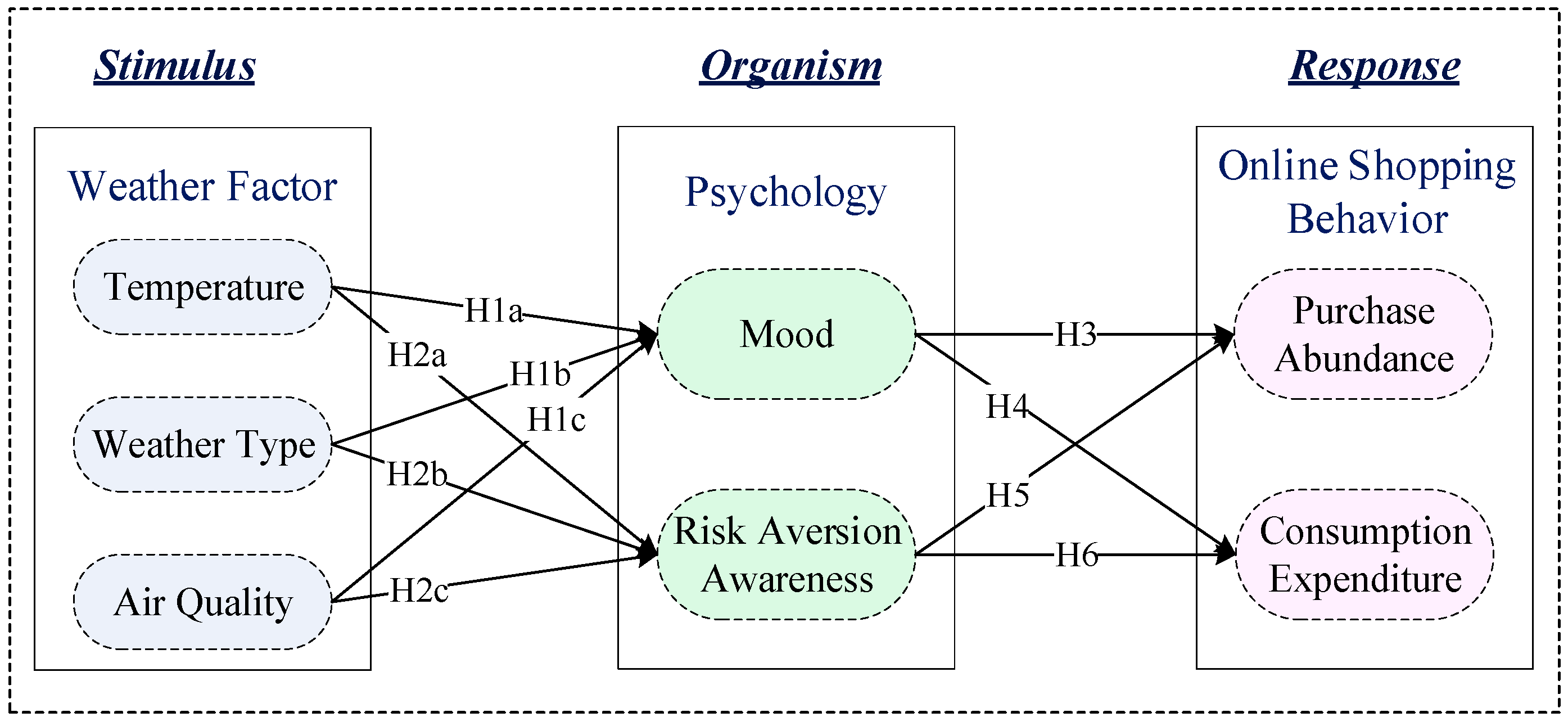
Figure 2.
Experimental design of the scenario.
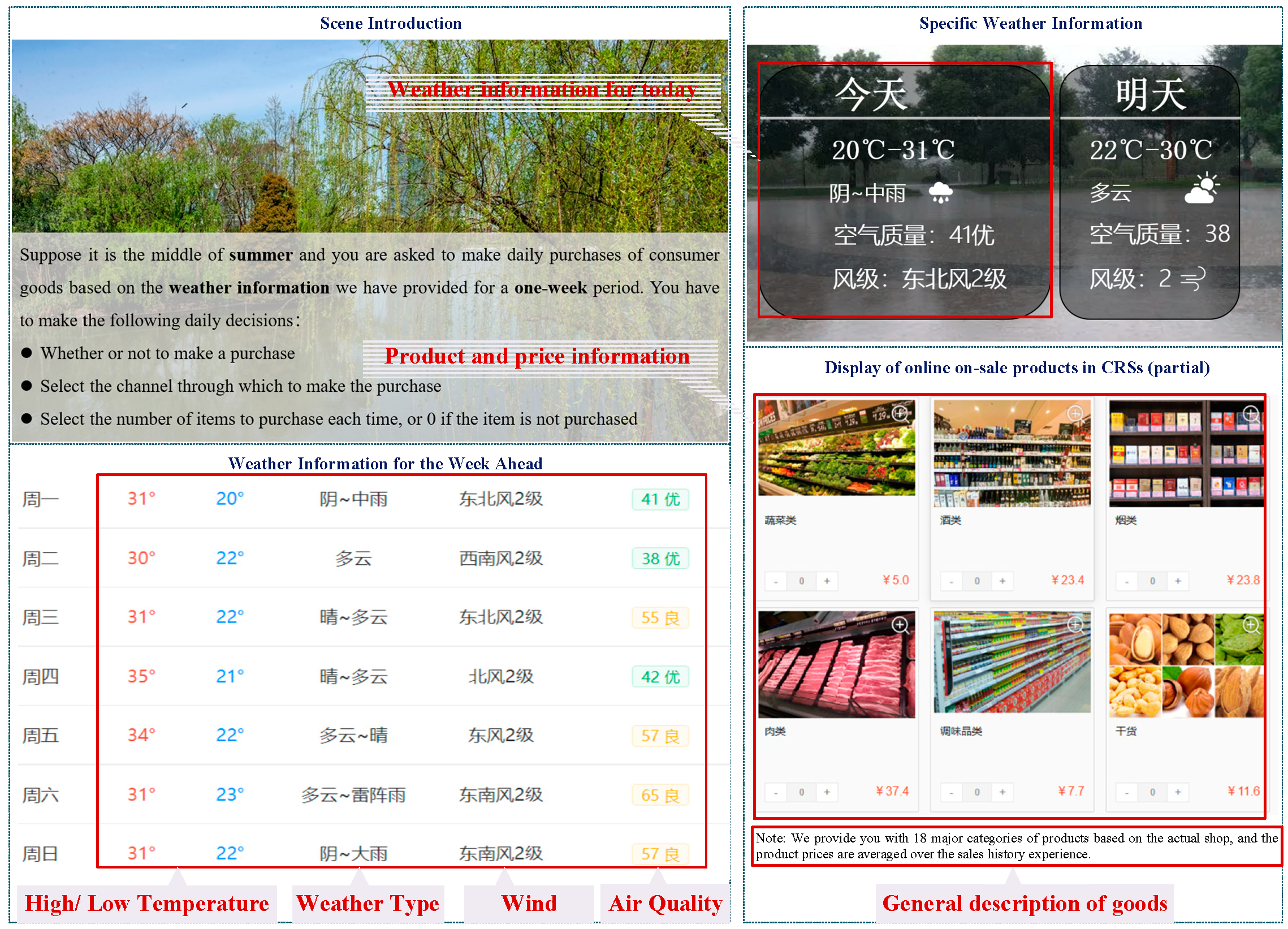
Figure 3.
The correlation analysis between organisms and purchase behavior.
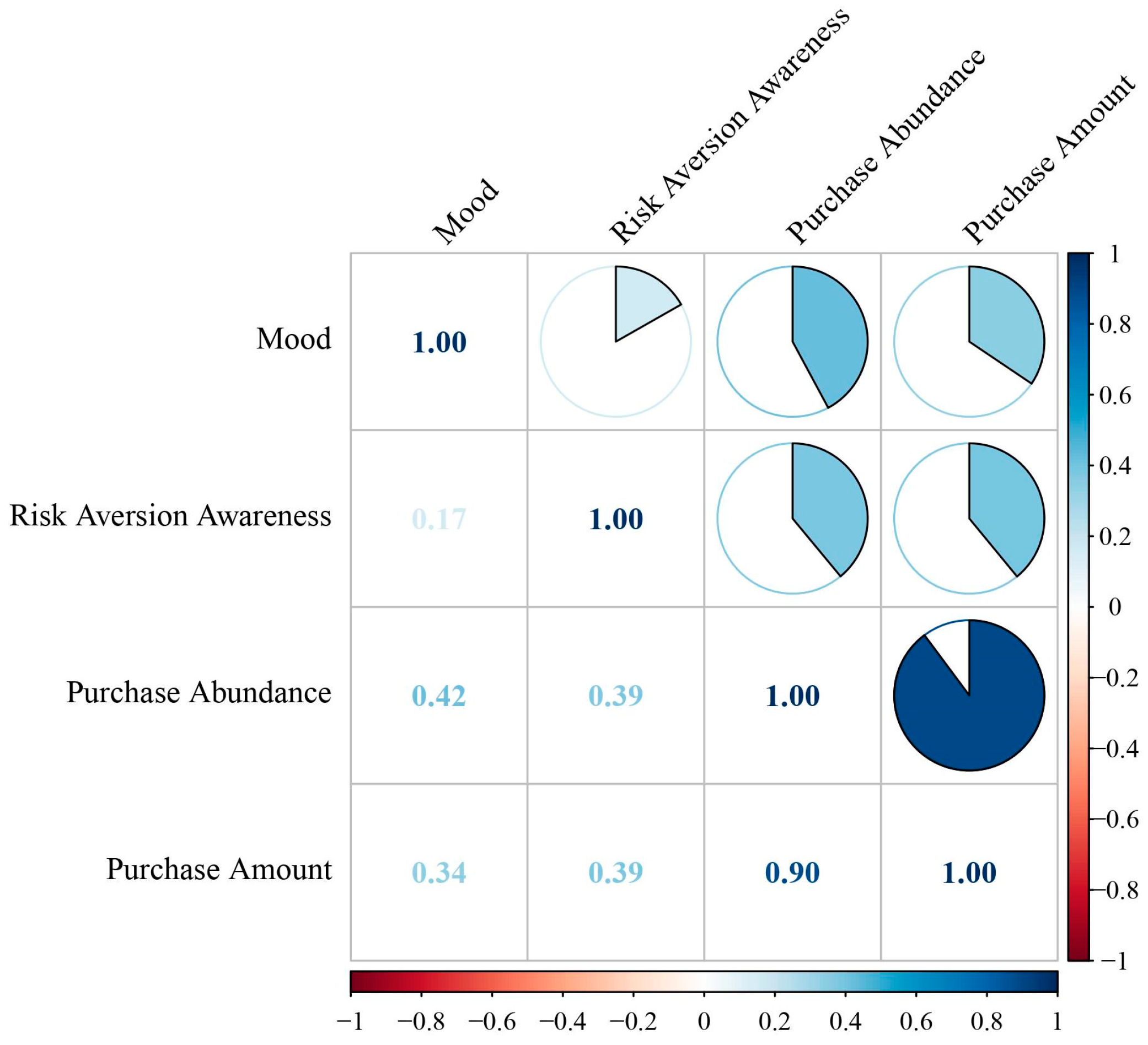
Figure 4.
Results of the consumer purchasing behavior model.
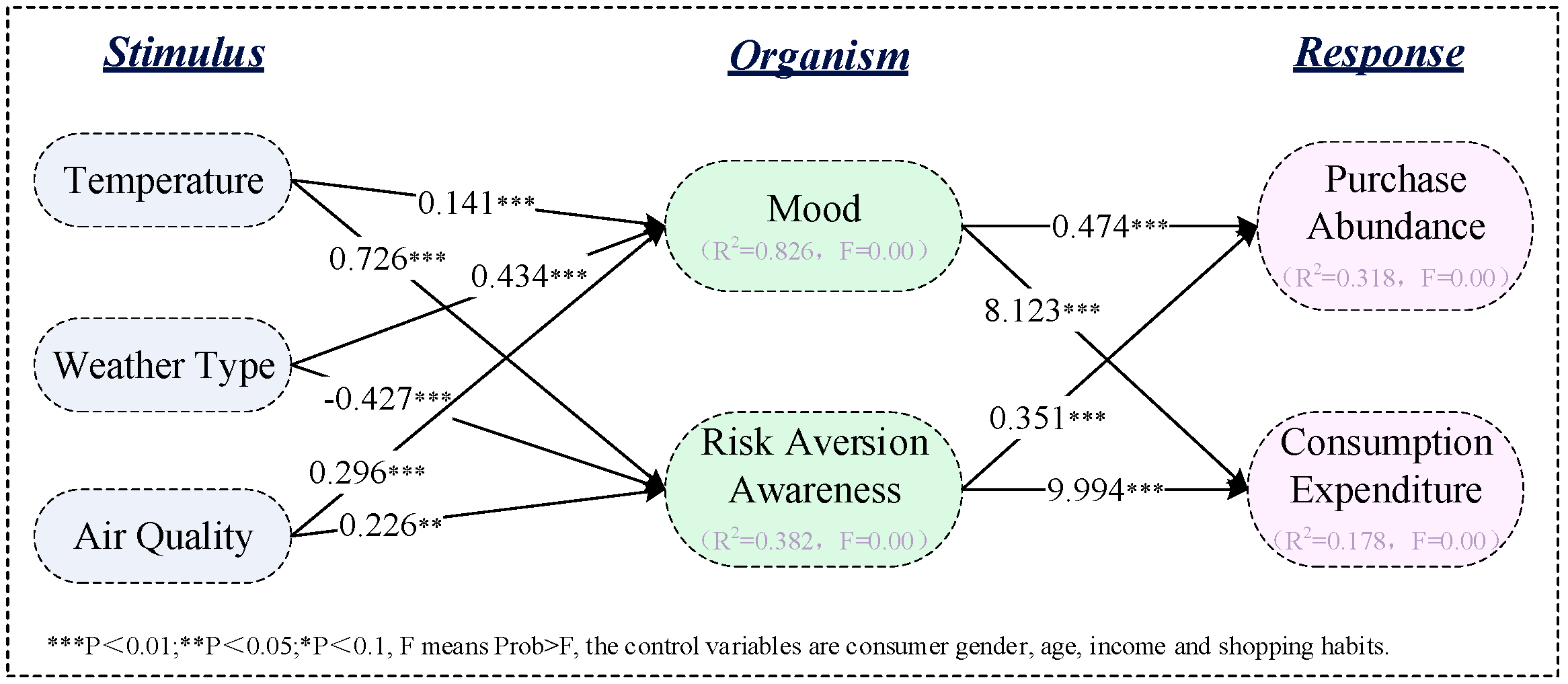
Figure 5.
Bar chart of extreme temperatures and fresh produce expenditure.
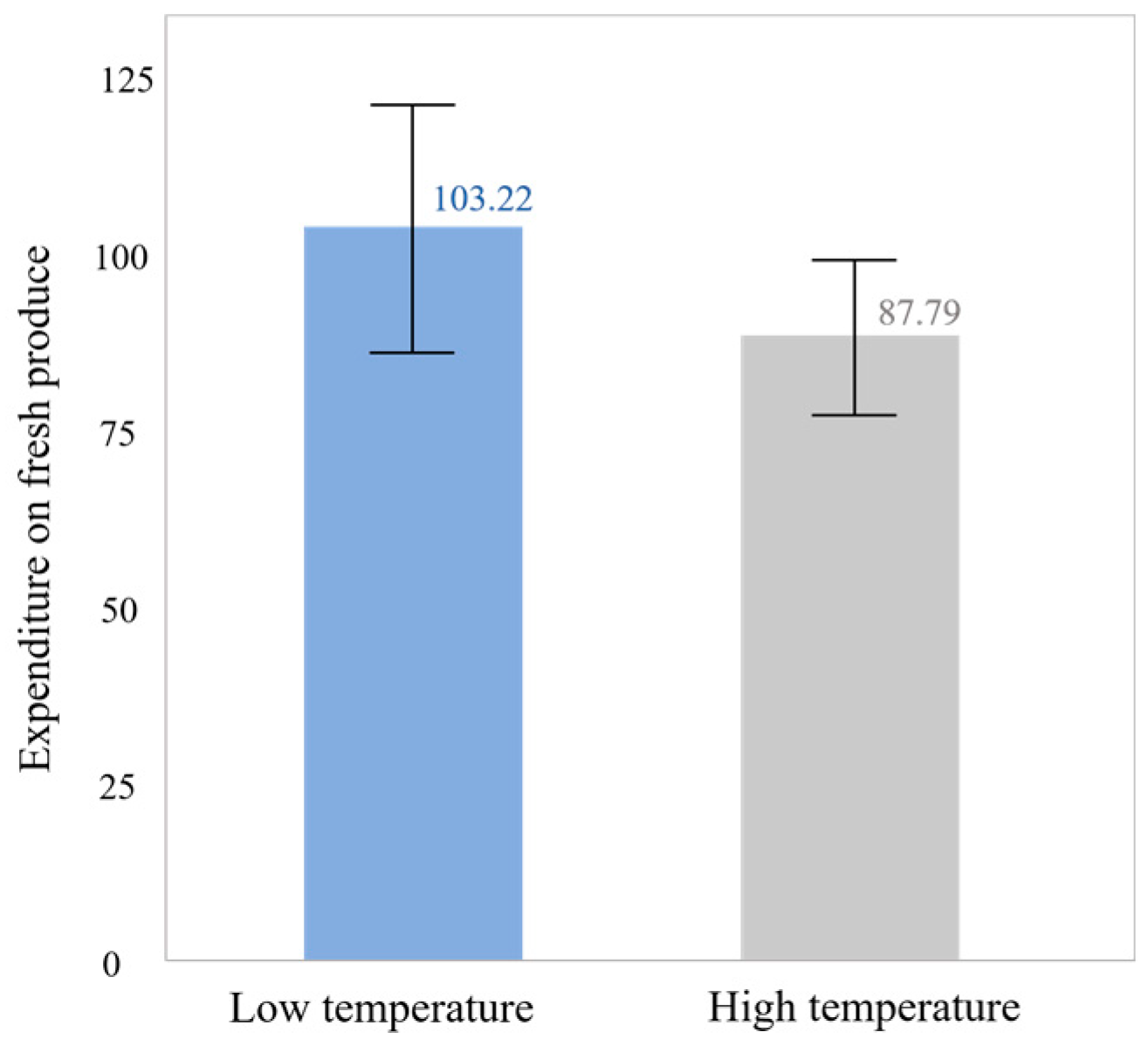
Figure 6.
Analysis of heterogeneity by gender.
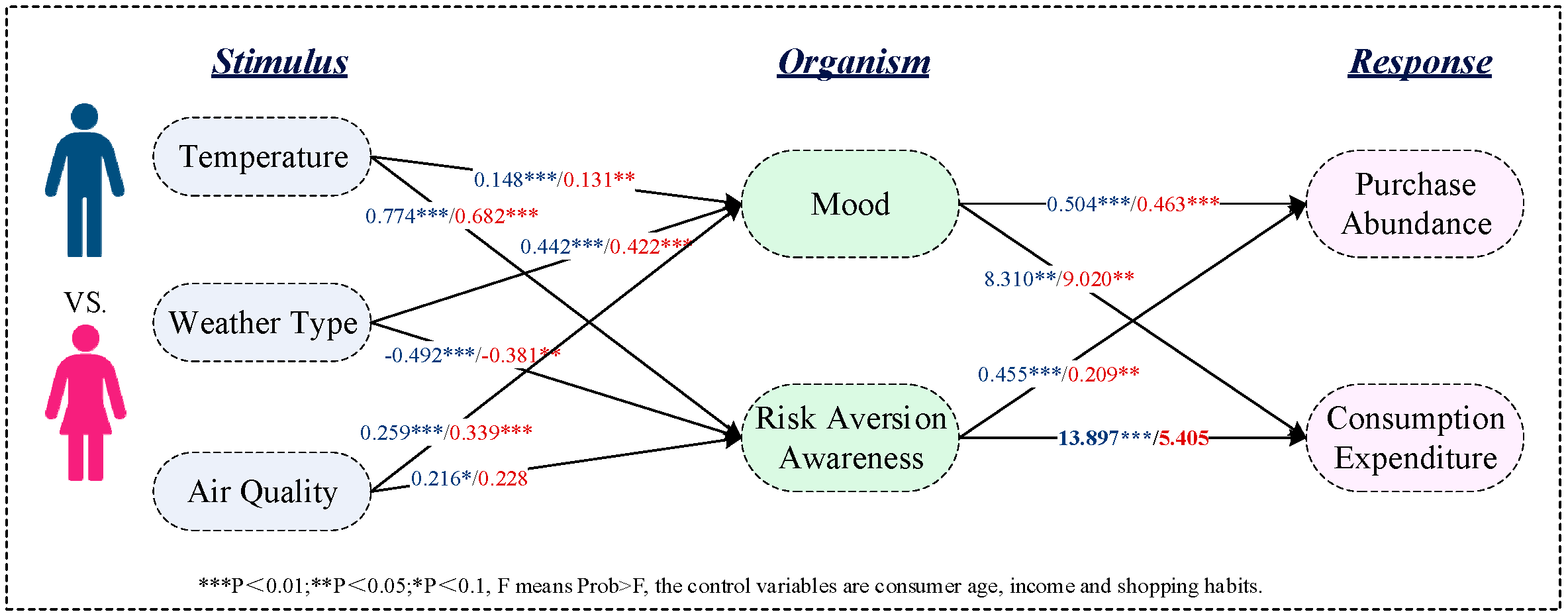
Figure 7.
Analysis of the heterogeneity of shopping habits.
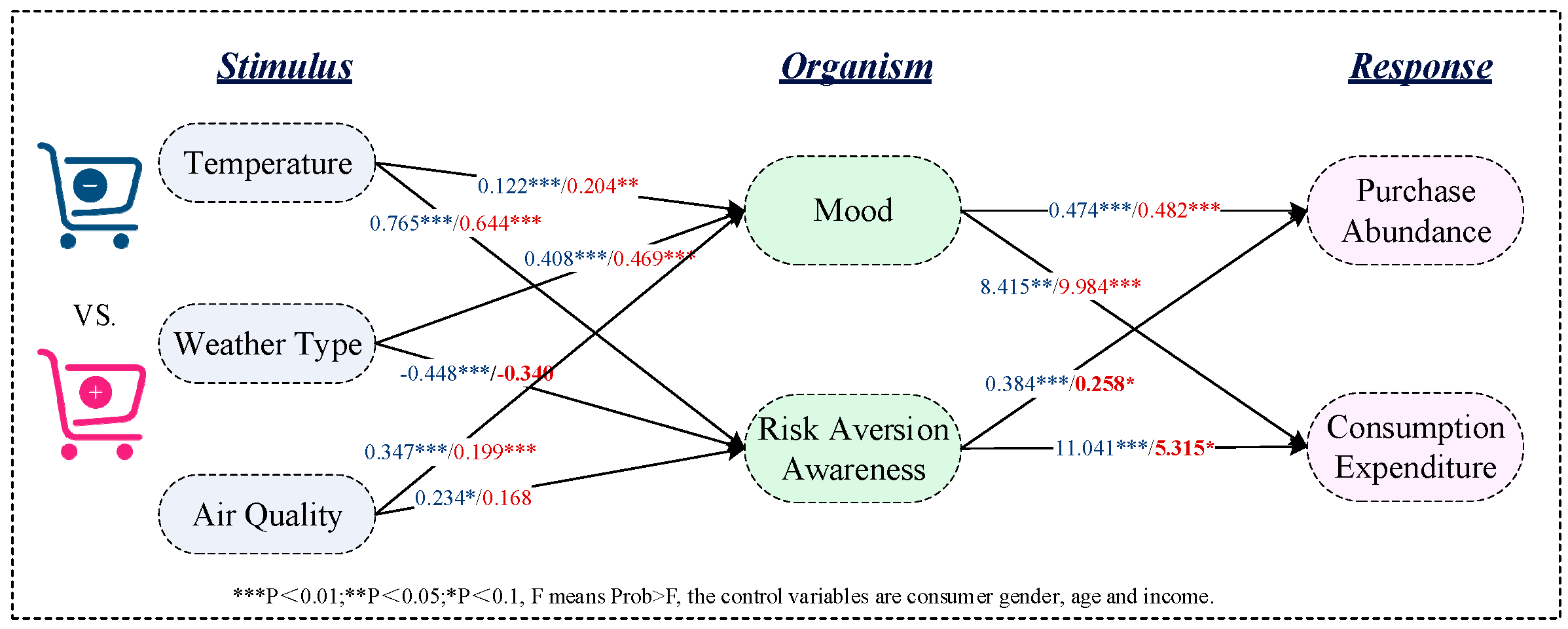

Table 1.
Measurement of questionnaire variables.
| Type | Title | References |
|---|---|---|
| S | T. According to the weather information we have provided, what do you think of the degree of today's temperatures? | Measurement based on real conditions |
| W. According to the weather information we have provided, what do you think the weather type will be like today? (Judge by sunny, rainy or snowy.) | ||
| A. Based on the weather information we have provided, what do you think the air quality will be like today? | ||
| O | E1. Mood: happy (strongly agree to strongly disagree). | Babin and Darden [106] Shi, Wang, Qiao and Shang [107] Dang-Van, et al. [111] |
| E2. Mood: relaxed (strongly agree to strongly disagree). | ||
| E3. Mood: excitedly (strongly agree to strongly disagree). | ||
| E4. Mood: lively (strongly agree to strongly disagree). | ||
| RAA1. I think that future purchases will be of poor quality and thus cause me financial loss (strongly agree to strongly disagree). | Derbaix [98],Murray and Schlacter [108]; Konuk [88] | |
| RAA2. In the long term, I think it's important to stock up on functional items (strongly agree to strongly disagree). | Sweeney, Soutar and Johnson [109] Zielke, Komor and Schlößer [102] |
|
| RAA3. The psychological and physical risks of going out are higher (strongly agree to strongly disagree). | Derbaix [98],Murray and Schlacter [108]; Zhao, Wang, Liu and Jackson [101] | |
| R | PD. Online purchasing decisions for CRSs. | Calculate |
Table 2.
Descriptive statistics of participants.
| Category | Classification | Percentage | Category | Classification | Percentage |
|---|---|---|---|---|---|
| Gender | Man | 122(54.95%) | Age | Under 18 | 1(0.45%) |
| Woman | 100(45.05%) | 18~25 | 31(13.96%) | ||
| Occupation | Students | 13(5.86%) | 26~30 | 86(38.74%) | |
| Production staff | 23(10.36%) | 31~40 | 80(36.04%) | ||
| Sales staff | 20(9.01%) | 41~50 | 15(6.76%) | ||
| Management staff | 46(20.72%) | 51~60 | 8(3.6%) | ||
| Administrative staff | 16(7.21%) | 60 or more | 1(0.45%) | ||
| Finance/Audit staff | 14(6.31%) | Number of outgoing purchases (per week) | 0 | 1(0.45%) | |
| Clerical staff | 17(7.66%) | 1-3 | 149(67.12%) | ||
| Technical/R&D staff | 30(13.52%) | 4-6 | 64(28.83%) | ||
| Others | 43(19.37%) | 7 or more | 8(3.6%) |
Table 3.
Results of the mediation effect test.
| Pathway | Direct/Indirect Effect | LLCI | ULCI | Mediating |
|---|---|---|---|---|
| Temperature->Mood->PA | 0.302***/0.225*** | 0.104/0.084 | 0.500/0.331 | YES |
| Temperature->Mood->CE | 8.862***/2.797*** | 2.282/-0.054 | 15.443/0.230 | No |
| Weather Type->Mood-> PA | 0.484***/0.384*** | 0.179/0.140 | 0.790/0.496 | YES |
| Weather Type->Mood-> CE | 11.730**/9.309*** | 1.601/0.061 | 21.860/0.454 | YES |
| Air Quality->Mood-> PA | 0.294**/0.253*** | 0.061/0.059 | 0.527/0.399 | YES |
| Air Quality->Mood-> CE | 5.809/5.124*** | -1.952/-0.018 | 13.570/0.322 | No |
| Temperature->Risk Aversion Awareness-> PA | 0.357***/0.171*** | 0.206/0.066 | 0.508/0.258 | YES |
| Temperature-> Risk Aversion Awareness -> CE | 6.573**/5.122*** | 1.571/0.050 | 11.503/0.263 | YES |
| Weather Type-> Risk Aversion Awareness -> PA | 0.405***/0.141*** | 0.264/0.051 | 0.546/0.188 | YES |
| Weather Type-> Risk Aversion Awareness -> CE | 6.434***/3.947*** | 1.695/0.043 | 11.173/0.177 | YES |
| Air Quality-> Risk Aversion Awareness -> PA | 0.391***/0.156*** | 0.251/0.065 | 0.532/0.216 | YES |
| Air Quality-> Risk Aversion Awareness -> CE | 6.317***/4.616*** | 1.616/0.049 | 111.019/0.219 | YES |
***P<0.01;**P<0.05; LLCI refers to the lower limit of the 95% interval of Bootstrap sampling, ULCI refers to the upper limit of the 95% interval of Bootstrap sampling, and bootstrap counts are 5,000.
Table 4.
Calibration points and descriptive statistics.
| Results and conditions | Calibration points | Descriptive statistics | ||||||
|---|---|---|---|---|---|---|---|---|
| Fully affiliated | Crossover point | Completely unaffiliated | Mean | Standard deviation | Minimum | Maximum | ||
| Results | Risk Aversion Awareness | -8.63 | -1.56 | 1.83 | -2.50 | 3.55 | -9.50 | 8.00 |
| Conditions | Temperature | -5.64 | 2.33 | 5.97 | 1.40 | 3.55 | -9.00 | 9.00 |
| Weather Type | -5.50 | 1.00 | 5.14 | 0.49 | 3.18 | -7.50 | 8.33 | |
| Air Quality | -7.00 | 0.54 | 4.90 | -0.12 | 3.39 | -9.00 | 8.00 | |
| Gender | 1.00 | 1.00 | 2.00 | 1.45 | 0.50 | 1.00 | 2.00 | |
| Age | 2.00 | 3.00 | 5.00 | 3.47 | 0.98 | 1.00 | 7.00 | |
| Habits | 2.00 | 2.00 | 3.00 | 2.36 | 0.56 | 1.00 | 4.00 | |
Table 5.
Results of the necessity test for individual conditions.
| Conditions | Consistency | Coverage |
|---|---|---|
| Temperature | 0.76 | 0.75 |
| Weather Type | 0.69 | 0.68 |
| Air Quality | 0.73 | 0.72 |
| Gender | 0.86 | 0.61 |
| Age | 0.75 | 0.62 |
| Habits | 0.81 | 0.62 |
Table 6.
Constructs of antecedent variables of risk aversion awareness.
| Combined configurations | Path 1 | Path 2 | Path 3 |
|---|---|---|---|
| Temperature | ● | ● | ⊗ |
| Weather Type | ⊗ | ||
| Air Quality | ● | ⊗ | ● |
| Gender | | | |
| Age | ⊗ | | |
| Habits | | | |
| consistency | 0.952 | 0.886 | 0.855 |
| Raw coverage | 0.361 | 0.454 | 0.423 |
| Unique coverage | 0.055 | 0.020 | 0.019 |
| Solution consistency | 0.816 | ||
| Solution coverage | 0.663 | ||
Note: ● means that the core condition exists; means that the auxiliary condition exists; ⊗ means that the condition does not exist; and blank represents a fuzzy state, i.e., it does not affect the results.
Disclaimer/Publisher’s Note: The statements, opinions and data contained in all publications are solely those of the individual author(s) and contributor(s) and not of MDPI and/or the editor(s). MDPI and/or the editor(s) disclaim responsibility for any injury to people or property resulting from any ideas, methods, instructions or products referred to in the content. |
© 2024 by the authors. Licensee MDPI, Basel, Switzerland. This article is an open access article distributed under the terms and conditions of the Creative Commons Attribution (CC BY) license (https://creativecommons.org/licenses/by/4.0/).
Copyright: This open access article is published under a Creative Commons CC BY 4.0 license, which permit the free download, distribution, and reuse, provided that the author and preprint are cited in any reuse.


