

Submitted:
14 February 2023
Posted:
23 February 2023
You are already at the latest version
Abstract
This study uses the social impact theory to analyse consumer behaviour amidst Covid-19. Fear of scarcity has changed consumer buying behaviour in crisis times such as the now abating global health crisis – i.e., Covid-19. The study asserts that the existing five-stage model of consumer purchasing decisions does not fit neatly in turbulent times. It proposes a shortened four-stage process of need recognition, purchase, ownership and satisfaction as a better and more adaptable fit. Cutting out information search and evaluation of alternatives in the old model, and replacing these with ownership, is where the main contribution of the study lies. The study has implications for managing the marketing mix as we know it. It asserts that not all the 4Ps of the marketing mix are important in crisis times.
Keywords:
consumer buying behaviour
; marketing-mix
; marketing
; panic buying
; crisis times
Introduction
Following the Covid-19 lockdowns in first half of 2020, most countries, witnessed unprecedented buying behaviour patterns amidst fear of shortages of “essential” commodities such as personal hygiene products (e.g., toilet rolls and hand sanitisers). This change in buying behaviour is not unexpected as they tended to serve as coping strategies for life in isolation. This level of panic buying is not unrelated to mainstream news impending scarcity and supply chain disruptions with three keywords immediately coming to mind on the situation: fear, panic, risk (Arafat et al., 2020; Putri et al., 2021). These keywords underpin the kind of buying situation ongoing globally, characterising consumer buying decision making and instigating purchase of whatever consumers can lay their hands on. The situation also shows the promotion of specific needs and the postponement of other needs. In the panic buying situation, hyperactive demand for essential (and sometimes non-essential) commodities increased. Hence, consumers are increasingly frontloading their weeks and months of essential commodity needs – bringing forward their purchases of these items – that they would not have to in “non-crisis times.”
Invariably, consumers seem to have postponed the purchase of “non-essential” luxury goods, thus undermining the need for brand names. Rather most buyers have been forced to opt for what is available rather than status symbols – very much less on “what they know” and “how they feel” about products. This has implications for spending on advertising and other promotional activities. Essentially, they are already motivated by what is happening and the uncertain future that they hardly would have time and space for any marketing communication as a prelude to buying or stockpiling (Wong & Wilson, 2021). Another observed behaviour is the self-imposed rationing of consumption, as consumers are not certain how long they could hoard them if the situation does not improve anytime soon. This means consumption has assumed time and space characterisation as a result of fear of scarcity and uncertainty. This raises a number of questions as to how consumer buying behaviour may have been influenced in crisis times, this study relied on the social impact theory serves as its analytical lens – with a view to reinterpreting the marketing mix and buying behaviour in crisis times.
Literature review and hypotheses formulation.
This study uses the social impact theory to analyse the consumer behaviour amidst Covid-19. Fear of scarcity has changed consumer buying behaviour in crisis times such as the now abating global health crisis – i.e., Covid-19. People are buying not because they actually need the goods, but out of panic and/ or uncertainty. Our survival is threatened not only by the outbreak but by also the speed at which others are purchasing the things we all need to stay alive. Hence, we must act – buy, not only for today but also for the foreseeable feature, which we do not know when, and so we are buying plenty. We have been told that there is no end in sight as no cure for the virus has been found, and we do not know how long this situation could last (Zhang & Liu, 2020). This means, we are being dictated to as consumers not from our intrinsic values of need but from external forces in the character of Covid-19, the communication surrounding it and the actions of others. This is eliciting fear, panic, and perceived risk, and we are acting on it – buying. Social impact theory has been defined as any of the many changes a person experiences due to real or imagined presence of others. Latane (1981) posit that, social impact theory evaluates how individuals can be vulnerable, and are also sources of social influence. Thus, the social impact theory explains that in any situation traits, beliefs, feelings, or the behaviour of a person is influenced by the society or the implied actions of other people.
The theory underpins a number of studies in social psychological situations (Latane & Wolf, 1981; Latane & Nida, 1981) and has been adapted to serve as the base to stimulate language change (Nettle, 1999), culture change (Harton & Bullock, 2007) and computer simulations of attitude change in social groups (Nowak et al., 1990). The theory is a metatheory that postulates social influence as the combined effect of strength, immediacy and the sum total of persons producing the impact, subject to time and space (Latane & Wolf, 1981). Sedikides and Jackson (2015) also assert that the social impact theory is a direct function of strength, immediacy, and number of sources. As the sources get stronger, the more immediate they are to the target (Basset & Latank, 1976; Chang et al., 2018; Jackson & Latane, 1981b; Knowles, 1983), and as the sources increase, the greater the impact experienced by the target (Gerard, Wilhelmy, & Conolley, 1968; Milgram, Bickman, & Berkowitz, 1969). For example, if an individual or a person in a group experiences an impact which is as a result of a force exerted on the latter by another group that impact is said to be a direct function of the strength, immediacy, and the total number of individuals in the opposing group.
Latane and Wolf (1981) depict social impact as a multiplicative and divisive function of the three factors (strength, immediacy, and the number of sources) and further assert that a change in any of these variables should warrant a corresponding change in impact. This implies that, when an individual’s previous behaviour corresponds with that of either the opposing group or the immediate group then that person is likely to fall within both the multiplicative and divisive functions. This literally means the attitude of the individual will be influenced by that of the opposed group as well as his own group. For the purpose of this study the latter is deemed fit. Latane (1981) explained strength as the overall individual factors that makes a person influential. This means there are certain essential features that characterise people to be influential or otherwise.
Immediacy, according to the theory can be understood as the vital factors that underpin the relationship between the source of the influence and the target. Latane (1981) further states that proximity to space, clarity, or richness of the communication channels among people, lack of barriers, filters, or static, or the ability to monitor are some of the factors embedded with the immediacy. It is, however, imperative to note that among the diverse factors, the most pertinent is that immediacy is an inverse function of physical distance in that it enhances the intensity and power of the influence. The last variable is the number of influence sources available. Literature (Latane & Harkins, 1976; Latane & Wolf, 1981) has shown that the impact of social influence increases approximately to the square root of the number of people involved. This means that the greater the number of influence sources, the higher the impact and as the number approaches zero the same is the impact.
Consumers desire to avoid future regrets underpins the third explanation of product scarcity in marketing (Loomes et al., 1982). The regrets theory in product scarcity suggest that consumers are confronted with the choice between buying now or risk missing out on the purchase opportunity due to the item being out of stock if they do not. These consumers would most certainly be attracted by the scarcity as they exhibit high sense of concern at the possibility of missing out on future purchase. Thus, the motivation to buy a product is not because of its utility but because they are concerned that they won’t be able to buy it in the future. This feeling occurs especially when consumers are faced with time pressures, such as time-limited offers. In certain circumstances, this can even result in hoarding consumer behaviours (McKinnon et al., 1985; Sterman et al., 2015). According to Latane (1981), the social impact theory is applicable in situations such as interest value of news events, social inhibition of response to emergencies and requests for help. The impact of covid-19 has caused fear and panic facilitating a behaviour change among most consumers, at least for the short term. This behaviour change has influenced the traits, beliefs, and feelings of other people in the society emphasising the theory of social impact. The hasty bulk purchases of necessities among panic consumers caused fear of scarcity and as a result, most consumers also joined the frenzy. Now, as the strength of the source (panic consumers) increases, the greater is its impact on the target and the more immediate they are to the target (Tsao et al., 2018). This causes an increase in the number of sources and a decrease in the resistance level of the target audience, thereby resulting in panic buying.
Panic buying
The buying process and purchase patterns of consumers in times of crisis is different, as compared to the conventional buying behaviour (Sharma & Sonwalka, 2013; Nistorescu & Puiu, 2009). This change in purchase patterns and consumption arises because of the level of perceived risk associated with crisis. For instance, the advent of COVID-19 has drastically changed the behaviour of most consumers. Recently, most consumers resorted to panic buying, which is described as a situation where consumers make unusual purchase of large amounts of products in anticipation of a disaster or a perceived disaster (Tsao et al., 2018). Thus, consumers tend to buy necessities and have no regard for preferred brands and prices but rather the availability and proximity to the needed products. Tsao et al. (2019) in a study to investigate the effect of substitution on panic buying revealed that majority of consumers are willing to accept substitute in place of their preferred brands in times of crisis. Again, the purchase of premium and luxurious goods gets suspended, as consumers are no longer willing to spending money on these products (Nistorescu & Puiu, 2009) but on essential goods only.
Panic buying occurs when a large number of people purchase food, gasoline (fuel), and other necessities as quickly as possible because they are concerned about the likelihood of something terrible occurring in the near future (Utami, 2020). Consumers’ decisions to purchase, use, and invest goods and services, as well as the mechanisms that precede and accompany these actions, are referred to as panic purchasing (Sunarto, 2018). Panic buying behaviour is mostly influenced by uncertainties or circumstances where consumers perceive as risky. Kulemeka (2010) suggested four situations that engender panic buy. First is when consumer perceive an immediate dangerous circumstance. Second is when consumers feel there are limited solutions available to curb the situation. Third is when people perceive the available solutions to be completely obstructed and they necessitate an escape strategy. The fourth is when communications regarding the situation causes panic. Helsloot and Ruitenberg (2004) propine that in dangerous situations, people perceive scarcity which then migrates to a state of panic buy. In this context, the study argues that the advent of COVID-19 pandemic has caused people to panic buy which has impacted on their purchase patterns as most consumers made purchases in large quantities.
Scarcity and perceived scarcity
Scarcity in its broad view can be real or perceived lack of goods and services. This can be long term (due to legal restrictions) or short term (as a result of stock-outs). Scarcity can either be in a “variety” or “category” form. Variety scarcity refers to a situation where there is a limited quantity of a specific product, model, or size of the desired product whereas category scarcity denotes limited access to an entire product category (Grier & Davis 2013). Scarcity can be experienced at the individual or community level. For the purpose of this study, the community or group scarcity is deemed fit. The community scarcity is referred to as the shortage of certain products or services due to a natural disaster (Cannon et al. 2018). The advent of covid-19 initiated a community based perceived scarcity that defied the usual pattern of consumer purchase behaviour. All things being equal, consumers make purchases based on a demand that requires attention or has to be satisfied. For this reason, consumers enquire about the various products that can satisfy their needs i.e., search for information relating to the available brands. The consumer then evaluates the alternative brands and make a purchase decision (Hansen, 2004). However, the perception of scarcity by consumers creates a sense of urgency to make a purchase. This distracts the usual patterns consumers engage in to arrive at a purchase decision. Perceived scarcity has been defined as a threat to a consumer’s ability to meet his or her needs and desires due to a lack of, or inability to obtain, goods or services (Hamilton et al., 2018). Perceived scarcity thus limits consumers’ access to the products and services they need, increases their desire to own these products, increases the amount of purchase, reduces the search for products, and leads to satisfaction (Li, 2017). Perceived scarcity has been studied from diverse perspectives; supply (demand) induced (Nuansoi, et al., 2017; Kinata, 2016; Gupta, 2013; Cialdini, 2001); Shelf-based scarcity (Robinson 2016; Parker & Lehmann, 2011); Pricing-based scarcity (Miyazaki, 2009; Suri, 2007).
The extant literature has shown that perceived scarcity impacts on consumers’ intention to purchase in bulk (Kinata, 2016; Gupta, 2013; Parker & Lehmann, 2011). Shou et al. (2013) affirms this finding by stating that most studies within this discipline have shown consumers buying unusually large amounts of product following disaster warnings to avoid possible future shortage and regret. Robinson et al. (2016) reveals that, in as much as perceived scarcity largely affects consumer preferences for goods, it tends to impact preferences only when consumers believe that the scarcity is as a result of a market force (i.e., factors related to supply or demand). Thus, when consumers realize that their perceived scarcity is intentionally created by suppliers, its effect are not realized. Chen et al. (2013) in studying perceived product scarcity and purchase intention concluded that perceived product scarcity has a significant positive impact on purchase intention.
Wu et al. (2012) in their study to understand how perceived scarcity affects consumer value perception and purchase intention developed a comprehensive research model by comparing the explanation power of Lynn’s Scarcity–Expensiveness–Desirability (S-E-D) model and Synde and Fromkin’s desire for uniqueness model. The outcome of the study revealed that perceived scarcity has a stronger positive impact on purchase intention through perceived sacrifice and perceived value. Robinson et al. (2016) established in their study that perceived scarcity cues impact consumer willingness-to-pay; increase the likelihood of selecting an unfamiliar brand; and influence actual product choice in a field study. Their research demonstrated that perceived scarcity is a robust heuristic that has far-reaching and stable effects on consumer purchase decisions. Park and Silvera (2016) in examining how perceived scarcity affects consumer choice found that some natural settings can create the feeling of scarcity even when the items are available for purchase. Thus, consumers increase their purchases when there is a feeling that a natural setting can cause shortage of some product category even when the product is readily available.
H1: Perceived scarcity has a significant impact on consumer intention to make bulk purchase.
Shou et al. (2013) revealed that perceived scarcity is the main driver for consumer panic buying, and stockpiling behaviour. Park and Silvera (2016) affirms this outcome by asserting that when consumers are less certain about obtaining a product when next they need it, increases consumer uncertainty about supply shortage, make panic buying worse, and increases quantity demanded by consumers. The reactance theory has been widely used in the literature to explain the relationship amid perceived scarcity and panic buy. This theory posit that individuals experience psychological reactance, a motivational state that is about protecting their behavioural freedom when they feel threatened or restricted. In this context, a product that is expected to become inaccessible soon due to a health crisis is likely to threaten or restrict personal freedom (i.e., prevented or reduced access to the product). Psychological reactance triggers a sense of urgency to buy and hoarding behaviour, which denote similar meaning with panic buying. Further, the theory of anticipated regret has been used to underpin studies pertaining to perceived scarcity and panic buy (Sneath et al., 2018). This anticipated emotion emanates from a rejected option. Thus, consumers would compare their actual decision of stockpiling with a forgone decision of the opposite during a pandemic. Regret manifests if the rejected choice turns out to be better than the actual outcome whereas rejoice would be experienced if the actual outcome is better than the rejected choice.
Prior studies have established that these emotional consequences are anticipated and considered by consumers when making choices under uncertain situations. Consistent with prospect theory, during disease outbreak, it is more likely that people would experience regret than rejoice for not engaging in panic buying due to perceived scarcity. As a result, perceived scarcity of goods would motivate individuals to engage in panic buying due to psychological reactance and anticipated regret. Yuen et al., (2020) posit that instance where perceived scarcity is high, consumers are more likely to resort to panic buying. Shou et al. (2013) studied consumer panic buying under supply disruptions and investigate how the retailer should adapt inventory and quota policies to deal with perceived scarcity. Their study responded to a gap in understanding strategic consumer behaviour and retailer decisions in times of supply disruptions, attempting to offer rational explanations to the consumers’ seemingly irrational panic buying behaviour. They concluded that most consumers irrationally panic buy due to fear of product inaccessibility when there is the need for such products.
H2: Perceived Scarcity significantly influence consumers to panic buy.
H3: Panic buying has a significant effect on consumers to make bulk purchases during a pandemic.
Generally, consumers experience uncertainty during pandemics or disease outbreak (Gupta & Gentry, 2016). This uncertainty is mostly triggered by perceived scarcity associated with the pandemic and consumers inability to determine the outcomes of the outbreak (Elmore, 2017; Yoon et al., 2018). Shou et al. (2013) observe that in the event of disasters, consumers may receive extreme warnings but are uncertain to determine whether they would actually lead to severe supply disruptions. This causes people to ponder and imagine various scenarios and hence arouses fear. Studies have shown that fear of the unknown modifies consumer behaviour rather than the occurrence of the pandemic itself (Kennett-Hensel et al., 2016). Yangui et al., (2015) in a study to examine consumer behaviour and the anticipation of total stockout for food products revealed that uncertainty motivates consumers to make bulk purchase. These motivations are usually not driven by the actual need for the purchased product but to confer them a sense of comfort, security, assurance of future product accessibility and alleviate stress. This outcome is consistent with the findings of Schvaneveld et al. (2016) as they found a significant increase in spending at retail outlets during a pandemic or disaster. This is an indication that consumers prepare for unforeseen circumstances during an outbreak by increasing their spending at retail outlets. The relationship between uncertainty (fear of the unknown) and increased purchase behaviour has also been explained using the mood congruency theory. This theory posits that when consumers are under negative emotions or stress such as a disease outbreak, there is an increased motivation to unleash drastic measures to curtail the situation. According to Yuen et al. (2020) most consumers panic buy as a measure to curb their negative emotions towards product stockout during a pandemic. Sterman et al., (2015) in their study also found that consumers panic during crises as a form of self-protection to minimise risk.
H4: Perceived scarcity significantly influence consumer uncertainty.
H5: Consumer uncertainty significantly impact on consumers intention to purchase in bulk.
The mediating role of panic buying
Past studies have acknowledged panic buy as a trait that significantly impact on consumer purchase behaviour (Adam et al. 2015; Cameron & Shah, 2015; Malhotra, 2010). For instance, Wu et al. (2020) in their study found that perceived scarcity in both time and quantity has a significant impact on consumer purchase behaviour. Thus, perceived scarcity influences consumers to panic buy i.e., purchasing goods that they would not have patronized prior to the state of perceived scarcity. This study suggest that perceived scarcity associated with a pandemic engenders consumers to panic buy which in turn impact on their intention to stockpile or to make bulk purchase. Thus, when consumers are exposed to negative cues such as product scarcity, they experience worry and distress which underpins their purchase decisions (Thompson et al., 2017). For example, the Ebola outbreak in 2014 and the current covid-19 pandemic instigated consumers to engage in panic buying. This was partially a result of the increased media exposure surrounding hoarding activities by retailers (Yao, 2020). Adam et al. (2015) in their study to ascertain the key determinant of consumer decision making during crisis found that scarcity messages arouse consumers to panic buy which increases the likelihood of engaging in stockpiling.
Similarly, Xiang et al. (2016) illustrated that urge to panic buy is a proxy of actual consumer behaviour which normally occurs during crisis. This study further argues that although panic buy has been studied as an outcome variable in several studies, it is good a mediator between perceived scarcity and consumers intention to make bulk purchase (Wu et al., 2020; Gupta and Gentry, 2019; Badgaiyan & Verma, 2015). The mediating role of panic buying can be explicated by the conservation of resources theory which postulate that people are motivated to protect, procure and preserve resources that are of essence to their existence such as food, sanitary items, groceries etc. This theory elucidates further that individuals feel stressed when their resources or access to their resources are threatened or depleted.
However, Hobfoll and Schumm (2011) in their study found that one of the most efficient and effective ways to minimize the stress is to obtain and reserve these resources in anticipation of scarcity of such products. In this regard, panic buy and making bulk purchase may be employed as a mechanism to curb the heightened distress associated with perceived scarcity. Nonetheless, it is feasible that not all pandemic associated with perceived scarcity motivates consumers to panic buy in large quantities Therefore, we hypotheses that:
H6: Panic buying significantly mediate the relationship amid perceived scarcity and consumers intention to make bulk purchase during a pandemic.
The mediating role of uncertainty
Literature on uncertainty has justify the use of the construct as a mediator in diverse disciplines (Xu, Qamruzzaman, & Adow, 2021; Barnett, Moore & Archuleta, 2019). Ma (2017) examined the mediating role of uncertainty on satisfaction and purchase intentions. The outcome revealed that increased delivery time has a significant impact on consumer perceived ambiguity which minimizes satisfaction as well as negatively influencing purchase intention. Zhang (2016) studied the mediating role of uncertainty from a managerial perspective indicating with strong evidence that uncertainty is a good indicator for mediation effective.
Other literature has also shown uncertainty as an underlining factor amid perceived product shortage and consumers intention to make bulk purchase during crisis (Ghaderi et al., 2020; Li et al., 2020; Sharif, 2017). That is, the higher the perceived scarcity associated with the pandemic the more consumers become uncertain about product availability, hence, engage in stockpiling of goods (Adair & Xiong, 2018). Studies have revealed the effect of perceived scarcity on consumer behaviour especially during pandemics (Barnett, Moore & Archuleta, 2019; Ma, 2017; Sun et al. 2012). Sun et al. (2012) in their study found that in times of crisis, consumers become uncertain about what the future holds. Thus, consumers tend to experience what is termed as “fear of the unknow” where they become ambiguous over product accessibility and availability as time erodes. The current study therefore proposes that the urge for consumers to make bulk purchase or to stockpile when they perceive scarcity is highly influenced by their uncertainty to acquire essential products when need be. However, when consumers anticipate the pandemic as not threatening and its social impact minimal, the high levels of uncertainty during the initial stage of the pandemic diminishes, thereby neutralising the urge to stockpile. This portrays consumer uncertainty as a good mediator amid perceived scarcity and consumer intention to make bulk purchase. On these grounds the study hypothesis that:
H7: Consumer uncertainty significantly mediate the relationship between consumer perceived scarcity and consumers intention to make bulk purchase.
Methodology
Sampling procedure and data collection
In adherence to the covid-19 protocol, an online survey was conducted for the study. This was to avoid physical contact and to overcome place and time constraints imposed by the covid protocol. This procedure allowed for larger population reach from different regions which would have been difficult in a self-administering survey technique. The online questionnaire was hosted on google forms for a duration of three months (April – June 2020) during the early stages of the covid-19 pandemic. To solicit for respondents, the link to the online survey was distributed through the WhatsApp pages of the University of Ghana Business School staff, Executive MBA classes, Weekend MBA, and Sandwich programmes, and popularly known online community platforms on Facebook in Ghana: Tell it Mums and Tell it Dads. Responses retrieved for the study were 501, after a thorough clean-up of the data 402 questionnaires were retained for the analysis. The data clean up took into consideration questionnaires which had missing data, same ratings for all items, double questionnaire response from same respondent etc.
Data collection instrument
The first section of our questionnaire collected information on the demographics of participants, and their purchase behaviour prior to the advent of covid-19, the kinds of goods and services they purchased following the announcement of the lockdown and among other questions. The second section introduced the variables and their respective indicators. The questionnaire used a five-point Likert scale, anchored by strongly disagree to strongly agree, adapted from existing scales. Perceived scarcity and purchase intention was adapted from Wu et al. (2012). The reliability of these scales was affirmed in the study of Chen and Sun (2014), showing high reliability ratios. Panic buy measures was adapted from Lins and Aquino (2020). Consumer uncertainty scales was also adapted from Bollen, Euwema and Müller (2010). The study employed convenient sampling technique in conducting a pilot study. Out of a total of 501 questionnaire administered, 402 was retrieved. The reliability of the adapted indicators was tested to ascertain its significance in measuring the constructs within the context of the study. Items that did not load well on their respective constructs was deleted (loadings below the recommended threshold of 0.70 by Hair et al. (2016). The final eighteen indicators after eliminating the insignificant ones were used as the measurement items for the final study.
Assessment of Common Method Bias
The procedural and statistical remedies recommended by Podsakoff et al. (2003), together with the Harman’s single-factor test, were employed to curb the common method bias. For instance, the scales or measurement items were adapted from various sources as a procedural remedy. The current study ensured the confidentiality and anonymity of respondents by prescribing no right or wrong answers, and refining measurement items based on the context of the study, as proposed by Podsakoff et al. (2003). In the Harman’s single-factor test, all indicators were extracted into one factor using exploratory factor analysis. The result revealed that the single factor could explain only 43.25% of the variance declaring that the study had no common method bias presented in the data.
Findings and Analysis
Demographics
Table 1 depicts a tabulated analysis of the demographic characteristics of the participants. Out of a total of 401 respondents, 50.1 % were males, the dominate age group (26-35 years) represented 44.6%. Majority of the respondents 52.4% had completed their degree programmes whiles 27.4% held a postgraduate degree. Considering the occupation of the respondents, 46.6% were within the category of private sector employed, 75.8% indicated that their married while 22.9% were single.
In terms of their monthly income, 47.6% earned between the ranges of 2,000-4,900 with very few respondents earning between the ranges of 10,000 and above. The demographic of the respondents depicts a true reflection of the right sample for the study. This is because most of the respondents were married, educated, and fell within the new affluent worker, categorised by BBC news (https://www.bbc.com/news/uk-22007058) and understood the impact of the pandemic and the consequences that are associated with a lock down. The study investigated the kind of goods and services purchased by the respondents following the announcement of a lockdown. Table 2 displays the result of the preferred products. More than half of the respondents (61.1%) purchased and hoarded food stuffs, 21.7% stockpiled groceries, followed by toiletries (9.7%).
Pharmaceutical products constituted 6.7% which came as a surprise following that the pandemic is health related and anticipating that pharmaceutical products must have been within the top product category purchased.
PLS-Structural equation modeling
The data was analysed using PLS-SEM 2.0. This analytical tool was applied to assess the model with the justification that it avoids parameter estimation biases in-built in regression analysis, suitable for non-normality conditions and demands least constraints on measurement of the variables (Hair et al. 2019). A two-stage approach was adopted in examining the variables understudy: measurement and structural model assessment.
Measurement model assessment
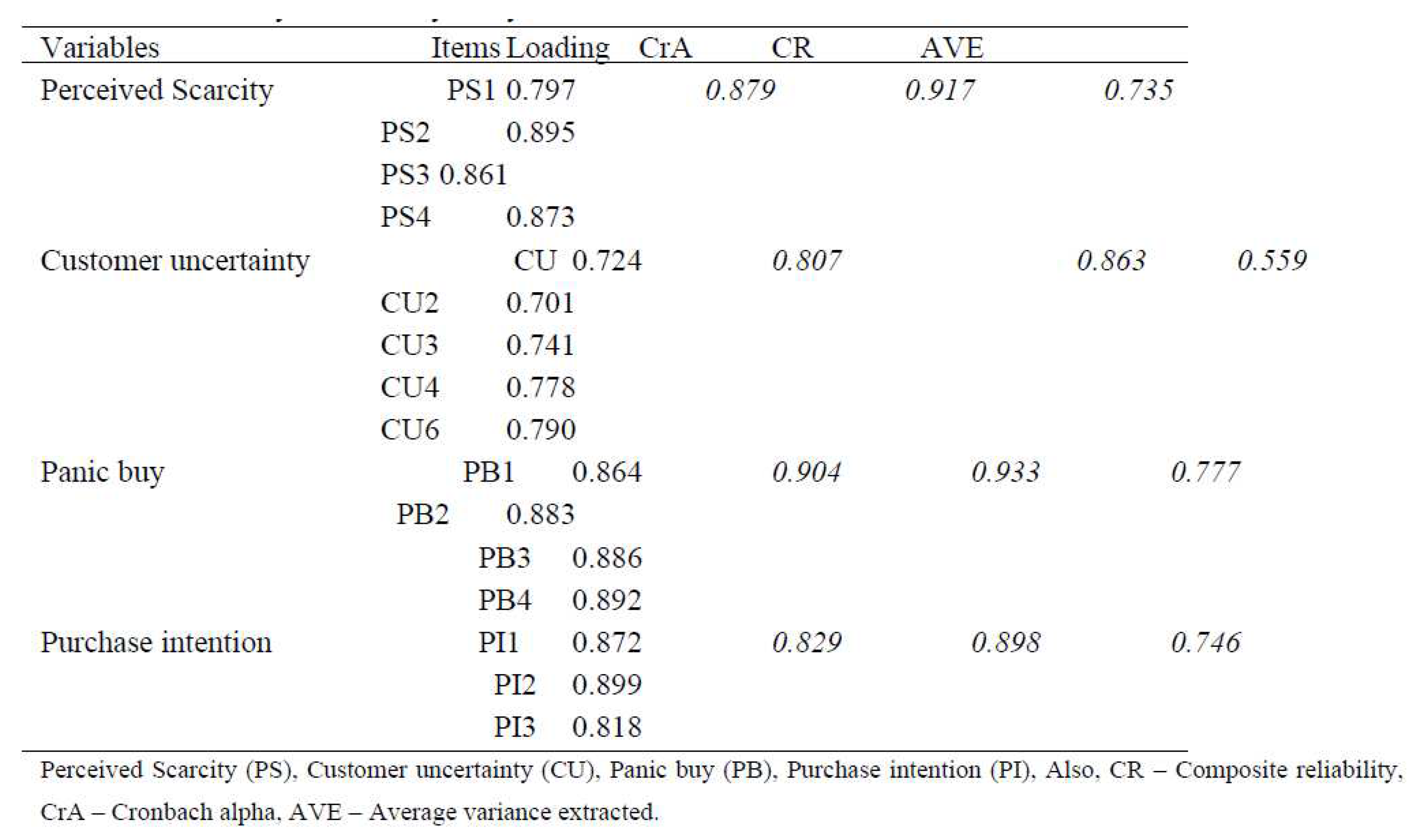
In testing hypothesised relationships, it is imperative that the validity and reliability of the data are first examined. In assessing the reliability of the data, the reflective indicator loadings were monitored. Item loadings of 7.0 and above has been recommended as acceptable (Hair et al., 2019), results from Table 3 shows that all the factor loadings were above the recommended threshold and significantly loaded on their corresponding latent variables.
However, two of the indicator loadings (PB5, CU5) were below the accepted threshold and had to be deleted (Gefen and Straub, 2005). This implies that all the indicators except the deleted two were good measurement of the latent variables. After ensuring accuracy of the measurement items, the internal consistency of the constructs was assessed using the Cronbach’s alpha (CrA). The values of the CrA for all the variables were above 0.7 indicating reliability among the constructs. Alternatively, the composite reliability (CR) has been noted to serve as a strong measure of internal consistency. The outcome displayed in Table 3 shows that all the CR values are above 0.8 indicating high reliability levels among the constructs (Henseler et al., 2009; Chin, 1998).
Convergent validity was measured using the average variance extracted (Fornell & Larcker, 1981). Hair et al. (2019) recommends an acceptable threshold of 0.5 for AVE values which means that the latent variable explains at least 50% of the variance of its items and thus shows sufficient convergent validity. From the Table 3, it can be realised that all the AVE values for the constructs are above the recommended threshold of 0.5 indicating the presence of convergent validity.

Table 3.
Reliability and validity analysis.
 |
After ascertaining the AVE values for the convergent validity, the discriminant validity was also assessed using the Fornell and Larcker (1981) criteria. The rule of thumb for this criterion this that the square roots of the AVE (italicized) must outdistance the off-diagonal correlation values indicating the presence of discriminant validity. Table 4 depicts the results of the discriminant validity.
Structural model assessment
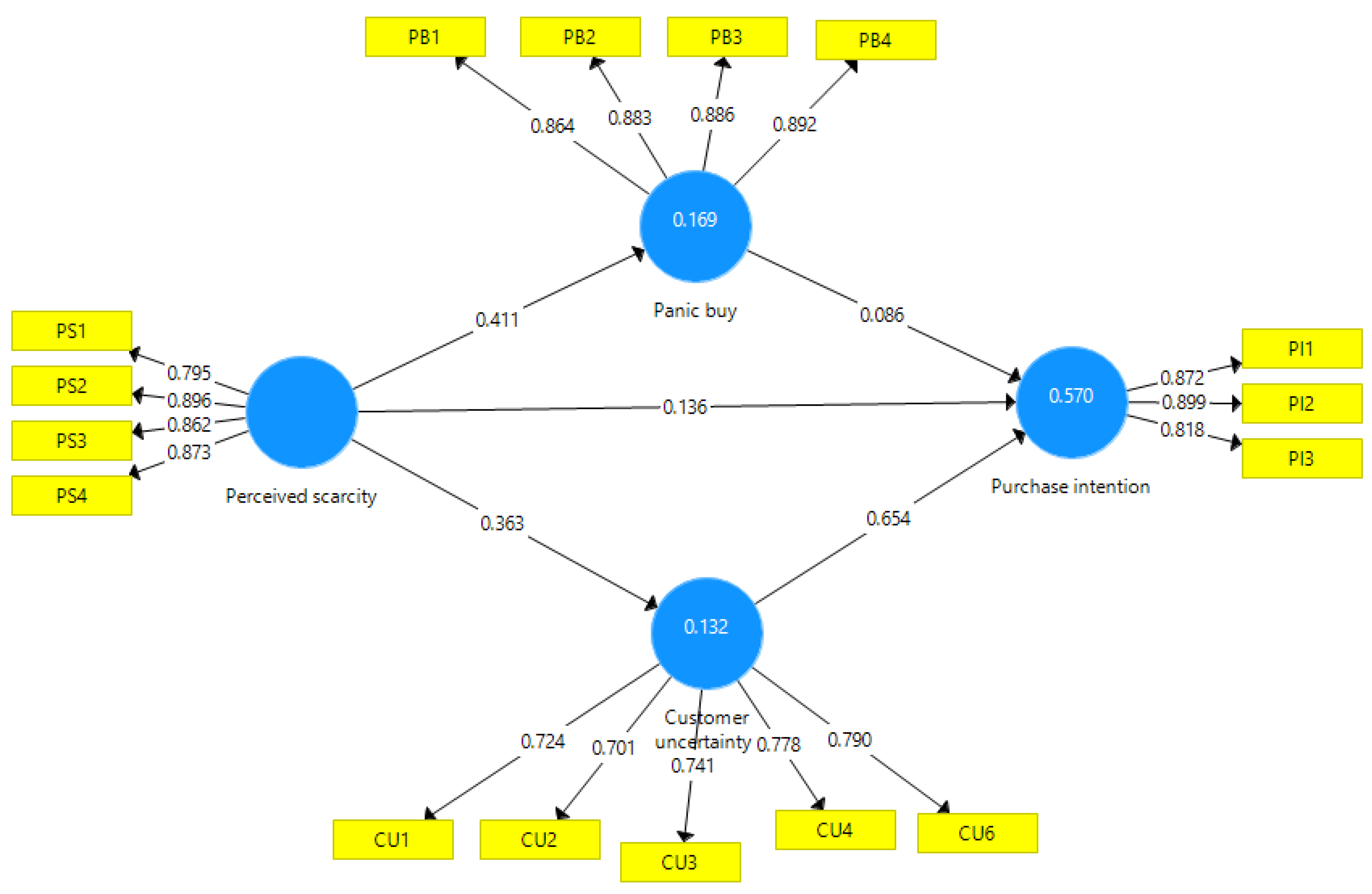
SEM was employed to examine the hypothesized relationships of the study. This was performed by adhering to the protocols of bootstrapping as recommended by Hair et al. (2019) using a resample size of 5000. The outcome of the structural model including the t-values, path coefficients, p-values, and the coefficient of determination (R2) are displayed in Table 4. It is imperative to state that the independent variable accounted for 57% of the total variance explained in the model(R2=0.570). All hypothesis tested significant (H1, H2, H3, H4, H5). Perceived scarcity was found to have a significant effect on purchase intention (β=0.136, p = 0.011) while perceived scarcity had a significant impact on panic buy (β=0.411, p = 0.000) and consumer uncertainty (β=0.363, p = 0.000). In general, the model shows a good fit, SRMR= 0.74 and NFI =0.806 (Hu & Benttler, 1999).
Table 4.
Path analysis.
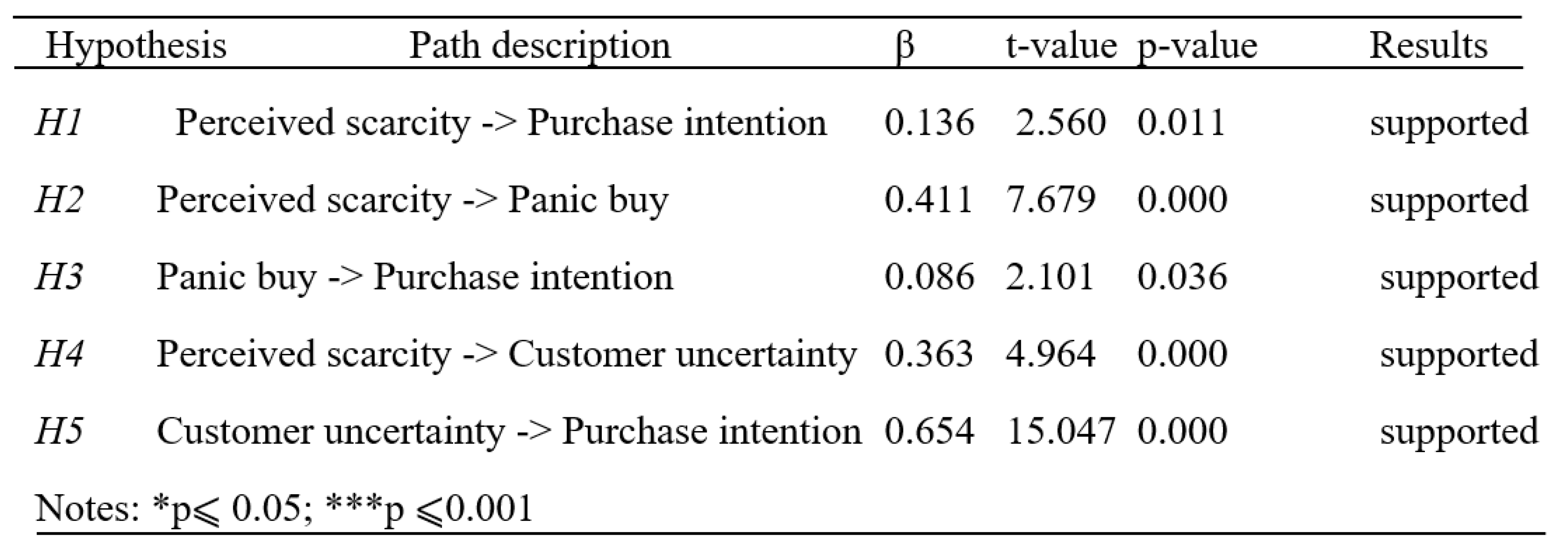 |
Figure 1.
Result of the structural model.
Mediation Analysis
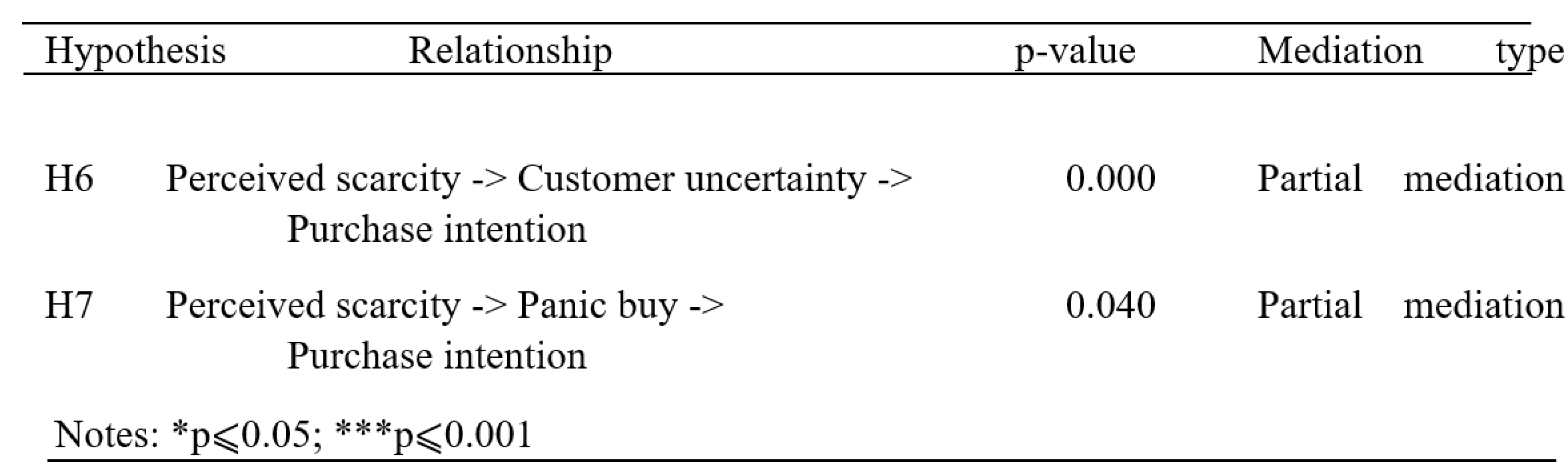
The study employed a bootstrapping of 5,000 samples to conduct a mediation analysis. Table 5 illustrates the outcome of this analysis. The results revealed that panic buy and consumer uncertainty partially mediate the relationship between perceived scarcity and purchase intention. Thus, it can be observed that perceived scarcity affects consumer purchase intention through consumer uncertainty and panic buy providing support for the proposed hypothesis (H6, H7). These findings are consistent with the findings of Adam et al. (2015) who in their study ascertained panic buy as a transitional stage for consumers to stockpile. This also corroborate with the study of Ma (2017) as they found consumer perceived ambiguity (uncertainty) to partially mediate consumer satisfaction and purchase intention.
Discussion and Conclusions
The covid-19 pandemic exposed consumers to a state of panic and uncertainty expediting an unprecedented change in their buying patterns and behaviour. The change was mostly dependent on the perceptions of consumers towards product scarcity and mitigating regret. The current study therefore examined the direct impact of perceived scarcity on consumers intention to stockpile during global pandemic and ascertained the mediating effect of panic buy and consumer uncertainty between the antecedent and outcome variables. All hypotheses tested proved significant. Using the social impact theory to explain the relationships, this study asserts that in times of crises the theory of consumer behaviour propounded by Dewey (1910) and later expanded by Angel, Blackwell and Kollat (1968), as currently known by its five stages, defaults. Thus, the consumer’s usual pattern of need recognition, information search, evaluation of alternatives, purchase and post purchase decisions is shortened to need recognition, purchase, ownership, and satisfaction, cutting out information search and evaluation of alternatives, and introducing ownership. As explained by the social impact theory, the need recognition arises not necessary because the consumer has an urgent need for the product but make a purchase due to the real or imagined presence of others procuring the very goods that is of essences for survival. This triggers a sense of scarcity among consumers as they witness a continual increase in demand for goods and services. As the situation unfolds, consumers become uncertain about what the future holds in relation to product availability, mobility and accessibility hence, facilitating a change in their behaviour.
Another school of thought is of the view that when consumers perceive scarcity during a pandemic, a state of fear is aroused which engenders consumers to panic buy and to stockpile in order to satisfy uncertainties and fear. From the perspective of the social impact theory, Sedikides and Jackson (2015) connote that the impact of the perceived scarcity is dependent on the number of sources, its strength and immediacy. This is to state that in times of a pandemic, as the sources (i.e., consumers making bulk purchase in haste) and strength of that segment increases, its impact experienced by consumers is best felt. This study aligns with other studies underpinned by the social impact theory to depict that the effect of social influence upsurges as a result of the number of influence source (Thompson et al., 2017; Cameron & Shah, 2015; Badgaiyan & Verma, 2015). According to Latane (1981) the social impact theory can be applied to situations that demand rapid response or attention. The change in consumer behaviour as a result of covid-19 pandemic emphasises the social impact theory as a suitable underpinning for the current study. Studies have therefore shown that consumers respond positively to social impact in order to mitigate future regrets (Yangui et al., 2015). As noted earlier, the regret theory explicates that consumers are presented with the choice of making a purchase now or risk missing out the opportunity to attain those goods in the future when needed. In the context of the current study, consumers are more likely to retort to the impact by stockpiling the sort after goods and services in order to satisfy their uncertainties and fears.
The outcome deduced from the hypothesized relations revealed that perceived scarcity during a global pandemic has a significant impact on consumers’ intention to making bulk purchase. Further, the outcome showed a positive and significant relationship between perceived scarcity, panic buy and consumer intention to purchase in bulk. The study again analysed the relationship amid perceived scarcity, consumer uncertainty and consumer intention to buy in bulk, the result indicated a positive and significant relationship among all the variables.
Robinson et al. (2016) in their study revealed that perceived scarcity has a great impact on consumers preferences for goods during a pandemic and affect their buying behaviour. This affirms the argument of the current study that consumers in times of crises consider proximity of products and are mostly not brand conscious and will choose alternatives that satisfies same needs. For instance, the urgency for essential product such as sanitizers, disinfectant, groceries, and others led to limited quantities of these products on shelves which necessitated an increase in price during the early stage of the covid-19 pandemic. Consumers at this point purchased products that were available regardless of the brand. Also, Park and Silvera (2016) assert that during crises consumers may perceive scarcity and increase their purchases even when the products are readily available, affirming the hypothesis that perceived scarcity impact positively on consumer intention to purchase in large quantities than usual.
Hamilton (2021) asserts that scarcity experienced during a pandemic (covid-19) largely affects consumer behaviour. This assertion is confirmed by the current study as the outcome revealed panic buy as an outcome behaviour of perceived scarcity during a pandemic. This implies that consumers do not only skip the established purchasing behaviour stages but buy products out of panic in order to minimize risk. The study of Shou et al. (2013) buttress this outcome by revealing that perceived scarcity is a major driver of panic buying behaviour. Consequently, this communicates that perceived scarcity associated with covid-19 worsened consumer panic buying behaviour and facilitated an increase in quantity demanded of products.
However, it can be emphasized that the change in consumer behaviour during the peak of the pandemic was peculiar to the fear of scarcity hence consumers anticipated the need to stock items that were likely to be scarce. In lieu of this, Yuen et al., (2020) postulate that when consumers experience high level of product scarcity, they are more likely to resort to panic buying. Furthermore, perceived scarcity was found to have a significant impact on consumer uncertainty and their intention to make bulk purchases. This is consistent with the study of Schvaneveld et al. (2016) and Yuen et al. (2020) as they revealed that consumers increase their spending mostly on essential products rather than on luxury in times of crises or during a pandemic. This is an indication that consumer become uncertain when scarcity is perceived hence, unleash drastic measures to curb their negative emotions towards product stockout.
Regarding the mediating role of panic buy and consumer uncertainty, the findings showed evidence for partial mediation for both variables. This implies that in as much as perceived scarcity directly influence consumer intention to stockpile goods, consumer uncertainty and panic buy has an influence on the relationship. These results confirm the outcome of prior studies which provide similar outcome in testing some of the hypotheses. For instance, Wu et al. (2020) reported that perceived scarcity associated in times of cries engenders individuals to panic buy with the intention to purchase in bulk, demonstrating a mediating effect. Similarly, Xiang et al. (2016) illustrated that panic buy mediates product scarceness and consumer intention to hoard. Consumer uncertainty was found to partially mediate the relationship amid perceived scarcity and consumer intention to stockpile. This literally means that uncertainty influence consumers to stockpile goods when scarcity is perceived given that Perceived Scarcity has a direct impact on consumer intention to stockpile. Studies in similar disciplines have affirmed this outcome (Li, et al., 2020; Ghaderi et al., 2020). Sharif (2017) revealed that uncertainty in times of crisis is a resultant factor of scarcity which influences consumer behaviour by altering their psychological, social, purchasing patterns and intentions. In this vein, Thompson et al., (2017) concluded that natural disasters such as health crisis exposes consumers to worry and distress hence, informing their purchasing decisions and behaviour.
The findings from this study have generated quite a number of conclusions as it sought to ascertain the impact of perceived scarcity on consumer intention to stockpile and to determine the mediating role of consumer uncertainty and panic buy in a time of a global pandemic. First, the main contribution of this study is to bring to the light the changes in consumer behaviour during a global pandemic. As noted earlier, they study highlighted the retracted form of consumer buying process in a mist of a global pandemic which underpins the behaviour change. The closure of Chinese ports to curb the covid-19 situation conceived fear and panic among most consumers in Africa since China is the major supplier of goods to the continent. The closure of the Chinse port and other African ports and the lockdown regulations imposed a sense of scarcity among consumers, given that, if ports were closed then obviously there is a halt in the importation of goods. The announcement of lockdowns instigated a rush for goods by consumer in several countries of which Ghana is not an exception. This created illusions and shaped perceptions toward product scarcity evoked panic and uncertainty. The findings of the study confirmed that perceived scarcity impacted on consumer intention to make bulk purchase during a global pandemic.
Implications, Limitations and Future Research Directions
The study has sought to add the dimension on crisis period consumption decisions and asserting that the existing five-stage model of purchasing decision making do not fit neatly. It notes a shortened four-stage process of need recognition, purchase, ownership and satisfaction as a good fit. It cuts out information search and evaluation of alternatives in the old model and introduces ownership. The study also has implications to the management of the marketing mix as we know it. It asserts that not all the 4Ps (i.e., product, price, place and promotion) of the marketing mix are important in crisis times. Whereas product and place factors receive enhanced state of importance, the promotion and price factors are demoted as they do not necessarily affect consumers’ desire to stockpile in anticipation of scarcity. However, it is observed that in the promotional mix, public relations, for example assumes significant level of importance whereas branding becomes least important. This understanding of how consumption decisions are made during crisis and the treatment of the 4Ps marketing mix framework invariably affects marketing practice.
Although the study sought to increase knowledge on consumer behaviour change during a global pandemic, the study has encountered some limitations which are mostly expected in research studies of this nature. The major limitation of the study pertained to the dissemination of the survey instruments. Thus, because the study was carried out during the peak period of the pandemic the researchers had to resort to an online survey. This denied the researchers the opportunity to physically administer the instruments in order ensure strict adherence to the demographic requirements of the participants. The study encountered issues of missing data because of the online survey which had to go through the recommended process of data cleansing. Future research may need to analyse the consumer behaviour post-covid in order to full appreciate the consumer behaviour before, during and post covid. Furthermore, a qualitative study is recommended to enhance readability and also to enrich the literature with consumers views pertaining to the pandemic and how it has impacted on their buying behaviour. Since the study focused on the perspectives of consumers, future studies should study the impact of the pandemic from a firm’s perspective in a longitudinal research approach.
References
- Adair, W. L., & Xiong, T. X. (2018). How Chinese and Caucasian Canadians conceptualize creativity: the mediating role of uncertainty avoidance. Journal of Cross-Cultural Psychology, 49(2), 223-238. [CrossRef]
- Adam, I., Adongo, C. A., & Amuquandoh, F. E. (2019). A structural decompositional analysis of eco-visitors’ motivations, satisfaction and post-purchase behaviour. Journal of Ecotourism, 18(1), 60-81. [CrossRef]
- Adams, R., Jones, A., Lefmann, S., & Sheppard, L. (2015). Rationing is a reality in rural physiotherapy: a qualitative exploration of service level decision-making. BMC health Services Research, 15(1), 1-12. [CrossRef]
- Agu, G.A., Okwara, O.O., Okocha, E.R. and Madichie, N.O. (2022), COVID-19 pandemic and entrepreneurial intention among university students: a contextualisation of the Igbo Traditional Business School, African Journal of Economic and Management Studies, Vol. 13 No. 1, pp. 89-104. [CrossRef]
- Amirani, E., Milajerdi, A., Mirzaei, H., Jamilian, H., Mansournia, M. A., Hallajzadeh, J., & Ghaderi, A. (2020). The effects of probiotic supplementation on mental health, biomarkers of inflammation and oxidative stress in patients with psychiatric disorders: A systematic review and meta-analysis of randomized controlled trials. Complementary therapies in medicine, 49, 102361. [CrossRef]
- Arafat, S. Y., Kar, S. K., & Kabir, R. (2020). Possible controlling measures of panic buying during COVID-19. International Journal of Mental Health and Addiction, 1-3. [CrossRef]
- Baddeley, M. (2020). Hoarding in the age of COVID-19. Journal of Behavioral Economics for Policy, 4(S), 69-75.
- Badgaiyan, A. J., & Verma, A. (2015). Does urge to buy impulsively differ from impulsive buying behaviour? Assessing the impact of situational factors. Journal of Retailing and Consumer Services, 22, 145-157. [CrossRef]
- Banbury, L. K., Shou, Q., Renshaw, D. E., Lambley, E. H., Griesser, H. J., Mon, H., & Wohlmuth, H. (2015). Compounds from Geijera parviflora with prostaglandin E2 inhibitory activity may explain its traditional use for pain relief. Journal of Ethnopharmacology, 163, 251-255. [CrossRef]
- Barnes, S. J., Diaz, M., & Arnaboldi, M. (2021). Understanding panic buying during COVID-19: A text analytics approach. Expert Systems with Applications, 169, 114360. [CrossRef]
- Barnett, M. D., Moore, J. M., & Archuleta, W. P. (2019). A loneliness model of hypochondriasis among older adults: The mediating role of intolerance of uncertainty and anxious symptoms. Archives of Gerontology and Geriatrics, 83, 86-90. [CrossRef]
- Bollen, K., Euwema, M., & Müller, P. (2010). Why are subordinates less satisfied with mediation? The role of uncertainty. Negotiation Journal, 26(4), 417-433. [CrossRef]
- Bown, C. P. (2020). COVID-19: Demand spikes, export restrictions, and quality concerns imperil poor country access to medical supplies. COVID-19 and Trade Policy: Why Turning Inward Won’t Work, 31.
- Chang, J. H., Zhu, Y. Q., Wang, S. H., & Li, Y. J. (2018). Would you change your mind? An empirical study of social impact theory on Facebook. Telematics and Informatics, 35(1), 282-292. [CrossRef]
- Chen, H. J., & Sun, T. H. (2014). Clarifying the impact of product scarcity and perceived uniqueness in buyers’ purchase behavior of games of limited-amount version. Asia Pacific Journal of Marketing and Logistics, 26(2), 232-249. [CrossRef]
- Chen, M. Y., & Teng, C. I. (2013). A comprehensive model of the effects of online store image on purchase intention in an e-commerce environment. Electronic Commerce Research, 13(1), 1-23. [CrossRef]
- Chin, W. W. (1998). The partial least squares approach to structural equation modeling. Modern Methods for Business Research, 295(2), 295-336.
- Fornell, C., & Larcker, D. F. (1981). Structural equation models with unobservable variables and measurement error: Algebra and statistics 382-388. [CrossRef]
- Frank, B., & Schvaneveldt, S. J. (2016). Understanding consumer reactions to product contamination risks after national disasters: The roles of knowledge, experience, and information sources. Journal of Retailing and Consumer Services, 28, 199-208. [CrossRef]
- Gandhi, S., Buragohain, C., Cao, L., Zheng, H., & Suri, S. (2007, April). A general framework for wireless spectrum auctions. In 2007 2nd IEEE International Symposium on New Frontiers in Dynamic Spectrum Access Networks (pp. 22-33). IEEE.
- Gerard, H. B., Wilhelmy, R. A., & Conolley, E. S. (1968). Conformity and group size. Journal of Personality and Social Psychology, 8(1p1), 79-82. [CrossRef]
- Ghaderi, M., Ahi, Q., Vaziri, S., Mansouri, A., & Shahabizadeh, F. (2020). The mediating role of emotion regulation and intolerance of uncertainty in the relationship between childhood maltreatment and nonsuicidal self-injury in adolescents. International Archives of Health Sciences, 7(2), 96. [CrossRef]
- Grier, S., & Davis, B. (2013). Are all proximity effects created equal? Fast food near schools and body weight among diverse adolescents. Journal of Public Policy & Marketing, 32(1), 116-128. [CrossRef]
- Guo, Y., Zhang, J., Zhang, Y., & Zheng, C. (2018). Examining the relationship between social capital and community residents’ perceived resilience in tourism destinations. Journal of Sustainable Tourism, 26(6), 973-986. [CrossRef]
- Gupta, S., & Gentry, J. W. (2016). The behavioral responses to perceived scarcity–the case of fast fashion. The International Review of Retail, Distribution and Consumer Research, 26(3), 260-271. [CrossRef]
- Hair, J. F., Risher, J. J., Sarstedt, M., & Ringle, C. M. (2019). When to use and how to report the results of PLS-SEM. European Business Review, 21(2), 5-16. [CrossRef]
- Harton, H. C., & Bullock, M. (2007). Dynamic social impact: A theory of the origins and evolution of culture. Social and Personality Psychology Compass, 1(1), 521-540. [CrossRef]
- Helsloot, I., & Ruitenberg, A. (2004). Citizen response to disasters: a survey of literature and some practical implications. Journal of Contingencies and Crisis Management, 12(3), 98-111. [CrossRef]
- Henseler, I., Falkai, P., & Gruber, O. (2010). Disturbed functional connectivity within brain networks subserving domain-specific subcomponents of working memory in schizophrenia: relation to performance and clinical symptoms. Journal of Psychiatric Research, 44(6), 364-372. [CrossRef]
- Kemp, E., Bui, M.(M). and Porter, III, M. (2021), Preparing for a crisis: examining the influence of fear and anxiety on consumption and compliance, Journal of Consumer Marketing, Vol. 38 No. 3, pp. 282-292. [CrossRef]
- Kinata, E. J. (2016). The effect of market volatility and firm size towards the difference of market reaction around stock-split announcement in Indonesia stock exchange. Journal of Administrative and Business Studies, 2(6), 304-313.
- Kulemeka, O. (2010). US consumers and disaster: Observing “panic buying” during the winter storm and hurricane seasons. ACR North American Advances.
- Li, C., Yang, Y., & Ren, L. (2020). Genetic evolution analysis of 2019 novel coronavirus and coronavirus from other species. Infection, Genetics and Evolution, 82, 104285. [CrossRef]
- Li, J., Xia, Y., Cheng, X., & Li, S. (2020). Fear of Uncertainty Makes You More Anxious? Effect of Intolerance of Uncertainty on College Students’ Social Anxiety: A Moderated Mediation Model. Frontiers in Psychology, 11, 2301. [CrossRef]
- Lim, W. M. (2021). Toward an agency and reactance theory of crowding: Insights from COVID-19 and the tourism industry. Journal of Consumer Behaviour. [CrossRef]
- Lins, S., & Aquino, S. (2020). Development and initial psychometric properties of a panic buying scale during COVID-19 pandemic. Heliyon, 6(9), e04746. [CrossRef]
- Loomes, G., & Sugden, R. (1982). Regret theory: An alternative theory of rational choice under uncertainty. The economic journal, 92(368), 805-824. [CrossRef]
- Madichie, N. O. (2015). The European ‘horsemeat scandal’: A welcome opportunity for the halal supply chain? Journal of Customer Behaviour, 14(1), 63-82. [CrossRef]
- Madichie, N. O., & Yamoah, F. A. (2017). Revisiting the European horsemeat scandal: the role of power asymmetry in the food supply chain crisis. Thunderbird International Business Review, 59(6), 663-675. [CrossRef]
- Mele, C., Russo-Spena, T., Tregua, M. and Amitrano, C.C. (2021), The millennial customer journey: a Phygital mapping of emotional, behavioural, and social experiences, Journal of Consumer Marketing, 38(4), 420-433. [CrossRef]
- Naeem, M. (2021). Do social media platforms develop consumer panic buying during the fear of Covid-19 pandemic. Journal of Retailing and Consumer Services, 58, 102226. [CrossRef]
- Nettle, D. (1999). Using social impact theory to simulate language change. Lingua, 108(2-3), 95-117. [CrossRef]
- Nowak, A., Szamrej, J., & Latané, B. (1990). From private attitude to public opinion: A dynamic theory of social impact. Psychological Review, 97(3), 362. [CrossRef]
- Park, Hanyong, Ashok K. Lalwani, and David H. Silvera (2020). The impact of resource scarcity on price-quality judgments. Journal of Consumer Research 46(6), 1110-1124. [CrossRef]
- Parker, J. R., & Lehmann, D. R. (2011). When shelf-based scarcity impacts consumer preferences. Journal of Retailing, 87(2), 142-155. [CrossRef]
- Podsakoff, P. M., MacKenzie, S. B., Lee, J. Y., & Podsakoff, N. P. (2003). Common method biases in behavioral research: a critical review of the literature and recommended remedies. Journal of Applied Psychology, 88(5), 879. [CrossRef]
- Putri, A., Retsan, A., Andika, H., & Hendriana, E. (2021). Antecedents of panic buying behavior during the COVID-19 pandemic. Management Science Letters, 11(6), 1821-1832. [CrossRef]
- Robinson, S. G., Brady, M. K., Lemon, K. N., & Giebelhausen, M. (2016). Less of this one? I’ll take it: New insights on the influence of shelf-based scarcity. International Journal of Research in Marketing, 33(4), 961-965. [CrossRef]
- Sachdeva, S., & Zhao, J. (2021). Distinct impacts of financial scarcity and natural resource scarcity on sustainable choices and motivations. Journal of Consumer Behaviour, 20(2), 203-217. [CrossRef]
- Sedikides, C., & Jackson, J. M. (1990). Social impact theory: A field test of source strength, source immediacy and number of targets. Basic and Applied Social Psychology, 11(3), 273-281. [CrossRef]
- Shanker, S., Barve, A., Muduli, K., Kumar, A., Garza-Reyes, J. A., & Joshi, S. (2021). Enhancing resiliency of perishable product supply chains in the context of the COVID-19 outbreak. International Journal of Logistics Research and Applications, 1-25. [CrossRef]
- Sharma, V., & Sonwalkar, J. (2013). Does Consumer Buying Behavior Change During Economic Crisis? International Journal of Economics & Business Administration, 1(2), 33-48.
- Shou, B., Xiong, H., & Shen, X. (2013). Consumer panic buying and quota policy under supply disruptions. Manufacturing and Service Operations Management.
- Tambunan, T. T. (2019). The impact of the economic crisis on micro, small, and medium enterprises and their crisis mitigation measures in Southeast Asia with reference to Indonesia. Asia & the Pacific Policy Studies, 6(1), 19-39. [CrossRef]
- Tsao, Y. C., Raj, P. V. R. P., & Yu, V. (2019). Product substitution in different weights and brands considering customer segmentation and panic buying behavior. Industrial Marketing Management, 77, 209-220. [CrossRef]
- Ulqinaku, A., Sarial-Abi, G., & Kinsella, E. L. (2020). Benefits of heroes to coping with mortality threats by providing perceptions of personal power and reducing unhealthy compensatory consumption. Psychology & Marketing, 37(10), 1433-1445. [CrossRef]
- Wang, E., An, N., Gao, Z., Kiprop, E., & Geng, X. (2020). Consumer food stockpiling behavior and willingness to pay for food reserves in COVID-19. Food Security, 12(4), 739-747. [CrossRef]
- Wang, H. H., & Na, H. A. O. (2020). Panic buying? Food hoarding during the pandemic period with city lockdown. Journal of Integrative Agriculture, 19(12), 2916-2925. [CrossRef]
- Wen, J., Aston, J., Liu, X., & Ying, T. (2020). Effects of misleading media coverage on public health crisis: a case of the 2019 novel coronavirus outbreak in China. Anatolia, 31(2), 331-336. [CrossRef]
- Wong, I. A., Ou, J., & Wilson, A. (2021). Evolution of hoteliers’ organizational crisis communication in the time of mega disruption. Tourism Management, 84, 104257. [CrossRef]
- Wood, B., Williams, O., Nagarajan, V., & Sacks, G. (2021). Market strategies used by processed food manufacturers to increase and consolidate their power: a systematic review and document analysis. Globalization and health, 17(1), 1-23. [CrossRef]
- Wu, W. Y., Lu, H. Y., Wu, Y. Y., & Fu, C. S. (2012). The effects of product scarcity and consumers’ need for uniqueness on purchase intention. International Journal of Consumer Studies, 36(3), 263-274. [CrossRef]
- Wu, Y., Xin, L., Li, D., Yu, J., & Guo, J. (2021). How does scarcity promotion lead to impulse purchase in the online market? A field experiments. Information & Management, 58(1), 103283. [CrossRef]
- Xu, S., Qamruzzaman, M., & Adow, A. H. (2021). Is Financial Innovation Bestowed or a Curse for Economic Sustainably: The Mediating Role of Economic Policy Uncertainty. Sustainability, 13(4), 2391. [CrossRef]
- Yangui, W., & Hajtaïeb El Aoud, N. (2015). Consumer behaviour and the anticipation of a total stockout for a food product: Proposing and validating a theoretical model. The International Review of Retail, Distribution and Consumer Research, 25(2), 181-203. [CrossRef]
- Yuen, K. F., Wang, X., Ma, F., & Li, K. X. (2020). The psychological causes of panic buying following a health crisis. International journal of environmental research and public health, 17(10), 3513. [CrossRef]
- Zhang, L., & Liu, Y. (2020). Potential interventions for novel coronavirus in China: A systematic review. Journal of Medical Virology, 92(5), 479-490. [CrossRef]
Table 1.
Demographics.
| Demographic variables | Frequency (402) | Percentages (100) |
|---|---|---|
| Gender | ||
| Male | 201 | 50.1 |
| Female | 200 | 49.9 |
| Age | ||
| 18-25 years | 143 | 35.7 |
| 26-35 years | 179 | 44.6 |
| 36-45years | 60 | 15.0 |
| 46-55 years | 17 | 4.2 |
| 56 and above | 2 | .5 |
| Level of Education | ||
| Certificate | 1 | .2 |
| Diploma | 78 | 19.5 |
| Degree | 210 | 52.4 |
| Postgraduate | 110 | 27.4 |
| Occupation | ||
| Government employee | 88 | 21.9 |
| Self-employed | 70 | 17.5 |
| Unemployed | 9 | 2.2 |
| Private sector employed | 187 | 46.6 |
| Student | 47 | 11.7 |
| Marital Status | ||
| Married | 304 | 75.8 |
| Single | 92 | 22.9 |
| Divorced/Separated Widow |
4 1 |
1.0 .2 |
| Level of Income(cedi) | ||
| 250-1,990 | 84 | 20.9 |
| 2,000-4,990 | 191 | 47.6 |
| 5,000-9,000 | 82 | 20.4 |
| 10,000 and above | 44 | 11.0 |
Table 2.
Product Category Purchased.
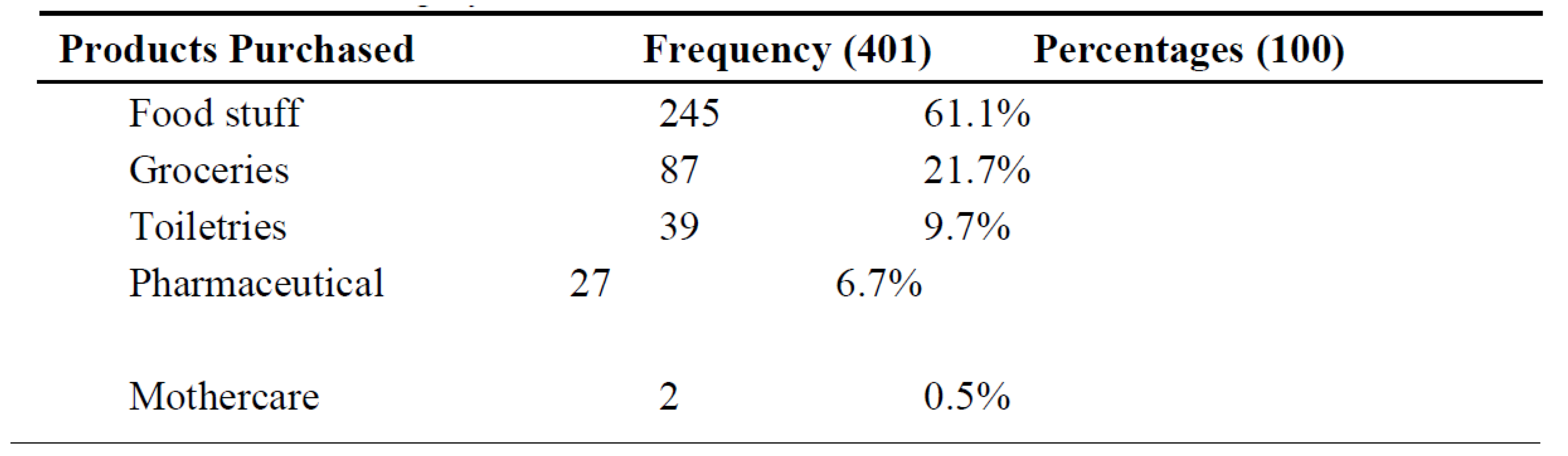 |
Table 5.
Mediation analysis.
 |
Disclaimer/Publisher’s Note: The statements, opinions and data contained in all publications are solely those of the individual author(s) and contributor(s) and not of MDPI and/or the editor(s). MDPI and/or the editor(s) disclaim responsibility for any injury to people or property resulting from any ideas, methods, instructions or products referred to in the content. |
© 2023 by the authors. Licensee MDPI, Basel, Switzerland. This article is an open access article distributed under the terms and conditions of the Creative Commons Attribution (CC BY) license (http://creativecommons.org/licenses/by/4.0/).
Copyright: This open access article is published under a Creative Commons CC BY 4.0 license, which permit the free download, distribution, and reuse, provided that the author and preprint are cited in any reuse.


