

Submitted:
24 July 2024
Posted:
25 July 2024
You are already at the latest version
Abstract
The effects of shade netting on the morphological and chemical composition (organic acids, sugars, total polyphenols, total and certain anthocyanins, proanthocyanidins) and in vitro antioxidant activity of raspberries and blackberries was conducted in the southeastern region of the Republic of North Macedonia. HPLC analysis confirmed a significant effect of shading nets on the amount of the most dominant anthocyanin in blackberries and raspberries. The amount of cyanidin-3-O-glucoside in blackberries covered with shading nets was significantly higher in comparison to the amount of the same anthocyanins in uncovered blackberries. The same tendency was observed for cyanidin-3-O-sophoroside for covered and uncovered raspberries from 2023. However, an opposite relationship was noticed for total anthocyanin content in favor of uncovered blackberry and raspberry from 2023. From all examined organic acids, the amount of acetic acid was the most affected in covered raspberries. The shade netting had a significant influence on polyphenolic content (such as high molecular proanthocyanidins, total and particular anthocyanins), the amounts of sugars (glucose and fructose), and organic acids as well as the intensity of color in blackberry and raspberry. Although net shading significantly influenced particular phenolic compounds presented in examined berry fruits, antioxidant activity was weakly correlated to this environmental change.
Keywords:
Shading nets
; blackberries
; raspberries
; phenolic compounds
; anthocyanins
; cyanidin-3-O-glucoside
; cyanidin-3-O-sophoroside
; HPLC-DAD
; antioxidant activity
; DPPH
1. Introduction
Extreme weather conditions and climate changes, such as very high temperatures, extreme UV radiation and global warming, have detrimental effects on berry fruit orchards [1]. Shade netting is one of the emerging techniques used by growers to protect their orchards against various biotic and abiotic stresses, such as excessive solar radiation, insects, heavy rains, hail as well as wind. Generally speaking, nettings, regardless of color, reduce UV and IR radiation reaching crops underneath (ref). It might be that the higher the shade factor, the more radiation will be reduced. Reductions in radiation resulting from netting will affecting temperatures (air, plant, soil) and relative humidities [2]. Recently, colored shade netting (shadecloth) designed specifically for manipulating plant development (green, red, yellow) and growth has become available. These nets can be used outdoors as well as in greenhouses. They can provide physical protection (birds, hail, insects, excessive radiation), affect environmental modification (humidity, shade, temperature) and increase the relative proportion of diffuse (scattered) light as well as absorb various spectral bands, thereby affecting light quality. These effects can influence crop development as well as the associated organisms [3]. Besides affecting the amount of radiation, nettings can influence the radiation direction.There are different shade netting systems used in the fruit industry, these include insect-proof screens, anti-hail and photoselective nets [4]. The state of global climate has become a major concern in the agricultural industry. Over the past 30 years, the global surface temperature has increased by approximately 0.2 °C per decade [5]. An increase in solar radiation through the years may result in significant color change, amount of berry anthocyanin, flavonoids and other phenolic compounds. However, with increasing temperatures, these and other metabolites such as malic acid may be degraded more rapidly [6]. Several studies related to the impact of UV-B on various morphological, biochemical and molecular aspects have been published, but most of the responses that have been found are highly variable depending on species, experimental conditions and UV-B levels [7]. High UV-B levels may cause damage directly and/or indirectly in raspberries and blackberries, through overproduction of reactive oxygen species (ROS), to a wide range of cellular constituents in different plant tissues. There are reports of impairment of nucleic acids, proteins and lipids (particularly saturated and unsaturated fatty acids) that inhibit photosynthetic reactions and different cell membrane processes [8,9,10,11,12]. In the case of Chilean blueberry shaded plants had 40% greater equatorial and polar diameters and grater weekly production comparing to control [13]. Moreover, the positive effect of different colored nets on physiological responses of the Turkish variety of strawberry was evaluated and results indicated that anthocyanins content was increased, while stomatal conductance in the red-colored net decreased by approximately 38% [14]. Besides the monitoring of elementary biological indicators like temperature and humidity, solar irradiation was also used to identify differences and to find the optimal tunnel material for maximal Hungarian raspberry plant productivity, where shade nets increased the yield and the average berry size variety-specific manner [15]. Among the nets tested, compared with black and green, gray and blue shade nets resulted in greater sugar accumulation in grape plants and greater consistency of fruit coloring [16]. According to the Retamales et al. (2008), treatments with white 50%, gray 35% and red 50%, consistently increased yields of mature highbush blueberries [17]. Results presented in the work of Moradi et al. (2022)[18], indicated pomegranate fruits grown under green 50% net shading on trees and postharvest fruit treatment with 2 mM salicylic acid resulted in greater total anthocyanins and ascorbic acid content and lower chilling injury of arils [18].
The main object of this study is the evaluation of the shading effects on the chemical composition and antioxidant activity of raspberry and blackberry treated in two consecutive years in the south-east region of the Republic of North Macedonia.
2. Materials and methods
2.1. Climate and Soil
Climatic conditions have been analyzed based on the received data for minimum, maximum, and average daily temperature for the period from 01.01.2023 to 30.09.2023. The obtained data are presented in Walter’s climatic diagram (Figure 1 a,b). According to the presented values for the examined parameters can be noted that the curve of precipitation is above the temperature’s curve, which indicates that in the examined period were dominant drought conditions.
2.2. Plant Material And nets
The shade trial was conducted on raspberry and blackberry plantations established in 2018 in the village of Psača, southeastern region of the Republic of North Macedonia (N 42.1646, E 22.2022). Shading was implemented in two consecutive years (2022 and 2023) with dark green polystyrene nets with 40% solar radiation transmittance. The nets are placed approximately 0.5 m above the expected highest point of plant development height. The control plants were unshaded but in the same agricultural inputs as the treated plants. The raspberry plants were of the Wilamette variety, while the blackberry plants were of the Thornfree variety. Both plantations were planted in 2018 in a 2×0.5 m planting pattern. Sampling of fruits in both years was done at technological maturity (during July).
2.3. Standards and Reagents
Methanol, ethanol, sulfuric acid and hydrochloric acid were purchased from Alkaloid, Skopje. Folin-Cioĉalteu reagent, iron and vanillin were obtained from Merck, Germany. Pure analytical standards (+)-catechin, and cyanidin were obtained from Sigma-Aldrich (Steinheim, Germany). Standard compounds cyanidin-3-O-glucoside and cyanidin-3-O-sophoroside were purchased from ChemFaces (Wuhan, China). The chemical composition of the wines was evaluated by official analytical methods for wines (OIV 2016) and internal laboratory methods (total and free SO2 and titratable acidity). pH was measured by Methorm pH meter (Herisau, Switzerland). Volatile, malic and lactic acid and glucose/fructose was measured enzymatically by Diatron 400 (Hungary). The alcohol content was measured by an alcohol meter (Alcolyzer Wine M, Anton Paar, Austria).
2.4. Spectrophotometric Analysis
Spectrophotometric analysis was performed with a Varian Cary 100 spectrophotometer (Agilent Technologies Inc., Palo Alto, CA, USA) as described (Rigo et al., 2000) [19]. Total polyphenols (TPs) were estimated by Folin-Cioĉalteu reagent reduction to blue pigments caused by phenols in alkaline solution. Concentrations of total polyphenols were determined using a calibration curve as (+)-catechin in mg kg−1 fresh berry weight (FW). High molecular weight proanthocyanidins were evaluated by transformation to cyanidin and expressed as mg kg−1 cyanidin chloride from FW berry fruit. The method is a highly specific assay, which provides a good evaluation of the total amount of proathocyanidins and is mainly associated with variations in high molecular mass phenols corresponding to at least 5 units (Vrhovsek et al., 2001) [20]. Low molecular weight proanthocyanidins were determined by their reaction with vanillin. Vanillin index methods provide an estimation of free C6 and C8 for catechins and proanthocyanidins. This index decreases with increasing polymerization because C6 and C8 are mainly involved in polymerization bonds. Therefore, the method provides a good estimation of monomers and a low degree of polymerized flavanols corresponding to two to four units. Low molecular weight proanthocyanidins were evaluated as (+)-catechin in mg kg−1 of FW grapes or mg L−1 of wine. Total anthocyanins (TA) were determined based on the maximum absorbance in the visible range (536–542 nm). They were quantified in mg kg−1 grape FW assuming average absorption of the raspberry mixture (average MW = 500 Da, ϵ = 18 800 M−1 cm−1 in 70:30:1 ethane:water:HCl solution). Color intensity is determined and defined as the sum of absorbance at 420, 520 and 620 nm. Wine hue is defined as the ratio of A420/A520. on a 1mm optical path, as was described in the method by Lisjak et al., 2020 [21].
2.5. Antioxidant Activity
Free radical scavenging activity was measured using DPPH as a source of free radicals according to the methods used by Brand-Williams et al. and Re et al. [23], respectively. The antioxidant activity was expressed as IC50 (the extract concentration required to inhibit 50% of the DPPH in the assay medium).
2.6. HPLC Analysis of Particular Anthocyanins
The extracts of blackberries and raspberries were prepared using 70% methanol and solid to solvent ratio 1:25. The analysis was performed by high-performance liquid chromatography system (Agilent 1200 RR, Agilent, Waldbronn, German) coupled with a diode-array detector (DAD). Anthocyanins separation was achieved on an Lichrospher RP-18 (Agilent) column (250 mm × 4 mm, 5 μm). Elution was made with solvent A (10%, v/v solution of formic acid in water) and solvent B (acetonitrile), using gradient elution as follows: 1% B, 0–0.5 min; 1–7% B, 0.5–1 min; 7% B, 1–4 min; 7–10% B, 4–7.5 min; 10–14% B, 7.5–11.5 min; 14–25% B, 11.5–15.5 min; 25–40% B, 15.5–18.5 min; 40–75% B, 18.5–22 min; 75% B, 22–25 min. The injection volume was 10 μL, the flow rate was 1 mL/min and the detection wavelength was set at 520 nm. The contents of the anthocyanin compounds were calculated using calibration curves. The results are presented as milligrams per gram of dried extract (mg/g DE). Anthocyanins identification was performed in double online detection using DAD (at 520 nm). The compounds identification was achieved by comparing their retention times, and UV–Vis spectra with those of standards or data available in literature. Quantification was done with the calibration curve of the standard compounds: cyanidin-3-O-glucoside and cyanidin-3-O-sophoroside.
2.7. Statistical Analysis
All observations were done in triplicate. Differences among observed phytochemicals (organic acids, sugars, total and particular anthocyanins, total phenolic compounds and higher and lower proanthocyanidins) of blackberries and raspberries (with and without shading nets from 2022 and 2023), were estimated by one-way ANOVA, followed by post hoc Tukey’s test at P<0.05 level of significance. Statistically significant differences between mean values, for every year particularly, were denoted by different row-wise letters (a-d). Statistical analysis was conducted using the R CRAN software package.
3. Results
3.1. Organic Acids and Sugars
The effect of the shading nets on organic acids content, total acidity and pH in cultivated raspberries and blackberries is presented in Table 1, where the amounts of organic acids were significantly influenced by shading nets as well as climatic conditions in the years 2022 and 2023. The effect of shading net was especially emphasized for acetic acid in raspberry produced in 2023. The amount of acetic acid in raspberries covered by green shading nets was almost ten times higher than in raspberries growing without shading nets. On the other hand, citric acid was detected only for uncovered blackberries produced in 2022 (0.92 g/kg). The same tendency was detected for D-gluconic and lactic acids due to the fact that the same samples from blackberries had almost four times higher amounts of D-gluconic and lactic acid in comparison to raspberry and blackberries from 2023. Statistical analysis showed that the amount of malic acid was not affected by the shading net and the difference was more statistically significant regarding the berry fruit and growing year.
However, only the difference in total acidity for blackberry grown with and without shading nets from 2023 was statistically significant. The higher total acidity was measured for blackberries covered by shading net which can be a result of other organic acids (such as phenolic acids) presented in blackberries while the values of pH for uncovered blackberries for both years were higher in comparison to covered blackberries and raspberries.
The highest amounts of sugars (D-glucose+D-fructose) were measured for blackberries in the 2022 year (63 g/kg), while the values of this quality parameter were significantly lower in 2023 (36.98-48.34 g/kg) (Table 2). However, the sugar content of the shaded blackberry (48.34 g/kg) was statistically significantly different from the non-shaded variety (36.98 g/kg), while the shading did not affect the sugar content of the raspberry.
Results presented in Table 2 showed the highest absorbance on 420 and 620 nm for blackberries produced in 2022 while raspberries had the strongest color on 520 nm. The difference in color intensity can be attributed to the different colors of blackberry and red raspberry but statistical difference unequivocally showed that blackberries produced in 2022 had stronger color in comparison to the same varieties of blackberries produced in 2023.
3.2. Phenolic Content
The color of blackberries and red raspberries is strongly affected by the amounts of anthocyanins as well as other phenolic compounds. As we can notice from Table 3, the highest amounts of total anthocyanins were measured for covered and uncovered raspberries (558.1 and 626.2 mg/kg, respectively). Those amounts were in complete agreement with the results from the absorbance at 520 nm. The highest amount of total polyphenols was measured for uncovered blackberries from 2023 while the difference with and without shading nets was not statistically significant for raspberries. The same tendency was detected for amounts of lower and higher molecular proanthocyanidins.
Generally speaking, results for phenolic content presented in Table 3, showed higher amounts for total anthocyanins in uncovered blackberries and raspberries. However, the amounts of major anthocyanins had the opposite relationship. As we can see from the results presented in Table 3, the amount of cyanidin-3-O-glycoside is more affected in blackberries from 2023. Results presented in Table 3 indicated a significantly higher amount of cyanidin-3-O-glycoside in blackberries covered by shading nets. On the other hand, the amount of the same anthocyanin in raspberries was not affected by the shading nets. The amounts of major anthocyanin for raspberries, cyanidin-3-O-sophoroside were strongly affected by shading nets by the tendency of higher amounts in raspberries covered by shading nets. The same anthocyanin was below the level of detection in blackberries. Regarding lower and higher molecular proanthocyanidins, the effect of shading nets was significant only for blackberries from 2023. Both of them were significantly higher in uncovered blackberries from 2023. The antioxidant activity determined by DPPH radical indicated the highest antioxidant activity for blackberries due to the fact that blackberries are a richer source of pigmented phenolic compounds but, the effect of shading nets was statistically not significant.
4. Discussion
4.1. Organic Acids and Sugars
Organic acids in raspberries and blackberries such as oxalic acid, tartaric acid, malic acid, α-ketoglutaric acid, lactic acid, citric acid, fumaric acid, ascorbic acid and succinic acid are effective in several physiological processes (especially stage of maturation and flavor) as well as their bioactivity and positive impact on human health [24]. In comparison to raspberry, blackberry is not extremely sensitive in terms of climatic requirements; therefore, it is more easily adaptable to different climatic conditions. Blackberry is grown in places where it is usually sunny, wind-protected, not rainy during harvest time, with adequate soil moisture, and having mild winters.
The ratio of organic acids and sugars is very important because it reveals the status of ripening in berry fruits [25]. Many researchers published a wide range of values for organic acids in different genotypes of raspberry and blackberry fruits. Kafkas et al. (2006) reported the malic acid content and the total acidity content of the five blackberry genotypes as varied from 0.6 to 11.0 g/kg and from 1.3 to 25.9 g/kg, respectively [26]. Our results from the same organic acid were in the same range. Vrhovsek et al. (2008) studied the citric acid and malic acid content of the blackberry genotypes in Italy and found them to range from 1.1 to 16.7 g/kg and from 4.0 to 15.8 g/kg, respectively [25]. Our results showed significantly lower amounts of citric and malic acid for blackberries from 2022, while in blackberries and raspberries from 2023, the citric acid was below the limit of detection. Our findings are in good agreement with the same researchers who were unable to identify citric acid in some genotypes. Usually, during the processes of fruit harvesting, freezing, storage and analysis, the loss in organic acids is reduced to a minimum, but it should be noted that the situation cannot be avoided completely. Consequently, reactions and changes in the physiology of fruits affect organic acid content. It is also thought that differences in the organic acidity contents of the blackberries genotypes might have arisen from genetic factors, climatic factors and/or cultural practices [27,28]. Total acidity and pH, are also indicators of the stage of ripening and strongly impact the taste (especially sour note) of the berry fruits. According to results found in the study of Haro-Maza and Guerrero-Beltrán, (2016), it was clear that the UV-C light had no effects on pH, or acidity in blueberry, raspberry, and blackberry nectars. Our results showed that shading nets did not affect significantly the pH and total acidity with the exception of blackberries from 2023. Generally speaking, the amounts of organic acids, especially phenolic acids drastically fluctuate during the process of ripening [29]. It was observed in conventional raspberries at the overripe stage (~56 mg/100 g dry weight of phenolic acids), while the highest phenolic acid concentration was observed at the same ripe stage in organic fruits [30].
The main sugars found in blueberries and raspberries are glucose and fructose. Usually, in berry fruits, the glucose content (46.48±4.98) mg/g) is slightly higher and the fructose content (34.67±4.79) mg g–1) is slightly lower (Šne et al., 2011) [31]. Our results presented as a sum of glucose and fructose is lower with the highest amount for uncovered blackberries from 2022 (63 g/kg). Significantly lower amounts in examined covered and uncovered berry fruits from 2023 can be the results of different climatic conditions in both years which affect the overall taste. Due to the fact that fructose is sweeter than glucose and sucrose (Kaye et al. 2008), their relative sweetness values are 1.75, 0.7, and 1, respectively (Zheng et al. 2011) [32,33]. Therefore, according to the working group of Zhang it is recommended to choose blueberry cultivars with relatively high fructose content, such as Sunrise, Earliblue and Bluegold (Zhang, 2020) [34].
4.2. Polyphenolic Content
The metabolic profile of flavonols and anthocyanins in blackberry fruits is formed by the flavonols kaempferol and quercetin and their respective derivatives, while cyanidin derivatives are the unique anthocyanidins present. The UV radiation causes a stressful situation for plants which is handled in two ways. First of all flavonoids and other pigments present mainly in the outer parts of the plant (epidermis and mesophyll tissues) absorb and considerably reduce the amount of radiation; the second one would consist in decreasing the effect of ROS caused by the radiation by scavenging ROS [35]. Among flavonols, the main compound related to light absorption is kaempferol 3-O-glucoside because of its monohydroxy B-ring and the flavonol with the greatest antioxidant properties is quercetin 3-O-glucoside, because of its dihydroxy B-ring. It has been shown that upon different UV exposures, the synthesis of phenolic compounds is increased [36]. This may be the primary mechanism of response, which can be followed by others such as accumulation of pigments or lignification processes. Hence, flavonoids and anthocyanins are involved in protection against oxidative stress due to high UV radiation.
The results for total phenolic content (TPC) published in the literature with the Folin–Cioĉalteu reagent for raspberry and blackberry fruits were in huge range. Wang and Lin examined the red and black raspberry as well as blackberry juices and showed that TPC ranged from 208 to 268 mg 100 g–1 FW in raspberries and from 204 to 248 mg 100 g –1 FW in blackberries [37]. On the other hand, Anttonen and Karjalainen revealed the respective values for red raspberries grown in Finland and extracted with 70% acetone containing 0.1% HCl. These values were found between 192 and 359 mg 100 g–1 FW [38]. Pantelidis and co-workers reported that 50%-methanolic extracts of fruits of a few raspberry cultivars grown in Greece contained between 1052 and 2494 mg GAE 100 g–1 dw [39]. In the case of primocane-fruiting raspberry cultivars they examined fruits of two harvest periods and demonstrated that fruits of the late season were more abundant in phenolic compounds, which increased from 1280 to 1905 mg 100 g–1 dw (‘Heritage’) and Chen and coworkers showed the total phenolic values of raspberries grown in northern China, in extracts prepared of 0.1% (v/v) methanol, as ranging from 215.54 to 619.35 mg 100 g–1 FW [40]. The results for total phenolic content from examined samples of blackberries and raspberries in our study were lower in comparison to those published in the literature with the highest amount of less than 300 mg/kg fruits. The total phenol content of the raspberry cultivars ranged from 1040.95 ± 15.91 mg GAE/100 g FW to 2062.27 ± 4.13 mg GAE/100 g FW. The samples of raspberries from Hollanda Boduru had considerably high total phenol content [41]. Statistical significant differences were observed between water and methanol extracts for total phenol content in Aksu Kırmızısı, Rubin, and Heritage cultivars. The concentration of total phenol quantified in raspberry and blackberry cultivars Chester and Jumbo was higher [42,43,44,45,46]. These differences could be due to environmental characteristics, period of harvesting, cultivar variability, fruit maturity, and extraction solvent and procedure [47].
4.3. Determination of total and Particular Anthocyanins
Cyanidin 3-glucoside is the predominant anthocyanin in blackberries (Kolniak-Ostek, Fan-Chiang, Lee 2012), while in red raspberries other cyanidins: cyanidin 3-sophoroside, cyanidin 3-glucosylrutinoside, cyanidin 3-glucoside and cyanidin 3-rutinoside occur in different amounts [48,49,50]. The anthocyanin compounds such cyanidin, pelargonidin, delphinidin, malvidin, cyanidin-3-sophoroside, cyanidin-3-glucoside, cyanidin-3-rutinoside, cyanidin-3-sambubioside, cyanidin-3- xylosyrutinoside, cyanidin-3-(2G-glucosylrutinoside), cyanidin xyloside, pelargonidin-3-sophoroside, pelargonidin-3-(2Gglycosylrutinoside), pelargonidin-3-glucoside, pelargonidin-3- rutinoside, malvidin-3-glucoside, and delphinidin-3-glucoside were investigated in both raspberry and blackberry cultivars because of common anthocyanins found in berries [51,52]. Although the amounts of total anthocyanins in our study were in favor of uncovered samples, the opposite relationships were noticed for particular major anthocyanins (cyanidin-3-O-glucoside for blackberries and cyanidin-3-O-sophoroside for raspberries). It might be that the effect of shading nets strongly influenced the amount of cyanidin-3-O-glucoside in blackberries due to the fact that covered samples had significantly higher amounts of the major anthocyanidin [56,57]. Although flavonoid biosynthesis may be up regulated by increasing sun exposure during the first half of ripening, the same exposure may be deleterious for anthocyanin and flavonol contents during the second half of berry ripening. Additionally, the positive effect of shading nets was detected for cyanidin-3-O-sophoroside as a major cyanidin in raspberries [58,59,60]. This might be due to the fact that shade cloths may efficiently palliate temperature spikes, especially the last weeks before harvest od raspberries and blackberries, while transmitting enough radiation into the fruit zone to achieve a better berry fruit composition compared to uncovered grapes.
4.4. Antioxidant activity
The effect of shading nets on the values of antioxidant activity presented in Table 3 was not statistically significant in our study. Generally speaking, the antioxidant activity of blackberries was higher in comparison to raspberries which can be linked to the different amounts of particular phenolic compounds and pigments. Results published in the literature showed that antioxidant activity measured by DPPH assay showed a similar relationship as did ABTS assay, but values were generally higher. These differences are especially noticeable in comparisons with the measured antioxidant activities of dark-colored fruits such as black raspberries and blackberries and activities of lighter, red-colored fruits (Ozgen and others 2006) [53,54,55]. According to the authors, anthocyanins in the dark-colored fruits make up a significant portion of antioxidant activity and anthocyanins do not react as readily with produced ABTS+, but react more readily with the DPPH assay. Antioxidant activity, measured by the DPPH assay, ranged from 64.14 ± 0.98 μmol TE/g FW (Rubin) to 127.59 ± 1.84 TE/g FW (Hollanda Boduru) in raspberry and range from 90.95 ± 1.04 μmol TE/g FW (Bursa 2) to 177.11 ± 3.17 μmol TE/g FW (Jumbo) in blackberry cultivars [54]. Many authors linked the values of antioxidant activities to particular phenolic compounds present in raspberries and blackberries. Correlations between ellagic acid, catechin, gallocatechin and syringic acid contents with antioxidant activity were observed. On the other hand, there was no significant correlation (5% probability) between gallic acid content and antioxidant activity. These results indicate that variations in phenolic compound contents can lead to different biological responses. Although the catechins represent potential constituents, other compounds may act synergistically, increasing the beneficial effects associated with the consumption of fruits and their blackberry derivatives [56,57,58,59,60].
5. Conclusions
The shading nets had a significant influence on the amounts of organic acids (in particular citric acid), sugars, total and particular anthocyanins and higher and lower proanthocyanidins in covered and uncovered blackberries and raspberries from the south-east region of the Republic of North Macedonia. The amount of acetic acid was the most affected by shading nets in raspberries, while total acidity and sugars (glucose+fructose) were the most affected parameters in blackberries. Due to the decreased tendency of total anthocyanins and proanthocyanidins in covered raspberries and blackberries and the increase tendency of the particular anthocyanins (cyanidin-3-O-glucoside and cyanidin-3-O-sophoroside), the effect of shading nets on the total antioxidant potential was not statistically significant. The higher antioxidant potential of blackberries in comparison to raspberries was linked to different polyphenolic profiles and different amounts of particular phytochemicals in examined berry fruits.
Author Contributions
Conceptualization, S.K.V., D.P. and D.T; Data curation, D.P. and D.T.; Formal analysis, S.K.V., and Z.T.; Methodology, J. Ž., Z.T., S.K.V., D.P. and D.T.; Software, Z. T., and D.P.; Supervision, D.P, Ž.D., and P.D.; Validation, P.D. and Ž.D.; Writing—original draft, S.K.V., D.T. and D.P.; Writing—review & editing, S.K.V and J.Ž. All authors have read and agreed to the published version of the manuscript.
Acknowledgments
This work was supported by a grant from the Fund for Innovation and Technological Development from the Republic of North Macedonia. The financial support from Fund for Innovation and Technological Development for the project with title “Impact of shading nets on the quality and antioxidant potential of raspberries and blackberries grown in the south-east region of Republic of North Macedonia” is gratefully acknowledged.
Conflicts of Interest
The authors have no conflict of interest to report.
References
- Mditshwa, A.; Magwaza, L.S.; Tesfay, S.Z. Shade netting on subtropical fruit: Effect on environmental conditions, tree physiology and fruit quality. Sci Hortic. 2019, 256, 108556. [Google Scholar] [CrossRef]
- Stamps, R.H. Differential effects of colored shade nets on three cut foliage crops. Acta Hort. 2008, 770, 169–176. [Google Scholar] [CrossRef]
- Pérez, M.; Plaza, B.M.; Jiménez, S.; Lao, M.T.; Barbero, J.; Bosch, J.L. The radiation spectrum through ornamental net houses and its impact on the climate generated. Acta Hort. 2006, 719, 631–636. [Google Scholar] [CrossRef]
- Stamps, R.H. Use of Colored Shade Netting in Horticulture. Use of Colored Shade Netting in Horticulture. Hort Science Horts. 2009, 44, 239–241. [Google Scholar]
- Hansen, J.; Sato, M.; Ruedy, R.; Lo, K.; Lea, D.W.; Medina-Elizade, M. Global temperature change. Proc Natl Acad Sci. U. S. A. 2006, 103, 14288–14293. [Google Scholar] [CrossRef]
- Martínez-Lüscher, J.; Lee Chen, C.C.; Brillante, L.; Kurtural, S.K. Partial solar radiation exclusion with color shade nets reduce the degradation of organic acids and flavonoids of grape berry (Vitis vinifera L.). J Agric Food Chem. 2017, 65, 10693–10702. [Google Scholar] [CrossRef]
- Berli, F.J.; Bottini, R. UV-B and abscisic acid effects on grape berry maturation and quality. J Berry Res. 2013, 3, 1–14. [Google Scholar] [CrossRef]
- Foyer, C.H.; Lelandais, M.; Kunert, K.J. Photooxidative stress in plants. Physiol Plantarum. 1994, 92, 696–717. [Google Scholar] [CrossRef]
- Jansen, M.A.K.; Gaba, V.; Greenberg, B.M. Higher plants and UV-B radiation: Balancing damage, repair and acclimation. Trends Plant Sci. 1998, 3, 131–5. [Google Scholar] [CrossRef]
- Frohnmeyer, H.; Staiger, D. Ultraviolet-B radiation-mediated responses in plants. Balancing damage and protection. Plant Physiol. 2003, 133, 1420–8. [Google Scholar] [CrossRef]
- Bjorn, L.O. Effects of ozone depletion and increased UV-B on terrestrial ecosystems. Int J Environ Stud. 1996, 51, 217–43. [Google Scholar] [CrossRef]
- Scandalios, J.G. Oxygen stress and superoxide dismutases. Plant Physiol. 1993, 101, 7–12. [Google Scholar] [CrossRef] [PubMed]
- Rodríguez Beraud, M.M.; Morales Ulloa, D.M. Shading nets effect on the production and quality of blueberry fruit (Vaccinium corymbosum L.) cv. Brigitta. Sci Agropecuaria 2015, 6, 41–50. [Google Scholar] [CrossRef]
- Aras, S.; Eşitken, A. Physiological effects of photoselective nets in strawberry plant. KSÜ Tarım ve Doğa Derg. 2019, 22, 342–346. [Google Scholar] [CrossRef]
- Szalay, K.; Keller, B.; Rak, R.; Peterfalvi, N.; Kovacs, L.; Soucek, J.; Sillinger, F.; Jung, A. Artificial solar radiation protection of raspberry plantation. Prog. Agric. Eng. Sci. 2020, 16, 141–150. [Google Scholar] [CrossRef]
- Zha, Q.; Yin, X.; Xi, X.; Jiang, A. Colored Shade Nets Can Relieve Abnormal Fruit Softening and Premature Leaf Senescence of “Jumeigui” Grapes during Ripening under Greenhouse Conditions. Plants 2022, 11, 1227. [Google Scholar] [CrossRef] [PubMed]
- Retamales, J.B.; Montecino, J.M.; Lobos, G.A.; Rojas, L.A. Colored Shading Nets Increase Yields and Profitability of Highbush Blueberries. Acta Hort. 770, ISHS 2008, : XXVII International Horticultural Congress - IHC2006.
- Moradi, S.; Zamani, Z.; Fatahi Moghadam, M.R.; Saba, M.K. Combination effects of preharvest tree net-shading and postharvest fruit treatments with salicylic acid or hot water on attributes of pomegranate fruit. Sci Hortic. 2022, 304, 111257. [Google Scholar] [CrossRef]
- Rigo, A.; Vianello, F.; Clementi, G.; Rossetto, M.; Scarpa, M.; Vrhovšek, U. Contribution of proanthocyanidins to the peroxy radical scavenging capacity of some Italian red wines. J Agric Food Chem 2000, 48, 1996–2002. [Google Scholar] [CrossRef] [PubMed]
- Vrhovsek, U.; Mattivi, F.; Watterhouse, A.L. Analysis of red wine phenolics: comparison of HPLC and spectrophotometric methods. Vitis 2001, 40, 87–91. [Google Scholar]
- Lisjak, K.; Lelova, Z.; Žigon, U.; Bolta, Š.V.; Teissedre, P.-L. and Vanzo, A. Effect of extraction time on content, composition and sensory perception of proanthocyanidins in wine-like medium and during industrial fermentation of Cabernet Sauvignon. J Sci Food Agric 2020, 100, 1887–1896. [Google Scholar] [CrossRef]
- Brand-Williams, W.; Cuvelier, E.; Berset, C.M. Use of free radical method to evaluate antioxidant activity. LWT-Food Sci. Technol. 1995, 28, 25–30. [Google Scholar] [CrossRef]
- Re, R.; Pellegrini, N.; Proteggente, A.; Pannala, A.; Yang, M.; Rice-Evans, C. Antioxidant activity applying an improved ABTS radical cation decolorization assay. Free Rad. Biol. Med 1999, 26, 1231–1237. [Google Scholar] [CrossRef]
- Shaw, D.V. 1988. Genotypic variation and genotypic correlation for sugars and organic acids of strawberries. J. Am. Soc. Hort. Sci. 1988, 113, 770–774. [Google Scholar] [CrossRef]
- Vrhovsek, U.; Giongo, L.; Mattivi, F.; Roberto, V. A survey of ellagitannin content in raspberry and blackberry cultivars grown in Trentino (Italy). Eur. Food Res. Technol. 2008, 226, 817–824. [Google Scholar] [CrossRef]
- Kafkas, E.; Ko§ar, M.; Turemi§, N.; Ba§er, K.H.C. Analysis of sugars, organic acids and vitamin C contents of blackberry genotypes from Turkey. Food Chem. 2006. Food Chem. 2006, 2006. 97, 732–736. [Google Scholar] [CrossRef]
- Poyrazoğlu, E.; Gökmen, V.; Artιk, N. Organic acids and phenolic compounds in pomegranates (Punica granatum L.) grown in Turkey. J. Food Compos. Anal. 2002, 15, 567–575. [Google Scholar] [CrossRef]
- Haro-Maza, J.F.; Guerrero-Beltrán, J.A. Ultraviolet-C Light Effect on the Physicochemical and Antioxidant Properties of Blackberry, Blueberry, and Raspberry Nectars. J. Food Res. 2016, 5, 11. [Google Scholar] [CrossRef]
- Frías-Moreno, M.N.; Parra-Quezada, R.A.; González-Aguilar, G.; Ruíz-Canizales, J.; Molina-Corral, F.J.; Sepulveda, D.R.; Salas-Salazar, N.; Olivas, G.I. Quality, Bioactive Compounds, Antioxidant Capacity, and Enzymes of Raspberries at Different Maturity Stages, Effects of Organic vs. Conventional Fertilizatio. Foods 2021, 10, 953. [Google Scholar] [CrossRef]
- Yu, Y.; Yang, G.; Sun, L.; Song, X.; Bao, Y.; Luo, T.; Wang, J. Comprehensive Evaluation of 24 Red Raspberry Varieties in Northeast China Based on Nutrition and Taste. Foods, 2022, 11, 3232. [Google Scholar] [CrossRef] [PubMed]
- Šne, E.; Kampuse, S.; Berņa, E. The composition of sugars and sugar-acid ratio of highbush blueberry varieties grown in Latvia. Research for Rural Development. International Scientific Conference 2011, 1, 140–144. [Google Scholar]
- Kaye, F.; Susanna, H.H.; Janette, C.B. International tables of glycemic index and glycemic load values: 2008. Diabetes Care 2008, 31, 2281–2283. [Google Scholar]
- Zheng, J.; Heikki, K.; Kaisa, L.; Baoru, Y. Sugars, sugar alcohols, fruit acids, and ascorbic acid in wild Chinese sea buckthorn (Hippophaë rhamnoides ssp. sinensis) with special reference to influence of latitude and altitude. Food Res. Int. 2011, 44, 2018–2026. [Google Scholar] [CrossRef]
- Zhang, J.; Nie, J.; Li, J.; Zhang, H.; Li, Y.; Saqib, F.; Syed Asim Shah Bacha, S.A.S.; Wang, J. Evaluation of sugar and organic acid composition and their levels in highbush blueberries from two regions of China. J. Integr. Agric. 2020, 19, 2352–2361. [Google Scholar] [CrossRef]
- Gutierrez, E.; Velasco, A. G.; Lucas, J. A.; Gutierrez-Mañero, F. J.; Ramos-Solano, B. The Flavonol-Anthocyanin Pathway in Blackberry and Arabidopsis: State of the Art. Flavonoids-from biosynthesis to human health. 2017. [Google Scholar] [CrossRef]
- Shomali, A.; Das, S.; Arif, N.; Sarraf, M.; Zahra, N.; Yadav, V.; Aliniaeifard, S.; Chauhan, D.K.; Hasanuzzaman, M. Diverse Physiological Roles of Flavonoids in Plant Environmental Stress Responses and Tolerance. Plants (Basel). 2022, 11, 3158. [Google Scholar] [CrossRef]
- Wang, S.Y.; Lin, H.S. Antioxidant activity in fruits and leaves of blackberry, raspberry, and strawberry varies with cultivar and developmental stage, J. Agric. Food Chem., 2000, 48, 140–146. [Google Scholar] [CrossRef]
- Anttonen, J.M.; Karjalainen, R.O. Environmental and genetic variation of phenolic compounds in red raspberry. J Food Chomp. Anal. 2005, 18, 759–769. [Google Scholar] [CrossRef]
- Pantelidis, G.E.; Vasilakakis, M.; Manganaris, G.A.; Diamantidis, G.R. Antioxidant capacity, phenol, anthocyanin and ascorbic acid contents in raspberries, blackberries, red currants, gooseberries and Cornelian cherries. Food Chem. 2007, 102, 777–783. [Google Scholar] [CrossRef]
- Chen, L.; Xin, X.; Zhang, H.; Yuan, Q. ; Phytochemical properties and antioxidant capacities of commercial raspberry varieties. J. Funct. Foods. 2013, 5, 508–515. [Google Scholar] [CrossRef]
- Sariburun, E.; Şahin, S.; Demir, C.; Türkben, C.; Uylaşer, V. Phenolic Content and Antioxidant Activity of Raspberry and Blackberry Cultivars. J Food Sci. 2010, 75, 328–335. [Google Scholar] [CrossRef] [PubMed]
- Amakura, Y.; Umino, Y.; Tsuji, S.; Tonogai, Y. Influence of jam processing on the radical scavenging activity and phenolic content in berries. J Agric Food Chem 2000, 48, 6292–7. [Google Scholar] [CrossRef]
- De Ancos, B.; Gonzales, E.; Cano, M.P. Differentiation of raspberry varieties accord- ´ ing to anthocyanin composition. Z Lebensm Unters Forsch A. 1999, 208, 33–8. [Google Scholar] [CrossRef]
- Wang, S.; Lin, H. Antioxidant activity in fruits and leaves of blackberry, raspberry and strawberry varies with cultivar and developmental stage. J Agric Food Chem. 2000, 2000. 48, 140–6. [Google Scholar] [CrossRef]
- Sellappan, S.; Akoh, C.C.; Krewer, G. Phenolic compounds and antioxidant capacity of Georgia-grown blueberries and blackberries. J Agric Food Chem. 2002, 50, 2432–8. [Google Scholar] [CrossRef]
- Wada, L.; Ou, B. Antioxidant activity and phenolic content of oregon caneberries. J Agric Food Chem 2002, 50, 3495–500. [Google Scholar] [CrossRef]
- Benvenutı, S.; Pellatı, F.; Melegarı, M.; Bertelli, D. Polyphenols, anthocyanins, ascorbic acid, and radical scavenging activity of rubus, ribes, and aronia. J Food Sci Food Chem Toxicol. 2004, 69, 164–9. [Google Scholar] [CrossRef]
- Kolniak-Ostek, J.; Kucharska, A.Z.; Sokół-Łętowska, A.; Fecka, I. Characterization of Phenolic Compounds of Thorny and Thornless Blackberries. J. Agr. Food Chem. 2015, 63, 3012–3021. [Google Scholar] [CrossRef]
- Fan-Chiang, H.; Wrolstad, R. Anthocyanin pigment composition of blackberries. J. Food Sci. 2005, 70, 198–202. [Google Scholar] [CrossRef]
- Lee, J.; Dossett, M.; Finn, C.E. Rubus fruit phenolics research: The good, the bad, and the confusing. Food Chem. 2012, 130, 785–796. [Google Scholar] [CrossRef]
- Wu, X.; Prior, RL. Systematic identification and characterization of anthocyanins by HPLC-ESI-MS/MS in common foods in the United States: fruits and berries. J Agric Food Chem. 2005, 53, 2589–2599. [Google Scholar] [CrossRef]
- Chen, F.; Sun, Y.; Zhao, G.; Liao, X.; Hu, X.; Wu, J.; Wang, Z. Optimization of ultrasound-assisted extraction of anthocyanins in red raspberries and identification of anthocyanins in extract using high-performance liquid chromatography–mass spectrometry. Ultrason Sonochem. 2007, 14, 767–78. [Google Scholar] [CrossRef] [PubMed]
- Ozgen, M.; Reese, R.N.; Tulio, A.Z.; Miller, A.R.; Scheerens, J.C. Modified 2,2-azino-bis-3-ethylbenzothiazoline-6-sulfonic acid (ABTS) method to measure antioxidant capacity of selected small fruits and comparison to ferric reducing antioxidant power (FRAP) and 2,20-diphenyl-1-picrylhydrazyl (DPPH) methods. J Agric Food Chem. 2006, 54, 1151–7. [Google Scholar] [CrossRef] [PubMed]
- Sariburun, E.; Şahin, S.; Demir, C.; Türkben, C.; Uylaşer, V. Phenolic Content and Antioxidant Activity of Raspberry and Blackberry Cultivars. J. Food Sci., 2010, 75, 328–335. [Google Scholar] [CrossRef] [PubMed]
- Guedes, M. N. S.; Pio, R.; Maro, L. A. C.; Lage, F. F.; Abreu, C. M. P.; de, Saczk, A. A. Antioxidant activity and total phenol content of blackberries cultivated in a highland tropical climate. Acta Scient. Agr. 2017, 39, 43. [Google Scholar] [CrossRef]
- Maurer, T.; Tonello, C.; Machado, B.; Trentin, T.; Bertol, C.; Lângaro, N.; Chiomento, J. L. Phytochemical potential of berries: An overview. LADEE 2023, 4, 11–28. [Google Scholar] [CrossRef]
- Wolske, E.; Chatham, L.; Juvik, J.; Branham, B. Berry Quality and Anthocyanin Content of 'Consort' Black Currants Grown under Artificial Shade. Plants (Basel). 2021, 10, 766. [Google Scholar] [CrossRef]
- Pallotti, L.; Silvestroni, O.; Dottori, E.; Lattanzi, T.; Lana, V. Effects of shading nets as a form of adaptation to climate change on grapes production: a review. OENO One 2023, 57. [Google Scholar] [CrossRef]
- Šavikin, K.; Mikulič-Petkovšek, M.; Djordjević, B.; Zdunić, G.; Janković, T.; Djurović, D.; Veberič, R. Influence of shading net on polyphenol profile and radical scavenging activity in different varieties of black currant berries. Sci. Hortic. 2013, 160, 20–28. [Google Scholar] [CrossRef]
- Martínez-Lüscher, J.; Lee Chen, C.C.; Brillante, L.; Kurtural, S.K. Partial Solar Radiation Exclusion with Color Shade Nets Reduces the Degradation of Organic Acids and Flavonoids of Grape Berry (Vitis vinifera L.). J. Agric. Food Chem. 2017, 65, 10693–10702. [Google Scholar] [CrossRef]
Figure 1.
Walter climate diagram.
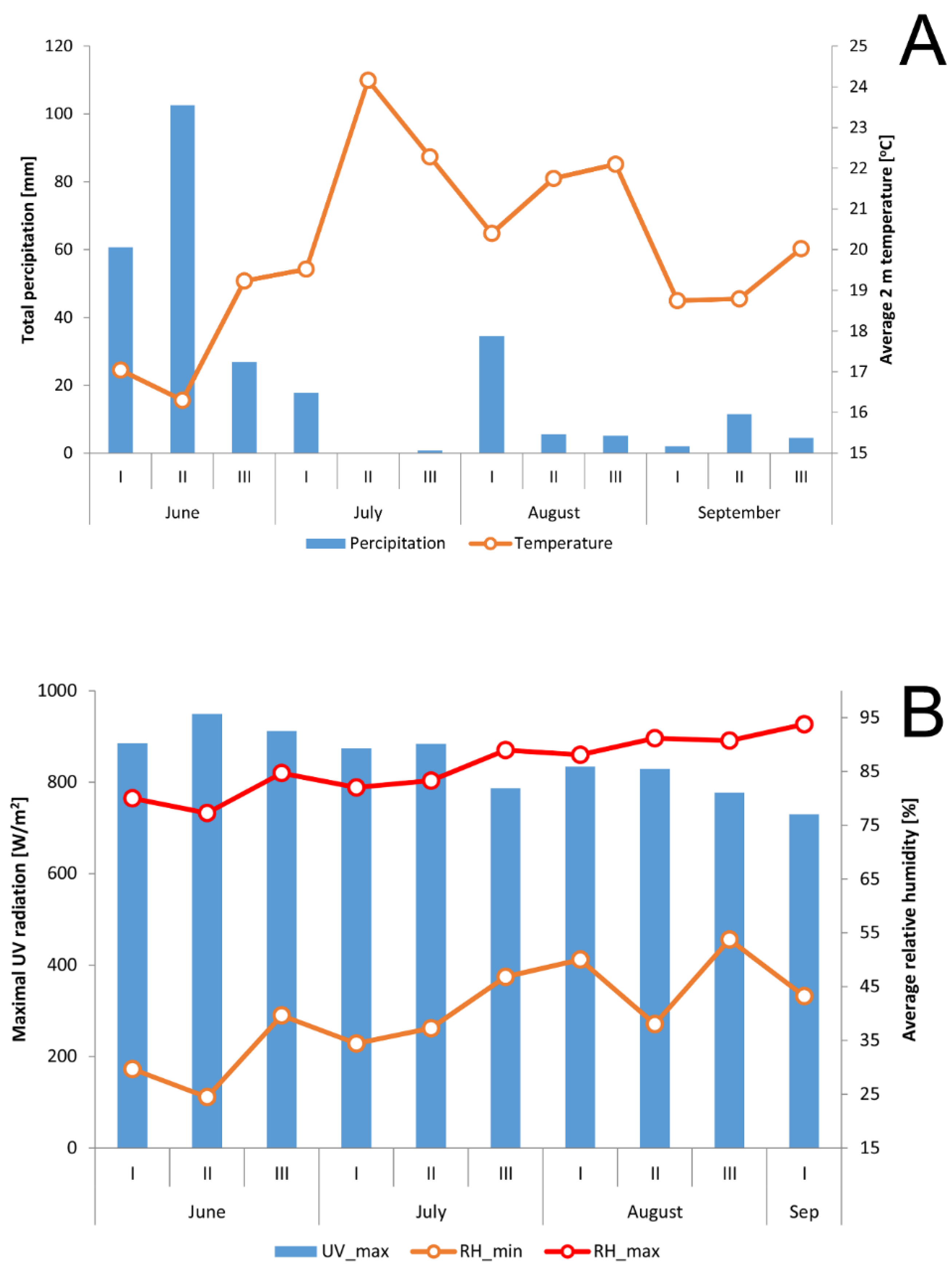

Table 1.
Influence of shading net on organic acids content, total acidity, pH and sugars in cultivated raspberries and blackberries.
Table 1.
Influence of shading net on organic acids content, total acidity, pH and sugars in cultivated raspberries and blackberries.
| Species | Treatment | Acetic | Citric | D-gluconic | Lactic | Malic | Total acidity | pH | D-glc + D-fru |
|---|---|---|---|---|---|---|---|---|---|
| [g/kg] | [g/kg] | [g/kg] | [g/kg] | [g/kg] | [g/kg] | [g/kg] | |||
| Year 2022 | |||||||||
| Blackberry | without shading | 0.02±0.01 b | 0.92±0.13 | 0.20±0.03 a | 0.04±0.00 | 2.14±0.02 b | 11.90±0.49 b | 3.23±0.01 a | 63.00±1.44 a |
| Year 2023 | |||||||||
| Blackberry | without shading | 0.03±0.01 b | - | 0.05±0.01 b | 0.01±0.00 | 3.08±0.04 a | 9.19±0.11 c | 3.33±0.05 a | 36.98±3.21 c |
| shading | 0.03±0.00 b | - | 0.05±0.00 b | - | 3.12±0.06 a | 11.31±0.07 b | 3.06±0.04 b | 48.34±2.51 b | |
| Raspberry | without shading | 0.01±0.00 b | - | 0.03±0.00 b | - | 0.67±0.09 c | 21.93±2.03 a | 3.02±0.03 b | 38.83±1.56 c |
| shading | 0.11±0.02 a | - | 0.04±0.01 b | - | 0.72±0.10 c | 20.19±3.21 a | 3.10±0.01 b | 39.48±1.71 c | |
| a Different letters next to mean values indicate statistical differences according to the post hoc Tukey’s test at the level of P<0.05 | |||||||||
Table 2.
Influence of shading net on fruit color in cultivated raspberries and blackberries.
| Species | Treatment | A420(violet) | A520(blue) | A620(orange) |
|---|---|---|---|---|
| Year 2022 | ||||
| Blackberry | without shading | 4.74±0.69 a | 6.14±0.81 c | 1.99±0.11 a |
| Year 2023 | ||||
| Blackberry | without shading | 3.33±0.10 b | 4.43±0.27 d | 0.53±0.31 b |
| shading | 1.93±0.22 c | 3.98±0.41 d | 0.16±0.02 d | |
| Raspberry | without shading | 3.15±0.29 b | 10.00±2.01 a | 0.18±0.00 d |
| shading | 3.21±0.34 b | 9.83±2.21 b | 0.32±0.02 c |
a Different letters next to mean values indicate statistical differences according to the post hoc Tukey’s test at the level of P<0.05.
Table 3.
Influence of shading net on polyphenolic content and antioxidant activity in cultivated raspberries and blackberries.
Table 3.
Influence of shading net on polyphenolic content and antioxidant activity in cultivated raspberries and blackberries.
| Species | Treatment | Total anthocyanins | Cya-3-O-glc | Cya-3-O-soph.b | Total polyphenols | LM proAc | HM proAd | IC50 |
|---|---|---|---|---|---|---|---|---|
| [mg/g FW]a | [mg/g FW] | [mg/g FW] | [mg/g FW] | [mg/g FW] | [mg/g FW] | [mg] | ||
| Year 2022 | ||||||||
| Blackberry | without shading | 469.0±83.81 c | 0.74±0.05 b | n.d. | 278.0±14.50 a | 445.1±10.11 b | 868.0±14.71 b | 87.1±2.1 b |
| Year 2023 | ||||||||
| Blackberry | without shading | 457.5±17.22 c | 0.97±0.06 b | n.d. | 294.3±23.93 a | 512.7±31.24 a | 931.5±21.09 a | 94.0±12.30 a |
| shading | 323.1±10.05 d | 1.22±0.09 a | n.d. | 256.6±12.97 ab | 462.9±14.53 b | 872.4±13.2 b | 92.1±9.10 a | |
| Raspberry | without shading | 626.2±21.43 a | 0.21±0.03 a | 0.48±0.09 b | 223.5±31.81 b | 388.0±22.92 c | 772.9±30.0 c | 84.1±10.0 b |
| shading | 558.1±41.92 b | 0.28±0.04 a | 0.66±0.08 a | 217.4±13.99 b | 365.2±12.41 c | 713.6±13.21 c | 82.1±11.4 b |
a Different letters next to mean values indicate statistical differences according to the post hoc Tukey’s test at the level of P<0.05 b n.d. - not detected.c LM proA - Low molecular proanthocyanidins. d HM proAd - High molecular proanthocyanidin.
Disclaimer/Publisher’s Note: The statements, opinions and data contained in all publications are solely those of the individual author(s) and contributor(s) and not of MDPI and/or the editor(s). MDPI and/or the editor(s) disclaim responsibility for any injury to people or property resulting from any ideas, methods, instructions or products referred to in the content. |
© 2024 by the authors. Licensee MDPI, Basel, Switzerland. This article is an open access article distributed under the terms and conditions of the Creative Commons Attribution (CC BY) license (http://creativecommons.org/licenses/by/4.0/).
Copyright: This open access article is published under a Creative Commons CC BY 4.0 license, which permit the free download, distribution, and reuse, provided that the author and preprint are cited in any reuse.


