

Submitted:
22 May 2023
Posted:
23 May 2023
You are already at the latest version
Abstract
(Background:) Raspberry (Rubus idaeus L.) is very popular with consumers around the world for its intense flavor, attractive appearance and health benefits. In recent years, interest in healthy eating and natural products has increased, and raspberry fits perfectly into these trends, which translates into its greater importance on the consumer market. (Aim) The aim of the study was the commodity evaluation of raspberry fruits bearing fruit on 2-year-old shoots, cultivated under the conditions of varied nitrogen fertilization against the background of constant phosphorus-potassium fertilization. The first-order factor were cultivars ('Laszka' and ‘Glen Ample’), and the second-order factor was nitrogen fertilization (0, 50, 100 and 150 kg N ha-1), against the background of constant phosphorus-potassium fertilization (100 kg P2O5 and 120 kg K2O ha-1). The experiment was set up in a dependent split-plot design, in 3 repetitions. (Results) The importance of raspberry on the consumer market was shaped by: taste and quality of fruit, health benefits, naturalness and freshness, universality of use, availability and nutritional trends. (Conclusion) The tested cultivars were characterized by similar production and quality capabilities. Fertilization of the tested cultivars with a dose of 135 kg N·ha-1 turned out to be justified in terms of yield. Increasing nitrogen doses resulted in a significant increase in fresh fruit yield and 1000 fruit weight. Different doses of nitrogen increased fruit resistance to mechanical damage, firmness and improved quality indices.
Keywords:
raspberry fruit
; cultivated
; balanced fertilization
; conditions
; commodity evaluation
; quality of fruit
1. Introduction
The raspberry (Rubus idaeus L.) belongs to the rose family Rosaceae [1]. This botanical family includes most cultivated trees (e.g., pears, apples, plums, pears, cherries), fruit bushes (e.g., raspberries and blackberries - Rubus) and ornamental shrubs (e.g., rose - Rosa) and perennials (e.g., Fragaria) [2,3,4,5]. Its natural origin can be found in Europe, North Asia and North America. In Europe, the raspberry is widespread, especially in the temperate zone. This species has long been cultivated in many European countries, such as Poland, Germany, France, Great Britain, Russia and Scandinavia. In addition to Europe, the raspberry also occurs naturally in North Asia, in countries such as Russia, Kazakhstan, Mongolia, China, Japan and Korea. Raspberries are also grown in these regions. In North America, raspberries are found growing wild. This species is endemic to the continent, with natural ranges from Alaska and Canada to mountainous areas in the United States, including Colorado, Washington, Oregon and Montana. Thanks to the development of genetics and breeding, the raspberry is now cultivated all over the world in various regions that provide appropriate climatic and soil conditions for this species. The raspberry is very popular among consumers due to its intense taste, attractive appearance and health benefits [5,6]. There are several factors that influence the importance of the raspberry in the consumer market. These are:
- –
- taste and quality: raspberry have a distinct, sweet and sour taste. The degree of ripeness, the variety, the content of simple sugars, organic acids and volatile substances determine the taste and aroma of the fruit. Fruit should also be fresh, juicy and of good quality to meet consumer expectations [7,8,9,10].
- –
- –
- naturalness and freshness: consumers want natural and fresh products, especially when it comes to fruit. Raspberry fruit is often perceived as a natural, seasonal fruit that can be eaten in its original form.
- –
- versatility of use: raspberry fruit can be eaten in many different ways - as an independent fruit, an addition to desserts, an ingredient in cocktails, jellies, jams, casseroles. This versatility attracts diverse groups of consumers,
- –
- –
The quality of raspberry fruits and their importance on the consumer market also depend on factors such as: region of cultivation, production methods, local availability and price competitiveness [4,7,10,11,12].
The biological value of the raspberry depends to a large extent on the concentration of antioxidants, which include, among others: ascorbic acid and anthocyanins [4,11,12,14]. Raspberry fruit also contains vitamin C, as well as vitamins from the group: B, PP, A, E, K and minerals such as: potassium, calcium, magnesium, iron, and in a smaller amount: manganese, copper and zinc [2,8,9,11]. The presence of these ingredients affects the health-promoting properties of the raspberry. Polyphenols have antioxidant, anti-inflammatory and antimicrobial effects [13]. They inhibit the formation of free radicals, which adversely oxidize many compounds and damage: cell membranes, proteins, lipids, enzymes and genetic material [11,14,15,16,17,18,19]. Viskelis et al. [20] showed that black raspberries (‘Bristol’ variety) are characterized by a lower number of anthocyanins and phenolic compounds compared to chokeberry and elderberry, however, the radical scavenging effect (RSA) of black raspberries is insignificant and is at the level (approx. 9% ). The best-known group of polyphenolic compounds includes flavonoids, which are located in the surface layers of plant tissues and act as dyes [11,14,15,17]. A rich source of flavonoids that give the red color in raspberry fruit are anthocyanins, which include, among others, cyanidin and pelargonidin [16,18]. Consumption of products containing these compounds has a beneficial effect on the eyesight and the cardiovascular system [16,20]. The fruits of Rubus idaeus L. also contain carotenoid compounds that act as natural plant pigments, including β-carotene, zeaxanthin and lutein [22,23]. Zeaxanthin and lutein give color to yellow-fruited varieties that do not contain anthocyanins. Raspberry is a rich source of phenolic acids, which include ellagic and salicylic acid [17,18,21,23]. Ellagic acid has anticancer and antioxidant properties, while salicylic acid has analgesic, antipyretic and anti-inflammatory properties [13,14,16,19,24].
However, raspberry fruits are very susceptible to mechanical damage, water loss and mold development during transport and storage. For these reasons, the viability of the raspberry after harvest is limited to a few days, usually 3 to 5 days, and only a small percentage of these fruits can be eaten fresh [10,17]. To prevent these defects, it is recommended to store the fruit at a temperature close to 0°C. However, storing fruit at low temperature is insufficient to extend the shelf life of raspberry fruit to 14 days, and more and more often storage is carried out in a controlled atmosphere [25,26,27,28,29]. Maintaining the concentration of CO2 at the level of 5-20%, and O2 - 3-10% ensures an increase in the durability of stored Rubus idaeus fruits. Reducing the O2 concentration below 3% may, however, cause deterioration of the taste, while exceeding the CO2 level above 30% increases the softening of the fruit and causes brown discoloration of the skin [21,28,29].
The yield and quality of Rubus idaeus fruits are also determined by appropriate cultivation management, including fertilization, especially with nitrogen, and care treatments [30,31]. The use of nitrogen fertilizers is very important due to the fact that nitrogen is a component of amino acids forming structural proteins and enzymes important for metabolism, nucleic acids and chlorophyll [17].
Consumers purchasing raspberry fruit pay special attention to quality features such as color, size and shape. The color affects the appearance, attractiveness, as well as freshness and determines the taste. Quality standards for fresh fruit intended for consumption in international trade are defined by the European standard UN/ECE FFV-32, which provides for three quality classes: Extra, I and II. In each of them, healthy, clean fruit, without foreign smells, with a fresh appearance, free from pests and damage, not damp, are allowed to be marketed. The size of fruits of cultivars depends on determining the largest diameter and for individual fractions is: Extra - 15 mm, I - 12 mm [32]. In the case of class II raspberries, the size is not specified [32]. Quality classes differ in the share of fruit with defects and the degree of tolerance of these defects, e.g., separating raspberry fruits after a period of drought and repeated rainfall. Each batch of fruit must be uniform and properly labeled [33]. Therefore, the aim of the study was to carry out a commodity evaluation of the fruits of two raspberry cultivars bearing fruit on 2-year-old shoots, cultivated under the conditions of differentiated nitrogen fertilization against the background of constant phosphorus-potassium fertilization.
2. Material and Methods
The research was based on a field experiment. They were located in the village of Rozbórz Długi, located in the Przemyśl Foothills on brown, slightly acidic soil. Geographical location: 49°55′45″N 22°29′18″E (Figure 1). The experiment was performed using the randomized block method, in a dependent, split-plot design, in 3 repetitions. The 1st order factor were 2 raspberry cultivars: ’Laszka’ and ’Glen Ample’, bearing fruit on two-year-old shoots. The second-order factor was differentiated nitrogen fertilization (0, 45, 90, 135 kg N·ha-1), against the background of constant phosphorus-potassium fertilization and full dose of manure (40 t·ha-1). The area of one plot was 4000 m2.
2.1. Characteristics of varieties
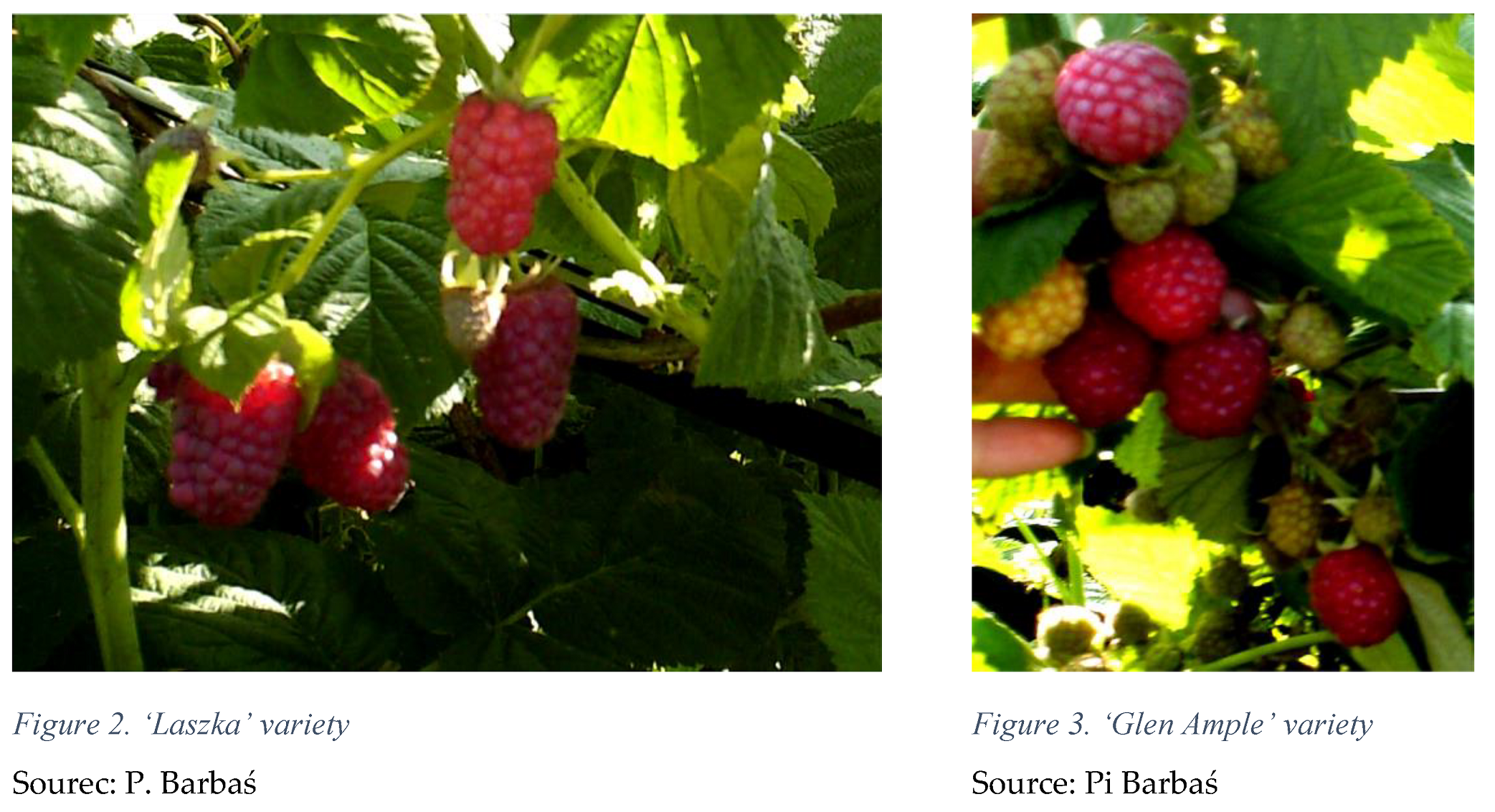
’Laszka’ - a variety bred in the Experimental Department of the Institute of Pomology and Floriculture in Brzezna. It was entered into the National Register of Original Varieties in 2006 (Figure 1) [34]. It is an early fruiting variety on two-year-old shoots. Plant growth is moderately strong. Rigid and arched shoots have numerous, but not very aggressive spines [35]. The fruits are large and very large, elongated, intensely red in color with a slight moss. It is resistant to frost, dieback of shoots and fruit rot. The fruits have a long post-harvest shelf life and are less susceptible to damage during transport [33]. They are also characterized by a high content of vitamin C - even twice as high as in other varieties [35]. The optimal yield of this variety can be obtained under appropriate cultivation conditions, i.e., low density of shoots per 1 m2, development of appropriate fertilization and appropriate air and water conditions of the soil [33]. Its fertility and fruit size are useful in the production of consumption and dessert fruit. It is a variety recommended for controlled cultivation for accelerated harvest due to early ripening and high content of ascorbic acid in the fruit [33].
’Glen Ample’ is a variety bred at the Scottish Institute of Crop Production in Dundee (Figure 2). However, it can be cultivated in Poland. A high-yielding variety (up to 20 t ha-1), and on irrigated plantations even up to 25 t ha-1 [33,35]. It is characterized by strong growth, stiff shoots, without thorns, large, compact fruits, bright red in color with a slight moss. The fruits have an attractive appearance and a very good taste, which makes them intended mainly for direct sale as dessert [36]. It is characterized by frost resistance and very high resistance to diseases. Its fruits reach a weight of 8-10 g, are resistant to rot and transport. Even after several days of rainfall, they do not fall and remain firm [35].
2.2. Agrotechnical conditions
The forecrop of the raspberry was white mustard. In the autumn of 2018, deep plowing (35 cm) was performed with manure and mineral, phosphorus-potassium fertilizers in the amount of 150 kg K and 80 kg P, 75 kg Mg and 150 kg Ca.ha-1. These fertilizers were introduced in the form of polifoska 6 (NPK - 6-20-30), potassium salt 60% and magnesium lime (CaO, MgO - 30-15), then a cultivation unit was used.
Raspberry seedlings, qualification grade C, were planted at a spacing of 2.5 m, every 0.5 m in a row. The plant density was 10,000. pcs.ha-1. After the acceptance of the seedlings, nitrogen fertilization was applied in the amount of 10 kg N.ha-1 in three equal doses, every 20 days, in the form of 34% ammonium nitrate. In addition, in order to provide young seedlings with the necessary microelements, Florovit liquid, multi-component foliar and soil fertilizer was applied.
In 2019, in the spring, white clover was sown in the rows of raspberries, in the amount of 8 kg.ha-1, in order to eliminate some weeds and enrich the soil with nitrogen. In the autumn of that year, after examining the abundance of assimilable macronutrients in the soil, the basic mineral fertilization with phosphorus and potassium was established at a dose of 90 kg K.ha-1 (in the form of 60% potassium salt in the amount of 150 kg ha-1), and phosphorus in the form granulated simple superphosphate (20% P) in the amount of 100 kg ha-1.
In 2020, the plantation was divided into blocks and subblocks and repeats, leaving drive paths. According to the planned scheme of the experiment, mineral fertilization with nitrogen was introduced. Nitrogen doses above 45 kg.ha-1 were divided into 2 or 3 parts, depending on the size of the dose. The dose of 90 kg N was applied in 2 parts:
- –
- the first dose (in the amount of 45 kg N.ha-1) was applied in early spring at the beginning of vegetation - in the form of 34% ammonium nitrate,
- –
- II dose - in the amount of 45 kg N.ha-1 was applied after flowering of raspberry shoots, in the form of 46% urea.
- –
- The dose of nitrogen in the amount of 135 kg N.ha-1 was divided into 3 parts:
- –
- the first dose (in the amount of 45 kg N.ha-1) was applied in early spring at the beginning of vegetation - in the form of 34% ammonium nitrate,
- –
- II dose - in the amount of 45 kg N.ha-1 was introduced before the flowering of raspberry shoots, in the form of 46% urea;
- –
- III dose - in the amount of: 45 kg N.ha-1 was applied after flowering of raspberry shoots in the foliar form. 100 kg of urea was dissolved in 900 l of water and used for 3 periods, every 7 days.
The quality of raspberry fruit was assessed on the basis of: weight of 1000 fruit, organoleptic evaluation of fruit; their dry matter, juice yield, fruit storage life, transport resistance and rheological evaluation. The weight of the harvested fruit was determined using a laboratory balance.
2.3. Fruit picking
It is important to determine the optimal date of fruit harvest, which will reduce losses and obtain good quality fruit for processing or storage. The fruits of the true raspberry reach harvest maturity when they are fully ripe. Harvest is carried out every 2-3 days as the fruit ripens, but the fruit must not be overripe as it becomes too soft and unsuitable for transport. The fruit harvest on the experimental plantation was preceded by organizational work, securing manual work and mechanical equipment.
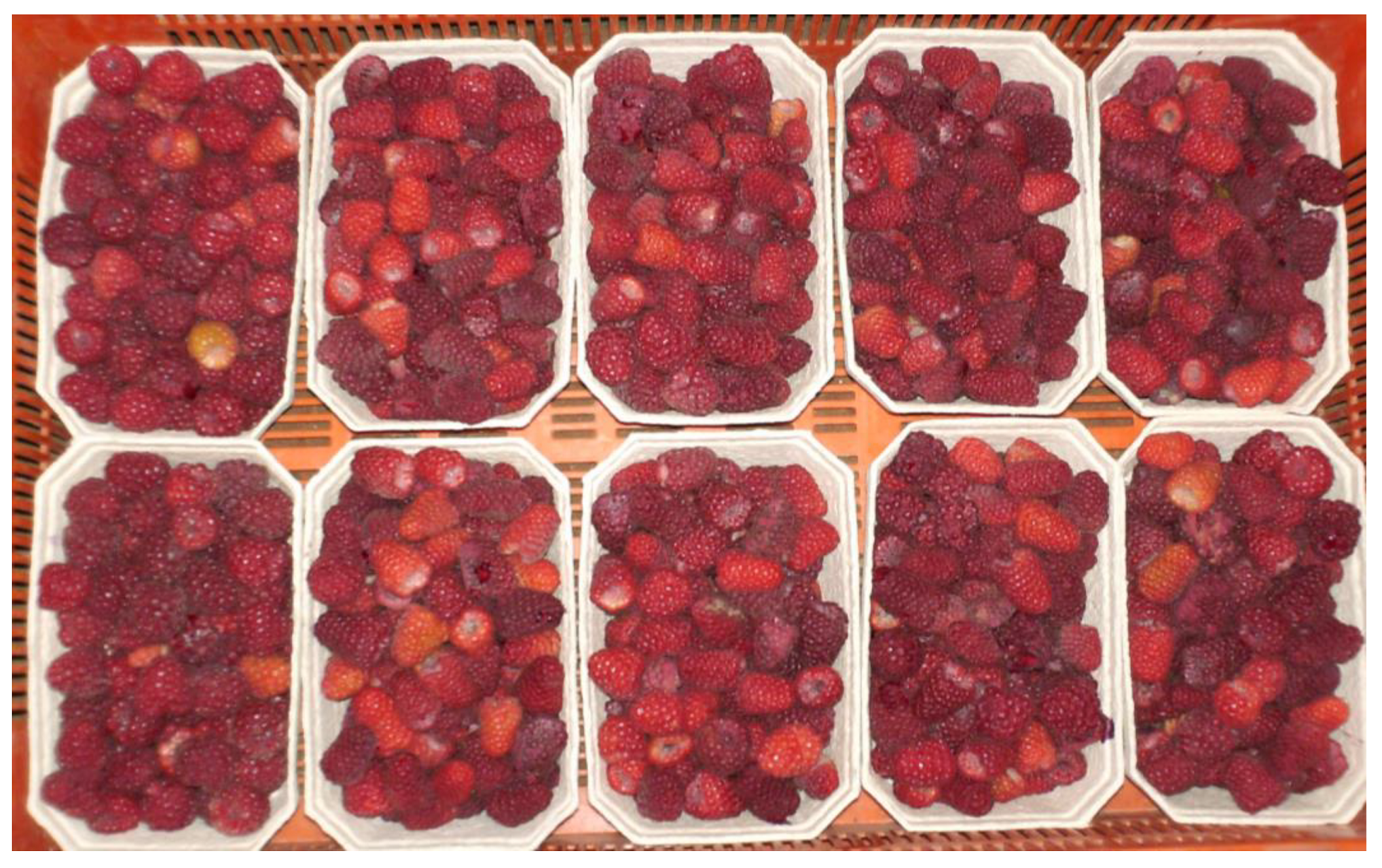
Raspberry fruits were collected in small 0.25 kg packages, which were then placed in collecting containers (Figure 3). After harvesting, the fruits were cooled to +2°C to +5°C in the shortest possible time.
Figure 4.
Raspberry fruits of the ’Laszka’ variety in 0.5 kg packages in a collective container. Source: D. Skiba
Figure 4.
Raspberry fruits of the ’Laszka’ variety in 0.5 kg packages in a collective container. Source: D. Skiba
2.4. Meteorological conditions
The course of temperatures and precipitation during the raspberry growing season in 2019/2020 was varied, which is illustrated by the results in Table 1, Table 2 and Table 3.
Precipitation in July 2019 was very abundant and amounted to 235.4 mm, which was as much as 247.3% of the long-term average (Table 1). The average air temperature in July was 18.9°C, and the deviation from the norm was 0.2°C. The minimum, average air temperature in that month was 15.6°C, and the maximum was 23.6°C (Table 2). The sum of sunshine hours was 203 (Table 3). According to the Radomski dryness criterion, it was an extremely wet month, and according to the hydrothermal coefficient - very wet [Vinczeffy, 1994].
Precipitation in August 2019 was small and amounted to 30.7 mm, which was only 45.0% of the long-term norm. The highest precipitation was recorded in the first decade (Table 1). The average air temperature in August was 20.4°C, and the deviation from the norm was -2.1°C. The minimum, average air temperature in that month was 13.4°C, and the maximum was 25.4°C (Table 2). The sum of sunshine hours was 302 (Table 3). According to the Radomski dryness criterion, it was a very dry month, and according to the hydrothermal coefficient - a humid one [37].
Precipitation in September 2019 was very small and amounted to 8.3 mm, which was only 15.2% of the long-term average (Table 1). The highest rainfall was recorded in the third decade and amounted to 8.3 mm, while in the first and second decade of September no waste was recorded. The average air temperature in that month was 17.0°C, and the deviation from the norm was -3.4°C. The minimum average air temperature in September was 9.8°C, and the maximum was 22.4°C (Table 2). The sum of sunshine hours was 244 (Table 3). According to the Radomski dryness criterion, it was an extremely dry month, and according to the hydrothermal coefficient it was dry [37].
Precipitation in October 2019 was average and amounted to 29.9 mm, which was 72.0% of the long-term average (Table 1). The highest rainfall was recorded in the third decade. In the first decade, no precipitation was recorded, while in the second it amounted to 7 mm. The average air temperature in October was 11.1°C, and the deviation from the norm was -1.4°C (Table 2). The minimum average air temperature in that month was 4.3°C, while the maximum was 13.4°C. The sum of sunshine hours was 134 (Table 3). According to the Radomski dryness criterion, it was an average month, and according to the hydrothermal coefficient it was very humid [37].
Precipitation in November 2019 was very small and amounted to only 0.6 mm, which was 1.8% of the long-term average (Table1). No precipitation was recorded in the first and third decades. The average air temperature in November was 4.3°C, and the deviation from the norm was 0.2°C (Table 2). The minimum, average air temperature in that month was 1.0°C, and the maximum was 7.0°C. The sum of sunshine hours was 88 (Table 3). According to the Radomski dryness criterion, it was an extremely dry month, and according to the hydrothermal coefficient, it was a dry month [37].
Precipitation in December 2019 was average and amounted to 27.2 mm, which was 95.8% of the long-term average (Table 1). The highest rainfall was recorded in the second decade. The average air temperature in December was 1.3°C, and the deviation from the norm was -1.8°C (Table 2). The minimum average air temperature in that month was -1.3°C, while the maximum was 4.5°C. The sum of sunshine hours was 41 (Table 3). According to the Radomski dryness criterion, it was an average month, and according to the hydrothermal coefficient it was very humid [37].
Precipitation in January 2020 was moderate and amounted to 49.8 mm, which was 145.2% of the long-term average (Table 1). The highest rainfall was recorded in the third decade. The average air temperature in January was -2.8°C, and the deviation from the norm was 1.0°C (Table 2). The minimum average air temperature in that month was -6.5°C, while the maximum was 0.9°C. The sum of sunshine hours was 46. According to the Radomski dryness criterion, it was a wet month [37].
In February 2020, precipitation was average and amounted to 25.4 mm, which was 86.1% of the long-term average (Table1). The highest rainfall was recorded in the second decade of the month. In the first decade, no precipitation was recorded, while in the third, the precipitation was at the level of 12.6 mm. The average air temperature in February was -12.5°C, and the deviation from the norm was 3.7°C. The sum of sunshine hours was 65. According to the Radomski dryness criterion, it was an average month [37].
In March 2020, precipitation was average and amounted to 28.1 mm, which was 80.1% of the long-term average (Table 1). The highest precipitation was recorded in the second decade, and no precipitation was recorded in the third decade. The average air temperature in March was -4.3°C, and the deviation from the norm was 0.9°C (Table 2). The minimum average air temperature in that month was -5.5°C, while the maximum was 1.3°C. The sum of sunshine hours was 161 (Table 3). According to Radomski’s criterion of dryness, it was an average month [37].
In April 2020, the rainfall was small and amounted to 27.6 mm, which was only 60.1% of the long-term average (Table 1). The largest precipitation was recorded in the third decade and amounted to 18.6 mm. In the first decade, precipitation was at the level of 9.0 mm, while in the second decade no precipitation was recorded. The average air temperature in April was 4.5°C (Table 2). The minimum average air temperature in that month was 4.6°C, and the maximum was 15.9°C. The sum of sunshine hours was 168 (Table 3). According to the Radomski dryness criterion, it was a dry month, and according to the hydrothermal coefficient it was a very wet month [37].
Precipitation in May 2020 was at an average level and amounted to 57.4 mm, which was 86.8% of the long-term average (Table 1). The highest rainfall was recorded in the second decade of the month and amounted to 33.9 mm. In the first decade, precipitation was at the level of 23.5 mm, while in the third decade no precipitation was recorded. In the first decade of May 2020, heavy hail was recorded. The average air temperature in May was 14.4°C, and the deviation from the norm was -0.1°C (Table 2). The minimum average air temperature in that month was 9°C, while the maximum was 21.9°C. The sum of sunshine hours was 264 (Table 3). According to the Radomski dryness criterion, it was an average month, and according to the hydrothermal coefficient it was very humid [37].
Precipitation in June 2020 was small and amounted to 53.2 mm, which was 67.9% of the long-term average (Table1). The largest precipitation was recorded in the first decade and amounted to 24.0 mm. The average air temperature in June was 19.6°C, and the deviation from the norm was -2.7°C (Table 2). The minimum average air temperature in that month was 14.5°C, and the maximum was 24.0°C. The sum of sunshine hours was 228 (Table 3). According to the Radomski dryness criterion, it was a dry month, and according to the hydrothermal coefficient it was a very wet month [37].
Precipitation in July 2020 was small and amounted to 48.7 mm, which was only 51.2% of the long-term average (Table 1). The largest precipitation was recorded in the first decade and amounted to 19.3 mm. The average air temperature in July was 24.1°C and was higher than the long-term average by as much as 5°C (Table 2). The minimum average air temperature in that month was 17.4°C, and the maximum was 29.1°C. The sum of sunshine hours was 288 (Table 3). According to the Radomski dryness criterion, it was a dry month, and according to the hydrothermal coefficient - a wet one [37].
In August 2020, precipitation was average and amounted to 57.9 mm, which was 84.9% of the long-term average (Table1). The highest rainfall was recorded in the third decade and amounted to 29.3 mm. In the first decade, no precipitation was recorded, while in the second, precipitation was at the level of 28.6 mm. The average air temperature in August was 21.2°C, and the deviation from the norm was -2.9°C (Table 2). The minimum average air temperature in that month was -13.7°C, while the maximum was 26.5°C. The sum of sunshine hours was 255 (Table 3). According to the Radomski dryness criterion, it was an average month, and according to the hydrothermal coefficient it was very humid [37].
2.5. Soil conditions
The experiment was set up on brown soil with a slightly acid reaction and moderate humus content. The content of assimilable phosphorus and potassium in the soil was high, magnesium - medium. The content of micronutrients was moderate, except for the low content of boron (Table 4).
The agronomic category of the tested soil was marked as heavy, valuation class IV (sum of fractions below 0.02 mm: 37.54%) (Table 5).
2.6. Fruit quality assessment
Fruit mass losses were determined after 24 hours of storage at 10°C. The test was performed in 3 repetitions from each experimental object. A laboratory scale (accuracy 0.01 g) was used for the measurements [38].
The weight of 1000 raspberry fruits were determined using a laboratory scale with an accuracy of 0.01 g. The fruits were counted and then weighed. The assay was repeated three times for each harvest date, variety and fertilization combination.
Fruit strength properties were determined using a CT3 texturemeter. The forces needed to permanently distort the structure of a compound fruit as a result of squeezing and tearing, i.e., binding individual drupes into a compound fruit, were determined [38].
The yield of raw juice from fresh raspberry fruit was determined. Juice yield was expressed in ml per 1 kg of fresh fruit. The determination was made using a fruit press. The pressing process lasted 10 minutes for each sample. Juice was separated from the solid fraction on a sieve with a mesh size of 1.5 x 1.5 mm. The separation process lasted 60 minutes, followed by the measurement of the juice content in the samples [38].
Fruit strength during transport was assessed on a 5-point scale, where:
- -
- fruits without visible structure damage were rated at 5 points,
- -
- a few pieces of slightly damaged fruit - 4 points,
- -
- half of the fruit structure damaged - 3 points,
- -
- most damaged and rotting processes started - 2 points,
- -
- rotting and mold development on damaged fruit - 1 point [39].
The dry mass of raspberry fruit was determined after evaporation of water from fresh fruit. The fruit weight of 1 sample intended for determination was 1 kg. The determinations were made in 3 harvest dates. The percentage content of dry matter was calculated using the dryer method [38]. The organoleptic evaluation was carried out according to a 6-point scale for the following characteristics: taste, smell, color, shape, appearance and consistency [39].
The taste of fruit was determined on the basis of a 5-point scale, where: Very sweet - 5, Sweet - 4, Slightly sweet - 3, Sour - 2, Very sour - 1 [34].
The smell of fruit was assessed on the basis of a 4-point criterion, where: typical raspberry flavor - very distinct - 5 points, Clear raspberry flavor - 4 points, Slightly distinct, but without foreign smells - 3 points, Slightly distinct, with the smell of mold and bacteria - 2 points [39].
Fruit color was determined according to a 4-point scale, where: very intense color - 5 points, intense - 4 points, partially red - 3 points, green - 2 points [39].
The fruit shape was determined on the basis of a 5-point scale, where: shape typical for the variety - 5 points, very slightly deformed - 4, slightly deformed - 3, clearly deformed - 2, not developed - 1 [34].
The appearance of the fruit was determined on the basis of a 4-point scale, where: typical appearance for the variety (without signs of disease) - 5 points, very slightly affected by diseases - 4, slightly affected by diseases - 3, heavily affected by diseases - 2 [34]
The consistency of the fruit was determined on the basis of a 5-point criterion, where: very firm (hard) consistency - 5 points, firm - 4 points, slightly firm - 3 points, soft - 2 points, very soft with signs of juice spillage - 1 point [39].
The organoleptic evaluation was carried out in a group of 12 properly trained persons [38]. The results of organoleptic evaluation of the raspberry by a group of trained people can provide valuable information on sensory preferences and evaluation of fruit quality. The results can be used for further improvement of raspberry breeding, selection of the best varieties or improvement of raspberry cultivation, harvesting and storage processes in order to ensure the highest quality of fruit for consumers [38].
2.7. Statistical analysis
The test results were statistically calculated, mainly using the analysis of variance and regression analysis. The significance of the sources of variability was assessed using the Fischer-Snedecor “F” test, while the significance of differences between the compared means was performed using multiple Tukey intervals [40]. Using the SPSS program, descriptive statistics were calculated by calculating some of its features, such as: mean, standard deviation, range, maximum, minimum, kurtosis, coefficient of variation. Coefficients of variation are a measure of the dispersion of the obtained results. The lower its value, the more stable the feature is [40].
3. Results
3.1. Fruit yield
The average fruit yield of raspberry was 8.44 t.ha-1. The cultivar ’Glen Ample’ turned out to be more prolific and yielded 6.8% more than the cultivar ’Laszka’. A successive, significant increase in fruit yield was observed under the influence of successively increasing doses of nitrogen. The highest yield was obtained in the object with 135 kg N ha-1. Harvest dates did not differentiate fruit yield (Table 6).
3.2. Thousands of fruits
The average weight of 1000 raspberry fruits were 7.75 kg (Table 7). All factors of the experiment had a significant impact on the examined feature. The weight of 1000 raspberry fruits were higher for the ’Laszka’ cultivar by 20.8% compared to the ’Glen Ample’ cultivar. Differentiated nitrogen fertilization had a significant effect on the weight of 1000 fruits. A significant increase in the value of this feature was observed at fertilization of 135 kg N·ha-1. The highest weight of 1000 raspberry fruits were recorded in the first date of harvest for both cultivars. As the harvest dates were delayed, a successive decrease in the value of this feature was observed.
3.3. Juice yield
The average juice yield from 1 kg of fresh raspberry fruit was 0.673 dm3 (Table 8). Only cultivars had a significant impact on the examined trait. The ’Glen Ample’ cultivar showed better juice yield and was higher than the ’Laszka’ cultivar by 7.7%. Higher juice yield was obtained in the third date of harvest than in the other dates, but it was not a significantly highest value (Table 8).
3.4. Fruit dry matter content
The average dry matter content of raspberry fruit was 18.13% (Table 9). All factors of the experiment had a significant impact on the examined feature. The ’Laszka’ cultivar was characterized by a higher content of dry matter, which was a difference of 5.27% in comparison with the ’Glen Ample’ cultivar. Increasing the nitrogen dose resulted in a successive decrease in the dry matter content. The highest dry matter content for both cultivars was observed in the first date, and the lowest - in the third date of harvest (Table 9).
3.5. Fruit quality
In the first date of harvest, the experimental factors did not have a significant impact on the organoleptic evaluation. The highest score in this period was given to the appearance and consistency of the fruit. The shape and color of the fruit were at the same level, and the lowest score was given to the taste of the fruit (Table 10).
In the second harvest time, only the taste and color of the fruit depended significantly on the experimental factors (Table 11). Varieties were the factor that differentiated these features. The ’Glen Ample’ cultivar had a better taste, while the fruit of the ’Laszka’ cultivar had a brighter color. The consistency of the fruit was at the highest level among the assessed features. Nitrogen fertilization did not significantly affect any of the assessed traits. Only a tendency to improve the aroma and consistency of fruit was observed under the influence of fertilization with higher doses of nitrogen.
In the third term of harvest, the factors of the experiment did not have a significant impact on the organoleptic evaluation of raspberry fruit (Table 12). The highest organoleptic score was obtained for fruit consistency (4.8° on a scale of 5°), while aroma and taste received the lowest scores, regardless of the variety and the level of nitrogen fertilization.
3.6. Transport resistance
The resistance of raspberry fruits to transport was assessed on average at 4.6° on a 5° scale (Table 13). Varietal properties and harvest dates significantly differentiated the value of this feature. The ’Laszka’ cultivar was characterized by a higher resistance to transport than the ’Glen Ample’ cultivar. In the first date of harvest, the fruits were the most resistant to transport, while those harvested in the second and third dates were characterized by a reduced level of strength. However, the fruits differed significantly in terms of resistance to transport only in the first and third dates of harvest. The reaction of the tested cultivars to nitrogen fertilization was similar.
3.7. Rheological features
The rheological properties of the raspberry, such as: maximum load, work and final load, refer to their mechanical and textural properties. Maximum load is a measure of the maximum force a raspberry fruit can withstand before it becomes deformed or crushed. It is measured in grams (g) and reflects the strength of the structure of the raspberry fruit. Higher values of the maximum load indicate greater strength of raspberry fruit.
Work refers to the energy needed to cause deformation of raspberry fruit. It is measured in milli joules (mJ) and is a measure of the flexibility and springiness of raspberry fruit. Higher values of work indicate greater flexibility and ability of raspberry fruit to absorb energy during deformation.
The final load is the force at which the raspberry fruit reaches its final deformation or destruction. It is measured in grams (g) and reflects the point at which the fruit loses its elasticity and becomes irreversibly deformed. Higher values of the final load indicate greater strength of raspberry fruit against damage.
The average maximum fruit load was 365.8 g (Table 14). Varietal properties significantly differentiated the value of rheological features. The ’Glen Ample’ cultivar showed a higher value of the maximum load compared to the ’Laszka’ cultivar by 18%. Nitrogen fertilization had no significant effect on the maximum load. The reaction of the tested cultivars to fertilization turned out to be varied. Cultivar ’Laszka’ reacted to high nitrogen fertilization at the rate of 135 kg N ha-1 with lower values of the maximum load, which indicates a decrease in the resistance of raspberry fruit to crushing.
On the other hand, the ’Glen Ample’ variety responded with an increase in crush resistance in objects fertilized with a dose of 135 kg ha-1, compared to the control object, without nitrogen fertilization.
The average value of the work performed was 35.2 mJ. Only the genetic features of the tested cultivars shaped this feature. The ’Glen Ample’ cultivar was characterized by a higher work value, which indicates a greater flexibility and ability of raspberry fruit to absorb energy during deformation than in the case of the ’Laszka’ cultivar (Table 13).
The final load was 366.0 g and was modified only by the variety factor. More work was needed to deform the fruit in the case of the ’Glen Ample’ variety, which indicates a higher resistance of the fruit to damage than in the case of the ’Laszka’ variety. Nitrogen fertilization and cultivar x fertilization interaction had no significant effect on crushing strength of raspberry fruit (Table 13).
3.8. Fruit storage life
Raspberry fruits, stored for 24 hours at 10°C, showed a slight loss of fruit mass as a result of respiration and evaporation. Their average weight loss was 1.91% and did not depend significantly on the experimental factors or their interactions (Table 15).
4. Discussion
4.1. Influence of cultivars and fertilization on the size and quality of fruit yield
The yield of raspberry fruit depends to a large extent on the course of weather, low temperatures in winter, drought in spring and early summer, as well as the age of the plantation [31]. The results obtained in the experiment were strongly influenced by the weather conditions in 2020, namely heavy hail in the first decade of May, which caused damage to the tops of shoots and flower buds. In addition, the spring was very wet, which favored the infection of raspberry shoots by fungal diseases causing shoot dieback [41].
The chemical composition of fruits depends not only on genetic conditions, age of plants, but also on agrochemical factors, mainly fertilization [42,43]. In the study, the highest yield level was obtained at a dose of 135 kg N·ha-1, both for ’Laszka’ and ’Glen Ample’ cultivars. Research conducted in Scotland [44] showed that higher doses of nitrogen increase the yield in the first and second year of raspberry cultivation, but do not affect the yield in subsequent years, and the reaction to nitrogen fertilization depends on the age of the plant. Increasing the doses of N (0, 50, 100, 200 and 400 kg ha-1) in the cultivation of raspberries in Hungary [45] resulted in an increase in yields, but also a smaller fruit size. Similar results were obtained in southern Brazil on the autumn red variety Bliss [46]. They obtained higher yields at a nitrogen dose of 200 or 300 kg ha-1 than at 100 kg ha-1, while the yields between plants that received 200 and 300 ha-1 were at a similar level, which indicates that fertilization exceeding the needs plants may not have a positive effect on yields. Different results were obtained by Heiberg [47] who conducted research on the ’Veten’ variety in Norway. The author showed that a high dose of nitrogen (178 kg N ha·ha-1) did not increase the yield compared to a low dose of N fertilizer (40 kg N ha·ha-1). The lack of effect of the dose of N on the yield and quality of fruit was also observed by scientists conducting an experiment with the red variety "Meeker" in north-western Washington (USA) [48]. According to the authors, this could be related to the mineralization of nutrients with the soil and the use of nutrient reserves accumulated in the plant. The effect of fertilization with 4 doses of N (0, 60, 120 and 240 kg N ha-1) and 3 doses of P (0.43 and 86 kg P/ha) on the yield of raspberry variety Heritage was also assessed [49]. The authors showed that after application of nitrogen at a dose of 240 kg N ha-1, the highest vegetative growth of raspberry shoots, as well as yielding, occurred. They found no effect of P application or N-P interaction. Fertilization with solutions consisting of five macronutrients (N, P, K, Ca and Mg) applied in three different doses (0 mg l-1, control and 10 X control) was evaluated by Spiers et al. [50] on the ‘Dormanred’ variety. The application of a 10-fold dose of N resulted in a high concentration of Fe in the leaves, but lower concentrations of Ca and Mg in the leaves. The high dose of P increased the content of P, K and Cu in the leaves, but inhibited Ca uptake. 10-fold K fertilization inhibited the uptake of Ca and Mg, but increased the content of P, K, Fe and Cu in the leaves. High Ca fertilization increased the content of P in leaves and decreased the uptake of Mg and Mn. A 10-fold dose of Mg increased the Mg content in the leaves, but decreased the Ca content. The content of microelements and heavy metals in raspberry fruits of the Willamette cultivar on organic and conventional plantations was assessed by Serbian scientists [51]. Their content was arranged in the following order (Mn>Fe>Zn>Cu>Ni>Cr>C). The authors did not find a significant difference in the concentration of the tested elements in raspberry fruits from organic and conventional cultivation, except for the statistically proven Fe content in organic raspberries. According to Rumasz-Rudnicka and Koszański [43], an increase in the level of nitrogen fertilization, as well as an optimal level of hydration, provides plants with a higher yield. The authors observed an increase in yields of the ‘Norna’ and ‘Veten’ varieties as a result of irrigation by nearly 52% compared to natural precipitation. Fertilization of both tested cultivars with a dose of 120 kg N·ha-1 turned out to be the most justified. In addition, irrigation significantly increased the fruit yield and the weight of 100 berries, as well as the intensity of leaf assimilation and transpiration. Similar results were also obtained by Treder [52] and Koszański et al. [53]. Rolbiecki et al. [2005] showed a positive effect of drip irrigation and micro-spraying on the increase in fruit weight, which was positively correlated with the amount of water received by the plants.
In addition, raspberry fruits are characterized by anticancer properties, as compounds contained in raspberries, such as ellagitannins, can inhibit the growth of cancer cells and have antimutagenic properties. Blood sugar regulation: raspberries contain natural sugars and fiber that can help regulate blood sugar levels. Therefore, raspberry fruit may be beneficial for people with diabetes or problems with blood sugar control. It is suggested that consumption of raspberry fruit may be beneficial for the health of the heart and blood vessels. Components contained in raspberries, such as anthocyanins, can lower blood pressure and reduce the risk of cardiovascular diseases. Another beneficial feature of this species is aiding digestion. Raspberries are also beneficial for the digestive system. The fiber contained in them can aid digestion, improve intestinal peristalsis and prevent constipation. It is worth noting that the effects and health benefits of raspberries may vary depending on individual health conditions and consumption. It is always a good idea to consult your doctor or nutritionist before incorporating larger amounts of raspberries into your diet, especially if you have any specific health needs [12,19].
Studies by numerous authors [7,9,12,14] suggest that consumption of raspberry fruit may have a beneficial effect on heart health. Anthocyanins and flavonoids may help lower blood pressure, reduce LDL (bad) cholesterol, and reduce inflammation in the circulatory system. Due to the presence of antioxidants, consumption of raspberry fruit may have a beneficial effect on the body’s ability to fight oxidative stress and delay cell aging. However, the biological value of the raspberry may differ depending on the variety [12,13,14,19].
4.2. Influence of weather conditions on fruit yield and quality
Meteorological factors have a significant impact on the yield and quality of raspberry (Rubus idaeus L.). Here are some of the main meteorological factors and their effect on raspberries:
The temperature that has a significant impact on the growth, development and yielding of the raspberry. This species grows best in moderate temperatures, where the air temperature is around 20-25°C during the day and does not fall below 15°C at night. Low temperatures can delay the development of plants, and high temperatures can negatively affect flowering and fruit quality. Temperature is crucial for the raspberry flowering process. Too high or too low air temperatures can affect the efficiency of flowering, pollination and fruiting [31]. Optimum temperatures during the raspberry flowering period are usually between 15 and 25°C. Air temperature affects the rate of ripening of raspberry fruit. Warmer temperatures speed up the ripening process, which can result in a shorter period between flowering and harvesting. However, too high temperatures can lead to excessive ripening, reduced quality and shortened shelf life of fruit [28]. The air temperature can also affect the quality of the raspberry. Low temperatures can cause frost damage and increase susceptibility to disease. In turn, high temperatures can lead to moisture loss, reduced fruit color intensity and reduced shelf life. The optimum storage temperature for raspberries is usually between 0 and 4°C. In addition, different raspberry varieties may have different temperature requirements. Therefore, it is important to adapt the cultivation of raspberries to the appropriate climatic conditions and to monitor the temperature to ensure optimal conditions for growth, yield and fruit quality. In the conducted research, in the year of harvest, high temperatures often occurred, exceeding the long-term average in August by up to 5°C. This could have contributed to poorer flowering and fruit filling, poorer response of plants to nitrogen fertilization, and as a result, poorer juice yield and poorer consumption quality of fruit [28].
The raspberry also needs the right amount of water, especially during flowering and fruit ripening. However, too much or too little rainfall can negatively affect the yield of raspberries. Excessive humidity can promote the development of fungal diseases such as powdery mildew, while drought can lead to insufficient hydration of plants. If rainfall is sufficient, raspberries can develop well and reach their full yield potential. Excessive rainfall may, in turn, lead to excessive soil hydration, which may negatively affect the development of plant roots [31]. Too much water in the soil can lead to root flooding, restrict air access and cause root rot. This, in turn, can lead to weakening of plants, reduced yield and fruit quality. Rainfall can create favorable conditions for the development of fungal diseases such as gray mold or rust. A moist environment also favors the reproduction of pests such as aphids and spider mites. This can lead to plant damage, reduced yield and poor quality. To properly manage rainfall in raspberry cultivation, it is essential to monitor the weather and manage irrigation properly. Taking care of proper soil drainage, the use of irrigation systems and plant protection products can help minimize the negative effects of excessive rainfall on the yield and quality of raspberries [30]. In the conducted research, irrigation of plants was not used, and in several periods of plant growth there were significant water shortages. This could affect both the yield, its health and fruit quality. This is confirmed by Winiarska’s research [31].
The raspberry (Rubus idaeus) also needs the right amount of sunlight to develop properly. The sun is essential for the photosynthesis process that provides energy to plants. Lack of sufficient sunlight can lead to poor growth, reduced fruit yield, and reduced fruit sugar and flavor. More sunlight means more energy available to plants, which translates into greater photosynthesis efficiency and potentially higher yields. Plants that receive enough sunlight tend to grow stronger, stay in better shape, and yield more. Good insolation is also conducive to the proper development of plant organs, such as leaves, flowers and fruits. Sun exposure affects the color and flavor of plants. Plants that receive adequate sunlight tend to have a more intense fruit color, especially in the case of fruit. Insolation can also affect the content of nutrients, including sugars, organic acids, minerals, etc., which can affect the quality and nutritional value of plants and affect the taste and aroma of fruits. It is important to adapt the cultivation of a given plant species to its specific requirements for insolation in order to ensure optimal conditions for their growth and plant development [31].
Wind can have both positive and negative effects on raspberry development. Gentle gusts of wind can help pollinate flowers, but strong winds can damage plants, break stems and cause fruit loss. In addition, wind can accelerate the process of evaporation of water from plants, which can lead to drought. Hail is one of the most serious threats to the raspberry. Heavy hail can damage leaves, shoots and fruit, leading to yield loss and a drastic reduction in fruit quality. Such damaged plants need time to recover from hail, which can delay their growth and affect yield. However, it is worth noting that this species is quite flexible and can adapt to various meteorological conditions [31,52].
According to Krawiec and Rybczyński [41], the yield is largely affected by weather conditions, which cause damage to entire plants or inflorescences. According to Król et al. [36] among raspberry cultivars bearing fruit on two-year-old shoots, the cultivars ’Glen Ample’ and ’Benefis’ had the highest fruit yield.
Analyzing the weight of 1000 raspberry fruits, it can be concluded that the tested cultivars differed in the weight of individual fruits, and the use of differentiated nitrogen fertilization against the background of constant phosphorus-potassium fertilization resulted in a significant increase in fruit weight, which corresponds to the results of other authors [54]. In addition, it was observed that with increasing nitrogen doses, both ’Laszka’ and ’Glen Ample’ showed a significant increase in the weight of 1000 fruits, which in the case of ’Laszka’ was 20.8% higher than that of ’Glen Ample’. An increase in the weight of 1000 fruits in relation to differentiated nitrogen fertilization was also observed by Rebanel et al. [54], Treder [52], Koszański et al. [53].
4.3. Commodity characteristics and fruit quality
The most important aspects that are taken into account in the commodity evaluation of fruit are: external appearance, consistency, taste, aroma, juice content. In addition, the fruit should be clean and free of contaminants such as soil, insects, mold or other foreign substances, and should have sufficient durability to survive transport and storage without major damage [27]. The above parameters are general and may vary depending on specific market requirements or quality standards set by relevant institutions or organizations [31]. It is also important to follow the principles of sustainable management, including nitrogen fertilization, to ensure healthy and organically grown raspberry fruits [28].
Raspberry fruit should also be fresh, juicy and of good quality to meet consumer expectations and provide health benefits, i.e., vitamins, minerals, antioxidants, fiber, which attracts consumers looking for safe and healthy food [13,14,19]. Raspberry is also low in calories and can be part of a healthy diet. Consumers care about natural and fresh products, especially when it comes to fruit. Rubus idaeus are seen as natural, seasonal fruits that can be eaten in their original form.
One of the features is the universality of application. Raspberry fruits can be eaten in many different ways - as an independent fruit, an addition to desserts, an ingredient in cocktails, jellies, jams or casseroles. This versatility of application attracts various groups of consumers [31].
Therefore, the commodity characteristics are important aspects of assessing the quality of raspberry (Rubus idaeus L.) fruit. The research shows that the key commodity characteristics that affect the quality of raspberry fruit are:
- –
- color: raspberry fruit should have an attractive, intense color. The fruit should be uniform in color, without spots, discoloration or signs of immaturity [19],
- –
- –
- firmness: fruits of this species should be firm, but at the same time delicate to the touch. Fruit that is too soft may indicate over-ripeness or damage,
- –
- taste and aroma of Rubus idaeus fruit should have a distinct, sweet and sour taste and an intense, characteristic aroma. The taste should be balanced, without an overly sour or bland aftertaste [14],
- –
- raspberry fruit should be juicy, with a lot of juice. Dry or not very juicy raspberry fruit may indicate immaturity or its low quality,
- –
- durability and freshness of the raspberry should be ensured by fresh and durable fruit, retaining their sensory properties for a sufficiently long period of time. Fruit should not be overripe, crushed, moldy or showing signs of deterioration [31].
It is worth noting that the assessment of the quality of raspberry fruit is based not only on commodity characteristics, but also on other aspects, such as maturity, general appearance, lack of mechanical damage or leaf condition. Appropriate assessment of fruit quality is important both for producers to provide high-quality products and for consumers to be sure that they buy fresh and tasty raspberry fruit [14].
Fruit mass losses during 24-hour storage differed depending on fertilization and cultivar. ’Glen Ample’ was characterized by a greater loss of fresh fruit weight. However, this did not have a significant effect on the examined feature. In a study by Krawiec et al. [41] on raspberries bearing fruit on one-year-old shoots, the mass loss was 1.3% for the ’Polka’ cultivar, and 0.4% for the ’Polana’ cultivar. Weight loss on stored fruits and vegetables was observed by Nunes and Emond [58]. There is a significant correlation between weight loss and the visual quality of each fruit and vegetable. It was also observed that with an increase in weight loss during storage, shelf life also decreases, and in addition, there is an increase in wilting, shrinking and browning of fruits [27,28].
Raspberry fruits have low mechanical resistance of tissues and high-water content. Firmness is considered a good indicator of the appropriate quality of the picked fruit. It indicates the suitability of fruits for harvesting, transport, consumption or freezing, as well as for identifying fruits infected with fungal diseases [28,41,55]. The assessment of raspberry fruit firmness was carried out by Italian authors [56,59], examining 3 varieties: ‘Heritage’, ‘Glen Magna’, ‘Tulameen’. They observed a marked decrease in firmness after 3 days storage of Heritage at 3°C (-32%), and only a slight decrease in firmness in ’Glen Magna’ and ’Tulameen’. On the 6th day of storage, a decrease in firmness was observed in all tested cultivars, and in the final shelf life (after 8 days of storage) all fruits had a significant loss of density and firmness (-43% and -48%). A clear decrease in the loss of firmness of ’Erica’ raspberries after 4 days of storage at 4°C was also observed by Giovanelli et al. [56], however, its maximum reduction was achieved when fruit was packed using plastic with a high (LDPE/EVOH/LDPE) gas barrier and a biopolymer film (PLA) with an average gas barrier.
The rheological properties of raspberries are important from the point of view of product quality, especially in the context of transport, storage and processing. They can also be used to assess the ripeness of raspberry fruits and identify changes in their structure during storage and processing. The tests showed that higher values of the maximum load indicate greater strength of the fruit. The work refers to the energy needed to cause deformation on raspberry fruit. Higher values of work indicated greater flexibility and ability of raspberry fruit to absorb energy during deformation [28]. The final load is the force at which the raspberry fruit reaches its final deformation or breakage. It is measured in grams (g) and reflects the point at which the fruit loses its elasticity and becomes irreversibly deformed. Higher values of the final load indicate greater strength of raspberry fruit against damage.
Varietal properties differentiated the value of rheological features. The ’Glen Ample’ variety showed a higher maximum load value. The reaction of the tested cultivars to fertilization was varied. However, increasing doses of nitrogen did not significantly affect the rheological evaluation of the fruit. Balanced nitrogen fertilization had no significant effect on the maximum load. Raspberries of the ’Laszka’ and ’Glen Ample’ cultivars, bearing fruit in the summer on two-year-old shoots, started fruiting the earliest in comparison to other cultivars (’Benefis’, ’Tulameen’, ’Citra’) [36,63,64]. This proves the possibility of earlier introduction of fresh fruit into commercial circulation. The optimal aroma, firmness, size and color of the fruit were obtained by picking raspberries from the plantation at the appropriate stage of maturity, i.e., picking them many times during the season. Firmness is considered a good indicator of the appropriate quality of the picked fruit. According to Rybczyński et al. [42] the force of fruit detachment is a varietal feature and depends on the size and shape of the flower base, on the degree of fruit ripeness, and sometimes on weather conditions during the harvest period.
Availability is an important commodity feature of raspberry fruit. Rubus idaeus fruit is available in the market most of the year, both as fresh fruit and as processed products. This makes them more accessible to consumers, who can enjoy them for most of the year [57].
4.4. Norms and standards of fruit
In the case of the raspberry (Rubus idaeus L.), there are many norms and quality standards that are used in different regions and markets [57]. Here are some of the main norms and quality standards specific to the raspberry:
Marketing Standards: Many countries develop marketing standards that set minimum requirements for the quality of raspberries. These standards may include criteria such as size, shape, color, degree of maturity, presence of defects (e.g., mechanical damage, rot) and physicochemical parameters (e.g., sugar content, acidity). However, for international trade in raspberries, general quality standards such as ISO 9001 (Quality Management Systems) [60] and ISO 22000 (Food Safety Management Systems) [62] may be used. The international ISO 9001 standard is one of the most popular standards, compliance with which is confirmed by external certifications. The number of ISO 9001 certificates issued in the world is incomparably greater than the number of other types of management system certificates. According to the ISO report for 2020, the number of ISO 9001 certificates significantly exceeds the number of all other certificates combined. These standards are general food quality and safety standards that may apply to raspberries and other food products. In addition, there are also industry and national standards that may cover raspberries and specify detailed requirements for quality, safety and other parameters. It is important that raspberry producers and exporters familiarize themselves with the applicable norms and standards in their country or target market in order to meet commercial requirements and ensure high quality of their products [57,62,63,64].
Industry Standards: In some countries, there are also industry standards developed by farming organizations or raspberry associations. Industry standards for raspberry fruit may vary by country and region, but are generally intended to establish minimum requirements for quality, grading, packaging and labeling of raspberry fruit. industry standards for fruit and vegetables still exist in the European Union. They were established to ensure the quality, safety and fairness of intra-EU trade in these products. The main provisions on industry standards for fruit and vegetables can be found in Regulation (EC) No 543/2011 [65]. These standards define the quality and shape requirements for various types of fruit and vegetables. They also specify minimum requirements for maturity, purity, damage, calibration and packaging. The standards also include the classification of products based on their quality, with the highest class being Extra, followed by Classes I and II respectively. The introduction of industry standards aims to facilitate trade in fruit and vegetables within the EU by ensuring consistency in the quality and labeling of products. These standards are also intended to protect consumers from poor quality or unsafe products. However, it is worth noting that there have been some changes in the approach to industry standards at EU level in recent years. In some cases, less restrictive requirements for the shape and appearance of fruit and vegetables are introduced to increase acceptance of variety and reduce food waste. Nevertheless, there are still a number of industry standards that must be followed in order to trade fruit and vegetables within the EU.
Industry standards of the American Particular Food Association (USDA) are set by the United States Department of Agriculture (USDA), which sets quality standards for many agricultural products, including fruits and vegetables. The USDA establishes quality, classification, packaging and labeling guidelines for raspberries sold in the US market [57]. Australia has standards set by organizations such as Horticulture Innovation Australia (HIA) and the Australian Raspberry Growers Association (ARGA). These standards include quality, classification, packaging, labelling, hygiene and environmental requirements.
It is important that raspberry producers and traders adhere to the relevant industry standards to ensure high product quality and compliance with market requirements. The choice of standards should take into account local legal regulations and consumer expectations in a given market [57]. The purpose of industry standards is to ensure uniform quality and safety of raspberry products [5]. Many countries also have general food quality standards that include the raspberry as one of many foods. These standards can regulate aspects such as hygiene, freshness, purity, chemical and microbiological safety, labeling and consumer information [61,62].
4.4. Trends in the cultivation, breeding, nutritional tradition and market of the raspberry
In recent years, several trends in the cultivation and cultivation of the raspberry (Rubus idaeus L.) can be observed. Here are some of them:
- a)
- organic farming: an increasing number of raspberry producers are switching to organic farming. Organic farming involves using natural methods and minimizing the use of pesticides and chemical fertilizers. This approach aims to produce healthier fruit with less environmental impact and greater respect for biodiversity [6],
- b)
- c)
- breeding of new varieties: in recent years, significant progress has been made in the breeding of new raspberry varieties. Breeders are trying to develop varieties with higher yields, larger fruits, better resistance to diseases and pests, longer harvesting period, excellent taste and attractive appearance. New varieties of raspberries are aimed at meeting consumer expectations and improving the profitability of cultivation [5,63],
- d)
- automation and technology in production in order to increase the efficiency and precision of production, more and more raspberry producers use modern technological solutions. Automated systems of irrigation, harvesting, sorting and packaging of fruit contribute to increasing productivity, improving fruit quality and reducing production costs [6,31,64],
- e)
- sustainable cultivation practices were developed in response to the growing interest of consumers in ecological products and sustainable development. Raspberry producers are increasingly using sustainable practices in their crops. These include: minimizing water consumption, optimal use of fertilizers, using natural pest and disease control methods, as well as monitoring and minimizing the impact of production on the natural environment [5,6,64].
These trends in raspberry cultivation and breeding are aimed at improving the quality and efficiency of production, meeting the growing demand for healthy and ecological products and increasing resistance to diseases [5,6,31]. Food trends. In recent years, interest in healthy eating and natural products has increased. Raspberry proper fits perfectly into these trends, which translates into their greater importance on the consumer market [57].
Market trends related to raspberry (Rubus idaeus) may vary depending on the region and consumer preferences [57]. Here are some general trends you may notice:
Increased interest in healthy eating: Consumers are increasingly interested in healthy and natural foods. Raspberries are rich in vitamins, minerals, antioxidants and fiber, which makes them an attractive choice for people who are conscious of a healthy diet. Encouraging the consumption of fruit fresh, unprocessed or used as an ingredient in healthy snacks and food products may contribute to an increased demand for raspberry fruit. Increasing popularity of ecological products: Consumers care about conscious choice and care for the environment. The increase in demand for raspberries from organic farming may be related to the preference for products without artificial pesticides and fertilizers. Customers are looking for raspberries with organic certificates or from local, sustainable crops.
Variety of varieties and exclusive varieties: with the progress in breeding, new varieties of raspberries with unique characteristics appear on the market. Customers may be interested in exclusive raspberry varieties with an intense taste, aroma or unusual appearance. Breeders and producers can try to promote and offer a variety of varieties to attract the attention of consumers and satisfy their diverse preferences [5,31,57,64].
Raspberries can be used in a variety of processed foods, such as jams, syrups, juices, ice cream and even cosmetics. Processed raspberry products can offer added value and flavor variety for consumers. Companies can focus on innovative ways of using raspberries to create attractive and differentiated products for the market [57,63].
5. Conclusions
The tested cultivars were characterized by similar production possibilities, but they were characterized by different dates of fruit ripening. The influence of the maturity date on the commodity value depends on market preferences. Early raspberry varieties may be more desirable to the market in the early season, while later varieties may be more valuable when other varieties are no longer available.
Balanced mineral fertilization has a positive effect on the yield and quality of raspberry fruit. Fertilization of the raspberry with a dose of 135 kg N·ha-1 turned out to be justified in terms of yield.
Cultivation of this species with balanced fertilization led to obtaining fruits with good sensory and rheological properties. The successive increase of nitrogen fertilization against the background of appropriate phosphorus-potassium fertilization did not deteriorate the quality of the raw material, which is the fresh raspberry. The use of appropriate doses of fertilizers can improve the organoleptic characteristics of raspberry fruit, such as: taste, aroma, color, appearance and consistency. Sustainable fertilization may affect the functional properties of raspberry fruits as well as their sensory and rheological properties, resistance to transport and storage stability.
Raspberry cultivars differed in their response to nitrogen fertilization. The ’Ample’ cultivar was more reactive to nitrogen supply and showed better responses to this factor of the experiment, while the ’Laszka’ cultivar turned out to be less sensitive to nitrogen.
Nitrogen dosage should be adjusted to the needs of raspberry varieties and cultivation conditions, such as soil type, water availability and other environmental factors. Incorrect nitrogen fertilization can lead to problems such as excessive fruit thinning, reduced sugar content and increased risk of diseases and pests.
Optimal nitrogen fertilization should take into account the balance between the needs of plants and minimizing negative effects on the environment. It is also important to include other nutrients, such as phosphorus, potassium, microelements, in addition to nitrogen, to ensure comprehensive fertilization of the raspberry. Individual approach to nitrogen fertilization, adapted to the variety of this species and growing conditions. This will allow you to achieve optimal growth, yield and fruit quality. Well thought-out nitrogen fertilization can contribute to the success of raspberry cultivation.
Evaluation of raspberry fruit quality should take into account both sensory and rheological characteristics as well as chemical composition. The conducted research indicates the need for a holistic approach to quality assessment, combining organoleptic and rheological assessment with chemical analyses.
The conclusions suggest that proper fertilization is a key factor affecting the quality of raspberry fruit and should be considered in cultivation practices to ensure optimal results, both in economic and health terms.
Author Contributions
For research articles with several authors, a short paragraph specifying their individual contributions must be provided. The following statements should be used “Conceptualization, B.S., B.P. and P.P.; methodology, B.S. D.S.; B. K-M., software, D.S.; validation, P.B., B.K-M., and P.P.; formal analysis, B.S.; investigation, P.P.; resources, P.B.; data curation, D.S.; writing—original draft preparation, P.B.; writing—review and editing, B.S., B. K-M., visualization, P.P.; supervision, B.S., B.K-M.; project administration, B.S.; funding acquisition, B.S. All authors have read and agreed to the published version of the manuscript.
Funding
This research received no external funding.
Institutional Review Board Statement
“Not applicable”.
Informed Consent Statement
“Not applicable”
Data Availability Statement
No new data was created in these studies.
Acknowledgments
We thank the University of Life Sciences in Lublin for administrative and technical support in conducting this research.
Conflicts of Interest
“The authors declare no conflict of interest.”
References
- Hummer, KE, Janick, J. Rosaceae: taxonomy, economic importance, genomics. Genetics and Genomics of Rosaceae, 2009, 1-17.
- Krauze-Baranowska, M, Majdan, M. Raspberries – a source of therapeutically valuable secondary metabolites and vitamins. Panacea, 2009, 1(26): 14–15.
- Krauze-Baranowska, M.; Głód, D.; Kula, M.; Majdan, M.; Hałasa, R.; Matkowski, A.; Kozłowska, W.; Kawiak, A. Chemical composition and biological activity of Rubus idaeus shoots – a traditional herbal remedy of Eastern Europe. BMC Complement. Altern. Med. 2014, 14, 480. [Google Scholar] [CrossRef]
- Baranowska, A. , Mystkowska, I., Zarzecka, K., Gugała, M. 2017. Cenne owoce maliny właściwej (Fructus Rubi idaei). Herbalism, 3(1): 70-79.
- Titirică, I.; Roman, I.A.; Nicola, C.; Sturzeanu, M.; Iurea, E.; Botu, M.; Sestras, R.E.; Pop, R.; Militaru, M.; Ercisli, S.; et al. The Main Morphological Characteristics and Chemical Components of Fruits and the Possibilities of Their Improvement in Raspberry Breeding. Horticulturae 2023, 9, 50. [Google Scholar] [CrossRef]
- Wróblewska, W.; Pawlak, J.; Paszko, D. The influence of factors on the yields of two raspberry varieties (Rubus idaeus L.) and the economic results. Acta Sci. Pol. Hortorum Cultus 2020, 19, 63–70. [Google Scholar] [CrossRef]
- Aprea, E.; Biasioli, F.; Gasperi, F. Volatile Compounds of Raspberry Fruit: From Analytical Methods to Biological Role and Sensory Impact. Molecules 2015, 20, 2445–2474. [Google Scholar] [CrossRef]
- Purgar, D.D.; Duralija, B.; Voća, S.; Vokurka, A.; Ercisli, S. A Comparison of Fruit Chemical Characteristics of Two Wild Grown Rubus Species from Different Locations of Croatia. Molecules 2012, 17, 10390–10398. [Google Scholar] [CrossRef]
- Horuz, A, Korkmaz, A., Karaman, MR, Dizman, M, Turan, M. The evaluation of leaf nutrient contents and element ratios of different raspberry varieties. J. Food Agric. Environ, 2013, 11: 588-593.
- Quintanilla, A.; Mencia, A.; Powers, J.; Rasco, B.; Tang, J.; Sablani, S.S. Developing vacuum-impregnated dehydrofrozen red raspberries with improved mechanical properties. Dry. Technol. 2020, 40, 299–309. [Google Scholar] [CrossRef]
- Cosme, F.; Pinto, T.; Aires, A.; Morais, M.C.; Bacelar, E.; Anjos, R.; Ferreira-Cardoso, J.; Oliveira, I.; Vilela, A.; Gonçalves, B. Red Fruits Composition and Their Health Benefits—A Review. Foods 2022, 11, 644. [Google Scholar] [CrossRef]
- Qian, M.C.; Rimando, A.M.; Reineccius, G.; Kahlon, T.S.; Du, X.; Liu, G.-Y.; Cadwallader, K.R.; Yang, E.; Zhao, Y.; Wang, Y.; et al. Flavor and Health Benefits of Small Fruits; American Chemical Society (ACS): Washington, DC, United States, 2010; ISBN 0841200025. [Google Scholar]
- Lopez-Corona, A.V.; Valencia-Espinosa, I.; González-Sánchez, F.A.; Sánchez-López, A.L.; Garcia-Amezquita, L.E.; Garcia-Varela, R. Antioxidant, Anti-Inflammatory and Cytotoxic Activity of Phenolic Compound Family Extracted from Raspberries (Rubus idaeus): A General Review. Antioxidants 2022, 11, 1192. [Google Scholar] [CrossRef]
- de Ancos, B.; González, E.M.; Cano, M.P. Ellagic Acid, Vitamin C, and Total Phenolic Contents and Radical Scavenging Capacity Affected by Freezing and Frozen Storage in Raspberry Fruit. J. Agric. Food Chem. 2000, 48, 4565–4570. [Google Scholar] [CrossRef]
- Mullen, W.; Stewart, A.J.; Lean, M.E.J.; Gardner, P.; Duthie, G.G.; Crozier, A. Effect of Freezing and Storage on the Phenolics, Ellagitannins, Flavonoids, and Antioxidant Capacity of Red Raspberries. J. Agric. Food Chem. 2002, 50, 5197–5201. [Google Scholar] [CrossRef]
- Bobinaitė, R.; Viškelis, P.; Venskutonis, P.R. Variation of total phenolics, anthocyanins, ellagic acid and radical scavenging capacity in various raspberry (Rubus spp.) cultivars. Food Chem. 2011, 132, 1495–1501. [Google Scholar] [CrossRef] [PubMed]
- Jakobek, L, Seruga, M, Novak, I, Medvidovic-Kosanovic, M. Flavonols, phenolic acids and antioxidant activity of some red fruits. Deutsche Lebensmittel Rundschau, 2007, 103(8): 369-377.
- Wang, S.Y.; Chen, C.-T.; Wang, C.Y. The influence of light and maturity on fruit quality and flavonoid content of red raspberries. Food Chem. 2009, 112, 676–684. [Google Scholar] [CrossRef]
- Khoo, H.E.; Azlan, A.; Tang, S.T.; Lim, S.M. Anthocyanidins and anthocyanins: colored pigments as food, pharmaceutical ingredients, and the potential health benefits. Food Nutr. Res. 2017, 61, 1361779–1361779. [Google Scholar] [CrossRef] [PubMed]
- Viskelis, P, Rubinskiene, M, Bobinaite, R, Dambrauskiene, E. Bioactive compounds and antioxidant activity of small fruits in Lithuania. J. Food Agric. Environ, 2010, 8(3-4): 259-263.
- Vrhovsek, U.; Giongo, L.; Mattivi, F.; Viola, R. A survey of ellagitannin content in raspberry and blackberry cultivars grown in Trentino (Italy). Eur. Food Res. Technol. 2007, 226, 817–824. [Google Scholar] [CrossRef]
- Ponder, A.; Hallmann, E. Phenolics and Carotenoid Contents in the Leaves of Different Organic and Conventional Raspberry (Rubus idaeus L.) Cultivars and Their In Vitro Activity. Antioxidants 2019, 8, 458. [Google Scholar] [CrossRef] [PubMed]
- Burton-Freeman, B.M.; Sandhu, A.K.; Edirisinghe, I. Red Raspberries and Their Bioactive Polyphenols: Cardiometabolic and Neuronal Health Links. Adv. Nutr. Int. Rev. J. 2016, 7, 44–65. [Google Scholar] [CrossRef]
- Larrosa, M.; García-Conesa, M.T.; Espín, J.C.; Tomás-Barberán, F.A. Ellagitannins, ellagic acid and vascular health. Mol. Asp. Med. 2010, 31, 513–539. [Google Scholar] [CrossRef]
- Haffner, K.; Rosenfeld, H.J.; Skrede, G.; Wang, L. Quality of red raspberry Rubus idaeus L. cultivars after storage in controlled and normal atmospheres. Postharvest Biol. Technol. 2002, 24, 279–289. [Google Scholar] [CrossRef]
- Temocico, G. , Stoian, E., Ion, V., Tudor, V. Results regarding behavior of some small fruits under controlled atmosphere conditions. Romanian Biotechnological Letters, 2014, 19(2): 9162-9169.
- Krüger, E.; Dietrich, H.; Schöpplein, E.; Rasim, S.; Kürbel, P. Cultivar, storage conditions and ripening effects on physical and chemical qualities of red raspberry fruit. Postharvest Biol. Technol. 2011, 60, 31–37. [Google Scholar] [CrossRef]
- González-Orozco, B.D.; Mercado-Silva, E.M.; Castaño-Tostado, E.; Vázquez-Barrios, M.E.; Rivera-Pastrana, D.M. Effect of short-term controlled atmospheres on the postharvest quality and sensory shelf life of red raspberry (Rubus idaeus L.). CyTA - J. Food 2020, 18, 352–358. [Google Scholar] [CrossRef]
- Forney, C.F.; Jamieson, A.R.; Pennell, K.D.M.; Jordan, M.A.; Fillmore, S.A. Relationships between fruit composition and storage life in air or controlled atmosphere of red raspberry. Postharvest Biol. Technol. 2015, 110, 121–130. [Google Scholar] [CrossRef]
- Valentinuzzi, F.; Pii, Y.; Mimmo, T.; Savini, G.; Curzel, S.; Cesco, S. Fertilization strategies as a tool to modify the organoleptic properties of raspberry (Rubus idaeus L.) fruits. Sci. Hortic. 2018, 240, 205–212. [Google Scholar] [CrossRef]
- Winiarska, J. , 1992. Niektóre cechy biologiczne i produkcyjne owocujących pędów dziesięciu odmian maliny (Rubus idaeus L.), Rozprawa habilitacyjna, Wyd. AR Lublin, ss. 60. [in Polish].
- UN/ECE FFV-32. Agricultural Quality Standards (WP.7) – UNECE/ https://unece.org › FFV-Standards, 2023Dane (accessed 15.05.2023).
- Danek, J. Uprawa maliny i jeżyny. Wyd. HORTPRESS, Warszawa, 2009: 7-60. [in Polish].
- Gacek, E. Lista odmian roślin sadowniczych wpisanych do krajowego rejestru w Polsce, Wyd. Centralnego Ośrodka Badania Odmian Roślin Uprawnych w Słupi Wielkiej, Słupia Wielka, 20-34 2012. [in Polish].
- HoruzA, Korkmaz A, Rüştü-Karaman M,elal.Th evaluation of leaf nutrient content sand element ratios of different raspberry varieties. J Food Agric Environ 2013: 11(1):588-93.
- Król K, Danek J, Skrzyński J. Odmiany maliny do produkcji owoców deserowych. Wyd. Instytutu Sadownictwa i Kwiaciarstwa, Brzezna, Poland, 2010: 13-20. [in Polish].
- Vinczeffy, I. The effect of some ecological factors on grass yield. Proc. of the 10th Gen. Meet. EGF, Norway, 1984, 76-79.
- Czarniecka-Skubina, E. , Nowak D. Technologia żywności. Część 1. Podstawy technologii żywności. 360 ss., 2010, Warszawa, ISBN: 978-83-891-8435-1 [in Polish].
- Pijanowski, E, Dłużewski, M, Dłużewska, A. 2010. Ogólna Technologia Żywności. 292 ss. Wyd. WNT, Warszawa. [in Polish].
- omnicki, A. Wprowadzenie do statystyki dla przyrodników. Wyd. PWN, 282 ss, 2023. ISBN: 9788301179489 [in Polish]. 9: ISBN, 9788. [Google Scholar]
- Krawiec P, Grenda A, Rybczyński R. Ocena efektywności fertygacji w malinach odmian powtarzających wg programu Yara. Biuletyn Związku Sadowników Rzeczpospolitej Polskiej, 2010, Informator 1/2010: 24-27.
- Rybczyński, R. Dobrzański B., Więźniarska J. Właściwości mechaniczne owoców maliny, Acta Agrophysica, 2001, 45, 167-175. [in Polish].
- Rumasz-Rudnicka, E. , Kaszyński Z. Reakcja maliny na zróżnicowane nawożenie azotem i nawadnianie kroplowe. IN. Rol. 5(103), 219-228. [in Polish].
- Lawson, HM, Waister, PD. The response to nitrogen of a raspberry plantation under contrasting systems of management for weed and sucker control. Hort Res., 1972, 12: 43-55.
- Papp, J. , Kobzos-Pápai, I., Nagy, J. Effect of nitrogen application on yield, leaf nutrient status and fruit chemical composition of raspberry and redcurrant varieties. Acta Agron. Acad. Sci. Hung, 1984, 33: 337–343.
- Rizzi, R.; Silvestre, W.P.; Rota, L.D.; Pauletti, G.F. Raspberry production with different NPK dosages in South Brazil. Sci. Hortic. 2019, 261, 108984. [Google Scholar] [CrossRef]
- Heiberg, N. EFFECT OF VEGETATION CONTROL AND NITROGEN FERTILIZATION IN RED RASPBERRY. Acta Hortic. 2002, 579–583. [Google Scholar] [CrossRef]
- Lu, Q.; Miles, C.; Tao, H.; DeVetter, L.W. Reduced Nitrogen Fertilizer Rates Maintained Raspberry Growth in an Established Field. Agronomy 2022, 12, 672. [Google Scholar] [CrossRef]
- Salvatierra GMA, Ortega BR. Effect of nitrogen and phosphorus fertilization on growth, yield and fruit quality of red raspberry (Rubus idaeus L.) cv. Heritage. Agricultura Tecnica (Chile) 1993, ISSN: 0365-2807.
- Spiers, J.M.; Braswell, J.H.; Gupton, C.L. INFLUENCE OF P, K, CA, AND MG RATES ON LEAF ELEMENTAL CONCENTRATION AND PLANT GROWTH OF ’DORMANRED’ RASPBERRY. Acta Hortic. 1999, 337–342. [Google Scholar] [CrossRef]
- Milinković, M, Vranić, D, Đurić, M, Paunović, SM. Chemical composition of organically and conventionally grown fruits of raspberry (Rubus idaeus L.) cv. Willamette. Acta Agriculturae Serbica, 2021, 26(51): 83-88.
- Treder, W. Wpływ nawadniania i ściółkowania czarną folią na plonowanie maliny odmiany Canby. Zeszyty Nauk Sadowniczych 1993, 1: 27-32. [in Polish].
- Koszański, Z. , Karczmarczyk, S., Podsiadło, C., Herman, B. Wpływ nawadniania i nawożenia azotem na plonowanie dwóch odmian malin uprawnych na glebie lekkiej. Folia Horiculture, 2003, Suplement 2: 246-248. [in Polish].
- Rebanel Z, Przypiecka M, Cofta H. Wpływ nawadniania na plonowanie i wzrost maliny odmiany Nora. Prace Institutes Sandinista i Kwiaciarstwa, Skierniewice, 1992, 69-70. [in Polish].
- Dobrzański B, Rybczyński R. Mechanical behaviour of raspberry fruit AT different ripeness stage. Proceedings of IAMC, Beijing, China, 1995: 26-31.
- Giovanelli, G.; Limbo, S.; Buratti, S. Effects of new packaging solutions on physico-chemical, nutritional and aromatic characteristics of red raspberries (Rubus idaeus L.) in postharvest storage. Postharvest Biol. Technol. 2014, 98, 72–81. [Google Scholar] [CrossRef]
- Bojkovska, K.; Jankulovski, N.; Mihajlovski, G.; Momirceski, J. ANALYSIS OF MARKET OPPORTUNITIES FOR RASPBERRY PRODUCTION IN THE REPUBLIC OF NORTH MACEDONIA. Int. J. Res. -GRANTHAALAYAH 2020, 8, 149–154. [Google Scholar] [CrossRef]
- Nunes, CN, Emond, JP. Relationship between weight loss and visual quality of fruits and vegetables. Proceedings of the Florida State Horticultural Society, 2007, 20: 235-245.
- Cortellino G, De Vecchi P, Lo Scalzo R, Ughini V, Granelli G. Buccheri M. Ready – to - eat raspberries: qualitative and nutraceutical characteristics during shelf-life. Adv. Hort. Sci., 2018, 32(3): 399-406.
- ISO 9001 (Systemy Zarządzania Jakością). Available online: https://www.iso.org.pl/uslugi-zarzadzania/wdrazanie-systemow/zarzadzanie-jakoscia/iso-9001/ (accessed on 14 May 2023).
- ISO 22000 (System Zrządzania Bezpieczeństwem Żywności – ISO 22000 – wymagania dla wszystkich organizacji należących do łańcucha żywnościowego (2008-04-21)). Available online: https://www.iso.org.pl/artykuly-i-informacje-dotyczace-systemow-zarzadzania/iso-22000-wymagania/ (accessed on 21 April 2008).
- Anonimous 2023. Najnowsze badania ISO – szybki wzrost popularności Systemu Zarządzania Energią! Available online: www.iso.org.pl/najnowsze-badania-iso (accessed on 14 March 2023).
- Kala, R. Elementy wnioskowania parametrycznego dla przyrodników. Wyd. AR, Poznań, 153 ss., 1993, ISBN: 978-83-716-0010-4. [in Polish].
- Rolbiecki S, Rolbiecki R, Czekanowski C. Nawadnianie jako czynnik przeciwdziałający skutkom posuch w uprawie maliny na glebie piaszczystej. IMUZ. Woda – Środowisko - Obszary Wiejskie, 2005, 5 (14): 243-260. [in Polish].
- Commission Implementing Regulation (Eu) No 543/2011 of 7 June 2011 laying down detailed rules for the application of Council Regulation (EC) No 1234/2007 as regards the fruit and vegetables sector and the processed fruit and vegetables sector. Official Journal of the European Union L 157/1, 15.6.2011.
Figure 1.
Map of the Przemyśl Foothills.
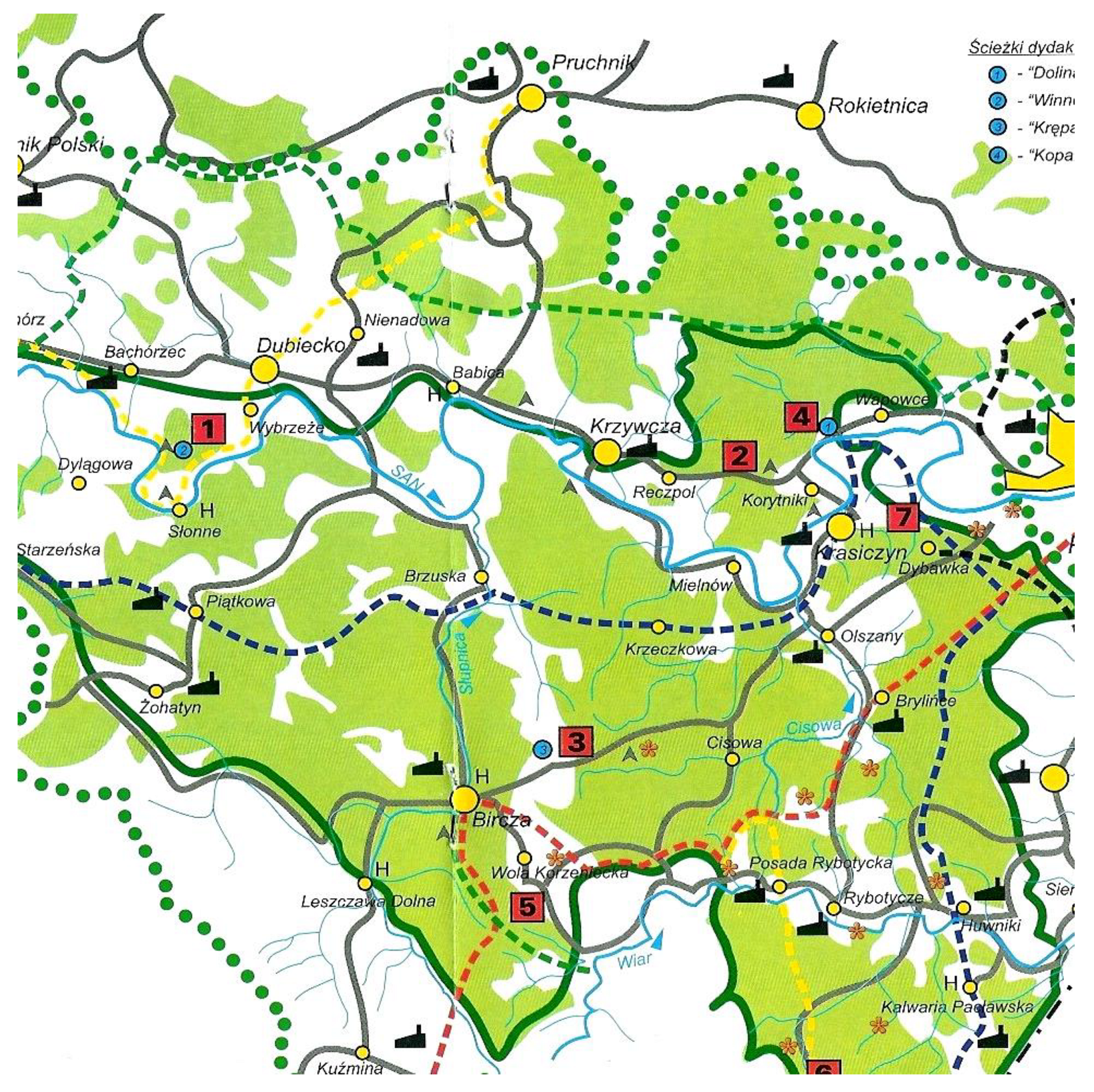

Table 1.
Precipitation and the Sielianinov hydrothermal coefficient in 2019/2020 according to the meteorological station in Przemyśl.
Table 1.
Precipitation and the Sielianinov hydrothermal coefficient in 2019/2020 according to the meteorological station in Przemyśl.
| Year | Month | Monthly precipitation in mm | % of the norm* | Number of days with precipitation >0.5 mm |
Hydrothermal coefficient (HTC)*** |
|||||||
| Decade | Sum**** | multi-year average | Decade | Sum | ||||||||
| 1 | 2 | 3 | 1 | 2 | 3 | |||||||
| 2019 | July August September October November December |
81.2 12.6 0.0 0.0 0.0 10.3 |
76.1 11.3 0.0 7.8 0.6 10.5 |
78.1 6.8 8.3 22.1 0.0 6.4 |
235.4 30.7 8.3 29.9 0.6 27.2 |
95.2 68.2 54.6 41.5 33.2 28.4 |
247.3 45.0 15.2 72.0 1.8 95.8 |
8.0 2.0 0.0 0.0 0.0 11.0 |
10.0 6.0 0.0 1.0 3.0 7.0 |
5.0 1.0 6.0 6.0 0.0 2.0 |
23.0 9.0 6.0 7.0 3.0 20.0 |
2,5 1,5 0,5 2,7 0,1 0.0 |
| 2020 | January February March April May June July August |
8.0 0.0 12.7 9.0 23.5 24.0 19.3 0.0 |
10.6 12.8 15.4 0.0 33.9 16.8 17.4 28.6 |
31.2 12.6 0.0 18.6 0.0 12.4 12.0 29.3 |
49.8 25.4 28.1 27.6 57.4 53.2 48.7 57.9 |
34.3 29.5 35.1 45.9 66.1 78.4 95.2 68.2 |
145.2 86.1 80.1 60.1 86.8 67.9 51.2 84.9 |
2.0 0.0 3.0 4.0 3.0 5.0 7.0 0.0 |
6.0 6.0 7.0 0.0 8.0 3.0 1.0 9.0 |
15.0 8.0 0.0 11.0 0.0 1.0 1.0 3.0 |
23.0 14.0 10.0 15.0 11.0 9.0 9.0 12.0 |
0.0 0.0 0.0 6,1 4,0 2,7 2,0 2,7 |
| Total | 200,6 | 241.8 | 237.8 | 680.2 | 55.3 | 81.4 | 3.2 | 4.8 | 4.2 | 12.2 | 2.1 | |
Source: Own study based on the meteorological station in Przemyśl in 2019/2020. * in relation to the average in the years 1999 - 2020 according to the meteorological station in Przemyśl, **Hydrothermal coefficient of k = (P 10)/ ∑t, where: P – monthly sum of precipitation in mm, ∑t – sum of average daily air temperatures > 0°C. Evaluation of the month according to Sielianinov: <0.5 – drought; 0.5 -1 - drought; 1.1-2 - moist; > 2 - very humid.
Table 2.
Air temperature in 2019/2020 according to the meteorological station in Przemyśl.
| Year | Month | Air temperature in °C | |||||||||||||
| average over the decade | month average’ ** |
multi- year average [°C]* |
deviation from normal [°C] | minimum in a decade | maximum in a decade | ||||||||||
| 1 | 2 | 3 | 1 | 2 | 3 | mean | 1 | 2 | 3 | mean | |||||
| 2019 | July August September October November December |
20.2 23.6 19.1 13.2 7.4 4.1 |
17.9 19.5 16.8 10.9 3.2 1.2 |
18.6 18.2 15.2 9.1 2.4 -1.4 |
18.9 20.4 17.0 11.1 4.3 1.3 |
19.1 18.3 13.6 9.7 4.5 -0.5 |
0.2 -2.1 -3.4 -1.4 0.2 -1.8 |
14.4 13.7 9.7 4.1 1.2 0.5 |
17.4 13.9 10.2 4.6 1.0 -1.4 |
14.9 12.5 9.6 4.3 0.9 -2.9 |
15.6 13.4 9.8 4.3 1.0 -1.3 |
23.1 25.0 22.4 13.6 6.7 4.8 |
23.7 25.7 22.1 13.1 7.2 4.4 |
24.0 25.4 22.6 13.5 7.0 4.2 |
23.6 25.4 22.4 13.4 7.0 4.5 |
| 2020 | January February March April May June July August |
-1.9 -11.6 -9.7 0.7 9.4 19.1 22.7 22.8 |
-2.9 -15.1 -4.2 5.4 14.6 18.4 25.1 21.4 |
-3.6 -10.8 1.0 7.4 19.1 21.2 24.6 19.5 |
-2.8 -12.5 -4.3 4.5 14.4 19.6 24.1 21.2 |
-1.8 -8.8 -3.4 9.0 14.3 16.9 19.1 18.3 |
1.0 3.7 0.9 4.5 -0.1 -2.7 -5.0 -2.9 |
-6.2 -26.2 -5.6 4.1 8.7 13.1 15.3 13.7 |
-6.4 -24.5 -5.1 4.6 9.2 15.3 17.2 14.2 |
-6.8 -26.1 -5.9 5.1 9.1 15.2 19.6 13.2 |
-6.5 -25.6 -5.5 4.6 9.0 14.5 17.4 13.7 |
0.8 0.6 1.0 15.1 20.4 23.4 27.9 25.8 |
1.0 0.4 1.3 15.9 22.4 25.1 29.3 27.5 |
0.9 0.8 1.5 16.8 22.9 23.6 30.2 26.1 |
0.9 0.6 1.3 15.9 21.9 24.0 29.1 26.5 |
| Mean | 9.9 | 9.4 | 10.0 | 9.8 | 9.8 | -0.6 | 4.3 | 5.0 | 4.5 | 4.6 | 15.0 | 15.7 | 15.7 | 15.5 | |
Source: Own study based on the meteorological station in Przemyśl in 2019/2020. * in relation to the average in the years 1988 - 2020 acc. to the meteorological station in Przemyśl. ** based on data from the meteorological station in Przemyśl.
Table 3.
The number of sunshine hours in 2019/2020 according to the meteorological station in Przemyśl.
Table 3.
The number of sunshine hours in 2019/2020 according to the meteorological station in Przemyśl.
| Year | Month | Total sunshine hours | ||||
| decade | Sum | |||||
| 1 | 2 | 3 | ||||
| 2019 | July August September October November December |
67.0 103.2 118.3 67.4 32.6 11.6 |
76.4 99.1 84.6 48.7 24.6 13.9 |
59.4 100.1 40.9 17.9 30.5 15.1 |
202.8 302.4 243.8 134.0 87.7 40.6 |
|
| 2020 | January February March April May June July August |
22.7 31.6 35.7 24.2 59.1 65.981.3 99.7 |
21.9 18.5 49.1 89.4 45.3 76.0 109.0 71.2 |
1.7 14.5 76.4 54.6 159.6 86.4 97.3 84.2 |
46.3 64.6 161.2 168.2 264.0 228.3 287.6 255.1 |
|
| Total | 820.3 | 827.7 | 838.6 | 2486.6 | ||
Source: Own study based on the meteorological station in Przemyśl (2019/2020).
Table 4.
Physico-chemical soil analysis.
| Parameter* | Unit | 2019 | 2020 |
| pH in KCl | - | 5.9 | 6.2 |
| Organic carbon | % | 0.87 | 0.79 |
| P | mg 100 g-1 of soil | 86.8 | 79.6 |
| K | 189.7 | 194.5 | |
| Mg | 63 | 65 | |
| Fe | mg kg-1 of soil | 1510 | 2236 |
| Zn | 10.6 | 13.0 | |
| Mn | 348 | 433 | |
| Cu | 4.4 | 5.5 | |
| B | 1.2 | 1.1 |
*Soil samples were analyzed at the Regional Chemical and Agricultural Station in Rzeszów.
Table 5.
The granulometric composition of the soil.
| Division into fractions according to PN-R-04033 | ||||||||
| 2.0-1.0 | 1.0-0.5 | 0.5-0.25 | 0.25-0.10 | 0.10-0.05 | 0.05-0.02 | 0.02-0.005 | 0.005-0.002 | <0.002 |
| Percentage of mechanical fractions with a diameter in mm | ||||||||
| 0 | 1.06 | 2.01 | 2.24 | 16.98 | 40.17 | 25.6 | 6.56 | 5.37 |
Source: Own elaboration based on soil tests carried out by the Chemical and Agricultural Station in Rzeszow
Table 6.
Influence of cultivar, fertilization and harvest date on raspberry fruit yield (t ha-1).
| Varieties | Fertilization | Harvest dates* | Mean | |||
| 1 | 2 | 3 | ||||
| ‘Laszka’ | 0 45 90 135 |
4.31 6.35 9.26 12.97 |
4.35 6.03 9.07 12.90 |
4.12 6.28 9.31 12.81 |
4.26 6.22 9.21 12.89 |
|
| Mean | 8.22 | 8.09 | 8.13 | 8.15 | ||
| ‘Glen Ample’ | 0 4590 135 |
4.58 6.84 10.59 13.00 |
4.62 6.68 10.63 12.97 |
4.52 6.74 10.54 13.14 |
4.57 6.75 10.59 13.04 |
|
| Mean | 8.75 | 8.73 | 8.74 | 8.74 | ||
| Mean | 0 45 90 135 |
4.45 6.60 9.93 12.99 |
4.49 6.36 9.85 12.94 |
4.32 6.51 9.93 12.98 |
4.42 6.49 9.90 12.97 |
|
| Mean | 8.49 | 8.41 | 8.43 | 8.44 | ||
| LSDp0.05 | ||||||
| Varieties | 0.36 | |||||
| Fertilization | 0.90 | |||||
| Harvest dates | ns** | |||||
| Varieties x Fertilization | ns | |||||
| Harvest dates x Fertilization | ns | |||||
| Harvest dates x Varieties | ns | |||||
* 1st harvest date - 27.06, 2nd harvest date - 09.07, 3rd harvest date - 20.07. ** not significant at p0.05.
Table 7.
Influence of variety, fertilization and harvest dates on 1000 fruit weight [kg].
| Varieties | Fertilization | Harvest dates* | Mean | ||
| 1 | 2 | 3 | |||
| ‘Laszka’ | 0 45 90 135 |
8.34 9.85 9.77 10.29 |
7.81 8.55 8.90 9.70 |
7.18 7.41 7.90 8.11 |
7.78 8.60 8.86 9.37 |
| Mean | 9.56 | 8.74 | 7.65 | 8.65 | |
| ‘Glen Ample’ | 0 45 90 135 |
6.84 7.01 7.44 7.98 |
6.20 6.64 6.94 7.20 |
6.16 6.23 6.58 6.94 |
6.40 6.63 6.99 7.37 |
| Mean | 7.32 | 6.75 | 6.48 | 6.85 | |
| Average for fertilization | 0 45 90 135 |
7.59 8.43 8.61 9.14 |
7.01 7.60 7.92 8.45 |
6.67 6.82 7.24 7.53 |
7.09 7.62 7.92 8.37 |
| Mean | 8.44 | 7.74 | 7.06 | 7.75 | |
| LSDp0.05 | |||||
| Varieties | 0.4 | ||||
| Fertilization | 1.0 | ||||
| Harvest dates | 0.6 | ||||
| Varieties x Fertilization | ns** | ||||
| Harvest dates x Fertilization | ns | ||||
| Harvest dates x Varieties | ns | ||||
* 1st harvest date - 27.06, 2nd harvest date - 09.07, 3rd harvest date - 20.07. ** not significant at p0.05.
Table 8.
Influence of variety, fertilization and harvest dates on juice yield from 1 kg of fresh fruit [dm3].
Table 8.
Influence of variety, fertilization and harvest dates on juice yield from 1 kg of fresh fruit [dm3].
| Varieties | Fertilization | Harvest dates* | Mean | |||
| 1 | 2 | 3 | ||||
| ‘Laszka’ | 0 45 90 135 |
0.630 0.633 0.646 0.650 |
0.646 0.651 0.651 0.646 |
0.636 0.646 0.663 0.650 |
0.637 0.643 0.653 0.648 |
|
| Mean | 0.640 | 0.648 | 0.649 | 0.646 | ||
| ‘Glen Ample’ | 0 45 90 135 |
0.680 0.693 0.690 0.700 |
0.687 0.710 0.706 0.703 |
0.700 0.703 0.706 0.720 |
0.689 0.702 0.701 0.707 |
|
| Mean | 0.690 | 0.701 | 0.707 | 0.700 | ||
| Averege for fertilization | 0 45 90 135 |
0.655 0.663 0.668 0.675 |
0.667 0.680 0.679 0.674 |
0.668 0.675 0.685 0.685 |
0.663 0.673 0.677 0.678 |
|
| Mean | 0,665 | 0.675 | 0.678 | 0.673 | ||
| LSDp0.05 | ||||||
| Varieties | 0.34 | |||||
| Fertilization | ns** | |||||
| Harvest dates | ns | |||||
| Varieties x Fertilization | ns | |||||
| Harvest dates x Fertilization | ns | |||||
| Harvest dates x Varieties | ns | |||||
* 1st harvest date - 27.06, 2nd harvest date - 09.07, 3rd harvest date - 20.07. ** not significant at p0.05.
Table 9.
Influence of variety, fertilization and harvest dates on fruit dry matter content [%].
| Varieties | Fertilization | Harvest dates* | Mean | ||
| 1 | 2 | 3 | |||
| ‘Laszka’ | 0 45 90 135 |
25.00 22.67 21.90 20.67 |
23.67 23.33 21.33 19.00 |
20.33 18.67 18.00 14.67 |
23.00 21.56 20.41 18.11 |
| Mean | 22.58 | 21.83 | 17.92 | 20.77 | |
| ‘Glen Ample’ | 0 45 90 135 |
18.00 16.33 16.33 15.00 |
17.33 15.00 13.33 12.00 |
17.33 16.33 15.33 13.67 |
17.56 15.89 15.00 13.56 |
| Mean | 16.42 | 14.42 | 15.67 | 15.50 | |
| Average for fertilization | 0 45 90 135 |
21.50 19.50 19.12 17.83 |
20.50 19.17 17.33 15.50 |
18.83 17.50 16.67 14.17 |
20.28 18.72 17.71 15.83 |
| Mean | 19.49 | 18.13 | 16.79 | 18.13 | |
| LSDp0.05 | |||||
| Varieties | 0.98 | ||||
| Fertilization | 1.90 | ||||
| Harvest dates | 1.41 | ||||
| Varieties x Fertilization | ns* | ||||
| Harvest dates x Fertilization | ns | ||||
| Harvest dates x Varieties | 2.83 | ||||
Table 10.
Influence of cultivar and fertilization on the organoleptic evaluation of fruit in the first harvest date [in 5° scale].
Table 10.
Influence of cultivar and fertilization on the organoleptic evaluation of fruit in the first harvest date [in 5° scale].
| Varieties | Fertilization | Organoleptic assessment | ||||||||||
| Taste | Smell | Color | Shape | Appearance | Consistency | |||||||
| ‘Laszka’ | 0 | 4.3 | 4.7 | 4.8 | 4.9 | 4.8 | 4.8 | |||||
| 45 | 4.4 | 4.3 | 4.5 | 4.6 | 4.7 | 4.8 | ||||||
| 90 | 4.7 | 4.5 | 4.8 | 4.6 | 4.8 | 4.8 | ||||||
| 135 | 4.2 | 4.8 | 4.7 | 4.8 | 4.7 | 5.0 | ||||||
| Mean | 4.4 | 4.6 | 4.7 | 4.7 | 4.8 | 4.9 | ||||||
| ‘Glen Ample’ | 0 | 4.5 | 4.6 | 4.5 | 4.9 | 4.9 | 4.9 | |||||
| 45 | 4.5 | 4.7 | 4.7 | 4.6 | 4.8 | 4.9 | ||||||
| 90 | 4.5 | 4.6 | 4.8 | 4.7 | 4.7 | 4.8 | ||||||
| 135 | 4.5 | 4.4 | 4.5 | 4.7 | 4.7 | 4.6 | ||||||
| Mean | 4.5 | 4.6 | 4.6 | 4.7 | 4.8 | 4.8 | ||||||
| Average for fertilization | 0 | 4.4 | 4.7 | 4.7 | 4.9 | 4.9 | 4.9 | |||||
| 45 | 4.5 | 4.5 | 4.6 | 4.6 | 4.8 | 4.9 | ||||||
| 90 | 4.6 | 4.6 | 4.8 | 4.7 | 4.8 | 4.8 | ||||||
| 135 | 4.4 | 4.6 | 4.6 | 4.8 | 4.7 | 4.8 | ||||||
| Mean | 4.5 | 4.6 | 4.7 | 4.7 | 4.8 | 4.8 | ||||||
| LSDp0.05 | ||||||||||||
| Varieties | ns* | ns | ns | ns | ns | ns | ||||||
| Fertilization | ns | ns | ns | ns | ns | ns | ||||||
| Varieties x Fertilization | ns | ns | ns | ns | ns | ns | ||||||
* not significant at p0.05.
Table 11.
Influence of cultivar and fertilization on organoleptic evaluation of fruit in the 2nd term of harvest [scale 5°].
Table 11.
Influence of cultivar and fertilization on organoleptic evaluation of fruit in the 2nd term of harvest [scale 5°].
| Varieties | Fertilization | Organoleptic assessment | ||||||
| Taste | Smell | Color | Shape | Appearance | Consistency | |||
| ‘Laszka’ | 0 45 90 135 |
4.3 4.2 4.5 4.2 |
4.5 4.5 4.64.8 |
4.8 4.8 4.8 4.7 |
4.6 5.0 4.6 4.8 |
4.7 4.8 4.6 4.7 |
4.6 4.8 4.9 5.0 |
|
| Mean | 4.3 | 4.6 | 4.8 | 4.8 | 4.7 | 4.8 | ||
| ‘Glen Ample’ | 0 45 90 135 |
4.4 4.6 4.7 4.6 |
4.6 4.7 4.5 4.5 |
4.5 4.6 4.6 4.4 |
4.9 4.6 4.6 4.7 |
4.9 4.4 4.7 4.6 |
4.9 4.9 4.8 4.6 |
|
| Mean | 4.6 | 4.6 | 4.5 | 4.7 | 4.7 | 4.8 | ||
| Average for fertilization | 0 45 90 135 |
4.4 4.4 4.6 4.4 |
4.6 4.6 4.6 4.7 |
4.7 4.7 4.7 4.6 |
4.8 4.8 4.6 4.8 |
4.8 4.6 4.7 4.7 |
4.8 4.9 4.9 4.8 |
|
| Mean | 4.4 | 4.6 | 4.7 | 4.7 | 4.7 | 4.8 | ||
| LSDp0.05 | ||||||||
| Varieties | 0.2 | ns* | 0.2 | ns | ns | ns | ||
| Fertilization | ns | ns | ns | ns | ns | ns | ||
| Varieties x Fertilization | ns | ns | ns | ns | ns | ns | ||
*not significant at p0.05.
Table 12.
Influence of cultivar and fertilization on organoleptic evaluation of fruit in the 3rd term of harvest [scale 5°].
Table 12.
Influence of cultivar and fertilization on organoleptic evaluation of fruit in the 3rd term of harvest [scale 5°].
| Varieties | Fertilization | Organoleptic assessment | |||||
| Taste | Smell | Color | Shape | Appearance | Consistency | ||
| ‘Laszka’ | 0 45 90 135 |
4.3 4.2 4.6 4.2 |
4.7 4.3 4.4 4.7 |
4.6 4.6 4.9 4.6 |
4.9 4.7 4.6 4.7 |
4.7 4.7 4.9 4.5 |
4.8 4.8 4.9 4.9 |
| Mean | 4.3 | 4.5 | 4.7 | 4.7 | 4.7 | 4.9 | |
| ‘Glen Ample’ | 0 45 90 135 |
4.5 4.3 4.3 4.4 |
4.6 4.6 4.6 4.3 |
4.5 4.6 4.8 4.6 |
4.8 4.6 4.7 4.7 |
4.7 4.6 4.7 4.7 |
4.8 4.8 4.8 4.9 |
| Mean | 4.4 | 4.5 | 4.6 | 4.7 | 4.7 | 4.8 | |
| Average for fertilization | 0 45 90 135 |
4.4 4.3 4.5 4.3 |
4.7 4.5 4.5 4.5 |
4.6 4.6 4.9 4.6 |
4.9 4.7 4.7 4.7 |
4.7 4.7 4.8 4.6 |
4.8 4.8 4.9 4.9 |
| Mean | 4,4 | 4.5 | 4.7 | 4.7 | 4.7 | 4.8 | |
| LSDp0.05 | |||||||
| Varieties | ns* | ns | ns | ns | ns | ns | |
| Fertilization | ns | ns | ns | ns | ns | ns | |
| Varieties x Fertilization | ns | ns | ns | ns | ns | ns | |
* not significant at p0.05.
Table 13.
Influence of variety, fertilization and harvest dates on fruit resistance during transport [in 5° scale].
Table 13.
Influence of variety, fertilization and harvest dates on fruit resistance during transport [in 5° scale].
| Varieties | Fertilization | Harvest dates* | Mean | ||
| 1 | 2 | 3 | |||
| ‘Laszka’ | 0 45 90 135 |
4.7 4.7 5.0 5.0 |
5.0 4.7 4.7 4.7 |
4.7 4.7 5.0 5.0 |
4.8 4.7 4.9 4.9 |
| Mean | 4.8 | 4.8 | 4.8 | 4.8 | |
| ‘Glen Ample’ | 0 45 90 135 |
4.3 4.7 5.0 4.7 |
4.0 4.3 4.7 4.7 |
3.7 4.3 4.7 4.3 |
4.0 4.4 4.8 4.6 |
| Mean | 4.7 | 4.4 | 4.3 | 4.4 | |
| Average for fertilization | 0 45 90 135 |
4.5 4.7 5.0 4.8 |
4.5 4.5 4.7 4.7 |
4.2 4.5 4.8 4.7 |
4.4 4.6 4.8 4.7 |
| Mean | 4.8 | 4.6 | 4.5 | 4.6 | |
| LSDp0.05 | |||||
| Varieties | 0.2 | ||||
| Fertilization | ns** | ||||
| Harvest dates | 0.3 | ||||
| Varieties x Fertilization | ns | ||||
| Harvest dates x Fertilization | ns | ||||
| Harvest dates x Varieties | ns | ||||
* 1st harvest date - 27.06, 2nd harvest date - 09.07, 3rd harvest date - 20.07. ** not significant at p0.05.
Table 14.
Influence of cultivar and fertilization on fruit rheological evaluation rheological features.
Table 14.
Influence of cultivar and fertilization on fruit rheological evaluation rheological features.
| Varieties | Fertilization | Rheological evaluation | ||
| Maximum load [g] | Work [mJ] | Final load [g] | ||
| ‘Laszka’ | 0 45 90 135 |
368.5 328.0 344.6 274.6 |
34.4 29.0 32.3 30.9 |
399.8 316.1 325.9 326.9 |
| Mean | 328.9 | 31.7 | 342.2 | |
| ‘Glen Ample’ | 0 45 90 135 |
368.4 429.1 363.7 449.5 |
34.4 42.3 38.3 40.3 |
366.5 425.7 362.7 404.6 |
| Mean | 402.7 | 38.8 | 389.9 | |
| Average for fertilization | 0 45 90 135 |
368.5 378.6 354.2 362.1 |
34.4 35.7 35.3 35.6 |
383.2 370.9 344.3 365.8 |
| Mean | 365.8 | 35.2 | 366.0 | |
| LSDp0.05 | ||||
| Varieties | 18.7 | 1.8 | 18.7 | |
| Fertilization | ns* | ns | ns | |
| Varieties x Fertilization | 74.6 | ns | ns | |
* not significant at p0.05.
Table 15.
Influence of variety, fertilization and harvest date on the weight loss of stored fruits [%].
Table 15.
Influence of variety, fertilization and harvest date on the weight loss of stored fruits [%].
| Varieties | Fertilization | Harvest dates* | Mean | |||
| 1 | 2 | 3 | ||||
| ‘Laszka’ | 0 45 90 135 |
1.74 1.89 1.90 1.90 |
1.83 1.91 1.93 1.98 |
1.87 1.90 1.97 1.83 |
1.81 1.90 1.93 1.90 |
|
| Mean | 1.86 | 1.91 | 1.89 | 1.89 | ||
| ‘Glen Ample’ | 0 45 90 135 |
1.71 1.97 1.94 2.03 |
1.90 2.03 2.01 1.97 |
1.87 1.90 1.90 1.92 |
1.83 1.97 1.95 1.97 |
|
| Mean | 1.91 | 1.98 | 1.90 | 1.93 | ||
| Average for fertilization | 0 45 90 135 |
1.73 1.93 1.92 1.97 |
1.87 1.97 1.97 1.98 |
1.87 1.90 1.94 1.88 |
1.82 1.93 1.94 1.94 |
|
| Mean | 1.89 | 1.95 | 1.90 | 1.91 | ||
| LSDp0.05 | ||||||
| Varieties | ns** | |||||
| Fertilization | ns | |||||
| Harvest dates | ns | |||||
| Varieties x Fertilization | ns | |||||
| Harvest dates x Fertilization | ns | |||||
| Harvest dates x Varieties | ns | |||||
* 1st harvest date - 27.06, 2nd harvest date - 09.07, 3rd harvest date - 20.07. ** not significant at p0.05.
Disclaimer/Publisher’s Note: The statements, opinions and data contained in all publications are solely those of the individual author(s) and contributor(s) and not of MDPI and/or the editor(s). MDPI and/or the editor(s) disclaim responsibility for any injury to people or property resulting from any ideas, methods, instructions or products referred to in the content. |
© 2024 by the authors. Licensee MDPI, Basel, Switzerland. This article is an open access article distributed under the terms and conditions of the Creative Commons Attribution (CC BY) license (https://creativecommons.org/licenses/by/4.0/).
Copyright: This open access article is published under a Creative Commons CC BY 4.0 license, which permit the free download, distribution, and reuse, provided that the author and preprint are cited in any reuse.


