

Submitted:
25 July 2024
Posted:
25 July 2024
You are already at the latest version
Abstract
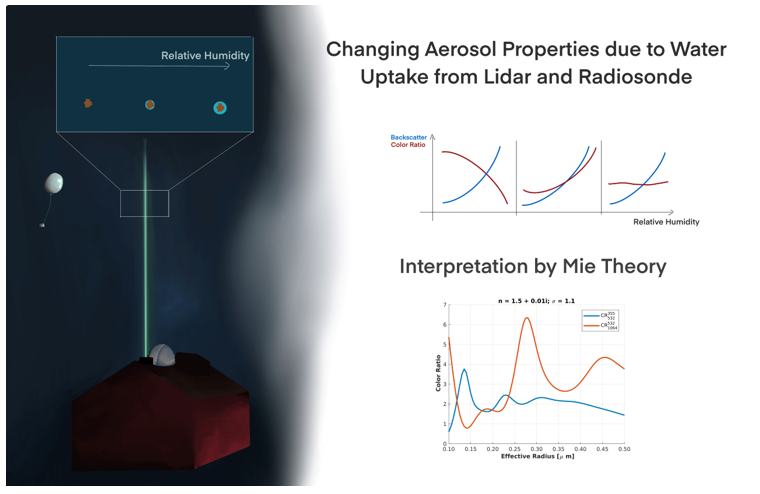
This study aims to investigate the microphysical properties of Arctic, tropospheric aerosol in the transition from the Arctic Haze in spring towards the summer season in 2021. A special focus lies on the hygroscopicity of the aerosol. Therefore, a one-parameter growth curve model is applied to lidar data from the Koldewey Aerosol Raman Lidar (AWIPEV in Ny-Ålesund, Svalbard) and simultaneous radiosonde measurements. Hygroscopic growth depends on different factors like aerosol diameter and chemical composition. To detangle this dependency, three trends in hygroscopicity are additionally investigated by classifying the aerosol first by its color ratio, and then by its season and altitude. Furthermore, two special days are discussed using Mie-theory. They show on the one side the complexity of analyzing hygroscopic growth by means of lidar data, but on the other side demonstrate that it is in fact measurable with this approach. For these two case studies we calculated, that the aerosol effective radius increased from 0.16 μm (dry) to 0.18 μm (wet), and from 0.28 μm to 0.32 μm for the second case. Generally, we found two different modes of stronger or weaker hygroscopic particles and a complex altitude dependence with the least hygroscopic particles in the middle free troposphere.
Keywords:
Arctic Aerosol
; Lidar
; hygroscopic growth
1. Introduction
The Arctic, and especially the European sector in winter, shows a strong warming [1], a phenomenon which is called Arctic Amplification [2,3]. This Arctic Amplification is not fully understood due to a complex interplay between local and regional exchange processes, [4]. Amongst others, variations in aerosol are found to lead to significant changes in the Arctic climate system [5]. Their direct effect [6] as well as the aerosol-cloud feedbacks [7] are complex and depend on the spatial and temporal distribution of the aerosols [8]. However, those feedbacks may play an important role in the Arctic Amplification.
Ny-Ålesund is located on the West coast of Spitsbergen in the European Arctic at (78.9 N, 11.9 E). It is an international super-site for environmental research, in which atmospheric measurements are carried out by many institutes from different European or Asian countries. Aerosol measurements were originally motivated due to the Arctic Haze phenomenon, a springtime air pollution [9], transported into the Arctic from inhabited regions [10]. Other prominent aerosol types in this region are biomass burning [11], sulfates of different origin or sea salt [12].
These aerosol measurements are performed both by in-situ (e.g. [13]) and by remote sensing (e.g. [14]) methods for more than 20 years at this site. A current overview of the measurement efforts concerning in-situ techniques is given in Platt et al. [15], trend and variability from remote sensing perspective are presented in Gral and Ritter [16].
While a few studies have been published that combine both in-situ and remote sensing information like Ferrero et al. [17], this is generally a complicated task, because aerosol properties may change in the boundary layer on short time scales.
The Arctic aerosol typically presents a clear annual cycle as described by Tunved et al. [13]: There are slightly larger particles during the Arctic Haze period in spring, followed by a maximum aerosol number concentration in summer of more and very small particles from local origin (increased new particle formation [18]) and a clear autumn. Hence, from an aerosol perspective, a year may be subdivided into three periods: polluted in late winter and spring, local with sporadic biomass burning events in summer, and a clean season in autumn and early winter. As the aerosol’s radiative forcing not only depends on their intrinsic properties, but also on albedo, solar altitude and background atmosphere [19] a precise estimation of this forcing is challenging.
Aerosols are difficult to describe in climate models for several reasons [20]. In this work we investigate one of them in detail: The hygroscopic growth of these particles. Above a given relative humidity over water, aerosol captures water molecules from the gas phase. Hence it is growing in size and thus changes its light scattering properties [21,22,23]. We note that by uptake and release of water molecules not only the size, but also the shape and the index of refraction of the scattering particles will change. Hence potential differences between measured dry aerosol properties and the aerosol direct effect in the real atmosphere may, partially, be explained by hygroscopic effects.
The uptake or release of water from aerosol at changing relative humidity has been known for decades. Tang [21] considered the hygroscopic growth of different sulfate and nitrate aerosol particles and presented a hysteresis curve (his Figure 1): The aerosols remain at their dry radius at consecutively wetter conditions up to the deliquescence point. Beyond that, at even higher relative humidity, they take up water (will be "activated") and may grow into a cloud droplet at about 100% relative humidity. At consecutively lower relative humidity the aerosols are able to "defend" their water shell up to the efflorescence point. This means that aerosols that have been in contact with moist air before continuously change their diameter and, hence, their scatter coefficient depending on ambient humidity.
Frequently this hygroscopic behavior of the scattering particles is described by a simple one-parameter power law of relative humidity with a hygroscopic exponent. Gassó et al. [22] for example was able to separate different aerosol classes via this value, and Zieger et al. [24] presented an overview of aerosols’ hygroscopicity for several European sites. Vu et al. [23] analyzed the hygroscopic behavior of aerosol also as a function of its dry diameter.
In Ny-Ålesund the hygroscopic growth of Arctic aerosol has also been analyzed by Zieger et al. [25], who performed measurements there during summer and fall by dry- and wet nephelometer. They found a surprisingly high hygroscopic behavior and a considerable sea salt fraction. Rastak et al. [26] extended similar measurements for a longer time period and concluded that during summer the aerosol is even stronger hygroscopic than during spring time.
By this work we want to stimulate a discussion about to what extent hygroscopic properties of aerosol can be derived by simultaneous observations from a multiwavelength lidar and a radiosonde. We hypothesize that in the Arctic free troposphere (far away from the major sources of aerosol) vertical gradients of the aerosol properties, such as dry radius and chemical composition, shall be low. Hence we pose the assumption that if changes in the aerosol properties occur which coincide with gradients of the relative humidity these changes are due to hygroscopic effects, i.e. the uptake or release of water molecules from the aerosol particles. During their long advection from the source regions into the Arctic, the aerosol may frequently have encountered moist conditions and has been activated. Therefore, remote regions like the Arctic may be well-suited locations to analyze hygroscopic effects of aerosol by lidar.
The paper is structured like this: We will shortly present our lidar and the radiosonde data in Section 2. Next, using the lidar data, we present the development of the aerosol’s optical properties from spring to summer 2021 in Section 3. Further, an overview of their general hygroscopic properties is illustrated in Section 4. As this seasonal overview shows quite some scatter we will discuss hygroscopicity in terms of its dependence on the aerosols’ size, season and altitude. Additionally, two case studies show the complexity of the different phenomena in some more detail. Finally, we try to put our findings in a more general perspective in Section 5. In particular by using Mie theory with properties obtained from lidar we show that hygroscopic growth of atmospheric aerosol is measurable.
2. Instruments, Methods and Data
2.1. The Koldewey Aerosol Raman Lidar and Measurement Site
The data of this work has been recorded by the Koldewey Aerosol Raman Lidar (KARL) at the AWIPEV station in Ny-Ålesund, Svalbard, (55.435’N55.740’E), which is operated throughout the whole year. It is a traditional Raman lidar consisting of a Nd:YAG laser at nm, nm and nm. It collects both, the elastically scattered light as well as the Raman lines at nm and nm by a 70cm mirror and Licel electronics. It uses a Spectra-Newport laser operating at per color at 50 Hz. More information on the lidar can be found at Hoffmann [27].
This study uses lidar data from April to the end of July 2021. The data set consists of a spatial resolution of , and a temporal resolution of . As the investigation focuses on tropospheric aerosol, only data up to is discussed.
In this work we mainly consider the (volumetric) backscatter coefficient of aerosol, in units []. Another important quantity is the extinction coefficient []. Further, we define the color ratio, the depolarization and the lidar ratio as:
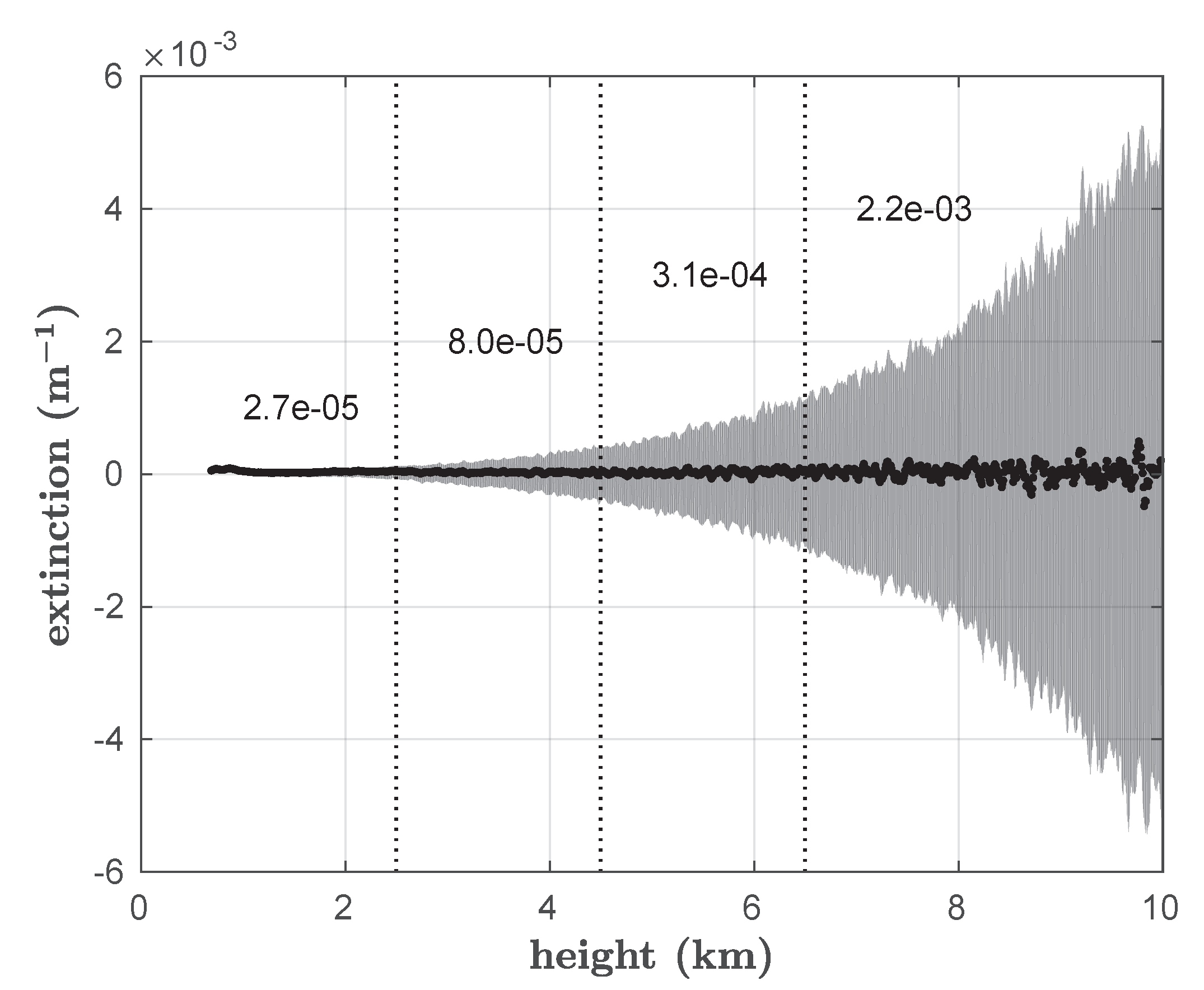
However, as we deal with daylight data, noise in limits the accessible altitude (see Appendix A). One needs to treat it with caution, which is why in this work and lidar ratio LR are only analyzed till height.
For abbreviation purposes, if not stated otherwise, we consider backscatter at , written as , the color ratio , or short , and the depolarization and lidar ratio as well at .
Information on the meteorologic conditions is obtained by radiosonde: A Vaisala RS-41 is launched directly next to the lidar each day at around . It provides radiosonde profiles of temperature, wind, humidity and pressure [28]. These sounding data are used to calculate the Rayleigh contribution of backscatter and extinction and, more importantly for this work, to derive profiles of relative humidity.
2.2. Data Set and the Cloud Mask
Lidar provides vertical profiles of optical aerosol properties from which one can obtain their microphysical properties. The standard methods of Ansmann [29] and Klett [30] have been used to evaluate the lidar data. A boundary condition is needed for the retrieval of the backscatter. We chose the clear sky condition at as average in the altitude interval between to altitude. Further, we use an Ångström exponent to recalculate the corresponding boundary condition for the other wavelengths. For the Klett Method the assumption of a lidar ratio is needed. We chose moderate lidar ratios of for and for according to [14] and [31].
Clouds cause high backscatter and thus destroy any statistics on aerosol properties. Therefore, lidar profiles with cloud influence need to be filtered out prior to performing any statistics of aerosol. The first step is to apply a threshold-based cloud filter which removes affected time- or altitude-steps. Analyzing our data (scatter plot of color ratio versus aerosol backscatter at , not shown), we noted that a situation of implies cloud occurrence and we removed these data points accordingly. Further, below clouds, the backscatter profile in a lidar might be off due to an inappropriately chosen lidar ratio within the cloud. For thin clouds, our retrieval software automatically corrects this like in Nakoudi et al. [32]. For thicker clouds, the lidar profiles have either to be rejected or recalculated by the assumption that in at least one altitude layer below the cloud the aerosol backscatter remains constant.
After application of the cloud filter, out of 1046 lidar profiles 451 remain. During the discussion of hygroscopic growth, simultaneous radiosonde (Vaisala RS-41) data is used. Then only lidar data obtained before and after launch of the radiosonde is considered, leading to 33 profiles from 10 days.
As previously mentioned, the study focuses on tropospheric aerosol up to height. In addition, due to the necessary overlap of telescope and laser beam from the lidar, only heights above are analyzed.
2.3. Hygroscopic Growth and the Growth Curve Model
The hygroscopicity of an aerosol describes its ability to grow due to water uptake. Next to the relative humidity of the atmosphere, it depends on both, the aerosol’s size and chemical composition [24,33].
Tang [21] has studied salt-containing aerosol and finds the hygroscopic growth to describe a hysteresis: For the activated aerosol, meaning aerosols that already grew at some earlier point in time, hygroscopic growth starts at relative humidity, while for the non-activated at .
Hygroscopic growth changes the aerosol’s scattering and absorption properties [25,34]. Zieger et al. [25] and Gassó et al. [22] described this change by means of the hygroscopic growth curve model. It utilizes the scattering enhancement factor , which they parametrized to:
with relative humidity RH and the fit parameter which acts as a measure for the hygroscopicity of the aerosol.
Two comments about this formula 2 are necessary: First, f usually refers to the scattering enhancement. A lidar measures foremost the backscatter and we apply the same approach for our data. Hence, the values of our work will not be directly comparable to the cited literature. Second, by water uptake typically the refractive index of the aerosol changes. For a few case studies with good lidar data quality this effect can be deduced (e.g. Dube et al. [35] ). However, as in the literature above, here we neglect this and assume that the index of refraction will not change with humidity.
3. Aerosol Properties in Spring and Summer 2021
The daily median of aerosol backscatter, color ratio and depolarization between and , and of the lidar ratio between and are illustrated in Figure 1a-d.
The backscatter development in Figure 1a exhibits an increase till mid of May, followed by a decrease till mid of June. Towards mid of July, the backscatter increases again. Considering the points of inflections on the 20th of May and the 20th of July, the period can be subdivided into three different seasons, as indicated by the vertical dotted lines in Figure 1a-d.
The color ratio in Figure 1b shows a continuous decrease of effective particle radius throughout the whole period.
Aerosol depolarization stays continuously low (see Figure 1c).
Lidar ratio is on average the highest in May and early June. In particular, the 11th and 12th of April take low values. It is noteworthy that the lidar ratio takes most often values between and during the season, except for May and June. It is constantly enhanced and even provides two peaks in lidar ratio on two consecutive days.
Figure 2 demonstrates the height dependence of the backscatter development. The daily median of the backscatter is built upon four different height intervals: , , and . Overall, backscatter is most increased in the lowest height interval. However, the backscatter gradients in time are most pronounced in heights of to .
Figure 3 is built similarly to Figure 2, but illustrates the color ratio. In general, color ratio increases towards the summer season for every height interval. Thereby, the lowest height interval () provides the strongest gradient in time. Beginning of this increase is approximately after the spring season, which was estimated by means of the backscatter. Furthermore, the color ratio amounts to values of about 1.5 to 2.0 in the beginning and later rises to more than 2.5.
4. Hygroscopic Properties
In this section we present an overview of the general hygroscopic properties of Arctic aerosol for the whole season. Note that the relative humidity over ice, and thus ice nucleation, is not additionally considered. Further explanation to neglecting this effect is stated in the Appendix C.
Figure 4a shows the backscatter development with regard to the relative humidity over water from April to the end of July 2021. Due to the high spread of in backscatter, the median for each percentage of relative humidity is additionally illustrated. In general, backscatter rises with relative humidity. However, beginning at a relative humidity of the behavior gets more irregular and provides increased backscatter values.
For further analysis in Figure 4b, a normalization of the median backscatter relative to dry conditions is performed. The drop in backscatter below relative humidity is considered as not representative for the expected constant course at dry conditions. Thus, "dry conditions" are taken here as the average backscatter coefficient between and relative humidity. The quality of the normalization is considered to be sufficient, as the constant course below is located around 1.0. The growth curve in equation 2 is fitted to the normalized median backscatter between and relative humidity. By means of the assumption that disruptive effects will cancel out, due to the variety of meteorological events and aerosol size and composition, the fitting parameter can be considered as a seasonal average. It can be seen from the plot that already at relative humidity the backscatter is larger than at dry conditions and that at the backscatter is about 1.3 times larger than in the dry state.
Note that R amounts to only 0.43. To reduce the spread in backscatter, and thus obtain a more precise fitting parameter , three subdivisions of the data set are performed and evaluated in the following Section 4.1, Section 4.2 and Section 4.3. Goal is to evaluate diameter-dependent, seasonal and vertical trends in hygroscopic growth of aerosol. The sub datasets in the following subsections are illustrated without an upper boundary in relative humidity. A robust least-square fit is used for the application of the growth curve due to its stability against outliers.
4.1. Hygroscopic Growth Analysis, dependent on Aerosol Diameter
A subdivision of the backscatter and radiosonde data from Figure 4 is performed. An analysis with broad intervals between CR = 0 and CR >= 5 (see Appendix B) showed that the maximum hygroscopic growth occurs for a color ratio between one and three. Thus, in the following more subtle intervals, of spacing 0.25, are chosen for that range.
The backscatter development of these finer sub datasets is shown in Figure 5a-h. As indicated by the median backscatter, the general development is a rise of backscatter with humidity, i.e. the occurrence of hygroscopic growth is still visible. Another observation is that the subdivision of the data set reduces the standard deviation . In particular, on the log-scale is a thinning of the spread in the data visible, compared to Figure 4a. Outliers, e.g. in sub-Figure 5h, stem to a great extent from the 15th of May.
The hygroscopic growth curve is fitted to these sub datasets in Figure 6a-h. The fitting parameter increases till the maximum of 0.72 for aerosols associated with a color ratio of 1.75 to 2.0, and decreases afterward. Thus, the weakest growth behavior is to be found at the highest and lowest color ratio values.
4.2. Hygroscopic Growth Analysis, dependent on the Season
The lidar and radiosonde data of Figure 4a are subdivided into whether they are recorded during the Arctic Haze, the summer or the season with forest fire impacts. The classification of those seasons is based on Section 3.
The subdivided data is shown in Figure 7a-c. In general, backscatter still increases with relative humidity. Compared to the full data set in Figure 4a, the spread in backscatter did not decrease significantly (see Figure 7a,b). Furthermore, because the complete daily trends are included in one sub dataset, individual days that differ strongly from other days can have quite an impact on the overall trend. This is in particular visible in the smallest data set - the forest fire impacted season (see Figure 7c).
The growth curve is fitted onto the sub datasets (see Figure 8a-c). Two different modes were striking during the Haze and the summer season: One of lower and one of higher hygroscopicity. Weighting of data points supported the fitting curves to follow the different modes and estimated the aerosols’ hygroscopicity.
The modes of high hygroscopicity are almost identical for both seasons. However, the mode of low hygroscopicity during summer is stronger than during both the Haze and the forest fire impacted season, as indicated by the fit parameter .
For further evaluation of the impact of relative humidity on the observed seasonal trend, the average trend of relative humidity from April to July is shown in Figure 9a. From mid-April to May the values are comparably low. The forest fire impacted season has on average the highest relative humidity of about . However, otherwise no strong bias towards high or low relative humidity during a season is observed.
4.3. Hygroscopic Growth Analysis, dependent on Altitude
Although the absolute humidity decreases with altitude, the impact on the relative humidity is not clear, as the temperature decreases with altitude. The average, vertical distribution of relative humidity RH is illustrated in Figure 10a. Radiosonde Points of the whole season, without limitation to temporal closure to lidar data, are used. Data of low relative humidity (RH) can be treated all together, as hygroscopic growth occurs only for RH, and is thus illustrated individually in Figure 9b.
It is visible that relative humidity decreases with altitude. In particular, above the amount of RH< increases strongly. Noteworthy is also the accumulation of relative humidity data points between 40 % and 60 % from to .
Figure 10b illustrates the relative amount of aerosol of specified color ratio within a certain height interval. A shift to higher color ratio values is observed above . The biggest aerosol gathers around which correlates with the accumulation of relative humidity values between 40 % and 60 %. Note, that also the spread increases in this height interval so that aerosol with is allocated especially here. Above , the average color ratio begins to reduce again, yet is still bigger than the average values below . Above the pattern becomes a more even distribution and in addition, a second concentration emerges which includes very small aerosol (). Overall, there exists a clear trend of smaller aerosol at higher altitudes, yet not continuously decreasing.
The last hygroscopic growth analysis is performed in the following on a data set that is subdivided into altitude intervals. This subdivision is interesting as aerosol size, chemical composition and relative humidity change with altitude. In accordance to subSection 3, the following height intervals are used: , , and . Figure 11a-d illustrate the backscatter of the subdivided dataset, as well as its median. The standard deviation, in comparison to analysis of the whole season (see Figure 4), reduced only partwise, as the average backscatter value of subplot Figure 11a,b is relatively high. Looking at the median backscatter, it seems to be almost constant, and merely fluctuating around a value.
4.4. Case study: 23rd of May 2021
This case study addresses the visibility of hygroscopic growth within the variables color ratio, lidar ratio and aerosol depolarization in detail. Especially we find distinct particle properties below relative humidity. Even if at this dry condition no hygroscopic behavior can be expected, we present the results here and simply state that apparently below this limit the aerosol microphysics is different.
The 23rd of May 2021 is characterized by a strong gradient in relative humidity between and . Figure 13 shows the development of color ratio (a), as well as lidar ratio and aerosol depolarization (b) with relative humidity over water.
The color ratio decreases from about 2.8 to 2.4. The color ratio , constructed from the longer wavelengths, is lower and rises from about 1.2 to 1.9. The aerosol depolarization is generally low and further decreases with increasing relative humidity. Apparently, the hygroscopic growth makes the particles even more spherical, as one could imagine, if a shell of water forms around the aerosol. Only at very dry conditions, the aerosol depolarization increases above . However, the dependence of the lidar ratio on relative humidity is not simple. We recall that the lidar ratio depends on all three parameters that determine the light scattering: the size, shape and refractive index [36]. All these variables will change by uptake or release of water molecules from aerosol. As it can be seen from Figure 13, for the lidar ratio is low and is more or less constant with low values below , in particular above relative humidity. For the lidar ratio is more complicated: It peaks with values around at about relative humidity.
4.5. Case study: 29th of April 2021
In this section, we discuss a second case study, this time for the 29th of April. By this day we want to demonstrate some caveats and difficulties which must be kept in mind when a combined evaluation between lidar and radiosonde for hygroscopic growth of aerosol shall be done.
We neglect the trivial case that sonde and lidar may not probe the same air mass, because the sonde drifts with the wind and can, hence, not see the advection of "new air masses". One can overcome this by making sure that only cases are discussed that show a persistent structure in the lidar.
In Figure 14 an overview of this day in terms of relative humidity and aerosol backscatter is presented. While the lowest interval (1550m to 1900m) may point to hygroscopic growth, the higher intervals (Figure 14b and c) clearly show a different behavior: While in the layer between 3000m to 3800m altitude the relative humidity rises from slightly over to over , absolutely no increase in backscatter can be seen. There are two possible explanations for this finding: Either the aerosol, in this case, is really non-hygroscopic and may e.g. consist of soot. Or (more likely) it consists of normal hygroscopic aerosol that has not been activated before and was always trapped in dry air masses. In this case, the particles have always been below their deliquescence point (like in Figure 1 of Tang [21]). While such cases may be rare in the Arctic (long advection time of aerosol and cooling of the air masses, which enhances the relative humidity) they should be more frequent in the free troposphere above the inhabited continents.
Figure 14c shows the conditions in the altitude range between and altitude, where a double layer in backscatter can be seen. In this case, the relative humidity is so low that no hygroscopic growth can be expected. This example simply shows that at least sometimes the aerosol is advected in dry air into the Arctic. In fact, already Khattatov et al. [37] noted that according to their observations Arctic Haze either resulted from cold and dry source regions or underwent cloud formation processes.
The fact that no hygroscopic growth is visible in the layers around or can also be seen in Figure 15.
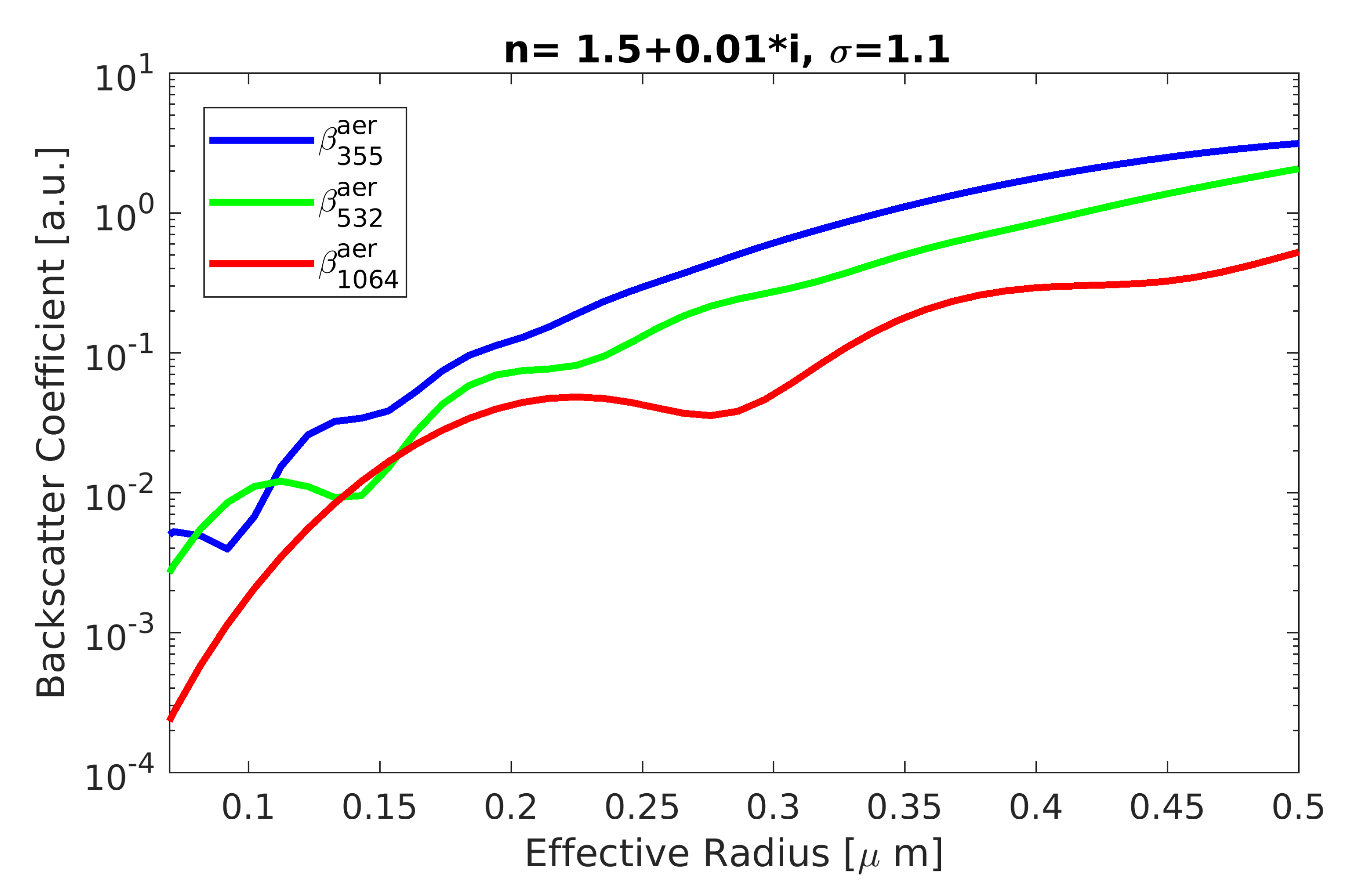
Figure 16 shows the lowest layer, between and altitude. While the relative humidity drops significantly in this range, the color ratio rises. However, clearly both quantities are not strictly correlated (see Figure 16a). This may indicate that (dry) particle properties are not precisely constant over this altitude interval. Neglecting this complication, Figure 16b shows the scatter plots of both color ratios as a function of relative humidity. It can be seen, that the color ratio remains almost constant, at values around 2.
5. Discussion
5.1. Estimation of the Effective Aerosol Radius - according to Mie Theory
In this section, we present an analysis of Mie calculations to quantify any change in the aerosol size by water uptake. Mie theory is a valid approximation as the aerosol depolarization, as presented in the previous sections, is generally small.
To represent an aerosol distribution we chose a slim log-normal distribution with a geometric standard deviation of and a typical complex refractive index of Arctic aerosol of , like in Böckmann et al. [38]. This assumption of an index of refraction is a bit heuristic, as the precise value for both case studies and the change of the refractive index with humidity is not known. Contrarily, the choice of the geometric standard deviation is quite safe, as broader distributions cannot represent the measured changes of the color ratios and even more narrow distributions may be unlikely. We calculated for different effective radii of the aerosol the ratio of the backscatter efficiencies coefficients in the three different wavelengths, i.e. the color ratios. The result is plotted in Figure 17.
Some interesting features can be seen from this plot. First, in both spectral regions, short wave and long wave, the color ratios do not decrease monotonically. This means that a plain statement like "the color ratios are an indicator of the particles’ size" is not strictly true. In fact, Figure 17 shows several intervals of aerosol radius, in which both color ratios show the opposite behavior. And second, the color ratio contains the smaller information content, because for an aerosol effective radius between to its value is always close to 2.
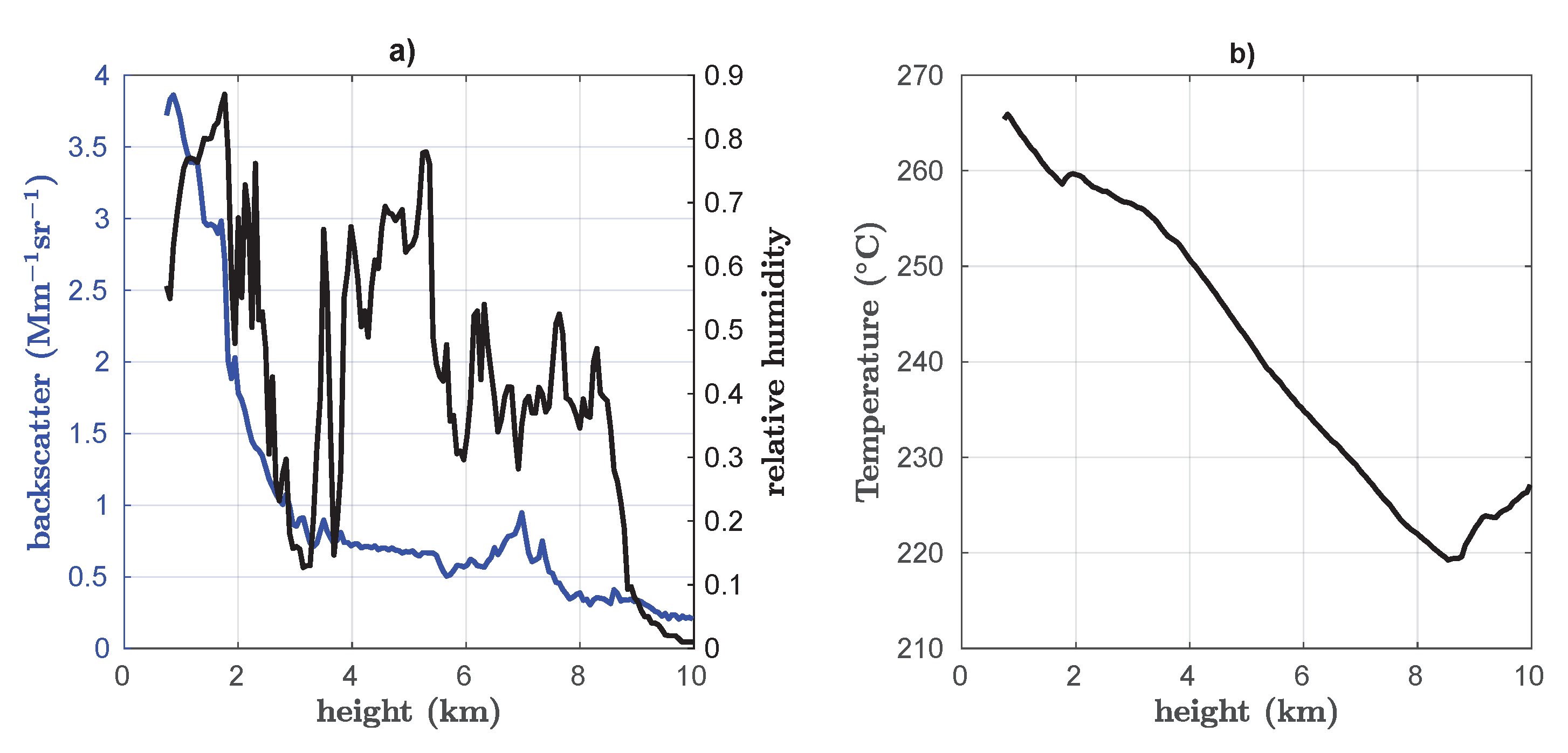
For the case of the 23rd of May we observed an increase of from (dry) to (wet) (see Figure 13), while decreased from values around (dry) to (moist). From the Mie calculations (see Figure 17), it can be seen that these values for the color ratios agree with each other and that the effective radius of the aerosol increases from about (dry) to (wet). These aerosol sizes are typical for the Arctic free troposphere based on lidar data [35]. This increase of aerosol effective radius is highly relevant as can be seen from the increase of backscatter with humidity by a factor of 3 in Figure A4 of the Appendix.
The second case from the 29th of April also showed values of the color ratios, that are physically meaningful (see Figure 16b). In this example, the effective radius of the aerosol is around at around at relative humidity, while it is approximately at around at .
This non-monotonic behavior of the two color ratios from the Mie calculation also explains the complicated result of Figure 6, where the largest value has been found for color ratios around 2: Both questions - how much the aerosol radius increases with humidity and how apparent this radius change is in a lidar - need to be considered. Figure 18 shows the dependence of aerosol backscatter at the three wavelengths of a Nd:YAG based lidar. The units in the figure are arbitrary, as they depend on the aerosol concentration that will vary from case to case. Figure 18 uses the same log-normal distribution as before. It can be seen that larger particles have the highest backscatter. However, the gradient, of how much the backscatter changes with effective radius is larger for smaller particles. Hence, our high exponents in Figure 6 can be explained by particles with effective radius < because their backscatter rises most by hygroscopic growth.
One obvious summary so far is that the information content from one color ratio alone is clearly limited (due to its non-monotonic behavior). However, with a three wavelength system the hygroscopic growth of aerosol in the accumulation mode can be tracked, because the backscatter changes for all wavelengths and both color ratios mostly show an opposite behavior. We note that for this discussion the extinction values have not been used, hence this methodology works in daylight, like in our case. Still, it would be beneficial to perform a real inversion (including the extinction coefficients) to retrieve the microphysical properties of aerosol, which would also allow to estimate the change of the refractive index with humidity, like in Böckmann [39] and Dube et al. [35]. However, as our data set also contains faint aerosol layers in the high troposphere during Polar day the evaluation of the extinction coefficient was not always trustful, see Appendix A.
5.2. The Seasonal Cycle of Arctic Aerosol in 2021
Based on optical aerosol properties in Section 3 one can deduce the microphysical aerosol properties. The temporal development of these properties shows the seasonal cycle of the aerosol (see Figure 1a-d). In 2021, a return of the Haze period in May is observed. Lidar ratio is enhanced, but not due to elongated particles [40] since the aerosol particles stay spherical throughout the season (see Figure 1c). Instead, pollution is the reason, i.e. a return of the Arctic Haze. The Haze lasts approximately till the 20th of May, according to turning points in the backscatter developments. In comparison to May, April consists of a clearer atmosphere - in particular on the 11th and 12th of April. Usually (e.g., [13,41]), the Haze maximum is observed in March or April. However, Shibata et al. [31] find the backscatter maximum from 2014 to 2017 to be on average in May, like in this study. However, they also find increased aerosol load in June and July. This can be explained by inter-annual variability, as discussed in Graßl and Ritter [42]. In the last century the Arctic Haze phenomenon also lasted until May (Herber et al. [43]). For this reason, it is important to continue monitoring the occurrence of aerosol in the Arctic.
After the Haze period, the typical summer season starts (e.g., [13,44]). It is characterized by small aerosol diameter (see Figure 1b) and lower backscatter (see Figure 1a), probably due to new particle formation [13].
Beginning on the 20th of July, the summer development is disturbed. As before, lidar ratio and aerosol depolarization indicate the occurrence of pollution (see Figure 1c,d). Forest fire impacts are hypothesized as reason for this disturbance.
The backscatter development within different height intervals was displayed in Figure 2. It is visible that the aerosol number density maximizes in the lower troposphere. This is as expected (e.g. [45]), and in addition coincides during spring with the usual altitude range of the Arctic Haze [31,46]. In comparison, the transition from Arctic Haze to summer season, i.e. the seasonal cycle, is most pronounced between and . Shibata et al. [31] as well state to observe a seasonal cycle the best above . The weaker gradients, compared to studies of Tunved et al. [13], stem from the integration of the lidar data over altitude.
The color ratio development within the different height intervals (see Figure 3) shows that aerosols have in general a larger diameter in lower height intervals. This coincides with studies of Rader et al. [47] and the location of the Haze [31,46]. A connection to hygroscopic growth is to be discussed later in Section 5.3. If we compare the color ratio of Figure 17 with typical sizes of Arctic aerosol like in Tunved et al. [13] or Dall’Osto et al. [48], which measured, even close to the ground, predominately aerosol radii smaller than we notice, that our sizes seem generally larger. Clearly, more regular and direct comparisons between aerosol in-situ and remote sensing instruments are necessary. The existence of values of about 1.5 only below altitude in March and April, which later increases to values around 2 and more, implies that only during the Haze period in this low altitude particles with effective radius around prevail. Later in the year and always at higher altitudes, particles with effective radii around dominate.
Two obvious explanations why the aerosol diameter may be overestimated in lidar compared to in-situ instruments can be immediately given: Figure 18 shows that the lidar signal is dominated by very few large particles which may not be captured efficiently by in-situ techniques. Or, simply, part of the aerosol is hygroscopically grown in the free Arctic atmosphere.
5.3. Dependene of Hygroscopicity on Particle Size, Season and Altitude
The hygroscopic analysis of all simultaneous lidar and radiosonde data from April to July 2021 (see Figure 4b) between and altitude provides a weaker growth than in studies of Zieger et al. [25]. However, as described in Section 2.3 our values of the growth parameter is based on the backscatter coefficient and hence only roughly comparable to existing literature. Further, we hypothesize that the sea salt fraction decreases with altitude: While sea salt may be one reason for the high hygroscopicity found by [26] and is frequent in the boundary layer of Ny-Ålesund as pointed out by [12], previous lidar studies suggest, that sea salt is only a minor aerosol constituent above altitude, [14].
Overall, we noted a large spread in the overall hygroscopicity (see Figure 4). Therefore, subdivisions of the data set were performed to reduce this spread. It is assumed that will be determined more exactly then. Moreover, another goal is the determination of hygroscopic trends dependent on aerosol diameter, season and altitude.
Particle Diameter Trends
The result of the subdivision according to particle diameter coincides with expectations [23]: Larger aerosols provide stronger growth than smaller ones (see Figure 6). We found the largest increase of aerosol backscatter with relative humidity for the color ratio for values around 1.5 to 2, as discussed before. Even if this range of values does not match a single size interval of the aerosol, Figure 18 shows that aerosol with radius increases their backscatter most and hence should present the largest exponent in our data set. Figure 6 shows smaller hygroscopic growth parameters for (aerosol radius of or ) or even which corresponds to aerosol of about radius.
Seasonal Trends
In this work we generally (Figure 8) found two modes with higher or lower values of the growth parameter. Only for the days in July with increased backscatter (biomass burning) the mode of high is missing (see Figure 8c). A low hygroscopicity for biomass burning has also been found by [49] and [50].
We hypothesize that our finding with the mode of weak hygroscopicity can be explained by those circumstances: Either the particles have not been activated, like in the case of Section 4.5, which is indeed more likely for the drier upper free troposphere (Figure 9). Alternatively, the particles are already so large that any further growth cannot be captured well by just the color ratio in lidar, [38]. Finally, the aerosol in the upper free troposphere may simply be less hygroscopic, see next paragraph.
Vertical Trends
In this study we analyse to our knowledge for the first time the hygroscopic behavior or Arctic aerosol vertically resolved in the free troposphere. In our data set from 2021, on average no hygroscopic growth is visible from to (see Figure 12b,c). We explain this by the fact that with increasing altitude the surrounding air becomes drier (Figure 9) and the aerosol may become smaller. These two effects hinder the hygroscopicity. Further, Figure 12 shows the highest variability in the middle two altitude intervals.
From to the aerosol is weakly hygroscopic (see Figure 12a). Due to the orography of Svalbard, one can hypothesize that underneath interactions with the boundary layer still occur, meaning that e.g. more moisture from the ocean or sea salt aerosol is present. Furthermore, assuming vertical wind shear, the spread in color ratio from (see Figure 10a) results from mixing of different aerosol, if the free troposphere in fact is located above .
The most hygroscopic aerosol is present above (see Figure 12d). We explain this surprising result by the fact, that the sources of the aerosol are close to the ground. Hence, aerosol above has necessarily been rising with the surrounding air. Ascending air cools which increases the relative humidity. Further, the aerosol in this air might be the oldest and during its aging, Arctic aerosol changes from a chemically external to an internal mixture, meaning that less hygroscopic aerosol is surrounded by a shell of more hygroscopic sulfate, [51]. Hence we hypothesize that the fraction of aerosol in this altitude that has been in contact with moist conditions is higher than below . Therefore, the less hygroscopic, non-activated branch is missing in the upper troposphere. This finding is in agreement to [52] who stated that high Arctic black carbon (and aerosol) layers in the Arctic are controlled by cloud processes.
In total we found a surprising complex vertical hygroscopicity which needs to be analysed further.
6. Conclusions
Aim of this work was to stimulate a discussion on to what extent lidar data with simultaneous radiosonde data can be used to investigate the hygroscopicity of aerosol. The study focuses on tropospheric aerosol from the European Arctic from spring to summer 2021. Therefore, first the seasonal development of the microphysical aerosol properties was investigated. The main results build the average situation of this season, on which the analysis of this study will be based on: An extended Arctic Haze till the 20th of May, followed by the typical summer season. Forest fire impacts disrupt beginning on the 20th of July.
The main analysis, focussing on the aerosols’ hygroscopicity, included in particular these tasks:
- Subdivision of the data set according to the aerosols’ color ratio, season and altitude. The application of the growth curve model then estimates the hygroscopicity of the sub dataset.
- Illustration of the often complex interpretation of the lidar data, and in particular the color ratio. Mie-calculation is performed to obtain a relation of the color ratio to the effective aerosol radius. We showed that by three backscatter coefficients (two color ratios, no extinction coefficient) the hygroscopic growth for a large, relevant size interval can be captured with only mild assumptions of the refractive index.
Assessing these investigations leads in particular to the following results:
- Hygroscopic growth depends on the particle diameter. A bias to stronger growth by larger particles is observed. Therein, aerosols with a color ratio of 1.75-2.0 provide on average the highest apparent hygroscopicity. Using Mie theory (and the color ratio between and ), their radius is determined to be . The hygroscopic growth of larger particles will surely happen in the atmosphere, but is hard to see from inspection of the color ratio alone. Here a full inversion of the lidar data seems necessary.
- Generally we found in different seasons two modes of stronger (, only missing during forest fire season) and weaker () hygroscopicity. Only during summer, this weakly hygroscopic mode has a higher value. While this hygroscopicity parameter in the present work is based on the aerosol backscatter coefficient, this number may not be directly comparable to the existing literature. However, in the atmospheric column the aerosol may, on average, be less hygroscopic than previously derived by ground-based measurements.
- An interplay of processes causes the vertical trend in hygroscopicity to be complex. We found higher hygroscopicity and high relative humidity in the lowest altitude, but cannot say whether this is due to different chemical composition or due to orographic effects. In the middle troposphere, the hygroscopicity is reduced, maybe because the probability of having aerosol that never encountered moist conditions is the highest. Finally, in the upper free troposphere highly hygroscopic aerosol was found. These particles must have been lifted up and hence the surrounding air had apparently cooled to saturation level prior to its advection towards the Arctic.
In the future, a similar work could be done during Polar night to capture the full annual cycle and to systematically include the extinction coefficient from the Raman method. Coordinated observations by wind lidar in the lowest atmospheric layers may shed some light on vertical movements of air and their impact on humidity and hygroscopic growth.
Author Contributions
This study was jointly desined by Nele Eggers and Christoph Ritter. The evaluation of the lidar data and the writing of the manuscript was mainly performed by Nele Eggers. Sandra Graßl provided the Figures for the Mie calculations. Christoph Ritter is the PI of the lidar and supervised Nele Eggers and Sandra Graßl.
Funding
The authors did not receive any external funding.
Acknowledgments
The lidar measurements were performed by Sandra Graßl and Wilfried Ruhe. The authors thank the team of AWIPEV station for their support.
Conflicts of Interest
The authors declare no conflict of interest.
Appendix A. Sensitivity study: Amplifying Noise in the Extinction Coefficient with Altitude
Figure A1.
The median extinction over all available data points (without cloud influence) is calculated and displayed for each height step. The standard deviation for each height step is illustrated as filled area. It demonstrates the strongly increasing noise in extinction and thus lidar ratio with altitude. For the previous analysis in this paper, the height intervals , , , are often utilized. In particular, the lidar ratio is only used within the lowest height interval due to noise. To emphasize this strengthening in noise, the mean standard deviation within this height interval is denoted in the figure. It rises by about 2 magnitudes.
Figure A1.
The median extinction over all available data points (without cloud influence) is calculated and displayed for each height step. The standard deviation for each height step is illustrated as filled area. It demonstrates the strongly increasing noise in extinction and thus lidar ratio with altitude. For the previous analysis in this paper, the height intervals , , , are often utilized. In particular, the lidar ratio is only used within the lowest height interval due to noise. To emphasize this strengthening in noise, the mean standard deviation within this height interval is denoted in the figure. It rises by about 2 magnitudes.
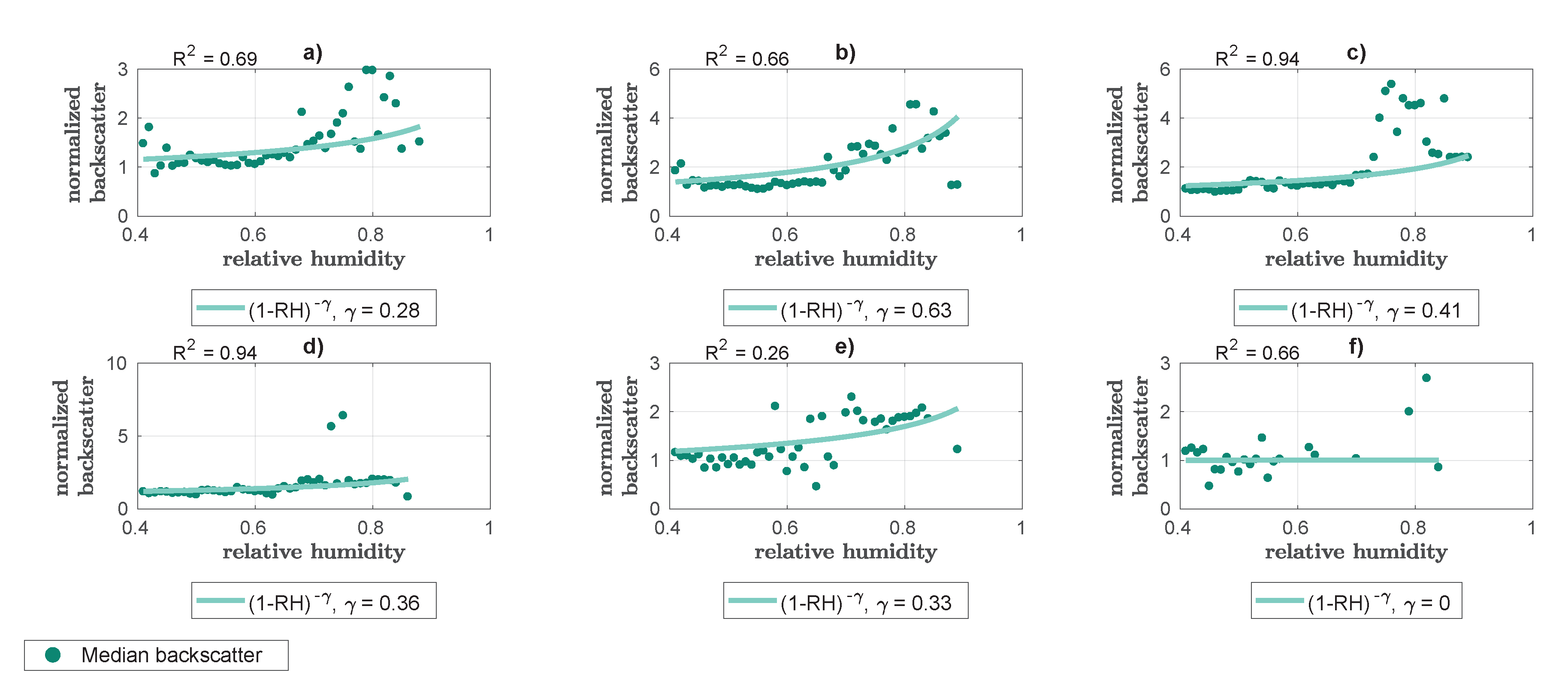
Appendix B. Fitted Growth curve for the Color Ratio classified sub dataset using larger intervals of spacing 1.0
Figure A2.
The median backscatter of the subdivided data set is illustrated in scatter plots a)-f) along with relative humidity. The subdivision is performed according to the intervals of color ratio [0, 1), [1, 2), [2, 3), [3, 4), [4, 5) and >5, respectively. The growth curve is calculated for each sub dataset. The fit parameter indicates the strongest growth for aerosols with a color ratio between 1 and 3. The growth is less strong for bigger particles, i.e. with a color ratio of 0-1. Moreover, also smaller aerosols provide weaker growth, as expected.
Figure A2.
The median backscatter of the subdivided data set is illustrated in scatter plots a)-f) along with relative humidity. The subdivision is performed according to the intervals of color ratio [0, 1), [1, 2), [2, 3), [3, 4), [4, 5) and >5, respectively. The growth curve is calculated for each sub dataset. The fit parameter indicates the strongest growth for aerosols with a color ratio between 1 and 3. The growth is less strong for bigger particles, i.e. with a color ratio of 0-1. Moreover, also smaller aerosols provide weaker growth, as expected.
Appendix C. Discussion on the importance of relative humidity over ice in this work
Figure A3.
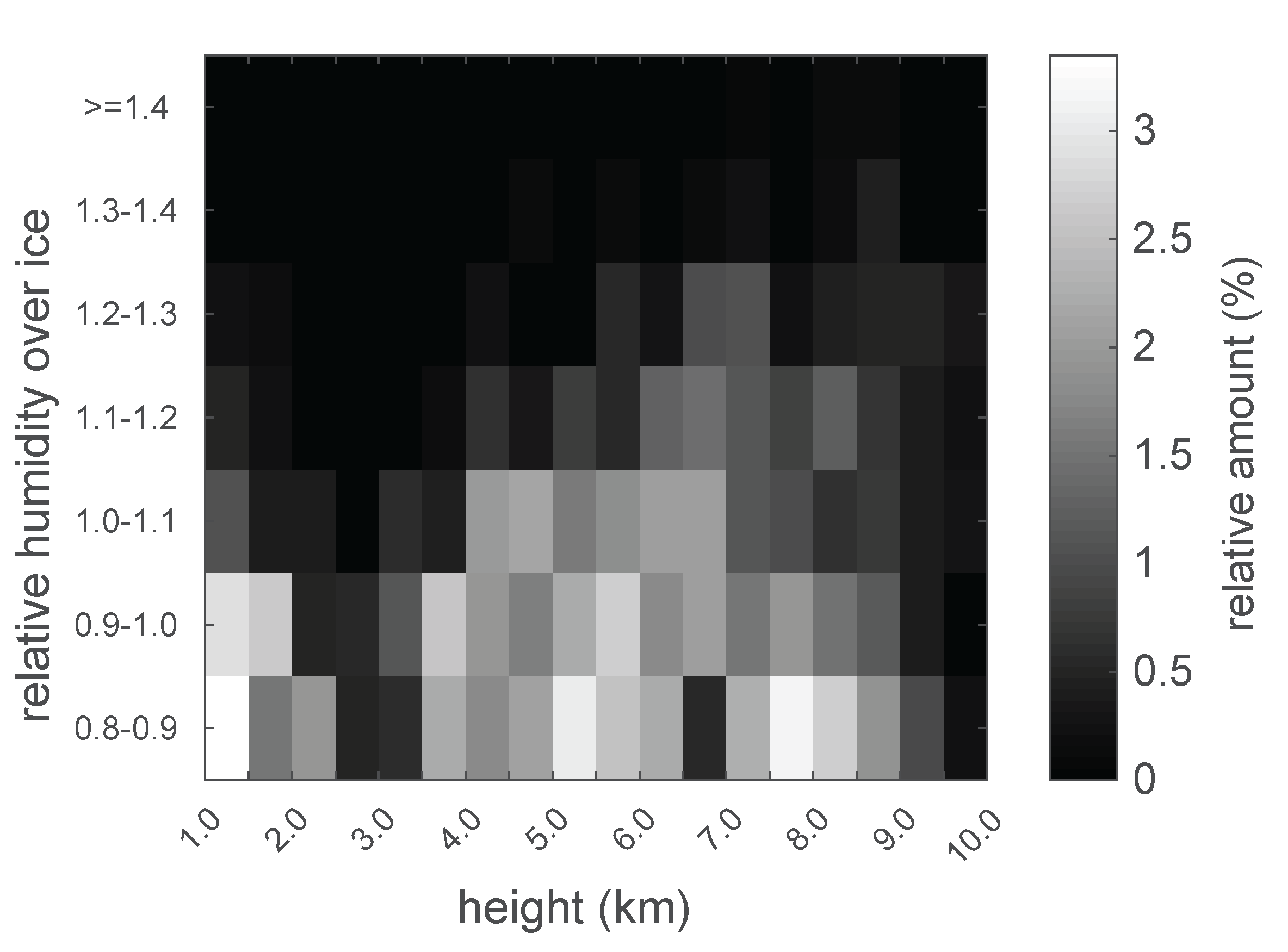
The vertical distribution of the relative humidity over ice is shown. Significant supersaturation (>110 %) occurs only above altitude.
Figure A3.
The vertical distribution of the relative humidity over ice is shown. Significant supersaturation (>110 %) occurs only above altitude.
In this work only the relative humidity over water has been considered. This was done due to the general sparseness of INP [53]: At a given supersaturation over ice the onset of hygroscopic growth in the ice phase depends on the availability of INP, which may or may not be present. This potentially leads to a large scatter in the parameter.
Figure A3 presents the occurrence of supersaturation with respect to ice in our data set. It can be seen that significant supersaturation (> 110%) only occurs above 4 km altitude. It was shown in Section 3 that at this altitude the aerosol backscatter is already clearly lower than in the lower free troposphere.
However, principally contemporary measurements by radio sonde and depolarization lidar allow to creation of statistics, in which season, altitude, relative humidity and temperature ice or water clouds will form.
Appendix D. Backscatter, Relative Humidity and Temperature Profiles on the 23rd of May 2021
Figure A4.
The tropospheric profiles from backscatter, relative humidity (a) and temperature (b) are illustrated. A strong gradient in relative humidity is visible from to . A focussed analysis of this interval is performed in Section 4.4.
Figure A4.
The tropospheric profiles from backscatter, relative humidity (a) and temperature (b) are illustrated. A strong gradient in relative humidity is visible from to . A focussed analysis of this interval is performed in Section 4.4.
References
- Maturilli, M.; Herber, A.; König-Langlo, G. Surface radiation climatology for Ny-Ålesund, Svalbard (78.9 N), basic observations for trend detection. Theoretical and Applied Climatology 2015, 120, 331–339. [Google Scholar] [CrossRef]
- Wendisch, M.; Brückner, M.; Crewell, S.; Ehrlich, A.; Notholt, J.; Lüpkes, C.; Macke, A.; Burrows, J.; Rinke, A.; Quaas, J.; others. Atmospheric and surface processes, and feedback mechanisms determining Arctic amplification: A review of first results and prospects of the (AC) 3 project. Bulletin of the American Meteorological Society 2023, 104, E208–E242. [Google Scholar] [CrossRef]
- Serreze, M.C.; Barry, R.G. Processes and impacts of Arctic amplification: A research synthesis. Global and Planetary Change 2011, 77, 85–96. [Google Scholar] [CrossRef]
- Previdi, M.; Smith, K.L.; Polvani, L.M. Arctic amplification of climate change: a review of underlying mechanisms. Environmental Research Letters 2021, 16, 093003. [Google Scholar] [CrossRef]
- Stjern, C.W.; Lund, M.T.; Samset, B.H.; Myhre, G.; Forster, P.M.; Andrews, T.; Boucher, O.; Faluvegi, G.; Fläschner, D.; Iversen, T.; Kasoar, M.; Kharin, V.; Kirkevåg, A.; Lamarque, J.F.; Olivié, D.; Richardson, T.; Sand, M.; Shawki, D.; Shindell, D.; Smith, C.J.; Takemura, T.; Voulgarakis, A. Arctic Amplification Response to Individual Climate Drivers. Journal of Geophysical Research: Atmospheres 2019, 124, 6698–6717. [Google Scholar] [CrossRef]
- J. Schmale, P. Zieger, A. Aerosols in current and future Arctic climate. Nat. Clim. Change 2021, 11, 95–105. [Google Scholar] [CrossRef]
- Creamean, J.M.; Barry, K.; Hill, T.C.J.; Hume, C.; DeMott, P.J.; Shupe, M.D.; Dahlke, S.; Willmes, S.; Schmale, J.; Beck, I.; Hoppe, C.J.M.; Fong, A.; Chamberlain, E.; Bowman, J.; Scharien, R.; Persson, O. Annual cycle observations of aerosols capable of ice formation in central Arctic clouds. Nature Communications 2022, 13, 3537. [Google Scholar] [CrossRef] [PubMed]
- Li, J.; Carlson, B.E.; Yung, Y.L.; Lv, D.; Hansen, J.; Penner, J.E.; Liao, H.; Ramaswamy, V.; Kahn, R.A.; Zhang, P.; Dubovik, O.; Ding, A.; Lacis, A.A.; Zhang, L.; Dong, Y. Scattering and absorbing aerosols in the climate system. Nature Reviews Earth & Environment 2022, 3, 363–379. [Google Scholar] [CrossRef]
- Quinn, P.K.; Shaw, G.; Andrews, E.; Dutton, E.; Ruoho-Airola, T.; Gong, S. Arctic haze: current trends and knowledge gaps. Tellus B: Chemical and Physical Meteorology 2007, 59, 99–114. [Google Scholar] [CrossRef]
- Stohl, A. Characteristics of atmospheric transport into the Arctic troposphere. Journal of Geophysical Research: Atmospheres 2006, 111. [https://agupubs.onlinelibrary.wiley.com/doi/pdf/10.1029/2005JD006888]. [Google Scholar] [CrossRef]
- Zielinski, T.; Bolzacchini, E.; Cataldi, M.; Ferrero, L.; Graßl, S.; Hansen, G.; Mateos, D.; Mazzola, M.; Neuber, R.; Pakszys, P.; others. Study of chemical and optical properties of biomass burning aerosols during long-range transport events toward the arctic in summer 2017. Atmosphere 2020, 11, 84. [Google Scholar] [CrossRef]
- Udisti, R.; Bazzano, A.; Becagli, S.; Bolzacchini, E.; Caiazzo, L.; Cappelletti, D.; Ferrero, L.; Frosini, D.; Giardi, F.; Grotti, M.; others. Sulfate source apportionment in the Ny-Ålesund (Svalbard Islands) Arctic aerosol. Rendiconti Lincei 2016, 27, 85–94. [Google Scholar] [CrossRef]
- Tunved, P.; Ström, J.; Krejci, R. Arctic aerosol life cycle: linking aerosol size distributions observed between 2000 and 2010 with air mass transport and precipitation at Zeppelin station, Ny-Ålesund, Svalbard. Atmospheric Chemistry and Physics 2013, 13, 3643–3660. [Google Scholar] [CrossRef]
- Ritter, C.; Neuber, R.; Schulz, A.; Markowicz, K.; Stachlewska, I.; Lisok, J.; Makuch, P.; Pakszys, P.; Markuszewski, P.; Rozwadowska, A.; others. 2014 iAREA campaign on aerosol in Spitsbergen–Part 2: Optical properties from Raman-lidar and in-situ observations at Ny-Ålesund. Atmospheric environment 2016, 141, 1–19. [Google Scholar] [CrossRef]
- Platt, S.M.; Hov; Berg, T.; Breivik, K.; Eckhardt, S.; Eleftheriadis, K.; Evangeliou, N.; Fiebig, M.; Fisher, R.; Hansen, G.; others. Atmospheric composition in the European Arctic and 30 years of the Zeppelin Observatory, Ny-Ålesund. Atmospheric Chemistry and Physics Discussions 2021, 2021, 1–80. [Google Scholar]
- Graßl, S.; Ritter, C. Properties of arctic aerosol based on sun photometer long-term measurements in Ny-Ålesund, Svalbard. Remote Sensing 2019, 11, 1362. [Google Scholar] [CrossRef]
- Ferrero, L.; Ritter, C.; Cappelletti, D.; Moroni, B.; Močnik, G.; Mazzola, M.; Lupi, A.; Becagli, S.; Traversi, R.; Cataldi, M.; others. Aerosol optical properties in the Arctic: The role of aerosol chemistry and dust composition in a closure experiment between Lidar and tethered balloon vertical profiles. Science of the total environment 2019, 686, 452–467. [Google Scholar] [CrossRef] [PubMed]
- Schmale, J.; Baccarini, A. Progress in Unraveling Atmospheric New Particle Formation and Growth Across the Arctic. Geophysical Research Letters 2021, 48, e2021GL094198. [Google Scholar] [CrossRef]
- Nakoudi, K.; Ritter, C.; Böckmann, C.; Kunkel, D.; Eppers, O.; Rozanov, V.; Mei, L.; Pefanis, V.; Jäkel, E.; Herber, A.; Maturilli, M.; Neuber, R. Does the Intra-Arctic Modification of Long-Range Transported Aerosol Affect the Local Radiative Budget? (A Case Study). Remote Sensing 2020, 12. [Google Scholar] [CrossRef]
- Johnson, J.S.; Regayre, L.A.; Yoshioka, M.; Pringle, K.J.; Turnock, S.T.; Browse, J.; Sexton, D.M.H.; Rostron, J.W.; Schutgens, N.A.J.; Partridge, D.G.; Liu, D.; Allan, J.D.; Coe, H.; Ding, A.; Cohen, D.D.; Atanacio, A.; Vakkari, V.; Asmi, E.; Carslaw, K.S. Robust observational constraint of uncertain aerosol processes and emissions in a climate model and the effect on aerosol radiative forcing. Atmospheric Chemistry and Physics 2020, 20, 9491–9524. [Google Scholar] [CrossRef]
- Tang, I.N. Chemical and size effects of hygroscopic aerosols on light scattering coefficients. Journal of Geophysical Research: Atmospheres 1996, 101, 19245–19250. [Google Scholar] [CrossRef]
- Gassó, S.; Hegg, D.A.; Covert, D.S.; Collins, D.; Noone, K.J.; Öström, E.; Schmid, B.; Russell, P.B.; Livingston, J.M.; Durkee, P.A.; Jonsson, H. Influence of humidity on the aerosol scattering coefficient and its effect on the upwelling radiance during ACE-2. Tellus B: Chemical and Physical Meteorology 2000. [CrossRef]
- Vu, T.V.; Shi, Z.; Harrison, R.M. Estimation of hygroscopic growth properties of source-related sub-micrometre particle types in a mixed urban aerosol. npj Climate and Atmospheric Science 2021, 4, 21. [Google Scholar] [CrossRef]
- Zieger, P.; Fierz-Schmidhauser, R.; Weingartner, E.; Baltensperger, U. Effects of relative humidity on aerosol light scattering: results from different European sites. Atmospheric Chemistry and Physics 2013, 13, 10609–10631. [Google Scholar] [CrossRef]
- Zieger, P.; Fierz-Schmidhauser, R.; Gysel, M.; Ström, J.; Henne, S.; Yttri, K.E.; Baltensperger, U.; Weingartner, E. Effects of relative humidity on aerosol light scattering in the Arctic. Atmospheric Chemistry and Physics 2010, 10, 3875–3890. [Google Scholar] [CrossRef]
- Rastak, N.; Silvergren, S.; Zieger, P.; Wideqvist, U.; Ström, J.; Svenningsson, B.; Maturilli, M.; Tesche, M.; Ekman, A.M.L.; Tunved, P.; Riipinen, I. Seasonal variation of aerosol water uptake and its impact on the direct radiative effect at Ny-Ålesund, Svalbard. Atmospheric Chemistry and Physics 2014, 14, 7445–7460. [Google Scholar] [CrossRef]
- Hoffmann, A. Comparative aerosol studies based on multi-wavelength Raman LIDAR at Ny-Ålesund, Spitsbergen. doctoralthesis, Universität Potsdam, 2011.
- Maturilli, M.; Kayser, M. Arctic warming, moisture increase and circulation changes observed in the Ny-Ålesund homogenized radiosonde record. Theoretical and Applied Climatology 2017, 130, 1–17. [Google Scholar] [CrossRef]
- Ansmann, A.; Wandinger, U.; Riebesell, M.; Weitkamp, C.; Michaelis, W. Independent measurement of extinction and backscatter profiles in cirrus clouds by using a combined Raman elastic-backscatter lidar. Appl. Opt. 1992, 31, 7113–7131. [Google Scholar] [CrossRef] [PubMed]
- Klett, J.D. Lidar inversion with variable backscatter/extinction ratios. Appl. Opt. 1985, 24, 1638–1643. [Google Scholar] [CrossRef] [PubMed]
- Shibata, T.; Shiraishi, K.; Shiobara, M.; Iwasaki, S.; Takano, T. Seasonal Variations in High Arctic Free Tropospheric Aerosols Over Ny-Ålesund, Svalbard, Observed by Ground-Based Lidar. Journal of Geophysical Research: Atmospheres 2018, 123, 12–353. [Google Scholar] [CrossRef]
- Nakoudi, K.; Stachlewska, I.S.; Ritter, C. An extended lidar-based cirrus cloud retrieval scheme: first application over an Arctic site. Opt. Express 2021, 29, 8553–8580. [Google Scholar] [CrossRef] [PubMed]
- Vu, T.V.; Delgado-Saborit, J.M.; Harrison, R.M. A review of hygroscopic growth factors of submicron aerosols from different sources and its implication for calculation of lung deposition efficiency of ambient aerosols. Air Quality, Atmosphere & Health 2015, 8, 429–440. [Google Scholar] [CrossRef]
- Swietlicki, E.; Hansson, H.C.; Hämeri, K.; Svenningsson, B.; Massling, A.; Mcfiggans, G.; Mcmurry, P.H.; Petäjä, T.; Tunved, P.; Gysel, M.; Topping, D.; Weingartner, E.; Baltensperger, U.; Rissler, J.; Wiedensohler, A.; Kulmala, M. Hygroscopic properties of submicrometer atmospheric aerosol particles measured with H-TDMA instruments in various environments—a review. Tellus B: Chemical and Physical Meteorology 2008, 60, 432–469. [Google Scholar] [CrossRef]
- Dube, J.; Böckmann, C.; Ritter, C. Lidar-Derived Aerosol Properties from Ny-Ålesund, Svalbard during the MOSAiC Spring 2020. Remote Sensing 2022, 14. [Google Scholar] [CrossRef]
- Foken, T. Springer Handbook of Atmospheric Measurements, 1 ed.; Springer Cham, 2021. [CrossRef]
- Khattatov, V.; Tyabotov, A.; Alekseev, A. An aircraft lidar method of studying aerosol in the free troposphere over Siberia. Atmospheric research 1997, 44, 89–98. [Google Scholar] [CrossRef]
- Böckmann, C.; Ritter, C.; Graßl, S. Improvement of Aerosol Coarse-Mode Detection through Additional Use of Infrared Wavelengths in the Inversion of Arctic Lidar Data. Remote Sensing 2024, 16, 1576. [Google Scholar] [CrossRef]
- Böckmann, C. Hybrid regularization method for the ill-posed inversion of multiwavelength lidar data in the retrieval of aerosol size distributions. Applied Optics 2001, 40, 1329–1342. [Google Scholar] [CrossRef] [PubMed]
- Sassen, K., Polarization in Lidar. In Lidar: Range-Resolved Optical Remote Sensing of the Atmosphere; Weitkamp, C., Ed.; Springer New York: New York, NY, 2005; pp. 19–42. [CrossRef]
- Quinn, P.K.; Shaw, G.; Andrews, E.; Dutton, E.G.; Ruoho-Airola, T.; Gong, S.L. Arctic haze: current trends and knowledge gaps. Tellus B: Chemical and Physical Meteorology 2007, 59, 99–114. [Google Scholar] [CrossRef]
- Graßl, S.; Ritter, C. Properties of Arctic Aerosol Based on Sun Photometer Long-Term Measurements in Ny-Ålesund, Svalbard. Remote Sensing 2019, 11. [Google Scholar] [CrossRef]
- Herber, A.; Thomason, L.W.; Gernandt, H.; Leiterer, U.; Nagel, D.; Schulz, K.H.; Kaptur, J.; Albrecht, T.; Notholt, J. Continuous day and night aerosol optical depth observations in the Arctic between 1991 and 1999. Journal of Geophysical Research: Atmospheres 2002, 107, AAC–6. [Google Scholar] [CrossRef]
- Schmeisser, L.; Backman, J.; Ogren, J.A.; Andrews, E.; Asmi, E.; Starkweather, S.; Uttal, T.; Fiebig, M.; Sharma, S.; Eleftheriadis, K.; et al. Seasonality of aerosol optical properties in the Arctic. Atmospheric Chemistry and Physics 2018, 18, 11599–11622. [Google Scholar] [CrossRef]
- Koffi, B.; Schulz, M.; Bréon, F.M.; Dentener, F.; Steensen, B.M.; Griesfeller, J.; Winker, D.; Balkanski, Y.; Bauer, S.E.; Bellouin, N.; et al. Evaluation of the aerosol vertical distribution in global aerosol models through comparison against CALIOP measurements: AeroCom phase II results. Journal of Geophysical Research: Atmospheres 2016, 121, 7254–7283. [Google Scholar] [CrossRef] [PubMed]
- Tomasi, C.; Kokhanovsky, A.A.; Lupi, A.; Ritter, C.; Smirnov, A.; O’Neill, N.T.; Stone, R.S.; Holben, B.N.; Nyeki, S.; Wehrli, C.; et al. Aerosol remote sensing in polar regions. Earth-Science Reviews 2015, 140, 108–157. [Google Scholar] [CrossRef]
- Rader, F.; Traversi, R.; Severi, M.; Becagli, S.; Müller, K.J.; Nakoudi, K.; Ritter, C. Overview of Aerosol Properties in the European Arctic in Spring 2019 Based on In Situ Measurements and Lidar Data. Atmosphere 2021, 12. [Google Scholar] [CrossRef]
- Dall’Osto, M.; Beddows, D.C.; Tunved, P.; Harrison, R.M.; Lupi, A.; Vitale, V.; Becagli, S.; Traversi, R.; Park, K.T.; Yoon, Y.J.; others. Simultaneous measurements of aerosol size distributions at three sites in the European high Arctic. Atmospheric Chemistry and Physics 2019, 19, 7377–7395. [Google Scholar] [CrossRef]
- Rissler, J.; Vestin, A.; Swietlicki, E.; Fisch, G.; Zhou, J.; Artaxo, P.; Andreae, M.O. Size distribution and hygroscopic properties of aerosol particles from dry-season biomass burning in Amazonia. Atmospheric Chemistry and Physics 2006, 6, 471–491. [Google Scholar] [CrossRef]
- Lathem, T.L.; Beyersdorf, A.J.; Thornhill, K.L.; Winstead, E.L.; Cubison, M.J.; Hecobian, A.; Jimenez, J.L.; Weber, R.J.; Anderson, B.E.; Nenes, A. Analysis of CCN activity of Arctic aerosol and Canadian biomass burning during summer 2008. Atmospheric Chemistry and Physics 2013, 13, 2735–2756. [Google Scholar] [CrossRef]
- Hara, K.; Yamagata, S.; Yamanouchi, T.; Sato, K.; Herber, A.; Iwasaka, Y.; Nagatani, M.; Nakata, H. Mixing states of individual aerosol particles in spring Arctic troposphere during ASTAR 2000 campaign. Journal of Geophysical Research: Atmospheres 2003, 108. [Google Scholar] [CrossRef]
- Schacht, J.; Heinold, B.; Quaas, J.; Backman, J.; Cherian, R.; Ehrlich, A.; Herber, A.; Huang, W.T.K.; Kondo, Y.; Massling, A.; et al. The importance of the representation of air pollution emissions for the modeled distribution and radiative effects of black carbon in the Arctic. Atmospheric Chemistry and Physics 2019, 19, 11159–11183. [Google Scholar] [CrossRef]
- Schrod, J.; Thomson, E.S.; Weber, D.; Kossmann, J.; Pöhlker, C.; Saturno, J.; Ditas, F.; Artaxo, P.; Clouard, V.; Saurel, J.M.; others. Long-term INP measurements from four stations across the globe. Atmospheric Chemistry and Physics Discussions 2020, 2020, 1–37. [Google Scholar]
Figure 1.
The daily median of the backscatter (a), the color ratio and the aerosol depolarization (c) is calculated within and altitude, and for the lidar ratio (d) within to . After a decrease in April, the backscatter takes its maximum in May. An unusual second increase in July is observed. The lidar ratio is enhanced throughout the whole season and takes maxima in May and June. Color ratio continuously increases, and depolarization decreases. Three estimated seasons are indicated by dotted lines.
Figure 1.
The daily median of the backscatter (a), the color ratio and the aerosol depolarization (c) is calculated within and altitude, and for the lidar ratio (d) within to . After a decrease in April, the backscatter takes its maximum in May. An unusual second increase in July is observed. The lidar ratio is enhanced throughout the whole season and takes maxima in May and June. Color ratio continuously increases, and depolarization decreases. Three estimated seasons are indicated by dotted lines.
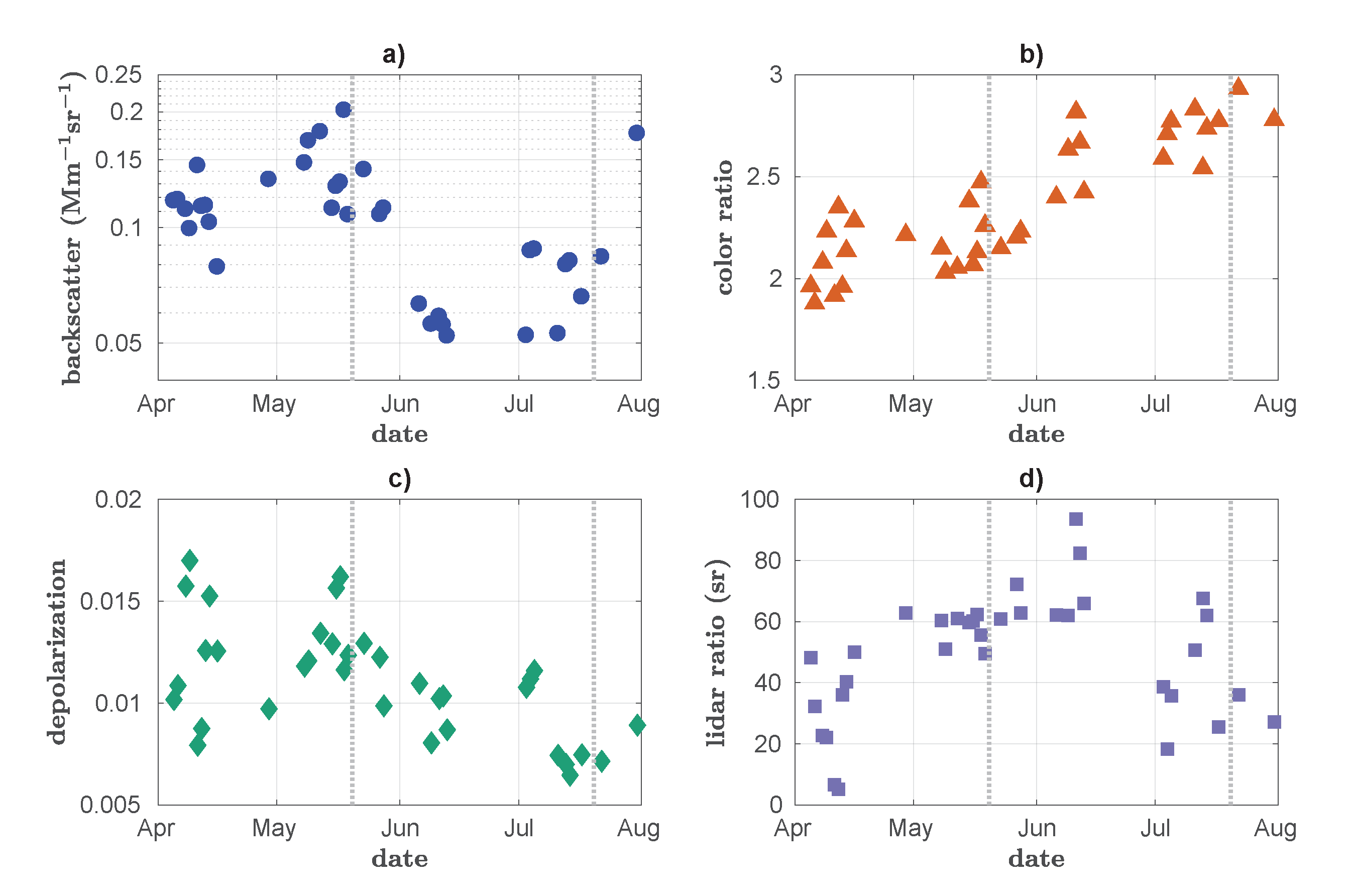
Figure 2.
The daily median of the backscatter is illustrated for four different height intervals: , , and . Overall, backscatter is the highest in the lowest height interval. However, the seasonal development, i.e. the transition from spring to summer, is most pronounced within and .
Figure 2.
The daily median of the backscatter is illustrated for four different height intervals: , , and . Overall, backscatter is the highest in the lowest height interval. However, the seasonal development, i.e. the transition from spring to summer, is most pronounced within and .
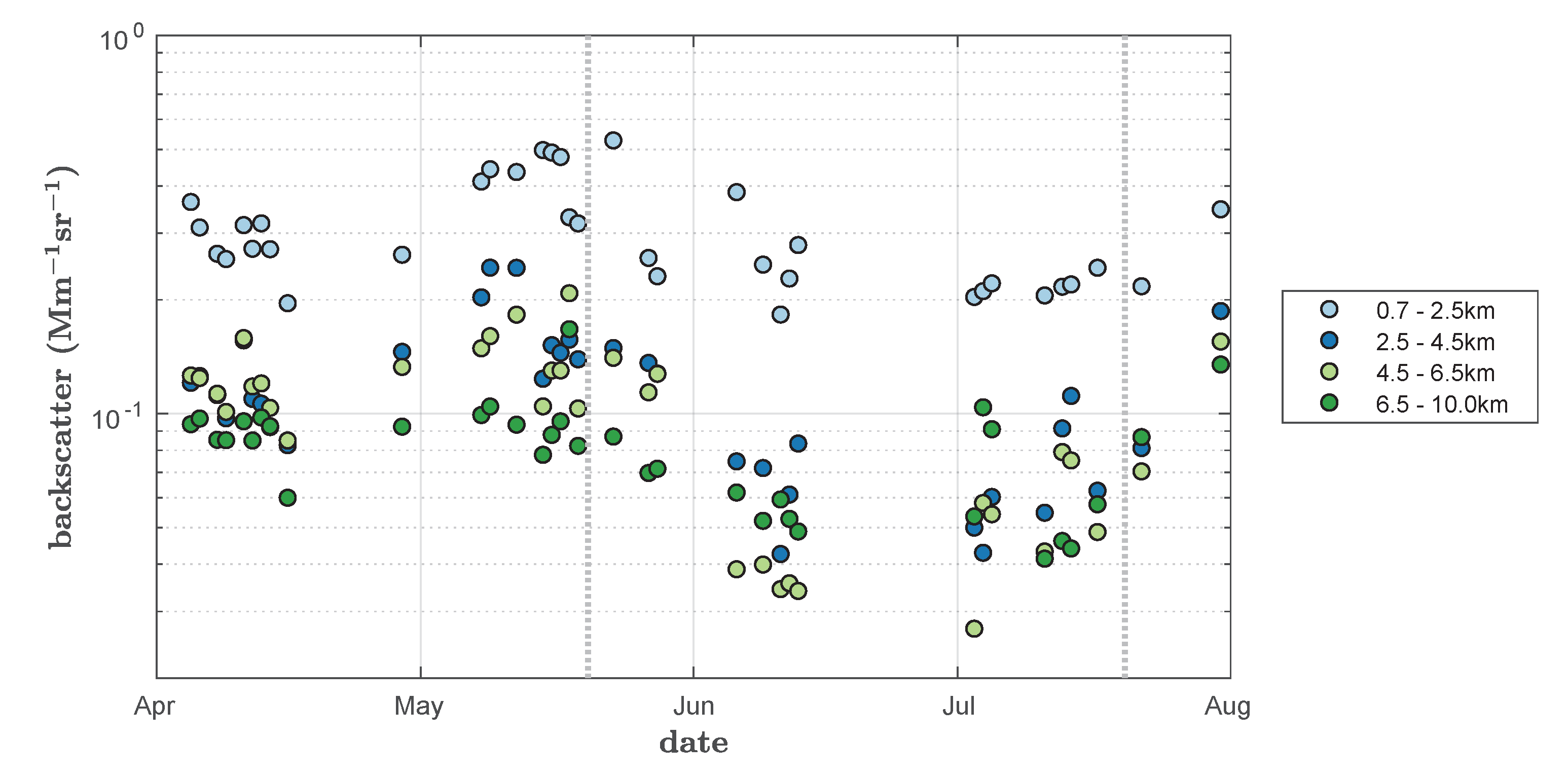
Figure 3.
The daily median of the color ratio is illustrated for four different height intervals: , , and . Color ratio increases in general towards summer. The strongest gradient in time is visible below .
Figure 3.
The daily median of the color ratio is illustrated for four different height intervals: , , and . Color ratio increases in general towards summer. The strongest gradient in time is visible below .
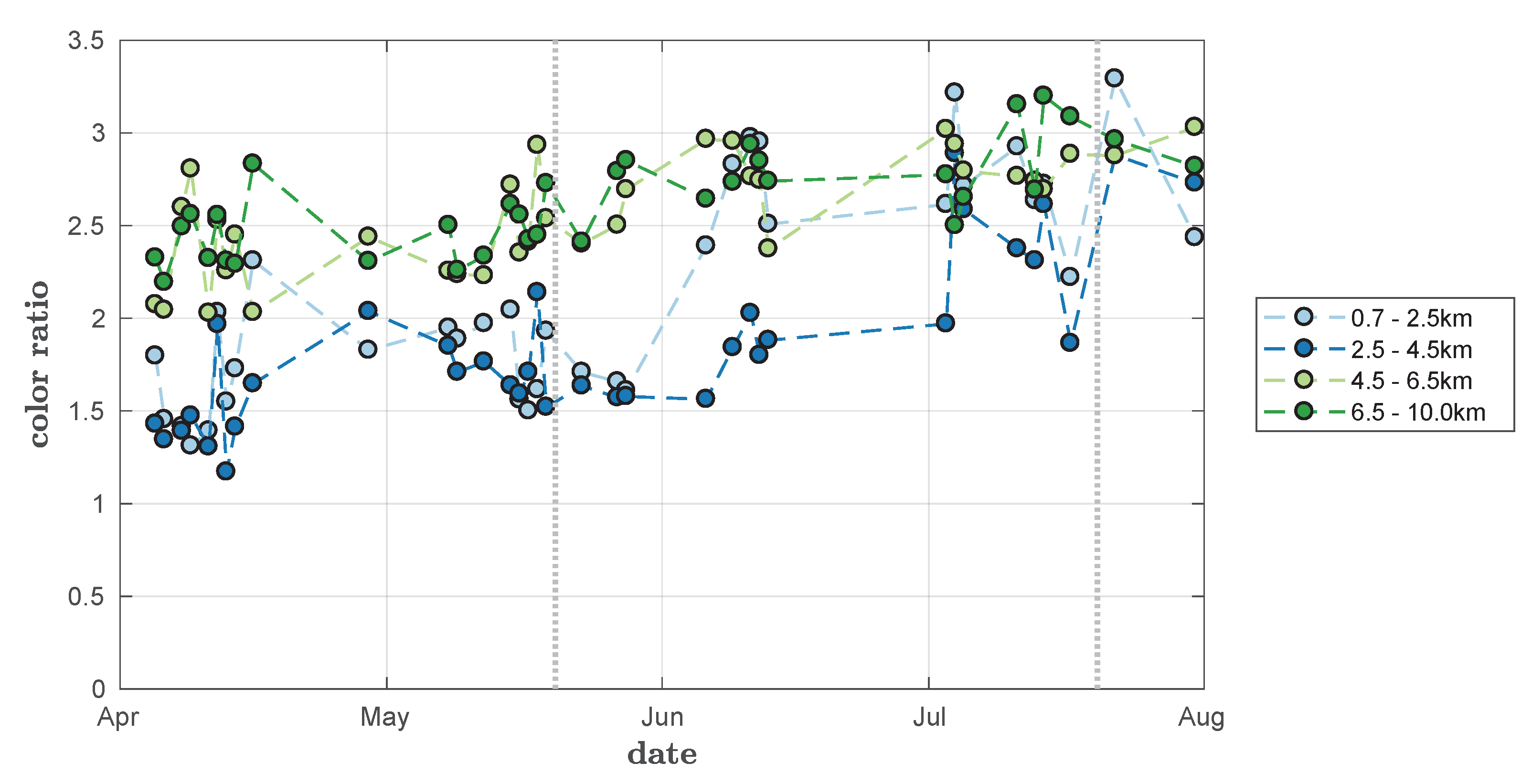
Figure 4.
The backscatter development between April and July 2021 with regard to the relative humidity over water is shown in a). The median backscatter of each percentage of relative humidity is additionally illustrated. In general, the aerosol demonstrates hygroscopic growth between 40% and 67% relative humidity. Beginning at relative humidity, a more irregular behavior dominates. The growth curve is fitted onto the normalized median backscatter between and relative humidity in b). The fitting parameter amounts to with R of 0.43.
Figure 4.
The backscatter development between April and July 2021 with regard to the relative humidity over water is shown in a). The median backscatter of each percentage of relative humidity is additionally illustrated. In general, the aerosol demonstrates hygroscopic growth between 40% and 67% relative humidity. Beginning at relative humidity, a more irregular behavior dominates. The growth curve is fitted onto the normalized median backscatter between and relative humidity in b). The fitting parameter amounts to with R of 0.43.
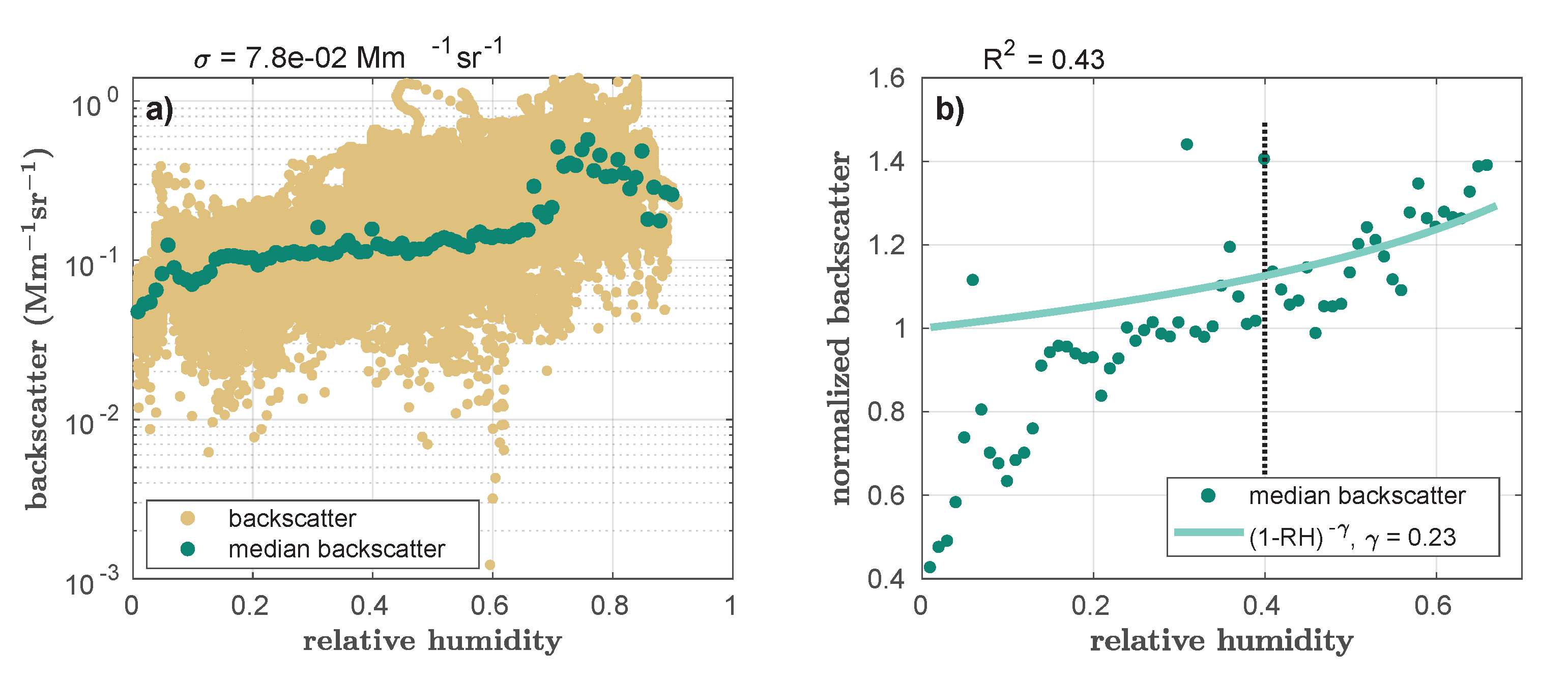
Figure 5.
The backscatter and radiosonde data from April to July 2021 are subdivided according to specified color ratio intervals, and illustrated in scatter plots. Subplot a) corresponds to aerosol of color ratio . In ascending order, the color ratio intervals of the other subplots are [1.25, 1.5), [1.5, 1.75), [1.75, 2.0), [2.0, 2.25), [2.25, 2.5), [2.5, 2.75), [2.75, 3.0), respectively. The median backscatter is calculated for each percentage of relative humidity. Overall, the backscatter still rises with humidity, as expected.
Figure 5.
The backscatter and radiosonde data from April to July 2021 are subdivided according to specified color ratio intervals, and illustrated in scatter plots. Subplot a) corresponds to aerosol of color ratio . In ascending order, the color ratio intervals of the other subplots are [1.25, 1.5), [1.5, 1.75), [1.75, 2.0), [2.0, 2.25), [2.25, 2.5), [2.5, 2.75), [2.75, 3.0), respectively. The median backscatter is calculated for each percentage of relative humidity. Overall, the backscatter still rises with humidity, as expected.
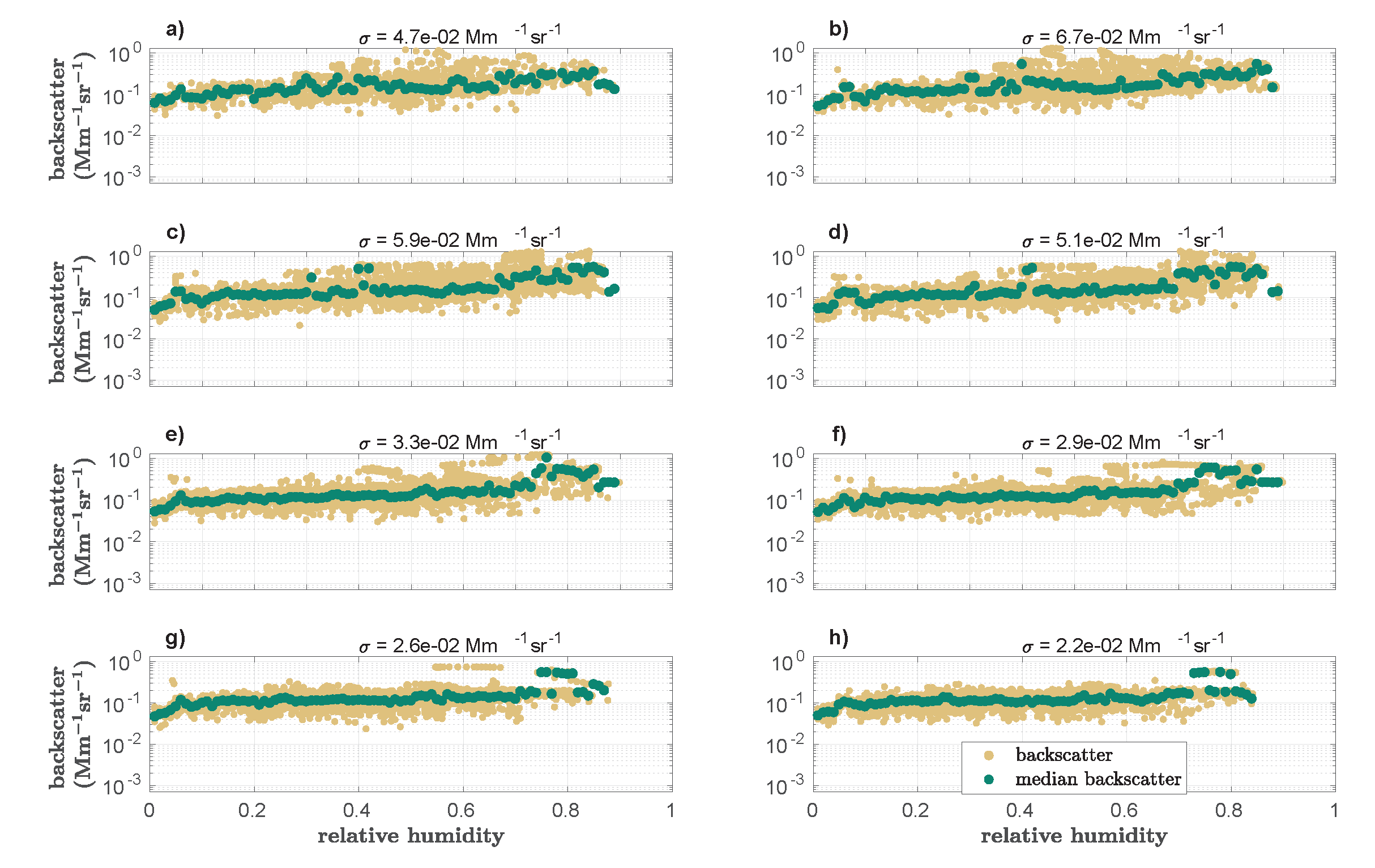
Figure 6.
The median backscatter of the subdivided data set is illustrated in scatter plots a)-h) along with relative humidity. The subdivision is performed according to the fine intervals of color ratio: [1, 1.25), [1.25, 1.5), [1.5, 1.75), [1.75, 2.0), [2.0, 2.25), [2.25, 2.5), [2.5, 2.75), [2.75, 3.0), respectively. The growth curve is calculated for each data set. Hygroscopic growth is the strongest for a color ratio between 1.75 and 2.0.
Figure 6.
The median backscatter of the subdivided data set is illustrated in scatter plots a)-h) along with relative humidity. The subdivision is performed according to the fine intervals of color ratio: [1, 1.25), [1.25, 1.5), [1.5, 1.75), [1.75, 2.0), [2.0, 2.25), [2.25, 2.5), [2.5, 2.75), [2.75, 3.0), respectively. The growth curve is calculated for each data set. Hygroscopic growth is the strongest for a color ratio between 1.75 and 2.0.
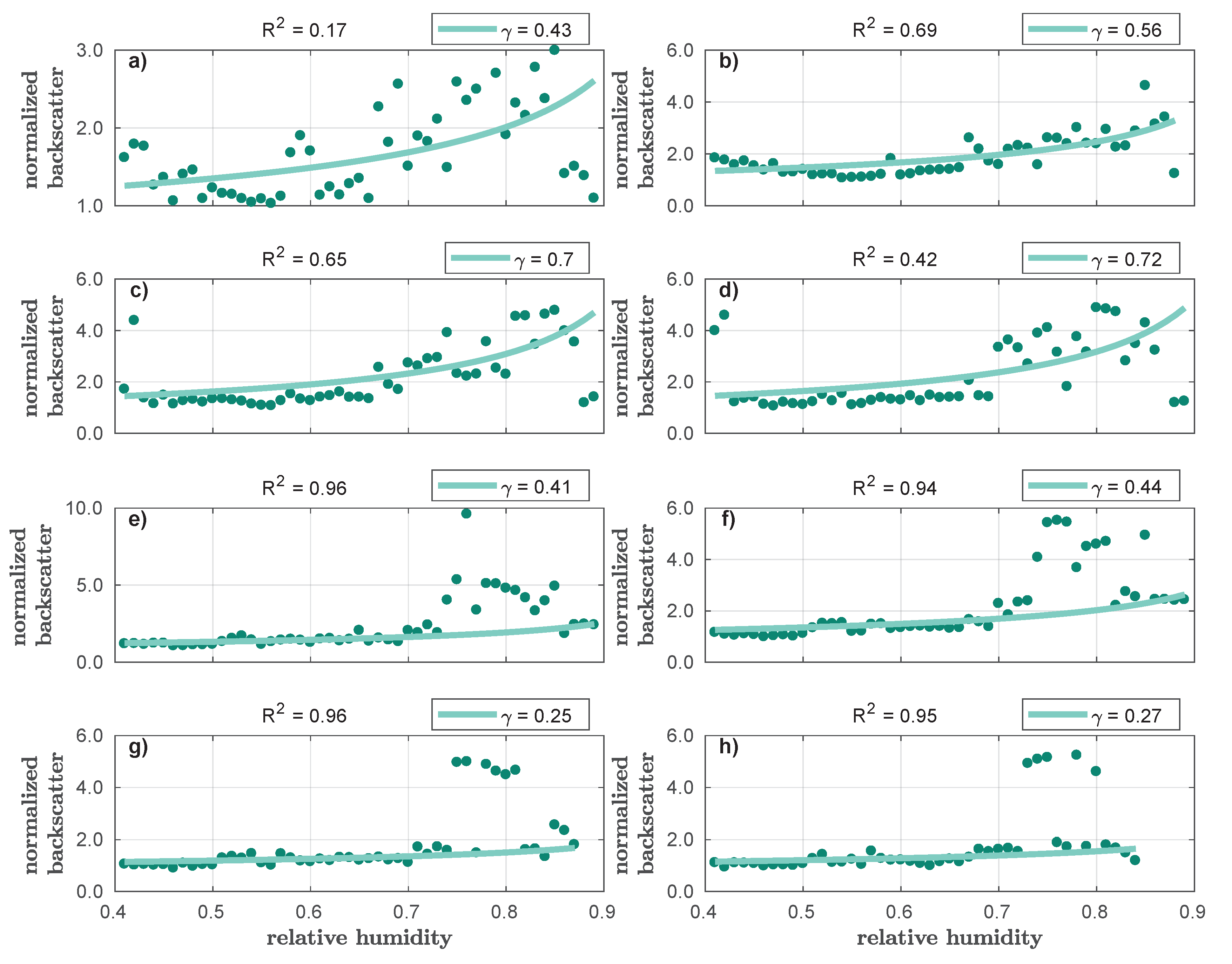
Figure 7.
The lidar and radiosonde data is subdivided into the three seasons Arctic Haze (a), summer (b) and season with forest fire impact (c). This separation is based on Section 3. To visualize an average growth behavior of the season, the median backscatter is calculated for each percentage of relative humidity. Note that backscatter developments of individual time steps may have a great impact on the overall trend.
Figure 7.
The lidar and radiosonde data is subdivided into the three seasons Arctic Haze (a), summer (b) and season with forest fire impact (c). This separation is based on Section 3. To visualize an average growth behavior of the season, the median backscatter is calculated for each percentage of relative humidity. Note that backscatter developments of individual time steps may have a great impact on the overall trend.
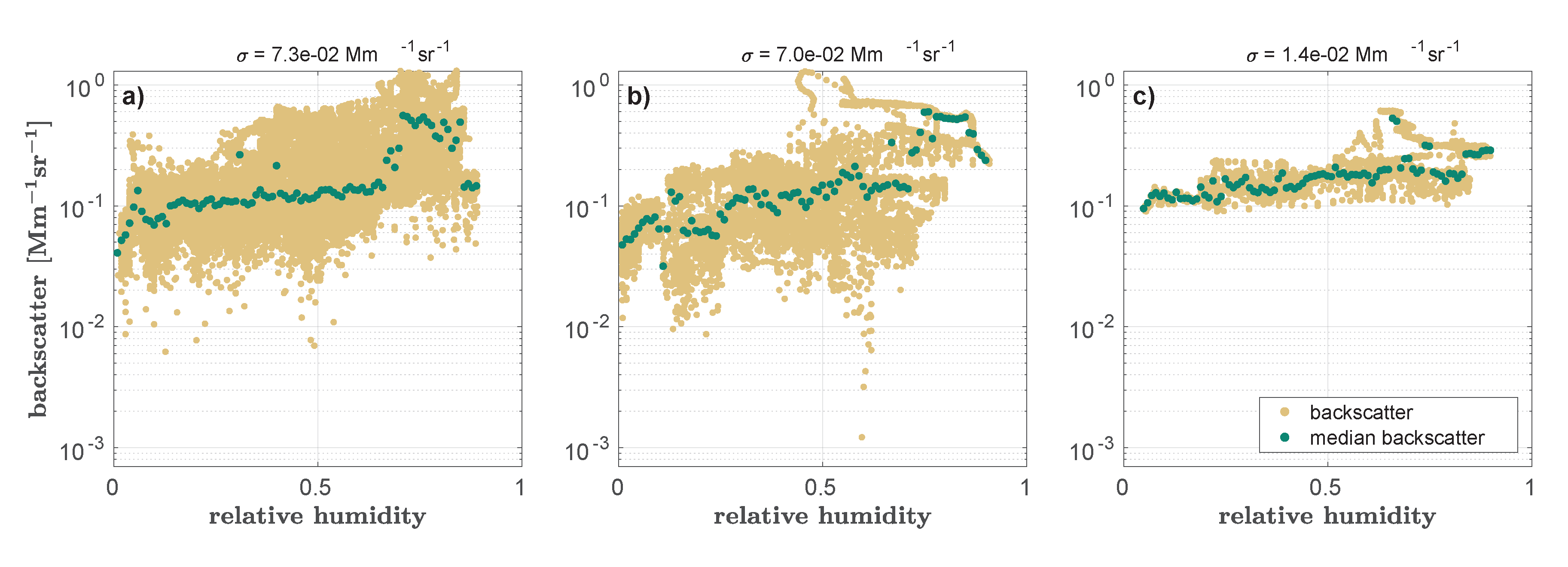
Figure 8.
The growth curve is fitted onto the median backscatter above 40 % relative humidity over water. The data is taken from the seasonally classified data set. It is subdivided into: Arctic Haze (a), summer (b) and the season with forest fire impacts (c). A mode of higher and one of lower hygroscopicity are visible during Haze and summer. The high modes almost coincide, whereas the lower mode of the summer season is still stronger than during Haze and the forest fire impacted season.
Figure 8.
The growth curve is fitted onto the median backscatter above 40 % relative humidity over water. The data is taken from the seasonally classified data set. It is subdivided into: Arctic Haze (a), summer (b) and the season with forest fire impacts (c). A mode of higher and one of lower hygroscopicity are visible during Haze and summer. The high modes almost coincide, whereas the lower mode of the summer season is still stronger than during Haze and the forest fire impacted season.
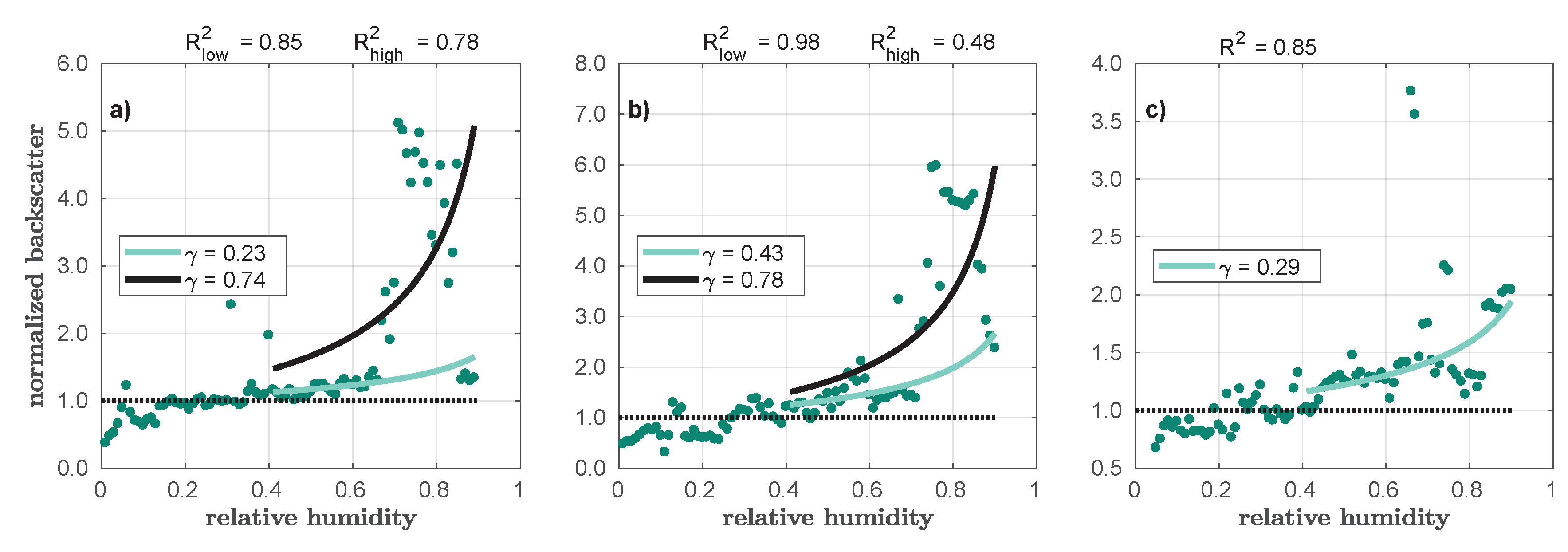
Figure 9.
The seasonal development of the relative humidity is illustrated in (a). The median is built between and . Dotted lines indicate the three seasons - Haze, summer season and forest fire impacted season. Figure (b) shows the vertical distribution of data points from the whole season between and that provide a relative humidity smaller than 40%. On average, relative humidity decreases with altitude.
Figure 9.
The seasonal development of the relative humidity is illustrated in (a). The median is built between and . Dotted lines indicate the three seasons - Haze, summer season and forest fire impacted season. Figure (b) shows the vertical distribution of data points from the whole season between and that provide a relative humidity smaller than 40%. On average, relative humidity decreases with altitude.
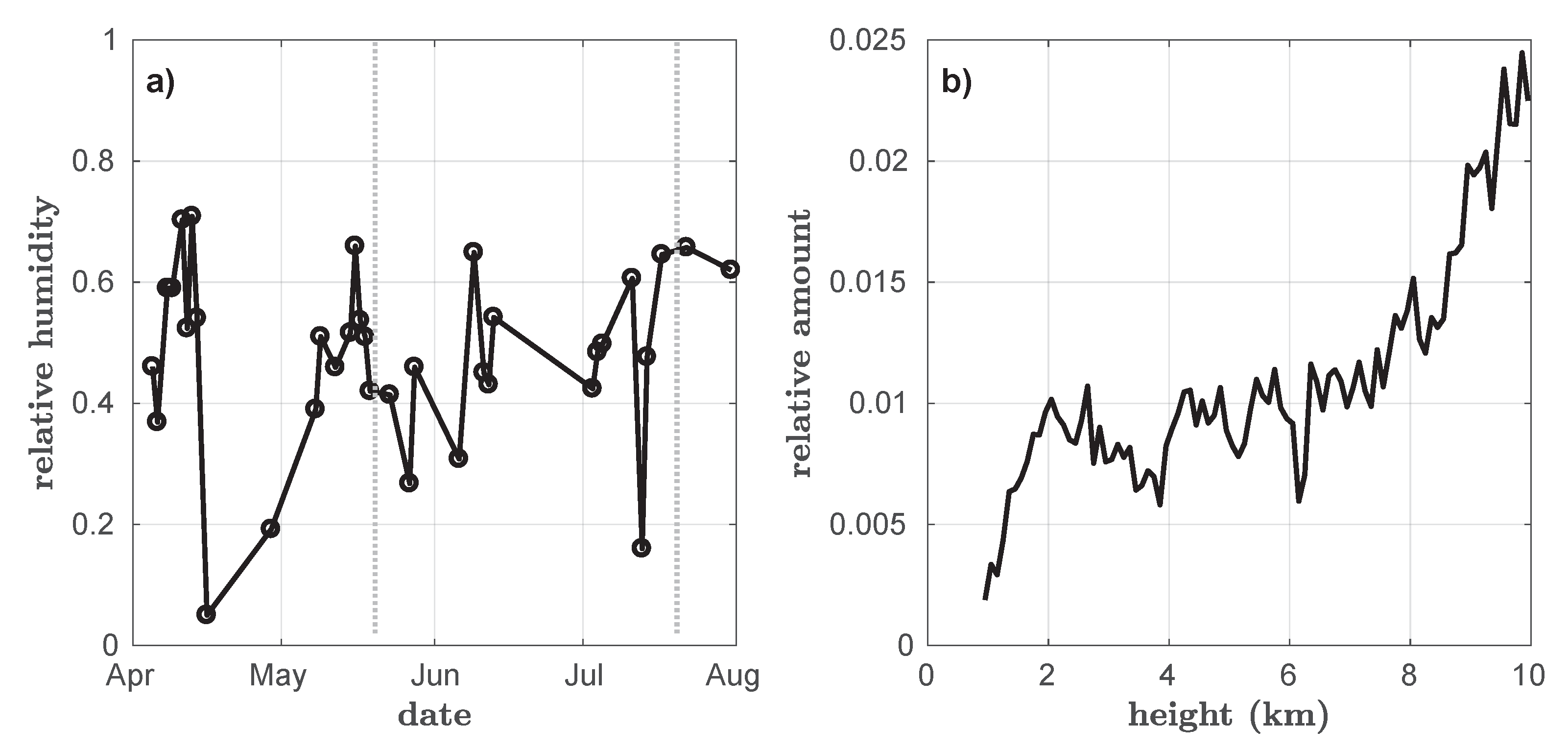
Figure 10.
The vertical distribution of the color ratio (a) and of relative humidity (b) over the troposphere are shown. Values between and , as well as the smallest color ratio values occur most often between and . Note, as no direct comparison of radiosonde and lidar data is performed here, not only simultaneous data is illustrated which enhances the data basis.
Figure 10.
The vertical distribution of the color ratio (a) and of relative humidity (b) over the troposphere are shown. Values between and , as well as the smallest color ratio values occur most often between and . Note, as no direct comparison of radiosonde and lidar data is performed here, not only simultaneous data is illustrated which enhances the data basis.
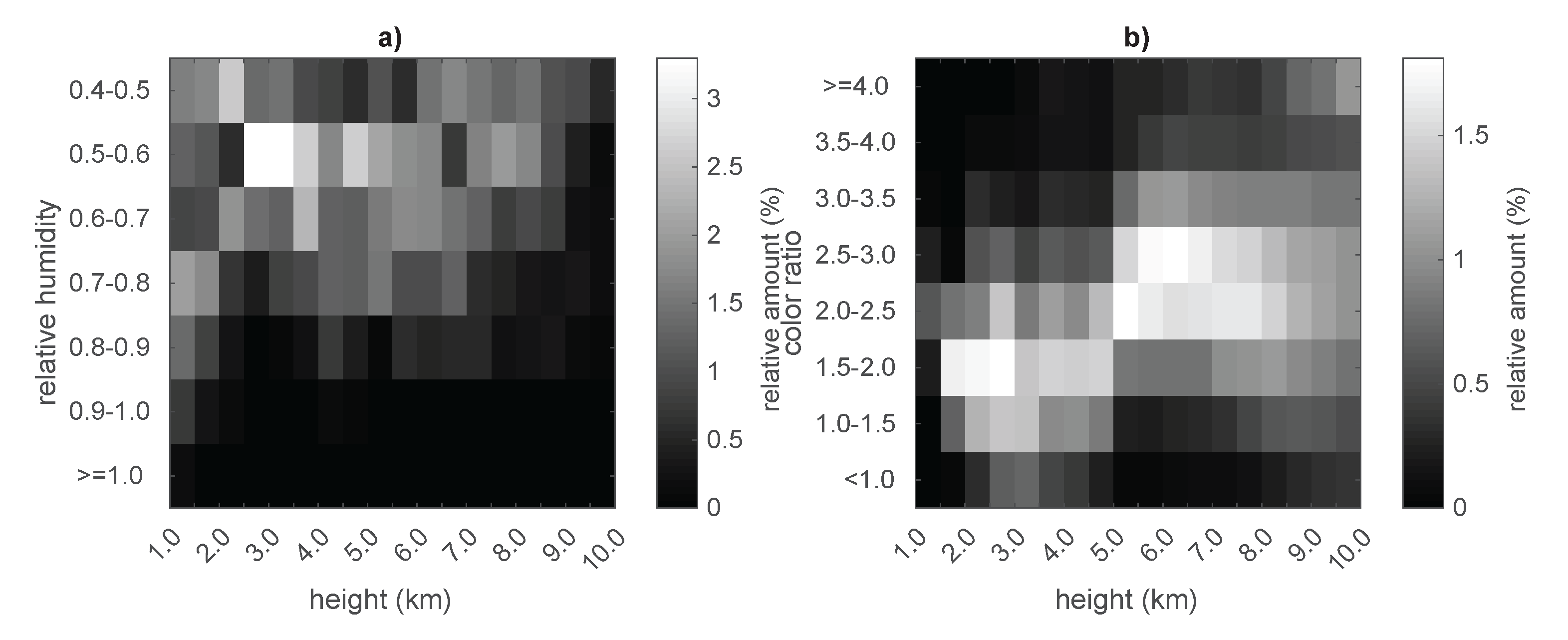
Figure 11.
The data set is subdivided by altitude. The backscatter and median backscatter between (a), (b), (c) and (d) are illustrated.
Figure 11.
The data set is subdivided by altitude. The backscatter and median backscatter between (a), (b), (c) and (d) are illustrated.
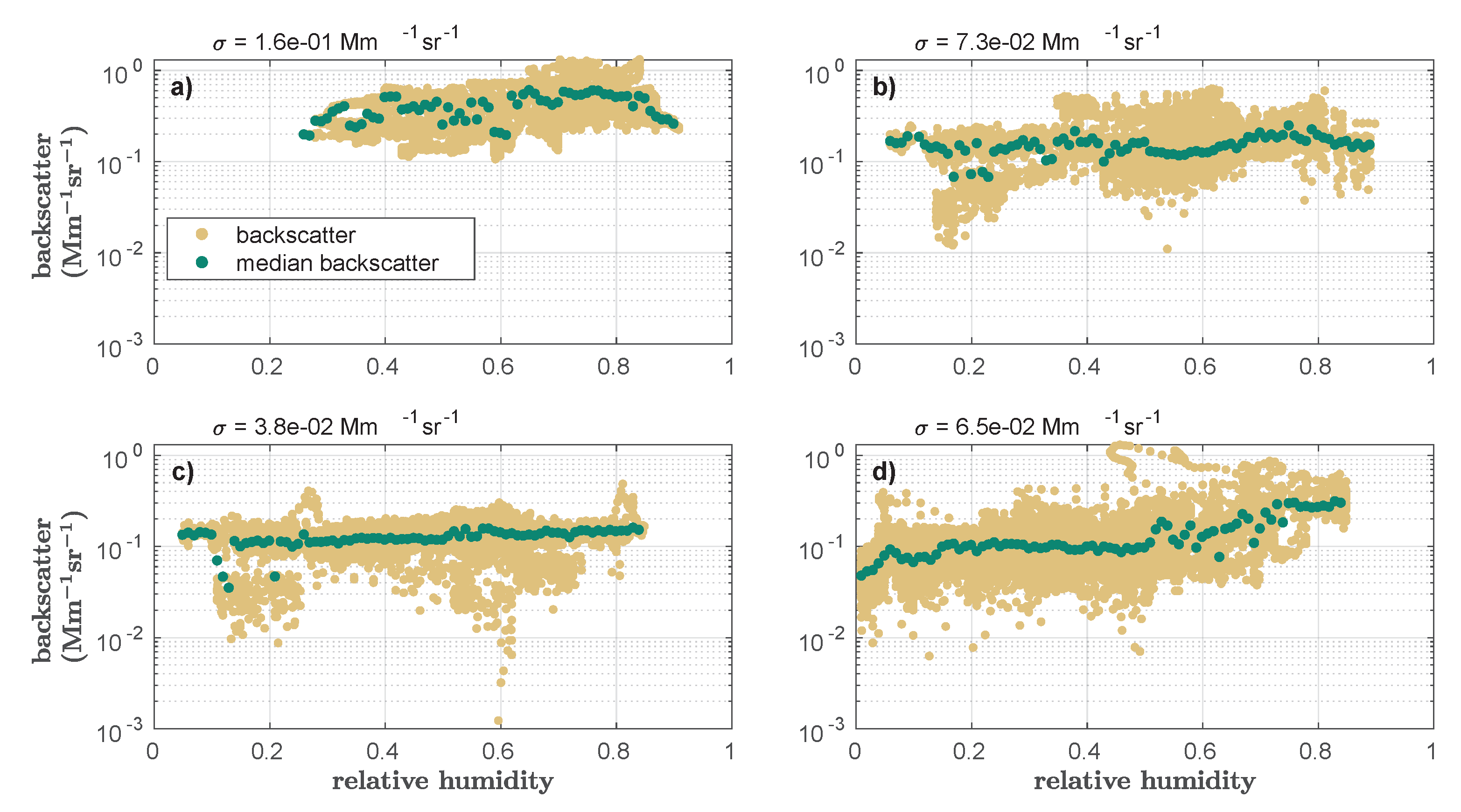
Figure 12.
The growth curve is fitted onto the data of the different height intervals (a), (b), (c) and (d). Except for the uppermost height interval, no clear growth trend is observed. Especially within random trends seem to dominate.
Figure 12.
The growth curve is fitted onto the data of the different height intervals (a), (b), (c) and (d). Except for the uppermost height interval, no clear growth trend is observed. Especially within random trends seem to dominate.
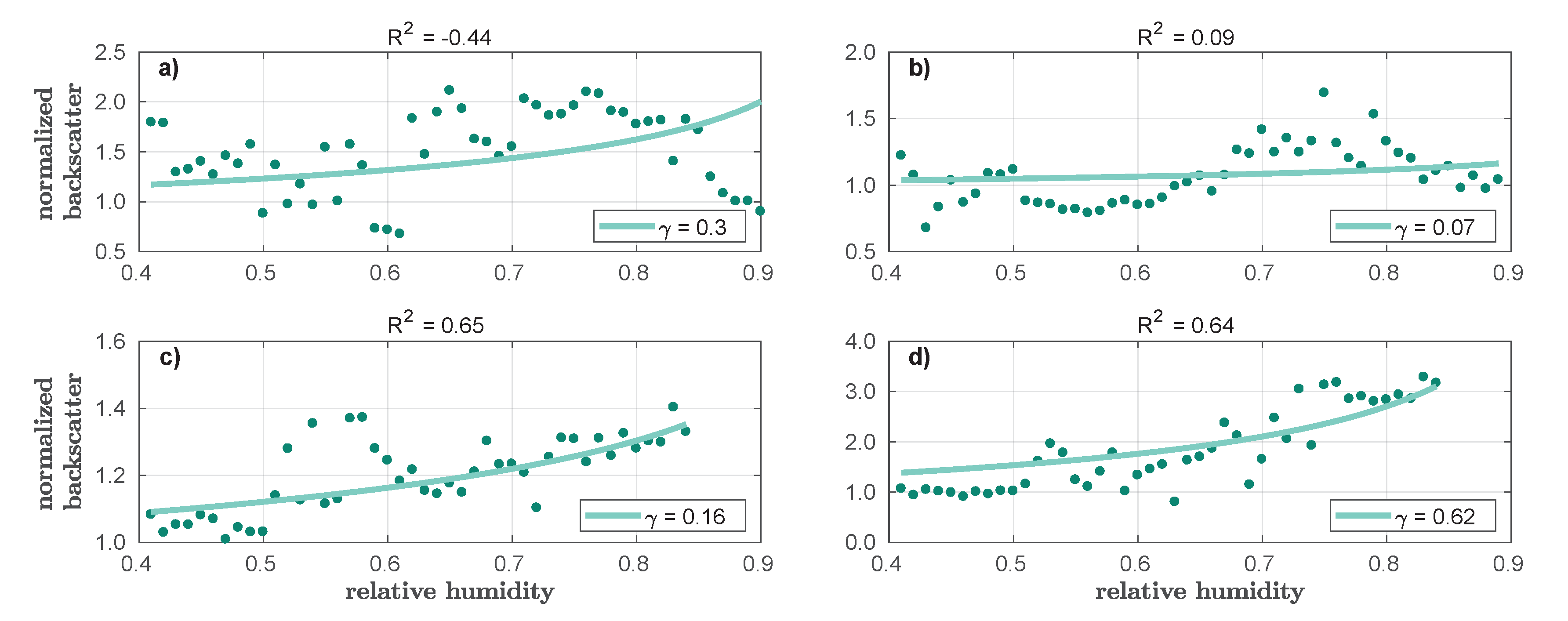
Figure 13.
The development of color ratio, depolarization and lidar ratio with relative humidity on the 23rd of May between and is illustrated. and develop contrarily. While the lidar ratio at is constantly low, it has a maximum at relative humidity for .
Figure 13.
The development of color ratio, depolarization and lidar ratio with relative humidity on the 23rd of May between and is illustrated. and develop contrarily. While the lidar ratio at is constantly low, it has a maximum at relative humidity for .
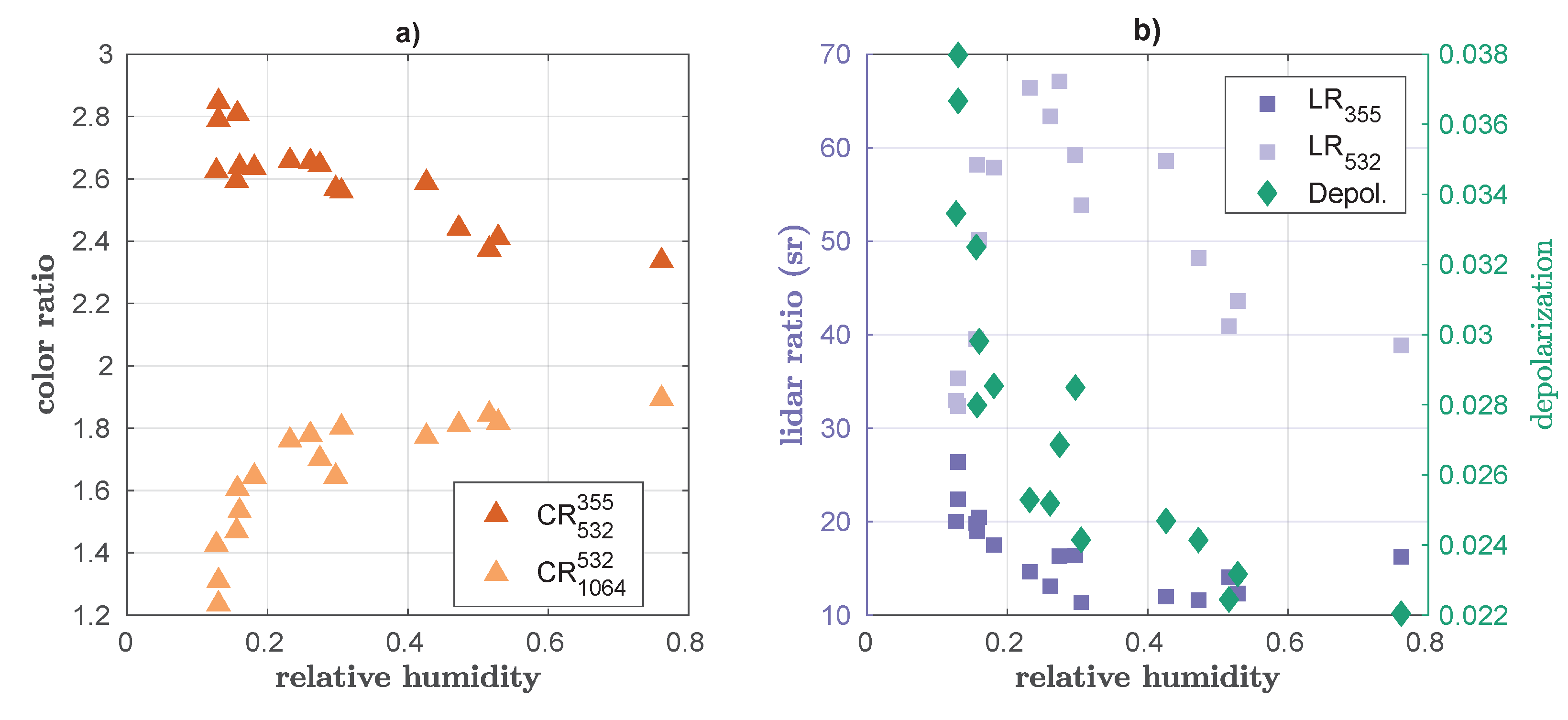
Figure 14.
The backscatter profiles at 10:52:31 and the relative humidity profiles at 11:00:00 between (a), (b) and (c) on the 29th of April are illustrated. These cases demonstrate difficulties when analyzing hygroscopic growth with combined radiosonde and lidar data.
Figure 14.
The backscatter profiles at 10:52:31 and the relative humidity profiles at 11:00:00 between (a), (b) and (c) on the 29th of April are illustrated. These cases demonstrate difficulties when analyzing hygroscopic growth with combined radiosonde and lidar data.
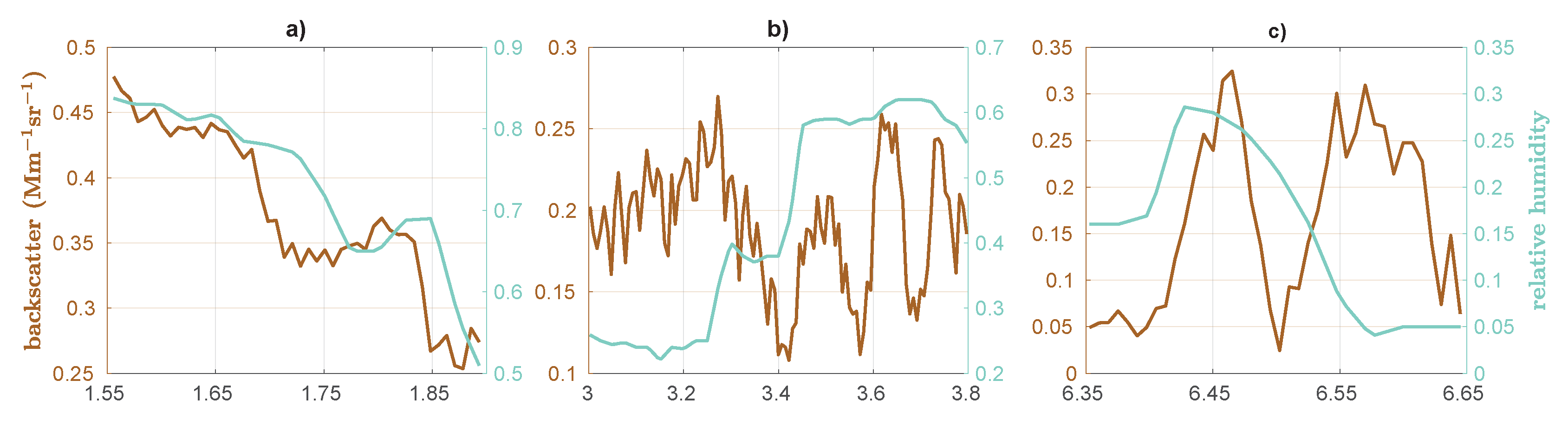
Figure 15.
The color ratio development of and with regard to relative humidity is displayed between (a) and (b). No hygroscopic growth is visible.
Figure 15.
The color ratio development of and with regard to relative humidity is displayed between (a) and (b). No hygroscopic growth is visible.
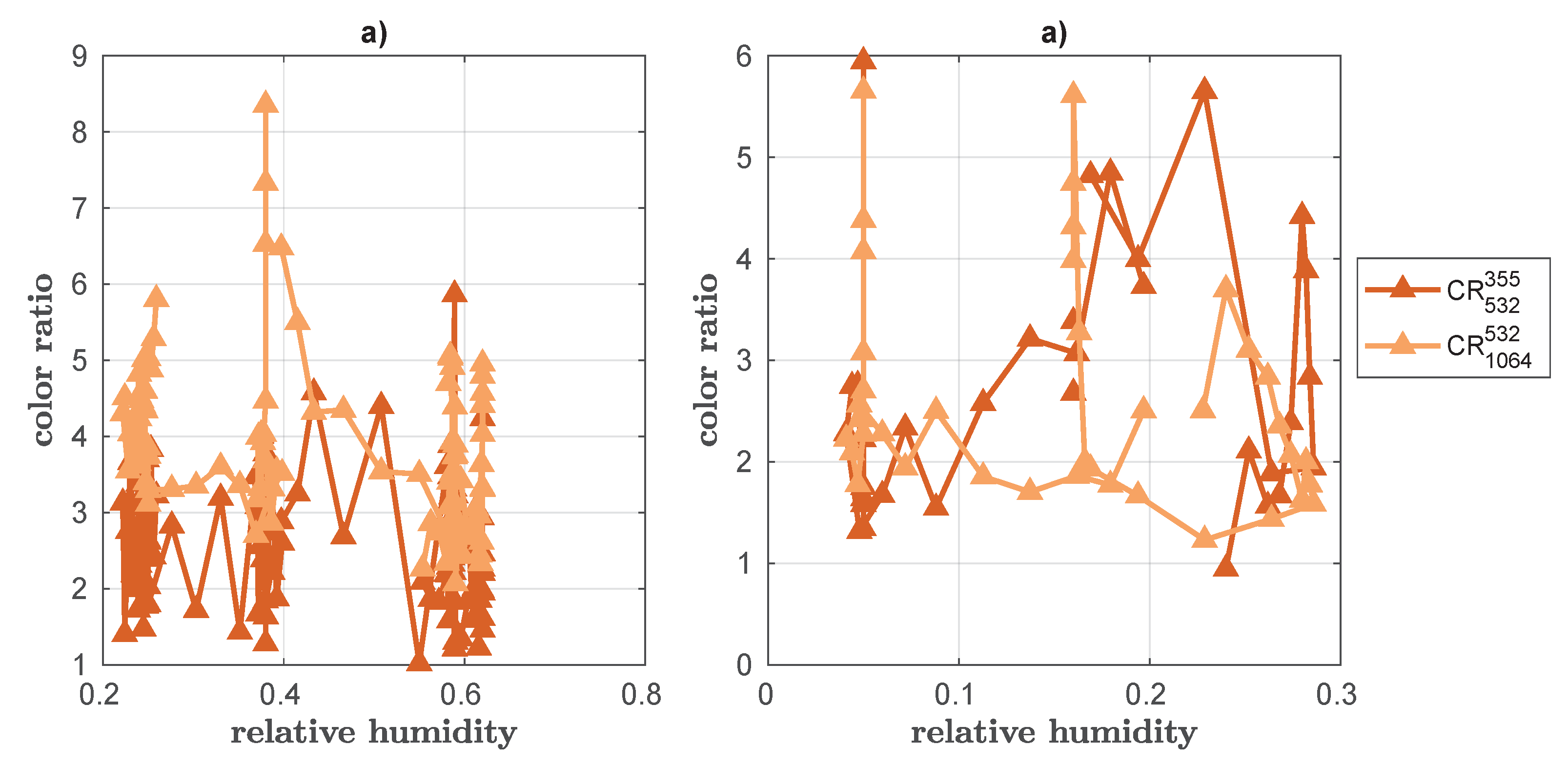
Figure 16.
The profiles of color ratio and relative humidity for the lowest layer, , are illustrated (a). No strict correlation is seen. In addition, the development of and with relative humidity is shown (b). In particular, stays almost constant.
Figure 16.
The profiles of color ratio and relative humidity for the lowest layer, , are illustrated (a). No strict correlation is seen. In addition, the development of and with relative humidity is shown (b). In particular, stays almost constant.
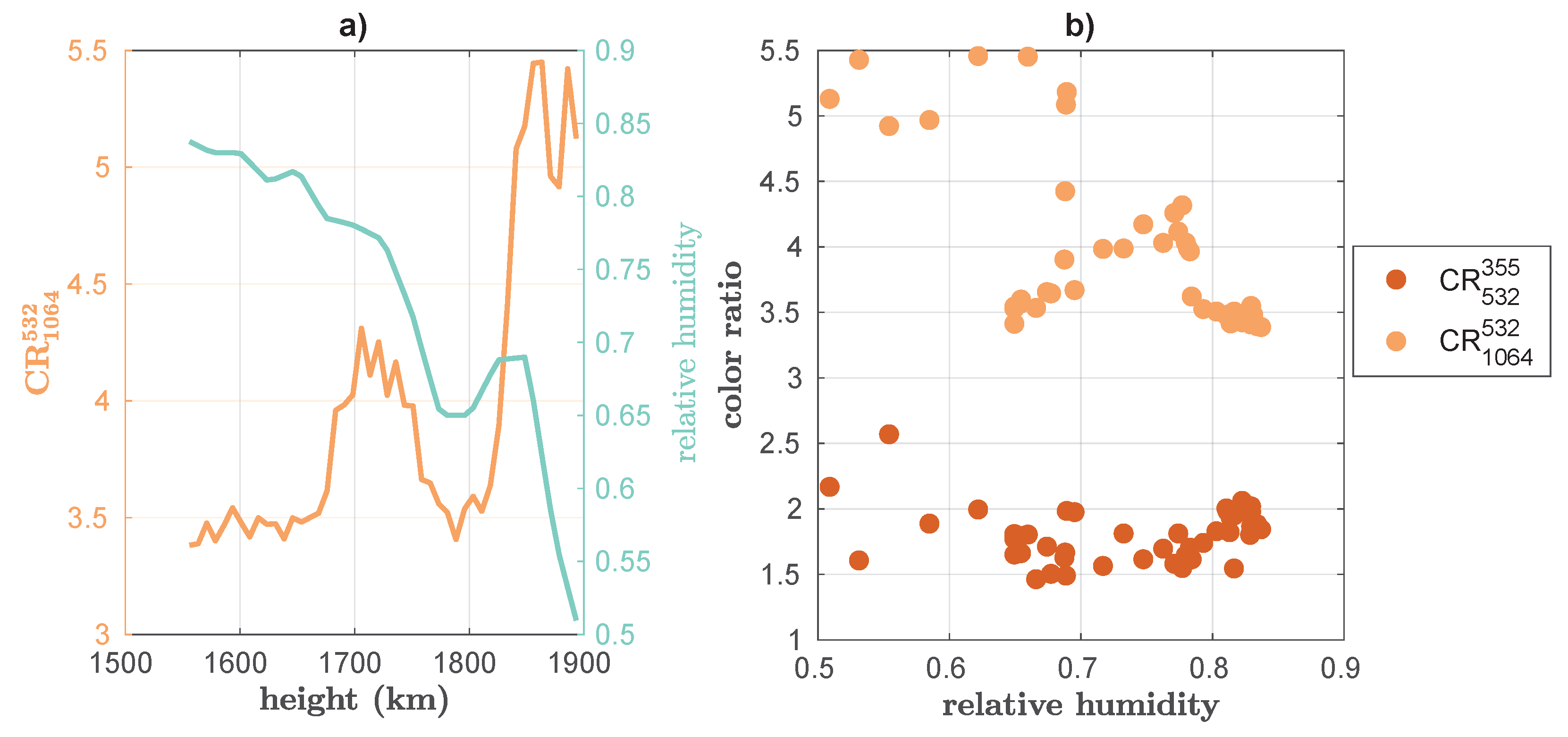
Figure 17.
Dependence of the color ratios on the effective radius of aerosol according to Mie theory for a log-normal distribution of geometric standard deviation () of 1.1 and a complex index of refraction of .
Figure 17.
Dependence of the color ratios on the effective radius of aerosol according to Mie theory for a log-normal distribution of geometric standard deviation () of 1.1 and a complex index of refraction of .
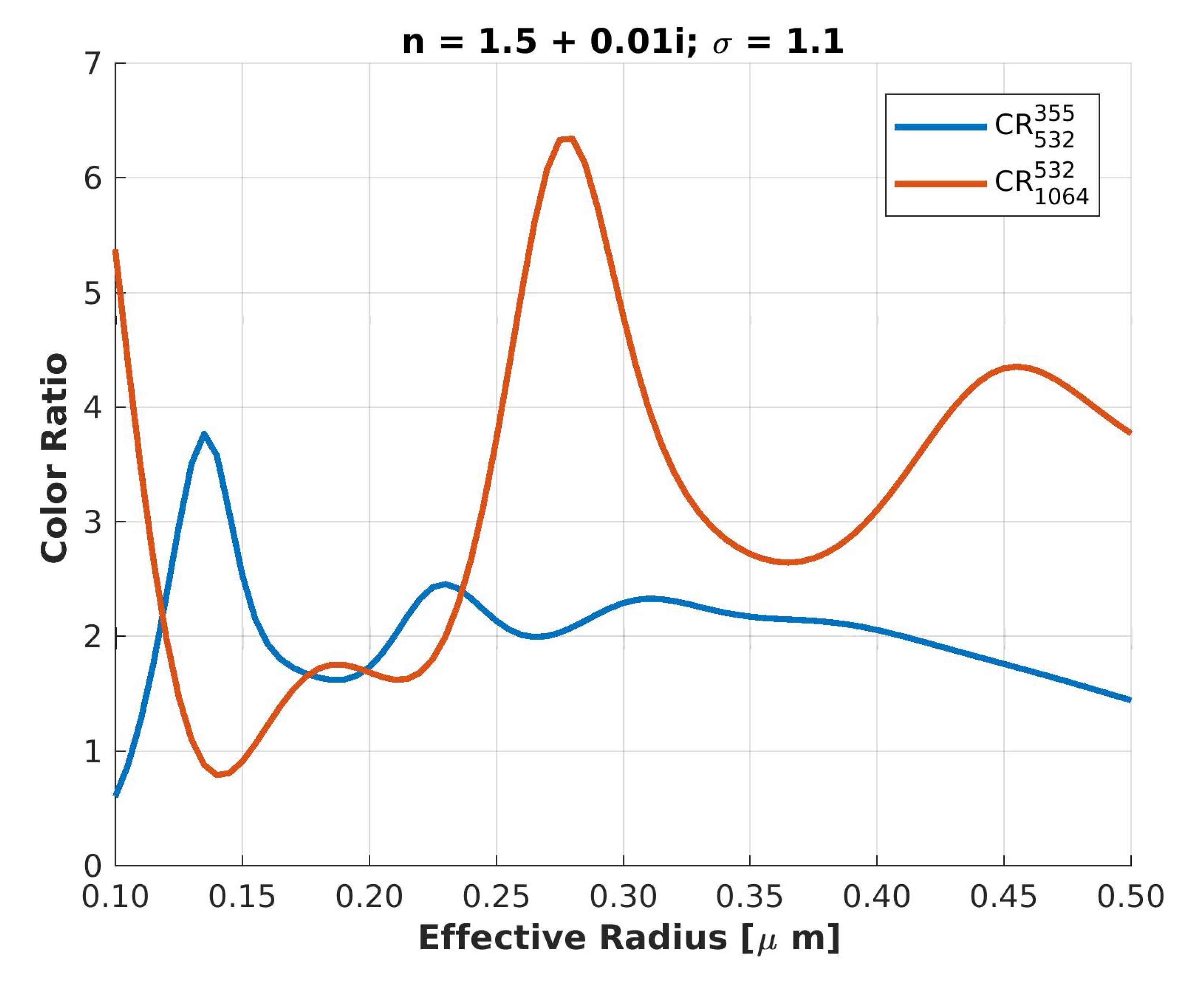
Figure 18.
Dependence of the aerosol backscatter at the three colors of , and as function of the effective radius of aerosol according to Mie theory for a log-normal distribution of geometric standard deviation () of 1.1 and a complex index of refraction of . The values on the y-axis are in arbitrary units as the concentration of aerosol is different from case to case.
Figure 18.
Dependence of the aerosol backscatter at the three colors of , and as function of the effective radius of aerosol according to Mie theory for a log-normal distribution of geometric standard deviation () of 1.1 and a complex index of refraction of . The values on the y-axis are in arbitrary units as the concentration of aerosol is different from case to case.
Disclaimer/Publisher’s Note: The statements, opinions and data contained in all publications are solely those of the individual author(s) and contributor(s) and not of MDPI and/or the editor(s). MDPI and/or the editor(s) disclaim responsibility for any injury to people or property resulting from any ideas, methods, instructions or products referred to in the content. |
© 2024 by the authors. Licensee MDPI, Basel, Switzerland. This article is an open access article distributed under the terms and conditions of the Creative Commons Attribution (CC BY) license (http://creativecommons.org/licenses/by/4.0/).
Copyright: This open access article is published under a Creative Commons CC BY 4.0 license, which permit the free download, distribution, and reuse, provided that the author and preprint are cited in any reuse.


