

Submitted:
23 July 2024
Posted:
24 July 2024
You are already at the latest version
Abstract
This article investigates and studies the current situation of implementing the credit system in ordinary high schools in Zhejiang Province, and puts forward relevant suggestions. Firstly, analyze the background and objectives of implementing the credit system in ordinary high schools in Zhejiang Province. Then, through a questionnaire survey method, a sample survey was conducted on the current status of the implementation of the credit system in ordinary high schools in Zhejiang Province. The results showed that there are some problems in the management of the credit system in schools, such as unreasonable credit course settings, inaccurate recording and statistics of credits, etc. Further analysis reveals that students and parents have biases and utilitarian motives in their understanding and evaluation of the credit system.
Keywords:
High School
; Credit system
; Credit acquisition
1. Introduction
1.1. Background
The credit system is an evaluation system based on students’ learning outcomes and study time, which provides students with more personalized and flexible learning paths by converting learning outcomes into credits.The implementation of the credit system for ordinary high schools in Zhejiang Province can be traced back to 2012. Since then, the credit system has gradually been promoted and implemented in ordinary high schools in Zhejiang Province, becoming an important indicator and management method for students’ academic development. The implementation of the credit system in ordinary high schools in Zhejiang Province is an important measure of education reform, aimed at improving the quality of education and cultivating students’ comprehensive development and innovation abilities. With the rapid development of society and the change of educational concepts, the implementation of the credit system in ordinary high schools in Zhejiang Province has achieved certain results, but it also faces some challenges and problems.
In the actual implementation of the credit system, firstly, due to the fact that the credit system was still in the transitional stage after trial, teachers and students had different levels of understanding and comprehension of the credit system, which led to some misunderstandings and maladjustment. Secondly, in the implementation of the credit system, there are some inconsistent evaluation systems and standards, and there are differences in credit evaluation among different schools and disciplines, which may affect the fairness of students. In addition, there are still some management system and teacher team construction issues in the implementation process of the credit system.
1.2. Questionnaire Survey
This study adopted a questionnaire survey as the main data collection method to understand the current situation of the implementation of the credit system in ordinary high schools in Zhejiang Province. In order to ensure the effectiveness and reliability of the survey, it was clarified that the purpose of this study and its investigation is to understand the current situation of the implementation of the credit system in ordinary high schools in Zhejiang Province, including the implementation of the credit system, the significance of credit system reform, and the course selection system that is a twin of the credit system. In order to improve the effectiveness of the survey questionnaire, this study selected some students and teachers from a regular high school in Zhejiang Province as the survey subjects. The selection of samples was carried out using random sampling and screening methods.
The designed questionnaire content is shown in the following table:

Table 1.
Survey Questionnaire [2] Understanding and Relevant Situation of the Credit System in High School Stage.
Table 1.
Survey Questionnaire [2] Understanding and Relevant Situation of the Credit System in High School Stage.
| Dimension | Problem | Option |
|---|---|---|
| Overall evaluation |
T1:Are you aware that your high school has implemented a credit system | A.I have carefully studied it B.I have a little understanding of it C.I have no understanding at all |
| T2:Do you hope that your high school can truly implement a credit system and course selection related system | A.I hope to learn more additional content B.It doesn’t matter C.I don’t hope that, because I don’t have time to deal with these additional contents |
|
| Implementation effectiveness | T3:Do you think the credit system in your high school is effective | A.Effective B.Ineffective |
| T4:What kind of extension courses did your own high school offer you when implementing the credit system effectively | A.Final exam B.Daily classes C.After-class learning D.Other:______________ |
|
| T5:What are the specific manifestations of the ineffective credit system implemented in your own high school | A.Time conflict B.The different grading standards given by teachers result in a significant disparity in grades C.The school’s curriculum cannot meet the needs of students. D.Unable to choose the teacher I like E.Limited communication between classes and a lack of collective consciousness. F.Other:______________ |
|
| Management mechanism | T6:Which of the following modules have you experienced insufficient credits in | A.Various themed education that must be organized and carried out by ordinary high schools according to relevant national departments and the Ministry of Education regulations B.Compulsory expansion courses, university junior courses, cutting-edge courses in disciplinary development, and research-based learning in disciplines C.Life skills, vocational skills, local economy technology D.Sports, art, health education, leisure life, knowledge application E.Investigation and exploration activities, social practice activities,Sports and campus cultural activities |
| T7:What measures will your own high school take when your credits are insufficient to meet the graduation requirements | A.Let you complete the relevant project on your own without providing assistance B.Allow you to complete the relevant project on your own, but provide some assistance C.Directly give you the credits you lack, you need to do nothing D.Directly give you the credits you lack, you just need to symbolically do a little |
|
| Course selection system | T8:Does your course selection reflect your intention | A.Yes,it reflects all my intention B.Yes,it reflects my intention partly C.No,it doesn’t reflect |
| T9:Can the elective courses currently offered by your school meet your needs | A.Can meet B.Can meet basically C.Cannot meet |
|
| T10:What problems have you encountered in course selection | A.The number of available courses is limited, and classes are often not available B.The course selection system often has problems C.Lack of course introduction, blind course selection D. Insufficient time slots for course selection E.Conflict with required course schedule F.Other: |
|
| T11:Do you have any suggestions for the setting of elective courses in the school | A.Build existing courses well B. Increase the number of optional course C.Control the number of students in class and improve the quality of classes. D. Offer more professional skills and elective courses E.Organize more extracurricular lectures. F. Other: |
|
| T12:What motivates you to choose a certain course after the credit system reform | A.Professional development direction B. Personal interests and hobbies C.The personal charm of the teaching staff D. Being able to easily obtain credits E. Reserve knowledge for employment needs F. Working with classmates and following the crowd G.Other: |
1.3. Data Analysis
Data analysis is an important part of this study, with the aim of conducting in-depth statistics and analysis on the collected sample data to understand the current situation and existing problems of the credit system implementation in ordinary high schools in Zhejiang Province, and to provide a scientific basis for improving the implementation of the credit system in Zhejiang Province.
1.3.1. Questionnaire Analysis
In this data processing, thecollected valid data will be input into SPSS27.0 statistical software for statistical and analytical processing. Among the valid participants in this questionnaire survey, the frequency of high school graduates is 22, accounting for 88.0% of the total; The frequency of high school students is 3, accounting for 12.0% of the total;
The dimensionsof the question items are pre divided into: overall evaluation (T1, T2), implementation effectiveness (T3~T5), and management mechanism (T6,T7) and course selection system (T8~T12)
Table 2.
Basic Information of Effective Participants.
| Questionnaire items | Option | Size | Percentage(%) |
| Identity | High school graduates | 22 | 88.0 |
| high-school student | 3 | 12.0 | |
| Total | 25 | 100.0 | |
The main body of the questionnaire includes four dimensions: overall evaluation, implementation effectiveness, management mechanism, and course selection system degree,a total of 40 questions. The following table shows the results of Cronbach’s alpha coefficient measurements for the four dimensions of the 36 valid items in this questionnaire. The coefficient result is used to measure the reliability quality level of the questionnaire data in this survey.
Table 3.
Dimensionality reliability analysis: Cronbach’s α coefficient table (after removing invalid items).
Table 3.
Dimensionality reliability analysis: Cronbach’s α coefficient table (after removing invalid items).
| Dimension | Cronbach’s α coefficient | Standardized Cronbach’s α coefficient |
Number of items |
Sample size |
| Overall evaluation | 0.581 | 0.589 | 2 | 25 |
| Effectiveness of Implementation | 0.977 | 0.992 | 7 | 25 |
| Management mechanism | 0.976 | 0.988 | 6 | 25 |
| Course selection system | 0.998 | 0.999 | 21 | 25 |
According to the reliability analysis of the dimensions, it can be seen that the reliability of the survey results in each dimension of the questionnaire is very high and acceptable.
Next, six evaluation items (T1,T2,T3, T7, T8, T9) will be selected from the questionnaire for validity analysis:
Table 4.
KMO test and Bartlett test of All Evaluation items.
| KMO test and Bartlett test | ||
| KMO value | 0.842 | |
| Bartlett Sphericity test | Approximate χ2 | 215.91 |
| df | 15 | |
| P | 0.000*** | |
| Note:***,* *,* represent significance levels of 1%, 5%, and 10%, respectively | ||
After studying the KMO test results, it was found that the value reached 0.842,which is greater than the standard line of 0.6. Through Bartlett’s Sphericity test, a clear conclusion was drawn that the significance p-value is only 0.000 * *<0.05, indicating that there is a correlation between various factors. Therefore, the null hypothesis can be accepted to be denied, that is, these factors all have relevant characteristics and their relationships are effective, and this effect has reached an appropriate level. This proves that the design of the evaluation items in the questionnaire developed and adopted this time is reasonable and the dimension division is appropriate.
1.3.2. Sample Analysis
Using Spearman correlation coefficient for statistics, correlation analysis was conducted on six evaluation indicators. The following are the research results:
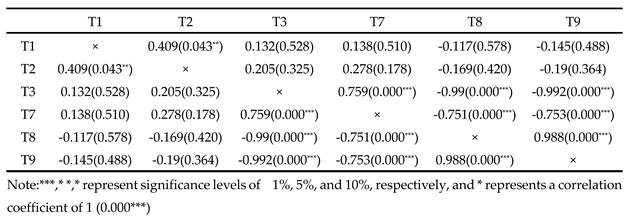
Based on this, it can be concluded that:
(a) There is a close positive correlation between students’ understanding of the credit system implemented in a regular high school and their expectations for truly implementing the credit system and course selection related systems. The higher the students’ understanding of the credit system implemented in an ordinary high school, the more they hope to further improve and implement the credit system and course selection related systems;
(b) The effectiveness of implementing a credit system in a regular high school is closely related to the measures it takes when students have insufficient credits to meet graduation requirements. The higher the effectiveness of implementing the credit system in an ordinary high school, the more likely the school is to directly give the insufficient credits to a student when they meet graduation requirements;
(c) The effectiveness of implementing a credit system in a regular high school is closely negatively correlated with the degree of self willingness reflected in students’ course selection. The higher the effectiveness of implementing the credit system in a regular high school, the lower the level of self willingness reflected by its students in course selection;
(d) The effectiveness of implementing a credit system in a regular high school is closely negatively correlated with the degree to which its elective courses meet the needs of its students. The higher the effectiveness of implementing the credit system in a regular high school, the lower the degree to which the elective courses currently offered meet the needs of its students;
(e) The methods adopted by an ordinary high school when encountering students with insufficient credits for graduation requirements are closely negatively correlated with the degree of self willingness reflected by their students’ course selection. The higher the level of self willingness reflected by a regular high school student’s course selection, the more likely they are to have the student complete the credits for the relevant project on their own (without providing assistance) when they encounter insufficient credits for graduation requirements;
(f) The methods adopted by an ordinary high school when encountering insufficient credits for students’ graduation requirements are closely negatively correlated with the degree to which its current elective courses meet the needs of its students. The lower the degree to which elective courses offered by a regular high school meet the needs of its students, the more likely the school is to directly give the insufficient credits to a student when they encounter graduation requirements;
(g) The degree of self willingness reflected by a regular high school student’s course selection is closely positively correlated with the degree to which the elective courses currently offered meet the needs of their students. The lower the level of self willingness reflected by a regular high school student’s course selection, the lower the degree to which the elective courses currently offered meet the needs of their students.
2. Cause Analysis
The new curriculum reform in Zhejiang Province has been implemented for 12 years since 2012. However, the sampling analysis of the research subjects shows that the credit system and its supporting course selection system, which were originally intended to provide students with more opportunities for free development and growth in basic education, and lay a solid foundation for their future abilities such as adaptability, hands-on operation, and innovative thinking, have been largely ignored or ignored by many ordinary high schools. Some schools have even made the middle school learning process too pragmatic, almost completely ignoring the multi-level and diverse growth needs that students should possess as complete individuals. The credit system has become a burden in the eyes of these ordinary high schools. We cannot ignore the impact of interest groups at various levels from macro to micro on this institutional reform, and we need to analyze it from both perspectives.
- (a)
- Micro level: Parents and students’ cognitive bias towards the concept of "achieving ideal goals" and utilitarian driven issues
Due to its emptiness and conceptual nature, the life concept proposition of ’I have achieved my ideal goals’ is often difficult to serve as a clear endpoint for guiding personal development in real life. After thousands of years of social development, this concept proposition has been basically completed and its clear mapping in real life has been fixed, that is, only by studying hard can one be admitted to an ideal university and truly realize their life ideals. As a carrier for the above types of students and parents, ordinary high schools inevitably adhere to their interests
Otherwise, this school will face a certain degree of survival crisis. In fact, there are many students and parents of this kind. The scarcity of high-quality educational opportunities as a resource is the objective basis for the emergence of this concept.
Due to the public nature and relevance of high-quality educational resources, fairness is seen by students and parents as the primary need for their allocation mechanism. The college entrance examination, as a universal evaluation system that meets their expectations for fairness, has gradually become an important means of allocating high-quality educational resources, and this trend is constantly strengthening over time. However, the evaluation method of "college entrance examination" also amplifies and enhances the disadvantages and risks of bias, short termism, and speculation.
In summary, the interaction between the interests of schools and the needs of students and families has led to widespread obstacles in the quality education system centered around credit systems. At the same time, society has also provided strong support for this obstacle through public morality and socio-cultural attitudes, allowing its influence to expand to the public level.
- (b)
- At the macro level, the credit system and its twin course selection system are in a state of separation and standardization
The current reform of the college entrance examination still adopts a series of specialized bonus points in the supporting evaluation measures of the credit system and its twin course selection system. However, this does not promote the development of quality education based on the credit system and its twin course selection system, but rather distorts its essence and damages fairness.
There are two main reasons: firstly, in the context of implementing the credit system and its twin course selection system, it is not enough to simply admit every student based on scores, and it is also necessary to refer to the diversified development performance of students in their daily lives. These precious personal diversified developments cannot be measured by scores. Secondly, generally speaking, a considerable number of students in ordinary high schools have institutionalized channels for upward mobility. However, due to limitations such as family economic conditions, they find it difficult to have the resources and conditions to cultivate various talents, and there is no need to discuss the impact of the credit system and its twin course selection system on them
The actual effect of its diversified development. For them, incorporating quality education represented by the credit system and its twin course selection system into the college entrance examination system, from a separate norm to a common norm, is expected to be an innovative approach.
3. Conclusion and Suggestions
3.1. Suggestion
Firstly, strengthen the promotion and training of credit system policies. The credit system is a relatively new educational management model that requires strengthening understanding and recognition of the credit system through policy promotion and teacher training. At the same time, it is necessary to strengthen the promotion of the credit system among students and parents, so that they understand the goals and expectations of the credit system, actively support and participate.
Secondly, improve the evaluation and incentive mechanism of the credit system. The core of the credit system is the comprehensive evaluation of students, therefore it is necessary to establish a scientific, fair, and operable evaluation system to comprehensively assess students’ learning outcomes and abilities from multiple perspectives.At the same time, optimize the management system of chemical classification. The implementation of the credit system requires schools to establish a sound management system, including course management, student evaluation, and credit accumulation. We need to strengthen the research and exploration of credit system management, draw on advanced domestic and foreign experience, continuously improve the management system, and enhance the effectiveness and feasibility of the credit system.
Finally, promote the integration of credit system and discipline construction. The credit system requires students to have diverse learning needs and abilities, which requires schools to strengthen subject construction, provide rich and diverse subject courses and learning resources. Therefore, it is necessary to promote the integration of credit system and subject construction, fully utilize subject resources, and enhance the connotation and value of the credit system.
3.2. Expectation
Although the credit system and its closely related course selection system are considered a panacea for solving various problems, in reality, they cannot completely solve the problem. The effectiveness of its implementation depends on the ability level of teachers, as well as the influence of ecological environment factors inside and outside the school. Only when the cultural atmosphere of the school can provide nutrients and support for subject fairness, student self-management, teacher collaboration, and moral education integration, can this system fully exert its advantages.
If the school implements this system without corresponding concepts and cognitive support, it is equivalent to one leg having entered a new stage, while the other leg is firmly bound by outdated concepts and cognition. Currently, some scholars still refute this system with inappropriate reasons, arguing that students do not have the ability to choose at this moment. As Fulan pointed out, it is wrong to not update concepts and cognition during institutional updates.
References
- Qian Wanjun, Li Jing. Enhancing selectivity and creating education suitable for students’ development - Practice and exploration of deepening the reform of ordinary high school curriculum in Zhejiang Province. Basic Education Curriculum, 2013, (10): 6-9+24.
- Liang Chengtian. Investigation on the Understandingand Relevant Situation of the Credit System in High School[EB/OL] (2023-12-15)[2023-12-18].https://www.wjx.cn/vm/P45GhB6.aspx.
- Wang Lifang. The Shaping and Reshaping of Habits in the College Entrance Examination: A Sociological Interpretation of the Phenomenon in Counties and Its Implications for Quality Education Reform. Education Academic Monthly, 2013, (08): 14-20.
- Bian Xincan. Reflections on the SelectiveIssues of the New College Entrance Examination [J]. China Higher Education Research, 2019, (03): 39-46.
- Cheng Hongyan. Course selection system and credit system: institutional innovation and practical exploration of China’s basic education reform [J]. Nanjing Social Sciences, 2016, (04): 127-133+153.
- Shen Qianruo. The pros and cons of the free course selection system - written on the occasion of the comprehensive implementation of the college entrance examination reform [J]. Physics and Engineering, 2020, 30 (02): 27-31.
Disclaimer/Publisher’s Note: The statements, opinions and data contained in all publications are solely those of the individual author(s) and contributor(s) and not of MDPI and/or the editor(s). MDPI and/or the editor(s) disclaim responsibility for any injury to people or property resulting from any ideas, methods, instructions or products referred to in the content. |
© 2024 by the authors. Licensee MDPI, Basel, Switzerland. This article is an open access article distributed under the terms and conditions of the Creative Commons Attribution (CC BY) license (http://creativecommons.org/licenses/by/4.0/).
Copyright: This open access article is published under a Creative Commons CC BY 4.0 license, which permit the free download, distribution, and reuse, provided that the author and preprint are cited in any reuse.


