
Submitted:
18 July 2024
Posted:
19 July 2024
You are already at the latest version
Abstract
Graphene-based materials (GBMs) are a prospective material of choice for rechargeable battery electrodes because of their unique set of qualities, which include tunable interlayer channels, high specific surface area, and strong electrical conductivity characteristics. The market for commercial rechargeable batteries is now dominated by lithium-ion batteries (LIBs), however issues with organic electrolyte safety, high lithium pricing, and limited lithium resources have hindered LIB development. Zinc-based rechargeable batteries have emerged as a viable substitute for rechargeable batteries due to their affordability, safety, and improved performance. This review article explores recent developments in the synthesis and advancement of GBMs for rechargeable zinc‐air batteries (ZABs), and common graphene-based electrocatalyst types. An outlook on the difficulties and probable future paths of this extremely promising field of study is provided at the end.
Keywords:
zinc-air batteries
; graphene
; graphene-based materials
; electrocatalysis
; GO
; rGO
1. Introduction
Because of their high potential energy density and ability to use atmospheric free oxygen as fuel, metal air batteries hold great promise as a power source. The positive electrode in metal-air batteries is made of carbon and is coated in metals to react with oxygen. One or more metals, such as zinc, aluminum, magnesium, or lithium, make up the negative electrode. These batteries are classified as fuel cells because air is passing through the cathode membrane’s pores inside the cell [1,2]. Zinc-air batteries are a particularly promising type of metal air battery because of its high theoretical energy density, affordability, and built-in safety[3]. Figure 1 shows the advantages of ZABs over other types of batteries. Zinc-air batteries (ZABs) have attracted interest as a viable substitute because of their attractive features, which include their remarkable theoretical energy densities of 1218 Wh kg−1 (gravimetric) and 6136 Wh L−1 (volumetric), their environmentally friendly ability to extract power from Zn and atmospheric oxygen, their compact form factor because of the air cathode, and their remarkably low operating cost of < $10 kW−1 h−1. The most significant energy source for hearing aids is primary zinc-air batteries, however the focus of current research is on the use of electrically rechargeable zinc-air batteries [4]. The power density, energy efficiency, and cycle life of zinc air batteries that are rechargeable are influenced by the electrocatalysts present in the air cathode [5]. Since oxygen is one of the active materials in the positive electrode and is derived from the air, oxygen is provided from outside the battery; as a result, the negative electrode material occupies the majority of the battery’s interior [6]. Since oxygen is a potent oxidizing agent, light in weight, and readily available, it will reach the electrolyte through the air without the help of any solid substance. For ORR to occur, the air electrode that is produced needs to contain a lot of pores in order to facilitate the easy transport of oxygen towards the electrolyte [7,8]. For the purpose of stabilizing gas movement and preventing electrolyte invasion, the material’s surface between the pores needs to be hydrophobic. “Triple-phase boundaries” (TPBs) are the locations where ORR is finished and they are formed by the intersection of oxygen, electrolyte, and catalyst. Accordingly, in terms of OER, hydroxyl ions arrive at the two-phase zone known as the electrolyte electrode interface with the purpose of producing and releasing oxygen. A hydrophilic catalytic surface that interacts with the electrolyte is necessary to optimize and balance the three-phase and two-phase interfaces [9,10].Because of their large surface areas, strong thermal, mechanical, and chemical durability, and high electronic conductivity, graphene materials which are made up of individual sheets of carbon atoms—are thought to hold great promise for a variety of uses, including electrocatalysis [11]. The graphene structure has the strongest C–C bond in-plane, while the out-of-plane π bond contributes to a delocalized network of electrons that allows for weak interaction between graphene and catalyst or between graphene layers, which is what causes graphene to conduct electrons [12]. To increase the air cathode’s catalytic performance, the electrocatalyst’s structures must be modified. Because of their intriguing qualities, graphene-based nanocomposites are thought to be the most promising electrocatalyst for use in any kind of energy storage device. This article presents a prospective approach for the production of graphene, graphene oxide, and reduced graphene oxide with an emphasis on improving graphene and graphene-based electrode materials.
2. Working Principle of Rechargeable Zinc Air Battery
Three components make up rechargeable zinc-air batteries: an aqueous alkaline solution (electrolyte), zinc metal (anode), and air electrode (cathode). The air electrode, which controls performance, is the most crucial and intricate component of the zinc air battery [14]. Figure 2 below illustrates how oxygen from the environment is reduced during cell discharging to release hydroxyl ions (OH-) into the electrolyte and how hydroxide ions are oxidized during cell charging to produce oxygen. These processes are equivalent to the well-known complex and kinetically sluggish multi-step reactions known as the oxygen reduction reaction (ORR) and the oxygen evolution reaction (OER). The basic characteristics and structure of the electrocatalyst, as well as experimental parameters like solution pH and active material concentration, all influence how these reactions work [15]. The following diagram illustrates the air cathode’s reaction mechanism as shown in Equations (1) and (2).
ORR on discharge:
O2 (g) + 2H2O (l) + 4e−1 → 4OH− (aq)
OER on charge:
4OH- (aq) → O2 (g) + 2H2O (l) + 4e−
A hydrophilic electrocatalyst layer and a hydrophobic gas diffusion layer often make up an air electrode bilayer. With the help of a binding agent, active catalyst is put onto one side of the air electrode. In the case of nonconductive catalysts, conductive carbon is occasionally added to the active catalysts in order to increase the electrical conductivity [15,16]. Figure 1 illustrates a specific kind of rechargeable zinc air battery that displays the cathode electrode’s catalytic layers.
The low stability of the air electrode during battery charging is one of the fundamental drawbacks of rechargeable zinc-air batteries. The zinc-air cell at the positive electrode uses up oxygen from the surrounding air during discharge. For the gas to react, it is therefore better to use an electrode with a very high effective surface area [18]. Only when the reactant gas, in this case oxygen, is in contact with both the liquid electrolyte over this large surface area and an electronic conductor acting as a current collector can the electrochemical reaction take place [19]. As a result, the air electrode is made to function with an interface that is triple phase, meaning it consists of a solid, liquid, and gas. At every triple phase reaction point, a catalyst is also required to minimize electrochemical losses. By employing a porous electrode that allows both air and the liquid electrolyte to pass through, these triple phase reaction interfaces are produced [20].
3. The Recent Advancement of Graphene
Because of its significant physical and chemical properties, graphene is a promising candidate for a sustainable clean energy source and is present in many innovative materials [21]. Graphene, a single-atomic layer-thick carbon allotrope, serves as the fundamental building block for carbon compounds in all other dimensions [22]. In general, graphene is more effective than other carbon-containing materials including fullerene, graphite, and carbon nanotubes [31]. It is thought that the highly conjugated and delocalized π system shared by the sp2 carbons in graphene is chemically inert [25,26,27]. There will undoubtedly be some intrinsic or extrinsic flaws introduced into the graphene lattice in order for graphene to become functional. Topological defects, dangling bonds, armchair edges, zigzag edges, and vacancies are examples of the structural flaws that can form [28]. The conjugated sp2 systems’ homogeneity and symmetry are broken by point n defects, which include vacancies in the basal plane and zigzag/armchair edges at the lattice boundary. The boundary carbon atoms with unpaired π electrons, localized spins, and high chemical potential in catalytic processes are made possible by the localized electrons in edging sites[29]. Graphene is utilized as a template because of its regularly repeated unit structure. The aggregation of nanoparticles is limited when a homogenous composite of particles is created using graphene as a template [30].Large surface area, good mechanical and thermal stability, charge redistribution, change in electronic structure, and ease of functionalization are the main reasons for the dominance of nanostructured carbonaceous materials [29]. Consequently, graphene has a wide range of uses in the creation of ZABs with strong electrochemical activity due to its special properties. Graphene by itself, however, often exhibits negligible electrocatalytic activity toward ORR/OER. For graphene to be useful for ORR/OER reactions in rechargeable zinc air batteries, it must be modified utilizing a variety of modification procedures [33]. Graphene by itself, however, often exhibits negligible electrocatalytic activity toward ORR/OER. For graphene to be useful for ORR/OER reactions in rechargeable zinc air batteries, it must be modified utilizing a variety of modification procedures [22]. Chemical doping is one of the most interesting methods for functionalizing graphene because it introduces new active sites, controls the electron/spin cultures of the carbon lattice, and significantly accelerates carbocatalytic reactions [27]. Oxidizing substances such as H2O2, O2, and CO2 and concentrated acids like H2SO4, HNO3, H 3PO4 can be used to potentially add oxygen-containing groups to carbon compounds. There are several different types of oxygen groups, most of which are found on graphene’s edge. Proton-donating and -accepting oxygen functions are classified into acidic, neutral, and basic species [34]. Numerous investigations have been done on the intrinsic catalytic centers and activities of oxygen groups thus far. The species and amount of oxygen groups in graphene can have an impact on the material’s reactivity during electrochemical catalysis [35].Heteroatom doping, which modifies graphene’s electron donor characteristics, is one of the other most intriguing graphene functionalization methods [36,37]. Metal-free elements, including boron, nitrogen, phosphorus, sulfur, and halogens, are widely employed as dopants. These elements can be added to graphene by post-treating it with organic or inorganic precursors containing the elements [38,39]. A few methods for openly synthesizing heteroatom-modified graphene have also been established [40]. In a redox reaction, the substitution of foreign atoms modifies the neighboring carbons’ charge density and catalytic activities. Their varying electro negativities dictate which way electrons flow from the dopants to the carbon [41]. In addition, the electrical configuration to establish a covalent connection with sp2 carbon and the relative radius of the alien atom to carbon dictate the doping amount. In particular, doping levels should be controlled below reasonable bounds; otherwise, graphene’s structural stability will be compromised. A new class of single-atom carbocatalysts for chemical processes has been made possible recently by the use of metal-free dopants, particularly pyridinic nitrogen, as anchoring sites to coordinate with isolated transition/noble metal atoms in the graphene layer [42]. Three characteristics of the dopant element—its size, electronegativity, and number of electrons in the outer shell—are primarily linked to the effect of the dopants on the electrocatalytic activities of graphene-based materials [43]. Direct plasma [44], non-plasma (chemical vapor deposition (CVD)) [45], and hydrothermal method [46]. are the methods used to produce N doped graphene. N-doped exfoliated graphene is also prepared via the electro exfoliation technique [47]. The enhanced graphene has superior electrochemical capabilities. Consequently, one of the most promising substitutes for electrode materials in energy-related devices has been thought to be graphene and graphene-based materials [24,48,49]. Graphene can be utilized as a cathode material alone or in combination with other dopants such as non-metals, transition metals, transition metal oxides, and halides, for the reasons previously mentioned. On the surface of graphene, the dopants are utilized to form functional groups and active sites [50]. Heteroatom doping is a useful method for producing active sites that can accommodate specific functional groups that support redox catalysis. Doping is therefore anticipated to increase graphene’s catalytic activity for the activation of oxidants (O–O bonds) by altering the surface’s chemical composition and textural structure [51]. Figure 3 provides a brief overview of the roadmap for representative research on graphene in electrochemical energy storage (EES) devices.
4. Preparation of Graphene
Techniques for preparing graphene can be classified into two groups: top-down and bottom-up. Techniques such as chemical exfoliation, mechanical exfoliation, and chemical synthesis fall under the top-down approach classification scheme, while techniques such thermal chemical vapor deposition (CVD), pyrolysis, and epitaxial growth go under the bottom-up approach [53]. The use of pure graphene in the creation of graphene-based air catalysts is essentially limited because it is practically insoluble and cannot be dissolved in water or any other organic solvent [54]. The top-down and bottom-up approaches of graphene preparation are summarized in the diagram below. Regretfully, it is difficult to synthesize graphene, particularly on a big scale. Consequently, the discovery of graphene led to the development of its derivatives, including reduced graphene oxide (rGO) and graphene oxide (GO). Compared to graphene, these materials are comparatively simpler to produce on a wide scale [53]. Thus, this section will go into further detail regarding the preparation techniques for both reduced and graphene oxide [55].
4.1. Synthesis of Graphene Oxide (GO)
As seen in Figure 4 below, the top-down method is primarily used to synthesize graphite oxide (GO). This involves treating graphite with strong oxidants, such as sulfuric acid and potassium permanganate, and then using mechanical peeling techniques, like sonication and shearing stress, to achieve the exfoliation step [56,57].
Moreover, bottom-up synthesis techniques like chemical vapor deposition (CVD) can be used to produce GO [59]. The sp2 structure of graphite layers is broken during the treatment process, and various oxygen-containing functional groups, such as carboxyl, hydroxyl, or epoxy groups, are acquired [60]. The graphite structure’s interplanar gap grows as a result of graphite layer oxidation. To create a solution of uniform graphene oxide layers, the next step involves exfoliation, which divides the graphite oxide layers [61]. The final GO structure and the degree of oxidation are strongly influenced by a number of factors, including the initial oxidation conditions, energetic input, source, and lateral size of the graphite utilized as a beginning material [62]. Distinctive qualities like low electrical conductivity, high specific surface area, high mechanical strength, and high fracture strength are caused by the disruption of the sp2 bonding network [61]. Figure 5 shows the synthesis of graphene oxide utilizing Hummer’s method, while Figure 6 shows the quick synthesis of graphene oxide from graphene [63].
4.2. Synthesis of Reduced Graphene Oxide (RGO)
One appealing way to achieve graphene-like properties is through the reduction of graphene oxide. Reduced graphene oxide structures can be obtained by thermal, chemical, or photo-thermal reduction techniques [66].
4.3. Chemical Reduction of GO to RGO
Because chemical reduction can produce stable dispersions, which are necessary for many applications, and because it can produce RGO of excellent quality and productivity, it has supplanted non-chemical reduction methods in the field [67]. Certain compounds are utilized, such as sodium borohydride, hydrohalic acids, strong alkalies, [68], hydrazine, hydrazine hydrate, and ascorbic acid [69]. The structural characteristics, mechanical strength, stability, dispersibility, and reactivity of GO are all drastically altered throughout the reduction process (Figure 7) [70]. These modifications have a direct bearing on the removal of compounds that include oxygen from the GO structure and the subsequent restoration of the sp2 structure following the reduction process [71]. Even with its reduced size, reduced graphene oxide is still beneficial due to its regulated functionality, high electrical and thermal conductivity, initial material availability, and inexpensive, scalable manufacturing method [72].
4.4. Thermal Reduction of GO to RGO
One of the most promising methods for producing significant amounts of reduced graphene oxide (rGO) is thermal reduction of graphene oxide (GO) [73]. Large-scale production can benefit from the quick, easy, and non-toxic nature of thermal reduction. Three elements-temperature, time, and atmosphere-have a significant impact on the structure and characteristics of rGO during the thermal reduction process [74,75]. As seen in the figure below, the reduction process will eliminate the oxygen functional group of GO. The C/O ratio in their structures is the primary distinction between GO and rGO (Figure 8). Although the carbon to oxygen ratio is extremely low in GO structures, it is much higher in rGO structures that are virtually entirely oxygen free. This variation in C/O ratios accounts for the majority of the remaining variations between GO and rGO materials [42].
4.5. Photo-Thermal Reduction of GO to RGO
In the area of CO2 conversion, photo thermal reduction has garnered a lot of attention as an effective catalytic technique that combines thermochemical and photochemical processes [77]. Given that the two systems may operate concurrently, determining which pathway primarily drives the system can be extremely difficult and opaque at times [78]. Figure 9 below summarizes the preparation method for graphene.
5. Electrocatalysts for ZABs
Three components make up zinc air batteries: an air cathode (a carbon substrate with a catalytic layer), an alkaline electrolyte (often concentrated KOH), and a zinc anode. One of the most costly cell components that affects the battery’s performance is the air cathode in zinc air batteries [79]. The main element of the air cathode that is essential to determining the energy conversion efficiency is the electrocatalyst [80]. Cathode electrocatalysts can be made of a wide range of materials. Some of the cathode catalyst materials employed in zinc air batteries are noble metals, transition metal oxides, and various carbon materials such activated carbon, carbon nanotubes, and graphene [81,82]. Since its initial isolation in 2004[81], graphene has gained popularity as a material for electrochemical energy storage systems [83]. With a 2D “aromatic” monolayer of carbon atoms tightly packed in a honeycomb crystal lattice, this sp2 linked carbon nanosheet offers a remarkable two-fold advantage: rapid heterogeneous electron transport at the edges and unusually high electron mobility at ambient temperature [84,85]. Furthermore, compared to one-dimensional carbon nanotubes (1315 m2g−1) and three-dimensional graphite (10m2g−1), graphene has an ultra-high surface area of 2630 m2g−1. Recently, there has been a lot of interest in decorating graphene with metal nanoparticles. Additionally, graphene-based materials perform better than graphene in a number of applications, including electrocatalysis, environmental remediation, energy applications, capacitors, transparent electrodes, sensors, and electrical or optical detectors [86,87]. Graphene-based devices have proven effective because they are excellent single-atom thick substrates for the development of functional nanomaterials. Graphene-based nanocomposites are primarily driven by electrochemical processes, wherein graphene substrates can function as a large electron carrier for highly-efficient electronic exchange between graphene and the decorations [88]. Because active sites are selectively exposed, combining graphene substrates with the matching recognition sites of addends can prevent errors in electrical conductivity and self-construction while also clearly demonstrating their electrocatalytic activity. Furthermore, complex structural addenda are rather essential to the further enhancement of graphene-based nanocomposites’ electrocatalytic activity [89]. Figure 10 shows the usual graphene’s structure.
Due to its exceptional qualities, which make it an excellent electrocatalyst in many applications, graphene has drawn a lot of attention. These qualities include high electron mobility at room temperature, fast heterogeneous electron transfer at the edges, superior electric conductivities, and excellent mechanical strength and elasticity [90,91,92]. Graphene is an extremely promising electrocatalyst support because of all these qualities. Graphene-doped graphene, graphene/metals (metal oxides), and other graphene-based nanomaterials were all rationally constructed, and under alkaline circumstances, they all demonstrated increased activity and stability for ORR, comparable to the commercial Pt/C catalyst. In comparison to the commercial Pt/C catalyst currently utilized for the manufacture of zinc air batteries, certain forms of electrocatalysts offer superior catalytic characteristics at a lower cost [93]. In order to adjust the surface reactivity and physical characteristics of graphene-based materials, such as band structure, carrier concentration, and magnetism, graphene can now be changed using metal nanoparticles or non-metals. There are structural flaws in graphene, which can improve its functionality even further. In the meanwhile, chemical or ion irradiation processes can be used to purposefully induce imperfect structures into graphene. More opportunities for supported catalysts to reside in the surface are provided by the enhanced chemical reactivity through the defects sites that are formed [86,94].
6. Graphene Based Cathode Material for Zinc-Air Battery
One of the crucial cell elements that may be seen as essential to managing ZAB operation is the air cathode. The materials utilized and the electrocatalyst’s structure both have a role in improving the performance of air cathodes. Because of their intriguing features, graphene-based nanocomposites are thought to be the most promising of the known electrocatalysts for use in any kind of energy storage device. This section will discuss the characteristics of nitrogen doped graphene (N/G), metal co-doped graphene (M/N/G), metal oxide co-doped graphene (MOx/N/G), and mixed metal oxides co-doped graphene (M1M2Ox/N/G) [48,96].
6.1. Nitrogen Doped Graphene (N/G (GO,rGO))
Doping graphene with non-metal atoms such as N, B, S, and P, or their combination, improves its chemical characteristics, forms active sites, and significantly boosts its catalytic activity. Nitrogen is the most common non-metal dopant, followed by sulfur. By altering the exterior electronic structures and promoting exterior hydrophilicity of carbon materials, N atoms placed into the graphitic lattice might enhance oxygen molecule adsorption and the ensuing electron transfer process. For graphene-based materials to have ORR catalytic activity, their shape and structure are also crucial. The electrophilic properties of pyridinic and graphitic N atoms in the graphene framework cause adjacent carbon atoms to become electropositively charged, which increases the amount of oxygen that can be absorbed on the catalyst surface and intensifies the oxygen reduction reaction. Of the four types of N atoms in the graphene framework, pyridinic and graphitic N atoms play a key role in this process [33,97,98,99]. The N-doped structures in nitrogen-doped graphene operate as catalysts, and these can be isolated from one another by primarily inactive un-doped areas. Thus, distinct oxygen transport behaviors on the graphene region may be displayed by the nitrogen-doped graphene sheets [100]. There is much disagreement over the precise location of the N-doped carbon active centers, which is believed to be either at the graphene’s edge or basal plane. There is also disagreement over the centers’ chemical makeup and whether or not they contain graphitic or pyridinic N sites. Pyridinic-N has frequently been thought of being the catalytic active site because it has a lone pair of electrons, which improves O2 adsorption. However, recent studies have shown that graphitic-N sites play a significant role in ORR employing graphene or carbon black generated by chemical vapor deposition (CVD) [101]. To increase the electron dispersion on graphene’s surface, elements with varying electro negativities can be doped into the material. Doping N, which has a higher electronegativity than carbon, may change the electronic characteristics and chemical reactivity of graphene by forming a unique electronic structure. This would result in increased electrocatalytic activity. At the same loading in an alkaline electrolyte, N-doped graphene exhibits equivalent ORR electroactivity to the commercial Pt/C catalyst due to its huge species surface area, superior conductivity, and durability. Drawing from the research of Piotr Kamedulski and Jerzy P. Lukaszewicz, the Electroexfoliated method of N-doping enhances the performance of the graphene cathode. A great way to create an electrocatalyst without any metal is to use the produced N-doped graphene-based catalysts. Nitrogen’s presence enables graphene-based catalysts to carry out ORR as intensely and successfully as Pt-loaded commercial catalysts. Furthermore, nitrogen doping produces extremely stressed regions in SP2 carbon networks, which results in the creation of edge defects, vacancies, and active sites.[47,102].
In order to achieve optimal oxygen adsorption and suitable active sites, two heteroatoms with differing electronegativities may occasionally be added to the reduced graphene oxide structure [103]. Consider the elements boron and nitrogen. Adding nitrogen atoms with strong electronegativity produces positively charged neighboring carbon atoms, which act as O2 molecules’ adsorption sites. In the meantime, the positively charged boron species is converted into active sites by doping boron atoms with low electronegativity [104]. In alkaline electrolytes, carbon that has been doped with N or B exhibits enhanced catalytic activity. When used as an electrocatalyst, N/B co-doped graphene performs better for ORR activity than N- or B-doped, according to Chen et al. [105]. Reaction kinetics in ORR were accelerated by the more advantageous locations for O2 adsorption created by the electron-deficient characteristic of B atoms. That being said, low density N-doped graphene, which forms a considerably thicker catalyst layer, would restrict its volumetric species activity, which would worsen mass transfer in the Zn-air battery [106]. Because co-doping graphene with N and S helps to build non-neutral electron sites that permit effective four-electron transfer ORR activity, it is also a promising approach to produce an ORR catalyst. To create N and S co-doped graphene nanosheets, we employ thiourea as the only precursor in a reaction with graphene oxide (GO). XPS provides proof that N, B, and S coexist on the graphene surface. In addition to their ORR activity, N, B, and S’s primary role on the graphene surface is to create a conductive network that promotes effective electron transmission [107]. This article focuses on the characteristics and transmission electron microscope (TEM) structures of materials used as the cathode in zinc-air batteries, including reduced graphene oxide (RGO), graphene oxide (GO), and doped and co-doped graphene (G). The TEM pictures of nitrogen- and boron-doped graphene are displayed in Figure 11.
6.2. Metal Co-Doped Nitrogen Doped Graphene (M/N/G (GO, rGO))
In an effort to address the issue and enhance ORR activity, transition metal nanoparticles (such as Co, Fe, Mn, and Ni) with ORR activity have recently been encapsulated in carbon composites. The process of electron transfer is directly impacted by the interface between graphene and metal nanoparticles. N/B co-doped reduced graphene oxide aerogel adorned with iron nanoparticles (Fe-NBrGO) is one of the greatest examples of two heteroatoms with distinct electronegativities encapsulated with a metal. Yuyun Irmawati has created an oxygen catalyst for use in alkaline and neutral electrolytes [104,105]. Figure 12 below shows the SEM pictures of the naked NBrGO electrocatalyst and the iron-decorated electrocatalyst.
According to certain study studies, the encapsulation of metal-metal carbide nanoparticles in the graphene layer reduces the carbon layer’s work function, activating the structure electrochemically toward ORR. It has been demonstrated that the ORR performance was directly correlated with the FeN, Fe3C, and FeP in catalysts as modifications, which may further enable quicker electron transfer [105,106,108,109]. The TEM image presented in Figure 13 demonstrates the homogeneous dispersion of spherical Fe particles on graphene sheets.
Emilia Morallon reports that direct dispersion of graphene oxide (GO) generated by electrochemical expansion has been successfully used to incorporate iron, cobalt, and manganese phthalocyanines (FePc, CoPc, and MnPc, respectively) into graphene oxide [107]. A favorable outcome was obtained when the ORR activities of the synthesized GO-based electrocatalysts were compared with those of the commercial Pt/C [110]. Figure 14 below shows the TEM pictures of the produced GO-based electrocatalysts and the bare GO.
Table 1 provides an overview of the electrocatalytic activity for ORR of the various composites and the commercial Pt/C.
In some cases, graphene can be coupled with metals that don’t contain phthalocyanines or other supports to act as an electrocatalyst. Fe/N/S is one of these kinds, where the addition of atoms to carbon materials raises the density of their intrinsic active sites and encourages the adsorption of oxygen. Active sites should be accessible as far into the material as feasible to maximize their usage; this can be achieved by optimizing porosity and dimensionality [111]. The morphological structures of N/S and Fe/N/S doped carbon are displayed in Figure 15.
Furthermore, catalysts made of non-platinum group metals (non-PGMs) have improved electron conductivity. Fe/N/Gr, Co/N/Gr, and Mn/N/Gr are the most often utilized dopants from N/G/(non-PGM) combinations, and they are investigated. Among these catalysts is Co/N/rGO(NH3), which exhibits better ORR activity. This could be because the carbon atoms in the GO matrix may offer special carbon chemistry, which could help the ORR active site form [112,113,114]. Figure 16 shows the morphological structures of this electrocatalyst.
6.3. Metal Oxide Co-Doped Nitrogen Doped Graphene (MOx/N/G (GO, rGO))
Because of their excellent ORR catalytic activity, low cost, and high electrochemical stability, transition metal oxides have garnered a lot of interest. Specifically, carbon electro catalysts doped with nitrogen and transition metals exhibit good catalytic activity, are readily available, and are reasonably priced. Nonetheless, the majority of transition metal oxides are semiconductors or insulators, which prevents electrons from moving between supporting electrodes and catalysts as well as inside them. Therefore, carbon composites with high conductivity and good durability are typically used to support the transition metal oxide nanoparticles in order to prevent these problems. Furthermore, the introduction of nitrogen atoms into carbon can modify its pristine electronic states and significantly increase its active sites (pyridinic-N, graphitic-N, and so on). For instance, if we take CoO, the combination of CoO nanoparticles and materials that dope carbon with nitrogen can modify CoO’s conductivity and encourage *O, *OH, and O2 to adsorb, transfer, and diffuse on the catalytic surface. Enhancing ORR kinetics is further aided by the interaction between CoO nanoparticles and nitrogen-doping carbon materials, wherein the ORR reaction is catalyzed by the N-doped carbon skeleton present in catalysts combined with CoO nanoparticles. It is therefore vital to investigate hybrid nanomaterials made of nitrogen-doped carbon and CoO nanoparticles that are well related to one another in order to make sense of the advantages of both types of nanoparticles. In practical applications and the commercial development of zinc-air batteries, CoO/NG catalyst as the air-cathode shows promise [115,116,117,118]. Figure 17 below displays the CoO/NG electrocatalyst’s SEM images.
The other form of cobalt oxide is Co3O4 which is one of the transition metal-based oxide materials in the form of spinel and perovskite structures that has been studied for long time as highly efficient catalysts. The graphene provides highly electrical conductivity, and the large surface of graphene creates more electrochemically active sites, which may improve the electrochemical performance of reduced graphene-Co3O4 (RG-Co3O4) composite materials in the rechargeable zinc-air batteries. As the SEM image shows in Figure 18 the rod-like Co3O4 is randomly dispersed on the surfaces of the graphene, and this composite structure is beneficial for the performance of catalyst by improving the electrical conductivity of Co3O4 [120].
6.4. Bimetallic Metal Oxides Co-Doped Nitrogen Doped Graphene (M1M2Ox/N/G (GO,rGO))
Bimetallic oxides, such Co-Ni, Fe-Ni, and Fe-Co oxides, are also frequently used because they perform better in electrocatalysis than their single-element equivalents. Therefore, the synthesis of cost-effective bimetallic oxide/N-doped carbon composite materials is extremely desirable in order to provide bifunctional oxygen electrocatalysts with well-defined architectures that are devoid of noble metals. Fe–Co is the most economical bifunctional oxygen electrocatalyst for ORR and OER in alkaline solutions among bimetallic oxides. FeCoOx@NG composite is an N-doped graphene sheet packed with in situ generated Fe–Co bimetallic oxide particles with a self-antistacking structure [114].[117]. Figure 19 below displays the composite material’s SEM pictures.
Repeated under the terms of the CC-BY Creative Commons Attribution 4.0 International license [108]. Copyright (2022), Wiley.
The other hybrid material is made up of nitrogen-doped reduced graphene oxide and CoMn2O4 nanoparticles covalently connected as a highly stable and active bifunctional electrocatalyst for zinc-air batteries generated by a hydrothermal technique (Figure 20) [122].
LaNiO3 nanorods, which have an anisotropic shape and a longitudinal axis structure that enhances dispersion, are one of the known La-based catalysts. They can also be used to improve catalytic utilization and mass and electron transport. It has been demonstrated that this catalyst works well with rechargeable Zn-air batteries. As fully conducting conduits, the interconnected rGO sheets can also increase the pace at which electrons move from the semiconducting catalyst to the external circuit. These imply that rGO combined with the structure of the mixedvalent Ni–O molecule could result in a high catalytic activity for the LNO-NR/RGO hybrid [123]. In the initial discharge-charge cycle, LaMnO3, the other catalyst based on La, has been found to demonstrate better catalytic activity for both ORR and OER. This is particularly true for the ORR that corresponds to the zinc-air battery’s discharge. An average valence of Mn(III)–Mn(IV) is typically found in the most active catalyst for Mn-based oxides, providing a moderate binding strength between the catalyst surface and the reactant or product [124].
Because N atoms have a lower electronegativity than O atoms, nitrides often have superior conductivity than oxides. Nitrides have a tendency to create interstitial compounds, which causes the d band to decrease and the distance between metal atoms to increase. This increases the density of states close to the Fermi level, which is advantageous for electrocatalysis. But in many instances, O2’s adsorbing capacity on nitrides is still less than that on oxides, which makes it less likely to cause ORR. Consequently, it is thought that integrating nitrides and oxides into a single integrated system is a worthwhile strategy to get high catalytic activity and comparatively good conductivity. Furthermore, the presence of metallic phases can enhance electronic transmission [115,116]. Co/Co3O4/CoN/NG is one of the greatest examples of a mixed electrocatalyst; in this case, N-doped graphene is coupled with CoN and Co3O4 (Figure 21). For alkaline zinc air batteries, sulfides can also be utilized in addition to oxides and nitrides. As an illustration In an alkaline media, cobalt sulfide nanoparticles supported on graphene have been employed as an ORR catalyst. In an alkaline media, carbon and graphene doped with sulfur and nitrogen also show respectable ORR activity. Fuel cells employed graphene-supported cobalt sulfide (CoS2) nanoparticles as an electrocatalyst. Because of their enhanced OER and ORR activities, cobalt sulfide nanoparticles anchored onto graphene oxide substrate display a better charge-discharge profile than valuable catalyst Pt-Ru/C (40 wt%) [125].
7. Challenges and Prospectives
We attempt to provide an overview of the preparation process and several graphene-based composites used as cathode materials for ZABs in this review. The TEM (SEM) images and the morphological interactions between the graphene and cathode materials are highlighted in those graphene-based composites. Graphene-based cathode materials have shown significant successes in ZABs because of their unique 2D structure, high electrical conductivity, huge surface area, customizable surface chemistry, and outstanding chemical and electrochemical stability. For this reason, it is important to carefully control the shape, pore size, and surface chemistry of graphene-based cathode materials in order to maximize their capacity by increasing their effective surface area. Furthermore, sufficient attention should be paid to heteroatom doping and porosity engineering in order to achieve high-capacity and high-rate capacitor-type cathodes. In addition to increasing capacity through quick redox reactions, doping can also improve electrical conductivity. Reasonably and adjustable porosity can also help with the diffusion of the electrolyte ions, which combined can produce exceptional rate capability. One of the key components for large-scale applications is the affordable preparation of graphene-based cathode materials. Another significant obstacle but crucial problem is the development of materials suitable for batteries that have a high rate of stability over time. To create high-rate anodes, it is therefore always necessary to design nanostructured materials with tunable porosity and combine them with highly conductive materials. Graphene’s typical precursor is GO, which requires a number of processes and chemicals to transfer from graphite, despite graphite being a plentiful precursor on Earth. The conventional method of synthesizing graphene oxide (GO) requires a large number of chemicals, which raises costs and may harm the environment. Numerous fascinating outcomes have been obtained from the exploration of cathode materials based on graphene. It is recommended to assess the cathode performance using electrocatalysts based on graphene. More innovative materials based on graphene are anticipated to be developed in the future, with tremendous potential for use as integrated cathodes with high performance in rechargeable ZABs. The following elements need to be carefully taken into account in order to enhance the performance of rechargeable zinc air batteries.
- Developing an extensive performance assessment of different graphene flaws in relation to OER/ORR activities is crucial. Systematic studies on the causes of altered OER/ORR performance resulting from different faults are still lacking. The explanation of each faulty site’s contribution is necessary to enhance comprehension of their respective responsibilities on graphene-based materials and enable their utilization in ZABs. Naturally, rigorous control studies on carbon materials with a single kind of defect are also required. Furthermore, it is important to understand how the location and quantity of dopants affect the degree of defect.
- In order to understand the electrocatalytic process of graphene-based catalysts for ZABs and to effectively develop and promote active sites, critical cathode electrode efficiency studies are desperately needed. Typically, catalyst recharge processes can result in structural changes to the active sites that are not detectable by standard characterisation techniques.
- Research on the functions of individual components in hybrid graphene-based ZAB catalysts is still needed. Researchers typically attribute these roles to the “synergistic effects” among the several components. In addition to proving the impact exists, we also need to clarify if the doping level and component location will affect this synergistic effect. Through comprehension and utilization of individual component contributions, we may enhance the efficiency of carbon-based cathodes for ZAB design.
- Since energy storage devices require rapid charging, the rate capability is a crucial technical requirement for applications involving rechargeable ZABs. Because of their enormous surface area and exceptional conductivity, graphene-based materials are commonly used in high-performance rechargeable zinc air batteries. Nevertheless, prior investigations have focused mostly on how using graphene materials in air cathodes can impact the rate capability of rechargeable ZABs.
- The inherent redox pathways of OER/ORR in air cathodes are the reason for the restricted gains in ZAB energy efficiency. In order to lower charge potentials, it is imperative to create more effective cathode systems, which might be motivated by the development of innovative cathodes made of carbon-based materials.
8. Conclusion
Compared to lithium-ion batteries (LIBs), zinc-air batteries (ZABs) have a greater theoretical energy density (1218 Wh kg−1), which increases their energy efficiency in terms of form factor and allows for a lighter and less expensive design. This points to a viable direction for significant advancements in the field of ZABs for flexible and portable forms that are simple to incorporate into wearable electronics such smart wristbands, electronic skins, and cell phones. From an environmental perspective, ZABs are also a far more promising option because they employ airborne oxygen as a reactant, negating the requirement for heavy metal components in the battery. Since ZABs don’t rely on finite metal resources, they are a more environmentally friendly choice than LIBs. However, ZABs are currently limited by issues with electrolyte management and electrode deterioration, making it difficult for them to reach their maximum theoretical energy density. Hence, in order to attain high energy storage performances for LIBs and ZBBs, this article aims to summarize the latest developments in GBM technology. Graphene and its derivatives are crucial for energy storage because they act as both a capacity storage medium and a conductive template. Graphene-based materials exhibit significant potential in ZAB air cathodes. Advanced research methods in defect engineering, synergistic effects tuning, and morphological designing have been made; however, there are still issues that need to be resolved and new carbon material applications for ZABs need to be investigated. Using fictitious examples, graphene-based electrocatalyst materials with the general forms of (N/G), (M/N/G), (MOx/N/G), and (M1M2Ox/N/G) have been elaborated. Because graphene is practically insoluble and cannot be dissolved in water or any other organic solvent, its use in the creation of graphene-based air catalysts is severely limited. Here, we address these issues and implement effective techniques to fully realize the potential advantages of ZAB technology.
Data Availability Statement
The original contributions presented in the study are included in the article, further inquiries can be directed to the corresponding authors
Conflicts of Interest
The authors declare no conflict of interest.
References
- Z.L. Wang, D. Xu, J.J. Xu, X.B. Zhang, Oxygen electrocatalysts in metal-air batteries: From aqueous to nonaqueous electrolytes, Chem. Soc. Rev. 43 (2014) 7746–7786. [CrossRef]
- M. Asmare Alemu, A. Ketema Worku, M. Zegeye Getie, Recent Advancement of Electrically Rechargeable Di-Trivalent Metal-Air Batteries for Future Mobility, Results Chem. 6 (2023) 1199–1211. [CrossRef]
- J. Zhang, Q. Zhou, Y. Tang, L. Zhang, Y. Li, Zinc-air batteries: Are they ready for prime time?, Chem. Sci. 10 (2019) 8924–8929. [CrossRef]
- P. Chen, K. Zhang, D. Tang, W. Liu, F. Meng, Q. Huang, J. Liu, Recent Progress in Electrolytes for Zn–Air Batteries, Front. Chem. 8 (2020) 1–7. [CrossRef]
- X.W. Lv, Z. Wang, Z. Lai, Y. Liu, T. Ma, J. Geng, Z.Y. Yuan, Rechargeable Zinc–Air Batteries: Advances, Challenges, and Prospects, Small. (2023). [CrossRef]
- F. Santos, A. Urbina, J. Abad, R. López, C. Toledo, A.J. Fernández Romero, Environmental and economical assessment for a sustainable Zn/air battery, Chemosphere. 250 (2020) 126273. [CrossRef]
- P.A. García-salaberri, P.K. Das, A.M. Chaparro, Local oxygen transport resistance in polymer electrolyte fuel cells: origin, dependencies and mitigation, (2024) 1–18. [CrossRef]
- Vazhayal, J. Thomas, S. Ashok C, N. Thomas, A comprehensive review on the recent developments in transition metal-based electrocatalysts for oxygen evolution reaction, Appl. Surf. Sci. Adv. 6 (2021) 100184. [CrossRef]
- Haas, F. Holzer, K. Müller, S. Müller, Metal/air batteries: the zinc/air case, Handb. Fuel Cells. (2010) 1–27. [CrossRef]
- L. Jo, Bifunctional oxygen electrodes, J. Power Sources. 11 (1984) 215–220. [CrossRef]
- V.S. Velan, P. Karthika, N. Rajalakshmi, K.S. Dhathathreyan, A Novel Graphene Based Cathode for Metal–Air Battery, Graphene. 1 (2014) 86–92. [CrossRef]
- M.I. Jamesh, P. Moni, A.S. Prakash, M. Harb, ORR/OER activity and zinc-air battery performance of various kinds of graphene-based air catalysts, Mater. Sci. Energy Technol. 4 (2021) 1–22. [CrossRef]
- G. Nazir, A. Rehman, J.-H. Lee, C.-H. Kim, J. Gautam, K. Heo, S. Hussain, M. Ikram, A.A. AlObaid, S.-Y. Lee, S.-J. Park, A Review of Rechargeable Zinc–Air Batteries: Recent Progress and Future Perspectives, Nano-Micro Lett. 16 (2024) 138. [CrossRef]
- S.K. Yadav, D. Deckenbach, J.J. Schneider, Secondary Zinc–Air Batteries: A View on Rechargeability Aspects, Batteries. 8 (2022). [CrossRef]
- J. Fu, R. Liang, G. Liu, A. Yu, Z. Bai, L. Yang, Z. Chen, Recent Progress in Electrically Rechargeable Zinc–Air Batteries, Adv. Mater. 31 (2019) 1–13. [CrossRef]
- Q. Liu, P. Qiao, M. Tong, Y. Xie, X. Zhang, K. Lin, Z. Liang, L. Wang, H. Fu, Enhancing zinc–air battery performance by constructing three-dimensional N-doped carbon coating multiple valence Co and MnO heterostructures, Nano Res. (2024). [CrossRef]
- K.U. Nisa, W. da Silva Freitas, J. Montero, A. D’Epifanio, B. Mecheri, Development and Optimization of Air-Electrodes for Rechargeable Zn–Air Batteries, Catalysts. 13 (2023). [CrossRef]
- S. Huang, H. Li, P. Pei, K. Wang, Y. Xiao, C. Zhang, C. Chen, A Dendrite-Resistant Zinc-Air Battery, IScience. 23 (2020) 101169. [CrossRef]
- Y. Liu, J. Lu, S. Xu, W. Zhang, D. Gao, Carbon-based composites for rechargeable zinc-air batteries: A mini review, Front. Chem. 10 (2022) 1–7. [CrossRef]
- G. Toussaint, P. Stevens, F. Moureau, R. Rouget, F. Fourgeot, Development of a Rechargeable Zinc-Air Battery, ECS Meet. Abstr. MA2010-01 (2010) 757–757. [CrossRef]
- A.G. Williams, E. Moore, A. Thomas, J.A. Johnson, Graphene-Based Materials in Dental Applications: Antibacterial, Biocompatible, and Bone Regenerative Properties, Int. J. Biomater. 2023 (2023). [CrossRef]
- A.R. Urade, I. Lahiri, K.S. Suresh, Graphene Properties, Synthesis and Applications: A Review, Jom. 75 (2023) 614–630. [CrossRef]
- F. Catania, E. Marras, M. Giorcelli, P. Jagdale, L. Lavagna, A. Tagliaferro, M. Bartoli, A review on recent advancements of graphene and graphene-related materials in biological applications, Appl. Sci. 11 (2021) 1–21. [CrossRef]
- Mondal, N.R. Jana, Graphene-Nanoparticle Composites and Their Applications in Energy, Environmental and Biomedical Science, Rev. Nanosci. Nanotechnol. 3 (2014) 177–192. [CrossRef]
- Frank, R. Blume, A. Rinaldi, A. Trunschke, R. Schlögl, Oxygen insertion catalysis by sp2 carbon, Angew. Chemie—Int. Ed. 50 (2011) 10226–10230. [CrossRef]
- Z. Yin, J. Zhu, Q. He, X. Cao, C. Tan, H. Chen, Q. Yan, H. Zhang, Graphene-Based materials for solar cell applications, Adv. Energy Mater. 4 (2014) 1–19. [CrossRef]
- S. Navalón, W.J. Ong, X. Duan, Sustainable catalytic processes driven by graphene-based materials, Processes. 8 (2020). [CrossRef]
- D.D. MacDonald, The history of the Point Defect Model for the passive state: A brief review of film growth aspects, Electrochim. Acta. 56 (2011) 1761–1772. [CrossRef]
- L. Wang, S. Ma, Z. Jiao, D. Yuan, Capability of defective graphene-supported Co 4 nanoparticle toward ammonia dehydrogenation, Appl. Surf. Sci. 465 (2019) 1–9. [CrossRef]
- Bashir, A. Mehvish, M. Khalil, Advanced Carbon Materials for Sustainable and Emerging Applications, 21st Century Adv. Carbon Mater. Eng. Appl.—A Compr. Handb. (2021) 1–19. [CrossRef]
- H. Etri, Graphene: A State-of-the-Art Review of Types, Properties and Applications in Different Sectors, Prabha Mater. Sci. Lett. 2 (2023) 98–139. [CrossRef]
- K. Ma, S. Zhang, B. Ye, J. Ouyang, G.H. Yue, A new view of graphene oxide biosafety in a water environment using an eatable fish as a model, RSC Adv. 6 (2016) 29619–29623. [CrossRef]
- P. Yang, X. Yang, W. Liu, R. Guo, Z. Yao, Graphene-based electrocatalysts for advanced energy conversion, Green Energy Environ. 8 (2023) 1265–1278. [CrossRef]
- S. Navalón, J.R. Herance, M. Álvaro, H. García, Frontispiece: Covalently Modified Graphenes in Catalysis, Electrocatalysis and Photoresponsive Materials, Chem.—A Eur. J. 23 (2017) 15275. [CrossRef]
- A.T. Lawal, Graphene-based nano composites and their applications. A review, Biosens. Bioelectron. 141 (2019) 111384. [CrossRef]
- Y. Tian, Z. Yu, L. Cao, X.L. Zhang, C. Sun, D.W. Wang, Graphene oxide: An emerging electromaterial for energy storage and conversion, J. Energy Chem. 55 (2021) 323–344. [CrossRef]
- D. Jana, C.L. Sun, L.C. Chen, K.H. Chen, Effect of chemical doping of boron and nitrogen on the electronic, optical, and electrochemical properties of carbon nanotubes, Prog. Mater. Sci. 58 (2013) 565–635. [CrossRef]
- C.N.R. Rao, K. Gopalakrishnan, A. Govindaraj, Synthesis, properties and applications of graphene doped with boron, nitrogen and other elements, Nano Today. 9 (2014) 324–343. [CrossRef]
- H. Wang, T. Maiyalagan, X. Wang, Review on recent progress in nitrogen-doped graphene: Synthesis, characterization, and its potential applications, ACS Catal. 2 (2012) 781–794. [CrossRef]
- K.S. Kim, Y. Zhao, H. Jang, S.Y. Lee, J.M. Kim, K.S. Kim, J.H. Ahn, P. Kim, J.Y. Choi, B.H. Hong, Large-scale pattern growth of graphene films for stretchable transparent electrodes, Nature. 457 (2009) 706–710. [CrossRef]
- A.H. Castro Neto, F. Guinea, N.M.R. Peres, K.S. Novoselov, A.K. Geim, The electronic properties of graphene, Rev. Mod. Phys. 81 (2009) 109–162. [CrossRef]
- A.T. Smith, A.M. LaChance, S. Zeng, B. Liu, L. Sun, Synthesis, properties, and applications of graphene oxide/reduced graphene oxide and their nanocomposites, Nano Mater. Sci. 1 (2019) 31–47. [CrossRef]
- D. Wu, W. Song, L. Chen, X. Duan, Q. Xia, X. Fan, Y. Li, F. Zhang, W. Peng, S. Wang, High-performance porous graphene from synergetic nitrogen doping and physical activation for advanced nonradical oxidation, J. Hazard. Mater. 381 (2020) 1–10. [CrossRef]
- N. Bundaleska, J. Henriques, M. Abrashev, A.M. Botelho do Rego, A.M. Ferraria, A. Almeida, F.M. Dias, E. Valcheva, B. Arnaudov, K.K. Upadhyay, M.F. Montemor, E. Tatarova, Large-scale synthesis of free-standing N-doped graphene using microwave plasma, Sci. Rep. 8 (2018) 1–11. [CrossRef]
- D. Wei, Y. Liu, Y. Wang, H. Zhang, L. Huang, G. Yu, Synthesis of n-doped graphene by chemical vapor deposition and its electrical properties, Nano Lett. 9 (2009) 1752–1758. [CrossRef]
- Y. Shang, H. Xu, M. Li, G. Zhang, Preparation of N-Doped Graphene by Hydrothermal Method and Interpretation of N-Doped Mechanism, Nano. 12 (2017) 1–9. [CrossRef]
- N.E. Graphene, A. Ilnicka, M. Skorupska, P. Romanowski, P. Kamedulski, J.P. Lukaszewicz, Improving the Performance of Zn-Air Batteries with, (2020) 1–14.
- B.F. MacHado, P. Serp, Graphene-based materials for catalysis, Catal. Sci. Technol. 2 (2012) 54–75. [CrossRef]
- Ababay Ketema Worku, Delele Worku Ayele, Recent advances of graphene-based materials for emerging technologies, Results Chem. 5 (2023) 100971. [CrossRef]
- S. Navalon, A. Dhakshinamoorthy, M. Alvaro, M. Antonietti, H. García, Active sites on graphene-based materials as metal-free catalysts, Chem. Soc. Rev. 46 (2017) 4501–4529. [CrossRef]
- X. Chen, W. Da Oh, T.T. Lim, Graphene- and CNTs-based carbocatalysts in persulfates activation: Material design and catalytic mechanisms, Chem. Eng. J. 354 (2018) 941–976. [CrossRef]
- Y. Jia, J. Zhang, D. Kong, C. Zhang, D. Han, J. Han, Y. Tao, W. Lv, Q.-H. Yang, Practical Graphene Technologies for Electrochemical Energy Storage, Adv. Funct. Mater. 32 (2022) 2204272. [CrossRef]
- B. Gürünlü, Ç. Taşdelen Yücedaǧ, M.R. Bayramoǧlu, Green Synthesis of Graphene from Graphite in Molten Salt Medium, J. Nanomater. 2020 (2020). [CrossRef]
- E. Lai, X. Yue, W. Ning, J. Huang, X. Ling, H. Lin, Three-Dimensional Graphene-Based Composite Hydrogel Materials for Flexible Supercapacitor Electrodes, Front. Chem. 7 (2019) 1–5. [CrossRef]
- N. Kumar, R. Salehiyan, V. Chauke, O. Joseph Botlhoko, K. Setshedi, M. Scriba, M. Masukume, S. Sinha Ray, Top-down synthesis of graphene: A comprehensive review, FlatChem. 27 (2021) 100224. [CrossRef]
- A.K.M.S. Islam, R.T. Hussain, M. Khairuddean, F.B. Mohd Suah, N.M. Ahmed, Innovative Approaches to Synthesize Novel Graphene Materials, Curr. Nanosci. 17 (2021) 829–843. [CrossRef]
- M.I. Kairi, S. Dayou, N.I. Kairi, S.A. Bakar, B. Vigolo, A.R. Mohamed, Toward high production of graphene flakes-a review on recent developments in their synthesis methods and scalability, J. Mater. Chem. A. 6 (2018) 15010–15026. [CrossRef]
- F.S. Mirza, Z.E.H. Aftab, M.D. Ali, A. Aftab, T. Anjum, H. Rafiq, G. Li, Green synthesis and application of GO nanoparticles to augment growth parameters and yield in mungbean (Vigna radiata L.), Front. Plant Sci. 13 (2022) 1–19. [CrossRef]
- M. Saeed, Y. Alshammari, S.A. Majeed, E. Al-Nasrallah, Chemical Vapour Deposition of Graphene—Synthesis, Characterisation, and Applications: A Review, Molecules. 25 (2020). [CrossRef]
- D. Chen, H. Feng, J. Li, Graphene oxide: Preparation, functionalization, and electrochemical applications, Chem. Rev. 112 (2012) 6027–6053. [CrossRef]
- D. Torres, J.L. Pinilla, R. Moliner, I. Suelves, On the oxidation degree of few-layer graphene oxide sheets obtained from chemically oxidized multiwall carbon nanotubes, Carbon N. Y. 81 (2015) 405–417. [CrossRef]
- D.A. Jasim, N. Lozano, K. Kostarelos, Synthesis of few-layered, high-purity graphene oxide sheets from different graphite sources for biology, 2D Mater. 3 (2016). [CrossRef]
- V. Palermo, I.A. Kinloch, S. Ligi, N.M. Pugno, Nanoscale Mechanics of Graphene and Graphene Oxide in Composites: A Scientific and Technological Perspective, Adv. Mater. 28 (2016) 6232–6238. [CrossRef]
- S.S. Sekhon, P. Kaur, Y.H. Kim, S.S. Sekhon, 2D graphene oxide–aptamer conjugate materials for cancer diagnosis, Npj 2D Mater. Appl. 5 (2021). [CrossRef]
- M.C.F. Costa, V.S. Marangoni, P.R. Ng, H.T.L. Nguyen, A. Carvalho, A.H. Castro Neto, Accelerated synthesis of graphene oxide from graphene, Nanomaterials. 11 (2021) 1–8. [CrossRef]
- J. McDonald-Wharry, M. Manley-Harris, K. Pickering, Carbonisation of biomass-derived chars and the thermal reduction of a graphene oxide sample studied using Raman spectroscopy, Carbon N. Y. 59 (2013) 383–405. [CrossRef]
- K.K.H. De Silva, H.H. Huang, R.K. Joshi, M. Yoshimura, Chemical reduction of graphene oxide using green reductants, Carbon N. Y. 119 (2017) 190–199. [CrossRef]
- A.T. Habte, D.W. Ayele, M. Hu, Synthesis and Characterization of Reduced Graphene Oxide (rGO) Started from Graphene Oxide (GO) Using the Tour Method with Different Parameters, Adv. Mater. Sci. Eng. 2019 (2019). [CrossRef]
- M. Kurian, Recent progress in the chemical reduction of graphene oxide by green reductants–A Mini review, Carbon Trends. 5 (2021) 100120. [CrossRef]
- U.N. Maiti, W.J. Lee, J.M. Lee, Y. Oh, J.Y. Kim, J.E. Kim, J. Shim, T.H. Han, S.O. Kim, 25th anniversary article: Chemically modified/doped carbon nanotubes & graphene for optimized nanostructures & nanodevices, Adv. Mater. 26 (2014) 40–67. [CrossRef]
- S. Sadhukhan, T.K. Ghosh, D. Rana, I. Roy, A. Bhattacharyya, G. Sarkar, M. Chakraborty, D. Chattopadhyay, Studies on synthesis of reduced graphene oxide (RGO) via green route and its electrical property, Mater. Res. Bull. 79 (2016) 41–51. [CrossRef]
- I.O. Faniyi, O. Fasakin, B. Olofinjana, A.S. Adekunle, T. V. Oluwasusi, M.A. Eleruja, E.O.B. Ajayi, The comparative analyses of reduced graphene oxide (RGO) prepared via green, mild and chemical approaches, SN Appl. Sci. 1 (2019) 1–7. [CrossRef]
- S.N. Tripathi, G.S.S. Rao, A.B. Mathur, R. Jasra, Polyolefin/graphene nanocomposites: A review, RSC Adv. 7 (2017) 23615–23632. [CrossRef]
- S.M.S. Al-Mufti, A. Almontasser, S.J.A. Rizvi, Single and double thermal reduction processes for synthesis reduced graphene oxide assisted by a muffle furnace: A facile robust synthesis and rapid approach to enhance electrical conductivity, AIP Adv. 12 (2022). [CrossRef]
- R. Hidayat, S. Wahyuningsih, A.H. Ramelan, Simple synthesis of rGO (reduced graphene oxide) by thermal reduction of GO (graphene oxide), IOP Conf. Ser. Mater. Sci. Eng. 858 (2020). [CrossRef]
- Fitrilawati, M.B. Perkasa, N. Syakir, A. Aprilia, L. Safriani, T. Saragi, Risdiana, S. Hidayat, A. Bahtiar, R. Siregar, R.R. Sihombing, A. Nugroho, Thermal Reduction Study of Graphene Oxide Paper, IOP Conf. Ser. Mater. Sci. Eng. 196 (2017). [CrossRef]
- F. Zhang, Y.H. Li, M.Y. Qi, Y.M.A. Yamada, M. Anpo, Z.R. Tang, Y.J. Xu, Photothermal catalytic CO2 reduction over nanomaterials, Chem Catal. 1 (2021) 272–297. [CrossRef]
- D. Mateo, J.L. Cerrillo, S. Durini, J. Gascon, Fundamentals and applications of photo-thermal catalysis, Chem. Soc. Rev. 50 (2021) 2173–2210. [CrossRef]
- E. Davari, A.D. Johnson, A. Mittal, M. Xiong, D.G. Ivey, Manganese-cobalt mixed oxide film as a bifunctional catalyst for rechargeable zinc-air batteries, Electrochim. Acta. 211 (2016) 735–743. [CrossRef]
- E. Davari, D.G. Ivey, Bifunctional electrocatalysts for Zn-air batteries, Sustain. Energy Fuels. 2 (2018) 39–67. [CrossRef]
- Y. Wang, E. Wang, X. Zhang, H. Yu, High-Voltage “single-Crystal” Cathode Materials for Lithium-Ion Batteries, Energy and Fuels. 35 (2021) 1918–1932. [CrossRef]
- C. Goswami, K.K. Hazarika, P. Bharali, Transition metal oxide nanocatalysts for oxygen reduction reaction, Mater. Sci. Energy Technol. 1 (2018) 117–128. [CrossRef]
- C. Simanjuntak, R. Siburian, H. Marpaung, Tamrin, Properties of Mg/graphite and Mg/graphene as cathode electrode on primary cell battery, Heliyon. 6 (2020) e03118. [CrossRef]
- B.K. Mandal, Sulfur Cathode for High-Capacity Lithium-Sulfur Cells, Energies. 15 (2022) 1–11.
- L. Ji, P. Meduri, V. Agubra, X. Xiao, M. Alcoutlabi, Graphene-Based Nanocomposites for Energy Storage, Adv. Energy Mater. 6 (2016) 7–16. [CrossRef]
- L. Poolnapol, W. Kao-Ian, A. Somwangthanaroj, F. Mahlendorf, M.T. Nguyen, T. Yonezawa, S. Kheawhom, Silver decorated reduced graphene oxide as electrocatalyst for zinc–air batteries, Energies. 13 (2020). [CrossRef]
- H. Purwaningsih, W. Widiyastuti, H. Setyawan, Synthesis and characterization of magnetite/graphene nanocomposite material for electrocatalyst of zinc-Air battery chatode, AIP Conf. Proc. 2384 (2021). [CrossRef]
- M.E.S. Ali, H.A. Tariq, B. Moossa, Z.A. Qureshi, R. Kahraman, S. Al-Qaradawi, R.A. Shakoor, LiMn2O4—MXene nanocomposite cathode for high-performance lithium-ion batteries, Energy Reports. 11 (2024) 2401–2414. [CrossRef]
- Q. Liu, Z. Li, Y. Liu, H. Zhang, Y. Ren, C. Sun, W. Lu, Y. Zhou, L. Stanciu, E.A. Stach, J. Xie, electrochemical performance for Li-ion batteries, (2015) 1–10. [CrossRef]
- B. Campbell, J. Manning, The rise of victimhood culture: Microaggressions, safe spaces, and the new culture wars, Rise Vict. Cult. Microaggressions, Safe Spaces, New Cult. Wars. (2018) 1–265. [CrossRef]
- D.G. Papageorgiou, I.A. Kinloch, R.J. Young, Mechanical properties of graphene and graphene-based nanocomposites, Prog. Mater. Sci. 90 (2017) 75–127. [CrossRef]
- V. Lightcap, T.H. Kosel, P. V. Kamat, Anchoring semiconductor and metal nanoparticles on a two-dimensional catalyst mat. storing and shuttling electrons with reduced graphene oxide, Nano Lett. 10 (2010) 577–583. [CrossRef]
- W. Zhang, Y. Liu, L. Zhang, J. Chen, Recent advances in isolated single-atom catalysts for zinc air batteries: A focus review, Nanomaterials. 9 (2019) 1–18. [CrossRef]
- .Tang, W. Chen, H. Chai, G. Zhao, Y. Li, D. Ma, X. Dai, Metal- and Nonmetal-Atom-Modified Graphene as Efficient Catalysts for CO Oxidation Reactions, J. Phys. Chem. C. 123 (2019) 10926–10939. [CrossRef]
- C.B. Clemons, M.W. Roberts, J.P. Wilber, G.W. Young, A. Buldum, D.D. Quinn, Continuum plate theory and atomistic modeling to find the flexural rigidity of a graphene sheet interacting with a substrate, J. Nanotechnol. 2010 (2010). [CrossRef]
- N. Sharma, R. Dev Gupta, R. Chandmal Sharma, S. Dayal, A. Singh Yadav, Graphene: An overview of its characteristics and applications, Mater. Today Proc. 47 (2021) 2752–2755. [CrossRef]
- S. Tang, X. Zhou, N. Xu, Z. Bai, J. Qiao, J. Zhang, Template-free synthesis of three-dimensional nanoporous N-doped graphene for high performance fuel cell oxygen reduction reaction in alkaline media, Appl. Energy. 175 (2016) 405–413. [CrossRef]
- X. Duan, K. O’Donnell, H. Sun, Y. Wang, S. Wang, Sulfur and Nitrogen Co-Doped Graphene for Metal-Free Catalytic Oxidation Reactions, Small. 11 (2015) 3036–3044. [CrossRef]
- X. Cai, L. Lai, J. Lin, Z. Shen, Recent advances in air electrodes for Zn-air batteries: Electrocatalysis and structural design, Mater. Horizons. 4 (2017) 945–976. [CrossRef]
- L.L. Tian, J. Yang, M.Y. Weng, R. Tan, J.X. Zheng, H.B. Chen, Q.C. Zhuang, L.M. Dai, F. Pan, Fast Diffusion of O2 on Nitrogen-Doped Graphene to Enhance Oxygen Reduction and Its Application for High-Rate Zn-Air Batteries, ACS Appl. Mater. Interfaces. 9 (2017) 7125–7130. [CrossRef]
- C.H. Choi, H.K. Lim, M.W. Chung, J.C. Park, H. Shin, H. Kim, S.I. Woo, Long-range electron transfer over graphene-based catalyst for high-performing oxygen reduction reactions: Importance of size, n-doping, and metallic impurities, J. Am. Chem. Soc. 136 (2014) 9070–9077. [CrossRef]
- W. Tang, J. Mai, L. Liu, N. Yu, L. Fu, Y. Chen, Y. Liu, Y. Wu, T. van Ree, Recent advances of bifunctional catalysts for zinc air batteries with stability considerations: from selecting materials to reconstruction, Nanoscale Adv. 5 (2023) 4368–4401. [CrossRef]
- R. Cheng, Y. Min, H. Li, C. Fu, Electronic structure regulation in the design of low-cost efficient electrocatalysts: From theory to applications, Nano Energy. 115 (2023) 108718. [CrossRef]
- Y. Irmawati, F. Balqis, P.B. Persada, F. Destyorini, R. Yudianti, F. Iskandar, A. Sumboja, Iron-Decorated Nitrogen/Boron co-Doped Reduced Graphene Oxide Aerogel for Neutral Rechargeable Zn-Air Batteries, Batteries. 9 (2023). [CrossRef]
- T. Huang, S. Mao, M. Qiu, O. Mao, C. Yuan, J. Chen, Nitrogen-boron Dipolar-doped Nanocarbon as a High-efficiency Electrocatalyst for Oxygen Reduction Reaction, Electrochim. Acta. 222 (2016) 481–487. [CrossRef]
- L.S. Panchakarla, K.S. Subrahmanyam, S.K. Saha, A. Govindaraj, H.R. Krishnamurthy, U. V Waghmare, C.N.R. Rao, Synthesis, Structure, and Properties of Boron- and, Adv. Mater. 27 (2009) 4726–4730.
- D. Geng, N.N. Ding, T.S.A. Hor, S.W. Chien, Z. Liu, Y. Zong, Cobalt sulfide nanoparticles impregnated nitrogen and sulfur co-doped graphene as bifunctional catalyst for rechargeable Zn-air batteries, RSC Adv. 5 (2015) 7280–7284. [CrossRef]
- M. Sun, F. Yuan, R. Li, S. Dong, Y. Zhao, W. Zhong, C. Shen, J. Wu, H. Zheng, Fe-Fe3C Functionalized Few-Layer Graphene Sheet Nanocomposites for an Efficient Electrocatalyst of the Oxygen Reduction Reaction, ACS Omega. 7 (2022) 25458–25465. [CrossRef]
- Y. Hu, J.O. Jensen, W. Zhang, L.N. Cleemann, W. Xing, N.J. Bjerrum, Q. Li, Hollow spheres of iron carbide nanoparticles encased in graphitic layers as oxygen reduction catalysts, Angew. Chemie—Int. Ed. 53 (2014) 3675–3679. [CrossRef]
- S. Calabuig-Mompó, D. Cazorla-Amorós, E. Morallón, Electrocatalysts based on graphene oxide and its buckypaper for enhanced Zn-air battery performance, J. Electroanal. Chem. 955 (2024). [CrossRef]
- Y. Chen, H. Wang, F. Liu, H. Gai, S. Ji, V. Linkov, R. Wang, Hydrophobic 3D Fe/N/S doped graphene network as oxygen electrocatalyst to achieve unique performance of zinc-air battery, Chem. Eng. J. 353 (2018) 472–480. [CrossRef]
- S. Kattel, P. Atanassov, B. Kiefer, Catalytic activity of Co-Nx/C electrocatalysts for oxygen reduction reaction: A density functional theory study, Phys. Chem. Chem. Phys. 15 (2013) 148–153. [CrossRef]
- Niu, B. Yang, J. Cui, J. Jin, X. Fu, Q. Zhao, J. Zhang, Graphene-based non-noble-metal Co/N/C catalyst for oxygen reduction reaction in alkaline solution, J. Power Sources. 243 (2013) 65–71. [CrossRef]
- Y. Balasooriya, P. Samarasekara, C.M. Lim, Y.F.C. Chau, M.R.R. Kooh, R. Thotagamuge, Cu—Nitrogen doped graphene (Cu–N/Gr) nanocomposite as cathode catalyst in fuel cells—DFT study, Heliyon. 9 (2023) e15989. [CrossRef]
- S. Liu, X. Wan, Y. Sun, S. Li, X. Guo, M. Li, R. Yin, Q. Kong, J. Kong, J. Zhang, Cobalt-based multicomponent nanoparticles supported on N-doped graphene as advanced cathodic catalyst for zinc—air batteries, Int. J. Miner. Metall. Mater. 29 (2022) 2212–2220. [CrossRef]
- H.L. Jia, J. Zhao, L. Gu, Z.J. Peng, Z.L. Bao, X.L. Sun, M.Y. Guan, Highly active Co-N-doped graphene as an efficient bifunctional electrocatalyst (ORR/HER) for flexible all-solid-state zinc-air batteries, Sustain. Energy Fuels. 4 (2020) 6165–6173. [CrossRef]
- Z. Zheng, C. Wang, P. Mao, Y. Zhu, R. Ran, W. Zhou, K. Liao, Z. Shao, In situ formation of self-antistacking FeCoOx on N-doped graphene: A 3D-on-2D nanoarchitecture for long-life Zn–air batteries, Carbon Energy. 5 (2023). [CrossRef]
- Xu, C. Wang, D. Deng, Y. Tian, X. He, G. Lu, J. Qian, S. Yuan, H. Li, Cobalt Oxide Nanoparticles/Nitrogen-Doped Graphene as the Highly Efficient Oxygen Reduction Electrocatalyst for Rechargeable Zinc-Air Batteries, ACS Sustain. Chem. Eng. 8 (2020) 343–350. [CrossRef]
- Wang, Y. Hou, R.C.T. Slade, J. Wang, D. Shi, D. Wexler, H. Liu, J. Chen, Core-shell Co/CoO integrated on 3D nitrogen doped reduced graphene oxide aerogel as an enhanced electrocatalyst for the oxygen reduction reaction, Front. Chem. 4 (2016) 1–10. [CrossRef]
- Q. Shen, J. Yang, K.L. Chen, H. Wang, J.B. Liu, H. Yan, Co3O4 nanorods–graphene composites as catalysts for rechargeable zinc-air battery, J. Solid State Electrochem. 20 (2016) 3331–3336. [CrossRef]
- Yu, Y. Chen, Highly efficient Co3O4 / Co @ NCs bifunctional oxygen electrocatalysts for long life rechargeable Zn-air batteries, (2020).
- Prabu, P. Ramakrishnan, S. Shanmugam, CoMn2O4 nanoparticles anchored on nitrogen-doped graphene nanosheets as bifunctional electrocatalyst for rechargeable zinc-air battery, Electrochem. Commun. 41 (2014) 59–63. [CrossRef]
- J. Hu, Q. Liu, Z. Shi, L. Zhang, H. Huang, LaNiO3-nanorod/graphene composite as an efficient bi-functional catalyst for zinc-air batteries, RSC Adv. 6 (2016) 86386–86394. [CrossRef]
- J. Hu, L. Wang, L. Shi, H. Huang, Electrochimica Acta Oxygen reduction reaction activity of LaMn 1-x Co x O 3 -graphene nanocomposite for zinc-air battery, 161 (2015) 115–123. [CrossRef]
- Ganesan, P. Ramakrishnan, M. Prabu, S. Shanmugam, Electrochimica Acta Nitrogen and Sulfur Co-doped Graphene Supported Cobalt Sul fi de Nanoparticles as an Ef fi cient Air Cathode for Zinc-air Battery, Electrochim. Acta. (2015). [CrossRef]
- Ganesan, P. Ramakrishnan, M. Prabu, S. Shanmugam, Nitrogen and Sulfur Co-doped Graphene Supported Cobalt Sulfide Nanoparticles as an Efficient Air Cathode for Zinc-air Battery, Electrochim. Acta. 183 (2015) 63–69. [CrossRef]
Figure 1.
(a) Nominal cell voltages, volumetric energy densities, Theoretical specific energies, and properties for various metal anodes, (b) schematic diagram of a ZAB, and (c) a comparison of the theoretical specific energies reversibility, stability, safety in aqueous media, and affordability of metal–air batteries. Reproduced under the terms of the CC-BY Creative Commons Attribution 4.0 International license [13].Copyright (2023), Springer.
Figure 1.
(a) Nominal cell voltages, volumetric energy densities, Theoretical specific energies, and properties for various metal anodes, (b) schematic diagram of a ZAB, and (c) a comparison of the theoretical specific energies reversibility, stability, safety in aqueous media, and affordability of metal–air batteries. Reproduced under the terms of the CC-BY Creative Commons Attribution 4.0 International license [13].Copyright (2023), Springer.
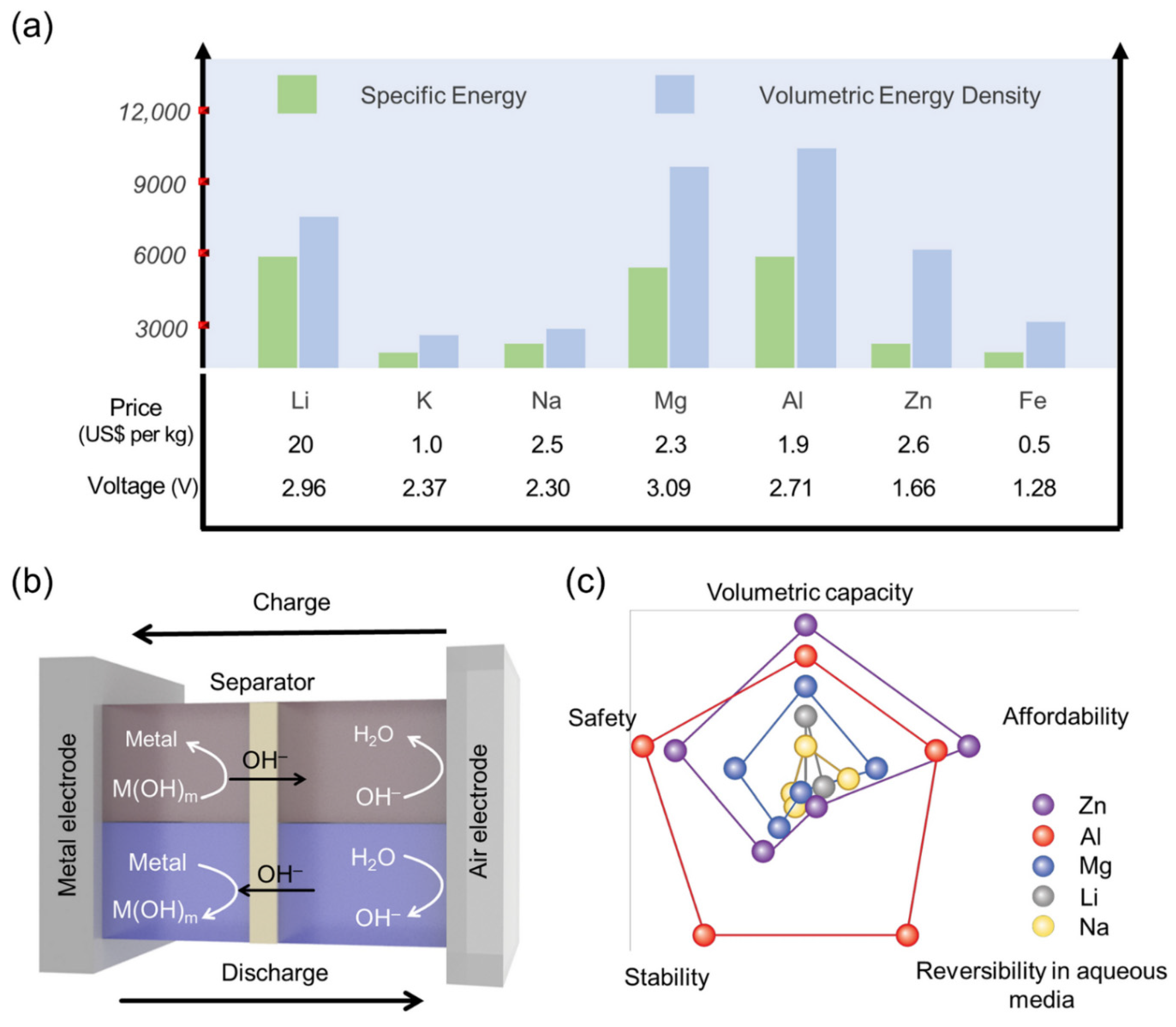
Figure 2.
Schematic representation of prismatic zinc–air battery configuration. Reproduced under the terms of the CC-BY Creative Commons Attribution 4.0 International license [17]. Copyright (2023), MDPI.
Figure 2.
Schematic representation of prismatic zinc–air battery configuration. Reproduced under the terms of the CC-BY Creative Commons Attribution 4.0 International license [17]. Copyright (2023), MDPI.
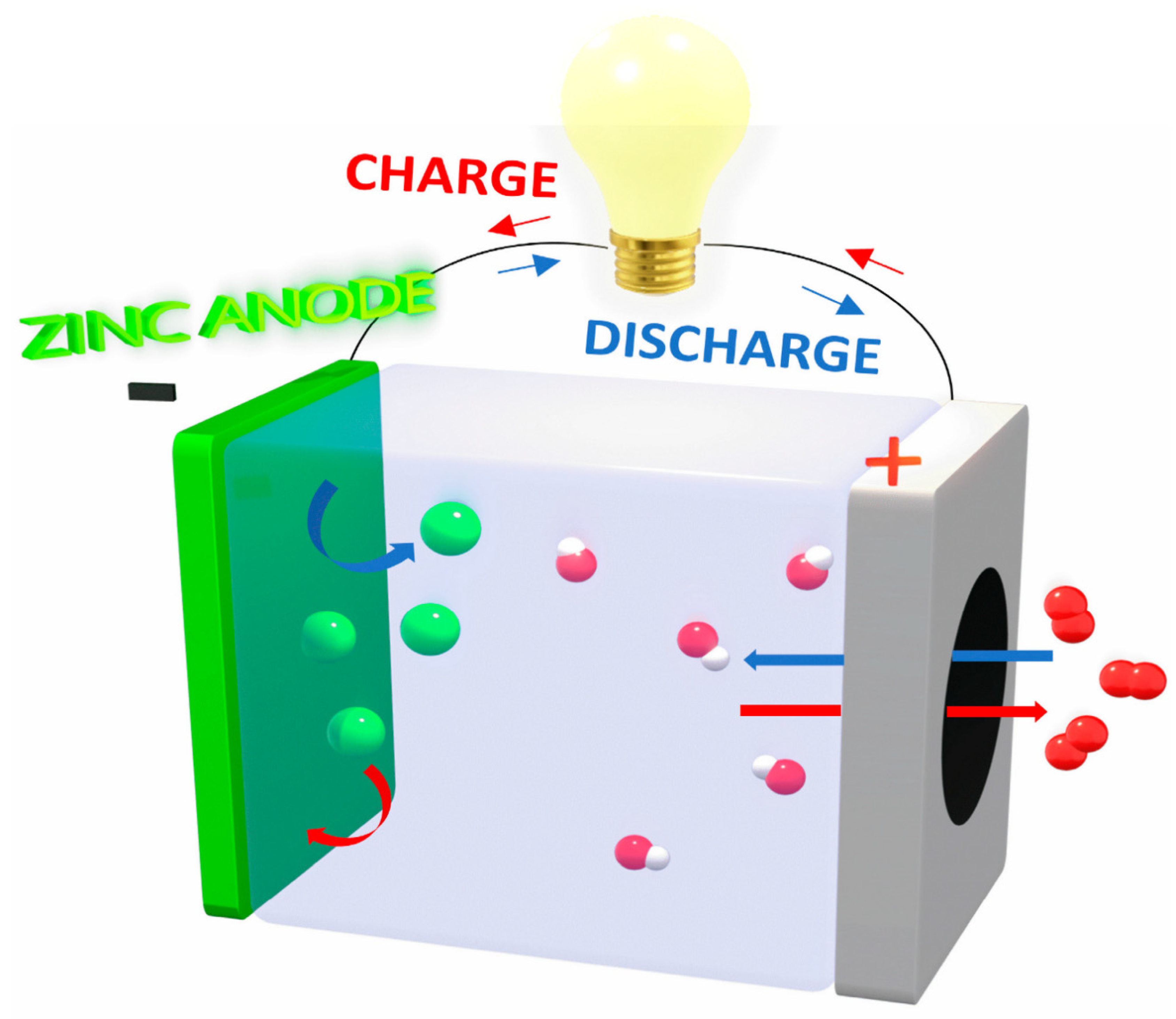
Figure 3.
Graphene research roadmap for EES devices. Reproduced under the terms of the CC-BY Creative Commons Attribution 4.0 International license [52]. Copyright (2022), Wiley.
Figure 3.
Graphene research roadmap for EES devices. Reproduced under the terms of the CC-BY Creative Commons Attribution 4.0 International license [52]. Copyright (2022), Wiley.
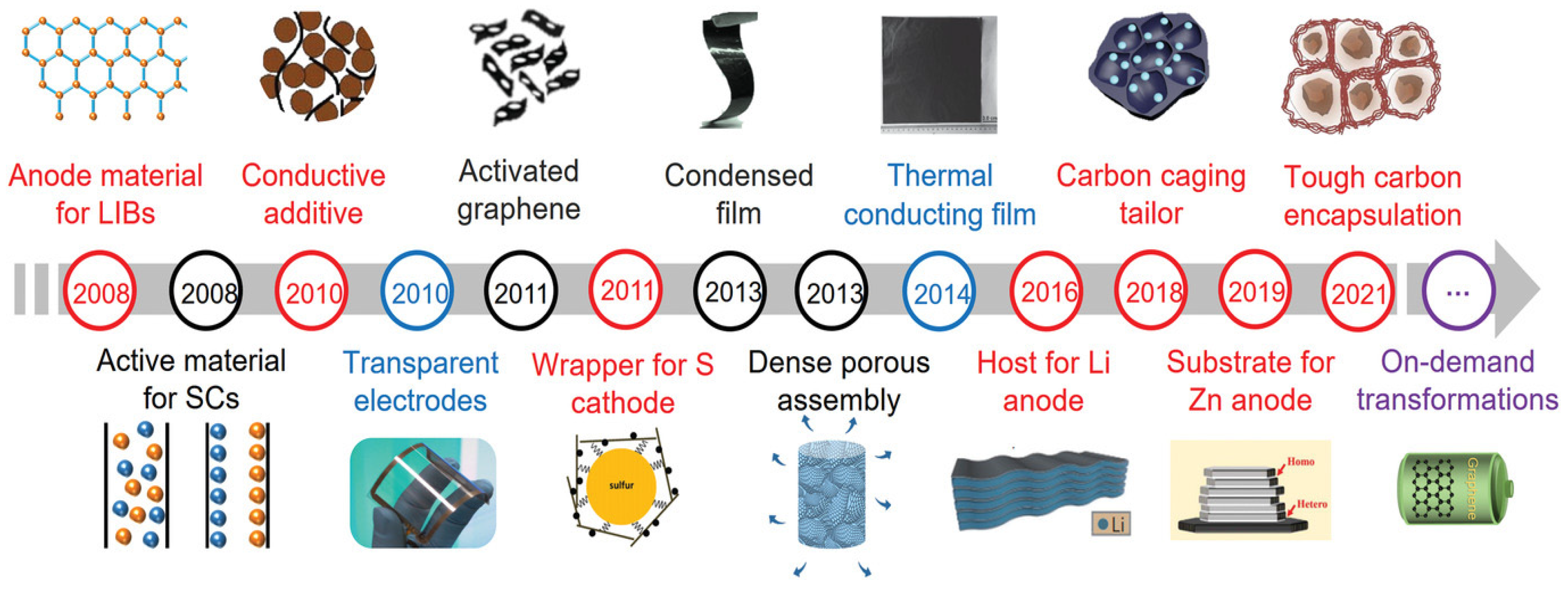
Figure 4.
Diagram showing how graphene oxide nanoparticles are synthesized. Reproduced under the terms of the CC-BY Creative Commons Attribution 4.0 International license [58]. Copyright (2022), Frontiers.
Figure 4.
Diagram showing how graphene oxide nanoparticles are synthesized. Reproduced under the terms of the CC-BY Creative Commons Attribution 4.0 International license [58]. Copyright (2022), Frontiers.
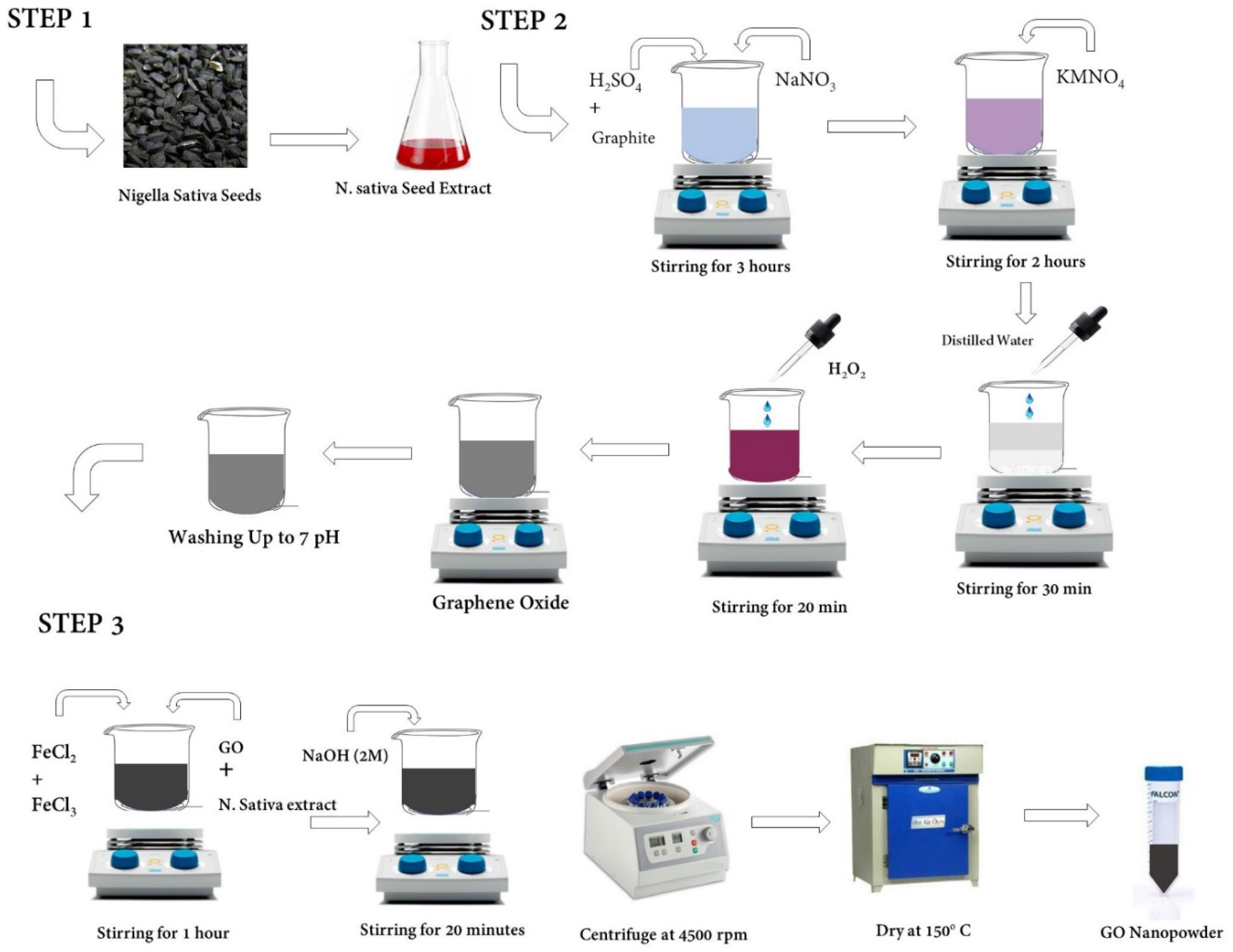
Figure 5.
Synthesis of graphene oxide using hummer’s method. Reproduced under the terms of the CC-BY Creative Commons Attribution 4.0 International license [64]. Copyright (2021), Nature.
Figure 5.
Synthesis of graphene oxide using hummer’s method. Reproduced under the terms of the CC-BY Creative Commons Attribution 4.0 International license [64]. Copyright (2021), Nature.
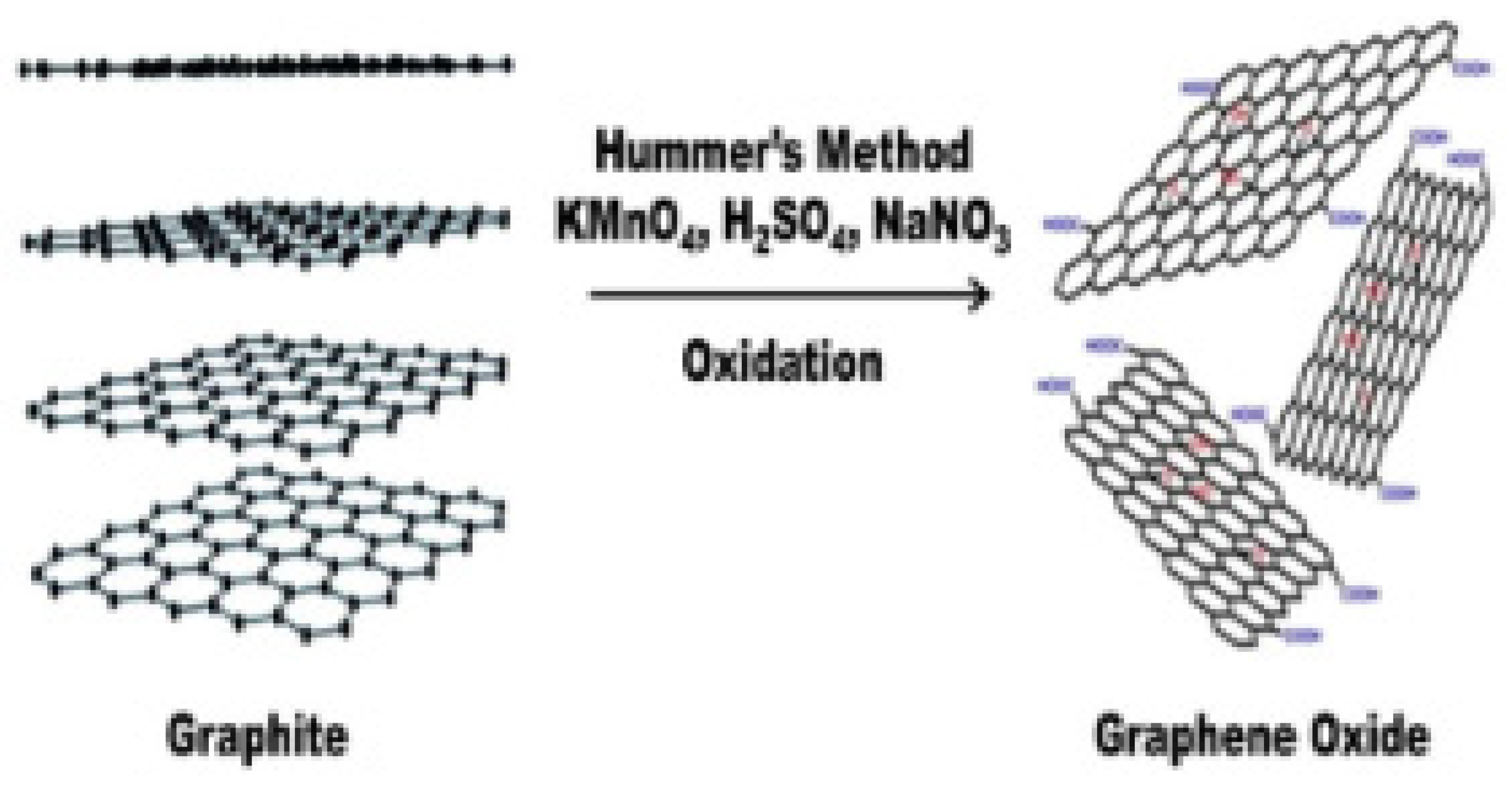
Figure 6.
Schematic representation of the rapid synthesis of graphene-oxide from graphene sheets. Reproduced under the terms of the CC-BY Creative Commons Attribution 4.0 International license [65]. Copyright (2021), MDPI.
Figure 6.
Schematic representation of the rapid synthesis of graphene-oxide from graphene sheets. Reproduced under the terms of the CC-BY Creative Commons Attribution 4.0 International license [65]. Copyright (2021), MDPI.
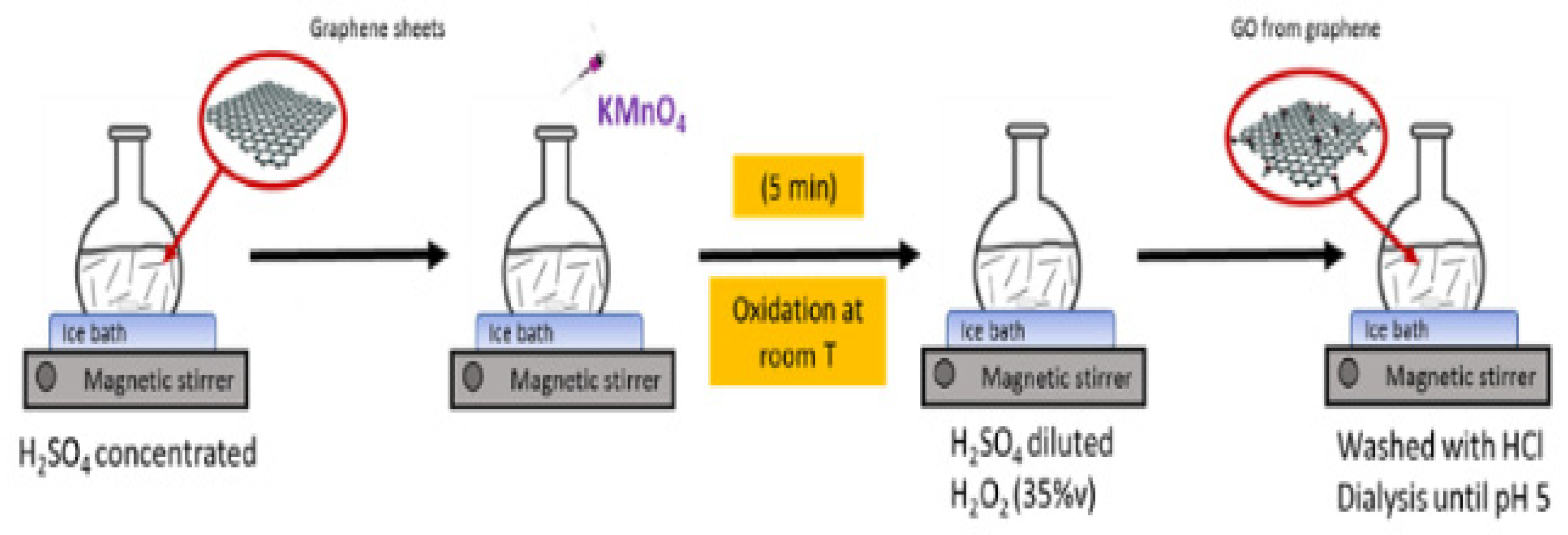
Figure 7.
Schematic representation of reduction of GO to RGO using chemical methods. Reproduced under the terms of the CC-BY Creative Commons Attribution 4.0 International license [73]. Copyright (2017), RSC.
Figure 7.
Schematic representation of reduction of GO to RGO using chemical methods. Reproduced under the terms of the CC-BY Creative Commons Attribution 4.0 International license [73]. Copyright (2017), RSC.
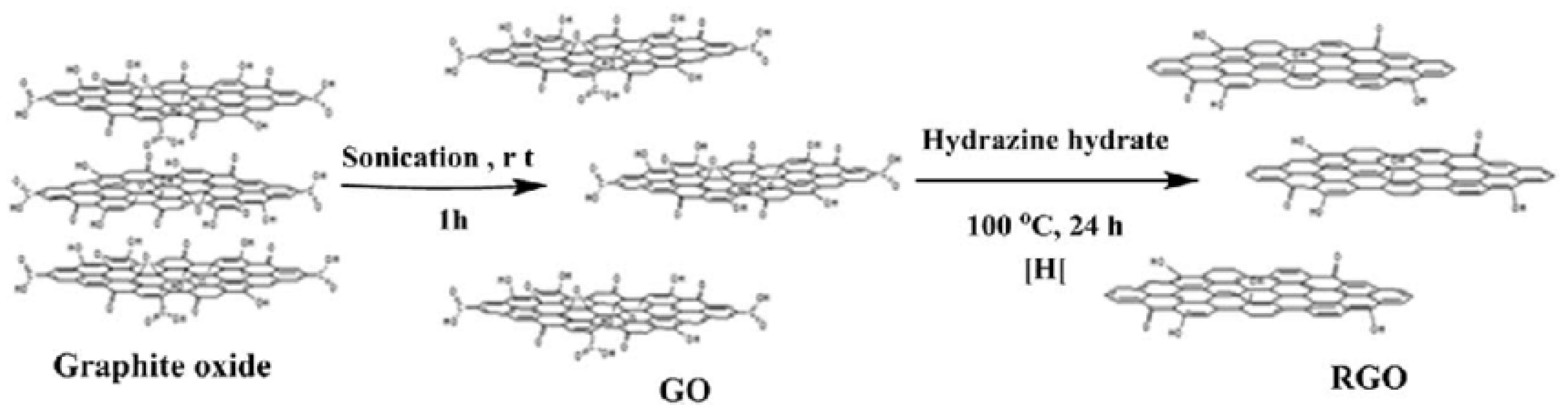
Figure 8.
Schematic illustration of the reduction of graphene oxide (GO) to reduced graphene oxide (RGO). Reproduced under the terms of the CC-BY Creative Commons Attribution 4.0 International license [76]. Copyright (2018), IOP.
Figure 8.
Schematic illustration of the reduction of graphene oxide (GO) to reduced graphene oxide (RGO). Reproduced under the terms of the CC-BY Creative Commons Attribution 4.0 International license [76]. Copyright (2018), IOP.
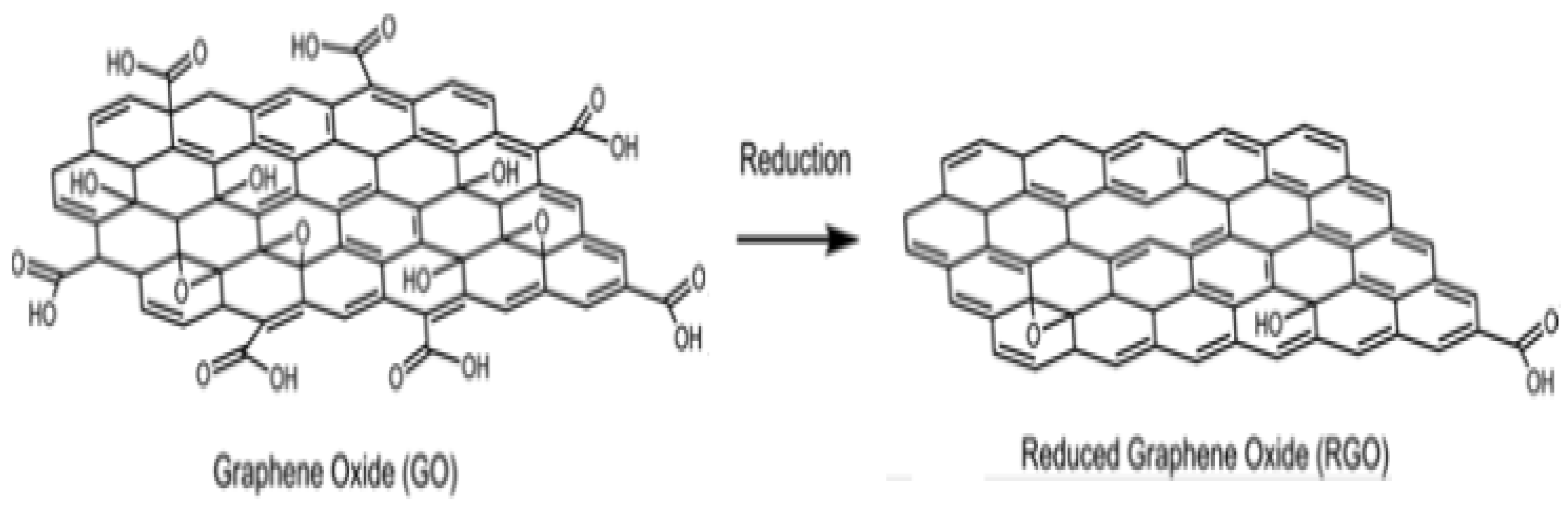
Figure 9.
Schematic representation of most frequently used synthesis techniques of graphen.
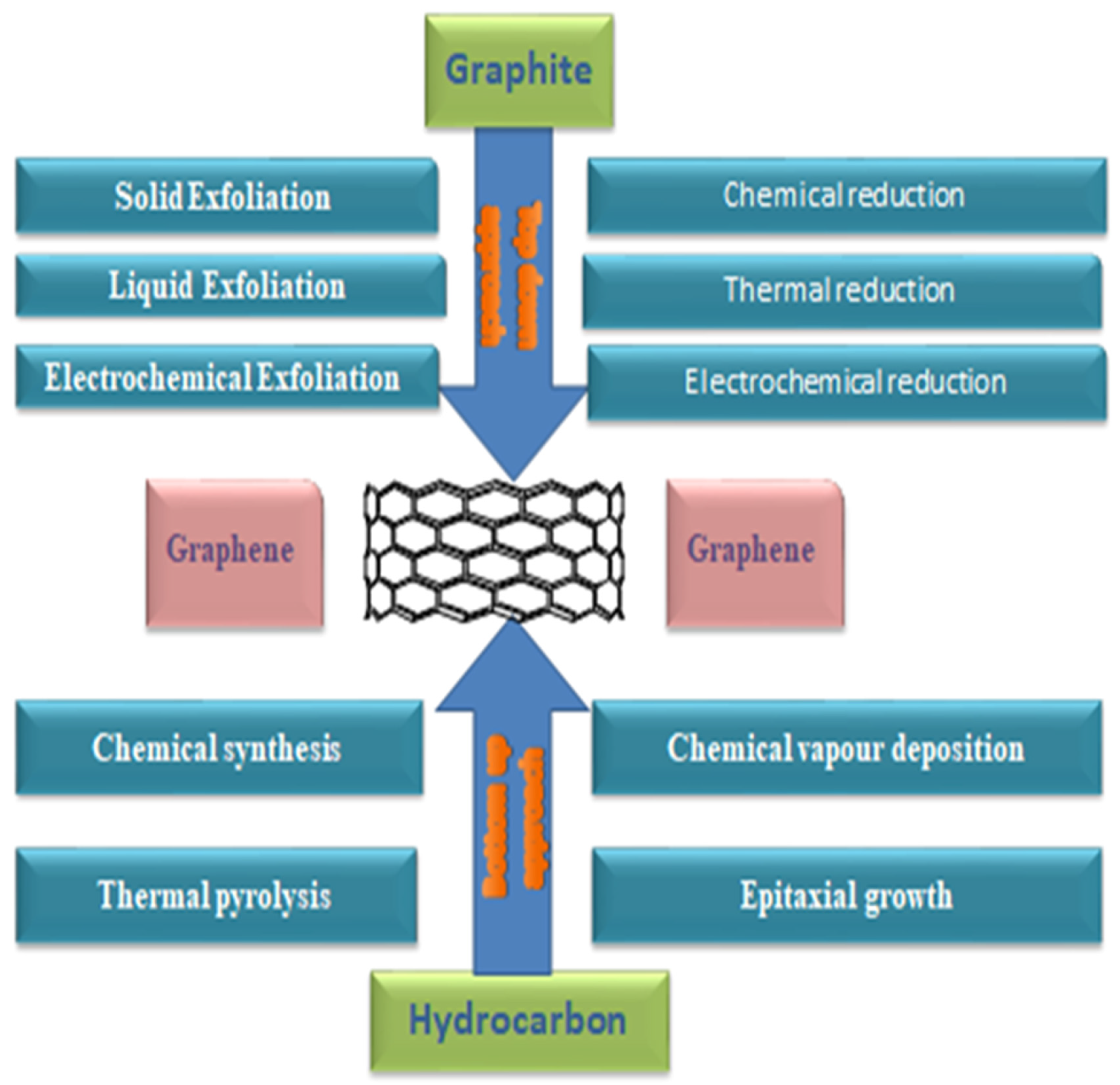
Figure 10.
Structure of typical graphene. Reproduced under the terms of the CC-BY Creative Commons Attribution 4.0 International license [95]. Copyright (2010), Hindawi.
Figure 10.
Structure of typical graphene. Reproduced under the terms of the CC-BY Creative Commons Attribution 4.0 International license [95]. Copyright (2010), Hindawi.
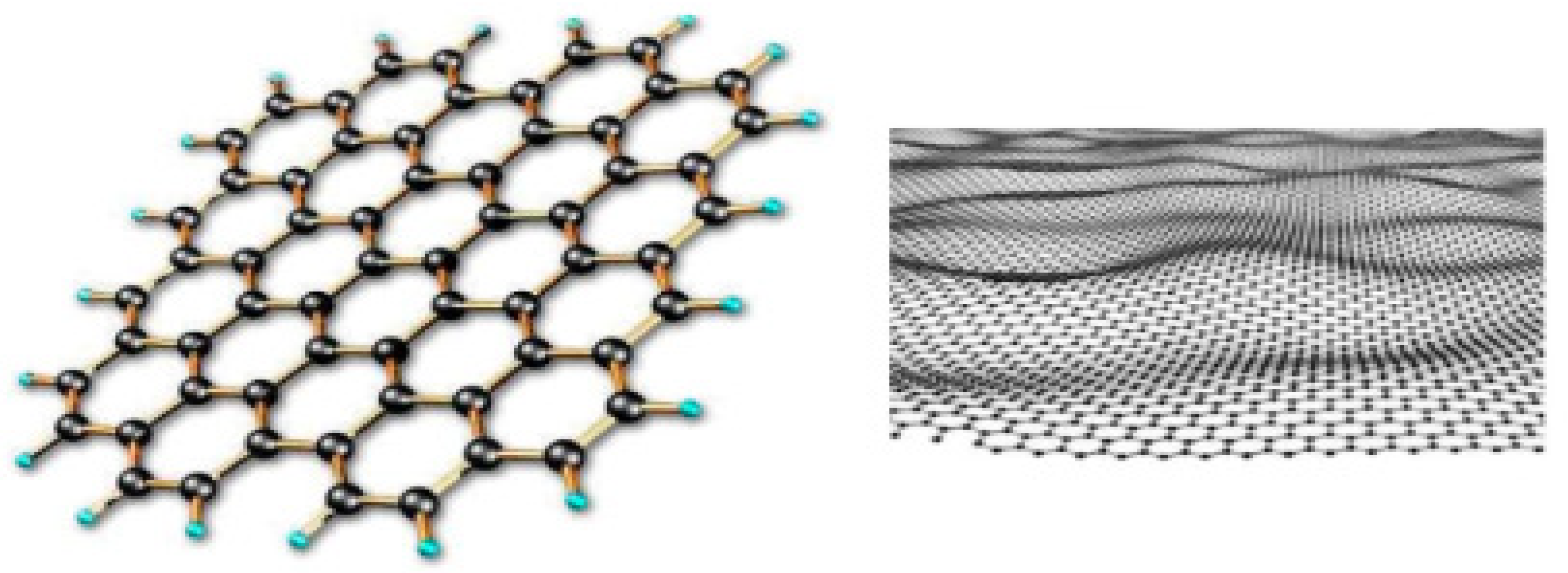
Figure 11.
TEM images of (a) B-doped graphene (b) N-doped graphene. Reproduced under the terms of the CC-BY Creative Commons Attribution 4.0 International license [106]. Copyright (2009), Wiley.
Figure 11.
TEM images of (a) B-doped graphene (b) N-doped graphene. Reproduced under the terms of the CC-BY Creative Commons Attribution 4.0 International license [106]. Copyright (2009), Wiley.
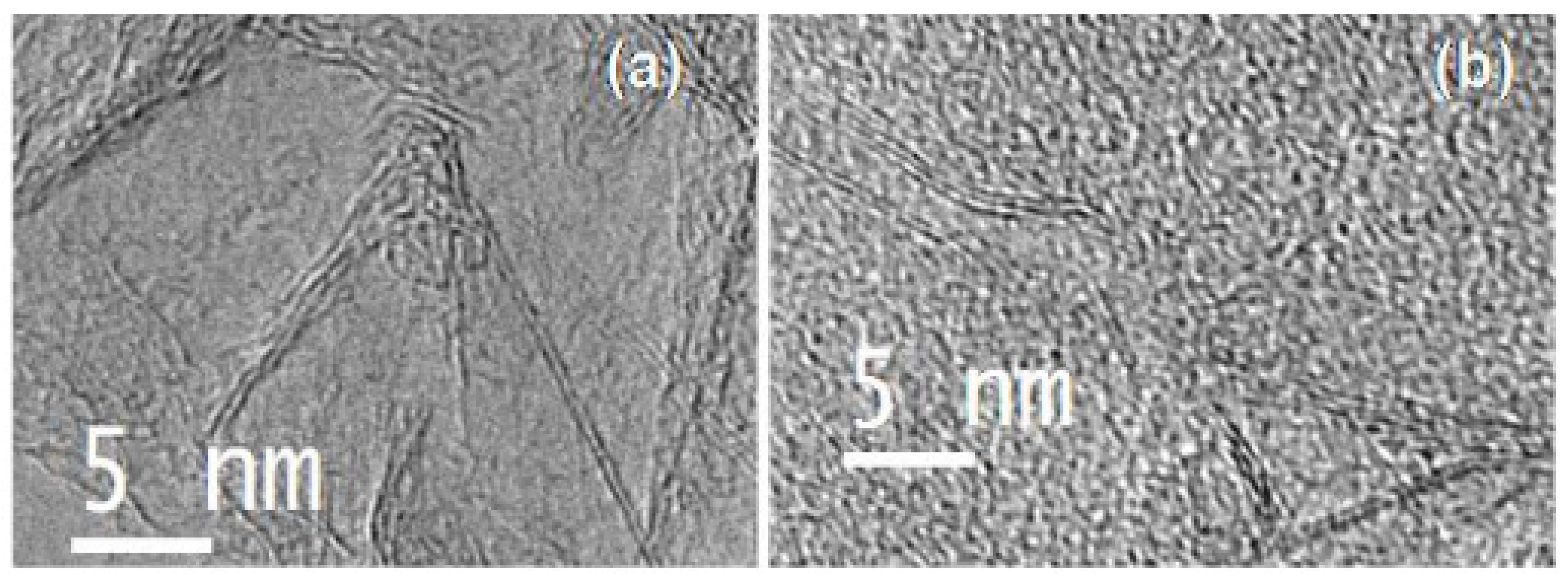
Figure 12.
SEM images of (a) NBrGO and (b) Fe-NBrGO, revealing the 3D porous structure of rGO based aerogel. Reproduced under the terms of the CC-BY Creative Commons Attribution 4.0 International license [104]. Copyright (2023), MDPI.
Figure 12.
SEM images of (a) NBrGO and (b) Fe-NBrGO, revealing the 3D porous structure of rGO based aerogel. Reproduced under the terms of the CC-BY Creative Commons Attribution 4.0 International license [104]. Copyright (2023), MDPI.
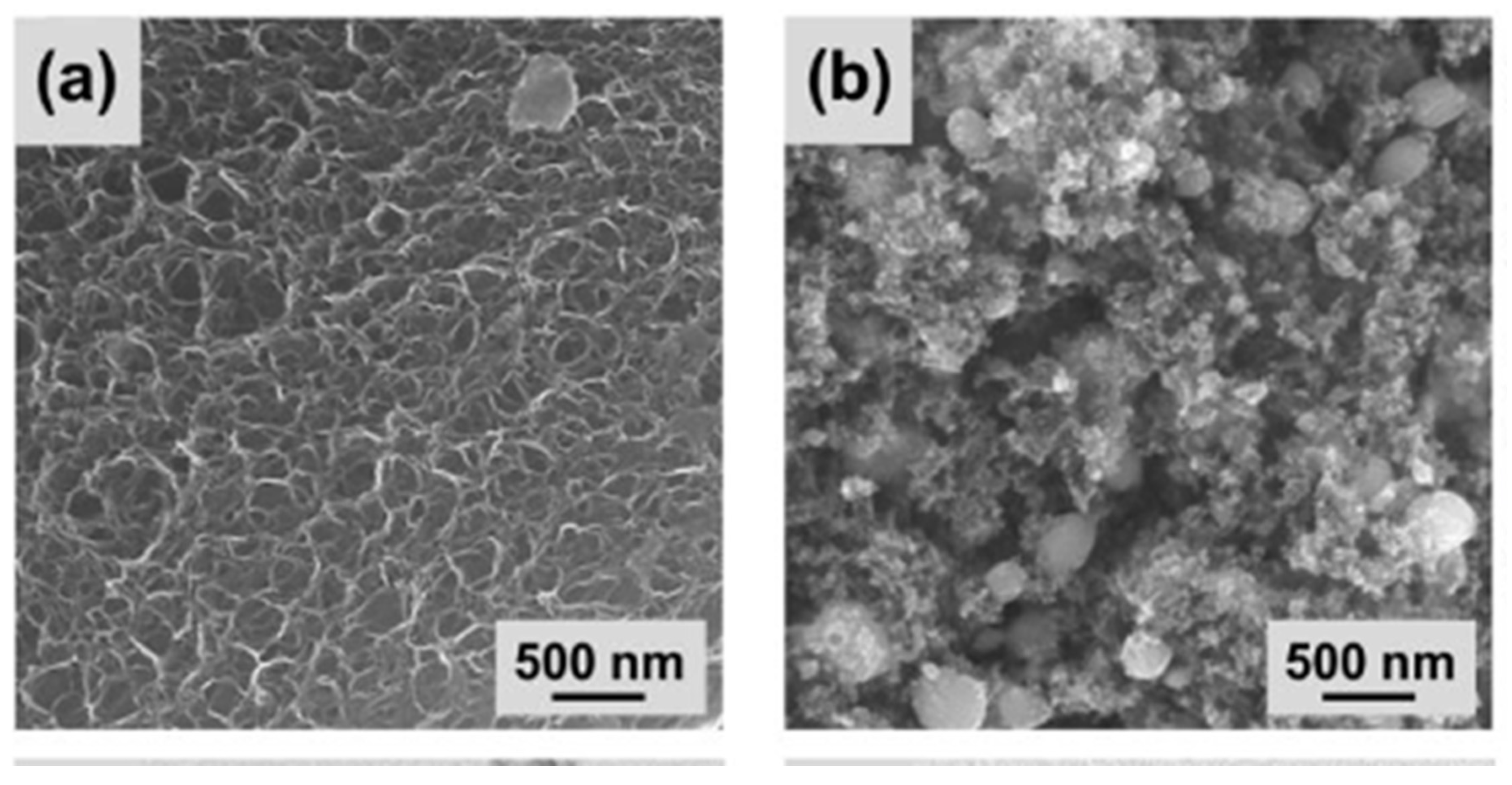
Figure 13.
Morphology and microstructure of the Fe/Fe3C/G nanocomposite. Reproduced under the terms of the CC-BY Creative Commons Attribution 4.0 International license [108]. Copyright (2022), ACS.
Figure 13.
Morphology and microstructure of the Fe/Fe3C/G nanocomposite. Reproduced under the terms of the CC-BY Creative Commons Attribution 4.0 International license [108]. Copyright (2022), ACS.
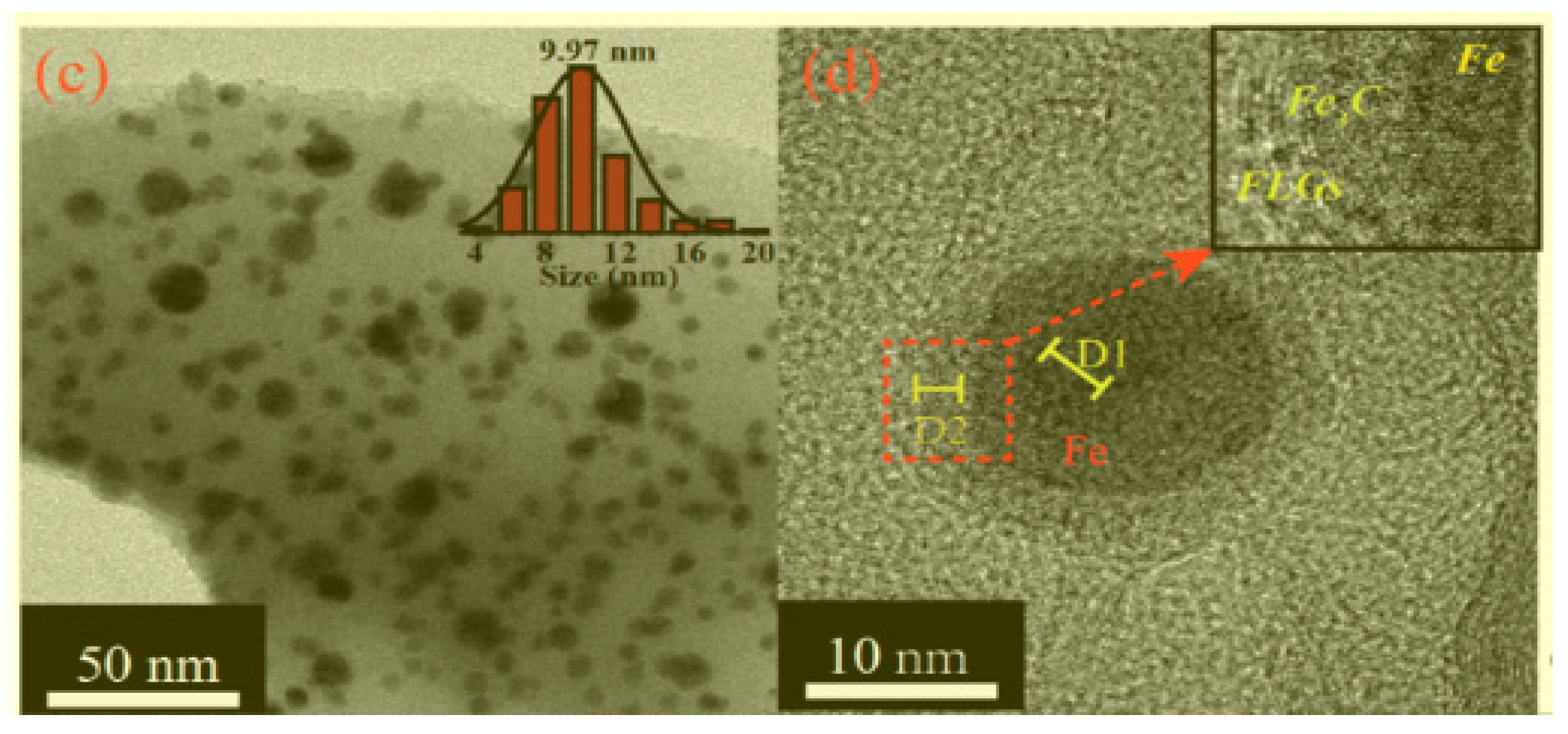
Figure 14.
TEM images of GO (a), GO/FePc (b), GO/MnPc (c) and GO/CoPc (d). Reproduced with permission from Ref. [110]. Copyright © 2024, Elsevier.
Figure 14.
TEM images of GO (a), GO/FePc (b), GO/MnPc (c) and GO/CoPc (d). Reproduced with permission from Ref. [110]. Copyright © 2024, Elsevier.
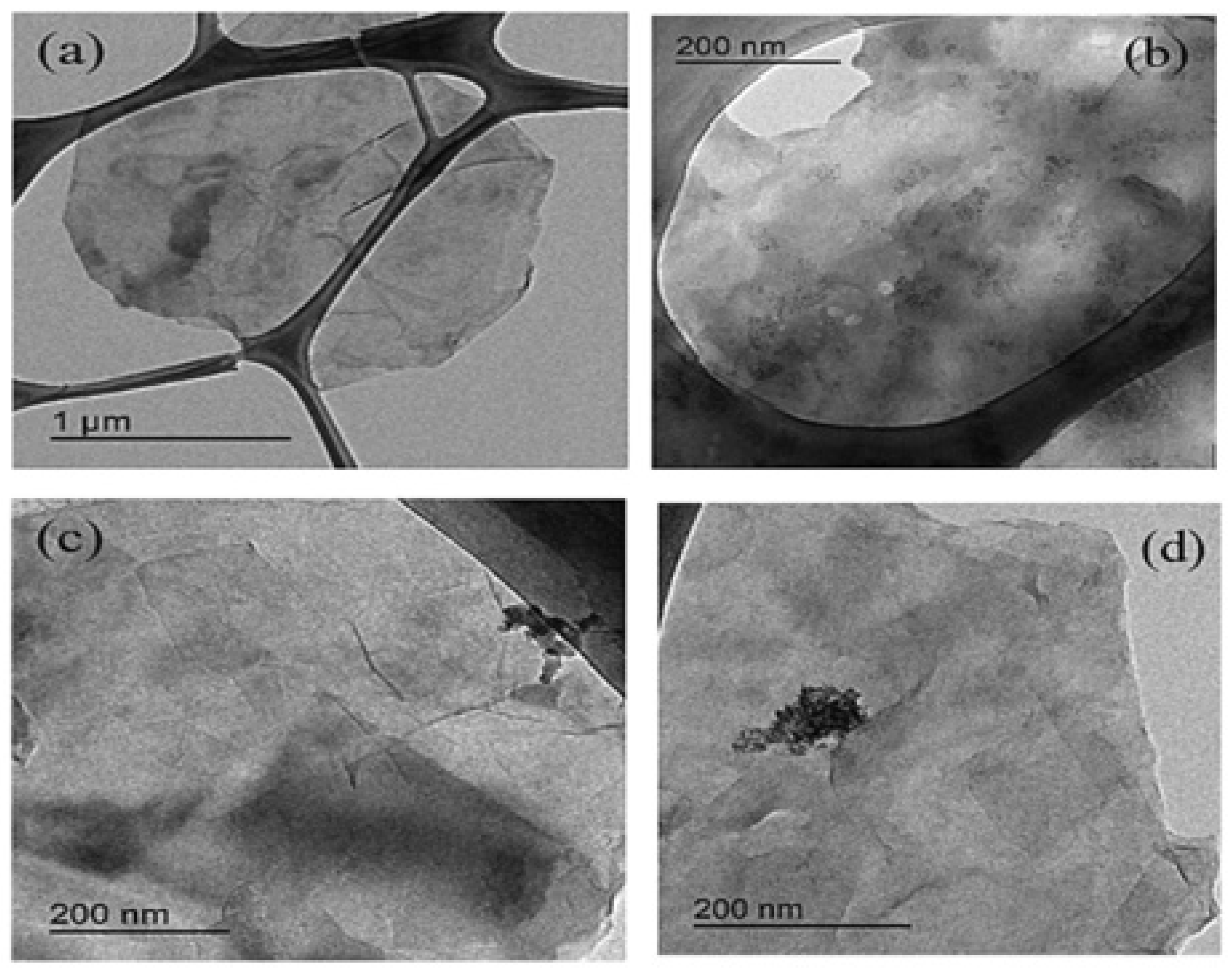
Figure 15.
(a) SEM morphology of 3D-N/S and (d) 3D-Fe/N/S. Reproduced with permission from Ref. [111]. Copyright © 2018, Elsevier.
Figure 15.
(a) SEM morphology of 3D-N/S and (d) 3D-Fe/N/S. Reproduced with permission from Ref. [111]. Copyright © 2018, Elsevier.

Figure 16.
SEM and TEM images of Co/N/rGO(NH3)(a) and (b) SEM images of Co/N/rGO(NH3) powder. Reproduced with permission from Ref. [113]. Copyright © 2013, Elsevier.
Figure 16.
SEM and TEM images of Co/N/rGO(NH3)(a) and (b) SEM images of Co/N/rGO(NH3) powder. Reproduced with permission from Ref. [113]. Copyright © 2013, Elsevier.
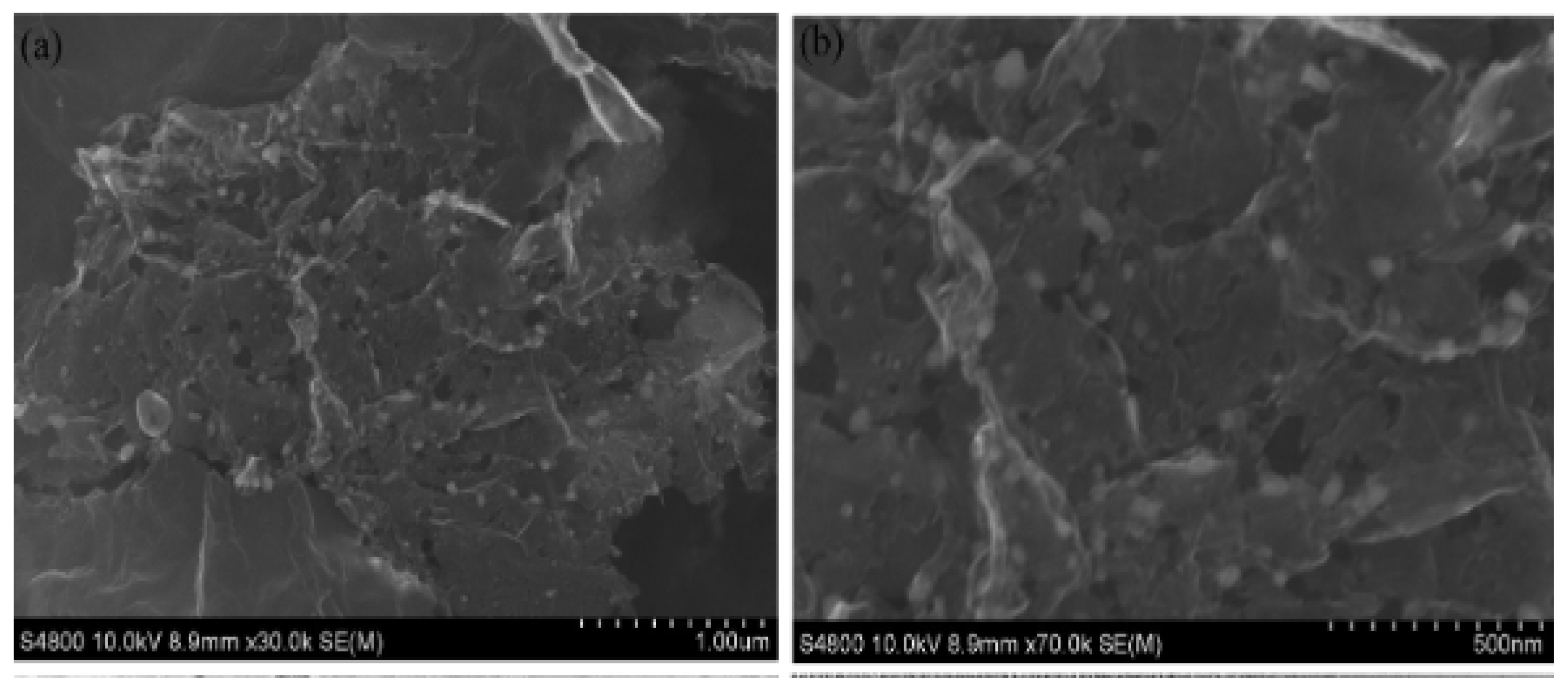
Figure 17.
(A,B) TEM images and (C) HR-TEM images of the Co/CoO-NGA. Reproduced under the terms of the CC-BY Creative Commons Attribution 4.0 International license [119]. Copyright (2016), Frontiers.
Figure 17.
(A,B) TEM images and (C) HR-TEM images of the Co/CoO-NGA. Reproduced under the terms of the CC-BY Creative Commons Attribution 4.0 International license [119]. Copyright (2016), Frontiers.
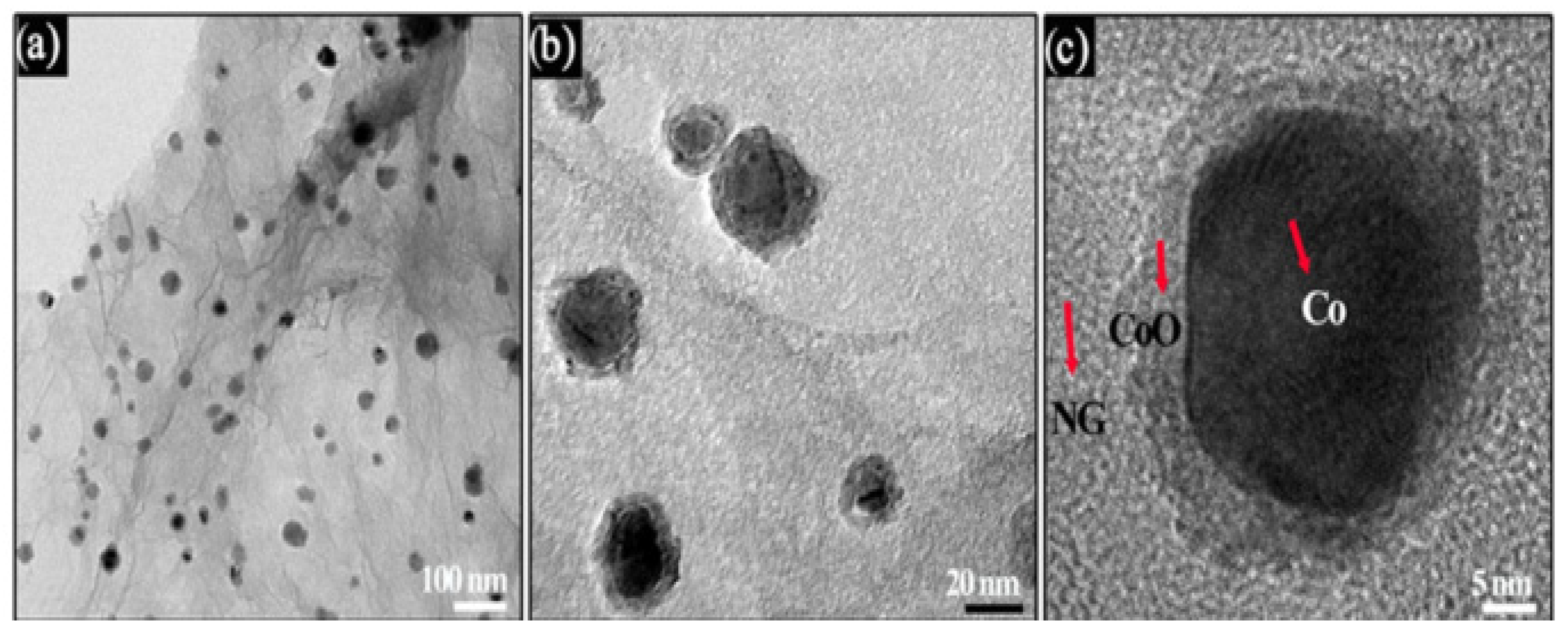
Figure 18.
(a) TEM image of Co/Co3O4@NCs (b) EDS elemental mapping images of Co/Co3O4@NCs. Reproduced with permission from Ref. [121]. Copyright © 2020, Elsevier.
Figure 18.
(a) TEM image of Co/Co3O4@NCs (b) EDS elemental mapping images of Co/Co3O4@NCs. Reproduced with permission from Ref. [121]. Copyright © 2020, Elsevier.
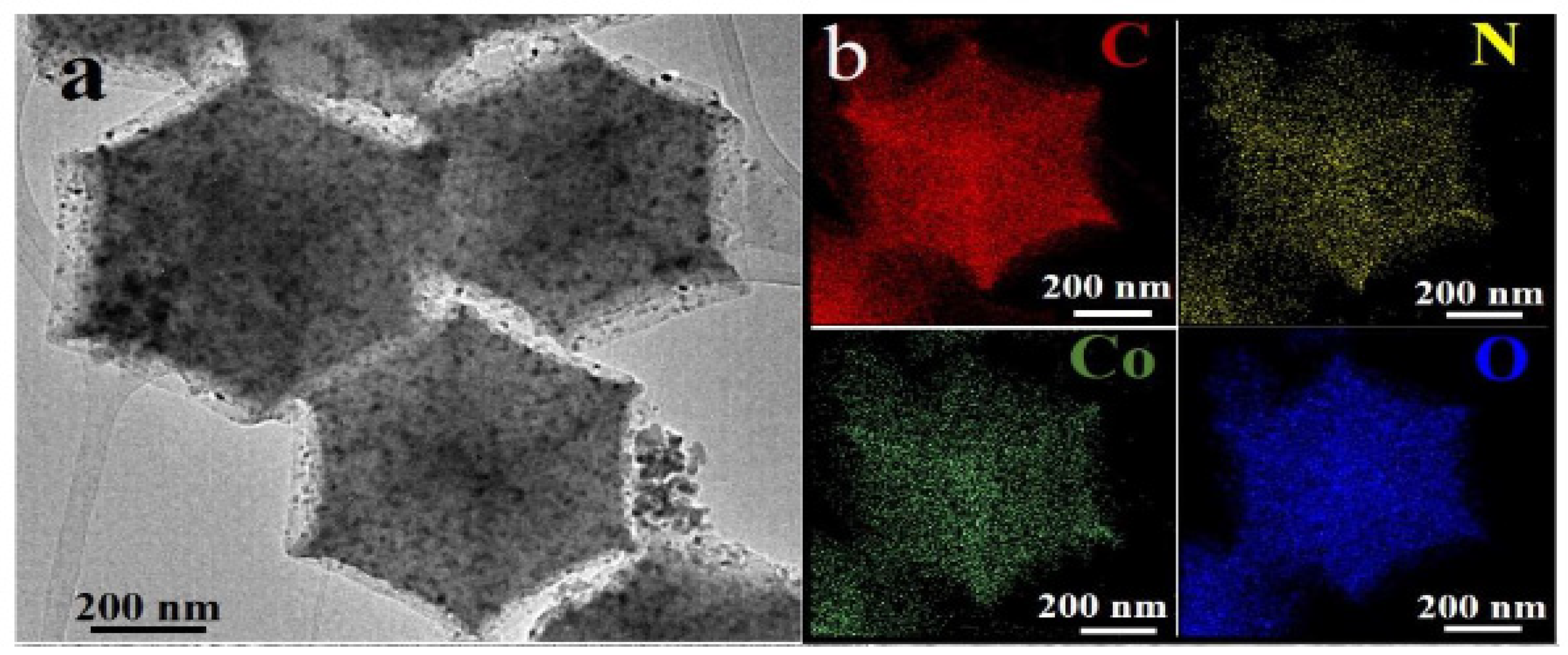
Figure 19.
SEM images of (a) NG, (b) FeCoOx@NG. Repeated under the terms of the CC-BY Creative Commons Attribution 4.0 International license [117]. Copyright (2022), Wiley.
Figure 19.
SEM images of (a) NG, (b) FeCoOx@NG. Repeated under the terms of the CC-BY Creative Commons Attribution 4.0 International license [117]. Copyright (2022), Wiley.
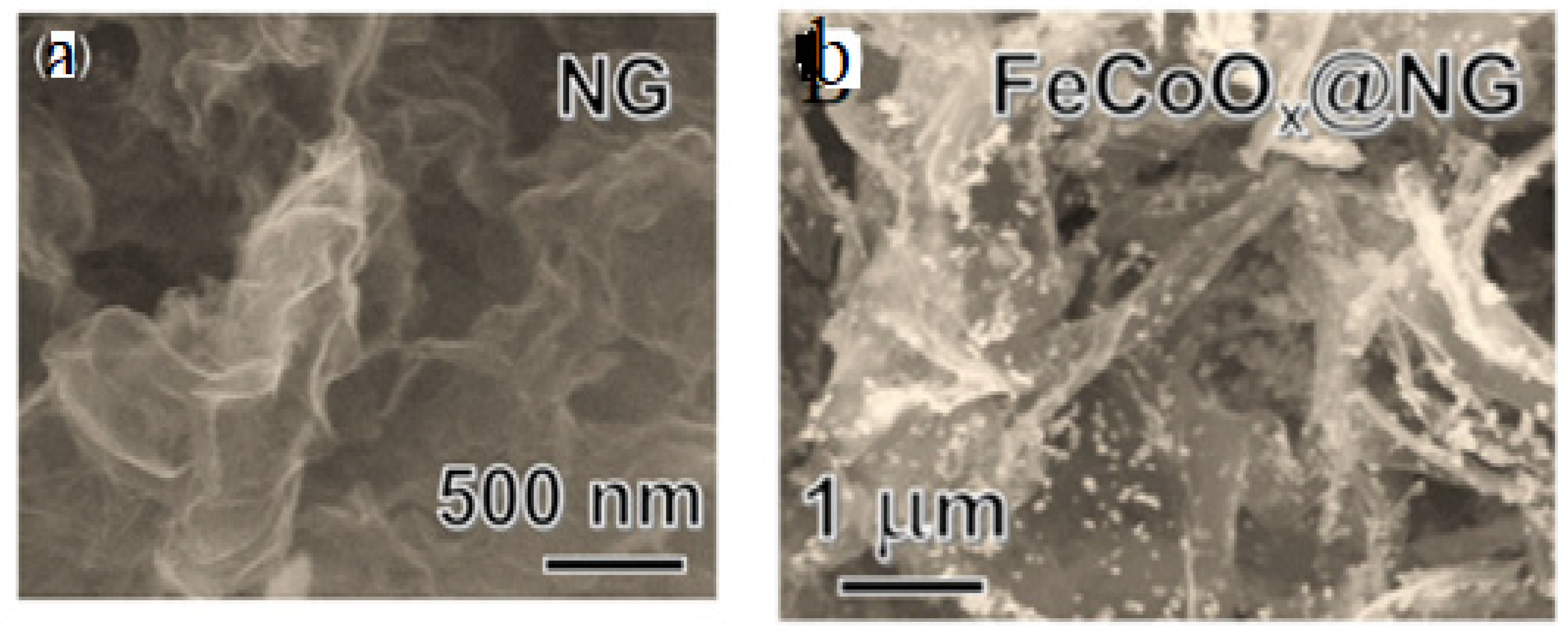
Figure 20.
TEM image of (a) CMO/rGO, (b) CMO/N-rGO. Reproduced with permission from Ref. [122]. Copyright © 2014, Elsevier.
Figure 20.
TEM image of (a) CMO/rGO, (b) CMO/N-rGO. Reproduced with permission from Ref. [122]. Copyright © 2014, Elsevier.
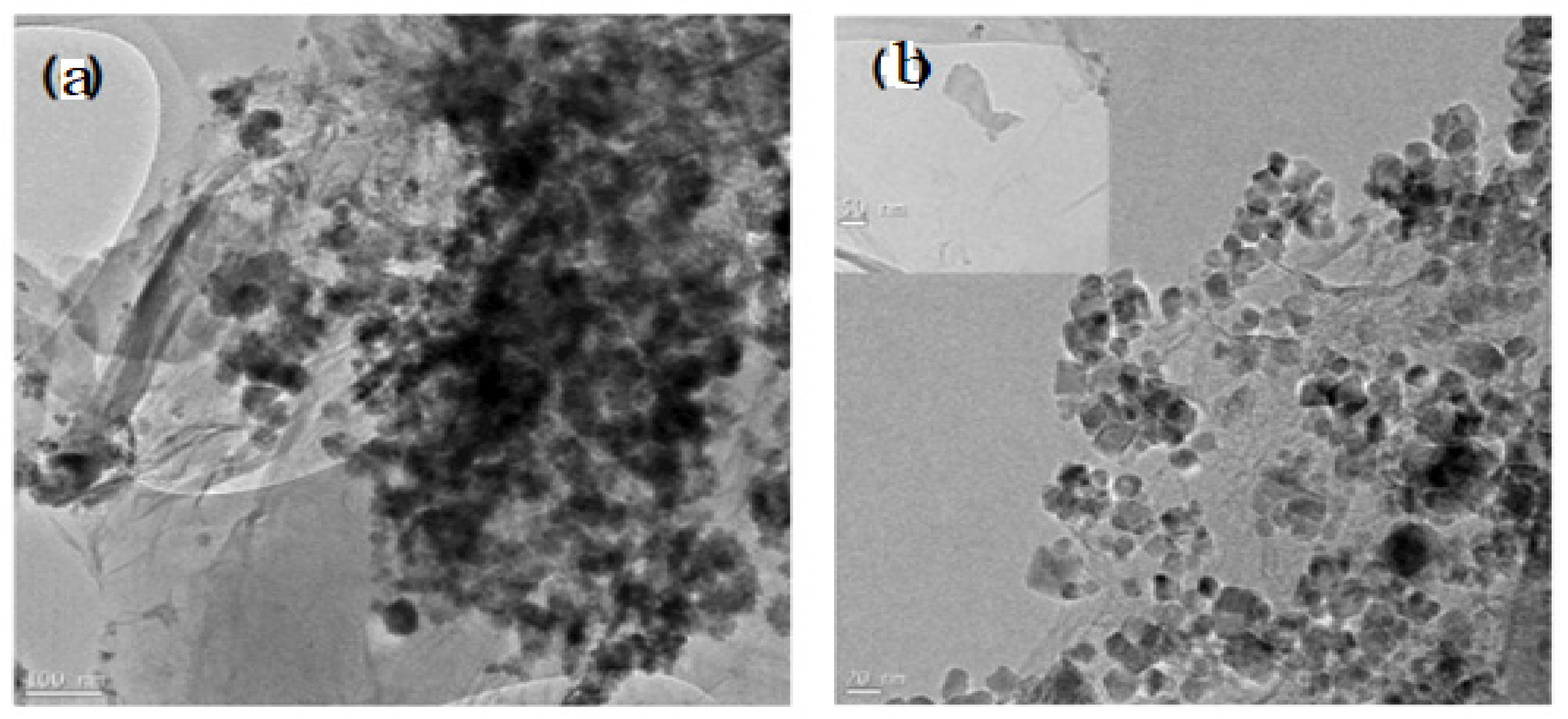
Figure 21.
SEM images of (a) CoS2/N, S-GO, (b) CoS2 and (c) N, S-GO. Reproduced with permission from Ref. [126]. Copyright © 2015, Elsevier.
Figure 21.
SEM images of (a) CoS2/N, S-GO, (b) CoS2 and (c) N, S-GO. Reproduced with permission from Ref. [126]. Copyright © 2015, Elsevier.
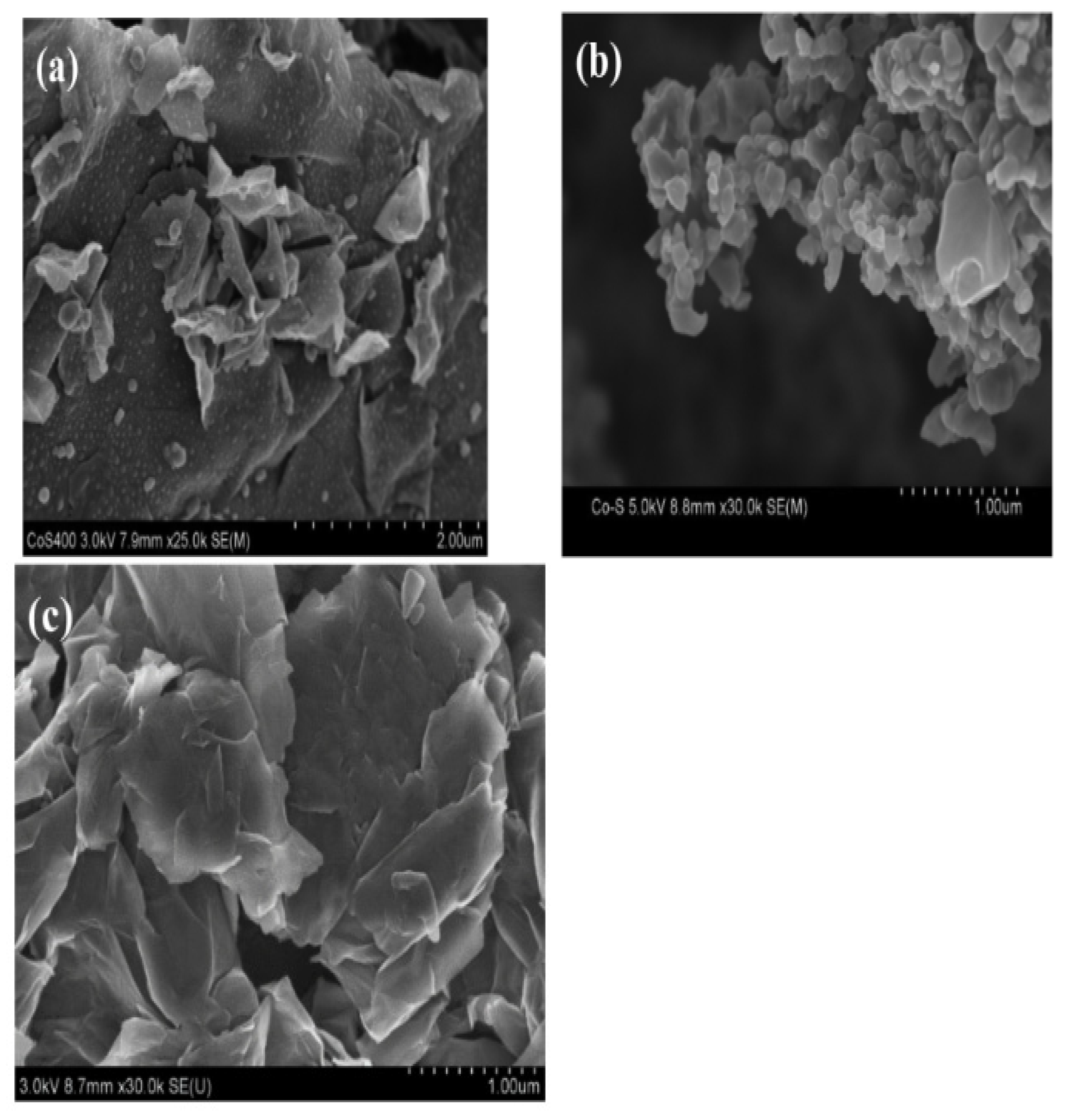

Table 1.
Electrochemical data of the different composites, GO and comparison with Pt/C in O2-saturated 0.1 M KOH solution[110].
Table 1.
Electrochemical data of the different composites, GO and comparison with Pt/C in O2-saturated 0.1 M KOH solution[110].
| Catalyst | Eonseta | E ½ | Electron transfer number br | jlim b | Tafel slope |
|---|---|---|---|---|---|
| (V) | (V) | (mAcm-2) | (mV dec-1) | ||
| GO/FePc | 0.95 | 0.87 | 4 | -6.9 | -31 |
| GO/MnPc | 0.87 | 0.69 | 3.7 | -4.4 | -61 |
| GO/CoPc | 0.84 | 0.59 | 3.6 | -4.7 | -86 |
| Pt/C | 0.99 | 0.87 | 4 | -6.4 | -52 |
| GO | 0.80 | 0.66 | 2.7 | -2.1 | -81 |
a Determined at -0.1mA cm-2. b Determined at 0.2V vs. RHE.
Disclaimer/Publisher’s Note: The statements, opinions and data contained in all publications are solely those of the individual author(s) and contributor(s) and not of MDPI and/or the editor(s). MDPI and/or the editor(s) disclaim responsibility for any injury to people or property resulting from any ideas, methods, instructions or products referred to in the content. |
© 2024 by the authors. Licensee MDPI, Basel, Switzerland. This article is an open access article distributed under the terms and conditions of the Creative Commons Attribution (CC BY) license (http://creativecommons.org/licenses/by/4.0/).
Copyright: This open access article is published under a Creative Commons CC BY 4.0 license, which permit the free download, distribution, and reuse, provided that the author and preprint are cited in any reuse.


