

Submitted:
10 July 2024
Posted:
11 July 2024
You are already at the latest version
Abstract
Staphylococcus aureus is a gram-negative bacterium that causes superficial and deep infections that can be mild or potentially fatal. Recently, the bacterium has gained significant attention due to the increased incidence of multidrug-resistant (MDR) strains that make treatment with antibiotics dif-ficult. Owing to the MDR strains, alternative therapies such as antimicrobial photodynamic therapy (PDT) have emerged as good options to treat non-systemic infections. PDT combines a photosensi-tiser (PS) with light and oxygen to generate free radicals that destroy bacterial structures such as the plasma membrane, matrix, and genetic material. This systematic review aimed to identify the ef-fectiveness of PDT delivered using different types of hydrogels for treating wounds, burns, and contamination by S. aureus. This systematic review followed the Preferred Reporting Items for Systematic Reviews and Meta-Analyses (PRISMA) 2020 guidelines. Bibliographic research was conducted using the PubMed, Web of Science, and Scopus databases. Only full articles published in English between 2013 and 2024 from any country of origin (without restrictions) were included. The research was carried out from 15 June 2023 to 15 June 2024 and did not use any automatic biblio-graphic search tool. The articles collected were identified using keywords and selected using in-clusion and exclusion criteria in accordance with the PRISMA protocol. Seven articles were in-cluded that presented a good set of evidence associated with the use of PDT against S. aureus in in vitro and in vivo studies. To conclude, PDT can effectively complement antimicrobial therapy against S. aureus, in the healing of wounds and burns. The effectiveness of this technique depends on the PS used, hydrogel type, and lesion location. Some studies have already demonstrated the ef-fectiveness of PDT but most were in vitro and a few in vivo. Further studies are required to demonstrate the safety and efficacy of PDT delivered via hydrogels in in vivo models of bacterial infection.
Keywords:
Hydrogels
; Antimicrobial Effects
; Photodynamic Therapy
1. Introduction
Antimicrobial resistance in bacteria, viruses, fungi, and parasites is a global threat to human health and development. The World Health Organisation recognises it as one of the main concerns for global public health, ranking among the top ten threats to humanity [1]. Inappropriate and excessive use of antimicrobial agents contributes to resistance, making practically all pathogenic microorganisms insensitive to the medications commonly used to control them. Multidrug resistance towards crucial classes of antibiotics has resulted in an increase in nosocomial pathogens, including Enterococcus faecium, Staphylococcus aureus, Klebsiella pneumoniae, Acinetobacter baumannii, Pseudomonas aeruginosa, and Enterobacter spp., grouped into a set known as ESKAPE [two]. Despite the complexity of developing new drugs with antibiotic properties [1], alternative approaches have been developed recently to control the spread of pathogenic microorganisms. One such approach is antimicrobial photodynamic therapy (PDT), which uses photosensitising agents (dyes) and hydrogels capable of absorbing light photons and elevating them to an excited state [3].
In recent years, the emergence of various drug-resistant bacteria has rendered the existing antibiotics ineffective, and the formation of biofilms has further weakened their therapeutic effect. The massive and abusive use of antibiotics has caused severe side effects, making it imperative to develop alternative, ultra-efficient, and safe antibacterial systems [4]. The most recent technique used to control microbial infections is the combination of PDT with a hydrogel, which appears innovative and operates non-specifically in microbial cells, thus preventing the development of resistance [5].
PDT is based on the administration of a non-toxic, light-sensitive photosensitiser (PS), followed by irradiation with low doses of visible light [6]. In the presence of oxygen in cells, an activated PS can react with the molecules in its vicinity by transferring electrons or hydrogen, producing free radicals, or by transferring energy to oxygen, generating singlet oxygen (1O2). Both mechanisms can lead to cell death and destruction of diseased tissues [5].
Faced with the growing problem of resistance to microbial antibiotics, PDT delivered using hydrogels has attracted interest as an alternative antimicrobial treatment. Several in vitro and in vivo studies involving microbial inactivation with successful results for bacteria, fungi, yeasts, viruses, and parasites, and in the healing of wounds and burns have been conducted [6]. Furthermore, a recent study has demonstrated that photosensitisation of bacterial cells is independent of the spectrum of antibiotic resistance [5].
The PS must be selected such that the available light source sufficiently penetrates the maximum absorption wavelength [7]. The penetration of light through the tissue can be hampered by dispersion and absorption, depending on the wavelength of the incident light, type of tissue, and manner in which PS will be carried to the location to be decontaminated. Hydrogels are excellent carriers of PSs for PDT [5]. Hydrogels have demonstrated good performances as cell carriers with different functionalities [8].
Hydrogels are a class of water-expanded three-dimensional polymer networks with tunable physicochemical properties that satisfy specific requirements under different conditions. As promising materials, they have been extensively applied in the biomedical field, from studies on physiological and pathological mechanisms to tissue regeneration and disease therapy [9].
Hydrogels have been widely investigated as matrices for biomedical applications because of their cross-linking ability under mild conditions, excellent biocompatibility, and tunable biochemical and biophysical properties. As their structure and properties resemble the microenvironment of many tissues in the human body, they are widely used in various biomedical applications [10].
In summary, multifunctional and intelligent antibacterial hydrogels designed according to the actual needs can simultaneously provide broad prospects for antibacterial infection therapy and tissue reconstruction. This study aimed to conduct a systematic review of studies analysing the effectiveness of PDT delivered via hydrogels for treating infections caused by S. aureus.
2. Materials and Methods
2.1. Development
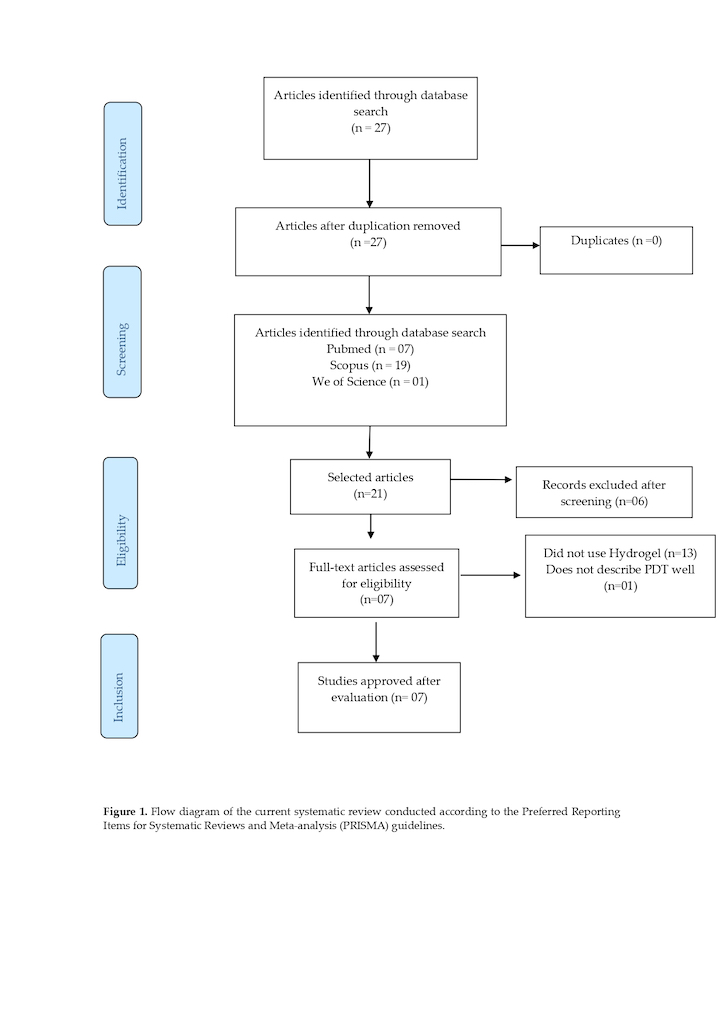
This systematic review followed the Preferred Reporting Items for Systematic Reviews and Meta-Analyses (PRISMA) 2020 guidelines [11]. Bibliographic research was conducted using the PubMed, Web of Science, and Scopus databases. Only full articles published in English between 2013 and 2024 from any country of origin (without restrictions) were included. The research was conducted from 15 January 2024 to 15 June 2024 and did not use any automatic bibliographic search tool.
2.2. Data Extraction Process
A two-phase process was adopted to select studies. In phase 1, two reviewers (RSM and JPRA) independently screened titles and abstracts to identify eligible studies based on the eligibility criteria. Those who met the inclusion criteria were selected for full reading. In phase 2, the same reviewers independently read the studies to confirm their inclusion. Any disagreement between the two reviewers was resolved through discussion with a third reviewer (LVFO), if necessary.
For each selected database, a bibliographic search was conducted by title and abstract using keywords according to MeSH. The strategy for a predefined combination of keywords was adopted as follows:
“Hydrogels”[Mesh] OR Hydrogel OR In Situ Hydrogels OR In Situ Hydrogel OR Patterned Hydrogels OR Patterned Hydrogel “Photochemotherapy”[Mesh] OR Photochemotherapies OR Photodynamic Therapy OR Photodynamic Therapies “Gram-Positive Bacterial Infections”[Mesh] OR Gram Positive Bacterial Infections OR Gram-Positive Bacterial Infection “Staphylococcus aureus”[Mesh]”Anti-Infective Agents”[Mesh] OR Anti Infective Agents OR Antiinfective Agents OR Anti-Infective Agent OR Anti Infective Agent OR Microbicides OR Anti-Microbial Agent OR Anti Microbial Agent OR Antimicrobial Agents OR Anti-Microbial Agents OR Anti Microbial Agents OR Microbicide OR Antimicrobial Agent
All the titles were manually searched and reviewed for inclusion. Reference lists of the articles containing titles, author names, languages, and publication dates were generated. This systematic review included only scientific articles reporting experimental studies.
2.4. Election Criteria
2.4.1. Design and Interventions
This review examined controlled experimental laboratory studies that employed PDT in conjunction with different hydrogels to combat antibiotic-resistant microorganisms, particularly S. aureus. Both in vitro and in vivo experimental models were considered, including research conducted on animals and studies that investigated the effects of PDT on cells without the use of animals.
2.4.2. Methodological Design
For this scoping review, we queried PubMed (using MESH), Web of Science, and Scopus databases to identify relevant articles. We used specific search criteria, including keywords such as Staphylococcus aureus, Photodynamic Therapy, photosensitiser, gram-positive, hydrogel, and antibiotic resistance. The inclusion and exclusion criteria were applied to ensure the relevance of the articles. We included studies that addressed the photodynamic associated with antimicrobial activity against S. aureus, both in vitro and in vivo, and considered its clinical applications and synergism with other antimicrobial agents. We excluded unpublished research, studies published before 2013, studies that did not mention the PS used, those that did not involve S. aureus, those that did not use hydrogels in PDT, and those that were not clinically relevant to the research. We followed the PRISMA guidelines, which allowed for a systematic approach to article selection. After selecting the studies, data were extracted to ensure consistency in the inclusion and exclusion criteria.
3. Results
3.1. Study Description
3.2. Characteristics and Results of Individual Studies
3.2.1. Xylan-Porphyrin Hydrogels as Light-Triggered Gram-Positive Antibacterial Agents
This study describes the synthesis and characterisation of xylan-based hydrogels containing a PS (tetra(4-carboxyphenyl) porphyrin; TCPP) for in vitro bacterial photoinactivation. The main results and conclusions were as follows. Hydrogels were prepared by cross-linking xylan with TCPP using N, N’-carbonyldiimidazole as a coupling agent. Different amounts of TCPP were used to synthesise the hydrogels [15].
Freeze-drying of the hydrogels affected their ability to swell in water, and shrinkage promoted mutual hydrophobic interactions, making it difficult for water to re-enter the hydrogel structure. Hydrogels containing lower amounts of porphyrins (TCPP) exhibited better swelling properties than those containing higher amounts. Covalent bonding between TCPP and xylan was confirmed through Fourier transform infrared (FTIR) spectroscopy [17]. In vitro bacterial photoinactivation tests showed that the hydrogel functionalised with TCPP exhibited antibacterial activity only under light irradiation and was more effective against gram-positive bacteria. The concentration of TCPP in the hydrogel affects the antibacterial activity, and further research is needed to optimise the concentration of the PS [15].
This research demonstrated the successful synthesis of TCPP-containing xylan-based hydrogels that show potential for bacterial photoinactivation applications, particularly against gram-positive bacteria. However, the optimal concentrations of TCPP and other parameters need to be determined.
3.2.2. Optimisation and Evaluation of a Chitosan/Hydroxypropylmethylcellulose Hydrogel Containing Toluidine Blue for Antimicrobial Photodynamic Inactivation
This study by Brown et al. (1993) describes the formulation and characterisation of hydrogels containing chitosan (HCT) as potential agents for PDI against S. aureus and P. aeruginosa biofilms. Hydroxypropylmethylcellulose (HPMC) was used as a gelling agent, and the effects of different concentrations of HPMC on the physical and textural properties of hydrogels, including viscosity, hardness, adhesiveness, and compressibility were evaluated [18]. Chen et al. (2015) showed that increasing the concentration of HPMC in the HCT resulted in greater viscosity, hardness, adhesiveness, and compressibility. The hydrogel with 1% HPMC exhibited textural properties similar to those of a commercial gel. However, the injectability of the hydrogels decreased as the concentration increased [12]. The efficacy of PDI against S. aureus and P. aeruginosa biofilms was evaluated, and the results showed that HCT with low concentrations of HPMC (F-1 and F-2) were effective, similar to those of the mixture of toluidine blue O (TBO) and chitosan. However, increasing the HPMC concentration reduced the effectiveness of PDI, probably due to the restriction of TBO release in hydrogels with high viscosity. Furthermore, another study investigated the penetration of TBO into biofilms and observed that increasing the concentration of HPMC restricted the penetration of TBO into the deeper layers of the biofilms [19]. In an in vivo study, HCT were tested in a burn model of rat skin infected with S. aureus, and the results showed a significant reduction in the survival of bacterial cells. However, the effectiveness of this treatment decreased as HPMC concentration in the hydrogel increased. Overall, this study highlighted the importance of HPMC concentration in the formulation of hydrogels for PDI and the need to optimise textural properties and treatment efficacy [12].
3.2.3. Hydrogen Peroxide (H2O2)-Supramolecular Material for the Treatment of Post-Irradiation Infected Wounds
This article presents a study on the production of H2O2 through a photocatalytic process mediated by riboflavin and its use for antibacterial purposes. The research is based on several steps and discoveries, as described below:
- Photocatalytic Process and H2O2 Production: Riboflavin is used as a photocatalyst and has a strong absorption peak around 460 nm. After irradiation with blue light, riboflavin is excited and rapidly converted into a triple state with a high oxidation potential, generating H2O2. The amount of H2O2 was quantified by monitoring the changes in the absorbance at 652 nm [20].
- Choice of Guanosine: Among the nucleotides derived from guanine, guanosine generates the most substantial amount of H2O2 owing to hydrogen bonds and stacking interactions with riboflavin. Because of the differences in their oxidation potentials, guanosine produces more H2O2 than adenosine, uridine, or cytidine [21].
- G4 Supramolecular Materials: Guanosine was used to develop G4 supramolecular materials, which were formed into nanofibres and crosslinked using 4-formylphenylboronic acid and 1,8-diaminooctane. The properties of these materials were characterised using techniques such as electrospray mass spectrometry and FTIR spectroscopy [8].
- Controlled H2O2 Production: The amount of H2O2 generated can be controlled by varying the riboflavin concentration and irradiation time. This system maintains its robustness even after irradiation.
- Antibacterial Activity: The H2O2 generated was used to test the antibacterial activity. The post-irradiation riboflavin-loaded hydrogel effectively killed gram-positive, gram-negative, and multidrug-resistant bacteria with a sterilisation rate of over 99.999%. Incubation with catalase inhibited the antibacterial activity [22].
- In Vivo Assays: Thestudy included in vivo assays using an MRSA-infected rat wound model. The post-irradiation hydrogel exhibited a significant therapeutic effect by eliminating wound infections and reducing the levels of typical inflammatory factors. This study demonstrated the effectiveness of controlled riboflavin-mediated H2O2 production for antibacterial purposes with promising results both in vitro and in vivo [23].
3.2.4. Photo-Inspired Antibacterial Activity and Acceleration of Wound Healing by Hydrogel Incorporated with Ag/Ag@Siver Chloride (AgCl)/Zinc Oxide (ZnO) Nanostructures
This study presents the synthesis and characterisation of a nanocomposite hydrogel containing Ag/Ag@AgCl/ZnO. The hydrogel was obtained by absorbing water and opening pores in the gel structure. X-ray diffraction (XRD) results revealed changes in the hydrogel structure after doping with Ag/Ag@AgCl/ZnO, indicating the incorporation of these nanomaterials. The diffraction patterns showed peaks corresponding to the crystal planes of metallic Ag, AgCl, and ZnO [24]. The morphology of the pure hydrogel was similar to that of a sponge, with pores of approximately 10 μm in diameter. After doping with the Ag NPs and Ag@AgCl particles, the Ag NPs were uniformly distributed in the samples. The ZnO hydrogel incorporated one-dimensional ZnO nanostructures such as nanorods and aggregates. The presence of Ag NPs in the ZnO nanostructures was confirmed using microscopy [25]. An analysis of the release of Ag and Zn ions from the hydrogels revealed different release profiles. The antibacterial activities of the hydrogels were evaluated in vitro, and the results showed significant effects against bacteria. Reactive oxygen species (ROS) formation was detected and was associated with enhanced antibacterial activity. In vivo studies demonstrated the therapeutic efficacy of hydrogels for wound healing, particularly in wounds infected with S. aureus. Ag/Ag@AgCl/ZnO and pure ZnO hydrogels reduced bacterial infection and promoted wound healing [14].
This article introduced a novel approach for the synthesis of nanocomposite hydrogels that exhibit promising antibacterial properties. This study also highlighted the potential of these hydrogels for wound healing, particularly in the context of infected wounds. The unique properties of these hydrogels, such as the controlled release of metal ions and generation of ROS, contribute significantly to their antibacterial and therapeutic efficacy.
3.2.5. Carrageenan Embedded in Atomically Precise Au Nanocluster for Single Infrared Light-Driven Photothermal and Photodynamic Antibacterial Therapy
The study addresses the synthesis and characterisation of a nanocomposite hydrogel composed of Ag, Ag@AgCl, and ZnO [26]. The main points of the study are as follows. The synthesis of the nanocomposite hydrogel involves the absorption of water by the carboxymethyl cellulose hydrogel, followed by doping with Ag/Ag@AgCl/ZnO. The materials were characterised via XRD to analyse their crystalline structures [27]. The results indicated the presence of metallic Ag, AgCl, and ZnO in the hydrogel structure. Transmission electron microscopy images showed the presence of cubic metallic Ag and Ag@AgCl nanostructures along with one-dimensional ZnO nanostructures [5]. The swelling behaviour of the hydrogel was investigated at different pH values, and it was found to be pH-sensitive [28]. The study also evaluated the release of Ag+ and Zn2+ ions from the nanocomposite hydrogel and its antibacterial activity in vitro. These results indicated that the nanocomposite hydrogel had antibacterial properties with different effects against Escherichia coli and S. aureus [29].
This study also evaluated the cytotoxicity of these materials in cell culture and their effectiveness in wound healing in an animal model. The results showed that the nanocomposite hydrogel could potentially be used for the treatment of infections and wound healing. Overall, this study focused on synthesising and characterising a nanocomposite hydrogel, highlighting its antibacterial properties and potential for wound healing [5].
3.2.6. Optimisation of Hydrogel Containing Toluidine Blue for PDT in the Treatment of Acne
This study focused on optimising the formulation of a hydrogel containing the PS, TBO, for PDT to treat bacterial infections, particularly acne vulgaris. Four types of carbomers were used, namely TBO, Tween 80, and other chemicals. PDT was performed on different types of bacteria, including S. aureus, E. coli, and Propionibacterium acnes, using the TBO hydrogel as a PS [26].
The results showed that the type of carbomer, carbomer concentration, TBO concentration, ethanol concentration, Tween 80 ratio, and mass ratio of NaOH to the carbomer significantly influenced the effectiveness of the TBO hydrogel in PDT. The optimal hydrogel formulation was determined based on optimisation experiments using response surface methodology (RSM) [30]. The optimal TBO hydrogel formulation comprised of 0.5% (w/v) carbomer 934, 0.01 mg/mL TBO, 0.5% (v/v) ethanol, 0.5% (v/v) Tween 80 ratio, and 0.4 (c/c) mass ratio of NaOH to carbomer. This formulation exhibited excellent rheological properties, stability during storage, and antibacterial activity against the tested bacteria [5]. Compared with the optimal TBO hydrogel PDT and antibiotic therapy, PDT showed promising results in reducing the number of colony-forming units/mL. Furthermore, the release of TBO from the hydrogel was evaluated, demonstrating that the optimised hydrogel maintained its properties over time, both in terms of pH and viscosity. This study showed that PDT with the optimised TBO hydrogel is a promising approach for treating bacterial infections such as acne vulgaris and may represent an effective alternative to traditional antibiotics [28].
3.2.7. Optimisation of Hydrogel Containing Toluidine Blue for PDT Using RSM
This study involved the preparation of hydrogels containing TBO and their application in the inactivation of S. aureus and E. coli through antimicrobial photodynamics (PDT) [31]. The materials used include carbomers, TBO, NaOH, and other reagents. The hydrogels were prepared by mixing the components and optimising the concentrations of carbomer, TBO, and the quality ratio between NaOH and carbomer using RSM [13].
The results showed that the choice of carbomer type did not significantly affect antimicrobial activity. However, the carbomer concentration influenced the activity, with very high concentrations impairing the diffusion of TBO in bacterial cells. TBO concentration also affected activity, with a 0.1 mg/mL concentration chosen for further experiments. The ratio of NaOH to carbomer also influenced the antimicrobial activity, with a ratio of 0.4 found to be the most effective [13].
A single-factor and RSM experiment identified an ideal hydrogel formulation comprising of 3% carbomer, 0.1 mg/mL TBO, and a quality ratio of NaOH and carbomer of 0.4. This formulation exhibited potent antibacterial activity against S. aureus and E. coli. This study also evaluated the stability of the hydrogel, which remained stable during 6 weeks of storage at different temperatures. Furthermore, the release of TBO from the hydrogel was monitored, and it showed gradual release over 6 h [32].
It is essential to highlight that the application of the TBO hydrogel or light alone did not result in significant antibacterial activity, highlighting the importance of combining both for PDT. In summary, this study demonstrated an ideal formulation of a hydrogel containing TBO with high antibacterial activity and good stability. Thus, PDT is a promising candidate for clinical treatments involving the inactivation of bacteria such as S. aureus and E. coli [31].
4. Discussion
4.1. Main PSs
4.1.1. Methylene Blue (MB)
MB is a phenothiazine widely used as a PS for PDT owing to its high efficiency in generating 1O2. In addition to its photodynamic properties, MB exhibits intrinsic antimicrobial action that enhances light absorption [33]. MB is effective against gram-positive and gram-negative bacteria in the wavelength range of 625–635 nm. Due to its hydrophilic/lipophilic balance and affinity for membranes, its ability to penetrate plasma membranes contributes to its effectiveness as a PS, generating intracellular ROS when activated by light [34]. MB is widely recognised as a histological and antiseptic dye and has been used as a topical disinfectant for wounds and infections for several years. Furthermore, it is one of the most commonly used PSs in photodynamics, alone or in combination with other compounds, such as nanoparticles (NPs) or antibiotics [35].
Previous studies have demonstrated the synergistic effects of MB in combination with ethanol and ethylenediaminetetraacetic acid (EDTA). The addition of these components significantly inhibited bacterial growth, suggesting a synergistic action. When combined with MB, ethanol can prolong singlet oxygen production during PDT, potentially increasing its effectiveness. EDTA disrupts biofilms and damages the outer membranes of bacteria, facilitating the transport and absorption of ethanol and MB molecules within the bacteria. This process results in increased singlet oxygen production and increased PDT efficacy [7]. Although the use of ethanol to optimise the effect of PDT on biofilms is promising, its clinical application in the treatment of superficial wounds remains debatable. It is thus essential to ensure that optimising PDT with ethanol is clinically safe, especially in wound care settings [36].
4.1.2. Rose Bengal (RB)
RB was first discovered by Gnehm in 1882. This water-soluble anionic xanthene dye, a halogenated derivative of fluorescein, comprises three linearly arranged aromatic rings with an oxygen atom in the centre, and acts as a type II PS [37]. When activated by visible light, RB exhibited maximum absorption at 546 nm in water [38]. Owing to its anionic nature, it may be less effective against gram-negative bacteria, such as P. aeruginosa, because of the negative charges on its membrane. Strategies to increase the effectiveness of RB include its incorporation into cationic polymers, both of natural and synthetic origin, which act as vehicles to improve the effectiveness of RB [39].
A study by Fernandez and collaborators (2021) demonstrated that the interaction of RB with potassium iodide in a polymeric matrix Poly 2-hydroxyethyl methacrylate (PHEMA) creates a protective environment for PS, preventing its complete photodegradation and prolonging its half-life. This strategy allowed the reduction of the light dose required for PDT while effectively eradicating planktonic cells. PHEMA is a polymer widely used in medicine because of its transparency and is used in manufacturing contact lenses and urethral stents [40].
Another approach involves the combination of RB with polycationic chitosan. Chitosan, a chitin derivative, is a natural biopolymer with high antimicrobial activity, biocompatibility, and biodegradability. This combination showed promising results in bacterial eradication when activated with light, suggesting its potential for systemic clinical applications. Furthermore, RB, combined with cation exchange resins such as macroporous polystyrene and Amberlite®® IRA-900, demonstrated significant inhibition of bacterial viability. The interaction of RB with these resins resulted in greater efficacy, especially against gram-negative bacteria such as P. aeruginosa. Using cationic transporters can increase interactions with the bacterial cell envelope, overcoming the initial ineffectiveness of RB against these species [41]. These combination strategies demonstrated the versatility and ability of RB to be optimised for diverse applications in PDT, highlighting its potential for addressing resistant infections.
4.1.3. Porphyrins
Porphyrins are a group of fluorescent crystalline pigments that may be of natural or synthetic origin, and are widely used in PDT. These compounds have notable absorption bands at approximately 392 nm (Soret band) and weaker satellite absorptions between 495 and 616 nm (Q bands) [42]. Naturally distributed in living tissues, porphyrins play vital roles in biochemical processes such as oxygen transport and photosynthesis [43].
The efficacy of porphyrins in PDT may be affected by its difficulty in permeating the cell membrane of gram-negative bacteria owing to the negatively charged cell wall. Strategies to overcome this problem include the use of cationic porphyrins that effectively interact with the negatively charged structures of gram-negative bacteria. However, for neutral or anionic porphyrins, this barrier can be overcome using membrane-disrupting agents or by attaching cationic polypeptides to PS molecules [44].
A notable cationic porphyrin, 5,10,15,20-tetrakis(1-methylpyridinium-4-yl) (TMPyP), has demonstrated significant antimicrobial activity against P. aeruginosa. The photocationic nature of porphyrin allows strong electrostatic interactions with negatively charged sites on the outer surface of the bacterial cell. The nanoassembly of TMPyP with cyclodextrin (CAPTISOL) as a vehicle facilitated the penetration of the P. aeruginosa plasma membrane. The CAPTISOL/TMPyP mixture exhibited excellent stability and photostability in biologically relevant media and as freeze-dried solids. Furthermore, TMPyP/CAPTISOL showed efficacy similar to that of free TMPyP, eliminating 99% of the bacteria. An important discovery was the ability of TMPyP/CAPTISOL to function as a sustained-release PS, being more stable than the free compound. This finding suggests that these systems may be promising for intravenous administration, improving selectivity and sustaining action in infected tissues, as a potential pre-surgical application [45].
4.1.4. Riboflavin (RF)
RF, also known as vitamin B2, is a natural, nontoxic PS that has several applications, including the decontamination of blood, plasma, or cell extracts and the elimination of microorganisms when combined with UV irradiation [46]. Furthermore, RF is inexpensive, highly biocompatible, and can be activated by light-emitting diode (LED) lamps in the ultraviolet A (360 nm) and blue (440 nm) regions [47]. This ability to be activated by visible light expands its applications and makes it a nontoxic photoinitiator.
RF has recently been used as a photoinitiator in the preparation of hydrogels exposed to visible light and is recognised as a biocompatible photocrosslinking agent. Furthermore, when associated with a light-emitting source such as an LED, it can act as a sterilising agent [48]. Because of its water solubility and biocompatibility, RF is widely used in biomedical field [46].
Notably, the amount of RF required for hydrogel formation is small, generally less than 5 mg/1 g of hydrogel precursor. Thus, RF as a photoinitiator for the manufacture of hydrogels is considered harmless and even beneficial. Additionally, an overdose of riboflavin does not cause significant side effects, as the excess is excreted in the urine a few hours after this vitamin is ingested [8]. The visible light absorption spectrum of RF enables the initiation of photopolymerisation through visible light irradiation [49].
4.2. PDT in Clinical Isolates
PDT studies involving clinical isolates of P. aeruginosa are relatively recent, dating back to 2019. A previous study [50] used clinical isolates from wounds infected with P. aeruginosa and other ESKAPE strains from Leipzig Hospital. The researchers demonstrated the complete eradication of P. aeruginosa clinical isolates through the application of two porphyrin-based PSs, TMPyP and THPTS, embedded in a hydrogel matrix. TMPyP was activated at a wavelength of 420 nm and a light dose of 13 mW/cm2, while THPTS was activated at a wavelength of 420 nm and a light dose of 18 mW/cm2 [51].
One of the fundamental objectives of this study was to explore the use of these hydrogels as adhesives or wound dressings to relieve pain, promote adequate wound healing, and absorb exudates. Translucent hydrogels have been highlighted as an excellent choice, as they allow the effective application of doses and wavelengths of light without the need to remove the substrate. This characteristic facilitates the practical and effective application of PDT, similar to other studies on chitosan hydrogels [50].
Furthermore, RM24, one of the PSs used, exhibited significantly higher bactericidal activity on strains in the exponential growth phase than in the steady state, even at doses as low as 1 µM. Researchers have also observed that the presence of organic compounds can affect the effectiveness of RM24, indicating that the medium influences the activity of PSs [52].
Sodium azide was used as the antioxidant to characterise the ROS produced by the activation of RM24. However, notably, the use of this highly toxic compound in photodynamics is currently not recommended, highlighting the importance of safety considerations in this type of research [53].
4.3. Synergism with Antibiotics and Other Drugs
Many studies have explored the combination of PSs and antibiotics to optimise the efficacy of PDT against P. aeruginosa. Some notable examples are as follows:
- Amoxicillin with Gold NPs (amoxi@AuNPs): The combination of gold NPs as a PS and amoxicillin proved to be a potent inhibitor of P. aeruginosa growth. When activated with white LED light at 490 nm for 3 h, the bacterial load was reduced by >70%. This synergistic approach has been suggested as a strategy to reduce the need for high doses of antibiotics and minimise their adverse effects. Furthermore, the amoxi@AuNP combination reduced the necessary light activation time, making the application of PDT more practical [54].
- MB with Gentamicin (Gen+MB): One study used a combination of MB and gentamicin for PDT against P. aeruginosa. Red LED light resulted in a notable inhibition of 6 log cm2 in planktonic cultures and 3 log cm2 in biofilms. The addition of gentamicin reduced the amount of methylene blue required for photoactivation, indicating potential advantages for the treatment of skin and mucosal infections [53].
- Polymyxin B with Cationic Porphyrin Derivative: The antibacterial activity was explored using a conjugate of polymyxin B with a cationic porphyrin derivative. This conjugate showed significant eradication of the bacterial load even after washing, with a small amount of light being sufficient to photoinactivate the concentrated bacterial inocula. The conjugate demonstrated selective affinity for bacteria, offering advantages in relation to the risk of bacterial resistance associated with the exclusive use of antibiotics. These synergistic combinations of PSs and antibiotics represent promising strategies for the fight against infections caused by P. aeruginosa, highlighting the versatility and potential of PDT as an effective and less resistance-prone approach [55].
4.4. PDT Associated with NPs
NPs play a significant role in the advancement of PDT by improving the efficacy of PS. Some approaches involving NPs include the following:
- Incorporation of PS into Polymeric NPs: PS can be incorporated into polymeric NPs, providing a stable and targeted platform for the efficient delivery of photosensitising agents. This approach helps overcome the limitations of solubility and bioavailability of PS.
- PS Attached to the Surface of NPs: PS can be attached to the surface of NPs, allowing for specific and targeted interactions with the target cells. This approach aimed to improve the selectivity and effectiveness of PDT. PS Close to NPs: Some strategies exploit the physical proximity of PS to NPs, enhancing their therapeutic effects. These strategies may involve physical proximity without direct connection but with beneficial interactions for the effectiveness of PDT [56].
- NPs such as PS: Certain NPs themselves can act as PSs, generating effective photodynamic reactions when exposed to adequate light. This feature of the NPs offers an integrated approach in which the NPs themselves play the role of phototherapeutic agents [57].
- Photothermal Therapy (PTT): In addition to PDT, NPs are used in PTT. In this context, near-infrared (NIR) laser irradiation is used to generate heat through the mediation of photoabsorbing agents, resulting in the denaturation of proteins, membrane rupture, and degradation of the genetic material of target cells.
- Microemulsions (MEs): MEs have been reported to improve the efficiency of PDT by overcoming the limitations associated with the use of aqueous media to disperse photosensitising agents. They consist of two phases (aqueous and organic), with the organic phase stabilised by surfactants. Eucalyptus oil was used to destabilise the cell wall, allowing for greater PS penetration and synergistic effects [58].
- Gold-Based NPs (AuNPs): AuNPs, including smaller gold nanoclusters, have received considerable attention owing to their photoactivatable properties, excellent biocompatibility, and ease of surface functionalisation. They can be used for both PDT and PTT, generating singlet oxygen under NIR light excitation and exhibiting photothermal properties when combined with organic dyes such as indocyanine green [53]. These approaches highlight the diversity of strategies that utilise NPs to improve the efficacy and specificity of PDT in diverse biomedical applications.
4.5. PDT Delivered via Hydrogels
Hydrogels are a class of water-expanded three-dimensional polymer networks with tunable physicochemical properties that satisfy specific requirements under different conditions [59]. As promising materials, they have been extensively applied in the biomedical field, from studies on physiological and pathological mechanisms to tissue regeneration and disease therapy [9].
Hydrogels have been widely investigated as matrices for biomedical applications owing to their cross-linking ability under mild conditions, excellent biocompatibility, and tunable biochemical and biophysical properties [60]. As the structure and properties of hydrogels resemble the microenvironment of many tissues in the human body, they are widely used in various biomedical applications [10].
Hydrogels have demonstrated good performance as cell carriers in various clinical applications [61]. Loading various antibacterial agents onto hydrogels is an efficient strategy for enhancing antimicrobial effects. To prevent the emergence of drug-resistant bacteria, phototherapeutic strategies such as the use of hydrogels loaded with RF + 405 nm LED irradiation have been widely used for antibacterial applications [8].
4.6. Application of PDT in Biofilm and Its Usefulness in Vivo
Biofilms represent a highly resistant and complex form of bacterial organisation composed of a matrix of exopolysaccharides (EPSs) that protects bacteria against various external stimuli. This structure provides considerable resistance, making treatment, including PDT, more challenging [62]. The following are some important aspects of biofilms.
- EP Matrix: The EPS matrix forms a three-dimensional structure surrounding the bacterial cells. In some cases, the matrix is composed of polysaccharides, proteins, and metal ions. The presence of metal ions can confer a neutral or polyanionic charge on the matrix, depending on the predominant type of EP [63].
- Resistance to External Aggression: The biofilm acts as a protective barrier, providing resistance to bacteria against external aggression, such as the host immune response, medications, and other antimicrobial agents. The matrix can trap antimicrobials, preventing them from reaching bacterial cells [63].
- Greater Resistance Compared to Planktonic Cells: Biofilm formation confers significantly greater resistance, estimated to be between 10 and 1,000 times greater than that of planktonic bacterial cells. This feature makes biofilms challenging to eradicate [64].
- Chemical Signalling and Bacterial Cooperation: Biofilm formation involves chemical signalling between bacteria, allowing the coordination of surface adherence and cell differentiation. This bacterial cooperation results in the creation of a complex and organised microbial community [62].
- Protection from Environmental Fluctuations: The matrix protects against environmental fluctuations, such as changes in humidity, temperature, and pH. Furthermore, the concentration of nutrients is favoured and waste can be efficiently eliminated.
- Challenges for PDT: In PDT, the presence of a biofilm represents a challenge, as the matrix limits the diffusion of PSs into the bacterial plasma membrane, leading to a reduction in the production of singlet oxygen. Specific strategies must be developed to overcome these barriers and make PDT effective against bacteria in biofilms [64].
Understanding the complexity of biofilms is crucial for developing effective therapeutic approaches, particularly in clinical situations where persistent biofilm-based infections are common.
5. Conclusions
Our systemic review showed that PDT delivered via a hydrogel against S. aureus can effectively inhibit the growth of bacteria and biofilms in vitro. Although many of these compounds are known to have clinical use in PDT, most studies have tested their efficacy only in vitro, making it necessary to understand their effectiveness in vivo for treating S. aureus infections. Therefore, whether PDT can help treat localised infections caused by antibiotic-resistant bacteria remains unclear. Our review highlighted that PDT carried via hydrogels is more effective than the antimicrobial treatment provided using PDT without the presence of any hydrogel. A primary obstacle to advancing the clinical use of PDT against S. aureus is the limited number of in vivo studies; thus, future research efforts should focus on demonstrating the safety and efficacy of these PS in vivo in animal infection models.
Author Contributions
Conceptualization, RSM., O.A.G. and L.V.F.O.; Methodology, J.P.R.A., O.A.G., R.K.P., G.I., I.O.S., and L.V.F.O.; Project administration, O.A.G., G.I. and L.V.F.O., Data curation, I.O.S., and C.H.M.S.; Formal analysis, R.F.O., D.A.A.P.O., D.A.C.P.G.M., D.B.S., R.K.P., and O.A.G.; Supervision, C.H.M.S, O.A.G., G.I., and L.V.F.O.; Writing-original draft, R.S.M., O.A.G., J.P.R.A., G.I., C.H.M.S., and L.V.F.O.; Writing-review and edit, T.B.M.O.S., O.A.G., and L.V.F. O., All authors have read and approved the final version of the manuscript.
Funding
This research received no external funding. L.V.F.O. received grants from Research Productivity, modality PQII; process no. 310241/2022-7 of Conselho Nacional de Desenvolvimento Cientifico e Tecnologico (local acronym CNPq), Brazil.
Institutional Review Board Statement
Not applicable
Informed Consent Statement
Not applicable
Data Availability Statement
The data presented in this study will be provided without restrictions upon communication with the corresponding author.
Conflicts of Interest
The authors declare no conflict of interest.
References
- Nathan, C. Resisting antimicrobial resistance. Nat Rev Microbiol. 2020;18;5:259-260. [CrossRef]
- Navarro, DB.; Llanos, R.; Miravet, JF.; Galindo, F. Photodynamic inactivation of Staphylococcus aureus in the presence of aggregation-prone photosensitizers based on BODIPY used at submicromolar concentrations. J Photochem Photobiol B. 2022;235:112543. [CrossRef]
- Beyer, P., Paulin, S. The antibacterial research and development pipeline needs urgent solutions. ACS Infectious Diseases. 2020;6;6:1289-1291. [CrossRef]
- Youf, R.; Müller, M.; Balasini, A.; Thétiot, F.; Müller, M.; Hascoët, A.; et al. Antimicrobial Photodynamic Therapy: Latest Developments with a Focus on Combinatory Strategies. Pharmaceutics. 2021;24;13;12:1995. [CrossRef]
- Zheng, Y.; Yu, E.; Weng, Q.; Zhou, L.; Li, Q. Optimization of hydrogel containing toluidine blue O for photodynamic therapy in treating acne. Lasers in Medical Science. 2019;34:1535-1545.
- Oliveira, LVF.; Apostólico, N.; Uriarte, JJ.; da Palma, RK.; Prates, RA.; Deana, AM.; Martins, RABL. Photodynamic Therapy in the Extracellular Matrix of Mouse Lungs: Preliminary Results of an Alternative Tissue Sterilization Process. International Journal of Photoenergy. 2021;1-9.
- Yanten, N.; Vilches, S.; Palavecino, CE. Photodynamic therapy for the treatment of Pseudomonas aeruginosa infections: A scoping review. Photodiagnosis Photodyn Ther. 2023;13;44:103803.
- Du, P.; Shen, Y.; Zhang, B.; Li, S.; Gao, M.; Wang, T.; et al. A H2 O2 -Supplied Supramolecular Material for Post-irradiated Infected Wound Treatment. Adv Sci (Weinh). 2023;10;9:e2206851.
- Choi, JR.; Yong, KW.; Choi, JY.; Cowie, AC. Recent advances in photo-crosslinkable hydrogels for biomedical applications. Biotechniques. 2019;66;1:40-53.
- Goding, J.; Vallejo, CG.; Syed, O.; Green, R. Considerations for hydrogel applications to neural bioelectronics. J Mater Chem B. 2019;14;7;10:1625-1636.
- Moher, D.; Liberati, A.; Tetzlaff, J.; Altman, DG. Preferred reporting items for systematic reviews and meta-analyses: the PRISMA statement. Annals of internal medicine. 2009;151;4:264-269.
- Chen, CP.; Hsieh, CM.; Tsai, T.; Yang, JC.; Chen, CT. Optimization and evaluation of a chitosan/hydroxypropyl methylcellulose hydrogel containing toluidine blue O for antimicrobial photodynamic inactivation. International journal of molecular sciences. 2015;16;9:20859-20872.
- Liang, H.; Xu, J.; Liu, Y.; Zhang, J.; Peng, W.; Yan, J.; et al. Optimization of hydrogel containing toluidine blue O for photodynamic therapy by response surface methodology. J Photochem Photobiol B. 2017;173:389-396.
- Mao, C., Xiang, Y., Liu, X., Cui, Z., Yang, X., Yeung, K.; et al. Wound Healing Acceleration by Hydrogel Embedded with Ag/Ag@ AgCl/ZnO Nanostructures. ACS Nano. 2017;11;9:9010-9021.
- Elkihel, A.; Vernisse, C.; Ouk, TS.; Roper, RL.; Chaleix, V.; Sol, V. Xylan-Porphyrin Hydrogels as Light-Triggered Gram-Positive Antibacterial Agents. Gels. 2023;2;9;2:124.
- Zheng Y, Zhu Y, Dai J, Lei J, You J, Chen N, Wang L, Luo M, Wu J. Atomically precise Au nanocluster-embedded carrageenan for single near-infrared light-triggered photothermal and photodynamic antibacterial therapy. Int J Biol Macromol. 2023 Mar 1;230:123452.
- Vidro, S.; Kuhnert, M.; Lippmann, N.; Zimmer, J.; Werderhausen, R.; Abel, B.; Eulenburg, V.; Schulze, A. Hidrogéis carregados com fotossensibilizador para inativação fotodinâmica de bactérias multirresistentes em feridas. RCS Av. 2021;11;7600–7609.
- Brown, MR; Gilbert, P. Sensibilidade de biofilmes a agentes antimicrobianos. J. Appl. Bacteriol. 1993;74;87S–97S.
- Jori, G.; Fabris, C.; Soncin, M.; Ferro, S.; Coppellotti, O.; Dei, D.; et al. Terapia fotodinâmica no tratamento de infecções microbianas: princípios básicos e aplicações em perspectiva. Cirurgia de Lasers. Med. 2006;38;468-481.
- He, YQ.; Fudickar, W.; Tang, JH.; Wang, H.; Li, X.; Han, J.; et al. Capture and Release of Singlet Oxygen in Coordination-Driven Self-Assembled Organoplatinum(II) Metallacycles. J Am Chem Soc. 2020;5;142;5:2601-2608.
- Turan, IS.; Yildiz, D.; Turksoy, A.; Gunaydin, G.; Akkaya, EU. A Bifunctional Photosensitizer for Enhanced Fractional Photodynamic Therapy: Singlet Oxygen Generation in the Presence and Absence of Light. Angew Chem Int Ed Engl. 2016;18;55;8:2875-8.
- Wang, Y.; Shen, X.; Ma, S.; Guo, Q.; Zhang, W.; Cheng, L.; et al. Oral biofilm elimination by combining iron-based nanozymes and hydrogen peroxide-producing bacteria. Biomater Sci. 2020;7;8;9:2447-2458.
- Li, Y.; Su, L.; Zhang, Y.; Liu, Y.; Huang, F.; Ren, Y.; et al. A Guanosine-Quadruplex Hydrogel as Cascade Reaction Container Consuming Endogenous Glucose for Infected Wound Treatment-A Study in Diabetic Mice. Adv Sci (Weinh). 2022;9;7:e2103485.
- Scherer, S.; Wagner, C.; Leuner, C.; Fleischer, W. Hydrogel. US patent US9415133, August 16, 2016.
- Liu M, Ishida Y, Ebina Y, Sasaki T, Aida T. Photolatently modulable hydrogels using unilamellar titania nanosheets as photocatalytic crosslinkers. Nat Commun. 2013;4:2029.
- Zhou, YF.; Yang, W.; Zhang, S.; Liu, AB.; Shaikh, L.; Yang, Y.; et al. Hidrogel bioinspirado, injetável, adesivo de tecido e antibacteriano para regeneração de tecidos múltiplos por terapia minimamente invasiva. Appl. Matéria. 2022;101290.
- Gan, D.; Xu, T.; Xing, W.; Ge, X.; Fang, L.; Wang, K.; et al. Hidrogel antibacteriano ativo de contato inspirado em mexilhões com alta afinidade celular, resistência e recuperabilidade. Av. Função. Matéria. 2019;29:1805964.
- Mo, S.; Song, Y.; Lin, M.; Wang, J.; Zhang, Z.; Sun, J.; et al. Nanofolhas de CuS ricas em vagas de enxofre responsivas ao infravermelho próximo para atividade antibacteriana eficiente via fototérmica sinérgica e vias fotodinâmicas. J Colloid Interface Sci. 2022;608:2896–2906.
- Yang, Y.; Liang, Y.; Chen, J.; Duan, X.; Guo, B. Curativo de hidrogel composto hemostático antioxidante adesivo inspirado em mexilhão via fotopolimerização para cicatrização de feridas em pele infectada. Bioact.Mater. 2022;8:341–354.
- Liang, JY.; He, B. Hidrogéis funcionais como curativo para melhorar a cicatrização de feridas. ACS Nano. 2021;8:12687–12722.
- Park, H.; Park, H.; Na, K. Terapia Dual Propionibacterium acnes usando lipossomas com penetração na pele carregados com um fotossensibilizador e um antibiótico. J Porphyr Phthalocya. 2015;19;8:956–966.
- Lee, CJ.; et al. Correlações dos componentes do óleo da árvore do chá com seus efeitos antibacterianos e irritação da pele. J Food Drug Anal. 2013;21;2:169–176.
- Liu, K.; Luo, Y.; Hao, L.; Chen, J. Antimicrobial effect of methylene blue in microbiologic culture to diagnose periprosthetic joint infection: an in vitro study. J Orthop Surg Res. 2022;28;17;1::571.
- Perez-Laguna, I.; Garcia-Luque, S.; Ballesta, L.; Perez-Artiaga, V.; Lampaya-Perez, A.; Rezusta, Y. Gilaberte, Photodynamic therapy using methylene blue, combined or not with gentamicin, against Staphylococcus aureus and Pseudomonas aeruginosa. Photodiagnosis and photodynamic therapy. 2020;31:101810.
- Tardivo, JP.; Del, AG.; Oliveira, CS.; Gabrielli, DS.; Junqueira, HC.; Tada, DB.; et al. Methylene blue in photodynamic therapy: From basic mechanisms to clinical applications. Photodiagnosis. Photodyn Ther. 2005;2;2:175-91.
- Prochnow, EP.; Martins, MR.; Campagnolo, CB.; Santos, RC.; Villetti, MA.; Kantorski, KZ. Antimicrobial photodynamic effect of phenothiazinic photosensitizers in formulations with ethanol on Pseudomonas aeruginosa biofilms. Photodiagnosis Photodyn Ther. 2016;13:291-296.
- Vanerio, N.; Stijnen, M.; Mol, BAJM.; Kock, LM. Biomedical Applications of Photo- and Sono-Activated Rose Bengal. A Review. Photobiomodul Photomed Laser Surg. 2019;37;7:383-394.
- Rauf, MA.; Graha, JP.; Bukallah, SB.; Al-Saedi, MA. Solvatochromic behavior on the absorption and fluorescence spectra of Rose Bengal dye in various solvents. Spectrochim Acta A Mol Biomol Spectrosc. 2009;72;1:133-7.
- Spagnul, C.; Turner, LC.; Boyle, RW. Immobilized photosensitizers for antimicrobial applications. J Photochem Photobiol B. 2015;150:11-30.
- López, AMF.; Muñoz, IR.; Llanos, R.; Galindo, F. Photodynamic Inactivation of Pseudomonas aeruginosa by PHEMA Films Loaded with Rose Bengal: Potentiation Effect of Potassium Iodide. Polymers (Basel). 2021;6;13;14:2227.
- Shrestha, A.; Cordova, M.; Kishen, A. Photoactivated polycationic bioactive chitosan nanoparticles inactivate bacterial endotoxins. J Endod. 2015;41;5:686-91.
- Refsnes, M.; Hetland, RB.; Øvrevik, J.; Sundfør, I.; Schwarze, PE.; Låg, M. Different particle determinants induce apoptosis and cytokine release in primary alveolar macrophage cultures. Part Fibre Toxicol. 2006;14;3:10.
- Yuan, J.; Li, ([2.2.2]Cryptand)potassium (4-methyl-benzene-thiol-ato)[5,10,15,20-tetra-kis-(4-chloro-phenyl)porphyr-inato]manganate(II) tetra-hydro-furan disolvate, IUCrData. 2022;7:3x220241.
- Meerovich, EV.; Akhlyustina, IG.; Tiganova, EA.; Lukyanets, EA.; Makarova, ER.; Tolordava, OA. Novel Polycationic Photosensitizers for Antibacterial Photodynamic Therapy, Advances in experimental medicine and biology. 2020;1282;1-19.
- Zagami, R.; Franco, D.; Pipkin, JD.; Antle, V.; Plano, L.; Patanè, S.; et al. Sulfobutylether-β-cyclodextrin/5,10,15,20-tetrakis(1-methylpyridinium-4-yl)porphine nanoassemblies with sustained antimicrobial phototherapeutic action. Int J Pharm. 2020;30;585:119487.
- Goto, R.; Nishida, E.; , Kobayashi, S.; Aino, M.; Ohno, T.; Iwamura, Y.; et al. Gelatin Methacryloyl-Riboflavin (GelMA-RF) Hydrogels for Bone Regeneration. Int J Mol Sci. 2021;6;22;4:1635.
- Kingsley, DH.; Perez, RE.; Boyd, G.; Sites, J.; Niemira, BA. Evaluation of 405-nm monochromatic light for inactivation of Tulane virus on blueberry surfaces. J Appl Microbiol. 2018;124;4:1017-1022.
- Kang, Y.; Kim, JH.; Kim, SY.; Koh, WG.; Lee, HJ. Blue Light-Activated Riboflavin Phosphate Promotes Collagen Crosslinking to Modify the Properties of Connective Tissues. Materials (Basel). 2021;3;14;19:5788.
- Piluso, S.; Flores, DG.; Dokter, I.; Moreira, LT.; Li, Y.; Leijten, J.; et al. Rapid and cytocompatible cell-laden silk hydrogel formation via riboflavin-mediated crosslinking. J Mater Chem B. 2020;28;8;41:9566-9575.
- Glass, S.; Kühnert, M.; Lippmann, N.; Zimmer, J.; Werdehausen, R.; Abel, B.; et al. Photosensitizer-loaded hydrogels for photodynamic inactivation of multirestistant bacteria in wounds. RSC Adv. 2021;17;11;13:7600-7609.
- Lebreton, F.; Snesrud, E.; Hall, L.; Mills, E.; Galac, M.; Stam, J.; et al. A panel of diverse Pseudomonas aeruginosa clinical isolates for research and development. JAC Antimicrob Resist. 2021;10;3;4:dlab179.
- Bayat, F.; Karimi, AR. Projeto de hidrogéis fotodinâmicos de quitosana contendo conjugado de ftalocianina-colistina como agente antibacteriano, Jornal internacional de macromoléculas biológicas. 2019;129:927-935.
- Rocca, DM.; Silvero, CM.; Aiassa, V.; Becerra, MC. Tratamento fotodinâmico rápido e eficaz de infecções por biofilme usando baixas doses de nanopartículas de ouro revestidas com amoxicilina, Fotodiagnóstico e terapia fotodinâmica. 2020;31:101811.
- Perez, ILV.; Garcia, SL.; Ballesta, L.; Perez, VA.; Lampaya, AP.; Rezusta, Y. Terapia fotodinâmica com azul de metileno, combinada ou não com gentamicina, contra Staphylococcus aureus e Pseudomonas aeruginosa, Fotodiagnóstico e terapia fotodinâmica. 2020;31:101810.
- Guern, FL.; Sol, V.; Ouk, C.; Arnoux, P.; Frochot, C.; Ouk, TS. Enhanced Photobactericidal and Targeting Properties of a Cationic Porphyrin following the Attachment of Polymyxin B. Bioconjug Chem. 2017;20;28;9:2493-2506.
- Perni, PS.; Prokopovich, J.; Pratten, IP.; Parkin, M.; Nanopartículas: seu uso potencial em terapia fotodinâmica antibacteriana, Ciências fotoquímicas e fotobiológicas: Jornal oficial da Associação Europeia de Fotoquímica e da Sociedade Europeia de Fotobiologia. 2011;5;10:712-20.
- Tondro, N.; Behzadpour, Z.; Keykhaee, N.; Akbari, N. Sattarahmady, Carbon@polypyrrole nanotubos como fotossensibilizador em fototerapia a laser de Pseudomonas aeruginosa, colóides e superfícies. B, Biointerfaces. 2019;180:481-486.
- Parasuraman, YTR.; Shaji, AC.; Sharan, AH.; Bahkali, HF.; Al-Harthi, A.; Syed, VT.; et al. Nanopartículas de prata biogênicas decoradas com azul de metileno potencializaram o Inativação fotodinâmica de Pseudomonas aeruginosa e Staphylococcus aureus, Pharmaceutics. 2020;12:8.
- Choi, JR.; Yong, KW.; Choi, JY.; Cowie, AC. Recent advances in photo-crosslinkable hydrogels for biomedical applications. Biotechniques. 2019;66;1:40-53.
- Goding, J.; Vallejo, CG.; Syed, O.; Green, R. Considerations for hydrogel applications to neural bioelectronics. J Mater Chem B. 2019;14;7;10:1625-1636.
- Xiang, Y.; Mao, C.; Liu, X.; Cui, Z.; Jing, D.; Yang, X.; Wu, S. Rapid and superior bacteria killing of carbon quantum dots/ZnO decorated injectable folic acid--conjugated PDA hydrogel through dual--light triggered ROS and membrane permeability. Small. 2019;15;22:1900322.
- Meerovich, EV.; Akhlyustina, IG.; Tiganova, EA.; Lukyanets, EA.; Makarova, ER.; Tolordava, OA. Novel Polycationic Photosensitizers for Antibacterial Photodynamic Therapy, Advances in experimental medicine and biology. 2020;1282;1-19.
- Martinez, SR.; Ibarra, LE.; Ponzio, RA.; Forcone, MV.; Wendel, AB.; Chesta, CA.; et al. Inativação fotodinâmica de patógenos bacterianos do grupo ESKAPE em culturas planctônicas e de biofilme usando nanopartículas de polímero conjugado dopado com porfirina metalizada. ACS infeccioso doenças. 2020;6;8:2202-2213.
- Sun, L.; Jiang, W.; Zhang, H.; Guo, Y.; Chen, W.; Jin, Y.; et al. Carregado com fotossensibilizador Nanopartículas multifuncionais de quitosana para imagens simultâneas in situ, erradicação de biofilme bacteriano altamente eficiente e ablação de tumores, materiais aplicados ACS e interfaces. 2019;11;2:2302-2316.
Figure 1.
Flow diagram of the current systematic review conducted according to the Preferred Reporting Items for Systematic Reviews and Meta-analysis (PRISMA) guidelines.
Figure 1.
Flow diagram of the current systematic review conducted according to the Preferred Reporting Items for Systematic Reviews and Meta-analysis (PRISMA) guidelines.
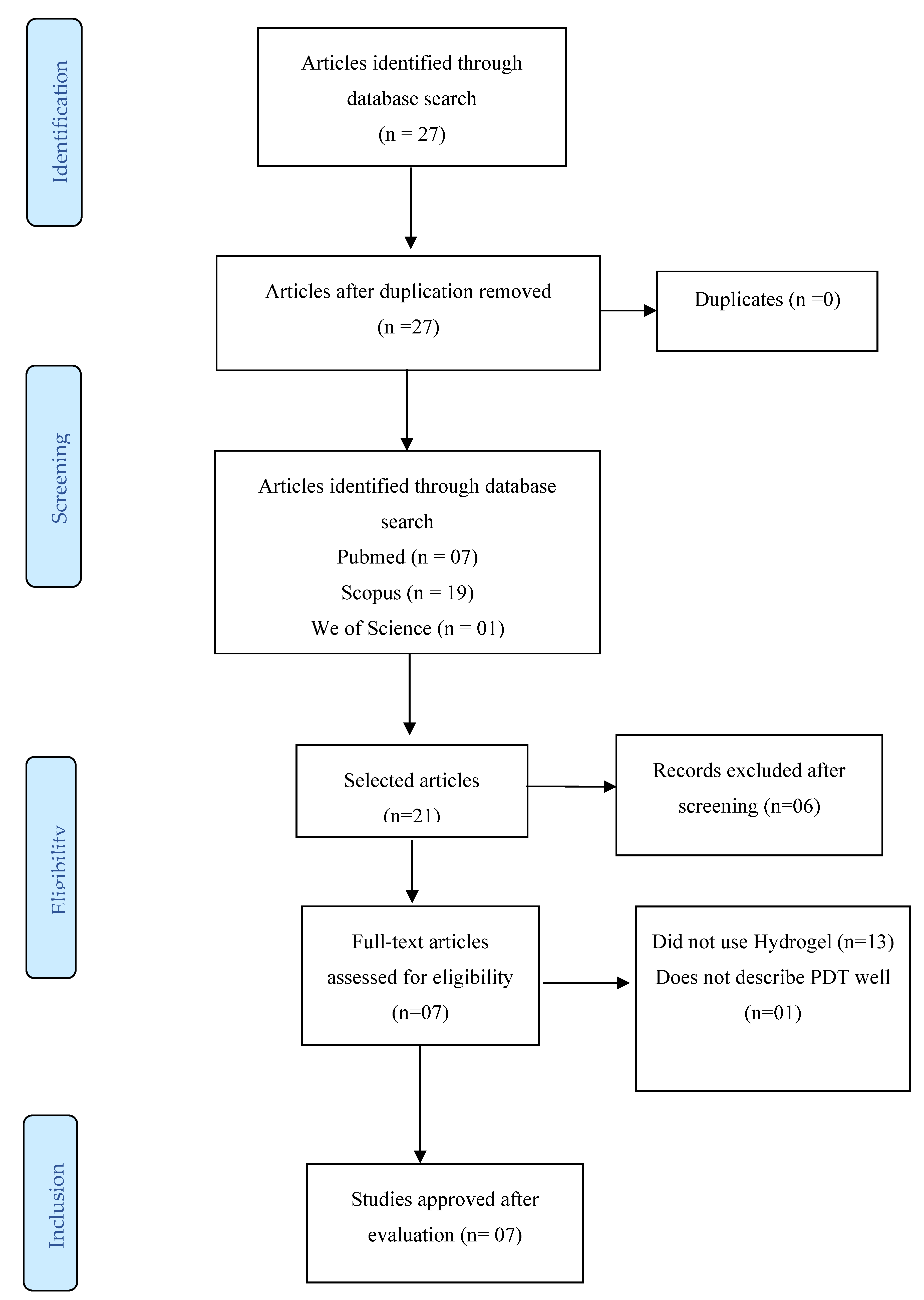

Table 1.
Information from each study.
| Authors | Country | Methods | What was analysed? | Conclusion |
|---|---|---|---|---|
| Chen, C. P., et al., 2015 [12] | Taiwan | Toluidine blue O (TBO) and chitosan were mixed with various amounts of hydroxypropylmethylcellulose (HPMC) to form chitosan/HPMC hydrogel (HCT). Irradiation with 100 J•cm−2 of 630 nm laser light. Irradiated with a set of light-emitting diodes (LEDs), with a wavelength of 635 nm and total bandwidth at half the maximum of 20 nm. | The photodynamic (PDT) efficacy of the hydrogel was examined in vitro against Staphylococcus aureus biofilms. Confocal laser scanning microscopy was performed to investigate the penetration level of TBO into viable solutions. The incorporation of HMPC could increase the physicochemical properties of chitosan hydrogel, including hardness, viscosity and also bioadhesion; however, higher concentrations of HMPC also resulted in a reduced antimicrobial effect. | The optimal choice of bioadhesive formulation for use in topical antimicrobial PDT will involve a compromise between achieving the required drug release rate and mechanical characteristics of the formulation, as these factors will affect clinical efficacy and ease of topical application. The penetration of the TBO biofilm is related to the physicochemical properties of the HTC hydrogel. Strategies for enhancing TBO diffusion in biofilm, along with formulation strategies, should be considered in detail for future clinical applications. |
| Liang, H., et al., 2017 [13] | China | TBO was used as a photosensitiser. Treatment with TBO hydrogel alone or with light alone (630 nm) could not show antibacterial activity against S. aureus. | A new TBO hydrogel was prepared for the treatment of periodontitis, with carbomer and NaOH used as the base and neutraliser, respectively. TBO hydrogel formulations have been used as demand-based drug delivery platforms for clinical treatments. The antibacterial activity of PDT treated with TBO hydrogel was performed on S. aureus. TBO hydrogel formulations were optimised using response surface methodology. | A TBO hydrogel was developed for photodynamic therapy against S. aureus. The results obtained were better than those for PDT with aqueous TBO solution. TBO (50% and 68.26%) were released from the TBO hydrogel in approximately 4 and 24 h, respectively. The TBO hydrogel showed no significant difference in colour, transparency, pH, and viscosity within 6 weeks at 4, 25 and 40 °C. The hydrogel alone or light alone had no antimicrobial effect on S. aureus; only light with TBO hydrogel showed antibacterial activity. Therefore, photodynamic therapy with new optimised TBO hydrogel formulations is a promising treatment strategy for periodontitis. |
| Mao, C., et al., 2017 [14] | China | Hybrid Ag/Ag@AgCl/ZnO nanostructures incorporated into a hydrogel, with chemical reduction using ultraviolet light followed by incorporation of ZnO nanostructures through NaOH precipitation. Visible light irradiation, using a 300 W xenon lamp | A hydrogel composite incorporated with carboxymethyl cellulose and Ag/Ag@AgCl/ZnO hybrid nanostructures has been described. It exhibits excellent photocatalytic activity and broad antibacterial efficiency against gram-positive bacteria under visible light irradiation. | Taking advantage of reactive oxygen species photogeneration, the system showed significantly enhanced photocatalytic activity, broad antibacterial activity against S. aureus (gram-positive), as well as accelerated wound healing. The hydrogel system showed controllable and sustained release of Ag+ and Zn2+ originating from the reversible swelling-shrinkage transition triggered by pH change and has great potential in tissue repair and antibacterial applications. |
| Zheng, Y., et al., 2019 [5] | China | The light source (CMC Dental, Rosiev, Denmark) applied in the study was a type of diode laser with an effective wavelength of 630 nm, equipped with a 23 mm periotip. Its output power and maximum output intensity were 5 and 4 mW/cm2, respectively. The photosensitiser used was toluidine blue. | In vitro antibacterial experiments (against S. aureus), wherein response surface methodology was used to optimise the TBO hydrogel formulation. The stability, pH, and antibacterial activity of TBO hydrogel did not change significantly under 4, 25, and 40 °C during 6-week storage. Furthermore, TBO combined with carbomer hydrogel showed release rates of 51.28% (4 h) and 69.80% (24 h). | The ideal TBO hydrogel was 0.5% (w/v) carbomer 934, TBO concentration of 0.01 mg/mL, ethanol concentration of 0.5% (v/v), Tween 80 ratio of 0.5% (v/v), and the mass ratio of NaOH to carbomer of 0.4 (w/c). The properties of the TBO hydrogel, such as appearance, clarity, viscosity, antibacterial activity, and pH, were generally stable at 4, 25 and 40 °C till 6 months. It also showed effective antibacterial activity against Propionibacterium acnes, S. aureus, and Escherichia coli. All of the above results supported the new TBO hydrogels that were viable for the treatment of acne, and additional studies on cellular toxicity and animal studies would be performed. In summary, TBO hydrogel could be a vital therapeutic strategy to promote PDT applied in topical acne therapy. |
| Du, P., et al., 2023 [8] | China | Photoactive supramolecular material based on G-quartet, self-assembled from guanosine (G) and 4-formylphenylboronic acid/1,8-diaminooctane, with incorporation of riboflavin as photocatalyst to the G4 nanowire, for post-irradiation photodynamic antibacterial therapy. G4 materials, which exhibit hydrogel-like properties, provide a scaffold to load riboflavin, and the guanosine reductant for riboflavin for phototriggered production of therapeutic H2O2. The excitation wavelength was set to 450 nm, and emission spectra from 500 to 600 nm were collected. | A photoactive supramolecular material based on G-quartet has been reported. It is self-assembled from guanosine (G) and 4-formylphenylboronic acid/1,8-diaminooctane, with the incorporation of riboflavin as photocatalyst to the G4 nanowire, for post-irradiation photodynamic antibacterial therapy. G4 materials, which exhibit hydrogel-like properties, provide a scaffold to load riboflavin, and the guanosine reductant for riboflavin for phototriggered production of therapeutic H2O2. | Supramolecular riboflavin-loaded G4 materials, which exhibited gel-like properties, were presented as a proof-of-concept for post-irradiation antibacterial therapy of the infected wound. The G4 hydrogels served as dressing materials to structure riboflavin through covalent bonding and aromatic stacking, and provided the reductant guanosine for the reduction of photoexcited riboflavin, followed by O2 reduction to generate H2O2. The post-irradiated hydrogels exhibited strong antibacterial activity, sufficient to kill gram-positive bacteria, gram-negative bacteria and multidrug-resistant bacteria in vitro and in vivo, and showed biosafety and no obvious cytotoxicity. Riboflavin-loaded G4 hydrogels, after photoirradiation, are capable of killing gram-positive bacteria (S. aureus), gram-negative bacteria (E. coli) and multi-resistant bacteria (methicillin-resistant S. aureus) with a sterilisation rate greater than 99.999%. The post-irradiated hydrogels also showed great antibacterial activity in the infected wound of rats. |
| Elkihel, A., et al., 2023 [15] | France | Hydrogels conjugated with xylan. Xylan-tetra(4-carboxyphenyl) porphyrin (TCPP) hydrogels with different PS/xylan ratios were obtained, characterised, and studied for their swelling behaviour. White LED light irradiated for 5 h at the same temperature (total fluence of 25/cm2). The photosensitiser used was meso-TCPP. The hydrogels were conjugated with xylan. | The antimicrobial activity of the hydrogels was tested under visible light irradiation against two strains of gram-positive bacteria, S. aureus and Bacillus cereus. Preliminary results showed interesting activity on these bacteria, indicating that these hydrogels could have great potential in the treatment of bacterial skin infections with this species using photodynamic antimicrobial chemotherapy. | Xylan-based hydrogels containing PS were developed using TCPP as a cross-linker. The swelling tests of the obtained hydrogels showed that the xyl-TCPP-3 hydrogel functionalised with the smallest amount of TCPP has a good swelling property. Preliminary antibacterial tests against two strains of gram positive bacteria showed photobacterial activity of this hydrogel only under light, and the covalent grafting of TCPP onto the xylan portion appears to reduce the toxicity of the photosensitiser in the absence of light. However, the required concentration appears to be significant for an effective photosensitiser compared to what is reported in the literature. |
| Zheng, Y., et al., 2023 [16] | China | Atomically precise captopril-capped Au nanoclusters (Au25Capt18) prepared using alkaline NaBH and then embedded them into biosafe carrageenan to achieve superior photothermal (PTT) and PDT dual-mode antibacterial effect. Irradiated by a near infrared light source (NIR, 808 nm). | Natural polysaccharide carrageenan embedded in atomically precise gold nanoparticles has been reported as a novel hydrogel platform for PTT and PDT antibacterial therapy triggered using single infrared light. | Atomically precise gold nanocluster-embedded hydrogels were developed via cross-linking Au25Capt18 and carrageenan as an efficient photothermal and photodynamic agent for practical antibacterial applications under single NIR laser irradiation. The contribution of PTT to antibacterial elimination was more significant than that of PDT in Au25Capt18 hydrogels. In vivo investigation demonstrated that Au25Capt18 hydrogels could eliminate pathogenic bacteria and accelerate the healing of bacteria-infected wounds. This investigation provides a simple, efficient, and alternative strategy for the design and fabrication of composite hydrogels that activate PTT and PDT functions under a single laser source and expand the antibacterial capacity of hydrogel-based platforms. |
Disclaimer/Publisher’s Note: The statements, opinions and data contained in all publications are solely those of the individual author(s) and contributor(s) and not of MDPI and/or the editor(s). MDPI and/or the editor(s) disclaim responsibility for any injury to people or property resulting from any ideas, methods, instructions or products referred to in the content. |
© 2024 by the authors. Licensee MDPI, Basel, Switzerland. This article is an open access article distributed under the terms and conditions of the Creative Commons Attribution (CC BY) license (http://creativecommons.org/licenses/by/4.0/).
Copyright: This open access article is published under a Creative Commons CC BY 4.0 license, which permit the free download, distribution, and reuse, provided that the author and preprint are cited in any reuse.


