
Submitted:
08 July 2024
Posted:
10 July 2024
You are already at the latest version
Abstract
The transition to renewable energy sources is pivotal in addressing the escalating challenges of climate change and environmental degradation. Solar energy, particularly photovoltaic (PV) technology, stands out as a prominent solution due to its potential for clean and sustainable electricity generation with minimal greenhouse gas emissions. However, accurately assessing the carbon footprint of PV modules is essential for guiding policy, industry practices, and research. This paper reviews the state of current literature and highlights the difficulties in estimating the carbon footprint of PV modules manufactured in China. It emphasizes the inherent limitations of Process-Based Life Cycle Assessment (PLCA), including data collection challenges, dynamic environmental changes, and subjective methodological choices. The study underscores the need for improved transparency, standardization, and reproducibility in Life Cycle Assessments (LCAs) to provide more accurate and reliable environmental impact evaluations.
Keywords:
Photovoltaic
; Life Cycle Assessment
; Carbon Footprint
; Ecoinvent
; PLCA
; EEIOA
1. Introduction
The transition to renewable energy sources is a central plank in the global response to the escalating challenges of climate change and environmental degradation. Among these energy sources, solar has emerged as a leading contender, with the promise of clean and sustainable electricity generation and minimal greenhouse gas emissions. As photovoltaic (PV) technology proliferates worldwide, assessing and quantifying the carbon footprint of PV modules has become paramount for policymakers, industry, and researchers alike.
Over the past two decades, methodologies for assessing the carbon footprint of PV modules have evolved significantly, driven by the pressing need to assess and mitigate the environmental impacts of renewable energy technologies. As their awareness of the importance of holistic life cycle assessments (LCAs) grew, researchers sought to encompass the entire life cycle of PV modules, from raw material extraction and manufacturing to installation, operation, and end-of-life disposal.
Process-Based Life Cycle Assessment (PLCA) has since emerged as the predominant, if not exclusive, methodology for evaluating the environmental impact of PV module production and deployment.
There are four main steps to PLCA: goal and scope definition, life cycle inventory (LCI), life cycle impact assessment (LCIA), and interpretation.
In the life cycle inventory phase, data on all inputs and outputs associated with the product's life cycle should be collected and quantified. These go into a comprehensive inventory database, detailing resource consumption and emissions at each stage of the product's life cycle. This inventory serves as the foundation for subsequent analyses in the PLCA process.
In the life cycle impact assessment phase the collected data are assessed for for any potential environmental impact. By means of mathematical models and impact assessment methods, inventory data are converted into environmental impact indicators.
Finally, in the interpretation phase, the results of the LCI are analysed and synthesised. Impact assessment allows for conclusions to be drawn and informed decision-making. This may involve sensitivity analysis, uncertainty analysis, and scenario analysis to assess the robustness of the results and identify areas for improvement.
Although PLCA is valuable for evaluating environmental impact, it has inherent limitations [1,2,3]. One lies in the complexity and uncertainty of data collection and interpretation. PLCA relies heavily on data availability, accuracy, and representativeness, which can vary significantly depending on the product, industry, and geographical context. Gathering comprehensive and reliable data throughout the entire life cycle of a product can be challenging, particularly for complex supply chains and emerging technologies like PV.
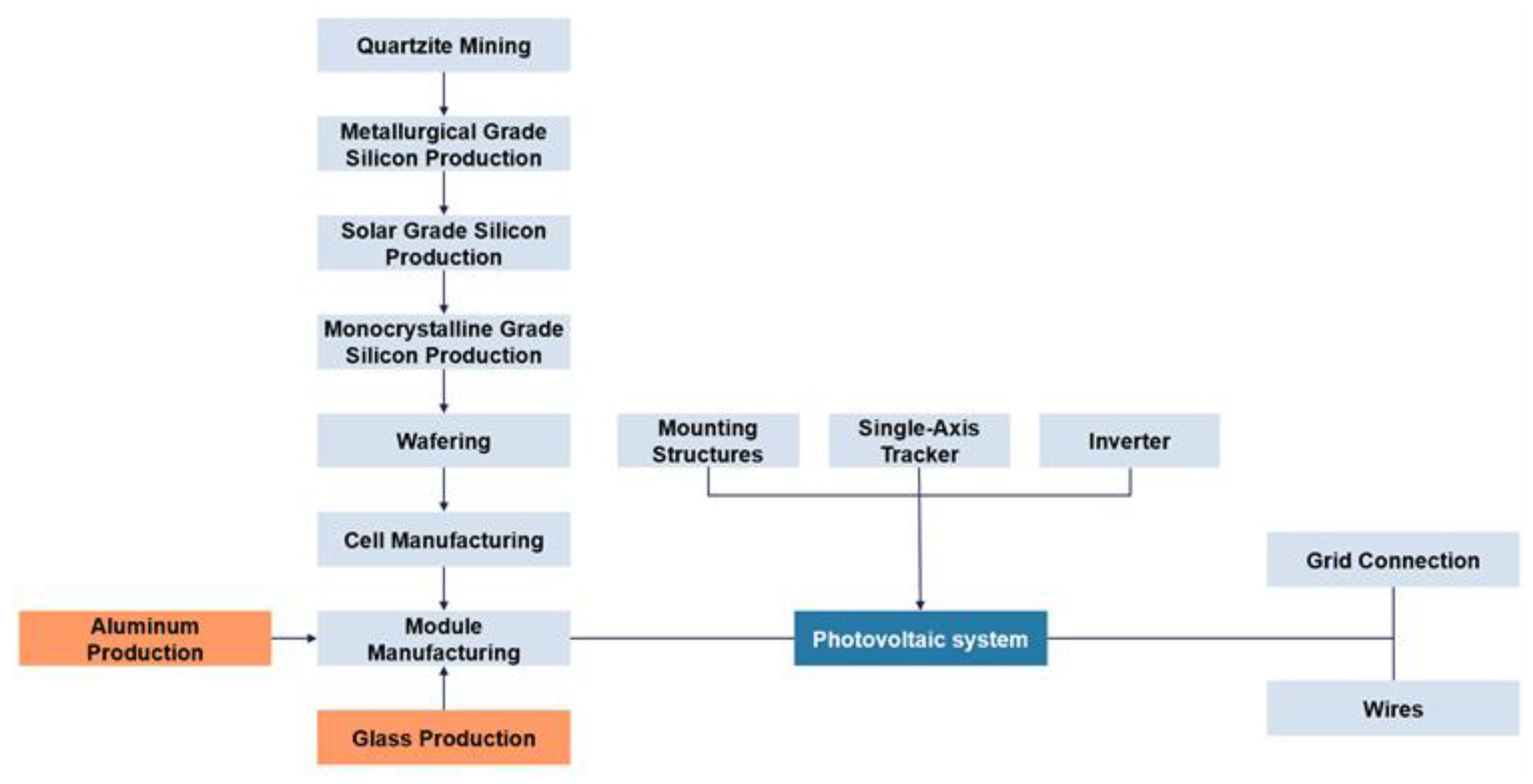
Figure 1.
Conventional PV system boundaries
Nor can PLCA capture dynamic environmental changes and feedback loops over time. Environmental impact evolves throughout a product's life cycle because of technological advancements, shifts in consumer or corporate behavior, and regulatory change. PLCA provides a static snapshot of environmental performance, which may not adequately reflect long-term factors.
Finally, with PLCA, results are influenced by assumptions, methodological choices, and subjective judgments made throughout the assessment process. Different practitioners may use different system boundaries, allocation methods, impact assessment models, and data sources, leading to variability and inconsistency in results. This subjectivity can undermine the credibility and comparability of PLCA findings, limiting its usefulness for decision-making and policy development.
This paper will present a summary of the state of the literature and explore difficulties with current carbon footprint estimates for PV modules manufactured in China.
2. The Current Landscape
Estimates of the carbon footprint of PV modules manufactured in China vary significantly in the literature. Considering only the most recent reports, scientific papers, and Environmental Product Declarations (EPDs), the range spans from about 400 kgCO2/kWp to 3000 kgCO2/kWp.

Table 1.
Carbon footprint of PV modules/systems made in China
| Documents | Results | Primary sources | Comment |
|---|---|---|---|
| Control: CEA-INES [4] | 320 kgCO2/kWp | Proprietary, European | Modules; Polysilicon made in Germany; 130 µm wafers made in Norway; Cells and modules made in France; Wooden frame; 2 mm glass sheet |
| Trina Solar EPD 2022 [5] | 395-430 kgCO2/kWp | TÜV Rheinland [6] (Ecoinvent [7] and proprietary data) | Modules; Vertex 670W |
| Jinko Solar EPD 2022 [8] | about 460 kgCO2/kWp | Certisolis [9] (Ecoinvent and proprietary data) | Bifacial modules; Certisolis boundaries include only electricity, aluminium, glass, EVA, PET, PVF [10] |
| Yin et al. 2021 [11] | about 630 kgCO2/kWp | China Photovoltaic Industry Association [12], GB standards [13] | Modules; Boundaries include only electricity, aluminium, glass, EVA, silver paste |
| Fthenakis and Leccisi 2021 [14] | about 800 kgCO2/kWp | IEA PVPS (2020) [15], Ecoinvent | Modules; Current consensus among Western experts |
| Muller et al. 2021 [16] | about 800 kgCO2/kWp | Confidential, European | Modules |
| IEA 2022 [17] | 600-900 kgCO2/kWp | Ecoinvent, IEA PVPS (2015) [18] | System |
| UNECE 2022 [19] | 1000-1500 kgCO2/kWp | Ecoinvent | System; Multi-Si modules |
| Jia et al. 2023 [20] | about 2600 kgCO2/kWp | Trina Solar[21], Chinese Life Cycle Database (CLCD)[22] | Modules; Multi-Si modules |
| Fan et al. 2021 [23] | 2000-3000 kgCO2/kWp | Chinese factories, eBalance [24], eFootprint [25], CLCD, Ecoinvent | From quartzite mining to wafering; Mono-Si wafers |
As explained in the previous chapter, current estimates of the carbon footprint of PV modules are based on the PLCA approach. However, several substantial fault lines lie behind this methodological convergence.
System and data collection boundaries are not standardised, consequently the characterisation of the system and inputs is highly variable. For example, some LCAs analyse multicrystalline modules, others monocrystalline modules, and still others module types that have not existed on the market for years [26]; some LCAs give substantial weight to chemicals consumed in processes while others exclude them from the boundaries, assuming they have marginal weight; some LCAs only count electrical inputs while others also include thermal inputs, and so on.
With regard to process and material inventories, the literature is divided between LCAs based on Chinese primary sources and LCAs based on Western primary sources.
The scientific literature in some cases reports in plain text on the process and material inventories it analyses, while the institutional and commercial literature usually refers to closed sources.
In a large part of the scientific and institutional literature, process and material inventories come from LCI databases such as Ecoinvent or CLCD. In contrast, most EPDs supplement LCI databases with proprietary data.
The so-called background data, i.e. emission factors, conversion factors, efficiency factors etc., are usually taken from LCI databases. However, researchers do not always select the most suitable background data and LCI databases do not always provide up-to-date or detailed background data. A case in point is the IPCC A.R.6. (2022) [27], where the consensus regarding the carbon footprint of PV systems is mainly determined from papers analysing European supply chains, despite the fact that China dominates the global PV market.
Table 2.
IPCC Assessment Reports, PV carbon footprint. Primary sources
| Report | Sources | Characterisation of energy inputs |
|---|---|---|
| A.R.5 (2014) [28] | Hsu et al. 2012 [29] | Seven of the twelve studies analysed in the review calculate the carbon footprint of modules assuming production with hydropower, natural gas, European grid electricity and waste heat. Since the Assessment Report identifies a median value; a snapshot of these seven studies |
| A.R.6 (2022) [27] | Nugent and Sovacool 2014 [30] | Nine of eleven sources analysing the production cycle of crystalline modules calculate the carbon footprint assuming that they are produced with hydropower, natural gas, European grid electricity and waste heat |
| Wetzel and Borchers 2015 [31] | Hydropower, natural gas, European grid electricity and waste heat | |
| Hou et al. 2016 [26] | Average Chinese electricity mix |
In turn, LCI databases draw their data mainly from confidential industry documentation, in many cases dating back 10 or 20 years. Moreover, inventories generally lack the metadata needed to put the inputs into context. As a result, it is very difficult to determine the comprehensiveness and accuracy of inventories.
As a consequence of the sum of all these factors, overall the literature landscape appears chaotic, opaque and potentially misleading.
3. Case study: Ecoinvent v3.7 (2020) [32]
Ecoinvent is the most authoritative LCI software in the world and also the most used. It includes detailed LCI data across various sectors including agriculture, energy, transport, waste management, and manufacturing. This is used by researchers, companies, policymakers, and consultants for environmental assessments and to develop sustainable practices.
Ecoinvent gathers from diverse sources, including scientific literature, industry reports, and direct contributions from experts and researchers. Validation processes ensure compliance with international standards like ISO 14040 and ISO 14044. The database is made up of unit processes (which are the smallest individual processes within a product system), detailing inputs (raw materials, energy) and outputs (products, emissions). Different system models support various LCA study types, defining how data is aggregated and how different life cycle stages are treated.
Access to Ecoinvent is typically through LCA software tools such as SimaPro, GaBi, and openLCA, which provide user-friendly interfaces for constructing LCA models and data analysis. Subscriptions are required for access, with various levels available based on the user's needs, whether academic or industrial. Users select relevant unit processes from the database to build a life cycle model of the product or service they are assessing, linking processes to reflect the entire life cycle. By means of integrated impact assessment methods, users can calculate environmental impact across various categories, such as greenhouse gas emissions, resource depletion, and water use.
3.1. Main Limitations
The following is not intended to be an exhaustive list of all the opacities, inconsistencies, and shortcomings in the Ecoinvent’s inventory of PV modules. Rather, it is a review of those most evident, with the aim of demonstrating the magnitude of the issue.
Furthermore, most of what is described in the subsequent sections pertain specifically to the PV modules inventory and not to the Ecoinvent database in general.
3.1.1. Degree of Purity of Silicon
Ecoinvent assigns a purity level of 99.99% to solar-grade silicon and assumes that the silicon used to produce PV cells is composed of 50% 6N silicon, which is 99.9999% pure, and 50% off-grade silicon, which is 99% pure. This modelling choice is based on Wacker Chemie AD data from over 20 years ago [33]. However, cells with this silicon mix could have an efficiency of 13-14% [34]. For efficiency of 20% or more, 9N or 10N SoG-Si is required [35]. The sources analyzed by Ecoinvent itself show how this gap may have influenced the evolution of energy demand over time.
Table 3.
Energy demand. 5N silicon vs 6N silicon
|
Production stage |
Solar grade silicon (5N) | Electronic grade silicon (6N) | ||
| Electricity consumption (kWh/kg) | Thermal energy consumption (MJ/kg) | Electricity consumption (kWh/kg) | Thermal energy consumption (MJ/kg) | |
| Siemens process | 110 | 122 | 150 | 160 |
| Czochralski process | 85.6 | 68 | 200 | 270 |
Source: Jungbluth et al. 2009 [33].
With the success of Ecoinvent, this mischaracterisation has become entrenched in industrial and commercial literature, and to date some companies continue to certify the carbon footprint of solar grade silicon as if it were 4N/5N grade [36].
3.1.2. Consumption of Chemicals
The simplified Siemens process used as a reference by Ecoinvent excludes etching due to relaxed purity requirements[33], thereby limiting chemical consumption to about 2 kg per kg of SoG-Si [37]. However, Chinese LCIs[23] identifies the use of dozens of chemicals in the silicon purification process, including tens of kilograms of NaOH per kg of SoG-Si. Considering only the electricity required to produce NaOH [38], the energy footprint of the modules could increase by 200 kWh/kWp and the carbon footprint could rise by up to 300 kgCO2/kWp, depending on the carbon intensity of the electricity used.
3.1.3. Carbon Intensity of Electricity
Ecoinvent allows researchers the opportunity to customise the carbon intensity of electricity inputs. This, however, has led to much confusion in the literature. Numerous studies [41,42] show that silicon purification is generally fuelled by coal power, which in China has a carbon intensity that is about twice the average grid carbon intensity [43,44], while later production stages are concentrated in the more industrialised provinces [45], where the grid carbon intensity is about 50% higher than the average national grid intensity [46].
Table 4.
Plausible average carbon intensity of electricity inputs
| Production stage | Carbon intensity |
|---|---|
| MG-Si | 1200 gCO2/kWh |
| SoG-Si | 1200 gCO2/kWh |
| Pull the bar + rod | 1200 gCO2/kWh |
| Cell | 900 gCO2/kWh |
| Module | 900 gCO2/kWh |
3.1.4. Emission of Fluorinated Gases
Fluorinated gases have a global warming potential thousands of times greater than CO2 [47]. They are mainly used as refrigerants, insulators in power grids and during etching processes. A recent study attributes the emission of all major fluorinated gases to the Chinese silicon industry and the emission of NF3 and HFCs to the PV industry [48]. The consumption of fluorinated gases by the silicon and PV industries is also confirmed by some of the world's leading suppliers of these gases, including major Chinese suppliers [49,50,51,52].
Table 5.
Emission of fluorinated gases. Semiconductor and PV industries
| Sector | SF6 | NF3 | CF4 | C2F6 | C3F8 | c-C4F8 | HFCs |
| Semiconductor industry (silicon) | X | X | X | X | X | X | X |
| PV industry (cells) | - | X | - | - | - | - | X |
3.1.5. Boundaries of Energy Inputs
It is impossible to determine whether the energy inputs reported in the Ecoinvent inventory represent the total energy demand of the facilities distributed across the main stages of the process tree, the energy demand of the core processes and associated auxiliary systems, or simply the energy demand of the core processes.
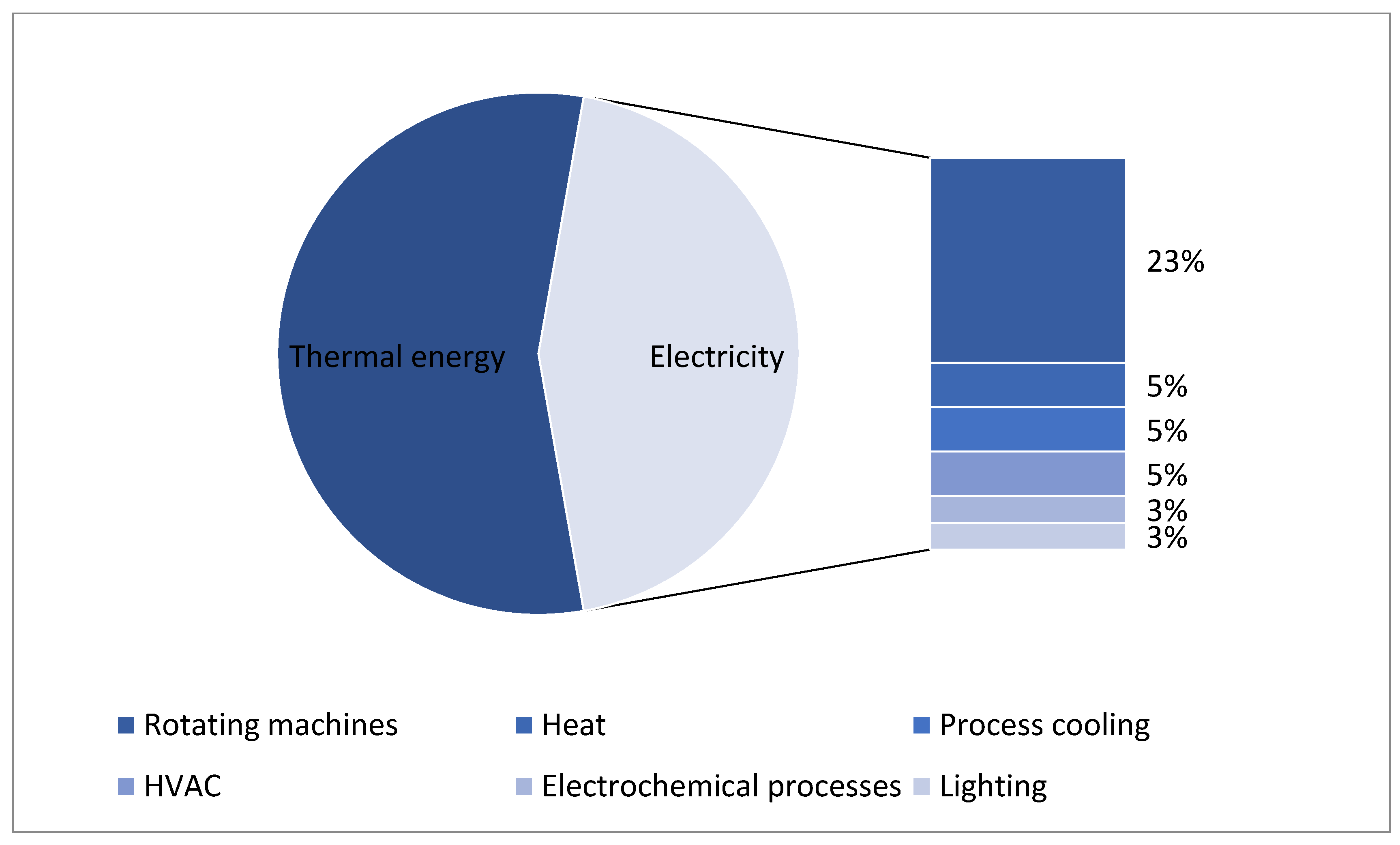
Given that the thermal and electrical energy demand of auxiliary and ancillary processes can account for up to 25% to 50% of the total energy demand of an industrial facility [53], this is a significant gray area.
Figure 2.
Breakdown of the average energy demand of an industrial plant
3.1.6. Material Emission Factors
Industry data shows that Ecoinvent underestimates the emission factor for materials such as laminated solar glass by about 200% (due to a product category attribution error) [54] and the emission factor for aluminum by 50% [55] (likely due to a mischaracterization of the global supply chain). This error has been repeated throughout the literature, as Ecoinvent's background data is used in other inventories, such as that published by the IEA PVPS (2020) [15].
3.1.7. Efficiency and Emission Factors of Thermal Energy Inputs
Ecoinvent attributes the use of waste heat for the production of SoG-Si and of natural gas in high-efficiency furnaces at all other stages of production. However, this assumption is based on data from 20 years ago, derived from European factories [33]. Whether this bears any relation to the reality of the Chinese silicon industry of today has never been verified.
3.1.8. Cut-Offs (Truncations)
Certain stages or components of a product's life cycle may be excluded from LCA. These “cut-offs” are typically based on criteria such as materiality, relevance, economic value or feasibility of data collection. While cut-offs can streamline the assessment process and focus attention on the most significant environmental impacts, they can also distort carbon footprint estimates.
The truncation error has been analysed by numerous studies. A recent article estimates that cut-offs in Ecoinvent conceal about a quarter of PV’s carbon footprint (median value) [54].
3.1.9. Land Consumption and Albedo Effect
Ecoinvent’s technical documentation delves into land consumption and the albedo effect related to utility-scale PV plants [33], but the inventory not currently include these factors in carbon footprint calculations.
PV energy is known to require significant amounts of land relative to the installed power capacity. In the best-case scenario, land use results in soil carbon depletion [56] and decreasing albedo [57], leading to indirect or equivalent CO2 emissions. In the worst-case scenario, it also leads to significant direct emissions due to land clearing [58]. These emissions can be measured empirically [59,60,61,62].
3.1.10. Allocation Models
Allocation models are used in LCA to allocate environmental burdens or benefits among different products and co-products within a production process [66]. This allocation is necessary when a process generates multiple outputs or involves recycled materials. The aim is to distribute the environmental impact of the entire process fairly and accurately.
Ecoinvent's allocation models introduce complexities and potential distortions in estimating PV’s carbon footprint. One common issue is the allocation of environmental burdens among different products or co-products within a production process. This allocation is necessary when a process generates multiple outputs, but it can be challenging to determine a fair and accurate allocation method.
Ecoinvent's allocation models often rely on simplifying assumptions or default values, which may not capture the complexities of real-world production processes. For instance, allocating emissions based solely on energy content, economic value or mass may overlook differences in environmental impacts between co-products.
Furthermore, the choice of allocation method can vary among different LCAs, leading to inconsistencies and difficulties in comparing results. This lack of standardization in allocation methods can further complicate the estimation of the carbon footprint of PV modules and hinder the interpretation of LCA findings.
3.1.11. Capital Goods
With regard to capital goods, Ecoinvent includes only concrete, steel, and bricks used in the construction of the PV cell factory [33]. Based on this assumption, the weight of capital goods becomes marginal, and often this factor is excluded from the boundaries of LCAs through cut-offs. However, recent studies attribute approximately 25% of the final demand globally to capital goods, with a peak of 56% in China [67], indicating a true weight that is far from statistical insignificance.
4. Discussion
Over the past two decades, the environmental impact of energy sources has become one of the focal points of the energy debate.
Given the fundamental role played by solar in dercabonisation strategies, the careful estimation of the carbon footprint of PV modules is all the more important.
Despite the gravity, current estimates are highly problematic.
PV inventories usually do not provide the minimum degree of transparency required for scientific research [68,69,70]. A large part of the data are of industrial origin and are collected through mechanisms that guarantee anonymity [12] and/or exclude the parties from any legal liability [71].
Generally, the inventories are based on outdated primary sources. For example, the Ecoinvent, the CLCD and the IEA PVPS (2020) PV inventories are mostly based on data dating back 10 or 20 years. This calls into question the current representativeness of the results calculated from these inventories [72,73,74,75].
Table 6.
Primary sources of LCI databases. Age of data
| Ecoinvent 3.7 [32] | IEA PVPS (2020) [15] | CLCD [12] | |
|---|---|---|---|
| Energy inputs | About 20 years old | 6-20 years old | 10 years old |
| Chemical inputs | About 20 years old | About 20 years old | 10 years old |
Inventories generally lack detailed technical annexes, so it is often impossible to determine the context of the data collection [76] and the comprehensiveness of the assessment [77]. A case in point is that of energy inputs, which it is not clear whether they represent the total energy consumption of manufacturing plants or only a portion of it.
As such, generally the inventories currently at the researchers’ disposal cannot ensure compliance with the GHG Protocol [78], the world's most widely used GHG emission certification system; itself developed from the framework devised by the IPCC [79].
Table 7.
GHG Protocol vs Ecoinvent 3.7 vs IEA PVPS (2020)
| GHG Protocol | Ecoinvent 3.7 [32] | IEA PVPS (2020) [15] |
|---|---|---|
| Scope 1 | ||
| Direct GHG emissions | Partially included | Partially included |
| Scope 2 | ||
| Electricity | Included/Partially included (it is not possible to determine the boundaries of the data collection) | Included/Partially included (it is not possible to determine the boundaries of the data collection) |
| Thermal energy | Included/Partially included (it is not possible to determine the boundaries of the data collection) | Included/Partially included (it is not possible to determine the boundaries of the data collection) |
| Scope 3 | ||
| Purchased goods and services | Included/Partially included (it is not possible to determine the boundaries of the data collection) | Included/Partially included (it is not possible to determine the boundaries of the data collection) |
| Capital goods | Include only the concrete, bricks and steel used in the construction of some buildings | Include only the concrete, bricks and steel used in the construction of some buildings |
| Fuel- and energyrelated activities not included in Scope 1 or Scope 2 | Not documented | Not documented |
| Upstream transportation and distribution | Partially included | Partially included |
| Waste generated in operations | Not documented | Not documented |
| Business travel | Not documented | Not documented |
| Employee commuting | Not documented | Not documented |
| Upstream leased assets | Not documented | Not documented |
| Downstream transportation and distribution | Partially included | Partially included |
| Processing of sold products | Not documented | Not documented |
| Use of sold products | Not present in PV modules | Not present in PV modules |
| End-of-life treatment of sold products | Not documented | Not documented |
| Downstream leased assets | Not documented | Not documented |
| Franchises | Not documented | Not documented |
More specifically, although dozens of studies have analysed the limitations of Ecoinvent in reconstructing the environmental impact of complex goods [54,67,73,74,77,80], and in particular of PV modules [81,82,83,84,85,86,87], to date the scientific and institutional consensus regarding the carbon footprint of PV modules is based on Ecoinvent inventory or elaborations of the Ecoinvent inventory.
Table 8.
Institutional reports. LCIs, modules
| Report | Life cycle inventory |
|---|---|
| IPCC, A.R.5 2014 [28] | Ecoinvent |
| JRC 2018 [88] | Ecoinvent |
| IEA PVPS 2020 [15] | Ecoinvent integrated with SmartGreenScan [89], NREL [45] and confidential data |
| IEA 2022 [17] | Ecoinvent and IEA PVPS (2015) [18] |
| UNECE 2022 [19] | Ecoinvent |
| IPCC, A.R.6 2022 [27] | Mainly based on Ecoinvent |
The gaps and the shortcomings discussed, together with the wide discrepancy of results present in the literature, question the current consensus and call for further investigation.
5. Future Directions
Based on the analysis of current literature, this study offers the following suggestions to improve understanding of the environmental impact and specifically GHG emissions related to the manufacturing of PV modules:1) Improve transparency of inventories and data collection mechanismsTransparency in inventories and data collection processes is crucial for ensuring the reliability and credibility of LCA results. Researchers and industry stakeholders should work towards:- Detailed metadata provision: including comprehensive metadata in LCI databases to contextualize data inputs and facilitate a clearer understanding of the data's origin and applicability.
- − Open access to data: encouraging the sharing of data from industry and research to create more robust and up-to-date databases.
- − Regular updates: ensuring that inventories are updated regularly to reflect current technologies and practices, reducing the reliance on outdated data.2) Define standard methodologiesStandardization in LCA methodologies is necessary to enhance the comparability and consistency of carbon footprint assessments. Future efforts should focus on: Unified guidelines: developing and adopting unified guidelines for conducting LCAs of PV modules, including standardized system boundaries, allocation methods, and impact assessment models.
- − International collaboration: promoting international collaboration to harmonize LCA practices and create globally accepted standards.
- − Case study databases: creating databases of case studies that follow standardized methodologies to serve as benchmarks for future assessments.3) Ensure the reproducibility of LCAsReproducibility is a cornerstone of scientific research. To enhance the reproducibility of LCAs, the following measures are recommended:-Detailed reporting: mandating detailed reporting of all assumptions, methodological choices, and data sources used in LCA studies.
- − Replication studies: encouraging replication studies to validate LCA findings and identify potential areas of improvement.4) Integrate dynamic environmental changesLCAs should account for dynamic environmental changes to provide a more accurate representation of long-term impacts. Future directions include:
- − Temporal modelling: developing temporal models that can simulate how environmental impacts evolve over time due to technological advancements and regulatory changes.
- − Feedback mechanisms: incorporating feedback mechanisms to capture the interactions between different life cycle stages and their cumulative environmental impacts.5) Expand the scope of capital goods assessmentThe inclusion of capital goods in LCAs of PV modules is often limited. Future research should:- Comprehensive capital goods data: Gather detailed data on the environmental impacts of all capital goods used in the production and installation of PV modules.
- − - Broadened boundaries: expand the system boundaries to include all relevant capital goods, ensuring a more comprehensive assessment of the carbon footprint.6) Address allocation method variabilityTo reduce inconsistencies in LCA results due to varying allocation methods, the following actions are suggested:- Standardized allocation methods: establish standardized allocation methods for different processes and materials within the PV module life cycle.
- − Sensitivity analysis: conduct sensitivity analyses to understand the impact of different allocation methods on LCA results and identify the most appropriate approaches for various contexts.
By addressing these future directions, the accuracy, reliability, and credibility of LCAs for PV modules can be significantly enhanced, supporting more informed decision-making and contributing to the advancement of sustainable energy practices..
Funding
This research received no external funding.
Conflicts of Interest
The authors declare no conflicts of interest.
References
- Suh, S.; Huppes, G. Methods for Life Cycle Inventory of a product. J. Clean. Prod. 2006, 13, 687–697. [Google Scholar] [CrossRef]
- Price, L.; Kendall, A. Wind Power as a Case Study. J. Ind. Ecol. 2012, 16, S22–S27. [Google Scholar] [CrossRef]
- Gibon, T.; Schaubroeck, T. Lifting the fog on characteristics and limitations of hybrid LCA—a reply to “Does hybrid LCA with a complete system boundary yield adequate results for product promotion?”. Int. J. Life Cycle Assess. 2017, 22, 456–406. [Google Scholar] [CrossRef]
- CEA liten. Available online: https://liten.cea.fr/cea-tech/liten/english/Pages/Medias/News/PV-High-Efficiency/Reaching-very-low-carbon-photovoltaic-panels.aspx (accessed on 01/07/2024).
- Trina Solar. Environmental Product Declaration for Trina Solar PV Modules. TÜV Rheinland, 2022. Available online: https://www.trinasolar.com/it/resources/newsroom/tue-11082022-1530 (accessed on 01/07/2024).
- TUV Rheinland. Available online: https://www.tuv.com/market-access-services/it/main-navigation/traffics-vehicles-rail/mobility/ (accessed on 01/07/2024).
- Ecoinvent. Available online: https://ecoinvent.org/ (accessed on 01/07/2024).
- Certisolis. CFP for Jinko Solar Tiger Neo PV Modules. Certisolis, 2022. Available online: https://ir.jinkosolar.com/news-releases/news-release-details/jinkosolars-tiger-neo-bifacial-modules-reach-competitive-carbon (accessed on 01/07/2024).
- Certisolis. Available online: https://www.certisolis.com/ (accessed on 01/07/2024).
- Lègifrance. JORF n°0235 du 8 octobre 2021. Available online: https://www.legifrance.gouv.fr/jorf/id/JORFTEXT000044173060 (accessed on 01/07/2024).
- Yin, Y.; Yang, D.; Lu, L.; Zhang, J.; Yu, X.; Zhang, R.; Xiong, Y. Carbon footprint of crystalline silicon photovoltaic systems: Analysis of Chinese multi-crystalline silicon PV systems. Sol. Energy 2022, 215, 231–242. [Google Scholar] [CrossRef]
- China Photovoltaic Industry Association. Available online: http://www.chinapv.org.cn/index.html (accessed on 01/07/2024).
- GB China National Standards. Available online: https://www.gbstandards.org/ (accessed on 01/07/2024).
- Fthenakis, V.; Leccisi, E. Updated sustainability status of crystalline silicon-based photovoltaic systems: Energy use, greenhouse gas emissions, and land use. Prog. Photovolt: Res. Appl. 2021, 29, 379–388. [Google Scholar] [CrossRef]
- IEA PVPS Task 12. Life Cycle Inventories and Life Cycle Assessments of Photovoltaic Systems; International Energy Agency: Paris, France, 2020. [Google Scholar]
- Muller, A.; Friedrich, L.; Reichel, C.; Herceg, S.; Mittag, M.; Neuhaus, D.H. A comparative life cycle assessment of silicon PV modules: Impact of module design, manufacturing location and inventory. Sol. Ene. Mat. Sol. Cells. 2021, 29, 460–470. [Google Scholar] [CrossRef]
- International Energy Agency: IEA. Special Report on Solar PV Global Supply Chains; International Energy Agency: Paris, France, 2022. [Google Scholar]
- IEA PVPS Task 12. Life Cycle Inventories and Life Cycle Assessments of Photovoltaic Systems; International Energy Agency: Paris, France, 2015. [Google Scholar]
- UNECE. Carbon footprint of photovoltaic systems: Analysis and consensus; United Nations Economic Commission for Europe: Geneva, Switzerland, 2022. [Google Scholar]
- Jia, H.; Ling, L.; Xie, J.; Zhang, J. Environmental Effects of Technological Improvements in Polysilicon Photovoltaic Systems in China—A Life Cycle Assessment. Soust. 2023, 14, 8670. [Google Scholar] [CrossRef]
- Trina Solar. Available online: https://www.trinasolar.com/ (accessed on 01/07/2024).
- China Life Cycle Database. Availabe online: https://www.ike-global.com/#/products-2/chinese-lca-database-clcd (accessed on 01/07/2024).
- Fan, M.; Yu, Z.; Ma, W.; Li, L. Life Cycle Assessment of Crystalline Silicon Wafers for Photovoltaic Power Generation. Silicon. 2021, 13, 3177–3189. [Google Scholar] [CrossRef]
- eBalance. Availabe online: https://www.ike-global.com/#/home (accessed on 01/07/2024).
- eFootprint. Availabe online: https://www.efootprint.net/login (accessed on 01/07/2024).
- Hou, J.; Sun, H.; Jiang, Z.; Pan, Z.; Wang, Y.; Zhang, X.; Zhao, Y.; Yao, Q. Life cycle assessment of grid-connected photovoltaic power generation from crystalline silicon solar modules in China. App. Ene. 2016, 164, 882–890. [Google Scholar] [CrossRef]
- IPCC, AR6, WG3, Chapter 6. Energy systems; Intergovernmental Panel on Climate Change: Geneva, Switzerland, 2022. Availabe online: https://www.ipcc.ch/report/ar6/wg3/chapter/chapter-6/ (accessed on 01/07/2024).
- IPCC, AR5, WG3, Annex III. Technology-specific Cost and Performance Parameters. Intergovernmental Panel on Climate Change: Geneva, Switzerland, 2014. Availabe online: https://www.ipcc.ch/site/assets/uploads/2018/02/ipcc_wg3_ar5_annex-iii.pdf (accessed on 01/07/2024).
- Hsu, D.D.; O’Donoughue, P.; Fthenakis, V.; Heath, G.A.; Chul Kim, H.; Sawyer, P.; Choi, J.; Turney, D.E. Life Cycle Greenhouse Gas Emissions of Crystalline Silicon Photovoltaic Electricity Generation. J. Ind. Ecol. 2012, 16, 0. [Google Scholar] [CrossRef]
- Nugent, D.; Sovacool, B.K. Assessing the lifecycle greenhouse gas emissions from solar PV and wind energy: A critical meta-survey. Ener. Pol. 2014, 65, 229–244. [Google Scholar] [CrossRef]
- Wetzel, T.; Borchers, S. Update of energy payback time and greenhouse gas emission data for crystalline silicon photovoltaic modules. Prog. Photovolt: Res. Appl. 2014, 23, 1429–1435. [Google Scholar] [CrossRef]
- Ecoinvent. Ecoinvent version 3.7 and 3.7.1. Availabe online: https://support.ecoinvent.org/ecoinvent-version-3.7 (accessed on 01/07/2024).
- Swiss Centre for Life Cycle Inventories. Photovoltaics; Swiss Centre for Life Cycle Inventories: Dubendorf, Switzerland, 2009. Availabe online: https://www.bifne.de/fileadmin/bifne/userdata/Dokumente/2009_-_Jungbluth_et.al_-_Sachbilanzen_von_Energiesystemen_-_Photovoltaik.pdf.
- Pizzini, S. Solar grade silicon as a potential candidate material for low-cost terrestrial solar cells. Sol. Ene. Mat. 1982, 6-3, 253–297. [Google Scholar] [CrossRef]
- Bernreuter Research. Polysilicon production processes. Available online: https://www.bernreuter.com/polysilicon/production-processes/ (accessed on 01/07/2024).
- REC SIlicon. Environmental Product Declaration for REC Solar Grade Silicon. EPD Norge, 2021. Available online: https://www.recgroup.com/sites/default/files/documents/nepd-2681-1371_rec-solar-solar-grade-silicon-sog-si-.pdf?t=1640127176 (accessed on 01/07/2024). Available online:.
- de Wild-Scholten, M.; Alsema 2007 de Wild-Scholten, M. J. and Alsema, E. A. (2007) Environmental Life Cycle Inventory of Crystalline Silicon Photovoltaic System Production. Energy research Center of the Netherlands, Petten, The Netherlands and Copernicus Institute for Sustainable Development and Innovation, Utrecht University, The Netherlands.
- Kumar, A.; Du, F.; Lienhard, J.H. Caustic Soda Production, Energy Efficiency, and Electrolyzers. ACS En. Lett. 2021, 6-10, 3563–3566. [Google Scholar] [CrossRef]
- https://doi.org/10.3969/j.issn.1007-7804.2019.05.001.
- Jinko Solar. Jinko Solar Virtual Tour-Cell Factory. Available online: https://www.youtube.com/watch?v=PME47LDFb0s (accessed on 01/07/2024).
- Congressional-Executive Commission on China. China Environmental’s Challenges and U.S. Responses; Congressional-Executive Commission on China: Washington, U.S., 2022. Available online: https://www.cecc.gov/sites/chinacommission.house.gov/files/documents/CHRG-117jhrg46021.pdf (accessed on 01/07/2024).
- The Breakthrough Institute. Sins of a Solar Empire; The Breakthrough Institute: Berkeley, U.S., 2022. Available online: https://thebreakthrough.org/issues/energy/sins-of-a-solar-empire (accessed on 01/07/2024).
- Ember Climate. Global Electricity Review; Ember Climate: U.K., 2024. Availabe online: https://ember-climate.org/app/uploads/2024/05/Report-Global-Electricity-Review-2024.pdf (accessed on 01/07/2024).
- Oberschelp, C.; Pfister, S.; Raptis, C.E.; Hellweg, S. Global emission hotspots of coal power generation. Nat. Sust. 2019, 2, 113–121. [Google Scholar] [CrossRef]
- NREL. Crystalline Silicon Photovoltaic Module Manufacturing Costs and Sustainable Pricing: 1H 2018 Benchmark and Cost Reduction Road Map. National Renewable Energy Laboratory: Golden, U.S., 2020. Availabe online: https://www.nrel.gov/docs/fy19osti/72134.pdf (accessed on 01/07/2024).
- Li, X.; Chalvatzis, K.J.; Pappas, D. China’s electricity emission intensity in 2020 – an analysis at provincial level. Ene. Proc. 2017, 142, 2779–2785. [Google Scholar] [CrossRef]
- UNCC. Global Warming Potentials. Available online: https://unfccc.int/process/transparency-and-reporting/greenhouse-gas-data/greenhouse-gas-data-unfccc/global-warming-potentials (accessed on 01/07/2024).
- Guo, L.; Yang, Y.; Fraser, P.J.; Velders, G.J.M.; Liu, Z.; Cui, D.; Quan, J.; Cai, Z.; Yao, B.; Hu, J.; Fang, X. Projected increases in emissions of high global warming potential fluorinated gases in China – Supllementary Materials. Comm. Earth & Env. 2023, 4, 205. [Google Scholar] [CrossRef]
- Solvay. Sulfur Hexafluoride. Available online: https://www.solvay.com/en/brands/sulfur-hexafluoride-sf6-electronic-grade (accessed on 01/07/2024).
- Jinhong Gas. Sulfur Hexafluoride. Available online: http://it.jinhong-gas.net/electronic-special-gas/sulphur-hexafluoride-sf6.html (accessed on 01/07/2024).
- Huazhong Gas. Sulfur Hexafluoride. Available online: https://www.huazhong-gas.com/product/sulfur-hexafluoride/ (accessed on 01/07/2024).
- Sinochem. Available online: https://www.sinochem.com/en/p/17928-4660.html (accessed on 01/07/2024).
- Thunder Said Energy. Industrial energy and electricity consumption by sector. Available online: https://thundersaidenergy.com/downloads/industrial-energy-and-electricity-consumption-by-sector (accessed on 01/07/2024).
- Agez, M.; Wood, R.; Margni, M.; Stromman, A.H.; Samson, R.; Majeau-Bettez, G. Hybridization of complete PLCA and MRIO databases for a comprehensive product system coverage. J. Ind. Ecol. 2020, 24, 774–790. [Google Scholar] [CrossRef]
- International Aluminium. Greenhouse gas emissions intensity of primary aluminium. Available online: https://international-aluminium.org/statistics/greenhouse-gas-emissions-intensity-primary-aluminium/ (accessed on 01/07/2024).
- Moscatelli, M.C.; Marabottini, R.; Massaccesi, L.; Marinari, S. Soil properties changes after seven years of ground mounted photovoltaic panels in Central Italy coastal area. Geod. Reg. 2022, 29, e00500. [Google Scholar] [CrossRef]
- Zhang, X.; Jiao, Z.; Zhao, C.; Qu, Y.; Liu, Q.; Zhang, H.; Tong, Y.; Wang, C.; Li, S.; Guo, J.; Zhu, Z.; Yin, S.; Cui, L. Review of Land Surface Albedo: Variance Characteristics, Climate Effect and Management Strategy. Rem. Sens. 2022, 14, 1382. [Google Scholar] [CrossRef]
- Mass Audubon, Harvard Forest. Growing Solar, Protecting Nature. Available online: https://storymaps.arcgis.com/stories/932be293f1af43c8b776fdad24d9f071 (accessed on 01/07/2024).
- Armstrong, A.; Waldron, S.; Whitaker, J.; Ostle, N.J. Wind farm and solar park effects on plant-soil carbon cycling: uncertain impacts of changes in ground-level microclimate. Glob. Chang. Biol. 2014, 20, 1699–706. [Google Scholar] [CrossRef] [PubMed]
- Chen, X.; Chen, B.; Wang, Y.; Zhou, N.; Zhou, Z. Response of Vegetation and Soil Property Changes by Photovoltaic Established Stations Based on a Comprehensive Meta-Analysis. Land 2024, 13, 478. [Google Scholar] [CrossRef]
- Stern, R.; Amer, M.; Müller, J.; Tatarinov, F.; Segev, L.; Rotenberg, E.; and Yakir, D. “Solar panels forest” and its radiative forcing effect: preliminary results from the Arava Desert, EGU General Assembly 2020, Online, 4–8 May 2020, EGU2020-18924. [CrossRef]
- Burg, B.R.; Ruch, P.; Paredes, S.; Michel, B. Placement and efficiency effects on radiative forcing of solar installations. AIP Conf. Proc. 2015, 1679, 090001. [Google Scholar] [CrossRef]
- Vera, I.; Wicke, B.; Lamers, P.; Cowie, A.; Repo, A.; Heukels, B.; Zumpf, C.; Styles, D.; Parish, E.; Cherubini, F.; Berndes, G.; Jager, H.; Schiesari, L.; Junginger, M.; Brandão, M.; Bentsen, N.S.; Daioglou, V.; Harris, Z.; van der Hilst, F. Land use for bioenergy: Synergies and trade-offs between sustainable development goals. Ren. Sust. En. Rev. 2022, 161, 112409. [Google Scholar] [CrossRef]
- He, L.; Bhattarai, N.; Pokhrel, Y.; Jia, N.; Zhu, P.; Ye, G.; Xu, Z.; Wu, S.; Li, Z.B. Dynamics of land cover changes and carbon emissions driven by large dams in China. iScience. 2024, 27, 109516. [Google Scholar] [CrossRef] [PubMed]
- Wohlfahrt, G.; Tomelleri, E.; Hammerle, A. The albedo-climate penalty of hydropower reservoirs. Nat. Energy. 2021, 6, 372–377. [Google Scholar] [CrossRef] [PubMed]
- Schrijvers, D.L.; Loubet, P.; Sonnemann, G. Developing a systematic framework for consistent allocation in LCA. Int. J. Life Cycle Assess. 2016, 21, 976–993. [Google Scholar] [CrossRef]
- Sodersten, C.-J.; Wood, R.; Hertwich, E.G. Environmental Impacts of Capital Formation. J. Ind. Ecol. 2017, 22, 55–67. [Google Scholar] [CrossRef]
- Rugun Wu, S.; Wang, L. Higher transparency: A desideratum in environmental life cycle assessment research. J. Clean. Prod. 2022, 374, 134074. [Google Scholar] [CrossRef]
- Saavedra-Rubio, K.; Thonemann, N.; Crenna, E.; Lemoine, B.; Caliandro, P.; Laurent, A. Stepwise guidance for data collection in the life cycle inventory (LCI) phase: Building technology-related LCI blocks. J. Clean. Prod. 2022, 366, 132903. [Google Scholar] [CrossRef]
- Bisinella, V.; Christensen, T.H.; Astrup, T.F. Future scenarios and life cycle assessment: systematic review and recommendations. Int. J. Life Cycle Assess. 2021, 26, 2143–2170. [Google Scholar] [CrossRef]
- Personal communications with VDMA.
- Esnouf, A.; Latrille, E.; Steyer, J.-P.; Helias, A. Representativeness of environmental impact assessment methods regarding Life Cycle Inventories. Sci. Tot. Env. 2018, 621, 1264–1271. [Google Scholar] [CrossRef] [PubMed]
- Schaubroeck, T. Sustainability assessment of product systems in dire straits due to ISO 14040–14044 standards: Five key issues and solutions. J. Ind. Ecol. 2022, 26, 1600–1604. [Google Scholar] [CrossRef]
- Reap, J.; Roman, F.; Duncan, S.; Bras, B. A survey of unresolved problems in life cycle assessment. Int. J. Life Cycle Assess. 2008, 13, 374–388. [Google Scholar] [CrossRef]
- JRC. General guide for Life Cycle Assessment – Detailed Guidance. Joint Research Centre: Joint Research Centre: Bruxelles, Belgium, 2020. Availabe online: https://eplca.jrc.ec.europa.eu/uploads/ILCD-Handbook-General-guide-for-LCA-DETAILED-GUIDANCE-12March2010-ISBN-fin-v1.0-EN.pdf (accessed on 01/07/2024).
- Bamber, N.; Turner, I.; Arulnathan, V.; Li, Y.; Ershadi, S.Z.; Smart, A.; Pelletier, N. Comparing sources and analysis of uncertainty in consequential and attributional life cycle assessment: review of current practice and recommendations. Int. J. Life Cycle Assess. 2020, 25, 168–180. [Google Scholar] [CrossRef]
- Ward, H.; Wenz, L.; Steckel, J.C.; Minx, J.C. Truncation Error Estimates in Process Life Cycle Assessment Using Input-Output Analysis. J. Ind. Eco. 2017, 22, 1080–1091. [Google Scholar] [CrossRef]
- GHG Protocol. Corporate Standard; World Resources Institute and World Business Council for Sustainable Development: Washington, D.C., USA, 2014. [Google Scholar]
- IPCC. Guidelines for National Greenhouse Gas Inventories. Intergovernmental Panel on Climate Change: Geneva, Switzerland, 2006. Availabe online: https://www.ipcc-nggip.iges.or.jp/public/2006gl (accessed on 01/07/2024).
- Yu, M.; Wiedmann, T. Implementing hybrid LCA routines in an input–output virtual laboratory. J. Econ. Struct. 2018, 7, 33. [Google Scholar] [CrossRef]
- Agez, M.; Muller, E.; Patouillard, L.; Sodersten, C.-J.H.; Arvesen, A.; Margni, M.; Samson, R.; Majeau-Bettez, G. Correcting remaining truncations in hybrid life cycle assessment database compilation. J. Ind. Ecol. 2021, 26, 121–133. [Google Scholar] [CrossRef]
- Steubing, B.; de Koning, A.; Mercial, S.; Tukker, A. How do carbon footprints from LCA and EEIOA databases compare? A comparison of ecoinvent and EXIOBASE. J. Ind. Ecol. 2022, 26, 1406–1422. [Google Scholar] [CrossRef]
- Gamarra, A.R.; Lechon, Y.; Benacloche, S.; Corona, B.; de Andrés, J.M. A comparison and methodological proposal for hybrid approaches to quantify environmental impacts: A case study for renewable energies. Sci. Tot. Env. 2023, 867, 161502. [Google Scholar] [CrossRef]
- Palmer, G.; Floyd, J. An Exploration of Divergence in EPBT and EROI for Solar Photovoltaics. BioPhy. Econ. Res. Qual. 2017, 2, 15. [Google Scholar] [CrossRef]
- Zhai, P.; Williams, E.D. Dynamic Hybrid Life Cycle Assessment of Energy and Carbon of Multicrystalline Silicon Photovoltaic Systems. Env. Sci. Tech. 2010, 44, 7950–7955. [Google Scholar] [CrossRef]
- Kolahchian Tabrizi, M.; Famiglietti, J.; Bonalumi, D.; Campanari, S. The Carbon Footprint of Hydrogen Produced with State-of-the-Art Photovoltaic Electricity Using Life-Cycle Assessment Methodology. Energies. 2023, 16, 5190. [Google Scholar] [CrossRef]
- Gerbinet, S.; Belboom, S.; Leonard, A. Life Cycle Analysis (LCA) of photovoltaic panels: A review. Ren. Sust. Ene. Rev. 2014, 38, 747–753. [Google Scholar] [CrossRef]
- JRC. Preparatory study for solar photovoltaic modules, inverters and systems. Joint Research Centre: Bruxelles, Belgium, 2020. Availabe online: https://publications.jrc.ec.europa.eu/repository/handle/JRC122431 (accessed on 01/07/2024).
- SmartGreenScans. Life Cycle Assessment of Photovoltaics Status 2011, Part 1 Data collection. Not available online.
Disclaimer/Publisher’s Note: The statements, opinions and data contained in all publications are solely those of the individual author(s) and contributor(s) and not of MDPI and/or the editor(s). MDPI and/or the editor(s) disclaim responsibility for any injury to people or property resulting from any ideas, methods, instructions or products referred to in the content. |
© 2024 by the authors. Licensee MDPI, Basel, Switzerland. This article is an open access article distributed under the terms and conditions of the Creative Commons Attribution (CC BY) license (http://creativecommons.org/licenses/by/4.0/).
Copyright: This open access article is published under a Creative Commons CC BY 4.0 license, which permit the free download, distribution, and reuse, provided that the author and preprint are cited in any reuse.


