

Submitted:
09 July 2024
Posted:
10 July 2024
You are already at the latest version
Abstract
This study investigates the utilization of innovative green composites made from hemp shiv, a waste by-product of hemp cultivation, with the aim of promoting sustainability within the construction industry. The manufacturing method involve the application of pressure in a mold to create the samples. These materials were produced using an environmentally friendly binder consisting of colophony, arabic gum and corn starch, moreover white glue and bioepoxy are also used to compare with the green resins. Three different binder compositions for the specimens. The samples underwent mechanical testing through tensile and bending assessments, and their performance was compared to that of non-green binders to validate the effectiveness of the manufacturing processes. The study revealed that decreasing the moisture content during the curing process is crucial for improving the mechanical properties. The best results were achieved when using arabic gum as a binder, yielding a tensile strength of 2.16 MPa and a bending strength of 5.25 MPa, with a composition of 62.5% hemp shiv and a manufacturing process involving a pressure of 5 MPa.
Keywords:
Hemp shiv
; Biocomposite material
; Mechanical performance
; Sustainability
1. Introduction
Over recent decades, there has been a notable surge in the fascination with eco-friendly and sustainable materials [1]. The scientific community is now actively aiming to develop novel materials that align with contemporary energy and environmental criteria. Hence, the imperative to discover new bio-based materials that are both energy-efficient and cost-effective, while boasting reduced carbon footprints [2]. Numerous plant-based materials have been explored revealing the hemp as one of the most promising options. With its resilience to drought and minimal need for fertilization, hemp can be cultivated effectively across numerous countries [3]. Moreover, hemp is a versatile crop with a wide range of applications spanning multiple industries.
Hemp shiv is often regarded as a low-value by-product of the hemp crop, primarily because there are insufficient applications to fully utilize the material [4]. It constitutes more than 50% of the total weight of the crop [5]. Recent publications have suggested that lignin-based resin, bio-epoxy resin [6], and recyclable cardboard fiber hold promise as potential binding materials for creating a novel bio-composite material using hemp shiv [7]. By its nature, materials made with wood chips can be extrapolated to provide an initial solution for hemp shiv-based materials. The elastic modulus of hemp shiv (10-16 GPa) varies depending on its position within the stem of the plant, determined by its height [8]. However, the specific region with the highest elastic modulus differs across hemp species. These variations in elastic modulus are associated with changes in the size of the cell wall along the stem [9]. Obtaining a variability on the results depending on the properties of the local product.
Different applications are being studied to use hemp shiv, taking advantage of its low price, such as using it as insulation in buildings. Hempcrete is manufacture by adding lime and water to the hemp shiv in order to form non-structural blocks [10]. A sustainable substitute for traditional walls, carried out a study of the acoustic absorption properties of lime and hemp shiv walls, obtaining an average of between 40-50% of acoustic absorption [11]. The main advantages of hempcrete is the insulating properties provide by the hemp shiv, and the lime binder provides a protection against moisture, fungi and fire [12]. In the same approach, adding hemp particles to the mortar as aggregates to reduce its density, increase the insulating properties and also the material will increase the capability of CO storage, nevertheless, the mechanical properties decrease (maximum stress is reduced up to 30% when adding 8% hemp) [13,14,15]. Although cementitious matrices offer the benefits of affordability and adaptability, their use can result in chemical damage to hemp shiv [16].
Hemp shiv particles, its also use as a raw material for materials that are made up of wood particles. In this way, a manufacture process is to mix it with a binder to fabricate a material similar to a chipboard. The manufacture of this type of material consists of mixing the shiv with the binder material and applying pressure and temperature in a mold, the adhesive cures and the material obtains the shape of the mold. The most commonly used binders are currently based on formaldehyde because of its mechanical properties, dynamic properties, abrasion resistance and affordability [17]. Nevertheless, due to the fact that it is a toxic material in large quantities, its use has been decreasing in order to reduce the formaldehyde. An intermediate solution is the use of 2 formaldehyde-based adhesives by partially substituting them for lignocellulose-based materials (wheat straw and pine and poplar particles) obtaining better results with PDMI (Polymeric Diphenylmethane Diisocyanate), by increasing the percentage of binding material [18,19]. PDMI shows better binding properties than UF (Urea formaldehyde), curing at a temperature of 180°C and applying pressure for 3 minutes [20], these are the usual values in the industry. The process is also the same with vegetable agglomerate taking into account the curing temperature for each vegetable binder [21,22], nevertheless, the curing time is higher for vegetable resins. In this type of manufacturing, the structure and size of the particles is also an important factor in the final properties of the material. If the particle size is very large, air gaps will be produced in the material as all the chips cannot be compacted together because the manufacture process do not use vacuum to prevent the air gaps. However, it can be solved by including saws and wood dust that occupy these holes together with the resin, thus increasing the mechanical properties of the material [23].
Another alternative is to completely eliminate formaldehyde-based resins by using natural ones. Although studies are being carried out to obtain vegetable resins that can achieve the regulatory requirements of the different applications, such as lignin-based wood adhesives [24,25], obtaining materials with great thermal properties, or vegetable proteins such as camellia protein, which is also a residue in the biodiesel production [26]. However, the main problem is the resistance to fire. The problem can be solved adding a fire resistance coating. There is also studies to develop a sustainable, high-performance, and flame-retardant wood coating based in a curing agent of ammonium hydrogen phytate (AHP) [27,28]. Starch is also a good biobased binder for wood particles, for example, cassava starch binder can be use to elaborate a low density particleboard wit and excellent performance [29]. The fungi resistance is low, however it can be added citric acid to improve the fungal degradation in a 10% [30].
This study focuses on research solutions of green materials based in hemp shiv. Therefore specimens made with hemp shiv and different green binders will be tested by compression and bending. Moreover, several fabrications methods will be employed in order to study the characteristic that improves the mechanical properties of the material. The study aims to improve the existing knowledge of hemp based materials by using two adhesives (colophony and arabic gum) that are not found in the literature and comparing it with other adhesive that are being studied (starch, bioepoxy and white glue).
2. Materials
2.1. Hemp Shiv
The hemp shiv, Figure 1, which refers to the woody portion of the plant’s trunk. The hemp shiv used in this research was provided by Planteles Lloveras, a local harvesting company. The hemp shiv particles exhibit a size distribution ranging from 5 to 20 mm in length. In certain samples, it was gather specifically the smaller particles, measuring between 5 and 10 mm in length.
2.1.1. Colophony
Colophony, an abundant and cost-effective natural resin derived from pine trees, is a renewable and biodegradable resource with low molecular weight. Colophony was dissolved in acetone with 2 proportions 2:1 and 1:1 ratio at 50°C to produce the binder.
2.1.2. Arabic Gum
Arabic gum, or acacia gum, is an exudate produced by acacia trees in sub-Saharan countries, which operates as a natural wound plaster, thus shielding trees against insects, molds and droughts. It’s a highly water soluble material [32]. Arabic gum was dissolved in water with 2 proportions 2:1 and 3:2 ratio at 90°C to produce the binder.
2.1.3. Corn Starch
Starch is a carbohydrate. When mixed with hot water, it creates a wheat-like dough, frequently used as a thickening agent, stiffener, or adhesive. The adhesive was produced following proportions outlined in the literature, with a ratio of 100 g of water for every 18 g of starch at 65°C, and the mixture was subjected to temperature and agitation [33].
2.1.4. Bioepoxy
ONE super sap is a epoxy resin made in a 30% with green materials in order to corroborate the mechanical properties of an intermediate solution. The resin is a general purpose laminating resin with high biobased content for composite laminating, coating, and adhesive applications.
2.1.5. White Glue
White glue HM-425 serves as a reference material since it ranks among the most frequently employed inorganic adhesives for wood-based products. It’s a water-based adhesive, rich in polyvinyl acetate (PVA).
3. Methodology
3.1. Fabrication Method
To conduct the study, composite specimens were fabricated using different resin selections and three different compositions (10g of hemp shiv with 2/4/6g of binder) to verify the stability of the resulting material, Figure 2. Subsequently, mechanical characterization tests were performed to determine the best proportions and binders.
For making the specimens, two steel molds were used to contain the hemp shiv mixed with the previously prepared binder, and pressure was applied from below to obtain the correct dimensions. In the case of vegetable resins, temperature does not reduce the curing time. To make an initial approximation of the best selection, it was decided to apply 5 MPa pressure within the molds for 5 minutes instead of applying pressure during the entire curing time and completing the curing process outside the molds at ambient conditions.
Favorable results were obtained with the five resins tested, allowing subsequent mechanical tests to be carried out. However, it was observed that curing outside the mold at ambient temperature caused the specimens to increase in size during curing. Consequently, the properties obtained will be less to those achieved when pressure is applied throughout the entire curing process. In adition, a highly viscous binder, such as white glue, presented challenges during the mixing process of the two materials, especially when used in small quantities, leading to a non-homogeneous mixture.
Notably, the specimens made with arabic gum, which utilizes water, exhibited the most significant changes in dimensions. Specimens with higher proportions of binder tended to break due to the significant increase in dimensions. This phenomenon occurs because the hemp absorbs water from the resin, leading to volume expansion.
Due to the similar behavior observed in the samples after the mixing performance test, an optimization study of the fabrication method was conducted using the most promising resin (arabic gum). Subsequently, this optimization process will be extended to the other resins that were utilized. The primary emphasis of the optimization for vegetable-based resins was placed on refining the manufacturing process and managing humidity levels during the curing stage, as these were the primary challenges encountered during the initial fabrication.
The optimization process consisted in solve those problems presented in the initial methodology involving the water absorption problem and the curing time. Therefore, 5 modifications were proposed:
- Concentrate the resin. In order to reduce the moisture during the curing phase.
- Introduce absorption paper and wood mold to increase the curing time up to 1 week. The absorption paper reduce the moisture inside the mold during the curing time and the wooden mold is more breathable than the steel mold, which helps reduce interior humidity allowing the sample to be more time curing in the mold.
- Increase the pressure manufacture time. To reduce the volume expansion.
- Reduce the hemp shiv size. To increase the mechanical strength.
- Curing time in oven at 120 ºC for 1 hour. To evaporate the water of the resin meanwhile the sample is in the mold.
3.2. Specimens
To introduce the specimens produced, they are labeled according the composition, binder and manufacture method, Table 1. In that way the sample are labeled with 1 letter of each list according to the methodology used to manufacture it.
3.3. Test Method
3.3.1. Tensile Test
The test procedure followed the regulations outlined in EN 319 [34]. Prismatic specimens with dimensions of 50x50x5 mm were used. Tensile test was conducted using an electromechanical universal testing system of 10 kN, with a constant test speed of 5 mm/min. The test setup include a self-aligning ball and socket joint component is positioned within the testing machine and connected to a wooden block to exert force on the sample, as shown in Figure 3. The sample is affixed to the wooden block using white glue to ensure that the failure occurs within the sample itself and not at the bonding interface.
3.3.2. Bending test
A 3-point bending test configuration was employed, Figure 3, with a distance of 200 mm between the supports. The test procedure followed the regulations outlined in EN 310 [35]. Prismatic specimens with dimensions of 250x50x10 mm were tested. Bending test was conducted using an electromechanical universal testing system of 10 kN, with a constant test speed of 5 mm/min. The formulas described below correspond to the standard used, where a linear stress distribution is assumed. It’s important to note that this assumption doesn’t hold for the proposed material. However, the formulation will be retained to facilitate comparisons between the test specimens and commercially available results.
4. Results and Discussion
The outcomes of the preliminary specimens are presented in Table 2. However, it should be noted that certain samples became unstable and broke on handling before testing, leading to values in the table without a coefficient of variation. Of particular significance is the case of starch resin, where all the samples prepared proved to be unstable due to the high moisture content of the resin, causing the samples to swell during the curing process, so it was removed from the table.
The primary objective of this initial results is to establish the appropriate blending protocol and validate specimen fabrication. For non-vegetable resins, an increase in resin quantity corresponds to improved tensile and bending properties. For the white glue, the 2-10 composition (LW-2-I) exhibited low binder content to produce a good mix.
However, this pattern does not hold true for vegetable resins. In the case of 6-10 composition with arabic gum and colophony (LA-6-I & LC-6-I), the tensile sample were unstable. This discrepancy is attributed to residual moisture in these resins, which leads to an enlargement of hemp shiv and an expansion of specimen dimensions during air curing.
Both vegetable and synthetic resin results obtained fall significantly below the benchmarks set by commercial materials (tensile strenght: 0.4 MPa & bending strenght: 11 MPa [36]), underscoring the need for production enhancements. Subsequently, the focus shifts toward refining the conducted processes to minimize specimen numbers. These interim steps will exclusively involve vegetable resins. Once the final process is selected, specimens of all types would be produced to facilitate comparative analysis.
Based on the outcomes presented modifications in the manufacture process are proposed to improve the quality of the samples. In terms of composition, the mechanical strength increases with the amount of applied resin. In the following samples, the compositions will be reduced to 10-2/6.
The first suggestion is to concentrate the resins for the purpose of minimizing moisture within the mold. Initially, the ratio is 2g of water per 1g of arabic gum; however, in these instances, a 3:2 ratio is adopted. This proportion was applied to two different cases, 2-10 and 6-10 (HA-2-I & HA-6-I). In both cases, the dimensions expansion of the specimens decreased during curing. This effect was more pronounced in the 6-10 case, where a greater reduction in water was achieved, resulting in improved stability.
By using concentrated resin with lower amount of water, the arabic gum also achieve better mechanical resistance with a higher amount of resin, Table 3. Conversely, in cases of lower resin content, the diminished water usage (and subsequently less reduction in overall water quantity) as well as the challenge in blending the two components with a smaller amount produce a reduction in the mechanical properties compared to the non-concentrate case. Based on the findings, it is recommended to utilize concentrated resin exclusively in the scenario of the 6-10 composition. This adaptation results in a reduction of 30 g of water within the bending specimens.
A further recommendation is to prolong the duration of pressure application within the steel mold for 5 hours at 5MPa and was then left to air dry for 1 week (LA-2-P). This approach aims to mitigate sample expansion by allowing more time for resin curing, resulting in higher strength upon specimen demolding. Another approach consist on a 5-minute pressure application in the steel mold and then, the mold was introduced into a 120°C oven for 1 hour (HA-6-O). Similar to the previous modification, this method aims to expedite sample drying, thereby reducing the curing time while the specimen remains in the mold. Samples were also fabricated using smaller-sized hemp shivs (HA-6-T). To obtain the finer hemp shiv, the sample was filtered through a sieve, resulting in a median particle size of 5 mm compared to the initial 10 mm medium length. Table 4 show the results of the different fabrication methods proposed.
Unfortunately, the achieved outcomes are not favorable, mainly because the 5-hour duration within the mold proves inadequate for the complete resin curing process. After removing the specimen from the mold, it was observed that the humidity inside the mold was substantial. Moreover, during the week of curing outside the mold at ambient conditions, the dimensions increased significantly. This phenomenon occurred because the binder began to cure inside the mold, causing the hemp to absorb the remaining water, as the mold did not allow moisture to escape. The modification aimed to improve the curing process through elevated temperatures fail to enhance specimen outcomes, as this approach leads to the development of internal cracks caused by the swift removal of water. The filtration of hemp shiv in order to use smaller particles does not contribute to improved results. Using smaller hemp particles can enhance the mechanical properties in this composite materials [37]; however, the hemp shiv used were already within the described small particle range. In that case reduce more the particle length produce a reduction in the maximum strength of the sample. Consequently, these attempted modifications are disregarded. The hemp shiv were soaked for 24 hours to prevent further moisture absorption from the binder and to prevent volume changes. Nevertheless, utilizing damp hemp shivs hinders the effective curing of the arabic gum, leading to the instability of the specimens.
Based on these results, it was proposed to keep a sample in the mold for 1 week applying pressure in order to maintain the shape (HA-6-W), and use bleeding paper and absorbent paper similar to those used in composite material fabrication with infusion methods to reduce the quantity of water that is absorbed by the hemp shiv, Figure 4. The wood mold and absorbent paper reduces the moisture absorbed by the hemp, and since the specimen remains in the mold during curing, it maintains its dimensions. With these two processes, the dimensions improved from 15 mm to 10-11 mm, increasing the compactness of the samples, resulting in improved properties, as shown in Table 5. These process were extrapolated to the other initially considered resins.
Furthermore, for the arabic gum and colophony composites, a two-step curing process is proposed using the wooden mold. This is because colophony, which utilized acetone, does not exhibit as many moisture-related issues. However, it’s important to note that the optimal curing time varies for each resin due to their distinct curing mechanisms, as indicated in Table 5. For arabic gum, water absorption by the wood and paper components creates a high-moisture environment over an extended period, which can decrease the strength of arabic gum, and the hemp shiv may also absorb moisture, reducing its mechanical properties. In contrast, colophony undergoes elimination upon contact with air. In the mold, the evaporation process is slower, resulting in a more resilient sample with one week of curing time. In this scenario, the most favorable outcomes were achieved, with values approaching those of commercial materials (tensile strenght: 0.4 MPa & bending strenght: 11 MPa [36]). Consequently, this modification will be implemented for the other binders as well.
In the initial stages, corn starch was utilized as a binding agent. However, the material exhibited instability due to the significant amount of water required for the binder. Through refining the manufacturing process, which involved employing a wooden mold with a drainage system and allowing for one week of drying time with absorbent paper, the mixture became sufficiently stable for mechanical testing (LS-0.5-D & LS-1-D). The results obtained from using food-grade starch, coupled with this optimized manufacturing approach, are detailed in Table 5. Nevertheless, these outcomes fell short of those achieved with the two vegetable resins applied. In the case of 1-10, the samples remained unstable due to the high water content in the mixture, even with the improved fabrication method.
In Table 6, a comparison is presented between all the resins employed in the study and the top-performing scenarios. The fabrication process involved applying pressure for 5 minutes, followed by placing the sample in a wooden mold with absorbent paper for curing. For white glue, bioepoxy, and colophony, the curing period was 1 week, while for arabic gum and corn starch, it was 1 day. For the case of colophony and arabic gum the concentrated resin was used. Analyzing these findings reveals that, when compared to commercial benchmarks, the attained tensile strength improve the best instances by a factor of up to 5. Nonetheless, the bending strength remains within the range of 50% of that seen in commercial boards (tensile strength: 0.4 MPa & bending strength: 11 MPa [36]) for the most successful cases, arabic gum 6-10 (HA-6-D). The medium density of the samples manufactured are 480-500 kg/m obtaining a lower density comparing to commercial chipboard, 550-800 kg/m. The difference in density and the volume expansion present in the sample indicate that the curing process can still improve to obtain sample with better mechanical performance. Regarding the attained outcomes, the current material’s suitability as a particle board is limited due to its lower bending mechanical characteristics. Considering the best case scenario with arabic gum, the bending Young’s modulus is 50% lower than commercial materials (1800 MPa [36]). Additionally, the amount of binder used is higher, with a 5-10% ratio in commercial chipboards [36].
Nevetheless, with this mechanical performance, this green composite materials could be used in some applications in the construction sector. The coffered ceiling is a suitable applications, because its mechanical properties are suitable with similar density to commercial materials and more over it also has insulating properties that can be interesting for the applications. The attained mechanical strength values meet regulatory standards, and its bending strength is two times greater than EPS (150 Kpa) in the case of 2-10 with colophony (350 kPa). Colophony is chosen for its hydrophobic properties, moreover, colophony protect the cellulose, hemicellulose and lignin from the alkaline ambient [38,39]. Therefore, it shields the hemp shiv from the alkaline environment created by concrete. It is necessary to protect the material during the initial week to prevent degradation of its mechanical properties. In the case of arabic gum, since it is soluble in water, the material may not be resistant enough to withstand the weight of the concrete until it is fully cured. Nevertheless, it’s crucial to acknowledge that an excessively alkaline environment could also break down the vegetable binder, hinder its advantages and producing and unstable material.
After the concrete is poured and undergoes curing, these blocks become an integral component of the structure. It’s crucial to verify material compatibility and ensure that the green material remains stable for at least 7 days, allowing the concrete curing process to take place without degradation of the mechanical properties of the bio composite or the concrete.
Table 7 presents a comparison of the compression Young’s modulus and bending strength of the hemp-based materials. The mechanical properties of the composite are significantly influenced by the binder used.
The material developed in this study show a good performance for non-structural applications in constructions compared to other green materials. It could be use in some applications replacing materials like chipboard or wood based materials with similar mechanical performance or EPS. Increasing with this materials the use of more renewable materials in the construction sector.
5. Conclusions
In this study, an experimental investigation was conducted to explore a biocomposite material based on hemp shiv. The experimental campaign includes variations of the manufacture process and materials in samples tested by tensile and bending test. The main conclusion of the study are:
-
The use manufacturing processes and materials with low water content increase the mechanical performance of the composite made with hemp shiv.The mechanical properties are greatly influenced by moisture during the curing process, as the hemp shiv absorb water, leading to swelling and a reduction in mechanical properties. Therefore, employing techniques to minimize moisture content in the material during curing is recommended.
-
The application of coffer ceiling is feasible using colophony as binder.While the mechanical properties of green resins may not match for chipboard, they are adequate for coffer ceiling application achieving a bending strength of 2.77 MPa in the HC-6-W case. Hence, colophony is recommended due to its water and moisture resistance. For particleboard application, structural reinforcement is necessary to improve bending strength. An option to explore is to introduce a vegetal mesh in the material.
-
The application of chipboard could be suitable for hemp shiv based materials using arabic gum as a binder.Since the bending strength of the materials is lower (747,19 MPa) than commercial materials the dimensions of the materials should be bigger. Also it is necessary to introduce a superficial organic coating to protect the materials against ambient water and the use in its application. Moreover, a structural reinforcement is necessary to improve bending strength.
Gathering all this information it can be concluded that in some application on the construction industry, hemp shiv can be use as a more ecological material to substitute the inorganic commercial material. Coffer ceiling could offer a great starting point into the construction sector for hemp shiv. Although it should be noted that the use of cementitious matrices can lead to chemical damage to the hemp shiv and also to the colophony coating applied. A solution that could be study in future research is to apply a superficial less alkaline matrices mortar in order to reduce the alkalinity in the interface of the two materials.
Author Contributions
Conceptualization, B.M., V.M., E.B. and L.G.; methodology, B.M., V.M., E.B. and L.G.; software, B.M.; validation, B.M., V.M., E.B. and L.G.; formal analysis, B.M.; investigation, B.M. and V.M.; resources, B.M.; data curation, B.M.; writing—original draft preparation, B.M.; writing—review and editing, V.M., E.B. and L.G.; visualization, L.G.; supervision, E.B. and L.G.; project administration, L.G.; funding acquisition, L.G. All authors have read and agreed to the published version of the manuscript.
Funding
This research was funded by ACCIÓ grant number VALSUCANEM ACE014/20/000024. The corresponding author is partially granted through the FPU-UPC scholarship, 2021. The third author is a Serra Húnter fellow.
Institutional Review Board Statement
Not applicable.
Informed Consent Statement
Not applicable.
Data Availability Statement
MDPI Research Data Policies.
Conflicts of Interest
The authors declare no conflict of interest.
References
- Delbeke, J.; Runge-Metzger, A.; Slingenberg, Y.; Werksman, J. The paris agreement. Towards a Climate-Neutral Europe: Curbing the Trend, 2019; 24–45. [Google Scholar] [CrossRef]
- Ahmed, A.T.; Islam, M.Z.; Mahmud, M.S.; Sarker, M.E.; Islam, M.R. Hemp as a potential raw material toward a sustainable world: A review. Heliyon 2022, 8, e08753. [Google Scholar] [CrossRef] [PubMed]
- Bourdot, A.; Moussa, T.; Gacoin, A.; Maalouf, C.; Vazquez, P.; Thomachot-Schneider, C.; Bliard, C.; Merabtine, A.; Lachi, M.; Douzane, O.; Karaky, H.; Polidori, G. Characterization of a hemp-based agro-material: Influence of starch ratio and hemp shive size on physical, mechanical, and hygrothermal properties. Energy and Buildings 2017, 153, 501–512. [Google Scholar] [CrossRef]
- Marrot, L.; Candelier, K.; Valette, J.; Lanvin, C.; Horvat, B.; Legan, L.; DeVallance, D.B. Valorization of Hemp Stalk Waste Through Thermochemical Conversion for Energy and Electrical Applications. Waste and Biomass Valorization 2022, 13, 2267–2285. [Google Scholar] [CrossRef]
- Colinart, T.; Glouannec, P.; Chauvelon, P. Influence of the setting process and the formulation on the drying of hemp concrete. Construction and Building Materials 2012, 30, 372–380. [Google Scholar] [CrossRef]
- Asdrubali, F.; D’Alessandro, F.; Schiavoni, S. A review of unconventional sustainable building insulation materials. Sustainable Materials and Technologies 2015, 4, 1–17. [Google Scholar] [CrossRef]
- Martínez, B.; Bernat-Maso, E.; Gil, L. Applications and Properties of Hemp Stalk-Based Insulating Biomaterials for Buildings: Review. Materials 2023, 16. [Google Scholar] [CrossRef] [PubMed]
- Khan, M.M.R.; Chen, Y.; Laguë, C.; Landry, H.; Peng, Q.; Zhong, W. Compressive properties of Hemp (Cannabis sativa L.) stalks. Biosystems Engineering 2010, 106, 315–323. [Google Scholar] [CrossRef]
- Li, X.; Wang, S.; Du, G.; Wu, Z.; Meng, Y. Variation in physical and mechanical properties of hemp stalk fibers along height of stem. Industrial Crops and Products 2013, 42, 344–348. [Google Scholar] [CrossRef]
- Brzyski, P.; Gładecki, M.; Rumińska, M.; Pietrak, K.; Kubiś, M.; apka, P. Influence of hemp shives size on hygro-thermal and mechanical properties of a hemp-lime composite. Materials 2020, 13, 1–17. [Google Scholar] [CrossRef]
- Kinnane, O.; Reilly, A.; Grimes, J.; Pavia, S.; Walker, R. Acoustic absorption of hemp-lime construction. Construction and Building Materials 2016, 122, 674–682. [Google Scholar] [CrossRef]
- Magwood, C. Essential Hempcrete; Endeavour Centre.
- Valle-Zermeno, R.D.; Aubert, J.E.; Laborel-Preneron, A.; Formosa, J.; Chimenos, J.M. Preliminary study of the mechanical and hygrothermal properties of hemp-magnesium phosphate cements. Construction and Building Materials 2016, 105, 62–68. [Google Scholar] [CrossRef]
- Seng, B.; Magniont, C.; Lorente, S. Characterization of a precast hemp concrete block. Part II: Hygric properties. Journal of Building Engineering 2019, 24. [Google Scholar] [CrossRef]
- Selvaranjan, K.; Navaratnam, S.; Gamage, J.C.P.H.; Thamboo, J.; Siddique, R.; Zhang, J.; Zhang, G. Thermal and environmental impact analysis of rice husk ash-based mortar as insulating wall plaster. Construction and Building Materials 2021, 283. [Google Scholar] [CrossRef]
- Mendizabal, V.; Martínez, B.; Mercedes, L.; Bernat-Maso, E.; Gil, L. Vegetal-FRCM Failure under Partial Interaction Mechanism. Applied Sciences 2022, 12. [Google Scholar] [CrossRef]
- Sonnenschein, M.F.; Wendt, B.L.; Sonnenschein, G.F. Interfacial factors affecting polymeric diphenylmethane diisocyanate/wood bond strength. Journal of Applied Polymer Science 2005, 98, 449–455. [Google Scholar] [CrossRef]
- Culfuk, M.; Karakus, K.; Atar, I.; Başboga, I.H.; Bozkurt, F.; Mengeloglu, F. Determination of some properties of particleboards produced with two different adhesives.
- Hasan, K.M.; Horváth, P.G.; Alpár, T. Thermomechanical Behavior of Methylene Diphenyl Diisocyanate-Bonded Flax/Glass Woven Fabric Reinforced Laminated Composites. ACS Omega 2021, 6, 6124–6133. [Google Scholar] [CrossRef]
- Papadopoulos, A.N. Particleboards: UF and PMDI resins. 2006; 1, 201–208. [Google Scholar]
- Kremensas, A.; Kairyte, A.; Vaitkus, S.; Vejelis, S.; Balvciunas, G. Mechanical performance of biodegradable thermoplastic polymer-based biocomposite boards from hemp shivs and corn starch for the building industry. Materials 2019, 16. [Google Scholar] [CrossRef]
- Le, A.T.; Gacoin, A.; Li, A.; Mai, T.H.; Rebay, M.; Delmas, Y. Experimental investigation on the mechanical performance of starch-hemp composite materials. Construction and Building Materials 2014, 61, 106–113. [Google Scholar] [CrossRef]
- Mirski, R.; Derkowski, A.; Dziurka, D.; Dukarska, D.; Czarnecki, R. Effects of a chipboard structure on its physical and mechanical properties. Materials 2019, 12. [Google Scholar] [CrossRef]
- Mansouri, N.E.E.; Pizzi, A.; Salvadó, J. Lignin-based wood panel adhesives without formaldehyde. Holz als Roh - und Werkstoff 2007, 65, 65–70. [Google Scholar] [CrossRef]
- Essid, S.; Hegde, V.J.; Mahieu, A.; Bizet, L.; Leblanc, N.; Saouab, A. Comparison of the properties of flax shives based particleboards prepared using binders of bio-based lignin and partially bio-based epoxy resin. International Journal of Adhesion and Adhesives 2021, 109. [Google Scholar] [CrossRef]
- Zhu, X.; Wang, D.; Li, N.; Sun, X.S. Bio-Based Wood Adhesive from Camelina Protein (a Biodiesel Residue) and Depolymerized Lignin with Improved Water Resistance. ACS Omega 2017, 2, 7996–8004. [Google Scholar] [CrossRef] [PubMed]
- Song, F.; Liu, T.; Fan, Q.; Li, D.; Ou, R.; Liu, Z.; Wang, Q. Sustainable, high-performance, flame-retardant waterborne wood coatings via phytic acid based green curing agent for melamine-urea-formaldehyde resin. Progress in Organic Coatings 2022, 162, 106597. [Google Scholar] [CrossRef]
- Zhao, X.; Liu, T.; Ou, R.; Hao, X.; Fan, Q.; Guo, C.; Sun, L.; Liu, Z.; Wang, Q. Fully Biobased Soy Protein Adhesives with Integrated High-Strength, Waterproof, Mildew-Resistant, and Flame-Retardant Properties. ACS Sustainable Chemistry Engineering 2022, 10, 6675–6686. [Google Scholar] [CrossRef]
- Monteiro, S.; Martins, J.; Magalhães, F.D.; Carvalho, L. Low density wood-based particleboards bonded with foamable sour cassava starch: Preliminary studies. Polymers 2016, 8. [Google Scholar] [CrossRef]
- Hazim, M.; Amini, M.; Hashim, R.; Sulaiman, N.S.; Mohamed, M.; Sulaiman, O. Environmentally friendly binder. BioResources 2020, 15, 4234–4248. [Google Scholar]
- Martínez, B.; Mendizabal, V.; Roncero, M.B.; Bernat-Maso, E.; Gil, L. Towards sustainable building solutions: Development of hemp shiv-based green insulation material. Construction and Building Materials 2024, 414, 134987. [Google Scholar] [CrossRef]
- Atgie, M.; Garrigues, J.C.; Chenneviere, A.; Masbernat, O.; Roger, K. Gum Arabic in solution: Composition and multi-scale structures. Food Hydrocolloids 2019, 91, 319–330. [Google Scholar] [CrossRef]
- Le, A.T.; Gacoin, A.; Li, A.; Mai, T.H.; Wakil, N.E. Influence of various starch/hemp mixtures on mechanical and acoustical behavior of starch-hemp composite materials. Composites Part B: Engineering 2015, 75, 201–211. [Google Scholar] [CrossRef]
- Particleboards and fibreboards - Determination of tensile strength perpendicular to the plane of the board, EN 319:1994 1994.
- Particleboards and fibreboards - Determination of modulus of elasticity in bending and of bending strength, EN 310:1994 1994.
- Alcala, M. Tablero OSB 3 -DECLARACIÓN DE PRESTACIONES. Grupo Total Cargo 2013. [Google Scholar]
- Su, N.; Fang, C.; Yu, Z.; Zhou, H.; Wang, X.; Tang, T.; Zhang, S.; Fei, B. Effects of rosin treatment on hygroscopicity, dimensional stability, and pore structure of round bamboo culm. Construction and Building Materials 2021, 287, 123037. [Google Scholar] [CrossRef]
- Ferrandin-Schoffel, N.; Martineau-Corcos, C.; Piovesan, C.; Paris-Lacombe, S.; Fichet, O.; Dupont, A.L. Stability of lignocellulosic papers strengthened and deacidified with aminoalkylalkoxysilanes. Polymer Degradation and Stability 2021, 183, 109413. [Google Scholar] [CrossRef]
- Zhang, X.; Yan, Y.; Yao, J.; Jin, S.; Tang, Y. Chemistry directs the conservation of paper cultural relics. Polymer Degradation and Stability 2023, 207, 110228. [Google Scholar] [CrossRef]
- Sassoni, E.; Manzi, S.; Motori, A.; Montecchi, M.; Canti, M. Novel sustainable hemp-based composites for application in the building industry: Physical, thermal and mechanical characterization. Energy and Buildings 2014, 77, 219–226. [Google Scholar] [CrossRef]
- Binici, H.; Aksogan, O.; Demirhan, C. Mechanical, thermal and acoustical characterizations of an insulation composite made of bio-based materials. Sustainable Cities and Society 2016, 20, 17–26. [Google Scholar] [CrossRef]
Figure 1.
Hemp shiv size distribution [31].
Figure 1.
Hemp shiv size distribution [31].
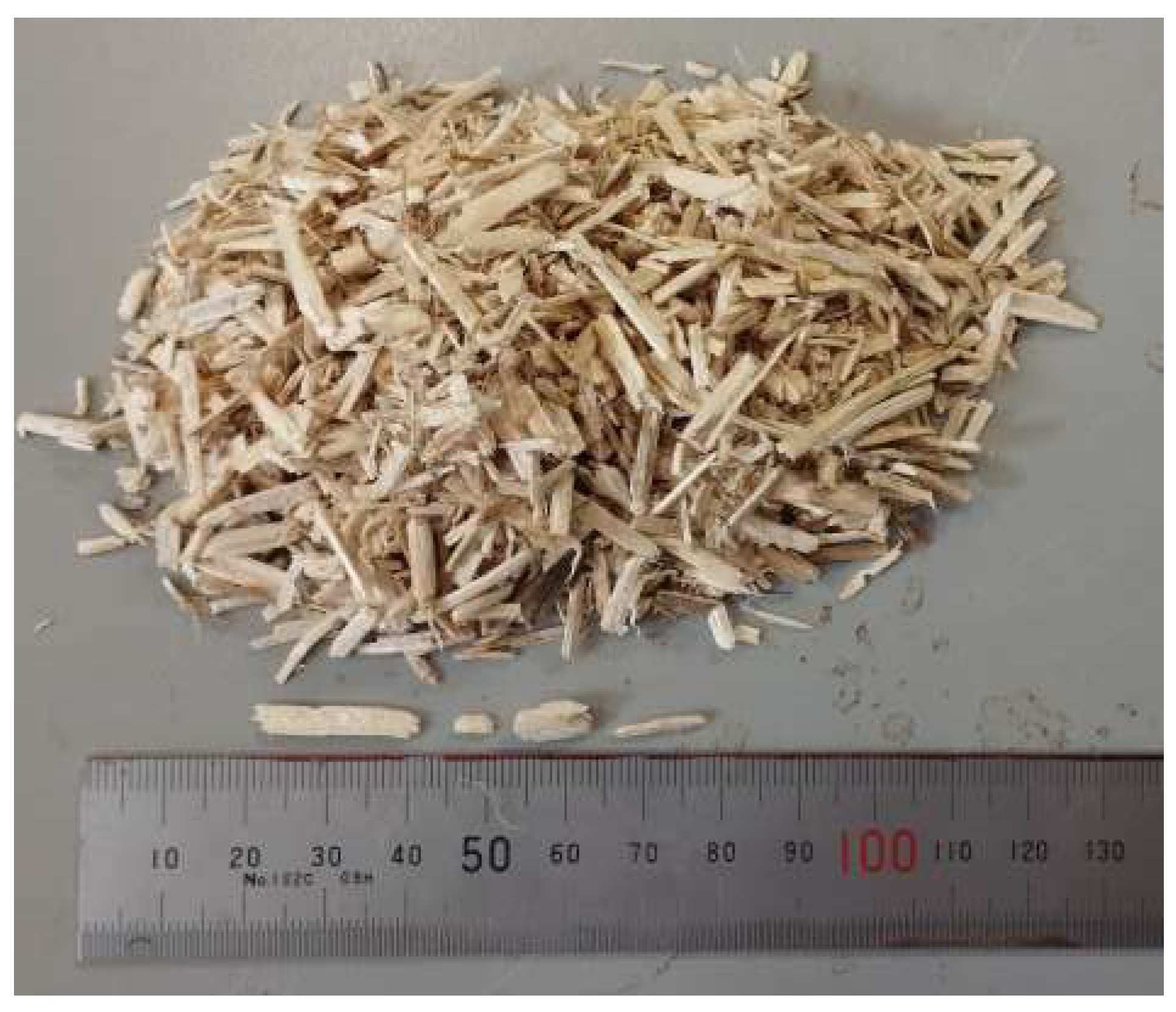
Figure 2.
Specimens made with arabic gum.
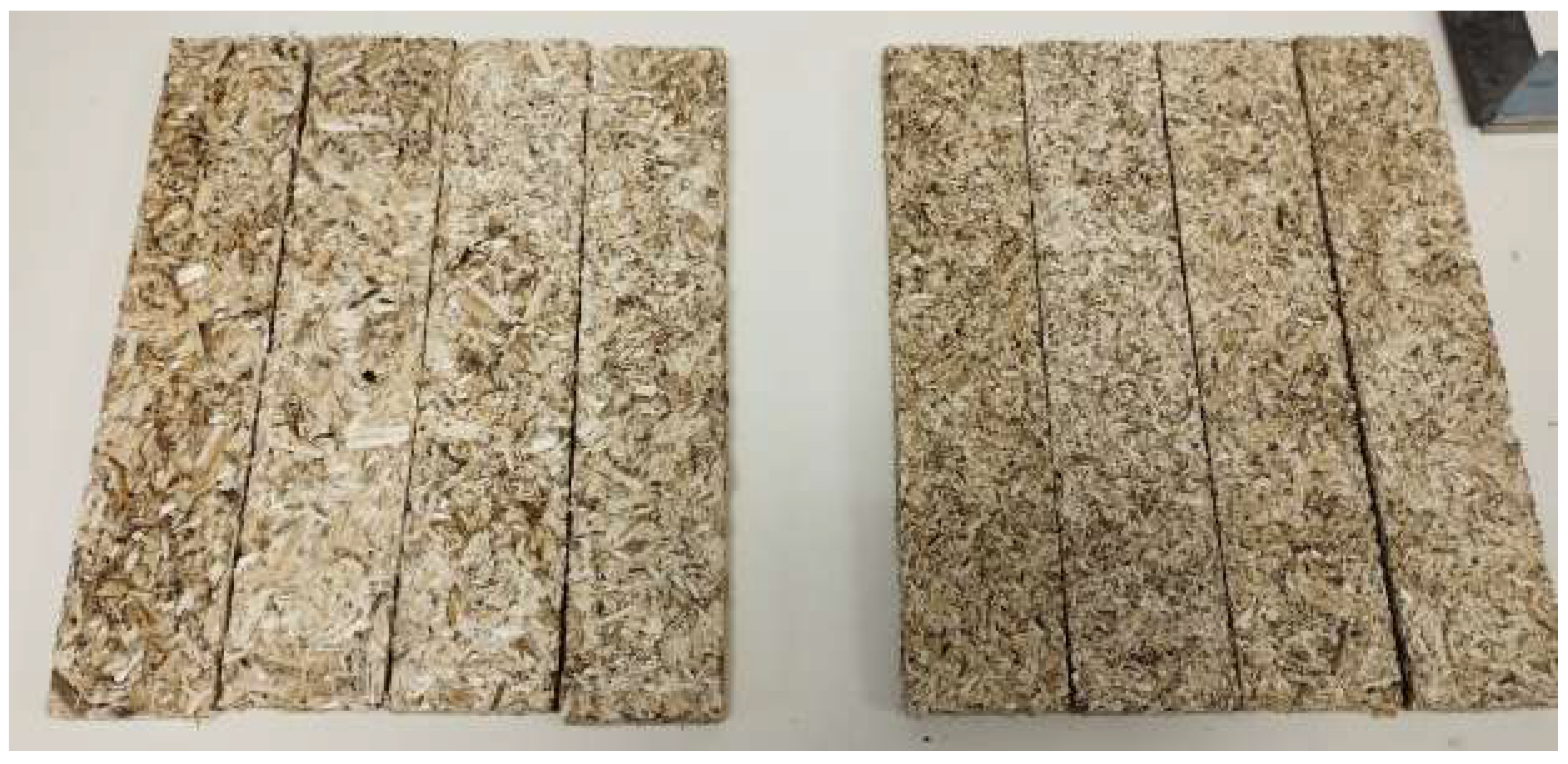
Figure 3.
Test configuration: tensile (left) and bending (right).
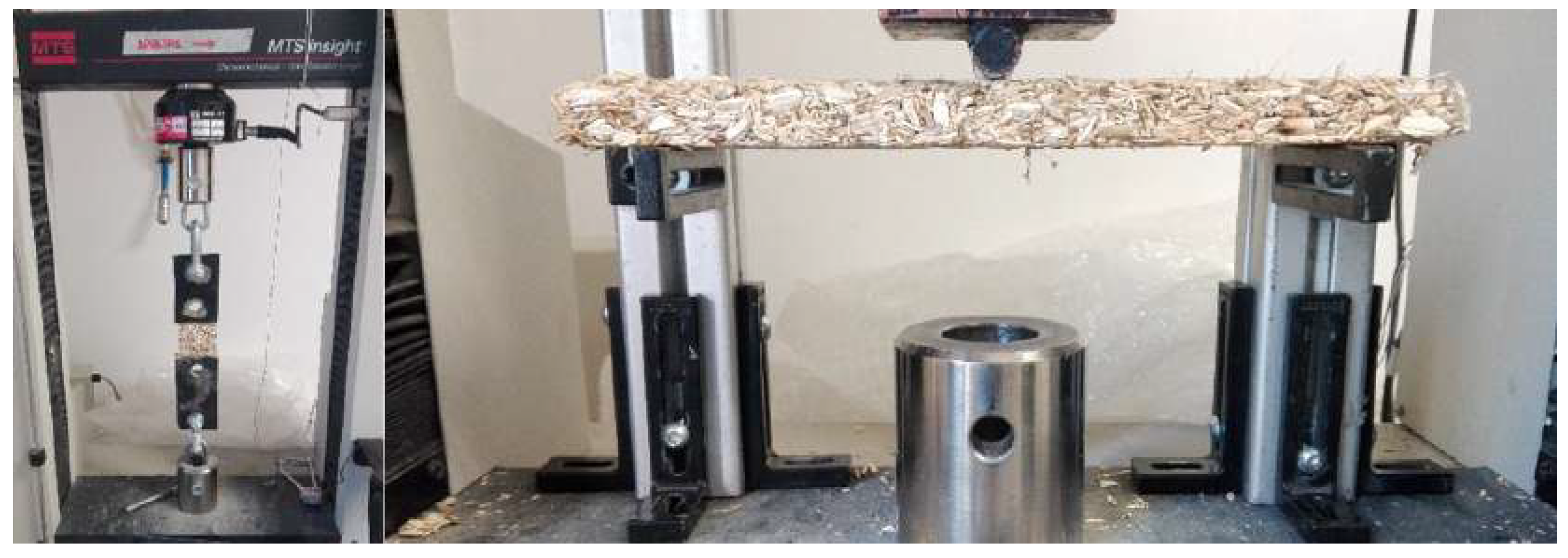
Figure 4.
Wooden mold with bleeding and absorbent paper (left) and obtained specimens (right).
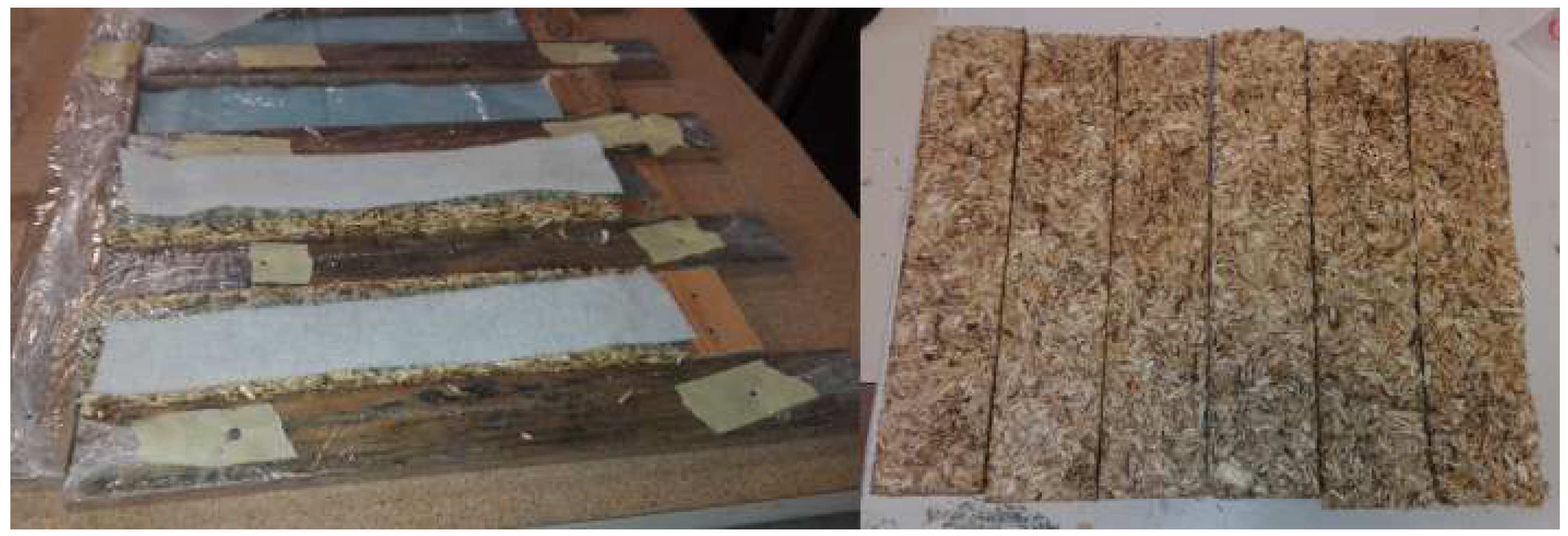

Table 1.
Nomenclature of the specimens.
| Resin | Relation hemp-binder | Manufacture method |
|---|---|---|
| LA (Arabic gum) | 0.5 (10-0.5) | I (initial method) |
| HA (Concentrated arabic gum) | 1 (10-1) | P (Increase the pressure time) |
| LC (Colophony) | 2 (10-2) | O (Curing 1h in oven) |
| HC (Concentrated colophony) | 4 (10-4) | D (1 day in wood mold) |
| LS (Corn starch) | 6 (10-6) | W (1 week in wood mold) |
| LE (Bioepoxy) | T (thin particle size) | |
| LW (White glue) |
Table 2.
Tensile and bending test results.
| Sample | Tensile strength (kPa), C.V. (%) | Bending young modulus (MPa), C.V. (%) | Bending strength (kPa), C.V. (%) |
|---|---|---|---|
| LW-2-I | 45.7 (15) | - | - |
| LW-4-I | 109.5 (40) | 21.27 (-) | 150.6 (-) |
| LW-6-I | 279.5 (-) | 39.70 (-) | 491.9 (1) |
| LE-2-I | 19.5 (35) | 2.12 (29) | 317 (45) |
| LE-4-I | 139.7 (15) | 59.16 (26) | 208.9 (23) |
| LE-6-I | 298.6 (26) | 44.85 (1) | 317 (36) |
| LA-2-I | 174.1 (40) | 32.74 (9) | 150.7 (5) |
| LA-4-I | 46.3 (5) | 31.91 (3) | 106.3 (6) |
| LA-6-I | - | 45.97 (47) | 202.6 (26) |
| LC-2-I | 22.8 (23) | 75.55 (28) | 195.8 (34) |
| LC-4-I | 33.1 (28) | 136.48 (16) | 486.2 (33) |
| LC-6-I | - | 148 (12) | 586.3 (4) |
Table 3.
Tensile and bending test results with concentrated arabic gum.
| Sample | Tensile strength (kPa) (C.V.) | Bending young modulus (MPa) (C.V.) | Bending strength (kPa) (C.V.) |
|---|---|---|---|
| LA-2-I | 174.1 (40) | 32.74 (9) | 150.7 (5) |
| HA-2-I | 109.2 (9) | 34.01 (3) | 219.5 (12) |
| LA-6-I | - | 45.97 (47) | 202.6 (26) |
| HA-6-I | 397.3 | 23.01 (8) | 339.9 (5) |
Table 4.
Results of tensile and bending tests varying the manufacturing methods.
| Sample | Tensile strength (kPa), C.V. (%) | Bending young modulus (MPa), C.V. (%) | Bending strength (MPa), C.V. (%) |
|---|---|---|---|
| LA-2-I | 174.1 (40) | 32.74 (9) | 0.15 (5) |
| LA-2-P | 10.9 (-) | 12.55 (-) | 0.11 (-) |
| HA-6-I | 1802.3 (45) | 222.79 (1) | 0.74 (1) |
| HA-6-O | 913 (15) | 398.46 (5) | 4.09 (18) |
| HA-6-T | 327.4 (28) | 133.15 (28) | 30.58 (26) |
Table 5.
Results of tensile and bending tests varying the curing times in the mold with absorbent paper.
Table 5.
Results of tensile and bending tests varying the curing times in the mold with absorbent paper.
| Sample | Tensile strength (MPa), C.V. (%) | Bending young modulus (MPa), C.V. (%) | Bending strength (MPa), C.V. (%) |
|---|---|---|---|
| HA-6-W | 1.80 (45) | 222.79 (1) | 0.74 (1) |
| HA-6-D | 2.16 (18) | 747.19 (29) | 5.25 (24) |
| HC-6-W | 0.61 (13) | 594.54 (40) | 2.77 (34) |
| HC-6-D | 0.26 (65) | 558.28 (8) | 1.33 (15) |
| LS-0.5-D | 0.31 (56) | 172.70 (24) | 1.05 (19) |
| LS-1-D | 0.03 (-) | 21.31 (-) | 0.12 (-) |
Table 6.
Results of tensile and bending tests for the best cases
| Sample | Tensile strength (MPa), C.V. (%) | Bending young modulus (MPa), C.V. (%) | Bending strength (MPa), C.V. (%) |
|---|---|---|---|
| LW-6-W | 1.06 (49) | 194.20 (22) | 2.22 (23) |
| LE-6-W | 1.73 (42) | 338.73 (2) | 5.15 (24) |
| LA-2-D | 0.37 (32) | 54.70 (3) | 0.25 (35) |
| HA-6-D | 2.16 (18) | 747.19 (29) | 5.25 (24) |
| LC-2-W | 0.12 (63) | 67.72 (9) | 0.35 (30) |
| HC-6-D | 0.61 (13) | 594.54 (40) | 2.77 (34) |
| LS-0.5-D | 0.31 (56) | 172.70 (24) | 1.05 (19) |
Table 7.
Compression and bending performance compared with other shiv based materials.
| Fiber | Matrix | Eco-friendly material | Compression Young Modulus (MPa) | Bending strength (MPa) | Reference |
|---|---|---|---|---|---|
| Hemp shiv | Arabic gum | YES | – | 5.25 | This study |
| Hemp shiv | Cardboard | YES | 0.67-0.96 | 0.43 | [31] |
| Hemp shiv | Wheat starch | YES | 0.55 | 0.08-0.14 | [33] |
| Hemp shiv | Reactive vegetable protein | YES | 1.1-3.0 | 6.83 | [40] |
| Corn shiv | Epoxy | NO | 0.11-0.29 | 0.13 | [41] |
| Hemp shiv | Portlandt & MgO-cement | NO | 0.4-5.5 | – | [13] |
| Hemp shiv | Lime | NO | 0.3-0.5 | 0.14 | [10] |
Disclaimer/Publisher’s Note: The statements, opinions and data contained in all publications are solely those of the individual author(s) and contributor(s) and not of MDPI and/or the editor(s). MDPI and/or the editor(s) disclaim responsibility for any injury to people or property resulting from any ideas, methods, instructions or products referred to in the content. |
© 2024 by the authors. Licensee MDPI, Basel, Switzerland. This article is an open access article distributed under the terms and conditions of the Creative Commons Attribution (CC BY) license (http://creativecommons.org/licenses/by/4.0/).
Copyright: This open access article is published under a Creative Commons CC BY 4.0 license, which permit the free download, distribution, and reuse, provided that the author and preprint are cited in any reuse.


