

Submitted:
08 July 2024
Posted:
09 July 2024
You are already at the latest version
Abstract
In recent years, the research community has been interested in members of the Acinetobacter genus mainly because of their role as causative agents of nosocomial infections. However, this rich-in-species genus has been proven to play a significant role in different biotechnological processes, such as bioremediation and fermented foods production. To partially fill the lack of information on Acinetobacter’s dualistic nature, in this review, based on literature data, we attempt to summarize the available information on the different roles the members of the genus play by considering their genetic constitution and metabolic properties. We found pieces of evidence of genetic divergence between the pathogenic and non-pathogenic species and strains, which can be explained by their high adaptability to the different ecological niches. In turn, this adaptability could result from intrinsic genetic variability due to mechanisms of horizontal genetic transfer, as well as high mutability determined by the expression of error-prone DNA polymerases. Yet, further studies are needed, especially whole-genome sequencing of non-pathogenic isolates, which for the moment are relatively scarce.
Keywords:
Acinetobacter genus
; pathogenic and non-pathogenic species and strains
; genetic divergence
1. Introduction
The genus Acinetobacter is a part of the family Moraxellaceae, order Pseudomonadales, and represents a group of Gram-negative, typically aerobic, non-motile, nonfastidious, catalase-positive, oxidase-negative bacteria [1]. They are widely distributed in various environments, including fertile and non-fertile soil, fresh and sea water, solid wastes, fruits and vegetables, and foods with animal origins – meat, fish, honey and dairy products [2,3,4]. Their presence on the human skin and gut microbiome is notable, as is their existence in other animals - cattle, pigs, honeybees, and more [5,6]. These bacteria are distinguished for their metabolic versatility and adaptability to these diverse ecological niches. Such qualities of the genus can be benefited from, as various strains can produce a number of economically valuable secondary metabolites, including hydrolase enzymes, bioemulsifiers and a range of biopolymers [7]. That would suggest their possible biotechnological application, which relies on their ability to biodegrade oil, xenobiotics and halogens, remove phosphate and heavy metals in wastewaters, and potentially produce industrially important bioproducts [8].
In recent years, Acinetobacter species have garnered significant attention due to their peculiar role in both public health and food technology. They affect the middle ground of the two concepts as well. Evidence suggests that the presence of those bacteria in raw food such as vegetables and fruits and in dairy products might cause the consumer to have a foodborne disease, among others, typically diarrheal. Their ability to do so is not very well determined, as many associate the disorder’s origin with the usual foodborne pathogens, such as Staphylococcus aureus or Escherichia coli [9]. Certain species are implicated in severe healthcare-associated infections, characterized by their remarkable ability to acquire resistance to multiple antibiotics [10,11]. The common antimicrobial resistance genes present in the genus include class D oxacillinases like OXA-23, OXA-24/40, OXA-58, and the inherent OXA-51 in Acinetobacter baumannii, which are responsible for hydrolyzing β-lactam antibiotics, including carbapenems. Multiple drug resistance efflux pumps (AdeABC, AdeIJK, and AdeFGH), aminoglycoside-modifying enzymes (aph(3’)-VIa, AAC(6′)I-ad, and ArmA) and colistin resistance genes (mutations in pmrA and pmrB) are all present to a notable extent in various strains, with the pathogenic ones being most relevant [12]. Due to the immense ecological spread of the genus Acinetobacter members, these bacteria have the potential to further escalate the growth of antimicrobial resistance genes throughout the environment [13,14,15].
Contrarily, in parallel to the genus’s pathogenic nature, some non-pathogenic species could play beneficial roles in the fermentation of foods, contributing to flavor development and preservation. A study reported high proteolytic activity from Acinetobacter, detected in 13 samples from Koozeh cheese, traditional for west Azarbaijan, from the 15 taken [4]. An examination of some types of French cheese made explicitly from raw goat’s milk concluded that A. baumannii accounted for 3.2% of the total isolated strains from the milk and rind during ripening [16]. Acinetobacter johnsonii, along with another unidentified representative of the genus, were noticed in French Livarot cheese both on its surface and core [17]. The same species were predominant in the ripening of Grana-like hard cheese, made from raw cow’s milk, in the Piedmont region in northwest Italy [18]. These observations could raise speculations that the presence of these bacteria in foods, especially in fermented ones, is a result of poor hygiene and lack of sanitary regulations in their production, therefore implying that detection of Acinetobacter is not recommended for the finished stock. While that might be an explanation, recent findings suggest that the genus might possess certain characteristics that could positively impact the result [4,19].
2. The Dualistic Nature of the Genus Acinetobacter
Genus Acinetobacter was first described in 1954 by Brisou and Prévot, who recognized the distinct characteristics that separated these organisms from other Gram-negative bacteria [20]. Initially, the genus included only a few species, but subsequent advances in molecular biology techniques, particularly DNA-DNA hybridization and 16S rRNA gene sequencing, have further expanded the understanding and classification of this group [21]. As of today, the genus Acinetobacter contains over 80 recognized species [22]. These bacteria have a DNA G+C content of between 39 and 47% [23,24] and are divided into several complexes and subgroups based on their genetic, biochemical, and phenotypic characteristics. These complexes include the Acinetobacter calcoaceticus – A. baumannii complex, which is the most clinically significant group [25]. Other common ones are the Acinetobacter lwoffii and A. johnsonii complexes, which are less associated with pathogenicity and more with their presence in the environment, in various foods, and in the natural microflora of humans and animals [21].
Acinetobacter species typically appear in pairs under a microscope and are known for their distinctive coccobacillary morphology, especially on non-selective agar media [1]. The cells of these bacteria differ in size and arrangement, usually 0.9 to 1.6 μm in diameter and 1.5 to 2.5 μm in length in the exponential growth phase. They can use different carbon sources for growth. When grown on solid media, Acinetobacter species usually form smooth or mucoid colonies ranging from white to pale yellow or light grey [26].
One of the genus’s representatives, A. baumannii, is infamous for its involvement in nosocomial infections, such as hospital-acquired pneumonia, bloodstream infections, and wound contaminations. They often affect patients with compromised immune systems, as well as elderly persons and young children [27]. The ability of A. baumannii to survive on various surfaces for prolonged periods and its rapid acquisition of antibiotic resistance mechanisms have provided considerable challenges for pathogenic control and effective treatment [11].
Acinetobacter haemolyticus is another reported pathogen known for its ability to cause hemolysis. It has been suspected to cause bloody diarrhea in a case where no other enteropathogenic bacteria were detected [28]. The same species has been isolated from an 86-year-old patient diagnosed with recurrent bronchiectasis.
Other opportunistic pathogens such as A. iwoffi, A. johnsonii and Acinetobacter junii have been associated with secondary meningitis and bacteremia, among others, although not as frequently as A. baumanii [29,30]. The highly adaptive nature of the genus indicates the need for more data from investigating the potential pathogenicity of non-baumanii species.
On the contrary, research into the environmental and beneficial aspects of Acinetobacter spp. has revealed their role in biodegradation and bioremediation processes, as well as their presence in fermented foods. These bacteria are capable of producing a range of enzymes, such as lipases, proteases, and esterases, which are crucial in breaking down complex food substrates into more pure, flavorful compounds [31]. For instance, two Acinetobacter strains (Acinetobacter sp. 1H8 and Acinetobacter indicus 3B2) were inoculated in cigar tobacco leaves, where they not only increased the degradation of macromolecules, produced aldehydes and ketones and increased the content of more flavorful agents, but also promoted the growth of other functional bacteria, such as some Bacillus species [32]. Acinetobacter also made up the fourth most abundant genera overall in differently sourced da-jiang samples, a traditional soybean fermented food from China, suggesting a high possibility of their active involvement in the product’s processing [33].
3. Virulence and Pathogenicity Genetic Determinants
3.1. Antibiotic Resistance Genes
What makes a pathogen a pathogen is a crucial topic for many investigations, primarily those dealing with the nature of microorganisms. A plethora of genetic determinants mainly drives the pathogenicity of Acinetobacter, each contributing to the genus’ unique ability to adapt to stress and cause diseases. The most well-known factor is the presence of various antibiotic-resistance genes in their genome, possibly acquired by horizontal transfer of plasmids and transposons from other already resistant microorganisms [35]. Non-pathogenic Acinetobacter are significantly more susceptible to antibiotics than their pathogenic counterparts [36]. Therefore, the genome of opportunistic pathogens such as A. baumannii has a higher content of mobile genetic elements, which promotes the acquisition and the further spread of novel antibiotic-resistance genes [37].
3.2. Error-Prone DNA Polymerases
Additionally, investigations have shown the existence of many error-prone DNA polymerases (EPPs). Within the Acinetobacter genus, they may result in point mutations that aid survival, thus furthering their resistance to antibiotics and toxins [21], especially the UmuD’2C polymerase (also known in Escherichia coli as pol V) [38], associated with a process known as SOS mutagenesis [39]. Interestingly, the SOS response in Acinetobacter does not rely on LexA protein, which has been proven to be absent within the genus [40]. Most probably, because the expression of the UmuD’2C polymerase depends on the unique for the genus non-homologous to LexA proteins UmuDAb and DdR [40,41], the SOS mutagenesis process is more robust, resulting in gaining resistance to antimicrobial agents under DNA damaging stress caused. Within the clinical environment this stress can be caused by antibiotics, UV light and desiccation – practices used in patients’ treatment and desinfection [42].
3.3. Biofilm Formation
Acinetobacter representatives such as A. baumannii, Acinetobacter nosocomialis and Acinetobacter pittii possess a couple of strategies for successful biofilm formation, which ensures bacterial survival due to the encasing of the colonies with a protective extracellular matrix [43]. They can form on various surfaces in clinical settings and in the human body, thus providing a protective environment against antibiotics, cleaning agents and the host immune system. The csuA/BABCDE operon encodes components of a chaperone-usher pili assembly system, which is essential for initial attachment and biofilm development. The biofilm-associated protein (Bap) is crucial for biofilm formation on abiotic surfaces. The control of biofilm formation and virulence gene expression is regulated by quorum sensing (QS) systems in response to population density [44]. The ability of Acinetobacter, particularly A. baumannii, to form such biofilms is one of the leading causes of their infamous pathogenic nature.
3.4. Other Outer Membrane Proteins
The existence of outer membrane proteins plays a crucial role in bacterial adherence, invasion and immune evasion. The outer membrane protein A (OmpA), a significant meditator of biofilm formation, is one of the most investigated virulence factors of A. baumannii, as its overproduction is closely associated with the mortality rate of the nosocomial infections caused by the bacterium [45]. Notably, the initial contact between the pathogen and the epithelial host cell is the binding of OmpA to fibronectin [46]. The protein also modulates the secretion of outer membrane vesicles such as Omp33-36, which also play an important role in the pathogenicity of A. baumannii [47]. The porin is the result of the expression of the mapA gene. It instigates apoptosis in infected immune and connective cells by activating caspases and blocking autophagy, thus allowing the bacteria to persist inside autophagosomes [48]. Other distinguished OMPs, possessed by pathogenic Acinetobacter are CarO, carbapenem susceptibility porin, and OprD, an orthologous protein with a role in drug resistance [49].
3.5. Toxins Secretion
Protein secretion systems are detrimental to the possible interactions of bacteria with the environment and host cells. Type II secretion (T2SS) is common in Gram-negative pathogens as it secretes multiple effector proteins such as lipases and proteases, some of which require membrane-bound chaperons to be correctly produced. It has been found that the presence of human serum slightly increased the expression of T2SS in A. baumannii, which suggests that environmental factors may positively or negatively influence the virulence of a strain [50]. A clear correlation between the T2SS function and the colonization and infection of mice with Acinetobacter has been determined. However, the specific virulence-promoting mechanisms of the secretion system have yet to be pointed out [51]. Type VI secretion (T6SS) is a complex mechanism for injecting toxins directly into contact with competing bacteria, ensuring a possible pathogenic dominance. The genes encoding T6SS in Acinetobacter are conservative and are found on a single chromosomal locus. Notably, a non-clinical strain of A. baumannii, DSM30011, could eliminate E. coli, Kleibsiella pneumoniae, Pseudomonas aeruginosa, and a clinical isolate of A. baumannii with a fully active T6SS [52]. Those results hint that while useful in bacterial competition, fully functional T6SS might not be absolutely necessary in pathogenic strains.
3.6. Siderophores
Another distinguished virulence determinant is the presence of iron acquisition systems. It is well known that iron is essential for bacterial growth and metabolism [53]. A. baumannii produces acinetobactin and baumannoferrin, which are siderophores, used to sequester iron from host cells with their high affinity. Their production is mediated by a ferric uptake regulator (Fur), a protein that controls the expression of iron acquisition genes in a metabolic response [54]. Such strategies are crucial for the survival of Acinetobacter pathogens inside the animal and human bodies, as they are iron-limited environments [55].
Acinetobacter species possess a wide range of virulence factors that enable them to adhere to host cells, form biofilms, and evade immune responses. They provide insights into the complex mechanisms that cause their pathogenicity, which could aid potential disease control strategies. The variety of determinants and genetic differences differentiates a pathogen from a non-pathogen Acinetobacter species. Below is a comparison of the genomes between the pathogen A. baumannii and the environmental Acinetobacter baylyi (Table 1).
4. Acinetobacter in the Environment
Acinetobacter species possess the capacity to spread on numerous diverse ecological niches, as they have been assessed as microbial weeds [61]. An attempt to explore the distribution of Acinetobacter in nature determined that the genus was present in 28 of the 30 unique soil samples and 29 of the 30 unique water samples taken from a vast area along the coast of central California [62]. Aside from being present in differently sourced soil, water, foods and animals, they are also a part of the basic commensal microflora of healthy humans [63]. The genus’s omnipresence, coupled with its representatives’ high adaptability, proposes studying these bacteria as model organisms for environmental, biotechnological and industrial microbiological investigations. For example, A. baylyi ADP51 - a soil-inhabiting strain, has been found to have the highest research opportunity due to its high transformation and recombination competency, genome plasticity, versatile metabolic abilities, and fast and easy cultivation [64].
4.1. Soil
Members of the genus inhabit a plethora of soil environments. Studies generally focus on their presence in agricultural fields due to both their role in nutrient cycling, specifically in nitrogen fixation and degradation of complex organic elements, and their ability to carry antibiotic resistance genes and virulence-related traits, which in turn could harm the consumers of the eventually produced crops [65]. Acinetobacter has been found to be among the dominant genera in the rhizosphere soil of wheat and maize in Turkey. Interestingly, the same investigation concluded that inoculating wheat (Triticum aestivum) with Acinetobacter sp. WR922, one of the isolated strains, increased the phosphorus content of the plant by 27% at 15 days after the emergence, and the dry matter by 15% at 30th day. These results are attributable to the strain’s phosphorus-solubilizing ability without the need for pyrroloquinoline quinone - like many other phosphate-solubilizing bacteria [66]. Strains of Acinetobacter guillouiae and A. calcoaceticus were used as bioinoculants in combination with chemical fertilizers to induce growth of onion (Allium cepa), which in turn grew in length biomass and had a higher availability of valuable compounds, demonstrating Acinetobacter representatives as plant growth promoting microbes [67]. Thus, it is suggested that these bacteria contribute to the growth of plants by providing nutrient compounds. Recent findings also demonstrate that Acinetobacter could play a role in soil bioremediation through hydrocarbon and phenol biodegradation [26,68].
4.2. Waters
Acinetobacter strains are present in both fresh and marine waters as free-living organisms or as biofilms on various surfaces. Such biofilms have been noted in drinking water distribution systems, as they are much less susceptible to antiseptics than planktonic Acinetobacter species. The genus is found to be the prevalent isolate from chlorinated distributional systems, making up more than 5% of all identified microorganisms [63]. This could result from high resistance to chlorine, the most commonly used water disinfectant, with A. baumannii being able to persist in 0.2 to 4 ppm of free chlorine exposure, thus raising concerns for causing potential water-borne diseases [69]. Acinetobacter spp. has been identified in 38 % of untreated groundwater supplies and 16% of the water supplies, with no total coliforms detected in northern Preston County. Researchers find no notable difference in slime production, a virulence factor for A. calcoaceticus, in drinking water strains and clinical isolates while also highlighting that Acinetobacter might mask the presence of total coliforms in water, which poses a significant threat to the safety of the consumers [70]. Furthermore, the drug-resistant A. baumannii ST219 caused an outbreak in Tokai University Hospital’s emergency intensive care unit due to the strain’s colonization of the water systems, therefore spreading the infection by tap water [71]. Another concern for the genera’s presence in tap water is the dissemination of antibiotic resistance to other species [72].
On the contrary, some strains could be a promising alternative to cleaning oil spills and reducing the toxicity of pollutants in wastewater [7]. Acinetobacter sp. SCYY-5 has been proven to reduce total petroleum hydrocarbon contamination by 69.17% in 10 days and under optimal degradation conditions by 79.94% in the same period [73]. Another study proposes that A. junii strain b2w is highly suitable for chromium bioremediation in contaminated waters since the bacterium could accumulate the heavy toxin effectively without disrupting cell integrity [74]. The positive environmental impact of several Acinetobacter strains in waters could be an excellent tool for industrial and biotechnological advancements and thus should be explored further.
4.3. Acinetobacter as an Animal Skin Commensal
Acinetobacter is considered to be a part of the common commensal skin microflora of humans and animals. They have been isolated from multiple animals, including dogs, cats, horses, pigs, and birds [75]. Investigations, mainly relevant to veterinary medicine, argue that Acinetobacter might become an opportunistic animal pathogen and should be given more attention due to the genus’s high affinity for antimicrobial resistance [76,77]. For instance, a carbapenem-resistant A. pittii isolate was detected in a cat skin sample [78]. A. baumannii caused necrotizing fasciitis, an infection of the deep layers of the skin and fascia, with septic shock in a domestic shorthair cat, which ended in cardiac arrest [79]. The same has been detected in various animal infection sites, such as chronic eczema and open wounds in dogs [75]. While the presence of pathogenic strains on the skin of domestic animals is alarming, their detection in livestock appears to be a broader question. A study examined the possible existence of drug-resistant A. baumannii in 422 cattle, containing 280 dairy cows, 59 beef cattle, and 83 calves over 14 months. A total of 15.6% of the diverse samples were positive, with dairy cows being the prevalent group with 21.1%, followed by beef cattle (6.8%) and calves (2.4%) [80]. Different farms in Lebanon have been similarly investigated through fecal samples taken from cattle, pigs and hens. Four isolates were inhibited with A. baumannii, resistant to a wide range of antibiotics [81]. Tigecycline-resistant Acinetobacter towneri has been identified in 684 fecal and environmental isolates from six livestock farms, as Acinetobacter species appear to be the leading carrier of tigecycline-resistant tet(X) genes. Notably, the most tet(X)-positive isolates seem to be associated with livestock [58]. Such results pose a multitude of speculations about a possible contamination of animal foods with virulent Acinetobacter, considering that the genus has already been identified in a plethora of such products [2,34]. Research into the presence of non-pathogenic strains in animals is severely limited, due to the higher urgency of virulence.
5. Acinetobacter in Fermented Foods
From balancing the gut microflora and reducing blood pressure to vitamin increase and reduction of inflammation, the numerous health benefits of fermented foods and their content have been extensively researched and promoted; hence, the consumption of fermented products has gained significant popularity over the years. These qualities are attributed to the bioactive compounds, including vitamins, peptides and polysaccharides, produced by the microbial communities responsible for the fermentation process [82]. Certain Acinetobacter representatives have been detected in metagenomic analyses of various fermented foods (Figure 2). The reasons behind the latter, however, could not be only a result of contamination of the processing environment or the raw material, as consistently mentioned, but also due to the metabolic capacities of the genus that play a practical role during food fermentation. Nonetheless, the strains found in food and those in clinical environments have substantial differences in their genotypes and, therefore, variable metabolic properties [83]. This could possibly impact the finished product in a different way.
5.1. Presence in Fermented Non-Dairy Foods
A study exploring the dynamic microflora of surimi, a protein extract from fish meat during fermentation, concluded that Acinetobacter was the second most abundant genera, making up 19.75% and 7.34% of the total bacterial diversity after 36 and 48h, respectively. Interestingly, at 0 h, its abundance accounted for 2.02%, then at 12h – for only 0.99%, before it grew to 12.44% at 24h. Although the microbiome of the raw ingredient, marine fish, appears to be inhabited mainly by gram-negative microorganisms, including Acinetobacter, the growth of the bacteria in the process could suggest a possible practical activity, even though the problem is left unspecified [84]. Acinetobacter has been revealed to be a dominant genus in Daqu, a cereal starter culture needed to produce Baijiu, a Chinese distilled spirit, as it produces esterases, pectinases and lipases, among others, and oxidizes glucose to produce acetic acid. All those components are essential for making the flavorful Baijiu [31]. Similarly, the predominance of the genus was observed in another Chinese product, red sufu, traditional soybean food, where it has been suggested that the bacteria could have a microflora stabilizing property [85]. A. baumannii TU04 has been isolated from Tapai Ubi, a Malaysian traditional cassava-fermented food, from which researchers identified an SPSFQ gene, a determinant of the production of extracellular serine protease that can degrade a variety of tissue-associated protein substrates [86]. A. lwoffii has also been identified as the dominant species (4.60%) in fermented rice Bhaati Jaanr, a product with proven antitumor activity [87]. Other fermented foods in which the species have been noticed are chicha, a rice-based fermented beverage; pulque, an alcoholic drink from the Agave plant; chikwangue, a starchy cassava product; koko, fermented maize porridge; and kenkey, steamed dumplings made from a steeping maze in water [88]. The possible functionality of Acinetobacter in those foods is scarcely explored, as many attribute its presence to an unsanitary environment.
5.2. Presence in Fermented Dairy Foods
Acinetobacter strains had a significant abundance in the maturation of two Camembert cheeses, with more than half of the strains presenting lipolytic activities on butterfat and tributyrin agar. Notably, NaCl enhanced the lipase production. No proteolytic strains were detected. In one sample, A. calcoaceticus was the most abundant species, apart from lactic acid bacteria. Furthermore, significant growth of Acinetobacter was only noticed after the growth of the yeast Debaryomyces hansenii [19]. Another study proposed that the genus could possess a secondary activity in the maturation of Istrian cheese [89]. A. baumannii has been identified as one of the species with relative abundance >1% in 92 different spontaneously fermented dairy products, such as shubat, yogurt, butter, sour cream and cottage cheese, all from different regions in Northeast Asia [90]. The same was present in 3.3% of overall samples of Domiati cheese, which is attributed to possible inefficient heat treatment or improper handling. In Kareish cheese, another Egyptian product, A. baumannii, was detected in 10% of the samples, along with a 3.3% presence of A. calcoaceticus, possibly due to the raw milk production process. The latter study also identified A. baumannii and A. haemolyticus in 13.3% of all cream samples. All of the strains from Domiati and Kareish cheese and three-fourths of those in cream presented positive lipolytic activity, which is argued to potentially reduce the shelf life of the milk products due to a possible production of ropy milk, which is a particular characteristic of the bacteria, although rarely encountered [91,92]. A. baumannii and A. pittii have been isolated from raw cheese samples in Lebanon [93]. Furthermore, A. calcoaceticus, Acinetobacter guillouiae, A. johnsonii and unidentified Acinetobacter were all present during the ripening of May bryndza cheese but were absent in the finished product [94]. Similarly to the non-dairy foods, knowledge of the activity of the genus in dairy fermented foods is limited, besides their aforementioned lipolytic and proteolytic ability, which appears to be a characteristic, not all strains possess [4,91]. It appears that the strains that are present in various products are highly specific, therefore inducing a lack of perceivable trends and broader investigations.
5. Conclusions
Acinetobacter is a fascinating, highly heterogeneous genus that includes pathogens, biodegradators, stabilizers, model organisms and flavor enhancers. While their virulence is being thoroughly explored, broader and more specific investigations are needed to determine the reason behind their significant presence in a plethora of fermented food products. So, future studies are needed. One way to fill the existing information gap on the genetic bases for biotechnological applications is whole-genome sequencing of non-pathogenic, environmental and fermented foods Acinetobacter isolates.
Author Contributions
Conceptualization, T.M. and S.D.; methodology, T.M..; validation, T.M., K.P. and I.B.; formal analysis, T.M.; investigation, T.M.; resources, I.B. and S.D.; data curation, K.P.; writing—original draft preparation, T.M. and S.D; writing—review and editing, I.B and S.D.; visualization, T.M.; supervision, S.D.; project administration, S.D.; funding acquisition, S.D.
Funding
This research was funded by BULGARIAN NATIONAL SCIENCE FUND, grant number КП-06-66/6 from 13.12.2022 (BG-175467353-2022-04-0022-C01).
Institutional Review Board Statement
Not applicable
Data Availability Statement
Not applicable
Conflicts of Interest
The authors declare no conflicts of interest.
Appendix A
The appendix is an optional section that can contain details and data supplemental to the main text—for example, explanations of experimental details that would disrupt the flow of the main text but nonetheless remain crucial to understanding and reproducing the research shown; figures of replicates for experiments of which representative data is shown in the main text can be added here if brief, or as Supplementary data. Mathematical proofs of results not central to the paper can be added as an appendix.
Appendix B
All appendix sections must be cited in the main text. In the appendices, Figures, Tables, etc. should be labeled starting with “A”—e.g., Figure A1, Figure A2, etc.
References
- Yang, X. Moraxellaceae. Encyclopedia of Food Microbiology 2014, 826–833. [Google Scholar] [CrossRef]
- Carvalheira, A.; Casquete, R.; Silva, J.; Teixeira, P. Prevalence and antimicrobial susceptibility of Acinetobacter spp. isolated from meat. International Journal of Food Microbiology 2017, 243, 58–63. [Google Scholar] [CrossRef] [PubMed]
- Veress, A.; Nagy, T.; Wilk, T.; Kömüves, J.; Olasz, F.; Kiss, J. Abundance of mobile genetic elements in an Acinetobacter lwoffii strain isolated from Transylvanian honey sample. Scientific Reports 2020, 10, 2969. [Google Scholar] [CrossRef] [PubMed]
- Valizade, K.M.; Rezazad, B.M.; Mehrnoosh, F.; Alizade, K.A.M. A research on existence and special activities of Acinetobacter in different cheese. 2014.
- Kim, P.S.; Shin, N.-R.; Kim, J.Y.; Yun, J.-H.; Hyun, D.-W.; Bae, J.-W. Acinetobacter apis sp. nov., isolated from the intestinal tract of a honey bee, Apis mellifera. Journal of microbiology 2014, 52, 639–645. [Google Scholar] [CrossRef] [PubMed]
- Hamouda, A.; Findlay, J.; Al Hassan, L.; Amyes, S.G.B. Epidemiology of Acinetobacter baumannii of animal origin. International Journal of Antimicrobial Agents 2011, 38, 314–318. [Google Scholar] [CrossRef] [PubMed]
- Abdel-El-Haleem, D. Acinetobacter: environmental and biotechnological applications. African journal of Biotechnology 2003, 2, 71–74. [Google Scholar]
- Abd-El-Haleem, D.; Beshay, U.; Abdelhamid, A.O.; Moawad, H.; Zaki, S. Effects of mixed nitrogen sources on biodegradation of phenol by immobilized Acinetobacter sp. strain W-17. African Journal of Biotechnology 2003, 2, 8–12. [Google Scholar]
- Amorim, A.M.B.d.; Nascimento, J.d.S. Acinetobacter: an underrated foodborne pathogen? The Journal of Infection in Developing Countries 2017, 11, 111–114. [Google Scholar] [CrossRef] [PubMed]
- Visca, P.; Seifert, H.; Towner, K.J. Acinetobacter infection – an emerging threat to human health. IUBMB Life 2011, 63, 1048–1054. [Google Scholar] [CrossRef]
- Cerqueira, G.M.; Peleg, A.Y. Insights into Acinetobacter baumannii pathogenicity. IUBMB Life 2011, 63, 1055–1060. [Google Scholar] [CrossRef]
- Poirel, L.; Bonnin, R.A.; Nordmann, P. Genetic basis of antibiotic resistance in pathogenic Acinetobacter species. IUBMB life 2011, 63, 1061–1067. [Google Scholar] [CrossRef] [PubMed]
- Wang, B.; Sun, D. Detection of NDM-1 carbapenemase-producing Acinetobacter calcoaceticus and Acinetobacter junii in environmental samples from livestock farms. Journal of Antimicrobial Chemotherapy 2014, 70, 611–613. [Google Scholar] [CrossRef] [PubMed]
- Xiong, W.; Sun, Y.; Zhang, T.; Ding, X.; Li, Y.; Wang, M.; Zeng, Z. Antibiotics, Antibiotic Resistance Genes, and Bacterial Community Composition in Fresh Water Aquaculture Environment in China. Microbial Ecology 2015, 70, 425–432. [Google Scholar] [CrossRef] [PubMed]
- Ababneh, Q.; Al-Rousan, E.; Jaradat, Z. Fresh produce as a potential vehicle for transmission of Acinetobacter baumannii. International Journal of Food Contamination 2022, 9, 5. [Google Scholar] [CrossRef]
- Sablé, S.; Portrait, V.; Gautier, V.; Letellier, F.; Cottenceau, G. Microbiological changes in a soft raw goat’s milk cheese during ripening. Enzyme and Microbial Technology 1997, 21, 212–220. [Google Scholar] [CrossRef]
- Coton, M.; Delbés-Paus, C.; Irlinger, F.; Desmasures, N.; Le Fleche, A.; Stahl, V.; Montel, M.-C.; Coton, E. Diversity and assessment of potential risk factors of Gram-negative isolates associated with French cheeses. Food Microbiology 2012, 29, 88–98. [Google Scholar] [CrossRef] [PubMed]
- Alessandria, V.; Ferrocino, I.; Filippis, F.D.; Fontana, M.; Rantsiou, K.; Ercolini, D.; Cocolin, L. Microbiota of an Italian Grana-Like Cheese during Manufacture and Ripening, Unraveled by 16S rRNA-Based Approaches. Applied and Environmental Microbiology 2016, 82, 3988–3995. [Google Scholar] [CrossRef] [PubMed]
- Addis, E.; Fleet, G.H.; Cox, J.M.; Kolak, D.; Leung, T. The growth, properties and interactions of yeasts and bacteria associated with the maturation of Camembert and blue-veined cheeses. International Journal of Food Microbiology 2001, 69, 25–36. [Google Scholar] [CrossRef] [PubMed]
- Brisou, J.; Prevot, A.R. [Studies on bacterial taxonomy. X. The revision of species under Acromobacter group]. Ann Inst Pasteur (Paris) 1954, 86, 722–728. [Google Scholar] [PubMed]
- Touchon, M.; Cury, J.; Yoon, E.J.; Krizova, L.; Cerqueira, G.C.; Murphy, C.; Feldgarden, M.; Wortman, J.; Clermont, D.; Lambert, T.; et al. The genomic diversification of the whole Acinetobacter genus: origins, mechanisms, and consequences. Genome Biol Evol 2014, 6, 2866–2882. [Google Scholar] [CrossRef]
- Genus Acinetobacter. LSPN - List of prokaryitic names with standing in nomenclature, Accesses on May 2024.
- Bergogne-Bérézin, E.; Towner, K.J. Acinetobacter spp. as nosocomial pathogens: microbiological, clinical, and epidemiological features. Clin Microbiol Rev 1996, 9, 148–165. [Google Scholar] [CrossRef] [PubMed]
- Peleg, A.Y.; Seifert, H.; Paterson, D.L. Acinetobacter baumannii: emergence of a successful pathogen. Clin Microbiol Rev 2008, 21, 538–582. [Google Scholar] [CrossRef] [PubMed]
- Nemec, A.; Krizova, L.; Maixnerova, M.; van der Reijden, T.J.; Deschaght, P.; Passet, V.; Vaneechoutte, M.; Brisse, S.; Dijkshoorn, L. Genotypic and phenotypic characterization of the Acinetobacter calcoaceticus-Acinetobacter baumannii complex with the proposal of Acinetobacter pittii sp. nov. (formerly Acinetobacter genomic species 3) and Acinetobacter nosocomialis sp. nov. (formerly Acinetobacter genomic species 13TU). Res Microbiol 2011, 162, 393–404. [Google Scholar] [CrossRef] [PubMed]
- Doughari, H.J.; Ndakidemi, P.A.; Human, I.S.; Benade, S. The ecology, biology and pathogenesis of Acinetobacter spp.: an overview. Microbes Environ 2011, 26, 101–112. [Google Scholar] [CrossRef] [PubMed]
- Glew, R.H.; Moellering, R.C., Jr.; Kunz, L.J. Infections with Acinetobacter calcoaceticus (Herellea vaginicola): clinical and laboratory studies. Medicine (Baltimore) 1977, 56, 79–97. [Google Scholar] [CrossRef] [PubMed]
- Grotiuz, G.; Sirok, A.; Gadea, P.; Varela, G.; Schelotto, F. Shiga Toxin 2-Producing Acinetobacter haemolyticus Associated with a Case of Bloody Diarrhea. Journal of Clinical Microbiology 2006, 44, 3838–3841. [Google Scholar] [CrossRef] [PubMed]
- Prashanth, K.; Badrinath, S. Nosocomial infections due to Acinetobacter species: clinical findings, risk and prognostic factors. Indian Journal of Medical Microbiology 2006, 24, 39–44. [Google Scholar] [CrossRef] [PubMed]
- Ku, S.C.; Hsueh, P.R.; Yang, P.C.; Luh, K.T. Clinical and microbiological characteristics of bacteremia caused by Acinetobacter lwoffii. Eur J Clin Microbiol Infect Dis 2000, 19, 501–505. [Google Scholar] [CrossRef] [PubMed]
- Wei, Y.; Zhang, S.; Guan, G.; Wan, Z.; Wang, R.; Li, P.; Liu, Y.; Wang, J.; Jiao, G.; Wang, H. A specific and rapid method for detecting Bacillus and Acinetobacter species in Daqu. Frontiers in Bioengineering and Biotechnology 2023, 11, 1261563. [Google Scholar] [CrossRef]
- Zheng, T.; Zhang, Q.; Wu, Q.; Li, D.; Wu, X.; Li, P.; Zhou, Q.; Cai, W.; Zhang, J.; Du, G. Effects of inoculation with Acinetobacter on fermentation of cigar tobacco leaves. Frontiers in Microbiology 2022, 13, 911791. [Google Scholar] [CrossRef]
- Zhang, P.; Wu, R.; Zhang, P.; Liu, Y.; Tao, D.; Yue, X.; Zhang, Y.; Jiang, J.; Wu, J. Structure and diversity of bacterial communities in the fermentation of da-jiang. Annals of microbiology 2018, 68, 505–512. [Google Scholar] [CrossRef]
- Carvalheira, A.; Silva, J.; Teixeira, P. Acinetobacter spp. in food and drinking water – A review. Food Microbiology 2021, 95, 103675. [Google Scholar] [CrossRef] [PubMed]
- von Wintersdorff, C.J.; Penders, J.; van Niekerk, J.M.; Mills, N.D.; Majumder, S.; van Alphen, L.B.; Savelkoul, P.H.; Wolffs, P.F. Dissemination of Antimicrobial Resistance in Microbial Ecosystems through Horizontal Gene Transfer. Front Microbiol 2016, 7, 173. [Google Scholar] [CrossRef] [PubMed]
- Manchanda, V.; Sanchaita, S.; Singh, N. Multidrug resistant acinetobacter. J Glob Infect Dis 2010, 2, 291–304. [Google Scholar] [CrossRef] [PubMed]
- Partridge, S.R.; Kwong, S.M.; Firth, N.; Jensen, S.O. Mobile Genetic Elements Associated with Antimicrobial Resistance. Clinical Microbiology Reviews 2018, 31, 10.1128/cmr.00088–00017. [Google Scholar] [CrossRef] [PubMed]
- Tang, M.; Shen, X.; Frank, E.G.; O’Donnell, M.; Woodgate, R.; Goodman, M.F. UmuD′2C is an error-prone DNA polymerase, Escherichia coli pol V. Proceedings of the National Academy of Sciences 1999, 96, 8919–8924. [Google Scholar] [CrossRef]
- Tang, M.; Pham, P.; Shen, X.; Taylor, J.-S.; O’Donnell, M.; Woodgate, R.; Goodman, M.F. Roles of E. coli DNA polymerases IV and V in lesion-targeted and untargeted SOS mutagenesis. Nature 2000, 404, 1014–1018. [Google Scholar] [CrossRef] [PubMed]
- Peterson, M.A.; Grice, A.N.; Hare, J.M. A corepressor participates in LexA-independent regulation of error-prone polymerases in Acinetobacter. Microbiology 2020, 166, 212–226. [Google Scholar] [CrossRef]
- Candra, B.; Cook, D.; Hare, J. Repression of Acinetobacter baumannii DNA damage response requires DdrR-assisted binding of UmuDAb dimers to atypical SOS box. Journal of Bacteriology 2024, 206, e00432–00423. [Google Scholar] [CrossRef]
- Cook, D.; Flannigan, M.D.; Candra, B.V.; Compton, K.D.; Hare, J.M. The DdrR Coregulator of the Acinetobacter baumannii Mutagenic DNA Damage Response Potentiates UmuDAb Repression of Error-Prone Polymerases. Journal of Bacteriology 2022, 204, e00165–00122. [Google Scholar] [CrossRef]
- Gedefie, A.; Demsis, W.; Ashagrie, M.; Kassa, Y.; Tesfaye, M.; Tilahun, M.; Bisetegn, H.; Sahle, Z. Acinetobacter baumannii biofilm formation and its role in disease pathogenesis: a review. Infection and drug resistance 2021, 3711–3719. [Google Scholar] [CrossRef] [PubMed]
- Li, Y.H.; Tian, X. Quorum sensing and bacterial social interactions in biofilms. Sensors (Basel) 2012, 12, 2519–2538. [Google Scholar] [CrossRef] [PubMed]
- Sánchez-Encinales, V.; Álvarez-Marín, R.; Pachón-Ibáñez, M.E.; Fernández-Cuenca, F.; Pascual, A.; Garnacho-Montero, J.; Martínez-Martínez, L.; Vila, J.; Tomás, M.M.; Cisneros, J.M. Overproduction of outer membrane protein A by Acinetobacter baumannii as a risk factor for nosocomial pneumonia, bacteremia, and mortality rate increase. The Journal of infectious diseases 2017, 215, 966–974. [Google Scholar] [PubMed]
- Smani, Y.; McConnell, M.J.; Pachón, J. Role of fibronectin in the adhesion of Acinetobacter baumannii to host cells. PloS one 2012, 7, e33073. [Google Scholar] [CrossRef] [PubMed]
- Moon, D.C.; Choi, C.H.; Lee, J.H.; Choi, C.-W.; Kim, H.-Y.; Park, J.S.; Kim, S.I.; Lee, J.C. Acinetobacter baumannii outer membrane protein A modulates the biogenesis of outer membrane vesicles. The Journal of Microbiology 2012, 50, 155–160. [Google Scholar] [CrossRef] [PubMed]
- Rumbo, C.; Tomás, M.; Moreira, E.F.; Soares, N.C.; Carvajal, M.; Santillana, E.; Beceiro, A.; Romero, A.; Bou, G. The Acinetobacter baumannii Omp33-36 Porin Is a Virulence Factor That Induces Apoptosis and Modulates Autophagy in Human Cells. Infection and Immunity 2014, 82, 4666–4680. [Google Scholar] [CrossRef] [PubMed]
- Uppalapati, S.R.; Sett, A.; Pathania, R. The Outer Membrane Proteins OmpA, CarO, and OprD of Acinetobacter baumannii Confer a Two-Pronged Defense in Facilitating Its Success as a Potent Human Pathogen. Frontiers in Microbiology 2020, 11. [Google Scholar] [CrossRef] [PubMed]
- Jacobs, A.C.; Sayood, K.; Olmsted, S.B.; Blanchard, C.E.; Hinrichs, S.; Russell, D.; Dunman, P.M. Characterization of the Acinetobacter baumannii growth phase-dependent and serum responsive transcriptomes. FEMS Immunol Med Microbiol 2012, 64, 403–412. [Google Scholar] [CrossRef] [PubMed]
- Weber, B.S.; Kinsella, R.L.; Harding, C.M.; Feldman, M.F. The secrets of Acinetobacter secretion. Trends in microbiology 2017, 25, 532–545. [Google Scholar] [CrossRef]
- Repizo, G.D.; Gagné, S.; Foucault-Grunenwald, M.-L.; Borges, V.; Charpentier, X.; Limansky, A.S.; Gomes, J.P.; Viale, A.M.; Salcedo, S.P. Differential Role of the T6SS in Acinetobacter baumannii Virulence. PLOS ONE 2015, 10, e0138265. [Google Scholar] [CrossRef]
- Troxell, B.; Hassan, H.M. Transcriptional regulation by Ferric Uptake Regulator (Fur) in pathogenic bacteria. Frontiers in cellular and infection microbiology 2013, 3, 59. [Google Scholar] [CrossRef] [PubMed]
- Miethke, M.; Marahiel, M.A. Siderophore-Based Iron Acquisition and Pathogen Control. Microbiology and Molecular Biology Reviews 2007, 71, 413–451. [Google Scholar] [CrossRef] [PubMed]
- Andrews, S.C.; Robinson, A.K.; Rodríguez-Quiñones, F. Bacterial iron homeostasis. FEMS Microbiology Reviews 2003, 27, 215–237. [Google Scholar] [CrossRef] [PubMed]
- Zhu, Y.; Lu, J.; Zhao, J.; Zhang, X.; Yu, H.H.; Velkov, T.; Li, J. Complete genome sequence and genome-scale metabolic modelling of Acinetobacter baumannii type strain ATCC 19606. International Journal of Medical Microbiology 2020, 310, 151412. [Google Scholar] [CrossRef] [PubMed]
- Barbe, V.; Vallenet, D.; Fonknechten, N.; Kreimeyer, A.; Oztas, S.; Labarre, L.; Cruveiller, S.; Robert, C.; Duprat, S.; Wincker, P.; et al. Unique features revealed by the genome sequence of Acinetobacter sp. ADP1, a versatile and naturally transformation competent bacterium. Nucleic Acids Research 2004, 32, 5766–5779. [Google Scholar] [CrossRef] [PubMed]
- Cheng, Y.-Y.; Liu, Y.; Chen, Y.; Huang, F.-M.; Chen, R.-C.; Xiao, Y.-H.; Zhou, K. Sporadic Dissemination of tet(X3) and tet(X6) Mediated by Highly Diverse Plasmidomes among Livestock-Associated Acinetobacter. Microbiology Spectrum 2021, 9, e01141–01121. [Google Scholar] [CrossRef] [PubMed]
- Fiester, S.E.; Actis, L.A. Stress Responses in the Opportunistic Pathogen Acinetobacter Baumannii. Future Microbiology 2013, 8, 353–365. [Google Scholar] [CrossRef] [PubMed]
- Alyamani, E.J.; Khiyami, M.A.; Booq, R.Y. Acinetobacter baylyi Biofilm Formation Dependent Genes. Journal Of Pure And Applied Microbiology 2014, 8, 379–382. [Google Scholar]
- Cray, J.A.; Bell, A.N.; Bhaganna, P.; Mswaka, A.Y.; Timson, D.J.; Hallsworth, J.E. The biology of habitat dominance; can microbes behave as weeds? Microbial biotechnology 2013, 6, 453–492. [Google Scholar] [CrossRef]
- Baumann, P. Isolation of Acinetobacter from Soil and Water. Journal of Bacteriology 1968, 96, 39–42. [Google Scholar] [CrossRef]
- Percival, S.L.; Williams, D.W. Acinetobacter. In Microbiology of waterborne diseases, Elsevier: 2014; pp. 35-48.
- Metzgar, D.; Bacher, J.M.; Pezo, V.; Reader, J.; Döring, V.; Schimmel, P.; Marliere, P.; de Crecy-Lagard, V. Acinetobacter sp. ADP1: an ideal model organism for genetic analysis and genome engineering. Nucleic acids research 2004, 32, 5780–5790. [Google Scholar] [CrossRef] [PubMed]
- Son, S.M.; Ahn, E.; Ahn, S.; Cho, S.; Ryu, S. Prevalence of antibiotic-resistant Acinetobacter spp. on soil and crops collected from agricultural fields in South Korea. Food Science and Biotechnology 2024, 1–7. [Google Scholar] [CrossRef] [PubMed]
- Ogut, M.; Er, F.; Kandemir, N. Phosphate solubilization potentials of soil Acinetobacter strains. Biology and fertility of soils 2010, 46, 707–715. [Google Scholar] [CrossRef]
- Kour, D.; Kaur, T.; Devi, R.; Chaubey, K.K.; Yadav, A.N. Co-inoculation of nitrogen fixing and potassium solubilizing Acinetobacter sp. for growth promotion of onion (Allium cepa). Biologia 2023, 78, 2635–2641. [Google Scholar] [CrossRef]
- Liu, Y.; Wang, W.; Shah, S.B.; Zanaroli, G.; Xu, P.; Tang, H. Phenol biodegradation by Acinetobacter radioresistens APH1 and its application in soil bioremediation. Applied Microbiology and Biotechnology 2020, 104, 427–437. [Google Scholar] [CrossRef] [PubMed]
- Karumathil, D.P.; Yin, H.-B.; Kollanoor-Johny, A.; Venkitanarayanan, K. Effect of Chlorine Exposure on the Survival and Antibiotic Gene Expression of Multidrug Resistant Acinetobacter baumannii in Water. International Journal of Environmental Research and Public Health 2014, 11, 1844–1854. [Google Scholar] [CrossRef] [PubMed]
- Bifulco, J.M.; Shirey, J.J.; Bissonnette, G.K. Detection of Acinetobacter spp. in rural drinking water supplies. Applied and Environmental Microbiology 1989, 55, 2214–2219. [Google Scholar] [CrossRef] [PubMed]
- Umezawa, K.; Asai, S.; Ohshima, T.; Iwashita, H.; Ohashi, M.; Sasaki, M.; Kaneko, A.; Inokuchi, S.; Miyachi, H. Outbreak of drug-resistant Acinetobacter baumannii ST219 caused by oral care using tap water from contaminated hand hygiene sinks as a reservoir. American Journal of Infection Control 2015, 43, 1249–1251. [Google Scholar] [CrossRef] [PubMed]
- Narciso-da-Rocha, C.; Vaz-Moreira, I.; Svensson-Stadler, L.; Moore, E.R.B.; Manaia, C.M. Diversity and antibiotic resistance of Acinetobacter spp. in water from the source to the tap. Applied Microbiology and Biotechnology 2013, 97, 329–340. [Google Scholar] [CrossRef]
- Cai, Y.; Wang, R.; Rao, P.; Wu, B.; Yan, L.; Hu, L.; Park, S.; Ryu, M.; Zhou, X. Bioremediation of Petroleum Hydrocarbons Using Acinetobacter sp. SCYY-5 Isolated from Contaminated Oil Sludge: Strategy and Effectiveness Study. International Journal of Environmental Research and Public Health 2021, 18, 819. [Google Scholar] [CrossRef]
- Sevak, P.; Pushkar, B.; Mazumdar, S. Mechanistic evaluation of chromium bioremediation in Acinetobacter junii strain b2w: A proteomic approach. Journal of Environmental Management 2023, 328, 116978. [Google Scholar] [CrossRef] [PubMed]
- van der Kolk, J.H.; Endimiani, A.; Graubner, C.; Gerber, V.; Perreten, V. Acinetobacter in veterinary medicine, with an emphasis on Acinetobacter baumannii. Journal of Global Antimicrobial Resistance 2019, 16, 59–71. [Google Scholar] [CrossRef] [PubMed]
- Mitchell, K.E.; Turton, J.F.; Lloyd, D.H. Isolation and identification of Acinetobacter spp. from healthy canine skin. Veterinary Dermatology 2018, 29, 240–e287. [Google Scholar] [CrossRef] [PubMed]
- Maboni, G.; Seguel, M.; Lorton, A.; Sanchez, S. Antimicrobial resistance patterns of Acinetobacter spp. of animal origin reveal high rate of multidrug resistance. Veterinary Microbiology 2020, 245, 108702. [Google Scholar] [CrossRef]
- Klotz, P.; Jacobmeyer, L.; Leidner, U.; Stamm, I.; Semmler, T.; Ewers, C. Acinetobacter pittii from Companion Animals Coharboring blaOXA-58, the tet(39) Region, and Other Resistance Genes on a Single Plasmid. Antimicrobial Agents and Chemotherapy 2017, 62. [Google Scholar] [CrossRef]
- Brachelente, C.; Wiener, D.; Malik, Y.; Huessy, D. A case of necrotizing fasciitis with septic shock in a cat caused by Acinetobacter baumannii. Veterinary dermatology 2007, 18, 432–438. [Google Scholar] [CrossRef] [PubMed]
- Klotz, P.; Higgins, P.G.; Schaubmar, A.R.; Failing, K.; Leidner, U.; Seifert, H.; Scheufen, S.; Semmler, T.; Ewers, C. Seasonal occurrence and carbapenem susceptibility of bovine Acinetobacter baumannii in Germany. Frontiers in microbiology 2019, 10, 272. [Google Scholar] [CrossRef] [PubMed]
- Al Bayssari, C.; Dabboussi, F.; Hamze, M.; Rolain, J.-M. Emergence of carbapenemase-producing Pseudomonas aeruginosa and Acinetobacter baumannii in livestock animals in Lebanon. Journal of Antimicrobial Chemotherapy 2014, 70, 950–951. [Google Scholar] [CrossRef] [PubMed]
- Şanlier, N.; Gökcen, B.B.; Sezgin, A.C. Health benefits of fermented foods. Critical Reviews in Food Science and Nutrition 2019, 59, 506–527. [Google Scholar] [CrossRef]
- Gennari, M.; Lombardi, P. Comparative Characterization of Acinetobacter Strains Isolated from Different Foods and Clinical Sources. Zentralblatt für Bakteriologie 1993, 279, 553–564. [Google Scholar] [CrossRef]
- Zhao, D.; Lu, F.; Qiu, M.; Ding, Y.; Zhou, X. Dynamics and Diversity of Microbial Community Succession of Surimi During Fermentation with Next-Generation Sequencing. Journal of Food Safety 2016, 36, 308–316. [Google Scholar] [CrossRef]
- Xu, D.; Wang, P.; Zhang, X.; Zhang, J.; Sun, Y.; Gao, L.; Wang, W. High-throughput sequencing approach to characterize dynamic changes of the fungal and bacterial communities during the production of sufu, a traditional Chinese fermented soybean food. Food Microbiology 2020, 86, 103340. [Google Scholar] [CrossRef] [PubMed]
- Muhammed, N.S.; Hussin, N.; Lim, A.S.; Jonet, M.A.; Mohamad, S.E.; Jamaluddin, H. Recombinant Production and Characterization of an Extracellular Subtilisin-Like Serine Protease from Acinetobacter baumannii of Fermented Food Origin. The Protein Journal 2021, 40, 419–435. [Google Scholar] [CrossRef] [PubMed]
- Jaiswal, S.; Pant, T.; Suryavanshi, M.; Antony, U. Microbiological diversity of fermented food Bhaati Jaanr and its antioxidant and anti-inflammatory properties: Effect against colon cancer. Food Bioscience 2023, 55, 102822. [Google Scholar] [CrossRef]
- Tamang, J.P.; Watanabe, K.; Holzapfel, W.H. Review: Diversity of Microorganisms in Global Fermented Foods and Beverages. Frontiers in Microbiology 2016, 7. [Google Scholar] [CrossRef] [PubMed]
- Fuka, M.M.; Engel, M.; Skelin, A.; Redžepović, S.; Schloter, M. Bacterial communities associated with the production of artisanal Istrian cheese. International Journal of Food Microbiology 2010, 142, 19–24. [Google Scholar] [CrossRef] [PubMed]
- Yu, Z.; Peng, C.; Kwok, L.-y.; Zhang, H. The Bacterial Diversity of Spontaneously Fermented Dairy Products Collected in Northeast Asia. Foods 2021, 10, 2321. [Google Scholar] [CrossRef] [PubMed]
- NM, S.; WF, A.; SM, M. Detection of Acinetobacter species in milk and some dairy products. Assiut Veterinary Medical Journal 2018, 64, 34–40. [Google Scholar]
- Gennari, M.; Parini, M.; Volpon, D.; Serio, M. Isolation and characterization by conventional methods and genetic transformation of Psychrobacter and Acinetobacter from fresh and spoiled meat, milk and cheese. International Journal of Food Microbiology 1992, 15, 61–75. [Google Scholar] [CrossRef]
- Rafei, R.; Hamze, M.; Pailhoriès, H.; Eveillard, M.; Marsollier, L.; Joly-Guillou, M.-L.; Dabboussi, F.; Kempf, M. Extrahuman Epidemiology of Acinetobacter baumannii in Lebanon. Applied and Environmental Microbiology 2015, 81, 2359–2367. [Google Scholar] [CrossRef]
- Pangallo, D.; Šaková, N.; Koreňová, J.; Puškárová, A.; Kraková, L.; Valík, L.; Kuchta, T. Microbial diversity and dynamics during the production of May bryndza cheese. International Journal of Food Microbiology 2014, 170, 38–43. [Google Scholar] [CrossRef] [PubMed]
Figure 1.
The possible pathway of spreading multidrug-resistant Acinetobacter to humans through consuming contaminated food.
Figure 1.
The possible pathway of spreading multidrug-resistant Acinetobacter to humans through consuming contaminated food.

Figure 2.
A visual representation of the presence of Acinetobacter in fermented foods, all varying in type and origin.
Figure 2.
A visual representation of the presence of Acinetobacter in fermented foods, all varying in type and origin.
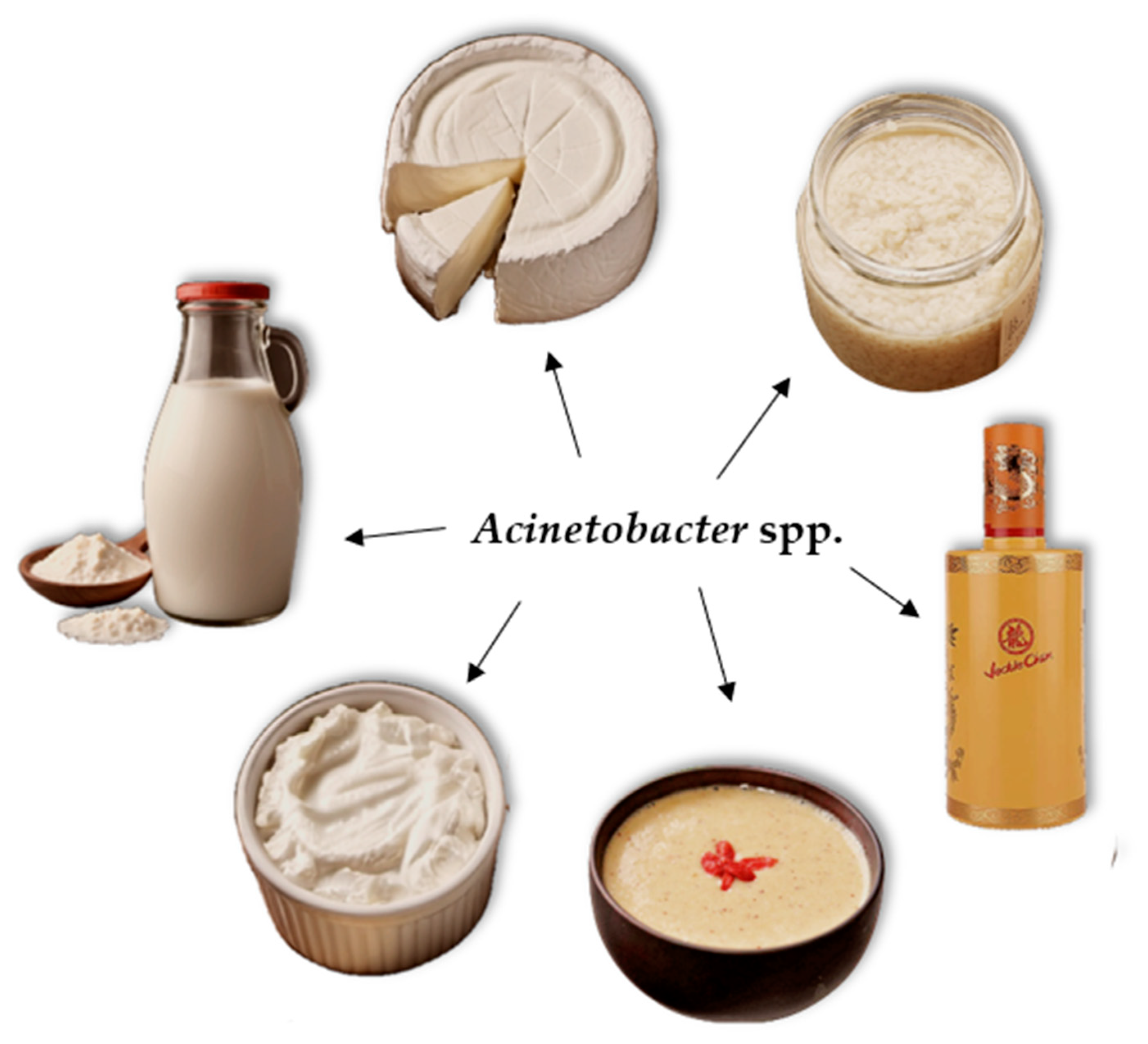

Table 1.
A comparison of the genomes of Acinetobacter baumannii and Acinetobacter baylyi in different categories.
Table 1.
A comparison of the genomes of Acinetobacter baumannii and Acinetobacter baylyi in different categories.
| A. baumannii | A. baylyi | Source | |
|---|---|---|---|
| Size of genome | Approximately | Approximately | |
| 3.4 to 4.2 Mb | 3.5 Mb | [56,57] | |
| Mobile genetic elements | Plasmids, transposons, Insertion sequences |
More stable genome | [57,58] |
| Antibiotic resistance | A Plethora of genes such as blaOXA-51 and pmrA, efflux pumps such as AdeABC, aminoglycoside-modifying enzymes | Lack of many determinants, more susceptible to antibiotics | [12,57] |
| Virulence factors |
Various factors, such as |
||
| OmpA, CarO, T2SS and T6SS components | Significantly less or none | [49,57] | |
| Metabolic adaptability | |||
| Equipment for survival in hostile environments | More adaptive and versatile | [57,59] | |
| Biofilm formation | Bap, csu operon, quorum sensing system | Less developed strategies | [43,60] |
| Iron acquisition system | Ferric uptake regulator, siderophores - acinetobactin and baumannoferrin | Lack of advanced system | [55,57] |
Disclaimer/Publisher’s Note: The statements, opinions and data contained in all publications are solely those of the individual author(s) and contributor(s) and not of MDPI and/or the editor(s). MDPI and/or the editor(s) disclaim responsibility for any injury to people or property resulting from any ideas, methods, instructions or products referred to in the content. |
© 2024 by the authors. Licensee MDPI, Basel, Switzerland. This article is an open access article distributed under the terms and conditions of the Creative Commons Attribution (CC BY) license (http://creativecommons.org/licenses/by/4.0/).
Copyright: This open access article is published under a Creative Commons CC BY 4.0 license, which permit the free download, distribution, and reuse, provided that the author and preprint are cited in any reuse.