

Submitted:
02 July 2024
Posted:
03 July 2024
You are already at the latest version
Preprints on COVID-19 and SARS-CoV-2
Abstract
Internships can foster educational alliances between industry (business environment) and academic institutions, which can facilitate both flexibility and accelerated innovation. The purpose of this research is to search for the factors that determine HRD through the implementation of the Internship program among the students of Democritus University of Thrace and reveal the correlation between the factors. Also, this paper investigated the impact of the COVID-19 Eras on Human Resource Development (HRD) Factors and finally, investigated the correlation between the two variables "Recruitment in the specialization" and "Covid Eras". The sample of the research consisted of 1398 students of DUTh who implemented Internships during the academic years 2015-2016 to 2021-2022. A questionnaire with 60 variables was created for data collection. A random sampling method was applied to collect the sample. From the results of the survey, ten factors were extracted for human resource training that explained 75.512% of the total variance and for each one, Cronbach's Alpha reliability was tested, which was high. In detail, the factors revealed were Learning Outcomes, Efficacy, Emotional Commitment, Satisfaction, Participation, Empowerment, Role Ambiguity, Role Conflict, Supervisor and Collaboration. From the results of the study, it was evident that HR development - training is a multi-dimensional concept and is a necessary condition for the competitiveness of the firms. Training can help to improve the flexibility of the firm, but also to motivate the staff by implementing multidisciplinary training programs. In general, internship programs are valuable ways for students to acquire broad competences, where the practical knowledge gained supports and complements the theoretical studies acquired in educational institutions.
Keywords:
internship
; training
; development
; human resources
; university
; covid
1. Introduction
Innovation benefits both the service provider and customers, improves the provider’s competitive advantage and is based on technology or systematic methods. Service innovation is increasingly seen as a set of criteria for a business’s competitive strategy. Its primary objective is to assist businesses by improving their service capabilities during the planning stages of service criteria development. The introduction of innovative ideas has spurred additional research and development in services, leading to new methods of delivering benefits, creating new service concepts, or developing new business models. This progress is achieved through continuous operational improvements, advancements in technology, performance enhancements, investment in human resources, and better customer experience management.
There have been extensive discussions on the role of human resource management in modern organisations. Justifying the actual contribution of human resource management in the business arena has been a key concern for many academics and researchers; hence, numerous empirical studies had been conducted which examined the impact of different human resource management practices on the overall performance of businesses [1].
The innovation process does not conclude with the adoption of new or modified technologies. Considerable effort is needed during their implementation and efficient utilization, enabling the business to develop the necessary skills for successful innovation integration [2]. In order to achieve optimal operation of new or significantly improved services, some changes in the organization of employees and their training must also take place. The successful implementation of innovations is influenced by nine factors: market selection, strategic human resource management, employee training, market responsiveness, empowerment, behavioral evaluation, marketing engagement, employee commitment, and quality of materials [3].
An attempt was made by [4] emphasized the importance of empowering human resources to address the complexity and flexible nature of Industry 4.0. Managing quality solely through technology without considering human skills can be futile. Quality Management 4.0 is an integrated, coherent, and interconnected system where reliability and efficiency depend on each component. Quality production cannot be achieved without a quality workforce.
Businesses, in their effort to ensure the administrative support of employee training activities and to motivate trainees to learn in order to be able to successfully transfer the knowledge they have acquired to their job-related tasks, have set themselves the goal of becoming ‘training organisations’ [5]. Internship programs enable organizations to provide this by utilising the cooperation between the Universities and the market. The same author states that Training and Development “T&D” programs can improve the competitiveness of a firm as they directly increase the value of its intangible assets i.e., create business asset in human capital, customer capital, social capital and intellectual capital. An ‘organization’ has the potential to gain a competitive advantage over other businesses as through human resource training it can transform its available resources into capabilities that are unique for the business itself [6]. According to [7], training that aims at developing the organizations’ human capital (by transmitting techniques, skills and values through which individuals give meaning to their work and fit into the organization) typically focuses on the complete long-term development of employees competences. Allocating money for educational purposes, however, should be seen as an investment to achieve better results both in the short and long term and not as a cost to the business’s operations [8].
The close cooperation of these gives impetus to the creation of a common interest, ambition and goal for a shared vision [9] in any well-organised internship. Internships are often seen to be mutually beneficial to the intern, the educational institution and industry [10,11]. A study in the US [12] conducted among 160 companies offering internships to undergraduate and graduate students concluded that student maturity, initiative and responsibility can influence performance, which in turn leads to firm satisfaction.
The purpose of this research was to determine the factors that determine HRD through the implementation of the Internship program among the students of Democritus University of Thrace and exlpored the correlation between the factors. Also, this paper revealed the impact of the COVID-19 Eras on Human Resource Development (HRD) Factors and finally, investigated the correlation between the two variables “Recruitment in the specialization” and “Covid Eras”.
2. Literature Review
2.1. Internship
Strengthening innovation and knowledge transfer is a high priority in EU policy and is at the heart of European programs and funding. In this new environment, universities and public research organisations play a key role in knowledge transfer and innovation outcomes, because they integrate physical and institutional channels to transform basic research results into pre-competitive results ready for industrial exploitation. The development of more effective principles and mechanisms to promote the university-market-industry link becomes necessary to implement knowledge transfer and develop innovative solutions.
Student internships are crucial for producing well-trained graduates for future employment, offering essential exposure to the real-world industry. Additionally, employers use internship programs to identify and recruit potential candidates for their organizations [13]. The internship gives students the opportunity to work for a short period of time in a real working environment. They have the opportunity to transfer their scientific knowledge to real-life conditions and apply it. They are also given the opportunity to enhance their scientific knowledge with professional skills and qualifications. Through the internship, students come into contact with the modern business and working environment and are prepared for their smooth integration and integration after receiving their degree. At the same time it provides the opportunity to network with institutions and business executives. It is a fact that during their studies, the opportunity to gain professional experience is particularly useful for their later professional career and really contributes to the smooth start of their professional career [14].
Internships, as a form of workplace training, are an important component of many professional programs [15]. It helps students bridge the gap between the academic educational process and its practical application by exposing them to real-life situations [16]. The definition of an internship varies based on the group of participating students (interns), the duration, the type of employment, their ultimate goals, and the context in which the internships are organized [17].
For educational institutions, internships can strengthen ties with industry and help students better understand business and industry expectations. For industry, internships serve as a foundation for producing future candidates for the workforce [18]. A well-organised internship will help students make a smooth transition from educational institution to industry [19].
2.2. Human Resources Training and Development
Training is the organized learning process that aims to acquire knowledge and skills for a specific purpose. According to [20], the term human resource development has a broader meaning. Specifically, they state that human resource development is a learning process with a longer time horizon whose goal is for employees to acquire knowledge and develop competencies that can be used in the future, in tasks that require more responsibility and initiative. Development therefore has a human-centered character, since the whole learning process aims to develop the personality of the employee so that in the future he or she will be able to cope with situations, take initiative and make decisions that are not only related to the technical dimension of the tasks but also to solving organizational issues.
Given the importance of enhancing human resource skills in Industry 4.0, companies should adopt strategies to boost their workforce’s competitiveness. Focusing solely on process automation will result in financial savings, but integrating strategies that leverage human resources’ capacities and talents, along with technology, can lead to substantial business growth and goal achievement. Managers must consistently and carefully monitor digital developments and changes that enhance production efficiency and improve various functions, including human resource management. By enhancing human resource skills and capacity, companies can promote process innovation, reflecting a strong “innovation orientation” [21]. Nowadays economic crisis has cover the world due to wars and uncertainty, so organizations pay attention to their human assets for growth and excellence and specifically to employees who have strong determination and willpower [22].
Another research of [23] stresses that human resource training is a necessary condition for the competitiveness of firms. Even the smartest strategy can be fruitless if the firm is not supported by adequate personnel, placed in the right job positions. The human resources training is an investment for the company because it focuses on the development of their competencies and skills, achieving the enhancement of their productivity and leading to the reduction of the cost of the work produced. In straightforward terms, businesses that have a positive view towards training their employees see it as an investment that will bring them future benefits. As a result, the advantages that come from investing in their staff outweigh the costs involved [24].
Hypothesis 1: There is a strong positive correlation between the factors of HRD: Learning Outcomes, Efficiency, Emotional Commitment, Satisfaction, Participation, Empowerment, Role Ambiguity, Role Conflict, Supervisor and Cooperation.
Hypothesis 2: Covid Eras have significant impact on the evaluation of the factors of HRD.
Hypothesis 3: There is a significant correlation between the two variables “Recruitment in the specialization” and “Covid Eras”.
3. Materials and Methods
For this research 1398 students of the Democritus University of Thrace in Greece (507 men, 889 women, 2 other) completed the questionnaire. They participated as beneficiaries in the framework of the Program “Internship of students of DUTH”, for the academic years 2015-2016 to 2021-2022, implemented with the funding of the National Strategic Reference Framework (NSRF) 2014-2020.
The questionnaire was developed taking into account the questionnaires from the surveys of [25,26,27] as well as additional questions concerning the training of human resources and consequently in the development of future business executives. The questionnaire consists of 71 questions divided into three sections.
A. The first section concerns the information on personal data and the consent/assent of the research participant (questions 1- open-ended and 2- closed-ended).
B. The second section is about the demographic characteristics of the beneficiaries and the characteristics of the internship they implemented, with eight questions (questions from 3-10 closed-ended except the 8th one which is open-ended), related to gender, age, year of study they belonged to when they implemented the internship, the department of study, the academic year in which the internship was implemented, the name of the host organization, the duration of the internship and finally a question about their continued employment at the host organization after the end of the internship.
C. The third section concerns the evaluation of the internship program and consists of 60 questions divided to subsections related to the following concepts
- Learning Outcomes
- Efficiency
- Emotional Commitment
- Satisfaction
- Participation
- Empowerment
- Role Ambiguity
- Role Conflict
- Supervisor
- Cooperation
After the completion of their internship, students received an email to evaluate the internship program. The research took place until October 2022.
For statistical analysis, it was used frequency analysis and descriptive analysis to determine the mean scores, standard deviations and percentages. Also, for the control of the validity of the questionnaire, it was used PCA and varimax rotation. For the reliability test, Cronbach’s coefficient a was calculated. Furthermore, to correlate the relationship between the factors and the degree of dependence between them, the Pearson correlation coefficient was calculated. Crosstabs analysis was applied to describe in more detail both the variables “Recruitment in the specialization” and “Covid Eras” and chi-Square test was used for the correlation between them. Finally, to investigate whether covid-19 period has an effect on students’ perception of HRD factors, one-way ANOVA was also applied.
4. Results
In the survey there was representation of students from all 18 departments of DUTh that participated in the Internship Program that period as shown in Figure 1 below.
The duration of the internship varies for each department and includes a period of one to three months as shown in Table 1.
Given that during the collection of the results, the pandemic due to the spread of covid-19 intervened, the need for further separation arose. Specifically, the compute command was applied in order to create an additional variable which was defined as “covid-19 era” and includes three periods of students that implemented internship, a) the pre-covid era with the academic years 2015-2018 (era 1), b) the covid era 2019-2020 (era 2) and c) the post-covid era 2021-2022 (era 3). The results via the compute command are shown in the table covid-19 era and are listed below in Table 2 and Figure 2.
For the control of the validity of the questionnaire, principal components analysis method and the varimax rotation were applied for the 60 variables. The sample consisted of 1398 students. Principal component analysis revealed 10 factors that explained 73.512% of the total variance (Table 3). The names of the factors were given based on the human resources training literature and the researchers’ construction design. The survey used those factors with eigenvalues above 1 (Guttman - Kaiser). The smallest loading used to divide the questions into the factors was 0.40. Loadings are the weight of each variable on each factor (correlation index) and provide basic information for the interpretation of the factors. The higher the loading the easier the interpretation of the factor. For the reliability test, Cronbach’s coefficient a was calculated for each factor and in total. Cronbach’s coefficient a for the 60 questions of the scale was found to be high (a = .969).
To correlate the relationship between the factors and the degree of dependence between them, the Pearson correlation coefficient was calculated which is used to show the linear relationship between the variables. Range of Correlation Coefficient Type of Relationship between variables:
- ⮚ From -1,0 to -0,7 Strong negative relationship
- ⮚ From -0,0 to -0,3 Weak negative relationship
- ⮚ From -0,3 to +0,3 Minimal or no relationship
- ⮚ From +0,3 to +0,7 Weak positive relationship
- ⮚ From +0,7 to +1,0 Strong positive relationship
Table 4 summarizes the range of the correlation coefficient that may exist between the variables and the conclusions drawn about the strength and direction of correlation. According to the data in Table, it appears that there is a strong positive correlation between the factor Learning Outcomes and Satisfaction with a correlation coefficient of 0.808**, the factor Learning Outcomes and Efficiency with a correlation coefficient of 0.774** and the factor Efficiency and Satisfaction with a correlation coefficient of 0.702**. There is also a weak positive pairwise relationship between the participation factor and the supervisor (0.357**), collaboration (0.336**), learning outcomes (0.520**), ambiguity (0.382**), satisfaction (0.448**) and efficiency (0.535**) factors. The Table 4 shows that the correlations are statistically significant (p<0.005).
The crosstabs analysis was applied to describe in more detail both the variables “Recruitment in the specialization” and “Covid Eras”. The results as shown in Table 5 below show that the variable “recruitment in the specialization” does not show variations during the pandemic era.
The results of the Chi-Square test showed that there is no statistically significant correlation between the two variables “Recruitment in the specialization” and “Covid Eras” and Table 6 below demonstrates this.
To investigate whether covid-19 period has an effect on students’ perception of HRD factors, one-way ANOVA was also applied which revealed statistically significant differences. The time period of covid-19 was divided into three levels. Pre-covid Era with the academic years 2015-2018 (Era 1), Covid Era 2019-2020 (Era 2) and Post-covid Era 2021-2022 (Era 3). The results are presented below:
- Participation F(2,1366) = 59.155, p<0.05
- Supervisor F(2,1375) = 59.291, p<0.05
- Cooperation F(2,1366) = 48.876, p<0.05
- Empowerment F(2,1368) = 17.564, p<0.05
- Learning Outcomes F(2,1350) = 64.179, p<0.05
- Role Ambiguity F(2,1372) = 25.762, p<0.05
- Role Conflict F(2,1374) = 6.611, p<0.05
- Satisfaction F(2,1365) = 27.583, p<0.05
- Emotional Commitment F(2,1361) = 6.772, p<0.05 και
- Efficiency F(2,1357) = 75.040, p<0.05
In order to identify the differences between the levels of the independent variable covid Era a Post Hoc analysis using Scheffe was followed and it was revealed that in almost all levels and all factors there are statistically significant differences which are presented in the table below (Table 7). The only exceptions that do not show statistically significant differences between levels and factors are the following:
- -
- For the Participation factor between the 2nd and 3rd level.
- -
- For the Supervisor factor between the 2nd and 3rd level.
- -
- For the Enhance factor between 2nd and 3rd level.
- -
- For the Learning Outcomes factor between the 2nd and 3rd level.
- -
- For the factor Role Ambiguity between the 2nd and 3rd level.
- -
- For the Role Conflict factor between the 1st and 3rd level.
- -
- For the Satisfaction factor between the 2nd and 3rd level.
- -
- For the Emotional Commitment factor between the 2nd and 3rd level.
- -
- For the Efficiency factor between the 2nd and 3rd level.
Therefore, the covid-19 variable can influence students’ perception of HRD factors with Mean Scores shown in detail:
5. Discussion and Conclusions
The research results indicated that staff development and training are vital for the competitiveness of businesses. Based on these findings, organizations should prioritize the improvement of Training and Development programs. The study identified ten crucial factors that companies and organizations need to consider for internships to be integrated into their human resources training. The research also discovered that students who were offered a job were more content with their internships compared to those who were not. This finding aligns with the research referenced as [28]. Satisfaction was found to be influenced by the trainees’ perception of receiving career information during their studies and internships, which in turn affected their performance. When intrinsically motivated and satisfied, trainees exhibited more confidence in the industry and were more willing to pursue a career, as also outlined in the research referenced as [29].
The findings indicate that the supervisor’s role is crucial in the work environment. Supervisors should share their experiences with student interns to enhance the learning process. Mentoring is important in the internship program. Students who have supervisors as mentors in internship programs tend to have better experiences. Mentors can help students navigate the organization and learn valuable skills for their career aspirations. This was also supported by research from [30], who suggested that organizations should establish appropriate working hours for student interns and provide fair salaries.
Our research indicates that institutions should ensure that they provide adequate training programs to enhance student satisfaction during internships as potential employees. Similarly, businesses should have innovative policies to support new employees. On-job Training can increase employee satisfaction and commitment as it stimulates personal development and self-esteem based on the organization. This finding aligns with the research of [31]. The quality of learning during internships significantly impacts overall satisfaction. Students can expect to improve their learning outcomes and job readiness, thus providing valuable human resources to the industry, in line with the research of [29]. According to the study by [32], internships help interns become more responsible, confident, dedicated, and adaptive, and assist in updating technical skills. Interns demonstrate dedication to their work during internships and enhance their skills and technical knowledge.
Empowerment of trainees can lead to better learning outcomes and improved preparation for their intended careers, thus providing valuable human resources to the industry. Role ambiguity helps measure the clarity of the work assigned to trainees. Clear expectations benefit trainees with well-defined programs and specific tasks, as opposed to those in open-ended programs with less-defined objectives [33,34]. Regression analysis in [35] shows that HRM practices, such as selection, participation, and employee empowerment, have a significant and positive effect on employee job performance. The study suggests that training moderates the impact of HRM practices on employees’ performance and that the sustainability of HRM practices greatly affects job performance. The research in [36] enhances managers’ understanding of the role of empowerment-focused HRM practices. Lastly, stakeholder cooperation is an important factor highlighted in the research. Both the industry and academia should collaborate to create a comprehensive internship program for students, as indicated in the research [37].
The results revealed that Covid Eras have significant impact on the evaluation of the factors of HRD (Pre-covid Era, covid Era, post-covid Era). During covid period, the higher education faced difficulties in training and internship programs. Students had to adjust to a new and difficult situation and businesses adopted new methods of distance services. In accordance with reference [38], it is suggested that blended teaching (b-teaching) is beneficial for developing internship competencies. It is important to align the activities developed during internships with the evaluated skills. Blended methods could include: a) On Job training, suggested methods: demonstration, coaching, mentoring, controlled internship, job briefing, cross training. b) Off Job Training (at the university), proposed methods: role plays, induction training, case studies, simulation training, detailed outline of an internship course, lecture-discussions, and written assignments. c) Distance learning (E-learning) for deeper understanding in teaching and combining academic and labor market knowledge.
6. Implications
The internship program provides students with a better understanding of how it enhances their skills and helps them secure placement. This aligns with the findings of a study by [39], which can assist institutions in creating effective internship programs that benefit all involved parties. Another study by [40] identified curriculum requirements as a crucial aspect of hotel internship experiences, reflecting the responsibilities of educational institutions in shaping these experiences. The study emphasized that internship achievements and curriculum requirements significantly influence internship satisfaction and career intention. Since today’s trainees are tomorrow’s employees, organizations can benefit from their feedback and use it to improve their HR processes. Therefore, educational institutions and supervisors should strive to enhance their curricula by consulting relevant studies and collaborating with companies. These changes are vital mainly due to the economic downturn, high unemployment rates and new forms of employment such as rotational and part-time work. Occupational integration is defined as the process of stabilization in the employment of people who have never participated in the active population, it is considered a change of situations in the context of an individual process of transition from an initial to a final situation. The level of unemployment combined with additional macroeconomic conditions is a key determinant of integration in accordance with the research [41].
7. Limitations and Future Research
The study could be replicated in the future using more diverse samples from various universities or countries to expand the results. In conclusion, fostering innovative cooperation between the business sector and universities through internship programs can enhance the understanding of innovation dynamics and facilitate strategic HR training and development.
Author Contributions
Conceptualization, S.E. and Y.G.; methodology, S.E., Y.G., K.A. and K.V.; software, S.E. and Y.G.; validation, S.E. and Y.G.; formal analysis, S.E. and Y.G.; investigation, S.E. and Y.G.; resources, P.A., Y.G. and S.E..; data curation, S.E. and Y.G.; writing—original draft preparation, S.E. and Y.G.; writing—review and editing, S.E. and Y.G.; visualization, Y.G. and P.A.; supervision, Y.G..; project administration, S.E., Y.G., K.A. and K.V. All authors have read and agreed to the published version of the manuscript.
Funding
Full waiver of publication fees by Guest Editor Dr. Koronios.
Informed Consent Statement
Informed consent was obtained from all subjects involved in the study. Approval from the Ethics Committee of DUTh Protocol No. 45784-441/20-4-2021
Data Availability Statement
Data supporting reported results can be shared after communication with the researchers.
Conflicts of Interest
The authors declare no conflicts of interest.
References
- Theriou, G. The impact of human resource management (HRM) practices on the operational performance of the production process and the ability to create and use knowledge. Doctoral thesis. 2009, Democritus University of Thrace (DUTH), Department of Production Engineering and Management (in Greek).
- Sirilli, G.; Evangelista, R. Technological innovation in services and manufacturing: results from Italian surveys. Research Policy 1998, 27, 881–899. [Google Scholar] [CrossRef]
- Ottenbacher, M.; Gnoth, J. How to develop successful hospitality innovation. Cornell Hotel and Restaurant Administration Quarterly 2005, 46(2), 205–222. [Google Scholar] [CrossRef]
- Balouei Jamkhaneh, H.; Shahin, A.; Parkouhi, S. V.; Shahin, R. The new concept of quality in the digital era: a human resource empowerment perspective. The TQM Journal 2022, 34(1), 125–144. [Google Scholar] [CrossRef]
- Noe, R.A. Employee Training and development (5th ed.). 2010, New York: McGraw-Hill.
- De Villiers, W.A. The learning organisation: validating a measuring instrument. Journal of Applied Business Research, 2008, 24(4), 11-22. http://www.cluteinstitute.com/JABRMain.htm.
- Garcia, M. U. Training and business performance: The Spanish case. The International Journal of Human Resource Management 2005, 16(9), 1691–1710. [Google Scholar] [CrossRef]
- Nadiri, H.; Hussain, K. Perceptions of service quality in North Cyprus hotels. International Journal of Contemporary Hospitality Management 2005, 17(6), 469–480. [Google Scholar] [CrossRef]
- Kliknaite, S. How proximity matters in Industry? University knowledge transfer. International Journal of Technology Transfer and Commercialization 2009, 8(2-3), 246-269.
- Borkowski, S. Internships for high school students. 2008, FastWeb, A Monster Company, University of South Florida: A Program of Union Pacific Foundation.
- Divine, R. L.; Linrud, J. K.; Miller, R. H.; Wilson, J. H. Required internship programs in marketing: Benefits, challenges and determinants of fit. Marketing Education Review 2007, 17(2), 45–52. [Google Scholar] [CrossRef]
- Lord, K. R.; Sumrall, D.; Sambandam, R. Satisfaction determinants in business internships. Interdisciplinary Journal of Contemporary Research in Business 2011, 2(10), 11–22. [Google Scholar]
- Pusiran, A. K.; Janin, Y.; Ismail, S.; Dalinting, L. J. Hospitality internship program insights. Worldwide Hospitality and Tourism Themes 2020, 12(2), 155–164. [Google Scholar] [CrossRef]
- Bouranta, M. The role of internships in luxury hotels. Diploma thesis. 2017, Department of Business Administration, Technological Institution of Crete (St.Nikolas) (in Greek).
- Levesque, K.; Lauen, D.; Teitelbaum, P.; Alt, M.; Librera S. Vocational Education in the United States: Toward the Year 2000. Statistical Analysis Report. 2000, National Center for Education Statistics (ED), Washington, DC.; MPR Associates, Berkeley, CA.
- Lam, T.; Ching, L. An exploratory study of an internship program: The case of Hong Kong students. International Journal of Hospitality Management 2007, 26(2), 336–351. [Google Scholar] [CrossRef]
- Crnković-Pozaić, S. Transition from school to work: Internships and first entry to the labour market in Croatia. 2009, ETF.
- Johnston, H. Internships for high school students. The Principal Partnership: A Program of Union Pacific Foundation. 2008, University of South Florida.
- Carlin, A.; Manson, D. My school, my teacher: A polytechnic approach to information assurance. Communication of the IIMA 2007, 7(3), 65–78. [Google Scholar]
- Panayotopoulou, L.; Bourantas, D.; Papalexandris, N. Strategic human resource management and its effects on firm performance: an implementation of the competing values framework. International Journal of Human Resource Management 2003, 14(4), 680–699. [Google Scholar] [CrossRef]
- Balouei Jamkhaneh, H.; Shahin, A.; Parkouhi, S.V.; Shahin, R. The new concept of quality in the digital era: a human resource empowerment perspective. The TQM Journal 2022, 34(1), 125–144. [Google Scholar] [CrossRef]
- Tripathi, P.M.; Srivastava, S.; Singh, L.B.; Kapoor, V.; Solanki, U. A JD-R perspective for enhancing engagement through empowerment: A study on Indian hotel industry. Journal of Hospitality and Tourism Management 2021, 46, 12–25. [Google Scholar] [CrossRef]
- Fayos-Sola, E. An Introduction to TEDQUAL: A Methodology for Quality in Tourism Education and Training. 1997, Madrid: World Tourism Organisation -WTO.
- Laloumis, D. Human resource management in tourism enterprises [Undergraduate textbook]. 2015, Kallipos, Open Academic Publications. http://hdl.handle.net/11419/5295 (in Greek).
- Odio, M. A. The role of the internship in career decision-making for TRSM students. 2013, Dissertation thesis. University of Florida, UMI 3586629.
- Mavridou, E. Training and development of employees: the case of graduates. 2017, Master thesis, School of Social Sciences, Hellenic Open University.
- Akomaning E.; Voogt J.M.; Pieters J.M. Internship in vocational education and training: Stakeholders’ perceptions of its organization. Journal of Vocational Education & Training 2011, 63(4), 575-592.
- Vukić, M.; Kuzmanović, M.; Vukić, M. Students’ perspective of internship in vocational higher education. Management: Journal of Sustainable Business and Management Solutions in Emerging Economies 2022, 27(1), 11–20. [CrossRef]
- Wang, C.J. Should I Stay or Should I Go? Linking Career Decision-Making Self-Efficacy to Intention to Stay in the Hospitality Industry Based on Internship Experience. Sustainability 2021, 13(19), 10571. [Google Scholar] [CrossRef]
- Kukreti, R.; Dani, R. Determining the role of working environment, contextual factors and task characteristics in internship satisfaction of hospitality undergraduates. Materials Today: Proceedings 2021, 46, 11226–11229. [Google Scholar] [CrossRef]
- Vo, N.T.; Le, L.H. P.; Lam, V.T.T. Challenges for student satisfaction of internship program in hospitality and tourism industry in Vietnam. Journal of Quality Assurance in Hospitality & Tourism 2022, 23(5), 1298-1324.
- Joshi, S.; Tyagi, H. A study on student’s perception about internship program and its impact on their personality, with reference to hotel management students of Pune Region. Atithya: A Journal of Hospitality 2019, 5(2), 67-74.
- Rothman, M. Lessons learned: Advice to employers from interns. Journal of Education for business 2007, 82(3), 140–144. [Google Scholar] [CrossRef]
- Knouse, S.B.; Fontenot, G. Benefits of the business college internship: A research review. Journal of Employment Counseling 2008, 45(2), 61–66. [Google Scholar] [CrossRef]
- Manzoor, F.; Wei, L.; Bányai, T.; Nurunnabi, M.; Subhan, Q.A. An Examination of Sustainable HRM Practices on Job Performance: An Application of Training as a Moderator. Sustainability 2019, 11, 2263. [Google Scholar] [CrossRef]
- Zhang, H.; Yang, M.; Huo, B. The impact of empowerment-focused human resource management on relationship learning and innovation. Industrial Management & Data Systems 2021, 121(8), 1767-1783.
- Karunaratne, K.; Perera, N. Students’ perception on the effectiveness of industrial internship programme. Education Quarterly Reviews 2019, 2(4), 822–832. [Google Scholar] [CrossRef]
- Ruiz-Ruiz, B.; García-Arrabé, M.; del Prado-Álvarez, R.; Bermejo-Franco, A.; Diaz-Meco Conde, R.; González-Fernández, L.; Aladro-Gonzalvo, A.R. Competence Development in an Undergraduate Physiotherapy Internship Program during the COVID-19 Pandemic: A Blended Learning Approach. Sustainability 2023, 15, 12052. [Google Scholar] [CrossRef]
- Jagannath, D.; Mishra, R.; Pal, S.; Mishra, N.; Singh, M.K. Is Internship Influencing Hotel Management Students’ Perception about Hospitality Industry? International Journal of Economic Research 2017, 14(9), 391–400. [Google Scholar]
- Qu, H.; Leung, X.Y.; Huang, S.S.; He, J. Factors affecting hotel interns’ satisfaction with internship experience and career intention in China. Journal of Hospitality, Leisure, Sport & Tourism Education 2021, 28, 100311. [Google Scholar]
- Blanchflower, D. G.; Freeman, R. B. The Declining Economic Status of Young Workers in OECD Countries”. Youth Employment and Joblessness in Advanced Countries, edited by David G. Blanchflower and Richard B. Freeman, Chicago: University of Chicago Press, 2000, pp. 19–56.
Figure 1.
The representation at the research of 18 departments of DUTh that participated in the Internship Program.
Figure 1.
The representation at the research of 18 departments of DUTh that participated in the Internship Program.
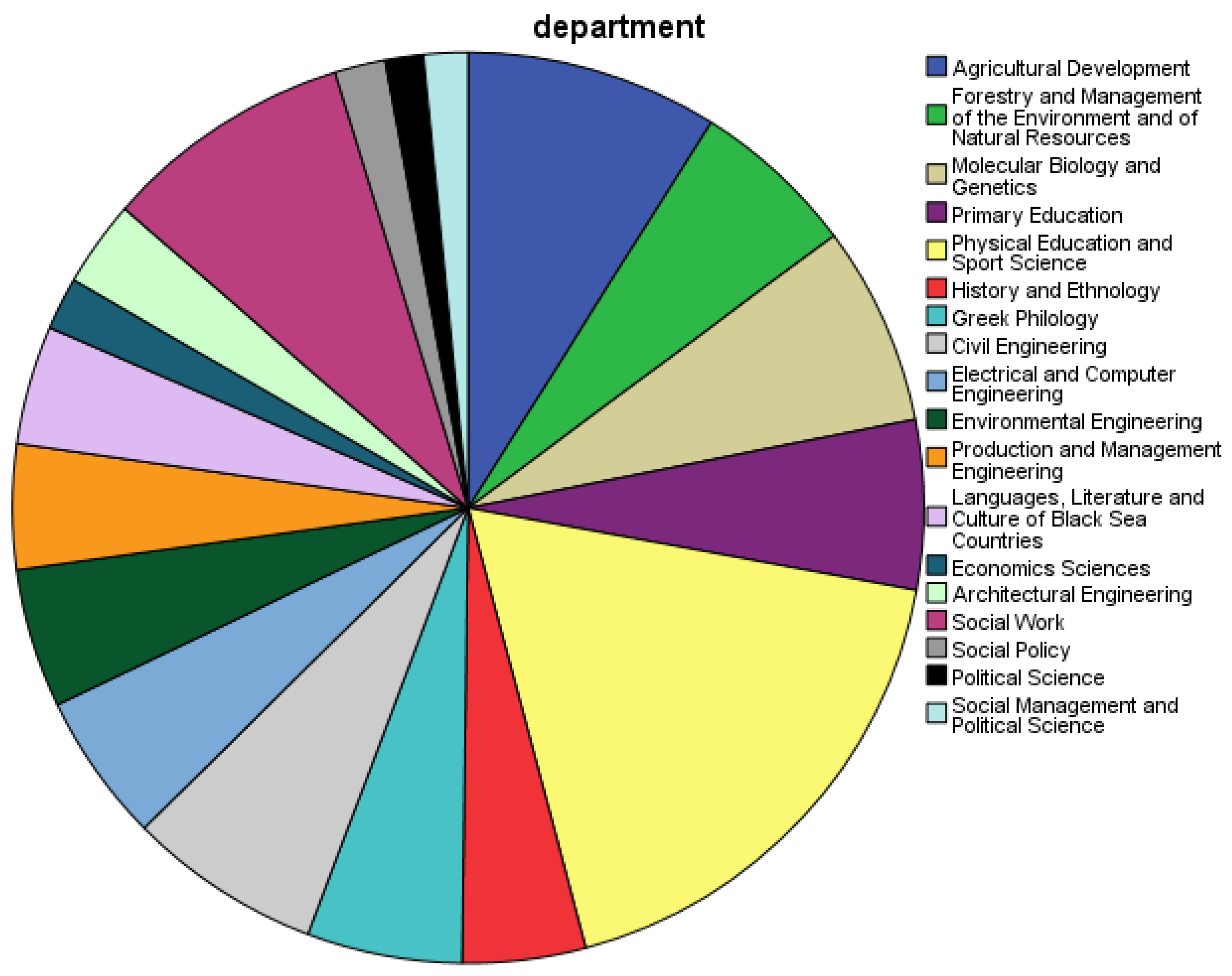
Figure 2.
Pre-covid, covid and post-covid Eras of students that implemented internship.
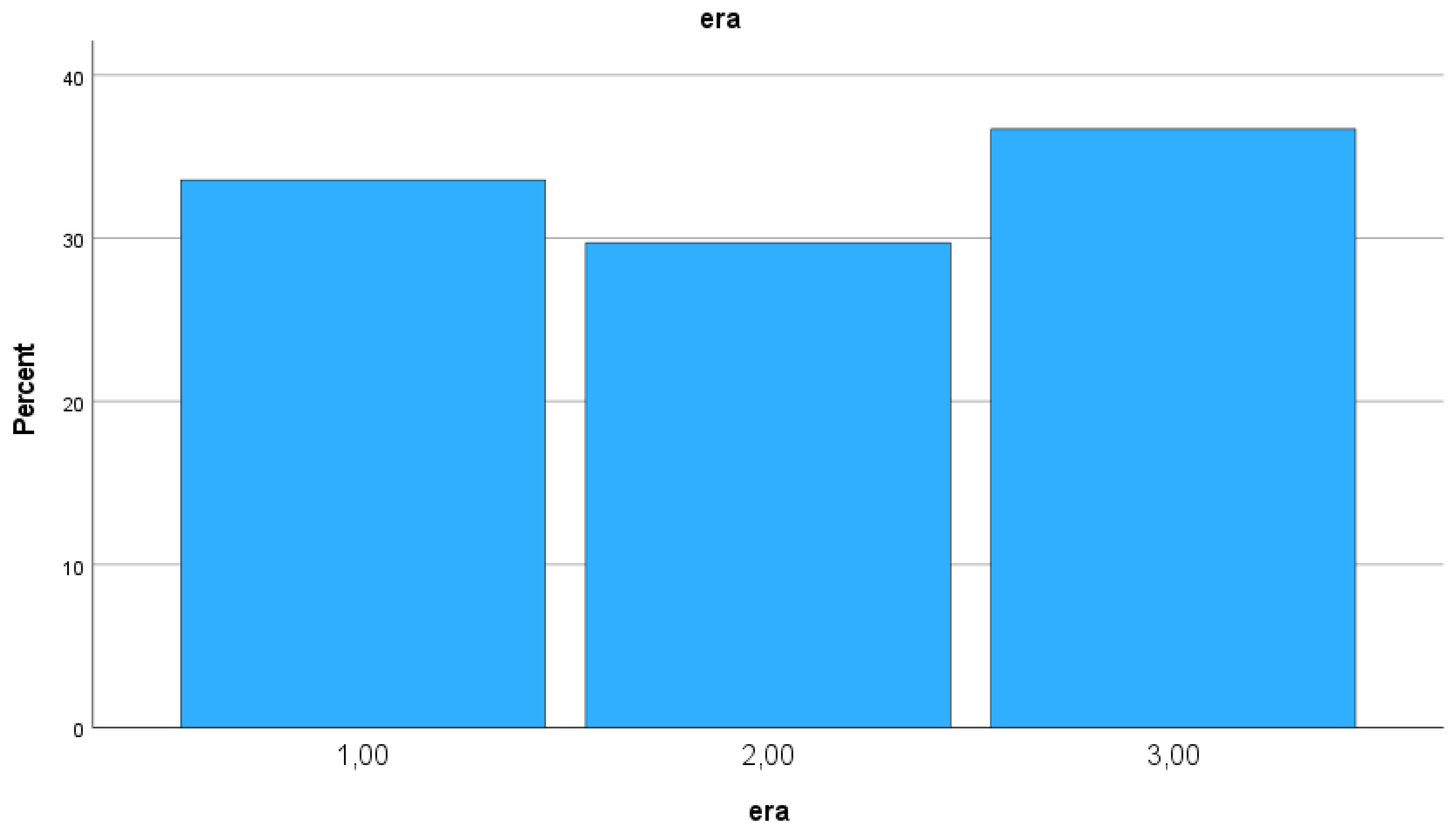

Table 1.
Internship duration.
| Frequency | Percentage | ||
| Duration | 1 month | 286 | 20,5 |
| 2 months | 885 | 63,3 | |
| 3 months | 227 | 16,2 | |
| Total | 1398 | 100,0 |
Table 2.
Covid-19 eras.
| Frequency | Percentage | Valid percentage | ||
| Temporal areas | Era 1 | 463 | 33,1 | 33,6 |
| Era 2 | 410 | 29,3 | 29,7 | |
| Era 3 | 506 | 36,2 | 36.7 | |
| Total | 1379 | 98.6 | 100,0 | |
| Missing values | 20 | 1,4 | ||
| Total | 1398 | 100,0 |
Table 3.
PCA, number of variables, factor’s loadings, eigenvalue, variance, Cronbach α, mean score and standard deviation of each factor.
Table 3.
PCA, number of variables, factor’s loadings, eigenvalue, variance, Cronbach α, mean score and standard deviation of each factor.
| FACTORS | N. Items | Loadings | Eigenvalue | Variance % | α | Factor Mean | Factor St.D. |
|---|---|---|---|---|---|---|---|
| Learning outcomes | 17 | .739 | 12.430 | 20.717 | .963 | 3.699 | .929 |
| .729 | |||||||
| .810 | |||||||
| .744 | |||||||
| .784 | |||||||
| .772 | |||||||
| .715 | |||||||
| .670 | |||||||
| .649 | |||||||
| .611 | |||||||
| .598 | |||||||
| .528 | |||||||
| .719 | |||||||
| .689 | |||||||
| .658 | |||||||
| .692 | |||||||
| .559 | |||||||
| Efficiency | 7 | .609 | 5.146 | 8.577 | .936 | 3.672 | 0.952 |
| .688 | |||||||
| .683 | |||||||
| .640 | |||||||
| .705 | |||||||
| .662 | |||||||
| .510 | |||||||
| Emotional commitment | 6 | .776 | 4.579 | 7.631 | .944 | 3.783 | 1.068 |
| .796 | |||||||
| .770 | |||||||
| .877 | |||||||
| .883 | |||||||
| .760 | |||||||
| Satisfaction | 8 | .553 | 4.334 | 7.224 | .958 | 3.875 | 1.039 |
| .535 | |||||||
| .616 | |||||||
| .689 | |||||||
| .648 | |||||||
| .676 | |||||||
| .681 | |||||||
| .588 | |||||||
| Participation | 6 | .566 | 4.306 | 7.177 | .876 | 3.317 | 0.893 |
| .706 | |||||||
| .774 | |||||||
| .811 | |||||||
| .807 | |||||||
| .739 | |||||||
| Empowerment | 5 | .739 | 3.553 | 5.921 | .876 | 3.981 | 0.841 |
| .792 | |||||||
| .848 | |||||||
| .843 | |||||||
| .825 | |||||||
| Role Ambiguity | 3 | .773 | 2.703 | 4.506 | .915 | 3.629 | 1.093 |
| .766 | |||||||
| .712 | |||||||
| Role Conflict | 3 | .870 | 2.589 | 4.315 | .853 | 1.994 | 1.027 |
| .890 | |||||||
| .821 | |||||||
| Supervisor | 3 | .805 | 2.523 | 4.205 | .934 | 3.789 | 1.170 |
| .817 | |||||||
| .832 | |||||||
| Cooperation | 2 | .857 | 1.944 | 3.240 | .921 | 3.438 | 1.260 |
| .855 |
Table 4.
Pearson Correlation for the 10 factors.
| Participation | Supervisor | Cooperation | Empowerment | Learning Outcomes | Role Ambiguity | Role Conflict | Satisfaction | Emotional Commitment | Efficiency | |
|---|---|---|---|---|---|---|---|---|---|---|
| Participation | 1,0 | 0,357** | 0,336** | 0,112** | 0,520** | 0,382** | -0,114** | 0,448** | 0,288** | 0,535** |
| Supervisor | 0357** | 1,0 | 0,449** | 0,150** | 0,564** | 0,495** | -0,207** | 0,552** | 0,298** | 0,526** |
| Cooperation | 0,336** | 0,449** | 1,0 | 0,132** | 0,446** | 0,424** | -0,109** | 0,437** | 0,254** | 0,433** |
| Empowerment | 0,112** | 0,150** | 0,132** | 1,0 | 0,168** | 0,104** | 0,038 | 0,158** | 0,149** | 0,175** |
| Learning Outcomes | 0,520** | 0,564** | 0,446** | 0,168** | 1,0 | 0,627** | -0,127** | 0,808** | 0,571** | 0,774** |
| Role Ambiguity | 0,382** | 0,495** | 0,424** | 0,104** | 0,627** | 1,0 | -0,251** | 0,628** | 0,347** | 0,570** |
| Role Conflict | -0,114** | -0,207** | -0,109** | 0,038 | -0,127** | -0,251** | 1,0 | -0,277** | -0,081** | -0,125** |
| Satisfaction | 0,448** | 0,552** | 0,437** | 0,158** | 0,808** | 0,628** | -0,277** | 1,0 | 0,542** | 0,702** |
| Emotional Commitment | 0,288** | 0,298** | 0,254** | 0,149** | 0,571** | 0,347** | -0,081** | 0,542** | 1,0 | 0,531** |
| Efficiency | 0,535** | 0,526** | 0,433** | 0,175** | 0,774** | 0,570** | -0,125** | 0,702** | 0,531** | 1,0 |
Sig.(2 tailed) 0.005.
Table 5.
Percentages and number of students recruited in their specialization in each of the three Covid Eras.
Table 5.
Percentages and number of students recruited in their specialization in each of the three Covid Eras.
| Era | Number | % Recruitment in the specialization | % Covid Era |
|---|---|---|---|
| Pre-covid Era | 211 | 35,5% | 45,7% |
| Covid Era | 166 | 27,9% | 43% |
| Post-covid Era | 217 | 36,5% | 42,9% |
| Total students hired | 594 | 100% | 43,9% |
Table 6.
Chi-Square Tests “Recruitment in the specialization” and “Covid Eras”.
| Value | df | Asymptotic Significance (2-sided) | |
| Pearson Chi-Square | ,925a | 2 | ,630 |
| Likelihood Ratio | ,924 | 2 | ,630 |
| Linear-by-Linear Association | ,743 | 1 | ,389 |
| N of Valid Cases | 1354 |
a. 0 cells (,0%) have expected count less than 5. The minimum expected count is 169,34.
Table 7.
Factors, Eras and mean score.
| Mean | Std. Deviation | ||
| Participation | 1,00 | 2,9689 | ,97120 |
| 2,00 | 3,4656 | ,89640 | |
| 3,00 | 3,5248 | ,69218 | |
| Supervisor | 1,00 | 3,3362 | 1,28502 |
| 2,00 | 3,9812 | 1,11069 | |
| 3,00 | 4,0646 | ,94782 | |
| Cooperation | 1,00 | 3,0250 | 1,28801 |
| 2,00 | 3,4888 | 1,28636 | |
| 3,00 | 3,7966 | 1,07927 | |
| Empowerment | 1,00 | 4,1524 | ,83895 |
| 2,00 | 3,8224 | ,89409 | |
| 3,00 | 3,9470 | ,76831 | |
| Learning_Outcomes | 1,00 | 3,3276 | ,99401 |
| 2,00 | 3,8200 | ,89681 | |
| 3,00 | 3,9493 | ,76863 | |
| Role Ambiguity | 1,00 | 3,3413 | 1,18716 |
| 2,00 | 3,7849 | 1,05109 | |
| 3,00 | 3,7787 | ,97684 | |
| Role Conflict | 1,00 | 2,0557 | ,99542 |
| 2,00 | 1,8350 | 1,04106 | |
| 3,00 | 2,0527 | 1,02760 | |
| Satisfaction | 1,00 | 3,5929 | 1,13201 |
| 2,00 | 3,9903 | 1,03791 | |
| 3,00 | 4,0484 | ,88252 | |
| Emotional Commitment | 1,00 | 3,6286 | 1,15645 |
| 2,00 | 3,8283 | 1,09499 | |
| 3,00 | 3,8689 | ,94807 | |
| Efficiency | 1,00 | 3,2525 | 1,05173 |
| 2,00 | 3,8727 | ,87310 | |
| 3,00 | 3,8992 | ,77052 | |
Disclaimer/Publisher’s Note: The statements, opinions and data contained in all publications are solely those of the individual author(s) and contributor(s) and not of MDPI and/or the editor(s). MDPI and/or the editor(s) disclaim responsibility for any injury to people or property resulting from any ideas, methods, instructions or products referred to in the content. |
© 2024 by the authors. Licensee MDPI, Basel, Switzerland. This article is an open access article distributed under the terms and conditions of the Creative Commons Attribution (CC BY) license (http://creativecommons.org/licenses/by/4.0/).
Copyright: This open access article is published under a Creative Commons CC BY 4.0 license, which permit the free download, distribution, and reuse, provided that the author and preprint are cited in any reuse.


